WO2022158157A1 - 身体に対する侵襲に伴うせん妄の発症リスクの予測用バイオマーカー - Google Patents
身体に対する侵襲に伴うせん妄の発症リスクの予測用バイオマーカー Download PDFInfo
- Publication number
- WO2022158157A1 WO2022158157A1 PCT/JP2021/045367 JP2021045367W WO2022158157A1 WO 2022158157 A1 WO2022158157 A1 WO 2022158157A1 JP 2021045367 W JP2021045367 W JP 2021045367W WO 2022158157 A1 WO2022158157 A1 WO 2022158157A1
- Authority
- WO
- WIPO (PCT)
- Prior art keywords
- delirium
- acid
- surgery
- cells
- glycine
- Prior art date
- Legal status (The legal status is an assumption and is not a legal conclusion. Google has not performed a legal analysis and makes no representation as to the accuracy of the status listed.)
- Ceased
Links
Images




Classifications
-
- G—PHYSICS
- G01—MEASURING; TESTING
- G01N—INVESTIGATING OR ANALYSING MATERIALS BY DETERMINING THEIR CHEMICAL OR PHYSICAL PROPERTIES
- G01N33/00—Investigating or analysing materials by specific methods not covered by groups G01N1/00 - G01N31/00
- G01N33/48—Biological material, e.g. blood, urine; Haemocytometers
- G01N33/50—Chemical analysis of biological material, e.g. blood, urine; Testing involving biospecific ligand binding methods; Immunological testing
-
- G—PHYSICS
- G01—MEASURING; TESTING
- G01N—INVESTIGATING OR ANALYSING MATERIALS BY DETERMINING THEIR CHEMICAL OR PHYSICAL PROPERTIES
- G01N33/00—Investigating or analysing materials by specific methods not covered by groups G01N1/00 - G01N31/00
- G01N33/48—Biological material, e.g. blood, urine; Haemocytometers
- G01N33/50—Chemical analysis of biological material, e.g. blood, urine; Testing involving biospecific ligand binding methods; Immunological testing
- G01N33/53—Immunoassay; Biospecific binding assay; Materials therefor
-
- G—PHYSICS
- G01—MEASURING; TESTING
- G01N—INVESTIGATING OR ANALYSING MATERIALS BY DETERMINING THEIR CHEMICAL OR PHYSICAL PROPERTIES
- G01N33/00—Investigating or analysing materials by specific methods not covered by groups G01N1/00 - G01N31/00
- G01N33/48—Biological material, e.g. blood, urine; Haemocytometers
- G01N33/50—Chemical analysis of biological material, e.g. blood, urine; Testing involving biospecific ligand binding methods; Immunological testing
- G01N33/68—Chemical analysis of biological material, e.g. blood, urine; Testing involving biospecific ligand binding methods; Immunological testing involving proteins, peptides or amino acids
Definitions
- the present invention relates to biomarkers for predicting the risk of developing delirium associated with physical invasion.
- the present invention also relates to a method of predicting the risk of developing delirium associated with bodily insults.
- Delirium is a serious disease that affects about half of the elderly. Even if symptoms disappear, it is followed by decreased independence, increased mortality and cognitive decline. As one of the causes of delirium, invasiveness to the body such as surgery is known. Delirium, for example, occurs as an acute disturbance of consciousness in response to surgical intervention, followed by cognitive impairment accompanied by thinking disorders such as hallucinations and delusions, mainly attention disturbance.
- Non-Patent Document 1 A hypothesis for the pathogenesis of postoperative delirium suggests the involvement of an excessive immune response and a vulnerable spare brain (Non-Patent Document 1). Specifically, one of the onset mechanisms of delirium is that inflammatory cytokines excessively released from leukocytes migrate to the central nervous system through the blood brain barrier and induce microglia-mediated neuroinflammation. It is reported that there are
- the purpose of the present invention is to provide a biomarker for predicting the risk of developing delirium associated with physical invasion such as surgery.
- Another object of the present invention is to provide a method for predicting the risk of developing delirium associated with physical invasion such as surgery.
- the present invention relates to, for example, the following [1] to [7].
- Biomarkers for predicting the risk of developing delirium associated with bodily insults including (C1) a combination of glycine and proline betaine, or (C2) a combination of glycine, proline betaine and prolactin.
- the present invention also relates to, for example, the following [2-1] to [2-7].
- a method for predicting the risk of developing delirium associated with an invasion of the body comprising: measuring the amount of the biomarker in a blood sample taken from the subject; predicting the risk of developing delirium based on the amount of the biomarker measured; said biomarkers are N1,N12-diacetylspermine, N1,N8-diacetylspermidine, N1-acetylspermidine, N8-acetylspermidine, N-acetylaspartic acid, o-acetylcarnitine, proline betaine, tryptophan, 2-oxobutyric acid, 2-oxoisovaleric acid, 3-hydroxybutyric acid, adipic acid, dodecanoic acid, glycine, mucic acid, asparagine, lysine, glutaric acid, alanine, methionine, serine, cisacon
- a method for predicting the risk of developing severe delirium associated with physical invasion comprising: measuring the amount of the biomarker in a blood sample taken from the subject; predicting the risk of developing severe delirium based on the amount of the biomarker measured;
- the biomarker is N1,N12-diacetylspermine, glycine, tryptophan, adipic acid, N-acetylaspartic acid, asparagine, 3-hydroxybutyric acid, lysine, N1,N8-diacetylspermidine, glutaric acid, alanine, proline betaine, methionine , serine, cis-aconitic acid, glutamic acid, mucic acid, glycine to serine ratio (glycine/serine), dopamine, noradrenaline, adrenaline, IL-10, IL-1R4, CXCL9, prolactin, G-CSF, IL-1RA, MCP2 , IL-6 and th
- a method for predicting the risk of developing delirium associated with an invasion of the body comprising: measuring the amount of the biomarker in a blood sample taken from the subject; predicting the risk of developing delirium based on the amount of the biomarker measured; The method, wherein said biomarkers comprise (C1) a combination of glycine and proline betaine, or (C2) a combination of glycine, proline betaine and prolactin.
- a method for predicting the risk of developing severe delirium associated with physical invasion comprising: measuring the amount of the biomarker in a blood sample taken from the subject; predicting the risk of developing severe delirium based on the amount of the biomarker measured; (C3) a combination of prolactin, glycine, serine, CXCL9, N-acetylaspartic acid, N1,N12-diacetylspermine and N1,N8-diacetylspermidine, (C4) dopamine, mucic acid, CXCL9, asparagine, A method comprising a combination of serine, noradrenaline and N-acetylaspartic acid or a combination of (C5) G-CSF, CXCL9, adipic acid, glutamic acid, glycine and serine.
- a method for predicting the risk of developing hyperactive delirium associated with physical invasion comprising: measuring the amount of the biomarker in a blood sample taken from the subject; predicting the risk of developing hyperactive delirium based on the amount of the biomarker measured; (C6) a combination of N1,N12-diacetylspermine and N,N-dimethylglycine, (C7) a combination of glycine and serine, (C8) dopamine, noradrenaline, adrenaline, G-CSF, methionine, MCP2, A method comprising a combination of IL-1RA, proline betaine, glutaric acid, N-acetylaspartic acid and N1,N12-diacetylspermine, or (C9) a combination of IL-1R4 and N1,N8-diacetylspermidine.
- a method for predicting the risk of developing hypoactive delirium associated with physical invasion comprising: measuring the amount of the biomarker in a blood sample taken from the subject; predicting the risk of developing hypoactive delirium based on the amount of the biomarker measured;
- the biomarkers are glycine to serine ratio (glycine/serine), (C10) IL-6, N1,N12-diacetylspermine, G-CSF, proline betaine and IL-1R4 combination, (C11) mucic acid and IL - a combination of 1R4 or a combination of (C12)G-CSF, tryptophan, IL-1R4, IL-6, N1,N8-diacetylspermidine, N1,N12-diacetylspermine, adipic acid and lysine.
- a method for predicting the risk of developing mixed delirium associated with physical invasion comprising: measuring the amount of the biomarker in a blood sample taken from the subject; predicting the risk of developing mixed delirium based on the amount of the biomarkers measured;
- the biomarkers are (C13) IL-1RA, IL-1R4, G-CSF, IL-10, methionine, a combination of glycine and 3-hydroxybutyrate, (C14) methionine, G-CSF, CXCL9, tryptophan, IL- 10, a combination of thyroglobulin and N-acetylaspartic acid, or (C15) a combination of CXCL9, glutamic acid, IL-1RA, cisaconitic acid and N-acetylaspartic acid.
- the present invention further relates to, for example, the following [3-1] to [3-7].
- a method of collecting data for predicting the risk of developing delirium associated with physical invasion comprising: measuring the amount of the biomarker in a blood sample taken from the subject; said biomarkers are N1,N12-diacetylspermine, N1,N8-diacetylspermidine, N1-acetylspermidine, N8-acetylspermidine, N-acetylaspartic acid, o-acetylcarnitine, proline betaine, tryptophan, 2-oxobutyric acid, 2-oxoisovaleric acid, 3-hydroxybutyric acid, adipic acid, dodecanoic acid, glycine, mucic acid, asparagine, lysine, glutaric acid, alanine, methionine, serine, cisaconitic acid, glutamic acid, glycine to serine ratio (g)
- a method of collecting data for predicting the risk of developing severe delirium associated with physical invasion comprising: measuring the amount of the biomarker in a blood sample taken from the subject;
- the biomarker is N1,N12-diacetylspermine, glycine, tryptophan, adipic acid, N-acetylaspartic acid, asparagine, 3-hydroxybutyric acid, lysine, N1,N8-diacetylspermidine, glutaric acid, alanine, proline betaine, methionine , serine, cisaconitic acid, glutamic acid, mucic acid, glycine to serine ratio (glycine/serine), dopamine, noradrenaline, adrenaline, IL-10, IL-1R4, CXCL9, prolactin, G-CSF, IL-1RA, MCP2 , IL-6 and thyroglobulin.
- a method of collecting data for predicting the risk of developing delirium associated with physical invasion comprising: measuring the amount of the biomarker in a blood sample taken from the subject; The method, wherein said biomarkers comprise (C1) a combination of glycine and proline betaine, or (C2) a combination of glycine, proline betaine and prolactin.
- a method of collecting data for predicting the risk of developing severe delirium associated with physical invasion comprising: measuring the amount of the biomarker in a blood sample taken from the subject; (C3) a combination of prolactin, glycine, serine, CXCL9, N-acetylaspartic acid, N1,N12-diacetylspermine and N1,N8-diacetylspermidine, (C4) dopamine, mucic acid, CXCL9, asparagine, A method comprising a combination of serine, noradrenaline and N-acetylaspartic acid or a combination of (C5) G-CSF, CXCL9, adipic acid, glutamic acid, glycine and serine.
- a method for collecting data for predicting the risk of developing hyperactive delirium associated with physical invasion comprising: measuring the amount of the biomarker in a blood sample taken from the subject; (C6) a combination of N1,N12-diacetylspermine and N,N-dimethylglycine, (C7) a combination of glycine and serine, (C8) dopamine, noradrenaline, adrenaline, G-CSF, methionine, MCP2, A method comprising a combination of IL-1RA, proline betaine, glutaric acid, N-acetylaspartic acid and N1,N12-diacetylspermine, or (C9) a combination of IL-1R4 and N1,N8-diacetylspermidine.
- a method for collecting data for predicting the risk of developing hypoactive delirium associated with physical invasion comprising: measuring the amount of the biomarker in a blood sample taken from the subject;
- the biomarkers are glycine to serine ratio (glycine/serine), (C10) IL-6, N1,N12-diacetylspermine, G-CSF, proline betaine and IL-1R4 combination, (C11) mucic acid and IL - a combination of 1R4 or a combination of (C12)G-CSF, tryptophan, IL-1R4, IL-6, N1,N8-diacetylspermidine, N1,N12-diacetylspermine, adipic acid and lysine.
- a method for collecting data for predicting the risk of developing mixed delirium associated with physical invasion comprising: measuring the amount of the biomarker in a blood sample taken from the subject;
- the biomarkers are (C13) IL-1RA, IL-1R4, G-CSF, IL-10, methionine, a combination of glycine and 3-hydroxybutyrate, (C14) methionine, G-CSF, CXCL9, tryptophan, IL- 10, a combination of thyroglobulin and N-acetylaspartic acid, or a combination of (C15) CXCL9, glutamic acid, IL-1RA, cisaconitic acid and N-acetylaspartic acid.
- the present invention it is possible to provide a biomarker for predicting the risk of developing delirium associated with physical invasion such as surgery. According to the present invention, it is also possible to provide a method for predicting the risk of developing delirium associated with physical invasion such as surgery.
- the risk of developing hypoactive delirium or hyperactive delirium can also be predicted.
- Motor inhibition which characterizes hypoactive delirium, is associated with delays in rehabilitation and the risk of postoperative complications such as pneumonia, leading to increased mortality and a burden on the health care economy.
- hypoactive delirium is often overlooked and intervention is delayed, which may lead to a worse prognosis.
- the predictive methods and biomarkers of the present invention may not only reduce oversight of hypoactive delirium, but also enable proactive early intervention and improve surgical outcomes.
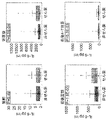
- FIG. 6 is a plot of 6 concentrations.
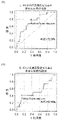
- A is an ROC curve showing the results of ROC analysis of IL-6 levels immediately after surgery in a hypoactive delirium group and a non-delirium group.
- (B) is an ROC curve showing the results of ROC analysis of the IL-6 concentration immediately after surgery in the hyperactive delirium group and the non-delirium group.
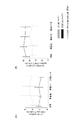
- a Kaplan-Meier survival curve showing the period until the onset of delirium in a group of patients with a high plasma IL-6 concentration and a group of patients with a low plasma IL-6 concentration immediately after surgery (immediately after surgery).
- B Kaplan-Meier survival curve showing the period until the onset of delirium in a group of patients with high plasma IL-6 concentration and a group of patients with low plasma IL-6 concentration on the morning after surgery (the morning after surgery).
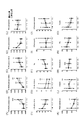
- Mean metabolite concentrations (unit ⁇ M) in plasma immediately before surgery (preoperative), immediately after surgery (immediately after surgery), and the morning after surgery (postoperative) were divided into the delirium group (31 subjects) and the non-delirium group (70 subjects). It is the figure plotted separately. Severe delirium group (24 people), mild (subthreshold) delirium group average plasma metabolite concentrations (unit ⁇ M) immediately before surgery (preoperative), immediately after surgery (immediately after surgery), and the morning after surgery (postoperative) (13 persons) and the non-delirium group (76 persons) are plotted separately.
- Severe delirium group 24 people
- mild (subthreshold) delirium group average plasma metabolite concentrations unit ⁇ M
- mean glycine and serine concentrations unit ⁇ M
- the ratio of glycine concentration to serine concentration glycine/serine
- Mean values of various immune profiles in blood samples immediately before surgery (preoperative), immediately after surgery (immediately after surgery), the morning after surgery (1 day after surgery), and the morning of 4-7 days after surgery (4-7 days after surgery) are divided into a delirium group (20 persons) and a non-delirium group (20 persons) and plotted.
- Mean values of various immune profiles in blood samples immediately before surgery (preoperative), immediately after surgery (immediately after surgery), the morning after surgery (1 day after surgery), and the morning of 4-7 days after surgery (4-7 days after surgery) are divided into a delirium group (20 persons) and a non-delirium group (20 persons) and plotted.
- FIG. 10 is a diagram showing ROC curves according to combinations of biomarkers for a non-delirium group and a severe delirium group immediately before surgery (preoperative), immediately after surgery (immediately after surgery), or the morning after surgery (postoperative morning).
- FIG. 10 is a diagram showing ROC curves according to combinations of biomarkers for a non-delirium group and a severe delirium group immediately before surgery (preoperative), immediately after surgery (immediately after surgery), or the morning after surgery (postoperative morning).
- FIG. 10 is a diagram showing ROC curves for a non-delirium group and an overactive delirium group for each biomarker combination immediately before surgery (preoperative), immediately after surgery (immediately after surgery), or the morning after surgery (postoperative morning).
- FIG. 10 is a diagram showing ROC curves for a non-delirium group and a hypoactive delirium group for each biomarker combination immediately before surgery (preoperative), immediately after surgery (immediately after surgery), or the morning after surgery (postoperative morning).
- FIG. 10 is a diagram showing ROC curves according to combinations of biomarkers for a non-delirium group and a mixed delirium group immediately before surgery (preoperative), immediately after surgery (immediately after surgery), or the morning after surgery (postoperative morning).
- a subject that is positive as determined using the Diagnostic and Statistical Manual of Mental Disorders fifth edition is defined as “delirium”, and a subject that is negative is defined as “non-delirium”.
- DSM-5 Diagnostic and Statistical Manual of Mental Disorders fifth edition
- DSM-5 a subject that is negative is defined as “non-delirium”.
- DSM-5 when evaluated using the severity score of Delirium Rating Scale-Revised-98 (DRS-R-98), "severe” Those that are classified are classified as “severe delirium”, and the others are classified as “mild (subthreshold) delirium”.
- subjects who have become “delirium” as determined using DSM-5 are classified into “hyperactive delirium” ( motor agitation + and motor inhibition -), “hypoactive delirium” (motor agitation - and motor inhibition +), “mixed delirium” (motor agitation + and motor inhibition +), or “non-psychomotor delirium” (Motor agitation - and motor inhibition -).
- the biomarker according to this embodiment can be used to predict the risk of developing delirium associated with physical invasion.
- the physical invasion is not particularly limited, it is preferably a planned invasion (anticipated physical invasion) because it is suitable for predicting the risk of onset.
- Specific examples of invasiveness to the body include radiation irradiation in radiotherapy, invasiveness in surgery, administration of opioids (eg, morphine) in opioid therapy, and the like.
- the biomarkers according to the first embodiment are N1,N12-diacetylspermine, N1,N8-diacetylspermidine, N1-acetylspermidine, N8-acetylspermidine, N-acetylaspartic acid, o-acetylcarnitine, proline betaine, tryptophan , 2-oxobutyric acid, 2-oxoisovaleric acid, 3-hydroxybutyric acid, adipic acid, dodecanoic acid, glycine, mucic acid, asparagine, lysine, glutaric acid, alanine, methionine, serine, cisaconitic acid, glutamic acid, glycine and serine ratio (glycine/serine), dopamine, noradrenaline, adrenaline, prolactin, G-CSF, IL-1RA, IL-1R4, CXCL9, IL-10, MCP2, IL-6, thyrog
- each biomarker according to the first embodiment alone has a significant difference in plasma amount between a patient group that develops delirium and a patient group that does not develop delirium (Examples described later reference). Therefore, each biomarker according to the first embodiment can independently predict the risk of developing delirium.
- each biomarker according to the first embodiment can independently predict the risk of developing delirium
- two or more of each biomarker according to the first embodiment are adopted to delirium. may be used to predict the onset risk of, other indicators (e.g., plasma concentrations of cytokines and metabolites other than each biomarker according to the first embodiment, and immune profiles in blood samples) and It is good also as combining and predicting the onset risk of delirium.
- the biomarkers according to the second embodiment are N1,N12-diacetylspermine, glycine, tryptophan, adipic acid, N-acetylaspartic acid, asparagine, 3-hydroxybutyric acid, lysine, N1,N8-diacetylspermidine, glutaric acid, Alanine, proline betaine, methionine, serine, cisaconitic acid, glutamic acid, mucic acid, glycine to serine ratio (glycine/serine), dopamine, noradrenaline, adrenaline, IL-10, IL-1R4, CXCL9, prolactin, G-CSF , IL-1RA, MCP2, IL-6 and thyroglobulin.
- the ratio of glycine to serine is suitable as a biomarker for predicting the risk of developing severe delirium, especially hypoactive delirium.
- each biomarker according to the second embodiment can independently predict the risk of developing severe delirium.
- two or more of the biomarkers according to the second embodiment are adopted. may be used to predict the risk of developing severe delirium, and other indicators (for example, plasma concentrations of cytokines and metabolites other than each biomarker according to the second embodiment, and blood samples immune profile) to predict the risk of developing severe delirium.
- Each biomarker according to the first and second embodiments described above is the timing at which the prediction accuracy is high along the time series including the time when the body is invaded (that is, for example, the delirium group and the non-delirium group There is a timing at which the difference between becomes statistically significant. Specifically, it is as follows.
- ratio of sex T cells may be 24 hours before being invaded to the time of being invaded, may be 12 hours before being invaded to the time of being invaded, and may be 6 hours before being invaded. It may be from an hour before to the time of receiving the attack.
- Biomarkers with high prediction accuracy immediately after physical invasion include N1,N12-diacetylspermine, N1,N8-diacetylspermidine, N1-acetylspermidine, N8-acetylspermidine, proline betaine, dodecanoic acid, and mucus.
- After being invaded specifically means more than 2 hours after being invaded and within 24 hours after being invaded, and 6 hours or more after being invaded. It may be within 24 hours after completing the insult, and may be between 6 hours or more and 16 hours after completing the insult.
- Biomarkers with high predictive accuracy 4-7 days after the body has been invaded include the ratio of ICOS-positive cells to CD8-positive naive T cells, IL-1R4 (for severe delirium), IL-1RA ( severe delirium).
- Biomarkers with high prediction accuracy after 7 days can be used not only as biomarkers for predicting the risk of developing delirium, but also as biomarkers for diagnosing delirium, and biomarkers for predicting delirium to prevent symptoms from being overlooked. May be used as a marker.
- biomarkers that increase the prediction accuracy by taking the difference between two specific time points along the time series including the time when the body was invaded.
- Thyroglobulin and naive control are biomarkers that increase the prediction accuracy by taking the difference between the measured value immediately after the physical invasion and the measured value before the physical invasion.
- the ratio of dopamine positive cells to T cells is included. They can predict the risk of developing severe delirium in particular.
- Glycine, serine, and cisaconite are biomarkers that increase the prediction accuracy by taking the difference between the measured value at the time after the body is invaded and the measured value at the time before the body is invaded.
- acid glutamic acid, mucic acid, thyroglobulin. They can predict the risk of developing severe delirium in particular.
- Each biomarker according to the first and second embodiments described above includes the above-described timing at which the prediction accuracy is high along the time series including the time point when the body is invaded (the difference between two specific time points. ) is preferably used.
- Each biomarker according to the first and second embodiments described above is a combination of two or more of these, and / or other indicators (e.g., each biomarker according to the first and second embodiments In combination with plasma concentrations of cytokines and metabolites other than markers, and immune profiles in blood samples), it is possible to predict the risk of developing delirium with higher accuracy.
- Specific examples of combinations include the following combinations (C1) to (C15).
- (C1) a combination of glycine and proline betaine
- (C2) a combination of glycine, proline betaine and prolactin. Both the combination of (C1) and the combination of (C2) can be used as biomarkers for predicting the risk of developing delirium associated with physical invasion.
- the timing at which the prediction accuracy of the combination of biomarkers (C1) is high is before the body is invaded.
- the timing at which the prediction accuracy of the combination of biomarkers (C2) is high is before the body is invaded.
- the timing at which the prediction accuracy of the combination of biomarkers of (C3) is high is before the body is invaded.
- the timing at which the prediction accuracy of the combination of biomarkers (C4) is high is immediately after the body is invaded.
- the timing at which the prediction accuracy of the combined biomarker of (C5) is high is after the body is invaded.
- (C6) combination, (C7) combination, (C8) combination, and (C9) combination can be used as biomarkers for predicting the risk of developing hyperactive delirium associated with physical invasion can.
- the timing at which the prediction accuracy of the combination of biomarkers (C7) is high is before the body is invaded.
- the timing at which the prediction accuracy of the combination of biomarkers (C8) is high is immediately after the body is invaded.
- the timing at which the combined biomarkers of (C6) and (C9) have high prediction accuracy is after the body is invaded.
- the timing at which the accuracy of prediction by the combination of biomarkers (C10) is high is before the body is invaded.
- the timing at which the prediction accuracy of the combination of biomarkers (C11) is high is immediately after the body is invaded.
- the timing at which the prediction accuracy of the combination of biomarkers (C12) is high is after the body is invaded.
- the timing at which the prediction accuracy of the combination of biomarkers of (C13) is high is before the body is invaded.
- the timing at which the prediction accuracy of the combination of biomarkers (C14) is high is immediately after the body is invaded.
- the timing at which the prediction accuracy of the combined biomarker of (C15) is high is after the body is invaded.
- a method for predicting the risk of developing delirium associated with physical invasion includes a step of measuring the amount of biomarkers in a blood sample collected from a subject (measurement step ), and a step of predicting the risk of developing delirium (prediction step) based on the amount of the measured biomarker.
- the prediction method according to this embodiment may be used to predict the risk of developing delirium, and may be used to predict the risk of developing severe delirium in particular.
- the prediction method according to the present embodiment may also be used to predict the risk of developing subtypes of delirium (hyperactive delirium, hypoactive delirium, mixed delirium, etc.).
- the timing at which the blood sample is collected (for example, before the subject undergoes an invasion of the body, immediately after the subject undergoes an invasion of the body, and when the subject undergoes an invasion of the body) or 4-7 days after the subject's physical insult), and depending on the type of delirium to be predicted (e.g., severity, subtype), biomarkers suitable for these are selected as appropriate. Selective use is preferred. Selection criteria are as described above.
- the subject (subject) to which the prediction method according to the present embodiment is applied is not particularly limited as long as it is a subject that undergoes/has undergone physical invasion.
- the subject is preferably a subject that undergoes/has undergone a planned invasion (a planned invasion of the body) because it is familiar with the prediction of onset risk.
- subjects scheduled for radiation therapy perioperative patients (e.g., perioperative cancer patients, perioperative non-cancer patients), and subjects scheduled for opioid therapy. .
- the amount of biomarkers in the blood sample collected from the subject is measured.
- a blood sample can be obtained according to a conventional method.
- the amount of biomarker (biomarker concentration, etc.) can be measured according to a conventional method.
- cytokine measurement can be performed by, for example, ELISA (Enzyme-Linked Immunosorbent Assay).
- Measurement of metabolites can be performed using, for example, capillary electrophoresis time-of-flight mass spectrometry (CE-TOFMS).
- Immune profile measurements can be performed, for example, using flow cytometry.
- the biomarkers are cytokines, metabolites, etc.
- it is preferable to measure the concentration in plasma and when the biomarker is an immune profile, it is preferable to measure the amount in blood.
- Plasma samples can be routinely obtained from blood samples collected from subjects.
- the measurement step is performed on the blood samples at the two specific time points.
- the risk of developing delirium is predicted based on the amount of biomarkers measured. Prediction of onset risk may be performed, for example, by comparing the amount of the measured biomarker with a preset cutoff value.
- the cut-off value is the amount of the biomarker in a large number of specimens in advance (for example, a delirium group that develops delirium due to physical invasion, and a specimen that does not develop delirium, and a non-delirium group that does not develop). It can be calculated by statistical processing from the presence or absence of onset of delirium.
- the present invention can also be regarded as a method of collecting data for predicting the risk of developing delirium associated with physical invasion (also referred to simply as a "data collection method").
- the data collection method according to this embodiment comprises a step (measurement step) of measuring the amount of biomarkers in a blood sample collected from a subject. The details of the measurement step are as described in the prediction method according to this embodiment.
- the data obtained in the measuring step can be used to predict the risk of developing delirium associated with bodily insults.
- Diagnosis of delirium and evaluation of delirium symptoms The primary endpoint, diagnosis of delirium and assessment of each delirium symptom, was assessed daily by a trained psychiatrist or clinical psychologist using the DSM-5 and DRS-R-98, respectively, for up to 5 days postoperatively. .
- blood sample The patient's blood will be collected immediately before surgery (10:00), immediately after surgery (when entering the ICU: within 1 hour after surgery), the morning after surgery (first day after surgery) (6:00-7:00 am: about 6 hours after surgery to about 12 hours later) and 4-7 days after surgery in the morning (6:00-7:00 am).
- Plasma plasma sample
- IL-6 concentration of IL-6 in plasma
- ELISA concentration of IL-6 in plasma
- CE-TOFMS time-of-flight mass spectrometry
- Cognitive function was evaluated using the Mini-Mental State Examination (MMSE) at the time of informed consent, including whether or not preoperative regular benzodiazepine anti-anxiety drugs were taken, whether gas anesthesia was used, and whether or not postoperative dexmedetomidine or antipsychotics were used. Such background information was recorded from the electronic medical record.
- MMSE Mini-Mental State Examination
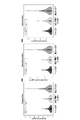
- Figure 1 shows IL in plasma obtained immediately before surgery (preoperative), immediately after surgery (immediately after surgery), the morning after surgery (next morning after surgery), and the morning of days 4-7 after surgery (days 4-7 after surgery).
- -6 concentration is plotted separately for a non-delirium group and a delirium group.
- IL-6 levels were higher in the delirium group than in the non-delirium group at three points immediately after surgery, the morning after surgery, and days 4 to 7 after surgery.
- a ROC analysis was performed to assess the accuracy of delirium prediction by IL-6 and was 62.7% (immediately after surgery) and 62.0% (next morning after surgery).
- the patient group with high IL-6 concentration on the morning after surgery (IL-6 high (next morning after surgery)) compared to the patient group with low IL-6 concentration on the morning after surgery (IL-6 low (next morning after surgery)) (cutoff: 238.43 pg / mL), increased risk of developing delirium (odds ratio: 2.71 (1.29-5.70)), speech impairment (odds ratio: 4.01 (1.78- 9.00)), thought disorder (odds ratio: 2.71 (1.32-5.78)), attention disorder (odds ratio: 2.63 (1.26-5.48)). (Table 1).
- FIG. 2 shows the surgical procedures divided into subtype groups classified by the presence or absence of psychomotor symptoms (hyperactive delirium group, hypoactive delirium group, mixed delirium group, non-psychomotor delirium group) and non-delirium groups.
- FIG. 4 is a plot of IL-6 concentrations immediately after. Motor inhibition is a core symptom of hypoactive delirium and affects delirium subtyping. On the other hand, motor agitation, which also characterizes the subtype, was not a symptom predicted by IL-6. When the delirium group showing motor suppression within 5 days after surgery was classified into two subtypes, the hypoactive delirium group and the mixed delirium group, IL-6 concentrations were higher in both groups than in the non-delirium group (Fig. 2).
- the hyperactive delirium group which showed motor agitation without motor inhibition, showed no difference in IL-6 concentration from the non-delirium group (Fig. 2).
- the non-psychomotor delirium group without psychomotor symptoms did not differ in IL-6 levels from the non-delirium group (Fig. 2).
- FIG. 3(A) is an ROC curve showing the results of ROC analysis of the IL-6 concentration immediately after surgery in the hypoactive delirium group and the non-delirium group.
- FIG. 3(B) is an ROC curve showing the results of ROC analysis of the IL-6 concentration immediately after surgery in the hyperactive delirium group and the non-delirium group.
- IL-6 levels immediately after surgery are associated with motor inhibition-mediated hypoactive delirium, but may not be associated with other subtypes.
- Using ROC analysis it was possible to distinguish between the hypoactive delirium group and the non-delirium group using IL-6 concentration alone immediately after surgery (Fig. 3(A), AUC: 72.9%).
- the IL-6 concentration alone immediately after surgery could not distinguish between the hyperactive delirium group and the non-delirium group (Fig. 3(B), AUC: 53.6%).
- FIG. 4(A) is a Kaplan-Meier survival curve showing the period until the onset of delirium in a patient group with high plasma IL-6 concentration and a patient group with low plasma IL-6 concentration immediately after surgery (immediately after surgery).
- FIG. 4(B) is a Kaplan-Meier survival curve showing the period until the onset of delirium in a group of patients with a high plasma IL-6 concentration and a group of patients with a low plasma IL-6 concentration on the morning after the operation (the morning after the operation).
- the survival curves for both groups were different, with a higher proportion of patients with high plasma IL-6 levels developing delirium early after surgery than those with low levels.
- Whether or not symptoms predicted by plasma IL-6 levels are similarly predicted in clinical practice may depend on cognitive decline, including dementia, which is a significant risk factor for delirium. There is Therefore, we reexamined the odds ratio of each symptom that was shown to be related to plasma IL-6 concentration in a patient group including patients suspected of having cognitive decline with an MMSE score of 26 or less. In this case, cognitive function was added to the adjustment factor. The optimal cutoff was identified for each symptom.
- IL-6 high at admission to ICU
- low IL-6 ICU Postoperative motor inhibition (odds ratio: 2.92 (1.43-5.97)) and short-term memory impairment (odds ratio: 2.42 (1.27-4.63))
- odds ratio: 3.08 (1.15-8.28) had a higher risk of visuospatial cognitive impairment (odds ratio: 3.08 (1.15-8.28)
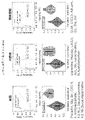
- Figure 5 shows the average plasma metabolite concentrations (unit ⁇ M) immediately before surgery (preoperative), immediately after surgery (immediately after surgery), and the morning after surgery (postoperative) in the delirium group (31 people) and the non-delirium group ( 70 people) are plotted separately.
- * indicates P ⁇ 0.05
- ** indicates P ⁇ 0.01
- *** indicates P ⁇ 0.001.
- N1,N12-diacetylspermine (Fig. 5 (A): immediately after surgery and after surgery), N1,N8-diacetylspermidine (Fig. 5 (B ): immediately after surgery and after surgery), N1-acetylspermidine (FIG. 5 (C): immediately after surgery and after surgery), N8-acetylspermidine (FIG. 5 (D): immediately after surgery), N-acetylaspartic acid (FIG. 5 (E): postoperative), o-acetylcarnitine (FIG. 5 (F): postoperative), proline betaine (FIG.
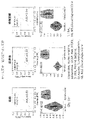
- Figures 6 and 7 show the average plasma metabolite concentrations (unit ⁇ M) immediately before surgery (preoperative), immediately after surgery (immediately after surgery), and the morning after surgery (postoperative) in the severe delirium group (24 people), It is a diagram plotted separately for a mild (subthreshold) delirium group (13 persons) and a non-delirium group (76 persons). 6 and 7, * indicates P ⁇ 0.01 (between the severe delirium group and the non-delirium group).
- N1, N12-diacetylspermine Fig. 6 (A): immediately after surgery and after surgery
- glycine Fig. 6 (B): after surgery
- tryptophan FIG. 6 (C): postoperative
- adipic acid FIGG. 6 (D): postoperative
- N-acetylaspartic acid FIGG. 6 (E): immediately after surgery and postoperative
- asparagine FIGG. 6 (F): immediately after surgery and after surgery
- 3-hydroxybutyric acid FIG. 6 (G): postoperative
- lysine FIG.
- FIG. 8 shows glycine and serine concentrations (unit ⁇ M) in plasma immediately before surgery (preoperative), immediately after surgery (immediately after surgery), and the morning after surgery (postoperative), and the ratio of glycine concentration to serine concentration (glycine/serine).
- FIG. 8(A) is a duplicate of glycine (FIG. 6(B))
- FIG. 8(B) is a duplicate of serine (FIG. 7(N)).
- FIG. 8(C) plots the average values of the ratio of glycine concentration to serine concentration (glycine/serine).
- * indicates P ⁇ 0.05 (between the severe delirium group and the non-delirium group).
- the AUC was calculated by ROC analysis for the preoperative glycine concentration to serine concentration ratio (glycine/serine), and its accuracy as a biomarker was examined.
- AUC was 0.71 in the distinction between severe delirium and non-delirium, and the prediction was made with high accuracy.
- severe delirium was further divided into subtypes (hypoactive delirium, hyperactive delirium) and analyzed.
- AUC was 0.64 in distinguishing between active delirium and non-delirium, and it predicted hypoactive delirium among severe delirium with high accuracy.
- G-CSF In the prediction of hypoactive delirium, G-CSF predicted with high accuracy.
- Plasma obtained from patients (non-delirium group) immediately before surgery (preoperative), immediately after surgery (immediately after surgery), the morning after surgery (postoperative day 1), and the morning of postoperative day 4-7 (postoperative day 4-7) was used to perform the same analysis as ⁇ (2B) Cytokine (1)>.
- Cytokine (1)> there was a significant difference between the severe delirium group and the non-delirium group at any time before surgery, immediately after surgery, 1 day after surgery and 4-7 days after surgery, or the difference between these two time points.
- cytokines 9 types of cytokines were found.
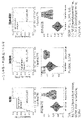
- Figure 9 shows the plasma cytokine concentration ( Unit pg/mL) divided into a severe delirium group (20 persons), a mild (subthreshold) delirium group (12 persons), and a non-delirium group (70 persons) and plotted.
- * indicates P ⁇ 0.05 (between the severe delirium group and the non-delirium group).
- IL-10 (Fig. 9 (A): immediately after surgery and 1 day after surgery), IL-1R4 (Fig. 9 (B): , 1 day after surgery and 4-7 days after surgery), CXCL9 (Fig. 9 (C): immediately after surgery and 1 day after surgery), prolactin (Fig. 9 (D): before surgery), G-CSF (Fig. 9 ( E): immediately after surgery and 1 day after surgery), IL-1RA (Fig. 9 (F): immediately after surgery, 1 day after surgery and 4-7 days after surgery), MCP2 (Fig. 9 (G): immediately after surgery), IL-6 (Fig. 9 (H): immediately after surgery and 1 day after surgery), thyroglobulin (Fig. 9 (I): (immediately after surgery - before surgery) and (1 day after surgery - before surgery)) were found. rice field.
- ⁇ (2C) immune profile> In a postoperative delirium cohort after highly invasive surgical cancer resection, those aged 60 years or older scheduled for resection for oral or pharyngeal, laryngeal or esophageal cancer without cognitive decline (MMSE score of 27) 20 patients who had delirium (delirium group) and 20 patients who did not have delirium (non-delirium group). Immune profile analysis by flow cytometry was performed using blood samples from the morning after surgery (postoperative day 1) and postoperative day 4-7 morning (postoperative day 4-7) to analyze the association with delirium. .
- FIG. 10 shows various immune responses in blood samples immediately before surgery (preoperative), immediately after surgery (immediately after surgery), the morning after surgery (1 day after surgery), and the morning of 4-7 days after surgery (4-7 days after surgery). It is a diagram in which the average values of profiles are plotted separately for a delirium group (20 persons) and a non-delirium group (20 persons). In FIG. 10, * indicates P ⁇ 0.05.
- FIG. 11 shows various immune responses in blood samples immediately before surgery (preoperative), immediately after surgery (immediately after surgery), the morning after surgery (1 day after surgery), and the morning of 4-7 days after surgery (4-7 days after surgery). It is a diagram in which the average values of profiles are plotted separately for a delirium group (20 persons) and a non-delirium group (20 persons). In FIG. 11, * indicates P ⁇ 0.01.
- Fig. 10 (A) preoperative, immediately after surgery, and 1 day after surgery
- effector control Percentage of dopamine-positive cells to sexual T cells Fig. 10 (B): immediately after surgery
- percentage of follicular T cells to CD4-positive T cells Fig. 10 (C): immediately after surgery and 1 day after surgery
- CD4-positive T Ratio of Th17 cells to cells Fig. 10 (D): immediately after surgery
- ratio of naive regulatory T cells to CD4-positive T cells Fig. 10 (E): 1 day after surgery
- dopamine-positive to naive regulatory T cells Percentage of cells Fig.
- Table 4 shows the results of calculating the AUC for the ratio of Th17 cells/naive regulatory T cells by ROC analysis and examining its accuracy as a biomarker.
- Dopamine has been reported as a molecule that suppresses the function and differentiation of regulatory T cells, and is also known to be a factor involved in the onset of postoperative delirium. Therefore, we measured plasma concentrations of dopamine before and after surgery and analyzed the relationship with delirium.
- Figure 12 shows the plasma catecholamine (dopamine, noradrenaline, adrenaline) concentrations (pg/mL) immediately after surgery (immediately after surgery) in the severe delirium group (56 people), mild (subthreshold) delirium group (35 people), and non-delirium. It is the figure which divided into the group (195 persons) and plotted. In FIG. 12, differences between groups were evaluated by the Mann-Whitney U test (two-tailed test).
- FIG. 10 (F) shows the ratio of dopamine-positive cells to naive regulatory T cells, but the transition is different between the delirium group and the non-delirium group, and the delirium group decreases the positive rate from immediately after surgery to the next morning after surgery. On the other hand, the positive rate increased in the non-delirium group.
- Tables 5 and 6 show the results of calculating the AUC by ROC analysis and examining the accuracy as a biomarker.
- FIG. 13 is a diagram showing the ROC curve for each biomarker combination for the non-delirium group and the severe delirium group immediately before surgery (preoperative), immediately after surgery (immediately after surgery), or the morning after surgery (next morning after surgery).
- FIG. 16 is a diagram showing ROC curves according to combinations of biomarkers for the non-delirium group and the mixed delirium group immediately before surgery (preoperative), immediately after surgery (immediately after surgery), or the morning after surgery (next morning after surgery). is.
Landscapes
- Life Sciences & Earth Sciences (AREA)
- Health & Medical Sciences (AREA)
- Engineering & Computer Science (AREA)
- Immunology (AREA)
- Molecular Biology (AREA)
- Biomedical Technology (AREA)
- Chemical & Material Sciences (AREA)
- Hematology (AREA)
- Urology & Nephrology (AREA)
- Cell Biology (AREA)
- Microbiology (AREA)
- Biotechnology (AREA)
- Food Science & Technology (AREA)
- Medicinal Chemistry (AREA)
- Physics & Mathematics (AREA)
- Analytical Chemistry (AREA)
- Biochemistry (AREA)
- General Health & Medical Sciences (AREA)
- General Physics & Mathematics (AREA)
- Pathology (AREA)
- Proteomics, Peptides & Aminoacids (AREA)
- Investigating Or Analysing Biological Materials (AREA)
Abstract
本発明は、N1,N12-ジアセチルスペルミン、N1,N8-ジアセチルスペルミジン、N1-アセチルスペルミジン、及びN8-アセチルスペルミジン等からなる群より選択される少なくとも1種を含む、身体に対する侵襲に伴うせん妄の発症リスクの予測用バイオマーカー等に関する。
Description
本発明は、身体に対する侵襲に伴うせん妄の発症リスクの予測用バイオマーカーに関する。本発明はまた、身体に対する侵襲に伴うせん妄の発症リスクを予測する方法にも関する。
せん妄は、高齢者の約半数に発症する重篤な疾患である。症状が消失したとしても、その後自立性低下、死亡率上昇及び認知機能低下を続発的に生じる。せん妄が生じる原因の一つとして、手術等の身体への侵襲が知られている。せん妄は、例えば、手術の侵襲に応じて急性の意識障害として生じ、次いで注意力障害を中心に、幻覚や妄想などの思考障害を伴う認知機能障害を生じさせる。
術後せん妄の発症機序の仮説としては、過剰な免疫応答、及び脆弱な脳予備脳の関与が示唆されている(非特許文献1)。具体的には、白血球から過剰放出された炎症性サイトカインが血液脳関門(Blood Brain Barrier)を通って中枢神経へ移行し、ミクログリアを介した神経炎症を惹起することがせん妄発症機序のひとつであると報告されている。
J.Geriatr Psychiatry Neurol.,2017年,30巻,6号,pp.337-345
しかし、せん妄の発症機序はほとんど分かっておらず、したがって確立した予防法がないのが現状である。超高齢社会を背景に、がん等に対する外科手術の需要は高まっている。しかし、高齢者は術後せん妄のリスクが高いため、メカニズムに基づく術後せん妄予防の最適化を行うことは、重要な課題である。しかしながら、せん妄の発症を予測するための確立されたバイオマーカーは未だ報告されていない。
本発明は、手術等の身体への侵襲に伴うせん妄の発症リスクを予測するためのバイオマーカーを提供することを目的とする。本発明はまた、手術等の身体への侵襲に伴うせん妄の発症リスクを予測するための方法を提供することを目的とする。
本発明者らは、身体への侵襲の一例として高侵襲手術を受けた対象(患者)において、術後せん妄の発症の有無と、血漿中の各種分子(サイトカイン、代謝産物等)濃度、及び免疫プロファイルとの関係を解析した結果、術後せん妄を予測し得るバイオマーカーを見出した。本発明は、この新規な知見に基づくものである。
本発明は、例えば、以下の[1]~[7]に関する。
[1]
N1,N12-ジアセチルスペルミン、N1,N8-ジアセチルスペルミジン、N1-アセチルスペルミジン、N8-アセチルスペルミジン、N-アセチルアスパラギン酸、o-アセチルカルニチン、プロリンベタイン、トリプトファン、2-オキソ酪酸、2-オキソイソ吉草酸、3-ヒドロキシ酪酸、アジピン酸、ドデカン酸、グリシン、粘液酸、アスパラギン、リシン、グルタル酸、アラニン、メチオニン、セリン、シスアコニット酸、グルタミン酸、グリシンとセリンの比(グリシン/セリン)、ドパミン、ノルアドレナリン、アドレナリン、プロラクチン、G-CSF、IL-1RA、IL-1R4、CXCL9、IL-10、MCP2、IL-6、チログロブリン、Th17細胞/ナイーブ制御性T細胞の比、エフェクター制御性T細胞に対するドパミン陽性細胞の割合、CD4陽性T細胞に対する濾胞性T細胞の割合、CD4陽性T細胞に対するTh17細胞の割合、CD4陽性T細胞に対するナイーブ制御性T細胞の割合、ナイーブ制御性T細胞に対するドパミン陽性細胞の割合、CD8陽性ナイーブT細胞に対するICOS陽性細胞の割合、及びCD4陽性T細胞に対するドパミン受容体1陽性細胞の割合からなる群より選択される少なくとも1種を含む、身体に対する侵襲に伴うせん妄の発症リスクの予測用バイオマーカー。
[2]
N1,N12-ジアセチルスペルミン、グリシン、トリプトファン、アジピン酸、N-アセチルアスパラギン酸、アスパラギン、3-ヒドロキシ酪酸、リシン、N1,N8-ジアセチルスペルミジン、グルタル酸、アラニン、プロリンベタイン、メチオニン、セリン、シスアコニット酸、グルタミン酸、粘液酸、グリシンとセリンの比(グリシン/セリン)、ドパミン、ノルアドレナリン、アドレナリン、IL-10、IL-1R4、CXCL9、プロラクチン、G-CSF、IL-1RA、MCP2、IL-6及びチログロブリンからなる群より選択される少なくとも1種を含む、身体に対する侵襲に伴う重症せん妄の発症リスクの予測用バイオマーカー。
[3]
(C1)グリシン及びプロリンベタインの組み合わせ、又は(C2)グリシン、プロリンベタイン及びプロラクチンの組み合わせを含む、身体に対する侵襲に伴うせん妄の発症リスクの予測用バイオマーカー。
[4]
(C3)プロラクチン、グリシン、セリン、CXCL9、N-アセチルアスパラギン酸、N1,N12-ジアセチルスペルミン及びN1,N8-ジアセチルスペルミジンの組み合わせ、(C4)ドパミン、粘液酸、CXCL9、アスパラギン、セリン、ノルアドレナリン及びN-アセチルアスパラギン酸の組み合わせ、又は(C5)G-CSF、CXCL9、アジピン酸、グルタミン酸、グリシン及びセリンの組み合わせを含む、身体に対する侵襲に伴う重症せん妄の発症リスクの予測用バイオマーカー。
[5]
(C6)N1,N12-ジアセチルスペルミン及びN,N-ジメチルグリシンの組み合わせ、(C7)グリシン及びセリンの組み合わせ、(C8)ドパミン、ノルアドレナリン、アドレナリン、G-CSF、メチオニン、MCP2、IL-1RA、プロリンベタイン、グルタル酸、N-アセチルアスパラギン酸及びN1,N12-ジアセチルスペルミンの組み合わせ、又は(C9)IL-1R4及びN1,N8-ジアセチルスペルミジンの組み合わせを含む、身体に対する侵襲に伴う過活動型せん妄の発症リスクの予測用バイオマーカー。
[6]
グリシンとセリンの比(グリシン/セリン)、(C10)IL-6、N1,N12-ジアセチルスペルミン、G-CSF、プロリンベタイン及びIL-1R4の組み合わせ、(C11)粘液酸及びIL-1R4の組み合わせ、又は(C12)G-CSF、トリプトファン、IL-1R4、IL-6、N1,N8-ジアセチルスペルミジン、N1,N12-ジアセチルスペルミン、アジピン酸及びリシンの組み合わせを含む、身体に対する侵襲に伴う低活動型せん妄の発症リスクの予測用バイオマーカー。
[7]
(C13)IL-1RA、IL-1R4、G-CSF、IL-10、メチオニン、グリシン及び3-ヒドロキシ酪酸の組み合わせ、(C14)メチオニン、G-CSF、CXCL9、トリプトファン、IL-10、チログロブリン及びN-アセチルアスパラギン酸の組み合わせ、又は(C15)CXCL9、グルタミン酸、IL-1RA、シスアコニット酸及びN-アセチルアスパラギン酸の組み合わせを含む、身体に対する侵襲に伴う混合型せん妄の発症リスクの予測用バイオマーカー。
[1]
N1,N12-ジアセチルスペルミン、N1,N8-ジアセチルスペルミジン、N1-アセチルスペルミジン、N8-アセチルスペルミジン、N-アセチルアスパラギン酸、o-アセチルカルニチン、プロリンベタイン、トリプトファン、2-オキソ酪酸、2-オキソイソ吉草酸、3-ヒドロキシ酪酸、アジピン酸、ドデカン酸、グリシン、粘液酸、アスパラギン、リシン、グルタル酸、アラニン、メチオニン、セリン、シスアコニット酸、グルタミン酸、グリシンとセリンの比(グリシン/セリン)、ドパミン、ノルアドレナリン、アドレナリン、プロラクチン、G-CSF、IL-1RA、IL-1R4、CXCL9、IL-10、MCP2、IL-6、チログロブリン、Th17細胞/ナイーブ制御性T細胞の比、エフェクター制御性T細胞に対するドパミン陽性細胞の割合、CD4陽性T細胞に対する濾胞性T細胞の割合、CD4陽性T細胞に対するTh17細胞の割合、CD4陽性T細胞に対するナイーブ制御性T細胞の割合、ナイーブ制御性T細胞に対するドパミン陽性細胞の割合、CD8陽性ナイーブT細胞に対するICOS陽性細胞の割合、及びCD4陽性T細胞に対するドパミン受容体1陽性細胞の割合からなる群より選択される少なくとも1種を含む、身体に対する侵襲に伴うせん妄の発症リスクの予測用バイオマーカー。
[2]
N1,N12-ジアセチルスペルミン、グリシン、トリプトファン、アジピン酸、N-アセチルアスパラギン酸、アスパラギン、3-ヒドロキシ酪酸、リシン、N1,N8-ジアセチルスペルミジン、グルタル酸、アラニン、プロリンベタイン、メチオニン、セリン、シスアコニット酸、グルタミン酸、粘液酸、グリシンとセリンの比(グリシン/セリン)、ドパミン、ノルアドレナリン、アドレナリン、IL-10、IL-1R4、CXCL9、プロラクチン、G-CSF、IL-1RA、MCP2、IL-6及びチログロブリンからなる群より選択される少なくとも1種を含む、身体に対する侵襲に伴う重症せん妄の発症リスクの予測用バイオマーカー。
[3]
(C1)グリシン及びプロリンベタインの組み合わせ、又は(C2)グリシン、プロリンベタイン及びプロラクチンの組み合わせを含む、身体に対する侵襲に伴うせん妄の発症リスクの予測用バイオマーカー。
[4]
(C3)プロラクチン、グリシン、セリン、CXCL9、N-アセチルアスパラギン酸、N1,N12-ジアセチルスペルミン及びN1,N8-ジアセチルスペルミジンの組み合わせ、(C4)ドパミン、粘液酸、CXCL9、アスパラギン、セリン、ノルアドレナリン及びN-アセチルアスパラギン酸の組み合わせ、又は(C5)G-CSF、CXCL9、アジピン酸、グルタミン酸、グリシン及びセリンの組み合わせを含む、身体に対する侵襲に伴う重症せん妄の発症リスクの予測用バイオマーカー。
[5]
(C6)N1,N12-ジアセチルスペルミン及びN,N-ジメチルグリシンの組み合わせ、(C7)グリシン及びセリンの組み合わせ、(C8)ドパミン、ノルアドレナリン、アドレナリン、G-CSF、メチオニン、MCP2、IL-1RA、プロリンベタイン、グルタル酸、N-アセチルアスパラギン酸及びN1,N12-ジアセチルスペルミンの組み合わせ、又は(C9)IL-1R4及びN1,N8-ジアセチルスペルミジンの組み合わせを含む、身体に対する侵襲に伴う過活動型せん妄の発症リスクの予測用バイオマーカー。
[6]
グリシンとセリンの比(グリシン/セリン)、(C10)IL-6、N1,N12-ジアセチルスペルミン、G-CSF、プロリンベタイン及びIL-1R4の組み合わせ、(C11)粘液酸及びIL-1R4の組み合わせ、又は(C12)G-CSF、トリプトファン、IL-1R4、IL-6、N1,N8-ジアセチルスペルミジン、N1,N12-ジアセチルスペルミン、アジピン酸及びリシンの組み合わせを含む、身体に対する侵襲に伴う低活動型せん妄の発症リスクの予測用バイオマーカー。
[7]
(C13)IL-1RA、IL-1R4、G-CSF、IL-10、メチオニン、グリシン及び3-ヒドロキシ酪酸の組み合わせ、(C14)メチオニン、G-CSF、CXCL9、トリプトファン、IL-10、チログロブリン及びN-アセチルアスパラギン酸の組み合わせ、又は(C15)CXCL9、グルタミン酸、IL-1RA、シスアコニット酸及びN-アセチルアスパラギン酸の組み合わせを含む、身体に対する侵襲に伴う混合型せん妄の発症リスクの予測用バイオマーカー。
本発明はまた、例えば、以下の[2-1]~[2-7]に関する。
[2-1]
身体に対する侵襲に伴うせん妄の発症リスクを予測する方法であって、
被験者から採取された血液試料中のバイオマーカーの量を測定するステップと、
測定されたバイオマーカーの量に基づき、せん妄の発症リスクを予測するステップと、を備え、
前記バイオマーカーが、N1,N12-ジアセチルスペルミン、N1,N8-ジアセチルスペルミジン、N1-アセチルスペルミジン、N8-アセチルスペルミジン、N-アセチルアスパラギン酸、o-アセチルカルニチン、プロリンベタイン、トリプトファン、2-オキソ酪酸、2-オキソイソ吉草酸、3-ヒドロキシ酪酸、アジピン酸、ドデカン酸、グリシン、粘液酸、アスパラギン、リシン、グルタル酸、アラニン、メチオニン、セリン、シスアコニット酸、グルタミン酸、グリシンとセリンの比(グリシン/セリン)、ドパミン、ノルアドレナリン、アドレナリン、プロラクチン、G-CSF、IL-1RA、IL-1R4、CXCL9、IL-10、MCP2、IL-6、チログロブリン、Th17細胞/ナイーブ制御性T細胞の比、エフェクター制御性T細胞に対するドパミン陽性細胞の割合、CD4陽性T細胞に対する濾胞性T細胞の割合、CD4陽性T細胞に対するTh17細胞の割合、CD4陽性T細胞に対するナイーブ制御性T細胞の割合、ナイーブ制御性T細胞に対するドパミン陽性細胞の割合、CD8陽性ナイーブT細胞に対するICOS陽性細胞の割合、及びCD4陽性T細胞に対するドパミン受容体1陽性細胞の割合からなる群より選択される少なくとも1種を含む、方法。
[2-2]
身体に対する侵襲に伴う重症せん妄の発症リスクを予測する方法であって、
被験者から採取された血液試料中のバイオマーカーの量を測定するステップと、
測定されたバイオマーカーの量に基づき、重症せん妄の発症リスクを予測するステップと、を備え、
前記バイオマーカーが、N1,N12-ジアセチルスペルミン、グリシン、トリプトファン、アジピン酸、N-アセチルアスパラギン酸、アスパラギン、3-ヒドロキシ酪酸、リシン、N1,N8-ジアセチルスペルミジン、グルタル酸、アラニン、プロリンベタイン、メチオニン、セリン、シスアコニット酸、グルタミン酸、粘液酸、グリシンとセリンの比(グリシン/セリン)、ドパミン、ノルアドレナリン、アドレナリン、IL-10、IL-1R4、CXCL9、プロラクチン、G-CSF、IL-1RA、MCP2、IL-6及びチログロブリンからなる群より選択される少なくとも1種を含む、方法。
[2-3]
身体に対する侵襲に伴うせん妄の発症リスクを予測する方法であって、
被験者から採取された血液試料中のバイオマーカーの量を測定するステップと、
測定されたバイオマーカーの量に基づき、せん妄の発症リスクを予測するステップと、を備え、
前記バイオマーカーが、(C1)グリシン及びプロリンベタインの組み合わせ、又は(C2)グリシン、プロリンベタイン及びプロラクチンの組み合わせを含む、方法。
[2-4]
身体に対する侵襲に伴う重症せん妄の発症リスクを予測する方法であって、
被験者から採取された血液試料中のバイオマーカーの量を測定するステップと、
測定されたバイオマーカーの量に基づき、重症せん妄の発症リスクを予測するステップと、を備え、
前記バイオマーカーが、(C3)プロラクチン、グリシン、セリン、CXCL9、N-アセチルアスパラギン酸、N1,N12-ジアセチルスペルミン及びN1,N8-ジアセチルスペルミジンの組み合わせ、(C4)ドパミン、粘液酸、CXCL9、アスパラギン、セリン、ノルアドレナリン及びN-アセチルアスパラギン酸の組み合わせ、又は(C5)G-CSF、CXCL9、アジピン酸、グルタミン酸、グリシン及びセリンの組み合わせを含む、方法。
[2-5]
身体に対する侵襲に伴う過活動型せん妄の発症リスクを予測する方法であって、
被験者から採取された血液試料中のバイオマーカーの量を測定するステップと、
測定されたバイオマーカーの量に基づき、過活動型せん妄の発症リスクを予測するステップと、を備え、
前記バイオマーカーが、(C6)N1,N12-ジアセチルスペルミン及びN,N-ジメチルグリシンの組み合わせ、(C7)グリシン及びセリンの組み合わせ、(C8)ドパミン、ノルアドレナリン、アドレナリン、G-CSF、メチオニン、MCP2、IL-1RA、プロリンベタイン、グルタル酸、N-アセチルアスパラギン酸及びN1,N12-ジアセチルスペルミンの組み合わせ、又は(C9)IL-1R4及びN1,N8-ジアセチルスペルミジンの組み合わせを含む、方法。
[2-6]
身体に対する侵襲に伴う低活動型せん妄の発症リスクを予測する方法であって、
被験者から採取された血液試料中のバイオマーカーの量を測定するステップと、
測定されたバイオマーカーの量に基づき、低活動型せん妄の発症リスクを予測するステップと、を備え、
前記バイオマーカーが、グリシンとセリンの比(グリシン/セリン)、(C10)IL-6、N1,N12-ジアセチルスペルミン、G-CSF、プロリンベタイン及びIL-1R4の組み合わせ、(C11)粘液酸及びIL-1R4の組み合わせ、又は(C12)G-CSF、トリプトファン、IL-1R4、IL-6、N1,N8-ジアセチルスペルミジン、N1,N12-ジアセチルスペルミン、アジピン酸及びリシンの組み合わせを含む、方法。
[2-7]
身体に対する侵襲に伴う混合型せん妄の発症リスクを予測する方法であって、
被験者から採取された血液試料中のバイオマーカーの量を測定するステップと、
測定されたバイオマーカーの量に基づき、混合型せん妄の発症リスクを予測するステップと、を備え、
前記バイオマーカーが、(C13)IL-1RA、IL-1R4、G-CSF、IL-10、メチオニン、グリシン及び3-ヒドロキシ酪酸の組み合わせ、(C14)メチオニン、G-CSF、CXCL9、トリプトファン、IL-10、チログロブリン及びN-アセチルアスパラギン酸の組み合わせ、又は(C15)CXCL9、グルタミン酸、IL-1RA、シスアコニット酸及びN-アセチルアスパラギン酸の組み合わせを含む、方法。
[2-1]
身体に対する侵襲に伴うせん妄の発症リスクを予測する方法であって、
被験者から採取された血液試料中のバイオマーカーの量を測定するステップと、
測定されたバイオマーカーの量に基づき、せん妄の発症リスクを予測するステップと、を備え、
前記バイオマーカーが、N1,N12-ジアセチルスペルミン、N1,N8-ジアセチルスペルミジン、N1-アセチルスペルミジン、N8-アセチルスペルミジン、N-アセチルアスパラギン酸、o-アセチルカルニチン、プロリンベタイン、トリプトファン、2-オキソ酪酸、2-オキソイソ吉草酸、3-ヒドロキシ酪酸、アジピン酸、ドデカン酸、グリシン、粘液酸、アスパラギン、リシン、グルタル酸、アラニン、メチオニン、セリン、シスアコニット酸、グルタミン酸、グリシンとセリンの比(グリシン/セリン)、ドパミン、ノルアドレナリン、アドレナリン、プロラクチン、G-CSF、IL-1RA、IL-1R4、CXCL9、IL-10、MCP2、IL-6、チログロブリン、Th17細胞/ナイーブ制御性T細胞の比、エフェクター制御性T細胞に対するドパミン陽性細胞の割合、CD4陽性T細胞に対する濾胞性T細胞の割合、CD4陽性T細胞に対するTh17細胞の割合、CD4陽性T細胞に対するナイーブ制御性T細胞の割合、ナイーブ制御性T細胞に対するドパミン陽性細胞の割合、CD8陽性ナイーブT細胞に対するICOS陽性細胞の割合、及びCD4陽性T細胞に対するドパミン受容体1陽性細胞の割合からなる群より選択される少なくとも1種を含む、方法。
[2-2]
身体に対する侵襲に伴う重症せん妄の発症リスクを予測する方法であって、
被験者から採取された血液試料中のバイオマーカーの量を測定するステップと、
測定されたバイオマーカーの量に基づき、重症せん妄の発症リスクを予測するステップと、を備え、
前記バイオマーカーが、N1,N12-ジアセチルスペルミン、グリシン、トリプトファン、アジピン酸、N-アセチルアスパラギン酸、アスパラギン、3-ヒドロキシ酪酸、リシン、N1,N8-ジアセチルスペルミジン、グルタル酸、アラニン、プロリンベタイン、メチオニン、セリン、シスアコニット酸、グルタミン酸、粘液酸、グリシンとセリンの比(グリシン/セリン)、ドパミン、ノルアドレナリン、アドレナリン、IL-10、IL-1R4、CXCL9、プロラクチン、G-CSF、IL-1RA、MCP2、IL-6及びチログロブリンからなる群より選択される少なくとも1種を含む、方法。
[2-3]
身体に対する侵襲に伴うせん妄の発症リスクを予測する方法であって、
被験者から採取された血液試料中のバイオマーカーの量を測定するステップと、
測定されたバイオマーカーの量に基づき、せん妄の発症リスクを予測するステップと、を備え、
前記バイオマーカーが、(C1)グリシン及びプロリンベタインの組み合わせ、又は(C2)グリシン、プロリンベタイン及びプロラクチンの組み合わせを含む、方法。
[2-4]
身体に対する侵襲に伴う重症せん妄の発症リスクを予測する方法であって、
被験者から採取された血液試料中のバイオマーカーの量を測定するステップと、
測定されたバイオマーカーの量に基づき、重症せん妄の発症リスクを予測するステップと、を備え、
前記バイオマーカーが、(C3)プロラクチン、グリシン、セリン、CXCL9、N-アセチルアスパラギン酸、N1,N12-ジアセチルスペルミン及びN1,N8-ジアセチルスペルミジンの組み合わせ、(C4)ドパミン、粘液酸、CXCL9、アスパラギン、セリン、ノルアドレナリン及びN-アセチルアスパラギン酸の組み合わせ、又は(C5)G-CSF、CXCL9、アジピン酸、グルタミン酸、グリシン及びセリンの組み合わせを含む、方法。
[2-5]
身体に対する侵襲に伴う過活動型せん妄の発症リスクを予測する方法であって、
被験者から採取された血液試料中のバイオマーカーの量を測定するステップと、
測定されたバイオマーカーの量に基づき、過活動型せん妄の発症リスクを予測するステップと、を備え、
前記バイオマーカーが、(C6)N1,N12-ジアセチルスペルミン及びN,N-ジメチルグリシンの組み合わせ、(C7)グリシン及びセリンの組み合わせ、(C8)ドパミン、ノルアドレナリン、アドレナリン、G-CSF、メチオニン、MCP2、IL-1RA、プロリンベタイン、グルタル酸、N-アセチルアスパラギン酸及びN1,N12-ジアセチルスペルミンの組み合わせ、又は(C9)IL-1R4及びN1,N8-ジアセチルスペルミジンの組み合わせを含む、方法。
[2-6]
身体に対する侵襲に伴う低活動型せん妄の発症リスクを予測する方法であって、
被験者から採取された血液試料中のバイオマーカーの量を測定するステップと、
測定されたバイオマーカーの量に基づき、低活動型せん妄の発症リスクを予測するステップと、を備え、
前記バイオマーカーが、グリシンとセリンの比(グリシン/セリン)、(C10)IL-6、N1,N12-ジアセチルスペルミン、G-CSF、プロリンベタイン及びIL-1R4の組み合わせ、(C11)粘液酸及びIL-1R4の組み合わせ、又は(C12)G-CSF、トリプトファン、IL-1R4、IL-6、N1,N8-ジアセチルスペルミジン、N1,N12-ジアセチルスペルミン、アジピン酸及びリシンの組み合わせを含む、方法。
[2-7]
身体に対する侵襲に伴う混合型せん妄の発症リスクを予測する方法であって、
被験者から採取された血液試料中のバイオマーカーの量を測定するステップと、
測定されたバイオマーカーの量に基づき、混合型せん妄の発症リスクを予測するステップと、を備え、
前記バイオマーカーが、(C13)IL-1RA、IL-1R4、G-CSF、IL-10、メチオニン、グリシン及び3-ヒドロキシ酪酸の組み合わせ、(C14)メチオニン、G-CSF、CXCL9、トリプトファン、IL-10、チログロブリン及びN-アセチルアスパラギン酸の組み合わせ、又は(C15)CXCL9、グルタミン酸、IL-1RA、シスアコニット酸及びN-アセチルアスパラギン酸の組み合わせを含む、方法。
本発明は更に、例えば、以下の[3-1]~[3-7]に関する。
[3-1]
身体に対する侵襲に伴うせん妄の発症リスクを予測するためのデータを収集する方法であって、
被験者から採取された血液試料中のバイオマーカーの量を測定するステップを備え、
前記バイオマーカーが、N1,N12-ジアセチルスペルミン、N1,N8-ジアセチルスペルミジン、N1-アセチルスペルミジン、N8-アセチルスペルミジン、N-アセチルアスパラギン酸、o-アセチルカルニチン、プロリンベタイン、トリプトファン、2-オキソ酪酸、2-オキソイソ吉草酸、3-ヒドロキシ酪酸、アジピン酸、ドデカン酸、グリシン、粘液酸、アスパラギン、リシン、グルタル酸、アラニン、メチオニン、セリン、シスアコニット酸、グルタミン酸、グリシンとセリンの比(グリシン/セリン)、ドパミン、ノルアドレナリン、アドレナリン、プロラクチン、G-CSF、IL-1RA、IL-1R4、CXCL9、IL-10、MCP2、IL-6、チログロブリン、Th17細胞/ナイーブ制御性T細胞の比、エフェクター制御性T細胞に対するドパミン陽性細胞の割合、CD4陽性T細胞に対する濾胞性T細胞の割合、CD4陽性T細胞に対するTh17細胞の割合、CD4陽性T細胞に対するナイーブ制御性T細胞の割合、ナイーブ制御性T細胞に対するドパミン陽性細胞の割合、CD8陽性ナイーブT細胞に対するICOS陽性細胞の割合、及びCD4陽性T細胞に対するドパミン受容体1陽性細胞の割合からなる群より選択される少なくとも1種を含む、方法。
[3-2]
身体に対する侵襲に伴う重症せん妄の発症リスクを予測するためのデータを収集する方法であって、
被験者から採取された血液試料中のバイオマーカーの量を測定するステップを備え、
前記バイオマーカーが、N1,N12-ジアセチルスペルミン、グリシン、トリプトファン、アジピン酸、N-アセチルアスパラギン酸、アスパラギン、3-ヒドロキシ酪酸、リシン、N1,N8-ジアセチルスペルミジン、グルタル酸、アラニン、プロリンベタイン、メチオニン、セリン、シスアコニット酸、グルタミン酸、粘液酸、グリシンとセリンの比(グリシン/セリン)、ドパミン、ノルアドレナリン、アドレナリン、IL-10、IL-1R4、CXCL9、プロラクチン、G-CSF、IL-1RA、MCP2、IL-6及びチログロブリンからなる群より選択される少なくとも1種を含む、方法。
[3-3]
身体に対する侵襲に伴うせん妄の発症リスクを予測するためのデータを収集する方法であって、
被験者から採取された血液試料中のバイオマーカーの量を測定するステップを備え、
前記バイオマーカーが、(C1)グリシン及びプロリンベタインの組み合わせ、又は(C2)グリシン、プロリンベタイン及びプロラクチンの組み合わせを含む、方法。
[3-4]
身体に対する侵襲に伴う重症せん妄の発症リスクを予測するためのデータを収集する方法であって、
被験者から採取された血液試料中のバイオマーカーの量を測定するステップを備え、
前記バイオマーカーが、(C3)プロラクチン、グリシン、セリン、CXCL9、N-アセチルアスパラギン酸、N1,N12-ジアセチルスペルミン及びN1,N8-ジアセチルスペルミジンの組み合わせ、(C4)ドパミン、粘液酸、CXCL9、アスパラギン、セリン、ノルアドレナリン及びN-アセチルアスパラギン酸の組み合わせ、又は(C5)G-CSF、CXCL9、アジピン酸、グルタミン酸、グリシン及びセリンの組み合わせを含む、方法。
[3-5]
身体に対する侵襲に伴う過活動型せん妄の発症リスクを予測するためのデータを収集する方法であって、
被験者から採取された血液試料中のバイオマーカーの量を測定するステップを備え、
前記バイオマーカーが、(C6)N1,N12-ジアセチルスペルミン及びN,N-ジメチルグリシンの組み合わせ、(C7)グリシン及びセリンの組み合わせ、(C8)ドパミン、ノルアドレナリン、アドレナリン、G-CSF、メチオニン、MCP2、IL-1RA、プロリンベタイン、グルタル酸、N-アセチルアスパラギン酸及びN1,N12-ジアセチルスペルミンの組み合わせ、又は(C9)IL-1R4及びN1,N8-ジアセチルスペルミジンの組み合わせを含む、方法。
[3-6]
身体に対する侵襲に伴う低活動型せん妄の発症リスクを予測するためのデータを収集する方法であって、
被験者から採取された血液試料中のバイオマーカーの量を測定するステップを備え、
前記バイオマーカーが、グリシンとセリンの比(グリシン/セリン)、(C10)IL-6、N1,N12-ジアセチルスペルミン、G-CSF、プロリンベタイン及びIL-1R4の組み合わせ、(C11)粘液酸及びIL-1R4の組み合わせ、又は(C12)G-CSF、トリプトファン、IL-1R4、IL-6、N1,N8-ジアセチルスペルミジン、N1,N12-ジアセチルスペルミン、アジピン酸及びリシンの組み合わせを含む、方法。
[3-7]
身体に対する侵襲に伴う混合型せん妄の発症リスクを予測するためのデータを収集する方法であって、
被験者から採取された血液試料中のバイオマーカーの量を測定するステップを備え、
前記バイオマーカーが、(C13)IL-1RA、IL-1R4、G-CSF、IL-10、メチオニン、グリシン及び3-ヒドロキシ酪酸の組み合わせ、(C14)メチオニン、G-CSF、CXCL9、トリプトファン、IL-10、チログロブリン及びN-アセチルアスパラギン酸の組み合わせ、又は(C15)CXCL9、グルタミン酸、IL-1RA、シスアコニット酸及びN-アセチルアスパラギン酸の組み合わせを含む、方法。
[3-1]
身体に対する侵襲に伴うせん妄の発症リスクを予測するためのデータを収集する方法であって、
被験者から採取された血液試料中のバイオマーカーの量を測定するステップを備え、
前記バイオマーカーが、N1,N12-ジアセチルスペルミン、N1,N8-ジアセチルスペルミジン、N1-アセチルスペルミジン、N8-アセチルスペルミジン、N-アセチルアスパラギン酸、o-アセチルカルニチン、プロリンベタイン、トリプトファン、2-オキソ酪酸、2-オキソイソ吉草酸、3-ヒドロキシ酪酸、アジピン酸、ドデカン酸、グリシン、粘液酸、アスパラギン、リシン、グルタル酸、アラニン、メチオニン、セリン、シスアコニット酸、グルタミン酸、グリシンとセリンの比(グリシン/セリン)、ドパミン、ノルアドレナリン、アドレナリン、プロラクチン、G-CSF、IL-1RA、IL-1R4、CXCL9、IL-10、MCP2、IL-6、チログロブリン、Th17細胞/ナイーブ制御性T細胞の比、エフェクター制御性T細胞に対するドパミン陽性細胞の割合、CD4陽性T細胞に対する濾胞性T細胞の割合、CD4陽性T細胞に対するTh17細胞の割合、CD4陽性T細胞に対するナイーブ制御性T細胞の割合、ナイーブ制御性T細胞に対するドパミン陽性細胞の割合、CD8陽性ナイーブT細胞に対するICOS陽性細胞の割合、及びCD4陽性T細胞に対するドパミン受容体1陽性細胞の割合からなる群より選択される少なくとも1種を含む、方法。
[3-2]
身体に対する侵襲に伴う重症せん妄の発症リスクを予測するためのデータを収集する方法であって、
被験者から採取された血液試料中のバイオマーカーの量を測定するステップを備え、
前記バイオマーカーが、N1,N12-ジアセチルスペルミン、グリシン、トリプトファン、アジピン酸、N-アセチルアスパラギン酸、アスパラギン、3-ヒドロキシ酪酸、リシン、N1,N8-ジアセチルスペルミジン、グルタル酸、アラニン、プロリンベタイン、メチオニン、セリン、シスアコニット酸、グルタミン酸、粘液酸、グリシンとセリンの比(グリシン/セリン)、ドパミン、ノルアドレナリン、アドレナリン、IL-10、IL-1R4、CXCL9、プロラクチン、G-CSF、IL-1RA、MCP2、IL-6及びチログロブリンからなる群より選択される少なくとも1種を含む、方法。
[3-3]
身体に対する侵襲に伴うせん妄の発症リスクを予測するためのデータを収集する方法であって、
被験者から採取された血液試料中のバイオマーカーの量を測定するステップを備え、
前記バイオマーカーが、(C1)グリシン及びプロリンベタインの組み合わせ、又は(C2)グリシン、プロリンベタイン及びプロラクチンの組み合わせを含む、方法。
[3-4]
身体に対する侵襲に伴う重症せん妄の発症リスクを予測するためのデータを収集する方法であって、
被験者から採取された血液試料中のバイオマーカーの量を測定するステップを備え、
前記バイオマーカーが、(C3)プロラクチン、グリシン、セリン、CXCL9、N-アセチルアスパラギン酸、N1,N12-ジアセチルスペルミン及びN1,N8-ジアセチルスペルミジンの組み合わせ、(C4)ドパミン、粘液酸、CXCL9、アスパラギン、セリン、ノルアドレナリン及びN-アセチルアスパラギン酸の組み合わせ、又は(C5)G-CSF、CXCL9、アジピン酸、グルタミン酸、グリシン及びセリンの組み合わせを含む、方法。
[3-5]
身体に対する侵襲に伴う過活動型せん妄の発症リスクを予測するためのデータを収集する方法であって、
被験者から採取された血液試料中のバイオマーカーの量を測定するステップを備え、
前記バイオマーカーが、(C6)N1,N12-ジアセチルスペルミン及びN,N-ジメチルグリシンの組み合わせ、(C7)グリシン及びセリンの組み合わせ、(C8)ドパミン、ノルアドレナリン、アドレナリン、G-CSF、メチオニン、MCP2、IL-1RA、プロリンベタイン、グルタル酸、N-アセチルアスパラギン酸及びN1,N12-ジアセチルスペルミンの組み合わせ、又は(C9)IL-1R4及びN1,N8-ジアセチルスペルミジンの組み合わせを含む、方法。
[3-6]
身体に対する侵襲に伴う低活動型せん妄の発症リスクを予測するためのデータを収集する方法であって、
被験者から採取された血液試料中のバイオマーカーの量を測定するステップを備え、
前記バイオマーカーが、グリシンとセリンの比(グリシン/セリン)、(C10)IL-6、N1,N12-ジアセチルスペルミン、G-CSF、プロリンベタイン及びIL-1R4の組み合わせ、(C11)粘液酸及びIL-1R4の組み合わせ、又は(C12)G-CSF、トリプトファン、IL-1R4、IL-6、N1,N8-ジアセチルスペルミジン、N1,N12-ジアセチルスペルミン、アジピン酸及びリシンの組み合わせを含む、方法。
[3-7]
身体に対する侵襲に伴う混合型せん妄の発症リスクを予測するためのデータを収集する方法であって、
被験者から採取された血液試料中のバイオマーカーの量を測定するステップを備え、
前記バイオマーカーが、(C13)IL-1RA、IL-1R4、G-CSF、IL-10、メチオニン、グリシン及び3-ヒドロキシ酪酸の組み合わせ、(C14)メチオニン、G-CSF、CXCL9、トリプトファン、IL-10、チログロブリン及びN-アセチルアスパラギン酸の組み合わせ、又は(C15)CXCL9、グルタミン酸、IL-1RA、シスアコニット酸及びN-アセチルアスパラギン酸の組み合わせを含む、方法。
本発明によれば、手術等の身体への侵襲に伴うせん妄の発症リスクを予測するためのバイオマーカーを提供することができる。本発明によればまた、手術等の身体への侵襲に伴うせん妄の発症リスクを予測するための方法を提供することができる。
本発明に係る予測方法及びバイオマーカーによれば、せん妄の一態様である低活動型せん妄又は過活動型せん妄の発症リスクも予測することができる。低活動型せん妄を特徴づける運動抑制は、リハビリテーションの遅れや、肺炎などの術後合併症のリスクを伴い、死亡率の増加や医療経済の負担につながる。また低活動型せん妄は見逃しが多く介入が遅れ、予後が悪化する可能性が指摘されている。本発明に係る予測方法及びバイオマーカーによれば、低活動型せん妄の見逃しを減らすだけでなく、積極的な早期介入を可能にし、手術アウトカムの向上させる可能性がある。また、看護師への暴力や点滴の自己抜去など、医療安全を障害する過活動型せん妄を予測することにより、看護師の重点的な配置によって医療安全を維持し、不穏行動のハイリスク群にのみ選択的な鎮静を検討することができ、医療者の負担軽減に貢献できる。
以下、本発明を実施するための形態について詳細に説明する。ただし、本発明は以下の実施形態に限定されるものではない。
本明細書において、Diagnostic and Statistical Manual of Mental Disorders fifth edition(DSM-5)を用いた判定により、陽性になる対象を「せん妄」とし、陰性になる対象を「非せん妄」とする。また特に、DSM-5を用いた判定により「せん妄」となった対象のうち、Delirium Rating Scale-Revised-98(DRS-R-98)の重症度得点を用いて評価したときに「重症」に分類されるものを「重症せん妄」とし、それ以外を「軽症(閾値下)せん妄」とする。
本明細書において、DSM-5を用いた判定により「せん妄」となった対象を、精神運動症状(DRS-R-98における運動性焦燥及び運動抑制)の有無により、「過活動型せん妄」(運動性焦燥+かつ運動抑制-)、「低活動型せん妄」(運動性焦燥-かつ運動抑制+)、「混合型せん妄」(運動性焦燥+かつ運動抑制+)又は「精神運動変動なし型せん妄」(運動性焦燥-かつ運動抑制-)のサブタイプに分類することがある。
〔バイオマーカー〕
本実施形態に係るバイオマーカーは、身体に対する侵襲に伴うせん妄の発症リスクの予測に使用することができる。身体に対する侵襲としては、特に限定されるものではないが、発症リスクの予測になじむことから、予定された侵襲(予定された身体に対する侵襲)であることが好ましい。身体に対する侵襲の具体例として、例えば、放射線療法における放射線照射、手術における侵襲、オピオイド療法におけるオピオイド(例えば、モルヒネ)の投与等が挙げられる。
本実施形態に係るバイオマーカーは、身体に対する侵襲に伴うせん妄の発症リスクの予測に使用することができる。身体に対する侵襲としては、特に限定されるものではないが、発症リスクの予測になじむことから、予定された侵襲(予定された身体に対する侵襲)であることが好ましい。身体に対する侵襲の具体例として、例えば、放射線療法における放射線照射、手術における侵襲、オピオイド療法におけるオピオイド(例えば、モルヒネ)の投与等が挙げられる。
第1の実施形態に係るバイオマーカーは、N1,N12-ジアセチルスペルミン、N1,N8-ジアセチルスペルミジン、N1-アセチルスペルミジン、N8-アセチルスペルミジン、N-アセチルアスパラギン酸、o-アセチルカルニチン、プロリンベタイン、トリプトファン、2-オキソ酪酸、2-オキソイソ吉草酸、3-ヒドロキシ酪酸、アジピン酸、ドデカン酸、グリシン、粘液酸、アスパラギン、リシン、グルタル酸、アラニン、メチオニン、セリン、シスアコニット酸、グルタミン酸、グリシンとセリンの比(グリシン/セリン)、ドパミン、ノルアドレナリン、アドレナリン、プロラクチン、G-CSF、IL-1RA、IL-1R4、CXCL9、IL-10、MCP2、IL-6、チログロブリン、Th17細胞/ナイーブ制御性T細胞の比、エフェクター制御性T細胞に対するドパミン陽性細胞の割合、CD4陽性T細胞に対する濾胞性T細胞の割合、CD4陽性T細胞に対するTh17細胞の割合、CD4陽性T細胞に対するナイーブ制御性T細胞の割合、ナイーブ制御性T細胞に対するドパミン陽性細胞の割合、CD8陽性ナイーブT細胞に対するICOS陽性細胞の割合、及びCD4陽性T細胞に対するドパミン受容体1陽性細胞の割合からなる群より選択される少なくとも1種を含み、身体に対する侵襲に伴うせん妄の発症リスクの予測用バイオマーカーである。
第1の実施形態に係る各バイオマーカーはそれぞれ単独で、せん妄を発症した患者群とせん妄を発症しなかった患者群とで血漿中の量に有意差があったものである(後述の実施例参照)。したがって、第1の実施形態に係る各バイオマーカーは、それぞれ単独でせん妄の発症リスクを予測することができる。なお、第1の実施形態に係る各バイオマーカーはそれぞれ単独でせん妄の発症リスクを予測することができるものであるが、第1の実施形態に係る各バイオマーカーから2種以上を採用してせん妄の発症リスクを予測することとしてもよいし、他の指標(例えば、上記第1の実施形態に係る各バイオマーカー以外のサイトカイン及び代謝産物等の血漿中濃度、並びに血液試料中の免疫プロファイル)と組み合わせてせん妄の発症リスクを予測することとしてもよい。
第2の実施形態に係るバイオマーカーは、N1,N12-ジアセチルスペルミン、グリシン、トリプトファン、アジピン酸、N-アセチルアスパラギン酸、アスパラギン、3-ヒドロキシ酪酸、リシン、N1,N8-ジアセチルスペルミジン、グルタル酸、アラニン、プロリンベタイン、メチオニン、セリン、シスアコニット酸、グルタミン酸、粘液酸、グリシンとセリンの比(グリシン/セリン)、ドパミン、ノルアドレナリン、アドレナリン、IL-10、IL-1R4、CXCL9、プロラクチン、G-CSF、IL-1RA、MCP2、IL-6及びチログロブリンからなる群より選択される少なくとも1種を含む、身体に対する侵襲に伴う重症せん妄の発症リスクの予測用バイオマーカーである。
また、グリシンとセリンの比(グリシン/セリン)は、重症せん妄のうち、特に低活動型せん妄の発症リスクの予測用バイオマーカーとして好適である。
第2の実施形態に係るバイオマーカーはそれぞれ単独で、特に重症せん妄を発症した患者群とせん妄を発症しなかった患者群とで血漿中の量に有意差があったものである(後述の実施例参照)。したがって、第2の実施形態に係る各バイオマーカーは、それぞれ単独で重症せん妄の発症リスクを予測することができる。なお、第2の実施形態に係る各バイオマーカーはそれぞれ単独で重症せん妄の発症リスクを予測することができるものであるが、第2の実施形態に係る各バイオマーカーの中から2種以上を採用して重症せん妄の発症リスクを予測することとしてもよいし、他の指標(例えば、上記第2の実施形態に係る各バイオマーカー以外のサイトカイン及び代謝産物等の血漿中濃度、並びに血液試料中の免疫プロファイル)と組み合わせて重症せん妄の発症リスクを予測することとしてもよい。
上述した第1及び第2の実施形態に係る各バイオマーカーは、身体に対する侵襲があった時点を含む時系列に沿って、予測精度が高くなるタイミング(すなわち、例えば、せん妄群と非せん妄群との間の差が統計的に有意になるタイミング)がある。具体的には、以下のとおりである。
身体に対して侵襲を受ける前に予測精度が高くなるバイオマーカーとして、プロリンベタイン、2-オキソイソ吉草酸、グリシン、粘液酸、グリシンとセリンの比(グリシン/セリン)、プロラクチン、Th17細胞/ナイーブ制御性T細胞の比が挙げられる。「侵襲を受ける前」とは、具体的には、侵襲を受ける24時間前~侵襲を受ける時点であってよく、侵襲を受ける12時間前~侵襲を受ける時点であってよく、侵襲を受ける6時間前~侵襲を受ける時点であってよい。
身体に対して侵襲を受けた直後に予測精度が高くなるバイオマーカーとして、N1,N12-ジアセチルスペルミン、N1,N8-ジアセチルスペルミジン、N1-アセチルスペルミジン、N8-アセチルスペルミジン、プロリンベタイン、ドデカン酸、粘液酸、ドパミン、G-CSF、IL-1RA、IL-1R4、Th17細胞/ナイーブ制御性T細胞の比、エフェクター制御性T細胞に対するドパミン陽性細胞の割合、CD4陽性T細胞に対する濾胞性T細胞の割合、CD4陽性T細胞に対するTh17細胞の割合、CD4陽性T細胞に対するドパミン受容体1陽性細胞の割合、N-アセチルアスパラギン酸(重症せん妄の場合)、アスパラギン、ノルアドレナリン、アドレナリン、IL-10、CXCL9(重症せん妄の場合)、MCP2、IL-6が挙げられる。「侵襲を受けた直後」とは、具体的には、侵襲を受け終えた時点~侵襲を受け終えてから2時間以内であってよく、侵襲を受け終えた時点~侵襲を受け終えてから1時間以内であってよい。
身体に対して侵襲を受けた後に予測精度が高くなるバイオマーカーとして、N1,N12-ジアセチルスペルミン、N1,N8-ジアセチルスペルミジン、N1-アセチルスペルミジン、N-アセチルアスパラギン酸、o-アセチルカルニチン、プロリンベタイン、トリプトファン、2-オキソ酪酸、3-ヒドロキシ酪酸、アジピン酸、グリシン、G-CSF、IL-1R4、CXCL9、Th17細胞/ナイーブ制御性T細胞の比、CD4陽性T細胞に対する濾胞性T細胞の割合、CD4陽性T細胞に対するナイーブ制御性T細胞の割合、CD8陽性ナイーブT細胞に対するICOS陽性細胞の割合、アスパラギン、リシン、グルタル酸、アラニン、メチオニン、IL-10、IL-1RA(重症せん妄の場合)、IL-6が挙げられる。「侵襲を受けた後」とは、具体的には、侵襲を受け終えてから2時間超~侵襲を受け終えてから24時間以内であってよく、侵襲を受け終えてから6時間以上~侵襲を受け終えてから24時間以内であってよく、侵襲を受け終えてから6時間以上~侵襲を受け終えてから16時間以内であってよい。
身体に対して侵襲を受け終えてから4~7日後に予測精度が高くなるバイオマーカーとして、CD8陽性ナイーブT細胞に対するICOS陽性細胞の割合、IL-1R4(重症せん妄の場合)、IL-1RA(重症せん妄の場合)が挙げられる。
なお、身体に対する侵襲に伴うせん妄は、侵襲を受け終えてから2日以内に発症する頻度が高く、侵襲を受け終えた直後に発症する例もある。そのため、身体に対して侵襲を受けた直後に予測精度が高くなるバイオマーカー、身体に対して侵襲を受けた後に予測精度が高くなるバイオマーカー、及び身体に対して侵襲を受け終えてから4~7日後に予測精度が高くなるバイオマーカーは、発症リスクの予測用バイオマーカーとしてのみならず、せん妄診断用バイオマーカーとして利用してもよいし、また症状の見逃しを防止するためのせん妄予測用バイオマーカーとして利用してもよい。
また、身体に対する侵襲があった時点を含む時系列に沿って、特定の2時点の差分をとることによって、予測精度が高くなるバイオマーカーとして、以下のものが挙げられる。
身体に対して侵襲を受けた直後の時点における測定値から身体に対して侵襲を受ける前の時点における測定値の差分をとることによって、予測精度が高くなるバイオマーカーとして、チログロブリン、ナイーブ制御性T細胞に対するドパミン陽性細胞の割合が挙げられる。これらは、特に重症せん妄の発症リスクを予測することができる。
身体に対して侵襲を受けた後の時点における測定値から身体に対して侵襲を受ける前の時点における測定値の差分をとることによって、予測精度が高くなるバイオマーカーとして、グリシン、セリン、シスアコニット酸、グルタミン酸、粘液酸、チログロブリンが挙げられる。これらは、特に重症せん妄の発症リスクを予測することができる。
上述した第1及び第2の実施形態に係る各バイオマーカーは、身体に対する侵襲があった時点を含む時系列に沿って、予測精度が高くなる上述したタイミング(特定の2時点の差分を含む。)で使用することが好ましい。
上述した第1及び第2の実施形態に係る各バイオマーカーは、これらの中から2種以上を組み合わせること、及び/又は他の指標(例えば、上記第1及び第2の実施形態に係る各バイオマーカー以外のサイトカイン及び代謝産物等の血漿中濃度、並びに血液試料中の免疫プロファイル)と組み合わせることで、せん妄の発症リスクをより精度高く予測することが可能である。組み合わせの具体例として、例えば、以下の(C1)~(C15)の組み合わせが挙げられる。
(C1)グリシン及びプロリンベタインの組み合わせ、並びに(C2)グリシン、プロリンベタイン及びプロラクチンの組み合わせ。(C1)の組み合わせ、及び(C2)の組み合わせは、いずれも身体に対する侵襲に伴うせん妄の発症リスクの予測用バイオマーカーとして使用することができる。(C1)の組み合わせのバイオマーカーによる予測精度が高くなるタイミングは、身体に対して侵襲を受ける前である。(C2)の組み合わせのバイオマーカーによる予測精度が高くなるタイミングは、身体に対して侵襲を受ける前である。
(C3)プロラクチン、グリシン、セリン、CXCL9、N-アセチルアスパラギン酸、N1,N12-ジアセチルスペルミン及びN1,N8-ジアセチルスペルミジンの組み合わせ、(C4)ドパミン、粘液酸、CXCL9、アスパラギン、セリン、ノルアドレナリン及びN-アセチルアスパラギン酸の組み合わせ、並びに(C5)G-CSF、CXCL9、アジピン酸、グルタミン酸、グリシン及びセリンの組み合わせ。(C3)の組み合わせ、(C4)の組み合わせ、及び(C5)の組み合わせは、いずれも身体に対する侵襲に伴う重症せん妄の発症リスクの予測用バイオマーカーとして使用することができる。(C3)の組み合わせのバイオマーカーによる予測精度が高くなるタイミングは、身体に対して侵襲を受ける前である。(C4)の組み合わせのバイオマーカーによる予測精度が高くなるタイミングは、身体に対して侵襲を受けた直後である。(C5)の組み合わせのバイオマーカーによる予測精度が高くなるタイミングは、身体に対して侵襲を受けた後である。
(C6)N1,N12-ジアセチルスペルミン及びN,N-ジメチルグリシンの組み合わせ、(C7)グリシン及びセリンの組み合わせ、(C8)ドパミン、ノルアドレナリン、アドレナリン、G-CSF、メチオニン、MCP2、IL-1RA、プロリンベタイン、グルタル酸、N-アセチルアスパラギン酸及びN1,N12-ジアセチルスペルミンの組み合わせ、並びに(C9)IL-1R4及びN1,N8-ジアセチルスペルミジンの組み合わせ。(C6)の組み合わせ、(C7)の組み合わせ、(C8)の組み合わせ、及び(C9)の組み合わせは、いずれも身体に対する侵襲に伴う過活動型せん妄の発症リスクの予測用バイオマーカーとして使用することができる。(C7)の組み合わせのバイオマーカーによる予測精度が高くなるタイミングは、身体に対して侵襲を受ける前である。(C8)の組み合わせのバイオマーカーによる予測精度が高くなるタイミングは、身体に対して侵襲を受けた直後である。(C6)及び(C9)の組み合わせのバイオマーカーによる予測精度が高くなるタイミングは、身体に対して侵襲を受けた後である。
(C10)IL-6、N1,N12-ジアセチルスペルミン、G-CSF、プロリンベタイン及びIL-1R4の組み合わせ、(C11)粘液酸及びIL-1R4の組み合わせ、並びに(C12)G-CSF、トリプトファン、IL-1R4、IL-6、N1,N8-ジアセチルスペルミジン、N1,N12-ジアセチルスペルミン、アジピン酸及びリシンの組み合わせ。(C10)の組み合わせ、(C11)の組み合わせ、及び(C12)の組み合わせは、いずれも身体に対する侵襲に伴う低活動型せん妄の発症リスクの予測用バイオマーカーとして使用することができる。(C10)の組み合わせのバイオマーカーによる予測精度が高くなるタイミングは、身体に対して侵襲を受ける前である。(C11)の組み合わせのバイオマーカーによる予測精度が高くなるタイミングは、身体に対して侵襲を受けた直後である。(C12)の組み合わせのバイオマーカーによる予測精度が高くなるタイミングは、身体に対して侵襲を受けた後である。
(C13)IL-1RA、IL-1R4、G-CSF、IL-10、メチオニン、グリシン及び3-ヒドロキシ酪酸の組み合わせ、(C14)メチオニン、G-CSF、CXCL9、トリプトファン、IL-10、チログロブリン及びN-アセチルアスパラギン酸の組み合わせ、並びに(C15)CXCL9、グルタミン酸、IL-1RA、シスアコニット酸及びN-アセチルアスパラギン酸の組み合わせ。(C13)の組み合わせ、(C14)の組み合わせ、及び(C15)の組み合わせは、いずれも身体に対する侵襲に伴う混合型せん妄の発症リスクの予測用バイオマーカーとして使用することができる。(C13)の組み合わせのバイオマーカーによる予測精度が高くなるタイミングは、身体に対して侵襲を受ける前である。(C14)の組み合わせのバイオマーカーによる予測精度が高くなるタイミングは、身体に対して侵襲を受けた直後である。(C15)の組み合わせのバイオマーカーによる予測精度が高くなるタイミングは、身体に対して侵襲を受けた後である。
〔身体に対する侵襲に伴うせん妄の発症リスクを予測する方法〕
本実施形態に係る身体に対する侵襲に伴うせん妄の発症リスクを予測する方法(単に「予測方法」ともいう。)は、被験者から採取された血液試料中のバイオマーカーの量を測定するステップ(測定ステップ)と、測定されたバイオマーカーの量に基づき、せん妄の発症リスクを予測するステップ(予測ステップ)と、を備える。
本実施形態に係る身体に対する侵襲に伴うせん妄の発症リスクを予測する方法(単に「予測方法」ともいう。)は、被験者から採取された血液試料中のバイオマーカーの量を測定するステップ(測定ステップ)と、測定されたバイオマーカーの量に基づき、せん妄の発症リスクを予測するステップ(予測ステップ)と、を備える。
本実施形態に係る予測方法は、せん妄の発症リスクを予測することに使用してもよいし、特に重症せん妄の発症リスクを予測することに使用してもよい。また、本実施形態に係る予測方法は、せん妄のサブタイプ(過活動型せん妄、低活動型せん妄、混合せん妄等)の発症リスクを予測することに使用してもよい。
本実施形態に係る予測方法では、血液試料が採取されたタイミング(例えば、被験者が身体に対して侵襲を受ける前、被験者が身体に対して侵襲を受けた直後、被験者が身体に対して侵襲を受けた後、又は被験者が身体に対して侵襲を受けた4~7日後)、及び予測対象とするせん妄の種類(例えば、重症度、サブタイプ)に応じて、これらに適したバイオマーカーを適宜選択して使用するのが好ましい。選択の基準は、上述したとおりである。
本実施形態に係る予測方法を適用する対象(被験者)は、身体に対する侵襲を受ける/受けた対象であれば、特に制限されない。対象としては、発症リスクの予測になじむことから、予定された侵襲(予定された身体に対する侵襲)を受ける/受けた対象であることが好ましい。具体的には、例えば、放射線療法が予定されている対象、周術期患者(例えば、周術期がん患者、周術期非がん患者)、オピオイド療法が予定されている対象が挙げられる。
測定ステップでは、被験者から採取された血液試料中のバイオマーカーの量を測定する。血液試料は、常法に従って取得することができる。バイオマーカーの量(バイオマーカー濃度等)の測定は、常法に従って実施することができる。具体的には、サイトカインの測定は、例えば、ELISA(Enzyme-Linked ImmunoSorbent Assay)により実施することができる。代謝産物の測定は、例えば、キャピラリー電気泳動・飛行時間型質量分析器(CE-TOFMS)を用いて実施することができる。免疫プロファイルの測定は、例えば、フローサイトメトリー(Flow cytometry)を使用して実施することができる。バイオマーカーがサイトカイン及び代謝産物等である場合は血漿中の濃度を測定することが好ましく、バイオマーカーが免疫プロファイルである場合は血液中の量を測定することが好ましい。血漿試料は、被験者から採取された血液試料から、常法に従って取得することができる。なお、特定の2時点の差分をとることによって予測精度が高くなるバイオマーカーを使用する場合は、当該特定の2時点の血液試料に対して測定ステップを実施する。
予測ステップでは、測定されたバイオマーカーの量に基づき、せん妄の発症リスクを予測する。発症リスクの予測は、例えば、測定されたバイオマーカーの量を、予め設定されたカットオフ値と比較することによって実施してもよい。カットオフ値は、予め多数の検体(例えば、身体に対する侵襲に伴いせん妄を発症したせん妄群、及び発症しなかった非せん妄群を含む検体)において、当該バイオマーカーの量と、身体に対する侵襲に伴うせん妄の発症の有無とから統計的処理により算出することができる。
〔身体に対する侵襲に伴うせん妄の発症リスクを予測するためのデータを収集する方法〕
本発明はまた、身体に対する侵襲に伴うせん妄の発症リスクを予測するためのデータを収集する方法(単に「データ収集方法」ともいう。)と捉えることもできる。本実施形態に係るデータ収集方法は、被験者から採取された血液試料中のバイオマーカーの量を測定するステップ(測定ステップ)を備えるものである。測定ステップの詳細は、本実施形態に係る予測方法で説明したとおりである。測定ステップで得られたデータは、身体に対する侵襲に伴うせん妄の発症リスクの予測に使用することができる。
本発明はまた、身体に対する侵襲に伴うせん妄の発症リスクを予測するためのデータを収集する方法(単に「データ収集方法」ともいう。)と捉えることもできる。本実施形態に係るデータ収集方法は、被験者から採取された血液試料中のバイオマーカーの量を測定するステップ(測定ステップ)を備えるものである。測定ステップの詳細は、本実施形態に係る予測方法で説明したとおりである。測定ステップで得られたデータは、身体に対する侵襲に伴うせん妄の発症リスクの予測に使用することができる。
以下、本発明を実施例に基づきより具体的に説明する。ただし、本発明は以下の実施例に限定されるものではない。
〔試験方法〕
(対象)
本試験は、国立がん研究センター中央病院の頭頚部外科、食道外科及び肝胆膵外科で高侵襲手術(6時間以上の手術時間と、術後ICU入室を予定する手術)を予定された同意能力を有する20歳以上の患者を対象に実施した。なお、説明同意時又は術前日にDSM-5を用いた判定で陽性となった患者(せん妄)、がんを切除しない術式であった患者、切除範囲に頭蓋内を含む術式であった患者、侵襲性が低下する術式変更(試験開腹、バイパス手術)があった患者は除外した。
(対象)
本試験は、国立がん研究センター中央病院の頭頚部外科、食道外科及び肝胆膵外科で高侵襲手術(6時間以上の手術時間と、術後ICU入室を予定する手術)を予定された同意能力を有する20歳以上の患者を対象に実施した。なお、説明同意時又は術前日にDSM-5を用いた判定で陽性となった患者(せん妄)、がんを切除しない術式であった患者、切除範囲に頭蓋内を含む術式であった患者、侵襲性が低下する術式変更(試験開腹、バイパス手術)があった患者は除外した。
(せん妄の診断、及びせん妄症状の評価)
主要評価項目であるせん妄の診断と、各せん妄症状の評価は、訓練を受けた精神科医又は臨床心理士がDSM-5とDRS-R-98を用いてそれぞれ術後5日まで毎日評価した。DRS-R-98は13種の症状をそれぞれ0-3点で評価する。DSM-5を用いたせん妄の診断の評価者間信頼性を担保するため、20回連続の同時かつ独立した評価により内的妥当性を担保した。最終的なせん妄の診断は、研究者間の合意に基づき決定した。
主要評価項目であるせん妄の診断と、各せん妄症状の評価は、訓練を受けた精神科医又は臨床心理士がDSM-5とDRS-R-98を用いてそれぞれ術後5日まで毎日評価した。DRS-R-98は13種の症状をそれぞれ0-3点で評価する。DSM-5を用いたせん妄の診断の評価者間信頼性を担保するため、20回連続の同時かつ独立した評価により内的妥当性を担保した。最終的なせん妄の診断は、研究者間の合意に基づき決定した。
(血液試料)
患者の血液を手術直前(10時)、手術直後(ICU入室時:術後1時間以内)、手術翌朝(術後1日目)(午前6時-7時:術後約6時間後~約12時間後)、術後4-7日目朝(午前6時-7時)の4点で取得した。
患者の血液を手術直前(10時)、手術直後(ICU入室時:術後1時間以内)、手術翌朝(術後1日目)(午前6時-7時:術後約6時間後~約12時間後)、術後4-7日目朝(午前6時-7時)の4点で取得した。
(血液試料を使用した解析)
取得した血液試料から血漿(血漿試料)を取得した。取得した血液試料又は血漿試料を使用して、(1)ELISAにより血漿中のIL-6の濃度を測定し、全症例(ただし、認知機能に低下の無い集団)でせん妄との関連を解析した。また、取得した血液試料又は血漿試料を使用して、(2)新規バイオマーカーの探索を実施した。新規バイオマーカーの探索では、頭頚部外科と食道外科の患者(ただし、認知機能に低下の無い集団)で、(2A)メタボローム解析(キャピラリー電気泳動・飛行時間型質量分析器(CE-TOFMS)を用いた、血漿中の水溶性代謝物の網羅的な測定)を行い、せん妄との関連を解析し、(2B)サイトカインアレイ(Human Cytokine Array Q640 (Raybiotech社))を用いた候補分子の探索と、ELISAにより候補分子の血漿中の濃度を測定し、せん妄との関連を解析し、更に(2C)フローサイトメトリーによる血液試料中の免疫プロファイル解析を行い、せん妄との関連を解析した。
取得した血液試料から血漿(血漿試料)を取得した。取得した血液試料又は血漿試料を使用して、(1)ELISAにより血漿中のIL-6の濃度を測定し、全症例(ただし、認知機能に低下の無い集団)でせん妄との関連を解析した。また、取得した血液試料又は血漿試料を使用して、(2)新規バイオマーカーの探索を実施した。新規バイオマーカーの探索では、頭頚部外科と食道外科の患者(ただし、認知機能に低下の無い集団)で、(2A)メタボローム解析(キャピラリー電気泳動・飛行時間型質量分析器(CE-TOFMS)を用いた、血漿中の水溶性代謝物の網羅的な測定)を行い、せん妄との関連を解析し、(2B)サイトカインアレイ(Human Cytokine Array Q640 (Raybiotech社))を用いた候補分子の探索と、ELISAにより候補分子の血漿中の濃度を測定し、せん妄との関連を解析し、更に(2C)フローサイトメトリーによる血液試料中の免疫プロファイル解析を行い、せん妄との関連を解析した。
(認知機能の評価)
認知機能は同意取得時にMini-Mental State Examination(MMSE)を用いて評価し、術前のベンゾジアゼピン系抗不安薬定期服用の有無、ガス麻酔の有無、術後のデクスメデトミジンや抗精神病薬使用の有無など背景情報を電子カルテから記録した。
認知機能は同意取得時にMini-Mental State Examination(MMSE)を用いて評価し、術前のベンゾジアゼピン系抗不安薬定期服用の有無、ガス麻酔の有無、術後のデクスメデトミジンや抗精神病薬使用の有無など背景情報を電子カルテから記録した。
(解析方法)
各バイオマーカーの群間の差は、Mann-WhitneyのU検定(両側検定)により評価した。なお、IL-6とせん妄との関連は片側検定で検証した。またROC(Receiver Operating Characteristic)解析により、AUC(Area Under Curve)を算出し、バイオマーカーとしての正確性を検討した。またROC解析によって得られたカットオフを用いてバイオマーカーによって予測されるリスクをロジスティック回帰分析により評価した。カットオフには、kolmogorov-smirnov統計により最も各群の分布が離れる点を用いた。ロジスティック回帰分析では、年齢・性別・術式(再建を含む頭頚部外科手術・開胸を伴う食道外科手術・肝胆膵がん手術)・ガス麻酔の有無・ベンゾジアゼピン系抗不安薬の定期内服を調整した。全ての解析はRを用いて実施した(R version,3.6.3)。
各バイオマーカーの群間の差は、Mann-WhitneyのU検定(両側検定)により評価した。なお、IL-6とせん妄との関連は片側検定で検証した。またROC(Receiver Operating Characteristic)解析により、AUC(Area Under Curve)を算出し、バイオマーカーとしての正確性を検討した。またROC解析によって得られたカットオフを用いてバイオマーカーによって予測されるリスクをロジスティック回帰分析により評価した。カットオフには、kolmogorov-smirnov統計により最も各群の分布が離れる点を用いた。ロジスティック回帰分析では、年齢・性別・術式(再建を含む頭頚部外科手術・開胸を伴う食道外科手術・肝胆膵がん手術)・ガス麻酔の有無・ベンゾジアゼピン系抗不安薬の定期内服を調整した。全ての解析はRを用いて実施した(R version,3.6.3)。
〔結果〕
((1)IL-6とせん妄との関連)
同意を得た患者327名の内、術式変更などを除いた286名で解析を実施し、その内91名をせん妄(DSM-5で陽性)と判断した。なお、評価者7名の評価者間信頼性は0.9-1.0と高い内的妥当性を示した。
((1)IL-6とせん妄との関連)
同意を得た患者327名の内、術式変更などを除いた286名で解析を実施し、その内91名をせん妄(DSM-5で陽性)と判断した。なお、評価者7名の評価者間信頼性は0.9-1.0と高い内的妥当性を示した。
(術後せん妄発症とIL-6との関係)
図1は、手術直前(術前)、手術直後(術直後)、手術翌朝(術後翌朝)及び術後4-7日目朝(術後4-7日目)に取得した血漿中のIL-6濃度を非せん妄群とせん妄群に分けてプロットした図である。図1に示すとおり、術直後、術後翌朝・術後4-7日目の3点でせん妄群の方が非せん妄群よりも高いIL-6の濃度を呈した。IL-6によるせん妄予測の正確性を評価するためにROC解析を実施したところ、62.7%(術直後)及び62.0%(術後翌朝)であった。
図1は、手術直前(術前)、手術直後(術直後)、手術翌朝(術後翌朝)及び術後4-7日目朝(術後4-7日目)に取得した血漿中のIL-6濃度を非せん妄群とせん妄群に分けてプロットした図である。図1に示すとおり、術直後、術後翌朝・術後4-7日目の3点でせん妄群の方が非せん妄群よりも高いIL-6の濃度を呈した。IL-6によるせん妄予測の正確性を評価するためにROC解析を実施したところ、62.7%(術直後)及び62.0%(術後翌朝)であった。
(術後IL-6によりリスクが予測される症状とせん妄サブタイプ)
せん妄は多彩な症状を呈する。術後のIL-6によって予測される各症状のリスク比を検討した。手術直後のIL-6濃度が高い患者群(IL-6高(ICU入室時))は、手術直後のIL-6濃度が低い患者群(IL-6低(ICU入室時))に比べ(カットオフ:990.19pg/mL)、運動抑制(オッズ比:2.15(1.13-4.10))、視空間認知障害(オッズ比:3.40(1.10-10.52))、短期記憶障害(オッズ比:2.31(1.09-4.92))のリスクが高かった(表1)。また、手術翌朝のIL-6濃度が高い患者群(IL-6高(術後翌朝))は、手術翌朝のIL-6濃度が低い患者群(IL-6低(術後翌朝))に比べ(カットオフ:238.43pg/mL)、せん妄発症のリスク上昇(オッズ比:2.71(1.29-5.70))に加え、言語障害(オッズ比:4.01(1.78-9.00))、思考障害(オッズ比:2.71(1.32-5.78))、注意障害(オッズ比:2.63(1.26-5.48))のリスクが上昇していた(表1)。
せん妄は多彩な症状を呈する。術後のIL-6によって予測される各症状のリスク比を検討した。手術直後のIL-6濃度が高い患者群(IL-6高(ICU入室時))は、手術直後のIL-6濃度が低い患者群(IL-6低(ICU入室時))に比べ(カットオフ:990.19pg/mL)、運動抑制(オッズ比:2.15(1.13-4.10))、視空間認知障害(オッズ比:3.40(1.10-10.52))、短期記憶障害(オッズ比:2.31(1.09-4.92))のリスクが高かった(表1)。また、手術翌朝のIL-6濃度が高い患者群(IL-6高(術後翌朝))は、手術翌朝のIL-6濃度が低い患者群(IL-6低(術後翌朝))に比べ(カットオフ:238.43pg/mL)、せん妄発症のリスク上昇(オッズ比:2.71(1.29-5.70))に加え、言語障害(オッズ比:4.01(1.78-9.00))、思考障害(オッズ比:2.71(1.32-5.78))、注意障害(オッズ比:2.63(1.26-5.48))のリスクが上昇していた(表1)。
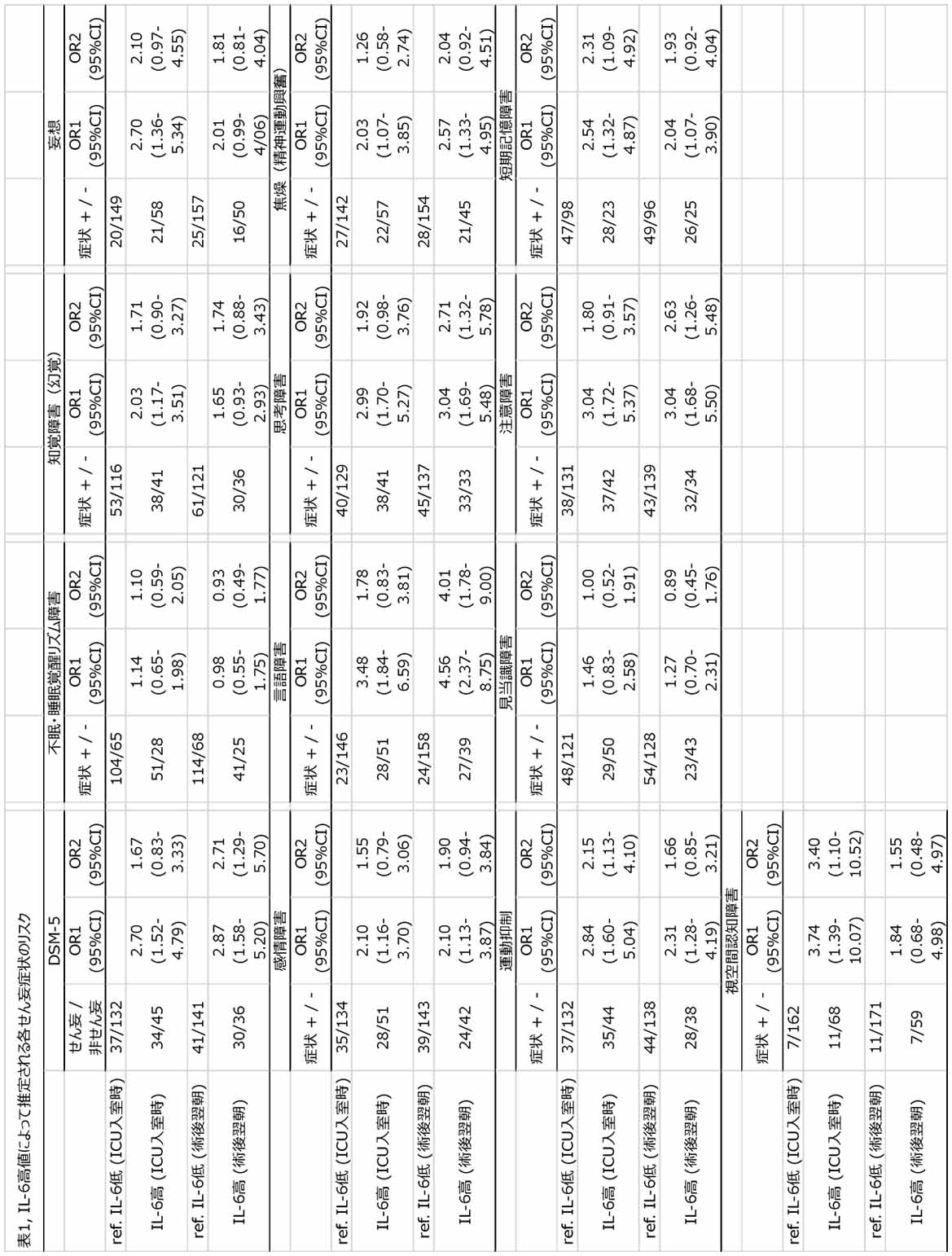
図2は、精神運動症状の有無により分類した各サブタイプ群(過活動型せん妄群、低活動型せん妄群、混合型せん妄群、精神運動変動なし型せん妄群)と非せん妄群に分けて手術直後のIL-6濃度をプロットした図である。運動抑制は低活動性せん妄の中核的な症状であり、せん妄のサブタイプ分類に影響する。一方で同様にサブタイプを特徴づける運動性焦燥はIL-6によって予測される症状ではなかった。術後5日以内に運動抑制を示したせん妄群を低活動型せん妄群と混合型せん妄群のサブタイプに分類すると、その両群が非せん妄群に比べIL-6濃度が高かった(図2)。一方、運動抑制を伴わずに運動性焦燥を示した過活動型せん妄群は、非せん妄群とIL-6濃度に差が無かった(図2)。精神運動症状を伴わない精神運動変動なし型せん妄群(注意障害と他の認知機能障害のみの症状)は、非せん妄群とIL-6の値に差が無かった(図2)。
図3(A)は、低活動型せん妄群と非せん妄群の手術直後のIL-6濃度をROC解析した結果を示すROC曲線である。図3(B)は、過活動型せん妄群と非せん妄群の手術直後のIL-6濃度をROC解析した結果を示すROC曲線である。手術直後のIL-6濃度は、運動抑制を介した低活動型せん妄と関連するが、他のサブタイプとは関連しない可能性がある。ROC解析を用いると、手術直後のIL-6濃度単独で、低活動型せん妄群と非せん妄群の区別が可能であった(図3(A),AUC:72.9%)。一方、手術直後のIL-6濃度単独では、過活動型せん妄群と非せん妄群の区別はできなかった(図3(B),AUC:53.6%)。
図4(A)は、手術直後(術直後)の血漿中のIL-6濃度が高い患者群と低い患者群のせん妄発症までの期間をKaplan-Meierの生存曲線に示した図である。図4(B)は、手術翌朝(術後翌朝)の血漿中のIL-6濃度が高い患者群と低い患者群のせん妄発症までの期間をKaplan-Meierの生存曲線に示した図である。手術直後及び手術翌朝の血漿中のIL-6濃度が高い患者群は、低い患者群よりも手術当日(手術直後)時点から、せん妄を発症した患者の割合が高かった。両群の生存曲線は異なり、血漿中のIL-6濃度が高い患者は、低い患者よりも術後早期にせん妄を発症した患者の割合が高かった。
血漿中のIL-6濃度によりリスクが予測される症状が、現実の臨床でも同じように予測されるかどうかは、せん妄の重大なリスク因子の認知症を含む認知機能低下によって左右される可能性がある。そのためMMSE得点26点以下の認知機能低下が疑われる患者も含めた患者群を対象として、血漿中のIL-6濃度と関連が示された各症状のオッズ比を再検討した。この際には認知機能を調整因子に加えた。なお、各症状ごとに最適のカットオフを同定した。手術直後(術直後)のIL-6濃度が高い患者群(IL-6高(ICU入室時))は、手術直後(術直後)のIL-6濃度が低い患者群(IL-6低(ICU入室時))に比べ、術後の運動抑制(オッズ比:2.92(1.43-5.97))、短期記憶障害(オッズ比:2.42(1.27-4.63))、視空間認知障害(オッズ比:3.08(1.15-8.28))のリスクが高かった(表2)。また、手術翌朝のIL-6濃度が高い患者群(IL-6高(術後翌朝))は、手術翌朝のIL-6濃度が低い患者群(IL-6低(術後翌朝))に比べ、言語障害(オッズ比:3.57(1.71-7.43))のリスクが高かった(表2)。
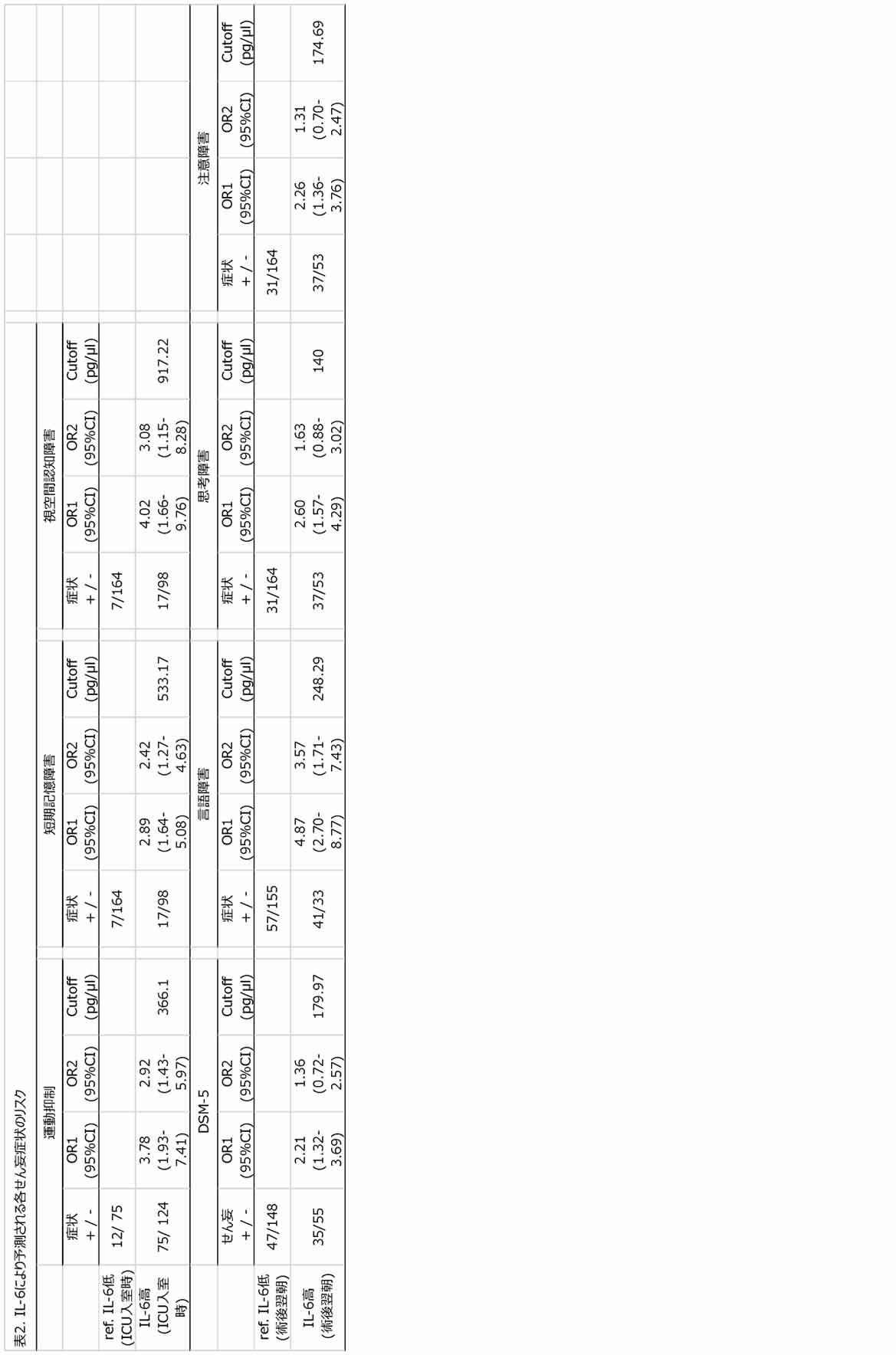
((2)新規バイオマーカーの探索)
<(2A)代謝産物(1)>
高侵襲外科的がん切除後の術後せん妄コホートの中で、口腔・咽頭がん、喉頭がん又は食道がんの切除手術を予定した60歳以上で、認知機能低下がない(MMSE得点27点以上)患者のうち、せん妄を認めた31名(せん妄群)と、せん妄の発症を認めなかった70名(非せん妄群)から取得した手術直前(術前)、手術直後(術直後)及び手術翌朝(術後)の血漿を使用して、メタボローム解析を実施した。その結果、術前、術直後及び術後のいずれかでせん妄群と非せん妄群との間で有意差があった代謝産物として、15種類の代謝産物が見出された。
<(2A)代謝産物(1)>
高侵襲外科的がん切除後の術後せん妄コホートの中で、口腔・咽頭がん、喉頭がん又は食道がんの切除手術を予定した60歳以上で、認知機能低下がない(MMSE得点27点以上)患者のうち、せん妄を認めた31名(せん妄群)と、せん妄の発症を認めなかった70名(非せん妄群)から取得した手術直前(術前)、手術直後(術直後)及び手術翌朝(術後)の血漿を使用して、メタボローム解析を実施した。その結果、術前、術直後及び術後のいずれかでせん妄群と非せん妄群との間で有意差があった代謝産物として、15種類の代謝産物が見出された。
図5は、手術直前(術前)、手術直後(術直後)及び手術翌朝(術後)の血漿中の代謝産物濃度(単位μM)の平均値をせん妄群(31名)と非せん妄群(70名)に分けてプロットした図である。図5中、*はP<0.05、**はP<0.01、***はP<0.001を示す。
せん妄群と非せん妄群との間で有意差のあった代謝産物として、N1,N12-ジアセチルスペルミン(図5(A):術直後及び術後)、N1,N8-ジアセチルスペルミジン(図5(B):術直後及び術後)、N1-アセチルスペルミジン(図5(C):術直後及び術後)、N8-アセチルスペルミジン(図5(D):術直後)、N-アセチルアスパラギン酸(図5(E):術後)、o-アセチルカルニチン(図5(F):術後)、プロリンベタイン(図5(G):術前、術直後及び術後)、トリプトファン(図5(H):術後)、2-オキソ酪酸(図5(I):術後)、2-オキソイソ吉草酸(図5(J):術前)、3-ヒドロキシ酪酸(図5(K):術後)、アジピン酸(図5(L):術後)、ドデカン酸(図5(M):術直後)、グリシン(図5(N):術前及び術後)及び粘液酸(図5(O):術前及び術直後)が見出された。
<(2A)代謝産物(2)>
高侵襲外科的がん切除後の術後せん妄コホートの中で、口腔・咽頭がん、喉頭がん又は食道がんの切除手術を予定した60歳以上で、認知機能低下がない(MMSE得点27点以上)患者のうち、重症せん妄を認めた24名(重症せん妄群)、軽症(閾値下)せん妄を認めた13名(軽症(閾値下)せん妄群)、及びせん妄の発症を認めなかった76名(非せん妄群)から取得した手術直前(術前)、手術直後(術直後)及び手術翌朝(術後)の血漿を使用して、メタボローム解析を実施した。その結果、術前、術直後及び術後のいずれかの時点、又はこれら2つの時点の差分で重症せん妄群と非せん妄群との間で有意差があった代謝産物として、17種類の代謝産物が見出された。
高侵襲外科的がん切除後の術後せん妄コホートの中で、口腔・咽頭がん、喉頭がん又は食道がんの切除手術を予定した60歳以上で、認知機能低下がない(MMSE得点27点以上)患者のうち、重症せん妄を認めた24名(重症せん妄群)、軽症(閾値下)せん妄を認めた13名(軽症(閾値下)せん妄群)、及びせん妄の発症を認めなかった76名(非せん妄群)から取得した手術直前(術前)、手術直後(術直後)及び手術翌朝(術後)の血漿を使用して、メタボローム解析を実施した。その結果、術前、術直後及び術後のいずれかの時点、又はこれら2つの時点の差分で重症せん妄群と非せん妄群との間で有意差があった代謝産物として、17種類の代謝産物が見出された。
図6及び図7は、手術直前(術前)、手術直後(術直後)及び手術翌朝(術後)の血漿中の代謝産物濃度(単位μM)の平均値を重症せん妄群(24名)、軽症(閾値下)せん妄群(13名)及び非せん妄群(76名)に分けてプロットした図である。図6及び図7中、*はP<0.01(重症せん妄群と非せん妄群との間)を示す。
重症せん妄群と非せん妄群との間で有意差のあった代謝産物として、N1,N12-ジアセチルスペルミン(図6(A):術直後及び術後)、グリシン(図6(B):術後)、トリプトファン(図6(C):術後)、アジピン酸(図6(D):術後)、N-アセチルアスパラギン酸(図6(E):術直後及び術後)、アスパラギン(図6(F):術直後及び術後)、3-ヒドロキシ酪酸(図6(G):術後)、リシン(図6(H):術後)、N1,N8-ジアセチルスペルミジン(図6(I):術後)、グルタル酸(図6(J):術後)、アラニン(図7(K):術後)、プロリンベタイン(図7(L):術後)、メチオニン(図7(M):術後)、セリン(図7(N):(術後-術前))、シスアコニット酸(図7(O):(術後-術前))、グルタミン酸(図7(P):(術後-術前))、粘液酸(図7(Q):(術後-術前))が見出された。
図8は、手術直前(術前)、手術直後(術直後)及び手術翌朝(術後)の血漿中のグリシン及びセリン濃度(単位μM)並びにグリシン濃度とセリン濃度の比(グリシン/セリン)の平均値を重症せん妄群(24名)、軽症(閾値下)せん妄群(13名)及び非せん妄群(76名)に分けてプロットした図である。図8(A)はグリシン(図6(B))を再掲したものであり、図8(B)はセリン(図7(N))を再掲したものである。図8(C)はグリシン濃度とセリン濃度の比(グリシン/セリン)の平均値をプロットしたものである。図8中、*はP<0.05(重症せん妄群と非せん妄群との間)を示す。
P<0.05で再解析した結果、グリシンが、術前において、重症せん妄群と非せん妄群との間、及び軽症(閾値下)せん妄群と非せん妄群との間で有意差があることが見出された(図8(A))。また、グリシン濃度とセリン濃度の比(グリシン/セリン)が、術前において、重症せん妄群と非せん妄群との間で有意差があることが見出された(図8(C))。
次いで、術前のグリシン濃度とセリン濃度の比(グリシン/セリン)に対し、ROC解析によりAUCを算出しバイオマーカーとしての正確性を検討した。その結果、重症せん妄と非せん妄の区別においてAUC=0.71であり、高い精度で予測していた。更に重症せん妄をサブタイプ(低活動型せん妄、過活動型せん妄)に分けて解析した結果、重症せん妄のうち低活動型せん妄と非せん妄の区別においてAUC=0.89、及び重症せん妄のうち過活動型せん妄と非せん妄の区別においてAUC=0.64であり、特に重症せん妄のうち低活動型せん妄を高い精度で予測していた。
<(2B)サイトカイン(1)>
デクスメデトミジンの投与を受けてもせん妄を認めた6名(せん妄群)とせん妄の発症を認めなかった6名(非せん妄群)から手術直前(術前)及び手術翌朝(術後)に取得した血漿中の640の免疫関連分子をサイトカインアレイを用いて測定し、検体の51%以上に発現を確認した465分子についてせん妄との関連を解析した。各分子の群間平均値を比較し、術前の時点でせん妄群で濃度が高かった20分子と濃度が低かった20分子と、術前から術後にかけて濃度が増加した20分子と濃度が減少した20分子、及びせん妄群で濃度が顕著に増加した20分子の中から、せん妄の発症に関連すると想定される炎症性サイトカイン、ホルモン、及び臓器保護作用を有する分子(計14分子)を候補分子として選出した。
デクスメデトミジンの投与を受けてもせん妄を認めた6名(せん妄群)とせん妄の発症を認めなかった6名(非せん妄群)から手術直前(術前)及び手術翌朝(術後)に取得した血漿中の640の免疫関連分子をサイトカインアレイを用いて測定し、検体の51%以上に発現を確認した465分子についてせん妄との関連を解析した。各分子の群間平均値を比較し、術前の時点でせん妄群で濃度が高かった20分子と濃度が低かった20分子と、術前から術後にかけて濃度が増加した20分子と濃度が減少した20分子、及びせん妄群で濃度が顕著に増加した20分子の中から、せん妄の発症に関連すると想定される炎症性サイトカイン、ホルモン、及び臓器保護作用を有する分子(計14分子)を候補分子として選出した。
候補分子のせん妄との関連を検証するため、高侵襲外科的がん切除後の術後せん妄コホートの中で、口腔・咽頭がん、喉頭がん又は食道がんの切除手術を予定した60歳以上で、認知機能低下がない(MMSE得点27点以上)患者のうち、せん妄を認めた31名(せん妄群)とせん妄の発症を認めなかった70名(非せん妄群)から取得した手術直前(術前)、手術直後(術直後)及び手術翌朝(術後)の血漿を使用して、各候補分子の濃度をELISAを用いて測定し、解析を行った。せん妄群と非せん妄群の差をMann-WhitneyのU検定により解析し、P<0.05を有意として評価した結果、術前にせん妄と関連する分子として「プロラクチン」、術直後にせん妄と関連する分子として「G-CSF」、「IL-1RA」、「IL-1R4」及び「CXCL9」が示唆された。次いでこれらの分子に対し、ROC解析によりAUCを算出しバイオマーカーとしての正確性を検討した。結果を表3に示す。
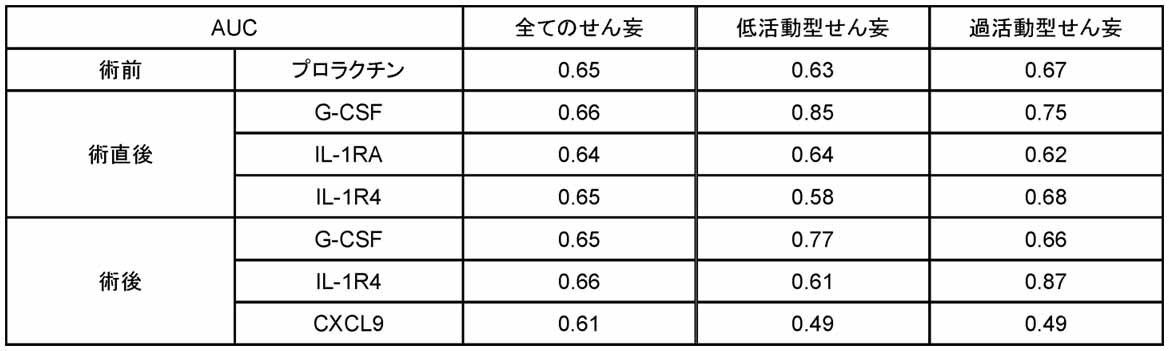
低活動型せん妄の予測においては、G-CSFが高い精度で予測していた。過活動型せん妄の予測においては、手術翌朝(術後)のIL-1R4が高い精度で予測していた。
<(2B)サイトカイン(2)>
高侵襲外科的がん切除後の術後せん妄コホートの中で、口腔・咽頭がん、喉頭がん又は食道がんの切除手術を予定した60歳以上で、認知機能低下がない(MMSE得点27点以上)患者のうち、重症せん妄を認めた20名(重症せん妄群)、軽症(閾値下)せん妄を認めた12名(軽症(閾値下)せん妄群)、及びせん妄の発症を認めなかった70名(非せん妄群)から取得した手術直前(術前)、手術直後(術直後)、手術翌朝(術後1日)及び術後4-7日目朝(術後4-7日)の血漿を使用して、<(2B)サイトカイン(1)>と同様の解析を実施した。その結果、術前、術直後、術後1日及び術後4-7日のいずれかの時点、又はこれら2つの時点の差分で重症せん妄群と非せん妄群との間で有意差があったサイトカインとして、9種類のサイトカインが見出された。
高侵襲外科的がん切除後の術後せん妄コホートの中で、口腔・咽頭がん、喉頭がん又は食道がんの切除手術を予定した60歳以上で、認知機能低下がない(MMSE得点27点以上)患者のうち、重症せん妄を認めた20名(重症せん妄群)、軽症(閾値下)せん妄を認めた12名(軽症(閾値下)せん妄群)、及びせん妄の発症を認めなかった70名(非せん妄群)から取得した手術直前(術前)、手術直後(術直後)、手術翌朝(術後1日)及び術後4-7日目朝(術後4-7日)の血漿を使用して、<(2B)サイトカイン(1)>と同様の解析を実施した。その結果、術前、術直後、術後1日及び術後4-7日のいずれかの時点、又はこれら2つの時点の差分で重症せん妄群と非せん妄群との間で有意差があったサイトカインとして、9種類のサイトカインが見出された。
図9は、手術直前(術前)、手術直後(術直後)、手術翌朝(術後1日)及び術後4-7日目朝(術後4-7日)の血漿中のサイトカイン濃度(単位pg/mL)の平均値を重症せん妄群(20名)、軽症(閾値下)せん妄群(12名)及び非せん妄群(70名)に分けてプロットした図である。図9中、*はP<0.05(重症せん妄群と非せん妄群との間)を示す。
重症せん妄群と非せん妄群との間で有意差のあったサイトカインとして、IL-10(図9(A):術直後及び術後1日)、IL-1R4(図9(B):術直後、術後1日及び術後4-7日)、CXCL9(図9(C):術直後及び術後1日)、プロラクチン(図9(D):術前)、G-CSF(図9(E):術直後及び術後1日)、IL-1RA(図9(F):術直後、術後1日及び術後4-7日)、MCP2(図9(G):術直後)、IL-6(図9(H):術直後及び術後1日)、チログロブリン(図9(I):(術直後-術前)及び(術後1日-術前))が見出された。
<(2C)免疫プロファイル>
高侵襲外科的がん切除後の術後せん妄コホートの中で、口腔・咽頭がん、喉頭がん又は食道がんの切除手術を予定した60歳以上で、認知機能低下がない(MMSE得点27点以上)患者のうち、せん妄を認めた20名(せん妄群)と、せん妄の発症を認めなかった20名(非せん妄群)から取得した手術直前(術前)、手術直後(術直後)、手術翌朝(術後1日)及び術後4-7日目朝(術後4-7日)の血液試料を使用して、フローサイトメトリーによる免疫プロファイル解析を行い、せん妄との関連を解析した。
高侵襲外科的がん切除後の術後せん妄コホートの中で、口腔・咽頭がん、喉頭がん又は食道がんの切除手術を予定した60歳以上で、認知機能低下がない(MMSE得点27点以上)患者のうち、せん妄を認めた20名(せん妄群)と、せん妄の発症を認めなかった20名(非せん妄群)から取得した手術直前(術前)、手術直後(術直後)、手術翌朝(術後1日)及び術後4-7日目朝(術後4-7日)の血液試料を使用して、フローサイトメトリーによる免疫プロファイル解析を行い、せん妄との関連を解析した。
図10は、手術直前(術前)、手術直後(術直後)、手術翌朝(術後1日)及び術後4-7日目朝(術後4-7日)の血液試料中の各種免疫プロファイルの平均値をせん妄群(20名)及び非せん妄群(20名)に分けてプロットした図である。図10中、*はP<0.05を示す。図11は、手術直前(術前)、手術直後(術直後)、手術翌朝(術後1日)及び術後4-7日目朝(術後4-7日)の血液試料中の各種免疫プロファイルの平均値をせん妄群(20名)及び非せん妄群(20名)に分けてプロットした図である。図11中、*はP<0.01を示す。
せん妄群と非せん妄群との間で有意差のあった免疫プロファイルとして、Th17細胞/ナイーブ制御性T細胞の比(図10(A):術前、術直後及び術後1日)、エフェクター制御性T細胞に対するドパミン陽性細胞の割合(図10(B):術直後)、CD4陽性T細胞に対する濾胞性T細胞の割合(図10(C):術直後及び術後1日)、CD4陽性T細胞に対するTh17細胞の割合(図10(D):術直後)、CD4陽性T細胞に対するナイーブ制御性T細胞の割合(図10(E):術後1日)、ナイーブ制御性T細胞に対するドパミン陽性細胞の割合(図10(F):(術直後-術前))、CD8陽性ナイーブT細胞に対するICOS陽性細胞の割合(図11(A):術後1日及び術後4-7日)、CD4陽性T細胞に対するドパミン受容体1陽性細胞の割合(図11(B):術直後)が見出された。
Th17細胞/ナイーブ制御性T細胞の比について、ROC解析によりAUCを算出しバイオマーカーとしての正確性を検討した結果を表4に示す。

制御性T細胞の機能や分画を抑制する分子としてドパミンが報告されており、ドパミンは術後せん妄の発症に関わる因子としても知られている。そこで、手術前後のドパミンの血漿中濃度を測定し、せん妄との関連を解析した。図12は、手術直後(術直後)の血漿中カテコールアミン(ドーパミン、ノルアドレナリン、アドレナリン)濃度(pg/mL)を重症せん妄群(56名)、軽症(閾値下)せん妄群(35名)及び非せん妄群(195名)に分けてプロットした図である。図12中、群間の差は、Mann-WhitneyのU検定(両側検定)により評価した。また、図10(F)は、ナイーブ制御性T細胞に対するドパミン陽性細胞の割合を示すが、せん妄群と非せん妄群で推移が異なり、せん妄群は術直後から術後翌朝にかけて陽性率が低下する一方で、非せん妄群は陽性率が上昇している。これらの結果から、術後せん妄の発症には末梢血中の免疫細胞のバランスが関与していると考えられ、制御性T細胞の相対的な減少にドパミンが関与する可能性が示唆された。なお、せん妄群は、31種全ての免疫細胞でドパミン受容体DRD1の陽性率が非せん妄群よりも低く、免疫細胞のDRD1を介したドパミンシグナル伝達とせん妄の関連が示唆された。
<ROC解析>
上記で見出された各バイオマーカーについて、ROC解析によりAUCを算出しバイオマーカーとしての正確性を検討した結果を表5及び表6に示す。
上記で見出された各バイオマーカーについて、ROC解析によりAUCを算出しバイオマーカーとしての正確性を検討した結果を表5及び表6に示す。
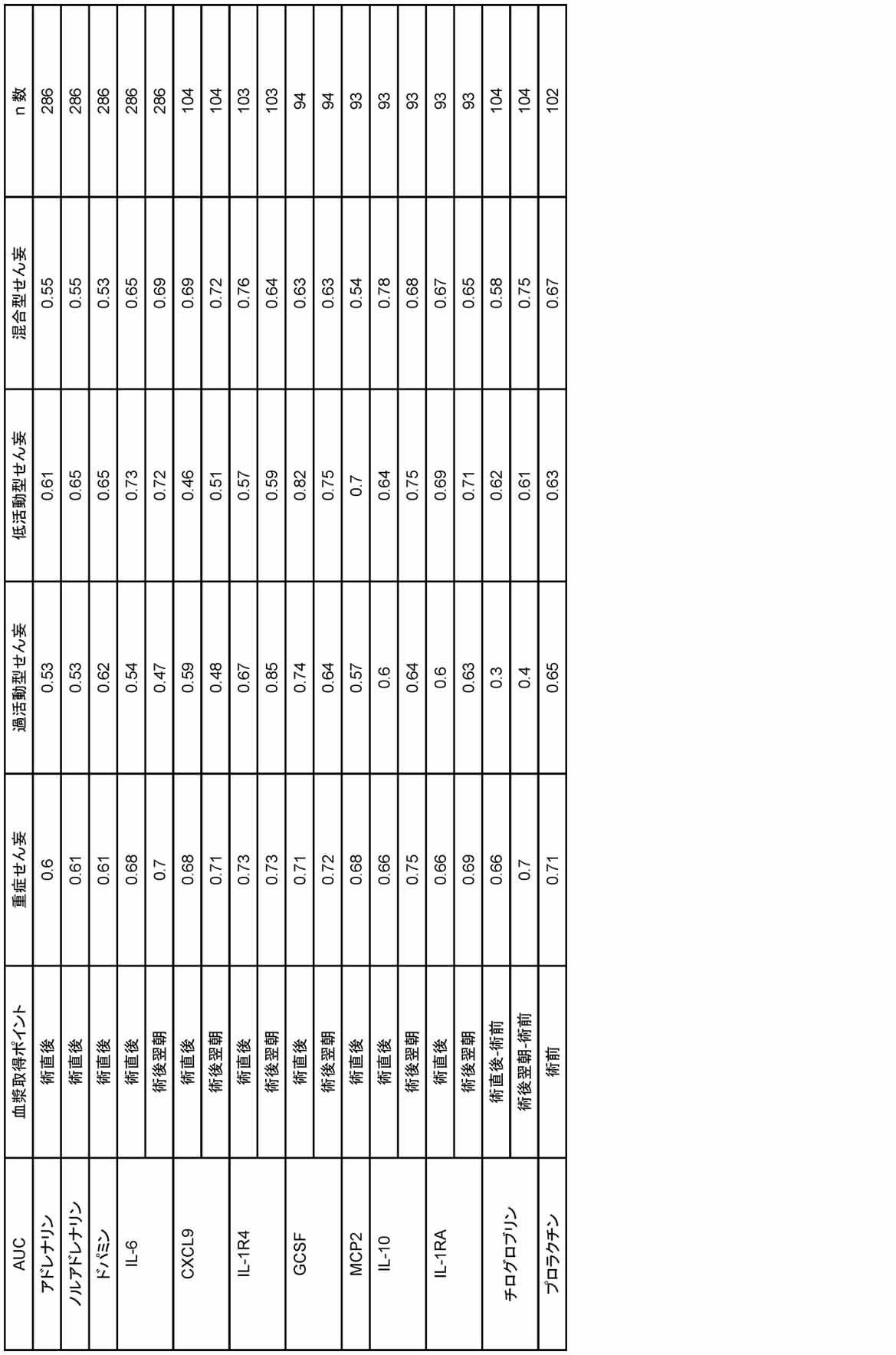
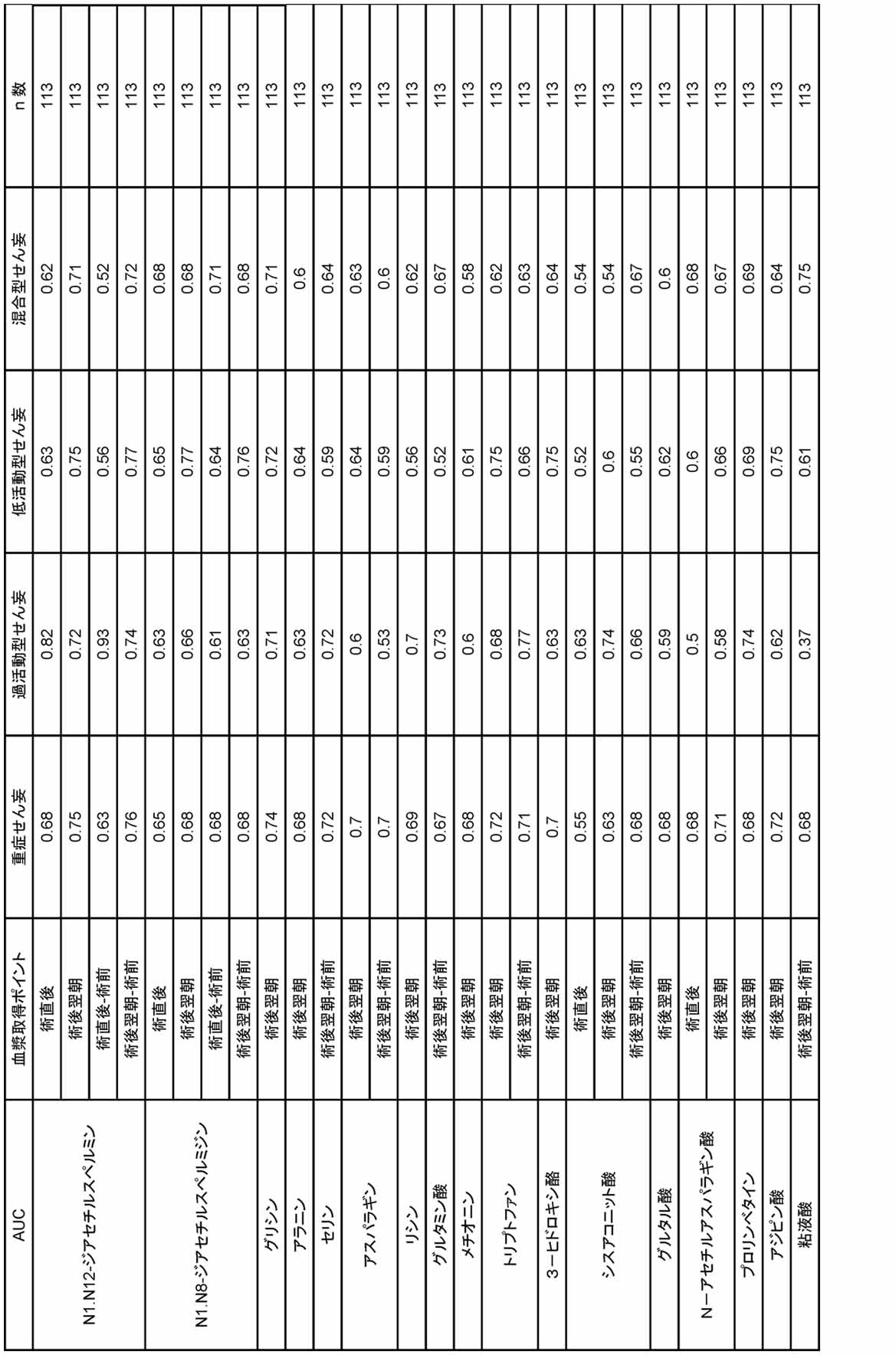
<バイオマーカーの組み合わせ>
次に、バイオマーカーの組み合わせについて検討を行った。まず、せん妄群と非せん妄群との間で有意差のあった15種類の代謝産物から、変数除去法(p<0.1)を用いて絞り込みを行った。その結果、せん妄群と非せん妄群について、グリシンとプロリンベタインの組み合わせが示唆された。グリシン単独(AUC=0.67)及びプロリンベタイン単独(AUC=0.64)と比べて、グリシンとプロリンベタインを組み合わせることでせん妄予測精度が高くなった(AUC=0.71)。組み合わせ時の最適カットオフは0,337、感度は0.68、特異度は0.69であった。
次に、バイオマーカーの組み合わせについて検討を行った。まず、せん妄群と非せん妄群との間で有意差のあった15種類の代謝産物から、変数除去法(p<0.1)を用いて絞り込みを行った。その結果、せん妄群と非せん妄群について、グリシンとプロリンベタインの組み合わせが示唆された。グリシン単独(AUC=0.67)及びプロリンベタイン単独(AUC=0.64)と比べて、グリシンとプロリンベタインを組み合わせることでせん妄予測精度が高くなった(AUC=0.71)。組み合わせ時の最適カットオフは0,337、感度は0.68、特異度は0.69であった。
また、代謝産物の中から、せん妄のサブタイプを予測するバイオマーカーを検討したところ、過活動型せん妄とN1,N12-ジアセチルスペルミンの術後変化に強い関連が見出された(過活動型せん妄群と非せん妄群について、AUC=0.93)。特に変数除去法(p<0.1)にて代謝物同士の組み合わせを検討すると、N,N-ジメチルグリシンと組み合わせることにより、AUC=0.96と極めて高い予測精度が示された。
次に、サイトカイン、ホルモン、代謝産物を統合して変数除去法(p<0.1)により解析し、せん妄群と非せん妄群に対して、手術前(術前)にせん妄を予測するバイオマーカーの組み合わせを探索した。その結果として、これまで術後せん妄との関連が示唆されていたグリシン、プロリンベタイン及びプロラクチンの組み合わせが示唆された。具体的には、グリシン単独ではAUC=0.67、プロリンベタイン単独ではAUC=0.64、プロラクチン単独ではAUCが0.65であったが、これらを組み合わせることにより、AUCが0.75と高い精度が示された。
さらに、重症せん妄、過活動型せん妄、低活動型せん妄又は混合型せん妄を予測するバイオマーカーの組み合わせを増減法で探索した。増減法には、サイトカイン、ホルモン、代謝産物から、手術直前(術前)は26分子、手術直後(術直後)は29分子、手術翌朝(術後翌朝)は26分子を用いた。
図13は、手術直前(術前)、手術直後(術直後)又は手術翌朝(術後翌朝)それぞれにおいて、非せん妄群と重症せん妄群とについて、各バイオマーカーの組み合わせによるROC曲線を示す図である。術前は、プロラクチン、グリシン、セリン、CXCL9、N-アセチルアスパラギン酸、N1,N12-ジアセチルスペルミン及びN1,N8-ジアセチルスペルミジンの組み合わせにより、重症せん妄に対して極めて高い予測精度(AUC=0.93)が示された。術直後は、ドパミン、粘液酸、CXCL9、アスパラギン、セリン、ノルアドレナリン及びN-アセチルアスパラギン酸の組み合わせにより、重症せん妄に対して極めて高い予測精度(AUC=0.92)が示された。術後翌朝は、G-CSF、CXCL9、アジピン酸、グルタミン酸、グリシン及びセリンの組み合わせにより、重症せん妄に対して極めて高い予測精度(AUC=0.92)が示された。
図14は、手術直前(術前)、手術直後(術直後)又は手術翌朝(術後翌朝)それぞれにおいて、非せん妄群と過活動型せん妄群とについて、各バイオマーカーの組み合わせによるROC曲線を示す図である。術前は、グリシン及びセリンの組み合わせにより、過活動型せん妄に対して極めて高い予測精度(AUC=0.89)が示された。術直後は、ドパミン、ノルアドレナリン、アドレナリン、G-CSF、メチオニン、MCP2、IL-1RA、プロリンベタイン、グルタル酸、N-アセチルアスパラギン酸及びN1,N12-ジアセチルスペルミンの組み合わせにより、過活動型せん妄に対して極めて高い予測精度(AUC=1.00)が示された。術後翌朝は、IL-1R4及びN1,N8-ジアセチルスペルミジンの組み合わせにより、過活動型せん妄に対して極めて高い予測精度(AUC=0.94)が示された。
図15は、手術直前(術前)、手術直後(術直後)又は手術翌朝(術後翌朝)それぞれにおいて、非せん妄群と低活動型せん妄群とについて、各バイオマーカーの組み合わせによるROC曲線を示す図である。術前は、IL-6、N1,N12-ジアセチルスペルミン、G-CSF、プロリンベタイン及びIL-1R4の組み合わせにより、低活動型せん妄に対して極めて高い予測精度(AUC=0.85)が示された。術直後は、粘液酸及びIL-1R4の組み合わせにより、低活動型せん妄に対して極めて高い予測精度(AUC=0.85)が示された。術後翌朝は、G-CSF、トリプトファン、IL-1R4、IL-6、N1,N8-ジアセチルスペルミジン、N1,N12-ジアセチルスペルミン、アジピン酸及びリシンの組み合わせにより、低活動型せん妄に対して極めて高い予測精度(AUC=0.98)が示された。
図16は、手術直前(術前)、手術直後(術直後)又は手術翌朝(術後翌朝)それぞれにおいて、非せん妄群と混合型せん妄群とについて、各バイオマーカーの組み合わせによるROC曲線を示す図である。術前は、IL-1RA、IL-1R4、G-CSF、IL-10、メチオニン、グリシン及び3-ヒドロキシ酪酸の組み合わせにより、混合型せん妄に対して極めて高い予測精度(AUC=0.95)が示された。術直後は、メチオニン、G-CSF、CXCL9、トリプトファン、IL-10、チログロブリン及びN-アセチルアスパラギン酸の組み合わせにより、混合型せん妄に対して極めて高い予測精度(AUC=0.94)が示された。術後翌朝は、CXCL9、グルタミン酸、IL-1RA、シスアコニット酸及びN-アセチルアスパラギン酸の組み合わせにより、混合型せん妄に対して極めて高い予測精度(AUC=0.90)が示された。
Claims (9)
- N1,N12-ジアセチルスペルミン、N1,N8-ジアセチルスペルミジン、N1-アセチルスペルミジン、N8-アセチルスペルミジン、N-アセチルアスパラギン酸、o-アセチルカルニチン、プロリンベタイン、トリプトファン、2-オキソ酪酸、2-オキソイソ吉草酸、3-ヒドロキシ酪酸、アジピン酸、ドデカン酸、グリシン、粘液酸、アスパラギン、リシン、グルタル酸、アラニン、メチオニン、セリン、シスアコニット酸、グルタミン酸、グリシンとセリンの比(グリシン/セリン)、ドパミン、ノルアドレナリン、アドレナリン、プロラクチン、G-CSF、IL-1RA、IL-1R4、CXCL9、IL-10、MCP2、IL-6、チログロブリン、Th17細胞/ナイーブ制御性T細胞の比、エフェクター制御性T細胞に対するドパミン陽性細胞の割合、CD4陽性T細胞に対する濾胞性T細胞の割合、CD4陽性T細胞に対するTh17細胞の割合、CD4陽性T細胞に対するナイーブ制御性T細胞の割合、ナイーブ制御性T細胞に対するドパミン陽性細胞の割合、CD8陽性ナイーブT細胞に対するICOS陽性細胞の割合、及びCD4陽性T細胞に対するドパミン受容体1陽性細胞の割合からなる群より選択される少なくとも1種を含む、身体に対する侵襲に伴うせん妄の発症リスクの予測用バイオマーカー。
- N1,N12-ジアセチルスペルミン、グリシン、トリプトファン、アジピン酸、N-アセチルアスパラギン酸、アスパラギン、3-ヒドロキシ酪酸、リシン、N1,N8-ジアセチルスペルミジン、グルタル酸、アラニン、プロリンベタイン、メチオニン、セリン、シスアコニット酸、グルタミン酸、粘液酸、グリシンとセリンの比(グリシン/セリン)、ドパミン、ノルアドレナリン、アドレナリン、IL-10、IL-1R4、CXCL9、プロラクチン、G-CSF、IL-1RA、MCP2、IL-6及びチログロブリンからなる群より選択される少なくとも1種を含む、身体に対する侵襲に伴う重症せん妄の発症リスクの予測用バイオマーカー。
- (C1)グリシン及びプロリンベタインの組み合わせ、又は(C2)グリシン、プロリンベタイン及びプロラクチンの組み合わせを含む、身体に対する侵襲に伴うせん妄の発症リスクの予測用バイオマーカー。
- (C3)プロラクチン、グリシン、セリン、CXCL9、N-アセチルアスパラギン酸、N1,N12-ジアセチルスペルミン及びN1,N8-ジアセチルスペルミジンの組み合わせ、(C4)ドパミン、粘液酸、CXCL9、アスパラギン、セリン、ノルアドレナリン及びN-アセチルアスパラギン酸の組み合わせ、又は(C5)G-CSF、CXCL9、アジピン酸、グルタミン酸、グリシン及びセリンの組み合わせを含む、身体に対する侵襲に伴う重症せん妄の発症リスクの予測用バイオマーカー。
- (C6)N1,N12-ジアセチルスペルミン及びN,N-ジメチルグリシンの組み合わせ、(C7)グリシン及びセリンの組み合わせ、(C8)ドパミン、ノルアドレナリン、アドレナリン、G-CSF、メチオニン、MCP2、IL-1RA、プロリンベタイン、グルタル酸、N-アセチルアスパラギン酸及びN1,N12-ジアセチルスペルミンの組み合わせ、又は(C9)IL-1R4及びN1,N8-ジアセチルスペルミジンの組み合わせを含む、身体に対する侵襲に伴う過活動型せん妄の発症リスクの予測用バイオマーカー。
- グリシンとセリンの比(グリシン/セリン)、(C10)IL-6、N1,N12-ジアセチルスペルミン、G-CSF、プロリンベタイン及びIL-1R4の組み合わせ、(C11)粘液酸及びIL-1R4の組み合わせ、又は(C12)G-CSF、トリプトファン、IL-1R4、IL-6、N1,N8-ジアセチルスペルミジン、N1,N12-ジアセチルスペルミン、アジピン酸及びリシンの組み合わせを含む、身体に対する侵襲に伴う低活動型せん妄の発症リスクの予測用バイオマーカー。
- (C13)IL-1RA、IL-1R4、G-CSF、IL-10、メチオニン、グリシン及び3-ヒドロキシ酪酸の組み合わせ、(C14)メチオニン、G-CSF、CXCL9、トリプトファン、IL-10、チログロブリン及びN-アセチルアスパラギン酸の組み合わせ、又は(C15)CXCL9、グルタミン酸、IL-1RA、シスアコニット酸及びN-アセチルアスパラギン酸の組み合わせを含む、身体に対する侵襲に伴う混合型せん妄の発症リスクの予測用バイオマーカー。
- 身体に対する侵襲に伴うせん妄の発症リスクを予測する方法であって、
被験者から採取された血液試料中のバイオマーカーの量を測定するステップと、
測定されたバイオマーカーの量に基づき、せん妄の発症リスクを予測するステップと、を備え、
前記バイオマーカーが、請求項1に記載のバイオマーカーである、方法。 - 身体に対する侵襲に伴うせん妄の発症リスクを予測するためのデータを収集する方法であって、
被験者から採取された血液試料中のバイオマーカーの量を測定するステップを備え、
前記バイオマーカーが、請求項1に記載のバイオマーカーである、方法。
Applications Claiming Priority (2)
| Application Number | Priority Date | Filing Date | Title |
|---|---|---|---|
| JP2021008936A JP2024065120A (ja) | 2021-01-22 | 2021-01-22 | 身体に対する侵襲に伴うせん妄の発症リスクの予測用バイオマーカー |
| JP2021-008936 | 2021-04-27 |
Publications (1)
| Publication Number | Publication Date |
|---|---|
| WO2022158157A1 true WO2022158157A1 (ja) | 2022-07-28 |
Family
ID=82548331
Family Applications (1)
| Application Number | Title | Priority Date | Filing Date |
|---|---|---|---|
| PCT/JP2021/045367 Ceased WO2022158157A1 (ja) | 2021-01-22 | 2021-12-09 | 身体に対する侵襲に伴うせん妄の発症リスクの予測用バイオマーカー |
Country Status (2)
| Country | Link |
|---|---|
| JP (1) | JP2024065120A (ja) |
| WO (1) | WO2022158157A1 (ja) |
Citations (2)
| Publication number | Priority date | Publication date | Assignee | Title |
|---|---|---|---|---|
| CN105277719A (zh) * | 2015-09-30 | 2016-01-27 | 青岛市市立医院 | 脑脊液Aβ-42/tau浓度比值预测老年患者发生术后认知功能障碍的方法 |
| US20190046122A1 (en) * | 2017-08-09 | 2019-02-14 | University Of Pittsburgh - Of The Commonwealth System Of Higher Education | Variable index for determining patient status |
-
2021
- 2021-01-22 JP JP2021008936A patent/JP2024065120A/ja active Pending
- 2021-12-09 WO PCT/JP2021/045367 patent/WO2022158157A1/ja not_active Ceased
Patent Citations (2)
| Publication number | Priority date | Publication date | Assignee | Title |
|---|---|---|---|---|
| CN105277719A (zh) * | 2015-09-30 | 2016-01-27 | 青岛市市立医院 | 脑脊液Aβ-42/tau浓度比值预测老年患者发生术后认知功能障碍的方法 |
| US20190046122A1 (en) * | 2017-08-09 | 2019-02-14 | University Of Pittsburgh - Of The Commonwealth System Of Higher Education | Variable index for determining patient status |
Non-Patent Citations (3)
| Title |
|---|
| CORNELIA KNAAK; GERALD VORDERWüLBECKE; CLAUDIA SPIES; SOPHIE K. PIPER; DANIEL HADZIDIAKOS; FRIEDRICH BORCHERS; WOLF‐R&#: "C‐reactive protein for risk prediction of post‐operative delirium and post‐operative neurocognitive disorder", ACTA ANAESTHESIOLOGICA SCANDINAVICA., WILEY-BLACKWELL MUNKSGAARD, DK, vol. 63, no. 10, 29 July 2019 (2019-07-29), DK , pages 1282 - 1289, XP071048877, ISSN: 0001-5172, DOI: 10.1111/aas.13441 * |
| HEIDI LINDROTH; LISA BRATZKE; SARA TWADELL; PAUL ROWLEY; JANIE KILDOW; MARA DANNER; LILY TURNER; BRANDON HERNANDEZ; ROGER BROWN; R: "Predicting postoperative delirium severity in older adults: The role of surgical risk and executive function", INTERNATIONAL JOURNAL OF GERIATRIC PSYCHIATRY, JOHN WILEY AND SONS, CHICHESTER, GB, vol. 34, no. 7, 23 April 2019 (2019-04-23), GB , pages 1018 - 1028, XP071724925, ISSN: 0885-6230, DOI: 10.1002/gps.5104 * |
| ISHIHARA ATSUSHI; TANAKA SHOGO; UENO MASAKI; IIDA HIROYA; KAIBORI MASAKI; NOMI TAKEO; HIROKAWA FUMITOSHI; IKOMA HISASHI; NAKAI TAK: "Preoperative Risk Assessment for Delirium After Hepatic Resection in the Elderly: a Prospective Multicenter Study", JOURNAL OF GASTROINTESTINAL SURGERY, QUALITY MEDICAL PUBL., ST. LOUIS, MO, US, vol. 25, no. 1, 1 January 1900 (1900-01-01), US , pages 134 - 144, XP037354974, ISSN: 1091-255X, DOI: 10.1007/s11605-020-04562-1 * |
Also Published As
| Publication number | Publication date |
|---|---|
| JP2024065120A (ja) | 2024-05-15 |
Similar Documents
| Publication | Publication Date | Title |
|---|---|---|
| Tabori Kraft et al. | Prevalence and clinical correlates of tic disorders in a community sample of school-age children | |
| Posti et al. | The levels of glial fibrillary acidic protein and ubiquitin C-terminal hydrolase-L1 during the first week after a traumatic brain injury: correlations with clinical and imaging findings | |
| Chiesa et al. | Prevalence and etiology of congenital hypothyroidism detected through an argentine neonatal screening program (1997-2010) | |
| Huang et al. | The neutrophil to lymphocyte ratio as a novel predictor of asthma and its exacerbation: a systematic review and meta-analysis. | |
| BRPI1007443B1 (pt) | método para diagnosticar nefropatia diabética em um indivíduo, método para avaliar a eficácia de um tratamento para nefropatia diabética em um indivíduo, método para determinação do estágio da nefropatia diabética em um indivíduo, método para monitoramento do progresso da nefropatia diabética em um indivíduo, e método para avaliar a eficácia de um tratamento para nefropatia diabética em um indivíduo | |
| Pelegrino et al. | Effects of active smoking on airway and systemic inflammation profiles in patients with chronic obstructive pulmonary disease | |
| Farah et al. | Association between peripheral airway function and neutrophilic inflammation in asthma | |
| Irshad et al. | Salivary free light chains as a new biomarker to measure psychological stress: the impact of a university exam period on salivary immunoglobulins, cortisol, DHEA and symptoms of infection | |
| US20220236294A1 (en) | Methods for Evaluation and Treatment of Alzheimer's Disease and Applications Thereof | |
| Wang et al. | Serum matrix metalloproteinase-2: A potential biomarker for diagnosis of epilepsy | |
| Tan et al. | Biomarkers of asthma relapse and lung function decline in adults with spontaneous asthma remission: A population‐based cohort study | |
| Zhang et al. | Association between serum amyloid A levels and predicting disase severity in COVID-19 patients: a systematic review and meta-analysis. | |
| Miyazaki et al. | Determination of optimal 25-hydroxyvitamin D cutoff values for the evaluation of restless legs syndrome among pregnant women | |
| Gu et al. | Association of inflammatory cytokines expression in cerebrospinal fluid with the severity and prognosis of spontaneous intracerebral hemorrhage | |
| Heaney et al. | Salivary immunoglobulin free light chains: reference ranges and responses to exercise in young and older adults | |
| de Nijs et al. | Airway inflammation and mannitol challenge test in COPD | |
| Bamford et al. | Salivary levels of amyloid beta reflect brain amyloid beta burden in cognitively-normal older adults | |
| WO2015174544A1 (ja) | 精神疾患判定マーカー | |
| Torstensen et al. | Repeated measures of hypocretin-1 in Danish and Italian patients with narcolepsy and in controls | |
| Rodríguez et al. | Application of the electronic nose in predicting preeclampsia in high-risk pregnancies. Pilot study | |
| Tsou et al. | Low level anti-Hu reactivity: A risk marker for small cell lung cancer? | |
| Başak et al. | Can C-reactive protein levels increase the accuracy of the Ranson score in predicting the severity and prognosis of acute pancreatitis? A prospective cohort study | |
| JP2024065120A (ja) | 身体に対する侵襲に伴うせん妄の発症リスクの予測用バイオマーカー | |
| JP2025016807A (ja) | 脳内アミロイドβの蓄積を評価するためのバイオマーカー | |
| Coelho et al. | Sleep breathing disorders in adolescents with asthma |
Legal Events
| Date | Code | Title | Description |
|---|---|---|---|
| 121 | Ep: the epo has been informed by wipo that ep was designated in this application |
Ref document number: 21921259 Country of ref document: EP Kind code of ref document: A1 |
|
| NENP | Non-entry into the national phase |
Ref country code: DE |
|
| 122 | Ep: pct application non-entry in european phase |
Ref document number: 21921259 Country of ref document: EP Kind code of ref document: A1 |
|
| NENP | Non-entry into the national phase |
Ref country code: JP |