WO2022149394A1 - 情報処理装置、情報処理方法、及び情報処理プログラム - Google Patents
情報処理装置、情報処理方法、及び情報処理プログラム Download PDFInfo
- Publication number
- WO2022149394A1 WO2022149394A1 PCT/JP2021/044992 JP2021044992W WO2022149394A1 WO 2022149394 A1 WO2022149394 A1 WO 2022149394A1 JP 2021044992 W JP2021044992 W JP 2021044992W WO 2022149394 A1 WO2022149394 A1 WO 2022149394A1
- Authority
- WO
- WIPO (PCT)
- Prior art keywords
- partial structure
- extracted
- occurrence
- chemical substance
- information processing
- Prior art date
- Legal status (The legal status is an assumption and is not a legal conclusion. Google has not performed a legal analysis and makes no representation as to the accuracy of the status listed.)
- Ceased
Links
Images





Classifications
-
- G—PHYSICS
- G16—INFORMATION AND COMMUNICATION TECHNOLOGY [ICT] SPECIALLY ADAPTED FOR SPECIFIC APPLICATION FIELDS
- G16C—COMPUTATIONAL CHEMISTRY; CHEMOINFORMATICS; COMPUTATIONAL MATERIALS SCIENCE
- G16C20/00—Chemoinformatics, i.e. ICT specially adapted for the handling of physicochemical or structural data of chemical particles, elements, compounds or mixtures
- G16C20/30—Prediction of properties of chemical compounds, compositions or mixtures
-
- G—PHYSICS
- G16—INFORMATION AND COMMUNICATION TECHNOLOGY [ICT] SPECIALLY ADAPTED FOR SPECIFIC APPLICATION FIELDS
- G16C—COMPUTATIONAL CHEMISTRY; CHEMOINFORMATICS; COMPUTATIONAL MATERIALS SCIENCE
- G16C20/00—Chemoinformatics, i.e. ICT specially adapted for the handling of physicochemical or structural data of chemical particles, elements, compounds or mixtures
- G16C20/40—Searching chemical structures or physicochemical data
-
- G—PHYSICS
- G16—INFORMATION AND COMMUNICATION TECHNOLOGY [ICT] SPECIALLY ADAPTED FOR SPECIFIC APPLICATION FIELDS
- G16C—COMPUTATIONAL CHEMISTRY; CHEMOINFORMATICS; COMPUTATIONAL MATERIALS SCIENCE
- G16C20/00—Chemoinformatics, i.e. ICT specially adapted for the handling of physicochemical or structural data of chemical particles, elements, compounds or mixtures
- G16C20/50—Molecular design, e.g. of drugs
Definitions
- the disclosed technology relates to information processing devices, information processing methods, and information processing programs.
- Japanese Patent Application Laid-Open No. 2019-40422 describes a partial structure selection means for selecting an arbitrary partial structure of a compound and a partial structure coexisting with the partial structure selected by the partial structure selection means in the compound data.
- a compound design apparatus including a substructure detecting means for detecting and a co-occurrence quantifying means for quantifying the degree of co-occurrence for a plurality of substructures detected by the substructure detecting means is described. ..
- the partial structure that constitutes a part of a chemical substance may have a great influence on the performance of the chemical substance. Therefore, when designing the structure of a chemical substance exhibiting desired performance for the purpose of manufacturing, it is necessary to understand what the partial structure that the chemical substance should have. However, the performance of a chemical substance changes not only by the existence of a partial structure but also by the positional relationship and combination of the partial structure with other structures contained in the chemical substance. Since the factors that affect the performance of chemical substances are complicated, it is not easy to design the structure of chemical substances after fully understanding such factors.
- the disclosed technology was made in view of the above points, and aims to support the structural design of chemical substances that exhibit desired performance.
- the information processing apparatus is an information processing apparatus including at least one processor, wherein the processor is a condition regarding partial structure data indicating a partial structure of a chemical substance and an index value indicating the performance of the chemical substance.
- the processor is a condition regarding partial structure data indicating a partial structure of a chemical substance and an index value indicating the performance of the chemical substance.
- the processor is a condition regarding partial structure data indicating a partial structure of a chemical substance and an index value indicating the performance of the chemical substance.
- the processor may perform a process of displaying the extracted co-occurrence substructure while showing the connection relationship with the input substructure.
- the processor may calculate the co-occurrence probability, which is the probability of appearing together with the input substructure, for the extracted co-occurrence substructure.
- a process of displaying the extracted co-occurrence substructures in the order of co-occurrence probability may be performed.
- the processor may perform a process of displaying the extracted co-occurrence substructure together with the co-occurrence probability calculated for the co-occurrence substructure.
- the information processing method accepts the input of conditions regarding the partial structure data indicating the partial structure of the chemical substance and the index value indicating the performance of the chemical substance, and for each of the plurality of known chemical substances, the chemical concerned. From a database that records structural data showing the structure of a substance, a known chemical substance containing and satisfying an input partial structure, which is a partial structure indicated by the partial structure data, is extracted, and the structure of the extracted known chemical substance is obtained.
- a processor included in an information processing apparatus executes a process of extracting a partial structure other than an input partial structure as a co-occurrence partial structure and displaying the extracted co-occurrence partial structure.
- the information processing program for the disclosed technology accepts input of conditions regarding partial structure data indicating the partial structure of the chemical substance and index values indicating the performance of the chemical substance, and for each of the plurality of known chemical substances, the chemical concerned. From a database that records structural data showing the structure of a substance, a known chemical substance containing and satisfying an input partial structure, which is a partial structure indicated by the partial structure data, is extracted, and the structure of the extracted known chemical substance is obtained. It is a program for extracting a partial structure other than an input partial structure as a co-occurrence partial structure and causing a processor included in the information processing apparatus to execute a process of displaying the extracted co-occurrence partial structure.
- FIG. 1 is a diagram showing an example of a hardware configuration of the information processing apparatus 10 according to the embodiment of the disclosed technique.
- the information processing device 10 includes a CPU (Central Processing Unit) 101, a memory 102 as a temporary storage area, and a storage unit 103. Further, the information processing apparatus 10 includes a display unit 104 such as a liquid crystal display, an input unit 105 including an input device such as a keyboard and a mouse, and a network I / F (InterFace) 106 connected to the network.
- the CPU 101, the memory 102, the storage unit 103, the display unit 104, the input unit 105, and the network I / F 106 are each connected to the bus 108.
- the storage unit 103 is realized by a non-volatile storage medium such as an HDD (Hard Disk Drive), an SSD (Solid State Drive), or a flash memory.
- the information processing program 110, the chemical substance database 120, and the partial structure database 130 are stored in the storage unit 103.
- the CPU 101 reads the information processing program 110 from the storage unit 103, expands the information processing program 110 into the memory 102, and executes the program.
- An example of the information processing apparatus 10 is a server computer or the like.
- the CPU 101 is an example of a processor in the disclosed technique.
- the information processing apparatus 10 is used for structural design of chemical substances and has a function as a molecular design editor.
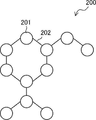
- the structural data representing the structure of the chemical substance handled by the information processing apparatus 10 according to the present embodiment is expressed in a graph format.
- FIG. 2 is a diagram showing an example of structural data 200 of a chemical substance expressed in a graph format.
- the atoms constituting the chemical substance are represented by the nodes 201, and the bonds between the atoms are represented by the edges 202.
- the format of the structural data handled by the information processing apparatus 10 is not limited to the graph format, and may be, for example, a character string format such as a DNA (DeoxyriboNucleic Acid) base sequence.
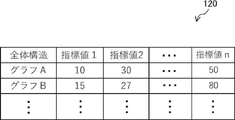
- FIG. 3 is a diagram showing an example of the chemical substance database 120 stored in the storage unit 103.
- the chemical substance database 120 records structural data representing the overall structure of the chemical substance for each of the plurality of known chemical substances. Structural data is represented in graph format. Each of the structural data is associated with at least one index value representing the performance of the chemical substance. Examples of index values include boiling point, melting point, glass transition temperature, partition coefficient, density, viscosity, coefficient of thermal expansion, and molecular weight. The index value may be, for example, an actually measured value or a nominal value obtained by a past experiment.
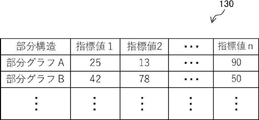
- FIG. 4 is a diagram showing an example of the partial structure database 130 stored in the storage unit 103.
- the substructure database 130 records the substructure data representing the substructure for each of the plurality of known substructures.
- a partial structure is a partial structure that constitutes a chemical substance. Examples of the partial structure include the structure of a functional group such as a carboxy group, an aldehyde group, and a hydroxyl group.
- the structural data of the substructure is expressed in graph format.
- Each of the structural data of the substructure is associated with at least one index value representing the performance of the substructure. Examples of index values include the presence or absence of carcinogenicity, the presence or absence of toxicity, and the degree of solubility in water.
- the index value may be, for example, an actually measured value or a nominal value obtained by a past experiment.
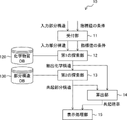
- FIG. 5 is a functional block diagram showing an example of the functional configuration of the information processing apparatus 10.
- the information processing apparatus 10 includes a reception unit 11, a first search unit 12, a second search unit 13, a calculation unit 14, and a display processing unit 15.
- the CPU 101 executes the information processing program 110, the information processing apparatus 10 functions as a reception unit 11, a first search unit 12, a second search unit 13, a calculation unit 14, and a display processing unit 15.
- a user who designs a structure of a chemical substance using the information processing device 10 inputs a partial structure that can be contained in the chemical substance to be designed into the information processing device 10.
- the partial structure input to the information processing apparatus 10 is hereinafter referred to as an input partial structure.
- the input of the input substructure to the information processing apparatus 10 can be performed by operating the input unit 105.
- the reception unit 11 receives partial structure data indicating an input partial structure input by the user.
- FIG. 6 is a diagram showing an example of the input substructure 300.
- the user formulates conditions for a specific index value based on the performance that the chemical substance to be designed should have, and inputs the formulated conditions to the information processing apparatus 10. For example, when designing the structure of a chemical substance having a boiling point of 150 ° C. or lower, information indicating "boiling point of 150 ° C. or lower" is input as a condition regarding an index value.
- the input of the condition regarding the index value to the information processing apparatus 10 can be performed by operating the input unit 105.
- the reception unit 11 receives a condition regarding a specific index value input by the user. There may be two or more conditions for a specific index value.
- the reception unit 11 supplies the conditions regarding the received input substructure and the specific index value to the first search unit 12.
- the first search unit 12 searches for and extracts a chemical substance containing an input partial structure and satisfying the conditions related to the index value from the chemical substance database 120. That is, the first search unit 12 extracts a chemical substance containing an input partial structure and capable of exhibiting the required performance from among a plurality of known chemical substances contained in the chemical substance database 120. When there are a plurality of chemical substances in the chemical substance database 120 that include the input partial structure and satisfy the condition regarding the index value, the first search unit 12 extracts all the corresponding chemical substances.
- the first search unit 12 supplies structural data showing the structure of the extracted chemical substance to the second search unit 13 and the calculation unit 14.
- the structure of the chemical substance extracted by the first search unit 12 is hereinafter referred to as an extracted chemical structure.
- the second search unit 13 extracts a partial structure other than the input partial structure included in the extracted chemical structure as a co-occurrence partial structure. That is, the co-occurrence substructure is a substructure that exists with the input substructure in a chemical substance.
- the second search unit 13 extracts the co-occurrence substructure by referring to the substructure database 130. That is, when the second search unit 13 finds a partial structure other than the input partial structure in the extracted chemical structure that matches the partial structure recorded in the partial structure database 130, that portion. Extract the structure as a co-occurrence substructure. When a plurality of substructures corresponding to the above are found in the extracted chemical structure, the second search unit 13 extracts all the corresponding substructures as co-occurrence substructures. The second search unit 13 supplies the partial structure data indicating the co-occurrence partial structure to the display processing unit 15 and the calculation unit 14.
- the calculation unit 14 calculates the co-occurrence probability, which is the probability of appearing together with the input substructure for the co-occurrence substructure. When a plurality of co-occurrence substructures having different structures are extracted, the calculation unit 14 calculates the co-occurrence probability for each of the plurality of co-occurrence substructures.
- the co-occurrence probability may be expressed by the following equation (1), for example.
- P is a co-occurrence probability
- A is the number of extracted co-occurrence substructures of a certain type extracted by the second search unit 13
- B is the first search unit 12.
- the number of chemical substances extracted by. B may be the total number of chemical substances recorded in the chemical substance database 120.
- the co-occurrence substructure having a relatively high co-occurrence probability tends to have a relatively high possibility of satisfying the condition regarding the index value because it exists together with the input substructure.
- P A / B ⁇ 100 [%] ⁇ ⁇ ⁇ (1)
- the display processing unit 15 performs a process of displaying the co-occurrence substructure extracted by the second search unit 13 on the display unit 104.
- FIG. 7 is a diagram showing an example of a display form of the co-occurrence substructure 310 displayed on the display screen 104A of the display unit 104.
- the display processing unit 15 performs a process of displaying the extracted co-occurrence substructure 310 while showing the connection relationship with the input substructure 300.
- the co-occurrence substructure 310 and the input substructure 300 are displayed in graph format. For example, when the co-occurrence substructure 310 and the input substructure 300 are directly connected, the connection point is represented by an edge.
- the display processing unit 15 may perform processing for displaying the co-occurrence substructure 310 and the input substructure 300 in an identifiable manner. For example, a process may be performed in which the node constituting the co-occurrence substructure 310 and the node constituting the input substructure 300 are displayed in different colors.
- the display processing unit 15 may perform processing to display only the co-occurrence partial structure 310 among the co-occurrence partial structure 310 and the input partial structure 300. Further, the display processing unit 15 may perform a process of displaying the entire structure including both the input partial structure 300 and the co-occurrence partial structure 310, that is, the entire structure of the chemical substance extracted by the first search unit 12. ..
- the display processing unit 15 When a plurality of co-occurrence substructures having different structures are extracted, the display processing unit 15 performs a process of arranging the extracted co-occurrence substructures in the order of the co-occurrence probabilities calculated by the calculation unit 14. conduct. For example, as shown in FIG. 7, the display processing unit 15 performs a process of arranging the extracted co-occurrence substructures 310 in order from the left to the right of the display screen 104A in descending order of the co-occurrence probability. You may go. Further, the display screen 104A may be displayed in order from the top to the bottom in descending order of co-occurrence probability. The display processing unit 15 may perform a process of displaying the co-occurrence substructure together with the co-occurrence probability.
- FIG. 8 is a flowchart showing an example of the flow of display processing executed by the CPU 101 executing the information processing program 110.
- step S1 the reception unit 11 receives the partial structure data indicating the input partial structure input by the user by operating the input unit 105.
- step S2 the reception unit 11 receives the condition regarding the specific index value input by the user by operating the input unit 105.
- the conditions for a particular index value are set based on the performance that the chemical substance to be designed should have.
- step S3 the first search unit 12 searches for and extracts from the chemical substance database 120 a known chemical substance containing the input partial structure received in step S1 and satisfying the condition relating to the index value received in step S2. ..
- step S4 the second search unit 13 refers to the partial structure database 130 to include a portion other than the input partial structure contained in the structure of the known chemical substance extracted in step S3 (that is, the extracted chemical structure). Extract the structure as a co-occurrence substructure.
- step S5 the calculation unit 14 calculates the co-occurrence probability, which is the probability that the co-occurrence substructure extracted in step S4 appears together with the input substructure.
- the calculation unit 14 calculates the co-occurrence probability based on the above equation (1), for example.
- step S6 the display processing unit 15 performs a process of displaying the co-occurrence substructure extracted in step S4 on the display unit 104. Specifically, the display processing unit 15 performs a process of displaying the co-occurrence substructure while showing the connection relationship with the input substructure. When a plurality of co-occurrence substructures having different structures are extracted, the display processing unit 15 performs a process of arranging the extracted co-occurrence substructures in the order of co-occurrence probability and displaying them.
- the partial structure that constitutes a part of a chemical substance may have a great influence on the performance of the chemical substance. Therefore, when designing a chemical substance that exhibits desired performance, it is necessary to understand what the partial structure that the chemical substance should have.
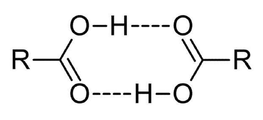
- the carboxylic acid shown in FIG. 9 generally forms a dimer by hydrogen bonding.
- Chemical substances that form hydrogen bonds such as carboxylic acids, have a higher boiling point than chemical substances that do not form hydrogen bonds and have similar molecular weights.
- maleic acid shown in FIG. 10 is one of carboxylic acids, but since two carboxy groups are present adjacent to each other, it does not form a hydrogen bond with another molecule. Therefore, maleic acid has a relatively low boiling point even if it is a carboxylic acid.
- the performance (for example, boiling point) of a chemical substance changes not only by the existence of a partial structure but also by the positional relationship and combination of the partial structure with other structures contained in the chemical substance. Since the factors that affect the performance of chemical substances are complicated, it is not easy to design the structure of chemical substances after fully understanding such factors.
- a known chemical substance containing an input partial structure and satisfying a condition (that is, a requirement regarding performance) for a specific index value is extracted, and the extracted chemical substance is used.
- Substructures other than the input substructure included in the structure are extracted and displayed as co-occurrence substructures.
- the carboxy group shown in FIG. 11 is input to the information processing apparatus 10 as an input substructure, and "boiling point 150 ° C. or lower" is input as a condition for a specific index value.
- maleic acid shown in FIG. 10 is extracted as a known chemical substance containing an input partial structure and satisfying the conditions.
- the carboxy group different from the input partial structure is extracted and displayed as a co-occurrence partial structure.
- a partial structure that may satisfy the condition regarding the index value when it exists together with the input partial structure is presented to the user as a co-occurrence partial structure.
- the user can adopt the presented co-occurrence substructure as a candidate for the substructure to be included in the chemical substance to be designed.
- the co-occurrence partial structure extracted from the structure of the known chemical substance extracted from the chemical substance database 120 is displayed, so that the displayed co-occurrence partial structure has the desired performance. It can increase the possibility that it will be useful for exerting. Further, according to the information processing apparatus 10, since the extracted co-occurrence substructure is displayed in a state where the connection relationship with the input substructure is shown, the design support can be performed more effectively. Further, according to the information processing apparatus 10, when a plurality of co-occurrence substructures having different structures are extracted, the extracted co-occurrence substructures are displayed in the order of co-occurrence probability. It is possible to specify a co-occurrence substructure that is relatively likely to satisfy the conditions related to the index value.
- a case where a partial structure matching the partial structure recorded in the partial structure database 130 is extracted as a co-occurrence partial structure is exemplified.
- Substructures randomly selected from the extracted chemical structure or according to a predetermined rule may be extracted as co-occurrence substructures.
- a processing unit that executes various processes such as a reception unit 11, a first search unit 12, a second search unit 13, a calculation unit 14, and a display processing unit 15.
- various processors shown below can be used.
- the various processors include CPUs, which are general-purpose processors that execute software (programs) and function as various processing units, as well as circuits after manufacturing FPGAs (Field Programmable Gate Arrays) and the like.
- Dedicated electricity which is a processor with a circuit configuration specially designed to execute specific processing such as programmable logic device (PLD), ASIC (Application Specific Integrated Circuit), which is a processor whose configuration can be changed. Circuits etc. are included.
- One processing unit may be composed of one of these various processors, or a combination of two or more processors of the same type or different types (for example, a combination of a plurality of FPGAs or a combination of a CPU and an FPGA). It may be composed of a combination). Further, a plurality of processing units may be configured by one processor.
- one processor is configured by a combination of one or more CPUs and software, as represented by a computer such as a client and a server.
- the processor functions as a plurality of processing units.
- SoC System On Chip
- the various processing units are configured by using one or more of the above-mentioned various processors as a hardware-like structure.
- an electric circuit in which circuit elements such as semiconductor elements are combined can be used.
- the information processing program 110 is stored (installed) in the storage unit 103 in advance, but the present invention is not limited to this.
- the information processing program 110 is provided in a form recorded on a recording medium such as a CD-ROM (Compact Disc Read Only Memory), a DVD-ROM (Digital Versatile Disc Read Only Memory), and a USB (Universal Serial Bus) memory. May be good. Further, the information processing program 110 may be downloaded from an external device via a network.
Landscapes
- Chemical & Material Sciences (AREA)
- Crystallography & Structural Chemistry (AREA)
- Life Sciences & Earth Sciences (AREA)
- Engineering & Computer Science (AREA)
- Bioinformatics & Cheminformatics (AREA)
- Bioinformatics & Computational Biology (AREA)
- Computing Systems (AREA)
- Theoretical Computer Science (AREA)
- Information Retrieval, Db Structures And Fs Structures Therefor (AREA)
- Management, Administration, Business Operations System, And Electronic Commerce (AREA)
- Organic Low-Molecular-Weight Compounds And Preparation Thereof (AREA)
Priority Applications (5)
| Application Number | Priority Date | Filing Date | Title |
|---|---|---|---|
| CN202180089273.6A CN116783658A (zh) | 2021-01-07 | 2021-12-07 | 信息处理装置、信息处理方法及信息处理程序 |
| CA3203719A CA3203719A1 (en) | 2021-01-07 | 2021-12-07 | Information processing apparatus, information processing method, and information processing program |
| JP2022573953A JP7753259B2 (ja) | 2021-01-07 | 2021-12-07 | 情報処理装置、情報処理方法、及び情報処理プログラム |
| EP21917615.3A EP4276839A4 (en) | 2021-01-07 | 2021-12-07 | INFORMATION PROCESSING DEVICE, INFORMATION PROCESSING METHOD AND INFORMATION PROCESSING PROGRAM |
| US18/340,038 US20230335226A1 (en) | 2021-01-07 | 2023-06-23 | Information processing apparatus, information processing method, and information processing program |
Applications Claiming Priority (2)
| Application Number | Priority Date | Filing Date | Title |
|---|---|---|---|
| JP2021001610 | 2021-01-07 | ||
| JP2021-001610 | 2021-01-07 |
Related Child Applications (1)
| Application Number | Title | Priority Date | Filing Date |
|---|---|---|---|
| US18/340,038 Continuation US20230335226A1 (en) | 2021-01-07 | 2023-06-23 | Information processing apparatus, information processing method, and information processing program |
Publications (1)
| Publication Number | Publication Date |
|---|---|
| WO2022149394A1 true WO2022149394A1 (ja) | 2022-07-14 |
Family
ID=82357353
Family Applications (1)
| Application Number | Title | Priority Date | Filing Date |
|---|---|---|---|
| PCT/JP2021/044992 Ceased WO2022149394A1 (ja) | 2021-01-07 | 2021-12-07 | 情報処理装置、情報処理方法、及び情報処理プログラム |
Country Status (6)
| Country | Link |
|---|---|
| US (1) | US20230335226A1 (https=) |
| EP (1) | EP4276839A4 (https=) |
| JP (1) | JP7753259B2 (https=) |
| CN (1) | CN116783658A (https=) |
| CA (1) | CA3203719A1 (https=) |
| WO (1) | WO2022149394A1 (https=) |
Families Citing this family (3)
| Publication number | Priority date | Publication date | Assignee | Title |
|---|---|---|---|---|
| US12587274B2 (en) | 2023-03-28 | 2026-03-24 | Quantum Generative Materials Llc | Satellite optimization management system based on natural language input and artificial intelligence |
| US12368503B2 (en) | 2023-12-27 | 2025-07-22 | Quantum Generative Materials Llc | Intent-based satellite transmit management based on preexisting historical location and machine learning |
| US12603701B2 (en) | 2023-12-27 | 2026-04-14 | Quantum Generative Materials Llc | Distributed satellite constellation management and control system |
Citations (4)
| Publication number | Priority date | Publication date | Assignee | Title |
|---|---|---|---|---|
| JP2007277188A (ja) * | 2006-04-10 | 2007-10-25 | Hitachi Ltd | 化合物検索支援システム |
| JP2019040422A (ja) | 2017-08-25 | 2019-03-14 | 国立研究開発法人産業技術総合研究所 | 化合物設計装置と化合物設計方法及び化合物設計プログラム |
| JP2020194488A (ja) * | 2019-05-30 | 2020-12-03 | 富士通株式会社 | 材料特性予測装置、材料特性予測方法、及び材料特性予測プログラム |
| JP2021001610A (ja) | 2019-06-19 | 2021-01-07 | 有限会社アールストーン | 配管支持具 |
Family Cites Families (1)
| Publication number | Priority date | Publication date | Assignee | Title |
|---|---|---|---|---|
| CN110728047B (zh) * | 2019-10-08 | 2023-04-07 | 中国工程物理研究院化工材料研究所 | 一种基于机器学习性能预测含能分子计算机辅助设计系统 |
-
2021
- 2021-12-07 EP EP21917615.3A patent/EP4276839A4/en active Pending
- 2021-12-07 CN CN202180089273.6A patent/CN116783658A/zh active Pending
- 2021-12-07 CA CA3203719A patent/CA3203719A1/en active Pending
- 2021-12-07 WO PCT/JP2021/044992 patent/WO2022149394A1/ja not_active Ceased
- 2021-12-07 JP JP2022573953A patent/JP7753259B2/ja active Active
-
2023
- 2023-06-23 US US18/340,038 patent/US20230335226A1/en active Pending
Patent Citations (4)
| Publication number | Priority date | Publication date | Assignee | Title |
|---|---|---|---|---|
| JP2007277188A (ja) * | 2006-04-10 | 2007-10-25 | Hitachi Ltd | 化合物検索支援システム |
| JP2019040422A (ja) | 2017-08-25 | 2019-03-14 | 国立研究開発法人産業技術総合研究所 | 化合物設計装置と化合物設計方法及び化合物設計プログラム |
| JP2020194488A (ja) * | 2019-05-30 | 2020-12-03 | 富士通株式会社 | 材料特性予測装置、材料特性予測方法、及び材料特性予測プログラム |
| JP2021001610A (ja) | 2019-06-19 | 2021-01-07 | 有限会社アールストーン | 配管支持具 |
Non-Patent Citations (1)
| Title |
|---|
| See also references of EP4276839A4 |
Also Published As
| Publication number | Publication date |
|---|---|
| JP7753259B2 (ja) | 2025-10-14 |
| JPWO2022149394A1 (https=) | 2022-07-14 |
| CA3203719A1 (en) | 2022-07-14 |
| EP4276839A1 (en) | 2023-11-15 |
| US20230335226A1 (en) | 2023-10-19 |
| CN116783658A (zh) | 2023-09-19 |
| EP4276839A4 (en) | 2024-12-04 |
Similar Documents
| Publication | Publication Date | Title |
|---|---|---|
| WO2022149394A1 (ja) | 情報処理装置、情報処理方法、及び情報処理プログラム | |
| TWI788345B (zh) | 設計積體電路的方法及其系統 | |
| TWI506462B (zh) | 用以執行字串搜尋之系統、方法與電腦程式產品 | |
| JP4039488B2 (ja) | 多頻度パターン抽出装置、多頻度パターン抽出方法、及びそのプログラムと記録媒体 | |
| Holt et al. | Merging of multi-string BWTs with applications | |
| US20230335230A1 (en) | Information processing apparatus, information processing method, and information processing program | |
| Janin et al. | BEETL-fastq: a searchable compressed archive for DNA reads | |
| JPWO2014132497A1 (ja) | データ解析装置、及びその方法 | |
| CN110060740A (zh) | 一种非冗余基因集聚类方法、系统及电子设备 | |
| Spencer et al. | Incorporating functional genomic information in genetic association studies using an empirical Bayes approach | |
| Shin et al. | A new algorithm for detecting low-complexity regions in protein sequences | |
| Cheng et al. | FMtree: a fast locating algorithm of FM-indexes for genomic data | |
| JP2013041385A (ja) | 文献検索方法、文献検索装置及び文献検索プログラム | |
| WO2019163610A1 (ja) | 情報処理システム及び情報処理方法 | |
| JP2005242812A (ja) | 回路設計支援システム、回路設計支援方法及びプログラム | |
| JP7750874B2 (ja) | 情報処理装置、情報処理方法、及び情報処理プログラム | |
| JP7783194B2 (ja) | 情報処理装置、情報処理方法、及び情報処理プログラム | |
| JP7800692B2 (ja) | 情報処理プログラム、情報処理方法および情報処理装置 | |
| Bahoussi et al. | Evolutionary history and genetic variation of Zika virus: connection between Thailand Zika viruses and global outbreaks strains | |
| JP2014174921A (ja) | 情報処理システム、名寄せ判定方法及びプログラム | |
| JP4992301B2 (ja) | 検索処理方法及び装置 | |
| Eskandar et al. | Lossless pangenome indexing using tag arrays | |
| Guan et al. | deSPI: efficient classification of metagenomics reads with lightweight de Bruijn graph-based reference indexing | |
| JP2017224191A (ja) | Dna配列解析装置、dna配列解析方法及びdna配列解析システム | |
| Srivastava et al. | Alevin: An integrated method for dscRNA-seq quantification |
Legal Events
| Date | Code | Title | Description |
|---|---|---|---|
| 121 | Ep: the epo has been informed by wipo that ep was designated in this application |
Ref document number: 21917615 Country of ref document: EP Kind code of ref document: A1 |
|
| WWE | Wipo information: entry into national phase |
Ref document number: 202317042739 Country of ref document: IN |
|
| ENP | Entry into the national phase |
Ref document number: 3203719 Country of ref document: CA |
|
| ENP | Entry into the national phase |
Ref document number: 2022573953 Country of ref document: JP Kind code of ref document: A |
|
| WWE | Wipo information: entry into national phase |
Ref document number: 202180089273.6 Country of ref document: CN |
|
| NENP | Non-entry into the national phase |
Ref country code: DE |
|
| ENP | Entry into the national phase |
Ref document number: 2021917615 Country of ref document: EP Effective date: 20230807 |