WO2022141012A1 - 医疗监测方式的设置方法及相关设备 - Google Patents
医疗监测方式的设置方法及相关设备 Download PDFInfo
- Publication number
- WO2022141012A1 WO2022141012A1 PCT/CN2020/140569 CN2020140569W WO2022141012A1 WO 2022141012 A1 WO2022141012 A1 WO 2022141012A1 CN 2020140569 W CN2020140569 W CN 2020140569W WO 2022141012 A1 WO2022141012 A1 WO 2022141012A1
- Authority
- WO
- WIPO (PCT)
- Prior art keywords
- alarm
- monitoring
- gestational age
- configuration information
- information
- Prior art date
- Legal status (The legal status is an assumption and is not a legal conclusion. Google has not performed a legal analysis and makes no representation as to the accuracy of the status listed.)
- Ceased
Links
Images




Classifications
-
- A—HUMAN NECESSITIES
- A61—MEDICAL OR VETERINARY SCIENCE; HYGIENE
- A61B—DIAGNOSIS; SURGERY; IDENTIFICATION
- A61B5/00—Measuring for diagnostic purposes; Identification of persons
- A61B5/02—Detecting, measuring or recording for evaluating the cardiovascular system, e.g. pulse, heart rate, blood pressure or blood flow
- A61B5/0205—Simultaneously evaluating both cardiovascular conditions and different types of body conditions, e.g. heart and respiratory condition
Definitions
- the present application relates to the technical field of medical equipment, and more particularly, to a method for setting a medical monitoring mode and related equipment.
- the present application provides a method for setting a medical monitoring mode, so as to automatically complete the setting process of different patient alarm modes, reduce the operations that medical staff need to perform, and thus avoid alarm errors caused by improper operations.
- an embodiment of the present application provides a method for setting a medical monitoring mode, including:
- Target alarm configuration information corresponding to the target alarm gestational age range is determined in at least one set of preset correspondence between the alarm gestational age range and the alarm configuration information, and the correspondence is used to indicate which alarm gestational age range can Trigger the alarm monitoring method from which alarm configuration information is obtained;
- the embodiments of the present application provide a method for setting a medical monitoring mode, including:
- target monitoring configuration information corresponding to the target monitoring condition is determined, and the corresponding relationship is used to indicate which monitoring condition can trigger which monitoring configuration The way in which the information is obtained is monitored;
- an embodiment of the present application provides a medical monitoring device, including:
- a memory for storing a preset correspondence between at least one set of alarm gestational age ranges and alarm configuration information, where the correspondence is used to indicate which alarm gestational age range can trigger an alarm monitoring method obtained from which alarm configuration information;
- a processor configured to obtain the gestational age information of the newborn, and determine the target alarm gestational age range corresponding to the gestational age information; in the correspondence between the at least one group of alarm gestational age ranges and the alarm configuration information, determine target alarm configuration information corresponding to the target alarm gestational age range; and loading the target alarm configuration information to obtain a target alarm monitoring method for the newborn.
- an embodiment of the present application provides a medical monitoring device, including:
- a memory for storing a preset correspondence between at least one set of monitoring conditions and monitoring configuration information, where the corresponding relationship is used to indicate which monitoring condition can trigger the monitoring method obtained from what kind of monitoring configuration information;
- a processor for obtaining feature information of at least one dimension of the monitoring object; determining target monitoring conditions corresponding to the feature information; target monitoring configuration information corresponding to a condition; and loading the target monitoring configuration information to obtain a target monitoring mode about the monitoring object.
- an embodiment of the present application provides a readable storage medium on which a computer program is stored, and when the computer program is loaded and executed by a processor, the method for setting a medical monitoring mode described in any one of the above aspects is implemented .
- the method for setting a medical monitoring mode provided in the embodiment of the present application can obtain the characteristic information of the monitoring object, determine the corresponding target monitoring conditions based on the characteristic information, and obtain the corresponding monitoring configuration information based on the target monitoring conditions, so as to obtain
- the target monitoring method of the monitoring object this scheme obtains different monitoring methods for the monitoring object through different characteristic information, improves the flexibility of monitoring method setting, and avoids the need for medical staff to manually set the monitoring method for different objects.
- the setting efficiency of the medical monitoring method is improved, and at the same time, setting errors that may be caused by manual operation are avoided.
- Fig. 1 is a schematic flowchart of a method for setting a medical monitoring mode provided by an embodiment of the present application
- FIG. 2 is another schematic flowchart of a method for setting a medical monitoring mode provided by an embodiment of the present application
- FIG. 3 is another schematic flowchart of a method for setting a medical monitoring mode provided by an embodiment of the present application.
- Fig. 4 is a schematic diagram of the interface setting of the medical monitoring mode provided by the embodiment of the present application.
- FIG. 5 is another schematic flowchart of a method for setting a medical monitoring mode provided by an embodiment of the present application.
- FIG. 6 is another schematic flowchart of a method for setting a medical monitoring mode provided by an embodiment of the present application.
- FIG. 7 is another schematic flowchart of a method for setting a medical monitoring mode provided by an embodiment of the present application.
- FIG. 8 is a schematic diagram of a medical monitoring device provided by an embodiment of the present application.
- FIG. 9 is a schematic structural diagram of a multi-parameter monitor provided by an embodiment of the present application.
- the most common clinical practice is the setting of alarm thresholds for vital signs of neonates and children.
- medical staff For newborns of different gestational ages or children of different ages, during daily hospital monitoring, medical staff usually define appropriate vital sign alarm thresholds for them according to their clinical work experience. It is inconvenient for medical staff to set manually and may cause monitoring errors. .
- the embodiment of the present application provides a method for setting a medical monitoring mode, and the medical monitoring device automatically completes the alarm configuration. It should be noted that the alarm settings for neonates are also suitable for the alarm settings for children or patients of other ages.
- the embodiment of the present application provides a method for setting a medical monitoring mode, and the method can be applied to medical monitoring equipment.
- the medical monitoring equipment is a medical equipment with a monitoring function, such as a monitor, a ventilator with Anesthesia machines with sign monitoring capabilities, et al. Please refer to FIG. 1 for details.
- the method may include steps 101-103.
- This embodiment is described by taking the setting process of a medical monitoring mode applied to a newborn as an example. Because the newborn has just left the mother's body, its gestational age information has a great influence on the vital signs of the newborn. Newborns in different gestational age ranges need to use different alarm thresholds for monitoring. Neonates can be classified based on different gestational age ranges. Exemplarily, newborns can be divided into three categories: preterm infants, term infants, and expired fetuses, wherein the gestational age corresponding to preterm infants is less than 37 weeks, and the gestational age corresponding to full-term infants is greater than or equal to 37 weeks and less than or equal to 42 weeks. .
- the gestational age of post-term infants is greater than 42 weeks. It should be noted that, according to the actual application, the number of categories for newborns may be other, and the gestational age range corresponding to each category may also be other, which is not specifically limited in this application. In addition, the gestational age may also be a corrected gestational age.
- the gestational age information of the newborn can be obtained by any of the following methods.
- the medical monitoring device is equipped with an input device, through which the operator can input the gestational age information of the newborn, and then the medical monitoring device obtains the gestational age information of the newborn.
- the input device may be a keyboard, a touch screen, a microphone, or the like.
- the input can be the value of the gestational age information directly input by the operator, or it can be a selection input, that is, the medical monitoring device provides a selection interface for the gestational age information of the newborn, and the user selects a certain gestational age information as the input newborn. information on the gestational age of the child.
- the input device can verify the identity of the operator before receiving the gestational age information input by the operator. For example, the operator is required to input a job number to confirm the identity of the operator's medical staff, so as to avoid non-medical staff from entering the wrong gestational age. This information in turn leads to errors in the setting of medical monitoring methods.
- the medical monitoring device can obtain the patient identification of the newborn, and the patient identification can be manually input by the operator through the input device or obtained by scanning the information acquisition device. If there is a patient identification of the newborn, the operator can use the scanning gun and other information acquisition and scanning equipment to scan the patient bracelet of the newborn, and then obtain the patient identification of the newborn.
- the patient identification can be a name or a hospitalization number.
- the medical monitoring device can query the local database to obtain the gestational age information corresponding to the patient identification, and can also send the patient identification to the central monitoring station and the clinical information system. , hospital information system or electronic medical record system, query the information record with the patient identification, and then obtain the corresponding gestational age information of the newborn.
- the specifics can be determined according to the actual situation, which is not limited here.
- the patient identification of the newborn may be recorded in the information carrier such as the patient bracelet of the newborn, or more data such as the patient information of the newborn may be recorded, and the patient information at least includes the gestational age information. Therefore, after using the information acquisition device to scan the patient information carrier of the newborn to obtain the patient information, the gestational age information of the newborn is extracted from the patient information.
- the gestational age information of the newborn can also be obtained by other methods, for example, other medical equipment collects the gestational age information of the newborn and sends the gestational age information to the medical monitoring equipment.
- other medical equipment collects the gestational age information of the newborn and sends the gestational age information to the medical monitoring equipment.
- Using the information collection device to collect the gestational age information of the newborn can save the manual input steps of the medical staff, and can improve the efficiency of obtaining the gestational age information of the newborn.
- the gestational age range can be a range composed of multiple consecutive gestational age values.
- a gestational age value can also be called a gestational age range.
- the gestational age range corresponding to the neonate is determined according to the gestational age information.
- one purpose of setting the gestational age range is to set corresponding alarm configuration information for different gestational age ranges, so that newborns with different gestational age ranges correspond to different alarm monitoring methods. Therefore, the gestational age range can also be referred to as the alarm gestational age range. Further, in order to distinguish it from other alarm gestational age ranges, the alarm gestational age range determined according to the neonatal gestational age information obtained in step 101 may be referred to as the target alarm gestational age range.
- step 101 obtains the gestational age information of a newborn At this time, it is determined that the alarm gestational age range of the newborn is the alarm gestational age range of normal infants, that is, the target alarm gestational age range is 37 to 42 weeks.
- the setting of the alarm gestational age range can be adjusted according to the actual situation. For example, the alarm gestational age can be subdivided to obtain multiple different alarm gestational age ranges, and more detailed alarm configuration settings can be made according to the actual situation. It depends on the situation and is not limited here.
- Corresponding alarm configuration information may be set for the alarm gestational age range in advance, and the corresponding relationship between the alarm gestational age range and the alarm configuration information may be one group or multiple groups. The corresponding relationship is used to indicate which alarm gestational age range can trigger the alarm monitoring mode obtained from which alarm configuration information. Based on at least one set of preset correspondences, corresponding alarm configuration information is determined for the target alarm gestational age range. For ease of description, the alarm configuration information determined according to the target alarm gestational age range may be referred to as target alarm configuration information.
- different alarm configuration information should be set for different alarm gestational age ranges. For example, for a smaller gestational age range, newborns with weak constitution often have poor organ development and poor anti-risk ability.
- the alarm configuration information corresponding to the alarm gestational age range is set to be more sensitive, so that the medical staff can discover the possible danger in time and take better care of the newborn.
- the physiological indicators of newborns in different gestational age ranges are also quite different.
- the alarm setting in one gestational age range may be normal in another gestational age range, so it is necessary to set different alarm gestational age ranges. Corresponding alarm configuration information.
- the correspondence between the alarm configuration information and the alarm gestational age range can be pre-stored in the medical monitoring device for quick search. It can be understood that the alarm configuration information can be preset by the staff, and the alarm configuration information set for the gestational age information of the newborn in a certain period of time can also be statistically analyzed and processed, and the corresponding alarms corresponding to each alarm gestational age range can be obtained by learning. Configuration information and the specific content of the alarm configuration information to realize the automatic setting of the alarm configuration information.
- the target alarm configuration information includes the parameter names of one or more vital sign parameters and the alarm threshold corresponding to the vital sign parameter, including but not limited to the alarm threshold of heartbeat frequency, the alarm threshold of blood oxygen saturation, the alarm threshold of blood pressure, etc. Wait. After loading the target alarm configuration information, the vital sign parameters of the newborn can be monitored. If the parameter value of a monitored vital sign parameter reaches the alarm threshold of the vital sign parameter, an alarm will be issued to realize the medical monitoring of the newborn. Purpose.
- the patient identification of the neonate can be sent to the medical staff when the alarm is issued, so that the medical staff can accurately determine the neonate with the alarm. It depends on the situation and is not limited here.
- this solution obtains the gestational age information of the neonate, determines the alarm configuration information based on the alarm gestational age range corresponding to the neonatal gestational age information, and loads the alarm configuration information to obtain the alarm monitoring method for the neonate. Since different alarm gestational age ranges correspond to different alarm configuration information, the alarm configuration information is the alarm configuration information used by neonates that are more in line with the alarm gestational age range, so this solution can obtain information for the newborn based on the gestational age information of the neonate.
- the alarm monitoring method for infants improves the accuracy of neonatal monitoring and saves the operation of medical staff to manually adjust the alarm configuration.
- one gestational age range division is taken as an example to specifically describe how to set alarm configuration information of newborns with different gestational age ranges. Please refer to FIG. 2 for details, including steps 201-204.
- gestational age information For the specific acquisition method of gestational age information, reference may be made to step 101 in the corresponding embodiment of FIG. 1 , and the gestational age information of the newborn is acquired by manually inputting or scanning the patient identifier, which will not be repeated here.
- This plan uses three gestational age ranges as examples to illustrate. For example, gestational age less than 37 weeks corresponds to the gestational age range of preterm infants, gestational age between 37 weeks and 42 weeks corresponds to the gestational age range of full-term infants, and gestational age greater than 42 weeks corresponds to the gestational age range of overdue infants. It is worth noting that when setting the gestational age range, the gestational age included in different gestational age ranges can be adjusted according to the actual situation. In addition, it should be avoided that a gestational age belongs to two gestational age ranges at the same time to avoid Error or conflict in alarm setting based on gestational age range.
- the corresponding target alarm gestational age range is determined based on the obtained gestational age information.
- step 201 is executed to load the parameter names and alarm thresholds of the vital signs monitoring parameters corresponding to the gestational age range of preterm infants; if step 201 obtains If the gestational age is greater than or equal to 37 weeks and less than or equal to 42 weeks, it is determined that the monitoring object corresponds to the gestational age range of the term infant, and step 203 is executed to load the parameter name and alarm threshold of the vital sign monitoring parameters corresponding to the gestational age range of the term infant; If the age is greater than 42 weeks, it is determined that the monitoring object corresponds to the gestational age range of the overdue infant, and step 204 is executed to load the parameter name and alarm threshold of the vital sign monitoring parameters corresponding to the overdue infant gestational age range.
- the parameter name of the vital sign monitoring parameter corresponding to the gestational age range of the premature infant and the alarm threshold corresponding to the vital sign monitoring parameter are loaded.
- the parameter of the vital sign monitoring parameter is loaded. It is called the types of vital signs monitoring parameters that need to be used for monitoring premature infants, such as: heart rate, blood oxygen saturation, blood pressure and other parameters.
- Each vital sign monitoring parameter has a preset alarm threshold, which is specific for each monitoring parameter. If the parameter value of a certain type of vital sign monitoring parameter reaches the alarm threshold, the medical monitoring device will trigger an alarm to notify the medical staff that an abnormal condition may occur.
- the gestational age range of preterm infants may also include multiple gestational age sub-ranges, and for the same vital sign monitoring parameter, the alarm thresholds corresponding to the multiple different gestational age sub-ranges included in the gestational age range of preterm infants are inconsistent.
- the vital signs of the 23-week gestational age neonates are significantly different from those of the 35-week gestational age neonates.
- the alarm thresholds of vital signs monitoring parameters corresponding to neonates with a gestational age of 30 weeks are subdivided accordingly, that is, further gestational age sub-range settings are performed for neonates belonging to the gestational age range of preterm infants, including those with a gestational age of less than 23 weeks. range, sub-range for gestational age 23 to 32 weeks, and sub-range for gestational age greater than 32 weeks.
- Each sub-range has different numerical settings for the alarm threshold corresponding to each vital sign monitoring parameter, thereby making the alarm action more detailed and sensitive, and more in line with the monitoring needs of newborns in different situations, specific gestational age sub-range and gestational age range
- the alarm threshold can be determined according to the actual situation, which is not limited here.
- the parameter name of the vital sign monitoring parameter corresponding to the gestational age range of the term infant and the alarm threshold corresponding to the vital sign monitoring parameter are loaded. It can be understood that multiple gestational age sub-ranges can also be included under the gestational age range of full-term infants, so that the alarm threshold can be adjusted based on the gestational age of the monitored object, that is, for the same vital sign monitoring parameters, term infants can
- the alarm thresholds corresponding to a plurality of different gestational age sub-ranges included in the gestational age range are inconsistent, and the specific setting method is similar to the setting method in the above step 202, which will not be repeated here.
- the obtained gestational age of the newborn belongs to the gestational age range of the overdue infant, load the parameter name of the vital sign monitoring parameter corresponding to the gestational age range of the overdue infant and the alarm threshold corresponding to the vital sign monitoring parameter.
- multiple gestational age sub-ranges can also be included under the gestational age range of overdue infants, so that the alarm threshold can be adjusted based on the gestational age of the monitored object, that is, for the same vital sign monitoring parameters, overdue infants and fetuses can be adjusted.
- the alarm thresholds corresponding to a plurality of different gestational age sub-ranges included in the age range are inconsistent, and the specific setting method is similar to the setting method in the above step 202, and will not be repeated here.
- this solution obtains the gestational age information of the neonate, and determines the alarm configuration information based on the alarm gestational age range corresponding to the neonatal gestational age information.
- the gestational age range and the gestational age range of overdue babies, the alarm configuration information corresponding to each gestational age range is set separately for the situation, so that the alarm configuration information is more in line with the alarm configuration information used by the newborns in the alarm gestational age range. Therefore, in this solution, an alarm monitoring method for the newborn can be obtained based on the gestational age information of the newborn, the accuracy of the newborn monitoring is improved, and the operation of manually adjusting the alarm configuration of the medical staff is saved.
- the above-mentioned embodiments of the method for setting various medical monitoring methods applied to neonates can be adapted to monitoring objects of other age groups, such as children or adults.
- the alarm age range can be divided into 1-6 years old and 6-12 years old.
- the alarming age range can be divided into 80-90 years old and more than 90 years old.
- the numerical value for dividing the alarm age range may be other, and the number of divisions for the alarm age range may also be other, which is not specifically limited here.
- the alarm configuration information corresponding to different alarm age ranges is different, so that different alarm configuration information can be set for different age ranges, and then different alarm monitoring methods are used to perform alarm monitoring on monitoring objects in different age ranges.
- gestational age can be extended to age, but also age parameters can be extended to other characteristic information, such as gender, height, weight, body fat percentage, standard body mass index, medical history, family history, biochemical monitoring items, vital signs Any one or more of measurement values, diagnostic information, treatment information, abnormal events, etc., and determine which type of object the monitoring object belongs to according to the multi-dimensional feature information, so as to provide targeted monitoring for the monitoring object in the future .
- the targeted monitoring method is not only limited to alarming, but can also be extended to other medical monitoring methods, such as displaying different forms of monitoring interfaces for monitoring objects with different characteristics to facilitate medical staff to view the interface content in a targeted manner.
- the monitoring objects be configured differently in terms of alarm, but also be configured differently from other aspects such as the display interface, so that the setting method of the medical monitoring method provided by the present application has higher usability and wider application range.
- the embodiment of the present application provides a method for setting a medical monitoring mode.
- a method for setting a medical monitoring mode For details, please refer to FIG. 3 , including steps 301 to 304 .
- the characteristic information may include patient information and vital sign monitoring parameters, wherein the patient information may be entered when the patient is admitted to the hospital, such as age, gender, family history, treatment information and abnormal events, as well as the doctor's diagnosis of the patient results, etc.
- the dimension of vital signs monitoring parameters may include information obtained by monitoring equipment, such as: height, weight, body fat percentage, standard body mass index, medical history, family history, diagnostic information, treatment information (such as medication type and dosage, special treatment) and abnormal events (such as myocardial infarction, cardiopulmonary resuscitation within the last 24 hours).
- the vital signs monitoring parameters are obtained by medical equipment, such as biochemical monitoring items, vital signs measurement values and other information.
- It can be obtained by direct monitoring of equipment such as hospital beds, or it can be networked with other medical systems and obtained from other medical systems, such as electronic medical record system, doctor's order system, etc., or obtained through the input device of medical monitoring equipment, such as manual input by medical personnel or It is obtained by scanning the patient identification with a scanning device, and the specific obtaining method may be determined according to the actual situation, which is not limited here. It can be understood that, in the actual implementation process of this solution, the type of feature information can be adjusted according to the actual situation, which is not specifically limited here.
- the corresponding relationship (mapping relationship) between the feature information and the monitoring conditions may be preset.
- Monitoring conditions refer to conditions that can trigger certain monitoring configuration information. For example, if a hypertensive patient needs to use a certain blood pressure alarm threshold, then hypertension can be regarded as a monitoring condition; another example is a patient who has experienced a myocardial infarction event. More types of arrhythmia alarms need to be turned on and the prompt level of arrhythmia alarms needs to be increased, then the myocardial infarction event can be considered as a monitoring condition; for another example, for patients who have recently suffered shock, medical staff are more concerned about the monitoring interface.
- the shock event can be regarded as a monitoring condition.
- the monitoring conditions may include not only the alarm conditions that trigger the alarm, but also other types of conditions, such as certain events that medical staff are concerned about.
- monitoring condition monitoring configuration information corresponding to the event of interest is triggered.
- whether the monitoring object has a special situation corresponding to a monitoring condition can be determined according to the characteristic information of the monitoring object, so the corresponding relationship between the characteristic information and the monitoring condition is preset. For example, if the diagnosis information includes hypertension, it is determined that the patient belongs to a hypertensive patient; if the treatment information includes the use of cardiopulmonary resuscitation equipment, it is determined that the patient has experienced a shock event. This step is the same as in the medical monitoring method applied to neonates, which is determined according to the gestational age information of the neonate to which alarm monitoring range it belongs to. monitoring conditions.
- the monitoring condition corresponding to the characteristic information in step 301 is determined in the corresponding relationship between the characteristic information and the monitoring condition.
- the monitoring condition may be referred to as a target monitoring condition. It should be noted that, in the actual implementation of this scheme, the same monitoring object can obtain multiple target monitoring conditions based on different types of characteristic information, so as to complete the monitoring of the monitoring object from different angles, which can be determined according to the actual situation, here Not limited.
- the monitoring configuration information corresponding to the target monitoring condition is determined.
- the determined monitoring configuration information may be referred to as target monitoring configuration information.
- the corresponding relationship is used to indicate which monitoring condition can trigger the monitoring method obtained from which monitoring configuration information.
- the monitoring condition is an alarm condition
- it corresponds to the alarm configuration information which means that the alarm condition can trigger the monitoring method obtained from the alarm configuration information.
- the monitoring condition is a preset attention event
- it corresponds to the interface configuration information which means that the preset attention event can trigger a monitoring interface obtained from the interface configuration information.
- the target monitoring configuration information set corresponding to the target monitoring conditions is obtained.
- the target monitoring configuration information can be input to the medical monitoring equipment by manual preset, or can be sorted and studied with the monitoring process of different patients.
- the learned results are used as target monitoring conditions. For example, if it is monitored that the patient's blood pressure continues to be too high, it can be determined that the patient is a hypertensive patient, and at the same time it is monitored that the medical staff for the patient has adjusted the various alarm thresholds of blood pressure, and then according to the long-term monitoring situation can learn Alarm thresholds such as high line threshold and low line threshold for blood pressure alarms of hypertensive patients.
- the specific settings can be made according to the actual situation, which is not limited here.
- the preset attention event may include a shock event
- the monitoring interface may be adjusted to a monitoring interface corresponding to a patient in shock.
- the interface is generally shown in Figure 4. Below the ECG waveform display area is the blood oxygen waveform display area, and below the blood oxygen waveform display area is the invasive blood pressure waveform display area.
- This monitoring interface can be used for monitoring general patients. However, for patients with shock, the fluctuation range of central venous pressure reflected in the invasive blood pressure waveform is extremely important for judging the state of the shock patient, so medical staff often adjust the invasive blood pressure waveform to the ECG during monitoring. Below the waveform, it is convenient to compare the amplitude and width of the waveform.
- the monitoring interface is adjusted to increase the display area of the invasive blood pressure waveform. It can be seen that, in order to simplify the operation of medical staff, the embodiment of the present application automatically sets the monitoring interface displayed corresponding to the shock event, which improves the applicability of the solution.
- the determined target monitoring configuration information is loaded, and the monitoring object is monitored based on the monitoring configuration information.
- the alarm configuration information includes monitoring items and alarm settings corresponding to the monitoring items.
- the monitoring objects are monitored to obtain the monitoring items in the alarm configuration information.
- Alarm settings if the parameter value of a vital sign monitoring parameter reaches the alarm threshold corresponding to the parameter, an alarm will be issued, such as a prompt sound or a light flashing.
- this solution obtains the characteristic information of the monitoring object, determines the corresponding target monitoring conditions based on the characteristic information of the monitoring object, obtains the corresponding monitoring configuration information based on the target monitoring conditions, and loads the monitoring configuration information.
- the target monitoring method of the monitoring object since different feature information corresponds to different detection configuration information, the obtained detection configuration information is more in line with the actual situation of the monitoring object, and the accuracy of the monitoring method set for the monitoring object is improved. The operation of manually adjusting the alarm configuration by medical staff is saved.
- the present solution provides several more specific embodiments.
- the setting method of medical monitoring is described by taking several different situations of blood pressure as examples, and the method may specifically include steps 501 to 504 .
- the 501 Determine a corresponding alarm condition according to the characteristic information of the monitoring object, where the alarm condition is a hypertensive patient, a normotensive patient or a hypotensive patient.
- the acquisition method of the feature information is as shown in the foregoing FIG. 3 corresponding to step 301 , and details are not repeated here.
- the characteristic information of the monitoring object such as medical history information, diagnosis information, etc.
- determine the specific situation of the monitoring object For example, based on the medical history information or diagnosis information, it can be determined that the monitoring object has hypertension symptoms or hypertensive diseases, and then the monitoring object is determined to be a hypertensive patient.
- the information or diagnosis information can confirm that the monitoring object has symptoms of hypotension or hypotensive disease, and the monitoring object is determined to be a hypotensive patient. patient.
- the monitoring object If it is determined based on the feature information that the monitoring object is a hypertensive patient, load the alarm configuration information corresponding to the hypertensive patient, that is, perform step 502 to load the systolic blood pressure alarm threshold, diastolic blood pressure alarm threshold and average blood pressure alarm threshold corresponding to the hypertensive patient;
- the information determines that the monitoring object is a normal blood pressure patient, then load the alarm configuration information corresponding to the normal blood pressure patient, that is, execute step 503 to load the systolic blood pressure alarm threshold, diastolic blood pressure alarm threshold and average blood pressure alarm threshold corresponding to the normal blood pressure patient;
- the object is a hypotensive patient, load the alarm configuration information corresponding to the hypotensive patient, that is, perform step 504 to load the systolic blood pressure alarm threshold, diastolic blood pressure alarm threshold and mean blood pressure alarm threshold corresponding to the hypotensive patient.
- the high-line threshold in the alarm thresholds of hypertensive patients is higher than the high-line threshold in the alarm thresholds of normotensive patients, and the alarm thresholds of hypotensive patients are in the high-line threshold.
- the low-line threshold for is lower than the low-line threshold in the alarm thresholds for normotensive patients.
- the systolic blood pressure alarm threshold, the diastolic blood pressure alarm threshold and the mean blood pressure alarm threshold are the alarm configuration information. Load different alarm configuration information according to different blood pressure patients. It should be noted that the corresponding alarm thresholds for patients in different conditions should be different, so that the alarm thresholds conform to the actual conditions of the patients. Specifically, with respect to at least one of the same monitoring items, the high-line threshold in the alarm thresholds for hypertensive patients is higher than the high-line threshold in the alarm thresholds for normotensive patients, and the low-line threshold in the alarm thresholds for hypotensive patients is lower than normal The low-line threshold in the alarm thresholds for blood pressure patients.
- the alarm thresholds can be set as: arterial blood pressure systolic blood pressure alarm high-line threshold is 180 mmHg, mean pressure alarm high-line threshold is 140 mmHg, diastolic blood pressure alarm high-line threshold is 90 mmHg,
- the high-line alarm threshold for arterial blood pressure is 160 mmHg for systolic blood pressure, 110 mmHg for mean blood pressure, and 90 mmHg for diastolic blood pressure.
- the high-line threshold setting of each alarm for hypertensive patients is higher than that for ordinary people, which is more in line with the actual situation of hypertensive patients and avoids unnecessary alarms.
- the specific values corresponding to each interval may be determined according to the actual situation, which is not limited here.
- the alarm thresholds set for patients under various conditions may also have sub-range settings.
- two sub-ranges are respectively set for patients with severe hypertension symptoms and patients with mild hypertension symptoms.
- a higher alarm threshold is set for more serious patients, and a lower alarm threshold is set for patients with milder symptoms, which can be adjusted according to the actual situation, which is not limited here.
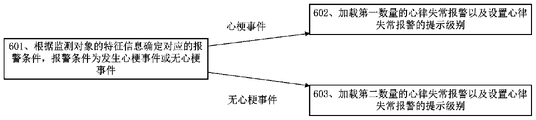
- a method for setting medical monitoring is described by taking whether a myocardial infarction event occurs as an example.
- the method embodiment may specifically include steps 601 to 603 .
- the acquisition method of the feature information is as shown in the foregoing FIG. 3 corresponding to step 301 , and details are not repeated here.
- the characteristic information of the monitoring object such as medical history information, treatment information, diagnosis information, abnormal events, etc.
- step 602 is executed to load the first number of arrhythmia events. alarm and set the prompt level of arrhythmia alarm. If it is identified that there is no myocardial infarction event in the medical history of the monitored object, step 603 is performed to load a second number of arrhythmia alarms and a prompt level of arrhythmia alarms.
- the medical staff will turn off the alarm switch corresponding to the situation. That is to say, if the monitoring object is not a patient with myocardial infarction, the alarms of some arrhythmia events are turned off, such as the alarm switch for premature ventricular contractions (PVC).
- the alarm switch may be turned off, but if the monitoring object is a patient with myocardial infarction, the arrhythmia alarm switch that was not turned on before needs to be turned on.
- the open arrhythmia alarm level will be increased, for example, medical staff can customize which arrhythmia alarm levels need to be increased. Therefore, the loaded alarm configuration information is different for a patient who has experienced a myocardial infarction event and a patient who has not experienced a myocardial infarction event.
- the first number of arrhythmia alarms is set for patients with myocardial infarction, and its alarm settings are more sensitive than those used by patients without myocardial infarction, so the first number is greater than the second number, that is, if monitoring If the subject has experienced a myocardial infarction event, more arrhythmia alarms will be turned on.
- the second number of arrhythmia alarms does not include the alarm for PVC or the alarm for the existence of PVC, but the prompt method is only text prompts, while for myocardial infarction
- the PVC alarm is turned on, and an audible signal or a light signal is used to alarm, so that the medical staff can find the situation in time and deal with it accordingly.
- the Bigeminy condition or Trigeminy condition or other types of arrhythmia alarms are turned on under certain circumstances but turned off under certain circumstances, which will not be repeated here. It can be understood that when the corresponding alarm configuration is performed for myocardial infarction patients, more detailed sub-interval settings can be set for myocardial infarction patients with different conditions. For example, more sensitive alarm settings can be set for myocardial infarction patients with more serious conditions. The specifics can be determined according to the actual situation, which is not limited here.
- the second number of arrhythmia alarms is set for non-myocardial infarction patients.
- the second number is smaller than the first number, some situations that need to be alarmed for patients with myocardial infarction may be normal phenomena or not cause too serious impact for patients without myocardial infarction, so it can be set to not be set for such situations.
- Alarm settings, or just text prompts can be determined according to the actual situation, which is not limited here.
- the prompt level of the arrhythmia alarm corresponding to the myocardial infarction event and the non-myocardial infarction event is different, for example, the prompt level of the arrhythmia alarm corresponding to the myocardial infarction event will be higher.
- the setting method of medical monitoring is described by taking whether there is a problem in the blood circulation system as an example.
- the method embodiment may specifically include steps 701 to 703 .
- the acquisition method of the feature information is as shown in the foregoing FIG. 3 corresponding to step 301 , and details are not repeated here.
- the characteristic information of the monitoring object such as medical history information, treatment information, diagnosis information, abnormal events, etc.
- the corresponding alarm configuration information based on the actual condition of the monitored object. If there is a problem with the patient's blood circulation system, at least three alarms are loaded: the intermediate alarm corresponding to the fluctuation range of central venous pressure (CVP), and the central venous pressure The advanced alarm corresponding to the fluctuation range; if the patient does not have problems with the blood circulation system, at least the alarm corresponding to the central venous pressure is loaded.
- CVP central venous pressure
- the fluctuation range of central venous pressure is of great significance for medical staff to determine the patient's status.
- the doctor will record a group of patients before treatment.
- the central venous pressure and the data before treatment A difference of 3 mmHg is already a more serious condition for patients with sepsis or shock, a difference of 5 mmHg is a very serious condition, and for patients with other circulatory disorders, this is a very serious condition.
- a difference of orders of magnitude will not have serious consequences, and no alarm processing is required.
- an alarm with a central venous pressure fluctuation greater than 3 mmHg is an intermediate alarm
- an alarm with a central venous pressure fluctuation greater than 5 mmHg is a high-level alarm.
- 3 mmHg and 5 mmHg are only examples for easier explanation of the solution, and are not specifically limited here.
- the difference between the intermediate alarm and the advanced alarm includes but is not limited to the following forms: the difference in the volume of the alarm sound, the difference in the color of the alarm prompt, and the difference in the area of the alarm display area.
- Medical monitoring equipment is medical equipment with monitoring functions, such as monitors, anesthesia machines with monitoring functions, and ventilators with monitoring functions.
- a medical monitoring device includes: a memory 801 , a processor 802 and a medical accessory 803 .
- the memory 801 is used to store at least one preset corresponding relationship between the alarm gestational age range and the alarm configuration information, and the corresponding relationship is used to indicate which alarm gestational age range can trigger the alarm monitoring mode obtained from which alarm configuration information ;
- the processor 802 is configured to obtain the gestational age information of the newborn, and determine the target alarm gestational age range corresponding to the gestational age information; in the corresponding relationship between the at least one group of alarm gestational age ranges and the alarm configuration information, determine the target alarm gestational age range corresponding to the gestational age information; The target alarm configuration information corresponding to the target alarm gestational age range is loaded; and the target alarm configuration information is loaded to obtain the target alarm monitoring mode for the newborn.
- the medical monitoring device also includes medical accessories 803 for realizing medical functions. If the medical monitoring device is a specific medical device, the medical accessory is the specific accessory that realizes the medical device. If the medical monitoring device is a monitor, the medical accessory is the vital sign monitoring parameter sensor accessory; if the medical monitoring device is an anesthesia machine The medical accessory is then a medical accessory for achieving anesthesia, and so on.
- the medical monitoring device further includes an input device; the input device is used to obtain the gestational age information of the neonate input by the operator, or obtain the patient identification of the neonate;
- the processor is configured to obtain the gestational age information of the neonate, and specifically includes: obtaining the gestational age information of the neonate obtained by the input device, or querying the database according to the patient identifier of the neonate obtained by the input device. information on the gestational age of the newborn.
- the medical monitoring device further includes an information collection device; the information collection device is used for scanning the obtained patient information of the newborn, or scanning and obtaining the patient identification of the newborn;
- the processor is configured to obtain the gestational age information of the newborn, specifically including: obtaining the gestational age information of the newborn from the patient information of the newborn scanned by the information collection device, or scanning the information collection device.
- the obtained patient identification is sent to a central monitoring station, a clinical information system, a hospital information system or an electronic medical record system to inquire about the gestational age information of the newborn.
- the alarm gestational age range includes: the gestational age range of preterm infants, the gestational age range of full-term infants, and the gestational age range of overdue infants; and the stored alarm configuration information includes: parameters of vital signs monitoring parameters name and the alarm threshold corresponding to the vital sign monitoring parameter; wherein for the same vital sign monitoring parameter, the alarm threshold corresponding to the gestational age range of the preterm infant is the same as the alarm threshold of the gestational age range of the term infant and the gestational age range of the overdue infant. Thresholds are inconsistent.
- each of the preterm gestational age ranges, term gestational age ranges, and late gestational age ranges stored in the memory includes a plurality of different gestational age subranges; wherein: monitoring for the same vital sign parameter, the alarm thresholds corresponding to multiple different gestational age sub-ranges included in the gestational age range of preterm infants are inconsistent; for the same vital sign monitoring parameter, the multiple different gestational age sub-ranges included in the gestational age range of full-term infants correspond to The alarm thresholds are inconsistent; for the same vital sign monitoring parameters, the alarm thresholds corresponding to multiple different gestational age sub-ranges included in the gestational age range of the overdue child are inconsistent.
- the medical monitoring device further includes an alarm unit, and the alarm unit is configured to: if the monitored parameter value of the vital sign parameter of the newborn reaches the alarm threshold, alarm.
- the processor is further configured to receive the alarm gestational age range, alarm configuration information, and the corresponding relationship between the alarm gestational age range and the alarm configuration information input by the operator, and send the alarm gestational age range, alarm configuration information, and The configuration information and the corresponding relationship between the alarm gestational age range and the alarm configuration information are stored in the memory.
- the processor is further configured to: obtain alarm configuration information set by the gestational age information of a plurality of newborns, perform statistical analysis on the alarm configuration information of the gestational age information of the plurality of newborns, and obtain at least An alarm gestational age range and alarm configuration information corresponding to the alarm gestational age range are stored, and the obtained alarm gestational age range and the alarm configuration information corresponding to the alarm gestational age range are stored in the memory.
- the embodiment of the present application also provides a medical monitoring device, including:
- a memory for storing a preset correspondence between at least one set of monitoring conditions and monitoring configuration information
- a processor for obtaining feature information of at least one dimension of the monitoring object; determining target monitoring conditions corresponding to the feature information; The target monitoring configuration information corresponding to the condition, the corresponding relationship is used to indicate what kind of monitoring condition can trigger the monitoring method obtained by what kind of monitoring configuration information; and loading the target monitoring configuration information to obtain the target about the monitoring object monitoring method.
- the characteristic information includes: patient information and/or vital sign monitoring parameters.
- the monitoring conditions stored in the memory include alarm conditions
- the monitoring configuration information includes alarm configuration information
- the corresponding relationship between the alarm conditions and the alarm configuration information is used to indicate which alarm conditions can trigger the The alarm monitoring method for which alarm configuration information is obtained.
- the characteristic information acquired by the characteristic information acquisition device includes: age, gender, height, weight, body fat percentage, standard body mass index, medical history, family history, biochemical monitoring items, vital sign measurements, Any one or more of diagnostic information, treatment information, abnormal events.
- the alarm configuration information stored in the memory includes monitoring items and alarm settings corresponding to the monitoring items.
- the alarm condition stored in the memory includes a hypertensive patient
- the alarm configuration information corresponding to the hypertensive patient includes: an alarm threshold corresponding to systolic blood pressure, an alarm threshold corresponding to diastolic blood pressure, and an alarm threshold corresponding to mean pressure
- the alarm conditions stored in the memory include normal blood pressure patients, and the alarm configuration information corresponding to the normal blood pressure patients includes: an alarm threshold corresponding to systolic blood pressure, an alarm threshold corresponding to diastolic blood pressure, and an alarm threshold corresponding to average pressure;
- the alarm conditions stored in the memory include:
- the alarm configuration information corresponding to the hypotensive patient includes: the alarm threshold corresponding to the systolic blood pressure, the alarm threshold corresponding to the diastolic blood pressure, and the alarm threshold corresponding to the average pressure; wherein, for at least one same monitoring item, the alarm of the hypertensive patient is The high-line threshold in the thresholds is higher than the high-line threshold in the
- the alarm condition stored in the memory includes a myocardial infarction event
- the alarm configuration information corresponding to the myocardial infarction event includes: enabling a first number of arrhythmia alarms and setting a prompt level of arrhythmia alarms
- the alarm condition includes no myocardial infarction event
- the alarm configuration information corresponding to the no myocardial infarction event includes: enabling the second number of arrhythmia alarms and setting the prompt level of the arrhythmia alarm; wherein, the myocardial infarction event and the arrhythmia corresponding to the no myocardial infarction event
- the prompt levels of the alarms are different, and the first number is greater than the second number.
- the alarm condition stored in the memory includes a patient with a problem in the blood circulation system, and the alarm configuration information corresponding to the patient with a problem in the blood circulation system includes: a first number of alarm levels corresponding to the central venous pressure fluctuation amplitude;
- the alarm conditions stored in the memory include patients with no problems in the blood circulation system, and the alarm configuration information corresponding to the patients with no problems in the blood circulation system includes: a second number of alarm levels corresponding to the central venous pressure fluctuation amplitude; wherein the first number is greater than second quantity.
- the monitoring conditions stored in the memory include a preset event of interest
- the monitoring configuration information includes interface configuration information
- the corresponding relationship between the preset event of interest and the interface configuration information is used to indicate what kind of preset Set the monitoring interface obtained by what interface configuration information the concerned event can trigger.
- the processor is further configured to receive monitoring conditions, monitoring configuration information, and the corresponding relationship between monitoring conditions and monitoring configuration information input by the operator, and compare the monitoring conditions, monitoring configuration information, and monitoring conditions with the monitoring conditions.
- the corresponding relationship of the monitoring configuration information is stored in the memory; or, the processor is further configured to obtain the monitoring configuration information of the monitoring condition settings of multiple monitoring objects, and perform statistical analysis on the monitoring configuration information of the multiple monitoring conditions to obtain The corresponding relationship between the monitoring conditions and the monitoring configuration information is stored, and the obtained corresponding relationship between the monitoring conditions and the monitoring configuration information is stored in the memory.
- a specific implementation product of the medical monitoring device may be a multi-parameter monitor, and a specific example of the multi-parameter monitor is shown in FIG. 9 .
- the multi-parameter monitor has an independent housing, and the housing panel has a sensor interface area, which integrates a plurality of sensor interfaces for connecting with various external physiological sign parameter sensor accessories 911.
- the housing panel also includes a small LCD display area, display 918, input interface circuit 920 and alarm circuit 919 (such as LED alarm area) and so on.
- the parameter processing module is used for external communication and power interface for communicating with the host and taking power from the host.
- the parameter processing module also supports the extrapolation parameter module, which can form a plug-in monitor host by inserting the parameter module, as a part of the monitor, or can be connected to the host through a cable, and the extrapolation parameter module can be used as an external accessory of the monitor.
- the multi-parameter monitor includes a memory 917 for storing computer programs and various data required in the embodiment of the medical monitoring method setting method, such as alarm conditions and alarm configuration information corresponding to the alarm conditions, monitoring conditions and monitoring conditions corresponding to the monitoring conditions. configuration information, etc.
- the internal circuit of the parameter processing module is placed in the casing, as shown in FIG. 9 , and includes a signal acquisition circuit 912 corresponding to at least two physiological sign parameters, a front-end signal processing circuit 913 and a main processor 915 .
- the main processor 915 may implement each step related to data processing in the method for setting the medical monitoring mode provided by the above embodiments.
- the signal acquisition circuit 912 can be selected from an electrocardiogram circuit, a breathing circuit, a body temperature circuit, a blood oxygen circuit, a non-invasive blood pressure circuit, an invasive blood pressure circuit, etc.
- Connected to the sensor accessories 911 corresponding to different physiological sign parameters its output end is coupled to the front-end signal processor, the communication port of the front-end signal processor is coupled to the main processor, and the main processor is electrically connected to the external communication and power interface.
- the front-end signal processor completes the sampling and analog-to-digital conversion of the output signal of the signal acquisition circuit, and outputs a control signal to control the measurement process of the physiological signal.
- These parameters include but are not. Limited to: ECG, respiration, body temperature, blood oxygen, non-invasive blood pressure and invasive blood pressure parameters.
- the front-end signal processor can be implemented by a single-chip microcomputer or other semiconductor devices, and can also be implemented by an ASIC or FPGA.
- the front-end signal processor can be powered by an isolated power supply, and the sampled data is simply processed and packaged, and then sent to the main processor through the isolated communication interface.
- the front-end signal processor circuit can be coupled to the main processor 915 through the isolated power supply and the communication interface 914. .
- the reason why the front-end signal processor is powered by the isolated power supply is that the DC/DC power supply isolated by the transformer plays the role of isolating the patient and the power supply equipment.
- the main purposes are: 1. Isolate the patient and float the application part through the isolation transformer to make the The leakage current of the patient is small enough; 2. Prevent the voltage or energy in the application of defibrillation or electrosurgery from affecting the boards and devices of the intermediate circuit such as the main control board (guaranteed by creepage distance and electrical clearance).
- the main processor completes the calculation of the physiological sign parameters, and sends the calculation results and waveforms of the parameters to the host (such as a host with a display, a PC, a central station, etc.) through the external communication and power interface.
- the external communication and power interface 916 can be used. It is one or a combination of the LAN interfaces composed of Ethernet, Token Ring, Token Bus, and FDDI as the backbone network of these three networks. It can be one or a combination of wireless interfaces such as infrared, bluetooth, wifi, and WMTS communication, or it can also be one or a combination of wired data connection interfaces such as RS232 and USB.
- the external communication and power interface 916 may also be one or a combination of both wireless data transmission interfaces and wired data transmission interfaces.
- the host can be the host of the monitor, an electrocardiograph, an ultrasound diagnostic apparatus, a computer, or any other computer equipment. By installing the matching software, it can form a monitoring device.
- the host can also be a communication device, such as a mobile phone, and the parameter processing module sends data to a mobile phone that supports Bluetooth communication through a Bluetooth interface to realize remote data transmission.
- any tangible, non-transitory computer-readable storage medium may be used, including magnetic storage devices (hard disks, floppy disks, etc.), optical storage devices (CD-ROMs, DVDs, Blu Ray disks, etc.), flash memory, and/or the like .
- These computer program instructions may be loaded on a general purpose computer, special purpose computer or other programmable data processing apparatus to form a machine such that execution of the instructions on the computer or other programmable data processing apparatus may generate means for implementing the specified functions.
- Computer program instructions may also be stored in a computer-readable memory that instructs a computer or other programmable data processing device to operate in a particular manner, such that the instructions stored in the computer-readable memory form a piece of Articles of manufacture, including implementing means for implementing specified functions.
- Computer program instructions may also be loaded on a computer or other programmable data processing device to perform a series of operational steps on the computer or other programmable device to produce a computer-implemented process such that a process executed on the computer or other programmable device Instructions may provide steps for implementing specified functions.
Landscapes
- Health & Medical Sciences (AREA)
- Life Sciences & Earth Sciences (AREA)
- Cardiology (AREA)
- Physiology (AREA)
- Engineering & Computer Science (AREA)
- Medical Informatics (AREA)
- Biophysics (AREA)
- Pathology (AREA)
- Pulmonology (AREA)
- Biomedical Technology (AREA)
- Heart & Thoracic Surgery (AREA)
- Physics & Mathematics (AREA)
- Molecular Biology (AREA)
- Surgery (AREA)
- Animal Behavior & Ethology (AREA)
- General Health & Medical Sciences (AREA)
- Public Health (AREA)
- Veterinary Medicine (AREA)
- Measuring And Recording Apparatus For Diagnosis (AREA)
Abstract
一种医疗监测方式的设置方法、医疗监测设备以及存储介质,方法包括:获得新生儿的胎龄信息(101),确定胎龄信息对应的目标报警胎龄范围(102);确定与目标报警胎龄范围对应的目标报警配置信息(103),加载目标报警配置信息(104),以得到关于新生儿的目标报警监测方式。基于新生儿胎龄信息对应的报警胎龄范围确定报警配置信息,进而得到关于新生儿的报警监测方式,由于不同的报警胎龄范围对应不同的报警配置信息,报警配置信息为更符合报警胎龄范围的新生儿所使用的报警配置信息。提高了对新生儿监测的准确度,节省了医护人员手动调整报警配置的操作。
Description
本申请涉及医疗设备技术领域,更具体地,是医疗监测方式的设置方法及相关设备。
在临床上,针对病人精细化护理、治疗的观点越来越得到业界认可。不同特征的病人,在临床护理或治疗的不同阶段,可能需要不同的报警监测方式。合理设置报警监测方式,才既能及时发现病人临床危险状态,又能合理降低无价值报警。然而,当前的监护设备针对一个病人往往生效一套报警阈值,更换监护病人后,需要根据监护病人的情况手动设置另一套报警阈值。该种设置方式由操作者手动实现,操作较为不便且可能发生由于人为因素导致的报警失误。
发明内容
有鉴于此,本申请提供了一种医疗监测方式的设置方法,以自动完成对不同病人报警方式的设置过程,减少医护人员所需执行的操作,进而避免因为操作不当导致的报警失误。
第一方面,本申请实施例提供了一种医疗监测方式的设置方法,包括:
获得新生儿的胎龄信息,确定所述胎龄信息对应的目标报警胎龄范围;
在预先设置的至少一组报警胎龄范围与报警配置信息的对应关系中,确定与所述目标报警胎龄范围对应的目标报警配置信息,所述对应关系用于表示何种报警胎龄范围能够触发由何种报警配置信息得到的报警监测方式;
加载所述目标报警配置信息,以得到关于所述新生儿的目标报警监测方式。
第二方面,本申请实施例提供了一种医疗监测方式的设置方法,包括:
获得监测对象至少一个维度的特征信息,确定所述特征信息对应的目标监测条件;
在预先设置的至少一组监测条件与监测配置信息的对应关系中,确定与所 述目标监测条件对应的目标监测配置信息,所述对应关系用于表示何种监测条件能够触发由何种监测配置信息得到的监测方式;
加载所述目标监测配置信息,以得到关于所述监测对象的目标监测方式。
第三方面,本申请实施例提供了一种医疗监测设备,包括:
存储器,用于存储预先设置的至少一组报警胎龄范围与报警配置信息的对应关系,所述对应关系用于表示何种报警胎龄范围能够触发由何种报警配置信息得到的报警监测方式;
处理器,用于获得新生儿的胎龄信息,确定所述胎龄信息对应的目标报警胎龄范围;在所述至少一组报警胎龄范围与报警配置信息的对应关系中,确定与所述目标报警胎龄范围对应的目标报警配置信息;以及加载所述目标报警配置信息,以得到关于所述新生儿的目标报警监测方式。
第四方面,本申请实施例提供了一种医疗监测设备,包括:
存储器,用于存储预先设置的至少一组监测条件与监测配置信息的对应关系,所述对应关系用于表示何种监测条件能够触发由何种监测配置信息得到的监测方式;
处理器,用于获得监测对象至少一个维度的特征信息;确定所述特征信息对应的目标监测条件;在预先设置的至少一组监测条件与监测配置信息的对应关系中,确定与所述目标监测条件对应的目标监测配置信息;以及加载所述目标监测配置信息,以得到关于所述监测对象的目标监测方式。
第五方面,本申请实施例提供了一种可读存储介质,其上存储有计算机程序,所述计算机程序被处理器加载并执行时,实现上述任一方面所述的医疗监测方式的设置方法。
由以上技术方案可知,本申请实施例提供的医疗监护方式的设置方法,可以获取监护对象的特征信息,基于特征信息确定对应的目标监测条件,基于目标监测条件获取相应的监测配置信息,以得到该监测对象的目标监测方式,本方案通过不同的特征信息得出对监测对象不同的监测方式,提高了监测方式设置的灵活性,避免了医护人员需要对不同对象需手动设置监测方式的缺陷,提高了医疗监测方式的设置效率,同时避免人工操作可能造成的设置错误。
为了更清楚地说明本发明实施例或现有技术中的技术方案,下面将对实施例或现有技术描述中所需要使用的附图作简单地介绍,显而易见地,下面描述中的附图仅仅是本发明的一些实施例,对于本领域普通技术人员来讲,在不付出创造性劳动的前提下,还可以根据这些附图获得其他的附图。
图1为本申请实施例提供的医疗监护方式设置方法的一个流程示意图;
图2为本申请实施例提供的医疗监护方式设置方法的另一个流程示意图;
图3为本申请实施例提供的医疗监护方式设置方法的另一个流程示意图;
图4为本申请实施例提供的医疗监护方式对界面设置的一个示意图;
图5为本申请实施例提供的医疗监护方式设置方法的另一个流程示意图;
图6为本申请实施例提供的医疗监护方式设置方法的另一个流程示意图;
图7为本申请实施例提供的医疗监护方式设置方法的另一个流程示意图;
图8为本申请实施例提供的医疗监护设备的一个示意图;
图9为本申请实施例提供的多参数监护仪的一种结构示意图。
下面将结合本发明实施例中的附图,对本发明实施例中的技术方案进行清楚、完整地描述,显然,所描述的实施例仅仅是本发明一部分实施例,而不是全部的实施例。基于本发明中的实施例,本领域普通技术人员在没有做出创造性劳动前提下所获得的所有其他实施例,都属于本发明保护的范围。
医学领域中,在对不同特征的病人或病人的不同临床治疗阶段进行生命体征参数监测时,可能需要设置不同的报警阈值。目前这一工作需要医护人员手动完成,频繁更改设置给医护人员带来了额外的工作内容,操作较为不便体验较差。经验不足的医护人员可能并不能清楚了解应该如何进行设置,为了避免造成临床护理事故其可能并不进行更换,或者医护人员可能忘记切换或切换不及时,等等,这些情况都会影响病人的临床护理质量,进而影响给予病人的安全护理或治疗。
临床上较为常见的是,关于新生儿、小儿的生命体征报警阈值的设置。不同胎龄的新生儿或不同年龄段的小儿,日常住院监护时,医护人员通常会根据临床工作经验分别为其定义合适的生命体征报警阈值,医护人员人工设置较为不便且可能造成监护工作的失误。对此,本申请实施例提供了一种医疗监测方 式的设置方法,由医疗监测设备自动完成报警配置。需要说明的是,新生儿的报警设置同样适应于小儿或其他年龄病人的报警设置。
本申请实施例提供了一种医疗监测方式的设置方法,该方法可以应用于医疗监测设备,医疗监测设备是具有监测功能的医疗设备,如监护仪、具有生命体征监测能力的呼吸机、具有生命体征监测能力的麻醉机,等。具体请参照图1,该方法可以包括步骤101-103。
101、获得新生儿的胎龄信息。
本实施例以应用于新生儿的医疗监测方式设置过程为例进行说明。新生儿由于刚刚离开母体,其胎龄信息对于新生儿的生命体征影响较大,不同胎龄范围段的新生儿需要使用不同的报警阈值进行监测。基于胎龄范围不同可对新生儿进行分类。示例性,可以将新生儿分为早产儿、足月儿和过期胎儿三个类别,其中早产儿对应的胎龄为小于37周、足月儿对应的胎龄为大于等于37周小于等于42周。过期产儿对应的胎龄为大于42周。需要说明的是,根据实际应用情况,新生儿划分的类别数量可以是其他,每个分类对应的胎龄范围也可以是其他,本申请并不做具体限定。另外,胎龄也可以为校正胎龄。
基于新生儿的胎龄信息才可以确定该新生儿归属的分类。其中新生儿胎龄信息可以由以下任一方式获取得到。
(1)获得操作者输入的新生儿的胎龄信息。
医疗监测设备配置有输入设备,操作者可通过该输入设备输入新生儿的胎龄信息,进而医疗监测设备获得新生儿的胎龄信息。示例性地,输入设备可以具体为键盘、触控屏或麦克风等。需要说明的是,该输入可以是操作者直接输入胎龄信息的数值,或者可以为选择输入,即医疗监测设备提供新生儿胎龄信息的选择界面,用户选择某个胎龄信息作为输入的新生儿的胎龄信息。进一步地,输入设备在接收操作者输入的胎龄信息前,可对操作者的身份进行验证,如需要操作者输入工号以便确认操作者的医护人员身份,避免非医护人员输入错误的胎龄信息进而导致医疗监测方式设置出现误差。
(2)获得新生儿的病人标识,根据病人标识查询新生儿的胎龄信息。
具体的,医疗监测设备可获取新生儿的病人标识,病人标识可由操作者通过输入设备手动输入也可通过信息采集设备扫描获得,如该新生儿的病人手环上通过二维码或其他方式记载有新生儿的病人标识,操作者可使用扫描枪等信 息采集扫描设备扫描新生儿的病人手环,进而得出新生儿的病人标识。其中病人标识可为姓名或住院号,在获取到病人标识后医疗监测设备可从本地数据库查询获得该病人标识所对应的胎龄信息,也可将该病人标识发送至中央监护站、临床信息系统、医院信息系统或电子病历系统,查询具有该病人标识的信息记录,进而获得该新生儿对应的胎龄信息。具体可依据实际情况而定,此处不做限定。
(3)从信息采集设备扫描得到的新生儿的病人信息中,获得新生儿的胎龄信息。
新生儿的病人手环等信息载体中可以只记录新生儿的病人标识,或者也可以记录更多数据如新生儿的病人信息,病人信息至少包括胎龄信息。从而,使用信息采集设备扫描新生儿的病人信息载体获得病人信息后,从病人信息中提取新生儿的胎龄信息。
需要说明的是,除了以上方式之外还可以通过其他方式获得新生儿胎龄信息,如其他医疗设备采集到新生儿胎龄信息后将胎龄信息发送至该医疗监测设备。使用信息采集设备采集新生儿胎龄信息,可以节省医护人员的手动输入步骤,且可以提高新生儿的胎龄信息获取效率。
102、确定胎龄信息对应的目标报警胎龄范围。
需要说明的是,本申请实施例可以预先划分出多个胎龄范围,胎龄范围的一种划分示例可以参照上述说明。胎龄范围可以是由多个连续胎龄值组成的范围,特殊情况下,一个胎龄值也可以称为一个胎龄范围。
获得某新生儿的胎龄信息后,根据该胎龄信息确定该新生儿对应的胎龄范围。在本申请实施例的应用场景中,设置胎龄范围的一个目的是,为不同胎龄范围设置相应的报警配置信息,以使不同胎龄范围的新生儿对应不同的报警监测方式。因此,胎龄范围也可以称为报警胎龄范围。更进一步地,为了与其他报警胎龄范围区分,根据步骤101获得的新生儿胎龄信息确定出的报警胎龄范围可以称为目标报警胎龄范围。
例如,设置小于37周胎龄为早产儿的胎龄范围,37至42周为正常儿的胎龄范围,大于42周为超龄胎儿的胎龄范围,假设步骤101获取某新生儿的胎龄信息为38周,此时确定该新生儿报警胎龄范围为正常儿的报警胎龄范围即目标报警胎龄范围为37至42周。可以理解的是,对报警胎龄范围的设置可依据实际情 况进行调整,如对报警胎龄进行细分获得多个不同的报警胎龄范围,进行更为详细的报警配置设置,具体可依据实际情况而定,此处不做限定。
103、确定与目标报警胎龄范围对应的目标报警配置信息。
可以预先为报警胎龄范围设置对应的报警配置信息,报警胎龄范围与报警配置信息的对应关系可以为一组,也可以为多组。对应关系用于表示何种报警胎龄范围能够触发由何种报警配置信息得到的报警监测方式。基于预先设置的至少一组对应关系,为目标报警胎龄范围确定相应的报警配置信息,为了便于描述,根据目标报警胎龄范围确定出的报警配置信息可以称为目标报警配置信息。
需要说明的是,对于不同的报警胎龄范围对应设置不同的报警配置信息,如对于胎龄较小的胎龄范围,新生儿体质较弱往往器官发育不良,抗风险能力较差,因此可将该报警胎龄范围对应的报警配置信息设置得较为敏感,以便于医护人员及时发现可能存在的危险,更好地照顾新生儿。另外,不同胎龄范围的新生儿其生理指标也存在较大的差别,对于某一胎龄范围下的报警设置可能在另一胎龄范围下属于正常情况,因此需区别设置各个报警胎龄范围对应的报警配置信息。
报警配置信息与报警胎龄范围的对应关系可以预存于医疗监测设备中,以便进行快速查找。可以理解的是,报警配置信息可由工作人员预先设置,也可对一定时期内对新生儿的胎龄信息设置的报警配置信息进行统计分析处理,学习得出各个报警胎龄范围较为恰当对应的报警配置信息以及报警配置信息的具体内容,以实现报警配置信息的自动设置。
104、加载目标报警配置信息。
加载目标报警配置信息,以得到关于新生儿的目标报警监测方式,后续便可以使用目标报警监测方式对新生儿进行报警监测。具体地,目标报警配置信息包括一个或多个生命体征参数的参数名以及生命体征参数对应的报警阈值,包括但不限于心跳频率的报警阈值、血氧饱和度的报警阈值、血压的报警阈值等等。加载目标报警配置信息后则可对新生儿的生命体征参数进行监测,若监测某一生命体征参数的参数值达到该生命体征参数的报警阈值,则进行报警,以实现对新生儿进行医疗监测的目的。由于使用医疗监测设备的病房可能存在多个新生儿,报警时可将该新生儿的病人标识如床位号或姓名发送至医护人 员,以便于医护人员准确确定出现报警的新生儿,具体可依据实际情况而定,此处不做限定。
由上述方法实施例可知,本方案获得新生儿的胎龄信息,基于新生儿胎龄信息对应的报警胎龄范围确定报警配置信息,加载报警配置信息后可以得到关于该新生儿的报警监测方式。由于不同的报警胎龄范围对应不同的报警配置信息,报警配置信息为更符合该报警胎龄范围的新生儿所使用的报警配置信息,从而本方案可以基于新生儿的胎龄信息获得针对该新生儿的报警监测方式,提高了对新生儿监测的准确度,节省了医护人员手动调整报警配置的操作。
基于上述图1对应的实施例,以一种胎龄范围划分为例具体说明如何设置不同胎龄范围新生儿的报警配置信息。具体请参照图2,包括步骤201-204。
201、确定胎龄信息对应的目标报警胎龄范围。
具体的胎龄信息获取方式可参照图1对应实施例中步骤101,通过手动输入或扫描病人标识的方式获取新生儿的胎龄信息,具体此处不做赘述。本方案以三个胎龄范围为例进行说明,例如胎龄小于37周对应早产儿胎龄范围,胎龄在37周至42周之间对应足月儿胎龄范围,胎龄大于42周对应超期产儿胎龄范围,值得注意的是,在设置胎龄范围时,不同胎龄范围所包括的胎龄可依据实际情况进行调整,另外应避免某一胎龄同时属于两个胎龄范围,以避免基于胎龄范围进行报警设置时出现错误或冲突。
基于所获得的胎龄信息确定对应的目标报警胎龄范围。假设,若步骤201获得的胎龄小于37周则确定监测对象对应早产儿胎龄范围,则执行步骤202加载早产儿胎龄范围对应的生命体征监测参数的参数名及报警阈值;若步骤201获得的胎龄大于等于37周且小于等于42周则确定监测对象对应足月儿胎龄范围,则执行步骤203加载足月儿胎龄范围对应的生命体征监测参数的参数名及报警阈值;若胎龄大于42周则确定监测对象对应超期产儿胎龄范围,则执行步骤204加载超期产儿胎龄范围对应的生命体征监测参数的参数名及报警阈值。
由于不同胎龄范围的新生儿,如早产儿往往器官发育不良,其体征监测参数值本来就比足月儿、过期产儿偏高或者偏低,新生儿病房内默认采用同一套报警阈值设置,是不合理的。例如,胎龄<36周的早产儿,其心率HR常见范围会偏高,而血氧饱和度SpO2、血压BP常见范围会偏低。
202、加载早产儿胎龄范围对应的生命体征监测参数的参数名及生命体征 监测参数对应的报警阈值。
若所获得的新生儿胎龄属于早产儿胎龄范围,则加载早产儿胎龄范围对应的生命体征监测参数的参数名及生命体征监测参数对应的报警阈值,具体地,生命体征监测参数的参数名为对早产儿进行监测时所需要使用的生命体征监测参数种类,如:心率、血氧饱和度、血压等参数,各个生命体征监测参数具有预先设定的报警阈值,对于各个监测参数设置特定的报警阈值,若某一种类生命体征监测参数的参数值达到该报警阈值,则医疗监测设备触发报警,通知医护人员可能出现异常状况。
可以理解的是,在早产儿胎龄范围下还可以包括多个胎龄子范围,针对相同的生命体征监测参数,早产儿胎龄范围包括的多个不同胎龄子范围对应的报警阈值不一致。例如,对于35周胎龄的新生儿和23周胎龄的新生儿虽然同属早产儿胎龄范围,但23周胎龄的新生儿的生命体征明显不同35周胎龄的新生儿,因此可以对30周胎龄的新生儿所对应的生命体征监测参数的报警阈值进行相应细分,即对属于早产儿胎龄范围的新生儿进行进一步的胎龄子范围设置,包括胎龄小于23周的子范围、胎龄为23周至32周的子范围和胎龄大于32周的子范围。各个子范围对各个生命体征监测参数所对应的报警阈值具有不同的数值设置,进而以使得报警动作更加细致更加灵敏,更符合不同情况新生儿的监测需求,具体的胎龄子范围以及胎龄范围的报警阈值可依据实际情况而定,此处不做限定。
203、加载足月儿胎龄范围对应的生命体征监测参数的参数名及生命体征监测参数对应的报警阈值。
若所获得的新生儿胎龄属于足月儿胎龄范围,则加载足月儿胎龄范围对应的生命体征监测参数的参数名及生命体征监测参数对应的报警阈值。可以理解的是,在足月儿胎龄范围下还可包括多个胎龄子范围,以便于基于监测对象的胎龄大小对报警阈值进行调整,即针对相同的生命体征监测参数,足月儿胎龄范围包括的多个不同胎龄子范围对应的报警阈值不一致,具体设置方式与上述步骤202中的设置方式类似,此处不再赘述。
204、加载超期产儿胎龄范围对应的生命体征监测参数的参数名及生命体征监测参数对应的报警阈值。
若所获得的新生儿胎龄属于超期产儿胎龄范围,则加载超期产儿胎龄范围 对应的生命体征监测参数的参数名及生命体征监测参数对应的报警阈值。可以理解的是,在超期产儿胎龄范围下还可包括多个胎龄子范围,以便于基于监测对象的胎龄大小对报警阈值进行调整,,即针对相同的生命体征监测参数,超期产儿胎龄范围包括的多个不同胎龄子范围对应的报警阈值不一致,具体设置方式与上述步骤202中的设置方式类似,此处不再赘述。
由上述说明可知,本方案获得新生儿的胎龄信息,基于新生儿胎龄信息对应的报警胎龄范围确定报警配置信息,具体的报警胎龄范围可包括:早产儿胎龄范围、足月儿胎龄范围及超期产儿胎龄范围,各个胎龄范围对应的报警配置信息分别为针对该情况区别设置,进而使得报警配置信息更为符合该报警胎龄范围的新生儿所使用的报警配置信息,从而本方案可以基于新生儿的胎龄信息获得针对该新生儿的报警监测方式,提高了对新生儿监测的准确度,节省了医护人员手动调整报警配置的操作。
需要说明的是,上述应用于新生儿的各个医疗监测方式的设置方法实施例可以适应于其他年龄段的监测对象,例如小儿或成人。以小儿为例,报警年龄范围可以划分为1岁-6岁以及6岁-12岁,以成人为例,报警年龄范围可以划分为80岁-90岁以及大于90岁。当然,根据实际监测要求,划分报警年龄范围的数值可以是其他以及报警年龄范围的划分数量也可以是其他,此处并不具体限定。需要说明的是,不同的报警年龄范围对应的报警配置信息是不同的,从而实现针对不同的年龄范围设置不同的报警配置信息,进而使用不同报警监测方式对不同年龄范围的监测对象进行报警监测。
进一步地,不仅可以将胎龄扩展为年龄,还可以将年龄参数扩展至其他特征信息,如性别、身高、体重、体脂率、标准身体质量指数、病史、家族史、生化监测项、生命体征测量值、诊断信息、治疗信息、异常事件等等中的任意一项或任意多项,根据多维度特征信息确定出该监测对象属于哪一类对象,以便后续为该监测对象提供针对性的监测。进一步地,针对性的监测方式不仅局限于报警,还可以扩展至其他医疗监测方式,如针对不同特点的监测对象显示不同形式的监测界面以方便医护人员针对性地查看界面内容,该种扩展可以不仅仅实现对监测对象在报警方面进行区别配置,还可以从显示界面等其他方面进行区别配置,使得本申请提供的医疗监测方式的设置方法可用性更高、使用范围更广。
本申请实施例提供了一种医疗监测方式的设置方法,具体请参照图3,包括步骤301-304。
301、获得监测对象至少一个维度的特征信息。
具体地,特征信息可以包括病人信息和生命体征监测参数,其中病人信息可以是在病人入院时录入的,如:年龄、性别、家族史、治疗信息和异常事件等信息,以及医生对病人的诊断结果等信息。生命体征监测参数维度可包括由监测设备所监测获得的信息,如:身高、体重、体脂率、标准身体质量指数、病史、家族史、诊断信息、治疗信息(如用药类型和剂量、特殊的治疗手段)和异常事件(如发生过心肌梗塞、最近24小时内进行过心肺复苏)等信息。生命体征监测参数由医疗设备获得,如生化监测项、生命体征测量值等信息,具体的特征信息可由如监护仪、呼吸机、麻醉机、输注泵、尿量仪、带有电子秤功能的病床等设备直接监测获得,也可为与其他医疗系统联网,从其他医疗系统中查询获得,如电子病历系统、医嘱系统等,也可通过医疗监测设备的输入设备获得,如医疗人员手动输入或使用扫描设备扫描病人标识获得,具体获取方式可依据实际情况而定,此处不做限定。可以理解的是,在本方案实际实施过程中特征信息的种类可依据实际情况进行调整,具体此处不做限定。
302、确定特征信息对应的目标监测条件。
具体地,可以预先设置特征信息与监测条件之间的对应关系(映射关系)。监测条件指的是能够触发某种监测配置信息的条件,例如:高血压病人需要使用某种特殊的血压报警阈值,则高血压可以认为是一种监测条件;又如发生过心梗事件的病人需要开启更多种类的心率失常报警以及心率失常报警的提示级别需要调高,则心梗事件可以认为是一种监测条件;再如,对于最近发生过休克的病人医护人员在监护界面中比较关注心电波形这项参数的显示内容,则休克事件可以认为是一种监测条件。当然此处仅仅是示例说明,实施中可以根据实际应用需求设置其他各种类型需要特殊关注的条件作为监测条件。需要说明的是,由于本实施例并不局限于进行报警这种类型的监测,监测条件不仅可以包括触发报警的报警条件,也可以包括其他类型的条件,如某种医护人员关注的事件也可以作为监测条件,从而触发与关注事件对应的监测配置信息。
需要说明的是,监测对象是否具有某监测条件对应的特殊情况,可以根据监测对象的特征信息判断出来,因此预先设置特征信息与监测条件之间的对应 关系。例如诊断信息中包含高血压,则确定该病人为属于高血压病人;治疗信息中包括使用心肺复苏设备,则确定该病人发生过休克事件。这一步骤与应用于新生儿的医疗监测方式中,根据新生儿的胎龄信息确定其属于何种报警监测范围同理,目的是根据监测对象各种各项的特征信息确定其对应于哪种监测条件。也即根据步骤301获取到的特征信息,在特征信息与监测条件的对应关系中确定步骤301的特征信息所对应的监测条件,为了便于描述该监测条件可以称为目标监测条件。需要说明的是,在本方案实际实施时,同一监测对象可基于不同种类的特征信息获得多个目标监测条件,以便从不同角度完成对监测对象的监测,具体可依据实际情况而定,此处不做限定。
303、确定与目标监测条件对应的目标监测配置信息。
在预先设置的至少一组监测条件与监测配置信息的对应关系中,确定与目标监测条件对应的监测配置信息,为了便于描述,确定出的监测配置信息可以称为目标监测配置信息。对应关系用于表示何种监测条件能够触发由何种监测配置信息得到的监测方式,例如,监测条件为报警条件,则其对应的是报警配置信息,意思是报警条件能够触发由报警配置信息得到的一种报警监测方式;又如,监测条件为预设关注事件,则其对应的是界面配置信息,意思是预设关注事件能够触发由界面配置信息得到的一种监护界面。
在确定目标监测条件后,获取与该目标监测条件对应设置的目标监测配置信息,目标监测配置信息可由人为预设输入至医疗监测设备,也可以与对不同患者的监测过程进行整理学习,将得出的学习结果作为目标监测条件。例如,如果监测到病人持续发生血压过高,则可以确定该该病人为高血压病人,且同时监测到针对该病人医护人员将血压的各个报警阈值进行了调节,则根据该长期监测情况可以学习出高血压病人的血压报警的报警阈值如高线阈值以及低线阈值。具体可依据实际情况进行设置,此处不做限定。
示例性地,预设关注事件可包括休克事件,针对休克事件可以将监护界面调整为与休克患者所对应的监护界面,其原因在于,普通的监护界面在展示病人的生命体征信息时,其监护界面一般如图4所示,心电波形展示区域的下方为血氧波形展示区域,血氧波形展示区域的下方为有创血压波形展示区域,这种监护界面可以满足对一般病人进行监护的使用需求,然而对于休克患者而言,其有创血压波形中所体现的中心静脉压波动幅度对于判断休克病人的状态 极为重要,因此在进行监护时医护人员往往会将有创血压波形调整至心电波形的下方,便于比对其波形幅度及宽度。因此,如图4所示对监护界面进行调整,将有创血压波形的展示区域上调。可见,本申请实施例为简化医护人员的操作,自动设置休克事件对应显示的监护界面,提高了本方案的适用性。
304、加载目标监测配置信息,以得到关于监测对象的目标监测方式。
加载所确定的目标监测配置信息,基于该监测配置信息对监测对象进行监测。例如,报警配置信息包括监测项目以及与所述监测项目对应的报警设置,加载报警配置信息后,对监测对象进行监测得到该报警配置信息中的监测项目,若某监测项目满足该监测项目对应的报警设置,如某生命体征监测参数的参数值达到该参数对应的报警阈值,则进行报警如发出提示音或灯光闪烁等。
由上述技术方案的说明可知,本方案获得监护对象的特征信息,基于监护对象的特征信息确定出对应的目标监测条件,基于目标监测条件获取相应的监测配置信息,加载该监测配置信息即得到了对监护对象的目标监测方式,由于不同的特征信息对应不同的检测配置信息,进而使得所获的检测配置信息更符合监护对象的实际情况,提高了对监护对象所设置的监测方式的准确程度,节省了医护人员手动调整报警配置的操作。
基于上述图3对应的实施例,本方案提供了几种更为具体的实施例。例如图5,以血压的几种不同情况为例对医疗监护的设置方法进行说明,该方法可以具体包括步骤501-504。
501、根据监测对象的特征信息确定对应的报警条件,报警条件为高血压病人、正常血压病人或低血压病人。
其中,特征信息的获取方式如前述图3对应步骤301,具体此处不做赘述。根据监测对象的特征信息如病史信息、诊断信息等判断监测对象的具体情况如基于病史信息或诊断信息可确定监测对象存在高血压症状或高血压疾病则判断监测对象为高血压病人,如基于病史信息或诊断信息可确定监测对象存在低血压症状或低血压疾病则判断监测对象为低血压病人,如基于病史信息或诊断信息无法获得高血压或低血压的相关疾病或症状则确定病人为正常血压病人。
若基于特征信息判断监测对象为高血压病人,则加载高血压病人对应的报警配置信息即执行步骤502加载高血压病人对应的收缩压报警阈值、舒张压报警阈值及平均压报警阈值;若基于特征信息判断监测对象为正常血压病人,则 加载正常血压病人对应的报警配置信息即执行步骤503加载正常血压病人对应的收缩压报警阈值、舒张压报警阈值及平均压报警阈值;若基于特征信息判断监测对象为低血压病人,则加载低血压病人对应的报警配置信息即执行步骤504加载低血压病人对应的收缩压报警阈值、舒张压报警阈值及平均压报警阈值。需要说明的是,为了实现差别监测,关于至少一个相同的监测项目,高血压病人的报警阈值中的高线阈值高于正常血压病人的报警阈值中的高线阈值,低血压病人的报警阈值中的低线阈值低于正常血压病人的报警阈值中的低线阈值。
502、加载高血压病人对应的收缩压报警阈值、舒张压报警阈值及平均压报警阈值。
503、加载正常血压病人对应的收缩压报警阈值、舒张压报警阈值及平均压报警阈值。
504、加载低血压病人对应的收缩压报警阈值、舒张压报警阈值及平均压报警阈值。
其中,收缩压报警阈值、舒张压报警阈值及平均压报警阈值即报警配置信息。根据不同的血压病人加载不同的报警配置信息。需要说明的是,对于不同情况的病人其对应的报警阈值应有所区别,以使得该报警阈值符合病人的实际情况。具体地,关于至少一个相同的监测项目,高血压病人的报警阈值中的高线阈值高于正常血压病人的报警阈值中的高线阈值,低血压病人的报警阈值中的低线阈值低于正常血压病人的报警阈值中的低线阈值。例如对于高血压病人其报警阈值可设置为:动脉血压收缩压报警高线阈值为180毫米汞柱,平均压报警高线阈值为140毫米汞柱,舒张压报警高线阈值为90毫米汞柱,对于正常病人而言,动脉血压收缩压报警高线阈值为160毫米汞柱,平均压报警高线阈值为110毫米汞柱,舒张压报警高线阈值为90毫米汞柱。其中对高血压病人的各个报警高线阈值设置高于对普通人的报警高线阈值设置,更符合高血压病人的实际情况,避免产生不必要的报警。具体各个区间对应的数值可依据实际情况而定,此处不做限定。
可以理解的是,在对各个情况下的病人所设置的报警阈值还可存在子范围的设置,如对于高血压症状较为严重的病人和高血压症状较为轻微的病人分别设置两个子范围,对于症状较严重的病人设置较高的报警阈值,对于症状较为 轻微的病人设置较低的报警阈值,具体可依据实际情况进行调整,此处不做限制。
又如图6,以是否发生心梗事件为例对医疗监护的设置方法进行说明,如图6所示该方法实施例可以具体包括步骤601-603。
601、根据监测对象的特征信息确定对应的报警条件,报警条件为发生心梗事件或无心梗事件。
其中,特征信息的获取方式如前述图3对应步骤301,具体此处不做赘述。根据监测对象的特征信息如病史信息、治疗信息、诊断信息、异常事件等判断监测对象是否发生过心梗事件,若确定出监测对象存在心梗事件,则执行步骤602加载第一数量的心律失常报警以及设置心律失常报警的提示级别。若识别出监测对象的病史中不存在心梗事件,则执行步骤603加载第二数量的心律失常报警以及心律失常报警的提示级别。
602、加载第一数量的心律失常报警以及设置心律失常报警的提示级别。
603、加载第二数量的心律失常报警以及设置心律失常报警的提示级别。
需要说明的是,因为临床认为某些心律失常情况并不需要及时处理,医护人员会将该情况对应的报警开关关闭。也就是说,如果监测对象不是心梗病人,则有部分心律失常事件的报警都是关闭的,如室性早搏(premature ventricualr contraction,PVC)情况的报警开关,对于非心梗病人而言,该报警开关可能为关闭的,但是,如果监测对象为心梗病人,则需要将原来没有打开的心律失常报警开关都打开。并且,打开的心律失常报警级别会调高,例如医护人员可以定制哪些心律失常报警级别需要调高。因此,针对发生过心梗事件的病人与未发生过心梗事件的病人,加载的报警配置信息是不同的。
具体地,第一数量的心律失常报警为针对心梗病人设置,其报警设置相对于不存在心梗病人所使用的报警设置而言更为敏感,因此第一数量大于第二数量,即如果监测对象发生过心梗事件则开启更多个心率失常报警,具体例如第二数量的心律失常报警中不包括对PVC的报警或存在PVC情况的报警但其提示方式仅为文字提示,而对于心梗病人,PVC报警为打开状态且采用声信号或光信号报警,以便医护人员及时发现该情况进行相应处理。同理参照,室早二联律(Bigeminy)情况或室早三联律(Trigeminy)情况或其他类型的心律失常报警在某种情况下打开但在某种情况下关闭,此处不做赘述。可以理解的是, 对于心梗病人进行相应的报警配置时,可对不同病情的心梗病人设置更为详细的子区间设置,如额外对于病情较为严重的心梗病人设置较为敏感的报警设置,具体可依据实际情况而定,此处不做限定。
第二数量的心律失常报警为针对非心梗病人设置,具体可参照对正常人的心律失常报警情况进行设置,与针对性心梗病人的报警设置相比需非心梗病人进行报警的情况较少,即第二数量小于第一数量,一些对于心梗病人需要进行报警的情况对于非心梗病人而言可能是正常现象或不会造成过于严重的影响,因此对于此类状况可设置不进行报警设置,或仅进行文本提示,具体可依据实际情况而定,此处不做限定。另外,心梗事件与无心梗事件对应的心律失常报警的提示级别不同,如心梗事件对应的心律失常报警的提示级别会更高。
又如图7,以血液循环系统是否存在问题为例对医疗监护的设置方法进行说明,如图7所示该方法实施例可以具体包括步骤701-703。
701、根据监测对象的特征信息确定对应的报警条件,报警条件为血液循环系统存在问题或血液循环系统不存在问题。
其中,特征信息的获取方式如前述图3对应步骤301,具体此处不做赘述。根据监测对象的特征信息如病史信息、治疗信息、诊断信息、异常事件等判断监测对象是否血液循环系统存在问题,如脓毒症或休克等病症,若识别病人的病史中存在与血液循环系统相关的病症,则执行步骤702加载中心静脉压波动幅度对应的第一数量的报警级别,若识别病人的病史中不存在与血液循环系统相关的病症,则执行步骤703加载中心静脉压波动幅度对应的第二数量的报警级别。
702、加载中心静脉压对应的报警、中心静脉压波动幅度对应的中级报警以及中心静脉压波动幅度对应的高级报警。
703、加载中心静脉压对应的报警。
基于监测对象的实际状况加载对应的报警配置信息,如病人的血液循环系统存在问题,则至少加载三种报警:中心静脉压(central venous pressure,CVP)波动幅度对应的中级报警,以及中心静脉压波动幅度对应的高级报警;若病人不存在血液循环系统的问题,则至少加载中心静脉压对应的报警。需要说明的是,通过对比可知本申请实施例为血液循环系统存在问题的病人以及血液循环系统不存在问题的病人分别加载不同的报警,且前者比后者加载的报警类型多 两项,分别为中心静脉压波动幅度对应的中级报警以及中心静脉压波动幅度对应的高级报警。
对于存在脓毒症或休克等血液循环系统存在问题的患者而言,其中心静脉压波动幅度对于医护人员确定病人状态具有较为重要的意义,在进行治疗时,医生会记录一组治疗前病人的体征基线,其中包括中心静脉压的波形幅度及宽度等数据,在治疗时,医生会着重关注治疗中中心静脉压参数与体征基线之间的差距,通常而言,中心静脉压与治疗前的数据相比差距3毫米汞柱对于脓毒症或休克患者而言已经是较为严重的情况,相差5毫米汞柱则属于非常严重的情况,而对于非他血液循环系统病症的患者而言,这一数量级的差距不会产生较严重的后果,无需报警处理。
因此加载中心静脉压波动幅度对应的中级报警以及高级报警,如中心静脉压波动幅度大于3毫米汞柱的报警为中级报警,中心静脉压波动幅度大于5毫米汞柱的报警为高级报警。可以理解的是,上述3毫米汞柱及5毫米汞柱的说明仅为更方便解释本方案的示例说明,具体此处不做限定。进一步地,中级报警和高级报警的区别包括但不限于以下几种形式:报警声音音量的大小区别、报警提示的颜色区别及报警显示区域的面积大小区别等。
为了保证上述方法在实际中的应用及实现,本申请提供了医疗监测设备。医疗监测设备为具有监护功能的医疗设备,如监护仪、具有监护功能的麻醉机、具有监护功能的呼吸机等。
见图8,一种医疗监测设备,包括:存储器801、处理器802以及医疗附件803。
存储器801,用于存储预先设置的至少一组报警胎龄范围与报警配置信息的对应关系,所述对应关系用于表示何种报警胎龄范围能够触发由何种报警配置信息得到的报警监测方式;
处理器802,用于获得新生儿的胎龄信息,确定所述胎龄信息对应的目标报警胎龄范围;在所述至少一组报警胎龄范围与报警配置信息的对应关系中,确定与所述目标报警胎龄范围对应的目标报警配置信息;以及加载所述目标报警配置信息,以得到关于所述新生儿的目标报警监测方式。
当然,医疗监测设备还包括医疗附件803用于实现医疗功能。在医疗监测设备为某种具体医疗设备的情况下,医疗附件为实现该医疗设备的具体附件, 如医疗监测设备为监护仪则医疗附件为生命体征监测参数传感器附件;如医疗监测设备为麻醉机则医疗附件为用于实现麻醉的医疗附件,等等。
在一实施例中,所述医疗监测设备还包括输入设备;输入设备用于获得操作者输入的所述新生儿的胎龄信息,或,获得所述新生儿的病人标识;
所述处理器用于获得新生儿的胎龄信息,具体包括:获得所述输入设备获得的所述新生儿的胎龄信息,或,根据所述输入设备获得的所述新生儿的病人标识查询所述新生儿的胎龄信息。
在一实施例中,所述医疗监测设备还包括信息采集设备;信息采集设备用于扫描得到的所述新生儿的病人信息,或,扫描获得所述新生儿的病人标识;
所述处理器用于获得新生儿的胎龄信息,具体包括:从信息采集设备扫描得到的所述新生儿的病人信息中获得所述新生儿的胎龄信息,或,将所述信息采集设备扫描得到的病人标识发送至中央监护站、临床信息系统、医院信息系统或电子病历系统,以查询所述新生儿的胎龄信息。
在一实施例中,所述报警胎龄范围包括:早产儿胎龄范围、足月儿胎龄范围以及超期产儿胎龄范围;所述存储其存储的报警配置信息包括:生命体征监测参数的参数名以及生命体征监测参数对应的报警阈值;其中针对相同的生命体征监测参数,所述早产儿胎龄范围对应的报警阈值与所述足月儿胎龄范围以及所述超期产儿胎龄范围的报警阈值不一致。
在一实施例中,所述存储器存储的所述早产儿胎龄范围、足月儿胎龄范围以及超期产儿胎龄范围各自包括多个不同的胎龄子范围;其中:针对相同的生命体征监测参数,所述早产儿胎龄范围包括的多个不同胎龄子范围对应的报警阈值不一致;针对相同的生命体征监测参数,所述足月儿胎龄范围包括的多个不同胎龄子范围对应的报警阈值不一致;针对相同的生命体征监测参数,所述超期产儿胎龄范围包括的多个不同胎龄子范围对应的报警阈值不一致。
在一实施例中,所述医疗监测设备还包括报警单元,所述报警单元用于:若监测到所述新生儿的所述生命体征参数的参数值达到所述报警阈值,则进行报警。
在一实施例中,所述处理器,还用于接收操作者输入的报警胎龄范围、报警配置信息以及报警胎龄范围与报警配置信息的对应关系,并将所述报警胎龄范围、报警配置信息以及报警胎龄范围与报警配置信息的对应关系存储至所述 存储器。
在一实施例中,所述处理器还用于:获得多个新生儿的胎龄信息设置的报警配置信息,对所述多个新生儿的胎龄信息的报警配置信息进行统计分析,得到至少一个报警胎龄范围以及所述报警胎龄范围对应的报警配置信息,并将得到的报警胎龄范围以及所述报警胎龄范围对应的报警配置信息存储至所述存储器。
另外,本申请实施例还提供了一种医疗监测设备,包括:
存储器,用于存储预先设置的至少一组监测条件与监测配置信息的对应关系;
处理器,用于获得监测对象至少一个维度的特征信息;确定所述特征信息对应的目标监测条件;在预先设置的至少一组监测条件与监测配置信息的对应关系中,确定与所述目标监测条件对应的目标监测配置信息,所述对应关系用于表示何种监测条件能够触发由何种监测配置信息得到的监测方式;以及加载所述目标监测配置信息,以得到关于所述监测对象的目标监测方式。
在一实施例中,所述特征信息包括:病人信息和/或生命体征监测参数。
在一实施例中,所述存储器存储的监测条件包括报警条件,所述监测配置信息包括报警配置信息,所述报警条件与所述报警配置信息的对应关系用于表示何种报警条件能够触发由何种报警配置信息得到的报警监测方式。
在一实施例中,所述特征信息获取设备所获取的特征信息包括:年龄、性别、身高、体重、体脂率、标准身体质量指数、病史、家族史、生化监测项、生命体征测量值、诊断信息、治疗信息、异常事件中的任意一项或多项。
在一实施例中,所述存储器存储的报警配置信息包括:监测项目以及与所述监测项目对应的报警设置。
在一实施例中,所述存储器存储的报警条件包括高血压病人,高血压病人对应的报警配置信息包括:收缩压对应的报警阈值、舒张压对应的报警阈值及平均压对应的报警阈值;所述存储器存储的报警条件包括正常血压病人,正常血压病人对应的报警配置信息包括:收缩压对应的报警阈值、舒张压对应的报警阈值及平均压对应的报警阈值;所述存储器存储的报警条件包括低血压病人,低血压病人对应的报警配置信息包括:收缩压对应的报警阈值、舒张压对应的报警阈值及平均压对应的报警阈值;其中,关于至少一个相同的监测项目, 高血压病人的报警阈值中的高线阈值高于正常血压病人的报警阈值中的高线阈值,低血压病人的报警阈值中的低线阈值低于正常血压病人的报警阈值中的低线阈值。
在一实施例中,所述存储器存储的报警条件包括心梗事件,心梗事件对应的报警配置信息包括:开启第一数量的心律失常报警以及设置心律失常报警的提示级别;所述存储器存储的报警条件包括无心梗事件,无心梗事件对应的报警配置信息包括:开启第二数量的心律失常报警以及设置心律失常报警的提示级别;其中,心梗事件与无心梗事件对应的心律失常报警的提示级别不同,且第一数量大于第二数量。
在一实施例中,所述存储器存储的报警条件包括血液循环系统存在问题的病人,血液循环系统存在问题的病人对应的报警配置信息包括:中心静脉压波动幅度对应的第一数量的报警级别;所述存储器存储的报警条件包括血液循环系统无问题的病人,血液循环系统无问题的病人对应的报警配置信息包括:中心静脉压波动幅度对应的第二数量的报警级别;其中,第一数量大于第二数量。
在一实施例中,所述存储器存储的监测条件包括预设关注事件,所述监测配置信息包括界面配置信息,所述预设关注事件与所述界面配置信息的对应关系用于表示何种预设关注事件能够触发由何种界面配置信息得到的监护界面。
在一实施例中,所述处理器,还用于接收操作者输入的监测条件、监测配置信息以及监测条件与监测配置信息的对应关系,并将所述监测条件、监测配置信息以及监测条件与监测配置信息的对应关系存储至存储器;或,所述处理器,还用于获得多个监测对象的监测条件设置的监测配置信息,对多个所述监测条件的监测配置信息进行统计分析,得到监测条件与监测配置信息的对应关系,并将得到的监测条件与监测配置信息的对应关系存储至存储器。
医疗监测设备的一种具体实现产品可以为多参数监护仪,多参数监护仪的一个具体示例如图9所示。
多参数监护仪具有独立的外壳,外壳面板上具有传感器接口区,其中集成了多个传感器接口,用于与外部的各个生理体征参数传感器附件911连接,外壳面板上还包括小型IXD显示器区,显示器918,输入接口电路920和报警电路919(如LED报警区)等。参数处理模块用于与主机进行通讯和从主机取电的对外通讯和电源接口。参数处理模块还支持外插参数模块,可以通过插入 参数模块形成插件式监护仪主机,作为监护仪的一部分,也可以通过电缆与主机连接,外插参数模块作为监护仪外置的一个配件。另外,多参数监护仪包括存储器917,用于存储计算机程序及医疗监测方式设置方法实施例中需要的各种数据,如报警条件以及报警条件对应的报警配置信息、监测条件以及监测条件对应的监测配置信息,等等。
参数处理模块的内部电路置于外壳内,如图9所示,包括至少两个生理体征参数对应的信号采集电路912、前端信号处理电路913和主处理器915。
主处理器915可以实现上述各个实施例提供的医疗监测方式的设置方法中各个与数据处理相关的步骤。
信号采集电路912可以选自于心电电路、呼吸电路、体温电路、血氧电路、无创血压电路、有创血压电路等等,这些信号采集电路912分别与相应的传感器接口电连接,用于电连接到不同的生理体征参数对应的传感器附件911,其输出端耦合到前端信号处理器,前端信号处理器的通讯口耦合到主处理器,主处理器与对外通讯和电源接口电连接。
各种生理体征参数测量电路可采用现有技术中的通用电路,前端信号处理器完成信号采集电路输出信号的采样和模数转换,并输出控制信号控制生理信号的测量过程,这些参数包括但不限于:心电,呼吸,体温,血氧,无创血压和有创血压参数。
前端信号处理器可采用单片机或其它半导体器件实现,也可以采用ASIC或FPGA实现。前端信号处理器可由隔离电源供电,采样得到的数据经过简单处理打包后,通过隔离通讯接口发送至主处理器,例如前端信号处理器电路可以通过隔离电源和通讯接口914耦合到主处理器915上。
前端信号处理器由隔离电源供电的原因是通过变压器隔离的DC/DC电源,起到了隔离患者与供电设备的作用,主要目的是:1、隔离患者,通过隔离变压器,将应用部分浮地,使患者漏电流足够小;2、防止除颤或电刀应用时的电压或能量影响主控板等中间电路的板卡及器件(用爬电距离和电气间隙保证)。
主处理器完成生理体征参数的计算,并通过对外通讯和电源接口将参数的计算结果和波形发送到主机(如带显示器的主机、PC机、中央站等等),对外通讯和电源接口916可以是以太网(Ethernet)、令牌环(Token Ring)、令 牌总线(Token Bus)以及作为这三种网的骨干网光纤分布数据接口(FDDI)构成的局域网接口中的一个或其组合,还可以是红外、蓝牙、wifi、WMTS通讯等无线接口中的一个或其组合,或者还可以是RS232、USB等有线数据连接接口中的一个或其组合。
对外通讯和电源接口916也可以是无线数据传输接口和有线数据传输接口中的一种或两种的组合。主机可以是监护仪的主机、心电图机,超声诊断仪,计算机等任何一个计算机设备,安装配合的软件,就能够组成一个监护设备。主机还可以是通讯设备,例如手机,参数处理模块通过蓝牙接口将数据发送到支持蓝牙通讯的手机上,实现数据的远程传输。
另外,如本领域技术人员所理解的,本文的原理可以反映在计算机可读存储介质上的计算机程序产品中,该可读存储介质预装有计算机可读程序代码。任何有形的、非暂时性的计算机可读存储介质皆可被使用,包括磁存储设备(硬盘、软盘等)、光学存储设备(CD-ROM、DVD、Blu Ray盘等)、闪存和/或诸如此类。这些计算机程序指令可被加载到通用计算机、专用计算机或其他可编程数据处理设备上以形成机器,使得这些在计算机上或其他可编程数据处理装置上执行的指令可以生成实现指定的功能的装置。这些计算机程序指令也可以存储在计算机可读存储器中,该计算机可读存储器可以指示计算机或其他可编程数据处理设备以特定的方式运行,这样存储在计算机可读存储器中的指令就可以形成一件制造品,包括实现指定功能的实现装置。计算机程序指令也可以加载到计算机或其他可编程数据处理设备上,从而在计算机或其他可编程设备上执行一系列操作步骤以产生一个计算机实现的进程,使得在计算机或其他可编程设备上执行的指令可以提供用于实现指定功能的步骤。
需要说明的是,本说明书中的各个实施例均采用递进的方式描述,每个实施例重点说明的都是与其他实施例的不同之处,各个实施例之间相同相似的部分互相参见即可。
还需要说明的是,在本文中,诸如第一和第二等之类的关系术语仅仅用来将一个实体或者操作与另一个实体或操作区分开来,而不一定要求或者暗示这些实体或操作之间存在任何这种实际的关系或者顺序。而且,术语“包括”、“包含”或者其任何其他变体意在涵盖非排他性的包含,从而使得包括一系列要素的过程、方法、物品或者设备不仅包括那些要素,而且还包括没有明确列出的 其他要素,或者是还包括为这种过程、方法、物品或者设备所固有的要素。在没有更多限制的情况下,由语句“包括一个……”限定的要素,并不排除在包括上述要素的过程、方法、物品或者设备中还存在另外的相同要素。
对所公开的实施例的上述说明,使本领域专业技术人员能够实现或使用本发明。对这些实施例的多种修改对本领域的专业技术人员来说将是显而易见的,本文中所定义的一般原理可以在不脱离本发明的精神或范围的情况下,在其它实施例中实现。因此,本发明将不会被限制于本文所示的这些实施例,而是要符合与本文所公开的原理和新颖特点相一致的最宽的范围。
Claims (37)
- 一种医疗监测方式的设置方法,其特征在于,包括:获得新生儿的胎龄信息,确定所述胎龄信息对应的目标报警胎龄范围;在预先设置的至少一组报警胎龄范围与报警配置信息的对应关系中,确定与所述目标报警胎龄范围对应的目标报警配置信息,所述对应关系用于表示何种报警胎龄范围能够触发由何种报警配置信息得到的报警监测方式;加载所述目标报警配置信息,以得到关于所述新生儿的目标报警监测方式。
- 根据权利要求1所述的医疗监测方式的设置方法,其特征在于,获得新生儿的胎龄信息的步骤,包括:获得操作者输入的所述新生儿的胎龄信息;或,获得所述新生儿的病人标识,根据所述病人标识查询所述新生儿的胎龄信息;或,从信息采集设备扫描得到的所述新生儿的病人信息中,获得所述新生儿的胎龄信息。
- 权利要求2所述的医疗监测方式的设置方法,其特征在于,获得所述新生儿的病人标识,根据所述病人标识查询所述新生儿的胎龄信息的步骤,包括:获得操作者输入的所述新生儿的病人标识,根据所述病人标识查询所述新生儿的胎龄信息;或,获得信息采集设备扫描的所述新生儿的病人标识,将所述病人标识发送至中央监护站、临床信息系统、医院信息系统或电子病历系统,以查询所述新生儿的胎龄信息。
- 根据权利要求1所述的医疗监测方式的设置方法,其特征在于,所述报警胎龄范围包括:早产儿胎龄范围、足月儿胎龄范围以及超期产儿胎龄范围;所述报警配置信息包括:生命体征监测参数的参数名以及生命体征监测参数对应的报警阈值;其中针对相同的生命体征监测参数,所述早产儿胎龄范围对应的报警阈值 与所述足月儿胎龄范围以及所述超期产儿胎龄范围的报警阈值不一致。
- 根据权利要求4所述的医疗监测方式的设置方法,其特征在于,所述早产儿胎龄范围、足月儿胎龄范围以及超期产儿胎龄范围各自包括多个不同的胎龄子范围;其中:针对相同的生命体征监测参数,所述早产儿胎龄范围包括的多个不同胎龄子范围对应的报警阈值不一致;针对相同的生命体征监测参数,所述足月儿胎龄范围包括的多个不同胎龄子范围对应的报警阈值不一致;针对相同的生命体征监测参数,所述超期产儿胎龄范围包括的多个不同胎龄子范围对应的报警阈值不一致。
- 根据权利要求4所述的医疗监测方式的设置方法,其特征在于,还包括:若监测到所述新生儿的所述生命体征参数的参数值达到所述报警阈值,则进行报警。
- 根据权利要求1所述的医疗监测方式的设置方法,其特征在于,报警胎龄范围与报警配置信息的对应关系通过以下步骤设置:接收操作者输入的报警胎龄范围、报警配置信息以及报警胎龄范围与报警配置信息的对应关系。
- 根据权利要求1所述的医疗监测方式的设置方法,其特征在于,报警胎龄范围与报警配置信息的对应关系通过以下步骤设置:获得多个新生儿的胎龄信息设置的报警配置信息,对所述多个新生儿的胎龄信息的报警配置信息进行统计分析,得到至少一个报警胎龄范围以及所述报警胎龄范围对应的报警配置信息。
- 一种医疗监测方式的设置方法,其特征在于,包括:获得监测对象至少一个维度的特征信息,确定所述特征信息对应的目标监测条件;在预先设置的至少一组监测条件与监测配置信息的对应关系中,确定与所述目标监测条件对应的目标监测配置信息,所述对应关系用于表示何种监测条件能够触发由何种监测配置信息得到的监测方式;加载所述目标监测配置信息,以得到关于所述监测对象的目标监测方式。
- 根据权利要求9所述的医疗监测方式的设置方法,其特征在于,所述特征信息包括:病人信息和/或生命体征监测参数。
- 根据权利要求9所述的医疗监测方式的设置方法,其特征在于,所述监测条件包括报警条件,所述监测配置信息包括报警配置信息,所述报警条件与所述报警配置信息的对应关系用于表示何种报警条件能够触发由何种报警配置信息得到的报警监测方式。
- 根据权利要求11所述的医疗监测方式的设置方法,其特征在于,所述特征信息包括:年龄、性别、身高、体重、体脂率、标准身体质量指数、病史、家族史、生化监测项、生命体征测量值、诊断信息、治疗信息、异常事件中的任意一项或多项。
- 根据权利要求11所述的医疗监测方式的设置方法,其特征在于,所述报警配置信息包括:监测项目以及与所述监测项目对应的报警设置。
- 根据权利要求13所述的医疗监测方式的设置方法,其特征在于,所述报警条件包括高血压病人,高血压病人对应的报警配置信息包括:收缩压对应的报警阈值、舒张压对应的报警阈值及平均压对应的报警阈值;所述报警条件包括正常血压病人,正常血压病人对应的报警配置信息包括:收缩压对应的报警阈值、舒张压对应的报警阈值及平均压对应的报警阈值;所述报警条件包括低血压病人,低血压病人对应的报警配置信息包括:收缩压对应的报警阈值、舒张压对应的报警阈值及平均压对应的报警阈值;其中,关于至少一个相同的监测项目,高血压病人的报警阈值中的高线阈值高于正常血压病人的报警阈值中的高线阈值,低血压病人的报警阈值中的低线阈值低于正常血压病人的报警阈值中的低线阈值。
- 根据权利要求13所述的医疗监测方式的设置方法,其特征在于,所述报警条件包括心梗事件,心梗事件对应的报警配置信息包括:开启第一数量的心律失常报警以及设置心律失常报警的提示级别;所述报警条件包括无心梗事件,无心梗事件对应的报警配置信息包括:开启第二数量的心律失常报警以及设置心律失常报警的提示级别;其中,心梗事件与无心梗事件对应的心律失常报警的提示级别不同,且第一数量大于第二数量。
- 根据权利要求13所述的医疗监测方式的设置方法,其特征在于,所述报警条件包括血液循环系统存在问题的病人,血液循环系统存在问题的病人对应的报警配置信息包括:中心静脉压对应的报警、中心静脉压波动幅度对应的中级报警以及中心静脉压波动幅度对应的高级报警;所述报警条件包括血液循环系统无问题的病人,血液循环系统无问题的病人对应的报警配置信息包括:中心静脉压对应的报警。
- 根据权利要求9所述的医疗监测方式的设置方法,其特征在于,所述监测条件包括预设关注事件,所述监测配置信息包括界面配置信息,所述预设关注事件与所述界面配置信息的对应关系用于表示何种预设关注事件能够触发由何种界面配置信息得到的监护界面。
- 根据权利要求9所述的医疗监测方式的设置方法,其特征在于,监测条件与监测配置信息的对应关系通过以下步骤设置:接收操作者输入的监测条件、监测配置信息以及监测条件与监测配置信息的对应关系;或,获得历史为多个监测对象的监测条件设置的监测配置信息,对多个所述监测条件的监测配置信息进行统计分析,得到监测条件与监测配置信息的对应关系。
- 一种医疗监测设备,其特征在于包括:存储器,用于存储预先设置的至少一组报警胎龄范围与报警配置信息的对应关系,所述对应关系用于表示何种报警胎龄范围能够触发由何种报警配置信息得到的报警监测方式;处理器,用于获得新生儿的胎龄信息,确定所述胎龄信息对应的目标报警胎龄范围;在所述至少一组报警胎龄范围与报警配置信息的对应关系中,确定与所述目标报警胎龄范围对应的目标报警配置信息;以及加载所述目标报警配置信息,以得到关于所述新生儿的目标报警监测方式。
- 根据权利要求19所述的医疗监测设备,其特征在于,还包括输入设备;输入设备,用于获得操作者输入的所述新生儿的胎龄信息,或,获得所述新生儿的病人标识;所述处理器用于获得新生儿的胎龄信息,具体包括:获得所述输入设备获得的所述新生儿的胎龄信息,或,根据所述输入设备获得的所述新生儿的病人标识查询所述新生儿的胎龄信息。
- 根据权利要求19所述的医疗监测设备,其特征在于,还包括信息采集设备;信息采集设备,用于扫描得到的所述新生儿的病人信息,或,扫描获得所述新生儿的病人标识;所述处理器用于获得新生儿的胎龄信息,具体包括:从信息采集设备扫描得到的所述新生儿的病人信息中获得所述新生儿的胎龄信息,或,将所述信息采集设备扫描得到的病人标识发送至中央监护站、临床信息系统、医院信息系统或电子病历系统,以查询所述新生儿的胎龄信息。
- 根据权利要求19所述的医疗监测设备,其特征在于,所述报警胎龄范围包括:早产儿胎龄范围、足月儿胎龄范围以及超期产儿胎龄范围;所述存储其存储的报警配置信息包括:生命体征监测参数的参数名以及生命体征监测参数对应的报警阈值;其中针对相同的生命体征监测参数,所述早产儿胎龄范围对应的报警阈值与所述足月儿胎龄范围以及所述超期产儿胎龄范围的报警阈值不一致。
- 根据权利要求22所述的医疗监测设备,其特征在于,所述存储器存储的所述早产儿胎龄范围、足月儿胎龄范围以及超期产儿胎龄范围各自包括多个不同的胎龄子范围;其中:针对相同的生命体征监测参数,所述早产儿胎龄范围包括的多个不同胎龄子范围对应的报警阈值不一致;针对相同的生命体征监测参数,所述足月儿胎龄范围包括的多个不同胎龄子范围对应的报警阈值不一致;针对相同的生命体征监测参数,所述超期产儿胎龄范围包括的多个不同胎龄子范围对应的报警阈值不一致。
- 根据权利要求22所述的医疗监测设备,其特征在于,还包括报警单元;报警单元,用于若监测到所述新生儿的所述生命体征参数的参数值达到所述报警阈值,则进行报警。
- 根据权利要求19所述的医疗监测设备,其特征在于,所述处理器,还用于接收操作者输入的报警胎龄范围、报警配置信息以及报警胎龄范围与报警配置信息的对应关系,并将所述报警胎龄范围、报警配置信息以及报警胎龄范围与报警配置信息的对应关系存储至所述存储器。
- 根据权利要求19所述的医疗监测设备,其特征在于,所述处理器还用于,获得多个新生儿的胎龄信息设置的报警配置信息,对所述多个新生儿的胎龄信息的报警配置信息进行统计分析,得到至少一个报警胎龄范围以及所述报警胎龄范围对应的报警配置信息,并将得到的报警胎龄范围以及所述报警胎龄范围对应的报警配置信息存储至所述存储器。
- 一种医疗监测设备,其特征在于,包括:存储器,用于存储预先设置的至少一组监测条件与监测配置信息的对应关系,所述对应关系用于表示何种监测条件能够触发由何种监测配置信息得到的监测方式;处理器,用于获得监测对象至少一个维度的特征信息;确定所述特征信息对应的目标监测条件;在预先设置的至少一组监测条件与监测配置信息的对应关系中,确定与所述目标监测条件对应的目标监测配置信息;以及加载所述目标监测配置信息,以得到关于所述监测对象的目标监测方式。
- 根据权利要求27所述的医疗监测设备,其特征在于,所述特征信息包括:病人信息和/或生命体征监测参数。
- 根据权利要求27所述的医疗监测设备,其特征在于,所述存储器存储的监测条件包括报警条件,所述监测配置信息包括报警配置信息,所述报警条件与所述报警配置信息的对应关系用于表示何种报警条件能够触发由何种报警配置信息得到的报警监测方式。
- 根据权利要求29所述的医疗监测设备,其特征在于,所述特征信息获取设备所获取的特征信息包括:年龄、性别、身高、体重、体脂率、标准身体质量指数、病史、家族史、生化监测项、生命体征测量值、诊断信息、治疗信息、异常事件中的任意一项或多项。
- 根据权利要求29所述的医疗监测设备,其特征在于,所述存储器存储的报警配置信息包括:监测项目以及与所述监测项目对应的报警设置。
- 根据权利要求31所述的医疗监测设备,其特征在于,所述存储器存储的报警条件包括高血压病人,高血压病人对应的报警配置信息包括:收缩压对应的报警阈值、舒张压对应的报警阈值及平均压对应的报警阈值;所述存储器存储的报警条件包括正常血压病人,正常血压病人对应的报警配置信息包括:收缩压对应的报警阈值、舒张压对应的报警阈值及平均压对应的报警阈值;所述存储器存储的报警条件包括低血压病人,低血压病人对应的报警配置信息包括:收缩压对应的报警阈值、舒张压对应的报警阈值及平均压对应的报警阈值;其中,关于至少一个相同的监测项目,高血压病人的报警阈值中的高线阈值高于正常血压病人的报警阈值中的高线阈值,低血压病人的报警阈值中的低线阈值低于正常血压病人的报警阈值中的低线阈值。
- 根据权利要求31所述的医疗监测设备,其特征在于,所述存储器存储的报警条件包括心梗事件,心梗事件对应的报警配置信息包括:开启第一数量的心律失常报警以及设置心律失常报警的提示级别;所述存储器存储的报警条件包括无心梗事件,无心梗事件对应的报警配置信息包括:开启第二数量的心律失常报警以及设置心律失常报警的提示级别;其中,心梗事件与无心梗事件对应的心律失常报警的提示级别不同,且第一数量大于第二数量。
- 根据权利要求31所述的医疗监测设备,其特征在于,所述存储器存储的报警条件包括血液循环系统存在问题的病人,血液循环系统存在问题的病人对应的报警配置信息包括:中心静脉压对应的报警、中心静脉压波动幅度对应的中级报警以及中心静脉压波动幅度对应的高级报警;所述存储器存储的报警条件包括血液循环系统无问题的病人,血液循环系统无问题的病人对应的报警配置信息包括:中心静脉压对应的报警。
- 根据权利要求27所述的医疗监测设备,其特征在于,所述存储器存储的监测条件包括预设关注事件,所述监测配置信息包括界面配置信息,所述预设关注事件与所述界面配置信息的对应关系用于表示何种预设关注事件能够触发由何种界面配置信息得到的监护界面。
- 根据权利要求27所述的医疗监测设备,其特征在于,所述处理器,还用于接收操作者输入的监测条件、监测配置信息以及监测条件与监测配置信息的对应关系,并将所述监测条件、监测配置信息以及监测条件与监测配置信息的对应关系存储至存储器;或,所述处理器,还用于获得多个监测对象的监测条件设置的监测配置信息,对多个所述监测条件的监测配置信息进行统计分析,得到监测条件与监测配置信息的对应关系,并将得到的监测条件与监测配置信息的对应关系存储至存储器。
- 一种可读存储介质,其上存储有计算机程序,其特征在于,所述计算机程序被处理器加载并执行时,实现如权利要求1至18任一项所述的医疗监测方式的设置方法。
Priority Applications (2)
| Application Number | Priority Date | Filing Date | Title |
|---|---|---|---|
| CN202080107999.3A CN116669621A (zh) | 2020-12-29 | 2020-12-29 | 医疗监测方式的设置方法及相关设备 |
| PCT/CN2020/140569 WO2022141012A1 (zh) | 2020-12-29 | 2020-12-29 | 医疗监测方式的设置方法及相关设备 |
Applications Claiming Priority (1)
| Application Number | Priority Date | Filing Date | Title |
|---|---|---|---|
| PCT/CN2020/140569 WO2022141012A1 (zh) | 2020-12-29 | 2020-12-29 | 医疗监测方式的设置方法及相关设备 |
Publications (1)
| Publication Number | Publication Date |
|---|---|
| WO2022141012A1 true WO2022141012A1 (zh) | 2022-07-07 |
Family
ID=82259893
Family Applications (1)
| Application Number | Title | Priority Date | Filing Date |
|---|---|---|---|
| PCT/CN2020/140569 Ceased WO2022141012A1 (zh) | 2020-12-29 | 2020-12-29 | 医疗监测方式的设置方法及相关设备 |
Country Status (2)
| Country | Link |
|---|---|
| CN (1) | CN116669621A (zh) |
| WO (1) | WO2022141012A1 (zh) |
Cited By (2)
| Publication number | Priority date | Publication date | Assignee | Title |
|---|---|---|---|---|
| CN115527337A (zh) * | 2022-09-06 | 2022-12-27 | 安徽通灵仿生科技有限公司 | 一种基于医疗设备系统的报警方法、装置及电子设备 |
| CN117100237A (zh) * | 2023-10-18 | 2023-11-24 | 众保健康科技服务(济南)有限公司 | 一种居家养老用智能监测系统 |
Citations (6)
| Publication number | Priority date | Publication date | Assignee | Title |
|---|---|---|---|---|
| CN206649515U (zh) * | 2017-04-07 | 2017-11-17 | 杨力 | 一种家庭养老健康预警系统 |
| CN108281182A (zh) * | 2017-12-30 | 2018-07-13 | 广州柏颐信息科技有限公司 | 一种用户健康监测数据报警方法和装置 |
| CN108309265A (zh) * | 2018-03-22 | 2018-07-24 | 魏兵 | 一种新生儿复苏检定系统 |
| CN108577830A (zh) * | 2018-03-15 | 2018-09-28 | 乐普(北京)医疗器械股份有限公司 | 一种面向用户的体征信息动态监护方法和动态监护系统 |
| CN109524105A (zh) * | 2018-10-30 | 2019-03-26 | 北京雪扬科技有限公司 | 一种用于心梗检测的身体检测系统 |
| US20200374682A1 (en) * | 2016-06-09 | 2020-11-26 | Amp Llc | Systems and methods for health monitoring and providing emergency support |
Family Cites Families (4)
| Publication number | Priority date | Publication date | Assignee | Title |
|---|---|---|---|---|
| CN201743706U (zh) * | 2010-08-23 | 2011-02-16 | 秦皇岛市康泰医学系统有限公司 | 基于pc机的胎儿心率仪 |
| AU2014304991B2 (en) * | 2013-08-08 | 2019-03-21 | Bloom Technologies NV | Wireless pregnancy monitor |
| WO2015148018A1 (en) * | 2014-03-27 | 2015-10-01 | Bellybit, Inc. | Systems, devices, and methods for tracking abdominal orientation and activity |
| CN111081369A (zh) * | 2019-12-30 | 2020-04-28 | 广西壮族自治区人民医院 | 早产儿出院后管理系统及其使用方法 |
-
2020
- 2020-12-29 WO PCT/CN2020/140569 patent/WO2022141012A1/zh not_active Ceased
- 2020-12-29 CN CN202080107999.3A patent/CN116669621A/zh active Pending
Patent Citations (6)
| Publication number | Priority date | Publication date | Assignee | Title |
|---|---|---|---|---|
| US20200374682A1 (en) * | 2016-06-09 | 2020-11-26 | Amp Llc | Systems and methods for health monitoring and providing emergency support |
| CN206649515U (zh) * | 2017-04-07 | 2017-11-17 | 杨力 | 一种家庭养老健康预警系统 |
| CN108281182A (zh) * | 2017-12-30 | 2018-07-13 | 广州柏颐信息科技有限公司 | 一种用户健康监测数据报警方法和装置 |
| CN108577830A (zh) * | 2018-03-15 | 2018-09-28 | 乐普(北京)医疗器械股份有限公司 | 一种面向用户的体征信息动态监护方法和动态监护系统 |
| CN108309265A (zh) * | 2018-03-22 | 2018-07-24 | 魏兵 | 一种新生儿复苏检定系统 |
| CN109524105A (zh) * | 2018-10-30 | 2019-03-26 | 北京雪扬科技有限公司 | 一种用于心梗检测的身体检测系统 |
Cited By (3)
| Publication number | Priority date | Publication date | Assignee | Title |
|---|---|---|---|---|
| CN115527337A (zh) * | 2022-09-06 | 2022-12-27 | 安徽通灵仿生科技有限公司 | 一种基于医疗设备系统的报警方法、装置及电子设备 |
| CN117100237A (zh) * | 2023-10-18 | 2023-11-24 | 众保健康科技服务(济南)有限公司 | 一种居家养老用智能监测系统 |
| CN117100237B (zh) * | 2023-10-18 | 2024-02-06 | 众保健康科技服务(济南)有限公司 | 一种居家养老用智能监测系统 |
Also Published As
| Publication number | Publication date |
|---|---|
| CN116669621A (zh) | 2023-08-29 |
Similar Documents
| Publication | Publication Date | Title |
|---|---|---|
| US12433493B2 (en) | Medical device, and multi-working mode monitoring configuration method and apparatus used for medical device | |
| CN108309263A (zh) | 多参数监护数据分析方法和多参数监护系统 | |
| CN108577830B (zh) | 一种面向用户的体征信息动态监护方法和动态监护系统 | |
| WO2019161609A1 (zh) | 多参数监护数据分析方法和多参数监护仪 | |
| Saponara et al. | Remote monitoring of vital signs in patients with chronic heart failure: Sensor devices and data analysis perspective | |
| WO2021108950A1 (zh) | 监护方法及监护装置、监护设备、计算机可读存储介质 | |
| TWI827354B (zh) | 攜帶型心率分析儀 | |
| CN110610760A (zh) | 一种用于医疗设备的信息显示方法以及医疗设备 | |
| WO2020132826A1 (zh) | 监护设备及其生理体征监测方法 | |
| CN116669621A (zh) | 医疗监测方式的设置方法及相关设备 | |
| US11684318B2 (en) | Monitoring device | |
| CN114732381A (zh) | 一种多功能生理及生化参数检测系统及使用方法 | |
| TW201325553A (zh) | 具有計算及顯示心律不整功能之血氧量測系統 | |
| US20180263558A1 (en) | A physiological monitoring kit with usb drive | |
| WO2020132827A1 (zh) | 一种应用于监护设备的显示方法及监护设备 | |
| TWI755866B (zh) | 生理信號耦合程度之檢測裝置及方法 | |
| WO2020133347A1 (zh) | 一种对患者的监护方法及装置 | |
| Thippeswamy et al. | Prototype development of continuous remote monitoring of ICU patients at home | |
| WO2020132815A1 (zh) | 一种用于医疗设备的医嘱工具显示方法及医疗设备 | |
| WO2020132811A1 (zh) | 一种基于监护设备的界面显示方法及监护设备 | |
| US20220087542A1 (en) | Physiological parameter monitoring device and method | |
| Zaman et al. | Blood oxygen saturation and heart rate monitor for home-based continuous monitoring | |
| CN112911996B (zh) | 针对血流动力学的生理体征监测方法和医疗监护设备 | |
| Zubair et al. | COVID-19 pandemic management: a multi-parameter portable healthcare monitoring device | |
| US11663894B2 (en) | Method for processing alarms of multiple devices and central display device |
Legal Events
| Date | Code | Title | Description |
|---|---|---|---|
| 121 | Ep: the epo has been informed by wipo that ep was designated in this application |
Ref document number: 20967362 Country of ref document: EP Kind code of ref document: A1 |
|
| WWE | Wipo information: entry into national phase |
Ref document number: 202080107999.3 Country of ref document: CN |
|
| NENP | Non-entry into the national phase |
Ref country code: DE |
|
| 122 | Ep: pct application non-entry in european phase |
Ref document number: 20967362 Country of ref document: EP Kind code of ref document: A1 |