WO2022124348A1 - 固体電池 - Google Patents
固体電池 Download PDFInfo
- Publication number
- WO2022124348A1 WO2022124348A1 PCT/JP2021/045188 JP2021045188W WO2022124348A1 WO 2022124348 A1 WO2022124348 A1 WO 2022124348A1 JP 2021045188 W JP2021045188 W JP 2021045188W WO 2022124348 A1 WO2022124348 A1 WO 2022124348A1
- Authority
- WO
- WIPO (PCT)
- Prior art keywords
- positive electrode
- satisfies
- garnet
- electrode layer
- solid
- Prior art date
- Legal status (The legal status is an assumption and is not a legal conclusion. Google has not performed a legal analysis and makes no representation as to the accuracy of the status listed.)
- Ceased
Links
Images

Classifications
-
- H—ELECTRICITY
- H01—ELECTRIC ELEMENTS
- H01M—PROCESSES OR MEANS, e.g. BATTERIES, FOR THE DIRECT CONVERSION OF CHEMICAL ENERGY INTO ELECTRICAL ENERGY
- H01M10/00—Secondary cells; Manufacture thereof
- H01M10/05—Accumulators with non-aqueous electrolyte
- H01M10/056—Accumulators with non-aqueous electrolyte characterised by the materials used as electrolytes, e.g. mixed inorganic/organic electrolytes
- H01M10/0561—Accumulators with non-aqueous electrolyte characterised by the materials used as electrolytes, e.g. mixed inorganic/organic electrolytes the electrolyte being constituted of inorganic materials only
- H01M10/0562—Solid materials
-
- H—ELECTRICITY
- H01—ELECTRIC ELEMENTS
- H01M—PROCESSES OR MEANS, e.g. BATTERIES, FOR THE DIRECT CONVERSION OF CHEMICAL ENERGY INTO ELECTRICAL ENERGY
- H01M10/00—Secondary cells; Manufacture thereof
- H01M10/05—Accumulators with non-aqueous electrolyte
- H01M10/052—Li-accumulators
-
- H—ELECTRICITY
- H01—ELECTRIC ELEMENTS
- H01M—PROCESSES OR MEANS, e.g. BATTERIES, FOR THE DIRECT CONVERSION OF CHEMICAL ENERGY INTO ELECTRICAL ENERGY
- H01M10/00—Secondary cells; Manufacture thereof
- H01M10/05—Accumulators with non-aqueous electrolyte
- H01M10/052—Li-accumulators
- H01M10/0525—Rocking-chair batteries, i.e. batteries with lithium insertion or intercalation in both electrodes; Lithium-ion batteries
-
- H—ELECTRICITY
- H01—ELECTRIC ELEMENTS
- H01M—PROCESSES OR MEANS, e.g. BATTERIES, FOR THE DIRECT CONVERSION OF CHEMICAL ENERGY INTO ELECTRICAL ENERGY
- H01M10/00—Secondary cells; Manufacture thereof
- H01M10/05—Accumulators with non-aqueous electrolyte
- H01M10/058—Construction or manufacture
-
- H—ELECTRICITY
- H01—ELECTRIC ELEMENTS
- H01M—PROCESSES OR MEANS, e.g. BATTERIES, FOR THE DIRECT CONVERSION OF CHEMICAL ENERGY INTO ELECTRICAL ENERGY
- H01M4/00—Electrodes
- H01M4/02—Electrodes composed of, or comprising, active material
- H01M4/04—Processes of manufacture in general
- H01M4/0402—Methods of deposition of the material
- H01M4/0407—Methods of deposition of the material by coating on an electrolyte layer
-
- H—ELECTRICITY
- H01—ELECTRIC ELEMENTS
- H01M—PROCESSES OR MEANS, e.g. BATTERIES, FOR THE DIRECT CONVERSION OF CHEMICAL ENERGY INTO ELECTRICAL ENERGY
- H01M4/00—Electrodes
- H01M4/02—Electrodes composed of, or comprising, active material
- H01M4/13—Electrodes for accumulators with non-aqueous electrolyte, e.g. for lithium-accumulators; Processes of manufacture thereof
-
- H—ELECTRICITY
- H01—ELECTRIC ELEMENTS
- H01M—PROCESSES OR MEANS, e.g. BATTERIES, FOR THE DIRECT CONVERSION OF CHEMICAL ENERGY INTO ELECTRICAL ENERGY
- H01M4/00—Electrodes
- H01M4/02—Electrodes composed of, or comprising, active material
- H01M4/36—Selection of substances as active materials, active masses, active liquids
- H01M4/48—Selection of substances as active materials, active masses, active liquids of inorganic oxides or hydroxides
-
- H—ELECTRICITY
- H01—ELECTRIC ELEMENTS
- H01M—PROCESSES OR MEANS, e.g. BATTERIES, FOR THE DIRECT CONVERSION OF CHEMICAL ENERGY INTO ELECTRICAL ENERGY
- H01M4/00—Electrodes
- H01M4/02—Electrodes composed of, or comprising, active material
- H01M4/62—Selection of inactive substances as ingredients for active masses, e.g. binders, fillers
-
- H—ELECTRICITY
- H01—ELECTRIC ELEMENTS
- H01M—PROCESSES OR MEANS, e.g. BATTERIES, FOR THE DIRECT CONVERSION OF CHEMICAL ENERGY INTO ELECTRICAL ENERGY
- H01M4/00—Electrodes
- H01M4/02—Electrodes composed of, or comprising, active material
- H01M2004/026—Electrodes composed of, or comprising, active material characterised by the polarity
- H01M2004/027—Negative electrodes
-
- H—ELECTRICITY
- H01—ELECTRIC ELEMENTS
- H01M—PROCESSES OR MEANS, e.g. BATTERIES, FOR THE DIRECT CONVERSION OF CHEMICAL ENERGY INTO ELECTRICAL ENERGY
- H01M4/00—Electrodes
- H01M4/02—Electrodes composed of, or comprising, active material
- H01M2004/026—Electrodes composed of, or comprising, active material characterised by the polarity
- H01M2004/028—Positive electrodes
-
- H—ELECTRICITY
- H01—ELECTRIC ELEMENTS
- H01M—PROCESSES OR MEANS, e.g. BATTERIES, FOR THE DIRECT CONVERSION OF CHEMICAL ENERGY INTO ELECTRICAL ENERGY
- H01M2300/00—Electrolytes
- H01M2300/0017—Non-aqueous electrolytes
- H01M2300/0065—Solid electrolytes
- H01M2300/0068—Solid electrolytes inorganic
- H01M2300/0071—Oxides
-
- Y—GENERAL TAGGING OF NEW TECHNOLOGICAL DEVELOPMENTS; GENERAL TAGGING OF CROSS-SECTIONAL TECHNOLOGIES SPANNING OVER SEVERAL SECTIONS OF THE IPC; TECHNICAL SUBJECTS COVERED BY FORMER USPC CROSS-REFERENCE ART COLLECTIONS [XRACs] AND DIGESTS
- Y02—TECHNOLOGIES OR APPLICATIONS FOR MITIGATION OR ADAPTATION AGAINST CLIMATE CHANGE
- Y02E—REDUCTION OF GREENHOUSE GAS [GHG] EMISSIONS, RELATED TO ENERGY GENERATION, TRANSMISSION OR DISTRIBUTION
- Y02E60/00—Enabling technologies; Technologies with a potential or indirect contribution to GHG emissions mitigation
- Y02E60/10—Energy storage using batteries
Definitions
- the present invention relates to a solid state battery.
- solid battery sintered solid secondary battery in which a solid electrolyte is used as an electrolyte and other components are also made of solid is being promoted.
- the solid-state battery includes a positive electrode layer, a negative electrode layer, and a solid electrolyte layer laminated between the positive electrode layer and the negative electrode layer.
- a positive electrode layer a positive electrode layer containing a positive electrode active material and a garnet-type oxide is known.
- Non-Patent Document 1 there is a garnet-type oxide in which Sr and Nb are concentrated near the grain boundary. Is disclosed.
- the inventor of the present invention has found that the following problems occur in a solid-state battery using a conventional positive electrode layer as described above. Specifically, there is a problem that a side reaction occurs between the positive electrode active material and the garnet-type oxide during firing, and / or the ionic conductivity of the garnet-type oxide is lowered.
- the garnet-type oxide has a chemical composition having a relatively large amount of Li
- Li is excessively introduced (or diffused) into the positive electrode active material at the time of firing, and the characteristics of the positive electrode active material are deteriorated. Therefore, by using a garnet-type oxide having a relatively small amount of Li, Li is less likely to be introduced (or diffused) into the positive electrode active material during firing, and deterioration of the characteristics of the positive electrode active material can be suppressed.
- the decrease in the amount of Li in the garnet-type oxide caused a decrease in ionic conductivity, leading to an increase in the resistance of the solid-state battery.
- Such a problem was particularly remarkable when a positive electrode active material having a layered rock salt type structure was used as the positive electrode active material. If the side reaction between the positive electrode active material and the garnet-type oxide during firing could not be sufficiently suppressed, for example, the initial utilization rate of the positive electrode active material in the solid-state battery decreased. Further, if the decrease in the ionic conductivity of the garnet-type oxide cannot be sufficiently suppressed, for example, the utilization rate of the positive electrode active material in the solid-state battery at the time of 1C discharge decreases.
- the present invention provides a solid-state battery capable of more sufficiently suppressing a decrease in ionic conductivity of a garnet-type oxide while more sufficiently suppressing side reactions during firing between the positive electrode active material and the garnet-type oxide.
- the purpose is to do.
- the present invention A positive electrode layer, a negative electrode layer, and a solid electrolyte layer arranged between the positive electrode layer and the negative electrode layer. It is a solid-state battery equipped with The positive electrode layer contains a positive electrode active material and an oxide having a garnet-type crystal structure.
- the present invention relates to a solid-state battery in which the Li concentration in the vicinity of the interface between the oxide and the positive electrode active material is lower than the Li concentration inside the particles of the oxide.
- the solid-state battery of the present invention can more sufficiently suppress the decrease in ionic conductivity of the garnet-type oxide while more sufficiently suppressing the side reaction at the time of firing between the positive electrode active material and the garnet-type oxide.
- a schematic cross-sectional view showing an embodiment of the relationship between the positive electrode active material and the garnet-type oxide in the positive electrode layer of the solid-state battery according to the present invention is shown.
- a schematic cross-sectional view showing another embodiment of the relationship between the positive electrode active material and the garnet-type oxide in the positive electrode layer of the solid-state battery according to the present invention is shown.
- a schematic cross-sectional view showing another embodiment of the relationship between the positive electrode active material and the garnet-type oxide in the positive electrode layer of the solid-state battery according to the present invention is shown.
- Solid-state battery refers to a battery in which its constituent elements (particularly the electrolyte layer) are composed of a solid in a broad sense, and in a narrow sense, the constituent elements (particularly all the constituent elements) are composed of a solid. Refers to the "all-solid-state battery” that is configured.
- the term “solid-state battery” includes a so-called “secondary battery” that can be repeatedly charged and discharged, and a “primary battery” that can only be discharged.
- the “solid-state battery” is preferably a "secondary battery”.
- the “secondary battery” is not overly bound by its name and may also include electrochemical devices such as "storage devices”.
- the solid battery of the present invention includes a positive electrode layer, a negative electrode layer and a solid electrolyte layer, and usually has a laminated structure in which a solid electrolyte layer is arranged between the positive electrode layer and the negative electrode layer.
- the positive electrode layer and the negative electrode layer may be laminated with two or more layers as long as a solid electrolyte layer is provided between them.
- the solid electrolyte layer is in contact with and sandwiched between the positive electrode layer and the negative electrode layer.
- the positive electrode layer and the solid electrolyte layer may be integrally sintered with each other, and / or the negative electrode layer and the solid electrolyte layer may be integrally sintered with each other.
- integral sintering of sintered bodies means that two or more adjacent or contacting members (particularly layers) are joined by sintering.
- the two or more members (particularly the layer) may be integrally sintered while being a sintered body.
- the solid battery of the present invention means that the positive electrode layer and the solid electrolyte layer are integrally sintered with each other, and the negative electrode layer and the solid electrolyte layer are integrally sintered with each other. Therefore, it may be referred to as a "sintered solid-state battery” or a "co-sintered solid-state battery”.
- the positive electrode layer contains a positive electrode active material and an oxide having a garnet-type crystal structure (in the present specification, it may be referred to as a garnet-type oxide).
- the positive electrode layer may have the form of a sintered body containing positive electrode active material particles and garnet-type oxide particles.
- the positive electrode layer is preferably a layer capable of occluding and releasing ions (particularly lithium ions).
- the positive electrode active material is not particularly limited, and positive electrode active materials known in the fields of lithium ion batteries and solid-state batteries can be used.
- the positive electrode active material include lithium transition metal composite oxide particles having a layered rock salt type structure (hereinafter, may be referred to as “layered rock salt type positive positive active material”), lithium-containing phosphoric acid compound particles having a pearcon type structure, and olivine. Examples thereof include lithium-containing phosphoric acid compound particles having a type structure, lithium-containing layered oxide particles, and lithium-containing oxide particles having a spinel-type structure.
- the positive electrode active material preferably contains a layered rock salt type positive electrode active material.
- the positive electrode active material contains a layered rock salt type positive electrode active material, it is more effective to sufficiently suppress both the side reaction of the positive electrode active material and the garnet type oxide during firing and the decrease in ionic conductivity of the garnet type oxide. Although it was difficult, even if such a layered rock salt type positive electrode active material is contained, both of them can be suppressed more sufficiently.
- the layered rock salt type positive electrode active material is a lithium transition metal composite oxide.
- the fact that the positive electrode active material has a layered rock salt type structure means that the lithium transition metal composite oxide (particularly its particles) has a layered rock salt type crystal structure, and in a broad sense, it is used by those skilled in the art of batteries. It means that it has a crystal structure that can be recognized as a layered rock salt type crystal structure. In a narrow sense, the positive electrode active material has a layered rock salt type structure.
- the lithium transition metal composite oxide (particularly its particles) is of the layered rock salt type by analyzing the X-ray diffraction pattern by Rietveld analysis or the like. Refers to being identified as having a crystalline structure.
- Lithium transition metal composite oxide is a general term for oxides containing lithium and one or more types of transition metal elements as constituent elements.
- the lithium transition metal composite oxide is, for example, a compound represented by Li x M1 y O 2 , Li x M1 y M2 z O 2 .
- M1 is one kind or two or more kinds of transition metal elements, and preferably contains cobalt, more preferably cobalt, from the viewpoint of further suppressing a side reaction at the time of firing and a decrease in ionic conductivity of the garnet-type oxide.
- M2 is aluminum, magnesium, boron, zinc, tin, calcium, strontium, bismuth, sodium, potassium, silicon, phosphorus and the like.
- the respective values of x, y and z are arbitrary.
- the lithium transition metal composite oxide is, for example, LiCoO 2 (that is, lithium cobalt oxide), Li (Co 0.8 Ni 0.1 Mn 0.1 ) O 2 , LiNiO 2 , LiVO 2 , LiCrO 2 . , LiCo 1/3 Ni 1/3 Mn 1/3 O 2 and the like.
- the layered rock salt type positive electrode active material is preferably lithium cobalt oxide from the viewpoint of further suppressing the side reaction during firing and the decrease in ionic conductivity of the garnet type oxide.
- the content of the layered rock salt type positive electrode active material in the positive electrode layer is usually 20% by volume or more, particularly 20% by volume or more and 100% by volume or less with respect to the entire positive electrode layer. From the viewpoint of further suppressing side reactions during firing and a decrease in ionic conductivity of the garnet-type oxide, it is preferably 40% by volume or more and 80% by volume or less, and more preferably 45% by volume or more and 70% by volume or less. ..
- the positive electrode layer may contain two or more kinds of layered rock salt type positive electrode active materials, and in that case, the total content thereof may be within the above range.
- the positive electrode layer may contain a positive electrode active material other than the layered rock salt type positive electrode active material.
- the content of the positive electrode active material other than the layered rock salt type positive electrode active material is usually 10% by volume or less with respect to the entire positive electrode layer, and further suppresses side reactions during firing and a decrease in ionic conductivity of the garnet type oxide. From the viewpoint of the above, it is preferably 5% by volume or less, and more preferably 0% by volume.
- the positive electrode active material has a Nashikon-type structure means that the positive-sided active material (particularly its particles) has a Nashikon-type crystal structure, and in a broad sense, a Nashikon-type crystal by a person skilled in the art of solid-state batteries. It means having a crystal structure that can be recognized as a structure.
- the fact that the positive electrode active material has a Nashikon-type structure in the positive electrode layer means that the positive electrode active material (particularly its particles) corresponds to the Miller index peculiar to the so-called Nashikon-type crystal structure in X-ray diffraction. It means showing one or more major peaks at a given angle of incidence.
- the positive electrode active material having a pearcon-type structure preferably used include Li 3 V 2 (PO 4 ) 3 .
- the fact that the positive electrode active material has an olivine type structure in the positive electrode layer means that the positive electrode active material (particularly its particles) corresponds to the Miller index peculiar to the so-called olivine type crystal structure in X-ray diffraction 1. It means showing one or more major peaks at a given angle of incidence.
- the positive electrode active material having an olivine type structure preferably used include Li 3 Fe 2 (PO 4 ) 3 , LiMn PO 4 and the like.
- the chemical composition of the positive electrode active material may be an average chemical composition.
- the average chemical composition of the positive electrode active material means the average value of the chemical composition of the positive electrode active material in the thickness direction of the positive electrode layer.
- the average chemical composition of the positive electrode active material is obtained by breaking the solid-state battery and using SEM-EDX (energy dispersive X-ray spectroscopy) to analyze the composition by EDX from the viewpoint that the entire thickness direction of the positive electrode layer fits. It can be analyzed and measured.
- the positive electrode active material can be produced, for example, by the following method, or can be obtained as a commercially available product.
- a raw material compound containing a predetermined metal atom is weighed so that the chemical composition has a predetermined chemical composition, and water is added and mixed to obtain a slurry. Then, the slurry is dried, calcined at 700 ° C. or higher and 1000 ° C. or lower for 1 hour or more and 30 hours or less, and pulverized to obtain a positive electrode active material.
- the chemical composition and crystal structure of the positive electrode active material in the positive electrode layer may usually change due to element diffusion during sintering.
- the positive electrode active material may have the above-mentioned chemical composition and crystal structure in the solid-state battery after being sintered together with the negative electrode layer and the solid electrolyte layer.
- the average particle size of the positive electrode active material is not particularly limited and may be, for example, 100 nm or more and 10 ⁇ m or less, and is preferable from the viewpoint of further suppressing a side reaction during firing and a decrease in ionic conductivity of the garnet-type oxide. It is 500 nm or more and 8 ⁇ m or less, more preferably 1 ⁇ m or more and 6 ⁇ m or less.
- the average particle size of the positive electrode active material is usually larger than the average particle size of the garnet-type oxide described later.
- the average particle size of the positive electrode active material for example, 10 or more and 100 or less particles may be randomly selected from the SEM image, and the average particle size (arithmetic mean) may be obtained by simply averaging the particles. can.
- the particle size is the diameter of the spherical particle assuming that the particle is perfectly spherical.
- a cross section of a solid battery is cut out, a cross section SEM image is taken using SEM, and then image analysis software (for example, "A image kun" (manufactured by Asahi Kasei Engineering Co., Ltd.)) is used to cut the particles.
- image analysis software for example, "A image kun" (manufactured by Asahi Kasei Engineering Co., Ltd.)
- the particle diameter R can be obtained by the following formula.
- the average particle size of the positive electrode active material in the positive electrode layer may be measured by specifying the positive electrode active material by the composition at the time of measuring the above-mentioned chemical composition.
- the average particle size of the positive electrode active material in the positive electrode layer may usually change due to sintering in the manufacturing process of the solid-state battery.
- the positive electrode active material may have the above-mentioned average particle size in the solid-state battery after sintering together with the negative electrode layer and the solid electrolyte layer.
- the garnet-type oxide is an oxide having a garnet-type crystal structure (particularly a metal oxide).
- the fact that an oxide has a garnet-type crystal structure means that the oxide has not only a "garnet-type crystal structure” but also a "garnet-type-like crystal structure". do.
- the oxide has a crystal structure that can be recognized by those skilled in the art of solid-state batteries as a garnet-type or garnet-type-like crystal structure in X-ray diffraction. More specifically, the oxide has one or more major peaks corresponding to the Miller index peculiar to the so-called garnet-type crystal structure (diffraction pattern: ICDD Card No. 01-080-6142) in X-ray diffraction.
- one or more major peaks corresponding to the Miller index inherent in the so-called garnet-type crystal structure are due to compositional differences. May show one or more major peaks with different incident angles (ie, peak position or diffraction angle) and intensity ratios (ie, peak intensity or diffraction intensity ratio).
- incident angles ie, peak position or diffraction angle
- intensity ratios ie, peak intensity or diffraction intensity ratio
- the garnet-type oxide has a predetermined Li concentration gradient between the vicinity of the interface with the positive electrode active material and the inside of the particles. Specifically, the Li concentration in the vicinity of the interface with the positive electrode active material in the garnet-type oxide is lower than the Li concentration inside the particles of the garnet-type oxide.
- a side reaction with the positive electrode active material that is, introduction of Li into the positive electrode active material or It is possible to suppress the decrease in ionic conductivity of the garnet-type oxide to the minimum while suppressing the diffusion). As a result, it becomes possible to manufacture a solid-state battery having sufficiently excellent low resistance due to the ionic conductivity of the garnet-type oxide while improving the utilization rate of the positive electrode active material in the solid-state battery.
- the positive electrode active material and the garnet-type oxide may usually be arranged in direct contact with each other, or may be arranged in direct contact with each other via an interface phase. It may have been done.
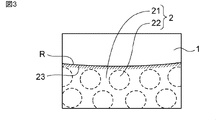
- the positive electrode active material particles 1 may be arranged in contact with each other with a smaller contact area while having voids with the adjacent garnet-type oxide particles 2.
- the garnet-type oxide particles may also be arranged in contact with each other with a smaller contact area while having voids between them.
- FIG. 1 shows a schematic cross-sectional view showing an embodiment of the relationship between a positive electrode active material and a garnet-type oxide in the positive electrode layer of the solid-state battery according to the present invention.
- heat treatment for example, sintering
- the positive electrode active material particles 1 have a larger contact area with the adjacent garnet-type oxide particles 2 while having smaller voids. They may be arranged in contact with each other.
- the garnet-type oxide particles may also be arranged in contact with each other with a larger contact area while having a smaller void between them.
- FIG. 1 shows a schematic cross-sectional view showing an embodiment of the relationship between a positive electrode active material and a garnet-type oxide in the positive electrode layer of the solid-state battery according to the present invention.
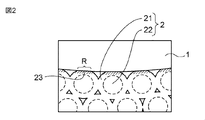
- FIG. 2 shows a schematic cross-sectional view showing another embodiment of the relationship between the positive electrode active material and the garnet-type oxide in the positive electrode layer of the solid-state battery according to the present invention.
- the heat treatment for example, sintering
- the positive electrode active material particles 1 are further separated from the adjacent garnet-type oxide (or its particles) 2 without having voids. They may be arranged in contact with each other with a larger contact area.
- the garnet-type oxide particles may also be arranged in contact with each other with a larger contact area without having voids between them.
- FIGS. 1 to 3 shows a schematic cross-sectional view showing another embodiment of the relationship between the positive electrode active material and the garnet-type oxide in the positive electrode layer of the solid-state battery according to the present invention.
- the positive electrode active material particles 1 are arranged in contact with the adjacent garnet-type oxide (or the particles thereof) 2 while having the morphology shown in FIGS. 1 to 3 in a complex manner. May be good.
- the garnet-type oxide particles are usually distinguished into a peripheral region 21 and an internal region 22 thereof as shown in FIG. 1 in a cross-sectional view of the solid-state battery of the present invention (particularly, a cross-sectional view by TEM or STEM photograph), and heat treatment is performed.
- peripheral regions 21 may be connected and shared among a plurality of garnet-type oxide particles.
- the peripheral region 21 and the internal region 22 usually have a difference in contrast (that is, lightness or shading) due to a difference in chemical composition in a cross-sectional view obtained by, for example, a scanning transmission electron microscope (STEM) -dark field (DF) image. , Can be distinguished.
- STEM scanning transmission electron microscope
- DF dark field
- the cross-sectional view or the cross-sectional view may be a cross-sectional view or a cross-sectional view when a solid cell (particularly the positive electrode layer thereof) is cut in any direction, and for example, the positive electrode layer may be attached to a main surface thereof. It may be a cross-sectional view or a cross-sectional view when cut in the vertical direction.
- the vicinity of the interface in the garnet-type oxide particles is, in detail, the distance from the interface R of the positive electrode active material 1 in the garnet-type oxide 2 (that is, the distance from the interface R toward the garnet-type oxide 2) in the cross-sectional view. ) Is within 50 nm, and corresponds to, for example, the shaded area represented by the reference numeral “23” in FIGS. 1 to 3.
- the interface vicinity portion 23 is usually arranged in the peripheral region 21 of the garnet-type oxide.
- the particle interior 22 is an inner region surrounded by the peripheral region 21 in a cross-sectional view.
- the Li concentration of the portion 23 near the interface with the positive electrode active material 1 in the garnet-type oxide 2 is higher than the Li concentration inside the particles 22 of the garnet-type oxide. It is low.
- the interface R is the interface between the interface phase and the garnet-type oxide.
- the Li concentration at an arbitrary 10 points in the interface vicinity portion 23 of the adjacent garnet-type oxide 2 was obtained, and the average of the interface vicinity portions 23 with respect to a total of 10 positive electrode active material particles.
- the Li concentration at an arbitrary 10 points in the particle internal 22 of the adjacent garnet-type oxide 2 is obtained, and the average Li concentration of the particle internal 22 with respect to a total of 10 positive electrode active material particles is obtained.
- Ask for. As a result, the average Li concentration in the vicinity of the interface 23 is lower than the average Li concentration in the particle interior 22.
- the Li concentration of the interface vicinity portion 23 and the particle interior 22 may be directly measured using TEM-EELS (electron energy loss spectroscopy). Further, after analyzing the molar ratio of elements other than Li using TEM-EDX (energy dispersive X-ray spectroscopy), the amount of Li may be calculated from the following formula (I).
- the average Li concentration can be obtained by performing point analysis of a predetermined number of points at each site and obtaining the average value thereof.
- the Li concentration gradient of the garnet-type oxide in the positive electrode layer in the solid-state battery of the present invention will be described in detail below with reference to a preferred embodiment in which the garnet-type oxide has a specific chemical composition.
- the garnet-type oxide preferably has a chemical composition represented by the following general formula (I) from the viewpoint of further suppressing side reactions during firing and a decrease in ionic conductivity of the garnet-type oxide.
- the garnet-type oxide near the interface 23 and the particle interior 22 are independently represented by the following general formulas from the viewpoint of further suppressing the side reaction during firing and the decrease in the ionic conductivity of the garnet-type oxide.
- the inside of the particles preferably has a chemical composition represented by the following general formula (I) independently from the viewpoint of further suppressing side reactions during firing and a decrease in ionic conductivity of the garnet-type oxide.
- A is one or more elements that can be solid-solved in the Li site of the garnet-type oxide.
- A is specifically selected from a group consisting of Mg (magnesium), Al (aluminum), Ga (gallium), Sc (scandium) and Fe (iron) (hereinafter, may be referred to as "group a") 1 It is an element more than a species.
- BI is one or more selected from the group consisting of elements belonging to Group 1 to Group 3 capable of coordinating with oxygen and elements having trivalent valences. It is an element.
- BI is La (lantern), Y (yttrium), Pr ( placeodim ), Nd (neodim), Pm (promethium), Sm (samarium), Eu (europium), Gd (gadrinium), Tb (terbium). ), Dy (dysprosium), Ho (holmium), Er (erbium), Tm (thurium), Yb (yttrium) and Lu (lutetium) (hereinafter, may be referred to as "group bI"). It is one or more elements.
- BI preferably contains La (lanthanum) from the viewpoint of further suppressing the side reaction during firing and the decrease in ionic conductivity of the garnet-type oxide.
- B II may contain La (lanthanum) alone.
- B II is one or more selected from the group consisting of elements belonging to groups 1 to 3 capable of coordinating with oxygen and elements having a valence other than trivalent. It is an element of.
- B II is specifically composed of a group consisting of Ca (calcium), Sr (strontium) and Ba (barium) as divalent B II , and Ce (cerium) as tetravalent B II (hereinafter, "group b II"). It is one or more elements selected from).
- DI is selected from the group consisting of transition elements capable of 6-coordination with oxygen and main group elements belonging to groups 12 to 15 and elements capable of tetravalent valence. One or more elements.
- the DI is specifically selected from the group consisting of Zr (zirconium), Ti (titanium), Hf (hafnium, Ge (germanium) and Sn (tin) (hereinafter, may be referred to as “group dI”) 1
- group dI group consisting of Zr (zirconium), Ti (titanium), Hf (hafnium, Ge (germanium) and Sn (tin)
- group dI group consisting of Zr (zirconium), Ti (titanium), Hf (hafnium, Ge (germanium) and Sn (tin)
- group dI group consisting of Zr (zirconium), Ti (titanium), Hf (hafnium, Ge (germanium) and Sn (tin)
- group dI group consisting of Zr (zirconium), Ti (titanium), Hf (hafnium, Ge (germanium) and Sn (tin)
- D II is specifically Sc (scandium) as trivalent D II , Ta (tantalum), Nb (niobium), Sb (antimony) and Bi (bismuth) as pentavalent D II , and hexavalent. It is one or more elements selected from the group consisting of Mo (molybdenum), W (tungsten) and Te (tellurium) as D II (hereinafter, may be referred to as “group dII”). D II is one or more elements preferably selected from the group consisting of Bi (bismuth) and Ta (tantalum) from the viewpoint of further suppressing side reactions during firing and a decrease in ionic conductivity of garnet-type oxides. More preferably, it contains Bi (bismuth). Since D II contains Bi, the sinterability at the interface with the positive electrode active material is improved, so that the contact area with the positive electrode active material can be easily improved, and the utilization rate can be further improved.
- A, BI, B II , DI and DI II are as described above both in the interface vicinity portion 23 and in the particle interior 22, and may be independently within the above range.
- A, BI , B II , DI , and DI II are used from the viewpoint of further suppressing the side reaction at the time of firing and the decrease in ionic conductivity of the garnet-type oxide. , Preferably as shown in the following embodiment 1.
- A is one or more elements selected from the group a; BI is one or more elements selected from the group bI , and preferably contains La (lanthanum) from the viewpoint of further suppressing a side reaction during firing and a decrease in ionic conductivity of the garnet-type oxide. In particular, it may contain only La (lantern); B II is one or more elements selected from the group b II; DI is one or more elements selected from the group dI , and preferably contains Zr (zirconium) from the viewpoint of further suppressing the side reaction during firing and the decrease in ionic conductivity of the garnet-type oxide.
- D II is one or more elements selected from the group d II, and is preferably Bi (bismuth) and Ta from the viewpoint of further suppressing side reactions during firing and a decrease in ionic conductivity of garnet-type oxides.
- A is one or more elements selected from the group a, and in particular, may be an element similar to A in the vicinity of the interface in this embodiment;
- BI is one or more elements selected from the group bI , and preferably contains La (lanthanum) from the viewpoint of further suppressing side reactions during firing and a decrease in ionic conductivity of the garnet-type oxide.
- BI may be, in particular, an element similar to BI in the vicinity of the interface in this embodiment
- B II is one or more elements selected from the group b II, and in particular, may be an element similar to B II in the vicinity of the interface in this embodiment
- DI is one or more elements selected from the group dI , and preferably contains Zr (zirconium) from the viewpoint of further suppressing side reactions during firing and a decrease in ionic conductivity of the garnet-type oxide.
- DI zirconium
- DI may be, in particular, an element similar to DI in the vicinity of the interface in this embodiment
- D II is one or more elements selected from the group d II, and is preferably Bi (bismuth) and Ta from the viewpoint of further suppressing side reactions during firing and a decrease in ionic conductivity of garnet-type oxides. It contains one or more elements selected from the group consisting of (tantalum) (hereinafter, may be referred to as "group dII'"), and more preferably one or more elements selected from the above group dII'. More preferably, Bi (bismuth) may be contained, and in particular, only Bi (bismuth) and Ta (tantalum) may be contained.
- a is the average valence of A.
- the average valence of A is, for example, when the element X having a valence r + is n1, the element Y having a valence s + is n2, and the element Z having a valence t + is n3. It is a value represented by n1 ⁇ r + n2 ⁇ s + n3 ⁇ t) / (n1 + n2 + n3).
- b is the average valence of B II .
- the average valence of B II is as described above when, for example, n1 elements X having a valence r +, n2 elements Y having a valence s +, and n3 elements Z having a valence t + are recognized as B II . It is a value expressed by the same formula as the average valence of A.
- d is the average valence of D II ; the average valence of D II is, for example, n1 element X with valence r +, n2 element Y with valence s +, and valence t + as D II .
- the element Z of the above is recognized by n3 elements, it is a value expressed by the same formula as the above-mentioned average valence of A.
- the p of the interface vicinity portion 23 of the garnet-type oxide (hereinafter referred to as “p1”) is the p of the particle interior 22 (hereinafter referred to as “p1”). It is larger than "p2").
- the interface vicinity portion 23 and the particle interior 22 of the garnet-type oxide are both represented by the above general formula (I), and the interface neighborhood portion 23 and the particle interior 22 are each represented by the general formula (I).
- the relationship between p1 of the interface vicinity portion 23 and p2 of the particle interior 22 has the same meaning as the relationship regarding the concentration gradient of the Li concentration of the interface vicinity portion 23 and the Li concentration of the particle interior 22. .. It should be noted that p is usually a value smaller than ⁇ in each of the vicinity of the interface and the inside of the particle.
- the interface vicinity portion 23 usually satisfies the following condition K in the formula (I), and the particle internal 22 usually satisfies the following condition N in the formula (I).
- ⁇ satisfies 5.0 ⁇ ⁇ ⁇ 8.0, and preferably 5.5 ⁇ ⁇ ⁇ 7.5 from the viewpoint of further suppressing side reactions during firing and further suppressing the decrease in ionic conductivity of the garnet-type oxide.
- ⁇ satisfies 2.5 ⁇ ⁇ 3.5, and preferably 2.6 ⁇ ⁇ ⁇ 3.4 from the viewpoint of further suppressing the side reaction during firing and the decrease in ionic conductivity of the garnet-type oxide.
- ⁇ ⁇ ⁇ 3.3 More preferably 2.7 ⁇ ⁇ ⁇ 3.3, still more preferably 2.8 ⁇ ⁇ ⁇ 3.2, particularly preferably 2.9 ⁇ ⁇ ⁇ 3.1, and most preferably 3.0. .. ⁇ satisfies 1.5 ⁇ ⁇ ⁇ 2.5, and preferably 1.6 ⁇ ⁇ ⁇ 2.4 from the viewpoint of further suppressing the side reaction during firing and the decrease in ionic conductivity of the garnet-type oxide.
- ⁇ satisfies 11 ⁇ ⁇ ⁇ 13, and is preferably 11 ⁇ ⁇ ⁇ 12.5, more preferably 11.5 ⁇ , from the viewpoint of further suppressing the side reaction during firing and the decrease in ionic conductivity of the garnet-type oxide. It satisfies ⁇ ⁇ 12.5, and more preferably “12- ⁇ ”.
- ⁇ indicates the amount of oxygen deficiency and may be 0. Normally, ⁇ may satisfy 0 ⁇ ⁇ ⁇ 1. The oxygen deficiency amount ⁇ may be considered to be 0 because it cannot be quantitatively analyzed even by using the latest equipment.
- x satisfies 0 ⁇ x ⁇ 1.0, and is preferably 0 ⁇ x ⁇ 0.8, more preferably 0 ⁇ , from the viewpoint of further suppressing side reactions during firing and further suppressing the decrease in ionic conductivity of the garnet-type oxide. It satisfies x ⁇ 0.6, more preferably 0 ⁇ x ⁇ 0.4, particularly preferably 0 ⁇ x ⁇ 0.2, and most preferably 0. y is a value smaller than ⁇ , usually satisfies 0 ⁇ y ⁇ 1.0, and is preferably 0 ⁇ y from the viewpoint of further suppressing a side reaction during firing and a decrease in ionic conductivity of the garnet-type oxide.
- ⁇ 0.8 more preferably 0 ⁇ y ⁇ 0.6, still more preferably 0 ⁇ y ⁇ 0.4, particularly preferably 0 ⁇ y ⁇ 0.2, and most preferably 0.
- z is a value of ⁇ or less, usually satisfying 0.4 ⁇ z ⁇ 2.2, and is preferably 0. from the viewpoint of further suppressing the side reaction at the time of firing and the decrease in ionic conductivity of the garnet-type oxide.
- Most preferably, 1.8 ⁇ z ⁇ 2.0 is satisfied.
- z 1 The z in the vicinity of the interface (hereinafter, may be referred to as z 1 ) is usually a larger value than the z inside the particles (hereinafter, may be referred to as z 2 ), which will be described later.
- z 1 and z 2 usually satisfy 0.1 ⁇ z 1 -z 2 ⁇ 2.0, and 0.3 ⁇ from the viewpoint of further suppressing the side reaction during firing and the decrease in ionic conductivity of the garnet-type oxide. It satisfies z 1 ⁇ z 2 ⁇ 1.5, more preferably 1.0 ⁇ z 1 ⁇ z 2 ⁇ 1.5.
- ⁇ satisfies 5.0 ⁇ ⁇ ⁇ 8.0, and preferably 5.5 ⁇ ⁇ ⁇ 7.5 from the viewpoint of further suppressing side reactions during firing and further suppressing the decrease in ionic conductivity of the garnet-type oxide.
- ⁇ satisfies 2.5 ⁇ ⁇ 3.5, and preferably 2.6 ⁇ ⁇ ⁇ 3.4 from the viewpoint of further suppressing the side reaction during firing and the decrease in ionic conductivity of the garnet-type oxide.
- ⁇ ⁇ ⁇ 3.3 More preferably 2.7 ⁇ ⁇ ⁇ 3.3, still more preferably 2.8 ⁇ ⁇ ⁇ 3.2, particularly preferably 2.9 ⁇ ⁇ ⁇ 3.1, and most preferably 3.0. .. ⁇ satisfies 1.5 ⁇ ⁇ ⁇ 2.5, and preferably 1.6 ⁇ ⁇ ⁇ 2.4 from the viewpoint of further suppressing the side reaction during firing and the decrease in ionic conductivity of the garnet-type oxide.
- ⁇ satisfies 11 ⁇ ⁇ ⁇ 13, and is preferably 11 ⁇ ⁇ ⁇ 12.5, more preferably 11.5 ⁇ , from the viewpoint of further suppressing the side reaction during firing and the decrease in ionic conductivity of the garnet-type oxide. It satisfies ⁇ ⁇ 12.5, and more preferably “12- ⁇ ”.
- ⁇ indicates the amount of oxygen deficiency and may be 0. Normally, ⁇ may satisfy 0 ⁇ ⁇ ⁇ 1. The oxygen deficiency amount ⁇ may be considered to be 0 because it cannot be quantitatively analyzed even by using the latest equipment.
- x satisfies 0 ⁇ x ⁇ 1.0, and is preferably 0 ⁇ x ⁇ 0.8, more preferably 0 ⁇ , from the viewpoint of further suppressing side reactions during firing and further suppressing the decrease in ionic conductivity of the garnet-type oxide. It satisfies x ⁇ 0.6, more preferably 0 ⁇ x ⁇ 0.4, particularly preferably 0 ⁇ x ⁇ 0.2, and most preferably 0. y is a value smaller than ⁇ , usually satisfies 0 ⁇ y ⁇ 1.0, and is preferably 0 ⁇ y from the viewpoint of further suppressing a side reaction during firing and a decrease in ionic conductivity of the garnet-type oxide.
- ⁇ 0.8 more preferably 0 ⁇ y ⁇ 0.6, still more preferably 0 ⁇ y ⁇ 0.4, particularly preferably 0 ⁇ y ⁇ 0.2, and most preferably 0.
- z is a value of ⁇ or less, usually satisfies 0.1 ⁇ z ⁇ 1.0, and is preferably 0. 2 ⁇ y ⁇ 0.9, more preferably 0.3 ⁇ z ⁇ 0.9, still more preferably 0.4 ⁇ z ⁇ 0.8, and particularly preferably 0.5 ⁇ z ⁇ 0.7. Most preferably, 0.55 ⁇ z ⁇ 0.65 is satisfied.
- the interface vicinity portion 23 and the particle interior 22 of the garnet-type oxide are both represented by the above general formula (I), and the interface neighborhood portion 23 and the particle interior 22 are generally used.
- the p (that is, p1) of the interface vicinity portion 23 is larger than the p (that is, p2) of the particle interior 22.
- the values obtained by the following methods can be used for p1 of the interface vicinity portion 23 and p2 of the particle interior 22. Focus on any five positive electrode active material particles 1 in each of the cut sections (TEM cross-sectional view) of the positive electrode layer in any two directions (a total of 10 positive electrode active material particles). Next, for each positive electrode active material particle 1, the chemical composition was obtained at an arbitrary 10 points in the interface vicinity portion 23 of the adjacent garnet-type oxide 2, and the average p1 of the interface vicinity portion 23 for a total of 10 positive electrode active material particles was obtained. Find the value.
- the chemical composition is obtained at an arbitrary 10 points in the particle internal 22 of the adjacent garnet-type oxide 2, and the average p2 value of the particle internal 22 with respect to a total of 10 positive electrode active material particles is obtained.
- Ask. As a result, the average p1 value of the interface vicinity portion 23 may be larger than the average p2 value of the particle interior 22.
- the chemical composition of the interface vicinity portion 23 and the particle interior 22 in the garnet-type oxide of the present invention is measured by quantitative analysis (composition analysis) using TEM-EDX (energy dispersive X-ray spectroscopy). good.
- the method for measuring the chemical composition of the interface vicinity portion 23 and the particle interior 22 is not particularly limited, but for example, TEM-EELS (transmission microscope-electron energy loss spectroscopy: Electron Energy-Loss Spectroscopy) measurement may be performed.
- the p1 of the interface vicinity portion 23 and the p2 of the particle interior 22 are preferably the relational expression of the following embodiment e1 from the viewpoint of further suppressing the side reaction at the time of firing and the decrease in ionic conductivity of the garnet-type oxide, more preferably.
- Embodiment e1 0.1 ⁇ p1-p2.
- Embodiment e2 0.1 ⁇ p1-p2 ⁇ 2.0.
- Embodiment e3 0.25 ⁇ p1-p2 ⁇ 1.8.
- Embodiment e4 0.25 ⁇ p1-p2 ⁇ 1.5.
- Embodiment e5 0.5 ⁇ p1-p2 ⁇ 1.5.
- Embodiment e6 0.65 ⁇ p1-p2 ⁇ 1.5.
- Embodiment e7 0.7 ⁇ p1-p2 ⁇ 1.5.
- Embodiment e8 1.0 ⁇ p1-p2 ⁇ 1.5.
- P1 of the interface vicinity portion 23 is preferably a relational expression of the following embodiment f1 and more preferably of the following embodiment f2 from the viewpoint of further suppressing a side reaction at the time of firing and a decrease in ionic conductivity of the garnet-type oxide.
- the relational expression more preferably the relational expression of the following embodiment f3, particularly preferably the relational expression of the following embodiment f4, sufficiently preferably the relational expression of the following embodiment f5, and more preferably the following embodiment f6.
- the relational expression of, most preferably, the relational expression of the following embodiment f7 is satisfied: Embodiment f1: 0.4 ⁇ p1 ⁇ 2.0. Embodiment f2: 0.5 ⁇ p1 ⁇ 2.0.
- Embodiment f3 0.7 ⁇ p1 ⁇ 2.0.
- Embodiment f4 1.2 ⁇ p1 ⁇ 2.0.
- Embodiment f5 1.5 ⁇ p1 ⁇ 2.0.
- Embodiment f6 1.7 ⁇ p1 ⁇ 2.0.
- Embodiment f7 1.8 ⁇ p1 ⁇ 2.0.
- the p2 of the particle interior 22 is preferably a relational expression of the following embodiment g1 and more preferably a relation of the following embodiment g2 from the viewpoint of further suppressing a side reaction at the time of firing and a decrease in ionic conductivity of the garnet-type oxide.
- the relational expression, most preferably the relational expression of embodiment g7 below is satisfied: Embodiment g1: 0.1 ⁇ p2 ⁇ 1.5. Embodiment g2: 0.1 ⁇ p2 ⁇ 1.2.
- Embodiment g3 0.1 ⁇ p2 ⁇ 1.0.
- Embodiment g4 0.3 ⁇ p2 ⁇ 1.0.
- Embodiment g5 0.3 ⁇ p2 ⁇ 0.7.
- Embodiment g6 0.5 ⁇ p2 ⁇ 0.7.
- Embodiment g7 0.55 ⁇ p2 ⁇ 0.7.
- the garnet-type oxide preferably has a chemical composition represented by the following general formula (II) from the viewpoint of further suppressing side reactions during firing and a decrease in ionic conductivity of the garnet-type oxide.
- the garnet-type oxide near the interface 23 and the particle interior 22 are independently represented by the following general formulas from the viewpoint of further suppressing the side reaction during firing and the decrease in the ionic conductivity of the garnet-type oxide. It is preferable to have the chemical composition represented by II).
- D II is similar to D II in general formula (I).
- D II is similar to D II in the general formula (I) both in the vicinity of the interface and inside the particle.
- the z in the formula (II) is the same as the z of the condition K in the formula (I) for the vicinity of the interface, and is the same as the z of the condition N in the formula (I) for the inside of the particle.
- the ⁇ in the formula (II) is the same as the ⁇ of the condition K in the formula (I) for the vicinity of the interface, and is the same as the ⁇ of the condition N in the formula (I) for the inside of the particle.
- the general formula (II) is one embodiment included in the above general formula (I). Therefore, when the garnet-type oxide (particularly the interface vicinity portion 23 and the particle interior 22) has a chemical composition represented by the general formula (II), p1 and p2 converted from the general formula (II) are described above. It suffices to satisfy the relational expression of p1 and p2 in the general expression (I).
- the average particle size of the garnet-type oxide is not particularly limited and may be, for example, 10 nm or more and 5 ⁇ m or less, which is preferable from the viewpoint of further suppressing the side reaction during firing and the decrease in ionic conductivity of the garnet-type oxide. Is 50 nm or more and 1 ⁇ m or less, more preferably 100 nm or more and 800 nm or less.
- the average particle size of the garnet-type oxide can be measured by the same method as the average particle size of the positive electrode active material described above.
- the content of the garnet-type oxide is usually 10% by volume or more, particularly 20% by volume or more and 80% by volume or less with respect to the entire positive electrode layer, and side reactions during firing and a decrease in ionic conductivity of the garnet-type oxide. From the viewpoint of further suppression, it is preferably 30% by volume or more and 80% by volume or less, and more preferably 30% by volume or more and 70% by volume or less.
- the positive electrode layer may contain two or more kinds of garnet-type oxides, in which case the total content thereof may be within the above range.
- the garnet-type oxide has a Li concentration gradient (for example, the p-value gradient in the above general formulas (I) and (II)) at the interface vicinity portion 23 and the particle interior 22. It can also be referred to as "gradient structure type garnet oxide".
- the Li concentration gradient (for example, the p-value gradient in the above general formulas (I) and (II)) that the garnet-type oxide has between the interface vicinity portion 23 and the particle interior 22 is determined in advance when the positive electrode layer is manufactured. It can be formed by using the produced core-shell structure garnet-type oxide.
- the core-shell structure garnet-type oxide is composed of a garnet-type oxide having a relatively high Li concentration in the core portion and a garnet-type oxide having a relatively low Li concentration in the shell layer.
- the core portion is composed of a garnet-type oxide having a relatively small p
- the shell portion is composed of a garnet-type oxide having a relatively large p.
- a garnet-type oxide layer having a relatively large p as a shell layer is present around the garnet-type oxide particles having a relatively small p as core particles. It can be obtained by heat treatment (for example, at least firing) in a state.
- the core particles are mixed with a solution in which the material for forming the shell layer is dissolved, the solvent is evaporated, and then the heat treatment is performed to obtain garnet-type oxide particles in which the core particles are coated with the shell layer. Further, by heat-treating the garnet-type oxide particles coated with the shell layer, a core-shell structure garnet-type oxide can be obtained.
- the above production method is an example of obtaining a garnet-type oxide having a Li concentration gradient, and may be produced by another production method.
- the core particles are garnet-type oxide particles having a relatively small p, and are, for example, materials similar to the garnet-type oxide having the chemical composition inside the particles represented by the above-mentioned general formula (I) or general formula (II). Can be mentioned.
- Core particles can be produced by the following method.
- the raw material compound containing a predetermined metal atom is weighed so that the chemical composition has a predetermined chemical composition, and water is added and mixed to obtain a slurry.
- the slurry is dried, calcined at 700 ° C. or higher and 1000 ° C. or lower for 1 hour or more and 30 hours or less, and pulverized to obtain core particles.
- the average particle size of the core particles is not particularly limited as long as the average particle size of the garnet-type oxide is within the above range, and may be, for example, 5 nm or more and 4 ⁇ m or less. From the viewpoint of further suppressing the decrease in ionic conductivity of the substance, it is preferably 40 nm or more and 0.8 ⁇ m or less, and more preferably 80 nm or more and 700 nm or less.
- the average particle size of the core particles can be measured by the same method as the average particle size of the positive electrode active material described above.
- the material for forming the shell layer is a material for forming a garnet-type oxide layer having a relatively large p as a shell layer, and for example, for forming a layer composed of a garnet-type oxide having a relatively large p. It is a material mixture.
- the mixing ratio in the material mixture may be such that the shell layer has a predetermined chemical composition after sintering.
- a garnet-type oxide having a relatively large p as a shell layer for example, a material similar to the garnet-type oxide having a chemical composition in the vicinity of the interface represented by the above-mentioned general formula (I) or general formula (II). Can be mentioned.
- the average film thickness of the shell layer is not particularly limited as long as the average particle size of the garnet-type oxide is within the above range, and may be, for example, 5 nm or more and 10 ⁇ m or less, as a side reaction during firing and garnet-type oxidation. From the viewpoint of further suppressing the decrease in ionic conductivity of the substance, it is preferably 10 nm or more and 2 ⁇ m or less, and more preferably 20 nm or more and 1 ⁇ m or less.
- the average film thickness of the shell layer can be calculated by performing TEM measurement of the core particles having the shell layer, measuring the film thickness of the shell layer at any 20 points, and averaging the film thickness.
- the content of the shell layer forming material in the slurry is not particularly limited as long as a core-shell structure garnet-type oxide can be obtained, and for example, 1 mol% or more and 70 mol% or less, particularly, with respect to 100 mol% of core particles. It may be 10 mol% or more and 50 mol% or less.
- the solvent is not particularly limited as long as it can dissolve the material for forming the shell layer, and for example, in the field of solid-state batteries, a solvent that can be used for producing a positive electrode layer, a negative electrode layer, or a solid electrolyte layer is used.
- a solvent that can use the binder described later is usually used. Examples of such a solvent include alcohols such as 2-methoxyethanol and the like.
- the heat treatment conditions for forming the shell layer are not particularly limited as long as the core-shell structure garnet-type oxide can be obtained.
- the heat treatment temperature may be, for example, 600 ° C. or higher and 1100 ° C. or lower, particularly 700 ° C. or higher and 950 ° C. or lower.
- the heat treatment time may be, for example, 10 minutes or more and 1440 minutes or less, particularly 60 minutes or more and 600 minutes or less.
- the positive electrode layer may contain a metal oxide other than the garnet-type oxide (for example, a so-called solid electrolyte) (hereinafter referred to as another metal oxide), in which case the content of the other metal oxide is usually the positive electrode layer.
- a metal oxide other than the garnet-type oxide for example, a so-called solid electrolyte
- the content of the other metal oxide is usually the positive electrode layer. 10% by volume or less, preferably 5% by volume or less, more preferably 0% by volume, from the viewpoint of further suppressing side reactions during firing and a decrease in ionic conductivity of the garnet-type oxide. be.
- the positive electrode layer may further contain a sintering aid and / or a conductive auxiliary agent.
- any sintering aid known in the field of solid-state batteries can be used.
- the composition of such a sintering aid may contain at least Li (lithium), B (boron), and O (oxygen), and the molar ratio of Li to B (Li / B) may be 2.0 or greater. preferable.
- Specific examples of such sintering aids include, for example, Li 4 B 2 O 5 , Li 3 BO 3 , (Li 2.7 Al 0.3 ) BO 3 , Li 2.8 (B 0.8 C 0 ). .2 ) Examples include O 3 and LiBO 2 .
- the content of the sintering aid is not particularly limited, and is preferably 0.1% by volume or more and 20% by volume or less, preferably 1% by volume or more and 10% by volume or less, based on the entire positive electrode layer. Is more preferable.
- a conductive auxiliary agent known in the field of solid-state batteries can be used.
- a metal material such as Ag (silver), Au (gold), Pd (palladium), Pt (platinum), Cu (copper), Sn (tin), Ni (nickel);
- carbon materials such as carbon nanotubes such as acetylene black, ketjen black, Super P (registered trademark), and VGCF (registered trademark).
- the shape of the carbon material is not particularly limited, and any shape such as a spherical shape, a plate shape, and a fibrous shape may be used.
- the content of the conductive auxiliary agent is not particularly limited, and is preferably 50% by volume or less (particularly 0% by volume or more and 50% by volume or less), and 40% by volume or less (particularly 0) with respect to the entire positive electrode layer. It is more preferably 50% by volume or more and 40% by volume or less).
- the thickness of the positive electrode layer is usually 0.1 to 30 ⁇ m, preferably 1 to 20 ⁇ m, for example.
- the average value of the thickness measured at any 10 points in the SEM image is used.
- the porosity is not particularly limited, and is preferably 20% by volume or less, more preferably 15% by volume or less, and further preferably 10% by volume or less.
- the porosity of the positive electrode layer the value measured from the SEM image after the FIB cross-section processing is used.
- the positive electrode layer is a layer that can be called a "positive electrode active material layer".
- the positive electrode layer may have a so-called positive electrode current collector or a positive electrode current collector.
- the negative electrode layer is not particularly limited.
- the negative electrode layer usually contains a negative electrode active material.
- the negative electrode layer is preferably a layer capable of occluding and releasing ions (particularly lithium ions).
- the negative electrode active material is not particularly limited, and a negative electrode active material known in the field of solid-state batteries can be used.
- the negative electrode active material include carbon materials such as graphite, graphite-lithium compounds, lithium metals, lithium alloy particles, phosphoric acid compounds having a pearcon-type structure, Li-containing oxides having a spinel-type structure, and ⁇ II -Li 3 VO. Examples thereof include oxides having a type 4 structure and a ⁇ II -Li 3 VO type 4 structure.
- As the negative electrode active material it is preferable to use a lithium metal, a Li-containing oxide having a ⁇ II -Li 3 VO 4 type structure, and a ⁇ II -Li 3 VO 4 type structure.
- an oxide having a ⁇ II -Li 3 VO 4 type structure in the negative electrode layer means that the oxide (particularly its particles) is a so-called ⁇ II -Li 3 VO 4 type crystal in X-ray diffraction. It is meant to indicate one or more major peaks corresponding to the structure-specific Miller index at a given angle of incidence.
- Preferred Li-containing oxides having a ⁇ II -Li 3 VO 4 type structure include Li 3 VO 4 .
- an oxide having a ⁇ II -Li 3 VO 4 type structure in the negative electrode layer means that the oxide (particularly its particles) is a so-called ⁇ II -Li 3 VO 4 type crystal in X-ray diffraction.
- Li-containing oxides having a ⁇ II -Li 3 VO 4 type structure include Li 3.2 V 0.8 Si 0.2 O 4 .
- the chemical composition of the negative electrode active material may be an average chemical composition.
- the average chemical composition of the negative electrode active material means the average value of the chemical composition of the negative electrode active material in the thickness direction of the negative electrode layer.
- the average chemical composition of the negative electrode active material is obtained by breaking the solid-state battery and using SEM-EDX (energy dispersive X-ray spectroscopy) to analyze the composition by EDX from the viewpoint that the entire thickness direction of the negative electrode layer fits. It can be analyzed and measured.
- the negative electrode active material can be produced, for example, by the same method as the positive electrode active material, or can be obtained as a commercially available product.
- the chemical composition and crystal structure of the negative electrode active material in the negative electrode layer may usually change due to element diffusion during sintering in the manufacturing process of the solid-state battery.
- the negative electrode active material may have the above-mentioned average chemical composition and crystal structure in the solid-state battery after being sintered together with the positive electrode layer and the solid electrolyte layer.
- the content of the negative electrode active material in the negative electrode layer is not particularly limited, and is preferably 50% or more (particularly 50% 99% or less) and 70% or more and 95% or less with respect to the entire negative electrode layer, for example. Is more preferable, and more preferably 80% or more and 90% or less.
- the negative electrode layer may further contain a so-called solid electrolyte, a sintering aid and / or a conductive auxiliary agent and the like.
- the solid electrolyte that may be contained in the negative electrode layer is not particularly limited, and examples thereof include solid electrolytes exemplified as solid electrolytes constituting the solid electrolyte layer described later.
- the content of the solid electrolyte may be usually 20% by volume or more and 60% by volume or less, particularly 30% by volume or more and 45% by volume or less with respect to the entire solid electrolyte layer.
- the same compound as the sintering aid in the positive electrode layer can be used.
- the conductive auxiliary agent in the negative electrode layer the same compound as the conductive auxiliary agent in the positive electrode layer can be used.
- the thickness of the negative electrode layer is usually 0.1 to 30 ⁇ m, preferably 1 to 20 ⁇ m.
- the average value of the thickness measured at any 10 points in the SEM image is used.
- the porosity is not particularly limited, and is preferably 20% or less, more preferably 15% or less, still more preferably 10% or less.
- porosity of the negative electrode layer a value measured by the same method as the porosity of the positive electrode layer is used.
- the negative electrode layer is a layer that can be called a "negative electrode active material layer".
- the negative electrode layer may have a so-called negative electrode current collector or a negative electrode current collector.
- the solid electrolyte layer contains a solid electrolyte.
- the solid electrolyte contained in the solid electrolyte layer is not particularly limited, and may be any solid electrolyte contained in the solid electrolyte layer in the field of solid batteries.
- the solid electrolyte may be, for example, an oxide type, and for example, a garnet type oxide (particularly a core-shell structure garnet type oxide) contained in the positive electrode layer, Li 2 ZrO 3 and ⁇ -Li. 3
- a garnet type oxide particularly a core-shell structure garnet type oxide
- Li 2 ZrO 3 and ⁇ -Li. 3 One or more materials selected from solid electrolytes having a VO4 structure and oxide glass ceramics-based lithium ion conductors can be mentioned.
- the solid electrolyte layer is a garnet-type oxide (particularly core-) contained in the positive electrode layer.
- Shell structure garnet type oxide) is preferably contained.
- Examples of the solid electrolyte having a ⁇ -Li 3 VO 4 structure include a solid electrolyte having an average chemical composition represented by the following general formula (III).
- A is one or more elements selected from the group consisting of Na, K, Mg, Ca, Al, Ga, Zn, Fe, Cr, and Co.
- B is one or more elements selected from the group consisting of V and P.
- D is one or more elements selected from the group consisting of Zn, Al, Ga, Si, Ge, Sn, As, Ti, Mo, W, Fe, Cr, and Co.
- x satisfies 0 ⁇ x ⁇ 1.0, especially 0 ⁇ x ⁇ 0.2.
- y satisfies 0 ⁇ y ⁇ 1.0, especially 0.20 ⁇ y ⁇ 0.50.
- a is the average valence of A.
- the average valence of A is, for example, when the element X having a valence a + is n1, the element Y having a valence b + is n2, and the element Z having a valence c + is n3 (n1 ⁇ ). It is a value represented by a + n2 ⁇ b + n3 ⁇ c) / (n1 + n2 + n3).
- c is the average valence of D.
- the average valence of D is, as D, for example, when n1 elements X having a valence a +, n2 elements Y having a valence b +, and n3 elements Z having a valence c + are recognized, the above-mentioned A It is the same value as the average valence of.
- solid electrolytes having a ⁇ -Li 3 VO 4 structure include Li 3.2 (V 0.8 Si 0.2 ) O 4 and Li 3.5 (V 0.5 Ge 0.5 ) O. 4 , Li 3.4 (P 0.6 Si 0.4) O 4 , Li 3.5 (P 0.5 Ge 0.5 ) O 4 and the like can be mentioned.
- oxide glass ceramics-based lithium ion conductor for example, a phosphoric acid compound (LATP) containing lithium, aluminum and titanium as a constituent element, and a phosphoric acid compound (LAGP) containing lithium, aluminum and germanium as constituent elements are used. Can be done.
- LATP phosphoric acid compound
- LAGP phosphoric acid compound
- the content of the solid electrolyte in the solid electrolyte layer is not particularly limited, and is preferably, for example, 10% by volume or more and 100% by volume or less, and 20% by volume or more and 100% by volume or less with respect to the entire solid electrolyte layer. More preferably, it is more preferably 30% by volume or more and 100% by volume or less.
- the solid electrolyte layer may further contain, for example, a sintering aid or the like in addition to the solid electrolyte.
- a sintering aid or the like in addition to the solid electrolyte.
- the same compound as the sintering aid in the positive electrode layer can be used.
- the content of the sintering aid in the solid electrolyte layer is not particularly limited, and should be 0% by volume or more and 20% by volume or less from the viewpoint of further suppressing side reactions during firing and a decrease in ionic conductivity of the garnet-type oxide. It is preferable, and it is more preferable that it is 1% by volume or more and 10% by volume or less.
- the thickness of the solid electrolyte layer is usually 0.1 to 30 ⁇ m, preferably 1 to 20 ⁇ m from the viewpoint of further suppressing the side reaction during firing and the decrease in ionic conductivity of the garnet-type oxide.
- the thickness of the solid electrolyte layer the average value of the thickness measured at any 10 points in the SEM image is used.
- the porosity is not particularly limited, and is preferably 20% by volume or less, more preferably 15% by volume or less, from the viewpoint of further suppressing side reactions during firing and a decrease in ionic conductivity of the garnet-type oxide. More preferably, it is 10% by volume or less.
- the porosity of the solid electrolyte layer the value measured by the same method as the porosity of the positive electrode layer is used.
- the solid-state battery can be manufactured, for example, by a so-called green sheet method, a printing method, or a method in which these methods are combined.
- a paste is prepared by appropriately mixing a core-shell structure garnet-type oxide, a solvent, a binder and the like with the positive electrode active material.
- the paste is applied onto the sheet and dried to form a first green sheet for forming the positive electrode layer.
- the first green sheet may contain other so-called solid electrolytes, conductive aids and / or sintering aids and the like.
- the paste is applied onto the sheet and dried to form a second green sheet for forming the negative electrode layer.
- the second green sheet may contain a so-called solid electrolyte, a conductive auxiliary agent and / or a sintering auxiliary agent and the like.
- the paste is applied and dried to prepare a third green sheet for forming the solid electrolyte layer.
- the third green sheet may contain a sintering aid or the like.
- the solvent for producing the first to third green sheets is not particularly limited, and for example, in the field of solid-state batteries, a solvent that can be used for producing a positive electrode layer, a negative electrode layer, or a solid electrolyte layer is used.
- a solvent that can use the binder described later is usually used. Examples of such a solvent include alcohols such as 2-propanol and the like.
- the binder for producing the first to third green sheets is not particularly limited, and for example, in the field of solid-state batteries, a binder that can be used for producing a positive electrode layer, a negative electrode layer, or a solid electrolyte layer is used.
- a binder that can be used for producing a positive electrode layer, a negative electrode layer, or a solid electrolyte layer is used.
- examples of such a binder include butyral resin, acrylic resin and the like.
- a laminated body is produced by appropriately laminating the first to third green sheets.
- the prepared laminate may be pressed.
- Preferred press methods include a hydrostatic pressure press method and the like.
- the solid-state battery can be obtained by sintering the laminate at, for example, 600 to 800 ° C.
- the printing method will be described.
- the printing method is the same as the green sheet method except for the following items. -Prepare an ink for each layer having a composition similar to that of the paste for each layer for obtaining a green sheet, except that the blending amount of the solvent and the resin is suitable for use as an ink. -Printing and laminating using the ink of each layer to produce a laminated body.
- Garnet-type oxide powder was produced as core particles as follows. Lithium hydroxide monohydrate LiOH ⁇ H 2 O, lanthanum hydroxide La (OH) 3 , lanthanum hydroxide ZrO 2 , tantalum oxide Ta 2 O 5 , and bismuth oxide Bi 2 O 3 were used as raw materials. Each raw material was weighed so as to have the chemical composition shown in Table 1, water was added, the mixture was sealed in a 100 ml polyethylene polypot, and the pot was rotated at 150 rpm for 16 hours to mix the raw materials.
- the Lithium hydroxide monohydrate LiOH ⁇ H2O which is the Li source, was charged in an excess of 3 wt% with respect to the target composition in consideration of Li deficiency during sintering.
- the obtained slurry was evaporated and dried, and then calcined at 900 ° C. for 5 hours to obtain a target phase.
- a mixed solvent of toluene-acetone was added to the obtained calcined powder, and the mixture was pulverized with a planetary ball mill for 6 hours. This pulverized powder was dried to obtain a garnet-type oxide powder. It was confirmed that the garnet-type oxide simple substance was obtained from the XRD measurement of the above powder.
- the average particle size of the core particles at this time was 150 nm.
- the primary particle size of the material was not changed, and the structure and composition were controlled by the molar ratio of the raw material and the firing time.
- a powder obtained by coating core particles with a garnet-type oxide as a shell layer was produced as follows.
- Raw materials include lithium nitrate LiNO 3 , lanthanum nitrate hexahydrate La (NO 3 ) 3.6H 2 O, bismuth nitrate pentahydrate Bi (NO 3 ) 3.5H 2 O, zirconium (IV) isopropoxide.
- Zr (OC 3 H 7 ) 4 , tantalum (V) ethoxydo Ta (OC 2 H 5 ) 5 , and ethyl acetoacetate were used.
- Each raw material was weighed to have the chemical composition shown in Table 1.
- Ethyl acetoacetate was weighed so as to have a molar amount four times that of each alkoxide.
- Solution A each alkoxide and ethyl acetoacetate were placed in a glass container and stirred with a stirrer piece for 30 minutes.
- Solution B each nitrate and 2-methoxyethanol were placed in a glass container to dissolve the nitrate (referred to as Solution B).
- a uniform solution C was prepared by dropping the solution A little by little into the solution B.
- the predetermined core particles were mixed with the solution C, mixed with a stirrer piece for 5 hours, and then the solvent was evaporated at 100 ° C.
- the obtained dry powder was heat-treated at 700 ° C.
- the garnet-type oxide powder having a shell layer on the core particles. Further, only the solution C was dried and then heat-treated at 700 ° C. for 5 hours to obtain a shell layer powder. It was confirmed that the garnet-type oxide simple substance was obtained from the XRD measurement of the shell layer powder. Furthermore, it was confirmed by ICP measurement that the above powder had no composition deviation in the shell layer. The thickness of the shell layer was 20 to 50 nm. In each example, the primary particle size of the material was not changed, and the structure and composition were controlled by the molar ratio of the raw material and the firing time.
- the positive electrode active material was produced as follows.
- the raw materials are lithium hydroxide monohydrate Li 2 CO 3 , cobalt oxide Co 3 O 4 , manganese oxide MnO 2 , nickel oxide NiO and Li (Co 0.8 Ni 0.1 Mn 0.1 ) O 2 chemistry.
- Weighed to the composition water was added, the mixture was sealed in a 100 ml polyethylene polypot, and rotated at 150 rpm for 16 hours on the pot rack to mix the raw materials.
- the target phase was obtained by calcining at 800 ° C. for 5 hours.
- the average particle size of the positive electrode active material particles after calcining was 5 ⁇ m. From the XRD measurement of the above powder, it was confirmed that a single phase of a layered rock salt type structure (ICDD card No. 01-070-2685) was obtained. It was confirmed by ICP measurement that the above powder had no composition deviation.
- the core-shell structure garnet-type oxide, the positive electrode active material powder, and the sintering aid powder are weighed so as to have a volume ratio of 49: 50: 1, and kneaded with alcohol and a binder to form a positive electrode layer slurry.
- the slurry was applied onto the sheet, and the slurry was dried to form a first green sheet for forming a positive electrode layer.
- a solid electrolyte layer slurry is prepared and dried by kneading with a core-shell structure garnet-type oxide similar to the core-shell structure garnet-type oxide contained in the first green sheet, an alcohol and a binder.
- a second green sheet for forming the solid electrolyte layer was formed.
- a laminated body was produced by appropriately laminating the first and second green sheets. The produced laminate was pressed by a hydrostatic pressure pressing method and appropriately cut to obtain a laminate of a positive electrode layer / a solid electrolyte layer.
- the co-firing body of the positive electrode layer / solid electrolyte layer was produced by pressure sintering at 800 ° C. for 60 minutes under a pressure of 100 MPa.
- the thickness of the positive electrode layer after sintering was about 15 ⁇ m, and the thickness of the solid electrolyte layer was about 200 ⁇ m.
- a metal Li was attached to the surface of the solid electrolyte layer opposite to the positive electrode layer as a counter electrode and a reference electrode, and sealed with a 2032 type coin cell to obtain a solid state battery.
- the initial utilization rate was calculated by dividing by the theoretical capacity (150 mAh / g) at the operating potential of the active material using the initial discharge capacity, and the determination was made according to the following criteria. ⁇ ⁇ : 85% ⁇ initial usage rate (best); ⁇ : 70% ⁇ initial usage rate ⁇ 85% (excellent); ⁇ ; 65% ⁇ initial usage rate ⁇ 70% (good); ⁇ ; 60% ⁇ initial usage rate ⁇ 65% (possible) (no problem in practical use); ⁇ ; Initial usage rate ⁇ 60% (impossible) (There is a problem in practical use).
- the utilization rate at the time of 1C discharge was calculated by dividing (150 mAh / g) by the theoretical capacity at the operating potential of the active material using the initial discharge capacity, and the determination was made according to the following criteria.
- ⁇ ⁇ Utilization rate at 70% ⁇ 1C discharge (best);
- ⁇ Utilization rate at 60% ⁇ 1C discharge ⁇ 70% (excellent);
- ⁇ Utilization rate at 60% ⁇ 1C discharge ⁇ 70% (excellent); ⁇ ; 56% ⁇ utilization rate at 1C discharge ⁇ 60% (good);
- ⁇ Utilization rate at 50% ⁇ 1C discharge ⁇ 56% (possible) (no problem in practical use);
- X Utilization rate at 1C discharge ⁇ 50% (impossible) (there is a problem in practical use).
- a positive half cell was produced and evaluated by the same method as in Example 1 except that a non-core-shell structure garnet-type oxide produced by the following method was used instead of the core-shell structure garnet-type oxide. Went.
- the chemical composition of the solid electrolyte used for the solid electrolyte layer of the positive electrode half cell was Li 6.5 La 3 (Zr 1.5 Ta 0.4 Bi 0.1 ) O 12 .
- a non-core-shell structure garnet-type oxide was produced by the same method as the method for producing core particles of Example 1, except that each raw material was weighed so as to have the chemical composition shown in Table 1.
- the average particle size of the non-core-shell structure garnet-type oxide was 150 nm.
- the primary particle size of the material was not changed, and the structure and composition were controlled by the molar ratio of the raw material and the firing time.
- the garnet-type crystal structure was confirmed by X-ray diffraction (XRD measurement) to obtain an X-ray diffraction image that can be attributed to a crystal structure similar to the garnet type (ICDD Card No. 00-045-0109).
- the positive electrode layer of the positive electrode half cell was cut out in arbitrary two directions by FIB processing, and attention was paid to arbitrary 5 positive electrode active material particles in each of their cross sections (TEM cross-sectional view) (10 positive electrode active material particles in total). ..
- the molar ratio of an element other than Li was obtained by TEM-EDX point analysis at an arbitrary 10 points in the interface vicinity portion 23 of the adjacent garnet-type oxide 2. From the molar ratio of the obtained constituent elements, the average p1 value of the interface vicinity portion 23 was obtained using the formula (I).
- the chemical composition was determined by TEM-EDX point analysis at arbitrary 10 points in the particle interior 22 of the adjacent garnet-type oxide 2, and the average p2 value of the particle interior 22 was determined.
- Example 7 From the comparison between Example 1 and Example 7, it was found that the inclusion of Bi in D II further improved the initial utilization rate and the utilization rate at the time of 1C discharge. It is considered that this is because the sinterability of the garnet-type oxide is improved and the contact area between the positive electrode active material / the garnet-type oxide is increased by increasing the amount of Bi in the vicinity of the interface.
- Comparative Examples 1 to 3 From Comparative Examples 1 to 3, it can be seen that the Li amount of the garnet-type oxide decreases, that is, the utilization rate of the initial active material increases as p increases. It is considered that this is because the reduction of the Li content of the garnet-type oxide suppressed the side reaction with the positive electrode active material having a layered rock salt structure.
- Comparative Example 3 it was found that the utilization rate at the time of 1C discharge was as low as 21%. It is considered that this is because the ionic conductivity of the garnet-type oxide decreases as the amount of Bi increases.
- the garnet-type oxide of Comparative Example 1 has high ionic conductivity, it is considered that the capacity retention rate at the time of 1C discharge is also low because the positive electrode active material is denatured by co-firing.
- the solid-state battery containing the solid electrolyte ceramics of the present invention can be used in various fields where battery use or storage is expected. Although only an example, the solid-state battery according to the embodiment of the present invention can be used in the field of electronics mounting.
- the solid-state battery according to an embodiment of the present invention also includes an electric / information / communication field (for example, a mobile phone, a smartphone, a smart watch, a laptop computer, a digital camera, an activity meter, an arm computer, etc.) in which a mobile device or the like is used.
- Electrical / electronic equipment field or mobile equipment field including electronic paper, wearable devices, RFID tags, card-type electronic money, small electronic devices such as smart watches), home / small industrial applications (eg, power tools, golf carts, homes)
- home / small industrial applications eg, power tools, golf carts, homes
- large industrial applications eg forklifts, elevators, bay port cranes
- transportation systems eg hybrid cars, electric cars, buses, trains, electrically assisted bicycles, electric
- power system applications for example, various power generation, road conditioners, smart grids, general home-installed power storage systems, etc.
- medical applications medical equipment fields such as earphone hearing aids
- pharmaceutical applications dose management It can be used in fields such as systems), IoT fields, and space / deep sea applications (for example, fields such as space explorers and submersible research vessels).
- Positive electrode active material 2 Garnet-type oxide 21: Peripheral region of garnet-type oxide particles 22: Internal region of garnet-type oxide particles (inside the particles) 23: Near the interface with the positive electrode active material in the garnet-type oxide (diagonal area) R: Interface with positive electrode active material in garnet-type oxide
Landscapes
- Chemical & Material Sciences (AREA)
- General Chemical & Material Sciences (AREA)
- Chemical Kinetics & Catalysis (AREA)
- Electrochemistry (AREA)
- Engineering & Computer Science (AREA)
- Manufacturing & Machinery (AREA)
- Inorganic Chemistry (AREA)
- Materials Engineering (AREA)
- General Physics & Mathematics (AREA)
- Condensed Matter Physics & Semiconductors (AREA)
- Physics & Mathematics (AREA)
- Battery Electrode And Active Subsutance (AREA)
- Secondary Cells (AREA)
Abstract
本発明は、正極活物質とガーネット型酸化物との焼成時における副反応をより十分に抑制しつつ、ガーネット型酸化物のイオン伝導度の低下をより十分に抑制することができる固体電池を提供する。本発明は、正極層と、負極層と、前記正極層と前記負極層との間に配置された固体電解質層と、を備える固体電池であって、前記正極層は正極活物質1およびガーネット型結晶構造を有する酸化物2を含み、前記酸化物2における前記正極活物質1との界面近傍部23のLi濃度が、前記酸化物の粒子内部22のLi濃度に比べて低い、固体電池に関する。
Description
本発明は固体電池に関する。
近年、携帯電話や携帯型パーソナルコンピュータ等の携帯型電子機器の電源として、電池の需要が大幅に拡大している。このような用途に用いられる電池としては、電解質として固体電解質を用いると共に、その他の構成要素も固体で構成されている焼結型固体二次電池(いわゆる「固体電池」)の開発が進められている。
固体電池は、正極層、負極層および正極層と負極層との間に積層されている固体電解質層を含む。正極層としては、正極活物質およびガーネット型酸化物を含む正極層が知られており、例えば、非特許文献1では、Sr,Nbが粒界付近に濃化したガーネット型酸化物が存在することが開示されている。
S. Ohta et.al., Frontiers in Energy Research (2016) 4, 30(豊田中研)
本発明の発明者は、上記のような従来の正極層を用いた固体電池において、以下の問題が生じることを見出した。詳しくは、焼成時において正極活物質とガーネット型酸化物との間で副反応が起こったり、かつ/または、ガーネット型酸化物のイオン伝導度の低下が生じたりする、という問題があった。
より詳しくは、ガーネット型酸化物が、Li量が相対的に多い化学組成を有するとき、焼成時に正極活物質中にLiが過剰に導入(または拡散)され、正極活物質の特性が低下した。そこで、Li量が相対的に少ないガーネット型酸化物を用いることで、焼成時に正極活物質中にLiが導入(または拡散)されにくくなり、正極活物質の特性低下を抑制することができた。しかしながら、ガーネット型酸化物中のLi量が減少することで、イオン伝導度の低下を引き起こし、固体電池の抵抗増大につながった。このような問題は、正極活物質として、層状岩塩型構造を有する正極活物質を用いた場合に、特に顕著であった。なお、正極活物質とガーネット型酸化物との焼成時の副反応を十分に抑制できないと、例えば、固体電池における正極活物質の初回利用率が低下した。また、ガーネット型酸化物のイオン伝導度の低下を十分に抑制できないと、例えば、固体電池における正極活物質の1C放電時利用率が低下した。
本発明は、正極活物質とガーネット型酸化物との焼成時における副反応をより十分に抑制しつつ、ガーネット型酸化物のイオン伝導度の低下をより十分に抑制することができる固体電池を提供することを目的とする。
本発明は、
正極層と、負極層と、前記正極層と前記負極層との間に配置された固体電解質層と、
を備える固体電池であって、
前記正極層は正極活物質およびガーネット型結晶構造を有する酸化物を含み、
前記酸化物における前記正極活物質との界面近傍部のLi濃度が、前記酸化物の粒子内部のLi濃度に比べて低い、固体電池
に関する。
正極層と、負極層と、前記正極層と前記負極層との間に配置された固体電解質層と、
を備える固体電池であって、
前記正極層は正極活物質およびガーネット型結晶構造を有する酸化物を含み、
前記酸化物における前記正極活物質との界面近傍部のLi濃度が、前記酸化物の粒子内部のLi濃度に比べて低い、固体電池
に関する。
本発明の固体電池は、正極活物質とガーネット型酸化物との焼成時における副反応をより十分に抑制しつつ、ガーネット型酸化物のイオン伝導度の低下をより十分に抑制することができる。
[固体電池]
本発明は固体電池を提供する。本明細書でいう「固体電池」とは、広義にはその構成要素(特に電解質層)が固体から構成されている電池を指し、狭義にはその構成要素(特に全ての構成要素)が固体から構成されている「全固体電池」を指す。本明細書でいう「固体電池」は、充電および放電の繰り返しが可能な、いわゆる「二次電池」、および放電のみが可能な「一次電池」を包含する。「固体電池」は好ましくは「二次電池」である。「二次電池」は、その名称に過度に拘泥されるものではなく、例えば、「蓄電デバイス」などの電気化学デバイスも包含し得る。
本発明は固体電池を提供する。本明細書でいう「固体電池」とは、広義にはその構成要素(特に電解質層)が固体から構成されている電池を指し、狭義にはその構成要素(特に全ての構成要素)が固体から構成されている「全固体電池」を指す。本明細書でいう「固体電池」は、充電および放電の繰り返しが可能な、いわゆる「二次電池」、および放電のみが可能な「一次電池」を包含する。「固体電池」は好ましくは「二次電池」である。「二次電池」は、その名称に過度に拘泥されるものではなく、例えば、「蓄電デバイス」などの電気化学デバイスも包含し得る。
本発明の固体電池は、正極層、負極層および固体電解質層を含み、通常は、正極層と負極層との間に固体電解質層が配置されてなる積層構造を有する。正極層および負極層は、それらの間に固体電解質層が備わっている限り、それぞれ2層以上で積層されていてもよい。固体電解質層は正極層および負極層と接触して、それらに挟持されている。正極層と固体電解質層とは焼結体同士の一体焼結をなしており、かつ/または負極層と固体電解質層とは焼結体同士の一体焼結をなしていてもよい。焼結体同士の一体焼結をなしているとは、隣接または接触する2つまたはそれ以上の部材(特に層)が焼結により接合されているという意味である。ここでは、当該2つまたはそれ以上の部材(特に層)はいずれも焼結体でありながら、一体的に焼結されていてもよい。本発明の固体電池は、正極層と固体電解質層とが焼結体同士の一体焼結をなしつつ、かつ負極層と固体電解質層とが焼結体同士の一体焼結をなしているという意味で、「焼結型固体電池」または「共焼結型固体電池」と称され得る。
(正極層)
本発明の固体電池において正極層は正極活物質およびガーネット型結晶構造を有する酸化物(本明細書中、ガーネット型酸化物ということがある)を含む。正極層は、正極活物質粒子およびガーネット型酸化物粒子を含む焼結体の形態を有していてもよい。正極層はイオン(特にリチウムイオン)を吸蔵放出可能な層となっていることが好ましい。
本発明の固体電池において正極層は正極活物質およびガーネット型結晶構造を有する酸化物(本明細書中、ガーネット型酸化物ということがある)を含む。正極層は、正極活物質粒子およびガーネット型酸化物粒子を含む焼結体の形態を有していてもよい。正極層はイオン(特にリチウムイオン)を吸蔵放出可能な層となっていることが好ましい。
正極活物質は、特に限定されず、リチウムイオン電池および固体電池の分野で知られている正極活物質が使用可能である。正極活物質として、例えば、層状岩塩型構造を有するリチウム遷移金属複合酸化物粒子(以下、「層状岩塩型正極活物質」ということがある)、ナシコン型構造を有するリチウム含有リン酸化合物粒子、オリビン型構造を有するリチウム含有リン酸化合物粒子、リチウム含有層状酸化物粒子、スピネル型構造を有するリチウム含有酸化物粒子等が挙げられる。正極活物質は層状岩塩型正極活物質を含むことが好ましい。正極活物質が層状岩塩型正極活物質を含む場合、当該正極活物質とガーネット型酸化物との焼成時における副反応とガーネット型酸化物のイオン伝導度低下の両方を十分に抑制することはより困難であったが、このような層状岩塩型正極活物質を含んでも、当該両方をより十分に抑制することができるためである。
層状岩塩型正極活物質はリチウム遷移金属複合酸化物である。正極活物質が層状岩塩型構造を有するとは、当該リチウム遷移金属複合酸化物(特にその粒子)が層状岩塩型の結晶構造を有するという意味であり、広義には、電池の分野の当業者により層状岩塩型の結晶構造と認識され得る結晶構造を有することをいう。狭義には、正極活物質が層状岩塩型構造を有するとは、当該リチウム遷移金属複合酸化物(特にその粒子)は、X線回折図形をリートベルト解析等により解析することで、層状岩塩型の結晶構造を持つと同定されることを指す。リチウム遷移金属複合酸化物は、リチウムと1種類または2種類以上の遷移金属元素とを構成元素として含む酸化物の総称である。
リチウム遷移金属複合酸化物は、例えば、LixM1yO2、LixM1yM2zO2で表される化合物などである。ただし、M1は、1種類または2種類以上の遷移金属元素であり、焼成時における副反応およびガーネット型酸化物のイオン伝導度低下のさらなる抑制の観点から、好ましくはコバルトを含み、より好ましくはコバルトを単独で含む。M2はアルミニウム、マグネシウム、ホウ素、亜鉛、スズ、カルシウム、ストロンチウム、ビスマス、ナトリウム、カリウム、ケイ素およびリンなどである。x、yおよびzのそれぞれの値は、任意である。
具体的には、リチウム遷移金属複合酸化物は、例えば、LiCoO2(すなわちコバルト酸リチウム)、Li(Co0.8Ni0.1Mn0.1)O2、LiNiO2、LiVO2、LiCrO2、LiCo1/3Ni1/3Mn1/3O2などである。
層状岩塩型正極活物質は、焼成時における副反応およびガーネット型酸化物のイオン伝導度低下のさらなる抑制の観点から、コバルト酸リチウムであることが好ましい。
正極層が層状岩塩型正極活物質を含む場合、正極層における層状岩塩型正極活物質の含有量は通常、正極層の全体に対して、20体積%以上、特に20体積%以上100体積%以下であり、焼成時における副反応およびガーネット型酸化物のイオン伝導度低下のさらなる抑制の観点、好ましくは40体積%以上80体積%以下であり、より好ましくは45体積%以上70体積%以下である。正極層は2種以上の層状岩塩型正極活物質を含んでもよく、その場合、それらの合計含有量が上記範囲内であればよい。
正極層が層状岩塩型正極活物質を含む場合、正極層は層状岩塩型正極活物質以外の正極活物質を含んでもよい。層状岩塩型正極活物質以外の正極活物質の含有量は通常、正極層の全体に対して、10体積%以下であり、焼成時における副反応およびガーネット型酸化物のイオン伝導度低下のさらなる抑制の観点、好ましくは5体積%以下であり、より好ましくは0体積%である。
正極活物質がナシコン型構造を有するとは、当該正極活物質(特にその粒子)がナシコン型の結晶構造を有するという意味であり、広義には、固体電池の分野の当業者によりナシコン型の結晶構造と認識され得る結晶構造を有することをいう。狭義には、正極層において正極活物質がナシコン型構造を有するとは、当該正極活物質(特にその粒子)は、X線回折において、いわゆるナシコン型の結晶構造に固有のミラー指数に対応する1つ以上の主要なピークを所定の入射角度において示すことを意味する。好ましく用いられるナシコン型構造を有する正極活物質としては、Li3V2(PO4)3等が挙げられる。
正極活物質がオリビン型構造を有するとは、当該正極活物質(特にその粒子)がオリビン型の結晶構造を有するという意味であり、広義には、固体電池の分野の当業者によりオリビン型の結晶構造と認識され得る結晶構造を有することをいう。狭義には、正極層において正極活物質がオリビン型構造を有するとは、当該正極活物質(特にその粒子)は、X線回折において、いわゆるオリビン型の結晶構造に固有のミラー指数に対応する1つ以上の主要なピークを所定の入射角度において示すことを意味する。好ましく用いられるオリビン型構造を有する正極活物質としては、Li3Fe2(PO4)3、LiMnPO4等が挙げられる。
正極層において正極活物質がスピネル型構造を有するとは、当該正極活物質(特にその粒子)がスピネル型の結晶構造を有するという意味であり、広義には、固体電池の分野の当業者によりスピネル型の結晶構造と認識され得る結晶構造を有することをいう。狭義には、正極層において正極活物質がスピネル型構造を有するとは、当該正極活物質(特にその粒子)は、X線回折において、いわゆるスピネル型の結晶構造に固有のミラー指数に対応する1つ以上の主要なピークを所定の入射角度において示すことを意味する。好ましく用いられるスピネル型構造を有する正極活物質としては、LiMn2O4,LiNi0.5Mn1.5O4、Li4Ti5O12等が挙げられる。
正極活物質の化学組成は平均化学組成であってもよい。正極活物質の平均化学組成は、正極層の厚み方向における正極活物質の化学組成の平均値を意味する。正極活物質の平均化学組成は、固体電池を破断し、SEM-EDX(エネルギー分散型X線分光法)を用いて、正極層の厚み方向全体が収まる視野にてEDXによる組成分析を行うことで分析および測定可能である。
正極活物質は、例えば、以下の方法により製造することができるし、または市販品として入手することもできる。正極活物質を製造する場合、まず、所定の金属原子を含有する原料化合物を、化学組成が所定の化学組成となるように秤量し、水を添加および混合してスラリーを得る。次いで、スラリーを乾燥させ、700℃以上1000℃以下で1時間以上30時間以下仮焼し、粉砕して、正極活物質を得ることができる。
正極層における正極活物質の化学組成および結晶構造は通常、焼結時の元素拡散によって変化することがある。正極活物質は、負極層および固体電解質層とともに焼結した後の固体電池において、上記した化学組成および結晶構造を有していてもよい。
正極活物質の平均粒径は、特に限定されず、例えば、100nm以上10μm以下であってもよく、焼成時における副反応およびガーネット型酸化物のイオン伝導度低下のさらなる抑制の観点から、好ましくは500nm以上8μm以下、より好ましくは1μm以上6μm以下である。正極活物質の平均粒径は通常、後述するガーネット型酸化物の平均粒径よりも大きい。
正極活物質の平均粒径は、例えば、SEM画像中から無作為に10個以上100個以下の粒子を選び出し、それらの粒径を単純に平均して平均粒径(算術平均)を求めることができる。
粒径は、粒子が完全な球形であると仮定したときの球形粒子の直径とする。このような粒径は、例えば、固体電池の断面を切り出し、SEMを用いて断面SEM画像撮影後、画像解析ソフト(例えば、「A像くん」(旭化成エンジニアリング社製))を用いて粒子の断面積Sを算出後、以下の式によって粒子直径Rを求めることができる。
粒径は、粒子が完全な球形であると仮定したときの球形粒子の直径とする。このような粒径は、例えば、固体電池の断面を切り出し、SEMを用いて断面SEM画像撮影後、画像解析ソフト(例えば、「A像くん」(旭化成エンジニアリング社製))を用いて粒子の断面積Sを算出後、以下の式によって粒子直径Rを求めることができる。

なお、正極層における正極活物質の平均粒径は、上記した化学組成の測定時において、組成により正極活物質を特定して、測定してもよい。
正極層における正極活物質の平均粒径は通常、固体電池の製造過程における焼結により変化することがある。正極活物質は、負極層および固体電解質層とともに焼結した後の固体電池において、上記した平均粒径を有していてもよい。
ガーネット型酸化物はガーネット型結晶構造を有する酸化物(特に金属酸化物)である。酸化物がガーネット型結晶構造を有するとは、当該酸化物が単に「ガーネット型の結晶構造」を有することだけでなく、「ガーネット型類似の結晶構造」を有することも包含して意味するものとする。詳しくは、当該酸化物は、X線回折において、固体電池の分野の当業者によりガーネット型またはガーネット型類似の結晶構造と認識され得る結晶構造を有する。より詳しくは、当該酸化物は、X線回折において、いわゆるガーネット型の結晶構造(回折パターン:ICDD Card No.01-080-6142)に固有のミラー指数に対応する1つ以上の主要なピークを所定の入射角度において示してもよいし、またはガーネット型類似の結晶構造として、いわゆるガーネット型の結晶構造に固有のミラー指数に対応する1つ以上の主要なピークとは、組成の差異に起因して入射角度(すなわちピーク位置または回折角度)および強度比(すなわちピーク強度または回折強度比)が異なる1つ以上の主要なピークを示してもよい。ガーネット型類似の結晶構造の代表的な回折パターンとして、例えば、ICDD Card No.00-045-0109等が挙げられる。
本発明において、ガーネット型酸化物は、正極活物質との界面近傍部と粒子内部との間で、所定のLi濃度勾配を有する。詳しくはガーネット型酸化物における正極活物質との界面近傍部のLi濃度が、当該ガーネット型酸化物の粒子内部のLi濃度に比べて低い。ガーネット型酸化物において、正極活物質との界面近傍部のLi濃度を、粒子内部のLi濃度よりも低くすることで、正極活物質との副反応(すなわち、正極活物質へのLiの導入または拡散)を抑制しつつ、ガーネット型酸化物のイオン伝導度の低下を最小限に抑制することができる。それらの結果、固体電池における正極活物質の利用率を向上させつつ、ガーネット型酸化物のイオン伝導性により十分に優れた低抵抗な固体電池の製造が実現可能となる。
正極層において、正極活物質とガーネット型酸化物(特にその少なくとも一部)とは通常、直接的に接触して配置されていてもよいし、または界面相を介して間接的に接触して配置されていてもよい。
例えば図1に示すように、正極活物質粒子1は隣接するガーネット型酸化物粒子2との間で、空隙を有しながら、より少ない接触面積で相互に接触して配置されていてもよい。このときガーネット型酸化物粒子同士もまた、図1に示すように、それらの間で、空隙を有しながら、より少ない接触面積で相互に接触して配置されていてもよい。図1は、本発明に係る固体電池の正極層における正極活物質とガーネット型酸化物との関係の一実施態様を示す模式的断面図を示す。
また例えば図2に示すように、熱処理(例えば焼結)が進んで、正極活物質粒子1は隣接するガーネット型酸化物粒子2との間で、より少ない空隙を有しながら、より大きな接触面積で相互に接触して配置されていてもよい。このときガーネット型酸化物粒子同士もまた、図2に示すように、それらの間で、より少ない空隙を有しながら、より大きな接触面積で相互に接触して配置されていてもよい。図2は、本発明に係る固体電池の正極層における正極活物質とガーネット型酸化物との関係の別の一実施態様を示す模式的断面図を示す。
また例えば図3に示すように、熱処理(例えば焼結)がより進んで、正極活物質粒子1は隣接するガーネット型酸化物(またはその粒子)2との間で、空隙を有することなく、より一層大きな接触面積で相互に接触して配置されていてもよい。このときガーネット型酸化物粒子同士もまた、図3に示すように、それらの間で、空隙を有することなく、より一層大きな接触面積で相互に接触して配置されていてもよい。図3は、本発明に係る固体電池の正極層における正極活物質とガーネット型酸化物との関係のまた別の一実施態様を示す模式的断面図を示す。
また例えば、正極活物質粒子1は、隣接するガーネット型酸化物(またはその粒子)2との間で、図1~図3に示す形態を複合的に有しながら、接触して配置されていてもよい。
例えば図1に示すように、正極活物質粒子1は隣接するガーネット型酸化物粒子2との間で、空隙を有しながら、より少ない接触面積で相互に接触して配置されていてもよい。このときガーネット型酸化物粒子同士もまた、図1に示すように、それらの間で、空隙を有しながら、より少ない接触面積で相互に接触して配置されていてもよい。図1は、本発明に係る固体電池の正極層における正極活物質とガーネット型酸化物との関係の一実施態様を示す模式的断面図を示す。
また例えば図2に示すように、熱処理(例えば焼結)が進んで、正極活物質粒子1は隣接するガーネット型酸化物粒子2との間で、より少ない空隙を有しながら、より大きな接触面積で相互に接触して配置されていてもよい。このときガーネット型酸化物粒子同士もまた、図2に示すように、それらの間で、より少ない空隙を有しながら、より大きな接触面積で相互に接触して配置されていてもよい。図2は、本発明に係る固体電池の正極層における正極活物質とガーネット型酸化物との関係の別の一実施態様を示す模式的断面図を示す。
また例えば図3に示すように、熱処理(例えば焼結)がより進んで、正極活物質粒子1は隣接するガーネット型酸化物(またはその粒子)2との間で、空隙を有することなく、より一層大きな接触面積で相互に接触して配置されていてもよい。このときガーネット型酸化物粒子同士もまた、図3に示すように、それらの間で、空隙を有することなく、より一層大きな接触面積で相互に接触して配置されていてもよい。図3は、本発明に係る固体電池の正極層における正極活物質とガーネット型酸化物との関係のまた別の一実施態様を示す模式的断面図を示す。
また例えば、正極活物質粒子1は、隣接するガーネット型酸化物(またはその粒子)2との間で、図1~図3に示す形態を複合的に有しながら、接触して配置されていてもよい。
ガーネット型酸化物粒子は通常、本発明の固体電池の断面視(特にTEM、STEM写真による断面視)において、図1に示すように、その周縁領域21とその内部領域22とに区別され、熱処理(例えば焼結)が進むに従って、図2~図3に示すように、周縁領域21が連結されて、複数のガーネット型酸化物粒子間で共有されてもよい。周縁領域21と内部領域22とは通常、例えば走査透過電子顕微鏡(STEM)-暗視野(DF)像による断面視において、化学組成の差異により、コントラスト(すなわち明度または濃淡)の差が生じることで、区別され得る。本明細書中、断面図または断面視は、あらゆる方向で固体電池(特にその正極層)を切断したときの断面図または断面視であってもよく、例えば、正極層をその主面に対して垂直方向で切断したときの断面図または断面視であってもよい。
ガーネット型酸化物粒子における界面近傍部は、詳しくは、断面視において、ガーネット型酸化物2における正極活物質1との界面Rからの距離(すなわち界面Rからガーネット型酸化物2に向かっての距離)が50nm以内である領域のことであり、例えば、図1~図3において、符号「23」で表される斜線領域に対応する。界面近傍部23は通常、ガーネット型酸化物の周縁領域21内に配置されている。粒子内部22は、断面視において、周縁領域21により包囲される内側領域である。本発明の固体電池においては、正極層において、ガーネット型酸化物2におけるこのような正極活物質1との界面近傍部23のLi濃度が、当該ガーネット型酸化物の粒子内部22のLi濃度に比べて低くなっている。正極活物質とガーネット型酸化物とが界面相を介して間接的に接触している場合、界面Rは、界面相とガーネット型酸化物との界面のことである。
本発明においては、正極層の任意の2つの方向での切断断面(TEM断面視)の各々において任意の5個の正極活物質粒子1に着目する(合計10個の正極活物質粒子)。次いで、各正極活物質粒子1について、隣接するガーネット型酸化物2の界面近傍部23における任意の10箇所でのLi濃度を求め、合計10個の正極活物質粒子に関する、界面近傍部23の平均Li濃度を求める。さらに、各正極活物質粒子1について、隣接するガーネット型酸化物2の粒子内部22における任意の10箇所でのLi濃度を求め、合計10個の正極活物質粒子に関する、粒子内部22の平均Li濃度を求める。それらの結果、界面近傍部23の平均Li濃度が粒子内部22の平均Li濃度に比べて低くなっている。
本明細書中、界面近傍部23および粒子内部22のLi濃度は、TEM-EELS(電子エネルギー損失分光法)を用いて直接測定してもよい。また、TEM-EDX(エネルギー分散型X線分光法)を用いて、Li以外の元素のモル比率を分析した後、下記式(I)から、Li量を算出してもよい。平均Li濃度はそれぞれの部位において、所定の数のポイントを点分析し、それらの平均値を求めることにより得ることができる。
本発明の固体電池における正極層のガーネット型酸化物のLi濃度勾配について、以下、ガーネット型酸化物が特定の化学組成を有する好ましい実施態様を例に挙げて詳しく説明する。
ガーネット型酸化物は、焼成時における副反応およびガーネット型酸化物のイオン伝導度の低下のさらなる抑制の観点から、下記一般式(I)で表される化学組成を有することが好ましい。詳しくは、ガーネット型酸化物の界面近傍部23および粒子内部22は、焼成時における副反応およびガーネット型酸化物のイオン伝導度の低下のさらなる抑制の観点から、それぞれ独立して、下記一般式(I)で表される化学組成を有することが好ましい。より詳しくは、ガーネット型酸化物粒子の各々は上記したように周縁領域およびその内部領域を含み、かつ、前記周縁領域に配置される正極活物質との界面近傍部および前記周縁領域により包囲される粒子内部は、焼成時における副反応およびガーネット型酸化物のイオン伝導度の低下のさらなる抑制の観点から、それぞれ独立して、下記一般式(I)で表される化学組成を有することが好ましい。

式(I)中、Aは、ガーネット型酸化物のLiサイトに固溶可能な1種以上の元素である。Aは、詳しくは、Mg(マグネシウム),Al(アルミニウム),Ga(ガリウム),Sc(スカンジウム)およびFe(鉄)からなる群(以下、「群a」ということがある)から選択される1種以上の元素である。
BIは、酸素と8配位をとることが可能な第1族~第3族に属する元素のうち、3価の価数をとることができる元素からなる群から選択される1種以上の元素である。BIは、詳しくは、La(ランタン)、Y(イットリウム)、Pr(プラセオジム)、Nd(ネオジム)、Pm(プロメチウム)、Sm(サマリウム)、Eu(ユウロピウム)、Gd(ガドリニウム)、Tb(テルビウム)、Dy(ジスプロシウム)、Ho(ホルミニウム)、Er(エルビウム)、Tm(ツリウム)、Yb(イッテルビウム)およびLu(ルテチウム)からなる群(以下、「群bI」ということがある)から選択される1種以上の元素である。BIは、焼成時における副反応およびガーネット型酸化物のイオン伝導度の低下のさらなる抑制の観点から、好ましくはLa(ランタン)を含む。BIはLa(ランタン)を単独で含んでもよい。
BIIは、酸素と8配位をとることが可能な第1族~第3族に属する元素のうち、3価以外の価数をとることができる元素からなる群から選択される1種以上の元素である。BIIは、詳しくは、2価のBIIとしてのCa(カルシウム),Sr(ストロンチウム)およびBa(バリウム)、ならびに4価のBIIとしてのCe(セリウム)からなる群(以下、「群bII」ということがある)から選択される1種以上の元素である。
DIは、酸素と6配位をとることが可能な遷移元素および第12族~第15族に属する典型元素のうち、4価の価数をとることができる元素からなる群から選択される1種類以上の元素である。DIは、詳しくは、Zr(ジルコニウム),Ti(チタン),Hf(ハフニウム,Ge(ゲルマニウム)およびSn(スズ)からなる群(以下、「群dI」ということがある)から選択される1種以上の元素である。DIは、焼成時における副反応およびガーネット型酸化物のイオン伝導度の低下のさらなる抑制の観点から、好ましくはZr(ジルコニウム)を含む。DIはZr(ジルコニウム)を単独で含んでもよい。
DIIは、酸素と6配位をとることが可能な遷移元素および第12族~第15族に属する典型元素のうち、4価以外の価数をとることができる元素からなる群から選択される1種以上の元素である。DIIは、詳しくは、3価のDIIとしてのSc(スカンジウム),5価のDIIとしてのTa(タンタル),Nb(ニオブ)、Sb(アンチモン)およびBi(ビスマス),ならびに6価のDIIとしてのMo(モリブデン),W(タングステン)およびTe(テルル)からなる群(以下、「群dII」ということがある)から選択される1種以上の元素である。DIIは、焼成時における副反応およびガーネット型酸化物のイオン伝導度の低下のさらなる抑制の観点から、好ましくはBi(ビスマス)およびTa(タンタル)からなる群から選択される1種以上の元素であり、より好ましくはBi(ビスマス)を含む。DIIがBiを含むことで、正極活物質との界面における焼結性が向上するため、正極活物質との接触面積を向上させやすく、さらに利用率を向上させることができる。
BIは、酸素と8配位をとることが可能な第1族~第3族に属する元素のうち、3価の価数をとることができる元素からなる群から選択される1種以上の元素である。BIは、詳しくは、La(ランタン)、Y(イットリウム)、Pr(プラセオジム)、Nd(ネオジム)、Pm(プロメチウム)、Sm(サマリウム)、Eu(ユウロピウム)、Gd(ガドリニウム)、Tb(テルビウム)、Dy(ジスプロシウム)、Ho(ホルミニウム)、Er(エルビウム)、Tm(ツリウム)、Yb(イッテルビウム)およびLu(ルテチウム)からなる群(以下、「群bI」ということがある)から選択される1種以上の元素である。BIは、焼成時における副反応およびガーネット型酸化物のイオン伝導度の低下のさらなる抑制の観点から、好ましくはLa(ランタン)を含む。BIはLa(ランタン)を単独で含んでもよい。
BIIは、酸素と8配位をとることが可能な第1族~第3族に属する元素のうち、3価以外の価数をとることができる元素からなる群から選択される1種以上の元素である。BIIは、詳しくは、2価のBIIとしてのCa(カルシウム),Sr(ストロンチウム)およびBa(バリウム)、ならびに4価のBIIとしてのCe(セリウム)からなる群(以下、「群bII」ということがある)から選択される1種以上の元素である。
DIは、酸素と6配位をとることが可能な遷移元素および第12族~第15族に属する典型元素のうち、4価の価数をとることができる元素からなる群から選択される1種類以上の元素である。DIは、詳しくは、Zr(ジルコニウム),Ti(チタン),Hf(ハフニウム,Ge(ゲルマニウム)およびSn(スズ)からなる群(以下、「群dI」ということがある)から選択される1種以上の元素である。DIは、焼成時における副反応およびガーネット型酸化物のイオン伝導度の低下のさらなる抑制の観点から、好ましくはZr(ジルコニウム)を含む。DIはZr(ジルコニウム)を単独で含んでもよい。
DIIは、酸素と6配位をとることが可能な遷移元素および第12族~第15族に属する典型元素のうち、4価以外の価数をとることができる元素からなる群から選択される1種以上の元素である。DIIは、詳しくは、3価のDIIとしてのSc(スカンジウム),5価のDIIとしてのTa(タンタル),Nb(ニオブ)、Sb(アンチモン)およびBi(ビスマス),ならびに6価のDIIとしてのMo(モリブデン),W(タングステン)およびTe(テルル)からなる群(以下、「群dII」ということがある)から選択される1種以上の元素である。DIIは、焼成時における副反応およびガーネット型酸化物のイオン伝導度の低下のさらなる抑制の観点から、好ましくはBi(ビスマス)およびTa(タンタル)からなる群から選択される1種以上の元素であり、より好ましくはBi(ビスマス)を含む。DIIがBiを含むことで、正極活物質との界面における焼結性が向上するため、正極活物質との接触面積を向上させやすく、さらに利用率を向上させることができる。
A、BI、BII、DIおよびDIIは、界面近傍部23においても、粒子内部22においても、上記の通りであり、それぞれ独立して、上記の範囲内であればよい。なお、界面近傍部23および粒子内部22の各々において、A、BI、BII、DI、DIIは、焼成時における副反応およびガーネット型酸化物のイオン伝導度低下のさらなる抑制の観点から、好ましくは以下の実施態様1に示す通りである。
(実施態様1)
界面近傍部23:
Aは、前記群aから選択される1種以上の元素である;
BIは、前記群bIから選択される1種以上の元素であり、焼成時における副反応およびガーネット型酸化物のイオン伝導度の低下のさらなる抑制の観点から、好ましくはLa(ランタン)を含み、特にLa(ランタン)のみを含んでもよい;
BIIは、前記群bIIから選択される1種以上の元素である;
DIは、前記群dIから選択される1種以上の元素であり、焼成時における副反応およびガーネット型酸化物のイオン伝導度の低下のさらなる抑制の観点から、好ましくはZr(ジルコニウム)を含み、特にZr(ジルコニウム)のみを含んでもよい;
DIIは、前記群dIIから選択される1種以上の元素であり、焼成時における副反応およびガーネット型酸化物のイオン伝導度の低下のさらなる抑制の観点から、好ましくはBi(ビスマス)およびTa(タンタル)からなる群から選択される1種以上の元素であり、より好ましくはBi(ビスマス)を含み、特にBi(ビスマス)のみを含んでもよい;
界面近傍部23:
Aは、前記群aから選択される1種以上の元素である;
BIは、前記群bIから選択される1種以上の元素であり、焼成時における副反応およびガーネット型酸化物のイオン伝導度の低下のさらなる抑制の観点から、好ましくはLa(ランタン)を含み、特にLa(ランタン)のみを含んでもよい;
BIIは、前記群bIIから選択される1種以上の元素である;
DIは、前記群dIから選択される1種以上の元素であり、焼成時における副反応およびガーネット型酸化物のイオン伝導度の低下のさらなる抑制の観点から、好ましくはZr(ジルコニウム)を含み、特にZr(ジルコニウム)のみを含んでもよい;
DIIは、前記群dIIから選択される1種以上の元素であり、焼成時における副反応およびガーネット型酸化物のイオン伝導度の低下のさらなる抑制の観点から、好ましくはBi(ビスマス)およびTa(タンタル)からなる群から選択される1種以上の元素であり、より好ましくはBi(ビスマス)を含み、特にBi(ビスマス)のみを含んでもよい;
粒子内部21:
Aは、前記群aから選択される1種以上の元素であり、特に、本実施態様における界面近傍部のAと同様の元素であってもよい;
BIは、前記群bIから選択される1種以上の元素であり、焼成時における副反応およびガーネット型酸化物のイオン伝導度の低下のさらなる抑制の観点から、好ましくはLa(ランタン)を含み、特にLa(ランタン)のみを含んでもよい;BIは、特に、本実施態様における界面近傍部のBIと同様の元素であってもよい;
BIIは、前記群bIIから選択される1種以上の元素であり、特に、本実施態様における界面近傍部のBIIと同様の元素であってもよい;
DIは、前記群dIから選択される1種以上の元素であり、焼成時における副反応およびガーネット型酸化物のイオン伝導度の低下のさらなる抑制の観点から、好ましくはZr(ジルコニウム)を含み、特にZr(ジルコニウム)のみを含んでもよい;DIは、特に、本実施態様における界面近傍部のDIと同様の元素であってもよい;
DIIは、前記群dIIから選択される1種以上の元素であり、焼成時における副反応およびガーネット型酸化物のイオン伝導度の低下のさらなる抑制の観点から、好ましくはBi(ビスマス)およびTa(タンタル)からなる群(以下、「群dII’」ということがある)から選択される1種以上の元素を含み、より好ましくは上記群dII’から選択される1種以上の元素であり、さらに好ましくBi(ビスマス)を含み、特にBi(ビスマス)およびTa(タンタル)のみを含んでもよい。
Aは、前記群aから選択される1種以上の元素であり、特に、本実施態様における界面近傍部のAと同様の元素であってもよい;
BIは、前記群bIから選択される1種以上の元素であり、焼成時における副反応およびガーネット型酸化物のイオン伝導度の低下のさらなる抑制の観点から、好ましくはLa(ランタン)を含み、特にLa(ランタン)のみを含んでもよい;BIは、特に、本実施態様における界面近傍部のBIと同様の元素であってもよい;
BIIは、前記群bIIから選択される1種以上の元素であり、特に、本実施態様における界面近傍部のBIIと同様の元素であってもよい;
DIは、前記群dIから選択される1種以上の元素であり、焼成時における副反応およびガーネット型酸化物のイオン伝導度の低下のさらなる抑制の観点から、好ましくはZr(ジルコニウム)を含み、特にZr(ジルコニウム)のみを含んでもよい;DIは、特に、本実施態様における界面近傍部のDIと同様の元素であってもよい;
DIIは、前記群dIIから選択される1種以上の元素であり、焼成時における副反応およびガーネット型酸化物のイオン伝導度の低下のさらなる抑制の観点から、好ましくはBi(ビスマス)およびTa(タンタル)からなる群(以下、「群dII’」ということがある)から選択される1種以上の元素を含み、より好ましくは上記群dII’から選択される1種以上の元素であり、さらに好ましくBi(ビスマス)を含み、特にBi(ビスマス)およびTa(タンタル)のみを含んでもよい。
式(I)において、pは計算式(i):
p=ax-(3-b)y+(d-4)z (i)
で表される。
p=ax-(3-b)y+(d-4)z (i)
で表される。
式(i)中、aはAの平均価数である。Aの平均価数は、Aとして、例えば、価数r+の元素Xがn1個、価数s+の元素Yがn2個、および価数t+の元素Zがn3個で認められる場合、式:(n1×r+n2×s+n3×t)/(n1+n2+n3)で表される値のことである。
bはBIIの平均価数である。BIIの平均価数は、BIIとして、例えば、価数r+の元素Xがn1個、価数s+の元素Yがn2個、および価数t+の元素Zがn3個で認められる場合、上記したAの平均価数と同様の式で表される値のことである。
dは、DIIの平均価数である;DIIの平均価数は、DIIとして、例えば、価数r+の元素Xがn1個、価数s+の元素Yがn2個、および価数t+の元素Zがn3個で認められる場合、上記したAの平均価数と同様の式で表される値のことである。
bはBIIの平均価数である。BIIの平均価数は、BIIとして、例えば、価数r+の元素Xがn1個、価数s+の元素Yがn2個、および価数t+の元素Zがn3個で認められる場合、上記したAの平均価数と同様の式で表される値のことである。
dは、DIIの平均価数である;DIIの平均価数は、DIIとして、例えば、価数r+の元素Xがn1個、価数s+の元素Yがn2個、および価数t+の元素Zがn3個で認められる場合、上記したAの平均価数と同様の式で表される値のことである。
本発明においては、pを上記のように計算式(i)で表した場合、ガーネット型酸化物の界面近傍部23のp(以下、「p1」という)が粒子内部22のp(以下、「p2」という)に比べて大きい。詳しくは、ガーネット型酸化物の界面近傍部23および粒子内部22はともに上記一般式(I)で表されるものであり、界面近傍部23および粒子内部22それぞれを一般式(I)で表したとき、界面近傍部のp1が粒子内部のp2に比べて大きい。このような界面近傍部23のp1と粒子内部22のp2との関係は、前記した界面近傍部23のLi濃度および粒子内部22のLi濃度の濃度勾配に関する関係と同じ意味内容を有している。なお、界面近傍部および粒子内部の各々において、pは通常、αよりも小さい値である。
式(I)中のα、β、γ、ω、x、yおよびzを、界面近傍部23と粒子内部22とで別々に説明する。
界面近傍部23は通常、式(I)において以下の条件Kを満たし、粒子内部22は通常、式(I)において以下の条件Nを満たす。
(界面近傍部:条件K)
αは、5.0≦α≦8.0を満たし、焼成時における副反応およびガーネット型酸化物のイオン伝導度低下のさらなる抑制の観点から、好ましくは5.5≦α≦7.5を満たし、より好ましくは5.5≦α≦7.0、さらに好ましくは6.0≦α≦6.8、特に好ましくは6.2≦α≦6.8、最も好ましくは6.2≦α≦6.6を満たす。
βは、2.5≦β≦3.5を満たし、焼成時における副反応およびガーネット型酸化物のイオン伝導度低下のさらなる抑制の観点から、好ましくは2.6≦β≦3.4を満たし、より好ましくは2.7≦β≦3.3、さらに好ましくは2.8≦β≦3.2、特に好ましくは2.9≦β≦3.1を満たし、最も好ましくは3.0である。
γは、1.5≦γ≦2.5を満たし、焼成時における副反応およびガーネット型酸化物のイオン伝導度低下のさらなる抑制の観点から、好ましくは1.6≦γ≦2.4を満たし、より好ましくは1.7≦γ≦2.3、さらに好ましくは1.8≦γ≦2.2、特に好ましくは1.9≦γ≦2.1を満たし、最も好ましくは2.0である。
ωは、11≦ω≦13を満たし、焼成時における副反応およびガーネット型酸化物のイオン伝導度低下のさらなる抑制の観点から、好ましくは11≦ω≦12.5、より好ましくは11.5≦ω≦12.5を満たし、さらに好ましくは「12-δ」である。δは酸素欠損量を示し、0であってもよい。δは通常、0≦δ<1を満たしていればよい。酸素欠損量δは、最新の装置を用いても定量分析できないため、0であるものと考えられてもよい。
xは、0≦x≦1.0を満たし、焼成時における副反応およびガーネット型酸化物のイオン伝導度低下のさらなる抑制の観点から、好ましくは0≦x≦0.8、より好ましくは0≦x≦0.6、さらに好ましくは0≦x≦0.4を満たし、特に好ましくは0≦x≦0.2を満たし、最も好ましくは0である。
yは、βよりも小さい値であり、通常は0≦y≦1.0を満たし、焼成時における副反応およびガーネット型酸化物のイオン伝導度低下のさらなる抑制の観点から、好ましくは0≦y≦0.8、より好ましくは0≦y≦0.6、さらに好ましくは0≦y≦0.4を満たし、特に好ましくは0≦y≦0.2を満たし、最も好ましくは0である。
zは、γ以下の値であり、通常は0.4≦z≦2.2を満たし、焼成時における副反応およびガーネット型酸化物のイオン伝導度低下のさらなる抑制の観点から、好ましくは0.5≦y≦2.1、より好ましくは0.7≦z≦2.1、さらに好ましくは0.9≦z≦2.1を満たし、特に好ましくは1.5≦z≦2.1を満たし、最も好ましくは1.8≦z≦2.0を満たす。界面近傍部におけるz(以下、z1ということがある)は通常、後述する粒子内部におけるz(以下、z2ということがある)よりも大きい値である。z1およびz2は通常、0.1≦z1-z2≦2.0を満たし、焼成時における副反応およびガーネット型酸化物のイオン伝導度低下のさらなる抑制の観点から、0.3≦z1-z2≦1.5、より好ましくは1.0≦z1-z2≦1.5を満たす。
αは、5.0≦α≦8.0を満たし、焼成時における副反応およびガーネット型酸化物のイオン伝導度低下のさらなる抑制の観点から、好ましくは5.5≦α≦7.5を満たし、より好ましくは5.5≦α≦7.0、さらに好ましくは6.0≦α≦6.8、特に好ましくは6.2≦α≦6.8、最も好ましくは6.2≦α≦6.6を満たす。
βは、2.5≦β≦3.5を満たし、焼成時における副反応およびガーネット型酸化物のイオン伝導度低下のさらなる抑制の観点から、好ましくは2.6≦β≦3.4を満たし、より好ましくは2.7≦β≦3.3、さらに好ましくは2.8≦β≦3.2、特に好ましくは2.9≦β≦3.1を満たし、最も好ましくは3.0である。
γは、1.5≦γ≦2.5を満たし、焼成時における副反応およびガーネット型酸化物のイオン伝導度低下のさらなる抑制の観点から、好ましくは1.6≦γ≦2.4を満たし、より好ましくは1.7≦γ≦2.3、さらに好ましくは1.8≦γ≦2.2、特に好ましくは1.9≦γ≦2.1を満たし、最も好ましくは2.0である。
ωは、11≦ω≦13を満たし、焼成時における副反応およびガーネット型酸化物のイオン伝導度低下のさらなる抑制の観点から、好ましくは11≦ω≦12.5、より好ましくは11.5≦ω≦12.5を満たし、さらに好ましくは「12-δ」である。δは酸素欠損量を示し、0であってもよい。δは通常、0≦δ<1を満たしていればよい。酸素欠損量δは、最新の装置を用いても定量分析できないため、0であるものと考えられてもよい。
xは、0≦x≦1.0を満たし、焼成時における副反応およびガーネット型酸化物のイオン伝導度低下のさらなる抑制の観点から、好ましくは0≦x≦0.8、より好ましくは0≦x≦0.6、さらに好ましくは0≦x≦0.4を満たし、特に好ましくは0≦x≦0.2を満たし、最も好ましくは0である。
yは、βよりも小さい値であり、通常は0≦y≦1.0を満たし、焼成時における副反応およびガーネット型酸化物のイオン伝導度低下のさらなる抑制の観点から、好ましくは0≦y≦0.8、より好ましくは0≦y≦0.6、さらに好ましくは0≦y≦0.4を満たし、特に好ましくは0≦y≦0.2を満たし、最も好ましくは0である。
zは、γ以下の値であり、通常は0.4≦z≦2.2を満たし、焼成時における副反応およびガーネット型酸化物のイオン伝導度低下のさらなる抑制の観点から、好ましくは0.5≦y≦2.1、より好ましくは0.7≦z≦2.1、さらに好ましくは0.9≦z≦2.1を満たし、特に好ましくは1.5≦z≦2.1を満たし、最も好ましくは1.8≦z≦2.0を満たす。界面近傍部におけるz(以下、z1ということがある)は通常、後述する粒子内部におけるz(以下、z2ということがある)よりも大きい値である。z1およびz2は通常、0.1≦z1-z2≦2.0を満たし、焼成時における副反応およびガーネット型酸化物のイオン伝導度低下のさらなる抑制の観点から、0.3≦z1-z2≦1.5、より好ましくは1.0≦z1-z2≦1.5を満たす。
(粒子内部:条件N)
αは、5.0≦α≦8.0を満たし、焼成時における副反応およびガーネット型酸化物のイオン伝導度低下のさらなる抑制の観点から、好ましくは5.5≦α≦7.5を満たし、より好ましくは5.5≦α≦7.0、さらに好ましくは6.0≦α≦6.8、特に好ましくは6.2≦α≦6.8、最も好ましくは6.2≦α≦6.6を満たす。
βは、2.5≦β≦3.5を満たし、焼成時における副反応およびガーネット型酸化物のイオン伝導度低下のさらなる抑制の観点から、好ましくは2.6≦β≦3.4を満たし、より好ましくは2.7≦β≦3.3、さらに好ましくは2.8≦β≦3.2、特に好ましくは2.9≦β≦3.1を満たし、最も好ましくは3.0である。
γは、1.5≦γ≦2.5を満たし、焼成時における副反応およびガーネット型酸化物のイオン伝導度低下のさらなる抑制の観点から、好ましくは1.6≦γ≦2.4を満たし、より好ましくは1.7≦γ≦2.3、さらに好ましくは1.8≦γ≦2.2、特に好ましくは1.9≦γ≦2.1を満たし、最も好ましくは2.0である。
ωは、11≦ω≦13を満たし、焼成時における副反応およびガーネット型酸化物のイオン伝導度低下のさらなる抑制の観点から、好ましくは11≦ω≦12.5、より好ましくは11.5≦ω≦12.5を満たし、さらに好ましくは「12-δ」である。δは酸素欠損量を示し、0であってもよい。δは通常、0≦δ<1を満たしていればよい。酸素欠損量δは、最新の装置を用いても定量分析できないため、0であるものと考えられてもよい。
xは、0≦x≦1.0を満たし、焼成時における副反応およびガーネット型酸化物のイオン伝導度低下のさらなる抑制の観点から、好ましくは0≦x≦0.8、より好ましくは0≦x≦0.6、さらに好ましくは0≦x≦0.4を満たし、特に好ましくは0≦x≦0.2を満たし、最も好ましくは0である。
yは、βよりも小さい値であり、通常は0≦y≦1.0を満たし、焼成時における副反応およびガーネット型酸化物のイオン伝導度低下のさらなる抑制の観点から、好ましくは0≦y≦0.8、より好ましくは0≦y≦0.6、さらに好ましくは0≦y≦0.4を満たし、特に好ましくは0≦y≦0.2を満たし、最も好ましくは0である。
zは、γ以下の値であり、通常は0.1≦z≦1.0を満たし、焼成時における副反応およびガーネット型酸化物のイオン伝導度低下のさらなる抑制の観点から、好ましくは0.2≦y≦0.9、より好ましくは0.3≦z≦0.9、さらに好ましくは0.4≦z≦0.8を満たし、特に好ましくは0.5≦z≦0.7を満たし、最も好ましくは0.55≦z≦0.65を満たす。
αは、5.0≦α≦8.0を満たし、焼成時における副反応およびガーネット型酸化物のイオン伝導度低下のさらなる抑制の観点から、好ましくは5.5≦α≦7.5を満たし、より好ましくは5.5≦α≦7.0、さらに好ましくは6.0≦α≦6.8、特に好ましくは6.2≦α≦6.8、最も好ましくは6.2≦α≦6.6を満たす。
βは、2.5≦β≦3.5を満たし、焼成時における副反応およびガーネット型酸化物のイオン伝導度低下のさらなる抑制の観点から、好ましくは2.6≦β≦3.4を満たし、より好ましくは2.7≦β≦3.3、さらに好ましくは2.8≦β≦3.2、特に好ましくは2.9≦β≦3.1を満たし、最も好ましくは3.0である。
γは、1.5≦γ≦2.5を満たし、焼成時における副反応およびガーネット型酸化物のイオン伝導度低下のさらなる抑制の観点から、好ましくは1.6≦γ≦2.4を満たし、より好ましくは1.7≦γ≦2.3、さらに好ましくは1.8≦γ≦2.2、特に好ましくは1.9≦γ≦2.1を満たし、最も好ましくは2.0である。
ωは、11≦ω≦13を満たし、焼成時における副反応およびガーネット型酸化物のイオン伝導度低下のさらなる抑制の観点から、好ましくは11≦ω≦12.5、より好ましくは11.5≦ω≦12.5を満たし、さらに好ましくは「12-δ」である。δは酸素欠損量を示し、0であってもよい。δは通常、0≦δ<1を満たしていればよい。酸素欠損量δは、最新の装置を用いても定量分析できないため、0であるものと考えられてもよい。
xは、0≦x≦1.0を満たし、焼成時における副反応およびガーネット型酸化物のイオン伝導度低下のさらなる抑制の観点から、好ましくは0≦x≦0.8、より好ましくは0≦x≦0.6、さらに好ましくは0≦x≦0.4を満たし、特に好ましくは0≦x≦0.2を満たし、最も好ましくは0である。
yは、βよりも小さい値であり、通常は0≦y≦1.0を満たし、焼成時における副反応およびガーネット型酸化物のイオン伝導度低下のさらなる抑制の観点から、好ましくは0≦y≦0.8、より好ましくは0≦y≦0.6、さらに好ましくは0≦y≦0.4を満たし、特に好ましくは0≦y≦0.2を満たし、最も好ましくは0である。
zは、γ以下の値であり、通常は0.1≦z≦1.0を満たし、焼成時における副反応およびガーネット型酸化物のイオン伝導度低下のさらなる抑制の観点から、好ましくは0.2≦y≦0.9、より好ましくは0.3≦z≦0.9、さらに好ましくは0.4≦z≦0.8を満たし、特に好ましくは0.5≦z≦0.7を満たし、最も好ましくは0.55≦z≦0.65を満たす。
本発明においては、上記したように、ガーネット型酸化物の界面近傍部23および粒子内部22はともに上記一般式(I)で表されるものであり、界面近傍部23および粒子内部22それぞれを一般式(I)で表し、pを上記計算式(i)で表した場合、界面近傍部23のp(すなわちp1)が粒子内部22のp(すなわちp2)に比べて大きい。
界面近傍部23のp1および粒子内部22のp2は以下の方法により得られた値を用いることができる。正極層の任意の2つの方向での切断断面(TEM断面視)の各々において任意の5個の正極活物質粒子1に着目する(合計10個の正極活物質粒子)。次いで、各正極活物質粒子1について、隣接するガーネット型酸化物2の界面近傍部23における任意の10箇所で化学組成を求め、合計10個の正極活物質粒子に関する、界面近傍部23の平均p1値を求める。さらに、各正極活物質粒子1について、隣接するガーネット型酸化物2の粒子内部22における任意の10箇所で化学組成を求め、合計10個の正極活物質粒子に関する、粒子内部22の平均p2値を求める。それらの結果、界面近傍部23の平均p1値が粒子内部22の平均p2値に比べて大きくなっていればよい。
本発明のガーネット型酸化物における界面近傍部23および粒子内部22の化学組成は、TEM-EDX(エネルギー分散型X線分光法)を用いて定量分析(組成分析)を行うことで測定されてもよい。界面近傍部23および粒子内部22の化学組成の測定方法は、特に限定されないが、例えば、TEM-EELS(透過顕微鏡-電子エネルギー損失分光法:Electron Energy-Loss Spectroscopy)測定などをおこなってもよい。
界面近傍部23のp1および粒子内部22のp2は、焼成時における副反応およびガーネット型酸化物のイオン伝導度低下のさらなる抑制の観点から、好ましくは以下の実施態様e1の関係式、より好ましくは以下の実施態様e2の関係式、さらに好ましくは以下の実施態様e3の関係式、特に好ましくは以下の実施態様e4の関係式、十分に好ましくは以下の実施態様e5の関係式、より十分に好ましくは以下の実施態様e6の関係式、さらに十分に好ましくは以下の実施態様e7の関係式、最も好ましくは以下の実施態様e8の関係式を満たす:
実施態様e1:
0.1≦p1-p2。
実施態様e2:
0.1≦p1-p2≦2.0。
実施態様e3:
0.25≦p1-p2≦1.8。
実施態様e4:
0.25≦p1-p2≦1.5。
実施態様e5:
0.5≦p1-p2≦1.5。
実施態様e6:
0.65≦p1-p2≦1.5。
実施態様e7:
0.7≦p1-p2≦1.5。
実施態様e8:
1.0≦p1-p2≦1.5。
0.1≦p1-p2。
実施態様e2:
0.1≦p1-p2≦2.0。
実施態様e3:
0.25≦p1-p2≦1.8。
実施態様e4:
0.25≦p1-p2≦1.5。
実施態様e5:
0.5≦p1-p2≦1.5。
実施態様e6:
0.65≦p1-p2≦1.5。
実施態様e7:
0.7≦p1-p2≦1.5。
実施態様e8:
1.0≦p1-p2≦1.5。
界面近傍部23のp1は、焼成時における副反応およびガーネット型酸化物のイオン伝導度低下のさらなる抑制の観点から、好ましくは以下の実施態様f1の関係式、より好ましくは以下の実施態様f2の関係式、さらに好ましくは以下の実施態様f3の関係式、特に好ましくは以下の実施態様f4の関係式、十分に好ましくは以下の実施態様f5の関係式、より十分に好ましくは以下の実施態様f6の関係式、最も好ましくは以下の実施態様f7の関係式を満たす:
実施態様f1:
0.4<p1≦2.0。
実施態様f2:
0.5≦p1≦2.0。
実施態様f3:
0.7≦p1≦2.0。
実施態様f4:
1.2≦p1≦2.0。
実施態様f5:
1.5≦p1≦2.0。
実施態様f6:
1.7≦p1≦2.0。
実施態様f7:
1.8≦p1≦2.0。
実施態様f1:
0.4<p1≦2.0。
実施態様f2:
0.5≦p1≦2.0。
実施態様f3:
0.7≦p1≦2.0。
実施態様f4:
1.2≦p1≦2.0。
実施態様f5:
1.5≦p1≦2.0。
実施態様f6:
1.7≦p1≦2.0。
実施態様f7:
1.8≦p1≦2.0。
粒子内部22のp2は、焼成時における副反応およびガーネット型酸化物のイオン伝導度低下のさらなる抑制の観点から、好ましくは以下の実施態様g1の関係式、より好ましくは以下の実施態様g2の関係式、さらに好ましくは以下の実施態様g3の関係式、特に好ましくは以下の実施態様g4の関係式、十分に好ましくは以下の実施態様g5の関係式、より十分に好ましくは以下の実施態様g6の関係式、最も好ましくは以下の実施態様g7の関係式を満たす:
実施態様g1:
0.1≦p2≦1.5。
実施態様g2:
0.1≦p2≦1.2。
実施態様g3:
0.1≦p2≦1.0。
実施態様g4:
0.3≦p2≦1.0。
実施態様g5:
0.3≦p2≦0.7。
実施態様g6:
0.5≦p2≦0.7。
実施態様g7:
0.55≦p2≦0.7。
実施態様g1:
0.1≦p2≦1.5。
実施態様g2:
0.1≦p2≦1.2。
実施態様g3:
0.1≦p2≦1.0。
実施態様g4:
0.3≦p2≦1.0。
実施態様g5:
0.3≦p2≦0.7。
実施態様g6:
0.5≦p2≦0.7。
実施態様g7:
0.55≦p2≦0.7。
ガーネット型酸化物は、焼成時における副反応およびガーネット型酸化物のイオン伝導度の低下のさらなる抑制の観点から、下記一般式(II)で表される化学組成を有することが好ましい。詳しくは、ガーネット型酸化物の界面近傍部23および粒子内部22は、焼成時における副反応およびガーネット型酸化物のイオン伝導度の低下のさらなる抑制の観点から、それぞれ独立して、下記一般式(II)で表される化学組成を有することが好ましい。

式(II)中、DIIは一般式(I)におけるDIIと同様である。例えば、界面近傍部においても、粒子内部においても、DIIは一般式(I)におけるDIIと同様である。
式(II)中のzは、界面近傍部については式(I)における条件Kのzと同様であり、粒子内部については式(I)における条件Nのzと同様である。
式(II)中のωは、界面近傍部については式(I)における条件Kのωと同様であり、粒子内部については式(I)における条件Nのωと同様である。
式(II)中のpはp=(d-4)zで表される。
式(II)中のzは、界面近傍部については式(I)における条件Kのzと同様であり、粒子内部については式(I)における条件Nのzと同様である。
式(II)中のωは、界面近傍部については式(I)における条件Kのωと同様であり、粒子内部については式(I)における条件Nのωと同様である。
式(II)中のpはp=(d-4)zで表される。
一般式(II)は、上記一般式(I)に含まれる1つの実施態様である。このため、ガーネット型酸化物(特にその界面近傍部23および粒子内部22)が一般式(II)で表される化学組成を有する場合、一般式(II)から換算されるp1およびp2が上記した一般式(I)におけるp1およびp2の関係式を満たせばよい。
ガーネット型酸化物の平均粒径は、特に限定されず、例えば、10nm以上5μm以下であってもよく、焼成時における副反応およびガーネット型酸化物のイオン伝導度低下のさらなる抑制の観点から、好ましくは50nm以上1μm以下、より好ましくは100nm以上800nm以下である。ガーネット型酸化物の平均粒径は、前記した正極活物質の平均粒径と同様の方法により測定することができる。
ガーネット型酸化物の含有量は通常、正極層の全体に対して、10体積%以上、特に20体積%以上80体積%以下であり、焼成時における副反応およびガーネット型酸化物のイオン伝導度低下のさらなる抑制の観点、好ましくは30体積%以上80体積%以下であり、より好ましくは30体積%以上70体積%以下である。正極層は2種以上のガーネット型酸化物を含んでもよく、その場合、それらの合計含有量が上記範囲内であればよい。
ガーネット型酸化物は、上記のように、界面近傍部23と粒子内部22とで、Li濃度勾配(例えば、上記一般式(I)および(II)におけるp値勾配)を有するため、「Li濃度勾配構造型ガーネット酸化物」と称することもできる。
正極層において、ガーネット型酸化物が界面近傍部23と粒子内部22とで有するLi濃度勾配(例えば、上記一般式(I)および(II)におけるp値勾配)は、正極層の製造に際して、予め製造されたコア-シェル構造ガーネット型酸化物を使用することにより、形成することができる。
コア-シェル構造ガーネット型酸化物は、コア部が比較的高いLi濃度を有するガーネット型酸化物から構成され、シェル層が比較的低いLi濃度を有するガーネット型酸化物から構成されている。このようなコア-シェル構造ガーネット型酸化物は、詳しくは、コア部を、pが比較的小さいガーネット型酸化物から構成させ、シェル部を、pが比較的大きいガーネット型酸化物から構成させることにより、製造することができる。より詳しくは、コア-シェル構造ガーネット型酸化物は、コア粒子としてのpが比較的小さいガーネット型酸化物粒子の周囲に、シェル層としてのpが比較的大きいガーネット型酸化物層を存在させた状態で熱処理(例えば、すくなくとも焼成)することにより得ることができる。さらに詳しくは、コア粒子を、シェル層形成用材料が溶解した溶液に混合し、溶媒を蒸発させた後、熱処理することで、コア粒子にシェル層が被覆されたガーネット型酸化物粒子を得る。さらに、前記シェル層が被覆されたガーネット型酸化物粒子を熱処理することで、コア-シェル構造ガーネット型酸化物を得ることができる。ただし、上記の製造方法はLi濃度勾配を有するガーネット型酸化物が得られる一例であり、その他の製造方法で作製されてもよい。
コア粒子はpが比較的小さいガーネット型酸化物粒子であり、例えば、上記した一般式(I)または一般式(II)で表される粒子内部の化学組成を有するガーネット型酸化物と同様の材料が挙げられる。
コア粒子は、以下の方法により製造することができる。所定の金属原子を含有する原料化合物を、化学組成が所定の化学組成となるように秤量し、水を添加および混合してスラリーを得る。次いで、スラリーを乾燥させ、700℃以上1000℃以下で1時間以上30時間以下仮焼し、粉砕して、コア粒子を得ることができる。
コア粒子の平均粒径は、ガーネット型酸化物の平均粒径が上記範囲内である限り、特に限定されず、例えば、5nm以上4μm以下であってもよく、焼成時における副反応およびガーネット型酸化物のイオン伝導度低下のさらなる抑制の観点から、好ましくは40nm以上0.8μm以下、より好ましくは80nm以上700nm以下である。コア粒子の平均粒径は、前記した正極活物質の平均粒径と同様の方法により測定することができる。
シェル層形成用材料はシェル層としてのpが比較的大きいガーネット型酸化物層を形成するための材料であり、例えば、pが比較的大きいガーネット型酸化物から構成される層を形成するための材料混合物である。当該材料混合物における混合比率は、焼結後において、シェル層が所定の化学組成を有するような比率であればよい。シェル層としてのpが比較的大きいガーネット型酸化物として、例えば、上記した一般式(I)または一般式(II)で表される界面近傍部の化学組成を有するガーネット型酸化物と同様の材料が挙げられる。
シェル層の平均膜厚は、ガーネット型酸化物の平均粒径が上記範囲内である限り、特に限定されず、例えば、5nm以上10μm以下であってもよく、焼成時における副反応およびガーネット型酸化物のイオン伝導度低下のさらなる抑制の観点から、好ましくは10nm以上2μm以下、より好ましくは20nm以上1μm以下である。
本明細書中、シェル層の平均膜厚はシェル層を有するコア粒子のTEM測定を行い、シェル層の膜厚を任意20箇所測長し、平均化することで算出することができる。
スラリーにおけるシェル層形成用材料の含有量は、コア-シェル構造ガーネット型酸化物が得られる限り特に限定されず、例えば、コア粒子100モル%に対して、1モル%以上70モル%以下、特に10モル%以上50モル%以下であってもよい。
溶媒はシェル層形成用材料を溶解できる限り特に限定されず、例えば、固体電池の分野で、正極層、負極層または固体電解質層の製造に使用され得る溶媒が使用される。溶媒としは通常、後述のバインダを使用可能な溶媒が使用される。そのような溶媒として、例えば、2-メトキシエタノール等のアルコール等が挙げられる。
シェル層を形成するための熱処理条件は、コア-シェル構造ガーネット型酸化物が得られる限り特に限定されない。熱処理温度は、例えば、600℃以上1100℃以下、特に700℃以上950℃以下であってもよい。熱処理時間は、例えば、10分間以上1440分間以下、特に60分間以上600分間以下であってもよい。
正極層はガーネット型酸化物以外の金属酸化物(例えば、いわゆる固体電解質)(以下、他の金属酸化物という)を含んでもよく、その場合、他の金属酸化物の含有量は通常、正極層の全体に対して、10体積%以下であり、焼成時における副反応およびガーネット型酸化物のイオン伝導度低下のさらなる抑制の観点、好ましくは5体積%以下であり、より好ましくは0体積%である。
正極層は焼結助剤および/または導電助剤等をさらに含んでいてもよい。
焼結助剤は、固体電池の分野で知られているあらゆる焼結助剤が使用可能である。そのような焼結助剤の組成は、少なくともLi(リチウム)、B(ホウ素)、およびO(酸素)を含み、Bに対するLiのモル比(Li/B)を2.0以上とすることが好ましい。そのような焼結助剤の具体例として、例えば、Li4B2O5、Li3BO3、(Li2.7Al0.3)BO3、Li2.8(B0.8C0.2)O3、LiBO2が挙げられる。
焼結助剤の含有量は特に限定されず、正極層の全体に対して、例えば、0.1体積%以上20体積%以下であることが好ましく、1体積%以上10体積%以下であることがより好ましい。
導電助剤は、固体電池の分野で知られている導電助剤が使用可能である。好ましく用いられる導電助剤としては、例えば、Ag(銀)、Au(金),Pd(パラジウム),Pt(白金),Cu(銅)、Sn(錫)、Ni(ニッケル)などの金属材料;およびアセチレンブラック、ケッチェンブラック、Super P(登録商標)、VGCF(登録商標)等のカーボンナノチューブなどの炭素材料等が挙げられる。炭素材料の形状に関しては、特に限定されず、球形、板状、繊維状など、どのような形状のものを使用してもよい。
導電助剤の含有量は特に限定されず、正極層の全体に対して、例えば、50体積%以下(特に0体積%以上50体積%以下)であることが好ましく、40体積%以下(特に0体積%以上40体積%以下)であることがより好ましい。
正極層の厚みは通常、0.1~30μmであり、例えば、好ましくは1~20μmである。正極層の厚みは、SEM画像において任意の10箇所で測定された厚みの平均値を用いている。
正極層において、空隙率は特に限定されず、好ましくは20体積%以下、より好ましくは15体積%以下、さらに好ましくは10体積%以下である。
正極層の空隙率は、FIB断面加工後のSEM画像から測定された値を用いている。
正極層は「正極活物質層」と呼ばれ得る層である。正極層はいわゆる正極集電体または正極集電層を有していてもよい。
(負極層)
本発明の固体電池において負極層は特に限定されない。負極層は通常、負極活物質を含む。負極層はイオン(特にリチウムイオン)を吸蔵放出可能な層となっていることが好ましい。
本発明の固体電池において負極層は特に限定されない。負極層は通常、負極活物質を含む。負極層はイオン(特にリチウムイオン)を吸蔵放出可能な層となっていることが好ましい。
負極活物質は、特に限定されず、固体電池の分野で知られている負極活物質が使用可能である。負極活物質として、例えば、黒鉛などの炭素材料、黒鉛-リチウム化合物、リチウム金属、リチウム合金粒子、ナシコン型構造を有するリン酸化合物、スピネル型構造を有するLi含有酸化物、βII-Li3VO4型構造、γII-Li3VO4型構造を有する酸化物等が挙げられる。負極活物質は、リチウム金属、βII-Li3VO4型構造、γII-Li3VO4型構造を有するLi含有酸化物を用いることが好ましい。
負極層において酸化物がβII-Li3VO4型構造を有するとは、当該酸化物(特にその粒子)がβII-Li3VO4型の結晶構造を有するという意味であり、広義には、固体電池の分野の当業者によりβII-Li3VO4型の結晶構造と認識され得る結晶構造を有することをいう。狭義には、負極層において酸化物がβII-Li3VO4型構造を有するとは、当該酸化物(特にその粒子)は、X線回折において、いわゆるβII-Li3VO4型の結晶構造に固有のミラー指数に対応する1つ以上の主要なピークを所定の入射角度において示すことを意味する。好ましく用いられるβII-Li3VO4型構造を有するLi含有酸化物としては、Li3VO4が挙げられる。
負極層において酸化物がγII-Li3VO4型構造を有するとは、当該酸化物(特にその粒子)がγII-Li3VO4型の結晶構造を有するという意味であり、広義には、固体電池の分野の当業者によりγII-Li3VO4型の結晶構造と認識され得る結晶構造を有することをいう。狭義には、負極層において酸化物がγII-Li3VO4型構造を有するとは、当該酸化物(特にその粒子)は、X線回折において、いわゆるγII-Li3VO4型の結晶構造に固有のミラー指数に対応する1つ以上の主要なピークを所定の入射角度(x軸)において示すことを意味する。好ましく用いられるγII-Li3VO4型構造を有するLi含有酸化物としては、Li3.2V0.8Si0.2O4が挙げられる。
負極活物質の化学組成は平均化学組成であってもよい。負極活物質の平均化学組成は、負極層の厚み方向における負極活物質の化学組成の平均値を意味する。負極活物質の平均化学組成は、固体電池を破断し、SEM-EDX(エネルギー分散型X線分光法)を用いて、負極層の厚み方向全体が収まる視野にてEDXによる組成分析を行うことで分析および測定可能である。
負極活物質は、例えば、正極活物質と同様の方法により製造することができるし、または市販品として入手することもできる。
負極層における負極活物質の化学組成および結晶構造は通常、固体電池の製造過程における焼結時の元素拡散によって変化することがある。負極活物質は、正極層および固体電解質層とともに焼結した後の固体電池において、上記した平均化学組成および結晶構造を有していてもよい。
負極層における負極活物質の含有量は特に限定されず、例えば、負極層全体に対して、50%以上(特に50%99%以下)であることが好ましく、70%以上95%以下であることがより好ましく、80%以上90%以下であることがさらに好ましい。
負極層は、いわゆる固体電解質、焼結助剤および/または導電助剤等をさらに含んでいてもよい。
負極層に含まれてもよい固体電解質としては、特に限定されず、例えば、後述の固体電解質層を構成する固体電解質として例示されている固体電解質が挙げられる。
負極層が固体電解質を含む場合、固体電解質の含有量は通常、固体電解質層全体に対して、20体積%以上60体積%以下、特に30体積%以上45体積%以下であってもよい。
負極層における焼結助剤としては、正極層における焼結助剤と同様の化合物が使用可能である。
負極層における導電助剤としては、正極層における導電助剤と同様の化合物が使用可能である。
負極層における導電助剤としては、正極層における導電助剤と同様の化合物が使用可能である。
負極層の厚みは通常、0.1~30μmであり、好ましくは1~20μmである。負極層の厚みは、SEM画像において任意の10箇所で測定された厚みの平均値を用いている。
負極層において、空隙率は特に限定されず、好ましくは20%以下、より好ましくは15%以下、さらに好ましくは10%以下である。
負極層の空隙率は、正極層の空隙率と同様の方法により測定された値を用いている。
負極層は「負極活物質層」と呼ばれ得る層である。負極層はいわゆる負極集電体または負極集電層を有していてもよい。
(固体電解質層)
本発明の固体電池において固体電解質層は固体電解質を含む。
本発明の固体電池において固体電解質層は固体電解質を含む。
固体電解質層に含まれる固体電解質は、特に限定されず、固体電池の分野で固体電解質層に含まれるあらゆる固体電解質であってもよい。そのような固体電解質としては、例えば、酸化物系であってよく、例示すると、正極層に含まれるガーネット型酸化物(特にコア-シェル構造ガーネット型酸化物)、Li2ZrO3およびγ-Li3VO4構造を有する固体電解質、酸化物ガラスセラミックス系リチウムイオン伝導体から選択される1種以上の材料が挙げられる。正極層と固体電解質層との境界における焼成時の副反応およびガーネット型酸化物のイオン伝導度低下のさらなる抑制の観点、から、固体電解質層は正極層に含まれるガーネット型酸化物(特にコア-シェル構造ガーネット型酸化物)を含むことが好ましい。
γ-Li3VO4構造を有する固体電解質としては、下記一般式(III)で表される平均化学組成を有する固体電解質が挙げられる。

式(III)中、Aは、Na,K,Mg,Ca,Al,Ga,Zn,Fe,Cr,およびCoからなる群から選択される1種類以上の元素である。
Bは、VおよびPからなる群から選択される1種類以上の元素である。
Dは、Zn,Al,Ga,Si,Ge,Sn,As,Ti,Mo,W,Fe,Cr,およびCoからなる群から選択される1種類以上の元素である。
xは、0≦x≦1.0、特に0≦x≦0.2を満たす。
yは、0≦y≦1.0、特に0.20≦y≦0.50を満たす。
aはAの平均価数である。Aの平均価数は、Aとして、例えば、価数a+の元素Xがn1個、価数b+の元素Yがn2個、および価数c+の元素Zがn3個で認められる場合、(n1×a+n2×b+n3×c)/(n1+n2+n3)で表される値のことである。
cはDの平均価数である。Dの平均価数は、Dとして、例えば、価数a+の元素Xがn1個、価数b+の元素Yがn2個、および価数c+の元素Zがn3個で認められる場合、上記したAの平均価数と同様の値のことである。
Bは、VおよびPからなる群から選択される1種類以上の元素である。
Dは、Zn,Al,Ga,Si,Ge,Sn,As,Ti,Mo,W,Fe,Cr,およびCoからなる群から選択される1種類以上の元素である。
xは、0≦x≦1.0、特に0≦x≦0.2を満たす。
yは、0≦y≦1.0、特に0.20≦y≦0.50を満たす。
aはAの平均価数である。Aの平均価数は、Aとして、例えば、価数a+の元素Xがn1個、価数b+の元素Yがn2個、および価数c+の元素Zがn3個で認められる場合、(n1×a+n2×b+n3×c)/(n1+n2+n3)で表される値のことである。
cはDの平均価数である。Dの平均価数は、Dとして、例えば、価数a+の元素Xがn1個、価数b+の元素Yがn2個、および価数c+の元素Zがn3個で認められる場合、上記したAの平均価数と同様の値のことである。
γ-Li3VO4構造を有する固体電解質の具体例として、例えば、Li3.2(V0.8Si0.2)O4、Li3.5(V0.5Ge0.5)O4、Li3.4(P0.6Si0.4)O4、Li3.5(P0.5Ge0.5)O4等が挙げられる。
酸化物ガラスセラミックス系リチウムイオン伝導体としては、例えば、リチウム、アルミニウムおよびチタンを構成元素に含むリン酸化合物(LATP)、リチウム、アルミニウムおよびゲルマニウムを構成元素に含むリン酸化合物(LAGP)を用いることができる。
固体電解質層における固体電解質の含有量は、特に限定されず、例えば、固体電解質層全体に対して、10体積%以上100体積%以下であることが好ましく、20体積%以上100体積%以下であることがより好ましく、30体積%以上100体積%以下であることがさらに好ましい。
固体電解質層は、固体電解質に加え、例えば、焼結助剤等をさらに含んでいてもよい。
固体電解質層における焼結助剤としては、正極層における焼結助剤と同様の化合物が使用可能である。
固体電解質層における焼結助剤としては、正極層における焼結助剤と同様の化合物が使用可能である。
固体電解質層における焼結助剤の含有量は特に限定されず、焼成時における副反応およびガーネット型酸化物のイオン伝導度低下のさらなる抑制の観点から、0体積%以上20体積%以下であることが好ましく、1体積%以上10体積%以下であることがより好ましい。
固体電解質層の厚みは通常、0.1~30μmであり、焼成時における副反応およびガーネット型酸化物のイオン伝導度低下のさらなる抑制の観点から、好ましくは1~20μmである。固体電解質層の厚みは、SEM画像において任意の10箇所で測定された厚みの平均値を用いている。
固体電解質層において、空隙率は特に限定されず、焼成時における副反応およびガーネット型酸化物のイオン伝導度低下のさらなる抑制の観点から、好ましくは20体積%以下、より好ましくは15体積%以下、さらに好ましくは10体積%以下である。
固体電解質層の空隙率は、正極層の空隙率と同様の方法により測定された値を用いている。
[固体電池の製造方法]
固体電池は、例えば、いわゆるグリーンシート法、印刷法またはこれらの方法を組み合わせた方法によって、製造することができる。
固体電池は、例えば、いわゆるグリーンシート法、印刷法またはこれらの方法を組み合わせた方法によって、製造することができる。
グリーンシート法について説明する。
まず、正極活物質に対して、コア-シェル構造ガーネット型酸化物、溶剤、バインダ等を適宜混合することにより、ペーストを調製する。そのペーストをシートの上に塗布し、乾燥させることにより正極層を構成するための第1のグリーンシートを形成する。第1のグリーンシートに、他のいわゆる固体電解質、導電助剤および/または焼結助剤等を含ませてもよい。
まず、正極活物質に対して、コア-シェル構造ガーネット型酸化物、溶剤、バインダ等を適宜混合することにより、ペーストを調製する。そのペーストをシートの上に塗布し、乾燥させることにより正極層を構成するための第1のグリーンシートを形成する。第1のグリーンシートに、他のいわゆる固体電解質、導電助剤および/または焼結助剤等を含ませてもよい。
負極活物質に対して、溶剤、バインダ等を適宜混合することにより、ペーストを調製する。そのペーストをシートの上に塗布し、乾燥させることにより負極層を構成するための第2のグリーンシートを形成する。第2のグリーンシートに、いわゆる固体電解質、導電助剤および/または焼結助剤等を含ませてもよい。
固体電解質に対して、溶剤、バインダ等を適宜混合することにより、ペーストを調製する。そのペーストを塗布し、乾燥させることにより、固体電解質層を構成するための第3のグリーンシートを作製する。第3のグリーンシートに、焼結助剤等を含ませてもよい。
第1~第3グリーンシートを作製するための溶剤は特に限定されず、例えば、固体電池の分野で、正極層、負極層または固体電解質層の製造に使用され得る溶剤が使用される。溶剤としは通常、後述のバインダを使用可能な溶剤が使用される。そのような溶剤として、例えば、2-プロパノール等のアルコール等が挙げられる。
第1~第3グリーンシートを作製するためのバインダは特に限定されず、例えば、固体電池の分野で、正極層、負極層または固体電解質層の製造に使用され得るバインダが使用される。そのようなバインダとして、例えば、ブチラール樹脂、アクリル樹脂等が挙げられる。
次に、第1~第3のグリーンシートを適宜積層することにより積層体を作製する。作製した積層体をプレスしてもよい。好ましいプレス方法としては、静水圧プレス法等が挙げられる。
その後、積層体を、例えば600~800℃で焼結することにより固体電池を得ることができる。
その後、積層体を、例えば600~800℃で焼結することにより固体電池を得ることができる。
印刷法について説明する。
印刷法は、以下の事項以外、グリーンシート法と同様である。
・溶剤および樹脂の配合量がインクとしての使用に適した配合量とすること以外、グリーンシートを得るための各層のペーストの組成と同様の組成を有する各層のインクを調製する。
・各層のインクを用いて印刷および積層し、積層体を作製する。
印刷法は、以下の事項以外、グリーンシート法と同様である。
・溶剤および樹脂の配合量がインクとしての使用に適した配合量とすること以外、グリーンシートを得るための各層のペーストの組成と同様の組成を有する各層のインクを調製する。
・各層のインクを用いて印刷および積層し、積層体を作製する。
以下、本発明について、具体的な実施例に基づいて、さらに詳細に説明するが、本発明は以下の実施例に何ら限定されるものではなく、その要旨を変更しない範囲において適宜変更して実施することが可能である。
<実施例1~7>
[コア-シェル構造ガーネット型酸化物の製造]
(コア粒子の製造)
コア粒子として、ガーネット型酸化物粉末を以下の通り製造した。
原料には水酸化リチウム一水和物LiOH・H2O、水酸化ランタンLa(OH)3、酸化ジルコニウムZrO2、酸化タンタルTa2O5、酸化ビスマスBi2O3を用いた。
各原料を、表1に示す化学組成となるように秤量し、水を添加し、100mlのポリエチレン製ポリポットに封入してポット架上で150rpm、16時間回転し、原料を混合した。また、Li源である水酸化リチウム一水和物LiOH・H2Oは焼結時のLi欠損を考慮し、狙い組成に対し、3wt%過剰で仕込んだ。
得られたスラリーを蒸発および乾燥させた後、900℃で5時間仮焼することで目的相を得た。
得られた仮焼粉にトルエン-アセトンの混合溶媒を添加し、遊星ボールミルにて6時間粉砕した。
この粉砕粉を乾燥し、ガーネット型酸化物粉末とした。上記粉末のXRD測定からガーネット型酸化物単体が得られていることを確認した。上記粉末はICP測定によって、組成ずれがないことを確認した。この時のコア粒子の平均粒径は150nmであった。
各実施例では、材料の一次粒径は変化させず、原料のモル比および焼成時間によって、構造・組成を制御した。
[コア-シェル構造ガーネット型酸化物の製造]
(コア粒子の製造)
コア粒子として、ガーネット型酸化物粉末を以下の通り製造した。
原料には水酸化リチウム一水和物LiOH・H2O、水酸化ランタンLa(OH)3、酸化ジルコニウムZrO2、酸化タンタルTa2O5、酸化ビスマスBi2O3を用いた。
各原料を、表1に示す化学組成となるように秤量し、水を添加し、100mlのポリエチレン製ポリポットに封入してポット架上で150rpm、16時間回転し、原料を混合した。また、Li源である水酸化リチウム一水和物LiOH・H2Oは焼結時のLi欠損を考慮し、狙い組成に対し、3wt%過剰で仕込んだ。
得られたスラリーを蒸発および乾燥させた後、900℃で5時間仮焼することで目的相を得た。
得られた仮焼粉にトルエン-アセトンの混合溶媒を添加し、遊星ボールミルにて6時間粉砕した。
この粉砕粉を乾燥し、ガーネット型酸化物粉末とした。上記粉末のXRD測定からガーネット型酸化物単体が得られていることを確認した。上記粉末はICP測定によって、組成ずれがないことを確認した。この時のコア粒子の平均粒径は150nmであった。
各実施例では、材料の一次粒径は変化させず、原料のモル比および焼成時間によって、構造・組成を制御した。
(コア粒子にシェル層を被覆した粉体の製造)
コア粒子にシェル層としてのガーネット型酸化物を被覆した粉体を以下の通り製造した。
原料には、硝酸リチウムLiNO3、硝酸ランタン六水和物La(NO3)3・6H2O、硝酸ビスマス五水和物Bi(NO3)3・5H2O、ジルコニウム(IV)イソプロポキシドZr(OC3H7)4、タンタル(V)エトキシドTa(OC2H5)5、アセト酢酸エチルを用いた。
各原料を、表1に示す化学組成となるように秤量した。なおアセト酢酸エチルは各アルコキシドに対して4倍のモル量になるように秤量した。
まず、各アルコキシドとアセト酢酸エチルをガラス容器中に入れ、30分間スターラーピースを用いて攪拌した(溶液Aとする)。次に、各硝酸塩と2-メトキシエタノールをガラス容器に入れ、硝酸塩を溶解させた(溶液Bとする)。溶液Bに溶液Aを少しずつ滴下することで、均一な溶液Cを作製した。所定のコア粒子を溶液Cに混合後、スターラーピースを用いて5時間混合し、その後、100℃で溶媒を蒸発させた。得られた乾燥粉を700℃、5時間熱処理することで、コア粒子上にシェル層を有したコア-シェル構造ガーネット型酸化物粉末を得た。
また、溶液Cのみを乾燥後、700℃、5時間熱処理することでシェル層粉末を得た。上記シェル層粉末のXRD測定からガーネット型酸化物単体が得られていることを確認した。さらに、上記粉末はICP測定によって、シェル層に組成ずれがないことを確認した。シェル層の厚みは20~50nmであった。
各実施例では、材料の一次粒径は変化させず、原料のモル比および焼成時間によって、構造・組成を制御した。
コア粒子にシェル層としてのガーネット型酸化物を被覆した粉体を以下の通り製造した。
原料には、硝酸リチウムLiNO3、硝酸ランタン六水和物La(NO3)3・6H2O、硝酸ビスマス五水和物Bi(NO3)3・5H2O、ジルコニウム(IV)イソプロポキシドZr(OC3H7)4、タンタル(V)エトキシドTa(OC2H5)5、アセト酢酸エチルを用いた。
各原料を、表1に示す化学組成となるように秤量した。なおアセト酢酸エチルは各アルコキシドに対して4倍のモル量になるように秤量した。
まず、各アルコキシドとアセト酢酸エチルをガラス容器中に入れ、30分間スターラーピースを用いて攪拌した(溶液Aとする)。次に、各硝酸塩と2-メトキシエタノールをガラス容器に入れ、硝酸塩を溶解させた(溶液Bとする)。溶液Bに溶液Aを少しずつ滴下することで、均一な溶液Cを作製した。所定のコア粒子を溶液Cに混合後、スターラーピースを用いて5時間混合し、その後、100℃で溶媒を蒸発させた。得られた乾燥粉を700℃、5時間熱処理することで、コア粒子上にシェル層を有したコア-シェル構造ガーネット型酸化物粉末を得た。
また、溶液Cのみを乾燥後、700℃、5時間熱処理することでシェル層粉末を得た。上記シェル層粉末のXRD測定からガーネット型酸化物単体が得られていることを確認した。さらに、上記粉末はICP測定によって、シェル層に組成ずれがないことを確認した。シェル層の厚みは20~50nmであった。
各実施例では、材料の一次粒径は変化させず、原料のモル比および焼成時間によって、構造・組成を制御した。
[正極活物質の製造]
正極活物質は次のように製造した。
原料には水酸化リチウム一水和物Li2CO3、酸化コバルトCo3O4、酸化マンガンMnO2、酸化ニッケルNiOをLi(Co0.8Ni0.1Mn0.1)O2の化学組成となるように秤量し、水を添加し、100mlのポリエチレン製ポリポットに封入してポット架上で150rpm、16時間回転し、原料を混合した。その後、800℃で5時間仮焼することで目的相を得た。仮焼後の正極活物質粒子の平均粒径は5μmであった。上記粉末のXRD測定から、層状岩塩型構造(ICDD card No. 01-070-2685)の単相が得られていることを確認した。上記粉末はICP測定によって、組成ずれがないことを確認した。
正極活物質は次のように製造した。
原料には水酸化リチウム一水和物Li2CO3、酸化コバルトCo3O4、酸化マンガンMnO2、酸化ニッケルNiOをLi(Co0.8Ni0.1Mn0.1)O2の化学組成となるように秤量し、水を添加し、100mlのポリエチレン製ポリポットに封入してポット架上で150rpm、16時間回転し、原料を混合した。その後、800℃で5時間仮焼することで目的相を得た。仮焼後の正極活物質粒子の平均粒径は5μmであった。上記粉末のXRD測定から、層状岩塩型構造(ICDD card No. 01-070-2685)の単相が得られていることを確認した。上記粉末はICP測定によって、組成ずれがないことを確認した。
[焼結助剤の製造]
水酸化リチウム一水和物LiOH・H2O、酸化ホウ素B2O3を用いた。各出発原料を焼結助剤の化学組成がLi4B2O5となるように適宜秤量し、乳鉢にてよく混合した後、650℃で5時間仮焼を行った。
水酸化リチウム一水和物LiOH・H2O、酸化ホウ素B2O3を用いた。各出発原料を焼結助剤の化学組成がLi4B2O5となるように適宜秤量し、乳鉢にてよく混合した後、650℃で5時間仮焼を行った。
[正極ハーフセルの製造]
まず、コア-シェル構造ガーネット型酸化物、正極活物質粉末および焼結助剤粉末を体積比でそれぞれ49:50:1となるように秤量し、アルコールおよびバインダーと混練することで、正極層スラリーを作製し、そのスラリーをシートの上に塗布し、乾燥させることにより正極層を構成するための第1のグリーンシートを形成した。
また、第1のグリーンシートに含まれるコア-シェル構造ガーネット型酸化物と同様のコア-シェル構造ガーネット型酸化物、アルコールおよびバインダーと混練することで、固体電解質層スラリーを作製し、乾燥させることにより固体電解質層を構成するための第2のグリーンシートを形成した。
第1、第2のグリーンシートを適宜積層することにより積層体を作製した。作製した積層体を静水圧プレス法により加圧し、適宜カットすることで、正極層/固体電解質層の積層体を得た。400℃でバインダを除去した後、800℃にて60分間、100MPaの圧力下で加圧焼結することで、正極層/固体電解質層の共焼成体を製造した。焼結後の正極層の厚みは15μm、固体電解質層の厚みは200μm程度であった。
その後、固体電解質層の正極層とは反対側の表面に対極兼参照極として金属Liを貼り付け、2032型のコインセルで封止して、固体電池を得た。
まず、コア-シェル構造ガーネット型酸化物、正極活物質粉末および焼結助剤粉末を体積比でそれぞれ49:50:1となるように秤量し、アルコールおよびバインダーと混練することで、正極層スラリーを作製し、そのスラリーをシートの上に塗布し、乾燥させることにより正極層を構成するための第1のグリーンシートを形成した。
また、第1のグリーンシートに含まれるコア-シェル構造ガーネット型酸化物と同様のコア-シェル構造ガーネット型酸化物、アルコールおよびバインダーと混練することで、固体電解質層スラリーを作製し、乾燥させることにより固体電解質層を構成するための第2のグリーンシートを形成した。
第1、第2のグリーンシートを適宜積層することにより積層体を作製した。作製した積層体を静水圧プレス法により加圧し、適宜カットすることで、正極層/固体電解質層の積層体を得た。400℃でバインダを除去した後、800℃にて60分間、100MPaの圧力下で加圧焼結することで、正極層/固体電解質層の共焼成体を製造した。焼結後の正極層の厚みは15μm、固体電解質層の厚みは200μm程度であった。
その後、固体電解質層の正極層とは反対側の表面に対極兼参照極として金属Liを貼り付け、2032型のコインセルで封止して、固体電池を得た。
[評価1:初回利用率算出方法]
作製した正極ハーフセルを定電流充放電試験によって、25℃、0.05Cに相当する電流密度で上限電圧4.2V(vs.Li/Li+)に到達するまで充電した。その後、25℃、0.05Cに相当する電流密度で下限電圧3.0V(vs.Li/Li+)に到達するまで放電した。定電流充放電試験から得られた初回放電時の電気量を、正極活物質重量で除算することで、初回放電容量を算出した。初回放電容量を用いた活物質の作動電位における理論容量(150mAh/g)で除算することで、初回利用率を算出し、以下の基準に従って判定した。
◎◎:85%≦初回利用率(最優);
◎:70%≦初回利用率<85%(優);
○;65%≦初回利用率<70%(良);
△;60%≦初回利用率<65%(可)(実用上問題なし);
×;初回利用率<60%(不可)(実用上問題あり)。
作製した正極ハーフセルを定電流充放電試験によって、25℃、0.05Cに相当する電流密度で上限電圧4.2V(vs.Li/Li+)に到達するまで充電した。その後、25℃、0.05Cに相当する電流密度で下限電圧3.0V(vs.Li/Li+)に到達するまで放電した。定電流充放電試験から得られた初回放電時の電気量を、正極活物質重量で除算することで、初回放電容量を算出した。初回放電容量を用いた活物質の作動電位における理論容量(150mAh/g)で除算することで、初回利用率を算出し、以下の基準に従って判定した。
◎◎:85%≦初回利用率(最優);
◎:70%≦初回利用率<85%(優);
○;65%≦初回利用率<70%(良);
△;60%≦初回利用率<65%(可)(実用上問題なし);
×;初回利用率<60%(不可)(実用上問題あり)。
[評価2:1C放電時利用率算出方法]
作製した正極ハーフセルを定電流充放電試験によって、25℃、0.05Cに相当する電流密度で上限電圧4.2V(vs.Li/Li+)に到達するまで充電した。その後、25℃、1Cに相当する電流密度で下限電圧1.5V(vs.Li/Li+)に到達するまで放電した。定電流充放電試験から得られた1C放電時の電気量を正極活物質重量で除算することで、1C放電時の放電容量を算出した。初回放電容量を用いた活物質の作動電位における理論容量で除算(150mAh/g)することで、1C放電時の利用率を算出し、以下の基準に従って判定した。
◎◎:70%≦1C放電時の利用率(最優);
◎:60%≦1C放電時の利用率<70%(優);
○;56%≦1C放電時の利用率<60%(良);
△;50%≦1C放電時の利用率<56%(可)(実用上問題なし);
×;1C放電時の利用率<50%(不可)(実用上問題あり)。
作製した正極ハーフセルを定電流充放電試験によって、25℃、0.05Cに相当する電流密度で上限電圧4.2V(vs.Li/Li+)に到達するまで充電した。その後、25℃、1Cに相当する電流密度で下限電圧1.5V(vs.Li/Li+)に到達するまで放電した。定電流充放電試験から得られた1C放電時の電気量を正極活物質重量で除算することで、1C放電時の放電容量を算出した。初回放電容量を用いた活物質の作動電位における理論容量で除算(150mAh/g)することで、1C放電時の利用率を算出し、以下の基準に従って判定した。
◎◎:70%≦1C放電時の利用率(最優);
◎:60%≦1C放電時の利用率<70%(優);
○;56%≦1C放電時の利用率<60%(良);
△;50%≦1C放電時の利用率<56%(可)(実用上問題なし);
×;1C放電時の利用率<50%(不可)(実用上問題あり)。
[総合判定]
全ての判定結果(評価1および2の判定結果)に基づいて、総合的に判定した。
◎◎:全ての判定結果が◎◎であった。
◎:全ての判定結果うち、最も低い判定結果が◎であった。
○:全ての判定結果うち、最も低い判定結果が○であった。
△:全ての判定結果うち、最も低い判定結果が△であった。
×:全ての判定結果うち、最も低い判定結果が×であった。
全ての判定結果(評価1および2の判定結果)に基づいて、総合的に判定した。
◎◎:全ての判定結果が◎◎であった。
◎:全ての判定結果うち、最も低い判定結果が◎であった。
○:全ての判定結果うち、最も低い判定結果が○であった。
△:全ての判定結果うち、最も低い判定結果が△であった。
×:全ての判定結果うち、最も低い判定結果が×であった。
<比較例1~3>
コア-シェル構造ガーネット型酸化物の代わりに、以下の方法で製造された非コア-シェル構造ガーネット型酸化物を用いたこと以外、実施例1と同様の方法により、正極ハーフセルを製造し、評価を行った。なお、正極ハーフセルの固体電解質層に用いる固体電解質の化学組成はLi6.5La3(Zr1.5Ta0.4Bi0.1)O12とした。
コア-シェル構造ガーネット型酸化物の代わりに、以下の方法で製造された非コア-シェル構造ガーネット型酸化物を用いたこと以外、実施例1と同様の方法により、正極ハーフセルを製造し、評価を行った。なお、正極ハーフセルの固体電解質層に用いる固体電解質の化学組成はLi6.5La3(Zr1.5Ta0.4Bi0.1)O12とした。
[非コア-シェル構造ガーネット型酸化物の製造]
各原料を、表1に示す化学組成となるように秤量したこと以外、実施例1のコア粒子の製造方法と同様の方法により、非コア-シェル構造ガーネット型酸化物を製造した。
非コア-シェル構造ガーネット型酸化物の平均粒径は150nmであった。
各比較例では、材料の一次粒径は変化させず、原料のモル比および焼成時間によって、構造・組成を制御した。
各原料を、表1に示す化学組成となるように秤量したこと以外、実施例1のコア粒子の製造方法と同様の方法により、非コア-シェル構造ガーネット型酸化物を製造した。
非コア-シェル構造ガーネット型酸化物の平均粒径は150nmであった。
各比較例では、材料の一次粒径は変化させず、原料のモル比および焼成時間によって、構造・組成を制御した。
<ガーネット型結晶構造>
ガーネット型結晶構造は、X線回折(XRD測定)より、ガーネット型類似の結晶構造に帰属できるX線回折像が得られることにより、確認した(ICDD Card No.00-045-0109)。
ガーネット型結晶構造は、X線回折(XRD測定)より、ガーネット型類似の結晶構造に帰属できるX線回折像が得られることにより、確認した(ICDD Card No.00-045-0109)。
<層状岩塩型結晶構造>
層状岩塩型結晶構造は、X線回折(XRD測定)より、層状岩塩型結晶構造に帰属できるX線回折像が得られることにより、確認した(ICDD Card No.01-070-2685)。
層状岩塩型結晶構造は、X線回折(XRD測定)より、層状岩塩型結晶構造に帰属できるX線回折像が得られることにより、確認した(ICDD Card No.01-070-2685)。
<コア粒子およびシェル層の化学組成>
TEM-EDX(エネルギー分散型X線分光法)を用いて、EDXによる組成分析を行うことで測定した。
TEM-EDX(エネルギー分散型X線分光法)を用いて、EDXによる組成分析を行うことで測定した。
<界面近傍部のp1および粒子内部のp2の測定>
正極ハーフセルの正極層をFIB加工によって任意の2つの方向で切り出し、それらの断面(TEM断面視)の各々において任意の5個の正極活物質粒子に着目した(合計10個の正極活物質粒子)。次いで、各正極活物質粒子1について、隣接するガーネット型酸化物2の界面近傍部23における任意の10箇所でTEM-EDX点分析によって、Li以外の元素のモル比率を得た。得られた構成元素のモル比から、式(I)を用いて、界面近傍部23の平均p1値を求めた。さらに、各正極活物質粒子1について、隣接するガーネット型酸化物2の粒子内部22における任意の10箇所でTEM-EDX点分析により化学組成を求め、粒子内部22の平均p2値を求めた。表2記載の化学組成は、EDXから得られた元素比率をBI+BII=3(β=3)、α=7として各構成元素の絶対値を算出した。酸素に関しては定量できないため、全体の電荷保障を考慮し、計算値として算出した。
正極ハーフセルの正極層をFIB加工によって任意の2つの方向で切り出し、それらの断面(TEM断面視)の各々において任意の5個の正極活物質粒子に着目した(合計10個の正極活物質粒子)。次いで、各正極活物質粒子1について、隣接するガーネット型酸化物2の界面近傍部23における任意の10箇所でTEM-EDX点分析によって、Li以外の元素のモル比率を得た。得られた構成元素のモル比から、式(I)を用いて、界面近傍部23の平均p1値を求めた。さらに、各正極活物質粒子1について、隣接するガーネット型酸化物2の粒子内部22における任意の10箇所でTEM-EDX点分析により化学組成を求め、粒子内部22の平均p2値を求めた。表2記載の化学組成は、EDXから得られた元素比率をBI+BII=3(β=3)、α=7として各構成元素の絶対値を算出した。酸素に関しては定量できないため、全体の電荷保障を考慮し、計算値として算出した。

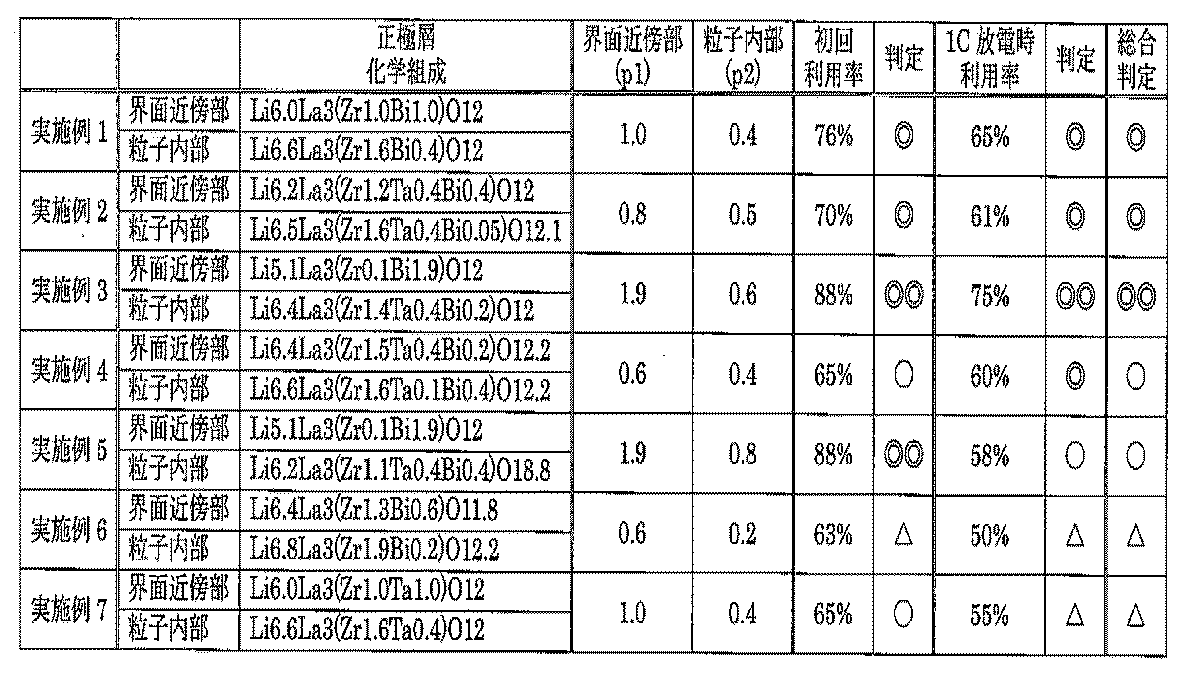

比較例1と実施例1~7との比較より、粒子内部のp2を比較的低い値に維持しつつ、界面近傍部のp1を増大させ(Li量を減少させ)ることで、高い初回利用率を維持した状態で、なおかつ1C放電時の利用率を向上させることができることがわかった。これは、界面近傍部のp1を増大させることで、正極活物質との副反応を抑制し、また、粒子内部のp2を比較的低い値に維持させることで固体電解質のイオン伝導度が高くなっていることに由来していると考えられる。
実施例1と実施例7との比較から、DIIがBiを含むことによって、初回利用率および、1C放電時の利用率がより一層向上することがわかった。これは、界面近傍部のBi量が増大することによって、ガーネット型酸化物の焼結性が向上し、正極活物質/ガーネット型酸化物間の接触面積が増大するためだと考えられる。
比較例1~3より、ガーネット型酸化物のLi量が低減する、つまり、pが増大するほど初回の活物質の利用率が向上することがわかる。これは、ガーネット型酸化物のLi量が低減することで層状岩塩構造を有する正極活物質との副反応が抑制されたためだと考えられる。一方で、比較例3においても1C放電時の利用率は21%と低いことがわかった。これはBi量の増大に伴って、ガーネット型酸化物のイオン伝導度が低下するためだと考えられる。
比較例1のガーネット型酸化物はイオン伝導度が高いものの、正極活物質が共焼成によって変性するため、1C放電時の容量維持率も低くなると考えられる。
比較例1のガーネット型酸化物はイオン伝導度が高いものの、正極活物質が共焼成によって変性するため、1C放電時の容量維持率も低くなると考えられる。
実施例1~5および6と、実施例7との比較により、界面近傍部および粒子内部が前記一般式(I)について以下の条件を満たすことにより、総合判定結果として、「○」以上を達成できることが明らかである:
・前記DIIはBiを含む;
・前記p1および前記p2は以下の関係式を満たす:
0.5≦p1≦2.0;および
0.3≦p2≦1.0。
・前記DIIはBiを含む;
・前記p1および前記p2は以下の関係式を満たす:
0.5≦p1≦2.0;および
0.3≦p2≦1.0。
実施例1~3と、実施例4~7との比較により、界面近傍部および粒子内部が前記一般式(I)について以下の条件を満たすことにより、総合判定結果として、「◎」以上を達成できることが明らかである:
・前記DIIはBiを含む;
・前記p1および前記p2は以下の関係式を満たす:
0.25≦p1-p2≦1.8
0.7≦p1≦2.0;および
0.3≦p2≦0.7。
・前記DIIはBiを含む;
・前記p1および前記p2は以下の関係式を満たす:
0.25≦p1-p2≦1.8
0.7≦p1≦2.0;および
0.3≦p2≦0.7。
本発明の固体電解質セラミックスを含む固体電池は、電池使用または蓄電が想定される様々な分野に利用することができる。あくまでも例示にすぎないが、本発明の一実施形態に係る固体電池は、エレクトロニクス実装分野で用いることができる。本発明の一実施形態に係る固体電池はまた、モバイル機器などが使用される電気・情報・通信分野(例えば、携帯電話、スマートフォン、スマートウォッチ、ノートパソコン、デジタルカメラ、活動量計、アームコンピューター、電子ペーパー、ウェアラブルデバイス、RFIDタグ、カード型電子マネー、スマートウォッチなどの小型電子機などを含む電気・電子機器分野あるいはモバイル機器分野)、家庭・小型産業用途(例えば、電動工具、ゴルフカート、家庭用・介護用・産業用ロボットの分野)、大型産業用途(例えば、フォークリフト、エレベーター、湾港クレーンの分野)、交通システム分野(例えば、ハイブリッド車、電気自動車、バス、電車、電動アシスト自転車、電動二輪車などの分野)、電力系統用途(例えば、各種発電、ロードコンディショナー、スマートグリッド、一般家庭設置型蓄電システムなどの分野)、医療用途(イヤホン補聴器などの医療用機器分野)、医薬用途(服用管理システムなどの分野)、ならびに、IoT分野、宇宙・深海用途(例えば、宇宙探査機、潜水調査船などの分野)などに利用することができる。
1:正極活物質
2:ガーネット型酸化物
21:ガーネット型酸化物粒子の周縁領域
22:ガーネット型酸化物粒子の内部領域(粒子内部)
23:ガーネット型酸化物における正極活物質との界面近傍部(斜線領域)
R:ガーネット型酸化物における正極活物質との界面
2:ガーネット型酸化物
21:ガーネット型酸化物粒子の周縁領域
22:ガーネット型酸化物粒子の内部領域(粒子内部)
23:ガーネット型酸化物における正極活物質との界面近傍部(斜線領域)
R:ガーネット型酸化物における正極活物質との界面
Claims (12)
- 正極層と、負極層と、前記正極層と前記負極層との間に配置された固体電解質層と、
を備え、
前記正極層は正極活物質およびガーネット型結晶構造を有する酸化物を含み、
前記酸化物における前記正極活物質との界面近傍部のLi濃度が、前記酸化物の粒子内部のLi濃度に比べて低い、固体電池。 - 前記界面近傍部および前記粒子内部は下記一般式(I):

BIは、酸素と8配位をとることが可能な第1族~第3族に属する元素のうち、3価の価数をとることができる元素からなる群から選択される1種以上の元素である;
BIIは、酸素と8配位をとることが可能な第1族~第3族に属する元素のうち、3価以外の価数をとることができる元素からなる群から選択される1種以上の元素である;
DIは、酸素と6配位をとることが可能な遷移元素および第12族~第15族に属する典型元素のうち、4価の価数をとることができる元素からなる群から選択される1種類以上の元素である;
DIIは、酸素と6配位をとることが可能な遷移元素および第12族~第15族に属する典型元素のうち、4価以外の価数をとることができる元素からなる群から選択される1種以上の元素である;
α、β、γ、ω、x、yおよびzは、以下の通りである;
(界面近傍部)
αは、5.0≦α≦8.0を満たす;
βは、2.5≦β≦3.5を満たす;
γは、1.5≦γ≦2.5を満たす;
ωは、11≦ω≦13を満たす;
xは、0≦x≦1.0を満たす;
yは、0≦y≦1.0を満たす;
zは、0.4≦z≦2.2を満たす:
(粒子内部)
αは、5.0≦α≦8.0を満たす;
βは、2.5≦β≦3.5を満たす;
γは、1.5≦γ≦2.5を満たす;
ωは、11≦ω≦13を満たす;
xは、0≦x≦1.0を満たす;
yは、0≦y≦1.0を満たす;
zは、0.1≦z≦1.0を満たす]
で表される化学組成を有し、
前記一般式(I)において、pを下記計算式:
p=ax-(3-b)y+(d-4)z
[式中、aはAの平均価数である;bはBIIの平均価数である;dは、DIIの平均価数である]
で表した場合、
前記界面近傍部のp(以下、「p1」という)が前記粒子内部のp(以下、「p2」という)に比べて大きい、請求項1に記載の固体電池。 - 正極層と、負極層と、前記正極層と前記負極層との間に配置された固体電解質層と、
を備え、
前記正極層は正極活物質およびガーネット型結晶構造を有する酸化物を含み、
前記酸化物における前記正極活物質との界面近傍部および前記酸化物の粒子内部は下記一般式(I):

BIは、酸素と8配位をとることが可能な第1族~第3族に属する元素のうち、3価の価数をとることができる元素からなる群から選択される1種以上の元素である;
BIIは、酸素と8配位をとることが可能な第1族~第3族に属する元素のうち、3価以外の価数をとることができる元素からなる群から選択される1種以上の元素である;
DIは、酸素と6配位をとることが可能な遷移元素および第12族~第15族に属する典型元素のうち、4価の価数をとることができる元素からなる群から選択される1種類以上の元素である;
DIIは、酸素と6配位をとることが可能な遷移元素および第12族~第15族に属する典型元素のうち、4価以外の価数をとることができる元素からなる群から選択される1種以上の元素である;
α、β、γ、ω、x、yおよびzは、以下の通りである;
(界面近傍部)
αは、5.0≦α≦8.0を満たす;
βは、2.5≦β≦3.5を満たす;
γは、1.5≦γ≦2.5を満たす;
ωは、11≦ω≦13を満たす;
xは、0≦x≦1.0を満たす;
yは、0≦y≦1.0を満たす;
zは、0.4≦z≦2.2を満たす:
(粒子内部)
αは、5.0≦α≦8.0を満たす;
βは、2.5≦β≦3.5を満たす;
γは、1.5≦γ≦2.5を満たす;
ωは、11≦ω≦13を満たす;
xは、0≦x≦1.0を満たす;
yは、0≦y≦1.0を満たす;
zは、0.1≦z≦1.0を満たす]
で表される化学組成を有し、
前記一般式(I)において、pを下記計算式:
p=ax-(3-b)y+(d-4)z
[式中、aはAの平均価数である;bはBIIの平均価数である;dは、DIIの平均価数である]
で表した場合、
前記界面近傍部のp(以下、「p1」という)が前記粒子内部のp(以下、「p2」という)に比べて大きい、固体電池。 - 前記p1は以下の関係式を満たす、請求項2または3に記載の固体電池:
0.4<p1≦2.0。 - 前記p1および前記p2は以下の関係式を満たす、請求項2~4のいずれかに記載の固体電池:
0.1≦p1-p2。 - 前記p1および前記p2は以下の関係式を満たす、請求項2~5のいずれかに記載の固体電池:
0.4<p1≦2.0;および
0.1≦p2≦1.5。 - 前記DIIはBiを含む、請求項2~6のいずれかに記載の固体電池。
- 前記DIIはBiを含み、
前記p1および前記p2は以下の関係式を満たす、請求項2~7のいずれかに記載の固体電池:
0.5≦p1≦2.0;および
0.3≦p2≦1.0。 - 前記DIIはBiを含み、
前記p1および前記p2は以下の関係式を満たす、請求項2~8のいずれかに記載の固体電池:
0.25≦p1-p2≦1.8
0.7≦p1≦2.0;および
0.3≦p2≦0.7。 - 前記正極活物質は層状岩塩型構造を有する、請求項1~9のいずれかに記載の固体電池。
- 前記正極層および前記負極層はリチウムイオンを吸蔵放出可能な層となっている、請求項1~10のいずれかに記載の固体電池。
- 前記固体電解質層は前記正極層および前記負極層と相互に焼結体同士の一体焼結をなしている、請求項1~11のいずれかに記載の固体電池。
Priority Applications (2)
| Application Number | Priority Date | Filing Date | Title |
|---|---|---|---|
| JP2022568318A JP7632476B2 (ja) | 2020-12-10 | 2021-12-08 | 固体電池 |
| US18/332,352 US12580225B2 (en) | 2020-12-10 | 2023-06-09 | Solid-state battery |
Applications Claiming Priority (2)
| Application Number | Priority Date | Filing Date | Title |
|---|---|---|---|
| JP2020205168 | 2020-12-10 | ||
| JP2020-205168 | 2020-12-10 |
Related Child Applications (1)
| Application Number | Title | Priority Date | Filing Date |
|---|---|---|---|
| US18/332,352 Continuation US12580225B2 (en) | 2020-12-10 | 2023-06-09 | Solid-state battery |
Publications (1)
| Publication Number | Publication Date |
|---|---|
| WO2022124348A1 true WO2022124348A1 (ja) | 2022-06-16 |
Family
ID=81973340
Family Applications (1)
| Application Number | Title | Priority Date | Filing Date |
|---|---|---|---|
| PCT/JP2021/045188 Ceased WO2022124348A1 (ja) | 2020-12-10 | 2021-12-08 | 固体電池 |
Country Status (3)
| Country | Link |
|---|---|
| US (1) | US12580225B2 (ja) |
| JP (1) | JP7632476B2 (ja) |
| WO (1) | WO2022124348A1 (ja) |
Cited By (2)
| Publication number | Priority date | Publication date | Assignee | Title |
|---|---|---|---|---|
| WO2023243247A1 (ja) * | 2022-06-17 | 2023-12-21 | パナソニックIpマネジメント株式会社 | 固体電解質およびそれを備えた蓄電デバイス |
| WO2025033430A1 (ja) * | 2023-08-10 | 2025-02-13 | 住友化学株式会社 | アルカリ金属含有酸化物、電極及び電池 |
Citations (3)
| Publication number | Priority date | Publication date | Assignee | Title |
|---|---|---|---|---|
| JP2017111884A (ja) * | 2015-12-14 | 2017-06-22 | トヨタ自動車株式会社 | 全固体電池用焼結体の製造方法 |
| JP2018206486A (ja) * | 2017-05-30 | 2018-12-27 | 凸版印刷株式会社 | 積層体グリーンシート、全固体二次電池およびその製造方法 |
| JP2019121462A (ja) * | 2017-12-28 | 2019-07-22 | トヨタ自動車株式会社 | 酸化物電解質焼結体で被覆された電極活物質の製造方法、酸化物電解質焼結体で被覆された電極活物質、及び、硫化物固体電池 |
Family Cites Families (4)
| Publication number | Priority date | Publication date | Assignee | Title |
|---|---|---|---|---|
| JP2016517146A (ja) * | 2013-03-21 | 2016-06-09 | ユニバーシティー オブ メリーランド、カレッジ パーク | 固体電解質物質を含むイオン伝導性バッテリー |
| CN115428098A (zh) * | 2020-05-18 | 2022-12-02 | 株式会社村田制作所 | 固体电解质陶瓷材料及固体电池 |
| WO2022107826A1 (ja) * | 2020-11-17 | 2022-05-27 | 株式会社村田製作所 | 固体電解質セラミックスおよび固体電池 |
| CN116888088A (zh) * | 2021-02-22 | 2023-10-13 | 康宁股份有限公司 | 致密生胚带、制造方法及其用途 |
-
2021
- 2021-12-08 WO PCT/JP2021/045188 patent/WO2022124348A1/ja not_active Ceased
- 2021-12-08 JP JP2022568318A patent/JP7632476B2/ja active Active
-
2023
- 2023-06-09 US US18/332,352 patent/US12580225B2/en active Active
Patent Citations (3)
| Publication number | Priority date | Publication date | Assignee | Title |
|---|---|---|---|---|
| JP2017111884A (ja) * | 2015-12-14 | 2017-06-22 | トヨタ自動車株式会社 | 全固体電池用焼結体の製造方法 |
| JP2018206486A (ja) * | 2017-05-30 | 2018-12-27 | 凸版印刷株式会社 | 積層体グリーンシート、全固体二次電池およびその製造方法 |
| JP2019121462A (ja) * | 2017-12-28 | 2019-07-22 | トヨタ自動車株式会社 | 酸化物電解質焼結体で被覆された電極活物質の製造方法、酸化物電解質焼結体で被覆された電極活物質、及び、硫化物固体電池 |
Cited By (2)
| Publication number | Priority date | Publication date | Assignee | Title |
|---|---|---|---|---|
| WO2023243247A1 (ja) * | 2022-06-17 | 2023-12-21 | パナソニックIpマネジメント株式会社 | 固体電解質およびそれを備えた蓄電デバイス |
| WO2025033430A1 (ja) * | 2023-08-10 | 2025-02-13 | 住友化学株式会社 | アルカリ金属含有酸化物、電極及び電池 |
Also Published As
| Publication number | Publication date |
|---|---|
| US20230318031A1 (en) | 2023-10-05 |
| US12580225B2 (en) | 2026-03-17 |
| JP7632476B2 (ja) | 2025-02-19 |
| JPWO2022124348A1 (ja) | 2022-06-16 |
Similar Documents
| Publication | Publication Date | Title |
|---|---|---|
| JP7622816B2 (ja) | 固体電池 | |
| WO2021145312A1 (ja) | 固体電池 | |
| US20230307705A1 (en) | Solid electrolyte ceramic and solid-state battery | |
| WO2021145273A1 (ja) | 固体電池 | |
| US20230076099A1 (en) | Solid electrolyte ceramic material and solid-state battery | |
| US12580225B2 (en) | Solid-state battery | |
| WO2021162128A1 (ja) | 固体電池 | |
| JP7666517B2 (ja) | 固体電解質セラミックスおよび固体電池 | |
| US20250336980A1 (en) | Solid-state battery | |
| JP7556402B2 (ja) | 固体電解質セラミックスおよび固体電池 | |
| JP7666518B2 (ja) | 固体電解質セラミックスおよび固体電池 | |
| JP7768366B2 (ja) | 固体電解質セラミックスおよび固体電池 | |
| JP7852710B2 (ja) | 固体電解質セラミックスおよび固体電池 |
Legal Events
| Date | Code | Title | Description |
|---|---|---|---|
| 121 | Ep: the epo has been informed by wipo that ep was designated in this application |
Ref document number: 21903447 Country of ref document: EP Kind code of ref document: A1 |
|
| ENP | Entry into the national phase |
Ref document number: 2022568318 Country of ref document: JP Kind code of ref document: A |
|
| NENP | Non-entry into the national phase |
Ref country code: DE |
|
| 122 | Ep: pct application non-entry in european phase |
Ref document number: 21903447 Country of ref document: EP Kind code of ref document: A1 |