WO2022123744A1 - 秘匿ハッシュテーブル構築装置、秘匿ハッシュテーブル構築システム、秘匿ハッシュテーブル構築方法、及びプログラム - Google Patents
秘匿ハッシュテーブル構築装置、秘匿ハッシュテーブル構築システム、秘匿ハッシュテーブル構築方法、及びプログラム Download PDFInfo
- Publication number
- WO2022123744A1 WO2022123744A1 PCT/JP2020/046125 JP2020046125W WO2022123744A1 WO 2022123744 A1 WO2022123744 A1 WO 2022123744A1 JP 2020046125 W JP2020046125 W JP 2020046125W WO 2022123744 A1 WO2022123744 A1 WO 2022123744A1
- Authority
- WO
- WIPO (PCT)
- Prior art keywords
- array
- data
- address value
- hash table
- secret
- Prior art date
- Legal status (The legal status is an assumption and is not a legal conclusion. Google has not performed a legal analysis and makes no representation as to the accuracy of the status listed.)
- Ceased
Links
Images



Classifications
-
- G—PHYSICS
- G06—COMPUTING OR CALCULATING; COUNTING
- G06F—ELECTRIC DIGITAL DATA PROCESSING
- G06F16/00—Information retrieval; Database structures therefor; File system structures therefor
- G06F16/20—Information retrieval; Database structures therefor; File system structures therefor of structured data, e.g. relational data
- G06F16/22—Indexing; Data structures therefor; Storage structures
- G06F16/2228—Indexing structures
- G06F16/2255—Hash tables
-
- G—PHYSICS
- G06—COMPUTING OR CALCULATING; COUNTING
- G06F—ELECTRIC DIGITAL DATA PROCESSING
- G06F21/00—Security arrangements for protecting computers, components thereof, programs or data against unauthorised activity
- G06F21/60—Protecting data
- G06F21/602—Providing cryptographic facilities or services
-
- G—PHYSICS
- G09—EDUCATION; CRYPTOGRAPHY; DISPLAY; ADVERTISING; SEALS
- G09C—CIPHERING OR DECIPHERING APPARATUS FOR CRYPTOGRAPHIC OR OTHER PURPOSES INVOLVING THE NEED FOR SECRECY
- G09C1/00—Apparatus or methods whereby a given sequence of signs, e.g. an intelligible text, is transformed into an unintelligible sequence of signs by transposing the signs or groups of signs or by replacing them by others according to a predetermined system
Definitions
- the present invention relates to a secret calculation, and particularly to an operation in which the order of an array is concealed.
- the hash table is a data structure for high-speed data retrieval based on the key value by encoding the key value of the data with a hash function or the like and associating it with the address value in the data array. This is useful, for example, when data is stored in an external server or the like and it is desired to perform a search by a key value at any time.
- ordinary hash tables do not assume data concealment, and there is a problem that, for example, a server entrusted with data (or hash table) by a user can identify the table structure and thereby observe the user's access tendency. be.
- a secret hash table for example, reference [4, 1]
- Reference names are listed at the end of the specification.
- the secret hash table is a technique for constructing a hash table while keeping the table structure secret from the server, and it is possible to hide the user's access tendency to the server.
- a method of constructing a secret hash table is a method in which the user encrypts all data at hand, constructs a hash table, and entrusts it to a server. In this case, the user's storage area is stored for the number of data n. O (n) is required.
- References [4] and [1] mentioned above are methods for constructing a concealed hash table on a server by a user-server cooperative protocol on the assumption that the server has all the encrypted data. It has the advantage that O (1) is sufficient for the storage area of the user.
- Non-Patent Document 1 shows a method of constructing a secret hash table by secret calculation using multiple servers without requiring any communication between users and servers. Therefore, the communication environment and calculation of the user terminal are shown. Stable performance can be achieved regardless of performance.
- the secret hash method called "Oblivius Greedy Hashing” is stored in two different address values (that is, at which position in the table) for each data to be stored.
- By giving (a value indicating whether or not it should be) a table construction algorithm is realized in which each data is stored in the more vacant of the two storage destinations. This has the advantage that the table size can be kept small compared to other existing methods.
- the present invention has been made in view of the above points, and an object of the present invention is to provide a technique for constructing a secret hash table without increasing the amount of communication while reducing the table size.
- up to Z data can be added to each of the B address values by secret calculation.
- It is a secret hash table construction device that builds a secret hash table that can be stored.
- a storage destination data array including a first address value and a second address value, a flag, and a rank for each address value for each data in the actual data string, and a first address value and a second address value as dummies.
- a second array in which the actual data string and the dummy data string are concatenated is generated.
- a ranking operation for the same data with respect to the first address value of the first array sorted by sorting each of the first array and the second array based on the first address value and the flag in the first array. And sort each of the first sequence and the second sequence based on the ranking.
- a ranking operation for the same data with respect to the second address value of the first array sorted by sorting each of the first array and the second array based on the second address value and the flag in the first array. And In the first array, the address value on the lower rank side of the first address value and the second address value is extracted, and a third array having the extracted address value and the flag is generated.
- the second sequence was sorted using the fourth sequence obtained by comparing each element of the rank array calculated from the address values in the third sequence with Z, and the BZ pieces in the sorted second sequence.
- a secret hash table construction device including an arithmetic unit that outputs elements as the secret hash table is provided.
- a technique for constructing a secret hash table without increasing the amount of communication while reducing the table size is provided.
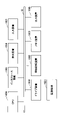
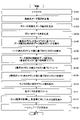
- FIG. 1 It is a block diagram of a secret hash table construction system. It is a functional block diagram of a server. It is a figure which shows the hardware configuration example of the apparatus. It is a flowchart which shows the processing procedure of Example 1.
- FIG. 2 It is a flowchart which shows the processing procedure of Example 2.
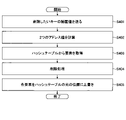
- FIG. 3 It is a flowchart which shows the processing procedure of Example 4.
- FIG. 1 shows a configuration example of a secret hash table construction system according to the present embodiment.
- the secret hash table construction system of the present embodiment has a configuration in which a plurality of servers 100-1 to 100-N are provided in 200 on a communication network.
- Each server is a computer.
- the computer may be a physical machine or a virtual machine provided by the cloud.
- the user terminal 300 shown in FIG. 1 accesses the secret hash table construction system and acquires, for example, the data corresponding to the key.
- the process related to the construction of the secret hash table is executed by the secret calculation by the cooperative protocol between these plurality of servers 100-1 to 100-N.
- the use of a cooperative protocol of a plurality of servers is an example, and the present invention is not limited thereto.
- the present invention is applicable to any technique capable of performing secret calculations. For example, if one server can perform secret calculations, it is also possible to execute the technique according to the present invention on that server.
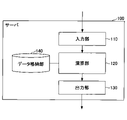
- FIG. 2 shows a configuration example of the server 100.
- the configuration example of the server 100 shown in FIG. 2 is the configuration when a plurality of servers 100-1 to 100-N are virtually regarded as one server.
- the server 100 shown in FIG. 2 may be called a secret hash table construction system.
- the server 100 may be referred to as a secret hash table construction device.
- the server may be the server 100 shown in FIG.
- the server 100 has an input unit 110, a calculation unit 120, an output unit 130, and a data storage unit 140.
- the arithmetic unit 120 executes a process related to the construction and operation of the secret hash table.
- the data storage unit 140 stores data prepared in advance for calculation, data such as a secret array during calculation, and a table.
- the input unit 110 receives, for example, a request from the user terminal 300 and inputs the request.
- the output unit 140 returns, for example, the calculation result for the request from the user terminal 300 to the user terminal 300.
- the server 100 in the present embodiment can be realized by, for example, causing a computer to execute a program describing the processing contents described in the present embodiment.
- the "computer” may be a physical machine or a virtual machine on the cloud.
- the "hardware” described here is virtual hardware.
- the above program can be recorded on a computer-readable recording medium (portable memory, etc.), saved, and distributed. It is also possible to provide the above program through a network such as the Internet or e-mail.
- FIG. 3 is a diagram showing an example of the hardware configuration of the above computer.
- the computer of FIG. 3 has a drive device 1000, an auxiliary storage device 1002, a memory device 1003, a CPU 1004, an interface device 1005, a display device 1006, an input device 1007, an output device 1008, and the like, which are connected to each other by a bus B, respectively.
- the program that realizes the processing on the computer is provided by, for example, a recording medium 1001 such as a CD-ROM or a memory card.
- a recording medium 1001 such as a CD-ROM or a memory card.
- the program is installed in the auxiliary storage device 1002 from the recording medium 1001 via the drive device 1000.
- the program does not necessarily have to be installed from the recording medium 1001, and may be downloaded from another computer via the network.
- the auxiliary storage device 1002 stores the installed program and also stores necessary files, data, and the like.
- the memory device 1003 reads and stores the program from the auxiliary storage device 1002 when the program is instructed to start.
- the CPU 1004 realizes the function related to the server 100 according to the program stored in the memory device 1003.
- the interface device 1005 is used as an interface for connecting to a network.
- the display device 1006 displays a GUI (Graphical User Interface) or the like by a program.
- the input device 1007 is composed of a keyboard, a mouse, buttons, a touch panel, and the like, and is used for inputting various operation instructions.
- the output device 1008 outputs the calculation result.
- the concealed value of the value x is referred to as [[x]]
- the process x ⁇ [[x]] is referred to as concealment of x
- [[x]] ⁇ x is referred to as restoration of x.
- the secret sharing method references [6, 5]
- Any concealment / restoration processing technique may be used.
- the comparison operation can be executed with the communication cost O (len) bit in the technique of reference [7].
- the following processing is executed by the arithmetic unit 120 of the server 100. Further, the data prepared in advance, the array obtained by the calculation, the table, etc. are stored in the data storage unit 140.
- the calculation unit 120 performs an operation on the data read from the data storage unit 140, and proceeds with the process while repeating storing the operation result in the data storage unit 140.
- Example 1 First, Example 1 will be described.
- the key ki is an identifier unique to each data, and is used for the purpose of uniquely specifying the data at the time of access or the like.
- the flag e i is a 1-bit value for determining whether or not the data is a dummy.
- the bit length of ki ceil (logn) at the minimum, but redundancy may be acceptable.
- the secret hash table constructed in the first embodiment is a data array of size B ⁇ Z, and is a data structure capable of storing up to Z data in each of the address values of B streets if expressed differently. And. Further, it is assumed that the pseudo-random function used in the first embodiment satisfies PRF ([[k]], [[s]]) ⁇ ⁇ 0, ..., B-1 ⁇ .
- the server 100 constructs a secret hash table by the process described below.
- the process executed by the server 100 will be described according to the procedure of the flowchart of FIG.
- step 101 the server 100 shuffles [[A]] and sets [[A]] ⁇ Shuffle ([[A]]). However, this operation may not be performed depending on the state of the input [[A]] and the safety to be satisfied.
- [[addr p i ]] ⁇ PRF ([[ki]], [[sp]]); i ⁇ ⁇ 0, ..., n-1 ⁇ , p ⁇ ⁇ 0, 1 ⁇ . Also, it is initialized as [[rank pi ]] ⁇ [[ 0 ]].
- ADDR ((3,1,0,0,0), It becomes an array (an array of n data) such as (18,95,0,0,0), ..., (8,78,0,0,0)).
- ADDR ((3,1,0,0,0)
- n data an array of n data
- the explanation may be given without [[]] as appropriate.
- ADDR' ((3,1,0,0,0), (18,95,0,0,0), ..., (8,78, 0,0,0), (0,0,1,0,0), (0,0,1,0,0), ..., (8,8,1,0,0)) (An array of n + BZ data).
- the notation [[ADDR'. [[ADDR']] is an array obtained by extracting only the first address value [[addr 0 i ]] from [[ADDR']] ([[addr 0 0 ]], ..., [[addr 0 n + BZ-1 ] ]. ]])).
- the notation [[ADDR'. addr 1 ]], [[ADDR'. rank 0 ]], [[ADDR'. Rank 1 ]] is defined as an array obtained by extracting [[addr 1 i ]], [[rank 0 i ]], and [[rank 1 i ]] from [[ADDR']], respectively.
- ADDR' ((3,1,0,0,0), (18,95,0,0,0), ..., (8,78,0,0,0), ( 0,0,1,0,0), (0,0,1,0,0), ..., (8,8,1,0,0)), ADDR'.
- pos 0 ((3,0), (18,0), ..., (8,0), (0,1), (0,1), ..., (8) , 1)).
- the dimmy is a predetermined value different from any key ki.
- the server 100 first sorts the data array and the storage destination data array based on the first address value addr 0 i and the flag e i . That is, [[A']] ⁇ Sort ([[ADDR'. Pos 0 ]], [[A']]), and [[ADDR']] ⁇ Sort ([[ADDR'. Pos 0 ]]], [ [ADDR']]) is calculated.
- the data array and the storage destination data array shall be sorted in ascending order by address value and in the order of actual data> dummy data at the same address value, but the subsequent sorting and ascending / descending order of ranking shall be adjusted. You can also change the sort order by doing this.
- ⁇ S106> the server 100 ranks based on the sorted address values. That is, [[ADDR'. rank 0 ]] ⁇ Rank ([[ADDR'.addr 0 ]]) is calculated.
- ADDR'. rank 0 is, for example, ADDR'.
- Rank 0 (1,2,3,4 ...., 1,2,3, ..., 1,2,3,4,5) is an array (an array of n + BZ data). ..
- the server 100 sorts the data array and the storage destination data array in descending order based on the first rank. That is, [[A']] ⁇ Sort ([[ADDR'.rank 0 ]], [[A']]) and [[ADDR']] ⁇ Sort ([[ADDR'.rank 0 ]], [[ ADDR']]) is calculated so that rank 0 i is arranged in descending order. Note that this operation can be similarly realized by simply sorting each array in ascending order and then sorting them in reverse order.
- the server 100 sorts based on the second address value addr 1 i and the flag, as in the process in S105. That is, [[A']] ⁇ Sort ([[ADDR'. Pos 1 ]], [[A']]) and [[ADDR']] ⁇ Sort ([[ADDR'. Pos 1 ]]], [[ ADDR']])) is calculated. At this time, if stable sorting is used, the same address value can be sorted in the order of actual data> dummy data and high rank> low rank.
- ⁇ S109> the server 100 ranks based on the second sorted address value, as in the process in S106. That is, [[ADDR'. rank 1 ]] ⁇ Rank ([[ADDR'.addr 1 ]]) is calculated.
- the server 100 sorts each data in ascending order based on the newly obtained array [[ADDR fin ]]. That is, [[A']] ⁇ Sort ([[ADDR fin ]], [[A']]) and [[ADDR fin ]] ⁇ Sort ([[ADDR fin ]], [[ADDR fin ]]). calculate.
- the server 100 sorts the data array in ascending order using [[Y]]. That is, [[A']] ⁇ Sort ([[Y]], [[A']]) is calculated. After that, only the last BZ elements are output as a hash table, and the others are deleted. In addition, two private keys [[s 0 ]] and [[s 1 ]] are also output as access information attached to the hash table.
- Example 2 a method of constructing a table equivalent to that of the first embodiment will be shown more efficiently.
- the data array [[A]] (or [[A']]) is always sorted together with the storage destination data array, the number of sorts is simply increased, and the key and the flag are assumed to be large. If the data vi was added, there was a possibility that the efficiency would be deteriorated due to the sorting of the data array.
- the algorithm of the first embodiment is followed in principle, but the number of sorts is reduced by using the encryption in the secret calculation, and the secret hash table is constructed as follows.
- the procedure of the flowchart of FIG. 5 will be described.
- the private key [[s]] may be generated before the start of the protocol.
- the only difference from the first embodiment is that the tag [[tag i ]] is included.
- tag sequence [[Tag d ]] ([[tag d 0 ]], ..., [[tag d BZ-1 ]]) calculated in S204 of the second embodiment, [[[[ Tag']] ⁇ [[Tag]]
- ⁇ S206> the server 100 conceals and randomizes the order of the arrays [[A']] and [[Tag']] ([[A']], [[Tag']]) ⁇ Shuffle ( [[A']], [[Tag']]) are calculated. In this operation, the same shuffle process is executed in parallel in order to randomize while maintaining the correspondence between the two arrays.
- ⁇ S207> the server 100 performs the same processing as in S105 to S113 of the first embodiment.
- the operation is performed only on the storage destination data array without touching the array [[A']] at all.
- each element of [[ADDR fin ]] is changed to ([[addr i ]], [[e i ]], [[tag i ]]. ]) To take over the tag information.
- the server 100 sorts [[ADDR fin ]] in ascending order using [[Y]] obtained in the procedure corresponding to S112 of Example 1. That is, [[ADDR fin ]] ⁇ Sort ([[Y]], [[ADDR fin ]]) is calculated. After that, only the last BZ elements are left, and the others are deleted.
- ⁇ S209> the server 100 restores all the elements of the tag array [[Tag']] and returns them to plaintext. At the same time, all tags included in [[ADDR fin ]] are restored and returned to plain text. Hash table by extracting BZ elements whose corresponding tags are included in [[ADDR fin ]] from the data array [[A']] and arranging them in the order of [[ADDR fin ]]. And. Finally, the hash table and private key [[s 0 ]] and [[s 1 ]] are output.
- Example 3 the data reference method to the secret hash table constructed in the first and second embodiments will be described.
- the server 100 holds the secret hash table (size B ⁇ Z) constructed in Examples 1 and 2 and the secret keys [[s 0 ]] and [[s 1 ]] in the data storage unit 140.
- the user terminal 300 has the key k to be accessed, but this may be selected by the server itself based on the agreement between the servers.
- the procedure shown in the flowchart of FIG. 6 will be described.
- the user terminal 300 sends the secret value [[k]] of the key corresponding to the data to be accessed to the server 100.
- this secret key value can be generated not only by the request from the user terminal 300 to the server 100 but also by the server itself based on the agreement between the servers.
- the server 100 uses a pseudo-random function to provide two address values [[addr 0 ]] ⁇ PRF ([[k]], [[s 0 ]]), [[addr 1 ]] ⁇ PRF ( [[K]], [[s 1 ]]) is calculated, and this is restored to obtain addr 0 and addr 1 .
- the server 100 calculates the inner product [[a]] ⁇ ⁇ [[a]], [[c]]> and returns it to the user terminal 300 or restores it based on the agreement between the servers. Alternatively, this may not be restored and may be used for a completely different secret calculation process.
- the communication amount between the user and the server is an O (logn) bit
- the communication amount between the servers is an O (Zlogn) bit
- Example 4 In the fourth embodiment, the data deletion method in the secret hash table constructed in the first and second embodiments will be described.
- the server 100 holds the hash table (size B ⁇ Z) constructed in Examples 1 and 2 and the private keys [[s 0 ]] and [[s 1 ]] in the data storage unit 140. And. Further, it is assumed that the user has the key k of the data to be deleted, but this may be selected by the server itself based on the agreement between the servers.
- the procedure shown in the flowchart of FIG. 7 will be described.
- S401 the user terminal 300 sends the secret value [[k]] of the key to be deleted to the server 100.
- this secret key value can be generated not only by the request from the user terminal 300 to the server 100 but also by the server itself based on the agreement between the servers.
- the server 100 uses a pseudo-random function to provide two address values [[addr 0 ]] ⁇ PRF ([[k]], [[s 0 ]]), [[addr 1 ]] ⁇ PRF ( [[K]], [[s 1 ]]) is calculated, and this is restored to obtain addr 0 and addr 1 .
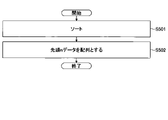
- Example 5 In the fifth embodiment, a method of disassembling the hash table constructed in the first and second embodiments and extracting all the data will be described. As a premise, it is assumed that the server 100 holds the hash table (size B ⁇ Z) constructed in the first and second embodiments in the data storage unit 140. Hereinafter, the procedure shown in the flowchart of FIG. 8 will be described.
- [[Table]] Sort ([[E]], [[Table]]).
- ⁇ S502> the server 100 sets the first n data of [[Table]] into an array [[A]] and deletes the rest.
- a secret hash table can be constructed without communication with the user by using the secret calculation.
- the secret calculation process called ranking the number of secret sorts required for table construction can be greatly reduced, and the communication cost can be greatly reduced as compared with the conventional method.
- the amount of communication between servers is changed from ⁇ (nlog 2.5 n) to O while maintaining the merit of the conventional method of reducing the table size by allocating two types of address values to each data. It can be reduced to (nlog 2 n). It is also possible to operate on the built table.
- a secret hash table construction device that can store up to Z data in each B-style address value is constructed by secret calculation from an actual data string containing a plurality of data having a key and a flag indicating whether or not the data is a dummy. It is a secret hash table construction device that A storage destination data array including a first address value and a second address value, a flag, and a rank for each address value for each data in the actual data string, and a first address value and a second address value as dummies.
- a first array that concatenates the flag and the storage destination data array including the rank for each address value.
- a second array in which the actual data string and the dummy data string are concatenated is generated.
- a ranking operation for the same data with respect to the first address value of the first array sorted by sorting each of the first array and the second array based on the first address value and the flag in the first array.
- sort each of the first sequence and the second sequence based on the ranking.
- a ranking operation for the same data with respect to the second address value of the first array sorted by sorting each of the first array and the second array based on the second address value and the flag in the first array.
- a secret hash table construction device including an arithmetic unit that outputs elements as the secret hash table.
- the calculation unit concatenates the actual data string and the dummy data string by using a tag column having a tag indicating each data in the actual data string and each data in the dummy data string.
- the secret hash table construction device according to item 1, wherein the secret hash table is generated without performing a sort other than the sort based on the fourth array with respect to the second array.
- the calculation unit calculates two address values from the key value to be accessed, acquires 2Z data corresponding to the two address values from the secret hash table, and of the 2Z data, the key.
- the secret hash table construction device according to item 1 or 2, which returns data having the same key value as the value.
- the calculation unit calculates two address values from the key value to be deleted, acquires 2Z data corresponding to the two address values from the secret hash table, and out of the 2Z data data.
- the secret hash table construction device according to any one of the items 1 to 3 for deleting data having the same key value as the key value.
- the calculation unit sorts all the data in the secret hash table based on the flag, and acquires the predetermined number of data at the beginning as the actual data string in any one of the first to fourth terms.
- the described secret hash table construction device (Section 6) A secret hash table that can store up to Z data in each of the B address values is constructed by secret calculation from an actual data string containing a plurality of data having a key and a flag indicating whether or not the data is a dummy.
- a storage destination data array including a first address value and a second address value, a flag, and a rank for each address value for each data in the actual data string, and a first address value and a second address value as dummies. And generate a first array that concatenates the flag and the storage destination data array including the rank for each address value.
- a second array in which the actual data string and the dummy data string are concatenated is generated.
- a ranking operation for the same data with respect to the first address value of the first array sorted by sorting each of the first array and the second array based on the first address value and the flag in the first array. And sort each of the first sequence and the second sequence based on the ranking.
- a ranking operation for the same data with respect to the second address value of the first array sorted by sorting each of the first array and the second array based on the second address value and the flag in the first array. And In the first array, the address value on the lower rank side of the first address value and the second address value is extracted, and a third array having the extracted address value and the flag is generated. The second sequence was sorted using the fourth sequence obtained by comparing each element of the rank array calculated from the address values in the third sequence with Z, and the BZ pieces in the sorted second sequence.
- a secret hash table construction system including an arithmetic unit that outputs elements as the secret hash table.
- a secret hash table that can store up to Z data in each B-style address value is constructed by secret calculation from an actual data string containing multiple data having a key and a flag indicating whether the data is dummy or not. It is a secret hash table construction method executed by the secret hash table construction system.
- a ranking operation for the same data with respect to the second address value of the first array sorted by sorting each of the first array and the second array based on the second address value and the flag in the first array.
- the steps to do In the first array a step of extracting the address value on the lower rank side of the first address value and the second address value and generating a third array having the extracted address value and the flag.
- the second sequence was sorted using the fourth sequence obtained by comparing each element of the rank array calculated from the address values in the third sequence with Z, and the BZ pieces in the sorted second sequence.
- a method of constructing a secret hash table including a step of outputting an element as the secret hash table.
- (Section 8) A program for causing a computer to function as an arithmetic unit in the secret hash table construction device according to any one of the items 1 to 5.
Landscapes
- Engineering & Computer Science (AREA)
- Theoretical Computer Science (AREA)
- Physics & Mathematics (AREA)
- General Physics & Mathematics (AREA)
- Software Systems (AREA)
- General Engineering & Computer Science (AREA)
- Databases & Information Systems (AREA)
- Data Mining & Analysis (AREA)
- Health & Medical Sciences (AREA)
- Bioethics (AREA)
- General Health & Medical Sciences (AREA)
- Computer Hardware Design (AREA)
- Computer Security & Cryptography (AREA)
- Information Retrieval, Db Structures And Fs Structures Therefor (AREA)
- Storage Device Security (AREA)
Priority Applications (3)
| Application Number | Priority Date | Filing Date | Title |
|---|---|---|---|
| PCT/JP2020/046125 WO2022123744A1 (ja) | 2020-12-10 | 2020-12-10 | 秘匿ハッシュテーブル構築装置、秘匿ハッシュテーブル構築システム、秘匿ハッシュテーブル構築方法、及びプログラム |
| JP2022567986A JP7505583B2 (ja) | 2020-12-10 | 2020-12-10 | 秘匿ハッシュテーブル構築装置、秘匿ハッシュテーブル構築システム、秘匿ハッシュテーブル構築方法、及びプログラム |
| US18/255,928 US12189594B2 (en) | 2020-12-10 | 2020-12-10 | Secret hash table construction apparatus, secret hash table construction system, secret hash table construction method and program |
Applications Claiming Priority (1)
| Application Number | Priority Date | Filing Date | Title |
|---|---|---|---|
| PCT/JP2020/046125 WO2022123744A1 (ja) | 2020-12-10 | 2020-12-10 | 秘匿ハッシュテーブル構築装置、秘匿ハッシュテーブル構築システム、秘匿ハッシュテーブル構築方法、及びプログラム |
Publications (1)
| Publication Number | Publication Date |
|---|---|
| WO2022123744A1 true WO2022123744A1 (ja) | 2022-06-16 |
Family
ID=81973434
Family Applications (1)
| Application Number | Title | Priority Date | Filing Date |
|---|---|---|---|
| PCT/JP2020/046125 Ceased WO2022123744A1 (ja) | 2020-12-10 | 2020-12-10 | 秘匿ハッシュテーブル構築装置、秘匿ハッシュテーブル構築システム、秘匿ハッシュテーブル構築方法、及びプログラム |
Country Status (3)
| Country | Link |
|---|---|
| US (1) | US12189594B2 (enExample) |
| JP (1) | JP7505583B2 (enExample) |
| WO (1) | WO2022123744A1 (enExample) |
Cited By (1)
| Publication number | Priority date | Publication date | Assignee | Title |
|---|---|---|---|---|
| WO2024176307A1 (ja) * | 2023-02-20 | 2024-08-29 | 日本電信電話株式会社 | データ管理システム、方法、及びプログラム |
Families Citing this family (2)
| Publication number | Priority date | Publication date | Assignee | Title |
|---|---|---|---|---|
| WO2021144905A1 (ja) * | 2020-01-16 | 2021-07-22 | 日本電信電話株式会社 | 秘匿ハッシュテーブル構築システム、参照システム、およびそれらの方法 |
| CN118069742B (zh) * | 2024-02-22 | 2025-06-27 | 北京火山引擎科技有限公司 | 数据处理方法、装置、电子设备、存储介质及产品 |
Family Cites Families (5)
| Publication number | Priority date | Publication date | Assignee | Title |
|---|---|---|---|---|
| US7017162B2 (en) * | 2001-07-10 | 2006-03-21 | Microsoft Corporation | Application program interface for network software platform |
| US8468244B2 (en) * | 2007-01-05 | 2013-06-18 | Digital Doors, Inc. | Digital information infrastructure and method for security designated data and with granular data stores |
| US9141823B2 (en) * | 2013-03-15 | 2015-09-22 | Veridicom, Sa De Cv | Abstraction layer for default encryption with orthogonal encryption logic session object; and automated authentication, with a method for online litigation |
| WO2017103970A1 (ja) * | 2015-12-14 | 2017-06-22 | 株式会社日立製作所 | データ加工システム及びデータ加工方法 |
| WO2021144905A1 (ja) * | 2020-01-16 | 2021-07-22 | 日本電信電話株式会社 | 秘匿ハッシュテーブル構築システム、参照システム、およびそれらの方法 |
-
2020
- 2020-12-10 JP JP2022567986A patent/JP7505583B2/ja active Active
- 2020-12-10 US US18/255,928 patent/US12189594B2/en active Active
- 2020-12-10 WO PCT/JP2020/046125 patent/WO2022123744A1/ja not_active Ceased
Non-Patent Citations (3)
| Title |
|---|
| ASHAROV, G. ET AL.: "OptORAMa: Optimal Oblivious RAM", CRYPTOLOGY EPRINT ARCHIVE: REPORT 2018/892, VER. 20191012 :17480 9, 12 October 2019 (2019-10-12), pages 1 - 71, XP055944968, Retrieved from the Internet <URL:https://eprint.iacr.org/2018/892> * |
| CHAN, T-H. H. ET AL.: "Perfectly Secure Oblivious Parallel RAM", CRYPTOLOGY EPRINT ARCHIVE: REPORT 2018/364, VER . 20181002 :155559, 2 October 2018 (2018-10-02), pages 1 - 54, XP061027284, Retrieved from the Internet <URL:https://eprint.iacr.org/2018/364> * |
| KUSHILEVITZ, E. ET AL., S UB-LOGARITHMIC DISTRIBUTED OBLIVIOUS RAM WITH SMALL BLOCK SIZE, vol. 3, 17 November 2018 (2018-11-17), pages 1 - 42, Retrieved from the Internet <URL:https://arxiv.org/abs/1802.05145>> * |
Cited By (1)
| Publication number | Priority date | Publication date | Assignee | Title |
|---|---|---|---|---|
| WO2024176307A1 (ja) * | 2023-02-20 | 2024-08-29 | 日本電信電話株式会社 | データ管理システム、方法、及びプログラム |
Also Published As
| Publication number | Publication date |
|---|---|
| US12189594B2 (en) | 2025-01-07 |
| JPWO2022123744A1 (enExample) | 2022-06-16 |
| US20240028576A1 (en) | 2024-01-25 |
| JP7505583B2 (ja) | 2024-06-25 |
Similar Documents
| Publication | Publication Date | Title |
|---|---|---|
| US11843687B2 (en) | Systems, devices, and processes for homomorphic encryption | |
| JP6693508B2 (ja) | 秘密計算システム、サーバ装置、秘密計算方法、および、プログラム | |
| Baldimtsi et al. | Sorting and searching behind the curtain | |
| Chida et al. | An efficient secure three-party sorting protocol with an honest majority | |
| CN107077469B (zh) | 服务器装置、检索系统、终端装置以及检索方法 | |
| US12333039B2 (en) | Secret hash table construction system, reference system, methods for the same | |
| JP7505583B2 (ja) | 秘匿ハッシュテーブル構築装置、秘匿ハッシュテーブル構築システム、秘匿ハッシュテーブル構築方法、及びプログラム | |
| Ustimenko et al. | On the constructions of new symmetric ciphers based on nonbijective multivariate maps of prescribed degree | |
| EP3545642A1 (en) | Method and system for securely storing data using a secret sharing scheme | |
| JPWO2016148281A1 (ja) | 秘匿文字列計算システム及び方法と装置並びにプログラム | |
| Biksham et al. | A lightweight fully homomorphic encryption scheme for cloud security | |
| Shi et al. | Exploiting non-full key additions: full-fledged automatic Demirci-Selcuk meet-in-the-middle cryptanalysis of skinny | |
| Liu et al. | Secure and fast decision tree evaluation on outsourced cloud data | |
| CN118332159A (zh) | 保护隐私的数值范围查询方法、索引构建方法及装置 | |
| Bambury et al. | Cryptanalysis of an efficient signature based on isotropic quadratic forms | |
| JPWO2016113878A1 (ja) | 秘匿検索システム、秘匿検索プログラム及び変換後検索鍵生成装置 | |
| Liu et al. | Efficient dynamic multi-client searchable encryption supporting fuzzy search | |
| JPWO2020152831A1 (ja) | 情報処理装置、秘密計算方法及びプログラム | |
| Alekseychuk et al. | Cryptographic properties of a new national encryption standard of Ukraine | |
| Wu et al. | Boolean function representation of s-boxes and Boolean permutations | |
| JP6693503B2 (ja) | 秘匿検索システム、サーバ装置、秘匿検索方法、検索方法、およびプログラム | |
| Köppl et al. | A parameter study for lll and bkz with application to shortest vector problems | |
| Srivani et al. | Multi-key searchable encryption technique for index-based searching | |
| Pandey et al. | A guide to general number field sieve for integer factorization | |
| JP7666588B2 (ja) | 秘密計算システム、秘密計算装置、方法、及びプログラム |
Legal Events
| Date | Code | Title | Description |
|---|---|---|---|
| 121 | Ep: the epo has been informed by wipo that ep was designated in this application |
Ref document number: 20965126 Country of ref document: EP Kind code of ref document: A1 |
|
| ENP | Entry into the national phase |
Ref document number: 2022567986 Country of ref document: JP Kind code of ref document: A |
|
| WWE | Wipo information: entry into national phase |
Ref document number: 18255928 Country of ref document: US |
|
| NENP | Non-entry into the national phase |
Ref country code: DE |
|
| 122 | Ep: pct application non-entry in european phase |
Ref document number: 20965126 Country of ref document: EP Kind code of ref document: A1 |