WO2022112980A1 - Quick release insecticidal composition - Google Patents
Quick release insecticidal composition Download PDFInfo
- Publication number
- WO2022112980A1 WO2022112980A1 PCT/IB2021/060954 IB2021060954W WO2022112980A1 WO 2022112980 A1 WO2022112980 A1 WO 2022112980A1 IB 2021060954 W IB2021060954 W IB 2021060954W WO 2022112980 A1 WO2022112980 A1 WO 2022112980A1
- Authority
- WO
- WIPO (PCT)
- Prior art keywords
- spp
- quick release
- binder
- carrier
- insecticide
- Prior art date
- Legal status (The legal status is an assumption and is not a legal conclusion. Google has not performed a legal analysis and makes no representation as to the accuracy of the status listed.)
- Ceased
Links
Classifications
-
- A—HUMAN NECESSITIES
- A01—AGRICULTURE; FORESTRY; ANIMAL HUSBANDRY; HUNTING; TRAPPING; FISHING
- A01P—BIOCIDAL, PEST REPELLANT, PEST ATTRACTANT OR PLANT GROWTH REGULATORY ACTIVITY OF CHEMICAL COMPOUNDS OR PREPARATIONS
- A01P7/00—Arthropodicides
- A01P7/04—Insecticides
-
- A—HUMAN NECESSITIES
- A01—AGRICULTURE; FORESTRY; ANIMAL HUSBANDRY; HUNTING; TRAPPING; FISHING
- A01N—PRESERVATION OF BODIES OF HUMANS OR ANIMALS OR PLANTS OR PARTS THEREOF; BIOCIDES, e.g. AS DISINFECTANTS, AS PESTICIDES OR AS HERBICIDES; PEST REPELLANTS OR ATTRACTANTS; PLANT GROWTH REGULATORS
- A01N25/00—Biocides, pest repellants or attractants, or plant growth regulators, characterised by their forms, or by their non-active ingredients or by their methods of application, e.g. seed treatment or sequential application; Substances for reducing the noxious effect of the active ingredients to organisms other than pests
- A01N25/12—Powders or granules
-
- A—HUMAN NECESSITIES
- A01—AGRICULTURE; FORESTRY; ANIMAL HUSBANDRY; HUNTING; TRAPPING; FISHING
- A01N—PRESERVATION OF BODIES OF HUMANS OR ANIMALS OR PLANTS OR PARTS THEREOF; BIOCIDES, e.g. AS DISINFECTANTS, AS PESTICIDES OR AS HERBICIDES; PEST REPELLANTS OR ATTRACTANTS; PLANT GROWTH REGULATORS
- A01N25/00—Biocides, pest repellants or attractants, or plant growth regulators, characterised by their forms, or by their non-active ingredients or by their methods of application, e.g. seed treatment or sequential application; Substances for reducing the noxious effect of the active ingredients to organisms other than pests
- A01N25/12—Powders or granules
- A01N25/14—Powders or granules wettable
-
- A—HUMAN NECESSITIES
- A01—AGRICULTURE; FORESTRY; ANIMAL HUSBANDRY; HUNTING; TRAPPING; FISHING
- A01N—PRESERVATION OF BODIES OF HUMANS OR ANIMALS OR PLANTS OR PARTS THEREOF; BIOCIDES, e.g. AS DISINFECTANTS, AS PESTICIDES OR AS HERBICIDES; PEST REPELLANTS OR ATTRACTANTS; PLANT GROWTH REGULATORS
- A01N43/00—Biocides, pest repellants or attractants, or plant growth regulators containing heterocyclic compounds
- A01N43/48—Biocides, pest repellants or attractants, or plant growth regulators containing heterocyclic compounds having rings with two nitrogen atoms as the only ring hetero atoms
- A01N43/56—1,2-Diazoles; Hydrogenated 1,2-diazoles
-
- A—HUMAN NECESSITIES
- A01—AGRICULTURE; FORESTRY; ANIMAL HUSBANDRY; HUNTING; TRAPPING; FISHING
- A01N—PRESERVATION OF BODIES OF HUMANS OR ANIMALS OR PLANTS OR PARTS THEREOF; BIOCIDES, e.g. AS DISINFECTANTS, AS PESTICIDES OR AS HERBICIDES; PEST REPELLANTS OR ATTRACTANTS; PLANT GROWTH REGULATORS
- A01N25/00—Biocides, pest repellants or attractants, or plant growth regulators, characterised by their forms, or by their non-active ingredients or by their methods of application, e.g. seed treatment or sequential application; Substances for reducing the noxious effect of the active ingredients to organisms other than pests
- A01N25/08—Biocides, pest repellants or attractants, or plant growth regulators, characterised by their forms, or by their non-active ingredients or by their methods of application, e.g. seed treatment or sequential application; Substances for reducing the noxious effect of the active ingredients to organisms other than pests containing solids as carriers or diluents
-
- A—HUMAN NECESSITIES
- A01—AGRICULTURE; FORESTRY; ANIMAL HUSBANDRY; HUNTING; TRAPPING; FISHING
- A01N—PRESERVATION OF BODIES OF HUMANS OR ANIMALS OR PLANTS OR PARTS THEREOF; BIOCIDES, e.g. AS DISINFECTANTS, AS PESTICIDES OR AS HERBICIDES; PEST REPELLANTS OR ATTRACTANTS; PLANT GROWTH REGULATORS
- A01N25/00—Biocides, pest repellants or attractants, or plant growth regulators, characterised by their forms, or by their non-active ingredients or by their methods of application, e.g. seed treatment or sequential application; Substances for reducing the noxious effect of the active ingredients to organisms other than pests
- A01N25/26—Biocides, pest repellants or attractants, or plant growth regulators, characterised by their forms, or by their non-active ingredients or by their methods of application, e.g. seed treatment or sequential application; Substances for reducing the noxious effect of the active ingredients to organisms other than pests in coated particulate form
-
- A—HUMAN NECESSITIES
- A01—AGRICULTURE; FORESTRY; ANIMAL HUSBANDRY; HUNTING; TRAPPING; FISHING
- A01N—PRESERVATION OF BODIES OF HUMANS OR ANIMALS OR PLANTS OR PARTS THEREOF; BIOCIDES, e.g. AS DISINFECTANTS, AS PESTICIDES OR AS HERBICIDES; PEST REPELLANTS OR ATTRACTANTS; PLANT GROWTH REGULATORS
- A01N25/00—Biocides, pest repellants or attractants, or plant growth regulators, characterised by their forms, or by their non-active ingredients or by their methods of application, e.g. seed treatment or sequential application; Substances for reducing the noxious effect of the active ingredients to organisms other than pests
- A01N25/30—Biocides, pest repellants or attractants, or plant growth regulators, characterised by their forms, or by their non-active ingredients or by their methods of application, e.g. seed treatment or sequential application; Substances for reducing the noxious effect of the active ingredients to organisms other than pests characterised by the surfactants
-
- A—HUMAN NECESSITIES
- A01—AGRICULTURE; FORESTRY; ANIMAL HUSBANDRY; HUNTING; TRAPPING; FISHING
- A01N—PRESERVATION OF BODIES OF HUMANS OR ANIMALS OR PLANTS OR PARTS THEREOF; BIOCIDES, e.g. AS DISINFECTANTS, AS PESTICIDES OR AS HERBICIDES; PEST REPELLANTS OR ATTRACTANTS; PLANT GROWTH REGULATORS
- A01N43/00—Biocides, pest repellants or attractants, or plant growth regulators containing heterocyclic compounds
- A01N43/34—Biocides, pest repellants or attractants, or plant growth regulators containing heterocyclic compounds having rings with one nitrogen atom as the only ring hetero atom
- A01N43/40—Biocides, pest repellants or attractants, or plant growth regulators containing heterocyclic compounds having rings with one nitrogen atom as the only ring hetero atom six-membered rings
-
- A—HUMAN NECESSITIES
- A01—AGRICULTURE; FORESTRY; ANIMAL HUSBANDRY; HUNTING; TRAPPING; FISHING
- A01N—PRESERVATION OF BODIES OF HUMANS OR ANIMALS OR PLANTS OR PARTS THEREOF; BIOCIDES, e.g. AS DISINFECTANTS, AS PESTICIDES OR AS HERBICIDES; PEST REPELLANTS OR ATTRACTANTS; PLANT GROWTH REGULATORS
- A01N47/00—Biocides, pest repellants or attractants, or plant growth regulators containing organic compounds containing a carbon atom not being member of a ring and having no bond to a carbon or hydrogen atom, e.g. derivatives of carbonic acid
- A01N47/02—Biocides, pest repellants or attractants, or plant growth regulators containing organic compounds containing a carbon atom not being member of a ring and having no bond to a carbon or hydrogen atom, e.g. derivatives of carbonic acid the carbon atom having no bond to a nitrogen atom
-
- A—HUMAN NECESSITIES
- A01—AGRICULTURE; FORESTRY; ANIMAL HUSBANDRY; HUNTING; TRAPPING; FISHING
- A01N—PRESERVATION OF BODIES OF HUMANS OR ANIMALS OR PLANTS OR PARTS THEREOF; BIOCIDES, e.g. AS DISINFECTANTS, AS PESTICIDES OR AS HERBICIDES; PEST REPELLANTS OR ATTRACTANTS; PLANT GROWTH REGULATORS
- A01N47/00—Biocides, pest repellants or attractants, or plant growth regulators containing organic compounds containing a carbon atom not being member of a ring and having no bond to a carbon or hydrogen atom, e.g. derivatives of carbonic acid
- A01N47/08—Biocides, pest repellants or attractants, or plant growth regulators containing organic compounds containing a carbon atom not being member of a ring and having no bond to a carbon or hydrogen atom, e.g. derivatives of carbonic acid the carbon atom having one or more single bonds to nitrogen atoms
- A01N47/10—Carbamic acid derivatives, i.e. containing the group —O—CO—N<; Thio analogues thereof
- A01N47/12—Carbamic acid derivatives, i.e. containing the group —O—CO—N<; Thio analogues thereof containing a —O—CO—N< group, or a thio analogue thereof, neither directly attached to a ring nor the nitrogen atom being a member of a heterocyclic ring
-
- A—HUMAN NECESSITIES
- A01—AGRICULTURE; FORESTRY; ANIMAL HUSBANDRY; HUNTING; TRAPPING; FISHING
- A01N—PRESERVATION OF BODIES OF HUMANS OR ANIMALS OR PLANTS OR PARTS THEREOF; BIOCIDES, e.g. AS DISINFECTANTS, AS PESTICIDES OR AS HERBICIDES; PEST REPELLANTS OR ATTRACTANTS; PLANT GROWTH REGULATORS
- A01N47/00—Biocides, pest repellants or attractants, or plant growth regulators containing organic compounds containing a carbon atom not being member of a ring and having no bond to a carbon or hydrogen atom, e.g. derivatives of carbonic acid
- A01N47/08—Biocides, pest repellants or attractants, or plant growth regulators containing organic compounds containing a carbon atom not being member of a ring and having no bond to a carbon or hydrogen atom, e.g. derivatives of carbonic acid the carbon atom having one or more single bonds to nitrogen atoms
- A01N47/28—Ureas or thioureas containing the groups >N—CO—N< or >N—CS—N<
- A01N47/34—Ureas or thioureas containing the groups >N—CO—N< or >N—CS—N< containing the groups, e.g. biuret; Thio analogues thereof; Urea-aldehyde condensation products
Definitions
- the present disclosure relates to a quick release insecticidal composition.
- the present disclosure additionally provides a process of preparing a quick release insecticidal composition and a method for controlling pests using the quick release insecticidal composition.
- Agrochemical active ingredients are used for controlling pests and diseases and for promoting plant growth in agriculture.
- Agrochemical formulations comprise active ingredients and inert ingredients.
- the “inert ingredients” do not possess biological activity, but are included in the formulation to obtain the desired dosage form such as granules, powder, suspension, or emulsion, or to impart desired characteristics such as binding, disintegration, and suspensibility.
- active ingredient(s) In order to control pests or diseases and simultaneously promote plant growth, it is important that a sufficient amount of active ingredient(s) is available to the biological system. Too large of an amount of the active ingredient(s), however, is not desired because of environmental and economic concerns. Furthermore, greater amounts of the active ingredient(s) lead to increased risks of leaching to ground water or surface water. Meanwhile, too small of an amount of the active ingredient(s) results in a lack of pest control and increases the risk that the pest will develop resistance. In granular formulations, active ingredients are formulated with inert ingredients such as binders, fillers, disintegrating agents, and/or surfactants, which are generally present in amounts greater than the amount of active ingredient(s). Often, active ingredients are not released to their full extent in the required time i.e., they are not released at the required rate and therefore do not achieve their intended performance.
- inert ingredients such as binders, fillers, disintegrating agents, and/or surfactants
- Chlorantraniliprole [3 -bromo-N - [4-chloro-2-methyl-6- [(methyl amino) carbonyl] phenyl]-l-(3-chloro-2-pyridinyl)-lH-pyrazole-5-carboxamide], is an anthranilic diamide pesticide.
- Chlorantraniliprole is a poorly water-soluble compound, and thus developing a granular pesticide product that is readily available in a water-based system is difficult.
- CN107873703 discloses granules containing chlorantraniliprole with other insecticide lambda-cyhalothrin.
- WO201277961 discloses floating diffusible pesticide tablet formulations of agrochemically active ingredients for pest control.
- CN102113516A discloses an insect killing compound containing chlorantraniliprole, which is prepared by two effective ingredients A and B.
- the ingredient A is chlorantraniliprole
- the ingredient B is cypermethrin, trifluoro- cypermethrin, dursban, profenofos, dipterex, diafenthiuron, chlorfenapyr, emamectin benzoate, pleocidin, tebufenozide, hexaf lumuron, chlorfenapyr, pyridaben, acetamiprid, isoprocarb, dimehypo, or cartap, and the composed mass ratio of the effective ingredient A to the ingredient B is 1:60-60:1.
- IN201821019166 discloses various combinations of chlorantraniliprole with other insecticidally active ingredients such as bifenthrin, lambda cyhalothrin, chlorpyrifos, cartap hydrochloride and thiocyclam hydrogen oxalate, along with other inactive ingredients to prepare various formulations such as granules (GR), water-dispersible granules (WDG), and ZC.
- GR granules
- WDG water-dispersible granules
- ZC ZC
- compositions comprising chlorantraniliprole and/or its combination with other active ingredients have been developed, there remains a need to for granular formulations which can effectively deliver chlorantraniliprole and optional other active ingredients to plants/crops and improve their biological response in controlling insect populations.
- a process of preparing a quick release composition comprising chlorantraniliprole and optionally at least one other active ingredient.
- Still yet another objective of the present disclosure is to provide a method of controlling a pest using a quick release composition comprising chlorantraniliprole and optionally at least one other active ingredient.
- compositions containing a water insoluble insecticide such as chlorantraniliprole and a carrier matrix comprising a binder and a surfactant exhibit quick release of the insecticide and provides efficient control of pests.
- the present disclosure provides a quick release insecticidal composition
- a quick release insecticidal composition comprising: at least one diamide insecticide; and a carrier matrix comprising a binder and a surfactant, wherein the diamide insecticide is dispersed in the carrier matrix.
- the present disclosure provides a quick release insecticidal granule comprising: at least one diamide insecticide; a carrier matrix comprising a binder and a surfactant; and a carrier granule; wherein the diamide insecticide is dispersed in the carrier matrix, and wherein at least one diamide insecticide and the carrier matrix comprising the binder and the surfactant are coated on the carrier granule.
- a quick release insecticidal composition comprising: at least one diamide insecticide; and a carrier matrix comprising a binder and a surfactant; wherein the ratio of binder and surfactant is from about 1:5 to about 5:1, wherein the diamide insecticide is dispersed in the carrier matrix.
- the present disclosure provides a quick release insecticidal composition
- a quick release insecticidal composition comprising: at least one diamide insecticide; at least one additional insecticide; a carrier matrix comprising a binder and a surfactant; and a carrier granule; wherein the at least one diamide insecticide, the at least one additional insecticide, and the carrier matrix comprising the binder and the surfactant are coated on the carrier granule, and wherein the diamide insecticide and the additional insecticide are dispersed in the carrier matrix.
- the present disclosure provides a quick release insecticidal composition
- a quick release insecticidal composition comprising: at least one diamide insecticide; at least one additional insecticide; and a carrier matrix comprising a binder and a surfactant; wherein the ratio of binder and surfactant is from about 1 :5 to about 5:1, and wherein the diamide insecticide and the additional insecticide are dispersed in the carrier matrix.
- the present disclosure provides a process of preparing a quick release insecticidal granule, comprising: mixing at least one diamide insecticide and a carrier matrix comprising a binder and a surfactant to obtain a pre-mix; coating the pre-mix on a carrier granule to obtain a coated granule; and drying the coated granule to provide the quick release insecticidal granule.
- the present disclosure provides a process of preparing a quick release insecticidal granule, comprising: mixing at least one diamide insecticide and a carrier matrix comprising a binder and a surfactant to obtain a pre-mix, wherein the ratio of binder to surfactant is from about 1:5 to about 5:1; coating the pre-mix on a carrier granule to obtain a coated granule; and drying the coated granule to provide the quick release insecticidal granule.
- the present disclosure provides a method of controlling pests, said method comprising applying of a composition to pests or to their locus, wherein the composition comprises: at least one diamide insecticide; a carrier matrix comprising a binder and a surfactant; and a carrier granule, wherein the diamide insecticide is dispersed in the carrier matrix.
- compositions comprising at least one diamide insecticide and a carrier matrix comprising a binder and a surfactant exhibit a quick release of chlorantraniliprole. It has also been found that the binder and the surfactant uniformly hold the dispersed diamide insecticide and readily release the diamide insecticide upon contact with water.
- the binder of the carrier matrix facilitates adhesion of the matrix to the carrier granule and holds the diamide insecticide within the matrix network.
- the surfactant facilitates uniform distribution of the diamide insecticide within the carrier matrix and facilitates its rapid dispersion upon contact with water. The rapid dispersion ultimately enables quick release of diamide insecticide.
- the quick release insecticidal composition of the present disclosure is in granular form, which can be applied, for example, with a dry spreader or by hand to a target area.
- the quick release insecticidal composition can be applied either with or without a secondary carrier such as a fertilizer or dry soil, and upon contact with water, for example rain or irrigation, the insecticide material is released from the carrier matrix.
- the granules of the present disclosure are coated with the insecticide material dispersed in a matric comprising a binder, and surfactant, and the binder and surfactant disintegrate readily upon contact with water and spread quickly for imparting its insecticidal action.
- the term “pest” refers to an organism, and in particular an insect, which is detrimental to the growth, reproduction, and/or viability of a plant, a portion of the plant or a plant seed.
- control as it relates to a pest, includes the killing of the pest, as well as protecting a plant, a portion of the plant, or a plant seed from attack or invasion by said pest.
- the term “quick release” as it relates to an insecticidal composition refers to the release of at least 60%, or at least 65%, or at least 70%, or at least 75% release of active diamide insecticide to a crop in less than or equal to 1 hour, preferably, less than or equal to 30 minutes.
- release rate refers to the percentage of active ingredient released from the carrier granule per unit time.
- carrier matrix is used to refer to a mixture of a binder and a surfactant.
- carrier granule refers to a granule on which a carrier matrix comprising an active ingredient is coated.
- coated granule refers to a carrier granule coated with the carrier matrix comprising an active ingredient.
- an “insecticidal composition” refers to a composition having insecticidal, acaricidal, molluscicidal and/or nematicidal properties, i.e., that is capable of killing and/or controlling growth of an insect pest.
- binder includes, but is not limited to, a polymeric binder.
- the diamide insecticide or other active ingredients include their salts, esters, ethers, polymorphs including solvates and hydrates.
- a salt includes salts that retain the biological effectiveness and properties of the active ingredient, and which are not biologically or otherwise undesirable, and include derivatives of the disclosed compounds in which the parent compound is modified by making inorganic and organic, non-toxic, acid or base addition salts thereof.
- the salts can be synthesized from the parent compound by conventional chemical methods.
- a "solvate” means the insecticide or its pharmaceutically acceptable salt, wherein molecules of a suitable solvent are incorporated in the crystal lattice.
- a suitable solvent is physiologically tolerable at the dosage administered. Examples of suitable solvents are ethanol, water and the like.
- solvates When water is the solvent, the molecule is referred to as a "hydrate".
- solvates are formed by dissolving the compound in the appropriate solvent and isolating the solvate by cooling or using an antisolvent.
- the solvate is typically dried or azeotroped under ambient conditions.
- the solvate is a hydrate.
- “About” or “approximately” as used herein is inclusive of the stated value and means within an acceptable range of deviation for the particular value as determined by one of ordinary skill in the art, considering the measurement in question and the error associated with measurement of the particular quantity (i.e., the limitations of the measurement system). For example, “about” can mean within one or more standard deviations, or within ⁇ 10% or ⁇ 5% of the stated value. Recitation of ranges of values are merely intended to serve as a shorthand method of referring individually to each separate value falling within the range, unless otherwise indicated herein, and each separate value is incorporated into the specification as if it were individually recited herein. The endpoints of all ranges are included within the range and independently combinable.
- a quick release insecticidal composition comprises: at least one diamide insecticide; and a carrier matrix comprising a binder and a surfactant, wherein the diamide insecticide is dispersed in the carrier matrix.
- the diamide insecticide comprises afoxolaner, broflanilide, chlorantraniliprole, cyantraniliprole, cyclaniliprole, cyhalodiamide, flubendiamide, fluralaner, lotilaner, tetrachlorantraniliprole, tetraniliprole, or a combination thereof.
- the diamide insecticide is chlorantraniliprole.
- the diamide insecticide is cyantraniliprole.
- the quick release insecticidal composition comprises from about 0.1% w/w to about 70% w/w, or 0.1% w/w to about 60% w/w, or about 0.1% w/w to about 50% w/w, or about 0.1% w/w to about 40% w/w, or about 0.1% w/w to about 30% w/w, or about 0.1% w/w to about 25% w/w, or about 0.1% w/w to about 15% w/w, or about 0.1% w/w to about 10% w/w, or about 0.1% w/w to about 5% w/w of the diamide insecticide based on the total weight of the composition including the carrier granule.
- a quick release insecticidal composition comprises from about 0.1% w/w to about 40% w/w, or about 0.5% w/w to about 35% w/w, or about 1% w/w to about 30% w/w, or about 1% w/w to about 20% w/w of the carrier matrix based on the total weight of the composition.
- the carrier matrix of quick release insecticidal composition comprises a binder and a surfactant.
- the binder in the carrier matrix of quick release insecticidal composition is a water-soluble binder, a water- swellable binder, or a combination thereof.
- the water-soluble binder comprises polyvinyl pyrrolidone, polyethylene glycol, polyethylene oxide, polyethoxylated fatty acids, polyethoxylated alcohols, natural gums, lignosulphonate, or a combination thereof.
- the water swellable binder of comprises china clay, bentonite, Fuller’s earth, zeolite, quartz, precipitated silica, palygorskite, sepiolite, halloysite, or a combination thereof.
- a quick release insecticidal composition comprises from about 0.01% w/w to about 30% w/w, or about 0.1% w/w to about 25% w/w, or about 0.5% w/w to about 20% w/w, or about 1% w/w to about 10% w/w of the binder based on the total weight of the composition including the carrier granule.
- the quick release insecticidal composition comprises carrier granules.
- the carrier granules of are composed of a chemically inert material and have a surface on which the carrier matrix is coated.
- the carrier granules comprise sand, silica, bentonite, attapulgite, ceramic, montmorillonite, pumice, sepiolite, diatomaceous earth, clay, dolomite, calcite, or a combination thereof.
- the carrier matrix of quick release insecticidal composition comprises a surfactant.
- the surfactant comprises an anionic surfactant, a cationic surfactant, a non-ionic surfactant, an amphoteric surfactant, or a combination thereof.
- the anionic surfactant comprises a substituted or unsubstituted polymeric alkyl aryl sulfonate, or a salt thereof.
- the anionic surfactant comprises sodium (Ci-Cio) alkylnaphthalene sulfonate, sodium naphthalene sulfonate, calcium lignosulfonate, sodium lignosulfonate, ammonium lignosulfonate, or a combination thereof.
- the non-ionic surfactant comprises alcohol ethoxylates, tallow amine ethoxylates, ethylene oxide - propylene oxide - ethylene oxide (EO-PO-EO) block copolymers having a weight average molecular weight of 1000 to 5000 Da, a sodium salt of an acid resin copolymer, sodium- N-methyl-N-oleyl taurate, sodium polycarboxylate, modified styrene acrylic polymer, or a combination thereof.
- EO-PO-EO ethylene oxide -propylene oxide - ethylene oxide
- the quick release insecticidal composition comprises from about 0.01% w/w to about 30% w/w, or about 0.1% w/w to about 25% w/w, or about 0.5% w/w to about 20% w/w, or about 0.5% w/w to about 10% w/w of surfactant based on the total weight of quick release insecticidal composition including the carrier granule.
- a quick release insecticidal composition comprises: at least one diamide insecticide; a carrier matrix comprising a binder and a surfactant; and a carrier granule; wherein the diamide insecticide and the carrier matrix are coated on the carrier granule, and wherein the diamide insecticide is dispersed in the carrier matrix.
- the diamide insecticide is held (adhered) on the surface of the carrier granule.
- a quick release insecticidal composition comprises: at least one diamide insecticide; and a carrier matrix comprising a binder and a surfactant, wherein the ratio of binder and surfactant is from about 1:5 to about 5:1; and wherein the diamide insecticide is dispersed in the carrier matrix.
- a quick release insecticidal composition comprises: at least one diamide insecticide, a carrier matrix comprising a binder and a surfactant, and a carrier granule; wherein the ratio of binder and surfactant is from about 1:5 to about 5:1; and wherein the diamide insecticide is dispersed in the carrier matrix.
- the quick release insecticidal composition is obtained by coating the diamide insecticide and the carrier matrix mixture on the surface of the carrier granule.
- the weight the ratio of the binder to the surfactant in the carrier matrix is from about 1:5 to about 5:1.
- the weight the ratio of binder to surfactant in the carrier matrix is from about 1:3 to about 3:1.
- the ratio of binder to surfactant in the carrier matrix is about 1:2.
- the ratio of binder to surfactant in the carrier matrix is about 1:1.5.
- the ratio of binder to surfactant in the carrier matrix is in about 1:1.
- the quick release insecticidal composition further comprises an additional insecticide.
- the additional insecticide can be combined together with the diamide insecticide and the carrier matrix and applied on the surface of the carrier granule.
- the diamide insecticide and the additional insecticide can be separately combined with the carrier matrix and separately applied on the carrier granule.
- the quick release insecticidal composition comprises chlorantraniliprole and at least one additional insecticide.
- the at least one additional insecticide comprises a benzoylphenyl urea group insecticide, a phenyl pyrazole group insecticide, a nereistoxin analogue group insecticide, a diacylhydrazine group insecticide, a pyrethroid group insecticide, a neonicotinoid group insecticide, or a combination thereof.
- the benzoylphenyl urea group insecticide comprises bistrifluron, chlorbenzuron, chlorfluazuron, dichlorbenzuron, diflubenzuron, flucycloxuron, flufenoxuron, hexaflumuron, lufenuron, novaluron, noviflumuron, penfluron, teflubenzuron, triflumuron, or a combination thereof.
- the phenyl pyrazole group insecticide comprises acetoprole, fipronil, ethiprole, vaniliprole, or a combination thereof.
- the nereistoxin analogue group insecticide comprises bensultap, cartap, polythialan, thiocyclam, thiosultap, or a combination thereof.
- the diacylhydrazine group insecticide comprises chromafenozide, furan tebufenozide, halofenozide, methoxyfenozide, or a combination thereof.
- the diacylhydrazine group insecticide comprises chromafenozide, methoxyfenozide, or a combination thereof.
- the neonicotinoid group insecticide of comprises clothianidin, dinotefuran, imidacloprid, imidaclothiz, thiamethoxam, nitenpyram, nithiazine, acetamiprid, cycloxaprid, thiacloprid, or a combination thereof.
- the neonicotinoid group insecticide comprises clothianidin, imidacloprid, acetamiprid, thiamethoxam, thiacloprid, or a combination thereof.
- the pyrrole group insecticide comprises chlorfenapyr.
- the pyrethroid group insecticide comprises bifenthrin, cypermethrin, lambda-cyhalothrin, or a combination thereof.
- the quick release insecticidal composition comprises the additional insecticide in an amount from about 0.1% w/w to about 70% w/w, or about 0.1% w/w to about 60% w/w, or about 0.1% w/w to about 60% w/w, or about 0.1% w/w to about 50% w/w, or about 0.1% w/w to about 40% w/w, or about 0.1% w/w to about 30% w/w, or about 0.1% w/w to about 20% w/w, based on the total weight of the composition including the carrier granule.
- the quick release insecticidal composition further comprises antifreeze agents, wetting agents, fillers, surfactants, anticaking agents, pH-regulating agents, preservatives, biocides, antifoaming agents, colorants, other formulation aids or inactive ingredients, or a combination thereof.
- the quick release insecticidal composition comprises a diamide insecticide and a carrier matrix, wherein said insecticidal composition is in the form of a granular composition.
- the quick release insecticidal composition comprises from about 0.1% w/w to about 70% w/w diamide insecticide and from about 1% w/w to about 30% w/w carrier matrix based on the total weight of the composition including the carrier granule.
- the quick release insecticidal composition comprises from about 0.1% w/w to about 60% w/w and from about 0.5% w/w to about 35% w/w carrier matrix based on the total weight of the composition.
- the quick release insecticidal composition comprises from about 0.1% w/w to about 50% w/w diamide insecticide and from about 1% w/w to about 30% w/w carrier matrix based on the total weight of the composition.
- the quick release insecticidal composition comprises from about 0.1% w/w to about 70% w/w diamide insecticide, from about 0.01 w/w % to about 30% w/w binder, and from about 0.01% w/w to about 30% w/w surfactant based on the total weight of the composition including the carrier granule.
- the quick release insecticidal composition comprises from about 0.1% w/w to about 60% w/w diamide insecticide, from about 0.1% w/w to about 25% w/w binder, and from about 0.1% w/w to about 25% w/w surfactant based on the total weight of the composition including the carrier granule.
- the quick release insecticidal composition comprises from about 0.1% w/w to about 50% w/w diamide insecticide, from about 0.5% w/w to about 20% w/w binder, and from about 0.5% w/w to about 20% w/w surfactant based on the total weight of the composition including the carrier granule.
- the quick release insecticidal composition comprises from about 0.1% w/w to about 70% w/w diamide insecticide, from about 0.01% w/w to about 30% w/w binder, from about 0.01% w/w to about 30% w/w surfactant, and from about 0.1% w/w to about 70% w/w of an additional insecticide based on the total weight of the composition including the carrier granule.
- the quick release insecticidal composition comprises from about 0.1% w/w to about 60% diamide insecticide, from about 0.1% w/w to about 25% w/w binder, from about 0.1% w/w to about 25% w/w surfactant and from about 0.1% w/w to about 60% w/w of an additional insecticide based on the total weight of the composition including the carrier granule.
- the quick release insecticidal composition comprises from about 0.1% w/w to about 50% w/w diamide insecticide, from about 0.5% w/w to about 20% w/w binder, from about 0.5% w/w to about 20% w/w surfactant and from about 0.1% w/w to about 50% w/w of an additional insecticide based on the total weight of the composition including the carrier granule wherein binder and surfactant are in from about 1:5 ratio.
- the weight ratio of binder to surfactant is 5:1.
- the composition is in the form of broadcasting granules.
- the rate of release of the diamide insecticide from the carrier granules is from about 60% to about 100%, or about 70% to about 100%, or about 80% to about 100%, or about 90% to about 100%, or about 95% to about 100%, or about 99% to about 100% in less than or equal to 1 hour.
- the rate of release of the diamide insecticide from carrier granules is greater than or equal to 60%, 65%, 70%, 75%, 80%, 85%, 90%, 95%, or 99%, in less than or equal to 1 hour.
- rate of release of diamide insecticide from carrier granules is greater than 70% in less than or equal to about 1 hour.
- rate of release of diamide insecticide from carrier granules is greater than 80% in less than or equal to about 1 hour.
- rate of release of diamide insecticide from carrier granules is greater than or equal to 60%, 65%, 70%, 75%, 80%, 85%, or 90%, in less than or equal to about 30 minutes.
- rate of release of diamide insecticide from carrier granules is greater than 70% in 30 minutes.
- rate of release of diamide insecticide from carrier granules is greater than 80% in 30 minutes.
- rate of release of diamide insecticide from carrier granules is greater than or equal to 60%, 65%, 70%, 75%, 80%, 85%, or 90%, in less than or equal to about 10 minutes.
- rate of release of diamide insecticide from carrier granules is greater than 70% in 10 minutes. According to an aspect of the present disclosure, rate of release of diamide insecticide from carrier granules is greater than 80% in 10 minutes.
- rate of release of diamide insecticide from carrier granules is greater than 85% in 10 minutes.
- granules while not being limited to any particular sizes, they typically have an average particle size in the range of about 0.1 to about 10 mm, preferably between about 0.25 to about 5 mm, and more preferably between about 0.5 to about 3 mm, although granules with sizes outside of these ranges also fall within the scope of the present invention.
- a process of preparing a quick release insecticidal granule comprising: mixing at least one diamide insecticide and a carrier matrix comprising a binder and a surfactant to obtain a pre-mix; coating the pre-mix on a carrier granule to obtain a coated granule; and drying the coated granule to obtain the quick release insecticidal granule.
- the quick release insecticidal granule comprises: (a) at least one diamide insecticide; and (b) the carrier matrix comprising the binder and the surfactant.
- a process of preparing a quick release insecticidal granule comprising: mixing at least one diamide insecticide, an additional insecticide, and a carrier matrix comprising a binder and a surfactant to obtain a pre-mix, wherein the diamide insecticide and the additional insecticide are milled prior to the mixing; coating the pre-mix on a carrier granule to obtain a coated granule; and drying the coated granule to obtain the quick release insecticidal granule.
- the quick release insecticidal granule comprises: the at least one diamide insecticide, the additional insecticide, and the carrier matrix comprising the binder and the surfactant.
- a carrier matrix comprising a binder and a surfactant is dissolved in water to obtain a solution which is then coated on the carrier granules.
- the weight ratio of binder to surfactant in the carrier matrix is from about 1:5 to about 5:1.
- a process of preparing quick release insecticidal granules comprising: mixing at least one diamide insecticide, at least one additional insecticide, and a carrier matrix comprising a binder and a surfactant to obtain pre-mix; coating the pre-mix on sand granules to obtain coated granules; and drying the coated granules to obtain quick release granules.
- the weight ratio of the binder to the surfactant is from about 1:5 to about 5:1.
- the present disclosure provides a method of controlling pests comprising applying a quick release insecticidal composition to the pests or to a locus comprising the pests, wherein the quick release insecticidal composition comprises: at least one diamide insecticide; and a carrier matrix comprising a binder and a surfactant.
- the present disclosure provides a method of controlling pests comprising applying a quick release insecticidal composition to the pests or to a locus comprising the pests, wherein the composition comprises: at least one diamide insecticide; a carrier matrix comprising a binder and a surfactant; and a carrier granule.
- the carrier matrix comprises the binder and the surfactant in a weight ratio of from about 1:5 to about 5:1.
- the present disclosure provides a method of controlling pests comprising applying a quick release insecticidal composition to pests or to a locus comprising the pests, wherein the composition comprises: at least one diamide insecticide; at least one additional insecticide; and a carrier matrix comprising a binder and a surfactant.
- the present disclosure provides a method of controlling pests, said method comprising applying a quick release insecticidal composition to pests or to their locus, wherein the composition comprises: at least one diamide insecticide; at least one additional insecticide; a carrier matrix comprising a binder and a surfactant; and a carrier granule.
- the quick release insecticidal composition is used to control a wide range of pests.
- insect pests controlled by the quick release composition of the present disclosure is from the class Insecta, Arachnida or Nematoda.
- Exemplary pests include: from the order Lepidoptera, such as Acleris spp., Adoxophyes spp., Aegeria spp., Agrotis spp., Alabama argillaceae, Amylois spp., Anticarsia gemmatalis, Archips spp., Argyrotaenia spp., Autographa spp., Busseola fusca, Cadra cautella, Carposina nipponensis, Chilo spp., Choristoneura spp., Clysia ambiguella, Cnaphalocrocis spp., Cnephasia spp., Cochylis spp., Coleophora spp., Crocidolomia spp., Cryptophlebia leucotreta, Crysodeixis includens, Cydia spp., Diatraea spp., Diparopsis castanea
- Schistocerca spp. from the order Isoptera, pests such as Reticulitermes spp.; from the order Psocoptera pest such as, Liposcelis spp., from the order Anoplura, pests such as Haematopinus spp., Linognathus spp., Pediculus spp., Pemphigus spp. And Phylloxera spp., from the order Mallophaga pests such as Damalinea spp.
- Trichodectes spp. from the order Thysanoptera, pests such as Frankliniella spp., Hercinothrips spp., Taeniothrips spp., Thrips palmi, Thrips tabaci, and Scirtothrips aurantir, from the order Heteroptera, pests such as Dichelops melacanthus, Distantiella theobroma, Dysdercus spp., Euchistus spp., Eurygaster spp., Eeptocorisa spp., Nezara spp., Piesma spp., Rhodnius spp., Sahlbergella singularis, Scotinophara spp., and Triatoma spp., from the order Homoptera, insect pests such as Aleurothrixus floccosus, Aleyrodes brassicae, Aonidiella spp., Aphididae, Aphi
- Neodiprion spp. Solenopsis spp., and Vespa spp.; from the order Diptera, insect pests such as Antherigona soccata, Bibio hortulanus, Ceratitis spp., Chrysomyia spp., Culex spp., Cuterebra spp., Dacus spp., Delia spp., Drosophila melanogaster, Liriomyza spp., Melanagromyza spp., Orseolia spp., Oscinella frit, Pegomyia hyoscyami, Phorbia spp., Rhagoletis pomonella, and Sciara spp.; from the order Acarina, pests such as Acarus siro, Aceria sheldoni, Aculus Mattendali, Amblyomma spp., Argas spp., Brevipalpus spp.,
- Globodera spp. for example, Globodera rostochiensis
- Radopholus spp. for example, Radopholus similes
- Rotylenchulus spp. for example, Pratylenchus neglectans and Pratylenchus penetrans
- Aphelenchoides spp. for example, Pratylenchus neglectans and Pratylenchus penetrans
- Aphelenchoides spp. Helicotylenchus spp., Hoplolaimus spp., Paratrichodorus spp., Longidorus spp., Nacobbus spp., Subanguina spp., Belonlaimus spp., Criconemella spp., Criconemoides spp., Ditylenchus spp., Dolichodorus spp., Hemicriconemoides spp.,
- Hemicycliophora spp. Hemicycliophora spp., Hirschmaniella spp., Hypsoperine spp.,
- Macroposthonia spp. Melinius spp., Punctodera spp., Quinisulcius spp., Scutellonema spp., Xiphinema spp., and Tylenchorhynchus spp.
- Euschistus heros (stink bug), belonging to neotropical species is widespread throughout South America, which can cause serious damage to several host plants such as soybean, beans, cotton, sunflower and other plant species and its control is important and challenging due to the limited number of registered, effective mode of actions (active ingredients chemical groups/sub-groups) to control such target insect and due to the capability of Euschistus heros to develop resistance to several active ingredients.
- the quick release insecticidal composition retains its physical integrity during handling and spreading, and upon broadcasting, releases the active ingredients upon contact with wet soil, irrigation water, or rainfall.
- the quick release insecticidal composition is provided as a component of a kit.
- the kit of quick release insecticidal composition comprises a plurality of components, each of which components may include at least one, or more, of the ingredients of the quick release insecticidal composition.
- Example 1 Chlorantraniliprole 8.33 + Fipronil 13.33 g/kg GR
- Example 2 Chlorantraniliprole 0.40 % + Cartap 7.50 % w/w GR
- 0.45 g chlorantraniliprole and 8.21 g cartap hydrochloride were charged into a mixing vessel.
- 0.35 g phosphoric acid and 4 g china clay were charged into the same mixing vessel and homogenized to obtain a pre-mix.
- 1.5 g isopropyl acid phosphate and 2.5 g nonylphenol ethoxylate were dissolved in water to obtain a solution.
- 82.99 g carrier granules (river sand) were charged in the mixing vessel and the separately prepared solution was slowly added under continuous homogenization to the same mixing vessel for about 30 min, to obtain coated granules.
- the coated granules were then allowed to dry to obtain a quick release insecticidal composition.
- Example 3 Chlorantraniliprole 0.5% w/w + Flupyrimin 1.0% w/w GR
- Table 3 The materials in Table 3 were used to prepare the insecticide composition of Example 3.
- Table 3 0.54 g chlorantraniliprole and 1.12 g flupyrimin were charged into a mixing vessel.
- 0.5 g diethylene glycol was charged into the same mixing vessel and homogenized.
- a solution was prepared by adding 0.5 g sodium diisopropyl naphthalene sulfonate and 0.3 g polyvinylpyrrolidone in water. The solution was added to the same mixing vessel to obtain a pre-mix. To the pre-mix, 1 g kaolin was added.
- silica granules were charged into the mixing vessel under continuous homogenization for about 30 min to obtain coated granules. The coated granules were then allowed to dry to obtain a quick release insecticidal composition.
- Example 4 Chlorantraniliprole 0.4 + Fipronil 0.4 % w/w GR
- 0.44 g chlorantraniliprole and 0.44 g fipronil were charged into a mixing vessel. Separately, a solution was prepared by mixing 3 g sodium lignosulphonate, 0.2 g sodium diisopropyl naphthalene sulfonate and 0.3 g polyvinylpyrrolidone in water. The solution was charged in the same mixing vessel and homogenized to obtain a pre-mix. To the pre-mix, 14.02 g kaolin, 0.17 g citric acid were added. To coat the pre-mix on carrier granules, 81.25 g sand granules were then charged in the mixing vessel under continuous homogenization for about 30 min to obtain coated sand granules. The coated granules were then allowed to dry to obtain a quick release insecticidal composition.
- Example 5 Chlorantraniliprole 0.90 % + Novaluron 0.40 % w/w GR
- chlorantraniliprole 0.45 g chlorantraniliprole was charged into a mixing vessel. 0.5 g polyvinvyl alcohol was charged into the same mixing vessel and homogenized to obtain pre-mix. Separately, 1.5 g calcium lignosulphonate and 0.4 g isotridecanol ethoxylate were dissolved in water to obtain solution. To coat the pre-mix on 0 granules, 91.6 g of carrier river sand granules were charged in the mixing vessel and the separately prepared solution was slowly added under continuous homogenization to the same mixing vessel for about 30 min to obtain coated granules. The coated granules were then allowed toto obtain a quick release insecticidal composition. 5
- Example 7 Chlorantraniliprole 0.5 % + Flupyrimin 1.0% GR
- Chlorantraniliprole, flupyrimin, the river sand granules, polyvinylpyrrolidone, sodium isopropyl naphthalene sulfonate, zinc EDTA, diethylene glycol and kaolin were mixed in above given quantity and quick release 5 insecticidal composition was prepared according to process of Example-3.
- Example 8 Chlorantraniliprole 0.5 % + Flupyrimin 1% GR
- Chlorantraniliprole, flupyrimin, river sand granules, polyvinylpyrrolidone, sodium isopropyl naphthalene sulfonate, zinc EDTA, diethylene glycol, and kaolin were mixed in quantities shown in Table 8 and a quick release insecticidal composition was prepared as described in Example 3.
- Example 9 Chlorantraniliprole 0.5 % + Flupyrimin 1.0% GR The materials in Table 9 were used to prepare the insecticide composition of Example 9.
- Chlorantraniliprole, flupyrimin, river sand granules, polyvinylpyrrolidone, sodium isopropyl naphthalene sulfonate, zinc EDTA, diethylene glycol and kaolin were mixed in the quantities shown in Table 9, and a quick release insecticidal composition was prepared as described in Example 3.
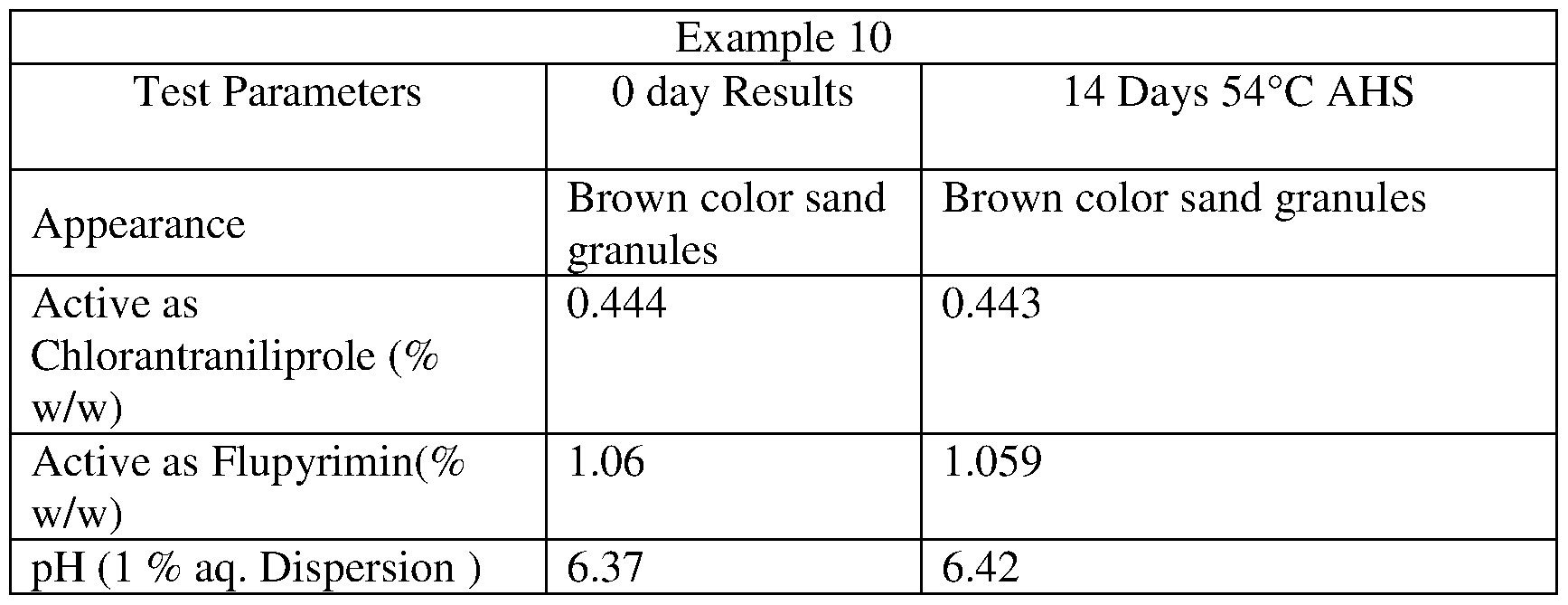
- Chlorantraniliprole, flupyrimin, river sand granules, polyvinylpyrrolidone, sodium isopropyl naphthalene sulfonate, zinc EDTA, diethylene glycol, and kaolin were mixed in the quantities shown in Table 10 and a quick release insecticidal composition was prepared as described in Example 3.
- Example 11 Chlorantraniliprole 0.4 % + Flupyrimin 1.0% GR
- Example 11 The materials in Table 11 were used to prepare the insecticide composition of Example 11. Chlorantraniliprole, flupyrimin, river sand granules, polyvinylpyrrolidone, sodium isopropyl naphthalene sulfonate, zinc EDTA, diethylene glycol, and kaolin were mixed in the quantities shown in Table 11 and a quick release insecticidal composition was prepared as described in Example 3.
- Example 12 Chlorantraniliprole 0.4 % GR
- Chlorantraniliprole, calcium lignosulfonate, dye, alcohol alkoxylate, polyvinyl alcohol, and silicon dioxide were mixed in the quantities shown in Table 12 and a quick release insecticidal composition was prepared as described in Example 3.
- Example 1-12 were evaluated for various parameters in order to ascertain the stability of the quick release insecticidal compositions. Stability parameters were evaluated under ambient conditions (0 days) and under accelerated heat stability (AHS, 14 days) conditions (at a temperature of 54°C). It was found that the activity of chlorantraniliprole and the additional agrochemical ingredients, measured by the amount of active compound remaining under ambient and AHS conditions, remained quite stable.
- the particle sizes of Example 1, 2, and 4-6 were determined by passing the compositions through a 12 BSS sieve and a 36 BSS sieve. About 99% of the particles passed through the 12 BSS sieve and the remaining 1% or less passed through the 36 BSS sieve, resulting in quick release insecticidal compositions with uniform particle size. The pH of the compositions of Example 1-12 also remained within acceptable limits. The results are shown in Tables 13 to 23 below.
- the quick release compositions of Examples 1-3 and 12 were studied to assess the release rate of chlorantraniliprole (CTPR) and other insecticidally active ingredients.
- the release rate was determined using a tablet disintegration apparatus comprised of a sample dipping tube (glass disintegration tube) and a dipping tub.
- a sample dipping tube glass disintegration tube
- 2.5g composition of Example 1 was contained in a glass disintegration tube modified by sealing the sides with a 425-micron sieve.
- the glass disintegration tube was set to be dipped in the tub at a constant speed of 30 dips/min (minute) such that the granular composition released active ingredient with each dip.
- compositions of Examples 1-3 and 12 released greater than 83% active ingredients within 10 min.
- the commercial sample of 0.4% chlorantraniliprole GR was also analysed in the same disintegration apparatus to analyse the rate of release, which was about 38% release of active ingredient (AI) in 10 min. Therefore, quick release compositions developed according to the present disclosure successfully demonstrated quick release of active ingredients from the carrier granules. (Table 24)
- the quick release insecticidal compositions comprising diamide insecticide disclosed herein result in stable insecticidal compositions.
- the carrier matrix comprising a binder and a surfactant successfully provided integrity to the quick release insecticidal composition by holding the active ingredients and inert ingredients together, and upon application, the compositions provided quick release of active ingredients.
- the careful selection of the binder and surfactant in a specific ratio range from about 1:5 to about 5:1 in formulating quick release composition provided excellent stability over time and at various temperatures.
Landscapes
- Life Sciences & Earth Sciences (AREA)
- Health & Medical Sciences (AREA)
- General Health & Medical Sciences (AREA)
- Wood Science & Technology (AREA)
- Environmental Sciences (AREA)
- Engineering & Computer Science (AREA)
- Plant Pathology (AREA)
- Pest Control & Pesticides (AREA)
- Zoology (AREA)
- Agronomy & Crop Science (AREA)
- Dentistry (AREA)
- Toxicology (AREA)
- Insects & Arthropods (AREA)
- Chemical & Material Sciences (AREA)
- Chemical Kinetics & Catalysis (AREA)
- General Chemical & Material Sciences (AREA)
- Agricultural Chemicals And Associated Chemicals (AREA)
Abstract
Description







Claims
Priority Applications (4)
| Application Number | Priority Date | Filing Date | Title |
|---|---|---|---|
| MX2023006181A MX2023006181A (en) | 2020-11-27 | 2021-11-25 | Quick release insecticidal composition. |
| AU2021389071A AU2021389071A1 (en) | 2020-11-27 | 2021-11-25 | Quick release insecticidal composition |
| CN202180079940.2A CN116634869A (en) | 2020-11-27 | 2021-11-25 | Quick release insecticidal composition |
| US18/039,231 US20240000072A1 (en) | 2020-11-27 | 2021-11-25 | Quick release insecticidal composition |
Applications Claiming Priority (2)
| Application Number | Priority Date | Filing Date | Title |
|---|---|---|---|
| IN202021051797 | 2020-11-27 | ||
| IN202021051797 | 2020-11-27 |
Publications (1)
| Publication Number | Publication Date |
|---|---|
| WO2022112980A1 true WO2022112980A1 (en) | 2022-06-02 |
Family
ID=81754989
Family Applications (1)
| Application Number | Title | Priority Date | Filing Date |
|---|---|---|---|
| PCT/IB2021/060954 Ceased WO2022112980A1 (en) | 2020-11-27 | 2021-11-25 | Quick release insecticidal composition |
Country Status (8)
| Country | Link |
|---|---|
| US (1) | US20240000072A1 (en) |
| CN (1) | CN116634869A (en) |
| AR (1) | AR124283A1 (en) |
| AU (1) | AU2021389071A1 (en) |
| MX (1) | MX2023006181A (en) |
| PY (1) | PY21104539A (en) |
| UY (1) | UY39536A (en) |
| WO (1) | WO2022112980A1 (en) |
Citations (4)
| Publication number | Priority date | Publication date | Assignee | Title |
|---|---|---|---|---|
| CN101715761A (en) * | 2009-11-04 | 2010-06-02 | 深圳诺普信农化股份有限公司 | Cyanogens traniliprole suspending agent and preparation method thereof |
| CN109452267A (en) * | 2018-11-22 | 2019-03-12 | 深圳诺普信农化股份有限公司 | The preparation method and aqueous pesticide formulations of aqueous pesticide formulations |
| WO2019067452A1 (en) * | 2017-09-27 | 2019-04-04 | Pioneer Hi-Bred International, Inc. | Soil application of crop protection agents |
| CN111838172A (en) * | 2020-08-24 | 2020-10-30 | 瑞隆化工(宿州)有限公司 | Bifenthrin and chlorantraniliprole compound insecticide and using method thereof |
Family Cites Families (6)
| Publication number | Priority date | Publication date | Assignee | Title |
|---|---|---|---|---|
| AU7234498A (en) * | 1998-05-08 | 1999-11-29 | Nissan Chemical Industries Ltd. | Pesticide granules for application on water surface |
| AU2009315884A1 (en) * | 2008-11-14 | 2010-05-20 | Syngenta Participations Ag | Turf safe granular herbicide formulations |
| JP5563964B2 (en) * | 2010-11-30 | 2014-07-30 | 北興化学工業株式会社 | Water-floating pesticide formulation |
| JP5872950B2 (en) * | 2012-04-20 | 2016-03-01 | 北興化学工業株式会社 | Iphenecarbazone-containing granular composition |
| EP3141116B1 (en) * | 2015-09-09 | 2018-06-13 | Endura S.p.a. | 5,7-disubstituted 2,3-dihydrobenzofurans and their use as synergists |
| CN107439557A (en) * | 2017-09-20 | 2017-12-08 | 陕西嘉益蓝德生物工程有限公司 | A kind of bromine cyanogen insect amide granule and application thereof |
-
2021
- 2021-11-25 MX MX2023006181A patent/MX2023006181A/en unknown
- 2021-11-25 US US18/039,231 patent/US20240000072A1/en active Pending
- 2021-11-25 AU AU2021389071A patent/AU2021389071A1/en active Pending
- 2021-11-25 CN CN202180079940.2A patent/CN116634869A/en active Pending
- 2021-11-25 WO PCT/IB2021/060954 patent/WO2022112980A1/en not_active Ceased
- 2021-11-25 UY UY0001039536A patent/UY39536A/en unknown
- 2021-11-26 PY PY202121104539A patent/PY21104539A/en unknown
- 2021-11-26 AR ARP210103268A patent/AR124283A1/en unknown
Patent Citations (4)
| Publication number | Priority date | Publication date | Assignee | Title |
|---|---|---|---|---|
| CN101715761A (en) * | 2009-11-04 | 2010-06-02 | 深圳诺普信农化股份有限公司 | Cyanogens traniliprole suspending agent and preparation method thereof |
| WO2019067452A1 (en) * | 2017-09-27 | 2019-04-04 | Pioneer Hi-Bred International, Inc. | Soil application of crop protection agents |
| CN109452267A (en) * | 2018-11-22 | 2019-03-12 | 深圳诺普信农化股份有限公司 | The preparation method and aqueous pesticide formulations of aqueous pesticide formulations |
| CN111838172A (en) * | 2020-08-24 | 2020-10-30 | 瑞隆化工(宿州)有限公司 | Bifenthrin and chlorantraniliprole compound insecticide and using method thereof |
Also Published As
| Publication number | Publication date |
|---|---|
| MX2023006181A (en) | 2023-09-07 |
| UY39536A (en) | 2022-05-31 |
| AU2021389071A1 (en) | 2023-06-22 |
| CN116634869A (en) | 2023-08-22 |
| US20240000072A1 (en) | 2024-01-04 |
| AU2021389071A9 (en) | 2024-06-27 |
| AR124283A1 (en) | 2023-03-15 |
| PY21104539A (en) | 2022-06-15 |
Similar Documents
| Publication | Publication Date | Title |
|---|---|---|
| AU2005279504B2 (en) | Aqueous neonicotinoid compositions for seed treatment | |
| JP5107914B2 (en) | Liquid composition for treating plant propagation material | |
| US20080234328A1 (en) | Acqueous neonicotinoid compositions for seed treatment | |
| CN101077072B (en) | Pesticide composition | |
| RU2388222C2 (en) | Pesticide compositions intended for treatment of seeds | |
| WO2020012310A1 (en) | Novel agrochemical combinations | |
| KR100216159B1 (en) | Picoline oxides and their preparations | |
| MX2011001571A (en) | Insecticidal combinations. | |
| US8476192B2 (en) | Seed treatment pesticidal compositions | |
| WO2022112980A1 (en) | Quick release insecticidal composition | |
| TW201038196A (en) | Pesticidal combinations | |
| AU2012200043B2 (en) | "Seed treatment pesticidal compositions" | |
| KR101173528B1 (en) | Seed treatment pesticidal compositions | |
| WO2024218745A1 (en) | Insecticidal combinations, methods, and applications thereof | |
| KR20060126608A (en) | Pesticide composition for seed treatment | |
| MXPA06010194A (en) | Seed treatment pesticidal compositions |
Legal Events
| Date | Code | Title | Description |
|---|---|---|---|
| 121 | Ep: the epo has been informed by wipo that ep was designated in this application |
Ref document number: 21897287 Country of ref document: EP Kind code of ref document: A1 |
|
| DPE1 | Request for preliminary examination filed after expiration of 19th month from priority date (pct application filed from 20040101) | ||
| WWE | Wipo information: entry into national phase |
Ref document number: 202180079940.2 Country of ref document: CN |
|
| REG | Reference to national code |
Ref country code: BR Ref legal event code: B01A Ref document number: 112023010243 Country of ref document: BR |
|
| ENP | Entry into the national phase |
Ref document number: 2021389071 Country of ref document: AU Date of ref document: 20211125 Kind code of ref document: A |
|
| NENP | Non-entry into the national phase |
Ref country code: DE |
|
| ENP | Entry into the national phase |
Ref document number: 112023010243 Country of ref document: BR Kind code of ref document: A2 Effective date: 20230525 |
|
| 122 | Ep: pct application non-entry in european phase |
Ref document number: 21897287 Country of ref document: EP Kind code of ref document: A1 |