WO2022106976A1 - Stable pharmaceutical formulations of soluble fgfr3 decoys - Google Patents
Stable pharmaceutical formulations of soluble fgfr3 decoys Download PDFInfo
- Publication number
- WO2022106976A1 WO2022106976A1 PCT/IB2021/060546 IB2021060546W WO2022106976A1 WO 2022106976 A1 WO2022106976 A1 WO 2022106976A1 IB 2021060546 W IB2021060546 W IB 2021060546W WO 2022106976 A1 WO2022106976 A1 WO 2022106976A1
- Authority
- WO
- WIPO (PCT)
- Prior art keywords
- formulation
- polypeptide
- sfgfr3
- set forth
- seq
- Prior art date
- Legal status (The legal status is an assumption and is not a legal conclusion. Google has not performed a legal analysis and makes no representation as to the accuracy of the status listed.)
- Ceased
Links
Classifications
-
- A—HUMAN NECESSITIES
- A61—MEDICAL OR VETERINARY SCIENCE; HYGIENE
- A61K—PREPARATIONS FOR MEDICAL, DENTAL OR TOILETRY PURPOSES
- A61K38/00—Medicinal preparations containing peptides
- A61K38/16—Peptides having more than 20 amino acids; Gastrins; Somatostatins; Melanotropins; Derivatives thereof
- A61K38/17—Peptides having more than 20 amino acids; Gastrins; Somatostatins; Melanotropins; Derivatives thereof from animals; from humans
- A61K38/18—Growth factors; Growth regulators
-
- A—HUMAN NECESSITIES
- A61—MEDICAL OR VETERINARY SCIENCE; HYGIENE
- A61P—SPECIFIC THERAPEUTIC ACTIVITY OF CHEMICAL COMPOUNDS OR MEDICINAL PREPARATIONS
- A61P19/00—Drugs for skeletal disorders
Definitions
- the present disclosure relates to the field of pharmaceutical formulations of protein therapeutics. Specifically, the present disclosure relates to stable formulations comprising soluble fibroblast growth factor receptor 3 (sFGFR3) polypeptides, their pharmaceutical preparation and use.
- sFGFR3 soluble fibroblast growth factor receptor 3
- Protein preparations intended for therapeutic or prophylactic use often require stabilizers to prevent any loss of activity or structural integrity of the protein.
- Many protein preparations can be unstable due to the effects of denaturation, deamidation, oxidation or aggregation over a period of time during storage and transportation prior to use.
- a large number of formulation options are available, but not one approach or system is suitable for all proteins (See e.g., Wang et al., J. Pharm Sci. 96: 1-26(2007)).
- a major aim in the development of protein formulations is to maintain protein solubility, stability and potency. It is also particularly desirable to avoid aggregates and particulates in solution which would require sterile filtration before use for intravenous or subcutaneous injection and limit route of administration. Salts, surfactants, pH and tonicity agents such as sugars can be used to overcome aggregation or denaturation problems. Formulation of protein preparations requires careful selection of these factors among others to avoid denaturation of the protein and loss of activity.
- a stable protein formulation suitable for parenteral administration including intravenous, intraocular, intravitreal, intraarterial, intrathecal, intraventricular, intraurethral, intrasternal, intracranial, intramuscular, intra-ossial, intraperitoneal, intradermal or subcutaneous injection.
- Soluble fibroblast growth factor receptor 3 (sFGFR3) polypeptides are known in the art and have been shown to be useful in the treatment of skeletal growth retardation disorders such as achondroplasia (see for example, WO 2014/111744, WO 2014/111467, WO 2016/110786, WO 2018/007597, WO 2019/057820). While liquid formulations for antibodies are known in the art (see, for example, W02006/096491, WO 2010/032220, WO2013/186719, US 2009/0110681, US 2017/0360929, and US 2018/0000933), formulations stabilizing sFGFR3 polypeptides have not been described. Thus, there is a need to provide a stable preparation of a sFGFR3 polypeptide in order to meet the medical need of patients suffering skeletal growth retardation disorders.
- Stable pharmaceutical formulations with an extended shelf life comprising a soluble fibroblast growth factor receptor 3 (sFGFR3) polypeptide are provided. It is demonstrated that a sFGFR3 polypeptide is 54 times more aggregation prone that a typical protein therapeutic molecule (see Fig. 1). It is thus, difficult to formulate sFGFR3 polypeptide into a stable composition as demonstrated by the instabilities observed in an initial formulation containing citrate buffer and mannitol (see Example 1, Table 1).
- sFGFR3 polypeptide is 54 times more aggregation prone that a typical protein therapeutic molecule (see Fig. 1). It is thus, difficult to formulate sFGFR3 polypeptide into a stable composition as demonstrated by the instabilities observed in an initial formulation containing citrate buffer and mannitol (see Example 1, Table 1).
- sFGFR3 polypeptide that have a reduced rate of aggregation (as demonstrated by low levels of % HMMS (High Molecular Mass Species), % fragments and acceptable levels of subvisible particulates).
- This enhancement of stability represents a significant improvement in the manufacturability of the polypeptide and greatly improves its usability as a therapeutic by allowing more flexible storage options.
- a formulation comprising about 15 mg/mL to about 250 mg/mL of a soluble fibroblast growth factor receptor 3 (sFGFR3) polypeptide, a buffer, a polyol, a surfactant, and a chelating agent, wherein the formulation has a pH at about 5.0 to about 7.0.
- sFGFR3 soluble fibroblast growth factor receptor 3
- a lyophilized formulation comprising about 15 mg/mL to about 250 mg/mL of a soluble fibroblast growth factor receptor 3 (sFGFR3) polypeptide, a buffer, a polyol, a surfactant, and a chelating agent, wherein the formulation has a pH at about 5.0 to about 7.0.
- sFGFR3 soluble fibroblast growth factor receptor 3
- a lyophilized formulation prepared by lyophilizing a liquid formulation comprising about 15 mg/mL to about 250 mg/mL of a soluble fibroblast growth factor receptor 3 (sFGFR3) polypeptide, a buffer, a polyol, a surfactant, a chelating agent, and a pH at about 5.0 to 7.0, wherein the formulation can reconstitute with a liquid into a solution that is essentially free of visible particulate within about 9 minutes or less.
- sFGFR3 soluble fibroblast growth factor receptor 3
- E5. The formulation as set forth in any one of E1-E4, wherein the buffer is selected from the group consisting of acetate, succinate, gluconate, citrate, histidine, acetic acid, phosphate, phosphoric acid, ascorbate, tartaric acid, maleic acid, glycine, lactate, lactic acid, ascorbic acid, imidazole, bicarbonate and carbonic acid, succinic acid, sodium benzoate, benzoic acid, gluconate, edetate, acetate, malate, imidazole, tris, phosphate, and mixtures thereof.
- the buffer is selected from the group consisting of acetate, succinate, gluconate, citrate, histidine, acetic acid, phosphate, phosphoric acid, ascorbate, tartaric acid, maleic acid, glycine, lactate, lactic acid, ascorbic acid, imidazole, bicarbonate and carbonic acid, succinic acid, sodium benzoate, be
- E8 The formulation as set forth in E5, wherein the buffer is histidine and citrate.
- E9 The formulation as set forth in any one of E1-E8, wherein the concentration of the buffer is about 0.1 mM to about 100 mM.
- E10 The formulation as set forth in E6, wherein the concentration of the buffer is about 0.1 mM to about 50 mM, about 1 mM to about 40 mM, about 1 mM to about 35 mM, about 5 mM to about 30 mM, or about 8 mM to about 20 mM.
- E11 The formulation as set forth in E7, wherein the concentration of the buffer is about 8 mM, about 10 mM, about 20 mM, about 30 mM, about 35 mM or about 40 mM.
- E14 The formulation as set forth in any one of E1-E13, wherein the polyol is selected from the group consisting of mannitol, trehalose, sorbitol, erythritol, isomalt, lactitol, maltitol, xylitol, glycerol, lactitol, propylene glycol, polyethylene glycol, inositol, fructose, glucose, mannose, sucrose, sorbose, xylose, lactose, maltose, sucrose, dextran, pullulan, dextrin, cyclodextrins, soluble starch, hydroxy ethyl starch, water-soluble glucans, or mixtures thereof.
- the polyol is selected from the group consisting of mannitol, trehalose, sorbitol, erythritol, isomalt, lactitol, maltitol,
- E15 The formulation as set forth in E14, wherein the polyol is sucrose, trehalose and/or mannitol.
- E16 The formulation as set forth in any one of E1-E15, wherein the concentration of the polyol is about 1 mg/mL to about 300 mg/mL, about 1 mg/mL to about 250 mg/mL, about 1 mg/mL to about 200 mg/mL or about 1 mg/mL to about 150 mg/mL.
- E17 The formulation as set forth in E16, wherein the concentration of the polyol is about 1 mg/mL to about 120 mg/mL, about 15 mg/ml to about 120 mg/mL, about 45 mg/mL to about 110 mg/mL, or about 60 mg/mL to about 100 mg/mL.
- E18 The formulation as set forth in E17, wherein the concentration of the polyol is about 18.9 mg/mL, 46.7 mg/ml, about 64 mg/mL, or about 85 mg/mL.
- E20 The formulation as set forth in any one of E1-E18, wherein the polyol is sucrose at a concentration of about 46.7 mg/ml and the polyol is mannitol at a concentration of about 18.9 mg/mL.
- E21 The formulation as set forth in any one of E1-E20, wherein the surfactant is selected from the group consisting of a polysorbate, poloxamer, triton, sodium dodecyl sulfate, sodium laurel sulfate, sodium octyl glycoside, lauryl-sulfobetaine, myristyl-sulfobetaine, linoleyl-sulfobetaine, stearyl-sulfobetaine, lauryl-sarcosine, myristyl-sarcosine, linoleyl-sarcosine, stearyl-sarcosine, linoleyl-betaine, myristyl-betaine, cetyl-betaine, lauroamidopropyl-betaine, cocamidopropyl- betaine, linoleamidopropyl-betaine, myristamidopropyl-betaine, palmi
- E22 The formulation as set forth in E21, wherein the surfactant is polysorbate 80.
- E23 The formulation as set forth in any one of E1-E22, wherein the concentration of the surfactant is about 0.01 mg/mL to about 10 mg/ mL, about 0.05 mg/mL to about 5 mg/mL, about 0.1 mg/mL to about 1 mg/mL or about 0.1 mg/ml to about 0.5 mg/mL.
- E24 The formulation as set forth in E23 wherein the concentration of the surfactant is about 0.1 mg/ml, about 0.2 mg/ mL or about 0.3 mg/mL.
- E27 The formulation as set forth in any one of E1-E26, wherein the chelating agent is selected from the group consisting of ethylenediaminetetraacetic acid (EDTA, disodium edetate dihydrate), diethylenetriamine pentaacetic acid 5 (DTPA), nitrilotriacetic acid (NTA), N-2-acetamido-2- iminodiacetic acid (ADA), bis(aminoethyl)glycolether, N,N,N',N' -tetraacetic acid (EGTA), transdiaminocyclohexane tetraacetic acid (DCTA), glutamic acid, and aspartic acid, N- hydroxy ethyliminodiacetic acid (HIMDA), N,N-bis-hydroxy ethylglycine (bicine) and N- (trishydroxymethylmethyl) 10 glycine (tri cine), glycylglycine, sodium desoxy cholate, ethylenediamine
- E28 The formulation as set forth in E27, wherein the chelating agent is disodium edetate dihydrate.
- E29 The formulation as set forth in any one of E1-E28, wherein the concentration of the chelating agent is from about 0.01 mg/mL to about 50 mg/mL, from about 0.01 mg/mL to about 10 mg/mL, from about 0.01 mg/mL to about 1 mg/mL, or about 0.02 mg/mL to about 0.08 mg/mL.
- E30 The formulation as set forth in E29, wherein the concentration of the chelating agent is about 0.038 mg/mL, about 0.05 mg/mL or about 0.063 mg/mL.
- E31 The formulation as set forth in E30, wherein the chelating agent is disodium edetate dihydrate at a concentration of about 0.05 mg/mL.
- E32 The formulation as set forth in any one of E1-E31, wherein the formulation has a pH of about 5.5 to about 6.5.
- E33 The formulation as set forth in E32, wherein the formulation has a pH of about 5.8, 5.9, 6.1, 6.2 or 6.3.
- E34 The formulation as set forth in E33, wherein the formulation has a pH of about 5.8, about 5.9, about 6.1 or about 6.2.
- E35 The formulation as set forth in any one of E1-E34, wherein the sFGFR3 polypeptide comprises at least 50 consecutive amino acids of an extracellular domain of a naturally occurring fibroblast growth factor receptor 3 (FGFR3) polypeptide.
- FGFR3 fibroblast growth factor receptor 3
- E36 The formulation as set forth in E35, wherein the sFGFR3 polypeptide comprises 100-370 consecutive amino acids of an extracellular domain of the naturally occurring FGFR3 polypeptide.
- E37 The formulation as set forth in E36, wherein the sFGFR3 polypeptide comprises fewer than 350 amino acids of the extracellular domain of the naturally occurring FGFR3 polypeptide.
- E38 The formulation as set forth in E37, wherein the sFGFR3 polypeptide comprises an Ig-like C2- type domain 1, 2, and/or 3 of the naturally occurring FGFR3 polypeptide.
- E39 The formulation as set forth in any one of E1-E38, wherein the sFGFR3 polypeptide lacks a signal peptide and/or a transmembrane domain, such as the signal peptide and/or transmembrane domain of a naturally occurring FGFR3 polypeptide.
- E40 The formulation as set forth in any one of E1-E39, wherein the sFGFR3 polypeptide is a mature polypeptide.
- E41 The formulation as set forth in any one of E1-E40, wherein the sFGFR3 polypeptide comprises 400 consecutive amino acids or fewer of an intracellular domain of a naturally-occurring FGFR3 polypeptide.
- E42 The formulation as set forth in any one of E1-E41, wherein the sFGFR3 polypeptide comprises between 5 and 399 consecutive amino acids of the intracellular domain of a naturally-occurring FGFR3 polypeptide, such as 175, 150, 125, 100, 75, 50, 40, 30, 20, 15, 13, or fewer consecutive amino acids of the intracellular domain of a naturally-occurring FGFR3 polypeptide.
- E43 The formulation as set forth in any one of E1-E42, wherein the sFGFR3 polypeptide comprises an amino acid sequence having at least 90%, 92%, 95%, 97%, or 99% sequence identity to amino acids 401 to 413 of SEQ ID NO: 8.
- E44 The formulation as set forth in any one of E1-E43, wherein the sFGFR3 polypeptide comprises amino acids 401 to 413 of SEQ ID NO: 8.
- E45 The formulation as set forth in any one of E1-E44, wherein the sFGFR3 polypeptide lacks a tyrosine kinase domain of a naturally-occurring FGFR3 polypeptide.
- E46 The formulation as set forth in any one of E1-E45, wherein the sFGFR3 polypeptide lacks an intracellular domain of a naturally-occurring FGFR3 polypeptide.
- E47 The formulation as set forth in any one of E1-E46, wherein the sFGFR3 polypeptide comprises fewer than 475, 450, 425, 400, 375, 350, 300, 250, 200, 150, or 100 amino acids in length.
- E48 The formulation as set forth in any one of E1-E47, wherein the sFGFR3 polypeptide comprises an amino acid sequence having at least 85% sequence identity to amino acids residues 1 to 280 of SEQ ID NO: 8.
- E49 The formulation as set forth in E48, wherein the amino acid sequence of the sFGFR3 polypeptide has 86%-100% sequence identity to amino acids residues 1 to 280 of SEQ ID NO: 8.
- E50 The formulation as set forth in any one of E1-E49, wherein the sFGFR3 polypeptide comprises an amino acid sequence having at least 85% sequence identity to the sequence of any one of SEQ ID NOs: 1-7.
- E51 The formulation as set forth in E50, wherein the amino acid sequence of the sFGFR3 polypeptide has 86%-100% sequence identity to the sequence of any one of SEQ ID NOs: 1-7.
- E52 The formulation as set forth in any one of E1-E51, wherein the sFGFR3 polypeptide binds to a fibroblast growth factor (FGF).
- FGF fibroblast growth factor
- FGF fibroblast growth factor 1
- FGF2 fibroblast growth factor 2
- FGF9 fibroblast growth factor 9
- FGF10 fibroblast growth factor 10
- FGF18 fibroblast growth factor 18
- FGF19 fibroblast growth factor 19
- FGF21 fibroblast growth factor 21
- FGF23 fibroblast growth factor 23
- E54 The formulation as set forth in any one of E52-E53, wherein the binding is characterized by an equilibrium dissociation constant (Kd) of about 0.2 nM to about 20 nM.
- Kd equilibrium dissociation constant
- E55 The formulation as set forth in E54, wherein the binding is characterized by a KD of about 1 nM to about 10 nM, wherein optionally the KD is about 1 nM, about 2 nM, about 3 nM, about 4 nM, about 5 nM, about 6 nM, about 7 nM, about 8 nM, about 9 nM, or about 10 nM.
- E56 The formulation as set forth in any one of E1-E55, wherein the sFGFR3 polypeptide comprises an amino acid sequence having at least 85% sequence identity to SEQ ID NO: 5.
- E57 The formulation as set forth in E56, wherein the sFGFR3 polypeptide comprises an amino acid sequence having at least 85%, at least 90%, at least 92%, at least 94%, at least 95%, at least 96%, at least 98%, at least 99% sequence identity to SEQ ID NO: 5.
- E58 The formulation as set forth in E57, wherein the sFGFR3 polypeptide comprises an amino acid sequence of SEQ ID NO: 5.
- E59 The formulation as set forth in E56, wherein the sFGFR3 polypeptide comprises a signal peptide, such as a signal peptide of a naturally-occurring FGFR3 polypeptide.
- E61 The formulation as set forth in any one of E1-E60, wherein the sFGFR3 polypeptide comprises a heterologous polypeptide.
- E62 The formulation as set forth in E61, wherein the heterologous polypeptide is a fragment crystallizable region of an immunoglobulin (Fc region) or human serum albumin (HSA).
- E63 The formulation as set forth in any one of E1-E62, wherein the sFGFR3 polypeptide is encoded by a polynucleotide comprising a nucleic acid sequence having at least 85% and up to 100% sequence identity to the nucleic acid sequence of any one of SEQ ID NOs: 10-18.
- E64 The formulation as set forth in E63, wherein the sFGFR3 polypeptide is encoded by a polynucleotide consisting of the nucleic acid sequence of any one of SEQ ID NOs: 10-18.
- E65 The formulation as set forth in any one of E1-E62, wherein the sFGFR3 polypeptide is encoded by a polynucleotide comprising a nucleic acid sequence having at least 85% and up to 100% sequence identity to the nucleic acid sequence of SEQ ID NO: 15, and optionally lacks the signal peptide.
- E66 The formulation as set forth in E65, wherein the sFGFR3 polypeptide is encoded by a polynucleotide consisting of the nucleic acid sequence of SEQ ID NO: 15, and optionally lacks the signal peptide.
- E67 The formulation as set forth in any one of E1-E66, wherein the concentration of the sFGFR3 polypeptide is about 15 mg/mL, 20 mg/mL, 25 mg/mL, 30 mg/mL, 35 mg/mL, 40 mg/mL, 45 mg/mL, 46 mg/mL, 47 mg/mL, 48 mg/mL, 49 mg/mL, 50 mg/mL, 52.5 mg/mL, 55 mg/mL, 60 mg/mL, 70 mg/mL, 75 mg/mL, 79 mg/mL, 100 mg/ml, 120 mg/mL, 125 mg/ml, 150 mg/mL, 175 mg/mL, 200 mg/ml, 225 mg/ml, or 250 mg/mL.
- E68 The formulation as set forth in E67, wherein the concentration of the sFGFR3 polypeptide is about 50 mg/mL, 52.5 mg/mL, about 60 mg/mL, 65 mg/mL, 70 mg/mL, 75 mg/mL, 79 mg/ml, 80 mg/mL, 85 mg/mL, 90 mg/mL, 100 mg/mL, 110 mg/mL,120 mg/mL, or 150 mg/mL.
- E69 The formulation as set forth in E67, wherein the concentration of the sFGFR3 polypeptide is about 50 mg/mL, about 52.5 mg/mL, about 55 mg/mL, about 60 mg/mL, about 65 mg/mL, about 70 mg/mL, about 75 mg/mL or about 79 mg/mL.
- E70 A pharmaceutical formulation comprising 52.5 mg/mL of a sFGFR3 polypeptide, 20 mM histidine, 85 mg/mL sucrose, 0.05 mg/mL disodium edetate dihydrate, 0.2 mg/mL polysorbate 80, wherein the sFGFR3 polypeptide comprises an amino acid sequence of SEQ ID NO: 5, and wherein the formulation has a pH of 6.2.
- a pharmaceutical lyophilized formulation comprising 50 mg/mL of a sFGFR3 polypeptide, 20 mM histidine, 85 mg/mL sucrose, 0.05 mg/mL disodium edetate dihydrate, 0.2 mg/mL polysorbate 80, wherein the sFGFR3 polypeptide comprises an amino acid sequence of SEQ ID NO: 5, and wherein the formulation has a pH of 6.2.
- a pharmaceutical lyophilized formulation comprising 50 mg/mL of a sFGFR3 polypeptide, 8.33 mM citrate, 104 mM mannitol, 11.67 mM histidine, 46.7 mg/mL sucrose, 0.05 mg/mL disodium edetate dihydrate, 0.2 mg/mL polysorbate 80, wherein the sFGFR3 polypeptide comprises an amino acid sequence of SEQ ID NO: 5, and wherein the formulation has a pH of 6.2.
- a pharmaceutical formulation comprising about 50 to about 80 mg/mL of a sFGFR3 polypeptide, about 20 to about 40 mM histidine (e.g, about 30-40 mM), about 85 mg/mL sucrose, about 0.05 mg/mL disodium edetate dihydrate, about 0.2 mg/mL polysorbate 80, wherein the sFGFR3 polypeptide comprises an amino acid sequence of SEQ ID NO: 5, and wherein the formulation has a pH of about 5.8 or about 5.9.
- a pharmaceutical formulation comprising about 50 mg/mL or about 75 mg/mL of a sFGFR3 polypeptide, about 35 mM histidine, about 85 mg/mL sucrose, about 0.05 mg/mL disodium edetate dihydrate, about 0.2 mg/mL polysorbate 80, wherein the sFGFR3 polypeptide comprises an amino acid sequence of SEQ ID NO: 5, and wherein the formulation has a pH of about 5.8-5.9.
- a pharmaceutical lyophilized formulation comprising about 50 to about 80 mg/mL of a sFGFR3 polypeptide, about 20 to about 40 mM histidine (e.g, about 30-40 mM), about 85 mg/mL sucrose, about 0.05 mg/mL disodium edetate dihydrate, about 0.2 mg/mL polysorbate 80, wherein the sFGFR3 polypeptide comprises an amino acid sequence of SEQ ID NO: 5, and wherein the formulation has a pH of about 5.8 or about 5.9.
- a pharmaceutical lyophilized formulation comprising about 50mg/mL or about 75 mg/mL of a sFGFR3 polypeptide, about 35 mM histidine, about 85 mg/mL sucrose, about 0.05 mg/mL disodium edetate dihydrate, about 0.2 mg/mL polysorbate 80, wherein the sFGFR3 polypeptide comprises an amino acid sequence of SEQ ID NO: 5, and wherein the formulation has a pH of about 5.8-5.9.
- E77 The pharmaceutical formulation as set forth in any one of E70-E76, wherein the sFGFR3 polypeptide consists of an amino acid sequence of SEQ ID NO: 5.
- E78 The formulation as set forth in any one of E1-E77, wherein the formulation is stable at about 2-8°C for at least 6 months.
- E79 The formulation as set forth in any one of E1-E78, wherein the formulation is stable at about 25°C/60% relative humidity (RH) for at least 6 months.
- E80 The formulation as set forth in E4, E71, E75 or E76, wherein the formulation can reconstitute with a liquid into a solution that is essentially free of visible particulate within about 9 minutes, within about 8 minutes, within about 6 minutes, within about 5 minutes, within about 4 minutes, within about 3 minutes, or within about 2 minutes 30 seconds or less.
- E81 The formulation as set forth in E780 wherein the formulation can reconstitute with a liquid into a solution in 2 minutes 15 seconds after storage for 6 months at 25°C/60% relative humidity (RH).
- E82 The formulation as set forth in E80, wherein the formulation can reconstitute with a liquid into a solution in 4 minutes 15 seconds after storage for 6 months at 2-8°C.
- a method for preparing a lyophilized formulation of a soluble fibroblast growth factor receptor 3 (sFGFR3) polypeptide comprising the steps of:
- a liquid formulation comprising about 15 mg/mL to about 250 mg/mL of a soluble fibroblast growth factor receptor 3 (sFGFR3) polypeptide, a buffer, a polyol, a surfactant, and a chelating agent,
- sFGFR3 soluble fibroblast growth factor receptor 3
- a method for preparing a lyophilized formulation of a soluble fibroblast growth factor receptor 3 (sFGFR3) polypeptide comprising the steps of:
- a liquid formulation comprising about 50 mg/mL of a sFGFR3 polypeptide, 20 mM histidine, 85 mg/mL sucrose, 0.05 mg/mL disodium edetate dihydrate, 0.2 mg/mL polysorbate 80, wherein the sFGFR3 polypeptide comprises or consists of an amino acid sequence of SEQ ID NO: 5, and wherein the formulation has a pH of 6.2,
- a liquid formulation comprising about 50 mg/mL of a sFGFR3 polypeptide, 20 mM histidine, 85 mg/mL sucrose, 0.05 mg/mL disodium edetate dihydrate, 0.2 mg/mL polysorbate 80, wherein the sFGFR3 polypeptide comprises or consists of an amino acid sequence of SEQ ID NO: 5, and wherein the formulation has a pH of 6.2,
- E88 The method as set forth in any one of E83-E87, wherein the liquid formulation of step (i) is as set forth in any one of E1-E2, E5-E82.
- E89 A lyophilized formulation prepared by the method as set forth in any one of E83-E88.
- E90 A method of treating a skeletal growth retardation disorder, comprising administering to a subject in need thereof a therapeutically effective amount of the formulation as set forth in any one ofE1-E82.
- E91 The method as set forth in E90, wherein the skeletal growth retardation disorder is a FGFR3- related skeletal disease.
- E92 The method as set forth in any one of E90-E91, wherein the FGFR3-related skeletal disease is selected from the group consisting of achondroplasia, thanatophoric dysplasia type I (TDI), thanatophoric dysplasia type II (TDI I), severe achondroplasia with developmental delay and acanthosis nigricans (SADDEN), hypochondroplasia, a craniosynostosis syndrome, and camptodactyly, tall stature, and hearing loss syndrome (CATSHL).
- TDI thanatophoric dysplasia type I
- TDI I thanatophoric dysplasia type II
- SADDEN severe achondroplasia with developmental delay and acanthosis nigricans
- hypochondroplasia a craniosynostosis syndrome
- camptodactyly tall stature, and hearing loss syndrome
- E93 The method as set forth in E92, wherein the skeletal growth retardation disorder is achondroplasia.
- E94 The method as set forth in E92, wherein the skeletal growth retardation disorder is hypochondroplasia.
- E95 The method as set forth in E92, wherein the craniosynostosis syndrome is selected from the group consisting of Muenke syndrome, Crouzon syndrome, and Crouzonodermoskeletal syndrome.
- E96 The method as set forth in any one of E90-E95, wherein the FGFR3-related skeletal disease is caused by expression of a eonstitutively active FGFR3 in the subject.
- E97 The method as set forth in E96, wherein the eonstitutively active FGFR3 comprises an amino acid substitution of a glycine residue with an arginine residue at position 380 of SEQ ID NO:
- E98 The method as set forth in any one of E90-E97, wherein the subject has been diagnosed with the skeletal growth retardation disorder.
- E99 The method as set forth in any one of E90-E98, wherein the subject exhibits one or more symptoms of the skeletal growth retardation disorder selected from the group consisting of short limbs, short trunk, bow' legs, a waddling gait, skull malformations, cloverieaf skull, craniosynostosis, wormian bones, anomalies of the hands, anomalies of the feet, hitchhiker thumb, and chest anomalies.
- E100 The method as set forth in any one of E90-E99, wherein the subject is selected from the group consisting of an infant, a child, an adolescent, and an adult.
- E101 The method as set forth in any one of E90-E100, wherein the subject is a human.
- E102. The method as set forth in any one of E90-E101, wherein the formulation is administered to the subject subcutaneously, intravenously, intramuscularly, intra-arterially, intrathecal ly, or intraperitoneally.
- E103 The method as set forth in E102, wherein the formulation is administered to the subject by subcutaneous injection.
- E104 The method as set forth in any one of E90-E103, wherein administration of the formulation increases survival of the subject, improves locomotion of the subject, improves abdominal breathing in the subject, increases body and/or bone length of the subject, improves the cranial ratio and/or restores foramen magnum shape in the subject.
- E105 An injectable syringe containing a pre-filled solution of the formulation as set forth in any one of E1-E82.
- E106 A device for subcutaneous administration comprising the formulation as set forth in any one of E1-E82.
- a transdermal patch comprising the formulation as set forth in any one of E1-E82 and optionally a pharmaceutically-acceptable carrier.
- E108 An intravenous bag comprising the formulation as set forth in any one of E1-E82 and optionally normal saline or 5% dextrose.
- a kit comprising at least one container comprising the formulation as set forth in any one of E1-E82 and instructions for use.
- E110 The kit as set forth in E 109, wherein the container is a glass vial or an injectable syringe.
- a pre-filled injectable syringe comprising a formulation:
- a pre-filled injectable syringe comprising a formulation:
- sFGFR3 polypeptide (a) 50 mg/mL of a sFGFR3 polypeptide, wherein the sFGFR3 polypeptide comprises an amino acid sequence of SEQ ID NO: 5;
- a pre-filled injectable syringe comprising a formulation:
- sFGFR3 polypeptide (a) 50mg/mL or 75 mg/mL of a sFGFR3 polypeptide, wherein the sFGFR3 polypeptide comprises an amino acid sequence of SEQ ID NO: 5;
- sFGFR3 polypeptide (a) 50 mg/mL of a sFGFR3 polypeptide, wherein the sFGFR3 polypeptide comprises an amino acid sequence of SEQ ID NO: 5;
- sFGFR3 polypeptide (a) 50 mg/mL or 75 mg/mL of a sFGFR3 polypeptide, wherein the sFGFR3 polypeptide comprises an amino acid sequence of SEQ ID NO: 5;
- a dual chamber cartridge comprising in one chamber a lyophilized formulation:
- sFGFR3 polypeptide (a) 50 mg/mL or 75 mg/mL of a sFGFR3 polypeptide, wherein the sFGFR3 polypeptide comprises an amino acid sequence of SEQ ID NO: 5;
- FIG. 1 A depicts an increase in %HMMS per week during storage at 25°C for various protein therapeutics.
- FIG. IB shows a comparison of increase in %HMMS per week during storage at 25°C for sFGFR3_Del4-D3 relative to average and previously observed maximum aggregation rates.
- sFGFR3 soluble fibroblast growth factor receptor
- sFGFR3 polypeptide is 54 times more aggregation prone that a typical protein therapeutic molecule (see Fig. 1), and is thus, a challenging molecule to formulate.
- Initial stability studies using a formulation comprising citrate buffer and mannitol demonstrated instabilities in the form of increased high molecular mass species (HMMS) by 11.6% at room temperature over a 1 month time frame (see Example 1, Table 1). Even under refrigerated conditions, HMMS levels increased by 4% over a 6 month period (see Example 1, Table 1).
- HMMS high molecular mass species
- a formulation comprising a buffer, a polyol, a surfactant, and a chelating agent is able to lower the aggregation rate of a sFGFR3 polypeptide.
- a liquid formulation comprising histidine, sucrose, disodium edetate dihydrate, polysorbate 80, pH 6.2 had low levels of degradation as measured by % high molecular mass species (% HMMS) using size exclusion-high performance liquid chromatography (SE-HPLC) (see Example 4 and Table 21).
- % HMMS % high molecular mass species
- SE-HPLC size exclusion-high performance liquid chromatography
- a formulation comprising: about 15 mg/mL to about 250 mg/mL of a soluble fibroblast growth factor receptor 3 (sFGFR3) polypeptide, a buffer, a polyol, a surfactant, a chelating agent, and wherein the formulation has a pH at about 5.0 to about 7.0.
- sFGFR3 soluble fibroblast growth factor receptor 3
- a formulation comprising: about 15 mg/mL to about 250 mg/mL of a sFGFR3 polypeptide, about 1 mM to about 40 mM of a buffer (e.g., histidine buffer, citrate buffer or combination of both), about 1 mg/mL to about 300 mg/mL of a polyol (e.g., sucrose, mannitol or a combination of both), about 0.01 mg/mL to about 10 mg/mL of a surfactant (e.g., polysorbate 80), about 0.01 mg/mL to about 50.0 mg/mL of a chelating agent (e.g., disodium edetate dihydrate), wherein the formulation has a pH at about 5.0 to about 7.0.
- a buffer e.g., histidine buffer, citrate buffer or combination of both
- a polyol e.g., sucrose, mannitol or a combination of both
- a surfactant e.g.,
- the sFGFR3 polypeptide concentration is about 15 mg/mL to about 250 mg/mL. In other embodiments, the sFGFR3 polypeptide concentration is about 25 mg/ml, 45 mg/ml, 49 mg/ml, 50 mg/ml, 52 mg/mL, 52.5 mg/mL, 75 mg/mL, 79 mg/mL, 100 mg/mL, about 120 mg/mL, about 150 mg/mL or 200 mg/mL.
- the term “isolated molecule” or “purified molecule” (where the molecule is, for example, a polypeptide, a polynucleotide, or an antibody) is a molecule that by virtue of its origin or source of derivation: (1) is not associated with naturally associated components that accompany it in its native state, (2) is substantially free of other molecules from the same species (3) is expressed by a cell from a different species, or (4) does not occur in nature.
- a molecule that is chemically synthesized, or expressed in a cellular system different from the cell from which it naturally originates will be “isolated” from its naturally associated components.
- a molecule also may be rendered substantially free of naturally associated components by isolation, using purification techniques well known in the art.
- Molecule purity or homogeneity may be assayed by a number of means well known in the art.
- the purity of a polypeptide sample may be assayed using polyacrylamide gel electrophoresis and staining of the gel to visualize the polypeptide using techniques well known in the art.
- higher resolution may be provided by using HPLC or other means well known in the art for purification.
- formulation as it relates to a polypeptide is meant to describe a polypeptide preparation in such form as to permit the biological activity of the polypeptide to be effective.
- the formulation can be liquid or solid (e.g., lyophilized).
- compositions or “pharmaceutical formulation” refer to preparations of a polypeptide in combination with a pharmaceutically acceptable carrier/excipient, such as buffers, sugars, amino acids (such as glycine, glutamine, asparagine, arginine or lysine), chelating agents, surfactants, polyols, bulking agents, stabilizers, lyoprotectants, solubilizers, emulsifiers, salts, adjuvants, tonicity enhancing agents (such as alkali metal halides, such as sodium or potassium chloride, mannitol, sorbitol), delivery vehicles and anti-microbial preservatives.
- a pharmaceutically acceptable carrier/excipient such as buffers, sugars, amino acids (such as glycine, glutamine, asparagine, arginine or lysine), chelating agents, surfactants, polyols, bulking agents, stabilizers, lyoprotectants, solubilizers, emuls
- “Pharmaceutically acceptable carriers/excipients” are those, which can safely be administered to a subject to provide an effective dose of the active ingredient employed.
- the term “excipient” or “carrier” as used herein refers to an inert substance, which is commonly used as a diluent, vehicle, preservative, binder or stabilizing agent for drugs. Compositions comprising such carriers are formulated by well known conventional methods (see, for example, Remington's Pharmaceutical Sciences, 18th edition, A. Gennaro, ed., Mack Publishing Co., Easton, PA, 1990; and Remington, The Science and Practice of Pharmacy 20th Ed. Mack Publishing, 2000).
- diluent refers to a pharmaceutically acceptable (safe and non-toxic for administration to a human) solvent and is useful for the preparation of the formulations described herein.
- exemplary diluents include, but are not limited to, sterile water and bacteriostatic water for injection (BWFI).
- lyophilization refers to a process by which the material to be dried is first frozen and then the ice or frozen solvent is removed by sublimation in a vacuum environment.
- An excipient may be included in pre-lyophilized formulations to enhance stability of the lyophilized product upon storage. Lyophilization processes are well known in the art, and non-limiting examples are described herein (see, Example 4, Table 3).
- dry cake refers to a dry pellet that results when a liquid formulation has been lyophilized or freeze-dried, as described herein. The appearance of the cake is partially indicative of the impact of the lyophilization process on the properties of the lyophilized formulation.
- dry cake refers to a cake that comprises about 20% or less residual moisture content. In some embodiments of the invention, the moisture content of the dry cake is 15% or less, 10% or less, 5% or less 1% or less or 0.5% or less. In some embodiments, the moisture content of the dry cake is within a range of about 0.1% to about 10%, about 0.1% to about 5%, or about 0.1% to about 0.5%.
- substitution time refers to the time that is required to rehydrate a dry, lyophilized, formulation (cake) so that the resulting reconstituted liquid formulation is clear, and the cake has been dissolved.
- fibroblast growth factor and “FGF” refer to a member of the FGF family, which includes structurally related signaling molecules involved in various metabolic processes, Including endocrine signaling pathways, development, wound healing, and angiogenesis. FGFs play key roles in the proliferation and differentiation of a wide range of cell and tissue types. The term preferably refers to FGF 1, FGF2, FGF9, FGF 10, FGF 18, FGF 19, FGF21 , and FGF23, which ha ve been shown to bind FGFR3.
- FGFs can include human FGF1 (e.g., a polypeptide having the amino acid sequence of SEQ ID NO: 26), human FGF2 (e.g., a polypeptide having the amino acid sequence of SEQ ID NO: 27), human FGF9 (e.g., a polypeptide having the amino acid sequence of SEQ ID NO: 28), human FGF10 (e.g., a polypeptide having the amino acid sequence of SEQ ID NO: 40), human FGF18 (e.g., a polypeptide having the amino acid sequence of SEQ ID NO: 29), human FGF19 (e.g., a polypeptide having the amino acid sequence of SEQ ID NO: 30), human FGF21 (e.g., a polypeptide having the amino acid sequence of SEQ ID NO: 31), and human FGF23 (e.g., a polypeptide having the amino acid sequence of SEQ ID NO: 41).
- human FGF1 e.g., a polypeptide having the amino acid sequence of S
- fibroblast growth factor receptor 3 refers to a polypeptide that specifically binds one or more FGFs (e.g., FGF1, FGF2, FGF9, FGF10, FGF18, FGF19, FGF 21, and/or FGF23).
- FGFs e.g., FGF1, FGF2, FGF9, FGF10, FGF18, FGF19, FGF 21, and/or FGF23.
- the human FGFR3 gene which is located on the distal short arm of chromosome 4, encodes an 806 amino acid protein precursor (fibroblast growth factor receptor 3 isoform 1 precursor), which contains 19 exons, and includes a signal peptide (e.g., a polypeptide having the amino acid sequence of SEQ ID NO: 21).
- Mutations in the FGFR3 amino acid sequence that lead to skeletal growth disorders include, e.g., the substitution of a glycine residue at position 358 with an arginine residue (i.e., G358R; SEQ ID NO: 9).
- the naturally occurring human FGFR3 gene has a nucleotide sequence as shown in Genbank Accession number NM_000142.4 and the naturally occurring human FGFR3 protein has an amino acid sequence as shown in Genbank Accession number NP_000133, herein represented by SEQ ID NO: 8.
- the wildtype FGFR3 (e.g., a polypeptide having the amino acid sequence of SEQ ID NO: 8) consists of an extracellular immunoglobulin-like membrane domain including Ig-like C2-type domains 1-3, a transmembrane domain, and an intracellular (i.e., cytoplasmic) domain.
- FGFR3s can include fragments and/or variants (e.g., splice variants, such as splice variants utilizing alternate exon 8 rather than exon 9) of the full-length, wild-type FGFR3.
- domain refers to a conserved region of the amino acid sequence of a polypeptide (e.g.
- a domain can vary in length from, e.g., about 20 amino acids to about 600 amino acids.
- Exemplary domains include the immunoglobulin domains of a FGFR3 (e.g., Ig-like C2-type domain 1, Ig-like C2-type domain 2, and Ig-like C2-type domain 3), the extracellular domain (ECD) of a FGFR3, the intracellular domain (ICD) of a FGFR3, or the transmembrane domainTM of a FGFR3, such as a FGFR3 having the sequence set forth in SEQ ID NO: 8).
- extracellular domain and “ECD” refer to the portion of a FGFR3 polypeptide that extends beyond the transmembrane domain into the extracellular space.
- the ECD mediates binding of a FGFR3 to one or more fibroblast growth factors (FGFs).
- FGFs fibroblast growth factors
- an ECD includes the Ig-like C2-type domains 1-3 of a FGFR3 polypeptide.
- the ECD includes the Ig-like C2-type domain 1 of a wildtype (wt) FGFR3 polypeptide, the Ig-like C2-type domain 2 of a wildtype (wt) FGFR3 polypeptide, and/or the Ig-like C2-type domain 3 of a wt FGFR3 polypeptide.
- An ECD of a FGFR3 can also include a fragment of the wildtype FGFR3 Ig-like 02-type domain for instance.
- fragment and “portion” refer to a part of a whole, such as a polypeptide or nucleic acid molecule that contains, preferably, at least 10%, 20%, 30%, 40%, 50%, 60%, 70%, 75%, 80%, 85%, 90%, 95%, 96%, 97%, 98%, 99%, or more of the entire length of the reference nucleic acid molecule or polypeptide, or a domain thereof (e.g., the ECD, ICD, or TM of a sFGFR3 polypeptide).
- a fragment or portion may contain, e.g., 10, 15, 20, 25, 30, 35, 40, 45, 50, 55, 60, 65, 70, 75, 80, 85, 90, 95, 100, 110, 120, 130, 140, 150, 160, 170, 180, 190, 200, 210, 220, 230, 240, 250, 260, 270, 280, 290, 300, 310, 320, 330, 336, 340, 348, 349, 350, 360, 370, 380, 390, 400, 500, 600, 700, or more consecutive amino acid residues, up to the entire length of the reference polypeptide.
- a FGFR3 fragment can include any polypeptide having at least about 5 consecutive amino acids to about 350 consecutive amino acids, inclusive of the endpoints, e.g., at least about 10, 20, 30, 40, 50, 60, 70, 80, 90, 100, 110, 120, 130, 140, 150, 160, 170, 180, 190, 200, 205, 210, 215, 220, 225, 230, 235, 240, 245, 250, 255, 260, 265, 270, 275, 280, 285, 290, 295, 300, 310, 320, 330, 335, 336, 340, or 350 consecutive amino acids of any one of SEQ ID Nos: 1-8.
- a FGFR3 fragment includes a polypeptide having at least 336 consecutive amino acids of SEQ ID NO: 8.
- soluble fibroblast growth factor receptor 3 refers to a FGFR3 that is characterized by the absence or functional disruption of all or a substantial part of the transmembrane domain and any polypeptide portion that would anchor the FGFR3 polypeptide to a cell membrane (e.g., a tyrosine kinase domain).
- An sFGFR3 polypeptide is a non- membrane bound form of an FGFR3 polypeptide.
- an sFGFR3 polypeptide can include a deletion of a portion or all of the amino acid residues of the transmembrane domain of a wild-type FGFR3 polypeptide sequence (e.g., a polypeptide having the amino acid sequence of SEQ ID NO: 8).
- the sFGFR3 polypeptide can further include deletions of the intracellular domain of the wild- type FGFR3 polypeptide.
- Exemplary sFGFR3 polypeptides can include, but are not limited to, at least amino acids 1 to 100, 1 to 125, 1 to 150, 1 to 175, 1 to 200, 1 to 205, 1 to 210, 1 to 215, 1 to 220, 1 to 225, 1 to 230, 1 to 235, 1 to 240, 1 to 245, 1 to 250, 1 to 252, 1 to 255, 1 to 260, 1 to 265, 1 to 270, 1 to 275, 1 to 280, 1 to 285, 1 to 290, 1 to 295, or 1 to 300, or 1 to 301 of SEQ ID NOs: 1-8.
- sFGFR3 polypeptides can include any polypeptide having at least 50% (e.g., 55%, 60%, 65%, 70%, 75%, 80%, 85%, 86%, 87%, 88%, 89%, 90%, 91%, 92%, 93%, 94%, 95%, 96%, 97%, 98%, 99%, or more) sequence identity to any of these sFGFR3 polypeptides of SEQ ID NOs: 1-8.
- exemplary sFGFR3 polypeptides can include, but are not limited to, at least amino acids 1 to 100, 1 to 125, 1 to 150, 1 to 175, 1 to 200, 1 to 205, 1 to 210, 1 to 215, 1 to 220, 1 to 225, 1 to 230, 1 to 235, 1 to 240, 1 to 245, 1 to 250, 1 to 255, 1 to 260, 1 to 265, 1 to 270, 1 to 275, 1 to 280, 1 to 285, 1 to 290, 1 to 295, 1 to 300, 1 to 305, 1 to 310, 1 to 315, 1 to 320, 1 to 325, 1 to 330, 1 to 335, 1 to 336, 1 to 340, 1 to 345, or 1 to 348 of SEQ ID NOs: 1-8.
- the sFGFR3 polypeptide comprises 1-336 consecutive amino acids of SEQ ID NO: 8.
- sFGFR3 polypeptides can include any polypeptide having at least 50% (e.g., 55%, 60%, 65%, 70%, 75%, 80%, 85%, 86%, 87%, 88%, 89%, 90%, 91%, 92%, 93%, 94%, 95%, 96%, 97%, 98%, 99%, or more) sequence identity to any of these sFGFR3 polypeptides having the amino acid sequence of SEQ ID NOs: 1-8.
- any of the above sFGFR3 polypeptides or variants thereof can optionally include a signal peptide at the N-terminal position, such as amino acids 1 to 22 of SEQ ID NO: 21 (MGAPACALALCVAVAIVAGASS) or amino acids 1 to 19 of SEQ ID NO: 43 (e.g., MMSFVSLLLVGILFHATQA).
- a signal peptide at the N-terminal position such as amino acids 1 to 22 of SEQ ID NO: 21 (MGAPACALALCVAVAIVAGASS) or amino acids 1 to 19 of SEQ ID NO: 43 (e.g., MMSFVSLLLVGILFHATQA).
- variant refers to a polypeptide (e.g., an sFGFR3 polypeptide or variant thereof, with or without a signal peptide) that differs by one or more changes in the amino acid sequence from the polypeptide from which the variant is derived (e.g., the reference polypeptide, such as, e.g., a polypeptide having the amino acid sequence of any one of SEQ ID NOs: 1-7).
- the reference polypeptide such as, e.g., a polypeptide having the amino acid sequence of any one of SEQ ID NOs: 1-7.
- variant refers to a polynucleotide that differs by one or more changes in the nucleic acid sequence from the polynucleotide from which the variant is derived (e.g., the reference polynucleotide, such as, e.g., a polynucleotide encoding a sFGFR3 polypeptide having the nucleic acid sequence of any one of SEQ ID NOs: 10- 18).
- the reference polynucleotide such as, e.g., a polynucleotide encoding a sFGFR3 polypeptide having the nucleic acid sequence of any one of SEQ ID NOs: 10- 18.
- the changes in the amino acid or nucleic acid sequence of the variant can be, e.g., amino acid or nucleic acid substitutions, insertions, deletions, N-term inal truncations, or C-terminal truncations, or any combination thereof.
- the amino acid substitutions may be conservative and/or non-conservative substitutions.
- a variant can be characterized by amino acid sequence identity or nucleic acid sequence identity to the reference polypeptide or parent polynucleotide, respectively.
- a variant can include any polypeptide having at least 50% (e.g., 55%, 60%, 65%, 70%, 75%, 80%, 85%, 86%, 87%, 88%, 89%, 90%, 91%, 92%, 93%, 94%, 95%, 96%, 97%, 98%, 99%, or more) sequence identity to the reference polypeptide or polynucleotide.
- sequence identity refers to the percentage of amino acid (or nucleic acid) residues of a candidate sequence, e.g., an FGFR3 polypeptide, that are identical to the amino acid (or nucleic acid) residues of a reference sequence, e.g., a wild-type sFGFR3 polypeptide (e.g., a polypeptide having the amino acid sequence of SEQ ID NO: 8) or an sFGFR3 polypeptide (e.g., an sFGFR3 polypeptide or variant thereof, such as a polypeptide having the amino acid sequence of any one of SEQ ID NOs: 1-7) after aligning the sequences and introducing gaps, if necessary, to achieve the maximum percent identity (e.g., gaps can be introduced in one or both of the candidate and reference sequences for optimal alignment and non-homologous sequences can be disregarded for comparison purposes).
- a wild-type sFGFR3 polypeptide e.g., a polypeptide having the amino acid sequence of SEQ
- Alignment for purposes of determining percent identity can be achieved in various ways that are within the skill in the art, for instance, using publicly available computer software, such as BLAST, BLAST-2, BLAST-P, BLAST-N, BLAST-X, WU-BLAST-2, ALIGN, ALIGN-2, CLUSTAL, or Megalign (DNASTAR) software. Those skilled in the art can determine appropriate parameters for measuring alignment, including any algorithms needed to achieve maximal alignment over the full length of the sequences being compared.
- the percent amino acid (or nucleic acid) sequence identity of a given candidate sequence to, with, or against a given reference sequence is calculated as follows: 100x(fraction of A/B) where A is the number of amino acid (or nucleic acid) residues scored as identical in the alignment of the candidate sequence and the reference sequence, and where B is the total number of amino acid (or nucleic acid) residues in the reference sequence.
- a reference sequence aligned for comparison with a candidate sequence can show that the candidate sequence exhibits from, e.g., 50% to 100% identity across the full length of the candidate sequence or a selected portion of contiguous amino acid (or nucleic acid) residues of the candidate sequence.
- the length of the candidate sequence aligned for comparison purpose is at least 30%, e.g., at least 40%, e.g., at least 50%, 60%, 70%, 80%, 90%, or 100% of the length of the reference sequence.
- a polypeptide that “preferentially binds” or “specifically binds” (used interchangeably herein) to a ligand is a term well understood in the art, and methods to determine such specific or preferential binding are also well known in the art.
- a molecule is said to exhibit “specific binding” or “preferential binding” if it reacts or associates more frequently, more rapidly, with greater duration and/or with greater affinity with a particular cell or substance than it does with alternative cells or substances.
- a polypeptide “specifically binds” or “preferentially binds” to a target if it binds with greater affinity, avidity, more readily, and/or with greater duration than it binds to other substances.
- a sFGFR3 polypeptide that specifically or preferentially binds to a fibroblast growth factor (FGF) is a polypeptide that binds the FGF with greater affinity, avidity, more readily, and/or with greater duration than it binds to other growth factors or other ligands. It is also understood by reading this definition that, for example, a polypeptide that specifically or preferentially binds to a first target may or may not specifically or preferentially bind to a second target. As such, “specific binding” or “preferential binding” does not necessarily require (although it can include) exclusive binding. Generally, but not necessarily, reference to binding means preferential binding.
- binding affinity is herein used as a measure of the strength of a non-covalent interaction between two molecules, e.g., a sFGFR3 polypeptide and its ligand, FGF.
- binding affinity is used to describe monovalent interactions (intrinsic activity). Binding affinity between two molecules, e.g., a sFGFR3 polypeptide and its ligand, FGF or a sFGFR3 polypeptide and the receptor FGFR3, through a monovalent interaction may be quantified by determination of the dissociation constant (KD).
- KD dissociation constant
- KD can be determined by measurement of the kinetics of complex formation and dissociation using, e.g., the surface plasmon resonance (SPR) method (Biacore).
- the rate constants corresponding to the association and the dissociation of a monovalent complex are referred to as the association rate constants k a (or k on ) and dissociation rate constant k d (or k off ), respectively.
- the value of the dissociation constant can be determined directly by well-known methods, and can be computed even for complex mixtures by methods such as those, for example, set forth in Caceci et al.
- the K D may be established using a double-filter nitrocellulose filter binding assay such as that disclosed by Wong & Lohman (1993, Proc. Natl. Acad. Sci. USA 90: 5428-5432).
- Other standard assays to evaluate the binding ability of ligands such as antibodies towards target antigens are known in the art, including for example, ELISAs, Western blots, RIAs, and flow cytometry analysis, and other assays exemplified elsewhere herein.
- the binding kinetics and binding affinity of the polypeptide also can be assessed by standard assays known in the art, such as Surface Plasmon Resonance (SPR), e.g. by using a BiacoreTM system, or KinExA.
- SPR Surface Plasmon Resonance
- skeletal growth retardation disorder refers to a skeletal disease characterized by deformities and/or malformations of the bones. These disorders include, but are not limiting to, skeletal growth retardation disorders caused by growth plate (physeal) fractures, idiopathic skeletal growth retardation disorders, or FGFR3 -related skeletal diseases.
- a patient having a skeletal growth retardation disorder e.g., achondroplasia
- the skeletal growth retardation disorder may include a skeletal dysplasia, e.g., achondroplasia, homozygous achondroplasia, heterozygous achondroplasia, achondrogenesis, acrodysostosis, acromesomelic dysplasia, atelosteogenesis, camptomelic dysplasia, chondrodysplasia punctata, rhizomelic type of chondrodysplasia punctata, cleidocranial dysostosis, congenital short femur, craniosynostosis (e.g., Muenke syndrome, Crouzon syndrome, Apert syndrome, Jackson-Weiss syndrome, Pfeiffer syndrome, or Crouzonodermoskeletal syndrome), dactyly, brachydactyly, camptodactyly, polydactyly, syndactyly, diastrophic dysplasia, dwarfis
- FGFR3 -related skeletal disease refers to a skeletal disease that is caused by an abnormal increase in the activation of FGFR3, such as by expression of a gain-of- function mutant of the FGFR3.
- gain-of-function mutant of the FGFR3 refers to a mutant of the FGFR3 exhibiting a biological activity, such as triggering downstream signaling, which is higher than the biological activity of the corresponding wild-type FGFR3 (e.g., a polypeptide having the amino acid sequence of SEQ ID NO: 8) in the presence of a FGF ligand.
- FGFR3-related skeletal diseases can include an inherited or a sporadic disease.
- Exemplary FGFR3- related skeletal diseases include, but are not limited to, achondroplasia, thanatophoric dysplasia type I (TDI), thanatophoric dysplasia type II (TDII), severe achondroplasia with developmental delay and Acanthosis nigricans (SADDAN), hypochondroplasia, a craniosynostosis syndrome (e.g., Muenke syndrome, Crouzon syndrome, and Crouzonodermoskeletal syndrome), and camptodactyly, tall stature, and hearing loss syndrome (CATSHL).
- TDI thanatophoric dysplasia type I
- TDII thanatophoric dysplasia type II
- SADDAN severe achondroplasia with developmental delay and Acanthosis nigricans
- hypochondroplasia e.g., Muenke syndrome, Crouzon syndrome, and Crouzonodermoskeletal syndrome
- CASHL tall stature, and hearing loss syndrome
- an “effective amount” of drug, formulation, compound, or pharmaceutical composition is an amount sufficient to effect beneficial or desired results including clinical results such as alleviation or reduction of the targeted pathologic condition.
- An effective amount can be administered in one or more administrations.
- an effective amount of drug, compound, or pharmaceutical composition is an amount sufficient to treat, ameliorate, or reduce the intensity of the targeted pathologic condition.
- an effective amount of a drug, compound, or pharmaceutical composition may or may not be achieved in conjunction with another drug, compound, or pharmaceutical composition.
- an “effective amount” may be considered in the context of administering one or more therapeutic agents, and a single agent may be considered to be given in an effective amount if, in conjunction with one or more other agents, a desirable result may be or is achieved.
- a “therapeutically effective amount” refers to an amount effective, at dosages and for periods of time necessary, to achieve the desired therapeutic result, which in the context of sFGFR3 polypeptides includes treatment or prophylactic prevention of the targeted pathologic condition, for example skeletal growth retardation disorders such as achondroplasia and hypochondropasia. It is to be noted that dosage values may vary with the severity of the condition to be alleviated. It is to be further understood that for any particular subject, specific dosage regimens should be adjusted over time according to the individual need and the professional judgment of the person administering or supervising the administration of the compositions, and that dosage ranges set forth herein are exemplary only and are not intended to limit the scope or practice of the claimed composition.
- a therapeutically effective amount of the polypeptide may vary according to factors such as the disease state, age, sex, and weight of the individual, the ability of the polypeptide to elicit a desired response in the individual, and the desired route of administration of the polypeptide formulation.
- a therapeutically effective amount is also one in which any toxic or detrimental effects of the polypeptide are outweighed by the therapeutically beneficial effects.
- therapeutically effective amounts for sFGFR3 polypeptides include a dose of about 0.0002 mg/kg to about 30 mg/kg. In some embodiments, therapeutically effective amounts for sFGFR3 polypeptides include a dose of about 0.2 mg/kg to about 3 mg/kg. In some embodiments, therapeutically effective amounts for sFGFR3 polypeptides include a dose of about 0.3 mg/kg, 1 mg/kg, 3 mg/kg, 10 mg/kg, 20 mg/kg or 30 mg/kg administered subcutaneously once weekly.
- treatment refers to both therapeutic treatment and prophylactic or preventative measures, wherein the object is to prevent or slow down (lessen) the targeted pathologic condition (e.g., any condition that would benefit from treatment with the polypeptide).
- pathologic condition e.g., any condition that would benefit from treatment with the polypeptide.
- Those in need of treatment include those already with the condition as well as those prone to have the condition or those in whom the condition is to be prevented.
- treatment is an approach for obtaining beneficial or desired clinical results including, but not limited to, one or more of the following: including lessening severity, alleviation of one or more symptoms associated with the pathologic condition.
- “treating” and “treatment” is meant a reduction (e.g., by at least about 10%, about 15%, about 20%, about 25%, about 30%, about 35%, about 40%, about 45%, about 50%, about 60%, about 70%, about 80%, about 90%, about 95%, about 99%, or even 100%) in the progression or severity of a skeletal growth retardation disorder (e.g., achondroplasia), or in the progression, severity, or frequency of one or more symptoms of a skeletal growth retardation disorder (e.g., achondroplasia) in a patient (e.g., a human, such as an infant, a child, an adolescent or an adult).
- a skeletal growth retardation disorder e.g., achondroplasia
- a patient e.g., a human, such as an infant, a child, an adolescent or an adult.
- Treatment can occur for a treatment period, in which an sFGFR3 polypeptide is administered for a period of time (e.g., days, weeks, months, years, or longer) to treat a patient (e.g., a human, such as an infant, a child, an adolescent or an adult) having a skeletal growth retardation disorder, such as achondroplasia.
- a patient e.g., a human, such as an infant, a child, an adolescent or an adult
- a skeletal growth retardation disorder such as achondroplasia.
- Exemplary symptoms of achondroplasia that can be treated with an sFGFR3 polypeptide include, but are not limited to, short stature, a long trunk, shortened limbs, an adult height of between about 42 to about 56 inches, a relatively large head, a forehead that is prominent, underdeveloped portions of the face, genu valgum (e.g., “knock-knee”), a waddling gait, short and stubby fingers, short and stubby toes, limited ability to straighten the arm at the elbow, an excessive curve of the lower back, dental problems (e.g. from overcrowding of teeth), weight control problems, neurological problems, respiratory problems, and/or pain and numbness in the lower back and/or spine.
- short stature e.g., a long trunk, shortened limbs, an adult height of between about 42 to about 56 inches
- a relatively large head e.g., “knock-knee”
- genu valgum
- the term “subject”, “patient” or “individual” for purposes of treatment includes any subject, and preferably is a subject who is in need of the treatment of the targeted pathologic condition (e.g., achondroplasia).
- the subject is any subject, and preferably is a subject that is at risk for, or is predisposed to, developing the targeted pathologic condition.
- the term “subject” is intended to include living organisms, e.g., prokaryotes and eukaryotes. Examples of subjects include mammals, e.g., humans, dogs, cows, horses, pigs, sheep, goats, cats, mice, rabbits, rats, and transgenic non- human animals.
- the subject is a human.
- the subject is an infant, a child, an adolescent or an adult.
- polynucleotide or “nucleic acid”, used interchangeably herein, means a polymeric form of nucleotides either ribonucleotides or deoxynucleotides or a modified form of either type of nucleotide and may be single and double stranded forms.
- a “polynucleotide” or a “nucleic acid” sequence encompasses its complement unless otherwise specified.
- isolated polynucleotide or “isolated nucleic acid” means a polynucleotide of genomic, cDNA, or synthetic origin or some combination thereof, which by virtue of its origin or source of derivation, the isolated polynucleotide has one to three of the following: (1) is not associated with all or a portion of a polynucleotide with which the “isolated polynucleotide” is found in nature, (2) is operably linked to a polynucleotide to which it is not linked in nature, or (3) does not occur in nature as part of a larger sequence.
- references to “about” a value or parameter herein includes (and describes) embodiments that are directed to that value or parameter per se.
- description referring to “about X” includes description of “X.”
- Numeric ranges are inclusive of the numbers defining the range.
- the term “about” refers to the indicated value of the variable and to all values of the variable that are within the experimental error of the indicated value (e.g. within the 95% confidence interval for the mean) or within 10 percent of the indicated value, whichever is greater.
- the present invention encompasses not only the entire group listed as a whole, but each member of the group individually and all possible subgroups of the main group, but also the main group absent one or more of the group members.
- the present invention also envisages the explicit exclusion of one or more of any of the group members in the claimed invention.
- the present application is based on the surprising and unexpected observation that, while sFGFR3 polypeptides are challenging to formulate, formulations containing a buffer, a polyol, a surfactant, a chelating agent, pH at about 5.0 to about 7.0 have a reduced rate of aggregation (as demonstrated by low levels of % HMMS (High Molecular Mass Species), % fragments and acceptable levels of subvisible particulates).
- This enhancement of stability represents a significant improvement in the manufacturability of the sFGFR3 polypeptide and greatly improves its usability as a therapeutic by allowing more flexible storage options.
- a formulation comprising of a soluble fibroblast growth factor receptor 3 (sFGFR3) polypeptide, a buffer, a polyol, a surfactant, and a chelating agent, wherein the formulation has a pH at about 5.0 to about 7.0.
- the formulation may be a liquid formulation, a lyophilized formulation, or a lyophilized formulation that is reconstituted as a liquid.
- the formulations described herein have an extended shelf life, preferably of at least about 2 weeks, about 4 weeks, about 1 month, about 4 months, about 6 months, about 12 months, about 24 months, about 36 months, about 48 months, or about 60 months (e.g., at about -70° C, at about -20° C, at about 2-8° C, at about 25° C or at about 40° C).
- the formulation comprises at least one sFGFR3 polypeptide.
- sFGFR3 polypeptides include but are not limited to those described in WO 2014/111744, WO 2014/111467, WO 2016/110786, WO 2018/007597, and WO 2019/057820, each of which is herein incorporated by reference in its entirety.
- the sFGFR3 polypeptide is selected from the group consisting of SEQ ID NOs: 1-7. In some embodiments, the sFGFR3 polypeptide comprises or consists of the amino acid sequence of SEQ ID NO: 5. In some embodiments, the sFGFR3 polypeptide comprises or consists of sFGFR3_Del4-D3 (SEQ ID NO: 5; also known as PF-07256472).
- more than one sFGFR3 polypeptide may be present. At least one, at least two, at least three, at least four, at least five, or more, different sFGFR3 polypeptides can be present.
- the sFGFR3 polypeptide can also be used in conjunction with other agents that serve to enhance and/or complement the effectiveness of the sFGFR3 polypeptide.
- the sFGFR3 polypeptide may include at least 50 consecutive amino acids of an extracellular domain (ECD) of a naturally occurring fibroblast growth factor receptor 3 (FGFR3) polypeptide (e.g., the FGFR3 polypeptide having the sequence set forth in GenBank Accession No. NP_000133; see also SEQ ID NO: 8).
- the sFGFR3 polypeptide may include 100-370 consecutive amino acids (e.g., fewer than 350 consecutive amino acids) of an ECD of a naturally occurring fibroblast growth factor receptor 3 (FGFR3) polypeptide.
- the sFGFR3 polypeptide includes 100, 200, 225, 250, 275, 300, 310, 320, 325, 330, 335, 336, 340, 345, or 350 consecutive amino acids of an ECD of a naturally occurring fibroblast growth factor receptor 3 (FGFR3) (e.g., the FGFR3 polypeptide having the sequence set forth in GenBank Accession No. NP_000133; see also SEQ ID NO: 8).
- the sFGFR3 polypeptide includes 336 consecutive amino acids of an ECD of a naturally occurring fibroblast growth factor receptor 3 (FGFR3) (e.g., the FGFR3 polypeptide having the sequence set forth in GenBank Accession No.
- the sFGFR3 polypeptide may also have an Ig-like C2-type domain 1, 2, and/or 3 of a naturally occurring FGFR3 polypeptide.
- Exemplary sFGFR3 polypeptides can include, but are not limited to, at least amino acids 1 to 100, 1 to 125, 1 to 150, 1 to 175, 1 to 200, 1 to 205, 1 to 210, 1 to 215, 1 to 220, 1 to 225, 1 to 230, 1 to 235, 1 to 240, 1 to 245, 1 to 250, 1 to 252, 1 to 255, 1 to 260, 1 to 265, 1 to 270, 1 to 275, 1 to 280, 1 to 285, 1 to 290, 1 to 295, or 1 to 300, or 1 to 301 of SEQ ID NOs: 1-8.
- sFGFR3 polypeptides can include any polypeptide having at least 50% (e.g., 55%, 60%, 65%, 70%, 75%, 80%, 85%, 86%, 87%, 88%, 89%, 90%, 91%, 92%, 93%, 94%, 95%, 96%, 97%, 98%, 99%, or more) sequence identity to any of these sFGFR3 polypeptides of SEQ ID NOs: 1-8.
- exemplary sFGFR3 polypeptides can include, but are not limited to, at least amino acids 1 to 100, 1 to 125, 1 to 150, 1 to 175, 1 to 200, 1 to 205, 1 to 210, 1 to 215, 1 to 220, 1 to 225, 1 to 230, 1 to 235, 1 to 240, 1 to 245, 1 to 250, 1 to 255, 1 to 260, 1 to 265, 1 to 270, 1 to 275, 1 to 280, 1 to 285, 1 to 290, 1 to 295, 1 to 300, 1 to 305, 1 to 310, 1 to 315, 1 to 320, 1 to 325, 1 to 330, 1 to 335, 1 to 336, 1 to 340, 1 to 345, or 1 to 348 of SEQ ID NOs: 1-8.
- the sFGFR3 polypeptide comprises 1-336 consecutive amino acids of SEQ ID NO: 8.
- sFGFR3 polypeptides can include any polypeptide having at least 50% (e.g., 55%, 60%, 65%, 70%, 75%, 80%, 85%, 86%, 87%, 88%, 89%, 90%, 91%, 92%, 93%, 94%, 95%, 96%, 97%, 98%, 99%, or more) sequence identity to any of these sFGFR3 polypeptides having the amino acid sequence of SEQ ID NOs: 1-8.
- any of the above sFGFR3 polypeptides or variants thereof can optionally include a signal peptide at the N-terminal position, such as amino acids 1 to 22 of SEQ ID NO: 21 (MGAPACALALCVAVAIVAGASS) or amino acids 1 to 19 of SEQ ID NO: 43 (e.g., MMSFVSLLLVGILFHATQA).
- the sFGFR3 is a mature polypeptide lacking the signal peptide, which is cleaved during expression and secretion from the cell.
- the sFGFR3 polypeptide may also lack a transmembrane domain (TM), such as the TM of a naturally occurring FGFR3 polypeptide.
- TM transmembrane domain
- the sFGFR3 polypeptides may also contain all or a portion of an intracellular domain (ICD) of an FGFR3 polypeptide.
- the sFGFR3 polypeptide may have 400 consecutive amino acids or fewer (e.g., between 5 and 399 consecutive amino acids, such as 175, 150, 125, 100, 75, 50, 40, 30, 20, 15, 13, 10, 5 or fewer consecutive amino acids) of an ICD of a naturally-occurring FGFR3 polypeptide.
- the sFGFR3 polypeptide comprises 13 consecutive amino acids of an ICD of a naturally-occurring FGFR3 polypeptide (e.g., SEQ ID NO: 8).
- the ICD of the sFGFR3 polypeptide may also lack a tyrosine kinase domain of a naturally-occurring FGFR3 polypeptide.
- the sFGFR3 polypeptide may lack any amino acids of an ICD of a naturally- occurring FGFR3 polypeptide (e.g., the FGFR3 polypeptide of SEQ ID NO: 8).
- the sFGFR3 polypeptide may also have an amino acid sequence with at least 90%, 92%, 95%, 97%, 99%, or 100% sequence identity to, or the sequence of, amino acids 401 to 413 of SEQ ID NO: 8.
- the sFGFR3 polypeptide comprises an amino acids 401 to 413 of SEQ ID NO: 8.
- An sFGFR3 polypeptide included in the formulations described herein may be fewer than 475, 450, 425, 400, 375, 350, 300, 250, 200, 150, or 100 amino acids in length and/or may have an amino acid sequence with at least 85% sequence identity (e.g., 86%-100% sequence identity, such as 86%, 87%, 88%, 89%, 90%, 91 %, 92%, 93%, 94%, 95%, 96%, 97%, 98%, or 99% sequence identity) to amino acids residues 1 to 280 of SEQ ID NO: 8.
- sequence identity e.g., 86%-100% sequence identity, such as 86%, 87%, 88%, 89%, 90%, 91 %, 92%, 93%, 94%, 95%, 96%, 97%, 98%, or 99% sequence identity
- the sFGFR polypeptide may also be one with an amino acid sequence having at least 85% sequence identity (e.g., 86%-100% sequence identity, such as 86%, 87%, 88%, 89%, 90%, 91 %, 92%, 93%, 94%, 95%, 96%, 97%, 98%, or 99% sequence identity) to the amino acid sequence of any one of SEQ ID NOs: 1 -7 (e.g., SEQ ID NO: 1, 2, 3, 4, 5, 6, or 7).
- the sFGFR3 has the amino acid sequence of SEQ ID NO: 5 or 6 (e.g., the amino acid sequence of SEQ ID NO: 5).
- the SFGFR3 polypeptide may also have the sequence of SEQ ID NO: 6, except that the residue at position 253 is an alanine, glycine, proline, or threonine.
- sFGFR3 polypeptide variants that may be included in the formulations disclosed herein also include fragments of the amino acid sequence of any one of SEQ ID NOs: 1 -8 (e.g., at least amino acids 1 to 200, 1 to 205, 1 to 210, 1 to 215, 1 to 220, 1 to 225, 1 to 235, 1 to 230, 1 to 240, 1 to 245, 1 to 250, 1 to 253, 1 to 255, 1 to 260, 1 to 265, 1 to 275, 1 to 280, 1 to 285, 1 to 290, 1 to 300, of SEQ ID NO: 8) or polypeptides having at least 50% sequence identity (e.g., 55%, 60%, 65%, 70%, 75%, 80%, 85%, 86%, 87%, 88%, 89%, 90%
- exemplary sFGFR3 polypeptides can include, but are not limited to, at least amino acids 1 to 100, 1 to 125, 1 to 150, 1 to 175, 1 to 200, 1 to 205, 1 to 210, 1 to 215, 1 to 220, 1 to 225, 1 to 230, 1 to 235, 1 to 240, 1 to 245, 1 to 250, 1 to 255, 1 to 260, 1 to 265, 1 to 270, 1 to 275, 1 to 280, 1 to 285, 1 to 290, 1 to 295, 1 to 300, 1 to 305, 1 to 310, 1 to 315, 1 to 320, 1 to 325, 1 to 330, 1 to 335, 1 to 336, 1 to 340, 1 to 345, or 1 to 348 of SEQ ID NOs: 1-8.
- the sFGFR3 polypeptide comprises 1-336 consecutive amino acids of SEQ ID NO: 8.
- sFGFR3 polypeptides can include any polypeptide having at least 50% (e.g., 55%, 60%, 65%, 70%, 75%, 80%, 85%, 86%, 87%, 88%, 89%, 90%, 91%, 92%, 93%, 94%, 95%, 96%, 97%, 98%, 99%, or more) sequence identity to any of these sFGFR3 polypeptides having the amino acid sequence of SEQ ID NOs: 1-8.
- the sFGFR3 polypeptides included in the formulations disclosed herein can also be characterized as binding to a fibroblast growth factor (FGF).
- FGF fibroblast growth factor
- the FGF is selected from the group consisting of fibroblast growth factor 1 (FGF1 ; SEQ ID NO: 26), fibroblast growth factor 2 (FGF2; SEQ ID NO: 27), fibroblast growth factor 9 (FGF9; SEQ ID NO: 28), fibroblast growth fact 10 (FGF10; SEQ ID NO: 40), fibroblast growth factor 18 (FGF18; SEQ ID NO: 29), fibroblast growth factor 19 (FGF19; SEQ ID NO: 30), fibroblast growth factor 21 (FGF21 ; SEQ ID NO: 31), and fibroblast growth factor 23 (FGF23; SEQ ID NO: 41 ).
- the binding is characterized by an equilibrium dissociation constant ( k d ) of about 0.2 nM to about 20 nM (e.g., a k d of about 1 nM to about 10 nM, wherein optionally the k d is about 1 nm, about 2 nm, about 3 nm, about 4 nm, about 5 nm, about 6 nm, about 7 nm, about 8 nm, about 9 nm, or about 10 nm).
- k d equilibrium dissociation constant
- formulations described herein are not limited to a particular sFGFR3 polypeptide or variant thereof.
- any sFGFR3 polypeptide that binds one or more FGFs with a similar binding affinity as the sFGFR3 polypeptides having the amino acids sequence of SEQ ID NOs: 1 -7 are also envisioned as being included in the formulations described herein.
- the sFGFR3 polypeptides can be, for example, fragments of FGFR3 isoform 2 lacking exons 8 and 9 encoding the C-terminal half of the lgG3 domain and exon 10 including the transmembrane domain (e.g., fragments of the amino acid sequence of SEQ ID NO: 8), corresponding to fragments of FGFR3 transcript variant 2 (Accession No. NM_022965).
- an sFGFR3 polypeptide for use in the methods of the invention can include a signal peptide at the N-terminal position.
- An exemplary signal peptide can include, but is not limited to, amino acids 1 to 22 of SEQ ID NO: 21 (e.g., MGAPACALALCVAVAIVAGASS). Accordingly, the SFGFR3 polypeptides include both secreted forms, which lack the N-terminal signal peptide, and non-secreted forms, which include the N-terminal signal peptide.
- a secreted sFGFR3 polypeptide can include the amino acid sequence of any one of SEQ ID NOs: 1 -7, but without an N-terminal signal peptide (e.g., the sequence of SEQ ID NO: 21).
- the sFGFR3 polypeptide e.g., a polypeptide having the amino acid sequence of any one of SEQ ID NOs: 1 -7) does include a signal peptide, such as the amino acid sequence of SEQ ID NO: 21.
- the position of the N- terminal signal peptide will vary in different sFGFR3 polypeptides and can include, for example, the first 5, 8, 10, 1 1 , 12, 13, 14, 15, 16, 17, 18, 19, 20, 21 , 22, 23, 24, 25, 27, 30, or more amino acid residues on the N-terminus of the polypeptide.
- One of skill in the art can predict the position of a signal sequence cleavage site, e.g., by an appropriate computer algorithm such as that described in Bendtsen et al. (J. Mol. Biol. 340(4):783-795, 2004) and available on the Web at cbs.dtu.dk/services/SignalP/.
- sFGFR3 polypeptides of the invention can be glycosylated.
- a sFGFR3 polypeptide can be altered to increase or decrease the extent to which the sFGFR3 polypeptide is glycosylated.
- Addition or deletion of glycosylation sites to an sFGFR3 polypeptide can be accomplished by altering the amino acid sequence such that one or more glycosylation sites is created or removed.
- N-linked glycosylation in which an oligosaccharide is attached to the amide nitrogen of an asparagine residue, can occur at position Asn76, Asnl48, Asnl69, Asn 203, Asn240, Asn272, and/or Asn 294 of the amino acid sequence of SEQ ID NO: 5 or 6 and variants thereof.
- One or more of these Asn residues can also be substituted to remove the glycosylation site.
- O-linked glycosylation in which an oligosaccharide is attached to an oxygen atom of an amino acid residue, can occur at position Serl09, Thrl26, Serl99, Ser274, Thr281, Ser298, Ser299, and/or Thr301 of the amino acid sequence of SEQ ID NO: 5 or 6 and variants thereof.
- O-linked glycosylation can occur at a serine residue within the sFGFR3.
- Ser or Thr residues can also be substituted to remove the glycosylation site.
- sFGFR3 Fusion Polypeptides sFGFR3 polypeptides included in the formulations described herein (e.g., sFGFR3 polypeptides having the amino acid sequence of any one of SEQ ID NOs: 1 -7 (e.g., SEQ ID NO: 1, 2, 3, 4, 5, 6, 7) or a variant thereof having at least 85% sequence identity thereto (e.g., 86%-100% sequence identity, such as 86%, 87%, 88%, 89%, 90%, 91 %, 92%, 93%, 94%, 95%, 96%, 97%, 98%, or 99% sequence identity thereto) can be fused to a functional domain from a heterologous polypeptide (e.g., a fragment crystallizable region (Fc region; such as a polypeptide having the amino acid sequence of SEQ ID NOs: 35 and 36) or human serum albumin (HSA; such as a polypeptide having the amino acid sequence of SEQ ID NO: 37)) to provide a sFGFR3
- a flexible linker can be included between the sFGFR3 polypeptide and the heterologous polypeptide (e.g., an Fc region or HSA), such as a serine or glycine-rich sequence (e.g., a poly-glycine or a poly-glycine/serine linker, such as SEQ ID NOs: 38 and 39).
- the heterologous polypeptide e.g., an Fc region or HSA
- a serine or glycine-rich sequence e.g., a poly-glycine or a poly-glycine/serine linker, such as SEQ ID NOs: 38 and 39.
- the sFGFR3 polypeptides and variants thereof can be a fusion polypeptide including, e.g., an Fc region of an immunoglobulin at the N-terminal or C-terminal domain.
- useful Fc regions can include the Fc fragment of any immunoglobulin molecule, including IgG, IgM, IgA, IgD, or IgE and their various subclasses (e.g., IgG-l , lgG-2, lgG-3, lgG-4, IgA-1 , IgA-2) from any mammal (e.g., a human).
- the Fc fragment human IgG-l (SEQ ID NO: 35) or a variant of human IgG-l , such as a variant including a substitution of asparagine at position 297 of SEQ ID NO: 35 with alanine (e.g., a polypeptide having the amino acid sequence of SEQ ID NO: 36).
- the Fc fragments of the invention can include, for example, the CH2 and CH3 domains of the heavy chain and any portion of the hinge region.
- the sFGFR3 fusion polypeptides of the invention can also include, e.g., a monomeric Fc, such as a CH2 or CH3 domain.
- the Fc region may optionally be glycosylated at any appropriate one or more amino acid residues known to those skilled in the art.
- An Fc fragment as described herein may have 1 , 2, 3, 4, 5, 6, 7, 8, 9, 10, 1 1 , 12, 13, 14, 15, 16, 17, 18, 19, 20, 25, 30, 35, 40, 50, or more additions, deletions, or substitutions relative to any of the Fc fragments described herein.
- the sFGFR3 polypeptides can be conjugated to other molecules at the N- terminal or C-terminal domain for the purpose of improving the solubility and stability of the protein in aqueous solution.
- examples of such molecules include human serum albumin (HSA), PEG, PSA, and bovine serum albumin (BSA).
- HSA human serum albumin
- PEG polyEG
- PSA bovine serum albumin
- BSA bovine serum albumin
- the sFGFR3 polypeptides can be conjugated to human HSA (e.g., a polypeptide having the amino acid sequence of SEQ ID NO: 37) or a fragment thereof.
- the sFGFR3 fusion polypeptides can include a peptide linker region between the sFGFR3 polypeptide and the heterologous polypeptide (e.g., an Fc region or HSA).
- the linker region may be of any sequence and length that allows the sFGFR3 to remain biologically active, e.g., not sterically hindered.
- Exemplary linker lengths are between 1 and 200 amino acid residues, e.g., 1 -5, 6-10, I 1 - 15, 16-20, 21 -25, 26-30, 31 -35, 36-40, 41 -45, 46-50, 51 -55, 56-60, 61 -65, 66-70, 71-75, 76-80, 81 -85, 86-90, 91 -95, 96-100, 101 -1 10, 11 1 -120, 121 -130, 131 -140, 141 -150, 151 -160, 161 - 170, 171 -180, 181 -190, or 191-200 amino acid residues.
- linkers include or consist of flexible portions, e.g., regions without significant fixed secondary or tertiary structure. Preferred ranges are 5 to 25 and 10 to 20 amino acids in length. Such flexibility is generally increased if the amino acids are small and do not have bulky side chains that impede rotation or bending of the amino acid chain.
- the peptide linker of the present invention has an increased content of small amino acids, in particular of glycines, alanines, serines, threonines, leucines and isoleucines.
- Exemplary flexible linkers are glycine-rich linkers, e.g., containing at least 50%, 60%, 65%, 70%, 75%, 80%, 85%, 90%, 95%, or even 100% glycine residues.
- Linkers may also contain, e.g., serine-rich linkers, e.g., containing at least 50%, 60%, 65%, 70%, 75%, 80%, 85%, 90%, 95%, or even 100% serine residues.
- the amino acid sequence of a linker consists only of glycine and serine residues.
- the linker can be the amino acid sequence of GGGGAGGGG (SEQ ID NO: 38) or GGGGSGGGGSGGGGS (SEQ ID NO: 39).
- a linker can optionally be glycosylated at any appropriate one or more amino acid residues.
- the linker can also be absent, in which the sFGFR3 polypeptide and the heterologous polypeptide (e.g., an Fc region or HSA) are fused together directly, with no intervening residues.
- Polynucleotides encoding the sFGFR3 polypeptides can be used to treat a patient having abnormal visceral fat deposition in a patient (e.g., a human, such as a fetus, a neonate, an infant, a child, an adolescent, or an adult).
- a patient having abnormal visceral fat deposition in a patient e.g., a human, such as a fetus, a neonate, an infant, a child, an adolescent, or an adult.
- the polynucleotide can have the nucleic acid sequence of any one of SEQ ID NOs: 10-18 or a variant thereof having at least 85% sequence identity (e.g., 86%, 87%, 88%, 89%, 90%, 91 %, 92%, 93%, 94%, 95%, 96%, 97%, 98%, 99%, or more sequence identity) to the nucleic acid sequence of any one of SEQ ID NOs: 10-18.
- sequence identity e.g., 86%, 87%, 88%, 89%, 90%, 91 %, 92%, 93%, 94%, 95%, 96%, 97%, 98%, 99%, or more sequence identity
- polynucleotide can have the nucleic acid sequence of SEQ ID NO: 14 or 15 or a variant having at least 85% sequence identity (e.g., 86%, 87%, 88%, 89%, 90%, 91 %, 92%, 93%, 94%, 95%, 96%, 97%, 98%, 99%, or more sequence identity) to the nucleic acid sequence of SEQ ID NO: 14 or 15.
- sequence identity e.g., 86%, 87%, 88%, 89%, 90%, 91 %, 92%, 93%, 94%, 95%, 96%, 97%, 98%, 99%, or more sequence identity
- polynucleotides encoding sFGFR3 fusion polypeptides e.g., a sFGFR3 polypeptide fused to a heterologous polypeptide, such as a Fc region or HSA
- polynucleotides encoding sFGFR3 polypeptides without a signal peptide e.g., polypeptides having the amino acid sequence of any one of SEQ ID NOs: 1 -7) or with a signal peptide (e.g., polypeptides having the amino acid sequence of any one of SEQ ID NOs: 1 -7.
- polynucleotides can have one or more mutations to alter any of the glycosylation sites described herein or known to be present in the polypeptide.
- the polynucleotides of the invention can be codon optimized to alter the codons in the nucleic acid, in particular to reflect the typical codon usage of the host organism (e.g., a human) without altering the sFGFR3 polypeptide encoded by the nucleic acid sequence of the polynucleotide.
- Codon- optimized polynucleotides can, e.g., facilitate genetic manipulations by decreasing the GC content and/or for expression in a host cell (e.g., a HEK 293 cell or a CHO cell). Codonoptimization can be performed by the skilled person, e.g.
- the sFGFR3 polypeptide may be present in the formulation at a concentration ranging from about 0.1 mg/mL to about 250 mg/mL, from about 15 mg/mL to 250 mg/mL, from about 20 mg/mL to about 175 mg/mL, or from about 25 mg/mL to about 160 mg/mL.
- the concentration of sFGFR3 polypeptide is about 0.5 mg/mL, about 1 mg/mL, about 2 mg/mL, about 2.5 mg/mL, about 3 mg/mL, about 3.5 mg/mL, about 4 mg/mL, about 4.5 mg/mL, about 5 mg/mL, about 5.5 mg/mL, about 6 mg/mL, about 6.5 mg/mL, about 7 mg/mL, about 7.5 mg/mL, about 8 mg/mL, about 8.5 mg/mL, about 9 mg/mL, about 9.5 mg/mL, about 10 mg/mL, about 11 mg/mL, about 12 mg/mL, about 13 mg/mL, about 14 mg/mL, about 15 mg/mL, about 16 mg/mL, about 17 mg/mL, about 18 mg/mL, about 19 mg/mL, about 20 mg/mL, about 21 mg/mL, about 22 mg/mL, about 23 mg/mL, about 24 mg/mL, about 4.5
- the concentration of sFGFR3 polypeptide in the formulation is about 47 mg/mL, about 48 mg/mL, about 49 mg/mL, about 50 mg/mL, about 51 mg/mL, about 52 mg/mL or about 53 mg/mL. In some embodiments, the concentration of sFGFR3 polypeptide in the formulation is 50 mg/mL. In some embodiments, the concentration of sFGFR3 polypeptide in the formulation is 52.5 mg/mL. In some embodiments, the concentration of sFGFR3 polypeptide in the formulation is 75 mg/mL. In some embodiments, the concentration of sFGFR3 polypeptide in the formulation is 79 mg/mL.
- the buffer e.g., histidine, citrate or succinate buffer
- the buffer provides the formulation with a pH close to physiological pH for reduced risk of pain or anaphylactoid side effects on injection and provides enhanced polypeptide stability and resistance to aggregation, oxidation, and fragmentation.
- the buffer can be, for example without limitation, acetate, succinate (e.g., disodium succinate hexahydrate), gluconate, citrate, histidine, acetic acid, phosphate, phosphoric acid, ascorbate, tartaric acid, maleic acid, glycine, lactate, lactic acid, ascorbic acid, imidazole, bicarbonate and carbonic acid, succinic acid, sodium benzoate, benzoic acid, gluconate, edetate, acetate, malate, imidazole, tris, phosphate, and mixtures thereof.
- the buffer is histidine, citrate or succinate.
- the succinate buffer comprises disodium succinate hexahydrate (basic form) and/or succinic acid or a mixture thereof.
- the buffer is histidine, wherein the histidine buffer comprises L-histidine, L-histidine monohydrochloride (also termed as L-histidine monohydrochloride monohydrate and/or L-histidine hydrochloride monohydrate) or a mixture thereof.
- the buffer is a combination of histidine and citrate buffers.
- the concentration of the buffer can range from about 0.1 millimolar (mM) to about 100 mM.
- the concentration of the buffer is from about 0.5 mM to about 50 mM, further preferably about 1 mM to about 30 mM, more preferably about 1 mM to about 25 mM.
- the concentration of the buffer is about 1 mM, about 2 mM, about 3 mM, about 4 mM, about 5 mM, about 6 mM, about 7 mM, about 8 mM, about 9 mM, about 10 mM, about 11 mM, about 12 mM, about 13 mM, about 14 mM, about 15 mM, about 16 mM, about 17 mM, about 18 mM, about 19 mM, about 20 mM, about 21 mM, about 22 mM, about 23 mM, about 24 mM, about 25 mM, about 30 mM, about 31 mM, about 32 mM, about 33 mM, about 34 mM, about 35 mM, about 36 mM
- the buffer is histidine in the concentration of about 20 to about 40 mM mM. In some embodiments, the buffer is histidine in the concentration of about 30 to about 40 mM. In some embodiments, the buffer is histidine in the concentration of about 20 mM. In some embodiments, the buffer is histidine in the concentration of about 30 mM. In some embodiments, the buffer is histidine in the concentration of about 35 mM. In some embodiments, the buffer is histidine in the concentration of about 36 mM. In some embodiments, the buffer is histidine in the concentration of about 40 mM. In some embodiments, the buffer is a mixture comprising histidine at a concentration of about 11.67 mM and citrate at a concentration of about 8.33 mM.
- the concentration of the buffer can also range from about 0.01 mg/mL to about 30 mg/mL, from about 0.1 mg/mL to about 5 mg/mL, or from about 0.5 mg/mL to about 4 mg/mL.
- the concentration of the buffer is about 0.01 mg/mL, 0.02 mg/mL, 0.03 mg/mL, about 0.04 mg/mL, about 0.05 mg/mL, about 0.06 mg/mL, about 0.07 mg/mL, 0.08 mg/mL, 0.09 mg/mL, about 0.10 mg/mL, 0.11 mg/mL, 0.12 mg/mL, 0.13 mg/mL, about 0.14 mg/mL, about 0.15 mg/mL, about 0.16 mg/mL, about 0.17 mg/mL, 0.18 mg/mL, 0.19 mg/mL about 0.20 mg/mL, about 0.25 mg/mL, about 0.3 mg/mL, about 0.4 mg/mL, about 0.5 mg/mL, about 0.6 mg/mL
- the formulation comprises about 0.5-5.0 mg/mL histidine buffer.
- the buffer is histidine buffer comprising about 0.1-1.5 mg/mL L-histidine and about 1-3 mg/mL L-histidine monohydrochloride.
- the buffer is histidine buffer comprising 1.12 mg/mL L-histidine and 2.67 mg/mL L-histidine monohydrochloride.
- the buffer is a succinate buffer comprising about 0.5- 5.0 mg/mL disodium succinate hexahydrate and about 0.1-1.0 mg/mL succinic acid.
- the buffer is a succinate buffer comprising about 4.08 mg/mL disodium succinate hexahydrate and about 0.58 mg/mL succinic acid. In some embodiments the buffer is a succinate buffer comprising about 2.362 mg/mL succinic acid.
- the polyol can have a molecular weight that, for example without limitation, is less than about 600 kD (e.g., in the range from about 120 to about 400 kD), and comprises multiple hydroxyl groups including sugars (e.g., reducing and nonreducing sugars or mixtures thereof, saccharide, or a carbohydrate), sugar alcohols, sugar acids, or a salt or mixtures thereof.
- sugars e.g., reducing and nonreducing sugars or mixtures thereof, saccharide, or a carbohydrate
- sugar alcohols e.g., sugar alcohols, sugar acids, or a salt or mixtures thereof.
- non-reducing sugars include, but are not limited to, sucrose, trehalose, and mixtures thereof.
- the polyol is mannitol, trehalose, sorbitol, erythritol, isomalt, lactitol, maltitol, xylitol, glycerol, lactitol, propylene glycol, polyethylene glycol, inositol, or mixtures thereof.
- the polyol can be, for example without limitation, a monosaccharide, disaccharide or polysaccharide, or mixtures of any of the foregoing.
- the saccharide or carbohydrate can be, for example without limitation, fructose, glucose, mannose, sucrose, sorbose, xylose, lactose, maltose, sucrose, dextran, pullulan, dextrin, cyclodextrins, soluble starch, hydroxy ethyl starch, water-soluble glucans, or mixtures thereof.
- the polyol is selected from the group consisting of mannitol, trehalose, sorbitol, erythritol, isomalt, lactitol, maltitol, xylitol, glycerol, lactitol, propylene glycol, polyethylene glycol, inositol, fructose, glucose, mannose, sucrose, sorbose, xylose, lactose, maltose, sucrose, dextran, pullulan, dextrin, cyclodextrins, soluble starch, hydroxyethyl starch, water-soluble glucans, or mixtures thereof.
- the polyol is sucrose, mannitol or trehalose.
- the polyol is sucrose.
- the polyol comprises sucrose and mannitol.
- the concentration of the polyol in the formulation ranges from about 1 mg/mL to about 300 mg/mL, from about 1 mg/mL to about 250 mg/mL, from about 1 mg/mL to about 200 mg/mL, from about 1 mg/mL to about 150 mg/mL, or from about 1 mg/mL to about 120 mg/mL.
- the concentration of the polyol in the formulation is about 15 mg/mL to about 120 mg/mL, about 15 mg/ml to about 120 mg/mL, about 45 mg/mL to about 110 mg/mL, about 50 mg/mL to about 120 mg/mL, from about 60 mg/mL to about 110 mg/mL, or from about 80 mg/mL to about 90 mg/mL).
- the concentration of the polyol in the formulation is about 0.5 mg/mL, about 1 mg/mL, about 2 mg/mL, about 2.5 mg/mL, about 3 mg/mL, about 3.5 mg/mL, about 4 mg/mL, about 4.5 mg/mL, about 5 mg/mL, about 5.5 mg/mL, about 6 mg/mL, about 6.5 mg/mL, about 7 mg/mL, about 7.5 mg/mL, about 8 mg/mL, about 8.5 mg/mL, about 9 mg/mL, about 9.5 mg/mL, about 10 mg/mL, about 11 mg/mL, about 12 mg/mL, about 13 mg/mL, about 14 mg/mL, about 15 mg/mL, about 16 mg/mL, about 17 mg/mL, about 18 mg/mL, about 19 mg/mL, about 20 mg/mL, about 21 mg/mL, about 22 mg/mL, about 23 mg/mL, about 24 mg/mL, about 25 mg/
- the polyol is sucrose at a concentration of from about 1 mg/mL to about 300 mg/mL, from about 1 mg/mL to about 200 mg/mL, or from about 1 mg/mL to about 120 mg/mL.
- concentration of the sucrose in the formulation is about 50 mg/mL to about 120 mg/mL, from about 60 mg/mL to about 110 mg/mL, or from about 80 mg/mL to about 90 mg/mL.
- the concentration of sucrose in the formulation is about 85 mg/mL.
- the concentration of sucrose in the formulation is about 84 mg/mL.
- the concentration of sucrose in the formulation is about 90 mg/mL.
- the polyol is trehalose at a concentration of about 84 mg/mL or about 85 mg/mL or about 90 mg/mL. In some embodiments, the polyol comprises a combination of sucrose at a concentration of about 46.7 mg/mL and mannitol at a concentration of about 18.9 mg/mL (e.g., 104 nM).
- Surfactants can alter the surface tension of a liquid formulation.
- the surfactant reduces the surface tension of a liquid formulation.
- the surfactant can contribute to an improvement in stability of any of the sFGFR3 polypeptide in the formulation.
- the surfactant can also reduce aggregation of the formulated sFGFR3 polypeptide (e.g., during shipping and storage) and/or minimize the formation of particulates in the formulation and/or reduces adsorption (e.g., adsorption to a container).
- the surfactant can also improve stability of the sFGFR3 polypeptide during and after a freeze/thaw cycle.
- the surfactant can be, for example without limitation, a polysorbate, poloxamer, triton, sodium dodecyl sulfate, sodium laurel sulfate, sodium octyl glycoside, laurylsulfobetaine, myristyl-sulfobetaine, linoleyl-sulfobetaine, stearyl-sulfobetaine, lauryl-sarcosine, myristyl-sarcosine, linoleyl-sarcosine, stearyl-sarcosine, linoleyl-betaine, myristyl-betaine, cetylbetaine, lauroamidopropyl-betaine, cocamidopropyl-betaine, linoleamidopropyl-betaine, myristamidopropyl-betaine, palmidopropyl-betaine, isostearamidopropyl-betaine
- the surfactant can be, for example without limitation, polysorbate 20, polysorbate 21, polysorbate 40, polysorbate 60, polysorbate 61, polysorbate 65, polysorbate 80, polysorbate 81, polysorbate 85, PEG3350 and mixtures thereof.
- the concentration of the surfactant generally ranges from about 0.01 mg/mL to about 10 mg/mL, from about 0.01 mg/mL to about 5.0 mg/mL, from about 0.01 mg/mL to about 2.0 mg/mL, from about 0.01 mg/mL to about 1.5 mg/mL, from about 0.01 mg/mL to about 1.0 mg/mL, from about 0.01 mg/mL to about 0.5 mg/mL, from about 0.01 mg/mL to about 0.4 mg/mL, from about 0.01 mg/mL to about 0.3 mg/mL, from about 0.01 mg/mL to about 0.2 mg/mL, from about 0.01 mg/mL to about 0.15 mg/mL, from about 0.01 mg/mL to about 0.1 mg/mL, from about 0.01 mg/mL to about 0.05 mg/mL, from about 0.1 mg/mL to about 1 mg/mL, from about 0.1 mg/mL to about 0.5 mg/mL, or from about 0.1 mg/mL to
- the concentration of the surfactant is about 0.05 mg/mL, about 0.06 mg/mL, about 0.07 mg/mL, about 0.08 mg/mL, about 0.09 mg/mL, about 0.1 mg/mL, about 0.15 mg/mL, about 0.2 mg/mL, about 0.3 mg/mL, about 0.4 mg/mL, about 0.5 mg/mL, about 0.6 mg/mL, about 0.7 mg/mL, about 0.8 mg/mL, about 0.9 mg/mL, or about 1 mg/mL.
- the polysorbate is polysorbate 80 at a concentration ranging from about 0.1 mg/mL to about 0.3 mg/mL, for example, at 0.2 mg/mL.
- Chelating agents lower the formation of reduced oxygen species, reduce acidic species (e.g., deamidation) formation, reduce polypeptide aggregation, and/or reduce polypeptide fragmentation, and/or reduce polypeptide oxidation in the formulation of the present invention.
- the chelating agent can be a multidentate ligand that forms at least one bond (e.g., covalent, ionic, or otherwise) to a metal ion and acts as a stabilizer to complex with species, which might otherwise promote instability.
- the chelating agent can be selected from the group consisting of aminopolycarboxylic acids, hydroxyaminocarboxylic acids, N-substituted glycines, 2- (2-amino-2- oxocthyl) aminoethane sulfonic acid (BES), deferoxamine (DEF), citric acid, niacinamide, and desoxycholates and mixtures thereof.
- the chelating agent is selected from the group consisting of ethylenediaminetetraacetic acid (EDTA), diethylenetriamine pentaacetic acid 5 (DTPA), nitrilotriacetic acid (NTA), N-2-acetamido-2-iminodiacetic acid (ADA), bis(aminoethyl)glycolether, N,N,N',N' -tetraacetic acid (EGTA), trans-diaminocyclohexane tetraacetic acid (DCTA), glutamic acid, and aspartic acid, N- hydroxy ethyliminodiacetic acid (HIMDA), N,N-bis-hydroxy ethylglycine (bicine) and N- (trishydroxymethylmethyl) 10 glycine (tricine), glycylglycine, sodium desoxycholate, ethylenediamine, propylenediamine, diethylenetriamine, triethylenetetraamine (trien), diso
- the chelating agent is selected from the group consisting of salts of EDTA including, but not limited to, dipotassium edetate, disodium edetate, edetate calcium disodium, sodium edetate, trisodium edetate, and potassium edetate; and a suitable salt of deferoxamine (DEF) is deferoxamine mesylate (DFM), or mixtures thereof.
- DEF deferoxamine
- DMF deferoxamine mesylate
- Chelating agents used in the invention can be present, where possible, as the free acid or free base form or salt form of the compound, also as an anhydrous, solvated or hydrated form of the compound or corresponding salt.
- the chelating agent is EDTA.
- the chelating agent is a salt of EDTA.
- the chelating agent is disodium edetate dihydrate.
- the concentration of the chelating agent generally ranges from about 0.01 mg/mL to about 50 mg/mL, from about 0.1 mg/mL to about 10.0 mg/mL, from about 5 mg/mL to about 15.0 mg/mL, from about 0.01 mg/mL to about 1.0 mg/mL, from about 0.02 mg/mL to about 0.5 mg/mL, from about 0.025 mg/mL to about 0.075 mg/mL.
- the concentration of the chelating agent generally ranges from about 0.01 mM to about 2.0 mM, from about 0.01 mM to about 1.5 mM, from about 0.01 mM to about 0.5 mM, from about 0.01 mM to about 0.4 mM, from about 0.01 mM to about 0.3 mM, from about 0.01 mM to about 0.2 mM, from about 0.01 mM to about 0.15 mM, from about 0.01 mM to about 0.1 mM, from about 0.01 mM to about 0.09 mM, from about 0.01 mM to about 0.08 mM, from about 0.01 mM to about 0.07 mM, from about 0.01 mM to about 0.06 mM, from about 0.01 mM to about 0.05 mM, from about 0.01 mM to about 0.04 mM, from about 0.01 mM to about 0.03 mM, from about 0.01 mM to about 0.02 mM, from about 0.01
- the concentration of the chelating agent can be about 0.01 mg/mL, about 0.02 mg/mL, about 0.025 mg/mL, about 0.03 mg/mL, about 0.04 mg/mL, about 0.05 mg/mL, about 0.06 mg/mL, about 0.07 mg/mL, about 0.075 mg/mL, about 0.08 mg/mL, about 0.09 mg/mL, about 0.10 mg/mL, or about 0.20 mg/mL.
- the concentration of chelating agent is about 0.025 mg/mL, about 0.03 mg/mL, about 0.035 mg/mL, about 0.04 mg/mL, about 0.045 mg/mL, about 0.05 mg/mL, about 0.055 mg/mL, about 0.06 mg/mL, about 0.065 mg/mL, about 0.07 mg/mL, or about 0.075 mg/mL. In some embodiments, the concentration of the chelating agent is about 0.05 mg/mL.
- the chelating agent is disodium edetate dihydrate in a concentration of about 0.05 mg/mL. In some embodiments, the chelating agent is ethylenediaminetetraacetic acid (EDTA) in a concentration of about 0.05 mg/mL.
- EDTA ethylenediaminetetraacetic acid
- the pH can be in the range of about pH 5.0 to about 7.0, preferably between about pH 5.5 to 6.5.
- the pH for the formulation of the present invention can be in the range selected from between any one of about pH 5.2, 5.3, 5.4, 5.5, or 5.6 and any one of about pH 6.5, 6.4, 6.3, 6.2, 6.1, 6.0, 5.9, 5.8 or 5.7.
- the pH can be selected from pH values of any of about pH 5.0, 5.1, 5.2, 5.3, 5.4, 5.5, 5.6, 5.7, 5.8, 5.9, 6.0, 6.1, 6.2, 6.3, 6.4, 6.5, 6.6, 6.7, 6.8, 6.9, 7.0, 7.1, 7.2, 7.3, 7.4 or 7.5.
- the pH is pH 6.2 +/- 0.5, and in some embodiments, the pH is pH 6.2 +/- 0.3.
- the pH is pH 5.8.
- the pH is pH 5.9.
- the formulation can comprise a preservative.
- the preservative agent is selected from phenol, m-cresol, benzyl alcohol, benzalkonium chloride, benzalthonium chloride, phenoxyethanol and methyl paraben.
- the concentration of the preservative generally ranges from about 0.001 mg/mL to about 50 mg/mL, from about 0.005 mg/mL to about 15.0 mg/mL, from about 0.008 mg/mL to about 12.0 mg/mL or from about 0.01 mg/mL to about 10.0 mg/mL.
- the concentration of preservative can be about 0.1 mg/mL, 0.2 mg/mL, 0.3 mg/mL, about 0.4 mg/mL, about 0.5 mg/mL, about 0.6 mg/mL, about 0.7 mg/mL, 0.8 mg/mL, 0.9 mg/mL about 1.0 mg/mL, 2.0 mg/mL, 3.0 mg/mL, about 4.0 mg/mL, about 5.0 mg/mL, about 6.0 mg/mL, about 7.0 mg/mL, 8.0 mg/mL, 9.0 mg/mL about 9.1 mg/mL, about 9.2 mg/mL, 9.3 mg/mL, 9.4 mg/mL, 9.5 mg/mL, 9.6 mg/mL, 9.7 mg/mL, 9.8 mg/mL, 9.9 mg/mL, 10.0 mg/mL. Most preferably, the concentration of preservative is about 0.1 mg/mL or 9.0 mg/mL.
- the formulation does not contain a preservative.
- a pharmaceutical formulation comprising or consisting of 50 mg/mL or 52.5 mg/mL of a sFGFR3 polypeptide, 20 mM histidine, 85 mg/mL sucrose, 0.05 mg/mL disodium edetate dihydrate, 0.2 mg/mL polysorbate 80, wherein the sFGFR3 polypeptide comprises an amino acid sequence of SEQ ID NO: 5, and wherein the formulation has a pH of 6.2.
- a pharmaceutical formulation comprising or consisting of 75 mg/mL of a sFGFR3 polypeptide, 35 mM histidine, 85 mg/mL sucrose, 0.05 mg/mL disodium edetate dihydrate, 0.2 mg/mL polysorbate 80, wherein the sFGFR3 polypeptide comprises an amino acid sequence of SEQ ID NO: 5, and wherein the formulation has a pH of about 5.8 or about 5.9.
- a pharmaceutical formulation comprising or consisting of 75 mg/mL of a sFGFR3 polypeptide, 30 mM histidine, 85 mg/mL sucrose, 0.05 mg/mL disodium edetate dihydrate, 0.2 mg/mL polysorbate 80, wherein the sFGFR3 polypeptide comprises an amino acid sequence of SEQ ID NO: 5, and wherein the formulation has a pH of about 5.8 or about 5.9.
- a pharmaceutical formulation comprising or consisting of 75 mg/mL of a sFGFR3 polypeptide, 40 mM histidine, 85 mg/mL sucrose, 0.05 mg/mL disodium edetate dihydrate, 0.2 mg/mL polysorbate 80, wherein the sFGFR3 polypeptide comprises an amino acid sequence of SEQ ID NO: 5, and wherein the formulation has a pH of about 5.8 or about 5.9.
- Formulations can be stored after lyophilization.
- a lyophilization protocol may include loading a sample into a lyophilizer, a pre-cooling period, ramping to freezing, freezing, ramping to annealing, annealing, ramping to refreezing, refreezing, vacuum initiation, ramping to the primary drying temperature, primary drying, ramping to the secondary drying temperature, secondary drying, and stoppering the sample. Additional parameters that can be selected for a lyophilization protocol include vacuum (e.g., in microns) and condenser temperature. Suitable ramp rates for temperature are between about 0.1°C/min. to 2°C/ min., for example 0.1°C/ min. to 1.0°C/ min., 0.1°C/ min.
- Suitable shelf temperatures during freezing for a lyophilization cycle are generally from about -55 °C to -30°C (e.g., -55°C, -50°C, -45°C, -40°C, -35°C, or -30°C). Shelf temperatures can be different for primary drying and secondary drying, for example, primary drying can be performed at a lower temperature than secondary drying. In some embodiments, primary and secondary drying are performed at the same temperature (e.g., from about -35°C to about 30°C). In a non-limiting example, primary drying can be executed from about -35°C to about 30°C and secondary drying from about 0°C to about 30°C.
- an annealing protocol is used during freezing and prior to vacuum initiation.
- the annealing time must be selected, and the temperature is generally above the glass transition temperature of the composition.
- the annealing time is about 2 to 15 hours, about 3 to 12 hours, about 2 to 10 hours, about 3 to 5 hours, about 3 to 4 hours, about 2 hours, about 3 hours, about 5 hours, about 8 hours, about 10 hours, about 12 hours, or about 15 hours.
- the temperature for annealing is generally from about -35 °C to about -5 °C, for example from about - 25°C to about -8°C, about -20°C to about -10°C, about -25°C, about -20°C, about -15°C, about 0°C, or about -5°C.
- the annealing temperature is generally from -35°C to 5°C, for example from 25°C to -8°C, -20°C to -10°C, -25°C, -20°C, -15°C, 0°C, or 5°C.
- Non-limiting examples of the temperature range for storage of an sFGFR3 polypeptide formulation are about -80°C to about 50°C, e.g., about -60°C to about 30°C, about -40°C to about 20°C, about -25 °C to about 15 °C, about 5 °C to about 20°C, about 5 °C to about 15 °C, about 2°C to about 12°C, about 2°C to about 5°C, about 2°C to about 8°C, about 2°C to about 6°C, 2°C, 3°C, 4°C, 5°C, 6°C, 7°C, 8°C, 10°C, 15°C, or 25°C. Notwithstanding the storage temperatures, in certain cases, samples are stable under temperature changes that may transiently occur during storage and transportation conditions that can be anticipated for such compositions.
- a formulation is spray-dried and then stored.
- Spray-drying is conducted using methods known in the art, and can be modified to use liquid or frozen spray-drying (e.g., using methods such as those from Niro Inc. (Madison, WI), Upperton Particle Technologies (Nottingham, England), or Buchi (Brinkman Instruments Inc., Westbury, NY), or U.S. Patent Publ. Nos. 20030072718 and 20030082276).
- a pharmaceutical lyophilized formulation comprising or consisting of 50 mg/mL of a sFGFR3 polypeptide, 20 mM histidine, 85 mg/mL sucrose, 0.05 mg/mL disodium edetate dihydrate, 0.2 mg/mL polysorbate 80, wherein the sFGFR3 polypeptide comprises an amino acid sequence of SEQ ID NO: 5, and wherein the formulation has a pH of 6.2.
- a pharmaceutical lyophilized formulation comprising or consisting of 50 mg/mL of a sFGFR3 polypeptide, 8.33 mM citrate, 104 mM mannitol, 11.67 mM histidine, 46.7 mg/mL sucrose, 0.05 mg/mL disodium edetate dihydrate, 0.2 mg/mL polysorbate 80, wherein the sFGFR3 polypeptide comprises an amino acid sequence of SEQ ID NO: 5, and wherein the formulation has a pH of 6.2.
- a pharmaceutical lyophilized formulation comprising or consisting of about 75 mg/mL, about 35 mM histidine, about 85 mg/mL sucrose, about 0.05 mg/mL disodium edetate dihydrate, about 0.2 mg/mL polysorbate 80, wherein the sFGFR3 polypeptide comprises an amino acid sequence of SEQ ID NO: 5, and wherein the formulation has a pH of about 5.8 or about 5.9.
- the sFGFR3 polypeptide consists of an amino acid sequence of SEQ ID NO: 5.
- the formulation may be stable at about 2-8°C for at least 6 months. In some embodiments, the formulation is stable at about 25°C/60% relative humidity (RH) for at least 6 months.
- the lyophilized formulations described herein can be reconstituted with a liquid (e.g., water) into a solution that is essentially free of visible particulate within about 9 minutes, within about 8 minutes, within about 6 minutes, within about 5 minutes, within about 4 minutes, within about 3 minutes, or within about 2 minutes 30 seconds or less.
- the lyophilized formulation can be reconstituted with a liquid (e.g., water) into a solution in 2 minutes 15 seconds after storage for 6 months at 25°C/60% relative humidity (RH).
- RH relative humidity
- the lyophilized formulation can be reconstituted with a liquid (e.g., water) into a solution in 4 minutes 15 seconds after storage for 6 months at 2-8°C.
- a method for preparing a lyophilized formulation of a soluble fibroblast growth factor receptor 3 (sFGFR3) polypeptide comprises the steps of: (i) preparing a liquid formulation (as described herein) comprising about 15 mg/mL to about 250 mg/mL of a soluble fibroblast growth factor receptor 3 (sFGFR3) polypeptide, a buffer, a polyol, a surfactant, and a chelating agent, (ii) freezing the formulation at a first temperature for a length of time sufficient to transform the liquid formulation into a solid state, wherein the first temperature is in the range of about ⁇ 70° C to about ⁇ 30° C (e.g., -70° C, -65° C, -60° C, -55° C, -50° C, -45° C, -40° C, -35° C, - 30° C); (iii) annealing by freezing the formulation at a second temperature, wherein
- a lyophilized formulation prepared by the methods as set forth herein is provided. Unless stated otherwise, the concentrations listed herein are those concentrations at ambient conditions, i.e., at 25°C and atmospheric pressure. Methods of Using the sFGFR3 Polypeptide Formulations The formulations described herein are useful in various applications including, but are not limited to, therapeutic treatment methods.
- a therapeutic method comprises administering the formulation of the invention to a subject in need thereof.
- Exemplary therapeutic uses of the formulation of the invention include treating skeletal growth retardation disorders (e.g., FGFR3-related skeletal disorders) including but not limited to achondroplasia, thanatophoric dysplasia type I (TDI), thanatophoric dysplasia type II (TDI I), severe achondroplasia with developmental delay and acanthosis nigricans (SADDEN), hypochondroplasia, a craniosynostosis syndrome, and camptodactyly, tall stature, and hearing loss syndrome (CATSHL).
- skeletal growth retardation disorder is achondroplasia.
- the skeletal growth retardation disorder is hypochondroplasia.
- the craniosynostosis syndrome is selected from the group consisting of Muenke syndrome, Crouzon syndrome, and Crouzonodermoskeletal syndrome.
- the FGFR3-related skeletal disease is caused by expression of a constitutively active FGFR3 in the subject.
- the constitutively active FGFR3 comprises an amino acid substitution of a glycine residue with an arginine residue at position 380 of SEQ ID NO: 5.
- the subject may be diagnosed with the skeletal growth retardation disorder, and optionally, the subject exhibits one or more symptoms of the skeletal growth retardation disorder selected from the group consisting of short limbs, short trunk, bow legs, a waddling gait, skull malformations, cloverleaf skull, craniosynostosis, wormian bones, anomalies of the hands, anomalies of the feet, hitchhiker thumb, and chest anomalies.
- the subject can be, but is not limited to, an infant, a child, an adolescent, and an adult.
- administration of the formulation increases survival of the subject, improves locomotion of the subject, improves abdominal breathing in the subject, increases body and/or bone length of the subject, improves the cranial ratio and/or restores foramen magnum shape in the subject.
- the formulations described herein can be administered directly into the blood stream, into muscle, into tissue, into fat, or into an internal organ of a subject. Suitable means for parenteral administration include intravenous, intraocular, intravitreal, intraarterial, intraperitoneal, intrathecal, intraventricular, intraurethral, intrasternal, intracranial, intramuscular, intra-ossial, intradermal and subcutaneous.
- Suitable devices for parenteral administration include needle (including microneedle, microprojections, soluble needles and other micropore formation techniques) injectors, needle-free injectors and infusion techniques.
- the formulation of the present invention is administered to the subject intravenously or subcutaneously.
- the formulation described herein are administered to the subject subcutaneously.
- the formulation described herein is administered to the subject intravenously.
- the administration pattern of the formulation described herein comprises administration of a dose of the formulation once every week, once every two weeks, once every three weeks, once every four weeks, once every five weeks, once every six weeks, once every seven weeks, once every eight weeks, once every nine weeks, once every ten weeks, once every fifteen weeks, once every twenty weeks, once every twenty five weeks, or once every twenty six weeks.
- the formulation described herein is administered once every month, once every two months, once every three months, once every four months, once every five months, or once every six months.
- the formulation described herein in administered daily or weekly (i.e., once a week). The progress of this therapy is easily monitored by conventional techniques and assays. The dosing regimen can vary over time.
- the formulation described herein is administered weekly (i.e., once a week) at a sFGFR3 polypeptide dose of about 0.0002 mg/kg to about 30 mg/kg. In some embodiments, the formulation described herein is administered weekly (i.e., once a week) at a sFGFR3 polypeptide dose of about 0.2 mg/kg to about 3 mg/kg. In some embodiments, the formulation described herein is administered weekly (i.e., once a week) at a sFGFR3 polypeptide dose of about 0.3 mg/kg, 1 mg/kg, 3 mg/kg, 10 mg/kg, 20 mg/kg or 30 mg/kg administered subcutaneously once weekly.
- the formulation described herein is administered daily, twice a week, three times a week, four times a week, five times a week, or six times a week at a dose of about 1.5 mg/kg, 1 mg/kg, 2 mg/kg. In some embodiments, the formulation described herein is administered daily at a dose of about 1.5 mg/kg. In some embodiments, the formulation described herein is administered twice a week at a dose of about 1 mg/kg. In some embodiments, the formulation described herein is administered once a week (i.e., weekly) at a dose of about 2 mg/kg.
- the following examples are offered for illustrative purposes only and are not intended to limit the scope of the present invention in any way. Indeed, various modifications of the invention in addition to those shown and described herein will become apparent to those skilled in the art from the foregoing description and fall within the scope of the appended claims.
- starting materials are generally available from commercial sources such as MilliporeSigma (St. Louis, MO), Fisher Chemical (Pittsburgh, PA), Avantor Performance Materials (Center Valley, PA) MP Biomedicals (Santa Ana, CA) Promega Corp. (Madison, WI), Lancaster Synthesis, Inc. (Windham, NH), Acros Organics (Fairlawn, NJ), Maybridge Chemical Company, Ltd. (Cornwall, England), Tyger Scientific (Princeton, NJ), AstraZeneca Pharmaceuticals (London, England), and Accela ChemBio (San Diego, CA).
- SFGFR3 Del4-D3 Formulation 1 This example illustrates the instabilities observed in the initial sFGFR3_Del4-D3 formulation.
- SFGFR3_Del4-D3 formulation 1 consisted of sFGFR3_Del4-D3, 120 mg/mL, in 20 mM citrate buffer and 250 mM mannitol, at pH 6.2. This formulation was placed on stability at -20°C, 5°C, and 25°C and analyzed at specific timepoints. Aggregation was assessed via size exclusion chromatography (SEC), expressed as high molecular mass species (HMMS). SEC used a single column system under non-denaturing conditions to separate sFGFR3_Del4-D3 monomer from HMMS, which are detected as column effluent by measuring UV absorbance at 280 nm (A280). Aggregate levels are determined on a percentage basis by the relative A280 peak areas. Table 1 displays the levels of HMMS observed for the storage conditions utilized in this stability study.
- SEC size exclusion chromatography
- HMMS high molecular mass species
- HMMS HMMS
- HMMS levels increased by 11.6% over a 1 -month timeframe.
- HMMS levels increased by 4% over a 6-month period.
- This rapid increase in HMMS would result in an extremely short product shelf life if a refrigerated product were to be developed in formulation 1.
- HMMS peaked at the 2 month timepoint, and decreased slightly from there. The observation of this increase in HMMS at the -20°C condition, and the inconsistent manner in which it occurred, indicates -20°C is also unsuitable for a long-term storage condition.
- This example illustrates the aggregation prone nature of sFGFR3_Del4-D3 formulation 1 compared to typical protein therapeutics.
- FIG. 1 A displays SEC results from such stability studies for a number of protein therapeutics in various formulations, in terms of increase in percentage increase in HMMS per week of storage at 25°C.
- FIG. IB displays the results for sFGFR3_Del4-D3, compared to the average rate of % increase in HMMS across the 40 protein therapeutics, as well as the result from PT#40, which had the highest rate previously observed.
- sFGFR3_Del4-D3 formulation 1 is showing an increase of HMMS of 2.7% per week at 25°C. Therefore, under the 25°C storage condition, sFGFR3_Del4-D3 formulation 1 is roughly 7 times more aggregation prone than protein therapeutic #40, which was previously the most aggregation prone molecule studies, and 54 times more aggregation prone than a more typical protein therapeutic molecule.
- This example describes an alternative formulation of sFGFR3_Del4-D3 which remained aggregation prone.
- formulation 2 Due to the instabilities observed in formulation 1 of sFGFR3_Del4-D3, an alternative formulation was explored.
- Material from formulation 1 was buffer exchanged into phosphate buffered saline, pH 7.4, using dialysis cassettes. Following the buffer exchange, the protein was concentrated using centricons to a target concentration of 120 mg/mL, equal to that of formulation 1. Therefore, this material, referred to as formulation 2, had a composition of 120 mg/mL sFGFR3_Del4-D3, 10 mM phosphate, 2.7 mM KC1, and 137 mM NaCl at pH 7.4, and was aliquoted into glass vials and was placed on an accelerated stability study along side formulation 1 as a liquid at 30°C for 3 days. Aggregates were assayed by SEC. Results from this study are displayed in Table 2.
- Table 2 Percent increase in HMMS levels relative to TO for sFGFR3 Del4-D3 formulations 1 and 2, held at 30°C.
- Formulation 2 aggregates more rapidly than formulation 1, indicating changes to the formulation c exacerbated the aggregation issue further.
- sFGFR3_Del4-D3 is a challenging molecule to formulate to prevent aggregation and develop a usable therapeutic presentation.
- Example 4 Lyophilized formulations of sFGFR3 Del4-D3 provide acceptable stability at desirable storage conditions.
- This example describes two lyophilized forms of sFGFR3_Del4-D3 which were developed to prevent aggregation and ensure stability of the protein therapeutic, as well as a drug substance formulation.
- Formulation 3 consists of 52.5 mg/mL sFGFR3_Del4-D3, 20 mM histidine, 85 mg/mL sucrose, 0.05 mg/mL disodium EDTA dihydrate, 0.2 mg/mL polysorbate 80 (PS-80) (w/v), pH 6.2. Following purification of sFGFR3_Del4-D3, the protein was buffer exchanged into a 20 mM histidine buffer and concentrated as needed. The remaining excipients were introduced via a spike buffer consisting of 20 mM histidine with concentrated levels of the other excipients to result in the desired composition of formulation 3. This formulation was then filled into 6 mL vials with a 1.4 mL fill volume.
- Formulation 4 consists of 50 mg/mL sFGFR3_Del4-D3, 20 mM histidine, 85 mg/mL sucrose, 0.05 mg/mL disodium EDTA dihydrate, 0.2 mg/mL PS-80 (w/v), pH 6.2.
- This material was produced by using formulation 3, and diluting slightly with buffer consisting of 20 mM histidine, 85 mg/mL sucrose, 0.05 mg/mL disodium EDTA dihydrate, 0.2 mg/mL PS-80 (w/v), pH 6.2. This material was then filed into 6 mL vials with a 1.4 mL fill volume and lyophilized to produce drug product.
- Formulation 5 consists of 50 mg/mL sFGFR3_Del4-D3, 8.33 mM citrate, 104 mM mannitol, 46.7 mg/mL sucrose, 11.67 mM histidine, 0.2 mg/mL PS-80, 0.05 mg/mL EDTA, pH 6.2.
- This material was produced using formulation 1 material, and diluting using 20 mM histidine, 85 mg/mL sucrose, pH 6.2.
- PS-80 and disodium EDTA dihydrate were spiked in separately to the final levels of the formulation. This material was then filed into 6 mL vials with a 1.4 mL fill volume and lyophilized to produce drug product.
- the absorbance at 280 nm is used to determine the concentration of the test sample.
- the specific absorption coefficient or absorptivity ( /2x0) for sFGFR3_Del4-D3 (described below) is used for the concentration calculation.
- concentration of about 50.0 ⁇ 5.0 mg/mL is expected for all 3 formulations.
- the SE-HPLC method is used to determine product purity.
- the test samples are diluted and injected onto a size-exclusion column.
- the content of high molecular mass species (HMMS) and monomer is reported as the percent of the total area for all protein-related peaks.
- stable formulations typically have ⁇ 5.0% HMMS, and ⁇ 90.0% Monomer Imaged Capillary Isoelectric Focusing (iCE)
- the imaged capillary isoelectric focusing (iCE) method is used to evaluate charge heterogeneity.
- SFGFR3_Del4-D3 is a glycoprotein with varying levels of sialic acid, which complicates the overall charge profile of the molecule.
- sialic acid groups of N-linked glycans are removed by enzymatic treatment with a general sialidase.
- iCE separates protein species based on their charge differences in a pH gradient generated by ampholytes under the influence of an electric field and is used to monitor product charge heterogeneity. Protein charge species are focused within a capillary under DC voltage and detected at 280 nm with whole capillary imaging.
- This method is used to determine the purity of the reduced and deglycosylated protein.
- Samples are denatured with Rapigest, heated in the presence of a reducing agent, and then deglycosylated with peptide-N-glycosidase F.
- the fragmented species that are smaller than the main species are electrophoretically separated in a capillary containing sieving medium and detected using UV spectroscopy. The separation allows quantitation of the resolved species. The purity (percent main peak) as well as size related impurities are reported.
- the time required to fully dissolve the drug product lyophilized powder or cake upon reconstitution is measured.
- the lyophilized drug product is visually assessed for cake quality, color, absence of moisture and of foreign particles using a fluorescence light source.
- the binding ELISA method is used to evaluate the in vitro biological activity of sFGFR3_Del4-D3.
- the ELISA demonstrates sFGFR3_Del4-D3 is capable of binding to FGF-basic.
- a microtiter plate is coated with FGF basic. Dilutions of sFGFR3_Del4-D3 reference material and test samples prepared in a solution containing heparin are then transferred to the FGF basic coated plate.
- the sFGFR3_Del4-D3 that is bound to the FGF basic is detected using an anti-FGFR3 antibody (primary antibody) and then the bound anti-FGFR3 antibody is detected using a goat anti- rabbit polyclonal horseradish peroxidase (HRP) conjugates (detection antibody). After HRP substrate addition, the colorimetric response is measured spectrophotometrically.
- an anti-FGFR3 antibody primary antibody
- HRP horseradish peroxidase conjugates
- the method of data analysis includes non-linear curve fitting and an assessment of parallelism between the reference material curve and sample curves.
- sample relative potency is determined using the ratio of EC50 between the sample and reference materials. Stable formulations are expected to retain a 50-150% potency relative to reference material.
- Residual moisture in lyophilized drug product is tested by the Karl Fischer Coulometric Titration method, in compliance with USP ⁇ 921> Method 1c and Ph. Eur. 2.5.32. Stable formulations have ⁇ 3% water.
- Clarity results for formulations 3-5 are listed in Tables 10 through 12, respectively.
- SFGFR3_Del4-D3 appears stable for all appearance assays during storage across all storage conditions.
- all reconstituted samples were essentially free of visible particulate (EFVP) at all timepoints and storage conditions for all formulations tested.
- Appearance prior to reconstitution for the lyophilized formulations is a white cake with no signs of discoloring (color)
- cakes were uniform with no signs of collapse or meltback (appearance)
- cake and vial interior show no visible signs of the presence of foreign matter, and there was an absence of significant low/high fills or other container associated defects.
- Each lyophilized sample at all timepoints and storage conditions was a white cake, essentially free of visible foreign particulate. pH results for formulations 3-5 are listed in Tables 15 through 17, respectively.
- SFGFR3_Del4-D3 appears stable by pH across all storage conditions/formulations.
- Size exclusion chromatography HMMS results for formulations 3-5 are listed in Tables 21 through 23, and monomer results for formulations 3-5 are listed in in Tables 24 through 26.
- the tested sFGFR3_Del4-D3 formulations have reasonable levels of HMMS generated during stability.
- the data indicates decent product purity profile at this timepoint for either drug product formulation and drug substance.
- the aggregation rate of formulation 3, which is a liquid formulation has been reduced to 1.2% per week at 25°C.
- This enhancement of stability represents a significant improvement in the manufacturability of the molecule.
- both lyophilized formulations are robust to elevated temperatures for multiple months. This greatly improves usability of the protein therapeutic by allowing more flexible storage options.
- Isoelectric capillary electrophoresis acidic species results for formulations 3-5 are listed in Tables 27 through 29, main species results for formulations 3-5 are listed in Tables 30-32, and basic species results for formulations 3-5 are listed in Tables 33-35.
- sFGFR3_Del4-D3 comprising formulations 3-5 have stable levels of charged variants during stability.
- sFGFR3_Del4-D3 formulations 3 and 4 have acceptable levels of subvisible particulates.
- formulation 3 is able to stabilize sFGF3 polypeptide sufficiently to support manufacturing hold times and requisite storage and handling of the drug substance.
- Formulations 4 and 5 also demonstrated excellent stability as drug product, ensuring sufficient shelf life under refrigerated or even room temperature conditions. This will help avoid the complicated supply chain and storage requirements of frozen drug products. Therefore, manufacturability and ease of storage of sFGFR3_Del4-D3 is greatly and unexpectedly improved when utilizing these new formulations.
- This Example illustrates studies to determine the stability of sFGFR3_Del4-D3 drug substance.
- sFGFR3_Del4-D3 drug substance (DS) at ⁇ 80 mg/mL was taken from frozen storage at -80°C and thawed completely at 2-8°C overnight and room temperature. The material was then mixed by inversion and 20 mL of DS was filtered using a 0.22 pm PES filter unit. Aliquots of 1 mL were made into 12 HDPE (8 mL) bottles. An additional 4 mL aliquot was made into an HDPE (8 mL) bottle for HIAC testing.
- the HIAC testing was performed after 2 weeks of stability studies at 2-8°C.
- the thawed drug substance was diluted to 1 mg/mL by adding 0.5 mL of drug substance to 39 mL of formulation buffer and mixed by inversion. The material was then filtered using a 0.22 pm PES filter unit. Aliquots of 1 mL were made into 10 polypropylene (PP, 2 mL) vials. The sample aliquots were put on stability at -20°C, 2-8°C or 25°C.
- F/T freeze/thaw
- the samples were subjected to uncontrolled F/T from -20°C to room temperature for five cycles. After each thaw, containers were gently inverted 3 times.
- DS Active Drug Substance
- sFGFR3_Del4-D3 in formulation buffer (40 mM Histidine, 8.5% sucrose, 0.05 mg/mL EDTA, 0.2 mg/mL polysorbate- 80, pH 5.8).
- the actual drug substance in these studies was tested and foundto have 35 mM histidine (instead of 40 mM).
- Formulation buffer 40 mM histidine, 8.5% sucrose, 0.05 mg/mL EDTA, 0.2 mg/mL polysorbate- 80, pH 5.8. As noted above, the concentration of histidine in the DS was 35 mM histidine.
- results from this study demonstrated that sFGFR3_Del4-D3 drug substance (formulated in 40 mM histidine, 8.5% sucrose, 0.05 mg/mL EDTA, 0.2 mg/mL polysorbate-80, pH 5.8) was stable at 1 and 80 mg/mL during the course of the stability study at 25°C for 8 weeks, at 5°C for 2 weeks and at -20°C for 3 months.
- the drug substance between 1 and 80 mg/mL was stable up to 5 freeze/thaws cycles (frozen at -20°C, thaw at 25°C) and stable to mixing by inversion.
Landscapes
- Health & Medical Sciences (AREA)
- Life Sciences & Earth Sciences (AREA)
- Veterinary Medicine (AREA)
- Animal Behavior & Ethology (AREA)
- Chemical & Material Sciences (AREA)
- Engineering & Computer Science (AREA)
- Bioinformatics & Cheminformatics (AREA)
- Public Health (AREA)
- Medicinal Chemistry (AREA)
- Pharmacology & Pharmacy (AREA)
- General Health & Medical Sciences (AREA)
- Epidemiology (AREA)
- Gastroenterology & Hepatology (AREA)
- Proteomics, Peptides & Aminoacids (AREA)
- Immunology (AREA)
- Zoology (AREA)
- Physical Education & Sports Medicine (AREA)
- Chemical Kinetics & Catalysis (AREA)
- General Chemical & Material Sciences (AREA)
- Nuclear Medicine, Radiotherapy & Molecular Imaging (AREA)
- Organic Chemistry (AREA)
- Medicinal Preparation (AREA)
Abstract
The present invention relates to the field of pharmaceutical formulations of polypeptides. Specifically, the present invention relates to stable liquid and lyophilized formulations and their pharmaceutical preparation and use. This invention is exemplified by liquid and lyophilized formulations of a sFGFR3 polypeptide.
Description
STABLE PHARMACEUTICAL FORMULATIONS OF SOLUBLE FGFR3 DECOYS
SEQUENCE LISTING INCORPORATED BY REFERENCE
This application contains a Sequence Listing submitted as an electronic text file named “PC072677A PCT_Sequence listing.txt”, having a size in bytes of 125,150, and created on November 1, 2021. The information contained in this electronic file is hereby incorporated by reference in its entirety.
CROSS-REFERENCE TO RELATED APPLICATIONS
This application claims the benefit of U.S. Provisional Application Nos. 63/115,170, filed November 18, 2020, and 63/274,070, filed November 1, 2021, which are hereby incorporated by reference in their entirety.
FIELD OF THE INVENTION
The present disclosure relates to the field of pharmaceutical formulations of protein therapeutics. Specifically, the present disclosure relates to stable formulations comprising soluble fibroblast growth factor receptor 3 (sFGFR3) polypeptides, their pharmaceutical preparation and use.
BACKGROUND
Protein preparations intended for therapeutic or prophylactic use often require stabilizers to prevent any loss of activity or structural integrity of the protein. Many protein preparations can be unstable due to the effects of denaturation, deamidation, oxidation or aggregation over a period of time during storage and transportation prior to use. A large number of formulation options are available, but not one approach or system is suitable for all proteins (See e.g., Wang et al., J. Pharm Sci. 96: 1-26(2007)).
A major aim in the development of protein formulations is to maintain protein solubility, stability and potency. It is also particularly desirable to avoid aggregates and particulates in solution which would require sterile filtration before use for intravenous or subcutaneous injection and limit route of administration. Salts, surfactants, pH and tonicity agents such as sugars can be used to overcome aggregation or denaturation problems. Formulation of protein preparations requires careful selection of these factors among others to avoid denaturation of the protein and loss of activity. Accordingly, there is a need for a stable protein formulation suitable for parenteral
administration, including intravenous, intraocular, intravitreal, intraarterial, intrathecal, intraventricular, intraurethral, intrasternal, intracranial, intramuscular, intra-ossial, intraperitoneal, intradermal or subcutaneous injection.
Soluble fibroblast growth factor receptor 3 (sFGFR3) polypeptides are known in the art and have been shown to be useful in the treatment of skeletal growth retardation disorders such as achondroplasia (see for example, WO 2014/111744, WO 2014/111467, WO 2016/110786, WO 2018/007597, WO 2019/057820). While liquid formulations for antibodies are known in the art (see, for example, W02006/096491, WO 2010/032220, WO2013/186719, US 2009/0110681, US 2017/0360929, and US 2018/0000933), formulations stabilizing sFGFR3 polypeptides have not been described. Thus, there is a need to provide a stable preparation of a sFGFR3 polypeptide in order to meet the medical need of patients suffering skeletal growth retardation disorders.
All publications, patents, and patent applications cited herein are hereby incorporated by reference herein in their entirety for all purposes to the same extent as if each individual publication, patent, and patent application were specifically and individually indicated to be so incorporated by reference. In the event that one or more of the incorporated literatures and similar materials differs from or contradicts this application, including but not limited to defined terms, term usage, described techniques, or the like, this application controls.
SUMMARY OF THE INVENTION
Stable pharmaceutical formulations with an extended shelf life comprising a soluble fibroblast growth factor receptor 3 (sFGFR3) polypeptide are provided. It is demonstrated that a sFGFR3 polypeptide is 54 times more aggregation prone that a typical protein therapeutic molecule (see Fig. 1). It is thus, difficult to formulate sFGFR3 polypeptide into a stable composition as demonstrated by the instabilities observed in an initial formulation containing citrate buffer and mannitol (see Example 1, Table 1). Disclosed and exemplified herein are stable liquid and lyophilized formulations containing a sFGFR3 polypeptide that have a reduced rate of aggregation (as demonstrated by low levels of % HMMS (High Molecular Mass Species), % fragments and acceptable levels of subvisible particulates). This enhancement of stability represents a significant improvement in the manufacturability of the polypeptide and greatly improves its usability as a therapeutic by allowing more flexible storage options.
Disclosed and exemplified herein are formulations for sFGFR3. Those skilled in the art will recognize or be able to ascertain using no more than routine experimentation, many equivalents to
the specific embodiments of the invention described herein. Such equivalents are intended to be encompassed by the following embodiments (E).
E1. A formulation comprising about 15 mg/mL to about 250 mg/mL of a soluble fibroblast growth factor receptor 3 (sFGFR3) polypeptide, a buffer, a polyol, a surfactant, and a chelating agent, wherein the formulation has a pH at about 5.0 to about 7.0.
E2. The formulation as set forth in El, wherein the formulation is a liquid formulation, a lyophilized formulation, or a lyophilized formulation that is reconstituted as a liquid.
E3. A lyophilized formulation comprising about 15 mg/mL to about 250 mg/mL of a soluble fibroblast growth factor receptor 3 (sFGFR3) polypeptide, a buffer, a polyol, a surfactant, and a chelating agent, wherein the formulation has a pH at about 5.0 to about 7.0.
E4. A lyophilized formulation prepared by lyophilizing a liquid formulation comprising about 15 mg/mL to about 250 mg/mL of a soluble fibroblast growth factor receptor 3 (sFGFR3) polypeptide, a buffer, a polyol, a surfactant, a chelating agent, and a pH at about 5.0 to 7.0, wherein the formulation can reconstitute with a liquid into a solution that is essentially free of visible particulate within about 9 minutes or less.
E5. The formulation as set forth in any one of E1-E4, wherein the buffer is selected from the group consisting of acetate, succinate, gluconate, citrate, histidine, acetic acid, phosphate, phosphoric acid, ascorbate, tartaric acid, maleic acid, glycine, lactate, lactic acid, ascorbic acid, imidazole, bicarbonate and carbonic acid, succinic acid, sodium benzoate, benzoic acid, gluconate, edetate, acetate, malate, imidazole, tris, phosphate, and mixtures thereof.
E6. The formulation as set forth in E5, wherein the buffer is histidine.
E7. The formulation as set forth in E5, wherein the buffer is succinate.
E8. The formulation as set forth in E5, wherein the buffer is histidine and citrate.
E9. The formulation as set forth in any one of E1-E8, wherein the concentration of the buffer is about 0.1 mM to about 100 mM.
E10. The formulation as set forth in E6, wherein the concentration of the buffer is about 0.1 mM to about 50 mM, about 1 mM to about 40 mM, about 1 mM to about 35 mM, about 5 mM to about 30 mM, or about 8 mM to about 20 mM.
E11. The formulation as set forth in E7, wherein the concentration of the buffer is about 8 mM, about 10 mM, about 20 mM, about 30 mM, about 35 mM or about 40 mM.
E12. The formulation as set forth in El l, wherein the buffer is histidine and the concentration of the buffer is about 20 mM, about 25 mM, about 30 mM, about 35 mM or about 40 mM.
E13. The formulation as set forth in El l, wherein the buffer is histidine at a concentration of about 11.67 mM and the buffer is citrate at a concentration of the buffer of about 8.33 mM.
E14. The formulation as set forth in any one of E1-E13, wherein the polyol is selected from the group consisting of mannitol, trehalose, sorbitol, erythritol, isomalt, lactitol, maltitol, xylitol, glycerol, lactitol, propylene glycol, polyethylene glycol, inositol, fructose, glucose, mannose, sucrose, sorbose, xylose, lactose, maltose, sucrose, dextran, pullulan, dextrin, cyclodextrins, soluble starch, hydroxy ethyl starch, water-soluble glucans, or mixtures thereof.
E15. The formulation as set forth in E14, wherein the polyol is sucrose, trehalose and/or mannitol. E16. The formulation as set forth in any one of E1-E15, wherein the concentration of the polyol is about 1 mg/mL to about 300 mg/mL, about 1 mg/mL to about 250 mg/mL, about 1 mg/mL to about 200 mg/mL or about 1 mg/mL to about 150 mg/mL.
E17. The formulation as set forth in E16, wherein the concentration of the polyol is about 1 mg/mL to about 120 mg/mL, about 15 mg/ml to about 120 mg/mL, about 45 mg/mL to about 110 mg/mL, or about 60 mg/mL to about 100 mg/mL.
E18. The formulation as set forth in E17, wherein the concentration of the polyol is about 18.9 mg/mL, 46.7 mg/ml, about 64 mg/mL, or about 85 mg/mL.
E19. The formulation as set forth in any one of E1-E18 wherein the polyol is sucrose at a concentration of about 85 mg/mL.
E20. The formulation as set forth in any one of E1-E18, wherein the polyol is sucrose at a concentration of about 46.7 mg/ml and the polyol is mannitol at a concentration of about 18.9 mg/mL.
E21. The formulation as set forth in any one of E1-E20, wherein the surfactant is selected from the group consisting of a polysorbate, poloxamer, triton, sodium dodecyl sulfate, sodium laurel sulfate, sodium octyl glycoside, lauryl-sulfobetaine, myristyl-sulfobetaine, linoleyl-sulfobetaine, stearyl-sulfobetaine, lauryl-sarcosine, myristyl-sarcosine, linoleyl-sarcosine, stearyl-sarcosine, linoleyl-betaine, myristyl-betaine, cetyl-betaine, lauroamidopropyl-betaine, cocamidopropyl- betaine, linoleamidopropyl-betaine, myristamidopropyl-betaine, palmidopropyl-betaine, isostearamidopropyl-betaine, myristamidopropyl-dimethylamine, palmidopropyl-dimethylamine, isostearamidopropyl-dimethylamine, sodium methyl cocoy 1-taurate, disodium methyl oleyl- taurate, dihydroxypropyl PEG 5 linoleammonium chloride, polyethylene glycol, polypropylene glycol, polysorbate 20, polysorbate 21, polysorbate 40, polysorbate 60, polysorbate 61, polysorbate 65, polysorbate 80, polysorbate 81, polysorbate 85, PEG3350 and mixtures thereof.
E22. The formulation as set forth in E21, wherein the surfactant is polysorbate 80.
E23. The formulation as set forth in any one of E1-E22, wherein the concentration of the surfactant is about 0.01 mg/mL to about 10 mg/ mL, about 0.05 mg/mL to about 5 mg/mL, about 0.1 mg/mL to about 1 mg/mL or about 0.1 mg/ml to about 0.5 mg/mL.
E24. The formulation as set forth in E23 wherein the concentration of the surfactant is about 0.1 mg/ml, about 0.2 mg/ mL or about 0.3 mg/mL.
E25. The formulation as set forth in E24, wherein the surfactant is polysorbate 80 at a concentration of about 0.2 mg/mL.
E26. The formulation as set forth in any one of E1-E25, wherein the formulation does not contain any surfactant (e.g., polysorbate 80).
E27. The formulation as set forth in any one of E1-E26, wherein the chelating agent is selected from the group consisting of ethylenediaminetetraacetic acid (EDTA, disodium edetate dihydrate), diethylenetriamine pentaacetic acid 5 (DTPA), nitrilotriacetic acid (NTA), N-2-acetamido-2- iminodiacetic acid (ADA), bis(aminoethyl)glycolether, N,N,N',N' -tetraacetic acid (EGTA), transdiaminocyclohexane tetraacetic acid (DCTA), glutamic acid, and aspartic acid, N- hydroxy ethyliminodiacetic acid (HIMDA), N,N-bis-hydroxy ethylglycine (bicine) and N- (trishydroxymethylmethyl) 10 glycine (tri cine), glycylglycine, sodium desoxy cholate, ethylenediamine, propylenediamine, diethylenetriamine, triethylenetetraamine (trien), disodium edetate dihydrate (or disodium EDTA dihydrate or EDTA disodium salt), calcium EDTA oxalic acid, malate, citric acid, citric acid monohydrate, and trisodium citrate-dihydrate, 8- hydroxyquinolate, amino acids, histidine, cysteine, methionine, peptides, polypeptides, and proteins and mixtures thereof.
E28. The formulation as set forth in E27, wherein the chelating agent is disodium edetate dihydrate.
E29. The formulation as set forth in any one of E1-E28, wherein the concentration of the chelating agent is from about 0.01 mg/mL to about 50 mg/mL, from about 0.01 mg/mL to about 10 mg/mL, from about 0.01 mg/mL to about 1 mg/mL, or about 0.02 mg/mL to about 0.08 mg/mL.
E30. The formulation as set forth in E29, wherein the concentration of the chelating agent is about 0.038 mg/mL, about 0.05 mg/mL or about 0.063 mg/mL.
E31. The formulation as set forth in E30, wherein the chelating agent is disodium edetate dihydrate at a concentration of about 0.05 mg/mL.
E32. The formulation as set forth in any one of E1-E31, wherein the formulation has a pH of about 5.5 to about 6.5.
E33. The formulation as set forth in E32, wherein the formulation has a pH of about 5.8, 5.9, 6.1, 6.2 or 6.3.
E34. The formulation as set forth in E33, wherein the formulation has a pH of about 5.8, about 5.9, about 6.1 or about 6.2.
E35. The formulation as set forth in any one of E1-E34, wherein the sFGFR3 polypeptide comprises at least 50 consecutive amino acids of an extracellular domain of a naturally occurring fibroblast growth factor receptor 3 (FGFR3) polypeptide.
E36. The formulation as set forth in E35, wherein the sFGFR3 polypeptide comprises 100-370 consecutive amino acids of an extracellular domain of the naturally occurring FGFR3 polypeptide. E37. The formulation as set forth in E36, wherein the sFGFR3 polypeptide comprises fewer than 350 amino acids of the extracellular domain of the naturally occurring FGFR3 polypeptide.
E38. The formulation as set forth in E37, wherein the sFGFR3 polypeptide comprises an Ig-like C2- type domain 1, 2, and/or 3 of the naturally occurring FGFR3 polypeptide.
E39. The formulation as set forth in any one of E1-E38, wherein the sFGFR3 polypeptide lacks a signal peptide and/or a transmembrane domain, such as the signal peptide and/or transmembrane domain of a naturally occurring FGFR3 polypeptide.
E40. The formulation as set forth in any one of E1-E39, wherein the sFGFR3 polypeptide is a mature polypeptide.
E41. The formulation as set forth in any one of E1-E40, wherein the sFGFR3 polypeptide comprises 400 consecutive amino acids or fewer of an intracellular domain of a naturally-occurring FGFR3 polypeptide.
E42. The formulation as set forth in any one of E1-E41, wherein the sFGFR3 polypeptide comprises between 5 and 399 consecutive amino acids of the intracellular domain of a naturally-occurring FGFR3 polypeptide, such as 175, 150, 125, 100, 75, 50, 40, 30, 20, 15, 13, or fewer consecutive amino acids of the intracellular domain of a naturally-occurring FGFR3 polypeptide.
E43. The formulation as set forth in any one of E1-E42, wherein the sFGFR3 polypeptide comprises an amino acid sequence having at least 90%, 92%, 95%, 97%, or 99% sequence identity to amino acids 401 to 413 of SEQ ID NO: 8.
E44. The formulation as set forth in any one of E1-E43, wherein the sFGFR3 polypeptide comprises amino acids 401 to 413 of SEQ ID NO: 8.
E45. The formulation as set forth in any one of E1-E44, wherein the sFGFR3 polypeptide lacks a tyrosine kinase domain of a naturally-occurring FGFR3 polypeptide.
E46. The formulation as set forth in any one of E1-E45, wherein the sFGFR3 polypeptide lacks an intracellular domain of a naturally-occurring FGFR3 polypeptide.
E47. The formulation as set forth in any one of E1-E46, wherein the sFGFR3 polypeptide comprises fewer than 475, 450, 425, 400, 375, 350, 300, 250, 200, 150, or 100 amino acids in length.
E48. The formulation as set forth in any one of E1-E47, wherein the sFGFR3 polypeptide comprises an amino acid sequence having at least 85% sequence identity to amino acids residues 1 to 280 of SEQ ID NO: 8.
E49. The formulation as set forth in E48, wherein the amino acid sequence of the sFGFR3 polypeptide has 86%-100% sequence identity to amino acids residues 1 to 280 of SEQ ID NO: 8. E50. The formulation as set forth in any one of E1-E49, wherein the sFGFR3 polypeptide comprises an amino acid sequence having at least 85% sequence identity to the sequence of any one of SEQ ID NOs: 1-7.
E51. The formulation as set forth in E50, wherein the amino acid sequence of the sFGFR3 polypeptide has 86%-100% sequence identity to the sequence of any one of SEQ ID NOs: 1-7. E52. The formulation as set forth in any one of E1-E51, wherein the sFGFR3 polypeptide binds to a fibroblast growth factor (FGF).
E53. The formulation as set forth in E52, wherein the FGF is selected from the group consisting of fibroblast growth factor 1 (FGF1), fibroblast growth factor 2 (FGF2), fibroblast growth factor 9 (FGF9), fibroblast growth factor 10 (FGF10), fibroblast growth factor 18 (FGF18), fibroblast growth factor 19 (FGF19), fibroblast growth factor 21 (FGF21), and fibroblast growth factor 23 (FGF23).
E54. The formulation as set forth in any one of E52-E53, wherein the binding is characterized by an equilibrium dissociation constant (Kd) of about 0.2 nM to about 20 nM.
E55. The formulation as set forth in E54, wherein the binding is characterized by a KD of about 1 nM to about 10 nM, wherein optionally the KD is about 1 nM, about 2 nM, about 3 nM, about 4 nM, about 5 nM, about 6 nM, about 7 nM, about 8 nM, about 9 nM, or about 10 nM.
E56. The formulation as set forth in any one of E1-E55, wherein the sFGFR3 polypeptide comprises an amino acid sequence having at least 85% sequence identity to SEQ ID NO: 5.
E57. The formulation as set forth in E56, wherein the sFGFR3 polypeptide comprises an amino acid sequence having at least 85%, at least 90%, at least 92%, at least 94%, at least 95%, at least 96%, at least 98%, at least 99% sequence identity to SEQ ID NO: 5.
E58. The formulation as set forth in E57, wherein the sFGFR3 polypeptide comprises an amino acid sequence of SEQ ID NO: 5.
E59. The formulation as set forth in E56, wherein the sFGFR3 polypeptide comprises a signal peptide, such as a signal peptide of a naturally-occurring FGFR3 polypeptide.
E60. The formulation as set forth in E59, wherein the signal peptide comprises the amino acid sequence of SEQ ID NO: 21.
E61. The formulation as set forth in any one of E1-E60, wherein the sFGFR3 polypeptide comprises a heterologous polypeptide.
E62. The formulation as set forth in E61, wherein the heterologous polypeptide is a fragment crystallizable region of an immunoglobulin (Fc region) or human serum albumin (HSA). E63. The formulation as set forth in any one of E1-E62, wherein the sFGFR3 polypeptide is encoded by a polynucleotide comprising a nucleic acid sequence having at least 85% and up to 100% sequence identity to the nucleic acid sequence of any one of SEQ ID NOs: 10-18.
E64. The formulation as set forth in E63, wherein the sFGFR3 polypeptide is encoded by a polynucleotide consisting of the nucleic acid sequence of any one of SEQ ID NOs: 10-18. E65. The formulation as set forth in any one of E1-E62, wherein the sFGFR3 polypeptide is encoded by a polynucleotide comprising a nucleic acid sequence having at least 85% and up to 100% sequence identity to the nucleic acid sequence of SEQ ID NO: 15, and optionally lacks the signal peptide.
E66. The formulation as set forth in E65, wherein the sFGFR3 polypeptide is encoded by a polynucleotide consisting of the nucleic acid sequence of SEQ ID NO: 15, and optionally lacks the signal peptide.
E67. The formulation as set forth in any one of E1-E66, wherein the concentration of the sFGFR3 polypeptide is about 15 mg/mL, 20 mg/mL, 25 mg/mL, 30 mg/mL, 35 mg/mL, 40 mg/mL, 45 mg/mL, 46 mg/mL, 47 mg/mL, 48 mg/mL, 49 mg/mL, 50 mg/mL, 52.5 mg/mL, 55 mg/mL, 60 mg/mL, 70 mg/mL, 75 mg/mL, 79 mg/mL, 100 mg/ml, 120 mg/mL, 125 mg/ml, 150 mg/mL, 175 mg/mL, 200 mg/ml, 225 mg/ml, or 250 mg/mL.
E68. The formulation as set forth in E67, wherein the concentration of the sFGFR3 polypeptide is about 50 mg/mL, 52.5 mg/mL, about 60 mg/mL, 65 mg/mL, 70 mg/mL, 75 mg/mL, 79 mg/ml, 80 mg/mL, 85 mg/mL, 90 mg/mL, 100 mg/mL, 110 mg/mL,120 mg/mL, or 150 mg/mL.
E69. The formulation as set forth in E67, wherein the concentration of the sFGFR3 polypeptide is about 50 mg/mL, about 52.5 mg/mL, about 55 mg/mL, about 60 mg/mL, about 65 mg/mL, about 70 mg/mL, about 75 mg/mL or about 79 mg/mL.
E70. A pharmaceutical formulation comprising 52.5 mg/mL of a sFGFR3 polypeptide, 20 mM histidine, 85 mg/mL sucrose, 0.05 mg/mL disodium edetate dihydrate, 0.2 mg/mL polysorbate 80,
wherein the sFGFR3 polypeptide comprises an amino acid sequence of SEQ ID NO: 5, and wherein the formulation has a pH of 6.2.
E71. A pharmaceutical lyophilized formulation comprising 50 mg/mL of a sFGFR3 polypeptide, 20 mM histidine, 85 mg/mL sucrose, 0.05 mg/mL disodium edetate dihydrate, 0.2 mg/mL polysorbate 80, wherein the sFGFR3 polypeptide comprises an amino acid sequence of SEQ ID NO: 5, and wherein the formulation has a pH of 6.2.
E72. A pharmaceutical lyophilized formulation comprising 50 mg/mL of a sFGFR3 polypeptide, 8.33 mM citrate, 104 mM mannitol, 11.67 mM histidine, 46.7 mg/mL sucrose, 0.05 mg/mL disodium edetate dihydrate, 0.2 mg/mL polysorbate 80, wherein the sFGFR3 polypeptide comprises an amino acid sequence of SEQ ID NO: 5, and wherein the formulation has a pH of 6.2.
E73. A pharmaceutical formulation comprising about 50 to about 80 mg/mL of a sFGFR3 polypeptide, about 20 to about 40 mM histidine (e.g, about 30-40 mM), about 85 mg/mL sucrose, about 0.05 mg/mL disodium edetate dihydrate, about 0.2 mg/mL polysorbate 80, wherein the sFGFR3 polypeptide comprises an amino acid sequence of SEQ ID NO: 5, and wherein the formulation has a pH of about 5.8 or about 5.9.
E74. A pharmaceutical formulation comprising about 50 mg/mL or about 75 mg/mL of a sFGFR3 polypeptide, about 35 mM histidine, about 85 mg/mL sucrose, about 0.05 mg/mL disodium edetate dihydrate, about 0.2 mg/mL polysorbate 80, wherein the sFGFR3 polypeptide comprises an amino acid sequence of SEQ ID NO: 5, and wherein the formulation has a pH of about 5.8-5.9.
E75. A pharmaceutical lyophilized formulation comprising about 50 to about 80 mg/mL of a sFGFR3 polypeptide, about 20 to about 40 mM histidine (e.g, about 30-40 mM), about 85 mg/mL sucrose, about 0.05 mg/mL disodium edetate dihydrate, about 0.2 mg/mL polysorbate 80, wherein the sFGFR3 polypeptide comprises an amino acid sequence of SEQ ID NO: 5, and wherein the formulation has a pH of about 5.8 or about 5.9.
E76. A pharmaceutical lyophilized formulation comprising about 50mg/mL or about 75 mg/mL of a sFGFR3 polypeptide, about 35 mM histidine, about 85 mg/mL sucrose, about 0.05 mg/mL disodium edetate dihydrate, about 0.2 mg/mL polysorbate 80, wherein the sFGFR3 polypeptide comprises an amino acid sequence of SEQ ID NO: 5, and wherein the formulation has a pH of about 5.8-5.9.
E77. The pharmaceutical formulation as set forth in any one of E70-E76, wherein the sFGFR3 polypeptide consists of an amino acid sequence of SEQ ID NO: 5.
E78. The formulation as set forth in any one of E1-E77, wherein the formulation is stable at about 2-8°C for at least 6 months.
E79. The formulation as set forth in any one of E1-E78, wherein the formulation is stable at about 25°C/60% relative humidity (RH) for at least 6 months.
E80. The formulation as set forth in E4, E71, E75 or E76, wherein the formulation can reconstitute with a liquid into a solution that is essentially free of visible particulate within about 9 minutes, within about 8 minutes, within about 6 minutes, within about 5 minutes, within about 4 minutes, within about 3 minutes, or within about 2 minutes 30 seconds or less.
E81. The formulation as set forth in E780 wherein the formulation can reconstitute with a liquid into a solution in 2 minutes 15 seconds after storage for 6 months at 25°C/60% relative humidity (RH).
E82. The formulation as set forth in E80, wherein the formulation can reconstitute with a liquid into a solution in 4 minutes 15 seconds after storage for 6 months at 2-8°C.
E83. A method for preparing a lyophilized formulation of a soluble fibroblast growth factor receptor 3 (sFGFR3) polypeptide comprising the steps of:
(i) preparing a liquid formulation comprising about 15 mg/mL to about 250 mg/mL of a soluble fibroblast growth factor receptor 3 (sFGFR3) polypeptide, a buffer, a polyol, a surfactant, and a chelating agent,
(ii) freezing the formulation at a first temperature for a length of time sufficient to transform the liquid formulation into a solid state, wherein the first temperature is in the range of about -70° C to about -30° C;
(iii) annealing by freezing the formulation at a second temperature, wherein the second temperature is in the range of about -30° C to about -5° C;
(iv) freezing the formulation at a third temperature, wherein the third temperature is in the range of about -65° C to about -25° C;
(v) subjecting the formulation to a pressure of about 5-200 mTorr at a fourth temperature of about -65° C to about -25° C;
(vi) drying the formulation at a fifth temperature, wherein the fifth temperature is in the range of about -40° C to about -5° C, and wherein the drying step is performed under 5-200 mTorr of pressure;
(vii) drying the formulation at a sixth temperature wherein the sixth temperature is from about 5° C to about 60° C to produce a dry cake, wherein the drying step is performed under 20-200 mTorr of pressure; wherein the dry cake can be reconstituted with a liquid within about 9 minutes or less to produce a reconstituted liquid formulation.
E84. A method for preparing a lyophilized formulation of a soluble fibroblast growth factor receptor 3 (sFGFR3) polypeptide comprising the steps of:
(i) preparing a liquid formulation comprising about 15 mg/mL to about 250 mg/mL of a soluble fibroblast growth factor receptor 3 (sFGFR3) polypeptide, a buffer, a polyol, a surfactant, and a chelating agent,
(ii) freezing the formulation at a first temperature for a length of time sufficient to transform the liquid formulation into a solid state, wherein the first temperature is in the range of about -70° C to about -30° C;
(iii) annealing by freezing the formulation at a second temperature, wherein the second temperature is in the range of about -30° C to about -5° C;
(iv) freezing the formulation at a third temperature, wherein the third temperature is in the range of about -65° C to about -25° C;
(v) subjecting the formulation to a pressure of about 5-200 mTorr at a fourth temperature of about -65° C to about -25° C;
(vi) drying the formulation at a fifth temperature, wherein the fifth temperature is in the range of about -40° C to about 30° C, and wherein the drying step is performed under 5-200 mTorr of pressure;
(vii) drying the formulation at a sixth temperature wherein the sixth temperature is from about 5° C to about 60° C to produce a dry cake, wherein the drying step is performed under 20-200 mTorr of pressure; wherein the dry cake can be reconstituted with a liquid within about 9 minutes or less to produce a reconstituted liquid formulation.
E85. A method for preparing a lyophilized formulation of a soluble fibroblast growth factor receptor 3 (sFGFR3) polypeptide comprising the steps of:
(i) preparing a liquid formulation comprising about 50 mg/mL of a sFGFR3 polypeptide, 20 mM histidine, 85 mg/mL sucrose, 0.05 mg/mL disodium edetate dihydrate, 0.2 mg/mL polysorbate 80, wherein the sFGFR3 polypeptide comprises or consists of an amino acid sequence of SEQ ID NO: 5, and wherein the formulation has a pH of 6.2,
(ii) freezing the formulation at a first temperature for a length of time sufficient to transform the liquid formulation into a solid state, wherein the first temperature is about -50° C;
(iii) annealing by freezing the formulation at a second temperature, wherein the second temperature is about -10° C;
(iv) freezing the formulation at a third temperature, wherein the third temperature is about
-45° C;
(v) subjecting the formulation to a pressure of about SO mTorr at a fourth temperature of about -45° C;
(vi) drying the formulation at a fifth temperature, wherein the fifth temperature is about -21° C, and wherein the drying step is performed under 50 mTorr of pressure;
(vii) drying the formulation at a sixth temperature wherein the sixth temperature is about 30° C to produce a dry cake, wherein the drying step is performed under 80 mTorr of pressure; wherein the dry cake can be reconstituted with a liquid within about 9 minutes or less to produce a reconstituted liquid formulation. E86. A method for preparing a lyophilized formulation of a soluble fibroblast growth factor receptor
3 (sFGFR3) polypeptide comprising the steps of:
(0 preparing a liquid formulation comprising about 50 mg/mL of a sFGFR3 polypeptide, 20 mM histidine, 85 mg/mL sucrose, 0.05 mg/mL disodium edetate dihydrate, 0.2 mg/mL polysorbate 80, wherein the sFGFR3 polypeptide comprises or consists of an amino acid sequence of SEQ ID NO: 5, and wherein the formulation has a pH of 6.2,
(ii) freezing the formulation at a first temperature for a length of time sufficient to transform the liquid formulation into a solid state, wherein the first temperature is about -45° C;
(iii) annealing by freezing the formulation at a second temperature, wherein the second temperature is about 10° C;
(iv) freezing the formulation at a third temperature, wherein the third temperature is about -45° C;
(v) subjecting the formulation to a pressure of about 50 mTorr at a fourth temperature of about -45° C,
(vi) drying the formulation at a fifth temperature, wherein the fifth temperature is about 20° C, and wherein the drying step is performed under 50 mTorr of pressure;
(vii) drying the formulation at a sixth temperature wherein the sixth temperature is about 30°
C to produce a dry cake, wherein the drying step is performed under 80 mTorr of pressure; wherein the dry cake can be reconstituted with a liquid within about 9 minutes or less to produce a reconstituted liquid formulation. E87. The method as set forth in any one of E83-E86, wherein the sFGFR3 polypeptide is as set forth in any one of E35-E69.
E88. The method as set forth in any one of E83-E87, wherein the liquid formulation of step (i) is as set forth in any one of E1-E2, E5-E82.
E89. A lyophilized formulation prepared by the method as set forth in any one of E83-E88.
E90. A method of treating a skeletal growth retardation disorder, comprising administering to a subject in need thereof a therapeutically effective amount of the formulation as set forth in any one ofE1-E82. E91. The method as set forth in E90, wherein the skeletal growth retardation disorder is a FGFR3- related skeletal disease.
E92. The method as set forth in any one of E90-E91, wherein the FGFR3-related skeletal disease is selected from the group consisting of achondroplasia, thanatophoric dysplasia type I (TDI), thanatophoric dysplasia type II (TDI I), severe achondroplasia with developmental delay and acanthosis nigricans (SADDEN), hypochondroplasia, a craniosynostosis syndrome, and camptodactyly, tall stature, and hearing loss syndrome (CATSHL).
E93. The method as set forth in E92, wherein the skeletal growth retardation disorder is achondroplasia.
E94. The method as set forth in E92, wherein the skeletal growth retardation disorder is hypochondroplasia.
E95. The method as set forth in E92, wherein the craniosynostosis syndrome is selected from the group consisting of Muenke syndrome, Crouzon syndrome, and Crouzonodermoskeletal syndrome. E96. The method as set forth in any one of E90-E95, wherein the FGFR3-related skeletal disease is caused by expression of a eonstitutively active FGFR3 in the subject. E97. The method as set forth in E96, wherein the eonstitutively active FGFR3 comprises an amino acid substitution of a glycine residue with an arginine residue at position 380 of SEQ ID NO:
5.
E98. The method as set forth in any one of E90-E97, wherein the subject has been diagnosed with the skeletal growth retardation disorder. E99. The method as set forth in any one of E90-E98, wherein the subject exhibits one or more symptoms of the skeletal growth retardation disorder selected from the group consisting of short limbs, short trunk, bow' legs, a waddling gait, skull malformations, cloverieaf skull, craniosynostosis, wormian bones, anomalies of the hands, anomalies of the feet, hitchhiker thumb, and chest anomalies. E100. The method as set forth in any one of E90-E99, wherein the subject is selected from the group consisting of an infant, a child, an adolescent, and an adult.
E101. The method as set forth in any one of E90-E100, wherein the subject is a human.
E102. The method as set forth in any one of E90-E101, wherein the formulation is administered to the subject subcutaneously, intravenously, intramuscularly, intra-arterially, intrathecal ly, or intraperitoneally.
E103. The method as set forth in E102, wherein the formulation is administered to the subject by subcutaneous injection.
E104. The method as set forth in any one of E90-E103, wherein administration of the formulation increases survival of the subject, improves locomotion of the subject, improves abdominal breathing in the subject, increases body and/or bone length of the subject, improves the cranial ratio and/or restores foramen magnum shape in the subject.
E105. An injectable syringe containing a pre-filled solution of the formulation as set forth in any one of E1-E82.
E106. A device for subcutaneous administration comprising the formulation as set forth in any one of E1-E82.
E107. A transdermal patch comprising the formulation as set forth in any one of E1-E82 and optionally a pharmaceutically-acceptable carrier.
E108. An intravenous bag comprising the formulation as set forth in any one of E1-E82 and optionally normal saline or 5% dextrose.
E109. A kit comprising at least one container comprising the formulation as set forth in any one of E1-E82 and instructions for use.
E110. The kit as set forth in E 109, wherein the container is a glass vial or an injectable syringe.
E111. A pre-filled injectable syringe, comprising a formulation:
(a) 52.5 mg/mL of a sFGFR3 polypeptide, wherein the sFGFR3 polypeptide comprises an amino acid sequence of SEQ ID NO: 5;
(b) 20 mM histidine;
(c) 85 mg/mL sucrose;
(d) 0.05 mg/mL disodium edetate dihydrate;
(e) 0.2 mg/mL polysorbate 80, wherein the pH of the formulation is 6.2.
E112. A pre-filled injectable syringe, comprising a formulation:
(a) 50 mg/mL of a sFGFR3 polypeptide, wherein the sFGFR3 polypeptide comprises an amino acid sequence of SEQ ID NO: 5;
(b) 20 mM histidine;
(c) 85 mg/mL sucrose;
(d) 0.05 mg/mL disodium edetate dihydrate;
(e) 0.2 mg/mL polysorbate 80, wherein the pH of the formulation is 6.2.
E113. A pre-filled injectable syringe, comprising a formulation:
(a) 50mg/mL or 75 mg/mL of a sFGFR3 polypeptide, wherein the sFGFR3 polypeptide comprises an amino acid sequence of SEQ ID NO: 5;
(b) 35 mM histidine;
(c) 85 mg/mL sucrose;
(d) 0.05 mg/mL disodium edetate dihydrate;
(e) 0.2 mg/mL polysorbate 80, wherein the pH of the formulation is about 5.8 or about 5.9.
E114. A glass vial comprising a lyophilized formulation:
(a) 50 mg/mL of a sFGFR3 polypeptide, wherein the sFGFR3 polypeptide comprises an amino acid sequence of SEQ ID NO: 5;
(b) 20 mM histidine;
(c) 85 mg/mL sucrose;
(d) 0.05 mg/mL disodium edetate dihydrate;
(e) 0.2 mg/mL polysorbate 80, wherein the pH of the formulation is 6.2.
E114. A glass vial comprising a lyophilized formulation:
(a) 50 mg/mL or 75 mg/mL of a sFGFR3 polypeptide, wherein the sFGFR3 polypeptide comprises an amino acid sequence of SEQ ID NO: 5;
(b) 35 mM histidine;
(c) 85 mg/mL sucrose;
(d) 0.05 mg/mL disodium edetate dihydrate;
(e) 0.2 mg/mL polysorbate 80, wherein the pH of the formulation is about 5.8 or about 5.9.
E115. A dual chamber cartridge comprising in one chamber a lyophilized formulation:
(a) 50 mg/mL or 75 mg/mL of a sFGFR3 polypeptide, wherein the sFGFR3 polypeptide comprises an amino acid sequence of SEQ ID NO: 5;
(b) 35 mM histidine;
(c) 85 mg/mL sucrose;
(d) 0.05 mg/mL disodium edetate dihydrate;
(e) 0.2 mg/mL polysorbate 80, wherein the pH of the formulation is about 5.8 or about 5.9; and in the other chamber a liquid for reconstitution.
E116. Use of the formulation of any one of E1-E82 in a method as set forth in any one of E83- E104.
E117. A formulation as set forth in any one of E1-E82 for use in a method as set forth in any one of E83-E104.
DESCRIPTION OF DRAWINGS
FIG. 1 A depicts an increase in %HMMS per week during storage at 25°C for various protein therapeutics. FIG. IB shows a comparison of increase in %HMMS per week during storage at 25°C for sFGFR3_Del4-D3 relative to average and previously observed maximum aggregation rates.
DETAILED DESCRIPTION
Disclosed herein are stable pharmaceutical formulations comprising a soluble fibroblast growth factor receptor (sFGFR3) polypeptide. The present application is based on the observation that a sFGFR3 polypeptide is 54 times more aggregation prone that a typical protein therapeutic molecule (see Fig. 1), and is thus, a challenging molecule to formulate. Initial stability studies using a formulation comprising citrate buffer and mannitol demonstrated instabilities in the form of increased high molecular mass species (HMMS) by 11.6% at room temperature over a 1 month time frame (see Example 1, Table 1). Even under refrigerated conditions, HMMS levels increased by 4% over a 6 month period (see Example 1, Table 1). Testing using an alternative formulation containing phosphate buffer, sodium chloride and potassium chloride revealed that the changes to the formulation exacerbated the aggregation issues even further (see Example 3, Table 2), thereby highlighting the challenge in formulating these polypeptides into a usable therapeutic presentation.
Surprisingly, it was discovered that a formulation comprising a buffer, a polyol, a surfactant, and a chelating agent is able to lower the aggregation rate of a sFGFR3 polypeptide. In particular, it was demonstrated that a liquid formulation comprising histidine, sucrose, disodium edetate dihydrate, polysorbate 80, pH 6.2 had low levels of degradation as measured by % high molecular mass species (% HMMS) using size exclusion-high performance liquid chromatography (SE-HPLC) (see Example 4 and Table 21). For example, under refrigerated storage condition of 2-8°C, the sFGFR3 polypeptide was stable for up to 4 weeks with little degradation observed (%HMMS was about 1.06). In addition, tested lyophilized formulations (Formulations 4 and 5, see Example 4)
were robust to elevated temperatures for multiple months (at 25°C/60% Relative humidity (RH), %HMMS for Formulation 4 after 6 months of storage was 0.76, while %HMMS for Formulation 5 after 2 months storage was 1.11. This unexpected enhancement of stability represents a significant improvement in the manufacturability of the sFGFR3 polypeptides and greatly improves their usability as a therapeutic by allowing more flexible storage options.
Accordingly, in one aspect, provided is a formulation comprising: about 15 mg/mL to about 250 mg/mL of a soluble fibroblast growth factor receptor 3 (sFGFR3) polypeptide, a buffer, a polyol, a surfactant, a chelating agent, and wherein the formulation has a pH at about 5.0 to about 7.0. For example, in some embodiments, provided is a formulation comprising: about 15 mg/mL to about 250 mg/mL of a sFGFR3 polypeptide, about 1 mM to about 40 mM of a buffer (e.g., histidine buffer, citrate buffer or combination of both), about 1 mg/mL to about 300 mg/mL of a polyol (e.g., sucrose, mannitol or a combination of both), about 0.01 mg/mL to about 10 mg/mL of a surfactant (e.g., polysorbate 80), about 0.01 mg/mL to about 50.0 mg/mL of a chelating agent (e.g., disodium edetate dihydrate), wherein the formulation has a pH at about 5.0 to about 7.0. In some embodiments, the sFGFR3 polypeptide concentration is about 15 mg/mL to about 250 mg/mL. In other embodiments, the sFGFR3 polypeptide concentration is about 25 mg/ml, 45 mg/ml, 49 mg/ml, 50 mg/ml, 52 mg/mL, 52.5 mg/mL, 75 mg/mL, 79 mg/mL, 100 mg/mL, about 120 mg/mL, about 150 mg/mL or 200 mg/mL.
General Techniques
The practice of the present invention will employ, unless otherwise indicated, conventional techniques of molecular biology (including recombinant techniques), microbiology, cell biology, biochemistry and immunology, which are within the skill of the art. Such techniques are explained fully in the literature, such as, Molecular Cloning: A Laboratory Manual, second edition (Sambrook et al., 1989) Cold Spring Harbor Press; Oligonucleotide Synthesis (M.J. Gait, ed., 1984); Methods in Molecular Biology, Humana Press; Cell Biology: A Laboratory Notebook (J.E. Cellis, ed., 1998) Academic Press; Animal Cell Culture (R.I. Freshney, ed., 1987); Introduction to Cell and Tissue Culture (J.P. Mather and P.E. Roberts, 1998) Plenum Press; Cell and Tissue Culture: Laboratory Procedures (A. Doyle, J.B. Griffiths, and D.G. Newell, eds., 1993-1998) J. Wiley and Sons; Methods in Enzymology (Academic Press, Inc.); Handbook of Experimental Immunology (D.M. Weir and C.C. Blackwell, eds.); Gene Transfer Vectors for Mammalian Cells (J.M. Miller and M.P. Calos, eds., 1987); Current Protocols in Molecular Biology (F.M. Ausubel et al., eds., 1987); PCR: The Polymerase Chain Reaction, (Mullis et al., eds., 1994); Current Protocols in Immunology (J.E.
Coligan et al., eds., 1991); Short Protocols in Molecular Biology (Wiley and Sons, 1999); Immunobiology (C.A. Janeway and P. Travers, 1997); Antibodies (P. Finch, 1997); Antibodies: a practical approach (D. Catty., ed., IRL Press, 1988-1989); Monoclonal antibodies: a practical approach (P. Shepherd and C. Dean, eds., Oxford University Press, 2000); Using antibodies: a laboratory manual (E. Harlow and D. Lane (Cold Spring Harbor Laboratory Press, 1999); The Antibodies (M. Zanetti and J.D. Capra, eds., Harwood Academic Publishers, 1995).
Definitions
The following terms, unless otherwise indicated, shall be understood to have the following meanings: the term “isolated molecule” or “purified molecule” (where the molecule is, for example, a polypeptide, a polynucleotide, or an antibody) is a molecule that by virtue of its origin or source of derivation: (1) is not associated with naturally associated components that accompany it in its native state, (2) is substantially free of other molecules from the same species (3) is expressed by a cell from a different species, or (4) does not occur in nature. Thus, a molecule that is chemically synthesized, or expressed in a cellular system different from the cell from which it naturally originates, will be “isolated” from its naturally associated components. A molecule also may be rendered substantially free of naturally associated components by isolation, using purification techniques well known in the art. Molecule purity or homogeneity may be assayed by a number of means well known in the art. For example, the purity of a polypeptide sample may be assayed using polyacrylamide gel electrophoresis and staining of the gel to visualize the polypeptide using techniques well known in the art. For certain purposes, higher resolution may be provided by using HPLC or other means well known in the art for purification.
As used herein, the term “formulation” as it relates to a polypeptide is meant to describe a polypeptide preparation in such form as to permit the biological activity of the polypeptide to be effective. The formulation can be liquid or solid (e.g., lyophilized).
The terms “pharmaceutical composition” or “pharmaceutical formulation” refer to preparations of a polypeptide in combination with a pharmaceutically acceptable carrier/excipient, such as buffers, sugars, amino acids (such as glycine, glutamine, asparagine, arginine or lysine), chelating agents, surfactants, polyols, bulking agents, stabilizers, lyoprotectants, solubilizers, emulsifiers, salts, adjuvants, tonicity enhancing agents (such as alkali metal halides, such as sodium or potassium chloride, mannitol, sorbitol), delivery vehicles and anti-microbial preservatives.
“Pharmaceutically acceptable carriers/excipients” (vehicles, additives) are those, which can safely be administered to a subject to provide an effective dose of the active ingredient employed.
The term “excipient” or “carrier” as used herein refers to an inert substance, which is commonly used as a diluent, vehicle, preservative, binder or stabilizing agent for drugs. Compositions comprising such carriers are formulated by well known conventional methods (see, for example, Remington's Pharmaceutical Sciences, 18th edition, A. Gennaro, ed., Mack Publishing Co., Easton, PA, 1990; and Remington, The Science and Practice of Pharmacy 20th Ed. Mack Publishing, 2000). As used herein, the term “diluent” refers to a pharmaceutically acceptable (safe and non-toxic for administration to a human) solvent and is useful for the preparation of the formulations described herein. Exemplary diluents include, but are not limited to, sterile water and bacteriostatic water for injection (BWFI).
The terms “lyophilization”, “lyophilized”, and “freeze-dried” refer to a process by which the material to be dried is first frozen and then the ice or frozen solvent is removed by sublimation in a vacuum environment. An excipient may be included in pre-lyophilized formulations to enhance stability of the lyophilized product upon storage. Lyophilization processes are well known in the art, and non-limiting examples are described herein (see, Example 4, Table 3).
The term “cake” refers to a dry pellet that results when a liquid formulation has been lyophilized or freeze-dried, as described herein. The appearance of the cake is partially indicative of the impact of the lyophilization process on the properties of the lyophilized formulation. As used herein, “dry cake” refers to a cake that comprises about 20% or less residual moisture content. In some embodiments of the invention, the moisture content of the dry cake is 15% or less, 10% or less, 5% or less 1% or less or 0.5% or less. In some embodiments, the moisture content of the dry cake is within a range of about 0.1% to about 10%, about 0.1% to about 5%, or about 0.1% to about 0.5%.
The term “reconstitution time” refers to the time that is required to rehydrate a dry, lyophilized, formulation (cake) so that the resulting reconstituted liquid formulation is clear, and the cake has been dissolved.
The terms “fibroblast growth factor” and “FGF” refer to a member of the FGF family, which includes structurally related signaling molecules involved in various metabolic processes, Including endocrine signaling pathways, development, wound healing, and angiogenesis. FGFs play key roles in the proliferation and differentiation of a wide range of cell and tissue types. The term preferably refers to FGF 1, FGF2, FGF9, FGF 10, FGF 18, FGF 19, FGF21 , and FGF23, which ha ve been shown to bind FGFR3. For instance, FGFs can include human FGF1 (e.g., a polypeptide having the amino acid sequence of SEQ ID NO: 26), human FGF2 (e.g., a polypeptide having the amino acid sequence of SEQ ID NO: 27), human FGF9 (e.g., a polypeptide having the amino acid sequence of
SEQ ID NO: 28), human FGF10 (e.g., a polypeptide having the amino acid sequence of SEQ ID NO: 40), human FGF18 (e.g., a polypeptide having the amino acid sequence of SEQ ID NO: 29), human FGF19 (e.g., a polypeptide having the amino acid sequence of SEQ ID NO: 30), human FGF21 (e.g., a polypeptide having the amino acid sequence of SEQ ID NO: 31), and human FGF23 (e.g., a polypeptide having the amino acid sequence of SEQ ID NO: 41). The terms “fibroblast growth factor receptor 3,” “FGFR3,” or “FGFR3 receptor,” as used herein, refer to a polypeptide that specifically binds one or more FGFs (e.g., FGF1, FGF2, FGF9, FGF10, FGF18, FGF19, FGF 21, and/or FGF23). The human FGFR3 gene, which is located on the distal short arm of chromosome 4, encodes an 806 amino acid protein precursor (fibroblast growth factor receptor 3 isoform 1 precursor), which contains 19 exons, and includes a signal peptide (e.g., a polypeptide having the amino acid sequence of SEQ ID NO: 21). Mutations in the FGFR3 amino acid sequence that lead to skeletal growth disorders, (e.g., achondroplasia), include, e.g., the substitution of a glycine residue at position 358 with an arginine residue (i.e., G358R; SEQ ID NO: 9). The naturally occurring human FGFR3 gene has a nucleotide sequence as shown in Genbank Accession number NM_000142.4 and the naturally occurring human FGFR3 protein has an amino acid sequence as shown in Genbank Accession number NP_000133, herein represented by SEQ ID NO: 8. The wildtype FGFR3 (e.g., a polypeptide having the amino acid sequence of SEQ ID NO: 8) consists of an extracellular immunoglobulin-like membrane domain including Ig-like C2-type domains 1-3, a transmembrane domain, and an intracellular (i.e., cytoplasmic) domain. FGFR3s can include fragments and/or variants (e.g., splice variants, such as splice variants utilizing alternate exon 8 rather than exon 9) of the full-length, wild-type FGFR3. The term “domain” refers to a conserved region of the amino acid sequence of a polypeptide (e.g. a FGFR3 polypeptide) having an identifiable structure and/or function within the polypeptide. A domain can vary in length from, e.g., about 20 amino acids to about 600 amino acids. Exemplary domains include the immunoglobulin domains of a FGFR3 (e.g., Ig-like C2-type domain 1, Ig-like C2-type domain 2, and Ig-like C2-type domain 3), the extracellular domain (ECD) of a FGFR3, the intracellular domain (ICD) of a FGFR3, or the transmembrane domain™ of a FGFR3, such as a FGFR3 having the sequence set forth in SEQ ID NO: 8). The terms “extracellular domain” and “ECD” refer to the portion of a FGFR3 polypeptide that extends beyond the transmembrane domain into the extracellular space. The ECD mediates binding of a FGFR3 to one or more fibroblast growth factors (FGFs). For instance, an ECD includes the Ig-like C2-type domains 1-3 of a FGFR3 polypeptide. In particular, the ECD includes the Ig-like C2-type domain 1 of a wildtype (wt) FGFR3 polypeptide, the Ig-like C2-type domain 2 of a
wildtype (wt) FGFR3 polypeptide, and/or the Ig-like C2-type domain 3 of a wt FGFR3 polypeptide. An ECD of a FGFR3 can also include a fragment of the wildtype FGFR3 Ig-like 02-type domain for instance. The terms “fragment” and “portion” refer to a part of a whole, such as a polypeptide or nucleic acid molecule that contains, preferably, at least 10%, 20%, 30%, 40%, 50%, 60%, 70%, 75%, 80%, 85%, 90%, 95%, 96%, 97%, 98%, 99%, or more of the entire length of the reference nucleic acid molecule or polypeptide, or a domain thereof (e.g., the ECD, ICD, or TM of a sFGFR3 polypeptide). A fragment or portion may contain, e.g., 10, 15, 20, 25, 30, 35, 40, 45, 50, 55, 60, 65, 70, 75, 80, 85, 90, 95, 100, 110, 120, 130, 140, 150, 160, 170, 180, 190, 200, 210, 220, 230, 240, 250, 260, 270, 280, 290, 300, 310, 320, 330, 336, 340, 348, 349, 350, 360, 370, 380, 390, 400, 500, 600, 700, or more consecutive amino acid residues, up to the entire length of the reference polypeptide. For example, a FGFR3 fragment can include any polypeptide having at least about 5 consecutive amino acids to about 350 consecutive amino acids, inclusive of the endpoints, e.g., at least about 10, 20, 30, 40, 50, 60, 70, 80, 90, 100, 110, 120, 130, 140, 150, 160, 170, 180, 190, 200, 205, 210, 215, 220, 225, 230, 235, 240, 245, 250, 255, 260, 265, 270, 275, 280, 285, 290, 295, 300, 310, 320, 330, 335, 336, 340, or 350 consecutive amino acids of any one of SEQ ID Nos: 1-8. In some embodiments, a FGFR3 fragment includes a polypeptide having at least 336 consecutive amino acids of SEQ ID NO: 8. The terms “soluble fibroblast growth factor receptor 3,” “soluble FGFR3,” and “sFGFR3” refer to a FGFR3 that is characterized by the absence or functional disruption of all or a substantial part of the transmembrane domain and any polypeptide portion that would anchor the FGFR3 polypeptide to a cell membrane (e.g., a tyrosine kinase domain). An sFGFR3 polypeptide is a non- membrane bound form of an FGFR3 polypeptide. Thus, an sFGFR3 polypeptide can include a deletion of a portion or all of the amino acid residues of the transmembrane domain of a wild-type FGFR3 polypeptide sequence (e.g., a polypeptide having the amino acid sequence of SEQ ID NO: 8). The sFGFR3 polypeptide can further include deletions of the intracellular domain of the wild- type FGFR3 polypeptide. Exemplary sFGFR3 polypeptides can include, but are not limited to, at least amino acids 1 to 100, 1 to 125, 1 to 150, 1 to 175, 1 to 200, 1 to 205, 1 to 210, 1 to 215, 1 to 220, 1 to 225, 1 to 230, 1 to 235, 1 to 240, 1 to 245, 1 to 250, 1 to 252, 1 to 255, 1 to 260, 1 to 265, 1 to 270, 1 to 275, 1 to 280, 1 to 285, 1 to 290, 1 to 295, or 1 to 300, or 1 to 301 of SEQ ID NOs: 1-8. sFGFR3 polypeptides can include any polypeptide having at least 50% (e.g., 55%, 60%, 65%, 70%, 75%, 80%, 85%, 86%, 87%, 88%, 89%, 90%, 91%, 92%, 93%, 94%, 95%, 96%, 97%, 98%, 99%, or more) sequence
identity to any of these sFGFR3 polypeptides of SEQ ID NOs: 1-8. Additionally, exemplary sFGFR3 polypeptides can include, but are not limited to, at least amino acids 1 to 100, 1 to 125, 1 to 150, 1 to 175, 1 to 200, 1 to 205, 1 to 210, 1 to 215, 1 to 220, 1 to 225, 1 to 230, 1 to 235, 1 to 240, 1 to 245, 1 to 250, 1 to 255, 1 to 260, 1 to 265, 1 to 270, 1 to 275, 1 to 280, 1 to 285, 1 to 290, 1 to 295, 1 to 300, 1 to 305, 1 to 310, 1 to 315, 1 to 320, 1 to 325, 1 to 330, 1 to 335, 1 to 336, 1 to 340, 1 to 345, or 1 to 348 of SEQ ID NOs: 1-8. In some embodiments, the sFGFR3 polypeptide comprises 1-336 consecutive amino acids of SEQ ID NO: 8. sFGFR3 polypeptides can include any polypeptide having at least 50% (e.g., 55%, 60%, 65%, 70%, 75%, 80%, 85%, 86%, 87%, 88%, 89%, 90%, 91%, 92%, 93%, 94%, 95%, 96%, 97%, 98%, 99%, or more) sequence identity to any of these sFGFR3 polypeptides having the amino acid sequence of SEQ ID NOs: 1-8. Any of the above sFGFR3 polypeptides or variants thereof can optionally include a signal peptide at the N-terminal position, such as amino acids 1 to 22 of SEQ ID NO: 21 (MGAPACALALCVAVAIVAGASS) or amino acids 1 to 19 of SEQ ID NO: 43 (e.g., MMSFVSLLLVGILFHATQA). The term “variant,” with respect to a polypeptide, refers to a polypeptide (e.g., an sFGFR3 polypeptide or variant thereof, with or without a signal peptide) that differs by one or more changes in the amino acid sequence from the polypeptide from which the variant is derived (e.g., the reference polypeptide, such as, e.g., a polypeptide having the amino acid sequence of any one of SEQ ID NOs: 1-7). The term “variant,” with respect to a polynucleotide, refers to a polynucleotide that differs by one or more changes in the nucleic acid sequence from the polynucleotide from which the variant is derived (e.g., the reference polynucleotide, such as, e.g., a polynucleotide encoding a sFGFR3 polypeptide having the nucleic acid sequence of any one of SEQ ID NOs: 10- 18). The changes in the amino acid or nucleic acid sequence of the variant can be, e.g., amino acid or nucleic acid substitutions, insertions, deletions, N-term inal truncations, or C-terminal truncations, or any combination thereof. In particular, the amino acid substitutions may be conservative and/or non-conservative substitutions. A variant can be characterized by amino acid sequence identity or nucleic acid sequence identity to the reference polypeptide or parent polynucleotide, respectively. For example, a variant can include any polypeptide having at least 50% (e.g., 55%, 60%, 65%, 70%, 75%, 80%, 85%, 86%, 87%, 88%, 89%, 90%, 91%, 92%, 93%, 94%, 95%, 96%, 97%, 98%, 99%, or more) sequence identity to the reference polypeptide or polynucleotide. As used herein, the term “sequence identity” refers to the percentage of amino acid (or nucleic acid) residues of a candidate sequence, e.g., an FGFR3 polypeptide, that are identical to the amino acid (or nucleic acid) residues of a reference sequence, e.g., a wild-type sFGFR3 polypeptide
(e.g., a polypeptide having the amino acid sequence of SEQ ID NO: 8) or an sFGFR3 polypeptide (e.g., an sFGFR3 polypeptide or variant thereof, such as a polypeptide having the amino acid sequence of any one of SEQ ID NOs: 1-7) after aligning the sequences and introducing gaps, if necessary, to achieve the maximum percent identity (e.g., gaps can be introduced in one or both of the candidate and reference sequences for optimal alignment and non-homologous sequences can be disregarded for comparison purposes). Alignment for purposes of determining percent identity can be achieved in various ways that are within the skill in the art, for instance, using publicly available computer software, such as BLAST, BLAST-2, BLAST-P, BLAST-N, BLAST-X, WU-BLAST-2, ALIGN, ALIGN-2, CLUSTAL, or Megalign (DNASTAR) software. Those skilled in the art can determine appropriate parameters for measuring alignment, including any algorithms needed to achieve maximal alignment over the full length of the sequences being compared. For instance, the percent amino acid (or nucleic acid) sequence identity of a given candidate sequence to, with, or against a given reference sequence (which can alternatively be phrased as a given candidate sequence that has or includes a certain percent amino acid (or nucleic acid) sequence identity to, with, or against a given reference sequence) is calculated as follows: 100x(fraction of A/B) where A is the number of amino acid (or nucleic acid) residues scored as identical in the alignment of the candidate sequence and the reference sequence, and where B is the total number of amino acid (or nucleic acid) residues in the reference sequence. In particular, a reference sequence aligned for comparison with a candidate sequence can show that the candidate sequence exhibits from, e.g., 50% to 100% identity across the full length of the candidate sequence or a selected portion of contiguous amino acid (or nucleic acid) residues of the candidate sequence. The length of the candidate sequence aligned for comparison purpose is at least 30%, e.g., at least 40%, e.g., at least 50%, 60%, 70%, 80%, 90%, or 100% of the length of the reference sequence. When a position in the candidate sequence is occupied by the same amino acid (or nucleic acid) residue as the corresponding position in the reference sequence, then the molecules are identical at that position.
A polypeptide that “preferentially binds” or “specifically binds” (used interchangeably herein) to a ligand is a term well understood in the art, and methods to determine such specific or preferential binding are also well known in the art. A molecule is said to exhibit “specific binding” or “preferential binding” if it reacts or associates more frequently, more rapidly, with greater duration and/or with greater affinity with a particular cell or substance than it does with alternative cells or substances. A polypeptide “specifically binds” or “preferentially binds” to a target if it binds with greater affinity, avidity, more readily, and/or with greater duration than it binds to other substances. For example, a sFGFR3 polypeptide that specifically or preferentially binds to a
fibroblast growth factor (FGF) is a polypeptide that binds the FGF with greater affinity, avidity, more readily, and/or with greater duration than it binds to other growth factors or other ligands. It is also understood by reading this definition that, for example, a polypeptide that specifically or preferentially binds to a first target may or may not specifically or preferentially bind to a second target. As such, “specific binding” or “preferential binding” does not necessarily require (although it can include) exclusive binding. Generally, but not necessarily, reference to binding means preferential binding.
The term “binding affinity” is herein used as a measure of the strength of a non-covalent interaction between two molecules, e.g., a sFGFR3 polypeptide and its ligand, FGF. The term “binding affinity” is used to describe monovalent interactions (intrinsic activity). Binding affinity between two molecules, e.g., a sFGFR3 polypeptide and its ligand, FGF or a sFGFR3 polypeptide and the receptor FGFR3, through a monovalent interaction may be quantified by determination of the dissociation constant (KD). In turn, KD can be determined by measurement of the kinetics of complex formation and dissociation using, e.g., the surface plasmon resonance (SPR) method (Biacore). The rate constants corresponding to the association and the dissociation of a monovalent complex are referred to as the association rate constants ka (or kon) and dissociation rate constant kd (or koff), respectively. KD is related to ka and kd through the equation KD = kd / ka. The value of the dissociation constant can be determined directly by well-known methods, and can be computed even for complex mixtures by methods such as those, for example, set forth in Caceci et al. (1984, Byte 9: 340-362). For example, the KD may be established using a double-filter nitrocellulose filter binding assay such as that disclosed by Wong & Lohman (1993, Proc. Natl. Acad. Sci. USA 90: 5428-5432). Other standard assays to evaluate the binding ability of ligands such as antibodies towards target antigens are known in the art, including for example, ELISAs, Western blots, RIAs, and flow cytometry analysis, and other assays exemplified elsewhere herein. The binding kinetics and binding affinity of the polypeptide also can be assessed by standard assays known in the art, such as Surface Plasmon Resonance (SPR), e.g. by using a Biacore™ system, or KinExA.
The term “skeletal growth retardation disorder,” as used herein, refers to a skeletal disease characterized by deformities and/or malformations of the bones. These disorders include, but are not limiting to, skeletal growth retardation disorders caused by growth plate (physeal) fractures, idiopathic skeletal growth retardation disorders, or FGFR3 -related skeletal diseases. In particular, a patient having a skeletal growth retardation disorder (e.g., achondroplasia) may have bones that are shorter than the bones of a healthy patient. For example, the skeletal growth retardation disorder may include a skeletal dysplasia, e.g., achondroplasia, homozygous achondroplasia, heterozygous
achondroplasia, achondrogenesis, acrodysostosis, acromesomelic dysplasia, atelosteogenesis, camptomelic dysplasia, chondrodysplasia punctata, rhizomelic type of chondrodysplasia punctata, cleidocranial dysostosis, congenital short femur, craniosynostosis (e.g., Muenke syndrome, Crouzon syndrome, Apert syndrome, Jackson-Weiss syndrome, Pfeiffer syndrome, or Crouzonodermoskeletal syndrome), dactyly, brachydactyly, camptodactyly, polydactyly, syndactyly, diastrophic dysplasia, dwarfism, dyssegmental dysplasia, enchondromatosis, fibrochondrogenesis, fibrous dysplasia, hereditary multiple exostoses, hypochondroplasia, hypophosphatasia, hypophosphatemic rickets, Jaffe-Lichtenstein syndrome, Kniest dysplasia, Kniest syndrome, Langer-type mesomelic dysplasia, Marfan syndrome, McCune- Albright syndrome, micromelia, metaphyseal dysplasia, Jansen-type metaphyseal dysplasia, metatrophic dysplasia, Morquio syndrome, Nievergelt-type mesomelic dysplasia, neurofibromatosis, osteoarthritis, osteochondrodysplasia, osteogenesis imperfecta, perinatal lethal type of osteogenesis imperfecta, osteopetrosis, osteopoikilosis, peripheral dysostosis, Reinhardt syndrome, Roberts syndrome, Robinow syndrome, short-rib polydactyly syndromes, short stature, spondyloepiphyseal dysplasia congenita, and spondyloepimetaphyseal dysplasia.
The term “FGFR3 -related skeletal disease,” as used herein, refers to a skeletal disease that is caused by an abnormal increase in the activation of FGFR3, such as by expression of a gain-of- function mutant of the FGFR3. The phrase “gain-of-function mutant of the FGFR3” refers to a mutant of the FGFR3 exhibiting a biological activity, such as triggering downstream signaling, which is higher than the biological activity of the corresponding wild-type FGFR3 (e.g., a polypeptide having the amino acid sequence of SEQ ID NO: 8) in the presence of a FGF ligand. FGFR3-related skeletal diseases can include an inherited or a sporadic disease. Exemplary FGFR3- related skeletal diseases include, but are not limited to, achondroplasia, thanatophoric dysplasia type I (TDI), thanatophoric dysplasia type II (TDII), severe achondroplasia with developmental delay and Acanthosis nigricans (SADDAN), hypochondroplasia, a craniosynostosis syndrome (e.g., Muenke syndrome, Crouzon syndrome, and Crouzonodermoskeletal syndrome), and camptodactyly, tall stature, and hearing loss syndrome (CATSHL).
An “effective amount” of drug, formulation, compound, or pharmaceutical composition is an amount sufficient to effect beneficial or desired results including clinical results such as alleviation or reduction of the targeted pathologic condition. An effective amount can be administered in one or more administrations. For purposes of this invention, an effective amount of drug, compound, or pharmaceutical composition is an amount sufficient to treat, ameliorate, or reduce the intensity of the targeted pathologic condition. As is understood in the clinical context, an effective amount of a
drug, compound, or pharmaceutical composition may or may not be achieved in conjunction with another drug, compound, or pharmaceutical composition. Thus, an “effective amount” may be considered in the context of administering one or more therapeutic agents, and a single agent may be considered to be given in an effective amount if, in conjunction with one or more other agents, a desirable result may be or is achieved.
A “therapeutically effective amount” refers to an amount effective, at dosages and for periods of time necessary, to achieve the desired therapeutic result, which in the context of sFGFR3 polypeptides includes treatment or prophylactic prevention of the targeted pathologic condition, for example skeletal growth retardation disorders such as achondroplasia and hypochondropasia. It is to be noted that dosage values may vary with the severity of the condition to be alleviated. It is to be further understood that for any particular subject, specific dosage regimens should be adjusted over time according to the individual need and the professional judgment of the person administering or supervising the administration of the compositions, and that dosage ranges set forth herein are exemplary only and are not intended to limit the scope or practice of the claimed composition. Likewise, a therapeutically effective amount of the polypeptide may vary according to factors such as the disease state, age, sex, and weight of the individual, the ability of the polypeptide to elicit a desired response in the individual, and the desired route of administration of the polypeptide formulation. A therapeutically effective amount is also one in which any toxic or detrimental effects of the polypeptide are outweighed by the therapeutically beneficial effects.
In some embodiments, therapeutically effective amounts for sFGFR3 polypeptides include a dose of about 0.0002 mg/kg to about 30 mg/kg. In some embodiments, therapeutically effective amounts for sFGFR3 polypeptides include a dose of about 0.2 mg/kg to about 3 mg/kg. In some embodiments, therapeutically effective amounts for sFGFR3 polypeptides include a dose of about 0.3 mg/kg, 1 mg/kg, 3 mg/kg, 10 mg/kg, 20 mg/kg or 30 mg/kg administered subcutaneously once weekly.
As used herein, the term “treatment” refers to both therapeutic treatment and prophylactic or preventative measures, wherein the object is to prevent or slow down (lessen) the targeted pathologic condition (e.g., any condition that would benefit from treatment with the polypeptide). This includes chronic and acute disorders or diseases including those pathological conditions which predispose the mammal to the disorder in question. Those in need of treatment include those already with the condition as well as those prone to have the condition or those in whom the condition is to be prevented. As used herein, “treatment” is an approach for obtaining beneficial or desired clinical
results including, but not limited to, one or more of the following: including lessening severity, alleviation of one or more symptoms associated with the pathologic condition.
In some embodiments, “treating” and “treatment” is meant a reduction (e.g., by at least about 10%, about 15%, about 20%, about 25%, about 30%, about 35%, about 40%, about 45%, about 50%, about 60%, about 70%, about 80%, about 90%, about 95%, about 99%, or even 100%) in the progression or severity of a skeletal growth retardation disorder (e.g., achondroplasia), or in the progression, severity, or frequency of one or more symptoms of a skeletal growth retardation disorder (e.g., achondroplasia) in a patient (e.g., a human, such as an infant, a child, an adolescent or an adult). Treatment can occur for a treatment period, in which an sFGFR3 polypeptide is administered for a period of time (e.g., days, weeks, months, years, or longer) to treat a patient (e.g., a human, such as an infant, a child, an adolescent or an adult) having a skeletal growth retardation disorder, such as achondroplasia. Exemplary symptoms of achondroplasia that can be treated with an sFGFR3 polypeptide include, but are not limited to, short stature, a long trunk, shortened limbs, an adult height of between about 42 to about 56 inches, a relatively large head, a forehead that is prominent, underdeveloped portions of the face, genu valgum (e.g., “knock-knee”), a waddling gait, short and stubby fingers, short and stubby toes, limited ability to straighten the arm at the elbow, an excessive curve of the lower back, dental problems (e.g. from overcrowding of teeth), weight control problems, neurological problems, respiratory problems, and/or pain and numbness in the lower back and/or spine.
As used herein, the term “subject”, “patient” or “individual” for purposes of treatment includes any subject, and preferably is a subject who is in need of the treatment of the targeted pathologic condition (e.g., achondroplasia). For purposes of prevention, the subject is any subject, and preferably is a subject that is at risk for, or is predisposed to, developing the targeted pathologic condition. The term “subject” is intended to include living organisms, e.g., prokaryotes and eukaryotes. Examples of subjects include mammals, e.g., humans, dogs, cows, horses, pigs, sheep, goats, cats, mice, rabbits, rats, and transgenic non- human animals. In specific embodiments of the invention, the subject is a human. In some embodiments, the subject is an infant, a child, an adolescent or an adult.
As used herein, the term “polynucleotide” or “nucleic acid”, used interchangeably herein, means a polymeric form of nucleotides either ribonucleotides or deoxynucleotides or a modified form of either type of nucleotide and may be single and double stranded forms. A “polynucleotide” or a “nucleic acid” sequence encompasses its complement unless otherwise specified. As used herein, the term “isolated polynucleotide” or “isolated nucleic acid” means a polynucleotide of
genomic, cDNA, or synthetic origin or some combination thereof, which by virtue of its origin or source of derivation, the isolated polynucleotide has one to three of the following: (1) is not associated with all or a portion of a polynucleotide with which the “isolated polynucleotide” is found in nature, (2) is operably linked to a polynucleotide to which it is not linked in nature, or (3) does not occur in nature as part of a larger sequence.
Reference to “about” a value or parameter herein includes (and describes) embodiments that are directed to that value or parameter per se. For example, description referring to “about X” includes description of “X.” Numeric ranges are inclusive of the numbers defining the range. Generally speaking, the term “about” refers to the indicated value of the variable and to all values of the variable that are within the experimental error of the indicated value (e.g. within the 95% confidence interval for the mean) or within 10 percent of the indicated value, whichever is greater.
Where aspects or embodiments of the invention are described in terms of a Markush group or other grouping of alternatives, the present invention encompasses not only the entire group listed as a whole, but each member of the group individually and all possible subgroups of the main group, but also the main group absent one or more of the group members. The present invention also envisages the explicit exclusion of one or more of any of the group members in the claimed invention.
When introducing elements of the present invention or the preferred embodiment(s) thereof, the articles “a”, “an”, “the” and “said” are intended to mean that there are one or more of the elements. The terms “comprising”, “comprise”, “comprises”, “including” and “having” are intended to be inclusive and mean that there may be additional elements other than the listed elements. It is understood that wherever embodiments are described herein with the language “comprising,” otherwise analogous embodiments described in terms of “consisting of’ and/or “consisting essentially of’ are also provided.
Unless otherwise defined, all technical and scientific terms used herein have the same meaning as commonly understood by one of ordinary skill in the art to which this invention belongs. In case of conflict, the present specification, including definitions, will control. Unless otherwise required by context, singular terms shall include pluralities and plural terms shall include the singular.
Exemplary methods and materials are described herein, although methods and materials similar or equivalent to those described herein can also be used in the practice or testing of the present invention. The materials, methods, and examples are illustrative only and not intended to be limiting.
sFGFR3 polypeptide Formulations
The present application is based on the surprising and unexpected observation that, while sFGFR3 polypeptides are challenging to formulate, formulations containing a buffer, a polyol, a surfactant, a chelating agent, pH at about 5.0 to about 7.0 have a reduced rate of aggregation (as demonstrated by low levels of % HMMS (High Molecular Mass Species), % fragments and acceptable levels of subvisible particulates). This enhancement of stability represents a significant improvement in the manufacturability of the sFGFR3 polypeptide and greatly improves its usability as a therapeutic by allowing more flexible storage options.
Accordingly, in one aspect, provided herein is a formulation comprising of a soluble fibroblast growth factor receptor 3 (sFGFR3) polypeptide, a buffer, a polyol, a surfactant, and a chelating agent, wherein the formulation has a pH at about 5.0 to about 7.0. The formulation may be a liquid formulation, a lyophilized formulation, or a lyophilized formulation that is reconstituted as a liquid. The formulations described herein have an extended shelf life, preferably of at least about 2 weeks, about 4 weeks, about 1 month, about 4 months, about 6 months, about 12 months, about 24 months, about 36 months, about 48 months, or about 60 months (e.g., at about -70° C, at about -20° C, at about 2-8° C, at about 25° C or at about 40° C). sFGFR3 polypeptides
In some embodiments, the formulation comprises at least one sFGFR3 polypeptide. Exemplary sFGFR3 polypeptides include but are not limited to those described in WO 2014/111744, WO 2014/111467, WO 2016/110786, WO 2018/007597, and WO 2019/057820, each of which is herein incorporated by reference in its entirety.
In some embodiments, the sFGFR3 polypeptide is selected from the group consisting of SEQ ID NOs: 1-7. In some embodiments, the sFGFR3 polypeptide comprises or consists of the amino acid sequence of SEQ ID NO: 5. In some embodiments, the sFGFR3 polypeptide comprises or consists of sFGFR3_Del4-D3 (SEQ ID NO: 5; also known as PF-07256472).
In some embodiments, more than one sFGFR3 polypeptide may be present. At least one, at least two, at least three, at least four, at least five, or more, different sFGFR3 polypeptides can be present. The sFGFR3 polypeptide can also be used in conjunction with other agents that serve to enhance and/or complement the effectiveness of the sFGFR3 polypeptide.
In some embodiments, the sFGFR3 polypeptide may include at least 50 consecutive amino acids of an extracellular domain (ECD) of a naturally occurring fibroblast growth factor receptor 3
(FGFR3) polypeptide (e.g., the FGFR3 polypeptide having the sequence set forth in GenBank Accession No. NP_000133; see also SEQ ID NO: 8). In particular, the sFGFR3 polypeptide may include 100-370 consecutive amino acids (e.g., fewer than 350 consecutive amino acids) of an ECD of a naturally occurring fibroblast growth factor receptor 3 (FGFR3) polypeptide. In some embodiments, the sFGFR3 polypeptide includes 100, 200, 225, 250, 275, 300, 310, 320, 325, 330, 335, 336, 340, 345, or 350 consecutive amino acids of an ECD of a naturally occurring fibroblast growth factor receptor 3 (FGFR3) (e.g., the FGFR3 polypeptide having the sequence set forth in GenBank Accession No. NP_000133; see also SEQ ID NO: 8). In some embodiments, the sFGFR3 polypeptide includes 336 consecutive amino acids of an ECD of a naturally occurring fibroblast growth factor receptor 3 (FGFR3) (e.g., the FGFR3 polypeptide having the sequence set forth in GenBank Accession No. NP_000133; see also SEQ ID NO: 8). The sFGFR3 polypeptide may also have an Ig-like C2-type domain 1, 2, and/or 3 of a naturally occurring FGFR3 polypeptide. Exemplary sFGFR3 polypeptides can include, but are not limited to, at least amino acids 1 to 100, 1 to 125, 1 to 150, 1 to 175, 1 to 200, 1 to 205, 1 to 210, 1 to 215, 1 to 220, 1 to 225, 1 to 230, 1 to 235, 1 to 240, 1 to 245, 1 to 250, 1 to 252, 1 to 255, 1 to 260, 1 to 265, 1 to 270, 1 to 275, 1 to 280, 1 to 285, 1 to 290, 1 to 295, or 1 to 300, or 1 to 301 of SEQ ID NOs: 1-8. sFGFR3 polypeptides can include any polypeptide having at least 50% (e.g., 55%, 60%, 65%, 70%, 75%, 80%, 85%, 86%, 87%, 88%, 89%, 90%, 91%, 92%, 93%, 94%, 95%, 96%, 97%, 98%, 99%, or more) sequence identity to any of these sFGFR3 polypeptides of SEQ ID NOs: 1-8. Additionally, exemplary sFGFR3 polypeptides can include, but are not limited to, at least amino acids 1 to 100, 1 to 125, 1 to 150, 1 to 175, 1 to 200, 1 to 205, 1 to 210, 1 to 215, 1 to 220, 1 to 225, 1 to 230, 1 to 235, 1 to 240, 1 to 245, 1 to 250, 1 to 255, 1 to 260, 1 to 265, 1 to 270, 1 to 275, 1 to 280, 1 to 285, 1 to 290, 1 to 295, 1 to 300, 1 to 305, 1 to 310, 1 to 315, 1 to 320, 1 to 325, 1 to 330, 1 to 335, 1 to 336, 1 to 340, 1 to 345, or 1 to 348 of SEQ ID NOs: 1-8. In some embodiments, the sFGFR3 polypeptide comprises 1-336 consecutive amino acids of SEQ ID NO: 8. sFGFR3 polypeptides can include any polypeptide having at least 50% (e.g., 55%, 60%, 65%, 70%, 75%, 80%, 85%, 86%, 87%, 88%, 89%, 90%, 91%, 92%, 93%, 94%, 95%, 96%, 97%, 98%, 99%, or more) sequence identity to any of these sFGFR3 polypeptides having the amino acid sequence of SEQ ID NOs: 1-8. Any of the above sFGFR3 polypeptides or variants thereof can optionally include a signal peptide at the N-terminal position, such as amino acids 1 to 22 of SEQ ID NO: 21 (MGAPACALALCVAVAIVAGASS) or amino acids 1 to 19 of SEQ ID NO: 43 (e.g., MMSFVSLLLVGILFHATQA). In some embodiments, the sFGFR3 is a mature polypeptide lacking the signal peptide, which is cleaved during expression and secretion from the cell. The sFGFR3
polypeptide may also lack a transmembrane domain (TM), such as the TM of a naturally occurring FGFR3 polypeptide.
The sFGFR3 polypeptides may also contain all or a portion of an intracellular domain (ICD) of an FGFR3 polypeptide. For example, the sFGFR3 polypeptide may have 400 consecutive amino acids or fewer (e.g., between 5 and 399 consecutive amino acids, such as 175, 150, 125, 100, 75, 50, 40, 30, 20, 15, 13, 10, 5 or fewer consecutive amino acids) of an ICD of a naturally-occurring FGFR3 polypeptide. In some embodiments, the sFGFR3 polypeptide comprises 13 consecutive amino acids of an ICD of a naturally-occurring FGFR3 polypeptide (e.g., SEQ ID NO: 8). The ICD of the sFGFR3 polypeptide may also lack a tyrosine kinase domain of a naturally-occurring FGFR3 polypeptide. Alternatively, the sFGFR3 polypeptide may lack any amino acids of an ICD of a naturally- occurring FGFR3 polypeptide (e.g., the FGFR3 polypeptide of SEQ ID NO: 8).
The sFGFR3 polypeptide may also have an amino acid sequence with at least 90%, 92%, 95%, 97%, 99%, or 100% sequence identity to, or the sequence of, amino acids 401 to 413 of SEQ ID NO: 8. In some embodiments, the sFGFR3 polypeptide comprises an amino acids 401 to 413 of SEQ ID NO: 8.
An sFGFR3 polypeptide included in the formulations described herein may be fewer than 475, 450, 425, 400, 375, 350, 300, 250, 200, 150, or 100 amino acids in length and/or may have an amino acid sequence with at least 85% sequence identity (e.g., 86%-100% sequence identity, such as 86%, 87%, 88%, 89%, 90%, 91 %, 92%, 93%, 94%, 95%, 96%, 97%, 98%, or 99% sequence identity) to amino acids residues 1 to 280 of SEQ ID NO: 8. The sFGFR polypeptide may also be one with an amino acid sequence having at least 85% sequence identity (e.g., 86%-100% sequence identity, such as 86%, 87%, 88%, 89%, 90%, 91 %, 92%, 93%, 94%, 95%, 96%, 97%, 98%, or 99% sequence identity) to the amino acid sequence of any one of SEQ ID NOs: 1 -7 (e.g., SEQ ID NO: 1, 2, 3, 4, 5, 6, or 7). In some embodiments, the sFGFR3 has the amino acid sequence of SEQ ID NO: 5 or 6 (e.g., the amino acid sequence of SEQ ID NO: 5). The SFGFR3 polypeptide may also have the sequence of SEQ ID NO: 6, except that the residue at position 253 is an alanine, glycine, proline, or threonine. sFGFR3 polypeptide variants that may be included in the formulations disclosed herein also include fragments of the amino acid sequence of any one of SEQ ID NOs: 1 -8 (e.g., at least amino acids 1 to 200, 1 to 205, 1 to 210, 1 to 215, 1 to 220, 1 to 225, 1 to 235, 1 to 230, 1 to 240, 1 to 245, 1 to 250, 1 to 253, 1 to 255, 1 to 260, 1 to 265, 1 to 275, 1 to 280, 1 to 285, 1 to 290, 1 to 300, of SEQ ID NO: 8) or polypeptides having at least 50% sequence identity (e.g., 55%, 60%, 65%, 70%, 75%, 80%, 85%, 86%, 87%, 88%, 89%, 90%, 91 %, 92%, 93%, 94%, 95%, 96%, 97%, 98%, 99%, or more sequence identity) to any one of SEQ ID NOs: 1-8 (and that, e.g.,
lack a signal peptide and TM domain). Additionally, exemplary sFGFR3 polypeptides can include, but are not limited to, at least amino acids 1 to 100, 1 to 125, 1 to 150, 1 to 175, 1 to 200, 1 to 205, 1 to 210, 1 to 215, 1 to 220, 1 to 225, 1 to 230, 1 to 235, 1 to 240, 1 to 245, 1 to 250, 1 to 255, 1 to 260, 1 to 265, 1 to 270, 1 to 275, 1 to 280, 1 to 285, 1 to 290, 1 to 295, 1 to 300, 1 to 305, 1 to 310, 1 to 315, 1 to 320, 1 to 325, 1 to 330, 1 to 335, 1 to 336, 1 to 340, 1 to 345, or 1 to 348 of SEQ ID NOs: 1-8. In some embodiments, the sFGFR3 polypeptide comprises 1-336 consecutive amino acids of SEQ ID NO: 8. sFGFR3 polypeptides can include any polypeptide having at least 50% (e.g., 55%, 60%, 65%, 70%, 75%, 80%, 85%, 86%, 87%, 88%, 89%, 90%, 91%, 92%, 93%, 94%, 95%, 96%, 97%, 98%, 99%, or more) sequence identity to any of these sFGFR3 polypeptides having the amino acid sequence of SEQ ID NOs: 1-8.
The sFGFR3 polypeptides included in the formulations disclosed herein can also be characterized as binding to a fibroblast growth factor (FGF). In particular, the FGF is selected from the group consisting of fibroblast growth factor 1 (FGF1 ; SEQ ID NO: 26), fibroblast growth factor 2 (FGF2; SEQ ID NO: 27), fibroblast growth factor 9 (FGF9; SEQ ID NO: 28), fibroblast growth fact 10 (FGF10; SEQ ID NO: 40), fibroblast growth factor 18 (FGF18; SEQ ID NO: 29), fibroblast growth factor 19 (FGF19; SEQ ID NO: 30), fibroblast growth factor 21 (FGF21 ; SEQ ID NO: 31), and fibroblast growth factor 23 (FGF23; SEQ ID NO: 41 ). The binding is characterized by an equilibrium dissociation constant ( kd ) of about 0.2 nM to about 20 nM (e.g., a kd of about 1 nM to about 10 nM, wherein optionally the kd is about 1 nm, about 2 nm, about 3 nm, about 4 nm, about 5 nm, about 6 nm, about 7 nm, about 8 nm, about 9 nm, or about 10 nm).
The formulations described herein are not limited to a particular sFGFR3 polypeptide or variant thereof. In addition to the exemplary sFGFR3 polypeptides and variants thereof discussed above, any sFGFR3 polypeptide that binds one or more FGFs with a similar binding affinity as the sFGFR3 polypeptides having the amino acids sequence of SEQ ID NOs: 1 -7 are also envisioned as being included in the formulations described herein. The sFGFR3 polypeptides can be, for example, fragments of FGFR3 isoform 2 lacking exons 8 and 9 encoding the C-terminal half of the lgG3 domain and exon 10 including the transmembrane domain (e.g., fragments of the amino acid sequence of SEQ ID NO: 8), corresponding to fragments of FGFR3 transcript variant 2 (Accession No. NM_022965).
As noted above, an sFGFR3 polypeptide for use in the methods of the invention can include a signal peptide at the N-terminal position. An exemplary signal peptide can include, but is not limited to, amino acids 1 to 22 of SEQ ID NO: 21 (e.g., MGAPACALALCVAVAIVAGASS). Accordingly, the SFGFR3 polypeptides include both secreted forms, which lack the N-terminal
signal peptide, and non-secreted forms, which include the N-terminal signal peptide. For instance, a secreted sFGFR3 polypeptide can include the amino acid sequence of any one of SEQ ID NOs: 1 -7, but without an N-terminal signal peptide (e.g., the sequence of SEQ ID NO: 21). Alternatively, the sFGFR3 polypeptide (e.g., a polypeptide having the amino acid sequence of any one of SEQ ID NOs: 1 -7) does include a signal peptide, such as the amino acid sequence of SEQ ID NO: 21. One skilled in the art will appreciate that the position of the N- terminal signal peptide will vary in different sFGFR3 polypeptides and can include, for example, the first 5, 8, 10, 1 1 , 12, 13, 14, 15, 16, 17, 18, 19, 20, 21 , 22, 23, 24, 25, 27, 30, or more amino acid residues on the N-terminus of the polypeptide. One of skill in the art can predict the position of a signal sequence cleavage site, e.g., by an appropriate computer algorithm such as that described in Bendtsen et al. (J. Mol. Biol. 340(4):783-795, 2004) and available on the Web at cbs.dtu.dk/services/SignalP/.
Additionally, sFGFR3 polypeptides of the invention can be glycosylated. In particular, a sFGFR3 polypeptide can be altered to increase or decrease the extent to which the sFGFR3 polypeptide is glycosylated. Addition or deletion of glycosylation sites to an sFGFR3 polypeptide can be accomplished by altering the amino acid sequence such that one or more glycosylation sites is created or removed. For example, N-linked glycosylation, in which an oligosaccharide is attached to the amide nitrogen of an asparagine residue, can occur at position Asn76, Asnl48, Asnl69, Asn 203, Asn240, Asn272, and/or Asn 294 of the amino acid sequence of SEQ ID NO: 5 or 6 and variants thereof. One or more of these Asn residues can also be substituted to remove the glycosylation site. For instance, O-linked glycosylation, in which an oligosaccharide is attached to an oxygen atom of an amino acid residue, can occur at position Serl09, Thrl26, Serl99, Ser274, Thr281, Ser298, Ser299, and/or Thr301 of the amino acid sequence of SEQ ID NO: 5 or 6 and variants thereof. Additionally, O-linked glycosylation can occur at a serine residue within the sFGFR3. One or more of these Ser or Thr residues can also be substituted to remove the glycosylation site. sFGFR3 Fusion Polypeptides sFGFR3 polypeptides included in the formulations described herein (e.g., sFGFR3 polypeptides having the amino acid sequence of any one of SEQ ID NOs: 1 -7 (e.g., SEQ ID NO: 1, 2, 3, 4, 5, 6, 7) or a variant thereof having at least 85% sequence identity thereto (e.g., 86%-100% sequence identity, such as 86%, 87%, 88%, 89%, 90%, 91 %, 92%, 93%, 94%, 95%, 96%, 97%, 98%, or 99% sequence identity thereto) can be fused to a functional domain from a heterologous polypeptide (e.g., a fragment crystallizable region (Fc region; such as a polypeptide having the
amino acid sequence of SEQ ID NOs: 35 and 36) or human serum albumin (HSA; such as a polypeptide having the amino acid sequence of SEQ ID NO: 37)) to provide a sFGFR3 fusion polypeptide. Optionally, a flexible linker, can be included between the sFGFR3 polypeptide and the heterologous polypeptide (e.g., an Fc region or HSA), such as a serine or glycine-rich sequence (e.g., a poly-glycine or a poly-glycine/serine linker, such as SEQ ID NOs: 38 and 39).
For example, the sFGFR3 polypeptides and variants thereof can be a fusion polypeptide including, e.g., an Fc region of an immunoglobulin at the N-terminal or C-terminal domain. In particular, useful Fc regions can include the Fc fragment of any immunoglobulin molecule, including IgG, IgM, IgA, IgD, or IgE and their various subclasses (e.g., IgG-l , lgG-2, lgG-3, lgG-4, IgA-1 , IgA-2) from any mammal (e.g., a human). For instance, the Fc fragment human IgG-l (SEQ ID NO: 35) or a variant of human IgG-l , such as a variant including a substitution of asparagine at position 297 of SEQ ID NO: 35 with alanine (e.g., a polypeptide having the amino acid sequence of SEQ ID NO: 36). The Fc fragments of the invention can include, for example, the CH2 and CH3 domains of the heavy chain and any portion of the hinge region. The sFGFR3 fusion polypeptides of the invention can also include, e.g., a monomeric Fc, such as a CH2 or CH3 domain. The Fc region may optionally be glycosylated at any appropriate one or more amino acid residues known to those skilled in the art. An Fc fragment as described herein may have 1 , 2, 3, 4, 5, 6, 7, 8, 9, 10, 1 1 , 12, 13, 14, 15, 16, 17, 18, 19, 20, 25, 30, 35, 40, 50, or more additions, deletions, or substitutions relative to any of the Fc fragments described herein.
Additionally, the sFGFR3 polypeptides can be conjugated to other molecules at the N- terminal or C-terminal domain for the purpose of improving the solubility and stability of the protein in aqueous solution. Examples of such molecules include human serum albumin (HSA), PEG, PSA, and bovine serum albumin (BSA). For instance, the sFGFR3 polypeptides can be conjugated to human HSA (e.g., a polypeptide having the amino acid sequence of SEQ ID NO: 37) or a fragment thereof.
The sFGFR3 fusion polypeptides can include a peptide linker region between the sFGFR3 polypeptide and the heterologous polypeptide (e.g., an Fc region or HSA). The linker region may be of any sequence and length that allows the sFGFR3 to remain biologically active, e.g., not sterically hindered. Exemplary linker lengths are between 1 and 200 amino acid residues, e.g., 1 -5, 6-10, I 1 - 15, 16-20, 21 -25, 26-30, 31 -35, 36-40, 41 -45, 46-50, 51 -55, 56-60, 61 -65, 66-70, 71-75, 76-80, 81 -85, 86-90, 91 -95, 96-100, 101 -1 10, 11 1 -120, 121 -130, 131 -140, 141 -150, 151 -160, 161 - 170, 171 -180, 181 -190, or 191-200 amino acid residues. For instance, linkers include or consist of flexible portions, e.g., regions without significant fixed secondary or tertiary structure. Preferred
ranges are 5 to 25 and 10 to 20 amino acids in length. Such flexibility is generally increased if the amino acids are small and do not have bulky side chains that impede rotation or bending of the amino acid chain. Thus, preferably the peptide linker of the present invention has an increased content of small amino acids, in particular of glycines, alanines, serines, threonines, leucines and isoleucines.
Exemplary flexible linkers are glycine-rich linkers, e.g., containing at least 50%, 60%, 65%, 70%, 75%, 80%, 85%, 90%, 95%, or even 100% glycine residues. Linkers may also contain, e.g., serine-rich linkers, e.g., containing at least 50%, 60%, 65%, 70%, 75%, 80%, 85%, 90%, 95%, or even 100% serine residues. In some cases, the amino acid sequence of a linker consists only of glycine and serine residues. For example, the linker can be the amino acid sequence of GGGGAGGGG (SEQ ID NO: 38) or GGGGSGGGGSGGGGS (SEQ ID NO: 39). A linker can optionally be glycosylated at any appropriate one or more amino acid residues. The linker can also be absent, in which the sFGFR3 polypeptide and the heterologous polypeptide (e.g., an Fc region or HSA) are fused together directly, with no intervening residues.
Polynucleotides encoding the sFGFR3 Polypeptides
Polynucleotides encoding the sFGFR3 polypeptides can be used to treat a patient having abnormal visceral fat deposition in a patient (e.g., a human, such as a fetus, a neonate, an infant, a child, an adolescent, or an adult). For example, the polynucleotide can have the nucleic acid sequence of any one of SEQ ID NOs: 10-18 or a variant thereof having at least 85% sequence identity (e.g., 86%, 87%, 88%, 89%, 90%, 91 %, 92%, 93%, 94%, 95%, 96%, 97%, 98%, 99%, or more sequence identity) to the nucleic acid sequence of any one of SEQ ID NOs: 10-18. Additionally, the polynucleotide can have the nucleic acid sequence of SEQ ID NO: 14 or 15 or a variant having at least 85% sequence identity (e.g., 86%, 87%, 88%, 89%, 90%, 91 %, 92%, 93%, 94%, 95%, 96%, 97%, 98%, 99%, or more sequence identity) to the nucleic acid sequence of SEQ ID NO: 14 or 15.
Also featured are polynucleotides encoding sFGFR3 fusion polypeptides (e.g., a sFGFR3 polypeptide fused to a heterologous polypeptide, such as a Fc region or HSA) and polynucleotides encoding sFGFR3 polypeptides without a signal peptide (e.g., polypeptides having the amino acid sequence of any one of SEQ ID NOs: 1 -7) or with a signal peptide (e.g., polypeptides having the amino acid sequence of any one of SEQ ID NOs: 1 -7. Additionally, the polynucleotides can have one or more mutations to alter any of the glycosylation sites described herein or known to be present in the polypeptide.
Optionally, the polynucleotides of the invention can be codon optimized to alter the codons in the nucleic acid, in particular to reflect the typical codon usage of the host organism (e.g., a human) without altering the sFGFR3 polypeptide encoded by the nucleic acid sequence of the polynucleotide. Codon- optimized polynucleotides (e.g., a polynucleotide having the nucleic acid sequence of SEQ ID NO: 14 or 16) can, e.g., facilitate genetic manipulations by decreasing the GC content and/or for expression in a host cell (e.g., a HEK 293 cell or a CHO cell). Codonoptimization can be performed by the skilled person, e.g. by using online tools such as the JAVA Codon Adaption Tool (www.jcat.de) or Integrated DNA Technologies Tool (www.eu.idtdna.com/CodonOpt) by simply entering the nucleic acid sequence of the polynucleotide and the host organism for which the codons are to be optimized. The codon usage of different organisms is available in online databases, for example, www.kazusa.or.jp/codon.
The sFGFR3 polypeptide may be present in the formulation at a concentration ranging from about 0.1 mg/mL to about 250 mg/mL, from about 15 mg/mL to 250 mg/mL, from about 20 mg/mL to about 175 mg/mL, or from about 25 mg/mL to about 160 mg/mL. For example, in some embodiments, the concentration of sFGFR3 polypeptide is about 0.5 mg/mL, about 1 mg/mL, about 2 mg/mL, about 2.5 mg/mL, about 3 mg/mL, about 3.5 mg/mL, about 4 mg/mL, about 4.5 mg/mL, about 5 mg/mL, about 5.5 mg/mL, about 6 mg/mL, about 6.5 mg/mL, about 7 mg/mL, about 7.5 mg/mL, about 8 mg/mL, about 8.5 mg/mL, about 9 mg/mL, about 9.5 mg/mL, about 10 mg/mL, about 11 mg/mL, about 12 mg/mL, about 13 mg/mL, about 14 mg/mL, about 15 mg/mL, about 16 mg/mL, about 17 mg/mL, about 18 mg/mL, about 19 mg/mL, about 20 mg/mL, about 21 mg/mL, about 22 mg/mL, about 23 mg/mL, about 24 mg/mL, about 25 mg/mL, about 26 mg/mL, about 27 mg/mL, about 28 mg/mL, about 29 mg/mL, about 30 mg/mL, about 31 mg/mL, about 32 mg/mL, about 33 mg/mL, about 34 mg/mL, about 35 mg/mL, about 36 mg/mL, about 37 mg/mL, about 38 mg/mL, about 39 mg/mL, about 40 mg/mL, about 41 mg/mL, about 42 mg/mL, about 43 mg/mL, about 44 mg/mL, about 45 mg/mL, about 46 mg/mL, about 47 mg/mL, about 48 mg/mL, about 49 mg/mL, about 50 mg/mL, about 51 mg/mL, about 52 mg/mL, about 53 mg/mL, about 54 mg/mL, about 55 mg/mL, about 56 mg/mL, about 57 mg/mL, about 58 mg/mL, about 59 mg/mL, about 60 mg/mL, about 70 mg/mL, about 75 mg/mL, about 79 mg/mL, about 80 mg/mL, about 90 mg/mL, about 100 mg/mL, about 101 mg/mL, about 102 mg/mL, about 102.5 mg/mL, about 103 mg/mL, about 103.5 mg/mL, about 104 mg/mL, about 104.5 mg/mL, about 105 mg/mL, about 105.5 mg/mL, about 106 mg/mL, about 106.5 mg/mL, about 107 mg/mL, about 107.5 mg/mL, about 108 mg/mL, about 108.5 mg/mL, about 109 mg/mL, about 109.5 mg/mL, about 110 mg/mL, about 111 mg/mL, about 112 mg/mL, about 113 mg/mL, about 114 mg/mL, about 115 mg/mL, about 116
mg/mL, about 117 mg/mL, about 118 mg/mL, about 119 mg/mL, about 120 mg/mL, about 121 mg/mL, about 122 mg/mL, about 123 mg/mL, about 124 mg/mL, about 125 mg/mL, about 126 mg/mL, about 127 mg/mL, about 128 mg/mL, about 129 mg/mL, about 130 mg/mL, about 131 mg/mL, about 132 mg/mL, about 133 mg/mL, about 134 mg/mL, about 135 mg/mL, about 136 mg/mL, about 137 mg/mL, about 138 mg/mL, about 139 mg/mL, about 140 mg/mL, about 141 mg/mL, about 142 mg/mL, about 143 mg/mL, about 144 mg/mL, about 145 mg/mL, about 146 mg/mL, about 147 mg/mL, about 148 mg/mL, about 149 mg/mL, about 150 mg/mL, about 151 mg/mL, about 152 mg/mL, about 153 mg/mL, about 154 mg/mL, about 155 mg/mL, about 156 mg/mL, about 157 mg/mL, about 158 mg/mL, about 159 mg/mL, about 160 mg/mL, about 170 mg/mL, about 180 mg/mL, about 190 mg/mL, about 200 mg/mL, about 210 mg/mL, about 220 mg/mL, about 230 mg/mL, about 240 mg/mL, or about 250 mg/mL. In some embodiments, the concentration of sFGFR3 polypeptide in the formulation is about 47 mg/mL, about 48 mg/mL, about 49 mg/mL, about 50 mg/mL, about 51 mg/mL, about 52 mg/mL or about 53 mg/mL. In some embodiments, the concentration of sFGFR3 polypeptide in the formulation is 50 mg/mL. In some embodiments, the concentration of sFGFR3 polypeptide in the formulation is 52.5 mg/mL. In some embodiments, the concentration of sFGFR3 polypeptide in the formulation is 75 mg/mL. In some embodiments, the concentration of sFGFR3 polypeptide in the formulation is 79 mg/mL.
According to the present disclosure, the buffer (e.g., histidine, citrate or succinate buffer) provides the formulation with a pH close to physiological pH for reduced risk of pain or anaphylactoid side effects on injection and provides enhanced polypeptide stability and resistance to aggregation, oxidation, and fragmentation.
The buffer can be, for example without limitation, acetate, succinate (e.g., disodium succinate hexahydrate), gluconate, citrate, histidine, acetic acid, phosphate, phosphoric acid, ascorbate, tartaric acid, maleic acid, glycine, lactate, lactic acid, ascorbic acid, imidazole, bicarbonate and carbonic acid, succinic acid, sodium benzoate, benzoic acid, gluconate, edetate, acetate, malate, imidazole, tris, phosphate, and mixtures thereof. In some embodiments, the buffer is histidine, citrate or succinate. In some embodiments, the succinate buffer comprises disodium succinate hexahydrate (basic form) and/or succinic acid or a mixture thereof. In some embodiments, the buffer is histidine, wherein the histidine buffer comprises L-histidine, L-histidine monohydrochloride (also termed as L-histidine monohydrochloride monohydrate and/or L-histidine hydrochloride monohydrate) or a mixture thereof. In some embodiments, the buffer is a combination of histidine and citrate buffers.
The concentration of the buffer can range from about 0.1 millimolar (mM) to about 100 mM. Preferably, the concentration of the buffer is from about 0.5 mM to about 50 mM, further preferably about 1 mM to about 30 mM, more preferably about 1 mM to about 25 mM. Preferably, the concentration of the buffer is about 1 mM, about 2 mM, about 3 mM, about 4 mM, about 5 mM, about 6 mM, about 7 mM, about 8 mM, about 9 mM, about 10 mM, about 11 mM, about 12 mM, about 13 mM, about 14 mM, about 15 mM, about 16 mM, about 17 mM, about 18 mM, about 19 mM, about 20 mM, about 21 mM, about 22 mM, about 23 mM, about 24 mM, about 25 mM, about 30 mM, about 31 mM, about 32 mM, about 33 mM, about 34 mM, about 35 mM, about 36 mM, about 37 mM, about 38 mM, about 39 mM, about 40 mM, about 45 mM, about 50 mM, about 55 mM, about 60 mM, about 65 mM, about 70 mM, about 75 mM, about 80 mM, about 85 mM, about 90 mM, about 95 mM, or about 100 mM. In some embodiments, the buffer is histidine in the concentration of about 20 to about 40 mM mM. In some embodiments, the buffer is histidine in the concentration of about 30 to about 40 mM. In some embodiments, the buffer is histidine in the concentration of about 20 mM. In some embodiments, the buffer is histidine in the concentration of about 30 mM. In some embodiments, the buffer is histidine in the concentration of about 35 mM. In some embodiments, the buffer is histidine in the concentration of about 36 mM. In some embodiments, the buffer is histidine in the concentration of about 40 mM. In some embodiments, the buffer is a mixture comprising histidine at a concentration of about 11.67 mM and citrate at a concentration of about 8.33 mM.
The concentration of the buffer can also range from about 0.01 mg/mL to about 30 mg/mL, from about 0.1 mg/mL to about 5 mg/mL, or from about 0.5 mg/mL to about 4 mg/mL. For example, the concentration of the buffer is about 0.01 mg/mL, 0.02 mg/mL, 0.03 mg/mL, about 0.04 mg/mL, about 0.05 mg/mL, about 0.06 mg/mL, about 0.07 mg/mL, 0.08 mg/mL, 0.09 mg/mL, about 0.10 mg/mL, 0.11 mg/mL, 0.12 mg/mL, 0.13 mg/mL, about 0.14 mg/mL, about 0.15 mg/mL, about 0.16 mg/mL, about 0.17 mg/mL, 0.18 mg/mL, 0.19 mg/mL about 0.20 mg/mL, about 0.25 mg/mL, about 0.3 mg/mL, about 0.4 mg/mL, about 0.5 mg/mL, about 0.6 mg/mL, about 0.7 mg/mL, about 0.8 mg/mL, about 0.9 mg/mL, about 1.0 mg/mL, about 2.0 mg/mL, about 3.0 mg/mL, about 4.0 mg/mL, about 5.0 mg/mL, about 6.0 mg/mL, about 7.0 mg/mL, about 8.0 mg/mL, about 9.0 mg/mL, about 10.0 mg/mL, about 11.0 mg/mL, about 12.0 mg/mL, about 13.0 mg/mL, about 14.0 mg/mL, about 15.0 mg/mL, about 16.0 mg/mL, about 17.0 mg/mL, about 18.0 mg/mL, about 19.0 mg/mL, about 20 mg/mL, about 21.0 mg/mL, about 22.0 mg/mL, about 23.0 mg/mL, about 24.0 mg/mL, about 25.0 mg/mL, about 26.0 mg/mL, about 27.0 mg/mL, about 28.0 mg/mL, about 29.0 mg/mL, or about 30 mg/mL. In some embodiments, the formulation comprises about 0.5-5.0 mg/mL
histidine buffer. In some embodiments, the buffer is histidine buffer comprising about 0.1-1.5 mg/mL L-histidine and about 1-3 mg/mL L-histidine monohydrochloride. In some embodiments, the buffer is histidine buffer comprising 1.12 mg/mL L-histidine and 2.67 mg/mL L-histidine monohydrochloride. In some embodiments, the buffer is a succinate buffer comprising about 0.5- 5.0 mg/mL disodium succinate hexahydrate and about 0.1-1.0 mg/mL succinic acid. In some embodiments the buffer is a succinate buffer comprising about 4.08 mg/mL disodium succinate hexahydrate and about 0.58 mg/mL succinic acid. In some embodiments the buffer is a succinate buffer comprising about 2.362 mg/mL succinic acid.
In some embodiments, the polyol can have a molecular weight that, for example without limitation, is less than about 600 kD (e.g., in the range from about 120 to about 400 kD), and comprises multiple hydroxyl groups including sugars (e.g., reducing and nonreducing sugars or mixtures thereof, saccharide, or a carbohydrate), sugar alcohols, sugar acids, or a salt or mixtures thereof. Examples of non-reducing sugars include, but are not limited to, sucrose, trehalose, and mixtures thereof. In some embodiments, the polyol is mannitol, trehalose, sorbitol, erythritol, isomalt, lactitol, maltitol, xylitol, glycerol, lactitol, propylene glycol, polyethylene glycol, inositol, or mixtures thereof. In other embodiments, the polyol can be, for example without limitation, a monosaccharide, disaccharide or polysaccharide, or mixtures of any of the foregoing. The saccharide or carbohydrate can be, for example without limitation, fructose, glucose, mannose, sucrose, sorbose, xylose, lactose, maltose, sucrose, dextran, pullulan, dextrin, cyclodextrins, soluble starch, hydroxy ethyl starch, water-soluble glucans, or mixtures thereof.
In some embodiments, the polyol is selected from the group consisting of mannitol, trehalose, sorbitol, erythritol, isomalt, lactitol, maltitol, xylitol, glycerol, lactitol, propylene glycol, polyethylene glycol, inositol, fructose, glucose, mannose, sucrose, sorbose, xylose, lactose, maltose, sucrose, dextran, pullulan, dextrin, cyclodextrins, soluble starch, hydroxyethyl starch, water-soluble glucans, or mixtures thereof. In some embodiments, the polyol is sucrose, mannitol or trehalose. In some embodiments, the polyol is sucrose. In some embodiments, the polyol comprises sucrose and mannitol.
The concentration of the polyol in the formulation ranges from about 1 mg/mL to about 300 mg/mL, from about 1 mg/mL to about 250 mg/mL, from about 1 mg/mL to about 200 mg/mL, from about 1 mg/mL to about 150 mg/mL, or from about 1 mg/mL to about 120 mg/mL. Preferably the concentration of the polyol in the formulation is about 15 mg/mL to about 120 mg/mL, about 15 mg/ml to about 120 mg/mL, about 45 mg/mL to about 110 mg/mL, about 50 mg/mL to about 120 mg/mL, from about 60 mg/mL to about 110 mg/mL, or from about 80 mg/mL to about 90 mg/mL).
For example, the concentration of the polyol in the formulation is about 0.5 mg/mL, about 1 mg/mL, about 2 mg/mL, about 2.5 mg/mL, about 3 mg/mL, about 3.5 mg/mL, about 4 mg/mL, about 4.5 mg/mL, about 5 mg/mL, about 5.5 mg/mL, about 6 mg/mL, about 6.5 mg/mL, about 7 mg/mL, about 7.5 mg/mL, about 8 mg/mL, about 8.5 mg/mL, about 9 mg/mL, about 9.5 mg/mL, about 10 mg/mL, about 11 mg/mL, about 12 mg/mL, about 13 mg/mL, about 14 mg/mL, about 15 mg/mL, about 16 mg/mL, about 17 mg/mL, about 18 mg/mL, about 19 mg/mL, about 20 mg/mL, about 21 mg/mL, about 22 mg/mL, about 23 mg/mL, about 24 mg/mL, about 25 mg/mL, about 26 mg/mL, about 27 mg/mL, about 28 mg/mL, about 29 mg/mL, about 30 mg/mL, about 31 mg/mL, about 32 mg/mL, about 33 mg/mL, about 34 mg/mL, about 35 mg/mL, about 36 mg/mL, about 37 mg/mL, about 38 mg/mL, about 39 mg/mL, about 40 mg/mL, about 41 mg/mL, about 42 mg/mL, about 43 mg/mL, about 44 mg/mL, about 45 mg/mL, about 46 mg/mL, about 47 mg/mL, about 48 mg/mL, about 49 mg/mL, about 50 mg/mL, about 51 mg/mL, about 52 mg/mL, about 53 mg/mL, about 54 mg/mL, about 55 mg/mL, about 56 mg/mL, about 57 mg/mL, about 58 mg/mL, about 59 mg/mL, about 60 mg/mL, about 65 mg/mL, about 70 mg/mL, about 75 mg/mL, about 80 mg/mL, about 81 mg/mL, about 82 mg/mL, about 83 mg/mL, about 84 mg/mL, about 85 mg/mL, about 86 mg/mL, about 87 mg/mL, about 88 mg/mL, about 89 mg/mL, about 90 mg/mL, about 91 mg/mL, about 92 mg/mL, about 93 mg/mL, about 94 mg/mL, about 95 mg/mL, about 96 mg/mL, about 97 mg/mL, about 98 mg/mL, about 99 mg/mL, about 100 mg/mL, about 101 mg/mL, about 102 mg/mL, about 103 mg/mL, about 104 mg/mL, about 105 mg/mL, about 106 mg/mL, about 107 mg/mL, about 108 mg/mL, about 109 mg/mL, about 110 mg/mL, about 111 mg/mL, about 112 mg/mL, about 113 mg/mL, about 114 mg/mL, about 115 mg/mL, about 116 mg/mL, about 117 mg/mL, about 118 mg/mL, about 119 mg/mL, about 120 mg/mL, about 121 mg/mL, about 122 mg/mL, about 123 mg/mL, about 124 mg/mL, about 125 mg/mL, about 126 mg/mL, about 127 mg/mL, about 128 mg/mL, about 129 mg/mL, about 130 mg/mL, about 131 mg/mL, about 132 mg/mL, about 133 mg/mL, about 134 mg/mL, about 135 mg/mL, about 136 mg/mL, about 137 mg/mL, about 138 mg/mL, about 139 mg/mL, about 140 mg/mL, about 141 mg/mL, about 142 mg/mL, about 143 mg/mL, about 144 mg/mL, about 145 mg/mL, about 146 mg/mL, about 147 mg/mL, about 148 mg/mL, about 149 mg/mL, or about 150 mg/mL.
In some embodiments, the polyol is sucrose at a concentration of from about 1 mg/mL to about 300 mg/mL, from about 1 mg/mL to about 200 mg/mL, or from about 1 mg/mL to about 120 mg/mL. Preferably the concentration of the sucrose in the formulation is about 50 mg/mL to about 120 mg/mL, from about 60 mg/mL to about 110 mg/mL, or from about 80 mg/mL to about 90 mg/mL. In some embodiments, the concentration of sucrose in the formulation is about 85 mg/mL.
In some embodiments, the concentration of sucrose in the formulation is about 84 mg/mL. In some embodiments, the concentration of sucrose in the formulation is about 90 mg/mL. In some embodiments, the polyol is trehalose at a concentration of about 84 mg/mL or about 85 mg/mL or about 90 mg/mL. In some embodiments, the polyol comprises a combination of sucrose at a concentration of about 46.7 mg/mL and mannitol at a concentration of about 18.9 mg/mL (e.g., 104 nM).
Surfactants, as used in the formulations disclosed herein, can alter the surface tension of a liquid formulation. In certain embodiments, the surfactant reduces the surface tension of a liquid formulation. In still other embodiments, the surfactant can contribute to an improvement in stability of any of the sFGFR3 polypeptide in the formulation. The surfactant can also reduce aggregation of the formulated sFGFR3 polypeptide (e.g., during shipping and storage) and/or minimize the formation of particulates in the formulation and/or reduces adsorption (e.g., adsorption to a container). For example, the surfactant can also improve stability of the sFGFR3 polypeptide during and after a freeze/thaw cycle. The surfactant can be, for example without limitation, a polysorbate, poloxamer, triton, sodium dodecyl sulfate, sodium laurel sulfate, sodium octyl glycoside, laurylsulfobetaine, myristyl-sulfobetaine, linoleyl-sulfobetaine, stearyl-sulfobetaine, lauryl-sarcosine, myristyl-sarcosine, linoleyl-sarcosine, stearyl-sarcosine, linoleyl-betaine, myristyl-betaine, cetylbetaine, lauroamidopropyl-betaine, cocamidopropyl-betaine, linoleamidopropyl-betaine, myristamidopropyl-betaine, palmidopropyl-betaine, isostearamidopropyl-betaine, myristamidopropyl-dimethylamine, palmidopropyl-dimethylamine, isostearamidopropyl- dimethylamine, sodium methyl cocoy 1-taurate, disodium methyl oleyl- taurate, dihydroxypropyl PEG 5 linoleammonium chloride, polyethylene glycol, polypropylene glycol, and mixtures thereof. The surfactant can be, for example without limitation, polysorbate 20, polysorbate 21, polysorbate 40, polysorbate 60, polysorbate 61, polysorbate 65, polysorbate 80, polysorbate 81, polysorbate 85, PEG3350 and mixtures thereof.
The concentration of the surfactant generally ranges from about 0.01 mg/mL to about 10 mg/mL, from about 0.01 mg/mL to about 5.0 mg/mL, from about 0.01 mg/mL to about 2.0 mg/mL, from about 0.01 mg/mL to about 1.5 mg/mL, from about 0.01 mg/mL to about 1.0 mg/mL, from about 0.01 mg/mL to about 0.5 mg/mL, from about 0.01 mg/mL to about 0.4 mg/mL, from about 0.01 mg/mL to about 0.3 mg/mL, from about 0.01 mg/mL to about 0.2 mg/mL, from about 0.01 mg/mL to about 0.15 mg/mL, from about 0.01 mg/mL to about 0.1 mg/mL, from about 0.01 mg/mL to about 0.05 mg/mL, from about 0.1 mg/mL to about 1 mg/mL, from about 0.1 mg/mL to about 0.5 mg/mL, or from about 0.1 mg/mL to about 0.3 mg/mL. Further preferably the concentration of the
surfactant is about 0.05 mg/mL, about 0.06 mg/mL, about 0.07 mg/mL, about 0.08 mg/mL, about 0.09 mg/mL, about 0.1 mg/mL, about 0.15 mg/mL, about 0.2 mg/mL, about 0.3 mg/mL, about 0.4 mg/mL, about 0.5 mg/mL, about 0.6 mg/mL, about 0.7 mg/mL, about 0.8 mg/mL, about 0.9 mg/mL, or about 1 mg/mL.
In some embodiments, the polysorbate is polysorbate 80 at a concentration ranging from about 0.1 mg/mL to about 0.3 mg/mL, for example, at 0.2 mg/mL.
Chelating agents, as used in the present invention, lower the formation of reduced oxygen species, reduce acidic species (e.g., deamidation) formation, reduce polypeptide aggregation, and/or reduce polypeptide fragmentation, and/or reduce polypeptide oxidation in the formulation of the present invention. For example, the chelating agent can be a multidentate ligand that forms at least one bond (e.g., covalent, ionic, or otherwise) to a metal ion and acts as a stabilizer to complex with species, which might otherwise promote instability.
In some embodiments, the chelating agent can be selected from the group consisting of aminopolycarboxylic acids, hydroxyaminocarboxylic acids, N-substituted glycines, 2- (2-amino-2- oxocthyl) aminoethane sulfonic acid (BES), deferoxamine (DEF), citric acid, niacinamide, and desoxycholates and mixtures thereof. In some embodiments, the chelating agent is selected from the group consisting of ethylenediaminetetraacetic acid (EDTA), diethylenetriamine pentaacetic acid 5 (DTPA), nitrilotriacetic acid (NTA), N-2-acetamido-2-iminodiacetic acid (ADA), bis(aminoethyl)glycolether, N,N,N',N' -tetraacetic acid (EGTA), trans-diaminocyclohexane tetraacetic acid (DCTA), glutamic acid, and aspartic acid, N- hydroxy ethyliminodiacetic acid (HIMDA), N,N-bis-hydroxy ethylglycine (bicine) and N- (trishydroxymethylmethyl) 10 glycine (tricine), glycylglycine, sodium desoxycholate, ethylenediamine, propylenediamine, diethylenetriamine, triethylenetetraamine (trien), disodium edetate dihydrate (or disodium EDTA dihydrate or EDTA disodium salt), calcium EDTA oxalic acid, malate, citric acid, citric acid monohydrate, and trisodium citrate-dihydrate, 8-hydroxyquinolate, amino acids, histidine, cysteine, methionine, peptides, polypeptides, and proteins and mixtures thereof. In some embodiments, the chelating agent is selected from the group consisting of salts of EDTA including, but not limited to, dipotassium edetate, disodium edetate, edetate calcium disodium, sodium edetate, trisodium edetate, and potassium edetate; and a suitable salt of deferoxamine (DEF) is deferoxamine mesylate (DFM), or mixtures thereof. Chelating agents used in the invention can be present, where possible, as the free acid or free base form or salt form of the compound, also as an anhydrous, solvated or hydrated form of the compound or corresponding salt.
In some embodiments the chelating agent is EDTA. In some embodiments, the chelating agent is a salt of EDTA. In some embodiments, the chelating agent is disodium edetate dihydrate.
The concentration of the chelating agent generally ranges from about 0.01 mg/mL to about 50 mg/mL, from about 0.1 mg/mL to about 10.0 mg/mL, from about 5 mg/mL to about 15.0 mg/mL, from about 0.01 mg/mL to about 1.0 mg/mL, from about 0.02 mg/mL to about 0.5 mg/mL, from about 0.025 mg/mL to about 0.075 mg/mL. In some embodiments, the concentration of the chelating agent generally ranges from about 0.01 mM to about 2.0 mM, from about 0.01 mM to about 1.5 mM, from about 0.01 mM to about 0.5 mM, from about 0.01 mM to about 0.4 mM, from about 0.01 mM to about 0.3 mM, from about 0.01 mM to about 0.2 mM, from about 0.01 mM to about 0.15 mM, from about 0.01 mM to about 0.1 mM, from about 0.01 mM to about 0.09 mM, from about 0.01 mM to about 0.08 mM, from about 0.01 mM to about 0.07 mM, from about 0.01 mM to about 0.06 mM, from about 0.01 mM to about 0.05 mM, from about 0.01 mM to about 0.04 mM, from about 0.01 mM to about 0.03 mM, from about 0.01 mM to about 0.02 mM, from about 0.02, or from about 0.05 mM to about 0.01 mM. In some embodiments, the concentration of the chelating agent can be about 0.01 mg/mL, about 0.02 mg/mL, about 0.025 mg/mL, about 0.03 mg/mL, about 0.04 mg/mL, about 0.05 mg/mL, about 0.06 mg/mL, about 0.07 mg/mL, about 0.075 mg/mL, about 0.08 mg/mL, about 0.09 mg/mL, about 0.10 mg/mL, or about 0.20 mg/mL. In some embodiments, the concentration of chelating agent is about 0.025 mg/mL, about 0.03 mg/mL, about 0.035 mg/mL, about 0.04 mg/mL, about 0.045 mg/mL, about 0.05 mg/mL, about 0.055 mg/mL, about 0.06 mg/mL, about 0.065 mg/mL, about 0.07 mg/mL, or about 0.075 mg/mL. In some embodiments, the concentration of the chelating agent is about 0.05 mg/mL.
In some embodiments, the chelating agent is disodium edetate dihydrate in a concentration of about 0.05 mg/mL. In some embodiments, the chelating agent is ethylenediaminetetraacetic acid (EDTA) in a concentration of about 0.05 mg/mL.
In some embodiments, the pH can be in the range of about pH 5.0 to about 7.0, preferably between about pH 5.5 to 6.5. In some embodiments, the pH for the formulation of the present invention can be in the range selected from between any one of about pH 5.2, 5.3, 5.4, 5.5, or 5.6 and any one of about pH 6.5, 6.4, 6.3, 6.2, 6.1, 6.0, 5.9, 5.8 or 5.7. In some embodiments the pH can be selected from pH values of any of about pH 5.0, 5.1, 5.2, 5.3, 5.4, 5.5, 5.6, 5.7, 5.8, 5.9, 6.0, 6.1, 6.2, 6.3, 6.4, 6.5, 6.6, 6.7, 6.8, 6.9, 7.0, 7.1, 7.2, 7.3, 7.4 or 7.5. In some embodiments, the pH is pH 6.2 +/- 0.5, and in some embodiments, the pH is pH 6.2 +/- 0.3. In some embodiments, the pH is pH 5.8. In some embodiments, the pH is pH 5.9.
In some embodiments the formulation can comprise a preservative. Preferably the preservative agent is selected from phenol, m-cresol, benzyl alcohol, benzalkonium chloride, benzalthonium chloride, phenoxyethanol and methyl paraben.
The concentration of the preservative generally ranges from about 0.001 mg/mL to about 50 mg/mL, from about 0.005 mg/mL to about 15.0 mg/mL, from about 0.008 mg/mL to about 12.0 mg/mL or from about 0.01 mg/mL to about 10.0 mg/mL. Preferably the concentration of preservative can be about 0.1 mg/mL, 0.2 mg/mL, 0.3 mg/mL, about 0.4 mg/mL, about 0.5 mg/mL, about 0.6 mg/mL, about 0.7 mg/mL, 0.8 mg/mL, 0.9 mg/mL about 1.0 mg/mL, 2.0 mg/mL, 3.0 mg/mL, about 4.0 mg/mL, about 5.0 mg/mL, about 6.0 mg/mL, about 7.0 mg/mL, 8.0 mg/mL, 9.0 mg/mL about 9.1 mg/mL, about 9.2 mg/mL, 9.3 mg/mL, 9.4 mg/mL, 9.5 mg/mL, 9.6 mg/mL, 9.7 mg/mL, 9.8 mg/mL, 9.9 mg/mL, 10.0 mg/mL. Most preferably, the concentration of preservative is about 0.1 mg/mL or 9.0 mg/mL.
In some embodiments, the formulation does not contain a preservative.
In some embodiments, a pharmaceutical formulation is provided comprising or consisting of 50 mg/mL or 52.5 mg/mL of a sFGFR3 polypeptide, 20 mM histidine, 85 mg/mL sucrose, 0.05 mg/mL disodium edetate dihydrate, 0.2 mg/mL polysorbate 80, wherein the sFGFR3 polypeptide comprises an amino acid sequence of SEQ ID NO: 5, and wherein the formulation has a pH of 6.2.
In some embodiments, a pharmaceutical formulation is provided comprising or consisting of 75 mg/mL of a sFGFR3 polypeptide, 35 mM histidine, 85 mg/mL sucrose, 0.05 mg/mL disodium edetate dihydrate, 0.2 mg/mL polysorbate 80, wherein the sFGFR3 polypeptide comprises an amino acid sequence of SEQ ID NO: 5, and wherein the formulation has a pH of about 5.8 or about 5.9.
In some embodiments, a pharmaceutical formulation is provided comprising or consisting of 75 mg/mL of a sFGFR3 polypeptide, 30 mM histidine, 85 mg/mL sucrose, 0.05 mg/mL disodium edetate dihydrate, 0.2 mg/mL polysorbate 80, wherein the sFGFR3 polypeptide comprises an amino acid sequence of SEQ ID NO: 5, and wherein the formulation has a pH of about 5.8 or about 5.9.
In some embodiments, a pharmaceutical formulation is provided comprising or consisting of 75 mg/mL of a sFGFR3 polypeptide, 40 mM histidine, 85 mg/mL sucrose, 0.05 mg/mL disodium edetate dihydrate, 0.2 mg/mL polysorbate 80, wherein the sFGFR3 polypeptide comprises an amino acid sequence of SEQ ID NO: 5, and wherein the formulation has a pH of about 5.8 or about 5.9.
Lyophilization
Formulations can be stored after lyophilization. In general, a lyophilization protocol may include loading a sample into a lyophilizer, a pre-cooling period, ramping to freezing, freezing,
ramping to annealing, annealing, ramping to refreezing, refreezing, vacuum initiation, ramping to the primary drying temperature, primary drying, ramping to the secondary drying temperature, secondary drying, and stoppering the sample. Additional parameters that can be selected for a lyophilization protocol include vacuum (e.g., in microns) and condenser temperature. Suitable ramp rates for temperature are between about 0.1°C/min. to 2°C/ min., for example 0.1°C/ min. to 1.0°C/ min., 0.1°C/ min. to 0.5°C/ min., 0.2°C/ min. to 0.5°C/ min., 0.1°C/ min., 0.2°C/ min., 0.3°C/ min., 0.4°C/ min., 0.5°C/ min., 0.6°C/ min., 0.7°C/ min., 0.8°C/ min., 0.9°C/ min., and 1.0°C/ min.
Suitable shelf temperatures during freezing for a lyophilization cycle are generally from about -55 °C to -30°C (e.g., -55°C, -50°C, -45°C, -40°C, -35°C, or -30°C). Shelf temperatures can be different for primary drying and secondary drying, for example, primary drying can be performed at a lower temperature than secondary drying. In some embodiments, primary and secondary drying are performed at the same temperature (e.g., from about -35°C to about 30°C). In a non-limiting example, primary drying can be executed from about -35°C to about 30°C and secondary drying from about 0°C to about 30°C.
In some cases, an annealing protocol is used during freezing and prior to vacuum initiation. In such cases, the annealing time must be selected, and the temperature is generally above the glass transition temperature of the composition. In general, the annealing time is about 2 to 15 hours, about 3 to 12 hours, about 2 to 10 hours, about 3 to 5 hours, about 3 to 4 hours, about 2 hours, about 3 hours, about 5 hours, about 8 hours, about 10 hours, about 12 hours, or about 15 hours. The temperature for annealing is generally from about -35 °C to about -5 °C, for example from about - 25°C to about -8°C, about -20°C to about -10°C, about -25°C, about -20°C, about -15°C, about 0°C, or about -5°C. In some cases, the annealing temperature is generally from -35°C to 5°C, for example from 25°C to -8°C, -20°C to -10°C, -25°C, -20°C, -15°C, 0°C, or 5°C.
An exemplary and non-limiting lyophilization process is disclosed in Table 3. Two formulations (Formulation 4 and 5, Example 4) were lyophilized and stability studies were conducted as disclosed in Tables 4 and 5. Both formulations 4 and 5 demonstrated excellent stability ensuring sufficient shelf life under refrigerated or even room temperature conditions, and avoiding the complicated supply chain and storage requirements of frozen drug products (see Example 4).
Non-limiting examples of the temperature range for storage of an sFGFR3 polypeptide formulation are about -80°C to about 50°C, e.g., about -60°C to about 30°C, about -40°C to about 20°C, about -25 °C to about 15 °C, about 5 °C to about 20°C, about 5 °C to about 15 °C, about 2°C to about 12°C, about 2°C to about 5°C, about 2°C to about 8°C, about 2°C to about 6°C, 2°C, 3°C, 4°C, 5°C, 6°C, 7°C, 8°C, 10°C, 15°C, or 25°C. Notwithstanding the storage temperatures, in certain
cases, samples are stable under temperature changes that may transiently occur during storage and transportation conditions that can be anticipated for such compositions.
Spray-drying
In some cases, a formulation is spray-dried and then stored. Spray-drying is conducted using methods known in the art, and can be modified to use liquid or frozen spray-drying (e.g., using methods such as those from Niro Inc. (Madison, WI), Upperton Particle Technologies (Nottingham, England), or Buchi (Brinkman Instruments Inc., Westbury, NY), or U.S. Patent Publ. Nos. 20030072718 and 20030082276).
In some embodiments, a pharmaceutical lyophilized formulation is provided comprising or consisting of 50 mg/mL of a sFGFR3 polypeptide, 20 mM histidine, 85 mg/mL sucrose, 0.05 mg/mL disodium edetate dihydrate, 0.2 mg/mL polysorbate 80, wherein the sFGFR3 polypeptide comprises an amino acid sequence of SEQ ID NO: 5, and wherein the formulation has a pH of 6.2.
In some embodiments, a pharmaceutical lyophilized formulation is provided comprising or consisting of 50 mg/mL of a sFGFR3 polypeptide, 8.33 mM citrate, 104 mM mannitol, 11.67 mM histidine, 46.7 mg/mL sucrose, 0.05 mg/mL disodium edetate dihydrate, 0.2 mg/mL polysorbate 80, wherein the sFGFR3 polypeptide comprises an amino acid sequence of SEQ ID NO: 5, and wherein the formulation has a pH of 6.2.
In some embodiments, a pharmaceutical lyophilized formulation is provided comprising or consisting of about 75 mg/mL, about 35 mM histidine, about 85 mg/mL sucrose, about 0.05 mg/mL disodium edetate dihydrate, about 0.2 mg/mL polysorbate 80, wherein the sFGFR3 polypeptide comprises an amino acid sequence of SEQ ID NO: 5, and wherein the formulation has a pH of about 5.8 or about 5.9. In some embodiments, the sFGFR3 polypeptide consists of an amino acid sequence of SEQ ID NO: 5. The formulation may be stable at about 2-8°C for at least 6 months. In some embodiments, the formulation is stable at about 25°C/60% relative humidity (RH) for at least 6 months.
In some embodiments, the lyophilized formulations described herein can be reconstituted with a liquid (e.g., water) into a solution that is essentially free of visible particulate within about 9 minutes, within about 8 minutes, within about 6 minutes, within about 5 minutes, within about 4 minutes, within about 3 minutes, or within about 2 minutes 30 seconds or less. In some embodiments, the lyophilized formulation can be reconstituted with a liquid (e.g., water) into a solution in 2 minutes 15 seconds after storage for 6 months at 25°C/60% relative humidity (RH). In
some embodiments, the lyophilized formulation can be reconstituted with a liquid (e.g., water) into a solution in 4 minutes 15 seconds after storage for 6 months at 2-8°C. In some embodiments, a method for preparing a lyophilized formulation of a soluble fibroblast growth factor receptor 3 (sFGFR3) polypeptide is provided. The method comprises the steps of: (i) preparing a liquid formulation (as described herein) comprising about 15 mg/mL to about 250 mg/mL of a soluble fibroblast growth factor receptor 3 (sFGFR3) polypeptide, a buffer, a polyol, a surfactant, and a chelating agent, (ii) freezing the formulation at a first temperature for a length of time sufficient to transform the liquid formulation into a solid state, wherein the first temperature is in the range of about −70° C to about −30° C (e.g., -70° C, -65° C, -60° C, -55° C, -50° C, -45° C, -40° C, -35° C, - 30° C); (iii) annealing by freezing the formulation at a second temperature, wherein the second temperature is in the range of about −30° C to about −5° C (e.g., -30° C, -25° C, -20° C, -15° C, - 10° C, -5° C); (iv) freezing the formulation at a third temperature, wherein the third temperature is in the range of about −65° C to about −25° C(e.g, -65° C, -60° C, -55° C, -50° C, -45° C, -40° C, -35° C, - 30° C, -25° C); (v) subjecting the formulation to a pressure of about 5-200 mTorr (e.g, 50 mTorr, 80 mTorr) at a fourth temperature of about −65° C to about −25° C (e.g., -65° C, -60° C, -55° C, -50° C, -45° C, -40° C, -35° C, -30° C, -25° C); (vi) drying the formulation at a fifth temperature, wherein the fifth temperature is in the range of about −40° C to about −5° C (e.g., -40° C, -35° C, -30° C, -25° C, -20° C, -15° C, -10° C, - 5° C), and wherein the drying step is performed under 5-200 mTorr (e.g., 50 mTorr) of pressure; (vii) drying the formulation at a sixth temperature wherein the sixth temperature is from about 5° C to about 60° C (e.g., 5° C, 10° C, 15° C, 20° C, 25° C, 30° C, 35° C, 40° C, 50° C, 60° C) to produce a dry cake, wherein the drying step is performed under 20-200 mTorr (e.g., 80 mTorr) of pressure; wherein the dry cake can be reconstituted with a liquid within about 9 minutes or less to produce a reconstituted liquid formulation. In some embodiments, a lyophilized formulation prepared by the methods as set forth herein is provided. Unless stated otherwise, the concentrations listed herein are those concentrations at ambient conditions, i.e., at 25°C and atmospheric pressure.
Methods of Using the sFGFR3 Polypeptide Formulations The formulations described herein are useful in various applications including, but are not limited to, therapeutic treatment methods. A therapeutic method comprises administering the formulation of the invention to a subject in need thereof. Exemplary therapeutic uses of the formulation of the invention include treating skeletal growth retardation disorders (e.g., FGFR3-related skeletal disorders) including but not limited to achondroplasia, thanatophoric dysplasia type I (TDI), thanatophoric dysplasia type II (TDI I), severe achondroplasia with developmental delay and acanthosis nigricans (SADDEN), hypochondroplasia, a craniosynostosis syndrome, and camptodactyly, tall stature, and hearing loss syndrome (CATSHL). In some embodiments, the skeletal growth retardation disorder is achondroplasia. In some embodiments, the skeletal growth retardation disorder is hypochondroplasia. In some embodiments, the craniosynostosis syndrome is selected from the group consisting of Muenke syndrome, Crouzon syndrome, and Crouzonodermoskeletal syndrome. In some embodiments, the FGFR3-related skeletal disease is caused by expression of a constitutively active FGFR3 in the subject. In some embodiments, the constitutively active FGFR3 comprises an amino acid substitution of a glycine residue with an arginine residue at position 380 of SEQ ID NO: 5. In some embodiments, the subject may be diagnosed with the skeletal growth retardation disorder, and optionally, the subject exhibits one or more symptoms of the skeletal growth retardation disorder selected from the group consisting of short limbs, short trunk, bow legs, a waddling gait, skull malformations, cloverleaf skull, craniosynostosis, wormian bones, anomalies of the hands, anomalies of the feet, hitchhiker thumb, and chest anomalies. The subject can be, but is not limited to, an infant, a child, an adolescent, and an adult. In some embodiments, administration of the formulation increases survival of the subject, improves locomotion of the subject, improves abdominal breathing in the subject, increases body and/or bone length of the subject, improves the cranial ratio and/or restores foramen magnum shape in the subject. In some embodiments, the formulations described herein can be administered directly into the blood stream, into muscle, into tissue, into fat, or into an internal organ of a subject. Suitable means for parenteral administration include intravenous, intraocular, intravitreal, intraarterial, intraperitoneal, intrathecal, intraventricular, intraurethral, intrasternal, intracranial, intramuscular, intra-ossial, intradermal and subcutaneous. Suitable devices for parenteral administration include needle (including microneedle, microprojections, soluble needles and other micropore formation
techniques) injectors, needle-free injectors and infusion techniques. In some embodiments, the formulation of the present invention is administered to the subject intravenously or subcutaneously. In some embodiments, the formulation described herein are administered to the subject subcutaneously. In some embodiments, the formulation described herein is administered to the subject intravenously.
In some embodiments, the administration pattern of the formulation described herein comprises administration of a dose of the formulation once every week, once every two weeks, once every three weeks, once every four weeks, once every five weeks, once every six weeks, once every seven weeks, once every eight weeks, once every nine weeks, once every ten weeks, once every fifteen weeks, once every twenty weeks, once every twenty five weeks, or once every twenty six weeks. In some embodiments, the formulation described herein is administered once every month, once every two months, once every three months, once every four months, once every five months, or once every six months. In some embodiments, the formulation described herein in administered daily or weekly (i.e., once a week). The progress of this therapy is easily monitored by conventional techniques and assays. The dosing regimen can vary over time.
In some embodiments, the formulation described herein is administered weekly (i.e., once a week) at a sFGFR3 polypeptide dose of about 0.0002 mg/kg to about 30 mg/kg. In some embodiments, the formulation described herein is administered weekly (i.e., once a week) at a sFGFR3 polypeptide dose of about 0.2 mg/kg to about 3 mg/kg. In some embodiments, the formulation described herein is administered weekly (i.e., once a week) at a sFGFR3 polypeptide dose of about 0.3 mg/kg, 1 mg/kg, 3 mg/kg, 10 mg/kg, 20 mg/kg or 30 mg/kg administered subcutaneously once weekly.
In some embodiments, the formulation described herein is administered daily, twice a week, three times a week, four times a week, five times a week, or six times a week at a dose of about 1.5 mg/kg, 1 mg/kg, 2 mg/kg. In some embodiments, the formulation described herein is administered daily at a dose of about 1.5 mg/kg. In some embodiments, the formulation described herein is administered twice a week at a dose of about 1 mg/kg. In some embodiments, the formulation described herein is administered once a week (i.e., weekly) at a dose of about 2 mg/kg. The following examples are offered for illustrative purposes only and are not intended to limit the scope of the present invention in any way. Indeed, various modifications of the invention in addition to those shown and described herein will become apparent to those skilled in the art from the foregoing description and fall within the scope of the appended claims.
EXAMPLES
Unless specified otherwise, starting materials are generally available from commercial sources such as MilliporeSigma (St. Louis, MO), Fisher Chemical (Pittsburgh, PA), Avantor Performance Materials (Center Valley, PA) MP Biomedicals (Santa Ana, CA) Promega Corp. (Madison, WI), Lancaster Synthesis, Inc. (Windham, NH), Acros Organics (Fairlawn, NJ), Maybridge Chemical Company, Ltd. (Cornwall, England), Tyger Scientific (Princeton, NJ), AstraZeneca Pharmaceuticals (London, England), and Accela ChemBio (San Diego, CA).
GENERAL EXPERIMENTAL PROCEDURES
The practice of the present invention will employ, unless otherwise indicated, conventional techniques of molecular biology (including recombinant techniques), microbiology, cell biology, biochemistry and immunology, which are within the skill of the art. Such techniques are explained fully in the literature, such as, Molecular Cloning: A Laboratory Manual, second edition (Sambrook et al., 1989) Cold Spring Harbor Press; Oligonucleotide Synthesis (M.J. Gait, ed., 1984); Methods in Molecular Biology, Humana Press; Cell Biology: A Laboratory Notebook (J.E. Cellis, ed., 1998) Academic Press; Animal Cell Culture (R.I. Freshney, ed., 1987); Introduction to Cell and Tissue Culture (J.P. Mather and P.E. Roberts, 1998) Plenum Press; Cell and Tissue Culture: Laboratory Procedures (A. Doyle, J.B. Griffiths, and D.G. Newell, eds., 1993-1998) J. Wiley and Sons; Methods in Enzymology (Academic Press, Inc.); Handbook of Experimental Immunology (D.M. Weir and C.C. Blackwell, eds.); Gene Transfer Vectors for Mammalian Cells (J.M. Miller and M.P. Calos, eds., 1987); Current Protocols in Molecular Biology (F.M. Ausubel et al., eds., 1987); PCR: The Polymerase Chain Reaction, (Mullis et al., eds., 1994); Current Protocols in Immunology (J.E. Coligan et al., eds., 1991); Short Protocols in Molecular Biology (Wiley and Sons, 1999); Immunobiology (C.A. Janeway and P. Travers, 1997); Antibodies (P. Finch, 1997); Antibodies: a practical approach (D. Catty., ed., IRL Press, 1988-1989); Monoclonal antibodies: a practical approach (P. Shepherd and C. Dean, eds., Oxford University Press, 2000); Using antibodies: a laboratory manual (E. Harlow and D. Lane (Cold Spring Harbor Laboratory Press, 1999); The Antibodies (M. Zanetti and J.D. Capra, eds., Harwood Academic Publishers, 1995).
Procedures
1. SFGFR3 Del4-D3 Formulation 1
This example illustrates the instabilities observed in the initial sFGFR3_Del4-D3 formulation.
SFGFR3_Del4-D3 formulation 1 consisted of sFGFR3_Del4-D3, 120 mg/mL, in 20 mM citrate buffer and 250 mM mannitol, at pH 6.2. This formulation was placed on stability at -20°C, 5°C, and 25°C and analyzed at specific timepoints. Aggregation was assessed via size exclusion chromatography (SEC), expressed as high molecular mass species (HMMS). SEC used a single column system under non-denaturing conditions to separate sFGFR3_Del4-D3 monomer from HMMS, which are detected as column effluent by measuring UV absorbance at 280 nm (A280). Aggregate levels are determined on a percentage basis by the relative A280 peak areas. Table 1 displays the levels of HMMS observed for the storage conditions utilized in this stability study.
Table 1: Percent HMMS levels observed in sFGFR3_De!4-D3 formulation 1 stability study

At the tested temperatures, instabilities manifested in the form of increased HMMS levels. At room temperature, HMMS increased by 11.6% over a 1 -month timeframe. As most drug product manufacturing operations are typically done under room temperature conditions, such rapid aggregation could prove problematic to the production of this protein as a potential therapeutic. Under the refrigerated condition, HMMS levels increased by 4% over a 6-month period. This rapid increase in HMMS would result in an extremely short product shelf life if a refrigerated product were to be developed in formulation 1. Finally, at the frozen storage condition of -20°C, HMMS peaked at the 2 month timepoint, and decreased slightly from there. The observation of this increase in HMMS at the -20°C condition, and the inconsistent manner in which it occurred, indicates -20°C is also unsuitable for a long-term storage condition.
Therefore, this formulation requires storage at temperatures less than -20°C to remain stable over the course of the shelf life of the product. Such storage conditions are extremely restrictive, requiring specialized freezers and complicated shipping strategies to maintain the required cryogenic storage temperature, and therefore limit the usability of the product.
Example 2. SFGFR3 Del4-D3 aggregation behavior compared to other protein therapeutics
This example illustrates the aggregation prone nature of sFGFR3_Del4-D3 formulation 1 compared to typical protein therapeutics.
Typically, early clinical development of therapeutic molecules involves setting up studies to collect stability data in liquid formulations at various temperatures over the course of 4-12 weeks. FIG. 1 A displays SEC results from such stability studies for a number of protein therapeutics in various formulations, in terms of increase in percentage increase in HMMS per week of storage at 25°C. FIG. IB displays the results for sFGFR3_Del4-D3, compared to the average rate of % increase in HMMS across the 40 protein therapeutics, as well as the result from PT#40, which had the highest rate previously observed.
The majority of the candidate molecules were monoclonal antibodies, although fusion proteins are also represented in the data. In the worst case, for protein therapeutic #40, aggregation of 0.4% per week was observed after storage at 25°C. The average aggregation rate observed across the data set is 0.05% increase in HMMS per week. From example 1, sFGFR3_Del4-D3 formulation 1 is showing an increase of HMMS of 2.7% per week at 25°C. Therefore, under the 25°C storage condition, sFGFR3_Del4-D3 formulation 1 is roughly 7 times more aggregation prone than protein therapeutic #40, which was previously the most aggregation prone molecule studies, and 54 times more aggregation prone than a more typical protein therapeutic molecule.
3. Alternative sFGFR3 Del4-D3 formulation (Formulation 2) remains aggregation at elevated
This example describes an alternative formulation of sFGFR3_Del4-D3 which remained aggregation prone.
Due to the instabilities observed in formulation 1 of sFGFR3_Del4-D3, an alternative formulation was explored. Material from formulation 1 was buffer exchanged into phosphate buffered saline, pH 7.4, using dialysis cassettes. Following the buffer exchange, the protein was concentrated using centricons to a target concentration of 120 mg/mL, equal to that of formulation 1. Therefore, this material, referred to as formulation 2, had a composition of 120 mg/mL sFGFR3_Del4-D3, 10 mM phosphate, 2.7 mM KC1, and 137 mM NaCl at pH 7.4, and was aliquoted into glass vials and was placed on an accelerated stability study along side formulation 1 as a liquid at 30°C for 3 days. Aggregates were assayed by SEC. Results from this study are displayed in Table 2.
Table 2: Percent increase in HMMS levels relative to TO for sFGFR3 Del4-D3 formulations 1 and 2, held at 30°C.

Formulation 2 aggregates more rapidly than formulation 1, indicating changes to the formulation c exacerbated the aggregation issue further. Collectively, the results of examples 1-3 indicate that sFGFR3_Del4-D3 is a challenging molecule to formulate to prevent aggregation and develop a usable therapeutic presentation.
Example 4: Lyophilized formulations of sFGFR3 Del4-D3 provide acceptable stability at desirable storage conditions.
This example describes two lyophilized forms of sFGFR3_Del4-D3 which were developed to prevent aggregation and ensure stability of the protein therapeutic, as well as a drug substance formulation.
In an effort to mitigate the aggregation risks observed in the previous formulations, 3 alternative formulations were developed.
Formulation 3 consists of 52.5 mg/mL sFGFR3_Del4-D3, 20 mM histidine, 85 mg/mL sucrose, 0.05 mg/mL disodium EDTA dihydrate, 0.2 mg/mL polysorbate 80 (PS-80) (w/v), pH 6.2. Following purification of sFGFR3_Del4-D3, the protein was buffer exchanged into a 20 mM histidine buffer and concentrated as needed. The remaining excipients were introduced via a spike buffer consisting of 20 mM histidine with concentrated levels of the other excipients to result in the desired composition of formulation 3. This formulation was then filled into 6 mL vials with a 1.4 mL fill volume.
Formulation 4 consists of 50 mg/mL sFGFR3_Del4-D3, 20 mM histidine, 85 mg/mL sucrose, 0.05 mg/mL disodium EDTA dihydrate, 0.2 mg/mL PS-80 (w/v), pH 6.2. This material was produced by using formulation 3, and diluting slightly with buffer consisting of 20 mM histidine, 85 mg/mL sucrose, 0.05 mg/mL disodium EDTA dihydrate, 0.2 mg/mL PS-80 (w/v), pH 6.2. This
material was then filed into 6 mL vials with a 1.4 mL fill volume and lyophilized to produce drug product.
Formulation 5 consists of 50 mg/mL sFGFR3_Del4-D3, 8.33 mM citrate, 104 mM mannitol, 46.7 mg/mL sucrose, 11.67 mM histidine, 0.2 mg/mL PS-80, 0.05 mg/mL EDTA, pH 6.2. This material was produced using formulation 1 material, and diluting using 20 mM histidine, 85 mg/mL sucrose, pH 6.2. PS-80 and disodium EDTA dihydrate were spiked in separately to the final levels of the formulation. This material was then filed into 6 mL vials with a 1.4 mL fill volume and lyophilized to produce drug product.
The lyophilization cycle utilized in the production of the drug product formulations is described in Table 3.
Table 3 SFGFR3_Del4-D3Lyophilization Cycle Set Points
 Materials above were placed on stability and assayed as described below according to the following schedule:
Table 4. Formulation 3 Stability Study
 Table 5: Formulations 4 and 5 Stability Study

Appearance (Clarity, Coloration, Particulates)
The formulations were assessed for clarity and coloration in accordance with the current European Pharmacopoeia procedure, Ph. Eur. 2.2.1 and Ph. Eur. 2.2.2, respectively, and assessed for visible particulate matter in accordance with current Ph. Eur. 2.9.20 requirements. Typically, stable formulations are essentially free from visible particulates, < 30 Nephelometric Turbidity Units (NTU) for clarity, and not more intensely colored than level 3 of the color standard (larger numbers indicate lower coloration) pH The formulations were analyzed for pH in accordance with the current USP Procedure
<791>. Formulations with a pH of 6.2 ± 0.5 are preferred.
Protein Concentration by UV
Using a spectrophotometer, the absorbance at 280 nm is used to determine the concentration of the test sample. The specific absorption coefficient or absorptivity ( /2x0) for sFGFR3_Del4-D3
(described below) is used for the concentration calculation. Depending on protein stability, concentration of about 50.0 ± 5.0 mg/mL is expected for all 3 formulations.
Size Exclusion HPLC (SE-HPLC)
The SE-HPLC method is used to determine product purity. The test samples are diluted and injected onto a size-exclusion column. The content of high molecular mass species (HMMS) and monomer is reported as the percent of the total area for all protein-related peaks. Typically, stable formulations have ≤ 5.0% HMMS, and ≥ 90.0% Monomer Imaged Capillary Isoelectric Focusing (iCE)
The imaged capillary isoelectric focusing (iCE) method is used to evaluate charge heterogeneity. SFGFR3_Del4-D3 is a glycoprotein with varying levels of sialic acid, which complicates the overall charge profile of the molecule. To facilitate an effective monitoring of product charge heterogeneity sialic acid groups of N-linked glycans are removed by enzymatic treatment with a general sialidase. iCE separates protein species based on their charge differences in a pH gradient generated by ampholytes under the influence of an electric field and is used to monitor product charge heterogeneity. Protein charge species are focused within a capillary under DC voltage and detected at 280 nm with whole capillary imaging.
Capillary Gel Electrophoresis (CGE) Reducing
This method is used to determine the purity of the reduced and deglycosylated protein. Samples are denatured with Rapigest, heated in the presence of a reducing agent, and then deglycosylated with peptide-N-glycosidase F. After reduction, the fragmented species that are smaller than the main species are electrophoretically separated in a capillary containing sieving medium and detected using UV spectroscopy. The separation allows quantitation of the resolved species. The purity (percent main peak) as well as size related impurities are reported. Reconstitution Time
The time required to fully dissolve the drug product lyophilized powder or cake upon reconstitution is measured.
The lyophilized drug product is visually assessed for cake quality, color, absence of moisture and of foreign particles using a fluorescence light source.
Particulate Matter in Injections
The formulations are tested for sub-visible (≥ 10 μm and ≥ 25 μm) particulate matter in accordance with current USP <788>, Ph. Eur. 2.9.19 and JP 6.17 requirements.
Biological Activity by Binding ELISA
The binding ELISA method is used to evaluate the in vitro biological activity of sFGFR3_Del4-D3. The ELISA demonstrates sFGFR3_Del4-D3 is capable of binding to FGF-basic. A microtiter plate is coated with FGF basic. Dilutions of sFGFR3_Del4-D3 reference material and test samples prepared in a solution containing heparin are then transferred to the FGF basic coated plate. The sFGFR3_Del4-D3 that is bound to the FGF basic is detected using an anti-FGFR3 antibody (primary antibody) and then the bound anti-FGFR3 antibody is detected using a goat anti- rabbit polyclonal horseradish peroxidase (HRP) conjugates (detection antibody). After HRP substrate addition, the colorimetric response is measured spectrophotometrically.
The method of data analysis includes non-linear curve fitting and an assessment of parallelism between the reference material curve and sample curves. For samples achieving parallelism with reference material, sample relative potency is determined using the ratio of EC50 between the sample and reference materials. Stable formulations are expected to retain a 50-150% potency relative to reference material.
Moisture
Residual moisture in lyophilized drug product is tested by the Karl Fischer Coulometric Titration method, in compliance with USP<921> Method 1c and Ph. Eur. 2.5.32. Stable formulations have ≤ 3% water.
Analytical results from the stability studies follow in the series of tables below. Reconstitution times for formulations 4 and 5 are listed in Table 6.


Color results for formulations 3-5 are listed in Tables 7 through 9, respectively.
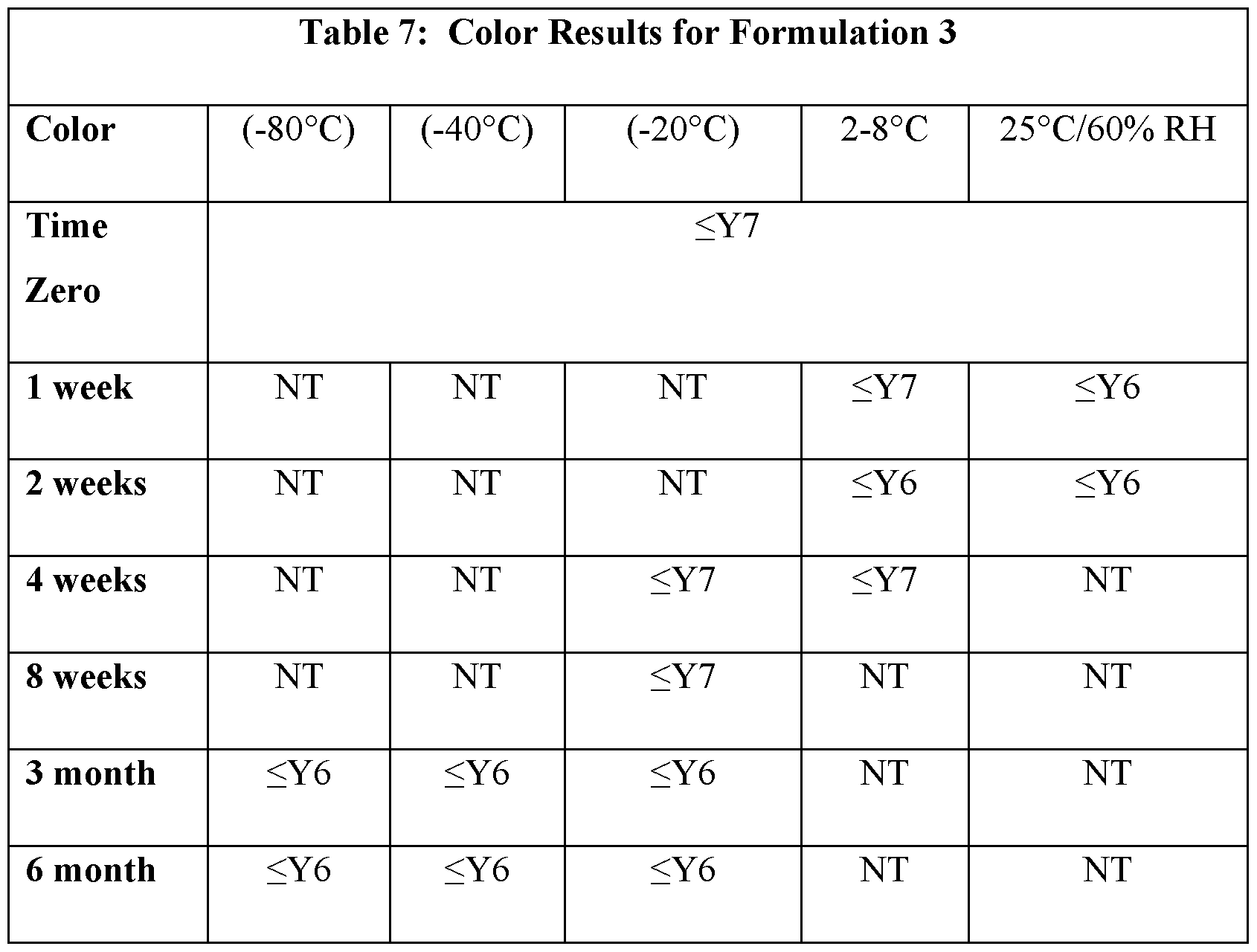


Clarity results for formulations 3-5 are listed in Tables 10 through 12, respectively.


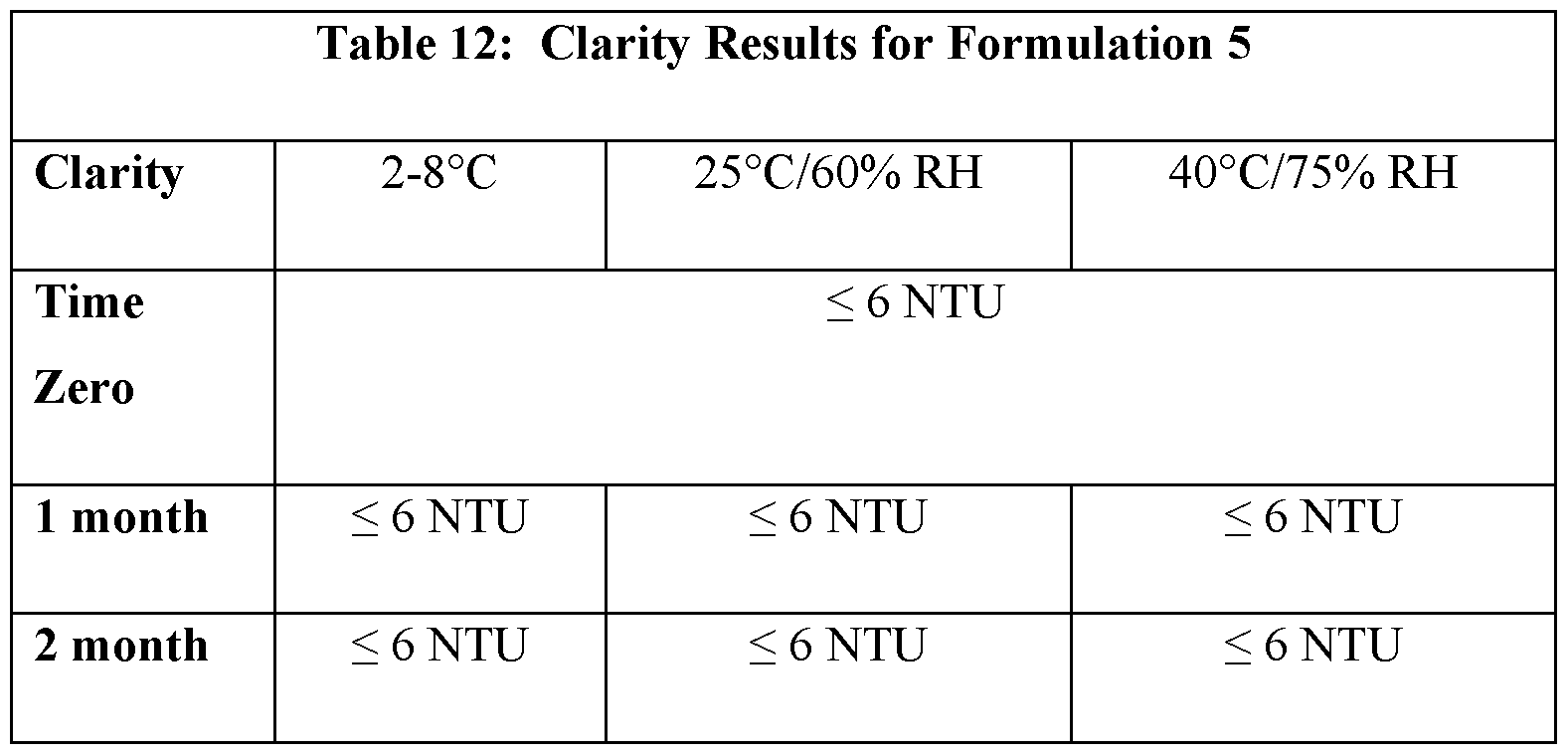
Moisture content results for formulations 4-5 are listed in Tables 13 through 14, respectively.

* Sample testing planned for a 12 month timepoint but actually tested after 21 months of storage at 2-8°C.

SFGFR3_Del4-D3 appears stable for all appearance assays during storage across all storage conditions. In addition, all reconstituted samples were essentially free of visible particulate (EFVP) at all timepoints and storage conditions for all formulations tested. Appearance prior to reconstitution for the lyophilized formulations is a white cake with no signs of discoloring (color), cakes were uniform with no signs of collapse or meltback (appearance), cake and vial interior show
no visible signs of the presence of foreign matter, and there was an absence of significant low/high fills or other container associated defects. Each lyophilized sample at all timepoints and storage conditions was a white cake, essentially free of visible foreign particulate. pH results for formulations 3-5 are listed in Tables 15 through 17, respectively.


SFGFR3_Del4-D3 appears stable by pH across all storage conditions/formulations.
Concentration results for formulations 3-5 are listed in Tables 18 through 20, respectively.


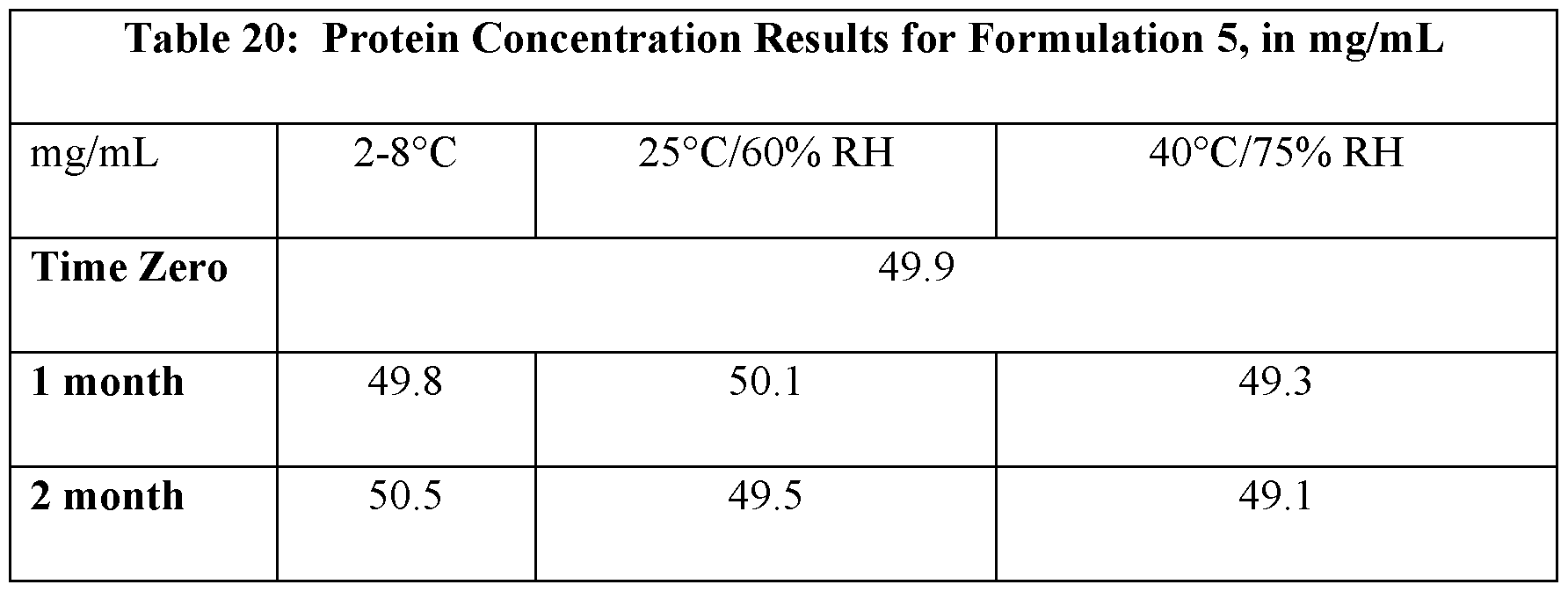 sFGFR3_Del4-D3 appears stable by concentration across all storage conditions/formulations.
Size exclusion chromatography HMMS results for formulations 3-5 are listed in Tables 21 through 23, and monomer results for formulations 3-5 are listed in in Tables 24 through 26.


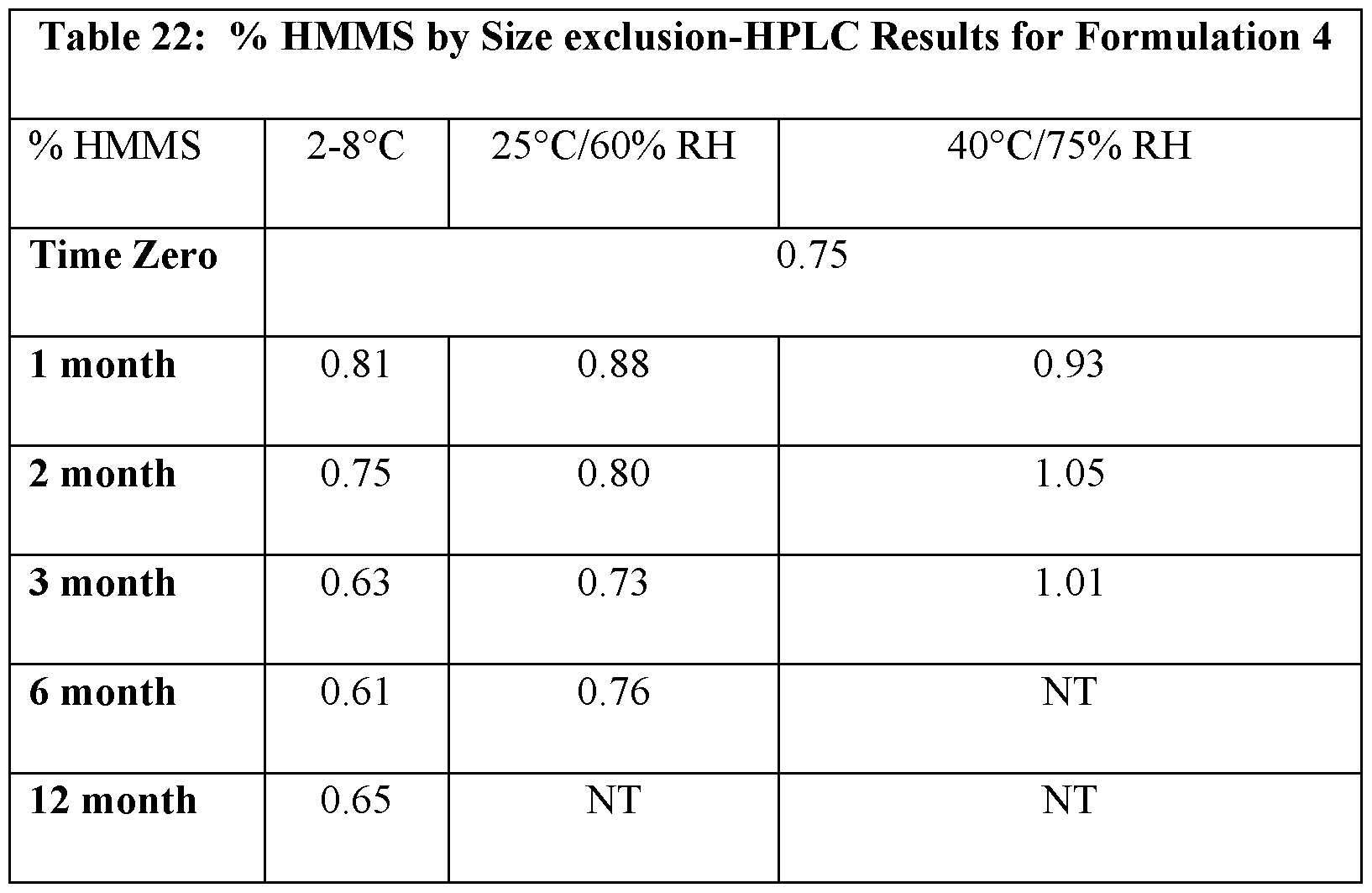


The tested sFGFR3_Del4-D3 formulations have reasonable levels of HMMS generated during stability. The data indicates decent product purity profile at this timepoint for either drug product formulation and drug substance. In particular, the aggregation rate of formulation 3, which is a liquid formulation, has been reduced to 1.2% per week at 25°C. This enhancement of stability represents a significant improvement in the manufacturability of the molecule. In addition, both lyophilized formulations are robust to elevated temperatures for multiple months. This greatly improves usability of the protein therapeutic by allowing more flexible storage options.
Isoelectric capillary electrophoresis acidic species results for formulations 3-5 are listed in Tables 27 through 29, main species results for formulations 3-5 are listed in Tables 30-32, and basic species results for formulations 3-5 are listed in Tables 33-35.


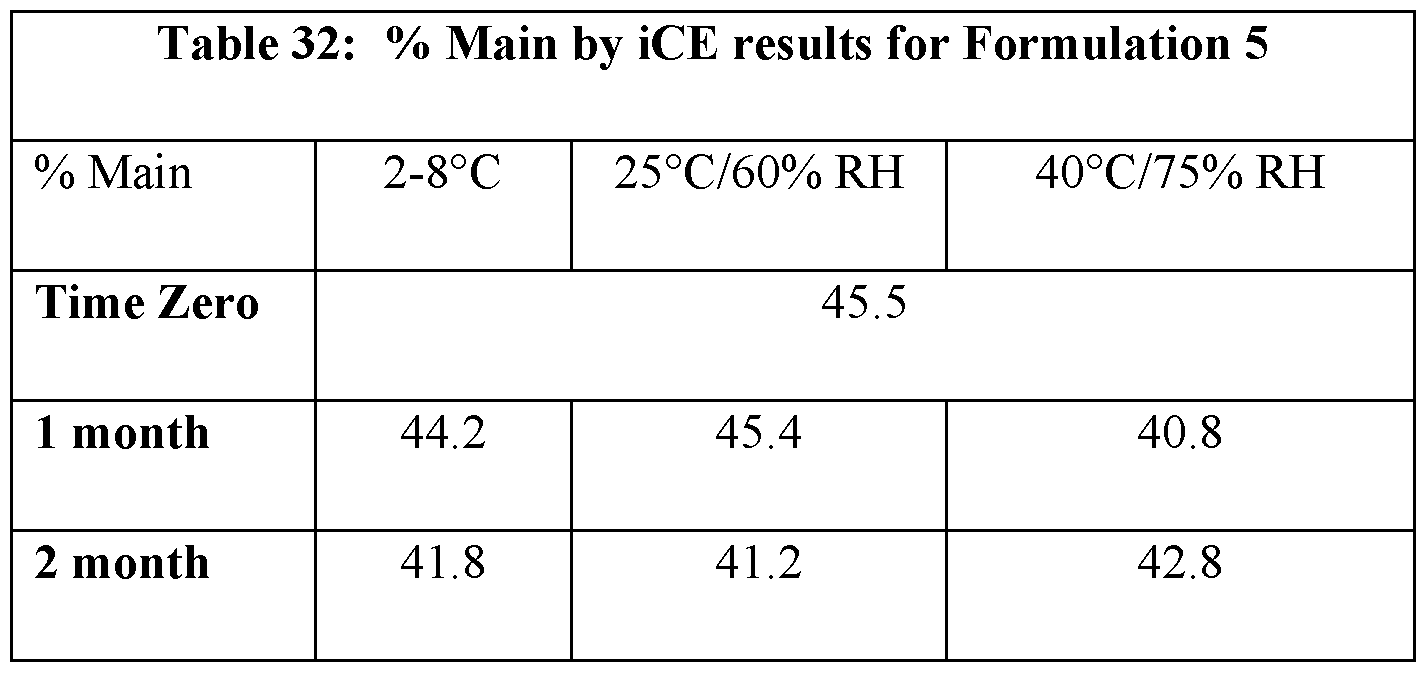


At all storage conditions, sFGFR3_Del4-D3 comprising formulations 3-5 have stable levels of charged variants during stability.
Reducing capillary gel electrophoresis % fragment results for formulations 3-5 are listed in Tables 36 through 38, and % main species results for formulations 3-5 are listed in Tables 39-41.


At all storage conditions, sFGFR3_Del4-D3 formulations 3-5 have stable levels of fragments during stability. Subvisible particulate results, assessed via HIAC, for formulations 3-4 are listed in Table 42.


At all storage conditions and timepoints, sFGFR3_Del4-D3 formulations 3 and 4 have acceptable levels of subvisible particulates.
Bioassay results, for formulations 3-4 are listed in Table 43 and 44 respectively.


Collectively, the stability study results indicate that formulation 3 is able to stabilize sFGF3 polypeptide sufficiently to support manufacturing hold times and requisite storage and handling of the drug substance. Formulations 4 and 5 also demonstrated excellent stability as drug product, ensuring sufficient shelf life under refrigerated or even room temperature conditions. This will help avoid the complicated supply chain and storage requirements of frozen drug products. Therefore, manufacturability and ease of storage of sFGFR3_Del4-D3 is greatly and unexpectedly improved when utilizing these new formulations.
Example 5: sFGFR3_Del4-D3 handling studies:
This Example illustrates studies to determine the stability of sFGFR3_Del4-D3 drug substance.
For the studies, sFGFR3_Del4-D3 drug substance (DS) at ~ 80 mg/mL was taken from frozen storage at -80°C and thawed completely at 2-8°C overnight and room temperature. The material was then mixed by inversion and 20 mL of DS was filtered using a 0.22 pm PES filter unit.
Aliquots of 1 mL were made into 12 HDPE (8 mL) bottles. An additional 4 mL aliquot was made into an HDPE (8 mL) bottle for HIAC testing. The HIAC testing was performed after 2 weeks of stability studies at 2-8°C.The thawed drug substance was diluted to 1 mg/mL by adding 0.5 mL of drug substance to 39 mL of formulation buffer and mixed by inversion. The material was then filtered using a 0.22 pm PES filter unit. Aliquots of 1 mL were made into 10 polypropylene (PP, 2 mL) vials. The sample aliquots were put on stability at -20°C, 2-8°C or 25°C. For the freeze/thaw (F/T) studies, the samples were subjected to uncontrolled F/T from -20°C to room temperature for five cycles. After each thaw, containers were gently inverted 3 times. For the mixing studies, samples were agitated by 10 inversions at room temperature prior to analysis. Materials used for the studies: Active Drug Substance (DS): 79 mg/mL of sFGFR3_Del4-D3 in formulation buffer (40 mM Histidine, 8.5% sucrose, 0.05 mg/mL EDTA, 0.2 mg/mL polysorbate- 80, pH 5.8). The actual drug substance in these studies was tested and foundto have 35 mM histidine (instead of 40 mM).
Formulation buffer: 40 mM histidine, 8.5% sucrose, 0.05 mg/mL EDTA, 0.2 mg/mL polysorbate- 80, pH 5.8. As noted above, the concentration of histidine in the DS was 35 mM histidine.
Results:
Table 15: Analytical results of 79 mg/mL DS of sFGFR3_Del4-D3


A minor reduction is concentration was seen for the DS at the 3 month -20°C time point. Otherwise, no changes in particles or purity by SEC was seen for the studied samples. The HIAC data for the 5°C sample at 2 weeks was within the USP acceptable range. Table 46: Analytical results of diluted 1 mg/mL material of sFGFR3_Del4-D3

EFVP: Essentially Free of Visible Particles
No changes in concentration by soloVPE, particles or purity by SEC was seen for the studied samples of diluted 1 mg/mL material.
Discussion:
Results from this study demonstrated that sFGFR3_Del4-D3 drug substance (formulated in 40 mM histidine, 8.5% sucrose, 0.05 mg/mL EDTA, 0.2 mg/mL polysorbate-80, pH 5.8) was stable at 1 and 80 mg/mL during the course of the stability study at 25°C for 8 weeks, at 5°C for 2 weeks and at -20°C for 3 months. In addition, the drug substance between 1 and 80 mg/mL was stable up to 5 freeze/thaws cycles (frozen at -20°C, thaw at 25°C) and stable to mixing by inversion.
Table 47 Sequences
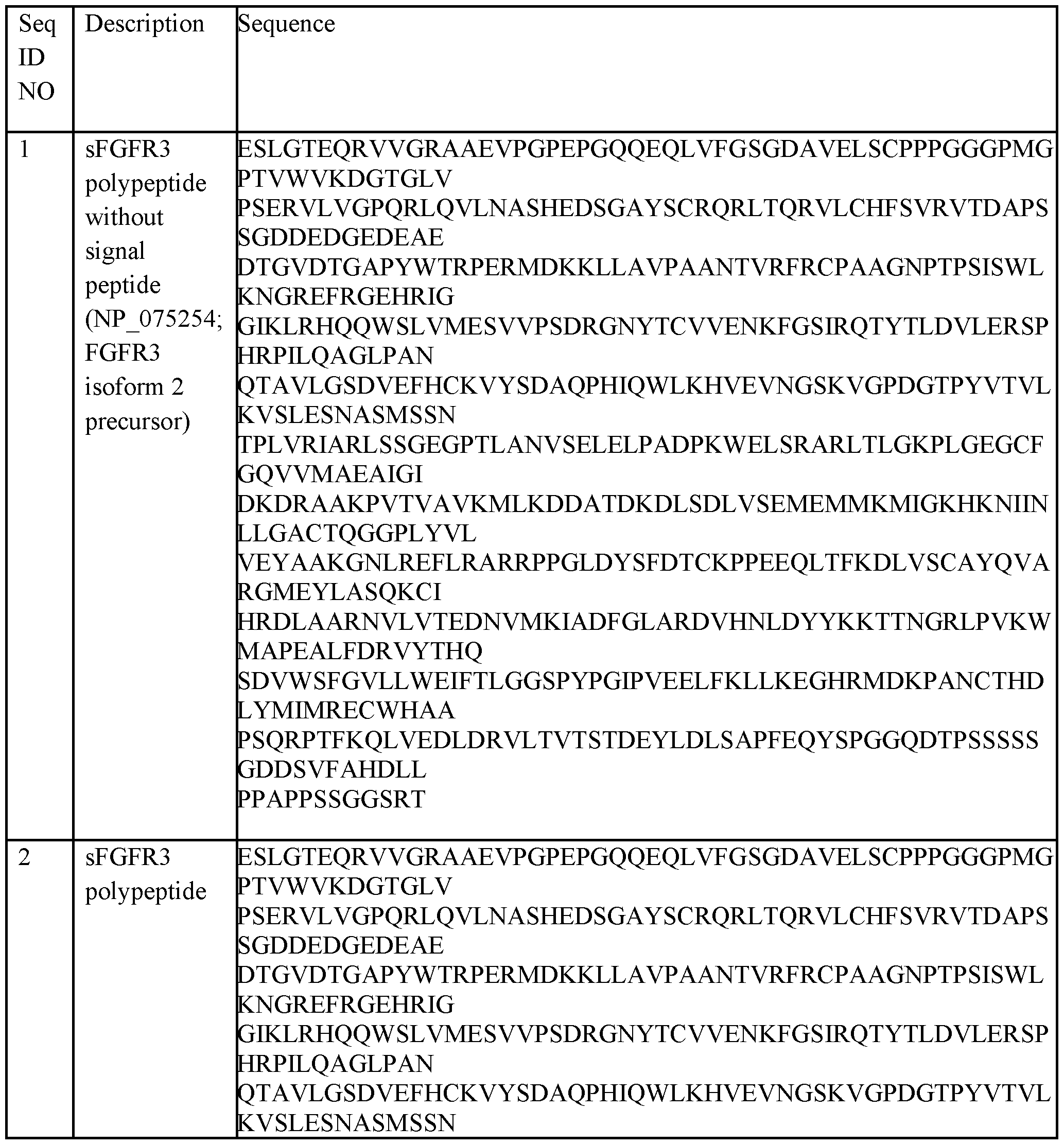
 PSERVLVGPQRLQVLNASHEDSGAYSCRQRLTQRVLCHFSVRVTDAPS
SGDDEDGEDEAE
DTGVDTGAPYWTRPERMDKKLLAVPAANTVRFRCPAAGNPTPSISWL
KNGREFRGEHRIG
GIKLRHQQWSLVMESVVPSDRGNYTCVVENKFGSIRQTYTLDVLERSP
HRPILQAGLPAN
QTAVLGSDVEFHSKVYSDAQPHIQWLKHVEVNGSKVGPDGTPYVTVL
KVSLESNASMSSN
T
 LLWEIFTLGGSPYPGIPVEELFKLLKEGHRMDKPANCTHDLYMIMREC
WHAAPSQRPTFK
QLVEDLDRVLTVTSTDEYLDLS APFEQ YSPGGQDTPS S S S SGDDS VFAH
DLLPPAPPSSG
GSRT


P336 added KNGREFRGEHRIG
GIKLRHQQWSLVMESVVPSDRGNYTCVVENKFGSIRQTYTLDVLERSP
HRPILQAGLPAN
QTAVLGSDVEFHCKVYSDAQPHIQWLKHVEVNGSKVGPDGTPYVTVL
KTAGANTTDKELE
VLSLHNVTFEDAGEYTCLAGNSIGFSHHSAWLVVLPVSLESNASMSSN
TPLVRIARLSSG
EGPTLANVSELELPADPKWELSRARLTLGKPLGEGCFGQVVMAEAIGI
DKDRAAKPVTVA
VKMLKDDATDKDLSDLVSEMEMMKMIGKHKNIINLLGACTQGGPLY
VLVEYAAKGNLREF
LRARRPPGLDYSFDTCKPPEEQLTFKDLVSCAYQVARGMEYLASQKCI
HRDLAARNVLVT
EDNVMI<IADFGLARDVHNLDYYI<I<TTNGRLPVI<WMAPEALFDRVYT
HQSDVWSFGVLLWE
1FTLGGSPYPGIPVEELFKLLKEGHRMDKPANCTHDLYMIMRECWHAA
PSQRPTFKQLVE
DLDRVLTVTSTDEYLDLSAPFEQYSPGGQDTPSSSSSGDDSVFAHDLLP PAPPSSGGSRT
SFGFR3 ESLGTEQRVVGRAAEVPGPEPGQQEQLVFGSGDAVELSCPPPGGGPMG C275S (del PTVWVKDGTGLV P302 PSERVLVGPQRLQVLNASHEDSGAYSCRQRLTQRVLCHFSVRVTDAPS
SGDDEDGEDEAE toT672)
DTGVDTGAPYWTRPERMDKKLLAVPAANTVRFRCPAAGNPTPSISWL replaced by KNGREFRGEHRIG splicer GIKLRHQQWSLVMESVVPSDRGNYTCVVENKFGSIRQTYTLDVLERSP SGSGSGSG HRPILQAGLPAN SGSGSGS QTAVLGSDVEFHSKVYSDAQPHIQWLKHVEVNGSKVGPDGTPYVTVL (SEQ ID KVSLESNASMSSN NO: 44) TSGSGSGSGSGSGSGSVVFPYFPRLGRYNLNFHEAQQACLDQDAVIASF
DQLYDAWRGGL + V158 to
DWCNAGWLSDGSVQYPITKPREPCGGQNTVPGVRNYGFWDKDKSRY N353 from DVFCFTSNFNGRFY XP_0168645 YLH4PTKLTYDEAVQACLNDGAQIAKVGQIFAAWKILGYDRCDAGWL 42.1 ADGSVRYPISRPR (human hyal RRC SPTEAAVRF VGFPDKKHKL YGVYCFRAYN uronan and proteoglycan link protein 1 isoform X2 sFGFR3 with ESLGTEQRVVGRAAEVPGPEPGQQEQLVFGSGDAVELSCPPPGGGPMG full length PTVWVKDGTGLV Ig-like PSERVLVGPQRLQVLNASHEDSGAYSCRQRLTQRVLCHFSVRVTDAPS
SGDDEDGEDEAE domain III
DTGVDTGAPYWTRPERMDKKLLAVPAANTVRFRCPAAGNPTPSISWL (aa T289 to KNGREFRGEHRIG

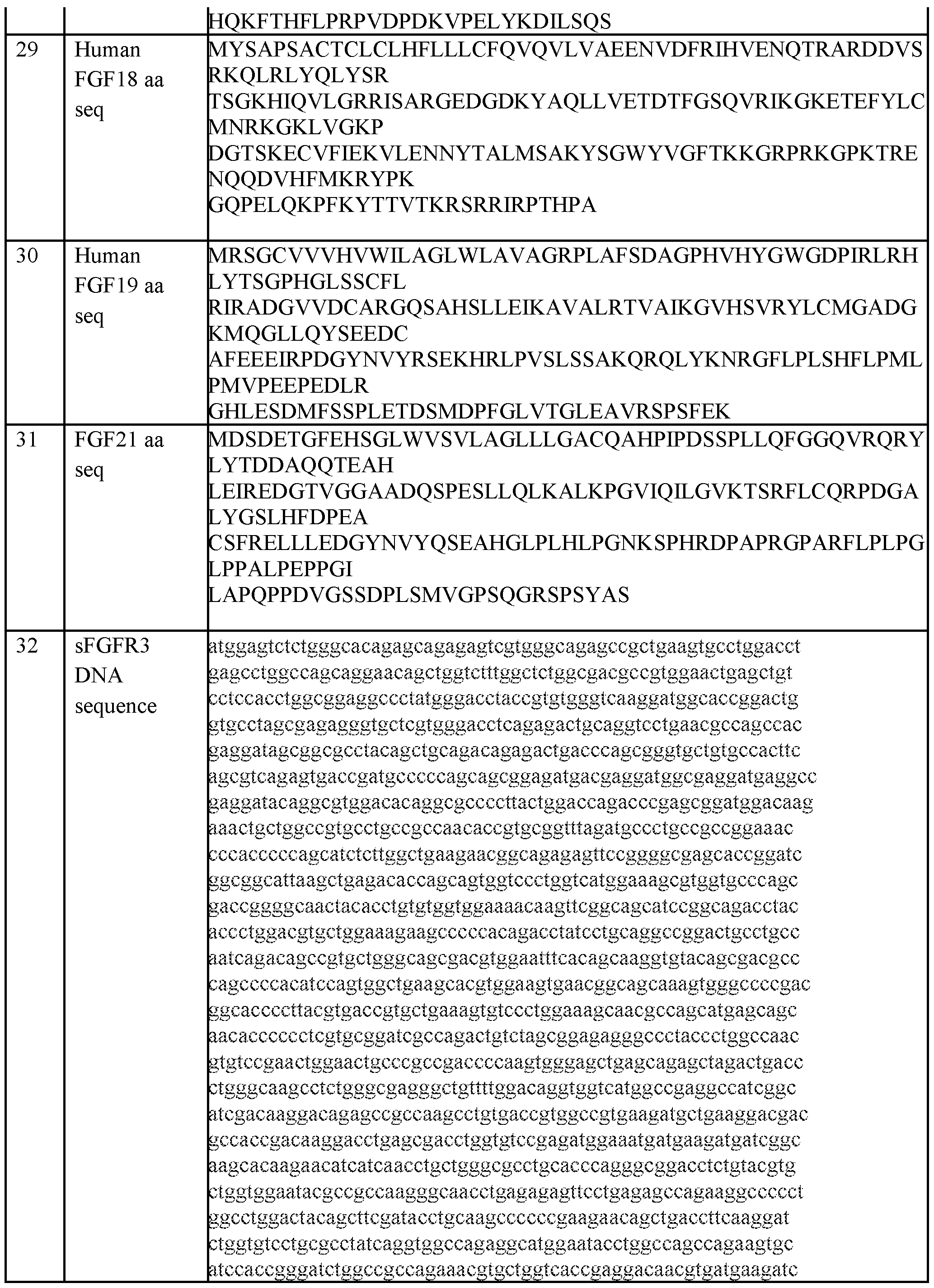


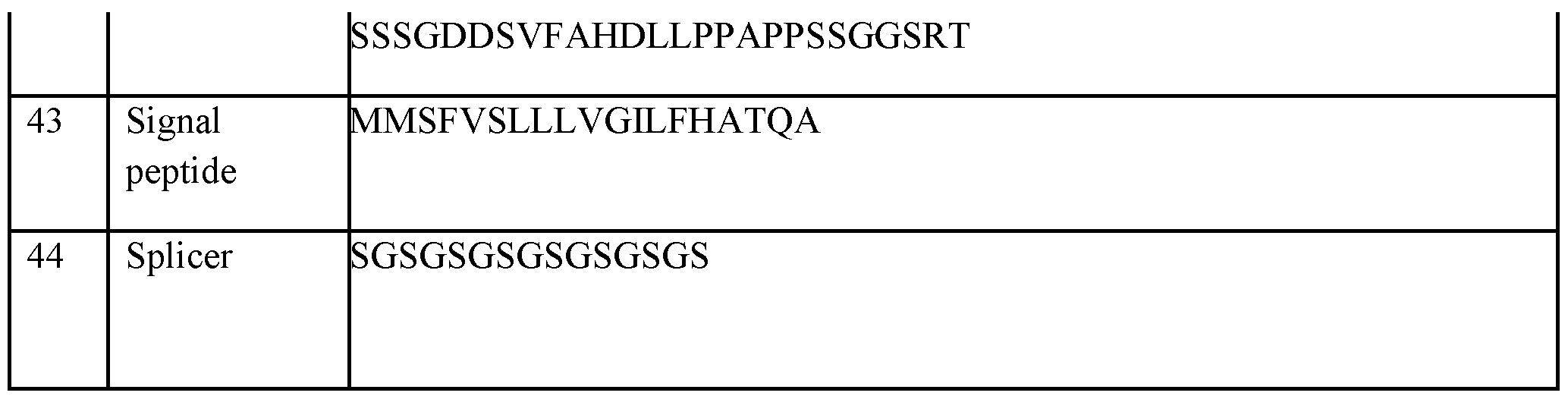
The various features and embodiments of the present invention, referred to in individual sections above apply, as appropriate, to other sections, mutatis mutandis. Consequently, features specified in one section may be combined with features specified in other sections, as appropriate. All references cited herein, including patents, patent applications, papers, textbooks, and cited sequence Accession numbers, and the references cited therein are hereby incorporated by reference in their entirety. In the event that one or more of the incorporated literature, and similar materials differs from or contradicts this application, including but not limited to defined terms, term usage, described techniques, or the like, this application controls.
We claim:
Claims
1. A formulation comprising: about 15 mg/mL to about 250 mg/mL of a soluble fibroblast growth factor receptor 3 (sFGFR3) polypeptide, a buffer, a polyol, a surfactant, and a chelating agent, and wherein the formulation has a pH at about 5.0 to about 7.0.
2. The formulation of claim 1, wherein the formulation is a liquid formulation, a lyophilized formulation, or a lyophilized formulation that is reconstituted as a liquid.
3. The formulation of claim 1 or 2, wherein the buffer is a histidine, citrate and/or succinate buffer.
4. The formulation of any one of claims 1-3, wherein the concentration of the buffer is about 8 mM to about 40 mM.
5. The formulation of any one of claims 1 to 3, wherein the polyol is sucrose and/or mannitol.
6. The formulation of any one of claims 1 to 5, wherein the concentration of the polyol is about 15 mg/mL to about 120 mg/mL.
7. The formulation of any one of claims 1 to 6, wherein the surfactant is a polysorbate.
8. The formulation of claim 7, wherein the polysorbate is polysorbate 80 (PS80).
9. The formulation of any one of claims 1 to 8, wherein the concentration of the surfactant is about 0.1 mg/mL to about 1 mg/mL.
10. The formulation of any one of claims 1 to 9, wherein the chelating agent is disodium edetate dihydrate (i.e., ethylenediaminetetraacetic acid (EDTA)).
11. The formulation of any one of claims 1 to 10, wherein the concentration of the chelating agent is about 0.01 mg/mL to about 1.0 mg/mL.
12. The formulation of any one of claims 1 to 11, wherein the formulation has a pH of about 5.5 to 6.5.
13. The formulation of any one of claims 1 to 12, wherein the sFGFR3 polypeptide:
(i) comprises 100-370 consecutive amino acids of an extracellular domain of the naturally occurring FGFR3 polypeptide;
(ii) comprises 100, 200, 225, 250, 275, 300, 310, 320, 325, 330, 335, 336, 340, 345, or 350 consecutive amino acids of an ECD of a naturally occurring fibroblast growth factor receptor 3 (FGFR3);
(iii) lacks a signal peptide and/or a transmembrane domain, such as the signal peptide and/or transmembrane domain of a naturally occurring FGFR3 polypeptide;
(iv) comprises 175, 150, 125, 100, 75, 50, 40, 30, 20, 15, 13, or fewer consecutive amino acids of the intracellular domain of a naturally-occurring FGFR3 polypeptide;
(v) comprises an amino acid sequence having at least 85%, 86%, 87%, 88%, 89%, 90%, 91%, 92%, 93%, 94%, 95%, 96%, 97%, 98%, 99%, or more sequence identity to the amino acid sequences of SEQ ID NOs: 1-8;
(vi) comprises an amino acid sequence having at least 85%, at least 90%, at least 92%, at least 94%, at least 95%, at least 96%, at least 98%, at least 99% sequence identity to SEQ ID NO: 5;
(vii) comprises or consists of an amino acid sequence of SEQ ID NO: 5;
(viii) is encoded by a polynucleotide comprising a nucleic acid sequence having at least 85% and up to 100% sequence identity to the nucleic acid sequence of any one of SEQ ID NOs: 10-18; and/or
(ix) is encoded by a polynucleotide comprising a nucleic acid sequence having at least 85% and up to 100% sequence identity to the nucleic acid sequence of SEQ ID NO: 15, and optionally lacks the signal peptide.
14. The formulation of any one of claims 1 to 13, wherein the concentration of the sFGFR3 polypeptide is about 50 mg/mL, 52.5 mg/mL, 75 mg/ml, 79 mg/ml, 80 mg/ml, 120 mg/mL, or 150 mg/mL.
15. A pharmaceutical formulation comprising about 50 mg/mL of a sFGFR3 polypeptide, about 20-40 mM histidine, about 85 mg/mL sucrose, about 0.05 mg/mL disodium edetate
dihydrate, about 0.2 mg/mL polysorbate 80, wherein the sFGFR3 polypeptide comprises or consists of an amino acid sequence of SEQ ID NO: 5, and wherein the formulation has a pH of about 5.8±0.5.
16. The pharmaceutical formulation of any one of claims 14-15, wherein the formulation is a liquid formulation, a lyophilized formulation, or a lyophilized formulation that is reconstituted as a liquid.
17. The pharmaceutical formulation of any one of claims 14-16, wherein the concentration of histidine is about 20 mM, 25 mM, 30 mM, 31 mM, 32 mM, 33 mM, 34 mM, 35 mM, 36 mM, 37 mM, 38 mM, 39 mM or 40 mM.
18. The pharmaceutical formulation of claim 17, wherein the concentration of histidine is about 35 mM.
19. A method for preparing a lyophilized formulation of a soluble fibroblast growth factor receptor 3 (sFGFR3) polypeptide comprising the steps of:
(i) preparing a liquid formulation comprising about 15 mg/mL to about 250 mg/mL of a soluble fibroblast growth factor receptor 3 (sFGFR3) polypeptide, a buffer, a polyol, a surfactant, and a chelating agent,
(ii) freezing the formulation at a first temperature for a length of time sufficient to transform the liquid formulation into a solid state, wherein the first temperature is in the range of about -70° C to about -30° C;
(iii) annealing by freezing the formulation at a second temperature, wherein tire second temperature is in the range of about -30° C to about -5° C;
(iv) freezing the formulation at a third temperature, wherein the third temperature is in the range of about -65° C to about -25° C,
(v) subjecting the formulation to a pressure of about 5-200 mTorr at a fourth temperature of about -65° C to about -25° C,
(vi ) drying the formulation at a fifth temperature, wherein the fifth temperature is in the range of about -40° C to about -5° C, and wherein the drying step is performed under 5-200 mTorr of pressure;
(vii) drying the formulation at a sixth temperature wherein the sixth temperature is from
about 5° C to about 60° C to produce a dry cake, wherein the drying step is performed under 20- 200 mTorr of pressure; wherein the dry cake can be reconstituted with a liquid within about 9 minutes or less to produce a reconstituted liquid formulation.
20. The method of claim 19, wherein the liquid formulation of step (i) is as set forth in any one of claims 1-17.
21. A lyophilized formulation prepared by the method as set forth in any one of claims 19-20.
22. A method of treating a skeletal growth retardation disorder, comprising administering to a subject in need thereof a therapeutically effective amount of the formulation as set forth in any one of claims 1-17, 20.
23. The method as set forth in claim 21, wherein the skeletal growth retardation disorder is a FGFR3-related skeletal disease.
24. The method as set forth in claim 23, wherein the FGFR3-related skeletal disease is selected from the group consisting of achondroplasia, thanatophoric dysplasia type I (TDI), thanatophoric dysplasia type II (TDI I), severe achondroplasia with developmental delay and acanthosis nigricans (SADDEN), hypochondroplasia, a craniosynostosis syndrome, and camptodactyly, tall stature, and hearing loss syndrome (CATSHL).
25. An injectable syringe containing a pre-filled solution of the formulation as set forth in any one of claims 1-18, 21.
26. A glass vial comprising a lyophilized formulation as set forth in any one of claims 1-18, 21.
27. A dual chamber cartridge comprising in one chamber a lyophilized formulation as set forth in any one of claims 1-18, 21, and in the other chamber a liquid for reconstitution.
28. Use of the formulation of any one of claims 1-18, 21 in a method as set forth in any one of any one of claims 22-24.
29. A formulation as set forth in any one of claims 1-18, 21 for use in a method as set forth in any one of claims 22-24.
Applications Claiming Priority (4)
| Application Number | Priority Date | Filing Date | Title |
|---|---|---|---|
| US202063115170P | 2020-11-18 | 2020-11-18 | |
| US63/115,170 | 2020-11-18 | ||
| US202163274070P | 2021-11-01 | 2021-11-01 | |
| US63/274,070 | 2021-11-01 |
Publications (1)
| Publication Number | Publication Date |
|---|---|
| WO2022106976A1 true WO2022106976A1 (en) | 2022-05-27 |
Family
ID=78820202
Family Applications (1)
| Application Number | Title | Priority Date | Filing Date |
|---|---|---|---|
| PCT/IB2021/060546 Ceased WO2022106976A1 (en) | 2020-11-18 | 2021-11-15 | Stable pharmaceutical formulations of soluble fgfr3 decoys |
Country Status (1)
| Country | Link |
|---|---|
| WO (1) | WO2022106976A1 (en) |
Cited By (2)
| Publication number | Priority date | Publication date | Assignee | Title |
|---|---|---|---|---|
| WO2024104922A1 (en) | 2022-11-14 | 2024-05-23 | Ascendis Pharma Growth Disorders A/S | Method of improving skeletal muscle function |
| WO2024194300A1 (en) | 2023-03-20 | 2024-09-26 | Ascendis Pharma Growth Disorders A/S | Method of treatment of a thoracolumbar deformity in a human subject with achondroplasia |
Citations (11)
| Publication number | Priority date | Publication date | Assignee | Title |
|---|---|---|---|---|
| US20030072718A1 (en) | 1994-05-18 | 2003-04-17 | Platz Robert M. | Methods and compositions for the dry powder formulation of interferons |
| US20030082276A1 (en) | 2001-10-18 | 2003-05-01 | Anandaraman Subramaniam | Spray-dried compositions and method for their preparation |
| WO2006096491A2 (en) | 2005-03-08 | 2006-09-14 | Pharmacia & Upjohn Company Llc | Anti-ctla-4 antibody compositions |
| WO2010032220A1 (en) | 2008-09-19 | 2010-03-25 | Pfizer Inc. | Stable liquid antibody formulation |
| WO2013186719A1 (en) | 2012-06-15 | 2013-12-19 | Pfizer Inc. | Improved antagonist antibodies against gdf-8 and uses therefor |
| WO2014111744A1 (en) | 2013-01-16 | 2014-07-24 | INSERM (Institut National de la Santé et de la Recherche Médicale) | A soluble fibroblast growth factor receptor 3 (fgr3) polypeptide for use in the prevention or treatment of skeletal growth retardation disorders |
| WO2016110786A1 (en) | 2015-01-07 | 2016-07-14 | Therachon | Solube fgfr3 decoys for treating skeletal growth disorders |
| US20170360929A1 (en) | 2014-12-23 | 2017-12-21 | Pfizer Inc. | Stable aqueous antibody formulation for anti tnf alpha antibodies |
| US20180000933A1 (en) | 2015-01-28 | 2018-01-04 | Pfizer Inc. | Stable aqueous anti-vascular endothelial growth factor (vegf) antibody formulation |
| WO2018007597A1 (en) | 2016-07-07 | 2018-01-11 | Therachon | Soluble fibroblast growth factor receptor 3 (sfgfr3) polypeptides and uses thereof |
| WO2019057820A1 (en) | 2017-09-20 | 2019-03-28 | Therachon Sas | Treatment of abnormal visceral fat deposition using soluble fibroblast growth factor receptor 3 (sfgfr3) polypeptides |
-
2021
- 2021-11-15 WO PCT/IB2021/060546 patent/WO2022106976A1/en not_active Ceased
Patent Citations (13)
| Publication number | Priority date | Publication date | Assignee | Title |
|---|---|---|---|---|
| US20030072718A1 (en) | 1994-05-18 | 2003-04-17 | Platz Robert M. | Methods and compositions for the dry powder formulation of interferons |
| US20030082276A1 (en) | 2001-10-18 | 2003-05-01 | Anandaraman Subramaniam | Spray-dried compositions and method for their preparation |
| WO2006096491A2 (en) | 2005-03-08 | 2006-09-14 | Pharmacia & Upjohn Company Llc | Anti-ctla-4 antibody compositions |
| US20090110681A1 (en) | 2005-03-08 | 2009-04-30 | Pfizer, Inc. | Anti-M-CSF Antibody Compositions |
| WO2010032220A1 (en) | 2008-09-19 | 2010-03-25 | Pfizer Inc. | Stable liquid antibody formulation |
| WO2013186719A1 (en) | 2012-06-15 | 2013-12-19 | Pfizer Inc. | Improved antagonist antibodies against gdf-8 and uses therefor |
| WO2014111744A1 (en) | 2013-01-16 | 2014-07-24 | INSERM (Institut National de la Santé et de la Recherche Médicale) | A soluble fibroblast growth factor receptor 3 (fgr3) polypeptide for use in the prevention or treatment of skeletal growth retardation disorders |
| WO2014111467A1 (en) | 2013-01-16 | 2014-07-24 | INSERM (Institut National de la Santé et de la Recherche Médicale) | A soluble fibroblast growth factor receptor 3 (fgr3) polypeptide for use in the prevention or treatment of skeletal growth retardation disorders |
| US20170360929A1 (en) | 2014-12-23 | 2017-12-21 | Pfizer Inc. | Stable aqueous antibody formulation for anti tnf alpha antibodies |
| WO2016110786A1 (en) | 2015-01-07 | 2016-07-14 | Therachon | Solube fgfr3 decoys for treating skeletal growth disorders |
| US20180000933A1 (en) | 2015-01-28 | 2018-01-04 | Pfizer Inc. | Stable aqueous anti-vascular endothelial growth factor (vegf) antibody formulation |
| WO2018007597A1 (en) | 2016-07-07 | 2018-01-11 | Therachon | Soluble fibroblast growth factor receptor 3 (sfgfr3) polypeptides and uses thereof |
| WO2019057820A1 (en) | 2017-09-20 | 2019-03-28 | Therachon Sas | Treatment of abnormal visceral fat deposition using soluble fibroblast growth factor receptor 3 (sfgfr3) polypeptides |
Non-Patent Citations (19)
| Title |
|---|
| "Antibodies: a practical approach", 1988, IRL PRESS |
| "Current Protocols in Immunology", 1991 |
| "Genbank", Database accession no. NM_000142.4 |
| "GenBank", Database accession no. NP _ 000133 |
| "Gene Transfer Vectors for Mammalian Cells", 1987, ACADEMIC PRESS, INC. |
| "PCR: The Polymerase Chain Reaction", 1994 |
| "Remington, The Science and Practice of Pharmacy", 2000, OXFORD UNIVERSITY PRESS |
| "Remington's Pharmaceutical Sciences", 1990, MACK PUBLISHING CO. |
| "The Antibodies", 1995, HARWOOD ACADEMIC PUBLISHERS |
| ANIMAL CELL CULTURE, 1987 |
| BENDTSEN ET AL., J. MOL. BIOL., vol. 340, no. 4, 2004, pages 783 - 795 |
| C.A. JANEWAYP. TRAVERS, IMMUNOBIOLOGY, 1997 |
| CACECI ET AL., BYTE, vol. 9, 1984, pages 340 - 362 |
| E. HARLOWD. LANE: "Using antibodies: a laboratory manual", 1999, COLD SPRING HARBOR LABORATORY PRESS |
| J.P. MATHERP.E. ROBERTS: "Introduction to Cell and Tissue Culture", 1998, ACADEMIC PRESS |
| P. FINCH, ANTIBODIES, 1997 |
| SAMBROOK ET AL.: "Molecular Cloning: A Laboratory Manual", 1989, COLD SPRING HARBOR PRESS |
| WANG ET AL., J. PHARM SCI., vol. 96, 2007, pages 1 - 26 |
| WONGLOHMAN: "Cell and Tissue Culture: Laboratory Procedures", vol. 90, 1993, J. WILEY AND SONS, pages: 5428 - 5432 |
Cited By (2)
| Publication number | Priority date | Publication date | Assignee | Title |
|---|---|---|---|---|
| WO2024104922A1 (en) | 2022-11-14 | 2024-05-23 | Ascendis Pharma Growth Disorders A/S | Method of improving skeletal muscle function |
| WO2024194300A1 (en) | 2023-03-20 | 2024-09-26 | Ascendis Pharma Growth Disorders A/S | Method of treatment of a thoracolumbar deformity in a human subject with achondroplasia |
Similar Documents
| Publication | Publication Date | Title |
|---|---|---|
| US20230047111A1 (en) | Pharmaceutical formulations of tnf-alpha antibodies | |
| US10987405B2 (en) | Method of reducing formation of etanercept aggregates or fragments | |
| TWI548424B (en) | Etaner's stable liquid formula | |
| TWI593421B (en) | Lyophilized recombinant VWF formulation | |
| US11000588B2 (en) | Etanercept formulations stabilized with sodium chloride | |
| JP2015527350A (en) | Factor VIII liquid formulation | |
| JP2016539947A (en) | Liquid formulation of fusion protein containing TNFR and Fc regions | |
| JP2023011601A (en) | Stable formulations of fibronectin-based scaffolding domain proteins that bind myostatin | |
| EP4415693B1 (en) | Formulations of factor viii chimeric proteins and uses thereof | |
| CN121079103A (en) | Formulations comprising ACTRIIA protein variants | |
| OA17126A (en) | Pharmaceutical formulations of TNF-alpha antibodies | |
| HK1204921B (en) | Stable liquid formulation of etanercept | |
| HK1200720B (en) | Etanercept formulations stabilized with combinations of sugars and polyols |
Legal Events
| Date | Code | Title | Description |
|---|---|---|---|
| 121 | Ep: the epo has been informed by wipo that ep was designated in this application |
Ref document number: 21816528 Country of ref document: EP Kind code of ref document: A1 |
|
| NENP | Non-entry into the national phase |
Ref country code: DE |
|
| 122 | Ep: pct application non-entry in european phase |
Ref document number: 21816528 Country of ref document: EP Kind code of ref document: A1 |