WO2022075215A1 - データ処理システム、モデル生成装置、データ処理方法、モデル生成方法、及びプログラム - Google Patents
データ処理システム、モデル生成装置、データ処理方法、モデル生成方法、及びプログラム Download PDFInfo
- Publication number
- WO2022075215A1 WO2022075215A1 PCT/JP2021/036407 JP2021036407W WO2022075215A1 WO 2022075215 A1 WO2022075215 A1 WO 2022075215A1 JP 2021036407 W JP2021036407 W JP 2021036407W WO 2022075215 A1 WO2022075215 A1 WO 2022075215A1
- Authority
- WO
- WIPO (PCT)
- Prior art keywords
- data
- training
- model
- processing system
- input
- Prior art date
- Legal status (The legal status is an assumption and is not a legal conclusion. Google has not performed a legal analysis and makes no representation as to the accuracy of the status listed.)
- Ceased
Links
Images





Classifications
-
- G—PHYSICS
- G06—COMPUTING OR CALCULATING; COUNTING
- G06N—COMPUTING ARRANGEMENTS BASED ON SPECIFIC COMPUTATIONAL MODELS
- G06N3/00—Computing arrangements based on biological models
- G06N3/02—Neural networks
- G06N3/08—Learning methods
-
- G—PHYSICS
- G06—COMPUTING OR CALCULATING; COUNTING
- G06N—COMPUTING ARRANGEMENTS BASED ON SPECIFIC COMPUTATIONAL MODELS
- G06N3/00—Computing arrangements based on biological models
- G06N3/02—Neural networks
- G06N3/04—Architecture, e.g. interconnection topology
- G06N3/045—Combinations of networks
- G06N3/0455—Auto-encoder networks; Encoder-decoder networks
-
- Y—GENERAL TAGGING OF NEW TECHNOLOGICAL DEVELOPMENTS; GENERAL TAGGING OF CROSS-SECTIONAL TECHNOLOGIES SPANNING OVER SEVERAL SECTIONS OF THE IPC; TECHNICAL SUBJECTS COVERED BY FORMER USPC CROSS-REFERENCE ART COLLECTIONS [XRACs] AND DIGESTS
- Y02—TECHNOLOGIES OR APPLICATIONS FOR MITIGATION OR ADAPTATION AGAINST CLIMATE CHANGE
- Y02E—REDUCTION OF GREENHOUSE GAS [GHG] EMISSIONS, RELATED TO ENERGY GENERATION, TRANSMISSION OR DISTRIBUTION
- Y02E60/00—Enabling technologies; Technologies with a potential or indirect contribution to GHG emissions mitigation
- Y02E60/10—Energy storage using batteries
Definitions
- the present invention relates to a data processing system, a model generator, a data processing method, a model generation method, and a program.
- Patent Document 1 describes that learning using a neural network is used when estimating the state of a secondary battery.
- the value of the model used for data analysis for example, the model generated by machine learning is high.
- a third party can connect to the model, such as when a device using this model connects to a network. In this case, it is also possible to send input data to this model and receive output data from this model. Then, since a third party can obtain a plurality of combinations of input data and output data, there is a possibility that the structure of the model can be estimated.
- An example of an object of the present invention is to enhance the confidentiality of a model used for data analysis.
- an input data processing unit that acquires input data composed of a plurality of values and converts the input data according to a conversion rule.
- An intermediate data generation unit that outputs intermediate data consisting of data of a plurality of rows and / or a plurality of columns consisting of a plurality of values by processing the input data after conversion.
- An output data generation unit that generates output data by selecting at least one value at a predetermined position after performing a predetermined operation on the intermediate data. Equipped with A data processing system provided in a device different from the intermediate data generation unit and the output data generation unit is provided.
- the present invention is a model generation device that generates a model used in the intermediate data generation unit of the data processing system according to claim 1.
- the training data acquisition unit that acquires the first training data consisting of normal data and the second training data including some abnormal data,
- a model generation unit that repeats a process of training the model using the first training data and then training using the second training data after being converted by the conversion rule a plurality of times.
- a model generator is provided.
- the computer Input data processing that acquires input data consisting of multiple values and converts the input data according to conversion rules.
- An intermediate data generation process that outputs intermediate data consisting of data consisting of multiple rows and / or multiple columns consisting of a plurality of values by processing the input data after conversion.
- Output data generation processing that generates output data by selecting at least one value at a predetermined position after performing a predetermined operation on the intermediate data.
- a data processing method in which the intermediate data generation process and the output data generation process are performed by different computers.
- the present invention is a model generation method for generating a model used in the intermediate data generation unit of the data processing system.
- Training data acquisition processing to acquire the first training data consisting of normal data and the second training data including some abnormal data A model generation process in which the process of training the model using the first training data and then training using the second training data after being converted by the conversion rule is repeated a plurality of times.
- a model generation method is provided.
- the computer An input data processing function that acquires input data consisting of multiple values and converts the input data according to conversion rules.
- An intermediate data generation function that outputs intermediate data consisting of data consisting of multiple rows and / or multiple columns consisting of multiple values by processing the converted input data. Is provided.
- the computer An output data generation function that generates output data by selecting at least one value at a predetermined position after performing a predetermined operation on the intermediate data generated by the intermediate data generation function described above.
- the present invention is a program that gives a computer a function of generating a model used in the intermediate data generation unit of the data processing system according to claim 1.
- the training data acquisition function that acquires the first training data consisting of normal data and the second training data including some abnormal data
- a model generation function that repeats the process of training the model using the first training data and then training using the second training data after being converted by the conversion rule a plurality of times. Is provided.
- the confidentiality of the model used for data analysis is enhanced.
- FIG. 1 is a diagram for explaining an example of the usage environment of the model generation device 10 and the data processing system 20 according to the embodiment.
- the data processing system 20 processes the input data using the model generated by the model generation device 10 and outputs the output data.
- the input data consists of multiple values. An example of these plurality of values is the result of measuring the state of an object with different indexes.
- the object is the storage battery (secondary battery) 30, and the input data is the measurement result of the state of the storage battery 30.
- the input data includes, for example, the output voltage, output current value, and temperature of the storage battery 30.
- the object and the input data are not limited to these.
- the model generator 10 and the data processing system 20 are used together with the storage battery 30.
- a part of the functions of the data processing system 20 may be the BMS (Battery Management System) of the storage battery 30.
- the intermediate data generation unit 240 and the output data generation unit 250 which will be described later, are provided in different devices. Then, one data processing system 20 is connected to a plurality of storage batteries 30, and processes the plurality of storage batteries 30.
- the storage battery 30 supplies electric power to the device 40.
- the device 40 is a vehicle such as an electric vehicle.
- the storage battery 30 is a household storage battery
- the device 40 is an electric device used at home.
- the storage battery 30 is located outside the device 40.
- the storage battery 30 may be connected to the grid power grid.
- the storage battery 30 is used to level the supplied electric power.
- the device 40 stores electric power when there is surplus electric power, and supplies electric power when the electric power is unpredictable.
- the data processing system 20 estimates the state of the storage battery 30.
- the state estimated here is, for example, at least one of the remaining capacity (unit: Ah), the charge rate (SOC: StateOfCharge), and SOH (StateOfHealth) of the storage battery 30.
- the SOH is, for example, "current full charge capacity (Ah) / initial full charge capacity (Ah) x 100 (%)".
- the state of the storage battery 30 is not limited to these.
- the data processing system 20 uses a model.
- the model generator 10 generates and updates at least one of the models used by the data processing system 20 using machine learning, such as a neural network.
- the model generator 10 may acquire measured values (hereinafter referred to as actual data) of data relating to the state of the storage batteries 30 from a plurality of storage batteries 30.
- actual data measured values
- a part of the plurality of actual data may be used as training data for machine learning, and at least a part of the remaining actual data may be used to verify the model.
- the actual data includes information for specifying the type (for example, product name and model number) of the storage battery 30.
- the model generation device 10 can generate a model for each type of the storage battery 30.
- the data processing system 20 can acquire a model corresponding to the type of the storage battery 30 to which the data processing system 20 is connected from the model generation device 10 and use it. Therefore, the accuracy of estimating the state of the storage battery 30 by the data processing system 20 is high.
- the actual data may be generated by the storage battery 30 used for the main purpose of collecting the actual data.
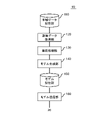
- FIG. 2 is a diagram showing an example of the functional configuration of the model generator 10.
- the model generation device 10 includes a training data acquisition unit 120 and a model generation unit 140.
- the training data acquisition unit 120 acquires a plurality of training data.
- each of the training data uses training measurement data including an index (for example, current, voltage, and temperature) indicating the state of the storage battery in a certain charge / discharge cycle as input data, and a value indicating the performance of the storage battery (for example, the balance).
- the target value is training output data, which is at least one of capacity, SOC, and SOH).
- the model generation unit 140 generates a model by machine learning a plurality of training data.
- the model generation unit 140 may generate a plurality of models by using a plurality of machine learning algorithms (for example, LSTM (Long Short-Term Memory), DNN (Deep Neural Network), LR (Linear Regression), etc.). ..
- machine learning algorithms for example, LSTM (Long Short-Term Memory), DNN (Deep Neural Network), LR (Linear Regression), etc.
- the training data acquisition unit 120 acquires training data from the training data storage unit 110.
- the training data storage unit 110 may be a part of the model generation device 10 or may be provided outside the model generation device 10.
- the training data stored in the training data storage unit 110 includes a first training data consisting of normal data and a second training data including a part of abnormal data.
- An example of the first training data is the above-mentioned actual data.
- An example of the second training data includes values that cannot exist as actual data, and is generated by, for example, a person or a computer.
- the model generation device 10 further includes a preprocessing unit 130.
- the pre-processing unit 130 converts at least the second training data according to a predetermined conversion rule.
- the model generation unit 140 generates a model using the converted second training data.
- the preprocessing unit 130 may further convert the first training data according to a predetermined conversion rule.
- the model generation unit 140 generates a model using the converted first training data.
- the conversion rule by adding dummy data to the input data of the training data, the number of values constituting the input data is increased, and dummy data is also added to the output data of the training data. By doing so, it is a process of increasing the number of values constituting the output data.
- the converted input data when the input data consists of three values, the converted input data includes three values originally included in the input data and dummy data consisting of at least one value, so four. It will be composed of the above values. A detailed example of this conversion rule will be described later.
- the model generated by the model generation unit 140 is stored in the model storage unit 150. Then, the model stored in the model storage unit 150 is transmitted to the data processing system 20 by the model transmission unit 160.
- the model storage unit 150 and the model transmission unit 160 are a part of the model generation device 10. However, at least one of the model storage unit 150 and the model transmission unit 160 may be an external device of the model generation device 10.
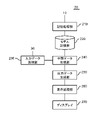
- FIG. 3 is a diagram showing an example of the functional configuration of the data processing system 20.
- the data processing system 20 includes an input data processing unit 230, an intermediate data generation unit 240, and an output data generation unit 250.
- the intermediate data generation unit 240 and the output data generation unit 250 are different devices from each other.
- the output data generation unit 250 of the data processing system 20 is provided on the cloud server, and other functions of the data processing system 20 are provided on the terminal.
- the storage processing unit 210, the model storage unit 220, and the display processing unit 260, which will be described later, may also be provided on the cloud server.
- the input data processing unit 230 acquires the input data and converts the input data according to the conversion rule.
- the structure of the input data is the same as the input data of the training data used by the model generation device 10.
- the input data processing unit 230 acquires input data from a sensor (for example, an ammeter, a voltmeter, and a thermometer) that detects the state of the storage battery 30.
- the conversion rule used by the input data processing unit 230 is the same as the conversion rule used by the preprocessing unit 130 of the model generation device 10.
- An example of this conversion rule is to increase the number of values contained in the input data by adding dummy data to the input data as described above.
- the intermediate data generation unit 240 generates intermediate data by processing the converted input data.
- This intermediate data is, for example, data having a plurality of rows and / or a plurality of columns consisting of a plurality of values.
- the intermediate data generation unit 240 generates intermediate data using the model generated by the model generation device 10. As described above, the model generator 10 adds dummy data to the output data of the training data when the model is generated. Therefore, the generated intermediate data includes a meaningful value (that is, a value to be obtained) and a dummy value.
- the output data generation unit 250 selects at least one value (that is, a meaningful value among the intermediate data) at a predetermined position after performing a predetermined operation on the intermediate data generated by the intermediate data generation unit 240. By doing so, output data is generated.
- the predetermined operation performed here is, for example, addition, but may be subtraction, multiplication, or division, or may be a combination of at least two of addition, subtraction, multiplication, and division.
- the data processing system 20 further includes a storage processing unit 210, a display processing unit 260, and a display 270.
- the storage processing unit 210 acquires a model from the model generation device 10 and stores it in the model storage unit 220.
- the storage processing unit 210 acquires data for updating the model (for example, model parameters) from the model generation device 10
- the storage processing unit 210 updates the model stored in the model storage unit 220 by using this data. This update process is preferably repeated.
- the model storage unit 220 is a part of the data processing system 20.
- the model storage unit 220 may be an external device of the data processing system 20.
- the display processing unit 260 displays the output data generated by the output data generation unit 250 on the display 270.
- the display 270 is arranged at a position visible to the user of the device 40.
- the display 270 is provided inside the vehicle (for example, in front of the driver's seat or diagonally in front).
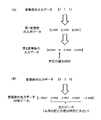
- FIG. 4 is a diagram for explaining a first example of a conversion rule used by the pre-processing unit 130 of the model generation device 10 and the input data processing unit 230 of the data processing system 20.
- FIG. 4A shows a first example of input data
- FIG. 4B shows an example of output data corresponding to FIG. 4A.
- the input data is row data and is composed of a plurality of values (for example, three values [1, 1, 1]).
- the conversion rule is to insert dummy data at a predetermined position on this line.
- "0" which is a dummy value, is added to the second column of the input data.
- the values in the second and subsequent columns are carried down one column at a time.
- the original output data is row data, and is composed of a predetermined number of values (for example, three values [1, 3, 1]).
- the model generated by the model generator 10 is premised on using the input data after conversion, and as a result, a larger number of values than the original output data (for example, [-3,1,3,]
- the row data consists of five values (1, -2)).
- this row data contains the original output data ([1, 3, 1]) in a predetermined position (that is, a predetermined column), and a dummy value in the remaining position (column). Includes.
- the output data generation unit 250 performs a process of extracting [1,3,1] from [-3,1,3,1,-2]. It should be noted that the plurality of values that are the original output data do not have to be continuous.
- the preprocessing unit 130 of the model generation device 10 sets dummy data (for example, 0) of a predetermined value at a predetermined position (for example, 2) with respect to the input data (for example, [1, 1, 1]) included in the training data. Add to column). Further, the preprocessing unit 130 adds predetermined dummy data at predetermined positions (for example, the first column and the fifth column) to the output data (for example, [1, 3, 1]) included in the training data.
- the value of the predetermined dummy data added to the output data is preferably within a range in which the value included in the original output data can be taken.
- the dummy value (that is, the value not selected as the output data) included in the intermediate data generated by the intermediate data generation unit 240 is within the range that can be taken by a plurality of values that are the original output data. Therefore, even if a third party sees the intermediate data, the third party cannot determine which of the plurality of values contained in the intermediate data is meaningful data (that is, the original output data). Therefore, the third party cannot specify the combination of the input data and the output data, and as a result, the confidentiality of the model generated by the model generation device 10 becomes high.
- the dummy value included in the output data should be within a range in which a plurality of values that are the original output data can be taken. Just do it.
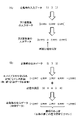
- FIG. 5 is a diagram for explaining a second example of the conversion rule used by the input data processing unit 230 of the data processing system 20.
- FIG. 5A shows a first example of input data
- FIG. 5B shows an example of output data corresponding to FIG. 5A.
- the conversion rule further includes "when the input data contains a value satisfying a predetermined condition, the value is replaced with another value".
- the input data includes a specific value (for example, an integer such as 0 or 1). Often. Therefore, if a value that is easy to use when the computer automatically generates data is set as a "value that satisfies a predetermined condition" in the conversion rule, this value is replaced with another value by the conversion rule. Therefore, the confidentiality of the model is high.
- the input data includes the "value satisfying the predetermined condition”.
- the difference between the value of the output data output by the output data generation unit 250 and the output data (the value of the original output data) when the value is not replaced becomes small. Therefore, the error caused by the replacement of the value of the conversion rule becomes small.
- FIG. 6 is a diagram for explaining a third example of the conversion rule used by the pre-processing unit 130 of the model generation device 10 and the input data processing unit 230 of the data processing system 20.
- the process shown in this figure is premised on the process described with reference to FIG. 4 or 5. Therefore, the process shown in FIG. 6 (A) is the same as the process shown in FIG. 5 (A) (or FIG. 4 (A)). Then, the intermediate data generated by the intermediate data generation unit 240 is subjected to a predetermined operation on at least one value (a value constituting the original data, not a dummy value) constituting these data. The original data can be obtained. This operation is performed by the output data generation unit 250. For example, in the example shown in FIG. 6B, the original data can be obtained by adding a constant (for example, 1) to the value in the third column.
- a constant for example, 1
- the operation opposite to the operation performed by the intermediate data generation unit 240 (or the output data generation unit 250) on the output data for example, three columns.
- a constant for example, 1 is subtracted from the value of the eye, and the training data after performing this inverse operation may be used to generate the model used by the intermediate data generation unit 240.
- the value indicating the original data among the intermediate data output by the model is different from the original value. Therefore, the confidentiality of the model is further increased.
- FIG. 7 is a diagram showing a hardware configuration example of the model generator 10.
- the model generator 10 includes a bus 1010, a processor 1020, a memory 1030, a storage device 1040, an input / output interface 1050, and a network interface 1060.
- the bus 1010 is a data transmission path for the processor 1020, the memory 1030, the storage device 1040, the input / output interface 1050, and the network interface 1060 to transmit and receive data to each other.
- the method of connecting the processors 1020 and the like to each other is not limited to the bus connection.
- the processor 1020 is a processor realized by a CPU (Central Processing Unit), a GPU (Graphics Processing Unit), or the like.
- the memory 1030 is a main storage device realized by a RAM (RandomAccessMemory) or the like.
- the storage device 1040 is an auxiliary storage device realized by an HDD (Hard Disk Drive), SSD (Solid State Drive), memory card, ROM (Read Only Memory), or the like.
- the storage device 1040 stores a program module that realizes each function of the model generation device 10 (for example, a training data acquisition unit 120, a preprocessing unit 130, a model generation unit 140, and a model transmission unit 160).
- a program module that realizes each function of the model generation device 10 (for example, a training data acquisition unit 120, a preprocessing unit 130, a model generation unit 140, and a model transmission unit 160).
- the storage device 1040 also functions as a training data storage unit 110 and a model storage unit 150.
- the input / output interface 1050 is an interface for connecting the model generation device 10 and various input / output devices.
- the network interface 1060 is an interface for connecting the model generator 10 to the network.
- This network is, for example, LAN (Local Area Network) or WAN (Wide Area Network).
- the method of connecting the network interface 1060 to the network may be a wireless connection or a wired connection.
- the model generator 10 may communicate with the data processing system 20 via the network interface 1060.
- the hardware configuration of the data processing system 20 is the same as the example shown in FIG. Then, the storage device provides a program module that realizes each function of the data processing system 20 (for example, a storage processing unit 210, an input data processing unit 230, an intermediate data generation unit 240, an output data generation unit 250, and a display processing unit 260). I remember.
- the storage device also functions as a model storage unit 220.
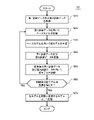
- FIG. 8 is a flowchart showing a first example of the model generation process performed by the model generation device 10.
- the training data acquisition unit 120 of the model generation device 10 reads out the training data from the training data storage unit 110 (step S10).
- This training data includes the first training data and the second training data.
- the conversion rule is not applied to the first training data and the second training data, and therefore dummy data is not added.
- the model generation unit 140 trains the model using the first training data (step S20).
- the model generated by this training is referred to as a base model.
- the number of input data values for the base model and the number of output data values from the base model are the original numbers, respectively.
- the model generation unit 140 generates a tentative model by processing the base model (step S30).
- each of the number of input data and the number of output data is the number after the conversion rule is applied.
- the tentative model is generated by, for example, the following method.
- the above-mentioned conversion rule of the first training data and the conversion rule from the intermediate data to the output data are determined according to the generation method of this provisional model.
- the value of the dummy data in the tentative model is determined by training the tentative model.
- the preprocessing unit 130 converts the first training data and the second training data according to the conversion rule (step S40). Then, the model generation unit 140 trains the tentative model using the converted first training data and the second training data (step S50). Then, it is determined whether or not the tentative model after training meets the criteria (step S60).
- This criterion includes, for example, both of the following two.
- the first criterion is to select the actual data that was not used for training from the training data storage unit 110, input the input data of the selected actual data into the temporary model, and the output data as a result and the selected actual data.
- the difference between the data corresponding to the output data and the data is less than the standard.
- the second criterion is to input the input data of abnormal data (corresponding to the second training data) that was not used for training into the tentative model, and all the values that make up the output data obtained as a result are originally.
- the output data of is within the range of possible values.
- step S60 If the provisional model after training does not meet the criteria (step S60: No), the process returns to step S20. That is, the model generation device 10 repeats the processes shown in steps S20 to S50 until the provisional model meets the criteria.
- the model generation unit 140 stores the provisional model as a formal model in the model storage unit 150 (step S70).
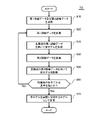
- FIG. 9 is a flowchart showing a second example of the model generation process performed by the model generation device 10.
- the example shown in this figure is an example shown in FIG. 8 except that a temporary model is generated by training the model after the first training data is converted by the conversion rule (step S22) (step S32). Is similar to.
- FIG. 10 is a flowchart showing an example of processing performed by the data processing system 20.
- the input data processing unit 230 acquires the input data.
- the input data processing unit 230 acquires the input data from the storage battery 30 (step S110) and converts the input data according to the conversion rule (step S120).
- the intermediate data generation unit 240 obtains intermediate data by inputting the converted input data into the model stored in the model storage unit 220 (step S130).
- the output data generation unit 250 generates output data by performing a predetermined operation on the intermediate data and then selecting a value at a predetermined position (step S140).
- the output data generation unit 250 outputs the output data to the display processing unit 260 (step S150).
- the display processing unit 260 causes the display 270 to display the output data.
- the output data of the model used by the data processing system 20 is different from the output data of the data processing system 20. Therefore, even if a third party obtains a plurality of combinations of input data and output data of the data processing system 20, it is difficult to estimate the model used by 20 from these combinations. Therefore, the confidentiality of this model is high.
- Model generation device 10
- Data processing system 30
- Storage battery 40
- Equipment 110
- Training data storage unit 120
- Training data acquisition unit 130
- Pre-processing unit 140
- Model generation unit 150
- Model storage unit 160
- Model transmission unit 210
- Model storage unit 230
- Input data processing Unit 240
- Intermediate data generation unit 250
- Output data generation unit 260
- Display processing unit 270 Display
Landscapes
- Engineering & Computer Science (AREA)
- Theoretical Computer Science (AREA)
- Physics & Mathematics (AREA)
- General Health & Medical Sciences (AREA)
- Computing Systems (AREA)
- Biomedical Technology (AREA)
- Biophysics (AREA)
- Computational Linguistics (AREA)
- Data Mining & Analysis (AREA)
- Evolutionary Computation (AREA)
- Life Sciences & Earth Sciences (AREA)
- Molecular Biology (AREA)
- Artificial Intelligence (AREA)
- General Engineering & Computer Science (AREA)
- General Physics & Mathematics (AREA)
- Mathematical Physics (AREA)
- Software Systems (AREA)
- Health & Medical Sciences (AREA)
- Management, Administration, Business Operations System, And Electronic Commerce (AREA)
- Debugging And Monitoring (AREA)
- Stored Programmes (AREA)
Priority Applications (3)
| Application Number | Priority Date | Filing Date | Title |
|---|---|---|---|
| CN202180064039.8A CN116235189A (zh) | 2020-10-09 | 2021-10-01 | 数据处理系统、模型生成装置、数据处理方法、模型生成方法以及程序 |
| US18/044,652 US20230316073A1 (en) | 2020-10-09 | 2021-10-01 | Data processing system, model generation device, data processing method, model generation method, and program |
| EP21877514.6A EP4227866A4 (en) | 2020-10-09 | 2021-10-01 | Data processing system, model generation device, data processing method, model generation method, and program |
Applications Claiming Priority (2)
| Application Number | Priority Date | Filing Date | Title |
|---|---|---|---|
| JP2020171188A JP2022062959A (ja) | 2020-10-09 | 2020-10-09 | データ処理システム、モデル生成装置、データ処理方法、モデル生成方法、及びプログラム |
| JP2020-171188 | 2020-10-09 |
Publications (1)
| Publication Number | Publication Date |
|---|---|
| WO2022075215A1 true WO2022075215A1 (ja) | 2022-04-14 |
Family
ID=81126861
Family Applications (1)
| Application Number | Title | Priority Date | Filing Date |
|---|---|---|---|
| PCT/JP2021/036407 Ceased WO2022075215A1 (ja) | 2020-10-09 | 2021-10-01 | データ処理システム、モデル生成装置、データ処理方法、モデル生成方法、及びプログラム |
Country Status (5)
| Country | Link |
|---|---|
| US (1) | US20230316073A1 (https=) |
| EP (1) | EP4227866A4 (https=) |
| JP (1) | JP2022062959A (https=) |
| CN (1) | CN116235189A (https=) |
| WO (1) | WO2022075215A1 (https=) |
Citations (5)
| Publication number | Priority date | Publication date | Assignee | Title |
|---|---|---|---|---|
| JP2008232758A (ja) | 2007-03-19 | 2008-10-02 | Nippon Soken Inc | 二次電池の内部状態検出装置及びニューラルネット式状態量推定装置 |
| JP2017207947A (ja) * | 2016-05-19 | 2017-11-24 | 株式会社 ディー・エヌ・エー | 対象物の類似度判定のためのプログラム、システム、及び方法 |
| US20190044918A1 (en) * | 2018-03-30 | 2019-02-07 | Intel Corporation | Ai model and data camouflaging techniques for cloud edge |
| US20200164763A1 (en) * | 2017-07-21 | 2020-05-28 | Quantumscape Corporation | Predictive model for estimating battery states |
| JP2020171188A (ja) | 2020-01-14 | 2020-10-15 | ソネディックス・ジャパン株式会社 | 太陽光発電システム、ソーラーパネル用架台、およびソーラーパネルの位置調整方法 |
Family Cites Families (3)
| Publication number | Priority date | Publication date | Assignee | Title |
|---|---|---|---|---|
| KR20170078387A (ko) * | 2015-12-29 | 2017-07-07 | 삼성전자주식회사 | 센서 관리 장치 및 방법 |
| US10776380B2 (en) * | 2016-10-21 | 2020-09-15 | Microsoft Technology Licensing, Llc | Efficient transformation program generation |
| JP6216024B1 (ja) * | 2016-11-15 | 2017-10-18 | 株式会社Preferred Networks | 学習済モデル生成方法及び信号データ判別装置 |
-
2020
- 2020-10-09 JP JP2020171188A patent/JP2022062959A/ja active Pending
-
2021
- 2021-10-01 WO PCT/JP2021/036407 patent/WO2022075215A1/ja not_active Ceased
- 2021-10-01 US US18/044,652 patent/US20230316073A1/en active Pending
- 2021-10-01 CN CN202180064039.8A patent/CN116235189A/zh not_active Withdrawn
- 2021-10-01 EP EP21877514.6A patent/EP4227866A4/en not_active Withdrawn
Patent Citations (5)
| Publication number | Priority date | Publication date | Assignee | Title |
|---|---|---|---|---|
| JP2008232758A (ja) | 2007-03-19 | 2008-10-02 | Nippon Soken Inc | 二次電池の内部状態検出装置及びニューラルネット式状態量推定装置 |
| JP2017207947A (ja) * | 2016-05-19 | 2017-11-24 | 株式会社 ディー・エヌ・エー | 対象物の類似度判定のためのプログラム、システム、及び方法 |
| US20200164763A1 (en) * | 2017-07-21 | 2020-05-28 | Quantumscape Corporation | Predictive model for estimating battery states |
| US20190044918A1 (en) * | 2018-03-30 | 2019-02-07 | Intel Corporation | Ai model and data camouflaging techniques for cloud edge |
| JP2020171188A (ja) | 2020-01-14 | 2020-10-15 | ソネディックス・ジャパン株式会社 | 太陽光発電システム、ソーラーパネル用架台、およびソーラーパネルの位置調整方法 |
Non-Patent Citations (3)
| Title |
|---|
| BLOSSER, GARY ET AL.: "MAINTAINING K-ANONYMITY ON REAL-TIME DATA", PROCEEDINGS OF THE SIXTH INTERNATIONAL CONFERENCE ON MACHINE LEARNING AND CYBERNETICS, 22 August 2007 (2007-08-22), pages 3012 - 3015, XP031154330, ISBN: 978-1-4244-0972-3, DOI: 10.1109/ ICMLC.2007.4370664 * |
| GU, ZHONGSHU ET AL.: "Reaching Data Confidentiality and Model Accountability on the CalTrain", 2019 49TH ANNUAL IEEE /IFIP INTERNATIONAL CONFERENCE ON DEPENDABLE SYSTEMS AND NETWORKS (DSN, 27 June 2019 (2019-06-27), pages 336 - 348, XP033601065, ISBN: 978-1-7281-0057-9, DOI: 10.1109/DSN.2019.00044 * |
| See also references of EP4227866A4 |
Also Published As
| Publication number | Publication date |
|---|---|
| EP4227866A1 (en) | 2023-08-16 |
| US20230316073A1 (en) | 2023-10-05 |
| JP2022062959A (ja) | 2022-04-21 |
| CN116235189A (zh) | 2023-06-06 |
| EP4227866A4 (en) | 2024-03-13 |
Similar Documents
| Publication | Publication Date | Title |
|---|---|---|
| JP7457575B2 (ja) | 劣化推定装置、モデル生成装置、劣化推定方法、モデル生成方法、及びプログラム | |
| KR102731011B1 (ko) | 배터리의 충방전 사이클에 따른 용량 변화 예측방법 및 예측시스템 | |
| Wang et al. | Modeling and state-of-charge prediction of lithium-ion battery and ultracapacitor hybrids with a co-estimator | |
| Klir | Identification of generative structures in empirical data | |
| CN111537884B (zh) | 获取动力电池寿命数据的方法、装置、计算机设备及介质 | |
| CN116298927B (zh) | 一种电池容量估计方法和装置、计算机设备、存储介质 | |
| Berben et al. | Unit root tests and asymmetric adjustment: a reassessment | |
| CN118897212A (zh) | 基于时间分解与特征融合的锂离子电池健康状态评估方法及系统 | |
| CN114663074B (zh) | 一种基于数字孪生的产品数据分析方法及系统 | |
| El-Sagheer et al. | Statistical inference for a step-stress partially accelerated life test model based on progressively type-II-censored data from Lomax distribution | |
| CN113379182B (zh) | 一种基于多维状态参数的中低压设备健康状态评估方法 | |
| WO2022102532A1 (ja) | データ処理装置、モデル生成装置、データ処理方法、モデル生成方法、及びプログラム | |
| WO2022075215A1 (ja) | データ処理システム、モデル生成装置、データ処理方法、モデル生成方法、及びプログラム | |
| WO2021210526A1 (ja) | 残容量推定装置、モデル生成装置、残容量推定方法、モデル生成方法、及びプログラム | |
| US20230394321A1 (en) | Server apparatus | |
| Haraz et al. | Hybrid Tree-Based Machine Learning Models for State-of-Charge and Core Temperature Estimation in EV Batteries | |
| CN121090967B (zh) | 智能程控模拟负载系统、非车载充电机动态效率测试方法、设备及介质 | |
| JP2025014207A (ja) | 温度分布推定装置 | |
| CN117970121A (zh) | 锂电池剩余寿命的预测方法、装置、服务器及存储介质 | |
| Zhao et al. | Building equivalent circuit models of lithium-ion battery by means of genetic programming | |
| Li et al. | A study on probability distribution models for multiple wind speeds | |
| Liu | A study on remaining useful life prediction for prognostic applications | |
| JP2024027843A (ja) | シミュレーション方法、シミュレーション装置、及びシミュレーションプログラム | |
| CN121385696A (zh) | 电芯健康状态和电池模组健康状态的预测方法及电子设备 | |
| CN119648049A (zh) | 一种项目绩效评估方法、装置、设备、产品及存储介质 |
Legal Events
| Date | Code | Title | Description |
|---|---|---|---|
| 121 | Ep: the epo has been informed by wipo that ep was designated in this application |
Ref document number: 21877514 Country of ref document: EP Kind code of ref document: A1 |
|
| NENP | Non-entry into the national phase |
Ref country code: DE |
|
| ENP | Entry into the national phase |
Ref document number: 2021877514 Country of ref document: EP Effective date: 20230509 |