WO2022065301A1 - 医療画像装置及びその作動方法 - Google Patents
医療画像装置及びその作動方法 Download PDFInfo
- Publication number
- WO2022065301A1 WO2022065301A1 PCT/JP2021/034569 JP2021034569W WO2022065301A1 WO 2022065301 A1 WO2022065301 A1 WO 2022065301A1 JP 2021034569 W JP2021034569 W JP 2021034569W WO 2022065301 A1 WO2022065301 A1 WO 2022065301A1
- Authority
- WO
- WIPO (PCT)
- Prior art keywords
- image
- display
- medical image
- medical
- result
- Prior art date
- Legal status (The legal status is an assumption and is not a legal conclusion. Google has not performed a legal analysis and makes no representation as to the accuracy of the status listed.)
- Ceased
Links
Images





Classifications
-
- A—HUMAN NECESSITIES
- A61—MEDICAL OR VETERINARY SCIENCE; HYGIENE
- A61B—DIAGNOSIS; SURGERY; IDENTIFICATION
- A61B1/00—Instruments for performing medical examinations of the interior of cavities or tubes of the body by visual or photographical inspection, e.g. endoscopes; Illuminating arrangements therefor
- A61B1/00002—Operational features of endoscopes
- A61B1/00004—Operational features of endoscopes characterised by electronic signal processing
- A61B1/00009—Operational features of endoscopes characterised by electronic signal processing of image signals during a use of endoscope
- A61B1/000094—Operational features of endoscopes characterised by electronic signal processing of image signals during a use of endoscope extracting biological structures
-
- A—HUMAN NECESSITIES
- A61—MEDICAL OR VETERINARY SCIENCE; HYGIENE
- A61B—DIAGNOSIS; SURGERY; IDENTIFICATION
- A61B1/00—Instruments for performing medical examinations of the interior of cavities or tubes of the body by visual or photographical inspection, e.g. endoscopes; Illuminating arrangements therefor
- A61B1/00002—Operational features of endoscopes
- A61B1/00004—Operational features of endoscopes characterised by electronic signal processing
- A61B1/00009—Operational features of endoscopes characterised by electronic signal processing of image signals during a use of endoscope
- A61B1/000095—Operational features of endoscopes characterised by electronic signal processing of image signals during a use of endoscope for image enhancement
-
- A—HUMAN NECESSITIES
- A61—MEDICAL OR VETERINARY SCIENCE; HYGIENE
- A61B—DIAGNOSIS; SURGERY; IDENTIFICATION
- A61B1/00—Instruments for performing medical examinations of the interior of cavities or tubes of the body by visual or photographical inspection, e.g. endoscopes; Illuminating arrangements therefor
- A61B1/00002—Operational features of endoscopes
- A61B1/00004—Operational features of endoscopes characterised by electronic signal processing
- A61B1/00009—Operational features of endoscopes characterised by electronic signal processing of image signals during a use of endoscope
- A61B1/000096—Operational features of endoscopes characterised by electronic signal processing of image signals during a use of endoscope using artificial intelligence
-
- A—HUMAN NECESSITIES
- A61—MEDICAL OR VETERINARY SCIENCE; HYGIENE
- A61B—DIAGNOSIS; SURGERY; IDENTIFICATION
- A61B1/00—Instruments for performing medical examinations of the interior of cavities or tubes of the body by visual or photographical inspection, e.g. endoscopes; Illuminating arrangements therefor
- A61B1/00002—Operational features of endoscopes
- A61B1/00043—Operational features of endoscopes provided with output arrangements
- A61B1/00045—Display arrangement
-
- A—HUMAN NECESSITIES
- A61—MEDICAL OR VETERINARY SCIENCE; HYGIENE
- A61B—DIAGNOSIS; SURGERY; IDENTIFICATION
- A61B1/00—Instruments for performing medical examinations of the interior of cavities or tubes of the body by visual or photographical inspection, e.g. endoscopes; Illuminating arrangements therefor
- A61B1/06—Instruments for performing medical examinations of the interior of cavities or tubes of the body by visual or photographical inspection, e.g. endoscopes; Illuminating arrangements therefor with illuminating arrangements
- A61B1/0638—Instruments for performing medical examinations of the interior of cavities or tubes of the body by visual or photographical inspection, e.g. endoscopes; Illuminating arrangements therefor with illuminating arrangements providing two or more wavelengths
Definitions
- the present invention relates to a medical imaging device that uses recognition processing such as AI (Artificial Intelligence) and a method of operating the same.
- recognition processing such as AI (Artificial Intelligence) and a method of operating the same.
- Patent Document 1 determines whether or not the tip of the endoscope is in the discrimination state based on whether or not the tip of the endoscope is in the stationary state, but the relationship between the image blur and the discrimination state is described. And no suggestion.
- An object of the present invention is to provide a medical imaging device capable of appropriately displaying the result of recognition processing according to the state of image blur and a method of operating the medical imaging device.
- the medical image device of the present invention sequentially acquires medical images, performs recognition processing on the medical images, and displays or hides the result of the recognition processing on the display according to the blur of the medical image. It is equipped with a processor that determines and controls the display of recognition processing according to the determination.
- the processor acquires the intermediate image feature amount from the recognition processing to the medical image until the result of the recognition processing is obtained, performs the pattern classification process for pattern-classifying the intermediate image feature amount, and performs the pattern classification process. It is preferable to determine the display or non-display of the result of the recognition process based on the result of.
- the recognition process is preferably CNN (Convolutional Neural Network).
- the pattern classification process is preferably SVM (Support Vector Machine).
- the processor performs a pixel gradient calculation process for calculating a pixel gradient from a medical image, calculates a representative value of the pixel gradient, and determines display or non-display of the result of the recognition process based on the representative value.
- the pixel gradient calculation process is preferably any one of a Sobel filter, a Laplacian filter, a Log filter, and a Canny filter.
- the representative value is preferably the total value or the average value of the pixel gradients in the medical image.
- the medical image is preferably an endoscopic image obtained by imaging the inside of the body with an endoscope.
- the processor preferably acquires an endoscopic image as a medical image from an endoscopic processor device that processes the endoscopic image.
- the processor sequentially acquires a medical image, performs a recognition process on the medical image, and displays the result of the recognition process on the display according to the blur of the medical image. It has a step of deciding to show or hide, and a step of controlling the display of the recognition process according to the decision.
- the result of the recognition process can be appropriately displayed according to the state of image blur.
- the medical imaging device 10 of the first embodiment performs recognition processing such as lesion detection or discrimination on a medical image such as an endoscopic image, and displays the result of the recognition processing.
- the medical imaging device 10 is connected to an endoscopic system 100 that acquires an endoscopic image obtained by photographing the inside of the body such as the digestive tract.
- the endoscope system 100 includes a light source device 101, an endoscope 102, an endoscope processor device 103, and a display 104.
- the light source device 101 supplies the endoscope 24 with illumination light for irradiating the inside of the subject.
- the endoscope 102 acquires an endoscope image by irradiating at least one of light in a white wavelength band or light in a specific wavelength band to photograph a subject.
- the specific wavelength band light used by the endoscope 102 for illumination light is, for example, light in a wavelength band shorter than that in the green wavelength band, particularly light in the blue band or purple band in the visible region.
- the endoscope processor device 103 sequentially acquires endoscope images from the endoscope 102, and performs various image processing on the acquired endoscope images.
- the endoscopic image subjected to various image processing is displayed on the display 104. Further, the endoscopic images before or after various image processings are transmitted from the endoscopic processor device 103 to the medical imaging device 10 for the lesion recognition processing.
- the medical image is a still image or a moving image (so-called inspection moving image).
- the frame image constituting the moving image can be acquired as a still image after the examination.
- displaying the medical image includes displaying a still image of one representative frame constituting the moving image and playing the moving image one or more times.
- the medical image includes an image taken by a doctor by operating an endoscope 102 or the like, and an image automatically taken regardless of a doctor's shooting instruction.
- the medical image device 10 can acquire a plurality of medical images, one or a plurality of the medical images can be selectively acquired. Further, the medical imaging device 10 can acquire a plurality of medical images acquired in a plurality of different examinations. For example, one or both of a medical image acquired by a past examination and a medical image acquired by the latest examination can be acquired. That is, the medical image device can arbitrarily acquire a medical image.
- the medical image device 10 includes a recognition processing processor device 11 and a display 12.
- the display 12 is provided separately from the display 104 of the endoscope system, the display 12 may be eliminated in the medical imaging device 10 and the display 104 may be used in combination.
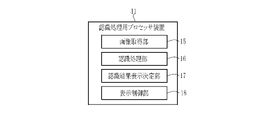
- the recognition processing processor device 11 acquires a medical image from the endoscope system 100 and performs recognition processing on the medical image. As shown in FIG. 2, the recognition processing processor device 11 includes an image acquisition unit 15, a recognition processing unit 16, a recognition result display determination unit 17, and a display control unit 18. The image acquisition unit 15 sequentially acquires medical images transmitted from the endoscope processor device 103 of the endoscope system 100.
- the recognition processing processor device 11 programs related to various processing are incorporated in a program memory (not shown).
- the recognition processing processor device 11 is provided with a central control unit (not shown) configured by the processor.
- the central control unit executes the program in the program memory, the functions of the image acquisition unit 15, the recognition processing unit 16, the recognition result display determination unit 17, and the display control unit 18 are realized.
- the recognition processing unit 16 performs recognition processing on the medical image.
- the recognition process includes a region detection process for detecting a region of interest ROI such as a lesion from a medical image, and a process for discriminating the ROI of interest such as the type and stage of the lesion.
- the recognition result display determination unit 17 decides to display or hide the result of the recognition process on the display 12 according to the blur of the medical image. The details of the recognition result display determination unit 17 will be described later.
- the display control unit 18 controls the display of the recognition process according to the determination in the recognition result display determination unit 17.
- the differentiation process may be performed by segmenting the entire image, or may be performed by performing the classification process only on the region detected as a lesion.
- the blur of the medical image includes not only the blurring of the endoscope but also the blurring caused by the movement of the body such as the large intestine.
- the region of interest is detected as the region of interest.
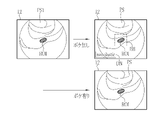
- the banding box BB indicating that the ROI has been detected and the lesion type DN (neoplastic) indicated by the region of interest RO as a differentiation result are displayed on the display 12.
- the recognition process of this embodiment is preferably a machine learning process used in the machine learning completed learning model.
- the machine learning process it is preferable to use NN (Neural Network), Adaboost, or random forest in addition to CNN (Convolutional Neural Network). That is, in the recognition process, it is preferable to output the area detection result and / or the discrimination result with respect to the input of the medical image. Further, as the recognition process, the region of interest may be detected based on the feature amount obtained from the color information of the medical image, the gradient of the pixel value, and the like.
- the gradient of the pixel value is, for example, the shape (global undulation of the mucous membrane or local depression or ridge, etc.) and color (color such as whitening due to inflammation, bleeding, redness, or atrophy) of the subject. Changes appear depending on the characteristics of the tissue (thickness, depth, density of blood vessels, or a combination thereof, etc.) or the characteristics of the structure (pit pattern, etc.).
- the areas of interest detected by the recognition process are, for example, lesions represented by cancer, traces of treatment, traces of surgery, bleeding sites, benign tumors, and inflamed areas (in addition to so-called inflammation, bleeding or atrophy, etc.).
- the cognitive process detects a region of interest that includes at least one of a lesion, a trace of treatment, a trace of surgery, a bleeding site, a benign tumor, an inflamed area, a marking area, or a biopsy site.
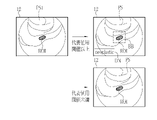
- the recognition result display determination unit 17 decides to display or hide the result of the recognition process on the display 12 according to the blur of the medical image. This makes it possible to control the display or non-display of the recognition processing result because the recognition processing result may not be accurate depending on the blur of the medical image. For example, in FIG. 3, when the medical image PS has little blur, the correct answer “neoplastic” is obtained as a result of the recognition process. In this case, the result of the recognition process “neoplastic” is displayed. On the other hand, when the medical image PS has a lot of blur and the ROI of the region of interest is unclear, an incorrect "hyperplastic” is obtained as a result of the recognition process. In this case, if the incorrect answer "hyperplastic" is displayed on the display 12 as it is, incorrect information will be given to the user. Therefore, in the present embodiment, the result of the recognition process is displayed or hidden according to the blur of the medical image.
- the recognition result display determination unit 17 includes an intermediate image feature amount acquisition unit 20, a pattern classification unit 21, and a first determination unit 22.
- the intermediate image feature amount acquisition unit 20 acquires an intermediate image feature amount from the recognition processing to the medical image until the result of the recognition processing is obtained.
- the recognition process is CNN (Convolutional Neural Network)
- the recognition process unit 16 has a first convolution process, a second convolution process, ..., Nth convolution process (N is a natural number).
- N is a natural number
- a medical image having a vertical pixel count of X1 and a horizontal pixel count of Y1 is subjected to a convolution process based on a specific kernel, so that the number of vertical pixels is X2 ( ⁇ X1).
- a first intermediate image feature amount having a horizontal pixel count of Y2 ( ⁇ Y1) can be obtained.
- the number of vertical pixels is X3 ( ⁇ X2) and the number of horizontal pixels is Y3 ( ⁇ Y2) by performing the convolution process based on a specific kernel for the second intermediate image feature amount.
- the second intermediate image feature amount is obtained.
- the first to Nth intermediate image feature amounts are calculated by performing the Nth convolution process.
- the recognition processing unit 16 outputs the result of the recognition processing based on the Nth intermediate image feature amount.
- the intermediate image feature amount acquisition unit 20 uses any of the first to Nth intermediate image feature amounts or the combined feature amount obtained by weighting the first to Nth intermediate image feature amounts as the intermediate image feature amount. get.
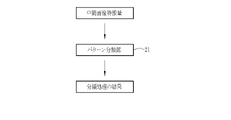
- the pattern classification unit 21 performs pattern classification processing for pattern classification with respect to the intermediate image feature amount.
- the pattern classification process for example, it is preferable to use SVM (Support Vector Machine).
- SVM Small Vector Machine
- the result of the classification process including two intermediate image feature quantities, a pattern showing the feature of the image blur and a pattern showing the feature of the image blur, can be obtained.
- the first determination unit 22 determines whether to display or hide the result of the recognition process based on the result of the classification process. As shown in FIG. 7, when the intermediate feature amount of the pattern showing the feature of image blur is less than the threshold value for the first feature amount, or the intermediate feature amount of the pattern showing the feature of image blur is for the second feature amount. If it is equal to or more than the threshold value, the first determination unit 22 determines that there is no blur, and the display control unit 18 displays the banding box BB which is the result of the recognition process and / or the name DN of the lesion which is the differentiation result. Display on.
- the intermediate feature amount of the pattern showing the feature of image blur is equal to or more than the threshold value for the first feature amount, or when the intermediate feature amount of the pattern showing the feature of image blur is less than the threshold value for the second feature amount.
- the first determination unit 22 determines that there is a blur, and the display control unit 18 hides the banding box BB and / or the name DN of the lesion. It is preferable to display the original medical image to which the recognition process has been performed, regardless of whether the result of the recognition process is displayed or not.
- the image acquisition unit 15 sequentially acquires medical images from the endoscope processor device 103.
- the recognition processing unit 16 performs recognition processing on the medical image.
- the recognition result display determination unit 17 decides to display or hide the result of the recognition process on the display 12 according to the blur of the medical image.
- the recognition result display determination unit 17 decides to display the result of the recognition process
- the result of the recognition process is displayed on the display 12.
- the recognition result display determination unit 17 decides to hide the recognition processing result, the recognition processing result is not displayed on the display 12.
- the result of the recognition process is not correct due to the blurring of the image, the result of the recognition process is not displayed on the display 12, so that there is no possibility of giving erroneous information to the user.
- the display control of the result of the recognition process is repeatedly performed while the recognition process continues to be executed.
- the display of the result of the recognition process is controlled by using the pixel gradient of the medical image or the like. Since it is the same as the first embodiment except for the part related to the display of the result of the recognition process, it will be omitted.
- the recognition result display determination unit 30 different from the recognition result display determination unit 17 of the first embodiment is provided in the recognition processing processor device 11. As shown in FIG. 9, the recognition result display determination unit 30 includes a pixel gradient calculation unit 31, a representative value calculation unit 32, and a second determination unit 33.
- the pixel gradient calculation unit 31 performs a pixel gradient calculation process for calculating a pixel gradient from a medical image.
- the pixel gradient calculation process include a Sobel filter (extracting the contour using the first derivative), a Laplacian filter (extracting the contour using the second derivative), and a Log filter (enhancing the contour by logarithmization). It is preferably one of the Canny filters (which suppresses the enhancement and extraction of noise by performing a smoothing process before the differential process).
- Pixel gradient data is obtained by the pixel gradient calculation process. In the pixel gradient data, the pixels in the contour portion of the region of interest ROI have a relatively large pixel gradient, while the portion other than the contour has a relatively small pixel gradient.
- the representative value calculation unit 32 calculates the representative value of the pixel gradient.
- the representative value is preferably the sum of the pixel gradients in the medical image or the average value.
- the representative value calculated by the representative value calculation unit 32 is a value representing the pixel gradient of the region of interest ROI. For example, when the lower the image blur and the higher the representative value, the higher the representative value, the less the image blur, and the clearer the ROI of the region of interest, while the lower the representative value, the more the image blur. Therefore, it is shown that the region of interest ROI is unclear.
- the second determination unit 33 determines display or non-display of the result of the recognition process based on the representative value calculated by the representative value calculation unit 32. For example, when the image blur is lower and the representative value is higher, as shown in FIG. 11, when the representative value is equal to or higher than the representative value threshold value, the second determination unit 33 determines that there is no blur. , The display control unit 18 displays the banding box BB as a result of the recognition process and / or the name DN of the lesion as a differentiation result on the display 12. On the other hand, when the representative value is less than the threshold value for the representative value, the second determination unit 33 determines that there is blur, and the display control unit 18 hides the banding box BB and / or the name DN of the lesion. ..
- a white band light or a normal light image obtained by irradiating light of a plurality of wavelength bands as white band light can be used.
- a band narrower than the white wavelength band can be used as the specific wavelength band.
- the specific wavelength band is, for example, the blue band or the green band in the visible range.
- the specific wavelength band When a specific wavelength band is a visible blue band or a green band, the specific wavelength band includes a wavelength band of 390 nm or more and 450 nm or less or 530 nm or more and 550 nm or less, and light in the specific wavelength band is 390 nm or more. It is preferable to have a peak wavelength in the wavelength band of 450 nm or less or 530 nm or more and 550 nm or less.
- the specific wavelength band is, for example, the red band in the visible range.
- the specific wavelength band is the red band in the visible region
- the specific wavelength band includes a wavelength band of 585 nm or more and 615 nm or 610 nm or more and 730 nm or less, and the light of the specific wavelength band is 585 nm or more and 615 nm or less or 610 nm. It is preferable to have a peak wavelength in the wavelength band of 730 nm or less.
- the specific wavelength band includes, for example, a wavelength band in which the absorption coefficient differs between the oxidized hemoglobin and the reduced hemoglobin, and the light in the specific wavelength band has a peak wavelength in the wavelength band in which the absorption coefficient differs between the oxidized hemoglobin and the reduced hemoglobin. Can have.
- a specific wavelength band includes a wavelength band having different absorption coefficients between oxidized hemoglobin and reduced hemoglobin, and light in a specific wavelength band has a peak wavelength in a wavelength band having different absorption coefficients between oxidized hemoglobin and reduced hemoglobin.
- the specific wavelength band includes 400 ⁇ 10 nm, 440 ⁇ 10 nm, 470 ⁇ 10 nm, or 600 nm or more and 750 nm or less, and the light in the specific wavelength band is 400 ⁇ 10 nm, 440 ⁇ 10 nm. It is preferable to have a peak wavelength in a wavelength band of 470 ⁇ 10 nm or 600 nm or more and 750 nm or less.
- this in-vivo image can have information on fluorescence emitted by a fluorescent substance in the living body.
- fluorescence fluorescence obtained by irradiating the living body with excitation light having a peak wavelength of 390 nm or more and 470 nm or less can be used.
- the wavelength band of infrared light can be used as the above-mentioned specific wavelength band.
- the specific wavelength band is a wavelength band of 790 nm or more and 820 nm or 905 nm or more and 970 nm or less. It is preferable that the light having a wavelength band of 790 nm or more and 820 nm or less or 905 nm or more and 970 nm or less has a peak wavelength.
- the medical imaging device acquires a special light image having a signal in a specific wavelength band based on a normal light image obtained by irradiating light in a white band or light in a plurality of wavelength bands as light in the white band. It can have an image acquisition unit. In this case, a special optical image can be used as a medical image.
- a signal in a specific wavelength band can be obtained by calculation based on RGB or CMY color information included in a normal optical image.
- a feature amount image generation unit for generating a feature amount image can be provided.
- the feature amount image can be used as the medical image.
- a capsule endoscope can be used as the endoscope 102.
- the light source device 101 and a part of the endoscope processor device 103 can be mounted on the capsule endoscope.
- the hardware-like structures of the processing unit that executes various processes such as the result display determination unit 30, the pixel gradient calculation unit 31, the representative value calculation unit 32, and the second determination unit 33 are as shown below. Processor.
- the circuit configuration is changed after manufacturing CPU (Central Processing Unit), FPGA (Field Programmable Gate Array), etc., which are general-purpose processors that execute software (programs) and function as various processing units.
- PLD Programmable Logic Device
- dedicated electric circuit which is a processor with a circuit configuration designed exclusively for executing various processes, and a large amount of processing such as image processing in parallel.
- the GPU Graphic Processing Unit
- One processing unit may be composed of one of these various processors, or a combination of two or more processors of the same type or different types (for example, a plurality of FPGAs, a combination of a CPU and an FPGA, or a CPU and a combination of two or more processors. It may be composed of a combination of GPUs). Further, a plurality of processing units may be configured by one processor. As an example of configuring a plurality of processing units with one processor, first, as represented by a computer such as a client or a server, one processor is configured by a combination of one or more CPUs and software. There is a form in which this processor functions as a plurality of processing units.
- SoC System On Chip
- the various processing units are configured by using one or more of the above-mentioned various processors as a hardware-like structure.
- the hardware-like structure of these various processors is, more specifically, an electric circuit (circuitry) in which circuit elements such as semiconductor elements are combined.
Landscapes
- Health & Medical Sciences (AREA)
- Life Sciences & Earth Sciences (AREA)
- Engineering & Computer Science (AREA)
- Surgery (AREA)
- Medical Informatics (AREA)
- Radiology & Medical Imaging (AREA)
- Biomedical Technology (AREA)
- Veterinary Medicine (AREA)
- Biophysics (AREA)
- Nuclear Medicine, Radiotherapy & Molecular Imaging (AREA)
- Optics & Photonics (AREA)
- Pathology (AREA)
- Public Health (AREA)
- General Health & Medical Sciences (AREA)
- Physics & Mathematics (AREA)
- Heart & Thoracic Surgery (AREA)
- Molecular Biology (AREA)
- Animal Behavior & Ethology (AREA)
- Signal Processing (AREA)
- Artificial Intelligence (AREA)
- Evolutionary Computation (AREA)
- Endoscopes (AREA)
- Image Processing (AREA)
- Image Analysis (AREA)
Priority Applications (2)
| Application Number | Priority Date | Filing Date | Title |
|---|---|---|---|
| JP2022551994A JP7478245B2 (ja) | 2020-09-24 | 2021-09-21 | 医療画像装置及びその作動方法 |
| US18/185,833 US12484759B2 (en) | 2020-09-24 | 2023-03-17 | Medical imaging apparatus and operating method for same |
Applications Claiming Priority (2)
| Application Number | Priority Date | Filing Date | Title |
|---|---|---|---|
| JP2020-159622 | 2020-09-24 | ||
| JP2020159622 | 2020-09-24 |
Related Child Applications (1)
| Application Number | Title | Priority Date | Filing Date |
|---|---|---|---|
| US18/185,833 Continuation US12484759B2 (en) | 2020-09-24 | 2023-03-17 | Medical imaging apparatus and operating method for same |
Publications (1)
| Publication Number | Publication Date |
|---|---|
| WO2022065301A1 true WO2022065301A1 (ja) | 2022-03-31 |
Family
ID=80845465
Family Applications (1)
| Application Number | Title | Priority Date | Filing Date |
|---|---|---|---|
| PCT/JP2021/034569 Ceased WO2022065301A1 (ja) | 2020-09-24 | 2021-09-21 | 医療画像装置及びその作動方法 |
Country Status (3)
| Country | Link |
|---|---|
| US (1) | US12484759B2 (https=) |
| JP (1) | JP7478245B2 (https=) |
| WO (1) | WO2022065301A1 (https=) |
Families Citing this family (1)
| Publication number | Priority date | Publication date | Assignee | Title |
|---|---|---|---|---|
| WO2025254441A1 (en) * | 2024-06-05 | 2025-12-11 | Samsung Electronics Co., Ltd. | Enhancing ai-based in-loop filtering for electronic device |
Citations (5)
| Publication number | Priority date | Publication date | Assignee | Title |
|---|---|---|---|---|
| WO2019087791A1 (ja) * | 2017-10-31 | 2019-05-09 | 富士フイルム株式会社 | 診断支援装置、内視鏡装置、管理装置、診断支援方法、管理方法、診断支援プログラム、及び管理プログラム |
| WO2019123986A1 (ja) * | 2017-12-22 | 2019-06-27 | 富士フイルム株式会社 | 医療画像処理装置及び方法、内視鏡システム、プロセッサ装置、診断支援装置並びにプログラム |
| WO2020036224A1 (ja) * | 2018-08-17 | 2020-02-20 | 富士フイルム株式会社 | 内視鏡システム |
| WO2020036121A1 (ja) * | 2018-08-17 | 2020-02-20 | 富士フイルム株式会社 | 内視鏡システム |
| WO2020054543A1 (ja) * | 2018-09-11 | 2020-03-19 | 富士フイルム株式会社 | 医療画像処理装置及び方法、内視鏡システム、プロセッサ装置、診断支援装置並びにプログラム |
Family Cites Families (2)
| Publication number | Priority date | Publication date | Assignee | Title |
|---|---|---|---|---|
| CN102498501B (zh) * | 2009-09-18 | 2015-05-20 | 皇家飞利浦电子股份有限公司 | 用于确定模糊图像中模糊的性质的系统和方法 |
| CN110049709B (zh) | 2016-12-07 | 2022-01-11 | 奥林巴斯株式会社 | 图像处理装置 |
-
2021
- 2021-09-21 WO PCT/JP2021/034569 patent/WO2022065301A1/ja not_active Ceased
- 2021-09-21 JP JP2022551994A patent/JP7478245B2/ja active Active
-
2023
- 2023-03-17 US US18/185,833 patent/US12484759B2/en active Active
Patent Citations (5)
| Publication number | Priority date | Publication date | Assignee | Title |
|---|---|---|---|---|
| WO2019087791A1 (ja) * | 2017-10-31 | 2019-05-09 | 富士フイルム株式会社 | 診断支援装置、内視鏡装置、管理装置、診断支援方法、管理方法、診断支援プログラム、及び管理プログラム |
| WO2019123986A1 (ja) * | 2017-12-22 | 2019-06-27 | 富士フイルム株式会社 | 医療画像処理装置及び方法、内視鏡システム、プロセッサ装置、診断支援装置並びにプログラム |
| WO2020036224A1 (ja) * | 2018-08-17 | 2020-02-20 | 富士フイルム株式会社 | 内視鏡システム |
| WO2020036121A1 (ja) * | 2018-08-17 | 2020-02-20 | 富士フイルム株式会社 | 内視鏡システム |
| WO2020054543A1 (ja) * | 2018-09-11 | 2020-03-19 | 富士フイルム株式会社 | 医療画像処理装置及び方法、内視鏡システム、プロセッサ装置、診断支援装置並びにプログラム |
Also Published As
| Publication number | Publication date |
|---|---|
| JP7478245B2 (ja) | 2024-05-02 |
| US20230210349A1 (en) | 2023-07-06 |
| US12484759B2 (en) | 2025-12-02 |
| JPWO2022065301A1 (https=) | 2022-03-31 |
Similar Documents
| Publication | Publication Date | Title |
|---|---|---|
| US12124960B2 (en) | Learning apparatus and learning method | |
| CN114298980A (zh) | 一种图像处理方法、装置及设备 | |
| JP2023087014A (ja) | 内視鏡システム及び内視鏡システムの作動方法 | |
| CN112512398B (zh) | 医疗图像处理装置 | |
| WO2020017212A1 (ja) | 内視鏡システム | |
| CN112584741B (zh) | 医疗图像处理系统 | |
| JP6834019B2 (ja) | 医療画像処理装置、及び、内視鏡装置 | |
| US8351667B2 (en) | Methods of contrast enhancement for images having blood vessel structures | |
| JP6936401B2 (ja) | 医療画像処理システム | |
| CN112584739B (zh) | 医疗图像处理系统 | |
| JP2023519489A (ja) | 対応する補助画像内で識別される制限情報領域で処理された発光画像を用いた医療処置の支援 | |
| US11867896B2 (en) | Endoscope system and medical image processing system | |
| CN116205814A (zh) | 医用内窥镜图像增强方法、系统及计算机设备 | |
| US11830185B2 (en) | Medical image processing system and learning method | |
| US12484759B2 (en) | Medical imaging apparatus and operating method for same | |
| JP7774610B2 (ja) | 医療画像処理装置、内視鏡システム、医療画像処理方法、医療画像処理プログラム、及び記録媒体 | |
| EP4189643B1 (en) | Processing of multiple luminescence images globally for their mapping and/or segmentation | |
| EP4136616B1 (en) | Verification of segmentation of luminescence images limited to analysis regions thereof | |
| JPWO2022065301A5 (https=) | ||
| JP2026010580A (ja) | 制御装置、内視鏡システム、制御装置の動作方法、及びプログラム | |
| JP2023011303A (ja) | 医療画像処理装置及びその作動方法 |
Legal Events
| Date | Code | Title | Description |
|---|---|---|---|
| 121 | Ep: the epo has been informed by wipo that ep was designated in this application |
Ref document number: 21872430 Country of ref document: EP Kind code of ref document: A1 |
|
| ENP | Entry into the national phase |
Ref document number: 2022551994 Country of ref document: JP Kind code of ref document: A |
|
| NENP | Non-entry into the national phase |
Ref country code: DE |
|
| 122 | Ep: pct application non-entry in european phase |
Ref document number: 21872430 Country of ref document: EP Kind code of ref document: A1 |