WO2022038929A1 - 情報処理方法、プログラム、及び、音響再生装置 - Google Patents
情報処理方法、プログラム、及び、音響再生装置 Download PDFInfo
- Publication number
- WO2022038929A1 WO2022038929A1 PCT/JP2021/026585 JP2021026585W WO2022038929A1 WO 2022038929 A1 WO2022038929 A1 WO 2022038929A1 JP 2021026585 W JP2021026585 W JP 2021026585W WO 2022038929 A1 WO2022038929 A1 WO 2022038929A1
- Authority
- WO
- WIPO (PCT)
- Prior art keywords
- sound
- predetermined
- filter
- predetermined direction
- fluctuation
- Prior art date
- Legal status (The legal status is an assumption and is not a legal conclusion. Google has not performed a legal analysis and makes no representation as to the accuracy of the status listed.)
- Ceased
Links
Images





Classifications
-
- H—ELECTRICITY
- H04—ELECTRIC COMMUNICATION TECHNIQUE
- H04S—STEREOPHONIC SYSTEMS
- H04S7/00—Indicating arrangements; Control arrangements, e.g. balance control
- H04S7/30—Control circuits for electronic adaptation of the sound field
- H04S7/302—Electronic adaptation of stereophonic sound system to listener position or orientation
- H04S7/303—Tracking of listener position or orientation
- H04S7/304—For headphones
-
- H—ELECTRICITY
- H04—ELECTRIC COMMUNICATION TECHNIQUE
- H04S—STEREOPHONIC SYSTEMS
- H04S7/00—Indicating arrangements; Control arrangements, e.g. balance control
- H04S7/30—Control circuits for electronic adaptation of the sound field
-
- H—ELECTRICITY
- H04—ELECTRIC COMMUNICATION TECHNIQUE
- H04S—STEREOPHONIC SYSTEMS
- H04S2400/00—Details of stereophonic systems covered by H04S but not provided for in its groups
- H04S2400/11—Positioning of individual sound objects, e.g. moving airplane, within a sound field
-
- H—ELECTRICITY
- H04—ELECTRIC COMMUNICATION TECHNIQUE
- H04S—STEREOPHONIC SYSTEMS
- H04S2420/00—Techniques used stereophonic systems covered by H04S but not provided for in its groups
- H04S2420/01—Enhancing the perception of the sound image or of the spatial distribution using head related transfer functions [HRTF's] or equivalents thereof, e.g. interaural time difference [ITD] or interaural level difference [ILD]
Definitions
- This disclosure relates to an audio reproduction device and an information processing method and program related to the sound reproduction device.
- the information processing method is an arrival direction on a three-dimensional sound field corresponding to the predetermined direction from sound information including information on a predetermined sound and information on a predetermined direction at each time point on the time axis. It is an information processing method for generating an output sound signal for the user to perceive the predetermined sound as a sound coming from the user in time series, and calculates the amount of angle of fluctuation in the predetermined direction on the time axis.
- a selection is made from among the three-dimensional acoustic filters, information about the predetermined sound is input to the selected three-dimensional acoustic filter to generate the output signal, and in the selection of the three-dimensional acoustic filter, the calculated variation in the predetermined direction is performed.
- the amount of angle of the predetermined sound is smaller than the threshold value
- the stereoscopic acoustic filter is selected so that the predetermined sound is emphasized and perceived by the user as compared with the case where the amount of fluctuation in the predetermined direction is equal to or larger than the threshold value. do.
- the sound reproduction device is on a three-dimensional sound field corresponding to the predetermined direction from sound information including information on a predetermined sound and information on a predetermined direction at each time point on the time axis.
- An acoustic reproduction device that generates and reproduces an output sound signal for allowing the user to perceive the predetermined sound as a sound arriving from the arrival direction, the acquisition unit for acquiring the sound information, and the predetermined sound on the time axis.
- a plurality of candidate three-dimensional acoustic filters that calculate the amount of angle of variation in the direction and perceive the input input sound as the sound from the arrival direction based on the information regarding the predetermined direction.
- a filter selection unit that selects from a plurality of three-dimensional acoustic filters prepared for each arrival direction, and information about the predetermined sound is input to the selected three-dimensional acoustic filter as the input sound, and the output sound signal.
- the filter selection unit includes an output sound generation unit that generates a sound, and an output unit that outputs a sound based on the generated output sound signal.
- the stereoscopic sound filter is selected so that the predetermined sound is emphasized and perceived by the user as compared with the case where the angle amount of the fluctuation in the predetermined direction is equal to or larger than the threshold value.
- one aspect of the present disclosure can also be realized as a program for causing a computer to execute the sound reproduction method described above.
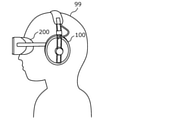
- FIG. 1 is a schematic diagram showing a use case of the sound reproduction device according to the embodiment.
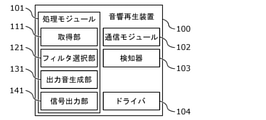
- FIG. 2 is a block diagram showing a functional configuration of the sound reproduction device according to the embodiment.
- FIG. 3 is a block diagram showing a functional configuration of the acquisition unit according to the embodiment.
- FIG. 4 is a block diagram showing a functional configuration of the filter selection unit according to the embodiment.
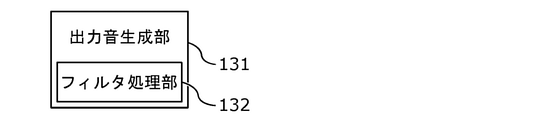
- FIG. 5 is a block diagram showing a functional configuration of the output sound generation unit according to the embodiment.
- FIG. 6 is a flowchart showing the operation of the sound reproduction device according to the embodiment.
- FIG. 7 is a diagram illustrating the arrival direction of a predetermined sound by the selected stereophonic filter according to the embodiment.
- FIG. 8 is a second diagram illustrating an arrival direction of a predetermined sound by the selected stereophonic filter according to the embodiment.
- FIG. 9 is a third diagram illustrating an arrival direction of a predetermined sound by the selected stereophonic filter according to the embodiment.
- a process of convolving a head-related transfer function for perceiving it as a sound arriving from a predetermined direction with a signal of a target sound is known.
- the realistic sensation experienced by the user is improved.
- it is known that in the convolution of the head-related transfer function it is difficult to perceive fluctuations in the time domain in the direction of arrival of sound. For this reason, the user may mistakenly perceive that the sound does not change even if the sound has a slight change in the time domain.
- the present disclosure in view of the above, while utilizing a stereophonic filter for allowing the user to perceive the sound as a sound from a predetermined direction in the three-dimensional sound field, the easiness of perceiving a sound with a slight fluctuation in the time domain is improved. Rather, carry out appropriate calculation processing. It is an object of the present disclosure to provide an information processing method or the like that allows a user to perceive a three-dimensional sound by this appropriate calculation process.
- the information processing method is a three-dimensional sound corresponding to a predetermined direction from sound information including information on a predetermined sound and information on a predetermined direction at each time point on the time axis. It is an information processing method that generates an output sound signal for the user to perceive a predetermined sound as a sound arriving from the arrival direction on the field in chronological order.
- the calculated angle amount of fluctuation in the predetermined direction is calculated.
- the stereoscopic sound filter is selected so that the predetermined sound is emphasized and perceived by the user as compared with the case where the angle amount of fluctuation in the predetermined direction is equal to or larger than the threshold value.
- the predetermined sound when the calculated angle amount of fluctuation in a predetermined direction is smaller than the threshold value, that is, the fluctuation is minute so that it is difficult for the user to perceive the fluctuation in the arrival direction.
- the predetermined sound can be emphasized and perceived by the user. Since the user's attention is directed to the predetermined sound, it is possible to make the user more appropriately perceive a minute change in the arrival direction of the predetermined sound.
- the stereophonic filter when the calculated angle amount of fluctuation in a predetermined direction is smaller than the threshold value, the direction of arrival perceived by the output sound signal when the selected stereophonic filter is used.
- the amount of variation angle is greater than the amount of variation perceived by the output sound signal when using the stereophonic filter selected when the calculated amount of variation in the predetermined direction is greater than or equal to the threshold.
- the stereophonic filter may be selected so as to be large.
- the stereophonic filter selected when the fluctuation angle amount is equal to or larger than the threshold value with respect to the predetermined sound that is, the output sound so as to be the fluctuation angle amount preset in the content.
- the stereophonic filter can be selected so that the amount of fluctuation is large.
- the output sound signal emphasizes and perceives the predetermined sound by expanding the amount of fluctuation angle.
- the stereophonic filter in the selection of a stereophonic filter, the smaller the calculated angle amount of fluctuation in a predetermined direction, the greater the angle amount of variation in the arrival direction perceived by the output sound signal when the selected stereophonic filter is used.
- the stereophonic filter may be selected so that
- the stereophonic filter selected when the fluctuation angle amount is equal to or larger than the threshold value with respect to the predetermined sound that is, the output sound so as to be the fluctuation angle amount preset in the content.
- the stereophonic filter can be selected so that the amount of fluctuation is large.
- the output sound signal emphasizes and perceives the predetermined sound by expanding the amount of fluctuation angle.
- the smaller the amount of fluctuation in the sound information the larger the amount of fluctuation in the sound in the output sound signal. It is emphasized and presented to the user to make it more perceptible.
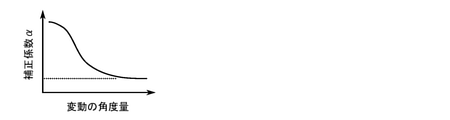
- the smaller the angle amount of fluctuation in the predetermined direction on the sound information the more the numerical value.
- the expansion coefficient ⁇ ( ⁇ > 1), the amount of variation in the arrival direction on the time axis of the output sound signal is expanded, and the relationship between the amount of variation in the predetermined direction and the expansion coefficient ⁇ . May be non-linear.
- the expansion coefficient ⁇ By multiplying by the expansion coefficient ⁇ , the relationship between the amount of fluctuation in the predetermined direction and the arrival direction of the predetermined sound in the output sound information becomes non-linear, and it is possible to emphasize the emphasis effect as the fluctuation is smaller. It becomes.
- a predetermined direction is on the front side of the boundary surface with respect to a virtual boundary surface that divides the user's head into front and back, and the calculated angle of fluctuation in the predetermined direction is obtained.
- the predetermined direction is on the rear surface side of the boundary surface and is calculated from the angle amount of the fluctuation of the arrival direction on the time axis when the selected stereophonic filter is used.
- the stereophonic filter is selected so that the angle amount of fluctuation in the arrival direction on the time axis when the selected stereophonic filter is used is larger. May be good.
- the emphasis effect can be made larger on the rear surface side of the boundary surface where it is difficult to detect the fluctuation in the arrival direction than on the front surface side of the boundary surface.
- the arrival direction perceived by the output sound signal when the selected stereophonic filter is used vibrates on the time axis as compared with the predetermined direction on the sound information.
- a stereophonic filter may be selected.
- a predetermined sound whose arrival direction vibrates can be presented to the user. Since the arrival direction vibrates on the time axis, the user can more easily perceive the predetermined sound as compared with other sounds, so that there is an effect that the fluctuation of the predetermined sound is more easily perceived.
- the arrival direction at the time point of the Nth (N is an integer of 2 or more) on the time axis of the output sound signal is the third on the time axis of the output sound signal.
- N-1 Vibration in which the numerical value vibrates on the time axis with respect to the difference value between the predetermined direction on the sound information corresponding to the Nth time point and the predetermined direction on the sound information corresponding to the Nth time point. It may be calculated by multiplying the numerical value of the corresponding time point in the function and adding the difference value after the multiplication in the predetermined direction on the sound information corresponding to the (N-1) th time point.
- a predetermined sound whose arrival direction vibrates can be presented to the user. Since the arrival direction vibrates on the time axis, the user can more easily perceive the predetermined sound as compared with other sounds, so that there is an effect that the fluctuation of the predetermined sound is more easily perceived.
- a stereophonic filter when the calculated angle amount of fluctuation in a predetermined direction is smaller than the threshold value, it is on the time axis perceived by the output sound signal when the selected stereophonic filter is used.
- the amount of change in the sound pressure of the predetermined sound is the predetermined sound perceived by the output sound signal when the stereophonic filter selected when the calculated angle amount of fluctuation in the predetermined direction is equal to or greater than the threshold value.
- the stereophonic filter may be selected so as to be larger than the amount of change in sound pressure.
- the stereophonic filter selected when the fluctuation angle amount is equal to or larger than the threshold value with respect to the predetermined sound that is, the output sound so as to be the fluctuation angle amount preset in the content.
- the stereophonic filter can be selected so that the amount of change in sound pressure is large.
- the output sound signal enhances and perceives the predetermined sound by expanding the amount of change in sound pressure.
- the predetermined sound is timed as the sound arriving from the arrival direction on the three-dimensional sound field corresponding to the predetermined direction. It is an information processing method that generates an output sound signal to be perceived by the user along the sequence.
- the amount of fluctuation in a predetermined direction on the time axis is calculated, and the calculated amount of fluctuation in the predetermined direction is calculated.
- the information about the predetermined sound is corrected so that the user perceives the predetermined sound by emphasizing the predetermined sound more than when the angle amount of the fluctuation in the predetermined direction is equal to or larger than the threshold value.
- a plurality of candidate stereophonic filters which are input to the stereophonic filter selected based on the information regarding the corrected predetermined direction from among the plurality of stereophonic filters prepared for each arrival direction, and the output signal. May be generated.
- the predetermined sound when the calculated angle amount of the fluctuation in the predetermined direction is smaller than the threshold value, that is, the predetermined sound having a minute fluctuation that makes it difficult for the user to perceive the fluctuation in the arrival direction is included. If this is the case, the predetermined sound can be emphasized and perceived by the user.
- the stereophonic filter selected thereafter by correcting the information regarding the predetermined direction included in the sound information, the stereophonic filter selected thereafter can be made to be a stereophonic filter for emphasizing the predetermined sound and making the user perceive it. ..
- the user's attention is directed to the predetermined sound, it is possible to make the user more appropriately perceive a minute change in the arrival direction of the predetermined sound.
- program according to one aspect of the present disclosure is a program for causing a computer to execute the information processing method described above.
- the sound reproduction device arrives on a three-dimensional sound field corresponding to a predetermined direction from sound information including information on a predetermined sound and information on a predetermined direction at each time point on the time axis. It is an acoustic reproduction device that generates and reproduces an output sound signal for allowing the user to perceive a predetermined sound as a sound coming from a direction.
- a plurality of candidate three-dimensional acoustic filters that calculate the amount of angle and perceive the input sound as sound from the arrival direction based on the information about the predetermined direction are prepared for each arrival direction.
- a filter selection unit that selects from a plurality of three-dimensional acoustic filters that have been created, and an output sound generation unit that generates an output sound signal by inputting information about a predetermined sound into the selected three-dimensional acoustic filter as an input sound.
- the filter selection unit includes an output unit that outputs a sound based on the output sound signal, and the filter selection unit has a fluctuation angle amount in the predetermined direction equal to or larger than the threshold value when the calculated fluctuation angle amount in the predetermined direction is smaller than the threshold value.
- the stereophonic filter is selected so that the user perceives the predetermined sound with more emphasis than in the case of.
- ordinal numbers such as 1, 2, and 3 may be attached to the elements. These ordsinal numbers are attached to the elements to identify them and do not necessarily correspond to a meaningful order. These ordinals may be replaced, newly added, or removed as appropriate.
- FIG. 1 is a schematic diagram showing a use case of the sound reproduction device according to the embodiment.
- FIG. 1 shows a user 99 who uses the sound reproduction device 100.
- the sound reproduction device 100 shown in FIG. 1 is used at the same time as the stereoscopic image reproduction device 200.
- the image enhances the auditory sense of presence and the sound enhances the visual sense of presence, as if you were in the scene where the image and sound were taken. You can experience it.
- the user 99 is emitted from the person's mouth even when the localization of the sound image of the conversation sound is deviated from the person's mouth. It is known to be perceived as a conversational sound.
- the visual information corrects the position of the sound image, and the image and the sound may be combined to enhance the sense of presence.
- the stereoscopic image reproduction device 200 is an image display device mounted on the head of the user 99. Therefore, the stereoscopic image reproduction device 200 moves integrally with the head of the user 99.
- the stereoscopic image reproduction device 200 is a glasses-type device supported by the user 99's ears and nose, as shown in the figure.
- the stereoscopic image reproduction device 200 changes the image to be displayed according to the movement of the head of the user 99, so that the user 99 is perceived as moving the head in the three-dimensional image space. That is, when an object in the three-dimensional image space is located in front of the user 99, when the user 99 turns to the right, the object moves to the left of the user 99, and when the user 99 turns to the left, the object moves to the left. Moves to the right of the user. In this way, the stereoscopic image reproduction device 200 moves the three-dimensional image space in the direction opposite to the movement of the user 99 with respect to the movement of the user 99.
- the stereoscopic image reproduction device 200 displays two images in which a difference in visual difference occurs in each of the left and right eyes of the user 99.
- the user 99 can perceive the three-dimensional position of the object on the image based on the deviation of the visual difference of the displayed image.
- the stereoscopic image reproduction device 200 is not an essential component of the present disclosure.
- the sound reproduction device 100 is a sound presentation device mounted on the head of the user 99. Therefore, the sound reproduction device 100 moves integrally with the head of the user 99.
- the sound reproduction device 100 in the present embodiment is a so-called over-ear headphone type device.
- the form of the sound reproduction device 100 is not particularly limited, and may be, for example, two earplug-type devices that are independently attached to the left and right ears of the user 99. By communicating with each other, these two devices simultaneously present the sound for the right ear and the sound for the left ear.
- the sound reproduction device 100 changes the sound presented according to the movement of the head of the user 99, so that the user 99 perceives that the user 99 is moving the head in the three-dimensional sound field. Therefore, as described above, the sound reproduction device 100 moves the three-dimensional sound field in the direction opposite to the movement of the user with respect to the movement of the user 99.
- the sound reproduction device 100 can make the user 99 perceive that the sound image has movement by correcting the sound presented by information processing so as to complement this phenomenon. That is, the sound reproduction device 100 acquires the amount of movement of the sound image, and when the amount of the acquired movement is smaller than the threshold value, the user 99 further emphasizes the predetermined sound on the three-dimensional sound field and causes the user 99 to perceive it.
- this threshold value is a numerical value related to the amount of movement that makes it impossible for the user 99 to grasp the amount of movement, the threshold value is unique to the user 99. Therefore, this threshold value may be set to a value obtained experimentally or empirically. Further, a generalized threshold value based on the statistics of a plurality of users 99 may be applied.
- the amount of movement here is the amount of change in the arrival direction of the predetermined sound in a minute time, and is the amount of the change angle per minute time in the predetermined direction as seen from the user 99. That is, the amount of movement is expressed by the maximum value of the angle formed by the arrival directions of the two predetermined sounds corresponding to each of the two time points between the first time point and the second time point.
- FIG. 2 is a block diagram showing a functional configuration of the sound reproduction device according to the embodiment.
- the sound reproduction device 100 includes a processing module 101, a communication module 102, a detector 103, and a driver 104.
- the processing module 101 is an arithmetic unit for performing various signal processing in the sound reproduction device 100.
- the processing module 101 includes, for example, a processor and a memory, and a program stored in the memory is executed by the processor. So, it exerts various functions.
- the processing module 101 has an acquisition unit 111, a filter selection unit 121, an output sound generation unit 131, and a signal output unit 141. The details of each functional unit of the processing module 101 will be described below together with the details of the configurations other than the processing module 101.
- the communication module 102 is an interface device for receiving input of sound information to the sound reproduction device 100.
- the communication module 102 includes, for example, an antenna and a signal converter, and receives sound information from an external device by wireless communication. More specifically, the communication module 102 receives a radio signal indicating sound information converted into a format for wireless communication by using an antenna, and reconverts the wireless signal into sound information by a signal converter. ..
- the sound reproduction device 100 acquires sound information from an external device by wireless communication.
- the sound information acquired by the communication module 102 is acquired by the acquisition unit 111. In this way, the sound information is input to the processing module 101.
- the communication between the sound reproduction device 100 and the external device may be performed by wire communication.
- the sound information acquired by the sound reproduction device 100 is encoded in a predetermined format such as MPEG-H 3D Audio (ISO / IEC 23008-3).
- a predetermined format such as MPEG-H 3D Audio (ISO / IEC 23008-3).
- information about a predetermined sound reproduced by the sound reproduction device 100 and a sound image of the sound are localized at a predetermined position in a three-dimensional sound field (that is, a sound arriving from a predetermined direction).
- Information on the localization position at the time of (perceived as), that is, information on a predetermined direction is included.
- the sound information includes information on a plurality of sounds including the first predetermined sound and the second predetermined sound, and the sound image when each sound is reproduced is a sound arriving from different directions in the three-dimensional sound field. The sound image is localized so that it is perceived as.
- the sound information may include only information about a predetermined sound. In this case, information regarding a predetermined direction may be acquired separately. Further, as described above, the sound information includes the first sound information regarding the first predetermined sound and the second sound information regarding the second predetermined sound, but a plurality of sound information including these separately is acquired. However, the sound image may be localized at different positions in the three-dimensional sound field by simultaneously reproducing the sound. As described above, the form of the input sound information is not particularly limited, and the sound reproduction device 100 may be provided with the acquisition unit 111 corresponding to various forms of sound information.
- FIG. 3 is a block diagram showing a functional configuration of the acquisition unit according to the embodiment.
- the acquisition unit 111 in the present embodiment includes, for example, an encoded sound information input unit 112, a decoding processing unit 113, and a sensing information input unit 114.
- the encoded sound information input unit 112 is a processing unit for inputting encoded (in other words, encoded) sound information acquired by the acquisition unit 111.
- the encoded sound information input unit 112 outputs the input sound information to the decoding processing unit 113.
- the decoding processing unit 113 decodes (in other words, decodes) the sound information output from the encoded sound information input unit 112, thereby processing the information regarding the predetermined sound included in the sound information and the information regarding the predetermined direction in the subsequent processing. It is a processing unit generated in the format used for.
- the sensing information input unit 114 will be described below together with the functions of the detector 103.
- the detector 103 is a device for detecting the movement speed of the head of the user 99.
- the detector 103 is configured by combining various sensors used for motion detection such as a gyro sensor and an acceleration sensor.
- the detector 103 is built in the sound reproduction device 100, and for example, a stereoscopic image reproduction device 200 or the like that operates according to the movement of the head of the user 99 like the sound reproduction device 100. It may be built in an external device. In this case, the detector 103 does not have to be included in the sound reproduction device 100.
- the movement of the head of the user 99 may be captured by using an external image pickup device or the like, and the movement of the user 99 may be detected by processing the captured image.
- the detector 103 is integrally fixed to the housing of the sound reproduction device 100, for example, and detects the speed of movement of the housing. Since the sound reproduction device 100 including the above housing moves integrally with the head of the user 99 after being worn by the user 99, the detector 103 detects the speed of movement of the head of the user 99 as a result. can do.
- the detector 103 may detect, for example, as the amount of movement of the head of the user 99, the amount of rotation having at least one of the three axes orthogonal to each other in the three-dimensional space as the rotation axis, or the above three axes.
- the amount of displacement may be detected with at least one of the above as the displacement direction. Further, the detector 103 may detect both the rotation amount and the displacement amount as the amount of movement of the head of the user 99.
- the sensing information input unit 114 acquires the movement speed of the head of the user 99 from the detector 103. More specifically, the sensing information input unit 114 acquires the amount of movement of the head of the user 99 detected by the detector 103 per unit time as the speed of movement. In this way, the sensing information input unit 114 acquires at least one of the rotation speed and the displacement speed from the detector 103.
- the amount of movement of the user 99's head acquired here is used to determine the coordinates and orientation of the user 99 in the three-dimensional sound field.
- the relative position of the sound image is determined based on the determined coordinates and orientation of the user 99, and the sound is reproduced. Specifically, the above function is realized by the filter selection unit 121 and the output sound generation unit 131.
- the filter selection unit 121 determines from which direction in the three-dimensional sound field the user 99 perceives the predetermined sound as the sound arriving from the predetermined sound, and determines with respect to the predetermined sound. It is a processing unit that selects the stereophonic filter to be applied.
- the stereophonic filter is a function that causes the user 99 to perceive the above-mentioned predetermined sound as a sound arriving from a predetermined direction based on the specific head-related transfer function by convolving a specific head-related transfer function into the input predetermined sound. It is a filter.
- a sound pressure difference, a time difference, a phase difference, etc. are generated in the left and right sound signals of the predetermined sound, and the arrival direction is controlled. It is possible to output a sound signal capable of reproducing the predetermined sound.
- a plurality of stereophonic filters that are candidates for selection are, for example, adjusted and prepared in advance for each user 99.
- FIG. 4 is a block diagram showing a functional configuration of the filter selection unit according to the embodiment.
- the filter selection unit 121 in the present embodiment includes, for example, a filter storage unit 122, a fluctuation angle calculation unit 123, and a filter determination unit 124.
- the filter storage unit 122 is a storage device for storing a plurality of stereophonic filters generated by calculating in advance for each direction of arrival of sound.
- the fluctuation angle calculation unit 123 is a processing unit that calculates the amount of fluctuation (angle amount) in a predetermined direction in a minute time based on the sound information. For example, the fluctuation angle calculation unit 123 calculates the amount of fluctuation in the predetermined direction within a fixed period within a range of several milliseconds to several seconds from the information regarding the predetermined direction. Here, the fluctuation angle calculation unit 123 calculates the angle difference when the angle difference in the predetermined direction becomes maximum within the above period as the above angle amount. The fluctuation angle calculation unit 123 compares the calculated angle amount with the threshold value. The comparison result such that the calculated angle amount is smaller than the threshold value is used for the determination of the stereophonic filter to be selected by the filter determination unit 124.
- the filter determination unit 124 emphasizes the predetermined sound more and causes the user 99 to perceive the stereophonic filter selected. It is a processing unit that determines.
- the stereophonic filter determined by the filter determination unit 124 is output by being read from the filter storage unit 122, that is, is output as a stereophonic filter selected by the filter selection unit 121.
- the details of the determination of the stereophonic filter by the filter determination unit 124 (that is, the selection of the stereophonic filter by the filter selection unit 121) will be described later.
- the output sound generation unit 131 generates an output sound signal by inputting information about a predetermined sound included in the sound information to the selected stereophonic filter by using the stereophonic filter selected by the filter selection unit 121. It is a processing unit.
- FIG. 5 is a block diagram showing a functional configuration of the output sound generation unit according to the embodiment.
- the output sound generation unit 131 in the present embodiment includes, for example, a filter processing unit 132.
- the filter processing unit 132 sequentially reads the filters continuously selected by the filter selection unit 121, and inputs information about the corresponding predetermined sound on the time axis, so that the predetermined sound arrives on the three-dimensional sound field. Continuously outputs the controlled sound signal.
- the sound information divided for each time of the processing unit on the time axis is output as a continuous sound signal (output sound signal) on the time axis.
- the signal output unit 141 is a functional unit that outputs the generated output sound signal to the driver 104.
- the signal output unit 141 generates a waveform signal by performing signal conversion from a digital signal to an analog signal based on the output sound signal, generates a sound wave in the driver 104 based on the waveform signal, and makes a sound to the user 99.
- the driver 104 has, for example, a diaphragm and a drive mechanism such as a magnet and a voice coil.
- the driver 104 operates the drive mechanism in response to the waveform signal, and the drive mechanism vibrates the diaphragm. In this way, the driver 104 generates a sound wave by the vibration of the diaphragm in response to the output sound signal, the sound wave propagates through the air and is transmitted to the user 99's ear, and the user 99 perceives the sound.
- FIG. 6 is a flowchart showing the operation of the sound reproduction device according to the embodiment.
- the acquisition unit 111 acquires sound information via the communication module 102.
- the sound information is decoded into information about a predetermined sound and information about a predetermined direction by the decoding processing unit 113, and filter selection is started.
- the filter selection unit 121 As an initial value, a stereophonic filter that reproduces a predetermined sound so as to be in the arrival direction (the arrival direction that matches the predetermined direction) preset in the content is read from the filter storage unit 122.
- the fluctuation angle calculation unit 123 calculates the amount of fluctuation in the predetermined direction (S101). After that, the fluctuation angle calculation unit 123 determines whether or not the fluctuation angle amount is smaller than the threshold value (S102). When the amount of fluctuation angle is equal to or greater than the threshold value (No in S102), the filter selection unit 121 ends the process and outputs a stereophonic filter whose predetermined direction and arrival direction match to the output sound generation unit 131.
- the filter determination unit 124 determines the stereophonic filter (S103).
- the determination of the stereophonic filter can also be read as making a selection for changing the stereophonic filter selected as the initial value.
- the direction of arrival of the sound in the output sound signal at this time is a direction different from the predetermined direction on the sound information.
- the stereophonic filter determined directly by the filter determination unit 124 may be read out from the filter storage unit 122 without setting the initial value of the stereophonic filter as described above. That is, the modification of the stereophonic filter is an expression used for convenience for explanation, and the present disclosure also includes directly selecting and outputting the stereophonic filter without using the initial value.
- FIG. 7 is a diagram illustrating the arrival direction of a predetermined sound by the selected stereophonic filter according to the embodiment.
- FIG. 8 is a second diagram illustrating an arrival direction of a predetermined sound by the selected stereophonic filter according to the embodiment.
- FIG. 9 is a third diagram illustrating an arrival direction of a predetermined sound by the selected stereophonic filter according to the embodiment.
- the arrival direction of the predetermined sound when the stereophonic filter is not changed is shown on the left side of the white arrow pointing to the right, and the arrival direction of the predetermined sound at the first time point is shown by a solid line.
- the arrival direction of the predetermined sound at the second time point following is indicated by a broken line.
- the arrival direction of the predetermined sound when the stereophonic filter is changed is shown on the right side of the white arrow pointing to the right, and the arrival direction of the predetermined sound at the first time point is shown by a solid line.
- the arrival direction of the predetermined sound at the second time point following the first time point is shown by a broken line.
- a user 99 in a posture with the paper surface facing forward is schematically shown in a circle with a “U”, and the user 99 is in an upright posture in a direction perpendicular to the paper surface. ..
- FIG. 7 the position where the predetermined sound is localized is shown as a black circle, and a virtual speaker is also shown.
- the localized position of the first predetermined sound at the first time point is the first position S1.
- This first predetermined sound moves to the second position S1a at the second time point when the stereophonic filter is not changed.
- the predetermined direction rotates from the first direction connecting the first position S1 and the user 99 to the second direction connecting the second position S1a and the user 99. It is assumed that the first predetermined sound moves linearly both temporally and spatially between the first time point and the second time point.
- the amount of rotation from the first direction to the second direction is smaller than the threshold value, it is difficult for the user 99 to recognize that the first predetermined sound has moved. be.
- the predetermined sound is moved to the third position S1b at the second time point.
- the predetermined direction rotates from the first direction connecting the first position S1 and the user 99 to the third direction connecting the third position S1b and the user 99.
- the angle difference between the second direction and the third direction may be a fixed angle such as 5 degrees, 10 degrees, 15 degrees, 20 degrees, or the first direction. Based on the angle difference between the first direction and the second direction, the angle difference between the first direction and the third direction may be an angle sufficiently exceeding the minimum human discrimination angle (about 10 degrees).
- the smaller the angle difference between the first direction and the second direction that is, the amount of the angle of fluctuation in the predetermined direction on the original sound information
- the filter determination unit 124 the smaller the amount of fluctuation in the predetermined direction on the original sound information, the more the angle of fluctuation in the arrival direction of the output sound signal when the changed stereophonic filter is used.
- the stereophonic filter may be determined so that the amount is large. For example, as shown in FIG. 8, the expansion coefficient ⁇ ( ⁇ > 1), and the numerical value becomes larger as the angle amount of fluctuation in the predetermined direction on the sound information is smaller, is the first direction.
- the third direction is determined by multiplying the angle difference from the second direction, and the stereophonic filter may be changed so that a predetermined sound at the second time point arrives from this third direction.
- the expansion coefficient ⁇ may have a non-linear relationship because the smaller the amount of fluctuation angle, the larger the amount of fluctuation due to the change.
- the alternate long and short dash line extending to the left and right of the user 99 indicates a virtual boundary surface that divides the head of the user 99 into front and back.
- This boundary surface may be a surface along the ear canal of the user 99, a surface passing through the last point of the auricle of the user 99, or simply a surface passing through the center of gravity of the head of the user 99. May be. It is known that there is a difference in the audibility of sound before and after such a boundary surface, that is, before and after the user 99. Therefore, it is effective to make the changing characteristics of the stereophonic filter different between the front surface side and the rear surface side with the boundary surface as a boundary.
- the localized position of the second predetermined sound at the first time point is the fourth position S2.
- This second predetermined sound moves to the fifth position S2a at the second time point when the stereophonic filter is not changed.
- the predetermined direction rotates from the fourth direction connecting the fourth position S2 and the user 99 to the fifth direction connecting the fifth position S2a and the user 99.
- the first direction and the fourth direction are parallel, and the second direction and the fifth direction are parallel. Therefore, in the period from the first time point to the second time point, the angle amount of the fluctuation of the second predetermined sound is equivalent to the angle amount of the fluctuation of the first predetermined sound.
- the second predetermined sound is on the rear side (behind the user 99) of the boundary surface, it can be said that the fluctuation is less likely to be recognized by the user 99 as compared with the front side.
- the filter determination unit 124 has a boundary in the predetermined direction rather than an angle amount of variation in the arrival direction on the time axis when the changed stereophonic filter is used when the predetermined direction is on the front side of the boundary surface.
- the stereophonic filter is determined so that the angle amount of the variation in the arrival direction on the time axis becomes larger when the modified stereophonic filter is used when it is on the rear surface side of the surface.
- the localization position of the predetermined sound is set from the fourth position S2 in the fourth direction to the sixth position S2b so that the fluctuation angle is larger than the angle formed by the first direction and the third direction. It's changing.
- the angle difference between the 5th direction and the 6th direction may be a fixed angle such as 10 degrees, 15 degrees, 20 degrees, 25 degrees, or twice the angle difference on the front side, 3 It may be set so that the angle difference is a coefficient multiple such as fold, quadruple, or quintuple.
- FIG. 9 shows another example of the determination of the stereophonic filter by the filter determination unit 124.
- FIG. 9 shows a diagram having the same configuration as that of FIG. 7, and the configuration after the modification of the stereophonic filter (the right side of the white arrow pointing to the right) is different. Note that FIG. 9 shows only the sound image on the front side of the boundary surface, and on the right side of the white arrow pointing to the right, the first predetermined sound at the first time point is localized for readability. The illustration regarding the position S1 is omitted.
- the first predetermined sound at the second time point is localized at the seventh position S1c and the stereophonic filter is selected so as to vibrate separately from the fluctuation in the predetermined direction on the sound information. good.
- the first predetermined sound vibrates in the angle region sandwiched between the two alternate long and short dash lines around the seventh position S1c.
- the first predetermined sound may be emphasized by a method in which the magnitude of the variation in the arrival direction is not expanded.
- the first predetermined sound is made to change periodically and regularly so that the user 99 is directed to the consciousness, and even if the change is a little small, the user 99 recognizes it. Can be made easier.
- a vibration function whose numerical value vibrates on the time axis, such as a sine function or a cosine function, is multiplied or added to the angle amount of fluctuation in the arrival direction of a predetermined sound.
- the arrival direction (corresponding to the changed angle amount) at the time of the Nth (N is an integer of 2 or more) on the time axis of the output sound signal is output.
- Difference value original angle
- Difference value original angle
- the stereophonic filter may be changed so that the amount of change in the sound pressure of a predetermined sound on the time axis is larger.
- these examples of modification of the stereophonic filter do not contradict each other, and may be used as any combination.
- the phenomenon that the fluctuation is difficult to be recognized by the user 99 is emphasized by changing the stereophonic filter.
- the output sound signal can be generated in this way. Therefore, small fluctuations in the arrival direction of the predetermined sound, which are difficult for the user 99 to recognize, become clearer, and the user 99 can more appropriately perceive a three-dimensional sound.
- the content of the present disclosure is also effective when the sound follows the movement of the user's head. That is, in the operation of causing the user to perceive a predetermined sound as a sound arriving from the first position that moves relatively with the movement of the user's head, when the amount of fluctuation in the arrival direction of the predetermined sound is smaller than the threshold value, the stereophonic sound is formed.
- Acoustic filters may be selected to emphasize variability.
- the sound reproduction device described in the above embodiment may be realized as one device including all the components, or each function is assigned to a plurality of devices, and the plurality of devices cooperate with each other. It may be realized by.
- an information processing device such as a smartphone, a tablet terminal, or a PC may be used as the device corresponding to the processing module.
- the modified stereophonic filter can be selected by correcting the original sound information by the decoding processing unit.
- the decoding processing unit in this example is a processing unit that generates information about a predetermined direction included in the sound information and corrects the original sound information.
- the decoding processing unit calculates the amount of fluctuation in the predetermined direction on the time axis, and when the calculated amount of fluctuation in the predetermined direction is smaller than the threshold value, the amount of fluctuation in the predetermined direction is equal to or greater than the threshold value.
- the information about the predetermined direction is corrected so that the user perceives the predetermined sound with more emphasis than in a certain case.
- the stereophonic filter that defines the arrival direction in which the predetermined sound arrives is selected based on the corrected predetermined direction information output from the decoding processing unit, and the modified stereophonic filter in the above embodiment is selected.
- a stereophonic filter will be applied.
- the information processing method and the like disclosed in the present application may be realized by correcting the information regarding the predetermined direction in the original sound information.
- the decoding processing unit as described above can be inserted in place of the processing unit that performs the decoding processing of the conventional stereophonic sound reproduction device, thereby realizing an sound reproduction device capable of achieving the same effect as that disclosed in the present application. Can be done.
- the sound reproduction device of the present disclosure is connected to a reproduction device provided with only a driver, and outputs an output sound signal to the reproduction device using a stereophonic filter selected based on the acquired sound information. It can also be realized as an acoustic processing device that only does.
- the sound processing device may be realized as hardware provided with a dedicated circuit, or may be realized as software for causing a general-purpose processor to execute a specific process.
- another processing unit may execute the processing executed by the specific processing unit. Further, the order of the plurality of processes may be changed, or the plurality of processes may be executed in parallel.
- each component may be realized by executing a software program suitable for each component.
- Each component may be realized by a program execution unit such as a CPU or a processor reading and executing a software program recorded on a recording medium such as a hard disk or a semiconductor memory.
- each component may be realized by hardware.
- each component may be a circuit (or an integrated circuit). These circuits may form one circuit as a whole, or may be separate circuits from each other. Further, each of these circuits may be a general-purpose circuit or a dedicated circuit.
- the general or specific aspects of the present disclosure may be realized by a recording medium such as an apparatus, an apparatus, a method, an integrated circuit, a computer program, or a computer-readable CD-ROM.
- the general or specific aspects of the present disclosure may be realized by any combination of devices, devices, methods, integrated circuits, computer programs and recording media.
- the present disclosure may be realized as an audio signal reproduction method executed by a computer, or may be realized as a program for causing an audio signal reproduction method computer to execute.
- the present disclosure may be realized as a computer-readable non-temporary recording medium in which such a program is recorded.
- This disclosure is useful for acoustic reproduction such as making a user perceive a three-dimensional sound.
Landscapes
- Physics & Mathematics (AREA)
- Engineering & Computer Science (AREA)
- Acoustics & Sound (AREA)
- Signal Processing (AREA)
- Stereophonic System (AREA)
Priority Applications (5)
| Application Number | Priority Date | Filing Date | Title |
|---|---|---|---|
| JP2022543320A JP7670723B2 (ja) | 2020-08-20 | 2021-07-15 | 情報処理方法、プログラム、及び、音響再生装置 |
| CN202180056561.1A CN116018824A (zh) | 2020-08-20 | 2021-07-15 | 信息处理方法、程序和音响再现装置 |
| EP21858078.5A EP4203520A4 (en) | 2020-08-20 | 2021-07-15 | INFORMATION PROCESSING METHOD, PROGRAM AND ACOUSTIC PLAYBACK DEVICE |
| US18/104,908 US12563356B2 (en) | 2020-08-20 | 2023-02-02 | Information processing method, recording medium, and sound reproduction device |
| JP2025068010A JP7821354B2 (ja) | 2020-08-20 | 2025-04-17 | 情報処理方法、プログラム、及び、音響再生装置 |
Applications Claiming Priority (4)
| Application Number | Priority Date | Filing Date | Title |
|---|---|---|---|
| US202063068003P | 2020-08-20 | 2020-08-20 | |
| US63/068,003 | 2020-08-20 | ||
| JP2021091020 | 2021-05-31 | ||
| JP2021-091020 | 2021-05-31 |
Related Child Applications (1)
| Application Number | Title | Priority Date | Filing Date |
|---|---|---|---|
| US18/104,908 Continuation US12563356B2 (en) | 2020-08-20 | 2023-02-02 | Information processing method, recording medium, and sound reproduction device |
Publications (1)
| Publication Number | Publication Date |
|---|---|
| WO2022038929A1 true WO2022038929A1 (ja) | 2022-02-24 |
Family
ID=80323565
Family Applications (1)
| Application Number | Title | Priority Date | Filing Date |
|---|---|---|---|
| PCT/JP2021/026585 Ceased WO2022038929A1 (ja) | 2020-08-20 | 2021-07-15 | 情報処理方法、プログラム、及び、音響再生装置 |
Country Status (5)
| Country | Link |
|---|---|
| US (1) | US12563356B2 (https=) |
| EP (1) | EP4203520A4 (https=) |
| JP (2) | JP7670723B2 (https=) |
| CN (1) | CN116018824A (https=) |
| WO (1) | WO2022038929A1 (https=) |
Cited By (4)
| Publication number | Priority date | Publication date | Assignee | Title |
|---|---|---|---|---|
| WO2023199815A1 (ja) * | 2022-04-14 | 2023-10-19 | パナソニック インテレクチュアル プロパティ コーポレーション オブ アメリカ | 音響処理方法、プログラム、及び音響処理システム |
| WO2024214799A1 (ja) * | 2023-04-14 | 2024-10-17 | パナソニックホールディングス株式会社 | 情報処理装置、情報処理方法、及び、プログラム |
| JP2025504930A (ja) * | 2022-01-26 | 2025-02-19 | ドルビー ラボラトリーズ ライセンシング コーポレイション | 音場回転 |
| WO2025205328A1 (ja) * | 2024-03-25 | 2025-10-02 | 公立大学法人秋田県立大学 | 情報処理装置、情報処理方法、及び、プログラム |
Families Citing this family (1)
| Publication number | Priority date | Publication date | Assignee | Title |
|---|---|---|---|---|
| WO2025174980A1 (en) * | 2024-02-16 | 2025-08-21 | Dolby Laboratories Licensing Corporation | Incorporating jitter into spatial audio objects |
Citations (3)
| Publication number | Priority date | Publication date | Assignee | Title |
|---|---|---|---|---|
| JPH0946797A (ja) * | 1995-07-28 | 1997-02-14 | Sanyo Electric Co Ltd | 音響信号再生装置 |
| JP2009159073A (ja) * | 2007-12-25 | 2009-07-16 | Panasonic Corp | 音響再生装置および音響再生方法 |
| JP2020018620A (ja) | 2018-08-01 | 2020-02-06 | 株式会社カプコン | 仮想空間における音声生成プログラム、四分木の生成方法、および音声生成装置 |
Family Cites Families (16)
| Publication number | Priority date | Publication date | Assignee | Title |
|---|---|---|---|---|
| JP3346884B2 (ja) * | 1994-04-28 | 2002-11-18 | シャープ株式会社 | 立体音響受聴装置 |
| EP1227392A2 (en) * | 2001-01-29 | 2002-07-31 | Hewlett-Packard Company | Audio user interface |
| US7720229B2 (en) * | 2002-11-08 | 2010-05-18 | University Of Maryland | Method for measurement of head related transfer functions |
| JP2007158619A (ja) * | 2005-12-02 | 2007-06-21 | Sharp Corp | 操作装置、システム、及び、操作方法 |
| US8520873B2 (en) * | 2008-10-20 | 2013-08-27 | Jerry Mahabub | Audio spatialization and environment simulation |
| WO2014189550A1 (en) * | 2013-05-24 | 2014-11-27 | University Of Maryland | Statistical modelling, interpolation, measurement and anthropometry based prediction of head-related transfer functions |
| US10595147B2 (en) * | 2014-12-23 | 2020-03-17 | Ray Latypov | Method of providing to user 3D sound in virtual environment |
| EP3443762B1 (en) * | 2016-04-12 | 2020-06-10 | Koninklijke Philips N.V. | Spatial audio processing emphasizing sound sources close to a focal distance |
| EP3264802B1 (en) * | 2016-06-30 | 2025-02-12 | Nokia Technologies Oy | Spatial audio processing for moving sound sources |
| WO2018017394A1 (en) | 2016-07-20 | 2018-01-25 | Dolby Laboratories Licensing Corporation | Audio object clustering based on renderer-aware perceptual difference |
| EP3343349B1 (en) * | 2016-12-30 | 2022-06-15 | Nokia Technologies Oy | An apparatus and associated methods in the field of virtual reality |
| JP6907863B2 (ja) * | 2017-09-28 | 2021-07-21 | 富士通株式会社 | 音声処理用コンピュータプログラム、音声処理装置及び音声処理方法 |
| US10390171B2 (en) * | 2018-01-07 | 2019-08-20 | Creative Technology Ltd | Method for generating customized spatial audio with head tracking |
| CA3168579C (en) * | 2018-04-09 | 2026-03-31 | Dolby International Ab | Methods, apparatus and systems for three degrees of freedom (3dof+) extension of mpeg-h 3d audio |
| JP7226436B2 (ja) | 2018-04-12 | 2023-02-21 | ソニーグループ株式会社 | 情報処理装置および方法、並びにプログラム |
| US10638251B2 (en) | 2018-08-06 | 2020-04-28 | Facebook Technologies, Llc | Customizing head-related transfer functions based on monitored responses to audio content |
-
2021
- 2021-07-15 CN CN202180056561.1A patent/CN116018824A/zh active Pending
- 2021-07-15 EP EP21858078.5A patent/EP4203520A4/en active Pending
- 2021-07-15 JP JP2022543320A patent/JP7670723B2/ja active Active
- 2021-07-15 WO PCT/JP2021/026585 patent/WO2022038929A1/ja not_active Ceased
-
2023
- 2023-02-02 US US18/104,908 patent/US12563356B2/en active Active
-
2025
- 2025-04-17 JP JP2025068010A patent/JP7821354B2/ja active Active
Patent Citations (3)
| Publication number | Priority date | Publication date | Assignee | Title |
|---|---|---|---|---|
| JPH0946797A (ja) * | 1995-07-28 | 1997-02-14 | Sanyo Electric Co Ltd | 音響信号再生装置 |
| JP2009159073A (ja) * | 2007-12-25 | 2009-07-16 | Panasonic Corp | 音響再生装置および音響再生方法 |
| JP2020018620A (ja) | 2018-08-01 | 2020-02-06 | 株式会社カプコン | 仮想空間における音声生成プログラム、四分木の生成方法、および音声生成装置 |
Non-Patent Citations (1)
| Title |
|---|
| See also references of EP4203520A4 |
Cited By (5)
| Publication number | Priority date | Publication date | Assignee | Title |
|---|---|---|---|---|
| JP2025504930A (ja) * | 2022-01-26 | 2025-02-19 | ドルビー ラボラトリーズ ライセンシング コーポレイション | 音場回転 |
| JP7765646B2 (ja) | 2022-01-26 | 2025-11-06 | ドルビー ラボラトリーズ ライセンシング コーポレイション | 音場回転 |
| WO2023199815A1 (ja) * | 2022-04-14 | 2023-10-19 | パナソニック インテレクチュアル プロパティ コーポレーション オブ アメリカ | 音響処理方法、プログラム、及び音響処理システム |
| WO2024214799A1 (ja) * | 2023-04-14 | 2024-10-17 | パナソニックホールディングス株式会社 | 情報処理装置、情報処理方法、及び、プログラム |
| WO2025205328A1 (ja) * | 2024-03-25 | 2025-10-02 | 公立大学法人秋田県立大学 | 情報処理装置、情報処理方法、及び、プログラム |
Also Published As
| Publication number | Publication date |
|---|---|
| JP2025106569A (ja) | 2025-07-15 |
| CN116018824A (zh) | 2023-04-25 |
| JPWO2022038929A1 (https=) | 2022-02-24 |
| JP7670723B2 (ja) | 2025-04-30 |
| EP4203520A1 (en) | 2023-06-28 |
| US12563356B2 (en) | 2026-02-24 |
| EP4203520A4 (en) | 2024-01-24 |
| US20230179938A1 (en) | 2023-06-08 |
| JP7821354B2 (ja) | 2026-02-26 |
Similar Documents
| Publication | Publication Date | Title |
|---|---|---|
| JP7821354B2 (ja) | 情報処理方法、プログラム、及び、音響再生装置 | |
| JP7165215B2 (ja) | 空間化オーディオを用いた仮想現実、拡張現実、および複合現実システム | |
| JP3796776B2 (ja) | 映像音声再生装置 | |
| CN102318374B (zh) | 头部跟踪方法和系统、以及音频再现系统 | |
| US20120207308A1 (en) | Interactive sound playback device | |
| JP2020532914A (ja) | 仮想オーディオのスイートスポット適応法 | |
| US20230199428A1 (en) | Information processing method, recording medium, and sound reproduction device | |
| WO2012028906A1 (en) | Determining individualized head-related transfer functions | |
| US20240381051A1 (en) | Acoustic reproduction method, recording medium, and acoustic reproduction system | |
| CN114270877A (zh) | 非重合视听捕获系统 | |
| WO2023166721A1 (ja) | 情報処理装置、情報処理システムおよび情報処理方法 | |
| EP4447493A1 (en) | Acoustic processing apparatus, acoustic processing method, and program | |
| US20250362862A1 (en) | Information processing method, information processing device, acoustic reproduction system, and recording medium | |
| EP4510633A1 (en) | Acoustic signal processing device, acoustic signal processing method, and program | |
| US12389182B2 (en) | Information processing method, recording medium, and information processing system | |
| JP2024056580A (ja) | 情報処理装置及びその制御方法及びプログラム | |
| WO2026042529A1 (ja) | 音響処理方法、音響処理装置、及び音響処理プログラム | |
| JP2024152931A (ja) | 音響処理装置、音響処理方法、及び音響処理プログラム | |
| JP2007318188A (ja) | 音像提示方法および音像提示装置 | |
| HK40026575B (en) | Method, system and apparatus for sweet spot adaptation for virtualized audio | |
| HK40026575A (en) | Method, system and apparatus for sweet spot adaptation for virtualized audio |
Legal Events
| Date | Code | Title | Description |
|---|---|---|---|
| 121 | Ep: the epo has been informed by wipo that ep was designated in this application |
Ref document number: 21858078 Country of ref document: EP Kind code of ref document: A1 |
|
| ENP | Entry into the national phase |
Ref document number: 2022543320 Country of ref document: JP Kind code of ref document: A |
|
| NENP | Non-entry into the national phase |
Ref country code: DE |
|
| ENP | Entry into the national phase |
Ref document number: 2021858078 Country of ref document: EP Effective date: 20230320 |