WO2022034656A1 - 解析装置、解析方法及びプログラム - Google Patents
解析装置、解析方法及びプログラム Download PDFInfo
- Publication number
- WO2022034656A1 WO2022034656A1 PCT/JP2020/030714 JP2020030714W WO2022034656A1 WO 2022034656 A1 WO2022034656 A1 WO 2022034656A1 JP 2020030714 W JP2020030714 W JP 2020030714W WO 2022034656 A1 WO2022034656 A1 WO 2022034656A1
- Authority
- WO
- WIPO (PCT)
- Prior art keywords
- kernel
- function
- series data
- condition
- time series
- Prior art date
- Legal status (The legal status is an assumption and is not a legal conclusion. Google has not performed a legal analysis and makes no representation as to the accuracy of the status listed.)
- Ceased
Links
Images


Classifications
-
- G—PHYSICS
- G06—COMPUTING OR CALCULATING; COUNTING
- G06F—ELECTRIC DIGITAL DATA PROCESSING
- G06F17/00—Digital computing or data processing equipment or methods, specially adapted for specific functions
- G06F17/10—Complex mathematical operations
- G06F17/18—Complex mathematical operations for evaluating statistical data, e.g. average values, frequency distributions, probability functions, regression analysis
Definitions
- the present invention relates to an analysis device, an analysis method and a program.
- Time-series data including random noise
- various analyzes for example, feature understanding, prediction, abnormality detection, etc.
- the technology to do is being researched.
- a technique for analyzing time-series data having non-linear behavior has been proposed by using a mathematical object called a Transfer operator. At this time, the Transfer operator is estimated from a finite number of samples (that is, a finite number of data constituting the time series data).
- the Transfer operator has a high expressive power that can express an arbitrary relationship, and even if the original relationship is non-linear, the Transfer operator itself has a simple structure of linearity, so it does not become a blackbox. It is known that time series data can be analyzed (see, for example, Non-Patent Document 1).
- One embodiment of the present invention has been made in view of the above points, and an object thereof is to realize high-speed time-series data analysis using a Transfer operator.
- the analyzer includes an acquisition unit that acquires time-series data including random noise, a function g that satisfies a predetermined first condition, and a predetermined second condition.
- the kernel function k the kernel component that constitutes the new kernel function l
- the feature map of the kernel function l is ⁇
- the analysis target data included in the time series data is z
- the feature map ⁇ Using the kernel average embedding ⁇ of the kernel function l, it is characterized by having an action element approximation part that approximates K ⁇ (z) in which the Transfer action element K is applied to ⁇ (z).
- an analysis device 10 capable of performing analysis of time-series data having randomness at high speed by using a Transfer operator will be described.
- the analysis device 10 it is possible to perform various analyzes such as feature understanding, prediction, and abnormality detection.
- ⁇ Preparation ⁇ Time series data shall be generated from the following mathematical model.
- X t + 1 h (X t ) + ⁇ t
- X t and ⁇ t are random variables from the state space X to the probability space ( ⁇ , F, P)
- ⁇ is a set that is a sample space
- F is a ⁇ -algebra on ⁇
- P is a probability measure on ⁇ .
- k be a two-variable function related to X, a measurable and bounded continuous function, and a function that satisfies the following two conditions.
- Condition 2 For any x 1 , ..., x n ⁇ X and c 1 , ..., c n ⁇ C,
- C represents a set of all complex numbers.
- k is called the kernel.
- the RKHS (Reproducing kernel Hilbert space) for k is an infinite dimensional function space consisting of all linear combinations of ⁇ (x) and their limits.
- the RKHS related to k is referred to as Hk.
- H k the concept of inner product can be applied to the elements of H k by defining the inner product of ⁇ (x) and ⁇ (y) by k (x, y).
- This concept of inner product makes it possible to use the theory of linear algebra in Hk .
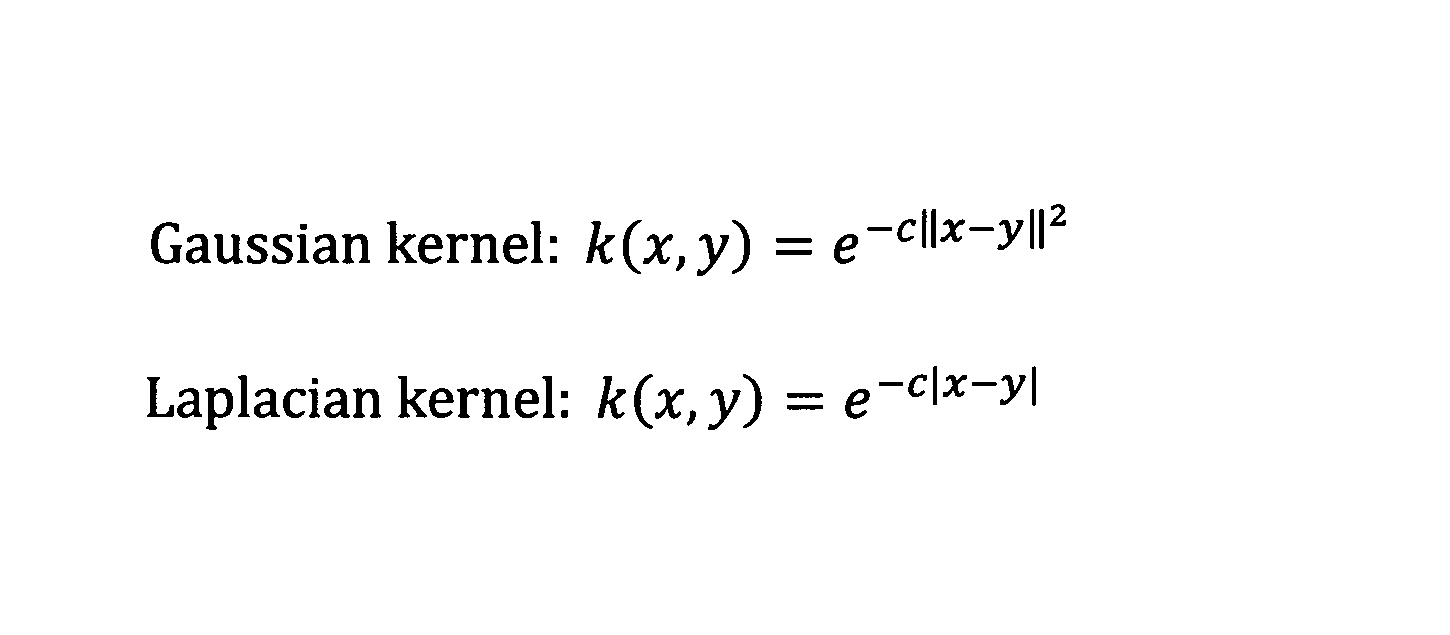
- kernel k include the following Gaussian kernel and Laplacian kernel.
- c is a positive constant.
- the Perron-Frobenius operator K on H k is an operator defined by:
- the Perron-Frobenius operator is one of the Transfer operators.
- ⁇ is called kernel mean embedding, and it is for the signed measure ⁇ .
- K does not depend on t and that K is linear.
- the above definition of the Perron-Frobenius operator K represents information on time evolution by the function Ft .
- ⁇ x 0 , x 1 , ..., X T-1 ⁇ be the observed data (that is, the observed time series data).
- Kernel k can be freely selected, and ⁇ and ⁇ are composed of k, so if k is changed, ⁇ and ⁇ will change accordingly. Therefore, the approximation error is reduced by replacing the kernel k.
- the approximation error can be evaluated by the following equation (2).
- FIG. 1 is a diagram showing an example of a hardware configuration of the analysis device 10 according to the present embodiment.
- the analysis device 10 is realized by a general computer or a computer system, and as hardware, an input device 11, a display device 12, an external I / F 13, and a communication I / It has an F14, a processor 15, and a memory device 16. Each of these hardware is connected so as to be communicable via the bus 17.
- the input device 11 is, for example, a keyboard, a mouse, a touch panel, or the like.
- the display device 12 is, for example, a display or the like.
- the analysis device 10 does not have to have at least one of the input device 11 and the display device 12.
- the external I / F13 is an interface with an external device.
- the external device includes a recording medium 13a and the like.
- the analysis device 10 can read or write the recording medium 13a via the external I / F 13.
- the recording medium 13a includes, for example, a CD (Compact Disc), a DVD (Digital Versatile Disk), an SD memory card (Secure Digital memory card), a USB (Universal Serial Bus) memory card, and the like.
- the communication I / F 14 is an interface for connecting the analysis device 10 to the communication network.
- the processor 15 is, for example, various arithmetic units such as a CPU (Central Processing Unit) and a GPU (Graphics Processing Unit).
- the memory device 16 is, for example, various storage devices such as an HDD (Hard Disk Drive), an SSD (Solid State Drive), a RAM (RandomAccessMemory), a ROM (ReadOnlyMemory), and a flash memory.
- the analysis device 10 can realize the time-series data analysis process described later.
- the hardware configuration shown in FIG. 1 is an example, and the analysis device 10 may have another hardware configuration.
- the analysis device 10 may have a plurality of processors 15 or a plurality of memory devices 16.
- FIG. 2 is a diagram showing an example of the functional configuration of the analysis device 10 according to the present embodiment.
- the analysis device 10 has an acquisition unit 101, a kernel configuration unit 102, and an operator approximation unit 103 as functional units.
- Each of these functional units is realized, for example, by a process in which one or more programs installed in the analysis device 10 are executed by the processor 15.
- the acquisition unit 101 acquires time-series data to be analyzed.
- the acquisition unit 101 may acquire, for example, time-series data stored in the memory device 16 or the like, or acquire time-series data stored in a database server or the like connected via a communication network. You may.
- the kernel component 102 configures a new kernel l (x, y) using the function g from X to X.
- the operator approximation unit 103 calculates the approximation QS to KS QS * ⁇ (z) of K ⁇ (z) using the kernel l (x, y) configured by the kernel configuration unit 102. This makes it possible to analyze the time-series data acquired by the acquisition unit 101 (for example, feature understanding, prediction, abnormality detection, etc.). Note that z is data (observation) at a certain time t in the time series data.
- FIG. 3 is a flowchart showing an example of time-series data analysis processing according to the present embodiment.
- the acquisition unit 101 acquires the time-series data to be analyzed (step S101).
- the kernel component 102 configures a new kernel l (x, y) using the function g from X to X (step S102).
- the operator approximation unit 103 uses the kernel l (x, y) configured in the above step S102 to K ⁇ (z) with respect to the data z at a certain time t in the time series data acquired in the above step S101.
- Approximate QS to KS QS * ⁇ (z) is calculated (step S103). That is, the operator approximation unit 103 constructs ⁇ and ⁇ from the kernel l (x, y), and calculates the approximation QS to KS QS * ⁇ (z) of K ⁇ (z).
- the analysis device 10 can accurately approximate the Perron-Frobenius operator with a relatively small number of samples (that is, a relatively small S), so that the analysis of time-series data having randomness can be performed at high speed. It can be carried out.
- ⁇ t is a random variable that follows a normal distribution with a mean of 0 and a variance of 1.
- the analyzer 10 can approximate the Perron-Frobenius operator more accurately with a smaller number of samples than the conventional method.
Landscapes
- Engineering & Computer Science (AREA)
- Physics & Mathematics (AREA)
- Data Mining & Analysis (AREA)
- General Physics & Mathematics (AREA)
- Mathematical Optimization (AREA)
- Pure & Applied Mathematics (AREA)
- Theoretical Computer Science (AREA)
- Mathematical Physics (AREA)
- Computational Mathematics (AREA)
- Mathematical Analysis (AREA)
- Life Sciences & Earth Sciences (AREA)
- Operations Research (AREA)
- Probability & Statistics with Applications (AREA)
- Bioinformatics & Cheminformatics (AREA)
- Algebra (AREA)
- Evolutionary Biology (AREA)
- Databases & Information Systems (AREA)
- Software Systems (AREA)
- General Engineering & Computer Science (AREA)
- Bioinformatics & Computational Biology (AREA)
- Complex Calculations (AREA)
Abstract
一実施形態に係る解析装置は、ランダムなノイズを含む時系列データを取得する取得部と、所定の第1の条件を満たす関数gと所定の第2の条件を満たすカーネル関数kとを用いて、新たなカーネル関数lを構成するカーネル構成部と、前記カーネル関数lの特徴写像をψ、前記時系列データに含まれる解析対象データをzとして、前記特徴写像ψと前記カーネル関数lのカーネル平均埋め込みΨとを用いて、Transfer作用素Kをψ(z)に作用させたKψ(z)を近似する作用素近似部と、を有することを特徴とする。
Description
本発明は、解析装置、解析方法及びプログラムに関する。
ランダムなノイズを含む時系列データとして通信トラヒックデータや株価データ、気象データ等が知られており、これらのデータの振る舞いを近似することで各種解析(例えば、特徴理解や予測、異常検知等)を行う技術が研究されている。また、近年では、Transfer作用素と呼ばれる数学的対象を用いることで、非線形な振る舞いをする時系列データを解析する技術が提案されている。この際、Transfer作用素は有限個のサンプル(つまり、時系列データを構成する有限個のデータ)から推定される。
Transfer作用素は任意の関係性を表現できるという高い表現力を持ち、更に、元の関係性が非線形であってもTransfer作用素自身は線形という単純な構造を持っているため、ブラックボックス化することなく時系列データを解析できることが知られている(例えば、非特許文献1参照)。
Y. Hashimoto, I. Ishikawa, M. Ikeda, Y. Matsuo, and Y. Kawahara. Krylov subspace method for nonlinear dynamical systems with random noise. arXiv:1909.03634v3, 2019.
しかしながら、Transfer作用素を用いた時系列データの解析は計算コストが高いという課題が存在する。これは、ランダム性を表現するために全てのサンプルにわたって平均を取る操作が必要になることが主な要因である。したがって、できるだけ少ないサンプルでできるだけ精度の良い近似を得ることが必要となるが、Transfer作用素を用いた時系列データの解析手法は近年注目され始めた新しい手法であるため、その高速化手法は未だ知られていない。
本発明の一実施形態は、上記の点に鑑みてなされたもので、Transfer作用素を用いた時系列データ解析の高速化を実現することを目的とする。
上記目的を達成するため、一実施形態に係る解析装置は、ランダムなノイズを含む時系列データを取得する取得部と、所定の第1の条件を満たす関数gと所定の第2の条件を満たすカーネル関数kとを用いて、新たなカーネル関数lを構成するカーネル構成部と、前記カーネル関数lの特徴写像をψ、前記時系列データに含まれる解析対象データをzとして、前記特徴写像ψと前記カーネル関数lのカーネル平均埋め込みΨとを用いて、Transfer作用素Kをψ(z)に作用させたKψ(z)を近似する作用素近似部と、を有することを特徴とする。
Transfer作用素を用いた時系列データ解析の高速化を実現することができる。
以下、本発明の一実施形態について説明する。本実施形態では、Transfer作用素を用いて、ランダム性を持つ時系列データの解析を高速に行うことができる解析装置10について説明する。本実施形態に係る解析装置10を用いることで、例えば、特徴理解や予測、異常検知等の各種解析を行うことが可能となる。
<理論的構成>
まず、本実施形態の理論的構成について説明する。
まず、本実施形態の理論的構成について説明する。
≪準備≫
時系列データは、以下のような数学モデルから生成されるものとする。
時系列データは、以下のような数学モデルから生成されるものとする。
Xt+1=h(Xt)+ξt
ただし、Xt及びξtは状態空間Xから確率空間(Ω,F,P)への確率変数とし、hはXからXへの非線形な写像とする。ξt(t=0,1,・・・)は時系列データのランダム性を表現するためのノイズを表す独立同分布な確率変数で、Xtとξtも独立であるとする。また、Ωは標本空間となる集合、FはΩ上のσ-加法族、PはΩ上の確率測度である。
ただし、Xt及びξtは状態空間Xから確率空間(Ω,F,P)への確率変数とし、hはXからXへの非線形な写像とする。ξt(t=0,1,・・・)は時系列データのランダム性を表現するためのノイズを表す独立同分布な確率変数で、Xtとξtも独立であるとする。また、Ωは標本空間となる集合、FはΩ上のσ-加法族、PはΩ上の確率測度である。
kを、Xに関する2変数関数かつ可測で有界連続な関数で以下の2つの条件を満たす関数であるものとする。
条件1:任意のx,y∈Xに対して、k(x,y)=k(y,x)
条件2:任意のx1,・・・,xn∈Xとc1,・・・,cn∈Cに対して、
条件2:任意のx1,・・・,xn∈Xとc1,・・・,cn∈Cに対して、

このとき、kはカーネルと呼ばれる。また、x∈Xに対して、φ(x)を、yに関する関数k(y,x)、すなわちφ(x)=k(・,x)とする。このφは特徴写像(feature map)とも呼ばれる。
kに関するRKHS(Reproducing kernel Hilbert space)とは、φ(x)の全ての線形結合とその極限から成る、無限次元の関数空間である。以降、kに関するRKHSをHkと表す。
Hkにおいて、φ(x)とφ(y)の内積をk(x,y)で定めることで、Hkの要素に内積という概念を適用することができる。この内積という概念により、Hkにおいて線形代数の理論を用いることができるようになる。なお、カーネルkの例としては以下のGaussian kernelやLaplacian kernel等がある。ただし、cは正の定数である。
Hk上のPerron-Frobenius作用素Kとは、以下により定義される作用素である。なお、Perron-Frobenius作用素とはTransfer作用素のうちの1つである。

また、Φはカーネル平均埋め込み(kernel mean embedding)と呼ばれ、符号付測度μに対して

≪RKHS上のPerron-Frobenius作用素の推定≫
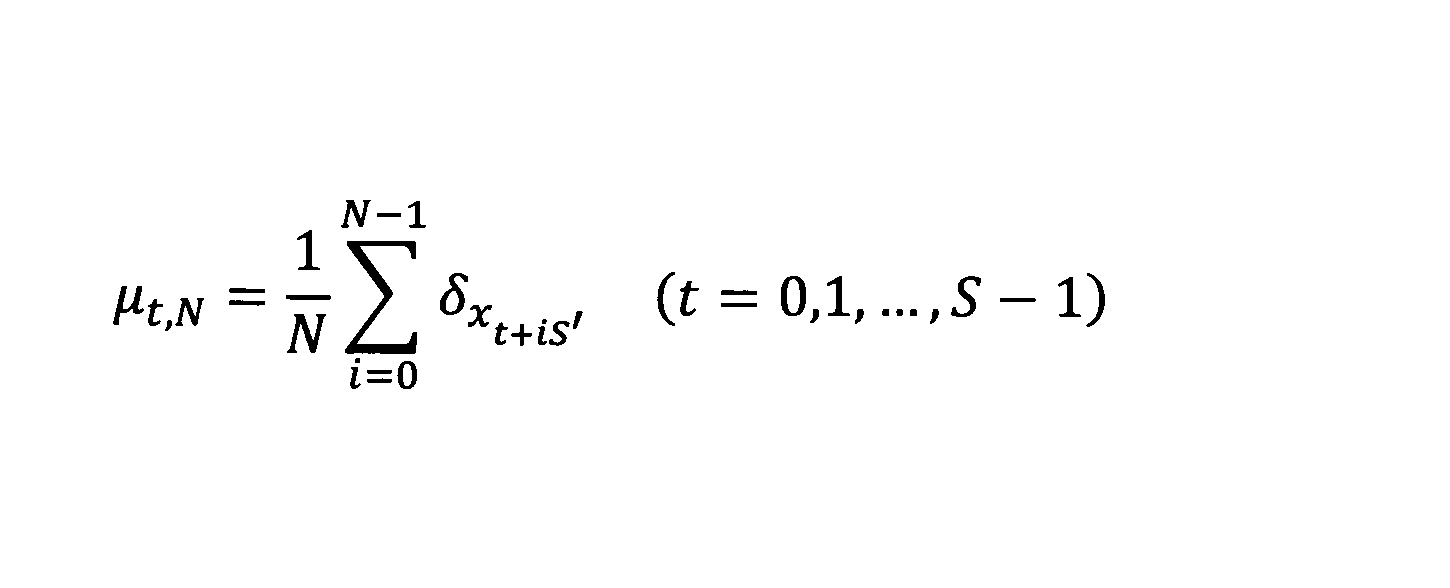
{x0,x1,・・・,xT-1}を観測データ(つまり、観測された時系列データ)とする。この観測データを{x0,xS',・・・,x(N-1)S'},{x1,x1+S',・・・,x1+(N-1)S'},・・・,{xS-1,xS-1+S',・・・,xS-1+(N-1)S'}というS組のデータセットに分ける。ただし、S'≧Sである。また、Nは各データセットに含まれる観測数(データ数)である。
{x0,x1,・・・,xT-1}を観測データ(つまり、観測された時系列データ)とする。この観測データを{x0,xS',・・・,x(N-1)S'},{x1,x1+S',・・・,x1+(N-1)S'},・・・,{xS-1,xS-1+S',・・・,xS-1+(N-1)S'}というS組のデータセットに分ける。ただし、S'≧Sである。また、Nは各データセットに含まれる観測数(データ数)である。
このとき、
ここで、以下のような、空間平均と時間平均が一致するという条件を仮定する。
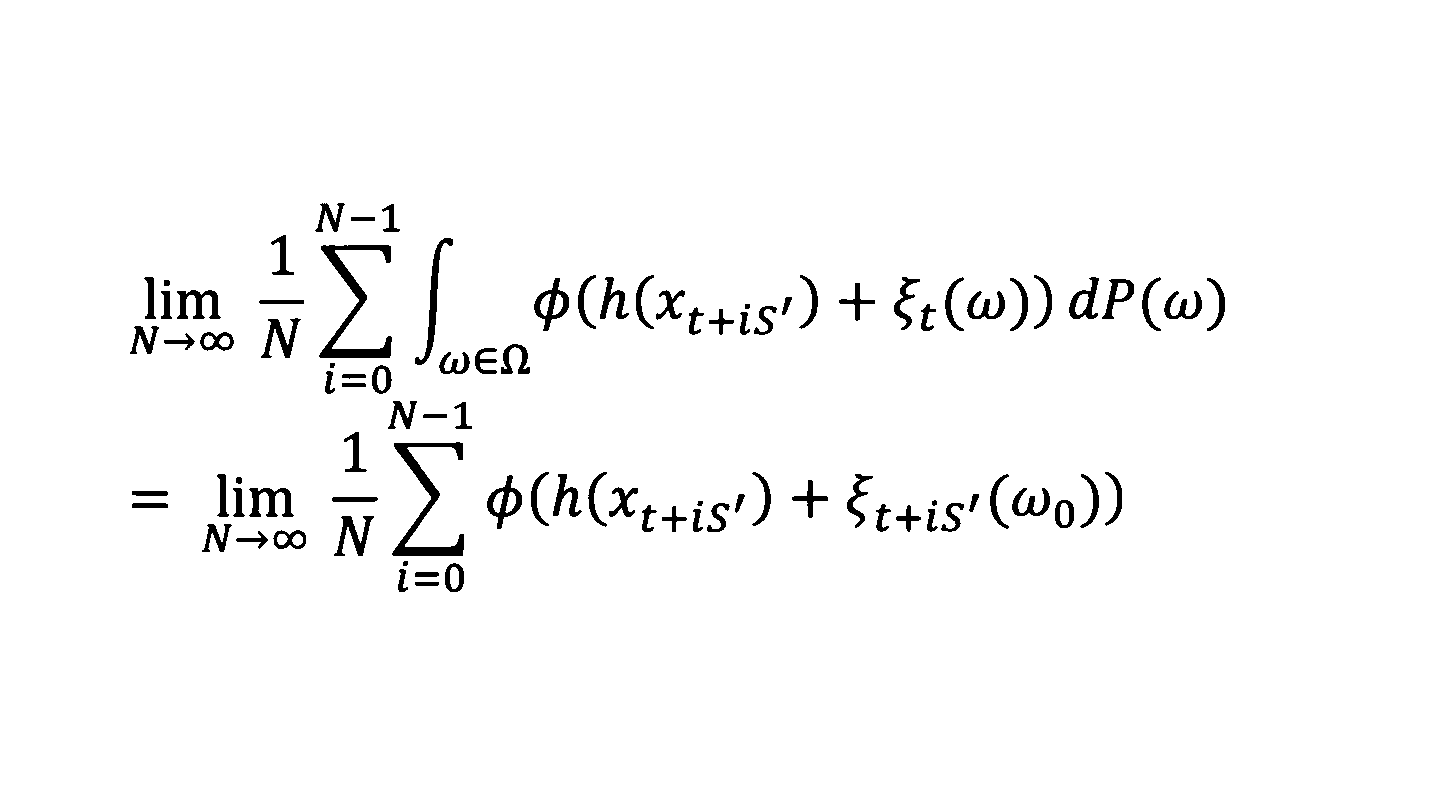
[Φ(μ1),・・・,Φ(μS)]=K[Φ(μ0),・・・,Φ(μS-1)]
ただし、
ただし、

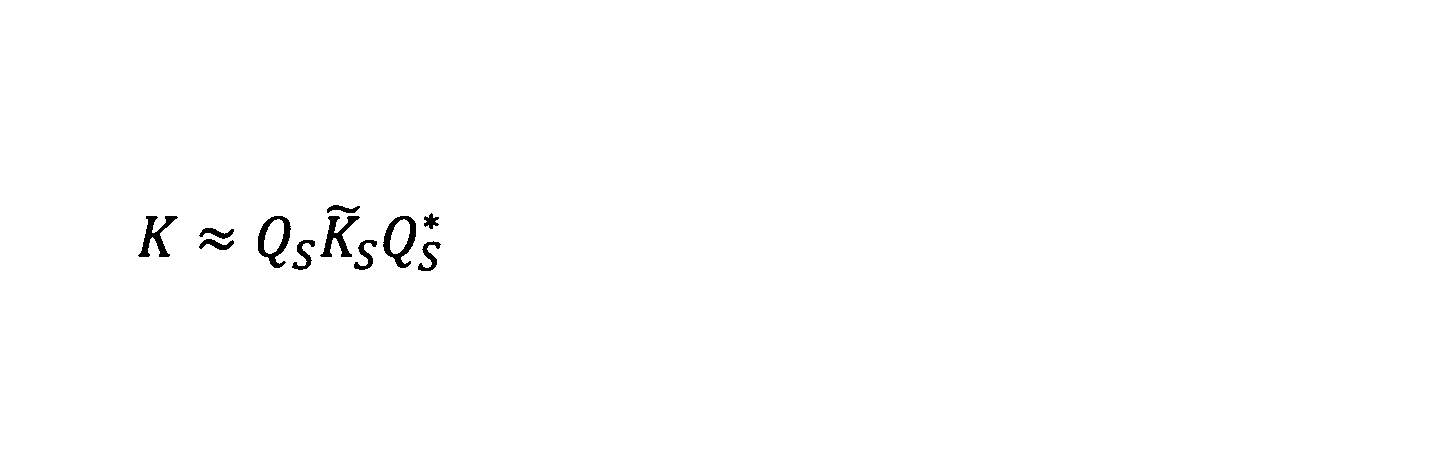
このとき、[Φ(μ0),・・・,Φ(μS-1)]=QSRSとQR分解する。そして、


≪カーネルkの置き換えによる近似の高速化≫
実際には、Kそのものの近似ではなく、或る時刻tにおける観測zに対してKφ(z)を近似することで、時刻t+1における観測を予測することができるようになる。そこで、Kφ(z)とQS ~KSQS *φ(z)の誤差(近似誤差)を小さくすることを考える。
実際には、Kそのものの近似ではなく、或る時刻tにおける観測zに対してKφ(z)を近似することで、時刻t+1における観測を予測することができるようになる。そこで、Kφ(z)とQS ~KSQS *φ(z)の誤差(近似誤差)を小さくすることを考える。
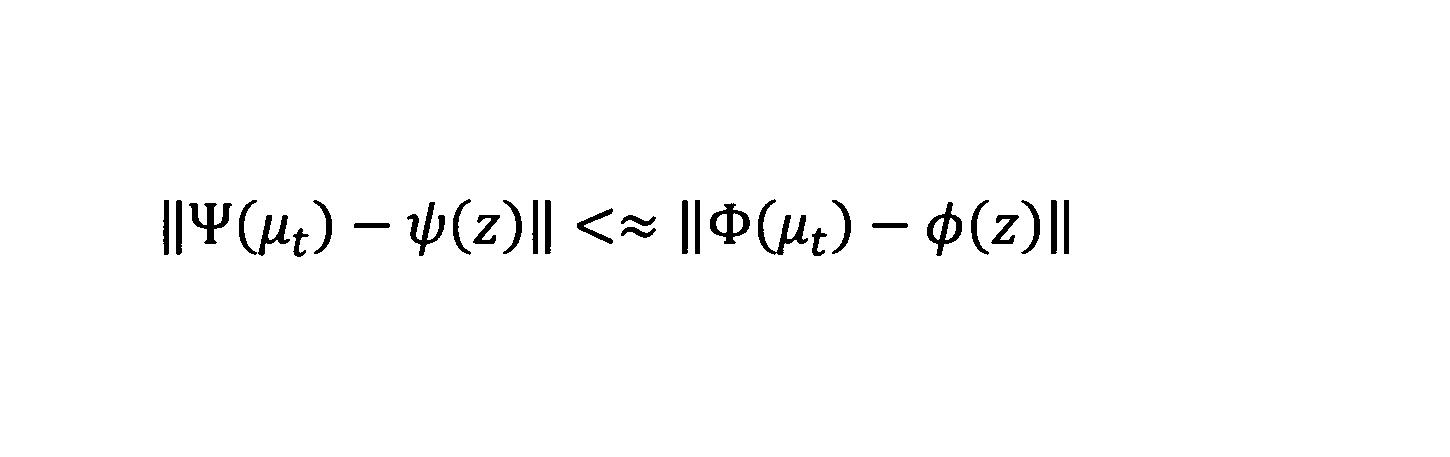
カーネルkは自由に選ぶことができ、φやΦはkから構成されるため、kを変化させれば、それに応じてφやΦも変化する。そこで、カーネルkを置き換えることにより近似誤差を小さくする。近似誤差は以下の式(2)のように評価できる。

そこで、XからXへの関数gを導入し、新たなカーネルl(x,y)=k(g(x),g(y))を作成する。ψ(x)を、yに関するl(y,x)、すなわちfeature map ψ(x)=l(・,x)とし、lに対するkernel mean embeddingをΨとする。
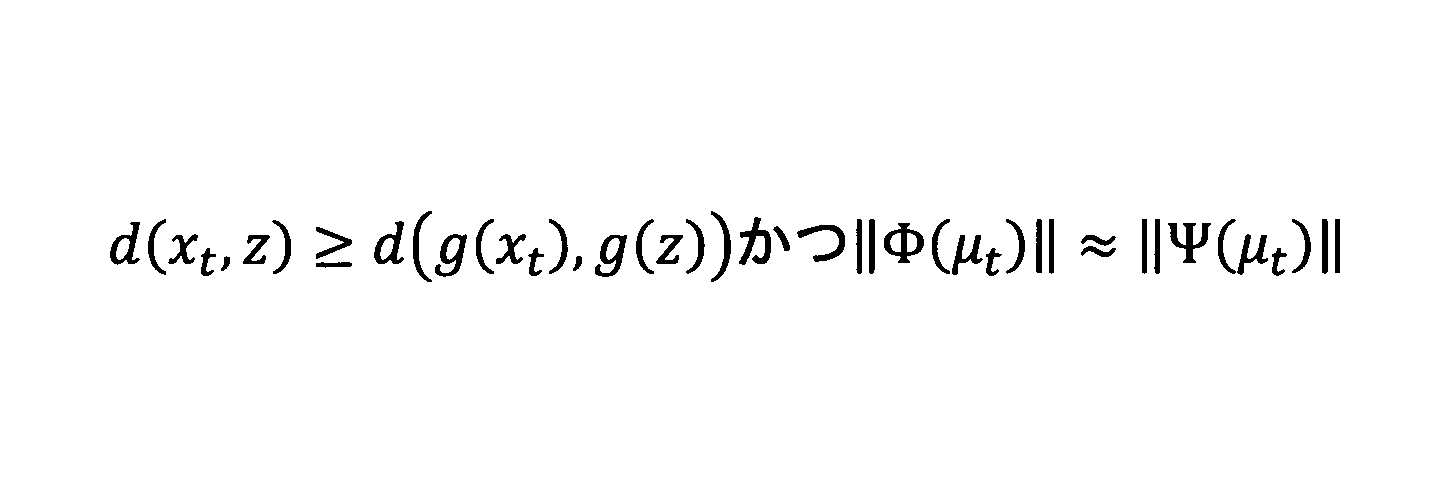
カーネルkが、単調増加な関数fと距離を表す関数dとを用いてk(x,y)=f(-d(x,y))と表され、任意のx∈Xに対してk(x,x)=1を満たすとする。この条件はGaussian kernelやLaplacian kernel等のよく利用されるカーネルでは満たされる条件である。また、関数gが
<解析装置10のハードウェア構成>
次に、本実施形態に係る解析装置10のハードウェア構成について、図1を参照しながら説明する。図1は、本実施形態に係る解析装置10のハードウェア構成の一例を示す図である。
次に、本実施形態に係る解析装置10のハードウェア構成について、図1を参照しながら説明する。図1は、本実施形態に係る解析装置10のハードウェア構成の一例を示す図である。
図1に示すように、本実施形態に係る解析装置10は一般的なコンピュータ又はコンピュータシステムで実現され、ハードウェアとして、入力装置11と、表示装置12と、外部I/F13と、通信I/F14と、プロセッサ15と、メモリ装置16とを有する。これらの各ハードウェアは、それぞれがバス17を介して通信可能に接続されている。
入力装置11は、例えば、キーボードやマウス、タッチパネル等である。表示装置12は、例えば、ディスプレイ等である。なお、解析装置10は、入力装置11及び表示装置12のうちの少なくとも一方を有していなくてもよい。
外部I/F13は、外部装置とのインタフェースである。外部装置には、記録媒体13a等がある。解析装置10は、外部I/F13を介して、記録媒体13aの読み取りや書き込み等を行うことができる。なお、記録媒体13aには、例えば、CD(Compact Disc)、DVD(Digital Versatile Disk)、SDメモリカード(Secure Digital memory card)、USB(Universal Serial Bus)メモリカード等がある。
通信I/F14は、解析装置10を通信ネットワークに接続するためのインタフェースである。プロセッサ15は、例えば、CPU(Central Processing Unit)やGPU(Graphics Processing Unit)等の各種演算装置である。メモリ装置16は、例えば、HDD(Hard Disk Drive)やSSD(Solid State Drive)、RAM(Random Access Memory)、ROM(Read Only Memory)、フラッシュメモリ等の各種記憶装置である。
本実施形態に係る解析装置10は、図1に示すハードウェア構成を有することにより、後述する時系列データ解析処理を実現することができる。なお、図1に示すハードウェア構成は一例であって、解析装置10は、他のハードウェア構成を有していてもよい。例えば、解析装置10は、複数のプロセッサ15を有していてもよいし、複数のメモリ装置16を有していてもよい。
<解析装置10の機能構成>
次に、本実施形態に係る解析装置10の機能構成について、図2を参照しながら説明する。図2は、本実施形態に係る解析装置10の機能構成の一例を示す図である。
次に、本実施形態に係る解析装置10の機能構成について、図2を参照しながら説明する。図2は、本実施形態に係る解析装置10の機能構成の一例を示す図である。
図2に示すように、本実施形態に係る解析装置10は、機能部として、取得部101と、カーネル構成部102と、作用素近似部103とを有する。これらの各機能部は、例えば、解析装置10にインストールされた1以上のプログラムがプロセッサ15に実行させる処理により実現される。
取得部101は、解析対象の時系列データを取得する。なお、取得部101は、例えば、メモリ装置16等に格納されている時系列データを取得してもよいし、通信ネットワークを介して接続されるデータベースサーバ等に格納されている時系列データを取得してもよい。
カーネル構成部102は、XからXへの関数gを用いて新たなカーネルl(x,y)を構成する。
作用素近似部103は、カーネル構成部102によって構成されたカーネルl(x,y)を用いてKψ(z)の近似QS
~KSQS
*ψ(z)を計算する。これにより、取得部101によって取得された時系列データの解析(例えば、特徴理解や予測、異常検知等)を行うことができる。なお、zは、当該時系列データ中の或る時刻tにおけるデータ(観測)である。
<時系列データ解析処理>
次に、本実施形態に係る解析装置10が実行する時系列データ解析処理の流れについて、図3を参照しながら説明する。図3は、本実施形態に係る時系列データ解析処理の一例を示すフローチャートである。
次に、本実施形態に係る解析装置10が実行する時系列データ解析処理の流れについて、図3を参照しながら説明する。図3は、本実施形態に係る時系列データ解析処理の一例を示すフローチャートである。
まず、取得部101は、解析対象の時系列データを取得する(ステップS101)。次に、カーネル構成部102は、XからXへの関数gを用いて新たなカーネルl(x,y)を構成する(ステップS102)。そして、作用素近似部103は、上記のステップS102で構成したカーネルl(x,y)を用いて、上記のステップS101で取得した時系列データ中の或る時刻tにおけるデータzに関してKψ(z)の近似QS
~KSQS
*ψ(z)を計算する(ステップS103)。すなわち、作用素近似部103は、カーネルl(x,y)からψ及びΨを構成し、Kψ(z)の近似QS
~KSQS
*ψ(z)を計算する。
以上により、本実施形態に係る解析装置10は、比較的少ないサンプル数(つまり、比較的小さいS)でPerron-Frobenius作用素を精度良く近似できるため、ランダム性を持つ時系列データの解析を高速に行うことができる。
<実験>
本実施形態に係る解析装置10と従来手法とでPerron-Frobenius作用素の近似精度及びその計算コストを比較するために実験を行った。本実験では、以下のような力学系から、人工的に時系列データ{x0,x1.・・・}を作成した。
本実施形態に係る解析装置10と従来手法とでPerron-Frobenius作用素の近似精度及びその計算コストを比較するために実験を行った。本実験では、以下のような力学系から、人工的に時系列データ{x0,x1.・・・}を作成した。
X0=1,Xt+1=0.99Xtcos(0.1Xt)+0.01ξt
ただし、ξtは平均0、分散1の正規分布に従う独立が確率変数である。
ただし、ξtは平均0、分散1の正規分布に従う独立が確率変数である。
このとき、z=x220とし、Kψ(z)を近似した。kをLaplacian kernel k(x,y)=e-|x-y|とし、

そして、g(x)=xとした場合(これは従来手法に相当する。)と、本実施形態に係る解析装置10でg(x)=g0(x)とした場合とでPerron-Frobenius作用素の近似誤差を比較した。100回計算した平均の結果を図4に示す。図4では、横軸が近似空間の次元(つまり、観測データを複数のデータセットに分けた際のデータセット数S)を表し、縦軸が近似誤差を表す。一般に、近似空間の次元が大きくなるほど近似誤差は小さくなる。図4に示されるように、g(x)=g0(x)とした場合の方が、小さい近似空間の次元でも近似誤差が小さくなっていることがわかる。
したがって、本実施形態に係る解析装置10では、従来手法よりも、より少ないサンプル数でより精度良くPerron-Frobenius作用素が近似できていることがわかる。
本発明は、具体的に開示された上記の実施形態に限定されるものではなく、特許請求の範囲の記載から逸脱することなく、種々の変形や変更、既知の技術等との組み合わせが可能である。
10 解析装置
11 入力装置
12 表示装置
13 外部I/F
13a 記録媒体
14 通信I/F
15 プロセッサ
16 メモリ装置
17 バス
101 取得部
102 カーネル構成部
103 作用素近似部
11 入力装置
12 表示装置
13 外部I/F
13a 記録媒体
14 通信I/F
15 プロセッサ
16 メモリ装置
17 バス
101 取得部
102 カーネル構成部
103 作用素近似部
Claims (7)
- ランダムなノイズを含む時系列データを取得する取得部と、
所定の第1の条件を満たす関数gと所定の第2の条件を満たすカーネル関数kとを用いて、新たなカーネル関数lを構成するカーネル構成部と、
前記カーネル関数lの特徴写像をψ、前記時系列データに含まれる解析対象データをzとして、前記特徴写像ψと前記カーネル関数lのカーネル平均埋め込みΨとを用いて、Transfer作用素Kをψ(z)に作用させたKψ(z)を近似する作用素近似部と、
を有することを特徴とする解析装置。 - 前記時系列データに含まれる各データは、前記ノイズを表す確率変数を含む数学モデルから生成されたものとみなすことができるデータであり、
前記カーネル構成部は、
前記カーネル関数kの特徴写像をφ、カーネル平均埋め込みをΦ、前記時系列データから計算される確率測度をμt(ただし、tは前記時系列データの時刻を表す)として、Φ(μt)とφ(z)の差が小さくなるように前記カーネル関数lを構成する、ことを特徴とする請求項1に記載の解析装置。 - 前記第2の条件は、前記カーネル関数kの定義域に含まれる元をx,yとして、単調増加な関数fと距離関数dとを用いてk(x,y)=f(-d(x,y))と表され、かつ、k(x,x)=1を満たすという条件であり、
前記第1の条件は、前記時系列データに含まれる時刻tのデータをxtとして、d(xt,z)≧d(g(xt),g(z))、かつ、Ψ(μt)はΦ(μt)で近似されるという条件である、ことを特徴とする請求項2に記載の解析装置。 - 前記カーネル構成部は、
l(x,y)=k(g(x),g(y))により前記カーネル関数lを構成する、ことを特徴とする請求項1乃至3の何れか一項に記載の解析装置。 - 前記カーネル構成部は、
前記時系列データの全部又は一部のデータで構成される集合Y、前記カーネル関数kをラプラスカーネル、前記関数gをg(x)=|x-1/2(1/|Y|Σy∈Yy+z)|として、前記カーネル関数lを構成する、ことを特徴とする請求項4に記載の解析装置。 - ランダムなノイズを含む時系列データを取得する取得手順と、
所定の第1の条件を満たす関数gと所定の第2の条件を満たすカーネル関数kとを用いて、新たなカーネル関数lを構成するカーネル構成手順と、
前記カーネル関数lの特徴写像をψ、前記時系列データに含まれる解析対象データをzとして、前記特徴写像ψと前記カーネル関数lのカーネル平均埋め込みΨとを用いて、Transfer作用素Kをψ(z)に作用させたKψ(z)を近似する作用素近似手順と、
をコンピュータが実行することを特徴とする解析方法。 - コンピュータを、請求項1乃至5の何れか一項に記載の解析装置として機能させるプログラム。
Priority Applications (1)
| Application Number | Priority Date | Filing Date | Title |
|---|---|---|---|
| PCT/JP2020/030714 WO2022034656A1 (ja) | 2020-08-12 | 2020-08-12 | 解析装置、解析方法及びプログラム |
Applications Claiming Priority (1)
| Application Number | Priority Date | Filing Date | Title |
|---|---|---|---|
| PCT/JP2020/030714 WO2022034656A1 (ja) | 2020-08-12 | 2020-08-12 | 解析装置、解析方法及びプログラム |
Publications (1)
| Publication Number | Publication Date |
|---|---|
| WO2022034656A1 true WO2022034656A1 (ja) | 2022-02-17 |
Family
ID=80247057
Family Applications (1)
| Application Number | Title | Priority Date | Filing Date |
|---|---|---|---|
| PCT/JP2020/030714 Ceased WO2022034656A1 (ja) | 2020-08-12 | 2020-08-12 | 解析装置、解析方法及びプログラム |
Country Status (1)
| Country | Link |
|---|---|
| WO (1) | WO2022034656A1 (ja) |
-
2020
- 2020-08-12 WO PCT/JP2020/030714 patent/WO2022034656A1/ja not_active Ceased
Non-Patent Citations (1)
| Title |
|---|
| HASHIMOTO YUKA, ISHIKAWA ISAO, IKEDA MASAHIRO, MATSUO YOICHI, KAWAHARA YOSHINOBU: "Krylov Subspace Method for Nonlinear Dynamical Systems with Random Noise, arXiv:1909.03634v3", ARXIV, 2 December 2019 (2019-12-02), Cornell University, pages 1 - 27, XP055908995, Retrieved from the Internet <URL:https://arxiv.org/pdf/1909.03634v3.pdf> * |
Similar Documents
| Publication | Publication Date | Title |
|---|---|---|
| Kavitha et al. | Quantum machine learning for support vector machine classification | |
| CN111814362B (zh) | 量子噪声过程分析方法、系统及存储介质和终端设备 | |
| Waller et al. | Estimating correlated observation error statistics using an ensemble transform Kalman filter | |
| WO2020260476A1 (en) | Unsupervised clustering in quantum feature spaces using quantum similarity matrices | |
| Bernido et al. | Methods and applications of white noise analysis in interdisciplinary sciences | |
| US9558554B1 (en) | Defining basis function requirements for image reconstruction | |
| Zhao et al. | Boundary value problem for a class of fractional integro-differential coupled systems with Hadamard fractional calculus and impulses | |
| Buzzicotti et al. | Inferring turbulent environments via machine learning | |
| Sane et al. | Investigating in situ reduction via lagrangian representations for cosmology and seismology applications | |
| Hoang et al. | Determining white noise forcing from Eulerian observations in the Navier-Stokes equation | |
| Xu et al. | Prediction for distributional outcomes in high-performance computing input/output variability | |
| JP7396601B2 (ja) | 解析装置、解析方法及びプログラム | |
| De Luca et al. | A gpu-based algorithm for environmental data filtering | |
| Dai et al. | Adaptive weighted neighbors method for sensitivity analysis | |
| Delo et al. | On the influence of structural attributes for transferring knowledge in population-based structural health monitoring | |
| Rodríguez et al. | A quantum annealing approach to fluid dynamics problems solving Navier-Stokes equations | |
| Kuzmak et al. | Detecting the purely imaginary Fisher zeros of an Ising spin system on a quantum computer | |
| Wang et al. | Functional time series forecasting of distributions: A Koopman-Wasserstein approach | |
| Dulny et al. | GrINd: Grid Interpolation Network for Scattered Observations | |
| Leiva et al. | A generalisation of the integral Maxwell model: the gK-BKZ model—frame invariance and analytical solutions | |
| Yasin et al. | Statistical inferences for multivariate generalized gamma regression model | |
| Ishak et al. | Box-Cox optimal parameter estimation for multiple regressions with homoscedasticity | |
| Wu et al. | End-to-end reaction field energy modeling via deep learning based voxel-to-voxel transform | |
| MacDonald et al. | A Dimension-Reduced Multivariate Spatial Model for Extreme Events: Balancing Flexibility and Scalability: R. MacDonald et al. | |
| Eghwerido et al. | The multi-component Gompertz flexible generalized family of distributions: characterizations and applications |
Legal Events
| Date | Code | Title | Description |
|---|---|---|---|
| 121 | Ep: the epo has been informed by wipo that ep was designated in this application |
Ref document number: 20949518 Country of ref document: EP Kind code of ref document: A1 |
|
| NENP | Non-entry into the national phase |
Ref country code: DE |
|
| 122 | Ep: pct application non-entry in european phase |
Ref document number: 20949518 Country of ref document: EP Kind code of ref document: A1 |
|
| NENP | Non-entry into the national phase |
Ref country code: JP |