WO2022016134A1 - A curable thermoset for high speed low loss electrical laminates - Google Patents
A curable thermoset for high speed low loss electrical laminates Download PDFInfo
- Publication number
- WO2022016134A1 WO2022016134A1 PCT/US2021/042132 US2021042132W WO2022016134A1 WO 2022016134 A1 WO2022016134 A1 WO 2022016134A1 US 2021042132 W US2021042132 W US 2021042132W WO 2022016134 A1 WO2022016134 A1 WO 2022016134A1
- Authority
- WO
- WIPO (PCT)
- Prior art keywords
- weight
- resin composition
- curable resin
- composition
- curable
- Prior art date
- Legal status (The legal status is an assumption and is not a legal conclusion. Google has not performed a legal analysis and makes no representation as to the accuracy of the status listed.)
- Ceased
Links
- QSTVWADMPKTGOA-UHFFFAOYSA-N O=C(C(CC1)C2CC1P(c1ccccc1)(c1ccccc1)=O)OC2=O Chemical compound O=C(C(CC1)C2CC1P(c1ccccc1)(c1ccccc1)=O)OC2=O QSTVWADMPKTGOA-UHFFFAOYSA-N 0.000 description 1
Classifications
-
- C—CHEMISTRY; METALLURGY
- C08—ORGANIC MACROMOLECULAR COMPOUNDS; THEIR PREPARATION OR CHEMICAL WORKING-UP; COMPOSITIONS BASED THEREON
- C08G—MACROMOLECULAR COMPOUNDS OBTAINED OTHERWISE THAN BY REACTIONS ONLY INVOLVING UNSATURATED CARBON-TO-CARBON BONDS
- C08G59/00—Polycondensates containing more than one epoxy group per molecule; Macromolecules obtained by polymerising compounds containing more than one epoxy group per molecule using curing agents or catalysts which react with the epoxy groups
- C08G59/18—Macromolecules obtained by polymerising compounds containing more than one epoxy group per molecule using curing agents or catalysts which react with the epoxy groups ; e.g. general methods of curing
- C08G59/68—Macromolecules obtained by polymerising compounds containing more than one epoxy group per molecule using curing agents or catalysts which react with the epoxy groups ; e.g. general methods of curing characterised by the catalysts used
- C08G59/686—Macromolecules obtained by polymerising compounds containing more than one epoxy group per molecule using curing agents or catalysts which react with the epoxy groups ; e.g. general methods of curing characterised by the catalysts used containing nitrogen
-
- C—CHEMISTRY; METALLURGY
- C08—ORGANIC MACROMOLECULAR COMPOUNDS; THEIR PREPARATION OR CHEMICAL WORKING-UP; COMPOSITIONS BASED THEREON
- C08G—MACROMOLECULAR COMPOUNDS OBTAINED OTHERWISE THAN BY REACTIONS ONLY INVOLVING UNSATURATED CARBON-TO-CARBON BONDS
- C08G59/00—Polycondensates containing more than one epoxy group per molecule; Macromolecules obtained by polymerising compounds containing more than one epoxy group per molecule using curing agents or catalysts which react with the epoxy groups
- C08G59/18—Macromolecules obtained by polymerising compounds containing more than one epoxy group per molecule using curing agents or catalysts which react with the epoxy groups ; e.g. general methods of curing
- C08G59/20—Macromolecules obtained by polymerising compounds containing more than one epoxy group per molecule using curing agents or catalysts which react with the epoxy groups ; e.g. general methods of curing characterised by the epoxy compounds used
- C08G59/32—Epoxy compounds containing three or more epoxy groups
- C08G59/3218—Carbocyclic compounds
-
- C—CHEMISTRY; METALLURGY
- C08—ORGANIC MACROMOLECULAR COMPOUNDS; THEIR PREPARATION OR CHEMICAL WORKING-UP; COMPOSITIONS BASED THEREON
- C08G—MACROMOLECULAR COMPOUNDS OBTAINED OTHERWISE THAN BY REACTIONS ONLY INVOLVING UNSATURATED CARBON-TO-CARBON BONDS
- C08G59/00—Polycondensates containing more than one epoxy group per molecule; Macromolecules obtained by polymerising compounds containing more than one epoxy group per molecule using curing agents or catalysts which react with the epoxy groups
- C08G59/18—Macromolecules obtained by polymerising compounds containing more than one epoxy group per molecule using curing agents or catalysts which react with the epoxy groups ; e.g. general methods of curing
- C08G59/40—Macromolecules obtained by polymerising compounds containing more than one epoxy group per molecule using curing agents or catalysts which react with the epoxy groups ; e.g. general methods of curing characterised by the curing agents used
- C08G59/4007—Curing agents not provided for by the groups C08G59/42 - C08G59/66
- C08G59/4071—Curing agents not provided for by the groups C08G59/42 - C08G59/66 phosphorus containing compounds
-
- C—CHEMISTRY; METALLURGY
- C08—ORGANIC MACROMOLECULAR COMPOUNDS; THEIR PREPARATION OR CHEMICAL WORKING-UP; COMPOSITIONS BASED THEREON
- C08G—MACROMOLECULAR COMPOUNDS OBTAINED OTHERWISE THAN BY REACTIONS ONLY INVOLVING UNSATURATED CARBON-TO-CARBON BONDS
- C08G59/00—Polycondensates containing more than one epoxy group per molecule; Macromolecules obtained by polymerising compounds containing more than one epoxy group per molecule using curing agents or catalysts which react with the epoxy groups
- C08G59/18—Macromolecules obtained by polymerising compounds containing more than one epoxy group per molecule using curing agents or catalysts which react with the epoxy groups ; e.g. general methods of curing
- C08G59/40—Macromolecules obtained by polymerising compounds containing more than one epoxy group per molecule using curing agents or catalysts which react with the epoxy groups ; e.g. general methods of curing characterised by the curing agents used
- C08G59/42—Polycarboxylic acids; Anhydrides, halides or low molecular weight esters thereof
- C08G59/4215—Polycarboxylic acids; Anhydrides, halides or low molecular weight esters thereof cycloaliphatic
-
- C—CHEMISTRY; METALLURGY
- C08—ORGANIC MACROMOLECULAR COMPOUNDS; THEIR PREPARATION OR CHEMICAL WORKING-UP; COMPOSITIONS BASED THEREON
- C08J—WORKING-UP; GENERAL PROCESSES OF COMPOUNDING; AFTER-TREATMENT NOT COVERED BY SUBCLASSES C08B, C08C, C08F, C08G or C08H
- C08J5/00—Manufacture of articles or shaped materials containing macromolecular substances
- C08J5/04—Reinforcing macromolecular compounds with loose or coherent fibrous material
- C08J5/0405—Reinforcing macromolecular compounds with loose or coherent fibrous material with inorganic fibres
- C08J5/043—Reinforcing macromolecular compounds with loose or coherent fibrous material with inorganic fibres with glass fibres
-
- C—CHEMISTRY; METALLURGY
- C08—ORGANIC MACROMOLECULAR COMPOUNDS; THEIR PREPARATION OR CHEMICAL WORKING-UP; COMPOSITIONS BASED THEREON
- C08J—WORKING-UP; GENERAL PROCESSES OF COMPOUNDING; AFTER-TREATMENT NOT COVERED BY SUBCLASSES C08B, C08C, C08F, C08G or C08H
- C08J5/00—Manufacture of articles or shaped materials containing macromolecular substances
- C08J5/24—Impregnating materials with prepolymers which can be polymerised in situ, e.g. manufacture of prepregs
- C08J5/241—Impregnating materials with prepolymers which can be polymerised in situ, e.g. manufacture of prepregs using inorganic fibres
- C08J5/244—Impregnating materials with prepolymers which can be polymerised in situ, e.g. manufacture of prepregs using inorganic fibres using glass fibres
-
- C—CHEMISTRY; METALLURGY
- C08—ORGANIC MACROMOLECULAR COMPOUNDS; THEIR PREPARATION OR CHEMICAL WORKING-UP; COMPOSITIONS BASED THEREON
- C08J—WORKING-UP; GENERAL PROCESSES OF COMPOUNDING; AFTER-TREATMENT NOT COVERED BY SUBCLASSES C08B, C08C, C08F, C08G or C08H
- C08J2363/00—Characterised by the use of epoxy resins; Derivatives of epoxy resins
- C08J2363/04—Epoxynovolacs
Definitions
- Epoxy resins are used in both industrial and consumer electronics because of, among other things, their chemical resistance, mechanical strength and electrical properties.
- epoxy resins can be used in electronics as laminates, adhesive materials and/or insulating materials, such as interlayer insulating films.
- the epoxy resins need to provide certain necessary physical, thermal, electrical insulation and moisture resistance properties.
- Epoxy resins can be flammable. As such, different approaches have been made to impart flame resistance to epoxy resins. Two main approaches have been taken to provide flame resistance. The first approach makes use of halogen compounds.
- Halogen- containing compounds have been commonly used in the electronic industry to impart flame resistance to electrical and electronic assemblies.
- TBBA tetrabromobisphenol-A
- halogen-containing compounds can be effective for this purpose, they are highly undesirable from an environmental standpoint. It is therefore desirable to develop halogen-free compounds that can be used as effective flame retardants in epoxy resin compositions.
- phosporated anhydride compounds may be particularly useful as flame retardants in epoxy resin compositions.
- WO 2019/090563 discloses a class of phosphorated anhydride compounds that are effective as epoxy hardeners and provide flame retardant characteristics. It remains desirable, however, to develop improved halogen-free flame retardants that provide better electrical characteristics than currently available products, particularly for use in the production of high speed, low loss electrical laminates for printed circuit boards (PCBs). In particular, it is desirable to develop improved flame retardants that provide a lower dielectric loss than existing solutions, without compromising other performance aspects of the laminate material.
- PCBs printed circuit boards
- a curable resin composition comprising (a) an epoxy resin component; (b) a phosphorated anhydride component; and (c) an active ester component.
- the curable resin composition may comprise a phosphorated anhydride of Formula III or Formula IV:
- each R.4 and Rs is independently selected from alkyl, alkoxy, aryl, aryloxy, arylalkyl, alkenyl, and alkynyl; 1 is 0, 1, 2, or 3; m is 0, 1, 2, 3 or 4; and n is 0, 1, 2, 3 or 4.
- cured compositions prepared by curing the resin compositions described herein. Also provided herein is a printed circuit board comprising such a cured composition.
- halogen-free, flame retardant curable resin compositions that provide both good electrical characteristics and good heat resistance characteristics sufficient to allow for their use in high-performance PCB systems.
- a curable resin composition comprising (a) an epoxy resin component; (b) a phosphorated anhydride component; and (c) an active ester component.
- the curable resin composition may comprise an epoxy resin component, wherein the epoxy resin component comprises at least one epoxy resin.
- Epoxy resins may be used to make the curable and cured compositions disclosed herein. Types of epoxy resins that may be used include aromatic epoxy resins, alicyclic epoxy resins, aliphatic epoxy resins, and combinations thereof.
- the curable resin composition may comprise one or more epoxy resins selected from the group consisting of divinylarene dioxide, diglycidyl ethers of bisphenol A, diglycidyl ethers of bromobisphenol A; oligomeric or polymeric diglycidyl ethers of bisphenol A, oligomeric or polymeric diglycidyl ethers of tetrabromobisphenol A, diglycidyl ethers of bisphenol F or their derivatives, epoxy novolac resins, epoxy cresol novolac resins, or mixtures thereof.
- epoxy resins selected from the group consisting of divinylarene dioxide, diglycidyl ethers of bisphenol A, diglycidyl ethers of bromobisphenol A; oligomeric or polymeric diglycidyl ethers of bisphenol A, oligomeric or polymeric diglycidyl ethers of tetrabromobisphenol A, diglycidyl ethers of bisphenol F or their derivatives, epoxy
- the divinylarene dioxide is selected from the group consisting of substituted divinylbenzene dioxide, divinylnaphthalene dioxide, divinylbiphenyl dioxide, divinyldiphenylether dioxide, and mixtures thereof.
- the curable resin composition may comprise one or more epoxy resins selected from the group consisting of glycidyl ether compounds of polyphenols, where the polyphenols are selected from the group consisting of hydroquinone, resorcinol, bisphenol A, bisphenol F, 4,4'-dihydroxybiphenyl, phenol novolac, cresol novolac, trisphenol (tris-(4- hydroxyphenyl)methane), l,l,2,2-tetra(4-hydroxyphenyl)ethane, tetrabromobisphenol A, 2,2- bi s(4-hy droxyphenyl)- 1 , 1 , 1 , 3 ,3 , 3 -hexafluoropropane, 1 ,6-dihy droxynaphthalene, and combinations thereof.
- epoxy resins include dicyclopentadiene phenol novolac epoxy resins and biphenyl phenol novolac epoxy resin
- Examples of alicyclic epoxy resins include polyglycidyl ethers of polyols having at least one alicyclic ring, or compounds including cyclohexene oxide or cyclopentene oxide obtained by epoxidizing compounds including a cyclohexene ring or cyclopentene ring with an oxidizer.
- Particular examples include, but are not limited to, hydrogenated bisphenol A diglycidyl ether; 3, 4-epoxy cy cl ohexylmethyl-3, 4-epoxy cyclohexyl carboxylate; 3, 4-epoxy - l-methylcyclohexyl-3, 4-epoxy- 1-methylhexane carboxylate; 6-methyl-3,4- epoxycy cl ohexylmethyl-6-m ethyl-3, 4-epoxy cyclohexane carboxylate; 3,4-epoxy-3- methylcy cl ohexylmethyl-3, 4-epoxy-3-methylcy cl ohexane carboxylate; 3,4-epoxy-5- methylcy cl ohexylmethyl-3, 4-epoxy-5-methylcy cl ohexane carboxylate; bis(3,4- epoxycyclohexylmethyl)adipate; methylene-bis(3, 4-
- aliphatic epoxy resins include polyglycidyl ethers of aliphatic polyols or alkylene-oxide adducts thereof, polyglycidyl esters of aliphatic long-chain polybasic acids, homopolymers synthesized by vinyl-polymerizing glycidyl acrylate or glycidyl methacrylate, and copolymers synthesized by vinyl-polymerizing glycidyl acrylate or glycidyl methacrylate and other vinyl monomers.
- Some particular examples include, but are not limited to glycidyl ethers of polyols, such as 1,4-butanediol diglycidyl ether; 1,6- hexanediol diglycidyl ether; a triglycidyl ether of glycerin; a triglycidyl ether of trimethylol propane; a tetraglycidyl ether of sorbitol; a hexaglycidyl ether of dipentaerythritol; a diglycidyl ether of polyethylene glycol; and a diglycidyl ether of polypropylene glycol; polyglycidyl ethers of polyether polyols obtained by adding one type, or two or more types, of alkylene oxide to aliphatic polyols such as propylene glycol, trimethylol propane, and glycerin; diglycidyl esters of aliphatic long-
- the curable resin composition may comprise the epoxy resin component, for example, in an amount of from about 10% by weight to about 80% by weight, from about 20% by weight to about 70% by weight, from about 30% by weight to about 60% by weight, or from about 40% by weight to about 60% by weight of the composition.
- the curable resin composition may comprise the epoxy resin component in an amount of at least about 30% by weight, at least about 35% by weight, at least about 40% by weight, or at least about 45% by weight of the composition.
- the curable resin composition may further comprise a phosphorated anhydride component, wherein the phosphorated anhydride component comprises at least one phosphorated anhydride.
- the phosphorated anhydride compounds provided herein are useful as reactive-type flame retardants, and provide surprisingly good dielectric performance and heat resistance when incorporated into PCB compositions.
- the phosphorated anhydrides provided herein also confer the advantage of being halogen free while acting as a flame retardant for a cured resin (e.g., a cured epoxy resin) formed in part with the phosphorated anhydride.
- a cured resin e.g., a cured epoxy resin
- Such cured resins formed with the phosphorated anhydride can also have suitable thermal and electrical properties useful for electronic applications including electrical laminates, interconnect substrates, build-up films, solder masks, castings, and adhesives.
- the phosphorated anhydrides provided herein can confer improvements in thermomechanical properties, such as increasing the glass transition temperature of the cured epoxy. Such improvements can include, for example increasing the glass transition temperature (T ) of cured epoxy resin compositions formed with the phosphorated anhydride, such that the cured epoxy resin composition can be used for mid-to- high range applications that undergo temperatures of at least about 150°C, for example temperatures of at least about 170°C.
- curable resin compositions formed with the phosphorated anhydrides provided herein may also provide, in addition to flame resistance, other desired physical properties, such as thermal resistance.
- One method for measuring thermal resistance is to measure the thermal decomposition temperature (Td) by determining the temperature at which 5 percent by weight (wt. %) of a cured epoxy degrades as a sample is heated at a fixed rate.
- Td thermal decomposition temperature
- the phosphorated anhydrides of the present disclosure can be used to provide a cured epoxy resin composition having a Td of at least about 350°C.
- the curable resin composition may comprise a phosphorated anhydride of Formula I: wherein
- Ri and R2 are each independently selected from the group consisting of alkyl, alkoxy, cycloalkyl, -O-alkyl-cycloalkyl, -O-cycloalkyl, aryl, and aryloxy, or Ri and R2 together form a polycyclic moiety, wherein each aryl or polycyclic moiety is optionally independently substituted with one or more groups independently selected from the group consisting of alkyl, alkoxy, aryl, aryloxy, arylalkyl, alkenyl, and alkynyl;
- R3 is independently selected from the group consisting of alkyl, cycloalkyl, and aryl, wherein each aryl is optionally independently substituted with one or more groups independently selected from the group consisting of alkyl, alkoxy, aryl, aryloxy, alkenyl, and alkynyl; and l is O, 1, 2, 3, 4, 5 or 6.
- the curable resin composition may comprise a phosphorated anhydride of Formula II: wherein
- Ri and R2 are each independently selected from the group consisting of alkyl, alkoxy, cycloalkyl, -O-alkyl-cycloalkyl, -O-cycloalkyl, aryl, and aryloxy, or Ri and R2 together form a polycyclic moiety, wherein each aryl or polycyclic moiety is optionally independently substituted with one or more groups independently selected from the group consisting of alkyl, alkoxy, aryl, aryloxy, arylalkyl, alkenyl, and alkynyl;
- R3 is independently selected from the group consisting of alkyl, cycloalkyl, and aryl, wherein each aryl is optionally independently substituted with one or more groups independently selected from the group consisting of alkyl, alkoxy, aryl, aryloxy, alkenyl, and alkynyl; and l is O, 1, 2, 3, 4, 5 or 6.
- each R3 is independently C1-C6 alkyl, C3-C6 cycloalkyl, or phenyl; where each phenyl is optionally substituted with one or more groups independently selected from C1-C6 alkyl, C1-C6 alkoxy, phenyl, phenyloxy, C2-C4 alkenyl, and C2-C4 alkynyl.
- each R3 is independently C1-C4 alkyl, C3-C6 cycloalkyl, or phenyl; where each phenyl is optionally substituted with one or more groups independently selected from C1-C4 alkyl, C1-C4 alkoxy, phenyl, phenyloxy, C2-C4 alkenyl, and C2-C4 alkynyl.
- each R3 is independently methyl, ethyl, cyclopentyl, cyclohexyl, or phenyl.
- each R3 is independently C1-C4 alkyl.
- each R3 is independently methyl or ethyl.
- R3 is methyl.
- R3 when 1 is 1, R3 is methyl, ethyl, cyclopentyl, cyclohexyl, phenyl, allyl, or C2-C4 alkynyl. In another embodiment, R3 is methyl or allyl. In still another alternate embodiment, R3 is methyl.
- Ri and R2 are independently C1-C6 alkyl, C1-C6 alkoxy, C3-C6 cycloalkyl, -O-C1-C6 alkyl-cycloalkyl, -O-cycloalkyl, aryl, aryloxy, orRi and R2 together form a polycyclic moiety, where each aryl or polycyclic moiety is optionally substituted with one or more groups independently selected from alkyl, alkoxy, aryl, aryloxy, arylalkyl, alkenyl, and alkynyl.
- one of Ri and R2 is methyl, methoxy, cyclopentyl, cyclohexyl, -O-C1-C4 alkoxy-cycloalkyl, -O-cyclopentyl, -O- cyclohexyl, phenyl, phenyloxy, or Ri and R2 together form a polycyclic moiety, where the phenyl, phenyloxy or polycyclic moiety are optionally substituted with one or more groups independently selected from alkyl, alkoxy, aryl, aryloxy, arylalkyl, alkenyl, and alkynyl.
- Ri and R2 are optionally substituted with one or more groups independently selected from C1-C6 alkyl, C1-C6 alkoxy, phenyl, naphthyl, phenyloxy, benzyl, phenethyl, C2-C6 alkenyl, and C2-C6 alkynyl.
- Ri and R2 are the same. In an alternate embodiment, Ri and R2 are different.
- Ri and R2 form an optionally substituted polycyclic moiety, where the polycyclic moiety is optionally substituted with one or more groups independently selected from alkyl, alkoxy, aryl, aryloxy, arylalkyl, alkenyl, and alkynyl.
- the polycyclic moiety consists of two, optionally substituted, fused rings.
- the polycyclic moiety consists of at least three, optionally substituted, fused rings.
- the polycyclic moiety may comprise one or more heteroatoms, selected from the group consisting of P, N, O, and S.
- the P, N, O, and/or S replace one or more carbons in the polycyclic moiety.
- the polycyclic moiety comprises at least one of P, N, O, and S.
- the polycyclic moiety comprises a P.
- at least one ring heteroatom within the polycyclic moiety is directly bonded to the P.
- the heteroatom is O or S.
- the heteroatom is O.
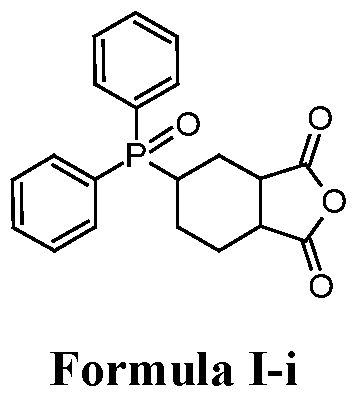
- Non-limiting examples of phosphorated anhydrides which may be present in the curable resin composition include the compound of Formula I-i, the compound of Formula Il-i, the compound of Formula I-ii, the compound of Formula Il-ii,
- the curable resin composition comprises a phosphorated anhydride of Formula III or Formula IV as provided herein.
- the curable resin composition may comprise a compound of Formula III:
- each R.4 and Rs is independently selected from alkyl, alkoxy, aryl, aryloxy, arylalkyl, alkenyl, and alkynyl;
- n 0, 1, 2, 3 or 4.
- the curable resin composition may comprise a compound of Formula IV :
- each R.4 and Rs is independently selected from alkyl, alkoxy, aryl, aryloxy, arylalkyl, alkenyl, and alkynyl; 1 is 0, 1, 2, or 3; m is 0, 1, 2, 3 or 4; and n is 0, 1, 2, 3 or 4.
- each R.4 and Rs is independently selected from the group consisting of alkyl, alkoxy, aryl, aryloxy, arylalkyl, alkenyl, and alkynyl.
- each R.4 and Rs is independently selected from the group consisting of C1-C6 alkyl, C1-C6 alkoxy, phenyl, naphthyl, phenyloxy, benzyl, phenethyl, C2-C6 alkenyl, and C2-C6 alkynyl.
- R.4 and R.5 may be the same. Alternatively, they may be different.
- m and n are 0. In a further embodiment, 1 is also 0.
- each R3 is independently C1-C6 alkyl, C3-C6 cycloalkyl, or phenyl; where each phenyl is optionally substituted with one or more groups independently selected from the group consisting of C1-C6 alkyl, C1-C6 alkoxy, phenyl, phenyloxy, C2-C4 alkenyl, and C2-C4 alkynyl.
- each R3 is independently C1-C4 alkyl.
- each R3 is independently methyl or ethyl.
- R3 is methyl.
- each R4 and Rs is independently selected from the group consisting C1-C4 alkyl, C1-C4 alkoxy, phenyl, phenyloxy, benzyl, phenethyl, C2-C6 alkenyl, and C2-C6 alkynyl.
- each R4 and Rs is independently methyl, ethyl, phenyl, benzyl, phenethyl, methoxy, ethoxy, ethenyl, ethynyl.
- each R4 and Rs is independently phenyl, phenyloxy, benzyl or phenethyl.
- R4 and Rs are the same. Alternatively, they may be different.
- n is 1 and m is 1.
- R4 and Rs are independently selected from the group consisting of C1-C4 alkyl, C1-C4 alkoxy, phenyl, phenyloxy, benzyl, phenethyl, C2-C6 alkenyl, and C2-C6 alkynyl.
- 1 is 0 or 1.
- R4 and Rs are independently methyl, ethyl, phenyl, benzyl, phenethyl, methoxy, ethoxy, ethenyl, ethynyl.
- R4 and R5 is independently phenyl, phenyloxy, benzyl or phenethyl.
- R4 and R5 are the same. Alternatively, they are different.
- n is 1, m is 0.
- R4 is selected from C1-C4 alkyl, C1-C4 alkoxy, phenyl, phenyloxy, benzyl, phenethyl, C2-C6 alkenyl, and C2-C6 alkynyl.
- 1 is 0 or 1.
- R4 is methyl, ethyl, phenyl, benzyl, phenethyl, methoxy, ethoxy, ethenyl, ethynyl.
- R4 is independently phenyl, phenyloxy, benzyl or phenethyl.
- R4 is benzyl.
- m is 1 and n is 0.
- Rs is selected from the group consisting of C1-C4 alkyl, C1-C4 alkoxy, phenyl, phenyloxy, benzyl, phenethyl, C2-C6 alkenyl, and C2-C6 alkynyl.
- 1 is 0 or 1.
- Rs is methyl, ethyl, phenyl, benzyl, phenethyl, methoxy, ethoxy, ethenyl, ethynyl.
- Rs is independently phenyl, phenyloxy, benzyl or phenethyl.
- Rs is benzyl.
- the curable resin composition may comprise the phosphorated anhydride component, for example, in an amount of from about 10% by weight to about 70% by weight, from about 20% by weight to about 60% by weight, from about 30% by weight to about 60% by weight, from about 30% by weight to about 55% by weight, from about 30% by weight to about 50% by weight, from about 35% by weight to about 60% by weight, from about 35% by weight to about 55% by weight, from about 35% by weight to about 50% by weight, or from about 35% by weight to about 45% by weight of the composition.
- the curable resin composition may comprise the phosphorated anhydride component in an amount of at least about 20% by weight, at least about 25% by weight, at least about 30% by weight, at least about 35% by weight, or at least about 40% by weight of the composition.
- the curable resin composition may further comprise at least one active ester.
- an active ester component improves the dielectric properties of an electrical laminate prepared form the cured resin composition, including but not limited to the permittivity (Dk) or the loss tangent (Df) of the laminate material. Without being bound to a particular theory, it is believed that water uptake of the electrical laminate is improved by the presence of an active ester.
- active ester refers to a compound comprising an ester functional group that is highly susceptible toward nucleophilic attack.
- Non-limiting examples of active esters include diamide; thioesters (e.g., acetyl CoA); esters of phosphoric and sulfuric acids (e.g., dimethylsulfate); ester derivatives of nitrophenols (e.g., bis(4-nitrophenyl) carbonate); ester derivatives of pentafluorophenol (e.g., bis(pentafluorophenyl) carbonate); ester derivatives of acrylic acid (e.g., acrylic acid N- hydroxysuccinimide ester); ester derivatives of N-hydroxysuccinimide (e.g., N,N'- disuccinimidyl carbonate); and ester derivatives of hydroxybenzotriazole (e.g., 1- hydroxybenzotriazole hydrate); and ester derivatives of phenol novolac resins.
- Non-limiting examples of commercially available active esters include EPICLON HPC-8000-65T, and EXB
- the active ester component comprises one or more ester derivatives of phenol novolac resins.
- the active ester component may comprise a dicyclopentadiene phenol novolac or naphthalene phenol novolac-based active ester.
- the active ester component may comprise a compound having the following structure, wherein each X is independently selected from the group consisting of hydrogen, C1-C6 alkyl, and C1-C6 alkoxyl; each Y is independently selected from the group consisting of Ci- Ce alkylene; and each Z is independently selected from the group consisting of hydroxyl, Ci- Ce alkyl, and C1-C6 alkoxyl.
- each X can be independently selected from the group consisting of hydrogen and methyl.
- each Y can be independently selected from the group consisting of-CEb- and -C(CH3)2-
- each Y can be -C(CH3)2-
- each Z can be independently selected from the group consisting of hydroxyl and methoxyl.
- each Z can be hydroxyl.
- the curable resin composition may comprise the active ester component, for example, in an amount of from about 1% by weight to about 30% by weight, from about 2% by weight to about 25% by weight, from about 4% by weight to about 20% by weight, or from about 8% by weight to about 20% by weight of the composition.
- the curable resin composition may comprise the active ester component in an amount of at least about 1% by weight, at least about 2% by weight, at least about 4% by weight, at least about 8% by weight, or at least about 10% by weight of the composition.
- active ester component in an amount of at least about 1% by weight, at least about 2% by weight, at least about 4% by weight, at least about 8% by weight, or at least about 10% by weight of the composition.
- Additives known useful for the preparation, storage, and curing of resin compositions may be used as optional additional components in the curable resin compositions provided herein.
- the curable resin composition may optionally contain one or more other additives which are useful for their intended uses.
- optional additives which may be useful in the curable resin composition include: stabilizers; surfactants, such as silicones; flow modifiers; dyes; matting agents; degassing agents; flame retardants (e.g., inorganic flame retardants, halogenated flame retardants, and non- halogenated flame retardants such as phosphorus-containing materials); toughening agents such as elastomers and liquid block copolymers; curing inhibitors; wetting agents; colorants; thermoplastics; processing aids; fluorescent compounds; inert fillers such as clay, talc, silica, and calcium carbonate; fibrous reinforcements; fibers such as fiberglass and carbon fiber; antioxidants; impact modifiers including thermoplastic particles; solvents such as ethers and alcohols; and mixtures thereof.
- the above list is intended to be exemplary and not limiting.
- the preferred additives for the formulation may be optimized by the skilled artisan.
- Non-limiting examples of stabilizers useful in the compositions provided herein include 2,6-di-tert-butyl-4-methylphenol (BHT), styrenated phenol, 2,2'-thiodiethylene bis[3-(3,5-di-tert-butyl-4-hydroxyphenyl)propionate], 2,6-di-t-butylphenol, 2,6-di-t-butyl-4- ethylphenol, 2,6-dicyclopentylphenol, 2,6-dicyclooctyl-4-methylphenol, 2-t-butyl-4-methyl- 6-cyclohexylphenol, 2,6-dibenzyl-4-n-butylphenol, 2,6-di(l-naphthyl)phenol and mixtures thereof.
- BHT 2,6-di-tert-butyl-4-methylphenol
- styrenated phenol 2,2'-thiodiethylene bis[3-(3,5-di-tert
- Non-limiting examples of surfactants which may optionally be used in the curable resin composition include polysiloxane type surfactants, fluorinated surfactants, acrylic copolymers, and mixtures thereof.
- Non-limiting examples of preferred toughening agents useful in the compositions provided herein include carboxyl-terminated butadiene nitrile liquid rubber (CTBN), liquid block copolymers, liquid polyols, core-shell rubber particles, and mixtures thereof.
- Non-limiting examples of fillers which may optionally be used in the curable resin composition include S1O2 and Al(OH)3.
- the concentration of the additional additives is generally from about 0% by weight to about 20% by weight; preferably, from about 0.01% by weight to about 15% by weight; more preferably, between about 0.1% by weight to about 10% by weight; and most preferably, between about 0.1% by weight to about 5% by weight of the composition.
- Electrical laminates may be prepared from the curable compositions disclosed herein.
- printed circuit boards may be prepared from the curable compositions and electrical laminates disclosed herein. If desired, the electrical laminate comprises alternating layers of prepregs and a conductive material.
- the curable compositions disclosed herein may further comprise at least one curing agent (also referred to as a “hardener”) and/or curing accelerator.
- curing agents include anhydrides, carboxylic acids, amine compounds, phenolic compounds, polyols, and mixtures thereof.
- the composition comprises from about 0.01 weight percent to about 90 weight percent of curing agent.
- curing agents include, but are not limited to, dicyandiamide, diaminodiphenylmethane and diaminodiphenylsulfone, polyamides, polyaminoamides, polyphenols, polymeric thiols, polycarboxylic acids, anhydrides such as phthalic anhydride, tetrahydrophthalic anhydride (THPA), methyl tetrahydrophthalic anhydride (MTHPA), hexahydrophthalic anhydride (HHPA), methyl hexahydrophthalic anhydride (MHHPA), nadic methyl anhydride (NMA), polyazealic polyanhydride, succinic anhydride, and maleic anhydride styrene-maleic anhydride copolymers.
- THPA tetrahydrophthalic anhydride
- MTHPA methyl tetrahydrophthalic anhydride
- HHPA hexahydrophthalic anhydride
- Phenolic curing agents such as phenol novolacs, cresol novolacs, and bisphenol A novolac may also be used. Curing agents are preferably used in an amount of within a range of from 2 wt % to 80 wt %, based on the total weight of the curable composition.
- Curing accelerators include substituted or epoxy-modified imidazoles such as 2-methylimidazole, 2-phenyl imidazole and 2-ethyl-4-methyl imidazole.
- Other heterocyclic amines such as l,8-diazabicyclo[5.4.0]undec-7-ene (also known as DBU) and l,5-diazabicyclo[4.3.0]non-5-ene (also known as DBN) may also be used.
- Tertiary amines and phosphines including, but not limited to, triethylamine, tripropylamine, tributylamine, and triphenyl phosphine may also be used.
- phosphonium salts such as ethyltriphenylphosphonium acetate, ethyltriphenylphosphonium acetate and ammonium salts such as benzyltrimethylammonium acetate and benzyltrimethylammonium hydroxide can also be employed as curing accelerators.
- Halogen salts iodide, bromide, chloride, and fluoride
- Catalysts are preferably used in an amount of within a range of from about 0.01 wt % to about 2.00 wt %, based on the total weight of the curable composition.
- the optimum ratio of the curing agent to the phosphorus-containing epoxy is usually expressed in terms of equivalent ratio.
- the curable compositions of the present disclosure are preferably prepared with an equivalent ratio from 1.20:1.00 to 1.00:1.20, more preferably within a range of from 1.10:1.00 to 1.00:1.10, and most preferably within a range of from 1.10:1.00 to 1.00:1.05.
- a curable epoxy resin composition comprising admixing the curable compositions disclosed herein and at least one curing agent. Also disclosed are cured thermoset products prepared by curing the curable epoxy resin compositions disclosed herein.
- curing the curable composition formed with the phosphorus- containing epoxy resins of Formulas I, II, III and/or IV, in accordance with the disclosure can be carried out by first melting the phosphorus-containing epoxy resin in the curable composition to obtain a homogeneous melt or dissolving it in a suitable solvent.
- suitable solvents include, but are not limited to, ketones such as acetone and/or methyl ethyl ketone, esters, and/or aromatic hydrocarbons.
- the solvent can be used in an amount up to about 50 wt % based on the total weight of the curable composition.
- the solvent can be removed by distillation or simple evaporation during the course of or at the end of the cure.
- the phosphorus-containing epoxy resin of the present disclosure can be mixed with thermoplastic resin to form a hybrid crosslink network.
- Preparation of the curable compositions of the present disclosure can be accomplished by suitable mixing means known in the art, including dry blending the individual components and subsequently melt mixing, either directly in the extruder used to make the finished article or pre-mixing in a separate extruder.
- the curable composition formed with the phosphorus-containing epoxy resin of the present disclosure and the thermoplastic resin can be formed or molded using conventional techniques such as compression molding, injection molding, gas assisted injection molding, calendaring, vacuum forming, thermoforming, extrusion and/or blow molding, alone or in combination.
- the curable composition formed with the phosphorus-containing epoxy resin of the present disclosure and the thermoplastic resin may also be formed, spun, or drawn into films, fibers, multi-layer laminates or extruded sheets, or can be compounded with one or more organic or inorganic substances.
- a Lewis acid may also be employed in the compositions that include an epoxy resin.
- the Lewis acid may include, for example, one or a mixture of two or more halides, oxides, hydroxides and alkoxides of zinc, tin, titanium, cobalt, manganese, iron, silicon, aluminum, and boron.
- Lewis acids examples include boric acid, metaboric acid, optionally substituted boroxines (such as trimethoxy boroxine, trimethyl boroxine or tri ethyl boroxine), optionally substituted oxides of boron, alkyl borates, boron halides, zinc halides (such as zinc chloride) and other Lewis acids that tend to have a relatively weak conjugate base.
- boroxines such as trimethoxy boroxine, trimethyl boroxine or tri ethyl boroxine
- oxides of boron alkyl borates
- boron halides such as zinc halides (such as zinc chloride)
- other Lewis acids that tend to have a relatively weak conjugate base.
- the phosphorus-containing epoxy resin and/or curable compositions formed with the phosphorus-containing epoxy resin may be useful in the preparation of various articles of manufacture.
- the disclosure also includes prepregs of the above composition as well as shaped articles, reinforced compositions, laminates, electrical laminates, coating, molded articles, adhesives, composite products as hereinafter described from cured or partially cured phosphorus-containing epoxy resin or compositions that include the phosphorus-containing epoxy resin of the disclosure.
- the compositions of the disclosure can be used for various purposes in the form of a dried powder, pellets, a homogeneous mass, impregnated products and/or compounds.
- a variety of additional additives may be added to the curable compositions of the present disclosure.
- additional additives include reinforcement materials, fillers, pigments, dyes, thickening agents, wetting agents, lubricants, flame- retardants and the like.
- Suitable reinforcing materials include silica, alumina trihydrate, aluminum oxide, aluminum hydroxide oxide, metal oxides, nano tubes, glass fibers, quartz fibers, carbon fibers, boron fibers, Kevlar fibers and Teflon fibers, among others.
- a size range for the fibrous and/or particulate reinforcing materials can include 0.5 nanometer (nm) to 100 micron (pm).
- the fibrous reinforcing materials can come in the form of a mat, cloth or continuous fibers.
- Embodiments of the curable compositions may also include at least one of a synergist to help improve the flame-out ability of the cured composition.
- a synergist examples include, but are not limited to, aluminum hydroxide, magnesium hydroxide, zinc borate, metal phosphinates such as Exolit® OP-930 (available from Clariant), and combinations thereof.
- embodiments of the curable compositions may also include adhesion promoters, such as modified organosilanes (epoxidized, methacryl, amino), acetylacetonates, sulfur-containing molecules and combinations thereof.
- additives can include, but are not limited to, wetting and dispersing aids such as modified organosilanes, Byk® 900 series and W 9010 (Byk-Chemie GmbH), modified fluorocarbons and combinations thereof; air release additives such as Byk® A530, Byk® A525, Byk® A555, and Byk® A 560 (Byk-Chemie GmbH); surface modifiers such as slip and gloss additives; mold release agents such as waxes; and other functional additives or prereacted products to improve polymer properties such as isocyanates, isocyanurates, cyanate esters, allyl containing molecules or other ethylenically unsaturated compounds, acrylates and combinations thereof.
- wetting and dispersing aids such as modified organosilanes, Byk® 900 series and W 9010 (Byk-Chemie GmbH), modified fluorocarbons and combinations thereof
- air release additives such as Byk® A530, Byk® A525, Byk® A
- a resin sheet can be formed from the phosphorus-containing epoxy resin and/or curable compositions of the present disclosure.
- a plurality of sheets can be bonded together to form a laminated board, where the sheets comprise at least one of the resin sheet.
- the phosphorus-containing epoxy resin and/or curable compositions formed with the phosphorus-containing epoxy resin can also be used to form a resin clad metal foil.
- a metal foil such as a copper foil, can be coated with the phosphorus-containing epoxy resin and/or curable compositions formed with the phosphorus-containing epoxy resin of the present disclosure.
- the phosphorus-containing epoxy resin and/or curable compositions of the present disclosure can be applied to a substrate as a coating or adhesive layer.
- the phosphorus-containing epoxy resin and/or compositions of the present disclosure can be molded or laminated in the form of a powder, a pellet or impregnated in a substrate such as a fibrous reinforcement.
- the phosphorus-containing epoxy resin and/or curable compositions of the present disclosure can then be cured by the application of heat.
- the heat necessary to provide the proper curing conditions can depend on the proportion of composition components constituting the curable composition and the nature of the composition components employed.
- the curable composition of this disclosure may be cured by heating it at a temperature within the range of about 25°C to about 250°C, preferably 100°C to 220°C, although differing according to the presence of a curing agent or its amount, or the types of the composition components in the curable composition.
- the time required for heating can be 60 seconds to 24 hours, where the exact time will differ according to whether the curable composition is used as a thin coating or as molded articles of relatively large thickness or as laminates or as matrix resins for fiber reinforced composites, particularly for electrical and electronic applications, e.g., when applied to an electrically nonconductive material and subsequently curing the curable composition.
- alkyl refers to a straight or branched chain moiety comprising up to 10 carbon atoms.
- suitable alkyl groups include methyl, ethyl, propyl, butyl, pentyl, and hexyl.
- the alkyl group may be a straight-chain alkyl group or a branched alkyl group (e.g., isopropyl).
- the alkyl group is optionally independently substituted with one or more substituents.
- the alkyl group may optionally independently substituted with one or more alkoxyl groups (e.g., methoxyl) or carboxyl groups.
- the alkyl group is unsubstituted.
- aryl refers to an aromatic moiety comprising from 6 to 14 carbon atoms.
- the aryl group is optionally independently substituted with one or more substituents selected from the group consisting of methyl, ethyl, methoxyl, and carboxyl.
- suitable aryl groups include phenyl, naphthyl, benzyl, tolyl, and xylyl.
- alkoxyl refers to a group of the form -OR', wherein R' is alkyl as defined herein.
- R' is alkyl as defined herein.
- the group -OCFb may be referred to herein as “methoxyl.”
- the group -OCH2CH3 may be referred to herein as “ethoxyl ”
- carboxyl refers to a group of the form -C(0)OH.
- EPICLON HP-7200H is a DCPD phenolic novolac epoxy resin, available from DIC Corporation.
- NC3000H is a bisphenyl phenolic novolac epoxy resin, available from Nippon Kayaku.
- HPC8000 is a dicyclopentadiene phenol novolac-based active ester, available from DIC Corporation.
- EXB8150 is a naphthalene phenol novolac-based active ester, available from DIC Corporation.
- DMAP is 4-dimethylaminopyridine, available from Sinopharm Chemical.
- 2E4MI is 2-ethyl-4-methylimidazole, available from Sinopharm Chemical.
- T was measured by Differential Scanning Calorimetry (DSC) on DSC2500 (from TA Instruments) following IPC-TM650-2.4.25. Typically, a thermal scan ranges from 40°C to 210°C and heating rate of 20°C/min was used. Two heating cycles were performed, with the curve from the second cycle used for T g determination by “half height” method.
- DSC Differential Scanning Calorimetry
- Td is defined as temperature at 5% weight loss in nitrogen. It was measured on TA Q50 (from TA Instruments) following IPC-TM650-2.4.24.6. The heating rate was 10°C/min. [0097] Time to Delamination at 288°C (T288)
- the T288 was measured on TA Q400 (from TA Instruments) following IPC- TM-2.4.24.1.
- the time to delamination was determined as the elapsed time from when the temperature reached 288°C to when a sudden significant dimensional change occurred.
- the dielectric constant and dissipation factor of the laminate specimen were determined by a Keysight E4991B impedance analyzer under 1 GHz at 25°C following IPC- TM-2.5.5.9, and by a Rohde & Schwarz ZVL network analyzer under 10 GHz at 25 °C following IPC-TM-2.5.5.13.
- Copper peel strength was measured using an IMASS SP-2000 slip/peel tester equipped with a variable angle peel fixture capable of maintaining the desired 90° peel angle throughout the test.
- IMASS SP-2000 slip/peel tester equipped with a variable angle peel fixture capable of maintaining the desired 90° peel angle throughout the test.
- For the copper etching approximately 5 cm c 10 cm copper clad laminates were cut. Two strips of approximately 0.6 cm graphite tape were placed lengthwise along the sample on both faces of the laminate with at least a 1.25 cm space between them. The laminate pieces were then placed in a KeyPro bench top etcher. Once the samples were removed from the etcher and properly dried, the graphite tape was removed to reveal the copper strips. A razor blade was used to pull up each copper strip. The laminate was then loaded onto the IMASS tester. The copper strip was clamped, and the copper peel test was conducted at a 90° angle with a pull rate of approximately 7.1 cm/min.
- Copper-unclad laminate was cut into 4 pieces with a size of approximately 5 cm x 7.5 cm. The samples were weighted accurately and then put in the autoclave (Thermo Electron Corp. 8000-DSE). The samples were treated under the 121°C water vapor for 1 hour. The surface water was wiped and the samples were weighted accurately again to calculate the average water uptake.
- Table 2 below describes the results obtained when Inventive Examples 1-2 and Comparative Example 1 were cured and used in an electrical laminate application.
- inventive examples 1 and 2 all achieved V-0 UL94 ranking, indicating phosphorated anhydride could act as an effective flame retardant.
Landscapes
- Chemical & Material Sciences (AREA)
- Organic Chemistry (AREA)
- Health & Medical Sciences (AREA)
- Chemical Kinetics & Catalysis (AREA)
- Medicinal Chemistry (AREA)
- Polymers & Plastics (AREA)
- Engineering & Computer Science (AREA)
- Materials Engineering (AREA)
- Manufacturing & Machinery (AREA)
- Inorganic Chemistry (AREA)
- Epoxy Resins (AREA)
- Reinforced Plastic Materials (AREA)
- Laminated Bodies (AREA)
Abstract
Provided herein are curable resin compositions comprising (a) an epoxy resin component; (b) a phosphorated anhydride component; and (c) an active ester component. For example, the curable resin composition may comprise a phosphorated anhydride of Formula III or Formula IV wherein each R4 and R5 is independently selected from alkyl, alkoxy, aryl, aryloxy, arylalkyl, alkenyl, and alkynyl; 1 is 0, 1, 2, or 3; m is 0, 1, 2, 3 or 4; and n is 0, 1, 2, 3 or 4.
Description
A CURABLE THERMOSET FOR HIGH SPEED LOW LOSS ELECTRICAL
LAMINATES
BACKGROUND
[0001] Epoxy resins are used in both industrial and consumer electronics because of, among other things, their chemical resistance, mechanical strength and electrical properties. For example, epoxy resins can be used in electronics as laminates, adhesive materials and/or insulating materials, such as interlayer insulating films. To be useful for these applications, the epoxy resins need to provide certain necessary physical, thermal, electrical insulation and moisture resistance properties. For example, it is advantageous for epoxy resins used for electric applications to have a high glass transition temperature (Tg).
[0002] Epoxy resins, however, can be flammable. As such, different approaches have been made to impart flame resistance to epoxy resins. Two main approaches have been taken to provide flame resistance. The first approach makes use of halogen compounds. Halogen- containing compounds have been commonly used in the electronic industry to impart flame resistance to electrical and electronic assemblies. For example, tetrabromobisphenol-A (TBBA) is a typical halogen-containing compound that has been widely used as a flame retardant for epoxy resins. Although halogen-containing compounds can be effective for this purpose, they are highly undesirable from an environmental standpoint. It is therefore desirable to develop halogen-free compounds that can be used as effective flame retardants in epoxy resin compositions.
[0003] Recent advances in the art have shown that phosporated anhydride compounds may be particularly useful as flame retardants in epoxy resin compositions. For example, WO 2019/090563 discloses a class of phosphorated anhydride compounds that are effective as epoxy hardeners and provide flame retardant characteristics. It remains desirable, however, to develop improved halogen-free flame retardants that provide better electrical characteristics than currently available products, particularly for use in the production of high speed, low loss electrical laminates for printed circuit boards (PCBs). In particular, it is desirable to develop improved flame retardants that provide a lower dielectric loss than existing solutions, without compromising other performance aspects of the laminate material.
SUMMARY
[0004] For example, provided herein is a curable resin composition comprising (a) an epoxy resin component; (b) a phosphorated anhydride component; and (c) an active ester component. [0005] In one aspect, the curable resin composition may comprise a phosphorated anhydride of Formula III or Formula IV:

Formula III Formula IV wherein each R.4 and Rs is independently selected from alkyl, alkoxy, aryl, aryloxy, arylalkyl, alkenyl, and alkynyl; 1 is 0, 1, 2, or 3; m is 0, 1, 2, 3 or 4; and n is 0, 1, 2, 3 or 4.
[0006] Also provided are cured compositions prepared by curing the resin compositions described herein. Also provided herein is a printed circuit board comprising such a cured composition.
[0007] Other objects and features will be in part apparent and in part pointed out hereinafter.
DETAILED DESCRIPTION
[0008] Provided herein are halogen-free, flame retardant curable resin compositions that provide both good electrical characteristics and good heat resistance characteristics sufficient to allow for their use in high-performance PCB systems.
[0009] In particular, provided herein is a curable resin composition comprising (a) an epoxy resin component; (b) a phosphorated anhydride component; and (c) an active ester component. Each of these components is discussed in further detail below.
(a) Epoxy Resin [0010] The curable resin composition may comprise an epoxy resin component, wherein the epoxy resin component comprises at least one epoxy resin.
[0011] A variety of epoxy resins may be used to make the curable and cured compositions disclosed herein. Types of epoxy resins that may be used include aromatic epoxy resins, alicyclic epoxy resins, aliphatic epoxy resins, and combinations thereof.
[0012] The curable resin composition may comprise one or more epoxy resins selected from the group consisting of divinylarene dioxide, diglycidyl ethers of bisphenol A, diglycidyl ethers of bromobisphenol A; oligomeric or polymeric diglycidyl ethers of bisphenol A, oligomeric or polymeric diglycidyl ethers of tetrabromobisphenol A, diglycidyl ethers of bisphenol F or their derivatives, epoxy novolac resins, epoxy cresol novolac resins, or mixtures thereof. In an embodiment, the divinylarene dioxide the divinylarene dioxide is selected from the group consisting of substituted divinylbenzene dioxide, divinylnaphthalene dioxide, divinylbiphenyl dioxide, divinyldiphenylether dioxide, and mixtures thereof.
[0013] The curable resin composition may comprise one or more epoxy resins selected from the group consisting of glycidyl ether compounds of polyphenols, where the polyphenols are selected from the group consisting of hydroquinone, resorcinol, bisphenol A, bisphenol F, 4,4'-dihydroxybiphenyl, phenol novolac, cresol novolac, trisphenol (tris-(4- hydroxyphenyl)methane), l,l,2,2-tetra(4-hydroxyphenyl)ethane, tetrabromobisphenol A, 2,2- bi s(4-hy droxyphenyl)- 1 , 1 , 1 , 3 ,3 , 3 -hexafluoropropane, 1 ,6-dihy droxynaphthalene, and combinations thereof. Non-limiting examples of epoxy resins include dicyclopentadiene phenol novolac epoxy resins and biphenyl phenol novolac epoxy resins.
[0014] Examples of alicyclic epoxy resins include polyglycidyl ethers of polyols having at least one alicyclic ring, or compounds including cyclohexene oxide or cyclopentene oxide obtained by epoxidizing compounds including a cyclohexene ring or cyclopentene ring with an oxidizer. Particular examples include, but are not limited to, hydrogenated bisphenol A diglycidyl ether; 3, 4-epoxy cy cl ohexylmethyl-3, 4-epoxy cyclohexyl carboxylate; 3, 4-epoxy - l-methylcyclohexyl-3, 4-epoxy- 1-methylhexane carboxylate; 6-methyl-3,4- epoxycy cl ohexylmethyl-6-m ethyl-3, 4-epoxy cyclohexane carboxylate; 3,4-epoxy-3- methylcy cl ohexylmethyl-3, 4-epoxy-3-methylcy cl ohexane carboxylate; 3,4-epoxy-5- methylcy cl ohexylmethyl-3, 4-epoxy-5-methylcy cl ohexane carboxylate; bis(3,4- epoxycyclohexylmethyl)adipate; methylene-bis(3, 4-epoxycyclohexane); 2,2-bis(3,4- epoxycyclohexyl)propane; dicyclopentadiene diepoxide; ethylene-bis(3, 4-epoxycyclohexane carboxylate); dioctyl epoxyhexahydrophthalate; di-2-ethylhexyl epoxyhexahydrophthalate; and combinations thereof.
[0015] Examples of aliphatic epoxy resins include polyglycidyl ethers of aliphatic polyols or alkylene-oxide adducts thereof, polyglycidyl esters of aliphatic long-chain polybasic acids, homopolymers synthesized by vinyl-polymerizing glycidyl acrylate or glycidyl methacrylate, and copolymers synthesized by vinyl-polymerizing glycidyl acrylate or glycidyl methacrylate and other vinyl monomers. Some particular examples include, but are not limited to glycidyl ethers of polyols, such as 1,4-butanediol diglycidyl ether; 1,6- hexanediol diglycidyl ether; a triglycidyl ether of glycerin; a triglycidyl ether of trimethylol propane; a tetraglycidyl ether of sorbitol; a hexaglycidyl ether of dipentaerythritol; a diglycidyl ether of polyethylene glycol; and a diglycidyl ether of polypropylene glycol; polyglycidyl ethers of polyether polyols obtained by adding one type, or two or more types, of alkylene oxide to aliphatic polyols such as propylene glycol, trimethylol propane, and glycerin; diglycidyl esters of aliphatic long-chain dibasic acids; and combinations thereof.
[0016] Amount of Epoxy Resin
[0017] The curable resin composition may comprise the epoxy resin component, for example, in an amount of from about 10% by weight to about 80% by weight, from about 20% by weight to about 70% by weight, from about 30% by weight to about 60% by weight, or from about 40% by weight to about 60% by weight of the composition.
[0018] For example, the curable resin composition may comprise the epoxy resin component in an amount of at least about 30% by weight, at least about 35% by weight, at least about 40% by weight, or at least about 45% by weight of the composition.
(b) Phosphorated Anhydride
[0019] The curable resin composition may further comprise a phosphorated anhydride component, wherein the phosphorated anhydride component comprises at least one phosphorated anhydride.
[0020] The phosphorated anhydride compounds provided herein are useful as reactive-type flame retardants, and provide surprisingly good dielectric performance and heat resistance when incorporated into PCB compositions. The phosphorated anhydrides provided herein also confer the advantage of being halogen free while acting as a flame retardant for a cured resin (e.g., a cured epoxy resin) formed in part with the phosphorated anhydride. Such cured resins formed with the phosphorated anhydride can also have suitable thermal and electrical properties useful for electronic applications including electrical laminates, interconnect substrates, build-up films, solder masks, castings, and adhesives.
[0021] Specifically, the phosphorated anhydrides provided herein can confer improvements in thermomechanical properties, such as increasing the glass transition temperature of the cured epoxy. Such improvements can include, for example increasing the glass transition temperature (T ) of cured epoxy resin compositions formed with the phosphorated anhydride, such that the cured epoxy resin composition can be used for mid-to- high range applications that undergo temperatures of at least about 150°C, for example temperatures of at least about 170°C. In addition, curable resin compositions formed with the phosphorated anhydrides provided herein may also provide, in addition to flame resistance, other desired physical properties, such as thermal resistance. One method for measuring thermal resistance is to measure the thermal decomposition temperature (Td) by determining the temperature at which 5 percent by weight (wt. %) of a cured epoxy degrades as a sample is heated at a fixed rate. For example, the phosphorated anhydrides of the present disclosure can be used to provide a cured epoxy resin composition having a Td of at least about 350°C.
[0022] For example, the curable resin composition may comprise a phosphorated anhydride of Formula I:
 wherein
Ri and R2 are each independently selected from the group consisting of alkyl, alkoxy, cycloalkyl, -O-alkyl-cycloalkyl, -O-cycloalkyl, aryl, and aryloxy, or Ri and R2 together form a polycyclic moiety, wherein each aryl or polycyclic moiety is optionally independently substituted with one or more groups independently selected from the group consisting of alkyl, alkoxy, aryl, aryloxy, arylalkyl, alkenyl, and alkynyl;
R3 is independently selected from the group consisting of alkyl, cycloalkyl, and aryl, wherein each aryl is optionally independently substituted with one or more groups independently selected from the group consisting of alkyl, alkoxy, aryl, aryloxy, alkenyl, and alkynyl; and l is O, 1, 2, 3, 4, 5 or 6.
[0023] The curable resin composition may comprise a phosphorated anhydride of Formula II:
 wherein
Ri and R2 are each independently selected from the group consisting of alkyl, alkoxy, cycloalkyl, -O-alkyl-cycloalkyl, -O-cycloalkyl, aryl, and aryloxy, or Ri and R2 together form a polycyclic moiety, wherein each aryl or polycyclic moiety is optionally independently substituted with one or more groups independently selected from the group consisting of alkyl, alkoxy, aryl, aryloxy, arylalkyl, alkenyl, and alkynyl;
R3 is independently selected from the group consisting of alkyl, cycloalkyl, and aryl, wherein each aryl is optionally independently substituted with one or more groups independently selected from the group consisting of alkyl, alkoxy, aryl, aryloxy, alkenyl, and alkynyl; and l is O, 1, 2, 3, 4, 5 or 6.
[0024] In an embodiment, each R3 is independently C1-C6 alkyl, C3-C6 cycloalkyl, or phenyl; where each phenyl is optionally substituted with one or more groups independently selected from C1-C6 alkyl, C1-C6 alkoxy, phenyl, phenyloxy, C2-C4 alkenyl, and C2-C4 alkynyl. In another embodiment, each R3 is independently C1-C4 alkyl, C3-C6 cycloalkyl, or phenyl; where each phenyl is optionally substituted with one or more groups independently selected from C1-C4 alkyl, C1-C4 alkoxy, phenyl, phenyloxy, C2-C4 alkenyl, and C2-C4 alkynyl. In yet another embodiment, each R3 is independently methyl, ethyl, cyclopentyl, cyclohexyl, or phenyl. In still another embodiment, each R3 is independently C1-C4 alkyl. In a further embodiment, each R3 is independently methyl or ethyl. In a still further embodiment, R3 is methyl.
[0025] In one alternate embodiment, when 1 is 1, R3 is methyl, ethyl, cyclopentyl, cyclohexyl, phenyl, allyl, or C2-C4 alkynyl. In another embodiment, R3 is methyl or allyl. In still another alternate embodiment, R3 is methyl.
[0026] In another embodiment, Ri and R2 are independently C1-C6 alkyl, C1-C6 alkoxy, C3-C6 cycloalkyl, -O-C1-C6 alkyl-cycloalkyl, -O-cycloalkyl, aryl, aryloxy, orRi and R2 together form a polycyclic moiety, where each aryl or polycyclic moiety is optionally substituted with one or more groups independently selected from alkyl, alkoxy, aryl, aryloxy, arylalkyl, alkenyl, and alkynyl. In a further embodiment, one of Ri and R2, is methyl,
methoxy, cyclopentyl, cyclohexyl, -O-C1-C4 alkoxy-cycloalkyl, -O-cyclopentyl, -O- cyclohexyl, phenyl, phenyloxy, or Ri and R2 together form a polycyclic moiety, where the phenyl, phenyloxy or polycyclic moiety are optionally substituted with one or more groups independently selected from alkyl, alkoxy, aryl, aryloxy, arylalkyl, alkenyl, and alkynyl. In a further embodiment, Ri and R2 are optionally substituted with one or more groups independently selected from C1-C6 alkyl, C1-C6 alkoxy, phenyl, naphthyl, phenyloxy, benzyl, phenethyl, C2-C6 alkenyl, and C2-C6 alkynyl. In a still further embodiment, Ri and R2 are the same. In an alternate embodiment, Ri and R2 are different.
[0027] In a different embodiment, Ri and R2 form an optionally substituted polycyclic moiety, where the polycyclic moiety is optionally substituted with one or more groups independently selected from alkyl, alkoxy, aryl, aryloxy, arylalkyl, alkenyl, and alkynyl. In one embodiment, the polycyclic moiety consists of two, optionally substituted, fused rings. In an alternate embodiment, the polycyclic moiety consists of at least three, optionally substituted, fused rings. The polycyclic moiety may comprise one or more heteroatoms, selected from the group consisting of P, N, O, and S. To be clear, the P, N, O, and/or S replace one or more carbons in the polycyclic moiety. In a preferred embodiment, the polycyclic moiety comprises at least one of P, N, O, and S. Preferably, the polycyclic moiety comprises a P. Still more preferably, at least one ring heteroatom within the polycyclic moiety is directly bonded to the P. In a further embodiment, the heteroatom is O or S. In one preferred embodiment, the heteroatom is O.
[0028] Non-limiting examples of phosphorated anhydrides which may be present in the curable resin composition include the compound of Formula I-i,
 the compound of Formula Il-i,
 the compound of Formula I-ii,
 the compound of Formula Il-ii,

Formula Il-ii and the two compounds having the following structures.

[0029] Preferred Phosphorated Anhydrides
[0030] In preferred embodiments, the curable resin composition comprises a phosphorated anhydride of Formula III or Formula IV as provided herein.
[0031] For example, the curable resin composition may comprise a compound of Formula III:

Formula III wherein each R.4 and Rs is independently selected from alkyl, alkoxy, aryl, aryloxy, arylalkyl, alkenyl, and alkynyl;
1 is 0, 1, 2, or 3; m is 0, 1, 2, 3 or 4; and n is 0, 1, 2, 3 or 4.
[0032] The curable resin composition may comprise a compound of Formula IV :

Formula IV wherein each R.4 and Rs is independently selected from alkyl, alkoxy, aryl, aryloxy, arylalkyl, alkenyl, and alkynyl; 1 is 0, 1, 2, or 3; m is 0, 1, 2, 3 or 4; and n is 0, 1, 2, 3 or 4.
[0033] In some embodiments, at least one of m and n is not 0. Optionally, when at least one of m and n is not 0, each R.4 and Rs is independently selected from the group consisting of alkyl, alkoxy, aryl, aryloxy, arylalkyl, alkenyl, and alkynyl.
[0034] In one embodiment, each R.4 and Rs is independently selected from the group consisting of C1-C6 alkyl, C1-C6 alkoxy, phenyl, naphthyl, phenyloxy, benzyl, phenethyl, C2-C6 alkenyl, and C2-C6 alkynyl. R.4 and R.5 may be the same. Alternatively, they may be different.
[0035] In one embodiment, m and n are 0. In a further embodiment, 1 is also 0.
[0036] In one embodiment, 1 is 0. In another embodiment, 1 is 1. Is still another embodiment, 1 is 2. In yet still another embodiment, 1 is 3. In still yet another embodiment, 1 is 1 or 2. In each of these embodiments (except when 1 is 0), each R3 is independently C1-C6 alkyl, C3-C6 cycloalkyl, or phenyl; where each phenyl is optionally substituted with one or more groups independently selected from the group consisting of C1-C6 alkyl, C1-C6 alkoxy, phenyl, phenyloxy, C2-C4 alkenyl, and C2-C4 alkynyl. In another embodiment, each R3 is independently C1-C4 alkyl. In a further embodiment, each R3 is independently methyl or ethyl. In a still further embodiment, R3 is methyl.
[0037] In an alternate embodiment, m and n are independently 0, 1 or 2, wherein at least one of m and n is 1 or 2. In such a case, then each R4 and Rs is independently selected from the group consisting C1-C4 alkyl, C1-C4 alkoxy, phenyl, phenyloxy, benzyl, phenethyl, C2-C6 alkenyl, and C2-C6 alkynyl. In a still further embodiment, each R4 and Rs is independently methyl, ethyl, phenyl, benzyl, phenethyl, methoxy, ethoxy, ethenyl, ethynyl. In an alternate, further embodiment, each R4 and Rs is independently phenyl, phenyloxy, benzyl or phenethyl. In an embodiment, R4 and Rs are the same. Alternatively, they may be different.
[0038] In a further embodiment, n is 1 and m is 1. In a further embodiment, R4 and Rs are independently selected from the group consisting of C1-C4 alkyl, C1-C4 alkoxy, phenyl, phenyloxy, benzyl, phenethyl, C2-C6 alkenyl, and C2-C6 alkynyl. In a still further aspect, 1 is 0 or 1. In a still further embodiment, R4 and Rs are independently methyl, ethyl, phenyl, benzyl, phenethyl, methoxy, ethoxy, ethenyl, ethynyl. In an alternate, further embodiment, R4 and R5 is independently phenyl, phenyloxy, benzyl or phenethyl. In an embodiment, R4 and R5 are the same. Alternatively, they are different.
[0039] In another embodiment, n is 1, m is 0. In a further embodiment, R4 is selected from C1-C4 alkyl, C1-C4 alkoxy, phenyl, phenyloxy, benzyl, phenethyl, C2-C6 alkenyl, and C2-C6 alkynyl. In a still further aspect, 1 is 0 or 1. In a still further embodiment, R4 is methyl, ethyl, phenyl, benzyl, phenethyl, methoxy, ethoxy, ethenyl, ethynyl. In an alternate, R4 is independently phenyl, phenyloxy, benzyl or phenethyl. In still another embodiment, R4 is benzyl.
[0040] In another embodiment, m is 1 and n is 0. In a further embodiment, Rs is selected from the group consisting of C1-C4 alkyl, C1-C4 alkoxy, phenyl, phenyloxy, benzyl, phenethyl, C2-C6 alkenyl, and C2-C6 alkynyl. In a still further embodiment, 1 is 0 or 1. In a still further embodiment, Rs is methyl, ethyl, phenyl, benzyl, phenethyl, methoxy, ethoxy,
ethenyl, ethynyl. In an alternate, Rs is independently phenyl, phenyloxy, benzyl or phenethyl. In still another embodiment, Rs is benzyl.
[0041] Amount of Phosphorated Anhydride
[0042] The curable resin composition may comprise the phosphorated anhydride component, for example, in an amount of from about 10% by weight to about 70% by weight, from about 20% by weight to about 60% by weight, from about 30% by weight to about 60% by weight, from about 30% by weight to about 55% by weight, from about 30% by weight to about 50% by weight, from about 35% by weight to about 60% by weight, from about 35% by weight to about 55% by weight, from about 35% by weight to about 50% by weight, or from about 35% by weight to about 45% by weight of the composition.
[0043] For example, the curable resin composition may comprise the phosphorated anhydride component in an amount of at least about 20% by weight, at least about 25% by weight, at least about 30% by weight, at least about 35% by weight, or at least about 40% by weight of the composition.
Active Ester
[0044] The curable resin composition may further comprise at least one active ester.
It has been discovered that the presence of an active ester component improves the dielectric properties of an electrical laminate prepared form the cured resin composition, including but not limited to the permittivity (Dk) or the loss tangent (Df) of the laminate material. Without being bound to a particular theory, it is believed that water uptake of the electrical laminate is improved by the presence of an active ester.
[0045] As used herein, the term “active ester” refers to a compound comprising an ester functional group that is highly susceptible toward nucleophilic attack.
[0046] Non-limiting examples of active esters include diamide; thioesters (e.g., acetyl CoA); esters of phosphoric and sulfuric acids (e.g., dimethylsulfate); ester derivatives of nitrophenols (e.g., bis(4-nitrophenyl) carbonate); ester derivatives of pentafluorophenol (e.g., bis(pentafluorophenyl) carbonate); ester derivatives of acrylic acid (e.g., acrylic acid N- hydroxysuccinimide ester); ester derivatives of N-hydroxysuccinimide (e.g., N,N'- disuccinimidyl carbonate); and ester derivatives of hydroxybenzotriazole (e.g., 1- hydroxybenzotriazole hydrate); and ester derivatives of phenol novolac resins.
[0047] Non-limiting examples of commercially available active esters include EPICLON HPC-8000-65T, and EXB-8150-65T, which are dicyclopentadiene phenol novolac-based active esters available from DIC.
[0048] In an exemplary embodiment, the active ester component comprises one or more ester derivatives of phenol novolac resins. For example, the active ester component may comprise a dicyclopentadiene phenol novolac or naphthalene phenol novolac-based active ester.
[0049] As a further example, the active ester component may comprise a compound having the following structure,
 wherein each X is independently selected from the group consisting of hydrogen, C1-C6 alkyl, and C1-C6 alkoxyl; each Y is independently selected from the group consisting of Ci- Ce alkylene; and each Z is independently selected from the group consisting of hydroxyl, Ci- Ce alkyl, and C1-C6 alkoxyl. [0050] As a non-limiting example, each X can be independently selected from the group consisting of hydrogen and methyl.
[0051] As a non-limiting example, each Y can be independently selected from the group consisting of-CEb- and -C(CH3)2- For example, each Y can be -C(CH3)2-
[0052] As a non-limiting example, each Z can be independently selected from the group consisting of hydroxyl and methoxyl. For example, each Z can be hydroxyl.
[0053] Amount of Active Ester
[0054] The curable resin composition may comprise the active ester component, for example, in an amount of from about 1% by weight to about 30% by weight, from about 2% by weight to about 25% by weight, from about 4% by weight to about 20% by weight, or from about 8% by weight to about 20% by weight of the composition.
[0055] For example, the curable resin composition may comprise the active ester component in an amount of at least about 1% by weight, at least about 2% by weight, at least about 4% by weight, at least about 8% by weight, or at least about 10% by weight of the composition.
Optional Components
[0056] Additives known useful for the preparation, storage, and curing of resin compositions may be used as optional additional components in the curable resin compositions provided herein.
[0057] The curable resin composition may optionally contain one or more other additives which are useful for their intended uses. Non-limiting examples of optional additives which may be useful in the curable resin composition include: stabilizers; surfactants, such as silicones; flow modifiers; dyes; matting agents; degassing agents; flame retardants (e.g., inorganic flame retardants, halogenated flame retardants, and non- halogenated flame retardants such as phosphorus-containing materials); toughening agents such as elastomers and liquid block copolymers; curing inhibitors; wetting agents; colorants; thermoplastics; processing aids; fluorescent compounds; inert fillers such as clay, talc, silica, and calcium carbonate; fibrous reinforcements; fibers such as fiberglass and carbon fiber; antioxidants; impact modifiers including thermoplastic particles; solvents such as ethers and alcohols; and mixtures thereof. The above list is intended to be exemplary and not limiting. The preferred additives for the formulation may be optimized by the skilled artisan.
[0058] Non-limiting examples of stabilizers useful in the compositions provided herein include 2,6-di-tert-butyl-4-methylphenol (BHT), styrenated phenol, 2,2'-thiodiethylene bis[3-(3,5-di-tert-butyl-4-hydroxyphenyl)propionate], 2,6-di-t-butylphenol, 2,6-di-t-butyl-4- ethylphenol, 2,6-dicyclopentylphenol, 2,6-dicyclooctyl-4-methylphenol, 2-t-butyl-4-methyl- 6-cyclohexylphenol, 2,6-dibenzyl-4-n-butylphenol, 2,6-di(l-naphthyl)phenol and mixtures thereof.
[0059] Non-limiting examples of surfactants which may optionally be used in the curable resin composition include polysiloxane type surfactants, fluorinated surfactants, acrylic copolymers, and mixtures thereof. Non-limiting examples of preferred toughening agents useful in the compositions provided herein include carboxyl-terminated butadiene nitrile liquid rubber (CTBN), liquid block copolymers, liquid polyols, core-shell rubber particles, and mixtures thereof.
[0060] Non-limiting examples of fillers which may optionally be used in the curable resin composition include S1O2 and Al(OH)3.
[0061] The concentration of the additional additives is generally from about 0% by weight to about 20% by weight; preferably, from about 0.01% by weight to about 15% by
weight; more preferably, between about 0.1% by weight to about 10% by weight; and most preferably, between about 0.1% by weight to about 5% by weight of the composition.
Electrical Laminates
[0062] Electrical laminates may be prepared from the curable compositions disclosed herein. And printed circuit boards may be prepared from the curable compositions and electrical laminates disclosed herein. If desired, the electrical laminate comprises alternating layers of prepregs and a conductive material.
[0063] The curable compositions disclosed herein may further comprise at least one curing agent (also referred to as a “hardener”) and/or curing accelerator. Examples of curing agents include anhydrides, carboxylic acids, amine compounds, phenolic compounds, polyols, and mixtures thereof. In one embodiment the composition comprises from about 0.01 weight percent to about 90 weight percent of curing agent. Examples of curing agents include, but are not limited to, dicyandiamide, diaminodiphenylmethane and diaminodiphenylsulfone, polyamides, polyaminoamides, polyphenols, polymeric thiols, polycarboxylic acids, anhydrides such as phthalic anhydride, tetrahydrophthalic anhydride (THPA), methyl tetrahydrophthalic anhydride (MTHPA), hexahydrophthalic anhydride (HHPA), methyl hexahydrophthalic anhydride (MHHPA), nadic methyl anhydride (NMA), polyazealic polyanhydride, succinic anhydride, and maleic anhydride styrene-maleic anhydride copolymers. Phenolic curing agents such as phenol novolacs, cresol novolacs, and bisphenol A novolac may also be used. Curing agents are preferably used in an amount of within a range of from 2 wt % to 80 wt %, based on the total weight of the curable composition.
[0064] Curing accelerators (or catalysts) include substituted or epoxy-modified imidazoles such as 2-methylimidazole, 2-phenyl imidazole and 2-ethyl-4-methyl imidazole. Other heterocyclic amines such as l,8-diazabicyclo[5.4.0]undec-7-ene (also known as DBU) and l,5-diazabicyclo[4.3.0]non-5-ene (also known as DBN) may also be used. Tertiary amines and phosphines including, but not limited to, triethylamine, tripropylamine, tributylamine, and triphenyl phosphine may also be used. Additionally, phosphonium salts such as ethyltriphenylphosphonium acetate, ethyltriphenylphosphonium acetate and ammonium salts such as benzyltrimethylammonium acetate and benzyltrimethylammonium hydroxide can also be employed as curing accelerators. Halogen salts (iodide, bromide, chloride, and fluoride) are also usable, but are generally less desirable in halogen-free
applications. Catalysts are preferably used in an amount of within a range of from about 0.01 wt % to about 2.00 wt %, based on the total weight of the curable composition.
[0065] The optimum ratio of the curing agent to the phosphorus-containing epoxy is usually expressed in terms of equivalent ratio. There can be a 1.00:1.00 equivalent ratio of epoxy to reactive hydrogen ( — SH, — OH, — NH, or — COOH) or anhydride in the curing agent. The curable compositions of the present disclosure are preferably prepared with an equivalent ratio from 1.20:1.00 to 1.00:1.20, more preferably within a range of from 1.10:1.00 to 1.00:1.10, and most preferably within a range of from 1.10:1.00 to 1.00:1.05.
Methods of Preparation
[0066] In another aspect, disclosed herein are processes for preparing a curable epoxy resin composition comprising admixing the curable compositions disclosed herein and at least one curing agent. Also disclosed are cured thermoset products prepared by curing the curable epoxy resin compositions disclosed herein.
[0067] Generally, curing the curable composition formed with the phosphorus- containing epoxy resins of Formulas I, II, III and/or IV, in accordance with the disclosure, can be carried out by first melting the phosphorus-containing epoxy resin in the curable composition to obtain a homogeneous melt or dissolving it in a suitable solvent. Examples of suitable solvents include, but are not limited to, ketones such as acetone and/or methyl ethyl ketone, esters, and/or aromatic hydrocarbons. For the embodiments, the solvent can be used in an amount up to about 50 wt % based on the total weight of the curable composition. The solvent can be removed by distillation or simple evaporation during the course of or at the end of the cure.
[0068] The phosphorus-containing epoxy resin of the present disclosure can be mixed with thermoplastic resin to form a hybrid crosslink network. Preparation of the curable compositions of the present disclosure can be accomplished by suitable mixing means known in the art, including dry blending the individual components and subsequently melt mixing, either directly in the extruder used to make the finished article or pre-mixing in a separate extruder.
[0069] When softened or melted by the application of heat, the curable composition formed with the phosphorus-containing epoxy resin of the present disclosure and the thermoplastic resin can be formed or molded using conventional techniques such as compression molding, injection molding, gas assisted injection molding, calendaring, vacuum
forming, thermoforming, extrusion and/or blow molding, alone or in combination. The curable composition formed with the phosphorus-containing epoxy resin of the present disclosure and the thermoplastic resin may also be formed, spun, or drawn into films, fibers, multi-layer laminates or extruded sheets, or can be compounded with one or more organic or inorganic substances.
[0070] A Lewis acid may also be employed in the compositions that include an epoxy resin. The Lewis acid may include, for example, one or a mixture of two or more halides, oxides, hydroxides and alkoxides of zinc, tin, titanium, cobalt, manganese, iron, silicon, aluminum, and boron. Examples of such Lewis acids, and anhydrides of Lewis acids include boric acid, metaboric acid, optionally substituted boroxines (such as trimethoxy boroxine, trimethyl boroxine or tri ethyl boroxine), optionally substituted oxides of boron, alkyl borates, boron halides, zinc halides (such as zinc chloride) and other Lewis acids that tend to have a relatively weak conjugate base.
[0071] The phosphorus-containing epoxy resin and/or curable compositions formed with the phosphorus-containing epoxy resin may be useful in the preparation of various articles of manufacture. Thus, the disclosure also includes prepregs of the above composition as well as shaped articles, reinforced compositions, laminates, electrical laminates, coating, molded articles, adhesives, composite products as hereinafter described from cured or partially cured phosphorus-containing epoxy resin or compositions that include the phosphorus-containing epoxy resin of the disclosure. In addition, the compositions of the disclosure can be used for various purposes in the form of a dried powder, pellets, a homogeneous mass, impregnated products and/or compounds.
[0072] A variety of additional additives may be added to the curable compositions of the present disclosure. Examples of these additional additives include reinforcement materials, fillers, pigments, dyes, thickening agents, wetting agents, lubricants, flame- retardants and the like. Suitable reinforcing materials include silica, alumina trihydrate, aluminum oxide, aluminum hydroxide oxide, metal oxides, nano tubes, glass fibers, quartz fibers, carbon fibers, boron fibers, Kevlar fibers and Teflon fibers, among others. A size range for the fibrous and/or particulate reinforcing materials can include 0.5 nanometer (nm) to 100 micron (pm). For the various embodiments, the fibrous reinforcing materials can come in the form of a mat, cloth or continuous fibers.
[0073] Embodiments of the curable compositions may also include at least one of a synergist to help improve the flame-out ability of the cured composition. Examples of such
synergists include, but are not limited to, aluminum hydroxide, magnesium hydroxide, zinc borate, metal phosphinates such as Exolit® OP-930 (available from Clariant), and combinations thereof. In addition, embodiments of the curable compositions may also include adhesion promoters, such as modified organosilanes (epoxidized, methacryl, amino), acetylacetonates, sulfur-containing molecules and combinations thereof. Other additives can include, but are not limited to, wetting and dispersing aids such as modified organosilanes, Byk® 900 series and W 9010 (Byk-Chemie GmbH), modified fluorocarbons and combinations thereof; air release additives such as Byk® A530, Byk® A525, Byk® A555, and Byk® A 560 (Byk-Chemie GmbH); surface modifiers such as slip and gloss additives; mold release agents such as waxes; and other functional additives or prereacted products to improve polymer properties such as isocyanates, isocyanurates, cyanate esters, allyl containing molecules or other ethylenically unsaturated compounds, acrylates and combinations thereof.
[0074] For the various embodiments, a resin sheet can be formed from the phosphorus-containing epoxy resin and/or curable compositions of the present disclosure. In one embodiment, a plurality of sheets can be bonded together to form a laminated board, where the sheets comprise at least one of the resin sheet. The phosphorus-containing epoxy resin and/or curable compositions formed with the phosphorus-containing epoxy resin can also be used to form a resin clad metal foil. For example, a metal foil, such as a copper foil, can be coated with the phosphorus-containing epoxy resin and/or curable compositions formed with the phosphorus-containing epoxy resin of the present disclosure.
[0075] For the various embodiments, the phosphorus-containing epoxy resin and/or curable compositions of the present disclosure can be applied to a substrate as a coating or adhesive layer. Alternatively, the phosphorus-containing epoxy resin and/or compositions of the present disclosure can be molded or laminated in the form of a powder, a pellet or impregnated in a substrate such as a fibrous reinforcement. The phosphorus-containing epoxy resin and/or curable compositions of the present disclosure can then be cured by the application of heat.
[0076] The heat necessary to provide the proper curing conditions can depend on the proportion of composition components constituting the curable composition and the nature of the composition components employed. In general, the curable composition of this disclosure may be cured by heating it at a temperature within the range of about 25°C to about 250°C, preferably 100°C to 220°C, although differing according to the presence of a curing agent or
its amount, or the types of the composition components in the curable composition. The time required for heating can be 60 seconds to 24 hours, where the exact time will differ according to whether the curable composition is used as a thin coating or as molded articles of relatively large thickness or as laminates or as matrix resins for fiber reinforced composites, particularly for electrical and electronic applications, e.g., when applied to an electrically nonconductive material and subsequently curing the curable composition.
[0077] Other objects and features will be in part apparent and in part pointed out hereinafter.
Definitions
[0078] As used herein, the term “alkyl” refers to a straight or branched chain moiety comprising up to 10 carbon atoms. Non-limiting examples of suitable alkyl groups include methyl, ethyl, propyl, butyl, pentyl, and hexyl. The alkyl group may be a straight-chain alkyl group or a branched alkyl group (e.g., isopropyl). In some embodiments, the alkyl group is optionally independently substituted with one or more substituents. For example, the alkyl group may optionally independently substituted with one or more alkoxyl groups (e.g., methoxyl) or carboxyl groups. In other embodiments, the alkyl group is unsubstituted.
[0079] As used herein, the term “aryl” refers to an aromatic moiety comprising from 6 to 14 carbon atoms. In some embodiments, the aryl group is optionally independently substituted with one or more substituents selected from the group consisting of methyl, ethyl, methoxyl, and carboxyl. Non-limiting examples of suitable aryl groups include phenyl, naphthyl, benzyl, tolyl, and xylyl.
[0080] As used herein, the term “alkoxyl” refers to a group of the form -OR', wherein R' is alkyl as defined herein. For example, the group -OCFb may be referred to herein as “methoxyl.” The group -OCH2CH3 may be referred to herein as “ethoxyl ”
[0081] As used herein, the term “carboxyl” refers to a group of the form -C(0)OH.
EXAMPLES
[0082] The following non-limiting examples are provided to further illustrate the present disclosure.
[0083] Materials
[0084] Unless otherwise indicated, the materials described below were used in each of the following examples.
[0085] EPICLON HP-7200H is a DCPD phenolic novolac epoxy resin, available from DIC Corporation.
[0086] NC3000H is a bisphenyl phenolic novolac epoxy resin, available from Nippon Kayaku.
[0087] HPC8000 is a dicyclopentadiene phenol novolac-based active ester, available from DIC Corporation. [0088] EXB8150 is a naphthalene phenol novolac-based active ester, available from
DIC Corporation.
[0089] DMAP is 4-dimethylaminopyridine, available from Sinopharm Chemical.
[0090] 2E4MI is 2-ethyl-4-methylimidazole, available from Sinopharm Chemical.
[0091] Preparation of laminate [0092] Varnish was impregnated onto the 2116 glass cloth. The glass cloth with resin was baked in treater to become partially cured prepreg. Six pieces of prepregs were stacked together and the surface was covered with a sheet of 35 pm standard copper foil. Then the stack was laminated in the hot press at 200 °C for 90 min.
[0093] Glass Transition Temperature (Tg)
[0094] The T was measured by Differential Scanning Calorimetry (DSC) on DSC2500 (from TA Instruments) following IPC-TM650-2.4.25. Typically, a thermal scan ranges from 40°C to 210°C and heating rate of 20°C/min was used. Two heating cycles were performed, with the curve from the second cycle used for Tg determination by “half height” method. [0095] Thermal Decomposition Temperature (Td)
[0096] The Td is defined as temperature at 5% weight loss in nitrogen. It was measured on TA Q50 (from TA Instruments) following IPC-TM650-2.4.24.6. The heating rate was 10°C/min.
[0097] Time to Delamination at 288°C (T288)
[0098] The T288 was measured on TA Q400 (from TA Instruments) following IPC- TM-2.4.24.1. The time to delamination was determined as the elapsed time from when the temperature reached 288°C to when a sudden significant dimensional change occurred.
[0099] Dielectric Constant /Dissipation Factor (Df)

[0100] The dielectric constant and dissipation factor of the laminate specimen were determined by a Keysight E4991B impedance analyzer under 1 GHz at 25°C following IPC- TM-2.5.5.9, and by a Rohde & Schwarz ZVL network analyzer under 10 GHz at 25 °C following IPC-TM-2.5.5.13.
[0101] Copper Peel Strength (CPS)
[0102] Copper peel strength was measured using an IMASS SP-2000 slip/peel tester equipped with a variable angle peel fixture capable of maintaining the desired 90° peel angle throughout the test. For the copper etching, approximately 5 cm c 10 cm copper clad laminates were cut. Two strips of approximately 0.6 cm graphite tape were placed lengthwise along the sample on both faces of the laminate with at least a 1.25 cm space between them. The laminate pieces were then placed in a KeyPro bench top etcher. Once the samples were removed from the etcher and properly dried, the graphite tape was removed to reveal the copper strips. A razor blade was used to pull up each copper strip. The laminate was then loaded onto the IMASS tester. The copper strip was clamped, and the copper peel test was conducted at a 90° angle with a pull rate of approximately 7.1 cm/min.
[0103] Press cooking test

[0104] Copper-unclad laminate was cut into 4 pieces with a size of approximately 5 cm x 7.5 cm. The samples were weighted accurately and then put in the autoclave (Thermo Electron Corp. 8000-DSE). The samples were treated under the 121°C water vapor for 1 hour. The surface water was wiped and the samples were weighted accurately again to calculate the average water uptake.
[0105] UL94 flame retardancv test
[0106] Each of five specimens (13 cm x 12 mm) was ignited twice for 10 seconds in the standard UL94 test chamber (Atlas UL94 Chamber VW-1). The time from leaving the ignition source to self-extinguish was recorded as the burning time. UL94 V-0 rating requires
less than 10 seconds of the burning time for each ignition and less than 50 seconds of the total burning time for 10 ignitions.
[0107] The following examples are given to illustrate, but not limit, the scope of this disclosure. [0108] Preparation of Test Compositions
[0109] Inventive Examples 1-2 and Comparative Example 1 were prepared as described in Table 1 below.
Table 1
 [0110] Laminate Application
[0111] Table 2 below describes the results obtained when Inventive Examples 1-2 and Comparative Example 1 were cured and used in an electrical laminate application.
Table 2


[0112] The inventive examples 1 and 2 all achieved V-0 UL94 ranking, indicating phosphorated anhydride could act as an effective flame retardant.
[0113] Compared to the comparative example 1, active ester (HPC8000) was introduced in the inventive example 1, the thermal properties were at the same level as the comparative example 1. Df of inventive example 1 was lower than that of comparative example 1 by 0.001 at 10 GHz.
[0114] In inventive example 2, rigid biphenyl epoxy (NC3000H) and active ester (EXB8150) were used. The laminate showed higher Td, up to 400°C, and a decreased water uptake, down to 0.38%, which indicated further improved thermal performances. Df was lowered to 0.0045 at 1 GHz and 0.0076 at 10 GHz, which achieved Megtron 4 level (Df <= 0.008 at 10 GHz). This demonstrated a curable thermoset with phosphorated anhydride as hardener and flame retardant could achieve superior laminate performances. [0115] When introducing elements of the present disclosure or the preferred embodiment(s) thereof, the articles “a”, “an”, “the”, and “said” are intended to mean that there are one or more of the elements. The terms “comprising”, “including”, and “having” are intended to be inclusive and mean that there may be additional elements other than the listed elements. [0116] In view of the above, it will be seen that the several objects of the disclosure are achieved and other advantageous results attained.
[0117] As various changes could be made in the above products and methods without departing from the scope of the disclosure, it is intended that all matter contained in the above description shall be interpreted as illustrative and not in a limiting sense.
Claims
1. A curable resin composition comprising:
(a) an epoxy resin component comprising at least one epoxy resin;
(b) a phosphorated anhydride component comprising at least one phosphorated anhydride; and
(c) an active ester component comprising at least one active ester.
2. The curable resin composition of claim 1 wherein the epoxy resin component comprises at least one epoxy resin selected from the group consisting of aromatic epoxy resins, alicyclic epoxy resins, aliphatic epoxy resins, and mixtures thereof.
3. The curable resin composition of claim 1 or 2 wherein the epoxy resin component comprises at least one epoxy resin selected from the group consisting of divinylarene dioxide, diglycidyl ethers of bisphenol A, diglycidyl ethers of bromobisphenol A; oligomeric or polymeric diglycidyl ethers of bisphenol A, oligomeric or polymeric diglycidyl ethers of tetrabromobisphenol A, diglycidyl ethers of bisphenol F or their derivatives, epoxy novolac resins, epoxy cresol novolac resins, and mixtures thereof.
4. The curable resin composition of any one of claims 1 to 3 comprising the epoxy resin component in an amount of from about 10% by weight to about 80% by weight, from about 20% by weight to about 70% by weight, from about 30% by weight to about 60% by weight, or from about 40% by weight to about 60% by weight of the composition.
5. The curable resin composition of any one of claims 1 to 4 comprising the epoxy resin component in an amount of at least about 30% by weight, at least about 35% by weight, at least about 40% by weight, or at least about 45% by weight of the composition.
6. The curable resin composition of any one of claims 1 to 5 comprising a phosphorated anhydride of Formula III or Formula IV:

Formula III Formula IV wherein each R.4 and Rs is independently selected from alkyl, alkoxy, aryl, aryloxy, arylalkyl, alkenyl, and alkynyl; 1 is 0, 1, 2, or 3; m is 0, 1, 2, 3 or 4; and n is 0, 1, 2, 3 or 4.
7. The curable resin composition of claim 6 wherein m and n are 0.
8 The curable resin composition of claim 6 wherein at least one of m and n is not 0.
9. The curable resin composition of claim 8 wherein each R.4 and Rs is independently selected from the group consisting of C1-C4 alkyl, C1-C4 alkoxy, phenyl, phenyloxy, benzyl, C2-C6 alkenyl, and C2-C6 alkynyl; and
1 is 0 or 1.
10. The curable resin composition of claim 8 or 9 wherein each R.4 and Rs is independently selected from the group consisting of methyl, ethyl, phenyl, benzyl, phenethyl, m ethoxy, ethoxy, ethenyl, and ethynyl.
11. The curable resin composition of any one of claims 8 to 10 wherein each R.4 and Rs is independently selected from the group consisting of phenyl, phenyloxy, and benzyl.
12. The curable resin composition of any one of claims 6 to 11 wherein each R.3 is independently selected from the group consisting of C1-C4 alkyl, C3-C6 cycloalkyl, and phenyl; wherein each phenyl is optionally independently substituted with one or more groups independently selected from selected from the group consisting of C1-C4 alkyl, C1-C4 alkoxy, phenyl, phenyloxy, C2-C4 alkenyl, and C2-C4 alkynyl.
13. The curable resin composition of any one of claims 6 to 12 wherein each R3 is independently selected from the group consisting of methyl, ethyl, cyclopentyl, cyclohexyl, and phenyl.
14. The curable resin composition of any one of claims 1 to 13 comprising the phosphorated anhydride component in an amount of from about 10% by weight to about 70% by weight, from about 20% by weight to about 60% by weight, from about 30% by weight to about 60% by weight, from about 30% by weight to about 55% by weight, from about 30% by weight to about 50% by weight, from about 35% by weight to about 60% by weight, from about 35% by weight to about 55% by weight, from about 35% by weight to about 50% by weight, or from about 35% by weight to about 45% by weight of the composition.
15. The curable resin composition of any one of claims 1 to 14 comprising the phosphorated anhydride component in an amount of at least about 20% by weight, at least about 25% by weight, at least about 30% by weight, at least about 35% by weight, or at least about 40% by weight of the composition.
16. The curable resin composition of any one of claims 1 to 15 wherein the active ester component comprises at least one active ester selected from the group consisting of diamide; thioesters; esters of phosphoric and sulfuric acids; ester derivatives of nitrophenols; ester derivatives of pentafluorophenol; ester derivatives of acrylic; ester derivatives of N- hydroxysuccinimide; ester derivatives of hydroxybenzotriazole; and ester derivatives of phenol novolac resins.
17. The curable resin composition of claim 16 wherein the active ester component comprises one or more ester derivatives of phenol novolac resins.
18. The curable resin composition of claim 17 wherein the active ester component comprises a dicyclopentadiene phenol novolac or naphthalene phenol novolac-based active ester.
19. The curable resin composition of any one of claims 1 to 18 comprising the active ester component in an amount of from about 1% by weight to about 30% by weight, from about
2% by weight to about 25% by weight, from about 4% by weight to about 20% by weight, or from about 8% by weight to about 20% by weight of the composition.
20. The curable resin composition of any one of claims 1 to 19 comprising the active ester component in an amount of at least about 1% by weight, at least about 2% by weight, at least about 4% by weight, at least about 8% by weight, or at least about 10% by weight of the composition.
21. A prepreg prepared from the curable resin composition of any one of claims 1 to 20.
22. The prepreg of claim 21 further comprising a reinforcement component.
23. The prepreg of claim 22 wherein the reinforcement component comprises a fiber, a fabric, or combinations thereof.
24. An electrical laminate prepared from the curable composition of any one of claims 1 to 20.
25. A printed circuit board prepared from the electrical laminate of claim 24.
26. The electrical laminate of claim 24 wherein the electrical laminate comprises alternating layers of prepregs and a conductive material.
27. A curable epoxy resin composition comprising:
(a) the composition of any one of claims 1 to 20; and
(b) at least one curing agent.
28. The curable composition of claim 27 wherein the composition comprises from 0.01 weight percent to 90 weight percent of curing agent.
29. The curable composition of claim 27 or 28 wherein the curing agent is selected from the group consisting of anhydrides, carboxylic acids, amine compounds, phenolic compounds, polyols; and mixtures thereof.
30. A process for preparing a curable epoxy resin composition, the process comprising admixing:
(a) the composition of any one of claims 1 to 20; and
(b) at least one curing agent.
31. A cured thermoset product prepared by curing the curable epoxy resin composition of any one of claims 1 to 20 or 27 to 29.
Applications Claiming Priority (2)
| Application Number | Priority Date | Filing Date | Title |
|---|---|---|---|
| US202063053386P | 2020-07-17 | 2020-07-17 | |
| US63/053,386 | 2020-07-17 |
Publications (1)
| Publication Number | Publication Date |
|---|---|
| WO2022016134A1 true WO2022016134A1 (en) | 2022-01-20 |
Family
ID=79555052
Family Applications (1)
| Application Number | Title | Priority Date | Filing Date |
|---|---|---|---|
| PCT/US2021/042132 Ceased WO2022016134A1 (en) | 2020-07-17 | 2021-07-19 | A curable thermoset for high speed low loss electrical laminates |
Country Status (2)
| Country | Link |
|---|---|
| TW (2) | TWI886169B (en) |
| WO (1) | WO2022016134A1 (en) |
Citations (5)
| Publication number | Priority date | Publication date | Assignee | Title |
|---|---|---|---|---|
| US5500285A (en) * | 1994-01-20 | 1996-03-19 | Great Lakes Chemical Italia S.R.L. | Reactive flame retardant additives containing phosphino oxide moieties |
| US10017601B2 (en) * | 2013-07-04 | 2018-07-10 | Panasonic Intellectual Property Management Co., Ltd. | Resin composition, prepreg and laminate board |
| CN110655775A (en) * | 2019-10-11 | 2020-01-07 | 常熟生益科技有限公司 | Resin composition, and prepreg, laminated board and printed wiring board provided with same |
| CN110885428A (en) * | 2018-09-07 | 2020-03-17 | 广东生益科技股份有限公司 | Halogen-free thermosetting resin composition, prepreg using same, laminated board and printed circuit board |
| KR20200080311A (en) * | 2017-11-09 | 2020-07-06 | 블루 큐브 아이피 엘엘씨 | Phosphorylated anhydride containing epoxy resin |
Family Cites Families (1)
| Publication number | Priority date | Publication date | Assignee | Title |
|---|---|---|---|---|
| CN111057217B (en) * | 2019-12-26 | 2021-08-27 | 广东生益科技股份有限公司 | Thermosetting epoxy resin composition and prepreg, laminated board and printed circuit board using same |
-
2020
- 2020-10-30 TW TW109137957A patent/TWI886169B/en active
- 2020-10-30 TW TW114117631A patent/TW202534084A/en unknown
-
2021
- 2021-07-19 WO PCT/US2021/042132 patent/WO2022016134A1/en not_active Ceased
Patent Citations (5)
| Publication number | Priority date | Publication date | Assignee | Title |
|---|---|---|---|---|
| US5500285A (en) * | 1994-01-20 | 1996-03-19 | Great Lakes Chemical Italia S.R.L. | Reactive flame retardant additives containing phosphino oxide moieties |
| US10017601B2 (en) * | 2013-07-04 | 2018-07-10 | Panasonic Intellectual Property Management Co., Ltd. | Resin composition, prepreg and laminate board |
| KR20200080311A (en) * | 2017-11-09 | 2020-07-06 | 블루 큐브 아이피 엘엘씨 | Phosphorylated anhydride containing epoxy resin |
| CN110885428A (en) * | 2018-09-07 | 2020-03-17 | 广东生益科技股份有限公司 | Halogen-free thermosetting resin composition, prepreg using same, laminated board and printed circuit board |
| CN110655775A (en) * | 2019-10-11 | 2020-01-07 | 常熟生益科技有限公司 | Resin composition, and prepreg, laminated board and printed wiring board provided with same |
Also Published As
| Publication number | Publication date |
|---|---|
| TW202204373A (en) | 2022-02-01 |
| TW202534084A (en) | 2025-09-01 |
| TWI886169B (en) | 2025-06-11 |
Similar Documents
| Publication | Publication Date | Title |
|---|---|---|
| JP7394930B2 (en) | Epoxy resin containing phosphorylated anhydride | |
| KR101799717B1 (en) | Thermosetting resin composition and use thereof | |
| EP2770025B1 (en) | Halogen-free low-dielectric resin composition, and prepreg and copper foil laminate made by using same | |
| EP2445949B1 (en) | Hardener composition for epoxy resins | |
| JP6666857B2 (en) | Flame-retardant epoxy resin composition, prepreg and laminate using the same | |
| CN106536589A (en) | High heat monomers and methods of use thereof | |
| US20120024580A1 (en) | Epoxy resin composition, and prepreg and printed circuit board using the same | |
| US20140045973A1 (en) | Trimethyl borate in epoxy resins | |
| CN100393802C (en) | Resin compositions, uses thereof, and methods for their manufacture | |
| WO2021097949A1 (en) | Halogen-free flame-retardant epoxy resin composition and use thereof | |
| US9822214B2 (en) | Curable compositions | |
| KR20140041584A (en) | Curable compositions | |
| TWI886169B (en) | A curable thermoset for high speed low loss electrical laminates | |
| CN106986981A (en) | Curable compositions | |
| JP2004231790A (en) | Epoxy resin composition and cured product thereof | |
| JP2002105284A (en) | Flame-retardant epoxy resin composition and laminate using the same | |
| CN118103425A (en) | Curable composition, cured product thereof, prepreg, circuit board, build-up film, semiconductor sealing material and semiconductor device | |
| WO2022118723A1 (en) | Epoxy resin, curable composition, cured product, semiconductor sealing material, semiconductor device, prepreg, circuit board and buildup film | |
| KR20160036562A (en) | Curable compositions |
Legal Events
| Date | Code | Title | Description |
|---|---|---|---|
| 121 | Ep: the epo has been informed by wipo that ep was designated in this application |
Ref document number: 21842985 Country of ref document: EP Kind code of ref document: A1 |
|
| DPE1 | Request for preliminary examination filed after expiration of 19th month from priority date (pct application filed from 20040101) | ||
| NENP | Non-entry into the national phase |
Ref country code: DE |
|
| 122 | Ep: pct application non-entry in european phase |
Ref document number: 21842985 Country of ref document: EP Kind code of ref document: A1 |