WO2022014016A1 - 穴埋め試験問題作成システム、方法、プログラム - Google Patents
穴埋め試験問題作成システム、方法、プログラム Download PDFInfo
- Publication number
- WO2022014016A1 WO2022014016A1 PCT/JP2020/027702 JP2020027702W WO2022014016A1 WO 2022014016 A1 WO2022014016 A1 WO 2022014016A1 JP 2020027702 W JP2020027702 W JP 2020027702W WO 2022014016 A1 WO2022014016 A1 WO 2022014016A1
- Authority
- WO
- WIPO (PCT)
- Prior art keywords
- fill
- blank
- document
- test question
- unit
- Prior art date
- Legal status (The legal status is an assumption and is not a legal conclusion. Google has not performed a legal analysis and makes no representation as to the accuracy of the status listed.)
- Ceased
Links
Images











Classifications
-
- G—PHYSICS
- G06—COMPUTING OR CALCULATING; COUNTING
- G06Q—INFORMATION AND COMMUNICATION TECHNOLOGY [ICT] SPECIALLY ADAPTED FOR ADMINISTRATIVE, COMMERCIAL, FINANCIAL, MANAGERIAL OR SUPERVISORY PURPOSES; SYSTEMS OR METHODS SPECIALLY ADAPTED FOR ADMINISTRATIVE, COMMERCIAL, FINANCIAL, MANAGERIAL OR SUPERVISORY PURPOSES, NOT OTHERWISE PROVIDED FOR
- G06Q50/00—Information and communication technology [ICT] specially adapted for implementation of business processes of specific business sectors, e.g. utilities or tourism
- G06Q50/10—Services
- G06Q50/20—Education
-
- G—PHYSICS
- G09—EDUCATION; CRYPTOGRAPHY; DISPLAY; ADVERTISING; SEALS
- G09B—EDUCATIONAL OR DEMONSTRATION APPLIANCES; APPLIANCES FOR TEACHING, OR COMMUNICATING WITH, THE BLIND, DEAF OR MUTE; MODELS; PLANETARIA; GLOBES; MAPS; DIAGRAMS
- G09B7/00—Electrically-operated teaching apparatus or devices working with questions and answers
- G09B7/02—Electrically-operated teaching apparatus or devices working with questions and answers of the type wherein the student is expected to construct an answer to the question which is presented or wherein the machine gives an answer to the question presented by a student
Definitions
- the present invention relates to a fill-in-the-blank exam question creation system, a method, and a program.
- paragraph 0040 states, "Therefore, according to the present embodiment, it is possible to easily generate a problem in which a problem with a difficulty level is added to the automatically generated problem.”
- the database 110 stores at least the feature amount and the difficulty level in association with each other for a known problem.”
- the feature amount extraction unit 120 has a problem.
- the feature amount is extracted.
- the feature amount is, as shown in FIG. 2, when the problem type is an arithmetic drill ..., in the case of an English fill-in-the-blank question, for example, the sentence entropy of the problem sentence.
- the difficulty estimation device described in the first embodiment is used to generate a problem with a difficulty level.
- the problem to be automatically generated is an arithmetic drill, the problem template or the like can be used.
- it is generated by randomly generating a patented operator.
- multiple regression analysis for the analysis of the relationship between the feature amount and the difficulty level. That is, in the example of the difficulty level estimation in the arithmetic drill, FIG. As shown, for a known arithmetic drill n question whose difficulty level is known, five feature quantities consisting of the number of operands and the like are extracted, and the relationship with the difficulty level is learned by multiple regression analysis. " It is described as.
- Patent Document 2 states, "Thus, according to the apparatus 10, reference data can be automatically created, and the reference data can be used to generate appropriate output data, which is complicated. It is stated that it is possible to automatically create a fill-in-the-blank question of various grammars without hassle. ”In paragraph 0058,“ First, the device 10 uses a large number of sets of question sentences and answers of the fill-in-the-blank question as training data. (Step S10 in FIG. 11) ..., A label "-1" indicating that it is not valid is attached.
- the apparatus 10 statistically processes the labeled case to calculate the identification surface and the support vector (step S16).
- the apparatus 10 accepts an input of an English sentence as test data (step S30 in FIG. 12) .... Generates a candidate case (step S34).
- Paragraph 0061 “Continued, the device 10 refers to the learning result and labels each candidate case (step S36) .... Then, the device 10 outputs the candidate data corresponding to the output case (step). S40).
- paragraph 0008 describes "Step 55: Creating an exam question by converting grammatically analyzed learning data into exam questions, which is performed according to the selected question model.”
- the exam question model created to satisfy the needs can take the form of filling in blanks, selecting, reconstructing sentences, correcting, etc .... It is created by asking the learner to fill in the correct form of the transformed word in the blank.
- the choice question is created by removing one word from the sentence, creating a choice, and at the same time the correct answer.
- Patent Document 4 for each of a plurality of simple sentences included in the hypothetical sentence, a simple sentence having a similar meaning to the simple sentence is extracted from the target sentences including the plurality of simple sentences, and each of the hypothetical sentence and the target sentence is described.
- Discourse-related information indicating the discourse relationship which is the order of occurrence of events between single sentences, is generated based on the order of appearance of the simple sentences before and after a certain connected word, and based on the discourse-related information, between the single sentences included in the hypothetical sentence.
- the discourse relation distance which is the number of intersections between the discourse relations and the positions between the simple sentences extracted by the extraction unit, is calculated, and the target sentence is a hypothetical sentence based on the value including the discourse relation distance and a predetermined threshold.
- An implication determination method including determining whether or not it is implied is described.
- Japanese Unexamined Patent Publication No. 2016-40580 Japanese Unexamined Patent Publication No. 2008-129449 Japanese Unexamined Patent Publication No. 2001-305944 Japanese Patent No. 6578941
- An object of the present invention is to provide a system, a method, and a program that contribute to the efficiency of the work of creating a fill-in-the-blank exam question.
- the fill-in-the-blank exam question target document determination unit that determines the fill-in-the-blank exam question target document that includes the search query sentence
- a trained model generator that executes model training using one or more documents and correct answer data that specifies the fill-in-the-blank points in the document as training data, and generates a trained model.
- a fill-in-the-blank location prediction unit that predicts and outputs the fill-in-the-blank location of the document subject to the fill-in-the-blank test using the trained model.
- a fill-in-the-blank test question creation system including a fill-in-the-blank test question display unit that displays a fill-in-the-blank test question including the fill-in-the-blank portion is provided.
- the step of determining the document to be filled in with the fill-in-the-blank exam that includes the search query sentence and A step of executing model training using one or more documents and correct answer data specifying a fill-in-the-blank location in the document as training data to generate a trained model, and A prediction step that predicts and outputs a fill-in-the-blank part of the document subject to the fill-in-the-blank test using the trained model, and a prediction step.
- a method for creating a fill-in-the-blank exam question is provided, which comprises a step of displaying the fill-in-the-blank exam question including the fill-in-the-blank part.
- This method is linked to a specific machine, a computer with the ability to determine the above-mentioned fill-in-the-blank exam question target document, generate a trained model, predict and output fill-in-the-blank exam questions, and display fill-in-the-blank exam questions. ing.
- a computer equipped with a processor and a storage device The process of determining the target document for the fill-in-the-blank exam question that includes the search query statement, Processing to generate a trained model by executing model training using one or more documents and correct answer data that specifies the fill-in-the-blank points in the document as training data.
- a prediction process that predicts and outputs the fill-in-the-blank location of the document subject to the fill-in-the-blank test using the trained model.
- a fill-in-the-blank exam question creation program is provided that executes a process of displaying a fill-in-the-blank test question including the fill-in-the-blank portion. Note that this program can be recorded on a computer-readable (non-transitional) storage medium. That is, the present invention can also be embodied as a computer program product.
- a fill-in-the-blank test question target document determination unit 10 a learned model generation unit 20, a fill-in-the-blank location prediction unit 30, and a fill-in-the-blank test question display unit 40 are provided. It can be realized by the fill-in-the-blank test question creation system 1.
- the fill-in-the-blank exam question target document determination unit 10 of the fill-in-the-blank exam question creation system 1 determines the fill-in-the-blank exam question target document including a search query sentence that summarizes the lesson content data.
- the lesson content data may be data that reflects the lesson content, such as text data representing the lesson content or data obtained by converting the voice during the lesson into text data by voice recognition.
- the trained model generation unit 20 executes model training using one or a plurality of documents and correct answer data in which fill-in-the-blank points in those documents are specified as training data, and generates a trained model.
- the neural network is used so that the error between the fill-in-the-blank location predicted by the neural network by inputting one or more documents of the training data and the correct answer data of the fill-in-the-blank location for each document is minimized.
- the network weight parameters are adjusted to generate a trained model.
- the fill-in-the-blank location prediction unit 30 predicts and outputs the fill-in-the-blank location of the fill-in-the-blank test question target document determined by the fill-in-the-blank test question target document determination unit 10 using the generated learned model.
- the fill-in-the-blank test question display unit 40 displays the fill-in-the-blank test question including the predicted fill-in-the-blank portion of the document subject to the fill-in-the-blank test question.
- the training data is not limited to this, but for example, correct answer data specifying English sentences and fill-in-the-blank parts of words and phrases in those sentences, correct answer data specifying fill-in-the-blank parts in social studies sentences, and the fill-in-the-blank parts.
- Correct answer data that specifies science sentences and their fill-in-the-blank points, correct answer data that specifies Japanese sentences and sentence insertion points, correct answer data that specifies English sentences and sentence insertion points, and the like may be used.
- model learning is performed for each group of training data with different difficulty levels of fill-in-the-blank exam questions, such as for each university of choice or for each academic ability level, for each difficulty level of various tests conducted by a predetermined educational institution. It can be run to generate different trained models for each difficulty level. That is, as training data for executing model learning, correct answer data that specifies one or more documents and fill-in-the-blank points in those documents for each desired university or academic ability level according to the difficulty level of the fill-in-the-blank exam question to be created. By preparing training data including Alternatively, it is also possible to predict and output the fill-in-the-blank location applied for each academic ability level and display the fill-in-the-blank exam questions.
- the neural network may be a deep neural network.
- the neural network may be RNN (Recurrent Neural Network, recurrent neural network), LSTM (Long Short Term Memory), CNN (Convolutional Neural Network, convolutional neural network), or any combination thereof. good.
- the document subject to the fill-in-the-blank exam question may be a document containing text, a document containing an image, or a document containing both text and an image. Further, the document subject to the fill-in-the-blank test question may be a document acquired by using a voice recognition means.
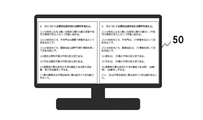
- FIG. 2 is a diagram showing the operation of the fill-in-the-blank test question display unit of the fill-in-the-blank test question creation system according to the embodiment of the present invention.
- FIG. 2 shows an embodiment of the display screen 50, in which the fill-in-the-blank test question target document determined by the fill-in-the-blank test question target document determination unit 10 of the fill-in-the-blank test question creation system 1 is displayed on the left side, and the fill-in-the-blank test question is displayed.
- the fill-in-the-blank test questions in which the fill-in-the-blank spots predicted by the fill-in-the-blank spot prediction unit 30 are displayed in parenthesized blanks are displayed in parallel on the right side portion.
- the fill-in-the-blank test question including the fill-in-the-blank test question is output by using the trained model for the fill-in-the-blank test question target document.
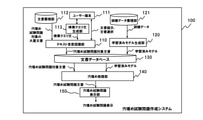
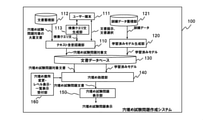
- FIG. 3 is a diagram showing a configuration of a fill-in-the-blank test question creation system according to the first embodiment of the present invention.
- the textual entailment recognition unit 110 the user terminal 111, the document storage unit 112, the search query sentence generation unit 113, the trained model generation unit 120, the training data storage unit 121, and the document database 130.
- a configuration including a fill-in-the-blank processing unit 140 and a fill-in-the-blank test question display unit 150 is shown.
- the document storage unit 112 stores documents that are candidates for the fill-in-the-blank exam question target document.
- the text implication recognition unit 110 extracts, for each of a plurality of simple sentences included in the search query sentence input from the search query sentence generation unit 113, a simple sentence having a similar meaning to the simple sentence from the document containing the plurality of simple sentences.
- discourse relation information showing the discourse relation which is the order of occurrence of the events between the simple sentences is generated based on the appearance order of the simple sentences before and after a certain connection word, and based on the discourse relation information.
- the discourse relationship between the simple sentences included in the search query sentence and the discourse relationship distance which is the number of intersections of the positions between the extracted simple sentences, are calculated, and the value including the discourse relationship distance and a predetermined threshold value are used.
- Textual entailment recognition is described in Patent Document 4. From the documents stored in the document storage unit 112, the textual entailment recognition unit 110 determines a document including the search query sentence input from the search query sentence generation unit 113 as a fill-in-the-blank test question target document. The determined fill-in-the-blank exam question target document is stored in the document database 130.
- the trained model generation unit 120 trains the model using the training data stored in the training data storage unit 121, which includes one or more documents and correct answer data specifying the fill-in-the-blank points in those documents. Run.
- the learning of the model by the trained model generation unit 120 is the same as the operation of the trained model generation unit 20 described in the above-described embodiment.
- the trained model generated by the trained model generation unit 120 is stored in the document database 130.
- training data of a plurality of groups having different difficulty levels of the fill-in-the-blank test questions for each test difficulty level conducted by a predetermined educational institution, for example, for each desired university or academic ability level are used as training data.
- the fill-in-the-blank processing unit 140 uses the trained model stored in the document database 130 to predict the fill-in-the-blank location of the document subject to the fill-in-the-blank test question stored in the document database 130, determine the fill-in-the-blank location, and determine the fill-in-the-blank location. Output the fill-in-the-blank exam question document including the fill-in-the-blank part.
- the fill-in-the-blank processing unit 140 has different learning for a plurality of groups of different difficulty levels of the fill-in-the-blank exam questions stored in the document database 130 for each difficulty level of the exam conducted by a predetermined educational institution, for example, for each aspiring university or academic ability level.
- the trained model applied to the document subject to the fill-in-the-blank exam can be used to predict the fill-in-the-blank location.
- the fill-in-the-blank test question display unit 150 receives the fill-in-the-blank test question document output by the fill-in-the-blank test question 140 and displays the fill-in-the-blank test question.
- FIG. 4 is a diagram showing the configuration of the search query sentence generation unit 113 of the fill-in-the-blank test question creation system according to the first embodiment of the present invention.
- the search query sentence generation unit 113 includes a lesson content data storage unit 1131, a query sentence storage unit 1132, a training data conversion unit 1133, a learned summary model generation unit 1134, a lesson content data conversion unit 1135, a query sentence prediction unit 1136, and a search query.
- the sentence selection unit 1137 is included.
- the lesson content data storage unit 1131 stores data reflecting the lesson content, such as text data representing the lesson content and data obtained by converting the voice of the lesson into text data by voice recognition.
- the search query sentence generated by the search query sentence generation unit 113 is a textual entailment recognition unit 110 shown in FIG. 3 for determining a document subject to a fill-in-the-blank test question from the documents stored in the document storage unit 112. Used by.
- the user terminal 111 creates a query statement summarizing the lesson content based on the lesson content data accumulated in the lesson content data storage unit 1131, and stores it in the query sentence storage unit 1132. Further, the created query sentence can be directly output as a search query sentence from the search query sentence generation unit 113 via the search query sentence selection unit 1137 by selection by the user terminal 111.
- the output search query text is input to the textual entailment recognition unit 110 shown in FIG.
- the textual entailment recognition unit 110 selects the input search query text from the documents stored in the document storage unit 112. Determine the implied document as the document for the fill-in-the-blank exam question.
- the determined fill-in-the-blank exam question target document is stored in the document database 130.
- the search query sentence generation unit 113 of the fill-in-the-blank test question creation system 100 of the first embodiment of the present invention shown in FIG. 4 corresponds to the lesson content data stored in the lesson content data storage unit 1131 and the lesson content data. Training of the summary model is executed using the training data including the query statements accumulated in the query statement storage unit 1132 as correct answer data.
- One or more lesson content data stored in the lesson content data storage unit 1131 and one or more query sentences stored in the query sentence storage unit 1132, which is correct answer data, are input to the training data conversion unit 1133, respectively. Converted to training data.
- the trained summary model generation unit 1134 performs preprocessing for converting the lesson content data and the query sentence which is the correct answer data into a format for executing the learning of the summary model.
- the content of the preprocessing is not limited to this, but includes, for example, converting a word in the lesson content data and a word in the query sentence which is the correct answer data into the distributed expression thereof.
- the distributed representation will be described later in the first embodiment of the present invention.
- the trained summary model generator 1134 uses these training data to train the summary model. In the learning of the summary model, between the query sentence predicted by the neural network by inputting one or more lesson content data of the training data and the query sentence of the correct answer data which is a summary for each lesson content data. The neural network weights parameters are adjusted to minimize the error to generate a trained summary model.
- the trained summary model generated by the trained summary model generation unit 1134 is input to the query sentence prediction unit 1136, and on the other hand, the lesson content data stored in the lesson content data storage unit 1131 is summarized.
- the lesson content data for which the query sentence to be performed is not generated is converted and input via the lesson content data conversion unit 1135.
- the lesson content data conversion unit 1135 executes a conversion similar to the conversion performed by the training data conversion unit 1133.
- the query sentence prediction unit 1136 predicts a query sentence that is a summary of the lesson content data from the converted and input lesson content data by using the learned summary model.
- the predicted query statement is presented to the user terminal 111.
- the predicted query statement is selected by the user terminal, it is output as a search query statement from the search query statement generation unit 113 via the search query statement selection unit 1137.
- the trained summary model generation unit 1134 may use a neural network to train the summary model, or may use a deep neural network to train the summary model, and may use RNN, LSTM, or Any combination of them may be used to train the summary model.
- the trained summary model generator 1134 may use the encoder / decoder model to train the summary model.
- the encoder and the decoder are configured by RNN, LSTM, or the like, respectively, and the output of the encoder is connected to the input of the decoder. Similar to the above, multiple lesson content data is input to the encoder so that the error between the predicted summary query statement output from the decoder and the correct query statement is minimized.
- the summary encoder / decoder model It is also possible to execute the training of the summary encoder / decoder model using the lesson content data and a plurality of query statements (correct answer data) to generate the trained summary encoder / decoder model.
- the query sentence prediction unit 1136 it is also possible to input the lesson content data for which the query sentence is to be generated into the learned summary encoder / decoder model and output the query statement which is the summary of the lesson content data predicted by the decoder.
- FIG. 5 is a diagram showing a configuration of a textual entailment recognition unit of the fill-in-the-blank test question creation system according to the first embodiment of the present invention.
- the textual entailment recognition unit 110 includes a textual entailment recognition processing unit 1101 and a fill-in-the-blank test question target document extraction / selection unit 1102.
- the text implication recognition processing unit 1101 determines a document that includes a search query sentence from a large number of documents that are subject to a fill-in-the-blank test question that is input from the search query sentence generation unit 113 and is stored in the document storage unit 112. And send it to the document extraction / selection unit 1102 for the fill-in-the-blank test question.
- the document extraction / selection unit 1102 for the fill-in-the-blank test question presents the extracted document to the user terminal.
- the selection of the document is sent from the user terminal to the document extraction / selection unit 1102 for the fill-in-the-blank test question, and according to this selection, the document extraction / selection unit 1102 for the fill-in-the-blank test question fills in the extracted document. Determine as the document to be questioned.
- the determined fill-in-the-blank exam question target document is stored in the document database 130.
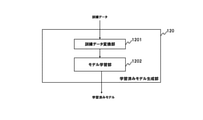
- FIG. 6 is a diagram showing a configuration of a trained model generation unit of the fill-in-the-blank test question creation system according to the first embodiment of the present invention.
- the trained model generation unit 120 includes a training data conversion unit 1201 and a model learning unit 1202.
- the training data conversion unit 1201 performs preprocessing for converting the training data into a format in which the model learning unit 1202 executes model learning.
- the content of the preprocessing is not limited to this, but includes, for example, converting a word in a document subject to a fill-in-the-blank test question into its distributed expression.
- the model learning unit 1202 executes model learning using the training data input from the training data conversion unit 1201.
- the learning of the model by the model learning unit 1202 is the same as the operation of the trained model generation unit 20 described in the above-described embodiment.
- the word distribution expression is a method for expressing the meaning of a word as a high-dimensional real number vector, and is a method such as word2vec, GloVe (Global Vectors for Word Repression), fastText, and BERT (Bidential Encoder Repression). ing.
- the training data conversion unit 1201 uses a distributed expression learned using sentences related to the document subject to the fill-in-the-blank exam question for each field such as English, social sciences, science, and Japanese, and uses the fill-in-the-blank exam question. Words in the target document may be converted.
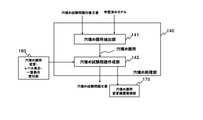
- FIG. 7 is a diagram showing a configuration of a fill-in-the-blank processing unit of the fill-in-the-blank test question creation system according to the first embodiment of the present invention.
- the fill-in-the-blank processing unit 140 includes a fill-in-the-blank location extraction unit 141 and a fill-in-the-blank test question creation unit 142.
- the fill-in-the-blank part extraction unit 141 predicts the fill-in-the-blank part of the input fill-in-the-blank test question target document for the input fill-in-the-blank test question target document, and determines the fill-in-the-blank part.
- the fill-in-the-blank test question creation unit 142 creates and outputs a fill-in-the-blank test question document including the determined fill-in-the-blank location.
- FIG. 8 is a diagram showing a configuration of a fill-in-the-blank location extraction unit of the fill-in-the-blank test question creation system according to the first embodiment of the present invention.
- the fill-in-the-blank location extraction unit 141 includes a document data conversion unit 1411 and a fill-in-the-blank location prediction unit 1412.
- a trained model is set in the fill-in-the-blank location prediction unit 1412.
- the document data conversion unit 1411 executes preprocessing for converting the document subject to the fill-in-the-blank test question into a format predicted by the fill-in-the-blank location prediction unit 1412.
- the processing corresponding to the pre-processing for the training data executed by the training data conversion unit 1201 shown in FIG. 6 is also executed for the fill-in-the-blank test question target document.
- the fill-in-the-blank location prediction unit 1412 inputs the fill-in-the-blank test question target document input from the document data conversion unit 1411 into the trained model, predicts the fill-in-the-blank location, determines the fill-in-the-blank location, and outputs the document.
- the fill-in-the-blank test question can be generated without manual operation, it is possible to contribute to the efficiency of the work of creating the fill-in-the-blank test question.
- the search query sentence used in the textual entailment recognition unit 110 can be generated from the lesson content data using the summary model, there is no need to manually create and input the search query sentence from the user terminal, and the fill-in-the-blank test is performed. It can further contribute to the efficiency of problem creation work.
- the fill-in-the-blank test question reflecting the lesson content can be generated.
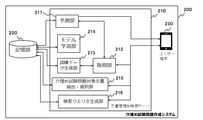
- FIG. 9 is a diagram showing a configuration of a fill-in-the-blank test question creation system according to a second embodiment of the present invention.
- the fill-in-the-blank test question creation system 200 of the second embodiment includes a document management AI search server 210, a storage unit 220, and a user terminal 230.
- the document management AI search server 210 includes a prediction unit 211, an acquisition unit 212, a training data generation unit 213, a model learning unit 214, a fill-in-the-blank test question target document extraction / selection unit 215, and a search query sentence generation unit 216.
- the fill-in-the-blank test question target document extraction / selection unit 215 includes a textual entailment recognition function for determining a document that implies an input text. The textual entailment recognition is as described above.
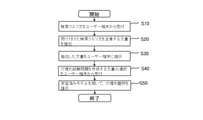
- FIG. 10 is a diagram showing a flowchart for explaining the operation of the fill-in-the-blank test question creation system according to the second embodiment of the present invention.
- the search query sentence generation unit 216 receives the search query sentence from the user terminal 230.
- the fill-in-the-blank test question target document extraction / selection unit 215 extracts a document including the search query sentence output from the search query sentence generation unit 216 by the textual entailment recognition function from the storage unit 220.
- step S30 the fill-in-the-blank test question target document extraction / selection unit 215 presents the extracted document to the user terminal 230.
- step S40 the acquisition unit 212 accepts the selection of the document to be created for the fill-in-the-blank test question from the user terminal 230.
- step S50 the prediction unit 211 predicts the fill-in-the-blank portion using the trained model, and presents the fill-in-the-blank test question to the user terminal 230.
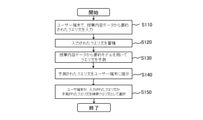
- FIG. 11 is a diagram showing a flowchart for explaining the operation of the search query sentence generation unit 216 of the fill-in-the-blank test question creation system of the second embodiment of the present invention.
- the flowchart shown in FIG. 11 is a diagram illustrating the operation of step S10 of the flowchart shown in FIG. 10 in more detail.
- step S110 a query sentence summarized based on the lesson content data stored in the storage unit 220 is input from the user terminal, and the input query sentence is stored in the storage unit 220 in step S120.
- step S130 a query sentence is predicted from the lesson content data stored in the storage unit 220 using a summary model, and in step 140, the predicted query sentence is presented to the user terminal 230.
- the user terminal 230 selects a search query statement from the input query statement or the predicted query statement.
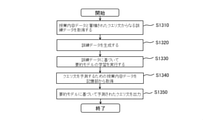
- FIG. 12 is a diagram showing a flowchart for explaining the operation of the search query sentence generation unit 216 of the fill-in-the-blank test question creation system of the second embodiment of the present invention.
- the flowchart shown in FIG. 12 is a diagram illustrating the operation of step S130 of the flowchart shown in FIG. 11 in more detail.
- step S1310 the training data consisting of the lesson content data stored in the storage unit 220 and the accumulated query sentences is acquired, and in step 1320, these are converted and used for training in the trained summary model generation unit 1134. Generate training data.
- training of the summary model is performed based on the transformed training data to generate a trained summary model.
- the lesson content data for predicting the query sentence is acquired from the storage unit 220, and in step 1350, the learned summary model is used to predict and output the query sentence summarized from the lesson content data. ..
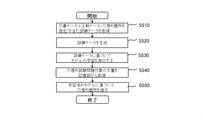
- FIG. 13 is a diagram showing a flowchart for explaining the operation of the fill-in-the-blank test question creation system according to the second embodiment of the present invention.
- the flowchart shown in FIG. 13 is a diagram illustrating the operation of step S50 of the flowchart shown in FIG. 10 in more detail.
- the acquisition unit 212 acquires training data including document data and correct answer data (designating a fill-in-the-blank location) from the storage unit 220.
- the training data generation unit 213 generates training data to be used for training in the model learning unit 214.
- the training data generation unit 213 is used for each of a plurality of groups having different difficulty levels of the fill-in-the-blank test questions for each of the various examinations conducted by a predetermined educational institution, for example, for each university of choice or for each academic ability level. It is also possible to generate training data.
- the model learning unit 214 trains the model based on the training data to generate a trained model, and stores the trained model in the storage unit 220. In the model learning of the model learning unit 214, the error between the fill-in-the-blank location predicted by the neural network by inputting one or more documents of the training data and the correct answer data of the fill-in-the-blank location for each document is the minimum.
- the weight parameter of the neural network is adjusted so that the trained model is generated.
- the model learning unit 214 executes model learning based on the training data for each of the plurality of groups for each desired university or each academic ability level generated by the training data generation unit 213, and for each desired university or academic ability level.
- a trained model for each of a plurality of groups may be generated and stored in the storage unit 220.
- step S540 the fill-in-the-blank test question target document, which is the document to be predicted selected in step S40 of FIG. 10, is read from the storage unit 220 to the prediction unit 211.
- step S550 the acquisition unit 212 receives the designation of the trained model to be used for prediction from the user terminal 230.
- the acquisition unit 212 specifies a trained model to be used for the prediction unit 211, and the prediction unit 211 reads the trained model to be used for prediction from the storage unit 220.
- the prediction unit 211 predicts the fill-in-the-blank portion of the read-out fill-in-the-blank test question target document based on the read-out learned model, and presents the fill-in-the-blank test question to the user terminal 230.
- FIG. 14 is a diagram showing a configuration of a fill-in-the-blank test question creation system according to a third embodiment of the present invention.
- the components having the same numbers as those in FIG. 3 indicate the same components.
- a third embodiment of the present invention is an embodiment in which a fill-in-the-blank location change / level display / list display reception unit 160 is added to the configuration of the fill-in-the-blank test question creation system of the first embodiment of the present invention shown in FIG. Is. Further, FIG.
- the fill-in-the-blank processing unit 140 of the third embodiment of FIG. 15 receives a fill-in-the-blank location change instruction output from the fill-in-the-blank location change / level display / list display reception unit 160 in the fill-in-the-blank test question creation unit 142, and fills in the blanks according to this instruction.
- the test question creation unit 142 executes a process such as deleting the determined fill-in-the-blank portion by the fill-in-the-blank location extraction unit 141 or setting a fill-in-the-blank portion in another location. According to the third embodiment of the present invention, it is possible to change the fill-in-the-blank portion determined by the fill-in-the-blank spot extraction unit 141.
- FIG. 16 is a diagram showing a configuration of a fill-in-the-blank test question creation system according to a fourth embodiment of the present invention.
- the components assigned the same numbers as those in FIG. 14 indicate the same components.
- a fourth embodiment of the present invention is an embodiment in which a fill-in-the-blank location change history storage unit 170 is added to the configuration of the fill-in-the-blank test question creation system of the third embodiment of the present invention described in FIG. Further, FIG.
- the fill-in-the-blank processing unit 140 of the fourth embodiment of FIG. 17 receives an instruction output from the fill-in-the-blank location change / level display / list display reception unit 160 in the fill-in-the-blank test question creation unit 142, and creates a fill-in-the-blank test question according to this instruction.
- the section 142 can change the fill-in-the-blank portion determined by the fill-in-the-blank location extraction unit 141.
- the fill-in-the-blank test question creation unit 142 stores the fill-in-the-blank test question target document together with the fill-in-the-blank test question target document when the fill-in-the-blank test question creation unit 142 changes the fill-in-the-blank location determined by the fill-in-the-blank location extraction unit 141.
- the change history of the fill-in-the-blank portion accumulated in this way can be used as training data when the trained model generation unit 120 generates a trained model when a certain number of change histories are accumulated. ..
- FIG. 18 is a diagram showing a configuration of a fill-in-the-blank test question creation system according to a fifth embodiment of the present invention.
- the components assigned the same numbers as those in FIG. 16 indicate the same components.
- a fifth embodiment of the present invention connects the fill-in-the-blank location change history storage unit 170 to the training data storage unit 121 in the configuration of the fill-in-the-blank test question creation system according to the fourth embodiment of the present invention shown in FIG. It is an added embodiment. The differences from the fourth embodiment will be mainly described below.
- the fill-in-the-blank location change history storage unit 170 of the fifth embodiment of FIG. 18 is described together with the fill-in-the-blank test question target document. Accumulate change history.
- the fill-in-the-blank test question target document accumulated from the fill-in-the-blank change history storage unit 170 to the training data storage unit 121 is displayed. , Send the change history of the accumulated fill-in-the-blank location.
- the training data storage unit 121 stores the sent documents subject to the fill-in-the-blank test and the change history of the fill-in-the-blank location as retraining data, and the trained model generation unit 120 uses the accumulated retraining data. , The trained model can be regenerated by re-training the model.
- FIG. 19 shows the configuration of the fill-in-the-blank processing unit according to the sixth embodiment of the present invention, and is a modification of the configuration of the fill-in-the-blank processing unit shown in FIG. 15 of the third embodiment of the present invention.
- the fill-in-the-blank processing unit 140 of the sixth embodiment of the present invention shown in FIG. 19 includes a fill-in-the-blank test question creation unit 142 and a fill-in-the-blank location level display unit 1421.
- FIG. 19 shows the configuration of the fill-in-the-blank processing unit according to the sixth embodiment of the present invention, and is a modification of the configuration of the fill-in-the-blank processing unit shown in FIG. 15 of the third embodiment of the present invention. be.
- the fill-in-the-blank processing unit 140 of the sixth embodiment of the present invention shown in FIG. 19 includes a fill-in-the-blank test question creation unit 142 and a fill-in-the-blan
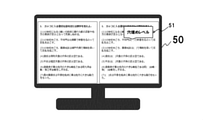
- FIG. 20 is a diagram showing an example of display of a fill-in-the-blank portion of the fill-in-the-blank test question creating system according to the sixth embodiment of the present invention.
- the components having the same numbers as those in FIG. 2 indicate the same components.
- the learned model used to predict the fill-in-the-blank part of the document subject to the fill-in-the-blank exam is the difficulty level of the fill-in-the-blank exam question for each difficulty level of various exams conducted by a predetermined educational institution, for example, for each university of choice or for each academic ability level.
- Each trained model corresponds to the difficulty of each fill-in-the-blank exam question, as it is generated using the respective training data for each of the different groups.
- the fill-in-the-blank level display unit 1421 receives and holds the fill-in-the-blank test question corresponding to the difficulty level of the extracted fill-in-the-blank location and the training data when the trained model is generated from the fill-in-the-blank location extraction unit 141. ..
- a pointing device such as a mouse
- the fill-in-the-blank part is specified.
- the change / level display / list display reception unit 160 accepts the fill-in-the-blank location designation and sends it to the fill-in-the-blank test question creation unit 142.
- the fill-in-the-blank test question creation unit 142 sends the fill-in-the-blank test question display unit 150 together with the fill-in-the-blank test question document the fill-in-the-blank level corresponding to each fill-in-the-blank location held by the fill-in-the-blank test question display unit 142.
- the fill-in-the-blank level 51 is displayed on the display screen 50.
- FIG. 21 shows the configuration of the fill-in-the-blank processing unit according to the seventh embodiment of the present invention, and is a modification of the configuration of the fill-in-the-blank processing unit shown in FIG. 15 of the third embodiment of the present invention. ..
- the fill-in-the-blank processing unit 140 of the seventh embodiment of the present invention shown in FIG. 21 includes a fill-in-the-blank test question creation unit 142 and a fill-in-the-blank location list display unit 1422.
- FIG. 22 is a diagram showing an example of a list display of fill-in-the-blank portions of the fill-in-the-blank test question creating system according to the seventh embodiment of the present invention.
- the difficulty level of the fill-in-the-blank exam question such as the fill-in-the-blank part number, the page / line of the fill-in-the-blank part, the desired university, and the academic ability level may be displayed.
- the trained model used to predict the fill-in-the-blank part of the document subject to the fill-in-the-blank exam is for each difficulty level of various exams conducted by a given educational institution, for example, for each of a plurality of groups for each university of choice or for each academic ability level.
- Each trained model corresponds to the difficulty of each fill-in-the-blank exam question, as it is generated using each training data.
- the fill-in-the-blank list display unit 1422 determines the desired university and academic ability level corresponding to the difficulty level of the fill-in-the-blank test questions related to the training data when the fill-in-the-blank location and the trained model are generated from the fill-in-the-blank location extraction unit 141.
- the list display specification is input to the fill-in-the-blank location change / level display / list display reception unit 160, the list display specification is sent to the fill-in-the-blank location list display unit 1422, and each fill-in-the-blank location held in the fill-in-the-blank location list display unit 1422.
- a list of fill-in-the-blank locations corresponding to is sent to the fill-in-the-blank test question display unit 150, and a list of fill-in-the-blank locations is displayed.
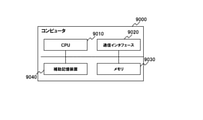
- a computer (9000 in FIG. 23) that functions as the fill-in-the-blank test question creation system 1, 100, 200. It can be realized by a program that realizes the function as.
- a computer is exemplified in a configuration including a CPU (Central Processing Unit) 9010, a communication interface 9020, a memory 9030, and an auxiliary storage device 9040 in FIG. 23. That is, the CPU 9010 in FIG. 23 may execute the fill-in-the-blank test question creation program and update each calculation parameter held in the auxiliary storage device 9040 or the like.
- CPU Central Processing Unit
- each part (processing means, function) of the fill-in-the-blank test question creation system shown in the first to seventh embodiments described above causes the processor of the computer to execute the above-mentioned processing by using the hardware thereof. It can be realized by a computer program.
- the fill-in-the-blank exam question target document determination unit of the fill-in-the-blank exam question creation system described above executes learning of a summary model using one or more lesson content data and correct answer data, which is a query sentence summarized from the lesson content data, as training data.
- a trained summary model generator that generates a trained summary model, and a query sentence prediction unit that predicts and outputs a query sentence from the lesson content data of the class for which a fill-in-the-blank exam question is created by the trained summary model.
- a search query statement generation unit including a search query statement selection unit that selects a query statement from a plurality of query statements including a predicted query statement and outputs a search query statement.
- the trained model generation unit of the above-mentioned fill-in-the-blank test question creation system generates different trained models for the training data of a plurality of groups for each difficulty level of various tests conducted by a predetermined educational institution.
- the fill-in-the-blank test question display unit of the fill-in-the-blank test question creation system displays the fill-in-the-blank test question target document and the fill-in-the-blank test question including the fill-in-the-blank test question in the fill-in-the-blank test question target document.
- the trained model generation unit of the above-mentioned fill-in-the-blank test question creation system executes model training using the first neural network.
- the first neural network of the above-mentioned fill-in-the-blank test question creation system is RNN (Recurrent Neural Network), LSTM (Long Short Term Memory), CNN (Convolutional Neural Network, convolutional neural network), or convolutional neural network. It is preferable to use a combination of. [7th form] It is preferable that the trained summary model generation unit of the above-mentioned fill-in-the-blank test question creation system executes model training using the second neural network.
- the fill-in-the-blank test question target document determination unit of the above-mentioned fill-in-the-blank test question creation system extracts a single sentence having a similar meaning to the single sentence for each of a plurality of simple sentences included in the search query sentence from the documents containing the multiple simple sentences.
- discourse relation information showing the discourse relation which is the order of occurrence of the events between the simple sentences is generated based on the appearance order of the simple sentences before and after a certain connection word, and based on the discourse relation information.
- the discourse relationship between the simple sentences included in the search query sentence and the discourse relationship distance which is the number of intersections of the positions between the extracted simple sentences, are calculated, and the value including the discourse relationship distance and a predetermined threshold value are used.
- the trained model generation unit of the above-mentioned fill-in-the-blank exam question creation system generates different trained models for the training data of a plurality of groups for each desired university or each academic ability level.
- the first neural network of the above-mentioned fill-in-the-blank test question creation system is preferably a deep neural network.
- the second neural network of the above-mentioned fill-in-the-blank test question creation system is preferably a deep neural network.
- the second neural network of the above-mentioned fill-in-the-blank test question creation system is a deep neural network which is RNN (Recurrent Neural Network), LSTM (Long Short Term Memory), or any combination thereof. Is preferable.
- the second neural network of the above-mentioned fill-in-the-blank test question creation system is preferably an encoder / decoder model.
- the document subject to the fill-in-the-blank test question in the fill-in-the-blank test question creation system described above is preferably a document containing text.
- the document subject to the fill-in-the-blank test question of the above-mentioned sentence fill-in-the-blank test question creation system can be a document containing an image.
- the document subject to the fill-in-the-blank test question of the above-mentioned sentence fill-in-the-blank test question creation system can be a document acquired by the voice recognition means.
- the fill-in-the-blank test question creation unit changes the fill-in-the-blank location determined by the fill-in-the-blank location extraction unit according to the input received by the fill-in-the-blank location change reception unit of the fill-in-the-blank test question creation system described above.
- [21st form] It is possible to further include a fill-in-the-blank change history storage unit that stores changes in the fill-in-the-blank part of the above-mentioned fill-in-the-blank test question creation system as a change history.
- the trained model generation unit of the above-mentioned fill-in-the-blank test question creation system re-trains the model using the retraining data in which the history information accumulated in the fill-in-the-blank location change history storage unit is used as correct answer data.
- the fill-in-the-blank part level display reception unit of the above-mentioned fill-in-the-blank test question creation system can accept an input for designating a fill-in-the-blank part of the fill-in-the-blank test question.
- the fill-in-the-blank location level display unit of the fill-in-the-blank test question creation system can display the level of the fill-in-the-blank location held by the fill-in-the-blank location level display unit according to the input received by the fill-in-the-blank location level display reception unit.
- the fill-in-the-blank part list display reception unit of the fill-in-the-blank test question creation system can accept an input specifying that the fill-in-the-blank part is to be displayed in a list.
- the fill-in-the-blank test question display unit of the fill-in-the-blank test question creation system can display a list of fill-in-the-blank locations held in the fill-in-the-blank location list display unit according to the input received by the fill-in-the-blank location list display reception unit.
- the list of fill-in-the-blank locations in the above-mentioned fill-in-the-blank exam question creation system can display fill-in-the-blank locations, pages / lines where fill-in-the-blanks appear, the university of choice associated with each location, and academic ability level.
Landscapes
- Engineering & Computer Science (AREA)
- Business, Economics & Management (AREA)
- Theoretical Computer Science (AREA)
- Physics & Mathematics (AREA)
- Educational Administration (AREA)
- Educational Technology (AREA)
- General Physics & Mathematics (AREA)
- Tourism & Hospitality (AREA)
- Health & Medical Sciences (AREA)
- Economics (AREA)
- General Health & Medical Sciences (AREA)
- Human Resources & Organizations (AREA)
- Marketing (AREA)
- Primary Health Care (AREA)
- Strategic Management (AREA)
- General Business, Economics & Management (AREA)
- Electrically Operated Instructional Devices (AREA)
- Management, Administration, Business Operations System, And Electronic Commerce (AREA)
- Information Retrieval, Db Structures And Fs Structures Therefor (AREA)
Priority Applications (2)
| Application Number | Priority Date | Filing Date | Title |
|---|---|---|---|
| PCT/JP2020/027702 WO2022014016A1 (ja) | 2020-07-16 | 2020-07-16 | 穴埋め試験問題作成システム、方法、プログラム |
| JP2022536073A JP7521583B2 (ja) | 2020-07-16 | 2020-07-16 | 穴埋め試験問題作成システム、方法、プログラム |
Applications Claiming Priority (1)
| Application Number | Priority Date | Filing Date | Title |
|---|---|---|---|
| PCT/JP2020/027702 WO2022014016A1 (ja) | 2020-07-16 | 2020-07-16 | 穴埋め試験問題作成システム、方法、プログラム |
Publications (1)
| Publication Number | Publication Date |
|---|---|
| WO2022014016A1 true WO2022014016A1 (ja) | 2022-01-20 |
Family
ID=79554549
Family Applications (1)
| Application Number | Title | Priority Date | Filing Date |
|---|---|---|---|
| PCT/JP2020/027702 Ceased WO2022014016A1 (ja) | 2020-07-16 | 2020-07-16 | 穴埋め試験問題作成システム、方法、プログラム |
Country Status (2)
| Country | Link |
|---|---|
| JP (1) | JP7521583B2 (enExample) |
| WO (1) | WO2022014016A1 (enExample) |
Families Citing this family (1)
| Publication number | Priority date | Publication date | Assignee | Title |
|---|---|---|---|---|
| JP7772347B1 (ja) * | 2025-08-18 | 2025-11-18 | 未来教育株式会社 | 学習支援システム |
Citations (3)
| Publication number | Priority date | Publication date | Assignee | Title |
|---|---|---|---|---|
| JPH0695583A (ja) * | 1992-09-09 | 1994-04-08 | Brother Ind Ltd | 学習支援装置 |
| JP2008129449A (ja) * | 2006-11-22 | 2008-06-05 | Yahoo Japan Corp | 問題自動作成装置、問題自動作成方法、及びコンピュータプログラム |
| JP6578941B2 (ja) * | 2013-02-28 | 2019-09-25 | 日本電気株式会社 | 含意判定装置、含意判定方法及びプログラム |
-
2020
- 2020-07-16 JP JP2022536073A patent/JP7521583B2/ja active Active
- 2020-07-16 WO PCT/JP2020/027702 patent/WO2022014016A1/ja not_active Ceased
Patent Citations (3)
| Publication number | Priority date | Publication date | Assignee | Title |
|---|---|---|---|---|
| JPH0695583A (ja) * | 1992-09-09 | 1994-04-08 | Brother Ind Ltd | 学習支援装置 |
| JP2008129449A (ja) * | 2006-11-22 | 2008-06-05 | Yahoo Japan Corp | 問題自動作成装置、問題自動作成方法、及びコンピュータプログラム |
| JP6578941B2 (ja) * | 2013-02-28 | 2019-09-25 | 日本電気株式会社 | 含意判定装置、含意判定方法及びプログラム |
Non-Patent Citations (1)
| Title |
|---|
| IWATA TOMOHARU, TAKUYA GOTO, TOMOKO KOJIRI, TOYOHIDE WATANABE, TAKESHI YAMADA: "Automatic generation of English cloze questions based on machine learning", NTT GIJUTU JOURNAL, 1 July 2011 (2011-07-01), XP055898073, Retrieved from the Internet <URL:https://www.ntt-review.jp/archive/ntttechnical.php?contents=ntr201110fa3.pdf&mode=show_pdf> * |
Also Published As
| Publication number | Publication date |
|---|---|
| JP7521583B2 (ja) | 2024-07-24 |
| JPWO2022014016A1 (enExample) | 2022-01-20 |
Similar Documents
| Publication | Publication Date | Title |
|---|---|---|
| US11947578B2 (en) | Method for retrieving multi-turn dialogue, storage medium, and electronic device | |
| CN109918568B (zh) | 个性化学习方法、装置、电子设备及存储介质 | |
| US20050026129A1 (en) | Interactive computerized performance support system and method | |
| JP7371297B1 (ja) | 文章作成支援システム、情報処理方法及びプログラム | |
| CN113569112B (zh) | 基于题目的辅导策略提供方法、系统、装置及介质 | |
| CN119537542B (zh) | 基于多智能体协作的互动问答任务处理方法及相关装置 | |
| CN114493944B (zh) | 学习路径的确定方法、装置、设备及存储介质 | |
| CN112596731B (zh) | 一种融合智能教育的编程教学系统及方法 | |
| CN110808038B (zh) | 普通话评测方法、装置、设备及存储介质 | |
| CN118132741B (zh) | 一种基于Agent的自主学习方法及系统 | |
| CN118734571B (zh) | 仿真计算app应用流程推荐方法、装置及系统 | |
| Gopi et al. | Enhancing engineering education through llm-driven adaptive quiz generation: A rag-based approach | |
| JP7684500B1 (ja) | 情報処理システム、情報処理方法及びプログラム | |
| KR20250071254A (ko) | 증강 현실 경험에서의 명령어 동적 조정 | |
| JP6846666B2 (ja) | 翻訳文生成方法、翻訳文生成装置及び翻訳文生成プログラム | |
| JP7494868B2 (ja) | 解答添削システム、方法、プログラム | |
| JP7521583B2 (ja) | 穴埋め試験問題作成システム、方法、プログラム | |
| CN119990242A (zh) | 数据标注方法和装置、评分系统、电子设备及计算机介质 | |
| US10936793B2 (en) | Edited character strings | |
| KR20250064529A (ko) | 모의 면접 서비스를 제공하는 방법 및 이를 위한 서버 | |
| CN118135856A (zh) | 一种基于文档编辑与通讯的口才训练方法 | |
| CN117786105A (zh) | 答题评分模型训练、答题评分方法、装置、设备和介质 | |
| WO2021245833A1 (ja) | 文書の黒塗り箇所表示システム、方法、プログラム | |
| CN118377885B (zh) | 基于语言链和对话生成模型的书法教学辅助系统和方法 | |
| KR20220083122A (ko) | 입시 데이터 분석 장치 및 방법 |
Legal Events
| Date | Code | Title | Description |
|---|---|---|---|
| 121 | Ep: the epo has been informed by wipo that ep was designated in this application |
Ref document number: 20945632 Country of ref document: EP Kind code of ref document: A1 |
|
| ENP | Entry into the national phase |
Ref document number: 2022536073 Country of ref document: JP Kind code of ref document: A |
|
| NENP | Non-entry into the national phase |
Ref country code: DE |
|
| 122 | Ep: pct application non-entry in european phase |
Ref document number: 20945632 Country of ref document: EP Kind code of ref document: A1 |