WO2021257442A1 - Naphthenic acid corrosion inhibitors for a refinery - Google Patents
Naphthenic acid corrosion inhibitors for a refinery Download PDFInfo
- Publication number
- WO2021257442A1 WO2021257442A1 PCT/US2021/037201 US2021037201W WO2021257442A1 WO 2021257442 A1 WO2021257442 A1 WO 2021257442A1 US 2021037201 W US2021037201 W US 2021037201W WO 2021257442 A1 WO2021257442 A1 WO 2021257442A1
- Authority
- WO
- WIPO (PCT)
- Prior art keywords
- corrosion inhibitor
- weight
- corrosion
- inhibitor composition
- approximately
- Prior art date
- Legal status (The legal status is an assumption and is not a legal conclusion. Google has not performed a legal analysis and makes no representation as to the accuracy of the status listed.)
- Ceased
Links
Classifications
-
- C—CHEMISTRY; METALLURGY
- C10—PETROLEUM, GAS OR COKE INDUSTRIES; TECHNICAL GASES CONTAINING CARBON MONOXIDE; FUELS; LUBRICANTS; PEAT
- C10G—CRACKING HYDROCARBON OILS; PRODUCTION OF LIQUID HYDROCARBON MIXTURES, e.g. BY DESTRUCTIVE HYDROGENATION, OLIGOMERISATION, POLYMERISATION; RECOVERY OF HYDROCARBON OILS FROM OIL-SHALE, OIL-SAND, OR GASES; REFINING MIXTURES MAINLY CONSISTING OF HYDROCARBONS; REFORMING OF NAPHTHA; MINERAL WAXES
- C10G75/00—Inhibiting corrosion or fouling in apparatus for treatment or conversion of hydrocarbon oils, in general
- C10G75/02—Inhibiting corrosion or fouling in apparatus for treatment or conversion of hydrocarbon oils, in general by addition of corrosion inhibitors
-
- C—CHEMISTRY; METALLURGY
- C10—PETROLEUM, GAS OR COKE INDUSTRIES; TECHNICAL GASES CONTAINING CARBON MONOXIDE; FUELS; LUBRICANTS; PEAT
- C10G—CRACKING HYDROCARBON OILS; PRODUCTION OF LIQUID HYDROCARBON MIXTURES, e.g. BY DESTRUCTIVE HYDROGENATION, OLIGOMERISATION, POLYMERISATION; RECOVERY OF HYDROCARBON OILS FROM OIL-SHALE, OIL-SAND, OR GASES; REFINING MIXTURES MAINLY CONSISTING OF HYDROCARBONS; REFORMING OF NAPHTHA; MINERAL WAXES
- C10G7/00—Distillation of hydrocarbon oils
- C10G7/10—Inhibiting corrosion during distillation
-
- C—CHEMISTRY; METALLURGY
- C10—PETROLEUM, GAS OR COKE INDUSTRIES; TECHNICAL GASES CONTAINING CARBON MONOXIDE; FUELS; LUBRICANTS; PEAT
- C10G—CRACKING HYDROCARBON OILS; PRODUCTION OF LIQUID HYDROCARBON MIXTURES, e.g. BY DESTRUCTIVE HYDROGENATION, OLIGOMERISATION, POLYMERISATION; RECOVERY OF HYDROCARBON OILS FROM OIL-SHALE, OIL-SAND, OR GASES; REFINING MIXTURES MAINLY CONSISTING OF HYDROCARBONS; REFORMING OF NAPHTHA; MINERAL WAXES
- C10G9/00—Thermal non-catalytic cracking, in the absence of hydrogen, of hydrocarbon oils
- C10G9/14—Thermal non-catalytic cracking, in the absence of hydrogen, of hydrocarbon oils in pipes or coils with or without auxiliary means, e.g. digesters, soaking drums, expansion means
- C10G9/16—Preventing or removing incrustation
-
- C—CHEMISTRY; METALLURGY
- C23—COATING METALLIC MATERIAL; COATING MATERIAL WITH METALLIC MATERIAL; CHEMICAL SURFACE TREATMENT; DIFFUSION TREATMENT OF METALLIC MATERIAL; COATING BY VACUUM EVAPORATION, BY SPUTTERING, BY ION IMPLANTATION OR BY CHEMICAL VAPOUR DEPOSITION, IN GENERAL; INHIBITING CORROSION OF METALLIC MATERIAL OR INCRUSTATION IN GENERAL
- C23F—NON-MECHANICAL REMOVAL OF METALLIC MATERIAL FROM SURFACE; INHIBITING CORROSION OF METALLIC MATERIAL OR INCRUSTATION IN GENERAL; MULTI-STEP PROCESSES FOR SURFACE TREATMENT OF METALLIC MATERIAL INVOLVING AT LEAST ONE PROCESS PROVIDED FOR IN CLASS C23 AND AT LEAST ONE PROCESS COVERED BY SUBCLASS C21D OR C22F OR CLASS C25
- C23F11/00—Inhibiting corrosion of metallic material by applying inhibitors to the surface in danger of corrosion or adding them to the corrosive agent
- C23F11/08—Inhibiting corrosion of metallic material by applying inhibitors to the surface in danger of corrosion or adding them to the corrosive agent in other liquids
- C23F11/10—Inhibiting corrosion of metallic material by applying inhibitors to the surface in danger of corrosion or adding them to the corrosive agent in other liquids using organic inhibitors
-
- C—CHEMISTRY; METALLURGY
- C10—PETROLEUM, GAS OR COKE INDUSTRIES; TECHNICAL GASES CONTAINING CARBON MONOXIDE; FUELS; LUBRICANTS; PEAT
- C10G—CRACKING HYDROCARBON OILS; PRODUCTION OF LIQUID HYDROCARBON MIXTURES, e.g. BY DESTRUCTIVE HYDROGENATION, OLIGOMERISATION, POLYMERISATION; RECOVERY OF HYDROCARBON OILS FROM OIL-SHALE, OIL-SAND, OR GASES; REFINING MIXTURES MAINLY CONSISTING OF HYDROCARBONS; REFORMING OF NAPHTHA; MINERAL WAXES
- C10G2300/00—Aspects relating to hydrocarbon processing covered by groups C10G1/00 - C10G99/00
- C10G2300/10—Feedstock materials
- C10G2300/1037—Hydrocarbon fractions
- C10G2300/1044—Heavy gasoline or naphtha having a boiling range of about 100 - 180 °C
-
- C—CHEMISTRY; METALLURGY
- C10—PETROLEUM, GAS OR COKE INDUSTRIES; TECHNICAL GASES CONTAINING CARBON MONOXIDE; FUELS; LUBRICANTS; PEAT
- C10G—CRACKING HYDROCARBON OILS; PRODUCTION OF LIQUID HYDROCARBON MIXTURES, e.g. BY DESTRUCTIVE HYDROGENATION, OLIGOMERISATION, POLYMERISATION; RECOVERY OF HYDROCARBON OILS FROM OIL-SHALE, OIL-SAND, OR GASES; REFINING MIXTURES MAINLY CONSISTING OF HYDROCARBONS; REFORMING OF NAPHTHA; MINERAL WAXES
- C10G2300/00—Aspects relating to hydrocarbon processing covered by groups C10G1/00 - C10G99/00
- C10G2300/20—Characteristics of the feedstock or the products
- C10G2300/201—Impurities
- C10G2300/207—Acid gases, e.g. H2S, COS, SO2, HCN
-
- C—CHEMISTRY; METALLURGY
- C10—PETROLEUM, GAS OR COKE INDUSTRIES; TECHNICAL GASES CONTAINING CARBON MONOXIDE; FUELS; LUBRICANTS; PEAT
- C10G—CRACKING HYDROCARBON OILS; PRODUCTION OF LIQUID HYDROCARBON MIXTURES, e.g. BY DESTRUCTIVE HYDROGENATION, OLIGOMERISATION, POLYMERISATION; RECOVERY OF HYDROCARBON OILS FROM OIL-SHALE, OIL-SAND, OR GASES; REFINING MIXTURES MAINLY CONSISTING OF HYDROCARBONS; REFORMING OF NAPHTHA; MINERAL WAXES
- C10G2300/00—Aspects relating to hydrocarbon processing covered by groups C10G1/00 - C10G99/00
- C10G2300/40—Characteristics of the process deviating from typical ways of processing
- C10G2300/4075—Limiting deterioration of equipment
-
- C—CHEMISTRY; METALLURGY
- C10—PETROLEUM, GAS OR COKE INDUSTRIES; TECHNICAL GASES CONTAINING CARBON MONOXIDE; FUELS; LUBRICANTS; PEAT
- C10G—CRACKING HYDROCARBON OILS; PRODUCTION OF LIQUID HYDROCARBON MIXTURES, e.g. BY DESTRUCTIVE HYDROGENATION, OLIGOMERISATION, POLYMERISATION; RECOVERY OF HYDROCARBON OILS FROM OIL-SHALE, OIL-SAND, OR GASES; REFINING MIXTURES MAINLY CONSISTING OF HYDROCARBONS; REFORMING OF NAPHTHA; MINERAL WAXES
- C10G2300/00—Aspects relating to hydrocarbon processing covered by groups C10G1/00 - C10G99/00
- C10G2300/80—Additives
Definitions
- the present disclosure is generally related to chemical compositions, and more particularly related to corrosion inhibitor compositions.
- naphthenic acid corrosion is common in refinery processes that occur at high temperatures (e.g., 200°C to 400°C), for example in refinery processes that process crude oil and its various fractions. For instance, distillation of an acidic crude oil can result in naphthenic acid corrosion. In some circumstances, naphthenic acid corrosion can be predicted in a given refinery apparatus based on the total acid number (TAN) of the fluid that is exposed to the apparatus. In standard oil and gas facilities, corrosion inhibitors and corrosion-resistant alloys (CRAs) are often used to mitigate naphthenic acid corrosion.
- TAN total acid number
- CRAs corrosion inhibitors and corrosion-resistant alloys
- phosphate-based corrosion inhibitors are known to have some effectiveness in controlling naphthenic acid corrosion.
- phosphate-based corrosion inhibitors can have negative effects on downstream refinery units, as these types of inhibitors can result in catalyst poisoning (partial or complete deactivation of the catalyst), for example.
- a corrosion inhibitor composition in a first aspect, can comprise 2,5-dihydroxyterephthalic acid (DHTA), dimethyl sulfoxide, heavy aromatic naphtha.
- DHTA 2,5-dihydroxyterephthalic acid
- the composition comprises approximately: 10-30 weight% of DHTA, 60-80 weight % of dimethyl sulfoxide, and 10-30 weight % heavy aromatic naphtha.
- the composition comprises approximately: 20 weight % of DHTA; 70 weight % of dimethyl sulfoxide; and 10 weight % heavy aromatic naphtha.
- the corrosion inhibitor composition inhibits naphthenic acid corrosion.
- the corrosion inhibitor composition is free of phosphate.
- a corrosion inhibitor composition comprising a corrosion inhibitor, dimethyl sulfoxide, and heavy aromatic naphtha
- the corrosion inhibitor is 3-dimethylamino benzoic acid (3-DMAB) or 4-dimethylamino benzoic acid (4- DMAB).
- the composition comprises approximately: 10-30 weight% of the corrosion inhibitor, 60-80 weight % of dimethyl sulfoxide, and 10-30 weight % heavy aromatic naphtha.
- the corrosion inhibitor is 3-DMAB and the composition comprises approximately: 20 weight % of 3-DMAB, 70 weight % of dimethyl sulfoxide, and 10 weight % heavy aromatic naphtha.
- the corrosion inhibitor is 4-DMAB and the composition comprises approximately: 10 weight % of 4-DMAB, 80 weight % of dimethyl sulfoxide, and 10 weight % heavy aromatic naphtha.
- the corrosion is caused by naphthenic acid.
- the corrosion inhibitor composition is free of phosphate.
- a method for inhibiting corrosion on a metal surface exposed to a hydrocarbon fluid is provided.
- a corrosion inhibitor composition is added to the hydrocarbon fluid exposed to the metal surface, and the corrosion inhibitor composition comprises 3-DMAB, 4-DMAB, or DHTA.
- the corrosion inhibitor composition is added to the hydrocarbon fluid in a concentration of approximately 100 ppm to approximately 1000 ppm.
- the corrosion inhibitor composition comprises 3-DMAB, and further comprises dimethyl sulfoxide, and heavy aromatic naphtha.
- the corrosion inhibitor composition comprises approximately: 20 weight % of 3-DMAB, 70 weight % of dimethyl sulfoxide, and 10 weight % heavy aromatic naphtha, and the corrosion inhibitor composition is added to the hydrocarbon fluid in a concentration of approximately 500 ppm.
- the corrosion inhibitor composition comprises 4- DMAB, and further comprises dimethyl sulfoxide, and heavy aromatic naphtha.
- the corrosion inhibitor composition comprises approximately: 10 weight % of 4-DMAB, 80 weight % of dimethyl sulfoxide, and 10 weight % heavy aromatic naphtha, and the corrosion inhibitor composition is added to the hydrocarbon fluid in a concentration of approximately 500 ppm.
- the corrosion inhibitor composition comprises DHTA, and further comprises dimethyl sulfoxide, and heavy aromatic naphtha.
- the corrosion inhibitor composition comprises approximately: 20 weight % of DHTA, 70 weight % of dimethyl sulfoxide, and 10 weight % heavy aromatic naphtha, and the corrosion inhibitor composition is added to the hydrocarbon fluid in a concentration of approximately 500 ppm.
- the corrosion inhibitor composition is added to the hydrocarbon fluid in a refinery process, wherein the refinery process is performed at a temperature of approximately 200°C to approximately 400°C, and wherein the corrosion inhibitor composition inhibits naphthenic acid corrosion on the metal surface.
- the corrosion inhibitor compositions of the present application are phosphate-free and can comprise a corrosion inhibitor, such as 3-dimethylamino benzoic acid (3-DMAB), 4-dimethylamino benzoic acid (4-DMAB), or 2,5-dihydroxyterephthalic acid (DHTA).
- a corrosion inhibitor such as 3-dimethylamino benzoic acid (3-DMAB), 4-dimethylamino benzoic acid (4-DMAB), or 2,5-dihydroxyterephthalic acid (DHTA).
- the corrosion inhibitor composition comprises (i) DHTA, (ii) dimethyl sulfoxide, and (in) heavy aromatic naphtha.
- the corrosion inhibitor composition comprises (i) 3-DMAB or 4-DMAB, (ii) dimethyl sulfoxide, and (iii) heavy aromatic naphtha.
- a corrosion inhibitor composition of the present application can be added to a hydrocarbon fluid in a refinery process in which the hydrocarbon fluid is exposed to one or more metal surfaces.
- the addition of the corrosion inhibitor composition to the hydrocarbon fluid can mitigate or prevent corrosion on the metal surfaces typically caused by the hydrocarbon fluid.
- the present compositions and methods can be used to mitigate or prevent naphthenic acid corrosion that is induced during high-temperature (e.g., 200°C to 400°C) refinery processes, such as distillation of an acidic crude oil.
- at least one of the present corrosion inhibitor compositions is added to the acidic crude oil, thereby reducing the amount of naphthenic acid corrosion that occurs on the metal surfaces exposed to the acidic crude oil.
- compositions and methods can be used to reduce corrosion — and in particular, naphthenic acid corrosion — in various refinery units, such as crude distillation units, vacuum distillations units, and furnaces, that are exposed to hydrocarbon fluids.
- compositions and methods are described in further detail below with reference to the accompany drawing figures, in which one or more illustrated embodiments and/or arrangements of the corrosion inhibitors are shown.
- the compositions and methods of the present application are not limited in any way to the illustrated embodiments and/or arrangements. It should be understood that the compositions and methods as shown in the accompanying figures are merely exemplary of the compositions and methods of the present application, which can be embodied in various forms as appreciated by one skilled in the art. Therefore, it is to be understood that any structural and functional details disclosed herein are not to be interpreted as limiting the present compositions and methods, but rather are provided as a representative embodiment and/or arrangement for teaching one skilled in the art one or more ways to implement the present compositions and methods.
- the corrosion inhibitor compositions of the present application generally comprise at least one corrosion inhibitor.
- Figs. 1A-1C display the chemical structures of various corrosion inhibitors of the present compositions and methods in accordance with one or more embodiments.
- Fig. 1A shows the chemical structure of 3-dimethylamino benzoic acid (3-DMAB).
- Fig. IB shows the chemical structure of 4-dimethylamino benzoic acid (4-DMAB).
- Fig. 1C shows the chemical structure of 2,5-dihydroxyterephthalic acid (DHTA).
- the corrosion inhibitors of the present compositions are free of phosphates, and thus the present compositions are also free of phosphates. As such, the present compositions do not have the same negative effects on downstream refinery units that phosphate-based corrosion inhibitors do.
- refinery units such as fluid catalytic cracking (FCC) units and naphtha hydrotreater (NHT) units, are typically downstream of the units that are affected by naphthenic acid corrosion.
- FCC and NHT units generally include catalysts that, upon interaction with phosphate groups, become partially or complete deactivated (“catalyst poisoning”), thereby hindering the reactions of the FCC and NHT units.
- Catalyst poisoning catalysts that, upon interaction with phosphate groups, become partially or complete deactivated
- phosphate-based corrosion inhibitors mitigate naphthenic acid corrosion, their effectiveness in mitigating corrosion is negated by their downstream effects on catalysts.
- the phosphate-free corrosion inhibitor compositions of the present application are effective at reducing and/or preventing naphthenic acid corrosion, and do not cause catalyst poisoning in downstream operations.
- the corrosion inhibitor compositions can comprise one or more additional compounds in addition to the at least one corrosion inhibitor.
- the corrosion inhibitor composition can comprise DHTA, dimethyl sulfoxide, and heavy aromatic naphtha.
- the heavy aromatic naphtha as mentioned herein is the compound identified by CAS #64742- 94-5.
- the corrosion inhibitor composition can comprise approximately 10-30 weight % of DHTA, approximately 60-80 weight % of dimethyl sulfoxide, and approximately 10-30 weight % heavy aromatic naphtha. In at least one embodiment, the composition can comprise approximately 20 weight % of DHTA, approximately 70 weight % of dimethyl sulfoxide, and approximately 10 weight % heavy aromatic naphtha. In the present application, it should be understood that the term “approximately”, when used in conjunction with a number, refers to any number within 5% of the referenced number, including the referenced number.
- the corrosion inhibitor composition can comprise: (i) 3-DMAB or 4-DMAB; (ii) dimethyl sulfoxide; and (in) heavy aromatic naphtha.
- the composition comprises approximately 10-30 weight% of either 3-DMAB or 4-DMAB, approximately 60-80 weight % of dimethyl sulfoxide, and approximately 10-30 weight % heavy aromatic naphtha.
- the corrosion inhibitor composition can comprise approximately 20 weight % of 3-DMAB, approximately 70 weight % of dimethyl sulfoxide, and approximately 10 weight % heavy aromatic naphtha.
- the corrosion inhibitor composition can comprise approximately 10 weight % of 4-DMAB, approximately 80 weight % of dimethyl sulfoxide, and approximately 10 weight % heavy aromatic naphtha.
- the present application also discloses methods for inhibiting corrosion on a metal surface that is exposed to a hydrocarbon fluid. The present methods utilize one or more of the corrosion inhibitor compositions discussed above.
- the method can comprise adding at least one of the corrosion inhibitor compositions of the present application to a hydrocarbon fluid exposed to the metal surface.
- the hydrocarbon fluid can be in-use in a metal refinery unit, such as a crude distillation unit, vacuum distillation unit, or furnace.
- the addition of the at least one corrosion inhibitor composition to the hydrocarbon fluid can reduce corrosion on the metal surfaces typically caused by the hydrocarbon fluid.
- the corrosion inhibitor compositions can mitigate or prevent naphthenic acid corrosion that is induced during high- temperature (e.g., 200°C to 400°C) refinery processes, such as distillation of an acidic crude oil.
- high-temperature refinery processes such as distillation of an acidic crude oil.
- at least one of the present corrosion inhibitor compositions can be added to an acidic crude oil that is used in a high-temperature refinery unit, such as a crude distillation unit.
- Acidic crude oil typical causes naphthenic acid corrosion on the metal surfaces of a crude distillation unit over time.
- the addition of the at least one corrosion inhibitor composition to the acidic crude oil mitigates the occurrence naphthenic acid corrosion or, in certain implementations, prevents naphthenic acid corrosion from occurring on the metal surfaces exposed to the acidic crude oil.
- the at least one corrosion inhibitor composition is added to the hydrocarbon fluid (e.g., acidic crude oil) after it enters the refinery unit.
- the corrosion inhibitor composition(s) of the present application can be continuously added in the hydrocarbon fluid at a selected amount, measured in parts per million (ppm) for example, to protect the refinery equipment from naphthenic acid corrosion.
- the corrosion inhibitor composition can be added to the hydrocarbon fluid in a concentration of approximately 100 ppm to approximately 1000 ppm. In one or more embodiments, the corrosion inhibitor composition can be added to the hydrocarbon fluid in a concentration of approximately 500 ppm.
- a corrosion inhibitor composition comprising approximately 20 weight % of DHTA, approximately 70 weight % of dimethyl sulfoxide, and approximately 10 weight % heavy aromatic naphtha can be added to a hydrocarbon fluid in a concentration of approximately 500 ppm.
- a corrosion inhibitor composition comprising approximately 20 weight % of 3-DMAB, approximately 70 weight % of dimethyl sulfoxide, and approximately 10 weight % heavy aromatic naphtha can be added to the hydrocarbon fluid in a concentration of approximately 500 ppm.
- a corrosion inhibitor composition comprising approximately 10 weight % of 4-DMAB, approximately 80 weight % of dimethyl sulfoxide, and approximately 10 weight % heavy aromatic naphtha.
- a rotating cage autoclave corrosion test was performed to measure the corrosion inhibition efficiency of the various formulations.
- the test was performed in accordance with ASTM standard G170.
- a hydrocarbon fluid comprising 310 gm (about 350 mL) of mineral oil heavy (CAS # 8042-47-5) was provided to the rotating cage autoclave cell and 4.2 gm (about 4.56 mL) of naphthenic acid (CAS # 1338-24-5; commercial grade with acid value of 230 mg KOH/g) was added to the fluid to make a test solution having a TAN value of 3 mg KOH/g.
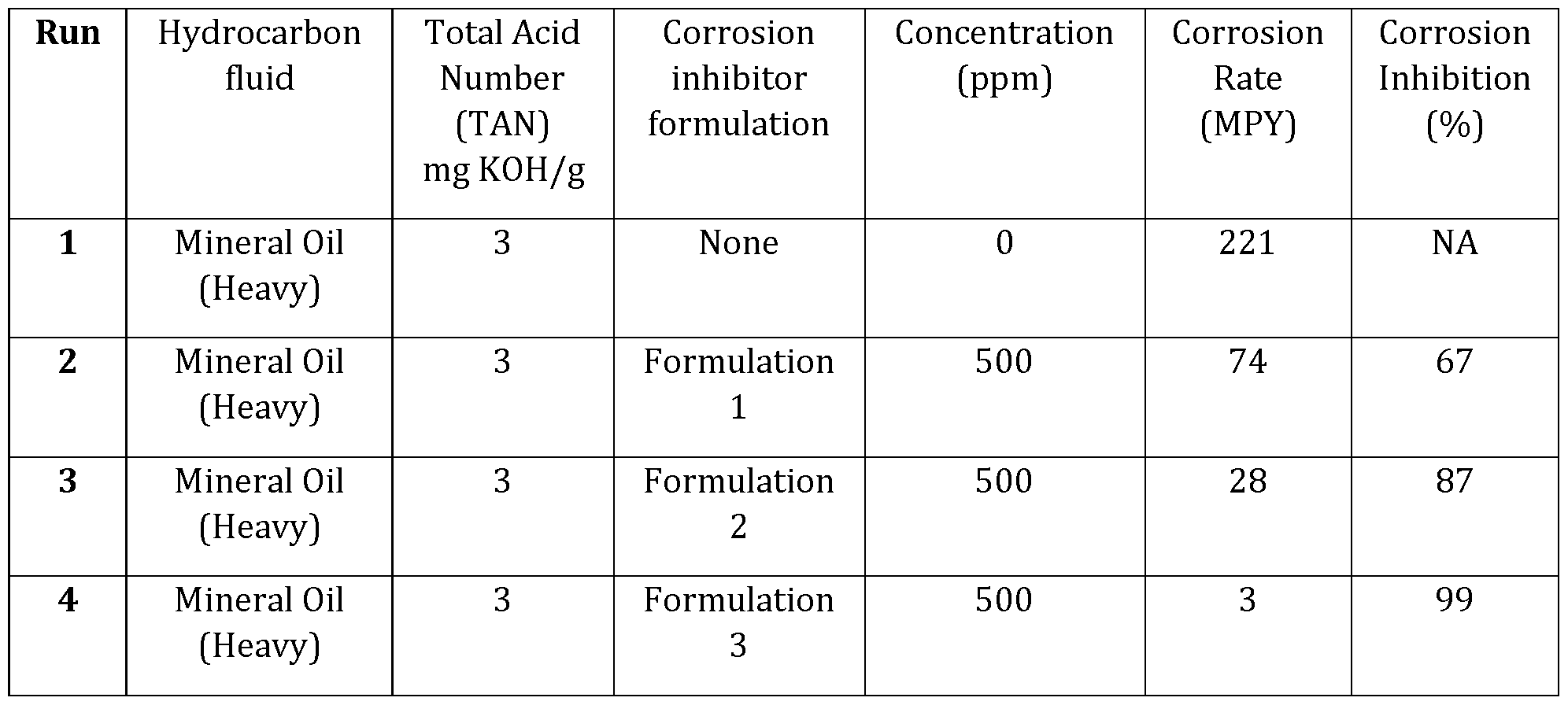
- the three formulations of corrosion inhibitor compositions were added separately in the test solution in separate runs as shown in results of Table 2, below.
- the mixture of the test solution and the respective formulations were exposed metal coupons in the test cell.
- a control run was also done in which no corrosion inhibitor composition was added to the test solution. Nitrogen gas purging was performed to remove the oxygen content in the test solution as well as in the test cell.
- the experimental conditions were as follows:
- the corrosion inhibition efficiency was calculated using the below equations. For each of the test formulations, corrosion inhibition efficiency was calculated by comparing weight loss of the metal coupon due to the respective test formulations with weight loss of metal coupon in the test run without a corrosion inhibitor formulation.
- Corrosion inhibition efficiency ⁇ (weight loss for coupon without corrosion inhibitor) - (weight loss for coupon with corrosion inhibitor) / (weight loss for coupon without corrosion inhibitor) ⁇ c 100.
- the corrosion rate in MPY (mils per year) was calculated by the following formula:
- corrosion inhibitor formulations 1, 2 and 3 each showed corrosion inhibition efficiency in high-temperature naphthenic acid conditions (i.e., 300°C and 3 TAN mineral oil solution).
- Formulation 3 exhibited 99% corrosion inhibition and formed a protective barrier layer on the metals surface of the coupons in contact with the corrosive fluids.
- Formulations 1 and 2 were still effective at forming a protective barrier layer on the metal surfaces of the coupons in contact with the corrosive fluids.
- the present experimental runs show that the metal surfaces in refinery piping (e.g., furnaces, pump arounds) and equipment (e.g., crude distillation unit, vacuum distillation unit) are protected from naphthenic acid corrosion by adding the corrosion inhibitor compositions of the present application to the corrosive fluids (e.g., 3 TAN mineral oil heavy).
- the corrosion inhibitor compositions of the present application e.g., 3 TAN mineral oil heavy.
- compositions and methods for inhibiting corrosion on metal surfaces in refineries or pipelines can be similarly deployed and/or implemented in scenarios, situations, and settings far beyond the referenced scenarios. It should be further understood that any such implementation and/or deployment is within the scope of the composition and methods described herein.
Landscapes
- Chemical & Material Sciences (AREA)
- Oil, Petroleum & Natural Gas (AREA)
- Engineering & Computer Science (AREA)
- Organic Chemistry (AREA)
- Chemical Kinetics & Catalysis (AREA)
- General Chemical & Material Sciences (AREA)
- Mechanical Engineering (AREA)
- Thermal Sciences (AREA)
- Physics & Mathematics (AREA)
- Metallurgy (AREA)
- Materials Engineering (AREA)
- Production Of Liquid Hydrocarbon Mixture For Refining Petroleum (AREA)
- Preventing Corrosion Or Incrustation Of Metals (AREA)
Abstract
Description


Claims
Priority Applications (1)
| Application Number | Priority Date | Filing Date | Title |
|---|---|---|---|
| SA522441691A SA522441691B1 (en) | 2020-06-15 | 2022-12-11 | Naphthenic Acid Corrosion Inhibitors for A Refinery |
Applications Claiming Priority (2)
| Application Number | Priority Date | Filing Date | Title |
|---|---|---|---|
| US16/901,825 US11046901B1 (en) | 2020-06-15 | 2020-06-15 | Naphthenic acid corrosion inhibitors for a refinery |
| US16/901,825 | 2020-06-15 |
Publications (1)
| Publication Number | Publication Date |
|---|---|
| WO2021257442A1 true WO2021257442A1 (en) | 2021-12-23 |
Family
ID=76548125
Family Applications (1)
| Application Number | Title | Priority Date | Filing Date |
|---|---|---|---|
| PCT/US2021/037201 Ceased WO2021257442A1 (en) | 2020-06-15 | 2021-06-14 | Naphthenic acid corrosion inhibitors for a refinery |
Country Status (3)
| Country | Link |
|---|---|
| US (2) | US11046901B1 (en) |
| SA (1) | SA522441691B1 (en) |
| WO (1) | WO2021257442A1 (en) |
Citations (3)
| Publication number | Priority date | Publication date | Assignee | Title |
|---|---|---|---|---|
| US20030012681A1 (en) * | 2001-07-13 | 2003-01-16 | Yeganeh Mohsen S. | Method for inhibiting corrosion using certain phosphorus and sulfur-free compounds |
| US20030013621A1 (en) * | 2001-07-13 | 2003-01-16 | Guido Sartori | Method for inhibiting corrosion using certain aromatic acidic species |
| US6583091B2 (en) * | 2001-07-13 | 2003-06-24 | Exxonmobil Research And Engineering Company | Method for inhibiting corrosion using 4-sulfophthalic acid |
Family Cites Families (29)
| Publication number | Priority date | Publication date | Assignee | Title |
|---|---|---|---|---|
| US3692681A (en) | 1968-08-02 | 1972-09-19 | Chevron Res | Dispersion of terephthalic acid in detergent containing hydrocarbon oil medium |
| US5252254A (en) | 1992-12-30 | 1993-10-12 | Nalco Chemical Company | Naphthenic acid corrosion inhibitor |
| US5314643A (en) | 1993-03-29 | 1994-05-24 | Betz Laboratories, Inc. | High temperature corrosion inhibitor |
| US5543388A (en) * | 1993-08-05 | 1996-08-06 | Exxon Chemical Patents Inc. | Intensified corrosion inhibitor and method of use |
| US5500107A (en) | 1994-03-15 | 1996-03-19 | Betz Laboratories, Inc. | High temperature corrosion inhibitor |
| WO1997045503A1 (en) | 1996-05-30 | 1997-12-04 | Petrolite Corporation | Control of naphthenic acid corrosion with thiophosphorus compounds |
| MY155018A (en) | 2007-03-30 | 2015-08-28 | Dorf Ketal Chemicals I Private Ltd | High temperature naphthenic acid corrosion inhibition using organophosphorous sulphur compounds and combinations thereof |
| CN101688118B (en) | 2007-04-04 | 2014-10-29 | 多尔夫凯塔尔化学制品(I)私人有限公司 | Inhibition of naphthenic acid corrosion with new synergistic phosphorus-containing compounds |
| CN104711580A (en) | 2007-09-14 | 2015-06-17 | 多尔夫凯塔尔化学制品(I)私人有限公司 | A novel additive for naphthenic acid corrosion inhibition and method of using the same |
| WO2009053971A1 (en) | 2007-10-22 | 2009-04-30 | Oil Refineries Ltd | Process for inhibiting naphthenic acid corrosion |
| CN102482294B (en) | 2009-06-19 | 2016-02-03 | 加利福尼亚大学董事会 | Complicated mixed ligand open-framework material |
| EP2661482B1 (en) | 2011-01-04 | 2016-12-28 | The Lubrizol Corporation | Continuously variable transmission fluid with extended anti-shudder durability |
| CN102732896A (en) | 2011-03-31 | 2012-10-17 | 武汉润尔华科技有限公司 | High-temperature corrosion inhibitor |
| US20140187455A1 (en) | 2012-12-28 | 2014-07-03 | Chevron Oronite LLC | Ultra-low saps lubricants for internal combustion engines |
| CN104968425B (en) | 2013-01-31 | 2017-08-11 | 巴斯夫欧洲公司 | Metal-organic framework extrudates with high packing density and adjustable pore volume |
| CN109181671B (en) | 2013-01-31 | 2020-08-25 | 艺康美国股份有限公司 | Mobility control polymers for enhanced oil recovery |
| US9238588B2 (en) | 2013-08-02 | 2016-01-19 | Ecolab USA, Inc. | Organic disulfide based corrosion inhibitors |
| CA2919874A1 (en) | 2013-09-11 | 2015-03-19 | Halliburton Energy Services, Inc. | Asphaltene-dissolving oil-external emulsion for acidization and methods of using the same |
| KR102261638B1 (en) | 2013-11-15 | 2021-06-08 | 삼성디스플레이 주식회사 | Cleaner Composition and method of manufacturing metal line using the same |
| WO2015088893A1 (en) | 2013-12-10 | 2015-06-18 | The Lubrizol Corporation | Organic salts of glyceride-cyclic carboxylic acid anhydride adducts as corrosion inhibitors |
| US9890625B2 (en) | 2014-02-28 | 2018-02-13 | Eclipse Ior Services, Llc | Systems and methods for the treatment of oil and/or gas wells with an obstruction material |
| CA2898770C (en) | 2014-07-28 | 2019-05-21 | Cesi Chemical, Inc. | Methods and compositions related to gelled layers in oil and/or gas wells |
| TWI775722B (en) | 2014-12-22 | 2022-09-01 | 德商巴斯夫歐洲公司 | Use of a chemical mechanical polishing (cmp) composition for polishing of cobalt and/or cobalt alloy comprising substrates |
| US10450500B2 (en) | 2015-01-12 | 2019-10-22 | Ecolab Usa Inc. | Thermally stable polymers for enhanced oil recovery |
| KR102641590B1 (en) | 2015-08-12 | 2024-02-27 | 바스프 에스이 | Use of chemical mechanical polishing (CMP) compositions for polishing cobalt-containing substrates |
| JP6065138B1 (en) | 2016-03-22 | 2017-01-25 | 栗田工業株式会社 | Method for reducing corrosive ions in aromatic compound extraction solvents |
| WO2018102503A1 (en) | 2016-11-30 | 2018-06-07 | Ecolab Usa Inc. | Composition for remediating iron sulfide in oilfield production systems |
| US11993729B2 (en) * | 2017-11-22 | 2024-05-28 | Basf Se | Chemical mechanical polishing composition |
| CN111100724B (en) | 2018-10-25 | 2022-07-15 | 中国石油化工股份有限公司 | Perfluoropolyether lubricating grease and preparation method thereof |
-
2020
- 2020-06-15 US US16/901,825 patent/US11046901B1/en active Active
-
2021
- 2021-06-14 WO PCT/US2021/037201 patent/WO2021257442A1/en not_active Ceased
- 2021-06-25 US US17/304,815 patent/US11345867B2/en active Active
-
2022
- 2022-12-11 SA SA522441691A patent/SA522441691B1/en unknown
Patent Citations (3)
| Publication number | Priority date | Publication date | Assignee | Title |
|---|---|---|---|---|
| US20030012681A1 (en) * | 2001-07-13 | 2003-01-16 | Yeganeh Mohsen S. | Method for inhibiting corrosion using certain phosphorus and sulfur-free compounds |
| US20030013621A1 (en) * | 2001-07-13 | 2003-01-16 | Guido Sartori | Method for inhibiting corrosion using certain aromatic acidic species |
| US6583091B2 (en) * | 2001-07-13 | 2003-06-24 | Exxonmobil Research And Engineering Company | Method for inhibiting corrosion using 4-sulfophthalic acid |
Non-Patent Citations (1)
| Title |
|---|
| CAS, no. 64742-94-5 |
Also Published As
| Publication number | Publication date |
|---|---|
| US11345867B2 (en) | 2022-05-31 |
| US11046901B1 (en) | 2021-06-29 |
| US20210388276A1 (en) | 2021-12-16 |
| SA522441691B1 (en) | 2024-07-30 |
Similar Documents
| Publication | Publication Date | Title |
|---|---|---|
| KR101581215B1 (en) | Naphthenic acid corrosion inhibiting composition containing organophosphorus sulfur compounds, method for inhibiting high temperature naphthenic acid corrosion and sulfur corrosion inhibiting composition | |
| JP2971691B2 (en) | Naphthenic acid corrosion inhibitor | |
| CN101473017B (en) | Method and compositions for inhibition of naphthenic acid induced corrosion | |
| KR101374609B1 (en) | A New Additive for Inhibiting Acid Corrosion and Method of Using the New Additive | |
| CA2682656C (en) | Naphthenic acid corrosion inhibition using new synergetic combination of phosphorus compounds | |
| CA2143406C (en) | High temperature corrosion inhibitor | |
| CN101868514B (en) | An additive for inhibiting naphthenic acid corrosion and its application method | |
| JPH06280062A (en) | Inhibitor for corrosion caused by naphthenic acid and method for suppression thereof | |
| US6593278B2 (en) | Method for inhibiting corrosion using certain phosphorus and sulfur-free compounds | |
| CN105713701B (en) | Additive composition for steam turbine lubricating oil | |
| KR101364325B1 (en) | Corrosion inhibitor | |
| US11345867B2 (en) | Naphthenic acid corrosion inhibitors for a refinery | |
| US11434413B1 (en) | Flourinated aromatic compound as refinery corrosion inhibitor | |
| US11319634B2 (en) | Corrosion inhibitors for a refinery | |
| US6559104B2 (en) | Method for inhibiting corrosion using certain aromatic acidic species | |
| WO2003006580A2 (en) | Method for inhibiting corrosion using phosphorous acid | |
| US6583091B2 (en) | Method for inhibiting corrosion using 4-sulfophthalic acid | |
| US6537950B2 (en) | Method for inhibiting corrosion using triphenylstibine | |
| CN1973021A (en) | Use of organic polysulfides against corrosion by acid crudes |
Legal Events
| Date | Code | Title | Description |
|---|---|---|---|
| 121 | Ep: the epo has been informed by wipo that ep was designated in this application |
Ref document number: 21745854 Country of ref document: EP Kind code of ref document: A1 |
|
| NENP | Non-entry into the national phase |
Ref country code: DE |
|
| 32PN | Ep: public notification in the ep bulletin as address of the adressee cannot be established |
Free format text: NOTING OF LOSS OF RIGHTS PURSUANT TO RULE 112(1) EPC (EPO FORM 1205A DATED 04/04/2023) |
|
| WWE | Wipo information: entry into national phase |
Ref document number: 522441691 Country of ref document: SA |
|
| 122 | Ep: pct application non-entry in european phase |
Ref document number: 21745854 Country of ref document: EP Kind code of ref document: A1 |
|
| WWE | Wipo information: entry into national phase |
Ref document number: 522441691 Country of ref document: SA |
|
| WWG | Wipo information: grant in national office |
Ref document number: 522441691 Country of ref document: SA |