WO2021210134A1 - 映像配信装置、映像配信方法及びプログラム - Google Patents
映像配信装置、映像配信方法及びプログラム Download PDFInfo
- Publication number
- WO2021210134A1 WO2021210134A1 PCT/JP2020/016732 JP2020016732W WO2021210134A1 WO 2021210134 A1 WO2021210134 A1 WO 2021210134A1 JP 2020016732 W JP2020016732 W JP 2020016732W WO 2021210134 A1 WO2021210134 A1 WO 2021210134A1
- Authority
- WO
- WIPO (PCT)
- Prior art keywords
- probability
- video
- collision
- video distribution
- image
- Prior art date
- Legal status (The legal status is an assumption and is not a legal conclusion. Google has not performed a legal analysis and makes no representation as to the accuracy of the status listed.)
- Ceased
Links
Images




Classifications
-
- G—PHYSICS
- G08—SIGNALLING
- G08G—TRAFFIC CONTROL SYSTEMS
- G08G1/00—Traffic control systems for road vehicles
- G08G1/16—Anti-collision systems
-
- G—PHYSICS
- G06—COMPUTING OR CALCULATING; COUNTING
- G06V—IMAGE OR VIDEO RECOGNITION OR UNDERSTANDING
- G06V10/00—Arrangements for image or video recognition or understanding
- G06V10/98—Detection or correction of errors, e.g. by rescanning the pattern or by human intervention; Evaluation of the quality of the acquired patterns
- G06V10/993—Evaluation of the quality of the acquired pattern
-
- G—PHYSICS
- G06—COMPUTING OR CALCULATING; COUNTING
- G06V—IMAGE OR VIDEO RECOGNITION OR UNDERSTANDING
- G06V20/00—Scenes; Scene-specific elements
- G06V20/50—Context or environment of the image
- G06V20/56—Context or environment of the image exterior to a vehicle by using sensors mounted on the vehicle
-
- G—PHYSICS
- G06—COMPUTING OR CALCULATING; COUNTING
- G06V—IMAGE OR VIDEO RECOGNITION OR UNDERSTANDING
- G06V20/00—Scenes; Scene-specific elements
- G06V20/50—Context or environment of the image
- G06V20/56—Context or environment of the image exterior to a vehicle by using sensors mounted on the vehicle
- G06V20/58—Recognition of moving objects or obstacles, e.g. vehicles or pedestrians; Recognition of traffic objects, e.g. traffic signs, traffic lights or roads
-
- G—PHYSICS
- G07—CHECKING-DEVICES
- G07C—TIME OR ATTENDANCE REGISTERS; REGISTERING OR INDICATING THE WORKING OF MACHINES; GENERATING RANDOM NUMBERS; VOTING OR LOTTERY APPARATUS; ARRANGEMENTS, SYSTEMS OR APPARATUS FOR CHECKING NOT PROVIDED FOR ELSEWHERE
- G07C5/00—Registering or indicating the working of vehicles
-
- H—ELECTRICITY
- H04—ELECTRIC COMMUNICATION TECHNIQUE
- H04N—PICTORIAL COMMUNICATION, e.g. TELEVISION
- H04N21/00—Selective content distribution, e.g. interactive television or video on demand [VOD]
- H04N21/20—Servers specifically adapted for the distribution of content, e.g. VOD servers; Operations thereof
- H04N21/21—Server components or server architectures
- H04N21/218—Source of audio or video content, e.g. local disk arrays
- H04N21/2187—Live feed
-
- H—ELECTRICITY
- H04—ELECTRIC COMMUNICATION TECHNIQUE
- H04N—PICTORIAL COMMUNICATION, e.g. TELEVISION
- H04N21/00—Selective content distribution, e.g. interactive television or video on demand [VOD]
- H04N21/20—Servers specifically adapted for the distribution of content, e.g. VOD servers; Operations thereof
- H04N21/23—Processing of content or additional data; Elementary server operations; Server middleware
- H04N21/234—Processing of video elementary streams, e.g. splicing of video streams or manipulating encoded video stream scene graphs
- H04N21/23418—Processing of video elementary streams, e.g. splicing of video streams or manipulating encoded video stream scene graphs involving operations for analysing video streams, e.g. detecting features or characteristics
-
- H—ELECTRICITY
- H04—ELECTRIC COMMUNICATION TECHNIQUE
- H04N—PICTORIAL COMMUNICATION, e.g. TELEVISION
- H04N21/00—Selective content distribution, e.g. interactive television or video on demand [VOD]
- H04N21/20—Servers specifically adapted for the distribution of content, e.g. VOD servers; Operations thereof
- H04N21/25—Management operations performed by the server for facilitating the content distribution or administrating data related to end-users or client devices, e.g. end-user or client device authentication, learning user preferences for recommending movies
- H04N21/266—Channel or content management, e.g. generation and management of keys and entitlement messages in a conditional access system, merging a VOD unicast channel into a multicast channel
- H04N21/2662—Controlling the complexity of the video stream, e.g. by scaling the resolution or bitrate of the video stream based on the client capabilities
-
- H—ELECTRICITY
- H04—ELECTRIC COMMUNICATION TECHNIQUE
- H04N—PICTORIAL COMMUNICATION, e.g. TELEVISION
- H04N7/00—Television systems
- H04N7/18—Closed-circuit television [CCTV] systems, i.e. systems in which the video signal is not broadcast
-
- H—ELECTRICITY
- H04—ELECTRIC COMMUNICATION TECHNIQUE
- H04N—PICTORIAL COMMUNICATION, e.g. TELEVISION
- H04N21/00—Selective content distribution, e.g. interactive television or video on demand [VOD]
- H04N21/40—Client devices specifically adapted for the reception of or interaction with content, e.g. set-top-box [STB]; Operations thereof
- H04N21/41—Structure of client; Structure of client peripherals
- H04N21/414—Specialised client platforms, e.g. receiver in car or embedded in a mobile appliance
- H04N21/41422—Specialised client platforms, e.g. receiver in car or embedded in a mobile appliance located in transportation means, e.g. personal vehicle
Definitions
- the present invention relates to a video distribution device, a video distribution method, and a program.
- Non-Patent Document 2 At autonomous driving level 3, one observer is scheduled to monitor two or three vehicles by devising the interface used by the observer and training the observer (for example). , Non-Patent Document 2).
- an observer who monitors a plurality of vehicles remotely controls one vehicle, it becomes difficult for the observer to monitor and operate the other vehicle, so that the observer automatically operates the vehicle.
- a function of safely stopping another vehicle and restarting the other vehicle after the remote control is completed is known (for example, Non-Patent Documents 3 to 5).
- One embodiment of the present invention has been made in view of the above points, and an object of the present invention is to realize high scaleability of a monitored vehicle in automatic driving.
- the video distribution device is a video distribution device that distributes images from a plurality of cameras mounted on a plurality of vehicles that perform automatic driving to terminals, and until a predetermined time.
- a collision probability calculation unit that calculates a collision probability indicating the probability that the vehicle will collide with an object
- a selection unit that selects an image of a camera mounted on the vehicle having the highest collision probability among the images of the plurality of cameras. It is characterized by having a control unit for improving the image quality of the image of the selected camera.
- the image quality (resolution / frame rate) will be adjusted according to the collision probability of the agricultural machines.
- the video distribution system 1 that controls the above will be described. More specifically, the image of an agricultural machine that has a high probability of colliding with some object (including humans, animals, other agricultural machines, etc.) is delivered with high image quality, and the possibility of colliding with any object is low.
- the video distribution system 1 for delivering the video of the agricultural machine with low video quality will be described.
- FIG. 1 is a diagram showing an example of the overall configuration of the video distribution system 1 according to the first embodiment.
- the video distribution system 1 includes a video distribution server 10, a monitor terminal 20, one or more agricultural machines 30, and one or more cameras 40.
- the video distribution server 10 is a server installed in a system environment on the edge or the cloud, and distributes the video of the camera mounted on the agricultural machine 30 to the monitor terminal 20. At this time, the video distribution server 10 controls the video quality of each video according to the collision probability of each agricultural machine 30.
- the system environment in and around the field is referred to as local with respect to the system environment on the edge or the cloud.
- the observer terminal 20 is a terminal installed in a system environment in a remote location relative to the local area, and is used by an observer who monitors the image of a camera mounted on each of the automatically operated agricultural machines 30.
- the observer is an operator or the like who monitors the video delivered to the observer terminal 20 and performs an operation such as an emergency stop or an emergency operation when the agricultural machine 30 is likely to collide with some object.
- the agricultural machine 30 is, for example, a vehicle that automatically operates according to a preset action plan.
- the agricultural machine 30 is equipped with a camera 31 for photographing the front (and its surroundings) of the agricultural machine 30 and a GPS (Global Positioning System) receiver 32 for positioning the current position of the agricultural machine 30.
- the agricultural machine 30 transmits the image taken by the camera 31 and the position information indicating the current position determined by the GPS receiver 32 to the image distribution server 10.
- agricultural machine 30 1 when distinguishing each of the plurality of agricultural machines 30, they are referred to as "agricultural machine 30 1 ", "agricultural machine 30 2 ", “agricultural machine 30 3 " and the like.
- agricultural machinery 30 respectively "Camera 31 1” camera 31 and the GPS receiver 32 mounted on the first and “GPS receiver 32 1”, respectively camera 31 and the GPS receiver 32 mounted on the agricultural machine 30 2 It referred to as “camera 312” and “GPS receiver 32 2”, respectively camera 31 and the GPS receiver 32 mounted on the agricultural machine 30 3 "camera 31 3” and the like “GPS receiver 32 3”.
- the agricultural machine 30 means an agricultural machine provided with a traveling device such as a wheel or a crawler.
- a traveling device such as a wheel or a crawler.
- the agricultural machine 30 include a tractor, a combine, and the like.
- the agricultural machine 30 may include any agricultural machine capable of automatic operation (automatic running or automatic navigation).
- the agricultural machine 30 may be, for example, a drone for agriculture, a ship for agriculture, or the like.
- the camera 40 is a photographing device installed in or around the field.
- the camera 40 transmits a video image of the field and its surroundings to the video distribution server 10. This makes it possible for the video distribution server 10 to manage the position information of the field and objects (animals, people, etc.) existing around the field from this video.
- the image taken by the camera 31 is referred to as a “surveillance image” and the image taken by the camera 40 is referred to as a “position identification image”.
- video Also referred to as "video”.
- the overall configuration of the video distribution system 1 shown in FIG. 1 is an example, and may be another configuration.
- the video distribution system 1 may include a plurality of observer terminals 20, or may include a plurality of cameras 40.
- the video distribution system 1 may include a pedestrian terminal 50 possessed by a person walking in and around the field.
- the pedestrian terminal 50 When the video distribution system 1 includes a pedestrian terminal 50, the pedestrian terminal 50 may be equipped with a GPS receiver, and position information indicating the current position of the pedestrian may be transmitted to the video distribution server 10. Thereby, the position information of the pedestrian at each time can be managed by the video distribution server 10.
- the pedestrian terminal 50 for example, a smartphone, a wearable device, or the like can be used.
- person 1 when distinguishing each of a plurality of people, they are expressed as "person 1", “person 2", “person 3" and the like.
- FIG. 2 is a diagram showing an example of the hardware configuration of the video distribution server 10 according to the first embodiment.
- the video distribution server 10 is realized by a general computer or computer system, and includes an input device 11, a display device 12, an external I / F13, and a communication I / F14. It has a processor 15 and a memory device 16. Each of these hardware is communicably connected via the bus 17.
- the input device 11 is, for example, a keyboard, a mouse, a touch panel, or the like.
- the display device 12 is, for example, a display or the like.
- the video distribution server 10 does not have to have at least one of the input device 11 and the display device 12.
- the external I / F 13 is an interface with various external devices such as a recording medium 13a.
- the video distribution server 10 can, for example, read or write the recording medium 13a via the external I / F 13.
- the recording medium 13a includes, for example, a CD (Compact Disc), a DVD (Digital Versatile Disk), an SD memory card (Secure Digital memory card), a USB (Universal Serial Bus) memory card, and the like.
- the communication I / F 14 is an interface for connecting the video distribution server 10 to the communication network.
- the processor 15 is, for example, various arithmetic units such as a CPU (Central Processing Unit).
- the memory device 16 is, for example, various storage devices such as an HDD (Hard Disk Drive), an SSD (Solid State Drive), a RAM (Random Access Memory), a ROM (Read Only Memory), and a flash memory.
- the video distribution server 10 can realize the video distribution process described later.
- the hardware configuration shown in FIG. 2 is an example, and the video distribution server 10 may have another hardware configuration.
- the video distribution server 10 may have a plurality of processors 15 or a plurality of memory devices 16.
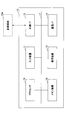
- FIG. 3 is a diagram showing an example of the functional configuration of the video distribution server 10 according to the first embodiment.
- the video distribution server 10 includes a position information management unit 101, a relative speed calculation unit 102, an existence probability calculation unit 103, a collision probability calculation unit 104, and a network information reception unit. It has 105 and a video relay unit 106. Each of these parts is realized, for example, by a process in which one or more programs installed in the video distribution server 10 cause the processor 15 to execute.
- the video distribution server 10 has a label DB 107.
- the DB is realized by, for example, the memory device 16.
- the position information management unit 101 receives position information from each agricultural machine 30 and each pedestrian terminal 50, and also receives a position identification image from the camera 50. Further, the position information management unit 101 identifies the position of each object (for example, an animal, a person, etc.) from the position specifying image, and generates position information indicating the specified position.
- the position information received from each agricultural machine 30 and each pedestrian terminal 50 and the position information specified from the position identification image are, for example, in the memory device 16 or the like for each time and object (animal, person, etc.) or each agricultural machine 30. It will be saved.
- the position information management unit 101 may specify the position of each object from the position identification image by using a known object recognition technique or the like. Further, as long as the position information is unified, it may be, for example, absolute position coordinates expressed in latitude, mildness, etc., or set in some standard (for example, a specific agricultural machine 30 or a field). It may be relative position coordinates from the reference point, etc.).
- the relative velocity calculation unit 102 calculates the relative velocity between each object (for example, an animal or a person) and each agricultural machine 30 by using the position information of each object and the label and velocity stored in the label DB 107.
- the label is a classification of an object, and as will be described later, the speed (accurately, the speed) of the object is predetermined for each label.
- the existence probability calculation unit 103 uses the position information of each object and the label and speed stored in the label DB 107 to a predetermined area (for example, in a field, etc.) up to a predetermined time (for example, farm work end time, etc.). ), The existence probability of each object (for example, animal, person) is calculated.
- the existence probability calculation unit 103 is described in, for example, Reference 1 "Daisuke Sugimura, Takanori Kobayashi, Yoichi Sato, Akihiro Sugimoto," Stabilization of three-dimensional tracking of a person by using the probability of existence of a person based on behavior history ", Information Processing. Academic journal Computer Vision and Image Media Vol. 1 No.
- the collision probability calculation unit 104 uses the existence probability of each object and the coefficient determined for each label of each object, and the probability that each agricultural machine 30 collides with any object by a predetermined time (collision probability). To calculate.
- the network information receiving unit 105 receives the communication quality (for example, communication band, etc.) of the communication network between the video distribution server 10 and each agricultural machine 30.
- the network information receiving unit 105 may receive the communication quality from, for example, an external device or device that measures or predicts the communication quality of the communication network between the video distribution server 10 and each agricultural machine 30. However, for example, the network information receiving unit 105 may measure or predict the communication quality.
- the video relay unit 106 controls the video quality (resolution / frame rate) of the camera 31 mounted on each of the agricultural machines 30 according to the collision probability of each of the agricultural machines 30. That is, the video relay unit 106 controls the camera 31 mounted on the agricultural machine 30 having a high collision probability to improve the video quality of the camera 31.
- the video relay unit 106 is a camera 31 mounted on another agricultural machine 30 according to the communication quality (for example, communication band) of the communication network between the video distribution server 10 and the monitor terminal 20. Is controlled to lower the image quality of these cameras 31. Then, the video relay unit 106 distributes the surveillance video received from each agricultural machine 30 to the monitor terminal 20.
- the label DB 107 stores information (label, coefficient, speed) used for calculation of relative velocity between each agricultural machine 30 and each object, calculation of existence probability of each object, calculation of collision probability of each agricultural machine 30, and the like.
- information label, coefficient, speed
- FIG. 4 is a diagram showing an example of the label DB 107.
- the label, the coefficient a, and the velocity v are stored in association with each other in the label DB 107.
- the label includes a major classification and a minor classification.
- the coefficient a indicating the possibility of collision and the predetermined speed v are stored in association with each label indicating the type of the object.
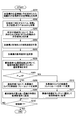
- FIG. 5 is a flowchart showing an example of the video distribution process according to the first embodiment.
- the position information management unit 101 acquires the position information of each agricultural machine 30 and each object (animal, person, etc.) up to the current time (step S101).
- the position information management unit 101 may acquire position information up to the current time of each agricultural machine 30 and each object from, for example, a memory device 16 or the like.
- the existence probability calculation unit 103 calculates the existence probability of each object in a predetermined area up to a predetermined time by using the position information of each object, the label, and the velocity (step S103).
- the predetermined time may be the farm work end time, and the predetermined area may be in the field.
- the existence probability calculation unit 103 calculates the existence probability of each object in the field up to the farm work end time.
- the total number of objects is N
- a known method is used for calculating the existence probability.
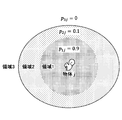
- FIG. 6 an example of the calculation result of the existence probability pkj of a certain object j is shown in FIG.
- the region 1 and the region 3 other than the region 2 that is, the region 3
- the other areas 3 are.
- the region 1 is a circular or elliptical region around the object j, and the region 2 is an outer annular or elliptical ring region, but the region 1 is not limited to this and has an arbitrary shape.
- the probability of existence in the region may be calculated. For example, the probability of existence in a rectangular area such as a mesh may be calculated. Further, in the example shown in FIG. 6, the existence probabilities in the three areas of the area 1, the area 2 and the area 3 are calculated, but if it is one or more areas, the existence probabilities in any number of areas can be calculated. good.
- steps S104 to S112 are repeatedly executed at predetermined time intervals (for example, every 1 second to several seconds) until the distribution of the surveillance video is completed (for example, until the farm work end time is reached). NS.
- the relative velocity calculation unit 102 calculates the relative velocity between each object and each agricultural machine 30 using the position information of each object, the label, and the velocity (velocity) (step S104). For example, as shown in FIG. 7, the velocity vector of the agricultural machine 30 i is V i , the velocity vector of the object j is v j , the angle representing the direction of the object j with respect to the agricultural machine 30 i is ⁇ ij , and the velocity vector V i is ⁇ ij.
- V ij a V i cos ⁇ ij
- V ij a V i cos ⁇ ij
- the velocity vector v j is a velocity (velocity) corresponding to the label of the object j, and is a vector in the direction from the object j to the agricultural machine 30 i.
- the relative speed calculation unit 102 calculates the relative speed assuming that each object heads for each agricultural machine 30 at the shortest distance at a speed corresponding to the label of the object. This is because, as will be described later, when calculating the collision probability, the faster the relative velocity, the larger the number of existence probabilities used in the calculation of the collision probability. That is, each object is supposed to move in the direction in which the probability of collision with each agricultural machine 30 is highest.
- the collision probability calculation unit 104 uses the existence probability of each object and the coefficient determined for each label of each object by a predetermined time (that is, in the present embodiment, the farm work end time).
- the probability (collision probability) that the agricultural machine 30 collides with any object is calculated (step S105).
- the above-mentioned existence probability q j is the existence probability p kj of the object j in the region D ij .
- the object j takes different existence probability in the area D ij, to the highest existence probability among the plurality of the existence probability may be q j, the average of the plurality of presence probability q j May be.
- the above-mentioned region D ij is determined according to the relative velocity V ij of the agricultural machine 30 i and the object j.
- d'[m] is a distance required for the observer to confirm the object from the surveillance image, and is a predetermined value (for example, 5 [m] or the like).
- d 'ij [m] is the distance required to stop the agricultural machine 30 i
- d' ij t r ⁇ V ij ⁇ (1000/3600) + (V i 2 / (256 ⁇ ⁇ ) ) Is calculated.
- tr is the reaction time (that is, the time [s] required from the observer recognizing the necessity of stopping the agricultural machine 30 to performing the stop operation and controlling the agricultural machine 30)
- ⁇ is the friction coefficient. be.
- each agricultural machine 30 moves according to a predetermined action plan, it is assumed that the agricultural machines 30 do not collide with each other, but the collision probability is increased in consideration of the collision between the agricultural machines 30. It may be calculated. In this case, after calculating the existence probabilities of each agricultural machine 30 in step S103 above, the collision probability of each agricultural machine 30 may be calculated by using these existence probabilities as well.
- the video relay unit 106, the collision probability P i of each agricultural machine 30, by using the communication quality network information receiving unit 105 receives, as well as selecting the monitoring image to be distributed with a high image quality, the selection The communication band of the agricultural machine 30 for transmitting the surveillance video is determined (step S106). That is, the video relay unit 106 selects the surveillance video of the farm machine 30 i having the highest collision probability Pi as the surveillance video to be delivered with high video quality, and the communication band when the farm machine 30 transmits this surveillance video. Is determined to be a higher communication band determined in advance.
- the video relay unit 106 may be divided into, for example, a selection unit that selects surveillance video to be distributed with high video quality, and a control unit or determination unit that determines a higher communication band.
- the video quality of the surveillance video other than the surveillance video is lowered, and the communication band when the agricultural machine 30 transmits the other surveillance video is set to a lower communication band determined in advance.
- the band may be determined.
- the communication quality received by the network information receiving unit 105 is used to determine whether or not it is necessary to lower the video quality of the other surveillance video, and the video of the other surveillance video is determined according to the determination result. It may be determined that the quality is lowered, and the communication band when the agricultural machine 30 transmits the other surveillance video may be determined to be a lower communication band.
- video relay unit 106 selects a distributing monitoring image of a plurality of agricultural machines 30 i with high image quality, the communication band A higher communication band may be determined.
- the process in this step is not performed.
- P max is the maximum value of ⁇ P 1, ⁇ , P M ⁇ .
- step S108 the video relay unit 106 determines the video quality (resolution / frame) of the camera 31 of each agricultural machine 30 according to the communication band determined in step S106. Rate) is changed (step S108).
- the video relay unit 106 can receive the surveillance video at 800 Mbps without delay, and The image quality of the camera 31 of the agricultural machine 30 is changed so as to obtain the highest image quality.
- the camera 31 of the agricultural machine 30 determined to have a higher communication band in step S106 is changed to a higher image quality, and the camera 31 of the agricultural machine 30 determined to have a lower communication band in step S106 is more.
- the video relay unit 106 distributes the monitoring image of the collision probability P i is the highest agricultural machine 30 i to the monitoring terminal 20 (step S109).
- the monitoring image of the agricultural machine 30 having the highest probability of colliding with any object (more accurately, the object j whose coefficient a j is not 0) by the end time of the agricultural work is delivered to the observer terminal 20.
- the video relay unit 106 may distribute not only the monitoring video of the agricultural machine 30 having the highest collision probability Pi but also the monitoring video of the other agricultural machine 30 to the monitor terminal 20.
- the monitor terminal 20 side only the monitoring image of the agricultural machine 30 having the highest collision probability may be displayed, or the upper L (L is a predetermined integer of 2 or more) in descending order of the collision probability.
- Only one surveillance image may be displayed, or a plurality of surveillance images may be displayed and only the surveillance image of the agricultural machine 30 having the highest collision probability may be displayed in a different manner (for example, a mode that calls attention). It may be displayed with.
- the video relay unit 106 randomly selects one monitoring image from the monitoring images of each agricultural machine 30 (that is, agricultural machine 30 1 , ..., Agricultural machine 30 M), and the selected monitoring image. Is delivered to the observer terminal 20 (step S111). As a result, only one randomly selected surveillance image is delivered to the observer terminal 20. At this time, a plurality of surveillance images may be randomly selected.
- the video relay unit 106 determines whether or not to end the distribution of the surveillance video (step S112).
- the video relay unit 106 may determine that the distribution of the surveillance video is terminated, for example, when the farm work end time is reached or the distribution end time is determined in advance. As a result, the above steps S104 to S111 are repeatedly executed at predetermined time intervals until the distribution of the surveillance video is completed.
- FIG. 8 is a flowchart showing an example of the video distribution process according to the second embodiment.
- steps S201 to S212 are repeatedly executed at predetermined time intervals (for example, every 1 second to several seconds).
- the processing contents of steps S201 to S212 are the same as the processing contents of steps S101 to S112 of FIG.
- the acquisition of the position information (step S201) and the calculation of the existence probability (step S202) are also repeatedly executed at predetermined time intervals.
- the existence probability is calculated each time when the collision probability is calculated, so that the collision probability can be calculated with higher accuracy than that of the first embodiment.
- the video distribution system 1 calculates the probability (collision probability) that the agricultural machine 30 collides with an object (object j whose coefficient a j is not 0). Then, the image of the agricultural machine 30 having a high collision probability is selected. As a result, it is possible to improve the image quality of the selected image and deliver only the selected image to the observer terminal 20, and only the selected image is displayed in a different display mode on the observer terminal 20. It is possible to display it on. Therefore, the monitoring burden of the observer when monitoring the agricultural machine 30 is reduced or reduced, and one observer can monitor more agricultural machines 30. That is, it is possible to realize high scaleability with respect to the number of monitored vehicles in automatic driving.
- Video distribution system 10 Video distribution server 11 Input device 12 Display device 13 External I / F 13a Recording medium 14 Communication I / F 15 Processor 16 Memory device 17 Bus 20 Observer terminal 30 Agricultural machine 31 Camera 32 GPS receiver 40 Camera 50 Pedestrian terminal 101 Position information management unit 102 Relative velocity calculation unit 103 Existence probability calculation unit 104 Collision probability calculation unit 105 Network information reception unit 106 Video relay unit 107 Label DB
Landscapes
- Engineering & Computer Science (AREA)
- Multimedia (AREA)
- Physics & Mathematics (AREA)
- General Physics & Mathematics (AREA)
- Signal Processing (AREA)
- Databases & Information Systems (AREA)
- Theoretical Computer Science (AREA)
- Quality & Reliability (AREA)
- Traffic Control Systems (AREA)
- Time Recorders, Dirve Recorders, Access Control (AREA)
- Closed-Circuit Television Systems (AREA)
- Alarm Systems (AREA)
Priority Applications (3)
| Application Number | Priority Date | Filing Date | Title |
|---|---|---|---|
| PCT/JP2020/016732 WO2021210134A1 (ja) | 2020-04-16 | 2020-04-16 | 映像配信装置、映像配信方法及びプログラム |
| JP2022514954A JP7416219B2 (ja) | 2020-04-16 | 2020-04-16 | 映像配信装置、映像配信方法及びプログラム |
| US17/919,116 US12198550B2 (en) | 2020-04-16 | 2020-04-16 | Video distribution apparatus, video distribution method and program |
Applications Claiming Priority (1)
| Application Number | Priority Date | Filing Date | Title |
|---|---|---|---|
| PCT/JP2020/016732 WO2021210134A1 (ja) | 2020-04-16 | 2020-04-16 | 映像配信装置、映像配信方法及びプログラム |
Publications (1)
| Publication Number | Publication Date |
|---|---|
| WO2021210134A1 true WO2021210134A1 (ja) | 2021-10-21 |
Family
ID=78084158
Family Applications (1)
| Application Number | Title | Priority Date | Filing Date |
|---|---|---|---|
| PCT/JP2020/016732 Ceased WO2021210134A1 (ja) | 2020-04-16 | 2020-04-16 | 映像配信装置、映像配信方法及びプログラム |
Country Status (3)
| Country | Link |
|---|---|
| US (1) | US12198550B2 (https=) |
| JP (1) | JP7416219B2 (https=) |
| WO (1) | WO2021210134A1 (https=) |
Cited By (1)
| Publication number | Priority date | Publication date | Assignee | Title |
|---|---|---|---|---|
| WO2023170768A1 (ja) * | 2022-03-08 | 2023-09-14 | 日本電気株式会社 | 制御装置、監視システム、制御方法及び非一時的なコンピュータ可読媒体 |
Families Citing this family (2)
| Publication number | Priority date | Publication date | Assignee | Title |
|---|---|---|---|---|
| WO2021210134A1 (ja) * | 2020-04-16 | 2021-10-21 | 日本電信電話株式会社 | 映像配信装置、映像配信方法及びプログラム |
| CN119149965A (zh) * | 2024-11-19 | 2024-12-17 | 广东和诚信息技术有限公司 | 救护的定位方法以及系统 |
Citations (6)
| Publication number | Priority date | Publication date | Assignee | Title |
|---|---|---|---|---|
| JP2009094885A (ja) * | 2007-10-10 | 2009-04-30 | Victor Co Of Japan Ltd | 無線装置および接続方法 |
| JP2009239673A (ja) * | 2008-03-27 | 2009-10-15 | Mitsubishi Motors Corp | 車両用モニタリング装置 |
| WO2013118191A1 (ja) * | 2012-02-10 | 2013-08-15 | 三菱電機株式会社 | 運転支援装置及び運転支援方法 |
| JP2018074286A (ja) * | 2016-10-26 | 2018-05-10 | 三菱自動車工業株式会社 | 運転支援装置 |
| WO2018167891A1 (ja) * | 2017-03-15 | 2018-09-20 | 三菱電機株式会社 | 情報処理装置、情報処理方法及び情報処理プログラム |
| JP2019008796A (ja) * | 2017-06-23 | 2019-01-17 | ウーバー テクノロジーズ,インコーポレイテッド | 自律可能車両用衝突回避システム |
Family Cites Families (3)
| Publication number | Priority date | Publication date | Assignee | Title |
|---|---|---|---|---|
| JP6779835B2 (ja) * | 2017-06-15 | 2020-11-04 | 株式会社日立製作所 | 監視制御システム、監視制御装置及び監視制御方法 |
| WO2021210134A1 (ja) * | 2020-04-16 | 2021-10-21 | 日本電信電話株式会社 | 映像配信装置、映像配信方法及びプログラム |
| US12165416B2 (en) * | 2021-02-26 | 2024-12-10 | Qualcomm Incorporated | Determining common operations for image processing computing components |
-
2020
- 2020-04-16 WO PCT/JP2020/016732 patent/WO2021210134A1/ja not_active Ceased
- 2020-04-16 US US17/919,116 patent/US12198550B2/en active Active
- 2020-04-16 JP JP2022514954A patent/JP7416219B2/ja active Active
Patent Citations (6)
| Publication number | Priority date | Publication date | Assignee | Title |
|---|---|---|---|---|
| JP2009094885A (ja) * | 2007-10-10 | 2009-04-30 | Victor Co Of Japan Ltd | 無線装置および接続方法 |
| JP2009239673A (ja) * | 2008-03-27 | 2009-10-15 | Mitsubishi Motors Corp | 車両用モニタリング装置 |
| WO2013118191A1 (ja) * | 2012-02-10 | 2013-08-15 | 三菱電機株式会社 | 運転支援装置及び運転支援方法 |
| JP2018074286A (ja) * | 2016-10-26 | 2018-05-10 | 三菱自動車工業株式会社 | 運転支援装置 |
| WO2018167891A1 (ja) * | 2017-03-15 | 2018-09-20 | 三菱電機株式会社 | 情報処理装置、情報処理方法及び情報処理プログラム |
| JP2019008796A (ja) * | 2017-06-23 | 2019-01-17 | ウーバー テクノロジーズ,インコーポレイテッド | 自律可能車両用衝突回避システム |
Cited By (3)
| Publication number | Priority date | Publication date | Assignee | Title |
|---|---|---|---|---|
| WO2023170768A1 (ja) * | 2022-03-08 | 2023-09-14 | 日本電気株式会社 | 制御装置、監視システム、制御方法及び非一時的なコンピュータ可読媒体 |
| JPWO2023170768A1 (https=) * | 2022-03-08 | 2023-09-14 | ||
| JP7779373B2 (ja) | 2022-03-08 | 2025-12-03 | 日本電気株式会社 | 制御装置、制御方法及びプログラム |
Also Published As
| Publication number | Publication date |
|---|---|
| JP7416219B2 (ja) | 2024-01-17 |
| US20230169862A1 (en) | 2023-06-01 |
| US12198550B2 (en) | 2025-01-14 |
| JPWO2021210134A1 (https=) | 2021-10-21 |
Similar Documents
| Publication | Publication Date | Title |
|---|---|---|
| JP7355877B2 (ja) | 車路協同自動運転の制御方法、装置、電子機器及び車両 | |
| JP7239703B2 (ja) | 領域外コンテキストを用いたオブジェクト分類 | |
| EP2444919B1 (en) | Method and apparatus for generating alerts | |
| US10909628B1 (en) | Accident fault determination implementing unmanned aerial vehicles (UAVS) | |
| US10745009B2 (en) | Electronic apparatus for determining a dangerous situation of a vehicle and method of operating the same | |
| US10558224B1 (en) | Shared vehicle obstacle data | |
| US10479376B2 (en) | Dynamic sensor selection for self-driving vehicles | |
| EP3460406A1 (en) | Information processing apparatus, vehicle, information processing method, running control method, and map updating method | |
| US8818043B2 (en) | Traffic signal mapping and detection | |
| US10849543B2 (en) | Focus-based tagging of sensor data | |
| KR102241584B1 (ko) | 응급 차량을 실시간으로 검출하고, 응급 차량으로 인해 발생될 것으로 예상되는 상황에 대처하기 위한 주행 경로를 플래닝하는 방법 및 장치 | |
| CN110959143A (zh) | 信息处理装置、信息处理方法、程序和移动体 | |
| US12219293B2 (en) | Image data collecting apparatus, method, and program | |
| JP7416219B2 (ja) | 映像配信装置、映像配信方法及びプログラム | |
| JPWO2020116204A1 (ja) | 情報処理装置、情報処理方法、プログラム、移動体制御装置、及び、移動体 | |
| EP3690845A1 (en) | Method for providing autonomous driving service platform to be used for supporting autonomous driving of vehicles by using competitive computing and information fusion and server using the same | |
| US20230373503A1 (en) | Vehicle controller, method and computer program for vehicle control, priority setting device, and vehicle control system | |
| WO2020203241A1 (ja) | 情報処理方法、プログラム、及び、情報処理装置 | |
| CN114690783A (zh) | 割草机的路径规划方法及相关装置 | |
| US20220309848A1 (en) | Signal processing device, signal processing method, program, and imaging device | |
| US20240412331A1 (en) | Information processing device, information processing method, and program | |
| JP7764960B2 (ja) | 位置情報提供装置、位置情報提供方法及びプログラム | |
| US20250102646A1 (en) | Statistically modeling effect of fog on lidar data | |
| US20230322252A1 (en) | True vision autonomous mobile system | |
| US20240404299A1 (en) | Perception and understanding of road users and road objects |
Legal Events
| Date | Code | Title | Description |
|---|---|---|---|
| 121 | Ep: the epo has been informed by wipo that ep was designated in this application |
Ref document number: 20931421 Country of ref document: EP Kind code of ref document: A1 |
|
| ENP | Entry into the national phase |
Ref document number: 2022514954 Country of ref document: JP Kind code of ref document: A |
|
| NENP | Non-entry into the national phase |
Ref country code: DE |
|
| 122 | Ep: pct application non-entry in european phase |
Ref document number: 20931421 Country of ref document: EP Kind code of ref document: A1 |