WO2021199201A1 - リスク評価装置、リスク評価方法およびプログラム - Google Patents
リスク評価装置、リスク評価方法およびプログラム Download PDFInfo
- Publication number
- WO2021199201A1 WO2021199201A1 PCT/JP2020/014663 JP2020014663W WO2021199201A1 WO 2021199201 A1 WO2021199201 A1 WO 2021199201A1 JP 2020014663 W JP2020014663 W JP 2020014663W WO 2021199201 A1 WO2021199201 A1 WO 2021199201A1
- Authority
- WO
- WIPO (PCT)
- Prior art keywords
- risk
- model
- models
- ethical
- information
- Prior art date
- Legal status (The legal status is an assumption and is not a legal conclusion. Google has not performed a legal analysis and makes no representation as to the accuracy of the status listed.)
- Ceased
Links
Images




Classifications
-
- G—PHYSICS
- G06—COMPUTING OR CALCULATING; COUNTING
- G06N—COMPUTING ARRANGEMENTS BASED ON SPECIFIC COMPUTATIONAL MODELS
- G06N5/00—Computing arrangements using knowledge-based models
- G06N5/04—Inference or reasoning models
- G06N5/045—Explanation of inference; Explainable artificial intelligence [XAI]; Interpretable artificial intelligence
-
- G—PHYSICS
- G06—COMPUTING OR CALCULATING; COUNTING
- G06N—COMPUTING ARRANGEMENTS BASED ON SPECIFIC COMPUTATIONAL MODELS
- G06N5/00—Computing arrangements using knowledge-based models
- G06N5/02—Knowledge representation; Symbolic representation
- G06N5/027—Frames
Definitions
- the present invention relates to a device for evaluating ethical risk in an explainable predictive model, etc., and a method and program for evaluating the ethical risk.
- the conventional AI system and the prediction model generated by its analysis engine were black box type in which the structure of the model and the basis for judgment could not be seen. For this reason, it is difficult for humans to decide whether to adopt the model, and as a result, companies and the like face the problem of difficulty in utilizing the model.
- a white box type AI system and its analysis engine that can output the structure and judgment basis of a prediction model in a form that can be interpreted by humans have appeared, and the above problems are being solved.
- Patent Document 1 discloses an information processing system capable of generating explanatory texts about feature quantities (candidates for explanatory variables) in a prediction model and feature quantity generation functions that generate feature quantities in natural language. Specifically, a feature amount generation function is generated by substituting the values in the table including the accepted explanatory variable and the objective variable into a predetermined template, and the feature amount is calculated by applying the function to the table. .. An explanation is generated by substituting the feature amount generation function and the calculated feature amount into a different template.
- the model applied to the white box type AI system and its analysis engine can be explained, the model may be unethical depending on the characteristics of the adopted explanatory variables themselves or the combination of the explanatory variables, or the individual or society. It becomes clear that it is based on something that has an adverse effect on. Then, this is taken up as a problem, and there is a risk that the reliability of the corporate system to which the model is applied and the device utilizing AI is impaired. In recent years, discussions on AI ethics and discussions on countermeasures have become active, and once such a risk of loss of credibility arises, it may not be possible to continue corporate activities. .. Furthermore, ethics vary from country to country and language area, and their impacts often differ from country to language area.Therefore, there are various risks in applying the model, and it is necessary to deal with them. It becomes.
- a model acquisition unit that acquires one or more explainable predictive models, the one or more models, ethical risk factor information that is information that becomes an ethical risk factor, and information on ethical risk factors.
- a risk determination unit that determines the risk of one or more models based on the above, a model selection unit that selects a model based on the determination result of the determined risk, and a model output unit that outputs the selected model.
- a risk assessment device to have is provided.
- one or more explainable predictive models are acquired, and the above-mentioned one is based on the acquired model and ethical risk factor information which is information that becomes an ethical risk factor.
- a risk evaluation method is provided that determines the risk of the above model, selects a model based on the risk determination result, and outputs the selected model.
- a program causes a computer to execute a process of determining the risk of one or more models, a process of selecting a model based on the risk determination result, and a process of outputting the selected model.
- the program can be stored and provided on a recording medium.
- FIG. It is a figure which shows an example of the functional block of the risk assessment apparatus by one Embodiment of this disclosure. It is a figure which shows the structure of the risk assessment apparatus by Embodiment 1.
- FIG. It is a flowchart which shows the operation of the risk assessment apparatus by the said embodiment. It is a figure which shows the outline of the hardware structure of the risk assessment apparatus by the said embodiment. It is a figure which shows the structure of the risk assessment apparatus by Embodiment 2. It is a figure for showing an example of the model selection rule stored in the model selection rule holding part of the said embodiment. It is a flowchart which shows the operation of the risk assessment apparatus by the said embodiment.
- FIG. 1 shows an example of a block diagram of the risk assessment device in one embodiment.
- the risk evaluation device 100 includes a model acquisition unit 101 that acquires one or more explainable prediction models, the acquired model, ethical risk factor information that is information that becomes an ethical risk factor, and information on ethical risk factors.
- a risk determination unit 102 that determines the risk of one or more models based on the above, a model selection unit 103 that selects a model based on the determination result of the determined risk, and a model output unit 104 that outputs the selected model. And have.
- the risk assessment device determines the magnitude of risk from an ethical point of view for each of one or more explainable prediction models, and selects and outputs the model according to the determination result. It is possible. Therefore, it is possible to provide an efficient and highly reliable model.
- FIG. 2 shows an example of a block diagram of the risk assessment device according to the present embodiment.
- the model acquisition unit 101 acquires one or more explainable prediction models.
- the "prediction model” refers to a model capable of predicting and outputting a value according to a learning result for some input.
- "explainable” means that it is possible to present the rationale for outputting a certain value by the prediction model. For example, it means that it is possible to grasp the relationship between explanatory variables, which are elements that appear in the model, and the relationship between explanatory variables and objective variables.
- "acquiring a model” means receiving information representing a model as input from a system or module that executes model generation or learning processing.
- the acquired model is stored in storage.
- the variables y, x 1 , x 2 , x 3 and the coefficients a, b, c are stored.
- each variable (x 1 , x 2 , x 3 ) is associated with and stores the item names (“research theme”, “age”, “examination score”, etc.) of the variables indicating the explanation contents. do.
- a semiconductor storage for example, ROM (Read Only Memory), RAM (Random Access Memory), EEPROM (Electrically Erasable Programmable Read-Only Memory), Memory Memory
- ROM Read Only Memory
- RAM Random Access Memory
- EEPROM Electrically Erasable Programmable Read-Only Memory
- Memory Memory A non-temporary computer-readable recording medium such as a Hard Disk Drive, a CD (Compact Disc), or a DVD (Digital Versaille Disc) can be used, and the program from the third viewpoint of the present disclosure described above is stored and stored. be able to.
- the model acquisition unit 101 evaluates the model received as input by a predetermined method before the risk determination unit 102 calculates the score, and as a result of the evaluation, when the predetermined value is satisfied.
- a process such as acquiring a model only and outputting the model to the risk determination unit 102 may intervene.
- the generated model is evaluated based on an information criterion such as AIC (Akaike's Information Criterion), and only a model lower than a predetermined value is adopted.
- the risk determination unit 102 determines the risk of the one or more models based on one or more models acquired by the model acquisition unit 101 and ethical risk factor information which is information that becomes an ethical risk factor. .. “Judgment” is to indicate the degree of risk as a risk judgment result using some index.
- the risk determination result is shown by various methods, for example, a numerical score calculated by a predetermined method, a risk indicated by several stages of evaluation, or the like.
- Ethical risk factor information is information that requires a certain amount of consideration for its handling, and when a variable representing that information is applied to the model as an explanatory variable, the characteristics of that variable and the combination of the variables are ethical.
- This information includes risks that are contrary to the above and adversely affect individuals and society.
- the above risks include those that adversely affect corporate activities. That is, if a prediction model or the like having such a risk is incorporated into the system, it may become widely known in the media or the like as a system or service having an ethical problem after the release. If this happens, the system or service will be forced to stop, which may not only damage the trust of the user but also cause damage such as a huge claim for compensation.
- Ethical risk factor information is provided as linguistic data and numerical data. These data may be stored in a database inside the device.
- the configuration may include an ethical risk factor information holding unit 105 that holds ethical risk factor information.
- the ethical risk factor information may be stored in an external database existing on the Internet, or the information may be acquired by a search engine.
- the data may be held in the form of a document or may be held in the form of a list such as a dictionary.
- linguistic data such as documents, words, and phrases may be stored as features expressed by numerical values of a plurality of dimensions. Twice
- the risk determination result may be obtained by scoring as described above.
- the model acquired by the model acquisition unit 101 is received as an input, and a process of scoring using the components and ethical risk factor information is executed.
- variables and their item names are associated, and values such as the number of search hits and search hit rate can be obtained by searching the database that holds ethical risk factor information using the item names. Can be done. It is possible to select a model by outputting these as risk determination scores to the model selection unit 103.
- the risk determination unit 102 generates a sentence in which the model is described in a language for each of the acquired one or more models based on the relationship between the acquired elements of the one or more models, and at least one of the sentence and the elements of the sentence. And ethical risk factor information, and may have a function of calculating a risk determination score obtained by scoring the one or more models.
- a sentence in which the model is described in the language is generated for each of the one or more models.
- the item name is associated with (y: recruitment judgment value, x 1 : research theme, x 2 : age, x 3: test score). Since y and the linear expression for x are connected by an equal sign, it can be recognized that the objective variable is y and the explanatory variable is x.
- the present disclosure may further be configured to use this statement and ethical risk factor information to calculate a risk assessment score.
- the risk determination unit 102 can obtain the risk determination result by using at least one of the generated sentence and the element of the generated sentence and the ethical risk factor information. Is.
- the risk judgment score can be calculated by taking the similarity and the frequency of those having a predetermined similarity.
- the risk determination unit 102 calculates a statistical value indicating the relationship between the generated sentence and at least one of the elements of the generated sentence and the retained ethical risk factor information.
- the risk judgment score is calculated by.
- Various "statistical values" can be considered.
- the relationship between the generated sentence and the document in the same information can be configured as follows. For example, 1. 2. The sum of the similarity based on the value of the inner product of the feature vector of the generated sentence and the feature vector of the document in the same information, and the frequency of documents having a similarity equal to or higher than a predetermined value.
- the word that is the element of the generated sentence is used to search the ethical risk factor information, and the hit frequency and hit rate are calculated to obtain the "statistical value".
- the method for calculating the statistical value and the score is not limited to the above, and various methods can be used.
- Model selection unit / model output unit The model selection unit 103 selects a model based on the determination result of the determined risk.
- the risk determination unit 102 receives the determination results of one or more models determined, and selects by executing the determination of whether or not to adopt the model based on a predetermined criterion.
- the selected model is output to the outside by the model output unit 104.
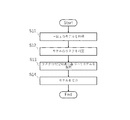
- FIG. 3 is a flowchart showing a processing flow in the risk assessment device of the present embodiment.
- the model acquisition unit 101 acquires one or more explainable prediction models (step S11).
- the risk determination unit 102 determines the risk of the one or more models based on the acquired model and the retained ethical risk factor information (step S12).
- the model selection unit 103 selects a model based on the determined determination result (step S13).
- the model output unit 104 outputs the selected model (step S14).
- FIG. 4 is a block diagram showing an example of the hardware configuration of the risk assessment device according to the first embodiment.
- the risk assessment device 100 can be configured by the information processing device (computer) 200, and includes the configuration illustrated in FIG.
- the risk assessment device 100 includes a CPU (Central Processing Unit) 201, a memory 202, an input / output interface 203, a communication means NIC (Network Interface Card) 204, and the like, which are connected to each other by an internal bus 205.
- the risk assessment device 100 typically comprises an interface capable of communicating with the network via a NIC.
- the configuration shown in FIG. 4 does not mean to limit the hardware configuration of the risk assessment device 100.
- the risk assessment device 100 may include hardware and functional elements (not shown). Further, the number of CPUs and the like included in the risk assessment device 100 is not limited to the example shown in FIG. 4, and for example, a plurality of CPUs may be included in the risk assessment device 100.
- the memory 202 is a RAM (Random Access Memory), a ROM (Read Only Memory), and an auxiliary storage device (hard disk, etc.).
- the input / output interface 203 is a means that serves as an interface for a display device or an input device (not shown).
- the display device is, for example, a liquid crystal display or the like.
- the input device is, for example, a device that accepts user operations such as a keyboard and a mouse.
- the model acquisition program is called from the memory 202 and executed by the CPU 201.
- the program receives one or more models generated by other devices and stores them in memory 202.
- the memory space is secured in association with the address 1 and the address 2 at the head, and the space starting with the address 1 is the mathematical expression information of the model and the address 2 at the head.
- Information for explaining the model is stored in the space.
- the risk determination score calculation program is executed in the CPU 201.
- the program accesses the information stored in the address 2 to explain the model, and obtains, for example, the item label of the variable.
- the information described as the item label of the variable for example, in the case of the above-mentioned recruitment judgment model, the information of the words "recruitment judgment value”, "research theme”, "age”, and "test score” is acquired.
- the program calls a document template such as "Predict ⁇ $ objective variable ⁇ by ⁇ $ explanatory variable ⁇ ” stored in the memory 202, and the word “research theme” of the item label of the variable which is the explanatory variable. , "Age”, “Examination score”, and the objective variable “Recruitment judgment value”, and the sentence “Predict the adoption judgment value by the research theme, age, and examination score.” Generate.
- the program executes the clustering process in the ethical risk factor information database stored in the memory 202 including the generated sentence by the arithmetic process of the CPU 201. Then, as an example, the risk determination score R is calculated based on the document frequency in the cluster to which the resulting sentence belongs.
- Ethical risk factor information is started by collecting information available in advance and storing it in a database, but it is itself supplemented and accumulated after the start of operation.
- the model selection program is executed in the CPU 201.
- the calculated R is compared with the reference value R 0 for model selection.
- R is smaller than R 0
- the program passes the information of the model held in the space starting from address 1 and address 2 to the model output program.
- the program outputs information on the selected model via the input / output interface 203.
- FIG. 5 shows an example of a block diagram of the risk assessment device according to the second embodiment.
- the risk assessment device 100 of the present embodiment includes a model acquisition unit 101, a risk determination unit 102, a model selection unit 103, and a model output unit 104. Since these have already been explained above, the description thereof will be omitted.
- a model selection rule holding unit 106 is newly provided.
- the model selection rule holding unit 106 holds a model selection rule, which is a rule for selecting a model from the one or more models.
- a list listing information on specific ethical risk factors is provided in the storage, and the ethical risk factor information identified by the provided list is risk-determined when the information is included in the model.
- the model related to the risk judgment score is not selected. That is, for information that is likely to significantly impair the reliability of the model simply because the information (words, etc.) exists in the model, the model is not selected without calculating the risk judgment score, and the output candidates are selected.
- the rule is to remove it.
- a rule for selecting a model based on the calculated risk judgment score and the coefficient of the explanatory variable in the prediction formula of one or more models can be adopted.
- FIG. 6 is a diagram for showing an example of the model selection rule stored in the model selection rule holding unit 106 of the present embodiment.
- the models of Examples 1 to 3 are generated and acquired by the model acquisition unit 101.
- the risk determination score calculated by the risk determination unit 102 is the search hit rate which is the result of searching the ethical risk factor information holding unit 105 by the item label of the variable which is a component of the model. Show the search hit rate for each item in the frame. That is, the score is 0.1 for the word "research theme", 0.2 for "examination score", 0.6 for "age”, 0.7 for "gender”, and 0.8 for "university of origin”. .. Coefficients are given to the model by learning for each item (variable).
- Example 3 Example 2> Example 1 in descending order of risk. It is possible to determine which model to select (adopt) by setting a predetermined reference value.
- the predetermined reference value can be set so as to actually meet the actual operation (or trial) of the device or system.
- FIG. 7 shows the flow of processing of the risk assessment device and the like in this embodiment.
- the model acquisition unit 101 first acquires one or more models (step S201).
- the model acquisition unit 101 enters a model selection loop (step S202 to step S214) for processing each model.
- the model acquisition unit 101 enters the explanatory variable selection loop (step S203 to step S213) in which the model acquisition unit 101 processes each selected explanatory variable.
- the model acquisition unit 101 accepts the selected explanatory variable (step S204).
- the model acquisition unit 101 evaluates the model based on the received explanatory variables based on various information criteria (step S205).
- the model acquisition unit 101 determines whether or not the evaluation value of the model is improved by the selection (step S206).
- the risk determination unit 102 generates a search sentence / term from the model (step S207). If the evaluation value does not improve, the model acquisition unit 101 accepts another explanatory variable in the next iteration.
- the risk determination unit 102 searches the ethical risk factor information with the generated search sentence / term (step S208).
- the risk determination unit 102 calculates the risk determination score based on the search result (step S209).
- the model selection unit 103 applies the model selection rule to the score (step S210).
- the hardware configuration of the risk assessment device in this embodiment is the same as the hardware configuration of the first embodiment. Therefore, the description will be omitted, and the outline of the hardware operation will be described with reference to FIG.
- the model acquisition program is called from the memory 202 and executed by the CPU 201.
- the program receives one or more models generated by other devices and stores them in memory 202.
- the memory space is secured in association with the address 1 and the address 2 at the head, and the space starting with the address 1 is the mathematical expression information of the model and the address 2 at the head.
- Information for explaining the model such as a description of the model and item labels of variables, is stored in the space.
- the explanatory variables selected by the input / output interface 203 and the like are accepted and stored at the above address.
- the program may perform pre-evaluation of the model.
- the model based on the accepted explanatory variables is evaluated according to various information criteria, and the evaluation value is calculated. It is possible to perform a process of determining whether or not the evaluation value has reached a predetermined level and moving to the next risk determination score calculation process only when the evaluation value has reached the predetermined level.
- the risk determination program is in the execution state in the CPU 201.
- the program accesses the information stored in the address 2 to explain the model, and obtains, for example, the item label of the variable.
- the information described as the item label of the variable for example, in the case of the above-mentioned recruitment judgment model, the information of the words "recruitment judgment value”, "research theme”, "age”, and “test score” is acquired.
- the program refers to the mathematical formula information of the model stored in the space starting from the associated address 1.
- the "adoption judgment value” is the objective variable.
- [Form 1] This is the device according to the first viewpoint described above.
- [Form 2] The risk determination unit in the first form generates a sentence in which the model is described in a language for each of the one or more models based on the relationship between the elements of the one or more models in the first form, and the sentence and the elements of the sentence.
- the risk determination unit calculates a risk determination score obtained by scoring the risks of the one or more models based on the one or more models and the ethical risk factor information, and the model selection unit calculates the risk determination score.
- the ethical risk factor information holding department that holds the ethical risk factor information, Further, the risk determination unit determines the risk of the one or more models based on the one or more models and the retained ethical risk factor information, preferably from Form 1 to Form 5.
- the risk assessment device according to any one of the above.
- the model selection rule holding unit that holds the model selection rule, which is a rule for selecting a model from the one or more models, and the model selection unit are based on the risk determination score and the model selection rule.
- the risk evaluation device according to any one of Form 3 to Form 5, preferably selecting a model from the above models.
- the risk assessment device according to any one of Form 7 to Form 9, which is a rule that a model related to the risk judgment score is not selected regardless of the judgment score.
- Form 11 This is the risk assessment method related to the second viewpoint above.
- Form 12 This is the same as the program related to the third viewpoint.
- Form 13 It is a recording medium that stores the program of Form 12.
- Risk assessment device 101
- Model acquisition section 102
- Risk judgment section 103
- Model selection section 104
- Model output section 105
- Ethical risk factor information holding section 106
- Model selection rule holding section 200
- Information processing device (computer) 201
- CPU 202
- Memory 203
- Input / output interface 204
- NIC 205
Landscapes
- Engineering & Computer Science (AREA)
- Theoretical Computer Science (AREA)
- Computing Systems (AREA)
- Data Mining & Analysis (AREA)
- Evolutionary Computation (AREA)
- Physics & Mathematics (AREA)
- Computational Linguistics (AREA)
- General Engineering & Computer Science (AREA)
- General Physics & Mathematics (AREA)
- Mathematical Physics (AREA)
- Software Systems (AREA)
- Artificial Intelligence (AREA)
- Medical Informatics (AREA)
- Management, Administration, Business Operations System, And Electronic Commerce (AREA)
- Information Retrieval, Db Structures And Fs Structures Therefor (AREA)
Priority Applications (3)
| Application Number | Priority Date | Filing Date | Title |
|---|---|---|---|
| US17/911,715 US20230177362A1 (en) | 2020-03-30 | 2020-03-30 | Risk assessment apparatus, risk assessment method, and program |
| JP2022512935A JP7409484B2 (ja) | 2020-03-30 | 2020-03-30 | リスク評価装置、リスク評価方法およびプログラム |
| PCT/JP2020/014663 WO2021199201A1 (ja) | 2020-03-30 | 2020-03-30 | リスク評価装置、リスク評価方法およびプログラム |
Applications Claiming Priority (1)
| Application Number | Priority Date | Filing Date | Title |
|---|---|---|---|
| PCT/JP2020/014663 WO2021199201A1 (ja) | 2020-03-30 | 2020-03-30 | リスク評価装置、リスク評価方法およびプログラム |
Publications (1)
| Publication Number | Publication Date |
|---|---|
| WO2021199201A1 true WO2021199201A1 (ja) | 2021-10-07 |
Family
ID=77927990
Family Applications (1)
| Application Number | Title | Priority Date | Filing Date |
|---|---|---|---|
| PCT/JP2020/014663 Ceased WO2021199201A1 (ja) | 2020-03-30 | 2020-03-30 | リスク評価装置、リスク評価方法およびプログラム |
Country Status (3)
| Country | Link |
|---|---|
| US (1) | US20230177362A1 (https=) |
| JP (1) | JP7409484B2 (https=) |
| WO (1) | WO2021199201A1 (https=) |
Cited By (2)
| Publication number | Priority date | Publication date | Assignee | Title |
|---|---|---|---|---|
| EP4383154A1 (en) | 2022-12-09 | 2024-06-12 | Fujitsu Limited | Artificial intelligence (ai) system check program, ai system check method, and information processing device |
| EP4386642A1 (en) | 2022-12-13 | 2024-06-19 | Fujitsu Limited | Artificial intelligence (ai) system check program, ai system check method, and information processing device |
Families Citing this family (4)
| Publication number | Priority date | Publication date | Assignee | Title |
|---|---|---|---|---|
| US12591827B2 (en) * | 2022-01-21 | 2026-03-31 | Dell Products L.P. | Ethical confidence fabrics: measuring ethical algorithm development |
| CN116993296B (zh) * | 2023-08-15 | 2024-04-16 | 深圳市中联信信息技术有限公司 | 应用于工程设计交互平台的智能监理管理系统及方法 |
| WO2025126781A1 (ja) * | 2023-12-11 | 2025-06-19 | 株式会社日立ハイテク | セキュリティパッチ管理システム |
| KR20250178504A (ko) | 2024-06-19 | 2025-12-29 | (주)리스크제로 | Mm-llm 기반 건설 재해 예측 방법 |
Citations (3)
| Publication number | Priority date | Publication date | Assignee | Title |
|---|---|---|---|---|
| WO2017168458A1 (ja) * | 2016-03-28 | 2017-10-05 | 日本電気株式会社 | 予測モデル選択システム、予測モデル選択方法および予測モデル選択プログラム |
| US20190147371A1 (en) * | 2017-11-13 | 2019-05-16 | Accenture Global Solutions Limited | Training, validating, and monitoring artificial intelligence and machine learning models |
| JP2019197245A (ja) * | 2018-05-07 | 2019-11-14 | 富士通株式会社 | 情報処理装置、品質関連式生成方法、および品質関連式生成プログラム |
Family Cites Families (6)
| Publication number | Priority date | Publication date | Assignee | Title |
|---|---|---|---|---|
| US11562323B2 (en) * | 2009-10-01 | 2023-01-24 | DecisionQ Corporation | Application of bayesian networks to patient screening and treatment |
| US9147041B2 (en) * | 2012-09-13 | 2015-09-29 | Parkland Center For Clinical Innovation | Clinical dashboard user interface system and method |
| US10430903B2 (en) * | 2013-04-22 | 2019-10-01 | Jianqing Wu | Method for improving document review performance |
| US20170124495A1 (en) * | 2015-11-04 | 2017-05-04 | Tata Consultancy Services Limited | Method and system for mitigating risk in a supply chain |
| US10949581B2 (en) * | 2017-09-14 | 2021-03-16 | Sap Se | Tool for configuring computational models |
| WO2021178731A1 (en) * | 2020-03-04 | 2021-09-10 | Karl Denninghoff | Neurological movement detection to rapidly draw user attention to search results |
-
2020
- 2020-03-30 WO PCT/JP2020/014663 patent/WO2021199201A1/ja not_active Ceased
- 2020-03-30 US US17/911,715 patent/US20230177362A1/en active Pending
- 2020-03-30 JP JP2022512935A patent/JP7409484B2/ja active Active
Patent Citations (3)
| Publication number | Priority date | Publication date | Assignee | Title |
|---|---|---|---|---|
| WO2017168458A1 (ja) * | 2016-03-28 | 2017-10-05 | 日本電気株式会社 | 予測モデル選択システム、予測モデル選択方法および予測モデル選択プログラム |
| US20190147371A1 (en) * | 2017-11-13 | 2019-05-16 | Accenture Global Solutions Limited | Training, validating, and monitoring artificial intelligence and machine learning models |
| JP2019197245A (ja) * | 2018-05-07 | 2019-11-14 | 富士通株式会社 | 情報処理装置、品質関連式生成方法、および品質関連式生成プログラム |
Non-Patent Citations (1)
| Title |
|---|
| TOSHIHIRO KAMISHIMA: "A Survey on Fairness / Discrimination-Aware Mining", IEICE TECHNICAL REPORT, PRMU, IBISML, vol. 2012-CVIM-183, no. 1 (PRMU2012-30; IBISML2012-13), 15 October 2012 (2012-10-15), JP , pages 1 - 8, XP009537090, ISSN: 1884-0930 * |
Cited By (2)
| Publication number | Priority date | Publication date | Assignee | Title |
|---|---|---|---|---|
| EP4383154A1 (en) | 2022-12-09 | 2024-06-12 | Fujitsu Limited | Artificial intelligence (ai) system check program, ai system check method, and information processing device |
| EP4386642A1 (en) | 2022-12-13 | 2024-06-19 | Fujitsu Limited | Artificial intelligence (ai) system check program, ai system check method, and information processing device |
Also Published As
| Publication number | Publication date |
|---|---|
| JP7409484B2 (ja) | 2024-01-09 |
| JPWO2021199201A1 (https=) | 2021-10-07 |
| US20230177362A1 (en) | 2023-06-08 |
Similar Documents
| Publication | Publication Date | Title |
|---|---|---|
| JP7409484B2 (ja) | リスク評価装置、リスク評価方法およびプログラム | |
| US20240232539A1 (en) | Systems and Methods for Insights Extraction Using Semantic Search | |
| CN109299228B (zh) | 计算机执行的文本风险预测方法及装置 | |
| US11822883B2 (en) | Automatic content labeling | |
| US20190155913A1 (en) | Document search using grammatical units | |
| KR20160149050A (ko) | 텍스트 마이닝을 활용한 순수 기업 선정 장치 및 방법 | |
| CN114722198B (zh) | 产品分类编码确定方法、系统及相关装置 | |
| CN118152428A (zh) | 一种电力客服系统查询指令的预测和增强方法及其装置 | |
| Khatian et al. | Comparative analysis for predicting non-functional requirements using supervised machine learning | |
| Karo et al. | Karonese sentiment analysis: a new dataset and preliminary result | |
| KR20220111406A (ko) | 국내외 뉴스 자연어처리를 바탕으로 한 상품가격 단기예측 통계분석 알고리즘 | |
| Eldin et al. | An enhanced opinion retrieval approach on Arabic text for customer requirements expansion | |
| JP6509391B1 (ja) | 計算機システム | |
| Afandi et al. | Analyzing public trust in presidential election surveys: a study using SVM and logistic regression on social media comments | |
| Tukino et al. | LSTM and Word Embedding: Classification and Prediction of Puskesmas Reviews Via Twitter | |
| Pham et al. | Inference-based no-learning approach on pre-trained BERT model retrieval | |
| Shini et al. | Implicit aspect based sentiment analysis for restaurant review using LDA topic modeling and ensemble approach | |
| Dube et al. | Language identification for south african bantu languages using rank order statistics | |
| Özdemir et al. | An analysis of intelligent Turkish text classification models for routing calls in call centers: a case study on the Republic of Turkiye Ministry of Trade Call Center | |
| JP6026036B1 (ja) | データ分析システム、その制御方法、プログラム、及び、記録媒体 | |
| Mingo | Enhancing Sentiment Analysis with Logistic Regression and NLP: A Case Study Of 2023 Amazon Software Reviews | |
| Thakur et al. | The SAFE miner: A fine grained aspect level approach for resolving the sentiment | |
| Islam et al. | Developing an intelligent system for recommending products | |
| WO2023204724A1 (ru) | Способ анализа юридического документа | |
| CN112463959A (zh) | 一种基于上行短信的业务处理方法及相关设备 |
Legal Events
| Date | Code | Title | Description |
|---|---|---|---|
| 121 | Ep: the epo has been informed by wipo that ep was designated in this application |
Ref document number: 20929483 Country of ref document: EP Kind code of ref document: A1 |
|
| ENP | Entry into the national phase |
Ref document number: 2022512935 Country of ref document: JP Kind code of ref document: A |
|
| NENP | Non-entry into the national phase |
Ref country code: DE |
|
| 122 | Ep: pct application non-entry in european phase |
Ref document number: 20929483 Country of ref document: EP Kind code of ref document: A1 |