WO2021182523A1 - 通信装置、制御方法、及び、プログラム - Google Patents
通信装置、制御方法、及び、プログラム Download PDFInfo
- Publication number
- WO2021182523A1 WO2021182523A1 PCT/JP2021/009591 JP2021009591W WO2021182523A1 WO 2021182523 A1 WO2021182523 A1 WO 2021182523A1 JP 2021009591 W JP2021009591 W JP 2021009591W WO 2021182523 A1 WO2021182523 A1 WO 2021182523A1
- Authority
- WO
- WIPO (PCT)
- Prior art keywords
- tas
- communication device
- time
- frame
- sta
- Prior art date
- Legal status (The legal status is an assumption and is not a legal conclusion. Google has not performed a legal analysis and makes no representation as to the accuracy of the status listed.)
- Ceased
Links
Images








Classifications
-
- H—ELECTRICITY
- H04—ELECTRIC COMMUNICATION TECHNIQUE
- H04W—WIRELESS COMMUNICATION NETWORKS
- H04W74/00—Wireless channel access
- H04W74/002—Transmission of channel access control information
-
- H—ELECTRICITY
- H04—ELECTRIC COMMUNICATION TECHNIQUE
- H04W—WIRELESS COMMUNICATION NETWORKS
- H04W72/00—Local resource management
- H04W72/50—Allocation or scheduling criteria for wireless resources
- H04W72/54—Allocation or scheduling criteria for wireless resources based on quality criteria
-
- H—ELECTRICITY
- H04—ELECTRIC COMMUNICATION TECHNIQUE
- H04W—WIRELESS COMMUNICATION NETWORKS
- H04W72/00—Local resource management
- H04W72/20—Control channels or signalling for resource management
-
- H—ELECTRICITY
- H04—ELECTRIC COMMUNICATION TECHNIQUE
- H04W—WIRELESS COMMUNICATION NETWORKS
- H04W72/00—Local resource management
- H04W72/12—Wireless traffic scheduling
-
- H—ELECTRICITY
- H04—ELECTRIC COMMUNICATION TECHNIQUE
- H04W—WIRELESS COMMUNICATION NETWORKS
- H04W74/00—Wireless channel access
- H04W74/02—Hybrid access
-
- H—ELECTRICITY
- H04—ELECTRIC COMMUNICATION TECHNIQUE
- H04W—WIRELESS COMMUNICATION NETWORKS
- H04W74/00—Wireless channel access
- H04W74/08—Non-scheduled access, e.g. ALOHA
- H04W74/0808—Non-scheduled access, e.g. ALOHA using carrier sensing, e.g. carrier sense multiple access [CSMA]
- H04W74/0816—Non-scheduled access, e.g. ALOHA using carrier sensing, e.g. carrier sense multiple access [CSMA] with collision avoidance
-
- H—ELECTRICITY
- H04—ELECTRIC COMMUNICATION TECHNIQUE
- H04W—WIRELESS COMMUNICATION NETWORKS
- H04W84/00—Network topologies
- H04W84/02—Hierarchically pre-organised networks, e.g. paging networks, cellular networks, WLAN [Wireless Local Area Network] or WLL [Wireless Local Loop]
- H04W84/10—Small scale networks; Flat hierarchical networks
- H04W84/12—WLAN [Wireless Local Area Networks]
Definitions
- the present invention relates to a communication device, a control method, and a program, specifically, an information sharing technique for a scheduling function in wireless communication.
- the IEEE 802.11 standard series is known as a communication standard for wireless LAN (Local Area Network) established by the IEEE (Institute of Electrical and Electronics Engineers).
- the IEEE802.11 standard series includes the IEEE802.11a / b / g / n / ac / ax standard, and continuous studies are being conducted on new standards that will improve peak throughput and frequency utilization efficiency compared to conventional standards. It is done. For example, in the IEEE802.11ax standard, high peak throughput can be obtained by using OFDMA (Orthogonal Frequency Division Multiple Access) or the like (see Patent Document 1).
- OFDMA Orthogonal Frequency Division Multiple Access
- the present invention provides a communication control technique for realizing such highly reliable and low-delay communication.
- the communication device has a communication means for transmitting a wireless frame conforming to the IEEE802.11 standard series to another communication device or receiving from another communication device, and has a MAC (Media) of the wireless frame.
- the Access Control) frame contains information about time-based scheduling.
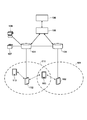
- FIG. 1 is a diagram showing a configuration example of a network according to the present embodiment.
- FIG. 2 is a diagram showing a hardware configuration example of a communication device.
- FIG. 3 is a diagram showing a functional configuration example of the communication device.
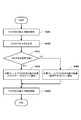
- FIG. 4 is a diagram showing an example of a processing flow executed by the AP at the time of STA connection.
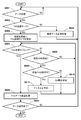
- FIG. 5 is a diagram showing an example of a flow of data reception processing.
- FIG. 6 is a diagram showing an example of a flow of data transmission processing.
- FIG. 7 is a diagram showing an example of the flow of messages transmitted and received between the AP and STA during DL communication.
- FIG. 8 is a diagram showing an example of the flow of messages transmitted and received between the AP and STA during UL communication.
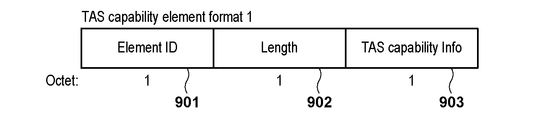
- FIG. 9 is a diagram showing a configuration example of TAS capability information.
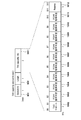
- FIG. 10 is a diagram showing a configuration example of TAS capability information.
- FIG. 11 is a diagram for explaining the set value of the TAS ability information.
- FIG. 12 is a diagram for explaining the set value of the TAS ability information.
- FIG. 13 is a diagram showing an example of a processing flow when the TAS capability information is notified by the Beacon frame.
- FIG. 14 is a diagram illustrating an example of a primary channel in the 5 GHz band.
- FIG. 15 is a diagram illustrating TAS traffic processing.
- FIG. 16 is a diagram illustrating TAS traffic processing.
- FIG. 1 shows an example of a network configuration according to the present embodiment.
- a wireless communication network (BSS101) in which a wireless communication service is provided by AP102 and a wireless communication network (BSS111) in which a wireless communication service is provided by AP112 are included.
- AP is an acronym for access point
- BSS is an acronym for Basic Service Set.
- the wireless terminal (STA) can participate in the BSS provided by the AP by connecting to the AP whose communicable range is the position where the own device exists.
- the STA can send and receive wireless frames within the participating network.
- FIG. 1 shows an example of a network configuration according to the present embodiment.
- the STA 103 since the STA 103 exists in the communicable range of both AP102 and AP112, it can connect to any of these APs and participate in either BSS101 or BSS111.
- An environment in which the communicable ranges of a plurality of APs overlap may be referred to as an OBSS environment. That is, in this embodiment, the STA 103 exists in the OBSS environment. Here, the STA 103 is connected to the AP 102, and the signal from the AP 112 can be an interference signal in the STA 103. Further, since the STA 113 exists in the communicable range of the AP 112, the STA 113 can be connected to the AP 112 and participate in the BSS 111.
- AP102 and AP112 are connected by a bridge 104.
- a wired line may be connected between the AP and the bridge, and between the bridge and another bridge, for example.
- a wireless line may be used in at least a part of the section where the AP102 and the AP112 are connected.
- the sensor device 107 is a sensor connected to the network via the bridge 104, and is configured to output, for example, the environmental data collected by the sensor function to another device. In the present embodiment, the sensor device 107 transmits the collected data to the STA 103 at regular intervals.
- the remote device 108 is a device that is connected to a network via a bridge 104 and operates according to a remote control instruction from another device.
- the remote device 108 is an end device such as an industrial robot or a medical surgical robot that requires low-delay data communication by RTA (Real Time Application). In the present embodiment, the remote device 108 operates according to a remote control instruction from the STA 103.
- the STA 103 can reliably receive the data from the sensor device 107 at a fixed cycle, and the remote control instruction signal from the STA 103 can reach the remote device 108 with low delay. It is important to do.
- the device that transmits data confirms that the wireless resource is not used in the surroundings and transmits the signal during the period when the wireless resource is not used, so that the device wirelessly transmits the signal by another device. Communication is not possible when resources are used. Therefore, it is necessary to introduce some kind of communication control function in order to secure the transmission / reception of signals at a fixed cycle and to enable communication with low delay.
- the TAS method is a time-based schedule method that allows signals to be transmitted and received at a fixed time based on the time.
- the TAS method by performing communication adopting this TAS method in the network, communication at a fixed cycle and communication with low delay are appropriately executed. Therefore, it is assumed that each device such as AP102, STA103, STA113, and bridge 104 supports the TAS method. However, it is assumed that AP112 does not support this TAS method. It is assumed that the devices other than AP112 further support the standard (IEEE802.AS) that synchronizes with the same reference clock in the network.
- IEEE802.AS the standard
- the TAS traffic data is packet data transmitted and received in consideration of delay control between end devices.
- the network further includes a network management device 105 and a schedule management device 106.
- the network management device 105 executes delay control regarding TAS traffic data.
- the schedule management device 106 manages the schedule regarding the TAS traffic of the end device in the network that uses the TAS traffic data.
- the AP 102 transmits / receives data to / from the network management device 105 via the bridge 104. Further, the AP 102 further exchanges TAS information with the schedule management device 106 that manages the schedule of the entire network.
- the network management device 105 collects requirements related to the time response schedule (TAS) from end devices such as the AP 103, the sensor device 107, and the remote device 108. According to this requirement, for example, between which devices the TAS traffic data is transmitted / received, how often the data is transmitted, the magnitude of the allowable delay, and the like are specified.
- the network management device 105 detects the network topology of the network to be controlled by the own device.
- the network topology can be related to which device each device in the network is connected to.
- "connected” here may indicate a state of being physically directly connected, or a state of establishing a logical link regardless of the physical connection configuration. You may.
- the network management device 105 calculates an end-to-end path between end devices for each transmission and reception of TAS traffic data to be performed, based on the collected requirements. Then, the network management device 105 determines at what timing each device should transmit a signal based on the calculation result, performs scheduling, and notifies the schedule management device 106 of the schedule result.
- the schedule management device 106 transmits a message including TAS information to the bridge 104 and the AP 102 to set a transmission / reception schedule.
- the schedule management device 106 also notifies the end devices (STA 103, sensor device 107, remote device 108) of the TAS information.
- the end devices (STA 103, sensor device 107, remote device 108) each operate as a talker (data transmitting side) or a listener (data receiving side) according to a transmission schedule in the network regarding TAS traffic.
- the STA 103 operates as a listener and the sensor device 107 operates as a talker.
- the details of the message sequence in this case will be described later with reference to FIG. 7 as an example of the downlink (DL) communication flow of the data communication supporting TAS in the BSS 101. Further, in the combination of the STA 103 and the end device considering the RTA traffic of the remote device 108, the remote device 108 operates as a listener and the STA 103 operates as a talker. The details of the message sequence in this case will be described later with reference to FIG. 8 as an example of the uplink (UL) communication flow of the data communication supporting TAS in the BSS 101.
- the above-mentioned network configuration is an example, and is not limited to the configuration shown in FIG.
- the following discussion can be applied to a network (BSS) containing a large number of wireless communication devices in a wider area, and to the positional relationship of various wireless communication devices.
- the schedule management device 106 sets the transmission / reception schedule, and the function of the schedule management device 106 may be included in a network node such as AP102, or in some cases, in STA103. That is, the AP102 or STA103 may determine the transmission / reception schedule of the data frame.
- TAS traffic data can be transmitted and received between devices that support the TAS method at strict timings, as will be described later with reference to FIGS. 15 and 16. Therefore, by setting an appropriate communication timing, it is possible to perform communication in a highly reliable environment with low delay and, in some cases, without interference from other devices.
- a communication device that does not support the TAS method exists within the range of the network. Even if the schedule management device 106 transmits a TAS method control message to a communication device that does not support such a TAS method, the communication device cannot interpret the message. For this reason, inconveniences such as an unexpected operation may occur.
- a method for notifying the capability information of each communication device is provided. .. Specifically, an information element is added to the MAC (Media Access Control) header of the wireless frame transmitted by each communication device to notify the information. Further, by selecting whether or not to use the scheduling by the TAS method based on this information, it becomes possible to perform appropriate scheduling between the transmitting device and the receiving device.
- the configuration and processing flow of the device for transmitting and receiving such notifications and an example of a specific frame configuration will be described.
- FIG. 2 shows the hardware configuration of the communication device (AP, STA, and other end devices) according to the present embodiment.
- the communication device includes a storage unit 201, a control unit 202, a function unit 203, an input unit 204, an output unit 205, a communication unit 206, and an antenna 207 as an example of its hardware configuration.
- the storage unit 201 is composed of, for example, ROM (Read Only Memory), RAM (Random Access Memory), or one of them.
- the storage unit 201 stores, for example, various information such as a program for performing various operations described later and communication parameters for wireless communication.
- As the storage unit 201 in addition to memories such as ROM and RAM, storage media such as flexible disks, hard disks, optical disks, magneto-optical disks, CD-ROMs, CD-Rs, magnetic tapes, non-volatile memory cards, and DVDs. May be used.
- the control unit 202 is composed of one or more processors such as a processor such as a CPU and MPU, an ASIC (application specific integrated circuit), a DSP (digital signal processor), and an FPGA (field programmable gate array).
- a processor such as a CPU and MPU, an ASIC (application specific integrated circuit), a DSP (digital signal processor), and an FPGA (field programmable gate array).
- CPU is an acronym for Central Processing Unit
- MPU is an acronym for Micro Processing Unit.
- the control unit 202 controls the entire communication device by executing the program stored in the storage unit 201.
- the control unit 202 may control the entire communication device in cooperation with the program stored in the storage unit 201 and the OS (Operating System).
- the control unit 202 controls the function unit 203 to execute predetermined processing such as imaging, printing, and projection.
- the functional unit 203 is hardware for the communication device to execute a predetermined process. For example, when the communication device is a camera, the functional unit 203 is an imaging unit and performs imaging processing. Further, for example, when the communication device is a printer, the functional unit 203 is a printing unit and performs printing processing. Further, for example, when the communication device is a projector, the functional unit 203 is a projection unit and performs projection processing.
- the data processed by the functional unit 203 may be data stored in the storage unit 201, or may be data communicated with another communication device via the communication unit 206 described later.
- the input unit 204 accepts various operations from the user.
- the output unit 205 outputs various outputs to the user.
- the output by the output unit 205 includes at least one of a display on the screen, an audio output by the speaker, a vibration output, and the like.
- both the input unit 204 and the output unit 205 may be realized by one module like a touch panel.
- the communication unit 206 controls wireless communication and IP communication in accordance with the IEEE802.11 standard series. In the present embodiment, the communication unit 206 can execute processing conforming to at least the IEEE802.11be standard. Further, the communication unit 206 controls the antenna 207 to transmit and receive wireless signals for wireless communication.
- the communication device communicates contents such as image data, document data, and video data with other communication devices via the communication unit 206.
- the wireless antenna 207 is an antenna capable of receiving any of the sub GHz band, 2.4 GHz band, 5 GHz band, and 6 GHz band, respectively.
- the wireless antenna 207 may be physically composed of one or more antennas in order to realize MIMO (Multi-Input and Multi-Auto) transmission / reception.
- FIG. 3 shows an example of the functional configuration related to the TAS communication of the communication device.
- the communication device includes, for example, a TAS capability information generation unit 301, a TAS method determination unit 302, a connection processing unit 303, a MAC frame generation unit 304, and a data transmission / reception unit 305.
- these functional units can be realized, for example, by the control unit 202 executing the program stored in the storage unit 201.
- the present invention is not limited to this, and for example, dedicated hardware corresponding to the functional block shown in FIG. 3 may be used.
- the TAS capability information generation unit 301 generates capability information (TAS capability information) related to the TAS of the communication device and stores it in the storage unit 201. Further, the TAS capacity information generation unit 301 reconstructs the TAS capacity information stored in the storage unit 201 based on the information regarding the TAS received from the schedule management device 106, or updates the content of the TAS capacity information. Can be done.
- the TAS capability information includes a support ID indicating the TAS schedule method of the communication device. The support ID is an identification corresponding to each of the plurality of methods, and is used to indicate which of the plurality of methods can be used. The ability information of TAS will be described later with reference to FIGS. 9 to 12.
- the communication device may execute at least one of notifying the capability information of its own device to another communication device and receiving the capability information of the device from the other communication device. That is, the communication device only receives the capability information of the other communication device, and does not have to notify the capability information of its own device to the other communication device.
- the TAS method determination unit 302 determines the TAS method used for communication with the other device according to the TAS capability information of the other device of communication.
- TAS methods There are generally two types of TAS methods, "shaper” and “polishing". Since these methods have different characteristics from each other, a method according to the intended use (application) is used based on the difference in the characteristics.
- the "policing” method is a method of reducing the delay due to queuing by dropping packets exceeding the limit rate or changing the priority of packets.
- the "shaper” method buffers packets exceeding the limit rate in the I / F queue, which may cause a delay.
- a method selection may be made such that the "shaper" method is used for TCP and the "policing" method is used for UDP.
- the TAS method that can be used by STA is only "shaper”
- the TAS method that can be used by STA is only "polishing”
- the TAS method that can be used by STA is both "shaper” and "polishing”
- either TAS method can be determined according to the application characteristics of the data transmitted to and received from the STA.
- a shaper method may be selected for transmitting and receiving data such as sensor data, which is periodic but has no delay constraint or has no strict delay constraint.
- data such as sensor data, which is periodic but has no delay constraint or has no strict delay constraint.
- the policing method is selected so that periodic data is transmitted and received in consideration of delay control. Can be done.
- the shaper method and the policing method are examples, and other methods may be used.
- the TAS method determination unit 302 can select the method to be used from a plurality of available methods including the other method.
- the TAS capability information can include TAS method information according to the application characteristics of the data to be transmitted and received.
- the communication device notifies the other device during connection or communication by using the management frame of the IEEE802.11 standard. Will be done. Information notification by the management frame will be described later with reference to FIG. 7.
- the type of the TAS method may be changed when the number of STAs accommodated by the AP is equal to or greater than the specified number.
- the communication device may or may not notify the communication partner device of the TAS method determined by the TAS method determination unit 302.
- the connection processing unit 303 performs processing for establishing a connection between the STA and the AP. For example, the connection processing unit 303 of the STA transmits an Association Request frame to the AP. Further, the connection processing unit 303 of the AP transmits an Association Response frame as a response to the Association Request frame.
- the MAC frame generation unit 304 generates a MAC frame in which the TAS capability information generated by the TAS capability information generation unit 301 is stored as needed.
- the MAC frame here is, for example, a MAC frame in a wireless frame such as a Beacon frame, a Probe Request / Response frame, and an Association Request / Response frame. Further, the MAC frame may be a MAC frame of a Response Request / Response frame.
- the TAS capability information can be stored, for example, in the MAC header part. Further, the TAS ability information and the TAS method information are transmitted using the Capability element described later with reference to FIGS. 9 and 11.
- the data transmission / reception unit 305 transmits / receives TAS traffic data frames that are periodically generated at strict timings according to the TAS method determined by the TAS method determination unit 302. The transmission process of the TAS traffic data in the data transmission / reception unit 305 will be described in detail later with reference to FIGS. 15 and 16.
- Processing flow An example of the processing flow executed by the AP 102 when the STA 103 is connected to the AP 102 will be described with reference to FIG. The same process can be executed in other combinations of STA and AP.
- This process can be started, for example, when the power of the STA 103 is turned on. Further, this process may be started in response to an instruction from a user or an application to start data communication in which the TAS method should be used in the STA 103.
- This process is realized, for example, by the control unit 202 of the AP 102 executing the program stored in the storage unit 201.
- AP102 first acquires TAS capability information of STA103 (S401). For example, the TAS capability information shown by FIG. 9 or FIG. 10 described later is included in the Probe Request frame transmitted by the STA 103 before the connection and the Association Request frame transmitted at the time of connection. The AP102 can acquire the TAS capability information of the STA 103 by receiving these frames and analyzing the contents. Subsequently, the TAS determination unit 302 of the AP102 determines the TAS method used for the delay control based on the TAS capability information of the STA 103 acquired in S401 (S402). Then, AP102 determines whether or not the TAS method determined in S402 can be used (S403).
- S401 TAS capability information of STA103
- the AP102 determines that the TAS method determined in S402 cannot be used (NO in S403), the AP102 notifies the STA103 that the delay control cannot be executed. In this case, the AP 102 notifies the STA 103 of, for example, a management frame including the TAS capability information in which the information (for example, ID) indicating that the delay control cannot be executed is set (S406).
- the TAS capability information generation unit 301 of the AP102 notifies the STA103 of the TAS method determined in S402.
- AP102 notifies STA103 of, for example, a management frame including TAS capability information in which a value indicating the TAS method determined in S402 is set (S404).
- This value may be, for example, a TAS support ID corresponding to the TAS method.
- the AP 102 stores the TAS capability information notified to the STA 103 in the management frame in S404 or S406 in the storage unit 201 (S405).
- the ability information of TAS is exchanged between AP and STA.
- This process can also be applied to an uplink (UL), which is a link in which a signal is transmitted from the STA 103 to the AP 102.
- UL uplink
- the same process can be executed when the AP 102 receives data from the STA 103.
- the STA 103 described below is replaced with the AP 102.
- the STA 103 determines whether the own device is operating in the TAS reception mode such as policing or shaper. The determination of whether or not the operation is performed in the TAS reception mode can be performed, for example, by confirming the TAS support ID stored in the storage unit 201 in response to the STA 103 receiving the management frame from the AP 102.
- the STA 103 executes a normal data reception process (S503).
- the STA 103 when the STA 103 is operating in the TAS reception mode (YES in S502), the STA 103 is activated by setting the TAS traffic data reception timer at a time interval shorter than the next TAS traffic data reception timing after the data reception processing. (S504).
- the STA 103 checks the reception timer of the TAS traffic data in order to determine whether it is the reception timing of the TAS traffic data (S505).
- the STA 103 checks whether a predetermined time such as the timing immediately before reception has been reached (S508).
- the STA 103 returns the process to S505 and checks the reception timing of the TAS traffic data.
- the STA 103 executes carrier sense or the like to confirm the usage state of the corresponding TAS traffic data reception channel (S509).
- the STA 103 determines that the receiving channel is in the busy state (NO in S509), the STA 103 executes the channel access conflict processing (S510) so that the channel can be used. Is returned to S505. Further, when the reception channel is not busy and can be used (YES in S509), the STA 103 sets the reception channel of the TAS traffic data by transmitting a null packet, for example, because the current time is immediately before the reception timing. Make a reservation (S511). Then, the STA 103 returns the process to S505.
- S510 channel access conflict processing
- the STA 103 checks the reception timer of the TAS traffic data, and when it is determined that it is the reception timing of the TAS traffic data (YES in S505), executes the reception process of the TAS traffic data (S506). Then, the STA 103 determines whether the data communication ends (S507), returns the process to S501 when the data communication continues (NO in S507), and returns the data to S501 when the data communication ends (YES in S507). End the reception process. As described above, the STA 103 can receive the TAS traffic data from the AP 102 at a predetermined reception timing (time) in the wireless communication of the BSS 101.
- TAS traffic data remote control data, etc.
- the handling of TAS traffic data (remote control data, etc.) when the STA 103 is the talker (transmitting side) and the device such as the remote device 108 is the listener (receiving side) will be described.
- the TAS traffic data periodically transmitted from the STA 103 reaches the remote device 108 via the AP 102 and the bridge 104.
- This process can also be applied to the downlink (DL), and for example, the same process can be executed when the AP 102 transmits data to the STA 103.
- the STA 103 described below is replaced with the AP 102.
- the STA 103 continuously monitors whether or not transmission data has been generated, for example, by receiving a request for data transmission from a control application of a remote device 108 mounted on its own device (S601). Then, when the STA 103 detects the occurrence of transmission data (YES in S601), the STA 103 determines whether the own device is operating in the TAS transmission mode such as policing or shaper. The determination of whether or not the operation is performed in the TAS transmission mode can be performed, for example, by confirming the TAS support ID stored in the storage unit 201 in response to the STA 103 receiving the management frame from the AP 102.
- the STA 103 executes a normal data transmission process (S603).
- the STA 103 is activated by setting a TAS traffic data transmission timer at a time interval shorter than the next TAS traffic data transmission timing after the data transmission process. (S604).
- the STA 103 checks the transmission timer of the TAS traffic data in order to determine whether it is the transmission timing of the TAS traffic data (S605).
- the STA 103 checks whether a predetermined time such as the timing immediately before transmission has been reached (S608).
- the STA 103 returns the process to S605 and checks the transmission timing of the TAS traffic data.
- the STA 103 executes carrier sense or the like to confirm the usage state of the corresponding TAS traffic data transmission channel (S609).
- the STA 103 determines that the transmission channel is in a busy state (NO in S609), the STA 103 executes channel access conflict processing (S610) so that the channel can be used. Is returned to S605. Further, when the transmission channel is not busy and can be used (YES in S609), the STA 103 sets the transmission channel of the TAS traffic data by transmitting a null packet, for example, because the current time is immediately before the transmission timing. Make a reservation (S511). Then, the STA 103 returns the process to S605.
- S610 channel access conflict processing
- the STA 103 checks the transmission timer of the TAS traffic data, and when it is determined that it is the transmission timing of the TAS traffic data (YES in S605), the STA 103 executes the transmission process of the TAS traffic data (S606).
- the TAS traffic data transmission process will be described later with reference to FIGS. 15 and 16.
- the STA 103 determines whether the data communication ends (S607), returns the process to S601 when the data communication continues (NO in S607), and returns the data when the data communication ends (YES in S607). End the transmission process.
- the STA 103 can transmit the TAS traffic data to the AP102 at a predetermined transmission timing (time) in the wireless communication of the BSS101.
- the STA 103 can transmit the TAS traffic data to the AP102 at a predetermined transmission timing.
- the TAS traffic data is periodically transmitted at a preset time.
- FIG. 7 This process is executed when TAS traffic data from a device such as a sensor device 107 operating as a talker is received by the listener STA 103 via the bridge 104 and AP 102.
- the STA 103 executes a scan process for acquiring the network information of the AP102.
- AP102 notifies a device within the range of BSS101 of a Beacon frame (M701) including network information.
- the AP102 may use FIG. 9 or FIG. 10 to notify the Beacon frame including the ability information of the TAS method described later.
- the STA 103 may transmit a probe request frame (M702) inquiring about the network information of the AP102 and acquire the information from the AP102.
- the AP102 transmits a Probe Resolution frame (M703) in response to the Probe Request frame (M702).
- the STA 103 can receive, for example, the Beacon frame (M701) transmitted by the AP102 and acquire the network information of the AP102 from the Beacon frame. Further, the STA 103 may acquire the network information of the AP102 by actively transmitting the probe request frame (M702) and receiving the probe response frame (M703) from the AP102.
- the Beacon frame (M701) and the Probe Response frame (M703) include information indicating whether or not the AP102 supports the TAS method as TAS capability information. If the TAS method is supported, the TAS capability information included in the frame indicates whether only the policing method is supported, only the shaper method is supported, or both methods are supported. Can be shown. Further, the STA 103 can transmit the TAS capability information of the STA 103 in the Probe Request frame (M702). By these processes, STA103 and AP102 can exchange TAS ability information. However, at this point, the TAS ability information may not be exchanged, and the TAS ability information may be exchanged in another message such as an Association Request / Response frame described later.
- the STA 103 transmits an Association Request frame (M704) to the AP102 in order to connect to the BSS 101.
- the AP102 transmits an Assessment Response frame (M705) indicating the connection result of the STA 103 to the STA 103.
- the TAS ability information may be included in the ACTION Request frame and the Assistion Response frame.
- the STA 103 may determine the TAS capability information to be included in the Association Request frame based on the TAS capability information of the AP102 acquired in the scan process.
- the STA 103 selects the method to be used depending on the purpose of communication by the TAS method, and only the selected method can be used.
- the indicated information may be notified to AP102.
- the STA 103 which can use both types, transmits an Association Request frame (M704) including TAS capability information indicating that the own device can use only the shaper method to the AP102. May be good.
- the STA 103 that can use both types transmits an Association Request frame (M704) including TAS capability information indicating that the own device can use only the policing method to the AP102.
- AP102 may also determine the TAS ability information to be included in the Association Response frame based on the TAS ability information of STA103 included in the Association Request frame. In this way, TAS capability information is exchanged before the connection between AP102 and STA103 is established.
- the AP102 transmits the management frame (M706) to the STA103 after confirming that the TAS communication is possible.
- This management frame includes information indicating that, for example, a shaper method should be used in the TAS capability information at the time of DL data communication.
- this management frame may include, for example, information indicating a schedule in which data should be transmitted / received by the TAS method.
- the STA 103 which is a listener, periodically receives the TAS traffic data (M707) from the sensor device 107, which is a talker, via the AP 102.
- the STA 103 receives, for example, the TAS traffic data (M707) by executing the data reception process described with reference to FIG. Further, the AP102 executes the data transmission process described with reference to FIG. 6, for example, and transmits the TAS traffic data (M707).
- the STA 103 capable of supporting both types includes the TAS capability information indicating that the own device can use only the policing method in the Association Request frame and transmits it to the AP102. Can be done.
- the management frame (M706) includes information indicating that, for example, a policing method should be used in the TAS capability information during data communication of UL. In addition, this management frame may include, for example, information indicating a schedule in which data should be transmitted / received by the TAS method.
- the talker STA103 periodically transmits mTAS traffic data (M801) to the listener remote device 108 via the AP102.
- the STA 103 executes the data transmission process described with reference to FIG. 6 to transmit the TAS traffic data (M801).
- the AP102 receives the TAS traffic data (M801) by executing the data reception process described with reference to FIG. 5, for example.
- the AP102 and the STA103 exchange the TAS capability information of the own device, and determine whether or not to perform the TAS method communication in the subsequent communication, and whether to use the shaper method or the policing method. Can be done.
- wireless communication can be performed by scheduling according to the time, and low-delay communication can be performed.
- the name of this TAS ability information is "TAS capacity element", but the present invention is not limited to this.
- TAS capacity element has the same configuration as other Information Elements defined by the IEEE802.11 standard. That is, the TAS capacity element is configured to include an element ID field 901 that identifies the element, a Length field 902 that indicates the data length of the element, and information unique to the element.
- the TAS capacity property includes the TAS capacity Info field 903 as information unique to the element.
- the TAS capacity element is included in a MAC frame such as a Beacon frame, a Probe Request / Response frame, and an Association Request / Response frame.
- the MAC frame of the Response Request / Response frame may include the TAS capacity element.
- the TAS capacity Info field 903 includes information indicating whether or not the sender of the TAS capacity element can use the TAS method and the TAS method that can be used. This information is represented by, for example, 2 bits. An example of information represented by 2 bits will be described later with reference to FIG. Although it is described here that the TAS capacity Infofield 903 has a size of 1 octet (8 bits), the present invention is not limited to this.
- the field names and bit positions / sizes are not limited to the example shown in FIG. 9, and similar information may be stored in different field names, different orders, and different sizes.
- This TAS capacity element also includes an Element ID field 901 and a Length field 902, as in the example of FIG. Further, this information may be included in the MAC frame of each of the above-mentioned radio frames instead of the information in FIG.
- the TAS capacity element of FIG. 10 can be the same as the TAS capacity element of FIG. 9, except for the TAS capacity Info field 1001. However, it should be noted that the values stored in the Length field 902 differ between FIGS. 9 and 10 because the size of the TAS capacity Info field is different. In the example of FIG.
- the TAS capacity Info field 1001 is composed of information indicating whether or not each of the TAS methods of the primary channel can be used, in addition to whether or not the TAS method can be used.
- the primary channel is a main channel for supporting a multi-link technology that uses a plurality of wireless channels at the same time, and is used for transmission / reception control of other wireless link capability information and messages related to connection and disconnection. The relationship between the capacity information of the TAS method and the primary channel will be described later with reference to FIG. In the following, the primary channel may be referred to as "PCH".
- the TAS support field 1002 includes information indicating whether or not the sender of this TAS capacity element can use the TAS method and the TAS method that can be used. This information is represented by 2 bits as an example. An example of information represented by 2 bits will be described later with reference to FIG.
- the PCH1 availability field 1003 to the PCH9 availability field 1011 are fields indicating the availability of the TAS method in each of the primary channel 1 to the primary channel 9. The values stored in this field and the contents indicated by the values will be described later with reference to FIG.
- the Reserve field 1012 is a 5-bit unused area for future expansion.
- the TAS capacity Info field 1001 is 2 octets (16 bits), but the present invention is not limited to this.
- Similar information may be indicated by different field names, different bit positions, different field sizes.
- the name of the element in FIG. 10 is TAS capacity element, but the name is not limited to this, and other names such as TAS Multi-Link Element may be used.
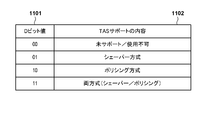
- the D bit value 1101 indicates a 2-bit data bit (D bit) value stored in the TAS capacity Info field 903 of FIG. 9 and the TAS support field 1002 of FIG.
- the bit string indicated by the D bit may be a TAS support ID.
- the content 1102 of the TAS support indicates the content corresponding to each TAS support ID.
- the bit value "00" of the D bit value 1101 indicates that the TAS method is not supported (cannot be used). Further, the bit value "01" of the D bit value 1101 indicates that although the TAS method is supported, only the shaper method can be used. Further, the bit value "10" of the D bit value 1001 indicates that although the TAS method is supported, only the policing method can be used. The bit value "11" of the D bit value 1001 corresponds to the TAS method, and indicates that both the policing method and the shaper method can be used.
- the setting value for each information element is not limited to this example, and similar information may be indicated by different field names or different values.
- FIG. 12 shows an example of the values stored in each of the PCH1 availability fields 1003 to the PCH9 availability fields 1011 in FIG. 10 and the corresponding contents.
- the PCH1 availability field 1003 to the PCH9 availability field 1011 store the E bit 1201 configured so that the indicated content 1202 differs depending on the combination with the value indicated in the TAS support field 1002. For example, when the two bits stored in the TAS support field 1102 indicate the policing method (D bit value "10") or the shaper method (D bit value "01”), the E bit is the respective TAS method. Indicates the availability of.
- setting the E bit to "1" indicates that the TAS method indicated by the D bit value can be used, and setting the E bit to "0" indicates that the D bit value can be used. It can indicate that the indicated TAS scheme cannot be used. Note that this is an example, and by setting the E bit to "0", it indicates that the TAS method indicated by the D bit value can be used, and the E bit is set to "1". May indicate that the TAS method indicated by the D-bit value cannot be used. Further, when the 2 bits stored in the TAS support field 1102 indicate that both the policing method and the shaper method can be used (when the D bit value is "11"), one bit of the E bit is used. That method can be specified.
- the policing method is specified by setting the E bit to "1"
- the shaper method is specified by setting the E bit to "0”.
- the policing method may be specified by setting the E bit to "0”
- the shaper method may be specified by setting the E bit to "1".
- FIG. 10 An example of a processing flow executed by the AP102 when the TAS capability information of FIG. 10 is notified by the Beacon frame will be described with reference to FIG.
- This process is started, for example, when the power of the AP102 is turned on, or when the TAS data collection process is started in the AP102.
- This process can be realized, for example, by the control unit 202 of the AP 102 executing the program stored in the storage unit 201.
- the AP102 determines whether the mode is set to include the multi-channel TAS information as shown in FIG. 10 in the Beacon frame (S1301). When it is determined that the mode for including the multi-channel TAS information in the Beacon frame has not been set (NO in S1301), the AP102 executes the conventional Beacon frame setting process (S1302). Then, AP102 notifies the Beacon frame obtained by the setting process of S1302 in BSS1 (S1306). In this case, the AP102 may transmit a Beacon frame including the TAS information as shown in FIG. 9, for example.
- the AP102 uses each of the plurality of PCHs based on the TAS method capability information stored in S405 of FIG. Whether or not it is possible is determined (S1303). For this purpose, the AP102 transmits an RTS (Request To Send) message. Then, when the STA 103 receives the RTS in each PCH, the STA 103 executes the carrier sense in that PCH. The STA 103 transmits a CTS (Clear To Send) message to the AP 102 after the SIFS (Short Inter Frame Space) period elapses when the PCH is not in a busy state.
- RTS Request To Send
- the AP102 confirms whether or not the CTS has been received in each of the PCHs that have transmitted the RTS, and recognizes the PCH for which the reception has been confirmed as a usable PCH. At this time, the TAS capability information generation unit 301 of the AP102 recognizes that the TAS communication cannot be used for the PCH for which the reception of the CTS could not be confirmed.
- the TAS ability information generation unit 301 updates the information on whether or not the TAS method can be used for each of the PCHs in the TAS ability information.
- the AP102 completes the processing of S1303 for all of the plurality of usable PCHs (YES in S1304)
- the AP102 stores the confirmed TAS ability information in the storage unit 201 and sets the TAS ability information in the Beacon frame (S1305).
- AP102 notifies the Beacon frame including the TAS ability information in BSS101 (S1306).
- the Beacon frame including the TAS capability information shown in FIG. 9 or FIG. 10 may be notified to a plurality of PCHs.
- the AP102 can transmit the Beacon frame including the information of a plurality of PCHs.
- the STA 103 can select and use a PCH capable of communication in consideration of delay control based on TAS capability information.
- a PCH having a signal bandwidth of a predetermined width or more may be selected, or a PCH having a large signal bandwidth may be preferentially selected. It may be.
- the PCHs having the received electric field strength and the signal-to-noise ratio (SNR) of a predetermined value or more may be selected, and the PCHs having these values having good values are prioritized. May be selected for.
- the PCHs having the TAS capability information the PCHs having a channel transmission capacity calculated from the bandwidth and the SNR of a predetermined value or more may be selected, or the PCH having the larger capacity is preferentially selected. It may be done.
- the PCH to be used may be selected based on the free channel information estimated from the channel usage status for a certain period of time.
- conditions other than these PCH selection conditions may be used. Further, one or more of the above-mentioned selection conditions may be used in combination.
- PCH1 to PCH9 each indicate a plurality of PCHs that can be used in the 5 GHz band.
- PCH1 to PCH9 are frequency channels having channel numbers of 36, 44, 52, 60, 100, 108, 116, 124, and 132, respectively, and having a bandwidth of 20 MHz.
- the frequency band of 5 GHz has been described here, the same argument can be applied to the frequency bands of 2.4 GHz and 6 GHz. Further, the above discussion may be applied not only to PCH but also to any other frequency channel.
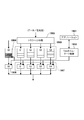
- AP102 and STA101 have the configuration shown in FIG. 15 for TAS traffic data transmission processing.
- the application 1501 receives the TAS method information determined by the TAS method determination unit 302 described above before reaching the state during communication of the TAS traffic data. Then, the application 1501 prepares for a data transmission request from the Mac frame generation unit 304 in order to execute the transmission process according to the TAS method information.
- the traffic classification function 1503 receives the traffic data to which the priority information is added from the Mac frame generation unit 304, and maps the time-constrained traffic data to the TAS queue (Q0) 1504.
- the traffic classification function 1503 maps the best effort traffic data other than the TAS traffic data to each of the BE queues (Q1-Q4) 1505.
- the TAS time gate control function 1502 suspends / resumes each of the TAS time gate (G0) 1506 and various BE time gates (G1-G4) 1507, and the traffic data accumulated in each queue. Execute output control of.
- the TAS time gate control function 1502 executes control that protects TAS traffic data while avoiding channel access conflicts, as will be described later, for example.
- Curve 1601 shows the OPEN / CLOSE state of the TAS time gate (G0) 1506, and curves 1602 to 1605 show the OPEN / CLOSE state of each of the various BE time gates (G1-G4) 1507. Is shown. In these curves, "1" indicates OPEN and "0" indicates CLOSE.
- the guard time 1606 indicates a time Tg for blocking transmission of all gates. With this guard time 1606, it is possible to prevent various BE traffic data from colliding with the TAS traffic data.
- the timing 1607 indicates the timing To at which the TAS time gate (G0) 1506 periodically OPENs. Timing To occurs every 1608 cycle. This period 1608 is defined by the interval Tp at which data is transmitted at the strict and periodic timing specified by the TAS traffic data transmission request.
- the period 1609 is a time interval Tc in which the TAS time gate (G0) 1506 of the TAS queue (Q0) 1504 is opened, and indicates a period in which the TAS traffic data is transmitted at a strict and periodic timing. ..
- the TAS time gate control function 1502 executes gate control according to a cyclically repeated transmission / reception schedule of TAS traffic data.
- the TAS time gate control function 1502 can make each time gate CLOSE or OPEN, for example, by inputting bit 0 or 1 for each time gate.
- the TAS time gate control function 1502 may indicate, for example, the OPEN / CLOSE of the five time gates G0 to G4 by a 5-bit bit string. Then, each time gate can extract the bit corresponding to itself from this bit string and execute the control of CLOSE / OPEN. Further, the TAS time gate control function 1502 may output 1-bit information indicating whether the time gate is CLOSE or OPEN for each time gate.
- the state of each time gate for each bit string will be described.
- the bit string here indicates the OPEN / CLOSE of each time gate in the order of "G0, G1, G2, G3, G4".
- the bit string "00000” indicates a data block state. This state corresponds to the guard time 1606, and all time gates (G0-G4) are set to CLOSE.
- the bit string "10000” indicates a state in which only the TAS time gate (G0) 1506 is set to OPEN, and this state corresponds to the period 1609.
- the bit string "01111” is a state in which various BE time gates (G1-G4) 1507 are set to OPEN, and corresponds to, for example, a period of the period 1608 excluding the period 1609 and the guard time 1606. In this way, the TAS time gate control function 1502 can control the CLOSE / OPEN of each time gate by a 1-bit indicator.
- time gates (G0 to G4) are used to block the data that should not be transmitted at the transmission timing of the TAS traffic data that should be transmitted at a strict timing, and the TAS traffic data is transmitted without delay. Can be processed.
- the present invention supplies a program that realizes one or more functions of the above-described embodiment to a system or device via a network or storage medium, and one or more processors in the computer of the system or device reads and executes the program. It can also be realized by the processing to be performed. It can also be realized by a circuit (for example, ASIC) that realizes one or more functions.
Landscapes
- Engineering & Computer Science (AREA)
- Computer Networks & Wireless Communication (AREA)
- Signal Processing (AREA)
- Quality & Reliability (AREA)
- Mobile Radio Communication Systems (AREA)
- Small-Scale Networks (AREA)
Priority Applications (5)
| Application Number | Priority Date | Filing Date | Title |
|---|---|---|---|
| EP21768937.1A EP4120779A4 (en) | 2020-03-12 | 2021-03-10 | COMMUNICATION DEVICE, CONTROL METHOD AND PROGRAM |
| CN202180019870.1A CN115280878B (zh) | 2020-03-12 | 2021-03-10 | 通信装置、控制方法和存储介质 |
| CN202610132236.3A CN121924604A (zh) | 2020-03-12 | 2021-03-10 | 通信装置、控制方法和存储介质 |
| US17/886,642 US12389436B2 (en) | 2020-03-12 | 2022-08-12 | Communication apparatus, control method, and computer-readable storage medium |
| US19/266,326 US20250344234A1 (en) | 2020-03-12 | 2025-07-11 | Communication apparatus, control method, and computer-readable storage medium |
Applications Claiming Priority (2)
| Application Number | Priority Date | Filing Date | Title |
|---|---|---|---|
| JP2020-043334 | 2020-03-12 | ||
| JP2020043334A JP7492351B2 (ja) | 2020-03-12 | 2020-03-12 | 通信装置、制御方法、及び、プログラム |
Related Child Applications (1)
| Application Number | Title | Priority Date | Filing Date |
|---|---|---|---|
| US17/886,642 Continuation US12389436B2 (en) | 2020-03-12 | 2022-08-12 | Communication apparatus, control method, and computer-readable storage medium |
Publications (1)
| Publication Number | Publication Date |
|---|---|
| WO2021182523A1 true WO2021182523A1 (ja) | 2021-09-16 |
Family
ID=77672096
Family Applications (1)
| Application Number | Title | Priority Date | Filing Date |
|---|---|---|---|
| PCT/JP2021/009591 Ceased WO2021182523A1 (ja) | 2020-03-12 | 2021-03-10 | 通信装置、制御方法、及び、プログラム |
Country Status (5)
| Country | Link |
|---|---|
| US (2) | US12389436B2 (https=) |
| EP (1) | EP4120779A4 (https=) |
| JP (3) | JP7492351B2 (https=) |
| CN (2) | CN115280878B (https=) |
| WO (1) | WO2021182523A1 (https=) |
Families Citing this family (2)
| Publication number | Priority date | Publication date | Assignee | Title |
|---|---|---|---|---|
| WO2023274165A1 (zh) * | 2021-06-30 | 2023-01-05 | 华为技术有限公司 | 参数配置的方法、装置、控制器、通信设备和通信系统 |
| JP7828150B2 (ja) | 2021-09-28 | 2026-03-11 | キヤノン株式会社 | 通信装置及びその制御方法、並びにプログラム |
Citations (2)
| Publication number | Priority date | Publication date | Assignee | Title |
|---|---|---|---|---|
| JP2018050133A (ja) | 2016-09-20 | 2018-03-29 | キヤノン株式会社 | 通信装置、制御方法、及びプログラム |
| JP2020043334A (ja) | 2018-09-11 | 2020-03-19 | 廣達電腦股▲ふん▼有限公司Quanta Computer Inc. | 通気メカニズム用の着脱可能なpsu専用トンネル |
Family Cites Families (11)
| Publication number | Priority date | Publication date | Assignee | Title |
|---|---|---|---|---|
| ES2929072T3 (es) * | 2013-03-13 | 2022-11-24 | Celeno Communications Israel Ltd | Programación consciente del tiempo de antena para red inalámbrica de área local |
| JP2015180043A (ja) | 2014-02-25 | 2015-10-08 | キヤノン株式会社 | 通信装置、通信装置の制御方法およびプログラム |
| EP3166257B1 (en) * | 2015-11-05 | 2018-09-26 | Robert Bosch Gmbh | Start-up triggering in an ethernet-based in-vehicle network |
| CN106998582B (zh) * | 2016-01-22 | 2020-09-08 | 华为技术有限公司 | 协商目标唤醒时间的方法、接入点和站点 |
| WO2017146780A1 (en) * | 2016-02-26 | 2017-08-31 | Intel Corporation | User equipment (ue) and method of sidelink data communication in fifth generation (5g) new radio (nr) things networks |
| JP6751053B2 (ja) * | 2017-06-05 | 2020-09-02 | 日本電信電話株式会社 | 通信装置 |
| US11528722B2 (en) | 2018-07-08 | 2022-12-13 | Intel Corporation | Apparatus, system and method of scheduling time sensitive networking (TSN) wireless communications |
| WO2021080263A1 (ko) * | 2019-10-23 | 2021-04-29 | 엘지전자 주식회사 | 무선랜 시스템에서 저지연 통신을 수행하기 위한 기법 |
| JP7569154B2 (ja) | 2020-02-03 | 2024-10-17 | キヤノン株式会社 | 通信装置、通信装置の制御方法、およびプログラム |
| US12250592B2 (en) * | 2020-07-01 | 2025-03-11 | Intel Corporation | Methods and arrangements for application service discovery |
| WO2022094940A1 (zh) * | 2020-11-06 | 2022-05-12 | 北京小米移动软件有限公司 | 通信方法和通信设备 |
-
2020
- 2020-03-12 JP JP2020043334A patent/JP7492351B2/ja active Active
-
2021
- 2021-03-10 WO PCT/JP2021/009591 patent/WO2021182523A1/ja not_active Ceased
- 2021-03-10 CN CN202180019870.1A patent/CN115280878B/zh active Active
- 2021-03-10 EP EP21768937.1A patent/EP4120779A4/en active Pending
- 2021-03-10 CN CN202610132236.3A patent/CN121924604A/zh active Pending
-
2022
- 2022-08-12 US US17/886,642 patent/US12389436B2/en active Active
-
2024
- 2024-05-17 JP JP2024081115A patent/JP7710566B2/ja active Active
-
2025
- 2025-07-07 JP JP2025114636A patent/JP2025129397A/ja active Pending
- 2025-07-11 US US19/266,326 patent/US20250344234A1/en active Pending
Patent Citations (2)
| Publication number | Priority date | Publication date | Assignee | Title |
|---|---|---|---|---|
| JP2018050133A (ja) | 2016-09-20 | 2018-03-29 | キヤノン株式会社 | 通信装置、制御方法、及びプログラム |
| JP2020043334A (ja) | 2018-09-11 | 2020-03-19 | 廣達電腦股▲ふん▼有限公司Quanta Computer Inc. | 通気メカニズム用の着脱可能なpsu専用トンネル |
Non-Patent Citations (2)
| Title |
|---|
| DAVE CAVALCANTI (INTEL): "Capabilities to support Time-Aware Scheduling in 802.11be", IEEE DRAFT; 11-19-1933-00-00BE-CAPABILITIES-TO-SUPPORT-TIME-AWARE-SCHEDULING-IN-802-11BE, IEEE-SA MENTOR, PISCATAWAY, NJ USA, vol. 802.11 EHT; 802.11be, no. 0, 10 November 2019 (2019-11-10), Piscataway, NJ USA , pages 1 - 24, XP068164306 * |
| See also references of EP4120779A4 |
Also Published As
| Publication number | Publication date |
|---|---|
| JP2025129397A (ja) | 2025-09-04 |
| JP2024098048A (ja) | 2024-07-19 |
| US12389436B2 (en) | 2025-08-12 |
| EP4120779A1 (en) | 2023-01-18 |
| CN121924604A (zh) | 2026-04-24 |
| EP4120779A4 (en) | 2024-03-13 |
| JP7492351B2 (ja) | 2024-05-29 |
| US20220386321A1 (en) | 2022-12-01 |
| CN115280878A (zh) | 2022-11-01 |
| JP7710566B2 (ja) | 2025-07-18 |
| US20250344234A1 (en) | 2025-11-06 |
| JP2021145257A (ja) | 2021-09-24 |
| CN115280878B (zh) | 2026-02-17 |
Similar Documents
| Publication | Publication Date | Title |
|---|---|---|
| JP7673265B2 (ja) | 通信装置、通信方法、およびプログラム | |
| JP7562270B2 (ja) | 通信装置、通信方法、およびプログラム | |
| CN102196470B (zh) | 毫米波无线系统中的分簇管理 | |
| JP7710566B2 (ja) | 通信装置、制御方法、及び、プログラム | |
| US20230115667A1 (en) | Access point apparatus, control method therefor, and computer readable storage medium | |
| JP2025026524A (ja) | 通信装置、制御方法、及び、プログラム | |
| JP2025004139A (ja) | 通信装置、制御方法、およびプログラム | |
| EP3167672A1 (en) | Systems and methods for traffic information signaling in a wireless communications network | |
| EP4187988B1 (en) | Communication device, control method for communication device, and program | |
| JP5013542B2 (ja) | 無線ネットワーク内における複数無線インターフェイスの使用 | |
| CN117941452A (zh) | 接入点设备、通信方法、通信系统和程序 | |
| US8086232B2 (en) | Time synchronized wireless method and operations | |
| WO2022050218A1 (ja) | 通信装置、制御方法、およびプログラム | |
| US20210321395A1 (en) | Resource scheduling between network nodes | |
| JP7625398B2 (ja) | 通信装置、制御方法、およびプログラム | |
| JP2024075270A (ja) | 通信装置、制御方法、及び、プログラム | |
| WO2024202920A1 (ja) | 通信装置、通信方法、およびプログラム | |
| CN118632295A (zh) | 通信方法和通信装置 | |
| WO2022168393A1 (ja) | 通信装置、通信装置の制御方法、およびプログラム |
Legal Events
| Date | Code | Title | Description |
|---|---|---|---|
| 121 | Ep: the epo has been informed by wipo that ep was designated in this application |
Ref document number: 21768937 Country of ref document: EP Kind code of ref document: A1 |
|
| NENP | Non-entry into the national phase |
Ref country code: DE |
|
| ENP | Entry into the national phase |
Ref document number: 2021768937 Country of ref document: EP Effective date: 20221012 |