WO2021181987A1 - 内分泌攪乱物質等の定量方法 - Google Patents
内分泌攪乱物質等の定量方法 Download PDFInfo
- Publication number
- WO2021181987A1 WO2021181987A1 PCT/JP2021/004922 JP2021004922W WO2021181987A1 WO 2021181987 A1 WO2021181987 A1 WO 2021181987A1 JP 2021004922 W JP2021004922 W JP 2021004922W WO 2021181987 A1 WO2021181987 A1 WO 2021181987A1
- Authority
- WO
- WIPO (PCT)
- Prior art keywords
- group
- reaction
- antibody
- enzyme
- antigen
- Prior art date
- Legal status (The legal status is an assumption and is not a legal conclusion. Google has not performed a legal analysis and makes no representation as to the accuracy of the status listed.)
- Ceased
Links
- 0 C*C(C(C1C)O)=C(*)C(O)=C1*=C Chemical compound C*C(C(C1C)O)=C(*)C(O)=C1*=C 0.000 description 1
Images


Classifications
-
- C—CHEMISTRY; METALLURGY
- C12—BIOCHEMISTRY; BEER; SPIRITS; WINE; VINEGAR; MICROBIOLOGY; ENZYMOLOGY; MUTATION OR GENETIC ENGINEERING
- C12Q—MEASURING OR TESTING PROCESSES INVOLVING ENZYMES, NUCLEIC ACIDS OR MICROORGANISMS; COMPOSITIONS OR TEST PAPERS THEREFOR; PROCESSES OF PREPARING SUCH COMPOSITIONS; CONDITION-RESPONSIVE CONTROL IN MICROBIOLOGICAL OR ENZYMOLOGICAL PROCESSES
- C12Q1/00—Measuring or testing processes involving enzymes, nucleic acids or microorganisms; Compositions therefor; Processes of preparing such compositions
- C12Q1/26—Measuring or testing processes involving enzymes, nucleic acids or microorganisms; Compositions therefor; Processes of preparing such compositions involving oxidoreductase
- C12Q1/28—Measuring or testing processes involving enzymes, nucleic acids or microorganisms; Compositions therefor; Processes of preparing such compositions involving oxidoreductase involving peroxidase
-
- G—PHYSICS
- G01—MEASURING; TESTING
- G01N—INVESTIGATING OR ANALYSING MATERIALS BY DETERMINING THEIR CHEMICAL OR PHYSICAL PROPERTIES
- G01N21/00—Investigating or analysing materials by the use of optical means, i.e. using sub-millimetre waves, infrared, visible or ultraviolet light
- G01N21/01—Arrangements or apparatus for facilitating the optical investigation
- G01N21/03—Cuvette constructions
- G01N21/05—Flow-through cuvettes
-
- G—PHYSICS
- G01—MEASURING; TESTING
- G01N—INVESTIGATING OR ANALYSING MATERIALS BY DETERMINING THEIR CHEMICAL OR PHYSICAL PROPERTIES
- G01N21/00—Investigating or analysing materials by the use of optical means, i.e. using sub-millimetre waves, infrared, visible or ultraviolet light
- G01N21/75—Systems in which material is subjected to a chemical reaction, the progress or the result of the reaction being investigated
- G01N21/77—Systems in which material is subjected to a chemical reaction, the progress or the result of the reaction being investigated by observing the effect on a chemical indicator
- G01N21/78—Systems in which material is subjected to a chemical reaction, the progress or the result of the reaction being investigated by observing the effect on a chemical indicator producing a change of colour
-
- G—PHYSICS
- G01—MEASURING; TESTING
- G01N—INVESTIGATING OR ANALYSING MATERIALS BY DETERMINING THEIR CHEMICAL OR PHYSICAL PROPERTIES
- G01N33/00—Investigating or analysing materials by specific methods not covered by groups G01N1/00 - G01N31/00
- G01N33/48—Biological material, e.g. blood, urine; Haemocytometers
- G01N33/50—Chemical analysis of biological material, e.g. blood, urine; Testing involving biospecific ligand binding methods; Immunological testing
- G01N33/53—Immunoassay; Biospecific binding assay; Materials therefor
- G01N33/531—Production of immunochemical test materials
- G01N33/532—Production of labelled immunochemicals
- G01N33/535—Production of labelled immunochemicals with enzyme label or co-enzymes, co-factors, enzyme inhibitors or enzyme substrates
-
- G—PHYSICS
- G01—MEASURING; TESTING
- G01N—INVESTIGATING OR ANALYSING MATERIALS BY DETERMINING THEIR CHEMICAL OR PHYSICAL PROPERTIES
- G01N33/00—Investigating or analysing materials by specific methods not covered by groups G01N1/00 - G01N31/00
- G01N33/48—Biological material, e.g. blood, urine; Haemocytometers
- G01N33/50—Chemical analysis of biological material, e.g. blood, urine; Testing involving biospecific ligand binding methods; Immunological testing
- G01N33/53—Immunoassay; Biospecific binding assay; Materials therefor
- G01N33/543—Immunoassay; Biospecific binding assay; Materials therefor with an insoluble carrier for immobilising immunochemicals
Definitions
- the present invention relates to a quantification method and a quantification device for endocrine disruptors and the like.
- Endocrine disruptors are chemical substances such as pesticides discharged into the environment such as soil, rivers, and oceans that are metabolically toxicized by microorganisms living in the environment.
- endocrine disruptors there has been an increasing demand for measurement and analysis of chemical substances such as pesticides in the environment and endocrine disruptors derived from the chemical substances (hereinafter referred to as "endocrine disruptors").
- Fluorescent substances and color-developing substrates used in quantification methods for endocrine disruptors are often unstable to light and heat if they have high measurement accuracy and sensitivity, while compounds that are stable to light and heat are used. When used, the measurement accuracy and sensitivity are often low.
- the present invention has been made under such circumstances, and an object of the present invention is to provide a quantification method or the like that can be stably and highly accurately carried out at the site where an environmental sample such as an endocrine disruptor is collected.
- the first aspect of the present invention is a quantification method for quantifying a target component contained in a sample solution by utilizing an antigen-antibody reaction, wherein an enzyme-labeled enzyme-labeled antigen or an enzyme-labeled antibody is labeled with the enzyme.
- an enzyme-labeled enzyme-labeled antigen or an enzyme-labeled antibody is labeled with the enzyme.
- a quantification method comprising a absorptiometry step C for measuring the absorptivity of the above, and a quantification step D for quantifying the target component from the absorbance obtained in the absorptivity measurement step C.
- R1 to R4 are independent of each other and may have a hydrogen atom, a hydrocarbon group, a halogen atom, a hydroxyl group, an acetyl group, a substituent or an amino group or a substituent.
- a hydrochloride, a sulfonic acid group or a sulfonic acid base which may have a substituent, a thiol group, a nitro group, a cyano group, a carbonyl group, a carboxyl group or a halogen atom, a hydroxyl group, a carboxyl group or an amino group.
- a substituent a thiol group, a nitro group, a cyano group, a carbonyl group, a carboxyl group or a halogen atom, a hydroxyl group, a carboxyl group or an amino group.
- the second aspect of the present invention is the quantification method of the first aspect, in which the enzyme is horseradish peroxidase and the peak potential of the oxidation potential of the dihydroxybenzene-based compound is 1 V or less.
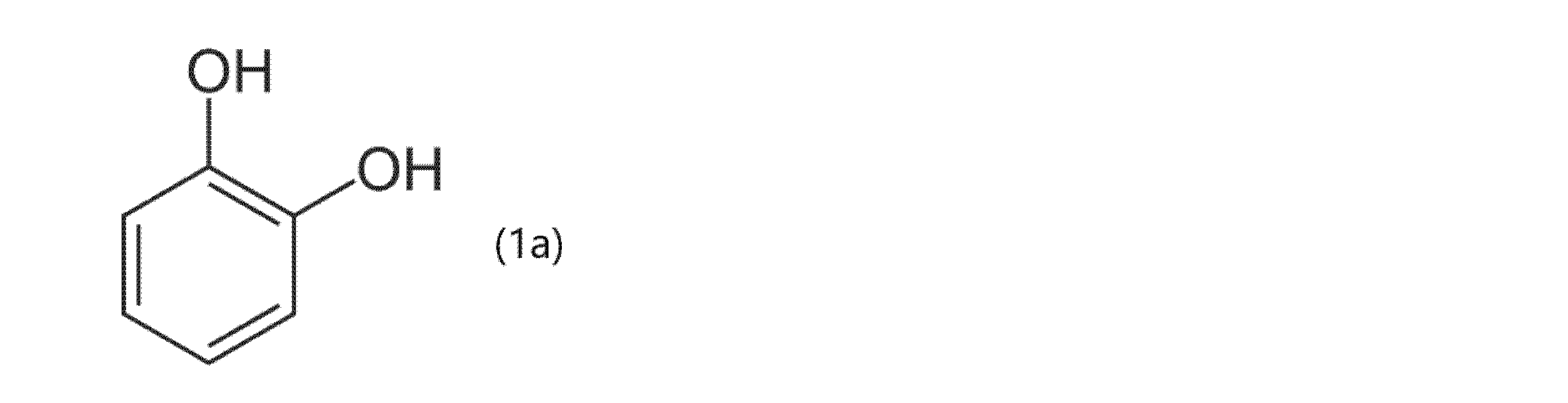
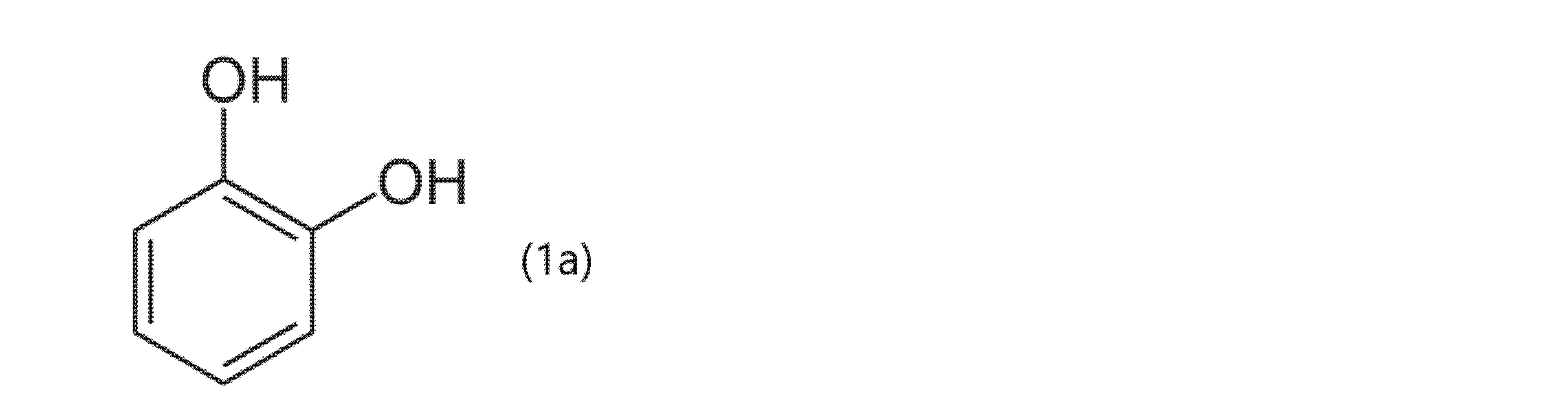
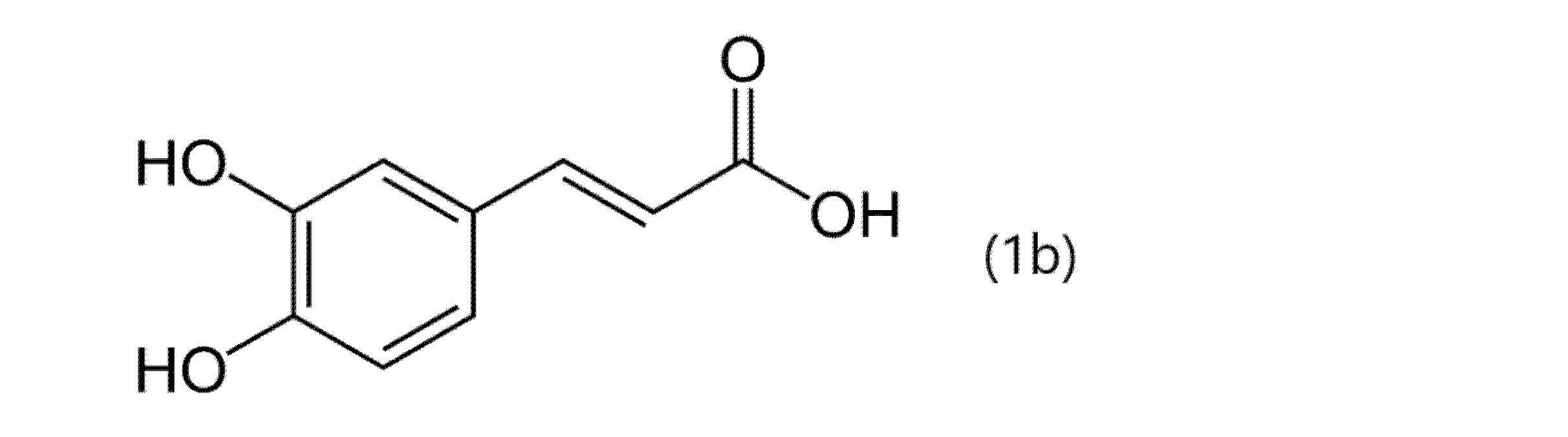
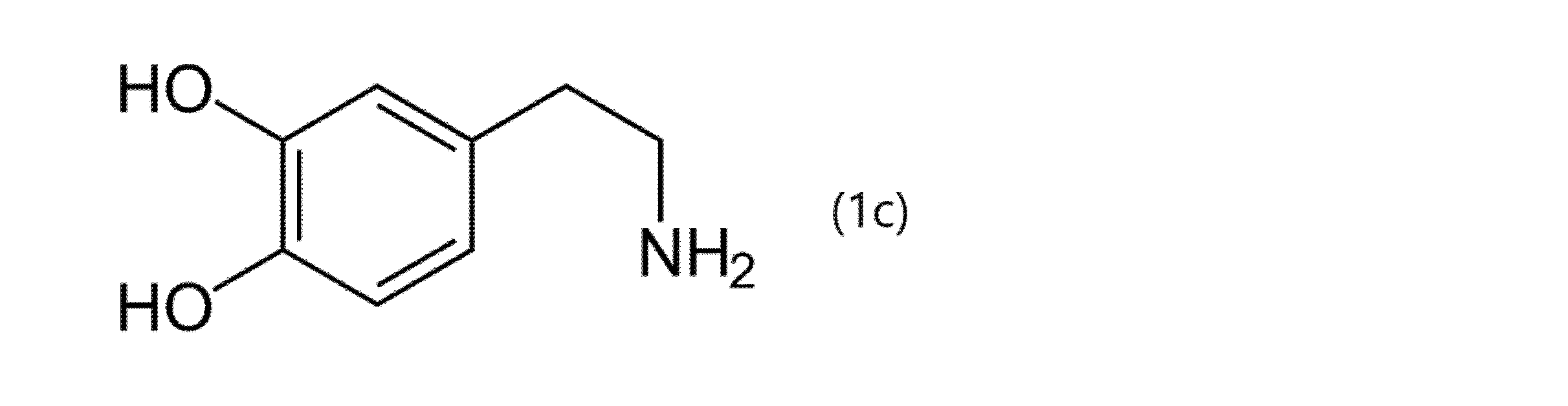
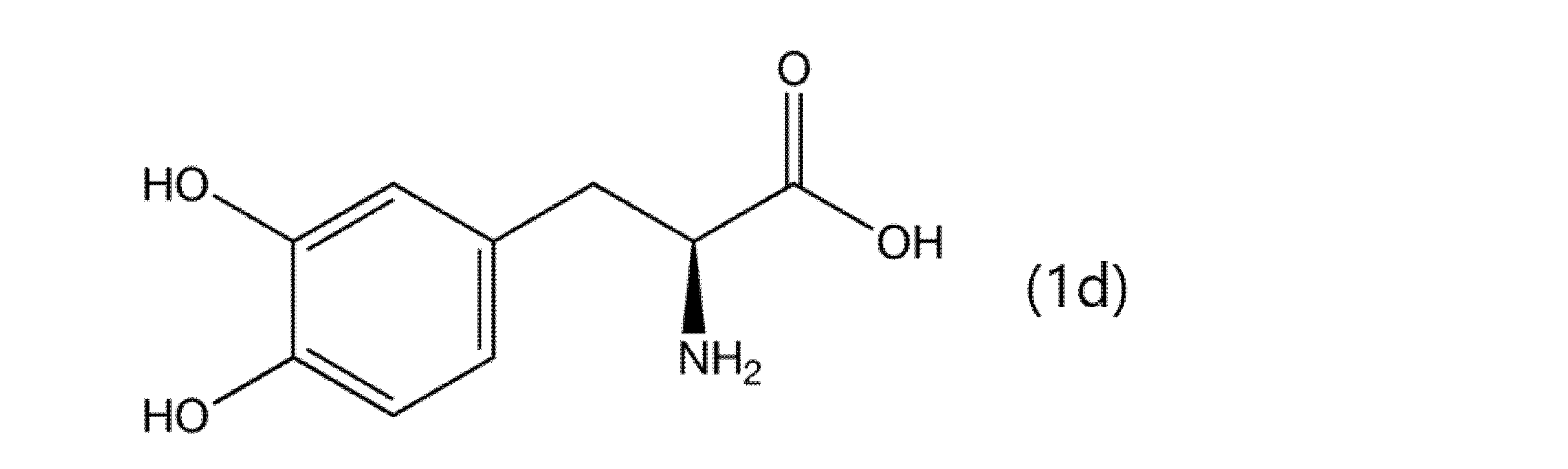
- the third aspect of the present invention is the quantification method of the first or second aspect, in which the dihydroxybenzene-based compound is at least one selected from the group consisting of the following formulas (1a) to (1d). It is a compound.
- the reaction catalyzed by the enzyme is an oxidation reaction and / or a polymerization reaction, it is affected by light or heat as compared with the conventional ELISA using a fluorescent substrate or a color-developing substrate. It is difficult to provide a quantification method suitable for outdoor measurement. Moreover, since the reaction time of the oxidation reaction or the polymerization reaction is short, it becomes possible to quantify endocrine disruptors and the like in a short time.
- the oxidation reaction and / or polymerization reaction of the dihydroxybenzene compound having a short reaction time since the oxidation reaction and / or polymerization reaction of the dihydroxybenzene compound having a short reaction time is used, it is possible to quantify in a short time. Further, since the dihydroxybenzene-based compound has a large change range in absorbance (large dynamic range) of the reaction product produced by oxidation and / or polymerization in the presence of an enzyme, the measurement accuracy in the absorbance measurement step C is excellent. Although the reason why such an effect can be obtained is not clear, it is considered that the dihydroxybenzene-based compound is easily dissolved in water and a high-concentration colored product can be obtained. More specifically, the following reasons can be considered.
- the oxidation reaction and / or the polymerization reaction proceeds in the reaction step B depending on the arrangement of the two hydroxyl groups on the benzene ring and the presence of other substituents.
- the reaction step B when the oxidation reaction of the dihydroxybenzene-based compound proceeds, the dihydroxybenzene-based compound has a property of developing color by being oxidized, and the dihydroxybenzene-based compound is easily dissolved in water, so that it is used at a high concentration. can do. As a result, it is considered that the reaction product produced by the oxidation reaction of the dihydroxybenzene-based compound has a large change in absorbance.
- reaction step B when the polymerization reaction of the dihydroxybenzene-based compound proceeds, the conjugated system expands due to the polymerization reaction and the HOMO-LUMO energy gap becomes smaller, so that the absorption wavelength of the reaction product becomes longer. shift. Further, depending on the progress of the polymerization reaction, polymers having different molecular weights (reaction products) are mixed, so that light of various wavelengths is absorbed. Further, as the polymerization reaction proceeds, the absorbance of the polymer apparently increases.
- the dihydroxybenzene-based compounds compounds in which the polymerization reaction easily proceeds, for example, catecholamine-based compounds described later, are easily soluble in water, and the polymer produced by the polymerization reaction is also easily soluble in water. Therefore, it is considered that the polymerization reaction of catecholamine compounds in particular is likely to proceed, and as a result, the range of change in the absorbance of the polymer (reaction product) is large.
- the quantification method of the present invention is suitable for outdoor measurement. Furthermore, since dihydroxybenzene compounds are inexpensive, expensive fluorescent reagents such as conventional Elisa are unnecessary.
- ELISA using horseradish peroxidase is preferably carried out by using a dihydroxybenzene-based compound having a peak potential of oxidation potential of 1 V or less. be able to.
- At least one compound selected from the group consisting of the formulas (1a) to (1d) is oxidized and / or polymerized in the presence of an enzyme. Since the change range of the absorbance of the reaction product produced by the reaction is large, the measurement accuracy in the absorbance measurement step C is particularly excellent.
- This is an example of the configuration of a quantifying device for endocrine disruptors of the present invention. It is a figure which shows the spectrum which shows the time change of the absorbance at the time of reacting HRP which was varied from 0 to 100 ppb, 1 mM H 2 O 2 and 10 mM catechol, caffeic acid, dopamine hydrochloride or levodopa, respectively.
- FIG. 1 shows a flow chart of a method for quantifying endocrine disruptors and the like of the present invention.
- the quantification target was 3-phenoxybenzoic acid (3-PBA), which is a kind of metabolite of diphenyl ether herbicide.
- 3-phenoxybenzoic acid (3-PBA)
- HRP horseradish peroxidase
- Any chemical substance having a COOH group or two NH groups at the terminal can be labeled with HRP.
- a phosphate buffer was used as the solvent for each solution.
- an anti-3-PBA antibody that specifically binds to 3-PBA is injected into a reaction cell (an example of the "reaction part” according to claim) and adsorbed on a substrate in the reaction cell (S1).
- BSA bovine serum albumin
- BSA is a blocking agent for suppressing non-specific adsorption of the labeled antigen to be injected in the next step on the substrate.
- a mixed solution of the 3-PBA solution to be quantified an example of the "sample solution” according to the claim
- the labeled 3-PBA solution an example of the "enzyme-labeled antigen” according to the claim
- the labeled 3-PBA solution is a solution containing the labeled 3-PBA in which the antigen 3-PBA is pre-labeled with HRP, and the concentration of the labeled 3-PBA is known.
- the unlabeled 3-PBA and the labeled 3-PBA are competitively captured by the antibody on the substrate, resulting in an antigen-antibody reaction.
- the dihydroxybenzene compound and hydrogen peroxide H 2 O 2 are injected into the reaction cell (S4, an example of "reaction step B" according to claim).
- the dihydroxybenzene-based compound When the dihydroxybenzene-based compound is a catecholamine-based compound having an amino group, the dihydroxybenzene-based compound catalyzes the polymerization reaction in addition to the oxidation reaction, and the dihydroxybenzene-based compound produces a polymer as a reaction product.
- the absorbance of the reaction product is measured (S5, an example of "absorbance measurement step C” according to claim).
- concentration of 3-PBA is calculated based on the obtained absorbance (S6, an example of "quantitative step D” according to claim).
- a method for calculating the concentration of 3-PBA based on the obtained absorbance for example, a plurality of 3-PBA samples having different concentrations are prepared, and the quantification method according to the present invention is carried out using these samples at each concentration.
- a method of calculating the concentration of the measurement sample by using a calibration curve prepared in advance based on the absorbance of the sample can be mentioned.
- this quantification method utilizes the oxidation reaction, oxidation reaction and polymerization reaction of the dihydroxybenzene-based compound, the time required for quantification can be significantly shortened as compared with the conventional ELISA.
- the time required for the conventional Elisa enzyme reaction is several minutes, whereas the time required for the oxidation reaction, the oxidation reaction and the polymerization reaction of this quantification method is several seconds.
- the dihydroxybenzene-based compound is much more stable to light and heat than the fluorescent substrate and the color-developing substrate used in the conventional Elisa, and is therefore suitable for on-site analysis.
- the dihydroxybenzene-based compound is cheaper than the substrate used in the conventional Elisa. That is, according to this quantification method, on-site analysis of endocrine disruptors and the like can be performed quickly, safely and inexpensively.
- the reaction in which a dihydroxybenzene-based compound is polymerized after an oxidation reaction is referred to as a "polymerization reaction", but the degree of polymerization is not particularly problematic, and as will be described later, dihydroxybenzene.
- the reaction (polymerization) may be performed to the extent that an absorption spectrum in the visible light region, which is not seen in the dihydroxybenzene system compound, can be detected.
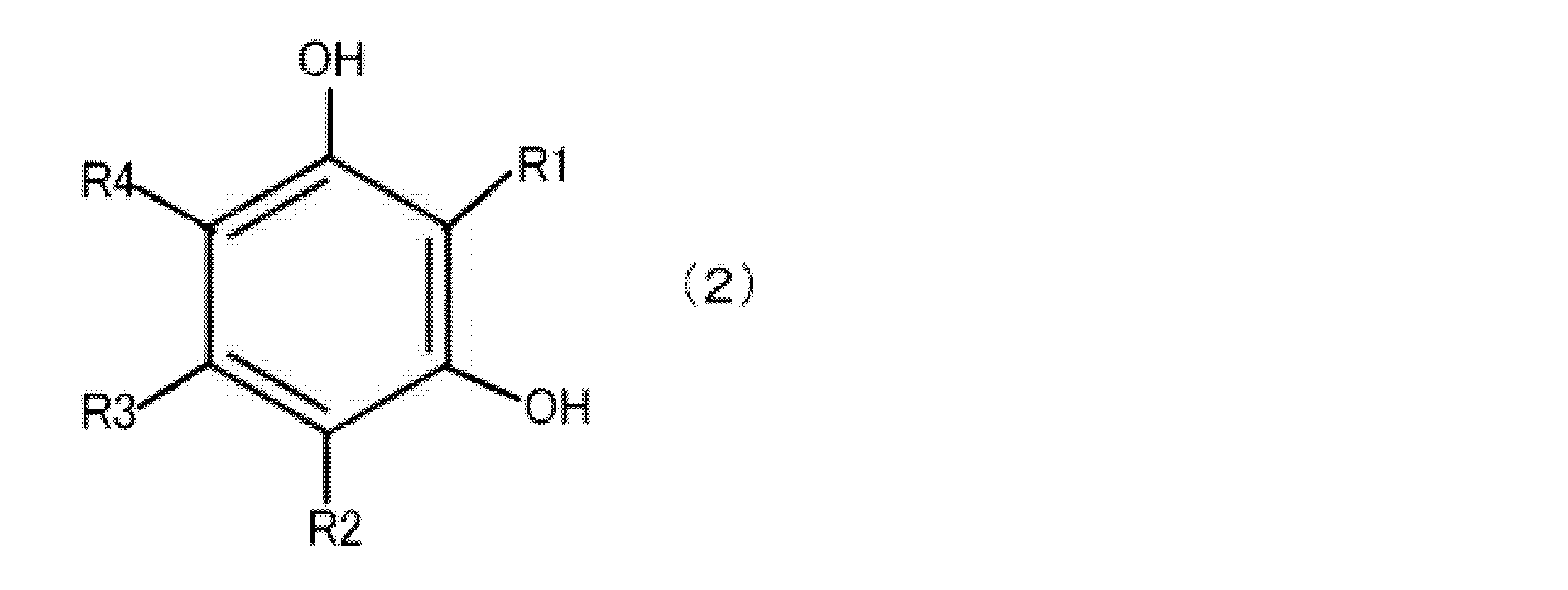
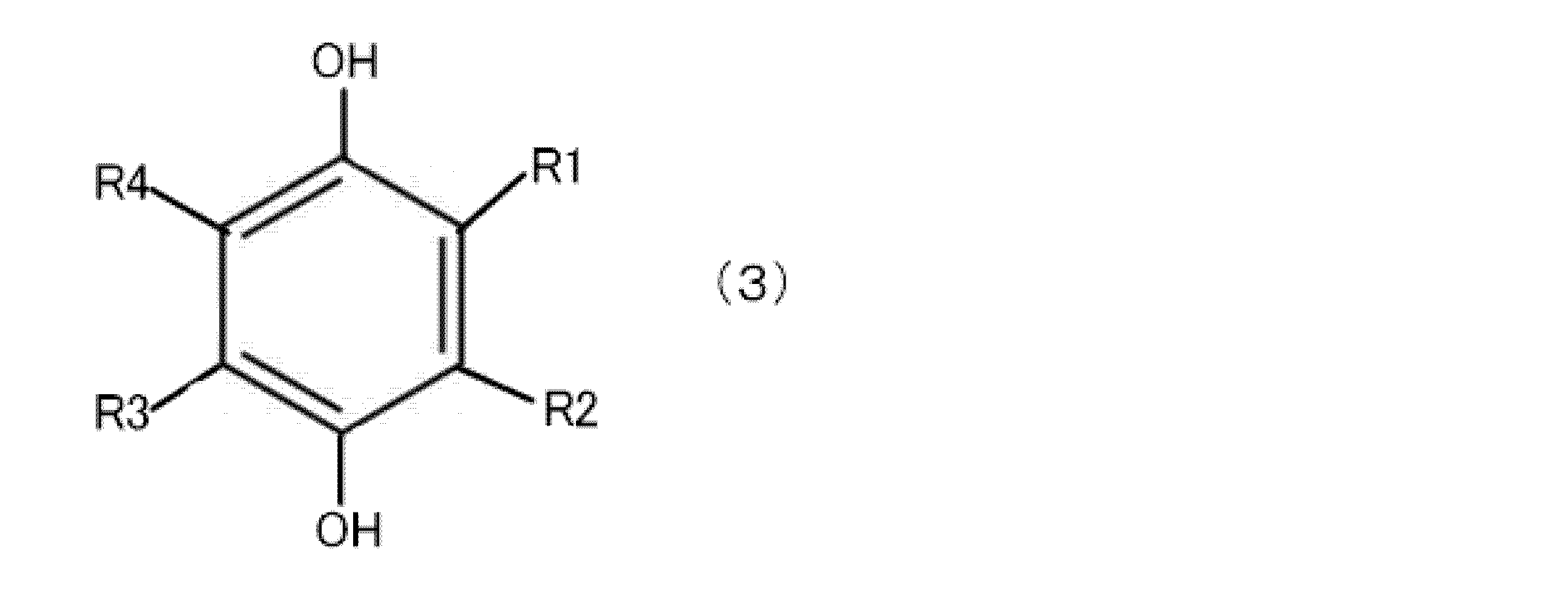
- Examples of the dihydroxybenzene-based compound include a catechol-based compound represented by the following general formula (1), a resorcinol-based compound represented by the following general formula (2), and a hydroquinone-based compound represented by the following general formula (3).
- R1 to R4 are independent of each other and may have a hydrogen atom, a hydrocarbon group, a halogen atom, a hydroxyl group, an acetyl group, a substituent or an amino group or a substituent.
- a hydrochloride, a sulfonic acid group or a sulfonic acid base which may have a substituent, a thiol group, a nitro group, a cyano group, a carbonyl group, a carboxyl group or a halogen atom, a hydroxyl group, a carboxyl group or an amino group.
- a substituent a thiol group, a nitro group, a cyano group, a carbonyl group, a carboxyl group or a halogen atom, a hydroxyl group, a carboxyl group or an amino group.
- hydrocarbon group examples include an alkyl group having 1 to 10 carbon atoms such as a methyl group, an ethyl group, a propyl group, a butyl group, a pentyl group, a hexyl group, a heptyl group, an octyl group, a nonyl group and a decyl group, and a cyclo.
- Cycloalkyl groups with 3 to 8 carbon atoms such as propyl group, cyclobutyl group, cyclopentyl group, cyclohexyl group, cycloheptyl group, cyclooctyl group; alkyl groups with 1 to 6 carbon atoms such as phenethyl group and phenylpropyl group Examples thereof include an aralkyl group to which an aryl group is bonded. In addition, these groups include various isomers.
- R1 to R4 may be bonded to each other to form a ring, and examples of the ring formed by bonding are a methylenedioxy ring containing an alkylene group having 1 to 3 carbon atoms and an ethylenedioxy ring. , Propylenedioxy ring and the like.
- halogen atom examples include a fluorine atom, a chlorine atom, a bromine atom or an iodine atom, or a (fluoro) alkylsulfonyloxy group such as a methanesulfonyloxy group, a trifluoromethanesulfonyloxy group, and a nonafluorobutanesulfonyloxy group; benzene.
- aromatic sulfonyloxy groups such as sulfonyloxy groups and toluene sulfonyloxy groups.
- alkenyl group having 2 to 20 carbon atoms include an ethenyl group, an n-1-propenyl group, an n-2-propenyl group, a 1-methylethenyl group, an n-1-butenyl group and an n-2-butenyl group.
- alkynyl group having 2 to 20 carbon atoms include an ethynyl group, an n-1-propynyl group, an n-2-propynyl group, an n-1-butynyl group, an n-2-butynyl group, and an n-3-butynyl group.
- aryl group having 6 to 20 carbon atoms include a phenyl group, a 1-naphthyl group, a 2-naphthyl group, a 1-anthryl group, a 2-anthryl group, a 9-anthryl group, a 1-phenanthryl group and a 2-phenanthryl group.
- examples thereof include a group, a 3-phenanthryl group, a 4-phenanthryl group, a 9-phenanthryl group and the like.
- heteroaryl group having 2 to 20 carbon atoms include 2-thienyl group, 3-thienyl group, 2-furanyl group, 3-furanyl group, 2-oxazolyl group, 4-oxazolyl group and 5-oxazolyl group.
- 3-Isooxazolyl group, 4-Isooxazolyl group, 5-Isooxazolyl group, 2-thiazolyl group, 4-thiazolyl group, 5-thiazolyl group, 3-isothiazolyl group, 4-isothiazolyl group, 5-isothiazolyl group, 2-imidazolyl group Examples thereof include 4-imidazolyl group, 2-pyridyl group, 3-pyridyl group and 4-pyridyl group.
- alkoxyl group examples include an alkoxyl group having 1 to 20 carbon atoms such as a methoxyl group, an ethoxyl group, and a propoxyl group.
- these groups include various isomers.
- alkylthio group examples include an alkylthio group having 1 to 20 carbon atoms such as a methylthio group, an ethylthio group and a propylthio group.
- these groups include various isomers.
- the dihydroxybenzene compound having a peak oxidation potential of 1 V or less is an ELISA using horseradish peroxidase (HRP) and hydrogen peroxide (H 2 O 2). It can be preferably carried out.
- HRP horseradish peroxidase
- H 2 O 2 hydrogen peroxide
- the dihydroxybenzene type is used because the range of change in the absorbance of the reaction product produced by the oxidation reaction or the oxidation reaction and the polymerization reaction in the presence of an enzyme is large, and the measurement accuracy in the absorbance measurement step C is particularly excellent.
- the catechol-based compound represented by the general formula (1) is preferable.
- catechol represented by the following formula (1a) caffeic acid represented by the following formula (1b), dopamine hydrochloride represented by the following formula (1c), and the following formula (1d). It is preferred to use the represented repodopa.
- catechol compounds represented by the formulas (1a) to (1d) for example, adrenaline, noradrenaline, 3', 4'-dihydroxyacetophenone, 2,3-dihydroxybenzoic acid, 3,4-dihydroxy Catechol compounds such as benzoic acid, 3,4-dihydroxybenzyl alcohol, 3,4-dihydroxyphenylacetic acid, 3-methoxycatechol, 4-methoxycatechol, 4-nitrocatechol, Tyrone; and resorcinol compounds such as resorcinol, Alternatively, hydroquinone compounds such as hydroquinone can be used.
- the change range of the absorbance of the reaction product is large.
- H 2 O 2 and dihydroxybenzene compound having a specific concentration in the case of measuring the spectra representing the time variation of absorbance when was variously variables and while reacting HRP concentration, regardless of the HRP concentration, the absorbance When the time change has a proportional relationship (linear relationship), it is preferable because the measurement accuracy in the absorbance measurement step C is particularly excellent.
- HRP particular concentration is reacted with H 2 O 2 and dihydroxybenzene compounds, when changing in a certain range of measurement wavelength of absorbance (e.g.
- the dihydroxybenzene-based compound in which the above appears is preferable because the measurement accuracy in the absorbance measurement step C of the present invention is particularly excellent, or the measurement conditions can be flexibly changed.
- the quantification method according to the present invention can be carried out by, for example, the following quantification device.
- a quantification device for quantifying a target component contained in a sample solution using an antigen-antibody reaction which is a reaction part used as a reaction field for the antigen-antibody reaction, a first container for holding the sample solution, and an enzyme. Holds a second container for holding an enzyme-labeled product solution labeled with, and containing an enzyme-labeled product which is an antigen or antibody of the antigen-antibody reaction, and a substrate solution for a polymerization reaction promoted by the enzyme.
- the third flow path that guides the substrate solution in the third container to the reaction section, the fourth flow path that guides the solution in the reaction section to the outside, and the polymer produced by the polymerization reaction absorb the light.
- a quantification device including a second light guide path that guides light from the unit to the light detection unit, and a light absorbing unit that surrounds the first light guide path and the second light guide path and absorbs light.
- the light absorbing portion is made of a pigment-containing silicone member containing a pigment that absorbs light.
- the first light guide path, the second light guide path, and the light absorbing portion are made of a silicone resin having the same refractive index.
- the first flow path and the second flow path merge upstream of the reaction unit.
- the quantification device includes a fourth container for holding the antibody solution used for the antigen-antibody reaction and a fourth flow path for guiding the antibody solution in the fourth container to the reaction section, and the enzyme-labeled product.
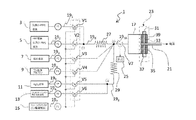
- FIG. 2 shows a configuration example of the quantification device 1 for carrying out the quantification method of the present invention.
- the quantification device 1 enables analysis by a flow analysis method (for example, Flow Injection Analysis).
- the quantification device 1 includes an antigen container 3 for holding the 3-PBA solution to be quantified (an example of the “first container” described above) and a labeled antigen container for holding the labeled 3-PBA solution. 5 (an example of the "second container” described above), an antibody container 7 for holding an antibody solution (an example of the "fourth container” described above), and a blocking agent such as BSA.
- the introduction flow path 19 for guiding the solution from each container to the reaction cell 17, the pump P1-P7 for flowing the solution in the introduction flow path 19, and the open / close controllable three-way valve V1-V7 provided in the introduction flow path 19.
- An optical measurement flow path 21 (an example of the "fourth flow path” described above) for guiding the solution from the reaction cell 17 to the outside, and an absorbance measuring unit 23 for measuring the absorbance of the reaction product of the dihydroxybenzene-based compound.
- the opening / closing control of the three-way valve described above includes a fluid flow direction switching control and a fluid flow On / Off control.
- Each container (antigen container 3, labeled antigen container 5, the antibody container 7, for blocking container 9, H 2 O 2 for container 11, container 13 dihydroxybenzene compounds, the container 15 for running buffer) is introduced flow path 19 (19 1, 19 2, 19 3, 19 4, 19 5, 19 6, 19 7) connected to a pump P1-P7 through the solution introduction channel in each container by driving the pump P1-P7 It flows through 19 and enters the reaction cell 17.
- a three-way valve V1-V6 capable of opening / closing control is provided.
- a valve V7 is provided in the introduction flow path 19 10 between the confluence point C3 and the reaction cell 17, which will be described later, and the other is connected to the waste liquid container 25.
- each valve is shown individually in FIG. 2 for ease of understanding, it may be a valve control mechanism in which each valve is integrated to form one structure.
- the introduction channel 19 1 from antigen container 3 flows 3-PBA solution (an example of "first flow path” of the described), the introduction passage 19 from the labeled antigen container 5 flows labeled 3-PBA solution 2 ( It merges with the above-mentioned “example of the second flow path") at the merging portion C1. That is, the 3-PBA solution that flows when the pumps P1 and P2 operate and the valve V1 is open only in the horizontal direction of the drawing and the labeled 3-PBA solution that flows when the valve V2 is open only in the horizontal direction of the drawing merge.
- the introduction channel 19 8 on the downstream side of the merging portion C1 flows the mixture of 3-PBA solution and labeled 3-PBA solution.
- the introduction channel 19 8 that mixture flows, is connected to the upstream of the first mixing coil unit 27.
- the mixed solution of the 3-PBA solution and the labeled 3-PBA solution is sufficiently mixed by flowing through the first mixing coil section 27.
- the 3-PBA solution and the labeled 3-PBA solution can be mixed in a short flow path, so that a compact quantification device 1 can be provided.
- the introduction channel 19 9 downstream of the merging portion C2, the second mixing coil unit 29 is provided downstream of the second mixing coil portion 29, joins the junction C3. That is, a mixed solution of H 2 O 2 and dihydroxybenzene compound solution which has passed through the merging section C2 is thoroughly mixed by flowing through the second mixing coil unit 29.
- An antibody fixing portion is provided in the reaction cell 17.
- a plastic substrate for example, a PDMS substrate
- a PDMS substrate is used as the antibody fixing portion.
- the optical measurement flow path 21 on the downstream side of the reaction cell 17 is made of a light-transmitting material.
- an absorbance measuring unit 23 for measuring the absorbance of the reaction product of the dihydroxybenzene-based compound is provided.
- the absorbance measuring unit 23 is for projecting light that guides the light emitted from the light source 31 to the optical measurement flow path 21 and the light source 31 that emits light for measuring the absorbance (an example of the “light source unit” described above).
- the light guide path 33 (an example of the "first light guide path” described above), the light receiving light guide path 35 that guides the light that has passed through the reaction product-containing solution of the dihydroxybenzene-based compound in the optical measurement flow path 21 (the above).
- An example of the above-described "second light guide path" and a light receiving sensor 37 (an example of the above-mentioned "light detection unit”) that receives light guided by the light receiving light guide path 35 are included.
- noise light such as external light can enter the light emitting light guide path 33 and the light receiving light guide path 35.
- the light source 31, the light emitting light path 33, the light receiving light path 35, and the light receiving sensor 37 are made of a light absorbing material (for example, a silicone resin containing a pigment such as carbon black). It is surrounded by a light-shielding member 39 (an example of the "absorbent portion" described above).
- noise light entering the light emitting light guide path 33 or the light receiving light guide path 35 very few components travel in the same direction as the optical axes of the light emitting light guide path 33 and the light receiving light guide path 35, and most of them are. It is incident on the light-shielding member 39 from the interface between the light-emitting light path 33 and the light-shielding member 39 and the interface between the light-receiving light-light path 35 and the light-shielding member 39. At this time, the noise light incident on the light-shielding member 39 is absorbed by the light-absorbing member contained in the light-shielding member 39. Therefore, it is possible to effectively reduce the influence of noise light (stray light) on the measurement result of the optical measurement.
- the light emitting light path 33 and the light receiving light path 35 are configured as a cavity provided in the light shielding member 39, and the light emitting light path 33 is transparent to the light emitted from the light source 31. It can also be composed of a resin (for example, a silicone resin). Similarly, the light receiving light path 35 may be made of a resin (for example, a silicone resin) that is transparent to the light emitted from the reaction product of the dihydroxybenzene-based compound.
- the transparent resin constituting the light emitting light guide path 33 and the light receiving light guide path 35 and the resin containing the pigment constituting the light shielding member 39 are made of the same material, the refractive indexes of both resins are the same. Therefore, reflection and scattering at the interface between the two resins are suppressed. That is, in this case, the stray light incident on the light-shielding member 39 is absorbed by the pigment contained in the light-shielding member 39, as in the case where the light-emitting light guide path 33 and the light-receiving light guide path 35 are hollow.
- valve V1-V7 bulb control mechanism
- pump P1-P7 pump P1-P7
- light source light receiving sensor
- a power feeding means not shown
- opening / closing control of the bulb V1-V7 bulb control mechanism
- control of the pump P1-P7, the light source, and the light receiving sensor are performed by a control unit (not shown).
- the quantification of 3-PBA in the quantifying device 1 is performed as follows. First, the pump P3 is operated, the valve V3 is opened only in the lateral direction of the drawing, and the antibody solution is introduced into the reaction cell 17 from the antibody container 7 through the confluence point C3. The antibody in the antibody solution introduced into the reaction cell 17 is adsorbed on the plastic substrate (S1).
- the operation of the pump P3 is stopped and the valve V3 is closed.
- the pump P4 is operated, the valve V4 is opened only in the lateral direction in the drawing, and the BSA is introduced into the reaction cell 17 from the blocking agent container 9 through the confluence point C3 (S2).
- the reason why BSA is introduced into the reaction cell 17 is to prevent the labeled 3-PBA, which is later introduced into the reaction cell 17, from being non-specifically adsorbed on the substrate without being recognized by the antibody.
- the operation of the pump P4 is stopped and the valve V4 is closed.
- the pumps P1 and P2 are operated, the valves V1 and V2 are opened only in the lateral direction of the drawing, and the mixed solution of the 3-PBA solution from the antigen container 3 and the labeled 3-PBA solution from the labeled antigen container 5 is opened. Is sufficiently mixed by the first mixing coil section 27, passes through the merging section C3, and then introduced into the reaction cell 17.
- the introduced mixed solution is captured by the antibody adsorbed and immobilized on the substrate (S3).
- the operations of the pumps P1 and P2 are stopped, and the valves V1 and V2 are closed.
- the pumps P5 and P6 are operated, the valves V5 and V6 are opened, and the H 2 O 2 from the H 2 O 2 container 11 and the dihydroxybenzene compound-containing solution from the dihydroxybenzene compound solution container 13 are prepared. Is sufficiently mixed by the second mixing coil section 29, passes through the merging section C3, and then introduced into the reaction cell 17.
- the reaction product of the dihydroxybenzene-based compound is generated in the reaction cell 17 (S4), and the reaction product-containing solution of the dihydroxybenzene-based compound is placed in the flow path 21 for optical measurement on the downstream side of the reaction cell 17. It flows.
- the absorbance of the reaction product of the dihydroxybenzene-based compound was measured by the absorbance measuring unit 23 provided around the optical measurement flow path 21 on the downstream side of the reaction cell 17 (S5), and 3 based on the absorbance.
- the concentration of PBA is calculated (S6).
- the introduction flow path 19 and the reaction cell 17 are washed by appropriately flowing a running buffer between the steps. For example, for some of the derived channel 19 6, 19 9, 19 10 dihydroxybenzene compound solution flows are washed as follows. When the pump P7 is operated, only the plug connected to the dihydroxybenzene compound container 13 of the valve V6 is closed, and the other two plugs are opened, the running buffer merges from the running buffer container 15. It is guided to pass through the point C2, the second mixing coil 29 and the confluence 3, and flows into the waste liquid container below the valve V7.
- the quantification apparatus 1 of the present invention it is possible to perform analysis by the flow analysis method. Therefore, in the flow system, a competitive antigen-antibody reaction or a reaction product of a dihydroxybenzene-based compound can be produced. It is possible to realize quickness, convenience, and sample saving (reagent) in analysis. Further, since the absorbance measuring unit 23 has a structure in which the light emitting light path 33 and the light receiving light path 35 are surrounded by the light-shielding member 39, noise light can be easily suppressed, and noise can be easily suppressed as in the conventional case. It does not require a large-scale structure for light protection. As a result, the quantification device 1 of the present invention can be miniaturized and portable, and can realize relatively stable and rapid measurement in an outdoor measurement environment.
- the method for measuring the oxidation potentials of catechol, caffeic acid, dopamine hydrochloride and levodopa will be described below.
- the oxidation potential measuring step E for measuring the oxidation potential and the current density is carried out in a state of being filled with 10 mM concentration.
- the compounds in which the peak potential of the oxidation potential in the quadratic curve showing the correlation between the oxidation potential obtained in the oxidation potential measurement step E and the current density is 1 V or less are the presence of HRP and hydrogen peroxide. Since it can be oxidized underneath, the reaction step B for producing the reaction product by reacting the catechol compound with an enzyme can be preferably carried out.
- the peak potentials of the oxidation potentials of catechol, caffeic acid, dopamine hydrochloride and levodopa are as follows.
- Catechol 0.62V Caffeic acid: 0.65V
- Dopamine hydrochloride 0.54V
- Levodopa 0.65V
- the peak potentials of the oxidation potentials of catechol, caffeic acid, dopamine hydrochloride and repodopa are all 1 V or less, and they can be oxidized in the presence of HRP and hydrogen peroxide. Therefore, catechol compounds are reacted with enzymes.
- the reaction step B for producing the reaction product can be preferably carried out.
- FIG. 3 shows the time change of absorbance when 0, 10, 20, 50, 100 ppb HRP, 1 mM H 2 O 2 and 10 mM catechol, caffeic acid, dopamine hydrochloride or repodopa are reacted, respectively.
- the spectrum to be represented is shown. In all of catechol, caffeic acid, dopamine hydrochloride and levodopa, the absorbance spectrum shows that the absorbance increases as the concentration of HRP increases.
- the concentration of each reaction product and the concentration of the target component are accurately calculated from the absorbance after the reaction. be able to.
- the target component to be quantified is not limited to endocrine disruptors contained in soil, and may be present in an environment such as a river or the ocean.
- the antibody solution was flowed from the antibody container to the reaction cell to adsorb the antibody on the substrate in the reaction cell, but the substrate on which the antibody was adsorbed in advance may be installed in the reaction cell. ..
- the quantification apparatus of the embodiment has one running buffer container, a plurality of running buffer containers are provided in order to adjust the pH in the reaction cell to the optimum pH for each of the enzyme reaction and the antigen-antibody reaction. You may.
- the measurement wavelength may be any wavelength that can appropriately measure the absorbance of the dihydroxybenzene compound, particularly the catechol compound, specifically 400 nm-600 nm, and more preferably 400 nm-470 nm.
- an example using the ELISA competitive method is shown, but a direct method, an indirect method, or a sandwich method may be used.
- a direct method, an indirect method, or a sandwich method may be used.
- an antigen is added to cause a first antigen-antibody reaction, and then a labeled antibody is added thereto to cause a second antigen-antibody reaction.
- the competitive method as shown in Examples, the antigen-antibody reaction is performed only once.
- quantification can be performed in a small number of steps, so that the workload of the measurer can be reduced, the time required for quantification can be shortened, and a quantification method suitable for on-site analysis can be provided. It will be possible.
- Quantitative device Container for antigen 5 Container for labeled antigen 7 Container for antibody 9 Container for blocking agent 11 Container for H 2 O 2 13 Container for dihydroxybenzene compounds 15 Container for running buffer 17 Reaction cell 19 Introduction flow path P1-P7 Pump V1-V7 Three-way valve 21 Optical measurement flow path 23 Absorption measurement unit 25 Waste liquid container 27 1st mixing coil unit 29 2nd mixing coil unit 31 Light source 33 Light source 33 Light source 35 Light source 37 Light sensor 39 Light-shielding member
Landscapes
- Health & Medical Sciences (AREA)
- Life Sciences & Earth Sciences (AREA)
- Immunology (AREA)
- Chemical & Material Sciences (AREA)
- Engineering & Computer Science (AREA)
- Physics & Mathematics (AREA)
- Analytical Chemistry (AREA)
- Biochemistry (AREA)
- General Health & Medical Sciences (AREA)
- Molecular Biology (AREA)
- Hematology (AREA)
- General Physics & Mathematics (AREA)
- Biomedical Technology (AREA)
- Urology & Nephrology (AREA)
- Pathology (AREA)
- Organic Chemistry (AREA)
- Biotechnology (AREA)
- Microbiology (AREA)
- Medicinal Chemistry (AREA)
- Wood Science & Technology (AREA)
- Food Science & Technology (AREA)
- Zoology (AREA)
- Cell Biology (AREA)
- Proteomics, Peptides & Aminoacids (AREA)
- Biophysics (AREA)
- Plasma & Fusion (AREA)
- Chemical Kinetics & Catalysis (AREA)
- Bioinformatics & Cheminformatics (AREA)
- General Engineering & Computer Science (AREA)
- Genetics & Genomics (AREA)
- Investigating Or Analysing Materials By The Use Of Chemical Reactions (AREA)
- Optical Measuring Cells (AREA)
- Measuring Or Testing Involving Enzymes Or Micro-Organisms (AREA)
Abstract
抗原抗体反応を利用して試料溶液に含まれる対象成分を定量する定量方法。酵素で標識されている酵素標識抗原又は酵素標識抗体を、酵素標識抗原に対応する抗体又は酵素標識抗体に対応する抗原が入っている反応部に加え、抗原抗体反応をさせる抗原抗体反応工程Aと、ジヒドロキシベンゼン系化合物を反応部に加え、酵素の存在下で反応させることにより反応生成物を生成する反応工程Bと、反応工程Bで生成された反応生成物の吸光度を測定する吸光度測定工程Cと、吸光度測定工程で得られた吸光度から、対象成分を定量する定量工程Dとを含む。
Description
本発明は、内分泌攪乱物質等の定量方法及び定量装置に関するものである。
内分泌攪乱物質(所謂、環境ホルモン)による環境汚染が注目されている。内分泌攪乱物質は、土壌、河川、海洋などの環境に排出された農薬等の化学物質が前記環境に生息する微生物により代謝毒性化したものである。近年、環境中における農薬等の化学物質や当該化学物質に由来する内分泌攪乱物質(以下、「内分泌攪乱物質等」とする。)の測定・分析に対する要請が高まってきた。
内分泌攪乱物質等の定量方法としては、従来より、ガスクロマトグラフ質量分析(例えば、高分解能ガスクロマトグラフ分析:HRGC/MS,高分解能質量分析HRGC/HRMS)法や、液体クロマトグラフ(例えば、高速液体クロマトグラフ:HPLC)法、ELISA等の光学測定が用いられてきた(特許文献1)。
しかしながら、従来の内分泌攪乱物質等の定量方法は、測定精度や感度は高いものの、比較的大型の装置を必要とするため、基本的には研究所等の分析拠点にて実施されることを前提としていて、内分泌攪乱物質等の採取現場において実施することは困難であった。
なお、内分泌攪乱物質等の定量方法において使用される蛍光物質や発色基質は、測定精度や感度は高いものについては光や熱に不安定なものが多く、一方、光や熱に安定な化合物を使用した場合は測定精度や感度が低いことが多い。
本発明は係る事情によりなされたものであって、内分泌攪乱物質等のような環境試料検体を採取した現場で安定的にかつ高精度で実施できる定量方法等を提供することを目的とする。
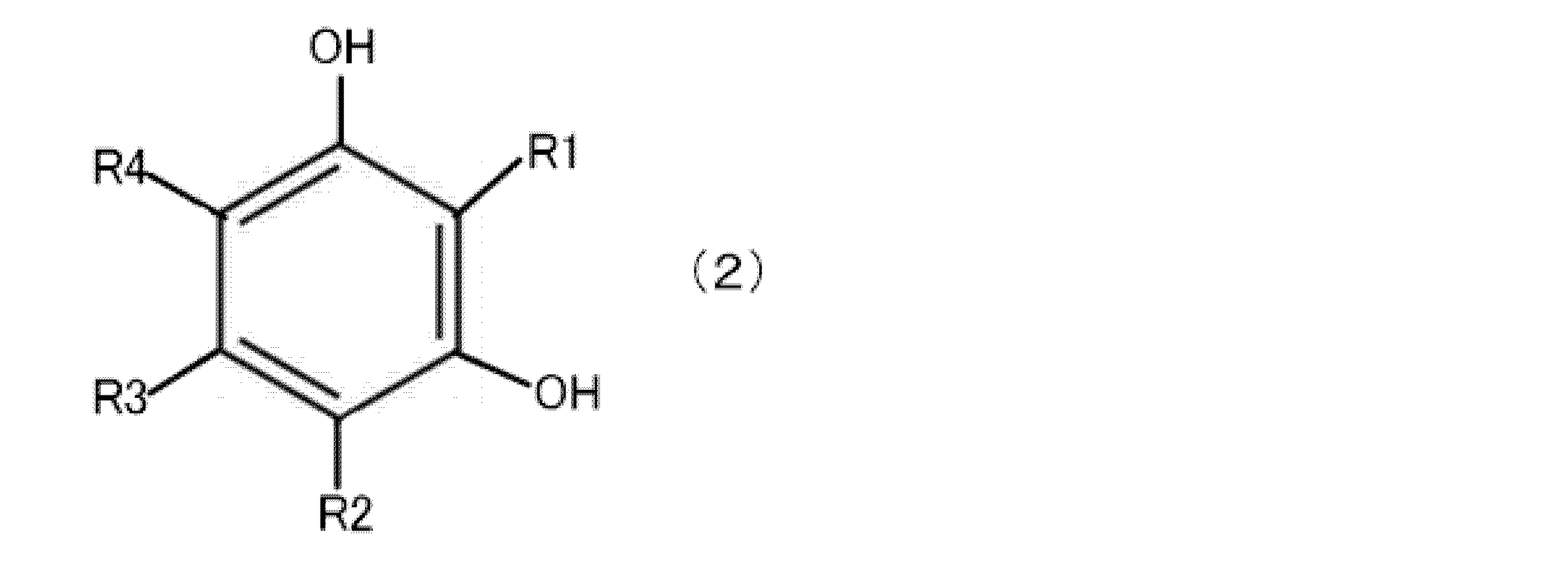
本発明の第1の観点は、抗原抗体反応を利用して試料溶液に含まれる対象成分を定量する定量方法であって、酵素で標識されている酵素標識抗原又は酵素標識抗体を、前記酵素標識抗原に対応する抗体又は前記酵素標識抗体に対応する抗原が入っている反応部に加え、抗原抗体反応をさせる抗原抗体反応工程Aと、下記一般式(1)~(3)からなる群より選択される少なくとも1種のジヒドロキシベンゼン系化合物を前記反応部に加え、前記酵素の存在下で反応させることにより反応生成物を生成する反応工程Bと、前記反応工程Bで生成された前記反応生成物の吸光度を測定する吸光度測定工程Cと、前記吸光度測定工程Cで得られた吸光度から、前記対象成分を定量する定量工程Dとを含む、定量方法。

(前記一般式(1)~(3)中、R1~R4は、互いに独立して、水素原子、炭化水素基、ハロゲン原子、ヒドロキシル基、アセチル基、置換基を有してもよいアミノ基もしくは塩酸塩、置換基を有してもよいスルホン酸基もしくはスルホン酸塩基、チオール基、ニトロ基、シアノ基、カルボニル基、カルボキシル基またはハロゲン原子、ヒドロキシル基、カルボキシル基もしくはアミノ基で置換されていてもよい、炭素数1~20のアルキル基、炭素数1~20のアルコキシル基、炭素数1~20のアルキルチオ基、炭素数2~20のアルケニル基、炭素数2~20のアルキニル基、炭素数6~20のアリール基もしくは炭素数2~20のヘテロアリール基を表す。)
本発明の第2の観点は、第1の観点の定量方法であって、前記酵素が西洋ワサビペルオキシターゼであり、前記ジヒドロキシベンゼン系化合物の酸化電位のピーク電位が1V以下である。
本発明の第3の観点は、第1または第2の観点の定量方法であって、前記ジヒドロキシベンゼン系化合物が、下記式(1a)~(1d)からなる群より選択される少なくとも1種の化合物である。


本発明の各観点によれば、内分泌攪乱物質等の採取現場において吸光度を測定し、内分泌攪乱物質等を安定的にかつ高精度で定量することが可能になる。
また、本発明の各観点によれば、酵素により触媒される反応が酸化反応および/または重合反応であるため、蛍光基質や発色基質を用いる従来のELISAに比べて、光や熱による影響を受けにくく、屋外での測定に適した定量方法等を提供することが可能になる。また、酸化反応または重合反応の反応時間は短いため、短時間で内分泌攪乱物質等を定量することが可能になる。
本発明の各観点によれば、反応時間が短いジヒドロキシベンゼン系化合物の酸化反応および/または重合反応を利用しているため、短時間で定量することが可能になる。また、ジヒドロキシベンゼン系化合物は酵素存在下で酸化および/または重合させることにより生成する反応生成物の吸光度の変化幅が大きい(ダイナミックレンジが大きい)ため、吸光度測定工程Cにおける測定精度に優れる。このような効果が得られる理由は明らかではないが、ジヒドロキシベンゼン系化合物は水に溶け易く、高濃度の着色物が得られることが考えられる。より具体的には、以下の理由が考えられる。
ジヒドロキシベンゼン系化合物は、ベンゼン環上の2つのヒドロキシル基の配置および他の置換基の存在如何により、反応工程Bにおいて、酸化反応および/または重合反応が進行する。反応工程Bにおいて、ジヒドロキシベンゼン系化合物の酸化反応が進行する場合は、酸化されることによりジヒドロキシベンゼン系化合物は発色する性質があり、さらにジヒドロキシベンゼン系化合物は水に溶け易いので、高濃度で使用することができる。その結果、ジヒドロキシベンゼン系化合物の酸化反応により生成する反応生成物は吸光度の変化幅が大きくなるものと考えられる。
一方、反応工程Bにおいて、ジヒドロキシベンゼン系化合物の重合反応が進行する場合は、重合反応により共役系が広がり、HOMO-LUMOエネルギーギャップが小さくなることによって、反応生成物の吸収波長が長波長側にシフトする。また、重合反応の進行程度により、分子量の異なるポリマー(反応生成物)が混在することによって、様々な波長の光を吸収することになる。さらに、重合反応が進むと、見掛け上、ポリマーの吸光度は増加する。ジヒドロキシベンゼン系化合物のうち、重合反応が進行し易い化合物、例えば後述するカテコールアミン系化合物は水に溶け易く、さらに重合反応により生成するポリマーも同様に水に溶け易い性質を有する。このため、特にカテコールアミン系化合物は重合反応が進行し易く、結果として、ポリマー(反応生成物)の吸光度の変化幅が大きくなるものと考えられる。
また、ジヒドロキシベンゼン系化合物は、従来のELISAで用いる蛍光基質に比べ、光や熱に対して安定であるため、本発明の定量方法は屋外測定に適している。さらに、ジヒドロキシベンゼン系化合物は安価であるため、従来のELISAのような高価な蛍光試薬は不要である。
本発明の第2の観点によれば、酸化電位のピーク電位が1V以下であるジヒドロキシベンゼン系化合物を使用することにより、西洋ワサビペルオキシダーゼ(Horse Radish Peroxidase:HRP)を用いたELISAを好適に実施することができる。
本発明の第3の観点によれば、後述する実験結果が示すとおり、式(1a)~(1d)からなる群より選択される少なくとも1種の化合物は、酵素存在下で酸化および/または重合させることにより生成する反応生成物の吸光度の変化幅が大きいため、吸光度測定工程Cにおける測定精度に特に優れる。
以下、図面を参照して、本発明の実施例について述べる。なお、本発明の実施の形態は、以下の実施例に限定されるものではない。
[実施例1]
図1に、本発明の内分泌攪乱物質等の定量方法のフロー図を示す。本実施例では、定量対象をジフェニルエーテル系除草剤の代謝物質の一種である3-フェノキシ安息香酸(3-phenoxybenzoic acid:3-PBA)とした。また、酵素には、西洋ワサビペルオキシダーゼ(Horse Radish Peroxidase:HRP)を用いた。なお、末端にCOOH基又はNH2基を有する化学物質であれば、HRPにより標識可能である。また、各溶液の溶媒には、リン酸緩衝液(Phosphate buffer)を用いた。
図1に、本発明の内分泌攪乱物質等の定量方法のフロー図を示す。本実施例では、定量対象をジフェニルエーテル系除草剤の代謝物質の一種である3-フェノキシ安息香酸(3-phenoxybenzoic acid:3-PBA)とした。また、酵素には、西洋ワサビペルオキシダーゼ(Horse Radish Peroxidase:HRP)を用いた。なお、末端にCOOH基又はNH2基を有する化学物質であれば、HRPにより標識可能である。また、各溶液の溶媒には、リン酸緩衝液(Phosphate buffer)を用いた。
まず、3-PBAと特異的に結合する抗3-PBA抗体を反応セル(請求項記載の「反応部」の一例)に注入し、反応セル内の基板に吸着させる(S1)。次に、ウシ血清アルブミン(BSA)を反応セルに注入する(S2)。BSAは、次のステップで注入する標識抗原が基板に非特異的に吸着することを抑制するためのブロッキング剤である。続いて、定量対象の3-PBA溶液(請求項記載の「試料溶液」の一例)と、標識3-PBA溶液(請求項記載の「酵素標識抗原」の一例)との混合液を反応セルに注入する(S3、請求項記載の「抗原抗体反応工程A」の一例)。ここで、標識3-PBA溶液は、抗原である3-PBAをHRPで予め標識した標識3-PBAを含む溶液であって、標識3-PBAの濃度は既知である。3-PBA溶液と標識3-PBA溶液の混合液が注入されると、標識されていない3-PBAと標識3-PBAが競合的に基板上の抗体により補足され、抗原抗体反応が起こる。そして、洗浄後、ジヒドロキシベンゼン系化合物と過酸化水素(H2O2)とを反応セルに注入する(S4、請求項記載の「反応工程B」の一例)。すると、基板上の抗体に補足された標識3-PBAのHRPにより、下記の酸化反応が触媒され、ジヒドロキシベンゼン系化合物から、反応生成物であるベンゾキノン系化合物が生成する。
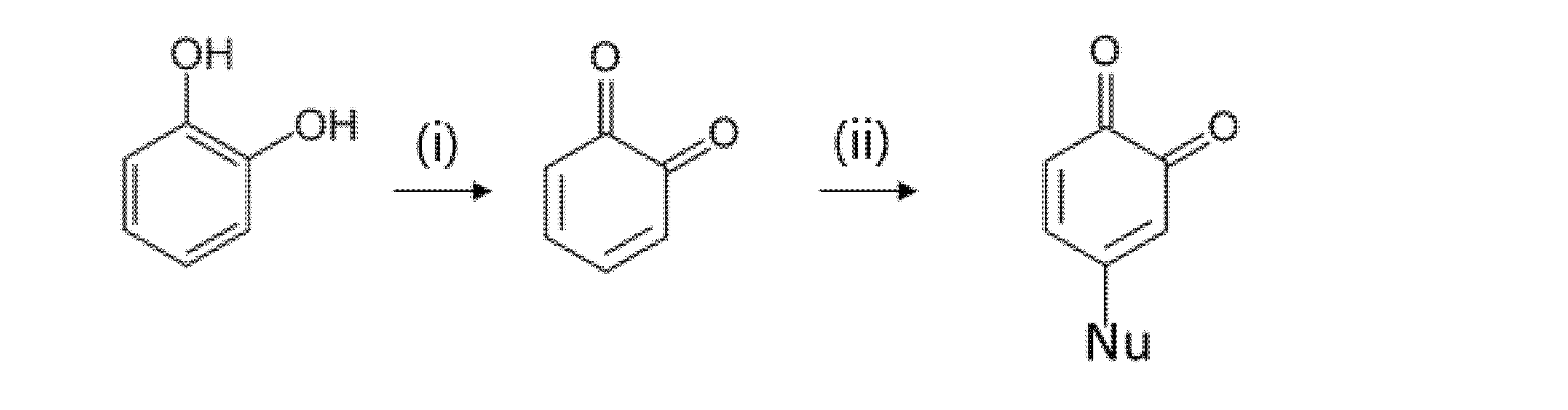
また、ジヒドロキシベンゼン系化合物がアミノ基を有するカテコールアミン系化合物である場合、ジヒドロキシベンゼン系化合物は酸化反応に加え重合反応が触媒され、ジヒドロキシベンゼン系化合物から、反応生成物であるポリマーが生成する。

前記酸化反応、または酸化反応および重合反応の後、反応生成物の吸光度を測定する(S5、請求項記載の「吸光度測定工程C」の一例)。最後に、得られた吸光度に基づいて、3-PBAの濃度を算出する(S6、請求項記載の「定量工程D」の一例)。得られた吸光度に基づく3-PBAの濃度の算出方法としては、例えば複数の異なる濃度の3-PBAサンプルを用意し、これらサンプルを使用して本発明に係る定量方法を実施し、各濃度での吸光度に基づき予め作成した検量線を利用して、測定サンプルの濃度を算出する方法が挙げられる。
このように、本定量方法は、ジヒドロキシベンゼン系化合物の酸化反応、または酸化反応および重合反応を利用しているため、定量にかかる時間を従来のELISAに比べて大幅に短縮できる。従来のELISAの酵素反応にかかる時間は数分であるのに対し、本定量方法の酸化反応、または酸化反応および重合反応にかかる時間は数秒である。また、ジヒドロキシベンゼン系化合物は、従来のELISAで用いていた蛍光基質や発色基質に比べて、光や熱に対してはるかに安定であるため、オンサイト分析に適している。さらに、従来のELISAで用いていた基質に比べ、ジヒドロキシベンゼン系化合物は安価である。つまり、本定量方法によれば、迅速、安全かつ安価に、内分泌攪乱物質等のオンサイト分析を行うことが可能になる。
なお、本発明においてはジヒドロキシベンゼン系化合物が酸化反応の後に重合する反応((iv)に示す反応)を「重合反応」と表すが、その重合度は特に問題でなく、後述のとおり、ジヒドロキシベンゼン系化合物が反応(重合)してポリマーが生成することにより、ジヒドロキシベンゼン系化合物には見られない可視光領域での吸収スペクトルが検出される程度に反応(重合)すればよい。
ジヒドロキシベンゼン系化合物としては、下記一般式(1)により表されるカテコール系化合物、下記一般式(2)により表されるレゾルシノール系化合物、および下記一般式(3)により表されるヒドロキノン系化合物が挙げられる。

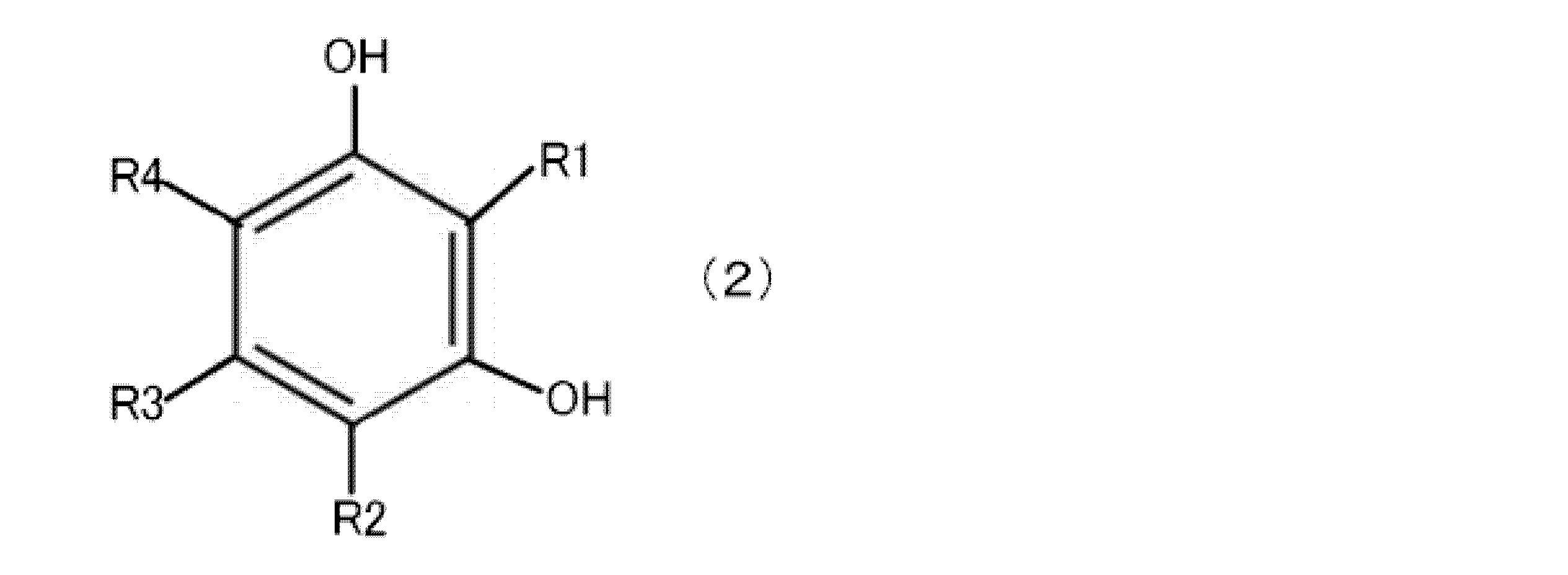

(前記一般式(1)~(3)中、R1~R4は、互いに独立して、水素原子、炭化水素基、ハロゲン原子、ヒドロキシル基、アセチル基、置換基を有してもよいアミノ基もしくは塩酸塩、置換基を有してもよいスルホン酸基もしくはスルホン酸塩基、チオール基、ニトロ基、シアノ基、カルボニル基、カルボキシル基またはハロゲン原子、ヒドロキシル基、カルボキシル基もしくはアミノ基で置換されていてもよい、炭素数1~20のアルキル基、炭素数1~20のアルコキシル基、炭素数1~20のアルキルチオ基、炭素数2~20のアルケニル基、炭素数2~20のアルキニル基、炭素数6~20のアリール基もしくは炭素数2~20のヘテロアリール基を表す。)
炭化水素基としては、例えば、メチル基、エチル基、プロピル基、ブチル基、ペンチル基、ヘキシル基、ヘプチル基、オクチル基、ノニル基、デシル基等の炭素原子数1~10のアルキル基、シクロプロピル基、シクロブチル基、シクロペンチル基、シクロヘキシル基、シクロヘプチル基、シクロオクチル基等の炭素原子数3~8のシクロアルキル基;フェネチル基、フェニルプロピル基等の炭素原子数1~6のアルキル基にアリール基が結合したアラルキル基が挙げられる。なお、これらの基は、各種異性体を含む。R1ないしR4は、互いに結合して環を形成していても良く、結合して形成される環としては、例えば、炭素原子数1~3のアルキレン基を含むメチレンジオキシ環、エチレンジオキシ環、プロピレンジオキシ環等が挙げられる。
上記ハロゲン原子の具体例としては、フッ素原子、塩素原子、臭素原子もしくはヨウ素原子、またはメタンスルホニルオキシ基、トリフルオロメタンスルホニルオキシ基、ノナフルオロブタンスルホニルオキシ基等の(フルオロ)アルキルスルホニルオキシ基;ベンゼンスルホニルオキシ基、トルエンスルホニルオキシ基等の芳香族スルホニルオキシ基等が挙げられる。
炭素数2~20のアルケニル基の具体例としては、エテニル基、n-1-プロペニル基、n-2-プロペニル基、1-メチルエテニル基、n-1-ブテニル基、n-2-ブテニル基、n-3-ブテニル基、2-メチル-1-プロペニル基、2-メチル-2-プロペニル基、1-エチルエテニル基、1-メチル-1-プロペニル基、1-メチル-2-プロペニル基、n-1-ペンテニル基、n-1-デセニル基またはn-1-エイコセニル基等が挙げられる。
炭素数2~20のアルキニル基の具体例としては、エチニル基、n-1-プロピニル基、n-2-プロピニル基、n-1-ブチニル基、n-2-ブチニル基、n-3-ブチニル基、1-メチル-2-プロピニル基、n-1-ペンチニル基、n-2-ペンチニル基、n-3-ペンチニル基、n-4-ペンチニル基、1-メチル-n-ブチニル基、2-メチル-n-ブチニル基、3-メチル-n-ブチニル基、1,1-ジメチル-n-プロピニル基、n-1-ヘキシニル基、n-1-デシニル基、n-1-ペンタデシニル基またはn-1-エイコシニル基等が挙げられる。
炭素数6~20のアリール基の具体例としては、フェニル基、1-ナフチル基、2-ナフチル基、1-アントリル基、2-アントリル基、9-アントリル基、1-フェナントリル基、2-フェナントリル基、3-フェナントリル基、4-フェナントリル基または9-フェナントリル基等が挙げられる。
炭素数2~20のヘテロアリール基の具体例としては、2-チエニル基、3-チエニル基、2-フラニル基、3-フラニル基、2-オキサゾリル基、4-オキサゾリル基、5-オキサゾリル基、3-イソオキサゾリル基、4-イソオキサゾリル基、5-イソオキサゾリル基、2-チアゾリル基、4-チアゾリル基、5-チアゾリル基、3-イソチアゾリル基、4-イソチアゾリル基、5-イソチアゾリル基、2-イミダゾリル基、4-イミダゾリル基、2-ピリジル基、3-ピリジル基または4-ピリジル基等が挙げられる。
前記アルコキシル基としては、例えば、メトキシル基、エトキシル基、プロポキシル基等の炭素原子数1~20のアルコキシル基が挙げられる。なお、これらの基は、各種異性体を含む。
前記アルキルチオ基としては、例えば、メチルチオ基、エチルチオ基、プロピルチオ基等の炭素原子数1~20のアルキルチオ基が挙げられる。なお、これらの基は、各種異性体を含む。
前記ジヒドロキシベンゼン系化合物の中でも、特に酸化電位のピーク電位が1V以下であるジヒドロキシベンゼン系化合物は、西洋ワサビペルオキシダーゼ(Horse Radish Peroxidase:HRP)および過酸化水素(H2O2)を用いたELISAを好適に実施することができる。ジヒドロキシベンゼン系化合物の酸化電位の測定方法については後述する。
酵素存在下で酸化反応、または酸化反応および重合反応させることにより生成する反応生成物の吸光度の変化幅が大きく、吸光度測定工程Cにおける測定精度に特に優れることから、本発明においては、ジヒドロキシベンゼン系化合物の中でも前記一般式(1)により表されるカテコール系化合物が好ましい。さらにカテコール系化合物の中でも、下記式(1a)で表されるカテコール、下記式(1b)で表されるコーヒー酸、下記式(1c)で表されるドーパミン塩酸塩、および下記式(1d)で表されるレポドパを使用することが好ましい。

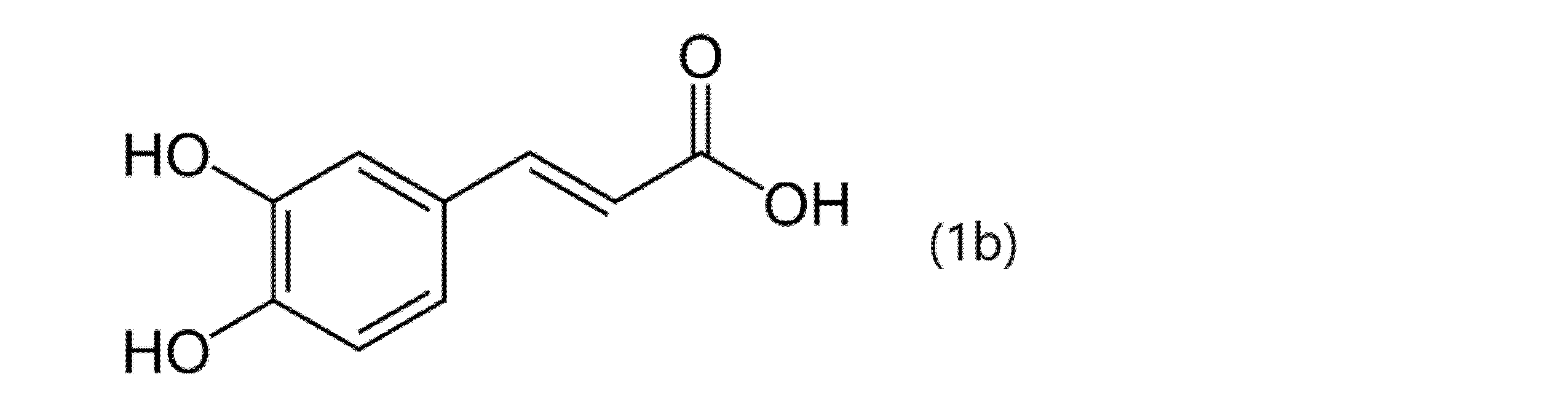


本発明においては、式(1a)~(1d)で表されるカテコール系化合物以外に、例えばアドレナリン、ノルアドレナリン、3’,4’-ジヒドロキシアセトフェノン、2,3-ジヒドロキシ安息香酸、3,4-ジヒドロキシ安息香酸、3,4-ジヒドロキシベンジルアルコール、3,4-ジヒドロキシフェニル酢酸、3-メトキシカテコール、4-メトキシカテコール、4-ニトロカテコール、タイロンなどのカテコール系化合物;さらにはレゾルシノールなどのレゾルシノール系化合物、あるいはヒドロキノンなどのヒドロキノン系化合物を使用可能である。
なお、本発明の吸光度測定工程Cにおける測定精度に特に優れるジヒドロキシベンゼン系化合物として、反応生成物の吸光度の変化幅が大きいことが好ましいことは前記のとおりである。さらに、特定濃度のH2O2およびジヒドロキシベンゼン系化合物に対し、HRP濃度を種々変量しつつ反応させた場合の吸光度の時間変化を表すスペクトルを測定した場合に、HRP濃度にかかわらず、吸光度の時間変化が比例関係(直線関係)にある場合は、吸光度測定工程Cにおける測定精度に特に優れるため好ましい。また、特定濃度のHRP、H2O2およびジヒドロキシベンゼン系化合物を反応させ、吸光度の測定波長をある一定の範囲(例えば400~700nm)で変化させたとき、複数の波長領域で吸光度の時間変化が現れるジヒドロキシベンゼン系化合物は、本発明の吸光度測定工程Cにおける測定精度が特に優れる、あるいは測定条件の変更が柔軟に可能となるため好ましい。
本発明に係る定量方法は、例えば下記定量装置により実施可能である。抗原抗体反応を利用して試料溶液に含まれる対象成分を定量する定量装置であって、前記抗原抗体反応の反応場とする反応部と、前記試料溶液を保持するための第1容器と、酵素で標識されていて、かつ、前記抗原抗体反応の抗原又は抗体である酵素標識物を含む酵素標識物溶液を保持するための第2容器と、前記酵素により促進される重合反応の基質溶液を保持するための第3容器と、前記第1容器内の前記試料溶液を前記反応部に導く第1流路と、前記第2容器内の前記酵素標識物溶液を前記反応部に導く第2流路と、前記第3容器内の前記基質溶液を前記反応部に導く第3流路と、前記反応部内の溶液を外部に導く第4流路と、前記重合反応により生成される重合体が吸収する波長を含む光を発する光源部と、光を検出する光検出部と、前記光源部が発する光を前記第4流路の一部である測定部に導光する第1導光路と、前記測定部からの光を前記光検出部に導光する第2導光路と、前記第1導光路及び前記第2導光路の周囲を包囲する、光を吸収する吸光部とを備える、定量装置。
前記定量装置において、前記吸光部が、光を吸収する顔料を含有する顔料含有シリコーン部材からなることが好ましい。
前記定量装置において、前記第1導光路、前記第2導光路、及び、前記吸光部は、屈折率が同一のシリコーン樹脂を素材とすることが好ましい。
前記定量装置において、前記第1流路と、前記第2流路とは、前記反応部よりも上流で合流していることが好ましい。
前記定量装置において、前記抗原抗体反応に用いる抗体溶液を保持するための第4容器と、前記第4容器内の前記抗体溶液を前記反応部に導く第4流路とを備え、前記酵素標識物は、酵素標識された抗原である酵素標識抗原であることが好ましい。
図2に、本発明の定量方法を実施するための定量装置1の構成例を示す。定量装置1は、流れ分析法(例えば、Flow Injection Analysis)による分析を可能としたものである。
定量装置1は、定量対象である3-PBA溶液を保持するための抗原用容器3(前記記載の「第1容器」の一例)と、標識3-PBA溶液を保持するための標識抗原用容器5(前記記載の「第2容器」の一例)と、抗体溶液を保持するための抗体用容器7(前記記載の「第4容器」の一例)と、BSAなどのブロッキング剤を保持するためのブロッキング剤用容器9と、過酸化水素水(H2O2)を保持するためのH2O2用容器11と、ジヒドロキシベンゼン系化合物含有溶液を保持するためのジヒドロキシベンゼン系化合物用容器13(前記記載の「第3容器」の一例)と、ランニングバッファを保持するためのランニングバッファ用容器15と、抗原抗体反応の反応場となる反応セル17(前記記載の「反応部」の一例)と、各容器から反応セル17に溶液を導く導入流路19と、導入流路19中の溶液を流すためのポンプP1-P7と、導入流路19に設けた開閉制御可能な三方バルブV1-V7と、反応セル17から外部に溶液を導く光学測定用流路21(前記記載の「第4流路」の一例)と、ジヒドロキシベンゼン系化合物の反応生成物の吸光度を測定する吸光度測定部23とを有する。なお上記した三方バルブの開閉制御は、流体の流れ方向の切り替え制御、流体の流れのOn・Off制御を含むものとする。
各容器(抗原用容器3、標識抗原用容器5、抗体用容器7、ブロッキング剤用容器9、H2O2用容器11、ジヒドロキシベンゼン系化合物用容器13、ランニングバッファ用容器15)は、導入流路19(191、192、193、194、195、196、197)を通じてポンプP1-P7に接続され、ポンプP1-P7の駆動により各容器内の溶液が導入流路19内を流れ、反応セル17に入る。ポンプP1-P6の下流側には、開閉制御可能な三方バルブV1-V6が設けられている。後述する合流点C3と反応セル17の間の導入流路1910には、バルブV7が設けられ、もう一方が廃液入れ25に接続している。なお、図2においては、理解を容易にするため、各バルブ個別に示されているが、各バルブを集約して1つの構造体を成すバルブ制御機構であってもよい。
抗原用容器3より3-PBA溶液が流れる導入流路191(前記記載の「第1流路」の一例)と、標識抗原用容器5より標識3-PBA溶液が流れる導入流路192(前記記載の「第2流路」の一例)とは、合流部C1で合流する。すなわち、ポンプP1及びP2が動作し、バルブV1が図面横方向のみ開状態のときに流れる3-PBA溶液と、バルブV2が図面横方向のみ開状態のときに流れる標識3-PBA溶液とが合流部C1に流れ込むと、当該合流部C1の下流側の導入流路198には、3-PBA溶液と標識3-PBA溶液の混合液が流れる。
この混合液が流れる導入流路198は、第1混合コイル部27の上流と接続される。3-PBA溶液と標識3-PBA溶液の混合液は、第1混合コイル部27を流れることにより十分に混合される。第1混合コイル部27を設けることにより、短い流路で3-PBA溶液と標識3-PBA溶液を混合できるため、コンパクトな定量装置1を提供することが可能になる。
第1混合コイル部27の下流側の導入流路198は、合流点C3において、ポンプP3が動作し、バルブV3が図面横方向のみ開状態のとき抗体用容器7より抗体溶液が流れる導入流路193と、ポンプP4が動作し、バルブV4が図面横方向のみ開状態のときブロッキング剤用容器9よりBSAが流れる導入流路194と、後で説明するように、H2O2及びジヒドロキシベンゼン系化合物溶液の混合液が流れる導入流路199と合流する。そして、合流部C3の下流側の導入流路1910は、反応セル17に連結される。
H2O2用容器11よりH2O2が流れる導入流路195と、ジヒドロキシベンゼン系化合物溶液用容器13よりジヒドロキシベンゼン系化合物含有溶液が流れる導入流路196(前記記載の「第3流路」の一例)は、合流部C2で合流する。すなわち、ポンプP5及びP6が動作し、バルブV5が図面横方向のみ開状態のときに流れるH2O2と、バルブV6が図面横方向のみ開状態のときに流れるジヒドロキシベンゼン系化合物溶液とが合流部C3に流れ込むと、当該合流部C2の下流側の導入流路199には、H2O2及びジヒドロキシベンゼン系化合物溶液の混合液が流れる。
合流部C2の下流側の導入流路199には、第2混合コイル部29が設けられ、第2混合コイル部29の下流側は、合流点C3に合流する。すなわち、合流部C2を通過したH2O2及びジヒドロキシベンゼン系化合物溶液の混合液は、第2混合コイル部29を流れることにより十分に混合される。
反応セル17内には、抗体定着部が設けられている。抗体定着部としては、例えば、プラスチック基板(例えば、PDMS基板)が用いられる。
反応セル17の下流側の光学測定用流路21は、光透過性材料からなる。この光学測定用流路21の周囲には、ジヒドロキシベンゼン系化合物の反応生成物の吸光度を測定するための吸光度測定部23が設けられる。吸光度測定部23は、吸光度測定用の光を放出する光源31(前記記載の「光源部」の一例)と、光源31から放出される光を光学測定用流路21に導光する投光用導光路33(前記記載の「第1導光路」の一例)、光学測定用流路21内のジヒドロキシベンゼン系化合物の反応生成物含有溶液を通過した光を導光する受光用導光路35(前記記載の「第2導光路」の一例)、受光用導光路35により導光される光を受光する受光センサ37(前記記載の「光検出部」の一例)を含む。
ここで、投光用導光路33及び受光用導光路35には、外光等のノイズ光(迷光)が侵入しうる。この外光の影響を抑制するために、光源31、投光用導光路33、受光用導光路35及び受光センサ37は、光吸収性材料(例えば、カーボンブラック等の顔料を含有するシリコーン樹脂)からなる遮光部材39(前記記載の「吸光部」の一例)により包囲される。
投光用導光路33又は受光用導光路35に侵入するノイズ光のうち、投光用導光路33、受光用導光路35の光軸と同方向に進む成分は非常に少なく、大部分は、投光用導光路33と遮光部材39との界面、受光用導光路35と遮光部材39との界面から遮光部材39へ入射する。このとき、遮光部材39へ入射したノイズ光は、遮光部材39が含有する光吸収部材により吸収される。したがって、光学測定の測定結果に対するノイズ光(迷光)の影響を効果的に低減することが可能である。
投光用導光路33及び受光用導光路35は、遮光部材39に設けられた空洞部として構成されるが、上記投光用導光路33は、光源31から放出される光に対して透明な樹脂(例えば、シリコーン樹脂)により構成することもできる。同様に、受光用導光路35は、ジヒドロキシベンゼン系化合物の反応生成物から放出される光に対して透明な樹脂(例えば、シリコーン樹脂)により構成することもできる。
ここで、投光用導光路33、受光用導光路35を構成する透明な樹脂と、遮光部材39を構成する顔料を含有する樹脂との材質を同じにすると、前記両樹脂の屈折率が同じであるので、当該両樹脂の界面での反射及び散乱が抑制される。すなわち、この場合、投光用導光路33、受光用導光路35が空洞である場合と同様に、遮光部材39へ入射した迷光は遮光部材39が含有する上記顔料により吸収されるが、さらに、投光用導光路33、受光用導光路35と遮光部材39との界面での反射及び散乱が抑制されるので、遮光部材39へ入射した迷光は投光用導光路33、受光用導光路35にはほとんど戻らない。よって、迷光の複雑な多重反射がほとんど発生しない。
なお、バルブV1-V7(バルブ制御機構)、ポンプP1-P7、光源、受光センサへの給電は図示を省略した給電手段により行われる。同様に、バルブV1-V7(バルブ制御機構)の開閉制御、ポンプP1-P7、光源、受光センサの制御は、図示を省略した制御部により行われる。
本定量装置1における3-PBAの定量は以下のように行われる。まず、ポンプP3を動作させ、バルブV3を図面横方向のみ開状態として、抗体用容器7より抗体溶液が、合流点C3を通過して、反応セル17内に導入される。反応セル17内に導入された抗体溶液中の抗体は、プラスチック基板上に吸着される(S1)。
上記基板上に抗体が吸着された後、ポンプP3の動作を停止し、バルブV3を閉状態とする。その後、ポンプP4を動作させ、バルブV4を図面横方向のみ開状態として、ブロッキング剤用容器9よりBSAが、合流点C3を通過して、反応セル17内に導入される(S2)。反応セル17内にBSAを導入するのは、後に反応セル17内に導入される標識3-PBAが、抗体に認識されずに基板上に非特異的に吸着するのを抑制するためである。
反応セル17内にBSAを導入後、ポンプP4の動作を停止し、バルブV4を閉状態とする。その後、ポンプP1及びP2を動作させ、バルブV1及びV2を図面横方向のみ開状態として、抗原用容器3からの3-PBA溶液と標識抗原用容器5からの標識3-PBA溶液との混合液が、第1混合コイル部27により十分混合されて合流部C3を通過後、反応セル17内に導入される。導入された上記混合液は、基板上に吸着されて固定化された抗体に捕捉される(S3)。
抗原抗体反応を起こした後、ポンプP1及びP2の動作を停止し、バルブV1及びV2を閉状態とする。次に、ポンプP5及びP6を動作させ、バルブV5及びV6を開状態として、H2O2容器11からのH2O2とジヒドロキシベンゼン系化合物溶液用容器13からのジヒドロキシベンゼン系化合物含有溶液との混合液が、第2混合コイル部29により十分混合されて合流部C3を通過後、反応セル17内に導入される。すると、反応セル17にて、ジヒドロキシベンゼン系化合物の反応生成物が生成され(S4)、反応セル17の下流側の光学測定用流路21には、ジヒドロキシベンゼン系化合物の反応生成物含有溶液が流れる。
そして、反応セル17の下流側の光学測定用流路21の周囲に設けられた吸光度測定部23において、ジヒドロキシベンゼン系化合物の反応生成物の吸光度が測定され(S5)、その吸光度に基づいて3-PBAの濃度が算出される(S6)。なお、導入流路19及び反応セル17は、各工程の間に適宜ランニングバッファを流すことにより洗浄される。例えば、ジヒドロキシベンゼン系化合物溶液が流れる導出流路196、199、1910の一部については次のように洗浄する。ポンプP7を動作させ、バルブV6のジヒドロキシベンゼン系化合物用容器13に接続している栓のみを閉状態とし、他の二つの栓を開状態とすると、ランニングバッファ用容器15よりランニングバッファが、合流点C2、第2混合コイル29及び合流点3を通過するよう導かれ、バルブV7の下方の被廃液入れに流れる。
以上のように、本発明の定量装置1によれば、流れ分析法による分析を可能としたので、流れ系において、競合的な抗原抗体反応やジヒドロキシベンゼン系化合物の反応生成物の生成を行うことが可能となり、分析において迅速性・簡便性・省試料(試薬)化を実現できる。また、吸光度測定部23において、投光用導光路33及び受光用導光路35を遮光部材39で包囲した構造としたので、ノイズ光の抑制を容易に実施することができ、従来のようにノイズ光対策のための大がかりな構造を必要としない。結果的に本発明の定量装置1は、小型化・携帯化が可能となり、かつ、屋外の測定環境に比較的安定で、迅速な測定を実現することができる。
以下において、ジヒドロキシベンゼン系化合物の一例として、カテコール系化合物であるカテコール(式(1a)記載の化合物)、コーヒー酸(式(1b)記載の化合物)、ドーパミン塩酸塩(式(1c)記載の化合物)、およびレポドパ(式(1d)記載の化合物)を挙げて本発明を説明する。
カテコール、コーヒー酸、ドーパミン塩酸塩およびレポドパの酸化電位の測定方法について以下に説明する。3電極式電気化学セル(参照極:銀/塩化銀(飽和KCL)、対極:白金コイル、作用極:グラッシーカーボンディスク電極(d=3.0mm))内にリン酸バッファー液(pH=7)を10mM濃度で充填した状態で酸化電位と電流密度とを測定する酸化電位測定工程Eを実行する。カテコール系化合物のうち、酸化電位測定工程Eで得られる前記酸化電位と電流密度との相関関係を示す二次曲線における酸化電位のピーク電位が1V以下である化合物は、HRPおよび過酸化水素の存在下で酸化可能であるため、酵素によりカテコール系化合物を反応させることで反応生成物を生成する反応工程Bを好適に実行することができる。カテコール、コーヒー酸、ドーパミン塩酸塩およびレポドパの酸化電位のピーク電位は以下のとおりである。カテコール:0.62Vコーヒー酸:0.65Vドーパミン塩酸塩:0.54Vレポドパ:0.65V
上記のとおり、カテコール、コーヒー酸、ドーパミン塩酸塩およびレポドパの酸化電位のピーク電位はいずれも1V以下であり、HRPおよび過酸化水素の存在下で酸化可能であるため、酵素によりカテコール系化合物を反応させることで反応生成物を生成する反応工程Bを好適に実行することができる。
上記のとおり、カテコール、コーヒー酸、ドーパミン塩酸塩およびレポドパの酸化電位のピーク電位はいずれも1V以下であり、HRPおよび過酸化水素の存在下で酸化可能であるため、酵素によりカテコール系化合物を反応させることで反応生成物を生成する反応工程Bを好適に実行することができる。
図3に、0、10、20、50、100ppbのHRPと、1mMのH2O2と、10mMのカテコール、コーヒー酸、ドーパミン塩酸塩またはレポドパとをそれぞれ反応させた場合の吸光度の時間変化を表すスペクトルを示す。カテコール、コーヒー酸、ドーパミン塩酸塩およびレポドパのいずれにおいても、吸光度スペクトル曲線は、HRPの濃度が高くなるに従い吸光度が高くなっている。このように、カテコール、コーヒー酸、ドーパミン塩酸塩またはレポドパとこれらの反応生成物との吸収スペクトルが大きく異なるため、反応後の吸光度から各反応生成物の濃度及び目的成分の濃度を精度よく算出することができる。
なお、定量する対象成分は、土壌に含まれる内分泌攪乱物質に限るものではなく、河川、海洋などの環境に存在するものであってもよい。
また、上記実施例においては、抗体用容器から反応セルに抗体溶液を流し、反応セル内の基板に抗体を吸着させたが、予め抗体を吸着させた基板を反応セル内に設置してもよい。
また、実施例の定量装置ではランニングバッファ用容器は1つであるが、反応セル内のpHを酵素反応と抗原抗体反応のそれぞれの最適pHに調整するために、複数のランニングバッファ用容器を備えてもよい。
なお、測定波長は、ジヒドロキシベンゼン系化合物、特にはカテコール系化合物の吸光度を適切に測定できる波長であればよく、具体的には400nm-600nmであれば好ましく、400nm-470nmであればさらに好ましい。
また、上記実施例では、ELISAの競合法を用いた例を示したが、直説法、間接法、又は、サンドイッチ法を用いてもよい。例えば、ELISAのサンドイッチ法では、抗体を基板に吸着させた後に、抗原を加えて1回目の抗原抗体反応をさせ、さらにそこに標識抗体を加えて2回目の抗原抗体反応をさせる。一方、競合法では、実施例に示す通り、抗原抗体反応は1回のみである。そのため、ELISAの競合法を用いることにより、少ない工程で定量できるため、測定者の作業負担が軽減され、また、定量にかかる時間が短縮され、オンサイト分析に適した定量方法を提供することが可能になる。
1 定量装置3 抗原用容器5 標識抗原用容器7 抗体用容器9 ブロッキング剤用容器11 H2O2用容器13 ジヒドロキシベンゼン系化合物用容器15 ランニングバッファ用容器17 反応セル19 導入流路P1-P7 ポンプV1-V7 三方バルブ21 光学測定用流路23 吸光度測定部25 廃液入れ27 第1混合コイル部29 第2混合コイル部31 光源33 投光用導光路35 受光用導光路37 受光センサ39 遮光部材
Claims (3)
- 抗原抗体反応を利用して試料溶液に含まれる対象成分を定量する定量方法であって、酵素で標識されている酵素標識抗原又は酵素標識抗体を、前記酵素標識抗原に対応する抗体又は前記酵素標識抗体に対応する抗原が入っている反応部に加え、抗原抗体反応をさせる抗原抗体反応工程Aと、下記一般式(1)~(3)からなる群より選択される少なくとも1種のジヒドロキシベンゼン系化合物を前記反応部に加え、前記酵素の存在下で反応させることにより反応生成物を生成する反応工程Bと、前記反応工程Bで生成された前記反応生成物の吸光度を測定する吸光度測定工程Cと、前記吸光度測定工程Cで得られた吸光度から、前記対象成分を定量する定量工程Dとを含む、定量方法。


- 前記酵素が西洋ワサビペルオキシターゼであり、前記ジヒドロキシベンゼン系化合物の酸化電位のピーク電位が1V以下である、請求項1記載の定量方法。
- 前記ジヒドロキシベンゼン系化合物が、下記式(1a)~(1d)からなる群より選択される少なくとも1種の化合物である、請求項1または2に記載の定量方法。
Applications Claiming Priority (2)
| Application Number | Priority Date | Filing Date | Title |
|---|---|---|---|
| JP2020-041753 | 2020-03-11 | ||
| JP2020041753A JP2021143893A (ja) | 2020-03-11 | 2020-03-11 | 内分泌攪乱物質等の定量方法 |
Publications (1)
| Publication Number | Publication Date |
|---|---|
| WO2021181987A1 true WO2021181987A1 (ja) | 2021-09-16 |
Family
ID=77671544
Family Applications (1)
| Application Number | Title | Priority Date | Filing Date |
|---|---|---|---|
| PCT/JP2021/004922 Ceased WO2021181987A1 (ja) | 2020-03-11 | 2021-02-10 | 内分泌攪乱物質等の定量方法 |
Country Status (2)
| Country | Link |
|---|---|
| JP (1) | JP2021143893A (ja) |
| WO (1) | WO2021181987A1 (ja) |
Citations (4)
| Publication number | Priority date | Publication date | Assignee | Title |
|---|---|---|---|---|
| JP2007147539A (ja) * | 2005-11-30 | 2007-06-14 | Hitachi Ltd | 免疫分析法、タンパク質分析装置及び免疫分析用マイクロフローセル |
| JP2009031024A (ja) * | 2007-07-25 | 2009-02-12 | Frontier Kenkyusho:Kk | 抗原又は抗体の測定方法 |
| JP2009510485A (ja) * | 2005-09-21 | 2009-03-12 | コンビマトリックス・コーポレイション | 酵素を用いる電極マイクロアレイにおける結合事象の検出方法 |
| WO2020054300A1 (ja) * | 2018-09-11 | 2020-03-19 | 国立大学法人九州大学 | 内分泌攪乱物質等の定量方法及び定量装置 |
-
2020
- 2020-03-11 JP JP2020041753A patent/JP2021143893A/ja not_active Withdrawn
-
2021
- 2021-02-10 WO PCT/JP2021/004922 patent/WO2021181987A1/ja not_active Ceased
Patent Citations (4)
| Publication number | Priority date | Publication date | Assignee | Title |
|---|---|---|---|---|
| JP2009510485A (ja) * | 2005-09-21 | 2009-03-12 | コンビマトリックス・コーポレイション | 酵素を用いる電極マイクロアレイにおける結合事象の検出方法 |
| JP2007147539A (ja) * | 2005-11-30 | 2007-06-14 | Hitachi Ltd | 免疫分析法、タンパク質分析装置及び免疫分析用マイクロフローセル |
| JP2009031024A (ja) * | 2007-07-25 | 2009-02-12 | Frontier Kenkyusho:Kk | 抗原又は抗体の測定方法 |
| WO2020054300A1 (ja) * | 2018-09-11 | 2020-03-19 | 国立大学法人九州大学 | 内分泌攪乱物質等の定量方法及び定量装置 |
Non-Patent Citations (2)
| Title |
|---|
| MOLAEI RAD, A. ET AL.: "Spectrophotometric assay for horseradish peroxidase activity based on pyrocatechol-aniline coupling hydrogen donor", ANALYTICAL BIOCHEMISTRY, vol. 362, no. 1, 20 December 2006 (2006-12-20), pages 38 - 43, XP022056700, DOI: 10.1016/j.ab.2006.11.035 * |
| SHIMIZU, SHINICHI ET AL.: "Development of flow absorption ELISA method based on polyaniline production for quantitative analysis of metabolites of diphenyl ether herbaceous agents", PROCEEDINGS OF THE 67TH ANNUAL MEETING OF THE JAPAN SOCIETY FOR ANALYTICAL CHEMISTRY, 29 August 2018 (2018-08-29) * |
Also Published As
| Publication number | Publication date |
|---|---|
| JP2021143893A (ja) | 2021-09-24 |
Similar Documents
| Publication | Publication Date | Title |
|---|---|---|
| Li et al. | Simultaneous nucleophilic-substituted and electrostatic interactions for thermal switching of spiropyran: a new approach for rapid and selective colorimetric detection of thiol-containing amino acids | |
| Bandookwala et al. | Advancements in the analytical quantification of nitroxidative stress biomarker 3-nitrotyrosine in biological matrices | |
| Gámiz-Gracia et al. | Analysis of pesticides by chemiluminescence detection in the liquid phase | |
| Gu et al. | A boron-dipyrromethene-based fluorescent probe for colorimetric and ratiometric detection of sulfite | |
| Montoya et al. | Development of selective colorimetric probes for hydrogen sulfide based on nucleophilic aromatic substitution | |
| Choi et al. | Hydrazine-selective chromogenic and fluorogenic probe based on levulinated coumarin | |
| Liu et al. | Molecular engineering of aqueous soluble triarylboron-compound-based two-photon fluorescent probe for mitochondria H2S with analyte-induced finite aggregation and excellent membrane permeability | |
| Lou et al. | A selective glutathione probe based on AIE fluorogen and its application in enzymatic activity assay | |
| Chen et al. | Theoretical and experimental investigation of thermodynamics and kinetics of thiol-michael addition reactions: a case study of reversible fluorescent probes for glutathione imaging in single cells | |
| Yu et al. | Determination of hydrogen sulfide in wines based on chemical-derivatization-triggered aggregation-induced emission by high-performance liquid chromatography with fluorescence detection | |
| Jiang et al. | Dissecting diazirine photo-reaction mechanism for protein residue-specific cross-linking and distance mapping | |
| Wang et al. | A review: Red/near‐infrared (NIR) fluorescent probes based on nucleophilic reactions of H2S since 2015 | |
| Miyake et al. | Performance of an organic photodiode as an optical detector and its application to fluorometric flow-immunoassay for IgA | |
| Zhang et al. | Dual-site functionalized NIR fluorescent material for a discriminative concentration-dependent response to SO 2 in cells and mice | |
| Al‐Hetlani | Forensic drug analysis and microfluidics | |
| Asghar et al. | Sensing mechanism of cysteine specific fluorescence probes and their application of cysteine recognition | |
| Xiong et al. | A microvolume molecularly imprinted polymer modified fiber-optic evanescent wave sensor for bisphenol A determination | |
| Assi et al. | Microfluidic paper-based fluorescence sensor for L-homocysteine using a molecularly imprinted polymer and in situ-formed fluorescent quantum dots | |
| Sun et al. | Development of a highly sensitive ELISA and immunochromatographic strip to detect pentachlorophenol | |
| Onoda et al. | A photoinduced electron-transfer reagent for peroxyacetic acid, 4-ethylthioacetylamino-7-phenylsulfonyl-2, 1, 3-benzoxadiazole, based on the method for predicting the fluorescence quantum yields | |
| Zeravik et al. | Development of direct ELISA for the determination of 4-nonylphenol and octylphenol | |
| Clases et al. | SEC-ICP-MS and on-line isotope dilution analysis for characterisation and quantification of immunochemical assays | |
| Imamura et al. | Improving predictive capacity of the Amino acid Derivative Reactivity Assay test method for skin sensitization potential with an optimal molar concentration of test chemical solution | |
| JP6073317B2 (ja) | アッセイ実行用光学デバイス | |
| Muhammad et al. | Design strategies and analytical performance of dansyl fluorophore-based fluorescent sensors for mercury ion (Hg2+) detection in water |
Legal Events
| Date | Code | Title | Description |
|---|---|---|---|
| 121 | Ep: the epo has been informed by wipo that ep was designated in this application |
Ref document number: 21767331 Country of ref document: EP Kind code of ref document: A1 |
|
| NENP | Non-entry into the national phase |
Ref country code: DE |
|
| 122 | Ep: pct application non-entry in european phase |
Ref document number: 21767331 Country of ref document: EP Kind code of ref document: A1 |