WO2021132265A1 - 動物用重量測定システム及び方法 - Google Patents
動物用重量測定システム及び方法 Download PDFInfo
- Publication number
- WO2021132265A1 WO2021132265A1 PCT/JP2020/048007 JP2020048007W WO2021132265A1 WO 2021132265 A1 WO2021132265 A1 WO 2021132265A1 JP 2020048007 W JP2020048007 W JP 2020048007W WO 2021132265 A1 WO2021132265 A1 WO 2021132265A1
- Authority
- WO
- WIPO (PCT)
- Prior art keywords
- weight
- data
- behavior
- animal
- measurement
- Prior art date
- Legal status (The legal status is an assumption and is not a legal conclusion. Google has not performed a legal analysis and makes no representation as to the accuracy of the status listed.)
- Ceased
Links
Images







Classifications
-
- A—HUMAN NECESSITIES
- A01—AGRICULTURE; FORESTRY; ANIMAL HUSBANDRY; HUNTING; TRAPPING; FISHING
- A01K—ANIMAL HUSBANDRY; AVICULTURE; APICULTURE; PISCICULTURE; FISHING; REARING OR BREEDING ANIMALS, NOT OTHERWISE PROVIDED FOR; NEW BREEDS OF ANIMALS
- A01K11/00—Marking of animals
-
- A—HUMAN NECESSITIES
- A01—AGRICULTURE; FORESTRY; ANIMAL HUSBANDRY; HUNTING; TRAPPING; FISHING
- A01K—ANIMAL HUSBANDRY; AVICULTURE; APICULTURE; PISCICULTURE; FISHING; REARING OR BREEDING ANIMALS, NOT OTHERWISE PROVIDED FOR; NEW BREEDS OF ANIMALS
- A01K29/00—Other apparatus for animal husbandry
-
- G—PHYSICS
- G01—MEASURING; TESTING
- G01G—WEIGHING
- G01G17/00—Apparatus for or methods of weighing material of special form or property
- G01G17/08—Apparatus for or methods of weighing material of special form or property for weighing livestock
-
- G—PHYSICS
- G06—COMPUTING OR CALCULATING; COUNTING
- G06Q—INFORMATION AND COMMUNICATION TECHNOLOGY [ICT] SPECIALLY ADAPTED FOR ADMINISTRATIVE, COMMERCIAL, FINANCIAL, MANAGERIAL OR SUPERVISORY PURPOSES; SYSTEMS OR METHODS SPECIALLY ADAPTED FOR ADMINISTRATIVE, COMMERCIAL, FINANCIAL, MANAGERIAL OR SUPERVISORY PURPOSES, NOT OTHERWISE PROVIDED FOR
- G06Q50/00—Information and communication technology [ICT] specially adapted for implementation of business processes of specific business sectors, e.g. utilities or tourism
- G06Q50/10—Services
Definitions
- This disclosure relates to animal weight measurement systems and methods.
- Patent Document 1 discloses a cat litter box usage status management system including a cat litter box and a management server.
- the above-mentioned technique can only measure the amount of urination, and did not fully meet the needs of the owner.
- one of the purposes of the present disclosure is to provide a weight measurement system and method that can change the measurement target according to the wishes of the owner.
- a weight data acquisition unit that acquires weight data from a weight measuring means and a weight that calculates the weight of a measurement target related to the behavior of the animal from the acquired weight data.
- a weight measurement system comprising a calculation unit and a behavior data generation unit that generates time-series behavior data of the animal based on the behavior measurement data relating to the animal can be obtained.
- it is a method for a measurement target related to animal behavior, in which weight data is acquired from a weight measuring means, and the weight of the measurement target related to animal behavior is calculated from the acquired weight data.
- a method is obtained that includes the above-mentioned and the generation of time-series behavior data of the animal based on the behavior measurement data relating to the animal.
- the present disclosure includes the following configurations.
- a weight measurement system for animals A weight data acquisition unit that acquires weight data from a weight measuring means, A weight calculation unit that calculates the weight of the measurement target related to the behavior of the animal from the acquired weight data, A behavior data generation unit that generates time-series behavior data of the animal based on the behavior measurement data related to the animal.
- a weight measuring system characterized by being equipped with.
- the weight measuring system according to item 1 further comprising a weight information evaluation unit that evaluates the accuracy of the weight information calculated by the weight calculation unit according to the time-series behavior data.
- the weight measuring system according to item 1 or 2 further comprising a weight type specifying unit that further specifies a measurement target of the weight information calculated by the weight calculating unit according to the time-series behavior data.
- the weight measurement system according to any one of items 1 to 3 further comprising an individual identification unit that identifies an individual related to the weight measured by the weight calculation unit.
- the weight measurement system according to item 4 wherein the individual identification unit identifies an individual related to the weight measured by the weight calculation unit according to the time-series behavior data.
- the weight measurement system according to item 6, wherein the display control unit outputs the weight information together with the behavior information based on the behavior data.
- the weight data acquisition unit acquires weight data from two or more of the weight measuring means, and obtains weight data.
- the weight calculation unit calculates the weight of the measurement target from the weight data acquired from each of the weight measuring means.
- the weight measuring system according to item 6, wherein the display control unit displays the calculated weight information of each measurement target side by side in one time series.
- the weight measuring system according to any one of items 1 to 8, further comprising an abnormality detecting unit for detecting an abnormality of the animal based on the calculated weight.
- the system according to the embodiment of the present disclosure manages the health of animals such as pets by using the weight data obtained from the weight measuring means 8 provided with the weight sensor.
- the weight measuring means 8 is, for example, a device for measuring the weight of an animal.
- the configuration of the device of the weight measuring means 8 is not particularly limited, and may include, for example, a table on which an animal is placed and a sensor for measuring the force received by the table. The base and the sensor do not necessarily have to be integrated.
- the weight measuring means 8 may be, for example, a weight scale or the like.
- the weight measuring means 8 may have a shape on which pet items such as a toilet, tableware, and a water bowl can be placed, depending on the intended use.
- the shape of the weight measuring means 8 is, for example, a board type as shown in FIG.
- the weight measuring system of the present disclosure calculates the weight of an animal, the amount of excrement (feces / urine), the amount of food (rice / water), etc. from the time-series weight data acquired by the weight measuring means 8, and weight information. It is intended to be provided to the user as. At the same time, the accuracy of the calculated weight information can be improved by using the behavior data specified by analyzing the behavior measurement data related to the behavior of the animal obtained from the acceleration sensor or the like attached to the animal. Since the weight measuring system of the present disclosure can change the measurement target according to the selected measurement mode, the user can freely select the target to be measured without limiting the use of the weight measuring means 8. .. By measuring various weights of these animals on a daily basis, it becomes possible to manage the health of the animals.
- the service providing system includes a server 1 that provides a service, a weight measuring means 8, a communication terminal 2, and a user terminal 3 that are connected to the server 1 via a network such as the Internet. Further, the server 1 is connected to the analysis server 4 via a network.
- FIG. 2 shows one weight measuring means 8, a communication terminal 2, a user terminal 3, and an analysis server 4, but a plurality of terminals are connected to the network of the system. It is possible.
- the server 1 can provide the service to the user terminal 3 via the application.
- the user terminal 3 downloads an application from the server 1 or another server, executes this application, and accesses the server 1 via web page browsing software such as a browser to send and receive information to and from the server 1. You can also receive services.
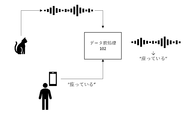
- the communication terminal 2 can acquire weight data and behavior measurement data by performing short-range wireless communication with the weight measuring means 8 and an acceleration sensor (an example of the sensor 5) attached to an animal, for example, a cat 6. More specifically, first, as shown in FIG. 3, a collar-shaped (or pendant-shaped) wearable device is attached to the cat 6. The wearable device incorporates an acceleration sensor and / or a temperature sensor as the sensor 5.
- the device that realizes the sensor 5 is not limited, and is not particularly limited as long as it is a sensor that senses movement or physiological phenomenon by other animals. Further, the sensor 5 is assumed to be attached to an animal such as a cat 6, but the sensor 5 does not have to be attached to the animal, and is attached to the body of the animal or the like. May be good.
- the weight measuring means 8 and the sensor 5 transmit data to a receiving device 7 installed in the same house through short-range wireless communication such as BLUETOOTH (registered trademark) LAW ENERGY (BLE), and the receiving device 7 is a router or the like.
- the data is transferred to the communication terminal 2, and the communication terminal 2 transmits the data to the server 1 via the network.
- the weight measuring means 8 and the sensor 5 may directly transmit the data to the user terminal 3 through short-range wireless communication such as BLUETOOTH (registered trademark) LAW ENERGY (BLE).
- the receiving device 7 can be equipped with an operation system based on Linux (registered trademark), and can also be equipped with various sensors such as a temperature sensor for measuring the air temperature.
- an OS such as an embedded chipset.
- the acceleration sensor 5 is a sensor that detects acceleration in three axial directions (x-axis, y-axis, and z-axis directions) orthogonal to each other, and is built in a collar worn on the neck of a cat.
- the front-back direction of the cat is defined as the X direction
- the left-right direction is defined as the Y direction
- the vertical direction is defined as the Z direction
- a collar is attached to the cat so that acceleration signals in each direction can be detected according to the movement of the cat. ..
- the type of sensor is not limited to this, and any sensing device that can acquire information on the movement of the cat, such as a gyro sensor and a motion sensor, can be adopted.
- the user terminal 3 may be a general-purpose computer such as a workstation or a personal computer, or may be a smartphone, a tablet, a mobile terminal, another information terminal, or the like.
- FIG. 4 is a functional block diagram of the server 1 according to the first embodiment of the present disclosure.
- the illustrated configuration is an example, and may have other configurations.
- the server 1 is connected to a database (not shown) to form part of the system.
- the server 1 may be a general-purpose computer such as a workstation or a personal computer, or may be logically realized by cloud computing.
- the server 1 includes at least a control unit 10, a memory 11, a storage 12, a transmission / reception unit 13, an input / output unit 14, and the like, and these are electrically connected to each other through a bus 15.
- the control unit 10 is an arithmetic unit that controls the operation of the entire server 1, controls the transmission and reception of data between each element, and performs information processing necessary for application execution and authentication processing.
- the control unit 10 is a CPU (Central Processing Unit), and executes each information processing by executing a program or the like stored in the storage 12 and expanded in the memory 11.
- the memory 11 includes a main memory composed of a volatile storage device such as a DRAM (Dynamic Random Access Memory) and an auxiliary storage composed of a non-volatile storage device such as a flash memory or an HDD (Hard Disc Drive). ..
- the memory 11 is used as a work area or the like of the processor 10, and also stores a BIOS (Basic Input / Output System) executed when the server 1 is started, various setting information, and the like.
- BIOS Basic Input / Output System
- the storage 12 stores various programs such as application programs.
- a database (not shown) storing data used for each process may be built in the storage 12.
- the transmission / reception unit 13 connects the server 1 to the network.
- the transmission / reception unit 13 may be provided with a short-range communication interface of Bluetooth (registered trademark) and BLE (Bluetooth Low Energy).
- the input / output unit 14 is an information input device such as a keyboard and a mouse, and an output device such as a display.
- the bus 15 is commonly connected to each of the above elements and transmits, for example, an address signal, a data signal, and various control signals.
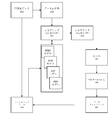
- FIG. 5 is a diagram showing a software configuration example of the server of the weight measurement system of the present disclosure.
- the server includes a measurement mode input reception unit 51, a measurement mode determination unit 52, a weight data acquisition unit 53, an action measurement data detection unit 54, an action data generation unit 55, an action data management unit 56, a weight calculation unit 57, and a weight information evaluation unit.
- 58 weight type identification unit 59, individual identification unit 60, abnormality detection unit 61, display control unit 62, measurement mode information storage unit 71, weight data storage unit 72, basic data storage unit 73, behavior measurement data storage unit 74, action.
- a data storage unit 75 and a weight information storage unit 76 are provided.
- the weight type identification unit 59, the individual identification unit 60, the abnormality detection unit 61, and the display control unit 62 are realized by the control unit 10 included in the server reading the program stored in the storage 12 into the memory 11 and executing the program.
- Measurement mode information storage unit 71, weight data storage unit 72, basic data storage unit 73, behavior measurement data storage unit 74, behavior data storage unit 75, weight information storage unit 76 by at least one of the memory 11 and the storage 12. Realized as part of the provided storage area.
- the measurement mode information storage unit 71 stores information related to the measurement mode. As the measurement mode, one or more measurement modes are registered. The measurement mode identifies at least one or more measurement targets. Typical examples are a meal amount measurement mode for measuring the amount of food, a water intake measurement mode for measuring water intake, a stool volume measurement mode for measuring stool volume, a urine volume measurement mode for measuring urine volume, and a body weight measurement. There are weight measurement modes and the like, and these can be combined.
- the measurement mode information storage unit 71 stores an algorithm and the like required for calculating and processing the weight of the measurement target from the ID, mode name, measurement target, and weight data of each mode.
- the weight data storage unit 72 stores the weight data acquired by the weight data acquisition unit 53 for each weight measuring means 8.
- the weight data is preferably time series data stored together with the time data.
- the behavior data storage unit 75 stores the behavior data generated by the behavior data generation unit 55.
- the behavior data is preferably time series data stored together with the time data.
- the weight data and the behavior data may be given an ID or the like that associates the data to be analyzed in conjunction with each other.
- the weight data obtained from the weight measuring means 8 owned by the same user may be associated with the behavior data of the animal raised by the user.
- the weight data obtained from one weight measuring means 8 may be associated with the behavior data of a plurality of animals.
- the weight information storage unit 76 stores the weight information calculated by the weight calculation unit 57.
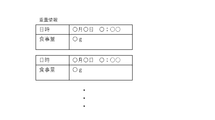
- FIG. 6 is a configuration example of weight information stored in the weight information storage unit 76.
- the measurement target and the weight of the measurement target eg, the amount of food
- the weight information may include information on an individual name and an individual ID in the case of a multi-headed animal.
- the measurement mode input receiving unit 51 receives input of a measurement mode selected from a plurality of measurement modes from the user.
- the input may be performed by a button or a touch panel provided on the weight measuring means 8, or may be input by a user terminal.
- the measurement mode determination unit 52 is used when the measurement mode is automatically set without receiving a selection input from the user.
- the measurement mode determination unit 52 can determine the measurement mode based on the weight of the item placed on the weight measuring means 8. For example, the measurement mode determination unit 52 stores in advance the weights of toilets, tableware, water bowls, beds, etc. that can be used by the user, and uses the weight of the item placed on the weight measuring means 8 to obtain the weight. Determine if is a toilet, tableware, water bowl, or bed. Then, the measurement mode determination unit 52 sets the excrement measurement mode when the toilet is placed, the meal amount measurement mode when the tableware is placed, the water intake measurement mode when the water bowl is placed, and the tableware and the water bowl. If both are placed, you can select the measurement mode set for each item, such as the meal amount & water intake measurement mode.
- the weight data acquisition unit 53 acquires weight data from the weight measuring means 8.
- the weight measuring means 8 and the server are connected by a communication network.
- Weight data is preferably acquired in chronological order.
- the acquired weight data is stored in the weight data storage unit 72 together with the time information.
- the behavior measurement data detection unit 54 receives the behavior measurement data detected by the sensor 5 and transmitted via the communication terminal 2 via the transmission / reception unit 13 of the server 1.
- the behavior measurement data is behavior measurement data relating to an animal, and is data obtained from a sensor 5 provided on the animal.
- the behavior measurement data may be, for example, output data of the sensor 5 such as acceleration and temperature (body temperature).
- the received behavior measurement data may be stored in the behavior measurement data storage unit 74 of the storage 12 built in the server 1, or stored in the storage built in the analysis server 4 shown in FIG. May be good.
- the behavior data generation unit 55 cooperates with the analysis server 4 (or by a single process in the behavior data generation unit 55) as shown in FIG. 2, and the behavior data of the cat. To generate. Further, the behavior data management unit 56 stores the generated behavior data in the behavior data storage unit 75, and manages the behavior data.
- the behavior data generated by the behavior data generation unit 55 is, for example, time-series behavior data.
- the behavior data may include exercise data, sleep data, meal data, toilet data, position data, and the like stored in the behavior data storage unit 75. More specifically, the exercise data may include aggregated data such as the presence or absence of exercise and how much activity is performed in a day with time.
- the sleep data may include aggregated data such as the presence or absence of sleep and how much sleep is performed in a day along with the time.
- meal data aggregated data such as how many times and when the meal was eaten with the presence or absence of eating behavior and time, and / or how many times and when the water was drunk with the presence or absence of water intake behavior and time. Data may be included.
- aggregated data such as how many times and when the bowel movement was performed with the presence or absence of defecation behavior and time, and / or aggregated data such as how many times and when the bowel movement was performed with the presence or absence of urination behavior and time.
- the position data may include which direction the user has moved and which position he / she was in.
- other data may include how many times the water was drunk, when it was drunk, and the like.
- data on the body temperature of the cat at the time of measurement and the surrounding environment such as the room temperature in which the cat is located can be acquired and stored in the behavior data storage unit 75.
- the basic data storage unit 73 stores basic animal information.
- Basic data may include animal name, species, age, gender, place of residence (area), health information, owner information and the like.
- Health information includes hospital visit history, medical history, and the like.
- the owner information includes information such as the owner's gender, age, and occupation.
- the weight calculation unit 57 analyzes the weight data acquired by the weight data acquisition unit 53 and outputs the target weight information according to the measurement mode.
- An example of the weight calculation method in each measurement mode is shown below.
- FIG. 7 shows an example of measuring the amount of food, the amount of water intake, and the body weight.
- the time series weight data behaves as shown in FIG. 7, for example.
- the difference ⁇ W1 between the weight before the animal is placed on the weight measuring means 8 and the weight when the animal is placed can be the weight of the animal.
- the difference ⁇ W2 between the weight before the animal gets on the weight measuring means 8 and the weight when the animal finishes eating and watering and gets off is the amount of decrease in food or water, that is, It can be the amount of food and water consumed.
- weight data fluctuates due to the movement of the animal while the animal is on the weight measuring means 8, the average value of the weight data in the time series or when the movement has stopped for a certain period of time or more.
- Optimal values can be appropriately adopted, such as by adopting weight data.
- FIG. 8 shows an example of measuring the amount of excretion and body weight.
- the difference ⁇ W3 between the weight of the animal when it enters the toilet and the weight when the animal exits the toilet can be the weight of the animal.
- the body weight may be the difference between the weight of the animal before entering the toilet and the weight immediately after entering the toilet.
- the difference ⁇ W4 between the weight before the animal enters the toilet and the weight after the animal leaves the toilet can be the amount of excretion. If the weight data fluctuates due to the movement of the animal while the animal is in the toilet, the average value of the weight data in the time series or the weight data when the animal has stopped moving for a certain period of time is adopted. The optimum value can be adopted as appropriate.
- FIG. 9 shows an example of measuring body weight.
- the time-series weight data behaves as shown in FIG. 9, for example.
- the difference ⁇ W5 between the weight of the animal when it enters the bed and the weight when the animal leaves the bed can be the weight of the animal.
- the weight calculation unit 57 can estimate the weight of various measurement targets from the change of the weight data in the time series.
- the type of measurement target and its calculation method are not limited to those described above, and can be set arbitrarily.
- the weight information evaluation unit 58 evaluates the certainty of the weight information.
- the weight information evaluation unit 58 can evaluate the certainty of the weight information by comparing the weight information calculated by the weight calculation unit 57 with the behavior data.
- the weight information evaluation unit 58 refers to the behavior data at the time (t1 to t2) when the weight information of the measurement target is acquired from the behavior data storage unit 75, and the behavior of the animal at that time matches the measurement target of the weight information. Check if. For example, when the weight data fluctuates when measuring in the meal amount measurement mode, the amount of change in the weight data is determined as the "meal amount" as described above, but as shown in FIG. If the behavioral data in t1 to t2) indicates "meal", it can be determined that the weight information is likely to be the amount of food.
- the weight information evaluation unit 58 determines that the weight information is probable when the behavior data in the same time zone as the weight information matches the weight information, and when the weight information does not match, the weight information Can be tagged or deleted as uncertain data.
- the weight information evaluation unit 58 may determine the certainty of the weight information based on the past weight data.
- the weight information evaluation unit 58 may determine a numerical range of the weight that can be taken for each measurement target from the past results, and if the measured weight is out of the range, it may be determined as an error. Further, it is also possible to create reference weight data by machine learning the past weight data as teacher data, and to judge as an error when the fluctuation rate is large from the reference weight data.
- the weight type identification unit 59 can distinguish between when eating rice and when drinking water, or when defecation and urination, the weight calculation unit 57 can be used.
- the calculated weight information can be specified more specifically.
- the weight type identification unit 59 can specify the type based on the behavior data. For example, in the food / water intake / weight measurement mode, when both the tableware and the water bowl are placed on the weight measuring means 8, ⁇ W2 indicates the total of either or both of the food amount and the water intake.
- ⁇ W2 indicates the total of either or both of the food amount and the water intake.
- the behavioral data in t1 to t2 indicates "meal"
- ⁇ W4 indicates the total of either or both of the defecation amount and the urine amount, but the behavior data in the time zone when the weight data was acquired was “defecation”. In this case, ⁇ W4 can be determined to be the amount of defecation. In this way, the weight type identification unit 59 can more specifically specify the measurement target of the weight information from the behavior data in the same time zone.
- the weight type specifying unit 59 may specify the weight type based on the past weight data. For example, the numerical range of the weight that can be taken for each measurement target may be determined from the past results, and the type of the measured weight may be specified. In addition, by machine learning past weight data for which the weight type (meal or drinking water, stool or urine, etc.) is known as teacher data, reference weight data for each weight type is created and measured. The weight type of the weight data obtained may be estimated.
- the individual identification unit 60 can determine, for example, which individual the weight information calculated by the weight calculation unit 57 is associated with in the case of a multi-headed animal.
- the individual identification unit 60 refers to the behavior data of each individual in the time zone (t1 to t2) when the weight data of the measurement target is acquired, and identifies the individual to which the weight information should be associated. In the example shown in FIG. 11, from the behavior data of the individual A and the individual B in t1 to t2, it is determined that the weight data acquired by the weight measuring means 8 is that of the individual A who was eating. In this way, the individual identification unit 60 can select an individual showing behavioral data that matches each weight information and add the individual information to the weight information.
- the individual identification unit 60 may identify an individual from waveform information such as acceleration data obtained from the sensor of each individual. It is known that even if the behavior is the same, each individual has a unique characteristic of the waveform. Individuals can be identified by comparing the characteristics of the behavioral waveform data in the time zone in which the weight data of the measurement target is acquired with the waveforms of each individual's behavior registered in advance.
- individual identification may be performed by analyzing image information obtained by an image acquisition means capable of photographing the weight measuring means 8. More specifically, an image acquisition means such as a video camera captures a moving image over time, and an individual resting on the weight measuring means 8 is identified by image recognition.
- the individual identification unit 60 can identify an individual to which the weight information should be associated from the image data at the time when the weight data of the measurement target is acquired.
- the individual identification unit 60 may identify an individual near the weight measuring means 8 by using information obtained from the strength of radio wave intensity such as BLUETOOTH LAW ENERGY (BLE) for data including individual information from an animal collar or the like. ..
- BLE BLUETOOTH LAW ENERGY
- a BLE receiving means can be provided at or near the weight measuring means 8 to recognize an individual closer to the weight measuring means 8.
- the individual identification unit 60 may identify an individual based on the information on the body weight of the animal.
- the individual can be identified by registering the weight of the individual in advance and referring to the information of the registered weight when the weight is calculated in each measurement mode.
- the individual identification unit 60 can identify an individual by a plurality of methods, but one or more of them can be adopted, and an individual identification may be performed by combining a plurality of methods.
- the abnormality detection unit 61 notifies the user of an abnormality when each of the calculated weight information satisfies a predetermined condition. For example, for each measurement target (meal amount / number of meals, water intake / number of meals, stool amount / number of meals, urine amount / number of meals, weight), an appropriate range is set in advance, and the range is less than or equal to that range. If it shows a high value, the measured value is judged to be "abnormal".
- the abnormality detection unit 61 determines that the abnormality is determined, for example, the analysis server 4, the weight measuring means 8, or the like may transmit information indicating that the abnormality has been determined to the user terminal.
- the display control unit 62 generates data constituting a screen displayed on the display of the user terminal 3.
- the display control unit 62 preferably displays the calculated weight information together with the time information. Further, as shown in FIG. 16, it is more preferable to display the weight information together with the behavior information.
- FIG. 12 is a flowchart of processing according to the embodiment of the present disclosure.
- the measurement mode input receiving unit 51 accepts the measurement mode (S101).
- the measurement mode is selected when the user starts using the weight measuring means 8 for the first time, or at an arbitrary timing when he / she wants to change the measurement target. For example, a measurement mode that can be set is displayed on the display unit provided in the weight measuring means 8 and may be selected by the user. Further, the measurement mode that can be set is displayed on the user terminal, and the measurement mode input receiving unit 51 may receive the information selected by the user.
- the measurement mode may be set by the measurement mode determination unit 52 instead of the measurement mode input reception unit 51 accepting the input by the user. Items such as a bed, tableware, and a water bowl may be placed on the weight measuring means 8 according to the measurement target.
- the measurement mode determination unit 52 measures the weight of the item placed on the weight measuring means 8 and recognizes which item is placed by comparing it with the weight of each item registered in advance. Then, the measurement mode is set for each placed item. If no item is placed, it may be determined that the mode measures only the body weight. As for the measurement mode, it is sufficient that one or more measurement targets can be defined, and the measurement targets can be arbitrarily combined.
- the weight data acquisition unit 53 acquires the weight data measured by the weight measuring means 8 over time.
- the weight data is stored in the weight data storage unit 72 together with the time information (S102).
- the weight calculation unit 57 calculates the weight of a predetermined measurement target from the acquired weight data based on the set measurement mode (S103).
- the weight information including the weight calculated in S103 is stored in the weight information storage unit 76 and output to the user terminal at a predetermined timing (S105).
- animal behavior data is generated in parallel with the acquisition of weight data.
- the generation of behavior data will be described later (S201 to S203).
- the weight information evaluation unit 58 reads out the behavior data at the time when the weight data to be measured is measured from the behavior data storage unit 75, and evaluates the accuracy of the weight information (S104). If the behavior data in the same time zone matches the measurement target, it is evaluated that the weight information is probable, while if it does not match, it is judged that the weight information is incorrect information. Similarly, the weight type identification unit 59 reads out the behavior data at the time when the weight data of the measurement target is measured from the behavior data storage unit 75, and distinguishes between meal and water intake and between defecation and urination from the behavior data. When possible, the measurement target of the measured weight data is specified more specifically (S104).
- the individual identification unit 60 identifies an individual related to the weight information by associating the weight information with the behavior data (S104).
- the individual identification unit 60 reads out the behavior data at the time when the weight data of the measurement target is measured from the behavior data storage unit 75, and identifies an individual whose behavior data in the same time zone matches the measurement target.
- Individual identification may be performed not by behavior data but by image analysis, radio wave intensity such as BLE, and weight.
- the display control unit outputs weight information for each individual.
- the behavior data generation unit 22 confirms the measurement data detected by the behavior measurement data detection unit 54 (S201).
- the action data generation unit 22 determines the action type based on the measurement data (S202).
- the behavior type determination method can be realized by some known behavior analysis methods.
- the acceleration data (Gx, Gy, Gz) in the xyz axis direction obtained from the acceleration sensor 5 can be obtained by using the wavelet transform.
- the vibration signal is decomposed into period and amplitude for each time, the periodicity of the signal at each time is recognized as an action spectrum, and the action is performed by comparing with the action element registered in advance according to the similarity of the spectrum. Can be classified.
- the acceleration data obtained from the acceleration sensor 5 is Fourier transformed, and the average value and peak value of the frequency components calculated along the time axis are set to the same or different cat behavior types (exercise, sleep, meal). , Toilet, etc.) and identify the behavior by comparing with the known frequency, and based on the frequency component calculated by performing the fast Fourier transform (FFT) of the acceleration component, the characteristic waveform and spectral value can be obtained.
- FFT fast Fourier transform
- Behavior can be identified by extracting and comparing with known characteristic waveforms or spectral values corresponding to the same or different cat behavior types (exercise, sleep, diet, toilet, etc.).
- the behavior type can be estimated by grasping the posture of the cat from the postures ( ⁇ x, ⁇ y, ⁇ z) in each axial direction calculated by the acceleration sensor.
- the action data generation unit 55 When the action type is determined, the action data generation unit 55 generates the data indicating the action type as the action data together with the date and time when the measurement data is measured (or the date and time when the measurement data is received, the date and time when the action data is generated) (S203). ..
- the acceleration data 101 acquired from the acceleration sensor is preprocessed so as to be the spectrum data obtained by the above-mentioned wavelet transform or the component data obtained by the Fourier transform or the like.
- the data preprocessed in this way is subsequently scored 103 by the binary model group.
- the binary model according to the present embodiment is comparatively analyzed with a model of activity that can be concretely expressed (interpreted) such as a WALK model, a RUN model, an EAT model, and a STAY model, and is specified among the preprocessed data 102. Score which action the part can be inferred to be. For example, as shown in FIG. 14, the accuracy is scored by analyzing the input data in each model.
- Scoring by the multi-valued model group according to the present embodiment is based on machine learning which binary model group should be prioritized when the results obtained by the binary model are in competition. judge. For example, in the example shown in FIG. 14, "walking" is 91 and “running” is 62, and the evaluation score of "running" is relatively high. In this case, it is determined which binary model should be prioritized in this case from the combination of the input data to the past binary model group and the determination result. As described above, in the present embodiment, the accuracy of the data is improved by further evaluating the result of the binary model group specialized in the determination of each behavior by the multi-value model group.
- the determined action is further corrected based on the rule base. For example, if the binary model determines a behavior that is unlikely to occur suddenly, such as "running,” during a judgment section such as “eating” or “sleeping,” which often continues for a certain period of time due to the behavior of the cat. Or, if it cannot be determined, the prediction result of the binary model in this section is rejected, and the correction is performed to presume it as another behavior according to the rule. When the correction is completed, the action label 106 registered in advance for the action is given.
- feedback 107 from the user is received. Specifically, as shown in FIG. 15, the current behavior is recorded (manually) while observing the animals under its control. By associating the record with the data of the acceleration sensor, it is possible to collect teacher data by visual inspection or the like. The feedback data 108 thus obtained is accumulated and used to improve the accuracy of the model of the binary model group.
- ⁇ Modification example> A case where a plurality of weight measuring means 8 are used will be described.
- one user can place different animal items on each of the plurality of weight measuring means 8 and measure different measurement targets.
- An example is shown in FIG. A tableware and a water bowl are placed on the first weight measuring means 8 to set the meal / water intake / weight measuring mode, and a toilet is placed on the second weight measuring means 8 to set the excretion / weight measuring mode.
- the weight of the measurement target is calculated for each weight data, and the first weight information and the second weight information are generated.
- the display control unit 62 can arrange each weight information together in one time series and provide it to the user. According to the modification, it is possible to acquire weight data of a plurality of measurement targets at the same time.
Landscapes
- Life Sciences & Earth Sciences (AREA)
- Environmental Sciences (AREA)
- Business, Economics & Management (AREA)
- General Physics & Mathematics (AREA)
- Tourism & Hospitality (AREA)
- Biodiversity & Conservation Biology (AREA)
- Physics & Mathematics (AREA)
- Animal Husbandry (AREA)
- General Health & Medical Sciences (AREA)
- Human Resources & Organizations (AREA)
- Strategic Management (AREA)
- General Business, Economics & Management (AREA)
- Engineering & Computer Science (AREA)
- Theoretical Computer Science (AREA)
- Marketing (AREA)
- Birds (AREA)
- Zoology (AREA)
- Primary Health Care (AREA)
- Economics (AREA)
- Health & Medical Sciences (AREA)
- Measuring And Recording Apparatus For Diagnosis (AREA)
- Dc-Dc Converters (AREA)
- Emergency Protection Circuit Devices (AREA)
- Protection Of Static Devices (AREA)
- Medical Treatment And Welfare Office Work (AREA)
Priority Applications (2)
| Application Number | Priority Date | Filing Date | Title |
|---|---|---|---|
| JP2021567492A JP7028500B2 (ja) | 2019-12-27 | 2020-12-22 | 動物用重量測定システム及び方法 |
| JP2022019026A JP7693214B2 (ja) | 2019-12-27 | 2022-02-09 | 動物用重量測定システム及び方法 |
Applications Claiming Priority (2)
| Application Number | Priority Date | Filing Date | Title |
|---|---|---|---|
| JP2019237625 | 2019-12-27 | ||
| JP2019-237625 | 2019-12-27 |
Publications (1)
| Publication Number | Publication Date |
|---|---|
| WO2021132265A1 true WO2021132265A1 (ja) | 2021-07-01 |
Family
ID=76573273
Family Applications (1)
| Application Number | Title | Priority Date | Filing Date |
|---|---|---|---|
| PCT/JP2020/048007 Ceased WO2021132265A1 (ja) | 2019-12-27 | 2020-12-22 | 動物用重量測定システム及び方法 |
Country Status (2)
| Country | Link |
|---|---|
| JP (2) | JP7028500B2 (https=) |
| WO (1) | WO2021132265A1 (https=) |
Cited By (1)
| Publication number | Priority date | Publication date | Assignee | Title |
|---|---|---|---|---|
| CN113688351A (zh) * | 2021-08-06 | 2021-11-23 | 北京每日优鲜电子商务有限公司 | 用于检测物品重量的方法、装置、电子设备和可读介质 |
Families Citing this family (1)
| Publication number | Priority date | Publication date | Assignee | Title |
|---|---|---|---|---|
| WO2024024165A1 (ja) * | 2022-07-25 | 2024-02-01 | パナソニックIpマネジメント株式会社 | 測定データ管理装置、測定データ管理方法、プログラム及び測定システム |
Citations (5)
| Publication number | Priority date | Publication date | Assignee | Title |
|---|---|---|---|---|
| US20120299731A1 (en) * | 2011-05-27 | 2012-11-29 | Pet Wireless Llc | Systems, methods and computer program products for monitoring the behavior, health, and/or characteristics of an animal |
| WO2017110161A1 (ja) * | 2015-12-25 | 2017-06-29 | ユニ・チャーム株式会社 | 動物用トイレ |
| WO2018096752A1 (ja) * | 2016-11-24 | 2018-05-31 | シャープ株式会社 | 個体特定装置、個体特定システム、個体特定装置の制御方法、および制御プログラム |
| JP2019000102A (ja) * | 2017-06-19 | 2019-01-10 | 千波 浜谷 | ペット用食事管理システム |
| WO2019021962A1 (ja) * | 2017-07-28 | 2019-01-31 | シャープ株式会社 | 重量計、重量測定方法、及び動物用トイレ |
Family Cites Families (2)
| Publication number | Priority date | Publication date | Assignee | Title |
|---|---|---|---|---|
| JP6295697B2 (ja) | 2014-02-10 | 2018-03-20 | 株式会社タニタ | 生体測定装置 |
| JP6392475B1 (ja) | 2017-08-29 | 2018-09-19 | 株式会社ペットボードヘルスケア | 猫用トイレ使用状況管理システム及び猫用トイレ |
-
2020
- 2020-12-22 JP JP2021567492A patent/JP7028500B2/ja active Active
- 2020-12-22 WO PCT/JP2020/048007 patent/WO2021132265A1/ja not_active Ceased
-
2022
- 2022-02-09 JP JP2022019026A patent/JP7693214B2/ja active Active
Patent Citations (5)
| Publication number | Priority date | Publication date | Assignee | Title |
|---|---|---|---|---|
| US20120299731A1 (en) * | 2011-05-27 | 2012-11-29 | Pet Wireless Llc | Systems, methods and computer program products for monitoring the behavior, health, and/or characteristics of an animal |
| WO2017110161A1 (ja) * | 2015-12-25 | 2017-06-29 | ユニ・チャーム株式会社 | 動物用トイレ |
| WO2018096752A1 (ja) * | 2016-11-24 | 2018-05-31 | シャープ株式会社 | 個体特定装置、個体特定システム、個体特定装置の制御方法、および制御プログラム |
| JP2019000102A (ja) * | 2017-06-19 | 2019-01-10 | 千波 浜谷 | ペット用食事管理システム |
| WO2019021962A1 (ja) * | 2017-07-28 | 2019-01-31 | シャープ株式会社 | 重量計、重量測定方法、及び動物用トイレ |
Cited By (1)
| Publication number | Priority date | Publication date | Assignee | Title |
|---|---|---|---|---|
| CN113688351A (zh) * | 2021-08-06 | 2021-11-23 | 北京每日优鲜电子商务有限公司 | 用于检测物品重量的方法、装置、电子设备和可读介质 |
Also Published As
| Publication number | Publication date |
|---|---|
| JP7693214B2 (ja) | 2025-06-17 |
| JP7028500B2 (ja) | 2022-03-02 |
| JP2022059631A (ja) | 2022-04-13 |
| JPWO2021132265A1 (https=) | 2021-07-01 |
Similar Documents
| Publication | Publication Date | Title |
|---|---|---|
| JP6560468B1 (ja) | 動物用トイレ使用状況管理システム | |
| JP6873526B1 (ja) | 動物の行動情報を取得するサービスを提供するサーバ | |
| US11224380B2 (en) | Animal health system and method for monitoring performance | |
| US12080416B2 (en) | Systems and methods for animal health monitoring | |
| JP2022036278A (ja) | サーバ | |
| JP2021026389A (ja) | 情報提供装置、情報提供方法及び情報提供プログラム | |
| JP2019000102A (ja) | ペット用食事管理システム | |
| JP2021177344A (ja) | ペット保険加入支援システム | |
| JP7693214B2 (ja) | 動物用重量測定システム及び方法 | |
| US20230000057A1 (en) | Method, system, and computer program product for monitoring state of animal and providing solution | |
| JP7594305B2 (ja) | 情報処理システムおよび方法 | |
| JP7028734B2 (ja) | 健康状態判定装置、健康状態判定システム及びプログラム | |
| JP7193011B2 (ja) | 摂取栄養量推定システム、摂取栄養量推定方法、摂取栄養量推定装置及び摂取栄養量出力方法 | |
| KR102344723B1 (ko) | 반려동물의 슬개골 탈구 정도를 측정하기 위한 스마트 체중 장치 및 이를 이용한 반려동물 관리 방법 | |
| JP2024037907A (ja) | 動物共同見守りシステム | |
| KR102344722B1 (ko) | 반려동물의 비만도를 측정하기 위한 스마트 체중 장치 및 이를 이용한 반려동물 관리 방법 | |
| WO2023106383A1 (ja) | 健康状態の評価方法、健康状態評価システム、プログラム及び排便検出方法 | |
| JP7584814B2 (ja) | 情報処理装置 | |
| JP7755838B2 (ja) | 方法、情報処理装置およびプログラム | |
| JP2022068638A (ja) | 情報処理装置、情報処理方法および情報処理システム。 | |
| KR20220013152A (ko) | 반려 동물의 생체 정보 감지 장치 및 감지 방법 | |
| JP2026005887A (ja) | ストレス評価システム、ストレス評価サーバ、ストレス評価方法 | |
| JP2024090782A (ja) | 複数のモードを有する飼育管理システム | |
| CN121729136A (zh) | 监测宠物进食行为的方法 | |
| CN121793841A (zh) | 智能宠物食盆 |
Legal Events
| Date | Code | Title | Description |
|---|---|---|---|
| 121 | Ep: the epo has been informed by wipo that ep was designated in this application |
Ref document number: 20907328 Country of ref document: EP Kind code of ref document: A1 |
|
| ENP | Entry into the national phase |
Ref document number: 2021567492 Country of ref document: JP Kind code of ref document: A |
|
| NENP | Non-entry into the national phase |
Ref country code: DE |
|
| 122 | Ep: pct application non-entry in european phase |
Ref document number: 20907328 Country of ref document: EP Kind code of ref document: A1 |