WO2021131548A1 - 画像復号装置、画像復号方法及びプログラム - Google Patents
画像復号装置、画像復号方法及びプログラム Download PDFInfo
- Publication number
- WO2021131548A1 WO2021131548A1 PCT/JP2020/044804 JP2020044804W WO2021131548A1 WO 2021131548 A1 WO2021131548 A1 WO 2021131548A1 JP 2020044804 W JP2020044804 W JP 2020044804W WO 2021131548 A1 WO2021131548 A1 WO 2021131548A1
- Authority
- WO
- WIPO (PCT)
- Prior art keywords
- merge
- geometric
- block
- block division
- motion information
- Prior art date
- Legal status (The legal status is an assumption and is not a legal conclusion. Google has not performed a legal analysis and makes no representation as to the accuracy of the status listed.)
- Ceased
Links
Images








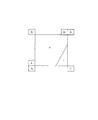
Classifications
-
- H—ELECTRICITY
- H04—ELECTRIC COMMUNICATION TECHNIQUE
- H04N—PICTORIAL COMMUNICATION, e.g. TELEVISION
- H04N19/00—Methods or arrangements for coding, decoding, compressing or decompressing digital video signals
- H04N19/10—Methods or arrangements for coding, decoding, compressing or decompressing digital video signals using adaptive coding
- H04N19/102—Methods or arrangements for coding, decoding, compressing or decompressing digital video signals using adaptive coding characterised by the element, parameter or selection affected or controlled by the adaptive coding
- H04N19/103—Selection of coding mode or of prediction mode
- H04N19/105—Selection of the reference unit for prediction within a chosen coding or prediction mode, e.g. adaptive choice of position and number of pixels used for prediction
-
- H—ELECTRICITY
- H04—ELECTRIC COMMUNICATION TECHNIQUE
- H04N—PICTORIAL COMMUNICATION, e.g. TELEVISION
- H04N19/00—Methods or arrangements for coding, decoding, compressing or decompressing digital video signals
- H04N19/10—Methods or arrangements for coding, decoding, compressing or decompressing digital video signals using adaptive coding
- H04N19/102—Methods or arrangements for coding, decoding, compressing or decompressing digital video signals using adaptive coding characterised by the element, parameter or selection affected or controlled by the adaptive coding
- H04N19/119—Adaptive subdivision aspects, e.g. subdivision of a picture into rectangular or non-rectangular coding blocks
-
- H—ELECTRICITY
- H04—ELECTRIC COMMUNICATION TECHNIQUE
- H04N—PICTORIAL COMMUNICATION, e.g. TELEVISION
- H04N19/00—Methods or arrangements for coding, decoding, compressing or decompressing digital video signals
- H04N19/10—Methods or arrangements for coding, decoding, compressing or decompressing digital video signals using adaptive coding
- H04N19/134—Methods or arrangements for coding, decoding, compressing or decompressing digital video signals using adaptive coding characterised by the element, parameter or criterion affecting or controlling the adaptive coding
- H04N19/157—Assigned coding mode, i.e. the coding mode being predefined or preselected to be further used for selection of another element or parameter
- H04N19/159—Prediction type, e.g. intra-frame, inter-frame or bidirectional frame prediction
-
- H—ELECTRICITY
- H04—ELECTRIC COMMUNICATION TECHNIQUE
- H04N—PICTORIAL COMMUNICATION, e.g. TELEVISION
- H04N19/00—Methods or arrangements for coding, decoding, compressing or decompressing digital video signals
- H04N19/10—Methods or arrangements for coding, decoding, compressing or decompressing digital video signals using adaptive coding
- H04N19/169—Methods or arrangements for coding, decoding, compressing or decompressing digital video signals using adaptive coding characterised by the coding unit, i.e. the structural portion or semantic portion of the video signal being the object or the subject of the adaptive coding
- H04N19/17—Methods or arrangements for coding, decoding, compressing or decompressing digital video signals using adaptive coding characterised by the coding unit, i.e. the structural portion or semantic portion of the video signal being the object or the subject of the adaptive coding the unit being an image region, e.g. an object
- H04N19/176—Methods or arrangements for coding, decoding, compressing or decompressing digital video signals using adaptive coding characterised by the coding unit, i.e. the structural portion or semantic portion of the video signal being the object or the subject of the adaptive coding the unit being an image region, e.g. an object the region being a block, e.g. a macroblock
-
- H—ELECTRICITY
- H04—ELECTRIC COMMUNICATION TECHNIQUE
- H04N—PICTORIAL COMMUNICATION, e.g. TELEVISION
- H04N19/00—Methods or arrangements for coding, decoding, compressing or decompressing digital video signals
- H04N19/44—Decoders specially adapted therefor, e.g. video decoders which are asymmetric with respect to the encoder
-
- H—ELECTRICITY
- H04—ELECTRIC COMMUNICATION TECHNIQUE
- H04N—PICTORIAL COMMUNICATION, e.g. TELEVISION
- H04N19/00—Methods or arrangements for coding, decoding, compressing or decompressing digital video signals
- H04N19/46—Embedding additional information in the video signal during the compression process
-
- H—ELECTRICITY
- H04—ELECTRIC COMMUNICATION TECHNIQUE
- H04N—PICTORIAL COMMUNICATION, e.g. TELEVISION
- H04N19/00—Methods or arrangements for coding, decoding, compressing or decompressing digital video signals
- H04N19/50—Methods or arrangements for coding, decoding, compressing or decompressing digital video signals using predictive coding
- H04N19/503—Methods or arrangements for coding, decoding, compressing or decompressing digital video signals using predictive coding involving temporal prediction
- H04N19/51—Motion estimation or motion compensation
- H04N19/513—Processing of motion vectors
- H04N19/517—Processing of motion vectors by encoding
- H04N19/52—Processing of motion vectors by encoding by predictive encoding
-
- H—ELECTRICITY
- H04—ELECTRIC COMMUNICATION TECHNIQUE
- H04N—PICTORIAL COMMUNICATION, e.g. TELEVISION
- H04N19/00—Methods or arrangements for coding, decoding, compressing or decompressing digital video signals
- H04N19/70—Methods or arrangements for coding, decoding, compressing or decompressing digital video signals characterised by syntax aspects related to video coding, e.g. related to compression standards
Definitions
- the present invention relates to an image decoding device, an image decoding method, and a program.
- Non-Patent Document 1 and Non-Patent Document 2 disclose a block division technique (rectangular division technique) using a rectangle called QTBTTT (Quad-Tree-Binary-Tree-Ternary-Tree).
- the appropriate block division for the object boundary may not be selected only by the block division by the rectangle in the above-mentioned conventional technique. It was. Therefore, the present invention has been made in view of the above-mentioned problems, and by applying the geometric block division merge to the target block divided into rectangles, the object boundary appearing in an arbitrary direction can be dealt with. Since the appropriate block division shape is selected, the coding performance is improved by reducing the prediction error as a result, and the subjective image quality is improved by selecting the appropriate block division boundary for the object boundary. It is an object of the present invention to provide an image decoding device, an image decoding method and a program capable of realizing the effect.
- the first feature of the present invention is an image decoding device, which includes a merging unit configured to apply a geometric block division merging to a rectangularly divided target block, and the merging unit is a merging unit.
- the merge mode specifying part configured to specify whether or not the geometric block division merge is applied and the geometric block division pattern are specified, and the rectangular division is performed using the specified geometric block division pattern.
- a geometric block division unit that is configured to further divide the target block into geometric blocks, and a merge that is configured to construct a merge list for the target block divided into the geometric blocks and decode motion information.
- the gist is to have a list construction unit.
- the second feature of the present invention is an image decoding method including a step of applying a geometric block division merge to a rectangularly divided target block, and the step is whether or not the geometric block division merge is applied. And the process of specifying the geometric block division pattern and further dividing the rectangularly divided target block into geometric blocks using the specified geometric block division pattern, and the geometric block division.
- the gist is to have a process of constructing a merge list for the target block and decoding motion information.
- a third feature of the present invention is a program that causes a computer to function as an image decoding device, and the image decoding device is configured to apply a geometric block division merge to a rectangularly divided target block.
- the merge unit includes a merge mode specific unit configured to specify whether or not the geometric block division merge is applied, and the geometric block division pattern specified and specified.
- a geometric block division portion configured to further divide the rectangularly divided target block into geometric blocks and a merge list for the geometric block divided target blocks are constructed.
- the gist is to have a merge list construction unit that is configured to decode motion information.
- an appropriate block division shape can be selected for the object boundary appearing in an arbitrary direction. Therefore, as a result, it is possible to realize the effect of improving the coding performance by reducing the prediction error and the effect of improving the subjective image quality by selecting an appropriate block division boundary for the object boundary. Decoding methods and programs can be provided.
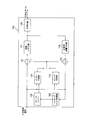
- FIG. 1 is a diagram showing an image processing system 10 according to the present embodiment.
- the image processing system 10 includes an image coding device 100 and an image decoding device 200.
- the image coding device 100 is configured to generate coded data by coding the input image signal.
- the image decoding device 200 is configured to generate an output image signal by decoding the coded data.
- the coded data may be transmitted from the image coding device 100 to the image decoding device 200 via a transmission line.
- the coded data may be stored in the storage medium and then provided from the image coding device 100 to the image decoding device 200.
- Image Coding Device 100 Image Coding Device 100
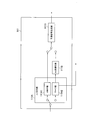
- FIG. 2 is a diagram showing an example of a functional block of the image coding apparatus 100 according to the present embodiment.
- the image coding device 100 includes an inter-prediction unit 111, an intra-prediction unit 112, a subtractor 121, an adder 122, a conversion / quantization unit 131, and an inverse conversion / dequantization. It has a unit 132, an encoding unit 140, an in-loop filter processing unit 150, and a frame buffer 160.
- the inter-prediction unit 111 is configured to generate a prediction signal by inter-prediction (inter-frame prediction).
- the inter-prediction unit 111 identifies and identifies the reference block included in the reference frame by comparing the frame to be encoded (hereinafter referred to as the target frame) with the reference frame stored in the frame buffer 160. It is configured to determine the motion vector (mv) for the reference block.
- the inter-prediction unit 111 is configured to generate a prediction signal included in a block to be encoded (hereinafter, a target block) based on a reference block and a motion vector for each target block.
- the inter-prediction unit 111 is configured to output a prediction signal to the subtractor 121 and the adder 122.
- the reference frame is a frame different from the target frame.
- the intra prediction unit 112 is configured to generate a prediction signal by intra prediction (in-frame prediction).
- the intra prediction unit 112 is configured to specify a reference block included in the target frame and generate a prediction signal for each target block based on the specified reference block. Further, the intra prediction unit 112 is configured to output a prediction signal to the subtractor 121 and the adder 122.
- the reference block is a block that is referenced for the target block.
- the reference block is a block adjacent to the target block.
- the subtractor 121 is configured to subtract the prediction signal from the input image signal and output the prediction residual signal to the conversion / quantization unit 131.
- the subtractor 121 is configured to generate a prediction residual signal, which is the difference between the prediction signal generated by the intra prediction or the inter prediction and the input image signal.
- the adder 122 adds a prediction signal to the prediction residual signal output from the inverse conversion / inverse quantization unit 132 to generate a pre-filter processing decoding signal, and the pre-filter processing decoding signal is combined with the intra prediction unit 112 and the input. It is configured to output to the loop filter processing unit 150.
- the pre-filtered decoding signal constitutes a reference block used by the intra prediction unit 112.
- the conversion / quantization unit 131 is configured to perform conversion processing of the predicted residual signal and acquire a coefficient level value. Further, the conversion / quantization unit 131 may be configured to quantize the coefficient level value.
- the conversion process is a process of converting the predicted residual signal into a frequency component signal.
- a base pattern (transformation matrix) corresponding to the discrete cosine transform (DCT: Discrete Cosine Transform) may be used, or a base pattern (transformation matrix) corresponding to the discrete sine transform (DST: Discrete Sine Transform). May be used.
- the inverse transformation / inverse quantization unit 132 is configured to perform the inverse transformation processing of the coefficient level value output from the conversion / quantization unit 131.
- the inverse transformation / inverse quantization unit 132 may be configured to perform inverse quantization of the coefficient level value prior to the inverse transformation processing.
- the inverse transformation process and the inverse quantization are performed in the reverse procedure of the conversion process and the quantization performed by the conversion / quantization unit 131.
- the coding unit 140 is configured to encode the coefficient level value output from the conversion / quantization unit 131 and output the coded data.
- coding is entropy coding in which codes of different lengths are assigned based on the probability of occurrence of coefficient level values.
- the coding unit 140 is configured to encode the control data used in the decoding process in addition to the coefficient level value.
- control data may include size data such as a coding block (CU: Coding Unit) size, a prediction block (PU: Precision Unit) size, and a conversion block (TU: Transfer Unit) size.
- CU Coding Unit
- PU prediction block
- TU Transfer Unit
- control data may include header information such as a sequence parameter set (SPS), a picture parameter set (PPS), and a slice header as described later.
- SPS sequence parameter set
- PPS picture parameter set
- slice header as described later.
- the in-loop filter processing unit 150 is configured to perform filter processing on the pre-filter processing decoding signal output from the adder 122 and output the post-filter processing decoding signal to the frame buffer 160.
- the filtering process is a deblocking filtering process that reduces the distortion that occurs at the boundary portion of the block (encoded block, prediction block, or conversion block).
- the frame buffer 160 is configured to store reference frames used by the inter-prediction unit 111.
- the decoded signal after filtering constitutes a reference frame used by the inter-prediction unit 111.
- FIG. 3 is a diagram showing an example of a functional block of the inter-prediction unit 111 of the image coding apparatus 100 according to the present embodiment.
- the inter-prediction unit 111 includes an mv derivation unit 111A, an AMVR unit 111B, an mv refinement unit 111B, and a prediction signal generation unit 111D.
- the inter-prediction unit 111 is an example of a prediction unit configured to generate a prediction signal included in a target block based on a motion vector.
- the mv derivation unit 111A has an AMVP (Adaptive Motion Vector Prediction) unit 111A1 and a merge unit 111A2, receives a target frame and a reference frame from the frame buffer 160 as inputs, and acquires a motion vector. It is configured to do.
- AMVP Adaptive Motion Vector Prediction
- the AMVP unit 111A1 is configured to identify a reference block included in the reference frame by comparing the target frame with the reference frame and search for a motion vector for the specified reference block.
- the above-mentioned search process is performed on a plurality of reference frame candidates, the reference frame and motion vector used for prediction in the target block are determined, and output to the prediction signal generation unit 111D in the subsequent stage.
- a maximum of two reference frames and motion vectors can be used for one block.
- the case where only one set of reference frame and motion vector is used for one block is called “single prediction”, and the case where two sets of reference frame and motion vector are used is called “double prediction”.
- the first set is referred to as "L0”
- the second set is referred to as "L1”.
- the AMVP unit 111A predicts a motion vector derived from an adjacent encoded motion vector in order to reduce the amount of coding when the above-determined motion vector is finally transmitted to the image decoding apparatus 200. From the candidates for the child (mvr: motion vector predictor), an mvp having a smaller difference from the motion vector of the target block, that is, a motion vector difference (mvd: motion vector difference) is selected.
- mvr motion vector predictor
- the index indicating the mvp and mvd selected in this way and the index indicating the reference frame (hereinafter referred to as Refidx) are encoded by the coding unit 140 and transmitted to the image decoding device 200.
- Such a process is generally called adaptive motion vector prediction coding (AMVP: Adaptive: Motion Vector Prediction).
- the merging unit 111A2 searches for and derives the motion information of the target block, does not transmit mvd as a difference from the adjacent block, and inputs the target frame and the reference frame to the target.
- An adjacent block in the same frame as the block or a block at the same position in a frame different from the target frame is used as a reference block, and the motion information of the reference block is inherited and used as it is.
- Such processing is generally referred to as merge coding (hereinafter referred to as “merge”).
- the merge list is a list in which a plurality of combinations of reference frames and motion vectors are listed.
- An index (hereinafter, merge index) is assigned to each combination, and the image coding apparatus 100 instead of individually encoding the combination information of Refidx and the motion vector (hereinafter, motion information), the above-mentioned merge. Only the index is encoded and transmitted to the image decoding apparatus 200 side.
- the image decoding device 200 side can decode the motion information only from the merge index information.
- the method of constructing the merge list and the method of dividing the geometric block of the inter-prediction block according to the present embodiment will be described later.
- the mv refinement unit 111B is configured to perform a refinement process for correcting the motion vector output from the merge unit 111A2.
- DMVR Decoder side Motion Vector Refine
- Non-Patent Document 1 DMVR (Decoder side Motion Vector Refine) described in Non-Patent Document 1 is known as a refinement process for modifying a motion vector.
- the refinement process the known method described in Non-Patent Document 1 can be used, and thus the description thereof will be omitted.
- the prediction signal generation unit 111C is configured to output an MC prediction image signal by inputting a reference frame and a motion vector. Since it is possible to use the known method described in Non-Patent Document 1 as the processing in the prediction signal generation unit 111C, the description thereof will be omitted.
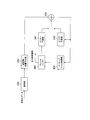
- FIG. 4 is a diagram showing an example of a functional block of the image decoding apparatus 200 according to the present embodiment.
- the image decoding device 200 includes a decoding unit 210, an inverse transformation / inverse quantization unit 220, an adder 230, an inter-prediction unit 241 and an intra-prediction unit 242, and an in-loop filter processing unit. It has 250 and a frame buffer 260.
- the decoding unit 210 is configured to decode the coded data generated by the image coding device 100 and decode the coefficient level value.
- the decoding is, for example, the entropy decoding in the reverse procedure of the entropy coding performed by the coding unit 140.
- the decoding unit 210 may be configured to acquire the control data by the decoding process of the coded data.
- control data may include size data such as a coded block size, a predicted block size, and a conversion block size.
- the inverse transformation / inverse quantization unit 220 is configured to perform the inverse transformation processing of the coefficient level value output from the decoding unit 210.
- the inverse transformation / inverse quantization unit 220 may be configured to perform inverse quantization of the coefficient level value prior to the inverse transformation processing.
- the inverse transformation process and the inverse quantization are performed in the reverse procedure of the conversion process and the quantization performed by the conversion / quantization unit 131.
- the adder 230 adds a prediction signal to the prediction residual signal output from the inverse conversion / inverse quantization unit 220 to generate a pre-filter processing decoding signal, and uses the pre-filter processing decoding signal as an intra prediction unit 242 and an in-loop. It is configured to output to the filter processing unit 250.
- the pre-filtered decoding signal constitutes a reference block used in the intra prediction unit 242.
- the inter-prediction unit 241 is configured to generate a prediction signal by inter-prediction (inter-frame prediction).
- the inter-prediction unit 241 is configured to generate a prediction signal for each prediction block based on the motion vector decoded from the coded data and the reference signal included in the reference frame.
- the inter-prediction unit 241 is configured to output a prediction signal to the adder 230.
- the intra prediction unit 242 is configured to generate a prediction signal by intra prediction (in-frame prediction).
- the intra prediction unit 242 is configured to specify a reference block included in the target frame and generate a prediction signal for each prediction block based on the specified reference block.
- the intra prediction unit 242 is configured to output a prediction signal to the adder 230.
- the in-loop filter processing unit 250 performs filter processing on the pre-filter processing decoding signal output from the adder 230, and outputs the post-filter processing decoding signal to the frame buffer 260. It is configured to do.
- the filtering process is a deblocking filtering process that reduces the distortion that occurs at the boundary portion of a block (encoded block, prediction block, conversion block, or sub-block that divides them).
- the frame buffer 260 is configured to store reference frames used by the inter-prediction unit 241.
- the decoded signal after filtering constitutes a reference frame used by the inter-prediction unit 241.
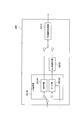
- FIG. 5 is a diagram showing an example of a functional block of the inter-prediction unit 241 according to the present embodiment.
- the inter-prediction unit 241 has an mv decoding unit 241A, an mv refinement unit 241B, and a prediction signal generation unit 241C.
- the inter-prediction unit 241 is an example of a prediction unit configured to generate a prediction signal included in a prediction block based on a motion vector.
- the mv decoding unit 241A has an AMVP unit 241A1 and a merge unit 241A2, and obtains a motion vector by decoding a target frame and a reference frame input from the frame buffer 260 and control data received from the image coding device 100. It is configured to get.
- the AMVP unit 241A1 is configured to receive the target frame and the reference frame, the index indicating mvp and mvd, Refidx, from the image coding device 100, and decode the motion vector.
- the motion vector decoding method a known method can be adopted, and the details thereof will be omitted.
- the merging unit 241A2 is configured to receive the merging index from the image coding device 100 and decode the motion vector.
- the merge unit 241A2 is configured to construct a merge list in the same manner as the image coding apparatus 100 and acquire the motion vector corresponding to the received merge index from the constructed merge list. .. The details of how to construct the merge list will be described later.
- the mv refinement unit 241B is configured to execute a refinement process for modifying the motion vector, similarly to the mv refinement unit 111B.
- the prediction signal generation unit 241C is configured to generate a prediction signal based on a motion vector, similarly to the prediction signal generation unit 111C.
- Non-Patent Document 1 the known technique described in Non-Patent Document 1 can be used in the present embodiment, and thus the description thereof will be omitted.
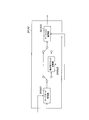
- FIGS. 6 and 7 are diagrams showing an example of functional blocks of the merge unit 111A2 of the inter-prediction unit 111 of the image coding device 100 and the merge unit 241A2 of the inter-prediction unit 241 of the image decoding device 200 according to the present embodiment. ..
- the merge unit 111A2 includes a merge mode specific unit 111A21, a geometric block division unit 111A22, and a merge list construction unit 111A23.
- the merge unit 241A2 includes a merge mode specific unit 241A21, a geometric block division unit 241A22, and a merge list construction unit 241A23.
- merge unit 111A2 The difference between the merge unit 111A2 and the merge unit 241A2 is that the merge mode specific unit 111A21 and the merge mode specific unit 241A21, the geometric block division unit 111A22 and the geometric block division unit 241A22, the merge list construction unit 111A23 and the merge list construction unit 241A23 The point is that the input and output of various indexes, which will be described later, are reversed.
- the merge mode specifying unit 241A21 is configured to specify whether or not the geometric block merge mode is applied to the target block divided into rectangles.
- the merge mode includes, for example, normal merge, subblock merge, MMVD (Merge mode with MVD), CIIP (Combined inter and intraprescription), and IBC (IBC), which are adopted in Non-Patent Document 1. Intra Block Copy) and so on.
- MMVD Merge mode with MVD
- CIIP Combined inter and intraprescription
- IBC IBC
- the geometric block division unit 241A22 is configured to specify the geometric block division pattern of the rectangularly divided target block and divide the target block into geometric blocks using the specified division pattern. The details of the method for specifying the geometric block division pattern will be described later.
- the merge list construction unit 241A23 is configured to construct a merge list for the target block and decode the motion information.
- the merge list construction process consists of three stages: motion information availability confirmation process, motion information registration / pruning process, and motion information decoding process, the details of each of which will be described later.
- FIGS. 8 to 10 are flowcharts showing an example of a method of specifying whether or not the geometric block division merge is applied in the merge mode specifying unit 241A21.
- the merge mode specific unit 241A21 applies the geometric block partition merge when the normal merge is not applied and the CIIP is not applied (the merge mode of the target block is divided into geometric blocks). It is configured to identify as a merge).
- step S7-1 the merge mode specifying unit 241A21 specifies whether or not the normal merge is applied, and if it is specified that the normal merge is applied, the process proceeds to step S7-5. , If it is specified that the normal merge is not applied, the process proceeds to step S7-2.
- step S7-2 the merge mode specifying unit 241A21 specifies whether or not CIIP is applied, proceeds to step S7-3 when specifying that CIIP is applied, and in step S7- when specifying that CIIP is not applied. Proceed to 4.
- the merge mode specifying unit 241A21 may skip step S7-2 and proceed directly to step S7-4. This usually means identifying the merge mode of the target block as a geometric block partition merge when merging is not applicable.
- step S7-3 the merge mode specifying unit 241A21 specifies that CIIP is applied to the target block (the merge mode of the target block is CIIP), and ends this process.
- the image coding device 100 and the image decoding device 200 have a specific result of whether or not the geometric block division merge is applied to the target block as internal parameters.
- step S7-4 the merge mode specifying unit 241A21 specifies that the geometric block division merge is applied to the target block (the merge mode of the target block is the geometric block division merge), and ends this process.
- step S7-5 the merge mode specifying unit 241A21 specifies that a normal merge is applied to the target block (the merge mode of the target block is a normal merge), and ends this process.
- step S7-2 is replaced by a merge other than CIIP in the future
- the merge mode specifying unit 241A21 responds to the determination result of the applicability of the replaced merge. Therefore, it may be specified whether or not the geometric block division merge is applied.
- the merge mode specifying unit 241A21 will be used for the added merge.
- whether or not the geometric block division merge is applied may be specified.
- step S7-1 the conditions for determining whether or not the normal merge of step S7-1 is applied will be described.
- step S7-1-1 the merge mode specifying unit 241A21 normally determines whether or not the merge flag needs to be decrypted.
- step S7-1-1-1 determines whether the merge mode specifying unit 241A21 satisfies the determination condition of step S7-1-1, that is, when it is determined that the normal merge decoding is necessary.
- the merge mode specifying unit 241A21 proceeds to step S7-1-2 and satisfies step S7-1-1. If it is determined that there is no such thing, that is, decoding of the normal merge is unnecessary, the process proceeds to step S7-1-3.
- the merge mode specifying unit 241A21 determines that the merge flag does not need to be decrypted, it indicates whether or not the target block is inter-predicted by merging, as in the method described in Non-Patent Document 1. And the value of the normal merge flag can be estimated based on the subblock merge flag indicating whether or not the subblock merge is applied.
- Non-Patent Document 1 As for such an estimation method, the same method as that described in Non-Patent Document 1 can be used in the present embodiment, and thus the description thereof will be omitted.
- the decoding necessity determination condition of the normal merge flag in step S7-1-1 is composed of a CIIP applicability determination condition and a geometric block merge applicability determination condition. Specifically, it is as follows. --CIIP applicability judgment conditions: (1) The area of the target block is 64 pixels or more.
- the height of the target block is less than 128 pixels.
- --Applicability of geometric block merge Judgment condition (1) The area of the target block is 64 pixels or more.
- the maximum number of merge indexes that can be registered in the merge list for geometric block division merge (hereinafter, the maximum number of geometric block division merge candidates) is greater than 1.
- the width of the target block is 8 pixels or more.
- the height of the target block is 8 pixels or more.
- the slice type including the target block is a B slice (bi-predicted slice).
- the merge mode specifying unit 241A21 determines that CIIP is applicable when all of the above conditional expressions (1) to (5) are satisfied in the CIIP applicability determination condition, and in other cases, CIIP. Is not applicable.
- the merge mode specifying unit 241A21 applies the geometric block division merge when all of the above conditional expressions (1) and (6) to (10) are satisfied in the applicability determination condition of the geometric block merge. It is determined that it is possible, otherwise it is determined that the geometric block split merge is not applicable.
- conditional expressions (1) and (6) to (10) Details of the conditional expressions (1) and (6) to (10) will be described later.
- the merge mode specifying unit 241A21 is one of the above-mentioned CIIP applicability determination condition or geometric block division merge applicability determination condition among the decoding necessity determination conditions of the normal merge flag in step S7-1-1. If one is satisfied, the process proceeds to step S7-1-2, and if neither is satisfied, the process proceeds to step S7-1-3.
- the CIIP applicability determination condition may be excluded from the decoding necessity determination condition of the normal merge flag in step S7-1-1. This means that only the applicability judgment condition of the geometric block division merge is added in the decoding necessity judgment condition of the normal merge flag.
- step S7-1-2 the merge mode specifying unit 241A21 usually decodes the merge flag and proceeds to step S7-1-3.
- step S7-1-3 the merge mode specifying unit 241A21 determines whether or not the value of the normal merge flag is 1, and if it is 1, the process proceeds to step S7-5, and if it is not 1, the process proceeds to step S7. Go to -2.
- step S7-2-1 the merge mode specifying unit 241A21 determines whether or not the CIIP flag needs to be decrypted.
- step S7-2-1 determines that the CIIP flag needs to be decrypted
- the merge mode specifying unit 241A21 proceeds to step S7-2-2 and does not satisfy step S7-2-1. That is, when it is determined that the decoding of the CIIP flag is unnecessary, the process proceeds to step S7-2-3.
- the merge mode specifying unit 241A21 determines that the CIIP flag does not need to be decrypted
- the merge mode specifying unit 241A21 estimates the value of the CIIP flag as follows.
- the merge mode specifying unit 241A21 treats CIIP as valid if all of the following conditions are met, that is, the value of the CIIP flag is 1, otherwise CIIP is invalid, that is, The value of the CIIP flag is treated as 0.
- the area of the target block is 64 pixels or more.
- the width of the target block is less than 128 pixels.
- the height of the target block is less than 128 pixels.
- the condition for determining whether or not the CIIP flag of the CIIP flag in step S7-2-1 needs to be decrypted is composed of the above-mentioned CIIP applicability determination condition and the geometric block division merge enableability determination condition.
- the merge mode specifying unit 241A21 proceeds to step S7-2-2 when both the CIIP applicability condition and the geometric block division merge enableability determination condition are satisfied, and when neither of them is satisfied, step S7. -Proceed to 2-3.
- step S7-2-1 since it has already been determined that the conditional expression (1) is satisfied by the decoding necessity determination condition of the normal merge flag before entering the CIIP flag decoding necessity determination condition, it is excluded from step S7-2-1. May be good.
- step S7-2-2 the merge mode specifying unit 241A21 decodes the CIIP flag and proceeds to step S7-1-3.
- step S7-2-3 the merge mode specifying unit 241A21 determines whether or not the value of the CIIP flag is 1, and if it is 1, the process proceeds to step S7-3, and if it is not 1, step S7- Proceed to 4.
- the lower limit of the width of the target block is set to 8 pixels or more.
- the lower limit of the height of the target block is set to 8 pixels or more.
- Geometric block division merge requires two different motion information as described above, and the two different motion information is linked to two different merge indexes registered in the merge list in the merge list construction unit. Identify (decode) from the motion information. Therefore, if the maximum number of candidates for geometric block partitioning merge is designed or specified to be 1 or less, it can be specified that geometric block partitioning merge is not applicable to the target block, so geometric block partitioning merge maximum. It is assumed that the parameter for calculating the number of candidates is held inside the geometric block partitioning section.
- the maximum number of candidates for this geometric block split merge may be the same as the maximum number of merge indexes that can be registered in the merge list for normal merge (hereinafter referred to as the maximum number of merge candidates), or in order to use a different value.
- a flag that defines how many candidates should be reduced from the maximum number of merge candidates may be transmitted from the image coding device 100 to the image decoding device 200, and the flag may be decoded to decode the flag.
- the block size (upper limit) or block aspect ratio of the target block is further restricted. Judgment by may be added.
- the reason why the upper limit of the height and the width is set to 64 pixels or less is that the pipeline processing unit of the image decoding apparatus 200 called the virtual pipeline data unit (VPDU: Virtual Pipeline Data Units) adopted in Non-Patent Document 1 is used. This is to avoid a constraint violation to maintain.
- VPDU Virtual Pipeline Data Units
- Non-Patent Document 1 since the size of the VPDU is set to 64 ⁇ 64 pixels, the upper limit of the applicable range of the geometric block division merge is set to 64 pixels.
- the upper limit may be set to a smaller upper limit, for example, 32 pixels or less, at the intention of the designer.
- the MC prediction image signal generated based on two different motion vectors having across the geometric block division boundary is transferred from the geometric block division boundary. Generated using a blending mask table weighted by distance.
- the size of the blending mask table can be reduced, and the blending that needs to be held in the memory of the image encoding device 100 and the image decoding device 200. It is desirable for implementation that the size of the mask table can be reduced to reduce the recording capacity of the memory.
- the aspect ratio of the target block specified to which the geometric block partitioning merge is applicable is, for example, an aspect ratio of 4 or less.
- Elongated rectangular blocks with an aspect ratio of 8 or more are unlikely to occur in natural images. Therefore, if the application of the geometric block division merge is prohibited for such a rectangular block, the number of variations of the division shape of the geometric block division described later (the position and direction of the geometric block division boundary in the rectangular block) can be determined. It is possible to reduce the number of variations of the specified parameters), and the image coding device 100 and the image decoding device 200 have the effect of reducing the recording capacity of the parameters for specifying the variations.
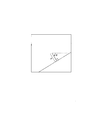
- FIG. 11 is a diagram showing an example of a method for defining a geometric block division pattern according to the present embodiment.
- the geometric block division pattern is, for example, as shown in FIG. 11, from the position of the geometric block division boundary line, that is, from the center point (hereinafter, center point) of the rectangularly divided target block to the geometric block division boundary line (hereinafter, the center point).
- center point the center point of the rectangularly divided target block to the geometric block division boundary line (hereinafter, the center point).
- it may be specified by two parameters of the distance ⁇ to the division boundary line) and the elevation angle ⁇ from the horizontal direction in the perpendicular line from the center point with respect to the division boundary line.
- the combination of the distance ⁇ and the elevation angle ⁇ may be transmitted from the image coding device 100 (merging unit 111A2) to the image decoding device 200 (merging unit 241A2) using the index.
- the more variations of the combination of the distance ⁇ and the angle ⁇ that define the geometric block division pattern the more the prediction error can be expected to be reduced, but on the other hand, the processing time required to specify the combination of the distance ⁇ and the elevation angle ⁇ . Since there is a trade-off between the increase in the code length and the increase in the code length of the index to indicate such a combination, the distance ⁇ and the elevation angle ⁇ quantized by the designer's intention may be used.
- the quantized distance ⁇ may be designed in predetermined pixel units, for example.
- the quantized elevation angle ⁇ may be designed, for example, at an angle obtained by equally dividing 360 degrees.
- FIG. 12 is a diagram showing an example of changing the elevation angle ⁇ that defines the above-mentioned geometric block division pattern.
- the elevation angle ⁇ may be defined by using the aspect ratio of the target block and the horizontal / vertical directions.
- the elevation angle ⁇ can be expressed using an inverse tangent function.
- a total of 24 different elevation angles ⁇ are defined.
- FIG. 13 is a diagram showing an example of changing the position (distance ⁇ ) that defines the above-mentioned geometric block division pattern.
- the distance ⁇ is defined as the perpendicular distance from the center point of the target block to the division boundary line, but in this modification example, the center point is included as shown in FIG. ,
- the distance ⁇ may be defined as a predetermined distance (predetermined position) in the horizontal direction or the vertical direction from the center point.
- the distance ⁇ is defined in two ways according to the block aspect ratio of the target block.
- the distance ⁇ may be specified only in the horizontal direction with respect to the horizontally long block.
- the distance ⁇ may be specified only in the vertical direction with respect to the vertically long block.
- the vertical and horizontal distances ⁇ are set, respectively. May be specified.
- the distance ⁇ may be specified in either the horizontal direction or the vertical direction, or both. Further, as shown in FIG. 13, the distance ⁇ may have variations with respect to a predetermined distance (predetermined position) obtained by dividing the width or height of the target block into eight equal parts.
- the width or height of the target block is 0/8 times, 1/8 times, 2/8 times, and 3 in the horizontal direction (horizontal direction) or vertical direction (vertical direction) from the center point.
- the distance ⁇ is defined as the distance (position) multiplied by / 8.
- the effect of increasing the number of variations of the geometric block division pattern by defining the distance ⁇ in the side direction is compared with the effect of increasing the variation of the geometric block division pattern by specifying the distance ⁇ in the long side direction. Because it is small.
- the division boundary line by the geometric block division can be designed as a perpendicular line with respect to the elevation angle ⁇ through the division boundary line and the point at the predetermined distance (predetermined position) ⁇ defined as described above.
- this modification 3 can be combined with the modification 2 described above, and the perpendicular line with respect to the distance ⁇ described above is the same for the angle of 180 degree pair at the elevation angle ⁇ , that is, the division boundary line is set. Be the same.
- the elevation angle ⁇ in the range of 0 degrees or more and less than 180 degrees and the elevation angle ⁇ in the range of 180 degrees or more and less than 360 degrees are left and right with the center point as axisymmetric as shown in FIG.
- the elevation angle ⁇ in the range of 0 degrees or more and less than 180 degrees and the elevation angle ⁇ in the range of 180 degrees or more and less than 360 degrees are left and right with the center point as axisymmetric as shown in FIG.
- the range of the elevation angle ⁇ and the horizontal direction (horizontal direction) and the vertical direction (combination with the vertical direction) of the distance ⁇ show the same variation of the geometric block division pattern even if they are reversed. You may change the implementation to.
- FIG. 14 is a diagram showing a modified example of the method of defining the elevation angle ⁇ and the distance ⁇ .
- the elevation angle ⁇ passes through a point at a predetermined distance (position) ⁇ .
- the line indicated by may be defined as the division boundary line itself and implemented.
- the variation of the distance ⁇ and the variation of the elevation angle ⁇ may be reduced as shown in FIGS. 14A to 14C.
- the variation of the distance ⁇ shown in the above-mentioned modification 3 is divided into two types, 0/8 times the width or height of the target block or 2/8 times the width or height of the target block. Limited.
- the possible values of the variation of the elevation angle ⁇ are limited according to the position where the division boundary line passes and the block aspect ratio of the target block.
- the variation of the geometric block division pattern is limited to a total of 16 ways.
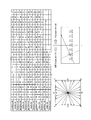
- FIG. 15 is a diagram showing an example of an index table showing a combination of an elevation angle ⁇ and a distance (position) ⁇ that define the geometric block division pattern described above.
- the elevation angle ⁇ and the distance ⁇ that define the geometric block division pattern are associated with “angle_idx” and “distance_idx”, respectively, and their combinations are further defined by “partition_idx”.
- the elevation angle ⁇ and the distance ⁇ shown in the above-mentioned modification 2 and 3 are integers of 0 to 23 and 0 to 3 in "angle_idx" and “geometry_idx”, respectively, as shown in the table of FIG.
- angle_idx integers of 0 to 23 and 0 to 3 in "angle_idx” and “geometry_idx”, respectively, as shown in the table of FIG.
- the image coding device 100 and the image decoding device 200 each have an index table showing such a geometric block division pattern, and the image coding device 100 has the geometric block having the lowest coding cost when the geometric block division is enabled.
- the "partition_idx" corresponding to the division pattern is transmitted to the image decoding device 200, and the geometric block division unit 241A22 of the image decoding device 200 decodes the "partition_idx".
- FIG. 16 is a diagram for explaining an example of controlling the decoding method of “partition_idx” according to the block size or block aspect ratio of the target block.
- a method of controlling the decoding method of "partition_idx" according to the block size or aspect ratio of the target block to further improve the coding efficiency can be considered as follows.
- the division boundary line between a relatively small block such as an 8 ⁇ 8 pixel block and a relatively large block such as a 32 ⁇ 32 pixel block Even if the number of variations of is the same, the roughness density of the division boundary line with respect to the area of the block may be different.
- the index table used to specify the elevation angle ⁇ and the distance ⁇ from “partition_idx” may be changed according to the block size or block aspect ratio of the target block.
- the index table with a small number of geometric block division patterns that is, the maximum value of "partition_idx"
- the geometric block division pattern is used.
- the correlation between the size of the block size and the number of geometric block division patterns may be reversed.
- the index table with a large number of geometric block partitioning patterns that is, the maximum value of "partition_idx"
- the geometric block partitioning is used.
- An index table with a small number of patterns, that is, a small maximum value of "partition_idx” may be used.
- the roughness density of the division boundary line can be made uniform even if the block size of the target block is different.
- the probability that the division boundary line by geometric block division can be aligned with respect to the object boundary generated in the target block can be made uniform for each block size.
- the number of geometric block division patterns may be increased in the horizontal direction, and conversely, the number of geometric block division patterns may be decreased in the vertical direction.
- the number of geometric block division patterns may be increased in the horizontal direction, and conversely, the number of geometric block division patterns may be decreased in the vertical direction.
- the correlation between the magnitude of the block aspect ratio and the number of geometric block division patterns may be reversed as shown in the above description of the magnitude of the block size and the number of geometric block division patterns.
- the number of geometric block division patterns may be reduced in the horizontal direction, and conversely, the number of geometric block division patterns may be increased in the vertical direction.
- the number of geometric block division patterns may be reduced in the horizontal direction, and conversely, the number of geometric block division patterns may be increased in the vertical direction.
- the method of controlling the number of geometric block division patterns according to this block aspect ratio can be realized by changing the index table to be used, as in the above case.
- index table itself is fixed, it is conceivable to limit the range of the value of "partition_idx" that can be decoded on the index table according to the block size or aspect ratio of the target block.
- the movement information availability confirmation process is the first process step that constitutes the merge list construction process.
- the motion information availability confirmation process confirms whether or not there is motion information in the reference block spatially or temporally adjacent to the target block.
- the known method described in Non-Patent Document 1 can be used in the present embodiment, and thus the description thereof will be omitted.
- FIG. 17 is a flowchart showing an example of motion information registration / pruning processing in the merge list according to the present embodiment.
- the motion information registration / pruning process according to the present embodiment may be configured by a total of five motion information registration / pruning processes as in Non-Patent Document 1.
- the motion information registration / pruning process includes spatial merging in step S14-1, time merging in step S14-2, history merging in step S14-3, pairwise average merging in step S14-4, and step S14-. It may be composed of 5 zero merges. Details of each process will be described later.
- FIG. 18 is a diagram showing an example of a merge list constructed as a result of motion information registration / pruning processing in the merge list.
- the merge list is a list in which movement information corresponding to the merge index is registered.
- the maximum number of merge indexes is set to 5 in Non-Patent Document 1, but it may be freely set according to the intention of the designer.
- mvL0, mvL1, RefIdxL0, and RefIdxL1 in FIG. 18 indicate motion vectors and reference image indexes of the reference image lists L0 and L1, respectively.
- the reference image lists L0 and L1 indicate a list in which the reference frame is registered, and the reference frame is specified by RefIdx.
- motion vector and the reference image index of both L0 and L1 are shown in the merge list shown in FIG. 18, it may be a one-sided prediction depending on the reference block.
- one (one-sided prediction) motion vector and one reference image index are registered in the list. If it is confirmed by the above-mentioned motion information availability confirmation process that the motion information does not exist in the reference block in the first stage of each process from step S15-1 to step S15-4, each process is skipped. ..
- FIG. 19 is a diagram for explaining spatial merging.
- Spatial merging is a technology that inherits mv, RefIdx, and hpelIfIdx from adjacent blocks that exist in the same frame as the target block.
- the merge list construction unit 241A23 is configured to inherit the above-mentioned mv, Refidx, and hpelfIdx from the adjacent blocks having a positional relationship as shown in FIG. 15 and register them in the merge list.
- Order of processing may be the order of B 1 ⁇ A 1 ⁇ B 0 ⁇ A 0 ⁇ B 2 as shown in FIG. 19.
- the motion information registration process in the merge list may be performed in the above-mentioned processing order, but Non-Patent Document 1 so that the same motion information as the motion information already registered is not registered in the merge list. Similarly, the pruning process of motion information may be implemented.
- the purpose of implementing the motion information pruning process is to increase the variation of the motion information registered in the merge list, and from the viewpoint of the image coding apparatus 100, the motion information having the smallest predetermined cost according to the image characteristics is obtained. There is a point that can be selected.
- the image decoding device 200 can generate a prediction signal with high prediction accuracy by using the motion information selected by the image coding device 100, and as a result, an effect of improving the coding performance can be expected.
- the motion information pruning process for spatial merging for example, when the motion information corresponding to B 1 is registered in the merge list, the motion information corresponding to A 1 in the next processing order is registered in the registered B 1 at the time of the registration process.
- the identity with the corresponding motion information is confirmed.
- the confirmation of the identity of the motion information is a comparison of whether mv and RefIdx are the same.
- the motion information corresponding to A 1 is not registered in the merge list.
- the motion information corresponding to B 0 is compared with the motion information corresponding to B 1
- the motion information corresponding to A 0 is compared with the motion information corresponding to A 1
- the motion information corresponding to B 2 is B 1 It is configured to be compared with the motion information corresponding to a 1 and. If the motion information corresponding to the position to be compared does not exist, the confirmation of the identity may be skipped and the corresponding motion information may be registered.
- Non-Patent Document 1 and set the registered maximum possible number of merge indices by the spatial merge 4 and, with respect to the adjacent block B 2, the spatial merging process so far, already four motion information in the merge list If it is registered, the processing of the adjacent block B 2 is skipped.
- the processing of the adjacent block B 2 may be determined by the number of existing motion information registrations.
- FIG. 20 is a diagram for explaining time merging.
- the time merge exists in a frame different from the target block, but moves by identifying the adjacent block at the lower left at the same position (C 1 in FIG. 17) or the block at the same position (C 0 in FIG. 17) as the reference block. It is a technology that inherits vectors and reference image indexes.
- the maximum number of motion information registered in the merge list by the time merge list is 1 in Non-Patent Document 1, and the same value may be used in the present embodiment or changed by the intention of the designer. May be done.
- FIG. 21 is a diagram showing the scaling process.
- the reference block is based on the distance tb between the reference frame of the target block and the frame in which the target frame exists and the distance td between the reference frame of the reference block and the reference frame of the reference block.
- Mv is scaled as follows.
- FIG. 22 is a diagram for explaining the history merge.
- the motion information of the inter-prediction block encoded in the past than the target block is separately recorded in a recording area called the history merge table, and at the end of the above-mentioned spatial merge and time merge processes, When the number of motion information registered in the merge list has not reached the maximum number, the motion information registered in the history merge table is sequentially registered in the merge list.
- FIG. 22 is a diagram showing an example of processing in which movement information is registered in the merge list by the history merge table.
- the motion information registered in this history merge table is managed by the history merge index, and the maximum number of registrations is 6 in Non-Patent Document 1, but the same value may be used or the designer. It may be changed according to the intention of.
- Non-Patent Document 1 employs FIFO processing for the process of registering motion information in this history merge table.
- the motion information associated with the last registered history merge index is deleted, and the motion information associated with the new history merge index is released. It is configured to be registered sequentially.
- the motion information registered in the history merge table may be initialized (all motion information is deleted from the history merge table) when the target block straddles the CTU, as in Non-Patent Document 1.
- Pairwise average merging is a technique for generating new motion information and registering it in the merge list by using motion information associated with two sets of merge indexes already registered in the merge list.
- the 0th and 1st merge indexes registered in the merge list may be fixedly used or designed as in Non-Patent Document 1. You may change to another combination of two sets at your own will.
- the movement information associated with the two sets of merge indexes already registered in the merge list is averaged to generate new movement information.
- the motion vectors in the L0 and L1 directions mvL0P 0 / mvL0P 1 , mvL1P 0 / mvL1P.
- the motion vector mvL0Avg / mvL1Avg of the pairwise average merge is calculated as follows.
- mvL0Avg (mvL0P 0 + mvL0P 1 ) / 2
- mvL1Avg (mvL1P 0 + mvL1P 1 ) / 2
- the non-existing vector is calculated as a zero vector as described above.
- Non-Patent Document 1 stipulates that the reference image index associated with the pairwise average merge index is always used as the reference image index RefIdxL0P 0 / RefIdxL0P 1 associated with the merge index P 0. (Zero merge)
- the zero merge is a process of adding a zero vector to the merge list when the number of registered movement information of the merge list has not reached the maximum number of registrations at the end of the above-mentioned pairwise average merge process.
- the registration method the known method described in Non-Patent Document 1 can be used in the present embodiment, and thus the description thereof will be omitted.
- the merge list construction unit 241A23 is configured to decode motion information from the merge list constructed after the above-mentioned motion information registration / pruning process is completed.
- the merge list construction unit 241A23 has a configuration in which motion information corresponding to the merge index transmitted from the merge list construction unit 111A23 is selected from the merge list and decoded.
- the method of selecting the merge index in the merge list construction unit 111A23 is not shown, the movement information with the lowest coding cost is transmitted to the merge list construction unit 241A23.
- the merge index is registered in the merge list earlier, that is, the merge index having a smaller index number has a shorter code length (because the coding cost is smaller), so that the merge list construction unit 111A23 Merge indexes with smaller index numbers tend to be selected more easily.
- the merge list construction unit 241A23 when the geometric block division merge is invalid, one merge index is decoded for the target block, but when the geometric block merge is valid, the target block is decoded. Since there are two regions m / n straddling the geometric block partition boundary, two different merge indexes m / n are decoded.
- xCb and yCb are position information of the pixel value located at the upper left of the target block.
- merge_idx1 if the maximum number of merge candidates for geometric block partition merge is 2 or less, it is not necessary to decode it. This is because when the maximum number of merge candidates for geometric block split merge is 2 or less, the merge index in the merge list corresponding to merge_idx1 is different from the merge index in the merge list selected by merge_idx0. This is because it is specified by one merge index.
- Modification 6 Control of merge list construction when geometric block partition merge is enabled
- modification 6 of the present invention will be described with reference to FIGS. 23 and 24, focusing on the differences from the second embodiment described above. Specifically, with reference to FIGS. 23 and 24, the control of the merge list construction when the geometric block division merge is valid according to this modification example will be described.
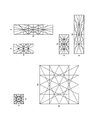
- FIGS. 23 and 24 are diagrams showing an example of the geometric block division pattern in the target block when the geometric block division merge is enabled, and an example of the positional relationship between the spatial merge and the time merge with respect to the target block.
- the adjacent block having the closest movement information to the two regions m / n straddling the block division boundary line becomes B 2 for m.
- n it becomes B 1 / A 1 / A 0 / B 0 / C 1 .
- the adjacent block having the closest motion information to the two regions m / n straddling the division boundary is C 1 for m.
- n it becomes B 1 / A 0 / A 1 / B 0 / B 2 .
- the priority of registering motion information in spatially similar positions such as B 1 / B 0 and A 1 / A 0 in the merge list is lowered, and B 2 and C 1 etc. Adding motion information at different spatial positions to the merge list can be expected to further improve the prediction accuracy.
- the coding efficiency can be improved.
- the motion information whose registration priority to the merge list is to be changed is the motion information of B 0 and A 0
- the motion information exists at these positions in the motion information availability confirmation process. Even when it is confirmed, by treating the motion information as unusable, the probability of registering the motion information corresponding to B 2 and C 1 following B 0 and A 0 in the merge list can be increased.
- the processing order of the spatial merge in step S14-1 and the time merge in step S14-2 of the merge list shown in FIG. 17 is decomposed. Then, the order of registration of motion information may be changed directly.
- B 2 of spatial merging and motion information C 1 or C 0 (hereinafter referred to as Col) registered by time merging are B 0 and A during spatial merging. Perform before 0.
- availableFlag is an internal parameter that holds the judgment result of the above-mentioned movement information availability confirmation processing for each merge candidate of spatial merge and time merge. When the parameter is 0, there is no motion information, and when it is 1, it indicates that there is motion information.
- mergeCandList shows the registration process of motion information at each position.
- merge_geo_flag the geometric block split merge is applied. If it is judged not to be applied, it enters the merge list construction process similar to normal merge, and if it is judged to be applied, it moves from normal merge. Enter the merge list construction process of the geometric block division merge in which the information availability confirmation process and the motion information registration / pruning process are exchanged.
- the total number of processing stages increases for the implementation example 1, but since the merge list for geometric block partitioning merge is partially shared with the normal merge list, it is complete as in the implementation example 1. Has the advantage that it does not have to have the resources of an independent merge list construction processing circuit.
- the registration priority of B 2 and Col is higher than that of B 0 and A 0 , but the registration priority of B 2 and Col is higher than that of B 1 and A 1. You may.
- either B 2 or Col may have a higher priority than B 0 and A 0 , or may have a higher priority than B 1 and A 1. Good.
- the motion B 2 is to register for the merge list before B 1, A 1, B 0 , A 0, which corresponds to B 1, A 1, B 0 , A in B 2 shown in the above Confirmation of identity with information (comparison condition) may be abolished.
- the identity confirmation with the motion information corresponding to B 2 may be added.
- the registration priority may be changed by the method described below.
- the motion information in the merged list building completed for a given merge processing and a predetermined position, for example, a merge index number of motion information registered by the spatial merging B 0 and A0, merging the index number and order changes to the time merge Col
- the time merge Col can have a higher priority than the spatial merges B 0 and A 0 (a correspondence to a small merge index number can be realized).
- the merge list construction process when geometric block division merge is enabled is shared with the merge list construction process in normal merge. can do.
- the determination criterion may be determined based on the geometric block division pattern, or may be determined based on the block size and aspect ratio of the target block.
- the target block has two different motion information across the division boundary line. Further, for these two different motion information, the one having the lowest coding cost is selected from the above-mentioned merge list by the coding apparatus 100, and two merge indexes merge_geo_idx0 and merge_geo_idx1 for each division area m / n are used. As described above, the merge index number of the merge list is specified and transmitted to the image decoding device 200 to decode the corresponding motion information.
- the following is an example of the selection method.
- it is a method of setting the priority of the motion information to be decoded in advance in the numerical order of the merge index of the merge list.
- the processing order of the merge index numbers for example, even numbers 0, 2, and 4 give priority to decoding the motion information registered in L0 of the merge index, and are odd numbers 1, 3, and so on.
- the merge index of 5 gives priority to decoding the motion information registered in L1.
- the distances of the reference frames indicated by the reference indexes corresponding to L0 and L1 may be compared with respect to the target frame including the target block, and the motion information including the reference frames having a short distance may be preferentially decoded.
- the priority set in advance for the merge index number of the merge list that is, the even number, is used as described above.
- Some 0, 2, and 4 may give priority to the motion information registered in L0
- the odd numbers 1, 3, and 5 may give priority to the motion information registered in L1.
- the priority may be determined as described above.
- the merge index number of the merge list may be the opposite of the one selected by the previous index number.
- L0 when L0 is selected as the 0th merge index of the merge index, L1 which is the opposite list may be selected as the 1st merge index of the merge list. If the merge index is 0th in the merge list and the frame distance difference is the same, L0 may be referred to.
- the target block has two different motion information across the division boundary line.
- the motion compensation prediction signal generated based on the two different motion vectors is weighted and averaged (blended) with a weight depending on the distance from the division boundary line for the target block, so that the pixels with respect to the division boundary line are obtained.
- a value smoothing effect can be expected.
- the above-mentioned weights can be obtained, for example, if the geometric block division pattern can be specified by having the image coding device 100 and the image decoding device 200 have one weight table (blending table) for one geometric block division pattern. , Blending processing suitable for geometric block division pattern can be realized.
- the merge list construction unit 111A2 cannot use the above-mentioned motion information at the time of the motion information availability confirmation process, regardless of the existence of the motion information for the predetermined merge process, depending on whether the geometric block division merge is applied or not. It may be configured to be treated as.
- the merge list construction unit 111A2 sets the motion information for the predetermined merge process to the same as the motion information already registered in the merge list at the time of motion information registration / pruning process, depending on whether or not the geometric block division merge is applied. Regardless of this, it may be treated as a pruning target, that is, it may be configured not to be newly registered in the merge list.
- the above-mentioned image coding device 100 and image decoding device 200 may be realized by a program that causes a computer to execute each function (each process).
- the present invention has been described by taking application to the image coding device 100 and the image decoding device 200 as an example, but the present invention is not limited to this, and the image coding is not limited to this. The same applies to an image coding system and an image decoding system having the functions of the device 100 and the image decoding device 200.
Landscapes
- Engineering & Computer Science (AREA)
- Multimedia (AREA)
- Signal Processing (AREA)
- Compression Or Coding Systems Of Tv Signals (AREA)
Priority Applications (7)
| Application Number | Priority Date | Filing Date | Title |
|---|---|---|---|
| CN202411393680.8A CN119277068A (zh) | 2019-12-26 | 2020-12-02 | 图像解码装置 |
| US17/615,543 US12615359B2 (en) | 2019-12-26 | 2020-12-02 | Image decoding device, image decoding method, and program |
| CN202411393472.8A CN119277065A (zh) | 2019-12-26 | 2020-12-02 | 图像解码装置 |
| CN202411393679.5A CN119277067A (zh) | 2019-12-26 | 2020-12-02 | 图像解码装置 |
| EP20904382.7A EP3989552A4 (en) | 2019-12-26 | 2020-12-02 | PICTURE DECODING DEVICE, PICTURE DECODING METHOD AND PROGRAM |
| CN202411393475.1A CN119277066A (zh) | 2019-12-26 | 2020-12-02 | 图像解码装置 |
| CN202080040283.6A CN113906745B (zh) | 2019-12-26 | 2020-12-02 | 图像解码装置、图像解码方法及程序 |
Applications Claiming Priority (2)
| Application Number | Priority Date | Filing Date | Title |
|---|---|---|---|
| JP2019-237278 | 2019-12-26 | ||
| JP2019237278A JP6931038B2 (ja) | 2019-12-26 | 2019-12-26 | 画像復号装置、画像復号方法及びプログラム |
Publications (1)
| Publication Number | Publication Date |
|---|---|
| WO2021131548A1 true WO2021131548A1 (ja) | 2021-07-01 |
Family
ID=76573044
Family Applications (1)
| Application Number | Title | Priority Date | Filing Date |
|---|---|---|---|
| PCT/JP2020/044804 Ceased WO2021131548A1 (ja) | 2019-12-26 | 2020-12-02 | 画像復号装置、画像復号方法及びプログラム |
Country Status (5)
| Country | Link |
|---|---|
| US (1) | US12615359B2 (https=) |
| EP (1) | EP3989552A4 (https=) |
| JP (3) | JP6931038B2 (https=) |
| CN (5) | CN119277065A (https=) |
| WO (1) | WO2021131548A1 (https=) |
Families Citing this family (4)
| Publication number | Priority date | Publication date | Assignee | Title |
|---|---|---|---|---|
| JP6931038B2 (ja) * | 2019-12-26 | 2021-09-01 | Kddi株式会社 | 画像復号装置、画像復号方法及びプログラム |
| US20250274581A1 (en) * | 2021-09-02 | 2025-08-28 | Electronics And Telecommunications Research Institute | Method, apparatus, and recording medium for encoding/decoding image by using geometric partitioning |
| JP7702228B2 (ja) * | 2022-07-01 | 2025-07-03 | Kddi株式会社 | 画像復号装置、画像復号方法及びプログラム |
| US12549742B2 (en) * | 2023-04-07 | 2026-02-10 | Nokia Technologies Oy | Region-based filtering |
Family Cites Families (22)
| Publication number | Priority date | Publication date | Assignee | Title |
|---|---|---|---|---|
| WO2011096770A2 (ko) * | 2010-02-02 | 2011-08-11 | (주)휴맥스 | 영상 부호화/복호화 장치 및 방법 |
| AU2015201569B2 (en) * | 2010-07-09 | 2016-08-11 | Samsung Electronics Co., Ltd. | Method and apparatus for encoding video by using block merging, and method and apparatus for decoding video by using block merging |
| KR101484281B1 (ko) * | 2010-07-09 | 2015-01-21 | 삼성전자주식회사 | 블록 병합을 이용한 비디오 부호화 방법 및 그 장치, 블록 병합을 이용한 비디오 복호화 방법 및 그 장치 |
| WO2013051209A1 (ja) * | 2011-10-05 | 2013-04-11 | パナソニック株式会社 | 画像符号化方法、画像符号化装置、画像復号方法、画像復号装置、および、画像符号化復号装置 |
| CN102547290B (zh) * | 2012-01-20 | 2013-12-18 | 厦门大学 | 一种基于几何分割的视频图像解编码方法 |
| KR101561461B1 (ko) * | 2012-11-27 | 2015-10-20 | 경희대학교 산학협력단 | 영상의 부호화/복호화 방법 및 이를 이용하는 장치 |
| JP5776711B2 (ja) * | 2013-03-06 | 2015-09-09 | 株式会社Jvcケンウッド | 画像復号装置、画像復号方法、画像復号プログラム、受信装置、受信方法、及び受信プログラム |
| US11039130B2 (en) * | 2016-10-28 | 2021-06-15 | Electronics And Telecommunications Research Institute | Video encoding/decoding method and apparatus, and recording medium in which bit stream is stored |
| WO2018092868A1 (ja) * | 2016-11-21 | 2018-05-24 | パナソニック インテレクチュアル プロパティ コーポレーション オブ アメリカ | 符号化装置、復号装置、符号化方法及び復号方法 |
| CN110024389B (zh) * | 2016-11-21 | 2023-05-09 | 松下电器(美国)知识产权公司 | 编码装置、解码装置、编码方法及解码方法 |
| US20180144521A1 (en) * | 2016-11-22 | 2018-05-24 | Qualcomm Incorporated | Geometric Work Scheduling of Irregularly Shaped Work Items |
| EP3632107A1 (en) * | 2017-06-30 | 2020-04-08 | Huawei Technologies Co., Ltd. | Encoder, decoder, computer program and computer program product for processing a frame of a video sequence |
| CN115118992B (zh) | 2017-08-22 | 2024-02-06 | 松下电器(美国)知识产权公司 | 图像编码器、图像解码器、和比特流生成设备 |
| CN112997489B (zh) * | 2018-11-06 | 2024-02-06 | 北京字节跳动网络技术有限公司 | 具有几何分割的帧间预测的边信息信令 |
| JP7277590B2 (ja) * | 2019-01-18 | 2023-05-19 | ウィルス インスティテュート オブ スタンダーズ アンド テクノロジー インコーポレイティド | モーション補償を用いたビデオ信号処理方法及び装置 |
| US11611759B2 (en) * | 2019-05-24 | 2023-03-21 | Qualcomm Incorporated | Merge mode coding for video coding |
| CN113950830B (zh) * | 2019-06-18 | 2025-03-18 | 韩国电子通信研究院 | 使用次级变换的图像编码/解码方法和装置 |
| CN114450946A (zh) * | 2019-07-23 | 2022-05-06 | 韩国电子通信研究院 | 通过使用几何分区对图像进行编码/解码的方法、设备和记录介质 |
| CN121664991A (zh) * | 2019-08-15 | 2026-03-13 | 阿里巴巴集团控股有限公司 | 用于视频编解码的块划分方法 |
| CN117499625A (zh) * | 2019-09-01 | 2024-02-02 | 北京字节跳动网络技术有限公司 | 视频编解码中预测权重的对准 |
| WO2021104433A1 (en) | 2019-11-30 | 2021-06-03 | Beijing Bytedance Network Technology Co., Ltd. | Simplified inter prediction with geometric partitioning |
| JP6931038B2 (ja) | 2019-12-26 | 2021-09-01 | Kddi株式会社 | 画像復号装置、画像復号方法及びプログラム |
-
2019
- 2019-12-26 JP JP2019237278A patent/JP6931038B2/ja active Active
-
2020
- 2020-12-02 CN CN202411393472.8A patent/CN119277065A/zh active Pending
- 2020-12-02 EP EP20904382.7A patent/EP3989552A4/en active Pending
- 2020-12-02 CN CN202411393475.1A patent/CN119277066A/zh active Pending
- 2020-12-02 WO PCT/JP2020/044804 patent/WO2021131548A1/ja not_active Ceased
- 2020-12-02 CN CN202411393680.8A patent/CN119277068A/zh active Pending
- 2020-12-02 CN CN202411393679.5A patent/CN119277067A/zh active Pending
- 2020-12-02 CN CN202080040283.6A patent/CN113906745B/zh active Active
- 2020-12-02 US US17/615,543 patent/US12615359B2/en active Active
-
2021
- 2021-08-12 JP JP2021131823A patent/JP7564068B2/ja active Active
-
2024
- 2024-09-26 JP JP2024166919A patent/JP7772893B2/ja active Active
Non-Patent Citations (6)
| Title |
|---|
| BENJAMIN BROSS , JIANLE CHEN , SHAN LIU , YE-KUI WANG: "Versatile Video Coding (Draft 7)", 16. JVET MEETING; 20191001 - 20191011; GENEVA; (THE JOINT VIDEO EXPLORATION TEAM OF ISO/IEC JTC1/SC29/WG11 AND ITU-T SG.16 ), no. JVET-P2001-vE, 14 November 2019 (2019-11-14), pages 1 - 489, XP030224330 * |
| BENJAMIN BROSS , JIANLE CHEN , SHAN LIU , YE-KUI WANG: "Versatile Video Coding (Draft 8)", 17. JVET MEETING; 20200107 - 20200117; BRUSSELS; (THE JOINT VIDEO EXPLORATION TEAM OF ISO/IEC JTC1/SC29/WG11 AND ITU-T SG.16 ), no. JVET-Q2001-vE, 12 March 2020 (2020-03-12), pages 1 - 510, XP030285390 * |
| H. GAO (HUAWEI), S. ESENLIK, E. ALSHINA, A. M. KOTRA, B. WANG (HUAWEI), K. REUZE (QUALCOMM), C.-C. CHEN, H. HUANG, W.-J. CHIEN, V.: "CE4 Common Base: Geometric inter prediction", 17. JVET MEETING; 20200107 - 20200117; BRUSSELS; (THE JOINT VIDEO EXPLORATION TEAM OF ISO/IEC JTC1/SC29/WG11 AND ITU-T SG.16 ), 8 January 2020 (2020-01-08), XP030222517 * |
| See also references of EP3989552A4 * |
| Y. KIDANI (KDDI), K. KAWAMURA (KDDI), K. UNNO, S. NAITO (KDDI): "Non-CE4: On merge list generation for geometric partitioning", 17. JVET MEETING; 20200107 - 20200117; BRUSSELS; (THE JOINT VIDEO EXPLORATION TEAM OF ISO/IEC JTC1/SC29/WG11 AND ITU-T SG.16 ), 11 January 2020 (2020-01-11), XP030222643 * |
| Z. DENG (BYTEDANCE), L. ZHANG (BYTEDANCE), H. LIU (BYTEDANCE), K. ZHANG (BYTEDANCE), Y. WANG (BYTEDANCE): "CE4-related: Further constraints on block shapes for GEO", 17. JVET MEETING; 20200107 - 20200117; BRUSSELS; (THE JOINT VIDEO EXPLORATION TEAM OF ISO/IEC JTC1/SC29/WG11 AND ITU-T SG.16 ), 31 December 2019 (2019-12-31), XP030223128 * |
Also Published As
| Publication number | Publication date |
|---|---|
| JP6931038B2 (ja) | 2021-09-01 |
| JP2022000949A (ja) | 2022-01-04 |
| JP7564068B2 (ja) | 2024-10-08 |
| CN119277065A (zh) | 2025-01-07 |
| CN119277068A (zh) | 2025-01-07 |
| EP3989552A4 (en) | 2023-07-26 |
| JP2024169690A (ja) | 2024-12-05 |
| JP2021106342A (ja) | 2021-07-26 |
| EP3989552A1 (en) | 2022-04-27 |
| CN119277066A (zh) | 2025-01-07 |
| CN113906745B (zh) | 2024-10-25 |
| JP7772893B2 (ja) | 2025-11-18 |
| CN119277067A (zh) | 2025-01-07 |
| CN113906745A (zh) | 2022-01-07 |
| US12615359B2 (en) | 2026-04-28 |
| US20230109719A1 (en) | 2023-04-13 |
Similar Documents
| Publication | Publication Date | Title |
|---|---|---|
| JP7271768B2 (ja) | 候補リスト共有方法及びこのような方法を使用する装置 | |
| US11284067B2 (en) | Method and apparatus for setting reference picture index of temporal merging candidate | |
| JP7838843B2 (ja) | 適応的動きベクトル解像度を利用したビデオ信号処理方法及び装置 | |
| JP7772893B2 (ja) | 画像復号装置、画像復号方法及びプログラム | |
| JP2022506767A (ja) | ペアワイズ平均候補計算におけるラウンディング | |
| CN114009033A (zh) | 用于用信号通知对称运动矢量差模式的方法和装置 | |
| JP7793586B2 (ja) | デコーダ側動きベクトル洗練のための誤差面ベースのサブピクセル精度の洗練方法 | |
| EP4128766A1 (en) | Geometric partitioning merge mode with merge mode with motion vector difference | |
| US20260012572A1 (en) | Composed prediction and restricted merge | |
| JP2024003175A (ja) | 画像復号装置、画像復号方法及びプログラム | |
| WO2023277107A1 (ja) | 画像復号装置、画像復号方法及びプログラム | |
| JP2023126544A (ja) | 画像復号装置、画像復号方法及びプログラム | |
| JP7267885B2 (ja) | 画像復号装置、画像復号方法及びプログラム | |
| WO2025199773A1 (zh) | 编解码方法、码流、编码器、解码器以及存储介质 | |
| CN118679744A (zh) | 用于视频处理的方法、装置和介质 | |
| CN118285098A (zh) | 用于视频处理的方法、装置和介质 |
Legal Events
| Date | Code | Title | Description |
|---|---|---|---|
| 121 | Ep: the epo has been informed by wipo that ep was designated in this application |
Ref document number: 20904382 Country of ref document: EP Kind code of ref document: A1 |
|
| WWE | Wipo information: entry into national phase |
Ref document number: 2020904382 Country of ref document: EP |
|
| NENP | Non-entry into the national phase |
Ref country code: DE |