WO2021131058A1 - 復号装置、符号化装置、復号方法及び復号プログラム - Google Patents
復号装置、符号化装置、復号方法及び復号プログラム Download PDFInfo
- Publication number
- WO2021131058A1 WO2021131058A1 PCT/JP2019/051563 JP2019051563W WO2021131058A1 WO 2021131058 A1 WO2021131058 A1 WO 2021131058A1 JP 2019051563 W JP2019051563 W JP 2019051563W WO 2021131058 A1 WO2021131058 A1 WO 2021131058A1
- Authority
- WO
- WIPO (PCT)
- Prior art keywords
- block
- unit
- prediction
- intra prediction
- intra
- Prior art date
- Legal status (The legal status is an assumption and is not a legal conclusion. Google has not performed a legal analysis and makes no representation as to the accuracy of the status listed.)
- Ceased
Links
Images






Classifications
-
- H—ELECTRICITY
- H04—ELECTRIC COMMUNICATION TECHNIQUE
- H04N—PICTORIAL COMMUNICATION, e.g. TELEVISION
- H04N19/00—Methods or arrangements for coding, decoding, compressing or decompressing digital video signals
- H04N19/10—Methods or arrangements for coding, decoding, compressing or decompressing digital video signals using adaptive coding
- H04N19/102—Methods or arrangements for coding, decoding, compressing or decompressing digital video signals using adaptive coding characterised by the element, parameter or selection affected or controlled by the adaptive coding
- H04N19/119—Adaptive subdivision aspects, e.g. subdivision of a picture into rectangular or non-rectangular coding blocks
-
- H—ELECTRICITY
- H04—ELECTRIC COMMUNICATION TECHNIQUE
- H04N—PICTORIAL COMMUNICATION, e.g. TELEVISION
- H04N19/00—Methods or arrangements for coding, decoding, compressing or decompressing digital video signals
- H04N19/50—Methods or arrangements for coding, decoding, compressing or decompressing digital video signals using predictive coding
- H04N19/593—Methods or arrangements for coding, decoding, compressing or decompressing digital video signals using predictive coding involving spatial prediction techniques
-
- H—ELECTRICITY
- H04—ELECTRIC COMMUNICATION TECHNIQUE
- H04N—PICTORIAL COMMUNICATION, e.g. TELEVISION
- H04N19/00—Methods or arrangements for coding, decoding, compressing or decompressing digital video signals
- H04N19/10—Methods or arrangements for coding, decoding, compressing or decompressing digital video signals using adaptive coding
- H04N19/102—Methods or arrangements for coding, decoding, compressing or decompressing digital video signals using adaptive coding characterised by the element, parameter or selection affected or controlled by the adaptive coding
- H04N19/103—Selection of coding mode or of prediction mode
- H04N19/105—Selection of the reference unit for prediction within a chosen coding or prediction mode, e.g. adaptive choice of position and number of pixels used for prediction
-
- H—ELECTRICITY
- H04—ELECTRIC COMMUNICATION TECHNIQUE
- H04N—PICTORIAL COMMUNICATION, e.g. TELEVISION
- H04N19/00—Methods or arrangements for coding, decoding, compressing or decompressing digital video signals
- H04N19/10—Methods or arrangements for coding, decoding, compressing or decompressing digital video signals using adaptive coding
- H04N19/134—Methods or arrangements for coding, decoding, compressing or decompressing digital video signals using adaptive coding characterised by the element, parameter or criterion affecting or controlling the adaptive coding
- H04N19/157—Assigned coding mode, i.e. the coding mode being predefined or preselected to be further used for selection of another element or parameter
- H04N19/159—Prediction type, e.g. intra-frame, inter-frame or bidirectional frame prediction
-
- H—ELECTRICITY
- H04—ELECTRIC COMMUNICATION TECHNIQUE
- H04N—PICTORIAL COMMUNICATION, e.g. TELEVISION
- H04N19/00—Methods or arrangements for coding, decoding, compressing or decompressing digital video signals
- H04N19/10—Methods or arrangements for coding, decoding, compressing or decompressing digital video signals using adaptive coding
- H04N19/169—Methods or arrangements for coding, decoding, compressing or decompressing digital video signals using adaptive coding characterised by the coding unit, i.e. the structural portion or semantic portion of the video signal being the object or the subject of the adaptive coding
- H04N19/17—Methods or arrangements for coding, decoding, compressing or decompressing digital video signals using adaptive coding characterised by the coding unit, i.e. the structural portion or semantic portion of the video signal being the object or the subject of the adaptive coding the unit being an image region, e.g. an object
- H04N19/176—Methods or arrangements for coding, decoding, compressing or decompressing digital video signals using adaptive coding characterised by the coding unit, i.e. the structural portion or semantic portion of the video signal being the object or the subject of the adaptive coding the unit being an image region, e.g. an object the region being a block, e.g. a macroblock
Definitions
- the present invention relates to a decoding device, a coding device, a decoding method, and a decoding program.
- HEVC High Efficiency Video Coding
- JVET Joint Video Exploration Team
- GEO GEOmetric partition
- JVET-J0023 GEO (GEOmetric partition) is proposed as one of the applied technologies.
- GEO aims to reduce prediction error and improve coding efficiency by extending the rectangular division of a block of coding units to non-rectangular division, for example, division into triangles and trapeziums.
- the prediction efficiency will be improved by dividing the block of the coding unit in a state where the partition matches the edge component such as the boundary between the foreground and the background.
- the GEO split shape is represented by two coordinate points P 0 and P 1 on the block boundary.
- a 4-bit code amount for identifying 16 templates and a 6-8 bit code amount indicating each of the two coordinate points P 0 and P 1 are required for each block.
- JVET-L0208 a method of limiting the position of dividing a block of a coding unit to 12 templates in GEO block division is proposed as MP (Multiple Prediction).
- MP Multiple Prediction
- the division position in each template is fixed, the coordinates of the above two coordinate points P 0 and P 1 are not transmitted. Therefore, according to MP, the code amount is suppressed to 4 bits for identifying the block division template.
- the block division template is limited to 12 patterns as in the above MP, it is difficult to match the partition position with the edge component of the video, so the prediction error increases. To do. In this case, there is a high possibility that the code amount expressing the prediction error will exceed the code amount used for identifying the non-rectangular divided shape.
- the decoding apparatus divides one of the two dividing nodes whose partitioning partitioning the block of coding units contained in the coded data into blocks of non-rectangular predicting units intersects the block boundary of the coding unit.
- a split shape calculation unit that calculates the split shape of the block of the non-rectangular prediction unit based on the position information of the node and the angle of the intra prediction mode used for the intra prediction in the block of the non-rectangular prediction unit, and the above. It has an intra prediction unit that performs intra prediction of a block of a non-rectangular prediction unit in which the block of the coding unit is divided based on the divided shape by using the intra prediction mode.
- the amount of code used to identify non-rectangular divided shapes can be suppressed.
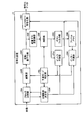
- FIG. 1 is a block diagram showing an example of a functional configuration of the decoding device according to the first embodiment.
- FIG. 2 is a diagram showing an example of a GEO template.
- FIG. 3 is a diagram showing an example of the intra prediction mode.
- FIG. 4 is a diagram showing an example of the intra prediction mode.
- FIG. 5A is a diagram showing an example of a method for encoding a dividing node.
- FIG. 5B is a diagram showing an example of a method for encoding a dividing node.
- FIG. 6 is a flowchart showing the procedure of the decoding process according to the first embodiment.
- FIG. 7 is a flowchart showing the procedure of the decoding process according to the application example of the first embodiment.
- FIG. 8 is a block diagram showing an example of the functional configuration of the coding device 2 according to the second embodiment.
- FIG. 9 is a flowchart showing the procedure of the coding process according to the second embodiment.
- FIG. 10 is a flowchart showing the procedure of the coding process according to the application example of the second embodiment.
- FIG. 11 is a diagram showing an example of a computer hardware configuration.
- FIG. 1 is a block diagram showing an example of a functional configuration of the decoding device according to the first embodiment.
- the decoding device 1 shown in FIG. 1 decodes the coded data of the input video for each block of coding units, so-called CU (Coding Unit).
- CU Coding Unit
- the decoding device 1 includes an entropy decoding unit 11, an inverse quantization / inverse conversion unit 12, an intra prediction unit 13, an inter prediction unit 14, an addition unit 15, and a post filter unit 16.
- the frame memory 17 and the divided shape determining unit 18 are provided.
- the decoding device 1 can implement the functions corresponding to each part as individual circuits.
- the decoding device 1 can also be implemented as an integrated circuit in which circuits that realize the functions of each part are integrated.
- the decoding device 1 may be virtually realized by a hardware processor such as a CPU (Central Processing Unit) or an MPU (Micro Processing Unit). That is, the processor reads an OS (Operating System) and a decoding program in which the functions of the above parts are modularized from a storage device (Hard Disk Drive), an optical disk, an SSD (Solid State Drive), etc., which are not shown. Then, the processor executes the above decoding program to develop a process corresponding to the functions of the above parts on the work area of the memory such as RAM (Random Access Memory). As a result of executing the decoding program in this way, the functions of the above parts are virtually realized as a process.
- a hardware processor such as a CPU (Central Processing Unit) or an MPU (Micro Processing Unit). That is, the processor reads an OS (Operating System) and a decoding program in which the functions of the above parts are modularized from a storage device (Hard Disk Drive), an optical disk, an SSD (Solid State Drive),
- a CPU and an MPU are illustrated as an example of a processor, but the functions of the above parts may be realized by any processor regardless of the general-purpose type or the specialized type. In addition, all or part of the functions of the above parts may be realized by hard-wired logic such as ASIC (Application Specific Integrated Circuit) or FPGA (Field Programmable Gate Array).
- ASIC Application Specific Integrated Circuit
- FPGA Field Programmable Gate Array
- a memory accessible to the processor or a part of the storage area of the memory is allocated to each of the above parts as a work area.
- various semiconductor memory elements for example, main storage devices such as RAM and flash memory can be used.
- the storage area accessible to the processor may not be realized as a work area on the memory, and may be a swap area saved in an external storage device or an auxiliary storage device.
- the entropy decoding unit 11 performs entropy decoding on the encoded data of the video.
- the prediction parameters of the block of the coding unit such as the intra prediction mode and the motion parameter, as well as the prediction residuals of the pixel values subjected to the orthogonal transformation and the quantization can be obtained.
- the predicted residuals of the pixel values that have undergone orthogonal transformation and quantization are output to the inverse quantization / inverse transformation unit 12, while the prediction parameters are intranet via the division shape calculation unit 18 described later. It is output to the prediction unit 13 and the inter-prediction unit 14.
- the inverse quantization / inverse transformation unit 12 performs inverse quantization and inverse orthogonal transformation on the orthogonal transformation and the predicted residual of the quantized pixel value, and restores the predicted residual of the pixel value.
- the predicted residual of the pixel value restored by the inverse quantization and the inverse orthogonal transform is output to the addition unit 15.
- the intra-prediction unit 13 and the inter-prediction unit 14 obtain pixel values obtained as a result of intra-prediction or inter-prediction for each prediction unit block in which a block of coding units is divided into one or a plurality, so-called PU (Prediction Unit). Output to the addition unit 15.
- the coding unit block may include only the prediction unit block encoded in either the intra-prediction or inter-prediction prediction mode, or the prediction encoded in both prediction modes. Unit blocks may be mixed.
- the intra prediction unit 13 predicts the pixel value of the block of the prediction unit based on the decoded pixel value of the adjacent pixel adjacent to the block of the prediction unit and the intra prediction mode. That is, the intra prediction unit 13 inputs the decoded pixel value of the adjacent pixel output from the intra prediction mode and the addition unit 15 output by the division shape calculation unit 18 described later, and predicts the pixel value of the block of the prediction unit. .. The pixel value of the block of the prediction unit predicted in this way is output to the addition unit 15.
- the inter-prediction unit 14 inputs motion parameters output by the divided shape calculation unit 18, which will be described later, for example, an index of a motion vector or a reference picture, and a pixel value of a reference picture output from the frame memory 17, and blocks a prediction unit. Predict the pixel value of. For example, the inter-prediction unit 14 predicts the pixel value of the block of the prediction unit by referring to the pixel value of the reference picture corresponding to the index of the reference picture among the pictures stored in the frame memory 17 based on the motion vector. To do.
- the addition unit 15 has a pixel value of the block of the coding unit output by the intra prediction unit 13 or the inter-prediction unit 14 and a pixel value of the block of the coding unit output from the inverse quantization / inverse conversion unit 12. Add to the predicted residuals of. As a result, the decoded pixel value of the block of the coding unit is obtained. The decoded pixel value of the block of the coding unit thus obtained is output to the post filter unit 16.
- the post filter unit 16 applies the post filter to the decoded pixel value output by the addition unit 15. As one aspect, the quantization error of the decoded pixel value is reduced by applying the post filter.
- the decoded pixel value to which the post filter is applied is output to the frame memory 17 in this way.
- the decoded pixel value after applying the post filter is drawn in the frame memory 17.
- the picture of the image is accumulated in the frame memory 17 for each frame.
- the pictures accumulated in this way can be output to a predetermined output destination, for example, a display device or a program, and the picture of the frame corresponding to the index of the reference picture is referred to at the time of inter-prediction.
- the frame memory 17 may be implemented as a graphics memory or a video memory, or may be implemented as a storage area of a part of the main memory.
- the division shape calculation unit 18 calculates the division shape of the block of the prediction unit.
- the division shape is H. Same as 264 and HEVC. Therefore, an example in which the GEO division for dividing the block of the coding unit into the blocks of two non-rectangular prediction units is performed by the coding device will be described below.
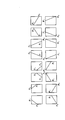
- FIG. 2 is a diagram showing an example of a GEO template.
- 16 templates are defined by a pattern in which two dividing nodes P 0 and P 1 of a partition are arranged on an edge or a vertex on the boundary of a block of coding units.
- the coordinates of the two dividing nodes P 0 and P 1 in which the partition that divides the block of the coding unit into the blocks of the two prediction units intersect the boundary of the block of the coding unit are encoded. Therefore, a 4-bit code amount is used for the template number, and a 6-8-bit code amount is used for each of the two dividing nodes P 0 and P 1 .
- the number of templates is limited to 12 by limiting the position of dividing the block of the coding unit in the block division of GEO.
- the division position in each template is fixed, the coordinates of the above two division nodes P 0 and P 1 are not encoded. Therefore, according to MP, the code amount is suppressed to 4 bits for identifying the block division template.
- the block division template is limited to 12 patterns like the MP proposed by JVET-L0208, it is difficult to match the partition position with the edge component of the video. , The prediction error increases. In this case, since there is a high possibility that the code amount expressing the prediction error exceeds the code amount indicating the divided shape of the block of the prediction unit, the coding efficiency is lowered.
- the problem of increasing the amount of code used for identifying the non-rectangular divided shape is set as one aspect of the problem of lowering the coding efficiency.
- the intra prediction mode is used to identify the angle of the GEO partition.
- Adopt a problem-solving approach that substitutes for angles.
- the angle of the partition is intra-predicted. It is set to the same angle as the mode angle.
- intra prediction is adopted as the prediction of the I picture.
- a prediction image is generated from the encoded adjacent pixels of the block, and the difference is encoded.
- H. Up to 9 intra-prediction modes are supported for 264, up to 35 for HEVC, and up to 86 for VVC.
- FIG. 3 is a diagram showing an example of the intra prediction mode.
- H The intra prediction mode at 264 is shown.
- a block of 8 ⁇ 8 coding units is shown in white, and adjacent pixels adjacent to the block of coding units are shown by hatching.
- the directions of adjacent pixels referred to when predicting the pixels of the block of the coding unit are indicated by arrows.
- H. In 264 eight directions including horizontal, vertical, and 45 degree directions are supported as the directions of the intra prediction mode.
- the weight determination formula of the predicted image calculated from the adjacent pixels differs depending on the prediction direction.
- intra-prediction modes such as Planer and DC (Direct Current) are also supported.
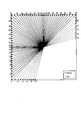
- FIG. 4 is a diagram showing an example of the intra prediction mode.
- FIG. 4 shows the intra prediction mode in VVC.
- the directions of adjacent pixels referred to when predicting the pixels of the block of the coding unit are indicated by arrows.
- the odd-numbered numbers of 2 to 66 are also supported from the aspect of improving the intra-prediction efficiency of the rectangular block. Including, -1 to -10 and 67 to 76 intra prediction modes have been added.
- the combination of the prediction modes of the blocks of the two prediction units in which the GEO division is performed can be any of the four patterns of (1) Intra & Intra, (2) Intra & Inter, (3) Inter & Intra, and (4) Inter & Inter. obtain.
- the prediction mode contains only one block of the prediction unit whose prediction mode is intra prediction, that is, in the case of the patterns (2) and (3)
- the angle of is used as the angle of the partition.
- the prediction modes of the blocks of the two prediction units are both intra-prediction, that is, in the case of the pattern (1), a predetermined vertex of the block of the coding unit, for example, the upper left vertex P [0,0] is set.
- the angle of the intra-prediction mode of the block of shared prediction units is used as the angle of the partition.
- the GEO division information of the adjacent block adjacent to the block of the coding unit being processed can be used to determine the division node.
- the extension line in which the line segment corresponding to the partition set in the adjacent block extends in the direction of the coded block being processed is the coded block being processed.
- One of the two intersections that intersect the boundary can be set as the dividing node.
- the intersection closest to the adjacent block can be set as the dividing node P 0
- the intersection having the longer distance from the adjacent block can be set as the dividing node P 1 .
- the GEO division information of the reference picture referred to in the frames before and after the coded block being processed can be used to determine the division node.
- the dividing node P 0 or P 1 can be set at the same position as the dividing nodes P 0 and P 1 set in the block referenced based on the motion vector on the reference picture.
- the block of the coding unit is divided into the blocks of the prediction unit according to the partition set in this way, and the position of one of the two dividing nodes is encoded as GEO division information.
- the division node P 0 is encoded among the division nodes P 0 and P 1
- the division node P 1 may be encoded. I will add in advance the points that do not matter.
- the origin P (0, 0) is set at the upper left vertex of the block of the coding unit, and the boundary of the block is searched clockwise or counterclockwise from there to the dividing node P 0. It can be defined by the distance d obtained.
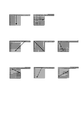
- 5A and 5B are diagrams showing an example of a method for encoding a dividing node. For example, if the intra prediction refers to the left adjacent pixel blocks of the coding unit, as shown in FIG. 5A, the upper boundary of the block searched counterclockwise from the origin P (0,0) to split the node P 0 The obtained distance d is encoded as GEO division information.
- the intra prediction refers to the adjacent pixel on the block of the coding unit, as shown in FIG. 5B, by searching the boundaries above block from the origin P (0,0) to split the node P 0 clockwise
- the obtained distance d is encoded as GEO division information.
- the prediction mode to one of the sub-block of the block coding unit includes the sub-block is an intra prediction
- the distance from the origin P (0,0) of the block of the coding unit to split nodes P 0 d, that is, the position information of the divided node P 0 is transmitted as GEO division information.
- the template number and the coordinates of the two division nodes are the GEO division information as in the existing GEO. Is transmitted as.
- the division shape calculation unit 18 uses the division shape calculation unit 18 as GEO division information when any of the subblocks of the block of the coding unit includes a subblock whose prediction mode is intra-prediction.
- the position information of the dividing node P 0 is decoded.
- the division shape calculation unit 18 calculates the coordinates of the division node P 1 based on the angle of the intra prediction mode of the subblock and the division node P 0.
- the split node P 0 as a starting point, by determining the intersection of straight lines extend intersect on the boundary of the blocks of the coding unit according to the angle of the intra prediction modes from which can be calculated coordinate division nodes P 1 ..
- coordinate divided node P 1 is calculated, the results that can identify the two split nodes P 0 and partitions defined by P 1, to calculate the division shape for dividing the CU non-rectangular to the PU Can be done.
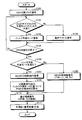
- FIG. 6 is a flowchart showing the procedure of the decoding process according to the first embodiment. This process is started as an example only when the data of the block of the coding unit is input to the entropy decoding unit 11.
- the entropy decoding unit 11 decodes the GEO division flag set in the block of the coding unit (step S101).
- the "GEO division flag” referred to here is set to "1" when GEO division is performed in the coding unit block, while GEO division is not performed in the coding unit block. "0" is set.
- the entropy decoding unit 11 determines whether the prediction mode of the subblock is intra-prediction or inter-prediction based on the intra / inter-determination flag of the block of the prediction unit, which is a sub-block of the block of the coding unit. (Step S102).
- the entropy decoding unit 11 decodes the intra prediction mode (step S103).
- the entropy decoding unit 11 sets motion parameters such as motion vectors and indexes of reference pictures. Decrypt (step S104).
- step S105No the processes from the above step S102 to the above step S104 are repeated until the prediction modes of all the subblocks are determined.
- step S105Yes the entropy decoding unit 11 indicates whether any of the sub-blocks of the block of the coding unit includes a sub-block whose prediction mode is intra-prediction. It is determined whether or not (step S106).
- step S106Yes which prediction mode to one of the sub-block of the block coding unit includes the sub-block is an intra prediction
- the entropy decoding unit 11 the position information of the divided nodes P 0 as the GEO division information Is decoded (step S107).
- the divided shape calculating unit 18 by calculating the angle of the intra prediction mode of the sub-blocks, the coordinate division nodes P 1 on the basis of the division node P 0, divides the CU non-rectangular to the PU The divided shape is calculated (step S108).
- the entropy decoding unit 11 uses the template number and the GEO division information as the GEO division information.
- the coordinates of the two dividing nodes P 0 and P 1 are decoded (step S109).
- the split shape of the PU is identified in step S108 or step S109 described above.
- the intra prediction unit 13 determines the pixel value of the PU based on the intra prediction mode obtained in step S103 and the decoding pixel value of the adjacent pixel output from the addition unit 15. Predict.
- the inter-prediction unit 14 sets the motion parameters obtained in step S104, for example, the motion vector and the index of the reference picture, and the pixel value of the reference picture output from the frame memory 17. The pixel value of PU is predicted based on.
- the inverse quantization / inverse transform unit 12 decodes the difference information (QP value and DCT coefficient) by performing the orthogonal transform and the inverse quantization and the inverse orthogonal transform on the predicted residual of the quantized pixel value. (Step S110).
- the addition unit 15 calculates the pixel value of the block of the coding unit output by the intra prediction unit 13 or the inter prediction unit 14 and the prediction residual of the pixel value of the block of the coding unit obtained in step S110. By adding, the decoded pixel value of the block of the coding unit is generated (step S111).
- the decoded pixel value of the block of the coding unit generated in step S111 is output to the frame memory 17 after the post filter is applied.
- the picture of the video is accumulated in the frame memory 17 for each frame.
- the decoding device 1 calculates the angle of the intra prediction mode, the division shape for dividing the CU non-rectangular to the PU on the basis of the one division nodes P 0 with the GEO partition.
- the PU is divided only by having the coding device perform coding and transmission of one of the two dividing nodes.
- the shape can be identified. Therefore, according to the decoding device 1 according to the present embodiment, it is possible to suppress the amount of code used for identifying the non-rectangular divided shape.
- the coding device when the decoding device 1 substitutes the angle of the GEO partition for identifying the angle in the intra prediction mode, the coding device performs the existing GEO division proposed by JVET-J0023.
- the angle of the GEO partition is calculated based on the template number included in the GEO division information encoded at the time of GEO division and the coordinates of the two division nodes.
- the encoding device selects the intra-prediction mode of the intra-prediction mode supported by VVC, which is the angle corresponding to the angle of the GEO partition, that is, the angle closest to the angle of the GEO partition.
- the intra-prediction mode selected in this way is set to the sub-block whose prediction mode is intra-prediction among the sub-blocks of the block of the coding unit.
- the intra prediction mode corresponding to the fixed length of 5 bits is set, but the intra prediction mode of the angle closest to the GEO partition angle is set as the MPM (Most Pobable Mode) element. It can also be set.
- MPM Mobile Broadband Multimedia Subsystem
- the code amount of the intra-prediction mode can be suppressed to be smaller than the fixed length.
- the decoding device 1 uses the intra-prediction mode based on the angle of the GEO partition instead of the divided shape calculation unit 18, and the sub-prediction mode is intra-prediction. It has an intra prediction mode setting unit that sets the block. The decoding process executed by the decoding device 1 having such an intra prediction mode setting unit will be described with reference to FIG. 7.
- FIG. 7 is a flowchart showing the procedure of the decoding process according to the application example of the first embodiment. This process is started as an example only when the data of the block of the coding unit is input to the entropy decoding unit 11.
- step S201 when the GEO division flag of the coded unit block decoded by the entropy decoding unit 11 is "1", that is, when the GEO division is performed on the coded unit block (step S201Yes). ), The entropy decoding unit 11 decodes the GEO division information including the template number and the coordinates of the two division nodes (step S202). When the GEO division flag is "0", that is, when GEO division is not performed on the block of the coding unit (step S201No), the process of step S202 is skipped.
- the entropy decoding unit 11 determines whether the prediction mode of the subblock is intra-prediction or inter-prediction based on the intra / inter-determination flag of the block of the prediction unit, which is a sub-block of the block of the coding unit. (Step S203).
- the intra prediction mode setting unit sets the template number and 2 included in the GEO division information.
- the intra prediction mode of the angle approximated to the angle of the GEO partition calculated from the coordinates of the two dividing nodes is set in the subblock (step S204).
- the entropy decoding unit 11 sets motion parameters such as motion vectors and indexes of reference pictures. Decrypt (step S205).
- step S206No the processes from the above step S203 to the above step S205 are repeated until the prediction modes of all the subblocks are determined.
- step S206Yes the division shape of the PU is identified based on the GEO division information obtained in the above step S202.
- the intra prediction unit 13 determines the pixel value of the PU based on the intra prediction mode obtained in step S204 and the decoding pixel value of the adjacent pixel output from the addition unit 15. Predict. Further, in the PU in which the prediction mode is inter-prediction, the inter-prediction unit 14 sets the motion parameters obtained in step S205, for example, the motion vector and the index of the reference picture, and the pixel value of the reference picture output from the frame memory 17. The pixel value of PU is predicted based on.
- the inverse quantization / inverse transform unit 12 decodes the difference information (QP value and DCT coefficient) by performing the orthogonal transform and the inverse quantization and the inverse orthogonal transform on the predicted residual of the quantized pixel value. (Step S207).
- the addition unit 15 calculates the pixel value of the block of the coding unit output by the intra prediction unit 13 or the inter prediction unit 14 and the prediction residual of the pixel value of the block of the coding unit obtained in step S207. By adding, the decoded pixel value of the block of the coding unit is generated (step S208).
- the decoded pixel value of the block of the coding unit generated in step S208 is output to the frame memory 17 after the post filter is applied.
- the picture of the video is accumulated in the frame memory 17 for each frame.
- the decoding device 1 sets the intra prediction mode corresponding to the angle of the GEO partition to the subblock whose prediction mode is intra prediction.
- the GEO partition angle can be substituted for the identification of the intra prediction mode on the decoding device 1 side. Therefore, since the coding of the intra prediction mode can be omitted at the time of GEO division on the coding device side, it is possible to suppress the coding amount of the intra prediction mode.
- the coding device 2 that generates the coded data of the video transmitted to the decoding device 1 according to the first embodiment will be described.
- FIG. 8 is a block diagram showing an example of the functional configuration of the coding device 2 according to the second embodiment.
- the coding device 2 adds the block dividing unit 20A, the subtracting unit 20B, the conversion / quantization unit 20C, the entropy coding unit 20D, the inverse quantization / inverse conversion unit 20E, and the addition. It has a unit 20F, a post filter unit 20G, a frame memory 20H, an intra prediction unit 20J, an inter prediction unit 20K, a prediction mode determination unit 20L, and a division shape determination unit 20M.
- the coding device 2 can implement the functions corresponding to each part as individual circuits.
- the coding device 2 can also be implemented as an integrated circuit in which circuits that realize the functions of each part are integrated.
- the coding device 2 may be virtually realized by a hardware processor such as a CPU or MPU. That is, the processor reads the OS and the decoding program in which the functions of the above parts are modularized from a storage device (not shown) such as an HDD, an optical disk, or an SSD. Then, the processor executes the above-mentioned coding program to develop a process corresponding to the functions of the above-mentioned parts on the work area of the memory such as RAM. As a result of executing the coding program in this way, the functions of the above parts are virtually realized as a process.
- a hardware processor such as a CPU or MPU. That is, the processor reads the OS and the decoding program in which the functions of the above parts are modularized from a storage device (not shown) such as an HDD, an optical disk, or an SSD. Then, the processor executes the above-mentioned coding program to develop a process corresponding to the functions of the above-mentioned parts on the work area of the memory such
- a CPU and an MPU are illustrated as an example of a processor, but the functions of the above parts may be realized by any processor regardless of the general-purpose type or the specialized type. In addition, all or part of the functions of the above parts may be realized by hard-wired logic such as ASIC or FPGA.
- a memory accessible to the processor or a part of the storage area of the memory is allocated to each of the above parts as a work area.
- various semiconductor memory elements for example, main storage devices such as RAM and flash memory can be used.
- the storage area accessible to the processor may not be realized as a work area on the memory, and may be a swap area saved in an external storage device or an auxiliary storage device.
- the block division unit 20A divides each picture of the video into a predetermined block. For example, the block division unit 20A performs CTU division for dividing the picture of the frame into blocks of coded tree units called CTU (Coding Tree Unit) for each frame of the video. Further, the block division unit 20A executes CU division that divides the block of the coded tree unit into the block of the coding unit, that is, the CU. Further, the block division unit 20A executes PU division that divides the block of the coding unit into a block of a plurality of prediction units, that is, the PU. Further, the block division unit 20A further executes TU division that divides the block of the coding unit into a block of a plurality of conversion units, that is, a TU (Transform Unit).
- CTU Coding Tree Unit
- the PU division when the PU division is executed, in the GEO or the like proposed by JVET-J0023, it is determined whether or not the GEO division for dividing the CU into the non-rectangular PU is performed. At this time, when GEO division is performed, "1" is set in the GEO division flag, while when GEO division is not performed, "0" is set in the GEO division flag.
- the division shape of the PU is determined by the division shape determination unit 20M described later.
- the subtraction unit 20B subtracts the prediction value of the coding unit block output by the prediction mode determination unit 20L, which will be described later, from the pixel value of the coding unit block output by the block division unit 20A.
- the predicted residual of the pixel value of the block of the coding unit obtained by such subtraction is output to the conversion / quantization unit 20C.
- the conversion / quantization unit 20C performs orthogonal conversion and quantization on the predicted residual of the pixel value of the block of the coding unit output by the subtraction unit 20B.
- the predicted residual of the pixel value of the block of the coding unit in which the quantization and the orthogonal transformation are performed is output to the entropy coding unit 20D and the inverse quantization / inverse conversion unit 20E.
- the entropy coding unit 20D has an intra prediction mode and an intra prediction mode output by the prediction mode determination unit 20L together with the prediction residual of the pixel value of the block of the coding unit that has been quantized and orthogonally converted by the conversion / quantization unit 20C. Entropy coding is performed on prediction parameters such as motion parameters output by the inter-prediction unit 20K.
- the coded data of the video that has been entropy-encoded in this way is output to a predetermined output destination, for example, an arbitrary program or transmission device.
- the inverse quantization / inverse conversion unit 20E performs inverse quantization and inverse orthogonal transformation on the predicted residuals of the pixel values of the blocks of the coding unit that have been orthogonally converted and quantizationed by the conversion / quantization unit 20C, and the pixels. Restore the predicted residual value. The predicted residuals of the pixel values restored by the inverse quantization and the inverse orthogonal transformation in this way are output to the addition unit 20F.
- the addition unit 20F calculates the pixel value of the block of the coding unit output by the prediction mode determination unit 20L and the prediction residual of the pixel value of the block of the coding unit output by the inverse quantization / inverse conversion unit 20E. to add. As a result, the decoded pixel value of the block of the coding unit is obtained. The decoded pixel value of the block of the coding unit thus obtained is output to the post filter unit 20G.
- the post filter unit 20G applies the post filter to the decoded pixel value output by the addition unit 20F.
- the quantization error of the decoded pixel value is reduced by applying the post filter.
- the decoded pixel value to which the post filter is applied is output to the frame memory 20H in this way.
- the decoded pixel value after applying the post filter is drawn in the frame memory 20H.
- video pictures are stored in the frame memory 20H for each frame.
- the picture of the frame corresponding to the index of the reference picture is referred to at the time of inter-prediction.
- the frame memory 20H may be implemented as a graphics memory or a video memory, or may be implemented as a storage area of a part of the main memory.
- the intra prediction unit 20J sets the intra prediction mode of the block of the prediction unit based on the pixel value of the block of the prediction unit output by the block division unit 20A and the decoded pixel value of the adjacent pixel adjacent to the block of the prediction unit. decide. Then, the intra prediction unit 20J sets the decoded pixel value corresponding to the previously determined intra prediction mode among the decoded pixel values of the adjacent pixels adjacent to the block of the prediction unit as the pixel value of the block of the prediction unit. Predict. The pixel value of the block of the prediction unit predicted in this way is output to the subtraction unit 20B via the prediction mode determination unit 20L, and the intra prediction mode is output to the entropy coding unit 20D.
- the inter-prediction unit 20K is based on the pixel value of the block of the prediction unit output by the block division unit 20A and the pixel value of the picture that can be referenced from the frame being processed among the pictures stored in the frame memory 20H. Calculate motion parameters such as reference pictures and motion vectors. Then, the inter-prediction unit 20K refers to the pixel value of the reference picture corresponding to the index of the reference picture among the pictures stored in the frame memory 17 based on the motion vector, so that the pixel value of the block of the prediction unit is used. Predict.
- the pixel value of the block of the prediction unit predicted in this way is output to the subtraction unit 20B via the prediction mode determination unit 20L, and the motion parameters such as the motion vector and the index of the reference picture are output to the entropy coding unit 20D. Will be done.
- the prediction mode determination unit 20L determines the prediction mode of the block of the prediction unit based on the prediction residual of the intra prediction of the block of the prediction unit and the prediction residual of the inter-prediction of the block of the prediction unit. For example, when the prediction mode of the block of the prediction unit is determined to be intra prediction, the prediction mode determination unit 20L outputs the pixel value of the block of the prediction unit predicted by the intra prediction unit 20J to the addition unit 20F and predicts. The intra prediction mode of the unit block is output to the division shape determination unit 20M. On the other hand, when the prediction mode of the block of the prediction unit is determined to be inter-prediction, the prediction mode determination unit 20L outputs the pixel value of the block of the prediction unit predicted by the inter-prediction unit 20K to the addition unit 20F.
- the division shape determination unit 20L determines the division shape of the block of the prediction unit.
- the division shape is H. Same as 264 and HEVC. Therefore, an example in which the GEO division for dividing the block of the coding unit into the blocks of two non-rectangular prediction units is performed by the coding device will be described below.
- the combination of the prediction modes of the blocks of the two prediction units in which the GEO division is performed can be any of the four patterns of (1) Intra & Intra, (2) Intra & Inter, (3) Inter & Intra, and (4) Inter & Inter. ..
- the prediction mode contains only one block of the prediction unit whose prediction mode is intra prediction, that is, in the case of the patterns (2) and (3)
- the angle of is used as the angle of the GEO partition.
- the prediction modes of the blocks of the two prediction units are both intra-prediction, that is, in the case of the pattern (1), a predetermined vertex of the block of the coding unit, for example, the upper left vertex P [0,0] is set.
- the angle of the intra-prediction mode of the shared prediction unit block is used as the angle of the GEO partition.
- the division shape determination unit 20M can use the GEO division information of the adjacent block adjacent to the block of the coding unit being processed. For example, when GEO division is performed in the adjacent block, the extension line in which the line segment corresponding to the partition set in the adjacent block extends in the direction of the coded block being processed is the coded block being processed. One of the two intersections that intersect the boundary can be set as the dividing node. Of the two intersections, the intersection closest to the adjacent block can be set as the dividing node P 0 , or the intersection having the longer distance from the adjacent block can be set as the dividing node P 1 .
- the division shape determination unit 20M can use the GEO division information of the reference picture that the coded block being processed refers to in the frames before and after.
- the dividing node P 0 or P 1 can be set at the same position as the dividing nodes P 0 and P 1 set in the block referenced based on the motion vector on the reference picture.
- the GEO partition can be identified if any two of the three elements of the GEO partition angle and the position information of the two dividing nodes are present. Therefore, the division shape determination unit 20M outputs any two elements of the three elements of the GEO partition angle and the position information of the two division nodes to the block division unit 20A. As a result, the block division unit 20A can divide the block of the coding unit into the block of the non-rectangular prediction unit according to the GEO partition determined by the two elements.
- the division shape determination unit 20M outputs the division node P 0 as GEO division information to the entropy coding unit 20D from the side of identifying the GEO partition on the decoding device side of the transmission destination.
- FIG. 9 is a flowchart showing the procedure of the coding process according to the second embodiment. This process is executed when each picture of the video is input as an example. As shown in FIG. 9, the entropy coding unit 20D encodes the GEO division flag set in the block of the coding unit (step S301).
- the sub-block prediction mode is based on the intra / inter-determination flag. Is an intra-prediction or an inter-prediction (step S302).
- the entropy coding unit 20D encodes the intra prediction mode (step S303). ).
- the entropy coding unit 20D uses motion parameters such as motion vectors and indexes of reference pictures. Is encoded (step S304).
- the processes from the above step S302 to the above step S304 are repeated until the prediction modes of all the subblocks are determined (step S305No).
- the entropy coding unit 20D includes a sub-block whose prediction mode is intra-prediction in any of the sub-blocks of the block of the coding unit. Whether or not it is determined (step S306).
- the division shape determination unit 20M is used for intra-prediction by the intra-prediction unit 20J.
- the division node P 0 is calculated based on the angle of the intra prediction mode (step S307).
- entropy coding unit 20D encodes the position information of the divided nodes P 0 as the GEO division information (step S308).
- the entropy coding unit 20D uses the template number as the GEO division information.
- the coordinates of the two dividing nodes P 0 and P 1 are encoded (step S309).
- the intra prediction unit 20J uses the pixel value of the PU based on the intra prediction mode encoded in step S303 and the decoded pixel value of the adjacent pixel output from the addition unit 20F. Predict. Further, in the PU in which the prediction mode is inter-prediction, the inter-prediction unit 20K uses the motion parameters encoded in step S304, for example, the motion vector and the index of the reference picture, and the pixel value of the reference picture output from the frame memory 20H. The pixel value of PU is predicted based on.
- the predicted value of the block of the coding unit corresponding to the prediction mode of the PU is subtracted from the pixel value of the block of the coding unit output by the block dividing unit 20A, so that the pixel value of the block of the coding unit is subtracted. Predicted residuals are obtained. The predicted residual of the pixel value of the block of the coding unit thus obtained is output to the conversion / quantization unit 20C.
- the entropy coding unit 20D encodes the predicted residuals (QP value and DCT coefficient) of the pixel values of the blocks of the coding unit that have been quantized and orthogonally converted by the conversion / quantization unit 20C (step). S310).
- the addition unit 20F encodes by adding the pixel value of the block of the coding unit output according to the prediction mode of the block of the prediction unit and the prediction residual of the pixel value of the block of the coding unit.
- the decoded pixel value of the unit block is generated (step S311).
- the encoding apparatus 2 encodes the division nodes P 0 partitions GEO calculated based on the angle of the intra prediction mode as the GEO division information. Therefore, according to the coding device 2 according to the present embodiment, it is possible to suppress the amount of code used for identifying the non-rectangular divided shape.
- the coding device 2 performs the existing GEO division proposed by JVET-J0023.
- the coding apparatus 2 calculates the angle of the GEO partition based on the template number included in the GEO division information encoded at the time of GEO division and the coordinates of the two division nodes. Then, the coding apparatus 2 selects the intra-prediction mode of the intra-prediction mode supported by the VVC, which is the angle corresponding to the angle of the GEO partition, that is, the angle closest to the angle of the GEO partition.
- the intra-prediction unit 20J uses the intra-prediction mode selected in this way, the intra-prediction unit 20J performs intra-prediction in the sub-block whose prediction mode is intra-prediction among the sub-blocks of the blocks of the coding unit.
- the intra prediction mode corresponding to the fixed length of 5 bits is set, but the intra prediction mode of the angle closest to the angle of the GEO partition can also be set in the MPM element. ..
- the code amount of the intra-prediction mode can be suppressed to be smaller than the fixed length.
- FIG. 10 is a flowchart showing the procedure of the coding process according to the application example of the second embodiment. This process is executed when each picture of the video is input as an example.
- step S401Yes the entropy coding unit 20D encodes the GEO division information including the template number obtained at the time of GEO division by the block division unit 20A and the coordinates of the two division nodes (step S402).
- step S401No the process of step S402 is skipped.
- the entropy encoding unit 20D determines whether the prediction mode of the subblock is intra-prediction or inter-prediction based on the intra / inter-determination flag of the block of the prediction unit, which is a sub-block of the block of the coding unit. Determine (step S403).
- the intra-prediction mode setting unit is the coding that is the division source of the sub-block. It is determined whether or not the unit block has no GEO division (step S404).
- the entropy coding unit 20D encodes the intra prediction mode (step S405).
- the entropy coding unit 20D can omit the coding in the intra prediction mode.
- the entropy coding unit 20D uses motion parameters such as motion vectors and indexes of reference pictures. Is encoded (step S406).
- the processes from the above step S403 to the above step S406 are repeated until the prediction modes of all the subblocks are determined (step S407No).
- the prediction modes of all the sub-blocks are determined (step S407Yes)
- the following processing is performed for each PU.
- the intra prediction unit 20J has an intra prediction mode encoded in step S405 or an intra prediction mode corresponding to the angle of the GEO partition, and an adjacent unit output from the addition unit 20F.
- the pixel value of the PU is predicted based on the decoded pixel value of the pixel.
- the inter-prediction unit 20K uses the motion parameters encoded in step S304, for example, the motion vector and the index of the reference picture, and the pixel value of the reference picture output from the frame memory 20H.
- the pixel value of PU is predicted based on.
- the predicted value of the block of the coding unit corresponding to the prediction mode of the PU is subtracted from the pixel value of the block of the coding unit output by the block dividing unit 20A, so that the pixel value of the block of the coding unit is subtracted.
- Predicted residuals are obtained.
- the predicted residual of the pixel value of the block of the coding unit thus obtained is output to the conversion / quantization unit 20C.
- the entropy coding unit 20D encodes the predicted residuals (QP value and DCT coefficient) of the pixel values of the blocks of the coding unit that have been quantized and orthogonally converted by the conversion / quantization unit 20C (step). S408).
- the addition unit 20F encodes by adding the pixel value of the block of the coding unit output according to the prediction mode of the block of the prediction unit and the prediction residual of the pixel value of the block of the coding unit.
- the decoded pixel value of the unit block is generated (step S409).
- the coding device 2 sets the intra prediction mode corresponding to the angle of the GEO partition to the sub-block whose prediction mode is intra prediction, and at the time of GEO division.
- the coding of the intra prediction mode is omitted. Thereby, it is possible to suppress the code amount of the intra prediction mode.
- each component of each device shown in the figure does not necessarily have to be physically configured as shown in the figure. That is, the specific form of distribution / integration of each device is not limited to the one shown in the figure, and all or part of the device is functionally or physically distributed / physically in arbitrary units according to various loads and usage conditions. Can be integrated and configured.
- a part of the functional units of the decoding device 1 may be connected via a network as an external device of the decoding device 1.
- the function of the decoding device 1 may be realized by having another device having a part of the functional units of the decoding device 1 and connecting to the network to cooperate with each other.
- a part of the functional units of the coding device 2 may be connected as an external device of the coding device 2 via a network.
- the function of the coding device 2 may be realized by having another device having a part of the functional units of the coding device 2 and connecting them to a network to cooperate with each other.
- FIG. 11 is a diagram showing an example of a computer hardware configuration.
- the computer 100 includes an operation unit 110a, a speaker 110b, a camera 110c, a display 120, and a communication unit 130. Further, the computer 100 has a CPU 150, a ROM 160, an HDD 170, and a RAM 180. Each of these 110 to 180 parts is connected via the bus 140.
- the HDD 170 stores a decoding program 170a that exhibits the same functions as each functional unit of the decoding device 1 shown in the first embodiment.
- the decoding program 170a may be integrated or separated in the same manner as each component of the decoding device 1 shown in FIG. That is, not all the data shown in the first embodiment may be stored in the HDD 170, and the data used for processing may be stored in the HDD 170.
- the CPU 150 reads the decoding program 170a from the HDD 170 and deploys it to the RAM 180.
- the decoding program 170a functions as the decoding process 180a, as shown in FIG.
- the decoding process 180a expands various data read from the HDD 170 into an area allocated to the decoding process 180a in the storage area of the RAM 180, and executes various processes using the expanded various data.
- the process shown in FIGS. 6 and 7 is included.
- the CPU 150 not all the processing units shown in the first embodiment need to operate, and the processing units corresponding to the processes to be executed may be virtually realized.
- the above decoding program 170a does not necessarily have to be stored in the HDD 170 or ROM 160 from the beginning.
- the decoding program 170a is stored in a "portable physical medium" such as a flexible disk inserted into the computer 100, that is, a so-called FD, CD-ROM, DVD disk, magneto-optical disk, or IC card. Then, the computer 100 may acquire the decoding program 170a from these portable physical media and execute it. Further, the decoding program 170a is stored in another computer or server device connected to the computer 100 via a public line, the Internet, LAN, WAN, or the like, and the computer 100 acquires the decoding program 170a from these and executes it. You may try to do it.
- Decoding device 11 Entropy decoding unit 12 Inverse quantization / inverse transformation unit 13 Intra prediction unit 14 Inter prediction unit 15 Addition unit 16 Post filter application unit 17 Frame memory 18 Divided shape calculation unit
Landscapes
- Engineering & Computer Science (AREA)
- Multimedia (AREA)
- Signal Processing (AREA)
- Compression Or Coding Systems Of Tv Signals (AREA)
Priority Applications (3)
| Application Number | Priority Date | Filing Date | Title |
|---|---|---|---|
| PCT/JP2019/051563 WO2021131058A1 (ja) | 2019-12-27 | 2019-12-27 | 復号装置、符号化装置、復号方法及び復号プログラム |
| JP2021566757A JP7180794B2 (ja) | 2019-12-27 | 2019-12-27 | 復号装置、符号化装置、復号方法及び復号プログラム |
| US17/742,438 US20220272341A1 (en) | 2019-12-27 | 2022-05-12 | Decoding device, decoding method, and storage medium |
Applications Claiming Priority (1)
| Application Number | Priority Date | Filing Date | Title |
|---|---|---|---|
| PCT/JP2019/051563 WO2021131058A1 (ja) | 2019-12-27 | 2019-12-27 | 復号装置、符号化装置、復号方法及び復号プログラム |
Related Child Applications (1)
| Application Number | Title | Priority Date | Filing Date |
|---|---|---|---|
| US17/742,438 Continuation US20220272341A1 (en) | 2019-12-27 | 2022-05-12 | Decoding device, decoding method, and storage medium |
Publications (1)
| Publication Number | Publication Date |
|---|---|
| WO2021131058A1 true WO2021131058A1 (ja) | 2021-07-01 |
Family
ID=76573829
Family Applications (1)
| Application Number | Title | Priority Date | Filing Date |
|---|---|---|---|
| PCT/JP2019/051563 Ceased WO2021131058A1 (ja) | 2019-12-27 | 2019-12-27 | 復号装置、符号化装置、復号方法及び復号プログラム |
Country Status (3)
| Country | Link |
|---|---|
| US (1) | US20220272341A1 (https=) |
| JP (1) | JP7180794B2 (https=) |
| WO (1) | WO2021131058A1 (https=) |
Cited By (1)
| Publication number | Priority date | Publication date | Assignee | Title |
|---|---|---|---|---|
| JP2023043219A (ja) * | 2021-09-16 | 2023-03-29 | シャープ株式会社 | 動画像復号装置および動画像符号化装置 |
Citations (3)
| Publication number | Priority date | Publication date | Assignee | Title |
|---|---|---|---|---|
| WO2012100047A1 (en) * | 2011-01-21 | 2012-07-26 | Thomson Licensing | Methods and apparatus for geometric-based intra prediction |
| US20130301716A1 (en) * | 2011-01-19 | 2013-11-14 | Huawei Technologies Co., Ltd. | Method and Device for Coding and Decoding Images |
| JP2019012980A (ja) * | 2017-07-03 | 2019-01-24 | 日本放送協会 | 決定装置、符号化装置、復号装置及びプログラム |
-
2019
- 2019-12-27 JP JP2021566757A patent/JP7180794B2/ja active Active
- 2019-12-27 WO PCT/JP2019/051563 patent/WO2021131058A1/ja not_active Ceased
-
2022
- 2022-05-12 US US17/742,438 patent/US20220272341A1/en not_active Abandoned
Patent Citations (3)
| Publication number | Priority date | Publication date | Assignee | Title |
|---|---|---|---|---|
| US20130301716A1 (en) * | 2011-01-19 | 2013-11-14 | Huawei Technologies Co., Ltd. | Method and Device for Coding and Decoding Images |
| WO2012100047A1 (en) * | 2011-01-21 | 2012-07-26 | Thomson Licensing | Methods and apparatus for geometric-based intra prediction |
| JP2019012980A (ja) * | 2017-07-03 | 2019-01-24 | 日本放送協会 | 決定装置、符号化装置、復号装置及びプログラム |
Non-Patent Citations (3)
| Title |
|---|
| I. ZUPANCIC (HHI): "Crosscheck of JVET-O0522 (Non-CE4: CIIP using triangular partitions)", 127. MPEG MEETING; 20190708 - 20190712; GOTHENBURG; (MOTION PICTURE EXPERT GROUP OR ISO/IEC JTC1/SC29/WG11), 4 July 2019 (2019-07-04), XP030207944 * |
| MAX BLäSER, SAUER JOHANNES, WIEN MATHIAS: "Description of SDR and 360°video coding technology proposal by RWTH Aachen University – 360°part", JVET MEETING; 10-4-2018 - 20-4-2018; SAN DIEGO; (THE JOINT VIDEO EXPLORATION TEAM OF ISO/IEC JTC1/SC29/WG11 AND ITU-T SG.16 ); URL: HTTP://PHENIX.INT-EVRY.FR/JVET/, vol. Jvet-J0023, 12 April 2018 (2018-04-12) - 20 April 2018 (2018-04-20), XP055566194 * |
| T. POIRIER (TECHNICOLOR), F. LE LéANNEC (TECHNICOLOR), P. BORDES (TECHNICOLOR): "CE10 related: multiple prediction unit shapes", 124. MPEG MEETING; 20181008 - 20181012; MACAO; (MOTION PICTURE EXPERT GROUP OR ISO/IEC JTC1/SC29/WG11), 24 September 2018 (2018-09-24), XP030190888 * |
Cited By (2)
| Publication number | Priority date | Publication date | Assignee | Title |
|---|---|---|---|---|
| JP2023043219A (ja) * | 2021-09-16 | 2023-03-29 | シャープ株式会社 | 動画像復号装置および動画像符号化装置 |
| JP7783715B2 (ja) | 2021-09-16 | 2025-12-10 | シャープ株式会社 | 動画像復号装置および動画像符号化装置 |
Also Published As
| Publication number | Publication date |
|---|---|
| US20220272341A1 (en) | 2022-08-25 |
| JP7180794B2 (ja) | 2022-11-30 |
| JPWO2021131058A1 (https=) | 2021-07-01 |
Similar Documents
| Publication | Publication Date | Title |
|---|---|---|
| KR102800978B1 (ko) | 서브블록 기반의 모션 보상을 이용한 비디오 신호 처리 방법 및 장치 | |
| CN114615492B (zh) | 视频编码的方法与装置 | |
| JP2020191690A (ja) | 復号装置、符号化装置、復号方法および符号化方法 | |
| US10484703B2 (en) | Adapting merge candidate positions and numbers according to size and/or shape of prediction block | |
| US20150043650A1 (en) | Image encoding/decoding apparatus and method to which filter selection by precise units is applied | |
| WO2012177051A2 (ko) | 쿼드트리 구조 기반의 적응적 양자화 파라미터 부호화 및 복호화 방법 및 장치 | |
| EP2846544A1 (en) | Method and apparatus for encoding multi-view images, and method and apparatus for decoding multi-view images | |
| KR102438246B1 (ko) | 디블로킹 필터 방법 및 장치 | |
| KR20140110958A (ko) | 동화상 복호 장치, 동화상 부호화 장치, 동화상 복호 방법, 및 동화상 부호화 방법 | |
| US11445173B2 (en) | Method and apparatus for Intra prediction fusion in image and video coding | |
| JP6501532B2 (ja) | 画像符号化装置、画像符号化方法及びプログラム | |
| KR20200005648A (ko) | 인트라 예측 모드 기반 영상 처리 방법 및 이를 위한 장치 | |
| KR20200015783A (ko) | 인트라 예측 모드 기반 영상 처리 방법 및 이를 위한 장치 | |
| US10349071B2 (en) | Motion vector searching apparatus, motion vector searching method, and storage medium storing motion vector searching program | |
| US20250267266A1 (en) | Image encoding apparatus, image decoding apparatus, control methods and non-transitory computer-readable storage medium | |
| CN106464901A (zh) | 具有搜索范围限制的分辨率自适应视频编码的方法和装置 | |
| JP7180794B2 (ja) | 復号装置、符号化装置、復号方法及び復号プログラム | |
| JP7156471B2 (ja) | 動画像復号装置、動画像復号方法及び動画像復号用コンピュータプログラム | |
| JP7202769B2 (ja) | 符号化装置、復号装置及びプログラム | |
| KR102599267B1 (ko) | 화상 부호화 장치, 화상 부호화 방법 및 프로그램, 화상 복호 장치, 화상 복호 방법 및 프로그램 | |
| KR101688085B1 (ko) | 고속 인트라 예측을 위한 영상 부호화 방법 및 장치 | |
| US11178397B2 (en) | Method and apparatus of encoding or decoding using reference samples determined by predefined criteria | |
| US20130136374A1 (en) | Method and apparatus for encoding that intra prediction based on mode of variable size partition is applied in macro block | |
| JP2016134852A (ja) | 符号化装置、符号化方法及びプログラム | |
| KR20140073472A (ko) | 쿼드트리 구조 기반의 적응적 양자화 파라미터 부호화 및 복호화 방법 및 장치 |
Legal Events
| Date | Code | Title | Description |
|---|---|---|---|
| 121 | Ep: the epo has been informed by wipo that ep was designated in this application |
Ref document number: 19957592 Country of ref document: EP Kind code of ref document: A1 |
|
| ENP | Entry into the national phase |
Ref document number: 2021566757 Country of ref document: JP Kind code of ref document: A |
|
| NENP | Non-entry into the national phase |
Ref country code: DE |
|
| 122 | Ep: pct application non-entry in european phase |
Ref document number: 19957592 Country of ref document: EP Kind code of ref document: A1 |