WO2021059966A1 - コアネットワークノード、アクセスモビリティ管理装置、及び通信方法 - Google Patents
コアネットワークノード、アクセスモビリティ管理装置、及び通信方法 Download PDFInfo
- Publication number
- WO2021059966A1 WO2021059966A1 PCT/JP2020/033950 JP2020033950W WO2021059966A1 WO 2021059966 A1 WO2021059966 A1 WO 2021059966A1 JP 2020033950 W JP2020033950 W JP 2020033950W WO 2021059966 A1 WO2021059966 A1 WO 2021059966A1
- Authority
- WO
- WIPO (PCT)
- Prior art keywords
- nssaa
- information
- management device
- function
- mobility management
- Prior art date
- Legal status (The legal status is an assumption and is not a legal conclusion. Google has not performed a legal analysis and makes no representation as to the accuracy of the status listed.)
- Ceased
Links
Images




Classifications
-
- H—ELECTRICITY
- H04—ELECTRIC COMMUNICATION TECHNIQUE
- H04W—WIRELESS COMMUNICATION NETWORKS
- H04W12/00—Security arrangements; Authentication; Protecting privacy or anonymity
- H04W12/60—Context-dependent security
- H04W12/69—Identity-dependent
- H04W12/72—Subscriber identity
-
- H—ELECTRICITY
- H04—ELECTRIC COMMUNICATION TECHNIQUE
- H04W—WIRELESS COMMUNICATION NETWORKS
- H04W12/00—Security arrangements; Authentication; Protecting privacy or anonymity
- H04W12/06—Authentication
-
- H—ELECTRICITY
- H04—ELECTRIC COMMUNICATION TECHNIQUE
- H04W—WIRELESS COMMUNICATION NETWORKS
- H04W48/00—Access restriction; Network selection; Access point selection
- H04W48/18—Selecting a network or a communication service
-
- H—ELECTRICITY
- H04—ELECTRIC COMMUNICATION TECHNIQUE
- H04W—WIRELESS COMMUNICATION NETWORKS
- H04W60/00—Affiliation to network, e.g. registration; Terminating affiliation with the network, e.g. de-registration
- H04W60/04—Affiliation to network, e.g. registration; Terminating affiliation with the network, e.g. de-registration using triggered events
-
- H—ELECTRICITY
- H04—ELECTRIC COMMUNICATION TECHNIQUE
- H04W—WIRELESS COMMUNICATION NETWORKS
- H04W48/00—Access restriction; Network selection; Access point selection
- H04W48/02—Access restriction performed under specific conditions
-
- H—ELECTRICITY
- H04—ELECTRIC COMMUNICATION TECHNIQUE
- H04W—WIRELESS COMMUNICATION NETWORKS
- H04W84/00—Network topologies
- H04W84/02—Hierarchically pre-organised networks, e.g. paging networks, cellular networks, WLAN [Wireless Local Area Network] or WLL [Wireless Local Loop]
- H04W84/04—Large scale networks; Deep hierarchical networks
- H04W84/042—Public Land Mobile systems, e.g. cellular systems
Definitions
- This disclosure relates to an access mobility management device, a core network node, a control method, and a communication method.
- 5G 5th generation
- Activities have been initiated by multiple research standardization agencies to develop 5G networks that provide services to multiple vertical service providers and services to a variety of terminals.
- 3GPP 3rd Generation Partnership Project
- 5GS 5G System
- 5GS 5G System
- the specifications of 5GS are disclosed in, for example, Non-Patent Document 1, Non-Patent Document 2, and Non-Patent Document 3.
- a network slice is a collection of logical network functions and resources that realize communication services in a specific use case.
- Network slicing is the process of dividing one physical network into multiple slices.
- Non-Patent Document 1 describes a process in which a wireless terminal (UE; User Equipment) uses S-NSSAI (Single Network Slice Selection Assistance information).
- UE User Equipment
- S-NSSAI Single Network Slice Selection Assistance information
- S-NSSAI may be composed of SST (Slice / Service type) and SD (Slice Differentiator). Moreover, S-NSSAI may be composed only of SST. Note that the SST may indicate the function or service aspect of the network slice, and the SD may be complementary information used to identify the network slice indicated by the same SST.
- the network slice instance is a network slice including a control plane (control plane; c-plane; cp) function and a user plane (user plane; u-plane; up) function described in Non-Patent Document 1. Is the actual situation.
- a plurality of different S-NSSAIs may be associated with one network slice instance. Further, one S-NSSAI may be associated with one network slice instance, or may be associated with a plurality of different network slice instances. For the network, select an appropriate network slice instance using S-NSSAI or the like. The function of selecting a network slice instance is described in Section 5.15 of Non-Patent Document 1. The network slice instance selected here provides the UE with a service specialized for network slices.
- NSSAI Network Slice Selection Assistance Information
- S-NSSAI Network Slice Selection Assistance Information
- NSSAI has five NSSAI modes: Configured NSSAI, Rejected NSSAI, Allowed NSSAI, Requested NSSAI, and Subscribed NSSAI.
- Requested NSSAI includes one or more S-NSSAI sent by the UE to the network. Allowed NSSAI includes one or more S-NSSAIs that the network allows to use.
- Rejected NSSAI includes S-NSSAI that the network refuses to use, and each S-NSSAI included in Rejected NSSAI is associated with a reason value.
- Configured NSSAI includes one or more S-NSSAIs that are shown in the UE to be applicable to one or more PLMNs (Publicland mobile networks). Subscribed NSSAI is S-NSSAI based on subscriber information, and Subscribed NSSAI may be set for each PLMN on the assumption that the UE moves to another PLMN.
- NSSAA Network Slice-Specific Authentication and Authorization
- each of the UE, 5GS core network, and security device related to the network slice must support the NSSAA procedure.
- the security device related to the UE and network slice has the NSSAA function and the 5GS core network does not support the NSSAA function, the NSSAA procedure is required even though the carrier requires the NSSAA procedure.
- the procedure is not executed normally. Specifically, if the core network node does not support the NSSAA function, it cannot interpret the instruction to execute the NSSAA procedure for the UE, so it cannot determine whether to execute the NSSAA procedure.
- the core network node allows the UE to access the network slice without determining whether or not the NSSAA procedure needs to be executed. Therefore, even if the UE has the NSSAA function, the UE is allowed to access the network slice without executing the NSSAA procedure.
- An object of the present disclosure is to provide an access mobility management device, a core network node, a control method, and a communication method capable of appropriately determining accessability to a network slice in order to solve the above problems. ..
- Access mobility management of the first information indicating whether or not the core network node supports the authentication and authorization (NSSAA: Network Slice-Specific Authentication and Authorization) function specialized for network slices.
- NSSAA Network Slice-Specific Authentication and Authorization
- the second information indicating the network slice corresponding to the first information is transmitted to the access mobility management device. Means and.
- the access mobility management device provides the first information indicating whether or not the access mobility management device supports the authentication and authorization (NSSAA: Network Slice-Specific Authentication and Authorization) function specialized for network slices in the core network.
- NSSAA Network Slice-Specific Authentication and Authorization
- the receiving means and the receiving means are provided.
- the core network node is a receiving means for receiving a request for selecting an access mobility management device from the first access mobility management device, and authentication specialized for a network slice in response to the request. It also includes a transmission means for transmitting information indicating a second access mobility management device that supports the NSSAA (Network Slice-Specific Authentication and Authorization) function to the first access mobility management device.
- NSSAA Network Slice-Specific Authentication and Authorization
- the communication method provides first information indicating whether or not the network slice-specific authentication and authorization (NSSAA: Network Slice-Specific Authentication and Authorization) function is supported by the access mobility management device.
- NSSAA Network Slice-Specific Authentication and Authorization
- the second information indicating the network slice corresponding to the first information is transmitted to the access mobility management device.
- an access mobility management device a core network node, a control method, and a communication method that can appropriately determine whether or not access to a network slice is possible.
- FIG. It is a block diagram of the access mobility management apparatus which concerns on Embodiment 1.
- FIG. It is a block diagram of the core network node which concerns on Embodiment 1.
- FIG. It is a block diagram of the communication system which concerns on Embodiment 2.
- FIG. It is a block diagram of UDM which concerns on Embodiment 2.
- FIG. It is a figure which shows the flow of the Registration process which concerns on Embodiment 2.
- FIG. It is a figure which shows the parameter which shows that the NSSAA function which concerns on Embodiment 2 is supported.
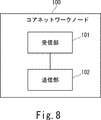
- It is a block diagram of the core network node which concerns on Embodiment 3.
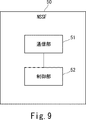
- FIG. It is a block diagram of NSSF which concerns on Embodiment 3.
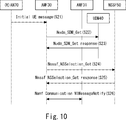
- FIG. It is a figure which shows the flow of the AMF re-allocation processing which concerns on Embodiment 3. It is a figure which shows the flow of the AMF re-allocation processing which concerns on Embodiment 3. It is a block diagram of the apparatus which concerns on each embodiment.
- the access mobility management device 10 may be a computer device that operates by the processor executing a program stored in the memory.
- the access mobility management device 10 has a communication unit 11 and a control unit 12.
- the communication unit 11 and the control unit 12 may be software or modules whose processing is executed by the processor executing a program stored in the memory.
- the communication unit 11 and the control unit 12 may be hardware such as a circuit or a chip.
- the communication unit 11 is a functional unit for the access mobility management device 10 to connect to another core network node. Further, the communication unit 11 is a functional unit for connecting to the access network and connecting to the wireless terminal via the access network. In other words, the access mobility management device 10 can send and receive user data and control information to and from the device in the access network and other core networks via the communication unit 11.
- the core network is a network included in the communication system.
- the communication system also includes, for example, an access network.
- the wireless terminal communicates with or connects with the access mobility management device 10 or the core network node 15 arranged in the core network via the access network.
- the communication unit 11 transmits information indicating whether or not the NSSAA function is supported to the core network node 15.
- the NSSAA procedure is a network slice-specific authentication and authorization procedure performed by a security device for a wireless terminal that requests the use of the network slice for each network slice.
- the security device may be, for example, an AAA (Authentication Authorization Accounting) server or a Radius server.
- the wireless terminal may be, for example, a mobile phone terminal, a smartphone terminal, or a tablet terminal. Further, the wireless terminal may be an IoT (Internet of Things) terminal or an MTC (Machine Type Communication) terminal.
- the core network node 15 may be a device that manages subscriber information or a device that has a function of selecting an access mobility management device 10.
- the function related to the NSSAA procedure may be to recognize the parameters required for the NSSAA procedure and execute the processing associated with the recognized parameters.
- the function related to the NSSAA procedure is, for example, reading the capability information from the received message when the communication unit 11 receives a message including the capability information capable of executing the NSSAA procedure from another device. Good.
- the function related to the NSSAA procedure may be to transmit the received capability information to another device.
- the communication unit 11 may receive the capability information from the wireless terminal or the core network node 15 and transmit the capability information to the wireless terminal or the core network node 15.
- the function related to the NSSAA procedure may be to read the identification information of the network slice from the received message when the message including the identification information for identifying the network slice requiring the NSSAA procedure is received.
- the communication unit 11 may receive the identification information of the network slice that requires the NSSAA procedure from the core network node 15. Further, the function related to the NSSAA procedure may be to transmit the identification information of the network slice that requires the NSSAA procedure to the wireless terminal.
- the communication unit 11 receives information about the network slice corresponding to the information indicating whether or not the NSSAA function is supported from the core network node 15.
- the information about the network slice corresponding to the information indicating whether or not the NSSAA function is supported corresponds to the information indicating whether or not the NSSAA function is supported.
- the information about the network slice corresponding to the information indicating whether or not the NSSAA function is supported is specified or changed depending on the information indicating whether or not the NSSAA function is supported.
- the information about the network slice corresponding to the information indicating whether or not the NSSAA function is supported may be, for example, the information indicating the network slice to which the wireless terminal is subscribed.
- the information about the network slice corresponding to the information indicating whether or not the NSSAA function is supported may be the information indicating the network slice requesting the NSSAA procedure.
- the control unit 12 is a functional unit for controlling the access mobility management device 10, and performs various processes of the entire access mobility management device 10 by reading and executing various information and programs stored in the memory. Realize.
- the control unit 12 determines whether or not to permit the use of the network slice based on the information about the network slice corresponding to the information indicating whether or not the NSSAA function is supported. Determining whether to allow use also includes identifying network slices that are permitted to be used, network slices that are not permitted to be used, and network slices that are suspended from use.
- the network slice whose use is suspended may be a network slice whose use by a wireless terminal is determined in the NSSAA procedure.
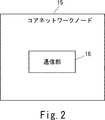
- the core network node 15 may be a computer device operated by the processor executing a program stored in the memory.
- the core network node 15 has a communication unit 16.
- the communication unit 16 may be software or a module whose processing is executed by the processor executing a program stored in the memory.
- the communication unit 16 may be hardware such as a circuit or a chip.
- the communication unit 16 receives information indicating whether or not the NSSAA function is supported from the access mobility management device 10. Further, the communication unit 16 identifies information about the network slice corresponding to the information indicating whether or not the NSSAA function is supported. Then, the communication unit 16 transmits the information regarding the specified network slice to the access mobility management device 10. For example, when the communication unit 16 receives the information indicating that the NSSAA function is supported, the communication unit 16 may identify the information regarding the network slice that requires the NSSAA and transmit it to the access mobility management device 10. Alternatively, when the communication unit 16 receives information that does not indicate that it supports the NSSAA function, the communication unit 16 may control not to transmit the information about the network slice that requires NSSAA to the access mobility management device 10.
- the access mobility management device 10 provides information indicating whether or not the core network node 15 supports the network slice-specific authentication and authorization (NSSAA) function. It receives and transmits the information about the network slice corresponding to the information to the access mobility management device 15.
- the core network node 15 can control the access mobility management device 10 that does not support the NSSAA function so as not to transmit information about a network slice that requires the NSSAA function.
- the core network node 15 can appropriately determine whether or not access to the network slice is possible even if the access mobility device 10 does not have the NSSAA function.
- the access mobility management device 10 can transmit information indicating whether or not the NSSAA function is supported.
- the access mobility management device 10 receives information about the network slice corresponding to the information indicating whether or not the NSSAA function is supported from the core network node 15.
- the information about the network slice corresponding to the information indicating whether or not the NSSAA function is supported is set according to the information indicating whether or not the access mobility management device 10 supports the NSSAA function.
- the access mobility management device 10 since the access mobility management device 10 receives the information set according to whether or not the NSSAA function is supported, it is possible to appropriately determine whether or not the wireless terminal can access the network slice. For example, when the access mobility management device 10 does not support the NSSAA function, the access mobility management device 10 receives information about a network slice that does not require the NSSAA function, which is set according to the fact that the NSSAA function is not supported. Since it is only necessary to receive information that can appropriately determine accessability without using, the desired accessability determination can be realized.
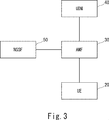
- the communication system of FIG. 3 includes a UE 20, an AMF (Access and Mobility management Function) entity 30 (hereinafter referred to as AMF30), a UDM (Unified Data Management) entity 40 (hereinafter referred to as UDM40), and an NSSF (Network Slice Selection Function). ) It has an entity 50 (hereinafter referred to as NSSF50).
- AMF30 Access and Mobility management Function
- UDM40 Unified Data Management
- NSSF Network Slice Selection Function
- the UE 20 corresponds to a wireless terminal.
- the AMF 30 corresponds to the access mobility management device 10 of FIG.
- UDM40 and NSSF50 correspond to core network nodes.
- the core network is a network including at least AMF30, UDM40, and NSSF50.
- AMF30, UDM40, and NSSF50 may be referred to as a core network node or a core network device.
- the core network sends and receives messages and / or executes procedures, it means that devices in the core network send and receive messages and / or perform procedures.
- the access network is a wireless network that connects the UE and the core network.
- the access network may be a 3GPP network or a non-3GPP network.
- the 3GPP network may be NG- (R) AN.
- the access network node refers to at least a part of gNB and ng-eNB, and may be referred to as an NG- (R) AN node or an NG- (R) AN device.
- the fact that the NG- (R) AN executes the message transmission / reception and / or the procedure means that the device in the NG- (R) AN executes the message transmission / reception and / or the procedure.
- the gNB may be a gNB having an NR (New Radio) function constituting the NG- (R) AN.
- the ng-eNB may be an eNB having an E-UTRA (Evolved Universal Terrestrial Radio Access) function constituting the NG- (R) AN.
- E-UTRA Evolved Universal Terrestrial Radio Access
- AMF30 manages access, mobility, etc. related to UE20.
- UDM40 manages subscriber information about AMF30.
- the NSSF 50 selects the AMF that manages the access and mobility of the UE 20. Specifically, the NSSF 50 may identify at least one candidate AMF in the re-allocation of AMF or the selection or reselection of AMF.
- the UE20 holds Configured NSSAI for each application.
- the UE 20 transmits a Requested NSSAI including the S-NSSAI used in the Serving PLMN to the AMF 30 in the Registration procedure.
- the UDM40 holds a Subscribed NSSAI including an S-NSSAI that can be provided to the UE 20.
- AMF30 acquires Subscribed NSSAI from UDM40. Further, the AMF30 determines Allowed NSSAI or Rejected NSSAI using Requested NSSAI and Subscribed NSSAI.
- the AMF 30 transmits the determined Allowed NSSAI or Rejected NSSAI to the UE 20.
- the UDM40 may be a computer device in which the processor operates by executing a program stored in memory.
- the UDM 40 has a communication unit 41 and a control unit 42.
- the communication unit 41 and the control unit 42 may be software or modules whose processing is executed by the processor executing a program stored in the memory.
- the communication unit 41 and the control unit 42 may be hardware such as a circuit or a chip.
- the communication unit 41 receives information from the AMF 30 indicating whether or not the AMF 30 supports the NSSAA function.
- the control unit 42 uses the received information to determine whether or not the AMF 30 supports the NSSAA function. For example, when the communication unit 41 receives information from the AMF 30 that directly or explicitly indicates whether or not the NSSAA function is supported, the control unit 42 determines according to the information that is directly or explicitly indicated. To do. Here, the communication unit 41 may receive a message from the AMF 30 that does not directly indicate whether or not the NSSAA function is supported. In such a case, the control unit 42 may determine that the AMF 30 does not support the NSSAA function. That is, in such a case, it can be said that the communication unit 41 has received information indirectly or implicitly indicating whether or not the NSSAA function is supported.
- Information that directly or explicitly indicates that the NSSAA function is supported is also expressed as an indicator that the NSSAA function is supported.
- Information that directly or explicitly indicates that the NSSAA function is not supported is also expressed as an indicator that the NSSAA function is not supported.
- the information indirectly or implicitly indicating whether or not the NSSAA function is supported is also expressed as information that does not include an indicator indicating that the NSSAA function is supported.
- one or more S-NSSAI indicating a network slice requesting the NSSAA procedure may be transmitted to the AMF 30 via the communication unit 41 together with the Subscribed NSSAI.
- S-NSSAI is used as identification information for identifying a network slice.
- the control unit 42 may transmit a subscribed NSSAI including only the S-NSSAI indicating the network slice requesting the NSSAA procedure to the AMF 30 via the communication unit 41.
- control unit 42 includes S-NSSAI and Subscribed NSSAI including at least one S-NSSAI indicating a network slice that requires the NSSAA procedure and one or more S-NSSAI indicating a network slice that does not require the NSSAA procedure. May be transmitted to the AMF 30 via the communication unit 41.
- the control unit 42 does not have to provide the S-NSSAI indicating the network slice requesting the NSSAA procedure to the AMF 30 as a Subscribed NSSAI.
- the control unit 42 may transmit the Subscribed NSSAI to the AMF 30 without deleting or excluding or not including the S-NSSAI indicating the network slice requesting the NSSAA procedure from the Subscribed NSSAI. If all the network slices indicated by S-NSSAI included in the Subscribed NSSAI request the NSSAA procedure, the control unit 42 does not have to provide the Subscribed NSSAI to the AMF30 or provides an empty Subscribed NSSAI to the AMF30.
- the control unit 42 notifies the AMF 30 of only the S-NSSAI indicating the network slice that does not require the NSSAA procedure among the network slices to which the UE 20 is subscribed.
- the AMF30 does not support the NSSAA function, it is possible to prevent the UE 20 supporting the NSSAA procedure from being allowed access to the network slice requesting the NSSAA procedure without performing the NSSAA procedure. it can.
- the flow of the Registration process according to the second embodiment will be described with reference to FIG.
- the UE 20, AMF 30, and UDM 40 support the NSSAA function.
- the UE 20 and the AMF 30 support the functions related to the NSSAA procedure.
- the fact that the UE 20 supports the function related to the NSSAA procedure may mean that the security device located in the network slice and the NSSAA procedure can be executed. Further, the fact that the UE 20 supports the function related to the NSSAA procedure may mean that the ability information indicating that the NSSAA procedure can be executed can be notified to the AMF 30.
- the UE 20 transmits a Registration Request to the AMF 30 (S11).
- RegistrationRequest includes Requested NSSAI.
- the RegistrationRequest contains information indicating that the UE 20 can perform the NSSAA procedure.
- Information indicating that the UE 20 can perform the NSSAA procedure may be shown as capability information of the UE 20.
- the authentication process related to the UE 20 is executed between the UE 20, the AMF 30, and the UDM 40 (S12).
- the UE 20 is authenticated as a UE that can use 5GS.
- AMF30 transmits Nudm_UECM_Registration to UDM40 (S13).
- Step S13 is performed to register the AMF 30 with the UDM 40.
- Nudm_UECM_Registration includes a parameter indicating that AMF30 supports NSSAA function.
- a parameter indicating that the NSSAA function is supported may be paraphrased as an indicator indicating that the NSSAA function is supported.
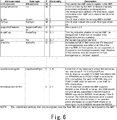
- FIG. 6 shows a list of parameters set in Nudm_UECM_Registration.
- the table shown in FIG. 6 is based on the table shown in 3GPP TS 29.503 V16.0.0 (2019-06). In the table shown in FIG. 6, some parameters are omitted from the table shown in 3GPP TS 29.503 V16.0.0 (2019-06).
- the table shown in FIG. 6 includes Nssaa support indicator as a parameter.
- Nssaasupportindicator is set in Nudm_UECM_Registration transmitted from AMF30, it indicates that AMF30 supports the NSSAA function.
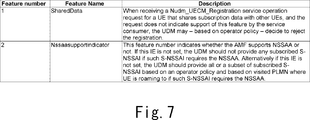
- FIG. 7 shows the parameters set in the supported Features of FIG.
- FIG. 7 shows that Nssaa support indicator is set in supportedFeatures.
- the Nssaasupportindicator may be a parameter at the same level as a parameter such as supportedFeatures as shown in FIG. 6, or may be a parameter set in supportedFeatures as shown in FIG.
- the UDM40 transmits a Nudm_UECM_Registration response to the AMF30 as a response to the Nudm_UECM_Registration (S14).
- AMF30 transmits Nudm_SDM_Get to UDM40 (S15).
- Step S15 is performed for the AMF 30 to acquire the subscriber information from the UDM 40.
- Nudm_SDM_Get may include a parameter indicating that the AMF30 supports the NSSAA function.
- the UDM40 transmits a Nudm_SDM_Get response to the AMF30 as a response to the Nudm_SDM_Get (S16).
- the UDM 40 has received Nudm_UECM_Registration including the Nssaa support indicator in step S13. That is, the UDM40 recognizes that the AMF30 supports the NSSAA function.
- the UDM 40 has received Nudm_SDM_Get including the Nssaa support indicator in step S15. That is, the UDM40 recognizes that the AMF30 supports the NSSAA function. Therefore, the UDM 40 may include one or more S-NSSAI indicating a network slice requesting the Subscribed NSSAI and NSSAA procedure in the Nudm_SDM_Get response.
- the UDM 40 may include a Subscribed NSSAI in the Nudm_SDM_Get response that includes only the S-NSSAI indicating the network slice requesting the NSSAA procedure.
- the UDM40 includes an S-NSSAI and a Subscribed NSSAI that include at least one S-NSSAI indicating a network slice that requires NSSAA procedures and one or more S-NSSAIs that indicate a network slice that does not require NSSAA procedures. It may be transmitted to the AMF 30 via the communication unit 41.
- AMF30 transmits the Registration Accept to the UE 20 (S17).
- AMF30 may include at least one of Allowed NSSAI and Rejected NSSAI in Registration Accept.
- AMF30 may include Allowed NSSAI including S-NSSAI included in Requested NSSAI and Subscribed NSSAI, which does not correspond to the network slice requesting the NSSAA procedure, in Registration Accept. Further, the AMF 30 may include the Rejected NSSAI including the S-NSSAI not included in the Subscribed NSSAI among the S-NSSAI included in the Requested NSSAI in the Registration Accept. Further, the AMF 30 may include the S-NSSAI included in the Requested NSSAI and the Subscribed NSSAI, and the Rejected NSSAI including the S-NSSAI corresponding to the network slice requesting the NSSAA procedure in the Registration Accept.
- the S-NSSAI included in the Rejected NSSAI and corresponding to the network slice that requires the NSSAA procedure has a cause value (reason value or reason for refusal) indicating that the NSSAA procedure is to be executed or is scheduled to be executed. Value) may be associated.
- step S16 when the Subscribed NSSAI including only the S-NSSAI indicating the network slice for which the UDM40 requests the NSSAA procedure is included in the Nudm_SDM_Get response, the operation may be performed as follows.
- the AMF 30 may include the Rejected NSSAI including the S-NSSAI included in the Requested NSSAI and the Subscribed NSSAI in the Registration Accept.
- the S-NSSAI included in the Rejected NSSAI and corresponding to the network slice requesting the NSSAA procedure may be associated with a cause value indicating that the NSSAA procedure is to be executed or is scheduled to be executed.
- the UE 20 executes the NSSAA procedure (Network Slice-Specific Authentication and Authorization procedure) for the S-NSSAI associated with the cause value indicating that the NSSAA procedure is to be executed or is scheduled to be executed (S18). ).
- the UE 20 executes the NSSAA procedure with the AMF30 and the security device AAA60.
- the UE 20 performs the NSSAA procedure for each S-NSSAI.
- UE20 can use the network slice specified by S-NSSAI for which the NSSAA procedure has been completed.
- AMF30 does not support the NSSAA function, including the following cases.
- AMF30 can set Nssaasupportindicator in Nudm_UECM_Registration, but includes the case where Nssaasupportindicator is not set in Nudm_UECM_Registration based on the operator's policy or the like.
- the operator may be paraphrased as a telecommunications carrier, a telecommunications carrier, or the like.
- step S13 the AMF 30 transmits Nudm_UECM_Registration that does not include the Nssaa support indicator. That is, AMF30 does not set Nssaasupportindicator in Nudm_UECM_Registration, and does not set Nssaasupportindicator in supportedFeatures.
- step S15 the AMF 30 transmits a Nudm_SDM_Get that does not include the Nssaa support indicator. That is, AMF30 does not set Nssaasupportindicator in Nudm_SDM_Get, and does not set Nssaasupportindicator in supportedFeatures.
- the UDM 40 deletes or excludes the S-NSSAI of the network slice requesting the NSSAA procedure from the Subscribed NSSAI, and sends a Nudm_SDM_Get response to the AMF30.
- the Subscribed NSSAI includes only S-NSSAI indicating a network slice that does not require the NSSAA procedure, or does not include any S-NSSAI.
- the AMF 30 includes Allowed NSSAI including S-NSSAI included in Requested NSSAI and Subscribed NSSAI in Registration Accept. Further, the AMF30 may include the Rejected NSSAI including the S-NSSAI included in the Requested NSSAI but not in the Subscribed NSSAI in the Registration Accept. In this case, the UE 20 does not receive the S-NSSAI associated with the cause value indicating that the NSSAA procedure is to be executed or is scheduled to be executed. Therefore, the procedure (S18) requesting the NSSAA procedure cannot be executed. Further, the UE 20 does not receive an Allowed NSSAI containing an S-NSSAI indicating a network slice requesting the NSSAA procedure. As a result, the UE 20 cannot utilize the network slice that requires the NSSAA procedure.
- the UDM40 does not notify the AMF30 of the network slice requesting the NSSAA procedure when the NSSAA function is not supported by the AMF30. From this, the AMF 30 does not notify the UE 20 of Allowed NSSAI including S-NSSAI indicating the network slice requesting the NSSAA procedure. As a result, it is possible to prevent the UE 20 from being allowed access to the network slice that requires the UE 20 to perform the NSSAA procedure without performing the NSSAA procedure.
- the UE 20 cannot access the network slice that requires the NSSAA procedure at all.
- UDM40 may select S-NSSAI to be set in Subscribed NSSAI based on a predetermined standard such as an operator policy. Good.
- the operator policy may be a policy determined by the operator who manages the home network (PLMN), or may be a policy determined by the operator who manages the roaming destination network (Visited PLMN).
- the UDM 40 may determine for each AMF whether or not to set the S-NSSAI indicating the network slice requesting the NSSAA procedure to the Subscribed NSSAI.
- the UDM40 may set the S-NSSAI of the network slice that requires the NSSAA procedure for the AMF to Subscribed NSSAI. Good.
- the UDM 40 may set the S-NSSAI of the network slice that requires the NSSAA procedure for the AMF that does not support the NSSAA function to Subscribed NSSAI only for a specific period.
- the UDM 40 may set the S-NSSAI of the network slice that requires the NSSAA procedure, which has a high priority, for the AMF that does not support the NSSAA function to Subscribed NSSAI.
- the UDM 40 may set the default S-NSSAI to Subscribed NSSAI for AMF that does not support the NSSAA function.
- the criteria for selecting S-NSSAI to be set in Subscribed NSSAI for AMF in which UDM40 does not support the NSSAA function are not limited to these. According to the configuration described here, the S-NSSAI requesting the NSSAA procedure can be provided to the UE 20 without the NSSAA procedure.
- the core network node 100 according to the third embodiment may be, for example, NSSF50.
- the core network node 100 has a receiving unit 101 and a transmitting unit 102.
- the receiving unit 101 and the transmitting unit 102 may be communication units.
- the receiving unit 101 receives the selection request from the access mobility management device in the selection process of the access mobility management device.
- the transmission unit 102 transmits information indicating the access mobility management device that supports the NSSAA function to the access mobility management device that has transmitted the selection request.
- the access mobility management device selection process may be, for example, an AMF re-allocation process.
- the AMF re-allocation process will be described.
- the AMF re-allocation process is performed in the Registration process. Specifically, when the UE 20 starts the Registration process, the base station randomly selects AMF. After that, the AMF re-allocation process is executed in order to change the randomly selected AMF. In the following, it is assumed that the AMF 30 is the AMF first randomly selected by the base station.
- the AMF30 receives information from the UE 20 indicating whether or not the NSSAA function is supported.
- the AMF 30 transmits the following information to the NSSF 50 when the UE 20 supports the NSSAA procedure.
- the information indicates that the newly selected AMF in the AMF re-allocation process needs to be an AMF that supports the NSSAA function. That is, the AMF 30 transmits information to the NSSF 50 requesting that when selecting a candidate AMF, it should be considered whether or not the AMF supports the NSSAA function.
- the NSSF 50 corresponds to the core network node 100.
- the NSSF 50 may be a computer device in which the processor operates by executing a program stored in memory.
- the NSSF 50 has a communication unit 51 and a control unit 52.
- the communication unit 51 and the control unit 52 may be software or modules whose processing is executed by the processor executing a program stored in the memory.
- the communication unit 51 and the control unit 52 may be hardware such as a circuit or a chip.
- the communication unit 51 receives information indicating that the newly selected AMF must be an AMF that supports the NSSAA function in the AMF re-allocation process.
- the control unit 52 selects at least one AMF that supports the NSSAA function.
- the control unit 52 transmits information identifying the selected AMF to the AMF 30 via the communication unit 51.
- the control unit 52 selects an arbitrary AMF and sends information indicating that there is no AMF that supports the NSSAA function to the AMF 30 via the communication unit 51. You may send it.
- the (R) AN ((Radio) Access Network) 70 is a base station that wirelessly communicates with the UE 20.
- the (R) AN70 may perform wireless communication using the UE 20 and 5G, which is a wireless communication standard defined in 3GPP.
- (R) AN70 sends an Initial UE message to AMF30 (S21).
- the Initial UE message is a message associated with the Registration Request transmitted by the UE 20.
- the Initial UE message includes capability information indicating that the UE 20 can execute the NSSAA procedure.
- the AMF 30 acquires the subscriber information regarding the UE 20 in the same manner as in steps S15 and S16 of FIG. 5 (S22, S23). At this time, the AMF 30 receives information about the network slice corresponding to the information indicating whether or not the NSSAA function is supported as in the first and second aspects.
- the AMF30 transmits Nnssf_NSSelection_Get to the NSSF50 in order to execute the AMF re-allocation process (S24).
- the AMF30 recognizes that the UE 20 has the ability information to indicate that it can perform the NSSAA procedure. Therefore, the AMF 30 includes information in Nnssf_NSSelection_Get indicating that the newly selected AMF must be an AMF that supports the NSSAA function. Further, the AMF 30 may include information about the network slice corresponding to the information indicating whether or not the above-mentioned NSSAA function is supported in Nnssf_NSSelection_Get.
- the NSSF 50 transmits a Nnssf_NSSelection_Get response including the identification information of at least one AMF that supports the NSSAA function to the AMF 30 (S25). That is, the NSSF 50 transmits at least one AMF identification information to the AMF 30 as a candidate for the next selected AMF. Alternatively, if there is no AMF that supports the NSSAA function, the NSSF 50 may send information to the AMF 30 indicating that there is no AMF that supports the NSSAA function. The NSSF50 identifies at least one AMF corresponding to the NSSAA function among the AMFs corresponding to the network slice, based on the information about the network slice corresponding to the information indicating whether or not the NSSAA function is supported.
- Nnssf_NSSelection_Getresponse containing information may be sent to AMF30. Further, even if the NSSF50 receives Nnssf_NSSelection_Get that does not include information indicating that the newly selected AMF needs to be an AMF that supports the NSSAA function, the NSSF50 preferentially performs the NSSAA function.
- the supported AMF may be a candidate for the next AMF to be selected.
- the AMF 30 selects the AMF 31 from the AMF identification information received from the NSSF 50.
- the AMF 30 transmits Namf_Communication_N1MessageNotify to the AMF 31 and receives the response message (S26).
- steps S21 to S25 in FIG. 11 are the same as those in FIG. 10, detailed description thereof will be omitted.
- the AMF 30 receives the AMF identification information from the NSSF 50, selects a new AMF, and then transmits a Reroute NAS message to the (R) AN70 (S31).
- the AMF 30 includes the identification information of the AMF 31 selected as the new AMF in the Reroute NAS message.
- the AMF30 may include one or more AMF identification information received from the NSSF50 in the Reroute NAS message.
- (R) AN70 transmits an Initial UE message to AMF31 included in the Reroute NAS message.
- FIG. 11 is different from FIG. 10 in that the (R) AN70 transmits an Initial UE message from the AMF30 to the designated AMF31.
- the NSSF50 is selected as a candidate for selecting an appropriate AMF next. Can be sent.
- the appropriate AMF is the AMF that supports the NSSAA procedure.
- the AMF 30 when the AMF 30 receives the ability information indicating that the UE 20 can execute the NSSAA procedure in step S21, the AMF 30 transmits the following information to the NSSF 50.
- the following information indicates that the newly selected AMF must be an AMF that supports the NSSAA function.
- step S23 after receiving the subscriber information of the UE 20, the AMF 30 determines whether or not the S-NSSAI included in the Subscribed NSSAI or the Requested NSSAI corresponds to the network slice requesting the NSSAA procedure. May be good. If the AMF30 determines that the S-NSSAI included in the Subscribed NSSAI or Requested NSSAI corresponds to the network slice requesting the NSSAA procedure, the above information may be included in the Nnssf_NSSelection_Get in step S24. The above information is information indicating that the newly selected AMF needs to be an AMF that supports the NSSAA function.
- the AMF 30 may transmit the above information when the following two conditions are satisfied.
- the UE 20 can execute the NSSAA procedure.
- S-NSSAI included in Subscribed NSSAI or Requested NSSAI corresponds to a network slice that requires NSSAA procedure.
- the AMF30 may notify the NSSF50 that the NSSAA procedure is supported.
- the AMF 30 may notify the NSSF 50 that it supports the NSSAA procedure when it is activated.
- the AMF 30 may notify the NSSF 50 that it no longer supports the NSSAA function when updating a file or the like. That is, the AMF 30 may notify the NSSF 50 of the change in the NSSAA ability information.
- the AMF30 notifies the NSSF50 of the support status of the NSSAA function, so that the NSSF50 can construct a database that manages the ability information related to each AMF.
- the NSSF50 can select an AMF that supports the NSSAA function as the next candidate AMF to be selected by referring to the database.
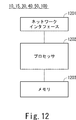
- FIG. 12 is a block diagram showing a configuration example of a core network node 15, a core network node 100, an access mobility management device 10, an AMF30, a UDM40, and an NSSF50 (hereinafter collectively referred to as a core network node 15).
- core network node 15 includes network interface 1201, processor 1202, and memory 1203.
- the network interface 1201 is used to communicate with other network node devices that make up the communication system.
- the network interface 1201 may include, for example, an IEEE 802.3 series compliant network interface card (NIC).
- NIC network interface 1201 may be used to perform wireless communication.
- the network interface 1201 may be used for wireless LAN communication or mobile communication specified in 3GPP (3rd Generation Partnership Project).
- the processor 1202 reads the software (computer program) from the memory 1203 and executes it to perform the processing of the core network node 15 described by using the flowchart or the sequence in the above embodiment.
- the processor 1202 may be, for example, a microprocessor, an MPU (Micro Processing Unit), or a CPU (Central Processing Unit).
- Processor 1202 may include a plurality of processors.
- Memory 1203 is composed of a combination of volatile memory and non-volatile memory. Memory 1203 may include storage located away from processor 1202. In this case, processor 1202 may access memory 1203 via an I / O interface (not shown).
- the memory 1203 is used to store the software module group.
- the processor 1202 can perform the processing of the core network node 15 described in the above-described embodiment by reading these software modules from the memory 1203 and executing them.
- each of the processors included in the core network node 15 executes one or more programs including a set of instructions for causing the computer to perform the algorithm described with reference to the drawings.
- Non-temporary computer-readable media include various types of tangible storage media.
- Examples of non-temporary computer-readable media include magnetic recording media, magneto-optical recording media (eg, magneto-optical disks), CD-ROMs (Read Only Memory), CD-Rs, CD-R / Ws, and semiconductor memories.
- the magnetic recording medium may be, for example, a flexible disk, a magnetic tape, or a hard disk drive.
- the semiconductor memory may be, for example, a mask ROM, a PROM (Programmable ROM), an EPROM (Erasable PROM), a flash ROM, or a RAM (Random Access Memory).
- the program may also be supplied to the computer by various types of temporary computer readable media.
- Examples of temporary computer-readable media include electrical, optical, and electromagnetic waves.
- the temporary computer-readable medium can supply the program to the computer via a wired communication path such as an electric wire and an optical fiber, or a wireless communication path.
- a user device (User Equipment, UE) (or a mobile station, a mobile terminal, a mobile device, a communication terminal, a wireless device, etc.) Is an entity connected to the network via a wireless interface.
- UE User Equipment
- the UE of the present specification is not limited to a dedicated communication device, and may be any device as described below having a communication function as a UE described in the present specification.
- UE User Equipment
- mobile station mobile terminal
- mobile device mobile device
- wireless terminal wireless terminal
- UE and “wireless terminal” also include devices that have been stationary for a long period of time.
- UE also includes, for example, production equipment / manufacturing equipment and / or energy related machinery (for example, boilers, engines, turbines, solar panels, wind generators, hydraulic generators, thermal power generators, nuclear generators, storage batteries, nuclear systems.
- UE is, for example, transportation equipment (for example, vehicles, automobiles, two-wheeled vehicles, bicycles, trains, buses, rear cars, rickshaws, ships (ship and other watercraft), airplanes, rockets, artificial satellites, drones, balloons, etc.) It may be.
- transportation equipment for example, vehicles, automobiles, two-wheeled vehicles, bicycles, trains, buses, rear cars, rickshaws, ships (ship and other watercraft), airplanes, rockets, artificial satellites, drones, balloons, etc. It may be.
- the UE may be, for example, an information communication device (for example, a computer and related devices, a communication device and related devices, an electronic component, etc.).
- an information communication device for example, a computer and related devices, a communication device and related devices, an electronic component, etc.
- UE also includes, for example, refrigerating machines, refrigerating machine application products and equipment, commercial and service equipment, vending machines, automatic service machines, office machinery and equipment, consumer electrical and electronic machinery and equipment (for example, audio equipment and speakers). , Radio, video equipment, TV, oven range, rice cooker, coffee maker, dishwasher, washing machine, dryer, fan, ventilation fan and related products, vacuum cleaner, etc.).
- the UE may be, for example, an electronic application system or an electronic application device (for example, an X-ray device, a particle accelerator, a radioactive material application device, a sound wave application device, an electromagnetic application device, a power application device, etc.).
- an electronic application system for example, an X-ray device, a particle accelerator, a radioactive material application device, a sound wave application device, an electromagnetic application device, a power application device, etc.
- UEs are, for example, light bulbs, lighting, weighing machines, analyzers, testing machines and measuring machines (for example, smoke alarms, personal alarm sensors, motion sensors, wireless tags, etc.), watches or clocks, physics and chemistry machines. , Optical machinery, medical equipment and / or medical systems, weapons, clockwork tools, or hand tools.
- the UE also includes, for example, a personal digital assistant or device having a wireless communication function (for example, an electronic device (for example, a personal computer, an electronic measuring instrument, etc.) configured to attach or insert a wireless card, a wireless module, or the like. )) May be.
- a personal digital assistant or device having a wireless communication function for example, an electronic device (for example, a personal computer, an electronic measuring instrument, etc.) configured to attach or insert a wireless card, a wireless module, or the like. )
- the UE may be, for example, a device or a part thereof that provides the following applications, services, and solutions in the "Internet of Things (IoT)" using wired or wireless communication technology.
- IoT Internet of Things
- IoT devices include suitable electronic devices, software, sensors, network connections, etc. that allow devices to collect and exchange data with each other and with other communication devices.
- the IoT device may be an automated device that complies with the software command stored in the internal memory.
- IoT devices may also operate without the need for human supervision or response.
- the IoT device may also remain inactive for a long period of time and / or for a long period of time.
- IoT devices can be implemented as part of a stationary device. IoT devices can be embedded in non-stationary devices (such as vehicles) or attached to animals or people that are monitored / tracked.
- IoT technology can be implemented on any communication device that can be connected to a communication network that sends and receives data regardless of human input control or software instructions stored in memory.
- IoT devices are sometimes referred to as Machine Type Communication (MTC) devices, or Machine to Machine (M2M) communication devices, NB-IoT (Narrow Band-IoT) UEs. ..
- MTC Machine Type Communication
- M2M Machine to Machine
- NB-IoT Near Band-IoT
- the UE can support one or more IoT or MTC applications.
- MTC applications Some examples of MTC applications are listed in the table below (Source: 3GPP TS22.368 V13.2.0 (2017-01-13) Annex B, the contents of which are incorporated herein by reference). This list is not exhaustive and shows an example MTC application.
- MVNO Mobile Virtual Network Operator
- POS Point of sale
- MBMS Multimedia Broadcast and Multicast Service
- V2X Vehicle to Everything: vehicle-to-vehicle communication and Road-to-vehicle / pedestrian communication
- IoT Internet of Things
- (Appendix 1) A receiving means for receiving the first information indicating whether or not the network slice-specific authentication and authorization (NSSAA) function is supported from the access mobility management device, and a receiving means.
- a core network including a transmission means for transmitting the second information indicating the network slice corresponding to the first information among the information indicating the network slice associated with the certain subscriber information to the access mobility management device. node.
- Appendix 2 When the first information does not indicate that it supports the NSSAA function, the second information indicates a network slice that requires NSSAA among the information indicating the network slice associated with the certain subscriber information.
- the core network node according to Appendix 1, which does not contain information.
- the second information indicates a network slice that does not require NSSAA among the information indicating the network slice associated with the certain subscriber information.
- the core network node according to Appendix 1 or 2 which contains information.
- (Appendix 4) Network slices that do not require the NSSAA Network slices not subject to NSSAA and Network slices that are subject to NSSAA but are available without NSSAA, based on at least one of the Operator Policy and the Visited Public Land Mobile Network (Visited PLMN) of the wireless terminal.
- the core network node according to Appendix 3 which comprises at least one of.
- the first information does not indicate that it supports the NSSAA function, then the first information does not include an indicator that it supports the NSSAA function, or if the first information does not indicate that it supports the NSSAA function.
- the second information is a network that requires NSSAA among the information indicating the network slice associated with the certain subscriber information.
- the core network node according to any one of Appendix 1 to 5, which contains at least one piece of information indicating a slice.
- the core network node according to any one of Supplementary note 1 to 6, wherein the receiving means receives the first information from the access mobility management device by a Get method.
- a transmission means that sends the first information indicating whether or not it supports the Network Slice-Specific Authentication and Authorization (NSSAA) function to the core network node.
- Access mobility management including a receiving means for receiving a second information indicating a network slice corresponding to the first information among the information indicating a network slice associated with a certain subscriber information from the core network node. apparatus.
- the information indicating the network slice associated with the certain subscriber information does not include the information indicating the network slice that requires NSSAA.
- the access mobility management device described in. (Appendix 10)
- the second information indicates a network slice that does not require NSSAA among the information indicating the network slice associated with the certain subscriber information.
- (Appendix 11) Network slices that do not require the NSSAA Network slices other than NSSAA targets and Network slices that are subject to NSSAA but can be provided without NSSAA, based on at least one of the operator policy and the visited public land mobile network (Visited PLMN) of the wireless terminal. 10.
- the access mobility management device according to Appendix 10 which comprises at least one of the above.
- (Appendix 12) If it does not indicate that it supports the NSSAA function, it does not include an indicator that the first information supports the NSSAA function, or the first information does not support the NSSAA function.
- the access mobility management device according to any one of Appendix 9 to 11, which is any one of the indicators indicating the above.
- the second information is information indicating a network slice that requires NSSAA among the information indicating the network slice associated with the certain subscriber information.
- NSSAA network slice-specific authentication and authorization
- a core network node that includes a transmission means for transmitting to a management device.
- the request includes a second piece of information indicating a network slice.
- the transmission means transmits information indicating the second access mobility management device that supports the NSSAA function when NSSAA is required for the network slice indicated by the second information, as described in Appendix 15.
- Core network node. (Appendix 17) The request includes information requesting that when selecting a candidate access mobility management device, the selected access mobility management device should be considered to support the NSSAA function. 15 or 16, wherein the transmitting means transmits information indicating the second access mobility management device that supports the NSSAA function to the first access mobility management device according to the information.
- Core network node
- Each access mobility management device is provided with a storage means for storing the first information indicating whether or not the NSSAA function is supported.
- the core according to any one of Supplementary note 15 to 17, wherein the transmission means transmits information indicating the second access mobility management device that supports the NSSAA function based on the first information.
- Network node (Appendix 19)
- the receiving means has started from the access mobility management device to start or no longer support the NSSAA function before transmitting the information indicating the second access mobility management device.
- the first information indicating whether or not the network slice-specific authentication and authorization (NSSAA) function is supported is received from the access mobility management device, and the information is received from the access mobility management device.
- a communication method comprising transmitting to the access mobility management device the second information indicating the network slice corresponding to the first information among the information indicating the network slice associated with a certain subscriber information.
- (Appendix 21) Sends first information to the core network node to indicate whether it supports the Network Slice-Specific Authentication and Authorization (NSSAA) function that is specific to network slices.
- a communication method comprising receiving from the core network node the second information indicating the network slice corresponding to the first information among the information indicating the network slice associated with a certain subscriber information.
- a request for selecting an access mobility management device is received from the first access mobility management device, and the request is received from the first access mobility management device.
- the information indicating the second access mobility management device that supports the network slicing-specific authentication and authorization (NSSAA) function is provided in the first access mobility.
- a communication method that comprises transmitting to a management device.
- Access mobility management device 11
- Communication unit 12 Control unit 15
- Core network node 16 Communication unit 17
- Control unit 20 UE 30
- AMF 40 UDM 41
- Communication unit 42 Control unit 50
- NSSF 51 Communication unit 52
- Control unit 60 AAA 70 (R)
- AN 100 Core network node 101 Receiver 102 Transmitter
Landscapes
- Engineering & Computer Science (AREA)
- Computer Security & Cryptography (AREA)
- Computer Networks & Wireless Communication (AREA)
- Signal Processing (AREA)
- Mobile Radio Communication Systems (AREA)
- Television Receiver Circuits (AREA)
- Two-Way Televisions, Distribution Of Moving Picture Or The Like (AREA)
Priority Applications (5)
| Application Number | Priority Date | Filing Date | Title |
|---|---|---|---|
| US17/629,832 US20220264310A1 (en) | 2019-09-25 | 2020-09-08 | Core network node, access mobility management apparatus, and communication method |
| JP2021548766A JP7052928B2 (ja) | 2019-09-25 | 2020-09-08 | コアネットワークノード、アクセスモビリティ管理装置、及び通信方法 |
| CN202080060780.2A CN114303404B (zh) | 2019-09-25 | 2020-09-08 | 核心网络节点及通信方法 |
| EP20869662.5A EP3993470B1 (en) | 2019-09-25 | 2020-09-08 | Core network node, accessibility management device, and communication method |
| ZA2022/01461A ZA202201461B (en) | 2019-09-25 | 2022-02-01 | Core network node, accessibility management device, and communication method |
Applications Claiming Priority (2)
| Application Number | Priority Date | Filing Date | Title |
|---|---|---|---|
| JP2019174767 | 2019-09-25 | ||
| JP2019-174767 | 2019-09-25 |
Publications (1)
| Publication Number | Publication Date |
|---|---|
| WO2021059966A1 true WO2021059966A1 (ja) | 2021-04-01 |
Family
ID=75166111
Family Applications (1)
| Application Number | Title | Priority Date | Filing Date |
|---|---|---|---|
| PCT/JP2020/033950 Ceased WO2021059966A1 (ja) | 2019-09-25 | 2020-09-08 | コアネットワークノード、アクセスモビリティ管理装置、及び通信方法 |
Country Status (6)
| Country | Link |
|---|---|
| US (1) | US20220264310A1 (https=) |
| EP (1) | EP3993470B1 (https=) |
| JP (1) | JP7052928B2 (https=) |
| CN (1) | CN114303404B (https=) |
| WO (1) | WO2021059966A1 (https=) |
| ZA (1) | ZA202201461B (https=) |
Families Citing this family (3)
| Publication number | Priority date | Publication date | Assignee | Title |
|---|---|---|---|---|
| US12207354B2 (en) * | 2022-06-06 | 2025-01-21 | Cisco Technology, Inc. | Facilitating services for devices in private mobile networks based on device authentications in an operator network |
| CN114980276B (zh) * | 2022-06-17 | 2024-09-27 | 中国电信股份有限公司 | 专网切片接入方法、装置和系统 |
| GB2624891A (en) * | 2022-11-29 | 2024-06-05 | Nokia Technologies Oy | Method, apparatus and computer program |
Citations (1)
| Publication number | Priority date | Publication date | Assignee | Title |
|---|---|---|---|---|
| JP2019174767A (ja) | 2018-03-29 | 2019-10-10 | キヤノン株式会社 | ヒータおよび定着装置 |
Family Cites Families (9)
| Publication number | Priority date | Publication date | Assignee | Title |
|---|---|---|---|---|
| US10652809B2 (en) * | 2016-05-15 | 2020-05-12 | Lg Electronics Inc. | Method and apparatus for supporting network slicing selection and authorization for new radio access technology |
| WO2017209367A1 (ko) * | 2016-05-31 | 2017-12-07 | 엘지전자(주) | 무선통신 시스템에서 서비스 별로 단말의 인증을 수행하기 위한 방법 및 이를 위한 장치 |
| KR102425675B1 (ko) * | 2017-08-14 | 2022-07-28 | 삼성전자 주식회사 | 5g 시스템에서 네트워크와 단말 간 제공 기능 협상 및 슬라이스 정보 맵핑 방법 |
| EP3729868B1 (en) * | 2017-12-22 | 2024-07-17 | Lenovo (Singapore) Pte. Ltd. | Network slice selection assistance information configuration |
| US11539699B2 (en) * | 2018-08-13 | 2022-12-27 | Lenovo (Singapore) Pte. Ltd. | Network slice authentication |
| US11076347B2 (en) * | 2018-10-01 | 2021-07-27 | Zte Corporation | Coexistent slicing group support in network slicing |
| ES2900513T3 (es) * | 2019-04-01 | 2022-03-17 | Ntt Docomo Inc | Métodos y componentes de red de comunicación para iniciar una autenticación y una autorización específicas de segmento |
| JP7527084B2 (ja) * | 2019-07-22 | 2024-08-02 | シャープ株式会社 | Ue及びueによって実行される通信制御方法 |
| EP4013093A4 (en) * | 2019-08-15 | 2022-08-03 | Huawei Technologies Co., Ltd. | COMMUNICATION PROCESS AND ASSOCIATED DEVICES |
-
2020
- 2020-09-08 US US17/629,832 patent/US20220264310A1/en not_active Abandoned
- 2020-09-08 JP JP2021548766A patent/JP7052928B2/ja active Active
- 2020-09-08 WO PCT/JP2020/033950 patent/WO2021059966A1/ja not_active Ceased
- 2020-09-08 CN CN202080060780.2A patent/CN114303404B/zh active Active
- 2020-09-08 EP EP20869662.5A patent/EP3993470B1/en active Active
-
2022
- 2022-02-01 ZA ZA2022/01461A patent/ZA202201461B/en unknown
Patent Citations (1)
| Publication number | Priority date | Publication date | Assignee | Title |
|---|---|---|---|---|
| JP2019174767A (ja) | 2018-03-29 | 2019-10-10 | キヤノン株式会社 | ヒータおよび定着装置 |
Non-Patent Citations (6)
| Title |
|---|
| "3rd Generation Partnership Project; Technical Specification Group Core Network and Terminals; Non-Access-Stratum (NAS) protocol for 5G System (5GS); Stage 3 (Release 16)", 3GPP TS 24.501 V16.2.0, vol. CT WG1, 24 September 2019 (2019-09-24), pages 73, XP051784713 * |
| "3rd Generation Partnership Project; Technical Specification Group Services and System Aspects; System Architecture for the 5G System (5GS); Stage 2 (Release 16)", 3GPP TS 23.501 V16.2.0, vol. SA WG2, 24 September 2019 (2019-09-24), pages 189 - 190, XP051784669 * |
| 3GPP TS 29.503, June 2019 (2019-06-01) |
| 3GPP TS22.368, 13 January 2017 (2017-01-13) |
| NEC: "Prevent unauthorized UE to access network slice that requires NSSAA", 3GPP TSG-SA WG2 MEETING #136 S 2-1911140, vol. SA WG2, 8 November 2019 (2019-11-08), XP051821242 * |
| See also references of EP3993470A4 |
Also Published As
| Publication number | Publication date |
|---|---|
| EP3993470B1 (en) | 2024-01-03 |
| JP7052928B2 (ja) | 2022-04-12 |
| US20220264310A1 (en) | 2022-08-18 |
| ZA202201461B (en) | 2022-11-30 |
| JPWO2021059966A1 (https=) | 2021-04-01 |
| EP3993470A4 (en) | 2022-08-03 |
| CN114303404B (zh) | 2023-05-16 |
| EP3993470A1 (en) | 2022-05-04 |
| CN114303404A (zh) | 2022-04-08 |
Similar Documents
| Publication | Publication Date | Title |
|---|---|---|
| US11463978B2 (en) | Network data analytics function, access and mobility function, and control method for UE analytics assistance for network automation and optimisation | |
| JP7099536B2 (ja) | コアネットワーク装置、通信端末、コアネットワーク装置の方法、プログラム、及び通信端末の方法 | |
| US20220078742A1 (en) | Procedure to handle services provided by a ue supporting multiple usim card | |
| US20240214859A1 (en) | Communication system | |
| US12470908B2 (en) | Communication system | |
| WO2021024995A1 (ja) | 通信方法、コアネットワークノード、及び無線端末 | |
| US12058638B2 (en) | Procedure to update the parameters related to Unified Access Control | |
| JP2023052589A (ja) | 基地局、及び方法 | |
| JP7586186B2 (ja) | コアネットワークノード及びその方法 | |
| JP7380005B2 (ja) | 無線端末、コアネットワークノード、及びこれらの方法 | |
| JP7268794B2 (ja) | 方法、基地局、及びコアネットワークファンクション | |
| US20240121740A1 (en) | Server, requesting entity, and methods therefor | |
| JP7052928B2 (ja) | コアネットワークノード、アクセスモビリティ管理装置、及び通信方法 | |
| JP2023145688A (ja) | 無線端末及び通信方法 | |
| JP7677398B2 (ja) | 無線端末、Edge Enabler Server(EES)、及びこれらにおける方法 | |
| US20240244033A1 (en) | Server, requesting entity, and methods therefor |
Legal Events
| Date | Code | Title | Description |
|---|---|---|---|
| 121 | Ep: the epo has been informed by wipo that ep was designated in this application |
Ref document number: 20869662 Country of ref document: EP Kind code of ref document: A1 |
|
| ENP | Entry into the national phase |
Ref document number: 2021548766 Country of ref document: JP Kind code of ref document: A |
|
| ENP | Entry into the national phase |
Ref document number: 2020869662 Country of ref document: EP Effective date: 20220128 |
|
| NENP | Non-entry into the national phase |
Ref country code: DE |
|
| WWG | Wipo information: grant in national office |
Ref document number: 202217008688 Country of ref document: IN |