WO2021033596A1 - 水試料中のペル及びポリフルオロアルキル化合物吸着活性炭 - Google Patents
水試料中のペル及びポリフルオロアルキル化合物吸着活性炭 Download PDFInfo
- Publication number
- WO2021033596A1 WO2021033596A1 PCT/JP2020/030576 JP2020030576W WO2021033596A1 WO 2021033596 A1 WO2021033596 A1 WO 2021033596A1 JP 2020030576 W JP2020030576 W JP 2020030576W WO 2021033596 A1 WO2021033596 A1 WO 2021033596A1
- Authority
- WO
- WIPO (PCT)
- Prior art keywords
- activated carbon
- polyfluoroalkyl
- pel
- water sample
- adsorbing
- Prior art date
- Legal status (The legal status is an assumption and is not a legal conclusion. Google has not performed a legal analysis and makes no representation as to the accuracy of the status listed.)
- Ceased
Links
Classifications
-
- B—PERFORMING OPERATIONS; TRANSPORTING
- B01—PHYSICAL OR CHEMICAL PROCESSES OR APPARATUS IN GENERAL
- B01J—CHEMICAL OR PHYSICAL PROCESSES, e.g. CATALYSIS OR COLLOID CHEMISTRY; THEIR RELEVANT APPARATUS
- B01J20/00—Solid sorbent compositions or filter aid compositions; Sorbents for chromatography; Processes for preparing, regenerating or reactivating thereof
- B01J20/02—Solid sorbent compositions or filter aid compositions; Sorbents for chromatography; Processes for preparing, regenerating or reactivating thereof comprising inorganic material
- B01J20/20—Solid sorbent compositions or filter aid compositions; Sorbents for chromatography; Processes for preparing, regenerating or reactivating thereof comprising inorganic material comprising free carbon; comprising carbon obtained by carbonising processes
-
- B—PERFORMING OPERATIONS; TRANSPORTING
- B01—PHYSICAL OR CHEMICAL PROCESSES OR APPARATUS IN GENERAL
- B01J—CHEMICAL OR PHYSICAL PROCESSES, e.g. CATALYSIS OR COLLOID CHEMISTRY; THEIR RELEVANT APPARATUS
- B01J20/00—Solid sorbent compositions or filter aid compositions; Sorbents for chromatography; Processes for preparing, regenerating or reactivating thereof
- B01J20/28—Solid sorbent compositions or filter aid compositions; Sorbents for chromatography; Processes for preparing, regenerating or reactivating thereof characterised by their form or physical properties
-
- B—PERFORMING OPERATIONS; TRANSPORTING
- B01—PHYSICAL OR CHEMICAL PROCESSES OR APPARATUS IN GENERAL
- B01J—CHEMICAL OR PHYSICAL PROCESSES, e.g. CATALYSIS OR COLLOID CHEMISTRY; THEIR RELEVANT APPARATUS
- B01J20/00—Solid sorbent compositions or filter aid compositions; Sorbents for chromatography; Processes for preparing, regenerating or reactivating thereof
- B01J20/28—Solid sorbent compositions or filter aid compositions; Sorbents for chromatography; Processes for preparing, regenerating or reactivating thereof characterised by their form or physical properties
- B01J20/28014—Solid sorbent compositions or filter aid compositions; Sorbents for chromatography; Processes for preparing, regenerating or reactivating thereof characterised by their form or physical properties characterised by their form
- B01J20/28023—Fibres or filaments
-
- B—PERFORMING OPERATIONS; TRANSPORTING
- B01—PHYSICAL OR CHEMICAL PROCESSES OR APPARATUS IN GENERAL
- B01J—CHEMICAL OR PHYSICAL PROCESSES, e.g. CATALYSIS OR COLLOID CHEMISTRY; THEIR RELEVANT APPARATUS
- B01J20/00—Solid sorbent compositions or filter aid compositions; Sorbents for chromatography; Processes for preparing, regenerating or reactivating thereof
- B01J20/28—Solid sorbent compositions or filter aid compositions; Sorbents for chromatography; Processes for preparing, regenerating or reactivating thereof characterised by their form or physical properties
- B01J20/28054—Solid sorbent compositions or filter aid compositions; Sorbents for chromatography; Processes for preparing, regenerating or reactivating thereof characterised by their form or physical properties characterised by their surface properties or porosity
- B01J20/28057—Surface area, e.g. B.E.T specific surface area
- B01J20/28064—Surface area, e.g. B.E.T specific surface area being in the range 500-1000 m2/g
-
- B—PERFORMING OPERATIONS; TRANSPORTING
- B01—PHYSICAL OR CHEMICAL PROCESSES OR APPARATUS IN GENERAL
- B01J—CHEMICAL OR PHYSICAL PROCESSES, e.g. CATALYSIS OR COLLOID CHEMISTRY; THEIR RELEVANT APPARATUS
- B01J20/00—Solid sorbent compositions or filter aid compositions; Sorbents for chromatography; Processes for preparing, regenerating or reactivating thereof
- B01J20/28—Solid sorbent compositions or filter aid compositions; Sorbents for chromatography; Processes for preparing, regenerating or reactivating thereof characterised by their form or physical properties
- B01J20/28054—Solid sorbent compositions or filter aid compositions; Sorbents for chromatography; Processes for preparing, regenerating or reactivating thereof characterised by their form or physical properties characterised by their surface properties or porosity
- B01J20/28057—Surface area, e.g. B.E.T specific surface area
- B01J20/28066—Surface area, e.g. B.E.T specific surface area being more than 1000 m2/g
-
- C—CHEMISTRY; METALLURGY
- C01—INORGANIC CHEMISTRY
- C01B—NON-METALLIC ELEMENTS; COMPOUNDS THEREOF; METALLOIDS OR COMPOUNDS THEREOF NOT COVERED BY SUBCLASS C01C
- C01B32/00—Carbon; Compounds thereof
- C01B32/30—Active carbon
-
- C—CHEMISTRY; METALLURGY
- C02—TREATMENT OF WATER, WASTE WATER, SEWAGE, OR SLUDGE
- C02F—TREATMENT OF WATER, WASTE WATER, SEWAGE, OR SLUDGE
- C02F1/00—Treatment of water, waste water, or sewage
- C02F1/28—Treatment of water, waste water, or sewage by sorption
- C02F1/281—Treatment of water, waste water, or sewage by sorption using inorganic sorbents
-
- C—CHEMISTRY; METALLURGY
- C02—TREATMENT OF WATER, WASTE WATER, SEWAGE, OR SLUDGE
- C02F—TREATMENT OF WATER, WASTE WATER, SEWAGE, OR SLUDGE
- C02F1/00—Treatment of water, waste water, or sewage
- C02F1/28—Treatment of water, waste water, or sewage by sorption
- C02F1/283—Treatment of water, waste water, or sewage by sorption using coal, charred products, or inorganic mixtures containing them
-
- C—CHEMISTRY; METALLURGY
- C02—TREATMENT OF WATER, WASTE WATER, SEWAGE, OR SLUDGE
- C02F—TREATMENT OF WATER, WASTE WATER, SEWAGE, OR SLUDGE
- C02F2101/00—Nature of the contaminant
- C02F2101/30—Organic compounds
- C02F2101/36—Organic compounds containing halogen
Definitions
- the present invention relates to pel and polyfluoroalkyl compound adsorbed activated carbon that collects pel and polyfluoroalkyl compounds contained in a water sample.
- Pell and polyfluoroalkyl compounds are fluorine-substituted aliphatic compounds having high thermal stability, high chemical stability, and high surface modification activity. Pell and polyfluoroalkyl compounds are widely used in industrial and chemical applications such as surface treatment agents, packaging materials, and liquid fire extinguishing agents by taking advantage of the above characteristics.
- the perfluoroalkyl compound has a completely fluorinated linear alkyl group and is a substance represented by the chemical formula (i).
- PFOS perfluorooctane sulfonic acid
- PFOA perfluorooctanoic acid
- a polyfluoroalkyl compound indicates a substance in which a part of hydrogen of an alkyl group is replaced with fluorine, and is a substance represented by the chemical formula (ii). For example, there is fluorotelomer alcohol and the like.
- Patent Document 1 an organic fluorine-based compound adsorbent made of a cyclodextrin polymer has been proposed (Patent Document 1).
- This adsorbent is not suitable for use as a collector used for quantitative measurement because it specializes only in adsorption and cannot desorb the compound.
- the cyclodextrin polymer is in the form of powder or fine particles, has poor handling, has high resistance during liquid passage or aeration, and has problems such as a risk of outflow of fine powder to the secondary side.
- pel and polyfluoroalkyl compounds remain in the environment in various forms with a wide range of physicochemical properties, and there is a problem that existing adsorbents do not have sufficient collection performance and accurate quantitative measurement cannot be performed. there were.
- the present invention has been made in view of the above points, and in particular, adsorption of pel and polyfluoroalkyl compounds in a water sample capable of desorbably collecting pel and polyfluoroalkyl compounds in a water sample.
- An activated carbon and a filter body using the activated carbon are provided.
- the first invention can desorbably adsorb pel and polyfluoroalkyl compounds in a water sample having a BET specific surface area of 800 m 2 / g or more or a surface oxide amount of 0.20 meq / g or less of an activated carbon adsorbent. It relates to pel and polyfluoroalkyl compound adsorption activated carbon in a water sample.
- the second invention makes it possible to desorb pel and polyfluoroalkyl compounds in a water sample having a BET specific surface area of 800 m 2 / g or more and a surface oxide amount of 0.50 meq / g or less of the activated carbon adsorbent. It relates to pel and polyfluoroalkyl compound adsorption activated carbon in a water sample for adsorption.
- the third invention is the per and polyfluoroalkyl in the water sample in which the sum (V mic ) of the micropore volume of 1 nm or less of the activated carbon adsorbent is 0.30 cm 3 / g or more in the first or second invention. It relates to compound adsorption activated carbon.
- the fourth invention relates to pel and polyfluoroalkyl compound adsorbing activated carbon in a water sample in which the activated carbon adsorbent is a fibrous activated carbon in any of the first to third inventions.
- the fifth invention relates to a pel and a polyfluoroalkyl compound adsorption filter body in a water sample, which retains the adsorbed activated carbon according to any one of the first to fourth inventions.
- the pel and polyfluoroalkyl compound adsorbing activated carbon in the water sample according to the first invention in the water sample in which the BET specific surface area of the activated carbon adsorbent is 800 m 2 / g or more or the surface oxide amount is 0.20 meq / g or less. Since it is a pel and polyfluoroalkyl compound adsorption activated carbon for desorbably adsorbing the pel and polyfluoroalkyl compound, the compound, which has been considered difficult to quantitatively measure, should be desorbably collected. Can be done.
- the BET specific surface area of the activated carbon adsorbent is 800 m 2 / g or more, and the surface oxide amount is 0.50 meq / g or less. Since it is a pel and polyfluoroalkyl compound adsorption activated carbon for desorbably adsorbing pel and polyfluoroalkyl compounds in a water sample, the compound, which has been considered difficult to quantitatively measure until now, can be removed more efficiently. It can be collected separately.
- the sum (V mic ) of the micropore volume of 1 nm or less of the activated carbon adsorbent is 0.30 cm. Since it is 3 / g or more, the per and polyfluoroalkyl compounds can be efficiently and desorbably collected.
- the pel and polyfluoroalkyl compound adsorbed activated carbon in the water sample according to the fourth invention since the activated carbon adsorbent is a fibrous activated carbon in any of the first to third inventions, the pel and polyfluoroalkyl The contact efficiency with the compound is increased, and the adsorption performance can be improved.
- the pel and polyfluoroalkyl compound adsorption filter body in the water sample according to the fifth invention since the adsorption activated carbon according to any one of the first to fourth inventions is retained, the pel and the polyfluoroalkyl compound are captured. Good handleability can be provided while improving collection efficiency.
- the pel and polyfluoroalkyl compound adsorption activated carbon in the water sample of the present invention is composed of fibrous activated carbon or granular activated carbon.
- the fibrous activated carbon is an activated carbon obtained by carbonizing and activating an appropriate fiber, and examples thereof include a phenol resin type, an acrylic resin type, a cellulose type, and a coal pitch type.
- the fiber length, cross-sectional diameter, etc. are appropriate.
- Raw materials for granular activated carbon include wood (waste wood, thinned wood, ogako), coffee bean pomace, rice husks, coconut husks, bark, and fruit nuts. These naturally derived raw materials are likely to develop pores by carbonization and activation. Moreover, since it is a secondary use of waste, it can be procured at low cost. In addition, fired products derived from synthetic resins such as tires, petroleum pitches, urethane resins, and phenol resins, and coal and the like can also be used as raw materials.
- the activated carbon raw material is carbonized by heating in a temperature range of 200 ° C. to 600 ° C. as needed to form fine pores. Subsequently, the activated carbon raw material is exposed to water vapor and carbon dioxide gas in a temperature range of 600 ° C. to 1200 ° C. and is activated. As a result, activated carbon with various pores developed is completed. In addition, at the time of activation, there is also zinc chloride activation and the like. In addition, sequential cleaning is also performed.
- the physical properties of the activated carbon thus produced define the adsorption performance of the substance to be adsorbed.
- the adsorption performance of activated carbon that adsorbs pel and polyfluoroalkyl compounds, which are substances to be adsorbed, is defined by the specific surface area, which is an index indicating the amount of pores formed in the activated carbon.
- the specific surface area of each prototype is measured by the BET method (Brunauer, Emmett and Teller method).
- the adsorption performance of activated carbon is also defined by the acidic functional groups present on the surface of activated carbon.
- the acidic functional groups that increase due to the surface oxidation of activated carbon are mainly hydrophilic groups such as carboxyl groups and phenolic hydroxyl groups. Acidic functional groups on the surface of activated carbon affect the collection capacity. The amount of these acidic functional groups can be grasped as the amount of surface oxide.
- a known method such as heat treatment in an inert gas atmosphere can be used to reduce acidic functional groups such as phenolic hydroxyl groups and carboxyl groups on the surface of activated carbon. Can be done.
- Activated carbon is also defined by the pore size of the pores.
- an adsorbent such as activated carbon
- any of micropores, mesopores, and macropores is present.
- the adsorption target and performance of activated carbon change depending on which range of pores are developed more.
- the activated carbon desired in the present invention is to desorbably and effectively adsorb molecules of pel and polyfluoroalkyl compounds.
- the adsorption performance of activated carbon that desorbably adsorbs pel and polyfluoroalkyl compounds in a water sample has a specific surface area of 800 m 2 / g or more or a surface oxide amount of 0.20 meq /, as derived from the examples described later. It is exhibited by setting it to g or less. Since it is considered that the acidic functional groups present on the surface of the activated carbon block the pores by the water molecules adsorbed by hydrogen bonds and the clusters of water molecules generated thereby, the specific surface area is low. Even activated carbon having a small surface area and a small amount of pores can adsorb the compound above a certain level.
- the activated carbon having a large specific surface area and a large amount of pores can adsorb the compound above a certain level. It becomes.
- the pell and the polyfluoroalkyl compound in the water sample can be more efficiently and desorbably adsorbed.
- the BET specific surface area of the activated carbon adsorbent to 800 m 2 / g or more and the surface oxide amount to 0.50 meq / g or less, pel and polyfluoroalkyl in the water sample The adsorption performance of the compound can be further enhanced.
- Activated carbon adsorbent used The inventors used the following raw materials to prepare pel and polyfluoroalkyl compound adsorption activated carbon.
- the specific surface area (m 2 / g) was determined by the BET method by measuring the nitrogen adsorption isotherm at 77K using the automatic specific surface area / pore distribution measuring device "BELSORP? MiniII” manufactured by Microtrac Bell Co., Ltd. (BET specific surface area).
- the average pore diameter (nm) was calculated from the mathematical formula (iii) using the values of the pore volume (cm 3 / g) and the specific surface area (m 2 / g), assuming that the shape of the pores is cylindrical. ..
- Table 1 shows the physical characteristics of the activated carbon of Prototype Example 1. From the top of Table 1, the amount of surface oxide (meq / g), BET specific surface area (m 2 / g), average pore diameter (nm), and average fiber diameter ( ⁇ m) are shown.
- FTOHs fluorotelomer alcohols
- FTOHs are substances represented by the above chemical formula (ii), and the substance names differ depending on the number of carbon atoms. For example, in the case of C 8 F 17 CH 2 CH 2 OH, 8: 2 FTOH (IUPAC name: 3,3,4,4,5,5,6,6,7,7,8,8,9,9,9, It is named 10,10,10-heptadecafluoro-1-decanol).
- a standard reagent for each FTOH of the object was added to ultrapure water to prepare a test solution of 0.5 ng / ml (0.5 ppb).
- 0.2 g of the fibrous activated carbon of Prototype Example 1 was filled in a 20 ml syringe, and 20 ml of the test solution was passed through the test solution at a rate of 1 drop / second (1 drop / second). After aeration and dehydration for 30 seconds, the adsorbed activated carbon in the syringe was sufficiently contact-stirred with 15 ml of a mixed solvent containing dichloromethane and ethyl acetate as main components, and then solid-liquid separated by centrifugation to collect an extract.
- the extract was quantitatively measured in MRM mode using GC-MS / MS (QuatrimicroGC manufactured by Waters), and the collection performance was confirmed.
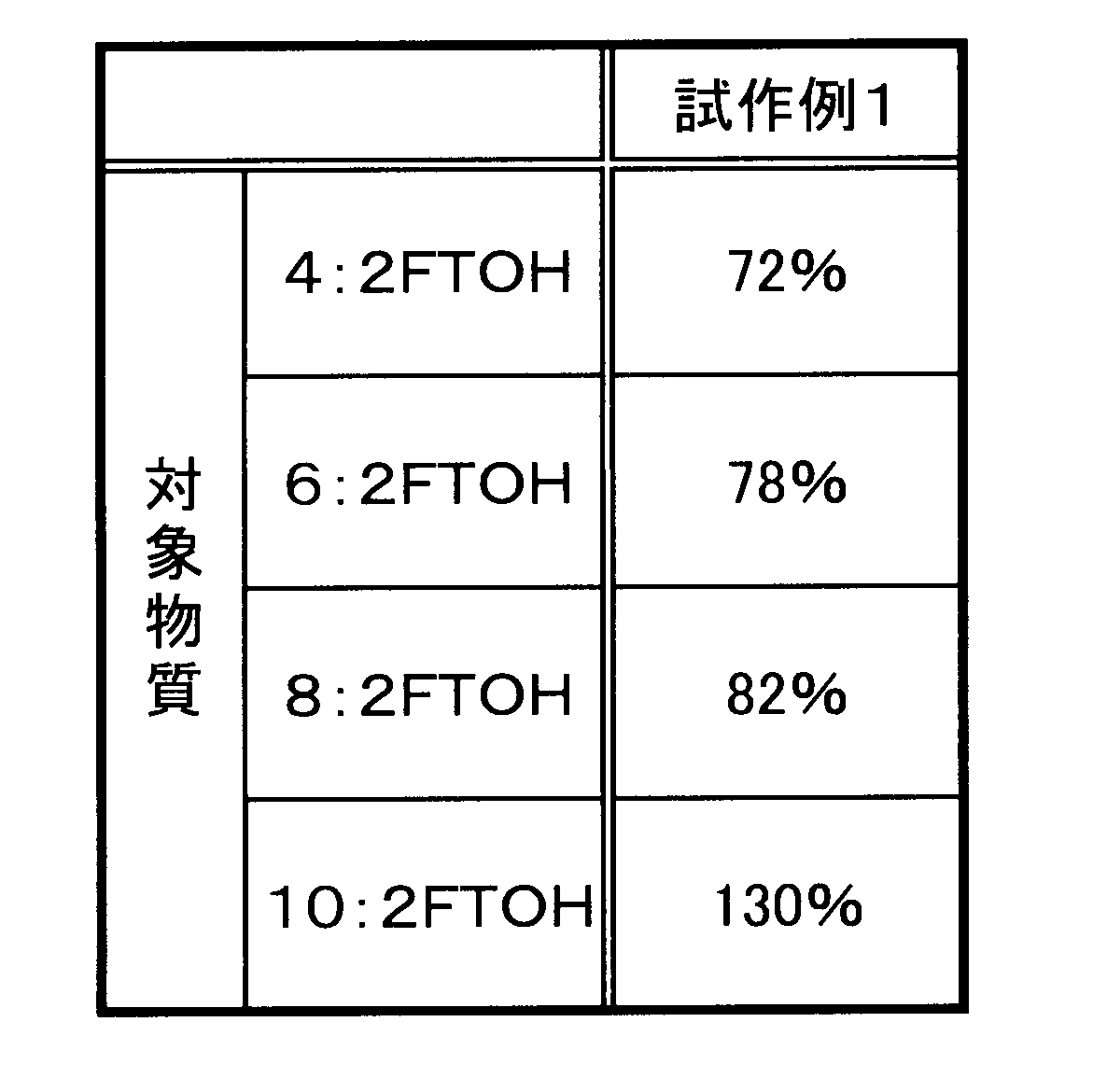
- Table 2 shows the recovery rate (%) of FTOHs for each target substance for the activated carbon of Prototype Example 1.
- the target substances are 4: 2FTOH, 6: 2FTOH, 8: 2FTOH, and 10: 2FTOH.
- FE3010 Futamura Chemical's fibrous activated carbon
- the pore volume was measured by nitrogen adsorption using an automatic specific surface area / pore distribution measuring device (“BELSORP-miniII”, manufactured by Microtrac Bell Co., Ltd.).
- the sum of micropore volumes (V mic ) (cm 3 / g), which is the pore volume in the pore diameter range of 1 nm or less in Prototype Examples 2 to 18, is the value of dV / dD in the pore diameter range of 1 nm or less. It was obtained by analyzing from the t-volume of the adsorption isotherm of nitrogen gas by the MP method.
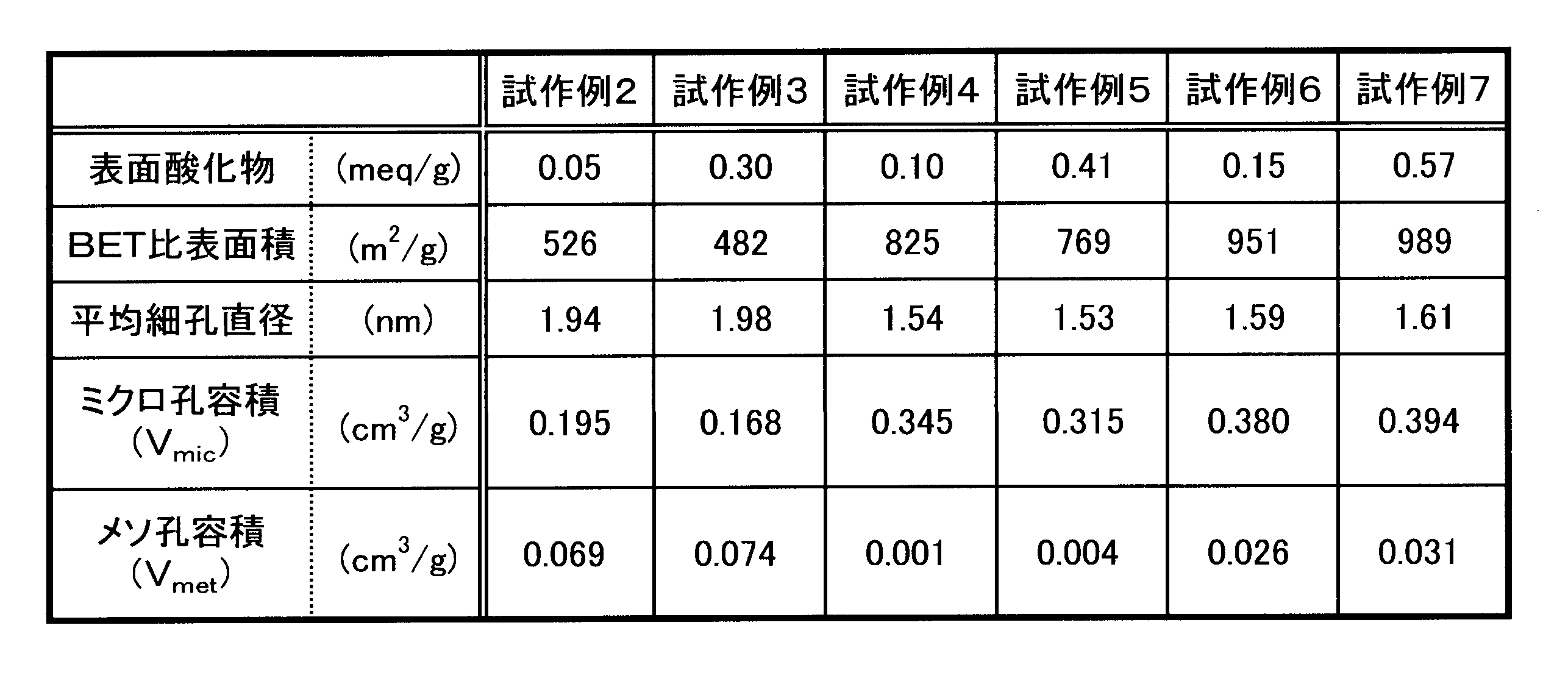
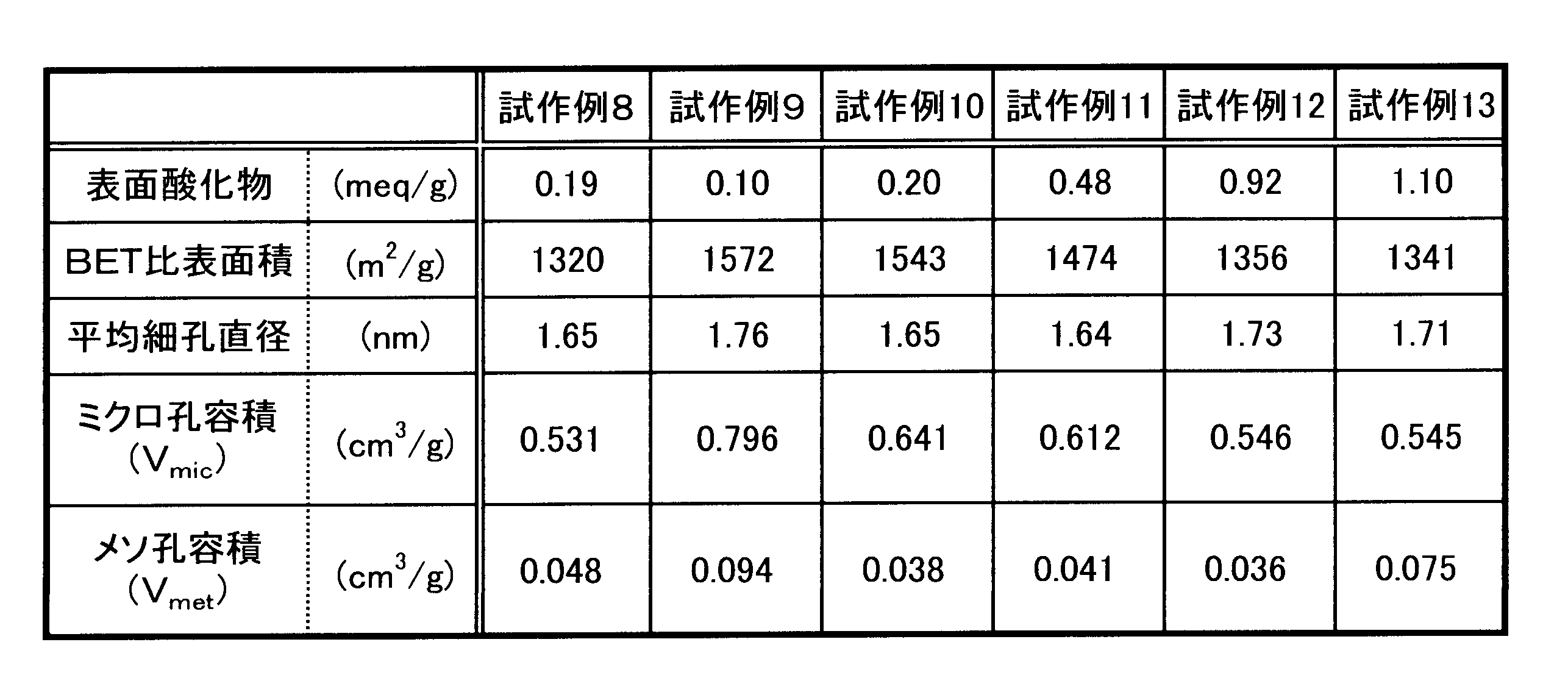
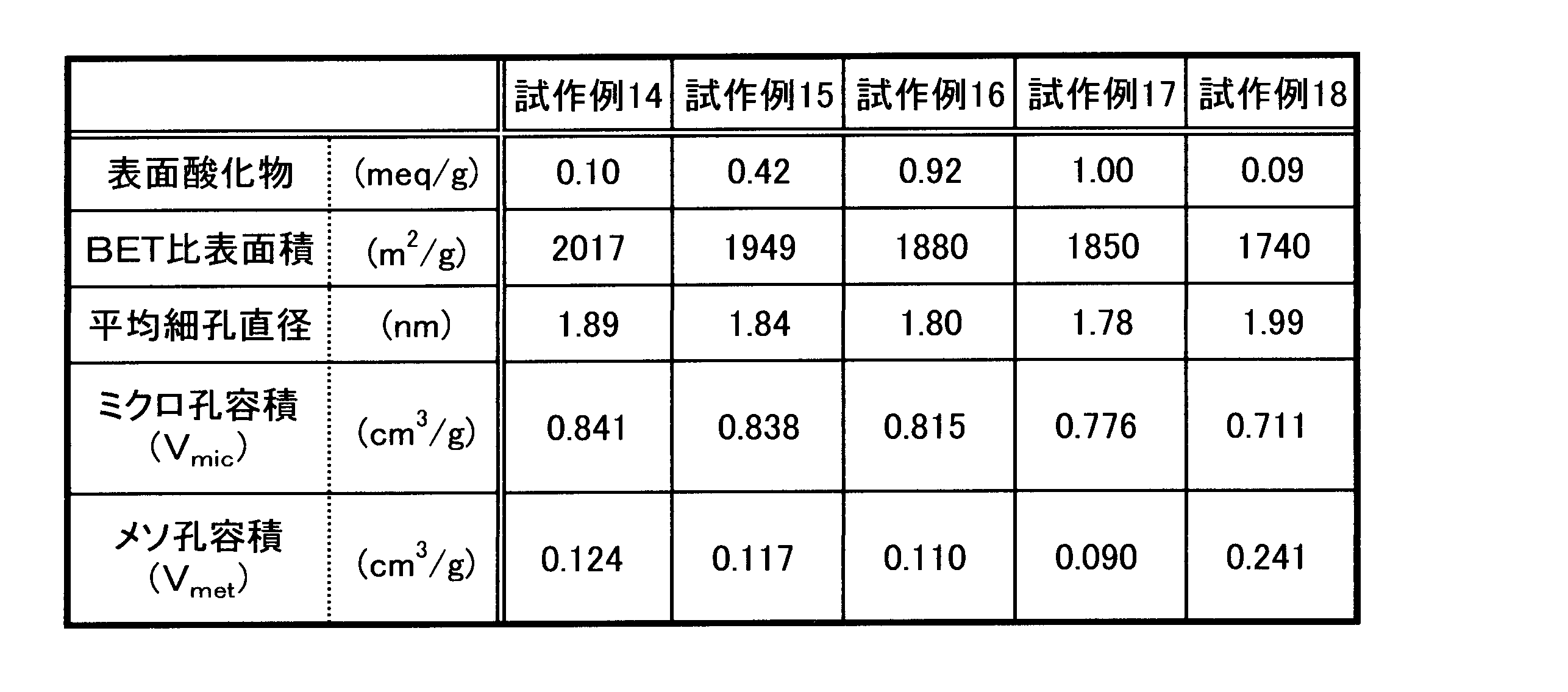
- the physical characteristics of the activated carbons of Prototype Examples 2 to 18 are shown in Tables 3 to 5. From the top of Table 3, the amount of surface oxide (meq / g), BET specific surface area (m 2 / g), average pore diameter (nm), micropore volume (V mic ) (cm 3 / g), mesopores. Volume (V met ) (cm 3 / g).
- the standard reagents of PFOA and PFOS of the target substances were added to ultrapure water, and the solution concentration of PFOA and PFOS was adjusted to 10 ng / ml (10 ppb) to prepare a test solution.
- 0.2 g of the above prototype was filled in a 20 ml syringe, and 20 ml of the test solution was passed through the test solution at a rate of 1 drop / second (1 drop / second). After passing the liquid, the water content of the activated carbon of the prototype example in the syringe was removed by centrifugation. Then, 14 ml of a methanol solution adjusted to an ammonia concentration of 0.01% was used, and the extract was collected by passing it through a prototype example after dehydration at a rate of 1 drop / second (1 drop / second).
- Tables 6 to 8 show the recovery rate (%) for each target substance for Prototype Examples 2 to 18.
- the target substances are PFOA and PFOS.
- Prototype Example 2 which has a small specific surface area, was able to sufficiently adsorb the target substance. This is because the amount of surface oxide is small, so that water molecules are not easily adsorbed on the functional groups on the surface of activated carbon by hydrogen bonds, and the pores are not easily clogged by the clusters of water molecules generated by this, and even if the specific surface area is small It is considered that there were sufficient pores capable of adsorbing the substance. Therefore, it is considered that the adsorption performance of activated carbon was exhibited well.
- the target substances were also adsorbed in the prototype examples 12, 13, 16 and 17 having a large amount of surface oxide. It is considered that this is because even if the amount of surface oxide is large and the pores are clogged by water molecules or clusters, the specific surface area is large, so that the pores necessary for adsorbing the target substance are sufficiently present. Therefore, it is considered that the adsorption performance of activated carbon was exhibited and the adsorption performance of pel and polyfluoroalkyl compounds was exhibited. From these facts, it is understood that a large specific surface area or more or a surface oxide amount of a certain amount or less is a condition for ensuring the adsorption performance of the pel and the polyfluoroalkyl compound in the water sample.
- the adsorption performance of both PFOA and PFOS is further improved when the activated carbon has a large specific surface area and a small amount of surface oxide. It was found that when the specific surface area was larger than a certain level and the amount of surface oxide was less than a certain level, the adsorption performance of the per and polyfluoroalkyl compounds in the water sample was further improved and a good recovery rate was exhibited. From the viewpoint of the contact efficiency between the target substance and the activated carbon, it is considered that the fibrous activated carbon can adsorb the pel and the polyfluoroalkyl compound more efficiently.
- the activated carbon has micropores developed after satisfying the above conditions, it can be inferred that the adsorption performance of the pel and the polyfluoroalkyl compound in the water sample will be further improved. It can be inferred that when the mesopores are developed, the molecules of the target substance are smoothly introduced into the pores of the activated carbon, and excellent adsorption performance is exhibited. Further, after the molecules of the target substance are adsorbed in the micropores, they are easily desorbed from the pores smoothly during the extraction operation, so that it is considered that a good recovery rate is obtained.
- the activated carbon adsorbing the pel and the polyfluoroalkyl compound in the water sample of the present invention can desorbably adsorb the pel and the polyfluoroalkyl compound in the water sample, which was not possible with the existing collecting material. Quantitative measurement of the compound was made possible. This enabled effective quantitative evaluation of persistent organic pollutants.
Landscapes
- Chemical & Material Sciences (AREA)
- Organic Chemistry (AREA)
- Analytical Chemistry (AREA)
- Chemical Kinetics & Catalysis (AREA)
- Inorganic Chemistry (AREA)
- Hydrology & Water Resources (AREA)
- Life Sciences & Earth Sciences (AREA)
- Engineering & Computer Science (AREA)
- Environmental & Geological Engineering (AREA)
- Water Supply & Treatment (AREA)
- Solid-Sorbent Or Filter-Aiding Compositions (AREA)
- Water Treatment By Sorption (AREA)
- Carbon And Carbon Compounds (AREA)
- Sampling And Sample Adjustment (AREA)
Abstract
Description


発明者らは、ペル及びポリフルオロアルキル化合物吸着活性炭を作成するため、下記の原料を使用した。
・繊維状活性炭
フタムラ化学株式会社製:繊維状活性炭「CF」(平均繊維径:15μm)
{以降、C1と表記する。}
フタムラ化学株式会社製:繊維状活性炭「FE3010」(平均繊維径:15μm)
{以降、C2と表記する。}
フタムラ化学株式会社製:繊維状活性炭「FE3012」(平均繊維径:15μm)
{以降、C3と表記する。}
フタムラ化学株式会社製:繊維状活性炭「FE3013」(平均繊維径:15μm)
{以降、C4と表記する。}
フタムラ化学株式会社製:繊維状活性炭「FE3015」(平均繊維径:15μm)
{以降、C5と表記する。}
フタムラ化学株式会社製:繊維状活性炭「FE3018」(平均繊維径:15μm)
{以降、C6と表記する。}
・粒状活性炭
フタムラ化学株式会社製:ヤシ殻活性炭「CW480SZ」(平均粒径:250μm)
{以降、C7と表記する。}
発明者らは下記の試作例1を用いて、水試料中のペル及びポリフルオロアルキル化合物の捕集実験1を行った。
<試作例1>
フタムラ化学製繊維状活性炭「FE3015」(C5)10gを、過酸化水素濃度6%溶液500mlに浸漬させ、70時間静置後、取り出して乾燥させ試作例1の活性炭とした。
〔表面酸化物量〕
表面酸化物量(meq/g)は、Boehmの方法を適用し、0.05N水酸化ナトリウム水溶液中において各例の吸着活性炭を振とうした後に濾過し、その濾液を0.05N塩酸で中和滴定した際の水酸化ナトリウム量とした。
比表面積(m2/g)は、マイクロトラック・ベル株式会社製、自動比表面積/細孔分布測定装置「BELSORP?miniII」を使用して77Kにおける窒素吸着等温線を測定し、BET法により求めた(BET比表面積)。
平均細孔直径(nm)は、細孔の形状を円筒形と仮定し、細孔容積(cm3/g)及び比表面積(m2/g)の値を用いて数式(iii)より求めた。


ペル及びポリフルオロアルキル化合物として、今回はフルオロテロマーアルコール(以降「FTOHs」と表記する。)を用いて評価を行った。FTOHsは上記した化学式(ii)に表される物質であって、炭素数によって物質名が異なる。例えば、C8F17CH2CH2OHの場合は、8:2FTOH(IUPAC名:3,3,4,4,5,5,6,6,7,7,8,8,9,9,10,10,10-ヘプタデカフルオロ-1-デカノール)と命名される。
次に、発明者らはペル及びポリフルオロアルキル化合物として、PFOA(C8HF15O2)及びPFOS(C8HF17O3S)を用いて、下記の試作例2~13について捕集実験2を行い評価した。
<試作例2>
フタムラ化学製繊維状活性炭「CF」(C1)10gを試作例2の活性炭とした。
フタムラ化学製繊維状活性炭「CF」(C1)10gを過酸化水素濃度4.2%溶液500mlに浸漬させ、220時間静置後、取り出して乾燥させ試作例3の活性炭とした。
フタムラ化学製繊維状活性炭「FE3010」(C2)10gを試作例4の活性炭とした。
フタムラ化学製繊維状活性炭「FE3010」(C2)10gを過酸化水素濃度4.2%溶液500mlに浸漬させ、150時間静置後、取り出して乾燥させ試作例5の活性炭とした。
フタムラ化学製繊維状活性炭「FE3012」(C3)10gを試作例6の活性炭とした。
フタムラ化学製繊維状活性炭「FE3012」(C3)10gを過酸化水素濃度4.2%溶液500mlに浸漬させ、100時間静置後、取り出して乾燥させ試作例7の活性炭とした。
フタムラ化学製繊維状活性炭「FE3013」(C4)10gを過酸化水素濃度1.5%溶液500mlに浸漬させ、70時間静置後、取り出して乾燥させ試作例8の活性炭とした。
フタムラ化学製繊維状活性炭「FE3015」(C5)10gを試作例9の活性炭とした。
フタムラ化学製繊維状活性炭「FE3015」(C5)10gを過酸化水素濃度1.5%溶液500mlに浸漬させ、40時間静置後、取り出して乾燥させ試作例10の活性炭とした。
フタムラ化学製繊維状活性炭「FE3015」(C5)10gを過酸化水素濃度4.2%溶液500mlに浸漬させ、70時間静置後、取り出して乾燥させ試作例11の活性炭とした。
フタムラ化学製繊維状活性炭「FE3015」(C5)10gを過酸化水素濃度14.0%溶液500mlに浸漬させ、350時間静置後、取り出して乾燥させ試作例12の活性炭とした。
フタムラ化学製繊維状活性炭「FE3015」(C5)10gを過酸化水素濃度18.9%溶液500mlに浸漬させ、480時間静置後、取り出して乾燥させ試作例13の活性炭とした。
フタムラ化学製繊維状活性炭「FE3018」(C6)10gを試作例14の活性炭とした。
フタムラ化学製繊維状活性炭「FE3018」(C6)10gを過酸化水素濃度4.2%溶液500mlに浸漬させ、50時間静置後、取り出して乾燥させ試作例15の活性炭とした。
フタムラ化学製繊維状活性炭「FE3018」(C6)10gを過酸化水素濃度14.0%溶液500mlに浸漬させ、350時間静置後、取り出して乾燥させ試作例16の活性炭とした。
フタムラ化学製繊維状活性炭「FE3018」(C6)10gを過酸化水素濃度18.9%溶液500mlに浸漬させ、480時間静置後、取り出して乾燥させ試作例17の活性炭とした。
フタムラ化学製ヤシ殻活性炭「CW480SZ」(C7)10gを試作例18の活性炭とした。
試作例2~18の表面酸化物、比表面積及び平均細孔直径は上記「活性炭の測定1」と同様に求めた。
細孔容積については、自動比表面積/細孔分布測定装置(「BELSORP-miniII」、マイクロトラック・ベル株式会社製)を使用し、窒素吸着により測定した。試作例2~18の細孔直径1nm以下の範囲の細孔容積であるミクロ孔容積の和(Vmic)(cm3/g)は、細孔直径1nm以下の範囲におけるdV/dDの値を窒素ガスの吸着等温線のt-plotからMP法により解析して求めた。
細孔直径が2~60nmの範囲におけるdV/dDの値は、窒素ガスの吸着等温線からDH法により解析した。なお、解析ソフトにおける細孔直径2~60nmの直径範囲は2.43~59.72nmである。この解析結果より、試作例6~21細孔直径2~60nmの範囲の細孔容積であるメソ孔容積の和(Vmet)(cm3/g)を求めた。
ペル及びポリフルオロアルキル化合物として、PFOA及びPFOSを用いて評価を行った。

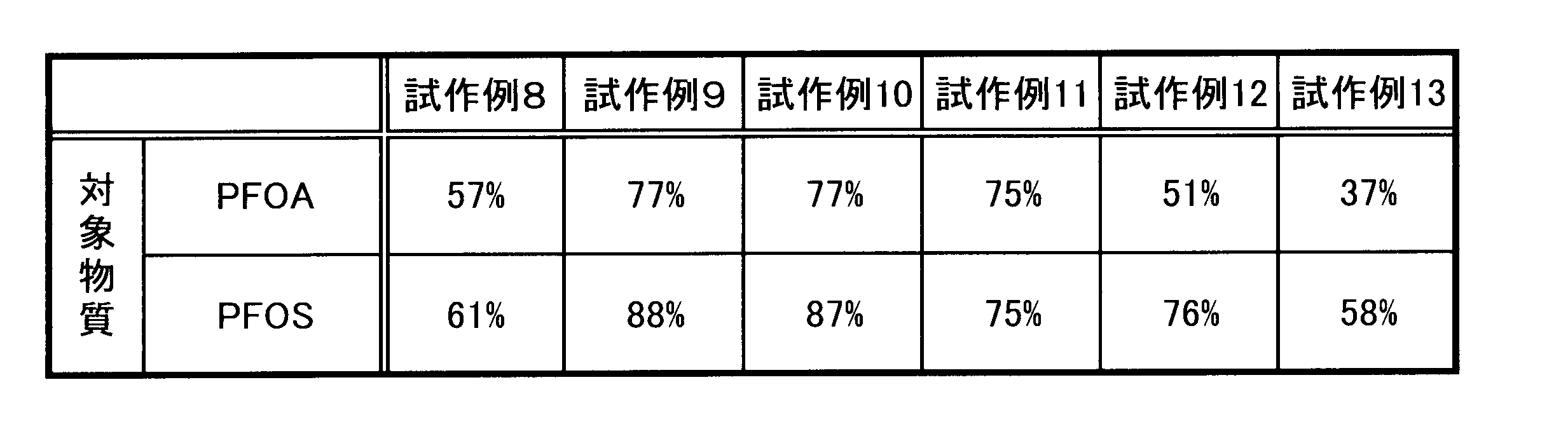

試作例3,5は、PFOA及びPFOSの両者において回収率が低い結果となり、対象物質の吸着が不十分であった。比表面積が小さく、さらに表面酸化物量が多いため、対象物質を吸着可能な細孔が不十分となり、吸着性能が発揮されなかったと推察される。
Claims (5)
- 活性炭吸着材のBET比表面積が800m2/g以上又は表面酸化物量が0.20meq/g以下である
水試料中のペル及びポリフルオロアルキル化合物を脱離可能に吸着するための
水試料中のペル及びポリフルオロアルキル化合物吸着活性炭。 - 活性炭吸着材のBET比表面積が800m2/g以上であって、
表面酸化物量が0.50meq/g以下である
水試料中のペル及びポリフルオロアルキル化合物を脱離可能に吸着するための
水試料中のペル及びポリフルオロアルキル化合物吸着活性炭。 - 前記活性炭吸着材の1nm以下のミクロ孔容積の和(Vmic)が0.30cm3/g以上である請求項1又は2に記載の水試料中のペル及びポリフルオロアルキル化合物吸着活性炭。
- 前記活性炭吸着材が繊維状活性炭である請求項1ないし3のいずれか1項に記載の水試料中のペル及びポリフルオロアルキル化合物吸着活性炭。
- 請求項1ないし4のいずれか1項に記載の吸着活性炭を保持してなることを特徴とする水試料中のペル及びポリフルオロアルキル化合物吸着フィルター体。
Priority Applications (3)
| Application Number | Priority Date | Filing Date | Title |
|---|---|---|---|
| CA3148636A CA3148636A1 (en) | 2019-08-20 | 2020-08-11 | Activated carbon for adsorbing per-and polyfluoroalkyl compounds in water sample |
| US17/753,081 US12257565B2 (en) | 2019-08-20 | 2020-08-11 | Activated carbon for adsorbing per- and polyfluoroalkyl compounds in water sample |
| CN202080058511.2A CN114302770A (zh) | 2019-08-20 | 2020-08-11 | 吸附水试样中的全氟和多氟烷基化合物的活性炭 |
Applications Claiming Priority (4)
| Application Number | Priority Date | Filing Date | Title |
|---|---|---|---|
| JP2019-150393 | 2019-08-20 | ||
| JP2019150393 | 2019-08-20 | ||
| JP2020-135049 | 2020-08-07 | ||
| JP2020135049A JP7541693B2 (ja) | 2019-08-20 | 2020-08-07 | 水試料中のペル及びポリフルオロアルキル化合物吸着活性炭 |
Publications (1)
| Publication Number | Publication Date |
|---|---|
| WO2021033596A1 true WO2021033596A1 (ja) | 2021-02-25 |
Family
ID=74661182
Family Applications (1)
| Application Number | Title | Priority Date | Filing Date |
|---|---|---|---|
| PCT/JP2020/030576 Ceased WO2021033596A1 (ja) | 2019-08-20 | 2020-08-11 | 水試料中のペル及びポリフルオロアルキル化合物吸着活性炭 |
Country Status (5)
| Country | Link |
|---|---|
| US (1) | US12257565B2 (ja) |
| JP (3) | JP7630146B2 (ja) |
| CN (1) | CN114302770A (ja) |
| CA (1) | CA3148636A1 (ja) |
| WO (1) | WO2021033596A1 (ja) |
Cited By (5)
| Publication number | Priority date | Publication date | Assignee | Title |
|---|---|---|---|---|
| JPWO2022255249A1 (ja) * | 2021-06-03 | 2022-12-08 | ||
| JP7603931B2 (ja) | 2021-04-19 | 2024-12-23 | 国立研究開発法人産業技術総合研究所 | 水試料中の揮発性ないし不揮発性ペル及びポリフルオロアルキル化合物の分析方法 |
| US12275661B2 (en) | 2023-07-14 | 2025-04-15 | Claros Technologies Inc. | Methods and systems of iodine capture from aqueous solutions |
| US12534390B2 (en) | 2023-07-14 | 2026-01-27 | Claros Technologies Inc. | Methods and systems of nitrate removal in aqueous systems for improved PFAS destruction |
| US12545601B2 (en) | 2023-07-14 | 2026-02-10 | Claros Technologies Inc. | Methods and systems of photosensitizer recovery for improved PFAS destruction |
Families Citing this family (1)
| Publication number | Priority date | Publication date | Assignee | Title |
|---|---|---|---|---|
| JP7799358B1 (ja) * | 2025-06-27 | 2026-01-15 | 株式会社シンコーホールディングス | Pfasの処理方法およびフッ化カルシウムの製造方法 |
Citations (2)
| Publication number | Priority date | Publication date | Assignee | Title |
|---|---|---|---|---|
| JP2013220413A (ja) * | 2012-04-19 | 2013-10-28 | Futamura Chemical Co Ltd | 浄水器用活性炭及びこれを用いた活性炭カートリッジ |
| WO2019063150A1 (de) * | 2017-09-27 | 2019-04-04 | BLüCHER GMBH | Verfahren und anlage für die behandlung und/oder aufreinigung von wasser |
Family Cites Families (6)
| Publication number | Priority date | Publication date | Assignee | Title |
|---|---|---|---|---|
| JP2010269241A (ja) * | 2009-05-21 | 2010-12-02 | Daikin Ind Ltd | 処理剤及びその製造方法、並びに、処理方法 |
| JP5327009B2 (ja) * | 2009-11-17 | 2013-10-30 | 東洋紡株式会社 | 活性炭素繊維 |
| JP2012101159A (ja) | 2010-11-09 | 2012-05-31 | Osaka Univ | 有機フッ素化合物吸着剤 |
| JP2014039912A (ja) * | 2012-08-22 | 2014-03-06 | Daikin Ind Ltd | 処理方法 |
| CN105329976B (zh) * | 2015-11-27 | 2018-11-09 | 清华大学 | 吸附并降解水中全氟化合物的方法 |
| WO2017199717A1 (ja) * | 2016-05-17 | 2017-11-23 | 株式会社クラレ | 活性炭、並びにそれを用いた吸着フィルターおよび浄水器 |
-
2020
- 2020-08-11 CN CN202080058511.2A patent/CN114302770A/zh active Pending
- 2020-08-11 WO PCT/JP2020/030576 patent/WO2021033596A1/ja not_active Ceased
- 2020-08-11 US US17/753,081 patent/US12257565B2/en active Active
- 2020-08-11 CA CA3148636A patent/CA3148636A1/en active Pending
-
2022
- 2022-08-31 JP JP2022138325A patent/JP7630146B2/ja active Active
- 2022-08-31 JP JP2022138326A patent/JP7478781B2/ja active Active
-
2023
- 2023-09-26 JP JP2023162676A patent/JP7509390B2/ja active Active
Patent Citations (2)
| Publication number | Priority date | Publication date | Assignee | Title |
|---|---|---|---|---|
| JP2013220413A (ja) * | 2012-04-19 | 2013-10-28 | Futamura Chemical Co Ltd | 浄水器用活性炭及びこれを用いた活性炭カートリッジ |
| WO2019063150A1 (de) * | 2017-09-27 | 2019-04-04 | BLüCHER GMBH | Verfahren und anlage für die behandlung und/oder aufreinigung von wasser |
Cited By (10)
| Publication number | Priority date | Publication date | Assignee | Title |
|---|---|---|---|---|
| JP7603931B2 (ja) | 2021-04-19 | 2024-12-23 | 国立研究開発法人産業技術総合研究所 | 水試料中の揮発性ないし不揮発性ペル及びポリフルオロアルキル化合物の分析方法 |
| JPWO2022255249A1 (ja) * | 2021-06-03 | 2022-12-08 | ||
| WO2022255249A1 (ja) * | 2021-06-03 | 2022-12-08 | フタムラ化学株式会社 | ペルフルオロアルキル化合物吸着活性炭 |
| JP7573108B2 (ja) | 2021-06-03 | 2024-10-24 | フタムラ化学株式会社 | ペルフルオロアルキル化合物吸着活性炭 |
| US12275661B2 (en) | 2023-07-14 | 2025-04-15 | Claros Technologies Inc. | Methods and systems of iodine capture from aqueous solutions |
| US12351498B2 (en) | 2023-07-14 | 2025-07-08 | Claros Technologies Inc. | Methods and systems of PFAS destruction using UV irradiation at 222 nanometers |
| US12473222B2 (en) | 2023-07-14 | 2025-11-18 | Claros Technologies Inc. | Methods and systems for recycling materials during PFAS destruction |
| US12515974B2 (en) | 2023-07-14 | 2026-01-06 | Claros Technologies Inc. | Methods and systems of iodine capture from aqueous solutions |
| US12534390B2 (en) | 2023-07-14 | 2026-01-27 | Claros Technologies Inc. | Methods and systems of nitrate removal in aqueous systems for improved PFAS destruction |
| US12545601B2 (en) | 2023-07-14 | 2026-02-10 | Claros Technologies Inc. | Methods and systems of photosensitizer recovery for improved PFAS destruction |
Also Published As
| Publication number | Publication date |
|---|---|
| CA3148636A1 (en) | 2021-02-25 |
| US12257565B2 (en) | 2025-03-25 |
| JP7630146B2 (ja) | 2025-02-17 |
| JP2022171711A (ja) | 2022-11-11 |
| JP7478781B2 (ja) | 2024-05-07 |
| CN114302770A (zh) | 2022-04-08 |
| JP7509390B2 (ja) | 2024-07-02 |
| US20220266217A1 (en) | 2022-08-25 |
| JP2023171415A (ja) | 2023-12-01 |
| JP2022176198A (ja) | 2022-11-25 |
Similar Documents
| Publication | Publication Date | Title |
|---|---|---|
| JP7630146B2 (ja) | 水試料中のペル及びポリフルオロアルキル化合物吸着活性炭 | |
| JP7541693B2 (ja) | 水試料中のペル及びポリフルオロアルキル化合物吸着活性炭 | |
| JP7833727B2 (ja) | 大気試料中のペル及びポリフルオロアルキル化合物吸着活性炭 | |
| JP7573108B2 (ja) | ペルフルオロアルキル化合物吸着活性炭 | |
| JP2023024455A5 (ja) | ||
| JP2021035671A5 (ja) | ||
| WO2021112011A1 (ja) | ペル及びポリフルオロアルキル化合物捕集サンプラー | |
| JP7603931B2 (ja) | 水試料中の揮発性ないし不揮発性ペル及びポリフルオロアルキル化合物の分析方法 | |
| JP7576789B2 (ja) | 中性ペル及びポリフルオロアルキル化合物吸着活性炭及び水試料中の中性ペル及びポリフルオロアルキル化合物の分析方法 | |
| RU2818008C2 (ru) | Активированный уголь, адсорбирующий пер- и полифторалкильные соединения | |
| JP7560052B2 (ja) | ペル及びポリフルオロアルキル化合物捕集サンプラー | |
| BR112022003001B1 (pt) | Carvão ativado adsorvente de compostos per- e polifluoroalquila e corpo de filtro de carvão ativado adsorvente de compostos per- e polifluoroalquila |
Legal Events
| Date | Code | Title | Description |
|---|---|---|---|
| 121 | Ep: the epo has been informed by wipo that ep was designated in this application |
Ref document number: 20854343 Country of ref document: EP Kind code of ref document: A1 |
|
| ENP | Entry into the national phase |
Ref document number: 3148636 Country of ref document: CA |
|
| NENP | Non-entry into the national phase |
Ref country code: DE |
|
| 122 | Ep: pct application non-entry in european phase |
Ref document number: 20854343 Country of ref document: EP Kind code of ref document: A1 |
|
| WWG | Wipo information: grant in national office |
Ref document number: 17753081 Country of ref document: US |