WO2021014951A1 - 質問応答システムのための回答分類器及び表現ジェネレータ、並びに表現ジェネレータを訓練するためのコンピュータプログラム - Google Patents
質問応答システムのための回答分類器及び表現ジェネレータ、並びに表現ジェネレータを訓練するためのコンピュータプログラム Download PDFInfo
- Publication number
- WO2021014951A1 WO2021014951A1 PCT/JP2020/026360 JP2020026360W WO2021014951A1 WO 2021014951 A1 WO2021014951 A1 WO 2021014951A1 JP 2020026360 W JP2020026360 W JP 2020026360W WO 2021014951 A1 WO2021014951 A1 WO 2021014951A1
- Authority
- WO
- WIPO (PCT)
- Prior art keywords
- answer
- question
- expression
- passage
- generator
- Prior art date
- Legal status (The legal status is an assumption and is not a legal conclusion. Google has not performed a legal analysis and makes no representation as to the accuracy of the status listed.)
- Ceased
Links
Images




Classifications
-
- G—PHYSICS
- G06—COMPUTING OR CALCULATING; COUNTING
- G06F—ELECTRIC DIGITAL DATA PROCESSING
- G06F40/00—Handling natural language data
- G06F40/20—Natural language analysis
-
- G—PHYSICS
- G06—COMPUTING OR CALCULATING; COUNTING
- G06F—ELECTRIC DIGITAL DATA PROCESSING
- G06F40/00—Handling natural language data
- G06F40/30—Semantic analysis
-
- G—PHYSICS
- G06—COMPUTING OR CALCULATING; COUNTING
- G06F—ELECTRIC DIGITAL DATA PROCESSING
- G06F16/00—Information retrieval; Database structures therefor; File system structures therefor
- G06F16/30—Information retrieval; Database structures therefor; File system structures therefor of unstructured textual data
- G06F16/33—Querying
- G06F16/332—Query formulation
- G06F16/3329—Natural language query formulation
-
- G—PHYSICS
- G06—COMPUTING OR CALCULATING; COUNTING
- G06F—ELECTRIC DIGITAL DATA PROCESSING
- G06F16/00—Information retrieval; Database structures therefor; File system structures therefor
- G06F16/30—Information retrieval; Database structures therefor; File system structures therefor of unstructured textual data
- G06F16/35—Clustering; Classification
- G06F16/353—Clustering; Classification into predefined classes
-
- G—PHYSICS
- G06—COMPUTING OR CALCULATING; COUNTING
- G06F—ELECTRIC DIGITAL DATA PROCESSING
- G06F40/00—Handling natural language data
- G06F40/30—Semantic analysis
- G06F40/35—Discourse or dialogue representation
-
- G—PHYSICS
- G06—COMPUTING OR CALCULATING; COUNTING
- G06N—COMPUTING ARRANGEMENTS BASED ON SPECIFIC COMPUTATIONAL MODELS
- G06N20/00—Machine learning
Definitions
- the present invention relates to a question answering system, in particular, used in a question answering system that extracts passages that may contain answers to questions entered in natural language from a text archive, and assumes that the passages contain correct answers. It relates to an answer classifier that classifies non-answers, an expression generator used in the answer classifier, and a computer program for training the expression generator.
- This application claims priority based on Japanese Application Japanese Patent Application No. 2019-133710 filed on July 19, 2019, and all the contents described in the Japanese application are incorporated herein by reference.
- FIG. 1 shows a schematic configuration of the reason type question answering system 30.
- a plurality of passages consisting of a set of sentences that are likely to be answers (hereinafter referred to as "passage group".
- the sentences included in each passage are 5 to 7).
- the text archive is extracted from the text archive and the most suitable answer to the question is selected.
- the passage means a sentence consisting of a plurality of consecutive sentences in the text.
- This reason type question answering system 30 is also such a system, but as a premise, an answer candidate search system that extracts and outputs a plurality of passages that are likely to contain the correct answer to the question when the question is given from the text archive. Use 34.
- the reason-type question answering system 30 disclosed in Patent Document 1 receives a question 32 composed of natural language voice, and outputs the question as a text.
- the question reception unit 50 and the question reception unit 50 The text of the question output by is given to the existing answer candidate search system 34, and the response receiving unit 52 that receives a plurality of passages (answer passages) as the answer candidates and the answer passage received by the response receiving unit 52 are stored.
- type question answering system 30 further expresses a causal relationship from a web archive storage unit 56 that collects and stores a large amount of text existing on the web in advance and a web archive stored in the web archive storage unit 56. It includes a causal relationship expression extraction unit 58 that extracts expressions considered to be. Various things can be considered as the causal relationship expression extraction unit 58. Why In the case of type questions, expressions that express causality are important in extracting the answers. In the system disclosed in Patent Document 1, a clue word such as "because” or a specific causal relationship pattern such as "A causes B to occur” is used to recognize the causal relationship in the response passage. It is listed.
- the why type question answering system 30 is further converted into texts received from each of the answer passages stored in the answer passage storage unit 54, knowledge about the causal relationship extracted by the causal relationship expression extraction unit 58, and the question reception unit 50.
- the answer passages are ranked based on the score calculated for each answer passage by the convolutional neural network (hereinafter referred to as "CNN") 62 and the CNN 62, and the answer passage with the highest score is asked.
- the answer candidate ranking unit 64 which is output as the answer 36 to 32, is included.
- the reason type question answering system 30 converts the question 32 into text by the question receiving unit 50 and gives it to the response receiving unit 52 and the feature amount extracting unit 60.
- the response receiving unit 52 gives this text to the answer candidate search system 34.
- the answer candidate search system 34 searches a text archive (not shown) for a group of passages that are likely to include an answer to this question, and gives the response receiver 52. These passage groups are stored in the response passage storage unit 54.
- the causal relationship expression extraction unit 58 extracts the causal relationship expression from the text on the web stored in the web archive storage unit 56 and gives it to the feature quantity extraction unit 60.
- the feature amount extraction unit 60 uses the passages, the textualized question 66, and the causal relationship expressions stored in the causal relationship expression extraction unit 58 for each of the plurality of passages stored in the answer passage storage unit 54. , A predetermined feature amount for determining whether or not the passage is suitable as an answer to the question 32 is extracted. This feature is given to CNN62. The CNN 62 receives the feature amount given by the feature amount extraction unit 60 and the passage to be processed stored in the answer passage storage unit 54, and the score indicating whether or not the passage is suitable as the answer to the question 32. Is calculated and output in combination with the passage.
- the answer candidate ranking unit 64 ranks the passages based on the score calculated by CNN62 for each passage stored in the answer passage storage unit 54, and outputs the passage with the highest score as the answer 36.
- the causal part of the causal relationship expression that has the question in the result part is appropriate as the answer.
- the most appropriate passage as an answer can be extracted from the passage group which is the answer candidate extracted by the response receiving unit 52 based on the causal relationship expression. Therefore, according to Patent Document 1, it is possible to select a more suitable answer to the type question as compared with the conventional case.
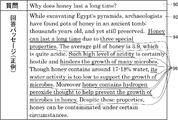
- FIG. 3 shows a part to be noted in the answer passage 92 of FIG.
- the answer passage 92 includes the expression 94 “Honey can last a long time”.
- the expression 94 is a portion indicating that the answer passage 92 is associated with question 90.
- the answer candidate search system 34 pays attention to such a part and outputs a passage including the part as an answer candidate.
- the underlined part 96 in the answer passage 92 is considered to be a part related to the answer to the question.
- the part other than the expression 94 and not underlined is a part that is not directly related to the question 90. These correspond to noise.
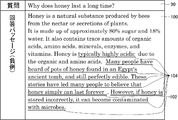
- the answer passage 100 shown in FIG. 4 has a part 102 related to the question 90, but the other parts, particularly the underlined part 104, has nothing to do with the question or the answer. These are considered to be similar to the normal noise. Passages that are not related to the answer to the question should be discarded.
- the present invention is used in an answer classifier that classifies passages with high accuracy based on whether or not a passage that is a candidate for an answer to a question is related to an answer to a question, and the answer classifier is used for inputting to the answer classifier. It is an object of the present invention to provide a computer program for training an expression generator for generating an expression of a passage, and an expression generator thereof.
- the computer program according to the first aspect of the present invention is a first method of expressing a computer in natural language processing by a computer when a question consisting of the natural language and an input paired with the question are given.
- a first expression generator that outputs an expression vector, a question and an answer to the question, a second expression that outputs a second expression vector that expresses the answer in the same format as the first expression vector.
- a generator for receiving input of a first expression vector or a second expression vector, and a separator for determining whether the input expression vector is a first expression vector or a second expression vector, and a first Operates as a hostile learning unit that trains the classifier and the first expression generator by hostile learning so that the false judgment for the expression vector becomes as large as possible and the false judgment for the second expression vector becomes as small as possible.
- the first expression generator given the question and a passage containing one or more sentences that may contain an answer to the question, from the passage, expresses the answer to the question.
- the first expression generator given a question and a passage containing one or more randomly selected sentences, represents the answer to the question from the passage and the question.
- the first representation generator given a question and a random vector consisting of random elements, outputs a first representation vector representing the answer to the question from the random vector and the question. Including means.
- the expression generator according to the second aspect of the present invention generates a first expression generator from a passage trained by any of the above computer programs.
- the answer classifier receives input of a question and a passage that may include an answer to the question, and is an expression of the answer to the question obtained from the passage. Outputs the above-mentioned expression generator, passage, first expression vector, and question that outputs the expression vector, and outputs the expression vector that encodes the passage with the attention added by the first expression vector and the question.
- a question encoder that receives a question and a passage, and outputs a question expression vector to which attention is given by the passage, and a first expression vector, a passage expression vector, and a question expression vector. , Includes passages and judgment units pre-trained to classify correct and incorrect answers to questions.
- FIG. 1 is a block diagram showing a schematic configuration of a reason-type question answering system disclosed in Patent Document 1.
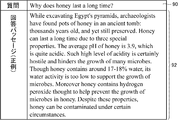
- FIG. 2 is a diagram showing a question and a positive example of an answer passage to the question.
- FIG. 3 is a diagram showing a question and a positive example of an answer passage to the question.
- FIG. 4 is a diagram showing a question and a negative example of an answer passage to the question.
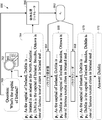
- FIG. 5 is a diagram showing a positive example of a question and an answer passage to the question, and a core answer created from the regular example.
- FIG. 6 is a schematic diagram for explaining a general hostile learning mechanism.
- FIG. 1 is a block diagram showing a schematic configuration of a reason-type question answering system disclosed in Patent Document 1.
- FIG. 2 is a diagram showing a question and a positive example of an answer passage to the question.
- FIG. 3 is a diagram showing a question and a positive example of an answer passage to the question.
- FIG. 4 is a diagram showing a
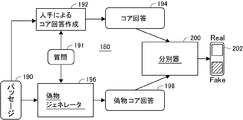
- FIG. 7 is a schematic diagram for explaining the mechanism of a virtual system for training a fake generator that creates a core answer similar to a core answer manually created from a passage using hostile learning.
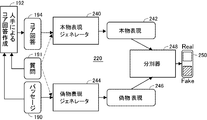
- FIG. 8 is for explaining the mechanism of a system for training a fake expression generator that creates an expression similar to the expression obtained from a core answer manually created based on a passage according to the first embodiment of the present invention. It is a schematic diagram of.
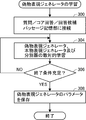
- FIG. 9 is a flowchart showing a control structure of the main routine of the program that realizes hostile learning by the system shown in FIG.
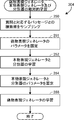
- FIG. 10 is a flowchart showing a routine control structure for performing parameter learning of the fake expression generator in the program shown in FIG. FIG.
- FIG. 11 is a block diagram showing the structure of an answer classifier that determines whether a passage is correct as an answer to a question using a fake expression generator trained by the system shown in FIG.
- FIG. 12 is a block diagram showing a basic configuration of an encoder constituting the fake expression generator shown in FIG.
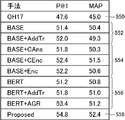
- FIG. 13 is a diagram showing the classification accuracy by the answer classifier shown in FIG. 11 in tabular form in comparison with the accuracy by the conventional answer classifier using the fake expression generator according to the first embodiment of the present invention.
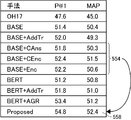
- FIG. 14 is the same table as FIG. 13, showing that the classification performance by the answer classifier using the fake expression generator according to the first embodiment of the present invention was improved by adopting the core answer expression. is there.
- FIG. 15 is the same table as FIG.
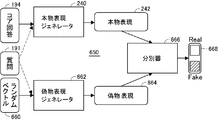
- FIG. 16 is a schematic diagram for explaining the mechanism of the system for training the fake expression generator according to the second embodiment of the present invention.
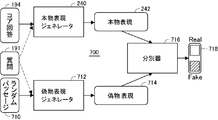
- FIG. 17 is a schematic diagram for explaining the mechanism of the system for training the fake expression generator according to the third embodiment of the present invention.
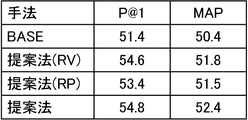
- FIG. 18 is a diagram showing the accuracy of the response classifiers that employ the fake expression generators according to the first, second, and third embodiments of the present invention in tabular form in comparison with the reference values.
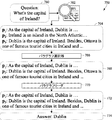
- FIG. 19 is a schematic diagram showing a processing process of a conventional OpenQA system.
- FIG. 20 is a block diagram showing the configuration of the OpenQA system shown in FIG.
- FIG. 21 is a schematic diagram showing a processing process of an OpenQA system that employs a fake expression generator according to an embodiment of the present invention.
- FIG. 22 is a block diagram showing a configuration of an OpenQA system that employs a fake expression generator according to an embodiment of the present invention. It is a figure which shows the appearance of the computer system which realizes the training system of the fake expression generator, the fake expression generator, and the answer classifier which concerns on each embodiment of this invention.
- FIG. 23 is a block diagram showing a hardware configuration of a computer system whose appearance is shown in FIG.
- the answer passage 92 is obtained for the question 90.
- An example of a core answer manually created based on this answer passage 92 is the core answer 110 shown in FIG.
- the core answer 110 is an accurate answer to the question 90 created only from the part of the passage included in the answer passage 92 that is suitable as an answer to the question 90. It has become.
- Generative Adversarial Network There is a machine learning technology called Generative Adversarial Network as a technology that may be able to create core answers from answer passages by automatic processing by a computer.
- GAN is often particularly applied to image generation, for example, it can generate a fake image (fake) that is almost indistinguishable from a photograph. Even in natural language processing, it may be effective in generating core answers.
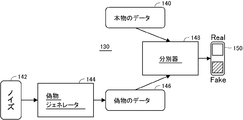
- FIG. 6 shows the basic configuration using GAN.
- this GAN is for learning the fake generator 144.
- the fake generator 144 for example, one that generates a fake image can be considered.
- the GAN 130 receives input from a fake generator 144 that samples noise 142 and generates fake data (eg, an image) 146 from the sampled noise, and real data 140 or fake data 146, and they are real or fake. It includes a separator 148 for sorting the noise and outputting the sorting result 150.
- the separator 148 is trained to correctly classify genuine data 140 as genuine and fake data 146 as fake.
- the counterfeit generator 144 learns its own parameters so that the classifier 148 has the maximum probability of misclassifying the counterfeit data 146 as genuine.
- the classifier 148 and the counterfeit generator 144 are alternately trained, and the training is terminated when the determination of the classifier 148 finally reaches 50% or when the learning of the specified number of repetitions is completed.
- the fake generator 144 is capable of generating fake data so close to the real data 140 that it is difficult to correctly determine whether the separator 148 is genuine or fake.
- FIG. 7 shows a virtual GAN configuration that can be considered as a system for realizing the above-mentioned core answer with the immediate goal of enabling the fake generator 144 to be automatically generated from the passage.
- the GAN 180 was created by a fake generator 196 trained to generate fake core answers 198 from passage 190 and question 191 and by manual core answer creation 192 based on passage 190 and question 191.
- the core answer 194 and the fake core answer 198 generated by the fake generator 196 the core answer 194 manually created is the real one, and the fake core answer 198 created by the fake generator 196 is the fake.
- GAN180 trains the separator 200 so as to discriminate the core answer 194 from the real one and the fake core answer 198 from the fake one (to minimize the error in sorting).
- the counterfeit generator 196 is trained so that the probability that the classifier 200 determines that the counterfeit core answer 198 generated by the counterfeit generator 196 from the passage 190 is genuine (probability of sorting error) is maximized. This is based on game theory, and eventually the Nash equilibrium is reached, and the probability that the separator 200 correctly separates is 50%. If a core answer is generated from the passage 190 using the counterfeit generator 196 trained in this way, the core answer may be indistinguishable from the manually created core answer 194.
- the GAN does not train the fake generator to generate a fake core answer from passage 190, but rather fake to obtain some representation (fake representation) of the fake core answer 198. It trains generators through hostile learning.
- a fake generator hereinafter referred to as "fake expression generator”
- the GAN 220 for training the fake expression generator 244 includes the passage 190, the core answer 194 created by the manual core answer creation 192 from the passage 190, and the passage. This is for training the fake expression generator 244 using a large number of three sets consisting of the question 191 that was the basis for obtaining 190.
- the fake representation generator 244 generates fake representation 246 from passage 190 and question 191.
- the real representation 242 and the fake representation 246 are vectors with the same number of elements. That is, unlike the one shown in FIG. 7, the fake expression generator 244 shown in FIG. 8 does not generate the final target object, but generates its vector expression (hereinafter, this is referred to as “expression vector”). ..
- the number of elements of this representation vector is selected in advance so as to be the maximum number of elements of these vectors obtained from the training data.
- the GAN 220 has a real expression generator 240 for generating a real expression 242 which is an expression in the same format as the fake expression 246 from the core answer 194 and the question 191 and a real expression 242.
- a classifier 248 that is trained to determine that it is an expression and to output a sorting result 250 (to minimize the error in sorting) by classifying the fake expression 246 generated by the fake expression generator 244 as a fake expression. And include.
- FIG. 9 is a flowchart showing a control structure of a program that realizes training by GAN220.
- the program communicatively connects the computer with each storage unit for questions, core answers, and candidate answer passages, step 300, fake representation generator 244, real representation generator 240, and sorting.
- steps 304 and 304 in which the learning of the device 248 is performed by hostile learning between the real expression generator 240 and the classifier 248 and the fake expression generator 244, it is determined whether or not the training end condition is satisfied.
- the parameters of the fake expression generator 244 at that time are stored in a predetermined storage device. Includes step 308 to save to. If the determination in step 306 is negative, control returns to step 304. Therefore, step 304 is repeated until the end condition is satisfied.
- the program that realizes the hostile learning in step 304 of FIG. 9 samples a plurality of samples consisting of a combination of a question and a passage corresponding to the question from the training data, step 350, a fake representation.
- the real representation generator 240 uses the core answers and questions of the samples sampled in steps 351 and 350 to fix the parameters of the generator 244, the real representation generator 240 generates the real representation 242 and the separator 248 incorrectly separates them as fake.
- step 354 to fix the parameters of the classifier 248 and the real representation generator 240, and the fake representation generator 244 from passage 190 and question 191.
- the fake expression generator 244 trained as above is used to identify the answer to determine whether the candidate answer passage 440 gives an appropriate answer to question 442.
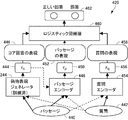
- the classifier 420 includes a fake expression generator 244 pre-learned by hostile learning according to the procedure shown in FIGS. 9 and 10, as well as a passage encoder 448 and a question encoder 454 pre-trained using the training data.
- the passage encoder 448 and the question encoder 454 are trained by normal supervised learning rather than hostile learning, using the training data of the question answering system.
- the classifier 420 further receives the core answer expression 446, the passage expression 452, and the question expression 458 as inputs, and outputs a classification result 462 indicating whether the passage 440 is a passage that gives the correct answer to the question 442.
- a logistic regression layer 460 for
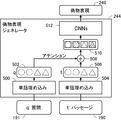
- the fake expression generator 244 receives the passage 190, converts each word constituting the passage 190 into a word embedding vector (hereinafter referred to as “word vector”), and outputs a word vector sequence 506. It includes a word embedding layer 504 and a word embedding layer 500 that receives question 191, converts each word constituting question 191 into a word vector, and outputs a word vector sequence 502.
- word vector word embedding vector
- the counterfeit expression generator 244 further adds an attention addition unit 508 that adds the word vector string 502 as an attention to each vector of the word vector string 506 and outputs a word vector string 510 modified by the attention, and a word vector string 510.
- an attention addition unit 508 that adds the word vector string 502 as an attention to each vector of the word vector string 506 and outputs a word vector string 510 modified by the attention, and a word vector string 510.
- the real expression generator 240 shown in FIG. 8 also has the same configuration as the fake expression generator 244 including the CNN 512.
- the real representation generator 240 differs from the fake representation generator 244 in that the object of encoding is the core answer 194 rather than the passage 190.
- the passage encoder 448 and the question encoder 454 shown in FIG. 11 each have the same configuration as the above-mentioned encoder.
- the fake representation generator 244 is trained by hostile learning in conjunction with the real representation generator 240 and the separator 248 shown in FIG.
- an existing question answering system collects appropriate passages 190 as answers to various questions 191 and stores them in a storage device in association with the question 191. From these passages 190, the core answer creation 192 by hand generates an appropriate and short core answer 194 as the answer to the question 191 and stores it in the storage device.
- a computer is connected to a storage unit that stores passage 190, question 191 and core answer 194.
- the computer opens a file containing these in the storage device that stores the passage 190, the question 191 and the core answer 194, reads the contents thereof, and stores them in the memory.
- passage 190, question 191 and core answer 194 are read from the database storing these and stored in the memory (step 300).
- a plurality of pairs of question 191 and passages for the question are sampled from the learning data (step 350).
- the parameters of the fake expression generator 244 are fixed (step 351).
- the real representation generator 240 uses the sampled question 191 and the core answer 194 to the question 191 to the real representation generator 240 generates the real representation 242 and gives it to the separator 248.
- the separator 248 determines whether or not this genuine expression 242 is genuine.
- the parameters of the separator 248 and the real expression generator 240 are trained with the parameters of the fake expression generator 244 fixed so that the erroneous determination becomes 0.
- the parameters of the separator 248 and the real expression generator 240 are fixed (step 354).
- the fake expression generator 244 is learned by using the question 191 and the passage 190 for the question 191 while the parameters of the separator 248 are fixed (step 356). Specifically, the fake expression generator 244 generates the fake expression 246.
- the classifier 248 determines whether or not the fake expression 246 is a genuine expression. This determination is made for a plurality of questions 191 so that the parameters of the fake expression generator 244 are maximized by the classifier 248, that is, the probability that the classifier 248 determines the fake expression 246 as a genuine expression is increased. As described above, the parameters of the classifier 248 and the real expression generator 240 are fixed and the parameters of the fake expression generator 244 are adjusted.
- step 306 it is determined whether or not the accuracy of the determination of the separator 248 has reached the state of this Nash equilibrium or a constant state close to the Nash equilibrium. If the determination result is negative, control returns to step 304 and continues hostile learning of the fake expression generator 244. If the determination result in step 306 is affirmative, the parameters of the fake expression generator 244 are stored in the storage device in step 308, and the process ends.
- the fake expression generator 244 of the classifier 420 was trained by the hostile learning described above. Therefore, the core answer expression generated by the fake expression generator 244 is such that the classifier 248 shown in FIG. 8 cannot correctly classify whether it is a genuine expression or a fake expression.
- the passage encoder 448 and the question encoder 454 have a configuration as shown in FIG. 12, similar to the fake expression generator 244. However, unlike the fake expression generator 244, the passage encoder 448 and the question encoder 454 have not received prior learning in hostile learning.
- the learning data of the combination of the question and the passage including the correct answer to the question and the combination of the passage not including the question and the correct answer to the question is prepared in advance. These combinations are labeled as correct or incorrect, depending on whether the passage contains the correct answer to the question.
- the passage 440 and the question 442 are given to the fake expression generator 244.
- the fake expression generator 244 outputs the core answer expression vector 444 to which the attention according to the question 442 is added to the passage 440.
- the core answer representation vector 444 is given to the logistic regression layer 460 as the representation 446 of the core answer.
- the passage encoder 448 is given a passage 440 and a core answer expression vector 444 and a question 442 obtained by the fake expression generator 244 for the passage 440.
- the passage encoder 448 adds the attention according to the core answer expression vector 444 and the question 442 to the passage 440 and outputs the passage expression vector 450.
- the passage representation vector 450 is given to the logistic regression layer 460 as a passage representation 452.
- the question encoder 454 is given a question 442 and a passage 440.
- the question encoder 454 adds attention by the passage 440 to the question 442 and outputs the question expression vector 456.
- the question expression vector 456 is given to the logistic regression layer 460 as the question expression 458.
- the logistic regression layer 460 receives the core answer expression 446, the passage expression 452, and the question expression 458 as inputs, and by the parameters of the logistic regression layer and the softmax function, does the passage 440 include the correct answer as the question 442?
- the classification result 462 including the probability indicating whether or not is output is output.
- the classifier 420 all parameters except the fake representation generator 244 are errored by the error backpropagation method based on the error between the classification result 462 thus obtained and the label of the pre-prepared passage 440. Is adjusted to be smaller.
- the training of the classifier 420 is completed by performing such processing using the entire training data.
- each part of the classifier 420 operates in the same manner as during the training. However, at the time of the determination operation, it is determined whether or not the passage 440 includes the correct answer to the question 442 according to the classification result 462 finally obtained from the classifier 420.
- the result 558 in the last line is the result according to the above embodiment.
- the result 600 consisting of the result 552 and the result 554 both shows the accuracy of answer identification by the method based on Baseline.
- the result 558 according to the above embodiment showed higher accuracy than any of these. Further, when the result 602 and the result 604 are compared, it can be seen that the performance of specifying the answer is improved when the core answer expression according to the above embodiment is used.
- the core answer expression shown in the above embodiment improves the performance as compared with the one using CAns, CEnc, and Enc as the expression of the core answer. It can be seen that it contributes greatly.
- both the real expression 242 and the fake expression 246 are obtained from the same passage 190.
- the GAN 650 receives, as inputs, a real representation generator 240 similar to that shown in FIG. 8, a question 191 and a random vector 660 consisting of randomly selected elements.
- the fake expression generator 662 for outputting the fake expression 664 by the same processing as the fake expression generator 244 of FIG. 8, and the real expression 242 or the fake expression 664 are received as inputs, and the input is the real expression or the fake expression.
- the number of elements of the random vector 660 shall be predetermined according to the maximum size passage.
- GAN650 The training of GAN650 is the same as that of GAN220 according to the first embodiment, except that the random vector 660 is used instead of the passage 190 of FIG.
- the fake expression generator 662 and the separator 666 have the same configuration as the fake expression generator 244 and the separator 248 shown in FIG. 8, respectively. However, since they are trained using data (random vector 660) different from the passage 190 shown in FIG. 8 as training data, their parameters are different from those shown in FIG. 8 and therefore show different behavior.
- the operation of the GAN650 at the time of training and answer identification is the same as that of the GAN220 according to the first embodiment. However, it differs from the first embodiment only in that it is not the passage but the random vector 660 that is given to the fake expression generator 662 at the time of training and answer identification.
- GAN650 although it is not as good as the first embodiment, a clearly superior effect was obtained as compared with the prior art. The effect will be described later together with the effect of the third embodiment.
- FIG. 17 shows the configuration of the GAN 700 according to the third embodiment.
- the GAN 700 has a real expression generator 240 that receives the core answer 194 and outputs a real expression 242, and a random passage randomly selected from the passages that may contain the answer.
- Receives the fake expression generator 712 having the same configuration as the fake expression generator 244 shown in FIG. 8, which receives the 710 and the question 191 as inputs and outputs the fake expression 714 of the random passage 710, and the real expression 242 or the fake expression 714.
- Question 191 has nothing to do with Random Passage 710.
- GAN700 is the same as that of GAN220 according to the first embodiment, except that the random passage 710 is used instead of the passage 190 of FIG.
- the operation of the GAN 700 at the time of training and answer identification is the same as that of the GAN 220 according to the first embodiment. However, it differs from the first embodiment only in that it is not a passage but a random passage 710 that is given to the fake expression generator 712 at the time of training and answer identification.
- the GAN700 according to the third embodiment also had a clearly superior effect as compared with the prior art, although it was not as good as the first embodiment.
- FIG. 18 shows the experimental results of the second and third embodiments in tabular form.
- “BASE” is the same as “BASE” in the second line of FIG.
- the “proposal method (RV)” shows the results of those according to the second embodiment.
- “RV” represents “Random Vector”.
- the “Proposed Method (RP)” shows the results of the third embodiment.
- RP stands for "Random Passage”.
- the "proposal method” shows the result according to the first embodiment, which is the same as the result 558 in the last line of FIG.
- the question answering system for English has a task called Supervised open-domain QA (DS-QA) described in reference A5 below.
- this task 750 is a task of receiving a question 760, searching a plurality of passages 764 for 762, and extracting answers 774 from the passages 764.
- the main question type is what type question. Therefore, answers often consist of words or noun phrases, which tend to be shorter than answers to type questions.
- a paragraph selector 766 that selects a set of paragraphs 768 that are likely to contain answers from the passage, and a paragraph selector 768 and a question 760 that are selected by the paragraph selector 766 are given.
- it includes a paragraph reader 770 that calculates a set of answer candidates 772 consisting of a word string having the highest probability of being an answer to question 760. Answer 774 is extracted from the set of answer candidates 772.
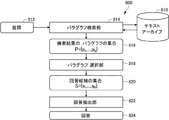
- an exemplary question answering system 800 that performs task 750 described in reference A5 receives a text archive 810 and a question 812 and is a set of paragraphs containing answer candidates from the text archive 810. It includes a paragraph search unit 814 that searches and retrieves 816.
- the question answering system 800 further selects a part (answer candidate) that is likely to be a correct answer from each of paragraphs p 1 , ..., P N included in the paragraph set 816, and generates a set of answer candidates 820.
- paragraph selection section 818 for this purpose.
- S ⁇ s 1 , ..., s N ⁇ , where s 1 , ..., S N are answer candidates selected from paragraphs p 1 , ..., P N , respectively.
- the question answering system 800 further includes an answer extraction unit 822 that extracts the answer candidate having the highest probability of being the correct answer to the question 812 from the set of answer candidates 820 and outputs it as the answer 824.
- the fourth is the one in which the fake expression generator is applied to this DS-QA task. Is an embodiment of. The conceptual diagram is shown in FIG.
- the task 850 for performing the same processing as the above task 750 using the fake expression generator searches the passage 764 in response to the question 760, and also obtains the fake expression 862 from the passage 764.
- This task 850 replaces the paragraph selector 766 and paragraph reader 770 of task 750 of FIG. 19 with a paragraph selector 864 that realizes the same functions as the paragraph selector 766 and paragraph reader 770 by using a fake representation 862. And paragraph reader 868.
- paragraphs selected by the paragraph selector 864 form a set of paragraphs 866
- the answer candidates selected by the paragraph reader 868 form a set of answer candidates 870. Similar to FIG. 19, answer 872 is extracted from the answer candidate 870.
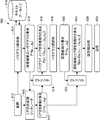
- FIG. 22 shows a schematic configuration of a question answering system 900 according to this embodiment that executes this task 850.
- the question answering system 900 includes a text archive 810 and a paragraph search unit 814 that receives the question 812 and searches and retrieves a set of paragraphs 816 containing answer candidates from the text archive 810.
- the question answering system 900 further includes a core answering generator 910 that takes each paragraph contained in the set of paragraphs 816 and the question 812 as inputs and generates a set of core answering expressions 912.
- a core answering generator 910 that takes each paragraph contained in the set of paragraphs 816 and the question 812 as inputs and generates a set of core answering expressions 912.
- One of these core answer expressions is obtained for each of paragraphs p 1 , ..., P N.
- the core answer expression generator 910 may be any one trained by the above-described embodiment or a similar method.
- the question answering system 900 further pairs each paragraph p 1 , ..., P N in the set of paragraphs 816 with the core answer expressions c 1 , ..., C N obtained from those paragraphs (with one paragraph). Combining with one core answering expression obtained from it), it includes a pairing unit 914 for generating a set 916 of paragraphs and core answering expression pairs.
- the question answering system 900 further includes core answer expressions corresponding to each element s 1 , ..., S N of the answer candidate set 920 of each paragraph and each element s 1 , ..., S N of the core answer expression set 912. It includes a pairing unit 922 for pairing c 1 , ..., C N and generating a set 924 of answer candidates and core answer expression pairs in each paragraph.
- the question answering system 900 further selects a pair including the answer candidate having the highest probability of being the answer to the question 812 from the set 924 of the answer candidate and the core answer expression pair, and the answer candidate included in the pair is the answer 928 to the question 812. Includes the answer extraction unit 926 for outputting as.
- any core answer expression generator 910 may be used as long as it is trained by the methods of the first to third embodiments.
- the paragraph search unit 814 the one using the clue word in the text may be used as in the conventional paragraph search.
- the paragraph selection unit 918 and the answer extraction unit 926 a statistical model trained in advance so as to calculate the score of each candidate by machine learning may be used.
- the answer extraction unit 926 in which a triplet of a question, an answer candidate, and a core answer expression consisting of a question, an answer candidate, and a core answer expression generated from the question and the answer candidate is input, and the answer candidate is the answer candidate.
- the probability that the answer candidate is finally the correct answer is calculated by the following formula.
- the paragraph selection unit 818 and the answer extraction unit 822 in FIG. 20 have the conditional probability Pr ( pi
- q, P) is calculated by combining these probabilities.
- the paragraph selection unit 818 and the answer extraction unit 822 use a bidirectional stacked RNN (RNN) when encoding the paragraph.
- the input using the word vector sequence p i of the paragraph.
- RNN bidirectional stacked RNN
- a core answer representation c i to calculate the word vectors ⁇ p i weighted by the attention paragraphs.
- p i of the j-th word of word vectors p i j and attention weighting described in the references A6 described subsequently herein, modified by attention by using the bilinear functions described in reference A7
- each element of the matrix M is a learning target.
- softmax j represents the jth element of the vector x after applying the softmax function.
- the question answering system 900 operates as follows.
- the question answering system 900 is roughly divided into a training phase and a test phase.
- a large amount of text is accumulated in the text archive 810 in advance.
- the core answer expression generator 910, the paragraph selection unit 918, and the answer extraction unit 926 are trained using the training data prepared in advance.
- the hostile learning described above is used for training the core answer expression generator 910.
- the paragraph search unit 814 extracts paragraphs that may include answers to question 812 from the text archive 810 using clues and the like to generate a set of paragraphs 816.
- the core answer expression generator 910 combines each paragraph in the paragraph set 816 with the question 812 to generate a core answer expression set 912, respectively.
- the pairing unit 914 pairs the paragraph and its core answer expression, and generates a set 916 of the paragraph and the core answer expression pair.
- the paragraph selection unit 918 selects a paragraph (answer candidate) having a high probability of including an answer to the question 812 from the set 916 of the paragraph and the core answer expression pair, and generates a set of answer candidates 920.
- the pairing unit 922 pairs each answer candidate in the set of answer candidates 920 with the core answer expression corresponding to the answer candidate, and generates a set 924 of the answer candidate and the core answer expression pair.
- the answer extraction unit 926 extracts the answer candidate having the highest probability of being the answer to the question 812 from the answer candidates in the set 924 of the answer candidate and the core answer expression pair, and outputs it as the answer 928.
- EM score and F1 score were used for all evaluations.
- the EM indicates the rate of prediction results that exactly matches any of the ground truths.
- F1 roughly indicates the average overlap between the prediction result and the true answer.
- the Trivia QA results are for that development data.
- ⁇ and ⁇ show the statistical significance of the performance difference between the proposed method (PAIR) and OpenQA, respectively, by the McNemar test under the conditions of p ⁇ 0.05 and p ⁇ 0.01, respectively.
- the core answer expression according to the present invention can be effectively used not only for a type question answering system but also for other question answering systems such as what type question answering system.
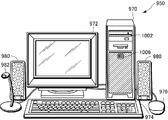
- FIG. 23 is an external view of a computer system that realizes each of the above embodiments.
- FIG. 24 is a hardware block diagram of the computer system shown in FIG. 23.
- the computer system 950 includes a computer 970 having a DVD (Digital Paris Disc) drive 1002, a keyboard 974, a mouse 976, and a monitor, both connected to the computer 970, for interacting with the user. Includes 972 and.
- DVD Digital
- the computer 970 includes a computer 970 having a DVD (Digital Paris Disc) drive 1002, a keyboard 974, a mouse 976, and a monitor, both connected to the computer 970, for interacting with the user.
- this is an example of a configuration for user dialogue, and any general hardware and software (for example, touch panel, voice input, pointing device in general) that can be used for user dialogue can be used.
- the computer 970 is connected to the CPU 990, the GPU (Graphics Processing Unit) 992, the CPU 990, the GPU 992, the bus 1010 connected to the DVD drive 1002, and the bus 1010 in addition to the DVD drive 1002.
- ROM 996 that stores the boot-up program of the computer 970
- RAM 998 that is connected to the bus 1010 and stores instructions, system programs, work data, etc. that compose the program
- non-volatile memory connected to the bus 1010. Includes hard disk drive (HDD) 1000.
- the hard disk 1000 is for storing a program executed by the CPU 990 and the GPU 992, data used by the program executed by the CPU 990 and the GPU 992, and the like.
- the computer 970 is further detachable from a network I / F1008 that provides a connection to a network 986 that enables communication with other terminals and a USB memory 984, and provides communication between the USB memory 984 and each part in the computer 970.
- USB port 1006 and the like are further detachable from a network I / F1008 that provides a connection to a network 986 that enables communication with other terminals and a USB memory 984, and provides communication between the USB memory 984 and each part in the computer 970.
- the computer 970 is further connected to the microphone 982, the speaker 980, and the bus 1010, reads out the audio signal generated by the CPU 990 and stored in the RAM 998 or the HDD 1000 according to the instructions of the CPU 990, performs analog conversion and amplification processing, and performs the speaker 980. It includes an audio I / F 1004 for driving or digitizing an analog audio signal from the microphone 982 and storing it at an arbitrary address specified by the CPU 990 of the RAM 998 or HDD 1000.
- the data and parameters of 716, text archive 810, core answer expression generator 910, paragraph selection unit 918, answer extraction unit 926, etc. are all, for example, HDD1000, RAM998, DVD978, USB memory 984, or network shown in FIG. It is stored in a storage medium or the like of an external device (not shown) connected via the I / F 1008 and the network 986. Typically, these data, parameters, etc. are written to the HDD 1000 from the outside and loaded into the RAM 998 when the computer 970 is executed.
- the GAN 220 shown in FIG. 8, a training device by hostile learning for that purpose, and a computer program for operating the computer system so as to realize the functions of the respective components are stored in the DVD 978 mounted on the DVD drive 1002. It is transferred from the DVD drive 1002 to the HDD 1000. Alternatively, this program is stored in the USB memory 984, the USB memory 984 is attached to the USB port 1006, and the program is transferred to the hard disk 1000. Alternatively, this program may be transmitted to the computer 970 via the network 986 and stored in the HDD 1000. The program is loaded into RAM 998 at run time. Of course, the source program may be input using the keyboard 974, the monitor 972, and the mouse 976, and the compiled object program may be stored in the HDD 1000.
- the script input using the keyboard 974 or the like may be stored in the HDD 1000.
- the script input using the keyboard 974 or the like may be stored in the HDD 1000.
- the CPU 990 reads a program from the RAM 998 according to an address indicated by a register (not shown) called a program counter inside the CPU 990, interprets the instruction, and outputs data necessary for executing the instruction to the RAM 998 according to the address specified by the instruction. , Read from the hard disk 1000 or other equipment and execute the process specified by the instruction. The CPU 990 stores the execution result data at an address specified by the program, such as the RAM 998, the hard disk 1000, and the registers in the CPU 990. At this time, the value of the program counter is also updated by the program. The computer program may be loaded directly into the RAM 998 from the DVD 978, from the USB memory 984, or via the network. In the program executed by the CPU 990, some tasks (mainly numerical calculation) are dispatched to the GPU 992 by the instructions included in the program or according to the analysis result at the time of executing the instructions by the CPU 990.
- some tasks (mainly numerical calculation) are dispatched to the GPU 992 by the instructions included in the program or according to
- the program that realizes the functions of each part according to each of the above-described embodiments by the computer 970 includes a plurality of instructions that are described and arranged to operate the computer 970 so as to realize those functions. Some of the basic functions required to execute this instruction are provided by an operating system (OS) running on computer 970 or a third-party program, or modules from various toolkits installed on computer 970. Therefore, this program does not necessarily include all the functions necessary to realize the system and method of this embodiment.
- This program as each of the above devices and its components, by instructing the appropriate function or the function of the "programming tool kit" in a controlled manner to obtain the desired result. It only needs to contain instructions to execute the operation.
- the GPU 992 can perform parallel processing, and can execute a large amount of calculations associated with machine learning in parallel or in a pipeline. For example, the parallel computing elements found in the program when the program is compiled, or the parallel computing elements found when the program is executed, are dispatched from the CPU 990 to the GPU 992 and executed at any time, and the result is directly or RAM998. It is returned to the CPU 990 via the predetermined address of, and is assigned to a predetermined variable in the program.
- This invention can be used for the construction and operation of a question answering system that contributes to solving problems in all fields of industry.
- the present invention can be used to efficiently operate a computer as a question answering system, improve the structure and operation of machines used in industry, and improve the utility of processes and methods.
Landscapes
- Engineering & Computer Science (AREA)
- Theoretical Computer Science (AREA)
- Physics & Mathematics (AREA)
- General Engineering & Computer Science (AREA)
- General Physics & Mathematics (AREA)
- Artificial Intelligence (AREA)
- Computational Linguistics (AREA)
- Data Mining & Analysis (AREA)
- General Health & Medical Sciences (AREA)
- Health & Medical Sciences (AREA)
- Audiology, Speech & Language Pathology (AREA)
- Databases & Information Systems (AREA)
- Mathematical Physics (AREA)
- Software Systems (AREA)
- Evolutionary Computation (AREA)
- Computer Vision & Pattern Recognition (AREA)
- Medical Informatics (AREA)
- Human Computer Interaction (AREA)
- Computing Systems (AREA)
- Electrically Operated Instructional Devices (AREA)
- Machine Translation (AREA)
- Information Retrieval, Db Structures And Fs Structures Therefor (AREA)
Priority Applications (1)
| Application Number | Priority Date | Filing Date | Title |
|---|---|---|---|
| US17/622,798 US12099801B2 (en) | 2019-07-19 | 2020-07-06 | Answer classifier and representation generator for question-answering system using GAN, and computer program for training the representation generator |
Applications Claiming Priority (2)
| Application Number | Priority Date | Filing Date | Title |
|---|---|---|---|
| JP2019-133710 | 2019-07-19 | ||
| JP2019133710A JP7290861B2 (ja) | 2019-07-19 | 2019-07-19 | 質問応答システムのための回答分類器及び表現ジェネレータ、並びに表現ジェネレータを訓練するためのコンピュータプログラム |
Publications (1)
| Publication Number | Publication Date |
|---|---|
| WO2021014951A1 true WO2021014951A1 (ja) | 2021-01-28 |
Family
ID=74192863
Family Applications (1)
| Application Number | Title | Priority Date | Filing Date |
|---|---|---|---|
| PCT/JP2020/026360 Ceased WO2021014951A1 (ja) | 2019-07-19 | 2020-07-06 | 質問応答システムのための回答分類器及び表現ジェネレータ、並びに表現ジェネレータを訓練するためのコンピュータプログラム |
Country Status (3)
| Country | Link |
|---|---|
| US (1) | US12099801B2 (cg-RX-API-DMAC7.html) |
| JP (1) | JP7290861B2 (cg-RX-API-DMAC7.html) |
| WO (1) | WO2021014951A1 (cg-RX-API-DMAC7.html) |
Families Citing this family (13)
| Publication number | Priority date | Publication date | Assignee | Title |
|---|---|---|---|---|
| EP3926551A1 (de) * | 2020-06-15 | 2021-12-22 | Deutsche Telekom AG | Verfahren zur unterstützung des verbesserten betriebs eines über ein telekommunikationsnetz einem telekommunikationsendgerät bereitgestellten frage-und-antwort-dienst, system, telekommunikationsnetz frage-und-antwort-dienst, computerprogramm und computerlesbares medium |
| JP7618201B2 (ja) * | 2020-10-20 | 2025-01-21 | 国立研究開発法人情報通信研究機構 | 回答特定用テキスト分類器及び背景知識表現ジェネレータ及びその訓練装置、並びにコンピュータプログラム |
| JP7735665B2 (ja) | 2021-02-08 | 2025-09-09 | 大同特殊鋼株式会社 | 溶融金属形成用線材及び溶接製品の製造方法 |
| US12134483B2 (en) | 2021-03-10 | 2024-11-05 | The Boeing Company | System and method for automated surface anomaly detection |
| KR102567585B1 (ko) * | 2021-04-14 | 2023-08-17 | 건국대학교 산학협력단 | 도메인 적응성 향상을 위한 기계 독해의 자가 트레이닝 방법 및 장치 |
| CN113139039B (zh) * | 2021-05-06 | 2024-07-16 | 京东科技控股股份有限公司 | 对话数据处理方法、装置、设备以及存储介质 |
| EP4341829A1 (en) * | 2021-05-17 | 2024-03-27 | Salesforce, Inc. | Systems and methods for hierarchical retrieval of semantic-based passages in deep learning |
| US11651554B2 (en) * | 2021-07-30 | 2023-05-16 | The Boeing Company | Systems and methods for synthetic image generation |
| US11900534B2 (en) * | 2021-07-30 | 2024-02-13 | The Boeing Company | Systems and methods for synthetic image generation |
| US12699834B2 (en) * | 2021-08-09 | 2026-08-04 | Samsung Electronics Co., Ltd. | System and method for interactive dialogue |
| JP7520783B2 (ja) * | 2021-08-18 | 2024-07-23 | 株式会社東芝 | 識別装置、方法、プログラムおよび学習装置 |
| CN116701609B (zh) * | 2023-07-27 | 2023-09-29 | 四川邕合科技有限公司 | 基于深度学习的智能客服问答方法、系统、终端及介质 |
| CN117874191A (zh) * | 2023-12-27 | 2024-04-12 | 联想(北京)有限公司 | 答复文本的生成方法、装置、计算机设备及存储介质 |
Citations (2)
| Publication number | Priority date | Publication date | Assignee | Title |
|---|---|---|---|---|
| WO2019012908A1 (ja) * | 2017-07-13 | 2019-01-17 | 国立研究開発法人情報通信研究機構 | ノン・ファクトイド型質問応答装置 |
| JP2019046019A (ja) * | 2017-08-31 | 2019-03-22 | ヤフー株式会社 | 情報処理装置、情報処理方法、及び情報処理プログラム |
Family Cites Families (4)
| Publication number | Priority date | Publication date | Assignee | Title |
|---|---|---|---|---|
| JP6618735B2 (ja) | 2015-08-31 | 2019-12-11 | 国立研究開発法人情報通信研究機構 | 質問応答システムの訓練装置及びそのためのコンピュータプログラム |
| US10983971B2 (en) * | 2018-11-28 | 2021-04-20 | Intuit Inc. | Detecting duplicated questions using reverse gradient adversarial domain adaptation |
| US11514330B2 (en) * | 2019-01-14 | 2022-11-29 | Cambia Health Solutions, Inc. | Systems and methods for continual updating of response generation by an artificial intelligence chatbot |
| CN114970513A (zh) * | 2022-04-22 | 2022-08-30 | 武汉轻工大学 | 图像生成方法、装置、设备及存储介质 |
-
2019
- 2019-07-19 JP JP2019133710A patent/JP7290861B2/ja active Active
-
2020
- 2020-07-06 WO PCT/JP2020/026360 patent/WO2021014951A1/ja not_active Ceased
- 2020-07-06 US US17/622,798 patent/US12099801B2/en active Active
Patent Citations (2)
| Publication number | Priority date | Publication date | Assignee | Title |
|---|---|---|---|---|
| WO2019012908A1 (ja) * | 2017-07-13 | 2019-01-17 | 国立研究開発法人情報通信研究機構 | ノン・ファクトイド型質問応答装置 |
| JP2019046019A (ja) * | 2017-08-31 | 2019-03-22 | ヤフー株式会社 | 情報処理装置、情報処理方法、及び情報処理プログラム |
Also Published As
| Publication number | Publication date |
|---|---|
| US12099801B2 (en) | 2024-09-24 |
| US20220253599A1 (en) | 2022-08-11 |
| JP7290861B2 (ja) | 2023-06-14 |
| JP2021018588A (ja) | 2021-02-15 |
Similar Documents
| Publication | Publication Date | Title |
|---|---|---|
| JP7290861B2 (ja) | 質問応答システムのための回答分類器及び表現ジェネレータ、並びに表現ジェネレータを訓練するためのコンピュータプログラム | |
| US10970493B1 (en) | Systems and methods for slot relation extraction for machine learning task-oriented dialogue systems | |
| KR102244448B1 (ko) | 전문 번역 서비스 플랫폼을 제공하기 위한 방법 | |
| JP7618201B2 (ja) | 回答特定用テキスト分類器及び背景知識表現ジェネレータ及びその訓練装置、並びにコンピュータプログラム | |
| CN111241287A (zh) | 用于生成对抗文本的生成模型的训练方法及装置 | |
| US20230368003A1 (en) | Adaptive sparse attention pattern | |
| KR20220045879A (ko) | 이미지 번역 서비스를 제공하기 위한 방법 및 서버 | |
| WO2025241024A1 (en) | Evaluating confidence in a classification performed by a generative language machine learning model | |
| Kodati et al. | Advancing mental health detection in texts via multi-task learning with soft-parameter sharing transformers | |
| Caron et al. | TacticalGPT: uncovering the potential of LLMs for predicting tactical decisions in professional football | |
| Kumar et al. | Transformer-based models for language identification: A comparative study | |
| CN117933226A (zh) | 一种上下文感知的对话信息提取系统及方法 | |
| CN116861855A (zh) | 多模态医疗资源确定方法、装置、计算机设备及存储介质 | |
| US20260073911A1 (en) | Systems for and methods of speech diarization using artificial intelligence models with sorting functionality | |
| CN120409698A (zh) | 文本预测模型的训练方法、装置、设备、介质及产品 | |
| Guo et al. | Leveraging mamba for reference audio-visual segmentation with vote and cache mechanism | |
| WO2025071829A1 (en) | Detecting computer-generated hallucinations using progressive scope-of-analysis enlargement | |
| CN118796263A (zh) | 代码大模型的代码生成方法、装置、电子设备及介质 | |
| Shen et al. | Extracting meaningful issue–solution pair from collaborative developer live chats | |
| Zhao et al. | Improving multimodal sentiment analysis with unimodal pseudo-label generation | |
| Zhu et al. | Multi-level Multi-task representation learning with adaptive fusion for multimodal sentiment analysis | |
| Do et al. | A contrastive graph-transformer network model for multimodal sentiment analysis | |
| CN114328797A (zh) | 内容搜索方法、装置、电子设备、存储介质及程序产品 | |
| Wu et al. | Multi-Intent Spoken Language Understanding: Methods, Trends, and Challenges | |
| Liu et al. | CoMAC: Conversational Agent for Multi-source Auxiliary Context with Sparse and Symmetric Latent Interactions |
Legal Events
| Date | Code | Title | Description |
|---|---|---|---|
| 121 | Ep: the epo has been informed by wipo that ep was designated in this application |
Ref document number: 20844240 Country of ref document: EP Kind code of ref document: A1 |
|
| NENP | Non-entry into the national phase |
Ref country code: DE |
|
| 122 | Ep: pct application non-entry in european phase |
Ref document number: 20844240 Country of ref document: EP Kind code of ref document: A1 |