WO2020262148A1 - 圧力測定用シートセット、圧力測定用シート - Google Patents
圧力測定用シートセット、圧力測定用シート Download PDFInfo
- Publication number
- WO2020262148A1 WO2020262148A1 PCT/JP2020/023771 JP2020023771W WO2020262148A1 WO 2020262148 A1 WO2020262148 A1 WO 2020262148A1 JP 2020023771 W JP2020023771 W JP 2020023771W WO 2020262148 A1 WO2020262148 A1 WO 2020262148A1
- Authority
- WO
- WIPO (PCT)
- Prior art keywords
- sheet
- microcapsules
- layer
- pressure measurement
- polyisocyanate
- Prior art date
- Legal status (The legal status is an assumption and is not a legal conclusion. Google has not performed a legal analysis and makes no representation as to the accuracy of the status listed.)
- Ceased
Links
Images


Classifications
-
- G—PHYSICS
- G01—MEASURING; TESTING
- G01L—MEASURING FORCE, STRESS, TORQUE, WORK, MECHANICAL POWER, MECHANICAL EFFICIENCY, OR FLUID PRESSURE
- G01L1/00—Measuring force or stress, in general
- G01L1/24—Measuring force or stress, in general by measuring variations of optical properties of material when it is stressed, e.g. by photoelastic stress analysis using infrared, visible light, ultraviolet
- G01L1/247—Measuring force or stress, in general by measuring variations of optical properties of material when it is stressed, e.g. by photoelastic stress analysis using infrared, visible light, ultraviolet using distributed sensing elements, e.g. microcapsules
-
- G—PHYSICS
- G01—MEASURING; TESTING
- G01L—MEASURING FORCE, STRESS, TORQUE, WORK, MECHANICAL POWER, MECHANICAL EFFICIENCY, OR FLUID PRESSURE
- G01L5/00—Apparatus for, or methods of, measuring force, work, mechanical power, or torque, specially adapted for specific purposes
Definitions
- the present invention relates to a pressure measurement sheet set and a pressure measurement sheet.
- Patent Document 1 proposes a pressure measurement sheet using microcapsules containing an electron-donating colorless dye precursor.
- the heating temperature may be changed depending on the member to be crimped, and it is desired to measure the precise pressure distribution even when the temperature is changed.
- the present inventor observed the degree of color development by changing the heating temperature in the range of high temperature conditions of about 180 to 240 ° C. using the pressure measurement sheet described in Patent Document 1, and found that the pressure measurement conditions were the same. However, it was found that the degree of color development of the pressure measurement sheet was different.
- the degree of color development differs when the heating temperature is different under high temperature conditions.
- the degree of color development differs depending on the temperature at the time of pressurization, and it is said that there is a temperature dependence of color development, and a member having a small temperature dependence of color development is desired. ..
- the present invention is a pressure measurement sheet set and a pressure measurement sheet having a small temperature dependence of color development even when used in a high temperature environment (particularly, an environment of 180 to 240 ° C.).
- the challenge is to provide.
- a trifunctional or higher polyisocyanate A in which the resin is an adduct of an aromatic diisocyanate or an alicyclic diisocyanate and a compound having three or more active hydrogen groups in one molecule and
- polyisocyanate B selected from the group consisting of aromatic diisocyanate and polymethylene polyphenyl polyisocyanate.
- the molecular weight of the color former is 550 or more, (1) to.
- Number of microcapsules The first sheet set for pressure measurement according to any one of (1) to (7), wherein the average wall thickness is 0.2 ⁇ m or more (9)
- (11) A trifunctional or higher polyisocyanate A in which the resin is an adduct of an aromatic diisocyanate or an alicyclic diisocyanate and a compound having three or more active hydrogen groups in one molecule, and The pressure measuring sheet according to (10), which is formed by using polyisocyanate B selected from the group consisting of aromatic diisocyanates and polymethylene polyphenyl polyisocyanates.
- the present invention it is possible to provide a pressure measurement sheet set and a pressure measurement sheet having a small temperature dependence of color development even when used in a high temperature environment (particularly, an environment of 180 to 240 ° C.).
- the numerical range represented by using "-" in this specification means the range including the numerical values before and after "-" as the lower limit value and the upper limit value.
- the upper limit value or the lower limit value described in a certain numerical range may be replaced with the upper limit value or the lower limit value of another numerical range described stepwise.
- the upper limit value or the lower limit value described in a certain numerical range may be replaced with the value shown in the examples.
- Various components described later may be used alone or in combination of two or more.
- the polyisocyanate described later may be used alone or in combination of two or more.
- the color density difference obtained by the predetermined color density difference measurement (color density difference measurement 1 and color density difference measurement 2) described later is equal to or less than the predetermined value.
- the point is that.
- the present inventor investigated the cause of the pressure measurement sheet described in Patent Document 1 not exerting a predetermined effect, and found that under high temperature conditions of 180 ° C. or higher, the motility of various materials such as the capsule wall of microcapsules , It has been found that the degradability of materials varies greatly with a slight temperature difference. Therefore, in the conventional pressure measurement sheet, it is considered that the difference in color development occurs due to the difference in the behavior of the material depending on the heating temperature described above, even though the pressurizing conditions are the same.
- the present inventor uses the above temperature. It has been found that the difference in material behavior is small, and as a result, a predetermined effect can be obtained.
- FIG. 1 is a cross-sectional view of an embodiment of a pressure measurement sheet set.
- the pressure measurement sheet set 10 includes a first sheet 16 having a first layer 14 including a predetermined microcapsule 13 arranged on the first support 12 and the first support 12, a second support 18, and a second support. 2
- a second sheet 22 having a second layer 20 containing a color developer arranged on the support 18 is provided.
- the first layer 14 in the first sheet 16 and the second layer 20 in the second sheet 22 face each other.
- the sheet 16 and the second sheet 22 are laminated and used.
- the microcapsules 13 are formed in the pressurized region.
- the color-developing agent that is broken and contained in the microcapsules 13 comes out of the microcapsules 13, and the color-developing reaction proceeds with the color-developing agent in the second layer 20. As a result, color development progresses in the pressurized region.
- the first sheet 16 may have the first layer 14 and may not have the first support 12.
- the second sheet 22 may have the second layer 20 and may not have the second support 18.
- the first support 12 and the first layer 14 are directly laminated, but the present invention is not limited to this mode, and as will be described later, the first support 12 and the first layer 14 Another layer (for example, an easy-adhesion layer) may be arranged between them.
- the second support 18 and the second layer 20 are directly laminated, but the present invention is not limited to this mode, and as will be described later, the second support 18 and the second layer 20 Another layer (for example, an easy-adhesion layer) may be arranged between them.
- the color density difference obtained by the following color density difference measurement 1 is 0.25 or less, preferably 0.20 or less, and more preferably 0.10 or less. preferable.
- the lower limit is not particularly limited, but is often 0.01 or more.
- Color development density difference measurement 1 The first sheet and the second sheet are laminated so that the first layer of the first sheet and the second layer of the second sheet face each other to obtain a laminated body, and the laminated body is not formed.
- the difference in optical density between before and after heating at 220 ° C. for 2 minutes in a pressurized state is defined as the difference in color development density.
- the laminate is heat-treated under predetermined conditions. The above measurement is carried out in a non-pressurized state.
- the non-pressurized state means a state in which pressure is not applied to the laminate (a state in which pressure is not applied). Further, when heating to 220 ° C., the laminate that was at room temperature (about 23 ° C.) is heated to the above-mentioned predetermined temperature.
- X-rite eXact manufactured by X-Rite
- the density status is measured at ISO status T and D50 / 2 ° without a filter.
- an OD (Optical absorbance) value is adopted. At the time of measurement, the OD is measured in each mode of CMYK (C: Cyan, M: Magenta, Y: Yellow, K: Black), and the one showing the highest OD is selected.
- the first sheet 16 shown in FIG. 1 has a first support 12 and a first layer 14 containing microcapsules 13 containing a color former. In the following, each member will be described in detail.
- the first support is a member for supporting the first layer. If the first layer itself can be handled, the first sheet does not have to have the first support.
- the first support may have any shape such as a sheet shape, a film shape, and a plate shape.
- Examples of the first support include paper, plastic film, and synthetic paper. Papers include high-quality paper, medium-quality paper, shaving paper, neutral paper, acidic paper, recycled paper, coated paper, machine-coated paper, art paper, cast-coated paper, finely coated paper, tracing paper, and recycled paper. Paper is mentioned.
- Examples of the plastic film include a polyester film such as a polyethylene terephthalate film, a cellulose derivative film such as cellulose triacetate, a polyolefin film such as polypropylene and polyethylene, and a polystyrene film.
- Synthetic paper includes those obtained by biaxially stretching polypropylene or polyethylene terephthalate or the like to form a large number of microvoids (Yupo, etc.), those produced using synthetic fibers such as polyethylene, polypropylene, polyethylene terephthalate, and polyamide, and synthetic papers. Examples thereof include a part of paper, one side or both sides of which are laminated. Among them, a plastic film or synthetic paper is preferable, and a plastic film is more preferable, from the viewpoint of further increasing the color density generated by pressurization.
- the thickness of the first support is not particularly limited, and is preferably 10 to 200 ⁇ m.
- the first layer contains microcapsules containing a color former.
- Microcapsules generally have a core portion and a capsule wall for encapsulating a core material (encapsulated) forming the core portion.
- the microcapsules contain a color former as a core material (encapsulating component). Since the color former is encapsulated in the microcapsules, the color former can exist stably until the microcapsules are destroyed by pressure.
- the microcapsules have a capsule wall that encloses the core material.
- the material for forming the capsule wall in the microcapsules is not particularly limited, and examples thereof include resins such as polyurethane urea, polyurethane, polyurea, melamine resin, and acrylic resin.
- the capsule wall in the microcapsules preferably contains at least one resin selected from the group consisting of polyurea, polyurethane urea, and polyurethane (hereinafter, also simply referred to as "specific resin").
- the capsule wall of the microcapsules is preferably made of a resin (preferably a specific resin).
- the capsule wall of the microcapsules is preferably made of resin.
- the polyurethane is a polymer having a plurality of urethane bonds, and is preferably a reaction product formed from a raw material containing a polyol and a polyisocyanate.
- the polyurea is a polymer having a plurality of urea bonds, and is preferably a reaction product formed from a raw material containing a polyamine and a polyisocyanate.
- the polyurethane urea is a polymer having a urethane bond and a urea bond, and is preferably a reaction product formed from a raw material containing a polyol, a polyamine, and a polyisocyanate.
- a part of the polyisocyanate reacts with water to form a polyamine, and as a result, a polyurethane urea may be obtained.
- the polyisocyanate is a compound having two or more isocyanate groups, and examples thereof include aromatic polyisocyanates and aliphatic polyisocyanates.
- Aromatic polyisocyanates can introduce aromatic ring groups into the capsule wall of microcapsules. Isocyanates are preferred.
- Examples of the aromatic polyisocyanate include aromatic diisocyanates, such as m-phenylenediisocyanate, p-phenylenediocyanate, 2,6-tolylene diisocyanate, 2,4-tolylene diisocyanate, naphthalene-1,4-diisocyanate, and the like.
- aliphatic polyisocyanate examples include aliphatic diisocyanates, such as trimethylene diisocyanate, hexamethylene diisocyanate, propylene-1,2-diisocyanate, butylene-1,2-diisocyanate, cyclohexylene-1,2-diisocyanate, and cyclohexyl.
- aliphatic diisocyanates such as trimethylene diisocyanate, hexamethylene diisocyanate, propylene-1,2-diisocyanate, butylene-1,2-diisocyanate, cyclohexylene-1,2-diisocyanate, and cyclohexyl.
- examples thereof include diisocyanate, lysine diisocyanate, and hydride xylylene diisocyanate.
- bifunctional aromatic polyisocyanates and aliphatic polyisocyanates have been exemplified, but trifunctional or higher functional polyisocyanates (for example, trifunctional triisocyanates and tetrafunctional tetraisocyanates) are also examples of polyisocyanates.
- the polyisocyanate is an adduct (addition) of a polyol such as a burette or isocyanurate, which is a trimeric of the above bifunctional polyisocyanate, and a trimethylolpropane, and a bifunctional polyisocyanate.
- trifunctional or higher functional polyisocyanate is preferable.
- the trifunctional or higher functional polyisocyanate include a trifunctional or higher functional aromatic polyisocyanate and a trifunctional or higher functional aliphatic polyisocyanate.
- the trifunctional or higher functional polyisocyanate include aromatic diisocyanates or alicyclic diisocyanates and compounds having three or more active hydrogen groups in one molecule (for example, trifunctional or higher functional polyols, polyamines, polythiols, etc.).
- Trifunctional or higher polyisocyanates that are adducts additives
- trifunctional or higher polyisocyanates that are adducts and trimerics of aromatic diisocyanates or alicyclic diisocyanates (biuret type or isocyanurate type) are also available.
- the trifunctional or higher functional polyisocyanate which is the adduct body (additive) is more preferable.
- a trifunctional or higher functional polyisocyanate which is an adduct body of an aromatic diisocyanate or an alicyclic diisocyanate and a polyol having three or more hydroxyl groups in one molecule is preferable.
- the adduct body As the adduct body, at least one of a point that the temperature dependence of color development is smaller and a point that the pressure distribution can be measured better in a high temperature environment can be obtained (hereinafter, simply “effect of the present invention”). It is also referred to as “more excellent point”), and it is preferable to use an adduct body obtained by using an aromatic diisocyanate.
- an aromatic diisocyanate As the above-mentioned polyol, for example, a trifunctional or higher functional low molecular weight polyol described later is preferable, and trimethylolpropane is more preferable.
- Examples of the adduct-type trifunctional or higher functional polyisocyanate include Takenate (registered trademark) D-102, D-103, D-103H, D-103M2, P49-75S, D-110N, D-120N, and D-.
- examples of adduct-type trifunctional or higher functional isocyanates include Takenate (registered trademark) D-110N, D-120N, D-140N, D-160N (manufactured by Mitsui Chemicals, Inc.), or DIC Corporation. Vernock® D-750 manufactured by Examples of the isocyanurate-type trifunctional or higher functional isocyanate include Takenate (registered trademark) D-127N, D-170N, D-170HN, D-172N, D-177N, and D-204 (manufactured by Mitsui Chemicals, Inc.).
- Biuret-type trifunctional or higher functional isocyanates include, for example, Takenate (registered trademark) D-165N, NP1100 (manufactured by Mitsui Chemicals, Inc.), Death Module (registered trademark) N3200 (Sumitomo Chemical Bayer Urethane), and Duranate (registered trademark). ) 24A-100 (manufactured by Asahi Kasei Corporation).
- polymethylene polyphenyl polyisocyanate polymethylene polyphenyl polyisocyanate is also preferable.
- polymethylene polyphenyl polyisocyanate a compound represented by the formula (X) is preferable.
- n represents the number of repeating units.
- the number of repeating units represents an integer of 1 or more, and n is preferably an integer of 1 to 10 and more preferably an integer of 1 to 5 in that the effect of the present invention is more excellent.
- polyisocyanates containing polymethylene polyphenyl polyisocyanate examples include Millionate MR-100, Millionate MR-200, Millionate MR-400 (manufactured by Tosoh Corporation), WANNAME PM-200, and WANNAME PM-400 (Manka Japan Co., Ltd.).
- a polyol is a compound having two or more hydroxyl groups, and is, for example, a low molecular weight polyol (eg, aliphatic polyol, aromatic polyol), polyvinyl alcohol, polyether polyol, polyester-based polyol, polylactone-based polyol, or Himashi. Examples thereof include oil-based polyols, polyolefin-based polyols, and hydroxyl group-containing amine-based compounds.
- the low molecular weight polyol means a polyol having a molecular weight of 400 or less, for example, bifunctional low molecular weight polyols such as ethylene glycol, diethylene glycol, and propylene glycol, and glycerin, trimethylolpropane, hexanetriol, and penta. Examples thereof include trifunctional or higher functional low molecular weight polyols such as erithitol and sorbitol.
- Examples of the hydroxyl group-containing amine compound include amino alcohols as oxyalkylated derivatives of amino compounds.
- the amino alcohol include N, N, N', N'-tetrakis [2-hydroxypropyl] ethylenediamine, which is a propylene oxide or an ethylene oxide adduct of an amino compound such as ethylenediamine, and N, N, N'. , N'-Tetrakis [2-hydroxyethyl] ethylenediamine and the like.
- a polyamine is a compound having two or more amino groups (primary amino group or secondary amino group), and is a fat such as diethylenetriamine, triethylenetetramine, 1,3-propylenediamine, and hexamethylenediamine.
- Group polyvalent amines Epoxy compound adducts of aliphatic polyvalent amines; Alicyclic polyvalent amines such as piperazine; 3,9-bis-aminopropyl-2,4,8,10-tetraoxaspiro- (5, 5) Examples thereof include heterocyclic diamines such as undecane.
- the resin contained in the capsule wall is a trifunctional or higher polyisocyanate A (hereinafter, trifunctional or higher) which is an adduct of an aromatic diisocyanate or an alicyclic diisocyanate and a compound having three or more active hydrogen groups in one molecule.
- polyisocyanate A polyisocyanate A
- polyisocyanate B selected from the group consisting of aromatic diisocyanates and polymethylene polyphenyl polyisocyanates (hereinafter, also simply referred to as "polyisocyanate B"). It is preferable to be done.
- the capsule wall is a capsule wall containing the above-mentioned resin (at least one resin selected from the group consisting of polyurea, polyurethane urea, and polyurethane) formed by using the above-mentioned polyisocyanate A and the above-mentioned polyisocyanate B. It is preferable to have.
- the effect of the present invention is more excellent.
- the temperature dependence of color development is small.
- the polyisocyanate A and the polyisocyanate B when the pressure measurement sheet set is used under high temperature conditions, it becomes difficult to develop color in areas other than the pressurized region, and the pressure distribution can be observed in a high temperature environment. It will be easier. It is considered that the reason why the above effect is obtained is that the leakage of the color former from the microcapsules is suppressed.
- aromatic diisocyanate may be used alone, polymethylene polyphenyl polyisocyanate may be used alone, or both may be used in combination.
- the polyisocyanate B a mixture of aromatic diisocyanate and polymethylene polyphenyl polyisocyanate is preferable.
- the mass ratio of polymethylene polyphenyl polyisocyanate to aromatic diisocyanate is not particularly limited, but is preferably 0.1 to 10 and 0. .5-2 is more preferable, and 0.75 to 1.5 is even more preferable.
- the viscosity of the polyisocyanate B is not particularly limited, but 100 to 1000 mPa ⁇ s is preferable in that the effect of the present invention is more excellent.
- the viscosity is the viscosity at 25 ° C.
- the mass ratio of polyisocyanate A to polyisocyanate B is not particularly limited, but is 98/2 to 20/80. Is preferable, 80/20 to 20/80 is more preferable, and 80/20 to 45/55 is even more preferable.
- the mass ratio is within the above range, the effect of the present invention is more excellent. Further, as described above, when the pressure measurement sheet set is used under high temperature conditions, it becomes difficult to develop color in areas other than the pressurized region.
- the resin preferably has a polymethylene polyphenyl structure in that the effect of the present invention is more excellent. That is, the resin preferably has a polymethylene polyphenyl structure as a partial structure.
- the polymethylene polyphenyl structure is a structure derived from polymethylene polyphenyl polyisocyanate, and more specifically, it is a structure represented by the following formula.
- n represents the number of repeating units.
- the number of repeating units represents an integer of 1 or more, and n is preferably an integer of 1 to 10 and more preferably an integer of 1 to 5 in that the effect of the present invention is more excellent.
- the glass transition temperature of the capsule wall of the microcapsules is not particularly limited, but it is preferably 150 ° C. or higher, or the capsule wall does not show the glass transition temperature. That is, it is preferable that the glass transition temperature of the material constituting the capsule wall of the microcapsules is 150 ° C. or higher, or the material constituting the capsule wall of the microcapsules does not exhibit the glass transition temperature.
- the temperature is preferably 160 ° C. or higher, more preferably 180 ° C. or higher, and even more preferably 200 ° C. or higher in that the effect of the present invention is more excellent.
- the upper limit of the temperature is not particularly limited, but it is often lower than the thermal decomposition temperature of the capsule wall of the microcapsule, and generally, it may be 250 ° C or lower. There are many. Among them, it is preferable that the capsule wall of the microcapsules does not show the glass transition temperature because the effect of the present invention is more excellent.
- the fact that the capsule wall of the microcapsules does not show the glass transition temperature means that the capsule wall of the microcapsules reaches a temperature (thermal decomposition temperature -5 ° C) obtained by subtracting 5 ° C from the thermal decomposition temperature of the capsule wall described later from 25 ° C. It means that (the material that constitutes the capsule wall of the microcapsule) does not show the glass transition temperature. That is, it means that the glass transition temperature is not shown in the range of "25 ° C" to "(pyrolysis temperature (° C) -5 ° C)".
- the glass transition temperature of the capsule wall of the microcapsules is 150 ° C.
- the method of preventing the capsule wall from exhibiting the glass transition temperature is not particularly limited, and the raw material for producing the microcapsules is appropriately selected. By doing so, it can be adjusted.
- a method of constructing the capsule wall with polyurea can be mentioned. Another method is to increase the crosslink density in the material constituting the capsule wall. Further, a method of introducing an aromatic ring group (for example, a benzene ring group) into the material constituting the capsule wall can also be mentioned.
- the method for measuring the glass transition temperature of the capsule wall is as follows. Fifty first layers (microcapsule layers) having a length of 1 cm and a width of 1 cm are prepared, and all of them are immersed in 10 ml of water and allowed to stand for 24 hours to obtain an aqueous dispersion of microcapsules. When the first sheet includes the first support, 50 sheets of 1 cm in length ⁇ 1 cm in width may be prepared and immersed. The obtained aqueous dispersion of microcapsules is centrifuged at 15,000 rpm for 30 minutes, and the microcapsules are separated. Ethyl acetate is added to the separated microcapsules, and the mixture is further stirred at 25 ° C. for 24 hours.
- the obtained solution is filtered, and the obtained residue is vacuum-dried at 60 ° C. for 48 hours to obtain microcapsules containing nothing inside (hereinafter, also simply referred to as “measurement material”). Be done. That is, a capsule wall material of microcapsules, which is a measurement target of the glass transition temperature, can be obtained.
- the thermal decomposition temperature of the obtained measurement material is measured using a thermogravimetric differential thermal analyzer TG-DTA (device name: DTG-60, Shimadzu Corporation).
- the thermal decomposition temperature refers to the temperature of the measurement material raised from room temperature at a constant temperature rise rate (10 ° C./min) with respect to the mass of the measurement material before heating. The temperature at which the weight is reduced by 5% by mass is defined as the thermal decomposition temperature (° C.).
- the glass transition temperature of the measurement material was measured using a differential scanning calorimeter DSC (device name: DSC-60a Plus, Shimadzu Corporation) using a closed pan, and the temperature rise rate was 25 ° C./min. Measure in the range of ° C to (pyrolysis temperature (° C) -5 ° C). As the glass transition temperature of the capsule wall of the microcapsule, the value at the time of raising the temperature in the second cycle is used.
- the particle size of the microcapsules is not particularly limited, but the volume-based median diameter (D50) is preferably 1 to 80 ⁇ m, more preferably 5 to 70 ⁇ m, and even more preferably 10 to 50 ⁇ m.
- the volume-based median diameter of the microcapsules can be controlled by adjusting the manufacturing conditions of the microcapsules and the like.
- the volume-based median diameter of microcapsules is the volume of particles on the large diameter side and the small diameter side when the entire microcapsule is divided into two with the particle diameter at which the cumulative volume is 50% as a threshold. The diameter at which the total is equal. That is, the median diameter corresponds to the so-called D50.
- the number average wall thickness of the microcapsules (the number average wall thickness of the capsule walls of the microcapsules) is not particularly limited, but is preferably 0.01 to 2 ⁇ m, more preferably 0.05 to 1 ⁇ m. Among them, 0.2 ⁇ m or more is preferable, and 0.3 ⁇ m or more is more preferable as the lower limit in that the effect of the present invention is more excellent. Further, 0.2 to 2 ⁇ m is more preferable, and 0.3 to 1 ⁇ m is particularly preferable, in that the effect of the present invention is more excellent.
- the wall thickness of the microcapsules refers to the thickness ( ⁇ m) of the capsule wall forming the capsule particles of the microcapsules, and the number average wall thickness is the thickness ( ⁇ m) of the individual capsule walls of the five microcapsules. Is obtained by a scanning electron microscope (SEM) and averaged. More specifically, a cross-sectional section of the first sheet having the first layer containing the microcapsules was prepared, and the cross section was observed at 200 times by SEM (value of median diameter based on the volume of the microcapsules) ⁇ .
- SEM scanning electron microscope
- the thickness of the capsule wall is calculated by observing at the above and the average value is calculated.
- the ratio ( ⁇ / Dm) of the number average wall thickness ⁇ of the microcapsules to the median diameter (Dm) based on the volume of the microcapsules is not particularly limited, and is often 0.005 or more. Above all, it is preferable to satisfy the relationship of the formula (1) in that the effect of the present invention is more excellent. Equation (1) ⁇ / Dm> 0.010 That is, the above ratio ( ⁇ / Dm) is preferably larger than 0.010.
- the ratio ( ⁇ / Dm) is preferably 0.015 or more.
- the upper limit is not particularly limited, but is preferably 0.100 or less, and more preferably 0.050 or less.
- a color former is encapsulated in the microcapsules.
- the color former is a compound that develops a color when it comes into contact with a color developer described later from a colorless state.
- an electron-donating dye precursor precursor of a dye that develops color
- the color former an electron-donating colorless dye is preferable.
- the color former those known in the application of pressure-sensitive copying paper or thermal recording paper can be used. Examples of the color former include triphenylmethanephthalide compounds, fluorene compounds, phenothiazine compounds, indolylphthalide compounds, azaindrillphthalide compounds, leucooramine compounds, rhodamine lactam compounds, and tris.
- Examples thereof include phenylmethane-based compounds, diphenylmethane-based compounds, triazene-based compounds, spiropyran-based compounds, and fluorene-based compounds.
- the color former may be used alone or in combination of two or more.
- the molecular weight of the color former is not particularly limited and is often 300 or more. Among them, 420 or more is preferable, 550 or more is more preferable, and 610 or more is further preferable, in that the effect of the present invention is more excellent.
- the upper limit is not particularly limited, but is preferably 1000 or less. By using a color former having a large molecular weight, it is possible to suppress unnecessary outflow of the color former at high temperatures.
- the color-developing agent having a molecular weight of 550 or more is preferably 50 to 100% by mass, more preferably 75 to 100% by mass, 90% by mass, based on the whole color-developing agent. It is more preferably to 100% by mass.
- the color-developing agent having a molecular weight of 610 or more is preferably 50 to 100% by mass, more preferably 75 to 100% by mass, based on the whole color-developing agent. It is more preferably 90 to 100% by mass.
- the molar extinction coefficient ( ⁇ ) of the dye (corresponding to the colored dye) (hereinafter, also simply referred to as “specific dye”) obtained by contacting the color former with the developer described later is not particularly limited, but is 10,000 mol ⁇ . 1 ⁇ cm -1 ⁇ L or more is preferable, 15000 mol -1 ⁇ cm -1 ⁇ L or more is more preferable, and 25000 mol -1 ⁇ cm -1 ⁇ L or more is further preferable.
- the upper limit of the molar extinction coefficient ( ⁇ ) is not particularly limited, but it is often 50,000 mol -1 ⁇ cm -1 ⁇ L or less.
- microcapsules may contain components other than the color formers described above.
- microcapsules preferably contain a solvent.
- the solvent is not particularly limited, and for example, an alkylnaphthalene compound such as diisopropylnaphthalene, a diarylalkane compound such as 1-phenyl-1-xsilylethane, an alkylbiphenyl compound such as isopropylbiphenyl, a triarylmethane compound, and an alkylbenzene compound.
- Aromatic hydrocarbons such as benzylnaphthalene compounds, diarylalkylene compounds, and arylindane compounds; aliphatic hydrocarbons such as dibutyl phthalate and isoparaffin; soybean oil, corn oil, cottonseed oil, rapeseed oil, olive oil, Examples thereof include natural animal and vegetable oils such as coconut oil, castor oil, and fish oil, and high boiling point distillates of natural compounds such as mineral oil.
- the solvent may be used alone or in combination of two or more.
- the mass ratio of the solvent to the color former is preferably in the range of 98/2 to 30/70 in terms of color development.
- the range of 97/3 to 40/60 is more preferable.
- the microcapsules may contain one or more additives such as an ultraviolet absorber, a light stabilizer, an antioxidant, a wax, and an odor suppressant, if necessary.
- additives such as an ultraviolet absorber, a light stabilizer, an antioxidant, a wax, and an odor suppressant, if necessary.
- the method for producing microcapsules containing a color former is not particularly limited, and examples thereof include known methods such as an interfacial polymerization method, an internal polymerization method, a phase separation method, an external polymerization method, and a core selvation method. Of these, the interfacial polymerization method is preferable.
- an interfacial polymerization method a raw material containing a color former and a capsule wall material (for example, polyisocyanate and at least one selected from the group consisting of polyol and polyamine. In addition, polyisocyanate is reacted with water to form a polyamine.
- an oil phase containing a polyol and a polyamine need not be used) is dispersed in an aqueous phase containing an emulsifier to prepare an emulsion (emulsification step), and a capsule wall material is used.
- An interface polymerization method including a step of forming a capsule wall by polymerizing at the interface between the oil phase and the aqueous phase to form microcapsules containing a color former (encapsulation step) is preferable.
- the mass ratio of the total amount of polyol and polyamine to the amount of polyisocyanate (total amount of polyol and polyamine / amount of polyisocyanate) in the above raw materials is not particularly limited, but is 0.1 / 99.9 to.
- the polyisocyanate A and the polyisocyanate B may be used in combination as the polyisocyanate. When both are used in combination, the preferable range of the mixing ratio of both is as described above.
- the type of emulsifier used in the emulsification step is not particularly limited, and examples thereof include a dispersant and a surfactant.
- examples of the dispersant include polyvinyl alcohol.
- the first layer contains the microcapsules described above.
- the content of the microcapsules in the first layer is not particularly limited, but 50 to 90% by mass is preferable, and 55 to 80% by mass is more, based on the total mass of the first layer, in that the effect of the present invention is more excellent. preferable.
- the content of the coloring agent in the first layer is not particularly limited, in terms of the effect of the present invention is more excellent, preferably 0.1 ⁇ 10g / m 2, more preferably 0.1 ⁇ 4g / m 2 ..
- the first layer may contain components other than the above-mentioned microcapsules.
- Other components include, for example, polymer binders, inorganic fillers (eg colloidal silica), optical brighteners, defoamers, penetrants, UV absorbers, surfactants, and preservatives.
- the polymer binder include styrene-butadiene copolymer, polyvinyl acetate, polyacrylic acid ester, polyvinyl alcohol, polyacrylic acid, maleic anhydride-styrene copolymer, starch, casein, gum arabic, gelatin, and carboxy.
- Examples thereof include synthetic polymers or natural polymers such as methyl styrene or salts thereof, and methyl styrene.
- the thickness of the first layer is not particularly limited, but is preferably 0.5 to 300 ⁇ m, more preferably 1 to 200 ⁇ m, and even more preferably 2 to 100 ⁇ m in that the effect of the present invention is more excellent.
- the mass (g / m 2 ) per unit area of the first layer is not particularly limited, but is preferably 0.5 to 20 g / m 2 .
- the method for forming the first layer is not particularly limited, and known methods can be mentioned. For example, a method of applying a composition for forming a first layer containing microcapsules onto a first support and, if necessary, performing a drying treatment can be mentioned.
- the composition for forming the first layer preferably contains at least microcapsules and a solvent.
- the microcapsule dispersion obtained by the above-mentioned interfacial polymerization method may be used as the composition for forming the first layer.
- the composition for forming the first layer may contain other components that may be contained in the first layer described above.
- the method of applying the composition for forming the first layer is not particularly limited, and examples of the coating machine used at the time of application include an air knife coater, a rod coater, a bar coater, a curtain coater, a gravure coater, and an extrusion coater. , Die coater, slide bead coater, and blade coater.
- the coating film After applying the composition for forming the first layer on the first support, the coating film may be subjected to a drying treatment, if necessary.
- a drying treatment include heat treatment.
- the method of forming the first layer on the first support is not limited to the above embodiment.
- the temporary support is peeled off.
- the first sheet composed of the first layer may be formed.
- the temporary support is not particularly limited as long as it is a peelable support.
- the first sheet may have members other than the first support and the first layer described above.
- the first sheet may have an easy-adhesion layer between the first support and the first layer to enhance the adhesion between the first support and the first layer.
- the easy-adhesion layer may be a layer containing a urethane polymer, blocked isocyanate, or the like.
- the thickness of the easy-adhesion layer is not particularly limited, and is preferably 0.005 to 0.2 ⁇ m, more preferably 0.01 to 0.1 ⁇ m.
- the second sheet 22 described in FIG. 1 has a second support 18 and a second layer 20 containing a color developer arranged on the second support 18.
- each member will be described in detail.
- the second support is a member for supporting the second layer. If the second layer itself can be handled, the second sheet does not have to have the second support. Since the aspect of the second support is the same as the aspect of the first support described above, the description thereof will be omitted.
- the second layer is a layer containing a color developer.
- the color developer is a compound that does not have a color-developing function by itself, but has a property of developing a color-developing agent by contact with the color-developing agent.
- an electron-accepting compound is preferable.
- the color developer include inorganic compounds and organic compounds. Of these, inorganic compounds that are difficult to decompose at high temperatures are preferable because the effects of the present invention are more excellent.
- the inorganic compound include clay substances such as acid clay, activated clay, attapulsite, zeolite, bentonite, and kaolin.
- Examples of the organic compound include a metal salt of an aromatic carboxylic acid, a phenol formaldehyde resin, and a metal salt of a carboxylated terpene phenol resin.
- a metal salt of an aromatic carboxylic acid a phenol formaldehyde resin
- a metal salt of a carboxylated terpene phenol resin as the color developer, acidic clay, activated clay, zeolite, kaolin, a metal salt of aromatic carboxylic acid, or a metal salt of carboxylated terpenephenol resin is preferable, and acidic clay, activated clay, kaolin, or Metal salts of aromatic carboxylic acids are more preferred.
- metal salt of the aromatic carboxylic acid examples include 3,5-di-t-butylsalicylic acid, 3,5-di-t-octylsalicylic acid, 3,5-di-t-nonylsalicylic acid, and 3,5-di-t.
- the content of the color developer in the second layer is not particularly limited, but 20 to 95% by mass is preferable, and 30 to 90% by mass is more, based on the total mass of the second layer, in that the effect of the present invention is more excellent. preferable.
- the color developer may be used alone or in combination of two or more.
- the content of the color developer in the second layer is not particularly limited, but is preferably 0.1 to 30 g / m 2 .
- the content of the color developer is preferably 3 to 20 g / m 2 and more preferably 5 to 15 g / m 2 .
- the content of the color developer is preferably 0.1 to 5 g / m 2 , more preferably 0.2 to 3 g / m 2 .
- the second layer may contain components other than the above-mentioned developer.
- Other components include, for example, polymer binders, pigments, optical brighteners, defoamers, penetrants, UV absorbers, surfactants, and preservatives.
- the polymer binder include styrene-butadiene copolymer, polyvinyl acetate, polyacrylic acid ester, polyvinyl alcohol, polyacrylic acid, maleic anhydride-styrene copolymer, starch, casein, gum arabic, gelatin, and carboxy.
- Examples thereof include synthetic polymers or natural polymers such as methyl styrene and methyl styrene.
- the pigment include heavy calcium carbonate, light calcium carbonate, talc, titanium dioxide and the like.
- the thickness of the second layer is not particularly limited, but 1 to 50 ⁇ m is preferable, and 2 to 30 ⁇ m is more preferable, because the effect of the present invention is more excellent.
- the mass (g / m 2 ) per unit area of the second layer is not particularly limited, but is preferably 0.5 to 30 g / m 2 .
- the method for forming the second layer is not particularly limited, and known methods can be mentioned. For example, a method in which a composition for forming a second layer containing a color developer is applied onto the second support and, if necessary, a drying treatment is performed.
- the composition for forming the second layer may be a dispersion liquid in which a color developer is dispersed in water or the like.
- the dispersion liquid in which the developer is dispersed can be prepared by mechanically dispersing the inorganic compound in water.
- the color developer is an organic compound, it can be prepared by mechanically dispersing the organic compound in water or dissolving it in an organic solvent.
- the composition for forming the second layer may contain other components that may be contained in the second layer described above.
- the method for applying the composition for forming the second layer is not particularly limited, and examples thereof include a method using a coating machine used for applying the composition for forming the first layer described above.
- the coating film may be subjected to a drying treatment, if necessary.
- a drying treatment include heat treatment.
- the method of forming the second layer on the second support is not limited to the above embodiment.
- the temporary support is peeled off.
- a second sheet composed of the second layer may be formed.
- the temporary support is not particularly limited as long as it is a peelable support.
- the second sheet may have members other than the above-mentioned second support and second layer.
- the second sheet may have an easy-adhesion layer between the second support and the second layer to enhance the adhesion between the two.
- the easy-adhesive layer include the easy-adhesive layer that the first sheet described above may have.
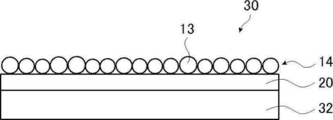
- FIG. 3 is a cross-sectional view of an embodiment of the pressure measuring sheet.
- the pressure measuring sheet 30 includes a support 32, a second layer 20 containing a color developer, and a first layer 14 containing a predetermined microcapsule 13 in this order.
- the microcapsules 13 are broken in the pressurized region by applying pressure from at least one side of the support 32 side and the first layer 14 side, and are included in the microcapsules 13.
- the coloring agent is discharged from the microcapsules 13 and the coloring reaction proceeds with the developing agent in the second layer 20. As a result, color development progresses in the pressurized region.
- the pressure measuring sheet 30 may have the first layer 14 and the second layer 20, and may not have the support 32. Further, in FIG. 3, the support 32 and the second layer 20 are directly laminated, but the present invention is not limited to this mode, and as will be described later, there is another space between the support 32 and the second layer 20. (For example, an easy-adhesion layer) may be arranged. Further, in FIG. 3, a pressure measuring sheet 30 having the support 32, the second layer 20, and the first layer 14 in this order is disclosed, but the present invention is not limited to this mode, and the support 32 A pressure measuring sheet having the first layer 14 and the second layer 20 in this order may be used.
- the pressure measuring sheet is used by applying pressure to its surface.
- the color density difference obtained by the following color density difference measurement 2 is 0.25 or less, preferably 0.20 or less, and more preferably 0.10 or less. ..
- the lower limit is not particularly limited, but is often 0.01 or more.
- Color development density difference measurement 2 The difference in optical density of the pressure measurement sheet before and after heating the pressure measurement sheet at 220 ° C. for 2 minutes in a non-pressurized state is defined as the color development density difference. Further, when heating to 220 ° C., the laminate that was at room temperature (about 23 ° C.) is heated to the above-mentioned predetermined temperature.
- the pressure measuring sheet is heat-treated under predetermined conditions.
- the above measurement is carried out in a non-pressurized state.
- the non-pressurized state means a state in which pressure is not applied to the pressure measuring sheet (a state in which pressure is not applied).
- X-rite eXact manufactured by X-Rite
- the density status is measured at ISO status T and D50 / 2 ° without a filter.
- the value of OD is adopted as the optical density.
- the OD is measured in each mode of CMYK (C: Cyan, M: Magenta, Y: Yellow, K: Black), and the one showing the highest OD is selected.
- first layer 14 and the second layer 20 in the pressure measurement sheet 30 are the same members as the first layer 14 and the second layer 20 described in the first embodiment described above, the description thereof will be omitted.
- the support 32 will be mainly described in detail.
- the support is a member for supporting the first layer and the second layer.
- the pressure measuring sheet does not have to have a support when the first layer and the second layer laminate itself can be handled. Since the preferred embodiment of the support is the same as the preferred embodiment of the first support described above, the description thereof will be omitted.
- the method for producing the pressure measuring sheet is not particularly limited, and known methods can be mentioned.
- a composition for forming a second layer containing a color developer is applied onto the support, and if necessary, a drying treatment is performed to form the second layer on the support, and then microcapsules are further applied.
- a method of applying the composition for forming the first layer containing the above to the second layer and, if necessary, performing a drying treatment to form the first layer can be mentioned.
- the method for forming the first layer using the composition for forming the first layer is as described in the first embodiment. Further, the method for forming the second layer using the composition for forming the second layer is also as described in the first embodiment.
- the pressure measuring sheet may include a support, a second layer, and other members other than the first layer.
- the pressure measuring sheet may have an easy-adhesion layer between the support and the second layer to improve the adhesion between the two.
- Examples of the easy-adhesive layer include the easy-adhesive layer that the first sheet described above may have.
- the pressure measuring sheet set and the pressure measuring sheet of the present invention can be used for various purposes, for example, for verification or control of various manufacturing processes including a high temperature press in a process.
- pressure distribution confirmation in the lamination process in the battery (lithium ion battery, fuel cell) field pressure distribution confirmation in the lamination process in the printed wiring board (FPC (Flexible Printed Circuits), BWB (Back Willing Board)) field, wiring extraction unit
- FPC Flexible Printed Circuits
- BWB Back Willing Board
- the pressure distribution confirmation in the thermocompression bonding step such as ACF (Anisotropic Conductive Film) bonding and laminating, and the pressure distribution confirmation of the mold tightening portion can be mentioned.
- the pressure distribution can be confirmed visually, or a pressure image analysis system (FPD-8010, manufactured by FUJIFILM Corporation) can be used.
- Pressure measuring sheet sets and pressure measuring sheets are used in a wide range of pressure zones. Specifically, it is preferably used in the range of 0.05 to 20 MPa, and more preferably used in the range of 0.5 to 10 MPa.
- the usable temperature range is from room temperature, but is preferably 160 ° C. or higher, and more preferably 180 to 240 ° C. When used at 240 ° C. or higher, the temperature applied to the pressure measuring sheet set (first sheet and second sheet) and the pressure measuring sheet can be appropriately reduced by using a protective sheet or the like.
- the protective sheet include a Teflon (registered trademark) sheet and a sheet having high heat resistance such as Kapton film.
- Example 1 (Preparation of microcapsules) The following compound (A) (molecular weight: 623) (6.8 parts by mass), which is a coloring agent, is dissolved in linear alkylbenzene (JX Energy Co., Ltd., Grade Alken L) (52 parts by mass) to prepare solution A. Obtained. Next, synthetic isoparaffin (Idemitsu Kosan Co., Ltd., IP solvent 1620) (14 parts by mass) was added to the stirring solution A to obtain a solution B.
- A molecular weight: 623
- linear alkylbenzene JX Energy Co., Ltd., Grade Alken L
- synthetic isoparaffin Idemitsu Kosan Co., Ltd., IP solvent 1620
- the capsule wall of the obtained microcapsules was substantially composed of polyurea.
- the Vernock D-750 corresponds to a trifunctional polyisocyanate which is an adduct of aromatic diisocyanate and trimethylolpropane as shown in the following structural formula.
- the median diameter of the color-developing agent-encapsulating microcapsules on a volume basis was 20 ⁇ m.
- the average wall thickness was 0.44 ⁇ m.
- ⁇ / Dm was 0.022.
- the glass transition temperature of the capsule wall of the microcapsules was 150 ° C.
- the median diameter (Dm) is 500 ⁇ m ⁇ 500 ⁇ m, as described later, after preparing the first sheet having the first layer containing the microcapsules, and then photographing the surface of the first layer with an optical microscope at 1000 times. The size of all microcapsules in the range was measured and calculated. As will be described later, the number average wall thickness is determined by preparing a first sheet having a first layer containing microcapsules, and then preparing a cross-sectional section of the first sheet having the first layer containing microcapsules.
- the cross section of each selected microcapsule was observed, the thickness of the capsule wall was calculated, and the average value was calculated.
- the glass transition temperature was measured by the following method. First, as will be described later, after preparing a first sheet having a first layer containing microcapsules, 50 sheets were cut into 1 cm in length ⁇ 1 cm in width, all immersed in 10 ml of water, and allowed to stand for 24 hours.
- a first sheet having 50 sheets of 1 cm in length ⁇ 1 cm in width was prepared, and all of them were immersed in 10 ml of water and allowed to stand for 24 hours to obtain an aqueous dispersion of microcapsules.
- the obtained aqueous dispersion of microcapsules was centrifuged at 15,000 rpm for 30 minutes, and the microcapsules were separated. Ethyl acetate was added to the separated microcapsules, and the mixture was further stirred at 25 ° C. for 24 hours. Then, the obtained solution is filtered, and the obtained residue is vacuum-dried at 60 ° C. for 48 hours to obtain microcapsules containing nothing inside (hereinafter, also simply referred to as “measurement material”). Was done.
- the thermal decomposition temperature of the obtained measurement material was measured using a thermogravimetric differential thermal analyzer TG-DTA (device name: DTG-60, Shimadzu Corporation).
- TGA thermogravimetric differential thermal analyzer
- the temperature of the measurement material is raised from room temperature at a constant temperature rise rate (10 ° C./min), and the temperature of the measurement material before heating is increased.
- the temperature at which the weight was reduced by 5% by mass was defined as the thermal decomposition temperature.
- the glass transition temperature of the measurement material was measured using a differential scanning calorimeter DSC (device name: DSC-60a Plus, Shimadzu Corporation) using a closed pan, and the temperature rise rate was 25 ° C./min.
- the measurement was performed in the range of ° C. to (thermal decomposition temperature ⁇ 5 ° C.).
- the value at the time of raising the temperature in the second cycle was used.
- the obtained composition for forming the first layer is placed on a polyethylene terephthalate sheet with an easy-adhesion layer (Toyobo Co., Ltd., Cosmo Shine (registered trademark) A4300) having a thickness of 75 ⁇ m, and the mass after drying is 4.5 g / g. It was applied with a bar coater so as to have m 2, and dried to form a first layer, and a first sheet was prepared.
- an easy-adhesion layer Toyobo Co., Ltd., Cosmo Shine (registered trademark) A4300
- a 19 mass% aqueous dispersion (180 parts by mass) of Nippon Zeon LX-814 (Nippon Zeon Co., Ltd.) and a 3.3 mass% aqueous solution of Polymaron 482 (Arakawa Chemical Industry Co., Ltd.) ( 220 parts by mass), 1% by mass aqueous solution of carboxymethyl cellulose Na (Daiichi Kogyo Seiyaku Co., Ltd., cellogen EP) (80 parts by mass), 15 parts by mass of sodium alkylbenzene sulfonate (Daiichi Kogyo Seiyaku Co., Ltd., Neogen T) A% aqueous solution (4.7 parts by mass) and a 1% by mass aqueous solution (70 parts by mass) of Neugen LP70 (Daiichi Kogyo Seiyaku Co., Ltd.) were mixed to prepare a coating solution containing a color developer.
- a coating liquid containing a developer is
- Example 2 Instead of the trimethylolpropane adduct of tolylene diisocyanate (DIC Co., Ltd., Vernock D-750) (13.9 parts by mass), the trimethylolpropane adduct of tolylene diisocyanate (DIC Co., Ltd., Vernock D-750) ) (13.2 parts by mass) (solid content mass: 9.9 parts by mass) and polyisocyanate B (Tosoh Corporation, Millionate MR-200) (0.5 parts by mass), except that Example 1 was used. The first sheet and the second sheet were prepared according to the same procedure as in the above.
- Example 2 the total solid content of the trimethylolpropane adduct of tolylene diisocyanate and polymethylene polyphenyl polyisocyanate was 10.4 parts by mass. Further, the millionate MR-200 used as the polyisocyanate B corresponds to a mixture of diphenylmethane diisocyanate and polymethylene polyphenyl polyisocyanate (corresponding to the compound represented by the formula (X)).
- Example 2 except that the total amount of the trimethylolpropane adduct of tolylene diisocyanate and polyisocyanate B was the same as in Example 2 (10.4 parts by mass) and the mixed mass ratio of both was as shown in Table 1.
- the first sheet and the second sheet were prepared according to the same procedure as in the above.
- Example 6> Instead of the trimethylolpropane adduct of tolylene diisocyanate (DIC Co., Ltd., Vernock D-750), as shown in Table 1, the trimethylolpropane adduct of 1,3-bis (isocyanatomethyl) cyclohexane (Mitsui) Chemical Co., Ltd., Takenate D-120N) was used to prepare the first and second sheets according to the same procedure as in Example 4, except that the mixed mass ratio with polyisocyanate B was adjusted as shown in Table 1. Made. As shown in the following structural formula, the above-mentioned Takenate D-120N corresponds to a trifunctional polyisocyanate which is an adduct of an alicyclic diisocyanate and trimethylolpropane.
- the above-mentioned Takenate D-120N corresponds to a trifunctional polyisocyanate which is an adduct of an alicyclic diisocyanate and trimethylolpropane
- Examples 7 to 8> The first sheet and the second sheet were prepared according to the same procedure as in Example 4 except that Millionate MR-100 or Millionate MR-400 was used instead of Millionate MR-200.
- the Millionate MR-100 and the Millionate MR-400 correspond to a mixture of diphenylmethane diisocyanate and polymethylene polyphenyl polyisocyanate (corresponding to the compound represented by the formula (X)).
- Example 9 to 12 As shown in Table 1, the first sheet and the second sheet were prepared according to the same procedure as in Example 4 except that the compounds (B) to (E) were used instead of the compound (A).
- the compounds (B) to (E) are as follows.
- Examples 13 to 16> The first sheet and the second sheet were prepared according to the same procedure as in Example 4 except that the amount of solid content of polyisocyanate used was changed as described in "Polyisocyanate solid content (parts by mass)" in Table 1. ..
- the amount of solid content used means the total mass of solid content of the trimethylolpropane adduct of tolylene diisocyanate and polyisocyanate B.
- the median diameter of the microcapsules, ⁇ / Dm, and the glass transition temperature of the capsule wall of the microcapsules in each example and comparative example are summarized in Table 1.
- the thermal decomposition temperature of the capsule wall of the microcapsules produced in each example was about 250 ° C.
- the pressure was applied at 2.0 MPa for 2 minutes so as to sandwich the SUS substrate and the laminate between the two heating stages heated to 220 ° C.
- the shape of the color-developing region of the obtained laminate was observed and evaluated according to the following criteria.
- the optical density B in the color-developing region of the laminated body was measured.
- the difference between the optical density A and the optical density B was determined and evaluated according to the following criteria. The smaller the above difference, the less the difference in the degree of color development due to temperature. "4": The above difference is 0.3 or less. "3”: The above difference is more than 0.3 and 0.4 or less. “2”: The above difference is more than 0.4 and 0.5 or less. “1”: The above difference is more than 0.5.
- X-rite eXact manufactured by X-Rite
- the density status was measured at ISO status T and D50 / 2 ° without a filter.
- the value of OD was adopted as the optical density.
- the OD was measured in each mode of CMYK (C: Cyan, M: Magenta, Y: Yellow, K: Black), and the one showing the highest OD was selected.
- polyisocyanate A corresponds to a trifunctional or higher functional polyisocyanate which is an adduct of an aromatic diisocyanate or an alicyclic diisocyanate and a compound having three or more active hydrogen groups in one molecule.
- Polyisocyanate B corresponds to a mixture of diphenylmethane diisocyanate and polymethylene polyphenyl polyisocyanate (corresponding to the compound represented by the formula (X)).
- mass ratio (A / B) represents the ratio of the mass of polyisocyanate A to the mass of polyisocyanate B.
- polyisocyanate solid content (parts by mass)” represents the total amount of the solid content mass of polyisocyanate A and the solid content mass of polyisocyanate B.
- type column of the “color former” column indicates the compounds (A) to (E)
- the “molecular weight” column indicates the molecular weight of each compound.
- particle size ( ⁇ m)” column represents the volume-based median diameter ( ⁇ m) of the microcapsules.
- ⁇ / Dm represents “ ⁇ / Dm” in the above formula (1)
- ⁇ is the number average wall thickness ( ⁇ m) of the microcapsules
- Dm is the median diameter based on the volume of the microcapsules.
- the “Glass transition temperature (° C.)” column represents the glass transition temperature of the capsule wall in the microcapsules.
- “None” in the “Glass transition temperature” column indicates that the glass transition temperature was not indicated in the above measurement. That is, it means that the capsule wall of the microcapsules does not show the glass transition temperature in the range of "25 ° C” to "(pyrolysis temperature (° C) -5 ° C)".
- the "color development density difference” column represents the color development density difference obtained by the color development density difference measurement 1 described above.
- the mode using the pressure measurement sheet set having the first sheet and the second sheet has been shown, but the pressure measurement sheet in which the second layer and the first layer are laminated in this order on the support is shown.
- the second layer and the first layer produced in Example 4 above are arranged in this order on a polyethylene terephthalate sheet with an easy-adhesion layer (Toyobo Co., Ltd., Cosmo Shine (registered trademark) A4300) to support the support.
- a pressure measurement sheet having the second layer and the first layer in this order was prepared, and the above (pressure distribution measurement) and (color development temperature dependence evaluation) were carried out. As a result, the same results as in Example 4 were obtained. Was done.
- Pressure measurement sheet set 12 1st support 13
- Microcapsules 14 1st layer 16 1st sheet 18 2nd support 20 2nd layer 22 2nd sheet 30 Pressure measurement sheet 32 Support
Landscapes
- Physics & Mathematics (AREA)
- General Physics & Mathematics (AREA)
- Force Measurement Appropriate To Specific Purposes (AREA)
- Manufacturing Of Micro-Capsules (AREA)
- Color Printing (AREA)
Abstract
本発明は、高温環境下(特に、180~240℃の環境)にて使用した際にも、発色の温度依存性が小さい圧力測定用シートセット、及び、圧力測定用シートを提供する。本発明の圧力測定用シートセットは、発色剤を内包するマイクロカプセルを含む第1層を有する第1シートと、顕色剤を含む第2層を有する第2シートと、を備える圧力測定用シートセットであって、以下の発色濃度差測定1によって求められる発色濃度差が0.25以下である、圧力測定用シートセット。 発色濃度差測定1:第1シートの第1層と第2シートの第2層とが対向するように、第1シートと第2シートとを積層させて積層体を得て、積層体を非加圧状態にて220℃で2分間加熱した前後の積層体の光学濃度の差を発色濃度差とする。
Description
本発明は、圧力測定用シートセット、及び、圧力測定用シートに関する。
近年、製品の高機能化及び高精細化により、圧力の分布を測定する必要性が増す傾向にある。
例えば、特許文献1においては、電子供与性無色染料前駆体が内包されたマイクロカプセルを用いた圧力測定用シートが提案されている。
例えば、特許文献1においては、電子供与性無色染料前駆体が内包されたマイクロカプセルを用いた圧力測定用シートが提案されている。
一方、プリント基板への集積回路や配線の熱圧着等の種々の高温環境での圧着操作において、歩留まりの向上のため、精密な圧力分布を測定することが望まれている。なお、圧着操作においては、圧着する部材によって加熱温度が変更される場合があり、温度を変えた場合でも精密な圧力分布を測定することが望まれている。
本発明者は、特許文献1に記載の圧力測定用シートを用いて180~240℃程度の高温条件の範囲において加熱温度を変更して発色の程度を観察したところ、同じ加圧条件にも関わらず、圧力測定用シートの発色の程度が異なることを知見した。つまり、加圧条件が同じでも、高温条件下においては、加熱温度が異なる場合に発色の程度が異なることを知見した。このような差異が生じると、圧力条件を変更するごとに測定に適切なシートを選択する必要があり、生産プロセスの簡略化の点で望ましくない。なお、以下では、上記のように、加圧の際の温度が異なることにより発色の程度が異なることを発色の温度依存性があるといい、発色の温度依存性が小さい部材が望まれている。
本発明者は、特許文献1に記載の圧力測定用シートを用いて180~240℃程度の高温条件の範囲において加熱温度を変更して発色の程度を観察したところ、同じ加圧条件にも関わらず、圧力測定用シートの発色の程度が異なることを知見した。つまり、加圧条件が同じでも、高温条件下においては、加熱温度が異なる場合に発色の程度が異なることを知見した。このような差異が生じると、圧力条件を変更するごとに測定に適切なシートを選択する必要があり、生産プロセスの簡略化の点で望ましくない。なお、以下では、上記のように、加圧の際の温度が異なることにより発色の程度が異なることを発色の温度依存性があるといい、発色の温度依存性が小さい部材が望まれている。
本発明は、上記実情に鑑みて、高温環境下(特に、180~240℃の環境)にて使用した際にも、発色の温度依存性が小さい圧力測定用シートセット、及び、圧力測定用シートを提供することを課題とする。
本発明者らは、上記課題について鋭意検討した結果、以下の構成により上記課題を解決できることを見出した。
(1) 発色剤を内包するマイクロカプセルを含む第1層を有する第1シートと、
顕色剤を含む第2層を有する第2シートと、を備える圧力測定用シートセットであって、
後述する発色濃度差測定1によって求められる発色濃度差が0.25以下である、圧力測定用シートセット。
(2) マイクロカプセルのカプセル壁が、ポリウレア、ポリウレタンウレア、及び、ポリウレタンからなる群から選択される少なくとも1種の樹脂を含む、(1)に記載の圧力測定用シートセット。
(3) 樹脂が、芳香族ジイソシアネート又は脂環族ジイソシアネートと1分子中に3つ以上の活性水素基を有する化合物とのアダクト体である3官能以上のポリイソシアネートA、並びに、
芳香族ジイソシアネート及びポリメチレンポリフェニルポリイソシアネートからなる群から選択されるポリイソシアネートBを用いて形成される、(2)に記載の圧力測定用シートセット。
(4) ポリイソシアネートBに対する、ポリイソシアネートAの質量比が、98/2~20/80である、(3)に記載の圧力測定用シートセット。
(5) 記樹脂が、ポリメチレンポリフェニル構造を有する、(2)~(4)のいずれかに記載の圧力測定用シートセット
(6) 発色剤の分子量が550以上である、(1)~(5)のいずれかに記載の圧力測定用シートセット。
(7) マイクロカプセルが後述する式(1)の関係を満たす、(1)~(6)のいずれかに記載の圧力測定用シートセット。
(8) マイクロカプセルの数平均壁厚が0.2μm以上である、(1)~(7)のいずれかに記載の圧力測定用シートセット
(9) 発色剤を内包するマイクロカプセルを含む第1層と、
第1層上に配置された、顕色剤を含む第2層と、を有する、圧力測定用シートであって、
後述する発色濃度差測定2によって求められる発色濃度差が0.25以下である、圧力測定用シート。
(10) マイクロカプセルのカプセル壁が、ポリウレア、ポリウレタンウレア、及び、ポリウレタンからなる群から選択される少なくとも1種の樹脂を含み、(9)に記載の圧力測定用シート。
(11) 樹脂が、芳香族ジイソシアネート又は脂環族ジイソシアネートと1分子中に3つ以上の活性水素基を有する化合物とのアダクト体である3官能以上のポリイソシアネートA、並びに、
芳香族ジイソシアネート及びポリメチレンポリフェニルポリイソシアネートからなる群から選択されるポリイソシアネートBを用いて形成される、(10)に記載の圧力測定用シート。
(12) ポリイソシアネートBに対する、ポリイソシアネートAの質量比が、98/2~20/80である、(11)に記載の圧力測定用シート。
(13) 樹脂が、ポリメチレンポリフェニル構造を有する、(10)~(12)のいずれかに記載の圧力測定用シート。
(14) 発色剤の分子量が550以上である、(9)~(13)のいずれかに記載の圧力測定用シート。
(15) マイクロカプセルが後述する式(1)の関係を満たす、(9)~(14)のいずれかに記載の圧力測定用シート。
(16) マイクロカプセルの数平均壁厚が0.2μm以上である、(9)~(15)のいずれかに記載の圧力測定用シート。
顕色剤を含む第2層を有する第2シートと、を備える圧力測定用シートセットであって、
後述する発色濃度差測定1によって求められる発色濃度差が0.25以下である、圧力測定用シートセット。
(2) マイクロカプセルのカプセル壁が、ポリウレア、ポリウレタンウレア、及び、ポリウレタンからなる群から選択される少なくとも1種の樹脂を含む、(1)に記載の圧力測定用シートセット。
(3) 樹脂が、芳香族ジイソシアネート又は脂環族ジイソシアネートと1分子中に3つ以上の活性水素基を有する化合物とのアダクト体である3官能以上のポリイソシアネートA、並びに、
芳香族ジイソシアネート及びポリメチレンポリフェニルポリイソシアネートからなる群から選択されるポリイソシアネートBを用いて形成される、(2)に記載の圧力測定用シートセット。
(4) ポリイソシアネートBに対する、ポリイソシアネートAの質量比が、98/2~20/80である、(3)に記載の圧力測定用シートセット。
(5) 記樹脂が、ポリメチレンポリフェニル構造を有する、(2)~(4)のいずれかに記載の圧力測定用シートセット
(6) 発色剤の分子量が550以上である、(1)~(5)のいずれかに記載の圧力測定用シートセット。
(7) マイクロカプセルが後述する式(1)の関係を満たす、(1)~(6)のいずれかに記載の圧力測定用シートセット。
(8) マイクロカプセルの数平均壁厚が0.2μm以上である、(1)~(7)のいずれかに記載の圧力測定用シートセット
(9) 発色剤を内包するマイクロカプセルを含む第1層と、
第1層上に配置された、顕色剤を含む第2層と、を有する、圧力測定用シートであって、
後述する発色濃度差測定2によって求められる発色濃度差が0.25以下である、圧力測定用シート。
(10) マイクロカプセルのカプセル壁が、ポリウレア、ポリウレタンウレア、及び、ポリウレタンからなる群から選択される少なくとも1種の樹脂を含み、(9)に記載の圧力測定用シート。
(11) 樹脂が、芳香族ジイソシアネート又は脂環族ジイソシアネートと1分子中に3つ以上の活性水素基を有する化合物とのアダクト体である3官能以上のポリイソシアネートA、並びに、
芳香族ジイソシアネート及びポリメチレンポリフェニルポリイソシアネートからなる群から選択されるポリイソシアネートBを用いて形成される、(10)に記載の圧力測定用シート。
(12) ポリイソシアネートBに対する、ポリイソシアネートAの質量比が、98/2~20/80である、(11)に記載の圧力測定用シート。
(13) 樹脂が、ポリメチレンポリフェニル構造を有する、(10)~(12)のいずれかに記載の圧力測定用シート。
(14) 発色剤の分子量が550以上である、(9)~(13)のいずれかに記載の圧力測定用シート。
(15) マイクロカプセルが後述する式(1)の関係を満たす、(9)~(14)のいずれかに記載の圧力測定用シート。
(16) マイクロカプセルの数平均壁厚が0.2μm以上である、(9)~(15)のいずれかに記載の圧力測定用シート。
本発明によれば、高温環境下(特に、180~240℃の環境)にて使用した際にも、発色の温度依存性が小さい圧力測定用シートセット、及び、圧力測定用シートを提供できる。
以下、本発明について詳細に説明する。
なお、本明細書において「~」を用いて表される数値範囲は、「~」の前後に記載される数値を下限値及び上限値として含む範囲を意味する。
また、本明細書に段階的に記載されている数値範囲において、ある数値範囲で記載された上限値又は下限値は、他の段階的な記載の数値範囲の上限値又は下限値に置き換えてもよい。また、本明細書に記載されている数値範囲において、ある数値範囲で記載された上限値又は下限値は、実施例に示されている値に置き換えてもよい。
後述する各種成分は、1種単独で又は2種以上を混合して用いてもよい。例えば、後述するポリイソシアネートは、1種単独で又は2種以上を混合して用いてもよい。
なお、本明細書において「~」を用いて表される数値範囲は、「~」の前後に記載される数値を下限値及び上限値として含む範囲を意味する。
また、本明細書に段階的に記載されている数値範囲において、ある数値範囲で記載された上限値又は下限値は、他の段階的な記載の数値範囲の上限値又は下限値に置き換えてもよい。また、本明細書に記載されている数値範囲において、ある数値範囲で記載された上限値又は下限値は、実施例に示されている値に置き換えてもよい。
後述する各種成分は、1種単独で又は2種以上を混合して用いてもよい。例えば、後述するポリイソシアネートは、1種単独で又は2種以上を混合して用いてもよい。
本発明の圧力測定用シートセット及び圧力測定用シートの特徴点としては、後述する所定の発色濃度差測定(発色濃度差測定1及び発色濃度差測定2)によって求められる発色濃度差が所定値以下である点が挙げられる。
本発明者は特許文献1に記載の圧力測定用シートが所定の効果を奏さない原因について検討したところ、180℃以上という高温条件下においては、マイクロカプセルのカプセル壁等の各種材料の運動性や、材料の分解性等が、少しの温度差によって大きく異なることを知見している。そのため、従来の圧力測定用シートにおいては、加圧条件が同じにもかかわらず、上述した加熱温度による材料の挙動の違いによって発色の差異が生じていたと考えられる。
それに対して、本発明者は、本発明で実施される発色濃度差測定によって求められる発色濃度が所定値以下である圧力測定用シートセット又は圧力測定用シートであれば、上記のような温度による材料の挙動の違いが小さく、結果として、所定の効果が得られることを知見している。
本発明者は特許文献1に記載の圧力測定用シートが所定の効果を奏さない原因について検討したところ、180℃以上という高温条件下においては、マイクロカプセルのカプセル壁等の各種材料の運動性や、材料の分解性等が、少しの温度差によって大きく異なることを知見している。そのため、従来の圧力測定用シートにおいては、加圧条件が同じにもかかわらず、上述した加熱温度による材料の挙動の違いによって発色の差異が生じていたと考えられる。
それに対して、本発明者は、本発明で実施される発色濃度差測定によって求められる発色濃度が所定値以下である圧力測定用シートセット又は圧力測定用シートであれば、上記のような温度による材料の挙動の違いが小さく、結果として、所定の効果が得られることを知見している。
<<第1実施形態>>
図1は、圧力測定用シートセットの一実施形態の断面図である。
圧力測定用シートセット10は、第1支持体12及び第1支持体12上に配置された所定のマイクロカプセル13を含む第1層14を有する第1シート16と、第2支持体18と第2支持体18上に配置された顕色剤を含む第2層20を有する第2シート22とを備える。
圧力測定用シートセット10を使用する際には、図2に示すように、第1シート16中の第1層14と第2シート22中の第2層20とが対向するように、第1シート16と第2シート22とを積層して使用する。得られた積層体中の第1シート16の第1支持体12側及び第2シート22の第2支持体18側の少なくとも一方側から加圧することにより、加圧された領域においてマイクロカプセル13が壊れて、マイクロカプセル13に内包されている発色剤がマイクロカプセル13から出てきて、第2層20中の顕色剤との間で発色反応が進行する。結果として、加圧した領域において、発色が進行する。
図1は、圧力測定用シートセットの一実施形態の断面図である。
圧力測定用シートセット10は、第1支持体12及び第1支持体12上に配置された所定のマイクロカプセル13を含む第1層14を有する第1シート16と、第2支持体18と第2支持体18上に配置された顕色剤を含む第2層20を有する第2シート22とを備える。
圧力測定用シートセット10を使用する際には、図2に示すように、第1シート16中の第1層14と第2シート22中の第2層20とが対向するように、第1シート16と第2シート22とを積層して使用する。得られた積層体中の第1シート16の第1支持体12側及び第2シート22の第2支持体18側の少なくとも一方側から加圧することにより、加圧された領域においてマイクロカプセル13が壊れて、マイクロカプセル13に内包されている発色剤がマイクロカプセル13から出てきて、第2層20中の顕色剤との間で発色反応が進行する。結果として、加圧した領域において、発色が進行する。
なお、後述するように、第1シート16は第1層14を有していればよく、第1支持体12を有していてなくてもよい。また、第2シート22は第2層20を有していればよく、第2支持体18を有していてなくてもよい。
さらに、図1においては、第1支持体12と第1層14とが直接積層しているが、この態様に制限されず、後述するように、第1支持体12と第1層14との間には他の層(例えば、易接着層)が配置されていてもよい。また、図1においては、第2支持体18と第2層20とが直接積層しているが、この態様に制限されず、後述するように、第2支持体18と第2層20との間には他の層(例えば、易接着層)が配置されていてもよい。
さらに、図1においては、第1支持体12と第1層14とが直接積層しているが、この態様に制限されず、後述するように、第1支持体12と第1層14との間には他の層(例えば、易接着層)が配置されていてもよい。また、図1においては、第2支持体18と第2層20とが直接積層しているが、この態様に制限されず、後述するように、第2支持体18と第2層20との間には他の層(例えば、易接着層)が配置されていてもよい。
上記圧力測定用シートセット10においては、以下の発色濃度差測定1によって求められる発色濃度差が0.25以下であり、0.20以下であることが好ましく、0.10以下であることがより好ましい。下限は特に制限されないが、0.01以上である場合が多い。
発色濃度差測定1:第1シートの第1層と第2シートの第2層とが対向するように、第1シートと第2シートとを積層させて積層体を得て、積層体を非加圧状態にて220℃で2分間加熱した前後の積層体の光学濃度の差を発色濃度差とする。
上記発色濃度差測定1においては、上記のように、積層体に対して所定の条件で加熱処理を施す。なお、上記測定は、非加圧状態にて実施する。非加圧状態とは、積層体に圧力をかけていない状態(加圧していない状態)を意味する。また、220℃に加熱する際には、室温(約23℃)下にあった積層体を上記所定の温度まで加熱する。
上記光学濃度の測定方法としては、X-rite eXact(X-Rite社製)を用いて、フィルタなし、濃度ステータスはISOステータスT、D50/2°で測定する。光学濃度としては、OD(Optical density)の値を採用する。なお、測定の際、CMYK(C:Cyan、M:Magenta、Y:Yellow、K:Black)の各モードでODを測定し、もっとも高いODを示すものを選択する。
発色濃度差測定1:第1シートの第1層と第2シートの第2層とが対向するように、第1シートと第2シートとを積層させて積層体を得て、積層体を非加圧状態にて220℃で2分間加熱した前後の積層体の光学濃度の差を発色濃度差とする。
上記発色濃度差測定1においては、上記のように、積層体に対して所定の条件で加熱処理を施す。なお、上記測定は、非加圧状態にて実施する。非加圧状態とは、積層体に圧力をかけていない状態(加圧していない状態)を意味する。また、220℃に加熱する際には、室温(約23℃)下にあった積層体を上記所定の温度まで加熱する。
上記光学濃度の測定方法としては、X-rite eXact(X-Rite社製)を用いて、フィルタなし、濃度ステータスはISOステータスT、D50/2°で測定する。光学濃度としては、OD(Optical density)の値を採用する。なお、測定の際、CMYK(C:Cyan、M:Magenta、Y:Yellow、K:Black)の各モードでODを測定し、もっとも高いODを示すものを選択する。
以下では、圧力測定用シートセット10を構成する第1シート16及び第2シート22の構成について詳述する。
<第1シート>
図1に記載の第1シート16は、第1支持体12と、発色剤を内包するマイクロカプセル13を含む第1層14とを有する。
以下では、各部材について詳述する。
図1に記載の第1シート16は、第1支持体12と、発色剤を内包するマイクロカプセル13を含む第1層14とを有する。
以下では、各部材について詳述する。
(第1支持体)
第1支持体は、第1層を支持するための部材である。なお、第1層自体で取り扱いが可能な場合には、第1シートは第1支持体を有していなくてもよい。
第1支持体は、第1層を支持するための部材である。なお、第1層自体で取り扱いが可能な場合には、第1シートは第1支持体を有していなくてもよい。
第1支持体は、シート状、フィルム状、及び、板状のいずれの形状であってもよい。
第1支持体としては、紙、プラスチックフィルム、及び、合成紙が挙げられる。
紙としては、上質紙、中質紙、更紙、中性紙、酸性紙、再生紙、コート紙、マシンコート紙、アート紙、キャストコート紙、微塗工紙、トレーシングペーパー、及び、再生紙が挙げられる。
プラスチックフィルムとしては、ポリエチレンテレフタレートフィルム等のポリエステルフィルム、三酢酸セルロース等のセルロース誘導体フィルム、ポリプロピレン及びポリエチレン等のポリオレフィンフィルム、並びに、ポリスチレンフィルムが挙げられる。
合成紙としては、ポリプロピレン又はポリエチレンテレフタレート等を二軸延伸してミクロボイドを多数形成したもの(ユポ等)、ポリエチレン、ポリプロピレン、ポリエチレンテレフタレート、及び、ポリアミド等の合成繊維を用いて作製したもの、及び、これらを紙の一部、片面又は両面に積層したもの、等が挙げられる。
なかでも、加圧により生じる発色濃度をより高める点から、プラスチックフィルム、又は、合成紙が好ましく、プラスチックフィルムがより好ましい。
第1支持体としては、紙、プラスチックフィルム、及び、合成紙が挙げられる。
紙としては、上質紙、中質紙、更紙、中性紙、酸性紙、再生紙、コート紙、マシンコート紙、アート紙、キャストコート紙、微塗工紙、トレーシングペーパー、及び、再生紙が挙げられる。
プラスチックフィルムとしては、ポリエチレンテレフタレートフィルム等のポリエステルフィルム、三酢酸セルロース等のセルロース誘導体フィルム、ポリプロピレン及びポリエチレン等のポリオレフィンフィルム、並びに、ポリスチレンフィルムが挙げられる。
合成紙としては、ポリプロピレン又はポリエチレンテレフタレート等を二軸延伸してミクロボイドを多数形成したもの(ユポ等)、ポリエチレン、ポリプロピレン、ポリエチレンテレフタレート、及び、ポリアミド等の合成繊維を用いて作製したもの、及び、これらを紙の一部、片面又は両面に積層したもの、等が挙げられる。
なかでも、加圧により生じる発色濃度をより高める点から、プラスチックフィルム、又は、合成紙が好ましく、プラスチックフィルムがより好ましい。
第1支持体の厚みは特に制限されず、10~200μmが好ましい。
(第1層)
第1層は、発色剤を内包するマイクロカプセルを含む。
第1層は、発色剤を内包するマイクロカプセルを含む。
マイクロカプセルは、一般的に、コア部と、コア部をなすコア材(内包されるもの)を内包するためのカプセル壁と、を有する。
本発明においては、マイクロカプセルは、コア材(内包成分)として、発色剤を内包する。発色剤がマイクロカプセルに内包されているため、加圧されてマイクロカプセルが破壊されるまで、発色剤は安定的に存在できる。
本発明においては、マイクロカプセルは、コア材(内包成分)として、発色剤を内包する。発色剤がマイクロカプセルに内包されているため、加圧されてマイクロカプセルが破壊されるまで、発色剤は安定的に存在できる。
マイクロカプセルは、コア材を内包するカプセル壁を有する。
マイクロカプセルにおけるカプセル壁を形成する材料は特に制限されず、ポリウレタンウレア、ポリウレタン、ポリウレア、メラミン樹脂、及び、アクリル樹脂等の樹脂が挙げられる。なかでも、マイクロカプセルにおけるカプセル壁は、ポリウレア、ポリウレタンウレア、及び、ポリウレタンからなる群から選択される少なくとも1種の樹脂(以下、単に「特定樹脂」ともいう。)を含むことが好ましい。
マイクロカプセルのカプセル壁は、実質的に、樹脂(好ましくは、特定樹脂)で構成されることが好ましい。実質的に樹脂で構成されるとは、カプセル壁全質量に対する、樹脂の含有量が90質量%以上であることを意味し、100質量%が好ましい。つまり、マイクロカプセルのカプセル壁は、樹脂で構成されることが好ましい。
なお、ポリウレタンとはウレタン結合を複数有するポリマーであり、ポリオールとポリイソシアネートとを含む原料から形成される反応生成物であることが好ましい。
また、ポリウレアとはウレア結合を複数有するポリマーであり、ポリアミンとポリイソシアネートとを含む原料から形成される反応生成物であることが好ましい。なお、ポリイソシアネートの一部が水と反応してポリアミンとなることを利用して、ポリイソシアネートを用いて、ポリアミンを使用せずに、ポリウレアを合成することもできる。
また、ポリウレタンウレアとはウレタン結合及びウレア結合を有するポリマーであり、ポリオールと、ポリアミンと、ポリイソシアネートとを含む原料から形成される反応生成物であることが好ましい。なお、ポリオールとポリイソシアネートとを反応させる際に、ポリイソシアネートの一部が水と反応してポリアミンとなり、結果的にポリウレタンウレアが得られることがある。
マイクロカプセルにおけるカプセル壁を形成する材料は特に制限されず、ポリウレタンウレア、ポリウレタン、ポリウレア、メラミン樹脂、及び、アクリル樹脂等の樹脂が挙げられる。なかでも、マイクロカプセルにおけるカプセル壁は、ポリウレア、ポリウレタンウレア、及び、ポリウレタンからなる群から選択される少なくとも1種の樹脂(以下、単に「特定樹脂」ともいう。)を含むことが好ましい。
マイクロカプセルのカプセル壁は、実質的に、樹脂(好ましくは、特定樹脂)で構成されることが好ましい。実質的に樹脂で構成されるとは、カプセル壁全質量に対する、樹脂の含有量が90質量%以上であることを意味し、100質量%が好ましい。つまり、マイクロカプセルのカプセル壁は、樹脂で構成されることが好ましい。
なお、ポリウレタンとはウレタン結合を複数有するポリマーであり、ポリオールとポリイソシアネートとを含む原料から形成される反応生成物であることが好ましい。
また、ポリウレアとはウレア結合を複数有するポリマーであり、ポリアミンとポリイソシアネートとを含む原料から形成される反応生成物であることが好ましい。なお、ポリイソシアネートの一部が水と反応してポリアミンとなることを利用して、ポリイソシアネートを用いて、ポリアミンを使用せずに、ポリウレアを合成することもできる。
また、ポリウレタンウレアとはウレタン結合及びウレア結合を有するポリマーであり、ポリオールと、ポリアミンと、ポリイソシアネートとを含む原料から形成される反応生成物であることが好ましい。なお、ポリオールとポリイソシアネートとを反応させる際に、ポリイソシアネートの一部が水と反応してポリアミンとなり、結果的にポリウレタンウレアが得られることがある。
ポリイソシアネートとは、2つ以上のイソシアネート基を有する化合物であり、芳香族ポリイソシアネート、及び、脂肪族ポリイソシアネートが挙げられ、マイクロカプセルのカプセル壁に芳香環基を導入できる点で、芳香族ポリイソシアネートが好ましい。
芳香族ポリイソシアネートとしては、芳香族ジイソシアネートが挙げられ、例えば、m-フェニレンジイソシアネート、p-フェニレンジイソシアネート、2,6-トリレンジイソシアネート、2,4-トリレンジイソシアネート、ナフタレン-1,4-ジイソシアネート、ジフェニルメタン-4,4’-ジイソシアネート、3,3’-ジメトキシ-ビフェニルジイソシアネート、3,3’-ジメチルジフェニルメタン-4,4’-ジイソシアネート、キシリレン-1,4-ジイソシアネート、キシリレン-1,3-ジイソシアネート、4-クロロキシリレン-1,3-ジイソシアネート、2-メチルキシリレン-1,3-ジイソシアネート、4,4’-ジフェニルプロパンジイソシアネート、及び、4,4’-ジフェニルヘキサフルオロプロパンジイソシアネートが挙げられる。
芳香族ポリイソシアネートとしては、芳香族ジイソシアネートが挙げられ、例えば、m-フェニレンジイソシアネート、p-フェニレンジイソシアネート、2,6-トリレンジイソシアネート、2,4-トリレンジイソシアネート、ナフタレン-1,4-ジイソシアネート、ジフェニルメタン-4,4’-ジイソシアネート、3,3’-ジメトキシ-ビフェニルジイソシアネート、3,3’-ジメチルジフェニルメタン-4,4’-ジイソシアネート、キシリレン-1,4-ジイソシアネート、キシリレン-1,3-ジイソシアネート、4-クロロキシリレン-1,3-ジイソシアネート、2-メチルキシリレン-1,3-ジイソシアネート、4,4’-ジフェニルプロパンジイソシアネート、及び、4,4’-ジフェニルヘキサフルオロプロパンジイソシアネートが挙げられる。
脂肪族ポリイソシアネートとしては、脂肪族ジイソシアネートが挙げられ、例えば、トリメチレンジイソシアネート、ヘキサメチレンジイソシアネート、プロピレン-1,2-ジイソシアネート、ブチレン-1,2-ジイソシアネート、シクロヘキシレン-1,2-ジイソシアネート、シクロヘキシレン-1,3-ジイソシアネート、シクロヘキシレン-1,4-ジイソシアネート、ジシクロヘキシルメタン-4,4’-ジイソシアネート、1,4-ビス(イソシアネートメチル)シクロヘキサン、1,3-ビス(イソシアネートメチル)シクロヘキサン、イソホロンジイソシアネート、リジンジイソシアネート、及び、水素化キシリレンジイソシアネートが挙げられる。
なお、上記では2官能の芳香族ポリイソシアネート及び脂肪族ポリイソシアネートを例示したが、ポリイソシアネートとしては、3官能以上のポリイソシアネート(例えば、3官能のトリイソシアネート、及び、4官能のテトライソシアネート)も挙げられる。
より具体的には、ポリイソシアネートとしては、上記の2官能のポリイソシアネートの3量体であるビューレット体もしくはイソシアヌレート体、トリメチロールプロパン等のポリオールと2官能のポリイソシアネートとのアダクト体(付加体)、ベンゼンイソシアネートのホルマリン縮合物、メタクリロイルオキシエチルイソシアネート等の重合性基を有するポリイソシアネート、及び、リジントリイソシアネートも挙げられる。
ポリイソシアネートについては「ポリウレタン樹脂ハンドブック」(岩田敬治編、日刊工業新聞社発行(1987))に記載されている。
より具体的には、ポリイソシアネートとしては、上記の2官能のポリイソシアネートの3量体であるビューレット体もしくはイソシアヌレート体、トリメチロールプロパン等のポリオールと2官能のポリイソシアネートとのアダクト体(付加体)、ベンゼンイソシアネートのホルマリン縮合物、メタクリロイルオキシエチルイソシアネート等の重合性基を有するポリイソシアネート、及び、リジントリイソシアネートも挙げられる。
ポリイソシアネートについては「ポリウレタン樹脂ハンドブック」(岩田敬治編、日刊工業新聞社発行(1987))に記載されている。
なかでも、ポリイソシアネートの好適態様の一つとしては、3官能以上のポリイソシアネートが好ましい。
3官能以上のポリイソシアネートとしては、例えば、3官能以上の芳香族ポリイソシアネート、及び、3官能以上の脂肪族ポリイソシアネートが挙げられる。
3官能以上のポリイソシアネートとしては、芳香族ジイソシアネート又は脂環族ジイソシアネートと1分子中に3つ以上の活性水素基を有する化合物(例えば、3官能以上の、ポリオール、ポリアミン、又はポリチオール等)とのアダクト体(付加物)である3官能以上のポリイソシアネート(アダクト型である3官能以上のポリイソシアネート)、及び、芳香族ジイソシアネート又は脂環族ジイソシアネートの3量体(ビウレット型又はイソシアヌレート型)も好ましく、上記アダクト体(付加物)である3官能以上のポリイソシアネートがより好ましい。
3官能以上のポリイソシアネートとしては、例えば、3官能以上の芳香族ポリイソシアネート、及び、3官能以上の脂肪族ポリイソシアネートが挙げられる。
3官能以上のポリイソシアネートとしては、芳香族ジイソシアネート又は脂環族ジイソシアネートと1分子中に3つ以上の活性水素基を有する化合物(例えば、3官能以上の、ポリオール、ポリアミン、又はポリチオール等)とのアダクト体(付加物)である3官能以上のポリイソシアネート(アダクト型である3官能以上のポリイソシアネート)、及び、芳香族ジイソシアネート又は脂環族ジイソシアネートの3量体(ビウレット型又はイソシアヌレート型)も好ましく、上記アダクト体(付加物)である3官能以上のポリイソシアネートがより好ましい。
上記アダクト体である3官能以上のポリイソシアネートとしては、芳香族ジイソシアネート又は脂環族ジイソシアネートと1分子中に3つ以上の水酸基を有するポリオールとのアダクト体である3官能以上のポリイソシアネートが好ましく、芳香族ジイソシアネート又は脂環族ジイソシアネートと1分子中に3つの水酸基を有するポリオールとのアダクト体である3官能のポリイソシアネートがより好ましい。
上記アダクト体としては、発色の温度依存性がより小さい点、及び、高温環境下での圧力分布の測定がより良好に実施できる点の少なくとも一方が得られる点(以下、単に「本発明の効果がより優れる点」ともいう。)で、芳香族ジイソシアネートを用いて得られるアダクト体を用いることが好ましい。
上記ポリオールとしては、例えば、後述する3官能以上の低分子ポリオールが好ましく、トリメチロールプロパンがより好ましい。
上記アダクト体としては、発色の温度依存性がより小さい点、及び、高温環境下での圧力分布の測定がより良好に実施できる点の少なくとも一方が得られる点(以下、単に「本発明の効果がより優れる点」ともいう。)で、芳香族ジイソシアネートを用いて得られるアダクト体を用いることが好ましい。
上記ポリオールとしては、例えば、後述する3官能以上の低分子ポリオールが好ましく、トリメチロールプロパンがより好ましい。
アダクト型である3官能以上のポリイソシアネートとしては、例えば、タケネート(登録商標)D-102、D-103、D-103H、D-103M2、P49-75S、D-110N、D-120N、D-140N、D-160N(三井化学株式会社製)、デスモジュール(登録商標)L75、UL57SP(住化バイエルウレタン株式会社製)、コロネート(登録商標)HL、HX、L(日本ポリウレタン株式会社製)、P301-75E(旭化成株式会社製)、バーノック(登録商標)D-750(DIC株式会社製)が挙げられる。
なかでも、アダクト型の3官能以上のポリイソシアネートとしては、例えば、タケネート(登録商標)D-110N、D-120N、D-140N、D-160N(三井化学株式会社製)、又は、DIC株式会社製のバーノック(登録商標)D-750が好ましい。
イソシアヌレート型の3官能以上のポリイソシアネートとしては、例えば、タケネート(登録商標)D-127N、D-170N、D-170HN、D-172N、D-177N、D-204(三井化学株式会社製)、スミジュールN3300、デスモジュール(登録商標)N3600、N3900、Z4470BA(住化バイエルウレタン)、コロネート(登録商標)HX、HK(日本ポリウレタン株式会社製)、デュラネート(登録商標)TPA-100、TKA-100、TSA-100、TSS-100、TLA-100、TSE-100(旭化成株式会社製)が挙げられる。
ビウレット型の3官能以上のポリイソシアネートとしては、例えば、タケネート(登録商標)D-165N、NP1100(三井化学株式会社製)、デスモジュール(登録商標)N3200(住化バイエルウレタン)、デュラネート(登録商標)24A-100(旭化成株式会社製)が挙げられる。
なかでも、アダクト型の3官能以上のポリイソシアネートとしては、例えば、タケネート(登録商標)D-110N、D-120N、D-140N、D-160N(三井化学株式会社製)、又は、DIC株式会社製のバーノック(登録商標)D-750が好ましい。
イソシアヌレート型の3官能以上のポリイソシアネートとしては、例えば、タケネート(登録商標)D-127N、D-170N、D-170HN、D-172N、D-177N、D-204(三井化学株式会社製)、スミジュールN3300、デスモジュール(登録商標)N3600、N3900、Z4470BA(住化バイエルウレタン)、コロネート(登録商標)HX、HK(日本ポリウレタン株式会社製)、デュラネート(登録商標)TPA-100、TKA-100、TSA-100、TSS-100、TLA-100、TSE-100(旭化成株式会社製)が挙げられる。
ビウレット型の3官能以上のポリイソシアネートとしては、例えば、タケネート(登録商標)D-165N、NP1100(三井化学株式会社製)、デスモジュール(登録商標)N3200(住化バイエルウレタン)、デュラネート(登録商標)24A-100(旭化成株式会社製)が挙げられる。
また、ポリイソシアネートとしては、ポリメチレンポリフェニルポリイソシアネートも好ましい。
ポリメチレンポリフェニルポリイソシアネートとしては、式(X)で表される化合物が好ましい。
ポリメチレンポリフェニルポリイソシアネートとしては、式(X)で表される化合物が好ましい。

式(X)中、nは繰り返し単位数を表す。繰り返し単位数としては、1以上の整数を表し、本発明の効果がより優れる点で、nは1~10の整数が好ましく、1~5の整数がより好ましい。
ポリメチレンポリフェニルポリイソシアネートを含むポリイソシアネートとしては、例えば、ミリオネート MR-100、ミリオネート MR-200、ミリオネート MR-400(東ソー株式会社製)、WANNATE PM-200、WANNATE PM-400(万華ジャパン株式会社製)、コスモネート M-50、コスモネート M-100、コスモネートM-200、コスモネート M-300(三井化学株式会社製)、及び、ボラネートM-595(ダウケミカル株式会社製)が挙げられる。
ポリオールとは、2つ以上のヒドロキシル基を有する化合物であり、例えば、低分子ポリオール(例:脂肪族ポリオール、芳香族ポリオール)、ポリビニルアルコール、ポリエーテル系ポリオール、ポリエステル系ポリオール、ポリラクトン系ポリオール、ヒマシ油系ポリオール、ポリオレフィン系ポリオール、及び、水酸基含有アミン系化合物が挙げられる。
なお、低分子ポリオールとは、分子量が400以下のポリオールを意味し、例えば、エチレングリコール、ジエチレングリコール、及び、プロピレングリコール等の2官能の低分子ポリオール、並びに、グリセリン、トリメチロールプロパン、ヘキサントリオール、ペンタエリスリトール、及び、ソルビトール等の3官能以上の低分子ポリオールが挙げられる。
なお、低分子ポリオールとは、分子量が400以下のポリオールを意味し、例えば、エチレングリコール、ジエチレングリコール、及び、プロピレングリコール等の2官能の低分子ポリオール、並びに、グリセリン、トリメチロールプロパン、ヘキサントリオール、ペンタエリスリトール、及び、ソルビトール等の3官能以上の低分子ポリオールが挙げられる。
なお、水酸基含有アミン系化合物としては、例えば、アミノ化合物のオキシアルキル化誘導体等として、アミノアルコールが挙げられる。アミノアルコールとしては、例えば、エチレンジアミン等のアミノ化合物のプロピレンオキサイド又はエチレンオキサイド付加物である、N,N,N’,N’-テトラキス[2-ヒドロキシプロピル]エチレンジアミン、及び、N,N,N’,N’-テトラキス[2-ヒドロキシエチル]エチレンジアミン等が挙げられる。
ポリアミンとは、2つ以上のアミノ基(第1級アミノ基又は第2級アミノ基)を有する化合物であり、ジエチレントリアミン、トリエチレンテトラミン、1,3-プロピレンジアミン、及び、ヘキサメチレンジアミン等の脂肪族多価アミン;脂肪族多価アミンのエポキシ化合物付加物;ピペラジン等の脂環式多価アミン;3,9-ビス-アミノプロピル-2,4,8,10-テトラオキサスピロ-(5,5)ウンデカン等の複素環式ジアミンが挙げられる。
なかでも、カプセル壁に含まれる樹脂は、芳香族ジイソシアネート又は脂環族ジイソシアネートと1分子中に3つ以上の活性水素基を有する化合物とのアダクト体である3官能以上のポリイソシアネートA(以下、単に「ポリイソシアネートA」ともいう。)、並びに、芳香族ジイソシアネート及びポリメチレンポリフェニルポリイソシアネートからなる群から選択されるポリイソシアネートB(以下、単に「ポリイソシアネートB」ともいう。)を用いて形成されることが好ましい。
つまり、カプセル壁は、上記ポリイソシアネートA及びポリイソシアネートBを用いて形成される、上記樹脂(ポリウレア、ポリウレタンウレア、及び、ポリウレタンからなる群から選択される少なくとも1種の樹脂)を含むカプセル壁であることが好ましい。
上記ポリイソシアネートA及びポリイソシアネートBを用いることにより、本発明に効果がより優れる。また、発色の温度依存性が小さい。また、上記ポリイソシアネートA及びポリイソシアネートBを用いることにより、高温条件下において圧力測定用シートセットを用いた際に、加圧した領域以外において発色しづらくなり、高温環境下における圧力分布の観察がより容易となる。なお、上記効果が得られる理由としては、マイクロカプセルから発色剤の漏れが抑制されるためと考えられる。
なお、ポリイソシアネートBとしては、芳香族ジイソシアネートを単独で用いてもよいし、ポリメチレンポリフェニルポリイソシアネートを単独で用いてもよいし、両者を混合して用いてもよい。なかでも、ポリイソシアネートBとしては、芳香族ジイソシアネート及びポリメチレンポリフェニルポリイソシアネートの混合物が好ましい。
上記混合物においては、芳香族ジイソシアネートに対する、ポリメチレンポリフェニルポリイソシアネートの質量比(ポリメチレンポリフェニルポリイソシアネートの質量/芳香族ジイソシアネートの質量)は特に制限されないが、0.1~10が好ましく、0.5~2がより好ましく、0.75~1.5がさらに好ましい。
つまり、カプセル壁は、上記ポリイソシアネートA及びポリイソシアネートBを用いて形成される、上記樹脂(ポリウレア、ポリウレタンウレア、及び、ポリウレタンからなる群から選択される少なくとも1種の樹脂)を含むカプセル壁であることが好ましい。
上記ポリイソシアネートA及びポリイソシアネートBを用いることにより、本発明に効果がより優れる。また、発色の温度依存性が小さい。また、上記ポリイソシアネートA及びポリイソシアネートBを用いることにより、高温条件下において圧力測定用シートセットを用いた際に、加圧した領域以外において発色しづらくなり、高温環境下における圧力分布の観察がより容易となる。なお、上記効果が得られる理由としては、マイクロカプセルから発色剤の漏れが抑制されるためと考えられる。
なお、ポリイソシアネートBとしては、芳香族ジイソシアネートを単独で用いてもよいし、ポリメチレンポリフェニルポリイソシアネートを単独で用いてもよいし、両者を混合して用いてもよい。なかでも、ポリイソシアネートBとしては、芳香族ジイソシアネート及びポリメチレンポリフェニルポリイソシアネートの混合物が好ましい。
上記混合物においては、芳香族ジイソシアネートに対する、ポリメチレンポリフェニルポリイソシアネートの質量比(ポリメチレンポリフェニルポリイソシアネートの質量/芳香族ジイソシアネートの質量)は特に制限されないが、0.1~10が好ましく、0.5~2がより好ましく、0.75~1.5がさらに好ましい。
ポリイソシアネートBの粘度は特に制限されないが、本発明の効果がより優れる点で、100~1000mPa・sが好ましい。
なお、上記粘度は、25℃における粘度である。
なお、上記粘度は、25℃における粘度である。
ポリイソシアネートA及びポリイソシアネートBを併用する場合、ポリイソシアネートBに対する、上記ポリイソシアネートAの質量比(ポリイソシアネートAの質量/ポリイソシアネートBの質量)は特に制限されないが、98/2~20/80が好ましく、80/20~20/80がより好ましく、80/20~45/55がさらに好ましい。
上記質量比が上記範囲内である場合、本発明の効果がより優れる。また、上述したように、高温条件下において圧力測定用シートセットを用いた際に、加圧した領域以外において発色しづらくなる。
上記質量比が上記範囲内である場合、本発明の効果がより優れる。また、上述したように、高温条件下において圧力測定用シートセットを用いた際に、加圧した領域以外において発色しづらくなる。
また、本発明の効果がより優れる点で、樹脂は、ポリメチレンポリフェニル構造を有することが好ましい。つまり、樹脂は、部分構造として、ポリメチレンポリフェニル構造を有することが好ましい。
上記ポリメチレンポリフェニル構造は、ポリメチレンポリフェニルポリイソシアネート由来の構造であり、より具体的には、以下の式で表される構造である。
上記ポリメチレンポリフェニル構造は、ポリメチレンポリフェニルポリイソシアネート由来の構造であり、より具体的には、以下の式で表される構造である。

式中、nは繰り返し単位数を表す。繰り返し単位数としては、1以上の整数を表し、本発明の効果がより優れる点で、nは1~10の整数が好ましく、1~5の整数がより好ましい。
マイクロカプセルのカプセル壁のガラス転移温度は特に制限されないが、150℃以上であるか、又は、カプセル壁がガラス転移温度を示さないことが好ましい。つまり、マイクロカプセルのカプセル壁を構成する材料のガラス転移温度が150℃以上であるか、又は、マイクロカプセルのカプセル壁を構成する材料がガラス転移温度を示さないことが好ましい。
なお、マイクロカプセルのカプセル壁がガラス転移温度を示す場合、その温度は、本発明の効果がより優れる点で、160℃以上が好ましく、180℃以上がより好ましく、200℃以上がさらに好ましい。マイクロカプセルのカプセル壁がガラス転移温度を示す場合、その温度の上限は特に制限されないが、マイクロカプセルのカプセル壁の熱分解温度以下である場合が多く、一般的に、250℃以下となることが多い。
なかでも、本発明の効果がより優れる点で、マイクロカプセルのカプセル壁がガラス転移温度を示さないことが好ましい。
なお、マイクロカプセルのカプセル壁がガラス転移温度を示す場合、その温度は、本発明の効果がより優れる点で、160℃以上が好ましく、180℃以上がより好ましく、200℃以上がさらに好ましい。マイクロカプセルのカプセル壁がガラス転移温度を示す場合、その温度の上限は特に制限されないが、マイクロカプセルのカプセル壁の熱分解温度以下である場合が多く、一般的に、250℃以下となることが多い。
なかでも、本発明の効果がより優れる点で、マイクロカプセルのカプセル壁がガラス転移温度を示さないことが好ましい。
なお、マイクロカプセルのカプセル壁がガラス転移温度を示さないとは、25℃から後述するカプセル壁の熱分解温度から5℃引いた温度(熱分解温度-5℃)までに、マイクロカプセルのカプセル壁(マイクロカプセルのカプセル壁を構成する材料)がガラス転移温度を示さないことを意味する。つまり、「25℃」~「(熱分解温度(℃)-5℃)」までの範囲においてガラス転移温度を示さないことを意味する。
マイクロカプセルのカプセル壁のガラス転移温度は150℃以上であるか、又は、カプセル壁がガラス転移温度を示さないようにする方法は特に制限されず、マイクロカプセルを製造する際の原料を適宜選択することにより、調整できる。例えば、ポリウレアは高いガラス転移温度を示す性質があるため、カプセル壁をポリウレアで構成する方法が挙げられる。また、カプセル壁を構成する材料中の架橋密度を増やす方法も挙げられる。さらに、カプセル壁を構成する材料中に、芳香環基(例えば、ベンゼン環基)を導入する方法も挙げられる。
マイクロカプセルのカプセル壁のガラス転移温度は150℃以上であるか、又は、カプセル壁がガラス転移温度を示さないようにする方法は特に制限されず、マイクロカプセルを製造する際の原料を適宜選択することにより、調整できる。例えば、ポリウレアは高いガラス転移温度を示す性質があるため、カプセル壁をポリウレアで構成する方法が挙げられる。また、カプセル壁を構成する材料中の架橋密度を増やす方法も挙げられる。さらに、カプセル壁を構成する材料中に、芳香環基(例えば、ベンゼン環基)を導入する方法も挙げられる。
上記カプセル壁のガラス転移温度の測定方法としては、以下の通りである。
縦1cm×横1cmの第1層(マイクロカプセル層)を50枚用意し、10mlの水にすべて浸漬し24時間静置し、マイクロカプセルの水分散液を得る。なお、第1シートが第1支持体を含む場合、50枚の縦1cm×横1cmの第1シートを用意し、浸漬してもよい。
得られたマイクロカプセルの水分散液を15000rpmにて30分間遠心分離し、マイクロカプセルを分取する。分取されたマイクロカプセルに酢酸エチルをいれて、さらに、25℃で24時間撹拌する。その後、得られた溶液をろ過し、得られた残渣を60℃で48時間真空乾燥することで、内部に何も内包されていないマイクロカプセル(以後、単に「測定材料」ともいう。)が得られる。つまり、ガラス転移温度の測定対象である、マイクロカプセルのカプセル壁材料が得られる。
次に、熱重量示差熱分析装置TG-DTA(装置名:DTG-60、(株)島津製作所)を用いて、得られた測定材料の熱分解温度を測定する。なお、熱分解温度とは、大気雰囲気の熱重量分析(TGA)において、測定材料を一定の昇温速度(10℃/min)で室温から昇温し、加熱前の測定材料の質量に対し、5質量%減量した時の温度をもって熱分解温度(℃)とする。
次に、測定材料のガラス転移温度を、示差走査熱量計DSC(装置名:DSC-60a Plus、(株)島津製作所)を用いて、密閉パンを使用し、昇温速度5℃/minで25℃~(熱分解温度(℃)-5℃)の範囲で測定する。マイクロカプセルのカプセル壁のガラス転移温度としては、2サイクル目の昇温時の値を使用する。
縦1cm×横1cmの第1層(マイクロカプセル層)を50枚用意し、10mlの水にすべて浸漬し24時間静置し、マイクロカプセルの水分散液を得る。なお、第1シートが第1支持体を含む場合、50枚の縦1cm×横1cmの第1シートを用意し、浸漬してもよい。
得られたマイクロカプセルの水分散液を15000rpmにて30分間遠心分離し、マイクロカプセルを分取する。分取されたマイクロカプセルに酢酸エチルをいれて、さらに、25℃で24時間撹拌する。その後、得られた溶液をろ過し、得られた残渣を60℃で48時間真空乾燥することで、内部に何も内包されていないマイクロカプセル(以後、単に「測定材料」ともいう。)が得られる。つまり、ガラス転移温度の測定対象である、マイクロカプセルのカプセル壁材料が得られる。
次に、熱重量示差熱分析装置TG-DTA(装置名:DTG-60、(株)島津製作所)を用いて、得られた測定材料の熱分解温度を測定する。なお、熱分解温度とは、大気雰囲気の熱重量分析(TGA)において、測定材料を一定の昇温速度(10℃/min)で室温から昇温し、加熱前の測定材料の質量に対し、5質量%減量した時の温度をもって熱分解温度(℃)とする。
次に、測定材料のガラス転移温度を、示差走査熱量計DSC(装置名:DSC-60a Plus、(株)島津製作所)を用いて、密閉パンを使用し、昇温速度5℃/minで25℃~(熱分解温度(℃)-5℃)の範囲で測定する。マイクロカプセルのカプセル壁のガラス転移温度としては、2サイクル目の昇温時の値を使用する。
マイクロカプセルの粒径は特に制限されないが、体積基準のメジアン径(D50)で1~80μmが好ましく、5~70μmがより好ましく、10~50μmがさらに好ましい。
マイクロカプセルの体積基準のメジアン径は、マイクロカプセルの製造条件等を調整することにより制御できる。
ここで、マイクロカプセルの体積基準のメジアン径とは、マイクロカプセル全体を体積累計が50%となる粒子径を閾値に2つに分けた場合に、大径側と小径側での粒子の体積の合計が等量となる径をいう。つまり、メジアン径は、いわゆるD50に該当する。
マイクロカプセルを含む第1層を有する第1シートの第1層の表面を光学顕微鏡により1000倍で撮影し、500μm×500μmの範囲にある全てのマイクロカプセルの大きさを計測して算出される値である。
マイクロカプセルの体積基準のメジアン径は、マイクロカプセルの製造条件等を調整することにより制御できる。
ここで、マイクロカプセルの体積基準のメジアン径とは、マイクロカプセル全体を体積累計が50%となる粒子径を閾値に2つに分けた場合に、大径側と小径側での粒子の体積の合計が等量となる径をいう。つまり、メジアン径は、いわゆるD50に該当する。
マイクロカプセルを含む第1層を有する第1シートの第1層の表面を光学顕微鏡により1000倍で撮影し、500μm×500μmの範囲にある全てのマイクロカプセルの大きさを計測して算出される値である。
マイクロカプセルの数平均壁厚(マイクロカプセルのカプセル壁の数平均壁厚)は特に制限されないが、0.01~2μmが好ましく、0.05~1μmがより好ましい。なかでも、本発明の効果がより優れる点で、下限としては、0.2μm以上が好ましく、0.3μm以上がより好ましい。また、本発明の効果がより優れる点で、0.2~2μmがさらに好ましく、0.3~1μmが特に好ましい。
なお、マイクロカプセルの壁厚とは、マイクロカプセルのカプセル粒子を形成するカプセル壁の厚み(μm)を指し、数平均壁厚とは、5個のマイクロカプセルの個々のカプセル壁の厚み(μm)を走査型電子顕微鏡(SEM)により求めて平均した平均値をいう。より具体的には、マイクロカプセルを含む第1層を有する第1シートの断面切片を作製し、その断面をSEMにより200倍にて観察し、(マイクロカプセルの体積基準のメジアン径の値)×0.9~(マイクロカプセルの体積基準のメジアン径の値)×1.1の範囲の粒径を有する任意の5個のマイクロカプセルを選択の上、選択した個々のマイクロカプセルの断面を15000倍にて観察してカプセル壁の厚みを求めて平均値を算出する。
なお、マイクロカプセルの壁厚とは、マイクロカプセルのカプセル粒子を形成するカプセル壁の厚み(μm)を指し、数平均壁厚とは、5個のマイクロカプセルの個々のカプセル壁の厚み(μm)を走査型電子顕微鏡(SEM)により求めて平均した平均値をいう。より具体的には、マイクロカプセルを含む第1層を有する第1シートの断面切片を作製し、その断面をSEMにより200倍にて観察し、(マイクロカプセルの体積基準のメジアン径の値)×0.9~(マイクロカプセルの体積基準のメジアン径の値)×1.1の範囲の粒径を有する任意の5個のマイクロカプセルを選択の上、選択した個々のマイクロカプセルの断面を15000倍にて観察してカプセル壁の厚みを求めて平均値を算出する。
マイクロカプセルの体積基準のメジアン径(Dm)に対する、マイクロカプセルの数平均壁厚δの比(δ/Dm)は特に制限されず、0.005以上の場合が多い。なかでも、本発明の効果がより優れる点で、式(1)の関係を満たすことが好ましい。
式(1) δ/Dm>0.010
つまり、上記比(δ/Dm)は、0.010より大きいことが好ましい。また、上記比(δ/Dm)は、0.015以上であることが好ましい。上限は特に制限されないが、0.100以下が好ましく、0.050以下がより好ましい。
マイクロカプセルが上記式(1)の関係を満たす場合、カプセルの大きさとカプセル壁の厚みとのバランスが良く、高温環境下においてマイクロカプセルの内包物が漏れる等の懸念がより少ない。
式(1) δ/Dm>0.010
つまり、上記比(δ/Dm)は、0.010より大きいことが好ましい。また、上記比(δ/Dm)は、0.015以上であることが好ましい。上限は特に制限されないが、0.100以下が好ましく、0.050以下がより好ましい。
マイクロカプセルが上記式(1)の関係を満たす場合、カプセルの大きさとカプセル壁の厚みとのバランスが良く、高温環境下においてマイクロカプセルの内包物が漏れる等の懸念がより少ない。
マイクロカプセル内には、発色剤が内包される。
発色剤とは、無色の状態から、後述する顕色剤と接することにより、発色する化合物である。発色剤としては、電子供与性の色素前駆体(発色する色素の前駆体)が好ましい。つまり、発色剤としては、電子供与性無色染料が好ましい。
発色剤は、感圧複写紙又は感熱記録紙の用途において公知のものを使用できる。発色剤としては、例えば、トリフェニルメタンフタリド系化合物、フルオラン系化合物、フェノチアジン系化合物、インドリルフタリド系化合物、アザインドリルフタリド系化合物、ロイコオーラミン系化合物、ローダミンラクタム系化合物、トリフェニルメタン系化合物、ジフェニルメタン系化合物、トリアゼン系化合物、スピロピラン系化合物、及び、フルオレン系化合物が挙げられる。
上記の化合物の詳細については、特開平5-257272号公報の記載を参照できる。
発色剤は、1種単独で又は2種以上を混合して用いてもよい。
発色剤とは、無色の状態から、後述する顕色剤と接することにより、発色する化合物である。発色剤としては、電子供与性の色素前駆体(発色する色素の前駆体)が好ましい。つまり、発色剤としては、電子供与性無色染料が好ましい。
発色剤は、感圧複写紙又は感熱記録紙の用途において公知のものを使用できる。発色剤としては、例えば、トリフェニルメタンフタリド系化合物、フルオラン系化合物、フェノチアジン系化合物、インドリルフタリド系化合物、アザインドリルフタリド系化合物、ロイコオーラミン系化合物、ローダミンラクタム系化合物、トリフェニルメタン系化合物、ジフェニルメタン系化合物、トリアゼン系化合物、スピロピラン系化合物、及び、フルオレン系化合物が挙げられる。
上記の化合物の詳細については、特開平5-257272号公報の記載を参照できる。
発色剤は、1種単独で又は2種以上を混合して用いてもよい。
発色剤の分子量は特に制限されず、300以上の場合が多い。なかでも、本発明の効果がより優れる点で、420以上が好ましく、550以上がより好ましく、610以上がさらに好ましい。上限は特に制限されないが、1000以下が好ましい。分子量の大きい発色剤を使用することにより、高温での発色剤の不要な流出を抑制することができる。
発色剤を2種以上混合して用いる場合、分子量550以上の発色剤は、発色剤全体に対して50~100質量%であることが好ましく、75~100質量%であることがより好ましく、90~100質量%であることがさらに好ましい。また、本発明の効果がより優れる点で、分子量610以上の発色剤が、発色剤全体に対して、50~100質量%であることが好ましく、75~100質量%であることがより好ましく、90~100質量%であることがさらに好ましい。
発色剤を2種以上混合して用いる場合、分子量550以上の発色剤は、発色剤全体に対して50~100質量%であることが好ましく、75~100質量%であることがより好ましく、90~100質量%であることがさらに好ましい。また、本発明の効果がより優れる点で、分子量610以上の発色剤が、発色剤全体に対して、50~100質量%であることが好ましく、75~100質量%であることがより好ましく、90~100質量%であることがさらに好ましい。
発色剤と後述する顕色剤とを接触させて得られる色素(発色した色素に該当)(以下、単に「特定色素」ともいう。)のモル吸光係数(ε)は特に制限されないが、10000mol-1・cm-1・L以上が好ましく、15000mol-1・cm-1・L以上がより好ましく、25000mol-1・cm-1・L以上がさらに好ましい。モル吸光係数(ε)の上限は特に制限されないが、50000mol-1・cm-1・L以下の場合が多い。
発色剤の好ましい例としては、3-(4-ジエチルアミノ-2-エトキシフェニル)-3-(1-エチル-2-メチルインドール-3-イル)-4-アザフタリド(ε=61000)、3-(4-ジエチルアミノ-2-エトキシフェニル)-3-(1-n-オクチル-2-メチルインドール-3-イル)フタリド(ε=40000)、3-[2,2-ビス(1-エチル-2-メチルインドール-3-イル)ビニル]-3-(4-ジエチルアミノフェニル)-フタリド(ε=40000)、9-[エチル(3-メチルブチル)アミノ]スピロ[12H-ベンゾ[a]キサンテン-12,1’(3’H)イソベンゾフラン]-3’-オン(ε=34000)、2-アニリノ-6-ジブチルアミノ-3-メチルフルオラン(ε=22000)、6-ジエチルアミノ-3-メチル-2-(2,6-キシリジノ)-フルオラン(ε=19000)、2-(2-クロロアニリノ)-6-ジブチルアミノフルオラン(ε=21000)、3,3-ビス(4-ジメチルアミノフェニル)-6-ジメチルアミノフタリド(ε=16000)、及び、2-アニリノ-6-ジエチルアミノ-3-メチルフルオラン(ε=16000)等が挙げられる。
なお、上記εは、各化合物の発色後のモル吸光係数を表す。
なお、上記εは、各化合物の発色後のモル吸光係数を表す。
モル吸光係数(ε)は、特定色素を95質量%酢酸水溶液中に溶解した場合の吸光度から算出できる。具体的には、吸光度が1.0以下となるように濃度を調節した特定色素の95質量%酢酸水溶液において、測定用セルの長さをAcm、特定色素の濃度をBmol/L、吸光度をCとした場合に、下記式によって算出することができる。
モル吸光係数(ε)=C/(A×B)
モル吸光係数(ε)=C/(A×B)
[その他の成分]
マイクロカプセルは、上述した発色剤以外の他の成分を内包していてもよい。
例えば、マイクロカプセルは、溶媒を内包することが好ましい。
溶媒は特に制限されず、例えば、ジイソプロピルナフタレン等のアルキルナフタレン系化合物、1-フェニル-1-キシリルエタン等のジアリールアルカン系化合物、イソプロピルビフェニル等のアルキルビフェニル系化合物、トリアリールメタン系化合物、アルキルベンゼン系化合物、ベンジルナフタレン系化合物、ジアリールアルキレン系化合物、及び、アリールインダン系化合物等の芳香族炭化水素;フタル酸ジブチル、及び、イソパラフィン等の脂肪族炭化水素;大豆油、コーン油、綿実油、菜種油、オリーブ油、ヤシ油、ひまし油、及び、魚油等の天然動植物油等、並びに、鉱物油等の天然物高沸点留分等が挙げられる。
溶媒は、1種単独で又は2種以上を混合して用いてもよい。
マイクロカプセルは、上述した発色剤以外の他の成分を内包していてもよい。
例えば、マイクロカプセルは、溶媒を内包することが好ましい。
溶媒は特に制限されず、例えば、ジイソプロピルナフタレン等のアルキルナフタレン系化合物、1-フェニル-1-キシリルエタン等のジアリールアルカン系化合物、イソプロピルビフェニル等のアルキルビフェニル系化合物、トリアリールメタン系化合物、アルキルベンゼン系化合物、ベンジルナフタレン系化合物、ジアリールアルキレン系化合物、及び、アリールインダン系化合物等の芳香族炭化水素;フタル酸ジブチル、及び、イソパラフィン等の脂肪族炭化水素;大豆油、コーン油、綿実油、菜種油、オリーブ油、ヤシ油、ひまし油、及び、魚油等の天然動植物油等、並びに、鉱物油等の天然物高沸点留分等が挙げられる。
溶媒は、1種単独で又は2種以上を混合して用いてもよい。
マイクロカプセル内に溶媒が内包される場合、溶媒と発色剤との質量比(溶媒の質量/発色剤の質量)としては、発色性の点で、98/2~30/70の範囲が好ましく、97/3~40/60の範囲がより好ましい。
マイクロカプセルは、上述した成分以外に、必要に応じて、紫外線吸収剤、光安定化剤、酸化防止剤、ワックス、及び、臭気抑制剤等の添加剤を1種以上内包していてもよい。
[マイクロカプセルの製造方法]
発色剤を内包するマイクロカプセルの製造方法は特に制限されず、例えば、界面重合法、内部重合法、相分離法、外部重合法、及び、コアセルベーション法等の公知の方法が挙げられる。なかでも、界面重合法が好ましい。
界面重合法としては、発色剤とカプセル壁材(例えば、ポリイソシアネートと、ポリオール及びポリアミンからなる群から選択される少なくとも1種とを含む原料。なお、ポリイソシアネートと水を反応させてポリアミンを系中で製造する場合、ポリオール及びポリアミンは使用しなくてもよい。)とを含む油相を、乳化剤を含む水相に分散して乳化液を調製する工程(乳化工程)と、カプセル壁材を油相と水相との界面で重合させてカプセル壁を形成し、発色剤を内包するマイクロカプセルを形成する工程(カプセル化工程)と、を含む界面重合法が好ましい。
なお、上記原料中における、ポリオール及びポリアミンの合計量と、ポリイソシアネートの量との質量比(ポリオール及びポリアミンの合計量/ポリイソシアネートの量)は特に制限されないが、0.1/99.9~30/70が好ましく、1/99~25/75がより好ましい。
なお、上述したように、ポリイソシアネートとしては、上記ポリイソシアネートA、及び、ポリイソシアネートBを併用して用いてもよい。両者を併用する場合、両者の混合比の好適範囲は上述した通りである。
発色剤を内包するマイクロカプセルの製造方法は特に制限されず、例えば、界面重合法、内部重合法、相分離法、外部重合法、及び、コアセルベーション法等の公知の方法が挙げられる。なかでも、界面重合法が好ましい。
界面重合法としては、発色剤とカプセル壁材(例えば、ポリイソシアネートと、ポリオール及びポリアミンからなる群から選択される少なくとも1種とを含む原料。なお、ポリイソシアネートと水を反応させてポリアミンを系中で製造する場合、ポリオール及びポリアミンは使用しなくてもよい。)とを含む油相を、乳化剤を含む水相に分散して乳化液を調製する工程(乳化工程)と、カプセル壁材を油相と水相との界面で重合させてカプセル壁を形成し、発色剤を内包するマイクロカプセルを形成する工程(カプセル化工程)と、を含む界面重合法が好ましい。
なお、上記原料中における、ポリオール及びポリアミンの合計量と、ポリイソシアネートの量との質量比(ポリオール及びポリアミンの合計量/ポリイソシアネートの量)は特に制限されないが、0.1/99.9~30/70が好ましく、1/99~25/75がより好ましい。
なお、上述したように、ポリイソシアネートとしては、上記ポリイソシアネートA、及び、ポリイソシアネートBを併用して用いてもよい。両者を併用する場合、両者の混合比の好適範囲は上述した通りである。
また、上記乳化工程で使用される乳化剤の種類は特に制限されず、例えば、分散剤、及び、界面活性剤が挙げられる。
分散剤としては、例えば、ポリビニルアルコールが挙げられる。
分散剤としては、例えば、ポリビニルアルコールが挙げられる。
第1層は、上述したマイクロカプセルを含む。
第1層中におけるマイクロカプセルの含有量は特に制限されないが、本発明の効果がより優れる点で、第1層全質量に対して、50~90質量%が好ましく、55~80質量%がより好ましい。
また、第1層中における発色剤の含有量は特に制限されないが、本発明の効果がより優れる点で、0.1~10g/m2が好ましく、0.1~4g/m2がより好ましい。
第1層中におけるマイクロカプセルの含有量は特に制限されないが、本発明の効果がより優れる点で、第1層全質量に対して、50~90質量%が好ましく、55~80質量%がより好ましい。
また、第1層中における発色剤の含有量は特に制限されないが、本発明の効果がより優れる点で、0.1~10g/m2が好ましく、0.1~4g/m2がより好ましい。
第1層は、上述したマイクロカプセル以外の他の成分を含んでいてもよい。
他の成分としては、例えば、高分子バインダー、無機フィラー(例えば、コロイダルシリカ)、蛍光増白剤、消泡剤、浸透剤、紫外線吸収剤、界面活性剤、及び、防腐剤が挙げられる。
高分子バインダーとしては、例えば、スチレン-ブタジエン共重合体、ポリ酢酸ビニル、ポリアクリル酸エステル、ポリビニルアルコール、ポリアクリル酸、無水マレイン酸-スチレン共重合体、デンプン、カゼイン、アラビアゴム、ゼラチン、カルボキシメチルセルロース若しくはその塩、及び、メチルセルロース等の、合成高分子又は天然高分子が挙げられる。
他の成分としては、例えば、高分子バインダー、無機フィラー(例えば、コロイダルシリカ)、蛍光増白剤、消泡剤、浸透剤、紫外線吸収剤、界面活性剤、及び、防腐剤が挙げられる。
高分子バインダーとしては、例えば、スチレン-ブタジエン共重合体、ポリ酢酸ビニル、ポリアクリル酸エステル、ポリビニルアルコール、ポリアクリル酸、無水マレイン酸-スチレン共重合体、デンプン、カゼイン、アラビアゴム、ゼラチン、カルボキシメチルセルロース若しくはその塩、及び、メチルセルロース等の、合成高分子又は天然高分子が挙げられる。
第1層の厚みは特に制限されないが、本発明の効果がより優れる点で、0.5~300μmが好ましく、1~200μmがより好ましく、2~100μmがさらに好ましい。
また、第1層の単位面積当たりの質量(g/m2)は特に制限されないが、0.5~20g/m2が好ましい。
また、第1層の単位面積当たりの質量(g/m2)は特に制限されないが、0.5~20g/m2が好ましい。
[第1層の形成方法]
上記第1層の形成方法は特に制限されず、公知の方法が挙げられる。
例えば、マイクロカプセルを含む第1層形成用組成物を第1支持体上に塗布して、必要に応じて、乾燥処理を施す方法が挙げられる。
第1層形成用組成物には、少なくともマイクロカプセルと溶媒とが含まれることが好ましい。なお、上述した界面重合法によって得られるマイクロカプセル分散液を、第1層形成用組成物として用いてもよい。
第1層形成用組成物には、上述した第1層に含まれていてもよい他の成分が含まれていてもよい。
上記第1層の形成方法は特に制限されず、公知の方法が挙げられる。
例えば、マイクロカプセルを含む第1層形成用組成物を第1支持体上に塗布して、必要に応じて、乾燥処理を施す方法が挙げられる。
第1層形成用組成物には、少なくともマイクロカプセルと溶媒とが含まれることが好ましい。なお、上述した界面重合法によって得られるマイクロカプセル分散液を、第1層形成用組成物として用いてもよい。
第1層形成用組成物には、上述した第1層に含まれていてもよい他の成分が含まれていてもよい。
第1層形成用組成物を塗布する方法は特に制限されず、塗布の際に用いられる塗工機としては、例えば、エアーナイフコーター、ロッドコーター、バーコーター、カーテンコーター、グラビアコーター、エクストルージョンコーター、ダイコーター、スライドビードコーター、及び、ブレードコーターが挙げられる。
第1層形成用組成物を第1支持体上に塗布後、必要に応じて、塗膜に対して乾燥処理を施してもよい。乾燥処理としては、加熱処理が挙げられる。
なお、上記では第1支持体上に第1層を形成する方法について述べたが、上記態様に制限されず、例えば、仮支持体上に第1層を形成した後、仮支持体を剥離して、第1層からなる第1シートを形成してもよい。
仮支持体としては、剥離性の支持体であれば特に制限されない。
仮支持体としては、剥離性の支持体であれば特に制限されない。
(他の部材)
第1シートは上述した第1支持体及び第1層以外の他の部材を有していてもよい。
例えば、第1シートは、第1支持体と第1層との間に、両者の密着性を高めるための易接着層を有していてもよい。
易接着層は、ウレタンポリマー又はブロックイソシアネート等を含む層であってもよい。
易接着層の厚みは特に制限されず、0.005~0.2μmが好ましく、0.01~0.1μmがより好ましい。
第1シートは上述した第1支持体及び第1層以外の他の部材を有していてもよい。
例えば、第1シートは、第1支持体と第1層との間に、両者の密着性を高めるための易接着層を有していてもよい。
易接着層は、ウレタンポリマー又はブロックイソシアネート等を含む層であってもよい。
易接着層の厚みは特に制限されず、0.005~0.2μmが好ましく、0.01~0.1μmがより好ましい。
<第2シート>
図1に記載の第2シート22は、第2支持体18と第2支持体18上に配置された顕色剤を含む第2層20とを有する。
以下では、各部材について詳述する。
図1に記載の第2シート22は、第2支持体18と第2支持体18上に配置された顕色剤を含む第2層20とを有する。
以下では、各部材について詳述する。
(第2支持体)
第2支持体は、第2層を支持するための部材である。なお、第2層自体で取り扱いが可能な場合には、第2シートは第2支持体を有していなくてもよい。
第2支持体の態様は、上述した第1支持体の態様と同じであるため、説明を省略する。
第2支持体は、第2層を支持するための部材である。なお、第2層自体で取り扱いが可能な場合には、第2シートは第2支持体を有していなくてもよい。
第2支持体の態様は、上述した第1支持体の態様と同じであるため、説明を省略する。
(第2層)
第2層は、顕色剤を含む層である。
顕色剤とは、それ自身では発色機能はないが、発色剤と接触することにより発色剤を発色される性質を有する化合物である。顕色剤としては、電子受容性の化合物が好ましい。
顕色剤としては、無機化合物及び有機化合物が挙げられる。なかでも、本発明の効果がより優れる点で、高温で分解しにくい無機化合物が好ましい。
無機化合物としては、例えば、酸性白土、活性白土、アタパルジャイト、ゼオライト、ベントナイト、及び、カオリン等の粘土物質が挙げられる。
有機化合物としては、例えば、芳香族カルボン酸の金属塩、フェノールホルムアルデヒド樹脂、及び、カルボキシル化テルペンフェノール樹脂の金属塩等が挙げられる。
なかでも、顕色剤としては、酸性白土、活性白土、ゼオライト、カオリン、芳香族カルボン酸の金属塩、又は、カルボキシル化テルペンフェノール樹脂の金属塩が好ましく、酸性白土、活性白土、カオリン、又は、芳香族カルボン酸の金属塩がより好ましい。
第2層は、顕色剤を含む層である。
顕色剤とは、それ自身では発色機能はないが、発色剤と接触することにより発色剤を発色される性質を有する化合物である。顕色剤としては、電子受容性の化合物が好ましい。
顕色剤としては、無機化合物及び有機化合物が挙げられる。なかでも、本発明の効果がより優れる点で、高温で分解しにくい無機化合物が好ましい。
無機化合物としては、例えば、酸性白土、活性白土、アタパルジャイト、ゼオライト、ベントナイト、及び、カオリン等の粘土物質が挙げられる。
有機化合物としては、例えば、芳香族カルボン酸の金属塩、フェノールホルムアルデヒド樹脂、及び、カルボキシル化テルペンフェノール樹脂の金属塩等が挙げられる。
なかでも、顕色剤としては、酸性白土、活性白土、ゼオライト、カオリン、芳香族カルボン酸の金属塩、又は、カルボキシル化テルペンフェノール樹脂の金属塩が好ましく、酸性白土、活性白土、カオリン、又は、芳香族カルボン酸の金属塩がより好ましい。
芳香族カルボン酸の金属塩としては、3,5-ジ-t-ブチルサリチル酸、3,5-ジ-t-オクチルサリチル酸、3,5-ジ-t-ノニルサリチル酸、3,5-ジ-t-ドデシルサリチル酸、3-メチル-5-t-ドデシルサリチル酸、3-t-ドデシルサリチル酸、5-t-ドデシルサリチル酸、5-シクロヘキシルサリチル酸、3,5-ビス(α,α-ジメチルベンジル)サリチル酸、3-メチル-5-(α-メチルベンジル)サリチル酸、3-(α,α-ジメチルベンジル)-5-メチルサリチル酸、3-(α,α-ジメチルベンジル)-6-メチルサリチル酸、3-(α-メチルベンジル)-5-(α,α-ジメチルベンジル)サリチル酸、3-(α,α-ジメチルベンジル)-6-エチルサリチル酸、3-フェニル-5-(α,α-ジメチルベンジル)サリチル酸、カルボキシ変性テルペンフェノール樹脂、3,5-ビス(α-メチルベンジル)サリチル酸とベンジルクロリドとの反応生成物であるサリチル酸樹脂等の、亜鉛塩、ニッケル塩、アルミニウム塩、又は、カルシウム塩等が好ましい。
第2層中における顕色剤の含有量は特に制限されないが、本発明の効果がより優れる点で、第2層全質量に対して20~95質量%が好ましく、30~90質量%がより好ましい。
顕色剤は、1種単独で又は2種以上を混合して用いてもよい。
顕色剤は、1種単独で又は2種以上を混合して用いてもよい。
第2層中における顕色剤の含有量は特に制限されないが、0.1~30g/m2が好ましい。顕色剤が無機化合物である場合には顕色剤の含有量は、3~20g/m2が好ましく、5~15g/m2がより好ましい。顕色剤が有機化合物である場合には顕色剤の含有量は、0.1~5g/m2が好ましく、0.2~3g/m2がより好ましい。
第2層は、上述した顕色剤以外の他の成分を含んでいてもよい。
他の成分としては、例えば、高分子バインダー、顔料、蛍光増白剤、消泡剤、浸透剤、紫外線吸収剤、界面活性剤、及び、防腐剤が挙げられる。
高分子バインダーとしては、例えば、スチレン-ブタジエン共重合体、ポリ酢酸ビニル、ポリアクリル酸エステル、ポリビニルアルコール、ポリアクリル酸、無水マレイン酸-スチレン共重合体、デンプン、カゼイン、アラビアゴム、ゼラチン、カルボキシメチルセルロース、及び、メチルセルロース等の、合成高分子又は天然高分子が挙げられる。
顔料としては、例えば、重質炭酸カルシウム、軽質炭酸カルシウム、タルク、及び、二酸化チタン等が挙げられる。
他の成分としては、例えば、高分子バインダー、顔料、蛍光増白剤、消泡剤、浸透剤、紫外線吸収剤、界面活性剤、及び、防腐剤が挙げられる。
高分子バインダーとしては、例えば、スチレン-ブタジエン共重合体、ポリ酢酸ビニル、ポリアクリル酸エステル、ポリビニルアルコール、ポリアクリル酸、無水マレイン酸-スチレン共重合体、デンプン、カゼイン、アラビアゴム、ゼラチン、カルボキシメチルセルロース、及び、メチルセルロース等の、合成高分子又は天然高分子が挙げられる。
顔料としては、例えば、重質炭酸カルシウム、軽質炭酸カルシウム、タルク、及び、二酸化チタン等が挙げられる。
第2層の厚みは特に制限されないが、本発明の効果がより優れる点で、1~50μmが好ましく、2~30μmがより好ましい。
また、第2層の単位面積当たりの質量(g/m2)は特に制限されないが、0.5~30g/m2が好ましい。
また、第2層の単位面積当たりの質量(g/m2)は特に制限されないが、0.5~30g/m2が好ましい。
[第2層の形成方法]
上記第2層の形成方法は特に制限されず、公知の方法が挙げられる。
例えば、顕色剤を含む第2層形成用組成物を第2支持体上に塗布して、必要に応じて、乾燥処理を施す方法が挙げられる。
第2層形成用組成物は、顕色剤を水等に分散した分散液でもよい。顕色剤を分散した分散液は、顕色剤が無機化合物である場合は無機化合物を機械的に水に分散処理させることにより調製できる。また、顕色剤が有機化合物である場合は、有機化合物を機械的に水に分散処理するか、又は、有機溶媒に溶解することにより調製できる。
第2層形成用組成物には、上述した第2層に含まれていてもよい他の成分が含まれていてもよい。
上記第2層の形成方法は特に制限されず、公知の方法が挙げられる。
例えば、顕色剤を含む第2層形成用組成物を第2支持体上に塗布して、必要に応じて、乾燥処理を施す方法が挙げられる。
第2層形成用組成物は、顕色剤を水等に分散した分散液でもよい。顕色剤を分散した分散液は、顕色剤が無機化合物である場合は無機化合物を機械的に水に分散処理させることにより調製できる。また、顕色剤が有機化合物である場合は、有機化合物を機械的に水に分散処理するか、又は、有機溶媒に溶解することにより調製できる。
第2層形成用組成物には、上述した第2層に含まれていてもよい他の成分が含まれていてもよい。
第2層形成用組成物を塗布する方法は特に制限されず、上述した第1層形成用組成物を塗布する際に用いる塗工機を用いる方法が挙げられる。
第2層形成用組成物を第2支持体上に塗布後、必要に応じて、塗膜に対して乾燥処理を施してもよい。乾燥処理としては、加熱処理が挙げられる。
なお、上記では第2支持体上に第2層を形成する方法について述べたが、上記態様に制限されず、例えば、仮支持体上に第2層を形成した後、仮支持体を剥離して、第2層からなる第2シートを形成してもよい。
仮支持体としては、剥離性の支持体であれば特に制限されない。
仮支持体としては、剥離性の支持体であれば特に制限されない。
(他の部材)
第2シートは上述した第2支持体及び第2層以外の他の部材を有していてもよい。
例えば、第2シートは、第2支持体と第2層との間に、両者の密着性を高めるための易接着層を有していてもよい。
易接着層の態様は、上述した第1シートが有していてもよい易接着層の態様が挙げられる。
第2シートは上述した第2支持体及び第2層以外の他の部材を有していてもよい。
例えば、第2シートは、第2支持体と第2層との間に、両者の密着性を高めるための易接着層を有していてもよい。
易接着層の態様は、上述した第1シートが有していてもよい易接着層の態様が挙げられる。
<<第2実施形態>>
図3は、圧力測定用シートの一実施形態の断面図である。
圧力測定用シート30は、支持体32と、顕色剤を含む第2層20と、所定のマイクロカプセル13を含む第1層14とをこの順で備える。
圧力測定用シート30を使用する際には、支持体32側及び第1層14側の少なくとも一方側から加圧することにより、加圧された領域においてマイクロカプセル13が壊れて、マイクロカプセル13に内包されている発色剤がマイクロカプセル13から出てきて、第2層20中の顕色剤との間で発色反応が進行する。結果として、加圧した領域において、発色が進行する。
図3は、圧力測定用シートの一実施形態の断面図である。
圧力測定用シート30は、支持体32と、顕色剤を含む第2層20と、所定のマイクロカプセル13を含む第1層14とをこの順で備える。
圧力測定用シート30を使用する際には、支持体32側及び第1層14側の少なくとも一方側から加圧することにより、加圧された領域においてマイクロカプセル13が壊れて、マイクロカプセル13に内包されている発色剤がマイクロカプセル13から出てきて、第2層20中の顕色剤との間で発色反応が進行する。結果として、加圧した領域において、発色が進行する。
なお、後述するように、圧力測定用シート30は第1層14及び第2層20を有していればよく、支持体32を有していてなくてもよい。
さらに、図3においては、支持体32と第2層20とが直接積層しているが、この態様に制限されず、後述するように、支持体32と第2層20との間には他の層(例えば、易接着層)が配置されていてもよい。
また、図3においては、支持体32と、第2層20と、第1層14とをこの順で有する圧力測定用シート30を開示しているが、この態様に制限されず、支持体32と、第1層14と、第2層20とをこの順で有する圧力測定用シートであってもよい。
さらに、図3においては、支持体32と第2層20とが直接積層しているが、この態様に制限されず、後述するように、支持体32と第2層20との間には他の層(例えば、易接着層)が配置されていてもよい。
また、図3においては、支持体32と、第2層20と、第1層14とをこの順で有する圧力測定用シート30を開示しているが、この態様に制限されず、支持体32と、第1層14と、第2層20とをこの順で有する圧力測定用シートであってもよい。
上述したように、圧力測定用シートは、その表面に対して加圧することにより使用される。
なお、圧力測定用シートにおいては、以下の発色濃度差測定2によって求められる発色濃度差が0.25以下であり、0.20以下であることが好ましく、0.10以下であることがより好ましい。下限は特に制限されないが、0.01以上である場合が多い。
発色濃度差測定2:圧力測定用シートを非加圧状態にて220℃で2分間加熱した前後の圧力測定用シートの光学濃度の差を発色濃度差とする。また、220℃に加熱する際には、室温(約23℃)下にあった積層体を上記所定の温度まで加熱する。
上記発色濃度差測定2においては、上記のように、圧力測定用シートに対して所定の条件で加熱処理を施す。なお、上記測定は、非加圧状態にて実施する。非加圧状態とは、圧力測定用シートに圧力をかけていない状態(加圧していない状態)を意味する。
上記光学濃度の測定方法としては、X-rite eXact(X-Rite社製)を用いて、フィルタなし、濃度ステータスはISOステータスT、D50/2°で測定する。光学濃度としては、ODの値を採用する。なお、測定の際、CMYK(C:Cyan、M:Magenta、Y:Yellow、K:Black)の各モードでODを測定し、もっとも高いODを示すものを選択する。
なお、圧力測定用シートにおいては、以下の発色濃度差測定2によって求められる発色濃度差が0.25以下であり、0.20以下であることが好ましく、0.10以下であることがより好ましい。下限は特に制限されないが、0.01以上である場合が多い。
発色濃度差測定2:圧力測定用シートを非加圧状態にて220℃で2分間加熱した前後の圧力測定用シートの光学濃度の差を発色濃度差とする。また、220℃に加熱する際には、室温(約23℃)下にあった積層体を上記所定の温度まで加熱する。
上記発色濃度差測定2においては、上記のように、圧力測定用シートに対して所定の条件で加熱処理を施す。なお、上記測定は、非加圧状態にて実施する。非加圧状態とは、圧力測定用シートに圧力をかけていない状態(加圧していない状態)を意味する。
上記光学濃度の測定方法としては、X-rite eXact(X-Rite社製)を用いて、フィルタなし、濃度ステータスはISOステータスT、D50/2°で測定する。光学濃度としては、ODの値を採用する。なお、測定の際、CMYK(C:Cyan、M:Magenta、Y:Yellow、K:Black)の各モードでODを測定し、もっとも高いODを示すものを選択する。
圧力測定用シート30中における第1層14及び第2層20は、上述した第1実施形態で説明した第1層14及び第2層20と同じ部材であるため、説明を省略する。
以下では、主に、支持体32について詳述する。
以下では、主に、支持体32について詳述する。
(支持体)
支持体は、第1層及び第2層を支持するための部材である。なお、第1層及び第2層の積層体自体で取り扱いが可能な場合には、圧力測定用シートは支持体を有していなくてもよい。
支持体の好適態様は、上述した第1支持体の好適態様と同じであるため、説明を省略する。
支持体は、第1層及び第2層を支持するための部材である。なお、第1層及び第2層の積層体自体で取り扱いが可能な場合には、圧力測定用シートは支持体を有していなくてもよい。
支持体の好適態様は、上述した第1支持体の好適態様と同じであるため、説明を省略する。
(圧力測定用シートの製造方法)
圧力測定用シートの製造方法は特に制限されず、公知の方法が挙げられる。
例えば、顕色剤を含む第2層形成用組成物を支持体上に塗布して、必要に応じて、乾燥処理を施して、支持体上に第2層を形成した後、さらに、マイクロカプセルを含む第1層形成用組成物を第2層上に塗布して、必要に応じて、乾燥処理を施して第1層を形成する方法が挙げられる。
第1層形成用組成物を用いた第1層の形成方法は、第1実施形態で説明した通りである。また、第2層形成用組成物を用いた第2層の形成方法も、第1実施形態で説明した通りである。
圧力測定用シートの製造方法は特に制限されず、公知の方法が挙げられる。
例えば、顕色剤を含む第2層形成用組成物を支持体上に塗布して、必要に応じて、乾燥処理を施して、支持体上に第2層を形成した後、さらに、マイクロカプセルを含む第1層形成用組成物を第2層上に塗布して、必要に応じて、乾燥処理を施して第1層を形成する方法が挙げられる。
第1層形成用組成物を用いた第1層の形成方法は、第1実施形態で説明した通りである。また、第2層形成用組成物を用いた第2層の形成方法も、第1実施形態で説明した通りである。
(他の部材)
圧力測定用シートは支持体、第2層及び第1層以外の他の部材を含んでいてもよい。
例えば、圧力測定用シートは、支持体と第2層との間に、両者の密着性を高めるための易接着層を有していてもよい。
易接着層の態様は、上述した第1シートが有していてもよい易接着層の態様が挙げられる。
圧力測定用シートは支持体、第2層及び第1層以外の他の部材を含んでいてもよい。
例えば、圧力測定用シートは、支持体と第2層との間に、両者の密着性を高めるための易接着層を有していてもよい。
易接着層の態様は、上述した第1シートが有していてもよい易接着層の態様が挙げられる。
本発明の圧力測定用シートセット及び圧力測定用シートは、種々の用途に使用でき、例えば、高温プレスをプロセスに含む様々な製造工程の検証又は管理に使用される。例えば、電池(リチウムイオン電池、燃料電池)分野における積層工程における圧力分布確認、プリント配線板(FPC(Flexible Printed Circuits)、BWB(Back Wiring Board))分野における積層工程における圧力分布確認、配線取り出し部のACF(Anisotropic Conductive Film)ボンディング及びラミネート等の熱圧着工程における圧力分布確認、並びに、金型締め付け部の圧力分布確認等が挙げられる。
圧力分布確認は、目視により確認してもよいし、圧力画像解析システム(FPD-8010、富士フイルム(株)製)を用いることもできる。
圧力測定用シートセット及び圧力測定用シートは、幅広い圧力帯において用いられる。具体的には0.05~20MPaの範囲での使用が好ましく、0.5~10MPaの範囲での使用がより好ましい。
使用可能な温度範囲は、室温からでも使用可能であるが、160℃以上が好ましく、180~240℃の範囲がより好ましい。240℃以上で使用する場合は、適宜、保護シート等を用いて圧力測定用シートセット(第1シート及び第2シート)及び圧力測定用シートへかかる温度を低減させることができる。保護シートとしては、テフロン(登録商標)シート及びカプトンフィルム等の耐熱性の高いシートが挙げられる。
圧力分布確認は、目視により確認してもよいし、圧力画像解析システム(FPD-8010、富士フイルム(株)製)を用いることもできる。
圧力測定用シートセット及び圧力測定用シートは、幅広い圧力帯において用いられる。具体的には0.05~20MPaの範囲での使用が好ましく、0.5~10MPaの範囲での使用がより好ましい。
使用可能な温度範囲は、室温からでも使用可能であるが、160℃以上が好ましく、180~240℃の範囲がより好ましい。240℃以上で使用する場合は、適宜、保護シート等を用いて圧力測定用シートセット(第1シート及び第2シート)及び圧力測定用シートへかかる温度を低減させることができる。保護シートとしては、テフロン(登録商標)シート及びカプトンフィルム等の耐熱性の高いシートが挙げられる。
以下、本発明を実施例によりさらに具体的に説明する。本発明はその主旨を越えない限り、以下の実施例に制限されるものではない。
<実施例1>
(マイクロカプセルの調製)
直鎖アルキルベンゼン(JXエネルギー(株)、グレードアルケンL)(52質量部)に、発色剤である下記の化合物(A)(分子量:623)(6.8質量部)を溶解し、溶液Aを得た。次に、合成イソパラフィン(出光興産(株)、IPソルベント1620)(14質量部)を、攪拌している溶液Aに加えて溶液Bを得た。さらに、2-ブタノン(10質量部)に溶解したトリレンジイソシアネートのトリメチロールプロパン付加物(DIC(株)、バーノックD-750)(13.9質量部)(固形分質量:10.4質量部)を、攪拌している溶液Bに加えて溶液Cを得た。なお、バーノックD-750は、固形分濃度75質量%の溶液であった。
そして、水(130質量部)にポリビニルアルコール(PVA-217E、(株)クラレ)(7.8質量部)を溶解した溶液中に上記の溶液Cを加えて、乳化分散した。乳化分散後の乳化液に水(230質量部)を加えて、攪拌しながら70℃まで加温し、1時間攪拌後、冷却した。さらに、水を加えて濃度を調整し、固形分濃度19.6質量%の発色剤内包マイクロカプセル液を得た。
なお、得られたマイクロカプセルのカプセル壁は、実質的に、ポリウレアより構成されていた。
また、上記バーノックD-750は、以下の構造式に示すように、芳香族ジイソシアネートとトリメチロールプロパンとのアダクト体である3官能のポリイソシアネートに該当する。
(マイクロカプセルの調製)
直鎖アルキルベンゼン(JXエネルギー(株)、グレードアルケンL)(52質量部)に、発色剤である下記の化合物(A)(分子量:623)(6.8質量部)を溶解し、溶液Aを得た。次に、合成イソパラフィン(出光興産(株)、IPソルベント1620)(14質量部)を、攪拌している溶液Aに加えて溶液Bを得た。さらに、2-ブタノン(10質量部)に溶解したトリレンジイソシアネートのトリメチロールプロパン付加物(DIC(株)、バーノックD-750)(13.9質量部)(固形分質量:10.4質量部)を、攪拌している溶液Bに加えて溶液Cを得た。なお、バーノックD-750は、固形分濃度75質量%の溶液であった。
そして、水(130質量部)にポリビニルアルコール(PVA-217E、(株)クラレ)(7.8質量部)を溶解した溶液中に上記の溶液Cを加えて、乳化分散した。乳化分散後の乳化液に水(230質量部)を加えて、攪拌しながら70℃まで加温し、1時間攪拌後、冷却した。さらに、水を加えて濃度を調整し、固形分濃度19.6質量%の発色剤内包マイクロカプセル液を得た。
なお、得られたマイクロカプセルのカプセル壁は、実質的に、ポリウレアより構成されていた。
また、上記バーノックD-750は、以下の構造式に示すように、芳香族ジイソシアネートとトリメチロールプロパンとのアダクト体である3官能のポリイソシアネートに該当する。

化合物(A)(以下、構造式参照)

発色剤内包マイクロカプセルの体積基準でのメジアン径は、20μmであった。数平均壁厚0.44μmであった。また、δ/Dmは、0.022であった。さらに、マイクロカプセルのカプセル壁のガラス転移温度は、150℃であった。
なお、メジアン径(Dm)は、後述するように、マイクロカプセルを含む第1層を有する第1シートを作製した後、第1層の表面を光学顕微鏡により1000倍で撮影し、500μm×500μmの範囲にある全てのマイクロカプセルの大きさを計測して算出した。
数平均壁厚は、後述するように、マイクロカプセルを含む第1層を有する第1シートを作製した後、マイクロカプセルを含む第1層を有する第1シートの断面切片を作製し、その断面をSEMにより200倍で観察し、(マイクロカプセルの体積基準のメジアン径の値)×0.9~(マイクロカプセルの体積基準のメジアン径の値)×1.1の範囲の粒径を有する任意の5個のマイクロカプセルを選択の上、選択した個々のマイクロカプセルの断面を観察してカプセル壁の厚みを求めて平均値を算出した。
また、ガラス転移温度は、以下の方法により測定した。
まず、後述するように、マイクロカプセルを含む第1層を有する第1シートを作製した後、50枚の縦1cm×横1cmに切り出し、10mlの水にすべて浸漬し24時間静置した。つまり、50枚の縦1cm×横1cmの第1層を有する第1シートを用意して、10mlの水にすべて浸漬し24時間静置し、マイクロカプセルの水分散液を得た。得られたマイクロカプセルの水分散液を15000rpmにて30分間遠心分離し、マイクロカプセルを分取した。分取されたマイクロカプセルに酢酸エチルをいれて、さらに、25℃で24時間撹拌した。その後、得られた溶液をろ過し、得られた残渣を60℃で48時間真空乾燥することで、内部に何も内包されていないマイクロカプセル(以後、単に「測定材料」ともいう。)が得られた。次に、熱重量示差熱分析装置TG-DTA(装置名:DTG-60、(株)島津製作所)を用いて、得られた測定材料の熱分解温度を測定した。なお、熱分解温度としては、大気雰囲気の熱重量分析(TGA)において、測定材料を一定の昇温速度(10℃/min)で室温から昇温し、加熱前の測定材料の質量に対し、5質量%減量した時の温度をもって熱分解温度とした。次に、測定材料のガラス転移温度を、示差走査熱量計DSC(装置名:DSC-60a Plus、(株)島津製作所)を用いて、密閉パンを使用し、昇温速度5℃/minで25℃~(熱分解温度-5℃)の範囲で測定した。マイクロカプセルのカプセル壁のガラス転移温度としては、2サイクル目の昇温時の値を使用した。
数平均壁厚は、後述するように、マイクロカプセルを含む第1層を有する第1シートを作製した後、マイクロカプセルを含む第1層を有する第1シートの断面切片を作製し、その断面をSEMにより200倍で観察し、(マイクロカプセルの体積基準のメジアン径の値)×0.9~(マイクロカプセルの体積基準のメジアン径の値)×1.1の範囲の粒径を有する任意の5個のマイクロカプセルを選択の上、選択した個々のマイクロカプセルの断面を観察してカプセル壁の厚みを求めて平均値を算出した。
また、ガラス転移温度は、以下の方法により測定した。
まず、後述するように、マイクロカプセルを含む第1層を有する第1シートを作製した後、50枚の縦1cm×横1cmに切り出し、10mlの水にすべて浸漬し24時間静置した。つまり、50枚の縦1cm×横1cmの第1層を有する第1シートを用意して、10mlの水にすべて浸漬し24時間静置し、マイクロカプセルの水分散液を得た。得られたマイクロカプセルの水分散液を15000rpmにて30分間遠心分離し、マイクロカプセルを分取した。分取されたマイクロカプセルに酢酸エチルをいれて、さらに、25℃で24時間撹拌した。その後、得られた溶液をろ過し、得られた残渣を60℃で48時間真空乾燥することで、内部に何も内包されていないマイクロカプセル(以後、単に「測定材料」ともいう。)が得られた。次に、熱重量示差熱分析装置TG-DTA(装置名:DTG-60、(株)島津製作所)を用いて、得られた測定材料の熱分解温度を測定した。なお、熱分解温度としては、大気雰囲気の熱重量分析(TGA)において、測定材料を一定の昇温速度(10℃/min)で室温から昇温し、加熱前の測定材料の質量に対し、5質量%減量した時の温度をもって熱分解温度とした。次に、測定材料のガラス転移温度を、示差走査熱量計DSC(装置名:DSC-60a Plus、(株)島津製作所)を用いて、密閉パンを使用し、昇温速度5℃/minで25℃~(熱分解温度-5℃)の範囲で測定した。マイクロカプセルのカプセル壁のガラス転移温度としては、2サイクル目の昇温時の値を使用した。
(第1シートの作製)
発色剤内包マイクロカプセル液(43質量部)、水(15質量部)、コロイダルシリカ(日産化学(株)、スノーテックス(登録商標)30)(4.3質量部)、カルボキシメチルセルロースNa(第一工業製薬(株)、セロゲン5A)の10質量%水溶液(4.3質量部)、カルボキシメチルセルロースNa(第一工業製薬(株)、セロゲンEP)の1質量%水溶液(10質量部)、アルキルベンゼンスルホン酸ナトリウム(第一工業製薬(株)、ネオゲンT)の15質量%水溶液(0.3質量部)、及び、ノイゲンLP70(第一工業製薬(株))の1質量%水溶液(1.0質量部)を混合し、2時間撹拌することにより、第1層形成用組成物を得た。
発色剤内包マイクロカプセル液(43質量部)、水(15質量部)、コロイダルシリカ(日産化学(株)、スノーテックス(登録商標)30)(4.3質量部)、カルボキシメチルセルロースNa(第一工業製薬(株)、セロゲン5A)の10質量%水溶液(4.3質量部)、カルボキシメチルセルロースNa(第一工業製薬(株)、セロゲンEP)の1質量%水溶液(10質量部)、アルキルベンゼンスルホン酸ナトリウム(第一工業製薬(株)、ネオゲンT)の15質量%水溶液(0.3質量部)、及び、ノイゲンLP70(第一工業製薬(株))の1質量%水溶液(1.0質量部)を混合し、2時間撹拌することにより、第1層形成用組成物を得た。
得られた第1層形成用組成物を、厚さ75μmの易接着層付ポリエチレンテレフタレートシート(東洋紡(株)、コスモシャイン(登録商標)A4300)の上に、乾燥後の質量が4.5g/m2となるようにバーコーターにより塗布し、乾燥させて第1層を形成し、第1シートを作製した。
(第2シートの作製)
顕色剤である硫酸処理活性白土(200質量部)、ヘキサメタリン酸ナトリウム(1質量部)、水酸化ナトリウム10質量%水溶液(30質量部)、及び、水(290質量部)を、サンドグラインダーを用いて、全粒子の平均粒子径が2μmになるように分散して分散液を調製した。
次いで、調製した分散液に、ニッポールLX-814(日本ゼオン(株))の19質量%水分散液(180質量部)、ポリマロン482(荒川化学工業(株))の3.3質量%水溶液(220質量部)、カルボキシメチルセルロースNa(第一工業製薬(株)、セロゲンEP)の1質量%水溶液(80質量部)、アルキルベンゼンスルホン酸ナトリウム(第一工業製薬(株)、ネオゲンT)の15質量%水溶液(4.7質量部)、及び、ノイゲンLP70(第一工業製薬(株))の1質量%水溶液(70質量部)を混合し、顕色剤を含む塗布液を調製した。
顕色剤を含む塗布液を、厚さ75μmのポリエチレンテレフタレートシートの上に固形分塗布量が12.0g/m2になるように塗布し、乾燥させて第2層を形成し、第2シートを得た。
顕色剤である硫酸処理活性白土(200質量部)、ヘキサメタリン酸ナトリウム(1質量部)、水酸化ナトリウム10質量%水溶液(30質量部)、及び、水(290質量部)を、サンドグラインダーを用いて、全粒子の平均粒子径が2μmになるように分散して分散液を調製した。
次いで、調製した分散液に、ニッポールLX-814(日本ゼオン(株))の19質量%水分散液(180質量部)、ポリマロン482(荒川化学工業(株))の3.3質量%水溶液(220質量部)、カルボキシメチルセルロースNa(第一工業製薬(株)、セロゲンEP)の1質量%水溶液(80質量部)、アルキルベンゼンスルホン酸ナトリウム(第一工業製薬(株)、ネオゲンT)の15質量%水溶液(4.7質量部)、及び、ノイゲンLP70(第一工業製薬(株))の1質量%水溶液(70質量部)を混合し、顕色剤を含む塗布液を調製した。
顕色剤を含む塗布液を、厚さ75μmのポリエチレンテレフタレートシートの上に固形分塗布量が12.0g/m2になるように塗布し、乾燥させて第2層を形成し、第2シートを得た。
<実施例2>
トリレンジイソシアネートのトリメチロールプロパン付加物(DIC(株)、バーノックD-750)(13.9質量部)の代わりに、トリレンジイソシアネートのトリメチロールプロパン付加物(DIC(株)、バーノックD-750)(13.2質量部)(固形分質量:9.9質量部)とポリイソシアネートB(東ソー(株)、ミリオネートMR-200)(0.5質量部)を用いた以外は、実施例1と同様の手順に従って、第1シート及び第2シートを作製した。
なお、実施例2において、トリレンジイソシアネートのトリメチロールプロパン付加物とポリメチレンポリフェニルポリイソシアネートとの固形分合計質量は10.4質量部であった。
また、上記ポリイソシアネートBとして用いたミリオネートMR-200は、ジフェニルメタンジイソシアネート、及び、ポリメチレンポリフェニルポリイソシアネート(式(X)で表される化合物に該当)の混合物に該当する。
トリレンジイソシアネートのトリメチロールプロパン付加物(DIC(株)、バーノックD-750)(13.9質量部)の代わりに、トリレンジイソシアネートのトリメチロールプロパン付加物(DIC(株)、バーノックD-750)(13.2質量部)(固形分質量:9.9質量部)とポリイソシアネートB(東ソー(株)、ミリオネートMR-200)(0.5質量部)を用いた以外は、実施例1と同様の手順に従って、第1シート及び第2シートを作製した。
なお、実施例2において、トリレンジイソシアネートのトリメチロールプロパン付加物とポリメチレンポリフェニルポリイソシアネートとの固形分合計質量は10.4質量部であった。
また、上記ポリイソシアネートBとして用いたミリオネートMR-200は、ジフェニルメタンジイソシアネート、及び、ポリメチレンポリフェニルポリイソシアネート(式(X)で表される化合物に該当)の混合物に該当する。
<実施例3~5>
トリレンジイソシアネートのトリメチロールプロパン付加物とポリイソシアネートBとの合計量を実施例2と同様(10.4質量部)にし、両者の混合質量比を表1のようにした以外は、実施例2と同様の手順に従って、第1シート及び第2シートを作製した。
トリレンジイソシアネートのトリメチロールプロパン付加物とポリイソシアネートBとの合計量を実施例2と同様(10.4質量部)にし、両者の混合質量比を表1のようにした以外は、実施例2と同様の手順に従って、第1シート及び第2シートを作製した。
<実施例6>
トリレンジイソシアネートのトリメチロールプロパン付加物(DIC(株)、バーノックD-750)の代わりに、表1に示すように、1,3-ビス(イソシアナトメチル)シクロヘキサンのトリメチロールプロパン付加物(三井化学(株)、タケネートD-120N)を用いて、ポリイソシアネートBとの混合質量比を表1のように調整した以外は、実施例4と同様の手順に従って、第1シート及び第2シートを作製した。
なお、上記タケネートD-120Nは、以下の構造式に示すように、脂環族ジイソシアネートとトリメチロールプロパンとのアダクト体である3官能のポリイソシアネートに該当する。
トリレンジイソシアネートのトリメチロールプロパン付加物(DIC(株)、バーノックD-750)の代わりに、表1に示すように、1,3-ビス(イソシアナトメチル)シクロヘキサンのトリメチロールプロパン付加物(三井化学(株)、タケネートD-120N)を用いて、ポリイソシアネートBとの混合質量比を表1のように調整した以外は、実施例4と同様の手順に従って、第1シート及び第2シートを作製した。
なお、上記タケネートD-120Nは、以下の構造式に示すように、脂環族ジイソシアネートとトリメチロールプロパンとのアダクト体である3官能のポリイソシアネートに該当する。
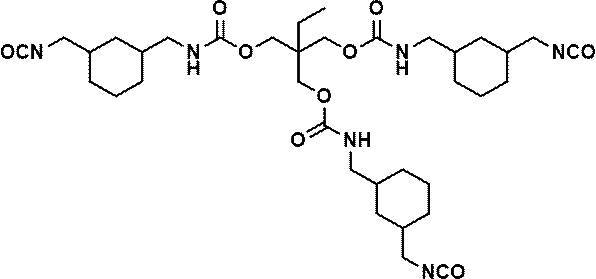
<実施例7~8>
ミリオネートMR-200の代わりに、ミリオネートMR-100又はミリオネートMR-400を用いた以外は、実施例4と同様の手順に従って、第1シート及び第2シートを作製した。
なお、上記ミリオネートMR-100及び上記ミリオネートMR-400は、ジフェニルメタンジイソシアネート、及び、ポリメチレンポリフェニルポリイソシアネート(式(X)で表される化合物に該当)の混合物に該当する。
ミリオネートMR-200の代わりに、ミリオネートMR-100又はミリオネートMR-400を用いた以外は、実施例4と同様の手順に従って、第1シート及び第2シートを作製した。
なお、上記ミリオネートMR-100及び上記ミリオネートMR-400は、ジフェニルメタンジイソシアネート、及び、ポリメチレンポリフェニルポリイソシアネート(式(X)で表される化合物に該当)の混合物に該当する。
<実施例9~12>
化合物(A)の代わりに、表1に示すように、化合物(B)~(E)を用いた以外は、実施例4と同様の手順に従って、第1シート及び第2シートを作製した。
なお、化合物(B)~(E)は、以下の通りである。
化合物(A)の代わりに、表1に示すように、化合物(B)~(E)を用いた以外は、実施例4と同様の手順に従って、第1シート及び第2シートを作製した。
なお、化合物(B)~(E)は、以下の通りである。

<実施例13~16>
ポリイソシアネートの固形分使用量を表1の「ポリイソシアネート固形分(質量部)」に記載のように変更した以外は、実施例4と同様の手順に従って、第1シート及び第2シートを作製した。
なお、固形分使用量とは、トリレンジイソシアネートのトリメチロールプロパン付加物とポリイソシアネートBとの固形分合計質量を意味する。
ポリイソシアネートの固形分使用量を表1の「ポリイソシアネート固形分(質量部)」に記載のように変更した以外は、実施例4と同様の手順に従って、第1シート及び第2シートを作製した。
なお、固形分使用量とは、トリレンジイソシアネートのトリメチロールプロパン付加物とポリイソシアネートBとの固形分合計質量を意味する。
<比較例1>
特許文献1の実施例1の記載の手順に従って、第1シート(電子供与性無色染料シート)及び第2シート(顕色剤シート)を作製した。
特許文献1の実施例1の記載の手順に従って、第1シート(電子供与性無色染料シート)及び第2シート(顕色剤シート)を作製した。
なお、各実施例及び比較例での、マイクロカプセルのメジアン径、δ/Dm及びマイクロカプセルのカプセル壁のガラス転移温度は、表1にまとめて示す。
なお、各実施例で作製したマイクロカプセルのカプセル壁の熱分解温度は、約250℃程度であった。
なお、各実施例で作製したマイクロカプセルのカプセル壁の熱分解温度は、約250℃程度であった。
<評価>
(圧力分布測定)
各実施例及び比較例にて作製した第1シート及び第2シートをそれぞれ5cm×5cmのサイズに裁断し、第1シートと第2シートとを、第1シートの第1層の表面と第2シートの第2層の表面とを接触させて重ね合わせて、積層体を得た。
次に、上下に配置された2枚の加熱ステージを有するホットプレス機を用意し、加熱ステージ同士を離して、下側のステージ上に幅5mmのリング形状のSUS基板を配置して、そのSUS基板を覆うように、積層体を配置した。その後、220℃に加熱した2枚の加熱ステージで上記SUS基板及び積層体を挟むように、2分間にわたって2.0MPaで加圧した。加圧終了後、得られた積層体の発色領域の形状を観察して、以下の基準に従って評価した。
(圧力分布測定)
各実施例及び比較例にて作製した第1シート及び第2シートをそれぞれ5cm×5cmのサイズに裁断し、第1シートと第2シートとを、第1シートの第1層の表面と第2シートの第2層の表面とを接触させて重ね合わせて、積層体を得た。
次に、上下に配置された2枚の加熱ステージを有するホットプレス機を用意し、加熱ステージ同士を離して、下側のステージ上に幅5mmのリング形状のSUS基板を配置して、そのSUS基板を覆うように、積層体を配置した。その後、220℃に加熱した2枚の加熱ステージで上記SUS基板及び積層体を挟むように、2分間にわたって2.0MPaで加圧した。加圧終了後、得られた積層体の発色領域の形状を観察して、以下の基準に従って評価した。
「5」:発色の粗密が無く、発色領域の形状がSUS基板と同様のリング形状であることを非常に良好に認識できた。
「4」:発色の粗密がごく僅かにあったが、発色領域の形状がSUS基板と同様のリング形状であることを良好に認識できた。
「3」:発色の粗密があったが、発色領域の形状がリング形状であることを十分に認識できた。
「2」:発色の粗密により、発色領域の形状がリング形状であることを、部分的に認識できない箇所があった。
「1」:発色の粗密がひどく、発色領域の形状がリング形状であることをほぼ認識できなかった。
「4」:発色の粗密がごく僅かにあったが、発色領域の形状がSUS基板と同様のリング形状であることを良好に認識できた。
「3」:発色の粗密があったが、発色領域の形状がリング形状であることを十分に認識できた。
「2」:発色の粗密により、発色領域の形状がリング形状であることを、部分的に認識できない箇所があった。
「1」:発色の粗密がひどく、発色領域の形状がリング形状であることをほぼ認識できなかった。
(発色温度依存性評価)
上記(圧力分布測定)と同様の手順に従って、各実施例及び比較例で作製した第1シート及び第2シートからなる積層体を2枚用意した。
次に、上下に配置された2枚の加熱ステージを有するホットプレス機を用意し、加熱ステージ同士を離して、下側のステージ上に積層体を配置した。その後、200℃に加熱した2枚の加熱ステージで上記積層体を挟むように、2分間にわたって2.0MPaで加圧した。加圧終了後、積層体の発色領域の光学濃度Aを測定した。
また、加熱ステージの温度を180℃に変更した以外は、上記手順と同様にして、積層体を加圧した。加圧終了後、積層体の発色領域の光学濃度Bを測定した。
次に、光学濃度Aと光学濃度Bとの差(光学濃度A-光学濃度B)を求め、以下の基準に従って評価した。上記差が小さいほど、温度による発色の程度の差がないことを意味する。
「4」:上記差が0.3以下である。
「3」:上記差が0.3超0.4以下である。
「2」:上記差が0.4超0.5以下である。
「1」:上記差が0.5超である。
なお、上記光学濃度の測定方法としては、X-rite eXact(X-Rite社製)を用いて、フィルタなし、濃度ステータスはISOステータスT、D50/2°で測定した。光学濃度としては、ODの値を採用した。なお、測定の際、CMYK(C:Cyan、M:Magenta、Y:Yellow、K:Black)の各モードでODを測定し、もっとも高いODを示すものを選択した。
上記(圧力分布測定)と同様の手順に従って、各実施例及び比較例で作製した第1シート及び第2シートからなる積層体を2枚用意した。
次に、上下に配置された2枚の加熱ステージを有するホットプレス機を用意し、加熱ステージ同士を離して、下側のステージ上に積層体を配置した。その後、200℃に加熱した2枚の加熱ステージで上記積層体を挟むように、2分間にわたって2.0MPaで加圧した。加圧終了後、積層体の発色領域の光学濃度Aを測定した。
また、加熱ステージの温度を180℃に変更した以外は、上記手順と同様にして、積層体を加圧した。加圧終了後、積層体の発色領域の光学濃度Bを測定した。
次に、光学濃度Aと光学濃度Bとの差(光学濃度A-光学濃度B)を求め、以下の基準に従って評価した。上記差が小さいほど、温度による発色の程度の差がないことを意味する。
「4」:上記差が0.3以下である。
「3」:上記差が0.3超0.4以下である。
「2」:上記差が0.4超0.5以下である。
「1」:上記差が0.5超である。
なお、上記光学濃度の測定方法としては、X-rite eXact(X-Rite社製)を用いて、フィルタなし、濃度ステータスはISOステータスT、D50/2°で測定した。光学濃度としては、ODの値を採用した。なお、測定の際、CMYK(C:Cyan、M:Magenta、Y:Yellow、K:Black)の各モードでODを測定し、もっとも高いODを示すものを選択した。
表1中、「ポリイソシアネートA」は、芳香族ジイソシアネート又は脂環族ジイソシアネートと1分子中に3つ以上の活性水素基を有する化合物とのアダクト体である3官能以上のポリイソシアネートに該当し、「ポリイソシアネートB」は、ジフェニルメタンジイソシアネート、及び、ポリメチレンポリフェニルポリイソシアネート(式(X)で表される化合物に該当)の混合物に該当する。
表1中、「質量比(A/B)」は、ポリイソシアネートBの質量に対する、ポリイソシアネートAの質量の比を表す。
表1中、「ポリイソシアネート固形分(質量部)」とは、ポリイソシアネートAの固形分質量と、ポリイソシアネートBの固形分質量との合計量を表す。
表1中、「発色剤」欄の「種類」欄は、上記化合物(A)~化合物(E)をそれぞれ示し、「分子量」欄は各化合物の分子量を表す。
表1中、「粒径(μm)」欄は、マイクロカプセルの体積基準のメジアン径(μm)を表す。
表1中、「δ/Dm」は、上記式(1)中の「δ/Dm」を表し、δはマイクロカプセルの数平均壁厚(μm)を、Dmはマイクロカプセルの体積基準のメジアン径(μm)を表す。
表1中、「ガラス転移温度(℃)」欄は、マイクロカプセルにおけるカプセル壁のガラス転移温度を表す。
表1中、「ガラス転移温度」欄中の「なし」は、上記測定においてガラス転移温度を示さなかったことを表す。つまり、つまり、「25℃」~「(熱分解温度(℃)-5℃)」までの範囲においてマイクロカプセルのカプセル壁がガラス転移温度を示さないことを意味する。
表1中、「発色濃度差」欄は、上述した発色濃度差測定1によって求められる発色濃度差を表す。
表1中、「質量比(A/B)」は、ポリイソシアネートBの質量に対する、ポリイソシアネートAの質量の比を表す。
表1中、「ポリイソシアネート固形分(質量部)」とは、ポリイソシアネートAの固形分質量と、ポリイソシアネートBの固形分質量との合計量を表す。
表1中、「発色剤」欄の「種類」欄は、上記化合物(A)~化合物(E)をそれぞれ示し、「分子量」欄は各化合物の分子量を表す。
表1中、「粒径(μm)」欄は、マイクロカプセルの体積基準のメジアン径(μm)を表す。
表1中、「δ/Dm」は、上記式(1)中の「δ/Dm」を表し、δはマイクロカプセルの数平均壁厚(μm)を、Dmはマイクロカプセルの体積基準のメジアン径(μm)を表す。
表1中、「ガラス転移温度(℃)」欄は、マイクロカプセルにおけるカプセル壁のガラス転移温度を表す。
表1中、「ガラス転移温度」欄中の「なし」は、上記測定においてガラス転移温度を示さなかったことを表す。つまり、つまり、「25℃」~「(熱分解温度(℃)-5℃)」までの範囲においてマイクロカプセルのカプセル壁がガラス転移温度を示さないことを意味する。
表1中、「発色濃度差」欄は、上述した発色濃度差測定1によって求められる発色濃度差を表す。

表1に示すように、本発明の圧力測定用シートセットを用いた場合、所望の効果が得られることが確認された。
なかでも、実施例2~5の比較より、ポリイソシアネートBに対する、ポリイソシアネートAの質量比が80/20~20/80(好ましくは、80/20~45/55)である場合、より効果がより優れることが確認された。
また、実施例4と6との比較より、芳香族ジイソシアネートを用いて得られるアダクト体を用いることにより、より優れた効果が得られることが確認された。
また、実施例4と実施例9~12の比較より、発色剤の分子量が420以上である場合(好ましくは、550以上である場合)、より効果が優れることが確認された。
また、実施例4と実施例13~16の比較より、δ/Dmが0.010超である場合(好ましくは、0.015以上である場合)、より効果が優れることが確認された。
なかでも、実施例2~5の比較より、ポリイソシアネートBに対する、ポリイソシアネートAの質量比が80/20~20/80(好ましくは、80/20~45/55)である場合、より効果がより優れることが確認された。
また、実施例4と6との比較より、芳香族ジイソシアネートを用いて得られるアダクト体を用いることにより、より優れた効果が得られることが確認された。
また、実施例4と実施例9~12の比較より、発色剤の分子量が420以上である場合(好ましくは、550以上である場合)、より効果が優れることが確認された。
また、実施例4と実施例13~16の比較より、δ/Dmが0.010超である場合(好ましくは、0.015以上である場合)、より効果が優れることが確認された。
なお、上記では第1シート及び第2シートを有する圧力測定用シートセットを用いた態様について示したが、支持体上に第2層及び第1層をこの順で積層させた圧力測定用シートを作製して、上記と同様の試験を行ったところ、各実施例と同様の結果が得られた。例えば、易接着層付ポリエチレンテレフタレートシート(東洋紡(株)、コスモシャイン(登録商標)A4300)の上に、上記実施例4で作製した第2層及び第1層をこの順に配置して、支持体、第2層及び第1層をこの順で有する圧力測定用シートを作製して、上記(圧力分布測定)及び(発色温度依存性評価)を実施したところ、実施例4と同様の結果が得られた。
10 圧力測定用シートセット
12 第1支持体
13 マイクロカプセル
14 第1層
16 第1シート
18 第2支持体
20 第2層
22 第2シート
30 圧力測定用シート
32 支持体
12 第1支持体
13 マイクロカプセル
14 第1層
16 第1シート
18 第2支持体
20 第2層
22 第2シート
30 圧力測定用シート
32 支持体
Claims (16)
- 発色剤を内包するマイクロカプセルを含む第1層を有する第1シートと、
顕色剤を含む第2層を有する第2シートと、を備える圧力測定用シートセットであって、
以下の発色濃度差測定1によって求められる発色濃度差が0.25以下である、圧力測定用シートセット。
発色濃度差測定1:前記第1シートの前記第1層と前記第2シートの前記第2層とが対向するように、前記第1シートと前記第2シートとを積層させて積層体を得て、前記積層体を非加圧状態にて220℃で2分間加熱した前後の前記積層体の光学濃度の差を発色濃度差とする。 - 前記マイクロカプセルのカプセル壁が、ポリウレア、ポリウレタンウレア、及び、ポリウレタンからなる群から選択される少なくとも1種の樹脂を含む、請求項1に記載の圧力測定用シートセット。
- 前記樹脂が、芳香族ジイソシアネート又は脂環族ジイソシアネートと1分子中に3つ以上の活性水素基を有する化合物とのアダクト体である3官能以上のポリイソシアネートA、並びに、
芳香族ジイソシアネート及びポリメチレンポリフェニルポリイソシアネートからなる群から選択されるポリイソシアネートBを用いて形成される、請求項2に記載の圧力測定用シートセット。 - 前記ポリイソシアネートBに対する、前記ポリイソシアネートAの質量比が、98/2~20/80である、請求項3に記載の圧力測定用シートセット。
- 前記樹脂が、ポリメチレンポリフェニル構造を有する、請求項2~4のいずれか1項に記載の圧力測定用シートセット。
- 前記発色剤の分子量が550以上である、請求項1~5のいずれか1項に記載の圧力測定用シートセット。
- 前記マイクロカプセルが式(1)の関係を満たす、請求項1~6のいずれか1項に記載の圧力測定用シートセット。
式(1) δ/Dm>0.010
δは、前記マイクロカプセルの数平均壁厚(μm)を表す。Dmは、前記マイクロカプセルの体積基準のメジアン径(μm)を表す。 - 前記マイクロカプセルの数平均壁厚が0.2μm以上である、請求項1~7のいずれか1項に記載の圧力測定用シートセット。
- 発色剤を内包するマイクロカプセルを含む第1層と、
前記第1層上に配置された、顕色剤を含む第2層と、を有する、圧力測定用シートであって、
以下の発色濃度差測定2によって求められる発色濃度差が0.25以下である、圧力測定用シート。
発色濃度差測定2:前記圧力測定用シートを非加圧状態にて220℃で2分間加熱した前後の前記圧力測定用シートの光学濃度の差を発色濃度差とする。 - 前記マイクロカプセルのカプセル壁が、ポリウレア、ポリウレタンウレア、及び、ポリウレタンからなる群から選択される少なくとも1種の樹脂を含み、請求項9に記載の圧力測定用シート。
- 前記樹脂が、芳香族ジイソシアネート又は脂環族ジイソシアネートと1分子中に3つ以上の活性水素基を有する化合物とのアダクト体である3官能以上のポリイソシアネートA、並びに、
芳香族ジイソシアネート及びポリメチレンポリフェニルポリイソシアネートからなる群から選択されるポリイソシアネートBを用いて形成される、請求項10に記載の圧力測定用シート。 - 前記ポリイソシアネートBに対する、前記ポリイソシアネートAの質量比が、98/2~20/80である、請求項11に記載の圧力測定用シート。
- 前記樹脂が、ポリメチレンポリフェニル構造を有する、請求項10~12のいずれか1項に記載の圧力測定用シート。
- 前記発色剤の分子量が550以上である、請求項9~13のいずれか1項に記載の圧力測定用シート。
- 前記マイクロカプセルが式(1)の関係を満たす、請求項9~14のいずれか1項に記載の圧力測定用シート。
式(1) δ/Dm>0.010
δは、前記マイクロカプセルの数平均壁厚(μm)を表す。Dmは、前記マイクロカプセルの体積基準のメジアン径(μm)を表す。 - 前記マイクロカプセルの数平均壁厚が0.2μm以上である、請求項9~15のいずれか1項に記載の圧力測定用シート。
Priority Applications (2)
| Application Number | Priority Date | Filing Date | Title |
|---|---|---|---|
| CN202080033958.4A CN113795741B (zh) | 2019-06-28 | 2020-06-17 | 压力测量用片材组、压力测量用片材 |
| JP2021526846A JP7124219B2 (ja) | 2019-06-28 | 2020-06-17 | 圧力測定用シートセット、圧力測定用シート |
Applications Claiming Priority (4)
| Application Number | Priority Date | Filing Date | Title |
|---|---|---|---|
| JP2019122271 | 2019-06-28 | ||
| JP2019-122271 | 2019-06-28 | ||
| JP2020-013121 | 2020-01-30 | ||
| JP2020013121 | 2020-01-30 |
Publications (1)
| Publication Number | Publication Date |
|---|---|
| WO2020262148A1 true WO2020262148A1 (ja) | 2020-12-30 |
Family
ID=74060115
Family Applications (1)
| Application Number | Title | Priority Date | Filing Date |
|---|---|---|---|
| PCT/JP2020/023771 Ceased WO2020262148A1 (ja) | 2019-06-28 | 2020-06-17 | 圧力測定用シートセット、圧力測定用シート |
Country Status (4)
| Country | Link |
|---|---|
| JP (1) | JP7124219B2 (ja) |
| CN (1) | CN113795741B (ja) |
| TW (1) | TWI853958B (ja) |
| WO (1) | WO2020262148A1 (ja) |
Citations (5)
| Publication number | Priority date | Publication date | Assignee | Title |
|---|---|---|---|---|
| US5225118A (en) * | 1990-08-15 | 1993-07-06 | Boise Cascade Corporation | Process for manufacturing polyurea microcapsules and product therefrom |
| JP2002292665A (ja) * | 2001-03-29 | 2002-10-09 | Dainippon Ink & Chem Inc | 乳酸系ポリマーシートの製造法 |
| JP2009014674A (ja) * | 2007-07-09 | 2009-01-22 | Fujifilm Corp | 圧力測定用材料 |
| WO2018057964A1 (en) * | 2016-09-23 | 2018-03-29 | Chromatic Technologies, Inc. | High pressure processing pressure sensor |
| WO2018199044A1 (ja) * | 2017-04-27 | 2018-11-01 | 富士フイルム株式会社 | 刺激応答性複合粒子及びその製造方法 |
Family Cites Families (4)
| Publication number | Priority date | Publication date | Assignee | Title |
|---|---|---|---|---|
| JPH09142027A (ja) * | 1995-11-21 | 1997-06-03 | Asahi Chem Ind Co Ltd | 感熱性記録シート |
| JP2007176125A (ja) * | 2005-12-28 | 2007-07-12 | Fujifilm Corp | 熱応答性マイクロカプセル、および、感熱記録材料 |
| ES2474727T3 (es) * | 2008-06-18 | 2014-07-09 | Nippon Soda Co., Ltd. | Composición reveladora de color y material de registro que contiene la misma |
| US10067011B2 (en) | 2016-02-23 | 2018-09-04 | International Business Machines Corporation | Pressure indicator films for high temperature applications |
-
2020
- 2020-06-17 CN CN202080033958.4A patent/CN113795741B/zh active Active
- 2020-06-17 WO PCT/JP2020/023771 patent/WO2020262148A1/ja not_active Ceased
- 2020-06-17 JP JP2021526846A patent/JP7124219B2/ja active Active
- 2020-06-22 TW TW109121166A patent/TWI853958B/zh active
Patent Citations (5)
| Publication number | Priority date | Publication date | Assignee | Title |
|---|---|---|---|---|
| US5225118A (en) * | 1990-08-15 | 1993-07-06 | Boise Cascade Corporation | Process for manufacturing polyurea microcapsules and product therefrom |
| JP2002292665A (ja) * | 2001-03-29 | 2002-10-09 | Dainippon Ink & Chem Inc | 乳酸系ポリマーシートの製造法 |
| JP2009014674A (ja) * | 2007-07-09 | 2009-01-22 | Fujifilm Corp | 圧力測定用材料 |
| WO2018057964A1 (en) * | 2016-09-23 | 2018-03-29 | Chromatic Technologies, Inc. | High pressure processing pressure sensor |
| WO2018199044A1 (ja) * | 2017-04-27 | 2018-11-01 | 富士フイルム株式会社 | 刺激応答性複合粒子及びその製造方法 |
Non-Patent Citations (1)
| Title |
|---|
| ANONYMOUS: "● INSTRUCTION MANUAL ● PRESSURE MEASUREMENT FILM", FUJIFILM CORPORATION, March 2017 (2017-03-01), pages 5 - 8, XP055778685, Retrieved from the Internet <URL:https://www.fujifilm.eu/fileadmin/content/industrial_products/downloads/Manual_LW_EN.pdf> * |
Also Published As
| Publication number | Publication date |
|---|---|
| TW202108391A (zh) | 2021-03-01 |
| JP7124219B2 (ja) | 2022-08-23 |
| CN113795741B (zh) | 2024-03-15 |
| CN113795741A (zh) | 2021-12-14 |
| TWI853958B (zh) | 2024-09-01 |
| JPWO2020262148A1 (ja) | 2020-12-30 |
Similar Documents
| Publication | Publication Date | Title |
|---|---|---|
| JP7212159B2 (ja) | 圧力測定用シートセット、圧力測定用シート、分散液 | |
| JP7398001B2 (ja) | 圧力測定用シートセット | |
| JP7124219B2 (ja) | 圧力測定用シートセット、圧力測定用シート | |
| JP7764401B2 (ja) | 圧力測定用シートセット、圧力測定用シート、マイクロカプセル、分散液、圧力測定用シートセットの製造方法、圧力測定用シートの製造方法 | |
| JP7405999B2 (ja) | 圧力測定用シートセット | |
| JP7231732B2 (ja) | 圧力測定用シートセット、圧力測定用シート | |
| JP7684988B2 (ja) | 圧力測定用シートセット、圧力測定用シートセットの製造方法 | |
| CN116670479B (zh) | 压力测定用片材组、压力测定方法 | |
| KR102955561B1 (ko) | 압력 측정용 시트 세트, 압력 측정 방법 | |
| CN115053115B (zh) | 压力测量用片材组、压力测量用片材、压力测量用片材组的制造方法、压力测量用片材的制造方法、片材、分散液、分散液组、微胶囊 | |
| CN114902026B (zh) | 压力测定用片材套组及其制造方法、压力测定用片材及其制造方法、分散液以及微胶囊 | |
| CN114829893A (zh) | 压力测定用片材套组、压力测定用片材、压力测定用片材套组的制造方法、压力测定用片材的制造方法 |
Legal Events
| Date | Code | Title | Description |
|---|---|---|---|
| 121 | Ep: the epo has been informed by wipo that ep was designated in this application |
Ref document number: 20831682 Country of ref document: EP Kind code of ref document: A1 |
|
| ENP | Entry into the national phase |
Ref document number: 2021526846 Country of ref document: JP Kind code of ref document: A |
|
| NENP | Non-entry into the national phase |
Ref country code: DE |
|
| 122 | Ep: pct application non-entry in european phase |
Ref document number: 20831682 Country of ref document: EP Kind code of ref document: A1 |