WO2020254577A1 - Hydrotropic extraction - Google Patents
Hydrotropic extraction Download PDFInfo
- Publication number
- WO2020254577A1 WO2020254577A1 PCT/EP2020/067101 EP2020067101W WO2020254577A1 WO 2020254577 A1 WO2020254577 A1 WO 2020254577A1 EP 2020067101 W EP2020067101 W EP 2020067101W WO 2020254577 A1 WO2020254577 A1 WO 2020254577A1
- Authority
- WO
- WIPO (PCT)
- Prior art keywords
- biological material
- extract
- biological
- water
- plant
- Prior art date
- Legal status (The legal status is an assumption and is not a legal conclusion. Google has not performed a legal analysis and makes no representation as to the accuracy of the status listed.)
- Ceased
Links
Classifications
-
- A—HUMAN NECESSITIES
- A23—FOODS OR FOODSTUFFS; TREATMENT THEREOF, NOT COVERED BY OTHER CLASSES
- A23L—FOODS, FOODSTUFFS OR NON-ALCOHOLIC BEVERAGES, NOT OTHERWISE PROVIDED FOR; PREPARATION OR TREATMENT THEREOF
- A23L33/00—Modifying nutritive qualities of foods; Dietetic products; Preparation or treatment thereof
- A23L33/10—Modifying nutritive qualities of foods; Dietetic products; Preparation or treatment thereof using additives
- A23L33/105—Plant extracts, their artificial duplicates or their derivatives
-
- A—HUMAN NECESSITIES
- A23—FOODS OR FOODSTUFFS; TREATMENT THEREOF, NOT COVERED BY OTHER CLASSES
- A23L—FOODS, FOODSTUFFS OR NON-ALCOHOLIC BEVERAGES, NOT OTHERWISE PROVIDED FOR; PREPARATION OR TREATMENT THEREOF
- A23L27/00—Spices; Flavouring agents or condiments; Artificial sweetening agents; Table salts; Dietetic salt substitutes; Preparation or treatment thereof
- A23L27/10—Natural spices, flavouring agents or condiments; Extracts thereof
- A23L27/11—Natural spices, flavouring agents or condiments; Extracts thereof obtained by solvent extraction
-
- A—HUMAN NECESSITIES
- A61—MEDICAL OR VETERINARY SCIENCE; HYGIENE
- A61K—PREPARATIONS FOR MEDICAL, DENTAL OR TOILETRY PURPOSES
- A61K36/00—Medicinal preparations of undetermined constitution containing material from algae, lichens, fungi or plants, or derivatives thereof, e.g. traditional herbal medicines
- A61K36/18—Magnoliophyta (angiosperms)
- A61K36/185—Magnoliopsida (dicotyledons)
- A61K36/53—Lamiaceae or Labiatae (Mint family), e.g. thyme, rosemary or lavender
-
- B—PERFORMING OPERATIONS; TRANSPORTING
- B01—PHYSICAL OR CHEMICAL PROCESSES OR APPARATUS IN GENERAL
- B01D—SEPARATION
- B01D11/00—Solvent extraction
- B01D11/02—Solvent extraction of solids
- B01D11/0215—Solid material in other stationary receptacles
- B01D11/0253—Fluidised bed of solid materials
- B01D11/0257—Fluidised bed of solid materials using mixing mechanisms, e.g. stirrers, jets
-
- B—PERFORMING OPERATIONS; TRANSPORTING
- B01—PHYSICAL OR CHEMICAL PROCESSES OR APPARATUS IN GENERAL
- B01D—SEPARATION
- B01D11/00—Solvent extraction
- B01D11/02—Solvent extraction of solids
- B01D11/0288—Applications, solvents
-
- B—PERFORMING OPERATIONS; TRANSPORTING
- B01—PHYSICAL OR CHEMICAL PROCESSES OR APPARATUS IN GENERAL
- B01D—SEPARATION
- B01D9/00—Crystallisation
- B01D9/0004—Crystallisation cooling by heat exchange
- B01D9/0013—Crystallisation cooling by heat exchange by indirect heat exchange
-
- B—PERFORMING OPERATIONS; TRANSPORTING
- B01—PHYSICAL OR CHEMICAL PROCESSES OR APPARATUS IN GENERAL
- B01D—SEPARATION
- B01D9/00—Crystallisation
- B01D9/005—Selection of auxiliary, e.g. for control of crystallisation nuclei, of crystal growth, of adherence to walls; Arrangements for introduction thereof
- B01D9/0054—Use of anti-solvent
-
- A—HUMAN NECESSITIES
- A61—MEDICAL OR VETERINARY SCIENCE; HYGIENE
- A61K—PREPARATIONS FOR MEDICAL, DENTAL OR TOILETRY PURPOSES
- A61K2236/00—Isolation or extraction methods of medicinal preparations of undetermined constitution containing material from algae, lichens, fungi or plants, or derivatives thereof, e.g. traditional herbal medicine
-
- C—CHEMISTRY; METALLURGY
- C11—ANIMAL OR VEGETABLE OILS, FATS, FATTY SUBSTANCES OR WAXES; FATTY ACIDS THEREFROM; DETERGENTS; CANDLES
- C11B—PRODUCING, e.g. BY PRESSING RAW MATERIALS OR BY EXTRACTION FROM WASTE MATERIALS, REFINING OR PRESERVING FATS, FATTY SUBSTANCES, e.g. LANOLIN, FATTY OILS OR WAXES; ESSENTIAL OILS; PERFUMES
- C11B9/00—Essential oils; Perfumes
- C11B9/02—Recovery or refining of essential oils from raw materials
Definitions
- the present invention relates to methods for preparing biological extracts using hydrotropic agents, methods for purifying biological extracts formed using hydrotropic agents, the biological extracts obtained using the methods and uses and the use of the biological extracts, such as in food-stuffs, pharmaceuticals, flavours and fragrances, cosmetics, nutraceuticals and supplements, such as food supplements and sports supplements.
- extracts that are to be used for human consumption are obtained using alcoholic based solvent or supercritical fluids (usually C0 2 ) due to their lack of toxicity.
- Water is a natural solvent that is considered to be renewable; however, its strong polarity does not easily allow for the extraction of lipophilic/non-water-soluble molecules.
- Hydrotropic agents are water-soluble organic compounds which, at and above a certain concentration, known as “MHC” (Minimum Hydrotropic Concentration), provide a significant increase in the solubility of organic compounds that are practically insoluble in water under normal conditions.
- MHC Minimum Hydrotropic Concentration
- MHC minimum hydrotropic concentration
- the MHC can be determined using several physicochemical methods such as measurement of surface tension, conductivity, dynamic and static light scattering (RE. Coffman, DO. Kildsig. Self-association of nicotinamide in aqueous solution: Light scattering and vapor pressure osmometry studies, J. Pharm. Sci. (1996) 85(8): 848-853) or by plotting a solubilisation curve of a lipophilic compound (content of solubilised solute vs. hydrotrope concentration). Sudan Red, a lipophilic dye easily assayed by spectrophotometry, can be used as reference.
- Hydrotropes are typically amphiphilic and may be ionic (anionic, cationic, zwitterionic) or non-ionic (resorcinol, nicotinamide, alkyl polyglycosides, etc.) and may have various structures, e.g. aromatic, aliphatic, or cyclic.
- Hydrotropes with an amphiphilic molecular structure possess the ability to increase the solubility of sparingly soluble organic molecules in water (T. Hodgdon, E. Kaler, Hydrotropic solutions, Curr. Opin. Colloid. In. 12 (2007) 121-128). It is a molecular phenomenon whereby adding a second solute (hydrotrope) helps to increase the aqueous solubility of poorly soluble solutes (A. Saleh, L. El-Khordagui, Hydrotropic agents: a new definition, Int. J. Pharm. 24 (1985) 231-238).
- hydrotropes typically contain both hydrophobic and hydrophilic fractions in them. In comparison to surfactant, they contain only a very small hydrophobic fraction (N. Kapadiya, I. Singhvi, K. Mehta, K. Gauri, D. Sen, Hydrotropy: a promising tool for solubility enhancement: a review, Int. J. Drug Dev. Res. 3 (201 1) 26-33).
- biological extracts comprising lipophilic, hydrophobic, oil soluble and/or non-water-soluble compounds can be obtained by combining/mixing biological material (such as plant biological material, algal biological material, animal biological material and/or prokaryotic biological material) with an extraction solution comprising water and at least one hydrotropic agent, in particular at least one hydrotropic agent which is not a salt.
- biological material such as plant biological material, algal biological material, animal biological material and/or prokaryotic biological material
- an extraction solution comprising water and at least one hydrotropic agent, in particular at least one hydrotropic agent which is not a salt.
- hydrotropic agent which is not a salt means that the at least one hydrotropic agent does not comprise alkali metal salts, or alkaline earth metal salts, or ammonium salts of aromatic or non aromatic carboxylates, sulfates or sulfonates, such as sodium xylene sulfonate, sodium para-toluene sulfonate, sodium cumene sulfonate, sodium butyl monoglycol sulfate, sodium butyl benzene sulfonate, or sodium salicylate.
- alkali metal salts such as sodium xylene sulfonate, sodium para-toluene sulfonate, sodium cumene sulfonate, sodium butyl monoglycol sulfate, sodium butyl benzene sulfonate, or sodium salicylate.
- alkali metals we mean principally sodium and potassium.
- alkaline earth metals we mean principally magnesium and calcium
- the at least one hydrotropic agent which is not a salt may also be refered to as a“non-salt hydrotropic agent”.
- the present invention provides a method for providing a biological extract comprising: i) mixing biological material (such as plant biological material, algal biological material, animal biological material and/or prokaryotic biological material) with an extraction solution comprising water and at least one hydrotropic agent, in particular at least one hydrotropic agent which is not a salt; and
- the present invention also provides the use of an extraction solution comprising water and at least one hydrotropic agent, in particular at least one hydrotropic agent which is not a salt, to provide a biological extract from biological material (such as plant biological material, algal biological material, animal biological material and/or prokaryotic biological material), wherein the use comprises:
- biological material such as plant biological material, algal biological material, animal biological material and/or prokaryotic biological material
- an extraction solution comprising water and at least one hydrotropic agent, in particular at least one hydrotropic agent which is not a salt
- the extraction solution does not comprise a soap compound.
- soap compound is intended to mean a particular salt between a fatty acid containing more than six carbon atoms in its hydrophobic chain and a monovalent cation.
- a soap compound is in particular a salt of a fatty acid and a monovalent cation that in an aqueous medium forms micelles.
- the biological extract may be, for example, a liquid biological extract, a crude solid or semi-solid biological extract or a purified biological extract.
- extraction solution comprising water and at least one hydrotropic agent is intended to mean an aqueous solution containing at least one hydrotropic agent at a concentration equal to or greater than the hydrotropic agent’s minimum hydrotropic concentration (MHC).
- MHC minimum hydrotropic concentration
- the MHC can be determined using several physicochemical methods such as measurement of surface tension, conductivity, dynamic and static light scattering (RE. Coffman, DO. Kildsig. Self-association of nicotinamide in aqueous solution: Light-scattering and vapor pressure osmometry studies, J. Pharm. Sci. (1996) 85(8): 848-853) or by plotting a solubilisation curve of a lipophilic compound (content of solubilised solute vs. hydrotrope concentration). Sudan Red, a lipophilic dye easily assayed by spectrophotometry, can be used as reference.
- plant biological material is material that has been obtained from or is obtainable from plants, such as from plant roots and/or the aerial parts of the plant, such as leaves, flowers, stems, barks, fruits or seeds or their tissues.
- the plant biological material may be obtained from the leaves of the plant.
- algal biological material is material that has been obtained from or is obtainable from a macroalgal or a microalgal source, such as from seaweeds, freshwater algae or cultivated populations of single cell microalgal organisms of eukaryotic nature.
- animal biological material is material that has been obtained from or is obtainable from an animal source, such as from secretions from the glands of mammals, i.e. musk.
- prokaryotic biological material is material that has been obtained from or is obtainable from prokaryotic single cell organisms, such as bacteria.
- the term “obtainable from” means that the plant and/or algal and/or animal and/or prokaryotic biological material may be obtained from a plant/algae/animal/prokaryote directly or may be isolated from the plant/algae/animal/prokaryote, or may be obtained from an alternative source, for example by chemical synthesis or enzymatic production.
- the term“obtained” as used herein means that the extract is directly derived from the plant/algae/animal/prokaryote source.
- liquid means a state of matter in which atoms or molecules within the liquid can move freely, while remaining in contact with one another, and will take the shape of its container.
- a liquid will have a viscosity from about 1 cP at 20 °C to about 10,000 cP at 20 °C, such as from about 50 cP at 20 °C to about 5,000 cP at 20 °C.
- the biological extract of the invention is enriched in compounds that have limited solubility in aqueous solutions, i.e. compounds that are lipophilic, hydrophobic, oil soluble and/or non-water-soluble.
- the present invention also provides a method of providing lipophilic, hydrophobic, oil soluble and/or non-water-soluble compounds from biological material (such as plant biological material, algal biological material, animal biological material and/or prokaryotic biological material) comprising:
- biological material such as plant biological material, algal biological material, animal biological material and/or prokaryotic biological material
- an extraction solution comprising water and at least one hydrotropic agent, in particular at least one hydrotropic agent which is not a salt
- the present invention also provides the use of an extraction solution comprising water and at least one hydrotropic agent, in particular at least one hydrotropic agent which is not a salt, to provide lipophilic, hydrophobic, oil soluble and/or non-water-soluble compounds from biological material (such as plant biological material, algal biological material, animal biological material and/or prokaryotic biological material), wherein the use comprises:
- biological material such as plant biological material, algal biological material, animal biological material and/or prokaryotic biological material
- an extraction solution comprising water and at least one hydrotropic agent, in particular at least one hydrotropic agent which is not a salt
- the term“enriched” means that the biological extract comprises about 0.05 % or more by weight of the extract compounds that have limited solubility in aqueous solutions, i.e. compounds that are lipophilic, hydrophobic, oil soluble and/or non-water-soluble.
- the biological extract when the biological extract is a liquid biological extract provided by a method or use as defined herein comprising steps (i) and (ii), the extract may comprise about 0.05 % or more, about 0.1 % or more, about 1 % or more, about 2 % or more, or about 4 % or more by weight of the liquid extract of compounds that have limited solubility in aqueous solutions, i.e. compounds that are lipophilic, hydrophobic, oil soluble and/or non-water-soluble.
- the term“lipophilic” means the compounds are able to dissolve in fats, oils, lipids, and non-polar solvents such as hexane or toluene.
- non-polar solvents such as hexane or toluene.
- at least about 90 % of the compound can dissolve in fats, oils, lipids, and non-polar solvents such as hexane or toluene, or at least about 95 % or at least about 99 % or about 100 %.
- non-water soluble means the compounds have a solubility in water of less than about 1 g/L, such as less than about 0.5 g/L at 20 °C.
- a solubility in water from about 0.001 g/L to about 1 g/L or are substantially insoluble in water.
- the term“hydrophobic” means that the compounds have a very low solubility in water.
- the compounds have a solubility in water of less than 1 g/L, such as less than 0.5 g/L at 20 °C.
- a solubility in water from about 0.001 g/L to about 1 g/L or are substantially insoluble in water.
- oil soluble means that the compounds have a high solubility in oil.
- the compounds have a solubility in oil of from about 5 g/L or more, such as from about 10 g/L or more or from about 20 g/L or more.
- hydrotropes in particular hydrotropes which are not a salt (i.e alkyl glycosides, alkyl glycerol ethers, alkyl polyethylene glycol ethers, dicarboxylic acids, nicotinamide or mixtures thereof), as used in the methods and uses of the present invention, interact with the structure molecules of the plant cells, i.e. molecules of the cell wall or the cell membrane. This interaction results in the release of compounds that would have otherwise been retained in polysaccharide-lignin networks that constituting cell walls.
- the present invention also provides a method for providing a biological extract comprising: (i) mixing biological material (such as plant biological material, algal biological material, animal biological material and/or prokaryotic biological material) with an extraction solution comprising water and at least one hydrotropic agent, in particular at least one hydrotropic agent which is not a salt; and
- the present invention also provides the use of an extraction solution comprising water and at least one hydrotropic agent, in particular at least one hydrotropic agent which is not a salt, to provide a biological extract from biological material (such as plant biological material, algal biological material, animal biological material and/or prokaryotic biological material), wherein the use comprises:
- biological material such as plant biological material, algal biological material, animal biological material and/or prokaryotic biological material
- an extraction solution comprising water and at least one hydrotropic agent, in particular at least one hydrotropic agent which is not a salt
- removing any undissolved biological material from the solution obtained in (i) to leave the biological extract wherein the extraction solvent releases lipophilic, hydrophobic, oil soluble and/or non-water-soluble compounds retained in the cells of the biological material (such as plant biological material, algal biological material, animal biological material and/or prokaryotic biological material).
- the extraction solvent may release at least 10 %, at least 20 %, at least 40 % or at least 50 %, or at least 60 %, or at least 70 %, or at least 80 %, or at least 90 %, such as from about 10 % to about 80 % or from about 20 % to about 60 %, of lipophilic, hydrophobic, oil soluble and/or non-water-soluble compounds retained in the cells of the biological material (such as plant biological material, algal biological material, animal biological material and/or prokaryotic biological material), such as in the polysaccharide-lignin networks that constituting cell walls.
- the biological material such as plant biological material, algal biological material, animal biological material and/or prokaryotic biological material
- the present invention also provides a method for decreasing the density of cells and/or increasing cell porosity in biological material (such as plant biological material, algal biological material, animal biological material and/or prokaryotic biological material) comprising:
- biological material such as plant biological material, algal biological material, animal biological material and/or prokaryotic biological material
- an extraction solution comprising water and at least one hydrotropic agent, in particular at least one hydrotropic agent which is not a salt
- the present invention also provides the use of an extraction solution comprising water and at least one hydrotropic agent, in particular at least one hydrotropic agent which is not a salt, to decrease the density of cells and/or increase cell porosity of biological material (such as plant biological material, algal biological material, animal biological material and/or prokaryotic biological material), wherein the use comprises:
- biological material such as plant biological material, algal biological material, animal biological material and/or prokaryotic biological material
- an extraction solution comprising water and at least one hydrotropic agent, in particular at least one hydrotropic agent which is not a salt
- Compounds that have limited solubility in aqueous solutions include, but are not limited to, phenolic compounds including phenolic acids (such as carnosic acid, rosmarinic acid, or caffeic acid), phenolic esters (such as gallate alkyl esters), phenolic diterpenes (such as carnosic acid and its derivatives), flavonoids (such as hesperidin or luteolin glucuronide), secoiridoids, curcuminoids (such as curcumin), stilbenes, phenolic alcohols, phenolic lipids (such as shogaol or ubiquinol), alkaloids, lipids, phenylpropanoids, coumarin (such as dimethoxycoumarin), organic acids (such as malic acid or tartaric acid), terpenoids including sesquiterpenoids, diterpenoids (
- the biological extract may comprise one or more of the compounds listed above or mixtures thereof. These compounds may typically be natural biological flavourings and taste modifiers, fragrances, biocides, antimicrobials, proteins, enzymes, colourings, pigments, surfactants, antioxidants, vitamins and/or bioactive compounds of nutritional, cosmetic or pharmaceutical interest.
- the biological material used in the method of the invention may be in the form of a liquid, such as fluid from the biological material, i.e. juice from a plant or fruit.
- the biological material may be in the form of a solid, such as fresh or dried biological material, which may optionally be ground and/or mashed biological material, i.e. ground or mashed material obtained or obtainable from the biological material.
- the biological material is not ground or not mashed.
- the method of the invention (and the use of the hydrotropes agents that are not a salt) can be used also on non-ground materials with very good extraction rates. This is advantageus since it allows to perform an extraction of products without modifying the start material thus avoiding oxidation or degradation of some valuable products.
- the biological material is not ground and/or not mashed leaves, petals (flowers), etc.
- the biological material (such as fruits, roots, rind of the frutis, seeds etc), can be cutted in slices to allow the solvent (hydrotropes agents that are not a salt) enter the material.
- the slices can be from about 0,1 cm to 1 cm.
- the biological material is preferably plant biological material.
- the plant biological material may be obtained from or obtainable from plant roots and/or plant aerial parts, such as the leaves, flowers, stems, barks, fruits and/or seeds, their tissues (such as the rind of the fruit) or mixtures thereof.
- the plant biological material may be the leaves of the plant.
- the plant biological material may be obtained from or obtainable from Lamiaceae (such as basil, mint, rosemary, sage, savory, marjoram, oregano, hyssop, thyme, lavender, perilla and mixtures thereof).
- Lamiaceae such as basil, mint, rosemary, sage, savory, marjoram, oregano, hyssop, thyme, lavender, perilla and mixtures thereof.
- Lamiaceae such as basil, mint, rosemary, sage, savory, marjoram, oregano, hyssop, thyme, lavender, perilla and mixtures thereof.
- Lamiaceae such as basil, mint, rosemary, sage, savory, marjoram, oregano, hyssop, thyme, lavender, perilla and mixtures thereof.
- the plant biological material may be rosemary and/or sage.
- the plant biological material may be obtained from or obtainable from Curcuma (such as Curcuma longa) or Citrus genus (such as C. medica, C. reticulate , etc), Ginger (Zingiber officinale), Prunus genus (such as P. afrincana, P. armenicana, P. dulcis, P. avium, etc), (such as cherry flower) Gardenia jasminoides (such as gardenia fruits), Sellaginella genus, Olea europaea (such as Olive leaf), Equisetum, Crithmum (Sea fennel), Rose of Jericho, Saffron flower, etc.
- Curcuma such as Curcuma longa
- Citrus genus such as C. medica, C. reticulate , etc
- Ginger Zingiber officinale
- Prunus genus such as P. afrincana, P. armenicana, P. dulcis,
- the biological extract obtained using the method of the invention may be enriched in carnosic acid and/or its derivatives and/or other lipophilic, hydrophobic, oil soluble and/or non-water-soluble compounds present in the biological material.
- the biological extract may be enriched in carnosic acid, 12-methoxycarnosic acid, carnosol, rosmarinic acid, palmitic acid (16:0), stearic acid (18:0), oleic acid (18:1), linoleic acid (18:2-n6), linolenic acid (18:3-n3), oleanic acid, betulinic acid, ursolic acid, apigenin, luteolin glucuronide, luteolin-O-(O-acetyl) glucuronide isomer 1 , luteolin-O-(O-acetyl) glucuronide isomer 2, diosmetin, chlorophyll pigments, hinokione, rosmanol, epirosmanol, rosmadial, rosmaridiphenol, O- methylcarnosol, genkwanin, ladanein, cirsimaritin, artepillin, methyl-shogaol and
- the extract when the biological extract is a liquid biological extract provided by a method or use as defined herein comprising steps (i) and (ii), the extract may comprise at least about 0.05 % by weight of the liquid extract of phenolic compounds, such as carnosic acid and/or derivatives thereof.
- the biological extract is a crude solid or semi-solid biological extract provided by a method or use as defined herein comprising steps (i) to (v)
- the extract may comprise at least about 2 % or about 5 % by weight of the dried solid or semi-solid extract of phenolic compounds, such as carnosic acid and/or derivatives thereof.
- the biological extract is a purified biological extract provided by a method or use as defined herein comprising steps (i) to (vii)
- the extract may comprise at least about 10 % by weight of the dried purified extract of carnosic acid and/or derivatives thereof.
- the solvent is preferably a hydrotropic agent which is not a salt.
- the solvent does not comprise sodium based hydrotropes.
- the at least one hydrotropic agent in particular at least one hydrotropic agent which is not a salt, may be an alkyl glycoside, an alkyl glycerol ether, a dicarboxylic acid, nicotinamide, an alkyl polyethylene glycol ether of formula C.E j wherein / represents the number of carbon atoms of the alkyl chain length and j the number of ethylene oxides, or a mixture thereof.
- Alkyl glycosides that may be used in the methods and uses described herein include, but are not limited to: amyl xyloside, heptyl glucoside and mixtures thereof.
- Alkyl glycerol ethers that may be used in the methods and uses described herein include, but are not limited to: butyl glycerol ether, pentyl glycerol ether, isoamyl glycerol ether and mixtures thereof.
- alkyl polyethylene glycol ethers of formula C j E j wherein
- the alkyl group may be linear or branched, as for ⁇ 0 4 E 4 with an isobutyle chain or iC 5 E 2 with an isoamylic chain.
- the alkyl group is linear.
- the method of the invention may comprise or consist of:
- plant biological material such as from a plant of the Lamiaceae species, i.e. rosemary and/or sage
- extraction solution comprising water and at least one of citraconic acid, glutaric acid or a mixture
- the present invention also provides biological extracts obtained by the above-mentioned methods and uses.
- Dicarboxylic acids that may be used in the methods and uses described herein include, but are not limited to, citraconic acid, glutaric acid and mixtures thereof.
- dicarboxylic acids that may be used in the methods and uses described herein include those comprising less than 6 carbon atoms.
- dicarboxylic acids comprising 3 to 5 carbon atoms include those comprising 3 to 5 carbon atoms.
- the present invention also provides the use of dicarboxylic acids (such as citraconic acid, glutaric acid and mixtures thereof) as a hydrotrope.
- dicarboxylic acids such as citraconic acid, glutaric acid and mixtures thereof
- the method of the invention may comprise or consist of:
- the use of the invention may comprise the use of an extraction solution comprising water and at least one of citraconic acid, glutaric acid or a mixture thereof to provide a biological extract and/or lipophilic, hydrophobic, oil soluble and/or non-water-soluble compounds from plant biological material (such as from a plant of the Lamiaceae species, i.e. rosemary and/or sage), wherein the use comprises:
- the present invention also provides biological extracts obtained by the above-mentioned methods and uses.
- the concentration of the at least one hydrotropic agent, in particular at least one hydrotropic agent which is not a salt, present in the extraction solution is at least the minimum hydrotropic concentration (MHC) of the at least one (non-salt) hydrotropic agent. For example, from about 1 to about 20 times, such as from about 2 to about 16 times or from about 4 to about 8 times the minimum hydrotropic concentration (MHC).
- the at least one hydrotropic agent in particular at least one hydrotropic agent which is not a salt, may be present in the extraction solvent at a concentration of about 80 % or less by weight relative to the weight of the extraction solvent, for example, the hydrotropic agent may be present in the extraction solvent at a concentration of about 70 % of less or about 60 % or less by weight relative to the weight of the extraction solvent or about 50 % or less by weight relative to the weight of the extraction solvent, or about 40 % or less by weight relative to the weight of the extraction solvent or about 30 % or less by weight relative to the weight of the extraction solvent or about 20 % or less by weight relative to the weight of the extraction solvent.
- the at least one hydrotropic agent in particular at least one hydrotropic agent which is not a salt, may be present in the extraction solvent at a concentration of from about 2 % or about 2.5 % to about 80 % by weight of the extraction solvent, such as from about 5 % to about 70 % by weight or from about 15 % to about 60 % by weight relative to the weight of the extraction solvent.
- the at least one hydrotropic agent in particular at least one hydrotropic agent which is not a salt, may have a critical aggregation concentration (CAC) of at least 0.022 mol/L of water (i.e. 0.6 % w/v), or at least 0.16 mol/L of water (i.e. 3.6 % w/v).
- CAC critical aggregation concentration
- critical aggregation concentration means the concentration above which a hydrotrope starts self-aggregating or starts aggregating cooperatively with a solute.
- the concentration of the at least one dicarboxylic acid may be from about 10 % to about 80 % by weight of the extraction solvent, such as from about 20 % or about 30 % or about 40 % or about 50 % to about 40 % or about 50 % or about 60 % or about 70 % by weight.
- the biological material such as a plant of the Lamiaceae species, i.e. rosemary or sage
- an extraction solvent comprising water and at least one alkyl glycoside and/or at least one alkyl glycerol ether (such as amyl xyloside, heptyl glucoside, butyl glycerol ether, pentyl glycerol ether and/or isoamyl glycerol ether)
- the concentration of the at least one alkyl glucoside and/or at least one alkyl glycerol ether may be from about 10 % to about 40 % by weight of the extraction solvent, such as from about 15 % to about 30 % or from about 18 % to about 25 % by weight of the extraction solvent.
- the biological material such as a plant of the Lamiaceae species, i.e. rosemary or sage
- the concentration of the at least one alkyl polyethylene glycol ether may be from about 10 % to about 80 % by weight of the extraction solvent, such as from about 20 % or about 30 % or about 40 % or about 50 % to about 40 % or about 50 % or about 60 % or about 70 % by weight.
- the biological material and the extraction solution comprising water and at least one hydrotropic agent, in particular at least one hydrotropic agent which is not a salt
- the biological material and the extraction solution comprising water and at least one hydrotropic agent, in particular at least one hydrotropic agent which is not a salt
- stirring such as magnetic or mechanical stirring.
- Stirring may be conducted at any suitable revolution per minute (rpm), for example, the stirring may be done from about 1 rpm or about 10 rpm or about 50 rpm to about 500 rpm.
- For mechanical stirring this may typically be done from about 1 rpm to 500 rpm, such as from about 10 rpm to about 200 rpm.
- the biological material and the extraction solution comprising water and at least one hydrotropic agent, in particular at least one hydrotropic agent which is not a salt, may be mixed at a temperature of from about 15 °C to about 100 °C, such as from about 20 °C to about 60 °C or from about 20 °C to about 80 °C or about 25 °C.
- the biological material and the extraction solution comprising water and at least one hydrotropic agent, in particular at least one hydrotropic agent which is not a salt, may be mixed at a pressure of from about 10 bar (1000 KPa) to about 1000 bar (100000 KPa) or from about 20 bar (2000 KPa) to about 100 bar (10000 KPa).
- the biological material and the extraction solution comprising water and at least one hydrotropic agent may be mixed for a duration of from about 1 minute to about 5 hours, such as from about 2 hours, in particular at least one hydrotropic agent which is not a salt, from about 5 minutes to about 1 hour or from about 5 minutes to about 30 minutes.
- the biological material and the extraction solution comprising water and at least one hydrotropic agent, in particular at least one hydrotropic agent which is not a salt, may be mixed at a pH of less than 7, such as a pH of less than 5 or less than 3.
- the pH may be from about 0 to about 7, or from about 1 to about 4, or from about 0 to about 3 or from about 1 to about 2.
- a pH as defined above has an unexpected advantageous effect in that it allows for the extraction of specific lipophilic, hydrophobic, oil soluble and/or non-water- soluble compounds from biological material (i.e. the plant and/or algal and/or animal and/or prokaryotic biological material), in particular, plant biological material (such as phenolic compounds from plants of Lamiaceae species, i.e. rosemary and/or sage) that may otherwise be unstable at a pH outside of these ranges.
- biological material i.e. the plant and/or algal and/or animal and/or prokaryotic biological material
- plant biological material such as phenolic compounds from plants of Lamiaceae species, i.e. rosemary and/or sage
- a pH within the range defined above allows for the extraction of the phenolic compound carnosic acid in preference to carnosol.
- any solid biological material present in the solution obtained in step (i) may be removed by any means known in the art, for example by filtration, static or dynamic decantation, and/or centrifugation.
- a method of the invention comprising steps (i) and (ii), may provide a liquid biological extract that is enriched in, for example comprises more than 0.05 % by weight of the extract, compounds that are not usually soluble in aqueous solutions as defined above.
- the liquid biological extract may be enriched in, for example, comprise more than 0.05 % by weight of the extract, phenolic diterpenes, for example, carnosic acid and/or its derivatives and/or other lipophilic, hydrophobic, oil soluble and/or non-water-soluble compounds present in the biological material as defined previously.
- the method of the invention may additionally comprise steps (iii) and (iv), wherein in step (iii) a flocculate and/or precipitate is obtained by adding water and/or cooling the solution obtained in step (ii) and in step (iv) the resulting solid material is collected.
- a method of the invention comprising steps (i) to (iv) provides a crude solid biological extract. If required, the crude biological solid may be dried to reduce/remove any residual water present in the extract.
- drying techniques such as, but not limited to, freeze-, spray-, oven-, heat- or vacuum-drying.
- the present invention provides a method of providing a crude solid or semi solid biological extract comprising or consisting of:
- the mixing may be at a pH less than 7, such as a pH of less than 5 or less than 3.
- the pH may be from about 0 to about 7, or from about 1 to about 4, or from about 0 to about 3 or from about 1 to about 2;
- step (iv) collecting the resulting solid material obtained in step (iii) from the solution; and v) optionally drying the solid material obtained in step (iv).
- the present invention also provides the use of an extraction solution comprising water and at least one hydrotropic agent, in particular at least one hydrotropic agent which is not a salt, to provide a crude solid or semi solid biological extract and/or lipophilic, hydrophobic, oil soluble and/or non-water-soluble compounds from biological material (such as plant biological material, algal biological material, animal biological material and/or prokaryotic biological material), wherein the use comprises:
- the mixing may be at a pH less than 7, such as a pH of less than 5 or less than 3.
- the pH may be from about 0 to about 7, or from about 1 to about 4, or from about 0 to about 3 or from about 1 to about 2;
- step (iv) collecting the resulting solid material obtained in step (iii) from the solution; and v) optionally drying the solid material obtained in step (iv).
- the biological material and at least one hydrotropic, in particular at least one hydrotropic agent which is not a salt, agent are as defined previously.
- the water added in step (iii) reduces the concentration of the at least one hydrotropic agent, in particular at least one hydrotropic agent which is not a salt, to near to or under the minimum hydrotropic concentration (MHC).
- MHC minimum hydrotropic concentration
- the amount of water required to achieve this will depend on the MHC of the at least one hydrotropic agent, in particular at least one hydrotropic agent which is not a salt, present in the aqueous solution and the amount of at least one hydrotropic agent, in particular at least one hydrotropic agent which is not a salt, present in the extraction solvent.
- water may be added to dilute the concentration of the at least one hydrotrope, in particular at least one hydrotrope which is not a salt, by a factor of from about 2 to about 20, such as from about 3 to about 8 or from about 4 to about 6.
- the MHC of the at least one hydrotrope in particular at least one hydrotrope which is not a salt
- the concentration of the at least one hydrotrope, in particular at least one hydrotropic agent which is not a salt was 20% by weight of the extraction solvent.
- Reducing the concentration of the at least one hydrotropic agent, in particular at least one hydrotropic agent which is not a salt, to near to or under the MHC has the effect of causing any compounds present in the solution that are only soluble due to the presence of the at least one hydrotropic agent, in particular at least one hydrotropic agent which is not a salt, to flocculate and/or precipitate from the solution. This solid material can then be collected.
- the solid material may be collected using such techniques known in the art, such as filtration, static or dynamic decantation, and/or centrifugation.
- step (v) the solid material may be dried using such techniques known in the art as previously defined.
- the crude solid or semi-solid biological extract is enriched in, for example comprises about 2 % or more, about 4 % or more, about 5 % or more, 10 % or more, 20 % or more or 40 % or more by weight of the extract, compounds that are not usually soluble in aqueous solutions as defined above, i.e. compounds that are lipophilic, hydrophobic, oil soluble and/or non-water-soluble.
- the biological material is plant material, such as from a plant of the Lamiaceae species, i.e.
- the crude solid or semi-solid biological extract may be enriched in, for example comprise about 2 % or more, about 4 % or more, about 5 % or more phenolic diterpenes, for example, carnosic acid and/or its derivatives as defined above.
- the crude solid or semi-solid biological extract may be enriched in, for example comprise about 2 % or more, about 4 % or more, about 5 % or more phenolic diterpenes, for example, carnosic acid and/or its derivatives as defined above.
- compounds that are not usually soluble in aqueous solutions as defined above i.e. compounds that are lipophilic, hydrophobic, oil soluble and/or non- water-soluble.
- step (iv) collecting the resulting solid material obtained in step (iii) from the solution; and v) optionally drying the solid material obtained in step (iv).
- step (iii) water may be added to the solution obtained in step (ii) at any suitable speed.
- water may be added at a speed of from about 0.01 mL/s (for example, dropwise) to about 5 mL/s.
- step (iii) water may be added to the solution obtained in step (ii) at any temperature.
- water may be added at a temperature of from about 15 °C to about 40 °C, such as from about 20 °C to about 30 °C.
- the water may be added to the solution obtained in step (ii) with cooling.
- water may be added to the solution obtained in step (ii) while the solution is being cooled to a temperature of from about 0°C or about 1°C to about 10°C, such as from about 2.5 °C to about 5 °C or water that has been pre-cooled to a temperature of from about 0 °C or about 1 °C to about 10 °C, such as from about 2.5 °C to about 5 °C may be used.
- the solution may be stirred to induce flocculation/precipitation.
- the solution may be stirred at any suitable speed.
- the solution may be stirred at from about 130 rpm to about 500 rpm using a magnetic stirring or from about 1 rpm to about 500 rpm using a mechanical stirring.
- step (iii) may be replaced with cooling the solution obtained in step (ii) causing solid material to precipitate (such as crystalize and separate from the solution.
- the cooling of the solution obtained in step (ii) may be done at a temperature of from about 0 °C or about 1 °C to about 10 °C, such as from about 2.5 °C to about 5 °C.
- the method of the invention may additionally comprise step (vi), wherein in step (vi) the crude solid biological extract is washed from about 1 to about 3 times or more, such as to about 10, or about 100 times, with water and the resulting solid material is collected.
- a method of the invention comprising step (vi) provides a purified solid biological extract. If required, the purified biological solid may be dried to reduce/remove any residual water present in the extract.
- drying techniques such as, but not limited to, freeze-, spray-, oven-, heat- or vacuum-drying.
- the present invention provides a method of providing a purified solid biological extract comprising:
- biological material such as plant biological material, algal biological material, animal biological material and/or prokaryotic biological material
- an extraction solution comprising water and at least one hydrotropic agent, in particular at least one hydrotropic agent which is not a salt
- the mixing may be at a pH less than 7, such as a pH of less than 5 or less than 3.
- the pH may be from about 0 to about 7, or from about 1 to about 4, or from about 0 to about 3 or from about 1 to about 2;
- step (iii) collecting the solid material obtained in step (iii) from the solution;
- step (iv) optionally drying the solid material obtained in step (iv);
- step (iv) washing the solid obtained in step (iv) or (v) from about 1 to about 3 times with water and collecting the resulting solid material;
- step (vi) optionally drying the solid material obtained in step (vi).
- the present invention also provides the use of an extraction solution comprising water and at least one hydrotropic agent, in particular at least one hydrotropic agent which is not a salt, to provide a purified solid biological extract and/or lipophilic, hydrophobic, oil soluble and/or non-water-soluble compounds from biological material (such as plant biological material, algal biological material, animal biological material and/or prokaryotic biological material), wherein the use comprises:
- the mixing may be at a pH less than 7, such as a pH of less than 5 or less than 3.
- the pH may be from about 0 to about 7, or from about 1 to about 4, or from about 0 to about 3 or from about 1 to about 2;
- step (iv) collecting the resulting solid material obtained in step (iii) from the solution; and v) optionally drying the solid material obtained in step (iv);
- step (iv) washing the solid obtained in step (iv) or (v) from about 1 to about 3 times with water and collecting the resulting solid material;
- step (vi) optionally drying the solid material obtained in step (vi).
- the biological material and at least one hydrotropic agent, in particular at least one hydrotropic agent which is not a salt, are as defined previously.
- the extract may comprise about 10 % or more, about 20 % or more, about 40 % or more, or about 60 % or more by weight of the dried purified extract of compounds that have limited solubility in aqueous solutions, i.e. compounds that are lipophilic, hydrophobic, oil soluble and/or non-water-soluble.
- the extract may comprise about 10 % or more, about 20 % or more, about 40 % or more, or about 60 % or more by weight of the dried purified extract of compounds that have limited solubility in aqueous solutions, i.e. compounds that are lipophilic, hydrophobic, oil soluble and/or non-water-soluble.
- the washing in step (vi) reduces the concentration of residual hydrotropic agent present in the extract.
- the present inventors have found that the washing step (vi) does not reduce the concentration of lipophilic/non-water-soluble compounds present in the purified solid biological extract and may in fact result in an increase in the concentration of active compounds present and/or the extracts anti- microbial/anti-oxidant activity.
- the biological material is plant material, such as from a plant of the Lamiaceae species, i.e.
- rosemary and/or sage, and biological extract is enriched in carnosic acid and/or its derivatives, washing the extract does not significantly reduce the concentration of carnosic acid and/or its derivatives and/or other compounds of interest present within the purified extract, and may in fact result in an increase in the concentration of active compounds present and/or the extracts anti-microbial/anti-oxidant activity.
- the biological extract obtained may comprise less than about 5 % by weight of the extract of the hydrotropic agent, in particular at least one hydrotropic agent which is not a salt, such as less than 2 % or less than 1 % or less than 0.1% of the hydrotropic agent, in particular at least one hydrotropic agent which is not a salt.
- the biological extract obtained may be substantially free of hydrotropic agent.
- the term“substantially free” means that the extract being described may contain small (for example up to 0.1 % or 0.01% by weight of the extract) of the hydrotropic agent, in particular at least one hydrotropic agent which is not a salt, provided that the presence of the hydrotropic agent, in particular at least one hydrotropic agent which is not a salt, does not affect the essential properties of the extract.
- the method of the present invention may comprise or consist of:
- the pH may be from about 0 to about 7, or from about 1 to about 4, or from about 0 to about 3 or from about 1 to about 2 ;
- step (iv) collecting the resulting solid material obtained in step (iii) from the solution; and v) optionally drying the solid material obtained in step (iv)
- step (iv) optionally washing the solid obtained in step (iv) or (v) from about 1 to about 3 times with water and collecting the resulting solid material;
- step (vi) optionally drying the solid material obtained in step (vi).
- the biological material i.e. plant and/or animal and/or prokaryotic biological material
- the biological material may be dried and/ or ground e.g. into a powder, before being mixed with an extraction solution comprising water and at least one hydrotropic agent, in particular at least one hydrotropic agent which is not a salt.
- the method of the invention may consist or consist essentially of the step described herein.
- the present invention also provides a biological extract obtained using the method or uses described previously, which may be referred to hereafter as the“extract of the invention”.
- the biological extract may be, for example, a liquid biological extract, a crude solid or semi-solid biological extract or a purified biological extract.
- the biological extract may be enriched in compounds that have limited solubility in aqueous solutions, i.e. compounds that are lipophilic, hydrophobic, oil soluble and/or non-water-soluble.
- the biological extract may comprise 0.05 % or more, 2 % or more or 10 % or more of compounds that have limited solubility in aqueous solutions, i.e. compounds that are lipophilic, hydrophobic, oil soluble and/or non-water-soluble.
- the biological extract of the invention may comprise more than 15 %, or more than 20 %, or more than 40 % by weight of compounds that have limited solubility in aqueous solutions, i.e. compounds that are lipophilic, hydrophobic, oil soluble and/or non-water- soluble.
- the biological extract of the invention may comprise less than about 5 % by weight of the extract of the extraction solvent, such as less than 2 % or less than 1 % or less than 0.1 % of the extraction solvent.
- the biological extract may be substantially free of extraction solvent.
- the biological extract of the invention may be used to provide phenolic compounds including phenolic acids, phenolic esters, phenolic diterpenes (such as carnosic acid and its derivatives), flavonoids, secoiridoids, curcuminoids, stilbenes and phenolic alcohols, alkaloids, lipids, phenylpropanoids, terpenoids including triterpenoids and carotenoids, and mixtures thereof, from the biological material (i.e. the plant and/or algal and/or animal and/or prokaryotic biological material).
- the biological material i.e. the plant and/or algal and/or animal and/or prokaryotic biological material.
- the biological extract may comprise one or more of the compounds listed above or mixtures thereof that may be used as natural biological flavourings and taste modifiers, fragrances, biocides, antimicrobials, proteins, enzymes, colourings, pigments, surfactants, antioxidants, vitamins, and/or bioactives of nutritional, cosmetic or pharmaceutical interest.
- the biological extract may be high in compounds that provide anti-oxidant and/or anti-microbial activity (e.g. anti-bacterial activity).
- the present invention provides a biological extract comprising antioxidants obtained from plant and/or algal and/or animal and/or prokaryotic biological material obtained by the methods described herein.
- the present invention also provides the use of a biological extract obtained by the methods described herein as an anti-oxidant.
- the anti-oxidant extract may be used in the compositions and/or products as described below.
- the present invention also provides a biological extract comprising anti-microbial (e.g. anti-bacterial) compounds obtained from plant and/or algal and/or animal and/or prokaryotic biological material obtained by the methods described herein.
- anti-microbial e.g. anti-bacterial
- the present invention also provides the use of a biological extract obtained by the methods described herein as an anti-microbial (e.g. anti-bacterial).
- an anti-microbial e.g. anti-bacterial
- the anti-microbial extract e.g. anti-bacterial
- the biological extract of the invention (which may be an anti-oxidant and/or anti-microbial (e.g. anti-bacterial)) may be used to provide a nutraceutical composition, a dietary or food product for humans or animals (such as functional food compositions, i.e. food, drink, feed or pet food or a food, drink, feed or pet food supplements), a nutritional supplement, a fragrance or flavouring, a pharmaceutical (pharmaceutical compositions or formulations), a veterinary composition, an oenological or a cosmetic formulation.
- a nutraceutical composition e.e. food, drink, feed or pet food or a food, drink, feed or pet food supplements
- a nutritional supplement i.e. food, drink, feed or pet food or a food, drink, feed or pet food supplements
- a nutritional supplement i.e. food, drink, feed or pet food or a food, drink, feed or pet food supplements
- a nutritional supplement i.e. food, drink, feed or pet food or a food, drink
- the nutraceutical composition, dietary or food product for humans or animals may be administered orally or parenterally, or be for topical, rectal, nasal, auricular, vaginal and/or ocular application.
- the present invention therefore provides a biological extract for use in nutraceutical compositions, dietary or food products for humans or animals (such as functional food compositions, i.e. food, drink, feed or pet food or a food, drink, feed or pet food supplements), nutritional supplements, fragrances or flavourings, pharmaceuticals (pharmaceutical compositions or formulations), veterinary compositions, oenological or cosmetic formulations.
- the present invention also provides nutraceutical compositions, dietary or food products for humans or animals (such as functional food compositions, i.e. food, drink, feed or pet food or a food, drink, feed or pet food supplements), nutritional supplements, fragrances or flavourings, pharmaceuticals (pharmaceutical compositions or formulations), veterinary compositions, oenological or cosmetic formulations comprising the biological extract, and optionally one or more pharmaceutically/veterinary acceptable ingredients, such as excipients or carriers or (functional) food acceptable ingredients and mixtures thereof, as appropriate.
- nutraceutical compositions i.e. food, drink, feed or pet food or a food, drink, feed or pet food supplements
- pharmaceuticals pharmaceutical compositions or formulations
- veterinary compositions oenological or cosmetic formulations comprising the biological extract
- oenological or cosmetic formulations comprising the biological extract
- pharmaceutically/veterinary acceptable ingredients such as excipients or carriers or (functional) food acceptable ingredients and mixtures thereof, as appropriate.
- the biological extract may be combined with other biologically active compounds within a nutraceutical composition, a dietary or food product for humans or animals (such as a functional food composition, i.e. a food, a drink, a feed or pet food or a food, drink, feed or pet food supplement), a nutritional supplement, a fragrance or flavouring, a pharmaceutical (pharmaceutical composition or formulation), a veterinary composition, an oenological or cosmetic formulation.
- references to pharmaceutically or veterinary acceptable excipients may refer to pharmaceutically or veterinary acceptable adjuvants, diluents and/or carriers as known to those skilled in the art.
- Food acceptable ingredients include those known in the art (including those also referred to herein as pharmaceutically acceptable excipients) and can be natural or non-natural, i.e. their structure may occur in nature or not. In certain instances, they can originate from natural compounds and be modified before use (e.g. maltodextrin).
- pharmaceutically or veterinary acceptable we mean that the additional components of the composition are generally safe, non-toxic, and neither biologically nor otherwise undesirable.
- the additional components are generally sterile and pyrogen free.
- Such components must be“acceptable” in the sense of being compatible with the extract of the invention and not deleterious to the recipients thereof.
- pharmaceutically acceptable excipients includes any compound(s) used in forming a part of the formulation that is intended to act merely as an excipient, i.e. not intended to have biological activity itself.
- extracts of the invention may be administered to a patient or subject (e.g. a human or animal patient or subject) by any suitable route, such as by the oral, rectal, nasal, pulmonary, buccal, sublingual, transdermal, intracisternal, intraperitoneal, or parenteral (including subcutaneous, intramuscular, intrathecal, intravenous and intradermal) route.
- a patient or subject e.g. a human or animal patient or subject
- any suitable route such as by the oral, rectal, nasal, pulmonary, buccal, sublingual, transdermal, intracisternal, intraperitoneal, or parenteral (including subcutaneous, intramuscular, intrathecal, intravenous and intradermal) route.
- Extracts of the invention may be administered orally.
- pharmaceutical or veterinary compositions according to the present invention may be specifically formulated for administration by the oral route.
- compositions for oral administration include solid dosage forms such as hard or soft capsules, tablets, troches, dragees, pills, lozenges, powders and granules. Where appropriate, they can be prepared with coatings such as enteric coatings, or they can be formulated so as to provide controlled release of the active ingredient, such as sustained or prolonged release, according to methods well known in the art.
- Liquid dosage forms for oral administration include solutions, emulsions, aqueous or oily suspensions, syrups and elixirs.
- compositions e.g. pharmaceutical or veterinary or food compositions described herein, such as those intended for oral administration, may be prepared according to methods known to those skilled in the art, such as by mixing the components of the composition together.
- compositions of the invention may contain one or more additional ingredients, such as food ingredients or pharmaceutical ingredients and excipients, such as sweetening agents, flavouring agents, colouring agents and preserving agents.
- additional ingredients such as food ingredients or pharmaceutical ingredients and excipients, such as sweetening agents, flavouring agents, colouring agents and preserving agents.
- the compositions of the invention may contain the active ingredient(s) in admixture with non-toxic pharmaceutically acceptable excipients (or ingredients) which are suitable for the manufacture of tablets.
- excipients may, for example, be: inert diluents, such as calcium carbonate, sodium carbonate, lactose, calcium phosphate or sodium phosphate; granulating and disintegrating agents, for example, corn starch, maltodextrin or alginic acid; binding agents, for example, starch, gelatine or acacia; or lubricating agents, for example magnesium stearate, stearic acid, talc and mixtures thereof.
- inert diluents such as calcium carbonate, sodium carbonate, lactose, calcium phosphate or sodium phosphate
- granulating and disintegrating agents for example, corn starch, maltodextrin or alginic acid
- binding agents for example, starch, gelatine or acacia
- lubricating agents for example magnesium stearate, stearic acid, talc and mixtures thereof.
- Solid compositions of the invention may be uncoated or they may be coated by known techniques to delay disintegration and absorption in the gastrointestinal tract and thereby provide a sustained action over a longer period.
- a time delay material such as glyceryl monostearate or glyceryl distearate may be employed.
- Liquid compositions of the invention may be contained within a capsule, which may be uncoated or coated as defined above.
- Suitable pharmaceutical or veterinary carriers include inert solid diluents or fillers, sterile aqueous solutions and various organic solvents.
- solid carriers are lactose, terra alba, sucrose, cyclodextrin, maltodextrin, talc, gelatin, agar, pectin, acacia, magnesium stearate, stearic acid, arabic gum, modified starch and lower alkyl ethers of cellulose, saccharose, silica and mixtures thereof.
- liquid carriers are syrup, peanut oil, olive oil, phospholipids, fatty acids, fatty acid amines, polyoxyethylene and water.
- the carrier or diluent may include any sustained release material known in the art, such as glyceryl monostearate or glyceryl distearate, alone or mixed with a wax.
- Suitable pharmaceutical carriers include inert solid diluents or fillers, sterile aqueous solutions and various organic solvents.
- solid carriers are lactose, terra alba, sucrose, cyclodextrin, maltodextrin, dextrin, talc, gelatine, agar, pectin, acacia, magnesium stearate, magnesium hydroxide; stearic acid, arabic gum, modified starch and lower alkyl ethers of cellulose, saccharose, silicon dioxide.
- liquid carriers are syrup, vegetables oils, phospholipids, fatty acids, fatty acid amines, polyoxyethylene and water.
- the carrier or diluent may include any sustained release material known in the art, such as glyceryl monostearate or glyceryl distearate, alone or mixed with a wax.
- carrier may also refer to a natural product or a product originating from nature that has been transformed or modified so that it is distinct from the natural product from which it originated, such as maltodextrin.
- extracts of the invention may be administered at varying doses (i.e. therapeutically effective doses, as administered to a patient in need thereof).
- doses i.e. therapeutically effective doses, as administered to a patient in need thereof.
- the skilled person will appreciate that the dose administered to a mammal, particularly a human, in the context of the present invention should be sufficient to affect a therapeutic response in the mammal over a reasonable timeframe.
- the selection of the exact dose and composition and the most appropriate delivery regimen will also be influenced by inter alia the pharmacological properties of the formulation, the nature and severity of the condition being treated, and the physical condition and mental acuity of the recipient, as well as the age, condition, body weight, sex and response of the patient to be treated, and the stage/severity of the disease.
- the pharmaceutical or veterinary or food compositions comprise an extract of the invention in a therapeutically effective amount.
- the term “effective amount” is synonymous with “therapeutically effective amount”, “effective dose”, or “therapeutically effective dose” and when used in the present invention refers to the minimum dose of the extract of the invention necessary to achieve the desired therapeutic effect and includes a dose sufficient to reduce a symptom associated with inflammation. Effectiveness in treating the diseases or conditions described herein can be determined by observing an improvement in an individual based upon one or more clinical symptoms, and/or physiological indicators associated with the condition. An improvement in the diseases or conditions described herein also can be indicated by a reduced need for a concurrent therapy.
- an effective amount of the extract of the invention will further depend upon factors, including, without limitation, the frequency of administration, the half-life of the extract of the invention, or any combination thereof.
- the amount of the biological extract present in a nutraceutical composition, a dietary or food product for humans or animals will vary depending on the application.
- the amount of biological extract present in a nutraceutical composition, a dietary or food product for humans or animals will be from about 0.0001 % to about 100 % by weight of the nutraceutical composition, dietary or food product for humans or animals (such as functional food compositions, i.e.
- compositions of the invention may consist of or consist essentially of the extract of the invention, and optionally a carrier.
- the diffusion of a molecule inside the plant requires both lipophilicity and mobility, the latter being directly related to the size of the molecule. This can be related to the structure and chemical composition of the cell barriers which are crossed during the diffusion. Indeed, during the diffusion across the phospholipid bilayer, the molecule crosses two types of environments: one mainly composed of the hydrophilic glycerol and phosphate functions and the other one composed of the hydrophobic alkyl chains of the phospholipids. Thus, very polar and apolar molecules require a lot of energy to cross the hydrophobic core and the hydrophilic layers respectively. A medium hydrophobicity and polarity is better suited to reduce the energy of the diffusion.
- the molecule also needs to diffuse across the cell wall ( ⁇ 200 nm), mainly composed of polar cellulose fibers.
- This layer is known to allow the diffusion of water, ions and water-soluble molecules such as plant hormones, but not proteins, hydrophobic molecules or particles with a diameter greater than 4 nm, which corresponds to the porosity of the matrix.
- Vm molecular volume
- CiEj hydrotropes
- c) determine the optimum of efficiency for the hydrotropes by representing the isoconcentration curves as concentric circles with a center corresponding to the theoretical properties to maximize the efficiency of an hydrotrope, and the radius corresponding to a function of the concentration of extracted compound
- the compound to be extracted is a lipophilic, hydrophobic, oil soluble and/or non-water-soluble compound.
- the hydrotropic agent is in particular at least one hydrotropic agent which is not a salt (such as alkyl glycosides, alkyl glycerol ethers, alkyl polyethylene glycol ethers, dicarboxylic acids, nicotinamide or mixtures thereof)
- the compound to be extracted is carnosic acid (CA) and the efficientcy is determined by the equation: (Equation 1)
- Vm molecular volume (Vm)
- FIG. 9b Influence of the number of washing steps on the composition of the rosemary extracts. Extractions were performed using a solution of amyl xyloside (C 5 Xyl) followed by a dilution with water by 4. Recovery of the precipitate was done by centrifugation.
- C 5 Xyl amyl xyloside
- FIG 10a Influence of the number of washing steps on the composition of the rosemary extracts. Extractions were performed using a solution of heptyl glucoside (C 7 GIU) followed by a dilution with water by 2.5. Recovery of the precipitate was done by centrifugation.
- C 7 GIU heptyl glucoside
- FIG. 10b Influence of the number of washing steps on the composition of the rosemary extracts. Extractions were performed using a solution of heptyl glucoside (C 7 GIU) followed by a dilution with water by 4. Recovery of the precipitate was done by centrifugation
- Figure 15 Concentration of CA in the filtrate after 24 and 48 h of extraction from 1 g of whole leaves of rosemary in contact with 10 mL of solutions at 25 °C, at pH 2.
- Figure 16. Thermal behavior of the solutions of amphiphiles without any solute (black bars) or in the presence of 2.5 g/L (dark grey) and after extraction, i.e. with CA and many other phytochemicals solubilized (light grey).
- Figure 17 Evolution of the cloud point of an aqueous solution of 30 wt. % C ⁇ at pH 2 containing increasing amounts of camphor (C), carnosic acid (CA), rosmarinic acid (RA) and stearic acid (SA; not soluble above 10 g/L).
- camphor C
- CA carnosic acid
- RA rosmarinic acid
- SA stearic acid
- FIG. 18 Kinetics of the extractions performed with aqueous solutions containing 30 wt. % of C 4 E I ( ⁇ ), C 4 E 2 ( ⁇ ) and C 4 E 3 ( ⁇ ) at 25 °C, pH 2 focused between 0 and 30.
- the first step i.e. "washing step” is colored in dark grey
- the second "diffusion” step in light grey
- the third step i.e. the plateau, is in white.
- FIG. 19 Analysis of the cross sections of rosemary before extraction (red background) and after 48 h of extraction with EtOH 96 %, C ⁇ , C 4 E 2 , C 4 E 3 . Trichomes are located inside the dotted lines. The width of the opening and the number of trichomes present in the opening have been measured by optical microscopy on 9 different leaves for each experiment.
- Figure 20 Solubility of carnosic acid (CA) and ursolic acid (UA) in solutions of different glycosylated amphiphiles at 30 wt. % after stirring for 24 h at 25 °C, pH 2.
- CA carnosic acid
- U ursolic acid
- Figure 21 Solubility curves of rosmarinic acid (RA) and ursolic acid (UA) in solutions of amyl xyloside (C 5 Xyl) at pH 2 and 25 °C.
- Figure 24 Solubility curves of some fatty acids in solutions of caprylyl/capryl glycoside (C 8 -i 0 Gly) at pH 2 and 25 °C.
- FIG. 25 (a) Concentration of CA extracted from whole rosemary leaves after 24 and 48 h of stirring by hydrotropic solutions at 30 wt. % and (b) kinetic rate between 1 and 8 h of extraction.
- Figure 26 Effect of the pH of the extraction using C5Xyl as hydrotrope (30 wt. % in water) on the oxidative stability of carnosic acid. Insert: weight ratio beltween carnosic acid (CA) and carnosol, its oxidative product.
- CA weight ratio beltween carnosic acid
- Extractions were performed with Rosmarinus officinalis L. (rosemary) leaves harvested and dried in Morocco and Salvia officinalis (sage) leaves harvested and dried in eastern Europe. Different amphiphile molecules—whether hydrotropes or surfactants— were used.
- Appyclean 6505 a concentrated solution of amyl xyloside (purity > 60 %), hereafter denoted“C 5 Xyl”, was purchased from Wheatoleo (ARD)
- Sepiclear G7 a concentrated solution of heptyl glucoside (purity > 73 %), hereafter denoted“C 7 Glu” was purchased from Seppic
- Appyclean 6781 a concentrated solution of caprylyl/capryl glycoside (purity > 60 %), hereafter denoted“C 8 -ioGly”, was purchased from Wheatoleo (ARD).
- Simulsol SL4 a concentrated solution of butyl glucoside (purity: 62.7 wt. %), hereafter denoted “C4Glu”
- Simulsol AS48 a concentrated solution of ethylhexyl polyglucoside (purity: 67.2 wt. %), hereafter denoted“bC8Glu”.
- the commercially-available ethoxylated amphiphile Tween 80 (purity > 99 %) was purchased from Sigma Aldrich as well as citraconic acid (> 98 %), glutaric acid (99 %), and nicotinamide (> 98 %).
- glycerol ethers amphiphiles which are not commercially available were used: (i) the 1-butyl glycerol ether, hereafter denoted [4.0.0], (ii) the 1-pentyl glycerol ether, hereafter denoted [5.0.0] and (iii) the isoamyl glycerol ether, hereafter denoted [ ⁇ 5.0.0].
- the [4.0.0] was synthesized by a reaction between the corresponding alkyl glycidyl ether, i.e. butyl glycidyl ether and water according to the literature (R. Lebeuf, E. Illous, C. Dussenne, V. Molinier, E. Da Silva, M.
- C E j amphiphiles Five alkyl polyethylene glycol ethers (C E j amphiphiles) were obtained from commercial sources: C 4 E ! (1-butoxy ethanol, purity > 99 %) and C 6 E 2 (diethylene glycol monohexyl ether, purity 95 %) were purchased from Sigma-Aldrich; C 4 E 2 (diethylene glycol monobutyl ether, purity > 99 %) from Acros Chemicals; C 4 E 3 (triethylene glycol monobutyl ether, purity > 99 %) and iC ⁇ (ethylene glycol monoisobutyl ether, purity > 99 %) from TCI.
- CE j amphiphiles (C 5 E 2 , iC 5 E 2 , C 5 E 3 , C 6 E 3 , C 6 E 4 , C 8 E 3 , C 8 E 4 , C I0 E 4 and C I2 E 4 ) were synthesized with precursors purchased from Sigma-Aldrich (1-bromohexane, 1- bromooctane and 1-bromodecane), TCI (1-bromo-3-methylbutane), or Alfa Aesar (1- bromopentane, 1-bromododecane and polyethylene glycols). Their purity was assessed by NMR (3 97 wt. %) and GC analyses (> 99 %) and by comparing their cloud point with the reference value.
- sodium xylene sulfonate (SXS) > 90 %), ethanol (96 %), propanol (> 99 %) and butanol (> 99 %) were supplied by Fluka, VWR, Alfa Aesar and TCI, respectively.
- Hydrotrope amphiphiles, carnosic acid and its derivatives were all quantified by HPLC.
- a Ci 8 column of type Uptisphere® 120 A from Interchim (particle size: 3pm; length: 150 mm) was used, preceded by a Ci 8 cartridge from Shimadzu.
- Hydrotropes were separated from the rest of the solution by a 60:40 MeOH 1 (containing 0.1 % of TFA 2 ):water eluant whereas carnosic acid and its derivatives carnosol and 12-methyl carnosic acid were separated by a 80:20 MeOH (0.1 % TFA):water eluant.
- Hydrotropes were detected by an ELSD detector and quantified thanks to a calibration curve which has previously been performed.
- Carnosic acid and its derivatives were detected by a UV detector at 210 nm and quantified.
- TFA Trifuoroacetic acid Hydrotropes and surfactants are both able to lower the surface tension between water and air.
- the surface tension of three commercially-available glycosylated amphiphiles was measured with a K-100 tensiometer and the Wilhelmy rod method: C 5 Xyl, C 7 Glu, and C 8 -ioGly.
- the surface tensions of the tested amphiphiles decrease until the“critical aggregation concentration” (CAC) of C 8 -ioGly, C 7 Glu and C 5 Xyl reaches 1.6 x 10 3 mol/L (i.e. 0.045 % w/v), 0.022 mol/L (i.e. 0.6 % w/v), 0.16 mol/L (i.e. 5.5 % w/v), resp.
- CAC critical aggregation concentration
- C 8.10 Gly has the best surface activity: its CAC is 10 times smaller than that of C 7 Glu and 100 times smaller than that of C 5 Xyl.
- Amphiphile molecules such as C 8.10 Gly which have long alkyl chains and are able to self-aggregate in water to form micelles, are called “surfactants”. Amphiphile molecules with shorter alkyl chains such as C 7 Glu and C 5 Xyl are less surface active and are called“hydrotropes”.
- the minimum hydrotropic concentration (MHC) of Tween 80, C 8.i0 Gly, C 7 GIU, C 5 Xyl and [4.0.0] solutions is 0.01 , 0.4, 2.8, 9, 14 % resp. for carnosic acid ( Figure 2).
- Solubility of carnosic acid increases until it reaches values (S max ) of 14, 15, and 16 g/L resp. at Cmax for C 5 Xyl (30 %), Tween 80 (10 %), and C 7 Glu (20 %). Above the C max of amphiphiles, the solubility of carnosic acid reaches a plateau or even decreases. For C 8.10 Gly, the solubility of carnosic acid increases until 9 g/L at 4 % of amphiphile.
- Alkyl polyethylene glycol ethers (C E j ) can be categorized as hydrotropes because of their capacity to self-assemble in water like surfactants, at higher concentration, but without forming well-defined aggregates such as micelles.
- CiEj can exhibit a cloud point at temperature below 100 °C.
- the temperature of liquid-liquid phase separation at which the cloud point is the lowest is called LCST (i.e. lower critical solution temperature). Salts can increase (salting in) or decrease (salting out) the cloud point, while hydrophobic solutes such as alkanes and long chain alcohols usually lower it.
- Table 1 summarizes the main physicochemical properties of well-defined CiEj with i ranging from 4 to 12 and j from 1 to 4.
- the long chain C 10 E 4 and C 12 E 4 are considered as true surfactants and have been included for comparison, as well as sodium xylene sulfonate (SXS) which is an archetypical anionic hydrotrope.
- SXS sodium xylene sulfonate
- log P and molecular volumes (Vm) were calculated with the CosmoQuick software. HLB were calculated according to Griffin’s equation.
- C 4 E 2 lowers the surface tension of water to 28 mN/m compared to SXS which only reaches 52 mN/m (Table 1).
- each CiE j was fixed at 30 wt. %, which is well above their CAC (Table 1).
- CA is readily soluble in almost all hydrotropic systems leading to homogeneous single-phase solutions at 25 °C, except for iC 4 E 1 , C 6 E 2 and C 8 E 3 solutions, for which a two-phase system is obtained at 25, 50 and 75 °C due to a lower cloud point ( Figure 4).
- iC 4 E 1 , C 6 E 2 and C 8 E 3 solutions for which a two-phase system is obtained at 25, 50 and 75 °C due to a lower cloud point ( Figure 4).
- CA is solubilized in the upper CiEj-rich phase.
- all CiE j form a single phase.
- C I2 E 4 surfactant
- the aqueous solution at 25 °C is very viscous due to the formation of liquid crystals. Indeed, at such temperature and high concentration, this surfactant forms a lamellar phase.
- C I0 E 4 no liquid crystal was formed at room temperature but a lamellar phase appeared just above the CP (> 34 °C).
- the short alkyl chain C,E j hydrotropes (i £ 8) do not form liquid crystals at 30 wt. % whatever the temperature.
- the MHC of C 4 E 2 is 10 wt. % and a solution of 30 wt. % C 4 E 2 can solubilize more than 25 g/L of CA, which is more than ten times the average maximal amount of CA that can be extracted from rosemary.
- amphiphiles presented in Examples 1 and 2 can be classified into two groups:
- the required dilution factor to reach the MHC depends on the amphiphile. More precisely, it depends on two parameters: the hydrotrope concentration used to perform the extraction and its MHC. They are reported in Table 2. For the same theoretical carnosic acid concentration solubilized (i.e. 8 g/L, see Example 2), the required dilution factor for a solution of C 5 Xyl is only 2.5, whereas solutions of C 7 Glu and surfactants must be diluted with a higher amount of water (Table 2). For example, a Tween 80 solution requires a dilution factor of 300, which is technically and economically difficult to achieve, if not impossible, at an industrial level. Even at the laboratory scale, using Tween 80 as hydrotrope extractant imply that 21 L of water is used to dilute 70 ml_ of the recovered enriched solution.
- hydrotropes present three advantages compared to surfactants: (i) they are more efficient to extract lipophilic, hydrophobic, oil soluble and/or non-water-soluble compounds, such as carnosic acid from biological material, such as rosemary (ii), they are fully compatible with classical precipitation techniques to recover the extracts, (iii) and they use much less amounts of water. Table 2. Conditions and results of extraction, dilution and recovery of the crude extract by filtration.
- hydrotrope-containing extracts unwashed extracts
- hydrotrope-free extracts refined extracts
- the concentration of carnosic acid increased from 12.4 to 20.7 % (dilution by 2.5) or from 7.9 to 19.5 % (dilution by 4).
- a homogeneous aqueous solution of 7 % of C 7 Glu was prepared. Ground rosemary leaves (10 g) were extracted with 100 ml_ of this solution for 30 min, and then, separated from the enriched solution by filtration. The extract was recovered by precipitation following the addition of water until a concentration of hydrotrope is reached below the MHC (2.8 %). This dark and sticky precipitate (i.e. the crude extract) was recovered by centrifugation, then freeze-dried and weighed.
- the enriched solution was diluted with water by 2.5 and 860 mg of extract were recovered corresponding to a mass yield of 8.6 % (Fig 10a).
- the enriched solution was diluted four times with water and only 210 mg of extract were obtained, corresponding to a mass yield of 2.1 % (Fig 10b).
- the resulting extracts were analyzed and residual hydrotrope (resp. 79 and 18 % after dilutions by 2.5 and 4) was found.
- Three successive washings by water were performed resulting in a drastic depletion of the hydrotrope from the extract. For instance, after three washing steps (dilution by 2.5), the hydrotrope proportion in the extract was reduced from 79 to 19 %.
- a dilution factor of 4 was applied for the precipitation step, a total elimination of hydrotrope from the final extract was obtained after two washing steps.
- the obtained hydrotrope- free extract appears as a light green powder with a fluid rheology. The total mass of the precipitate decreased with the number of washings due to the elimination of water-soluble“impurities”.
- a homogeneous aqueous solution of C 5 Xyl (22.5 %) was prepared. 10 g of ground rosemary leaves were incubated at ambient temperature with 100 ml_ of this solution for 30 min with a 250 rpm-magnetic stirring and the enriched solution was separated from the plant parts by filtration. The filtrate was diluted with water by a factor 2.5. The resulting precipitate was magnetically stirred for 30 min and left to settle for another 30 min. The precipitate was recovered by filtration, then washed three times with water. Finally, 263 mg of a light green powder were collected (mass yield: 2.63 %).
- the final extract contained 26 % of carnosic acid (HPLC quantification), and its derivatives, carnosol and methyl carnosic acid, were found at 5 and 12 % resp. in the refined extracts.
- the extract was analyzed by 1 H NMR to make sure that the hydrotrope was totally eliminated by the washing procedure. Indeed, the protons of secondary hydroxyl groups (between 5.1 and 2.8 ppm) of the xylose of C 5 Xyl (Fig 11 (a)) are absent of the extract 1 H NMR spectrum (Fig 9.b.). Therefore, it can be considered that the hydrotrope had successfully been eliminated.
- a second homogeneous aqueous solution of C 5 Xyl (30 %) was prepared. 10g of ground rosemary leaves were incubated at ambient temperature with 100 ml_ of this solution for 30 min at a 50 rpm (magnetic stirring) and the enriched solution was separated from the plant parts by filtration. The filtrate was diluted with water by a factor 4. The water was added slowly, i.e. at 0.1 mL/sec (dropwise). The resulting precipitate was magnetically stirred for 1 h and left to settle for another 1 h. The precipitate was recovered by centrifugation, then washed three times with water. Finally, 446 mg of a light green powder were collected (mass yield: 4.46 %). The final extract contained 24.6 % of carnosic acid (HPLC quantification), and its derivatives, carnosol and methyl carnosic acid, were found at 3 and 9 % resp. in the refined extracts.
- a homogeneous aqueous solution of C 7 Glu (11.6 %) was prepared. Ten grams of ground rosemary leaves were incubated at ambient temperature with 100 ml_ of this solution for 30 min and the enriched solution was separated from the plant by filtration. The filtrate was diluted by water by a factor 4. The resulting precipitate was magnetically stirred for 30 minutes and let for settling for other 30 minutes. The precipitate was recovered by filtration, and then washed three times with water. Finally, 81 mg of a light green powder were collected (mass yield: 0.81 %). The final extract contained 16.4 % of carnosic acid and only 1 % of hydrotrope (HPLC quantification).
- Hydrotropic extracts of rosemary obtained in examples 11 and 12 were assessed for their antioxidant activity in lipid matrices (sunflower oil fatty acid methyl esters, 2 mL) using the RapidOxy method at 110 °C and with a 300 kPa surpressure.
- the antioxidant molecules oxidize during an induction period during which no significant oxidation of the oil occurs. At the end of the induction period, the oxidation of the oil exponentially increases because all antioxidants are consumed and therefore the oil is not protected.
- An extract with acetone was also tested in comparison. This extract was obtained by extraction of 10 g of rosemary in 100 ml_ of acetone, and evaporation of acetone under vacuum in a rotative evaporator.
- Hydrotropic extracts of rosemary obtained in examples 11 and 12 were assessed for their antioxidant activity in lipid matrices (sunflower oil) using the Rancimat method at 110 °C and with an air flow of 10 L/h.
- the same concentration of extracts as those tested in the RapidOxy assay were tested in the Rancimat assay (i.e. 1000 ppm, 0.1 % w/v).
- the antioxidant molecules oxidize in Rancimat apparatus during an induction period during which no significant oxidation of the oil occurs. At the end of the induction period, the oxidation of the oil exponentially increases because all antioxidants are consumed and therefore the oil is not protected. Each experiment was repeated three times independently.
- the varying parameters were the stirring speed (50 or 500 rpm), the extraction time (15 or 30 min), the hydrotrope concentration (15 or 30 %) and the extraction temperature (25 or 60 °C), while the extraction performance was estimated through three responses: the carnosic acid concentration in the enriched solution and the dried final extract as well as the final mass yield (after precipitation).
- the conditions of the precipitation and recovery of the extracts did not vary and were as follow: dilution with water to reach the MHC of C 5 Xyl (9 %), then magnetic stirring for 10 min at 350 rpm, followed by filtration on cellulose filter (2-3 pm) and lyophilization of the retentate.
- Example 16 Feasibility of the precipitation and recovery processes using C 5 Xyl Table 6. Various feasible procedures of hydrotropic precipitation and extract recovery using C 5 Xyl.
- the carnosic acid concentration in the residual water does not exceed 3 % of available carnosic acid and is somewhat similar (negligible) in all experiments (Table 6).
- Table 6 shows values ranging from 4.2 to 7.9 % and from 3.2 to 17.4 %, respectively for the mass yield and the carnosic acid concentration in the final dried extract.
- an extract with a significant concentration of carnosic acid has been obtained demonstrating that the process of the invention covers all the possible combinations/variations of the precipitation and recovery parameters.
- Example 18 Extraction of rosemary without grinding with solution of 1 -butyl glycerol ether [4.0.0], 1-iso amyl glycerol ether [ ⁇ 5.0.0], and 1 -pentyl glycerol ether
- Example 19 Extraction of rosemary with a solution of 1 -butyl glycerol ether [4.0.0], precipitation, and recovery of the crude extract by filtration
- a homogeneous aqueous solution of 1-butyl glycerol ether (30 %) was prepared.
- Ten grams of ground rosemary leaves (containing 2.72 % carnosic acid) were incubated at ambient temperature with 80 mL of this solution for 30 min and the enriched solution was separated from the plant by filtration.
- the filtrate was analyzed by HPLC and the concentration of carnosic acid was found to be 2.9 g/L, which corresponds to a recovery rate of 85 %. This is surprisingly high, especially for a one-pass process.
- Example 20 Extraction of sage with a solution of C 5 Xyl, precipitation, and recovery of the crude extract by filtration
- a homogeneous aqueous solution of C 5 Xyl (22.5 %) was prepared.
- Ten grams of common sage leaves (containing 1.85 % carnosic acid) were incubated at ambient temperature with 100 ml_ of this solution for 30 min and the enriched solution was separated from the plant by filtration.
- the filtrate was analyzed by HPLC and the concentration of carnosic acid was found to be 1.3 g/L, which corresponds to a recovery rate of 57.5 %.
- the filtrate was diluted by a factor 3.
- the resulting precipitate was magnetically stirred for 30 min and let for settling for other 30 min.
- the precipitate was recovered by filtration and freeze-dried.
- 432 mg of a black pasty precipitate was collected (mass yield: 4.3 %), containing 20.4 % of carnosic acid (HPLC quantification), which corresponds to a final recovery rate of 47.7 %.
- Example 21 60 °C-extraction of rosemary with a solution of citraconic acid, precipitation, and recovery of the crude extract by centrifugation
- a homogeneous aqueous solution of a natural compound, citraconic acid was prepared at 70 %. Twenty grams of ground rosemary leaves (containing 3.17 % carnosic acid) were incubated at 60 °C with 200 mL of this solution for 30 min and the enriched solution was separated from the plant by centrifugation at 4200 rpm for 15 min. The supernatant was analyzed by HPLC and the concentration of carnosic acid was found to be 1.94 g/L, which corresponds to a recovery rate of 35.15 %. The supernatant was diluted by a factor of 14. The resulting precipitate was magnetically stirred for 15 min and let for settling for other 15 min.
- Example 22 Room temperature-extraction of rosemary with a solution of citraconic acid, precipitation, recovery of the crude extract by centrifugation and washing of the crude extract
- a homogeneous aqueous solution of a natural compound, citraconic acid was prepared at 70 %. Twenty grams of ground rosemary leaves (containing 3.17 % carnosic acid) were incubated at ambient temperature with 200 mL of this solution for 30 min and the enriched solution was separated from the plant by centrifugation at 4200 rpm for 15 min. The supernatant was analyzed by HPLC and the concentration of carnosic acid was found to be 2.01 g/L, which corresponds to a recovery rate of 36.09 %. The supernatant was diluted by a factor of 14. The resulting precipitate was magnetically stirred for 15 min and let for settling for other 15 min.
- Example 23 Room temperature-extraction of rosemary with a solution of nicotinamide, precipitation, and recovery of the crude extract by centrifugation
- a homogeneous aqueous solution of a natural compound, nicotinamide, was prepared at 40 %. Twenty grams of ground rosemary leaves (containing 3.17 % carnosic acid) were incubated at ambient temperature with 200 mL of this solution for 30 min and the enriched solution was separated from the plant by centrifugation at 4200 rpm for 15 min. The supernatant was analyzed by HPLC and the concentration of carnosic acid was found to be 0.53 g/L, which corresponds to a recovery rate of 9.90 %. The supernatant was diluted by a factor of 5. The resulting precipitate was magnetically stirred for 15 min and let for settling for other 15 min.
- Example 24 Solubilization of hesperidin using an aqueous solution containing 40 % by weight nicotinamide
- Example 25 Solubilization of curcumin using aqueous solution containing from 60 to 80 % by weight citraconic acid
- curcumin was assessed in various aqueous solutions containing 60, 70, and 80 % citraconic acid in a similar manner to carnosic acid in Example 2. It was found to be 0.31 , 0.64, and 1.51 g/L, respectively.
- Example 26 Solubilization of curcumin using an aqueous solution containing 60 % by weight C 5 Xyl
- Example 27 Extraction of rosemary without grinding with aqueous solution of 30 % alkyl polyethylene glycol ethers (C E j )
- Homogeneous aqueous solutions of alkyl polyethylene glycol ethers (CjE j ) were prepared for each of the fourteen C E j listed in Table 1. Their amphiphile concentration was set at 30 wt. % each (i.e. well above their CAC, Table 1). For comparison, 96 % ethanol, 100 % butanol as well as four aqueous solutions (30 % butanol; 30 % propanol; 30 % ethanol; and 30 % SXS) were also prepared. The aqueous solutions were acidified with 1 wt. % of phosphoric acid (i.e. pH around 2) to inhibit the oxidative degradation of CA into carnosol.
- phosphoric acid i.e. pH around 2
- SXS which is one of the first hydrotropes used for plant extraction, is not efficient at this concentration and pH compared to short CiE due to the low solubility of CA ( ⁇ to 0.8 g/L) in the SXS solution ( Figure 15).
- CiE j Comparing CiE j between them, we can see that for a same alkyl chain length /, a decrease of the level of extracted CA is observed when the ethylene oxide number j increases, e.g. C 4 E I > C 4 E 2 > C 4 E 3 ; C 5 E 2 > C 5 E 3 ; C 6 E 2 > C 6 E 3 > C 6 E 4 , and C 8 E 3 > C 8 E 4 .
- j is kept constant, a non-linear trend with the extraction efficiency is observed when increasing the alkyl chain length for the C,E 2 and C E 3 series. Indeed, they reach a maximum of efficiency for C 5 and C 6 respectively.
- Example 28 Effect of solubilized carnosic acid and extracted phytochemicals from rosemary on the cloud point of aqueous solution of 30 % alkyl polyethylene glycol ethers (C E j )
- the cloud point (CP) of hydrotropes is an important parameter for extraction of natural substances. For example, reaching the CP post-extraction can advantageously concentrate CA in a smaller phase which can constitute a unique purification procedure. Therefore, we measured the effect of solute concentration on CP.
- Example 29 Kinetics parameters of the extraction of rosemary without grinding with aqueous solution of 30 % alkyl polyethylene glycol ethers (C E j )
- the extraction process can be divided into three steps. First, a washing step takes place in the first minutes of extraction and corresponds to the solubilization of the most accessible CA in the rosemary leaves. Interestingly, the nature of the C j E j has no influence during this step and « 0.12 g/L of CA are extracted in 30 min. Then, there is a diffusion step of several hours during which CA diffuses from the inside of the plant to the solution, helped by the amphiphile which diffused into the interior of the plant and solubilized CA. Finally, until completion of extraction, the amount of extracted CA increases very slowly until reaching a plateau.
- Example 30 Mode of action of alkyl polyethylene glycol ethers (C B j ) in the extraction of carnosic acid from rosemary
- Trichomes secretory hairs which contain CA
- Trichomes are cut/degraded after the extractions performed with the different CiE j .
- trichomes have been counted by observing the opening and their density decreases after a treatment with hydrotropes, whereas it seems unchanged after a treatment with EtOH 96 % at ambient temperature.
- CA should be more released into the hydrotropic solution.
- the width of the opening on the lower side of leaves was measured and was found larger after treatment with CiE j but unchanged with EtOH. This suggests that hydrotropes penetrate inside the leaves and interact with the internal molecules of the cell wall or membrane.
- EtOH can extract CA but does not de-structure the leaves, so it is able to diffuse through the barrier without destabilizing them.
- Small hydrophilic head amphiphiles seem to have a hybrid behavior combining extraction mechanisms of alcohols with that of other CiE j .
- C ⁇ degrade trichomes as the other C,E j do but also penetrate inside the plant matrix to extract CA as in the case of EtOH because even if the deterioration of the plant is similar to the other hydrotropes, the extraction is much quicker.
- CA must diffuse across the barriers by another mechanism, with an efficiency similar to that of alcohols.
- Example 31 Extraction of rosemary without grinding with a solution of 0 4 E 1 precipitation, and recovery of the crude extract by filtration
- a homogeneous aqueous solution of the hydrotrope C ⁇ (40 %) was prepared. Two grams of whole rosemary leaves were incubated at room temperature and under magnetic stirring with 20 ml_ of this solution for 5 hours. The enriched solution was separated from the plant by filtration. The filtrate was analyzed by HPLC and the CA recovery rate was found to be 24 %.
- Example 32 A comparison of the solubility of carnosic, rosmarinic, and ursolic acids in aqueous solution of glycosylated amphiphiles
- C5Xyl amyl xyloside
- C7Glu heptyl glucoside
- Example 33 A comparison of the solubility of alkyl gallate esters in aqueous solutions of C5Xyl
- Figure 22 shows that C5Xyl can solubilize hydrophobic phenolic compounds such as gallate alkyl esters with a chain length ranging from 3 to 16, which correspond to log P ranging from 1.7 to 8.3. Therefore, the solubilization limit of C5Xyl is situated beyond log P 8.3, which is considerably hydrophobic.
- hydrophobic phenolic compounds such as gallate alkyl esters with a chain length ranging from 3 to 16, which correspond to log P ranging from 1.7 to 8.3. Therefore, the solubilization limit of C5Xyl is situated beyond log P 8.3, which is considerably hydrophobic.
- Example 34 A comparison of the solubility of fatty acids in aqueous solutions of C5Xyl
- Figure 23 shows that C5Xyl can solubilize fatty acids containing 14 and 18 carbon atoms in their alkyl chain, which correspond to log P of 5.8 and 7.8, respectively. Furthermore, C5Xyl was unable to solubilize behenic acid with a very long chain length of 22 carbon atoms, corresponding to a log P of 9.9. Therefore, in this example, the solubilization limit of C5Xyl is situated between log P 7.8 and 9.9, which is in accordance with Example 33 obtained on alkyl gallate solutes and demonstrating that this limit is beyond log P 8.3. Even more precise is the limit obtained in Example 32, which is somewhere below log P 8.7. In conclusion, this limit should be located at log P of 8.5 for C5Xyl.
- hydrotropic solutions of surfactant C 8/i oGly containing 20 g/L of solute were prepared as described above for hydrotrope C5Xyl. Solutions were stirred with a rotary agitator for 24 h. The solid phase was separated from the solution by a syringe filter (PTFE, 0.2 pm) and the solute was titrated in the filtrate by HPLC.
- Figure 24 shows that, similarly to C5Xyl, the surfactant C 8/i oGly can solubilize fatty acids containing 14 and 18 carbon atoms in their alkyl chain, which correspond to log P of 5.8 and 7.8, respectively.
- the tested surfactant was unable to solubilize substancial amounts of behenic acid with a very long chain length of 22 carbon atoms, corresponding to a log P of 9.9. Therefore, the solubilization limit of a surfactant such as C 8/10 Gly is relatively close to that of a hydrotrope such as C5Xyl.
- Example 35 Extraction of rosemary without grinding with aqueous solutions of glycosylated amphiphiles at 30 wt. %.
- Example 36 The pH-induced oxidative degradation of carnosic acid into carnosol during the extraction from rosemary leaves using C5Xyl as hydrotrope.
- carnosic acid as an example of phenolic compounds.
- Figure 26 shows that carnosic acid is oxidatively stable during extraction performed using C5Xyl as hydrotrope (30 wt. % in water) at pH below 3.5 approximately.
- a signification oxidation of carnosic acid into its oxidation product, i.e. carnosol— which is much less antioxidant— occurs when the pH during the extraction procedure is increased at 5.5. Beyond the neutrality, this oxidation is complete and extraction of carnosic acid cannot be performed.
- the extraction thus should be done at pH below 5, preferably below 3.5 and more preferably below 2.
- the diffusion of a molecule inside the plant requires both lipophilicity and mobility, the latter being directly related to the size of the molecule. This can be related to the structure and chemical composition of the cell barriers which are crossed during the diffusion. Indeed, during the diffusion across the phospholipid bilayer, the molecule crosses two types of environments: one mainly composed of the hydrophilic glycerol and phosphate functions and the other one composed of the hydrophobic alkyl chains of the phospholipids. Thus, very polar and apolar molecules require a lot of energy to cross the hydrophobic core and the hydrophilic layers respectively. A medium hydrophobicity and polarity is better suited to reduce the energy of the diffusion.
- the molecule also needs to diffuse across the cell wall ( ⁇ 200 nm), mainly composed of polar cellulose fibers.
- This layer is known to allow the diffusion of water, ions and water-soluble molecules such as plant hormones, but not proteins, hydrophobic molecules or particles with a diameter greater than 4 nm, which corresponds to the porosity of the matrix.
- the best multiple linear regression corresponding to this set of experiments is:
- V m the molecular volume
- log P the partition coefficient between octanol and water.
- Example 39 Prediction equations of the ability of all studied hydrotropes/surfactants (30 wt. % in water) to extract carnosic acid from whole rosemary at room temperature during 48 hours - a mathematical model using the number of carbon atoms, the mass of the hydrophilic part, the molecular mass, and the CAC
- the same set of 23 experiments is used as in Example 38, but the model now is calculated from all the 23 experiments, without test group.
- Wth i number of carbons in alkyl chain
- M hydro molar mass of the hydrophilic part (g/mol)
- M molar mass of the molecule (g/mol)
- CAC Critical Aggregation Concentration (g/L).
Landscapes
- Chemical & Material Sciences (AREA)
- Health & Medical Sciences (AREA)
- Life Sciences & Earth Sciences (AREA)
- Natural Medicines & Medicinal Plants (AREA)
- Chemical Kinetics & Catalysis (AREA)
- Engineering & Computer Science (AREA)
- Thermal Sciences (AREA)
- Crystallography & Structural Chemistry (AREA)
- Mycology (AREA)
- Polymers & Plastics (AREA)
- Food Science & Technology (AREA)
- Botany (AREA)
- Physics & Mathematics (AREA)
- Nutrition Science (AREA)
- Medical Informatics (AREA)
- Microbiology (AREA)
- Pharmacology & Pharmacy (AREA)
- Epidemiology (AREA)
- Animal Behavior & Ethology (AREA)
- General Health & Medical Sciences (AREA)
- Public Health (AREA)
- Veterinary Medicine (AREA)
- Medicinal Chemistry (AREA)
- Biotechnology (AREA)
- Alternative & Traditional Medicine (AREA)
- Medicines Containing Plant Substances (AREA)
- Cosmetics (AREA)
Abstract
The present invention relates to methods for preparing biological extracts using hydrotropic agents, methods for purifying biological extracts formed using hydrotropic agents and the use of the biological extracts, such as in food-stuffs, pharmaceuticals, flavours, fragrances, cosmetic products, nutraceuticals and supplements, such as food supplements and sports supplements.
Description
Hydrotropic Extraction
The present invention relates to methods for preparing biological extracts using hydrotropic agents, methods for purifying biological extracts formed using hydrotropic agents, the biological extracts obtained using the methods and uses and the use of the biological extracts, such as in food-stuffs, pharmaceuticals, flavours and fragrances, cosmetics, nutraceuticals and supplements, such as food supplements and sports supplements.
The extraction of molecules from biological materials, such as plant materials, is a common process which is usually carried out using water or volatile organic solvents, with different solvents being used to modify the extract obtained depending on the solubility of the compounds being extracted.
While hundreds of molecular solvents exist, only a small range are used for natural product extraction due to possible toxicity concerns and unwanted solvent characteristics, such as the boiling point of the solvent.
Typically, extracts that are to be used for human consumption are obtained using alcoholic based solvent or supercritical fluids (usually C02) due to their lack of toxicity.
Water is a natural solvent that is considered to be renewable; however, its strong polarity does not easily allow for the extraction of lipophilic/non-water-soluble molecules.
Therefore, there is a need to improve existing extraction methods for the purpose of preparing biological extracts with different proportions of lipophilic/non-water-soluble active compounds, as well as reducing the environmental impact of such methods and improving the quality of the extract obtained.
Hydrotropic agents are water-soluble organic compounds which, at and above a certain concentration, known as “MHC” (Minimum Hydrotropic Concentration), provide a significant increase in the solubility of organic compounds that are practically insoluble in water under normal conditions.
The minimum hydrotropic concentration (MHC) is the concentration on and after that hydrotropes start to form aggregates i.e. new micro-environments with physical
properties differing from those observed when the compound is diluted and differing from micellar behaviour.
The MHC can be determined using several physicochemical methods such as measurement of surface tension, conductivity, dynamic and static light scattering (RE. Coffman, DO. Kildsig. Self-association of nicotinamide in aqueous solution: Light scattering and vapor pressure osmometry studies, J. Pharm. Sci. (1996) 85(8): 848-853) or by plotting a solubilisation curve of a lipophilic compound (content of solubilised solute vs. hydrotrope concentration). Sudan Red, a lipophilic dye easily assayed by spectrophotometry, can be used as reference.
The term, ‘hydrotropy’ was coined by the scientist Carl A. Neuberg (C. Neuberg, Hydrotropic phenomena, Biochem. Z. 76 (1916) 107).
Hydrotropes are typically amphiphilic and may be ionic (anionic, cationic, zwitterionic) or non-ionic (resorcinol, nicotinamide, alkyl polyglycosides, etc.) and may have various structures, e.g. aromatic, aliphatic, or cyclic.
Hydrotropes with an amphiphilic molecular structure possess the ability to increase the solubility of sparingly soluble organic molecules in water (T. Hodgdon, E. Kaler, Hydrotropic solutions, Curr. Opin. Colloid. In. 12 (2007) 121-128). It is a molecular phenomenon whereby adding a second solute (hydrotrope) helps to increase the aqueous solubility of poorly soluble solutes (A. Saleh, L. El-Khordagui, Hydrotropic agents: a new definition, Int. J. Pharm. 24 (1985) 231-238).
They do not exhibit any colloidal properties, but it is thought that they improve solubility by forming weak interaction with solute molecules (V. Kumar, C. Raja, C. Jayakumar, A review on solubility enhancement using hydrotropic phenomena, Int. J. Pharm. Pharm. Sci. 6 (2014) 1-7).
It is thought that a hydrotropic molecule interacts with molecules that are poorly soluble in aqueous solutions via weak van der Waals interactions such as tt-p or attractive dipole-dipole interactions (M. Neumann, C. Schmitt, K. Prieto, et al. , The photo physical determination of the minimum hydrotrope concentration of aromatic hydrotropes, J. Colloid. Interface. Sci. 315 (2007) 810-813).
Hydrotropes typically contain both hydrophobic and hydrophilic fractions in them. In comparison to surfactant, they contain only a very small hydrophobic fraction (N. Kapadiya, I. Singhvi, K. Mehta, K. Gauri, D. Sen, Hydrotropy: a promising tool for solubility enhancement: a review, Int. J. Drug Dev. Res. 3 (201 1) 26-33).
The listing or discussion of an apparently prior-published document in this specification should not necessarily be taken as an acknowledgement that the document is part of the state of the art or common general knowledge.
Method of Providing a Biological Extract
The present inventors have surprisingly and unexpectedly found that biological extracts comprising lipophilic, hydrophobic, oil soluble and/or non-water-soluble compounds can be obtained by combining/mixing biological material (such as plant biological material, algal biological material, animal biological material and/or prokaryotic biological material) with an extraction solution comprising water and at least one hydrotropic agent, in particular at least one hydrotropic agent which is not a salt.
As used herein, the term“hydrotropic agent which is not a salt” means that the at least one hydrotropic agent does not comprise alkali metal salts, or alkaline earth metal salts, or ammonium salts of aromatic or non aromatic carboxylates, sulfates or sulfonates, such as sodium xylene sulfonate, sodium para-toluene sulfonate, sodium cumene sulfonate, sodium butyl monoglycol sulfate, sodium butyl benzene sulfonate, or sodium salicylate.
By“alkali metals”, we mean principally sodium and potassium.
By“alkaline earth metals”, we mean principally magnesium and calcium The at least one hydrotropic agent which is not a salt may also be refered to as a“non-salt hydrotropic agent”.
The present invention provides a method for providing a biological extract comprising: i) mixing biological material (such as plant biological material, algal biological material, animal biological material and/or prokaryotic biological material) with an extraction solution comprising water and at least one hydrotropic agent, in particular at least one hydrotropic agent which is not a salt; and
ii) removing any undissolved biological material from the solution obtained in (i) to leave the biological extract.
This method is hereinafter referred to as the method of the invention.
The present invention also provides the use of an extraction solution comprising water and at least one hydrotropic agent, in particular at least one hydrotropic agent which is not a salt, to provide a biological extract from biological material (such as plant biological material, algal biological material, animal biological material and/or prokaryotic biological material), wherein the use comprises:
i) mixing biological material (such as plant biological material, algal biological material, animal biological material and/or prokaryotic biological material) with an extraction solution comprising water and at least one hydrotropic agent, in particular at least one hydrotropic agent which is not a salt; and
ii) removing any undissolved biological material from the solution obtained in (i) to leave the biological extract.
This use is hereinafter referred to as the use of the invention.
Typically, in the method of the invention, or the use of the invention, the extraction solution does not comprise a soap compound.
As used herein, the term“soap compound” is intended to mean a particular salt between a fatty acid containing more than six carbon atoms in its hydrophobic chain and a monovalent cation. A soap compound is in particular a salt of a fatty acid and a monovalent cation that in an aqueous medium forms micelles.
The biological extract may be, for example, a liquid biological extract, a crude solid or semi-solid biological extract or a purified biological extract.
As used herein, the term “extraction solution comprising water and at least one hydrotropic agent” is intended to mean an aqueous solution containing at least one hydrotropic agent at a concentration equal to or greater than the hydrotropic agent’s minimum hydrotropic concentration (MHC).
As used herein, the term “minimum hydrotropic concentration (MHC)” is the critical concentration of the hydrotrope beyond which the hydrotrope starts to solubilise compounds that are lipophilic, hydrophobic, oil soluble and/or non-water-soluble. The MHC can be determined using several physicochemical methods such as measurement of surface tension, conductivity, dynamic and static light scattering (RE. Coffman, DO. Kildsig. Self-association of nicotinamide in aqueous solution: Light-scattering and vapor
pressure osmometry studies, J. Pharm. Sci. (1996) 85(8): 848-853) or by plotting a solubilisation curve of a lipophilic compound (content of solubilised solute vs. hydrotrope concentration). Sudan Red, a lipophilic dye easily assayed by spectrophotometry, can be used as reference.
As used herein, the term“plant biological material” is material that has been obtained from or is obtainable from plants, such as from plant roots and/or the aerial parts of the plant, such as leaves, flowers, stems, barks, fruits or seeds or their tissues. For example, the plant biological material may be obtained from the leaves of the plant.
As used herein, the term“algal biological material” is material that has been obtained from or is obtainable from a macroalgal or a microalgal source, such as from seaweeds, freshwater algae or cultivated populations of single cell microalgal organisms of eukaryotic nature.
As used herein, the term“animal biological material” is material that has been obtained from or is obtainable from an animal source, such as from secretions from the glands of mammals, i.e. musk.
As used herein, the term “prokaryotic biological material” is material that has been obtained from or is obtainable from prokaryotic single cell organisms, such as bacteria.
As will be appreciated by the person skilled in the art, as used herein the term “obtainable from” means that the plant and/or algal and/or animal and/or prokaryotic biological material may be obtained from a plant/algae/animal/prokaryote directly or may be isolated from the plant/algae/animal/prokaryote, or may be obtained from an alternative source, for example by chemical synthesis or enzymatic production. Whereas the term“obtained” as used herein, means that the extract is directly derived from the plant/algae/animal/prokaryote source.
As used herein, the term“liquid” means a state of matter in which atoms or molecules within the liquid can move freely, while remaining in contact with one another, and will take the shape of its container. Typically, a liquid will have a viscosity from about 1 cP at 20 °C to about 10,000 cP at 20 °C, such as from about 50 cP at 20 °C to about 5,000 cP at 20 °C.
Due to the presence of at least one hydrotropic agent, in particular at least one hydrotropic agent which is not a salt, in the extraction solution, the biological extract of the invention is enriched in compounds that have limited solubility in aqueous solutions, i.e. compounds that are lipophilic, hydrophobic, oil soluble and/or non-water-soluble.
Thus, the present invention also provides a method of providing lipophilic, hydrophobic, oil soluble and/or non-water-soluble compounds from biological material (such as plant biological material, algal biological material, animal biological material and/or prokaryotic biological material) comprising:
i) mixing biological material (such as plant biological material, algal biological material, animal biological material and/or prokaryotic biological material) with an extraction solution comprising water and at least one hydrotropic agent, in particular at least one hydrotropic agent which is not a salt; and
ii) removing any undissolved biological material from the solution obtained in (i) to leave the biological extract (liquid biological extract).
The present invention also provides the use of an extraction solution comprising water and at least one hydrotropic agent, in particular at least one hydrotropic agent which is not a salt, to provide lipophilic, hydrophobic, oil soluble and/or non-water-soluble compounds from biological material (such as plant biological material, algal biological material, animal biological material and/or prokaryotic biological material), wherein the use comprises:
i) mixing biological material (such as plant biological material, algal biological material, animal biological material and/or prokaryotic biological material) with an extraction solution comprising water and at least one hydrotropic agent, in particular at least one hydrotropic agent which is not a salt; and
ii) removing any undissolved biological material from the solution obtained in (i) to leave the biological extract (liquid biological extract).
As used herein, the term“enriched” means that the biological extract comprises about 0.05 % or more by weight of the extract compounds that have limited solubility in aqueous solutions, i.e. compounds that are lipophilic, hydrophobic, oil soluble and/or non-water-soluble.
For example, when the biological extract is a liquid biological extract provided by a method or use as defined herein comprising steps (i) and (ii), the extract may comprise about 0.05 % or more, about 0.1 % or more, about 1 % or more, about 2 % or more, or
about 4 % or more by weight of the liquid extract of compounds that have limited solubility in aqueous solutions, i.e. compounds that are lipophilic, hydrophobic, oil soluble and/or non-water-soluble. Such as from about 0.05 % to about 80 %, or from about 0.1 % to about 60 % or from about 1 % to about 40 % or from about 2 % to about 20 % by weight of the liquid extract of compounds that have limited solubility in aqueous solutions, i.e. compounds that are lipophilic, hydrophobic, oil soluble and/or non-water- soluble.
As used herein, the term“lipophilic” means the compounds are able to dissolve in fats, oils, lipids, and non-polar solvents such as hexane or toluene. For example, at least about 90 % of the compound can dissolve in fats, oils, lipids, and non-polar solvents such as hexane or toluene, or at least about 95 % or at least about 99 % or about 100 %.
As used herein, the term“non-water soluble” means the compounds have a solubility in water of less than about 1 g/L, such as less than about 0.5 g/L at 20 °C. For example, a solubility in water from about 0.001 g/L to about 1 g/L or are substantially insoluble in water.
As used herein, the term“hydrophobic” means that the compounds have a very low solubility in water. For example, the compounds have a solubility in water of less than 1 g/L, such as less than 0.5 g/L at 20 °C. For example, a solubility in water from about 0.001 g/L to about 1 g/L or are substantially insoluble in water.
As used herein, the term“oil soluble” means that the compounds have a high solubility in oil. For example, the compounds have a solubility in oil of from about 5 g/L or more, such as from about 10 g/L or more or from about 20 g/L or more.
The present inventors have shown that hydrotropes, in particular hydrotropes which are not a salt (i.e alkyl glycosides, alkyl glycerol ethers, alkyl polyethylene glycol ethers, dicarboxylic acids, nicotinamide or mixtures thereof), as used in the methods and uses of the present invention, interact with the structure molecules of the plant cells, i.e. molecules of the cell wall or the cell membrane. This interaction results in the release of compounds that would have otherwise been retained in polysaccharide-lignin networks that constituting cell walls.
Therefore, the present invention also provides a method for providing a biological extract comprising:
(i) mixing biological material (such as plant biological material, algal biological material, animal biological material and/or prokaryotic biological material) with an extraction solution comprising water and at least one hydrotropic agent, in particular at least one hydrotropic agent which is not a salt; and
(ii) removing any undissolved biological material from the solution obtained in (i) to leave the biological extract, wherein the extraction solvent releases lipophilic, hydrophobic, oil soluble and/or non-water-soluble compounds retained in the cells of the biological material (such as plant biological material, algal biological material, animal biological material and/or prokaryotic biological material).
The present invention also provides the use of an extraction solution comprising water and at least one hydrotropic agent, in particular at least one hydrotropic agent which is not a salt, to provide a biological extract from biological material (such as plant biological material, algal biological material, animal biological material and/or prokaryotic biological material), wherein the use comprises:
i) mixing biological material (such as plant biological material, algal biological material, animal biological material and/or prokaryotic biological material) with an extraction solution comprising water and at least one hydrotropic agent, in particular at least one hydrotropic agent which is not a salt; and ii) removing any undissolved biological material from the solution obtained in (i) to leave the biological extract, wherein the extraction solvent releases lipophilic, hydrophobic, oil soluble and/or non-water-soluble compounds retained in the cells of the biological material (such as plant biological material, algal biological material, animal biological material and/or prokaryotic biological material).
For example, in the method or use described above, the extraction solvent may release at least 10 %, at least 20 %, at least 40 % or at least 50 %, or at least 60 %, or at least 70 %, or at least 80 %, or at least 90 %, such as from about 10 % to about 80 % or from about 20 % to about 60 %, of lipophilic, hydrophobic, oil soluble and/or non-water-soluble compounds retained in the cells of the biological material (such as plant biological material, algal biological material, animal biological material and/or prokaryotic biological material), such as in the polysaccharide-lignin networks that constituting cell walls.
The present invention also provides a method for decreasing the density of cells and/or increasing cell porosity in biological material (such as plant biological material, algal
biological material, animal biological material and/or prokaryotic biological material) comprising:
(i) mixing biological material (such as plant biological material, algal biological material, animal biological material and/or prokaryotic biological material) with an extraction solution comprising water and at least one hydrotropic agent, in particular at least one hydrotropic agent which is not a salt; and
(ii) removing any undissolved biological material from the solution obtained in (i) to leave the biological extract.
The present invention also provides the use of an extraction solution comprising water and at least one hydrotropic agent, in particular at least one hydrotropic agent which is not a salt, to decrease the density of cells and/or increase cell porosity of biological material (such as plant biological material, algal biological material, animal biological material and/or prokaryotic biological material), wherein the use comprises:
i) mixing biological material (such as plant biological material, algal biological material, animal biological material and/or prokaryotic biological material) with an extraction solution comprising water and at least one hydrotropic agent, in particular at least one hydrotropic agent which is not a salt; and
ii) removing any undissolved biological material from the solution obtained in (i) to leave the biological extract.
Compounds that have limited solubility in aqueous solutions, i.e. compounds that are lipophilic, hydrophobic, oil soluble and/or non-water-soluble that may be present in the biological extract of the invention include, but are not limited to, phenolic compounds including phenolic acids (such as carnosic acid, rosmarinic acid, or caffeic acid), phenolic esters (such as gallate alkyl esters), phenolic diterpenes (such as carnosic acid and its derivatives), flavonoids (such as hesperidin or luteolin glucuronide), secoiridoids, curcuminoids (such as curcumin), stilbenes, phenolic alcohols, phenolic lipids (such as shogaol or ubiquinol), alkaloids, lipids, phenylpropanoids, coumarin (such as dimethoxycoumarin), organic acids (such as malic acid or tartaric acid), terpenoids including sesquiterpenoids, diterpenoids (such as hydroxycryptotanshinone), triterpenoids (such as ursolic acid) or carotenoids, and mixtures thereof, from the biological material (i.e. the plant and/or algal and/or animal and/or prokaryotic biological material). For example, the biological extract may comprise one or more of the compounds listed above or mixtures thereof.
These compounds may typically be natural biological flavourings and taste modifiers, fragrances, biocides, antimicrobials, proteins, enzymes, colourings, pigments, surfactants, antioxidants, vitamins and/or bioactive compounds of nutritional, cosmetic or pharmaceutical interest.
The biological material (i.e. the plant and/or algal and/or animal and/or prokaryotic biological material) used in the method of the invention may be in the form of a liquid, such as fluid from the biological material, i.e. juice from a plant or fruit. Alternatively, the biological material may be in the form of a solid, such as fresh or dried biological material, which may optionally be ground and/or mashed biological material, i.e. ground or mashed material obtained or obtainable from the biological material. In another embodiment, the biological material is not ground or not mashed. As it is demostrated in the examples (example 27, 29 and 35), the method of the invention (and the use of the hydrotropes agents that are not a salt) can be used also on non-ground materials with very good extraction rates. This is advantageus since it allows to perform an extraction of products without modifying the start material thus avoiding oxidation or degradation of some valuable products. In an embodiment the biological material is not ground and/or not mashed leaves, petals (flowers), etc. Optionally the biological material (such as fruits, roots, rind of the frutis, seeds etc), can be cutted in slices to allow the solvent (hydrotropes agents that are not a salt) enter the material. For example, the slices can be from about 0,1 cm to 1 cm.
The biological material is preferably plant biological material. The plant biological material may be obtained from or obtainable from plant roots and/or plant aerial parts, such as the leaves, flowers, stems, barks, fruits and/or seeds, their tissues (such as the rind of the fruit) or mixtures thereof. For example, the plant biological material may be the leaves of the plant.
The plant biological material may be obtained from or obtainable from Lamiaceae (such as basil, mint, rosemary, sage, savory, marjoram, oregano, hyssop, thyme, lavender, perilla and mixtures thereof). For example, the plant biological material may be rosemary and/or sage.
The plant biological material may be obtained from or obtainable from Curcuma (such as Curcuma longa) or Citrus genus (such as C. medica, C. reticulate , etc), Ginger (Zingiber officinale), Prunus genus (such as P. afrincana, P. armenicana, P. dulcis, P. avium, etc), (such as cherry flower) Gardenia jasminoides (such as gardenia fruits), Sellaginella
genus, Olea europaea (such as Olive leaf), Equisetum, Crithmum (Sea fennel), Rose of Jericho, Saffron flower, etc.
When the biological material is plant material, such as from a plant of the Lamiaceae species, i.e. rosemary and/or sage, the biological extract obtained using the method of the invention may be enriched in carnosic acid and/or its derivatives and/or other lipophilic, hydrophobic, oil soluble and/or non-water-soluble compounds present in the biological material. For example, the biological extract may be enriched in carnosic acid, 12-methoxycarnosic acid, carnosol, rosmarinic acid, palmitic acid (16:0), stearic acid (18:0), oleic acid (18:1), linoleic acid (18:2-n6), linolenic acid (18:3-n3), oleanic acid, betulinic acid, ursolic acid, apigenin, luteolin glucuronide, luteolin-O-(O-acetyl) glucuronide isomer 1 , luteolin-O-(O-acetyl) glucuronide isomer 2, diosmetin, chlorophyll pigments, hinokione, rosmanol, epirosmanol, rosmadial, rosmaridiphenol, O- methylcarnosol, genkwanin, ladanein, cirsimaritin, artepillin, methyl-shogaol and mixtures thereof.
For example, when the biological extract is a liquid biological extract provided by a method or use as defined herein comprising steps (i) and (ii), the extract may comprise at least about 0.05 % by weight of the liquid extract of phenolic compounds, such as carnosic acid and/or derivatives thereof. When the biological extract is a crude solid or semi-solid biological extract provided by a method or use as defined herein comprising steps (i) to (v), the extract may comprise at least about 2 % or about 5 % by weight of the dried solid or semi-solid extract of phenolic compounds, such as carnosic acid and/or derivatives thereof. When the biological extract is a purified biological extract provided by a method or use as defined herein comprising steps (i) to (vii), the extract may comprise at least about 10 % by weight of the dried purified extract of carnosic acid and/or derivatives thereof.
In the method or uses defined herein, the solvent is preferably a hydrotropic agent which is not a salt. In a preferred embodiment, the solvent does not comprise sodium based hydrotropes.
In the method or uses defined herein, the at least one hydrotropic agent, in particular at least one hydrotropic agent which is not a salt, may be an alkyl glycoside, an alkyl glycerol ether, a dicarboxylic acid, nicotinamide, an alkyl polyethylene glycol ether of formula C.Ej wherein / represents the number of carbon atoms of the alkyl chain length and j the number of ethylene oxides, or a mixture thereof.
Alkyl glycosides that may be used in the methods and uses described herein include, but are not limited to: amyl xyloside, heptyl glucoside and mixtures thereof.
Alkyl glycerol ethers that may be used in the methods and uses described herein include, but are not limited to: butyl glycerol ether, pentyl glycerol ether, isoamyl glycerol ether and mixtures thereof.
Alkyl polyethylene glycol ethers that may be used in the method or uses described herein include, but are not limited to alkyl polyethylene glycol ethers of formula C Ej, wherein i = 3 to 9 and j = 1 to 4, such as CsE^ C3E2, C3E3, C3E4, C^ , C4E2, C4E3, C4E4, CsE^ C5E2, C5E3, C5E4, C6EI , C6E2, C6E3, C6E4, C7EI , C7E2, C7E3, C7E4, C8EI , C8E2, C8E3, C8E4, C9EI , CgE2, CgE3, C9E4, and mixtures thereof. In particular, alkyl polyethylene glycol ethers of formula CjEj, wherein i = 3 to 6 and j = 1 to 2 or 3.
Typically, in the alkyl polyethlyene glycol ethers used in the methods and uses described herein, the alkyl group may be linear or branched, as for Ϊ04E4 with an isobutyle chain or iC5E2 with an isoamylic chain. Preferably, in the alkyl polyethlyene glycol ethers used in the methods and uses described herein, the alkyl group is linear.
It should be noted that the use of alkyl polyethylene glycol ethers with the formula C.Ej, wherein i = 3 to 9 and j = 1 to 4, in particular wherein i = 3 to 6 and j = 1 to 2 or 3, as hydrotropes is surprising and unexpected.
Thus, the present invention also provides the use of at least one alkyl polyethylene glycol ether with the formula C Ej, wherein i = 3 to 9 and j = 1 to 4, such as as CsE^ C3E2, C3E3,
C3E4, C4EI , C4E2, C4E3, C4E4, CSE! , C5E2, C5E3, C5E4, C6EI , C6E2, C6E3, C6E4, C7EI ,
C7E2, C7E3, C7E4, C8EI , C8E2, C8E3, C8E4, CgE!, CgE2, CgE3, CgE4, and mixtures thereof, in particular wherein i = 3 to 6 and j = 1 to 2 or 3, as an hydrotrope.
For example, the method of the invention may comprise or consist of:
i) mixing plant biological material (such as from a plant of the Lamiaceae species, i.e. rosemary and/or sage) with an extraction solution comprising water and at least one alkyl polyethylene glycol ether with the formula CjEj, wherein i = 3 to 9 and j = 1 to 4 or a mixture thereof, in particular wherein i = 3 to 6 and j = 1 to 2 or 3; and
ii) removing any undissolved plant biological material from the solution obtained in (i) to leave the biological extract (liquid biological extract).
The use of the invention may comprise the use of an extraction solution comprising water and at least one alkyl polyethylene glycol ether with the formula C Ej, wherein i = 3 to 9 and j = 1 to 4 or a mixture thereof, in particular wherein i = 3 to 6 and j = 1 to 2 or 3, to provide a biological extract and/or lipophilic, hydrophobic, oil soluble and/or non-water- soluble compounds from plant biological material (such as from a plant of the Lamiaceae species, i.e. rosemary and/or sage), wherein the use comprises:
i) mixing plant biological material (such as from a plant of the Lamiaceae species, i.e. rosemary and/or sage) with an extraction solution comprising water and at least one of citraconic acid, glutaric acid or a mixture; and
ii) removing any undissolved plant biological material from the solution obtained in (i) to leave the biological extract (liquid biological extract).
The present invention also provides biological extracts obtained by the above-mentioned methods and uses.
Dicarboxylic acids that may be used in the methods and uses described herein include, but are not limited to, citraconic acid, glutaric acid and mixtures thereof. In particular, dicarboxylic acids that may be used in the methods and uses described herein, include those comprising less than 6 carbon atoms. For example, dicarboxylic acids comprising 3 to 5 carbon atoms.
It should be noted that the use of dicarboxylic acids as hydrotropes is surprising and unexpected.
Thus, the present invention also provides the use of dicarboxylic acids (such as citraconic acid, glutaric acid and mixtures thereof) as a hydrotrope.
For example, the method of the invention may comprise or consist of:
i) mixing plant biological material (such as from a plant of the Lamiaceae species, i.e. rosemary and/or sage) with an extraction solution comprising water and at least one of citraconic acid, glutaric acid or a mixture thereof; and
ii) removing any undissolved plant biological material from the solution obtained in (i) to leave the biological extract (liquid biological extract).
The use of the invention may comprise the use of an extraction solution comprising water and at least one of citraconic acid, glutaric acid or a mixture thereof to provide a
biological extract and/or lipophilic, hydrophobic, oil soluble and/or non-water-soluble compounds from plant biological material (such as from a plant of the Lamiaceae species, i.e. rosemary and/or sage), wherein the use comprises:
i) mixing plant biological material (such as rosemary and/or sage) with an extraction solution comprising water and at least one of citra conic acid, glutaric acid or a mixture; and
ii) removing any undissolved plant biological material from the solution obtained in (i) to leave the biological extract (liquid biological extract).
The present invention also provides biological extracts obtained by the above-mentioned methods and uses.
The concentration of the at least one hydrotropic agent, in particular at least one hydrotropic agent which is not a salt, present in the extraction solution is at least the minimum hydrotropic concentration (MHC) of the at least one (non-salt) hydrotropic agent. For example, from about 1 to about 20 times, such as from about 2 to about 16 times or from about 4 to about 8 times the minimum hydrotropic concentration (MHC).
The at least one hydrotropic agent, in particular at least one hydrotropic agent which is not a salt, may be present in the extraction solvent at a concentration of about 80 % or less by weight relative to the weight of the extraction solvent, for example, the hydrotropic agent may be present in the extraction solvent at a concentration of about 70 % of less or about 60 % or less by weight relative to the weight of the extraction solvent or about 50 % or less by weight relative to the weight of the extraction solvent, or about 40 % or less by weight relative to the weight of the extraction solvent or about 30 % or less by weight relative to the weight of the extraction solvent or about 20 % or less by weight relative to the weight of the extraction solvent.
For example, the at least one hydrotropic agent, in particular at least one hydrotropic agent which is not a salt, may be present in the extraction solvent at a concentration of from about 2 % or about 2.5 % to about 80 % by weight of the extraction solvent, such as from about 5 % to about 70 % by weight or from about 15 % to about 60 % by weight relative to the weight of the extraction solvent.
In the method of the invention, the at least one hydrotropic agent, in particular at least one hydrotropic agent which is not a salt, may have a critical aggregation concentration
(CAC) of at least 0.022 mol/L of water (i.e. 0.6 % w/v), or at least 0.16 mol/L of water (i.e. 3.6 % w/v).
As used herein, the term “critical aggregation concentration (CAC)” means the concentration above which a hydrotrope starts self-aggregating or starts aggregating cooperatively with a solute.
Where the biological material (such as a plant of the Lamiaceae species, i.e. rosemary or sage) is combined with an extraction solvent comprising water and at least one dicarboxylic acid (such as citraconic acid and/or glutaric acid), the concentration of the at least one dicarboxylic acid may be from about 10 % to about 80 % by weight of the extraction solvent, such as from about 20 % or about 30 % or about 40 % or about 50 % to about 40 % or about 50 % or about 60 % or about 70 % by weight.
Alternatively, where the biological material (such as a plant of the Lamiaceae species, i.e. rosemary or sage) is combined with an extraction solvent comprising water and at least one alkyl glycoside and/or at least one alkyl glycerol ether (such as amyl xyloside, heptyl glucoside, butyl glycerol ether, pentyl glycerol ether and/or isoamyl glycerol ether), the concentration of the at least one alkyl glucoside and/or at least one alkyl glycerol ether may be from about 10 % to about 40 % by weight of the extraction solvent, such as from about 15 % to about 30 % or from about 18 % to about 25 % by weight of the extraction solvent.
Where the biological material (such as a plant of the Lamiaceae species, i.e. rosemary or sage) is combined with an extraction solvent comprising water and at least one alkyl polyethylene glycol ether (C.Ej) (such as alkyl polyethylene glycol ethers with a formula CiEj wherein i = 3 to 9 and j = 1 to 4), in particular those wherein i = 3 to 6 and j = 1 to 2 or 3, the concentration of the at least one alkyl polyethylene glycol ether may be from about 10 % to about 80 % by weight of the extraction solvent, such as from about 20 % or about 30 % or about 40 % or about 50 % to about 40 % or about 50 % or about 60 % or about 70 % by weight.
In step (i) of the method of the invention, the biological material and the extraction solution comprising water and at least one hydrotropic agent, in particular at least one hydrotropic agent which is not a salt, may be mixed using such techniques known in the art, for example using stirring, such as magnetic or mechanical stirring.
Stirring may be conducted at any suitable revolution per minute (rpm), for example, the stirring may be done from about 1 rpm or about 10 rpm or about 50 rpm to about 500 rpm. For mechanical stirring this may typically be done from about 1 rpm to 500 rpm, such as from about 10 rpm to about 200 rpm.
In step (i) of the method of the invention, the biological material and the extraction solution comprising water and at least one hydrotropic agent, in particular at least one hydrotropic agent which is not a salt, may be mixed at a temperature of from about 15 °C to about 100 °C, such as from about 20 °C to about 60 °C or from about 20 °C to about 80 °C or about 25 °C.
In step (i) of the method of the invention, the biological material and the extraction solution comprising water and at least one hydrotropic agent, in particular at least one hydrotropic agent which is not a salt, may be mixed at a pressure of from about 10 bar (1000 KPa) to about 1000 bar (100000 KPa) or from about 20 bar (2000 KPa) to about 100 bar (10000 KPa).
In step (i) of the method of the invention, the biological material and the extraction solution comprising water and at least one hydrotropic agent may be mixed for a duration of from about 1 minute to about 5 hours, such as from about 2 hours, in particular at least one hydrotropic agent which is not a salt, from about 5 minutes to about 1 hour or from about 5 minutes to about 30 minutes.
In step (i) of the method of the invention, the biological material and the extraction solution comprising water and at least one hydrotropic agent, in particular at least one hydrotropic agent which is not a salt, may be mixed at a pH of less than 7, such as a pH of less than 5 or less than 3. For example, the pH may be from about 0 to about 7, or from about 1 to about 4, or from about 0 to about 3 or from about 1 to about 2.
The use of a pH as defined above has an unexpected advantageous effect in that it allows for the extraction of specific lipophilic, hydrophobic, oil soluble and/or non-water- soluble compounds from biological material (i.e. the plant and/or algal and/or animal and/or prokaryotic biological material), in particular, plant biological material (such as phenolic compounds from plants of Lamiaceae species, i.e. rosemary and/or sage) that may otherwise be unstable at a pH outside of these ranges. For example, a pH within
the range defined above allows for the extraction of the phenolic compound carnosic acid in preference to carnosol.
In step (ii), any solid biological material present in the solution obtained in step (i) may be removed by any means known in the art, for example by filtration, static or dynamic decantation, and/or centrifugation.
A method of the invention comprising steps (i) and (ii), may provide a liquid biological extract that is enriched in, for example comprises more than 0.05 % by weight of the extract, compounds that are not usually soluble in aqueous solutions as defined above.
For example, when the biological material is plant material, such as from a plant of the Lamiaceae species, i.e. rosemary and/or sage, the liquid biological extract may be enriched in, for example, comprise more than 0.05 % by weight of the extract, phenolic diterpenes, for example, carnosic acid and/or its derivatives and/or other lipophilic, hydrophobic, oil soluble and/or non-water-soluble compounds present in the biological material as defined previously.
The method of the invention may additionally comprise steps (iii) and (iv), wherein in step (iii) a flocculate and/or precipitate is obtained by adding water and/or cooling the solution obtained in step (ii) and in step (iv) the resulting solid material is collected.
A method of the invention comprising steps (i) to (iv) provides a crude solid biological extract. If required, the crude biological solid may be dried to reduce/remove any residual water present in the extract.
Any suitable drying techniques known in the art may be used, such as, but not limited to, freeze-, spray-, oven-, heat- or vacuum-drying.
For example, the present invention provides a method of providing a crude solid or semi solid biological extract comprising or consisting of:
i) mixing biological material (such as plant biological material, algal biological material, animal biological material and/or prokaryotic biological material) with an extraction solution comprising water and at least one hydrotropic agent, in particular at least one hydrotropic agent which is not a salt, optionally wherein the mixing may be at a pH less than 7, such as a pH of less than 5 or less than 3. For example, the pH may be
from about 0 to about 7, or from about 1 to about 4, or from about 0 to about 3 or from about 1 to about 2;
ii) removing any undissolved biological material from the solution obtained in (i); iii) obtaining a flocculate and/or precipitate by adding water to and/or cooling the solution obtained in step (ii);
iv) collecting the resulting solid material obtained in step (iii) from the solution; and v) optionally drying the solid material obtained in step (iv).
The present invention also provides the use of an extraction solution comprising water and at least one hydrotropic agent, in particular at least one hydrotropic agent which is not a salt, to provide a crude solid or semi solid biological extract and/or lipophilic, hydrophobic, oil soluble and/or non-water-soluble compounds from biological material (such as plant biological material, algal biological material, animal biological material and/or prokaryotic biological material), wherein the use comprises:
i) mixing biological material (such as plant biological material, algal biological material, animal biological material and/or prokaryotic biological material) with an extraction solution comprising water and at least one hydrotropic agent, in particular at least one hydrotropic agent which is not a salt, optionally wherein the mixing may be at a pH less than 7, such as a pH of less than 5 or less than 3. For example, the pH may be from about 0 to about 7, or from about 1 to about 4, or from about 0 to about 3 or from about 1 to about 2;
ii) removing any undissolved biological material from the solution obtained in (i); iii) obtaining a flocculate and/or precipitate by adding water to and/or cooling the solution obtained in step (ii);
iv) collecting the resulting solid material obtained in step (iii) from the solution; and v) optionally drying the solid material obtained in step (iv).
The biological material and at least one hydrotropic, in particular at least one hydrotropic agent which is not a salt, agent are as defined previously.
The water added in step (iii) reduces the concentration of the at least one hydrotropic agent, in particular at least one hydrotropic agent which is not a salt, to near to or under the minimum hydrotropic concentration (MHC). The amount of water required to achieve this will depend on the MHC of the at least one hydrotropic agent, in particular at least one hydrotropic agent which is not a salt, present in the aqueous solution and the amount of at least one hydrotropic agent, in particular at least one hydrotropic agent which is not a salt, present in the extraction solvent. For example, water may be added to
dilute the concentration of the at least one hydrotrope, in particular at least one hydrotrope which is not a salt, by a factor of from about 2 to about 20, such as from about 3 to about 8 or from about 4 to about 6. For example, if the MHC of the at least one hydrotrope, in particular at least one hydrotrope which is not a salt, was 20% by weight of the extraction solvent, sufficient water would be added to reduce the concentration of the at least one hydrotrope, in particular at least one hydrotropic agent which is not a salt, to near to or below 20 % by weight of the extraction solvent.
Reducing the concentration of the at least one hydrotropic agent, in particular at least one hydrotropic agent which is not a salt, to near to or under the MHC has the effect of causing any compounds present in the solution that are only soluble due to the presence of the at least one hydrotropic agent, in particular at least one hydrotropic agent which is not a salt, to flocculate and/or precipitate from the solution. This solid material can then be collected.
In step (iv), the solid material may be collected using such techniques known in the art, such as filtration, static or dynamic decantation, and/or centrifugation.
In step (v), the solid material may be dried using such techniques known in the art as previously defined.
The crude solid or semi-solid biological extract is enriched in, for example comprises about 2 % or more, about 4 % or more, about 5 % or more, 10 % or more, 20 % or more or 40 % or more by weight of the extract, compounds that are not usually soluble in aqueous solutions as defined above, i.e. compounds that are lipophilic, hydrophobic, oil soluble and/or non-water-soluble. For example, when the biological material is plant material, such as from a plant of the Lamiaceae species, i.e. rosemary and/or or sage, the crude solid or semi-solid biological extract may be enriched in, for example comprise about 2 % or more, about 4 % or more, about 5 % or more phenolic diterpenes, for example, carnosic acid and/or its derivatives as defined above. For example, from about 2 % to about 60 %, such as from about 4 % to about 40 % or from about 5 % to about 20 % by weight of the extract, compounds that are not usually soluble in aqueous solutions as defined above, i.e. compounds that are lipophilic, hydrophobic, oil soluble and/or non- water-soluble.
For example, the method of the present invention may comprise or consist of:
i) mixing plant biological material (such as from a plant of the Lamiaceae species, i.e. rosemary and/or sage) with an extraction solution comprising water and amyl xyloside, heptyl glucoside, alkyl polyethylene glycol ethers of formula C.Ej, wherein i = 3 to 9 and j = 1 to 4, in particular wherein i = 3 to 6 and j = 1 to 2 or 3, butyl glycerol ether, pentyl glycerol ether, isoamyl glycerol ether, citraconic acid, glutaric acid, or nicotinamide or a mixture thereof, optionally wherein the mixing may be at a pH less than 7, such as a pH of less than 5 or less than 3. For example, at a pH from about 0 to about 7, or from about 1 to about 4, or from about 0 to about 3 or from about 1 to about 2;
ii) removing any undissolved biological material from the solution obtained in (i); iii) obtaining a flocculate and/or precipitate by adding water to and/or cooling the solution obtained in step (ii);
iv) collecting the resulting solid material obtained in step (iii) from the solution; and v) optionally drying the solid material obtained in step (iv).
In step (iii), water may be added to the solution obtained in step (ii) at any suitable speed. For example, water may be added at a speed of from about 0.01 mL/s (for example, dropwise) to about 5 mL/s.
In step (iii), water may be added to the solution obtained in step (ii) at any temperature. For example, water may be added at a temperature of from about 15 °C to about 40 °C, such as from about 20 °C to about 30 °C. The water may be added to the solution obtained in step (ii) with cooling. For example, water may be added to the solution obtained in step (ii) while the solution is being cooled to a temperature of from about 0°C or about 1°C to about 10°C, such as from about 2.5 °C to about 5 °C or water that has been pre-cooled to a temperature of from about 0 °C or about 1 °C to about 10 °C, such as from about 2.5 °C to about 5 °C may be used.
In step (iii), once the water has been added, the solution may be stirred to induce flocculation/precipitation. The solution may be stirred at any suitable speed. For example, the solution may be stirred at from about 130 rpm to about 500 rpm using a magnetic stirring or from about 1 rpm to about 500 rpm using a mechanical stirring.
In an aspect of the invention, step (iii) may be replaced with cooling the solution obtained in step (ii) causing solid material to precipitate (such as crystalize and separate from the solution.
Where step (iii) is replaced with cooling, the cooling of the solution obtained in step (ii) may be done at a temperature of from about 0 °C or about 1 °C to about 10 °C, such as from about 2.5 °C to about 5 °C.
The method of the invention may additionally comprise step (vi), wherein in step (vi) the crude solid biological extract is washed from about 1 to about 3 times or more, such as to about 10, or about 100 times, with water and the resulting solid material is collected.
A method of the invention comprising step (vi) provides a purified solid biological extract. If required, the purified biological solid may be dried to reduce/remove any residual water present in the extract.
Any suitable drying techniques known in the art may be used, such as, but not limited to, freeze-, spray-, oven-, heat- or vacuum-drying.
For example, the present invention provides a method of providing a purified solid biological extract comprising:
i) combining biological material (such as plant biological material, algal biological material, animal biological material and/or prokaryotic biological material) with an extraction solution comprising water and at least one hydrotropic agent, in particular at least one hydrotropic agent which is not a salt, optionally wherein the mixing may be at a pH less than 7, such as a pH of less than 5 or less than 3. For example, the pH may be from about 0 to about 7, or from about 1 to about 4, or from about 0 to about 3 or from about 1 to about 2;
ii) removing any undissolved biological material from the solution obtained in (i); iii) obtaining a flocculate and/or precipitate by adding water to and/or cooling the solution obtained in step (ii);
iv) collecting the solid material obtained in step (iii) from the solution;
v) optionally drying the solid material obtained in step (iv);
vi) washing the solid obtained in step (iv) or (v) from about 1 to about 3 times with water and collecting the resulting solid material; and
vii) optionally drying the solid material obtained in step (vi).
The present invention also provides the use of an extraction solution comprising water and at least one hydrotropic agent, in particular at least one hydrotropic agent which is not a salt, to provide a purified solid biological extract and/or lipophilic, hydrophobic, oil soluble and/or non-water-soluble compounds from biological material (such as plant
biological material, algal biological material, animal biological material and/or prokaryotic biological material), wherein the use comprises:
i) mixing biological material (such as plant biological material, algal biological material, animal biological material and/or prokaryotic biological material) with an extraction solution comprising water and at least one hydrotropic agent, in particular at least one hydrotropic agent which is not a salt, optionally wherein the mixing may be at a pH less than 7, such as a pH of less than 5 or less than 3. For example, the pH may be from about 0 to about 7, or from about 1 to about 4, or from about 0 to about 3 or from about 1 to about 2; and
ii) removing any undissolved biological material from the solution obtained in (i); iii) obtaining a flocculate and/or precipitate by adding water to and/or cooling the solution obtained in step (ii);
iv) collecting the resulting solid material obtained in step (iii) from the solution; and v) optionally drying the solid material obtained in step (iv);
vi) washing the solid obtained in step (iv) or (v) from about 1 to about 3 times with water and collecting the resulting solid material; and
vii) optionally drying the solid material obtained in step (vi).
The biological material and at least one hydrotropic agent, in particular at least one hydrotropic agent which is not a salt, are as defined previously.
When the biological extract is a purified biological extract provided by a method or use as defined herein comprising steps (i) to (vii), the extract may comprise about 10 % or more, about 20 % or more, about 40 % or more, or about 60 % or more by weight of the dried purified extract of compounds that have limited solubility in aqueous solutions, i.e. compounds that are lipophilic, hydrophobic, oil soluble and/or non-water-soluble. For example, from about 10 % to about 90 %, such as from about 20 % to about 70 % or from about 40 % to about 50 % by weight of the dried purified extract of compounds that have limited solubility in aqueous solutions, i.e. compounds that are lipophilic, hydrophobic, oil soluble and/or non-water-soluble.
The washing in step (vi) reduces the concentration of residual hydrotropic agent present in the extract. Surprisingly and unexpectedly, the present inventors have found that the washing step (vi) does not reduce the concentration of lipophilic/non-water-soluble compounds present in the purified solid biological extract and may in fact result in an increase in the concentration of active compounds present and/or the extracts anti- microbial/anti-oxidant activity. For example, where the biological material is plant
material, such as from a plant of the Lamiaceae species, i.e. rosemary and/or sage, and biological extract is enriched in carnosic acid and/or its derivatives, washing the extract does not significantly reduce the concentration of carnosic acid and/or its derivatives and/or other compounds of interest present within the purified extract, and may in fact result in an increase in the concentration of active compounds present and/or the extracts anti-microbial/anti-oxidant activity.
Thus, in the methods and uses described herein that provide a purified solid biological extract, the biological extract obtained may comprise less than about 5 % by weight of the extract of the hydrotropic agent, in particular at least one hydrotropic agent which is not a salt, such as less than 2 % or less than 1 % or less than 0.1% of the hydrotropic agent, in particular at least one hydrotropic agent which is not a salt. For example, the biological extract obtained may be substantially free of hydrotropic agent.
As used herein, the term“substantially free” means that the extract being described may contain small (for example up to 0.1 % or 0.01% by weight of the extract) of the hydrotropic agent, in particular at least one hydrotropic agent which is not a salt, provided that the presence of the hydrotropic agent, in particular at least one hydrotropic agent which is not a salt, does not affect the essential properties of the extract.
The method of the present invention may comprise or consist of:
i) mixing plant biological material (such as from a plant of the Lamicaeae species, i.e. rosemary and/or sage) with an extraction solution comprising water and amyl xyloside, heptyl glucoside, alkyl polyethylene glycol ethers of formula C Ej, wherein i = 3 to 9 and j = 1 to 4, in particular wherein i = 3 to 6 and j = 1 to 2 or 3, butyl glycerol ether, pentyl glycerol ether, isoamyl glycerol ether, citraconic acid, glutaric acid, or nicotinamide or a mixture thereof, optionally wherein the mixing may be at a pH less than 7, such as a pH of less than 5 or less than 3. For example, the pH may be from about 0 to about 7, or from about 1 to about 4, or from about 0 to about 3 or from about 1 to about 2 ;
ii) removing any undissolved biological material from the solution obtained in (i); iii) obtaining a flocculate and/or precipitate by adding water to and/or cooling the solution obtained in step (ii);
iv) collecting the resulting solid material obtained in step (iii) from the solution; and v) optionally drying the solid material obtained in step (iv)
vi) optionally washing the solid obtained in step (iv) or (v) from about 1 to about 3 times with water and collecting the resulting solid material; and
vii) optionally drying the solid material obtained in step (vi).
If required, before step (i) the biological material (i.e. plant and/or animal and/or prokaryotic biological material) may be dried and/ or ground e.g. into a powder, before being mixed with an extraction solution comprising water and at least one hydrotropic agent, in particular at least one hydrotropic agent which is not a salt.
For the avoidance of doubt, preferences, options, particular features and the like indicated for a given aspect, feature or parameter of the invention should, unless the context indicates otherwise, be regarded as having been disclosed in combination with any and all other preferences, option, particular features and the like as indicated for the same or other aspects, features and parameters of the invention.
The term“about” as used herein, e.g. when referring to a measurable value (such as an amount of weight of a particular component in the composition or reaction mixture), refers to variations of ± 20 %, ± 10 %, ± 5 %, ± 1 %, ± 0.5 %, or particularly, ± 0.1 %, of the specified amount.
In some aspects of the invention, the method of the invention may consist or consist essentially of the step described herein.
For the avoidance of doubt, in this specification when we use the term“comprising” or “comprises” we mean that the method being described must contain the listed step(s) but may optionally contain additional steps. When we use the term“consisting essentially of” or“consists essentially of” we mean that the method of the invention being described must contain the listed step(s) and may also contain minor additional steps provided that the additional steps do not affect the essential properties of the method. When we use the term“consisting of” or“consists of” we mean that the method of the invention being described must contain the listed step(s) only.
Biological Extract
The present invention also provides a biological extract obtained using the method or uses described previously, which may be referred to hereafter as the“extract of the invention”.
The biological extract may be, for example, a liquid biological extract, a crude solid or semi-solid biological extract or a purified biological extract.
The biological extract may be enriched in compounds that have limited solubility in aqueous solutions, i.e. compounds that are lipophilic, hydrophobic, oil soluble and/or non-water-soluble.
For example, the biological extract may comprise 0.05 % or more, 2 % or more or 10 % or more of compounds that have limited solubility in aqueous solutions, i.e. compounds that are lipophilic, hydrophobic, oil soluble and/or non-water-soluble. For example, the biological extract of the invention may comprise more than 15 %, or more than 20 %, or more than 40 % by weight of compounds that have limited solubility in aqueous solutions, i.e. compounds that are lipophilic, hydrophobic, oil soluble and/or non-water- soluble.
The biological extract of the invention may comprise less than about 5 % by weight of the extract of the extraction solvent, such as less than 2 % or less than 1 % or less than 0.1 % of the extraction solvent. For example, the biological extract may be substantially free of extraction solvent.
Uses of the Biological Extract of the Invention
The biological extract of the invention may be used to provide phenolic compounds including phenolic acids, phenolic esters, phenolic diterpenes (such as carnosic acid and its derivatives), flavonoids, secoiridoids, curcuminoids, stilbenes and phenolic alcohols, alkaloids, lipids, phenylpropanoids, terpenoids including triterpenoids and carotenoids, and mixtures thereof, from the biological material (i.e. the plant and/or algal and/or animal and/or prokaryotic biological material). For example, the biological extract may comprise one or more of the compounds listed above or mixtures thereof that may be used as natural biological flavourings and taste modifiers, fragrances, biocides, antimicrobials, proteins, enzymes, colourings, pigments, surfactants, antioxidants, vitamins, and/or bioactives of nutritional, cosmetic or pharmaceutical interest.
For example, the biological extract may be high in compounds that provide anti-oxidant and/or anti-microbial activity (e.g. anti-bacterial activity).
Thus, the present invention provides a biological extract comprising antioxidants obtained from plant and/or algal and/or animal and/or prokaryotic biological material obtained by the methods described herein.
The present invention also provides the use of a biological extract obtained by the methods described herein as an anti-oxidant. The anti-oxidant extract may be used in the compositions and/or products as described below.
Thus, the present invention also provides a biological extract comprising anti-microbial (e.g. anti-bacterial) compounds obtained from plant and/or algal and/or animal and/or prokaryotic biological material obtained by the methods described herein.
The present invention also provides the use of a biological extract obtained by the methods described herein as an anti-microbial (e.g. anti-bacterial). The anti-microbial extract (e.g. anti-bacterial) may be used in the compositions and/or products as described below.
The biological extract of the invention (which may be an anti-oxidant and/or anti-microbial (e.g. anti-bacterial)) may be used to provide a nutraceutical composition, a dietary or food product for humans or animals (such as functional food compositions, i.e. food, drink, feed or pet food or a food, drink, feed or pet food supplements), a nutritional supplement, a fragrance or flavouring, a pharmaceutical (pharmaceutical compositions or formulations), a veterinary composition, an oenological or a cosmetic formulation.
The nutraceutical composition, dietary or food product for humans or animals (such as functional food compositions, i.e. food, drink, feed or pet food or a food, drink, feed or pet food supplements), nutritional supplement, fragrance or flavouring, pharmaceutical (pharmaceutical compositions or formulations), veterinary composition, oenological or cosmetic formulation may be administered orally or parenterally, or be for topical, rectal, nasal, auricular, vaginal and/or ocular application.
The present invention therefore provides a biological extract for use in nutraceutical compositions, dietary or food products for humans or animals (such as functional food compositions, i.e. food, drink, feed or pet food or a food, drink, feed or pet food supplements), nutritional supplements, fragrances or flavourings, pharmaceuticals (pharmaceutical compositions or formulations), veterinary compositions, oenological or cosmetic formulations.
The present invention also provides nutraceutical compositions, dietary or food products for humans or animals (such as functional food compositions, i.e. food, drink, feed or pet
food or a food, drink, feed or pet food supplements), nutritional supplements, fragrances or flavourings, pharmaceuticals (pharmaceutical compositions or formulations), veterinary compositions, oenological or cosmetic formulations comprising the biological extract, and optionally one or more pharmaceutically/veterinary acceptable ingredients, such as excipients or carriers or (functional) food acceptable ingredients and mixtures thereof, as appropriate.
If necessary, the biological extract may be combined with other biologically active compounds within a nutraceutical composition, a dietary or food product for humans or animals (such as a functional food composition, i.e. a food, a drink, a feed or pet food or a food, drink, feed or pet food supplement), a nutritional supplement, a fragrance or flavouring, a pharmaceutical (pharmaceutical composition or formulation), a veterinary composition, an oenological or cosmetic formulation.
As used herein, references to pharmaceutically or veterinary acceptable excipients may refer to pharmaceutically or veterinary acceptable adjuvants, diluents and/or carriers as known to those skilled in the art.
Food acceptable ingredients include those known in the art (including those also referred to herein as pharmaceutically acceptable excipients) and can be natural or non-natural, i.e. their structure may occur in nature or not. In certain instances, they can originate from natural compounds and be modified before use (e.g. maltodextrin).
By“pharmaceutically or veterinary acceptable”, we mean that the additional components of the composition are generally safe, non-toxic, and neither biologically nor otherwise undesirable. For example, the additional components are generally sterile and pyrogen free. Such components must be“acceptable” in the sense of being compatible with the extract of the invention and not deleterious to the recipients thereof. Thus, “pharmaceutically acceptable excipients” includes any compound(s) used in forming a part of the formulation that is intended to act merely as an excipient, i.e. not intended to have biological activity itself.
The skilled person will understand that extracts of the invention (e.g. in the form of compositions, such as pharmaceutical or veterinary compositions) may be administered to a patient or subject (e.g. a human or animal patient or subject) by any suitable route, such as by the oral, rectal, nasal, pulmonary, buccal, sublingual, transdermal,
intracisternal, intraperitoneal, or parenteral (including subcutaneous, intramuscular, intrathecal, intravenous and intradermal) route.
Extracts of the invention may be administered orally. In such instances, pharmaceutical or veterinary compositions according to the present invention may be specifically formulated for administration by the oral route.
Pharmaceutical or veterinary compositions for oral administration include solid dosage forms such as hard or soft capsules, tablets, troches, dragees, pills, lozenges, powders and granules. Where appropriate, they can be prepared with coatings such as enteric coatings, or they can be formulated so as to provide controlled release of the active ingredient, such as sustained or prolonged release, according to methods well known in the art.
Liquid dosage forms for oral administration include solutions, emulsions, aqueous or oily suspensions, syrups and elixirs.
Compositions (e.g. pharmaceutical or veterinary or food compositions) described herein, such as those intended for oral administration, may be prepared according to methods known to those skilled in the art, such as by mixing the components of the composition together.
The compositions of the invention may contain one or more additional ingredients, such as food ingredients or pharmaceutical ingredients and excipients, such as sweetening agents, flavouring agents, colouring agents and preserving agents. The compositions of the invention may contain the active ingredient(s) in admixture with non-toxic pharmaceutically acceptable excipients (or ingredients) which are suitable for the manufacture of tablets. These excipients (or ingredients) may, for example, be: inert diluents, such as calcium carbonate, sodium carbonate, lactose, calcium phosphate or sodium phosphate; granulating and disintegrating agents, for example, corn starch, maltodextrin or alginic acid; binding agents, for example, starch, gelatine or acacia; or lubricating agents, for example magnesium stearate, stearic acid, talc and mixtures thereof.
Solid compositions of the invention may be uncoated or they may be coated by known techniques to delay disintegration and absorption in the gastrointestinal tract and thereby
provide a sustained action over a longer period. For example, a time delay material such as glyceryl monostearate or glyceryl distearate may be employed.
Liquid compositions of the invention may be contained within a capsule, which may be uncoated or coated as defined above.
Suitable pharmaceutical or veterinary carriers include inert solid diluents or fillers, sterile aqueous solutions and various organic solvents. Examples of solid carriers are lactose, terra alba, sucrose, cyclodextrin, maltodextrin, talc, gelatin, agar, pectin, acacia, magnesium stearate, stearic acid, arabic gum, modified starch and lower alkyl ethers of cellulose, saccharose, silica and mixtures thereof. Examples of liquid carriers are syrup, peanut oil, olive oil, phospholipids, fatty acids, fatty acid amines, polyoxyethylene and water.
Moreover, the carrier or diluent may include any sustained release material known in the art, such as glyceryl monostearate or glyceryl distearate, alone or mixed with a wax.
Suitable pharmaceutical carriers include inert solid diluents or fillers, sterile aqueous solutions and various organic solvents. Examples of solid carriers are lactose, terra alba, sucrose, cyclodextrin, maltodextrin, dextrin, talc, gelatine, agar, pectin, acacia, magnesium stearate, magnesium hydroxide; stearic acid, arabic gum, modified starch and lower alkyl ethers of cellulose, saccharose, silicon dioxide. Examples of liquid carriers are syrup, vegetables oils, phospholipids, fatty acids, fatty acid amines, polyoxyethylene and water. Moreover, the carrier or diluent may include any sustained release material known in the art, such as glyceryl monostearate or glyceryl distearate, alone or mixed with a wax.
The term“carrier” as used herein, may also refer to a natural product or a product originating from nature that has been transformed or modified so that it is distinct from the natural product from which it originated, such as maltodextrin.
Depending on the disorder, and the subject, to be treated, as well as the route of administration, extracts of the invention may be administered at varying doses (i.e. therapeutically effective doses, as administered to a patient in need thereof). In this regard, the skilled person will appreciate that the dose administered to a mammal, particularly a human, in the context of the present invention should be sufficient to affect a therapeutic response in the mammal over a reasonable timeframe. One skilled in the
art will recognize that the selection of the exact dose and composition and the most appropriate delivery regimen will also be influenced by inter alia the pharmacological properties of the formulation, the nature and severity of the condition being treated, and the physical condition and mental acuity of the recipient, as well as the age, condition, body weight, sex and response of the patient to be treated, and the stage/severity of the disease.
The pharmaceutical or veterinary or food compositions comprise an extract of the invention in a therapeutically effective amount. As used herein, the term “effective amount” is synonymous with “therapeutically effective amount”, “effective dose”, or “therapeutically effective dose” and when used in the present invention refers to the minimum dose of the extract of the invention necessary to achieve the desired therapeutic effect and includes a dose sufficient to reduce a symptom associated with inflammation. Effectiveness in treating the diseases or conditions described herein can be determined by observing an improvement in an individual based upon one or more clinical symptoms, and/or physiological indicators associated with the condition. An improvement in the diseases or conditions described herein also can be indicated by a reduced need for a concurrent therapy.
Additionally, where repeated administration of the extract of the invention is used, an effective amount of the extract of the invention will further depend upon factors, including, without limitation, the frequency of administration, the half-life of the extract of the invention, or any combination thereof.
The amount of the biological extract present in a nutraceutical composition, a dietary or food product for humans or animals (such as functional food compositions, i.e. food, drink, feed or pet food or a food, drink, feed or pet food supplements), a nutritional supplement, a fragrance or flavouring, a pharmaceutical (pharmaceutical compositions or formulations), a veterinary composition, an oenological or a cosmetic formulation will vary depending on the application.
Typically, the amount of biological extract present in a nutraceutical composition, a dietary or food product for humans or animals (such as functional food compositions, i.e. food, drink, feed or pet food or a food, drink, feed or pet food supplements), a nutritional supplement, a fragrance or flavouring, a pharmaceutical (pharmaceutical compositions or formulations), a veterinary composition, an oenological or a cosmetic formulation will be from about 0.0001 % to about 100 % by weight of the nutraceutical composition, dietary
or food product for humans or animals (such as functional food compositions, i.e. food, drink, feed or pet food or a food, drink, feed or pet food supplements), nutritional supplement, fragrance or flavouring, pharmaceutical (pharmaceutical composition or formulation), veterinary composition, oenological or cosmetic formulation, such as from about 0.001 % to about 50 % or from about 0.01 % to about 30 %.
Pharmaceutical or veterinary or food compositions of the invention may consist of or consist essentially of the extract of the invention, and optionally a carrier.
Prediction equation
The diffusion of a molecule inside the plant requires both lipophilicity and mobility, the latter being directly related to the size of the molecule. This can be related to the structure and chemical composition of the cell barriers which are crossed during the diffusion. Indeed, during the diffusion across the phospholipid bilayer, the molecule crosses two types of environments: one mainly composed of the hydrophilic glycerol and phosphate functions and the other one composed of the hydrophobic alkyl chains of the phospholipids. Thus, very polar and apolar molecules require a lot of energy to cross the hydrophobic core and the hydrophilic layers respectively. A medium hydrophobicity and polarity is better suited to reduce the energy of the diffusion. Similarly, the molecule also needs to diffuse across the cell wall (~ 200 nm), mainly composed of polar cellulose fibers. This layer is known to allow the diffusion of water, ions and water-soluble molecules such as plant hormones, but not proteins, hydrophobic molecules or particles with a diameter greater than 4 nm, which corresponds to the porosity of the matrix.
As shown in examples 37, 38 and 39 and in Figures 27, 28 and 29, the optimum of extraction efficiency of hydrotropes or amphiphiles for a certain compound can be calculated using predictive curves and equations.
Based on these considerations, in another embodiment there is a method for predicting the efficiency of an hydrotrope (such as CiEj ) for extracting a certain compound (such as carnosic acid or CA) comprising the steps of
a) determining the molecular volume (Vm) and plot said Vm as a function of log P b) calculate Isoconcentration curves of the extracted compound (such as CA) with different hydrotropes (such as CiEj ) at a certain time (such as 48 h) with for example the Origin® software
c) determine the optimum of efficiency for the hydrotropes by representing the isoconcentration curves as concentric circles with a center corresponding to
the theoretical properties to maximize the efficiency of an hydrotrope, and the radius corresponding to a function of the concentration of extracted compound
d) calculate the coefficients of the equation (1) of the circles by multiple linear regression between Vm, Vm2, logP, logP2 and ln(CCOmpound), with r, the radius and the equation (2) connecting r to the concentration of extracted compound Ccompound (SUCh 3S CA . CCA)
 (Equation 1)
Ccompound = 1-2 x exp(-0.3r2) (Equation 2) e) determine the efficiency of said hydrotropes (such as CiEj ) for extracting a certain compound (such as CA)
In a preferred embodiment of the method of prediction of the invention, the compound to be extracted is a lipophilic, hydrophobic, oil soluble and/or non-water-soluble compound. In a preferred embodiment, the hydrotropic agent, is in particular at least one hydrotropic agent which is not a salt (such as alkyl glycosides, alkyl glycerol ethers, alkyl polyethylene glycol ethers, dicarboxylic acids, nicotinamide or mixtures thereof)
In a further embodiment of the method of prediction of the invention, the compound to be extracted is carnosic acid (CA) and the efficientcy is determined by the equation:
 (Equation 1)
CCA = 1.2 x exp(— 0.3r2) (Equation 2)
Wherein Vm is molecular volume (Vm)
In a preferred embodiment the best hydrotrope for CA extaction should have a log P = 1 .37 and a Vm = 240 A3.
For the avoidance of doubt, in this specification when we use the term“comprising” or “comprises” we mean that the extract or composition being described must contain the
listed ingredient(s) but may optionally contain additional ingredients. When we use the term“consisting essentially of” or“consists essentially of’ we mean that the extract or composition being described must contain the listed ingredient(s) and may also contain small (for example up to 5 % by weight, or up to 1 % or 0.1 % by weight) of other ingredients provided that any additional ingredients do not affect the essential properties of the extract or composition. When we use the term“consisting of’ or“consists of’ we mean that the extract or composition being described must contain the listed ingredient(s) only.
Brief Description of the Figures
Figure 1. Surface tension of three glycosylated amphiphiles as a function of their concentration in water.
Figure 2. Solubility of carnosic acid in aqueous solutions of biobased (C5Xyl, C7Glu, C8. ioGly, and [4.0.0]) and petrosourced (Tween 80) amphiphiles.
Figure 3. Solubility of carnosic acid in aqueous solutions of natural hydrotropes (glutaric acid, citraconic acid, and nicotinamide).
Figure 4. Thermal behavior at 5, 25, 50 and 75 °C of aqueous solutions containing 30 wt. % of C Ej (i = 4 to 12 and j = 1 to 4) and 2.5 g/L of CA. In biphasic systems, CA is solubilized in the yellow amphiphile-rich upper phase.
Figure 5. Solubility (S) of CA in aqueous solutions of C4E2 (·) and SXS (o) at pH 2 after 24 h under stirring. Pictures show solutions at 2.5 g/L CA with 5 (O), 20 (Q) or 30 (Q) wt. % of C4E2 and SXS at pH 2.
Figure 6. Influence of the extraction duration on the recovery rate of carnosic acid in enriched solutions.
Figure 7. Influence of the extraction duration on the carnosic acid content of crude extracts.
Figure 8. Influence of the concentration of amyl xyloside (C5Xyl) upon the quantity of carnosic acid extracted
Figure 9a. Influence of the number of washing steps on the composition of the rosemary extracts. Extractions were performed using an aqueous solution of amyl xyloside (C5Xyl) solution followed by a dilution with water by 2.5. Recovery of the precipitate was done by centrifugation.
Figure 9b. Influence of the number of washing steps on the composition of the rosemary extracts. Extractions were performed using a solution of amyl xyloside (C5Xyl) followed by a dilution with water by 4. Recovery of the precipitate was done by centrifugation.
Figure 10a. Influence of the number of washing steps on the composition of the rosemary extracts. Extractions were performed using a solution of heptyl glucoside (C7GIU) followed by a dilution with water by 2.5. Recovery of the precipitate was done by centrifugation.
Figure 10b. Influence of the number of washing steps on the composition of the rosemary extracts. Extractions were performed using a solution of heptyl glucoside (C7GIU) followed by a dilution with water by 4. Recovery of the precipitate was done by centrifugation
Figure 11. 1H NMR spectrum of the rosemary extract after washing (b) in comparison with amyl xyloside (C5Xyl) (a) and carnosic acid (c) in DMSO.
Figure 12. 1H NMR spectrum of the rosemary extract after washing (ii) in comparison with heptyl glucoside (C7Glu) (i) and carnosic acid (iii) in DMSO. Extractions were performed using a solution of heptyl glucoside (C7Glu) followed by a dilution with water by 4. Recovery of the precipitate was done by filtration.
Figure 13. Evolution of the antioxidant activity (RapidOxy method) as a function of the carnosic acid concentration.
Figure 14. Evolution of the antioxidant activity (Rancimat method) as a function of the carnosic acid concentration.
Figure 15. Concentration of CA in the filtrate after 24 and 48 h of extraction from 1 g of whole leaves of rosemary in contact with 10 mL of solutions at 25 °C, at pH 2.
Figure 16. Thermal behavior of the solutions of amphiphiles without any solute (black bars) or in the presence of 2.5 g/L (dark grey) and after extraction, i.e. with CA and many other phytochemicals solubilized (light grey).
Figure 17. Evolution of the cloud point of an aqueous solution of 30 wt. % C^ at pH 2 containing increasing amounts of camphor (C), carnosic acid (CA), rosmarinic acid (RA) and stearic acid (SA; not soluble above 10 g/L).
Figure 18. Kinetics of the extractions performed with aqueous solutions containing 30 wt. % of C4EI (■), C4E2 (·) and C4E3 (¨) at 25 °C, pH 2 focused between 0 and 30. The first step, i.e. "washing step" is colored in dark grey, the second "diffusion" step in light grey and the third step, i.e. the plateau, is in white.
Figure 19. Analysis of the cross sections of rosemary before extraction (red background) and after 48 h of extraction with EtOH 96 %, C^, C4E2, C4E3. Trichomes are located inside the dotted lines. The width of the opening and the number of trichomes present in the opening have been measured by optical microscopy on 9 different leaves for each experiment.
Figure 20. Solubility of carnosic acid (CA) and ursolic acid (UA) in solutions of different glycosylated amphiphiles at 30 wt. % after stirring for 24 h at 25 °C, pH 2.
Figure 21. Solubility curves of rosmarinic acid (RA) and ursolic acid (UA) in solutions of amyl xyloside (C5Xyl) at pH 2 and 25 °C.
Figure 22. Solubility curves of some gallate alkyl esters in solutions of amyl xyloside (CsXyl) at pH 2 and 25 °C.
Figure 23. Solubility curves of some fatty acids in solutions of amyl xyloside (C5Xyl) at pH 2 and 25 °C.
Figure 24. Solubility curves of some fatty acids in solutions of caprylyl/capryl glycoside (C8-i0Gly) at pH 2 and 25 °C.
Figure 25. (a) Concentration of CA extracted from whole rosemary leaves after 24 and 48 h of stirring by hydrotropic solutions at 30 wt. % and (b) kinetic rate between 1 and 8 h of extraction.
Figure 26. Effect of the pH of the extraction using C5Xyl as hydrotrope (30 wt. % in water) on the oxidative stability of carnosic acid. Insert: weight ratio beltween carnosic acid (CA) and carnosol, its oxidative product.
Figure 27. (a) 2D diagram with the molecular volume of the amphiphiles plotted versus log P. Each line corresponds to an isoconcentration of extracted CA after 48 h in contact with solutions of linear CiEj and is calculated with the Origin® software, (b) Isoconcentration curves calculated by equation (1). The maximum of efficiency is supposed to be at the center of the circles (logP = 1.37, Vm = 240 A3). The radius is function of the concentration (c) Correlation between experimental and estimated concentration of extracted CA. Estimation based on the equation (2).
Figure 28. 2D diagram with the molecular volume of the amphiphiles plotted versus log P. Each line corresponds to an isoconcentration of extracted CA after 48 h in contact with solutions of linear CiEj. Isoconcentration curves are calculated by equation (1). The maximum of efficiency is supposed to be at the center of the circles (logP = 1.6, Vm = 210 A3).
Figure 29. Correlation between experimental and estimated concentration of extracted CA. Estimation based on the equation (2). The results with the CiEj are used for the multi linear regression. The results with the other amphiphiles are considered for the test group.
Figure 30. Correlation between experimental and estimated concentration of extracted CA. Estimation based on the equation (3). All the results are used for the multi linear regression.
Examples
The present invention will be further described by reference to the following, non-limiting examples.
Materials
Extractions were performed with Rosmarinus officinalis L. (rosemary) leaves harvested and dried in Morocco and Salvia officinalis (sage) leaves harvested and dried in eastern Europe.
Different amphiphile molecules— whether hydrotropes or surfactants— were used.
Three commercially-available glycosylated amphiphiles were used: (i) Appyclean 6505, a concentrated solution of amyl xyloside (purity > 60 %), hereafter denoted“C5Xyl”, was purchased from Wheatoleo (ARD), (ii) Sepiclear G7, a concentrated solution of heptyl glucoside (purity > 73 %), hereafter denoted“C7Glu”, was purchased from Seppic, and (iii) Appyclean 6781 , a concentrated solution of caprylyl/capryl glycoside (purity > 60 %), hereafter denoted“C8-ioGly”, was purchased from Wheatoleo (ARD).
For the sake of comparison, two additional amphiphiles purchased from Seppic were used in specific examples: Simulsol SL4, a concentrated solution of butyl glucoside (purity: 62.7 wt. %), hereafter denoted “C4Glu”, and Simulsol AS48, a concentrated solution of ethylhexyl polyglucoside (purity: 67.2 wt. %), hereafter denoted“bC8Glu”.
The commercially-available ethoxylated amphiphile Tween 80 (purity > 99 %) was purchased from Sigma Aldrich as well as citraconic acid (> 98 %), glutaric acid (99 %), and nicotinamide (> 98 %).
Three glycerol ethers amphiphiles which are not commercially available were used: (i) the 1-butyl glycerol ether, hereafter denoted [4.0.0], (ii) the 1-pentyl glycerol ether, hereafter denoted [5.0.0] and (iii) the isoamyl glycerol ether, hereafter denoted [Ϊ5.0.0]. The [4.0.0] was synthesized by a reaction between the corresponding alkyl glycidyl ether, i.e. butyl glycidyl ether and water according to the literature (R. Lebeuf, E. Illous, C. Dussenne, V. Molinier, E. Da Silva, M. Lemaire, J.-M. Aubry, Solvo-surfactant properties of dialkyl glycerol ethers: application as eco-friendly extractants of plant material through a novel hydrotropic cloud point extraction (HCPE) process, ACS Sus. Chem. Eng. 4 (2016), 4815-4823). The butyl glycidyl ether is commercially available and was purchased from TCI. The pentyl glycidyl ether [5.0.0] and the isoamyl glycidyl ether [Ϊ5.0.0] were synthesized in three steps starting by performing a reaction between the corresponding alcohols, i.e. pentyl alcohol and isoamyl alcohol resp., and epichlorydrin according to the literature (T. Miyajima, Process for producing glyceryl ether, Patent WO 2000043340, 1999). All the tested glycerol alkyl ethers can be synthesized from biosourced synthons (i.e. they are obtainable from the biomass).
Five alkyl polyethylene glycol ethers (C Ej amphiphiles) were obtained from commercial sources: C4E! (1-butoxy ethanol, purity > 99 %) and C6E2 (diethylene glycol monohexyl
ether, purity 95 %) were purchased from Sigma-Aldrich; C4E2 (diethylene glycol monobutyl ether, purity > 99 %) from Acros Chemicals; C4E3 (triethylene glycol monobutyl ether, purity > 99 %) and iC^ (ethylene glycol monoisobutyl ether, purity > 99 %) from TCI.
The other CEj amphiphiles (C5E2, iC5E2, C5E3, C6E3, C6E4, C8E3, C8E4, CI0E4 and CI2E4) were synthesized with precursors purchased from Sigma-Aldrich (1-bromohexane, 1- bromooctane and 1-bromodecane), TCI (1-bromo-3-methylbutane), or Alfa Aesar (1- bromopentane, 1-bromododecane and polyethylene glycols). Their purity was assessed by NMR (³ 97 wt. %) and GC analyses (> 99 %) and by comparing their cloud point with the reference value.
Finally, sodium xylene sulfonate (SXS) (> 90 %), ethanol (96 %), propanol (> 99 %) and butanol (> 99 %) were supplied by Fluka, VWR, Alfa Aesar and TCI, respectively. Methods
High Performance Liquid Chromatography (HPLC)
Hydrotrope amphiphiles, carnosic acid and its derivatives were all quantified by HPLC. A Ci8 column of type Uptisphere® 120 A from Interchim (particle size: 3pm; length: 150 mm) was used, preceded by a Ci8 cartridge from Shimadzu. Hydrotropes were separated from the rest of the solution by a 60:40 MeOH1 (containing 0.1 % of TFA2):water eluant whereas carnosic acid and its derivatives carnosol and 12-methyl carnosic acid were separated by a 80:20 MeOH (0.1 % TFA):water eluant. Hydrotropes were detected by an ELSD detector and quantified thanks to a calibration curve which has previously been performed. Carnosic acid and its derivatives were detected by a UV detector at 210 nm and quantified.
Nuclear Magnetic Resonance (NMR)
In examples 9 and 10, 1H NMR spectra have been achieved to make sure all hydrotrope was eliminated. These spectra were performed in DMSO d-6, supplied by Euriso-top.
Example 1. Tensioactivity of the glycosylated amphiphiles
1 MeOH: methanol
2 TFA: Trifuoroacetic acid
Hydrotropes and surfactants are both able to lower the surface tension between water and air. The surface tension of three commercially-available glycosylated amphiphiles was measured with a K-100 tensiometer and the Wilhelmy rod method: C5Xyl, C7Glu, and C8-ioGly.
The surface tensions of the tested amphiphiles (Figure 1) decrease until the“critical aggregation concentration” (CAC) of C8-ioGly, C7Glu and C5Xyl reaches 1.6 x 10³ mol/L (i.e. 0.045 % w/v), 0.022 mol/L (i.e. 0.6 % w/v), 0.16 mol/L (i.e. 5.5 % w/v), resp. At this concentration, the surface tension decreases at 26, 27, and 29 mN/m (resp.) for C8.i0Gly, C7GIU, and C5Xyl. At higher concentrations of amphiphiles, the surface tension of solutions of C7Glu and C8.i0Gly slightly increases until 31 and 27 mN/m, resp., whereas the surface tension of the solution of C5Xyl remains steady at its level of 29 mN/m. Therefore, each tested amphiphile has surface active properties. C8.10Gly has the best surface activity: its CAC is 10 times smaller than that of C7Glu and 100 times smaller than that of C5Xyl. Amphiphile molecules such as C8.10 Gly, which have long alkyl chains and are able to self-aggregate in water to form micelles, are called “surfactants”. Amphiphile molecules with shorter alkyl chains such as C7Glu and C5Xyl are less surface active and are called“hydrotropes”.
Example 2. Solubility of carnosic acid in aqueous solutions of glycosylated or glycerol-based amphiphiles
The solubility of carnosic acid was tested in aqueous solutions of three commercially- available glycosylated amphiphiles: C5Xyl, C7Glu, and C8.i0Gly”. Two other amphiphiles, a surfactant noted Tween 80 consisting in concentrated aqueous solution of polyoxyethylene (20) sorbitan monooleate and a glycerol-based hydrotrope noted [4.0.0] consisting in a solution of synthesized butyl glycerol ether were also tested for comparison. The minimum hydrotropic concentration (MHC) of Tween 80, C8.i0Gly, C7GIU, C5Xyl and [4.0.0] solutions is 0.01 , 0.4, 2.8, 9, 14 % resp. for carnosic acid (Figure 2). Solubility of carnosic acid increases until it reaches values (Smax) of 14, 15, and 16 g/L resp. at Cmax for C5Xyl (30 %), Tween 80 (10 %), and C7Glu (20 %). Above the Cmax of amphiphiles, the solubility of carnosic acid reaches a plateau or even decreases. For C8.10Gly, the solubility of carnosic acid increases until 9 g/L at 4 % of amphiphile. At higher concentrations, a phase separation is observed. For [4.0.0], the limit of solubility for carnosic acid was not observed as it is readily soluble. Indeed, the
Smax of [4.0.0] is higher than 30 g/L, which is much higher than the solubility of carnosic acid in Tween 80 or glycosylated amphiphiles.
Example 3. Solubility of carnosic acid in aqueous solutions of citraconic acid, glutaric acid or nicotinamide
Three naturally occurring hydrotropes, citraconic acid, glutaric acid, and nicotinamide, were also tested and showed interesting solubilizing properties of carnosic acid at room temperature (Figure 3), although they are much lower than those observed for bio-based or petro-based hydrotropes (Figure 2). Their MHC were 20, 20, and 2.5 %, resp. For all natural hydrotropes tested here, there is no plateau and the Smax (maximal achievable carnosic acid concentration) corresponds to the maximal achievable hydrotrope concentration in water. The Smax for citraconic acid, glutaric acid, and nicotinamide is 3.56, 1.12, and 2.75 g/L which is sufficient to extract a significant part, if not the totality, of the carnosic acid present in rosemary leaves.
Example 4. General properties of alkyl polyethylene glycol ethers (C Ej) and their capacity to solubilize carnosic acid
Alkyl polyethylene glycol ethers (C Ej) can be categorized as hydrotropes because of their capacity to self-assemble in water like surfactants, at higher concentration, but without forming well-defined aggregates such as micelles.
Depending on the polyethoxylated chain length, CiEj can exhibit a cloud point at temperature below 100 °C. The temperature of liquid-liquid phase separation at which the cloud point is the lowest is called LCST (i.e. lower critical solution temperature). Salts can increase (salting in) or decrease (salting out) the cloud point, while hydrophobic solutes such as alkanes and long chain alcohols usually lower it.
Table 1 summarizes the main physicochemical properties of well-defined CiEj with i ranging from 4 to 12 and j from 1 to 4. The long chain C10E4 and C12E4 are considered as true surfactants and have been included for comparison, as well as sodium xylene sulfonate (SXS) which is an archetypical anionic hydrotrope. To have comparable values for all CiEj, log P and molecular volumes (Vm) were calculated with the CosmoQuick software. HLB were calculated according to Griffin’s equation. Interestingly, C4E2 lowers the surface tension of water to 28 mN/m compared to SXS which only reaches 52 mN/m (Table 1).
Table 1. Physicochemical properties of alkyl polyethylene glycol ethers (O,E) with i = 4 to 12 and j = 1 to 4.

iso4 1 890 105 25.8 10.3 0.89 166.7 24.5 25.8 21.4
4 1 830 97.9 27.2 10.3 0.68 165.6 48.7 49.5 45.8
4 2 880 143 28 13.0 0.72 220.0 > 100 >100 >100
4 3 550 113 35.2 14.5 -0.04 275.9 > 100 >100 >100 iso5 2 370 65.1 27.7 11.9 0.96 240.1 n.d. 42.6 40.6
5 2 290 51.0 29.2 11.9 1.11 241.1 39 41.5 39.8
5 3 257 56.5 30.3 13.5 0.33 297.0 62.8 69.0 67.0
6 2 n.d.h n.d.h n.d.h 11.1 1.69 260.8 7.2 11.0 9.2
6 3 81 19.0 31 12.7 0.69 316.7 45.1 47.8 45.1
6 4 84 23.3 31.7 13.9 0.68 371.4 66.1 66.5 65.5
8 3 7.5 1.97 n.d.h 11.4 1.77 360.0 10.9 19.3 17.3
8 4 8.5 2.60 30 12.6 1.33 414.8 38.3 43.9 42.1
10 4 0.86 0.287 29.4 11.6 2.12 455.7 20.5 33.6 31.4
12 4 0.05 0.018 27.6 10.7 2.77 497.9 6.6 LC above 19 °C
SXS 479 100.7 52 n.d. 204.6
a Critical Aggregation Concentration; b Calculated according to Griffin’s relation; c From CosmoQuick®, with a calculation based on the COSMO-RS method and refined with real values of similar molecules; d Molecular volume; e Lower Concentration Solution Temperature; f Cloud point at 30 wt. % CiEj, 9 Cloud point at 30 wt. % CiEj and 2.5 g/L CA; h Not determined because CP < 25 °C.
The concentration of each CiEj was fixed at 30 wt. %, which is well above their CAC (Table 1). CA is readily soluble in almost all hydrotropic systems leading to homogeneous single-phase solutions at 25 °C, except for iC4E1 , C6E2 and C8E3 solutions, for which a two-phase system is obtained at 25, 50 and 75 °C due to a lower cloud point (Figure 4). In these cases, CA is solubilized in the upper CiEj-rich phase. At 5 °C, all CiEj form a single phase.
The presence of 2.5 g/L of CA systematically leads to a decrease of the CP of CiEj solutions from 1 to 4 °C (Table 1) with a larger reduction (~ 4 °C) for C^ and iC^. No CP has been observed for C4E2 and C4E3 up to 100 °C.
As for CI2E4 (surfactant), the aqueous solution at 25 °C is very viscous due to the formation of liquid crystals. Indeed, at such temperature and high concentration, this surfactant forms a lamellar phase. For CI0E4, no liquid crystal was formed at room temperature but a lamellar phase appeared just above the CP (> 34 °C). The short alkyl chain C,Ej hydrotropes (i £ 8) do not form liquid crystals at 30 wt. % whatever the temperature.
As the CP of the commercially available C4E2 is very high (> 100 °C even in the presence of CA), the solubility of CA in this hydrotropic solution was determined as a function of the hydrotrope concentration and compared to that obtained with SXS (Figure 5). This could not be measured with the other C,Ej because while increasing the CA concentration, a liquid-liquid phase separation occurred before the solution was saturated in CA.
The MHC of C4E2 is 10 wt. % and a solution of 30 wt. % C4E2 can solubilize more than 25 g/L of CA, which is more than ten times the average maximal amount of CA that can be extracted from rosemary.
The MHC of SXS is 20-25 wt. %, twice the MHC of C4E2. Due to a SXS saturation level in water nearing 42 wt. % in our conditions (pH = 2, T = 25 °C), the maximal CA content
that can be solubilized in those solutions (Smax) is 3 g/L. By comparison, C4E2 shows an excellent solubilizing capacity. Indeed, the pictures of the solutions containing 2.5 g/L of CA show a good solubility (no remaining solid) in solutions of C4E2 at 20 and 30 wt. %, in accordance with their corresponding points located under the saturation curve. On the contrary, CA is still not soluble (remaining solid) in solutions of SXS at such concentrations.
Example 5. Extraction of rosemary with C5Xyl, precipitation, and recovery of the crude extract by centrifugation
In separate experiments, one hundred grams of ground rosemary leaves (containing 2.41 % carnosic acid) were incubated with 1 L of an aqueous solution of C5Xyl (30 %) at room temperature for 0.5, 1 , 2, and 3 hours. Each extraction was followed by a filtration to separate the enriched solution from the plant residue. The enriched solutions were analyzed by HPLC to determine the concentration of carnosic acid. As we can see in Figure 6, in the tested conditions, the recovery rate of carnosic acid does not significantly evolve with the extraction duration. An extraction of 30 min was sufficient to obtain a recovery rate of nearly 70 % in one pass.
Then, the different extracts were recovered by precipitation following the addition of water until a concentration of hydrotrope is reached below the MHC (9 %). The water addition corresponds to a dilution factor of 3.33. Flocculation appeared when the milieu was magnetically stirred (500 rpm) for 10 min. After being transferred in centrifuge tube, this milieu was centrifuged at 4200 rpm for 15 min. Sediments were dried in a vacuum oven overnight and the resulting hydrotropic extract was recovered for analysis by HPLC. Carnosic acid concentration was between 10.5 and 11.4 % with no significant effect of the extraction duration (Figure 7).
Example 6. Extraction of rosemary with C5Xyl using a two-pass process, precipitation, and recovery of the crude extract by centrifugation
One hundred grams of ground rosemary leaves (containing 2.41 % carnosic acid) were incubated with 1 L of an aqueous solution of C5Xyl (30 %) at room temperature for 30 min, followed by a filtration to separate the enriched solution from the plant residue. The enriched solutions corresponding to the first pass were analyzed by HPLC to determine the concentration of carnosic acid. Then, this step was reiterated on plant residue using fresh solvent in the same conditions and quantities. The recovery rate of carnosic acid
reaches 69.88 % for the first pass and 15.52 % for the second one, amounting a total of 85.40 %, which is comparable to standard ethanol or acetone extraction.
Both enriched solutions (corresponding to pass 1 and 2) were diluted with water until the hydrotrope concentration reached the MHC (9 %). This corresponds to a dilution factor of 3.33. Flocculation appeared when the milieu was magnetically stirred (500 rpm) for 10 min. After being transferred in centrifuge tube, this suspension was centrifuged at 4200 rpm for 15 min. Sediments were dried in a vacuum oven overnight and the resulting hydrotropic extract was recovered for analysis by HPLC. Carnosic acid concentration was 13.4 and 10.2 % for pass 1 and 2, resp. Taking into account the mass yield for each pass, the average carnosic acid concentration of the blended extract was 12.6 %.
Example 7. Influence of the C5Xyl hydrotrope concentration upon the extraction efficiency
In separate experiments, ten grams of ground rosemary leaves (containing 2.76 % carnosic acid) were incubated with 100 ml_ of various C5Xyl solutions at different concentrations: 0, 8.8, 11 , 13.2, 15.4, 18.7, and 22.5 % w/v. Each extraction was followed by a filtration to separate the enriched solution from the plant residue. The enriched solutions were analyzed by HPLC to determine the concentration of carnosic acid which reached a plateau at 2 g/L above 20 % of hydrotrope (Figure 8).
Example 8. Advantages of using hydrotropes as solvents rather than surfactants in solid/liquid extractions
According to the number of carbons in their alkyl chain, and to their MHC or CAC, the amphiphiles presented in Examples 1 and 2 can be classified into two groups:
C5Xyl and C7Glu as hydrotropes (MHC > 1 %)
C8-ioGly and Tween 80 as surfactants (MHC < 1 %)
Homogeneous aqueous solutions of C5Xyl (22.5 %), C7Glu (11.6 %), C8-ioGly (4 %), and Tween 80 (3%) were prepared. For each of them, ten grams of ground rosemary leaves were incubated with 100 mL of the solution for 30 min. Then, the enriched solution was separated from the plant by filtration and analyzed by HPLC to find the concentration of carnosic acid (Table 1). The maximum efficiency is obtained with C5Xyl (> 2 g/L in the enriched solution), whereas surfactants allow only to extract 1.6 g/L (i.e. 20 % less efficient than hydrotropes).
The crude extract was recovered by precipitation, i.e. by addition of water until a concentration of hydrotrope below the MHC is reached. Then, diluted solutions were magnetically stirred for 30 min and let for settling for other 30 min. The precipitate was recovered by filtration, then freeze-dried and weighed.
The required dilution factor to reach the MHC depends on the amphiphile. More precisely, it depends on two parameters: the hydrotrope concentration used to perform the extraction and its MHC. They are reported in Table 2. For the same theoretical carnosic acid concentration solubilized (i.e. 8 g/L, see Example 2), the required dilution factor for a solution of C5Xyl is only 2.5, whereas solutions of C7Glu and surfactants must be diluted with a higher amount of water (Table 2). For example, a Tween 80 solution requires a dilution factor of 300, which is technically and economically difficult to achieve, if not impossible, at an industrial level. Even at the laboratory scale, using Tween 80 as hydrotrope extractant imply that 21 L of water is used to dilute 70 ml_ of the recovered enriched solution.
Even more problematic is the recovery process of the precipitate for surfactants as in our case, using 1 ml_ of Tween 80 solution diluted in 300 ml_ of water, no precipitation was observed. Probably, carnosic acid was too diluted to precipitate, which can be explained by the fact that the huge amount of water required to reach below the hydrotrope MHC is sufficient to significantly solubilize carnosic acid. As such there were probably not enough particles to be noticed. Another explanation can be that the precipitate was too fine to be retained after filtration. For extractions performed with C8-ioGly, the required dilution factor is 10, which is more realistic, and less problematic, but again, particles were probably too small or too diluted to be recovered by filtration and only 1.2 mg were collected on the filter.
Therefore, hydrotropes present three advantages compared to surfactants: (i) they are more efficient to extract lipophilic, hydrophobic, oil soluble and/or non-water-soluble compounds, such as carnosic acid from biological material, such as rosemary (ii), they are fully compatible with classical precipitation techniques to recover the extracts, (iii) and they use much less amounts of water.
Table 2. Conditions and results of extraction, dilution and recovery of the crude extract by filtration.

CA: Carnosic acid Example 9. Extraction of rosemary, precipitation, recovery of the extract by centrifugation, and elimination of residual C5Xyl from the extracts
A homogeneous solution of 22.5 % of C5Xyl was prepared. Ground rosemary leaves (10 g) were extracted with 100 ml_ of this solution for 30 min, then separated from the enriched solution by filtration. The extract was recovered by precipitation following the addition of water until a concentration of hydrotrope is reached below the MHC (9 %). This dark and pasty precipitate (i.e. the crude extract) was recovered by centrifugation, and was freeze-dried and weighed. In a first experiment, the enriched solution was diluted by 2.5 and 93 mg of crude extract per gram of rosemary were recovered corresponding to a mass yield of 9.3 % (Figure 9a). In a second experiment, the enriched solution was diluted by 4 and only 27 mg of crude extract per gram of rosemary were recovered corresponding to a mass yield of 2.7 % (Figure 9b).
The resulting extracts were analyzed and residual hydrotrope (resp. 27 and 49 % after dilutions by 2.5 and 4) was found. Three successive washings by water were performed to deplete hydrotrope from the extract. Total elimination of the hydrotrope occurs after three washings (dilution by 2.5) or after only one washing (dilution by 4) depending on the dilution factor that was applied during the precipitation step. Unlike hydrotrope- containing extracts (unwashed extracts) which are sticky and dark, hydrotrope-free extracts (refined extracts) appear as light green powders endowed with a fluid rheology (see pictures in Figures 7a and 7b). The partial discoloration along with the improvement
of the rheology of the extract following a washing procedure greatly improve their formulability in final products.
The total mass of the precipitate decreased with the number of washings due to the elimination of water-soluble“impurities”. On the contrary, the target molecule, carnosic acid, was not eliminated by water because of its hydrophobicity. Therefore, the mass of carnosic acid that has been extracted did not change much throughout the washing procedure, while the mass of the hydrotropes and other compounds (that can be considered as impurities) significantly decreases. Corollary, washing the precipitate with water was accompanied by a drastic increase of carnosic acid concentration in the corresponding extract. For example, between the unwashed precipitate (crude extract) and the one which has been washed once, the concentration of carnosic acid increased from 12.4 to 20.7 % (dilution by 2.5) or from 7.9 to 19.5 % (dilution by 4).
Example 10. Extraction of rosemary, precipitation, recovery of the extract by centrifugation, and elimination of residual C7Glu from the extracts
A homogeneous aqueous solution of 7 % of C7Glu was prepared. Ground rosemary leaves (10 g) were extracted with 100 ml_ of this solution for 30 min, and then, separated from the enriched solution by filtration. The extract was recovered by precipitation following the addition of water until a concentration of hydrotrope is reached below the MHC (2.8 %). This dark and sticky precipitate (i.e. the crude extract) was recovered by centrifugation, then freeze-dried and weighed. In a first experiment, the enriched solution was diluted with water by 2.5 and 860 mg of extract were recovered corresponding to a mass yield of 8.6 % (Fig 10a). In a second experiment, the enriched solution was diluted four times with water and only 210 mg of extract were obtained, corresponding to a mass yield of 2.1 % (Fig 10b).
The resulting extracts were analyzed and residual hydrotrope (resp. 79 and 18 % after dilutions by 2.5 and 4) was found. Three successive washings by water were performed resulting in a drastic depletion of the hydrotrope from the extract. For instance, after three washing steps (dilution by 2.5), the hydrotrope proportion in the extract was reduced from 79 to 19 %. When a dilution factor of 4 was applied for the precipitation step, a total elimination of hydrotrope from the final extract was obtained after two washing steps. In this last example, the obtained hydrotrope- free extract appears as a light green powder with a fluid rheology.
The total mass of the precipitate decreased with the number of washings due to the elimination of water-soluble“impurities”. On the contrary, the target molecule, carnosic acid, was not eliminated by water because of its hydrophobicity. Therefore, the mass of carnosic acid that has been extracted did not change much throughout the washing procedure, while the mass of the hydrotropes and other extracted compounds (that can be considered as impurities) significantly decreases. Corollary, washing the precipitate with water was accompanied by a drastic increase of carnosic acid concentration in the corresponding extract. For example, when a dilution factor of 2.5 was applied for the precipitation step, the concentration of carnosic acid increased from 10.7 to 18.5 % between the unwashed precipitate (crude extract) and the one which has been washed three times. When a dilution factor of 4 was applied for the precipitation step, the concentration of carnosic acid increased from 12 to 17.4 % between the unwashed precipitate (crude extract) and the one which has been washed once.
Example 11. Extraction of rosemary, precipitation, recovery of the extract by filtration or centrifugation, and elimination of residual C5Xyl from the extracts
A homogeneous aqueous solution of C5Xyl (22.5 %) was prepared. 10 g of ground rosemary leaves were incubated at ambient temperature with 100 ml_ of this solution for 30 min with a 250 rpm-magnetic stirring and the enriched solution was separated from the plant parts by filtration. The filtrate was diluted with water by a factor 2.5. The resulting precipitate was magnetically stirred for 30 min and left to settle for another 30 min. The precipitate was recovered by filtration, then washed three times with water. Finally, 263 mg of a light green powder were collected (mass yield: 2.63 %). The final extract contained 26 % of carnosic acid (HPLC quantification), and its derivatives, carnosol and methyl carnosic acid, were found at 5 and 12 % resp. in the refined extracts. Finally, the extract was analyzed by 1H NMR to make sure that the hydrotrope was totally eliminated by the washing procedure. Indeed, the protons of secondary hydroxyl groups (between 5.1 and 2.8 ppm) of the xylose of C5Xyl (Fig 11 (a)) are absent of the extract 1H NMR spectrum (Fig 9.b.). Therefore, it can be considered that the hydrotrope had successfully been eliminated. On the other hand, the characteristic peak of carnosic acid at 6.34 ppm (Fig 11(c)) appears in the washed extract (Fig 11(b)) and the region between 3.7 and 2.6 ppm is very similar between pure carnosic acid (Fig 11 (c)) and the washed extract (Fig 11(b)).
A second homogeneous aqueous solution of C5Xyl (30 %) was prepared. 10g of ground rosemary leaves were incubated at ambient temperature with 100 ml_ of this solution for
30 min at a 50 rpm (magnetic stirring) and the enriched solution was separated from the plant parts by filtration. The filtrate was diluted with water by a factor 4. The water was added slowly, i.e. at 0.1 mL/sec (dropwise). The resulting precipitate was magnetically stirred for 1 h and left to settle for another 1 h. The precipitate was recovered by centrifugation, then washed three times with water. Finally, 446 mg of a light green powder were collected (mass yield: 4.46 %). The final extract contained 24.6 % of carnosic acid (HPLC quantification), and its derivatives, carnosol and methyl carnosic acid, were found at 3 and 9 % resp. in the refined extracts.
Example 12. Extraction of rosemary, precipitation, recovery of the extract by filtration, and elimination of residual C7Glu from the extracts
A homogeneous aqueous solution of C7Glu (11.6 %) was prepared. Ten grams of ground rosemary leaves were incubated at ambient temperature with 100 ml_ of this solution for 30 min and the enriched solution was separated from the plant by filtration. The filtrate was diluted by water by a factor 4. The resulting precipitate was magnetically stirred for 30 minutes and let for settling for other 30 minutes. The precipitate was recovered by filtration, and then washed three times with water. Finally, 81 mg of a light green powder were collected (mass yield: 0.81 %). The final extract contained 16.4 % of carnosic acid and only 1 % of hydrotrope (HPLC quantification). Finally, the extract was analyzed by 1H NMR to make sure that the hydrotrope was nearly totally eliminated by the washing procedure. Indeed, the protons of secondary hydroxyl groups (between 5.1 and 2.8 ppm) of the glucose of C7Glu (Fig 12(i)) are absent of the extract 1H NMR spectrum (Fig 12(ii)). Therefore, it can be considered that the hydrotrope had successfully been eliminated. On the other hand, the characteristic peak of carnosic acid at 6.34 ppm (Fig 12(iii)) appears in the washed extract (Fig 12(H)) and the region between 3.7 and 2.6 ppm is very similar between pure carnosic acid (Fig 12(iii)) and the washed extract (Fig 12(H)).
Example 13. Antioxidant activity (RapidOxy) of the extracts obtained using C5Xyl and C7GIU as hydrotropes
Hydrotropic extracts of rosemary obtained in examples 11 and 12 were assessed for their antioxidant activity in lipid matrices (sunflower oil fatty acid methyl esters, 2 mL) using the RapidOxy method at 110 °C and with a 300 kPa surpressure. The antioxidant molecules oxidize during an induction period during which no significant oxidation of the oil occurs. At the end of the induction period, the oxidation of the oil exponentially increases because all antioxidants are consumed and therefore the oil is not protected.
An extract with acetone was also tested in comparison. This extract was obtained by extraction of 10 g of rosemary in 100 ml_ of acetone, and evaporation of acetone under vacuum in a rotative evaporator. Without any hydrotropic extract, lipids are oxidized in 0.17 ± 0.03 h. The longer the induction time, the more active the antioxidant. Indeed, when the test is performed with 0.1 % of pure carnosic acid, lipids are oxidized in 5.8 ± 0.3 h. For each experiment, the oxidation of 2 ml_ of oil containing 0.1 % of extracts was measured and results are reported in Table 3. The higher the carnosic acid content in the extract, the more active is the extract to counteract lipid oxidation (Figure 13). This confirms the importance of the washing procedure applied to the extracts to rise both carnosic acid content and antioxidant activity.
Table 3. Induction time (RapidOxy) of fatty acid methyl esters of sunflower oil oxidation in presence of 0.1 % w/v of hydrotropic extract.

*CA = carnosic acid
Example 14. Antioxidant activity (Rancimat) of the extracts obtained using C5Xyl and C7Glu as hydrotropes
Hydrotropic extracts of rosemary obtained in examples 11 and 12 were assessed for their antioxidant activity in lipid matrices (sunflower oil) using the Rancimat method at 110 °C and with an air flow of 10 L/h. The same concentration of extracts as those tested in the RapidOxy assay were tested in the Rancimat assay (i.e. 1000 ppm, 0.1 % w/v). Furthermore, similarly as the RapidOxy assay, the antioxidant molecules oxidize in Rancimat apparatus during an induction period during which no significant oxidation of the oil occurs. At the end of the induction period, the oxidation of the oil exponentially increases because all antioxidants are consumed and therefore the oil is not protected.
Each experiment was repeated three times independently. The longer the induction period, the more the extract is antioxidant. Without any hydrotropic extract, sunflower oil is oxidized in 5.7 ± 0.3 h. Results shown in Table 4 are well correlated with those obtained in Table 3, so the conclusions are the same. The more carnosic acid is extracted and further concentrated thanks to the washing procedure, the higher the antioxidant activity of the resulting extract, which confirms the importance of the washing step in the present process (Figure 14). Table 4. Induction time (Rancimat) of sunflower oil in presence of 0.1 % w/w of hydrotropic extract.

*CA = carnosic acid Example 15. Feasibility of the hydrotropic extraction process using C5Xyl
To further test the feasibility of the hydrotropic extraction procedure, different parameters were varied, and the overall extraction performance was quantitatively assessed. The varying parameters were the stirring speed (50 or 500 rpm), the extraction time (15 or 30 min), the hydrotrope concentration (15 or 30 %) and the extraction temperature (25 or 60 °C), while the extraction performance was estimated through three responses: the carnosic acid concentration in the enriched solution and the dried final extract as well as the final mass yield (after precipitation). The conditions of the precipitation and recovery of the extracts did not vary and were as follow: dilution with water to reach the MHC of C5Xyl (9 %), then magnetic stirring for 10 min at 350 rpm, followed by filtration on cellulose filter (2-3 pm) and lyophilization of the retentate.
All the 16 tested extraction procedures lead to significant concentrations of carnosic acid in the enriched solution (0.7-2.1 g/L) and in the dried final extract (9.3-23.3 %) with final mass yields ranging from 0.2 to 3.3 % (Table 5). Table 5. Various feasible hydrotropic extraction procedures using C5Xyl.

Example 16. Feasibility of the precipitation and recovery processes using C5Xyl Table 6. Various feasible procedures of hydrotropic precipitation and extract recovery using C5Xyl.
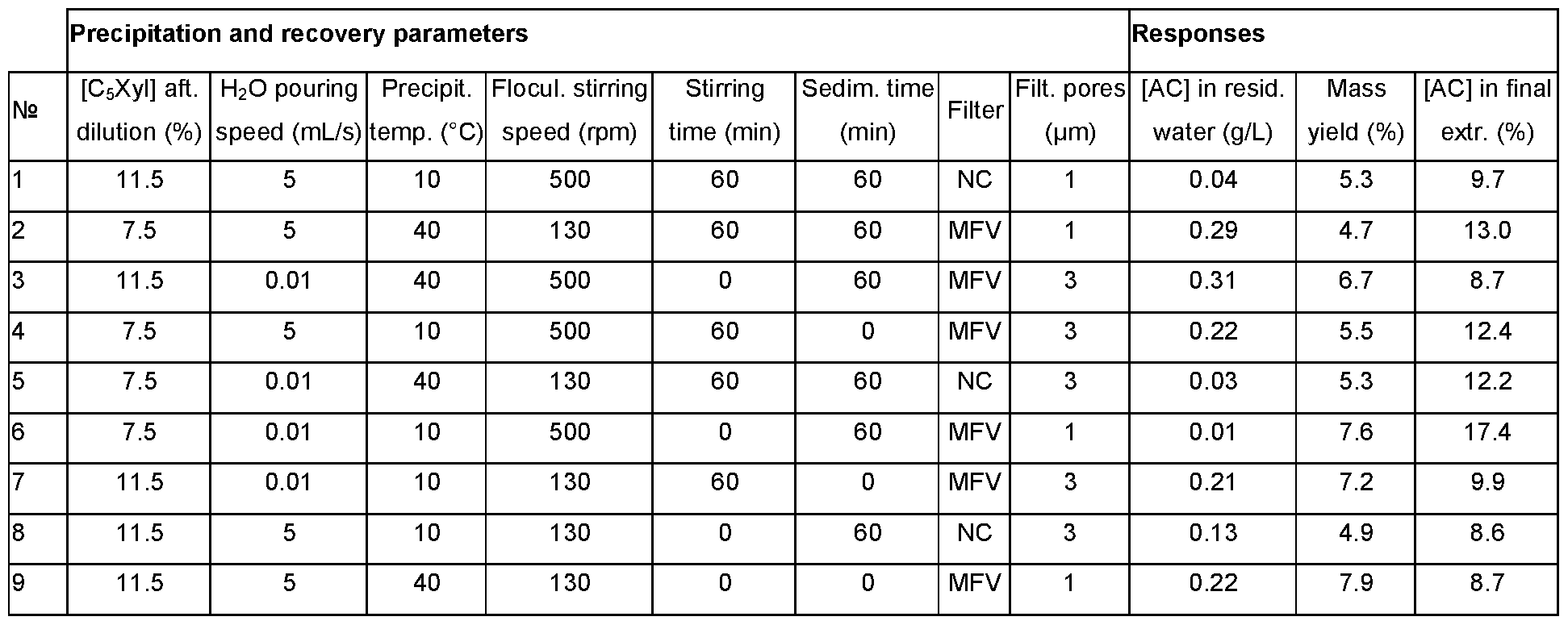

Different parameters related to the precipitation step and the recovery process downstream the extraction have been varied to see whether it affects the overall feasibility of the method. Height parameters have been studied: the hydrotrope concentration after dilution with water (7.5 or 11.5 %), the speed of water pouring (0.01 or 5 mL/s), the precipitation temperature (10 or 40 °C), the flocculation stirring speed (130 or 500 rpm) and time (0 or 60 min) after dilution, the static sedimentation time after stirring (0 or 60 min), the nature of the filter (cellulose nitrate, CN or glass microfibres, GMF), and the filter pores (1 or 3 pm). Interestingly, the precipitation/recovery process is robust upon all parameter variations.
First, the carnosic acid concentration in the residual water (i.e. the carnosic acid that is lost in the final separation step) does not exceed 3 % of available carnosic acid and is somewhat similar (negligible) in all experiments (Table 6). Regarding the two other responses, Table 6 shows values ranging from 4.2 to 7.9 % and from 3.2 to 17.4 %, respectively for the mass yield and the carnosic acid concentration in the final dried extract. In all tested conditions, an extract with a significant concentration of carnosic acid has been obtained demonstrating that the process of the invention covers all the possible combinations/variations of the precipitation and recovery parameters.
Example 17. Extraction of rosemary with 1 -isoamyl, 1 -pentyl and 1 -butyl glycerol ether hydrotrope
Homogeneous aqueous solutions of 1-isoamyl glycerol ether (noted [Ϊ5.0.0]) (30 %), 1- pentyl glycerol ether (noted [5.0.0]) (30 %) and 1 -butyl glycerol ether (noted [4.0.0]) (30 %) were prepared. For each of them, one gram of ground rosemary leaves (containing 2.72 % carnosic acid) was incubated with 10 mL of the solution for 30 min. Then, the enriched solution was separated from the plant by filtration and analyzed by HPLC to find the concentration of carnosic acid. The concentration of carnosic acid in the solution was found to be 2.42, 2.43 and 2.45 g/L, for [Ϊ5.0.0], [5.0.0] and [4.0.0] resp. Therefore, nearly all carnosic acid was extracted from the plant (recovery rate: 89.1 , 89.4 and 89.9 %, for [Ϊ5.0.0], [5.0.0] and [4.0.0], resp.).
Example 18. Extraction of rosemary without grinding with solution of 1 -butyl glycerol ether [4.0.0], 1-iso amyl glycerol ether [Ϊ5.0.0], and 1 -pentyl glycerol ether
[5.0.0]
Extraction of carnosic acid (CA) from rosemary using alkyl glycerol ethers have also been performed on whole leaves to show that the method of the invention and the use of these hydrotropes is not insulated to the sole case of ground biological materials but can also work on non-ground materials. Homogeneous aqueous solutions of 1 -isoamyl glycerol ether (noted [Ϊ5.0.0]) (30 %), 1 -pentyl glycerol ether (noted [5.0.0]) (30 %) and 1- butyl glycerol ether (noted [4.0.0]) (30 %) were prepared. For each of them, one gram of whole rosemary leaves (containing 2.72 % carnosic acid) was incubated with 10 mL of the solution for 24 and 48 h. Then, the enriched solution was separated from the plant by filtration and analyzed by HPLC to find the concentration of carnosic acid. The concentration of carnosic acid in the solution was found to be 0.51 , 0.43 and 0.49 g/L, after 24 h of extraction, and 0.83, 1.07 and 0.82 g/L after 48 h for [Ϊ5.0.0], [5.0.0] and [4.0.0] resp.
Example 19. Extraction of rosemary with a solution of 1 -butyl glycerol ether [4.0.0], precipitation, and recovery of the crude extract by filtration
A homogeneous aqueous solution of 1-butyl glycerol ether (30 %) was prepared. Ten grams of ground rosemary leaves (containing 2.72 % carnosic acid) were incubated at ambient temperature with 80 mL of this solution for 30 min and the enriched solution was separated from the plant by filtration. The filtrate was analyzed by HPLC and the concentration of carnosic acid was found to be 2.9 g/L, which corresponds to a recovery rate of 85 %. This is surprisingly high, especially for a one-pass process. For comparison purpose, we obtained the same recovery rate (85.40 %) using C5Xyl-assisted extraction of the same rosemary raw material but in a two-pass process (example 6). Then, the filtrate was diluted by water by a factor 2.3. The resulting precipitate was magnetically stirred for 30 min and let for settling for other 30 min. The precipitate was recovered by filtration and freeze-dried during 2 h. Finally, 343 mg of a pasty precipitate were collected (mass yield: 3.4 %). The final extract contained 15 % of carnosic acid (HPLC quantification).
Example 20. Extraction of sage with a solution of C5Xyl, precipitation, and recovery of the crude extract by filtration
A homogeneous aqueous solution of C5Xyl (22.5 %) was prepared. Ten grams of common sage leaves (containing 1.85 % carnosic acid) were incubated at ambient temperature with 100 ml_ of this solution for 30 min and the enriched solution was separated from the plant by filtration. The filtrate was analyzed by HPLC and the concentration of carnosic acid was found to be 1.3 g/L, which corresponds to a recovery rate of 57.5 %. The filtrate was diluted by a factor 3. The resulting precipitate was magnetically stirred for 30 min and let for settling for other 30 min. The precipitate was recovered by filtration and freeze-dried. Finally, 432 mg of a black pasty precipitate was collected (mass yield: 4.3 %), containing 20.4 % of carnosic acid (HPLC quantification), which corresponds to a final recovery rate of 47.7 %.
Example 21. 60 °C-extraction of rosemary with a solution of citraconic acid, precipitation, and recovery of the crude extract by centrifugation
A homogeneous aqueous solution of a natural compound, citraconic acid, was prepared at 70 %. Twenty grams of ground rosemary leaves (containing 3.17 % carnosic acid) were incubated at 60 °C with 200 mL of this solution for 30 min and the enriched solution was separated from the plant by centrifugation at 4200 rpm for 15 min. The supernatant was analyzed by HPLC and the concentration of carnosic acid was found to be 1.94 g/L, which corresponds to a recovery rate of 35.15 %. The supernatant was diluted by a factor of 14. The resulting precipitate was magnetically stirred for 15 min and let for settling for other 15 min. The precipitate was recovered by centrifugation (4200 rpm, 15 min) and dried overnight at 45 °C in a vacuum oven. Finally, 1.32 g of dried pellets was collected (mass yield: 6.58 %), containing 12.56 % of carnosic acid (HPLC quantification), which corresponds to a final recovery rate of 26.05 %.
Example 22. Room temperature-extraction of rosemary with a solution of citraconic acid, precipitation, recovery of the crude extract by centrifugation and washing of the crude extract
A homogeneous aqueous solution of a natural compound, citraconic acid, was prepared at 70 %. Twenty grams of ground rosemary leaves (containing 3.17 % carnosic acid) were incubated at ambient temperature with 200 mL of this solution for 30 min and the enriched solution was separated from the plant by centrifugation at 4200 rpm for 15 min.
The supernatant was analyzed by HPLC and the concentration of carnosic acid was found to be 2.01 g/L, which corresponds to a recovery rate of 36.09 %. The supernatant was diluted by a factor of 14. The resulting precipitate was magnetically stirred for 15 min and let for settling for other 15 min. The precipitate was recovered by centrifugation (4200 rpm, 15 min) and dried overnight at 45 °C in a vacuum oven. Finally, 1.01 g of dried pellets (hereafter referred to as‘crude extract’) was collected (mass yield: 5.05 %), containing 14.7 % of carnosic acid (HPLC quantification), which corresponds to a final recovery rate of 23.40 %.
In a separate experiment using the same process, the resulting crude extract (before drying in a vacuum oven) was washed with 200 mL water, filtrated then dried overnight at 45 °C in a vacuum oven. The washed extract contained 30.2 % of carnosic acid (HPLC quantification), a rise by more than a factor 2 of the carnosic acid level. The final mass yield concomitantly decreased at 2.74 % which is still well acceptable regarding industrial standard.
Example 23. Room temperature-extraction of rosemary with a solution of nicotinamide, precipitation, and recovery of the crude extract by centrifugation
A homogeneous aqueous solution of a natural compound, nicotinamide, was prepared at 40 %. Twenty grams of ground rosemary leaves (containing 3.17 % carnosic acid) were incubated at ambient temperature with 200 mL of this solution for 30 min and the enriched solution was separated from the plant by centrifugation at 4200 rpm for 15 min. The supernatant was analyzed by HPLC and the concentration of carnosic acid was found to be 0.53 g/L, which corresponds to a recovery rate of 9.90 %. The supernatant was diluted by a factor of 5. The resulting precipitate was magnetically stirred for 15 min and let for settling for other 15 min. The precipitate was recovered by centrifugation (4200 rpm, 15 min) and dried overnight at 45 °C in a vacuum oven. Finally, 0.54 g of dried pellets was collected (mass yield: 2.7 %), containing 9.7 % of carnosic acid (HPLC quantification), which corresponds to a final recovery rate of 8.3 %.
Example 24. Solubilization of hesperidin using an aqueous solution containing 40 % by weight nicotinamide
The solubility of hesperidin, a sparingly soluble flavonoid known for its anti-inflammatory, antioxidant, and antimicrobial activities, was assessed in an aqueous solution containing
40 % nicotinamide in a similar manner to carnosic acid in Example 2. The Smax for hesperidin is 1.075 g/L.
Example 25. Solubilization of curcumin using aqueous solution containing from 60 to 80 % by weight citraconic acid
The solubility of curcumin was assessed in various aqueous solutions containing 60, 70, and 80 % citraconic acid in a similar manner to carnosic acid in Example 2. It was found to be 0.31 , 0.64, and 1.51 g/L, respectively.
Example 26. Solubilization of curcumin using an aqueous solution containing 60 % by weight C5Xyl
The solubility of curcumin was assessed in an aqueous solution containing 60 % C5Xyl acid in a similar manner to carnosic acid in Example 2. It was found to be 0.81 g/L.
Example 27. Extraction of rosemary without grinding with aqueous solution of 30 % alkyl polyethylene glycol ethers (C Ej)
Homogeneous aqueous solutions of alkyl polyethylene glycol ethers (CjEj) were prepared for each of the fourteen C Ej listed in Table 1. Their amphiphile concentration was set at 30 wt. % each (i.e. well above their CAC, Table 1). For comparison, 96 % ethanol, 100 % butanol as well as four aqueous solutions (30 % butanol; 30 % propanol; 30 % ethanol; and 30 % SXS) were also prepared. The aqueous solutions were acidified with 1 wt. % of phosphoric acid (i.e. pH around 2) to inhibit the oxidative degradation of CA into carnosol.
One gram of whole rosemary leaves (containing 2.7 % carnosic acid) were incubated at room temperature under stirring with 10 mL of solution/solvent for 24 and 48 hours. The enriched solution was separated from the plant residues by Buchner filtration under vacuum (cellulose filters, diameter: 8 pm). Figure 15 shows the concentration of CA (quantified by HPLC) in the filtrate obtained after 24 and 48 h of extraction for the different systems.
All the hydrotropic CiErbased solutions are efficient towards the extraction of CA from rosemary. C4E!, C5E2 and C6E2 give the best results. In comparison with the hydrotropic solutions, 30 wt. % aqueous solution of ethanol does not extract CA at room temperature. Similarly, no CA was found in the filtrate obtained after extraction using 30
wt. % 1-butanol. Conversely, as propanol is miscible with water at 30 wt. % and more hydrophobic than ethanol, it significantly solubilizes CA. A concentration of 0.93 ± 0.02 g/L was extracted from rosemary after 48 h, which is still about 25 % less than the best hydrotropes (e.g. 1.21 g/L for C5E2). SXS, which is one of the first hydrotropes used for plant extraction, is not efficient at this concentration and pH compared to short CiE due to the low solubility of CA (< to 0.8 g/L) in the SXS solution (Figure 15).
Comparing CiEj between them, we can see that for a same alkyl chain length /, a decrease of the level of extracted CA is observed when the ethylene oxide number j increases, e.g. C4EI > C4E2 > C4E3; C5E2 > C5E3; C6E2 > C6E3 > C6E4, and C8E3 > C8E4. Interestingly, when j is kept constant, a non-linear trend with the extraction efficiency is observed when increasing the alkyl chain length for the C,E2 and C E3 series. Indeed, they reach a maximum of efficiency for C5 and C6 respectively. More precisely, for the CiE3 series, there is a parabolic-like influence of the alkyl chain length / on the extraction efficiency with an optimal (critical) point at / = 6, beyond which increasing / leads to a collapse of the efficiency. For the C,E4 series, the effect is linear with a negative correlation between / and the extraction efficiency. At least for some series, this shows a criticality in the molecular structure of hydrotropes for extracting carnosic acid from rosemary leaves.
Example 28. Effect of solubilized carnosic acid and extracted phytochemicals from rosemary on the cloud point of aqueous solution of 30 % alkyl polyethylene glycol ethers (C Ej)
The cloud point (CP) of hydrotropes is an important parameter for extraction of natural substances. For example, reaching the CP post-extraction can advantageously concentrate CA in a smaller phase which can constitute a unique purification procedure. Therefore, we measured the effect of solute concentration on CP.
In this example, most of the extractions were performed in homogeneous solutions except for C6E2 and C8E3 because of their CP below 25 °C. In the case of iC4E4 , the extraction started in homogenous solution but as CP decreased with the enrichment of the solution by phytochemicals such as CA, a biphasic mixture was obtained at the end. In each case, the CP was reduced after extraction. In the case of C6E2, the CP is not observable after extraction because the mixture is still biphasic at 0 °C. Post-extraction CPs were compared to the CPs of the hydrotropic solutions containing 2.5 g/L of CA,
which is close to the maximum concentration that can be reached after extraction (Figure 16). Indeed, the rosemary dried leaves used for these extractions contain 2.7 wt.% CA.
In Figure 16, since the reduction of the CP is higher in amphiphile solutions after extraction than with only 2.5 g/L CA, other extracted compounds than CA induce a depression of the CP. One can assume at first sight that the more the CP is reduced, the more phytochemicals are extracted, but all the phytochemicals do not reduce the CP in the same way. This was verified by investigating the thermal behavior of solutions of C4EI (30 wt. %) containing 1 to 25 g/L of CA, rosemary acid (RA) and pure camphor (C) and containing 1 to 10 g/L of stearic acid. For all solutes, CP linearly decreases with the amount of solubilized solute (Figure 17).
Example 29. Kinetics parameters of the extraction of rosemary without grinding with aqueous solution of 30 % alkyl polyethylene glycol ethers (C Ej)
With the aim of decreasing the time of extraction, the kinetics were studied on selected alkyl polyethylene glycol ethers. Homogeneous aqueous solutions of C^, C4E2 and C4E3 were prepared. Their concentration was set at 30 wt. % each (i.e. well above their CAC, Table 1). The aqueous solutions were acidified with 1 wt. % of phosphoric acid (i.e. pH around 2) to inhibit the oxidative degradation of CA into carnosol.
One gram of whole rosemary leaves (containing 2.7 % carnosic acid) were incubated at room temperature under stirring with 10 mL of solution/solvent for 48 hours. One hundred pL of solution were sampled at 30 min, then every hour for 8 h and finally at 24 and 48 h to ensure a well-defined time-resolved extraction kinetics. The enriched solution was separated from the plant residues by Buchner filtration under vacuum (cellulose filters, diameter: 8 pm). Figure 18 reports the amount of extracted CA as a function of time for the C^, C4E2 and C4E3 to evaluate the effect of the ethylene oxide number.
The extraction process can be divided into three steps. First, a washing step takes place in the first minutes of extraction and corresponds to the solubilization of the most accessible CA in the rosemary leaves. Interestingly, the nature of the CjEj has no influence during this step and « 0.12 g/L of CA are extracted in 30 min. Then, there is a diffusion step of several hours during which CA diffuses from the inside of the plant to the solution, helped by the amphiphile which diffused into the interior of the plant and solubilized CA. Finally, until completion of extraction, the amount of extracted CA increases very slowly until reaching a plateau.
Example 30. Mode of action of alkyl polyethylene glycol ethers (C Bj) in the extraction of carnosic acid from rosemary
Cross sections of whole rosemary leaves after 48 h of extractions with some alkyl polyethylene glycol ethers were observed by optical microscopy (Figure 19). Trichomes (secretory hairs which contain CA) are cut/degraded after the extractions performed with the different CiEj. Indeed, trichomes have been counted by observing the opening and their density decreases after a treatment with hydrotropes, whereas it seems unchanged after a treatment with EtOH 96 % at ambient temperature. As a consequence, we can assume that CA should be more released into the hydrotropic solution. Moreover, the width of the opening on the lower side of leaves was measured and was found larger after treatment with CiEj but unchanged with EtOH. This suggests that hydrotropes penetrate inside the leaves and interact with the internal molecules of the cell wall or membrane. On the contrary, EtOH can extract CA but does not de-structure the leaves, so it is able to diffuse through the barrier without destabilizing them.
Small hydrophilic head amphiphiles seem to have a hybrid behavior combining extraction mechanisms of alcohols with that of other CiEj. For example, C^ degrade trichomes as the other C,Ej do but also penetrate inside the plant matrix to extract CA as in the case of EtOH because even if the deterioration of the plant is similar to the other hydrotropes, the extraction is much quicker. In this case, CA must diffuse across the barriers by another mechanism, with an efficiency similar to that of alcohols.
Example 31. Extraction of rosemary without grinding with a solution of 04E1 precipitation, and recovery of the crude extract by filtration
A homogeneous aqueous solution of the hydrotrope C^ (40 %) was prepared. Two grams of whole rosemary leaves were incubated at room temperature and under magnetic stirring with 20 ml_ of this solution for 5 hours. The enriched solution was separated from the plant by filtration. The filtrate was analyzed by HPLC and the CA recovery rate was found to be 24 %.
The filtrate was diluted by acidic water by a factor 7. The resulting precipitate was recovered by filtration and freeze-dried. Finally, 135 mg of a precipitate were collected (mass yield: 6.8 %). The final extract contained 8.4 % of carnosic acid (HPLC quantification).
Example 32. A comparison of the solubility of carnosic, rosmarinic, and ursolic acids in aqueous solution of glycosylated amphiphiles
Figure 20 shows the solubility capacity for carnosic acid and ursolic acid of two hydrotropes of the invention, namely amyl xyloside (C5Xyl) and heptyl glucoside (C7Glu) compared to two conventional surfactants (ethylhexyl polyglucoside, bC8Glu (CAC = 0.06 wt. %), and caprylyl/capryl glycoside, C8/10Gly (CAC = 0.05 wt. %)). Incubation of solutes at various concentrations and amphiphiles at a fixed content of 30 wt. % in water lasted 24 h under stirring at 25 °C and pH 2. Overall, hydrotropes showed equivalent or even better solubilization capacity for carnosic acid than surfactants (Figure 20). Furthermore, C5Xyl shows a high selectivity with a very high carnosic acid-to-ursolic acid solubility ratio, while for C7Glu, this ratio is close to the unity.
Another interesting observation in Figure 20 is the fact that below the MHC, a hydrotrope cannot exhibit any solubilizing capacity for carnosic acid. We demonstrated this with butyl glucoside (C4Glu), the MHC of which is higher than 30 wt. %. Indeed, MHC of hydrotropes is higher than their CAC. Because the CAC for C4Glu has been found by tensiometry at 35 wt %, it means that during the solubilization experiment shown in Figure 20, C4Glu— whose content in aquous solution was set at 30 wt. % for comparison with other amphiphiles— was present at concentration significantly lower than its MHC. We thus demonstrated that hydrotropic solubilisation cannot be performed below the MHC, since almost no carnosic acid was solubilized by C4Glu below this critical level. Another experiment performed on C5Xyl shows its ability to improve the solubilisation of rosmarinic acid (log P 0.9) in water (Figure 21) compared to ursolic acid. As previously shown on Figure 20 for the carnosic acid/ursolic acid pair, a high selectivity was found for rosmarinic acid and around 47 g/L were solubilized. Interestingly, for C5Xyl, the limit to solubilize hydrophobic compound is below log P 8.7, which corresponds to the log P of ursolic acid, while for C7Glu, this limit is well beyond this value.
Example 33. A comparison of the solubility of alkyl gallate esters in aqueous solutions of C5Xyl
Hydrotropic solutions of C5Xyl containing 50 g/L of propyl, octyl, dodecyl and hexadecyl gallates were prepared in 2 mL flasks. Solutions were stirred with a rotary agitator for 24 h. If not saturated, the solution was added with 50 g/L more solute one or two times to reach the saturation. The solid phase was separated from the solution by a syringe filter (PTFE, 0.2 pm) and the solute was titrated in the filtrate by HPLC.
Figure 22 shows that C5Xyl can solubilize hydrophobic phenolic compounds such as gallate alkyl esters with a chain length ranging from 3 to 16, which correspond to log P ranging from 1.7 to 8.3. Therefore, the solubilization limit of C5Xyl is situated beyond log P 8.3, which is considerably hydrophobic.
Example 34. A comparison of the solubility of fatty acids in aqueous solutions of C5Xyl
Hydrotropic solutions of C5Xyl containing 20 g/L of solute (myristic, stearic and behenic acids) were prepared in 2 ml_ flasks and acidified by adding 1 % (v/v) of phosphoric acid (85 wt. %) (pH = 2). Solutions were stirred with a rotary agitator for 24 h. The solid phase was separated from the solution by a syringe filter (PTFE, 0.2 pm) and the solute was titrated in the filtrate by HPLC.
Figure 23 shows that C5Xyl can solubilize fatty acids containing 14 and 18 carbon atoms in their alkyl chain, which correspond to log P of 5.8 and 7.8, respectively. Furthermore, C5Xyl was unable to solubilize behenic acid with a very long chain length of 22 carbon atoms, corresponding to a log P of 9.9. Therefore, in this example, the solubilization limit of C5Xyl is situated between log P 7.8 and 9.9, which is in accordance with Example 33 obtained on alkyl gallate solutes and demonstrating that this limit is beyond log P 8.3. Even more precise is the limit obtained in Example 32, which is somewhere below log P 8.7. In conclusion, this limit should be located at log P of 8.5 for C5Xyl.
For comparison between hydrotropes and surfactants, hydrotropic solutions of surfactant C8/ioGly containing 20 g/L of solute (myristic, stearic and behenic acids) were prepared as described above for hydrotrope C5Xyl. Solutions were stirred with a rotary agitator for 24 h. The solid phase was separated from the solution by a syringe filter (PTFE, 0.2 pm) and the solute was titrated in the filtrate by HPLC.
Figure 24 shows that, similarly to C5Xyl, the surfactant C8/ioGly can solubilize fatty acids containing 14 and 18 carbon atoms in their alkyl chain, which correspond to log P of 5.8 and 7.8, respectively. However, similarly as C5Xyl, the tested surfactant was unable to solubilize substancial amounts of behenic acid with a very long chain length of 22 carbon atoms, corresponding to a log P of 9.9. Therefore, the solubilization limit of a surfactant such as C8/10Gly is relatively close to that of a hydrotrope such as C5Xyl.
Example 35. Extraction of rosemary without grinding with aqueous solutions of glycosylated amphiphiles at 30 wt. %.
Extraction of carnosic acid (CA) from rosemary using glycosylated hydrotropes have also been performed on whole leaves to show that the method of the invention and the use of these hydrotropes is not insulated to the sole case of ground biological materials but can also work on non-ground materials. Macerations were performed for 48 h at ambient temperature, with a kinetic study between 1 and 8 h (Figure 25). The concentration of CA in solution after 24 and 48 h of extraction were quantified by HPLC.
Results show that substantial amounts of CA is extracted in these conditions, except for C4Glu which is concentrated below its MHC. Among amphiphiles, C5Xyl appears as the most efficient one and extracts up to 0.43 g/L of CA after 48 h of maceration. Since rosemary is not ground, thus, glycolysated hydrotropes must first cross the plant barriers to penetrate inside the plant cells and then solubilize CA.
Example 36. The pH-induced oxidative degradation of carnosic acid into carnosol during the extraction from rosemary leaves using C5Xyl as hydrotrope.
Here we used carnosic acid as an example of phenolic compounds. Figure 26 shows that carnosic acid is oxidatively stable during extraction performed using C5Xyl as hydrotrope (30 wt. % in water) at pH below 3.5 approximately. A signification oxidation of carnosic acid into its oxidation product, i.e. carnosol— which is much less antioxidant— occurs when the pH during the extraction procedure is increased at 5.5. Beyond the neutrality, this oxidation is complete and extraction of carnosic acid cannot be performed. The extraction thus should be done at pH below 5, preferably below 3.5 and more preferably below 2.
Exemple 37. Prediction equation of the ability of CiEj hydrotropes (30 wt. % in water) to extract carnosic acid from whole rosemary at room temperature during 48 hours
The diffusion of a molecule inside the plant requires both lipophilicity and mobility, the latter being directly related to the size of the molecule. This can be related to the structure and chemical composition of the cell barriers which are crossed during the diffusion. Indeed, during the diffusion across the phospholipid bilayer, the molecule crosses two types of environments: one mainly composed of the hydrophilic glycerol and phosphate functions and the other one composed of the hydrophobic alkyl chains of the
phospholipids. Thus, very polar and apolar molecules require a lot of energy to cross the hydrophobic core and the hydrophilic layers respectively. A medium hydrophobicity and polarity is better suited to reduce the energy of the diffusion. Similarly, the molecule also needs to diffuse across the cell wall (~ 200 nm), mainly composed of polar cellulose fibers. This layer is known to allow the diffusion of water, ions and water-soluble molecules such as plant hormones, but not proteins, hydrophobic molecules or particles with a diameter greater than 4 nm, which corresponds to the porosity of the matrix.
Based on these considerations, the molecular volume (Vm) was plotted as a function of log P (Figure 27) for each linear CiEj. Isoconcentration curves of extracted CA at 48 h were calculated with the Origin® software. Each line is a set of points corresponding to theoretical amphiphiles with the same efficiency for an extraction in the same conditions. According to the calculation, there is an optimum of efficiency for hydrotropes with a log P above 1 and with a Vm below 250 A3. Indeed, C5E2, which is the best hydrotrope within the CiEj series has a log P of 1.11 and a molecular volume of 241 A3.
This diagram suggests the existence of an equation to estimate the concentration of extracted CA. Indeed, isoconcentration curves can be represented as concentric circles with a center corresponding to the theoretical properties to maximize the efficiency of an hydrotrope, and the radius corresponding to a function of the concentration of extracted CA (Figure 27). The coefficients of the equation (1) of the circles, with r, the radius and the equation (2) connecting r to the concentration of extracted CA (CCA) were calculated by multiple linear regression between Vm, Vm2, logP, logP2 and ln(CCA) for all CiEj with a rather good correlation coefficient of 0.9 (Figure 28). Equation (1) suggests that the best hydrotrope should have a log P = 1.37 and a Vm = 240 A3.
(log P— 1.37)2
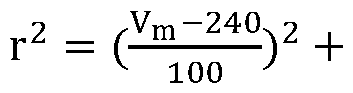
CCA = 1.2 x exp(— 0.3r2) (Equation 2)
Exemple 38. Prediction equations of the ability of all studied hydrotropes/surfactants (30 wt. % in water) to extract carnosic acid from whole rosemary at room temperature during 48 hours - a mathematical model using the molecular volume and the log P
In this example, results of the extraction using 14 C.Ej (i = 4 to 12, j = 1 to 4) are used for the model and the results of the extraction using 3 alkyl glycerol ethers (isoamyl, pentyl and butyl glycerols), sodium xylene sulfonate (NaXS) and 5 alkyl glycosides (C4Glu,
C5Xyl, C7GIU, bC8Glu, C8/ioGly) are considered as the test group. The best multiple linear regression corresponding to this set of experiments is:
ln(CC4) = -0.195 ( (¾)2 - 4.2 (¾) + logP2 - 3.2 logP + 7) + 0.148 (1) i.e.
ln(CC4) = -0.195 (( ¾ - 2.1)2 + ( logP - 1.6 ) 2) + 0.148 (2)
With Vm the molecular volume, and log P the partition coefficient between octanol and water.
Since (^ - 2.1)2 + ( logP - 1.6 ) 2 corresponds to the ray of a circle, it is possible to draw the concentric circles corresponding to the concentration of extracted CA and to place the tested hydrotropes (Figure 28). When the experimental values are plotted with the expected ones, alkyl glycerol ethers and alkyl glycosides are efficiently predicted with the model established with the C Ej, but the model does not fit for NaXS (Figure 29).
Example 39. Prediction equations of the ability of all studied hydrotropes/surfactants (30 wt. % in water) to extract carnosic acid from whole rosemary at room temperature during 48 hours - a mathematical model using the number of carbon atoms, the mass of the hydrophilic part, the molecular mass, and the CAC The same set of 23 experiments is used as in Example 38, but the model now is calculated from all the 23 experiments, without test group. The best regression obtained, with a p-value of 3.2 e-7, is:
CCA = - 1.98938 - 0.94603 i - 0.06542 Mhydro + 0.06121 M - 0.00390 CAC (3)
Wth i = number of carbons in alkyl chain, Mhydro = molar mass of the hydrophilic part (g/mol), M = molar mass of the molecule (g/mol) and CAC = Critical Aggregation Concentration (g/L). The predicted values are plot versus the experimental values resulting in the following Figure. All the alkyl glycosides, NaXS and most of the alkyl glycerols and glycosides are precisely predicted (Figure 30).
Claims
1. A method for providing a biological extract comprising:
i) mixing biological material with an extraction solution comprising water and at least one hydrotropic agent; and
ii) removing any undissolved biological material from the solution obtained in (i) to leave the biological extract.
2. A method according to claim 1 , wherein the at least one hydrotropic agent is not a salt.
3. A method according to claim 1 , wherein the biological extract comprises at least 0.05% by weight of lipophilic, hydrophobic, oil soluble and/or non-water-soluble compounds.
4. A method according to claim 2 or 3, wherein the lipophilic, hydrophobic, oil soluble and/or non-water-soluble compounds comprise one or more of phenolic acids, phenolic esters, phenolic diterpenes, flavonoids, secoiridoids, curcuminoids, stilbenes, phenolic alcohols, phenolic lipids, alkaloids, lipids, phenylpropanoids, coumarin, organic acids, terpenoids including sesquiterpenoids, diterpenoids, triterpenoids or carotenoids, and mixtures thereof, from the biological material.
5. A method according to any one of the preceding claims, wherein the biological extract comprises at least 0.05% by weight carnosic acid and/or its derivatives.
6. A method according to any one of claims 1 to 5, wherein the biological material is in the form of a liquid or in the form of a solid.
7. A method according to claim 6, wherein the biological material is not grounded and/or not mashed.
8. A method according to any one of the preceding claims, wherein the biological material is a plant biological material.
9. A method according to claim 8, wherein the plant biological material is obtained or obtainable from the plant roots, the aerial parts of a plant or a mixture thereof.
10. A method according to claim 8 or 9, wherein the plant biological material is obtained from or obtainable from at least one plant of the Lamiaceae species.
11. A method according to claim 10, wherein the at least one plant of the Lamiaceae species is one or more of basil, mint, rosemary, sage, savory, marjoram, oregano, hyssop, thyme, lavender, perilla and mixtures thereof.
12. A method according to any one of the preceding claims, wherein the biological material is rosemary and/or sage.
13. A method according to any one of the preceding claims, wherein the at least one hydrotropic agent is one or more of alkyl glycosides, alkyl polyethylene glycol ethers of formula O,E , wherein i = 3 to 9 and j = 1 to 4, alkyl glycerol ethers, dicarboxylic acids, nicotinamide or a mixture thereof.
14. A method according to claim 13, wherein:
a. the alkyl glycoside is amyl xyloside, heptyl glucoside, or a mixture thereof;
b. the alkyl polyethylene glycol ethers of formula C.Ej wherein i = 3 to 6 and j = 1 to 2 or 3, or a mixture thereof;
c. the alkyl glycerol ether is butyl glycerol ether, pentyl glycerol ether, isoamyl glycerol ether or a mixture thereof; and
d. the dicarboxylic acid is a C3 to C5 dicarboxylic acid or a mixture thereof, preferably wherein the dicarboxylic acid is citraconic acid, glutaric acid or a mixture thereof.
15. A method according to any one of the preceding claims, wherein the concentration of the at least one hydrotropic agent in the extraction solution used in step (i) is at least the minimum hydrotropic concentration (MHC) of the at least one hydrotropic agent.
16. A method according to claim 15, wherein the concentration of the at least one hydrotropic agent is, from about 1 to about 20 times, such as from about 2 to about 16 times or from about 4 to about 8 times the minimum hydrotropic concentration (MHC).
17. A method according to any one of the preceding claims, wherein the at least one hydrotropic agent is present in the extraction solvent at a concentration of from 1 % to about 80% by weight relative to the total weight of the extraction solvent.
18. A method according to claim 17, wherein the biological material is mixed with an extraction solvent comprising water and at least one dicarboxylic acid, wherein the concentration of the at least one dicarboxylic acid is from about 10% to about 80% by weight of the extraction solvent.
19. A method according to claim 17, wherein the biological material is combined with an extraction solvent comprising water and at least one alkyl glucoside and/or at least one alkyl glycerol ether or mixtures thereof, wherein the concentration of the at least one alkyl glucoside and/or at least one alkyl glycerol ether is from about 10% to about 40% by weight of the extraction solvent, such as from about 15% to about 30% or from about 18% to about 25% by weight of the extraction solvent.
20. A method according to claim 17, wherein the biological material is combined with an extraction solvent comprising water and at least one alkyl polyethylene glycol ether (CiEj) with a formula C.Ej wherein i = 3 to 9 and j = 1 to 4, wherein the concentration of the at least one alkyl polyethylene glycol ether is from about 10 % to about 80 % by weight of the extraction solvent.
21. A method according to any one of the preceding claims, additionally comprising: iii) obtaining a flocculate and/or precipitate by adding water to and/or cooling the solution obtained in step (ii); and
iv) collecting the resulting solid material, and
v) optionally drying the solid material obtained in step (iv).
22. A method according to any one of the preceding claims, further comprising:
vi) washing the solid obtained in step (iv) or (v) from about 1 to about 3 times with water and collecting the resulting solid material, and optionally drying the solid material.
23. A method according to any one of the preceding claims, wherein step (i), the biological material and the extraction solution comprising water and at least one hydrotropic agent is mixed at a pH of less than 7, such as a pH of less than 5 or less than 3.
24. A biological extract obtained or obtainable using the method defined in any one of claims 1 to 23.
25. A biological extract according to claim 24, wherein the extract comprises about 0.05% or more by weight of the extract of lipophilic, hydrophobic, oil soluble and/or non- water-soluble compounds or about 5% or more by weight of the extract of lipophilic, hydrophobic, oil soluble and/or non-water-soluble compounds or about 10% or more by weight of the extract of lipophilic, hydrophobic, oil soluble and/or non-water-soluble compounds.
26. A biological extract according to claim 25, wherein the extract comprises carnosic acid in an amount of about 0.05% or more by weight of the extract or about 5% or more by weight of the extract or about 10% or more by weight of the extract.
27. A biological extract according to any one of claims 24 to 26, wherein the extract comprises antioxidants and/or anti-microbial compounds.
28. A biological extract according to any one of claims 24 to 26, for use as an anti oxidant and/or anti-microbial.
29. The use of a biological extract according to any one of claims 24 to 26 as an anti oxidant and/or anti-microbial.
30. A biological extract according to any one of claims 24 to 26, for use in a nutraceutical composition, a dietary or food product for humans or animals, a nutritional supplement, a fragrance or flavouring, a pharmaceutical, a veterinary composition, or an oenological or cosmetic formulation.
31. A nutraceutical composition, a dietary or food product for humans or animals, a nutritional supplement, a fragrance or flavouring, a pharmaceutical, a veterinary composition, or an oenological or cosmetic formulationcomprising a biological extract according to any one of claims 24 to 26, and optionally a pharmaceutically/veterinary acceptable ingredient, such as an excipient or carrier or a food acceptable ingredient or a mixture thereof.
32. A method for providing a biological extract comprising:
(i) mixing biological material (such as plant biological material, algal biological material, animal biological material and/or prokaryotic biological material) with an extraction solution comprising water and at least one hydrotropic agent, in particular at least one hydrotropic agent; and
(ii) removing any undissolved biological material from the solution obtained in (i) to leave the biological extract, wherein the extraction solvent releases lipophilic, hydrophobic, oil soluble and/or non-water-soluble compounds retained in the cells of the biological material (such as plant biological material, algal biological material, animal biological material and/or prokaryotic biological material).
33. The use of an extraction solution comprising water and at least one hydrotropic agent, in particular at least one hydrotropic agent, to provide a biological extract from biological material (such as plant biological material, algal biological material, animal biological material and/or prokaryotic biological material), wherein the use comprises: i) mixing biological material (such as plant biological material, algal biological material, animal biological material and/or prokaryotic biological material) with an extraction solution comprising water and at least one hydrotropic agent, in particular at least one hydrotropic agent; and
ii) removing any undissolved biological material from the solution obtained in (i) to leave the biological extract, wherein the extraction solvent releases lipophilic, hydrophobic, oil soluble and/or non-water-soluble compounds retained in the cells of the biological material (such as plant biological material, algal biological material, animal biological material and/or prokaryotic biological material).
34. The method of claim 32 or the use of claim 33, wherein the extraction solvent releases at least 10 % of lipophilic, hydrophobic, oil soluble and/or non-water-soluble compounds retained in the cells of the biological material (such as plant biological material, algal biological material, animal biological material and/or prokaryotic biological material).
35. The method or use of claim 32, wherein the cells of the biological material are the polysaccharide-lignin networks that constituting cell walls of plants.
36. A method for decreasing the density of cells and/or increasing cell porosity in biological material (such as plant biological material, algal biological material, animal biological material and/or prokaryotic biological material) comprising:
(i) mixing biological material (such as plant biological material, algal biological material, animal biological material and/or prokaryotic biological material) with an extraction solution comprising water and at least one hydrotropic agent, in particular at least one hydrotropic agent; and
(ii) removing any undissolved biological material from the solution obtained in (i) to leave the biological extract.
37. The use of an extraction solution comprising water and at least one hydrotropic agent, in particular at least one hydrotropic agent, to decrease the density of cells and/or increase cell porosity of biological material (such as plant biological material, algal biological material, animal biological material and/or prokaryotic biological material), wherein the use comprises:
i) mixing biological material (such as plant biological material, algal biological material, animal biological material and/or prokaryotic biological material) with an extraction solution comprising water and at least one hydrotropic agent, in particular at least hydrotropic agent; and
ii) removing any undissolved biological material from the solution obtained in
(i) to leave the biological extract.
38. The method or use according to any one of claims 32 to 37, wherein the at least one hydrotropic agent is not a salt.
Applications Claiming Priority (2)
| Application Number | Priority Date | Filing Date | Title |
|---|---|---|---|
| GBGB1908881.4A GB201908881D0 (en) | 2019-06-20 | 2019-06-20 | Hydrotropic extraction |
| GB1908881.4 | 2019-06-20 |
Publications (1)
| Publication Number | Publication Date |
|---|---|
| WO2020254577A1 true WO2020254577A1 (en) | 2020-12-24 |
Family
ID=67511545
Family Applications (1)
| Application Number | Title | Priority Date | Filing Date |
|---|---|---|---|
| PCT/EP2020/067101 Ceased WO2020254577A1 (en) | 2019-06-20 | 2020-06-19 | Hydrotropic extraction |
Country Status (2)
| Country | Link |
|---|---|
| GB (1) | GB201908881D0 (en) |
| WO (1) | WO2020254577A1 (en) |
Cited By (2)
| Publication number | Priority date | Publication date | Assignee | Title |
|---|---|---|---|---|
| CN112409440A (en) * | 2021-01-04 | 2021-02-26 | 湖南德诺健康管理集团有限公司 | Method for producing ursolic acid emulsion by using rosemary ointment as raw material |
| FR3169352A1 (en) * | 2024-12-09 | 2026-06-12 | Lvmh Recherche | Aqueous extraction process of hydrophobic metabolites present in a plant |
Citations (6)
| Publication number | Priority date | Publication date | Assignee | Title |
|---|---|---|---|---|
| WO2000043340A1 (en) | 1999-01-25 | 2000-07-27 | Kao Corporation | Process for producing glyceryl ether |
| US6365601B1 (en) * | 1999-09-16 | 2002-04-02 | Council Of Scientific And Industrial Research | Process for extraction of piperine from piper species |
| EP3130655A1 (en) * | 2015-08-13 | 2017-02-15 | Universität Regensburg | Process for isolation of odoriferous agents |
| WO2017194629A1 (en) * | 2016-05-13 | 2017-11-16 | Universität Regensburg | Process for extraction of antioxidants from plant material |
| US20170367393A1 (en) * | 2015-03-18 | 2017-12-28 | Pierre Fabre Dermo-Cosmetique | Method for producing an extract of a matrix of vegetable origin with a non-ionic amphiphilic compound as extraction adjuvant in an aqueous medium |
| US20180055900A1 (en) * | 2015-03-18 | 2018-03-01 | Pierre Fabre Dermo-Cosmetique | Method for producing an extract of a matrix of vegetable origin by extrusion with a hydrotrope solution |
-
2019
- 2019-06-20 GB GBGB1908881.4A patent/GB201908881D0/en not_active Ceased
-
2020
- 2020-06-19 WO PCT/EP2020/067101 patent/WO2020254577A1/en not_active Ceased
Patent Citations (6)
| Publication number | Priority date | Publication date | Assignee | Title |
|---|---|---|---|---|
| WO2000043340A1 (en) | 1999-01-25 | 2000-07-27 | Kao Corporation | Process for producing glyceryl ether |
| US6365601B1 (en) * | 1999-09-16 | 2002-04-02 | Council Of Scientific And Industrial Research | Process for extraction of piperine from piper species |
| US20170367393A1 (en) * | 2015-03-18 | 2017-12-28 | Pierre Fabre Dermo-Cosmetique | Method for producing an extract of a matrix of vegetable origin with a non-ionic amphiphilic compound as extraction adjuvant in an aqueous medium |
| US20180055900A1 (en) * | 2015-03-18 | 2018-03-01 | Pierre Fabre Dermo-Cosmetique | Method for producing an extract of a matrix of vegetable origin by extrusion with a hydrotrope solution |
| EP3130655A1 (en) * | 2015-08-13 | 2017-02-15 | Universität Regensburg | Process for isolation of odoriferous agents |
| WO2017194629A1 (en) * | 2016-05-13 | 2017-11-16 | Universität Regensburg | Process for extraction of antioxidants from plant material |
Non-Patent Citations (8)
| Title |
|---|
| A. SALEHL. EI-KHORDAGUI: "Hydrotropic agents: a new definition", INT. J. PHARM., vol. 24, 1985, pages 231 - 238 |
| CARL A. NEUBERGC. NEUBERG: "Hydrotropic phenomena", BIOCHEM. Z., vol. 76, 1916, pages 107 |
| M. NEUMANNC. SCHMITTK. PRIETO ET AL.: "The photo physical determination of the minimum hydrotrope concentration of aromatic hydrotropes", J. COLLOID. INTERFACE. SCI., vol. 315, 2007, pages 810 - 813 |
| N. KAPADIYAI. SINGHVIK. MEHTAK. GAURID. SEN: "Hydrotropy: a promising tool for solubility enhancement: a review", INT. J. DRUG DEV. RES., vol. 3, 2011, pages 26 - 33 |
| R. LEBEUFE. ILLOUSC. DUSSENNEV. MOLINIERE. DA SILVAM. LEMAIREJ.-M. AUBRY: "Solvo-surfactant properties of dialkyl glycerol ethers: application as eco-friendly extractants of plant material through a novel hydrotropic cloud point extraction (HCPE) process", ACS SUS. CHEM. ENG., vol. 4, 2016, pages 4815 - 4823, XP055326778, DOI: 10.1021/acssuschemeng.6b01101 |
| RE. COFFMANDO. KILDSIG: "Self-association of nicotinamide in aqueous solution: Light-scattering and vapor pressure osmometry studies", J. PHARM. SCI., vol. 85, no. 8, 1996, pages 848 - 853 |
| T. HODGDONE. KALER: "Hydrotropic solutions", CURR. OPIN. COLLOID. IN., vol. 12, 2007, pages 121 - 128, XP022214823, DOI: 10.1016/j.cocis.2007.06.004 |
| V. KUMARC. RAJAC. JAYAKUMAR: "A review on solubility enhancement using hydrotropic phenomena", INT. J. PHARM. PHARM. SCI., vol. 6, 2014, pages 1 - 7 |
Cited By (3)
| Publication number | Priority date | Publication date | Assignee | Title |
|---|---|---|---|---|
| CN112409440A (en) * | 2021-01-04 | 2021-02-26 | 湖南德诺健康管理集团有限公司 | Method for producing ursolic acid emulsion by using rosemary ointment as raw material |
| FR3169352A1 (en) * | 2024-12-09 | 2026-06-12 | Lvmh Recherche | Aqueous extraction process of hydrophobic metabolites present in a plant |
| WO2026125853A1 (en) * | 2024-12-09 | 2026-06-18 | Lvmh Recherche | Method for the aqueous extraction of hydrophobic metabolites present in a plant |
Also Published As
| Publication number | Publication date |
|---|---|
| GB201908881D0 (en) | 2019-08-07 |
Similar Documents
| Publication | Publication Date | Title |
|---|---|---|
| US20220305401A1 (en) | Eutectic extraction of solids | |
| US11224628B2 (en) | Method for extraction of an agent from a plant source | |
| Xavier-Junior et al. | Microemulsion systems containing bioactive natural oils: an overview on the state of the art | |
| JP2022533838A (en) | Nanoemulsion composition containing bioactive ingredients | |
| CN1658770A (en) | Nano-sized self-assembled structured liquids | |
| JP6887954B2 (en) | A method for producing a plant-derived matrix extract using a nonionic amphipathic compound as an extraction adjuvant in an aqueous medium. | |
| Li et al. | Enhanced antioxidant and antiproliferative activities of Cymbopogon citratus (DC.) Stapf essential oils in microemulsion | |
| ES2843976T3 (en) | Procedure for preparing a plant matrix extract by extrusion with a hydrotropic solution | |
| EP3731852A1 (en) | Particular extract from perfume plants, aromatic plants and medicinal plants, method for obtaining said extract, compositions containing same and uses thereof | |
| JP2013202005A (en) | Curcumin-containing oil and fat, and method for producing the same | |
| US20230066836A1 (en) | Antioxidant Extracts and Compositions | |
| Al-Temimi et al. | Diagnose the bioactive compounds in flaxseed extract and its oil and use their mixture as an antioxidant | |
| JP2016044150A (en) | Cosmetic | |
| EP2033620A1 (en) | Formulation of natural triterpenes and biophenols obtained from the genus olea in liposomes | |
| US20110251415A1 (en) | Xylitol esters and ethers applied as alternative emulsifiers, solvents, co-emulsifiers and preservative systems for pharmaceutical and cosmetic products | |
| WO2023036973A1 (en) | Extraction method using an aqueous alkanediol | |
| JP2006249078A (en) | Plant component-containing emulsion preparation and method for producing the same | |
| Mendoza | Enrichment of vegetable oils with phenolic antioxidants for food applications | |
| KR102482609B1 (en) | A novel biological network mimic method for extraction of useful ingredients from biological raw material | |
| JP7270160B2 (en) | emulsified isada oil | |
| Ghosn | Preliminary assay for extraction of saponins from Styrax Officinalis and characterization of emulsifying properties of their extract | |
| DE202006004872U1 (en) | Agents, useful for therapeutic purposes, comprising Cistus plant extract, vitamin E and optionally active agents, vitamins, minerals and/or usual formulation auxiliary agents | |
| HK40118742A (en) | Nanostructured aqueous formulation of propolis extract and the uses thereof | |
| FR2853246A1 (en) | Pharmaceutical or food composition, useful for the treatment or prevention of inflammation, especially acne, contains alcoholic polyphenol containing extract of sunflower seeds | |
| JP2008013461A (en) | Antioxidant composition |
Legal Events
| Date | Code | Title | Description |
|---|---|---|---|
| 121 | Ep: the epo has been informed by wipo that ep was designated in this application |
Ref document number: 20733982 Country of ref document: EP Kind code of ref document: A1 |
|
| NENP | Non-entry into the national phase |
Ref country code: DE |
|
| 122 | Ep: pct application non-entry in european phase |
Ref document number: 20733982 Country of ref document: EP Kind code of ref document: A1 |