WO2020230239A1 - 運転指針探索方法、及び運転指針探索システム - Google Patents
運転指針探索方法、及び運転指針探索システム Download PDFInfo
- Publication number
- WO2020230239A1 WO2020230239A1 PCT/JP2019/018954 JP2019018954W WO2020230239A1 WO 2020230239 A1 WO2020230239 A1 WO 2020230239A1 JP 2019018954 W JP2019018954 W JP 2019018954W WO 2020230239 A1 WO2020230239 A1 WO 2020230239A1
- Authority
- WO
- WIPO (PCT)
- Prior art keywords
- natural gas
- refrigerant
- variables
- plant
- disturbance
- Prior art date
- Legal status (The legal status is an assumption and is not a legal conclusion. Google has not performed a legal analysis and makes no representation as to the accuracy of the status listed.)
- Ceased
Links
Images





Classifications
-
- F—MECHANICAL ENGINEERING; LIGHTING; HEATING; WEAPONS; BLASTING
- F25—REFRIGERATION OR COOLING; COMBINED HEATING AND REFRIGERATION SYSTEMS; HEAT PUMP SYSTEMS; MANUFACTURE OR STORAGE OF ICE; LIQUEFACTION SOLIDIFICATION OF GASES
- F25J—LIQUEFACTION, SOLIDIFICATION OR SEPARATION OF GASES OR GASEOUS OR LIQUEFIED GASEOUS MIXTURES BY PRESSURE AND COLD TREATMENT OR BY BRINGING THEM INTO THE SUPERCRITICAL STATE
- F25J1/00—Processes or apparatus for liquefying or solidifying gases or gaseous mixtures
- F25J1/003—Processes or apparatus for liquefying or solidifying gases or gaseous mixtures characterised by the kind of cold generation within the liquefaction unit for compensating heat leaks and liquid production
- F25J1/0047—Processes or apparatus for liquefying or solidifying gases or gaseous mixtures characterised by the kind of cold generation within the liquefaction unit for compensating heat leaks and liquid production using an "external" refrigerant stream in a closed vapor compression cycle
- F25J1/0052—Processes or apparatus for liquefying or solidifying gases or gaseous mixtures characterised by the kind of cold generation within the liquefaction unit for compensating heat leaks and liquid production using an "external" refrigerant stream in a closed vapor compression cycle by vaporising a liquid refrigerant stream
- F25J1/0055—Processes or apparatus for liquefying or solidifying gases or gaseous mixtures characterised by the kind of cold generation within the liquefaction unit for compensating heat leaks and liquid production using an "external" refrigerant stream in a closed vapor compression cycle by vaporising a liquid refrigerant stream originating from an incorporated cascade
-
- F—MECHANICAL ENGINEERING; LIGHTING; HEATING; WEAPONS; BLASTING
- F25—REFRIGERATION OR COOLING; COMBINED HEATING AND REFRIGERATION SYSTEMS; HEAT PUMP SYSTEMS; MANUFACTURE OR STORAGE OF ICE; LIQUEFACTION SOLIDIFICATION OF GASES
- F25J—LIQUEFACTION, SOLIDIFICATION OR SEPARATION OF GASES OR GASEOUS OR LIQUEFIED GASEOUS MIXTURES BY PRESSURE AND COLD TREATMENT OR BY BRINGING THEM INTO THE SUPERCRITICAL STATE
- F25J1/00—Processes or apparatus for liquefying or solidifying gases or gaseous mixtures
- F25J1/0002—Processes or apparatus for liquefying or solidifying gases or gaseous mixtures characterised by the fluid to be liquefied
- F25J1/0022—Hydrocarbons, e.g. natural gas
-
- F—MECHANICAL ENGINEERING; LIGHTING; HEATING; WEAPONS; BLASTING
- F25—REFRIGERATION OR COOLING; COMBINED HEATING AND REFRIGERATION SYSTEMS; HEAT PUMP SYSTEMS; MANUFACTURE OR STORAGE OF ICE; LIQUEFACTION SOLIDIFICATION OF GASES
- F25J—LIQUEFACTION, SOLIDIFICATION OR SEPARATION OF GASES OR GASEOUS OR LIQUEFIED GASEOUS MIXTURES BY PRESSURE AND COLD TREATMENT OR BY BRINGING THEM INTO THE SUPERCRITICAL STATE
- F25J1/00—Processes or apparatus for liquefying or solidifying gases or gaseous mixtures
- F25J1/003—Processes or apparatus for liquefying or solidifying gases or gaseous mixtures characterised by the kind of cold generation within the liquefaction unit for compensating heat leaks and liquid production
- F25J1/0047—Processes or apparatus for liquefying or solidifying gases or gaseous mixtures characterised by the kind of cold generation within the liquefaction unit for compensating heat leaks and liquid production using an "external" refrigerant stream in a closed vapor compression cycle
- F25J1/0052—Processes or apparatus for liquefying or solidifying gases or gaseous mixtures characterised by the kind of cold generation within the liquefaction unit for compensating heat leaks and liquid production using an "external" refrigerant stream in a closed vapor compression cycle by vaporising a liquid refrigerant stream
-
- F—MECHANICAL ENGINEERING; LIGHTING; HEATING; WEAPONS; BLASTING
- F25—REFRIGERATION OR COOLING; COMBINED HEATING AND REFRIGERATION SYSTEMS; HEAT PUMP SYSTEMS; MANUFACTURE OR STORAGE OF ICE; LIQUEFACTION SOLIDIFICATION OF GASES
- F25J—LIQUEFACTION, SOLIDIFICATION OR SEPARATION OF GASES OR GASEOUS OR LIQUEFIED GASEOUS MIXTURES BY PRESSURE AND COLD TREATMENT OR BY BRINGING THEM INTO THE SUPERCRITICAL STATE
- F25J1/00—Processes or apparatus for liquefying or solidifying gases or gaseous mixtures
- F25J1/006—Processes or apparatus for liquefying or solidifying gases or gaseous mixtures characterised by the refrigerant fluid used
- F25J1/008—Hydrocarbons
- F25J1/0087—Propane; Propylene
-
- F—MECHANICAL ENGINEERING; LIGHTING; HEATING; WEAPONS; BLASTING
- F25—REFRIGERATION OR COOLING; COMBINED HEATING AND REFRIGERATION SYSTEMS; HEAT PUMP SYSTEMS; MANUFACTURE OR STORAGE OF ICE; LIQUEFACTION SOLIDIFICATION OF GASES
- F25J—LIQUEFACTION, SOLIDIFICATION OR SEPARATION OF GASES OR GASEOUS OR LIQUEFIED GASEOUS MIXTURES BY PRESSURE AND COLD TREATMENT OR BY BRINGING THEM INTO THE SUPERCRITICAL STATE
- F25J1/00—Processes or apparatus for liquefying or solidifying gases or gaseous mixtures
- F25J1/02—Processes or apparatus for liquefying or solidifying gases or gaseous mixtures requiring the use of refrigeration, e.g. of helium or hydrogen ; Details and kind of the refrigeration system used; Integration with other units or processes; Controlling aspects of the process
- F25J1/0211—Processes or apparatus for liquefying or solidifying gases or gaseous mixtures requiring the use of refrigeration, e.g. of helium or hydrogen ; Details and kind of the refrigeration system used; Integration with other units or processes; Controlling aspects of the process using a multi-component refrigerant [MCR] fluid in a closed vapor compression cycle
- F25J1/0214—Processes or apparatus for liquefying or solidifying gases or gaseous mixtures requiring the use of refrigeration, e.g. of helium or hydrogen ; Details and kind of the refrigeration system used; Integration with other units or processes; Controlling aspects of the process using a multi-component refrigerant [MCR] fluid in a closed vapor compression cycle as a dual level refrigeration cascade with at least one MCR cycle
- F25J1/0215—Processes or apparatus for liquefying or solidifying gases or gaseous mixtures requiring the use of refrigeration, e.g. of helium or hydrogen ; Details and kind of the refrigeration system used; Integration with other units or processes; Controlling aspects of the process using a multi-component refrigerant [MCR] fluid in a closed vapor compression cycle as a dual level refrigeration cascade with at least one MCR cycle with one SCR cycle
- F25J1/0216—Processes or apparatus for liquefying or solidifying gases or gaseous mixtures requiring the use of refrigeration, e.g. of helium or hydrogen ; Details and kind of the refrigeration system used; Integration with other units or processes; Controlling aspects of the process using a multi-component refrigerant [MCR] fluid in a closed vapor compression cycle as a dual level refrigeration cascade with at least one MCR cycle with one SCR cycle using a C3 pre-cooling cycle
-
- F—MECHANICAL ENGINEERING; LIGHTING; HEATING; WEAPONS; BLASTING
- F25—REFRIGERATION OR COOLING; COMBINED HEATING AND REFRIGERATION SYSTEMS; HEAT PUMP SYSTEMS; MANUFACTURE OR STORAGE OF ICE; LIQUEFACTION SOLIDIFICATION OF GASES
- F25J—LIQUEFACTION, SOLIDIFICATION OR SEPARATION OF GASES OR GASEOUS OR LIQUEFIED GASEOUS MIXTURES BY PRESSURE AND COLD TREATMENT OR BY BRINGING THEM INTO THE SUPERCRITICAL STATE
- F25J1/00—Processes or apparatus for liquefying or solidifying gases or gaseous mixtures
- F25J1/02—Processes or apparatus for liquefying or solidifying gases or gaseous mixtures requiring the use of refrigeration, e.g. of helium or hydrogen ; Details and kind of the refrigeration system used; Integration with other units or processes; Controlling aspects of the process
- F25J1/0243—Start-up or control of the process; Details of the apparatus used; Details of the refrigerant compression system used
- F25J1/0244—Operation; Control and regulation; Instrumentation
- F25J1/0245—Different modes, i.e. 'runs', of operation; Process control
- F25J1/0247—Different modes, i.e. 'runs', of operation; Process control start-up of the process
-
- F—MECHANICAL ENGINEERING; LIGHTING; HEATING; WEAPONS; BLASTING
- F25—REFRIGERATION OR COOLING; COMBINED HEATING AND REFRIGERATION SYSTEMS; HEAT PUMP SYSTEMS; MANUFACTURE OR STORAGE OF ICE; LIQUEFACTION SOLIDIFICATION OF GASES
- F25J—LIQUEFACTION, SOLIDIFICATION OR SEPARATION OF GASES OR GASEOUS OR LIQUEFIED GASEOUS MIXTURES BY PRESSURE AND COLD TREATMENT OR BY BRINGING THEM INTO THE SUPERCRITICAL STATE
- F25J1/00—Processes or apparatus for liquefying or solidifying gases or gaseous mixtures
- F25J1/02—Processes or apparatus for liquefying or solidifying gases or gaseous mixtures requiring the use of refrigeration, e.g. of helium or hydrogen ; Details and kind of the refrigeration system used; Integration with other units or processes; Controlling aspects of the process
- F25J1/0243—Start-up or control of the process; Details of the apparatus used; Details of the refrigerant compression system used
- F25J1/0244—Operation; Control and regulation; Instrumentation
- F25J1/0252—Control strategy, e.g. advanced process control or dynamic modeling
-
- F—MECHANICAL ENGINEERING; LIGHTING; HEATING; WEAPONS; BLASTING
- F25—REFRIGERATION OR COOLING; COMBINED HEATING AND REFRIGERATION SYSTEMS; HEAT PUMP SYSTEMS; MANUFACTURE OR STORAGE OF ICE; LIQUEFACTION SOLIDIFICATION OF GASES
- F25J—LIQUEFACTION, SOLIDIFICATION OR SEPARATION OF GASES OR GASEOUS OR LIQUEFIED GASEOUS MIXTURES BY PRESSURE AND COLD TREATMENT OR BY BRINGING THEM INTO THE SUPERCRITICAL STATE
- F25J1/00—Processes or apparatus for liquefying or solidifying gases or gaseous mixtures
- F25J1/02—Processes or apparatus for liquefying or solidifying gases or gaseous mixtures requiring the use of refrigeration, e.g. of helium or hydrogen ; Details and kind of the refrigeration system used; Integration with other units or processes; Controlling aspects of the process
- F25J1/0243—Start-up or control of the process; Details of the apparatus used; Details of the refrigerant compression system used
- F25J1/0244—Operation; Control and regulation; Instrumentation
- F25J1/0254—Operation; Control and regulation; Instrumentation controlling particular process parameter, e.g. pressure, temperature
-
- G—PHYSICS
- G06—COMPUTING OR CALCULATING; COUNTING
- G06N—COMPUTING ARRANGEMENTS BASED ON SPECIFIC COMPUTATIONAL MODELS
- G06N20/00—Machine learning
Definitions
- the present invention relates to a technique for analyzing the operation of a liquefied natural gas plant.
- LNG plant In a liquefied natural gas plant (hereinafter, also referred to as “LNG plant”) that liquefies natural gas, natural gas (NG: Natural Gas) is cooled using a refrigerant, and liquefied natural gas (LNG: Liquefied Natural Gas) is produced. The process of obtaining is performed.
- LNG plants include heat exchangers that use refrigerants to cool the fluid to be cooled (NG and other refrigerants, etc.), compressors that compress vaporized refrigerants, and air-cooled heat exchangers that cool the compressed refrigerants. It is equipped with a large number of devices such as ACHE: Air-Cooled Heat Exchanger).
- the operating state of these devices changes according to disturbances such as outside air temperature, NG supply pressure, and NG composition.
- various operation adjustments are made so that LNG can be efficiently produced with a smaller amount of energy input while being affected by disturbance.
- the type of disturbance and how it is affected by each disturbance differ depending on the device.
- the operating state of another device may be affected.
- Patent Document 1 describes a technique for measuring the current current parameters of an LNG production plant and using the Carnot coefficient as an index of operating efficiency to obtain the optimum composition of a mixed refrigerant for liquefying LNG by model prediction control.
- a technique for optimizing using other methods there is no description of a technique for optimizing using other methods.
- the present invention has been made against such a background, and provides a technique for searching for an operation guideline for efficiently operating a liquefied natural gas plant.
- the operation guideline search method of the present invention is an operation guideline search method for a liquefied natural gas plant.
- the liquefied natural gas plant uses a liquefied refrigerant to liquefy natural gas to obtain liquefied natural gas, and the refrigerant used in the liquefied natural gas plant, including the liquefied refrigerant, is vaporized. It is equipped with a compressor that compresses the refrigerant gas after it is used. Operation data showing actual values of process variables including at least the compression power of the compressor and including control variables and operation variables for a plurality of target devices constituting the liquefied natural gas plant, and disturbances affecting the process variables.
- a process of creating a plant model showing the correspondence between the output values of the process variables other than the manipulated variables according to the input values of the manipulated variables and the disturbance by machine learning using a computer.
- the driving guideline search method may have the following features.
- A Based on the plurality of input values of the manipulated variable searched in the step of searching the input value of the manipulated variable, the input value actually used for the operation of the liquefied natural gas plant is determined as the manipulated variable.
- the disturbance includes the outside air temperature of the installation area of the liquefied natural gas plant, the supply pressure of natural gas to the liquefied natural gas plant, the composition of natural gas, the supply temperature of natural gas, and the supply amount of natural gas. Include disturbances selected from the disturbance group.
- C In the machine learning, the plant model is created by using at least one method of deep neural network, support vector regression, random forest regression, and partial least squares method.
- (D) As the process variables other than the compression power of the compressor, the temperature of the natural gas on the inlet side of the liquefaction heat exchanger, the liquefaction refrigerant temperature on the inlet side of the liquefaction heat exchanger, and the liquefaction refrigerant compression.
- the process variable selected from the process variable group consisting of the machine discharge pressure is included, and the operating variables include the gas flow rate of the liquefaction refrigerant, the liquid flow rate of the liquefaction refrigerant, the composition of the liquefaction refrigerant, and the rotation of the compressor.
- the operating variables selected from the operating variable group consisting of the number of revolutions driven by the driving machine or the inlet guide vane opening of the compressor include the operating variables selected from the operating variable group consisting of the number of revolutions driven by the driving machine or the inlet guide vane opening of the compressor.
- the group further includes at least one of the temperature of the natural gas after precooling and the temperature of the liquefiing refrigerant after cooling as process variables.
- the operation guideline search system of the present invention is an operation guideline search system for a liquefied natural gas plant.
- the liquefied natural gas is provided with a liquefied heat exchanger that liquefies natural gas to obtain liquefied natural gas using a liquefied natural gas, and a compressor that compresses the refrigerant gas after the refrigerant is vaporized, including the liquefied natural gas.
- operation data showing actual values of process variables including at least the compression power of the compressor and including control variables and operation variables for a plurality of target devices constituting the liquefied natural gas plant, and the process variables
- a data acquisition unit that acquires a plurality of datasets including disturbance data showing the actual value of the disturbing disturbance, and Based on a plurality of data sets acquired by the data acquisition unit, machine learning using a computer represents the correspondence between the output values of process variables other than the operation variables according to the input values of the operation variables and disturbances.
- the plant model creation department that creates the plant model and The input value of the disturbance and the initial value of the operation variable are given to the plant model created by the plant model creation unit, and the outlet temperature of the liquefied natural gas is set in advance by reinforcement learning using a computer. It is characterized by including an operation guideline search unit for searching an input value of the operation variable that minimizes the compression power per unit production amount of the liquefied natural gas under a condition of being equal to or lower than the constraint temperature.
- a plant model of a liquefied natural gas plant is created by machine learning, and reinforcement learning is performed to search for the value of the operating variable that minimizes the compression power of the refrigerant per unit production of liquefied natural gas. Therefore, the optimum operation can be performed according to the disturbance.
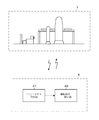
- FIG. 1 is a configuration example of the LNG plant 1 to which the operation guideline search method of this example is applied.
- the original LNG plant 1 is a heat exchanger for liquefaction after precooling NG (natural gas) from which impurities have been removed by pretreatment with a precooling heat exchanger 31 and separating gas and liquid with a scrub column 32.
- LNG is obtained by liquefying and supercooling in a cryogenic main heat exchanger (MCHE: Main Cryogenic Heat Exchanger) 33.
- MCHE Main Cryogenic Heat Exchanger
- a mixed refrigerant As a liquefaction refrigerant for liquefying and overcooling NG, a mixed refrigerant (MR: Mixed Refrigerant) is a mixture of a plurality of types of refrigerant raw materials selected from a group of refrigerant raw materials containing nitrogen and hydrocarbons such as methane, ethane, and propane. ) Is used.
- the MR used for liquefaction and overcooling of NG flows out of the MCHE 33 in a gaseous state, is sequentially compressed by a plurality of MR compressors 36 driven by a gas turbine (G / T) or the like, and each MR is compressed.
- MR cooler 204 Composed of ACHE (Air-Cooled Heat Exchanger) 2
- ACHE Air-Cooled Heat Exchanger
- the LNG plant 1 of this example uses a C3 refrigerant composed of a single component of propane or propylene as a refrigerant for precooling NG in the precooling heat exchanger 31 and a refrigerant for cooling MR in the MR cooler 37. ing.
- the C3 refrigerant used for NG precooling and MR cooling is also compressed and cooled, and then resupplied to the precooling heat exchanger 31 and the MR cooler 37.
- the liquid C3 refrigerant is stepped down through an expansion valve (not shown) and supplied to the C3 coolers 31 and 37 in a state where the temperature is lowered due to adiabatic expansion to cool each fluid to be cooled (NG or MR).
- the C3 refrigerant corresponds to one of the refrigerants used in the LNG plant 1.
- a desuperheater 201 for cooling the gas C3 refrigerant whose temperature has risen in the process of compression in a gaseous state and a gas C3 refrigerant cooled by the desuperheater 201 are further cooled.
- a condenser 202 for condensing the gas, a receiver (receiver) 353 for storing the liquid C3 refrigerant flowing out of the condenser 202, and a subcooler 203 for further cooling the liquid C3 refrigerant to an overcooled state are provided in this order from the upstream side. Has been done.
- the liquid C3 refrigerant supercooled by the subcooler 203 is sent to the C3 coolers 31 and 37 again via the expansion valve described above.
- the desuper heater 201, the condenser 202, and the sub cooler 203 are also configured by ACHE2.
- the LNG plant 1 includes the above-mentioned compressors (C3 refrigerant compressor 35, MR compressor 36), MR cooler 37, precooling heat exchanger 31, scrub column 32, rectifying towers of the rectifying section 34, MCHE33, and the like. It is composed of a large number of devices such as various pretreatment facilities that perform NG pretreatment. These devices include static devices such as tower tanks and heat exchangers, and dynamic devices such as pumps.
- the operating state of the target device is the pressure gauge (PI), thermometer (TI), flow meter (FI), composition analyzer (AI), and power measuring instrument (SC) that measures the power of each compressor 35, 36. ) And other measuring instruments (not shown).
- PI pressure gauge
- TI thermometer
- FI flow meter
- AI composition analyzer
- SC power measuring instrument
- the various measuring instruments can also measure various measured values of the device that is not controlled (corresponding to the "target device” in this example). It can.
- the manipulated variables, control variables, and variables other than these that can be acquired by using various measuring instruments are collectively referred to as process variables.
- the operation data indicating the actual value of the process variable may be data obtained by directly measuring with various measuring devices, or may be data calculated based on the measurement result.
- the LNG plant 1 is provided with various measuring instruments (not shown) for measuring disturbances such as outside air temperature, wind direction, wind speed, NG supply pressure, and NG composition in the area where the LNG plant 1 is installed. ing.
- various measuring instruments for measuring disturbances such as outside air temperature, wind direction, wind speed, NG supply pressure, and NG composition in the area where the LNG plant 1 is installed.
- the disturbance data showing the actual values of these disturbances
- the various measuring instruments provided in the LNG plant 1 have operation data, disturbance data, or these at data acquisition intervals (for example, 1-second intervals or 1-minute intervals) preset for each measuring device in chronological order. Acquire data for calculation.
- FIG. 2 is a configuration example of the driving guideline search system 4 of this example.
- the operation guideline search system 4 uses the above-mentioned operation data and disturbance data to obtain a compressor (C3 refrigerant compressor 35, MR compressor 36 in this example) per unit production amount of LNG under predetermined disturbance conditions. Search for the input value of the operating variable that minimizes the power (compressing power).
- the compressor power per unit production amount of LNG is also referred to as “SP (Specific Power)”.
- the operation guideline search system 4 is a data acquisition unit that acquires a large number of data sets of operation data and disturbance data acquired from the LNG plant 1 in chronological order, and the LNG plant by machine learning based on these many data sets. It is provided with a plant model creation unit 41 that creates the plant model of 1 and an operation guideline search unit 42 that searches for an input value of an operation variable that minimizes the SP by reinforcement learning using this plant model.
- the operation guideline search system 4 of this example can be configured by, for example, a computer installed in a place remote from the area where the LNG plant 1 is installed.
- the data acquisition unit is configured as a data communication unit that acquires the large number of data sets from the LNG plant 1 by data communication.
- the data acquisition unit acquires all operation data and disturbance data acquired at the LNG plant 1 during a predetermined period (for example, one week or one month).
- These data include operation data and disturbance data used for machine learning of the plant model by the plant model creation unit 41.
- the operation data and the disturbance data used for the machine learning may be selected in advance and only these data may be acquired.
- the plant model creation unit 41 uses a large number of datasets to perform machine learning to input the operation variables and disturbances. Create a plant model that represents the correspondence between the output values of process variables (excluding operation variables).
- the plant model creation unit 41 is composed of a computer equipped with a program for executing the machine learning.
- the plant model creation unit 41 may perform machine learning using at least one of known deep neural networks, support vector regression, random forest regression, and partial least squares method. Further, machine learning may be performed by combining two or more of these methods.
- the plant model creation unit 41 executes the machine learning using at least the operation data including the compression power of the compressors (C3 refrigerant compressor 35, MR compressor 36). Further, this operation data includes at least one selected from a process variable group consisting of the NG temperature on the inlet side of the MCHE33, the MR temperature on the inlet side of the MCHE33, the discharge pressure of the MR compressor 36, the power of the MR compressor 36, and the like. Machine learning can be performed using one process variable. Further, in the LNG plant 1 using the C3 refrigerant for precooling NG or cooling MR, at least one of the temperature of NG after precooling and the temperature of MR after cooling is set as a process variable in the process variable group. It may be included.
- the gas flow rate of the MR refrigerant, the liquid flow rate of the MR refrigerant, the composition of the MR refrigerant, and the compressors are driven by a rotary drive machine.
- Machine learning can be performed using the operation data of at least one operating variable selected from the operating variable group consisting of the number of revolutions of the case, the inlet guide vane opening degree of these compressors, and the like.
- the operation data used for machine learning is not limited to the variables listed in the above-mentioned process variable group and operation variable group, and may include operation data of other process variables.
- the plant model creation unit 41 is composed of a disturbance group including the outside air temperature of the installation area of the LNG plant 1, the supply pressure of NG to the LNG plant 1, the composition of NG, the supply temperature of NG, the supply amount of NG, etc.
- Machine learning can be performed using the disturbance data for the selected disturbance.
- the operation guideline search unit 42 searches for the input value of the operation variable that minimizes the SP described above by reinforcement learning using the plant model created by the plant model creation unit 41.
- the driving guideline search unit 42 is composed of a computer equipped with a program for executing the reinforcement learning.
- the driving guideline search unit 42 can exemplify a case where the input value of the instrumental variable whose SP is minimized is searched by deep reinforcement learning such as known proximity policy optimization or deep cue network.
- the driving guideline search unit 42 is not limited to deep reinforcement learning, and may be configured to search for input values of the operation variables by other types of reinforcement learning.
- the operation guideline search unit 42 is characterized in that the search is performed under the condition that the outlet temperature of LNG from the MCHE 33 is equal to or lower than the preset constraint temperature. By adding this constraint, it is possible to effectively eliminate the possibility that the input value of an unrealistic instrumental variable is searched.
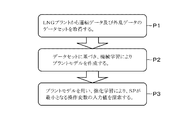
- preprocessing is performed from the acquired data set to remove the data set including the abnormal data, a part of the operation data, the data set in which the disturbance data is missing, and the like (step S201).
- the variables include at least compressive power, and process variables and other process variables selected from the above-mentioned process variable group, and disturbances and other disturbances selected from the disturbance group can be selected.
- the plant model creation unit 41 creates a plant model by machine learning (step S203).
- 5 (a) to 5 (c) show a part of the output of the created plant model.
- FIGS. 5A to 5C show the correspondence between the outside air temperature, which is one of the disturbances, the NG temperature at the MCHE33 inlet, the MR temperature at the MCHE33 inlet, and the MR compressor 36 discharge pressure, which are process variables. Shown. In the plant model, a large number of pairs of correspondence between the selected disturbance or manipulated variable and the process variable (excluding the manipulated variable) are acquired.
- step S204 in FIG. 4 it is confirmed whether or not the created plant model deviates from the actual operation of the LNG plant 1 (step S204 in FIG. 4).
- an evaluator who is familiar with the actual operation of the LNG plant 1 evaluates whether a correspondence of process variables that violates the actual causal relationship or physical law is created with respect to the disturbance or the direction of change of the instrumental variable. ..
- step S204 when the divergence is large (step S204; NO), the selection of variables and model types is changed (step S202), and machine learning is performed again (step S203). If the deviation is small (step S204; YES), the machine learning by the driving guideline search unit 42 ends (end).
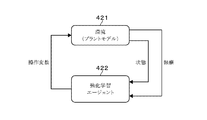
- the operation guideline search unit 42 carries out reinforcement learning using the environment 421 including the above-mentioned plant model and the reinforcement learning agent 422.
- the environment 421 receives the input values of the disturbance and the manipulated variable, and outputs the value of the process variable (excluding the manipulated variable) specified by using the plant model.
- the reinforcement learning agent 422 acquires the value (state) of the process variable output from the environment 421 and the result of performing the reward calculation using this value, and improves the reward according to the preset learning policy ( Create a new set of operating variables that can reduce the value of SP obtained from the plant model).
- a value base such as a deep cue network or a policy base such as proxyal policy optimization can be exemplified.
- step S301 a function for reward calculation for evaluating the value of the process variable output from the environment 421 is created. ..
- the learning policy of the reinforcement learning agent 422 is determined (step S302).
- step S303 the plant model created by the plant model creation unit 41 is used as the environment 421, and reinforcement learning of the reinforcement learning agent 422 is performed (step S303).
- the input value of the disturbance and an appropriate initial value of the manipulated variable are given to the environment 421, and the reinforcement learning loop shown in FIG. 7 is repeated.
- the reinforcement learning is finished (end).
- FIG. 9A shows the time course of the actual value of SP in the LNG plant 1. Further, in FIG. 9 (b), a plant model is created using the operation data and the disturbance data during the period in which the actual values of FIG. 9 (a) are obtained, and reinforcement learning is performed under the conditions of the disturbance during the period. The predicted value of SP estimated from the input value of the manipulated variable obtained by performing is shown. The actual value and predicted value of SP are standardized values with the common value as 100%.
- FIG. 9A it is confirmed that the SP changes significantly according to the temperature change during the day and night. That is, the SP is rising during the daytime when the temperature rises.
- the optimum SP value obtained as a result of reinforcement learning fluctuates greatly at very short intervals, and macroscopically changes with a predetermined bandwidth as shown in FIG. 9 (b).
- the input value of the manipulated variable obtained as a result of reinforcement learning as it is as the set value of the manipulated variable in the LNG plant 1 because the set value is changed at a very short interval.
- the result of reinforcement learning is used, and the operation variable at a certain time and the input value of the disturbance are operated after that time.
- Calculate the input value of the variable step S401).
- the input values of the manipulated variables that can minimize SP at each time point are output.
- the input value (that is, setting) of the operation variable used in actual operation that can be stably operated is used. Value) is determined.
- This set value can be used as an operation guideline and used as a new instrumental variable of the LNG plant 1 under a predetermined disturbance condition to perform an operation in which the SP value is reduced.
- the plant model of the LNG plant 1 is created by machine learning, and further reinforcement learning is performed to minimize the compression power per unit production amount of liquefied natural gas. Since the search is performed, the optimum operation can be performed according to the disturbance. In particular, since process variables and actual disturbance data are used as operation data and disturbance data to create a plant model, the validity of the optimum value is judged by the difference between the simulation result and the actual operation as in plant simulation. There is no need to individually search for what cannot be done or the conditions under which the simulation converges. As a result, highly accurate predictions can be made at high speed using a large number of disturbances and process variables.
- the LNG plant 1 to which the operation guideline search method of this example can be applied is not limited to the example shown in FIG.
- the LNG plant 1 of the one-step pressure type MR system may be a one-step pressure type MR type LNG plant 1 in which only the mixed refrigerant (MR) which is the liquefaction refrigerant is used without using the precooling refrigerant or the refrigerant cooling refrigerant (C3 refrigerant in this example).
- the LNG plant 1 using a single liquefaction refrigerant (refrigerant raw material: nitrogen or methane) may be used.
- the precooling refrigerant is not limited to the case where a single refrigerant raw material such as propane or propylene is used, and a mixed refrigerant such as methane, ethane, propane or butane may be used.
- the LNG plant 1 may be provided with a supercooler for supercooling LNG using a supercooling refrigerant using nitrogen or methane as a refrigerant raw material.
- the present technology can also be applied to a cascade-type LNG plant 1 in which LNG is obtained by sequentially cooling NG using a propane refrigerant, an ethylene refrigerant, and a methane refrigerant.
- the operation guideline search system 4 is not limited to the case where it is installed in a remote location in the installation area of the LNG plant 1. It may be provided in the control room of the LNG plant 1 as a part of the operation management system.
Landscapes
- Engineering & Computer Science (AREA)
- General Engineering & Computer Science (AREA)
- Physics & Mathematics (AREA)
- Mechanical Engineering (AREA)
- Thermal Sciences (AREA)
- Software Systems (AREA)
- Theoretical Computer Science (AREA)
- Artificial Intelligence (AREA)
- Computer Vision & Pattern Recognition (AREA)
- Medical Informatics (AREA)
- Data Mining & Analysis (AREA)
- Computing Systems (AREA)
- General Physics & Mathematics (AREA)
- Mathematical Physics (AREA)
- Evolutionary Computation (AREA)
- Chemical & Material Sciences (AREA)
- Chemical Kinetics & Catalysis (AREA)
- General Chemical & Material Sciences (AREA)
- Oil, Petroleum & Natural Gas (AREA)
- Feedback Control In General (AREA)
- Separation By Low-Temperature Treatments (AREA)
Abstract
Description
前記液化天然ガスプラントは、液化用冷媒を用い、天然ガスを液化して液化天然ガスを得る液化用熱交換器と、前記液化用冷媒を含む、前記液化天然ガスプラント内で用いられる冷媒が気化した後の冷媒ガスを圧縮する圧縮機とを備えることと、
前記圧縮機の圧縮動力を少なくとも含み、前記液化天然ガスプラントを構成する複数の対象機器についての制御変数及び操作変数を含むプロセス変数の実績値を示す運転データと、前記プロセス変数に影響を及ぼす外乱の実績値を示す外乱データと、を含む複数のデータセットを取得する工程と、
前記複数のデータセットに基づき、コンピュータを用いた機械学習により、前記操作変数及び外乱の入力値に応じた、前記操作変数以外のプロセス変数の出力値の対応関係を表すプラントモデルを作成する工程と、
前記プラントモデルに対して前記外乱の入力値と前記操作変数の初期値とを与え、コンピュータを用いた強化学習により、前記液化天然ガスの出口温度が予め設定された制約温度以下となる条件下で、前記液化天然ガスの単位生産量当たりの前記圧縮動力が最小となる前記操作変数の入力値を探索する工程と、を含むことと、を特徴とする。
(a)前記操作変数の入力値を探索する工程にて探索された前記操作変数の複数の入力値に基づき、前記操作変数として、前記液化天然ガスプラントの運転に実際に使用する入力値を決定する工程を含むこと。
(b)前記外乱として、前記液化天然ガスプラントの設置エリアの外気温度、前記液化天然ガスプラントへの天然ガスの供給圧力、天然ガスの組成、天然ガスの供給温度、天然ガスの供給量からなる外乱群から選択された外乱を含むこと。
(c)前記機械学習は、ディープニューラルネットワーク、サポートベクターリグレッション、ランダムフォレストリグレッション、部分最小二乗法少なくとも1つの手法を用いて前記プラントモデルを作成すること。
(d)前記圧縮機の圧縮動力以外の前記プロセス変数として、前記液化用熱交換器の入口側の天然ガスの温度、前記液化用熱交換器の入口側の液化用冷媒温度、液化用冷媒圧縮機吐出圧からなるプロセス変数群から選択されたプロセス変数を含み、前記操作変数として、前記液化用冷媒のガス流量、前記液化用冷媒の液体流量、前記液化用冷媒の組成、前記圧縮機が回転駆動機により駆動される場合の回転数、または前記圧縮機のインレットガイドベーン開度からなる操作変数群から選択された操作変数を含むこと。前記冷媒が、前記液化用冷媒により液化される前の前記天然ガスの予冷却を行う予冷用冷媒、または前記液化用冷媒の冷却を行う冷媒冷却用冷媒の少なくとも一方を含む場合に、前記プロセス変数群はさらに前記予冷却後の天然ガスの温度、前記冷却後の液化用冷媒の温度の少なくとも一つをプロセス変数として含むこと。
液化用冷媒を用い、天然ガスを液化して液化天然ガスを得る液化用熱交換器と、前記液化用冷媒を含む、冷媒が気化した後の冷媒ガスを圧縮する圧縮機とを備える前記液化天然ガスプラントから、前記圧縮機の圧縮動力を少なくとも含み、前記液化天然ガスプラントを構成する複数の対象機器についての制御変数及び操作変数を含むプロセス変数の実績値を示す運転データと、前記プロセス変数に影響を及ぼす外乱の実績値を示す外乱データと、を含む複数のデータセットを取得するデータ取得部と、
前記データ取得部にて取得した複数のデータセットに基づき、コンピュータを用いた機械学習により、前記操作変数及び外乱の入力値に応じた、前記操作変数以外のプロセス変数の出力値の対応関係を表すプラントモデルを作成するプラントモデル作成部と、
前記プラントモデル作成部にて作成したプラントモデルに対して前記外乱の入力値と前記操作変数の初期値とを与え、コンピュータを用いた強化学習により、前記液化天然ガスの出口温度が予め設定された制約温度以下となる条件下で、前記液化天然ガスの単位生産量当たりの前記圧縮動力が最小となる前記操作変数の入力値を探索する運転指針探索部と、を備えることを特徴とする。
本来のLNGプラント1は、前処理により不純物が除去されたNG(天然ガス)を予冷熱交換器31にて予冷却し、スクラブカラム32にて気液分離した後、液化用熱交換器である極低温主熱交換器(MCHE:Main Cryogenic Heat Exchanger)33にて液化、過冷却してLNGを得る。スクラブカラム32にて気液分離された液体は、精留部34にて精留され、精留の際に分離された軽質成分はMCHE33へと送られてLNGとなる。
NGの液化・過冷却に使用されたMRは、気体の状態でMCHE33から流出し、ガスタービン(G/T)などにより駆動される複数のMR圧縮機36にて順次、圧縮され、各MR圧縮機36の出口側に設けられたMRクーラー204(ACHE(Air-Cooled Heat Exchanger)2により構成される)にて冷却される。圧縮・冷却後のMRは、MR冷却器37にてさらに冷却されてからMCHE33へと再供給される。MRは、LNGプラント1内で用いられる冷媒の1つに相当する。
液体C3冷媒は、不図示の膨張弁を介して降圧され、断熱膨張により温度低下した状態でC3冷却器31、37に供給されて各被冷却流体(NGやMR)を冷却する。C3冷媒は、LNGプラント1内で用いられる冷媒の1つに相当する。
LNGプラント1に設けられた各種測定器は、時系列に沿って、測定機器ごとに予め設定されたデータ取得間隔(例えば1秒間隔や1分間隔)にて運転データや外乱データ、またはこれらの算出用のデータを取得する。
機械学習に用いる運転データには、上述のプロセス変数群や操作変数群に列挙した各変数に限定されず、他のプロセス変数の運転データを含んでもよい。
例えば運転指針探索部42は、公知のプロキシマルポリシーオプティマイゼーションやディープキューネットワークなどの深層強化学習によりSPが最小となる操作変数の入力値を探索する場合を例示することができる。なお、運転指針探索部42は、深層強化学習に限定されず、他の種類の強化学習により前記操作変数の入力値の探索を行うように構成してもよい。
はじめに、LNGプラント1から運転指針探索システム4へと運転データ及外乱データのデータセットを多数セット取得する(図3の処理P1)。
はじめに、取得したデータセットから、異常データを含むデータセットや、一部の運転データ、外乱データが欠損したデータセットなどを除く前処理を行う(ステップS201)
図7に示すように、運転指針探索部42は既述のプラントモデルを含む環境421と、強化学習エージェント422とを用いて強化学習を実施する。環境421は、外乱及び操作変数の入力値を受け取り、前記プラントモデルを用いて指定されたプロセス変数(操作変数を除く)の値を出力する。
一方、強化学習の結果得られる最適なSPの値は、非常に短い間隔で大きく変動し、巨視的にみると図9(b)に示すように所定のバンド幅を持って変化することが確認された。このとき、強化学習の結果得られた操作変数の入力値をそのままLNGプラント1における操作変数の設定値とすることは、非常に短い間隔で設定値を変化させることとなり現実的ではない。
特に、プラントモデル作成のために運転データや外乱データとしてプロセス変数や外乱の実績値を用いているので、プラントシミュレーションのようにシミュレーション結果と実運転とが乖離することによって最適値の妥当性が判断できないことや、シミュレーションが収束する条件を個別に探索する必要がない。この結果、多数の外乱やプロセス変数を用い、精度の高い予測を高速で行うことができる。
例えば予冷用冷媒や冷媒冷却用冷媒(本例ではC3冷媒)を用いず、液化用冷媒である混合冷媒(MR)のみを用いた1段階圧力式MR方式のLNGプラント1であってもよい。
この他、プロパン冷媒、エチレン冷媒、メタン冷媒を用いて、NGを順次、冷却することによりLNGを得るカスケード方式のLNGプラント1に対しても、本技術を適用することができる。
4 運転指針探索システム
41 プラントモデル作成部
42 運転指針探索部
421 環境
422 強化学習エージェント
Claims (11)
- 液化天然ガスプラントの運転指針探索方法であって、
前記液化天然ガスプラントは、液化用冷媒を用い、天然ガスを液化して液化天然ガスを得る液化用熱交換器と、前記液化用冷媒を含む、前記液化天然ガスプラント内で用いられる冷媒が気化した後の冷媒ガスを圧縮する圧縮機とを備えることと、
前記圧縮機の圧縮動力を少なくとも含み、前記液化天然ガスプラントを構成する複数の対象機器についての制御変数及び操作変数を含むプロセス変数の実績値を示す運転データと、前記プロセス変数に影響を及ぼす外乱の実績値を示す外乱データと、を含む複数のデータセットを取得する工程と、
前記複数のデータセットに基づき、コンピュータを用いた機械学習により、前記操作変数及び外乱の入力値に応じた、前記操作変数以外のプロセス変数の出力値の対応関係を表すプラントモデルを作成する工程と、
前記プラントモデルに対して前記外乱の入力値と前記操作変数の初期値とを与え、コンピュータを用いた強化学習により、前記液化天然ガスの出口温度が予め設定された制約温度以下となる条件下で、前記液化天然ガスの単位生産量当たりの前記圧縮動力が最小となる前記操作変数の入力値を探索する工程と、を含むことと、を特徴とする運転指針探索方法。 - 前記操作変数の入力値を探索する工程にて探索された前記操作変数の複数の入力値に基づき、前記操作変数として、前記液化天然ガスプラントの運転に実際に使用する入力値を決定する工程を含むことを特徴とする請求項1に記載の運転指針探索方法。
- 前記外乱として、前記液化天然ガスプラントの設置エリアの外気温度、前記液化天然ガスプラントへの天然ガスの供給圧力、天然ガスの組成、天然ガスの供給温度、天然ガスの供給量からなる外乱群から選択された外乱を含むことを特徴とする請求項1に記載の運転指針探索方法。
- 前記機械学習は、ディープニューラルネットワーク、サポートベクターリグレッション、ランダムフォレストリグレッション、部分最小二乗法の少なくとも1つの手法を用いて前記プラントモデルを作成することを特徴とする請求項1に記載の運転指針探索方法。
- 前記圧縮機の圧縮動力以外の前記プロセス変数として、前記液化用熱交換器の入口側の天然ガスの温度、前記液化用熱交換器の入口側の液化用冷媒温度、液化用冷媒圧縮機吐出圧からなるプロセス変数群から選択されたプロセス変数を含み、
前記操作変数として、前記液化用冷媒のガス流量、前記液化用冷媒の液体流量、前記液化用冷媒の組成、前記圧縮機が回転駆動機により駆動される場合の回転数、または前記圧縮機のインレットガイドベーン開度からなる操作変数群から選択された操作変数を含むことを特徴とする請求項1に記載の運転指針探索方法。 - 前記冷媒が、前記液化用冷媒により液化される前の前記天然ガスの予冷却を行う予冷用冷媒、または前記液化用冷媒の冷却を行う冷媒冷却用冷媒の少なくとも一方を含む場合に、前記プロセス変数群はさらに前記予冷却後の天然ガスの温度、前記冷却後の液化用冷媒の温度の少なくとも一つをプロセス変数として含むことを特徴とする請求項5に記載の運転指針探索方法。
- 液化天然ガスプラントの運転指針探索システムであって、
液化用冷媒を用い、天然ガスを液化して液化天然ガスを得る液化用熱交換器と、前記液化用冷媒を含む、冷媒が気化した後の冷媒ガスを圧縮する圧縮機とを備える前記液化天然ガスプラントから、前記圧縮機の圧縮動力を少なくとも含み、前記液化天然ガスプラントを構成する複数の対象機器についての制御変数及び操作変数を含むプロセス変数の実績値を示す運転データと、前記プロセス変数に影響を及ぼす外乱の実績値を示す外乱データと、を含む複数のデータセットを取得するデータ取得部と、
前記データ取得部にて取得した複数のデータセットに基づき、コンピュータを用いた機械学習により、前記操作変数及び外乱の入力値に応じた、前記操作変数以外のプロセス変数の出力値の対応関係を表すプラントモデルを作成するプラントモデル作成部と、
前記プラントモデル作成部にて作成したプラントモデルに対して前記外乱の入力値と前記操作変数の初期値とを与え、コンピュータを用いた強化学習により、前記液化天然ガスの出口温度が予め設定された制約温度以下となる条件下で、前記液化天然ガスの単位生産量当たりの前記圧縮動力が最小となる前記操作変数の入力値を探索する運転指針探索部と、を備えることを特徴とする運転指針探索システム。 - 前記プラントモデル作成部は、前記外乱として、前記液化天然ガスプラントの設置エリアの外気温度、前記液化天然ガスプラントへの天然ガスの供給圧力、天然ガスの組成、天然ガスの供給温度、天然ガスの供給量からなる外乱群から選択された外乱についての外乱データを用いて機械学習を行うことを特徴とする請求項7に記載の運転指針探索システム。
- 前記プラントモデル作成部は、ディープニューラルネットワーク、サポートベクターリグレッション、ランダムフォレストリグレッション、部分最小二乗法の少なくとも一つの手法を用いて前記プラントモデルを作成することを特徴とする請求項7に記載の運転指針探索システム。
- 前記プラントモデル作成部は、
前記圧縮機の圧縮動力以外の前記プロセス変数として、前記液化用熱交換器の入口側の天然ガスの温度、前記液化用熱交換器の入口側の液化用冷媒温度、液化用冷媒圧縮機吐出圧からなるプロセス変数群から選択されたプロセス変数の運転データと、
前記操作変数として、前記液化用冷媒のガス流量、前記液化用冷媒の液体流量、前記液化用冷媒の組成、前記圧縮機が回転駆動機により駆動される場合の回転数、または前記圧縮機のインレットガイドベーン開度からなる操作変数群から選択された操作変数を含むプロセス変数の運転データとを用いて機械学習を行うことを特徴とする請求項7に記載の運転指針探索システム。 - 前記冷媒が、前記液化用冷媒により液化される前の前記天然ガスの予冷却を行う予冷用冷媒、または前記液化用冷媒の冷却を行う冷媒冷却用冷媒の少なくとも一方を含む場合に、
前記プラントモデル作成部は、さらに前記予冷却後の天然ガスの温度、前記冷却後の液化用冷媒の温度の少なくとも一つをプロセス変数として含む前記プロセス変数群から選択されたプロセス変数の運転データを用いて機械学習を行うことを特徴とする請求項10に記載の運転指針探索システム。
Priority Applications (4)
| Application Number | Priority Date | Filing Date | Title |
|---|---|---|---|
| US17/294,425 US11874056B2 (en) | 2019-05-13 | 2019-05-13 | Operation guidance searching method and operation guidance searching system |
| JP2019566849A JP6781851B1 (ja) | 2019-05-13 | 2019-05-13 | 運転指針探索方法、及び運転指針探索システム |
| AU2019445489A AU2019445489B2 (en) | 2019-05-13 | 2019-05-13 | Operation guidance searching method and operation guidance searching system |
| PCT/JP2019/018954 WO2020230239A1 (ja) | 2019-05-13 | 2019-05-13 | 運転指針探索方法、及び運転指針探索システム |
Applications Claiming Priority (1)
| Application Number | Priority Date | Filing Date | Title |
|---|---|---|---|
| PCT/JP2019/018954 WO2020230239A1 (ja) | 2019-05-13 | 2019-05-13 | 運転指針探索方法、及び運転指針探索システム |
Publications (1)
| Publication Number | Publication Date |
|---|---|
| WO2020230239A1 true WO2020230239A1 (ja) | 2020-11-19 |
Family
ID=73022391
Family Applications (1)
| Application Number | Title | Priority Date | Filing Date |
|---|---|---|---|
| PCT/JP2019/018954 Ceased WO2020230239A1 (ja) | 2019-05-13 | 2019-05-13 | 運転指針探索方法、及び運転指針探索システム |
Country Status (4)
| Country | Link |
|---|---|
| US (1) | US11874056B2 (ja) |
| JP (1) | JP6781851B1 (ja) |
| AU (1) | AU2019445489B2 (ja) |
| WO (1) | WO2020230239A1 (ja) |
Cited By (1)
| Publication number | Priority date | Publication date | Assignee | Title |
|---|---|---|---|---|
| WO2022236222A1 (en) * | 2021-05-03 | 2022-11-10 | Exxonmobil Upstream Research Company | Machine learning for the optimization of liquefaction processes in the production of liquefied natural gas |
Citations (4)
| Publication number | Priority date | Publication date | Assignee | Title |
|---|---|---|---|---|
| WO2007123924A2 (en) * | 2006-04-19 | 2007-11-01 | Saudi Arabian Oil Company | Optimization of a dual refrigeration system natural gas liquid plant via empirical experimental method |
| JP2013540973A (ja) * | 2010-03-25 | 2013-11-07 | ザ・ユニバーシティ・オブ・マンチェスター | 冷却プロセス |
| JP2017142595A (ja) * | 2016-02-09 | 2017-08-17 | ファナック株式会社 | 生産制御システムおよび統合生産制御システム |
| JP6286812B2 (ja) * | 2016-03-10 | 2018-03-07 | 日揮株式会社 | 天然ガス液化装置の混合冷媒組成の決定方法 |
Family Cites Families (2)
| Publication number | Priority date | Publication date | Assignee | Title |
|---|---|---|---|---|
| WO2017097764A1 (en) * | 2015-12-08 | 2017-06-15 | Shell Internationale Research Maatschappij B.V. | Controlling refrigerant compression power in a natural gas liquefaction process |
| RU2640976C1 (ru) | 2017-05-05 | 2018-01-12 | Компания "Сахалин Энерджи Инвестмент Компани Лтд." | Способ управления процессом сжижения природного газа |
-
2019
- 2019-05-13 JP JP2019566849A patent/JP6781851B1/ja active Active
- 2019-05-13 US US17/294,425 patent/US11874056B2/en active Active
- 2019-05-13 WO PCT/JP2019/018954 patent/WO2020230239A1/ja not_active Ceased
- 2019-05-13 AU AU2019445489A patent/AU2019445489B2/en active Active
Patent Citations (4)
| Publication number | Priority date | Publication date | Assignee | Title |
|---|---|---|---|---|
| WO2007123924A2 (en) * | 2006-04-19 | 2007-11-01 | Saudi Arabian Oil Company | Optimization of a dual refrigeration system natural gas liquid plant via empirical experimental method |
| JP2013540973A (ja) * | 2010-03-25 | 2013-11-07 | ザ・ユニバーシティ・オブ・マンチェスター | 冷却プロセス |
| JP2017142595A (ja) * | 2016-02-09 | 2017-08-17 | ファナック株式会社 | 生産制御システムおよび統合生産制御システム |
| JP6286812B2 (ja) * | 2016-03-10 | 2018-03-07 | 日揮株式会社 | 天然ガス液化装置の混合冷媒組成の決定方法 |
Cited By (1)
| Publication number | Priority date | Publication date | Assignee | Title |
|---|---|---|---|---|
| WO2022236222A1 (en) * | 2021-05-03 | 2022-11-10 | Exxonmobil Upstream Research Company | Machine learning for the optimization of liquefaction processes in the production of liquefied natural gas |
Also Published As
| Publication number | Publication date |
|---|---|
| JP6781851B1 (ja) | 2020-11-04 |
| AU2019445489A1 (en) | 2021-06-10 |
| AU2019445489B2 (en) | 2024-12-19 |
| JPWO2020230239A1 (ja) | 2021-06-03 |
| US20210396463A1 (en) | 2021-12-23 |
| US11874056B2 (en) | 2024-01-16 |
Similar Documents
| Publication | Publication Date | Title |
|---|---|---|
| US10753677B2 (en) | Methods and systems for enhancing production of liquefied natural gas | |
| US12460861B2 (en) | Method and system for production optimization | |
| RU2142605C1 (ru) | Способ и устройство для регулируемого контроля выработки и температуры в оборудовании со смешанным хладагентом, предназначенном для сжижения природного газа | |
| US10012432B2 (en) | Method and apparatus for cooling a hydrocarbon stream | |
| KR950000479B1 (ko) | 가스 액화 공정 제어장치 | |
| RU2640976C1 (ru) | Способ управления процессом сжижения природного газа | |
| JP6286812B2 (ja) | 天然ガス液化装置の混合冷媒組成の決定方法 | |
| Key et al. | Choose the best refrigeration technology for small-scale LNG production | |
| RU2706892C2 (ru) | Способ и устройство для охлаждения криогенного теплообменника и способ сжижения потока углеводородов | |
| Sanavandi et al. | Normalized sensitivity analysis of LNG processes-Case studies: Cascade and single mixed refrigerant systems | |
| CN102483695A (zh) | 在具有平行序列的气体装置中的制冷系统控制方法 | |
| JP7397192B2 (ja) | 液化天然ガスプラントの運転条件決定方法及びそのシステム | |
| JP6781851B1 (ja) | 運転指針探索方法、及び運転指針探索システム | |
| Fazlali Serkani et al. | Sensitivity Analysis of Simple Expander–Nitrogen and Two Expander–Nitrogen Liquefaction Processes of Natural Gas | |
| Changizian et al. | Exploring efficiency: an in-depth analysis of the energy, exergy, and sensitivity in four traditional liquefied natural gas processes | |
| WO2025190798A1 (en) | A method for optimizing the operation of a thermodynamic system of a liquefied natural gas plant | |
| CA3047931C (en) | Method of refrigerant composition control in premixed refrigerant cycle of liquefied natural gas production | |
| Khan | Process Efficiency Optimisation of Cascade LNG Process | |
| Omar et al. | Process Design and Operational Optimisation of a C3MR LNG Liquefaction Process Using Mathematical Modeling and Thermodynamic Analysis. | |
| Hansen et al. | Process model and capacity upgrades of the CTI-4000 liquid helium coldbox | |
| Verma et al. | Analysis of various liquid nitrogen pre-cooling schemes for large-scale helium liquefiers/refrigerators | |
| Serkani et al. | Gas Processing Journal | |
| Leer | SPECIALIZATION PROJECT 2011 |
Legal Events
| Date | Code | Title | Description |
|---|---|---|---|
| ENP | Entry into the national phase |
Ref document number: 2019566849 Country of ref document: JP Kind code of ref document: A |
|
| 121 | Ep: the epo has been informed by wipo that ep was designated in this application |
Ref document number: 19928416 Country of ref document: EP Kind code of ref document: A1 |
|
| ENP | Entry into the national phase |
Ref document number: 2019445489 Country of ref document: AU Date of ref document: 20190513 Kind code of ref document: A |
|
| WWE | Wipo information: entry into national phase |
Ref document number: DZP2021000459 Country of ref document: DZ |
|
| NENP | Non-entry into the national phase |
Ref country code: DE |
|
| 122 | Ep: pct application non-entry in european phase |
Ref document number: 19928416 Country of ref document: EP Kind code of ref document: A1 |