WO2020179865A1 - シアリダーゼ活性検出蛍光プローブ - Google Patents
シアリダーゼ活性検出蛍光プローブ Download PDFInfo
- Publication number
- WO2020179865A1 WO2020179865A1 PCT/JP2020/009391 JP2020009391W WO2020179865A1 WO 2020179865 A1 WO2020179865 A1 WO 2020179865A1 JP 2020009391 W JP2020009391 W JP 2020009391W WO 2020179865 A1 WO2020179865 A1 WO 2020179865A1
- Authority
- WO
- WIPO (PCT)
- Prior art keywords
- group
- sialidase
- atom
- carbon atoms
- salt
- Prior art date
- Legal status (The legal status is an assumption and is not a legal conclusion. Google has not performed a legal analysis and makes no representation as to the accuracy of the status listed.)
- Ceased
Links
Images



Classifications
-
- C—CHEMISTRY; METALLURGY
- C12—BIOCHEMISTRY; BEER; SPIRITS; WINE; VINEGAR; MICROBIOLOGY; ENZYMOLOGY; MUTATION OR GENETIC ENGINEERING
- C12Q—MEASURING OR TESTING PROCESSES INVOLVING ENZYMES, NUCLEIC ACIDS OR MICROORGANISMS; COMPOSITIONS OR TEST PAPERS THEREFOR; PROCESSES OF PREPARING SUCH COMPOSITIONS; CONDITION-RESPONSIVE CONTROL IN MICROBIOLOGICAL OR ENZYMOLOGICAL PROCESSES
- C12Q1/00—Measuring or testing processes involving enzymes, nucleic acids or microorganisms; Compositions therefor; Processes of preparing such compositions
- C12Q1/34—Measuring or testing processes involving enzymes, nucleic acids or microorganisms; Compositions therefor; Processes of preparing such compositions involving hydrolase
- C12Q1/40—Measuring or testing processes involving enzymes, nucleic acids or microorganisms; Compositions therefor; Processes of preparing such compositions involving hydrolase involving amylase
-
- C—CHEMISTRY; METALLURGY
- C07—ORGANIC CHEMISTRY
- C07H—SUGARS; DERIVATIVES THEREOF; NUCLEOSIDES; NUCLEOTIDES; NUCLEIC ACIDS
- C07H17/00—Compounds containing heterocyclic radicals directly attached to hetero atoms of saccharide radicals
- C07H17/04—Heterocyclic radicals containing only oxygen as ring hetero atoms
-
- C—CHEMISTRY; METALLURGY
- C07—ORGANIC CHEMISTRY
- C07D—HETEROCYCLIC COMPOUNDS
- C07D493/00—Heterocyclic compounds containing oxygen atoms as the only ring hetero atoms in the condensed system
- C07D493/02—Heterocyclic compounds containing oxygen atoms as the only ring hetero atoms in the condensed system in which the condensed system contains two hetero rings
- C07D493/10—Spiro-condensed systems
-
- C—CHEMISTRY; METALLURGY
- C12—BIOCHEMISTRY; BEER; SPIRITS; WINE; VINEGAR; MICROBIOLOGY; ENZYMOLOGY; MUTATION OR GENETIC ENGINEERING
- C12Q—MEASURING OR TESTING PROCESSES INVOLVING ENZYMES, NUCLEIC ACIDS OR MICROORGANISMS; COMPOSITIONS OR TEST PAPERS THEREFOR; PROCESSES OF PREPARING SUCH COMPOSITIONS; CONDITION-RESPONSIVE CONTROL IN MICROBIOLOGICAL OR ENZYMOLOGICAL PROCESSES
- C12Q1/00—Measuring or testing processes involving enzymes, nucleic acids or microorganisms; Compositions therefor; Processes of preparing such compositions
- C12Q1/34—Measuring or testing processes involving enzymes, nucleic acids or microorganisms; Compositions therefor; Processes of preparing such compositions involving hydrolase
-
- C—CHEMISTRY; METALLURGY
- C12—BIOCHEMISTRY; BEER; SPIRITS; WINE; VINEGAR; MICROBIOLOGY; ENZYMOLOGY; MUTATION OR GENETIC ENGINEERING
- C12Q—MEASURING OR TESTING PROCESSES INVOLVING ENZYMES, NUCLEIC ACIDS OR MICROORGANISMS; COMPOSITIONS OR TEST PAPERS THEREFOR; PROCESSES OF PREPARING SUCH COMPOSITIONS; CONDITION-RESPONSIVE CONTROL IN MICROBIOLOGICAL OR ENZYMOLOGICAL PROCESSES
- C12Q1/00—Measuring or testing processes involving enzymes, nucleic acids or microorganisms; Compositions therefor; Processes of preparing such compositions
- C12Q1/68—Measuring or testing processes involving enzymes, nucleic acids or microorganisms; Compositions therefor; Processes of preparing such compositions involving nucleic acids
- C12Q1/6876—Nucleic acid products used in the analysis of nucleic acids, e.g. primers or probes
-
- G—PHYSICS
- G01—MEASURING; TESTING
- G01N—INVESTIGATING OR ANALYSING MATERIALS BY DETERMINING THEIR CHEMICAL OR PHYSICAL PROPERTIES
- G01N33/00—Investigating or analysing materials by specific methods not covered by groups G01N1/00 - G01N31/00
- G01N33/48—Biological material, e.g. blood, urine; Haemocytometers
- G01N33/50—Chemical analysis of biological material, e.g. blood, urine; Testing involving biospecific ligand binding methods; Immunological testing
- G01N33/53—Immunoassay; Biospecific binding assay; Materials therefor
- G01N33/536—Immunoassay; Biospecific binding assay; Materials therefor with immune complex formed in liquid phase
- G01N33/542—Immunoassay; Biospecific binding assay; Materials therefor with immune complex formed in liquid phase with steric inhibition or signal modification, e.g. fluorescent quenching
-
- G—PHYSICS
- G01—MEASURING; TESTING
- G01N—INVESTIGATING OR ANALYSING MATERIALS BY DETERMINING THEIR CHEMICAL OR PHYSICAL PROPERTIES
- G01N33/00—Investigating or analysing materials by specific methods not covered by groups G01N1/00 - G01N31/00
- G01N33/48—Biological material, e.g. blood, urine; Haemocytometers
- G01N33/50—Chemical analysis of biological material, e.g. blood, urine; Testing involving biospecific ligand binding methods; Immunological testing
- G01N33/58—Chemical analysis of biological material, e.g. blood, urine; Testing involving biospecific ligand binding methods; Immunological testing involving labelled substances
- G01N33/582—Chemical analysis of biological material, e.g. blood, urine; Testing involving biospecific ligand binding methods; Immunological testing involving labelled substances with fluorescent label
-
- G—PHYSICS
- G01—MEASURING; TESTING
- G01N—INVESTIGATING OR ANALYSING MATERIALS BY DETERMINING THEIR CHEMICAL OR PHYSICAL PROPERTIES
- G01N21/00—Investigating or analysing materials by the use of optical means, i.e. using sub-millimetre waves, infrared, visible or ultraviolet light
- G01N21/75—Systems in which material is subjected to a chemical reaction, the progress or the result of the reaction being investigated
- G01N21/77—Systems in which material is subjected to a chemical reaction, the progress or the result of the reaction being investigated by observing the effect on a chemical indicator
- G01N2021/7769—Measurement method of reaction-produced change in sensor
- G01N2021/7786—Fluorescence
-
- G—PHYSICS
- G01—MEASURING; TESTING
- G01N—INVESTIGATING OR ANALYSING MATERIALS BY DETERMINING THEIR CHEMICAL OR PHYSICAL PROPERTIES
- G01N2333/00—Assays involving biological materials from specific organisms or of a specific nature
- G01N2333/90—Enzymes; Proenzymes
- G01N2333/914—Hydrolases (3)
- G01N2333/924—Hydrolases (3) acting on glycosyl compounds (3.2)
Definitions
- the present invention relates to a novel fluorescent probe for detecting sialidase activity.
- Sialidase is an exo-type glycolytic enzyme that releases sialic acid from the non-reducing end of the sugar chain. It is involved in important cell functions such as cell proliferation/differentiation and apoptosis, and is present on the surface of influenza virus. Involved in virus growth. Therefore, sialidase can be a biomarker for detecting pathological conditions and viral infections.
- all of the existing fluorescent probes for detecting sialidase activity have problems such as those that function in the ultraviolet light region and properties such as precipitation of enzyme reaction products, resulting in poor biocompatibility.
- 4MU-NANA (2'-(4-methylumbelliferyl) - ⁇ -DN-acetylneuraminic acid) is an artificial sialidase substrate widely used for fluorescence detection of sialidase, although Due to its excitation and emission wavelengths at high energy wavelengths, this probe is rather unsuitable for in vivo fluorescence imaging.
- Suzuki et al. reported a novel fluorescent sialidase probe (BTP3-Neu5Ac) having improved fluorescent properties.
- the probe was It is suitable only for chemical staining (Non-Patent Document 4). Therefore, there is an urgent need for fluorescent sialidase substrates for in-vivo imaging.
- the present invention aims at providing a novel fluorescent probe for detecting sialidase activity.
- Sialic acid is an acidic monosaccharide that terminates cell surface glycans, and its removal is catalyzed by sialidase.
- the expression of sialidase is known to increase in various cancers, and we investigated whether the HMRef-sialic acid complex could be used as a fluorescent probe to detect sialidase activity.
- HMRef-Neu5Ac sialic acid
- HMRef-Neu5Ac exhibits non-fluorescent to highly fluorescent properties
- this probe exhibits instability over time.
- the present inventors have found that the glycosidic bond of sialic acid is very sensitive to acid hydrolysis. Therefore, as a result of diligent studies, the present inventors have introduced a spacer (self-decomposable linker) having a specific structure between the sialic acid (Neu5Ac) portion and the HMRef skeleton structure, whereby a glycoside bond of sialic acid is introduced.
- the present invention has been completed by finding that it is possible to provide a probe capable of suppressing acid hydrolysis of sialidase and effectively detecting the activity of sialidese.
- the present invention is [1] A compound represented by the following general formula (I) or a salt thereof.
- R 1 indicates the same or different monovalent substituents present on the benzene ring, if present
- R 2 and R 3 independently represent a hydrogen atom, an alkyl group having 1 to 6 carbon atoms, or a halogen atom
- R 4 and R 5 independently represent a hydrogen atom, an alkyl group having 1 to 6 carbon atoms, or a halogen atom
- R 6 represents a hydrogen atom, an alkyl group having 1 to 5 carbon atoms, or an alkyl fluoride group having 1 to 5 carbon atoms
- R 6 ' represents a hydrogen atom or a C 1-6 alkyl group having a carbon R 6 ', together with R 3 or R 5, R 6' may form a heterocyclyl or heteroaryl of 5-7 membered containing a nitrogen atom which is bonded
- R 7 and R 8 if present, independently represent
- R 9 is independently selected from a hydrogen atom, an alkyl group having 1 to 5 carbon atoms, an alkoxy group, a hydroxyl group, a carboxyl group, a halogen atom, a sulfo group, an amino group, an alkoxycarbonyl group, and an oxo group at each appearance;
- R 10 indicates the same or different monovalent substituents present on the benzene ring, if present;
- X represents an oxygen atom, a silicon atom or a carbon atom;
- m is an integer from 0 to 4;
- n is an integer of 1 to 3;
- s is an integer of 1;
- t is an integer of 0 to 4.
- [2] The compound according to [1] or a salt thereof, wherein R 6 is -CH 2- CF 3 .
- a fluorescent probe for detecting sialidase activity which comprises the compound according to [1] or [2] or a salt thereof.
- [4] A method for detecting the activity of sialidase. (A) The step of introducing the compound according to [1] or [2] or a salt thereof into a cell, and (b) measuring the fluorescence emitted by the reaction of the compound or a salt thereof with a sialidase in the cell. A method that includes a process. Is to provide.
- the sialidase activity-detecting fluorescent probe of the present invention is highly biocompatible because it can be excited with visible light and emits fluorescence without precipitating the enzyme reaction product. It also has the effect of improving the stability of the compound by introducing sialic acid as a substrate via a self-degrading linker.
- the probe of the present invention can be applied to various biological and medical studies related to sialidase, and is a research tool for sialidase. It is expected to make a significant contribution as a diagnostic tool.
- HMRef-Neu5Ac The scheme of enzymatic hydrolysis of HMRef-Neu5Ac and HMRef-S-Neu5Ac, which is an example of the compound of the present invention, in the presence of sialidase is shown.
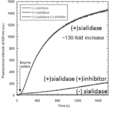
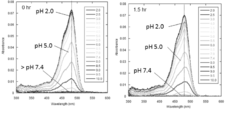
- Time-dependent change in fluorescence intensity of HMRef-Neu5Ac accompanying enzyme reaction The result of having measured the absorption spectrum of HMRef-Neu5Ac in various pH values.
- Time-dependent change in fluorescence intensity of HMRef-S-Neu5Ac accompanying enzyme reaction Results of measuring absorption spectra of HMRef-S-Neu5Ac at various pH values.
- the results of measuring the fluorescence intensities of HMRef-Neu5Ac and HMRef-S-Neu5Ac over time at various pH values are shown.
- the alkyl part of an “alkyl group” or a substituent containing an alkyl part has, for example, 1 to 6 carbon atoms, preferably 1 to 4 carbon atoms, unless otherwise specified. More preferably, it means an alkyl group having about 1 to 3 carbon atoms, which is linear, branched, cyclic, or a combination thereof.
- examples of the alkyl group include, for example, methyl group, ethyl group, n-propyl group, isopropyl group, cyclopropyl group, n-butyl group, sec-butyl group, isobutyl group, tert-butyl group, cyclopropyl group.
- examples thereof include a methyl group, an n-pentyl group, an n-hexyl group and the like.
- halogen atom may be any of a fluorine atom, a chlorine atom, a bromine atom, or an iodine atom, preferably a fluorine atom, a chlorine atom, or a bromine atom.
- One aspect of the present invention is a compound represented by the following general formula (I) or a salt thereof.
- a spacer autolytic linker having a specific structure between the sialic acid (Neu5Ac) moiety and the skeletal structure of HMRef. This makes it possible to provide a probe capable of suppressing acid hydrolysis of the glycosidic bond of sialic acid and effectively detecting the activity of sialidase.
- R 1 when present, represents the same or different monovalent substituents present on the benzene ring.
- the monovalent substituent include halogen, an optionally substituted alkyl group and the like.
- n is an integer from 0 to 4. In one preferred aspect of the invention, m is 0 and R 1 is absent and unsubstituted benzene ring.
- R 2 and R 3 each independently represent a hydrogen atom, an alkyl group having 1 to 6 carbon atoms, or a halogen atom.
- the alkyl group may contain one or more halogen atoms, carboxy groups, sulfonyl groups, hydroxyl groups, amino groups, alkoxy groups and the like.
- the alkyl group indicated by R 2 or R 3 may be an alkyl halide group, a hydroxyalkyl group, a carboxyalkyl group, or the like.
- R 2 and R 3 are each independently hydrogen atom or a halogen atom, R 2 and R 3 are both fluorine atoms, when a chlorine atom is more preferable.
- R 4 and R 5 each independently represent a hydrogen atom, an alkyl group having 1 to 6 carbon atoms, or a halogen atom, and are the same as those described for R 2 and R 3 . It is preferable that both R 4 and R 5 are hydrogen atoms.
- R 6 represents a hydrogen atom, an alkyl group having 1 to 5 carbon atoms, or a fluorinated alkyl group having 1 to 5 carbon atoms.
- alkyl group of R 6 a methyl group and an ethyl group are preferable.
- fluorinated alkyl group for R 6 —CH 2 —CF 3 and —CH 2 —CH 2 —CF 3 are preferable.
- R 6 is -CH 2- CF 3 .
- R 6 ' represents a hydrogen atom or a C 1-6 alkyl group having a carbon.
- R 6 ' represents an alkyl group, a halogen atom in the alkyl group, a carboxy group, a sulfonyl group, a hydroxyl group, an amino group, an alkoxy group may be present one or more, for example R
- the alkyl group indicated by 5 or R 6 may be an alkyl halide group, a hydroxyalkyl group, a carboxyalkyl group or the like.
- R 6 ' is hydrogen atom.
- R 6 ' together with R 3 or R 5, R 6' may form a heterocyclyl or heteroaryl of 5-7 membered containing a nitrogen atom which is bound.
- the heterocyclyl or heteroaryl may contain 1 to 3 additional heteroatoms selected from the group consisting of oxygen, nitrogen and sulfur atoms as ring members.
- Heterocyclyl or heteroaryl means an alkyl group having 1 to 6 carbon atoms, an alkenyl group having 2 to 6 carbon atoms, or an alkynyl group having 2 to 6 carbon atoms, an aralkyl group having 6 to 10 carbon atoms (benzyl group, It may be substituted with an alkyl-substituted alkenyl group having 6 to 10 carbon atoms (such as a phenethyl group).
- Examples of the heterocyclyl or heteroaryl thus formed include, but are not limited to, pyrrolidine, piperidine, hexamethyleneimine, pyrrole, imidazole, pyrazole, oxazole, thiazole and the like.
- R 7 and R 8 each independently represent an alkyl group or an aryl group having 1 to 6 carbon atoms when present, whereas R 7 and R 8 independently represent each other. It is preferably an alkyl group having 1 to 3 carbon atoms, and more preferably both R 7 and R 8 are methyl groups.
- the alkyl group represented by R 7 and R 8 may contain one or more halogen atoms, carboxy groups, sulfonyl groups, hydroxyl groups, amino groups, alkoxy groups, etc., for example, R 7 or R 8 indicates.
- the alkyl group may be an alkyl halide group, a hydroxyalkyl group, a carboxyalkyl group or the like.
- the aryl group may be either a monocyclic aromatic group or a condensed aromatic group, and the aryl ring is one or more ring-constituting heteroatoms. It may contain (for example, a nitrogen atom, an oxygen atom, or a sulfur atom).
- a phenyl group is preferred as the aryl group.
- One or more substituents may be present on the aryl ring. As the substituent, for example, one or two or more halogen atoms, carboxy groups, sulfonyl groups, hydroxyl groups, amino groups, alkoxy groups and the like may be present.
- R 7 and R 8 do not exist.
- R 9 is independently selected from a hydrogen atom, an alkyl group having 1 to 5 carbon atoms, an alkoxy group, a hydroxyl group, a carboxyl group, a halogen atom, a sulfo group, an amino group, an alkoxycarbonyl group, and an oxo group at each appearance. It is preferably a hydrogen atom.
- S is an integer of 1.
- R 10 represents the same or different monovalent substituents present on the benzene ring, if present.
- the monovalent substituent include halogen, an optionally substituted alkyl group and the like.
- t is an integer of 0 to 4. In one preferred aspect of the present invention, t is 0 and R 10 is absent and an unsubstituted benzene ring.
- X represents an oxygen atom, a silicon atom or a carbon atom. In one preferred aspect of the invention, X is an oxygen atom.
- N is an integer of 1 to 3, and preferably n is 1.
- the compound represented by the general formula (I) of the present invention can exist as an acid addition salt or a base addition salt.
- the acid addition salt include mineral salts such as hydrochlorides, sulfates and nitrates, or organic acid salts such as methanesulfonates, p-toluenesulfonates, oxalates, citrates and tartrates.
- the base addition salt include metal salts such as sodium salt, potassium salt, calcium salt, magnesium salt, ammonium salt, and organic amine salt such as triethylamine salt. In addition to these, it may form a salt with an amino acid such as glycine.
- the compound of the present invention or a salt thereof may exist as a hydrate or a solvate, and these substances are also within the scope of the present invention.
- the compound represented by the general formula (I) of the present invention may have one or two or more asymmetric carbons depending on the type of the substituent, but is based on one or two or more asymmetric carbons.
- stereoisomers such as optically active substances and diastereoisomers based on two or more asymmetric carbons, any mixture of stereoisomers, racemates, etc. are all included in the scope of the present invention.
- a method for producing a typical compound of the compound of the present invention is specifically shown in the examples of the present specification. Therefore, those skilled in the art can appropriately select reaction materials, reaction conditions, reaction reagents, etc. based on these explanations, and modify or modify these methods as necessary to obtain a general formula ( The compounds of the present invention represented by I) can be prepared.
- the compound of the present invention represented by the general formula (I) of the present invention is useful as a fluorescent probe for detecting sialidase activity. That is, another aspect of the present invention is a fluorescent probe containing the compound represented by the general formula (I) or a salt thereof. Further, another aspect of the present invention is a method for detecting intracellular sialidase activity, wherein (a) a step of introducing a compound represented by the general formula (I) or a salt thereof into cells, and ( b) A method comprising a step of measuring fluorescence emitted by the reaction of the compound or a salt thereof with sialidase in cells.
- the compound of the present invention represented by the general formula (I) or a salt thereof is characterized by being substantially non-fluorescent in an environment without sialidase or having only weak fluorescence, but emitting strong fluorescence in an environment with sialidase.
- FIG. 1 shows a scheme of enzymatic hydrolysis of HMRef-Neu5Ac in the presence of sialidase and HMRef-S-Neu5Ac, which is an example of the compound of the present invention.
- sialidase examples include various sialidases, for example, sialidases present in mammalian cells (NEU1, NEU2, NEU3, NEU4), bacterial sialidase, etc., but are not limited to these. Not something.
- the method of using the fluorescent probe of the present invention is not particularly limited, and it can be used in the same manner as a conventionally known fluorescent probe.
- aqueous medium such as physiological saline or a buffer solution, or a mixture of an aqueous medium and an aqueous solvent such as ethanol, acetone, ethylene glycol, dimethyl sulfoxide, or dimethyl formamide.
- the compounds to be prepared or salts thereof may be dissolved, and this solution may be added to a suitable buffer solution containing cells or tissues, and the fluorescence spectrum may be measured.
- the fluorescent probe of the present invention may be used in the form of a composition in combination with a suitable additive. For example, it can be combined with additives such as a buffering agent, a solubilizing agent, and a pH adjusting agent.
- the NMR spectrum was obtained by a Bruker NMR AVANCE III 400 spectrometer [1H (400 MHz), 13C (101 MHz)] using deuterated solvent.
- High resolution ESI mass spectra were obtained with microOTOF II (Bruker).
- HPLC purification was performed on JASCO PU-2087 Plus pumps (GL Science Co., Ltd.) and UVIDEC-100 equipped with Inerttil-ODS-3 columns ( ⁇ 10 ⁇ 250 mm (semi-preparation) and ⁇ 20 ⁇ 250 mm (preparation)).
- -V detector JASCO
- Silica gel column chromatography was performed using silica gel 60N (spherical, neutral, 63 to 210 ⁇ m; manufactured by Kanto Chemical Co., Inc.). TLC was performed on silica gel plate F254 (0.25 mm (analysis); Merck, AKG). The UV-vis spectrum was obtained with a Shimadzu UV-2450 spectrophotometer.
- Fluorescence spectra were obtained on Hitachi F-7000.
- the absolute fluorescence quantum efficiency was measured using an absolute PL quantum yield measuring device, Quantualus-QY (Hamamatsu Photonics).
- the probe was dissolved in dimethyl sulfoxide (DMSO, fluorescence measurement grade, Dojin Chemical Laboratory) to obtain a stock solution.
- DMSO dimethyl sulfoxide
- Optical properties of the probe were obtained in 0.2 M sodium phosphate buffer or 100 mM NaOAc, 2 mM CaCl 2 , pH 6.5 buffer or 50 mM NaOAc, 2 mM CaCl 2 , 100 ⁇ g / mL BSA, pH 7.4 buffer. did.
- the probe DMSO stock solution was diluted in 100 mM NaOAc, 2 mM CaCl 2 , pH 7.4 buffer to a final concentration of 1 ⁇ M.
- the fluorescence of the solution before the addition of sialidase was measured every second (excitation wavelength 490 nm, emission wavelength 520 nm).
- neuraminidase (0.01U) from Arthrobacter ureafaciens was used in this assay.
- V 0 is the steady state rate of probe substrate rotation by neuraminidase
- V max is the maximum rate (mM/min)
- X is the probe concentration in the reaction mixture (mM)
- K m is the reaction rate V It is a Michaelis constant (mM) which is half of max . Equation 1 was adapted to the data using the KaleidaGraph 4.5.2 software (Synergy Software).
- Fig. 2a When the same reaction was monitored in the absence of the enzyme, a 3-fold increase in fluorescence enhancement was observed, indicating probe instability over time.
- the absorption spectra of the probes were measured with buffer solutions of various pHs and compared immediately after the probe was dissolved and 1.5 hours later (the spectral shape changed significantly after 1.5 hours (FIG. 2b), that is, 1 During the 5 hours, a shift in absorption maximal was observed, that is, a change in spectral shape that was apparently converted to the hydrolysis product HMRef was observed.
- HMRef-S-Neu5Ac was synthesized according to the procedure of the following reaction scheme.
- HMRef (79 mg, 0.2 mmol) and NaH (6 mg, 0.26 mmol) were added dry THF (3 mL) and dry DMF (1 mL) and the mixture was stirred under argon at 0 °C.
- Example 2 The reactivity of HMRef-Neu5Ac and HMRef-S-Neu5Ac with sialidase in the presence of the sialidase inhibitor DANA was also evaluated.
- Table 1 shows the photochemical properties of HMRef-Neu5Ac and HMRef-S-Neu5Ac. In each case, the fluorescence intensity value is low at pH 7.4. This indicates that HMRef-S-Neu5Ac is more stable, but both probes function as sialidase-activated fluorescent probes.
- Example 3 The stability of HMRef-Neu5Ac and HMRef-S-Neu5Ac was directly compared by recording changes in fluorescence intensity over time at a pH range.
- the initial fluorescence intensities of both probes differ in pH value as a result of their pKcycl values, ie the lower the pH, the higher the initial fluorescence intensity.
- FIG. 4 shows the results of measuring the fluorescence intensities of HMRef-Neu5Ac and HMRef-S-Neu5Ac over time at various pH values. The measurement was carried out in a 0.2 M sodium phosphate buffer solution at 37° C., and the measurement value was taken every 5 minutes. Excitation/emission wavelengths of 485 nm/535 nm were used respectively.
- HMRef-Neu5Ac showed clear instability over all pHs over a time range of 2 hours in the experiment. This was particularly noticeable at pH 2 and 4, with complete hydrolysis observed after about 40 minutes.
- the fluorescence intensity of HMRef-S-Neu5Ac remained almost unchanged over the two hours confirming its improved stability.
- the optimum pH for efficient catalysis by mammalian sialidase is in a wide range of 4.4 to 6.5 (T. Miyagi, K. Yamaguchi, Glycobiology, 2012, 22, 880.). Therefore, it was crucial to determine the stability of the probe over these relevant pH values and it was confirmed that HMRef-S-Neu5Ac does not show an increase in fluorescence intensity due to acid hydrolysis.
- HMRef-Neu5Ac and HMRef-S-Neu5Ac were determined according to the method previously described by Govorkova et al. And compared with that of the commercially available sialidase substrate 4-MUNANA.
- k cat / K m values Table 2
- HMRef-Neu5Ac and towards HMRef-S-Neu5Ac can be respectively 16 times and 13 times more often than 4-MUNANA, new probe further the sensitivity and quantitative detection of sialidase activity It proved to be suitable.
- the target enzyme was sialidase, which is the majority of the enzyme group known to cleave final sialic acid from complex sugars on glycoproteins and glycolipids.
- the first probe developed to detect sialidase, HMRef-Neu5Ac has been shown to be unstable due to the carboxylate moiety of the sialic acid residue flanking the glycosidic bond. This adjacent carboxyl group stabilizes the intermediate carbonium ion and promotes the acid hydrolysis mechanism.
Landscapes
- Chemical & Material Sciences (AREA)
- Life Sciences & Earth Sciences (AREA)
- Health & Medical Sciences (AREA)
- Organic Chemistry (AREA)
- Engineering & Computer Science (AREA)
- Molecular Biology (AREA)
- Immunology (AREA)
- Proteomics, Peptides & Aminoacids (AREA)
- Biotechnology (AREA)
- General Health & Medical Sciences (AREA)
- Biochemistry (AREA)
- Zoology (AREA)
- Wood Science & Technology (AREA)
- Analytical Chemistry (AREA)
- Genetics & Genomics (AREA)
- Physics & Mathematics (AREA)
- Microbiology (AREA)
- Urology & Nephrology (AREA)
- Hematology (AREA)
- Biomedical Technology (AREA)
- General Engineering & Computer Science (AREA)
- Bioinformatics & Cheminformatics (AREA)
- Biophysics (AREA)
- Medicinal Chemistry (AREA)
- Pathology (AREA)
- General Physics & Mathematics (AREA)
- Food Science & Technology (AREA)
- Cell Biology (AREA)
- Measuring Or Testing Involving Enzymes Or Micro-Organisms (AREA)
Abstract
【解決課題】 新規なシアリダーゼ活性検出蛍光プローブを提供すること。 【解決手段】 以下の一般式(I)で表される化合物又はその塩。
Description
本発明は、新規なシアリダーゼ活性検出蛍光プローブに関する。
シアリダーゼ(ノイラミニダーゼ)は、糖鎖の非還元末端からシアル酸を遊離するエキソ型糖分解酵素で、細胞増殖・分化、アポトーシス等の重要な細胞機能に関わっている他、インフルエンザウィルスの表面に存在しウィルス増殖に関与している。そのため、シアリダーゼは病態やウィルス感染を検出するためのバイオマーカーとなりうる。しかしながら、既存のシアリダーゼ活性検出する蛍光プローブはいずれも紫外光領域で機能するものや、酵素反応生成物が沈殿するなどの性質があり、生体適合性に乏しいといった問題点があった。
例えば、4MU-NANA(2’-(4-メチルウンベリフェリル)-α-D-N-アセチルノイラミン酸)は、シアリダーゼの蛍光検出のために広く使用されている人工シアリダーゼ基質であるが、その励起および発光波長が高エネルギー波長にあるため、このプローブは生体内の蛍光イメージングにはむしろ適していない。また、2014年には、Suzukiらは改良された蛍光特性を有する新規の蛍光シアリダーゼプローブ(BTP3-Neu5Ac)を報告しているが、その加水分解産物の水不溶性の性質のために、プローブは組織化学染色にのみ適している(非特許文献4)。したがって、in-vivoイメージング用の蛍光シアリダーゼ基質が緊急に必要とされている。
J. Ferlay, I. Soerjomataram, R. Dikshit, S. Eser, C. Mathers, M. Rebelo, D.M. Parkin, D. Forman, F. Bray, Int. J. Cancer, 2015, 136, E359.
J. Vansteenkiste, L. Crino, C. Dooms, J.Y. Douillard, C. Faivre-Finn, E. Lim, G. Rocco, S. Senan, P. Van Schil, G. Veronesi, R. Stahel, S. Peters, E.F. Felip and Panel Members, Ann. Oncol. 2014, 25, 1462.
D. Asanuma, M. Sakabe, M. Kamiya, K. Yamamoto, J. Hiratake, M. Ogawa, N. Kosaka, P.L. Choyke, T. Nagano, H. Kobayashi, Y. Urano, Nat. Commun. 2015, 6, 6463.
A. Minami, T. Otsubo, D. Ieno, K. Ikeda, H. Kanazawa, K. Shimizu, K. Ohata, T. Yokochi, Y. Horii, H. Fukmoto, R. Taguchi, T. Takahashi, N. Oku, T. Suzuki, PLoS One, 2014, 9, e81941.
本発明は、新規なシアリダーゼ活性検出蛍光プローブを提供することを目的とする。
シアル酸は、細胞表面グリカンを終結させる酸性単糖であり、その除去はシアリダーゼによって触媒される。シアリダーゼの発現は様々な癌において増加することが知られており、本発明者らはHMRef-シアル酸複合体がシアリダーゼ活性検出する蛍光プローブとして使用できるかどうかを検討した。
本発明者らは、当初、本発明者らが最近開発したβ-ガラクトシダーゼのプローブであるHMRef-βGalのシアル酸(Neu5Ac)のβ-ガラクトシド部分を置換することにより、シアリダーゼの新規な蛍光プローブである、HMRef-Neu5Acを合成しその光学特性を調べた。

しかしながら、HMRef-Neu5Acは非蛍光型から高蛍光性の特性を示すものの、時間の経過に伴い本プローブが不安定性を示すことに気付いた。本発明者らは、その原因を調べたところ、シアル酸のグリコシド結合が酸加水分解に非常に敏感であることが判明した。そこで、本発明者らは、鋭意検討した結果、シアル酸(Neu5Ac)部分とHMRefの骨格構造の間に特定の構造を有するスペーサー(自己分解性リンカー)を導入することにより、シアル酸のグリコシド結合の酸加水分解を抑制でき、シアリダーゼの活性を有効に検出することができるプローブを提供できることを見出し、本発明を完成した。
即ち、本発明は、
[1] 以下の一般式(I)で表される化合物又はその塩。
 (式中、
(式中、
R1は、存在する場合は、ベンゼン環上に存在する同一又は異なる一価の置換基を示し;
R2及びR3は、それぞれ独立に、水素原子、炭素数1~6個のアルキル基又はハロゲン原子を示し;
R4及びR5は、それぞれ独立に、水素原子、炭素数1~6個のアルキル基又はハロゲン原子を示し;
R6は、水素原子、炭素数1~5個のアルキル基、又は炭素数1~5個のフッ化アルキル基を示し;
R6’は、水素原子又は炭素数1~6個のアルキル基を示し、
R6’は、R3又はR5と一緒になって、R6’が結合している窒素原子を含む5~7員のヘテロシクリル又はヘテロアリールを形成していてもよく;
R7及びR8は、存在する場合は、それぞれ独立に、炭素数1~6個のアルキル基又はアリール基を示し、
ここで、Xが酸素原子の場合は、R7及びR8は存在せず;
R9は、各出現において独立に、水素原子、炭素数1~5個のアルキル基、アルコキシ基、水酸基、カルボキシル基、ハロゲン原子、スルホ基、アミノ基、アルコキシカルボニル基、オキソ基から選択され;
R10は、存在する場合は、ベンゼン環上に存在する同一又は異なる一価の置換基を示し;
Xは、酸素原子、珪素原子又は炭素原子を示し;
mは、0~4の整数であり;
nは、1~3の整数であり;
sは、1の整数であり;
tは、0~4の整数である。)
[2]R6が-CH2-CF3である、[1]に記載の化合物又はその塩。
[3][1]又は[2]に記載の化合物又はその塩を含むシアリダーゼ活性検出蛍光プローブ。
[4]シアリダーゼの活性を検出する方法であって、
(a)[1]又は[2]に記載の化合物又はその塩を細胞内に導入する工程、及び
(b)当該化合物又はその塩が細胞内でシアリダーゼと反応することにより発せられる蛍光を測定する工程
を含む方法。
を提供するものである。
[1] 以下の一般式(I)で表される化合物又はその塩。
R1は、存在する場合は、ベンゼン環上に存在する同一又は異なる一価の置換基を示し;
R2及びR3は、それぞれ独立に、水素原子、炭素数1~6個のアルキル基又はハロゲン原子を示し;
R4及びR5は、それぞれ独立に、水素原子、炭素数1~6個のアルキル基又はハロゲン原子を示し;
R6は、水素原子、炭素数1~5個のアルキル基、又は炭素数1~5個のフッ化アルキル基を示し;
R6’は、水素原子又は炭素数1~6個のアルキル基を示し、
R6’は、R3又はR5と一緒になって、R6’が結合している窒素原子を含む5~7員のヘテロシクリル又はヘテロアリールを形成していてもよく;
R7及びR8は、存在する場合は、それぞれ独立に、炭素数1~6個のアルキル基又はアリール基を示し、
ここで、Xが酸素原子の場合は、R7及びR8は存在せず;
R9は、各出現において独立に、水素原子、炭素数1~5個のアルキル基、アルコキシ基、水酸基、カルボキシル基、ハロゲン原子、スルホ基、アミノ基、アルコキシカルボニル基、オキソ基から選択され;
R10は、存在する場合は、ベンゼン環上に存在する同一又は異なる一価の置換基を示し;
Xは、酸素原子、珪素原子又は炭素原子を示し;
mは、0~4の整数であり;
nは、1~3の整数であり;
sは、1の整数であり;
tは、0~4の整数である。)
[2]R6が-CH2-CF3である、[1]に記載の化合物又はその塩。
[3][1]又は[2]に記載の化合物又はその塩を含むシアリダーゼ活性検出蛍光プローブ。
[4]シアリダーゼの活性を検出する方法であって、
(a)[1]又は[2]に記載の化合物又はその塩を細胞内に導入する工程、及び
(b)当該化合物又はその塩が細胞内でシアリダーゼと反応することにより発せられる蛍光を測定する工程
を含む方法。
を提供するものである。
本発明のシアリダーゼ活性検出蛍光プローブは、可視光での励起が可能である上、酵素反応生成物が沈殿することなく蛍光を発するため、生体適合性が高い。また、自己分解性のリンカーを介して基質となるシアル酸を導入することで、化合物の安定性を改善するという効果も有する。
これらの効果は、本発明のプローブがシアリダーゼに関する様々な生物学研究及び医学研究に適用できることを示唆するものであり、シアリダーゼに関する研究ツール。診断ツールとして大きく貢献することが期待される。
本明細書において、「アルキル基」又はアルキル部分を含む置換基(例えばアルコキシ基など)のアルキル部分は、特に言及しない場合には例えば炭素数1~6個、好ましくは炭素数1~4個、更に好ましくは炭素数1~3個程度の直鎖、分枝鎖、環状、又はそれらの組み合わせからなるアルキル基を意味している。より具体的には、アルキル基として、例えば、メチル基、エチル基、n-プロピル基、イソプロピル基、シクロプロピル基、n-ブチル基、sec-ブチル基、イソブチル基、tert-ブチル基、シクロプロピルメチル基、n-ペンチル基、n-ヘキシル基などを挙げることができる。
本明細書において「ハロゲン原子」という場合には、フッ素原子、塩素原子、臭素原子、又はヨウ素原子のいずれでもよく、好ましくはフッ素原子、塩素原子、又は臭素原子である。
本発明の1つの態様は、以下の一般式(I)で表される化合物又はその塩である。
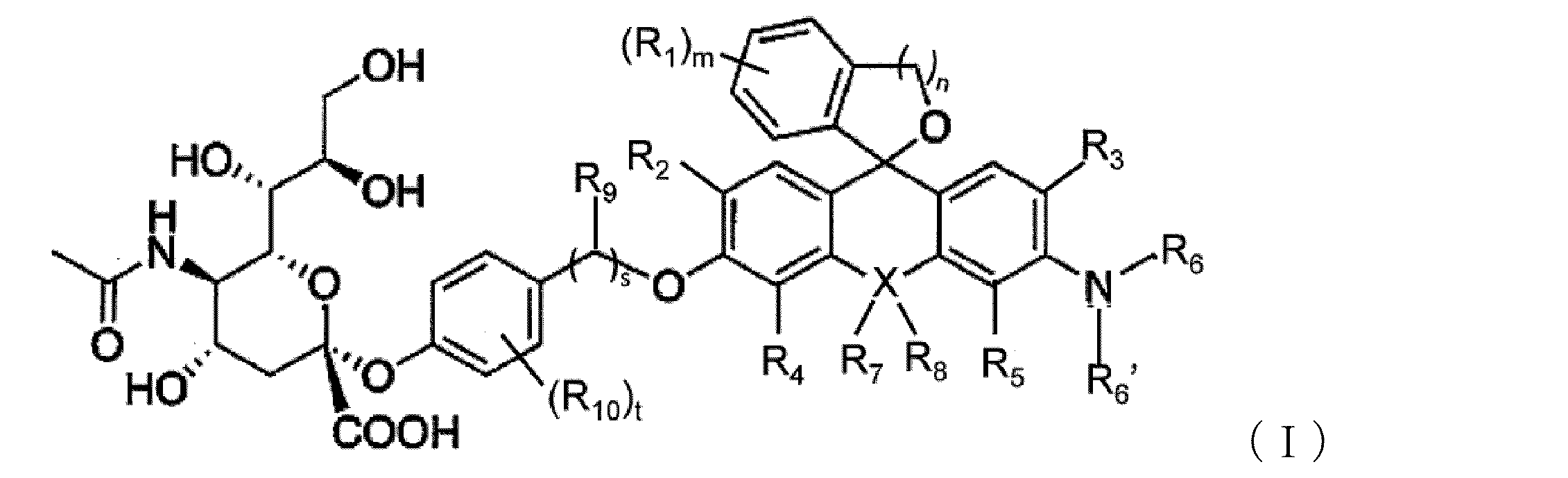
本発明においては、シアル酸(Neu5Ac)部分とHMRefの骨格構造の間に特定の構造を有するスペーサー(自己分解性リンカー)導入することが重要である。これにより、シアル酸のグリコシド結合の酸加水分解を抑制でき、シアリダーゼの活性を有効に検出することが可能なプローブを提供することができる。
一般式(I)において、R1は、存在する場合は、ベンゼン環上に存在する同一又は異なる一価の置換基を示す。一価の置換基としては、ハロゲン、置換されていてもよいアルキル基等が挙げられる。
mは、0~4の整数である。
本発明の1つの好ましい側面においては、mが0であり、R1存在せずに無置換のベンゼン環である。
本発明の1つの好ましい側面においては、mが0であり、R1存在せずに無置換のベンゼン環である。
一般式(I)において、R2及びR3は、それぞれ独立に、水素原子、炭素数1~6個のアルキル基又はハロゲン原子を示す。
R2及びR3がアルキル基を示す場合には、該アルキル基にはハロゲン原子、カルボキシ基、スルホニル基、水酸基、アミノ基、アルコキシ基などが1個又は2個以上存在していてもよく、例えばR2又はR3が示すアルキル基はハロゲン化アルキル基、ヒドロキシアルキル基、カルボキシアルキル基などであってもよい。R2及びR3がそれぞれ独立に水素原子又はハロゲン原子であることが好ましく、R2及びR3がともにフッ素原子であるか、塩素原子である場合がより好ましい。
R2及びR3がアルキル基を示す場合には、該アルキル基にはハロゲン原子、カルボキシ基、スルホニル基、水酸基、アミノ基、アルコキシ基などが1個又は2個以上存在していてもよく、例えばR2又はR3が示すアルキル基はハロゲン化アルキル基、ヒドロキシアルキル基、カルボキシアルキル基などであってもよい。R2及びR3がそれぞれ独立に水素原子又はハロゲン原子であることが好ましく、R2及びR3がともにフッ素原子であるか、塩素原子である場合がより好ましい。
R4及びR5は、それぞれ独立に、水素原子、炭素数1~6個のアルキル基、又はハロゲン原子を示し、R2及びR3について説明したものと同様である。R4及びR5が共に水素原子であることが好ましい。
R6は、水素原子、炭素数1~5個のアルキル基、又は炭素数1~5個のフッ化アルキル基を示す。R6のアルキル基としては、メチル基、エチル基が好ましい。R6のフッ化アルキル基としては、-CH2-CF3、-CH2-CH2-CF3が好ましい。
本発明の1つの好ましい側面においては、R6は、-CH2-CF3である。
本発明の1つの好ましい側面においては、R6は、-CH2-CF3である。
R6’は、水素原子又は炭素数1~6個のアルキル基を示す。R6’がアルキル基を示す場合には、該アルキル基にはハロゲン原子、カルボキシ基、スルホニル基、水酸基、アミノ基、アルコキシ基などが1個又は2個以上存在していてもよく、例えばR5又はR6が示すアルキル基はハロゲン化アルキル基、ヒドロキシアルキル基、カルボキシアルキル基などであってもよい。
本発明の化合物の1つの好ましい側面においては、R6’は、水素原子である。
本発明の化合物の1つの好ましい側面においては、R6’は、水素原子である。
R6’は、R3又はR5と一緒になって、R6’が結合している窒素原子を含む5~7員のヘテロシクリル又はヘテロアリールを形成していてもよい。
ヘテロシクリル又はヘテロアリールは環構成員として酸素原子、窒素原子及び硫黄原子からなる群から選択される1~3個の更なるヘテロ原子を含有していてもよい。
ヘテロシクリル又はヘテロアリールは、炭素数1~6個のアルキル基、炭素数2~6個のアルケニル基、又は炭素数2~6個のアルキニル基、炭素数6~10個のアラルキル基(ベンジル基、フェネチル基等)、炭素数6~10個のアルキル置換アルケニル基で置換されていてもよい。
このようにして形成されるヘテロシクリル又はヘテロアリールとしては、例えば、ピロリジン、ピペリジン、ヘキサメチレンイミン、ピロール、イミダゾール、ピラゾール、オキサゾール、チアゾールなどが挙げられるが、これらに限定されない。
ヘテロシクリル又はヘテロアリールは環構成員として酸素原子、窒素原子及び硫黄原子からなる群から選択される1~3個の更なるヘテロ原子を含有していてもよい。
ヘテロシクリル又はヘテロアリールは、炭素数1~6個のアルキル基、炭素数2~6個のアルケニル基、又は炭素数2~6個のアルキニル基、炭素数6~10個のアラルキル基(ベンジル基、フェネチル基等)、炭素数6~10個のアルキル置換アルケニル基で置換されていてもよい。
このようにして形成されるヘテロシクリル又はヘテロアリールとしては、例えば、ピロリジン、ピペリジン、ヘキサメチレンイミン、ピロール、イミダゾール、ピラゾール、オキサゾール、チアゾールなどが挙げられるが、これらに限定されない。
一般式(I)において、R7及びR8は、存在する場合は、それぞれ独立に、炭素数1~6個のアルキル基又はアリール基を示すが、R7及びR8は、それぞれ独立に、炭素数1~3個のアルキル基であることが好ましく、R7及びR8がともにメチル基であることがより好ましい。R7及びR8が示すアルキル基にはハロゲン原子、カルボキシ基、スルホニル基、水酸基、アミノ基、アルコキシ基などが1個又は2個以上存在していてもよく、例えばR7又はR8が示すアルキル基はハロゲン化アルキル基、ヒドロキシアルキル基、カルボキシアルキル基などであってもよい。
R7又はR8がアリール基を示す場合には、アリール基は単環の芳香族基又は縮合芳香族基のいずれであってもよく、アリール環は1個又は2個以上の環構成ヘテロ原子(例えば窒素原子、酸素原子、又は硫黄原子など)を含んでいてもよい。アリール基としてはフェニル基が好ましい。アリール環上には1個又は2個以上の置換基が存在していてもよい。置換基としては、例えばハロゲン原子、カルボキシ基、スルホニル基、水酸基、アミノ基、アルコキシ基などが1個又は2個以上存在していてもよい。
R7又はR8がアリール基を示す場合には、アリール基は単環の芳香族基又は縮合芳香族基のいずれであってもよく、アリール環は1個又は2個以上の環構成ヘテロ原子(例えば窒素原子、酸素原子、又は硫黄原子など)を含んでいてもよい。アリール基としてはフェニル基が好ましい。アリール環上には1個又は2個以上の置換基が存在していてもよい。置換基としては、例えばハロゲン原子、カルボキシ基、スルホニル基、水酸基、アミノ基、アルコキシ基などが1個又は2個以上存在していてもよい。
また、後述するXが酸素原子の場合は、R7及びR8は存在しない。
R9は、各出現において独立に、水素原子、炭素数1~5個のアルキル基、アルコキシ基、水酸基、カルボキシル基、ハロゲン原子、スルホ基、アミノ基、アルコキシカルボニル基、オキソ基から選択され、好ましくは、水素原子である。
sは、1の整数である。
R10は、存在する場合、ベンゼン環上に存在する同一又は異なる一価の置換基を示す。
一価の置換基としては、ハロゲン、置換されていてもよいアルキル基等が挙げられる。
一価の置換基としては、ハロゲン、置換されていてもよいアルキル基等が挙げられる。
tは、0~4の整数である。
本発明の1つの好ましい側面においては、tが0であり、R10は存在せずに無置換のベンゼン環である。
本発明の1つの好ましい側面においては、tが0であり、R10は存在せずに無置換のベンゼン環である。
Xは、酸素原子、珪素原子又は炭素原子を示す。
本発明の1つの好ましい側面においては、Xは酸素原子である。
本発明の1つの好ましい側面においては、Xは酸素原子である。
nは、1~3の整数であり、好ましくは、nは1である。
本発明の一般式(I)で表される化合物は、酸付加塩又は塩基付加塩として存在することができる。酸付加塩としては、例えば、塩酸塩、硫酸塩、硝酸塩などの鉱酸塩、又はメタンスルホン酸塩、p-トルエンスルホン酸塩、シュウ酸塩、クエン酸塩、酒石酸塩などの有機酸塩などを挙げることができ、塩基付加塩としては、ナトリウム塩、カリウム塩、カルシウム塩、マグネシウム塩などの金属塩、アンモニウム塩、又はトリエチルアミン塩などの有機アミン塩などを挙げることができる。これらのほか、グリシンなどのアミノ酸との塩を形成する場合もある。本発明の化合物又はその塩は、水和物又は溶媒和物として存在する場合もあるが、これらの物質も本発明の範囲内である。
本発明の一般式(I)で表される化合物は、置換基の種類により、1個又は2個以上の不斉炭素を有する場合があるが、1個又は2個以上の不斉炭素に基づく光学活性体や2個以上の不斉炭素に基づくジアステレオ異性体などの立体異性体のほか、立体異性体の任意の混合物、ラセミ体などは、いずれも本発明の範囲に包含される。
本発明の化合物の代表的化合物の製造方法を本明細書の実施例に具体的に示した。従って、当業者は、これらの説明をもとにして、反応原料、反応条件、及び反応試薬などを適宜選択して、必要に応じてこれらの方法に修飾や改変を加えることにより、一般式(I)で表される本発明の化合物を製造することができる。
本発明の一般式(I)で表される本発明の化合物は、シアリダーゼ活性を検出する蛍光プローブとして有用である。
即ち、本発明のもう1つの態様は、一般式(I)で表される化合物又はその塩を含む蛍光プローブである。
また、本発明のもう1つの態様は、細胞内のシアリダーゼ活性を検出する方法であって、(a)一般式(I)で表される化合物又はその塩を細胞内に導入する工程、及び(b)当該化合物又はその塩が細胞内でシアリダーゼと反応することにより発せられる蛍光を測定する工程を含む方法、である。
一般式(I)で表される本発明の化合物又はその塩は、シアリダーゼのない環境において実質的に無蛍光であるか、弱い蛍光のみを有するが、シアリダーゼのある環境において強い蛍光を発する特徴を有する。図1に、シアリダーゼの存在下でのHMRef-Neu5Ac、及び本発明の化合物の一例であるHMRef-S-Neu5Acの酵素加水分解のスキームを示す。
即ち、本発明のもう1つの態様は、一般式(I)で表される化合物又はその塩を含む蛍光プローブである。
また、本発明のもう1つの態様は、細胞内のシアリダーゼ活性を検出する方法であって、(a)一般式(I)で表される化合物又はその塩を細胞内に導入する工程、及び(b)当該化合物又はその塩が細胞内でシアリダーゼと反応することにより発せられる蛍光を測定する工程を含む方法、である。
一般式(I)で表される本発明の化合物又はその塩は、シアリダーゼのない環境において実質的に無蛍光であるか、弱い蛍光のみを有するが、シアリダーゼのある環境において強い蛍光を発する特徴を有する。図1に、シアリダーゼの存在下でのHMRef-Neu5Ac、及び本発明の化合物の一例であるHMRef-S-Neu5Acの酵素加水分解のスキームを示す。
本発明の蛍光プローブが検出することができるシアリダーゼとしては、種々のシアリダーゼ、例えば、哺乳類細胞に存在するシアリダーゼ(NEU1、NEU2、NEU3、NEU4)、バクテリアのシアリダーゼ等が挙げられるが、これらに限定されるものではない。
本発明の蛍光プローブの使用方法は特に限定されず、従来公知の蛍光プローブと同様に用いることが可能である。通常は、生理食塩水や緩衝液などの水性媒体、又はエタノール、アセトン、エチレングリコール、ジメチルスルホキシド、ジメチルホルムアミドなどの水混合性の有機溶媒と水性媒体との混合物などに上記式(I)で表される化合物又はそれらの塩を溶解し、細胞や組織を含む適切な緩衝液中にこの溶液を添加して、蛍光スペクトルを測定すればよい。本発明の蛍光プローブを適切な添加物と組み合わせて組成物の形態で用いてもよい。例えば、緩衝剤、溶解補助剤、pH調節剤などの添加物と組み合わせることができる。
以下、本発明を実施例により説明するが、本発明はこれに限定されるものではない。
[原料]
合成に使用した全ての化学物質は、東京化成工業(株)、和光純薬工業(株)、シグマアルドリッチ(株)から購入した。 さらに精製することなく使用した。
合成に使用した全ての化学物質は、東京化成工業(株)、和光純薬工業(株)、シグマアルドリッチ(株)から購入した。 さらに精製することなく使用した。
[測定機器]
NMRスペクトルは、重水素化溶媒中を用い、Bruker NMR AVANCE III 400分光計[1H(400MHz)、13C(101MHz)]で得た。
高分解能ESI質量スペクトルは、microOTOF II(Bruker)で得た。
HPLC精製は、Inertstil-ODS-3カラム(Φ10×250mm(セミ分取)およびΦ20×250mm(分取))を備えたJASCO PU-2087 Plusポンプ(GL Science Co.、Ltd.)およびUVIDEC-100-V検出器(JASCO)で行った。
HPLCに使用した溶媒は、和光(株)より入手した。シリカゲルカラムクロマトグラフィーは、シリカゲル60N(球状、中性、63~210μm;関東化学株式会社製)を用いて行った。
TLCは、シリカゲルプレートF254(0.25mm(分析);Merck、AKG)で行った。
UV-visスペクトルは、Shimadzu UV-2450分光光度計で得た。
NMRスペクトルは、重水素化溶媒中を用い、Bruker NMR AVANCE III 400分光計[1H(400MHz)、13C(101MHz)]で得た。
高分解能ESI質量スペクトルは、microOTOF II(Bruker)で得た。
HPLC精製は、Inertstil-ODS-3カラム(Φ10×250mm(セミ分取)およびΦ20×250mm(分取))を備えたJASCO PU-2087 Plusポンプ(GL Science Co.、Ltd.)およびUVIDEC-100-V検出器(JASCO)で行った。
HPLCに使用した溶媒は、和光(株)より入手した。シリカゲルカラムクロマトグラフィーは、シリカゲル60N(球状、中性、63~210μm;関東化学株式会社製)を用いて行った。
TLCは、シリカゲルプレートF254(0.25mm(分析);Merck、AKG)で行った。
UV-visスペクトルは、Shimadzu UV-2450分光光度計で得た。
[光学特性およびin vitro酵素反応]
蛍光スペクトルは日立F-7000で得た。絶対PL量子収率測定装置、Quantuarus-QY(浜松ホトニクス)を用いて絶対蛍光量子効率を測定した。プローブをジメチルスルホキシド(DMSO、蛍光測定グレード、同仁化学研究所)に溶解してストック溶液を得た。
プローブの光学特性は、0.2Mリン酸ナトリウム緩衝液、または、100mM NaOAc、2mM CaCl2、pH6.5緩衝液または50mM NaOAc、2mM CaCl2、100μg/mL BSA、pH7.4緩衝液中で取得した。インビトロでの酵素反応では、100mM NaOAc、2mM CaCl2、pH7.4緩衝液に、最終濃度1μMになるように、プローブDMSOストック溶液を希釈した。まず、シアリダーゼ添加前の溶液の蛍光を1秒ごとに測定した(励起波長490nm、発光波長520nm)。さらに、アルスロバクター・ウレアファシエンス由来のノイラミニダーゼ(0.01U)をこのアッセイに使用した。
蛍光スペクトルは日立F-7000で得た。絶対PL量子収率測定装置、Quantuarus-QY(浜松ホトニクス)を用いて絶対蛍光量子効率を測定した。プローブをジメチルスルホキシド(DMSO、蛍光測定グレード、同仁化学研究所)に溶解してストック溶液を得た。
プローブの光学特性は、0.2Mリン酸ナトリウム緩衝液、または、100mM NaOAc、2mM CaCl2、pH6.5緩衝液または50mM NaOAc、2mM CaCl2、100μg/mL BSA、pH7.4緩衝液中で取得した。インビトロでの酵素反応では、100mM NaOAc、2mM CaCl2、pH7.4緩衝液に、最終濃度1μMになるように、プローブDMSOストック溶液を希釈した。まず、シアリダーゼ添加前の溶液の蛍光を1秒ごとに測定した(励起波長490nm、発光波長520nm)。さらに、アルスロバクター・ウレアファシエンス由来のノイラミニダーゼ(0.01U)をこのアッセイに使用した。
[HMRef-Neu5Ac、HMRef-S-Neu5Acおよび4-MUNANAの動的パラメータ]
様々な濃度のプローブを、50mM NaOAc、2mM CaCl2、100μg/mL BSA緩衝液(pH6.5)200μL(全容量)に溶解した。ノイラミニダーゼ(アルスロバクター・ウレアファシエンス由来、50μM)を添加し、60分間の蛍光増加を評価した。動的パラメータVmaxおよびKmは、補正されたデータを以下の式を用いて計算した。

様々な濃度のプローブを、50mM NaOAc、2mM CaCl2、100μg/mL BSA緩衝液(pH6.5)200μL(全容量)に溶解した。ノイラミニダーゼ(アルスロバクター・ウレアファシエンス由来、50μM)を添加し、60分間の蛍光増加を評価した。動的パラメータVmaxおよびKmは、補正されたデータを以下の式を用いて計算した。
V0はノイラミニダーゼによるプローブ基質回転の定常状態速度であり、Vmaxは最大速度(mM/分)であり、Xは反応混合物中のプローブ濃度(mM)であり、Kmは、反応速度がVmaxの半分となるMichaelis定数(mM)である。KaleidaGraph 4.5.2ソフトウェア(Synergy Software)を使用して、式1をデータに適合させた。
[合成実施例1]
HMRef-Neu5Acの合成
以下の反応スキームの手順に従って、HMRef-Neu5Acを合成した。
HMRef-Neu5Acの合成
以下の反応スキームの手順に従って、HMRef-Neu5Acを合成した。
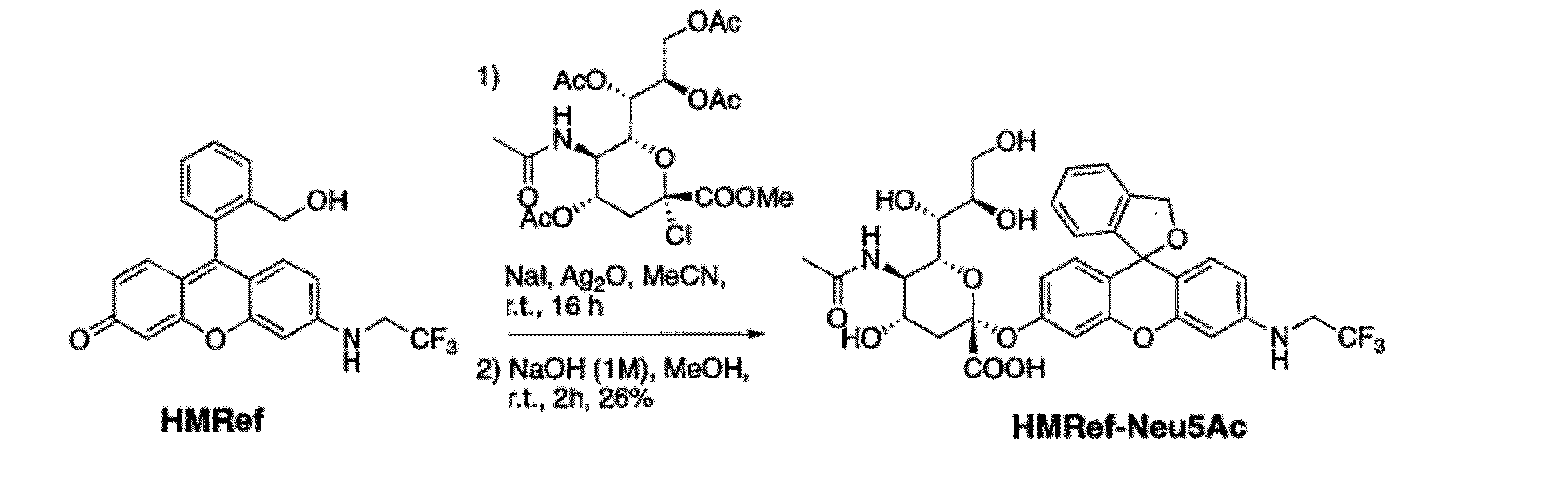
HMRefを文献(D. Asanuma, M. Sakabe, M. Kamiya, K. Yamamoto, J. Hiratake, M. Ogawa, N. Kosaka, P.L. Choyke, T. Nagano, H. Kobayashi, Y. Urano, Nat. Commun., 2015, 6, 6463.)に従って合成した。N-アセチル-2-クロロ-2-デジノイラミン酸メチルエステル 4,7,8,9-テトラアセテート(393mg、0.77mmol、6.0当量)、Ag2O(488mg、2.1mmol、16.4当量)、NaI(150mg、1.0mmol、7.8当量)および十分量の無水Na2SO4を入れたフラスコに、20mLの乾燥MeCNに溶解したHMRef(51.2mg、0.13mmol、1.0当量)を加えた。反応混合物を室温で16時間撹拌したのち、濾過し、ろ液を減圧留去した。残渣をMeOH(6mL)に溶解し、1M NaOH水溶液を加えた(3mL)。混合物を室温で5時間撹拌し、その後、有機溶媒を減圧留去した。残留水溶液を2MのHClで中和し、次いで凍結乾燥した。次いで、残留物をMeOH:DCM、1:4溶液に溶解し、濾過して不溶性塩を除去した。この溶液を減圧留去し、残渣をHPLCで精製後(A液:100mM TEAA緩衝液、B液:CH3CN 99%、H2O 1%。A/B=90/10で5分間、その後15分で10/90に勾配をかけ、次いで10/90で15分間)、凍結乾燥し、28mgの橙色粉末を得た(2工程で26%)。
1H NMR (400 MHz, CD3OD) δ1.04 (t, 18H, TEAA), 1.86 (1H, t, 3JHH = 11.2 Hz, H3ax), 1.90 (s, 3H, TEAA), 2.02 (s, 3H, NHCOCH3), 2.55 (q, 12 H, TEAA), 2.95 (dd, 1H, 3JHH = 12.6, 4.4 Hz, H3eq), 3.35 (s, 6H, TEAA), 3.56 (dd, 1H, 3JHH = 9.0, 1.6 Hz, H7), 3.67 (dd, 1H, 3JHH = 11.3, 5.2 Hz, H9), 3.74 (m, 1H, H5), 3.76 (m, 1H, H4), 3.82 (m, 1H, H9'), 3.84 (m, 2H, NHCH2CF3), 3.87 (m, 1H, H8), 3.90 (m, 1H, H6), 5.22 (s, 2H, ArCH2O), 6.44 (dd, 1H, 3JHH = 8.6, 4JHH = 2.4 Hz, Ar), 6.48 (d, 1H, 4JHH = 1.5 Hz, Ar), 6.67 (dd, 1H, 3JHH = 8.6, 4JHH = 2.6 Hz, Ar), 6.74 (dd, 1H, 3JHH = 8.7, 4JHH = 2.4 Hz, Ar), 6.78 (d, 1H, 3JHH = 7.6 Hz, Ar), 6.93 (dt, 1H, 3JHH = 8.7, 4JHH = 2.5 Hz, Ar), 7.07 (dd, 1H, 4JHH = 5.6, 2.3 Hz, Ar), 7.26 (t, 1H, 3JHH = 7.3 Hz, Ar), 7.38 (t, 1H, 3JHH = 7.6 Hz, Ar), 7.42 (d, 1H, 3JHH = 7.4 Hz, Ar). 13C NMR (101 MHz, CD3OD): δ 11.2 (TEAA) 22.9, 24.4 (TEAA), 43.1, 45.8, 49.9 (TEAA), 54.3, 64.0, 69.3, 70.2, 72.6, 73.1, 75.3, 85.5, 99.3, 104.1, 109.7, 110.8, 114.7, 117.8, 118.1, 121.9, 124.8, 126.9 (q, CF3), 129.3, 129.5, 130.2, 130.9, 140.2, 146.0, 150.3, 152.1, 153.0, 157.0, 174.6, 175.6, 180.7 (TEAA). HRMS (ESI+) calcd for [M]+ 691.21092; found 691.21104 (-0.1 mDa).
HPLC分析:A/B=80/20=0/100 (15min);flow rate=1.0mL/min)。検出蛍光波長:520nm。
HPLC分析:A/B=80/20=0/100 (15min);flow rate=1.0mL/min)。検出蛍光波長:520nm。

[参考例1]
合成実施例1で得られたHMRef-Neu5Acについて、ノイラミニダーゼ(arthrobacter ureafaciens)との酵素反応に伴うHMRef-Neu5Acの蛍光強度変化の経時変化を調べた。100mM NaOAc 2mM CaCl2緩衝液(pH7.4)にHMRef-Neu5Acを溶解して1μM溶液を作成し、測定開始後60秒で酵素0.01Uを添加した。測定時の温度は37℃、酵素阻害剤(DANA)の濃度は100μMとした。その結果を図2aに示す。
また、HMRef-Neu5Acを、種々のpH値の0.2Mリン酸ナトリウム緩衝液に溶解した直後および1.5時間後における吸収スペクトルを測定した結果を図2bに示す。
合成実施例1で得られたHMRef-Neu5Acについて、ノイラミニダーゼ(arthrobacter ureafaciens)との酵素反応に伴うHMRef-Neu5Acの蛍光強度変化の経時変化を調べた。100mM NaOAc 2mM CaCl2緩衝液(pH7.4)にHMRef-Neu5Acを溶解して1μM溶液を作成し、測定開始後60秒で酵素0.01Uを添加した。測定時の温度は37℃、酵素阻害剤(DANA)の濃度は100μMとした。その結果を図2aに示す。
また、HMRef-Neu5Acを、種々のpH値の0.2Mリン酸ナトリウム緩衝液に溶解した直後および1.5時間後における吸収スペクトルを測定した結果を図2bに示す。
HMRef-Neu5Acは、pH7.4ではスピロ環化体(pKcycl=4.8)が優先するため、ほとんど蛍光を示さなかった。シアリダーゼと反応すると、40倍までの適度な蛍光増強が観察された(図2a)。酵素の非存在下で同じ反応をモニターすると、蛍光増強の3倍の増加が観察され、時間の経過に伴うプローブの不安定性を示した。また、各種pHの緩衝溶液でプローブの吸光スペクトルを測定し、プローブ溶解直後、1.5時間後で比較すると、(1.5時間後ではスペクトル形状が大きく変化した(図2b)。つまり、1.5時間の間に、吸収極大のシフトがみられ、つまり、加水分解生成物であるHMRefに変換されることが明らかなスペクトル形状の変化が観察された。
本発明者らが以前に開発したHMRefの単糖誘導体はこのような不安定性を示さなかったので、この差異はシアル酸部分自体から生じたはずであると考えられた。更なる調査の結果、シアル酸のグリコシド結合は、他の単糖に比べて酸加水分解に非常に敏感であることが判明した(J.L. Sonnenburg, H. van Halbeek, A. Varki, J. Biol. Chem., 2002, 277, 17502.)。シアル酸残基の酸加水分解のメカニズムは、ケトシド酸素原子のプロトン化、アルコールと共鳴安定化されたカルボニウムオキソニウムイオンに分解する。このイオンは水と反応して遊離糖を生成する。グリコシド酸素のプロトン化は、中間体のカルボニウムイオンを安定化させるイオン化カルボキシル基の近接によって促進される。従って、シアル酸残基のこの固有の不安定性を誘発するのは隣接するカルボン酸である。
そこで、これに対処し、カルボニウムイオンの安定化を防ぐために、カルボキシル基を置換することを検討した。この戦略はChargaff et alにより以前に研究されたものであり、カルボン酸部分をメチルエステルに変換した。この誘導体中のグリコシド結合の安定性は実際に非常に高められたが、シアリダーゼによる処理ではシアル酸の遊離は観察されなかった。これは、シアリダーゼ感受性プローブを設計する際にカルボン酸保護のこの戦略を用いることができないことを意味していた。
そこで、これに対処し、カルボニウムイオンの安定化を防ぐために、カルボキシル基を置換することを検討した。この戦略はChargaff et alにより以前に研究されたものであり、カルボン酸部分をメチルエステルに変換した。この誘導体中のグリコシド結合の安定性は実際に非常に高められたが、シアリダーゼによる処理ではシアル酸の遊離は観察されなかった。これは、シアリダーゼ感受性プローブを設計する際にカルボン酸保護のこの戦略を用いることができないことを意味していた。
次に、本発明者らは、スペーサー基の取り込みが、酸加水分解に対するプローブの安定性を増加させる可能性があると仮定した。自己分解性スペーサーの使用は、プロドラッグおよび蛍光センサーで使用されて成功した適用により、ごく比較的最近において有効であることが判明している(A. Alouane, R. Labruere, T. Le Saux, F. Schmidt, L. Jullien, Angew. Chem. Int. Ed., 2015, 54, 7492.)。そのように、Phillipsらによって最初に報告されたフェノールスペーサー基を、シアル酸部分およびHMRefフルオロフォアの間に組み込んで、以下の合成実施例2に示すようにHMRef-S-Neu5Acを得た。
[合成実施例2]
以下の反応スキームの手順に従って、化合物3を合成した。
以下の反応スキームの手順に従って、化合物3を合成した。

(1)化合物1の合成
4-ヒドロキシベンズアルデヒド(S、479mg、3.9mmol)およびジイソプロピルエチルアミン(5mL)の溶液に、N-アセチル-2-クロロ-2-デオイズノイラミン酸メチルエステル4,7,8,9-テトラアセテート3(0.5mL、3.1mmol)のMeCN溶液に加え、反応混合物を室温で3時間撹拌した。この後、すべての溶媒を除去し、トルエン(×3)で希釈した。得られた残渣をシリカゲルクロマトグラフィー(EtOAc:DCM、1:1~EtOAc)を用いて精製して、化合物1を白色泡状物として得た(145mg、62%)。
4-ヒドロキシベンズアルデヒド(S、479mg、3.9mmol)およびジイソプロピルエチルアミン(5mL)の溶液に、N-アセチル-2-クロロ-2-デオイズノイラミン酸メチルエステル4,7,8,9-テトラアセテート3(0.5mL、3.1mmol)のMeCN溶液に加え、反応混合物を室温で3時間撹拌した。この後、すべての溶媒を除去し、トルエン(×3)で希釈した。得られた残渣をシリカゲルクロマトグラフィー(EtOAc:DCM、1:1~EtOAc)を用いて精製して、化合物1を白色泡状物として得た(145mg、62%)。
1H NMR (400 MHz, CDCl3):δ1.93 (s, 3H, NHOAc), 2.05 (s, 3H, OAc), 2.06 (s, 3H, OAc), 2.12 (s, 3H, OAc), 2.19 (s, 3H, OAc), 2.30 (t, 1H, 3JHH = 12.5 Hz, H3ax), 2.74 (dd, 1H, 3JHH = 13, 4.7 Hz, H3eq), 3.65 (s, 3H, COOMe), 4.11 (m, 1H, H9), 4.13 (m, 1H, H5), 4.25 (dd, 1H, 3JHH = 12.4, 2.4 Hz, H9’), 4.60 (dd, 1H, 3JHH = 10.8, 1.6 Hz, H6), 4.98 (td, 1H, 3JHH = 10.4, 4.6, 1.8 HZ, H4), 5.23 (d, 1H, 3JHH = 10 Hz, H7), 5.35 (m, 1H, NH), 5.37 (m, 1H, H8), 7.18 (d, 2H, 3JHH = 8.7 Hz, Ar), 7.83 (d, 2H, 3JHH = 8.8 Hz, Ar), 9.93 (s, 1H, CHO). 13C NMR (101 MHz, CDCl3): δ 20.7, 20.7, 20.8, 21.0, 23.2, 38.7, 49.5, 53.2, 62.0, 67.1, 68.4, 68.7, 73.6, 99.5, 118.9, 131.7, 132.0, 158.9, 168.2, 169.9, 170.1, 170.2, 170.6, 170.9, 190.9. HRMS (ESI+): calcd for [M+Na+] 618.17933, found 618.18094 (-1.6 mDa) for C27H34NaNO14.
(2)化合物2の合成
化合物1(247mg、0.42mmol)を乾燥THF(5mL)に溶解し、0℃でLiAlH(OtBu)3(0.83mLの1.0M THF溶液)を加えた。0℃で1時間撹拌した後、飽和NH4Cl(aq)(5mL)およびEtOAc(10mL)を混合物に加え、室温でさらに1時間撹拌した。これにロッシェル塩(水性)(10mL)の飽和溶液を加え、粗生成物をCHCl3(×3)で抽出したのち、有機層を減圧残去した。次いで残留物をシリカゲルクロマトグラフィー(MeOH:DCM 1:99から5:95)を用いて精製して、化合物2を白色泡状物として得た(156mg、63%)。
化合物1(247mg、0.42mmol)を乾燥THF(5mL)に溶解し、0℃でLiAlH(OtBu)3(0.83mLの1.0M THF溶液)を加えた。0℃で1時間撹拌した後、飽和NH4Cl(aq)(5mL)およびEtOAc(10mL)を混合物に加え、室温でさらに1時間撹拌した。これにロッシェル塩(水性)(10mL)の飽和溶液を加え、粗生成物をCHCl3(×3)で抽出したのち、有機層を減圧残去した。次いで残留物をシリカゲルクロマトグラフィー(MeOH:DCM 1:99から5:95)を用いて精製して、化合物2を白色泡状物として得た(156mg、63%)。
1H NMR (400 MHz, CDCl3): δ1.90 (s, 3H, NHOAc), 2.04 (s, 3H, OAc), 2.04 (s, 3H, OAc), 2.12 (s, 3H, OAc), 2.13 (s, 3H, OAc), 2.21 (t, 1H, 3JHH = 12.6 Hz, H3ax), 2.72 (dd, 1H, 3JHH = 12.9, 4.6 Hz, H3eq), 3.68 (s, 3H, COOMe), 4.10 (m, 1H, H5), 4.14 (d, 1H, 3JHH = 5 Hz, H9), 4.28 (dd, 1H, 3JHH = 12.6, 2.6 Hz, H9’), 4.38 (dd, 1H, 3JHH = 10.8, 1.6 Hz, H6), 4.63 (s, 2H, CH2OH), 4.95 (td, 1H, 3JHH = 10.4, 4.6, 1.8 HZ, H4), 5.27 (m, 1H, NH), 5.35 (m, 2H, H7, H8), 7.03 (d, 2H, 3JHH = 8.6 Hz, Ar), 7.27 (d, 2H, 3JHH = 8.6 Hz, Ar). 13C NMR (101 MHz, CDCl3): δ 20.7, 20.8, 20.8, 21.0, 23.2, 38.2, 49.5, 52.9, 62.1, 64.9, 67.4, 68.8, 69.4, 73.4, 99.9, 120.3, 128.3, 136.7, 153.1, 168.1, 170.0, 170.1, 170.3, 170.7, 170.9. HRMS (ESI+): calcd for [M+Na+] 620.19498, found 620.19672 (-1.7 mDa) C27H36NaNO14.
(3)化合物3の合成
化合物2(150mg、0.25mmol)をDCM(3mL)に溶解し、三臭化リン(12μL、0.13mmol)を0℃で溶液に添加した。0℃で2時間撹拌後、溶液を飽和NaHCO3水溶液(×3)および飽和食塩水(×1)で洗浄した。有機層を硫酸ナトリウムで乾燥させ、減圧残去して化合物3を白色泡状物(136mg、82%)として得た。
化合物2(150mg、0.25mmol)をDCM(3mL)に溶解し、三臭化リン(12μL、0.13mmol)を0℃で溶液に添加した。0℃で2時間撹拌後、溶液を飽和NaHCO3水溶液(×3)および飽和食塩水(×1)で洗浄した。有機層を硫酸ナトリウムで乾燥させ、減圧残去して化合物3を白色泡状物(136mg、82%)として得た。
1H NMR (400 MHz, CDCl3): δ 1.84 (s, 3H, NHOAc), 1.97 (s, 3H, OAc), 1.98 (s, 3H, OAc), 2.05 (s, 3H, OAc), 2.09 (s, 3H, OAc), 2.15 (t, 1H, 3JHH = 12.6 Hz, H3ax), 2.63 (dd, 1H, 3JHH = 13, 4.7 Hz, H3eq), 3.58 (s, 3H, COOMe), 4.03 (m, 1H, H9), 4.10 (m, 1H, H5), 4.23 (m, 1H, H9’), 4.37 (m, 1H, H6), 4.40 (s, 2H, CH2Br), 4.89 (td, 1H, 3JHH = 10.4, 4.6, 1.8 Hz, H4), 5.29 (m, 3H, H7, H8, NH), 6.95 (d, 2H, 3JHH = 8.7 Hz, Ar), 7.23 (d, 2H, 3JHH = 8.7 Hz, Ar). 13C NMR (101 MHz, CDCl3): δ 19.7, 19.8, 19.8, 20, 22.2, 32.3, 37.2, 48.4, 52.0, 70.0, 66.3, 67.7, 68.1, 72.4, 98.8, 118.7, 129.2, 132.1, 152.8, 167.1, 169.0, 169.1, 169.2, 169.6, 169.9. HRMS (ESI+): calcd for [M+Na+] 682.11057, found 682.10666 (3.9 mDa) C27H34BrNNaO13.
(4)HMRef-S-Neu5Acの合成
以下の反応スキームの手順に従って、HMRef-S-Neu5Acを合成した。
以下の反応スキームの手順に従って、HMRef-S-Neu5Acを合成した。
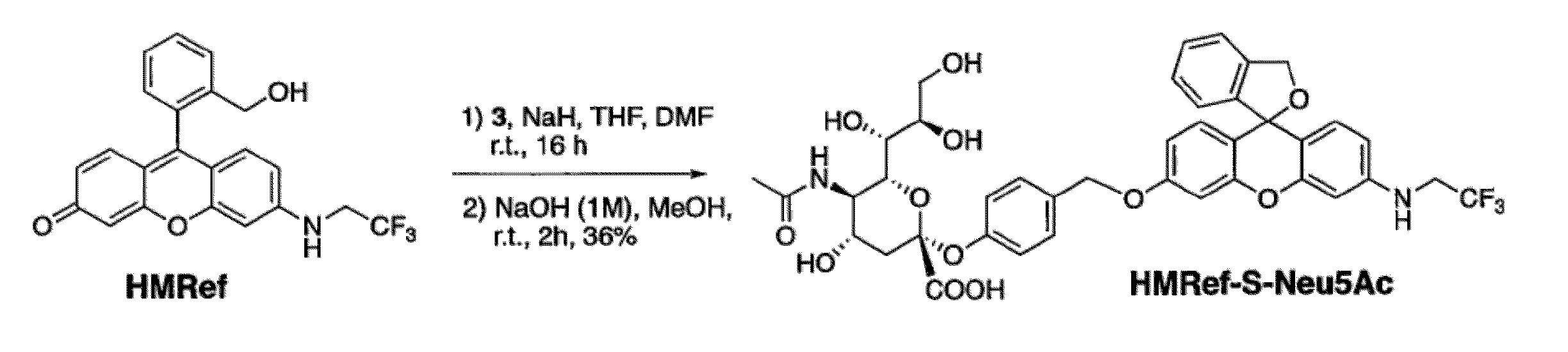
HMRef(79mg、0.2mmol)およびNaH(6mg、0.26mmol)に乾燥THF(3mL)および乾燥DMF(1mL)を添加し、この混合物をアルゴン気下で0℃で撹拌した。化合物3(130mg、0.2mmol)の乾燥THF(3mL)溶液を加え、反応混合物を室温で16時間撹拌した。この後、EtOAc(20mL)を加え、この混合物を飽和NH4Cl溶液(×2)および飽和食塩水(×1)で洗浄した。有機層を硫酸ナトリウム上で乾燥させ、減圧留去した。残渣をMeOH(6mL)に溶解し、1M NaOH(水溶液)を加えた(3mL)。混合物を室温で5時間撹拌し、その後、有機溶媒を蒸発させた。残留水溶液を2MのHClで中和し、次いで凍結乾燥させた。次いで、残留物をMeOH:DCM、1:4溶液に溶解し、濾過して不溶性塩を除去した。この溶液を減圧留去させ、残渣をHPLC(A液:100mM TEAA緩衝液、B液:CH3CN 99%、H2O 1%。A/B=90/10で5分間、その後15分で10/90に勾配をかけ、次いで10/90で15分間)で精製し、凍結乾燥後に橙色の粉末(2ステップで36%)を得た。
1H NMR (400 MHz, CD3OD) δ1.04 (t, 26H, TEAA), 1.84 (1H, t, 3JHH = 11.9 Hz, H3ax), 1.90 (s, 3H, TEAA), 2.02 (s, 3H, NHCOCH3), 2.55 (q, 17 H, TEAA), 2.94 (dd, 1H, 3JHH = 12.2, 4.0 Hz, H3eq), 3.54 (dd, 1H, 3JHH = 9.0, 1.6 Hz, H7), 3.66 (dd, 1H, 3JHH = 11.3, 5.4 Hz, H9), 3.74 (m, 1H, H5), 3.77 (m, 1H, H4), 3.81 (m, 1H, H9’), 3.85 (m, 2H, NHCH2CF3), 3.86 (m, 1H, H8), 3.91 (m, 1H, H6), 5.01 (s, 2H, ArCH2O), 5.23 (s, 2H, ArCH2O), 6.45 (dd, 1H, 3JHH = 8.6, 4JHH = 2.4 Hz, Ar), 6.50 (d, 1H, 4JHH = 2.3 Hz, Ar), 6.65 (dd, 1H, 3JHH = 8.7, 4JHH = 2.6 Hz, Ar), 6.67 (d, 1H, 3JHH = 8.6, Ar), 6.78 (m, 1H, Ar), 6.79 (m, 1H, Ar), 6.82 (m, 1H, Ar), 7.24 (d, 2H, 3JHH = 8.7 Hz, Ar), 7.30 (m, 1H, Ar), 7.31 (d, 2H, 3JHH = 8.7 Hz, Ar), 7.39 (m, 1H, Ar), 7.43 (m, 1H, Ar). 13C NMR (101 MHz, CD3OD): δ 11.2 (TEAA) 22.9, 24.4 (TEAA), 43.1, 45.8, 46.9 (TEAA), 54.3, 64.0, 69.3, 70.2, 72.6, 72.7, 73.1, 75.3, 85.5, 99.3, 104.0, 104.1, 109.7, 110.8, 114.7, 117.8, 118.1, 120.8, 121.9, 124.7, 124.8, 126.9 (q, CF3), 129.3, 129.4, 130.2, 130.2, 130.9, 140.3, 146.0, 150.3, 152.1, 153.0, 157.0, 173.6, 175.6, 180.7 (TEAA). HRMS (ESI+) L calcd for [M+Na]+ 797.75163; found 797.75043 (-1.2 mDa).
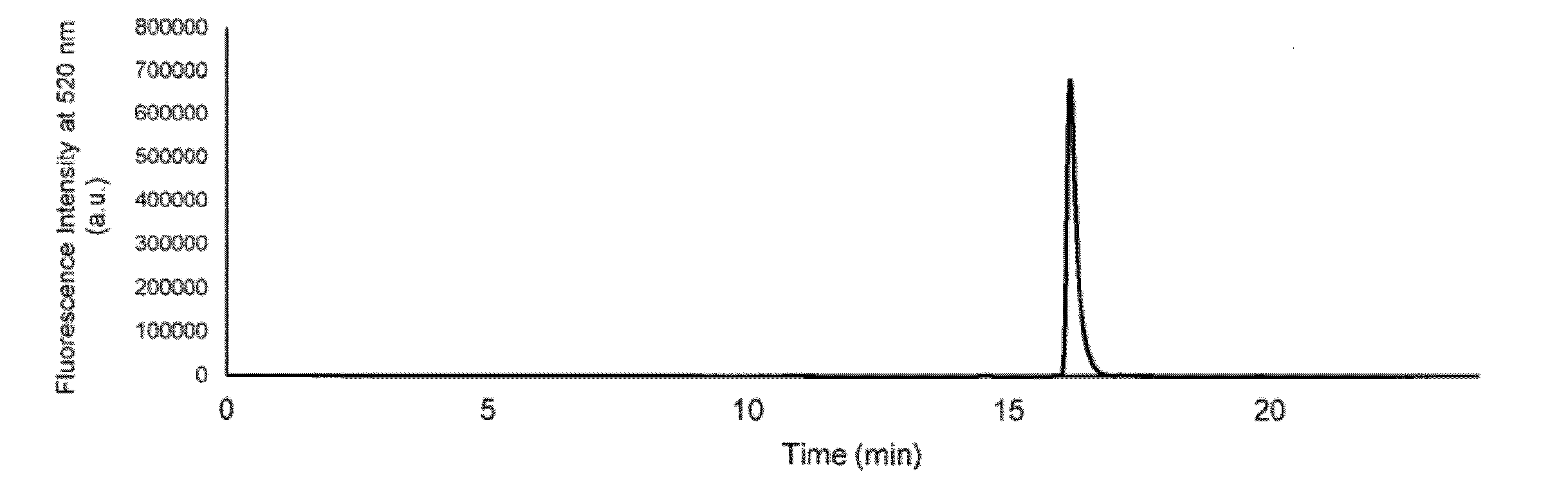
直線勾配(0min、20%CH3CN/0.1%TFAaq. To 15min,100%CH3CN 0.1%TFA aq;flow rate=1.0mL/min)を用いてHPLC分析を行った。520nmでの蛍光を調べた。
直線勾配(0min、20%CH3CN/0.1%TFAaq. To 15min,100%CH3CN 0.1%TFA aq;flow rate=1.0mL/min)を用いてHPLC分析を行った。520nmでの蛍光を調べた。
[実施例1]
HMRef-Neu5Acについて評価したように、HMRef-S-Neu5Acについてシアリダーゼとの反応および各pHでの吸光スペクトルを取得した(図3a及び図3b)。
pH7.4では、プローブは、スピロ環化体(pKcycl=5.3)で存在するため非常にわずかな蛍光を示した。しかし、このプローブは、シアリダーゼとの反応で130倍の蛍光増強を示し、これは主としてその安定性の増加に起因する。酵素を添加しない場合に見られるように、蛍光強度は一定の低レベルのままであり、プローブ溶解後1.5時間経過しても吸光スペクトルが殆ど変化しないことが明らかとなった。
HMRef-Neu5Acについて評価したように、HMRef-S-Neu5Acについてシアリダーゼとの反応および各pHでの吸光スペクトルを取得した(図3a及び図3b)。
pH7.4では、プローブは、スピロ環化体(pKcycl=5.3)で存在するため非常にわずかな蛍光を示した。しかし、このプローブは、シアリダーゼとの反応で130倍の蛍光増強を示し、これは主としてその安定性の増加に起因する。酵素を添加しない場合に見られるように、蛍光強度は一定の低レベルのままであり、プローブ溶解後1.5時間経過しても吸光スペクトルが殆ど変化しないことが明らかとなった。
[実施例2]
HMRef-Neu5Ac及びHMRef-S-Neu5Acについて、シアリダーゼ阻害剤DANAの存在下でのシアリダーゼとの反応性も評価した。
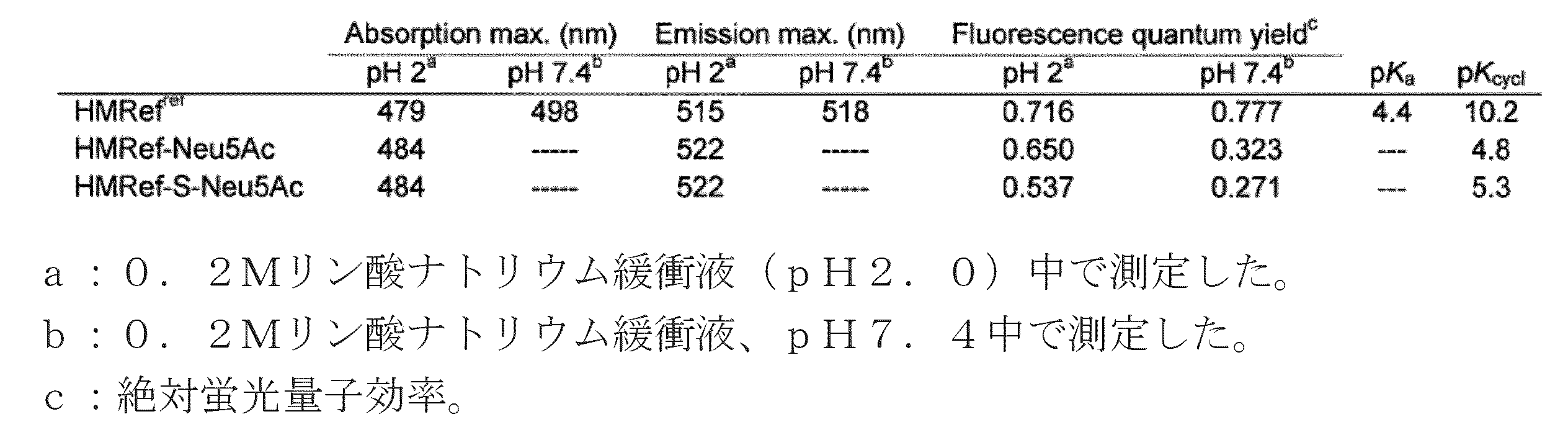
表1に、HMRef-Neu5AcおよびHMRef-S-Neu5Acの光化学的性質を示す。いずれの場合も、pH7.4において低い蛍光強度値を示す。これは、HMRef-S-Neu5Acの方が安定性性が優れているが、両方のプローブがシアリダーゼ活性化蛍光プローブとして機能することを示す。
HMRef-Neu5Ac及びHMRef-S-Neu5Acについて、シアリダーゼ阻害剤DANAの存在下でのシアリダーゼとの反応性も評価した。
表1に、HMRef-Neu5AcおよびHMRef-S-Neu5Acの光化学的性質を示す。いずれの場合も、pH7.4において低い蛍光強度値を示す。これは、HMRef-S-Neu5Acの方が安定性性が優れているが、両方のプローブがシアリダーゼ活性化蛍光プローブとして機能することを示す。
[実施例3]
HMRef-Neu5Ac及びHMRef-S-Neu5Acの安定性を、ある範囲のpHで経時的な蛍光強度の変化を記録することによって直接比較した。両方のプローブの蛍光強度初期値は、それらのpKcycl値の結果としてpH値で異なる、すなわち、pHが低いほど蛍光強度初期値が大きい。
HMRef-Neu5Ac及びHMRef-S-Neu5Acの安定性を、ある範囲のpHで経時的な蛍光強度の変化を記録することによって直接比較した。両方のプローブの蛍光強度初期値は、それらのpKcycl値の結果としてpH値で異なる、すなわち、pHが低いほど蛍光強度初期値が大きい。
種々のpHでHMRef-Neu5AcおよびHMRef-S-Neu5Acの蛍光強度を経時的に測定した結果を図4に示す。37℃で0.2Mリン酸ナトリウム緩衝溶液中で測定し、5分ごとに測定値を採取した。それぞれ485nm/535nmの励起/発光波長を使用した。
図4から分かるように、HMRef-Neu5Acは、実験の2時間の時間範囲にわたって、すべてのpHにわたって明確な不安定性を示した。これはpH2および4で特に顕著であり、約40分後に完全な加水分解が観察された。一方、HMRef-S-Neu5Acの蛍光強度は、その改善された安定性を確認する2時間にわたってほとんど変化しなかった。哺乳動物シアリダーゼによる効率的な触媒作用のための至適pHは、4.4~6.5の範囲の広い範囲である(T. Miyagi, K. Yamaguchi, Glycobiology, 2012, 22, 880.)。従って、これらの関連するpH値にわたるプローブの安定性を決定することは極めて重要であり、HMRef-S-Neu5Acが酸加水分解による蛍光強度の増加を示さないことが確認された。
HMRef-Neu5Ac及びHMRef-S-Neu5Acの動的パラメータを、以前にGovorkovaらによって記載された方法に従って決定し、市販のシアリダーゼ基質4-MUNANAのそれと比較した.kcat/Km値(表2)はHMRef-Neu5Ac及びHMRef-S-Neu5Acの方が4-MUNANAよりも夫々16倍および13倍近く多く、新規プローブはシアリダーゼ活性の感受性および定量的検出にさらに適していることが実証された。

本研究では、糖タンパク質および糖脂質上の複合糖質から最終シアル酸を切断することが知られている酵素群の大部分であるシアリダーゼを標的酵素とした。シアリダーゼを検出するために開発した最初のプローブであるHMRef-Neu5Acは、シアル酸残基のカルボキシル酸部分がグリコシド結合に隣接しているために、不安定になることが示された。この隣接するカルボキシル基は、中間的なカルボニウムイオンを安定化させ、酸加水分解機構を促進する。シアル酸とHMRefフルオロフォアの間にスペーサー基を導入してHMRef-S-Neu5Acを得ることにより、本発明者らはこの望ましくない加水分解経路の効率を低下させることができ、従ってプローブの安定性を改善することができた。
Claims (4)
- 以下の一般式(I)で表される化合物又はその塩。
(式中、
R1は、存在する場合は、ベンゼン環上に存在する同一又は異なる一価の置換基を示し;
R2及びR3は、それぞれ独立に、水素原子、炭素数1~6個のアルキル基又はハロゲン原子を示し;
R4及びR5は、それぞれ独立に、水素原子、炭素数1~6個のアルキル基又はハロゲン原子を示し;
R6は、水素原子、炭素数1~5個のアルキル基、又は炭素数1~5個のフッ化アルキル基を示し;
R6’は、水素原子又は炭素数1~6個のアルキル基を示し、
R6’は、R3又はR5と一緒になって、R6’が結合している窒素原子を含む5~7員のヘテロシクリル又はヘテロアリールを形成していてもよく;
R7及びR8は、存在する場合は、それぞれ独立に、炭素数1~6個のアルキル基又はアリール基を示し、
ここで、Xが酸素原子の場合は、R7及びR8は存在せず;
R9は、各出現において独立に、水素原子、炭素数1~5個のアルキル基、アルコキシ基、水酸基、カルボキシル基、ハロゲン原子、スルホ基、アミノ基、アルコキシカルボニル基、オキソ基から選択され;
R10は、存在する場合は、ベンゼン環上に存在する同一又は異なる一価の置換基を示し;
Xは、酸素原子、珪素原子又は炭素原子を示し;
mは、0~4の整数であり;
nは、1~3の整数であり;
sは、1の整数であり;
tは、0~4の整数である。) - R6が-CH2-CF3である、請求項1に記載の化合物又はその塩。
- 請求項1又は2に記載の化合物又はその塩を含むシアリダーゼ活性検出蛍光プローブ。
- シアリダーゼの活性を検出する方法であって、
(a)請求項1又は2に記載の化合物又はその塩を細胞内に導入する工程、及び
(b)当該化合物又はその塩が細胞内でシアリダーゼと反応することにより発せられる蛍光を測定する工程
を含む方法。
Priority Applications (2)
| Application Number | Priority Date | Filing Date | Title |
|---|---|---|---|
| JP2021503645A JPWO2020179865A1 (ja) | 2019-03-05 | 2020-03-05 | |
| US17/593,009 US20220186286A1 (en) | 2019-03-05 | 2020-03-05 | Fluorescent probe for detecting activation of sialidase |
Applications Claiming Priority (2)
| Application Number | Priority Date | Filing Date | Title |
|---|---|---|---|
| JP2019-039095 | 2019-03-05 | ||
| JP2019039095 | 2019-03-05 |
Publications (1)
| Publication Number | Publication Date |
|---|---|
| WO2020179865A1 true WO2020179865A1 (ja) | 2020-09-10 |
Family
ID=72338173
Family Applications (1)
| Application Number | Title | Priority Date | Filing Date |
|---|---|---|---|
| PCT/JP2020/009391 Ceased WO2020179865A1 (ja) | 2019-03-05 | 2020-03-05 | シアリダーゼ活性検出蛍光プローブ |
Country Status (3)
| Country | Link |
|---|---|
| US (1) | US20220186286A1 (ja) |
| JP (1) | JPWO2020179865A1 (ja) |
| WO (1) | WO2020179865A1 (ja) |
-
2020
- 2020-03-05 US US17/593,009 patent/US20220186286A1/en not_active Abandoned
- 2020-03-05 JP JP2021503645A patent/JPWO2020179865A1/ja active Pending
- 2020-03-05 WO PCT/JP2020/009391 patent/WO2020179865A1/ja not_active Ceased
Non-Patent Citations (2)
| Title |
|---|
| RIVAS,C. ET AL.: "A novel sialidase-activatable fluorescence probe with improved stability for the sensitive detection of sialidase", BIOORGANIC & MEDICINAL CHEMISTRY LETTERS, vol. 30, no. 2, 15 January 2020 (2020-01-15), pages 126860, XP086033976 * |
| ZHU,R. ET AL., SENESCENCE-ASSOCIATED SIALIDASE REVEALED BY AN ACTIVATABLE FLUORESCENCE-ON LABELING PROBE, vol. 54, no. 82, 2018, Cambridge, United Kingdom, pages 11566 - 11569, XP055736955 * |
Also Published As
| Publication number | Publication date |
|---|---|
| JPWO2020179865A1 (ja) | 2020-09-10 |
| US20220186286A1 (en) | 2022-06-16 |
Similar Documents
| Publication | Publication Date | Title |
|---|---|---|
| EP3408349B1 (en) | Chemiluminescent fluorophor-linked adamantylene-dioxetane probes as diagnostics or in-vivo imaging sensors | |
| JP7689753B2 (ja) | 活性に基づくプローブの化合物、組成物、および使用方法 | |
| JP4713343B2 (ja) | 蛍光プローブ | |
| US9329184B2 (en) | Fluorescent probe | |
| JP7720102B2 (ja) | 活性ベースのプローブ化合物、組成物、および使用方法 | |
| Hou et al. | An anthracenecarboximide fluorescent probe for in vitro and in vivo ratiometric imaging of endogenous alpha-l-fucosidase for hepatocellular carcinoma diagnosis | |
| WO2019224339A1 (en) | Long wavelength emitting chemiluminescent probes | |
| CN103796999B (zh) | 荧光素酶的发光基质 | |
| Fujita et al. | Chromogenic agents built around a multifunctional double-triazine framework for enzymatically triggered cross-linking under physiological conditions | |
| JP6165065B2 (ja) | 蛍光プローブ | |
| EP3275889A1 (en) | Fluorescent probe for detecting calpain activity | |
| JP2018145126A (ja) | カルボキシペプチダーゼ活性検出用蛍光プローブ | |
| Li et al. | H-aggregation of heptamethine cyanine dye induced by Smiles rearrangement for fluorescence sensing of biological species: A near-infrared ratiometric fluorescent assay for esterase | |
| US20220186286A1 (en) | Fluorescent probe for detecting activation of sialidase | |
| JP5360609B2 (ja) | 低酸素環境測定用試薬 | |
| JP7525161B2 (ja) | カルボキシペプチダーゼ活性検出用蛍光プローブ | |
| BR122022024635B1 (pt) | CONJUGADO DE FÓRMULA IIIa OU IIIb E COMPOSIÇÃO | |
| BR112018015334B1 (pt) | Composto de fórmula iva ou ivb e composição | |
| BR122022024633B1 (pt) | Composto de fórmula i, composto da fórmula iia ou iib, e composição |
Legal Events
| Date | Code | Title | Description |
|---|---|---|---|
| 121 | Ep: the epo has been informed by wipo that ep was designated in this application |
Ref document number: 20766491 Country of ref document: EP Kind code of ref document: A1 |
|
| ENP | Entry into the national phase |
Ref document number: 2021503645 Country of ref document: JP Kind code of ref document: A |
|
| NENP | Non-entry into the national phase |
Ref country code: DE |
|
| 122 | Ep: pct application non-entry in european phase |
Ref document number: 20766491 Country of ref document: EP Kind code of ref document: A1 |