WO2020171587A1 - Organic electroluminescent compound and organic electroluminescent device comprising the same - Google Patents
Organic electroluminescent compound and organic electroluminescent device comprising the same Download PDFInfo
- Publication number
- WO2020171587A1 WO2020171587A1 PCT/KR2020/002389 KR2020002389W WO2020171587A1 WO 2020171587 A1 WO2020171587 A1 WO 2020171587A1 KR 2020002389 W KR2020002389 W KR 2020002389W WO 2020171587 A1 WO2020171587 A1 WO 2020171587A1
- Authority
- WO
- WIPO (PCT)
- Prior art keywords
- substituted
- unsubstituted
- organic electroluminescent
- alkyl
- arylsilyl
- Prior art date
- Legal status (The legal status is an assumption and is not a legal conclusion. Google has not performed a legal analysis and makes no representation as to the accuracy of the status listed.)
- Ceased
Links
- 0 *NC([C@@](C1)C=Cc2c1c(cccc1)c1[o]2)=NC(c1ccccc1)=N Chemical compound *NC([C@@](C1)C=Cc2c1c(cccc1)c1[o]2)=NC(c1ccccc1)=N 0.000 description 11
- KVGIDRNOQCXKHB-UHFFFAOYSA-N C(C(C=C1)c(c2c3cccc2)ccc3-c2nc(-c3ccccc3)cc(-c3ccccc3)c2)C2=C1OC1(c3ccccc3-c3c1cccc3)O2 Chemical compound C(C(C=C1)c(c2c3cccc2)ccc3-c2nc(-c3ccccc3)cc(-c3ccccc3)c2)C2=C1OC1(c3ccccc3-c3c1cccc3)O2 KVGIDRNOQCXKHB-UHFFFAOYSA-N 0.000 description 1
- RLBHYHZGIZSDER-UHFFFAOYSA-N C(C1)C=CC=C1C1(c2ccccc2)Oc(cc(cc2)-c(c3c4cccc3)ccc4-c3nc(-c4ccccc4)cc(-c4ccccc4)c3)c2O1 Chemical compound C(C1)C=CC=C1C1(c2ccccc2)Oc(cc(cc2)-c(c3c4cccc3)ccc4-c3nc(-c4ccccc4)cc(-c4ccccc4)c3)c2O1 RLBHYHZGIZSDER-UHFFFAOYSA-N 0.000 description 1
- HQKDSCWVRDZPIC-UHFFFAOYSA-N C(c1c2SC(c3ccccc3)(c3ccccc3)Sc2ccc1)[n+]1c(-c2ccccc2)nc(-c2ccccc2)[n-]1 Chemical compound C(c1c2SC(c3ccccc3)(c3ccccc3)Sc2ccc1)[n+]1c(-c2ccccc2)nc(-c2ccccc2)[n-]1 HQKDSCWVRDZPIC-UHFFFAOYSA-N 0.000 description 1
- UTNMKOXSWXUADE-UHFFFAOYSA-N C1C=CC=CC1c1nc(N(C2C=CC(C3(c4ccccc4)Oc(cccc4)c4O3)=CC22)c3c2cccc3)nc(-c2ccccc2)n1 Chemical compound C1C=CC=CC1c1nc(N(C2C=CC(C3(c4ccccc4)Oc(cccc4)c4O3)=CC22)c3c2cccc3)nc(-c2ccccc2)n1 UTNMKOXSWXUADE-UHFFFAOYSA-N 0.000 description 1
- FSJRJXODQAOWSP-UHFFFAOYSA-N CC(C)(C)c1nc(-c(cc2)cc3c2c(cccc2)c2[s]3)nc(-c2ccccc2)n1 Chemical compound CC(C)(C)c1nc(-c(cc2)cc3c2c(cccc2)c2[s]3)nc(-c2ccccc2)n1 FSJRJXODQAOWSP-UHFFFAOYSA-N 0.000 description 1
- DRRLTVFVAWOEQN-UHFFFAOYSA-N CC(C)c(nc1-c2cc3ccccc3cc2)nc2c1[o]c1c2cccc1 Chemical compound CC(C)c(nc1-c2cc3ccccc3cc2)nc2c1[o]c1c2cccc1 DRRLTVFVAWOEQN-UHFFFAOYSA-N 0.000 description 1
- UZZRYFLQVUHGKZ-UHFFFAOYSA-N CC(C)c1c(-c2c3[o]c(cccc4)c4c3ccc2)nc(cccc2)c2n1 Chemical compound CC(C)c1c(-c2c3[o]c(cccc4)c4c3ccc2)nc(cccc2)c2n1 UZZRYFLQVUHGKZ-UHFFFAOYSA-N 0.000 description 1
- APFFOJPQCFSHGT-UHFFFAOYSA-N CC(C1)C(c(cc2c3c4cccc3)ccc2[n]4-c2ccccc2)=CC2=C1OC(c1ccccc1)(c1cc(-c(cc3)c(C4(C)C)cc3-c(cc3)ccc3-[n]3c(ccc(-c(cc5)cc6c5OC(c5ccccc5)(c5ccccc5)O6)c5)c5c5ccccc35)c4cc1)O2 Chemical compound CC(C1)C(c(cc2c3c4cccc3)ccc2[n]4-c2ccccc2)=CC2=C1OC(c1ccccc1)(c1cc(-c(cc3)c(C4(C)C)cc3-c(cc3)ccc3-[n]3c(ccc(-c(cc5)cc6c5OC(c5ccccc5)(c5ccccc5)O6)c5)c5c5ccccc35)c4cc1)O2 APFFOJPQCFSHGT-UHFFFAOYSA-N 0.000 description 1
- BOGZHUUPXWTMKO-UHFFFAOYSA-N CC(C1)C=CC=C1c1cc(-c2ccccc2)nc(-c2cc(-c3ccccc3C34Oc5ccccc5O3)c4cc2)c1 Chemical compound CC(C1)C=CC=C1c1cc(-c2ccccc2)nc(-c2cc(-c3ccccc3C34Oc5ccccc5O3)c4cc2)c1 BOGZHUUPXWTMKO-UHFFFAOYSA-N 0.000 description 1
- VHKBFBKLIXDJLL-UHFFFAOYSA-N CC(CC=C1)C(C23Oc(c4c(cc5)[nH]c6c4cccc6)c5O2)=C1c1c3cccc1 Chemical compound CC(CC=C1)C(C23Oc(c4c(cc5)[nH]c6c4cccc6)c5O2)=C1c1c3cccc1 VHKBFBKLIXDJLL-UHFFFAOYSA-N 0.000 description 1
- ASLXTXQIQOVCDA-UHFFFAOYSA-N CC1(C)c(cc(cc2)N(c(cc3)ccc3-c3ccccc3)c(cc3)cc4c3SC3(c(cccc5)c5-c5ccccc35)S4)c2-c2ccccc12 Chemical compound CC1(C)c(cc(cc2)N(c(cc3)ccc3-c3ccccc3)c(cc3)cc4c3SC3(c(cccc5)c5-c5ccccc35)S4)c2-c2ccccc12 ASLXTXQIQOVCDA-UHFFFAOYSA-N 0.000 description 1
- BBDBAUDDFRMAHS-UHFFFAOYSA-N CC1(C)c(cc(cc2)N(c3ccccc3)c(cc3)ccc3-c(cc3)cc4c3SC(c3ccccc3)(c3ccccc3)S4)c2-c2ccccc12 Chemical compound CC1(C)c(cc(cc2)N(c3ccccc3)c(cc3)ccc3-c(cc3)cc4c3SC(c3ccccc3)(c3ccccc3)S4)c2-c2ccccc12 BBDBAUDDFRMAHS-UHFFFAOYSA-N 0.000 description 1
- OEOYQFOIHFVGJA-UHFFFAOYSA-N CC1(C)c(cc(cc2)N(c3ccccc3)c3c4SC(c5ccccc5)(c5ccccc5)Sc4ccc3)c2-c2ccccc12 Chemical compound CC1(C)c(cc(cc2)N(c3ccccc3)c3c4SC(c5ccccc5)(c5ccccc5)Sc4ccc3)c2-c2ccccc12 OEOYQFOIHFVGJA-UHFFFAOYSA-N 0.000 description 1
- FNBHYKZYPRWALG-UHFFFAOYSA-N CC1(C)c(cc(cc2)N(c3ccccc3)c3ccc(C4(c5ccccc5)Sc(cccc5)c5S4)cc3)c2-c2ccccc12 Chemical compound CC1(C)c(cc(cc2)N(c3ccccc3)c3ccc(C4(c5ccccc5)Sc(cccc5)c5S4)cc3)c2-c2ccccc12 FNBHYKZYPRWALG-UHFFFAOYSA-N 0.000 description 1
- XUCKGVHFFCPPMG-UHFFFAOYSA-N CC1(C)c2cc(N(c(cc3C4(C)C)ccc3-c3c4cccc3)c(cc3)cc4c3SC3(c(cccc5)c5-c5ccccc35)S4)ccc2-c2ccccc12 Chemical compound CC1(C)c2cc(N(c(cc3C4(C)C)ccc3-c3c4cccc3)c(cc3)cc4c3SC3(c(cccc5)c5-c5ccccc35)S4)ccc2-c2ccccc12 XUCKGVHFFCPPMG-UHFFFAOYSA-N 0.000 description 1
- UDSBGLYCINIBJT-UHFFFAOYSA-N CC1(C)c2ccc(C3(C4=C5C=CCC4)Sc(cc(cc4)-c(cc6c7c8cccc7)ccc6[n]8-c6ccccc6)c4S3)c5c2-c2ccccc12 Chemical compound CC1(C)c2ccc(C3(C4=C5C=CCC4)Sc(cc(cc4)-c(cc6c7c8cccc7)ccc6[n]8-c6ccccc6)c4S3)c5c2-c2ccccc12 UDSBGLYCINIBJT-UHFFFAOYSA-N 0.000 description 1
- ZLIXKHHQJKXBET-UHFFFAOYSA-N CC1(C)c2ccc(C3(c4ccccc4-4)Oc(cc(cc5)-c(cc6c7ccccc77)ccc6[n]7-c6ccccc6)c5O3)c-4c2-c2ccccc12 Chemical compound CC1(C)c2ccc(C3(c4ccccc4-4)Oc(cc(cc5)-c(cc6c7ccccc77)ccc6[n]7-c6ccccc6)c5O3)c-4c2-c2ccccc12 ZLIXKHHQJKXBET-UHFFFAOYSA-N 0.000 description 1
- LKXDSNDHZZMMGB-UHFFFAOYSA-N CC1C(C)CC(C(C2)=NC(c(cc3)ccc3-[n]3c4ccc5OC6(c7ccccc7C7=C6C(C)CC=C7)Oc5c4c4ccccc34)=CC2(C)c2ccccc2)=CC1 Chemical compound CC1C(C)CC(C(C2)=NC(c(cc3)ccc3-[n]3c4ccc5OC6(c7ccccc7C7=C6C(C)CC=C7)Oc5c4c4ccccc34)=CC2(C)c2ccccc2)=CC1 LKXDSNDHZZMMGB-UHFFFAOYSA-N 0.000 description 1
- WTXQQTAZDPUKNV-UHFFFAOYSA-N CC1C(c2ccccc2)=CC(c2cc(-c3ccccc3)nc(-[n]3c4ccc5OC6(c7ccccc7-c7ccccc67)Oc5c4c4ccccc34)c2)=CC1 Chemical compound CC1C(c2ccccc2)=CC(c2cc(-c3ccccc3)nc(-[n]3c4ccc5OC6(c7ccccc7-c7ccccc67)Oc5c4c4ccccc34)c2)=CC1 WTXQQTAZDPUKNV-UHFFFAOYSA-N 0.000 description 1
- MEFYNTAEZPLMQE-UHFFFAOYSA-N CC1c(ccc(-c(cc2)cc3c2[n](C2C=CC=CC2)c2ccccc32)c2)c2SC11C(C=CCC2)=C2c2c1cccc2 Chemical compound CC1c(ccc(-c(cc2)cc3c2[n](C2C=CC=CC2)c2ccccc32)c2)c2SC11C(C=CCC2)=C2c2c1cccc2 MEFYNTAEZPLMQE-UHFFFAOYSA-N 0.000 description 1
- FIPICWOQFYDHFW-UHFFFAOYSA-N CNc1nc(-c2ccc(c(cccc3)c3[o]3)c3c2)nc(-c2ccccc2)n1 Chemical compound CNc1nc(-c2ccc(c(cccc3)c3[o]3)c3c2)nc(-c2ccccc2)n1 FIPICWOQFYDHFW-UHFFFAOYSA-N 0.000 description 1
- MJQOOJBXNWWFEC-UHFFFAOYSA-N CNc1nc(cccc2)c2nc1-c(cc1)cc2c1[s]c1ccccc21 Chemical compound CNc1nc(cccc2)c2nc1-c(cc1)cc2c1[s]c1ccccc21 MJQOOJBXNWWFEC-UHFFFAOYSA-N 0.000 description 1
- UNURICOTGSNSCZ-UHFFFAOYSA-N Cc1nc2ccccc2nc1-c1cc2ccccc2cc1 Chemical compound Cc1nc2ccccc2nc1-c1cc2ccccc2cc1 UNURICOTGSNSCZ-UHFFFAOYSA-N 0.000 description 1
- SLZQAAILBQNNBQ-LSNYGQCPSA-N N=C(/C=C(/c1ccccc1)\NC[n]1c2cc(-c3ccccc3)ccc2c2c1ccc1c2SC2(c3ccccc3-c3ccccc23)S1)c1ccccc1 Chemical compound N=C(/C=C(/c1ccccc1)\NC[n]1c2cc(-c3ccccc3)ccc2c2c1ccc1c2SC2(c3ccccc3-c3ccccc23)S1)c1ccccc1 SLZQAAILBQNNBQ-LSNYGQCPSA-N 0.000 description 1
- WQTSYXCUWYGORH-UHFFFAOYSA-N N=C(c1ccccc1)/N=C(/c1ccccc1)\N[n]1c2cc(-c3ccccc3C34Oc(cccc5)c5O3)c4cc2c2c1cccc2 Chemical compound N=C(c1ccccc1)/N=C(/c1ccccc1)\N[n]1c2cc(-c3ccccc3C34Oc(cccc5)c5O3)c4cc2c2c1cccc2 WQTSYXCUWYGORH-UHFFFAOYSA-N 0.000 description 1
- DRLHDWXOXFSAPY-UHFFFAOYSA-N Nc1nc2ccccc2nc1-c(cc1)cc2c1[o]c1c2cccc1 Chemical compound Nc1nc2ccccc2nc1-c(cc1)cc2c1[o]c1c2cccc1 DRLHDWXOXFSAPY-UHFFFAOYSA-N 0.000 description 1
- RSXLIDNZXDBXCB-UHFFFAOYSA-N c(cc1)ccc1-[n](c1ccccc1c1c2)c1ccc2-c(cc1)cc2c1OC1(c(cccc3)c3-c3c1cccc3)O2 Chemical compound c(cc1)ccc1-[n](c1ccccc1c1c2)c1ccc2-c(cc1)cc2c1OC1(c(cccc3)c3-c3c1cccc3)O2 RSXLIDNZXDBXCB-UHFFFAOYSA-N 0.000 description 1
- GLOJXYFNANQSHD-UHFFFAOYSA-N c(cc1)ccc1-[n]1c(cc(cc2)-c(cc3C45Oc6ccccc6O4)ccc3-c3c5cccc3)c2c2ccccc12 Chemical compound c(cc1)ccc1-[n]1c(cc(cc2)-c(cc3C45Oc6ccccc6O4)ccc3-c3c5cccc3)c2c2ccccc12 GLOJXYFNANQSHD-UHFFFAOYSA-N 0.000 description 1
- CBAUWWPWWOUHNV-UHFFFAOYSA-N c(cc1)ccc1-c(cc1)ccc1N(c(cc1)ccc1-c1ccccc1)c(cc1)cc2c1SC1(c3ccccc3-c3c1cccc3)S2 Chemical compound c(cc1)ccc1-c(cc1)ccc1N(c(cc1)ccc1-c1ccccc1)c(cc1)cc2c1SC1(c3ccccc3-c3c1cccc3)S2 CBAUWWPWWOUHNV-UHFFFAOYSA-N 0.000 description 1
- YSHSUJRRFNYJDN-UHFFFAOYSA-N c(cc1)ccc1-c(cc1)ccc1N(c1ccccc1)c(cc1)cc2c1SC1(c3ccccc3-c3c1cccc3)S2 Chemical compound c(cc1)ccc1-c(cc1)ccc1N(c1ccccc1)c(cc1)cc2c1SC1(c3ccccc3-c3c1cccc3)S2 YSHSUJRRFNYJDN-UHFFFAOYSA-N 0.000 description 1
- YAOILAZCRSDMFN-UHFFFAOYSA-N c(cc1)ccc1-c(cc1c2c3cccc2)ccc1[n]3-c(cc1)cc2c1OC1(c(cccc3)c3-c3ccccc13)O2 Chemical compound c(cc1)ccc1-c(cc1c2c3cccc2)ccc1[n]3-c(cc1)cc2c1OC1(c(cccc3)c3-c3ccccc13)O2 YAOILAZCRSDMFN-UHFFFAOYSA-N 0.000 description 1
- WVPXQOXDQFLPHV-UHFFFAOYSA-N c(cc1)ccc1-c(cc1c2c3cccc2)ccc1[n]3-c(cc1)cc2c1SC1(c(cccc3)c3-c3ccccc13)S2 Chemical compound c(cc1)ccc1-c(cc1c2c3cccc2)ccc1[n]3-c(cc1)cc2c1SC1(c(cccc3)c3-c3ccccc13)S2 WVPXQOXDQFLPHV-UHFFFAOYSA-N 0.000 description 1
- MRNIOZZLGNEYAP-UHFFFAOYSA-N c(cc1)ccc1-c1cc(-c(cc2)ccc2-[n](c2c3cccc2)c(cc2)c3c3c2SC2(c4ccccc4-c4ccccc24)S3)nc(-c2ccccc2)c1 Chemical compound c(cc1)ccc1-c1cc(-c(cc2)ccc2-[n](c2c3cccc2)c(cc2)c3c3c2SC2(c4ccccc4-c4ccccc24)S3)nc(-c2ccccc2)c1 MRNIOZZLGNEYAP-UHFFFAOYSA-N 0.000 description 1
- URQYQLAZQXRVNF-UHFFFAOYSA-N c(cc1)ccc1-c1cc(-c2cc(-c3ccccc3)nc(-[n](c3ccccc33)c(cc4)c3c3c4SC4(c5ccccc5-c5ccccc45)S3)c2)ccc1 Chemical compound c(cc1)ccc1-c1cc(-c2cc(-c3ccccc3)nc(-[n](c3ccccc33)c(cc4)c3c3c4SC4(c5ccccc5-c5ccccc45)S3)c2)ccc1 URQYQLAZQXRVNF-UHFFFAOYSA-N 0.000 description 1
- AOGPWYVOYUYPGA-UHFFFAOYSA-N c(cc1)ccc1-c1cc(-c2ccc(-c(cc3)cc4c3SC3(c5ccccc5-c5c3cccc5)S4)c3c2cccc3)nc(-c2ccccc2)c1 Chemical compound c(cc1)ccc1-c1cc(-c2ccc(-c(cc3)cc4c3SC3(c5ccccc5-c5c3cccc5)S4)c3c2cccc3)nc(-c2ccccc2)c1 AOGPWYVOYUYPGA-UHFFFAOYSA-N 0.000 description 1
- ZLYOOYWNRVYDHV-UHFFFAOYSA-N c(cc1)ccc1-c1cc(-c2ccccc2)nc(-[n]2c3ccc4SC5(c6ccccc6-c6ccccc56)Sc4c3c3ccccc23)n1 Chemical compound c(cc1)ccc1-c1cc(-c2ccccc2)nc(-[n]2c3ccc4SC5(c6ccccc6-c6ccccc56)Sc4c3c3ccccc23)n1 ZLYOOYWNRVYDHV-UHFFFAOYSA-N 0.000 description 1
- LAPHCKRCWKCEJJ-UHFFFAOYSA-N c(cc1)ccc1-c1cc(-c2ccccc2)nc(-c2cc(-c3ccccc3C34Sc(cccc5)c5S3)c4cc2)c1 Chemical compound c(cc1)ccc1-c1cc(-c2ccccc2)nc(-c2cc(-c3ccccc3C34Sc(cccc5)c5S3)c4cc2)c1 LAPHCKRCWKCEJJ-UHFFFAOYSA-N 0.000 description 1
- JVEWLPLRVDCBKC-UHFFFAOYSA-N c(cc1)ccc1-c1nc(-c2ccccc2)nc(-[n]2c3cc(-c4ccccc4C45Sc6ccccc6S4)c5cc3c3ccccc23)n1 Chemical compound c(cc1)ccc1-c1nc(-c2ccccc2)nc(-[n]2c3cc(-c4ccccc4C45Sc6ccccc6S4)c5cc3c3ccccc23)n1 JVEWLPLRVDCBKC-UHFFFAOYSA-N 0.000 description 1
- MYSSKDWFDSFLIB-UHFFFAOYSA-N c(cc1)ccc1N(c1ccccc1)c1ccc(C2(c(cc3)ccc3N(c3ccccc3)c3ccccc3)Sc(cccc3)c3S2)cc1 Chemical compound c(cc1)ccc1N(c1ccccc1)c1ccc(C2(c(cc3)ccc3N(c3ccccc3)c3ccccc3)Sc(cccc3)c3S2)cc1 MYSSKDWFDSFLIB-UHFFFAOYSA-N 0.000 description 1
- JXHKUYQCEJILEI-UHFFFAOYSA-N c1c(-c2ccccc2)[nH]nc1-c1ccccc1 Chemical compound c1c(-c2ccccc2)[nH]nc1-c1ccccc1 JXHKUYQCEJILEI-UHFFFAOYSA-N 0.000 description 1
- PNTOUBUZFSRPIB-UHFFFAOYSA-N c1ccc(C(c2ccccc2)(Sc2ccc3)Sc2c3-c(cc2)ccc2-c2nc(-c3ccccc3)nc(-c3ccccc3)n2)cc1 Chemical compound c1ccc(C(c2ccccc2)(Sc2ccc3)Sc2c3-c(cc2)ccc2-c2nc(-c3ccccc3)nc(-c3ccccc3)n2)cc1 PNTOUBUZFSRPIB-UHFFFAOYSA-N 0.000 description 1
- LZTYNZOAODCEEM-UHFFFAOYSA-N c1ccc(C2(c(cc3)cc(c4ccccc44)c3[n]4-c(cc3)ccc3-c3ccccc3)Sc(cccc3)c3S2)cc1 Chemical compound c1ccc(C2(c(cc3)cc(c4ccccc44)c3[n]4-c(cc3)ccc3-c3ccccc3)Sc(cccc3)c3S2)cc1 LZTYNZOAODCEEM-UHFFFAOYSA-N 0.000 description 1
- MGFBNXKSFBNUKQ-UHFFFAOYSA-N c1ccc(C2(c(cc3)ccc3-c(cc3)cc(c4ccccc44)c3[n]4-c3ccccc3)Sc(cccc3)c3S2)cc1 Chemical compound c1ccc(C2(c(cc3)ccc3-c(cc3)cc(c4ccccc44)c3[n]4-c3ccccc3)Sc(cccc3)c3S2)cc1 MGFBNXKSFBNUKQ-UHFFFAOYSA-N 0.000 description 1
- KQHWEBWPUXRODR-UHFFFAOYSA-N c1ccc(C2(c(cc3)ccc3-c3nc(-c4ccccc4)cc(-c4ccccc4)c3)Sc(cccc3)c3S2)cc1 Chemical compound c1ccc(C2(c(cc3)ccc3-c3nc(-c4ccccc4)cc(-c4ccccc4)c3)Sc(cccc3)c3S2)cc1 KQHWEBWPUXRODR-UHFFFAOYSA-N 0.000 description 1
- OZZHFDFVISQWKB-UHFFFAOYSA-N c1ccc(C2(c3ccccc3)Oc(c(c(c3c4)ccc4-c4ccccc4)c(cc4)[n]3-c3cc(-c5ccccc5)nc(-c5ccccc5)n3)c4O2)cc1 Chemical compound c1ccc(C2(c3ccccc3)Oc(c(c(c3c4)ccc4-c4ccccc4)c(cc4)[n]3-c3cc(-c5ccccc5)nc(-c5ccccc5)n3)c4O2)cc1 OZZHFDFVISQWKB-UHFFFAOYSA-N 0.000 description 1
- ITKFMNJWUUPUQW-UHFFFAOYSA-N c1ccc(C2(c3ccccc3)Oc(c(c3ccccc33)c(cc4)[n]3-c(cc3)ccc3-c3cc(-c5ccccc5)nc(-c5ccccc5)c3)c4O2)cc1 Chemical compound c1ccc(C2(c3ccccc3)Oc(c(c3ccccc33)c(cc4)[n]3-c(cc3)ccc3-c3cc(-c5ccccc5)nc(-c5ccccc5)c3)c4O2)cc1 ITKFMNJWUUPUQW-UHFFFAOYSA-N 0.000 description 1
- WFAXSJKMZMWHEE-UHFFFAOYSA-N c1ccc(C2(c3ccccc3)Oc(c(c3ccccc33)c(cc4)[n]3-c3cc(-c5ccccc5)cc(-c5ccccc5)n3)c4O2)cc1 Chemical compound c1ccc(C2(c3ccccc3)Oc(c(c3ccccc33)c(cc4)[n]3-c3cc(-c5ccccc5)cc(-c5ccccc5)n3)c4O2)cc1 WFAXSJKMZMWHEE-UHFFFAOYSA-N 0.000 description 1
- GBWWIWYBJZGLCT-UHFFFAOYSA-N c1ccc(C2(c3ccccc3)Oc(cc(cc3)-[n](c(cccc4)c4c4c5)c4ccc5-c4ccccc4)c3O2)cc1 Chemical compound c1ccc(C2(c3ccccc3)Oc(cc(cc3)-[n](c(cccc4)c4c4c5)c4ccc5-c4ccccc4)c3O2)cc1 GBWWIWYBJZGLCT-UHFFFAOYSA-N 0.000 description 1
- PMUNDJGTMZGQKV-UHFFFAOYSA-N c1ccc(C2(c3ccccc3)Oc3c(c4ccccc4[n]4-c5cc(-c6ccccc6)nc(-c6cc(-c7ccccc7)ccc6)c5)c4ccc3O2)cc1 Chemical compound c1ccc(C2(c3ccccc3)Oc3c(c4ccccc4[n]4-c5cc(-c6ccccc6)nc(-c6cc(-c7ccccc7)ccc6)c5)c4ccc3O2)cc1 PMUNDJGTMZGQKV-UHFFFAOYSA-N 0.000 description 1
- KOGSSMDWFLKETQ-UHFFFAOYSA-N c1ccc(C2(c3ccccc3)Sc(cc(cc3)-c(c4c5cccc4)ccc5-c4nc(-c5ccccc5)nc(-c5ccccc5)n4)c3S2)cc1 Chemical compound c1ccc(C2(c3ccccc3)Sc(cc(cc3)-c(c4c5cccc4)ccc5-c4nc(-c5ccccc5)nc(-c5ccccc5)n4)c3S2)cc1 KOGSSMDWFLKETQ-UHFFFAOYSA-N 0.000 description 1
- FROXYCYBACQFDH-UHFFFAOYSA-N c1ccc(C2(c3ccccc3)Sc(cc(cc3)-c(cc4)ccc4-c4nc(-c5ccccc5)nc(-c5ccccc5)n4)c3S2)cc1 Chemical compound c1ccc(C2(c3ccccc3)Sc(cc(cc3)-c(cc4)ccc4-c4nc(-c5ccccc5)nc(-c5ccccc5)n4)c3S2)cc1 FROXYCYBACQFDH-UHFFFAOYSA-N 0.000 description 1
- GIQBSJJCZQVTAN-UHFFFAOYSA-N c1ccc(C2(c3ccccc3)Sc(cc(cc3)-c(cc4)ccc4N(c4ccccc4)c4ccccc4)c3S2)cc1 Chemical compound c1ccc(C2(c3ccccc3)Sc(cc(cc3)-c(cc4)ccc4N(c4ccccc4)c4ccccc4)c3S2)cc1 GIQBSJJCZQVTAN-UHFFFAOYSA-N 0.000 description 1
Classifications
-
- C—CHEMISTRY; METALLURGY
- C09—DYES; PAINTS; POLISHES; NATURAL RESINS; ADHESIVES; COMPOSITIONS NOT OTHERWISE PROVIDED FOR; APPLICATIONS OF MATERIALS NOT OTHERWISE PROVIDED FOR
- C09K—MATERIALS FOR MISCELLANEOUS APPLICATIONS, NOT PROVIDED FOR ELSEWHERE
- C09K11/00—Luminescent materials, e.g. electroluminescent or chemiluminescent
- C09K11/06—Luminescent materials, e.g. electroluminescent or chemiluminescent containing organic luminescent materials
-
- H—ELECTRICITY
- H10—SEMICONDUCTOR DEVICES; ELECTRIC SOLID-STATE DEVICES NOT OTHERWISE PROVIDED FOR
- H10K—ORGANIC ELECTRIC SOLID-STATE DEVICES
- H10K85/00—Organic materials used in the body or electrodes of devices covered by this subclass
- H10K85/60—Organic compounds having low molecular weight
- H10K85/631—Amine compounds having at least two aryl rest on at least one amine-nitrogen atom, e.g. triphenylamine
-
- H—ELECTRICITY
- H10—SEMICONDUCTOR DEVICES; ELECTRIC SOLID-STATE DEVICES NOT OTHERWISE PROVIDED FOR
- H10K—ORGANIC ELECTRIC SOLID-STATE DEVICES
- H10K85/00—Organic materials used in the body or electrodes of devices covered by this subclass
- H10K85/60—Organic compounds having low molecular weight
- H10K85/649—Aromatic compounds comprising a hetero atom
- H10K85/654—Aromatic compounds comprising a hetero atom comprising only nitrogen as heteroatom
-
- H—ELECTRICITY
- H10—SEMICONDUCTOR DEVICES; ELECTRIC SOLID-STATE DEVICES NOT OTHERWISE PROVIDED FOR
- H10K—ORGANIC ELECTRIC SOLID-STATE DEVICES
- H10K85/00—Organic materials used in the body or electrodes of devices covered by this subclass
- H10K85/60—Organic compounds having low molecular weight
- H10K85/649—Aromatic compounds comprising a hetero atom
- H10K85/657—Polycyclic condensed heteroaromatic hydrocarbons
- H10K85/6572—Polycyclic condensed heteroaromatic hydrocarbons comprising only nitrogen in the heteroaromatic polycondensed ring system, e.g. phenanthroline or carbazole
-
- H—ELECTRICITY
- H10—SEMICONDUCTOR DEVICES; ELECTRIC SOLID-STATE DEVICES NOT OTHERWISE PROVIDED FOR
- H10K—ORGANIC ELECTRIC SOLID-STATE DEVICES
- H10K50/00—Organic light-emitting devices
- H10K50/10—OLEDs or polymer light-emitting diodes [PLED]
- H10K50/11—OLEDs or polymer light-emitting diodes [PLED] characterised by the electroluminescent [EL] layers
-
- H—ELECTRICITY
- H10—SEMICONDUCTOR DEVICES; ELECTRIC SOLID-STATE DEVICES NOT OTHERWISE PROVIDED FOR
- H10K—ORGANIC ELECTRIC SOLID-STATE DEVICES
- H10K50/00—Organic light-emitting devices
- H10K50/10—OLEDs or polymer light-emitting diodes [PLED]
- H10K50/14—Carrier transporting layers
- H10K50/15—Hole transporting layers
-
- H—ELECTRICITY
- H10—SEMICONDUCTOR DEVICES; ELECTRIC SOLID-STATE DEVICES NOT OTHERWISE PROVIDED FOR
- H10K—ORGANIC ELECTRIC SOLID-STATE DEVICES
- H10K50/00—Organic light-emitting devices
- H10K50/10—OLEDs or polymer light-emitting diodes [PLED]
- H10K50/17—Carrier injection layers
-
- H—ELECTRICITY
- H10—SEMICONDUCTOR DEVICES; ELECTRIC SOLID-STATE DEVICES NOT OTHERWISE PROVIDED FOR
- H10K—ORGANIC ELECTRIC SOLID-STATE DEVICES
- H10K50/00—Organic light-emitting devices
- H10K50/10—OLEDs or polymer light-emitting diodes [PLED]
- H10K50/17—Carrier injection layers
- H10K50/171—Electron injection layers
Definitions
- the present disclosure relates to an organic electroluminescent compound and an organic electroluminescent device comprising the same.
- An electroluminescent device is a self-light-emitting display device which has advantages in that it provides a wider viewing angle, a greater contrast ratio, and a faster response time.
- the first organic EL device was developed by Eastman Kodak in 1987, by using small aromatic diamine molecules and aluminum complexes as materials for forming a light-emitting layer [Appl. Phys. Lett. 51, 913, 1987].
- An organic electroluminescent device changes electric energy into light by applying electricity to an organic electroluminescent material, and commonly comprises an anode, a cathode, and an organic layer formed between the two electrodes.
- the organic layer of the organic EL device may comprise a hole injection layer, a hole transport layer, a hole auxiliary layer, a light-emitting auxiliary layer, an electron blocking layer, a light-emitting layer (containing host and dopant materials), an electron buffer layer, a hole blocking layer, an electron transport layer, an electron injection layer, etc.
- the materials used in the organic layer can be classified into a hole injection material, a hole transport material, a hole auxiliary material, a light-emitting auxiliary material, an electron blocking material, a light-emitting material, an electron buffer material, a hole blocking material, an electron transport material, an electron injection material, etc., depending on their functions.
- a hole injection material a hole transport material, a hole auxiliary material, a light-emitting auxiliary material, an electron blocking material, a light-emitting material, an electron buffer material, a hole blocking material, an electron transport material, an electron injection material, etc.
- holes from the anode and electrons from the cathode are injected into a light-emitting layer by the application of electric voltage, and excitons having high energy are produced by the recombination of the holes and electrons.
- the organic light-emitting compound moves into an excited state by the energy and emits light from energy when the organic light-emitting compound returns to the ground state from the excited state.
- the most important factor determining luminous efficiency in an organic EL device is light-emitting materials.
- the light-emitting materials are required to have the following features: high quantum efficiency, high movement degree of an electron and a hole, and uniformity and stability of the formed light-emitting material layer.
- the light-emitting material is classified into blue, green, and red light-emitting materials according to the light-emitting color, and further includes yellow or orange light-emitting materials. Furthermore, the light-emitting material is classified into a host material and a dopant material in a functional aspect. Recently, an urgent task is the development of an organic EL device having high efficiency and long lifespan.
- the preferable characteristics of a host material should have high purity and a suitable molecular weight in order to be deposited under vacuum.
- a host material is required to have high glass transition temperature and pyrolysis temperature to achieve thermal stability, high electrochemical stability to achieve long lifespan, easy formability of an amorphous thin film, good adhesion with adjacent layers, and no movement between layers.
- KR 2016-0076881 A discloses examples, which are a condensed phenanthrene-based compound used in an electron transport auxiliary layer and as a host compound.
- the object of the present disclosure is firstly, to provide an organic electroluminescent compound which is able to produce an organic electroluminescent device having high luminous efficiency and/or high power efficiency, and secondly, to provide an organic electroluminescent device comprising the organic electroluminescent compound.
- Y 1 and Y 2 each independently represent O or S;
- L 1 each independently represent a single bond, a substituted or unsubstituted (C6-C30)arylene, or a substituted or unsubstituted (3- to 30-membered)heteroarylene;
- Ar 1 each independently represent hydrogen, deuterium, halogen, cyano, a substituted or unsubstituted (C1-C30)alkyl, a substituted or unsubstituted (C6-C30)aryl, a substituted or unsubstituted (3- to 30-membered)heteroaryl, a substituted or unsubstituted (C3-C30)cycloalkyl, a substituted or unsubstituted (C1-C30)alkoxy, a substituted or unsubstituted tri(C1-C30)alkylsilyl, a substituted or unsubstituted di(C1-C30)alkyl(C6-C30)arylsilyl, a substituted or unsubstituted (C1-C30)alkyldi(C6-C30)arylsilyl, a substituted or unsubstituted tri(C6-C30)arylsilyl
- Ar 4 and Ar 5 each independently represent hydrogen, deuterium, a substituted or unsubstituted (C1-C30)alkyl, a substituted or unsubstituted (C2-C30)alkenyl, a substituted or unsubstituted (C6-C30)aryl, or a substituted or unsubstituted (3- to 30-membered)heteroaryl;
- R 1 and R 2 each independently represent hydrogen, deuterium, halogen, cyano, a substituted or unsubstituted (C1-C30)alkyl, a substituted or unsubstituted (C6-C30)aryl, a substituted or unsubstituted (3- to 30-membered)heteroaryl, a substituted or unsubstituted (C3-C30)cycloalkyl, a substituted or unsubstituted (C1-C30)alkoxy, a substituted or unsubstituted tri(C1-C30)alkylsilyl, a substituted or unsubstituted di(C1-C30)alkyl(C6-C30)arylsilyl, a substituted or unsubstituted (C1-C30)alkyldi(C6-C30)arylsilyl, a substituted or unsubstituted tri(C6-C30)aryl
- a represents an integer of 0 to 4, when a is 2 or more, each -L 1 -Ar 1 may be the same or different.
- an organic electroluminescent device having a high luminous efficiency and/or a high power efficiency can be prepared.
- the present disclosure relates to an organic electroluminescent compound represented by formula 1 above, an organic electroluminescent material comprising the organic electroluminescent compound, and an organic electroluminescent device comprising the organic electroluminescent material.
- organic electroluminescent compound in the present disclosure means a compound that may be used in an organic electroluminescent device, and may be comprised in any material layer constituting an organic electroluminescent device, as necessary.
- organic electroluminescent material means a material that may be used in an organic electroluminescent device, and may comprise at least one compound.
- the organic electroluminescent material may be comprised in any layer constituting an organic electroluminescent device, as necessary.
- the organic electroluminescent material may be a hole injection material, a hole transport material, a hole auxiliary material, a light-emitting auxiliary material, an electron blocking material, a light-emitting material (containing host and dopant materials), an electron buffer material, a hole blocking material, an electron transport material, or an electron injection material, etc.
- (C1-C30)alkyl is meant to be a linear or branched alkyl having 1 to 30 carbon atoms constituting the chain, in which the number of carbon atoms is preferably 1 to 20, and more preferably 1 to 10.
- the above alkyl may include methyl, ethyl, n-propyl, isopropyl, n-butyl, isobutyl, tert -butyl, etc.
- “(C3-C30)cycloalkyl” is a mono- or polycyclic hydrocarbon having 3 to 30 ring backbone carbon atoms, in which the number of carbon atoms is preferably 3 to 20, and more preferably 3 to 7.
- cycloalkyl may include cyclopropyl, cyclobutyl, cyclopentyl, cyclohexyl, etc.
- (C6-C30)aryl(ene) is a monocyclic or fused ring radical derived from an aromatic hydrocarbon having 6 to 30 ring backbone carbon atoms, in which the number of the ring backbone carbon atoms is preferably 6 to 20, more preferably 6 to 15, may be partially saturated, and may comprise a spiro structure.
- aryl specifically include phenyl, biphenyl, terphenyl, quaterphenyl, naphthyl, binaphthyl, phenylnaphthyl, naphthylphenyl, fluorenyl, phenylfluorenyl, dimethylfluorenyl, diphenylfluorenyl, benzofluorenyl, diphenylbenzofluorenyl, dibenzofluorenyl, phenanthrenyl, benzophenanthrenyl, phenylphenanthrenyl, anthracenyl, benzanthracenyl, indenyl, triphenylenyl, pyrenyl, tetracenyl, perylenyl, chrysenyl, benzochrysenyl, naphthacenyl, fluoranthenyl, benzofluoranthenyl, tolyl, xylyl, me
- the aryl may be o-tolyl, m-tolyl, p-tolyl, 2,3-xylyl, 3,4-xylyl, 2,5-xylyl, mesityl, o-cumenyl, m-cumenyl, p-cumenyl, p-t-butylphenyl, p-(2-phenylpropyl)phenyl, 4'-methylbiphenyl, 4"-t-butyl-p-terphenyl-4-yl, o-biphenyl, m-biphenyl, p-biphenyl, o-terphenyl, m-terphenyl-4-yl, m-terphenyl-3-yl, m-terphenyl-2-yl, p-terphenyl-4-yl, p-terphenyl-3-yl, p-terphenyl-2-yl, p-terphenyl-4-
- (3- to 30-membered)heteroaryl(ene) is an aryl having 3 to 30 ring backbone atoms, in which the number of ring backbone atoms is preferably 5 to 25, including at least one, preferably 1 to 4 heteroatoms selected from the group consisting of B, N, O, S, Si, P, and Ge.
- the above heteroaryl may be a monocyclic ring, or a fused ring condensed with at least one benzene ring; and may be partially saturated.
- the above heteroaryl may be one formed by linking at least one heteroaryl or aryl group to a heteroaryl group via a single bond(s).
- heteroaryl specifically may include a monocyclic ring-type heteroaryl including furyl, thiophenyl, pyrrolyl, imidazolyl, pyrazolyl, thiazolyl, thiadiazolyl, isothiazolyl, isoxazolyl, oxazolyl, oxadiazolyl, triazinyl, tetrazinyl, triazolyl, tetrazolyl, furazanyl, pyridyl, pyrazinyl, pyrimidinyl, pyridazinyl, etc., and a fused ring-type heteroaryl including benzofuranyl, benzothiophenyl, isobenzofuranyl, dibenzofuranyl, dibenzothiophenyl, benzoimidazolyl, benzothiazolyl, benzoisothiazolyl, benzoisoxazolyl, benzoxazolyl, imidazopyridin
- the heteroaryl may be 1-pyrrolyl, 2-pyrrolyl, 3-pyrrolyl, 2-pyridinyl, 3-pyridinyl, 4-pyridinyl, 2-pyrimidinyl, 4-pyrimidinyl, 5-pyrimidinyl, 6-pyrimidinyl, 1,2,3-triazin-4-yl, 1,2,4-triazin-3-yl, 1,3,5-triazin-2-yl, 1-imidazolyl, 2-imidazolyl, 1-pyrazolyl, 1-indolizidinyl, 2-indolizidinyl, 3-indolizidinyl, 5-indolizidinyl, 6-indolizidinyl, 7-indolizidinyl, 8-indolizidinyl, 2-imidazopyridinyl, 3-imidazopyridinyl, 5-imidazopyridinyl, 6-imidazopyridinyl, 7-imidazopyridinyl, 8-imidazopyridiny
- Ortho position is a compound with substituents, which are adjacent to each other, e.g., at the 1 and 2 positions on benzene.
- Meta position is the next substitution position of the immediately adjacent substitution position, e.g., a compound with substituents at the 1 and 3 positions on benzene.
- Para position is the next substitution position of the meta position, e.g., a compound with substituents at the 1 and 4 positions on benzene.
- a ring formed in linking to an adjacent substituent means a substituted or unsubstituted (3- to 30-membered) mono- or polycyclic, alicyclic, aromatic ring, or a combination thereof, formed by linking or fusing two or more adjacent substituents, preferably may be a substituted or unsubstituted (3- to 26-membered) mono- or polycyclic, alicyclic, aromatic ring, or a combination thereof.
- the formed ring may be included at least one heteroatom selected from the group consisting of B, N, O, S, Si and P, preferably, N, O and S.
- the number of atoms in the ring skeleton is 5 to 20; according to another embodiment of the present disclosure, the number of atoms in the ring skeleton is 5 to 15.
- the fused ring may be, for example, a substituted or unsubstituted dibenzothiophene ring, a substituted or unsubstituted dibenzofuran ring, a substituted or unsubstituted naphthalene ring, a substituted or unsubstituted phenanthrene ring, a substituted or unsubstituted fluorene ring, a substituted or unsubstituted benzothiophene ring, a substituted or unsubstituted benzofuran ring, a substituted or unsubstituted indole ring, a substituted or unsubstituted indene ring, a substituted or unsubstituted benzene ring
- substituted in the expression “substituted or unsubstituted” means that a hydrogen atom in a certain functional group is replaced with another atom or functional group, i.e., a substituent.
- the substituents may be a substituted or unsubstituted phenyl, a substituted or unsubstituted m-biphenyl, or a substituted or unsubstituted triazinyl, etc.
- the organic electroluminescent compound according to one embodiment is represented by the following formula 1.
- Y 1 and Y 2 each independently represent O or S;
- L 1 each independently represent a single bond, a substituted or unsubstituted (C6-C30)arylene, or a substituted or unsubstituted (3- to 30-membered)heteroarylene;
- Ar 1 each independently represent hydrogen, deuterium, halogen, cyano, a substituted or unsubstituted (C1-C30)alkyl, a substituted or unsubstituted (C6-C30)aryl, a substituted or unsubstituted (3- to 30-membered)heteroaryl, a substituted or unsubstituted (C3-C30)cycloalkyl, a substituted or unsubstituted (C1-C30)alkoxy, a substituted or unsubstituted tri(C1-C30)alkylsilyl, a substituted or unsubstituted di(C1-C30)alkyl(C6-C30)arylsilyl, a substituted or unsubstituted (C1-C30)alkyldi(C6-C30)arylsilyl, a substituted or unsubstituted tri(C6-C30)arylsilyl
- Ar 4 and Ar 5 each independently represent hydrogen, deuterium, a substituted or unsubstituted (C1-C30)alkyl, a substituted or unsubstituted (C2-C30)alkenyl, a substituted or unsubstituted (C6-C30)aryl, or a substituted or unsubstituted (3- to 30-membered)heteroaryl;
- R 1 and R 2 each independently represent hydrogen, deuterium, halogen, cyano, a substituted or unsubstituted (C1-C30)alkyl, a substituted or unsubstituted (C6-C30)aryl, a substituted or unsubstituted (3- to 30-membered)heteroaryl, a substituted or unsubstituted (C3-C30)cycloalkyl, a substituted or unsubstituted (C1-C30)alkoxy, a substituted or unsubstituted tri(C1-C30)alkylsilyl, a substituted or unsubstituted di(C1-C30)alkyl(C6-C30)arylsilyl, a substituted or unsubstituted (C1-C30)alkyldi(C6-C30)arylsilyl, a substituted or unsubstituted tri(C6-C30)aryl
- a represents an integer of 0 to 4, when a is 2 or more, each -L 1 -Ar 1 may be the same or different.
- Y 1 and Y 2 may both be O, or both be S.
- L 1 each independently may be a single bond, a substituted or unsubstituted (C6-C25)arylene, or a substituted or unsubstituted (5- to 25-membered)heteroarylene, preferably a single bond, a substituted or unsubstituted (C6-C18)arylene, or a substituted or unsubstituted (5- to 18-membered)heteroarylene, for example, may be a single bond, phenylene, naphthylene, or pyridylene.
- Ar 1 each independently may be hydrogen, a substituted or unsubstituted (C6-C25)aryl, a substituted or unsubstituted (5- to 25-membered)heteroaryl, -N(Ar 4 )(Ar 5 ); or may be linked to an adjacent substituent to form a substituted or unsubstituted (3- to 30-membered) mono- or polycyclic, alicyclic, aromatic ring, or a combination thereof.
- Ar 1 each independently may be hydrogen, a substituted or unsubstituted (C6-C18)aryl, a substituted or unsubstituted (5- to 18-membered)heteroaryl, -N(Ar 4 )(Ar 5 ); or may be linked to an adjacent substituent to form a substituted or unsubstituted (5- to 25-membered) mono- or polycyclic, aromatic ring, or a combination thereof, for example, may be hydrogen, a substituted or unsubstituted phenyl, a substituted or unsubstituted naphthylenyl, a substituted or unsubstituted carbazolyl, a substituted or unsubstituted dibenzofuranyl, a substituted or unsubstituted triazinyl, a substituted or unsubstituted pyridinyl, a substituted or unsubstituted pyrimidinyl, -N
- Ar 4 and Ar 5 each independently may be hydrogen, deuterium, a substituted or unsubstituted (C1-C10)alkyl, a substituted or unsubstituted (C2-C10)alkenyl, a substituted or unsubstituted (C6-C25)aryl, or a substituted or unsubstituted (5- to 25-membered)heteroaryl, preferably a substituted or unsubstituted (C6-C18)aryl or a substituted or unsubstituted (5- to 18-membered)heteroaryl, for example, may be a substituted or unsubstituted phenyl, a substituted or unsubstituted biphenyl, a substituted or unsubstituted fluorenyl, a substituted or unsubstituted phenanthrenyl, a substituted or unsubstituted dibenzofuranyl, or a substituted or un
- R 1 and R 2 each independently may be hydrogen, deuterium, halogen, cyano, a substituted or unsubstituted (C1-C10)alkyl, a substituted or unsubstituted (C6-C25)aryl, or a substituted or unsubstituted (5- to 25-membered)heteroaryl; or may be linked to adjacent R 1 s, or adjacent R 2 s, or adjacent R 1 and R 2 to form a ring.
- R 1 and R 2 each independently represent a substituted or unsubstituted (C6-C18)aryl or a substituted or unsubstituted (5- to 18-membered)heteroaryl; or may be linked to adjacent R 1 s, or adjacent R 2 s, or adjacent R 1 and R 2 to form a ring, for example, may be a substituted or unsubstituted phenyl, a substituted or unsubstituted fluorenyl, or a substituted or unsubstituted carbazolyl.
- * is a linking point with a core of formula 1.
- the organic electroluminescent compound of formula 1 may be represented by any one of the following formulae 2 to 4.
- Y 1 , Y 2 , R 1 , R 2 , L 1 , Ar 1 , and a are as defined in formula 1;
- Ar 2 , Ar 3 , and Ar 6 are as defined as Ar 1 ;
- Y 3 represents O, S, -N(L 2 -Ar 7 ), or -C(Ar 8 )(Ar 9 );
- L 2 represents as defined as L 1 ;
- Ar 7 represents as defined as Ar 4 ;
- Ar 8 and Ar 9 each independently represent a substituted or unsubstituted (C1-C30)alkyl or a substituted or unsubstituted (C6-C30)aryl;
- b to d each independently represent an integer of 1 to 4, e represents an integer of 1 or 2;
- each of Ar 2 , Ar 3 , Ar 6 , and -L 1 -Ar 1 may be the same or different.
- Ar 2 and Ar 3 each independently may be hydrogen, a substituted or unsubstituted (C6-C25)aryl, a substituted or unsubstituted (5- to 25-membered)heteroaryl, -N(Ar 4 )(Ar 5 ); or may be linked to an adjacent substituent to form a substituted or unsubstituted (3- to 30-membered) mono- or polycyclic, alicyclic, aromatic ring, or a combination thereof, preferably may be hydrogen, a substituted or unsubstituted (C6-C18)aryl, a substituted or unsubstituted (5- to 18-membered)heteroaryl, -N(Ar 4 )(Ar 5 ); or may be linked to an adjacent substituent to form a substituted or unsubstituted (5- to 25-membered) mono- or polycyclic, aromatic ring, or a combination thereof, for example, may be hydrogen, a substituted or un
- Ar 6 each independently may be hydrogen, a substituted or unsubstituted (C6-C25)aryl; or may be linked to adjacent substituents to form a substituted or unsubstituted (3- to 30-membered) mono- or polycyclic, alicyclic, aromatic ring, or a combination thereof, preferably may be hydrogen, an unsubstituted (C6-C18)aryl; or may be linked to adjacent substituents to form a substituted or unsubstituted (5- to 25-membered) mono- or polycyclic, aromatic ring, or a combination thereof, for example, hydrogen, a substituted or unsubstituted phenyl; or may be fused to adjacent substituents to form a substituted or unsubstituted fluorene ring.
- L 2 may a single bond, a substituted or unsubstituted (C6-C25)arylene, or a substituted or unsubstituted (5- to 25-membered)heteroarylene, preferably a single bond, a substituted or unsubstituted (C6-C18)arylene, or a substituted or unsubstituted (5- to 18-membered)heteroarylene.
- L 2 may be a single bond, phenylene, or pyridylene.
- Ar 7 may be a substituted or unsubstituted (C6-C25)aryl or a substituted or unsubstituted (5- to 25-membered)heteroaryl, preferably, a substituted or unsubstituted (C6-C18)aryl or a substituted or unsubstituted (5- to 18-membered)heteroaryl, for example, may be a substituted or unsubstituted phenyl, a substituted or unsubstituted biphenyl, a substituted or unsubstituted triazinyl, a substituted or unsubstituted pyridinyl, or a substituted or unsubstituted pyrimidinyl.
- Ar 1 , Ar 4 , Ar 5 , R 1 , and R 2 each independently may be selected from any one of the substituents listed in the following Group 1.
- the organic electroluminescent compound represented by formula 1 may be more specifically illustrated by the following compounds, but is not limited thereto.
- the compound represented by formula 1 according to the present disclosure may be prepared as represented by the following reaction schemes 1 and 2, but is not limited thereto; further produced by a synthetic method known to a person skilled in the art.
- the present disclosure may provide an organic electroluminescent material comprising an organic electroluminescent compound of formula 1, and an organic electroluminescent device comprising the organic electroluminescent material.
- the organic electroluminescent material may be comprised solely of the organic electroluminescent compound of the present disclosure, or may further comprise conventional materials included in the organic electroluminescent material. When two or more species of materials are included in one layer, the at least two compounds may be a mixture-evaporation or a co-evaporation to form a layer.
- the organic electroluminescent material according to one embodiment may comprise at least one compound represented by formula 1.
- the compound of formula 1 may be included as a hole transport layer (HTL) material of an organic electroluminescent device.
- HTL hole transport layer
- the organic electroluminescent material of the present disclosure may further comprise host compound other than the organic electroluminescent compound of formula 1.
- the organic electroluminescent material may further comprise at least one dopant.
- the dopant comprised in the organic electroluminescent material of the present disclosure may be at least one phosphorescent or fluorescent dopant, preferably a phosphorescent dopant.
- the phosphorescent dopant material applied to the organic electroluminescent device of the present disclosure is not particulary limited, but may be preferably a metallated complex compound(s) of a metal atom(s) selected from iridium (Ir), osmium (Os), copper (Cu), and platinum (Pt), more preferably an ortho-metallated complex compound(s) of a metal atom(s) selected from iridium (Ir), osmium (Os), copper (Cu), and platinum (Pt), and even more preferably ortho-metallated iridium complex compound(s).
- the dopant comprised may use the compound represented by the following formula 101, but is not limited thereto:
- L is selected from the following structure 1 or 2:
- R 100 to R 103 each independently represent hydrogen, deuterium, halogen, halogen-substituted or unsubstituted (C1-C30)alkyl, a substituted or unsubstituted (C3-C30)cycloalkyl, a substituted or unsubstituted (C6-C30)aryl, cyano, a substituted or unsubstituted (3- to 30-membered)heteroaryl, or a substituted or unsubstituted (C1-C30)alkoxy; or R 100 to R 103 may be linked to an adjacent substituent(s) to form a substituted or unsubstituted fused ring, e.g., a substituted or unsubstituted quinoline, a substituted or unsubstituted benzofuropyridine, a substituted or unsubstituted benzothienopyridine, a substituted or unsubstituted indenopyridine,
- R 104 to R 107 each independently represent hydrogen, deuterium, halogen, halogen-substituted or unsubstituted (C1-C30)alkyl, a substituted or unsubstituted (C3-C30)cycloalkyl, a substituted or unsubstituted (C6-C30)aryl, a substituted or unsubstituted (3- to 30-membered)heteroaryl, cyano, or a substituted or unsubstituted (C1-C30)alkoxy; or R 104 to R 107 may be linked to an adjacent substituent(s) to form a substituted or unsubstituted fused ring, e.g., a substituted or unsubstituted naphthyl, a substituted or unsubstituted fluorene, a substituted or unsubstituted dibenzothiophene, a substituted or unsubstituted dibenzofur
- R 201 to R 211 each independently represent hydrogen, deuterium, halogen, halogen-substituted or unsubstituted (C1-C30)alkyl, a substituted or unsubstituted (C3-C30)cycloalkyl, or a substituted or unsubstituted (C6-C30)aryl; or may be linked to an adjacent substituent(s) to form a substituted or unsubstituted fused ring; and
- s represents an integer of 1 to 3.
- the specific examples of the dopant compound include the following, but are not limited thereto:
- the organic electroluminescent device may comprise a first electrode; a second electrode; and at least one organic layer between the first and second electrodes.
- the compound represented by formula 1 of the present disclosure may be included in one or more layers constituting the organic electroluminescent device.
- the organic layer includes a light-emitting layer, a hole transport layer and/or a hole auxiliary layer containing an organic electroluminescent compound according to the present disclosure.
- the compound of formula 1 when included in the light-emitting layer, it may be included as a host material.
- the host material may be a host material for a green or red light-emitting organic electroluminescent device.
- the compound of formula 1 when the compound of formula 1 is included in the a hole transport layer and/or a hole auxiliary layer, it may be included as a hole transport material and/or a hole auxiliary material.
- the light-emitting layer, the hole transport layer and/or the hole auxiliary layer may include solely of the organic electroluminescent compound of the present disclosure or at least two species of the organic electroluminescent compound of the present disclosure, and may further comprise conventional materials included in the organic electroluminescent material.
- the organic layer may comprise a light-emitting layer, a hole transport layer, and a hole auxiliary layer, and may further comprise at least one layer selected from a hole injection layer, a light-emitting auxiliary layer, an electron transport layer, an electron injection layer, an interlayer, a hole blocking layer, an electron blocking layer, and an electron buffer layer.
- Each layer may further consist of several layers.
- the organic layer may further comprise at least one compound selected from the group consisting of an arylamine-based compound and a styrylarylamine-based compound, and further comprise at least one metal selected from the group consisting of metals of Group 1, metals of Group 2, transition metals of the 4 th period, transition metals of the 5 th period, lanthanides, and organic metals of the d-transition elements of the Periodic Table, or at least one complex compound comprising such a metal.
- An organic electroluminescent material may be used as light-emitting materials for a white organic light-emitting device.
- the white organic light-emitting device has suggested various structures such as a parallel side-by-side arrangement method, a stacking arrangement method, or CCM (color conversion material) method, etc., according to the arrangement of R (Red), G (Green), B (blue), or YG (yellowish green) light-emitting units.
- the organic electroluminescent material according to one embodiment may also be applied to the organic electroluminescent device comprising a QD (quantum dot).
- first electrode and the second electrode may be an anode and the other may be a cathode.
- first electrode and the second electrode may each be formed as a transmissive conductive material, a transflective conductive material, or a reflective conductive material.
- the organic electroluminescent device may be a top emission type, a bottom emission type, or a both-sides emission type according to the kinds of the material forming the first electrode and the second electrode.
- a hole injection layer, a hole transport layer, an electron blocking layer, or a combination thereof can be used between the anode and the light-emitting layer.
- the hole injection layer may be multi-layers in order to lower the hole injection barrier (or hole injection voltage) from the anode to the hole transport layer or the electron blocking layer, wherein each of the multi-layers may use two compounds simultaneously.
- the hole injection layer may be doped as a p-dopant.
- the electron blocking layer may be placed between the hole transport layer (or hole injection layer) and the light-emitting layer, and can confine the excitons within the light-emitting layer by blocking the overflow of electrons from the light-emitting layer to prevent a light-emitting leakage.
- the hole transport layer or the electron blocking layer may be multi-layers, and wherein each layer may use a plurality of compounds.
- An electron buffer layer, a hole blocking layer, an electron transport layer, an electron injection layer, or a combination thereof can be used between the light-emitting layer and the cathode.
- the electron buffer layer may be multi-layers in order to control the injection of the electron and improve the interfacial properties between the light-emitting layer and the electron injection layer, wherein each of the multi-layers may use two compounds simultaneously.
- the hole blocking layer or the electron transport layer may also be multi-layers, wherein each layer may use a plurality of compounds.
- the electron injection layer may be doped as an n-dopant.
- the light-emitting auxiliary layer may be placed between the anode and the light-emitting layer, or between the cathode and the light-emitting layer.
- the light-emitting auxiliary layer When the light-emitting auxiliary layer is placed between the anode and the light-emitting layer, it can be used for promoting the hole injection and/or the hole transport, or for preventing the overflow of electrons.
- the light-emitting auxiliary layer is placed between the cathode and the light-emitting layer, it can be used for promoting the electron injection and/or the electron transport, or for preventing the overflow of holes.
- the hole auxiliary layer may be placed between the hole transport layer (or hole injection layer) and the light-emitting layer, and may be effective to promote or block the hole transport rate (or the hole injection rate), thereby enabling the charge balance to be controlled.
- the hole transport layer which is further included, may be used as the hole auxiliary layer or the electron blocking layer.
- the light-emitting auxiliary layer, the hole auxiliary layer, or the electron blocking layer may have an effect of improving the efficiency and/or the lifespan of the organic electroluminescent device.
- a surface layer selected from a chalcogenide layer, a halogenated metal layer, and a metal oxide layer
- a surface layer selected from a chalcogenide layer, a halogenated metal layer, and a metal oxide layer
- a chalcogenide (including oxides) layer of silicon and aluminum is preferably placed on an anode surface of an electroluminescent medium layer
- a halogenated metal layer or a metal oxide layer is preferably placed on a cathode surface of an electroluminescent medium layer.
- the operation stability for the organic electroluminescent device may be obtained by the surface layer.
- the chalcogenide includes SiO X (1 ⁇ X ⁇ 2), AlO X (1 ⁇ X ⁇ 1.5), SiON, SiAlON, etc.;
- the halogenated metal includes LiF, MgF 2 , CaF 2 , a rare earth metal fluoride, etc.; and the metal oxide includes Cs 2 O, Li 2 O, MgO, SrO, BaO, CaO, etc.
- a mixed region of an electron transport compound and a reductive dopant, or a mixed region of a hole transport compound and an oxidative dopant may be placed on at least one surface of a pair of electrodes.
- the electron transport compound is reduced to an anion, and thus it becomes easier to inject and transport electrons from the mixed region to an electroluminescent medium.
- the hole transport compound is oxidized to a cation, and thus it becomes easier to inject and transport holes from the mixed region to the electroluminescent medium.
- the oxidative dopant includes various Lewis acids and acceptor compounds
- the reductive dopant includes alkali metals, alkali metal compounds, alkaline earth metals, rare-earth metals, and mixtures thereof.
- a reductive dopant layer may be employed as a charge generating layer to prepare an organic electroluminescent device having two or more light-emitting layers and emitting white light.
- dry film-forming methods such as vacuum evaporation, sputtering, plasma, ion plating methods, etc.
- wet film-forming methods such as ink jet printing, nozzle printing, slot coating, spin coating, dip coating, flow coating methods, etc.
- a thin film may be formed by dissolving or diffusing materials forming each layer into any suitable solvent such as ethanol, chloroform, tetrahydrofuran, dioxane, etc.
- the solvent may be any solvent where the materials forming each layer can be dissolved or diffused, and where there are no problems in film-formation capability.
- the present disclosure can provide display devices using the compound represented by formula 1. That is, by using the compound of the present disclosure, it can be used for the manufacture of display devices or lighting devices.
- the organic electroluminescent device of the present disclosure can be used for the manufacture of display devices such as smartphones, tablets, notebooks, PCs, TVs, or display devices for vehicles, or lighting devices such as outdoor or indoor lighting.
- N-([1,1'-biphenyl]-4-yl)-9,9-dimethyl-9H-fluoren-2-amine (6.8 g, 19.4 mmol), tris(dibenzylideneacetone)dipalladium(0) (Pd 2 (dba) 3 ) (710 mg, 0.776 mmol), 2-dicyclohexylphosphino-2′,6′-dimethoxybiphenyl (s-phos) (637 mg, 1.55 mmol), sodium tert -butoxide (NaOtBu) (2.8 g, 29 mmol), and 144 mL of toluene were added into 500 mL RBF, and heated to 100°C.
- N-phenyl-[1,1'-biphenyl]-4-amine (10 g, 19.4 mmol), Pd 2 dba 3 (1.5 g, 1.64 mmol), s-phos (1.3 g, 3.3 mmol), NaOtBu (5.9 g, 61 mmol), and 310 mL of toluene were added into 500 mL RBF and heated to 100°C.
- Compound 1-2 was dissolved in 100 mL of toluene followed by adding it dropwise to the reaction mixture, and then reacted for 3 hours. After completion of the reaction, the reaction mixture was cooled to room temperature and the organic layer was extracted with dichloromethane. The remaining liquid of the organic layer was removed with MgSO 4 and dried, and then the reaction mixture was purified by column chromatography to obtain the compound C-1 (7.5 g, 35%).
- OLEDs were produced by using the organic electroluminescent compound according to the present disclosure.
- a transparent electrode indium tin oxide (ITO) thin film (10 ⁇ /sq) on a glass substrate for an OLED (GEOMATEC CO., LTD., Japan) was subjected to an ultrasonic washing with acetone and isopropanol, sequentially, and then was stored in isopropanol.
- the ITO substrate was mounted on a substrate holder of a vacuum vapor deposition apparatus.
- Compound HI-1 was introduced into a cell of the vacuum vapor deposition apparatus, and the pressure in the chamber of the apparatus was then controlled to 10 -6 torr.
- the compound listed in the following Table 1 as a second hole transport material was then introduced into another cell of the vacuum vapor deposition apparatus, and an electric current was applied to the cell to evaporate the introduced material, thereby forming a second hole transport layer (a hole auxiliary layer) having a thickness of 30 nm on the first hole transport layer.
- a light-emitting layer was then deposited thereon as follows: the compound H-1 as a host was introduced into one cell of the vacuum vapor deposition apparatus and the compound D-1 was introduced into another cell as a dopant.
- the dopant was doped in a doping amount of 10 wt% with respect to the rate of the deposition of the light-emitting layer, to form a light-emitting layer having a thickness of 40 nm on the hole transport layer.
- compounds ET-1 and EI-1 were introduced into another cell, were evaporated at a rate of 1:1, and were deposited to form an electron transport layer having a thickness of 35 nm on the light-emitting layer.
- an Al cathode having a thickness of 800 nm was deposited on the electron injection layer by another vacuum vapor deposition apparatus.
- OLEDs were produced.
- An OLED was produced in the same manner as in Device Example 1, except that compound HT-1 was used in a second host transport material (a hole auxiliary material).
- the organic electroluminescent compound according to the present disclosure uses a material of the second hole transport layer of the organic electroluminescent device, it can be confirmed that the organic electroluminescent device according to one embodiment is superior with regard to the current efficiency, the power efficiency, and the external quantum efficiency, compared to the Device Comparative Example 1 using a conventional hole transport material. Thereby, the organic electroluminescent device according to one embodiment can be expected to have a high luminous efficiency.
Landscapes
- Chemical & Material Sciences (AREA)
- Engineering & Computer Science (AREA)
- Materials Engineering (AREA)
- Physics & Mathematics (AREA)
- Spectroscopy & Molecular Physics (AREA)
- Organic Chemistry (AREA)
- Electroluminescent Light Sources (AREA)
Abstract
The present disclosure relates to an organic electroluminescent compound and an organic electroluminescent device comprising the same. By comprising the organic electroluminescent compound, an organic electroluminescent device having a high luminous efficiency and/or a high power efficiency can be provided.
Description
The present disclosure relates to an organic electroluminescent compound and an organic electroluminescent device comprising the same.
An electroluminescent device (EL device) is a self-light-emitting display device which has advantages in that it provides a wider viewing angle, a greater contrast ratio, and a faster response time. The first organic EL device was developed by Eastman Kodak in 1987, by using small aromatic diamine molecules and aluminum complexes as materials for forming a light-emitting layer [Appl. Phys. Lett. 51, 913, 1987].
An organic electroluminescent device (OLED) changes electric energy into light by applying electricity to an organic electroluminescent material, and commonly comprises an anode, a cathode, and an organic layer formed between the two electrodes. The organic layer of the organic EL device may comprise a hole injection layer, a hole transport layer, a hole auxiliary layer, a light-emitting auxiliary layer, an electron blocking layer, a light-emitting layer (containing host and dopant materials), an electron buffer layer, a hole blocking layer, an electron transport layer, an electron injection layer, etc. The materials used in the organic layer can be classified into a hole injection material, a hole transport material, a hole auxiliary material, a light-emitting auxiliary material, an electron blocking material, a light-emitting material, an electron buffer material, a hole blocking material, an electron transport material, an electron injection material, etc., depending on their functions. In such an organic EL device, holes from the anode and electrons from the cathode are injected into a light-emitting layer by the application of electric voltage, and excitons having high energy are produced by the recombination of the holes and electrons. The organic light-emitting compound moves into an excited state by the energy and emits light from energy when the organic light-emitting compound returns to the ground state from the excited state.
The most important factor determining luminous efficiency in an organic EL device is light-emitting materials. The light-emitting materials are required to have the following features: high quantum efficiency, high movement degree of an electron and a hole, and uniformity and stability of the formed light-emitting material layer. The light-emitting material is classified into blue, green, and red light-emitting materials according to the light-emitting color, and further includes yellow or orange light-emitting materials. Furthermore, the light-emitting material is classified into a host material and a dopant material in a functional aspect. Recently, an urgent task is the development of an organic EL device having high efficiency and long lifespan. In particular, the development of highly excellent light-emitting material over conventional materials is urgently required, considering the EL properties necessary for medium and large-sized OLED panels. For this, preferably, as a solvent in a solid state and an energy transmitter, the preferable characteristics of a host material should have high purity and a suitable molecular weight in order to be deposited under vacuum. Furthermore, a host material is required to have high glass transition temperature and pyrolysis temperature to achieve thermal stability, high electrochemical stability to achieve long lifespan, easy formability of an amorphous thin film, good adhesion with adjacent layers, and no movement between layers.
In addition, there is a need for the development of a material that has good thermal stability in a hole transport layer, a buffer layer, an electron transport layer, etc., and which can improve the performance of the organic EL device such as driving voltage, luminous efficiency, and lifespan characteristics.
KR 2016-0076881 A discloses examples, which are a condensed phenanthrene-based compound used in an electron transport auxiliary layer and as a host compound.
The object of the present disclosure is firstly, to provide an organic electroluminescent compound which is able to produce an organic electroluminescent device having high luminous efficiency and/or high power efficiency, and secondly, to provide an organic electroluminescent device comprising the organic electroluminescent compound.
As a result of intensive studies to solve the technical problem above, the present inventors found that the aforementioned objective can be achieved by the organic electroluminescent compound represented by the following formula 1, and then completed the present invention.

In formula 1,
Y1 and Y2 each independently represent O or S;
L1 each independently represent a single bond, a substituted or unsubstituted (C6-C30)arylene, or a substituted or unsubstituted (3- to 30-membered)heteroarylene;
Ar1 each independently represent hydrogen, deuterium, halogen, cyano, a substituted or unsubstituted (C1-C30)alkyl, a substituted or unsubstituted (C6-C30)aryl, a substituted or unsubstituted (3- to 30-membered)heteroaryl, a substituted or unsubstituted (C3-C30)cycloalkyl, a substituted or unsubstituted (C1-C30)alkoxy, a substituted or unsubstituted tri(C1-C30)alkylsilyl, a substituted or unsubstituted di(C1-C30)alkyl(C6-C30)arylsilyl, a substituted or unsubstituted (C1-C30)alkyldi(C6-C30)arylsilyl, a substituted or unsubstituted tri(C6-C30)arylsilyl, a substituted or unsubstituted fused ring of (C3-C30)aliphatic ring and (C6-C30)aromatic ring, or -N(Ar4)(Ar5); or may be linked to adjacent substituents to form a ring;
Ar4 and Ar5 each independently represent hydrogen, deuterium, a substituted or unsubstituted (C1-C30)alkyl, a substituted or unsubstituted (C2-C30)alkenyl, a substituted or unsubstituted (C6-C30)aryl, or a substituted or unsubstituted (3- to 30-membered)heteroaryl;
R1 and R2 each independently represent hydrogen, deuterium, halogen, cyano, a substituted or unsubstituted (C1-C30)alkyl, a substituted or unsubstituted (C6-C30)aryl, a substituted or unsubstituted (3- to 30-membered)heteroaryl, a substituted or unsubstituted (C3-C30)cycloalkyl, a substituted or unsubstituted (C1-C30)alkoxy, a substituted or unsubstituted tri(C1-C30)alkylsilyl, a substituted or unsubstituted di(C1-C30)alkyl(C6-C30)arylsilyl, a substituted or unsubstituted (C1-C30)alkyldi(C6-C30)arylsilyl, a substituted or unsubstituted tri(C6-C30)arylsilyl, or a substituted or unsubstituted (C1-C30)alkyl(C6-C30)arylamino; or may be linked to adjacent substituents to form a ring; and
a represents an integer of 0 to 4, when a is 2 or more, each -L1-Ar1 may be the same or different.
By comprising an organic electroluminescent compound according to the present disclosure, an organic electroluminescent device having a high luminous efficiency and/or a high power efficiency can be prepared.
Hereinafter, the present disclosure will be described in detail. However, the following description is intended to explain the invention, and is not meant in any way to restrict the scope of the invention.
The present disclosure relates to an organic electroluminescent compound represented by formula 1 above, an organic electroluminescent material comprising the organic electroluminescent compound, and an organic electroluminescent device comprising the organic electroluminescent material.
The term "organic electroluminescent compound" in the present disclosure means a compound that may be used in an organic electroluminescent device, and may be comprised in any material layer constituting an organic electroluminescent device, as necessary.
Herein, "organic electroluminescent material" means a material that may be used in an organic electroluminescent device, and may comprise at least one compound. The organic electroluminescent material may be comprised in any layer constituting an organic electroluminescent device, as necessary. For example, the organic electroluminescent material may be a hole injection material, a hole transport material, a hole auxiliary material, a light-emitting auxiliary material, an electron blocking material, a light-emitting material (containing host and dopant materials), an electron buffer material, a hole blocking material, an electron transport material, or an electron injection material, etc.
Herein, "(C1-C30)alkyl" is meant to be a linear or branched alkyl having 1 to 30 carbon atoms constituting the chain, in which the number of carbon atoms is preferably 1 to 20, and more preferably 1 to 10. The above alkyl may include methyl, ethyl, n-propyl, isopropyl, n-butyl, isobutyl, tert-butyl, etc. "(C3-C30)cycloalkyl" is a mono- or polycyclic hydrocarbon having 3 to 30 ring backbone carbon atoms, in which the number of carbon atoms is preferably 3 to 20, and more preferably 3 to 7. The above cycloalkyl may include cyclopropyl, cyclobutyl, cyclopentyl, cyclohexyl, etc. "(C6-C30)aryl(ene)" is a monocyclic or fused ring radical derived from an aromatic hydrocarbon having 6 to 30 ring backbone carbon atoms, in which the number of the ring backbone carbon atoms is preferably 6 to 20, more preferably 6 to 15, may be partially saturated, and may comprise a spiro structure. Examples of the aryl specifically include phenyl, biphenyl, terphenyl, quaterphenyl, naphthyl, binaphthyl, phenylnaphthyl, naphthylphenyl, fluorenyl, phenylfluorenyl, dimethylfluorenyl, diphenylfluorenyl, benzofluorenyl, diphenylbenzofluorenyl, dibenzofluorenyl, phenanthrenyl, benzophenanthrenyl, phenylphenanthrenyl, anthracenyl, benzanthracenyl, indenyl, triphenylenyl, pyrenyl, tetracenyl, perylenyl, chrysenyl, benzochrysenyl, naphthacenyl, fluoranthenyl, benzofluoranthenyl, tolyl, xylyl, mesityl, cumenyl, spiro[fluorene-fluorene]yl, spiro[fluorene-benzofluorene]yl, azulenyl, etc. More specifically, the aryl may be o-tolyl, m-tolyl, p-tolyl, 2,3-xylyl, 3,4-xylyl, 2,5-xylyl, mesityl, o-cumenyl, m-cumenyl, p-cumenyl, p-t-butylphenyl, p-(2-phenylpropyl)phenyl, 4'-methylbiphenyl, 4"-t-butyl-p-terphenyl-4-yl, o-biphenyl, m-biphenyl, p-biphenyl, o-terphenyl, m-terphenyl-4-yl, m-terphenyl-3-yl, m-terphenyl-2-yl, p-terphenyl-4-yl, p-terphenyl-3-yl, p-terphenyl-2-yl, m-quaterphenyl, 1-naphthyl, 2-naphthyl, 1-fluorenyl, 2-fluorenyl, 3-fluorenyl, 4-fluorenyl, 9-fluorenyl, 9,9-dimethyl-1-fluorenyl, 9,9-dimethyl-2-fluorenyl, 9,9-dimethyl-3-fluorenyl, 9,9-dimethyl-4-fluorenyl, 9,9-diphenyl-1-fluorenyl, 9,9-diphenyl-2-fluorenyl, 9,9-diphenyl-3-fluorenyl, 9,9-diphenyl-4-fluorenyl, 1-anthryl, 2-anthryl, 9-anthryl, 1-phenanthryl, 2-phenanthryl, 3-phenanthryl, 4-phenanthryl, 9-phenanthryl, 1-chrysenyl, 2-chrysenyl, 3-chrysenyl, 4-chrysenyl, 5-chrysenyl, 6-chrysenyl, benzo[c]phenanthryl, benzo[g]chrysenyl, 1-triphenylenyl, 2-triphenylenyl, 3-triphenylenyl, 4-triphenylenyl, 3-fluoranthenyl, 4-fluoranthenyl, 8-fluoranthenyl, 9-fluoranthenyl, benzofluoranthenyl, etc. "(3- to 30-membered)heteroaryl(ene)" is an aryl having 3 to 30 ring backbone atoms, in which the number of ring backbone atoms is preferably 5 to 25, including at least one, preferably 1 to 4 heteroatoms selected from the group consisting of B, N, O, S, Si, P, and Ge. The above heteroaryl may be a monocyclic ring, or a fused ring condensed with at least one benzene ring; and may be partially saturated. Also, the above heteroaryl may be one formed by linking at least one heteroaryl or aryl group to a heteroaryl group via a single bond(s). Examples of the heteroaryl specifically may include a monocyclic ring-type heteroaryl including furyl, thiophenyl, pyrrolyl, imidazolyl, pyrazolyl, thiazolyl, thiadiazolyl, isothiazolyl, isoxazolyl, oxazolyl, oxadiazolyl, triazinyl, tetrazinyl, triazolyl, tetrazolyl, furazanyl, pyridyl, pyrazinyl, pyrimidinyl, pyridazinyl, etc., and a fused ring-type heteroaryl including benzofuranyl, benzothiophenyl, isobenzofuranyl, dibenzofuranyl, dibenzothiophenyl, benzoimidazolyl, benzothiazolyl, benzoisothiazolyl, benzoisoxazolyl, benzoxazolyl, imidazopyridinyl, isoindolyl, indolyl, benzoindolyl, indazolyl, benzothiadiazolyl, quinolyl, isoquinolyl, cinnolinyl, quinazolinyl, quinoxalinyl, carbazolyl, azacarbazolyl, benzocarbazolyl, dibenzocarbazolyl, phenoxazinyl, phenanthridinyl, benzodioxolyl, indolizidinyl, acrylidinyl, silafluorenyl, germafluorenyl, etc. More specifically, the heteroaryl may be 1-pyrrolyl, 2-pyrrolyl, 3-pyrrolyl, 2-pyridinyl, 3-pyridinyl, 4-pyridinyl, 2-pyrimidinyl, 4-pyrimidinyl, 5-pyrimidinyl, 6-pyrimidinyl, 1,2,3-triazin-4-yl, 1,2,4-triazin-3-yl, 1,3,5-triazin-2-yl, 1-imidazolyl, 2-imidazolyl, 1-pyrazolyl, 1-indolizidinyl, 2-indolizidinyl, 3-indolizidinyl, 5-indolizidinyl, 6-indolizidinyl, 7-indolizidinyl, 8-indolizidinyl, 2-imidazopyridinyl, 3-imidazopyridinyl, 5-imidazopyridinyl, 6-imidazopyridinyl, 7-imidazopyridinyl, 8-imidazopyridinyl, 1-indolyl, 2-indolyl, 3-indolyl, 4-indolyl, 5-indolyl, 6-indolyl, 7-indolyl, 1-isoindolyl, 2-isoindolyl, 3-isoindolyl, 4-isoindolyl, 5-isoindolyl, 6-isoindolyl, 7-isoindolyl, 2-furyl, 3-furyl, 2-benzofuranyl, 3-benzofuranyl, 4-benzofuranyl, 5-benzofuranyl, 6-benzofuranyl, 7-benzofuranyl, 1-isobenzofuranyl, 3-isobenzofuranyl, 4-isobenzofuranyl, 5-isobenzofuranyl, 6-isobenzofuranyl, 7-isobenzofuranyl, 2-quinolyl, 3-quinolyl, 4-quinolyl, 5-quinolyl, 6-quinolyl, 7-quinolyl, 8-quinolyl, 1-isoquinolyl, 3-isoquinolyl, 4-isoquinolyl, 5-isoquinolyl, 6-isoquinolyl, 7-isoquinolyl, 8-isoquinolyl, 2-quinoxalinyl, 5-quinoxalinyl, 6-quinoxalinyl, 1-carbazolyl, 2-carbazolyl, 3-carbazolyl, 4-carbazolyl, 9-carbazolyl, azacarbazole-1-yl, azacarbazole-2-yl, azacarbazole-3-yl, azacarbazole-4-yl, azacarbazole-5-yl, azacarbazole-6-yl, azacarbazole-7-yl, azacarbazole-8-yl, azacarbazole-9-yl, 1-phenanthridinyl, 2-phenanthridinyl, 3-phenanthridinyl, 4-phenanthridinyl, 6-phenanthridinyl, 7-phenanthridinyl, 8-phenanthridinyl, 9-phenanthridinyl, 10-phenanthridinyl, 1-acrylidinyl, 2-acrylidinyl, 3-acrylidinyl, 4-acrylidinyl, 9-acrylidinyl, 2-oxazolyl, 4-oxazolyl, 5-oxazolyl, 2-oxadiazolyl, 5-oxadiazolyl, 3-furazanyl, 2-thienyl, 3-thienyl, 2-methylpyrrole-1-yl, 2-methylpyrrole-3-yl, 2-methylpyrrole-4-yl, 2-methylpyrrole-5-yl, 3-methylpyrrole-1-yl, 3-methylpyrrole-2-yl, 3-methylpyrrole-4-yl, 3-methylpyrrole-5-yl, 2-t-butylpyrrole-4-yl, 3-(2-phenylpropyl)pyrrole-1-yl, 2-methyl-1-indolyl, 4-methyl-1-indolyl, 2-methyl-3-indolyl, 4-methyl-3-indolyl, 2-t-butyl-1-indolyl, 4-t-butyl-1-indolyl, 2-t-butyl-3-indolyl, 4-t-butyl-3-indolyl, 1-dibenzofuranyl, 2-dibenzofuranyl, 3-dibenzofuranyl, 4-dibenzofuranyl, 1-dibenzothiophenyl, 2-dibenzothiophenyl, 3-dibenzothiophenyl, 4-dibenzothiophenyl, 1-silafluorenyl, 2-silafluorenyl, 3-silafluorenyl, 4-silafluorenyl, 1-germafluorenyl, 2-germafluorenyl, 3-germafluorenyl, 4-germafluorenyl, etc. Herein, "Halogen" includes F, Cl, Br, and I.
In addition, "ortho (o)," "meta (m)," and "para (p)" are meant to signify the substitution position of all substituents. Ortho position is a compound with substituents, which are adjacent to each other, e.g., at the 1 and 2 positions on benzene. Meta position is the next substitution position of the immediately adjacent substitution position, e.g., a compound with substituents at the 1 and 3 positions on benzene. Para position is the next substitution position of the meta position, e.g., a compound with substituents at the 1 and 4 positions on benzene.
Herein, "a ring formed in linking to an adjacent substituent" means a substituted or unsubstituted (3- to 30-membered) mono- or polycyclic, alicyclic, aromatic ring, or a combination thereof, formed by linking or fusing two or more adjacent substituents, preferably may be a substituted or unsubstituted (3- to 26-membered) mono- or polycyclic, alicyclic, aromatic ring, or a combination thereof. Further, the formed ring may be included at least one heteroatom selected from the group consisting of B, N, O, S, Si and P, preferably, N, O and S. According to one embodiment of the present disclosure, the number of atoms in the ring skeleton is 5 to 20; according to another embodiment of the present disclosure, the number of atoms in the ring skeleton is 5 to 15. In one embodiment, the fused ring may be, for example, a substituted or unsubstituted dibenzothiophene ring, a substituted or unsubstituted dibenzofuran ring, a substituted or unsubstituted naphthalene ring, a substituted or unsubstituted phenanthrene ring, a substituted or unsubstituted fluorene ring, a substituted or unsubstituted benzothiophene ring, a substituted or unsubstituted benzofuran ring, a substituted or unsubstituted indole ring, a substituted or unsubstituted indene ring, a substituted or unsubstituted benzene ring or a substituted or unsubstituted carbazole ring, etc.
In addition, "substituted" in the expression "substituted or unsubstituted" means that a hydrogen atom in a certain functional group is replaced with another atom or functional group, i.e., a substituent. The substituents of the substituted (C1-C30)alkyl, the substituted (C2-C30)alkenyl, the substituted (C6-C30)aryl(ene), the substituted (3- to 30-membered)heteroaryl(ene), the substituted (C3-C30)cycloalkyl, the substituted (C1-C30)alkoxy, the substituted tri(C1-C30)alkylsilyl, the substituted di(C1-C30)alkyl(C6-C30)arylsilyl, the substituted (C1-C30)alkyldi(C6-C30)arylsilyl, the substituted tri(C6-C30)arylsilyl, the substituted fused ring of (C3-C30)aliphatic ring and (C6-C30)aromatic ring, and the substituted (C1-C30)alkyl(C6-C30)arylamino in L1, Ar1, Ar4, Ar5, R1, and R2 are each independently at least one selected from the group consisting of deuterium, halogen, cyano, carboxyl, nitro, hydroxyl, (C1-C30)alkyl, halo(C1-C30)alkyl, (C2-C30)alkenyl, (C2-C30)alkynyl, (C1-C30)alkoxy, (C1-C30)alkylthio, (C3-C30)cycloalkyl, (C3-C30)cycloalkenyl, (3- to 7-membered)heterocycloalkyl, (C6-C30)aryloxy, (C6-C30)arylthio, (C6-C30)aryl-substituted or unsubstituted (5- to 30-membered)heteroaryl, (5- to 30-membered)heteroaryl-substituted or unsubstituted (C6-C30)aryl, tri(C1-C30)alkylsilyl, tri(C6-C30)arylsilyl, di(C1-C30)alkyl(C6-C30)arylsilyl, (C1-C30)alkyldi(C6-C30)arylsilyl, amino, mono- or di(C1-C30)alkylamino, (C1-C30)alkyl-substituted or unsubstituted mono- or di(C6-C30)arylamino, (C1-C30)alkyl(C6-C30)arylamino, (C1-C30)alkylcarbonyl, (C1-C30)alkoxycarbonyl, (C6-C30)arylcarbonyl, di(C6-C30)arylboronyl, di(C1-C30)alkylboronyl, (C1-C30)alkyl(C6-C30)arylboronyl, (C6-C30)ar(C1-C30)alkyl, and (C1-C30)alkyl(C6-C30)aryl. For example, the substituents may be a substituted or unsubstituted phenyl, a substituted or unsubstituted m-biphenyl, or a substituted or unsubstituted triazinyl, etc.
Hereinafter, the organic electroluminescent compound according to one embodiment will be described.
The organic electroluminescent compound according to one embodiment is represented by the following formula 1.

In formula 1,
Y1 and Y2 each independently represent O or S;
L1 each independently represent a single bond, a substituted or unsubstituted (C6-C30)arylene, or a substituted or unsubstituted (3- to 30-membered)heteroarylene;
Ar1 each independently represent hydrogen, deuterium, halogen, cyano, a substituted or unsubstituted (C1-C30)alkyl, a substituted or unsubstituted (C6-C30)aryl, a substituted or unsubstituted (3- to 30-membered)heteroaryl, a substituted or unsubstituted (C3-C30)cycloalkyl, a substituted or unsubstituted (C1-C30)alkoxy, a substituted or unsubstituted tri(C1-C30)alkylsilyl, a substituted or unsubstituted di(C1-C30)alkyl(C6-C30)arylsilyl, a substituted or unsubstituted (C1-C30)alkyldi(C6-C30)arylsilyl, a substituted or unsubstituted tri(C6-C30)arylsilyl, a substituted or unsubstituted fused ring of (C3-C30)aliphatic ring and (C6-C30)aromatic ring, or -N(Ar4)(Ar5); or may be linked to adjacent substituents to form a ring;
Ar4 and Ar5 each independently represent hydrogen, deuterium, a substituted or unsubstituted (C1-C30)alkyl, a substituted or unsubstituted (C2-C30)alkenyl, a substituted or unsubstituted (C6-C30)aryl, or a substituted or unsubstituted (3- to 30-membered)heteroaryl;
R1 and R2 each independently represent hydrogen, deuterium, halogen, cyano, a substituted or unsubstituted (C1-C30)alkyl, a substituted or unsubstituted (C6-C30)aryl, a substituted or unsubstituted (3- to 30-membered)heteroaryl, a substituted or unsubstituted (C3-C30)cycloalkyl, a substituted or unsubstituted (C1-C30)alkoxy, a substituted or unsubstituted tri(C1-C30)alkylsilyl, a substituted or unsubstituted di(C1-C30)alkyl(C6-C30)arylsilyl, a substituted or unsubstituted (C1-C30)alkyldi(C6-C30)arylsilyl, a substituted or unsubstituted tri(C6-C30)arylsilyl, or a substituted or unsubstituted (C1-C30)alkyl(C6-C30)arylamino; or may be linked to adjacent substituents to form a ring;
a represents an integer of 0 to 4, when a is 2 or more, each -L1-Ar1 may be the same or different.
In one embodiment, Y1 and Y2 may both be O, or both be S.
In one embodiment, L1
each independently may be a single bond, a substituted or unsubstituted (C6-C25)arylene, or a substituted or unsubstituted (5- to 25-membered)heteroarylene, preferably a single bond, a substituted or unsubstituted (C6-C18)arylene, or a substituted or unsubstituted (5- to 18-membered)heteroarylene, for example, may be a single bond, phenylene, naphthylene, or pyridylene.
In one embodiment, Ar1 each independently may be hydrogen, a substituted or unsubstituted (C6-C25)aryl, a substituted or unsubstituted (5- to 25-membered)heteroaryl, -N(Ar4)(Ar5); or may be linked to an adjacent substituent to form a substituted or unsubstituted (3- to 30-membered) mono- or polycyclic, alicyclic, aromatic ring, or a combination thereof. Preferably, Ar1 each independently may be hydrogen, a substituted or unsubstituted (C6-C18)aryl, a substituted or unsubstituted (5- to 18-membered)heteroaryl, -N(Ar4)(Ar5); or may be linked to an adjacent substituent to form a substituted or unsubstituted (5- to 25-membered) mono- or polycyclic, aromatic ring, or a combination thereof, for example, may be hydrogen, a substituted or unsubstituted phenyl, a substituted or unsubstituted naphthylenyl, a substituted or unsubstituted carbazolyl, a substituted or unsubstituted dibenzofuranyl, a substituted or unsubstituted triazinyl, a substituted or unsubstituted pyridinyl, a substituted or unsubstituted pyrimidinyl, -N(Ar4)(Ar5); or may be linked to adjacent Ar1s to form a substituted or unsubstituted fused ring.
In one embodiment, Ar4 and Ar5 each independently may be hydrogen, deuterium, a substituted or unsubstituted (C1-C10)alkyl, a substituted or unsubstituted (C2-C10)alkenyl, a substituted or unsubstituted (C6-C25)aryl, or a substituted or unsubstituted (5- to 25-membered)heteroaryl, preferably a substituted or unsubstituted (C6-C18)aryl or a substituted or unsubstituted (5- to 18-membered)heteroaryl, for example, may be a substituted or unsubstituted phenyl, a substituted or unsubstituted biphenyl, a substituted or unsubstituted fluorenyl, a substituted or unsubstituted phenanthrenyl, a substituted or unsubstituted dibenzofuranyl, or a substituted or unsubstituted carbazolyl.
In one embodiment, R1 and R2 each independently may be hydrogen, deuterium, halogen, cyano, a substituted or unsubstituted (C1-C10)alkyl, a substituted or unsubstituted (C6-C25)aryl, or a substituted or unsubstituted (5- to 25-membered)heteroaryl; or may be linked to adjacent R1s, or adjacent R2s, or adjacent R1 and R2 to form a ring. Preferably R1 and R2 each independently represent a substituted or unsubstituted (C6-C18)aryl or a substituted or unsubstituted (5- to 18-membered)heteroaryl; or may be linked to adjacent R1s, or adjacent R2s, or adjacent R1 and R2 to form a ring, for example, may be a substituted or unsubstituted phenyl, a substituted or unsubstituted fluorenyl, or a substituted or unsubstituted carbazolyl.
In one embodiment, when adjacent R1s, or adjacent R2s, or adjacent R1 and R2 are linked to each other to form a ring, the following structure may be formed, so that a spiro structure may be formed together with the core of formula 1.

In the above structure, * is a linking point with a core of formula 1.
The organic electroluminescent compound of formula 1 according to one embodiment may be represented by any one of the following formulae 2 to 4.


In formulae 2 to 4,
Y1, Y2, R1, R2, L1, Ar1, and a are as defined in formula 1;
Ar2, Ar3, and Ar6 are as defined as Ar1;
Y3 represents O, S, -N(L2-Ar7), or -C(Ar8)(Ar9);
L2 represents as defined as L1;
Ar7 represents as defined as Ar4;
Ar8 and Ar9 each independently represent a substituted or unsubstituted (C1-C30)alkyl or a substituted or unsubstituted (C6-C30)aryl;
b to d each independently represent an integer of 1 to 4, e represents an integer of 1 or 2; and
when b to e are 2 or more, each of Ar2, Ar3, Ar6, and -L1-Ar1 may be the same or different.
In one embodiment, Ar2 and Ar3 each independently may be hydrogen, a substituted or unsubstituted (C6-C25)aryl, a substituted or unsubstituted (5- to 25-membered)heteroaryl, -N(Ar4)(Ar5); or may be linked to an adjacent substituent to form a substituted or unsubstituted (3- to 30-membered) mono- or polycyclic, alicyclic, aromatic ring, or a combination thereof, preferably may be hydrogen, a substituted or unsubstituted (C6-C18)aryl, a substituted or unsubstituted (5- to 18-membered)heteroaryl, -N(Ar4)(Ar5); or may be linked to an adjacent substituent to form a substituted or unsubstituted (5- to 25-membered) mono- or polycyclic, aromatic ring, or a combination thereof, for example, may be hydrogen, a substituted or unsubstituted pyridinyl, a substituted or unsubstituted carbazolyl, a substituted or unsubstituted triazinyl, -N(Ar4)(Ar5), e.g., a substituted or unsubstituted diarylamine; or may be fused to adjacent substituents to form a substituted or unsubstituted fluorene ring or a substituted or unsubstituted carbazole ring.
In one embodiment, Ar6 each independently may be hydrogen, a substituted or unsubstituted (C6-C25)aryl; or may be linked to adjacent substituents to form a substituted or unsubstituted (3- to 30-membered) mono- or polycyclic, alicyclic, aromatic ring, or a combination thereof, preferably may be hydrogen, an unsubstituted (C6-C18)aryl; or may be linked to adjacent substituents to form a substituted or unsubstituted (5- to 25-membered) mono- or polycyclic, aromatic ring, or a combination thereof, for example, hydrogen, a substituted or unsubstituted phenyl; or may be fused to adjacent substituents to form a substituted or unsubstituted fluorene ring.
In one embodiment, L2 may a single bond, a substituted or unsubstituted (C6-C25)arylene, or a substituted or unsubstituted (5- to 25-membered)heteroarylene, preferably a single bond, a substituted or unsubstituted (C6-C18)arylene, or a substituted or unsubstituted (5- to 18-membered)heteroarylene. For example, L2 may be a single bond, phenylene, or pyridylene.
In one embodiment, Ar7 may be a substituted or unsubstituted (C6-C25)aryl or a substituted or unsubstituted (5- to 25-membered)heteroaryl, preferably, a substituted or unsubstituted (C6-C18)aryl or a substituted or unsubstituted (5- to 18-membered)heteroaryl, for example, may be a substituted or unsubstituted phenyl, a substituted or unsubstituted biphenyl, a substituted or unsubstituted triazinyl, a substituted or unsubstituted pyridinyl, or a substituted or unsubstituted pyrimidinyl.
Ar1, Ar4, Ar5, R1, and R2 according to one embodiment each independently may be selected from any one of the substituents listed in the following Group 1.
[Group 1]


According to one embodiment, the organic electroluminescent compound represented by formula 1 may be more specifically illustrated by the following compounds, but is not limited thereto.


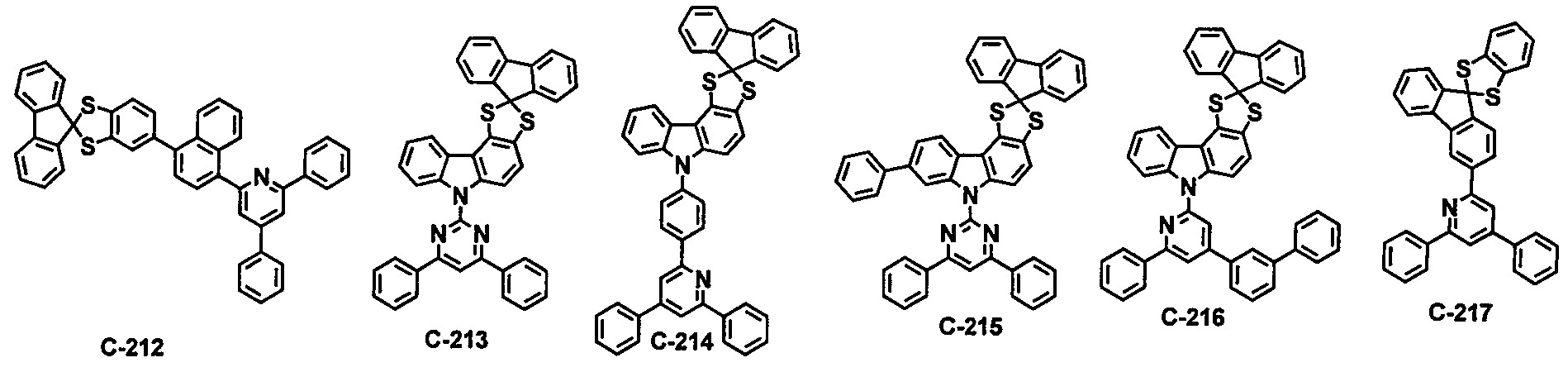

The compound represented by formula 1 according to the present disclosure may be prepared as represented by the following reaction schemes 1 and 2, but is not limited thereto; further produced by a synthetic method known to a person skilled in the art.
[Reaction Scheme 1]

[Reaction Scheme 2]


In reaction schemes 1 and 2, the definition of the substituents is as defined in formulae 1 to 4.
As described above, exemplary synthesis examples of the compounds represented by formula 1 according to one embodiment are described, but they are based on Buchwald-Hartwig cross coupling reaction, Suzuki cross-coupling reaction, Bromination reaction, organolithium reaction and Phosphine-mediated reductive cyclization reaction etc. It will be understood by one skilled in the art that the above reaction proceeds even if other substituents defined in the formulae 1 to 4 other than the substituents described in the specific synthesis examples are bonded.
The present disclosure may provide an organic electroluminescent material comprising an organic electroluminescent compound of formula 1, and an organic electroluminescent device comprising the organic electroluminescent material.
The organic electroluminescent material may be comprised solely of the organic electroluminescent compound of the present disclosure, or may further comprise conventional materials included in the organic electroluminescent material. When two or more species of materials are included in one layer, the at least two compounds may be a mixture-evaporation or a co-evaporation to form a layer. The organic electroluminescent material according to one embodiment may comprise at least one compound represented by formula 1. For example, the compound of formula 1 may be included as a hole transport layer (HTL) material of an organic electroluminescent device.
The organic electroluminescent material of the present disclosure may further comprise host compound other than the organic electroluminescent compound of formula 1. Preferably, the organic electroluminescent material may further comprise at least one dopant.
The dopant comprised in the organic electroluminescent material of the present disclosure may be at least one phosphorescent or fluorescent dopant, preferably a phosphorescent dopant. The phosphorescent dopant material applied to the organic electroluminescent device of the present disclosure is not particulary limited, but may be preferably a metallated complex compound(s) of a metal atom(s) selected from iridium (Ir), osmium (Os), copper (Cu), and platinum (Pt), more preferably an ortho-metallated complex compound(s) of a metal atom(s) selected from iridium (Ir), osmium (Os), copper (Cu), and platinum (Pt), and even more preferably ortho-metallated iridium complex compound(s).
The dopant comprised may use the compound represented by the following formula 101, but is not limited thereto:

In formula 101,
wherein, L is selected from the following structure 1 or 2:

R100 to R103 each independently represent hydrogen, deuterium, halogen, halogen-substituted or unsubstituted (C1-C30)alkyl, a substituted or unsubstituted (C3-C30)cycloalkyl, a substituted or unsubstituted (C6-C30)aryl, cyano, a substituted or unsubstituted (3- to 30-membered)heteroaryl, or a substituted or unsubstituted (C1-C30)alkoxy; or R100 to R103 may be linked to an adjacent substituent(s) to form a substituted or unsubstituted fused ring, e.g., a substituted or unsubstituted quinoline, a substituted or unsubstituted benzofuropyridine, a substituted or unsubstituted benzothienopyridine, a substituted or unsubstituted indenopyridine, a substituted or unsubstituted benzofuroquinoline, a substituted or unsubstituted benzothienoquinoline, or a substituted or unsubstituted indenoquinoline;
R104 to R107 each independently represent hydrogen, deuterium, halogen, halogen-substituted or unsubstituted (C1-C30)alkyl, a substituted or unsubstituted (C3-C30)cycloalkyl, a substituted or unsubstituted (C6-C30)aryl, a substituted or unsubstituted (3- to 30-membered)heteroaryl, cyano, or a substituted or unsubstituted (C1-C30)alkoxy; or R104 to R107 may be linked to an adjacent substituent(s) to form a substituted or unsubstituted fused ring, e.g., a substituted or unsubstituted naphthyl, a substituted or unsubstituted fluorene, a substituted or unsubstituted dibenzothiophene, a substituted or unsubstituted dibenzofuran, a substituted or unsubstituted indenopyridine, a substituted or unsubstituted benzofuropyridine, or a substituted or unsubstituted benzothienopyridine;
R201 to R211 each independently represent hydrogen, deuterium, halogen, halogen-substituted or unsubstituted (C1-C30)alkyl, a substituted or unsubstituted (C3-C30)cycloalkyl, or a substituted or unsubstituted (C6-C30)aryl; or may be linked to an adjacent substituent(s) to form a substituted or unsubstituted fused ring; and
s represents an integer of 1 to 3.
The specific examples of the dopant compound include the following, but are not limited thereto:


Hereinafter, the organic electroluminescent device to which the aforementioned organic electroluminescent compound or the organic electroluminescent material is applied will be described.
The organic electroluminescent device according to one embodiment may comprise a first electrode; a second electrode; and at least one organic layer between the first and second electrodes.
The compound represented by formula 1 of the present disclosure may be included in one or more layers constituting the organic electroluminescent device. According to one embodiment, the organic layer includes a light-emitting layer, a hole transport layer and/or a hole auxiliary layer containing an organic electroluminescent compound according to the present disclosure. In one embodiment, when the compound of formula 1 is included in the light-emitting layer, it may be included as a host material. Wherein, the host material may be a host material for a green or red light-emitting organic electroluminescent device. In addition, when the compound of formula 1 is included in the a hole transport layer and/or a hole auxiliary layer, it may be included as a hole transport material and/or a hole auxiliary material. For example, the light-emitting layer, the hole transport layer and/or the hole auxiliary layer may include solely of the organic electroluminescent compound of the present disclosure or at least two species of the organic electroluminescent compound of the present disclosure, and may further comprise conventional materials included in the organic electroluminescent material.
In addition, the organic layer may comprise a light-emitting layer, a hole transport layer, and a hole auxiliary layer, and may further comprise at least one layer selected from a hole injection layer, a light-emitting auxiliary layer, an electron transport layer, an electron injection layer, an interlayer, a hole blocking layer, an electron blocking layer, and an electron buffer layer. Each layer may further consist of several layers. Also, the organic layer may further comprise at least one compound selected from the group consisting of an arylamine-based compound and a styrylarylamine-based compound, and further comprise at least one metal selected from the group consisting of metals of Group 1, metals of Group 2, transition metals of the 4th period, transition metals of the 5th period, lanthanides, and organic metals of the d-transition elements of the Periodic Table, or at least one complex compound comprising such a metal.
An organic electroluminescent material according to one embodiment may be used as light-emitting materials for a white organic light-emitting device. The white organic light-emitting device has suggested various structures such as a parallel side-by-side arrangement method, a stacking arrangement method, or CCM (color conversion material) method, etc., according to the arrangement of R (Red), G (Green), B (blue), or YG (yellowish green) light-emitting units. In addition, the organic electroluminescent material according to one embodiment may also be applied to the organic electroluminescent device comprising a QD (quantum dot).
One of the first electrode and the second electrode may be an anode and the other may be a cathode. Wherein, the first electrode and the second electrode may each be formed as a transmissive conductive material, a transflective conductive material, or a reflective conductive material. The organic electroluminescent device may be a top emission type, a bottom emission type, or a both-sides emission type according to the kinds of the material forming the first electrode and the second electrode.
A hole injection layer, a hole transport layer, an electron blocking layer, or a combination thereof can be used between the anode and the light-emitting layer. The hole injection layer may be multi-layers in order to lower the hole injection barrier (or hole injection voltage) from the anode to the hole transport layer or the electron blocking layer, wherein each of the multi-layers may use two compounds simultaneously. The hole injection layer may be doped as a p-dopant. Also, the electron blocking layer may be placed between the hole transport layer (or hole injection layer) and the light-emitting layer, and can confine the excitons within the light-emitting layer by blocking the overflow of electrons from the light-emitting layer to prevent a light-emitting leakage. The hole transport layer or the electron blocking layer may be multi-layers, and wherein each layer may use a plurality of compounds.
An electron buffer layer, a hole blocking layer, an electron transport layer, an electron injection layer, or a combination thereof can be used between the light-emitting layer and the cathode. The electron buffer layer may be multi-layers in order to control the injection of the electron and improve the interfacial properties between the light-emitting layer and the electron injection layer, wherein each of the multi-layers may use two compounds simultaneously. The hole blocking layer or the electron transport layer may also be multi-layers, wherein each layer may use a plurality of compounds. Also, the electron injection layer may be doped as an n-dopant.
The light-emitting auxiliary layer may be placed between the anode and the light-emitting layer, or between the cathode and the light-emitting layer. When the light-emitting auxiliary layer is placed between the anode and the light-emitting layer, it can be used for promoting the hole injection and/or the hole transport, or for preventing the overflow of electrons. When the light-emitting auxiliary layer is placed between the cathode and the light-emitting layer, it can be used for promoting the electron injection and/or the electron transport, or for preventing the overflow of holes. In addition, the hole auxiliary layer may be placed between the hole transport layer (or hole injection layer) and the light-emitting layer, and may be effective to promote or block the hole transport rate (or the hole injection rate), thereby enabling the charge balance to be controlled. When an organic electroluminescent device includes two or more hole transport layers, the hole transport layer, which is further included, may be used as the hole auxiliary layer or the electron blocking layer. The light-emitting auxiliary layer, the hole auxiliary layer, or the electron blocking layer may have an effect of improving the efficiency and/or the lifespan of the organic electroluminescent device.
In the organic electroluminescent device of the present disclosure, preferably, at least one layer (hereinafter, "a surface layer") selected from a chalcogenide layer, a halogenated metal layer, and a metal oxide layer may be placed on an inner surface(s) of one or both electrode(s). Specifically, a chalcogenide (including oxides) layer of silicon and aluminum is preferably placed on an anode surface of an electroluminescent medium layer, and a halogenated metal layer or a metal oxide layer is preferably placed on a cathode surface of an electroluminescent medium layer. The operation stability for the organic electroluminescent device may be obtained by the surface layer. Preferably, the chalcogenide includes SiOX(1≤X≤2), AlOX(1≤X≤1.5), SiON, SiAlON, etc.; the halogenated metal includes LiF, MgF2, CaF2, a rare earth metal fluoride, etc.; and the metal oxide includes Cs2O, Li2O, MgO, SrO, BaO, CaO, etc.
Further, in the organic electroluminescent device of the present disclosure, a mixed region of an electron transport compound and a reductive dopant, or a mixed region of a hole transport compound and an oxidative dopant may be placed on at least one surface of a pair of electrodes. In this case, the electron transport compound is reduced to an anion, and thus it becomes easier to inject and transport electrons from the mixed region to an electroluminescent medium. Furthermore, the hole transport compound is oxidized to a cation, and thus it becomes easier to inject and transport holes from the mixed region to the electroluminescent medium. Preferably, the oxidative dopant includes various Lewis acids and acceptor compounds, and the reductive dopant includes alkali metals, alkali metal compounds, alkaline earth metals, rare-earth metals, and mixtures thereof. A reductive dopant layer may be employed as a charge generating layer to prepare an organic electroluminescent device having two or more light-emitting layers and emitting white light.
In order to form each layer of the organic electroluminescent device of the present disclosure, dry film-forming methods such as vacuum evaporation, sputtering, plasma, ion plating methods, etc., or wet film-forming methods such as ink jet printing, nozzle printing, slot coating, spin coating, dip coating, flow coating methods, etc., can be used.
When using a wet film-forming method, a thin film may be formed by dissolving or diffusing materials forming each layer into any suitable solvent such as ethanol, chloroform, tetrahydrofuran, dioxane, etc. The solvent may be any solvent where the materials forming each layer can be dissolved or diffused, and where there are no problems in film-formation capability.
Further, the present disclosure can provide display devices using the compound represented by formula 1. That is, by using the compound of the present disclosure, it can be used for the manufacture of display devices or lighting devices. Specifically, the organic electroluminescent device of the present disclosure can be used for the manufacture of display devices such as smartphones, tablets, notebooks, PCs, TVs, or display devices for vehicles, or lighting devices such as outdoor or indoor lighting.
Hereinafter, the preparation method of compounds according to the present disclosure will be explained with reference to the synthesis method of a representative compound or the intermediate compound of the present disclosure in order to understand the present disclosure in detail.
[Example 1] Synthesis of Compound C-3

Synthesis of Compound 1-1
Catechol (20 g, 181.7 mmol), α,α-dichlorodiphenylmethane (43 g, 181.7 mmol), and 454 mL of toluene were added into the 1L round bottom flask (RBF), and stirred at 100℃ for 27 hours. Thereafter the reaction mixture was cooled to room temperature and concentrated by distillation. The resulting mixture was purified by column chromatography to obtain the compound 1-1 (41 g, 82%).
Synthesis of Compound 1-2
Compound 1-1 (20 g, 73.0 mmol) and 730 mL of dimethylformamide (DMF) were added into 1L RBF, and stirred at room temperature for 10 minutes, and then N-bromosuccinimide(NBS) (13.6 g, 76 mmol) was added into the mixture followed by reacting at room temperature for 24 hours. After completion of the reaction, the solid obtained by distilled the reaction mixture was purified by column chromatography to obtain the compound 1-2 (24.4 g, 95%).
Synthesis of Compound C-3
N-([1,1'-biphenyl]-4-yl)-9,9-dimethyl-9H-fluoren-2-amine (6.8 g, 19.4 mmol), tris(dibenzylideneacetone)dipalladium(0) (Pd2(dba)3) (710 mg, 0.776 mmol), 2-dicyclohexylphosphino-2′,6′-dimethoxybiphenyl (s-phos) (637 mg, 1.55 mmol), sodium tert-butoxide (NaOtBu) (2.8 g, 29 mmol), and 144 mL of toluene were added into 500 mL RBF, and heated to 100℃. Compound 1-2 was dissolved in 50 mL of toluene followed by adding it dropwise to the reaction mixture, and then reacted for 3 hours. After completion of the reaction, the reaction mixture was cooled to room temperature and the organic layer was extracted with dichloromethane. The remaining liquid of the organic layer was removed with MgSO4 and dried, and then the reaction mixture was purified by column chromatography to obtain the compound C-3 (1 g, 8%).
[Example 2] Synthesis of Compound C-1

N-phenyl-[1,1'-biphenyl]-4-amine (10 g, 19.4 mmol), Pd2dba3 (1.5 g, 1.64 mmol), s-phos (1.3 g, 3.3 mmol), NaOtBu (5.9 g, 61 mmol), and 310 mL of toluene were added into 500 mL RBF and heated to 100℃. Compound 1-2 was dissolved in 100 mL of toluene followed by adding it dropwise to the reaction mixture, and then reacted for 3 hours. After completion of the reaction, the reaction mixture was cooled to room temperature and the organic layer was extracted with dichloromethane. The remaining liquid of the organic layer was removed with MgSO4 and dried, and then the reaction mixture was purified by column chromatography to obtain the compound C-1 (7.5 g, 35%).
Hereinafter, the preparation method and the properties of an organic electroluminescent device comprising an organic electroluminescent compound of the present disclosure will be explained in order to understand the present disclosure in detail.
[Device Examples 1 and 2] Producing OLEDs using the organic
electroluminescent compound according to the present disclosure
OLEDs were produced by using the organic electroluminescent compound according to the present disclosure. First, a transparent electrode indium tin oxide (ITO) thin film (10 Ω/sq) on a glass substrate for an OLED (GEOMATEC CO., LTD., Japan) was subjected to an ultrasonic washing with acetone and isopropanol, sequentially, and then was stored in isopropanol. Next, the ITO substrate was mounted on a substrate holder of a vacuum vapor deposition apparatus. Compound HI-1 was introduced into a cell of the vacuum vapor deposition apparatus, and the pressure in the chamber of the apparatus was then controlled to 10-6 torr. Thereafter, an electric current was applied to the cell to evaporate the introduced material, thereby forming a first hole injection layer having a thickness of 80 nm on the ITO substrate. Compound HI-2 was then introduced into another cell of the vacuum vapor deposition apparatus, and an electric current was applied to the cell to evaporate the introduced material, thereby forming a second hole injection layer having a thickness of 5 nm on the first hole injection layer. Next, compound HT-1 was introduced into another cell of the vacuum vapor deposition apparatus. Thereafter, an electric current was applied to the cell to evaporate the introduced material, thereby forming a first hole transport layer having a thickness of 10 nm on the second hole injection layer. The compound listed in the following Table 1 as a second hole transport material was then introduced into another cell of the vacuum vapor deposition apparatus, and an electric current was applied to the cell to evaporate the introduced material, thereby forming a second hole transport layer (a hole auxiliary layer) having a thickness of 30 nm on the first hole transport layer. After forming the hole injection layers and the hole transport layers, a light-emitting layer was then deposited thereon as follows: the compound H-1 as a host was introduced into one cell of the vacuum vapor deposition apparatus and the compound D-1 was introduced into another cell as a dopant. The dopant was doped in a doping amount of 10 wt% with respect to the rate of the deposition of the light-emitting layer, to form a light-emitting layer having a thickness of 40 nm on the hole transport layer. Next, compounds ET-1 and EI-1 were introduced into another cell, were evaporated at a rate of 1:1, and were deposited to form an electron transport layer having a thickness of 35 nm on the light-emitting layer. After depositing compound EI-1 as an electron injection layer having a thickness of 2 nm on the electron transport layer, an Al cathode having a thickness of 800 nm was deposited on the electron injection layer by another vacuum vapor deposition apparatus. Thus, OLEDs were produced.
[Device Comparative Example 1] Producing an OLED not according to the
present disclosure
An OLED was produced in the same manner as in Device Example 1, except that compound HT-1 was used in a second host transport material (a hole auxiliary material).
The results of the driving voltage, the current efficiency, the power efficiency, the external quantum efficiency, and the color coordinates at a luminance of 1,000 nits, of the organic electroluminescent device of Device Examples 1 and 2 and Device Comparative Example 1 produced as described above, are shown in the following Table 1.

Referring to Table 1 above, when the organic electroluminescent compound according to the present disclosure uses a material of the second hole transport layer of the organic electroluminescent device, it can be confirmed that the organic electroluminescent device according to one embodiment is superior with regard to the current efficiency, the power efficiency, and the external quantum efficiency, compared to the Device Comparative Example 1 using a conventional hole transport material. Thereby, the organic electroluminescent device according to one embodiment can be expected to have a high luminous efficiency.
The compounds used in Device Examples 1 and 2 and Device Comparative Example 1 are shown specifically in Table 2 below.


Claims (8)
- An organic electroluminescent compound represented by the following formula 1:
 wherein,Y1 and Y2 each independently represent O or S;L1 each independently represent a single bond, a substituted or unsubstituted (C6-C30)arylene, or a substituted or unsubstituted (3- to 30-membered)heteroarylene;Ar1 each independently represent hydrogen, deuterium, halogen, cyano, a substituted or unsubstituted (C1-C30)alkyl, a substituted or unsubstituted (C6-C30)aryl, a substituted or unsubstituted (3- to 30-membered)heteroaryl, a substituted or unsubstituted (C3-C30)cycloalkyl, a substituted or unsubstituted (C1-C30)alkoxy, a substituted or unsubstituted tri(C1-C30)alkylsilyl, a substituted or unsubstituted di(C1-C30)alkyl(C6-C30)arylsilyl, a substituted or unsubstituted (C1-C30)alkyldi(C6-C30)arylsilyl, a substituted or unsubstituted tri(C6-C30)arylsilyl, a substituted or unsubstituted fused ring of (C3-C30)aliphatic ring and (C6-C30)aromatic ring, or -N(Ar4)(Ar5); or may be linked to adjacent substituents to form a ring;Ar4 and Ar5 each independently represent hydrogen, deuterium, a substituted or unsubstituted (C1-C30)alkyl, a substituted or unsubstituted (C2-C30)alkenyl, a substituted or unsubstituted (C6-C30)aryl, or a substituted or unsubstituted (3- to 30-membered)heteroaryl;R1 and R2 each independently represent hydrogen, deuterium, halogen, cyano, a substituted or unsubstituted (C1-C30)alkyl, a substituted or unsubstituted (C6-C30)aryl, a substituted or unsubstituted (3- to 30-membered)heteroaryl, a substituted or unsubstituted (C3-C30)cycloalkyl, a substituted or unsubstituted (C1-C30)alkoxy, a substituted or unsubstituted tri(C1-C30)alkylsilyl, a substituted or unsubstituted di(C1-C30)alkyl(C6-C30)arylsilyl, a substituted or unsubstituted (C1-C30)alkyldi(C6-C30)arylsilyl, a substituted or unsubstituted tri(C6-C30)arylsilyl, or a substituted or unsubstituted (C1-C30)alkyl(C6-C30)arylamino; or may be linked to adjacent substituents to form a ring; anda represents an integer of 0 to 4, when a is 2 or more, each -L1-Ar1 may be the same or different.
 - The organic electroluminescent compound according to claim 1, wherein the formula 1 is represented by any one of the following formulae 2 to 4:

 wherein,Y1, Y2, R1, R2, L1, Ar1, and a are as defined in claim 1;Ar2, Ar3, and Ar6 are as defined as Ar1;Y3 represents O, S, -N(L2-Ar7), or -C(Ar8)(Ar9);L2 is as defined as L1;Ar7 is as defined as Ar4;Ar8 and Ar9 each independently represent a substituted or unsubstituted (C1-C30)alkyl or a substituted or unsubstituted (C6-C30)aryl;b to d each independently represent an integer of 1 to 4, e represents an integer of 1 or 2; andwhen b to e are 2 or more, each of Ar2, Ar3, Ar6, and -L1-Ar1 may be the same or different.
 - The organic electroluminescent compound according to claim 1, Ar1, Ar4, Ar5, R1, and R2 each independently are selected from any one of the substituents listed in the following Group 1:[Group 1]


- The organic electroluminescent compound according to claim 1, wherein the substituents of the substituted (C1-C30)alkyl, the substituted (C2-C30)alkenyl, the substituted (C6-C30)aryl(ene), the substituted (3- to 30-membered)heteroaryl(ene), the substituted (C3-C30)cycloalkyl, the substituted (C1-C30)alkoxy, the substituted tri(C1-C30)alkylsilyl, the substituted di(C1-C30)alkyl(C6-C30)arylsilyl, the substituted (C1-C30)alkyldi(C6-C30)arylsilyl, the substituted tri(C6-C30)arylsilyl, the substituted fused ring of (C3-C30)aliphatic ring and (C6-C30)aromatic ring, and the substituted (C1-C30)alkyl(C6-C30)arylamino in L1, Ar1, Ar4, Ar5, R1, and R2, each independently represent at least one selected from the group consisting of deuterium, halogen, cyano, carboxyl, nitro, hydroxyl, (C1-C30)alkyl, halo(C1-C30)alkyl, (C2-C30)alkenyl, (C2-C30)alkynyl, (C1-C30)alkoxy, (C1-C30)alkylthio, (C3-C30)cycloalkyl, (C3-C30)cycloalkenyl, (3- to 7-membered)heterocycloalkyl, (C6-C30)aryloxy, (C6-C30)arylthio, (C6-C30)aryl-substituted or unsubstituted (5- to 30-membered)heteroaryl, (5- to 30-membered)heteroaryl-substituted or unsubstituted (C6-C30)aryl, tri(C1-C30)alkylsilyl, tri(C6-C30)arylsilyl, di(C1-C30)alkyl(C6-C30)arylsilyl, (C1-C30)alkyldi(C6-C30)arylsilyl, amino, mono- or di- (C1-C30)alkylamino, (C1-C30)alkyl-substituted or unsubstituted mono- or di-(C6-C30)arylamino, (C1-C30)alkyl(C6-C30)arylamino, (C1-C30)alkylcarbonyl, (C1-C30)alkoxycarbonyl, (C6-C30)arylcarbonyl, di(C6-C30)arylboronyl, di(C1-C30)alkylboronyl, (C1-C30)alkyl(C6-C30)arylboronyl, (C6-C30)ar(C1-C30)alkyl, and (C1-C30)alkyl(C6-C30).
- The organic electroluminescent compound according to claim 1, wherein the compound represented by formula 1 is selected from the group consisting of:


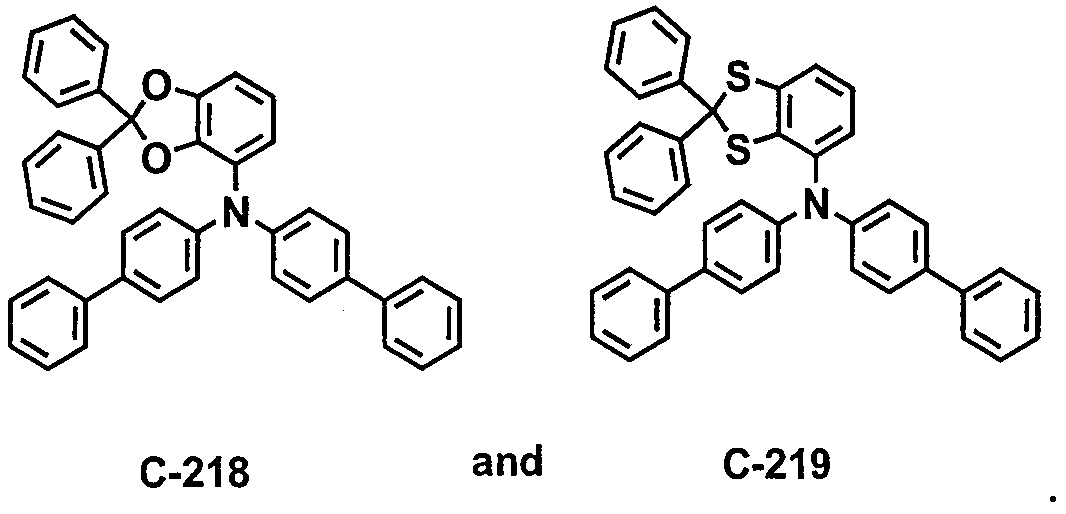
- An organic electroluminescent material comprising the organic electroluminescent compound according to claim 1.
- An organic electroluminescent device comprising the organic electroluminescent compound according to claim 1.
- The organic electroluminescent device according to claim 7, wherein the organic electroluminescent compound is contained in at least one layer of a light-emitting layer, a hole transport layer, and a hole auxiliary layer.
Priority Applications (1)
| Application Number | Priority Date | Filing Date | Title |
|---|---|---|---|
| CN202080015226.2A CN113490730A (en) | 2019-02-20 | 2020-02-19 | Organic electroluminescent compounds and organic electroluminescent device comprising the same |
Applications Claiming Priority (4)
| Application Number | Priority Date | Filing Date | Title |
|---|---|---|---|
| KR10-2019-0019815 | 2019-02-20 | ||
| KR20190019815 | 2019-02-20 | ||
| KR10-2020-0010274 | 2020-01-29 | ||
| KR1020200010274A KR102929794B1 (en) | 2019-02-20 | 2020-01-29 | Organic electroluminescent compound and organic electroluminescent device comprising the same |
Publications (1)
| Publication Number | Publication Date |
|---|---|
| WO2020171587A1 true WO2020171587A1 (en) | 2020-08-27 |
Family
ID=72144145
Family Applications (1)
| Application Number | Title | Priority Date | Filing Date |
|---|---|---|---|
| PCT/KR2020/002389 Ceased WO2020171587A1 (en) | 2019-02-20 | 2020-02-19 | Organic electroluminescent compound and organic electroluminescent device comprising the same |
Country Status (1)
| Country | Link |
|---|---|
| WO (1) | WO2020171587A1 (en) |
Citations (5)
| Publication number | Priority date | Publication date | Assignee | Title |
|---|---|---|---|---|
| KR20110016031A (en) * | 2009-08-10 | 2011-02-17 | 삼성모바일디스플레이주식회사 | Organic light emitting device |
| CN102146077A (en) * | 2011-01-13 | 2011-08-10 | 上海大学 | Fluoreneimidazole derivatives and preparation method thereof |
| KR20170074652A (en) * | 2015-12-22 | 2017-06-30 | 주식회사 두산 | Organic compounds and organic electro luminescence device comprising the same |
| KR20190001967A (en) * | 2017-06-28 | 2019-01-08 | 덕산네오룩스 주식회사 | Compound for organic electric element, organic electric element comprising the same and electronic device thereof |
| KR20190010811A (en) * | 2017-07-21 | 2019-01-31 | 덕산네오룩스 주식회사 | Compound for organic electric element, organic electric element comprising the same and electronic device thereof |
-
2020
- 2020-02-19 WO PCT/KR2020/002389 patent/WO2020171587A1/en not_active Ceased
Patent Citations (5)
| Publication number | Priority date | Publication date | Assignee | Title |
|---|---|---|---|---|
| KR20110016031A (en) * | 2009-08-10 | 2011-02-17 | 삼성모바일디스플레이주식회사 | Organic light emitting device |
| CN102146077A (en) * | 2011-01-13 | 2011-08-10 | 上海大学 | Fluoreneimidazole derivatives and preparation method thereof |
| KR20170074652A (en) * | 2015-12-22 | 2017-06-30 | 주식회사 두산 | Organic compounds and organic electro luminescence device comprising the same |
| KR20190001967A (en) * | 2017-06-28 | 2019-01-08 | 덕산네오룩스 주식회사 | Compound for organic electric element, organic electric element comprising the same and electronic device thereof |
| KR20190010811A (en) * | 2017-07-21 | 2019-01-31 | 덕산네오룩스 주식회사 | Compound for organic electric element, organic electric element comprising the same and electronic device thereof |
Similar Documents
| Publication | Publication Date | Title |
|---|---|---|
| WO2020218762A1 (en) | A plurality of host materials and organic electroluminescent device comprising the same | |
| WO2020085829A1 (en) | A plurality of light-emitting materials and organic electroluminescent device comprising the same | |
| WO2019177407A1 (en) | Composition material for organic electroluminescent device, plurality of host materials, and organic electroluminescent device comprising the same | |
| WO2020256376A1 (en) | Organic electroluminescent compound and organic electroluminescent device comprising the same | |
| WO2019143184A1 (en) | Organic electroluminescent compound and organic electroluminescent device comprising the same | |
| EP2616462A1 (en) | Novel organic electroluminescent compounds and organic electroluminescent device using the same | |
| EP3446345A1 (en) | A plurality of host materials and organic electroluminescent device comprising the same | |
| EP3344606A1 (en) | Organic electroluminescent compounds and organic electroluminescent device comprising the same | |
| WO2020091446A1 (en) | Organic electroluminescent compound and organic electroluminescent device comprising the same | |
| WO2017183859A1 (en) | A plurality of host materials and organic electroluminescent device comprising the same | |
| WO2015012618A1 (en) | Organic electroluminescent compound and organic electroluminescent device comprising the same | |
| WO2020045976A1 (en) | A plurality of host materials and organic electroluminescent device comprising the same | |
| WO2013154325A1 (en) | Novel organic electroluminescent compounds and organic electroluminescent device containing the same | |
| WO2014185751A1 (en) | Organic electroluminescent compounds and organic electroluminescent device comprising the same | |
| WO2020022769A1 (en) | A plurality of host materials and organic electroluminescent device comprising the same | |
| EP3201200A1 (en) | Organic electroluminescent compound and organic electroluminescent device comprising the same | |
| WO2017030283A1 (en) | Organic electroluminescent compounds and organic electroluminescent device comprising the same | |
| WO2020027506A1 (en) | A plurality of host materials and organic electroluminescent device comprising the same | |
| WO2020080693A1 (en) | A plurality of host materials and organic electroluminescent device comprising the same | |
| WO2018155942A1 (en) | A plurality of host materials and organic electroluminescent device comprising the same | |
| WO2019235748A1 (en) | A plurality of host materials and organic electroluminescent device comprising the same | |
| WO2016052962A1 (en) | Organic electroluminescent compound and organic electroluminescent device comprising the same | |
| WO2020197240A1 (en) | Organic electroluminescent compound and organic electroluminescent device comprising the same | |
| WO2019190149A1 (en) | Composition material for organic electroluminescent device, plurality of host materials, and organic electroluminescent device comprising the same | |
| WO2017099516A1 (en) | Organic electroluminescent compound and organic electroluminescent device comprising the same |
Legal Events
| Date | Code | Title | Description |
|---|---|---|---|
| 121 | Ep: the epo has been informed by wipo that ep was designated in this application |
Ref document number: 20759947 Country of ref document: EP Kind code of ref document: A1 |
|
| NENP | Non-entry into the national phase |
Ref country code: DE |
|
| 122 | Ep: pct application non-entry in european phase |
Ref document number: 20759947 Country of ref document: EP Kind code of ref document: A1 |