WO2020165310A1 - Pyridinium compounds and their use as herbicides - Google Patents
Pyridinium compounds and their use as herbicides Download PDFInfo
- Publication number
- WO2020165310A1 WO2020165310A1 PCT/EP2020/053697 EP2020053697W WO2020165310A1 WO 2020165310 A1 WO2020165310 A1 WO 2020165310A1 EP 2020053697 W EP2020053697 W EP 2020053697W WO 2020165310 A1 WO2020165310 A1 WO 2020165310A1
- Authority
- WO
- WIPO (PCT)
- Prior art keywords
- group
- hydrogen
- c6alkyl
- formula
- phenyl
- Prior art date
- Legal status (The legal status is an assumption and is not a legal conclusion. Google has not performed a legal analysis and makes no representation as to the accuracy of the status listed.)
- Ceased
Links
- 0 CCC(C)(*(C)C*N)[C@]1(*)*(C)C1 Chemical compound CCC(C)(*(C)C*N)[C@]1(*)*(C)C1 0.000 description 5
- SXQWVGXLKTZECH-UHFFFAOYSA-N CCCC(C(O)=O)(N)N Chemical compound CCCC(C(O)=O)(N)N SXQWVGXLKTZECH-UHFFFAOYSA-N 0.000 description 1
- VOZBIXFDNDAAEN-UHFFFAOYSA-N CCCCC(C)C(C)C(CBr)=N Chemical compound CCCCC(C)C(C)C(CBr)=N VOZBIXFDNDAAEN-UHFFFAOYSA-N 0.000 description 1
- BJLFRYUEDOKXRO-UHFFFAOYSA-N c1cnc(-c2ccncc2)nc1 Chemical compound c1cnc(-c2ccncc2)nc1 BJLFRYUEDOKXRO-UHFFFAOYSA-N 0.000 description 1
Classifications
-
- C—CHEMISTRY; METALLURGY
- C07—ORGANIC CHEMISTRY
- C07D—HETEROCYCLIC COMPOUNDS
- C07D401/00—Heterocyclic compounds containing two or more hetero rings, having nitrogen atoms as the only ring hetero atoms, at least one ring being a six-membered ring with only one nitrogen atom
- C07D401/02—Heterocyclic compounds containing two or more hetero rings, having nitrogen atoms as the only ring hetero atoms, at least one ring being a six-membered ring with only one nitrogen atom containing two hetero rings
- C07D401/04—Heterocyclic compounds containing two or more hetero rings, having nitrogen atoms as the only ring hetero atoms, at least one ring being a six-membered ring with only one nitrogen atom containing two hetero rings directly linked by a ring-member-to-ring-member bond
-
- A—HUMAN NECESSITIES
- A01—AGRICULTURE; FORESTRY; ANIMAL HUSBANDRY; HUNTING; TRAPPING; FISHING
- A01N—PRESERVATION OF BODIES OF HUMANS OR ANIMALS OR PLANTS OR PARTS THEREOF; BIOCIDES, e.g. AS DISINFECTANTS, AS PESTICIDES OR AS HERBICIDES; PEST REPELLANTS OR ATTRACTANTS; PLANT GROWTH REGULATORS
- A01N43/00—Biocides, pest repellants or attractants, or plant growth regulators containing heterocyclic compounds
- A01N43/48—Biocides, pest repellants or attractants, or plant growth regulators containing heterocyclic compounds having rings with two nitrogen atoms as the only ring hetero atoms
- A01N43/54—1,3-Diazines; Hydrogenated 1,3-diazines
-
- A—HUMAN NECESSITIES
- A01—AGRICULTURE; FORESTRY; ANIMAL HUSBANDRY; HUNTING; TRAPPING; FISHING
- A01N—PRESERVATION OF BODIES OF HUMANS OR ANIMALS OR PLANTS OR PARTS THEREOF; BIOCIDES, e.g. AS DISINFECTANTS, AS PESTICIDES OR AS HERBICIDES; PEST REPELLANTS OR ATTRACTANTS; PLANT GROWTH REGULATORS
- A01N43/00—Biocides, pest repellants or attractants, or plant growth regulators containing heterocyclic compounds
- A01N43/48—Biocides, pest repellants or attractants, or plant growth regulators containing heterocyclic compounds having rings with two nitrogen atoms as the only ring hetero atoms
- A01N43/58—1,2-Diazines; Hydrogenated 1,2-diazines
-
- A—HUMAN NECESSITIES
- A01—AGRICULTURE; FORESTRY; ANIMAL HUSBANDRY; HUNTING; TRAPPING; FISHING
- A01N—PRESERVATION OF BODIES OF HUMANS OR ANIMALS OR PLANTS OR PARTS THEREOF; BIOCIDES, e.g. AS DISINFECTANTS, AS PESTICIDES OR AS HERBICIDES; PEST REPELLANTS OR ATTRACTANTS; PLANT GROWTH REGULATORS
- A01N43/00—Biocides, pest repellants or attractants, or plant growth regulators containing heterocyclic compounds
- A01N43/48—Biocides, pest repellants or attractants, or plant growth regulators containing heterocyclic compounds having rings with two nitrogen atoms as the only ring hetero atoms
- A01N43/60—1,4-Diazines; Hydrogenated 1,4-diazines
-
- A—HUMAN NECESSITIES
- A01—AGRICULTURE; FORESTRY; ANIMAL HUSBANDRY; HUNTING; TRAPPING; FISHING
- A01N—PRESERVATION OF BODIES OF HUMANS OR ANIMALS OR PLANTS OR PARTS THEREOF; BIOCIDES, e.g. AS DISINFECTANTS, AS PESTICIDES OR AS HERBICIDES; PEST REPELLANTS OR ATTRACTANTS; PLANT GROWTH REGULATORS
- A01N43/00—Biocides, pest repellants or attractants, or plant growth regulators containing heterocyclic compounds
- A01N43/64—Biocides, pest repellants or attractants, or plant growth regulators containing heterocyclic compounds having rings with three nitrogen atoms as the only ring hetero atoms
- A01N43/647—Triazoles; Hydrogenated triazoles
-
- A—HUMAN NECESSITIES
- A01—AGRICULTURE; FORESTRY; ANIMAL HUSBANDRY; HUNTING; TRAPPING; FISHING
- A01N—PRESERVATION OF BODIES OF HUMANS OR ANIMALS OR PLANTS OR PARTS THEREOF; BIOCIDES, e.g. AS DISINFECTANTS, AS PESTICIDES OR AS HERBICIDES; PEST REPELLANTS OR ATTRACTANTS; PLANT GROWTH REGULATORS
- A01N43/00—Biocides, pest repellants or attractants, or plant growth regulators containing heterocyclic compounds
- A01N43/64—Biocides, pest repellants or attractants, or plant growth regulators containing heterocyclic compounds having rings with three nitrogen atoms as the only ring hetero atoms
- A01N43/647—Triazoles; Hydrogenated triazoles
- A01N43/653—1,2,4-Triazoles; Hydrogenated 1,2,4-triazoles
-
- A—HUMAN NECESSITIES
- A01—AGRICULTURE; FORESTRY; ANIMAL HUSBANDRY; HUNTING; TRAPPING; FISHING
- A01N—PRESERVATION OF BODIES OF HUMANS OR ANIMALS OR PLANTS OR PARTS THEREOF; BIOCIDES, e.g. AS DISINFECTANTS, AS PESTICIDES OR AS HERBICIDES; PEST REPELLANTS OR ATTRACTANTS; PLANT GROWTH REGULATORS
- A01N43/00—Biocides, pest repellants or attractants, or plant growth regulators containing heterocyclic compounds
- A01N43/64—Biocides, pest repellants or attractants, or plant growth regulators containing heterocyclic compounds having rings with three nitrogen atoms as the only ring hetero atoms
- A01N43/66—1,3,5-Triazines, not hydrogenated and not substituted at the ring nitrogen atoms
Definitions
- the present invention relates to herbicidally active pyridine derivatives, as well as to processes and intermediates used for the preparation of such derivatives.
- the invention further extends to herbicidal compositions comprising such derivatives, as well as to the use of such compounds and compositions in controlling undesirable plant growth: in particular the use in controlling weeds, in crops of useful plants.
- the present invention is based on the finding that pyridine derivatives of formula (I) as defined herein, exhibit surprisingly good herbicidal activity.
- T is 1 , 2 or 3;
- R 1 and R 2 are independently selected from the group consisting of hydrogen, halogen, Ci- Cealkyl, C 2 -C 6 alkenyl, C 2 -C 6 alkynyl, Cs-Cecycloalkyl, Ci-C 6 haloalkyl, -OR 7 , -OR 15a , -N(R 6 )S(0) 2 R 15 , - N(R 6 )C(0)R 15 , -N(R 6 )C(0)0R 15 , -N(R 6 )C(0)NR 16 R 17 , -N(R 6 )CHO, -N(R 7a ) 2 and -S(0) r R 15 ;
- R 1 is selected from the group consisting of -OR 7 , -OR 15a , -N(R 6 )S(0) 2 R 15 , - N(R 6 )C(0)R 15 , -N(R 6 )C(0)0R 15 , -N(R 6 )C(0)NR 16 R 17 , -N(R 6 )CHO, -N(R 7a ) 2 and -S(0) r R 15 , then the R 2 on the same carbon atom is selected from the group consisting of hydrogen and Ci-C6alkyl; or
- R 1 and R 2 together with the carbon atom to which they are attached form a C3-C6cycloalkyl ring or a 3- to 6- membered heterocyclyl, which comprises 1 or 2 heteroatoms individually selected from N and O;
- Y is (CR 1a R 2b ) m ;
- n 1 , 2 or 3;
- each R 1a is independently selected from the group consisting of hydrogen, halogen, Ci-C6alkyl, C 2 -C 6 alkenyl, C 2 -C 6 alkynyl, Cs-Cecycloalkyl, Ci-C 6 haloalkyl, -OH, -OR 7 , -OR 15a , -NH 2 , -NHR 7 , -N(R 7 ) 2 , - NHR 15a , -NR 7b R 7c , -N(R 6 )S(0) 2 R 15 , -N(R 6 )C(0)R 15 , -N(R 6 )C(0)0R 15 , -N(R 6 )C(0)NR 16 R 17 , -N(R 6 )CHO, - N(R 7a ) 2 ,— S(0)rR 15 and phenyl which is optionally substituted by 1 , 2 or 3 R 9 substituents, which may be the same or different, -C
- R 1a and R 2b together with the carbon atom to which they are attached form a C3-C6cycloalkyl ring or a 3- to 6- membered heterocyclyl, which comprises 1 or 2 heteroatoms individually selected from N and O;
- R 3 , R 3a , R 4 and R 5 are independently selected from the group consisting of hydrogen, halogen, cyano, nitro, -S(0) r R 15 , Ci-C6alkyl, Ci-C6fluoroalkyl, Ci-C6fluoroalkoxy, Ci-C6alkoxy, C3-C6cycloalkyl and -N(R 6 ) 2 ;
- each R 6 is independently selected from hydrogen and Ci-C6alkyl
- each R 7 is independently selected from the group consisting of Ci-C6alkyl, -S(0) 2 R 15 , -C(0)R 15 , -C(0)0R 15 and -C(0)NR 16 R 17 ;
- each R 7a is independently selected from the group consisting of -S(0) 2 R 15 , -C(0)R 15 , -C(0)0R 15 , -C(0)NR 16 R 17 and -C(0)NR 6 R 15a ;
- R 7b and R 7c are independently selected from the group consisting of Ci-C6alkyl, -S(0) r R 15 , - C(0)R 15 , - C(0)0R 15 , -C(0)NR 16 R 17 and phenyl, and wherein said phenyl is optionally substituted by 1 , 2 or 3 R 9 substituents, which may be the same or different; or
- R 7b and R 7c together with the nitrogen atom to which they are attached form a 4- to 6-membered heterocyclyl ring which optionally comprises one additional heteroatom individually selected from N, O and S;
- A is a 6-membered heteroaryl, which comprises 1 , 2, 3 or 4 nitrogen atoms and wherein the heteroaryl may be optionally substituted on carbon atoms by 1 , 2, 3 or 4 R 8 substituents, which may be the same or different,
- each R 8 is independently selected from the group consisting of halogen, nitro, cyano, -NH 2 , - NHR 7 , -N(R 7 ) 2 , -OH, -OR 7 , -S(0)rR 15 , -NR 6 S(0) 2 R 15 , -C(0)OR 10 , -C(0)R 15 , -C(0)NR 16 R 17 , - S(0) 2 NR 16 R 17 , Ci-C6alkyl, Ci-C6haloalkyl, C3-C6cycloalkyl, C3-C6halocycloalkyl, C3-C6cycloalkoxy, C 2 - C6alkenyl, C 2 -C6haloalkenyl, C 2 -C6alkynyl, Ci-C3alkoxyCi-C3alkyl-, hydroxyCi-Cealkyl-, Ci-C3alkoxyCi- C3alkoxy-, Ci-C6
- X is selected from the group consisting of -C(O)-, -0(0)0-, -C(0)N(R 40 )-, -C(0)N(R 42 )0-, - C (O) N (R 40 ) N (R 40 )- , -C(O)N(R 40 )C(O)-, -C(O)N(R 40 )C(O)N(R 40 )-, -C(O)N(R 40 )C(R 46 ) 2 C(O)N(R 40 )-, -
- R 40 is selected from the group consisting of hydrogen, Ci-C6alkyl, Ci-C6alkoxy, Ci-C3alkoxyCi-
- R 41 is selected from the group consisting of hydrogen, Ci-C6alkyl, Ci-C6alkoxy, Ci- C6alkylamino, di-Ci-C6alkylamino, cyano;
- R 42 is selected from the group consisting of hydrogen, Ci-C6alkyl, Ci-C6alkoxyCi-C3alkyl, Ci- C6 alkylcarbonyl, Ci-C6alkoxycarbonyl, Ci-C6alkylsulfonyl;
- R 43 is selected from the group consisting of hydrogen, Ci-C6alkyl, Ci-C6alkoxy, Ci-C3alkoxyCi- C3alkyl, Ci-C6alkylcarbonyl, Ci-C6alkoxycarbonyl, and Ci-C6alkylsulfonyl;
- R 44 is selected from the group consisting of hydrogen, Ci-C6alkyl, OH, Ci-C6alkoxy, Ci- C6alkoxyCi-C3alkyl, NH2, and Ci-C6alkylamino, di-Ci-C6alkylamino,
- R 45 is selected from the group consisting of hydrogen, halogen, and Ci-C6alkyl
- Z is selected from the group consisting of -C(0)OR 10 , -OH, -CH2OH, -CHO, -C(0)NH0R 11 , - C(0)NHCN, -0C(0)NH0R 11 , -0C(0)NHCN, -NR 6 C(0)NH0R 11 , -NR 6 C(0)NHCN, -C(0)NHS(0) 2 R 12 , - 0C(0)NHS(0) 2 R 12 , -NR 6 C(0)NHS(0) 2 R 12 , -S(0) 2 0R 10 , -0S(0) 2 0R 10 , -NR 6 S(0) 2 0R 10 , -NR 6 S(0)OR 10 , -NHS(0) 2 R 14 , -S(0)OR 10 , -OS(0)OR 10 , -S(0) 2 NHCN, -S(0) 2 NHC(0)R 18 , -S(0) 2 NHS(0) 2 R 12 , - 0S(0) 2 NHCN, -0S(0) 2 NHS(0) 2 R
- R 10 is selected from the group consisting of hydrogen, Ci-C6alkyl, phenyl and benzyl, and wherein said phenyl or benzyl are optionally substituted by 1 , 2 or 3 R 9 substituents, which may be the same or different;
- R 11 is selected from the group consisting of hydrogen, Ci-C6alkyl and phenyl, and wherein said phenyl is optionally substituted by 1 , 2 or 3 R 9 substituents, which may be the same or different;
- R 12 is selected from the group consisting of Ci-C6alkyl, Ci-C6haloalkyl, Ci-C6alkoxy, -OH, - N(R 6 )2 and phenyl, and wherein said phenyl is optionally substituted by 1 , 2 or 3 R 9 substituents, which may be the same or different;
- R 13 is selected from the group consisting of -OH, Ci-C6alkyl, Ci-C6alkoxy and phenyl;
- R 14 is Ci-Cehaloalkyl
- R 15 is selected from the group consisting of Ci-C6alkyl and phenyl, and wherein said phenyl is optionally substituted by 1 , 2 or 3 R 9 substituents, which may be the same or different;
- R 15a is phenyl, wherein said phenyl is optionally substituted by 1 , 2 or 3 R 9 substituents, which may be the same or different;
- R 16 and R 17 are independently selected from the group consisting of hydrogen and Ci-C6alkyl; or
- R 16 and R 17 together with the nitrogen atom to which they are attached form a 4- to 6-membered heterocyclyl ring which optionally comprises one additional heteroatom individually selected from N, O and S;
- R 18 is selected from the group consisting of hydrogen, Ci-C6alkyl, Ci-C6haloalkyl, Ci-C6alkoxy, -N(R 6 )2 and phenyl, and wherein said phenyl is optionally substituted by 1 , 2 or 3 R 9 substituents, which may be the same or different; and,
- r 0, 1 or 2.
- an agrochemical composition comprising a herbicidally effective amount of a compound of formula (I).
- Such an agricultural composition may further comprise at least one additional active ingredient and/or an agrochemically acceptable diluent or carrier.
- a method of controlling or preventing undesirable plant growth wherein a herbicidally effective amount of a compound of formula (I), or a composition comprising this compound as active ingredient, is applied to the plants, to parts thereof or the locus thereof.
- halogen refers to fluorine (fluoro), chlorine (chloro), bromine (bromo) or iodine (iodo), preferably fluorine, chlorine or bromine.
- cyano means a -CN group.
- hydroxy means an -OH group.
- nitro means an -NO2 group.
- Ci-C6alkyl refers to a straight or branched hydrocarbon chain radical consisting solely of carbon and hydrogen atoms, containing no unsaturation, having from one to six carbon atoms, and which is attached to the rest of the molecule by a single bond.
- Ci-C 4 alkyl and Ci- C2alkyl are to be construed accordingly.
- Examples of Ci-C6alkyl include, but are not limited to, methyl, ethyl, n-propyl, 1 -methylethyl (iso-propyl), n-butyl, and 1 -dimethylethyl (f-butyl).
- Ci-C6alkoxy refers to a radical of the formula -OR a where R a is a Ci- Cealkyl radical as generally defined above. Ci-C 4 alkoxy is to be construed accordingly. Examples of Ci- 4 alkoxy include, but are not limited to, methoxy, ethoxy, propoxy, iso-propoxy and f-butoxy.
- Ci-C6haloalkyl refers to a Ci-C6alkyl radical as generally defined above substituted by one or more of the same or different halogen atoms. Ci-C4haloalkyl is to be construed accordingly. Examples of Ci-C6haloalkyl include, but are not limited to chloromethyl, fluoromethyl, fluoroethyl, difluoromethyl, trifluoromethyl and 2,2,2-trifluoroethyl.
- C 2 -C6alkenyl refers to a straight or branched hydrocarbon chain radical group consisting solely of carbon and hydrogen atoms, containing at least one double bond that can be of either the (E)- or ( ⁇ -configuration, having from two to six carbon atoms, which is attached to the rest of the molecule by a single bond.
- C2-C4alkenyl is to be construed accordingly.
- Examples of C 2 -C6alkenyl include, but are not limited to, prop-1 -enyl, allyl (prop-2-enyl) and but-1 -enyl.
- C 2 -C6haloalkenyl refers to a C 2 -C6alkenyl radical as generally defined above substituted by one or more of the same or different halogen atoms.
- Examples of C 2 -C6haloalkenyl include, but are not limited to chloroethylene, fluoroethylene, 1 ,1 -difluoroethylene, 1 ,1 -dichloroethylene and 1 ,1 ,2-trichloroethylene.
- C 2 -C6alkynyl refers to a straight or branched hydrocarbon chain radical group consisting solely of carbon and hydrogen atoms, containing at least one triple bond, having from two to six carbon atoms, and which is attached to the rest of the molecule by a single bond.
- C2-C4alkynyl is to be construed accordingly.
- Examples of C 2 -C6alkynyl include, but are not limited to, prop-1 -ynyl, propargyl (prop-2-ynyl) and but-1 -ynyl.
- Ci-C6haloalkoxy refers to a Ci-C6alkoxy group as defined above substituted by one or more of the same or different halogen atoms. Ci-C4haloalkoxy is to be construed accordingly. Examples of Ci-C6haloalkoxy include, but are not limited to, fluoromethoxy, difluoromethoxy, fluoroethoxy, trifluoromethoxy and trifluoroethoxy.
- Ci-C3haloalkoxyCi-C3alkyl refers to a radical of the formula Rb-0-R a - where Rb is a Ci-C3haloalkyl radical as generally defined above, and R a is a Ci-C3alkylene radical as generally defined above.
- Ci-C3alkoxyCi-C3alkyl refers to a radical of the formula Rb-0-R a - where Rb is a Ci-C3alkyl radical as generally defined above, and R a is a Ci-C3alkylene radical as generally defined above.
- Ci-C3alkoxyCi-C3alkoxy- refers to a radical of the formula Rb-0-R a - O- where Rb is a Ci-C3alkyl radical as generally defined above, and R a is a Ci-C3alkylene radical as generally defined above.
- C3-C6alkenyloxy refers to a radical of the formula -OR a where R a is a C3-C6alkenyl radical as generally defined above.
- C3-C6alkynyloxy refers to a radical of the formula -OR a where R a is a C3-C6alkynyl radical as generally defined above.
- hydroxyCi-Cealkyl refers to a Ci-C6alkyl radical as generally defined above substituted by one or more hydroxy groups.
- Ci-C6alkylcarbonyl refers to a radical of the formula -C(0)R a where R a is a Ci-C6alkyl radical as generally defined above.
- Ci-C6alkoxycarbonyl refers to a radical of the formula -C(0)0R a where R a is a Ci-C6alkyl radical as generally defined above.
- aminocarbonyl refers to a radical of the formula -C(0)NH 2 .
- Ci-Cealkylaminocarbonyl refers to a radical of the formula -C(0)NHR a where R a is a Ci-C6alkyl radical as generally defined above.
- C3-C6cycloalkyl refers to a stable, monocyclic ring radical which is saturated or partially unsaturated and contains 3 to 6 carbon atoms.
- C3-C 4 cycloalkyl is to be construed accordingly.
- Examples of C3-C6cycloalkyl include, but are not limited to, cyclopropyl, cyclobutyl, cyclopentyl and cyclohexyl.
- C3-C6halocycloalkyl refers to a C3-C6cycloalkyl radical as generally defined above substituted by one or more of the same or different halogen atoms.
- C3-C 4 halocycloalkyl is to be construed accordingly.
- C3-C6cycloalkoxy refers to a radical of the formula -OR a where R a is a C3-C6cycloalkyl radical as generally defined above.
- heteroaryl refers to a 5- or 6- membered monocyclic aromatic ring which comprises 1 , 2, 3 or 4 heteroatoms individually selected from nitrogen, oxygen and sulfur.
- the heteroaryl radical may be bonded to the rest of the molecule via a carbon atom or heteroatom.
- heteroaryl include, furyl, pyrrolyl, imidazolyl, thienyl, pyrazolyl, thiazolyl, isothiazolyl, oxazolyl, isoxazolyl, triazolyl, tetrazolyl, pyrazinyl, pyridazinyl, pyrimidyl or pyridyl.
- heterocyclyl refers to a stable 4- to 6-membered non-aromatic monocyclic ring radical which comprises 1 , 2, or 3 heteroatoms individually selected from nitrogen, oxygen and sulfur.
- the heterocyclyl radical may be bonded to the rest of the molecule via a carbon atom or heteroatom.
- heterocyclyl examples include, but are not limited to, pyrrolinyl, pyrrolidyl, tetrahydrofuryl, tetrahydrothienyl, tetrahydrothiopyranyl, piperidyl, piperazinyl, tetrahydropyranyl, dihydroisoxazolyl, dioxolanyl, morpholinyl or d-lactamyl.
- asymmetric carbon atoms in a compound of formula (I) means that the compounds may occur in chiral isomeric forms, i.e., enantiomeric or diastereomeric forms. Also atropisomers may occur as a result of restricted rotation about a single bond.
- Formula (I) is intended to include all those possible isomeric forms and mixtures thereof.
- the present invention includes all those possible isomeric forms and mixtures thereof for a compound of formula (I).
- formula (I) is intended to include all possible tautomers (including lactam-lactim tautomerism and keto- enol tautomerism) where present.
- the present invention includes all possible tautomeric forms for a compound of formula (I).
- where there are di-substituted alkenes these may be present in E or Z form or as mixtures of both in any proportion.
- the present invention includes all these possible isomeric forms and mixtures thereof for a compound of formula (I).
- the compounds of formula (I) may exist as an agronomically acceptable salt, a zwitterion or an agronomically acceptable salt of a zwitterion.
- This invention covers all such agronomically acceptable salts, zwitterions and mixtures thereof in all proportions.
- a compound of formula (I) wherein Z comprises an acidic proton may exist as a zwitterion, a compound of formula (l-l), or as an agronomically acceptable salt of an acid, a compound of formula (l-ll) as shown below: wherein, Y represents an agronomically acceptable anion and j and k represent integers that may be selected from 1 , 2 or 3, dependant upon the charge of the respective anion Y.
- a compound of formula (I) may also exist as an agronomically acceptable salt of a zwitterion, a compound of formula (l-lll) as shown below:
- Y represents an agronomically acceptable anion
- M represents an agronomically acceptable cation (in addition to the pyridinium cation) and the integers j, k and q may be selected from 1 , 2 or 3, dependant upon the charge of the respective anion Y and respective cation M.
- a compound of formula (l-ll) wherein k is 2, j is 1 and Y is selected from the group consisting of halogen, trifluoroacetate and pentafluoropropionate.
- a nitrogen atom in the aromatic ring A may be protonated or a nitrogen atom comprised in R 1 , R 2 , Q or X may be protonated.
- k is 2, j is 1 and Y is chloride, wherein a nitrogen atom in the aromatic ring A is protonated.
- Suitable agronomically acceptable salts of the present invention include but are not limited chloride, bromide, iodide, fluoride, 2-naphthalenesulfonate, acetate, adipate, methoxide, ethoxide, propoxide, butoxide, aspartate, benzenesulfonate, benzoate, bicarbonate, bisulfate, bitartrate, butylsulfate, butylsulfonate, butyrate, camphorate, camsylate, caprate, caproate, caprylate, carbonate, citrate, diphosphate, edetate, edisylate, enanthate, ethanedisulfonate, ethanesulfonate, ethylsulfate, formate, fumarate, gluceptate, gluconate, glucoronate, glutamate, glycerophosphate, hepta
- Suitable cations represented by M include, but are not limited to, metals, conjugate acids of amines and organic cations.
- suitable metals include aluminium, calcium, cesium, copper, lithium, magnesium, manganese, potassium, sodium, iron and zinc.
- Suitable amines include allylamine, ammonia, amylamine, arginine, benethamine, benzathine, butenyl-2-amine, butylamine, butylethanolamine, cyclohexylamine, decylamine, diamylamine, dibutylamine, diethanolamine, diethylamine, diethylenetriamine, diheptylamine, dihexylamine, diisoamylamine, diisopropylamine, dimethylamine, dioctylamine, dipropanolamine, dipropargylamine, dipropylamine, dodecylamine, ethanolamine, ethylamine, ethylbutylamine, ethylenediamine, ethylheptylamine, ethyloctylamine, ethylpropanolamine, heptadecylamine, heptylamine, hexadecylamine, he
- Suitable organic cations include benzyltributylammonium, benzyltrimethylammonium, benzyltriphenylphosphonium, choline, tetrabutylammonium, tetrabutylphosphonium, tetraethylammonium, tetraethylphosphonium, tetramethylammonium, tetramethylphosphonium, tetrapropylammonium, tetrapropylphosphonium, tributylsulfonium, tributylsulfoxonium, triethylsulfonium, triethylsulfoxonium, trimethylsulfonium, trimethylsulfoxonium, tripropylsulfonium and tripropylsulfoxonium.
- Preferred compounds of formula (I), wherein Z comprises an acidic proton can be represented as either (l-l) or (l-ll).
- compounds of formula (l-ll) emphasis is given to salts when Y is chloride, bromide, iodide, hydroxide, bicarbonate, acetate, trifluoroacetate, methylsulfate, tosylate and nitrate, wherein j and k are 1 .
- T is 1 or 2, more preferably 1 .
- R 1 is selected from the group consisting of hydrogen, halogen, Ci-C6alkyl, Ci- C6fluoroalkyl, -OR 7 and -N(R 7a )2. More preferably, R 1 is selected from the group consisting of hydrogen, Ci-C6alkyl, -OR 7 and -N(R 7 )2. Even more preferably, R 1 is hydrogen or Ci-C6alkyl. Even preferably still, R 1 is hydrogen or methyl. Most preferably R 1 is hydrogen.
- R 2 is hydrogen or Ci-C6alkyl. More preferably, R 2 is hydrogen or methyl. Most preferably R 2 is hydrogen.
- R 1 and R 2 together with the carbon atom to which they are attached form a C3-C6cycloalkyl ring or a 3- to 6- membered heterocyclyl, then preferably, R 1 and R 2 together with the carbon atom to which they are attached form a cyclopropyl ring.
- R 1 and R 2 are hydrogen.
- Y is (CR 1a R 2b )m.
- m is 1 , 2 or 3.
- m is 1 or 2. More preferably, m is or 1.
- R 1a is selected from the group consisting of hydrogen, halogen, Ci-C6alkyl, C2- Cealkenyl, C 2 -C 6 alkynyl, Cs-Cecycloalkyl, Ci-C 6 haloalkyl, -OH, -OR 7 , -OR 15a , -N(R 6 )S(0) 2 R 15 , - N(R 6 )C(0)R 15 , -N(R 6 )C(0)0R 15 , -N(R 6 )C(0)NR 16 R 17 , -N(R 6 )CHO, -NH 2, -NHR 7 , -N(R 7a ) 2 and -S(0) r R 15 and one of the following;
- each R 1a is selected from the group consisting of hydrogen, halogen, Ci-C6alkyl, C 2 -C 6 alkenyl, C 2 -C 6 alkynyl, Cs-Cecycloalkyl, Ci-C 6 haloalkyl, -OH, -OR 7 , -OR 15a , -N(R 6 )S(0) 2 R 15 , - N(R 6 )C(0)R 15 , -N(R 6 )C(0)0R 15 , -N(R 6 )C(0)NR 16 R 17 , -N(R 6 )CHO, -NH 2 , -NHR 7 , -N(R 7a ) 2 and -S(0) r R 15 .
- R 1a is selected from the group consisting of hydrogen, halogen, Ci-C6alkyl, Ci- Cefluoroalkyl, -OH, -NH2 and -NHR 7 . More preferably still, R 1a is selected from the group consisting of hydrogen, Ci-C6alkyl, -OH and -NH2. Even more preferably stll, R 1a is selected from the group consisting of hydrogen and Ci-C6alkyl, particularly hydrogen and methyl. Most preferably R 1a is hydrogen.
- R 2b is selected from the group consisting of hydrogen, halogen, Ci-C6alkyl and Ci- C6haloalkyl and one of the following;
- each R 2b are independently selected from the group consisting of hydrogen, halogen, Ci-C6alkyl and Ci-C6fluoroalkyl. Even more preferably each R 2b are independently selected from the group consisting of hydrogen and Ci-C6alkyl. Still more preferably, R 2b is independently selected from the group consisting of hydrogen and methyl. Most preferably R 2b is hydrogen.
- each R 1a and R 2b together with the carbon atom to which they are attached form a C3-C6cycloalkyl ring.
- each R 1a and R 2b together with the carbon atom to which they are attached form a cyclopropyl ring.
- R 1a is selected from the group consisting of -OH, -OR 7 , -OR 15a , - N(R 6 )S(0) 2 R 15 , -N(R 6 )C(0)R 15 , -N(R 6 )C(0)0R 15 , -N(R 6 )C(0)NR 16 R 17 , -N(R 6 )CHO, -NH 2 , -NHR 7 , - NHR 15a , -N(R 7 ) 2 , -N(R 7a ) 2 , -NR 7b R 7c and -S(0) r R 15 , then the R 2b attached to the same carbon atom is selected from the group consisting of hydrogen and Ci-C6alkyl.
- R 3 , R 3a , R 4 and R 5 are independently selected from the group consisting of hydrogen, halogen, cyano, Ci-C6alkyl, Ci-C6fluoroalkyl, Ci-C6fluoroalkoxy, Ci-C6alkoxy, C3-C6cycloalkyl and - N(R 6 ) 2 . More preferably, R 3 , R 3a , R 4 and R 5 are independently selected from the group consisting of hydrogen, halogen, cyano, Ci-C6alkyl and Ci-C6fluoroalkyl.
- R 3 , R 3a , R 4 and R 5 are independently selected from the group consisting of hydrogen, and C1 -C3 alkyl. Even more preferably still, R 3 , R 3a , R 4 and R 5 are independently selected from the group consisting of hydrogen and methyl. Most preferably, R 3 , R 3a , R 4 and R 5 are hydrogen.
- each R 6 is independently selected from hydrogen and methyl.
- each R 7 is independently selected from the group consisting of Ci-C6alkyl, -C(0)R 15 and -C(0)NR 16 R 17 . More preferably, each R 7 is Ci-C6alkyl. Most preferably, each R 7 is methyl.
- each R 7a is independently -C(0)R 15 or -C(0)NR 16 R 17 .
- R 7b and R 7c are independently selected from the group consisting of Ci-C6alkyl, - C(0)R 15 and -C(0)NR 16 R 17 . More preferably, R 7b and R 7c are Ci-C6alkyl. Most preferably, R 7b and R 7c are methyl.
- A is a 6-membered heteroaryl, which comprises 2, 3 or 4 nitrogen atoms and wherein the heteroaryl may, where feasible, be optionally substituted by 1 , 2 or 3 R 8 substituents, which may be the same or different.
- A is a 6-membered heteroaryl, which comprises 2 or 3 nitrogen atoms and wherein the heteroaryl may be optionally substituted by 1 or 2 R 8 substituents, which may be the same or different.
- A is selected from the group consisting of formula A-l to A-XIII below
- jagged line defines the point of attachment to a compound of formula (I) and p is 0, 1 or 2.
- A is selected from the group consisting of formula A-l, A-ll, A- III, A- IV, A-V, A-VIII, A-XII and A-XIII above. Within this group A-l, A-ll, A-lll, A-IV, A-V and A-XII are preferred. Most preferably A is A-ll, A-V or A-XII
- each R 8 is independently selected from the group consisting of halogen, nitro, cyano, -NH 2 , -NHR 7 , -N(R 7 ) 2 , -OH, -OR 7 , -S(0) r R 15 , -NR 6 S(0) 2 R 15 , - C(0)OR 10 , -C(0)R 15 , -C(0)NR 16 R 17 , -S(0) 2 NR 16 R 17 , Ci-C 6 alkyl, Ci-C 6 haloalkyl, Cs-Cecycloalkyl, C 3 - Cehalocycloalkyl, C3-C6cycloalkoxy, C 2 -C6alkenyl, C 2 -C6haloalkenyl, C 2 -C6alkynyl, Ci-C3alkoxyCi- C3alkyl-, hydroxyCi-Cealkyl-, Ci-C3alkoxyC
- each R 8 is independently selected from the group consisting of halogen, nitro, cyano, -Nhh, -NHR 7 , -N(R 7 )2, -OH, -OR 7 , -S(0) r R 15 , -NR 6 S(0)2R 15 , -C(0)OR 10 , -C(0)R 15 , -C(0)NR 16 R 17 , -S(0) 2 NR 16 R 17 , Ci-C 6 alkyl, Ci-C 6 haloalkyl, Cs-Cecycloalkyl, Ci- C3alkoxyCi-C3alkyl-, hydroxyCi-Cealkyl-, Ci-C3alkoxyCi-C3alkoxy-, Ci-C6haloalkoxy, phenyl and a 6- membered heteroaryl, which comprises 1 or 2 nitrogen atoms, and wherein said phenyl or heteroaryl are
- each R 8 is independently selected from the group consisting of halogen, nitro, cyano, -NH2, -NHR 7 , -N(R 7 )2, -OH, -OR 7 , -S(0) r R 15 , - NR 6 S(0) 2 R 15 , -C(0)OR 10 , -C(0)R 15 , -C(0)NR 16 R 17 , -S(0) 2 NR 16 R 17 , Ci-Cealkyl, Ci-C 6 haloalkyl, C 3 - C6cycloalkyl, hydroxyCi-Cealkyl-, Ci-C6haloalkoxy and a 6- membered heteroaryl, which comprises 1 or 2 nitrogen atoms, and wherein said heteroaryl is optionally substituted by 1 R 9 substituent.
- each R 8 is independently selected from the group consisting of halogen, nitro, cyano, -NH2, -NHR 7 , -N(R 7 )2, -OH, -OR 7 , -S(0) r R 15 , -NR 6 S(0) 2 R 15 , -C(0)OR 10 , -C(0)R 15 , -C(0)NR 16 R 17 , -S(0) 2 NR 16 R 17 , Ci-Cealkyl and Ci-C 6 haloalkyl.
- each R 8 is independently selected from the group consisting of chloro, fluoro, cyano, -NH2, -NMe2, -OH, -OMe, -S(0) 2 Me, - C(0)0Me, -C(0)0H, -C(0)Me, -C(0)NH 2 , -C(0)NHMe, -C(0)NMe 2 , methyl and trifluoromethyl.
- each R 8 is independently selected from the group consisting of chloro, fluoro, cyano, -NH2, -NMe2, -OMe, -S(0) 2 Me, -C(0)NHMe, - C(0)NMe2, methyl and trifluoromethyl.
- each R 8 is independently selected from the group consisting of-NH 2 , -NHR 7 , -N(R 7 ) 2 , -OH, -OR 7 , -C(0)NR 16 R 17 , -S(0) 2 NR 16 R 17 , Ci-C 6 alkyl and Ci-C6haloalkyl.
- each R 8 is independently selected from the group consisting of -NH2, - NHR 7 , -N(R 7 )2, -OH, -OR 7 , Ci-C6alkyl and Ci-C6haloalkyl.
- each R 8 is independently selected from the group consisting of -NH2, -NHR 7 , -OR 7 , Ci-C6alkyl and Ci-C6haloalkyl. Even more preferably still, each R 8 is independently selected from the group consisting of Ci-C6alkyl and Ci- Cehaloalkyl.
- Each R 9 is independently selected from the group consisting of halogen, cyano, -N(R 6 )2, Ci- C 4 alkyl, Ci-C 4 alkoxy, Ci-C 4 haloalkyl and Ci-C 4 haloalkoxy.
- each R 9 is independently selected from the group consisting of halogen, Ci-C 4 alkyl, Ci-C 4 alkoxy and Ci-C 4 haloalkyl. More preferably, each R 9 is independently selected from the group consisting of halogen and Ci-C 4 alkyl.
- X is independently selected from the group consisting of -C(O)-, -C(0)N(R 40 )-, -0-, - S(O)-, -S(0) 2 -, -S(0) 2 N(R 40 )-, -N(R 40 )C(O)-, -N(R 40 )S(0)2-, and -N(R 40 )C(O)N(R 40 )- More preferably X is independently selected from the group consisting of -C(O)-, -C(0)N(R 40 )-,
- R 40 is selected from the group consisting of hydrogen and Ci-C6alkyl, more preferably hydrogen or methyl.
- R 41 is selected from the group consisting of hydrogen and Ci-C6alkyl, more preferably hydrogen and methyl.
- R 42 is selected from the group consisting of hydrogen and Ci-C6alkyl, more preferably hydrogen and methyl.
- R 43 is selected from the group consisting of hydrogen and Ci-C6alkyl, more preferably hydrogen and methyl.
- R 44 is selected from the group consisting of Ci-C6alkyl and Ci-C6alkoxy, more preferably methyl and methoxy.
- R 45 is selected from the group consisting of hydrogen and Ci-C6alkyl more preferably hydrogen and methyl.
- R 46 is selected from the group consisting of hydrogen, Ci-C6alkyl, Ci-C6alkoxy, Ci- C6alkoxyCi-C3alkyl, and one of the following ;
- Y-Z is a peptide moiety comprising one or two amino acid moieties independently selected from the group consisting of Ala, Cys, Asp, Glu, Phe, Gly, His, lie, Lys, Leu, Met, Asn, Pro, Gin, Arg, Ser, Thr, Val, Trp and Tyr, wherein said peptide moiety is bonded to the rest of the molecule via a nitrogen atom in the amino acid moiety;
- R 46 is selected from the group consisting of hydrogen and Ci-C6alkyl, most preferably hydrogen and methyl.
- Z is selected from the group consisting of -C(0)OR 10 , -OH, -CH2OH, -CHO, -C(0)NH0R 11 , - C(0)NHCN, -0C(0)NH0R 11 , -0C(0)NHCN, -NR 6 C(0)NH0R 11 , -NR 6 C(0)NHCN, -C(0)NHS(0) 2 R 12 , - 0C(0)NHS(0) 2 R 12 , -NR 6 C(0)NHS(0) 2 R 12 , -S(0) 2 0R 10 , -0S(0) 2 0R 10 , -NR 6 S(0) 2 0R 10 , -NR 6 S(0)OR 10 , -NHS(0) 2 R 14 , -S(0)OR 10 , -OS(0)OR 10 , -S(0) 2 NHCN, -S(0) 2 NHC(0)R 18 , -S(0) 2 NHS(0) 2 R 12 , - 0S(0) 2 NHCN, -0S(0) 2 NHS(0) 2 R
- Z is selected from the group consisting of -C(0)OR 10 , -C(0)NH0R 11 , - 0C(0)NH0R 11 , -NR 6 C(0)NH0R 11 , -C(0)NHS(0) 2 R 12 , -0C(0)NHS(0) 2 R 12 , -NR 6 C(0)NHS(0) 2 R 12 , - S(0) 2 0R 10 , -0S(0) 2 0R 10 , -NR 6 S(0) 2 0R 10 , -NR 6 S(0)OR 10 , -NHS(0) 2 R 14 , -S(0)OR 10 , -OS(0)OR 10 , - S(0) 2 NHC(0)R 18 , -S(0) 2 NHS(0) 2 R 12 , -0S(0) 2 NHS(0) 2 R 12 , -0S(0) 2 NHS(0) 2 R 12 , -0S(0) 2 NHS(0) 2 R 12 , -0S(0) 2 NHC(0)R 18 , -NR 6 S(0) 2 NHC(0)R 18 , -
- Z is selected from the group consisting of -C(0)OR 10 , -C(0)NH0R 11 , - C(0)NHS(0) 2 R 12 , -S(0) 2 0R 10 , -0S(0) 2 0R 10 , -NR 6 S(0) 2 0R 10 , -NHS(0) 2 R 14 , -S(0)OR 10 and - P(0)(R 13 )(OR 10 ). Even more preferably Z is selected from the group consisting of -C(0)OR 10 , -C(0)NHS(0) 2 R 12 , -S(0) 2 0R 10 , and -P(0)(R 13 )(OR 10 ).
- Z is selected from the group consisting of -C(0)0H, -C(0)0CH3, - C(0)0CH 2 CH 3 , -C(0)0CH(CH 3 ) 2 , -C(0)0C(CH 3 ) 3 , -C(0)0CH 2 C 6 H5, -C(0)0C 6 H 5 , -C(0)NHS(0) 2 CH 3 , - S(0) 2 0H, -P(0)(0H)( OCH 2 CH 3 ) and -P(0)(0CH 2 CH 3 )( OCH 2 CH 3 ).
- Z is -C(0)0H or -S(0) 2 0H.
- R 10 is selected from the group consisting of hydrogen, Ci-C6alkyl, phenyl and benzyl. More preferably, R 10 is selected from the group consisting of hydrogen and Ci-C6alkyl. Most preferably, R 10 is hydrogen.
- R 11 is selected from the group consisting of hydrogen, Ci-C6alkyl and phenyl. More preferably, R 11 is selected from the group consisting of hydrogen and Ci-C6alkyl. Even more preferably, R 11 is Ci-C6alkyl. Most preferably, R 11 is methyl.
- R 12 is selected from the group consisting of Ci-C6alkyl, Ci-C6haloalkyl, Ci-C6alkoxy, -OH, -N(R 6 ) 2 and phenyl. More preferably, R 12 is selected from the group consisting of Ci-C6alkyl, Ci- Cehaloalkyl and -N(R 6 ) 2 . Even more preferably, R 12 is selected from the group consisting of methyl, - N(CH 3 ) 2 and trifluoromethyl. Most preferably, R 12 is methyl.
- R 13 is selected from the group consisting of -OH, Ci-C6alkyl and Ci-C6alkoxy. More preferably, R 13 is selected from the group consisting of -OH and Ci-C6alkoxy. Even more preferably, R 13 is selected from the group consisting of -OH, methoxy and ethoxy. Most preferably, R 13 is -OH.
- R 14 is trifluoromethyl.
- R 15 is selected from the group consisting of Ci-C6alkyl and phenyl. More preferably, R 15 is Ci-C6alkyl. Most preferably R 15 is methyl.
- R 16 and R 17 are independently selected from the group consisting of hydrogen and methyl, or R 16 and R 17 together with the nitrogen atom to which they are attached form a 5- to 6- membered heterocyclyl ring which optionally comprises one additional heteroatom individually selected from N and O. More preferably, R 16 and R 17 together with the nitrogen atom to which they are attached form an pyrrolidyl, oxazolidinyl, imidazolidinyl, piperidyl, piperazinyl or morpholinyl group.
- R 18 is selected from the group consisting of hydrogen, Ci-C6alkyl, Ci-C6haloalkyl, Ci-C6alkoxy, -N(R 6 ) 2 and phenyl. More preferably, R 18 is selected from the group consisting of hydrogen, Ci-C6alkyl and Ci-C6haloalkyl. Further more preferably, R 18 is selected from the group consisting of Ci- C6alkyl and Ci-C6haloalkyl. Most preferably, R 18 is methyl or trifluoromethyl.
- r is 0 or 2.
- R 1 is hydrogen or Ci-C6alkyl
- R 2 is hydrogen or methyl
- Y is (CR 1a R 2b ) m ;
- n 1 or 2;
- R 1a and R 2b are independently selected from the group consisting of hydrogen and Ci-C6alkyl
- R 3 , R 3a , R 4 and R 5 are independently selected from the group consisting of hydrogen and Ci-C6alkyl; each R 6 is independently selected from hydrogen and methyl;
- each R 7 is Ci-C6alkyl
- A is a 6-membered heteroaryl, which comprises 2 or 3 nitrogen atoms and wherein the heteroaryl may be optionally substituted by 1 or 2 R 8 substituents, which may be the same or different;
- each R 8 is independently selected from the group consisting of halogen, nitro, cyano, -NH 2 , -NHR 7 , - N(R 7 )2, -OH , -OR 7 , -S(0)rR 15 , -NR 6 S(0) 2 R 15 , -C(0)OR 10 , -C(0)R 15 , -C(0)NR 16 R 17 , -S(0) 2 NR 16 R 17 , CI- C6alkyl and Ci-C6haloalkyl;
- Z is selected from the group consisting of -C(0)OR 10 , -C(0)NHS(0) 2 R 12 , -S(0) 2 OR 10 , and - P(0)(R 13 )(OR 10 );
- R 10 is selected from the group consisting of hydrogen, Ci-C6alkyl, phenyl and benzyl;
- R 12 is selected from the group consisting of Ci-C6alkyl, Ci-C6haloalkyl and -N(R 6 ) 2 ;
- R 13 is selected from the group consisting of -OH and Ci-C6alkoxy
- R 15 is Ci-Cealkyl
- R 16 and R 17 are independently selected from the group consisting of hydrogen and methyl; and r is 0 or 2.
- R 1 is hydrogen or methyl
- R 2 is hydrogen or methyl
- Y is (CR 1a R 2b ) m ;
- n 1 or 2;
- R 1a and R 2b are independently selected from the group consisting of hydrogen and methyl;
- R 3 , R 3a , R 4 and R 5 are independently selected from the group consisting of hydrogen and methyl;
- A is selected from the group consisting of formula A-l, A-ll, A- III, A-IV, A-V and A-XII and p is 0, 1 , or 2; each R 8 is independently selected from the group consisting of chloro, fluoro, cyano, -NH 2 , -NMe 2 , -OH, -OMe, -S(0) 2 Me, -C(0)0Me, -C(0)0H, -C(0)Me, -C(0)NH 2 , -C(0)NHMe, -C(0)NMe 2 , methyl and trifluoromethyl;
- Z is selected from the group consisting 0f -C(O)OH, -C(0)0CH3, -C(0)0CH 2 CH3, -C(0)0CH(CH3) 2 , -C(0)0C(CH 3 )3, -C(0)0CH 2 C 6 H5, -C(0)0C 6 H 5 , -C(0)NHS(0) 2 CH 3 , -S(0) 2 0H, -P(0)(0H)( OCH 2 CH 3 ) and -P(0)(0CH 2 CH 3 )( OCH 2 CH 3 ).
- the compound according to formula (I) is selected from a compound A1 to A9 listed in Table A.
- compounds of formula (I) may exist/be manufactured in‘procidal form’, wherein they comprise a group‘G’. Such compounds are referred to herein as compounds of formula (l-IV).
- G is a group which may be removed in a plant by any appropriate mechanism including, but not limited to, metabolism and chemical degradation to give a compound of formula (l-l) or (l-ll), wherein Z contains an acidic proton, see scheme below: Whilst such G groups may be considered as‘procidal’, and thus yield active herbicidal compounds once removed, compounds comprising such groups may also exhibit herbicidal activity in their own right. In such cases in a compound of formula (l-IV), Z-G may include but is not limited to, any one of (G1) to (G7) below and E indicates the point of attachment to a compound of formula (I):
- G, R 19 , R 20 , R 21 , R 22 and R 23 are defined herein:
- G is Ci-Cealkyl, C ⁇ Cealkenyl, C ⁇ Cealkynyl, -C(R 21 R 22 )0C(0)R 19 , phenyl or phenyl-Ci-C 4 alkyl-, wherein said phenyl moiety is optionally substituted by 1 to 5 substituents independently selected from halo, cyano, nitro, Ci-C6alkyl, Ci-C6haloalkyl or Ci-C6alkoxy.
- R 19 is Ci-C6alkyl or phenyl
- R 20 is hydroxy, Ci-C6alkyl, Ci-C6alkoxy or phenyl,
- R 21 is hydrogen or methyl
- R 22 is hydrogen or methyl
- R 23 is hydrogen or Ci-C6alkyl.
- Tables 1 to 64 below illustrate the compounds of the invention.
- the skilled person would understand that the compounds of formula (I) may exist as an agronomically acceptable salt, a zwitterion or an agronomically acceptable salt of a zwitterion as described hereinbefore.
- R 1 , R 2 , R 3 , R 3a , R 4 and R 5 are hydrogen and T, X, Y and Z are as defined in Table 1.
- This table discloses 60 specific compounds of the formula (T-2): Wherein R 1 , R 2 , R 3 , R 3a , R 4 and R 5 are hydrogen and T, X, Y and Z are as defined in Table 2.
- R 1 , R 2 , R 3 , R 3a , R 4 and R 5 are hydrogen and T, X, Y and Z are as defined in Table 3.
- R 1 , R 2 , R 3 , R 3a , R 4 and R 5 are hydrogen and T, X, Y and Z are as defined in Table 4.
- R 1 , R 2 , R 3 , R 3a , R 4 and R 5 are hydrogen and T, X, Y and Z are as defined in Table 1.
- R 1 , R 2 , R 3 , R 3a , R 4 and R 5 are hydrogen and T, X, Y and Z are as defined in Table 2.
- R 1 , R 2 , R 3 , R 3a , R 4 and R 5 are hydrogen and T, X, Y and Z are as defined in Table 3.
- R 1 , R 2 , R 3 , R 3a , R 4 and R 5 are hydrogen and T, X, Y and Z are as defined in Table 4.
- R 1 , R 2 , R 3 , R 3a , R 4 and R 5 are hydrogen and T, X, Y and Z are as defined in Table 2.
- R 1 , R 2 , R 3 , R 3a , R 4 and R 5 are hydrogen and T, X, Y and Z are as defined in Table 3.
- R 1 , R 2 , R 3 , R 3a , R 4 and R 5 are hydrogen and T, X, Y and Z are as defined in Table 1.
- R 1 , R 2 , R 3 , R 3a , R 4 and R 5 are hydrogen and T, X, Y and Z are as defined in Table 2.
- R 1 , R 2 , R 3 , R 3a , R 4 and R 5 are hydrogen and T, X, Y and Z are as defined in Table 4.
- R 1 , R 2 , R 3 , R 3a , R 4 and R 5 are hydrogen and T, X, Y and Z are as defined in Table 1.
- R 1 , R 2 , R 3 , R 3a , R 4 and R 5 are hydrogen and T, X, Y and Z are as defined in Table 3.
- R 1 , R 2 , R 3 , R 3a , R 4 and R 5 are hydrogen and T, X, Y and Z are as defined in Table 4.
- R 1 , R 2 , R 3 , R 3a , R 4 and R 5 are hydrogen and T, X, Y and Z are as defined in Table 2.
- R 1 , R 2 , R 3 , R 3a , R 4 and R 5 are hydrogen and T, X, Y and Z are as defined in Table 3.
- R 1 , R 2 , R 3 , R 3a , R 4 and R 5 are hydrogen and T, X, Y and Z are as defined in Table 1.
- R 1 , R 2 , R 3 , R 3a , R 4 and R 5 are hydrogen and T, X, Y and Z are as defined in Table 2.
- R 1 , R 2 , R 3 , R 3a , R 4 and R 5 are hydrogen and T, X, Y and Z are as defined in Table 4.
- R 1 , R 2 , R 3 , R 3a , R 4 and R 5 are hydrogen and T, X, Y and Z are as defined in Table 1.
- R 1 , R 2 , R 3 , R 3a , R 4 and R 5 are hydrogen and T, X, Y and Z are as defined in Table 3.
- R 1 , R 2 , R 3 , R 3a , R 4 and R 5 are hydrogen and T, X, Y and Z are as defined in Table 4.
- R 1 , R 2 , R 3 , R 3a , R 4 and R 5 are hydrogen and T, X, Y and Z are as defined in Table 2.
- R 1 , R 2 , R 3 , R 3a , R 4 and R 5 are hydrogen and T, X, Y and Z are as defined in Table 3.
- R 1 , R 2 , R 3 , R 3a , R 4 and R 5 are hydrogen and T, X, Y and Z are as defined in Table 1.
- R 1 , R 2 , R 3 , R 3a , R 4 and R 5 are hydrogen and T, X, Y and Z are as defined in Table 2.
- R 1 , R 2 , R 3 , R 3a , R 4 and R 5 are hydrogen and T, X, Y and Z are as defined in Table 4.
- R 1 , R 2 , R 3 , R 3a , R 4 and R 5 are hydrogen and T, X, Y and Z are as defined in Table 1.
- R 1 , R 2 , R 3 , R 3a , R 4 and R 5 are hydrogen and T, X, Y and Z are as defined in Table 3.
- R 1 , R 2 , R 3 , R 3a , R 4 and R 5 are hydrogen and T, X, Y and Z are as defined in Table 4.
- R 1 , R 2 , R 3 , R 3a , R 4 and R 5 are hydrogen and T, X, Y and Z are as defined in Table 2.
- R 1 , R 2 , R 3 , R 3a , R 4 and R 5 are hydrogen and T, X, Y and Z are as defined in Table 3.
- R 1 , R 2 , R 3 , R 3a , R 4 and R 5 are hydrogen and T, X, Y and Z are as defined in Table 4.
- R 1 , R 2 , R 3 , R 3a , R 4 and R 5 are hydrogen and T, X, Y and Z are as defined in Table 1.
- R 1 , R 2 , R 3 , R 3a , R 4 and R 5 are hydrogen and T, X, Y and Z are as defined in Table 2.
- R 1 , R 2 , R 3 , R 3a , R 4 and R 5 are hydrogen and T, X, Y and Z are as defined in Table 3.
- R 1 , R 2 , R 3 , R 3a , R 4 and R 5 are hydrogen and T, X, Y and Z are as defined in Table 4.
- R 1 , R 2 , R 3 , R 3a , R 4 and R 5 are hydrogen and T, X, Y and Z are as defined in Table 1.
- R 1 , R 2 , R 3 , R 3a , R 4 and R 5 are hydrogen and T, X, Y and Z are as defined in Table 3.
- R 1 , R 2 , R 3 , R 3a , R 4 and R 5 are hydrogen and T, X, Y and Z are as defined in Table 4.
- R 1 , R 2 , R 3 , R 3a , R 4 and R 5 are hydrogen and T, X, Y and Z are as defined in Table 2.
- R 1 , R 2 , R 3 , R 3a , R 4 and R 5 are hydrogen and T, X, Y and Z are as defined in Table 3.
- R 1 , R 2 , R 3 , R 3a , R 4 and R 5 are hydrogen and T, X, Y and Z are as defined in Table 1.
- R 1 , R 2 , R 3 , R 3a , R 4 and R 5 are hydrogen and T, X, Y and Z are as defined in Table 2.
- R 1 , R 2 , R 3 , R 3a , R 4 and R 5 are hydrogen and T, X, Y and Z are as defined in Table 4.
- the compounds of the present invention may be prepared according to the following schemes in which m, r, T, A, X, Z, R 1 , R 2 , R 1a , R 2b , R 3 , R 3a , R 4 , R 5 , R 6 , R 7 , R 7a , R 7b , R 7c , R 8 , R 9 , R 10 , R 11 , R 12 ,
- the compounds of formula (I) may be prepared by the alkylation of compounds of formula (X), wherein R 3 , R 3a , R 4 , R 5 and A are as defined for compounds of formula (I), with a suitable alkylating agent of formula (W), wherein R 1 , R 2 , T, X, Y and Z are as defined for compounds of formula (I) and LG is a suitable leaving group, for example, halide or pseudohalide such as triflate, mesylate or tosylate, in a suitable solvent at a suitable temperature, as described in reaction scheme 1 .
- Example conditions include stirring a compound of formula (X) with an alkylating agent of formula (W) in a solvent, or mixture of solvents, such as acetone, dichloromethane, dichloroethane, N,N- dimethylformamide, acetonitrile, 1 ,4-dioxane, water, acetic acid or trifluroacetic acid at a temperature between -78°C and 150°C.
- solvent such as acetone, dichloromethane, dichloroethane, N,N- dimethylformamide, acetonitrile, 1 ,4-dioxane, water, acetic acid or trifluroacetic acid at a temperature between -78°C and 150°C.
- An alkylating agent of formula (W) may include, but is not limited to, ethyl 2-(2-chloroacetamido)acetate, methyl 2-(2-chloroacetamido)acetate, methyl 2-[(2- bromoacetyl)amino]acetate, 2-[(2-chloroacetyl)amino]acetic acid, 2-[(2-bromoacetyl)amino]acetic acid, (2-bromoethoxy)acetic acid, 2-(2-chloroethoxy)acetic acid, ethyl 2-chloroethoxyl acetic acid, methyl 2- chloroethoxyl acetic acid, methyl 2-(3-chloropropanoylamino)acetate, 2-(3- chloropropanoylamino)acetic acid, methyl 2-((2-chloroethyl)sulfonyl)acetate and methyl 2-(2- chloroethylsulfon
- esters of N-alkyl acids which include, but are not limited to, esters of carboxylic acids, phosphonic acids, phosphinic acids, sulfonic acids and sulfinic acids, may be subsequently partially or fully hydrolysed by treament with a suitable reagent, for example, aqueous hydrochloric acid or trimethylsilyl bromide, in a suitable solvent at a suitable temperature between 0°C and 100°C.
- a suitable reagent for example, aqueous hydrochloric acid or trimethylsilyl bromide
- compounds of formula (I) may be prepared by reacting compounds of formula (X), wherein R 3 , R 3a , R 4 , R 5 and A are as defined for compounds of formula (I), with a suitable alcohol of formula (WW), wherein R 1 , R 2 , T, X, Y and Z are as defined for compounds of formula (I), under Mitsunobu-type conditions such as those reported by Petit et al, Tet. Lett. 2008, 49 (22), 3663.
- Suitable phosphines include triphenylphosphine
- suitable azodicarboxylates include diisopropylazodicarboxylate
- suitable acids include fluoroboric acid, triflic acid and bis(trifluoromethylsulfonyl)amine, as described in reaction scheme 2.
- Such alcohols are either known in the literature or may be prepared by known literature methods.
- a compound of formula (I), wherein R 1 , R 2 , R 3 , R 3a , R 4 , R 5 , A, T, X, Y and Z are as defined for compounds of formula (I), may be prepared from a compound of formula (R) and an oxidant, in a suitable solvent at a suitable temperature, as outlined in reaction scheme 3.
- Example oxidants include, but are not limited to, 2,3-dichloro-5,6-dicyano-1 ,4-benzoquinone, tetrachloro-p- benzoquinone, potassium permanganate, manganese dioxide, 2,2,6,6-tetramethyl-1-piperidinyloxy and bromine.
- Related reactions are known in the literature.
- a compound of formula (R), wherein R 1 , R 2 , R 3 , R 3a , R 4 , R 5 , A, T, X, Y and Z are as defined for compounds of formula (I), may be prepared from a compound of formula (S) and an organometallic of formula (T), which includes, but is not limited to, organomagnesium, organolithium, organocopper and organozinc reagents (M’), in a suitable solvent at a suitable temperature, optionally in the presence of an additonal transition metal additive, as outlined in reaction scheme 4.
- Example conditions include treating a compound of formula (S) with a Grignard of formula (T), in the presence of 0.05-100% copper iodide, in a solvent such as tetrahydrofuran at a temperature between -78°C and 100°C.
- Organometallics of formula (T) are known in the literature, or may be prepared by known literature methods.
- Compounds of formula (S) may be prepared by analogous reactions to those for the preparation of compounds of formula (I).
- Biaryl pyridines of formula (X) are known in the literature or may be prepared using literature methods.
- Example methods include, but are not limited to, the transition metal cross-coupling of compounds of formula (H) and formula (J), or alternatively compounds of formula (K) and formula (L), in which compounds of formula (J) and formula (L) are either an organostannane, organoboronic acid or ester, organotrifluoroborate, organomagnesium, organocopper or organozinc (M‘), as outlined in reaction scheme 5.
- Hal is defined as a halogen or pseudo halogen, for example triflate, mesylate and tosylate.
- Such cross-couplings include Stille (for example Sauer, J.; Heldmann, D. K.
- Suzuki-Miyaura for example Luebbers, T.; Flohr, A.; Jolidon, S.; David-Pierson, P.; Jacobsen, H.; Ozmen, L.; Baumann, K. Bioorg. Med. Chem. Lett., 201 1 , 6554
- Negishi for example Imahori, T.; Suzawa, K.; Kondo, Y. Heterocycles, 2008, 1057
- Kumada for example Heravi, M. M.; Hajiabbasi, P. Monatsh. Chem., 2012, 1575.
- the coupling partners may be selected with reference to the specific cross-coupling reaction and target product.
- Transition metal catalysts may be selected with reference to the desired cross-coupling and are known in the literature.
- Compounds of formula (H), formula (K) and formula (L) are known in the literature, or may be prepared by known literature methods.
- An organometallic of formula (J), which is either an organostannane, organoboronic acid or ester, organotrifluoroborate, organomagnesium, organocopper or organozinc (M‘), may be prepared from a compound of formula (XX), wherein R 3 , R 3a , R 4 and R 5 are as defined for compounds of formula (I), by metallation, as outlined in reaction scheme 6. Similar reactions are known in the literature (for example Ramphal et al, WO2015153683, Unsinn et al., Organic Letters, 15(5), 1 128-1 131 ; 2013, Sadler et al., Organic & Biomolecular Chemistry, 12(37), 7318-7327; 2014.
- an organometallic of formula (J) may be prepared from compounds of formula (K), wherein R 3 , R 3a , R 4 , R 5 are as defined for compounds of formula (I), and Hal is defined as a halogen or pseudo halogen, for example triflate, mesylate and tosylate, as described in scheme 6.
- Example conditions to prepare an organostannane of formula (J) include treatment of a compound of formula (K) with lithium tributyl tin in an appropriate solvent at an appropriate temperature (for example see WO 2010038465).
- Example conditions to prepare an organoboronic acid or ester of formula (J) include treatment of a compound of formula (K) with bis(pinacolato)diboron, in the presence of an appropriate transition metal catalyst, appropriate ligand, appropriate base, in an appropriate solvent at an appropriate temperature (for example KR 2015135626).
- Compounds of formula (K) and formula (XX) are either known in the literature or can be prepared by known methods.
- biaryl pyridines of formula (X) may be prepared by classical ring synthesis approaches starting from a compound of formula (ZZ), wherein R 3 , R 3a , R 4 and R 5 are as defined for compounds of formula (I) and Q is a functional group which can be converted through one or more chemical steps into a 6-membered heteroaryl.
- Such functional groups include, but are not limited to, acid, ester, nitrile, amide, thioamide and ketone.
- Related transformations are known in the literature.
- Substituted pyridines may be prepared using methodology outlined in the literature.
- the compounds according to the invention can be used as herbicidal agents in unmodified form, but they are generally formulated into compositions in various ways using formulation adjuvants, such as carriers, solvents and surface-active substances.
- formulation adjuvants such as carriers, solvents and surface-active substances.
- the formulations can be in various physical forms, e.g.
- soluble liquids soluble liquids, water-soluble concentrates or water soluble granules are preferred.
- Such formulations can either be used directly or diluted prior to use.
- the dilutions can be made, for example, with water, liquid fertilisers, micronutrients, biological organisms, oil or solvents.
- the formulations can be prepared e.g. by mixing the active ingredient with the formulation adjuvants in order to obtain compositions in the form of finely divided solids, granules, solutions, dispersions or emulsions.
- the active ingredients can also be formulated with other adjuvants, such as finely divided solids, mineral oils, oils of vegetable or animal origin, modified oils of vegetable or animal origin, organic solvents, water, surface-active substances or combinations thereof.
- the active ingredients can also be contained in very fine microcapsules.
- Microcapsules contain the active ingredients in a porous carrier. This enables the active ingredients to be released into the environment in controlled amounts (e.g. slow-release).
- Microcapsules usually have a diameter of from 0.1 to 500 microns. They contain active ingredients in an amount of about from 25 to 95 % by weight of the capsule weight.
- the active ingredients can be in the form of a monolithic solid, in the form of fine particles in solid or liquid dispersion or in the form of a suitable solution.
- the encapsulating membranes can comprise, for example, natural or synthetic rubbers, cellulose, styrene/butadiene copolymers, polyacrylonitrile, polyacrylate, polyesters, polyamides, polyureas, polyurethane or chemically modified polymers and starch xanthates or other polymers that are known to the person skilled in the art.
- very fine microcapsules can be formed in which the active ingredient is contained in the form of finely divided particles in a solid matrix of base substance, but the microcapsules are not themselves encapsulated.
- liquid carriers there may be used: water, toluene, xylene, petroleum ether, vegetable oils, acetone, methyl ethyl ketone, cyclohexanone, acid anhydrides, acetonitrile, acetophenone, amyl acetate, 2-butanone, butylene carbonate, chlorobenzene, cyclohexane, cyclohexanol, alkyl esters of acetic acid, diacetone alcohol, 1 ,2-dichloropropane, diethanolamine, p- diethylbenzene, diethylene glycol, diethylene glycol abietate, diethylene glycol butyl ether, diethylene glycol ethyl ether, diethylene glycol methyl ether, A/,A/-dimethylformamide, dimethyl sulfoxide, 1 ,4- dioxane, di
- Suitable solid carriers are, for example, talc, titanium dioxide, pyrophyllite clay, silica, attapulgite clay, kieselguhr, limestone, calcium carbonate, bentonite, calcium montmorillonite, cottonseed husks, wheat flour, soybean flour, pumice, wood flour, ground walnut shells, lignin and similar substances.
- a large number of surface-active substances can advantageously be used in both solid and liquid formulations, especially in those formulations which can be diluted with a carrier prior to use.
- Surface-active substances may be anionic, cationic, non-ionic or polymeric and they can be used as emulsifiers, wetting agents or suspending agents or for other purposes.
- Typical surface-active substances include, for example, salts of alkyl sulfates, such as diethanolammonium lauryl sulfate; salts of alkylarylsulfonates, such as calcium dodecylbenzenesulfonate; alkylphenol/alkylene oxide addition products, such as nonylphenol ethoxylate; alcohol/alkylene oxide addition products, such as tridecylalcohol ethoxylate; soaps, such as sodium stearate; salts of alkylnaphthalenesulfonates, such as sodium dibutylnaphthalenesulfonate; dialkyl esters of sulfosuccinate salts, such as sodium di(2- ethylhexyl)sulfosuccinate; sorbitol esters, such as sorbitol oleate; quaternary amines, such as lauryltrimethylammonium chloride, polyethylene glycol esters of
- Further adjuvants that can be used in pesticidal formulations include crystallisation inhibitors, viscosity modifiers, suspending agents, dyes, anti-oxidants, foaming agents, light absorbers, mixing auxiliaries, antifoams, complexing agents, neutralising or pH-modifying substances and buffers, corrosion inhibitors, fragrances, wetting agents, take-up enhancers, micronutrients, plasticisers, glidants, lubricants, dispersants, thickeners, antifreezes, microbicides, and liquid and solid fertilisers.
- compositions according to the invention can include an additive comprising an oil of vegetable or animal origin, a mineral oil, alkyl esters of such oils or mixtures of such oils and oil derivatives.
- the amount of oil additive in the composition according to the invention is generally from 0.01 to 10 %, based on the mixture to be applied.
- the oil additive can be added to a spray tank in the desired concentration after a spray mixture has been prepared.
- Preferred oil additives comprise mineral oils or an oil of vegetable origin, for example rapeseed oil, olive oil or sunflower oil, emulsified vegetable oil, alkyl esters of oils of vegetable origin, for example the methyl derivatives, or an oil of animal origin, such as fish oil or beef tallow.
- Preferred oil additives comprise alkyl esters of C8-C22 fatty acids, especially the methyl derivatives of C12-C18 fatty acids, for example the methyl esters of lauric acid, palmitic acid and oleic acid (methyl laurate, methyl palmitate and methyl oleate, respectively).
- Many oil derivatives are known from the Compendium of Herbicide Adjuvants, 10 th Edition, Southern Illinois University, 2010.
- the herbicidal compositions generally comprise from 0.1 to 99 % by weight, especially from 0.1 to 95 % by weight, compounds of formula (I) and from 1 to 99.9 % by weight of a formulation adjuvant which preferably includes from 0 to 25 % by weight of a surface-active substance.
- the inventive compositions generally comprise from 0.1 to 99 % by weight, especially from 0.1 to 95 % by weight, of compounds of the present invention and from 1 to 99.9 % by weight of a formulation adjuvant which preferably includes from 0 to 25 % by weight of a surface-active substance. Whereas commercial products may preferably be formulated as concentrates, the end user will normally employ dilute formulations.
- the rates of application vary within wide limits and depend on the nature of the soil, the method of application, the crop plant, the pest to be controlled, the prevailing climatic conditions, and other factors governed by the method of application, the time of application and the target crop.
- a general guideline compounds may be applied at a rate of from 1 to 2000 l/ha, especially from 10 to 1000 l/ha.
- Preferred formulations can have the following compositions (weight %):
- Emulsifiable concentrates are:
- active ingredient 1 to 95 %, preferably 60 to 90 %
- surface-active agent 1 to 30 %, preferably 5 to 20 %
- liquid carrier 1 to 80 %, preferably 1 to 35 %
- active ingredient 0.1 to 10 %, preferably 0.1 to 5 %
- solid carrier 99.9 to 90 %, preferably 99.9 to 99 %
- active ingredient 5 to 75 %, preferably 10 to 50 %
- surface-active agent 1 to 40 %, preferably 2 to 30 %
- active ingredient 0.5 to 90 %, preferably 1 to 80 %
- surface-active agent 0.5 to 20 %, preferably 1 to 15 %
- solid carrier 5 to 95 %, preferably 15 to 90 %
- active ingredient 0.1 to 30 %, preferably 0.1 to 15 %
- solid carrier 99.5 to 70 %, preferably 97 to 85 %
- composition of the present may further comprise at least one additional pesticide.
- additional pesticide is a herbicide and/or herbicide safener.
- compounds of formula (I) can be used in combination with one or more other herbicides to provide various herbicidal mixtures.
- Specific examples of such mixtures include (wherein “I” represents a compound of formula (I)):- 1 + acetochlor; I + acifluorfen-sodium; I + aclonifen; I + alachlor; I + alloxydim; I + ametryn; I + amicarbazone; I + amidosulfuron; I + aminocyclopyrachlor ; I + aminopyralid; I + amitrole; I + asulam; I + atrazine; I + bensulfuron-methyl; I + bentazone; I + bicyclopyrone; I + bifenox; I + bispyribac-sodium; I + bromacil; I + bromoxynil; I + butafenacil; I + cafenstrole; I + carfentrazone-ethyl; I + chlorimuron-ethy
- Such mixtures include:- I + ametryn; I + atrazine; I + bicyclopyrone; I + butafenacil; I + chlorotoluron; I + clodinafop-propargyl; I + clomazone; I + 2,4-D (including the choline salt and 2-ethylhexyl ester thereof); I + dicamba (including the aluminum, aminopropyl, bis-aminopropylmethyl, choline, diglycolamine, dimethylamine, dimethylammonium, potassium and sodium salts thereof); I + dimethachlor; I + diquat dibromide; I + fluazifop-P-butyl; I + flumetralin; I + fomesafen; I + glufosinate-ammonium; I + glyphosate (including the diammonium, isopropylammonium and potassium salts thereof); I + mesotrione; I + molinate; I +
- Preferred herbicide mixture products for weed control in cereals include:- 1 + amidosulfuron; I + aminopyralid; I + bromoxynil; I + carfentrazone-ethyl; I + chlorotoluron; I + clodinafop-propargyl; I + clopyralid; I + 2,4-D (including the choline salt and 2-ethylhexyl ester thereof); I + dicamba (including the aluminum, aminopropyl, bis-aminopropylmethyl, choline, diglycolamine, dimethylamine, dimethylammonium, potassium and sodium salts thereof); I + difenzoquat; I + diflufenican; I + fenoxaprop-P-ethyl; I + florasulam; I + flucarbazone-sodium; I + flufenacet; flupyrsulfuron-methyl-sodium; I + fluroxypyr-
- Preferred herbicide mixture products for weed control in corn include:- I + acetochlor; I + alachlor; I + atrazine; I + bicyclopyrone; I + 2,4-D (including the choline salt and 2-ethylhexyl ester thereof); I + dicamba (including the aluminum, aminopropyl, bis-aminopropylmethyl, choline, diglycolamine, dimethylamine, dimethylammonium, potassium and sodium salts thereof); I + diflufenzopyr; I + dimethenamid-P; I + flumioxazin; I + fluthiacet-methyl; I + foramsulfuron; I + glufosinate (including the ammonium salt thereof); I + glyphosate (including the diammonium, isopropylammonium and potassium salts thereof); I + isoxaflutole; I + mesotrione; I + nicosulfuron; I + primisulfuron-methyl;
- Preferred herbicide mixture products forweed control in rice include:- 1 + 2,4-D; I + 2,4-D choline salt; I + 2,4-D-2-ethylhexyl ester; I + bensulfuron-methyl; I + bispyribac-sodium; I + cafenstrole; I + cinosulfuron; I + clomazone; I + cyhalofop-butyl; I + daimuron; I + dicamba (including the aluminum, aminopropyl, bis-aminopropylmethyl, choline, diglycolamine, dimethylamine, dimethylammonium, potassium and sodium salts thereof); I + esprocarb; I + fenoxaprop-P-ethyl; I + florasulam; I + halauxifen- methyl; I + halosulfuron-methyl; I + iofensulfuron; I + ipfencarbazone; I + mefenacet; I +
- Preferred herbicide mixtures for weed control in soybean include:- I + acifluorfen-sodium; I + ametryn; I + atrazine; I + bentazone; I + bicyclopyrone; I + bromoxynil; I + carfentrazone-ethyl; I + chlorimuron-ethyl; I + clethodim; I + clomazone; I + 2,4-D (including the choline salt and 2-ethylhexyl ester thereof); I + dicamba (including the aluminum, aminopropyl, bis-aminopropylmethyl, choline, diglycolamine, dimethylamine, dimethylammonium, potassium and sodium salts thereof); I + diquat dibromide; I + diuron; I + fenoxaprop-P-ethyl; I + fluazifop-P-butyl; I + flufenacet; I + flumioxazin; I + fomesafen;
- the mixing partners of the compound of formula (I) may also be in the form of esters or salts, as mentioned e.g. in The Pesticide Manual, Fourteenth Edition, British Crop Protection Council, 2006.
- the compound of formula (I) can also be used in mixtures with other agrochemicals such as fungicides, nematicides or insecticides, examples of which are given in The Pesticide Manual.
- the mixing ratio of the compound of formula (I) to the mixing partner is preferably from 1 : 100 to 1000:1 .
- mixtures can advantageously be used in the above-mentioned formulations (in which case "active ingredient” relates to the respective mixture of compound of formula (I) with the mixing partner).
- Compounds of formula (I) of the present invention may also be combined with herbicide safeners.
- Preferred combinations include:- I + benoxacor, I + cloquintocet-mexyl; I + cyprosulfamide; I + dichlormid; I + fenchlorazole-ethyl; I + fenclorim; I + fluxofenim; l+ furilazole I + isoxadifen-ethyl; I + mefenpyr-diethyl; I + N-(2- methoxybenzoyl)-4-[(methylaminocarbonyl)amino] benzenesulfonamide and I + oxabetrinil.
- mixtures of a compound of formula (I) with cyprosulfamide, isoxadifen- ethyl, cloquintocet-mexyl and/or N-(2-methoxybenzoyl)-4-[(methyl- aminocarbonyl)amino]benzenesulfonamide are particularly preferred.
- the safeners of the compound of formula (I) may also be in the form of esters or salts, as mentioned e.g. in The Pesticide Manual, 14 th Edition (BCPC), 2006.
- the reference to cloquintocet-mexyl also applies to a lithium, sodium, potassium, calcium, magnesium, aluminium, iron, ammonium, quaternary ammonium, sulfonium or phosphonium salt thereof as disclosed in WO 02/34048, and the reference to fenchlorazole-ethyl also applies to fenchlorazole, etc.
- the mixing ratio of compound offormula (I) to safener is from 100:1 to 1 :10, especially from 20:1 to 1 :1 .
- mixtures can advantageously be used in the above-mentioned formulations (in which case "active ingredient” relates to the respective mixture of compound of formula (I) with the safener).
- the compounds of formula (I) of this invention are useful as herbicides.
- the present invention therefore further comprises a method for controlling unwanted plants comprising applying to the said plants or a locus comprising them, an effective amount of a compound of the invention or a herbicidal composition containing said compound.
- Controlling means killing, reducing or retarding growth or preventing or reducing germination.
- the plants to be controlled are unwanted plants (weeds).
- Locus means the area in which the plants are growing or will grow.
- the rates of application of compounds of formula (I) may vary within wide limits and depend on the nature of the soil, the method of application (pre-emergence; post-emergence; application to the seed furrow; no tillage application etc.), the crop plant, the weed(s) to be controlled, the prevailing climatic conditions, and other factors governed by the method of application, the time of application and the target crop.
- the compounds of formula (I) according to the invention are generally applied at a rate of from 10 to 2000 g/ha, especially from 50 to 1000 g/ha.
- the application is generally made by spraying the composition, typically by tractor mounted sprayer for large areas, but other methods such as dusting (for powders), drip or drench can also be used.
- composition according to the invention can be used include crops such as cereals, for example barley and wheat, cotton, oilseed rape, sunflower, maize, rice, soybeans, sugar beet, sugar cane and turf.
- crops such as cereals, for example barley and wheat, cotton, oilseed rape, sunflower, maize, rice, soybeans, sugar beet, sugar cane and turf.
- Crop plants can also include trees, such as fruit trees, palm trees, coconut trees or other nuts. Also included are vines such as grapes, fruit bushes, fruit plants and vegetables. Crops are to be understood as also including those crops which have been rendered tolerant to herbicides or classes of herbicides (e.g. ALS-, GS-, EPSPS-, PPO-, ACCase- and HPPD-inhibitors) by conventional methods of breeding or by genetic engineering.
- herbicides or classes of herbicides e.g. ALS-, GS-, EPSPS-, PPO-, ACCase- and HPPD-inhibitors
- An example of a crop that has been rendered tolerant to imidazolinones, e.g. imazamox, by conventional methods of breeding is Clearfield® summer rape (canola).
- crops that have been rendered tolerant to herbicides by genetic engineering methods include e.g. glyphosate- and glufosinate-resistant maize varieties
- Crops are also to be understood as being those which have been rendered resistant to harmful insects by genetic engineering methods, for example Bt maize (resistant to European corn borer), Bt cotton (resistant to cotton boll weevil) and also Bt potatoes (resistant to Colorado beetle).
- Bt maize are the Bt 176 maize hybrids of NK® (Syngenta Seeds).
- the Bt toxin is a protein that is formed naturally by Bacillus thuringiensis soil bacteria.
- Examples of toxins, or transgenic plants able to synthesise such toxins are described in EP-A-451 878, EP-A-374 753, WO 93/07278, WO 95/34656, WO 03/052073 and EP-A-427 529.
- transgenic plants comprising one or more genes that code for an insecticidal resistance and express one or more toxins are KnockOut® (maize), Yield Gard® (maize), NuCOTIN33B® (cotton), Bollgard® (cotton), NewLeaf® (potatoes), NatureGard® and Protexcta®.
- Plant crops or seed material thereof can be both resistant to herbicides and, at the same time, resistant to insect feeding ("stacked" transgenic events).
- seed can have the ability to express an insecticidal Cry3 protein while at the same time being tolerant to glyphosate.
- Crops are also to be understood to include those which are obtained by conventional methods of breeding or genetic engineering and contain so-called output traits (e.g. improved storage stability, higher nutritional value and improved flavour).
- output traits e.g. improved storage stability, higher nutritional value and improved flavour.
- turf grass for example in golf-courses, lawns, parks and roadsides, or grown commercially for sod
- ornamental plants such as flowers or bushes.
- Compounds of formula (I) and compositions of the invention can typically be used to control a wide variety of monocotyledonous and dicotyledonous weed species.
- monocotyledonous species that can typically be controlled include Alopecurus myosuroides, Avena fatua, Brachiaria plantaginea, Bromus tectorum, Cyperus esculentus, Digitaria sanguinalis, Echinochloa crus-galli, Lolium perenne, Lolium multiflorum, Panicum miliaceum, Poa annua, Setaria viridis, Setaria faberi and Sorghum bicolor.
- dicotyledonous species that can be controlled include Abutilon theophrasti, Amaranthus retroflexus, Bidens pilosa, Chenopodium album, Euphorbia heterophylla, Galium aparine, Ipomoea hederacea, Kochia scoparia, Polygonum convolvulus, Sida spinosa, Sinapis arvensis, Solanum nigrum, Stellaria media, Veronica persica and Xanthium strumarium.
- the compounds of formula (I) are also useful for pre-harvest desiccation in crops, for example, but not limited to, potatoes, soybean, sunflowers and cotton.
- Pre-harvest desiccation is a well-known process used to desiccate crop foliage without significant damage to the crop itself to aid harvesting.
- the combination is thoroughly mixed with the adjuvants and the mixture is thoroughly ground in a suitable mill, affording wettable powders that can be diluted with water to give suspensions of the desired concentration.
- Emulsions of any required dilution which can be used in plant protection, can be obtained from this concentrate by dilution with water.
- Ready-for-use dusts are obtained by mixing the combination with the carrier and grinding the mixture in a suitable mill.
- Extruder granules are obtained by mixing the combination with the carrier and grinding the mixture in a suitable mill.
- the combination is mixed and ground with the adjuvants, and the mixture is moistened with water.
- the mixture is extruded and then dried in a stream of air.
- polyethylene glycol (mol. wt. 200) 3 %
- the finely ground combination is uniformly applied, in a mixer, to the kaolin moistened with polyethylene glycol.
- Non-dusty coated granules are obtained in this manner.
- nonylphenol polyethylene glycol ether (15 mol of ethylene oxide) 6 %
- silicone oil (in the form of a 75 % emulsion in water) 1 %
- the finely ground combination is intimately mixed with the adjuvants, giving a suspension concentrate from which suspensions of any desired dilution can be obtained by dilution with water.
- 28 parts of the combination are mixed with 2 parts of an aromatic solvent and 7 parts of toluene diisocyanate/polymethylene-polyphenylisocyanate-mixture (8:1).
- This mixture is emulsified in a mixture of 1 .2 parts of polyvinylalcohol, 0.05 parts of a defoamer and 51 .6 parts of water until the desired particle size is achieved.
- a mixture of 2.8 parts 1 ,6-diaminohexane in 5.3 parts of water is added. The mixture is agitated until the polymerization reaction is completed.
- the obtained capsule suspension is stabilized by adding 0.25 parts of a thickener and 3 parts of a dispersing agent.
- the capsule suspension formulation contains 28% of the active ingredients.
- the medium capsule diameter is 8-15 microns.
- Step 1 Preparation of A/-aminopyridine-4-carboxamidine
- Step 3 Preparation of methyl 2-[[2-[4-(1 ,2,4-triazin-3-yl)pyridin-1-ium-1-yl]acetyl]amino]acetate bromide
- acetonitrile 10 mL
- methyl 2-[(2- chloroacetyl)amino]acetate 0.478 g
- the reaction mixture was heated at 70°C for 16 hours.
- the reaction mixture was cooled and diluted with water (20 mL) and washed with 10% methanol in dichloromethane (2 c 20 mL).
- Step 4 Preparation of 2-[[2-[4-(1 ,2,4-triazin-3-yl)pyridin-1 -ium-1 -yl]acetyl]amino]acetic acid chloride
- A4 A solution of methyl 2-[[2-[4-(1 ,2,4-triazin-3-yl)pyridin-1 -ium-1 -yl]acetyl]amino]acetate bromide (0.15 g) in water (10 mL) was cooled to 0°C and cone hydrochloric acid (10 mL) was added drop wise. The mixture was then heated at 80°C for 16 hours.
- reaction mixture was cooled and diluted with water (20 mL) and washed with dichloromethane (2 c 20 mL). Upon completion of the reaction, reaction mixture was diluted with water (20 mL) and washed with CH CI (2 c 20 mL). The aqueous layer was concentrated to afford 2-[[2-[4- (1 ,2,4-triazin-3-yl) pyridin-1 -ium-1 -yl]acetyl]amino]acetic acid chloride as a light brown solid.
- Step 1 Preparation of tributyl(pyridazin-4-yl)stannane To a solution of lithium diisopropylamide (1 M solution in tetrahydrofuran, 125 ml_) at -78°C under nitrogen was added a solution of pyridazine (10 g) and tri-n-butyltin chloride (44.6 g) in tetrahydrofuran (100 ml_) drop wise. The reaction mixture was stirred at -78°C for 1 hour. The reaction mixture was warmed to room temperature and quenched with saturated aqueous ammonium chloride (100 ml_) and extracted with ethyl acetate (3x150 ml_).
- reaction mixture was diluted with dichloromethane (40 ml_), absorbed onto celite (15 g) and purified by silica gel chromatography eluting with a mixture of methanol in dichloromethane to afford 4-(4-pyridyl)pyridazine as a beige solid.
- Step 3 Preparation of 2-[[2-(4-pyridazin-4-ylpyridin-1 -ium-1 -yl)acetyl]amino]acetic acid trifluoroacetate A9
- Step 3 Preparation of [3-(4-pyrimidin-4-ylpyridin-1 -ium-1 -yl)propanoylamino]methanesulfonate A18 A suspension of 4-(4-pyridyl)pyrimidine (0.1 g) and (prop-2-enoylamino)methanesulfonic acid (0.178 g) in water (3 mL) was heated at 80°C for 16 hours. The reaction mixture was cooled and washed with dichloromethane (2x20 mL).
- Step 1 Preparation of methyl 3-(chloromethylsulfanyl)propanoate
- a microwave vial was charged with tributyl(4-pyridyl)stannane (2.209 g), 2-chloropyrimidine (0.722 g), palladium (0) tetrakis(triphenylphosphine) (0.354 g) and 1 ,4-dioxane (18 mL), sparged with nitrogen for 3 minutes, then heated at 140°C under microwave irradiation for 2x1 hours. The mixture was concentrated then purified by silica gel chromatography eluting with a mixture of ethyl acetate and cyclohexane to give 2-(4-pyridyl)pyrimidine as a pale brown solid.
- Step 3 Preparation of methyl 3-[(4-pyrimidin-2-ylpyridin-1 -ium-1 -yl)methylsulfanyl]propanoate iodide A1
- Step 4 Preparation of 3-[(4-pyrimidin-2-ylpyridin-1 -ium-1 -yl)methylsulfonyl]propanoic acid 2,2,2- trifluoroacetate A24
- Step 1 Preparation of ethyl 3-oxo-4-(4-pyrimidin-2-ylpyridin-1 -ium-1 -yl)butanoate 2,2,2-trifluoroacetate A7
- 2-(4-pyridyl)pyrimidine 0.2 g
- acetonitrile 6 ml_
- ethyl 4-chloro-3- oxo-butanoate 0.222 ml_
- reaction mixture was cooled, concentrated and purified by reverse phase chromatography (trifluoroacetic acid was present in the eluent) to give ethyl 3-oxo-4-(4-pyrimidin-2-ylpyridin-1 -ium-1 -yl)butanoate 2,2,2- trifluoroacetate as a white solid.
- Step 2 Preparation of 3-oxo-4-(4-pyrimidin-2-ylpyridin-1-ium-1 -yl)butanoic acid 2,2,2-trifluoroacetate
- A6 A mixture of ethyl 3-oxo-4-(4-pyrimidin-2-ylpyridin-1 -ium-1 -yl)butanoate 2,2,2-trifluoroacetate (0.05 g) and 2M aqueous hydrochloric acid (4 mL) was stirred at room temperature for 48 hours.
- reaction mixture was concentrated and purified by reverse phase chromatography (trifluoroacetic acid was present in the eluent) to give 3-oxo-4-(4-pyrimidin-2-ylpyridin-1 -ium-1 -yl)butanoic acid 2,2,2- trifluoroacetate as a yellow solid.
- Step 1 Preparation of 2,2-dimethylpropyl 2-aminoethanesulfonate
- Step 3 Preparation of 2,2-dimethylpropyl 2-[[2-[4-(1 ,2,4-triazin-3-yl) pyridin-1 -ium-1 - yl]acetyl]amino]ethanesulfonate bromide
- Step 4 Preparation of 2-[[2-[4-(1 ,2,4-triazin-3-yl)pyridin-1 -ium-1 -yl]acetyl]amino]ethanesulfonate A12 A solution of 2,2-dimethylpropyl 2-[[2-[4-(1 ,2,4-triazin-3-yl)pyridin-1 -ium-1 - yl]acetyl]amino]ethanesulfonate bromide (0.15 g) in 6M aqueous hydrochloric acid (5 ml_) was heated at 60°C for 6 hours.
- reaction mixture was diluted with water (25 ml_) and washed with 10% methanol in dichloromethane (2x20 ml_).
- the aqueous layer was concentrated and purified by preparative reverse phase HPLC to give 2-[[2-[4-(1 ,2,4-triazin-3-yl)pyridin-1-ium-1 -yl]acetyl]amino]ethanesulfonate as a red solid.
- Step 1 Preparation of (4-pyrimidin-2-ylpyridin-1 -ium-1 -yl)methyl sulfate
- Step 2 Preparation of (4-pyrimidin-2-ylpyridin-1 -ium-1 -yl)methanesulfonate.
- a solution of sodium sulfite (2.76 g) water (7 mL) was cooled to ⁇ 0°C and (4-pyrimidin-2-ylpyridin-1-ium- 1 -yl)methyl sulfate (1.87 g) was added portion wise over 5 minutes. After stirring at ⁇ 0°C for 20 minutes water (3 mL) was added and the resulting solid filtered off cold and washed with cold water (4 mL). The solid was dried then heated in water (7 mL) at ⁇ 100°C for 30 minutes. After cooling the resulting solid was filtered off, dried then triturated with dichloromethane and dried again to give (4-pyrimidin-2- ylpyridin-1 -ium-1 -yl)methanesulfonate.
- Step 4 Preparation of tert-butyl 2-[(4-pyrimidin-2-ylpyridin-1-ium-1-yl)methylsulfonylamino]acetate 2,2,2-trifluoroacetate A57
- Step 5 Preparation of 2-[(4-pyrimidin-2-ylpyridin-1 -ium-1 -yl)methylsulfonylamino]acetic acid;2,2,2- trifluoroacetate A56
- IF50 11.12% Emulsogen EL360 TM + 44.44% N-methylpyrrolidone + 44.44% Dowanol DPM glycol ether
- IF50 11.12% Emulsogen EL360 TM + 44.44% N-methylpyrrolidone + 44.44% Dowanol DPM glycol ether
- Ipomoea hederacea IPHE
- Euphorbia heterophylla EPHHL
- Chenopodium album CHEAL
- Amaranthus palmeri AMAPA
- Lolium perenne LLOLPE
- Digitaria sanguinalis DIGSA
- Eleusine indica ELEIN
- Echinochloa crus-galli EHCG
- Setaria faberi SETFA
Landscapes
- Life Sciences & Earth Sciences (AREA)
- Agronomy & Crop Science (AREA)
- Pest Control & Pesticides (AREA)
- Plant Pathology (AREA)
- Health & Medical Sciences (AREA)
- Engineering & Computer Science (AREA)
- Dentistry (AREA)
- General Health & Medical Sciences (AREA)
- Wood Science & Technology (AREA)
- Zoology (AREA)
- Environmental Sciences (AREA)
- Chemical & Material Sciences (AREA)
- Organic Chemistry (AREA)
- Plural Heterocyclic Compounds (AREA)
- Pharmaceuticals Containing Other Organic And Inorganic Compounds (AREA)
Abstract
Compounds of the formula (I) wherein the substituents are as defined in claim 1, useful as a pesticides, especially as herbicides.
Description
PYRIDINIUM COMPOUNDS AND THEIR USE AS HERBICIDES
The present invention relates to herbicidally active pyridine derivatives, as well as to processes and intermediates used for the preparation of such derivatives. The invention further extends to herbicidal compositions comprising such derivatives, as well as to the use of such compounds and compositions in controlling undesirable plant growth: in particular the use in controlling weeds, in crops of useful plants.
The present invention is based on the finding that pyridine derivatives of formula (I) as defined herein, exhibit surprisingly good herbicidal activity. Thus, according to the present invention there is provided a compound of formula (I) or an agronomically acceptable salt or zwitterionic species thereof:

wherein
T is 1 , 2 or 3;
R1 and R2 are independently selected from the group consisting of hydrogen, halogen, Ci- Cealkyl, C2-C6alkenyl, C2-C6alkynyl, Cs-Cecycloalkyl, Ci-C6haloalkyl, -OR7, -OR15a, -N(R6)S(0)2R15, - N(R6)C(0)R15, -N(R6)C(0)0R15, -N(R6)C(0)NR16R17, -N(R6)CHO, -N(R7a)2 and -S(0)rR15;
provided that when R1 is selected from the group consisting of -OR7, -OR15a, -N(R6)S(0)2R15, - N(R6)C(0)R15, -N(R6)C(0)0R15, -N(R6)C(0)NR16R17, -N(R6)CHO, -N(R7a)2 and -S(0)rR15, then the R2 on the same carbon atom is selected from the group consisting of hydrogen and Ci-C6alkyl; or
R1 and R2 together with the carbon atom to which they are attached form a C3-C6cycloalkyl ring or a 3- to 6- membered heterocyclyl, which comprises 1 or 2 heteroatoms individually selected from N and O;
Y is (CR1aR2b)m;
m is 1 , 2 or 3;
each R1a is independently selected from the group consisting of hydrogen, halogen, Ci-C6alkyl, C2-C6alkenyl, C2-C6alkynyl, Cs-Cecycloalkyl, Ci-C6haloalkyl, -OH, -OR7, -OR15a, -NH2, -NHR7, -N(R7)2, - NHR15a, -NR7bR7c, -N(R6)S(0)2R15, -N(R6)C(0)R15, -N(R6)C(0)0R15, -N(R6)C(0)NR16R17, -N(R6)CHO, - N(R7a)2,— S(0)rR15 and phenyl which is optionally substituted by 1 , 2 or 3 R9 substituents, which may be the same or different, -Ci-C6alkylNH2 , -Ci-C6alkylNHR7, -Ci-C6alkylN(R7)2, -Ci-C6alkylC(0)OR10, -Ci- CealkylOR10, -Ci-C6alkylC(0)NR16R17, -Ci-CealkylSR10, -Ci-C6alkylS(0)R10 , -Ci-C6alkylS(0)2R10 , -Ci- C6NHC(=NH)NH2, -Ci-C3alkylphenyl, wherein said phenyl is optionally substituted by 1 , 2 or 3 R9 substituents, which may be the same or different, and -Ci-C3alkylheteroaromatic, wherein said heteroaromatic is a 5- to 10-membered cyclic or bicyclic aromatic ring which comprises 1 , 2, 3 or 4 heteroatoms individually selected from nitrogen, oxygen and sulfur, optionally substituted by 1 , 2 or 3 R9 substituents, which may be the same or different;
each R2b is independently selected from the group consisting of hydrogen, halogen, Ci-C6alkyl, Ci-Cehaloalkyl, -Ci-C6alkylNH2 , -Ci-C6alkylNHR7, -Ci-C6alkylN(R7)2, -Ci-C6alkylC(0)OR10, -Ci- CealkylOR10, -Ci-C6alkyiC(0)NR16R17, -Ci-CealkylSR10, -Ci-C6alkylS(0)R10 , -Ci-C6alkylS(0)2R10 , -Ci- C6NHC(=NH)NH2, -Ci-C3alkylphenyl, wherein said phenyl is optionally substituted by 1 , 2 or 3 R9 substituents, which may be the same or different, and -Ci-C3alkylheteroaromatic, wherein said heteroaromatic is a 5- to 10-membered cyclic or bicyclic aromatic ring which comprises 1 , 2, 3 or 4 heteroatoms individually selected from nitrogen, oxygen and sulfur, optionally substituted by 1 , 2 or 3 R9 substituents, which may be the same or different; or
R1a and R2b together with the carbon atom to which they are attached form a C3-C6cycloalkyl ring or a 3- to 6- membered heterocyclyl, which comprises 1 or 2 heteroatoms individually selected from N and O;
R3, R3a, R4 and R5 are independently selected from the group consisting of hydrogen, halogen, cyano, nitro, -S(0)rR15, Ci-C6alkyl, Ci-C6fluoroalkyl, Ci-C6fluoroalkoxy, Ci-C6alkoxy, C3-C6cycloalkyl and -N(R6)2;
each R6 is independently selected from hydrogen and Ci-C6alkyl;
each R7 is independently selected from the group consisting of Ci-C6alkyl, -S(0)2R15, -C(0)R15, -C(0)0R15 and -C(0)NR16R17;
each R7a is independently selected from the group consisting of -S(0)2R15, -C(0)R15, -C(0)0R15, -C(0)NR16R17 and -C(0)NR6R15a;
R7b and R7c are independently selected from the group consisting of Ci-C6alkyl, -S(0)rR15, - C(0)R15, - C(0)0R15, -C(0)NR16R17 and phenyl, and wherein said phenyl is optionally substituted by 1 , 2 or 3 R9 substituents, which may be the same or different; or
R7b and R7c together with the nitrogen atom to which they are attached form a 4- to 6-membered heterocyclyl ring which optionally comprises one additional heteroatom individually selected from N, O and S;
A is a 6-membered heteroaryl, which comprises 1 , 2, 3 or 4 nitrogen atoms and wherein the heteroaryl may be optionally substituted on carbon atoms by 1 , 2, 3 or 4 R8 substituents, which may be the same or different,
each R8 is independently selected from the group consisting of halogen, nitro, cyano, -NH2, - NHR7, -N(R7)2, -OH, -OR7, -S(0)rR15, -NR6S(0)2R15, -C(0)OR10, -C(0)R15, -C(0)NR16R17, - S(0)2NR16R17, Ci-C6alkyl, Ci-C6haloalkyl, C3-C6cycloalkyl, C3-C6halocycloalkyl, C3-C6cycloalkoxy, C2- C6alkenyl, C2-C6haloalkenyl, C2-C6alkynyl, Ci-C3alkoxyCi-C3alkyl-, hydroxyCi-Cealkyl-, Ci-C3alkoxyCi- C3alkoxy-, Ci-C6haloalkoxy, Ci-C3haloalkoxyCi-C3alkyl-, C3-C6alkenyloxy, C3-C6alkynyloxy, N-C3- C6cycloalkylamino, -C(R6)=NOR6, phenyl, a 3- to 6- membered heterocyclyl, which comprises 1 or 2 heteroatoms individually selected from N and O, and a 5- or 6- membered heteroaryl, which comprises 1 , 2, 3 or 4 heteroatoms individually selected from N, O and S, and wherein said phenyl, heterocyclyl or heteroaryl are optionally substituted by 1 , 2 or 3 R9 substituents, which may be the same or different; each R9 is independently selected from the group consisting of OH, halogen, cyano, -N(R6)2, Ci-C4alkyl, Ci-C4alkoxy, Ci-C4haloalkyl and Ci-C4haloalkoxy;
X is selected from the group consisting of -C(O)-, -0(0)0-, -C(0)N(R40)-, -C(0)N(R42)0-, - C (O) N (R40) N (R40)- , -C(O)N(R40)C(O)-, -C(O)N(R40)C(O)N(R40)-, -C(O)N(R40)C(R46)2C(O)N(R40)-, -

R40 is selected from the group consisting of hydrogen, Ci-C6alkyl, Ci-C6alkoxy, Ci-C3alkoxyCi-
C3alkyl;
R41 is selected from the group consisting of hydrogen, Ci-C6alkyl, Ci-C6alkoxy, Ci- C6alkylamino, di-Ci-C6alkylamino, cyano;
R42 is selected from the group consisting of hydrogen, Ci-C6alkyl, Ci-C6alkoxyCi-C3alkyl, Ci- C6 alkylcarbonyl, Ci-C6alkoxycarbonyl, Ci-C6alkylsulfonyl;
R43 is selected from the group consisting of hydrogen, Ci-C6alkyl, Ci-C6alkoxy, Ci-C3alkoxyCi- C3alkyl, Ci-C6alkylcarbonyl, Ci-C6alkoxycarbonyl, and Ci-C6alkylsulfonyl;
R44 is selected from the group consisting of hydrogen, Ci-C6alkyl, OH, Ci-C6alkoxy, Ci- C6alkoxyCi-C3alkyl, NH2, and Ci-C6alkylamino, di-Ci-C6alkylamino,
R45 is selected from the group consisting of hydrogen, halogen, and Ci-C6alkyl;
R46 is selected from the group consisting of hydrogen, Ci-C6alkyl, Ci-C6alkoxy, Ci-C6alkoxyCi- Csalkyl, -Ci-C6alkylNH2 , -Ci-C6alkylNHR7, -Ci-C6alkylN(R7)2, -Ci-C6alkylC(0)OR10, -Ci-CealkylOR10, - Ci-CealkylC(0)NR16R17, -Ci-CealkylSR10, -Ci-C6alkylS(0)R10 , -Ci-C6alkylS(0)2R10 , -Ci- C6NHC(=NH)NH2, -Ci-C3alkylCi-C3alkoxy, -Ci-C3alkylphenyl, wherein said phenyl is optionally substituted by 1 , 2 or 3 R9 substituents, which may be the same or different, and -Ci- C3alkylheteroaromatic, wherein said heteroaromatic is a 5- to 10-membered cyclic or bicyclic aromatic ring which comprises 1 , 2, 3 or 4 heteroatoms individually selected from nitrogen, oxygen and sulfur, optionally substituted by 1 , 2 or 3 R9 substituents, which may be the same or different;
Z is selected from the group consisting of -C(0)OR10, -OH, -CH2OH, -CHO, -C(0)NH0R11 , - C(0)NHCN, -0C(0)NH0R11 , -0C(0)NHCN, -NR6C(0)NH0R11 , -NR6C(0)NHCN, -C(0)NHS(0)2R12, - 0C(0)NHS(0)2R12, -NR6C(0)NHS(0)2R12, -S(0)20R10, -0S(0)20R10, -NR6S(0)20R10, -NR6S(0)OR10, -NHS(0)2R14, -S(0)OR10, -OS(0)OR10, -S(0)2NHCN, -S(0)2NHC(0)R18, -S(0)2NHS(0)2R12, - 0S(0)2NHCN, -0S(0)2NHS(0)2R12, -0S(0)2NHC(0)R18, -NR6S(0)2NHCN, -NR6S(0)2NHC(0)R18, - N(0H)C(0)R15, -0NHC(0)R15, -NR6S(0)2NHS(0)2R12, -P(0)(R13)(OR10), -P(0)H(OR10), -
0P(0)(R13)(0R1°), -NR6P(0)(R13)(OR10) and tetrazole;
R10 is selected from the group consisting of hydrogen, Ci-C6alkyl, phenyl and benzyl, and wherein said phenyl or benzyl are optionally substituted by 1 , 2 or 3 R9 substituents, which may be the same or different;
R11 is selected from the group consisting of hydrogen, Ci-C6alkyl and phenyl, and wherein said phenyl is optionally substituted by 1 , 2 or 3 R9 substituents, which may be the same or different;
R12 is selected from the group consisting of Ci-C6alkyl, Ci-C6haloalkyl, Ci-C6alkoxy, -OH, - N(R6)2 and phenyl, and wherein said phenyl is optionally substituted by 1 , 2 or 3 R9 substituents, which may be the same or different;
R13 is selected from the group consisting of -OH, Ci-C6alkyl, Ci-C6alkoxy and phenyl;
R14 is Ci-Cehaloalkyl;
R15 is selected from the group consisting of Ci-C6alkyl and phenyl, and wherein said phenyl is optionally substituted by 1 , 2 or 3 R9 substituents, which may be the same or different;
R15a is phenyl, wherein said phenyl is optionally substituted by 1 , 2 or 3 R9 substituents, which may be the same or different;
R16 and R17 are independently selected from the group consisting of hydrogen and Ci-C6alkyl; or
R16 and R17 together with the nitrogen atom to which they are attached form a 4- to 6-membered heterocyclyl ring which optionally comprises one additional heteroatom individually selected from N, O and S;
R18 is selected from the group consisting of hydrogen, Ci-C6alkyl, Ci-C6haloalkyl, Ci-C6alkoxy, -N(R6)2 and phenyl, and wherein said phenyl is optionally substituted by 1 , 2 or 3 R9 substituents, which may be the same or different; and,
r is 0, 1 or 2.
According to a second aspect of the invention, there is provided an agrochemical composition comprising a herbicidally effective amount of a compound of formula (I). Such an agricultural composition may further comprise at least one additional active ingredient and/or an agrochemically acceptable diluent or carrier.
According to a third aspect of the invention, there is provided a method of controlling or preventing undesirable plant growth, wherein a herbicidally effective amount of a compound of formula (I), or a composition comprising this compound as active ingredient, is applied to the plants, to parts thereof or the locus thereof.
According to a fourth aspect of the invention, there is provided the use of a compound of formula (I) as a herbicide.
As used herein, the term "halogen" or“halo” refers to fluorine (fluoro), chlorine (chloro), bromine (bromo) or iodine (iodo), preferably fluorine, chlorine or bromine.
As used herein, cyano means a -CN group.
As used herein, hydroxy means an -OH group.
As used herein, nitro means an -NO2 group.
As used herein, the term "Ci-C6alkyl" refers to a straight or branched hydrocarbon chain radical consisting solely of carbon and hydrogen atoms, containing no unsaturation, having from one to six carbon atoms, and which is attached to the rest of the molecule by a single bond. Ci-C4alkyl and Ci- C2alkyl are to be construed accordingly. Examples of Ci-C6alkyl include, but are not limited to, methyl, ethyl, n-propyl, 1 -methylethyl (iso-propyl), n-butyl, and 1 -dimethylethyl (f-butyl).
As used herein, the term "Ci-C6alkoxy" refers to a radical of the formula -ORa where Ra is a Ci- Cealkyl radical as generally defined above. Ci-C4alkoxy is to be construed accordingly. Examples of Ci- 4alkoxy include, but are not limited to, methoxy, ethoxy, propoxy, iso-propoxy and f-butoxy.
As used herein, the term "Ci-C6haloalkyl" refers to a Ci-C6alkyl radical as generally defined above substituted by one or more of the same or different halogen atoms. Ci-C4haloalkyl is to be construed accordingly. Examples of Ci-C6haloalkyl include, but are not limited to chloromethyl, fluoromethyl, fluoroethyl, difluoromethyl, trifluoromethyl and 2,2,2-trifluoroethyl.
As used herein, the term "C2-C6alkenyl" refers to a straight or branched hydrocarbon chain radical group consisting solely of carbon and hydrogen atoms, containing at least one double bond that can be of either the (E)- or (^-configuration, having from two to six carbon atoms, which is attached to the rest of the molecule by a single bond. C2-C4alkenyl is to be construed accordingly. Examples of C2-C6alkenyl include, but are not limited to, prop-1 -enyl, allyl (prop-2-enyl) and but-1 -enyl.
As used herein, the term“C2-C6haloalkenyl” refers to a C2-C6alkenyl radical as generally defined above substituted by one or more of the same or different halogen atoms. Examples of C2-C6haloalkenyl include, but are not limited to chloroethylene, fluoroethylene, 1 ,1 -difluoroethylene, 1 ,1 -dichloroethylene and 1 ,1 ,2-trichloroethylene.
As used herein, the term "C2-C6alkynyl" refers to a straight or branched hydrocarbon chain radical group consisting solely of carbon and hydrogen atoms, containing at least one triple bond, having from two to six carbon atoms, and which is attached to the rest of the molecule by a single bond. C2-C4alkynyl is to be construed accordingly. Examples of C2-C6alkynyl include, but are not limited to, prop-1 -ynyl, propargyl (prop-2-ynyl) and but-1 -ynyl.
As used herein, the term "Ci-C6haloalkoxy" refers to a Ci-C6alkoxy group as defined above substituted by one or more of the same or different halogen atoms. Ci-C4haloalkoxy is to be construed accordingly. Examples of Ci-C6haloalkoxy include, but are not limited to, fluoromethoxy, difluoromethoxy, fluoroethoxy, trifluoromethoxy and trifluoroethoxy.
As used herein, the term "Ci-C3haloalkoxyCi-C3alkyl" refers to a radical of the formula Rb-0-Ra- where Rb is a Ci-C3haloalkyl radical as generally defined above, and Ra is a Ci-C3alkylene radical as generally defined above.
As used herein, the term "Ci-C3alkoxyCi-C3alkyl" refers to a radical of the formula Rb-0-Ra- where Rb is a Ci-C3alkyl radical as generally defined above, and Ra is a Ci-C3alkylene radical as generally defined above.
As used herein, the term " Ci-C3alkoxyCi-C3alkoxy-" refers to a radical of the formula Rb-0-Ra- O- where Rb is a Ci-C3alkyl radical as generally defined above, and Ra is a Ci-C3alkylene radical as generally defined above.
As used herein, the term "C3-C6alkenyloxy" refers to a radical of the formula -ORa where Ra is a C3-C6alkenyl radical as generally defined above.
As used herein, the term "C3-C6alkynyloxy" refers to a radical of the formula -ORa where Ra is a C3-C6alkynyl radical as generally defined above.
As used herein, the term“hydroxyCi-Cealkyl” refers to a Ci-C6alkyl radical as generally defined above substituted by one or more hydroxy groups.
As used herein, the term "Ci-C6alkylcarbonyl" refers to a radical of the formula -C(0)Ra where Ra is a Ci-C6alkyl radical as generally defined above.
As used herein, the term "Ci-C6alkoxycarbonyl" refers to a radical of the formula -C(0)0Ra where Ra is a Ci-C6alkyl radical as generally defined above.
As used herein, the term“aminocarbonyl” refers to a radical of the formula -C(0)NH2.
As used herein, the term“Ci-Cealkylaminocarbonyl” refers to a radical of the formula -C(0)NHRa where Ra is a Ci-C6alkyl radical as generally defined above.
As used herein, the term "C3-C6cycloalkyl" refers to a stable, monocyclic ring radical which is saturated or partially unsaturated and contains 3 to 6 carbon atoms. C3-C4cycloalkyl is to be construed accordingly. Examples of C3-C6cycloalkyl include, but are not limited to, cyclopropyl, cyclobutyl, cyclopentyl and cyclohexyl.
As used herein, the term "C3-C6halocycloalkyl" refers to a C3-C6cycloalkyl radical as generally defined above substituted by one or more of the same or different halogen atoms. C3-C4halocycloalkyl is to be construed accordingly.
As used herein, the term "C3-C6cycloalkoxy" refers to a radical of the formula -ORa where Ra is a C3-C6cycloalkyl radical as generally defined above.
As used herein, except where explicitly stated otherwise, the term "heteroaryl" refers to a 5- or 6- membered monocyclic aromatic ring which comprises 1 , 2, 3 or 4 heteroatoms individually selected from nitrogen, oxygen and sulfur. The heteroaryl radical may be bonded to the rest of the molecule via a carbon atom or heteroatom. Examples of heteroaryl include, furyl, pyrrolyl, imidazolyl, thienyl, pyrazolyl, thiazolyl, isothiazolyl, oxazolyl, isoxazolyl, triazolyl, tetrazolyl, pyrazinyl, pyridazinyl, pyrimidyl or pyridyl.
As used herein, except where explicitly stated otherwise, the term "heterocyclyl" or "heterocyclic" refers to a stable 4- to 6-membered non-aromatic monocyclic ring radical which comprises 1 , 2, or 3 heteroatoms individually selected from nitrogen, oxygen and sulfur. The heterocyclyl radical may be bonded to the rest of the molecule via a carbon atom or heteroatom. Examples of heterocyclyl include, but are not limited to, pyrrolinyl, pyrrolidyl, tetrahydrofuryl, tetrahydrothienyl, tetrahydrothiopyranyl, piperidyl, piperazinyl, tetrahydropyranyl, dihydroisoxazolyl, dioxolanyl, morpholinyl or d-lactamyl.
The presence of one or more possible asymmetric carbon atoms in a compound of formula (I) means that the compounds may occur in chiral isomeric forms, i.e., enantiomeric or diastereomeric forms. Also atropisomers may occur as a result of restricted rotation about a single bond. Formula (I) is intended to include all those possible isomeric forms and mixtures thereof. The present invention includes all those possible isomeric forms and mixtures thereof for a compound of formula (I). Likewise, formula (I) is intended to include all possible tautomers (including lactam-lactim tautomerism and keto- enol tautomerism) where present. The present invention includes all possible tautomeric forms for a compound of formula (I). Similarly, where there are di-substituted alkenes, these may be present in E or Z form or as mixtures of both in any proportion. The present invention includes all these possible isomeric forms and mixtures thereof for a compound of formula (I).
The compounds of formula (I) may exist as an agronomically acceptable salt, a zwitterion or an agronomically acceptable salt of a zwitterion. This invention covers all such agronomically acceptable salts, zwitterions and mixtures thereof in all proportions.
For example a compound of formula (I) wherein Z comprises an acidic proton, may exist as a zwitterion, a compound of formula (l-l), or as an agronomically acceptable salt of an acid, a compound of formula (l-ll) as shown below:
wherein, Y represents an agronomically acceptable anion and j and k represent integers that may be selected from 1 , 2 or 3, dependant upon the charge of the respective anion Y.
A compound of formula (I) may also exist as an agronomically acceptable salt of a zwitterion, a compound of formula (l-lll) as shown below:

Thus where a compound of formula (I) is drawn in protonated form herein, the skilled person would appreciate that it could equally be represented in unprotonated or salt form with one or more relevant counter ions.
In one embodiment of the invention there is provided a compound of formula (l-ll) wherein k is 2, j is 1 and Y is selected from the group consisting of halogen, trifluoroacetate and pentafluoropropionate. In this embodiment a nitrogen atom in the aromatic ring A may be protonated or a nitrogen atom comprised in R1 , R2, Q or X may be protonated. Preferably, in a compound of formula (l-ll), k is 2, j is 1 and Y is chloride, wherein a nitrogen atom in the aromatic ring A is protonated.
Suitable agronomically acceptable salts of the present invention, represented by an anion Y, include but are not limited chloride, bromide, iodide, fluoride, 2-naphthalenesulfonate, acetate, adipate, methoxide, ethoxide, propoxide, butoxide, aspartate, benzenesulfonate, benzoate, bicarbonate, bisulfate, bitartrate, butylsulfate, butylsulfonate, butyrate, camphorate, camsylate, caprate, caproate, caprylate, carbonate, citrate, diphosphate, edetate, edisylate, enanthate, ethanedisulfonate, ethanesulfonate, ethylsulfate, formate, fumarate, gluceptate, gluconate, glucoronate, glutamate, glycerophosphate, heptadecanoate, hexadecanoate, hydroxide, hydroxynaphthoate, isethionate, lactate, lactobionate, laurate, malate, maleate, mandelate, mesylate, methanedisulfonate,
methylsulfate, mucate, myristate, napsylate, nitrate, nonadecanoate, octadecanoate, oxalate, pelargonate, pentadecanoate, perchlorate, phosphate, propionate, propylsulfate, propylsulfonate, succinate, sulfate, tartrate, tosylate, tridecylate, trifluoroacetate, undecylinate and valerate.
Suitable cations represented by M include, but are not limited to, metals, conjugate acids of amines and organic cations. Examples of suitable metals include aluminium, calcium, cesium, copper, lithium, magnesium, manganese, potassium, sodium, iron and zinc. Examples of suitable amines include allylamine, ammonia, amylamine, arginine, benethamine, benzathine, butenyl-2-amine, butylamine, butylethanolamine, cyclohexylamine, decylamine, diamylamine, dibutylamine, diethanolamine, diethylamine, diethylenetriamine, diheptylamine, dihexylamine, diisoamylamine, diisopropylamine, dimethylamine, dioctylamine, dipropanolamine, dipropargylamine, dipropylamine, dodecylamine, ethanolamine, ethylamine, ethylbutylamine, ethylenediamine, ethylheptylamine, ethyloctylamine, ethylpropanolamine, heptadecylamine, heptylamine, hexadecylamine, hexenyl-2- amine, hexylamine, hexylheptylamine, hexyloctylamine, histidine, indoline, isoamylamine, isobutanolamine, isobutylamine, isopropanolamine, isopropylamine, lysine, meglumine, methoxyethylamine, methylamine, methylbutylamine, methylethylamine, methylhexylamine, methylisopropylamine, methylnonylamine, methyloctadecylamine, methylpentadecylamine, morpholine, N,N-diethylethanolamine, N-methylpiperazine, nonylamine, octadecylamine, octylamine, oleylamine, pentadecylamine, pentenyl-2-amine, phenoxyethylamine, picoline, piperazine, piperidine, propanolamine, propylamine, propylenediamine, pyridine, pyrrolidine, sec-butylamine, stearylamine, tallowamine, tetradecylamine, tributylamine, tridecylamine, trimethylamine, triheptylamine, trihexylamine, triisobutylamine, triisodecylamine, triisopropylamine, trimethylamine, tripentylamine, tripropylamine, tris(hydroxymethyl)aminomethane, and undecylamine. Examples of suitable organic cations include benzyltributylammonium, benzyltrimethylammonium, benzyltriphenylphosphonium, choline, tetrabutylammonium, tetrabutylphosphonium, tetraethylammonium, tetraethylphosphonium, tetramethylammonium, tetramethylphosphonium, tetrapropylammonium, tetrapropylphosphonium, tributylsulfonium, tributylsulfoxonium, triethylsulfonium, triethylsulfoxonium, trimethylsulfonium, trimethylsulfoxonium, tripropylsulfonium and tripropylsulfoxonium.
Preferred compounds of formula (I), wherein Z comprises an acidic proton, can be represented as either (l-l) or (l-ll). For compounds of formula (l-ll) emphasis is given to salts when Y is chloride, bromide, iodide, hydroxide, bicarbonate, acetate, trifluoroacetate, methylsulfate, tosylate and nitrate, wherein j and k are 1 . For compounds of formula (l-ll) emphasis is also given to salts when Y is carbonate and sulfate, wherein j is 2 and k is 1 , and when Y is phosphate, wherein j is 3 and k is 1 .
Where appropriate compounds of formula (I) may also be in the form of (and/or be used as) an N-oxide.
The following list provides definitions, including preferred definitions, for substituents m, r, T, A,
X, Z, R1 , R2, R1a, R2b, R3, R3a, R4, R5, R6, R7, R7a, R7b, R7c, R8, R9, R10, R11 , R12, R13, R14, R15, R15a, R16,
R17 and R18 with reference to the compounds of formula (I) according to the invention. For any one of these substituents, any of the definitions given below may be combined with any definition of any other substituent given below or elsewhere in this document.
Preferably T is 1 or 2, more preferably 1 .
Preferably, R1 is selected from the group consisting of hydrogen, halogen, Ci-C6alkyl, Ci- C6fluoroalkyl, -OR7 and -N(R7a)2. More preferably, R1 is selected from the group consisting of hydrogen, Ci-C6alkyl, -OR7 and -N(R7)2. Even more preferably, R1 is hydrogen or Ci-C6alkyl. Even preferably still, R1 is hydrogen or methyl. Most preferably R1 is hydrogen.
Preferably R2 is hydrogen or Ci-C6alkyl. More preferably, R2 is hydrogen or methyl. Most preferably R2 is hydrogen.
When R1 and R2 together with the carbon atom to which they are attached form a C3-C6cycloalkyl ring or a 3- to 6- membered heterocyclyl, then preferably, R1 and R2 together with the carbon atom to which they are attached form a cyclopropyl ring.
In one embodiment R1 and R2 are hydrogen.
Y is (CR1aR2b)m. m is 1 , 2 or 3. Preferably, m is 1 or 2. More preferably, m is or 1.
Preferably R1a is selected from the group consisting of hydrogen, halogen, Ci-C6alkyl, C2- Cealkenyl, C2-C6alkynyl, Cs-Cecycloalkyl, Ci-C6haloalkyl, -OH, -OR7, -OR15a, -N(R6)S(0)2R15, - N(R6)C(0)R15, -N(R6)C(0)0R15, -N(R6)C(0)NR16R17, -N(R6)CHO, -NH2, -NHR7, -N(R7a)2 and -S(0)rR15 and one of the following;

More preferably each R1a is selected from the group consisting of hydrogen, halogen, Ci-C6alkyl, C2-C6alkenyl, C2-C6alkynyl, Cs-Cecycloalkyl, Ci-C6haloalkyl, -OH, -OR7, -OR15a, -N(R6)S(0)2R15, - N(R6)C(0)R15, -N(R6)C(0)0R15, -N(R6)C(0)NR16R17, -N(R6)CHO, -NH2, -NHR7, -N(R7a)2 and -S(0)rR15. Even more preferably R1a is selected from the group consisting of hydrogen, halogen, Ci-C6alkyl, Ci- Cefluoroalkyl, -OH, -NH2 and -NHR7. More preferably still, R1a is selected from the group consisting of
hydrogen, Ci-C6alkyl, -OH and -NH2. Even more preferably stll, R1a is selected from the group consisting of hydrogen and Ci-C6alkyl, particularly hydrogen and methyl. Most preferably R1a is hydrogen.
Preferably R2b is selected from the group consisting of hydrogen, halogen, Ci-C6alkyl and Ci- C6haloalkyl and one of the following;

More preferably each R2b are independently selected from the group consisting of hydrogen, halogen, Ci-C6alkyl and Ci-C6fluoroalkyl. Even more preferably each R2b are independently selected from the group consisting of hydrogen and Ci-C6alkyl. Still more preferably, R2b is independently selected from the group consisting of hydrogen and methyl. Most preferably R2b is hydrogen.
Alternatively, each R1a and R2b together with the carbon atom to which they are attached form a C3-C6cycloalkyl ring. Preferably in this case, each R1a and R2b together with the carbon atom to which they are attached form a cyclopropyl ring.
Preferably when R1a is selected from the group consisting of -OH, -OR7, -OR15a, - N(R6)S(0)2R15, -N(R6)C(0)R15, -N(R6)C(0)0R15, -N(R6)C(0)NR16R17, -N(R6)CHO, -NH2, -NHR7, - NHR15a, -N(R7)2, -N(R7a)2, -NR7bR7c and -S(0)rR15, then the R2b attached to the same carbon atom is selected from the group consisting of hydrogen and Ci-C6alkyl.
Preferably, R3, R3a, R4 and R5 are independently selected from the group consisting of hydrogen, halogen, cyano, Ci-C6alkyl, Ci-C6fluoroalkyl, Ci-C6fluoroalkoxy, Ci-C6alkoxy, C3-C6cycloalkyl and - N(R6)2. More preferably, R3, R3a, R4 and R5 are independently selected from the group consisting of hydrogen, halogen, cyano, Ci-C6alkyl and Ci-C6fluoroalkyl. Even more preferably, R3, R3a, R4 and R5 are independently selected from the group consisting of hydrogen, and C1 -C3 alkyl. Even more preferably still, R3, R3a, R4 and R5 are independently selected from the group consisting of hydrogen and methyl. Most preferably, R3, R3a, R4 and R5 are hydrogen.
Preferably, each R6 is independently selected from hydrogen and methyl.
Preferably, each R7 is independently selected from the group consisting of Ci-C6alkyl, -C(0)R15 and -C(0)NR16R17. More preferably, each R7 is Ci-C6alkyl. Most preferably, each R7 is methyl.
Preferably, each R7a is independently -C(0)R15 or -C(0)NR16R17.
Preferably, R7b and R7c are independently selected from the group consisting of Ci-C6alkyl, - C(0)R15 and -C(0)NR16R17. More preferably, R7b and R7c are Ci-C6alkyl. Most preferably, R7b and R7c are methyl.
Preferably A is a 6-membered heteroaryl, which comprises 2, 3 or 4 nitrogen atoms and wherein the heteroaryl may, where feasible, be optionally substituted by 1 , 2 or 3 R8 substituents, which may be the same or different.
More preferably, A is a 6-membered heteroaryl, which comprises 2 or 3 nitrogen atoms and wherein the heteroaryl may be optionally substituted by 1 or 2 R8 substituents, which may be the same or different.
Even more preferably, A is selected from the group consisting of formula A-l to A-XIII below

wherein the jagged line defines the point of attachment to a compound of formula (I) and p is 0, 1 or 2.
Even more preferably still, A is selected from the group consisting of formula A-l, A-ll, A- III, A- IV, A-V, A-VIII, A-XII and A-XIII above. Within this group A-l, A-ll, A-lll, A-IV, A-V and A-XII are preferred. Most preferably A is A-ll, A-V or A-XII
When A is substituted by 1 or 2 substituents each R8 is independently selected from the group consisting of halogen, nitro, cyano, -NH2, -NHR7, -N(R7)2, -OH, -OR7, -S(0)rR15, -NR6S(0)2R15, - C(0)OR10, -C(0)R15, -C(0)NR16R17, -S(0)2NR16R17, Ci-C6alkyl, Ci-C6haloalkyl, Cs-Cecycloalkyl, C3- Cehalocycloalkyl, C3-C6cycloalkoxy, C2-C6alkenyl, C2-C6haloalkenyl, C2-C6alkynyl, Ci-C3alkoxyCi- C3alkyl-, hydroxyCi-Cealkyl-, Ci-C3alkoxyCi-C3alkoxy-, Ci-C6haloalkoxy, Ci-C3haloalkoxyCi-C3alkyl-, C3-C6alkenyloxy, C3-C6alkynyloxy, -C(R6)=NOR6, phenyl and a 5- or 6- membered heteroaryl, which comprises 1 , 2, 3 or 4 heteroatoms individually selected from N, O and S, and wherein said phenyl or heteroaryl are optionally substituted by 1 , 2 or 3 R9 substituents, which may be the same or different.
Preferably, when A is substituted by 1 or 2 substituents, each R8 is independently selected from the group consisting of halogen, nitro, cyano, -Nhh, -NHR7, -N(R7)2, -OH, -OR7, -S(0)rR15, -NR6S(0)2R15, -C(0)OR10, -C(0)R15, -C(0)NR16R17, -S(0)2NR16R17, Ci-C6alkyl, Ci-C6haloalkyl, Cs-Cecycloalkyl, Ci- C3alkoxyCi-C3alkyl-, hydroxyCi-Cealkyl-, Ci-C3alkoxyCi-C3alkoxy-, Ci-C6haloalkoxy, phenyl and a 6- membered heteroaryl, which comprises 1 or 2 nitrogen atoms, and wherein said phenyl or heteroaryl are optionally substituted by 1 or 2 R9 substituents, which may be the same or different.
More preferably, when A is substituted by 1 or 2 substituents, each R8 is independently selected from the group consisting of halogen, nitro, cyano, -NH2, -NHR7, -N(R7)2, -OH, -OR7, -S(0)rR15, - NR6S(0)2R15, -C(0)OR10, -C(0)R15, -C(0)NR16R17, -S(0)2NR16R17, Ci-Cealkyl, Ci-C6haloalkyl, C3- C6cycloalkyl, hydroxyCi-Cealkyl-, Ci-C6haloalkoxy and a 6- membered heteroaryl, which comprises 1 or 2 nitrogen atoms, and wherein said heteroaryl is optionally substituted by 1 R9 substituent.
Even more preferably, when A is substituted by 1 or 2 substituents, each R8 is independently selected from the group consisting of halogen, nitro, cyano, -NH2, -NHR7, -N(R7)2, -OH, -OR7, -S(0)rR15, -NR6S(0)2R15, -C(0)OR10, -C(0)R15, -C(0)NR16R17, -S(0)2NR16R17, Ci-Cealkyl and Ci-C6haloalkyl.
Even more preferably still, when A is substituted by 1 or 2 substituents, each R8 is independently selected from the group consisting of chloro, fluoro, cyano, -NH2, -NMe2, -OH, -OMe, -S(0)2Me, - C(0)0Me, -C(0)0H, -C(0)Me, -C(0)NH2, -C(0)NHMe, -C(0)NMe2, methyl and trifluoromethyl.
Most preferably, when A is substituted by 1 or 2 substituents, each R8 is independently selected from the group consisting of chloro, fluoro, cyano, -NH2, -NMe2, -OMe, -S(0)2Me, -C(0)NHMe, - C(0)NMe2, methyl and trifluoromethyl.
Alternatively when A is substituted by 3 or 4 substituents, each R8 is independently selected from the group consisting of-NH2, -NHR7, -N(R7)2, -OH, -OR7, -C(0)NR16R17, -S(0)2NR16R17, Ci-C6alkyl and Ci-C6haloalkyl. Preferably, each R8 is independently selected from the group consisting of -NH2, - NHR7, -N(R7)2, -OH, -OR7, Ci-C6alkyl and Ci-C6haloalkyl. More preferably, each R8 is independently selected from the group consisting of -NH2, -NHR7, -OR7, Ci-C6alkyl and Ci-C6haloalkyl. Even more preferably still, each R8 is independently selected from the group consisting of Ci-C6alkyl and Ci- Cehaloalkyl.
Each R9 is independently selected from the group consisting of halogen, cyano, -N(R6)2, Ci- C4alkyl, Ci-C4alkoxy, Ci-C4haloalkyl and Ci-C4haloalkoxy. Preferably, each R9 is independently selected from the group consisting of halogen, Ci-C4alkyl, Ci-C4alkoxy and Ci-C4haloalkyl. More preferably, each R9 is independently selected from the group consisting of halogen and Ci-C4alkyl.
The moieties from which X is selected can be represented for clarity by the structural formulas given in the following table;


Preferably X is independently selected from the group consisting of -C(O)-, -C(0)N(R40)-, -0-, - S(O)-, -S(0)2-, -S(0)2N(R40)-, -N(R40)C(O)-, -N(R40)S(0)2-, and -N(R40)C(O)N(R40)- More preferably X is independently selected from the group consisting of -C(O)-, -C(0)N(R40)-,
-S(O)-, -S(0)2- and -S(0)2N(R40)-, even more preferably -C(0)N(R40)-, -S(O)-, -S(0)2- and -S(0)2N(R40)- and most preferably X is -C(0)N(R40)-
Preferably R40 is selected from the group consisting of hydrogen and Ci-C6alkyl, more preferably hydrogen or methyl.
Preferably R41 is selected from the group consisting of hydrogen and Ci-C6alkyl, more preferably hydrogen and methyl.
Preferably R42 is selected from the group consisting of hydrogen and Ci-C6alkyl, more preferably hydrogen and methyl.
Preferably R43 is selected from the group consisting of hydrogen and Ci-C6alkyl, more preferably hydrogen and methyl.
Preferably R44 is selected from the group consisting of Ci-C6alkyl and Ci-C6alkoxy, more preferably methyl and methoxy.
Preferably R45 is selected from the group consisting of hydrogen and Ci-C6alkyl more preferably hydrogen and methyl.
Preferably R46 is selected from the group consisting of hydrogen, Ci-C6alkyl, Ci-C6alkoxy, Ci- C6alkoxyCi-C3alkyl, and one of the following ;

In one embodiment where X is -C(O)- then Y-Z is a peptide moiety comprising one or two amino acid moieties independently selected from the group consisting of Ala, Cys, Asp, Glu, Phe, Gly, His, lie, Lys, Leu, Met, Asn, Pro, Gin, Arg, Ser, Thr, Val, Trp and Tyr, wherein said peptide moiety is bonded to the rest of the molecule via a nitrogen atom in the amino acid moiety;
More preferably R46 is selected from the group consisting of hydrogen and Ci-C6alkyl, most preferably hydrogen and methyl.
Z is selected from the group consisting of -C(0)OR10, -OH, -CH2OH, -CHO, -C(0)NH0R11 , - C(0)NHCN, -0C(0)NH0R11 , -0C(0)NHCN, -NR6C(0)NH0R11 , -NR6C(0)NHCN, -C(0)NHS(0)2R12, - 0C(0)NHS(0)2R12, -NR6C(0)NHS(0)2R12, -S(0)20R10, -0S(0)20R10, -NR6S(0)20R10, -NR6S(0)OR10, -NHS(0)2R14, -S(0)OR10, -OS(0)OR10, -S(0)2NHCN, -S(0)2NHC(0)R18, -S(0)2NHS(0)2R12, - 0S(0)2NHCN, -0S(0)2NHS(0)2R12, -0S(0)2NHC(0)R18, -NR6S(0)2NHCN, -NR6S(0)2NHC(0)R18, - N(0H)C(0)R15, -0NHC(0)R15, -NR6S(0)2NHS(0)2R12, -P(0)(R13)(OR10), -P(0)H(OR10), -
0P(0)(R13)(0R1°), -NR6P(0)(R13)(OR10) and tetrazole.
Preferably, Z is selected from the group consisting of -C(0)OR10, -C(0)NH0R11 , - 0C(0)NH0R11 , -NR6C(0)NH0R11 , -C(0)NHS(0)2R12, -0C(0)NHS(0)2R12, -NR6C(0)NHS(0)2R12, - S(0)20R10, -0S(0)20R10, -NR6S(0)20R10, -NR6S(0)OR10, -NHS(0)2R14, -S(0)OR10, -OS(0)OR10, - S(0)2NHC(0)R18, -S(0)2NHS(0)2R12, -0S(0)2NHS(0)2R12, -0S(0)2NHC(0)R18, -NR6S(0)2NHC(0)R18, -N(0H)C(0)R15, -0NHC(0)R15, -NR6S(0)2NHS(0)2R12, -P(0)(R13)(OR10), -P(0)H(OR10), -
0P(0)(R13)(0R1°) and -NR6P(0)(R13)(OR10).
More preferably, Z is selected from the group consisting of -C(0)OR10, -C(0)NH0R11 , - C(0)NHS(0)2R12, -S(0)20R10, -0S(0)20R10, -NR6S(0)20R10, -NHS(0)2R14, -S(0)OR10 and - P(0)(R13)(OR10).
Even more preferably Z is selected from the group consisting of -C(0)OR10, -C(0)NHS(0)2R12, -S(0)20R10, and -P(0)(R13)(OR10).
Even more preferably still Z is selected from the group consisting of -C(0)0H, -C(0)0CH3, - C(0)0CH2CH3, -C(0)0CH(CH3)2, -C(0)0C(CH3)3, -C(0)0CH2C6H5, -C(0)0C6H5, -C(0)NHS(0)2CH3, - S(0)20H, -P(0)(0H)( OCH2CH3) and -P(0)(0CH2CH3)( OCH2CH3).
Most preferably Z is -C(0)0H or -S(0)20H.
Preferably, R10 is selected from the group consisting of hydrogen, Ci-C6alkyl, phenyl and benzyl. More preferably, R10 is selected from the group consisting of hydrogen and Ci-C6alkyl. Most preferably, R10 is hydrogen.
Preferably, R11 is selected from the group consisting of hydrogen, Ci-C6alkyl and phenyl. More preferably, R11 is selected from the group consisting of hydrogen and Ci-C6alkyl. Even more preferably, R11 is Ci-C6alkyl. Most preferably, R11 is methyl.
Preferably, R12 is selected from the group consisting of Ci-C6alkyl, Ci-C6haloalkyl, Ci-C6alkoxy, -OH, -N(R6)2 and phenyl. More preferably, R12 is selected from the group consisting of Ci-C6alkyl, Ci- Cehaloalkyl and -N(R6)2. Even more preferably, R12 is selected from the group consisting of methyl, - N(CH3)2 and trifluoromethyl. Most preferably, R12 is methyl.
Preferably R13 is selected from the group consisting of -OH, Ci-C6alkyl and Ci-C6alkoxy. More preferably, R13 is selected from the group consisting of -OH and Ci-C6alkoxy. Even more preferably, R13 is selected from the group consisting of -OH, methoxy and ethoxy. Most preferably, R13 is -OH.
Preferably, R14 is trifluoromethyl.
Preferably, R15 is selected from the group consisting of Ci-C6alkyl and phenyl. More preferably, R15 is Ci-C6alkyl. Most preferably R15 is methyl.
Preferably, R16 and R17 are independently selected from the group consisting of hydrogen and methyl, or R16 and R17 together with the nitrogen atom to which they are attached form a 5- to 6- membered heterocyclyl ring which optionally comprises one additional heteroatom individually selected from N and O. More preferably, R16 and R17 together with the nitrogen atom to which they are attached form an pyrrolidyl, oxazolidinyl, imidazolidinyl, piperidyl, piperazinyl or morpholinyl group.
Preferably, R18 is selected from the group consisting of hydrogen, Ci-C6alkyl, Ci-C6haloalkyl, Ci-C6alkoxy, -N(R6)2 and phenyl. More preferably, R18 is selected from the group consisting of hydrogen, Ci-C6alkyl and Ci-C6haloalkyl. Further more preferably, R18 is selected from the group consisting of Ci- C6alkyl and Ci-C6haloalkyl. Most preferably, R18 is methyl or trifluoromethyl.
Preferably, r is 0 or 2.
In a set of preferred embodiments, in a compound according to formula (I) of the invention,
R1 is hydrogen or Ci-C6alkyl;
R2 is hydrogen or methyl;
Y is (CR1aR2b)m;
m is 1 or 2;
R1a and R2b are independently selected from the group consisting of hydrogen and Ci-C6alkyl;
R3, R3a, R4 and R5 are independently selected from the group consisting of hydrogen and Ci-C6alkyl; each R6 is independently selected from hydrogen and methyl;
each R7 is Ci-C6alkyl;
A is a 6-membered heteroaryl, which comprises 2 or 3 nitrogen atoms and wherein the heteroaryl may be optionally substituted by 1 or 2 R8 substituents, which may be the same or different;
each R8 is independently selected from the group consisting of halogen, nitro, cyano, -NH2, -NHR7, - N(R7)2, -OH , -OR7, -S(0)rR15, -NR6S(0)2R15, -C(0)OR10, -C(0)R15, -C(0)NR16R17, -S(0)2NR16R17, CI- C6alkyl and Ci-C6haloalkyl;
Z is selected from the group consisting of -C(0)OR10, -C(0)NHS(0)2R12, -S(0)2OR10, and - P(0)(R13)(OR10);
R10 is selected from the group consisting of hydrogen, Ci-C6alkyl, phenyl and benzyl;
R12 is selected from the group consisting of Ci-C6alkyl, Ci-C6haloalkyl and -N(R6)2;
R13 is selected from the group consisting of -OH and Ci-C6alkoxy;
R15 is Ci-Cealkyl;
R16 and R17 are independently selected from the group consisting of hydrogen and methyl; and r is 0 or 2.
More preferably,
R1 is hydrogen or methyl;
R2 is hydrogen or methyl;
Y is (CR1aR2b)m;
m is 1 or 2;
R1a and R2b are independently selected from the group consisting of hydrogen and methyl;
R3, R3a, R4 and R5 are independently selected from the group consisting of hydrogen and methyl;
A is selected from the group consisting of formula A-l, A-ll, A- III, A-IV, A-V and A-XII and p is 0, 1 , or 2; each R8 is independently selected from the group consisting of chloro, fluoro, cyano, -NH2, -NMe2, -OH, -OMe, -S(0)2Me, -C(0)0Me, -C(0)0H, -C(0)Me, -C(0)NH2, -C(0)NHMe, -C(0)NMe2, methyl and trifluoromethyl;
and Z is selected from the group consisting 0f -C(O)OH, -C(0)0CH3, -C(0)0CH2CH3, -C(0)0CH(CH3)2, -C(0)0C(CH3)3, -C(0)0CH2C6H5, -C(0)0C6H5, -C(0)NHS(0)2CH3, -S(0)20H, -P(0)(0H)( OCH2CH3) and -P(0)(0CH2CH3)( OCH2CH3).
In one set of embodiments, the compound according to formula (I) is selected from a compound A1 to A9 listed in Table A.
It should be understood that compounds of formula (I) may exist/be manufactured in‘procidal form’, wherein they comprise a group‘G’. Such compounds are referred to herein as compounds of formula (l-IV).
G is a group which may be removed in a plant by any appropriate mechanism including, but not limited to, metabolism and chemical degradation to give a compound of formula (l-l) or (l-ll), wherein Z contains an acidic proton, see scheme below:
Whilst such G groups may be considered as‘procidal’, and thus yield active herbicidal compounds once removed, compounds comprising such groups may also exhibit herbicidal activity in their own right. In such cases in a compound of formula (l-IV), Z-G may include but is not limited to, any one of (G1) to (G7) below and E indicates the point of attachment to a compound of formula (I):

In embodiments where Z is (G1) to (G7), G, R19, R20, R21 , R22 and R23 are defined herein:
G is Ci-Cealkyl, C^Cealkenyl, C^Cealkynyl, -C(R21R22)0C(0)R19, phenyl or phenyl-Ci-C4alkyl-, wherein said phenyl moiety is optionally substituted by 1 to 5 substituents independently selected from halo, cyano, nitro, Ci-C6alkyl, Ci-C6haloalkyl or Ci-C6alkoxy.
R19 is Ci-C6alkyl or phenyl,
R20 is hydroxy, Ci-C6alkyl, Ci-C6alkoxy or phenyl,
R21 is hydrogen or methyl,
R22 is hydrogen or methyl,
R23 is hydrogen or Ci-C6alkyl.
The compounds in Tables 1 to 64 below illustrate the compounds of the invention. The skilled person would understand that the compounds of formula (I) may exist as an agronomically acceptable salt, a zwitterion or an agronomically acceptable salt of a zwitterion as described hereinbefore.
Table 1 :
This table discloses 78 specific compounds of the formula (T-1):

Wherein R1, R2, R3, R3a, R4 and R5are hydrogen and T, X, Y and Z are as defined in Table 1.


Table 2:
This table discloses 60 specific compounds of the formula (T-2):
Wherein R1, R2, R3, R3a, R4 and R5are hydrogen and T, X, Y and Z are as defined in Table 2.


Table 3:
This table discloses 60 specific compounds of the formula (T-3):

Wherein R1, R2, R3, R3a, R4 and R5are hydrogen and T, X, Y and Z are as defined in Table 3.


Table 4:
This table discloses 60 specific compounds of the formula (T-4):

Wherein R1, R2, R3, R3a, R4 and R5are hydrogen and T, X, Y and Z are as defined in Table 4.


Table 5:
This table discloses 78 specific compounds of the formula (T-5):

Wherein R1, R2, R3, R3a, R4 and R5are hydrogen and T, X, Y and Z are as defined in Table 1.
Table 6:
This table discloses 60 specific compounds of the formula (T-6):

Table 7:
This table discloses 60 specific compounds of the formula (T-7):

Wherein R1, R2, R3, R3a, R4 and R5are hydrogen and T, X, Y and Z are as defined in Table 3.
Table 8:
This table discloses 60 specific compounds of the formula (T-8):

Wherein R1, R2, R3, R3a, R4 and R5 are hydrogen and T, X, Y and Z are as defined in Table 4.
Table 9:
This table discloses 78 specific compounds of the formula (T-9):
Wherein R1, R2, R3, R3a, R4 and R5 are hydrogen and T, X, Y and Z are as defined in Table 1. Table 10:
This table discloses 60 specific compounds of the formula (T-10):

Wherein R1, R2, R3, R3a, R4 and R5 are hydrogen and T, X, Y and Z are as defined in Table 2.
Table 11 :
This table discloses 60 specific compounds of the formula (T-11):

Table 12:
This table discloses 60 specific compounds of the formula (T-12):
Wherein R1, R2, R3, R3a, R4 and R5 are hydrogen and T, X, Y and Z are as defined in Table 4. Table 13:
This table discloses 78 specific compounds of the formula (T-13):

Wherein R1, R2, R3, R3a, R4 and R5 are hydrogen and T, X, Y and Z are as defined in Table 1.
Table 14:
This table discloses 60 specific compounds of the formula (T-14):

Table 15:
This table discloses 60 specific compounds of the formula (T-15):
Wherein R1, R2, R3, R3a, R4 and R5 are hydrogen and T, X, Y and Z are as defined in Table 3. Table 16:
This table discloses 60 specific compounds of the formula (T-16):

Wherein R1, R2, R3, R3a, R4 and R5 are hydrogen and T, X, Y and Z are as defined in Table 4.
Table 17:
This table discloses 78 specific compounds of the formula (T-17):

Table 18:
This table discloses 60 specific compounds of the formula (T-18):
Wherein R1, R2, R3, R3a, R4 and R5 are hydrogen and T, X, Y and Z are as defined in Table 2. Table 19:
This table discloses 60 specific compounds of the formula (T-19):

Wherein R1, R2, R3, R3a, R4 and R5 are hydrogen and T, X, Y and Z are as defined in Table 3.
Table 20:
This table discloses 60 specific compounds of the formula (T-20):

Wherein R1, R2, R3, R3a, R4 and R5 are hydrogen and T, X, Y and Z are as defined in Table 4.
Table 21 :
This table discloses 78 specific compounds of the formula (T-21):
Wherein R1, R2, R3, R3a, R4 and R5 are hydrogen and T, X, Y and Z are as defined in Table 1. Table 22:
This table discloses 60 specific compounds of the formula (T-22):

Wherein R1, R2, R3, R3a, R4 and R5 are hydrogen and T, X, Y and Z are as defined in Table 2.
Table 23:
This table discloses 60 specific compounds of the formula (T-23):

Table 24:
This table discloses 60 specific compounds of the formula (T-24):
Wherein R1, R2, R3, R3a, R4 and R5 are hydrogen and T, X, Y and Z are as defined in Table 4. Table 25:
This table discloses 78 specific compounds of the formula (T-25):

Wherein R1, R2, R3, R3a, R4 and R5 are hydrogen and T, X, Y and Z are as defined in Table 1.
Table 26:
This table discloses 60 specific compounds of the formula (T-26):

Table 27:
This table discloses 60 specific compounds of the formula (T-27):
Wherein R1, R2, R3, R3a, R4 and R5 are hydrogen and T, X, Y and Z are as defined in Table 3. Table 28:
This table discloses 60 specific compounds of the formula (T-28):

Wherein R1, R2, R3, R3a, R4 and R5 are hydrogen and T, X, Y and Z are as defined in Table 4.
Table 29:
This table discloses 78 specific compounds of the formula (T-29):

Table 30:
This table discloses 60 specific compounds of the formula (T-30):
Wherein R1, R2, R3, R3a, R4 and R5 are hydrogen and T, X, Y and Z are as defined in Table 2. Table 31 :
This table discloses 60 specific compounds of the formula (T-31):

Wherein R1, R2, R3, R3a, R4 and R5 are hydrogen and T, X, Y and Z are as defined in Table 3.
Table 32:
This table discloses 60 specific compounds of the formula (T-32):

This table discloses 78 specific compounds of the formula (T-33):
Wherein R1, R2, R3, R3a, R4 and R5 are hydrogen and T, X, Y and Z are as defined in Table 1. Table 34:
This table discloses 60 specific compounds of the formula (T-34):

Wherein R1, R2, R3, R3a, R4 and R5 are hydrogen and T, X, Y and Z are as defined in Table 2.
Table 35:
This table discloses 60 specific compounds of the formula (T-35):

Table 36:
This table discloses 60 specific compounds of the formula (T-36):
Wherein R1, R2, R3, R3a, R4 and R5 are hydrogen and T, X, Y and Z are as defined in Table 4. Table 37:
This table discloses 78 specific compounds of the formula (T-37):

Wherein R1, R2, R3, R3a, R4 and R5 are hydrogen and T, X, Y and Z are as defined in Table 1.
Table 38:
This table discloses 60 specific compounds of the formula (T-38):

Table 39:
This table discloses 60 specific compounds of the formula (T-39):
Wherein R1, R2, R3, R3a, R4 and R5 are hydrogen and T, X, Y and Z are as defined in Table 3. Table 40:
This table discloses 60 specific compounds of the formula (T-40):

Wherein R1, R2, R3, R3a, R4 and R5 are hydrogen and T, X, Y and Z are as defined in Table 4.
Table 41 :
This table discloses 78 specific compounds of the formula (T-41):

Table 42:
This table discloses 60 specific compounds of the formula (T-42):
Wherein R1, R2, R3, R3a, R4 and R5 are hydrogen and T, X, Y and Z are as defined in Table 2. Table 43:
This table discloses 60 specific compounds of the formula (T-43):

Wherein R1, R2, R3, R3a, R4 and R5 are hydrogen and T, X, Y and Z are as defined in Table 3.
Table 44:
This table discloses 60 specific compounds of the formula (T-44):

Table 45:
This table discloses 78 specific compounds of the formula (T-45):
Wherein R1, R2, R3, R3a, R4 and R5 are hydrogen and T, X, Y and Z are as defined in Table 1. Table 46:
This table discloses 60 specific compounds of the formula (T-46):

Wherein R1, R2, R3, R3a, R4 and R5 are hydrogen and T, X, Y and Z are as defined in Table 2.
Table 47:
This table discloses 60 specific compounds of the formula (T-47):

Table 48:
This table discloses 60 specific compounds of the formula (T-48):

Wherein R1, R2, R3, R3a, R4 and R5 are hydrogen and T, X, Y and Z are as defined in Table 4. Table 49:
This table discloses 78 specific compounds of the formula (T-49):

Wherein R1, R2, R3, R3a, R4 and R5 are hydrogen and T, X, Y and Z are as defined in Table 1.
Table 50:
This table discloses 60 specific compounds of the formula (T-50):

Table 51 :
This table discloses 60 specific compounds of the formula (T-51):

Wherein R1, R2, R3, R3a, R4 and R5 are hydrogen and T, X, Y and Z are as defined in Table 3. Table 52:
This table discloses 60 specific compounds of the formula (T-52):

Wherein R1, R2, R3, R3a, R4 and R5 are hydrogen and T, X, Y and Z are as defined in Table 4.
Table 53:
This table discloses 78 specific compounds of the formula (T-53):

Table 54:
This table discloses 60 specific compounds of the formula (T-54):
Wherein R1, R2, R3, R3a, R4 and R5 are hydrogen and T, X, Y and Z are as defined in Table 2. Table 55:
This table discloses 60 specific compounds of the formula (T-55):

Wherein R1, R2, R3, R3a, R4 and R5 are hydrogen and T, X, Y and Z are as defined in Table 3.
Table 56:
This table discloses 60 specific compounds of the formula (T-56):

Table 57:
This table discloses 78 specific compounds of the formula (T-57):
Wherein R1, R2, R3, R3a, R4 and R5 are hydrogen and T, X, Y and Z are as defined in Table 1. Table 58:
This table discloses 60 specific compounds of the formula (T-58):

Wherein R1, R2, R3, R3a, R4 and R5 are hydrogen and T, X, Y and Z are as defined in Table 2.
Table 59:
This table discloses 60 specific compounds of the formula (T-59):

Table 60:
This table discloses 60 specific compounds of the formula (T-60):
Wherein R1, R2, R3, R3a, R4 and R5 are hydrogen and T, X, Y and Z are as defined in Table 4. Table 61 :
This table discloses 78 specific compounds of the formula (T-61):

Wherein R1, R2, R3, R3a, R4 and R5 are hydrogen and T, X, Y and Z are as defined in Table 1.
Table 62:
This table discloses 60 specific compounds of the formula (T-62):

Table 63:
This table discloses 60 specific compounds of the formula (T-63):
Wherein R1, R2, R3, R3a, R4 and R5 are hydrogen and T, X, Y and Z are as defined in Table 3.
Table 64:
This table discloses 60 specific compounds of the formula (T-64):

Wherein R1, R2, R3, R3a, R4 and R5 are hydrogen and T, X, Y and Z are as defined in Table 4.
The compounds of the present invention may be prepared according to the following schemes in which m, r, T, A, X, Z, R1 , R2, R1a, R2b, R3, R3a, R4, R5, R6, R7, R7a, R7b, R7c, R8, R9, R10, R11 , R12,
R13, R14, R15, R15a, R16, R17 and R18 are as defined hereinbefore unless explicitly stated otherwise. The compounds of the preceding Tables 1 to 44 may thus be obtained in an analogous manner.
The compounds of formula (I) may be prepared by the alkylation of compounds of formula (X), wherein R3, R3a, R4, R5 and A are as defined for compounds of formula (I), with a suitable alkylating agent of formula (W), wherein R1 , R2, T, X, Y and Z are as defined for compounds of formula (I) and LG is a suitable leaving group, for example, halide or pseudohalide such as triflate, mesylate or tosylate, in a suitable solvent at a suitable temperature, as described in reaction scheme 1 . Example conditions include stirring a compound of formula (X) with an alkylating agent of formula (W) in a solvent, or mixture of solvents, such as acetone, dichloromethane, dichloroethane, N,N- dimethylformamide, acetonitrile, 1 ,4-dioxane, water, acetic acid or trifluroacetic acid at a temperature between -78°C and 150°C. An alkylating agent of formula (W) may include, but is not limited to, ethyl 2-(2-chloroacetamido)acetate, methyl 2-(2-chloroacetamido)acetate, methyl 2-[(2- bromoacetyl)amino]acetate, 2-[(2-chloroacetyl)amino]acetic acid, 2-[(2-bromoacetyl)amino]acetic acid, (2-bromoethoxy)acetic acid, 2-(2-chloroethoxy)acetic acid, ethyl 2-chloroethoxyl acetic acid, methyl 2- chloroethoxyl acetic acid, methyl 2-(3-chloropropanoylamino)acetate, 2-(3-
chloropropanoylamino)acetic acid, methyl 2-((2-chloroethyl)sulfonyl)acetate and methyl 2-(2- chloroethylsulfonylamino)acetate. Such alkylating agents and related compounds are either known in the literature or may be prepared by known literature methods. Compounds of formula (I) which may be described as esters of N-alkyl acids, which include, but are not limited to, esters of carboxylic acids, phosphonic acids, phosphinic acids, sulfonic acids and sulfinic acids, may be subsequently partially or fully hydrolysed by treament with a suitable reagent, for example, aqueous hydrochloric acid or trimethylsilyl bromide, in a suitable solvent at a suitable temperature between 0°C and 100°C.
Reaction scheme 1

formula (X) formula (I)
Furthermore, compounds of formula (I) may be prepared by reacting compounds of formula (X), wherein R3, R3a, R4, R5 and A are as defined for compounds of formula (I), with a suitable alcohol of formula (WW), wherein R1, R2, T, X, Y and Z are as defined for compounds of formula (I), under Mitsunobu-type conditions such as those reported by Petit et al, Tet. Lett. 2008, 49 (22), 3663. Suitable phosphines include triphenylphosphine, suitable azodicarboxylates include diisopropylazodicarboxylate and suitable acids include fluoroboric acid, triflic acid and bis(trifluoromethylsulfonyl)amine, as described in reaction scheme 2. Such alcohols are either known in the literature or may be prepared by known literature methods. Reaction scheme 2

Acid, Ph3P
In another approach a compound of formula (I), wherein R1, R2, R3, R3a, R4, R5, A, T, X, Y and Z are as defined for compounds of formula (I), may be prepared from a compound of formula (R) and an oxidant, in a suitable solvent at a suitable temperature, as outlined in reaction scheme 3. Example oxidants include, but are not limited to, 2,3-dichloro-5,6-dicyano-1 ,4-benzoquinone, tetrachloro-p- benzoquinone, potassium permanganate, manganese dioxide, 2,2,6,6-tetramethyl-1-piperidinyloxy and bromine. Related reactions are known in the literature.
Reaction scheme 3

A compound of formula (R), wherein R1, R2, R3, R3a, R4, R5, A, T, X, Y and Z are as defined for compounds of formula (I), may be prepared from a compound of formula (S) and an organometallic of formula (T), which includes, but is not limited to, organomagnesium, organolithium, organocopper and organozinc reagents (M’), in a suitable solvent at a suitable temperature, optionally in the presence of an additonal transition metal additive, as outlined in reaction scheme 4. Example conditions include treating a compound of formula (S) with a Grignard of formula (T), in the presence of 0.05-100% copper iodide, in a solvent such as tetrahydrofuran at a temperature between -78°C and 100°C. Organometallics of formula (T) are known in the literature, or may be prepared by known literature methods. Compounds of formula (S) may be prepared by analogous reactions to those for the preparation of compounds of formula (I).
Reaction scheme 4
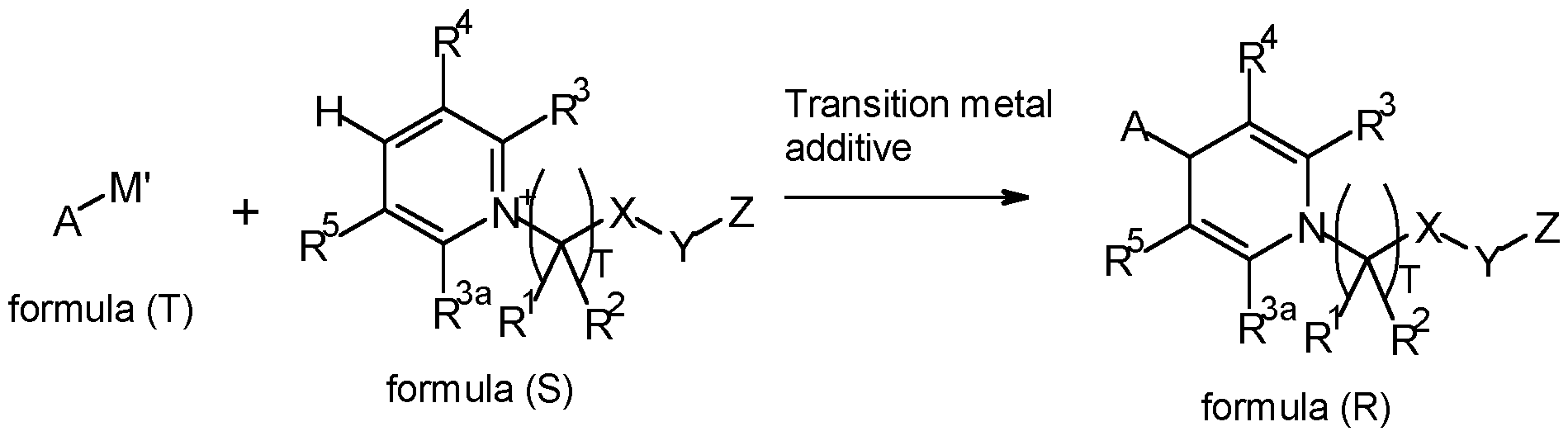
Biaryl pyridines of formula (X) are known in the literature or may be prepared using literature methods. Example methods include, but are not limited to, the transition metal cross-coupling of compounds of formula (H) and formula (J), or alternatively compounds of formula (K) and formula (L), in which compounds of formula (J) and formula (L) are either an organostannane, organoboronic acid
or ester, organotrifluoroborate, organomagnesium, organocopper or organozinc (M‘), as outlined in reaction scheme 5. Hal is defined as a halogen or pseudo halogen, for example triflate, mesylate and tosylate. Such cross-couplings include Stille (for example Sauer, J.; Heldmann, D. K. Tetrahedron, 1998, 4297), Suzuki-Miyaura (for example Luebbers, T.; Flohr, A.; Jolidon, S.; David-Pierson, P.; Jacobsen, H.; Ozmen, L.; Baumann, K. Bioorg. Med. Chem. Lett., 201 1 , 6554), Negishi (for example Imahori, T.; Suzawa, K.; Kondo, Y. Heterocycles, 2008, 1057), and Kumada (for example Heravi, M. M.; Hajiabbasi, P. Monatsh. Chem., 2012, 1575). The coupling partners may be selected with reference to the specific cross-coupling reaction and target product. Transition metal catalysts, ligands, bases, solvents and temperatures may be selected with reference to the desired cross-coupling and are known in the literature. Compounds of formula (H), formula (K) and formula (L) are known in the literature, or may be prepared by known literature methods.
Reaction scheme 5
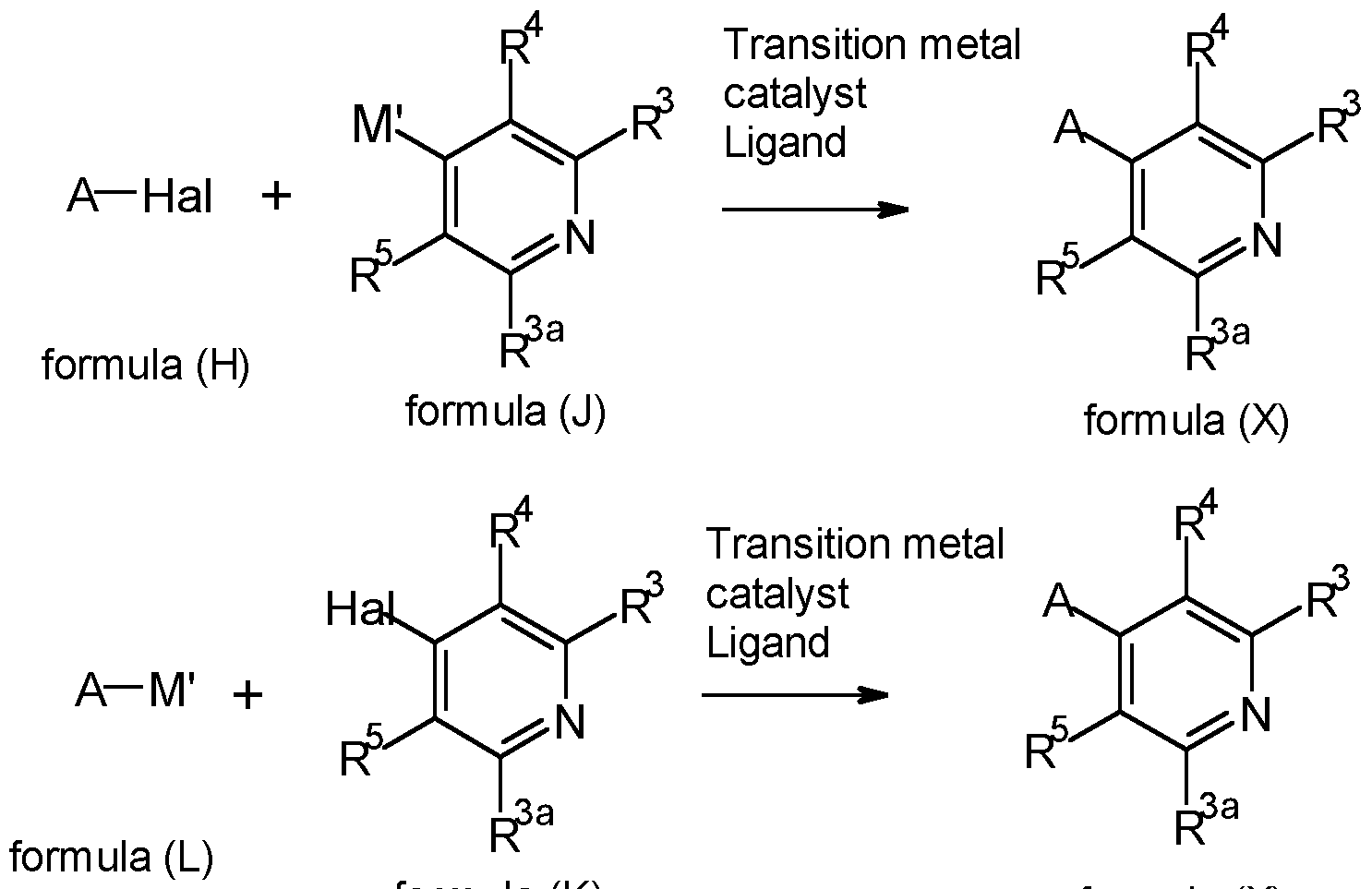
formula (K) formula (X)
An organometallic of formula (J), which is either an organostannane, organoboronic acid or ester, organotrifluoroborate, organomagnesium, organocopper or organozinc (M‘), may be prepared from a compound of formula (XX), wherein R3, R3a, R4 and R5 are as defined for compounds of formula (I), by metallation, as outlined in reaction scheme 6. Similar reactions are known in the literature (for example Ramphal et al, WO2015153683, Unsinn et al., Organic Letters, 15(5), 1 128-1 131 ; 2013, Sadler et al., Organic & Biomolecular Chemistry, 12(37), 7318-7327; 2014. Alternatively, an organometallic of formula (J) may be prepared from compounds of formula (K), wherein R3, R3a, R4, R5 are as defined for compounds of formula (I), and Hal is defined as a halogen or pseudo halogen, for example triflate, mesylate and tosylate, as described in scheme 6. Example conditions to prepare an organostannane of formula (J) include treatment of a compound of formula (K) with lithium tributyl tin in an appropriate solvent at an appropriate temperature (for example see WO 2010038465). Example conditions to prepare an organoboronic acid or ester of formula (J) include treatment of a compound of formula (K) with bis(pinacolato)diboron, in the presence of an appropriate transition metal catalyst, appropriate
ligand, appropriate base, in an appropriate solvent at an appropriate temperature (for example KR 2015135626). Compounds of formula (K) and formula (XX) are either known in the literature or can be prepared by known methods.
Reaction scheme 6

formula (K) formula (J) formula (XX)
In an additional approach, outlined in scheme 7, biaryl pyridines of formula (X) may be prepared by classical ring synthesis approaches starting from a compound of formula (ZZ), wherein R3, R3a, R4 and R5 are as defined for compounds of formula (I) and Q is a functional group which can be converted through one or more chemical steps into a 6-membered heteroaryl. Such functional groups include, but are not limited to, acid, ester, nitrile, amide, thioamide and ketone. Related transformations are known in the literature. Substituted pyridines may be prepared using methodology outlined in the literature.
Reaction scheme 7

The compounds according to the invention can be used as herbicidal agents in unmodified form, but they are generally formulated into compositions in various ways using formulation adjuvants, such as carriers, solvents and surface-active substances. The formulations can be in various physical forms, e.g. in the form of dusting powders, gels, wettable powders, water-dispersible granules, water- dispersible tablets, effervescent pellets, emulsifiable concentrates, microemulsifiable concentrates, oil- in-water emulsions, oil-flowables, aqueous dispersions, oily dispersions, suspo-emulsions, capsule suspensions, emulsifiable granules, soluble liquids, water-soluble concentrates (with water or a water- miscible organic solvent as carrier), impregnated polymer films or in other forms known e.g. from the Manual on Development and Use of FAO and WHO Specifications for Pesticides, United Nations, First Edition, Second Revision (2010). For water-soluble compounds, soluble liquids, water-soluble
concentrates or water soluble granules are preferred. Such formulations can either be used directly or diluted prior to use. The dilutions can be made, for example, with water, liquid fertilisers, micronutrients, biological organisms, oil or solvents.
The formulations can be prepared e.g. by mixing the active ingredient with the formulation adjuvants in order to obtain compositions in the form of finely divided solids, granules, solutions, dispersions or emulsions. The active ingredients can also be formulated with other adjuvants, such as finely divided solids, mineral oils, oils of vegetable or animal origin, modified oils of vegetable or animal origin, organic solvents, water, surface-active substances or combinations thereof.
The active ingredients can also be contained in very fine microcapsules. Microcapsules contain the active ingredients in a porous carrier. This enables the active ingredients to be released into the environment in controlled amounts (e.g. slow-release). Microcapsules usually have a diameter of from 0.1 to 500 microns. They contain active ingredients in an amount of about from 25 to 95 % by weight of the capsule weight. The active ingredients can be in the form of a monolithic solid, in the form of fine particles in solid or liquid dispersion or in the form of a suitable solution. The encapsulating membranes can comprise, for example, natural or synthetic rubbers, cellulose, styrene/butadiene copolymers, polyacrylonitrile, polyacrylate, polyesters, polyamides, polyureas, polyurethane or chemically modified polymers and starch xanthates or other polymers that are known to the person skilled in the art. Alternatively, very fine microcapsules can be formed in which the active ingredient is contained in the form of finely divided particles in a solid matrix of base substance, but the microcapsules are not themselves encapsulated.
The formulation adjuvants that are suitable for the preparation of the compositions according to the invention are known per se. As liquid carriers there may be used: water, toluene, xylene, petroleum ether, vegetable oils, acetone, methyl ethyl ketone, cyclohexanone, acid anhydrides, acetonitrile, acetophenone, amyl acetate, 2-butanone, butylene carbonate, chlorobenzene, cyclohexane, cyclohexanol, alkyl esters of acetic acid, diacetone alcohol, 1 ,2-dichloropropane, diethanolamine, p- diethylbenzene, diethylene glycol, diethylene glycol abietate, diethylene glycol butyl ether, diethylene glycol ethyl ether, diethylene glycol methyl ether, A/,A/-dimethylformamide, dimethyl sulfoxide, 1 ,4- dioxane, dipropylene glycol, dipropylene glycol methyl ether, dipropylene glycol dibenzoate, diproxitol, alkylpyrrolidone, ethyl acetate, 2-ethylhexanol, ethylene carbonate, 1 ,1 ,1 -trichloroethane, 2-heptanone, alpha-pinene, d-limonene, ethyl lactate, ethylene glycol, ethylene glycol butyl ether, ethylene glycol methyl ether, gamma-butyrolactone, glycerol, glycerol acetate, glycerol diacetate, glycerol triacetate, hexadecane, hexylene glycol, isoamyl acetate, isobornyl acetate, isooctane, isophorone, isopropylbenzene, isopropyl myristate, lactic acid, laurylamine, mesityl oxide, methoxypropanol, methyl isoamyl ketone, methyl isobutyl ketone, methyl laurate, methyl octanoate, methyl oleate, methylene chloride, m-xylene, n-hexane, n-octylamine, octadecanoic acid, octylamine acetate, oleic acid, oleylamine, o-xylene, phenol, polyethylene glycol, propionic acid, propyl lactate, propylene carbonate, propylene glycol, propylene glycol methyl ether, p-xylene, toluene, triethyl phosphate, triethylene glycol, xylenesulfonic acid, paraffin, mineral oil, trichloroethylene, perchloroethylene, ethyl acetate, amyl acetate, butyl acetate, propylene glycol methyl ether, diethylene glycol methyl ether, methanol, ethanol, isopropanol, and alcohols of higher molecular weight, such as amyl alcohol, tetrahydrofurfuryl alcohol, hexanol, octanol, ethylene glycol, propylene glycol, glycerol, A/-methyl-2-pyrrolidone and the like.
Suitable solid carriers are, for example, talc, titanium dioxide, pyrophyllite clay, silica, attapulgite clay, kieselguhr, limestone, calcium carbonate, bentonite, calcium montmorillonite, cottonseed husks, wheat flour, soybean flour, pumice, wood flour, ground walnut shells, lignin and similar substances.
A large number of surface-active substances can advantageously be used in both solid and liquid formulations, especially in those formulations which can be diluted with a carrier prior to use. Surface-active substances may be anionic, cationic, non-ionic or polymeric and they can be used as emulsifiers, wetting agents or suspending agents or for other purposes. Typical surface-active substances include, for example, salts of alkyl sulfates, such as diethanolammonium lauryl sulfate; salts of alkylarylsulfonates, such as calcium dodecylbenzenesulfonate; alkylphenol/alkylene oxide addition products, such as nonylphenol ethoxylate; alcohol/alkylene oxide addition products, such as tridecylalcohol ethoxylate; soaps, such as sodium stearate; salts of alkylnaphthalenesulfonates, such as sodium dibutylnaphthalenesulfonate; dialkyl esters of sulfosuccinate salts, such as sodium di(2- ethylhexyl)sulfosuccinate; sorbitol esters, such as sorbitol oleate; quaternary amines, such as lauryltrimethylammonium chloride, polyethylene glycol esters of fatty acids, such as polyethylene glycol stearate; block copolymers of ethylene oxide and propylene oxide; and salts of mono- and di- alkylphosphate esters; and also further substances described e.g. in McCutcheon's Detergents and Emulsifiers Annual, MC Publishing Corp., Ridgewood New Jersey (1981).
Further adjuvants that can be used in pesticidal formulations include crystallisation inhibitors, viscosity modifiers, suspending agents, dyes, anti-oxidants, foaming agents, light absorbers, mixing auxiliaries, antifoams, complexing agents, neutralising or pH-modifying substances and buffers, corrosion inhibitors, fragrances, wetting agents, take-up enhancers, micronutrients, plasticisers, glidants, lubricants, dispersants, thickeners, antifreezes, microbicides, and liquid and solid fertilisers.
The compositions according to the invention can include an additive comprising an oil of vegetable or animal origin, a mineral oil, alkyl esters of such oils or mixtures of such oils and oil derivatives. The amount of oil additive in the composition according to the invention is generally from 0.01 to 10 %, based on the mixture to be applied. For example, the oil additive can be added to a spray tank in the desired concentration after a spray mixture has been prepared. Preferred oil additives comprise mineral oils or an oil of vegetable origin, for example rapeseed oil, olive oil or sunflower oil, emulsified vegetable oil, alkyl esters of oils of vegetable origin, for example the methyl derivatives, or an oil of animal origin, such as fish oil or beef tallow. Preferred oil additives comprise alkyl esters of C8-C22 fatty acids, especially the methyl derivatives of C12-C18 fatty acids, for example the methyl esters of lauric acid, palmitic acid and oleic acid (methyl laurate, methyl palmitate and methyl oleate, respectively). Many oil derivatives are known from the Compendium of Herbicide Adjuvants, 10th Edition, Southern Illinois University, 2010.
The herbicidal compositions generally comprise from 0.1 to 99 % by weight, especially from 0.1 to 95 % by weight, compounds of formula (I) and from 1 to 99.9 % by weight of a formulation adjuvant which preferably includes from 0 to 25 % by weight of a surface-active substance. The inventive compositions generally comprise from 0.1 to 99 % by weight, especially from 0.1 to 95 % by weight, of compounds of the present invention and from 1 to 99.9 % by weight of a formulation adjuvant which preferably includes from 0 to 25 % by weight of a surface-active substance. Whereas commercial
products may preferably be formulated as concentrates, the end user will normally employ dilute formulations.
The rates of application vary within wide limits and depend on the nature of the soil, the method of application, the crop plant, the pest to be controlled, the prevailing climatic conditions, and other factors governed by the method of application, the time of application and the target crop. As a general guideline compounds may be applied at a rate of from 1 to 2000 l/ha, especially from 10 to 1000 l/ha.
Preferred formulations can have the following compositions (weight %):
Emulsifiable concentrates:
active ingredient: 1 to 95 %, preferably 60 to 90 %
surface-active agent: 1 to 30 %, preferably 5 to 20 %
liquid carrier: 1 to 80 %, preferably 1 to 35 %
Dusts:
active ingredient: 0.1 to 10 %, preferably 0.1 to 5 %
solid carrier: 99.9 to 90 %, preferably 99.9 to 99 %
Suspension concentrates:
active ingredient: 5 to 75 %, preferably 10 to 50 %
water: 94 to 24 %, preferably 88 to 30 %
surface-active agent: 1 to 40 %, preferably 2 to 30 %
Wettable powders:
active ingredient: 0.5 to 90 %, preferably 1 to 80 %
surface-active agent: 0.5 to 20 %, preferably 1 to 15 %
solid carrier: 5 to 95 %, preferably 15 to 90 %
Granules:
active ingredient: 0.1 to 30 %, preferably 0.1 to 15 %
solid carrier: 99.5 to 70 %, preferably 97 to 85 %
The composition of the present may further comprise at least one additional pesticide. For example, the compounds according to the invention can also be used in combination with other herbicides or plant growth regulators. In a preferred embodiment the additional pesticide is a herbicide and/or herbicide safener.
Thus, compounds of formula (I) can be used in combination with one or more other herbicides to provide various herbicidal mixtures. Specific examples of such mixtures include (wherein “I” represents a compound of formula (I)):- 1 + acetochlor; I + acifluorfen-sodium; I + aclonifen; I + alachlor; I + alloxydim; I + ametryn; I + amicarbazone; I + amidosulfuron; I + aminocyclopyrachlor ; I +
aminopyralid; I + amitrole; I + asulam; I + atrazine; I + bensulfuron-methyl; I + bentazone; I + bicyclopyrone; I + bifenox; I + bispyribac-sodium; I + bromacil; I + bromoxynil; I + butafenacil; I + cafenstrole; I + carfentrazone-ethyl; I + chlorimuron-ethyl; I + chlorotoluron; I + cinosulfuron; I + clethodim; I + clodinafop-propargyl; I + clomazone; I + clopyralid; I + cyhalofop-butyl; I + 2,4-D (including the choline salt and 2-ethylhexyl ester thereof); I + daimuron; I + desmedipham; I + dicamba (including the aluminum, aminopropyl, bis-aminopropylmethyl, choline, diglycolamine, dimethylamine, dimethylammonium, potassium and sodium salts thereof); I + diclofop-methyl; I + difenzoquat; I + diflufenican; I + diflufenzopyr; I + dimethachlor; I + dimethenamid-P; I + diquat dibromide; I + diuron; I + esprocarb; I + ethofumesate; I + fenoxaprop-P-ethyl; I + fenquinotrione; I + flazasulfuron; I + florasulam; I + fluazifop-P-butyl; I + flucarbazone-sodium; I + flufenacet; I + flumetralin; I + flumetsulam; I + flumioxazin; I + flupyrsulfuron-methyl-sodium; I + fluroxypyr-meptyl; I + fluthiacet-methyl; I + fomesafen; I + foramsulfuron; I + glufosinate (including the ammonium salt thereof); I + glyphosate (including the diammonium, isopropylammonium and potassium salts thereof); I + halauxifen-methyl; I + halosulfuron- methyl; I + haloxyfop-methyl; I + hexazinone; I + imazamox; I + imazapic; I + imazapyr; I + imazaquin; I + imazethapyr; I + indaziflam; I + iodosulfuron-methyl-sodium; I + iofensulfuron; I + iofensulfuron- sodium; I + ioxynil; I + ipfencarbazone; I + isoxaben; I + isoxaflutole; I + lactofen; I + linuron; I + mecoprop-P; I + mefenacet; I + mesosulfuron; I + mesosulfuron-methyl; I + mesotrione; I + metamitron; I + metobromuron; I + metolachlor; I + metoxuron; I + metribuzin; I + metsulfuron; I + molinate; I + napropamide; I + nicosulfuron; I + norflurazon; I + orthosulfamuron; I + oxadiargyl; I + oxadiazon; I + oxyfluorfen; I + paraquat dichloride; I + pendimethalin; I + penoxsulam; I + phenmedipham; I + picloram; I + picolinafen; I + pinoxaden; I + pretilachlor; I + primisulfuron-methyl; I + prodiamine; I + prometryn; I + propachlor; I + propanil; I + propaquizafop; I + propham; I + propyzamide; I + prosulfocarb; I + prosulfuron; I + pyrasulfotole; I + pyrazolynate, I + pyrazosulfuron-ethyl; I + pyribenzoxim; I + pyridate; I
+ pyriftalid; I + pyrithiobac-sodium; I + pyroxasulfone; I + pyroxsulam ; I + quinclorac; I + quizalofop-P- ethyl; I + rimsulfuron; I + saflufenacil; I + sethoxydim; I + S-metolachlor; I + sulcotrione; I + sulfentrazone; I + tebuthiuron; I + tefuryltrione; I + tembotrione; I + terbuthylazine; I + terbutryn; I + thiencarbazone; I + thifensulfuron; I + tiafenacil; I + tolpyralate; I + topramezone; I + tralkoxydim; I + triafamone; I + triasulfuron; I + tribenuron-methyl; I + triclopyr; I + trifloxysulfuron-sodium; I + trifludimoxazin and tritosulfuron.
Especially preferred examples of such mixtures include:- I + ametryn; I + atrazine; I + bicyclopyrone; I + butafenacil; I + chlorotoluron; I + clodinafop-propargyl; I + clomazone; I + 2,4-D (including the choline salt and 2-ethylhexyl ester thereof); I + dicamba (including the aluminum, aminopropyl, bis-aminopropylmethyl, choline, diglycolamine, dimethylamine, dimethylammonium, potassium and sodium salts thereof); I + dimethachlor; I + diquat dibromide; I + fluazifop-P-butyl; I + flumetralin; I + fomesafen; I + glufosinate-ammonium; I + glyphosate (including the diammonium, isopropylammonium and potassium salts thereof); I + mesotrione; I + molinate; I + napropamide; I + nicosulfuron; I + paraquat dichloride; I + pinoxaden; I + pretilachlor; I + primisulfuron-methyl; I + prometryn; I + prosulfocarb; I + prosulfuron; I + pyridate; I + pyriftalid; I + pyrazolynate, I + S-metolachlor; I + terbuthylazine; I + terbutryn; I + tralkoxydim; I + triasulfuron and I + trifloxysulfuron-sodium.
Preferred herbicide mixture products for weed control in cereals (especially wheat and/or barley) include:- 1 + amidosulfuron; I + aminopyralid; I + bromoxynil; I + carfentrazone-ethyl; I + chlorotoluron; I
+ clodinafop-propargyl; I + clopyralid; I + 2,4-D (including the choline salt and 2-ethylhexyl ester thereof); I + dicamba (including the aluminum, aminopropyl, bis-aminopropylmethyl, choline, diglycolamine, dimethylamine, dimethylammonium, potassium and sodium salts thereof); I + difenzoquat; I + diflufenican; I + fenoxaprop-P-ethyl; I + florasulam; I + flucarbazone-sodium; I + flufenacet; flupyrsulfuron-methyl-sodium; I + fluroxypyr-meptyl; I + halauxifen-methyl; I + iodosulfuron-methyl- sodium; I + iofensulfuron; I + iofensulfuron-sodium; I + mesosulfuron; I + mesosulfuron-methyl; I + metsulfuron; I + pendimethalin; I + pinoxaden; I + prosulfocarb; I + pyrasulfotole; I + pyroxasulfone; I + pyroxsulam; I + topramezone; I + tralkoxydim; I + triasulfuron and I + tribenuron-methyl.
Preferred herbicide mixture products for weed control in corn include:- I + acetochlor; I + alachlor; I + atrazine; I + bicyclopyrone; I + 2,4-D (including the choline salt and 2-ethylhexyl ester thereof); I + dicamba (including the aluminum, aminopropyl, bis-aminopropylmethyl, choline, diglycolamine, dimethylamine, dimethylammonium, potassium and sodium salts thereof); I + diflufenzopyr; I + dimethenamid-P; I + flumioxazin; I + fluthiacet-methyl; I + foramsulfuron; I + glufosinate (including the ammonium salt thereof); I + glyphosate (including the diammonium, isopropylammonium and potassium salts thereof); I + isoxaflutole; I + mesotrione; I + nicosulfuron; I + primisulfuron-methyl;
I + prosulfuron; I + pyroxasulfone; I + rimsulfuron; I + S-metolachlor, I + terbutylazine; I + tembotrione; I + thiencarbazone and I + thifensulfuron.
Preferred herbicide mixture products forweed control in rice include:- 1 + 2,4-D; I + 2,4-D choline salt; I + 2,4-D-2-ethylhexyl ester; I + bensulfuron-methyl; I + bispyribac-sodium; I + cafenstrole; I + cinosulfuron; I + clomazone; I + cyhalofop-butyl; I + daimuron; I + dicamba (including the aluminum, aminopropyl, bis-aminopropylmethyl, choline, diglycolamine, dimethylamine, dimethylammonium, potassium and sodium salts thereof); I + esprocarb; I + fenoxaprop-P-ethyl; I + florasulam; I + halauxifen- methyl; I + halosulfuron-methyl; I + iofensulfuron; I + ipfencarbazone; I + mefenacet; I + mesotrione; I + metsulfuron; I + molinate; I + orthosulfamuron; I + oxadiargyl; I + oxadiazon; I + pendimethalin; I + penoxsulam; I + pretilachlor; I + pyrazolynate, I + pyrazosulfuron-ethyl; I + pyribenzoxim; I + pyriftalid; I + quinclorac; I + tefuryltrione; I + triafamone and I + triasulfuron.
Preferred herbicide mixtures for weed control in soybean include:- I + acifluorfen-sodium; I + ametryn; I + atrazine; I + bentazone; I + bicyclopyrone; I + bromoxynil; I + carfentrazone-ethyl; I + chlorimuron-ethyl; I + clethodim; I + clomazone; I + 2,4-D (including the choline salt and 2-ethylhexyl ester thereof); I + dicamba (including the aluminum, aminopropyl, bis-aminopropylmethyl, choline, diglycolamine, dimethylamine, dimethylammonium, potassium and sodium salts thereof); I + diquat dibromide; I + diuron; I + fenoxaprop-P-ethyl; I + fluazifop-P-butyl; I + flufenacet; I + flumioxazin; I + fomesafen; I + glufosinate (including the ammonium salt thereof); I + glyphosate (including the diammonium, isopropylammonium and potassium salts thereof); I + imazethapyr; I + lactofen; I + mesotrione; I + metolachlor; I + metribuzin; I + nicosulfuron; I + oxyfluorfen; I + paraquat dichloride; I + pendimethalin; I + pyroxasulfone; I + quizalofop-P-ethyl; I + saflufenacil; I + sethoxydim; I + S- metolachlor and I + sulfentrazone.
The mixing partners of the compound of formula (I) may also be in the form of esters or salts, as mentioned e.g. in The Pesticide Manual, Fourteenth Edition, British Crop Protection Council, 2006.
The compound of formula (I) can also be used in mixtures with other agrochemicals such as fungicides, nematicides or insecticides, examples of which are given in The Pesticide Manual.
The mixing ratio of the compound of formula (I) to the mixing partner is preferably from 1 : 100 to 1000:1 .
The mixtures can advantageously be used in the above-mentioned formulations (in which case "active ingredient" relates to the respective mixture of compound of formula (I) with the mixing partner).
Compounds of formula (I) of the present invention may also be combined with herbicide safeners. Preferred combinations (wherein“I” represents a compound of formula (I)) include:- I + benoxacor, I + cloquintocet-mexyl; I + cyprosulfamide; I + dichlormid; I + fenchlorazole-ethyl; I + fenclorim; I + fluxofenim; l+ furilazole I + isoxadifen-ethyl; I + mefenpyr-diethyl; I + N-(2- methoxybenzoyl)-4-[(methylaminocarbonyl)amino] benzenesulfonamide and I + oxabetrinil.
Particularly preferred are mixtures of a compound of formula (I) with cyprosulfamide, isoxadifen- ethyl, cloquintocet-mexyl and/or N-(2-methoxybenzoyl)-4-[(methyl- aminocarbonyl)amino]benzenesulfonamide.
The safeners of the compound of formula (I) may also be in the form of esters or salts, as mentioned e.g. in The Pesticide Manual, 14th Edition (BCPC), 2006. The reference to cloquintocet-mexyl also applies to a lithium, sodium, potassium, calcium, magnesium, aluminium, iron, ammonium, quaternary ammonium, sulfonium or phosphonium salt thereof as disclosed in WO 02/34048, and the reference to fenchlorazole-ethyl also applies to fenchlorazole, etc.
Preferably the mixing ratio of compound offormula (I) to safener is from 100:1 to 1 :10, especially from 20:1 to 1 :1 .
The mixtures can advantageously be used in the above-mentioned formulations (in which case "active ingredient" relates to the respective mixture of compound of formula (I) with the safener).
The compounds of formula (I) of this invention are useful as herbicides. The present invention therefore further comprises a method for controlling unwanted plants comprising applying to the said plants or a locus comprising them, an effective amount of a compound of the invention or a herbicidal composition containing said compound. ‘Controlling’ means killing, reducing or retarding growth or preventing or reducing germination. Generally the plants to be controlled are unwanted plants (weeds). ‘Locus’ means the area in which the plants are growing or will grow.
The rates of application of compounds of formula (I) may vary within wide limits and depend on the nature of the soil, the method of application (pre-emergence; post-emergence; application to the seed furrow; no tillage application etc.), the crop plant, the weed(s) to be controlled, the prevailing climatic conditions, and other factors governed by the method of application, the time of application and the target crop. The compounds of formula (I) according to the invention are generally applied at a rate of from 10 to 2000 g/ha, especially from 50 to 1000 g/ha.
The application is generally made by spraying the composition, typically by tractor mounted sprayer for large areas, but other methods such as dusting (for powders), drip or drench can also be used.
Useful plants in which the composition according to the invention can be used include crops such as cereals, for example barley and wheat, cotton, oilseed rape, sunflower, maize, rice, soybeans, sugar beet, sugar cane and turf.
Crop plants can also include trees, such as fruit trees, palm trees, coconut trees or other nuts. Also included are vines such as grapes, fruit bushes, fruit plants and vegetables.
Crops are to be understood as also including those crops which have been rendered tolerant to herbicides or classes of herbicides (e.g. ALS-, GS-, EPSPS-, PPO-, ACCase- and HPPD-inhibitors) by conventional methods of breeding or by genetic engineering. An example of a crop that has been rendered tolerant to imidazolinones, e.g. imazamox, by conventional methods of breeding is Clearfield® summer rape (canola). Examples of crops that have been rendered tolerant to herbicides by genetic engineering methods include e.g. glyphosate- and glufosinate-resistant maize varieties commercially available under the trade names RoundupReady® and LibertyLink®.
Crops are also to be understood as being those which have been rendered resistant to harmful insects by genetic engineering methods, for example Bt maize (resistant to European corn borer), Bt cotton (resistant to cotton boll weevil) and also Bt potatoes (resistant to Colorado beetle). Examples of Bt maize are the Bt 176 maize hybrids of NK® (Syngenta Seeds). The Bt toxin is a protein that is formed naturally by Bacillus thuringiensis soil bacteria. Examples of toxins, or transgenic plants able to synthesise such toxins, are described in EP-A-451 878, EP-A-374 753, WO 93/07278, WO 95/34656, WO 03/052073 and EP-A-427 529. Examples of transgenic plants comprising one or more genes that code for an insecticidal resistance and express one or more toxins are KnockOut® (maize), Yield Gard® (maize), NuCOTIN33B® (cotton), Bollgard® (cotton), NewLeaf® (potatoes), NatureGard® and Protexcta®. Plant crops or seed material thereof can be both resistant to herbicides and, at the same time, resistant to insect feeding ("stacked" transgenic events). For example, seed can have the ability to express an insecticidal Cry3 protein while at the same time being tolerant to glyphosate.
Crops are also to be understood to include those which are obtained by conventional methods of breeding or genetic engineering and contain so-called output traits (e.g. improved storage stability, higher nutritional value and improved flavour).
Other useful plants include turf grass for example in golf-courses, lawns, parks and roadsides, or grown commercially for sod, and ornamental plants such as flowers or bushes.
Compounds of formula (I) and compositions of the invention can typically be used to control a wide variety of monocotyledonous and dicotyledonous weed species. Examples of monocotyledonous species that can typically be controlled include Alopecurus myosuroides, Avena fatua, Brachiaria plantaginea, Bromus tectorum, Cyperus esculentus, Digitaria sanguinalis, Echinochloa crus-galli, Lolium perenne, Lolium multiflorum, Panicum miliaceum, Poa annua, Setaria viridis, Setaria faberi and Sorghum bicolor. Examples of dicotyledonous species that can be controlled include Abutilon theophrasti, Amaranthus retroflexus, Bidens pilosa, Chenopodium album, Euphorbia heterophylla, Galium aparine, Ipomoea hederacea, Kochia scoparia, Polygonum convolvulus, Sida spinosa, Sinapis arvensis, Solanum nigrum, Stellaria media, Veronica persica and Xanthium strumarium.
The compounds of formula (I) are also useful for pre-harvest desiccation in crops, for example, but not limited to, potatoes, soybean, sunflowers and cotton. Pre-harvest desiccation is a well-known process used to desiccate crop foliage without significant damage to the crop itself to aid harvesting.
Compounds/compositions of the invention are particularly useful in non-selective burn-down applications, and as such may also be used to control volunteer or escape crop plants.
Various aspects and embodiments of the present invention will now be illustrated in more detail by way of example. It will be appreciated that modification of detail may be made without departing from the scope of the invention.
EXAMPLES
The Examples which follow serve to illustrate, but do not limit, the invention.
FORMULATION EXAMPLES
Wettable powders a) b) c)
active ingredients 25 % 50 % 75 %
sodium lignosulfonate 5 % 5 %
sodium lauryl sulfate 3 % - 5 %
sodium diisobutylnaphthalenesulfonate 6 % 10 %
phenol polyethylene glycol ether 2 %
(7-8 mol of ethylene oxide)
highly dispersed silicic acid 5 % 10 % 10 %
Kaolin 62 % 27 %
The combination is thoroughly mixed with the adjuvants and the mixture is thoroughly ground in a suitable mill, affording wettable powders that can be diluted with water to give suspensions of the desired concentration.
Emulsifiable concentrate
active ingredients 10 %
octylphenol polyethylene glycol ether 3 %
(4-5 mol of ethylene oxide)
calcium dodecylbenzenesulfonate 3 %
castor oil polyglycol ether (35 mol of ethylene oxide) 4 %
Cyclohexanone 30 %
xylene mixture 50 %
Emulsions of any required dilution, which can be used in plant protection, can be obtained from this concentrate by dilution with water.
Dusts a) b) c)
Active ingredients 5 % 6 % 4 %
Talcum 95 %
Kaolin 94 %
mineral filler 96 %
Ready-for-use dusts are obtained by mixing the combination with the carrier and grinding the mixture in a suitable mill.
Extruder granules
Active ingredients 15 %
sodium lignosulfonate 2 %
carboxymethylcellulose 1 %
Kaolin 82 %
The combination is mixed and ground with the adjuvants, and the mixture is moistened with water. The mixture is extruded and then dried in a stream of air.
Coated granules
Active ingredients 8 %
polyethylene glycol (mol. wt. 200) 3 %
Kaolin 89 %
The finely ground combination is uniformly applied, in a mixer, to the kaolin moistened with polyethylene glycol. Non-dusty coated granules are obtained in this manner.
Suspension concentrate
active ingredients 40 %
propylene glycol 10 %
nonylphenol polyethylene glycol ether (15 mol of ethylene oxide) 6 %
Sodium lignosulfonate 10 %
carboxymethylcellulose 1 %
silicone oil (in the form of a 75 % emulsion in water) 1 %
Water 32 %
The finely ground combination is intimately mixed with the adjuvants, giving a suspension concentrate from which suspensions of any desired dilution can be obtained by dilution with water.
Slow Release Capsule Suspension
28 parts of the combination are mixed with 2 parts of an aromatic solvent and 7 parts of toluene diisocyanate/polymethylene-polyphenylisocyanate-mixture (8:1). This mixture is emulsified in a mixture of 1 .2 parts of polyvinylalcohol, 0.05 parts of a defoamer and 51 .6 parts of water until the desired particle size is achieved. To this emulsion a mixture of 2.8 parts 1 ,6-diaminohexane in 5.3 parts of water is added. The mixture is agitated until the polymerization reaction is completed.
The obtained capsule suspension is stabilized by adding 0.25 parts of a thickener and 3 parts of a dispersing agent. The capsule suspension formulation contains 28% of the active ingredients. The medium capsule diameter is 8-15 microns.
The resulting formulation is applied to seeds as an aqueous suspension in an apparatus suitable for that purpose.
List of Abbreviations:
Boc ferf-butyloxy carbonyl
br broad
CDCI3 chloroform-d
CD3OD methanol-d
°C degrees Celsius
D2O water-d
DCM dichloromethane
d doublet
dd double doublet
dt double triplet
DMSO dimethylsulfoxide
EtOAc ethyl acetate
h hour(s)
HCI hydrochloric acid
m multiplet
M molar
min minutes
MHz mega hertz
mL millilitre
mp melting point
ppm parts per million
q quartet
quin quintet
rt room temperature
s singlet
t triplet
THF tetrahydrofuran
LC/MS Liquid Chromatography Mass Spectrometry
PREPARATION EXAMPLES
Example 1 : Preparation of 2-[[2-[4-(1 ,2,4-triazin-3-yl)pyridin-1-ium-1-yl]acetyl]amino]acetic acid chloride A4

Step 1 : Preparation of A/-aminopyridine-4-carboxamidine

To a mixture of pyridine-4-carbonitrile (2 g), water (8 mL) and tetrahydrofuran (20 mL) was added hydrazine hydrate (3.81 mL) and the mixture heated at 50°C for 2 hours. The reaction mixture was concentrated to give crude A/-aminopyridine-4-carboxamidine.
Ή NMR (400MHz, DMSO-de) 8.81-8.88 (m, 2H), 7.84-7.89 (m, 2H)
Step 2: Preparation of 3-(4-pyridyl)-1 ,2,4-triazine

To a mixture of A/-aminopyridine-4-carboxamidine (2.5 g) and water (25 mL) was added glyoxal (40% in water, 3.2 mL) and the mixture heated at 50°C for 6 hours. The reaction mixture was cooled to room temperature and extracted with ethyl acetate (3x50mL). The combined organic layers were washed with brine, concentrated and purified by silica gel chromatography eluting with 0-100% ethyl acetate in iso-hexane to give 3-(4-pyridyl)-1 ,2,4-triazine as a pale yellow solid.
Ή NMR (400MHz, CDCb) 9.30 (d, 1 H), 8.87 (d, 2H), 8.78 (d, 1 H), 8.42 (d, 2H)
Step 3: Preparation of methyl 2-[[2-[4-(1 ,2,4-triazin-3-yl)pyridin-1-ium-1-yl]acetyl]amino]acetate bromide A3
To a stirred solution of 3-(4-pyridyl)-1 ,2,4-triazine (0.3 g) in acetonitrile (10 mL) was added methyl 2-[(2- chloroacetyl)amino]acetate (0.478 g) and the reaction mixture was heated at 70°C for 16 hours. The reaction mixture was cooled and diluted with water (20 mL) and washed with 10% methanol in dichloromethane (2 c 20 mL). The aqueous layer was concentrated and purified by reverse phase chromatography eluting with water to afford methyl 2-[[2-[4-(1 ,2,4-triazin-3-yl)pyridin-1 -ium-1 -yl]acetyl]amino]acetate bromide as a black solid.
Ή NMR (400 MHz, D20) 9.43 - 9.42 (d, 1 H), 9.06 - 9.05 (d, 1 H), 9.01 - 8.96 (m, 4H), 5.62 (s, 2H), 4.08 (s, 2H), 3.69 (s, 3H) (NH proton missing)
Step 4: Preparation of 2-[[2-[4-(1 ,2,4-triazin-3-yl)pyridin-1 -ium-1 -yl]acetyl]amino]acetic acid chloride A4 A solution of methyl 2-[[2-[4-(1 ,2,4-triazin-3-yl)pyridin-1 -ium-1 -yl]acetyl]amino]acetate bromide (0.15 g) in water (10 mL) was cooled to 0°C and cone hydrochloric acid (10 mL) was added drop wise. The mixture was then heated at 80°C for 16 hours. The reaction mixture was cooled and diluted with water (20 mL) and washed with dichloromethane (2 c 20 mL). Upon completion of the reaction, reaction mixture was diluted with water (20 mL) and washed with CH CI (2 c 20 mL). The aqueous layer was concentrated to afford 2-[[2-[4- (1 ,2,4-triazin-3-yl) pyridin-1 -ium-1 -yl]acetyl]amino]acetic acid chloride as a light brown solid.
Ή NMR (400 MHz, D2O) 9.38 (s, 1 H), 9.01 (s, 1 H), 8.96 - 8.91 (m, 4H), 5.56 (s, 2H), 4.00 (s, 2H) (NH and CO2H protons missing)
Example 2: Preparation of 2-[[2-(4-pyridazin-4-ylpyridin-1 -ium-1 -yl)acetyl]amino]acetic acid trifluoroacetate A9

Step 1 : Preparation of tributyl(pyridazin-4-yl)stannane
To a solution of lithium diisopropylamide (1 M solution in tetrahydrofuran, 125 ml_) at -78°C under nitrogen was added a solution of pyridazine (10 g) and tri-n-butyltin chloride (44.6 g) in tetrahydrofuran (100 ml_) drop wise. The reaction mixture was stirred at -78°C for 1 hour. The reaction mixture was warmed to room temperature and quenched with saturated aqueous ammonium chloride (100 ml_) and extracted with ethyl acetate (3x150 ml_). The organic layer was dried over sodium sulfate, concentrated and purified by chromatography on silica eluting with 30% ethyl acetate in hexanes to afford tributyl(pyridazin-4-yl)stannane as a pale brown liquid.
Ή NMR (400MHz, CDCI3) 9.17 (t, 1 H) 9.02 (dd, 1 H) 7.54 (dd, 1 H) 1 .57-1 .49 (m, 6H) 1 .37-1 .29 (m, 6H) 1 .19-1 .13 (m, 6H) 0.92-0.86 (m, 9H)
Step 2: Preparation of 4-(4-pyridyl)pyridazine

To a mixture of tributyl(pyridazin-4-yl)stannane (2.215 g) and 4-iodopyridine (1 .292 g) in 1 ,4-dioxane (18 ml_) was added tetrakis(triphenylphosphine)palladium(0) (0.354 g), followed by purging with nitrogen then heating at 140°C under microwave irradiation for 1 hour. Further tetrakis(triphenylphosphine)palladium(0) (0. 354 g) was added and the mixture was heated again at 140°C under microwave irradiation for 1 hour. After cooling to room temperature the reaction mixture was diluted with dichloromethane (40 ml_), absorbed onto celite (15 g) and purified by silica gel chromatography eluting with a mixture of methanol in dichloromethane to afford 4-(4-pyridyl)pyridazine as a beige solid.
Ή NMR (400MHz, CDCI3) 9.50 (dd, 1 H), 9.35 (dd, 1 H), 8.83 (dd, 2H), 7.72 (dd, 1 H), 7.59 (dd, 2H)
Step 3: Preparation of 2-[[2-(4-pyridazin-4-ylpyridin-1 -ium-1 -yl)acetyl]amino]acetic acid trifluoroacetate A9
A suspension of 4-(4-pyridyl)pyridazine (0.2 g) and sodium iodide (0.191 g) in acetonitrile (1 .2 ml_) was warmed to 50°C, followed by addition of 2-[(2-chloroacetyl)amino]acetic acid (0.174 g) portion wise over 1 hour. The reaction mixture was further heated at 50°C for 8 hours. After cooling the reaction mixture was concentrated, dissolved in water and purified by preparative reverse phase HPLC (trifluoroacetic acid was present in the eluent) to afford 2-[[2-(4-pyridazin-4-ylpyridin-1 -ium-1 -yl)acetyl]amino]acetic acid trifluoroacetate.
Ή NMR (400MHz, D2O) 9.66 (dd, 1 H), 9.42 (dd, 1 H), 8.97 (d, 2H), 8.51 (d, 2H), 8.29 (dd, 1 H), 5.60 (s, 2H), 4.06 (s, 2H) (NH and CO2H protons missing)
Example 3: Preparation of 2-(4-pyridyl)-1 ,3,5-triazine

To a mixture of methyl pyridine-4-carboximidate (6 g) in A/,A/-dimethylformamide (50 ml_), at room temperature, was added a solution of formamidine hydrochloride (10.6 g) in A/,A/-dimethylformamide (50 ml_) and the reaction mixture was stirred at room temperature for 16 hours. The reaction mixture was poured onto ice and extracted with ethyl acetate (3x300 ml_). The combined organic layers were dried over sodium sulfate, concentrated then purified by silica gel chromatography eluting with 0-80% ethyl acetate in hexane to give 2-(4-pyridyl)-1 ,3,5-triazine as an off-white solid.
Ή NMR (400MHz, CDCI3) 9.34 (s, 2H), 8.86 (br s, 2H), 8.34-8.38 (m, 2H)
Example 4: Preparation of [3-(4-pyrimidin-4-ylpyridin-1-ium-1- yl)propanoylamino]methanesulfonate A18

Step 1 : Preparation of 4-(4-pyridyl)pyrimidine

A mixture of 4-chloropyrimidine (0.5 g), tripotassium phosphate (3.71 g), 4-(4,4,5,5-tetramethyl-1 ,3,2- dioxaborolan-2-yl)pyridine (1 .35 g), dimethoxyethane (16.35 ml_), [1 ,1 - bis(diphenylphosphino)ferrocene]palladium(ll) dichloride dichloromethane adduct (0.356 g) and water (3.5 ml_) was purged with nitrogen then heated at 120°C under microwave irradiation for 30 minutes. The reaction mixture was partitioned between water and dichloromethane. The organic phase was dried over magnesium sulfate, concentrated then purified by silica gel chromatography eluting with 0-70% acetonitrile in dichloromethane to give 4-(4-pyridyl)pyrimidine as a yellow solid.
Ή NMR (400MHz, CDCI3) 9.36 (d, 1 H), 8.89 (d, 1 H), 8.84-8.79 (m, 2H), 8.01 -7.90 (m, 2H), 7.80 (dd, 1 H)
Step 2: Preparation of (prop-2-enoylamino)methanesulfonic acid

A mixture of acetonitrile (40 mL), aminomethanesulfonic acid (2 g) and triethylamine (12.6 ml_) was stirred at room temperature for 1 hour. The reaction was cooled to ~0°C and 3-bromopropionyl chloride (2 mL) was added drop wise. After stirring at ~0°C for 30 minutes the reaction was allowed to warm to room temperature and stirred overnight. The reaction was partitioned between water and ethyl acetate. The aqueous layer was concentrated to give (prop-2-enoylamino)methanesulfonic acid, which was used without further purification.
Ή NMR (400MHz, D20) 6.43-6.53 (m, 1 H), 6.30-6.39 (m, 1 H), 5.91 -6.01 (m, 1 H), 4.48-4.56 (m, 2H)
Step 3: Preparation of [3-(4-pyrimidin-4-ylpyridin-1 -ium-1 -yl)propanoylamino]methanesulfonate A18 A suspension of 4-(4-pyridyl)pyrimidine (0.1 g) and (prop-2-enoylamino)methanesulfonic acid (0.178 g) in water (3 mL) was heated at 80°C for 16 hours. The reaction mixture was cooled and washed with dichloromethane (2x20 mL). The aqueous phase was concentrated and purified by preparative reverse phase HPLC to afford [3-(4-pyrimidin-4-ylpyridin-1 -ium-1 -yl)propanoylamino]methanesulfonate as an off-white solid.
Ή NMR (400MHz, D20) 9.32 (s, 1 H), 9.04 - 8.99 (m, 3H), 8.62 (br d, 2H), 8.20 (d, 1 H), 4.96 (t, 2H), 4.28 (s, 2H), 3.15 - 3.09 (m, 2H) (NH proton missing)
Example 5: Preparation of 3-[(4-pyrimidin-2-ylpyridin-1-ium-1-yl)methylsulfonyl]propanoic acid 2,2,2-trifluoroacetate A24

Step 1 : Preparation of methyl 3-(chloromethylsulfanyl)propanoate

Sodium hydride (60% in mineral oil, 0.36 g) was washed with cyclohexane (x2) then was suspended in dry tetrahydrofuran (5 mL), under nitrogen atmosphere. To this was added a solution of methyl 3- mercaptopropionate (1 mL) in dry tetrahydrofuran (1 .3 mL) drop wise over 40 minutes at room temperature. After stirring for 30 minutes this suspension was added drop wise to cooled (~0°C)
bromochloromethane (2.92 mL) over 40 minutes. The mixture was stirred at ~0°C for 18 hours. The mixture was diluted with fe/f-butyl methyl ether (5 mL) and filtered through celite, washing through with further fe/f-butyl methyl ether (5 mL). The filtrate was cautiously concentrated to give crude methyl 3- (chloromethylsulfanyl)propanoate, which was used without further purification.
Ή NMR (400MHz, CDCI3) 4.75 (s, 2H), 3.72 (s, 3H), 3.03 (t, 2H), 2.73 (t, 2H)
Step 2: Preparation of 2-(4-pyridyl)pyrimidine

A microwave vial was charged with tributyl(4-pyridyl)stannane (2.209 g), 2-chloropyrimidine (0.722 g), palladium (0) tetrakis(triphenylphosphine) (0.354 g) and 1 ,4-dioxane (18 mL), sparged with nitrogen for 3 minutes, then heated at 140°C under microwave irradiation for 2x1 hours. The mixture was concentrated then purified by silica gel chromatography eluting with a mixture of ethyl acetate and cyclohexane to give 2-(4-pyridyl)pyrimidine as a pale brown solid.
Ή NMR (400MHz, CDCI3) 8.87 (d, 2H), 8.78 (dd, 2H), 8.29 (dd, 2H), 7.32 (t, 1 H)
Step 3: Preparation of methyl 3-[(4-pyrimidin-2-ylpyridin-1 -ium-1 -yl)methylsulfanyl]propanoate iodide A1

To a stirred solution of 2-(4-pyridyl)pyrimidine (0.1 g) and sodium iodide (0.096 g) in acetonitrile (2 ml_) was added methyl 3-(chloromethylsulfanyl)propanoate (0.215 g) at room temperature. The resulting reaction mixture was heated at 80°C for 25 minutes under microwave irradiation. The reaction mixture was diluted with dichloromethane (20 mL), absorbed onto celite (15 g) and purified by silica gel chromatography eluting with a mixture of methanol in dichloromethane to give methyl 3-[(4-pyrimidin-2- ylpyridin-1 -ium-1 -yl)methylsulfanyl]propanoate iodide as an amber glass. 1H NMR (400MHz, CDCI3) 9.72 (d, 2H), 9.05 - 8.98 (m, 4H), 7.51 (t, 1 H), 6.42 (s, 2H), 3.66 (s, 3H), 3.07 (t, 2H), 2.76 (t, 2H)
Step 4: Preparation of 3-[(4-pyrimidin-2-ylpyridin-1 -ium-1 -yl)methylsulfonyl]propanoic acid 2,2,2- trifluoroacetate A24
To a mixture of methyl 3-[(4-pyrimidin-2-ylpyridin-1 -ium-1 -yl)methylsulfanyl]propanoate iodide (0.2 g), trifluoroacetic acid (1 .3 mL) and water (1 .3 mL) was added hydrogen peroxide (50% aqueous, 0.235 mL) at room temperature. After 15 minutes further hydrogen peroxide (50% aqueous, 0.078 mL) was added and the mixture was stirred at room temperature for 18 hours. The mixture was filtered, washing
through with water and the filtrate was freeze-dried. The residue was purified by preparative reverse phase HPLC (trifluoroacetic acid was present in the eluent) to give 3-[(4-pyrimidin-2-ylpyridin-1 -ium-1 - yl)methylsulfonyl]propanoic acid 2,2,2-trifluoroacetate as a white solid.
Ή NMR (400MHz, D2O) 9.09 (d, 2H), 8.99 (d, 2H), 8.92 (d, 2H), 7.64 (t, 1 H), 6.27 (s, 2H), 3.77 (t, 2H), 2.93 (t, 2H) (CO2H proton missing)
Compound A25, methyl 3-[(4-pyrimidin-2-ylpyridin-1 -ium-1 -yl)methylsulfonyl]propanoate 2,2,2- trifluoroacetate, a white solid, was also isolated from this reaction.

Ή NMR (400MHz, D2O) 9.10 - 9.06 (m, 2H), 8.98 (d, 2H), 8.90 - 8.94 (m, 2H), 7.63 (t, 1 H), 6.27 (s, 2H), 3.80 (t, 2H), 3.66 (s, 3H), 2.99 (t, 2H)
Example 6: Preparation of 3-[(4-pyrimidin-2-ylpyridin-1-ium-1-yl)methylsulfinyl]propanoic acid 2,2,2-trifluoroacetate A22

A mixture of methyl 3-[(4-pyrimidin-2-ylpyridin-1 -ium-1 -yl)methylsulfanyl]propanoate iodide (0.5 g), trifluoroacetic acid (3.45 ml_) and water (3.45 ml_) was cooled to ~0°C and hydrogen peroxide (50% aqueous, 0.147 ml_) was added. After 15 minutes the reaction was warmed to room temperature and further hydrogen peroxide (50% aqueous, 0.147 ml_) was added. The mixture was stirred at room temperature for 9 hours. Further hydrogen peroxide (50% aqueous, 0.294 ml_) was added and stirring continued for 48 hours. The mixture was filtered, washing through with water and the filtrate was freeze- dried. The residue was purified by preparative reverse phase HPLC (trifluoroacetic acid was present in the eluent) to give 3-[(4-pyrimidin-2-ylpyridin-1 -ium-1 -yl)methylsulfinyl]propanoic acid 2,2,2- trifluoroacetate as a white solid.
Ή NMR (400MHz, D2O) 9.00 - 8.96 (m, 4H), 8.89 (d, 2H), 7.63 (t, 1 H), 6.1 1 (d, 1 H), 5.83 (d, 1 H), 3.43 - 3.35 (m, 1 H), 3.10 - 3.02 (m, 1 H), 2.85 (t, 2H) (CO2H proton missing)
Compound A23, methyl 3-[(4-pyrimidin-2-ylpyridin-1 -ium-1 -yl)methylsulfinyl]propanoate 2,2,2- trifluoroacetate, a pale yellow solid, was also isolated from this reaction.
Ή NMR (400MHz, D2O) 9.00 - 8.95 (m, 4H), 8.89 (d, 2H), 7.63 (t, 1 H), 6.1 1 (d, 1 H), 5.82 (d, 1 H), 3.64 (s, 3H), 3.46 - 3.38 (m, 1 H), 3.09 (td, 1 H), 2.89 (t, 2H) Example 7: Preparation of 3-[(4-pyrimidin-2-ylpyridin-1-ium-1-yl)methylsulfanyl]propanoic acid 2,2,2-trifluoroacetate A2

A mixture of methyl 3-[(4-pyrimidin-2-ylpyridin-1 -ium-1 -yl)methylsulfanyl]propanoate iodide (0.03 g), methanol (0.5 mL) and 2M aqueous hydrochloric acid (1 .5 ml_) was heated at 100°C under microwave irradiation for 2.75 hours. The mixture was freeze-dried and purified by preparative reverse phase HPLC (trifluoroacetic acid was present in the eluent) to give 3-[(4-pyrimidin-2-ylpyridin-1 -ium-1 - yl)methylsulfanyl]propanoic acid 2,2,2-trifluoroacetate as an amber gum.
Ή NMR (400MHz, D2O) 9.15 (d, 2H), 8.96 (dd, 2H), 8.81 - 8.74 (m, 2H), 7.62 (dt, 1 H), 5.75 (s, 2H), 2.89 - 2.81 (m, 2H), 2.65 - 2.57 (m, 2H) (CO2H proton missing)
Example 8: Preparation of 3-oxo-4-(4-pyrimidin-2-ylpyridin-1 -ium-1 -yl)butanoic acid 2,2,2- trifluoroacetate A6

Step 1 : Preparation of ethyl 3-oxo-4-(4-pyrimidin-2-ylpyridin-1 -ium-1 -yl)butanoate 2,2,2-trifluoroacetate A7
To a stirred solution of 2-(4-pyridyl)pyrimidine (0.2 g) in acetonitrile (6 ml_) was added ethyl 4-chloro-3- oxo-butanoate (0.222 ml_) and the reaction mixture was heated at 80°C for 72 hours. The reaction mixture was cooled, concentrated and purified by reverse phase chromatography (trifluoroacetic acid was present in the eluent) to give ethyl 3-oxo-4-(4-pyrimidin-2-ylpyridin-1 -ium-1 -yl)butanoate 2,2,2- trifluoroacetate as a white solid.
Ή NMR (400MHz, D20) 8.96 - 8.91 (m, 2H), 8.90 - 8.86 (m, 1 H), 8.79 - 8.69 (m, 3H), 7.60 (dt, 1 H), 5.86 (s, 1 H), 4.84 - 4.81 (m, 1 H), 4.15 (quin, 2H), 1 .19 (dt, 3H) (exchange of CH2 protons)
Step 2: Preparation of 3-oxo-4-(4-pyrimidin-2-ylpyridin-1-ium-1 -yl)butanoic acid 2,2,2-trifluoroacetate A6 A mixture of ethyl 3-oxo-4-(4-pyrimidin-2-ylpyridin-1 -ium-1 -yl)butanoate 2,2,2-trifluoroacetate (0.05 g) and 2M aqueous hydrochloric acid (4 mL) was stirred at room temperature for 48 hours. The reaction mixture was concentrated and purified by reverse phase chromatography (trifluoroacetic acid was present in the eluent) to give 3-oxo-4-(4-pyrimidin-2-ylpyridin-1 -ium-1 -yl)butanoic acid 2,2,2- trifluoroacetate as a yellow solid.
Ή NMR (400MHz, D20) 8.94 (d, 2H), 8.91 - 8.87 (m, 1 H), 8.77 - 8.75 (m, 2H), 8.74 - 8.70 (m, 1 H), 7.60 (t, 1 H), 5.89 - 5.84 (m, 1 H), 4.86 - 4.81 (m, 1 H) (C02H proton missing, exchange of CH2 proton)
Example 9: Preparation of 2-[[2-[4-(1 ,2,4-triazin-3-yl)pyridin-1-ium-1- yl]acetyl]amino]ethanesulfonate A12

Step 1 : Preparation of 2,2-dimethylpropyl 2-aminoethanesulfonate

A mixture of ammonium hydroxide (13 mL) and tetrahydrofuran (20 mL) was cooled to ~0°C and a solution of 2,2-dimethylpropyl ethenesulfonate (4 g) in tetrahydrofuran (20 mL) was added drop wise.
The mixture was stirred at ~0°C for 1 hour and then at room temperature for 16 hours.
The mixture was partitioned between water (50 mL) and ethyl acetate (100 mL). The aqueous layer was extracted with further ethyl acetate (2x100 mL). The combined organic layers were dried over sodium sulfate, concentrated and purified by chromatography on silica eluting with a mixture of ethyl acetate in cyclohexane to give 2,2-dimethylpropyl 2-aminoethanesulfonate as a pale-yellow liquid.
Ή NMR (400 MHz, DMSO-de) 3.86 (s, 2H), 3.34-3.38 (m, 2H), 2.91 (t, 2H), 0.93 ppm (s, 9H)
Step 2: Preparation of 2,2-dimethylpropyl 2-[(2-bromoacetyl)amino]ethanesulfonate

A mixture of 2,2-dimethylpropyl 2-aminoethanesulfonate (1 g) in dichloromethane (10 mL), under nitrogen atmosphere, was cooled to -10°C and triethylamine (1 .02 mL) was added, followed by a solution of 2-bromoacetyl bromide (0.468 mL) in dichloromethane (5 mL). The resulting reaction mixture was stirred at -10°C for 30 minutes then allowed to warm to room temperature and stirred for 4 hours. Water (50 mL) was added to reaction mixture and this was extracted with dichloromethane (2x75 mL). The combined organic layers were washed with brine (200 mL), dried over sodium sulfate, concentrated and purified by silica gel chromatography eluting with a mixture of ethyl acetate in hexanes to give 2,2-dimethylpropyl 2-[(2-bromoacetyl)amino]ethanesulfonate as a brown liquid.
Ή NMR (400 MHz, CDCI3) 7.12 (br s, 1 H), 3.92 (s, 2H), 3.88 (s, 2H), 3.84 - 3.77 (m, 2H), 3.36 - 3.31 (m, 2H), 1 .00 (s, 9H)
Step 3: Preparation of 2,2-dimethylpropyl 2-[[2-[4-(1 ,2,4-triazin-3-yl) pyridin-1 -ium-1 - yl]acetyl]amino]ethanesulfonate bromide

To a stirred solution of 3-(4-pyridyl)-1 ,2,4-triazine (0.1 g) in acetonitrile (20 mL) was added 2,2- dimethylpropyl 2-[(2-bromoacetyl)amino]ethanesulfonate (0.159 g) at room temperature. The resulting reaction mixture was heated at 80°C for 16 hours. The reaction mixture was diluted with water (20 mL) and washed with 10% methanol in dichloromethane (2x20 mL). The aqueous layer was concentrated and purified by reverse phase chromatography to give 2,2-dimethylpropyl 2-[[2-[4-(1 ,2,4-triazin-3- yl)pyridin-1 -ium-1 -yl]acetyl]amino]ethanesulfonate bromide as an orange/red gum.
Ή NMR (400MHz, D20) 9.44-9.48 (m, 1 H), 9.06-9.08 (m, 1 H), 8.96-9.02 (m, 4H), 5.54 (s, 2H), 3.98 (s,
2H), 3.78 (t, 2H), 3.56 (t, 2H), 0.90 (s, 9H) (NH proton missing)
Step 4: Preparation of 2-[[2-[4-(1 ,2,4-triazin-3-yl)pyridin-1 -ium-1 -yl]acetyl]amino]ethanesulfonate A12 A solution of 2,2-dimethylpropyl 2-[[2-[4-(1 ,2,4-triazin-3-yl)pyridin-1 -ium-1 - yl]acetyl]amino]ethanesulfonate bromide (0.15 g) in 6M aqueous hydrochloric acid (5 ml_) was heated at 60°C for 6 hours. The reaction mixture was diluted with water (25 ml_) and washed with 10% methanol in dichloromethane (2x20 ml_). The aqueous layer was concentrated and purified by preparative reverse phase HPLC to give 2-[[2-[4-(1 ,2,4-triazin-3-yl)pyridin-1-ium-1 -yl]acetyl]amino]ethanesulfonate as a red solid.
Ή NMR (400MHz, D20) 9.39 (d, 1 H), 9.03 (d,1 H), 8.97 - 8.91 (m, 3H), 8.12 (s, 1 H), 5.49 (s, 2H), 3.60 (t, 2H), 3.04 (t, 2H) (NH proton missing)
Example 10: Preparation of 2-[(4-pyrimidin-2-ylpyridin-1 -ium-1 -yl)methylsulfonylamino]acetic acid 2,2,2-trifluoroacetate A56

Step 1 : Preparation of (4-pyrimidin-2-ylpyridin-1 -ium-1 -yl)methyl sulfate

To a solution of 2-(4-pyridyl)pyrimidine (0.95 g) in dichloroethane (20 ml_) was added N,N- dimethylformamide sulfur trioxide (1 .24 g). After stirring for 1 hour at room temperature paraformaldehyde (0.817 g) was added and the mixture was heated at 90°C under microwave irradiation for 1 hour. The resulting solid was filtered off, washed with dichloroethane and dried to give (4-pyrimidin- 2-ylpyridin-1 -ium-1 -yl)methyl sulfate as an off-white solid.
Ή NMR (400 MHz, DMSO-de) 9.29 (d, 2H), 9.17 (d, 2H), 8.94 (d, 2H), 7.78 (t, 1 H), 6.27 (s, 2H)
Step 2: Preparation of (4-pyrimidin-2-ylpyridin-1 -ium-1 -yl)methanesulfonate
A solution of sodium sulfite (2.76 g) water (7 mL) was cooled to ~0°C and (4-pyrimidin-2-ylpyridin-1-ium- 1 -yl)methyl sulfate (1.87 g) was added portion wise over 5 minutes. After stirring at ~0°C for 20 minutes water (3 mL) was added and the resulting solid filtered off cold and washed with cold water (4 mL). The solid was dried then heated in water (7 mL) at ~100°C for 30 minutes. After cooling the resulting solid was filtered off, dried then triturated with dichloromethane and dried again to give (4-pyrimidin-2- ylpyridin-1 -ium-1 -yl)methanesulfonate.
Ή NMR (400 MHz, DMSO-de) 9.17 - 9.13 (m, 4H), 8.94 (d, 2H), 7.77 (t, 1 H), 5.54 (s, 2H) Step 3: Preparation of (4-pyrimidin-2-ylpyridin-1 -ium-1 -yl)methanesulfonyl chloride chloride

Solid (4-pyrimidin-2-ylpyridin-1-ium-1-yl)methanesulfonate (0.1 g) was cooled to ~-10°C and trifluoromethanesulfonic acid (0.072 ml_) and trifluoromethanesulfonic anhydride (0.134 mL) were added. To this mixture was added phosphorus pentachloride (0.1 g) and the mixture was allowed to warm to room temperature. The mixture was stirred at room temperature for 18 hours to give (4- pyrimidin-2-ylpyridin-1-ium-1-yl)methanesulfonyl chloride chloride, which was used without further purification.
Step 4: Preparation of tert-butyl 2-[(4-pyrimidin-2-ylpyridin-1-ium-1-yl)methylsulfonylamino]acetate 2,2,2-trifluoroacetate A57

Crude (4-pyrimidin-2-ylpyridin-1-ium-1-yl)methanesulfonyl chloride chloride was cooled to ~-10°C and tert-butyl 2-aminoacetate (0.65 mL) was added followed by cold triethylamine (0.34 mL). The mixture was allowed to warm to room temperature and stirred for 20 minutes. The mixture was concentrated
and purified by preparative reverse phase HPLC (trifluoroacetic acid was present in the eluent) to give tert-butyl 2-[(4-pyrimidin-2-ylpyridin-1 -ium-1 -yl)methylsulfonylamino]acetate 2,2,2-trifluoroacetate.
Ή NMR (400 MHz, CDCIs) 9.26 (d, 2H), 9.10 (d, 2H), 9.01 (d, 2H), 7.53 - 7.49 (m, 1 H), 3.99 - 3.96 (m, 2H), 2.04 (s, 2H), 1 .49 - 1 .47 (m, 9H) (NH proton missing)
Step 5: Preparation of 2-[(4-pyrimidin-2-ylpyridin-1 -ium-1 -yl)methylsulfonylamino]acetic acid;2,2,2- trifluoroacetate A56
To a solution of tert-butyl 2-[(4-pyrimidin-2-ylpyridin-1 -ium-1 -yl)methylsulfonylamino]acetate 2,2,2- trifluoroacetate in dichloromethane (1 ml_) was added trifluoroacetic acid (0.5 ml_). After 2 hours stirring at room temperature the mixture was concentrated and purified by preparative reverse phase HPLC (trifluoroacetic acid was present in the eluent) to give 2-[(4-pyrimidin-2-ylpyridin-1 -ium-1 - yl)methylsulfonylamino]acetic acid;2,2,2-trifluoroacetate as a white solid.
Ή NMR (400 MHz, DMSO-de) 13.20 (brs, 1 H), 9.26 (d, 2H), 9.18 (d, 2H), 9.05 (d, 2H), 7.80 (t, 1 H), 6.28 (s, 2H), 3.92 (s, 2H) (NH proton missing)
Additional compounds in Table A (below) were prepared by analogous procedures, from appropriate starting materials. The skilled person would understand that the compounds of formula (I) may exist as an agronomically acceptable salt, a zwitterion or an agronomically acceptable salt of a zwitterion as described hereinbefore. Where mentioned the specific counterion is not considered to be limiting, and the compound of formula (I) may be formed with any suitable counter ion.
NMR spectra contained herein were recorded on either a 400MHz Bruker AVANCE III HD equipped with a Bruker SMART probe unless otherwise stated. Chemical shifts are expressed as ppm downfield from TMS, with an internal reference of either TMS or the residual solvent signals. The following multiplicities are used to describe the peaks: s = singlet, d = doublet, t = triplet, dd = double doublet, dt = double triplet, q = quartet, quin = quintet, m = multiplet. Additionally br. is used to describe a broad signal and app. is used to describe and apparent multiplicity.
Table A Physical Data for Compounds of the Invention


BIOLOGICAL EXAMPLES
Post-emergence efficacy
Seeds of a variety of test species were sown in standard soil in pots. After cultivation for 14 days
(post-emergence) under controlled conditions in a glasshouse (at 24/16°C, day/night; 14 hours light; 65 % humidity), the plants were sprayed with an aqueous spray solution derived from the dissolution of the technical active ingredient formula (I) in a small amount of acetone and a special solvent and emulsifier
mixture referred to as IF50 (11.12% Emulsogen EL360 TM + 44.44% N-methylpyrrolidone + 44.44% Dowanol DPM glycol ether), to create a 50g/l solution which was then diluted to required concentration using 0.25% or 1 % Empicol ESC70 (Sodium lauryl ether sulphate) + 1 % ammonium sulphate as diluent.
The test plants were then grown in a glasshouse under controlled conditions (at 24/16°C, day/night; 14 hours light; 65 % humidity) and watered twice daily. After 13 days the test was evaluated (100 = total damage to plant; 0 = no damage to plant).
Test plants:
Ipomoea hederacea (IPOHE), Euphorbia heterophylla (EPHHL), Chenopodium album (CHEAL), Amaranthus palmeri (AMAPA), Lolium perenne (LOLPE), Digitaria sanguinalis (DIGSA), Eleusine indica (ELEIN), Echinochloa crus-galli (ECHCG), Setaria faberi (SETFA)

Claims
1 . A compound of formula (I) or an agronomically acceptable salt or zwitterionic species thereof:

wherein
T is 1 , 2 or 3;
R1 and R2 are independently selected from the group consisting of hydrogen, halogen, Ci- Cealkyl, C2-C6alkenyl, C2-C6alkynyl, C3-C6cycloalkyl, Ci-C6haloalkyl, -OR7, -OR15a, - N(R6)S(0)2R15, -N(R6)C(0)R15, -N(R6)C(0)0R15, -N(R6)C(0)NR16R17, -N(R6)CHO, -N(R7a)2 and -S(0)rR15; provided that when R1 is selected from the group consisting of -OR7, -OR15a, -N(R6)S(0)2R15, - N(R6)C(0)R15, -N(R6)C(0)0R15, -N(R6)C(0)NR16R17, -N(R6)CHO, -N(R7a)2 and -S(0)rR15, then the R2 on the same carbon atom is selected from the group consisting of hydrogen and Ci- C6alkyl; or
R1 and R2 together with the carbon atom to which they are attached form a C3-C6cycloalkyl ring or a 3- to 6- membered heterocyclyl, which comprises 1 or 2 heteroatoms individually selected from N and O;
Y is (CR1aR2b)m; m is 1 , 2 or 3; each R1a is independently selected from the group consisting of hydrogen, halogen, Ci-C6alkyl, C2-C6alkenyl, C2-C6alkynyl, Cs-Cecycloalkyl, Ci-C6haloalkyl, -OH, -OR7, -OR15a, -NH2, -NHR7, - N(R7)2, -NHR15a, -NR7bR7c, -N(R6)S(0)2R15, -N(R6)C(0)R15, -N(R6)C(0)0R15, -
N(R6)C(0)NR16R17, -N(R6)CHO, -N(R7a)2, -S(0)rR15 and phenyl which is optionally substituted by 1 , 2 or 3 R9 substituents, which may be the same or different, -Ci-C6alkylNH2 , -Ci- CealkylNHR7, -Ci-C6alkylN(R7)2, -Ci-C6alkylC(0)OR10, -Ci-C6alkylOR10, -Ci- C6alkylC(0)NR16R17, -Ci-C6alkylSR10, -Ci-C6alkylS(0)R10 , -Ci-C6alkylS(0)2R10 , -Ci- C6NHC(=NH)NH2, -Ci-C3alkylphenyl, wherein said phenyl is optionally substituted by 1 , 2 or 3 R9 substituents, which may be the same or different, and -Ci-C3alkylheteroaromatic, wherein said heteroaromatic is a 5- to 10-membered cyclic or bicyclic aromatic ring which comprises 1 ,
2, 3 or 4 heteroatoms individually selected from nitrogen, oxygen and sulfur, optionally substituted by 1 , 2 or 3 R9 substituents, which may be the same or different; each R2b is independently selected from the group consisting of hydrogen, halogen, Ci-C6alkyl, Ci-Cehaloalkyl, -Ci-C6alkylNH2 , -Ci-C6alkylNHR7, -Ci-C6alkylN(R7)2, -Ci-C6alkylC(0)OR10, -Ci- CealkylOR10, -Ci-C6alkylC(0)NR16R17, -Ci-C6alkylSR10, -Ci-C6alkylS(0)R10 , -Ci- C6alkylS(0)2R10 , -CI-C6NHC(=NH)NH2, -Ci-C3alkylphenyl, wherein said phenyl is optionally substituted by 1 , 2 or 3 R9 substituents, which may be the same or different, and -Ci- C3alkylheteroaromatic, wherein said heteroaromatic is a 5- to 10-membered cyclic or bicyclic aromatic ring which comprises 1 , 2, 3 or 4 heteroatoms individually selected from nitrogen, oxygen and sulfur, optionally substituted by 1 , 2 or 3 R9 substituents, which may be the same or different; or
R1a and R2b together with the carbon atom to which they are attached form a C3-C6cycloalkyl ring or a 3- to 6- membered heterocyclyl, which comprises 1 or 2 heteroatoms individually selected from N and O;
R3, R3a, R4 and R5 are independently selected from the group consisting of hydrogen, halogen, cyano, nitro, -S(0)rR15, Ci-C6alkyl, Ci-C6fluoroalkyl, Ci-C6fluoroalkoxy, Ci-C6alkoxy, C3- C6cycloalkyl and -N(R6)2; each R6 is independently selected from hydrogen and Ci-C6alkyl; each R7 is independently selected from the group consisting of Ci-C6alkyl, -S(0)2R15, -C(0)R15, -C(0)0R15 and -C(0)NR16R17; each R7a is independently selected from the group consisting of -S(0)2R15, -C(0)R15, -C(0)0R15 -C(0)NR16R17 and -C(0)NR6R15a;
R7b and R7c are independently selected from the group consisting of Ci-C6alkyl, -S(0)rR15, - C(0)R15, - C(0)0R15, -C(0)NR16R17 and phenyl, and wherein said phenyl is optionally substituted by 1 , 2 or 3 R9 substituents, which may be the same or different; or
R7b and R7c together with the nitrogen atom to which they are attached form a 4- to 6-membered heterocyclyl ring which optionally comprises one additional heteroatom individually selected from N, O and S;
A is a 6-membered heteroaryl, which comprises 1 , 2, 3 or 4 nitrogen atoms and wherein the heteroaryl may be optionally substituted on carbon atoms by 1 , 2, 3 or 4 R8 substituents, which may be the same or different,
each R8 is independently selected from the group consisting of halogen, nitro, cyano, -Nhh, - NHR7, -N(R7)2, -OH, -OR7, -S(0)rR15, -NR6S(0)2R15, -C(0)OR10, -C(0)R15, -C(0)NR16R17, - S(0)2NR16R17, Ci-C6alkyl, Ci-C6haloalkyl, C3-C6cycloalkyl, C3-C6halocycloalkyl, C3- C6cycloalkoxy, C2-C6alkenyl, C2-C6haloalkenyl, C2-C6alkynyl, Ci-C3alkoxyCi-C3alkyl-, hydroxyCi-C6alkyl-, Ci-C3alkoxyCi-C3alkoxy-, Ci-C6haloalkoxy, Ci-C3haloalkoxyCi-C3alkyl-, C3-C6alkenyloxy, C3-C6alkynyloxy, N-C3-C6cycloalkylamino, -C(R6)=NOR6, phenyl, a 3- to 6- membered heterocyclyl, which comprises 1 or 2 heteroatoms individually selected from N and O, and a 5- or 6- membered heteroaryl, which comprises 1 , 2, 3 or 4 heteroatoms individually selected from N, O and S, and wherein said phenyl, heterocyclyl or heteroaryl are optionally substituted by 1 , 2 or 3 R9 substituents, which may be the same or different; each R9 is independently selected from the group consisting of OH, halogen, cyano, -N(R6)2, Ci-C4alkyl, Ci-C4alkoxy, Ci-C4haloalkyl and Ci-C4haloalkoxy;
X is selected from the group consisting of -C(O)-, -0(0)0-, -C(0)N(R40)-, -C(0)N(R42)0-, -

R40 is selected from the group consisting of hydrogen, Ci-C6alkyl, Ci-C6alkoxy, Ci-C3alkoxyCi- C3alkyl;
R41 is selected from the group consisting of hydrogen, Ci-C6alkyl, Ci-C6alkoxy, Ci- C6alkylamino, di-Ci-C6alkylamino, cyano;
R42 is selected from the group consisting of hydrogen, Ci-C6alkyl, Ci-C6alkoxyCi-C3alkyl, Ci- Od alkylcarbonyl, Ci-C6alkoxycarbonyl, Ci-C6alkylsulfonyl;
R43 is selected from the group consisting of hydrogen, Ci-C6alkyl, Ci-C6alkoxy, Ci-C3alkoxyCi- C3alkyl, Ci-C6alkylcarbonyl, Ci-C6alkoxycarbonyl, and Ci-C6alkylsulfonyl;
R44 is selected from the group consisting of hydrogen, Ci-C6alkyl, OH, Ci-C6alkoxy, Ci- C6alkoxyCi-C3alkyl, NH2, and Ci-C6alkylamino, di-Ci-C6alkylamino,
R45 is selected from the group consisting of hydrogen, halogen, and Ci-C6alkyl;
R46 is selected from the group consisting of hydrogen, Ci-C6alkyl, Ci-C6alkoxy, Ci-C6alkoxyCi- Csalkyl, -Ci-C6alkylNH2 , -Ci-C6alkylNHR7, -Ci-C6alkylN(R7)2, -Ci-C6alkylC(0)0R10, -Ci-
CealkylOR10, -Ci-C6alkylC(0)NR16R17, -Ci-C6alkylSR10, -Ci-C6alkylS(0)R10 , -Ci- C6alkylS(0)2R10 , -CI-C6NHC(=NH)NH2, -Ci-CsalkylCi-Csalkoxy, -Ci-C3alkylphenyl, wherein said phenyl is optionally substituted by 1 , 2 or 3 R9 substituents, which may be the same or different, and -Ci-C3alkylheteroaromatic, wherein said heteroaromatic is a 5- to 10-membered cyclic or bicyclic aromatic ring which comprises 1 , 2, 3 or 4 heteroatoms individually selected from nitrogen, oxygen and sulfur, optionally substituted by 1 , 2 or 3 R9 substituents, which may be the same or different;
Z is selected from the group consisting of -C(0)OR10, -OH, -CH2OH, -CHO, -C(0)NH0R11 , - C(0)NHCN, -0C(0)NH0R11, -0C(0)NHCN, -NR6C(0)NH0R11 , -NR6C(0)NHCN, -
C(0)NHS(0)2R12, -0C(0)NHS(0)2R12, -NR6C(0)NHS(0)2R12, -S(0)20R10, -0S(0)20R10, - NR6S(0)20R10, -NR6S(0)OR10, -NHS(0)2R14, -S(0)OR10, -OS(0)OR10, -S(0)2NHCN, - S(0)2NHC(0)R18, -S(0)2NHS(0)2R12, -0S(0)2NHCN, -0S(0)2NHS(0)2R12,
0S(0)2NHC(0)R18, -NR6S(0)2NHCN, -NR6S(0)2NHC(0)R18, -N(0H)C(0)R15, -0NHC(0)R15, - NR6S(0)2NHS(0)2R12, -P(0)(R13)(OR10), -P(0)H(OR10), -OP(0)(R13)(OR10),
NR6P(0)(R13)(OR10) and tetrazole;
R10 is selected from the group consisting of hydrogen, Ci-C6alkyl, phenyl and benzyl, and wherein said phenyl or benzyl are optionally substituted by 1 , 2 or 3 R9 substituents, which may be the same or different;
R11 is selected from the group consisting of hydrogen, Ci-C6alkyl and phenyl, and wherein said phenyl is optionally substituted by 1 , 2 or 3 R9 substituents, which may be the same or different;
R12 is selected from the group consisting of Ci-C6alkyl, Ci-C6haloalkyl, Ci-C6alkoxy, -OH, - N(R6)2 and phenyl, and wherein said phenyl is optionally substituted by 1 , 2 or 3 R9 substituents, which may be the same or different;
R13 is selected from the group consisting of -OH, Ci-C6alkyl, Ci-C6alkoxy and phenyl;
R14 is Ci-Cehaloalkyl;
R15 is selected from the group consisting of Ci-C6alkyl and phenyl, and wherein said phenyl is optionally substituted by 1 , 2 or 3 R9 substituents, which may be the same or different;
R15a is phenyl, wherein said phenyl is optionally substituted by 1 , 2 or 3 R9 substituents, which may be the same or different;
R16 and R17 are independently selected from the group consisting of hydrogen and Ci-C6alkyl; or
R16 and R17 together with the nitrogen atom to which they are attached form a 4- to 6-membered heterocyclyl ring which optionally comprises one additional heteroatom individually selected from N, O and S;
R18 is selected from the group consisting of hydrogen, Ci-C6alkyl, Ci-C6haloalkyl, Ci-C6alkoxy, -N(R6)2 and phenyl, and wherein said phenyl is optionally substituted by 1 , 2 or 3 R9 substituents, which may be the same or different; and r is 0, 1 or 2.
2. The compound according to claim 1 wherein T is 1 .
3. The compound according to claim 1 or 2, wherein R1 and R2 are independently selected from the group consisting of hydrogen and Ci-C6alkyl.
4. The compound according to any one of claims 1 to 3, wherein m is 1 or 2.
5. The compound according to any one of claims 1 to 4, wherein R3, R3a, R4 and R5 are independently selected from the group consisting of hydrogen and methyl.
6. The compound according to any one of claims 1 to 5, wherein A is selected from the group consisting of formula A-l to A-XIII below

A-V A- VI A- VII A- VIII A- IX

7. The compound according to claim 6, wherein A is selected from the group consisting of formula A-l, A-ll, A- III, A- IV, A-V, A-VIII, A-XII and A-XIII.
8. The compound according to any one of claims 1 to 7, wherein A is substituted with 1 or 2 R8 and each R8 is independently selected from the group consisting of chloro, fluoro, cyano, -Nhh, -NMe2, -OMe, -S(0)2Me, -C(0)NHMe, -C(0)NMe2, methyl and trifluoromethyl.
9. The compound according to any one of claims 1 to 8, wherein wherein A is substituted with 3 or 4 R8 and each R8 is independently selected from the group consisting of Ci-C6alkyl and Ci- C6haloalkyl.
10. The compound according to any one of claims 1 to 9, wherein A is selected from the group consisting of formula A-l to A-V and p is 0.
11. The compound according to any one of claims 1 to 10 wherein X is selected from the group consisting of -C(0)N(R40)-, -S(O)-, -S(0)2- and -S(0)2N(R40)- and R40 is selected from hydrogen and Ci-C6alkyl.
12. The compound according to any one of claims 1 to 11 , wherein Z is selected from the group consisting 0f -C(O)OR1°, -C(0)NHS(0)2R12, -S(0)20R10, and -P(0)(R13)(OR10).
13. The compound according to claim 12, wherein Z is -C(0)0H or -S(0)20H.
14. An agrochemical composition comprising a herbicidally effective amount of a compound of formula (I) as defined in any one of claims 1 to 13.
15. The composition according to claim 14, further comprising at least one additional active ingredient and/or an agrochemically-acceptable diluent or carrier.
16. A method of controlling unwanted plant growth, comprising applying a compound of formula (I) as defined in any one of claims 1 to 13, or a herbicidal composition according to claim 14 or claim 15, to the unwanted plants or to the locus thereof.
Applications Claiming Priority (2)
| Application Number | Priority Date | Filing Date | Title |
|---|---|---|---|
| GBGB1902064.3A GB201902064D0 (en) | 2019-02-14 | 2019-02-14 | Herbicidal compounds |
| GB1902064.3 | 2019-02-14 |
Publications (1)
| Publication Number | Publication Date |
|---|---|
| WO2020165310A1 true WO2020165310A1 (en) | 2020-08-20 |
Family
ID=65998636
Family Applications (1)
| Application Number | Title | Priority Date | Filing Date |
|---|---|---|---|
| PCT/EP2020/053697 Ceased WO2020165310A1 (en) | 2019-02-14 | 2020-02-13 | Pyridinium compounds and their use as herbicides |
Country Status (2)
| Country | Link |
|---|---|
| GB (1) | GB201902064D0 (en) |
| WO (1) | WO2020165310A1 (en) |
Cited By (3)
| Publication number | Priority date | Publication date | Assignee | Title |
|---|---|---|---|---|
| CN114085157A (en) * | 2021-11-02 | 2022-02-25 | 中国人民解放军空军军医大学 | A kind of preparation method of asymmetric hydrogenation to prepare metolachlor sperm intermediate |
| JP2022152762A (en) * | 2021-03-29 | 2022-10-12 | 三菱瓦斯化学株式会社 | Compound, rubber composition, and modified diene rubber |
| CN117264148A (en) * | 2023-09-20 | 2023-12-22 | 蚌埠市天宇高温树脂材料有限公司 | Modified phenolic resin and preparation method thereof |
Citations (12)
| Publication number | Priority date | Publication date | Assignee | Title |
|---|---|---|---|---|
| US4116675A (en) * | 1976-05-04 | 1978-09-26 | Ciba-Geigy Corporation | Pyridinium-s-triazines for regulating plant growth |
| EP0374753A2 (en) | 1988-12-19 | 1990-06-27 | American Cyanamid Company | Insecticidal toxines, genes coding therefor, antibodies binding them, transgenic plant cells and plants expressing these toxines |
| EP0427529A1 (en) | 1989-11-07 | 1991-05-15 | Pioneer Hi-Bred International, Inc. | Larvicidal lectins and plant insect resistance based thereon |
| EP0451878A1 (en) | 1985-01-18 | 1991-10-16 | Plant Genetic Systems, N.V. | Modifying plants by genetic engineering to combat or control insects |
| WO1993007278A1 (en) | 1991-10-04 | 1993-04-15 | Ciba-Geigy Ag | Synthetic dna sequence having enhanced insecticidal activity in maize |
| WO1995034656A1 (en) | 1994-06-10 | 1995-12-21 | Ciba-Geigy Ag | Novel bacillus thuringiensis genes coding toxins active against lepidopteran pests |
| WO2002034048A1 (en) | 2000-10-23 | 2002-05-02 | Syngenta Participations Ag | Agrochemical compositions with quinoline safeners |
| WO2003052073A2 (en) | 2001-12-17 | 2003-06-26 | Syngenta Participations Ag | Novel corn event |
| WO2010038465A1 (en) | 2008-10-02 | 2010-04-08 | 旭化成ファーマ株式会社 | 8-substituted isoquinoline derivative and use thereof |
| WO2015153683A1 (en) | 2014-04-02 | 2015-10-08 | Intermune, Inc. | Anti-fibrotic pyridinones |
| KR20150135626A (en) | 2014-05-22 | 2015-12-03 | 덕산네오룩스 주식회사 | Compound for organic electronic element, organic electronic element using the same, and an electronic device thereof |
| WO2019034757A1 (en) * | 2017-08-17 | 2019-02-21 | Syngenta Participations Ag | Herbicidal compounds |
-
2019
- 2019-02-14 GB GBGB1902064.3A patent/GB201902064D0/en not_active Ceased
-
2020
- 2020-02-13 WO PCT/EP2020/053697 patent/WO2020165310A1/en not_active Ceased
Patent Citations (12)
| Publication number | Priority date | Publication date | Assignee | Title |
|---|---|---|---|---|
| US4116675A (en) * | 1976-05-04 | 1978-09-26 | Ciba-Geigy Corporation | Pyridinium-s-triazines for regulating plant growth |
| EP0451878A1 (en) | 1985-01-18 | 1991-10-16 | Plant Genetic Systems, N.V. | Modifying plants by genetic engineering to combat or control insects |
| EP0374753A2 (en) | 1988-12-19 | 1990-06-27 | American Cyanamid Company | Insecticidal toxines, genes coding therefor, antibodies binding them, transgenic plant cells and plants expressing these toxines |
| EP0427529A1 (en) | 1989-11-07 | 1991-05-15 | Pioneer Hi-Bred International, Inc. | Larvicidal lectins and plant insect resistance based thereon |
| WO1993007278A1 (en) | 1991-10-04 | 1993-04-15 | Ciba-Geigy Ag | Synthetic dna sequence having enhanced insecticidal activity in maize |
| WO1995034656A1 (en) | 1994-06-10 | 1995-12-21 | Ciba-Geigy Ag | Novel bacillus thuringiensis genes coding toxins active against lepidopteran pests |
| WO2002034048A1 (en) | 2000-10-23 | 2002-05-02 | Syngenta Participations Ag | Agrochemical compositions with quinoline safeners |
| WO2003052073A2 (en) | 2001-12-17 | 2003-06-26 | Syngenta Participations Ag | Novel corn event |
| WO2010038465A1 (en) | 2008-10-02 | 2010-04-08 | 旭化成ファーマ株式会社 | 8-substituted isoquinoline derivative and use thereof |
| WO2015153683A1 (en) | 2014-04-02 | 2015-10-08 | Intermune, Inc. | Anti-fibrotic pyridinones |
| KR20150135626A (en) | 2014-05-22 | 2015-12-03 | 덕산네오룩스 주식회사 | Compound for organic electronic element, organic electronic element using the same, and an electronic device thereof |
| WO2019034757A1 (en) * | 2017-08-17 | 2019-02-21 | Syngenta Participations Ag | Herbicidal compounds |
Non-Patent Citations (12)
| Title |
|---|
| "Manual on Development and Use of FAO and WHO Specifications for Pesticides", 2010, SOUTHERN ILLINOIS UNIVERSITY |
| "McCutcheon's Detergents and Emulsifiers Annual", 1981, MC PUBLISHING CORP. |
| "The Pesticide Manual", 2006, BRITISH CROP PROTECTION COUNCIL |
| HERAVI, M. M.HAJIABBASI, P., MONATSH. CHEM., 2012, pages 1575 |
| I. V. KAPATINOV ET. AL.: "Synthesis, self assembly, bacterial and fungal toxicity of a series of L-phenylalaninederived surface active ionic liquids.", GREEN CHEMISTRY, vol. 21, no. 7, 12 March 2019 (2019-03-12), pages 1777 - 1794, XP002798952, DOI: 10.1039/c9gc00030e * |
| IMAHORI, T.SUZAWA, K.KONDO, Y., HETEROCYCLES, 2008, pages 1057 |
| LUEBBERS, T.FLOHR, A.JOLIDON, S.DAVID-PIERSON, P.JACOBSEN, H.OZMEN, L.BAUMANN, K., BIOORG. MED. CHEM. LETT., 2011, pages 6554 |
| PETIT ET AL., TET. LETT., vol. 49, no. 22, 2008, pages 3663 |
| SADLER ET AL., ORGANIC & BIOMOLECULAR CHEMISTRY, vol. 12, no. 37, 2014, pages 7318 - 7327 |
| SAUER, J.HELDMANN, D. K., TETRAHEDRON, 1998, pages 4297 |
| UNSINN ET AL., ORGANIC LETTERS, vol. 15, no. 5, 2013, pages 1128 - 1131 |
| V. CHANDRASHAKER ET. AL.: "Synthesis of diverse acyclic prcursors for studies of probiotic routes.", NEW JOURNAL OF CHEMISTRY, vol. 40, no. 10, 13 September 2016 (2016-09-13), pages 8786 - 8808, XP002798953, DOI: 10.1039/c6nj02048h * |
Cited By (4)
| Publication number | Priority date | Publication date | Assignee | Title |
|---|---|---|---|---|
| JP2022152762A (en) * | 2021-03-29 | 2022-10-12 | 三菱瓦斯化学株式会社 | Compound, rubber composition, and modified diene rubber |
| JP7727259B2 (en) | 2021-03-29 | 2025-08-21 | 三菱瓦斯化学株式会社 | Compound, rubber composition, and modified diene rubber |
| CN114085157A (en) * | 2021-11-02 | 2022-02-25 | 中国人民解放军空军军医大学 | A kind of preparation method of asymmetric hydrogenation to prepare metolachlor sperm intermediate |
| CN117264148A (en) * | 2023-09-20 | 2023-12-22 | 蚌埠市天宇高温树脂材料有限公司 | Modified phenolic resin and preparation method thereof |
Also Published As
| Publication number | Publication date |
|---|---|
| GB201902064D0 (en) | 2019-04-03 |
Similar Documents
| Publication | Publication Date | Title |
|---|---|---|
| AU2019240902A1 (en) | Herbicidal compounds | |
| EP3668855A1 (en) | Herbicidal compounds | |
| EP4250928A1 (en) | Herbicidal compounds | |
| WO2020161162A1 (en) | Herbicidal pyridinium compounds | |
| EP3924347A1 (en) | Pyridazinium compounds for use in a method of controlling unwanted plant growth | |
| WO2020178404A1 (en) | Herbicidal compounds | |
| WO2020161208A1 (en) | Herbicidal fused pyridazine compounds | |
| WO2020099367A1 (en) | Herbicidal compounds | |
| WO2020169604A1 (en) | Pyridazines herbicidal compounds | |
| WO2020165321A1 (en) | Herbicidal compounds | |
| WO2020161270A1 (en) | Herbicidal pyridazinum based compounds | |
| WO2020099407A1 (en) | Herbicidal compounds | |
| WO2021064073A1 (en) | Herbicidal compounds | |
| WO2021058592A1 (en) | Herbicidal compounds | |
| WO2020161138A1 (en) | Pyridazinium compounds for use in controlling unwanted plant growth | |
| GB2584175A (en) | Herbicidal compounds | |
| EP3920701A1 (en) | Herbicidal compounds | |
| WO2020099404A1 (en) | Herbicidal compounds | |
| WO2020099406A1 (en) | Herbicidal compounds | |
| EP3898594A1 (en) | Herbicidal cinnolinium compounds | |
| WO2020161209A1 (en) | Herbicidal fused pyridazine compounds | |
| WO2020161248A1 (en) | Herbicidal compounds | |
| WO2021110890A1 (en) | Pyridinium derivatives as herbicides | |
| EP3924344A1 (en) | Cinnolinium compounds for use in a method of controlling unwanted plant growth |
Legal Events
| Date | Code | Title | Description |
|---|---|---|---|
| 121 | Ep: the epo has been informed by wipo that ep was designated in this application |
Ref document number: 20706976 Country of ref document: EP Kind code of ref document: A1 |
|
| NENP | Non-entry into the national phase |
Ref country code: DE |
|
| 122 | Ep: pct application non-entry in european phase |
Ref document number: 20706976 Country of ref document: EP Kind code of ref document: A1 |