WO2020162496A1 - 樹脂成形体および積層体 - Google Patents
樹脂成形体および積層体 Download PDFInfo
- Publication number
- WO2020162496A1 WO2020162496A1 PCT/JP2020/004361 JP2020004361W WO2020162496A1 WO 2020162496 A1 WO2020162496 A1 WO 2020162496A1 JP 2020004361 W JP2020004361 W JP 2020004361W WO 2020162496 A1 WO2020162496 A1 WO 2020162496A1
- Authority
- WO
- WIPO (PCT)
- Prior art keywords
- resin molded
- resin
- molded body
- pottery
- internal friction
- Prior art date
- Legal status (The legal status is an assumption and is not a legal conclusion. Google has not performed a legal analysis and makes no representation as to the accuracy of the status listed.)
- Ceased
Links
Images
Classifications
-
- C—CHEMISTRY; METALLURGY
- C08—ORGANIC MACROMOLECULAR COMPOUNDS; THEIR PREPARATION OR CHEMICAL WORKING-UP; COMPOSITIONS BASED THEREON
- C08J—WORKING-UP; GENERAL PROCESSES OF COMPOUNDING; AFTER-TREATMENT NOT COVERED BY SUBCLASSES C08B, C08C, C08F, C08G or C08H
- C08J5/00—Manufacture of articles or shaped materials containing macromolecular substances
-
- C—CHEMISTRY; METALLURGY
- C08—ORGANIC MACROMOLECULAR COMPOUNDS; THEIR PREPARATION OR CHEMICAL WORKING-UP; COMPOSITIONS BASED THEREON
- C08K—Use of inorganic or non-macromolecular organic substances as compounding ingredients
- C08K3/00—Use of inorganic substances as compounding ingredients
- C08K3/01—Use of inorganic substances as compounding ingredients characterized by their specific function
- C08K3/013—Fillers, pigments or reinforcing additives
-
- C—CHEMISTRY; METALLURGY
- C08—ORGANIC MACROMOLECULAR COMPOUNDS; THEIR PREPARATION OR CHEMICAL WORKING-UP; COMPOSITIONS BASED THEREON
- C08L—COMPOSITIONS OF MACROMOLECULAR COMPOUNDS
- C08L101/00—Compositions of unspecified macromolecular compounds
Definitions
- the present invention relates to a resin molded body and a laminated body.
- Patent Document 1 a ceramic-like resin having an appearance like enamel obtained by forming a topcoat layer with a matte coating composition on a light-colored basecoat layer or substrate having an L value of 70 or more.
- the composition is described.
- Patent Document 2 describes a ceramic-like resin composition obtained by mixing a polybutylene terephthalate resin, a polyethylene terephthalate resin, and barium sulfate.
- Patent Document 3 describes a heat-conductive composition that is easy to feel the heat and cold feeling of the contents and has sufficient weight and stability when used for tableware and containers. It is described that the composition can be obtained by blending a thermoplastic resin such as a polyolefin resin with a thermally conductive metal oxide such as magnesium oxide.
- Patent Documents 1 to 3 Although there are known resin compositions that make the appearance and touch closer to pottery as in Patent Documents 1 to 3, a resin composition that emits a sound similar to pottery when hit is not yet proposed.
- An aspect of the present invention has been made in view of such problems, and one of the objects thereof is to provide a technique capable of making the sound of tapping in addition to the appearance and touch of a resin molded body similar to that of pottery. To do.
- the first aspect of the present invention is a resin molding.
- This resin molding has a q'max of 0.8 or more and an internal friction of 0.020 or less.
- the resin molded body according to the first embodiment of the present invention has q'max of 0.8 or more and internal friction of 0.020 or less.
- q'max of the resin molded body By setting the q'max of the resin molded body to 0.8 or more, when the resin molded body is touched, it is possible to feel a warm and cool sensation like ceramics. Furthermore, by setting the internal friction of the resin molded body to 0.020 or less, it is possible to feel a pottery sound when hit. Therefore, by setting q'max and internal friction within the above range, the texture of the resin molded body can be made closer to that of the pottery overall. Further, the resin molded body is lighter than the pottery, and a complicated shape can be made.
- q'max is an index indicating the coldness or warmth (contact cold sensation) felt when a person touches an object.
- q′max can be measured as a temperature change peak value “q′max” at a sensor unit of 36° C. and a sample temperature of 10° C. using a FR-07 finger robot thermolab (Kato Tech Co., Ltd.).
- the internal friction of the resin molded body may be 0.020 or less, and the lower limit thereof is not particularly limited, but it is preferably 0.001 or more.
- the internal friction can be measured by using Rheogel-E4000 (UBM Co., Ltd.) at a sample temperature of 23° C., a frequency of 100 Hz, and a strain control of 1 ⁇ m.
- the q'max in the above range of the resin molded body can be achieved, for example, by adopting an inorganic filler having a thermal conductivity of 1 W/mK or more as the inorganic filler.
- the inorganic fillers can be used alone or in combination of two or more.
- the upper limit of the thermal conductivity of the inorganic filler is not particularly limited, it is preferably 300 W/m ⁇ K or less from the viewpoint of moldability problems.
- the inorganic filler examples include silica nitride, aluminum nitride, boron nitride, aluminum oxide, aluminum hydroxide, magnesium oxide, zinc oxide, beryllia, crystalline silica, fused silica, carbonized silica, graphite, titanium oxide, glass fiber, Carbon fiber may be used.
- the shape of the inorganic filler is not particularly limited, and may be polygonal, scaly, spherical, fiber or the like.
- the volume average particle diameter of the inorganic filler is preferably 10 to 500 ⁇ m, more preferably 130 to 400 ⁇ m.
- the volume average particle diameter can be measured by a laser diffraction scattering method using HORIBA LA960V2.
- the internal friction of the resin molded body can be set within the above range.
- the resin include cyclic olefin copolymer (COC) resin, syndiotactic polystyrene (SPS) resin, polyphenylene sulfide (PPS) resin, polyetherimide (PEI) resin, liquid crystal polymer (LCP) resin, polycarbonate (PC).
- the resin include polybutylene terephthalate (PBT) resin.
- the resin may be used alone or in combination of two or more kinds.
- additives can be added to the resin molded product depending on its use and within the range not impairing its properties.
- additives include antioxidants, lubricants, plasticizers, ultraviolet absorbers, pigments, dyes, heat stabilizers, antistatic agents, nucleating agents, flame retardants and the like.
- the method for producing the resin molded body is not particularly limited, and a known method can be used.
- a resin composition obtained by mixing a resin, an inorganic filler, and optionally additives with a known molding method such as an injection molding method.
- the amount of the resin in the resin composition used for forming the resin molded product is 30 to 30% with respect to the total mass of the resin composition from the viewpoint of moldability and achieving desired internal friction of the resin molded product. It is preferably 50% by mass, more preferably 30 to 40% by mass, and even more preferably 30 to 40% by mass.
- the amount of the inorganic filler is preferably 50 to 70% by mass, and 55 to 70% by mass based on the total mass of the resin composition from the viewpoint of achieving the desired q'max of the resin molded body. %, and more preferably 60 to 70% by mass.
- the second embodiment of the present invention is a laminate including the resin molded body of the first embodiment and a coating film formed on the surface of the resin molded body.
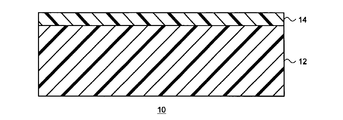
- FIG. 1 is a cross-sectional view schematically showing the laminated body of the second embodiment.
- the laminated body 10 includes a resin molded body 12 and a coating film 14 formed on the surface of the resin molded body 12.
- the resin molded body 12 is in accordance with the first embodiment of the present invention described above, q'max is 0.8 or more, and internal friction is 0.020 or less.
- the thickness of the coating 14 is preferably from 5 ⁇ m to 200 ⁇ m from the viewpoint that the ceramic-like thermal sensation and tapping sound of the laminate 10 can be achieved without being affected by the coating 14, and the resin molded body 12 can be stretched.
- the elastic modulus is preferably 5 GPa or more.
- the thickness of the coating 14 is 5 ⁇ m or less, the coating may be worn during use.
- the thickness of the coating film 14 is more preferably 30 ⁇ m to 170 ⁇ m, and further preferably 30 ⁇ m to 150 ⁇ m.
- the tensile modulus of elasticity of the resin molded body 12 is more preferably 7 GPa or more, and further preferably 10 GPa or more.
- the tensile modulus of the resin molded body 12 can be measured according to JIS K7161. Although the upper limit of the tensile modulus is not particularly limited, it is preferably 17 GPa or less from the viewpoint of workability of the resin molded body.
- the type of the coating film 14 can be appropriately selected according to the application of the laminated body 10 and so as not to impair the pottery-like thermal sensation and tapping sound.
- the coating film 14 can be formed by applying a known synthetic resin paint on at least one surface of the resin molded body.
- synthetic resin coatings include, but are not limited to, acrylic-urethane coatings, polyurethane coatings, epoxy coatings, fluorine coatings, vinyl coatings, polyester coatings.
- the resin molded body can be coated by a known coating method, for example, spray coating, hand coating, roll coater, flow coater, or electrostatic coating.
- the resin molded body of the first embodiment and the laminated body of the second embodiment of the present invention can be used for various articles using pottery.
- articles include tableware, toilet pottery, wash bowls, tiles, wall materials, potted plants, ornaments, and the like.
- the resin molded product and the laminated body it is possible to manufacture an article having a complicated shape that is difficult to form with pottery or an article that is lighter than pottery.
- Example 1 After degreasing the surfaces of the resin moldings of Example 1 and Comparative Examples 6 and 7 twice with isopropyl alcohol, spray coating according to the formulation shown in Table 2 below, applying a primer, and leaving at room temperature for 10 minutes or more. A color base was coated and baked at 70° C. for 1 hour, and then a clear base was coated and baked at 70° C. for 1 hour to form a coating film having a thickness of 100 ⁇ m.
- the q'max of the samples of each Example and Comparative Example was measured using a FR-07 finger robot thermo-lab (Kato Tech Co., Ltd.) at a sensor unit of 36°C and a sample temperature of 10°C.
- the internal friction was measured by cutting a resin molded sample into a thickness of 2 mm, a width of 3 mm and a length of 35 mm, and using a measurement Rheogel-E4000 (UBM Co., Ltd.) at a sample temperature of 23° C., a frequency of 100 Hz, and strain control of 1 ⁇ m. did.
- the tensile modulus was measured according to JIS K7161 by cutting a resin molded sample into a dumbbell shape and using a precision universal testing machine Autograph AG-I. Table 1 shows the respective measurement results.
- Table 1 shows the values of q'max, internal friction and tensile elastic modulus of a commercially available sanitary ware (wash bowl L536ANC), and the results of sensory evaluation.
- Comparative Example 3 and Comparative Example 4 the composition of the resin molded body was the same, but in Comparative Example 3, the sound was equivalent to that of pottery, but in Comparative Example 4 in which the coating film was formed on the surface, the sound was not of pottery I didn't feel it.
- Comparative Example 5 in which a coating film was similarly formed, the sound was equivalent to that of pottery.
- the resin molded body of Comparative Example 4 has a tensile elastic modulus of 2.5 GPa
- the resin molded body of Comparative Example 5 has a tensile elastic modulus of 5.0 GPa. Therefore, this result suggests that the tensile modulus of elasticity of the resin molded body is preferably 5.0 GPa or more when the coating film is formed.
- the resin molded body according to the second aspect includes the resin molded body according to the first aspect, which has at least one resin having an internal friction of 0.020 or less and at least one filler having a thermal conductivity of 1 W/m ⁇ K or more. Including. According to this aspect, it is possible to provide a resin molded body that satisfies q'max and internal friction of the resin molded body of the first aspect.
- a resin molded body according to a third aspect is the resin molded body according to the second aspect, comprising 30 to 50% by mass of the resin and 50 to 70% by mass of the filler with respect to the total mass of the resin composition. Has been formed. According to this aspect, it is possible to provide a resin molded body having both a thermal sensation and a tapping sound equivalent to those of ceramics.
- the fourth aspect of the laminated body includes the resin molded body according to any one of the first to third aspects, and a coating film formed on the surface of the resin molded body. According to this aspect, it is possible to provide a laminate having various surfaces due to the properties of the coating, in addition to the thermal sensation and tapping sound equivalent to those of ceramics.
- the thickness of the coating is 5 to 200 ⁇ m and the tensile modulus of the resin molded body is 5 GPa or more. According to this aspect, it is possible to achieve the pottery-like thermal sensation and tapping sound of the laminate without being affected by the coating.
- the present invention can be applied to various articles using pottery.
Landscapes
- Chemical & Material Sciences (AREA)
- Health & Medical Sciences (AREA)
- Chemical Kinetics & Catalysis (AREA)
- Medicinal Chemistry (AREA)
- Polymers & Plastics (AREA)
- Organic Chemistry (AREA)
- Engineering & Computer Science (AREA)
- Manufacturing & Machinery (AREA)
- Materials Engineering (AREA)
- Compositions Of Macromolecular Compounds (AREA)
- Manufacture Of Macromolecular Shaped Articles (AREA)
- Laminated Bodies (AREA)
Abstract
積層体10は、樹脂成形体12と、樹脂成形体12の表面に形成された被膜14と、を含む。樹脂成形体12は、q'maxが0.8以上であり、内部摩擦が0.020以下である。樹脂成形体12は、内部摩擦が0.020以下である少なくとも1種の樹脂と、熱伝導率が1W/m・K以上である少なくとも1種の充填材とを含んでもよい。
Description
本発明は、樹脂成形体および積層体に関する。
陶器調の樹脂組成物を得るために、樹脂表面を塗装する方法や熱可塑性樹脂に無機充填材を混合する方法が知られている。
例えば、特許文献1には、L値70以上の淡彩色のベースコート層もしくは基材に、艶消し塗料組成物でトップコート層を形成することによって得られるホウロウのような外観を有する陶器調の樹脂組成物が記載されている。また、特許文献2には、ポリブチレンテレフタレート樹脂と、ポリエチレンテレフタレート樹脂と、硫酸バリウムとを混合することによって得られた陶器調の樹脂組成物が記載されている。特許文献3には、食器や容器に使用した場合に、内容物の温冷感を感じやすく且つ重量感や安定感が十分な熱伝導性組成物が記載されており、このような熱伝導性組成物が、ポリオレフィン系樹脂等の熱可塑性樹脂に、酸化マグネシウム等の熱伝導性金属酸化物を配合することで得られることが記載されている。
特許文献1~3のように外観や触感を陶器に近づけた樹脂組成物は知られているが、叩いた時に陶器と同様の音を発する樹脂組成物は未だ提案されていない。
本発明のある態様は、このような課題に鑑みてなされ、その目的の1つは、樹脂成形体の外観、触感に加えて叩いた時の音も陶器と同様にすることができる技術を提供することにある。
上記の課題を解決するために、本発明の第1態様は樹脂成形体である。この樹脂成形体は、q’maxが0.8以上であり、内部摩擦が0.020以下である。
本発明によれば、樹脂成形体の外観、触感に加えて叩いた時の音も陶器と同様にすることができる技術を提供することができる。
本発明の第1実施形態の樹脂成形体は、q’maxが0.8以上であり、内部摩擦が0.020以下である。樹脂成形体のq’maxを0.8以上とすることで、樹脂成形体に触れたときに、陶器のような温冷感を感じることができる。さらに、樹脂成形体の内部摩擦を0.020以下とすることで、叩いた時に陶器のような音を感じることができる。したがって、q’maxと内部摩擦を上記範囲内とすることによって、樹脂成形体の質感が総合的に陶器により近いものとすることができる。また、樹脂成形体は陶器よりも軽量であり、複雑な形状も作ることができる。
樹脂成形体のq’maxは0.8以上であれば、陶器のような触感とすることができ、その上限は特に制限されないが、過剰に冷感を感じさせない観点から、1.3が好ましい。ここで、q’maxは、人が物に触れた時に感じる冷たさや温かさ(接触冷温感)を示す指標である。q’maxは、FR-07フィンガーロボットサーモラボ(カトーテック株式会社)を用い、センサー部36℃、サンプル温度10℃で、温度変化ピーク値「q’max」として計測することができる。
樹脂成形体の内部摩擦は0.020以下であればよく、その下限は特に制限されないが、0.001以上であることが好ましい。ここで、内部摩擦は、Rheogel-E4000(ユービーエム株式会社)を用い、サンプル温度23℃、周波数100Hz、歪制御1μmで計測することができる。
樹脂成形体の上記範囲のq’maxは、例えば無機充填材として、熱伝導率が1W/m・K以上である無機充填材を採用することで達成できる。無機充填材は単独で、または2種類以上を組み合わせて用いることができる。なお、無機充填材の熱伝導率の上限は特に制限されないが、成形性の不具合の観点から、300W/m・K以下であることが好ましい。
無機充填材の例としては、窒化シリカ、窒化アルミニウム、窒化ホウ素、酸化アルミニウム、水酸化アルミニウム、酸化マグネシウム、酸化亜鉛、ベリリア、結晶性シリカ、溶融シリカ、炭化シリカ、黒鉛、酸化チタン、ガラス繊維、炭素繊維が挙げられる。無機充填材の形状は特に限定されず、多角状、鱗片状、球状、繊維等の形状であり得る。また、成形体の熱伝導率向上の観点から、無機充填材の体積平均粒径は、10~500μmであることが好ましく、130~400μmであることがより好ましい。ここで、体積平均粒径は、HORIBA LA960V2を用い、レーザー回折散乱法により測定することができる。
樹脂成形体を構成する樹脂として、例えば剛直な分子構造を持っており、内部摩擦が小さい(例えば0.020以下)樹脂を採用することによって、樹脂成形体の内部摩擦を上記範囲とすることができる。樹脂の例としては、環状オレフィンコポリマー(COC)樹脂、シンジオタクチックポリスチレン(SPS)樹脂、ポリフェニレンスルファイド(PPS)樹脂、ポリエーテルイミド(PEI)樹脂、液晶ポリマー(LCP)樹脂、ポリカーボネート(PC)樹脂、ポリブチレンテレフタレート(PBT)樹脂が挙げられる。樹脂は単独で、または2種以上を組み合わせて用いることができる。
樹脂成形体には、その用途に応じて、かつその特性を損なわない範囲内で、様々な種類の添加剤を添加することができる。添加剤の例としては、酸化防止剤、滑剤、可塑剤、紫外線吸収剤、顔料、染料、熱安定剤、帯電防止剤、核剤、難燃剤などが挙げられる。
樹脂成形体の製造方法は特に限定されず、公知の方法を用いることができる。例えば、樹脂と、無機充填材と、任意に添加剤とを配合して得られた樹脂組成物を射出成形法等の公知の成形方法を用いて成形することによって、樹脂成形体を製造することができる。ここで、樹脂成形体の形成に用いる樹脂組成物中の樹脂の量は、成形性や樹脂成形体の所望の内部摩擦を達成するという観点から、樹脂組成物の総質量に対して、30~50質量%であることが好ましく、30~40質量%であることがより好ましく、30~40質量%であることがさらにより好ましい。また、無機充填材の量は、樹脂成形体の所望のq’maxを達成するという観点から、樹脂組成物の総質量に対して、50~70質量%であることが好ましく、55~70質量%であることがより好ましく、60~70質量%であることがさらにより好ましい。
本発明の第2実施形態は、第1実施形態の樹脂成形体と、該樹脂成形体の表面に形成された被膜と、を含む積層体である。図1は、第2実施形態の積層体を概略的に示す断面図である。積層体10は、樹脂成形体12と、樹脂成形体12の表面に形成された被膜14とを含む。樹脂成形体12は、上述した本発明の第1実施形態に従うものであり、q’maxが0.8以上であり、内部摩擦が0.020以下である。被膜14の影響を受けることなく、積層体10の陶器様の温冷感および打音を達成できるという観点から、被膜14の厚さが5μm~200μmであることが好ましく、樹脂成形体12の引張弾性率が5GPa以上であることが好ましい。なお、被膜14の厚さが5μm以下である場合、使用中に被膜が摩滅するおそれがある。ここで、被膜14の厚さは、より好ましくは、30μm~170μmであり、さらに好ましくは30μm~150μmである。また、樹脂成形体12の引張弾性率は、より好ましくは7GPa以上であり、さらに好ましくは10GPa以上である。
樹脂成形体12の引張弾性率は、JIS K7161に準じて計測できる。なお、引張弾性率の上限は特に制限されないが、樹脂成形体の加工性の観点から、17GPa以下であることが好ましい。
被膜14の種類は、積層体10の用途に応じて、かつその陶器様の温冷感および打音を損なわないように、適宜選択することができる。例えば、被膜14は、公知の合成樹脂塗料を樹脂成形体の少なくとも一方の表面に塗装することによって形成できる。合成樹脂塗料の例としては、アクリル-ウレタン系塗料、ポリウレタン系塗料、エポキシ系塗料、フッ素系塗料、ビニル系塗料、ポリエステル系塗料が挙げられるが、これらに限定されない。樹脂成形体の塗装は、公知の塗装方法、例えば、スプレー塗装、手塗り塗装、ロールコーター、フローコーター、静電塗装によって行うことができる。
本発明の第1実施形態の樹脂成形体および第2実施形態の積層体は、陶器を使用する様々な物品に用いることができる。そのような物品としては、例えば、食器、トイレの陶器、洗面ボウル、タイル、壁材、鉢植え、装飾品などが挙げられる。また、該樹脂成形体および該積層体を用いて、陶器では形成するのが困難な複雑な形状の物品や、陶器よりも軽い物品を製造することができる。
以下、本発明を実施例によってさらに詳細に説明するが、これらの実施例は本発明を何ら限定するものではない。
下記表1に示す処方に従い、2軸押出機(コペリオン株式会社製STS35)を用いて、設定樹脂温度220℃で溶融混練処理し、ストランドを押し出し、該ストランドを水冷後切断し、ペレットを得た。得られたペレットを射出成形機ROBOSHOT S100B(ファナック株式会社)を用い、設定樹脂温度220℃で成形して、実施例1、2、比較例1~7の樹脂成形体サンプル(厚さ3mm、幅35mm、長さ100mm)を得た。実施例1、比較例6、7の樹脂成形体の表面をイソプロピルアルコールで2回脱脂し、下記表2に示す処方に従いスプレー塗装を用いて、プライマーを塗布して常温で10分以上放置した後、カラーベースを塗装して70℃で1時間焼付け、その後クリヤーベースを塗装して70℃で1時間焼付け、厚さ100μmの塗膜を設けた。
各実施例および比較例のサンプルのq’maxは、FR-07フィンガーロボットサーモラボ(カトーテック株式会社)を用い、センサー部36℃、サンプル温度10℃で計測した。また、内部摩擦は、樹脂成形体サンプルを厚さ2mm、幅3mm、長さ35mmに切り出し、計測Rheogel-E4000(ユービーエム株式会社)を用い、サンプル温度23℃、周波数100Hz、歪制御1μmで計測した。引張弾性率は、JIS K7161に準じて、樹脂成形体サンプルをダンベル形状に切り出し精密万能試験機オートグラフAG-Iを用い計測した。それぞれの計測結果を表1に示す。
各実施例および比較例のサンプルの温冷感および響きについて官能評価を行った。官能評価の方法としては、温冷感は樹脂成形体を人差し指で触れたとき触感、響きは樹脂成形体の端部を持ち人差し指の爪で中心部を叩いた時の音を評価した。評価結果を表1に示す。表1中、「○」は陶器と同等に感じたことを示し、「×」は陶器とは感じなかったことを示す。
参考例として、市販の衛生陶器(洗面ボウルL536ANC)のq’max、内部摩擦および引張弾性率の各数値と、官能評価の結果を表1に示す。

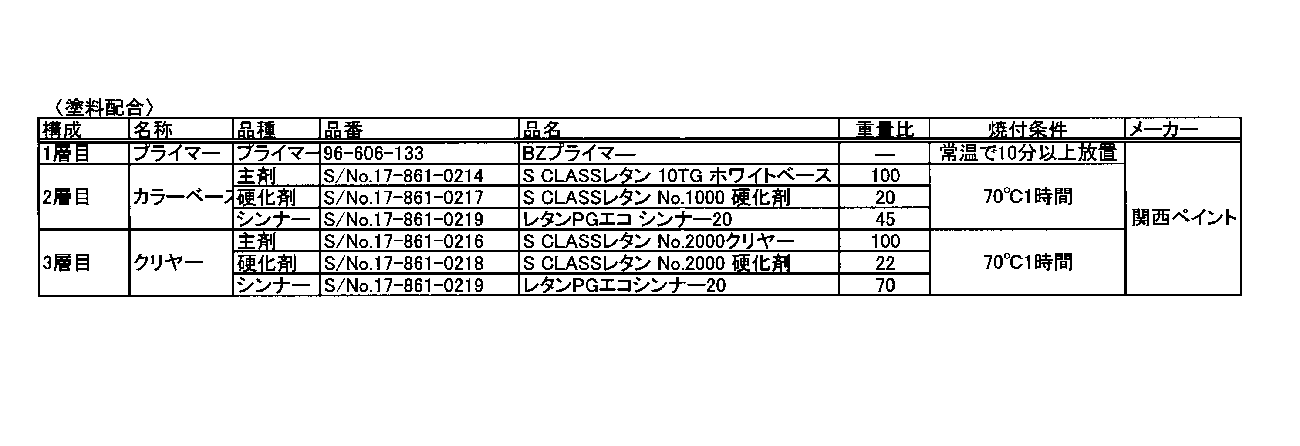
表1中、樹脂成形体の各成分の詳細は下記の通りである。
・COC:APL6509T(三井化学株式会社)。
・PP:MA3(日本ポリプロ株式会社)。
・黒鉛:F#2(日本黒鉛工業株式会社)。
・炭素繊維:K223HE(三菱ケミカル株式会社)。
・窒化ホウ素:UHP2(昭和電工株式会社)。
・ガラス繊維:CSF 3PE-332(日東紡績株式会社)。
・COC:APL6509T(三井化学株式会社)。
・PP:MA3(日本ポリプロ株式会社)。
・黒鉛:F#2(日本黒鉛工業株式会社)。
・炭素繊維:K223HE(三菱ケミカル株式会社)。
・窒化ホウ素:UHP2(昭和電工株式会社)。
・ガラス繊維:CSF 3PE-332(日東紡績株式会社)。
表1から明らかなように、q’maxが0.8以上であり、内部摩擦が0.020以下である実施例1、2のサンプルは、陶器と同等の温冷感および響きを有する。これに対して、内部摩擦が0.020未満である比較例1、2のサンプルでは、響きが陶器とは感じなかった。また、q’maxが0.8未満である比較例3~5のサンプルでは、陶器と同等の温冷感が得られなかった。
比較例3と比較例4は、樹脂成形体の組成が同じであるが、比較例3では響きが陶器と同等であったが、表面に塗膜を形成した比較例4では響きが陶器とは感じなかった。一方、同様に塗膜を形成した比較例5では、響きが陶器と同等であった。比較例4の樹脂成形体の引張弾性率が2.5GPaであるのに対して、比較例5の樹脂成形体の引張弾性率が5.0GPaである。したがって、この結果は、塗膜を形成した場合には、樹脂成形体の引張弾性率が5.0GPa以上であることが望ましいことを示唆している。
以上、本発明の実施形態について詳細に説明した。前述した実施形態は、いずれも本発明を実施するにあたっての具体例を示したものにすぎない。実施形態の内容は、本発明の技術的範囲を限定するものではなく、発明の思想を逸脱しない範囲において、構成要素の変更、追加、削除等の多くの設計変更が可能である。前述の実施形態では、このような設計変更が可能な内容に関して、「実施形態」との表記を付して強調しているが、そのような表記のない内容でも設計変更が許容される。以上の構成要素の任意の組み合わせも、本発明の態様として有効である。図面の断面に付したハッチングは、ハッチングを付した対象の材質を限定するものではない。
以上の実施形態により具体化される発明を一般化すると、以下の技術的思想が導かれる。以下、発明が解決しようとする課題に記載の態様を用いて説明する。
第2態様の樹脂成形体は、第1態様において、内部摩擦が0.020以下である少なくとも1種の樹脂と、熱伝導率が1W/m・K以上である少なくとも1種の充填材とを含む。この態様によれば、第1態様の樹脂成形体のq’maxおよび内部摩擦を満たす樹脂成形体を提供できる。
第3態様の樹脂成形体は、第2態様において、樹脂組成物の総質量に対して、前記樹脂を30~50質量%と、前記充填材を50~70質量%とを含む樹脂組成物から形成されている。この態様によれば、陶器と同等の温冷感および打音の両方を有する樹脂成形体を提供できる。
第4態様の積層体は、第1態様から第3態様のいずれかの樹脂成形体と、樹脂成形体の表面に形成された被膜と、を含む。この態様によれば、陶器と同等の温冷感および打音に加えて、被膜の性質により様々な表面を有する積層体を提供できる。
第5態様の積層体は、第4態様において、被膜の厚さが5~200μmであり、樹脂成形体の引張弾性率が5GPa以上である。この態様によれば、被膜の影響を受けることなく、積層体の陶器様の温冷感および打音を達成できる。
本発明は、陶器を使用する様々な物品に利用可能である。
10 積層体、12 樹脂成形体、14 被膜
Claims (5)
- q’maxが0.8以上であり、内部摩擦が0.020以下であることを特徴とする樹脂成形体。
- 内部摩擦が0.020以下である少なくとも1種の樹脂と、熱伝導率が1W/m・K以上である少なくとも1種の充填材とを含むことを特徴とする請求項1に記載の樹脂成形体。
- 樹脂組成物の総質量に対して、前記樹脂を30~50質量%と、前記充填材を50~70質量%とを含む樹脂組成物から形成されていることを特徴とする請求項2に記載の樹脂成形体。
- 請求項1から3のいずれかに記載の樹脂成形体と、前記樹脂成形体の表面に形成された被膜と、を含むことを特徴とする積層体。
- 前記被膜の厚さが5~200μmであり、前記樹脂成形体の引張弾性率が5GPa以上であることを特徴とする請求項4に記載の積層体。
Applications Claiming Priority (2)
| Application Number | Priority Date | Filing Date | Title |
|---|---|---|---|
| JP2019-021945 | 2019-02-08 | ||
| JP2019021945A JP2020128499A (ja) | 2019-02-08 | 2019-02-08 | 樹脂成形体および積層体 |
Publications (1)
| Publication Number | Publication Date |
|---|---|
| WO2020162496A1 true WO2020162496A1 (ja) | 2020-08-13 |
Family
ID=71947583
Family Applications (1)
| Application Number | Title | Priority Date | Filing Date |
|---|---|---|---|
| PCT/JP2020/004361 Ceased WO2020162496A1 (ja) | 2019-02-08 | 2020-02-05 | 樹脂成形体および積層体 |
Country Status (2)
| Country | Link |
|---|---|
| JP (1) | JP2020128499A (ja) |
| WO (1) | WO2020162496A1 (ja) |
Cited By (1)
| Publication number | Priority date | Publication date | Assignee | Title |
|---|---|---|---|---|
| JP2022128175A (ja) * | 2021-02-22 | 2022-09-01 | 株式会社Lixil | 積層体および積層体の製造方法 |
Citations (2)
| Publication number | Priority date | Publication date | Assignee | Title |
|---|---|---|---|---|
| JP2004270927A (ja) * | 2003-02-18 | 2004-09-30 | Inax Corp | 制振部材及びその製造方法 |
| JP2012144626A (ja) * | 2011-01-11 | 2012-08-02 | Daicel Corp | 熱伝導性樹脂組成物及び熱伝導性シート |
-
2019
- 2019-02-08 JP JP2019021945A patent/JP2020128499A/ja active Pending
-
2020
- 2020-02-05 WO PCT/JP2020/004361 patent/WO2020162496A1/ja not_active Ceased
Patent Citations (2)
| Publication number | Priority date | Publication date | Assignee | Title |
|---|---|---|---|---|
| JP2004270927A (ja) * | 2003-02-18 | 2004-09-30 | Inax Corp | 制振部材及びその製造方法 |
| JP2012144626A (ja) * | 2011-01-11 | 2012-08-02 | Daicel Corp | 熱伝導性樹脂組成物及び熱伝導性シート |
Cited By (2)
| Publication number | Priority date | Publication date | Assignee | Title |
|---|---|---|---|---|
| JP2022128175A (ja) * | 2021-02-22 | 2022-09-01 | 株式会社Lixil | 積層体および積層体の製造方法 |
| JP7624323B2 (ja) | 2021-02-22 | 2025-01-30 | 株式会社Lixil | 積層体および積層体の製造方法 |
Also Published As
| Publication number | Publication date |
|---|---|
| JP2020128499A (ja) | 2020-08-27 |
Similar Documents
| Publication | Publication Date | Title |
|---|---|---|
| CN107530955B (zh) | 材料挤出式三维打印机成型用丝材和成型体的制造方法 | |
| CN107000319B (zh) | 三维打印机成型用细丝和结晶性软质树脂成型体的制造方法 | |
| CN104530573A (zh) | 低光泽、低翘曲、软触感车用聚丙烯组合物及制备和应用 | |
| JP2012507611A5 (ja) | ||
| JP2010509459A (ja) | 粉末組成物及びそれから物品を製造する方法 | |
| KR101819774B1 (ko) | 데코 시트 | |
| JP2008214573A5 (ja) | 液晶性樹脂組成物からなる成形品 | |
| JP6424474B2 (ja) | 反射フィルム、及びこれを備えてなる液晶表示装置、照明装置、装飾用物品 | |
| WO2020162496A1 (ja) | 樹脂成形体および積層体 | |
| WO2021153637A1 (ja) | 3次元造形用フィラメント | |
| JP7605988B2 (ja) | 熱可塑性樹脂組成物およびその用途 | |
| JP5366122B2 (ja) | 二重成形樹脂製食器 | |
| WO2024180960A1 (ja) | 3dプリンター用樹脂組成物、3次元造形物及びその製造方法 | |
| JP3157046B2 (ja) | 積層体 | |
| JP2017110081A (ja) | 樹脂シート、積層シート、成形体、成形物及びそれらの製造方法 | |
| KR20210086750A (ko) | 직물 유사 외관 및 촉감을 구현할 수 있는 열가소성 수지 조성물 및 이를 포함하는 성형품 | |
| JP2018024874A (ja) | プロピレン系樹脂組成物、サニタリー用品、ドア部材、手すり部材、食器および配膳トレイ | |
| JP5519459B2 (ja) | 人造大理石用樹脂組成物と人造大理石 | |
| KR20220037545A (ko) | 3d 프린팅용으로 적합한 우수한 고화속도를 나타내는 금속 질감의 열가소성 수지 조성물 및 이를 포함하는 성형품 | |
| CN101570844B (zh) | 半透明涂层及其制造方法与应用 | |
| JP6218074B2 (ja) | アクリル樹脂成形材料及びその成形品 | |
| JP2537957B2 (ja) | 板状複合体 | |
| JP2019085542A (ja) | 成形体、家電機器、トイレ用部材、および便座 | |
| TW202528466A (zh) | 烯烴系樹脂組成物及其用途 | |
| WO2021025161A1 (ja) | 材料押出方式(me方式)3次元プリンタ用フィラメント、樹脂成型体、巻回体、および、3次元プリンタ装着用カートリッジ |
Legal Events
| Date | Code | Title | Description |
|---|---|---|---|
| 121 | Ep: the epo has been informed by wipo that ep was designated in this application |
Ref document number: 20752380 Country of ref document: EP Kind code of ref document: A1 |
|
| NENP | Non-entry into the national phase |
Ref country code: DE |
|
| 122 | Ep: pct application non-entry in european phase |
Ref document number: 20752380 Country of ref document: EP Kind code of ref document: A1 |