WO2020162213A1 - 制御装置、制御方法及びプログラム - Google Patents
制御装置、制御方法及びプログラム Download PDFInfo
- Publication number
- WO2020162213A1 WO2020162213A1 PCT/JP2020/002394 JP2020002394W WO2020162213A1 WO 2020162213 A1 WO2020162213 A1 WO 2020162213A1 JP 2020002394 W JP2020002394 W JP 2020002394W WO 2020162213 A1 WO2020162213 A1 WO 2020162213A1
- Authority
- WO
- WIPO (PCT)
- Prior art keywords
- network
- allocation
- control device
- physical
- power consumption
- Prior art date
- Legal status (The legal status is an assumption and is not a legal conclusion. Google has not performed a legal analysis and makes no representation as to the accuracy of the status listed.)
- Ceased
Links
Images


Classifications
-
- H—ELECTRICITY
- H04—ELECTRIC COMMUNICATION TECHNIQUE
- H04L—TRANSMISSION OF DIGITAL INFORMATION, e.g. TELEGRAPHIC COMMUNICATION
- H04L67/00—Network arrangements or protocols for supporting network services or applications
- H04L67/01—Protocols
- H04L67/10—Protocols in which an application is distributed across nodes in the network
- H04L67/1001—Protocols in which an application is distributed across nodes in the network for accessing one among a plurality of replicated servers
- H04L67/1004—Server selection for load balancing
- H04L67/1008—Server selection for load balancing based on parameters of servers, e.g. available memory or workload
-
- H—ELECTRICITY
- H04—ELECTRIC COMMUNICATION TECHNIQUE
- H04L—TRANSMISSION OF DIGITAL INFORMATION, e.g. TELEGRAPHIC COMMUNICATION
- H04L41/00—Arrangements for maintenance, administration or management of data switching networks, e.g. of packet switching networks
- H04L41/08—Configuration management of networks or network elements
- H04L41/0803—Configuration setting
-
- H—ELECTRICITY
- H04—ELECTRIC COMMUNICATION TECHNIQUE
- H04L—TRANSMISSION OF DIGITAL INFORMATION, e.g. TELEGRAPHIC COMMUNICATION
- H04L41/00—Arrangements for maintenance, administration or management of data switching networks, e.g. of packet switching networks
- H04L41/08—Configuration management of networks or network elements
- H04L41/0803—Configuration setting
- H04L41/0823—Configuration setting characterised by the purposes of a change of settings, e.g. optimising configuration for enhancing reliability
- H04L41/0826—Configuration setting characterised by the purposes of a change of settings, e.g. optimising configuration for enhancing reliability for reduction of network costs
-
- H—ELECTRICITY
- H04—ELECTRIC COMMUNICATION TECHNIQUE
- H04L—TRANSMISSION OF DIGITAL INFORMATION, e.g. TELEGRAPHIC COMMUNICATION
- H04L41/00—Arrangements for maintenance, administration or management of data switching networks, e.g. of packet switching networks
- H04L41/08—Configuration management of networks or network elements
- H04L41/0895—Configuration of virtualised networks or elements, e.g. virtualised network function or OpenFlow elements
-
- H—ELECTRICITY
- H04—ELECTRIC COMMUNICATION TECHNIQUE
- H04L—TRANSMISSION OF DIGITAL INFORMATION, e.g. TELEGRAPHIC COMMUNICATION
- H04L67/00—Network arrangements or protocols for supporting network services or applications
- H04L67/01—Protocols
- H04L67/10—Protocols in which an application is distributed across nodes in the network
-
- H—ELECTRICITY
- H04—ELECTRIC COMMUNICATION TECHNIQUE
- H04L—TRANSMISSION OF DIGITAL INFORMATION, e.g. TELEGRAPHIC COMMUNICATION
- H04L41/00—Arrangements for maintenance, administration or management of data switching networks, e.g. of packet switching networks
- H04L41/14—Network analysis or design
- H04L41/147—Network analysis or design for predicting network behaviour
-
- H—ELECTRICITY
- H04—ELECTRIC COMMUNICATION TECHNIQUE
- H04L—TRANSMISSION OF DIGITAL INFORMATION, e.g. TELEGRAPHIC COMMUNICATION
- H04L43/00—Arrangements for monitoring or testing data switching networks
- H04L43/08—Monitoring or testing based on specific metrics, e.g. QoS, energy consumption or environmental parameters
- H04L43/0805—Monitoring or testing based on specific metrics, e.g. QoS, energy consumption or environmental parameters by checking availability
- H04L43/0817—Monitoring or testing based on specific metrics, e.g. QoS, energy consumption or environmental parameters by checking availability by checking functioning
-
- H—ELECTRICITY
- H04—ELECTRIC COMMUNICATION TECHNIQUE
- H04L—TRANSMISSION OF DIGITAL INFORMATION, e.g. TELEGRAPHIC COMMUNICATION
- H04L43/00—Arrangements for monitoring or testing data switching networks
- H04L43/08—Monitoring or testing based on specific metrics, e.g. QoS, energy consumption or environmental parameters
- H04L43/0876—Network utilisation, e.g. volume of load or congestion level
- H04L43/0894—Packet rate
Definitions
- the present invention relates to a control device, a control method and a program.
- NFV Network Functions Virtualization
- VN Virtual Network
- Non-Patent Document 2 it is known that the power consumption of servers and devices in a data center fluctuates depending on the load factor (Non-Patent Document 2). Further, for example, it is known that the power consumption of the data center also depends on the outside temperature because the power consumption of the air conditioner is closely related to the outside temperature (Non-Patent Document 3).
- the electricity rate is calculated as the product of the power consumption and the electricity rate, but the electricity rate varies depending on the region (that is, the area under the jurisdiction of the electric power company) and the time of day. Therefore, for example, even if the virtual network is allocated such that the electricity charge is minimized in a certain time zone, the electricity charge is not always minimized in another time zone.
- the present invention has been made in view of the above points, and an object thereof is to realize allocation of a virtual network that minimizes cost.
- a control device is a control device that allocates a virtual network for providing a network service on a physical network, and the outside temperature of each node included in the physical network.
- Information indicating the physical resource information of the physical network, information indicating the predicted traffic amount of the physical network, and an acquisition unit that acquires an allocation request for the virtual network, calculated from the outside air temperature and the predicted traffic amount.
- VN virtual network
- a power consumption model (a power consumption model of a data center and a power consumption model of a link) in which the outside air temperature and the load factor are considered is defined, and then the power consumption calculated by these power consumption models is defined.
- assigning a VN to a physical resource may be expressed as, for example, “embedding the VN in the physical resource” or “arranging the VN in the physical resource”.
- FIG. 1 is a diagram for explaining an example of a relationship between the physical network 200 and a jurisdiction area of a power company.
- the physical network 200 is composed of nodes N1 to N24 and links connecting the nodes. Further, the jurisdiction areas of the electric power companies A to I are assumed to be those shown in FIG.
- Each of the nodes N1 to N24 is, for example, a data center in which a server and various communication devices are installed.
- the node of the physical network 200 is assumed to be a data center.
- the optimum route is the node N8 ⁇ node N10 ⁇ node 13 ⁇ node N12 ⁇ node N16.
- the unit price of electricity of the electric power company E is higher than that of other electric power companies, for example, the jurisdiction of the electric power company E such as node N8 ⁇ node N10 ⁇ node N14 ⁇ node N18 ⁇ node N17 ⁇ node N16. It is assumed that the route that bypasses the area will be the optimum route.
- VN when providing a network service by this access, it is possible to arrange the VN in the data center of the node N12 or the node N13 in consideration of centrality (that is, a position where the total distance to all service providing destinations becomes small). Although preferable, it is assumed that VNs are arranged in the node N16 and the node N17 from the viewpoint of the electricity bill, so that there is a cost merit.
- the optimal VN allocation pattern (that is, the allocation pattern for allocating VNs to physical resources) that takes into consideration the electricity rate changes. Further, as will be described later, since the electricity rate unit price varies depending on the time zone, the optimal VN allocation pattern also changes depending on the time zone.
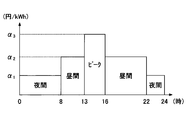
- FIG. 2 is a diagram for explaining an example of the relationship between the time zone and the electricity price unit price.
- FIG. 2 shows, as an example, the electricity unit price of a certain electric power company.
- the unit price of electricity generally differs depending on the time of day.
- the unit price of electricity is ⁇ 1 in the nighttime (0:00 to 8:00, 22:00 to 24:00) and the daytime (8:00 to 13:00, 16:00 to 22:00)
- the unit price of electricity is ⁇ 2
- the unit price of electricity is ⁇ 3 during peak hours (13:00 to 16:00).
- the unit price of electricity generally varies depending on the time of day.
- the example shown in FIG. 2 is an example, and there may be a case where the unit price of electricity is uniform regardless of the time zone depending on the electric power company, and the time zone is subdivided compared to the example shown in FIG. It is also possible.
- t i is the outside air temperature (° C.) at the point of the i-th data center
- l i is the load factor (%) of the entire i-th data center
- b j is the load factor of the j-th link.
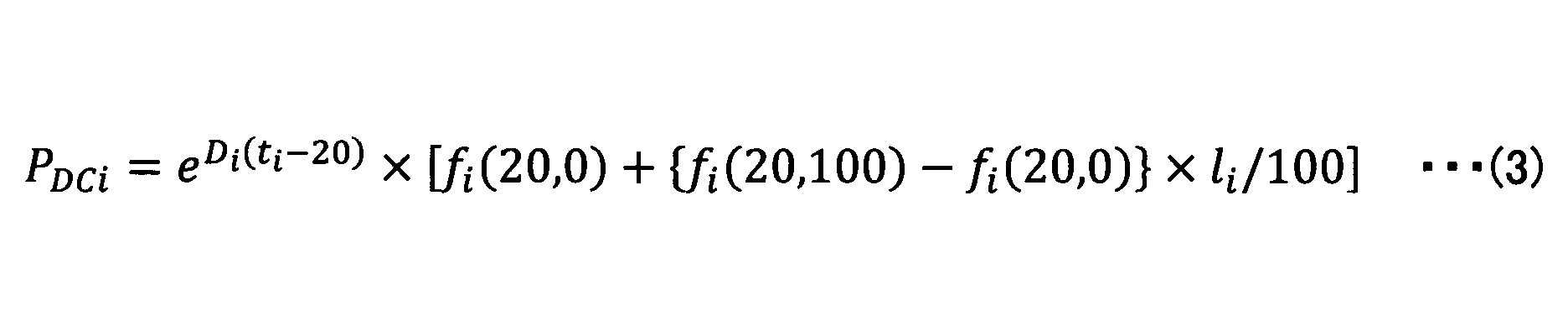
- the power consumption model P DCi of the data center is, for example, the following expression (3).
- e is the base of the natural logarithm
- D i is a predetermined constant for each data center
- f i (20,0) is the consumption of the i-th data center when the outside air temperature is 20° C. and the load factor is 0%.
- Electric power, f i (20,100) represents the power consumption of the i-th data center when the outside air temperature is 20° C. and the load factor is 100%.
- g j (20,0) is the power consumption of the j-th link when the outside air temperature is 20° C. and the load factor is 0%
- g j (20,100) is when the outside air temperature is 20° C. and the load factor is 100%. Represents the power consumption of the j-th link.
- the constants D i and D j in the above equations (3) and (4) may be derived by, for example, regression analysis from measured data of power consumption, load factor, and outside temperature.
- the CPU (Central Processing Unit) demand required for the a-th VN is defined as C VNa
- the CPU capacity of the i-th data center is defined as C imax
- the j-th link band is defined as C jmax .
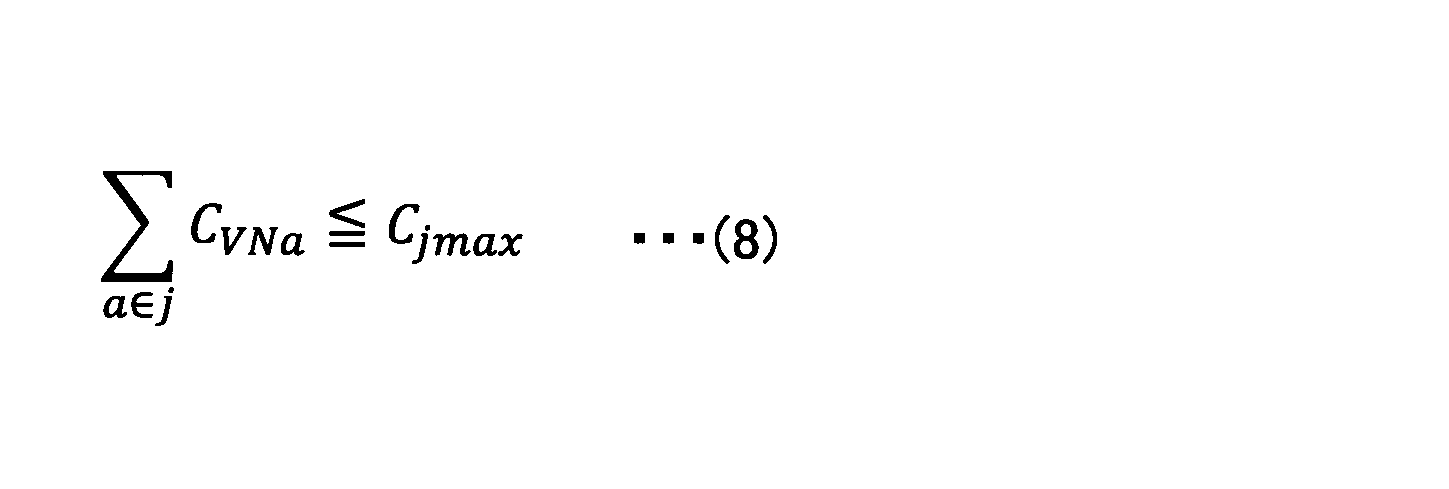
- l i and b j can be expressed by the following equations (5) and (6).
- the numerator on the right side of the above equation (5) represents the total CPU demand of all VNs assigned to the i-th data center.
- the numerator on the right side of Expression (6) represents the bands of all VNs assigned to the j-th link.
- F Ti represents the unit price of electricity at the i-th data center at time T
- F Tj represents the unit price of electricity at the j-th link at time T.
- the first term of the objective function h shown in the above equation (9) represents the electricity charges of all the data centers on the route (that is, the route connecting the start point and the end point of the VN), and the second term is on the route. Shows the electricity charges for all links.
- the allocation pattern of VNs (that is, the start point and the end point of each VN are set to minimize the objective function h shown in the above equation (9)).
- the connecting route By calculating the connecting route, it is possible to realize the VN allocation in which the cost (that is, the electricity charge) is minimized.
- FW Firewall
- IDS Intrusion Detection System
- the FW can be assigned to any data center. It is also calculated whether a function such as IDS or IDS is provided.
- constraint conditions shown in the above equations (7) and (8) are the CPU capacity of each data center and the link bandwidth of each link, but in addition to this, the required quality of the network service provided by the VN, etc. Depending on the above, the following may be considered as a constraint condition.
- the outside air temperature t i can use data acquired from a weather information service or the like, and the load factors l i and b j can be calculated from the traffic volume predicted by a known traffic prediction technique.
- the traffic prediction technique is a technique of predicting a future traffic amount from a past traffic amount by a method such as machine learning.
- any method can be applied as long as it is a time-series prediction method such as an ARIMA model or an LSTM (Long Short-Term Memory).
- ARIMA model for example, “Feng, Huifang, and Yantai Shu. “Study on network traffic prediction techniques.”, Wireless Communications, Networking and Mobile Computing, 2005. Proceedings. 2005 International Conference on. Vol. 2. IEEE, 2005 .” and the like can be used.
- LSTM for example, the method described in “Hochreiter, Sepp, and Jurgen Schmidhuber. “Long short-term memory.”, Neural computation 9.8 (1997): 1735-1780.” can be used. it can.
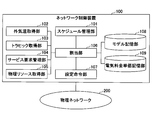
- FIG. 3 is a diagram showing an example of a functional configuration of the network control device 100 according to the embodiment of the present invention.
- the network control device 100 includes a schedule management unit 101, an outside air temperature acquisition unit 102, a traffic acquisition unit 103, and a service request management unit 104 as functional units. It has a physical resource acquisition unit 105, an allocation unit 106, and a setting instruction unit 107. Further, the network control device 100 according to the embodiment of the present invention includes a model storage unit 108 and an electricity charge unit price storage unit 109 as storage units.
- the model storage unit 108 stores the power consumption model (that is, the power consumption model shown in the above equations (1) and (2)).
- the electricity charge unit price storage unit 109 stores the electricity charge unit price for each time zone for each area. It should be noted that the unit price of electricity is updated each time the unit price of electricity is changed, such as revision of the unit price of the electric power company, change of contract with the electric power company, change to another electric power company, or the like.
- the schedule management unit 101 calculates an optimal VN allocation pattern and manages a schedule (that is, VN allocation execution condition) for executing a process (VN allocation process) of allocating a VN of this allocation pattern to a physical resource.
- a schedule that is, VN allocation execution condition
- VN allocation process a process of allocating a VN of this allocation pattern to a physical resource.
- the execution condition of the VN allocation for example, "a predetermined time interval has elapsed since the previous execution", "the traffic amount increases by a certain threshold or more", and the like can be mentioned.
- the outside temperature acquisition unit 102 acquires information indicating the outside temperature at each data center point (hereinafter, also referred to as “outside temperature information”).
- the outside air temperature information may be obtained from, for example, a weather information service or the like, or when an outside air temperature sensor or the like is installed in each data center, the outside air temperature information may be obtained from the outside air temperature sensor.
- the traffic acquisition unit 103 acquires the traffic volume (that is, the predicted traffic volume) at the time when the VN allocation is performed. Such traffic volume is predicted by the traffic prediction technique as described above.
- the traffic acquisition unit 103 may acquire the traffic amount predicted by another device connected to the network control device 100 via the network, or may acquire the traffic amount predicted by the network control device 100. Good.
- the service request management unit 104 manages service requests.
- the service request is a VN allocation request from the service provider.
- the service request includes the requirements of the VN (for example, the start and end points of the VN, the required bandwidth, the allowable delay, etc.). These service requests are held in, for example, the storage device of the network control device 100.
- the physical resource acquisition unit 105 manages information related to physical resources (for example, the CPU capacity of each data center and the link bandwidth of each link). Information about these physical resources is held in, for example, a storage device of the network control device 100.
- the allocation unit 106 calculates an optimum VN allocation pattern by the objective function h shown in the above equation (9) according to the instruction from the schedule management unit 101. That is, the allocation unit 106 first creates a constraint condition by using the service request and the information about the physical resource. Then, the allocation unit 106 calculates the optimum VN allocation pattern using the power consumption model, the unit price of electricity for each region and each time zone, the outside temperature, and the load factor. The load factor is calculated from the predicted traffic volume and the CPU capacity (or link bandwidth), for example.
- the setting command unit 107 transmits a VN setting command to each physical resource (for example, a server, various communication devices, etc.) so as to realize the optimal VN allocation pattern calculated by the allocation unit 106. As a result, optimum VN allocation is realized.
- each physical resource for example, a server, various communication devices, etc.
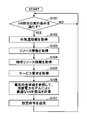
- FIG. 4 is a flowchart showing an example of VN allocation processing according to the embodiment of the present invention.
- Step S101 First, the schedule management unit 101 determines whether or not the VN allocation execution condition is satisfied.
- the VN allocation execution conditions include, for example, "a predetermined time interval has passed since the previous execution", "the traffic volume increases by a certain threshold or more", and the like. If it is determined that the VN allocation execution condition is satisfied, the process proceeds to step S102.
- the daily operation plan that is, what VN is based on the traffic volume predicted by the traffic prediction technique. It is possible to perform VN allocation when an unexpected increase in traffic that exceeds a certain predetermined threshold occurs after formulating a plan).
- control interval when “a predetermined time interval has elapsed since the last execution” is set as the VN allocation execution condition, in general, the electricity charge is often accumulated every 30 minutes, so the predetermined time interval ( It is conceivable that this time interval is also referred to as “control interval”) of 30 minutes.
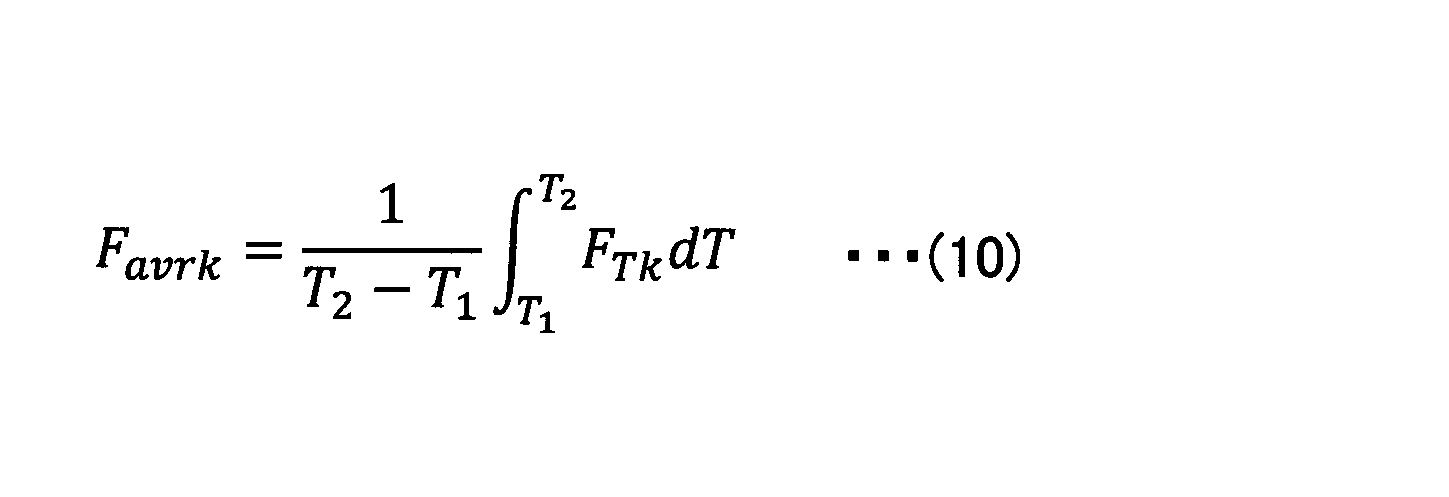
- the time average of the unit price of electricity may be used with the objective function h shown in the above equation (9).
- the time average unit price F avr k at the k-th data center (or link) is defined by the following formula (10).
- F avr i and F avr j may be used instead of F Ti and F Tj of the objective function h shown in the above equation (9), respectively.
- Step S102 The outside temperature acquisition unit 102 acquires outside temperature information indicating the outside temperature at each data center point.
- Step S103 The traffic acquisition unit 103 acquires the predicted traffic volume for the time when VN allocation is performed.
- Step S104 The physical resource acquisition unit 105 acquires information about the physical resource.
- Step S105 The service request management unit 104 acquires the service request.
- Step S106 Next, the allocation unit 106 creates a constraint condition by using the information about the service request and the physical resource. Then, the allocation unit 106 calculates the optimum VN allocation pattern using the power consumption model, the unit price of electricity for each region and each time zone, the outside temperature, and the load factor.
- Step S107 Next, the setting command unit 107 sends a VN setting command to each physical resource so as to realize the optimum VN allocation pattern calculated in the above Step S106.
- the network control device 100 can realize the VN allocation that minimizes the electricity charge in consideration of the outside air temperature, the load factor, the time zone, the region, and the like. Therefore, by using the network control device 100 according to the embodiment of the present invention, for example, a telecommunications carrier can realize further OPEX reduction.
- the electricity rate is assumed as an example of the cost, but the present invention is not limited to this, and the power consumption is multiplied by a variable that can be changed for each hour and area like the electricity rate unit price.
- the present invention can be similarly applied to any objective function derived as follows.
- CO2 emissions are another example of costs.
- the CO2 emission amount is calculated by the product of the power consumption and the CO2 emission coefficient, but the CO2 emission coefficient has a different value for each electric power company similarly to the unit price of electricity, and there is a regional difference.
- the CO2 emission coefficient generally does not change over time and is generally a fixed value.
- CO2 emission coefficient will be changed for each time zone in the future. It is also possible that the coefficients are defined. In that case, it is considered that the application of the present invention makes it possible to minimize the amount of CO 2 emission and realize the provision of services that appeal to the reduction of environmental load.
- FIG. 5 is a diagram showing an example of a hardware configuration of the network control device 100 according to the embodiment of the present invention.
- the network control device 100 includes, as hardware, an external I/F 301, a RAM (Random Access Memory) 302, a ROM (Read Only Memory) 303, and a processor 304. And a communication I/F 305 and an auxiliary storage device 306. These pieces of hardware are connected to each other via a bus B so that they can communicate with each other.
- the external I/F 301 is an interface with an external device.
- the external device includes a recording medium 301a and the like.
- the network control device 100 can read and write the recording medium 301 a via the external I/F 301.
- Examples of the recording medium 301a include a flexible disk, a CD (Compact Disc), a DVD (Digital Versatile Disk), an SD memory card (Secure Digital memory card), and a USB (Universal Serial Bus) memory card.
- a flexible disk a CD (Compact Disc), a DVD (Digital Versatile Disk), an SD memory card (Secure Digital memory card), and a USB (Universal Serial Bus) memory card.
- RAM 302 is a volatile semiconductor memory that temporarily holds programs and data.
- the ROM 303 is a non-volatile semiconductor memory that can retain programs and data even when the power is turned off.
- the ROM 303 stores, for example, setting information regarding an OS (Operating System), setting information regarding a communication network, and the like.
- the processor 304 is, for example, a CPU, a GPU (Graphics Processing Unit), or the like, and is an arithmetic device that reads a program or data from the ROM 303, the auxiliary storage device 306, or the like onto the RAM 302 and executes processing.
- Each functional unit included in the network control device 100 according to the embodiment of the present invention for example, a schedule management unit 101, an outside air temperature acquisition unit 102, a traffic acquisition unit 103, a service request management unit 104, a physical resource acquisition unit 105, and an allocation unit 106.
- the setting instruction unit 107 and the like are realized by, for example, a process that causes the processor 304 to execute one or more programs stored in the auxiliary storage device 306 or the like. Note that these one or more programs may be stored in the recording medium 301a, for example.
- the communication I/F 305 is an interface for connecting the network control device 100 to the physical network 200.
- the auxiliary storage device 306 is, for example, an HDD (Hard Disk Drive) or SSD (Solid State Drive), and stores various programs and data.
- the programs and data stored in the auxiliary storage device 306 implement, for example, an OS, application software that implements various functions on the OS, and functional units included in the network control device 100 according to the embodiment of the present invention. There are more than one program.
- the network control device 100 can realize the above-described various processes by having the hardware configuration shown in FIG. In the example shown in FIG. 5, the case where the network control device 100 according to the embodiment of the present invention is realized by one device (computer) is shown, but the present invention is not limited to this, and a plurality of devices (computers). ) May be realized. Further, one device (computer) may include a plurality of processors 304 and a plurality of memories (RAM 302, ROM 303, auxiliary storage device 306, etc.). Further, the network control device 100 may include, for example, a display device such as a display and an input device such as a keyboard and a mouse in addition to the above hardware.
- network control device 101 schedule management unit 102 outside air temperature acquisition unit 103 traffic acquisition unit 104 service request management unit 105 physical resource acquisition unit 106 allocation unit 107 setting instruction unit 108 model storage unit 109 electricity charge unit storage unit 200 physical network 301 external I /F 301a recording medium 302 RAM 303 ROM 304 processor 305 communication I/F 306 auxiliary storage device
Landscapes
- Engineering & Computer Science (AREA)
- Computer Networks & Wireless Communication (AREA)
- Signal Processing (AREA)
- Computer Hardware Design (AREA)
- General Engineering & Computer Science (AREA)
- Data Exchanges In Wide-Area Networks (AREA)
- Management, Administration, Business Operations System, And Electronic Commerce (AREA)
Abstract
ネットワークサービスを提供するための仮想ネットワークを物理ネットワーク上に割り当てる制御装置であって、前記物理ネットワークに含まれる各ノードの外気温を示す情報と、前記物理ネットワークの物理リソース情報と、前記物理ネットワークの予測トラヒック量を示す情報と、前記仮想ネットワークの割当要求とを取得する取得手段と、前記外気温と前記予測トラヒック量から算出される負荷率とを考慮した消費電力モデルと地域毎及び時間帯毎に定義されたコスト単価とで定義される目的関数と、前記物理リソース情報と前記割当要求とから得られる制約条件とを用いて、前記仮想ネットワークの最適割当を算出する算出手段と、を有することを特徴とする。
Description
本発明は、制御装置、制御方法及びプログラムに関する。
仮想ネットワーク機能(VNF:Virtual Network Function)を柔軟に組み合わせることで、様々なネットワークサービスの提供を可能するNFV(Network Functions Virtualization)と呼ばれる技術が知られている。これらのネットワークサービスは、サービス提供者が構築した仮想ネットワーク(VN:Virtual Network)を、電気通信事業者が持つ物理リソースに割り当てることで提供される。具体的には、仮想ネットワーク毎の要求条件(例えば、仮想ネットワークの始点や終点、要求帯域、許容遅延等)と物理ネットワークのリソース制約条件(例えば、リンク帯域やサーバ容量等)とを満たした上で、仮想ネットワークを各物理リソースに割り当てることで提供される。
ところで、電気通信事業者にとって事業継続の観点からOPEX(Operating Expense)の低減が重要な課題となっている。OPEXのうち、サーバやこれらを冷却する空調を稼働するための電気料金は大きなウェイトを占めおり、電気料金の削減が強く求められている。これに対して、OPEX低減のために消費電力が最小となるような仮想ネットワークの制御方法が提案されており。例えば、サーバ及びリンクの消費電力をモデル化し、消費電力を最も小さくする通信経路制御手法が提案されている(非特許文献1)。
他方で、例えば、データセンタ内のサーバや機器は、負荷率により消費電力が変動することが知られている(非特許文献2)。また、例えば、空調機器の消費電力は外気温と密接な関係があることから、データセンタの消費電力は外気温にも依存していることが知られている(非特許文献3)。
Zhichao Xu, Xiaoning Zhang, Shui Yu, Ji Zhang, "Energy-efficient Virtual Network Function Placement in Telecom Networks", 2018 IEEE International Conference on Communications (ICC)
ジム・スピタエルス,「データセンタとサーバルームの動的な電力変動」,APC White Paper #43
杉浦 徳宏,「電力見える化によるサーバ室の電力分析」,2014年大学ICT推進協議会
しかしながら、例えば、非特許文献1に記載されている手法では、外気温及び負荷率の双方が考慮されておらず、消費電力の推定精度が低かった。
また、電気料金は消費電力と電気料金単価との積で算出されるが、電気料金単価は各地域(つまり、電力会社の管轄エリア)や時間帯によっても異なる。このため、例えば、或る時間帯で電気料金が最小となるような仮想ネットワークの割当を行ったとしても、別の時間帯では電気料金が必ずしも最小になるとは限らなかった。
本発明は、上記の点に鑑みてなされたものであり、コストを最小化する仮想ネットワークの割り当てを実現することを目的とする。
上記目的を達成するため、本発明の実施の形態における制御装置は、ネットワークサービスを提供するための仮想ネットワークを物理ネットワーク上に割り当てる制御装置であって、前記物理ネットワークに含まれる各ノードの外気温を示す情報と、前記物理ネットワークの物理リソース情報と、前記物理ネットワークの予測トラヒック量を示す情報と、前記仮想ネットワークの割当要求とを取得する取得手段と、前記外気温と前記予測トラヒック量から算出される負荷率とを考慮した消費電力モデルと地域毎及び時間帯毎に定義されたコスト単価とで定義される目的関数と、前記物理リソース情報と前記割当要求とから得られる制約条件とを用いて、前記仮想ネットワークの最適割当を算出する算出手段と、を有することを特徴とする。
コストを最小化する仮想ネットワークの割り当てを実現することができる。
以下、本発明の実施の形態について、図面を参照しながら詳細に説明する。本発明の実施の形態では、コストの一例として電気料金を想定し、仮想ネットワーク(以降、単に「VN」とも表す。)を物理リソースに割り当てる際に、外気温や負荷率、時間帯、地域(電力会社の管轄エリア)等も考慮して、電気料金が最小となるような仮想ネットワークの割り当てを実現する場合について説明する。
そこで、本発明の実施の形態では、外気温及び負荷率を考慮した消費電力モデル(データセンタの消費電力モデル及びリンクの消費電力モデル)を定義した上で、これら消費電力モデルによって算出される消費電力に対して時間帯を考慮した電気料金単価を掛け合わせて総コスト(つまり、電気料金)を算出する目的関数を定式化する。そして、この目的関数を最小化するようにVN割当を算出する。なお、VNを物理リソースに割り当てることは、例えば、「VNを物理リソースに埋め込む」や「VNを物理リソースに配置する」等と表現されてもよい。
<物理ネットワーク200と電力会社の管轄エリアとの関係>
まず、物理ネットワーク200と電力会社の管轄エリアとの関係について、図1を参照しながら説明する。図1は、物理ネットワーク200と電力会社の管轄エリアとの関係の一例を説明するための図である。
まず、物理ネットワーク200と電力会社の管轄エリアとの関係について、図1を参照しながら説明する。図1は、物理ネットワーク200と電力会社の管轄エリアとの関係の一例を説明するための図である。
図1に示すにように、物理ネットワーク200は、ノードN1~N24と、ノード間を繋ぐリンクとで構成されているものとする。また、電力会社A~電力会社Iのそれぞれの管轄エリアは図1に示すものであるとする。なお、各ノードN1~N24は、例えば、サーバや各種通信機器等が設置されたデータセンタである。以降では、物理ネットワーク200のノードはデータセンタであるものとする。
ここで、例えば、全ての電力会社の電気料金単価が同じであるとして、ノードN8からノード16へアクセスする場合、ノードN8→ノードN10→ノード13→ノードN12→ノードN16が最適経路となる。しかしながら、例えば、電力会社Eの電気料金単価が他の電力会社と比べて高騰した場合は、例えば、ノードN8→ノードN10→ノードN14→ノードN18→ノードN17→ノードN16等、電力会社Eの管轄エリアを迂回した経路が最適経路となることが想定される。また、このアクセスによってネットワークサービスを提供する場合、中心性(つまり、全てのサービス提供先に対する距離の総和が小さくなる位置)を考慮してノードN12やノードN13のデータセンタにVNを配置することが好ましいが、電気料金の観点からノードN16やノードN17にVNを配置することでコストメリットが出ることが想定される。
このように、エリアによって電気料金単価が異なることにより、電気料金を考慮した最適なVNの割当パターン(つまり、VNを物理リソースに割り当てる際の割当パターン)が変化する。また、後述するように、電気料金単価は時間帯によって異なるため、時間帯によっても最適なVNの割当パターンが変化する。
<時間帯と電気料金単価との関係>
ここで、時間帯と電気料金単価との関係について、図2を参照しながら説明する。図2は、時間帯と電気料金単価との関係の一例を説明するための図である。
ここで、時間帯と電気料金単価との関係について、図2を参照しながら説明する。図2は、時間帯と電気料金単価との関係の一例を説明するための図である。
図2は、一例として、或る電力会社の電気料金単価である。図2に示すように、一般に、時間帯によって電気料金単価が異なる。図2に示す例では、夜間(0時~8時、22時~24時)の時間帯は電気料金単価がα1、昼間(8時~13時、16時~22時)の時間帯は電気料金単価がα2、ピーク(13時~16時)の時間帯は電気料金単価がα3となっている。
このように、電気料金単価は時間帯に応じて異なることが一般的である。ただし、図2に示す例は一例であって、電力会社によっては電気料金単価が時間帯によらず一律である場合も有り得るし、図2に示す例よりも時間帯が細分化されている場合も有り得る。
<目的関数の定式化>
次に、地域(電力会社の管轄エリア)及び時間帯により電気料金単価が異なる物理ネットワーク200において、電気料金が最も安くなるようなVN割当を算出するための目的関数を定式化する。
次に、地域(電力会社の管轄エリア)及び時間帯により電気料金単価が異なる物理ネットワーク200において、電気料金が最も安くなるようなVN割当を算出するための目的関数を定式化する。
まず、i番目のデータセンタの消費電力モデルPDCi及びj番目のリンクの消費電力モデルPLinkjを以下の式(1)及び式(2)のように関数f及びgで定義する。


外気温と消費電力とは指数関数の関係になっていることが考えられる。また、負荷率がゼロであっても、アイドル電力や待機電力、サーバを冷やし続けるための空調機器の電力等が必要なため、消費電力はゼロにはならない。これらを考慮して、データセンタの消費電力モデルPDCiは、一例として、以下の式(3)とすることが挙げられる。
リンクの消費電力モデルPLinkjも同様に、一例として、以下の式(4)とすることが挙げられる。

上記の式(3)及び(4)の定数Di及びDjについては、例えば、消費電力や負荷率、外気温の実測データから回帰分析等で導出すればよい。
次に、a番目のVNで必要なCPU(Central Processing Unit)デマンドをCVNa、i番目のデータセンタのCPU容量をCimax、j番目のリンク帯域をCjmaxと定義する。このとき、li及びbjは以下の式(5)及び式(6)で表すことができる。


また、各データセンタのCPU容量及び各リンクのリンク帯域を超えてVNを割り当てることはできないため、以下の式(7)及び式(8)に示す制約条件が得られる。

以上により、以下の式(9)に示す目的関数hを定式化することができる。
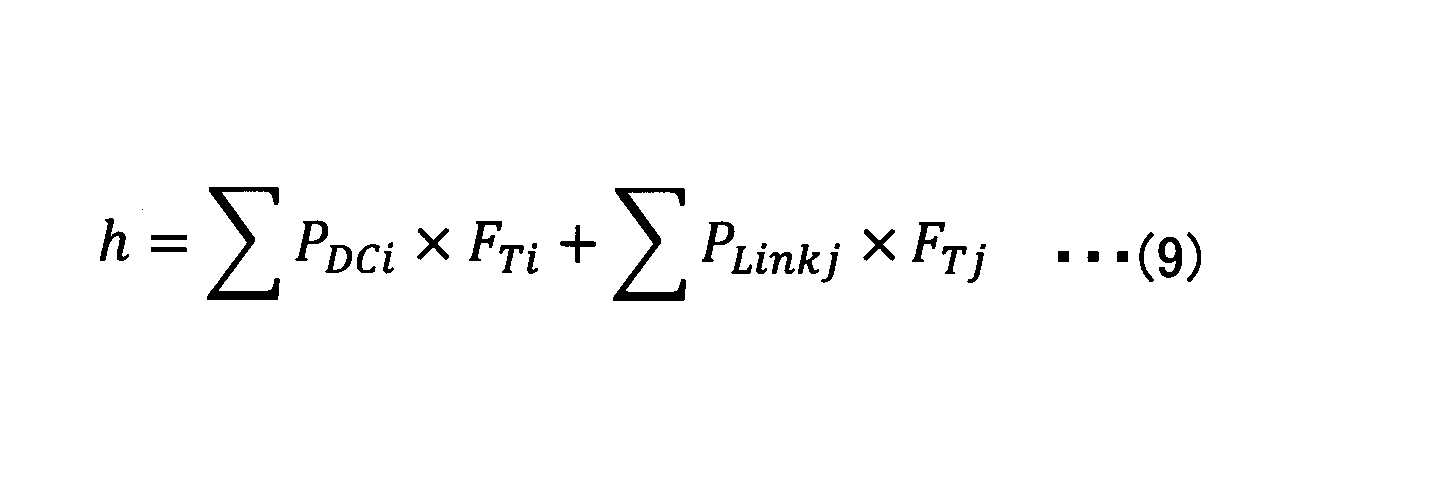
したがって、上記の式(7)及び式(8)に示す制約条件を満たしつつ、上記の式(9)に示す目的関数hを最小化するVNの割当パターン(すなわち、各VNの始点及び終点を繋ぐ経路)を算出することで、コスト(つまり、電気料金)を最小化したVN割当を実現することができる。なお、例えば、経路の途中にファイアウォール(FW:Firewall)や不正侵入検知システム(IDS:Intrusion Detection System)等が配置されたサービスファンクションチェイニングの場合には、経路に加えて、どのデータセンタにFWやIDS等の機能を持たせるかも併せて算出される。
なお、上記の式(7)及び式(8)に示す制約条件では各データセンタのCPU容量及び各リンクのリンク帯域としているが、これ以外にも、VNによって提供されるネットワークサービスの要求品質等に応じて以下も制約条件とすることも考えられる。
・各リンクの回線容量を超えないこと
・遅延時間が決められた上限値を超えないこと
・各VNが1つの物理マシン上に割り当てられること(つまり、VNが不可分であること)
・各データセンタの契約電力を超えないこと
ここで、上記の式(9)に示す目的関数hは、負荷率や外気温が変化しない定常状態である場合(つまり、ti、li及びbjが定数の場合)についても適用可能であるが、ti、li及びbjが時間によって変化する場合(つまり、ti、li及びbjが変数の場合)についても適用可能である。ti、li及びbjを変数とすることで、外気温、負荷率(つまり、トラヒック量)及び電気料金単価の全ての時間変化を考慮した上で、時間毎の最適なVN割当パターンを算出することができる。なお、例えば、外気温tiは気象情報サービス等から取得されるデータを用いることでき、負荷率li及びbjは既知のトラヒック予測技術で予測されたトラヒック量から算出することができる。トラヒック予測技術とは、例えば、機械学習等の手法により、過去のトラヒック量から将来のトラヒック量を予測する技術である。ここで、予測手法は、例えば、ARIMAモデルやLSTM(Long Short-Term Memory)等、時系列予測手法であれば任意の手法を適用可能である。ARIMAモデルについては、例えば、「Feng, Huifang, and Yantai Shu. "Study on network traffic prediction techniques.", Wireless Communications, Networking and Mobile Computing, 2005. Proceedings. 2005 International Conference on. Vol. 2. IEEE, 2005.」等に記載されている手法を利用することができる。また、LSTMについては、例えば、「Hochreiter, Sepp, and Jurgen Schmidhuber. "Long short-term memory.", Neural computation 9.8 (1997): 1735-1780.」等に記載されている手法を利用することができる。
・遅延時間が決められた上限値を超えないこと
・各VNが1つの物理マシン上に割り当てられること(つまり、VNが不可分であること)
・各データセンタの契約電力を超えないこと
ここで、上記の式(9)に示す目的関数hは、負荷率や外気温が変化しない定常状態である場合(つまり、ti、li及びbjが定数の場合)についても適用可能であるが、ti、li及びbjが時間によって変化する場合(つまり、ti、li及びbjが変数の場合)についても適用可能である。ti、li及びbjを変数とすることで、外気温、負荷率(つまり、トラヒック量)及び電気料金単価の全ての時間変化を考慮した上で、時間毎の最適なVN割当パターンを算出することができる。なお、例えば、外気温tiは気象情報サービス等から取得されるデータを用いることでき、負荷率li及びbjは既知のトラヒック予測技術で予測されたトラヒック量から算出することができる。トラヒック予測技術とは、例えば、機械学習等の手法により、過去のトラヒック量から将来のトラヒック量を予測する技術である。ここで、予測手法は、例えば、ARIMAモデルやLSTM(Long Short-Term Memory)等、時系列予測手法であれば任意の手法を適用可能である。ARIMAモデルについては、例えば、「Feng, Huifang, and Yantai Shu. "Study on network traffic prediction techniques.", Wireless Communications, Networking and Mobile Computing, 2005. Proceedings. 2005 International Conference on. Vol. 2. IEEE, 2005.」等に記載されている手法を利用することができる。また、LSTMについては、例えば、「Hochreiter, Sepp, and Jurgen Schmidhuber. "Long short-term memory.", Neural computation 9.8 (1997): 1735-1780.」等に記載されている手法を利用することができる。
以降では、上記の式(7)及び式(8)に示す制約条件を満たしつつ、上記の式(9)に示す目的関数hを最小化するVNの割当パターンを算出することで、最適なVN割当を実現するネットワーク制御装置100について説明する。
<ネットワーク制御装置100の機能構成>
次に、本発明の実施の形態におけるネットワーク制御装置100の機能構成について、図3を参照しながら説明する。図3は、本発明の実施の形態におけるネットワーク制御装置100の機能構成の一例を示す図である。
次に、本発明の実施の形態におけるネットワーク制御装置100の機能構成について、図3を参照しながら説明する。図3は、本発明の実施の形態におけるネットワーク制御装置100の機能構成の一例を示す図である。
図3に示すように、本発明の実施の形態におけるネットワーク制御装置100は、機能部として、スケジュール管理部101と、外気温取得部102と、トラヒック取得部103と、サービス要求管理部104と、物理リソース取得部105と、割当部106と、設定命令部107とを有する。また、本発明の実施の形態におけるネットワーク制御装置100は、記憶部として、モデル記憶部108と、電気料金単価記憶部109とを有する。
モデル記憶部108は、消費電力モデル(すなわち、上記の式(1)及び(2)に示す消費電力モデル)を記憶する。電気料金単価記憶部109は、地域毎に、時間帯毎の電気料金単価を記憶する。なお、電気料金単価は、例えば、電力会社の料金単価改訂や電力会社との契約変更、他の電力会社への変更等、電気料金単価が変更された場合にはその都度更新される。
スケジュール管理部101は、最適なVNの割当パターンを算出して、この割当パターンのVNを物理リソースに割り当てる処理(VN割当処理)を実行するスケジュール(つまり、VN割当の実行条件)を管理する。ここで、VN割当の実行条件としては、例えば、「前回の実行時から所定の時間間隔が経過」や「トラヒック量が或る閾値以上増加」等が挙げられる。
外気温取得部102は、各データセンタの地点における外気温を示す情報(以降、「外気温情報」とも表す。)を取得する。ここで、外気温情報は、例えば、気象情報サービス等から取得してもよいし、各データセンタに外気温センサ等が設置されている場合は当該外気温センサから取得してもよい。
トラヒック取得部103は、VN割当を行う時間におけるトラヒック量(つまり、予測トラヒック量)を取得する。このようなトラヒック量は、上述したように、トラヒック予測技術により予測される。なお、トラヒック取得部103は、ネットワーク制御装置100とネットワークを介して接続された他の装置で予測されたトラヒック量を取得してもよいし、ネットワーク制御装置100が予測したトラヒック量を取得してもよい。
サービス要求管理部104は、サービス要求を管理する。サービス要求とは、サービス提供者からのVN割当要求のことである。サービス要求には、VNの要求条件(例えば、VNの始点及び終点、要求帯域、許容遅延等)が含まれる。これらサービス要求は、例えば、ネットワーク制御装置100の記憶装置等に保持される。
物理リソース取得部105は、物理リソースに関する情報(例えば、各データセンタのCPU容量や各リンクのリンク帯域等)を管理する。これらの物理リソースに関する情報は、例えば、ネットワーク制御装置100の記憶装置等に保持される。
割当部106は、スケジュール管理部101からの指示に応じて、上記の式(9)に示す目的関数hにより最適なVN割当パターンを算出する。すなわち、割当部106は、まず、サービス要求や物理リソースに関する情報を用いて、制約条件を作成する。そして、割当部106は、消費電力モデルと、地域毎及び時間帯毎の電気料金単価と、外気温と、負荷率とを用いて、最適なVN割当パターンを算出する。なお、負荷率は、例えば、予測トラヒック量と、CPU容量(又はリンク帯域)とから算出される。
設定命令部107は、割当部106により算出された最適なVN割当パターンを実現するように、各物理リソース(例えば、サーバや各種通信機器等)に対してVNの設定命令を送信する。これにより、最適なVN割当が実現される。
<VN割当処理>
次に、本発明の実施の形態におけるVN割当処理について、図4を参照しながら説明する。図4は、本発明の実施の形態におけるVN割当処理の一例を示すフローチャートである。
次に、本発明の実施の形態におけるVN割当処理について、図4を参照しながら説明する。図4は、本発明の実施の形態におけるVN割当処理の一例を示すフローチャートである。
ステップS101:まず、スケジュール管理部101は、VN割当の実行条件を満たすか否かを判定する。上述したように、VN割当の実行条件としては、例えば、「前回の実行時から所定の時間間隔が経過」や「トラヒック量が或る閾値以上増加」等が挙げられる。VN割当の実行条件を満たすと判定された場合は、ステップS102に進む。
ここで、例えば、「トラヒック量が或る閾値以上増加した場合」をVN割当の実行条件とする場合、トラヒック予測技術により予測したトラヒック量に基づいて一日の運用計画(つまり、どのようなVN割当を行うかの計画)を策定した上で、或る所定の閾値を超えるような想定外のトラヒック増が発生した場合に、VN割当を行うことが可能となる。
なお、例えば、「前回の実行時から所定の時間間隔が経過」をVN割当の実行条件とする場合、一般には電気料金が30分毎に積算される場合が多いため、当該所定の時間間隔(この時間間隔を「制御間隔」とも表す。)を30分とすることが考えられる。
一方で、制御間隔を30分以上とした場合には、制御間隔の間で電気料金単価が変化してしまうことがある。そこで、このような場合には、上記の式(9)に示す目的関数hで、電気料金単価の時間平均を用いればよい。例えば、或る制御間隔T1~T2の間で電気料金単価が変化した場合、k番目のデータセンタ(又はリンク)での時間平均単価Favr kを以下の式(10)のように定義し、上記の式(9)に示す目的関数hのFTi及びFTjの代わりに、それぞれFavr i及びFavr jを用いればよい。
ステップS102:外気温取得部102は、各データセンタの地点における外気温を示す外気温情報を取得する。
ステップS103:トラヒック取得部103は、VN割当を行う時間の予測トラヒック量を取得する。
ステップS104:物理リソース取得部105は、物理リソースに関する情報を取得する。
ステップS105:サービス要求管理部104は、サービス要求を取得する。
なお、上記のステップS102~ステップS105の実行順は順不同である。
ステップS106:次に、割当部106は、サービス要求や物理リソースに関する情報を用いて、制約条件を作成する。そして、割当部106は、消費電力モデルと、地域毎及び時間帯毎の電気料金単価と、外気温と、負荷率とを用いて、最適なVN割当パターンを算出する。
ステップS107:次に、設定命令部107は、上記のステップS106で算出された最適なVN割当パターンを実現するように、各物理リソースに対してVNの設定命令を送信する。
以上により、本発明の実施の形態におけるネットワーク制御装置100は、外気温や負荷率、時間帯及び地域等も考慮して、電気料金が最小となるようなVNの割り当てを実現することができる。したがって、本発明の実施の形態におけるネットワーク制御装置100を用いることで、例えば電気通信事業者はより一層のOPEX削減を実現することが可能となる。
なお、本発明の実施の形態ではコストの一例として電気料金を想定したが、これに限られず、電気料金単価と同じように時間毎及び地域毎に変化し得る変数と、消費電力とを掛け合わせて導出される目的関数であれば、本発明を同様に適用可能である。
例えば、コストの他の例として、CO2排出量が挙げられる。CO2排出量は消費電力とCO2排出係数との積で算出されるが、CO2排出係数は、電気料金単価と同様に、電力会社毎に異なる値を持っており、地域差があるためである。なお、CO2排出係数は一般に時間変化せず固定値であることがほとんどであるが、環境負荷低減ニーズの高まりや時間帯によって稼働する発電設備が異なること等から、今後は時間帯毎にCO2排出係数が定義されることも考えられる。その際には本発明の適用によりCO2排出量を最小化し、環境負荷低減に訴求したサービス提供等を実現することが可能になると考えられる。
<ネットワーク制御装置100のハードウェア構成>
最後に、本発明の実施の形態におけるネットワーク制御装置100のハードウェア構成について、図5を参照しながら説明する。図5は、本発明の実施の形態におけるネットワーク制御装置100のハードウェア構成の一例を示す図である。
最後に、本発明の実施の形態におけるネットワーク制御装置100のハードウェア構成について、図5を参照しながら説明する。図5は、本発明の実施の形態におけるネットワーク制御装置100のハードウェア構成の一例を示す図である。
図5に示すように、本発明の実施の形態におけるネットワーク制御装置100は、ハードウェアとして、外部I/F301と、RAM(Random Access Memory)302と、ROM(Read Only Memory)303と、プロセッサ304と、通信I/F305と、補助記憶装置306とを有する。これら各ハードウェアは、それぞれがバスBを介して通信可能に接続されている。
外部I/F301は、外部装置とのインタフェースである。外部装置には、記録媒体301a等がある。ネットワーク制御装置100は、外部I/F301を介して、記録媒体301aの読み取りや書き込み等を行うことができる。
記録媒体301aとしては、例えば、フレキシブルディスク、CD(Compact Disc)、DVD(Digital Versatile Disk)、SDメモリカード(Secure Digital memory card)、USB(Universal Serial Bus)メモリカード等がある。
RAM302は、プログラムやデータを一時保持する揮発性の半導体メモリである。ROM303は、電源を切ってもプログラムやデータを保持することができる不揮発性の半導体メモリである。ROM303には、例えば、OS(Operating System)に関する設定情報や通信ネットワークに関する設定情報等が格納されている。
プロセッサ304は、例えばCPUやGPU(Graphics Processing Unit)等であり、ROM303や補助記憶装置306等からプログラムやデータをRAM302上に読み出して処理を実行する演算装置である。本発明の実施の形態におけるネットワーク制御装置100が有する各機能部(例えば、スケジュール管理部101、外気温取得部102、トラヒック取得部103、サービス要求管理部104、物理リソース取得部105、割当部106及び設定命令部107等)は、例えば、補助記憶装置306等に格納されている1以上のプログラムがプロセッサ304に実行させる処理により実現される。なお、これら1以上のプログラムは、例えば、記録媒体301aに格納されていてもよい。
通信I/F305は、ネットワーク制御装置100を物理ネットワーク200に接続するためのインタフェースである。
補助記憶装置306は、例えばHDD(Hard Disk Drive)やSSD(Solid State Drive)等であり、各種プログラムやデータを格納する。補助記憶装置306に格納されているプログラムやデータには、例えば、OS、当該OS上で各種機能を実現するアプリケーションソフトウェア、本発明の実施の形態におけるネットワーク制御装置100が有する各機能部を実現する1以上のプログラム等がある。
本発明の実施の形態におけるネットワーク制御装置100は、図5に示すハードウェア構成を有することにより、上述した各種処理を実現することができる。なお、図5に示す例では、本発明の実施の形態におけるネットワーク制御装置100が1台の装置(コンピュータ)で実現されている場合を示したが、これに限られず、複数台の装置(コンピュータ)で実現されていてもよい。また、1台の装置(コンピュータ)には、複数のプロセッサ304や複数のメモリ(RAM302やROM303、補助記憶装置306等)が含まれていてもよい。また、ネットワーク制御装置100は、上記のハードウェアに加えて、例えば、ディスプレイ等の表示装置と、キーボードやマウス等の入力装置とを有していてもよい。
本発明は、具体的に開示された上記の実施形態に限定されるものではなく、特許請求の範囲から逸脱することなく、種々の変形や変更が可能である。
100 ネットワーク制御装置
101 スケジュール管理部
102 外気温取得部
103 トラヒック取得部
104 サービス要求管理部
105 物理リソース取得部
106 割当部
107 設定命令部
108 モデル記憶部
109 電気料金単価記憶部
200 物理ネットワーク
301 外部I/F
301a 記録媒体
302 RAM
303 ROM
304 プロセッサ
305 通信I/F
306 補助記憶装置
101 スケジュール管理部
102 外気温取得部
103 トラヒック取得部
104 サービス要求管理部
105 物理リソース取得部
106 割当部
107 設定命令部
108 モデル記憶部
109 電気料金単価記憶部
200 物理ネットワーク
301 外部I/F
301a 記録媒体
302 RAM
303 ROM
304 プロセッサ
305 通信I/F
306 補助記憶装置
Claims (7)
- ネットワークサービスを提供するための仮想ネットワークを物理ネットワーク上に割り当てる制御装置であって、
前記物理ネットワークに含まれる各ノードの外気温を示す情報と、前記物理ネットワークの物理リソース情報と、前記物理ネットワークの予測トラヒック量を示す情報と、前記仮想ネットワークの割当要求とを取得する取得手段と、
前記外気温と前記予測トラヒック量から算出される負荷率とを考慮した消費電力モデルと地域毎及び時間帯毎に定義されたコスト単価とで定義される目的関数と、前記物理リソース情報と前記割当要求とから得られる制約条件とを用いて、前記仮想ネットワークの最適割当を算出する算出手段と、
を有することを特徴とする制御装置。 - 前記物理ネットワークには、所定のノード間を繋ぐリンクが含まれ、
前記消費電力モデルには、前記外気温と前記負荷率とを考慮した各ノードの消費電力を表す第1のモデルと、前記外気温と前記負荷率とを考慮した各リンクの消費電力を表す第2のモデルとが含まれ、
前記目的関数は、前記割当要求に係る仮想ネットワークが割り当てられたノード毎の前記第1のモデル及び前記コスト単価の積と、前記割当要求に係る仮想ネットワークが割り当てられたリンク毎の前記第2のモデル及び前記コスト単価の積とを和で表される、ことを特徴とする請求項1に記載の制御装置。 - 前記制約条件は、
各ノードで、前記ノードに割り当てられた仮想ネットワークのCPU容量の合計が、該ノードのCPU容量の最大値を超えないこと、及び、各リンクで、前記リンクに割り当てられた仮想ネットワークの帯域の合計が、該リンクの帯域の最大値を超えないこと、であることを特徴とする請求項2に記載の制御装置。 - 前記制御装置は、前記取得手段による取得と、前記算出手段による算出とを所定の時間間隔毎に実行し、
前記時間間隔が所定の時間間隔以下である場合、前記コスト単価として、前記時間間隔の間における各コスト単価の時間平均を用いる、ことを特徴とする請求項1乃至3の何れか一項に記載の制御装置。 - 前記コスト単価は、地域毎及び時間帯毎に定義された電気料金単価、又は、地域毎及び時間帯毎に定義されたCO2排出係数、であることを特徴とする請求項1乃至4の何れか一項に記載の制御装置。
- ネットワークサービスを提供するための仮想ネットワークを物理ネットワーク上に割り当てるコンピュータが、
前記物理ネットワークに含まれる各ノードの外気温を示す情報と、前記物理ネットワークの物理リソース情報と、前記物理ネットワークの予測トラヒック量を示す情報と、前記仮想ネットワークの割当要求とを取得する取得手順と、
前記外気温と前記予測トラヒック量から算出される負荷率とを考慮した消費電力モデルと地域毎及び時間帯毎に定義されたコスト単価とで定義される目的関数と、前記物理リソース情報と前記割当要求とから得られる制約条件とを用いて、前記仮想ネットワークの最適割当を算出する算出手順と、
を実行することを特徴とする制御方法。 - コンピュータを、請求項1乃至5の何れか一項に記載の制御装置における各手段として機能させるためのプログラム。
Priority Applications (1)
| Application Number | Priority Date | Filing Date | Title |
|---|---|---|---|
| US17/426,392 US11375007B2 (en) | 2019-02-04 | 2020-01-23 | Allocation of a virtual network that minimizes the electricity fee by using a power consumption model |
Applications Claiming Priority (2)
| Application Number | Priority Date | Filing Date | Title |
|---|---|---|---|
| JP2019-017812 | 2019-02-04 | ||
| JP2019017812A JP7040474B2 (ja) | 2019-02-04 | 2019-02-04 | 制御装置、制御方法及びプログラム |
Publications (1)
| Publication Number | Publication Date |
|---|---|
| WO2020162213A1 true WO2020162213A1 (ja) | 2020-08-13 |
Family
ID=71947292
Family Applications (1)
| Application Number | Title | Priority Date | Filing Date |
|---|---|---|---|
| PCT/JP2020/002394 Ceased WO2020162213A1 (ja) | 2019-02-04 | 2020-01-23 | 制御装置、制御方法及びプログラム |
Country Status (3)
| Country | Link |
|---|---|
| US (1) | US11375007B2 (ja) |
| JP (1) | JP7040474B2 (ja) |
| WO (1) | WO2020162213A1 (ja) |
Cited By (1)
| Publication number | Priority date | Publication date | Assignee | Title |
|---|---|---|---|---|
| CN116502738A (zh) * | 2022-01-18 | 2023-07-28 | 中国移动通信有限公司研究院 | 业务量预测方法及装置 |
Families Citing this family (6)
| Publication number | Priority date | Publication date | Assignee | Title |
|---|---|---|---|---|
| WO2021014624A1 (ja) * | 2019-07-24 | 2021-01-28 | 日本電信電話株式会社 | スケジューリング制御装置、スケジューリング制御方法、及びプログラム |
| JP7468304B2 (ja) * | 2020-11-09 | 2024-04-16 | 日本電信電話株式会社 | 制御装置、制御方法及びプログラム |
| WO2022168140A1 (ja) | 2021-02-02 | 2022-08-11 | 日本電信電話株式会社 | 制御装置、制御方法及びプログラム |
| WO2023021555A1 (ja) * | 2021-08-16 | 2023-02-23 | 日本電信電話株式会社 | 制御装置、制御方法及びプログラム |
| JP7582490B2 (ja) * | 2021-08-23 | 2024-11-13 | 日本電信電話株式会社 | 制御装置、制御方法及びプログラム |
| CN117937480B (zh) * | 2024-03-22 | 2024-07-23 | 杭州阿里云飞天信息技术有限公司 | 一种数据中心用能评估方法、装置、电子设备及存储介质 |
Citations (2)
| Publication number | Priority date | Publication date | Assignee | Title |
|---|---|---|---|---|
| US20080141048A1 (en) * | 2006-12-07 | 2008-06-12 | Juniper Networks, Inc. | Distribution of network communications based on server power consumption |
| EP2166777A1 (en) * | 2008-09-22 | 2010-03-24 | Nokia Siemens Networks OY | A mechanism to reduce energy consumption of telecommunication equipment by using adaptive and automated energy aware traffic engineering |
Family Cites Families (5)
| Publication number | Priority date | Publication date | Assignee | Title |
|---|---|---|---|---|
| US20140298349A1 (en) * | 2008-04-21 | 2014-10-02 | Adaptive Computing Enterprises, Inc. | System and Method for Managing Energy Consumption in a Compute Environment |
| US8224993B1 (en) * | 2009-12-07 | 2012-07-17 | Amazon Technologies, Inc. | Managing power consumption in a data center |
| KR20130130513A (ko) * | 2012-05-22 | 2013-12-02 | (주)시리우스소프트 | 지능형 건물 에너지 소비 관리 시스템 |
| CN106713055B (zh) * | 2017-02-27 | 2019-06-14 | 电子科技大学 | 一种虚拟cdn的节能部署方法 |
| KR102604735B1 (ko) * | 2017-11-30 | 2023-11-22 | 삼성전자주식회사 | 전자장치에서 소모 전력 관리장치 및 방법 |
-
2019
- 2019-02-04 JP JP2019017812A patent/JP7040474B2/ja active Active
-
2020
- 2020-01-23 US US17/426,392 patent/US11375007B2/en active Active
- 2020-01-23 WO PCT/JP2020/002394 patent/WO2020162213A1/ja not_active Ceased
Patent Citations (2)
| Publication number | Priority date | Publication date | Assignee | Title |
|---|---|---|---|---|
| US20080141048A1 (en) * | 2006-12-07 | 2008-06-12 | Juniper Networks, Inc. | Distribution of network communications based on server power consumption |
| EP2166777A1 (en) * | 2008-09-22 | 2010-03-24 | Nokia Siemens Networks OY | A mechanism to reduce energy consumption of telecommunication equipment by using adaptive and automated energy aware traffic engineering |
Cited By (1)
| Publication number | Priority date | Publication date | Assignee | Title |
|---|---|---|---|---|
| CN116502738A (zh) * | 2022-01-18 | 2023-07-28 | 中国移动通信有限公司研究院 | 业务量预测方法及装置 |
Also Published As
| Publication number | Publication date |
|---|---|
| JP7040474B2 (ja) | 2022-03-23 |
| US20220094742A1 (en) | 2022-03-24 |
| JP2020127108A (ja) | 2020-08-20 |
| US11375007B2 (en) | 2022-06-28 |
Similar Documents
| Publication | Publication Date | Title |
|---|---|---|
| JP7040474B2 (ja) | 制御装置、制御方法及びプログラム | |
| US10884821B2 (en) | Measuring utilization of resources in datacenters | |
| US12034597B2 (en) | Methods and apparatus to control processing of telemetry data at an edge platform | |
| US10838482B2 (en) | SLA-based power management in disaggregated computing systems | |
| US10819599B2 (en) | Energy consumption as a measure of utilization and work characterization in a system | |
| US10401940B2 (en) | Power management in disaggregated computing systems | |
| US11169592B2 (en) | SLA-based backup power management during utility power interruption in disaggregated datacenters | |
| US10545560B2 (en) | Power management and utilization detection of computing components | |
| EP3971682A1 (en) | Elastic power scaling | |
| US8868936B2 (en) | Dynamic power balancing among blade servers in a chassis | |
| US10404067B2 (en) | Congestion control in electric power system under load and uncertainty | |
| CN102693458B (zh) | 动态负荷轮廓化 | |
| Kiani et al. | Hierarchical capacity provisioning for fog computing | |
| WO2021087639A9 (en) | Cdn optimization platform | |
| CN108459905A (zh) | 资源池容量规划方法及服务器 | |
| Rani et al. | Deep learning based dynamic task offloading in mobile cloudlet environments | |
| CN111585789B (zh) | 数据预测方法及装置 | |
| JP7652264B2 (ja) | 制御装置、制御方法及びプログラム | |
| JP7582490B2 (ja) | 制御装置、制御方法及びプログラム | |
| CN115237610A (zh) | 一种基于Kubernetes容器云平台的弹性伸缩方法、装置及应用 | |
| JP7700948B2 (ja) | 制御装置、制御方法及びプログラム | |
| CN119325079A (zh) | Ota升级传输目标分配方法、装置、设备及存储介质 |
Legal Events
| Date | Code | Title | Description |
|---|---|---|---|
| 121 | Ep: the epo has been informed by wipo that ep was designated in this application |
Ref document number: 20752077 Country of ref document: EP Kind code of ref document: A1 |
|
| NENP | Non-entry into the national phase |
Ref country code: DE |
|
| 122 | Ep: pct application non-entry in european phase |
Ref document number: 20752077 Country of ref document: EP Kind code of ref document: A1 |