WO2020121115A1 - コンテンツの分類方法および分類モデルの生成方法 - Google Patents
コンテンツの分類方法および分類モデルの生成方法 Download PDFInfo
- Publication number
- WO2020121115A1 WO2020121115A1 PCT/IB2019/060377 IB2019060377W WO2020121115A1 WO 2020121115 A1 WO2020121115 A1 WO 2020121115A1 IB 2019060377 W IB2019060377 W IB 2019060377W WO 2020121115 A1 WO2020121115 A1 WO 2020121115A1
- Authority
- WO
- WIPO (PCT)
- Prior art keywords
- content
- classification
- learning
- classification model
- contents
- Prior art date
- Legal status (The legal status is an assumption and is not a legal conclusion. Google has not performed a legal analysis and makes no representation as to the accuracy of the status listed.)
- Ceased
Links
Images




Classifications
-
- G—PHYSICS
- G06—COMPUTING OR CALCULATING; COUNTING
- G06F—ELECTRIC DIGITAL DATA PROCESSING
- G06F16/00—Information retrieval; Database structures therefor; File system structures therefor
- G06F16/90—Details of database functions independent of the retrieved data types
- G06F16/906—Clustering; Classification
-
- G—PHYSICS
- G06—COMPUTING OR CALCULATING; COUNTING
- G06N—COMPUTING ARRANGEMENTS BASED ON SPECIFIC COMPUTATIONAL MODELS
- G06N20/00—Machine learning
- G06N20/20—Ensemble learning
-
- G—PHYSICS
- G06—COMPUTING OR CALCULATING; COUNTING
- G06F—ELECTRIC DIGITAL DATA PROCESSING
- G06F18/00—Pattern recognition
- G06F18/20—Analysing
- G06F18/21—Design or setup of recognition systems or techniques; Extraction of features in feature space; Blind source separation
- G06F18/214—Generating training patterns; Bootstrap methods, e.g. bagging or boosting
-
- G—PHYSICS
- G06—COMPUTING OR CALCULATING; COUNTING
- G06F—ELECTRIC DIGITAL DATA PROCESSING
- G06F18/00—Pattern recognition
- G06F18/20—Analysing
- G06F18/24—Classification techniques
- G06F18/241—Classification techniques relating to the classification model, e.g. parametric or non-parametric approaches
- G06F18/2415—Classification techniques relating to the classification model, e.g. parametric or non-parametric approaches based on parametric or probabilistic models, e.g. based on likelihood ratio or false acceptance rate versus a false rejection rate
-
- G—PHYSICS
- G06—COMPUTING OR CALCULATING; COUNTING
- G06F—ELECTRIC DIGITAL DATA PROCESSING
- G06F18/00—Pattern recognition
- G06F18/20—Analysing
- G06F18/24—Classification techniques
- G06F18/243—Classification techniques relating to the number of classes
- G06F18/2431—Multiple classes
-
- G—PHYSICS
- G06—COMPUTING OR CALCULATING; COUNTING
- G06F—ELECTRIC DIGITAL DATA PROCESSING
- G06F3/00—Input arrangements for transferring data to be processed into a form capable of being handled by the computer; Output arrangements for transferring data from processing unit to output unit, e.g. interface arrangements
- G06F3/01—Input arrangements or combined input and output arrangements for interaction between user and computer
- G06F3/048—Interaction techniques based on graphical user interfaces [GUI]
- G06F3/0481—Interaction techniques based on graphical user interfaces [GUI] based on specific properties of the displayed interaction object or a metaphor-based environment, e.g. interaction with desktop elements like windows or icons, or assisted by a cursor's changing behaviour or appearance
- G06F3/0482—Interaction with lists of selectable items, e.g. menus
-
- G—PHYSICS
- G06—COMPUTING OR CALCULATING; COUNTING
- G06F—ELECTRIC DIGITAL DATA PROCESSING
- G06F9/00—Arrangements for program control, e.g. control units
- G06F9/06—Arrangements for program control, e.g. control units using stored programs, i.e. using an internal store of processing equipment to receive or retain programs
- G06F9/44—Arrangements for executing specific programs
- G06F9/451—Execution arrangements for user interfaces
-
- G—PHYSICS
- G06—COMPUTING OR CALCULATING; COUNTING
- G06N—COMPUTING ARRANGEMENTS BASED ON SPECIFIC COMPUTATIONAL MODELS
- G06N20/00—Machine learning
-
- G—PHYSICS
- G06—COMPUTING OR CALCULATING; COUNTING
- G06N—COMPUTING ARRANGEMENTS BASED ON SPECIFIC COMPUTATIONAL MODELS
- G06N20/00—Machine learning
- G06N20/10—Machine learning using kernel methods, e.g. support vector machines [SVM]
-
- G—PHYSICS
- G06—COMPUTING OR CALCULATING; COUNTING
- G06N—COMPUTING ARRANGEMENTS BASED ON SPECIFIC COMPUTATIONAL MODELS
- G06N3/00—Computing arrangements based on biological models
- G06N3/02—Neural networks
- G06N3/08—Learning methods
- G06N3/09—Supervised learning
-
- G—PHYSICS
- G06—COMPUTING OR CALCULATING; COUNTING
- G06N—COMPUTING ARRANGEMENTS BASED ON SPECIFIC COMPUTATIONAL MODELS
- G06N3/00—Computing arrangements based on biological models
- G06N3/02—Neural networks
- G06N3/08—Learning methods
-
- G—PHYSICS
- G06—COMPUTING OR CALCULATING; COUNTING
- G06N—COMPUTING ARRANGEMENTS BASED ON SPECIFIC COMPUTATIONAL MODELS
- G06N5/00—Computing arrangements using knowledge-based models
- G06N5/01—Dynamic search techniques; Heuristics; Dynamic trees; Branch-and-bound
Definitions
- One aspect of the present invention relates to a content classification method using a computer device, a content classification system, a classification model generation method, and a graphical user interface.
- one embodiment of the present invention relates to a computer device.
- One aspect of the present invention relates to a method of classifying electronic contents (text data, image data, audio data, or moving image data) using a computer device.
- one aspect of the present invention relates to a content classification system that efficiently classifies a collection of content using machine learning.
- one aspect of the present invention relates to a content classification method, a content classification system, and a classification model generation method using a graphical user interface managed by a computer device by a program.
- the user wants to easily classify and extract information about topics specified by the user from a collection of contents.
- the result of classifying content varies depending on the knowledge or experience of individuals.
- Patent Document 1 discloses a machine learning approach for determining a document highly relevant to a topic designated by a user.
- the content is a patent.
- Each patent is given a unique patent number. Therefore, hereinafter, the content may be described as a patent number. Note that in the content classification method handled in one aspect of the present invention, attention is paid to a plurality of management parameters given to patent numbers.
- the content is not limited to patent documents.
- the content can handle information such as text data, image data, audio data, or moving image data.
- the meta information indicates not the content itself but data describing the attribute to which the content belongs or related information.
- the patent number is associated with the claims, the abstract, the drawing, and the specification as the contents. Further, meta information (evaluation information, elapsed days, family information, etc.) is given to the patent number, and management is performed using the meta information. Patent numbers are classified according to their importance by using meta information. Although the accuracy and efficiency of classification depend on the content of the target document, it is easy to make a difference depending on the experience and skill of the user, and it is necessary to classify a large number of documents.
- an object of one embodiment of the present invention is to provide a method for efficiently generating a classification model and classifying information using the classification model.
- a program is stored in the storage device of the computer device.
- the program can display various information on a display device included in the computer device through a graphical user interface (hereinafter, GUI).
- GUI graphical user interface
- the user can operate a computer, give information, respond to a database, instruct a machine learning, etc. on a computer device via a GUI.
- the program can display the calculation processing result by machine learning, the content of learning content or unclassified content downloaded from the database on the display device via the GUI.
- content when simply referred to as content, it includes learning content, unclassified content, or classified content.
- the proposed content classification system uses machine learning to generate a content classification model, and uses the generated content classification model to classify unclassified content. For example, the content having a plurality of pieces of meta information is used as the learning content.
- the learning content is further provided with a learning label to generate a feature vector from the learning content.
- the meta information or the learning label can be treated as the feature amount of the learning content.
- the learning contents are treated as teacher data.
- the classification model can be acquired by performing machine learning based on the learning content.
- the classification model obtained here classifies contents having a plurality of pieces of meta information.
- the types of classification may be two or three or more depending on the purpose of the user.
- the learning content can be downloaded from the learning content stored in the database.
- the learning content stored in the storage device of the computer device can be used.
- the learning content may be managed by including a learning label.
- the classification model stored in the database may be downloaded.
- a classification model stored in the storage device of the computer device may be used.
- One aspect of the present invention includes a learning content and a content, wherein the learning content is provided with a first feature amount and a learning label, and the content is provided with a second feature amount. It A step of generating a plurality of first classification models by machine learning using a plurality of learning contents; a step of generating a second classification model using a plurality of first classification models; and a second classification model Is used to add determination information to a plurality of contents and display the contents in a graphical user interface.
- One aspect of the present invention includes a learning content and a content, wherein the learning content is provided with a first feature amount and a learning label, and the content is provided with a second feature amount. It A step of generating a plurality of first classification models by machine learning using a plurality of learning contents, a step of calculating an average value from the outputs of the plurality of first classification models, and a step of using a plurality of average values A method of classifying contents, including a step of generating a second classification model, and a step of adding determination information to a plurality of contents using the second classification model and displaying the contents in a graphical user interface.
- One aspect of the present invention includes a learning content and a content, wherein the learning content is provided with a first feature amount and a learning label, and the content is provided with a second feature amount. It A step of generating a plurality of first classification models by machine learning using a plurality of learning contents; a step of evaluating each of the plurality of first classification models according to a first evaluation criterion; Each of the classification models performs an evaluation based on the second evaluation criteria, an evaluation result based on the plurality of first evaluation criteria, and a step of generating a second classification model from the evaluation results based on the second evaluation criteria, And a step of adding determination information to a plurality of contents by using a second classification model and displaying the plurality of contents in a graphical user interface.
- the first evaluation criterion is accuracy and the second evaluation criterion is sensitivity.
- a content classification method including a step of generating a first classification model using arbitrary learning content is preferable.
- the learning content is further provided with classification information, and the content having the same judgment information as the classification information is selected from the plurality of contents to which the classification label is given using the output of the second classification model. And displaying in a graphical user interface.
- the learning content or the feature amount given to the content is preferably the content classification method which is a management parameter.
- the determination information is preferably a content classification method including a classification label or score.
- the graphical user interface includes a step of designating a specific numerical range in the score and displaying the corresponding content as a list.
- One aspect of the present invention can provide a method of accurately classifying information.
- one embodiment of the present invention can provide a user interface for accurately classifying information.
- one embodiment of the present invention can provide a program for classifying information with high accuracy.
- an interactive interface for generating a classification model using machine learning can be provided to a user, and the burden on the user such as preparation of teacher data and evaluation of learning results can be reduced. be able to.
- the effects of one aspect of the present invention are not limited to the effects listed above.
- the effects listed above do not prevent the existence of other effects.
- the other effects are the effects which are not mentioned in this item, which will be described below.
- the effects not mentioned in this item can be derived from the description such as the specification or the drawings by those skilled in the art, and can be appropriately extracted from these descriptions.
- one embodiment of the present invention has at least one of the effects listed above and/or other effects. Therefore, one embodiment of the present invention may not have the effects listed above in some cases.
- FIG. 1 is a flowchart illustrating a classification method.
- FIG. 2 is a flowchart illustrating the classification method.
- FIG. 3 is a diagram for explaining the connection between the classification system 100 and the network.
- FIG. 4 is a block diagram illustrating the classification system.
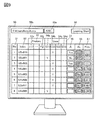
- 5A and 5B are diagrams illustrating a graphical user interface.
- FIG. 6 is a diagram illustrating a method of generating a classification model.
- FIG. 7 is a diagram illustrating a method of generating a classification model.
- FIG. 8 is a diagram illustrating a method of generating a classification model.
- FIG. 9 is a diagram illustrating a graphical user interface.
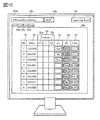
- FIG. 10 is a diagram illustrating a graphical user interface.
- the content classification method described in this embodiment is controlled by a program running on a computer device.
- the program is stored in the memory or storage of the computer device. Alternatively, it is stored in a computer connected via a network (LAN (Local Area Network), WAN (Wide Area Network), the Internet, etc.) or a server computer having a database.
- LAN Local Area Network
- WAN Wide Area Network
- the Internet etc.
- server computer having a database.
- the display device included in the computer device can display the data given to the program by the user and the result of calculation of the data by the arithmetic device included in the computer device.
- the configuration of the device will be described in detail with reference to FIG.
- the data displayed on the display device can be easily recognized by the user and the operability can be improved by, for example, following the listed display format. Therefore, a GUI is used as an interface for a user to easily interact with a program included in a computer device via a display device.
- the user can use the content classification method of the program via the GUI.
- the user can simplify the content classification operation using the GUI. Further, the user can easily visually judge the classification result of the content through the GUI. In addition, the user can easily operate the program through the GUI.
- the content indicates information such as text data, image data, audio data, or moving image data.
- the data processing unit has a data collection unit and a data generation unit.
- the data collection unit acquires a file including a plurality of contents from the database via the GUI.
- the data generation unit can generate the learning content by the user giving the learning label to the content via the GUI.
- the learning content to which the learning label is attached may be acquired from the database.
- the plurality of contents are files stored in the memory or storage of the computer device, or data stored in a database connected to a network, a computer, a data server, or the like.
- a plurality of learning contents or a plurality of unclassified contents be listed and stored in the database.
- a plurality of feature amounts and learning labels are given to the learning content and the unclassified content.
- the learning label can be modified by the user via the GUI.
- the learning label is attached to the learning content, the learning content to which the learning label is attached can be stored in the database.
- -Learning contents can include verification contents without learning labels.
- the verification content can be used to verify the classification model generated using the learning content.
- the meta information includes evaluation information, number of days elapsed, number of families, family status, application type, life, number of pending in family, number of abandoned in family, cost, number of inventors, fields, or number of claims. and so on. That is, the meta information is a content management parameter.
- the family includes a patent family, a patent family, and the like.
- the learning processing unit has a step of generating a classification model using the learning content.
- the learning processing unit has a classification model generation unit or a classification model evaluation unit.
- the classification model generator can generate a classification model.
- the classification model generation unit includes a step of generating a plurality of first classification models by machine learning using a plurality of learning contents, and generates a second classification model using the plurality of first classification models. Including steps.
- the output value of the first classification model or the second classification model can be displayed on the GUI.
- the user can give (including correction) the learning label of the first classification model to the output value. Alternatively, the user can add new learning content for the output value.
- the classification model evaluation unit evaluates the classification model generated by the classification model generation unit using the verification content.
- the classification model outputs the inferred result as determination information.
- the GUI can display the evaluation content with the determination information added thereto.
- the user can judge the output result of the classification model evaluation unit, correct the learning label if necessary, and update the classification model in the classification model generation unit.
- the classification model can be updated by the classification model generation unit by adding learning contents.
- the determination processing unit has a classification inference unit and a list generation unit.
- the classification inference unit infers and classifies a plurality of unclassified contents using the first learning model and the second learning model generated by the classification model generation unit.
- the classification model attaches the inference result to each content as determination information.
- the list generation unit can generate a list in a format required by the user from the content provided with the determination information and display the list on the GUI. For example, when each content is managed for each application country, the application country can be used as the classification information. When the application country is used as the classification information, it is preferable that the generated classification models generate different classification models for each application country.
- the classification information is not limited to the application country. For example, one of the meta information included in the content can be used as the classification information.
- meta information is used as classification information.
- the status of the patent family may be used as the classification information.
- the patent number of the parent application, the patent number of the divisional application, and the like are given as meta information to the patent number.
- a state in which a divisional application is possible from the parent application's patent number a state in which a divisional application is not possible from the parent application's patent number, a state in which the parent application's patent number is pending, a state in which the parent application's patent number is lost,
- the division number can be further divided, the division number cannot be further divided, the division application cannot be divided, the division application patent number is pending, or the division application patent number is lost.
- Different classification models can be generated depending on the state and the like, and the respective classification models can be used to make inferences.
- the judgment processing unit can infer a plurality of unclassified contents by using the classification model.
- the inferred result includes a step of adding the determination information to each content and displaying the determination information on the GUI.
- the determination information includes at least a classification label and a score (probability).
- the GUI includes a step of designating a specific numerical range of the score and displaying the corresponding content as a list.
- the classification model generation unit generates a plurality of first classification models by machine learning using a plurality of learning contents; calculates an average value from outputs of the plurality of first classification models; Generating a second classification model using the average value of.
- the output value of the first classification model or the second classification model can be displayed on the GUI.
- the user can correct the learning label of the first classification model for the output value.
- the user can add learning content to the output value.
- the said average value means calculating using any one of an arithmetic mean calculation, a geometric mean calculation, or a harmonic mean calculation.
- the second classification model is generated using the multiple average values.
- the second classification model since the outputs of the first classification model are averaged, it is possible to reduce the influence of noise components such as outliers included in the learning content.
- the classification model generation unit includes a step of generating a plurality of first classification models by machine learning using a plurality of learning contents, and a step of evaluating each of the plurality of first classification models according to a first evaluation criterion.
- a step of each of the plurality of first classification models performing evaluation based on the second evaluation criterion, and a second classification model generated from the evaluation results based on the plurality of first evaluation criteria and the second evaluation criteria
- the output value of the first classification model or the second classification model can be displayed on the GUI.
- the user can correct the learning label of the first classification model for the output value. Alternatively, the user can add learning content to the output value.
- the first evaluation criterion is the accuracy of the confusion matrix
- the second evaluation criterion is the sensitivity of the confusion matrix.
- the generated classification model can include the precision and recall of the plurality of first classification models. The classification accuracy of the second classification model generated using the plurality of first classification models is improved.
- the second classification model may be generated by using the generated m first classification models (m represents a natural number).
- the classification model generation unit described above has k learning contents (k represents a natural number)
- the first classification model can generate k learning contents or less.
- any learning content can include two different learning models.
- the learning content to which k different numbers are given can generate the first classification model by using q (q represents a natural number) each in accordance with the order sorted by the numbers.
- the program can display the content read from the database on the GUI.
- the content preferably has listed meta-information.
- the GUI displays the content according to the display format of the GUI.
- the listed meta information added to the content is preferably managed in units called records. For example, each record is composed of an ID (Identification) associated with a number, content (image data, audio data, or moving image data), meta information, or the like.
- machine learning is focused on meta information, and a classification model is generated by the machine learning.
- the classification model analyzes the meta information and classifies the content that has been converted into a feature vector.
- the classification model may be an algorithm such as K-means or DBSCAN (density-based spatial clustering of applications with noise).
- the program can generate a classification model using machine learning using learning contents to which a plurality of meta information and learning labels are added.
- a classification model an algorithm such as a decision tree, naive Bayes, KNN (k Nearest Neighbor), SVM (Support Vector Machines), perceptron, logistic regression, or a neural network can be used.
- the program can switch the classification model according to the number of learning contents.
- a decision tree naive Bayes, logistic regression may be used when the number of learning contents is small
- SVM a random forest
- a neural network may be used when the number of learning contents is a certain amount or more.
- the classification model used in this embodiment uses a random forest, which is one of the decision tree algorithms.
- random sampling or cross variation can be used as the selection method of the meta information, the selection method of the learning content, or the selection method of the first classification model.
- q each can be selected according to the order in which the assigned numbers are sorted.
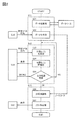
- FIG. 1 is a flowchart illustrating a content classification method according to one aspect of the present embodiment.
- the content classification method is controlled by a program running on a computer. Therefore, the content can be classified by the program having the data processing unit, the learning processing unit, or the determination processing unit.
- the program can classify the content desired by the user via the GUI. That is, the contents processed by the respective processing units described above correspond to the steps of the program.
- step S11 the user can instruct through the GUI to load the file containing the content.
- the file is stored in the database of the data processing unit. Note that the file includes learning content, unclassified content, and the like.
- a plurality of learning contents or a plurality of unclassified contents be listed and stored in the database.
- the user can add or correct the learning label of the learning content displayed on the GUI.
- the file can include verification content to which a learning label is not attached.
- Step S12 is a learning processing unit that generates a classification model using the loaded file.
- the generated classification model can evaluate the verification content and display the evaluation result on the GUI.
- the user can instruct the evaluation result to correct the learning label, add learning content, and the like.
- the user can update the meta information by predicting the change over time of the meta information that the learning content has. If the user updates the meta information, the classification model can include changes in the classification model over time. Therefore, the user can obtain a change in the classification of the content over time.
- the classification model can classify a content group whose value is expected to increase or a content group whose value is expected to decrease.
- Step S13 is a determination processing unit.
- Pure content is inferred using the classification model generated in step S12.
- the classification model can add determination information to unclassified content based on the inference result.
- the determination processing unit can display the content provided with the determination information on the GUI in a format required by the user.
- the determination information includes at least a classification label and a score.
- the GUI can specify a specific numerical value range of the score and display the corresponding content.
- step S11 includes the data collection unit of step S21 and the data generation unit of step S22.
- the data collection unit in step S21 can load the file from the database.
- the meta information, the content, and the like can be managed by different databases.
- the meta information may differ in the company, organization, or user who handles the content. Therefore, the data collection unit has a function of collecting meta-information about contents from different databases.
- each database can be installed in different buildings, different areas, or different countries.
- the data generation unit can manage contents and meta information in units called records.
- each record is composed of an ID associated with a number, content (image data, audio data, or moving image data), meta information, or the like.
- the user can generate the learning content by adding the learning label to the content displayed on the GUI.
- the learning processing unit in step S12 has a classification model generation unit in step S23, a classification model evaluation unit in step S24, and an output result determination process in step S25.
- the classification model generation unit can generate a classification model of content.
- the classification model generation unit can generate a plurality of first classification models by machine learning using a plurality of learning contents.
- a second classification model can be generated using the plurality of first classification models.
- the GUI can display the output value of the first classification model or the second classification model.
- the user can add (including correction) the learning label of the first classification model to the output value.
- the user can add new learning content for the output value. It is possible to predict the change with time of the meta information included in the learning content and update the meta information. The effect obtained by updating the meta information by the user can be referred to the description of step S12.
- the classification model evaluation unit can evaluate the classification model generated by the classification model generation unit by using the verification content.
- the classification model outputs the result of inferring the verification content as the determination information.
- the GUI can display the evaluation content with the determination information added thereto.
- step S25 the user can determine the output result of the classification model evaluation unit in step S24, and determine that the content classification model has been sufficiently learned.
- the user gives a GUI model generation completion (OK) instruction.
- the user can determine that the content classification model is not sufficiently learned (NG).
- the user returns to step S23 and updates the classification model by changing the learning label, adding learning content, or updating meta information.
- the determination processing unit in step S13 includes the classification inference unit in step S26 and the list creation unit in step S27.
- the classification inference unit infers and classifies a plurality of unclassified contents using the first learning model and the second learning model generated by the classification model generation unit.
- the classification inference unit is given the unclassified content generated by the data generation unit in step S22.
- the classification model attaches the inference result to each content as determination information.
- the list generation unit can list the contents to which the determination information is given in a format required by the user and display the list on the GUI.
- classification information different from the meta information may be given to each content. For example, when classification information is given to the learning content, different classification models can be generated for each classification information. Alternatively, one of the meta information included in the content can be used as the classification information.
- the judgment information includes at least a classification label and a score.
- the GUI can specify a specific numerical range of the score, list corresponding contents, and display the list on the GUI.
- FIG. 3 is a diagram for explaining the connection between the classification system 100 having the content classification method described above and the network (NetWork).
- the classification system 100 is connected to the communication network LAN1.
- a database DB1 or client computers CL1 to CLn (n is a natural number) is connected to the communication network LAN1.
- the communication network LAN1 can be connected to the communication network LAN2 via the network.
- the network can use the Internet, the communication network WAN, or satellite communication.
- a database DB2, client computers CL11 to CL1n, etc. are connected to the communication network LAN2.
- the classification system 100 uses a file including content stored in the database DB1, the database DB2, the client computers CL1 to CLn, or the client computers CL11 to CL1n to generate content, classify content, generate models, and unclassify. Content can be classified.
- the user can give an instruction to the GUI from the program operating in the classification system 100.
- a user can classify the unclassified content by generating the classification model described above using information of databases installed in different countries via the Internet. That is, the content or meta information may be stored in different databases or client computers.
- the GUI can display the classification results classified by the classification system 100 stored in the storage device of the computer device of the database DB1, the database DB2, the client computers CL1 to CLn, or the client computers CL11 to CL1n.
- FIG. 4 is a block diagram illustrating the classification system 100 described in FIG.
- the classification system 100 includes a GUI (Graphical User Interface) 110, a calculation unit 120, and a storage unit 130.
- the GUI 110 has an input unit 111 and an output unit 112.
- the input unit 111 has a function of selecting a content load source and a function of inputting a learning label.
- the output unit 112 has a function of displaying a content list loaded from a database or the like and a function of displaying determination information output by the classification model.
- the meta information included in the displayed content can be modified by the user via the GUI.
- the calculation unit 120 has a data processing unit 121, a learning processing unit 122, and a determination processing unit 123.
- the data processing unit 121 has a data collection unit and a data generation unit.
- the learning processing unit 122 has a classification model generation unit that creates a classification model and a classification model evaluation unit that classifies the classification model.
- the output result of the classification model evaluation unit has a function of evaluation result determination processing in which the user makes a determination.
- the determination processing unit 123 has a classification inference unit and an output list creation unit that lists the results classified by the classification inference unit.
- the arithmetic unit 120 uses a microprocessor to perform arithmetic processing of a program stored in a storage unit included in the computer device. However, the program can be processed using a DSP (Digital signal Processor) or a GPU (Graphics Processing Unit).
- DSP Digital signal Processor
- GPU Graphics Processing Unit
- the storage unit 130 temporarily stores a list of content and meta information generated by loading from a database or the like.
- a DRAM dynamic random access memory
- 1T transistor
- 1C capacity
- An OS transistor may be used as the transistor used in the memory cell of the DRAM.
- the OS transistor is a transistor including a metal oxide in a semiconductor layer.
- a memory device in which an OS transistor is used for a memory cell is called an “OS memory”.
- OS memory a RAM having 1T1C type memory cells is referred to as "DOSRAM (Dynamic Oxide Semiconductor RAM)".
- the off current of the OS transistor is very small. Therefore, in the DOSRAM, the frequency of refresh can be reduced, so that the power required for the refresh operation can be reduced.
- the off-state current referred to here is a current flowing between the source and the drain when the transistor is off. In the case where the transistor is an n-channel type, for example, when the threshold voltage is about 0 V to 2 V, the current flowing between the source and the drain when the voltage between the gate and the source is a negative voltage is an off current. Can be called.
- FIG. 5A is a diagram illustrating the configuration of the GUI 30.
- the GUI 30 shows, as an example, a management screen that displays a list of p learning contents.
- the learning content is managed in record units.
- the record includes a number (No) 31, a content (ID) 32, meta information (Feature) 33 (meta information (F1) 33a to meta information (Fm) 33m) indicating a feature amount, and classification information (Case) 34 ( The classification information (C1) 34a to the classification information (Cq) 34q), the learning label (J-Label) 35, and the like are included.
- the learning label 35 gives one of two values of “Yes” and “No”, but the learning label 35 is not limited to two values and may be three or more values. ..
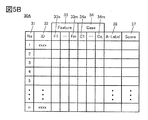
- FIG. 5B is a diagram illustrating the configuration of the GUI 30A.
- the GUI 30A shows a management screen that infers n unclassified contents by the evaluation inference unit and displays a list of the inferred determination information.
- the unclassified content has the number 31, the content 32, the meta information 33, and the classification information 34, like the learning content.
- a classification label (A-Label) 36 and a score (Score) 37 are added to each record as determination information.
- the GUI 30 and the GUI 30A can be managed on the same display screen.
- FIG. 9 or FIG. 10 described later a display example of a GUI that can display the learning content and the determination information on the same management screen is shown.
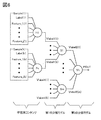
- FIG. 6 is a diagram illustrating a method of generating a classification model using a plurality of feature features associated with the learning content Sample described above by machine learning. Each of the characteristics Feature indicates any one of the meta information, and corresponds to a management parameter for managing the content. Note that in this embodiment, a method of generating a classification model will be described using the calculation unit F, the calculation unit S, the calculation unit V, the first classification model, and the second classification model.
- Each of the learning content Sample(1) to the learning content Sample(k) is provided with j features Feature and a learning label Label.
- the calculation unit F1 can generate a feature vector Vlabel1(1) in a format that can be processed by a computer from the learning content Sample(1).
- the calculation unit Fk can generate the feature vector Vlabel1(k) in a computer processable form from the learning content Sample(k).
- the feature vector Vlabel1(1) can be generated by the calculation unit F1 by giving different weighting factors to the respective features. Further, the feature vector Vlabel1(1) can be generated by using j or less feature features selected at random.
- the calculation units S1 to Sm correspond to different first classification models.
- the calculation unit S1 can generate the first classification model by using the feature vector Vlabel1(1) to the feature vector Vlabel1(k).
- the number of feature vectors Vlabel1 given to the calculation unit S1 may be k or less.
- the calculation unit Sm can generate the first classification model using different feature vectors Vlabel1(1) to Vlabel1(k). Therefore, the two different first classification models each include k or less feature vectors Vlabel1 and any one of the feature vectors Vlabel1 can include the same feature vector.
- the k pieces of learning content Sample that are selected to generate the first classification model may be selected at random, or may be selected in the order sorted by the number assigned to the learning content. ..
- the first classification model may include variation in the learning content.
- the tendency along the number assigned based on one of the characteristics of the time series or the meta information can be included.
- the first classification model can generate the feature vector Vlabel2 using the feature vector Vlabel1 generated from the learning content Sample(1) to the learning content Sample(k).
- the second classification model is generated by the calculation unit V1.
- the calculation unit V1 has a step of generating a second classification model using m feature vectors Vlabel2.
- the second classification model can generate classification models having different features by using the feature vector Vlabel2(1) to the feature vector Vlabel2(m).
- the second classification model can output the output value POUT using the feature vector Vlabel1 generated from the learning content Sample(1) to the learning content Sample(k).
- the GUI can display the output value POUT.
- the output value POUT includes a classification label that is determination information and a score. Therefore, the second classification model can classify contents. In addition, the second classification model can add determination information to each content.
- the judgment result is obtained by giving unclassified contents to the learning content Sample of the classification model.
- the learning label is not attached to the unclassified content.
- FIG. 7 is a diagram illustrating a method of generating a classification model different from that of FIG.
- FIG. 7 different points from FIG. 6 will be described, and in the configuration of the invention (or the configuration of the embodiment), the same reference numerals are commonly used in different drawings for the same portions or portions having similar functions. The repeated description is omitted.
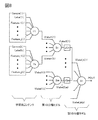
- the average value Av of the m feature vectors Vlabel2 is calculated, and the feature vector Vlabel_a is generated.
- the second classification model can be generated by using the p feature vectors Vlabel_a.
- the second classification model can generate classification models having different characteristics by calculating the average value Av of the m feature vectors Vlabel2.
- the generated classification model can make the classification of content accurate.
- FIG. 8 is a diagram illustrating a method of generating a classification model different from that of FIG. 7.
- FIG. 8 different points from FIG. 7 will be described, and in the configuration of the invention (or the configuration of the embodiment), the same reference numeral is commonly used in different drawings for the same portion or a portion having a similar function. The repeated description is omitted.
- the evaluation criterion for evaluating the m feature vectors Vlabel2 is given to the evaluation determination unit JG.
- the evaluation determination unit JG1 is given a precision (Precision) as the first evaluation criterion and can evaluate each feature vector Vlabel2(1).
- the evaluation determination unit JG1 can evaluate the respective feature vectors Vlabel2(1) given the sensitivity as a second evaluation criterion.
- the evaluation determination unit JG1 outputs the evaluation result Vlabel_b(1).
- the second classification model is generated by using the evaluation result Vlabel_b(1) to the evaluation result Vlabel_b(p).
- the plurality of feature vectors Vlabel2 may be evaluated by different first evaluation criteria and second evaluation criteria, or may be evaluated by the same evaluation criteria.
- an average value of the evaluation results Vlabel_b based on the first evaluation standard and the second evaluation standard can be calculated as in FIG. 7.
- the second classification model can generate classification models having different features by using the evaluation results of the m feature vectors Vlabel2.
- the generated classification model can make the classification of content accurate.
- FIG. 9 is a diagram illustrating the GUI 50.
- the GUI 50 is a display area for content (learning content, unclassified content, classified content), an icon 58a for selecting a download source of a file including the content, and text for displaying address information in which the selected file is stored. It has a box 58b and an icon (Learning Start) 59 for executing machine learning.
- Each record has a number (No) 51, an ID (Index) 52, a feature amount (Feature) 53, classification information (Case) 54, a learning label (JL) 55, a classification label (AL) 56, and a score (Prob. ) 57 components.
- the feature amount 53 can display the feature amount F(1) 53a to the feature amount F(j) 53j as detailed information.
- j is a natural number.
- the classification information 54 can display classification information C(1) 54a to classification information C(4) 54d as detailed information.
- the classification information can have a type that can be represented by a natural number.
- FIG. 9 shows an example in which the result of classifying the learning content and the unclassified content by the classification model is displayed on the GUI 50.
- the record numbers No. 1 to No. 3 correspond to learning contents.
- a learning label is given to the learning content, and classification information is given to the record numbers No1 to No3.
- Record numbers No4 to No8 correspond to the classified contents.
- a classification label 56 and a score 57 are given to the classified contents.
- FIG. 9 the result of classifying the record numbers No4 to No7 using the classification model obtained by learning the record numbers No1 and No3 is displayed.
- the result of classifying the record number No8 is displayed using the classification model obtained by learning the record number No2.
- the number of records is displayed up to 8 due to the space, but the number of records can handle a plurality of types.
- the classification label 56 or the score 57 preferably has a sorting function.
- the GUI can select and display the determination result in which the classification label 56 is “Yes”. Further, the GUI can specify and display the numerical range of the score 57.
- the GUI can classify and display contents having the same characteristics as the learning contents to which the teacher data is given.
- the above classification model can add judgment information to unclassified contents.
- the classification label 56 and the score 57 are displayed in the determination information.
- the user gives “No” to the classification label 56 by using the sort function.
- the score 57 is set to "0.8" to "1.0".
- the GUI can select and display a record having the same characteristics as the learning content whose patent number has been abandoned.
- FIG. 10 is a diagram illustrating a GUI 50A different from FIG. FIG. 10 is an efficient GUI display example when a large number of records are handled. Note that in FIG. 10, points different from FIG. 9 are described, and in the configuration of the invention (or the configuration of the embodiment), the same portions or portions having similar functions are denoted by the same reference numerals in different drawings. , And the repeated description thereof will be omitted.
- FIG. 10 is different from FIG. 9 in that records can be classified and displayed for any selected classification information.
- the display can be switched according to the type of the classification information C(1) to the classification information C(4).
- the user sees the plurality of feature amounts 53 given to the record and the judgment information of the classification model, and if sufficient classification accuracy is obtained, the updating of the classification model ends.
- the determination information attached to the record and determines that the classification accuracy is not sufficient the learning label is attached to the record to which the user-specified label is not attached, and the icon 59 is pressed.
- the classification model can be updated.
- the feature amount 53 may be updated by predicting the change over time in the meta information included in the learning content.
- the classification model can include changes in the classification model over time. Therefore, the user can obtain a change in the classification of the content over time.
- the classification model can classify the content group whose value is expected to increase or the content group whose value is expected to decrease.
- the feature quantity 53, the classification information 54a to 54d, the learning label 55, the classification label 56, or the numerical values or label information included in the score 57 can be displayed in a different order.
- the selected numerical values and label information can be sorted and displayed in the required order by using the filter function. Thereby, the user can efficiently evaluate the determination result of the classification model.
- the content classification method described with reference to FIGS. 1 to 10 can provide a method of classifying information having a high probability.
- GUI is suitable for classifying highly probable information.
- the program can update the classification model by giving new teaching data (label for learning) to the classification model.
- the program can classify information with high probability by updating the classification model.
- the generated classification model can be saved in the main body of the electronic device or in the external memory, and can be called and used when classifying a new file. Furthermore, the classification model can be updated according to the method described above while adding new teacher data.
Landscapes
- Engineering & Computer Science (AREA)
- Theoretical Computer Science (AREA)
- Physics & Mathematics (AREA)
- General Engineering & Computer Science (AREA)
- Data Mining & Analysis (AREA)
- Software Systems (AREA)
- General Physics & Mathematics (AREA)
- Artificial Intelligence (AREA)
- Evolutionary Computation (AREA)
- Computer Vision & Pattern Recognition (AREA)
- Computing Systems (AREA)
- Mathematical Physics (AREA)
- Databases & Information Systems (AREA)
- Medical Informatics (AREA)
- Life Sciences & Earth Sciences (AREA)
- Bioinformatics & Computational Biology (AREA)
- Bioinformatics & Cheminformatics (AREA)
- Evolutionary Biology (AREA)
- Human Computer Interaction (AREA)
- Health & Medical Sciences (AREA)
- Molecular Biology (AREA)
- General Health & Medical Sciences (AREA)
- Computational Linguistics (AREA)
- Biophysics (AREA)
- Biomedical Technology (AREA)
- Probability & Statistics with Applications (AREA)
- Information Retrieval, Db Structures And Fs Structures Therefor (AREA)
Abstract
Description
図2は、分類方法を説明するフローチャートである。
図3は、分類システム100と、ネットワークとの接続について説明する図である。
図4は、分類システムを説明するブロック図である。
図5A、図5Bは、グラフィカルユーザインターフェースを説明する図である。
図6は、分類モデルの生成方法を説明する図である。
図7は、分類モデルの生成方法を説明する図である。
図8は、分類モデルの生成方法を説明する図である。
図9は、グラフィカルユーザインターフェースを説明する図である。
図10は、グラフィカルユーザインターフェースを説明する図である。
Claims (9)
- 学習用コンテンツと、コンテンツと、を有し、
前記学習用コンテンツには、第1の特徴量および学習用ラベルが付与され、
前記コンテンツには、第2の特徴量が付与され、
複数の前記学習用コンテンツを用いて複数の第1の分類モデルを機械学習によって生成するステップと、
前記複数の第1の分類モデルを用いて第2の分類モデルを生成するステップと、
前記第2の分類モデルを用いて複数の前記コンテンツに判定情報を付与しグラフィカルユーザインターフェース内に表示するステップと、
を含むコンテンツの分類方法。 - 学習用コンテンツと、コンテンツと、を有し、
前記学習用コンテンツには、第1の特徴量および学習用ラベルが付与され、
前記コンテンツには、第2の特徴量が付与され、
複数の前記学習用コンテンツを用いて複数の第1の分類モデルを機械学習によって生成するステップと、
前記複数の第1の分類モデルの出力から平均値を算出するステップと、
複数の前記平均値を用いて第2の分類モデルを生成するステップと、
前記第2の分類モデルを用いて複数の前記コンテンツに判定情報を付与しグラフィカルユーザインターフェース内に表示するステップと、
を含むコンテンツの分類方法。 - 学習用コンテンツと、コンテンツと、を有し、
前記学習用コンテンツには、第1の特徴量および学習用ラベルが付与され、
前記コンテンツには、第2の特徴量が付与され、
複数の前記学習用コンテンツを用いて複数の第1の分類モデルを機械学習によって生成するステップと、
前記複数の第1の分類モデルがそれぞれ第一の評価基準による評価をするステップと、
前記複数の第1の分類モデルがそれぞれ第二の評価基準による評価をするステップと、
複数の前記第一の評価基準による評価結果と、前記第二の評価基準と、による評価結果から第2の分類モデルを生成するステップと、
前記第2の分類モデルを用いて複数の前記コンテンツに判定情報を付与しグラフィカルユーザインターフェース内に表示するステップと、
を含むコンテンツの分類方法。 - 請求項3において、
前記第一の評価基準は精度であり、
前記第二の評価基準は感度であるコンテンツの分類方法。 - 請求項1乃至3のいずれかにおいて、
任意の前記学習用コンテンツを用いて前記第1の分類モデルを生成するステップを含むコンテンツの分類方法。 - 請求項1乃至3のいずれかにおいて、
前記学習用コンテンツには、さらに分類情報が与えられ、
前記第2の分類モデルの出力を用いて分類ラベルが付与された複数の前記コンテンツから前記分類情報と同じ前記判定情報を有するコンテンツを選択して前記グラフィカルユーザインターフェース内に表示するステップと、
を含むコンテンツの分類方法。 - 請求項1乃至3のいずれかにおいて、
前記学習用コンテンツ又前記コンテンツに与えられる特徴量は、管理パラメータであるコンテンツの分類方法。 - 請求項1乃至3のいずれかにおいて、
前記判定情報には、分類ラベルまたはスコアを含むコンテンツの分類方法。 - 請求項8において、
前記グラフィカルユーザインターフェースは、前記スコアのうち特定の数値範囲を指定し、該当するコンテンツをリストとして表示するステップを含むコンテンツの分類方法。
Priority Applications (7)
| Application Number | Priority Date | Filing Date | Title |
|---|---|---|---|
| US17/311,730 US20220027799A1 (en) | 2018-12-13 | 2019-12-03 | Content classification method and classification model generation method |
| DE112019006203.4T DE112019006203T5 (de) | 2018-12-13 | 2019-12-03 | Verfahren zur Klassifizierung von Inhalten und Verfahren zur Erzeugung eines Klassifizierungsmodells |
| KR1020217016573A KR20210100613A (ko) | 2018-12-13 | 2019-12-03 | 콘텐츠의 분류 방법 및 분류 모델의 생성 방법 |
| CN201980078452.2A CN113168421A (zh) | 2018-12-13 | 2019-12-03 | 内容的分类方法及分类模型的生成方法 |
| JP2020559054A JP7730641B2 (ja) | 2018-12-13 | 2019-12-03 | コンテンツの分類方法 |
| JP2024227415A JP7734819B2 (ja) | 2018-12-13 | 2024-12-24 | コンテンツの分類システム |
| JP2025140625A JP2025161942A (ja) | 2018-12-13 | 2025-08-26 | コンテンツの分類方法 |
Applications Claiming Priority (2)
| Application Number | Priority Date | Filing Date | Title |
|---|---|---|---|
| JP2018-233037 | 2018-12-13 | ||
| JP2018233037 | 2018-12-13 |
Publications (1)
| Publication Number | Publication Date |
|---|---|
| WO2020121115A1 true WO2020121115A1 (ja) | 2020-06-18 |
Family
ID=71075466
Family Applications (1)
| Application Number | Title | Priority Date | Filing Date |
|---|---|---|---|
| PCT/IB2019/060377 Ceased WO2020121115A1 (ja) | 2018-12-13 | 2019-12-03 | コンテンツの分類方法および分類モデルの生成方法 |
Country Status (6)
| Country | Link |
|---|---|
| US (1) | US20220027799A1 (ja) |
| JP (3) | JP7730641B2 (ja) |
| KR (1) | KR20210100613A (ja) |
| CN (1) | CN113168421A (ja) |
| DE (1) | DE112019006203T5 (ja) |
| WO (1) | WO2020121115A1 (ja) |
Cited By (1)
| Publication number | Priority date | Publication date | Assignee | Title |
|---|---|---|---|---|
| JP2023539240A (ja) * | 2020-08-25 | 2023-09-13 | アルテリックス インコーポレイテッド | ハイブリッド機械学習 |
Families Citing this family (3)
| Publication number | Priority date | Publication date | Assignee | Title |
|---|---|---|---|---|
| CN113841137A (zh) | 2019-05-24 | 2021-12-24 | 株式会社半导体能源研究所 | 文件检索系统及文件检索方法 |
| US11501304B2 (en) * | 2020-03-11 | 2022-11-15 | Synchrony Bank | Systems and methods for classifying imbalanced data |
| WO2024006154A1 (en) * | 2022-06-28 | 2024-01-04 | HonorEd Technologies, Inc. | Comprehension modeling and ai-sourced student content recommendations |
Citations (3)
| Publication number | Priority date | Publication date | Assignee | Title |
|---|---|---|---|---|
| JP2008242880A (ja) * | 2007-03-28 | 2008-10-09 | Kenwood Corp | コンテンツ表示システム、コンテンツ表示方法および車載用の情報端末装置 |
| JP2013161298A (ja) * | 2012-02-06 | 2013-08-19 | Nippon Steel & Sumitomo Metal | 分類器作成装置、分類器作成方法、及びコンピュータプログラム |
| WO2014203328A1 (ja) * | 2013-06-18 | 2014-12-24 | 株式会社日立製作所 | 音声データ検索システム、音声データ検索方法、及びコンピュータ読み取り可能な記憶媒体 |
Family Cites Families (9)
| Publication number | Priority date | Publication date | Assignee | Title |
|---|---|---|---|---|
| US7287012B2 (en) | 2004-01-09 | 2007-10-23 | Microsoft Corporation | Machine-learned approach to determining document relevance for search over large electronic collections of documents |
| US20150206069A1 (en) * | 2014-01-17 | 2015-07-23 | Matthew BEERS | Machine learning-based patent quality metric |
| US10331782B2 (en) * | 2014-11-19 | 2019-06-25 | Lexisnexis, A Division Of Reed Elsevier Inc. | Systems and methods for automatic identification of potential material facts in documents |
| US20170316438A1 (en) * | 2016-04-29 | 2017-11-02 | Genesys Telecommunications Laboratories, Inc. | Customer experience analytics |
| JP6280997B1 (ja) * | 2016-10-31 | 2018-02-14 | 株式会社Preferred Networks | 疾患の罹患判定装置、疾患の罹患判定方法、疾患の特徴抽出装置及び疾患の特徴抽出方法 |
| US20180197087A1 (en) * | 2017-01-06 | 2018-07-12 | Accenture Global Solutions Limited | Systems and methods for retraining a classification model |
| US11323564B2 (en) * | 2018-01-04 | 2022-05-03 | Dell Products L.P. | Case management virtual assistant to enable predictive outputs |
| US20190279073A1 (en) * | 2018-03-07 | 2019-09-12 | Sap Se | Computer Generated Determination of Patentability |
| US10740621B2 (en) * | 2018-06-30 | 2020-08-11 | Microsoft Technology Licensing, Llc | Standalone video classification |
-
2019
- 2019-12-03 WO PCT/IB2019/060377 patent/WO2020121115A1/ja not_active Ceased
- 2019-12-03 KR KR1020217016573A patent/KR20210100613A/ko active Pending
- 2019-12-03 US US17/311,730 patent/US20220027799A1/en active Pending
- 2019-12-03 DE DE112019006203.4T patent/DE112019006203T5/de active Pending
- 2019-12-03 JP JP2020559054A patent/JP7730641B2/ja active Active
- 2019-12-03 CN CN201980078452.2A patent/CN113168421A/zh active Pending
-
2024
- 2024-12-24 JP JP2024227415A patent/JP7734819B2/ja active Active
-
2025
- 2025-08-26 JP JP2025140625A patent/JP2025161942A/ja active Pending
Patent Citations (3)
| Publication number | Priority date | Publication date | Assignee | Title |
|---|---|---|---|---|
| JP2008242880A (ja) * | 2007-03-28 | 2008-10-09 | Kenwood Corp | コンテンツ表示システム、コンテンツ表示方法および車載用の情報端末装置 |
| JP2013161298A (ja) * | 2012-02-06 | 2013-08-19 | Nippon Steel & Sumitomo Metal | 分類器作成装置、分類器作成方法、及びコンピュータプログラム |
| WO2014203328A1 (ja) * | 2013-06-18 | 2014-12-24 | 株式会社日立製作所 | 音声データ検索システム、音声データ検索方法、及びコンピュータ読み取り可能な記憶媒体 |
Cited By (2)
| Publication number | Priority date | Publication date | Assignee | Title |
|---|---|---|---|---|
| JP2023539240A (ja) * | 2020-08-25 | 2023-09-13 | アルテリックス インコーポレイテッド | ハイブリッド機械学習 |
| JP7806027B2 (ja) | 2020-08-25 | 2026-01-26 | アルテリックス インコーポレイテッド | ハイブリッド機械学習 |
Also Published As
| Publication number | Publication date |
|---|---|
| JP2025161942A (ja) | 2025-10-24 |
| DE112019006203T5 (de) | 2021-09-02 |
| JPWO2020121115A1 (ja) | 2020-06-18 |
| JP2025041828A (ja) | 2025-03-26 |
| KR20210100613A (ko) | 2021-08-17 |
| US20220027799A1 (en) | 2022-01-27 |
| JP7730641B2 (ja) | 2025-08-28 |
| CN113168421A (zh) | 2021-07-23 |
| JP7734819B2 (ja) | 2025-09-05 |
Similar Documents
| Publication | Publication Date | Title |
|---|---|---|
| JP7734819B2 (ja) | コンテンツの分類システム | |
| US11900320B2 (en) | Utilizing machine learning models for identifying a subject of a query, a context for the subject, and a workflow | |
| US20220253725A1 (en) | Machine learning model for entity resolution | |
| CN115062732B (zh) | 基于大数据用户标签信息的资源共享合作推荐方法及系统 | |
| CN111930518B (zh) | 面向知识图谱表示学习的分布式框架构建方法 | |
| CN107562789A (zh) | 知识库问题更新方法、客服机器人以及可读存储介质 | |
| Xie et al. | Factorization machine based service recommendation on heterogeneous information networks | |
| CN115082102B (zh) | 能源消费者的预测性细分 | |
| CN110705719A (zh) | 执行自动机器学习的方法和装置 | |
| WO2019015631A1 (zh) | 生成机器学习样本的组合特征的方法及系统 | |
| Nagaraju et al. | Boost customer churn prediction in the insurance industry using meta-heuristic models | |
| US11323564B2 (en) | Case management virtual assistant to enable predictive outputs | |
| Shaji et al. | Weather prediction using machine learning algorithms | |
| Olorunnimbe et al. | Dynamic adaptation of online ensembles for drifting data streams | |
| AU2021258019A1 (en) | Utilizing machine learning models to generate initiative plans | |
| Wang et al. | Explaining genetic programming-evolved routing policies for uncertain capacitated arc routing problems | |
| Ming-Te et al. | Using data mining technique to perform the performance assessment of lean service | |
| Obulaporam et al. | GCRITICPA: A CRITIC and grey relational analysis based service ranking approach for cloud service selection | |
| de Sá et al. | Algorithm recommendation for data streams | |
| JP2022069602A (ja) | 営業活動支援システム、営業活動支援方法および営業活動支援プログラム | |
| Derbel et al. | Automatic classification and analysis of multiple-criteria decision making | |
| CN117038074B (zh) | 基于大数据的用户管理方法、装置、设备及存储介质 | |
| JP6942672B2 (ja) | 情報処理装置、情報処理方法、及び情報処理プログラム | |
| Chen et al. | Using granular computing model to induce scheduling knowledge in dynamic manufacturing environments | |
| Das et al. | Decision Rule Prediction for Assessment of Rotor Spun Cotton Yarn Strength Using Rough Set |
Legal Events
| Date | Code | Title | Description |
|---|---|---|---|
| 121 | Ep: the epo has been informed by wipo that ep was designated in this application |
Ref document number: 19895325 Country of ref document: EP Kind code of ref document: A1 |
|
| ENP | Entry into the national phase |
Ref document number: 2020559054 Country of ref document: JP Kind code of ref document: A |
|
| ENP | Entry into the national phase |
Ref document number: 20217016573 Country of ref document: KR Kind code of ref document: A |
|
| 122 | Ep: pct application non-entry in european phase |
Ref document number: 19895325 Country of ref document: EP Kind code of ref document: A1 |