WO2020115537A1 - Low-carbon, high toughness, steel plates for pressurized tank car applications - Google Patents
Low-carbon, high toughness, steel plates for pressurized tank car applications Download PDFInfo
- Publication number
- WO2020115537A1 WO2020115537A1 PCT/IB2018/059773 IB2018059773W WO2020115537A1 WO 2020115537 A1 WO2020115537 A1 WO 2020115537A1 IB 2018059773 W IB2018059773 W IB 2018059773W WO 2020115537 A1 WO2020115537 A1 WO 2020115537A1
- Authority
- WO
- WIPO (PCT)
- Prior art keywords
- alloy plate
- steel
- toughness
- inventive
- mpa
- Prior art date
- Legal status (The legal status is an assumption and is not a legal conclusion. Google has not performed a legal analysis and makes no representation as to the accuracy of the status listed.)
- Ceased
Links
Classifications
-
- C—CHEMISTRY; METALLURGY
- C22—METALLURGY; FERROUS OR NON-FERROUS ALLOYS; TREATMENT OF ALLOYS OR NON-FERROUS METALS
- C22C—ALLOYS
- C22C38/00—Ferrous alloys, e.g. steel alloys
- C22C38/18—Ferrous alloys, e.g. steel alloys containing chromium
- C22C38/40—Ferrous alloys, e.g. steel alloys containing chromium with nickel
- C22C38/46—Ferrous alloys, e.g. steel alloys containing chromium with nickel with vanadium
-
- B—PERFORMING OPERATIONS; TRANSPORTING
- B61—RAILWAYS
- B61D—BODY DETAILS OR KINDS OF RAILWAY VEHICLES
- B61D17/00—Construction details of vehicle bodies
- B61D17/04—Construction details of vehicle bodies with bodies of metal; with composite, e.g. metal and wood body structures
- B61D17/041—Construction details of vehicle bodies with bodies of metal; with composite, e.g. metal and wood body structures with bodies characterised by use of light metal, e.g. aluminium
-
- B—PERFORMING OPERATIONS; TRANSPORTING
- B61—RAILWAYS
- B61D—BODY DETAILS OR KINDS OF RAILWAY VEHICLES
- B61D5/00—Tank wagons for carrying fluent materials
-
- C—CHEMISTRY; METALLURGY
- C21—METALLURGY OF IRON
- C21D—MODIFYING THE PHYSICAL STRUCTURE OF FERROUS METALS; GENERAL DEVICES FOR HEAT TREATMENT OF FERROUS OR NON-FERROUS METALS OR ALLOYS; MAKING METAL MALLEABLE, e.g. BY DECARBURISATION OR TEMPERING
- C21D1/00—General methods or devices for heat treatment, e.g. annealing, hardening, quenching or tempering
- C21D1/26—Methods of annealing
- C21D1/28—Normalising
-
- C—CHEMISTRY; METALLURGY
- C21—METALLURGY OF IRON
- C21D—MODIFYING THE PHYSICAL STRUCTURE OF FERROUS METALS; GENERAL DEVICES FOR HEAT TREATMENT OF FERROUS OR NON-FERROUS METALS OR ALLOYS; MAKING METAL MALLEABLE, e.g. BY DECARBURISATION OR TEMPERING
- C21D6/00—Heat treatment of ferrous alloys
- C21D6/004—Heat treatment of ferrous alloys containing Cr and Ni
-
- C—CHEMISTRY; METALLURGY
- C21—METALLURGY OF IRON
- C21D—MODIFYING THE PHYSICAL STRUCTURE OF FERROUS METALS; GENERAL DEVICES FOR HEAT TREATMENT OF FERROUS OR NON-FERROUS METALS OR ALLOYS; MAKING METAL MALLEABLE, e.g. BY DECARBURISATION OR TEMPERING
- C21D6/00—Heat treatment of ferrous alloys
- C21D6/005—Heat treatment of ferrous alloys containing Mn
-
- C—CHEMISTRY; METALLURGY
- C21—METALLURGY OF IRON
- C21D—MODIFYING THE PHYSICAL STRUCTURE OF FERROUS METALS; GENERAL DEVICES FOR HEAT TREATMENT OF FERROUS OR NON-FERROUS METALS OR ALLOYS; MAKING METAL MALLEABLE, e.g. BY DECARBURISATION OR TEMPERING
- C21D6/00—Heat treatment of ferrous alloys
- C21D6/008—Heat treatment of ferrous alloys containing Si
-
- C—CHEMISTRY; METALLURGY
- C21—METALLURGY OF IRON
- C21D—MODIFYING THE PHYSICAL STRUCTURE OF FERROUS METALS; GENERAL DEVICES FOR HEAT TREATMENT OF FERROUS OR NON-FERROUS METALS OR ALLOYS; MAKING METAL MALLEABLE, e.g. BY DECARBURISATION OR TEMPERING
- C21D8/00—Modifying the physical properties of ferrous metals or ferrous alloys by deformation combined with, or followed by, heat treatment
- C21D8/02—Modifying the physical properties of ferrous metals or ferrous alloys by deformation combined with, or followed by, heat treatment during manufacturing of plates or strips
-
- C—CHEMISTRY; METALLURGY
- C21—METALLURGY OF IRON
- C21D—MODIFYING THE PHYSICAL STRUCTURE OF FERROUS METALS; GENERAL DEVICES FOR HEAT TREATMENT OF FERROUS OR NON-FERROUS METALS OR ALLOYS; MAKING METAL MALLEABLE, e.g. BY DECARBURISATION OR TEMPERING
- C21D8/00—Modifying the physical properties of ferrous metals or ferrous alloys by deformation combined with, or followed by, heat treatment
- C21D8/02—Modifying the physical properties of ferrous metals or ferrous alloys by deformation combined with, or followed by, heat treatment during manufacturing of plates or strips
- C21D8/0221—Modifying the physical properties of ferrous metals or ferrous alloys by deformation combined with, or followed by, heat treatment during manufacturing of plates or strips characterised by the working steps
- C21D8/0226—Hot rolling
-
- C—CHEMISTRY; METALLURGY
- C21—METALLURGY OF IRON
- C21D—MODIFYING THE PHYSICAL STRUCTURE OF FERROUS METALS; GENERAL DEVICES FOR HEAT TREATMENT OF FERROUS OR NON-FERROUS METALS OR ALLOYS; MAKING METAL MALLEABLE, e.g. BY DECARBURISATION OR TEMPERING
- C21D8/00—Modifying the physical properties of ferrous metals or ferrous alloys by deformation combined with, or followed by, heat treatment
- C21D8/02—Modifying the physical properties of ferrous metals or ferrous alloys by deformation combined with, or followed by, heat treatment during manufacturing of plates or strips
- C21D8/0247—Modifying the physical properties of ferrous metals or ferrous alloys by deformation combined with, or followed by, heat treatment during manufacturing of plates or strips characterised by the heat treatment
- C21D8/0263—Modifying the physical properties of ferrous metals or ferrous alloys by deformation combined with, or followed by, heat treatment during manufacturing of plates or strips characterised by the heat treatment following hot rolling
-
- C—CHEMISTRY; METALLURGY
- C21—METALLURGY OF IRON
- C21D—MODIFYING THE PHYSICAL STRUCTURE OF FERROUS METALS; GENERAL DEVICES FOR HEAT TREATMENT OF FERROUS OR NON-FERROUS METALS OR ALLOYS; MAKING METAL MALLEABLE, e.g. BY DECARBURISATION OR TEMPERING
- C21D9/00—Heat treatment, e.g. annealing, hardening, quenching or tempering, adapted for particular articles; Furnaces therefor
- C21D9/46—Heat treatment, e.g. annealing, hardening, quenching or tempering, adapted for particular articles; Furnaces therefor for sheet metals
-
- C—CHEMISTRY; METALLURGY
- C22—METALLURGY; FERROUS OR NON-FERROUS ALLOYS; TREATMENT OF ALLOYS OR NON-FERROUS METALS
- C22C—ALLOYS
- C22C38/00—Ferrous alloys, e.g. steel alloys
- C22C38/001—Ferrous alloys, e.g. steel alloys containing N
-
- C—CHEMISTRY; METALLURGY
- C22—METALLURGY; FERROUS OR NON-FERROUS ALLOYS; TREATMENT OF ALLOYS OR NON-FERROUS METALS
- C22C—ALLOYS
- C22C38/00—Ferrous alloys, e.g. steel alloys
- C22C38/002—Ferrous alloys, e.g. steel alloys containing In, Mg, or other elements not provided for in one single group C22C38/001 - C22C38/60
-
- C—CHEMISTRY; METALLURGY
- C22—METALLURGY; FERROUS OR NON-FERROUS ALLOYS; TREATMENT OF ALLOYS OR NON-FERROUS METALS
- C22C—ALLOYS
- C22C38/00—Ferrous alloys, e.g. steel alloys
- C22C38/02—Ferrous alloys, e.g. steel alloys containing silicon
-
- C—CHEMISTRY; METALLURGY
- C22—METALLURGY; FERROUS OR NON-FERROUS ALLOYS; TREATMENT OF ALLOYS OR NON-FERROUS METALS
- C22C—ALLOYS
- C22C38/00—Ferrous alloys, e.g. steel alloys
- C22C38/04—Ferrous alloys, e.g. steel alloys containing manganese
-
- C—CHEMISTRY; METALLURGY
- C22—METALLURGY; FERROUS OR NON-FERROUS ALLOYS; TREATMENT OF ALLOYS OR NON-FERROUS METALS
- C22C—ALLOYS
- C22C38/00—Ferrous alloys, e.g. steel alloys
- C22C38/06—Ferrous alloys, e.g. steel alloys containing aluminium
-
- C—CHEMISTRY; METALLURGY
- C22—METALLURGY; FERROUS OR NON-FERROUS ALLOYS; TREATMENT OF ALLOYS OR NON-FERROUS METALS
- C22C—ALLOYS
- C22C38/00—Ferrous alloys, e.g. steel alloys
- C22C38/12—Ferrous alloys, e.g. steel alloys containing tungsten, tantalum, molybdenum, vanadium, or niobium
-
- C—CHEMISTRY; METALLURGY
- C22—METALLURGY; FERROUS OR NON-FERROUS ALLOYS; TREATMENT OF ALLOYS OR NON-FERROUS METALS
- C22C—ALLOYS
- C22C38/00—Ferrous alloys, e.g. steel alloys
- C22C38/18—Ferrous alloys, e.g. steel alloys containing chromium
- C22C38/22—Ferrous alloys, e.g. steel alloys containing chromium with molybdenum or tungsten
-
- C—CHEMISTRY; METALLURGY
- C22—METALLURGY; FERROUS OR NON-FERROUS ALLOYS; TREATMENT OF ALLOYS OR NON-FERROUS METALS
- C22C—ALLOYS
- C22C38/00—Ferrous alloys, e.g. steel alloys
- C22C38/18—Ferrous alloys, e.g. steel alloys containing chromium
- C22C38/24—Ferrous alloys, e.g. steel alloys containing chromium with vanadium
-
- C—CHEMISTRY; METALLURGY
- C22—METALLURGY; FERROUS OR NON-FERROUS ALLOYS; TREATMENT OF ALLOYS OR NON-FERROUS METALS
- C22C—ALLOYS
- C22C38/00—Ferrous alloys, e.g. steel alloys
- C22C38/18—Ferrous alloys, e.g. steel alloys containing chromium
- C22C38/26—Ferrous alloys, e.g. steel alloys containing chromium with niobium or tantalum
-
- C—CHEMISTRY; METALLURGY
- C22—METALLURGY; FERROUS OR NON-FERROUS ALLOYS; TREATMENT OF ALLOYS OR NON-FERROUS METALS
- C22C—ALLOYS
- C22C38/00—Ferrous alloys, e.g. steel alloys
- C22C38/18—Ferrous alloys, e.g. steel alloys containing chromium
- C22C38/40—Ferrous alloys, e.g. steel alloys containing chromium with nickel
- C22C38/42—Ferrous alloys, e.g. steel alloys containing chromium with nickel with copper
-
- C—CHEMISTRY; METALLURGY
- C22—METALLURGY; FERROUS OR NON-FERROUS ALLOYS; TREATMENT OF ALLOYS OR NON-FERROUS METALS
- C22C—ALLOYS
- C22C38/00—Ferrous alloys, e.g. steel alloys
- C22C38/18—Ferrous alloys, e.g. steel alloys containing chromium
- C22C38/40—Ferrous alloys, e.g. steel alloys containing chromium with nickel
- C22C38/44—Ferrous alloys, e.g. steel alloys containing chromium with nickel with molybdenum or tungsten
-
- C—CHEMISTRY; METALLURGY
- C21—METALLURGY OF IRON
- C21D—MODIFYING THE PHYSICAL STRUCTURE OF FERROUS METALS; GENERAL DEVICES FOR HEAT TREATMENT OF FERROUS OR NON-FERROUS METALS OR ALLOYS; MAKING METAL MALLEABLE, e.g. BY DECARBURISATION OR TEMPERING
- C21D2211/00—Microstructure comprising significant phases
- C21D2211/002—Bainite
-
- C—CHEMISTRY; METALLURGY
- C21—METALLURGY OF IRON
- C21D—MODIFYING THE PHYSICAL STRUCTURE OF FERROUS METALS; GENERAL DEVICES FOR HEAT TREATMENT OF FERROUS OR NON-FERROUS METALS OR ALLOYS; MAKING METAL MALLEABLE, e.g. BY DECARBURISATION OR TEMPERING
- C21D2211/00—Microstructure comprising significant phases
- C21D2211/005—Ferrite
-
- C—CHEMISTRY; METALLURGY
- C21—METALLURGY OF IRON
- C21D—MODIFYING THE PHYSICAL STRUCTURE OF FERROUS METALS; GENERAL DEVICES FOR HEAT TREATMENT OF FERROUS OR NON-FERROUS METALS OR ALLOYS; MAKING METAL MALLEABLE, e.g. BY DECARBURISATION OR TEMPERING
- C21D2211/00—Microstructure comprising significant phases
- C21D2211/009—Pearlite
Definitions
- the present invention relates to steel alloy plates and more specifically to steel alloy plates for use in production of railroad tank cars. Most specifically the invention relates to steel alloy plates having improved toughness and puncture resistance.
- TC 128 Gr B steel plates for making tank car heads and occasionally ASTM A516-70 steel plates depending on carrier contents.
- the steel plates are formed in to tank car heads either in ambient temperature after normalizing or at an elevated temperature (slightly above the Ar3 temperature) and then normalized.
- the full tank car body is then given a post weld heat treatment (PWHT) at 600-650 ° C for an hour. So, the specified material properties are to be guaranteed in normalized and PWHT condition.
- PWHT post weld heat treatment
- Tables 1 and 2 show the chemical and mechanical property requirements for the current TC 128 Gr B steel.
- the steel manufacturers have been using high C and Mn in order to meet the minimum tensile strength requirements as higher carbon equivalence (CE) guarantees higher pearlite contents and thereby higher tensile strength.
- Microalloying with Nb has rarely been opted or encouraged because of concerns of HAZ (Heaty Affected Zone) and weld metal toughness.
- Table 1 shows the chemical composition of current TC128 Gr B steel used by tank car manufactures in wt.%. Table 1
- Ceq C + Mn/6 + (Cr + Mo + V)/5 + (Cu + Ni)/15, Ceq (max%): 0.53
- Table 2 shows specified mechanical properties in current TC128 Gr B steel used by tank car manufactures.
- 2” GL is the 2-inch gauge length of the tensile specimen.
- the minimum longitudinal impact energy is 20.3 J at -45.5 °C and minimum transverse impact energy is 20.3 J at -34.4 °C.
- FIG. 1 is a photomicrograph of the normalized microstructure of a TC 128 Gr B steel plate of the prior art. The streaks of martensite 1 can easily be seen. The banded structure results in inconsistent and low impact toughness in the final tank car head. The upper shelf Charpy energy is also low due to high carbon content.
- Figure 2 is plot of the longitudinal CVN impact energy versus heat number for samples taken from tank car heads formed with TC 128 Gr B steel of the prior art. The data reveals poor impact toughness values.
- Table 3 indicates the composition of the alloy of the photomicrograph of Figure 1 and the data of Figure 2 in weight percent. Furthermore, it is the alloy used hereinafter as a comparison of the prior art TC 128 Gr B presently in use in the industry.
- the present invention relates to steel alloy plates for use in railroad tank cars.
- the inventive alloy plates have improved toughness and puncture resistance.
- the steel alloy plate for use in railroad tank cars comprises a steel alloy including in wt%: C: 0.1 - 0.15; Mn: 1.0 - 1.65; Si: 0.15 - 0.40; Al: 0.015 - 0.06; Mo: 0.1 - 0.3; Ni: 0.1 - 0.25; Nb: 0.015 - 0.045; Ti: up to 0.02; Cr: up to 0.22; V: up to 0.08; Cu: up to 0.35; P: max 0.025; S: max 0.015; and N: 0.004 - 0.01.
- the alloy plate may have been normalized for 30 to 60 minutes at 900 °C.
- the alloy plate may have a tensile strength of at least 560 MPa; a yield strength of at least 345 MPa; an elongation of at least 22%; a CVN impact toughness of at least 135.5 J at -34.4 °C; a CVN impact toughness of at least 122 J at - 45.5 °C
- the alloy plate may have a ferrite-bainite microstructure with 10% or less pearlite, preferably 5% or less, and most preferably 1 % or less pearlite.
- the inventive alloy plate may have an absence of any banded ferrite-pearlite/martensite structure.
- the steel alloy plate may contain 0.018 wt.% Nb and may have a tensile strength of at least 575 MPa; a yield strength of at least 425 MPa; an elongation of at least 33%; a CVN impact toughness of at least 176.25 J at -34.4 °C; and a CVN impact toughness of at least 203.3 J at -45.5 °C.
- the steel alloy plate may contain 0.032 wt.% Nb and may have a tensile strength of at least 580 MPa; a yield strength of at least 460 MPa; an elongation of at least 33%; a CVN impact toughness of at least 156 J at -34.4 °C; and a CVN impact toughness of at least 128.8 J at -45.5 °C.
- the steel alloy plate may contain 0.045 wt.% Nb.
- the steel alloy plate may have been subjected to a post weld heat treatment of 30-60 mins at 600-650 ° C.
- Figure 1 is a photomicrograph of the normalized microstructure of a TC 128 Gr B steel plate of the prior art
- Figure 2 is plot of the longitudinal CVN impact energy versus heat number for samples taken from tank car heads formed with TC 128 Gr B steel of the prior art
- Figure 3 is a plot of tensile properties of the inventive tank car steels as a function of normalizing time at 900 ° C vs the heat number;
- Figure 4 plots the temperature vs time for the industry standard PWHT for TC 128 steels
- Figure 5 plots the CVN impact toughness of the inventive steels and a conventional TC 128 Gr B steel vs test temperature
- Figure 6 plots the CVN impact toughness vs PWHT scheme from industrial trials of 0.032 Nb inventive steel compared with conventional TC128 Gr. B;
- Figure 7A is a photomicrograph showing the microstructure of normalized and PWHT steel plates of the inventive steels with 0.018 wt.% Nb;
- Figure 7B is a photomicrograph showing the microstructure of normalized and PWHT steel plates of the inventive steels with 0.032 wt.% Nb;
- Figure 7C is a photomicrograph showing the microstructure of normalized and PWHT steel plates of the inventive steels with 0.045 wt.% Nb;
- Figure 7D is a photomicrograph showing the microstructure of of normalized and PWHT steel plates of the prior art TC 128 Gr B steel.
- Figure 8 is a plot of the transverse CVN impact toughness of the CGHAZ of the inventive steels at the three different niobium levels and the base metal of the inventive steel vs temperature.
- the present invention relates to a new TC 128 chemistry within the stipulated compositional limits of TC 128 to significantly improve the toughness values.
- the newer chemistry significantly lowers the carbon content so that both the upper shelf as well as transition temperature is improved. Any loss in tensile strength due to the reduction of carbon is mitigated by (i) inducing a finer ferrite grain size due to addition of Nb, (ii) changes of microstructure from a predominantly ferrite-pearl ite to ferrite-bainite through addition of Mo and (iii) some low-temperature precipitation contribution through alloying with Nb and Mo.
- the present inventors had determined that the addition of Nb at low levels does not interfere with HAZ toughness when, as in the instant invention, the carbon was significantly reduced.
- the lowering of the carbon level improves the weldability and HAZ toughness and also reduces the PWHT time significantly thereby reducing the operating costs.
- the alloy includes in wt%: C: 0.1 - 0.15; Mn: 1.0 - 1.65; Si: 0.15 - 0.40; Al: 0.015 - 0.06; Mo: 0.1 - 0.3; Ni: 0.1 - 0.25; Nb: 0.015 - 0.045; Ti: up to 0.02; Cr: up to 0.22; V: up to 0.08; Cu: up to 0.35; P: max 0.025; S: max 0.015; and N: 0.004 - 0.01.
- Table 4 shows the more preferred ranges of the chemical compositions of the inventive steels. Table 4
- compositions varying only in Nb contents were melted in laboratory vacuum induction furnace and cast in 50 kg ingots.
- the compositions of the three alloys are presented in Table 5.
- the cast billets (125 x 125 x 250 mm in sizes) were hot rolled using industrial practices to 22 mm thick plates and then normalized. Normalization is an annealing process applied to ferrous alloys to give the material a uniform fine-grained structure and to avoid excess softening in steel. It involves heating the steel to 20- 50°C above its upper critical point, soaking it for a short period at that temperature and then cooling it in air to room temperature.
- Figure 3 is a plot of tensile properties of the inventive tank car steels as a function of normalizing time at 900 ° C vs the heat number.
- the symbols ⁇ and ⁇ represent the Yield Strength (YS) and ultimate Tensile Strength (TS) respectively for normalization for 60 minutes at 900 ° C.
- the symbols ⁇ and O represent the Yield Strength (YS) and ultimate Tensile Strength (TS) respectively for normalization for 30 minutes at 900 ° C.
- Figure 3 indicates that a 30-minute normalizing time is as effective as 60 minutes. Subsequent to normalizing, the plates were given a post weld heat treatment (PWHT) of 30-60 mins at 6090-650 ° C. Industrial trials were conducted as per TC 128 PWHT cycle recommendations for 1 hour.
- Figure 4 plots the temperature vs time for the industry standard PWHT for TC 128 steels.
- the transverse tensile properties of the inventive tank car steel plates with various Nb contents are shown in Table 6 in normalized and PWHT condition. In all Nb levels, the minimum tensile strength meets the required specification for TC 128. The yield strength shows a maximum at 0.032 wt.% of Nb.
- Figure 5 plots the CVN impact toughness of the inventive steels and a conventional TC 128 Gr B steel vs test temperature.
- Symbols 0, ⁇ and D represent the CVN impact energy for inventive steels with 0.018, 0.032 and 0.045 Nb content, respectively.
- the symbol ⁇ represents the prior art TC 128 Gr B steel. It can be seen that the inventive steels exhibit excellent impact toughness values at all test temperatures. The inventive steels show a significant increase in the toughness values including upper shelf compared with that of prior art TC 128 Gr B steel. The Nb content variations between 0.02-0.045 wt.% did not have a significant impact on the upper shelf energy.
- Table 7 lists the CVN impact toughness of the inventive steels and a conventional TC 128 Gr B steel vs test temperature as plotted in Figure 5.
- Figure 6 plots the CVN impact toughness vs PWHT scheme from industrial trials of 0.032 Nb inventive steel compared with conventional TC128 Gr. B. It is evident that the impact properties were similar for PWHT of 30 min and 1 hour at 621 ° C. Regardless of temperature and time, the impact properties were similar in all the conditions for the 0.032 Nb inventive steel.
- the symbol ⁇ represents the impact energy of 0.032Nb inventive steel, and o represent prior art TC 128 Gr B steel.
- Table 8 lists the CVN impact toughness of the industrial trail 0.032Nb inventive steel and conventional TC 128 Gr B steel vs test temperature at -34.4°c as plotted in Figure 6.
- microstructures of normalized and PWHT steel plates of the inventive steels are shown in Figures 6A to 6C.
- the microstructure of the prior art TC 128 Gr B steel is shown in Figure 6D. All three examples of the inventive steel showed a mixed ferrite-bainite microstructure with 10% or less pearlite, preferably 5% or less pearlite, most preferably 1 % or less pearlite. The fraction of bainite appears to increase and the ferrite grains become more acicular type with increasing Nb content.
- the microstructure of the prior art TC 128 Gr B steel showed a banded ferrite-pearl ite/ martensite structure with ferrite grains being mostly polygonal.
- Figure 7 plots the transverse CVN impact toughness of the CGHAZ of the inventive steels at the three different niobium levels and the base inventive steel vs temperature.
- the symbol ⁇ represents the 0.032Nb alloy base metal CVN impact toughness.
- the symbols ⁇ , ⁇ , and ⁇ represent the CVN impact toughness of the HAZ of inventive alloys with Nb contents of 0.018, 0.032 and 0.045 wt.% respectively. It should be noted that the HAZ toughness was found to be superior to that observed for the base metal. It can also be seen that Nb in excess of 0.03 wt.% did not contribute much to the CGHAZ toughness in the new steels.
- the CGHAZ toughness of the inventive alloys was tested after a high heat input welding process (1 10-120kJ/in) employing only two passes, one pass each side.
- a two- pass submerged arc welding (SAW) at high heat inputs (-105 kJ/inch) is considered to be the most conservative test condition that the new steel could be subjected to for tank car application.
- Plates of the inventive alloy composition (as listed in Table 9) were formed. Each plate edge was beveled 40 degrees on each side (front/back) as per welding specification and welded using an LA-85 consumable and 882 flux at heat inputs between 93-105 kJ/inch. An interpass temperature of 150 ° C was maintained. For comparison, a commercially produced TC 128 plate was also welded at similar welding parameters. The plates were subsequently heat treated at 600 ° C for 30 minutes (as per industry PWHT standards for tank cars).
- the HAZ toughness for the inventive steel which was welded by the SAW process was excellent at all test temperatures with a significant upper shelf energy value.
- the toughness values were also significantly higher than that obtained for the prior art TC 128 steel.
- the inventive steel successfully met the HAZ toughness requirements.
Landscapes
- Chemical & Material Sciences (AREA)
- Engineering & Computer Science (AREA)
- Mechanical Engineering (AREA)
- Materials Engineering (AREA)
- Metallurgy (AREA)
- Organic Chemistry (AREA)
- Crystallography & Structural Chemistry (AREA)
- Thermal Sciences (AREA)
- Physics & Mathematics (AREA)
- Life Sciences & Earth Sciences (AREA)
- Wood Science & Technology (AREA)
- Transportation (AREA)
- Heat Treatment Of Steel (AREA)
Abstract
Steel alloy plates for use in railroad tank cars. The inventive alloy plates have improved toughness and puncture resistance. The steel alloy plates comprise a steel alloy including in wt.%: C: 0.1 - 0.15; Mn: 1.0 - 1.65; Si: 0.15 - 0.40; Al: 0.015 - 0.06; Mo: 0.1 - 0.3; Ni: 0.1 - 0.25; Nb: 0.015 - 0.045; Ti: up to 0.02; Cr: up to 0.22; V: up to 0.08; Cu: up to 0.35; P: max 0.025; S: max 0.015; and N: 0.004 - 0.01. The alloy plate may have been normalized for 30 minutes at 900 °C. The alloy plate may have a tensile strength of at least 560 MPa; a yield strength of at least 345 MPa; a total elongation of at least 22%; a CVN impact toughness of at least 135.5 J at -34.4 °C; a CVN impact toughness of at least 122 J at -45.5 °C. The alloy plate may have a ferrite-bainite microstructure, with 10% or less pearlite. The inventive alloy plate may have an absence of any banded ferrite-pearlite/martensite structure.
Description
Low-carbon, High Toughness, Steel Plates for Pressurized Tank Car Applications
Field of the Invention
The present invention relates to steel alloy plates and more specifically to steel alloy plates for use in production of railroad tank cars. Most specifically the invention relates to steel alloy plates having improved toughness and puncture resistance.
Background of the Invention
Historically railroad tank car manufacturers have been using TC 128 Gr B steel plates for making tank car heads and occasionally ASTM A516-70 steel plates depending on carrier contents. The steel plates are formed in to tank car heads either in ambient temperature after normalizing or at an elevated temperature (slightly above the Ar3 temperature) and then normalized. The full tank car body is then given a post weld heat treatment (PWHT) at 600-650 °C for an hour. So, the specified material properties are to be guaranteed in normalized and PWHT condition.
Tables 1 and 2 show the chemical and mechanical property requirements for the current TC 128 Gr B steel. Traditionally, the steel manufacturers have been using high C and Mn in order to meet the minimum tensile strength requirements as higher carbon equivalence (CE) guarantees higher pearlite contents and thereby higher tensile strength. Microalloying with Nb has rarely been opted or encouraged because of concerns of HAZ (Heaty Affected Zone) and weld metal toughness. Table 1 shows the chemical composition of current TC128 Gr B steel used by tank car manufactures in wt.%.
Table 1

*With customer’s consent
Ceq= C + Mn/6 + (Cr + Mo + V)/5 + (Cu + Ni)/15, Ceq (max%): 0.53
Nb+V+Ti (max%): 0.11 ; Ti/N (max ratio): 4.0
Table 2 shows specified mechanical properties in current TC128 Gr B steel used by tank car manufactures. 2” GL is the 2-inch gauge length of the tensile specimen. The minimum longitudinal impact energy is 20.3 J at -45.5 °C and minimum transverse impact energy is 20.3 J at -34.4 °C.
Table 2

Because of use of high C, Mn and other alloying elements the normalized microstructures of TC 128 Gr B steel plates often indicate a heavily banded ferrite- pearlite microstructure with streaks of martensite within the bands. Figure 1 is a photomicrograph of the normalized microstructure of a TC 128 Gr B steel plate of the prior art. The streaks of martensite 1 can easily be seen. The banded structure results in inconsistent and low impact toughness in the final tank car head. The upper shelf Charpy energy is also low due to high carbon content. Figure 2 is plot of the longitudinal CVN impact energy versus heat number for samples taken from tank car heads formed with TC 128 Gr B steel of the prior art. The data reveals poor impact toughness values. This has been a cause for a growing safety concern for the tank car industry.
Table 3 indicates the composition of the alloy of the photomicrograph of Figure 1 and the data of Figure 2 in weight percent. Furthermore, it is the alloy used hereinafter as a comparison of the prior art TC 128 Gr B presently in use in the industry.
Table 3

Recently, in the context of several tank car accidents, the Association of American Railroads (AAR) has mandated newer safety regulations for tank cars requiring tougher and more puncture-resistant steels. Thus, there is a need in the art for tank car steels that guarantee higher puncture resistance.
Summary of the Invention
The present invention relates to steel alloy plates for use in railroad tank cars. The inventive alloy plates have improved toughness and puncture resistance. The steel alloy plate for use in railroad tank cars comprises a steel alloy including in wt%: C: 0.1 - 0.15; Mn: 1.0 - 1.65; Si: 0.15 - 0.40; Al: 0.015 - 0.06; Mo: 0.1 - 0.3; Ni: 0.1 - 0.25; Nb: 0.015 - 0.045; Ti: up to 0.02; Cr: up to 0.22; V: up to 0.08; Cu: up to 0.35; P: max 0.025; S: max 0.015; and N: 0.004 - 0.01. The alloy plate may have been normalized for 30 to 60 minutes at 900 °C. The alloy plate may have a tensile strength of at least 560 MPa; a yield strength of at least 345 MPa; an elongation of at least 22%; a CVN impact toughness of at least 135.5 J at -34.4 °C; a CVN impact toughness of at least 122 J at - 45.5 °C The alloy plate may have a ferrite-bainite microstructure with 10% or less
pearlite, preferably 5% or less, and most preferably 1 % or less pearlite. The inventive alloy plate may have an absence of any banded ferrite-pearlite/martensite structure.
The steel alloy plate may contain 0.018 wt.% Nb and may have a tensile strength of at least 575 MPa; a yield strength of at least 425 MPa; an elongation of at least 33%; a CVN impact toughness of at least 176.25 J at -34.4 °C; and a CVN impact toughness of at least 203.3 J at -45.5 °C.
The steel alloy plate may contain 0.032 wt.% Nb and may have a tensile strength of at least 580 MPa; a yield strength of at least 460 MPa; an elongation of at least 33%; a CVN impact toughness of at least 156 J at -34.4 °C; and a CVN impact toughness of at least 128.8 J at -45.5 °C.
The steel alloy plate may contain 0.045 wt.% Nb. The steel alloy plate may have been subjected to a post weld heat treatment of 30-60 mins at 600-650 °C.
Brief Description of the Drawings
Figure 1 is a photomicrograph of the normalized microstructure of a TC 128 Gr B steel plate of the prior art;
Figure 2 is plot of the longitudinal CVN impact energy versus heat number for samples taken from tank car heads formed with TC 128 Gr B steel of the prior art;
Figure 3 is a plot of tensile properties of the inventive tank car steels as a function of normalizing time at 900 °C vs the heat number;
Figure 4 plots the temperature vs time for the industry standard PWHT for TC 128 steels;
Figure 5 plots the CVN impact toughness of the inventive steels and a conventional TC 128 Gr B steel vs test temperature;
Figure 6 plots the CVN impact toughness vs PWHT scheme from industrial trials of 0.032 Nb inventive steel compared with conventional TC128 Gr. B;
Figure 7A is a photomicrograph showing the microstructure of normalized and PWHT steel plates of the inventive steels with 0.018 wt.% Nb;
Figure 7B is a photomicrograph showing the microstructure of normalized and PWHT steel plates of the inventive steels with 0.032 wt.% Nb;
Figure 7C is a photomicrograph showing the microstructure of normalized and PWHT steel plates of the inventive steels with 0.045 wt.% Nb;
Figure 7D is a photomicrograph showing the microstructure of of normalized and PWHT steel plates of the prior art TC 128 Gr B steel; and
Figure 8 is a plot of the transverse CVN impact toughness of the CGHAZ of the inventive steels at the three different niobium levels and the base metal of the inventive steel vs temperature.
Detailed Description of the Invention
The present invention relates to a new TC 128 chemistry within the stipulated compositional limits of TC 128 to significantly improve the toughness values. The newer chemistry significantly lowers the carbon content so that both the upper shelf as well as transition temperature is improved. Any loss in tensile strength due to the reduction of carbon is mitigated by (i) inducing a finer ferrite grain size due to addition of Nb, (ii) changes of microstructure from a predominantly ferrite-pearl ite to ferrite-bainite
through addition of Mo and (iii) some low-temperature precipitation contribution through alloying with Nb and Mo.
Significantly, the prior art teaches away from adding Nb to tank car alloys. For example, the journal article“Effect of Nb on Weld Metal Toughness in Tank Car Steels”, 1995 ASME International Mechanical Engineering Congress and Exposition, RTD-Vol. 10, ed. R.R. Newman, November 12-17, 1995, San Francisco, CA, pp.109-1 17 teaches:
• Nb was shown to be detrimental to TC128 Grade B weld metal toughness in the stress relived conditions;
• 0.03%Nb steel did not meet the stress relieved toughness requirement with any flux-wire combination of this study; and
• acceptable weld metal toughness in the stress relieved condition was obtained only with the Nb-free steels.
Further, “Effects of Niobium, Titanium and Nitrogen on the Microstructure and Mechanical Properties of Normalized Tank Car Steel Plates”, Materials Science and Technology (MS&T) 2007 September 16-20, 2007, Detroit, Michigan, STEEL: 4th International Symposium on Railroad Tank Cars teaches:
• TC128 Grade B steel containing no Nb or Ti, exhibited the best toughness. CVN toughness measured at both -34°C and at the upper shelf, it was found that the base TC128 Grade B steel containing no Nb or Ti, exhibited the best toughness.
• The combination addition of Nb and Ti to TC128 Grade B steel did not provide any meaningful benefit to the mechanical properties in the normalized condition at both N levels tested.
Again, Nb was shown to be detrimental to TC128 Grade B simulated HAZ toughness in C. Shah,“Effect of Nb additions on Welding Heat Affected Zone (HAZ) Toughness of 0.2 wt % C Ferrite-Pearlite Steels,” MS Thesis in Metallurgical and Materials Engineering, I IT Chicago 2002. Also C. Shah and P. Nash, 45th Mechanical Working and Steel Processing Conference Nov 10-12, 2003.
In another example, adding Nb to laboratory heats of TC128 Grade B did not provide a meaningful benefits to the mechanical properties of base metal: strength and toughness (especially upper shelf) P. J. Kyed, M. Manohar and R. L. Bodnar,“Effects of Niobium Content and Heat Treatment on the Microstructure and Mechanical Properties of Railroad Pressure Tank Car Steel Plates,” 45th Mechanical Working and Steel Processing Conference Proceedings, ISS, Vol. 41 , 2003, pp. 43-55.
Contrary to all of these (and more) prior art teachings, the present inventors had determined that the addition of Nb at low levels does not interfere with HAZ toughness when, as in the instant invention, the carbon was significantly reduced. The lowering of the carbon level improves the weldability and HAZ toughness and also reduces the PWHT time significantly thereby reducing the operating costs.
Broadly the alloy includes in wt%: C: 0.1 - 0.15; Mn: 1.0 - 1.65; Si: 0.15 - 0.40; Al: 0.015 - 0.06; Mo: 0.1 - 0.3; Ni: 0.1 - 0.25; Nb: 0.015 - 0.045; Ti: up to 0.02; Cr: up to 0.22; V: up to 0.08; Cu: up to 0.35; P: max 0.025; S: max 0.015; and N: 0.004 - 0.01. Table 4 shows the more preferred ranges of the chemical compositions of the inventive steels.
Table 4

Three different compositions varying only in Nb contents were melted in laboratory vacuum induction furnace and cast in 50 kg ingots. The compositions of the three alloys are presented in Table 5. The cast billets (125 x 125 x 250 mm in sizes) were hot rolled using industrial practices to 22 mm thick plates and then normalized. Normalization is an annealing process applied to ferrous alloys to give the material a uniform fine-grained structure and to avoid excess softening in steel. It involves heating the steel to 20- 50°C above its upper critical point, soaking it for a short period at that temperature and then cooling it in air to room temperature.
Table 5

The inventors determined that normalizing for 30 mins at 900 °C resulted in about the same tensile properties as normalizing for 60 mins at 900 °C. Therefore, all inventive steels disclosed hereinafter were normalized at 900 °C for 30 minutes. Figure 3 is a plot of tensile properties of the inventive tank car steels as a function of normalizing time at 900 °C vs the heat number. The symbols■ and · represent the Yield Strength (YS) and ultimate Tensile Strength (TS) respectively for normalization for 60 minutes at 900 °C. The symbols□ and O represent the Yield Strength (YS) and ultimate Tensile Strength
(TS) respectively for normalization for 30 minutes at 900 °C. Figure 3 indicates that a 30-minute normalizing time is as effective as 60 minutes. Subsequent to normalizing, the plates were given a post weld heat treatment (PWHT) of 30-60 mins at 6090-650 °C. Industrial trials were conducted as per TC 128 PWHT cycle recommendations for 1 hour. Figure 4 plots the temperature vs time for the industry standard PWHT for TC 128 steels.
Mechanical Properties
The transverse tensile properties of the inventive tank car steel plates with various Nb contents are shown in Table 6 in normalized and PWHT condition. In all Nb levels, the minimum tensile strength meets the required specification for TC 128. The yield strength shows a maximum at 0.032 wt.% of Nb.
Table 6

Figure 5 plots the CVN impact toughness of the inventive steels and a conventional TC 128 Gr B steel vs test temperature. Symbols 0,□ and D represent the CVN impact energy for inventive steels with 0.018, 0.032 and 0.045 Nb content, respectively. The symbol · represents the prior art TC 128 Gr B steel. It can be seen that the inventive steels exhibit excellent impact toughness values at all test temperatures. The inventive steels show a significant increase in the toughness values
including upper shelf compared with that of prior art TC 128 Gr B steel. The Nb content variations between 0.02-0.045 wt.% did not have a significant impact on the upper shelf energy. Table 7 lists the CVN impact toughness of the inventive steels and a conventional TC 128 Gr B steel vs test temperature as plotted in Figure 5.
Table 7
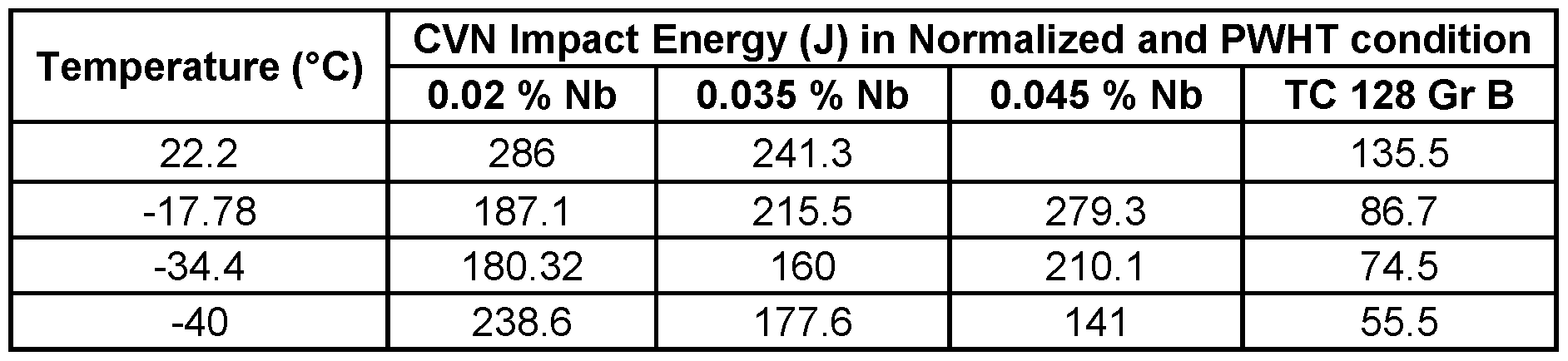
Figure 6 plots the CVN impact toughness vs PWHT scheme from industrial trials of 0.032 Nb inventive steel compared with conventional TC128 Gr. B. It is evident that the impact properties were similar for PWHT of 30 min and 1 hour at 621 °C. Regardless of temperature and time, the impact properties were similar in all the conditions for the 0.032 Nb inventive steel. The symbol · represents the impact energy of 0.032Nb inventive steel, and o represent prior art TC 128 Gr B steel. Table 8 lists the CVN impact toughness of the industrial trail 0.032Nb inventive steel and conventional TC 128 Gr B steel vs test temperature at -34.4°c as plotted in Figure 6.
Table 8

The microstructures of normalized and PWHT steel plates of the inventive steels (with 0.018, 0.032 and 0.045 Nb content, respectively) are shown in Figures 6A to 6C. The microstructure of the prior art TC 128 Gr B steel is shown in Figure 6D. All three examples of the inventive steel showed a mixed ferrite-bainite microstructure with 10% or less pearlite, preferably 5% or less pearlite, most preferably 1 % or less pearlite. The fraction of bainite appears to increase and the ferrite grains become more acicular type with increasing Nb content. In contrast, the microstructure of the prior art TC 128 Gr B steel showed a banded ferrite-pearl ite/ martensite structure with ferrite grains being mostly polygonal.
Weldability Studies
Since microalloying with Nb was an integral part of the alloy design, a weldability evaluation was carried out to examine the CGHAZ (coarse grain heat affected zone) toughness for the three steels with different Nb contents. It is to be noted that tank car manufacturers are conservative about niobium’s influence on the HAZ and weld metal toughness, especially with the typical higher carbon levels in prior art TC 128 steel alloys. The present inventors therefore examined the microalloying influence on the HAZ toughness for Nb levels up to 0.045 wt.%. Laboratory heats with Nb contents of 0.018, 0.032 and 0.045 wt.% were processed to 22 mm thick plates and then normalized for welding study.
Figure 7 plots the transverse CVN impact toughness of the CGHAZ of the inventive steels at the three different niobium levels and the base inventive steel vs
temperature. The symbol · represents the 0.032Nb alloy base metal CVN impact toughness. The symbols ¨,■, and▲ represent the CVN impact toughness of the HAZ of inventive alloys with Nb contents of 0.018, 0.032 and 0.045 wt.% respectively. It should be noted that the HAZ toughness was found to be superior to that observed for the base metal. It can also be seen that Nb in excess of 0.03 wt.% did not contribute much to the CGHAZ toughness in the new steels.
The CGHAZ toughness of the inventive alloys was tested after a high heat input welding process (1 10-120kJ/in) employing only two passes, one pass each side. A two- pass submerged arc welding (SAW) at high heat inputs (-105 kJ/inch) is considered to be the most conservative test condition that the new steel could be subjected to for tank car application. Plates of the inventive alloy composition (as listed in Table 9) were formed. Each plate edge was beveled 40 degrees on each side (front/back) as per welding specification and welded using an LA-85 consumable and 882 flux at heat inputs between 93-105 kJ/inch. An interpass temperature of 150 °C was maintained. For comparison, a commercially produced TC 128 plate was also welded at similar welding parameters. The plates were subsequently heat treated at 600 °C for 30 minutes (as per industry PWHT standards for tank cars).
Table 9

The HAZ toughness for the inventive steel which was welded by the SAW process was excellent at all test temperatures with a significant upper shelf energy value. The toughness values were also significantly higher than that obtained for the
prior art TC 128 steel. Thus, the inventive steel successfully met the HAZ toughness requirements.
Claims
1. A steel alloy plate for use in railroad tank cars, said alloy plate comprising a steel alloy including in wt.%:
C: 0.1 - 0.15; Mn: 1.0 - 1.65; Si: 0.15 - 0.40; Al: 0.015 - 0.06; Mo: 0.1 - 0.3; Ni: 0.1 - 0.25; Nb: 0.015 - 0.045; Ti: up to 0.02; Cr: up to 0.22; V: up to 0.08; Cu: up to 0.35; P: max 0.025; S: max 0.015; and N: 0.004 - 0.01 ;
said alloy plate having been normalized for at least 30 minutes at 900 °C;
said alloy plate has a tensile strength of at least 560 MPa;
said alloy plate has a yield strength of at least 345 MPa;
said alloy plate has an total elongation of at least 22%;
said alloy plate has a CVN impact toughness of at least 135.5 J at -34.4 °C;
said alloy plate has a CVN impact toughness of at least 122 J at -45.5 °C; and said alloy plate has a ferrite-bainite microstructure with 10% or less pearlite.
2. The steel alloy plate of claim 1 , wherein said ferrite-bainite microstructure has 5% or less pearlite.
3. The steel alloy plate of claim 1 , wherein said ferrite-bainite microstructure has 1 % or less pearlite
4. The steel alloy plate of claim 1 , wherein:
said alloy plate has a tensile strength of at least 575 MPa;
said alloy plate has a yield strength of at least 425 MPa; and
said alloy plate has an total elongation of at least 33%.
5. The steel alloy plate of claim 54, wherein:
said alloy plate has a CVN impact toughness of at least 176.2 J at -34.4 °C; and said alloy plate has a CVN impact toughness of at least 203 J at -45.5 °C.
6. The steel alloy plate of claim 1 , wherein:
said alloy plate has a tensile strength of at least 580 MPa;
said alloy plate has a yield strength of at least 460 Mpa; and
said alloy plate has an total elongation of at least 33%.
7. The steel alloy plate of claim 6, wherein:
said alloy plate has a CVN impact toughness of at least 156 J at -34.4 °C; and said alloy plate has a CVN impact toughness of at least 128.8 J at -45.55 °C.
8. The steel alloy plate of claim 1 , wherein said alloy plate has been subjected to a post weld heat treatment of 30 to 60 mins at 600 to 650 °C.
Priority Applications (4)
| Application Number | Priority Date | Filing Date | Title |
|---|---|---|---|
| PCT/IB2018/059773 WO2020115537A1 (en) | 2018-12-07 | 2018-12-07 | Low-carbon, high toughness, steel plates for pressurized tank car applications |
| PCT/IB2019/059989 WO2020115594A1 (en) | 2018-12-07 | 2019-11-20 | Railroad tank cars formed of low-carbon, high toughness, steel plates |
| US17/297,354 US12421585B2 (en) | 2018-12-07 | 2019-11-20 | Railroad tank cars formed of low-carbon, high toughness, steel plates |
| US19/304,834 US20250369080A1 (en) | 2018-12-07 | 2025-08-20 | Method of forming low-carbon, high toughness, steel plates for railroad tank cars |
Applications Claiming Priority (1)
| Application Number | Priority Date | Filing Date | Title |
|---|---|---|---|
| PCT/IB2018/059773 WO2020115537A1 (en) | 2018-12-07 | 2018-12-07 | Low-carbon, high toughness, steel plates for pressurized tank car applications |
Publications (1)
| Publication Number | Publication Date |
|---|---|
| WO2020115537A1 true WO2020115537A1 (en) | 2020-06-11 |
Family
ID=65003434
Family Applications (2)
| Application Number | Title | Priority Date | Filing Date |
|---|---|---|---|
| PCT/IB2018/059773 Ceased WO2020115537A1 (en) | 2018-12-07 | 2018-12-07 | Low-carbon, high toughness, steel plates for pressurized tank car applications |
| PCT/IB2019/059989 Ceased WO2020115594A1 (en) | 2018-12-07 | 2019-11-20 | Railroad tank cars formed of low-carbon, high toughness, steel plates |
Family Applications After (1)
| Application Number | Title | Priority Date | Filing Date |
|---|---|---|---|
| PCT/IB2019/059989 Ceased WO2020115594A1 (en) | 2018-12-07 | 2019-11-20 | Railroad tank cars formed of low-carbon, high toughness, steel plates |
Country Status (2)
| Country | Link |
|---|---|
| US (2) | US12421585B2 (en) |
| WO (2) | WO2020115537A1 (en) |
Families Citing this family (1)
| Publication number | Priority date | Publication date | Assignee | Title |
|---|---|---|---|---|
| KR102255822B1 (en) * | 2019-12-06 | 2021-05-25 | 주식회사 포스코 | Normalling heat treatable steel sheet having godd low impact toughness and method for the same |
Family Cites Families (5)
| Publication number | Priority date | Publication date | Assignee | Title |
|---|---|---|---|---|
| US3277843A (en) * | 1962-11-13 | 1966-10-11 | Gen Am Transport | Railway tank cars |
| KR101482258B1 (en) * | 2007-12-26 | 2015-01-13 | 주식회사 포스코 | High-strength hot-rolled steel sheet excellent in hot-forming workability, molded article using the same, and manufacturing method thereof |
| CN104480393B (en) * | 2014-11-26 | 2016-08-24 | 舞阳钢铁有限责任公司 | Oil groove tank car TC128GrB steel plate and production method thereof |
| CN104831165B (en) * | 2015-04-15 | 2017-08-08 | 武汉钢铁(集团)公司 | With good low-temperature high-toughness normalizing type high-strength pressure vessel steel plate and its manufacture method |
| KR102031499B1 (en) * | 2018-08-07 | 2019-10-11 | 주식회사 포스코 | Steel plate for pressure vessel having excellent strength and impact toughness after post weld heat treatment and method for manufacturing thereof |
-
2018
- 2018-12-07 WO PCT/IB2018/059773 patent/WO2020115537A1/en not_active Ceased
-
2019
- 2019-11-20 US US17/297,354 patent/US12421585B2/en active Active
- 2019-11-20 WO PCT/IB2019/059989 patent/WO2020115594A1/en not_active Ceased
-
2025
- 2025-08-20 US US19/304,834 patent/US20250369080A1/en active Pending
Non-Patent Citations (9)
| Title |
|---|
| "1995 ASME International Mechanical Engineering Congress and Exposition", 12 November 1995, article "Effect of Nb on Weld Metal Toughness in Tank Car Steels", pages: 109 - 117 |
| "Effects of Niobium, Titanium and Nitrogen on the Microstructure and Mechanical Properties of Normalized Tank Car Steel Plates", MATERIALS SCIENCE AND TECHNOLOGY (MS&T, 16 September 2007 (2007-09-16) |
| ALSO C. SHAH; P. NASH, 45TH MECHANICAL WORKING AND STEEL PROCESSING CONFERENCE, 10 November 2003 (2003-11-10) |
| ARUNIM RAY: "Niobium microalloyed rail steels", DEPARTMENT OF MATERIALS SCIENCE AND METALLURGY, UNIVERSITY OF CAMBRIDGE, 30 April 2017 (2017-04-30), Cambridge, pages 1 - 166, XP002793086 * |
| C. SHAH: "Effect of Nb additions on Welding Heat Affected Zone (HAZ) Toughness of 0.2 wt % C Ferrite-Pearlite Steels", MS THESIS IN METALLURGICAL AND MATERIALS ENGINEERING, 2002 |
| KLAUS HULKA: "THE ROLE OF NIOBIUM IN LOW CARBON BAINITIC HSLA STEEL", 31 December 2005 (2005-12-31), XP002793087, Retrieved from the Internet <URL:https://www.phase-trans.msm.cam.ac.uk/2005/LINK/10.pdf> [retrieved on 20190717] * |
| M. MANOHAR, W.E. HEITMANN: "Effects of Niobium, Titanium and Nitrogen on the Microstructure and Mechanical Properties of Normalized Tank Car Steel Plates", MATERIALS SCIENCE AND TECHNOLOGY, vol. 6, 20 September 2007 (2007-09-20), Detroit, pages 17 - 26, XP002793084, ISBN: 978-1-60560-133-5 * |
| P. J. KYED; M. MANOHAR; R. L. BODNAR: "Effects of Niobium Content and Heat Treatment on the Microstructure and Mechanical Properties of Railroad Pressure Tank Car Steel Plates", 45TH MECHANICAL WORKING AND STEEL PROCESSING CONFERENCE PROCEEDINGS, ISS, vol. 41, 2003, pages 43 - 55 |
| R.L. BODNAR, F. HAMAD, C. PENNISTON, S. ROYSUM: "As-Rolled Plate Product With Improved Yileld Strength, Toughness, and Weldability for Pressurized Railroad Tank Cars", MATERIALS SCIRNCE AND TACHNOLOGY, 20 September 2007 (2007-09-20), Detroit, pages 37-52, XP002793085 * |
Also Published As
| Publication number | Publication date |
|---|---|
| WO2020115594A1 (en) | 2020-06-11 |
| US12421585B2 (en) | 2025-09-23 |
| US20220025496A1 (en) | 2022-01-27 |
| US20250369080A1 (en) | 2025-12-04 |
Similar Documents
| Publication | Publication Date | Title |
|---|---|---|
| KR101846759B1 (en) | Steel plate and method for manufacturing same | |
| US11505841B2 (en) | High-strength steel product and method of manufacturing the same | |
| JPWO2018199145A1 (en) | High Mn steel and method of manufacturing the same | |
| CN112236539B (en) | High-tensile thick steel plate for extremely low temperature and method for producing same | |
| WO2014103629A1 (en) | STEEL SHEET HAVING YIELD STRENGTH OF 670-870 N/mm2 AND TENSILE STRENGTH OF 780-940 N/mm2 | |
| EP3034643A1 (en) | Electric-resistance-welded steel pipe with excellent weld quality and method for producing same | |
| JPWO2014038200A1 (en) | Thick high-strength steel excellent in welding heat affected zone CTOD characteristics and method for producing the same | |
| EP2811045A1 (en) | Base metal for high-toughness clad steel plate giving weld with excellent toughness, and process for producing said clad steel plate | |
| JP4547944B2 (en) | Manufacturing method of high strength and high toughness thick steel plate | |
| EP2400041A1 (en) | Steel material for welding and method for producing same | |
| JP3045856B2 (en) | Method for producing high toughness Cu-containing high tensile steel | |
| JPH0152462B2 (en) | ||
| KR102628769B1 (en) | HIGH-Mn STEEL AND MANUFACTURING METHOD THEREFOR | |
| US20250369080A1 (en) | Method of forming low-carbon, high toughness, steel plates for railroad tank cars | |
| CN111788325B (en) | High Mn steel and method for producing same | |
| WO2019082325A1 (en) | Nickel-containing steel for use at low temperatures | |
| JP5741454B2 (en) | Ni-added steel sheet excellent in toughness and productivity in which Charpy test value at −196 ° C. is 100 J or more for both base metal and welded joint, and manufacturing method thereof | |
| EP3835448A1 (en) | Steel for pressure vessel having excellent surface quality and impact toughness, and method for manufacturing same | |
| JP3487262B2 (en) | High strength thick steel plate excellent in CTOD characteristics and method for producing the same | |
| JP7533408B2 (en) | Steel plate and its manufacturing method | |
| JP2781000B2 (en) | Method for producing high-strength steel sheet excellent in HIC resistance and SSC resistance | |
| JP6540111B2 (en) | Ferritic steel | |
| JP3336877B2 (en) | Method for manufacturing thick high strength steel sheet with excellent brittle fracture arrestability and weldability | |
| JP6835054B2 (en) | High-strength steel plate and its manufacturing method | |
| JP7207199B2 (en) | Steel material and its manufacturing method |
Legal Events
| Date | Code | Title | Description |
|---|---|---|---|
| 121 | Ep: the epo has been informed by wipo that ep was designated in this application |
Ref document number: 18830530 Country of ref document: EP Kind code of ref document: A1 |
|
| NENP | Non-entry into the national phase |
Ref country code: DE |
|
| 122 | Ep: pct application non-entry in european phase |
Ref document number: 18830530 Country of ref document: EP Kind code of ref document: A1 |