WO2020100893A1 - 学習装置、推定装置、方法、及びプログラム - Google Patents
学習装置、推定装置、方法、及びプログラム Download PDFInfo
- Publication number
- WO2020100893A1 WO2020100893A1 PCT/JP2019/044331 JP2019044331W WO2020100893A1 WO 2020100893 A1 WO2020100893 A1 WO 2020100893A1 JP 2019044331 W JP2019044331 W JP 2019044331W WO 2020100893 A1 WO2020100893 A1 WO 2020100893A1
- Authority
- WO
- WIPO (PCT)
- Prior art keywords
- label
- learning
- likelihood
- time
- data
- Prior art date
- Legal status (The legal status is an assumption and is not a legal conclusion. Google has not performed a legal analysis and makes no representation as to the accuracy of the status listed.)
- Ceased
Links
Images


Classifications
-
- G—PHYSICS
- G06—COMPUTING OR CALCULATING; COUNTING
- G06N—COMPUTING ARRANGEMENTS BASED ON SPECIFIC COMPUTATIONAL MODELS
- G06N3/00—Computing arrangements based on biological models
- G06N3/02—Neural networks
- G06N3/08—Learning methods
-
- G—PHYSICS
- G06—COMPUTING OR CALCULATING; COUNTING
- G06N—COMPUTING ARRANGEMENTS BASED ON SPECIFIC COMPUTATIONAL MODELS
- G06N20/00—Machine learning
- G06N20/20—Ensemble learning
-
- B—PERFORMING OPERATIONS; TRANSPORTING
- B60—VEHICLES IN GENERAL
- B60W—CONJOINT CONTROL OF VEHICLE SUB-UNITS OF DIFFERENT TYPE OR DIFFERENT FUNCTION; CONTROL SYSTEMS SPECIALLY ADAPTED FOR HYBRID VEHICLES; ROAD VEHICLE DRIVE CONTROL SYSTEMS FOR PURPOSES NOT RELATED TO THE CONTROL OF A PARTICULAR SUB-UNIT
- B60W40/00—Estimation or calculation of non-directly measurable driving parameters for road vehicle drive control systems not related to the control of a particular sub unit, e.g. by using mathematical models
- B60W40/02—Estimation or calculation of non-directly measurable driving parameters for road vehicle drive control systems not related to the control of a particular sub unit, e.g. by using mathematical models related to ambient conditions
- B60W40/06—Road conditions
-
- G—PHYSICS
- G06—COMPUTING OR CALCULATING; COUNTING
- G06F—ELECTRIC DIGITAL DATA PROCESSING
- G06F18/00—Pattern recognition
- G06F18/20—Analysing
- G06F18/21—Design or setup of recognition systems or techniques; Extraction of features in feature space; Blind source separation
- G06F18/214—Generating training patterns; Bootstrap methods, e.g. bagging or boosting
- G06F18/2148—Generating training patterns; Bootstrap methods, e.g. bagging or boosting characterised by the process organisation or structure, e.g. boosting cascade
-
- G—PHYSICS
- G06—COMPUTING OR CALCULATING; COUNTING
- G06F—ELECTRIC DIGITAL DATA PROCESSING
- G06F18/00—Pattern recognition
- G06F18/20—Analysing
- G06F18/21—Design or setup of recognition systems or techniques; Extraction of features in feature space; Blind source separation
- G06F18/217—Validation; Performance evaluation; Active pattern learning techniques
-
- G—PHYSICS
- G06—COMPUTING OR CALCULATING; COUNTING
- G06N—COMPUTING ARRANGEMENTS BASED ON SPECIFIC COMPUTATIONAL MODELS
- G06N3/00—Computing arrangements based on biological models
- G06N3/02—Neural networks
- G06N3/04—Architecture, e.g. interconnection topology
- G06N3/044—Recurrent networks, e.g. Hopfield networks
- G06N3/0442—Recurrent networks, e.g. Hopfield networks characterised by memory or gating, e.g. long short-term memory [LSTM] or gated recurrent units [GRU]
-
- G—PHYSICS
- G06—COMPUTING OR CALCULATING; COUNTING
- G06N—COMPUTING ARRANGEMENTS BASED ON SPECIFIC COMPUTATIONAL MODELS
- G06N3/00—Computing arrangements based on biological models
- G06N3/02—Neural networks
- G06N3/04—Architecture, e.g. interconnection topology
- G06N3/0464—Convolutional networks [CNN, ConvNet]
-
- G—PHYSICS
- G06—COMPUTING OR CALCULATING; COUNTING
- G06N—COMPUTING ARRANGEMENTS BASED ON SPECIFIC COMPUTATIONAL MODELS
- G06N3/00—Computing arrangements based on biological models
- G06N3/02—Neural networks
- G06N3/08—Learning methods
- G06N3/09—Supervised learning
-
- G—PHYSICS
- G08—SIGNALLING
- G08G—TRAFFIC CONTROL SYSTEMS
- G08G1/00—Traffic control systems for road vehicles
- G08G1/01—Detecting movement of traffic to be counted or controlled
- G08G1/0104—Measuring and analyzing of parameters relative to traffic conditions
- G08G1/0108—Measuring and analyzing of parameters relative to traffic conditions based on the source of data
- G08G1/0112—Measuring and analyzing of parameters relative to traffic conditions based on the source of data from the vehicle, e.g. floating car data [FCD]
-
- G—PHYSICS
- G08—SIGNALLING
- G08G—TRAFFIC CONTROL SYSTEMS
- G08G1/00—Traffic control systems for road vehicles
- G08G1/01—Detecting movement of traffic to be counted or controlled
- G08G1/0104—Measuring and analyzing of parameters relative to traffic conditions
- G08G1/0125—Traffic data processing
- G08G1/0129—Traffic data processing for creating historical data or processing based on historical data
-
- G—PHYSICS
- G06—COMPUTING OR CALCULATING; COUNTING
- G06F—ELECTRIC DIGITAL DATA PROCESSING
- G06F2218/00—Aspects of pattern recognition specially adapted for signal processing
- G06F2218/08—Feature extraction
- G06F2218/10—Feature extraction by analysing the shape of a waveform, e.g. extracting parameters relating to peaks
-
- G—PHYSICS
- G06—COMPUTING OR CALCULATING; COUNTING
- G06N—COMPUTING ARRANGEMENTS BASED ON SPECIFIC COMPUTATIONAL MODELS
- G06N3/00—Computing arrangements based on biological models
- G06N3/02—Neural networks
- G06N3/04—Architecture, e.g. interconnection topology
- G06N3/044—Recurrent networks, e.g. Hopfield networks
-
- G—PHYSICS
- G06—COMPUTING OR CALCULATING; COUNTING
- G06N—COMPUTING ARRANGEMENTS BASED ON SPECIFIC COMPUTATIONAL MODELS
- G06N3/00—Computing arrangements based on biological models
- G06N3/02—Neural networks
- G06N3/04—Architecture, e.g. interconnection topology
- G06N3/045—Combinations of networks
Definitions
- the present invention relates to a learning device, an estimation device, a method, and a program, and more particularly to a learning device, an estimation device, a method, and a program for estimating a target state.
- Non-Patent Documents 1 and 2 See, for example, Non-Patent Documents 1 and 2).
- the road surface condition estimation as described above is often performed using a model constructed by machine learning using learning data. However, depending on the condition of the road surface, there is a problem that the desired estimation result cannot be obtained and the estimation accuracy is not sufficient.
- the present invention has been made in view of the above circumstances, and an object of the present invention is to provide a learning device, method, and program capable of learning a model for accurately estimating a label indicating a data state. Moreover, it aims at providing the estimation apparatus, method, and program which can estimate the label which shows the condition of data accurately.
- a learning device is learning data that is time-series data, and includes learning data to which any one of a plurality of types of labels is assigned as a correct answer label at each time.
- a first model for obtaining the likelihood of the label is learned for each label by a predetermined machine learning with a learning data set as an input, and for each of the learning data, the likelihood of each time for each label.
- a first learning unit that outputs time-series likelihood data that is, and input the time-series likelihood data for each of the learning data, to which the correct labels have been given, as input, and for each label by predetermined machine learning.
- a second learning unit that learns a second model for outputting any label from the change in the likelihood.
- the estimation device inputs the time-series data to a learned first model for obtaining the likelihood of the label for each of a plurality of types of labels, and the label at each time for each label. And a learned second for outputting the estimated likelihood of the label at each time for each label, based on a change in the likelihood of each label.
- a second estimation unit that inputs to the model and estimates one of the labels corresponding to the likelihood at each time for each label.
- the first learning unit is learning data that is time-series data, and is learning data including any one of a plurality of types of labels as correct labels for each time.
- a first model for obtaining the likelihood of the label is learned for each label by a predetermined machine learning using a set as an input, and for each of the learning data, it is the likelihood of each time for each label.
- Outputting the time-series likelihood data, and the second learning unit inputs the time-series likelihood data for each of the learning data, to which the correct label is given, as input, and performs the label by predetermined machine learning.
- a step of learning a second model for outputting one of the labels based on the change in the likelihood for each.
- the first estimation unit inputs the time-series data into a learned first model for obtaining the likelihood of the label for each of a plurality of types of labels, and the first model for each label.
- a step of estimating the likelihood of the label at time, and a second estimating unit outputs the estimated likelihood of the label at each time for each label, and outputs any label from the change in the likelihood for each label.
- the program according to the fifth invention is a program for causing a computer to function as each unit of the learning device according to the first invention.
- the program according to the sixth invention is a program for causing a computer to function as each unit of the estimation device according to the second invention.
- the learning device, the method, and the program of the present invention it is possible to obtain an effect that a model for estimating a label indicating a data condition can be learned with high accuracy. Further, according to the estimation device, method, and program of the present invention, it is possible to obtain an effect that the label indicating the status of data can be estimated with high accuracy.
- the likelihood obtained in the time series for each label is used, learning is performed by incorporating the change in the likelihood in the time series of the label, and the estimation accuracy is improved.
- FIG. 1 shows an example of estimation results of the state of the road surface on which a moving body moves by conventional machine learning.
- FIG. 1 shows a correct label and an estimation result of likelihood of each estimation class, and is a graph in which the vertical axis represents likelihood and the horizontal axis represents time series time.
- the time series time is 100 ms.
- the unit of 100 ms is the unit time for shifting the batch at the time of learning, and the graph of FIG.
- “time” shown in the embodiments of the present invention represents a unit time of 100 ms.
- the estimated class of the condition of the road surface on which the moving body moves is “flat” indicating a flat road, “stationary” indicating that the moving body is in a stationary state, “staircase ⁇ ” indicating an up staircase, and “staircase” indicating a down staircase. ⁇ ”.
- the likelihood of the desired label may not always be the highest in the likelihood of the estimation result.
- the correct answer label in the time series 1 to 71 is “staircase ⁇ ”, but the likelihood of the label “flat” shown in (B) is higher than the likelihood of the label “staircase ⁇ ” shown in (A).
- machine learning is performed in two steps so as to capture the change in likelihood when capturing the entire time series of labels. As a result, a desired label can be estimated even if the learning data is biased.
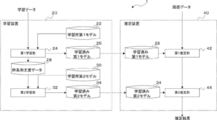
- the estimation system 1 includes a learning device 20 and an estimation device 40.
- Each of the learning device 20 and the estimation device 40 can be configured by a computer including a CPU, a RAM, and a ROM that stores a program and various data for executing processing of the operation described below.
- a learning data set including learning data that is time series data is input to the learning device 20.
- learning data road surface data detected in time series by a plurality of types of sensors that detect the state of the moving object that is the estimation target is used.
- one of a plurality of types of labels is given as a correct answer label every time.
- the label is the type of road surface condition such as “flat”, “stationary”, “stair ⁇ ”, “stair ⁇ ”, etc. It is also possible to subdivide the condition of the road surface and use a label such as "2 cm step ⁇ ".
- the model for learning the likelihood for each label is learned from the input data obtained from the road surface data by shifting the window having a width of 1500 ms by 100 ms.
- the correct answer class is the condition of the road surface corresponding to the time of 750 ms which is the center of the window.
- the window width may be shorter than 1500 ms.
- various sensors such as an acceleration sensor, a gyro sensor, a geomagnetic sensor, a gravity sensor, an atmospheric pressure sensor, and an inclination sensor can be appropriately used according to the estimation target.
- the learning device 20 includes a first learning unit 24 and a second learning unit 32.
- the first learning unit 24 constructs a learned first model 26 using the learning first model 22.
- the first learning model 22 is a model for obtaining the likelihood of the label for each label.
- the second learning unit 32 constructs the learned second model 34 using the learning second model 30.
- various machine learning such as CNN (Convolutional Neural Network), RNN (Recurrent Neural Network), LSTM (Long short-term memory), SVM (Support Vector Machine), etc. Can be used.
- the first learning unit 24 receives the learning data set as an input, learns the parameters of the first model for learning 22 by machine learning, and constructs the learned first model 26. Specifically, the parameters of the learning first model 22 are learned so that the likelihood of the correct label is highest from the input data and the correct label obtained from the learning data by shifting the window having the width of 1500 ms by 100 ms. To do. Further, the first learning unit 24 assigns a correct answer label to the likelihood of each time for each label of each of the learning data obtained in the learning process, and stores it as the time series likelihood data 28. The correct answer label is given, for example, by giving the correct answer label corresponding to time to each of the likelihoods of the labels “flat”, “still”, “stair ⁇ ”, and “stair ⁇ ”. For example, if it is the likelihood of each label from time 1 to 71 shown in FIG. 1, “staircase ⁇ ” is given as the correct label.
- the second learning unit 32 receives the time-series likelihood data 28 as an input and learns the parameters of the learning second model 30 for outputting any label from the change in the likelihood of each label by machine learning,
- the learned second model 34 is constructed.
- the parameters of the second model for learning 30 are learned by using the change of the likelihood.
- the second model for learning 30 outputs one of the labels by using the information about the likelihood of the label at each time as compared with the average likelihood of the label of interest. To do.
- the second learning unit 32 uses the change in the likelihood obtained from the time-series likelihood data 28 as learning data to learn the second learning model 30.
- the batch size may be set to 64 to 512, the number of times of learning is set to 500, the number of epochs (the number of times of repeating the learning unit where the number of times of learning is 1) is set to 50, and the like may be performed. ..
- machine learning may be performed in the same manner for the batch size, the number of times of learning, and the number of epochs.
- 1024, 2048, 4096 or the like may be used as a batch size different from that of the first learning unit 24. Thereby, learning can be performed so that the bias of the likelihood is reduced in consideration of the case where there is a correct answer label that is included in the learning data in a small number.
- the estimation device 40 will be described.
- Road surface data detected in time series by a sensor mounted on a moving body moving on the road surface is input to the estimation device 40. It is assumed that the state of the moving body at each time is detected in time series from the road surface data.
- the estimation device 40 has a learned first model 26 for obtaining the likelihood of a label for each of a plurality of types of labels, and a learned second model 34 for outputting any label from the change in the likelihood of each label. Labels are estimated using and.
- the estimated labels are “flat”, “still”, “stairs ⁇ ”, “stairs ⁇ ”, etc. used as the correct labels of the learning data of the learning device 20.
- the first estimation unit 42 inputs the road surface data, which is time-series data, into the learned first model 26, estimates the likelihood of the label for each label for each time, and outputs the likelihood to the second estimation unit 44. Specifically, the likelihood of each label is estimated using the learned first model 26 for each of the input data obtained from the road surface data by shifting the window having the width of 1500 ms by 100 ms. Obtain the likelihood of the label at each time.
- the second estimating unit 44 inputs the likelihood of the label at each time for each label estimated by the first estimating unit 42 to the learned second model 34, and corresponds to the likelihood at each time for each label, Estimate either label.
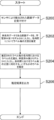
- step S100 the learning device 20 receives an input of a learning data set including learning data which is time series data.
- the learning data is road surface data detected by the sensor in time series.
- step S102 the first learning unit 24 receives the learning data set as an input and learns the parameters of the first model for learning 22 by machine learning to construct the learned first model 26.
- step S104 the first learning unit 24 assigns the correct answer label to the likelihood of each time for each label of each of the learning data obtained in the learning process, and stores it as the time series likelihood data 28. ..
- step S ⁇ b> 106 the second learning unit 32 receives the time-series likelihood data 28 as an input, and uses machine learning to output parameters of the second model for learning 30 for outputting one of the labels from the change in the likelihood of each label. Are learned and the learned second model 34 is constructed.
- step S200 the estimation device 40 receives an input of road surface data detected by the sensor in time series.
- step S202 the first estimation unit 42 inputs the road surface data, which is time-series data, into the learned first model 26, estimates the likelihood of the label for each label for each time, and causes the second estimation unit 44 to perform the estimation. Output.
- step S204 the second estimation unit 44 inputs the likelihood of the label at each time for each label estimated by the first estimation unit 42 to the learned second model 34, and the likelihood at each time for each label. Estimate any label corresponding to.
- step S206 the estimation device 40 outputs the label estimation result obtained in step S204.
- the learning device 20 learns the first model for obtaining the likelihood of the label for each label, and the learning data for each label.
- the time-series likelihood data which is the likelihood of each time, is output. Further, the time-series likelihood data for each of the learning data to which the correct answer label is given is input, and the second model for outputting any label from the change in the likelihood for each label is learned by machine learning. ..
- the second model for outputting any label from the change in the likelihood for each label is learned by machine learning. ..
- the estimation device 40 inputs the time-series data to the trained first model for obtaining the likelihood of the label for each of a plurality of types of labels, and estimates the likelihood of the label at each time for each label.
- the estimated label likelihood at each time is input to the trained second model for outputting any label from the change in the likelihood at each label, and the likelihood at each label time is input. Estimate one of the labels corresponding to the degree. This makes it possible to accurately estimate the label indicating the status of the data.
- the learning device 20 and the estimation device 40 can also be realized by using a computer.
- a computer stores a program describing the processing content for realizing each function of the learning device 20 and the estimation device 40 in the storage unit of the computer, and causes the CPU of the computer to read and execute the program. It can be realized.
- the present invention is not limited to this, and the embodiment of the present invention can be applied to data detected at each time of a time series.
Landscapes
- Engineering & Computer Science (AREA)
- Theoretical Computer Science (AREA)
- Physics & Mathematics (AREA)
- Data Mining & Analysis (AREA)
- General Physics & Mathematics (AREA)
- Artificial Intelligence (AREA)
- Evolutionary Computation (AREA)
- General Engineering & Computer Science (AREA)
- Life Sciences & Earth Sciences (AREA)
- Software Systems (AREA)
- Mathematical Physics (AREA)
- Computing Systems (AREA)
- Computer Vision & Pattern Recognition (AREA)
- Biomedical Technology (AREA)
- Health & Medical Sciences (AREA)
- Biophysics (AREA)
- Computational Linguistics (AREA)
- General Health & Medical Sciences (AREA)
- Molecular Biology (AREA)
- Evolutionary Biology (AREA)
- Bioinformatics & Computational Biology (AREA)
- Bioinformatics & Cheminformatics (AREA)
- Chemical & Material Sciences (AREA)
- Analytical Chemistry (AREA)
- Medical Informatics (AREA)
- Automation & Control Theory (AREA)
- Transportation (AREA)
- Mechanical Engineering (AREA)
- Traffic Control Systems (AREA)
- Image Analysis (AREA)
Abstract
精度よくデータの状況を示すラベルを推定するためのモデルを学習できる。 ラベル毎にラベルの尤度を求めるための第1モデルを学習し、学習データの各々について、ラベル毎の各時間の尤度である時系列尤度データを出力し、正解ラベルを付与した、学習データの各々についての時系列尤度データを入力として、機械学習によって、ラベル毎の尤度の変化からいずれかのラベルを出力するための第2モデルを学習する。
Description
本発明は、学習装置、推定装置、方法、及びプログラムに係り、特に、対象の状態を推定するための学習装置、推定装置、方法、及びプログラムに関する。
歩道あるいは車道などの路面上を移動する自動車、歩行者、車椅子などの移動体に搭載されたセンサを用いて、移動体が移動する路面の状況(段差、勾配など)を推定する技術が検討されている(例えば、非特許文献1、2参照)。
宮田章裕、荒木伊織、王統順、鈴木天詩、「健常歩行者センサデータを用いたバリア検出の基礎検討」、IPSJ論文誌(2018)
「高速バスに載せたスマホの加速度センサーで路面の凹凸を検知、検証試験を実施」、[online]、[2018年11月6日検索]、インターネット<URL:https://sgforum.impress.co.jp/news/3595>
上述したような路面の状況の推定は、学習データを用いた機械学習により構築されたモデルを用いて行われることが多い。しかしながら、路面の状況によっては、所望の推定結果が得られず、推定精度が十分でないという問題がある。
本発明は、上記事情を鑑みて成されたものであり、精度よくデータの状況を示すラベルを推定するためのモデルを学習できる学習装置、方法、及びプログラムを提供することを目的とする。また、精度よくデータの状況を示すラベルを推定することができる推定装置、方法、及びプログラムを提供することを目的とする。
上記目的を達成するために、第1の発明に係る学習装置は、時系列データである学習データであって、時間毎に複数種類のいずれかのラベルが正解ラベルとして付与された学習データからなる学習データ集合を入力として、予め定めた機械学習によって、前記ラベル毎に前記ラベルの尤度を求めるための第1モデルを学習し、前記学習データの各々について、前記ラベル毎の各時間の尤度である時系列尤度データを出力する第1学習部と、前記正解ラベルを付与した、前記学習データの各々についての前記時系列尤度データを入力として、予め定めた機械学習によって、前記ラベル毎の尤度の変化からいずれかのラベルを出力するための第2モデルを学習する第2学習部と、を含んで構成されている。
また、第2の発明に係る推定装置は、時系列データを、複数種類のラベル毎に前記ラベルの尤度を求めるための学習済み第1モデルに入力し、前記ラベル毎の各時間における前記ラベルの尤度を推定する第1推定部と、推定された前記ラベル毎の各時間における前記ラベルの尤度を、ラベル毎の尤度の変化からいずれかのラベルを出力するための学習済み第2モデルに入力し、前記ラベル毎の各時間における尤度に対応する、いずれかのラベルを推定する第2推定部と、を含んで構成されている。
第3の発明に係る学習方法は、第1学習部が、時系列データである学習データであって、時間毎に複数種類のいずれかのラベルが正解ラベルとして付与された学習データからなる学習データ集合を入力として、予め定めた機械学習によって、前記ラベル毎に前記ラベルの尤度を求めるための第1モデルを学習し、前記学習データの各々について、前記ラベル毎の各時間の尤度である時系列尤度データを出力するステップと、第2学習部が、前記正解ラベルを付与した、前記学習データの各々についての前記時系列尤度データを入力として、予め定めた機械学習によって、前記ラベル毎の尤度の変化からいずれかのラベルを出力するための第2モデルを学習するステップと、を含んで実行することを特徴とする。
第4の発明に係る推定方法は、第1推定部が、時系列データを、複数種類のラベル毎に前記ラベルの尤度を求めるための学習済み第1モデルに入力し、前記ラベル毎の各時間における前記ラベルの尤度を推定するステップと、第2推定部が、推定された前記ラベル毎の各時間における前記ラベルの尤度を、ラベル毎の尤度の変化からいずれかのラベルを出力するための学習済み第2モデルに入力し、前記ラベル毎の各時間における尤度に対応する、いずれかのラベルを推定するステップと、を含んで実行することを特徴とする。
第5の発明に係るプログラムは、コンピュータを、第1の発明に記載の学習装置の各部として機能させるためのプログラムである。
第6の発明に係るプログラムは、コンピュータを、第2の発明に記載の推定装置の各部として機能させるためのプログラムである。
本発明の学習装置、方法、及びプログラムによれば、精度よくデータの状況を示すラベルを推定するためのモデルを学習できる、という効果が得られる。また、本発明の推定装置、方法、及びプログラムによれば、精度よくデータの状況を示すラベルを推定することができる、という効果が得られる。
以下、図面を参照して本発明の実施の形態を詳細に説明する。
<本発明の実施の形態に係る概要>
まず、本発明の実施の形態における概要を説明する。本発明の実施の形態では、ラベル毎の時系列に得られた尤度を用いることで、ラベルの時系列における尤度の変化を取り入れて学習を行い、推定精度を向上させる。
図1に従来の機械学習による移動体が移動する路面の状況の推定結果の一例を示す。図1は、正解ラベルと、推定クラスの各々の尤度の推定結果とを表すものであり、縦軸に尤度、横軸に時系列の時間をとったグラフである。時系列の時間は100ms単位としている。ここでは、100ms単位は学習時にバッチをずらす単位時間としており、図1のグラフでは1ごとに100msの時間推移があることを表している。以下、本発明の実施の形態において示す「時間」は100msの単位時間を表すものである。移動体が移動する路面の状況の推定クラスは、平坦路を示す「平坦」、移動体が静止状態であることを示す「静止」、上り階段を示す「階段↑」、下り階段を示す「階段↓」である。時系列の各時間には正解ラベルが割り当てられるが、推定結果の尤度では、必ずしも所望のラベルの尤度が最も高くならない場合がある。例えば、時系列の時間1~71の正解ラベルは「階段↑」であるが、(A)に示したラベル「階段↑」の尤度よりも、(B)に示したラベル「平坦」の尤度の方が高く、正しい結果が得られない問題がある。そこで、本発明の実施の形態では、ラベルの時系列全体で捉えた場合の尤度の変化を捉えるように二段階で機械学習を行う。これにより、学習データに偏りがあったとしても、所望のラベルを推定できる。
以上の前提を元に本発明の実施の形態について説明する。
<本発明の実施の形態に係る構成>
次に、本発明の実施の形態に係る構成について説明する。図2に示すように、本発明の実施の形態に係る推定システム1は、学習装置20と、推定装置40とを含んで構成されている。学習装置20、及び推定装置40はそれぞれ、CPUと、RAMと、後述する作用の処理を実行するためのプログラムや各種データを記憶したROMと、を含むコンピュータで構成することが出来る。
まず、学習装置20について説明する。学習装置20には、時系列データである学習データからなる学習データ集合が入力される。学習データには、推定対象である移動体の状態を検出する複数種類のセンサにより時系列に検出された路面データを用いる。また、学習データには、時間毎に複数種類のいずれかのラベルを正解ラベルとして付与している。ラベルは、「平坦」、「静止」、「階段↑」、「階段↓」等の移動体が移動する路面の状況の種類とする。路面の状況を細分化して、「2cmの段差↑」等のラベルを用いてもよい。本実施の形態では、幅1500msとする窓を100msずつずらして路面データから得られる入力データから、ラベル毎の尤度を求めるためのモデルの学習を行う想定である。正解クラスは窓の中心である750msの時点に対応する路面の状況とする。リアルタイムで学習、及び推定を行う場合には、窓幅を1500msよりも短くしてもよい。センサとしては、加速度センサ、ジャイロセンサ、地磁気センサ、重力センサ、気圧センサ、及び傾きセンサなど種々のセンサを、推定の対象に合わせて適宜、利用することができる。
学習装置20は、第1学習部24と、第2学習部32とを備える。第1学習部24は、学習用第1モデル22を用いて学習済み第1モデル26を構築する。学習用第1モデル22は、ラベル毎に当該ラベルの尤度を求めるためのモデルである。第2学習部32は、学習用第2モデル30を用いて学習済み第2モデル34を構築する。学習用第1モデル22、学習用第2モデル30としては、CNN(Convolutional Neural Network)、RNN(Recurrent Neural Network)、LSTM(Long short-term memory)、SVM(Support Vector Machine)など種々の機械学習のモデルを用いることができる。
第1学習部24は、学習データ集合を入力として、機械学習によって、学習用第1モデル22のパラメータを学習し、学習済み第1モデル26を構築する。具体的には、幅1500msとする窓を100msずつずらして学習データから得られる入力データと正解ラベルとから、正解ラベルの尤度が最も高くなるように、学習用第1モデル22のパラメータを学習する。また、第1学習部24は、学習過程で得られた、学習データの各々についてのラベル毎の各時間の尤度に、正解ラベルを付与して、時系列尤度データ28として記憶する。正解ラベルの付与は、例えば、「平坦」、「静止、「階段↑」、「階段↓」のラベルの尤度のそれぞれに対して、時間に対応する正解ラベルを付与することにより行う。例えば図1に示した時間1~71の各ラベルの尤度であれば、「階段↑」を正解ラベルとして付与する。
第2学習部32は、時系列尤度データ28を入力として、機械学習によって、ラベル毎の尤度の変化からいずれかのラベルを出力するための学習用第2モデル30のパラメータを学習し、学習済み第2モデル34を構築する。第2学習部32の学習では、尤度の変化を用いた学習用第2モデル30のパラメータの学習を行う。学習用第2モデル30は、着目したあるラベルの平均の尤度と比べて、当該ラベルの各時間の尤度がどの程度の尤度であるかという情報を用いて、いずれかのラベルを出力する。第2学習部32は、このような時系列尤度データ28から得られる尤度の変化を学習データとして用いて学習用第2モデル30の学習を行う。
第1学習部24の機械学習では、例えば、バッチサイズを64~512、学習回数を500、エポック数(学習回数を1とした学習単位を繰り返す回数)を50等と定めて学習を行えばよい。第2学習部32においても、バッチサイズ、学習回数、及びエポック数は同様にして機械学習を行えばよい。なお、第2学習部32における機械学習で、第1学習部24と異なるバッチサイズとして、1024、2048、又は4096等を用いてもよい。これにより、学習データに含まれる数が少ない正解ラベルがある場合を考慮して、尤度の偏りが少なくなるように学習が行える。
次に、推定装置40について説明する。推定装置40には、路面上を移動する移動体に搭載されたセンサにより時系列に検出された路面データが入力される。路面データにより、時系列に各時間の移動体の状態が検出されているものとする。推定装置40は、複数種類のラベル毎にラベルの尤度を求めるための学習済み第1モデル26、及びラベル毎の尤度の変化からいずれかのラベルを出力するための学習済み第2モデル34、を用いてラベルの推定を行う。推定されるラベルは、上記学習装置20の学習データの正解ラベルとして用いた「平坦」、「静止」、「階段↑」、「階段↓」等である。
第1推定部42は、時系列データである路面データを、学習済み第1モデル26に入力し、各時間についてラベル毎のラベルの尤度を推定し、第2推定部44に出力する。具体的には、幅1500msとする窓を100msずつずらして路面データから得られる入力データの各々に対して、学習済み第1モデル26を用いて、ラベル毎の尤度を推定し、ラベル毎の各時間におけるラベルの尤度を求める。
第2推定部44は、第1推定部42で推定されたラベル毎の各時間におけるラベルの尤度を、学習済み第2モデル34に入力し、ラベル毎の各時間における尤度に対応する、いずれかのラベルを推定する。
<本発明の実施の形態に係る作用>
次に、本発明の実施の形態に係る推定システム1の作用について説明する。
まず、図3のフローチャートを参照して学習装置20の作用を説明する。
ステップS100で、学習装置20は、時系列データである学習データからなる学習データ集合の入力を受け付ける。学習データはセンサにより時系列に検出された路面データである。
ステップS102で、第1学習部24は、学習データ集合を入力として、機械学習によって、学習用第1モデル22のパラメータを学習し、学習済み第1モデル26を構築する。
ステップS104で、第1学習部24は、学習過程で得られた、学習データの各々についてのラベル毎の各時間の尤度に、正解ラベルを付与して、時系列尤度データ28として記憶する。
ステップS106で、第2学習部32は、時系列尤度データ28を入力として、機械学習によって、ラベル毎の尤度の変化からいずれかのラベルを出力するための学習用第2モデル30のパラメータを学習し、学習済み第2モデル34を構築する。
次に、図4のフローチャートを参照して推定装置40の作用を説明する。
ステップS200で、推定装置40は、センサにより時系列に検出された路面データの入力を受け付ける。
ステップS202で、第1推定部42は、時系列データである路面データを、学習済み第1モデル26に入力し、各時間についてラベル毎のラベルの尤度を推定し、第2推定部44に出力する。
ステップS204で、第2推定部44は、第1推定部42で推定されたラベル毎の各時間におけるラベルの尤度を、学習済み第2モデル34に入力し、ラベル毎の各時間における尤度に対応する、いずれかのラベルを推定する。
ステップS206で、推定装置40は、ステップS204で得られたラベルの推定結果を出力する。
以上、説明したように、本発明の実施の形態の推定システム1では、学習装置20によって、ラベル毎にラベルの尤度を求めるための第1モデルを学習し、学習データの各々について、ラベル毎の各時間の尤度である時系列尤度データを出力する。また、正解ラベルを付与した、学習データの各々についての時系列尤度データを入力として、機械学習によって、ラベル毎の尤度の変化からいずれかのラベルを出力するための第2モデルを学習する。これにより、精度よくデータの状況を示すラベルを推定するためのモデルを学習できる。
また、推定装置40によって、時系列データを、複数種類のラベル毎にラベルの尤度を求めるための学習済み第1モデルに入力し、ラベル毎の各時間におけるラベルの尤度を推定する。また、推定されたラベル毎の各時間におけるラベルの尤度を、ラベル毎の尤度の変化からいずれかのラベルを出力するための学習済み第2モデルに入力し、ラベル毎の各時間における尤度に対応する、いずれかのラベルを推定する。これにより、精度よくデータの状況を示すラベルを推定することができる。
また、学習装置20及び推定装置40は、コンピュータを用いて実現することも可能である。そのようなコンピュータは、学習装置20及び推定装置40の各機能を実現する処理内容を記述したプログラムを、該コンピュータの記憶部に格納しておき、該コンピュータのCPUによってこのプログラムを読み出して実行させることで実現することができる。
なお、本発明は、上述した実施の形態に限定されるものではなく、この発明の要旨を逸脱しない範囲内で様々な変形や応用が可能である。
例えば、入力として路面データを用いる場合を例に説明したが、これに限定されるものではなく、時系列の時間毎に検出されたデータであれば本発明の実施の形態を適用できる。
1 推定システム
20 学習装置
22 学習用第1モデル
24 第1学習部
26 学習済み第1モデル
28 時系列尤度データ
30 学習用第2モデル
32 第2学習部
34 学習済み第2モデル
40 推定装置
42 第1推定部
44 第2推定部
20 学習装置
22 学習用第1モデル
24 第1学習部
26 学習済み第1モデル
28 時系列尤度データ
30 学習用第2モデル
32 第2学習部
34 学習済み第2モデル
40 推定装置
42 第1推定部
44 第2推定部
Claims (8)
- 時系列データである学習データであって、時間毎に複数種類のいずれかのラベルが正解ラベルとして付与された学習データからなる学習データ集合を入力として、予め定めた機械学習によって、前記ラベル毎に前記ラベルの尤度を求めるための第1モデルを学習し、前記学習データの各々について、前記ラベル毎の各時間の尤度である時系列尤度データを出力する第1学習部と、
前記正解ラベルを付与した、前記学習データの各々についての前記時系列尤度データを入力として、予め定めた機械学習によって、前記ラベル毎の尤度の変化からいずれかのラベルを出力するための第2モデルを学習する第2学習部と、
を含む学習装置。 - 前記学習データを、対象の状態を検出するセンサによって時系列に検出された路面データとし、
前記ラベルを、前記対象が移動する路面の状況の種類とする請求項1に記載の学習装置。 - 時系列データを、複数種類のラベル毎に前記ラベルの尤度を求めるための学習済み第1モデルに入力し、前記ラベル毎の各時間における前記ラベルの尤度を推定する第1推定部と、
推定された前記ラベル毎の各時間における前記ラベルの尤度を、ラベル毎の尤度の変化からいずれかのラベルを出力するための学習済み第2モデルに入力し、前記ラベル毎の各時間における尤度に対応する、いずれかのラベルを推定する第2推定部と、
を含む推定装置。 - 前記時系列データを、対象の状態を検出するセンサによって時系列に検出された路面データとし、
前記ラベルを、前記対象が移動する路面の状況の種類とする請求項3に記載の推定装置。 - 第1学習部が、時系列データである学習データであって、時間毎に複数種類のいずれかのラベルが正解ラベルとして付与された学習データからなる学習データ集合を入力として、予め定めた機械学習によって、前記ラベル毎に前記ラベルの尤度を求めるための第1モデルを学習し、前記学習データの各々について、前記ラベル毎の各時間の尤度である時系列尤度データを出力するステップと、
第2学習部が、前記正解ラベルを付与した、前記学習データの各々についての前記時系列尤度データを入力として、予め定めた機械学習によって、前記ラベル毎の尤度の変化からいずれかのラベルを出力するための第2モデルを学習するステップと、
を含む学習方法。 - 第1推定部が、時系列データを、複数種類のラベル毎に前記ラベルの尤度を求めるための学習済み第1モデルに入力し、前記ラベル毎の各時間における前記ラベルの尤度を推定するステップと、
第2推定部が、推定された前記ラベル毎の各時間における前記ラベルの尤度を、ラベル毎の尤度の変化からいずれかのラベルを出力するための学習済み第2モデルに入力し、前記ラベル毎の各時間における尤度に対応する、いずれかのラベルを推定するステップと、
を含む推定方法。 - コンピュータを、請求項1又は請求項2に記載の学習装置の各部として機能させるためのプログラム。
- コンピュータを、請求項3又は請求項4に記載の推定装置の各部として機能させるためのプログラム。
Priority Applications (1)
| Application Number | Priority Date | Filing Date | Title |
|---|---|---|---|
| US17/293,728 US20220004934A1 (en) | 2018-11-16 | 2019-11-12 | Training device, estimation device, method and program |
Applications Claiming Priority (2)
| Application Number | Priority Date | Filing Date | Title |
|---|---|---|---|
| JP2018215848A JP2020086597A (ja) | 2018-11-16 | 2018-11-16 | 学習装置、推定装置、方法、及びプログラム |
| JP2018-215848 | 2018-11-16 |
Publications (1)
| Publication Number | Publication Date |
|---|---|
| WO2020100893A1 true WO2020100893A1 (ja) | 2020-05-22 |
Family
ID=70730331
Family Applications (1)
| Application Number | Title | Priority Date | Filing Date |
|---|---|---|---|
| PCT/JP2019/044331 Ceased WO2020100893A1 (ja) | 2018-11-16 | 2019-11-12 | 学習装置、推定装置、方法、及びプログラム |
Country Status (3)
| Country | Link |
|---|---|
| US (1) | US20220004934A1 (ja) |
| JP (1) | JP2020086597A (ja) |
| WO (1) | WO2020100893A1 (ja) |
Families Citing this family (3)
| Publication number | Priority date | Publication date | Assignee | Title |
|---|---|---|---|---|
| JP2023174332A (ja) * | 2022-05-27 | 2023-12-07 | 日本製鉄株式会社 | 演算装置、予測装置、演算プログラムおよび予測モデル生成方法 |
| CN116680325B (zh) * | 2023-06-25 | 2025-09-05 | 杭州电子科技大学 | 基于属性关联性的时序记录链接数据匹配方法及装置 |
| CN121351898A (zh) * | 2025-09-30 | 2026-01-16 | 香港科技大学 | 基于脉冲神经网络的数据处理方法、装置、设备及介质 |
Citations (2)
| Publication number | Priority date | Publication date | Assignee | Title |
|---|---|---|---|---|
| US9882999B1 (en) * | 2017-06-28 | 2018-01-30 | Facebook, Inc. | Analyzing tracking requests generated by client devices interacting with a website |
| JP2018124126A (ja) * | 2017-01-31 | 2018-08-09 | 株式会社アイエスピー | 移動体の状態を検知するための方法、プログラム、及び装置 |
Family Cites Families (3)
| Publication number | Priority date | Publication date | Assignee | Title |
|---|---|---|---|---|
| JP5984153B2 (ja) * | 2014-09-22 | 2016-09-06 | インターナショナル・ビジネス・マシーンズ・コーポレーションInternational Business Machines Corporation | 情報処理装置、プログラム、及び情報処理方法 |
| JP2017027227A (ja) * | 2015-07-17 | 2017-02-02 | 日本電信電話株式会社 | ラベル推定関数学習装置、方法、ラベル推定装置、方法及びプログラム |
| US20200050971A1 (en) * | 2018-08-08 | 2020-02-13 | International Business Machines Corporation | Minibatch Parallel Machine Learning System Design |
-
2018
- 2018-11-16 JP JP2018215848A patent/JP2020086597A/ja active Pending
-
2019
- 2019-11-12 WO PCT/JP2019/044331 patent/WO2020100893A1/ja not_active Ceased
- 2019-11-12 US US17/293,728 patent/US20220004934A1/en not_active Abandoned
Patent Citations (2)
| Publication number | Priority date | Publication date | Assignee | Title |
|---|---|---|---|---|
| JP2018124126A (ja) * | 2017-01-31 | 2018-08-09 | 株式会社アイエスピー | 移動体の状態を検知するための方法、プログラム、及び装置 |
| US9882999B1 (en) * | 2017-06-28 | 2018-01-30 | Facebook, Inc. | Analyzing tracking requests generated by client devices interacting with a website |
Non-Patent Citations (1)
| Title |
|---|
| TSUBOSHITA, YUKIHIRO: "Image annotation using adapted gaussian mixture model", TECHNICAL REPORT OF IEICE, vol. 111, no. 353, December 2011 (2011-12-01), pages 113 - 118 * |
Also Published As
| Publication number | Publication date |
|---|---|
| US20220004934A1 (en) | 2022-01-06 |
| JP2020086597A (ja) | 2020-06-04 |
Similar Documents
| Publication | Publication Date | Title |
|---|---|---|
| Alavi et al. | An intelligent structural damage detection approach based on self-powered wireless sensor data | |
| CN107369166B (zh) | 一种基于多分辨率神经网络的目标跟踪方法及系统 | |
| US10073908B2 (en) | Functional space-time trajectory clustering | |
| JP6529470B2 (ja) | 移動状況学習装置、移動状況認識装置、方法、及びプログラム | |
| CN106714110A (zh) | 一种Wi‑Fi位置指纹地图自动构建方法及系统 | |
| CN111798518B (zh) | 机械臂姿态检测方法、装置和设备及计算机存储介质 | |
| WO2020100893A1 (ja) | 学習装置、推定装置、方法、及びプログラム | |
| JP7164028B2 (ja) | 学習システム、データ生成装置、データ生成方法、及びデータ生成プログラム | |
| CN107403440B (zh) | 用于确定对象的姿态的方法和装置 | |
| CN111279209A (zh) | 用于改进定位模型的指纹数据预处理方法 | |
| WO2022004773A1 (ja) | モデル生成装置、回帰装置、モデル生成方法、及びモデル生成プログラム | |
| Mirajkar et al. | Enhanced pothole detection in road condition assessment using YOLOv8 | |
| CN115329146B (zh) | 时序网络中的链路预测方法、电子设备及存储介质 | |
| CN112106069B (zh) | 使用盲源分离的流传输数据张量分析 | |
| KR102405818B1 (ko) | 노이즈 제거 방법, 노이즈 제거 장치 및 상기 방법을 실행시키기 위하여 기록매체에 저장된 컴퓨터 프로그램 | |
| US20210397953A1 (en) | Deep neural network operation method and apparatus | |
| WO2017037859A1 (ja) | 情報処理装置及び方法 | |
| WO2020100894A1 (ja) | 学習装置、方法、及びプログラム | |
| JP7787291B2 (ja) | トークンのシーケンスを生成することによる画像内の物体の検出 | |
| US20250217659A1 (en) | A device and a computer-implemented method for continuous-time interaction modeling of agents | |
| JP7048896B2 (ja) | 学習データ生成装置、学習データ生成方法およびプログラム | |
| JP7276449B2 (ja) | 一般化データ生成装置、推定装置、一般化データ生成方法、推定方法、一般化データ生成プログラム、及び推定プログラム | |
| JP7268731B2 (ja) | 学習データ生成装置、学習装置、学習データ生成方法、及び学習データ生成プログラム | |
| US20220366307A1 (en) | Learning device, prediction device, learning method, and learning program | |
| WO2020230215A1 (ja) | マルチタスク学習装置、推定装置、学習方法、及び学習プログラム |
Legal Events
| Date | Code | Title | Description |
|---|---|---|---|
| 121 | Ep: the epo has been informed by wipo that ep was designated in this application |
Ref document number: 19885391 Country of ref document: EP Kind code of ref document: A1 |
|
| NENP | Non-entry into the national phase |
Ref country code: DE |
|
| 122 | Ep: pct application non-entry in european phase |
Ref document number: 19885391 Country of ref document: EP Kind code of ref document: A1 |