WO2020056519A1 - System and method to improve interaction between users through monitoring of emotional state of the users and reinforcement of goal states - Google Patents
System and method to improve interaction between users through monitoring of emotional state of the users and reinforcement of goal states Download PDFInfo
- Publication number
- WO2020056519A1 WO2020056519A1 PCT/CA2019/051340 CA2019051340W WO2020056519A1 WO 2020056519 A1 WO2020056519 A1 WO 2020056519A1 CA 2019051340 W CA2019051340 W CA 2019051340W WO 2020056519 A1 WO2020056519 A1 WO 2020056519A1
- Authority
- WO
- WIPO (PCT)
- Prior art keywords
- users
- data
- user
- module
- emotional
- Prior art date
- Legal status (The legal status is an assumption and is not a legal conclusion. Google has not performed a legal analysis and makes no representation as to the accuracy of the status listed.)
- Ceased
Links
Images




Classifications
-
- A—HUMAN NECESSITIES
- A61—MEDICAL OR VETERINARY SCIENCE; HYGIENE
- A61B—DIAGNOSIS; SURGERY; IDENTIFICATION
- A61B5/00—Measuring for diagnostic purposes; Identification of persons
- A61B5/16—Devices for psychotechnics; Testing reaction times ; Devices for evaluating the psychological state
- A61B5/165—Evaluating the state of mind, e.g. depression, anxiety
-
- G—PHYSICS
- G16—INFORMATION AND COMMUNICATION TECHNOLOGY [ICT] SPECIALLY ADAPTED FOR SPECIFIC APPLICATION FIELDS
- G16H—HEALTHCARE INFORMATICS, i.e. INFORMATION AND COMMUNICATION TECHNOLOGY [ICT] SPECIALLY ADAPTED FOR THE HANDLING OR PROCESSING OF MEDICAL OR HEALTHCARE DATA
- G16H40/00—ICT specially adapted for the management or administration of healthcare resources or facilities; ICT specially adapted for the management or operation of medical equipment or devices
- G16H40/60—ICT specially adapted for the management or administration of healthcare resources or facilities; ICT specially adapted for the management or operation of medical equipment or devices for the operation of medical equipment or devices
- G16H40/63—ICT specially adapted for the management or administration of healthcare resources or facilities; ICT specially adapted for the management or operation of medical equipment or devices for the operation of medical equipment or devices for local operation
-
- A—HUMAN NECESSITIES
- A61—MEDICAL OR VETERINARY SCIENCE; HYGIENE
- A61B—DIAGNOSIS; SURGERY; IDENTIFICATION
- A61B5/00—Measuring for diagnostic purposes; Identification of persons
- A61B5/48—Other medical applications
- A61B5/486—Biofeedback
-
- A—HUMAN NECESSITIES
- A61—MEDICAL OR VETERINARY SCIENCE; HYGIENE
- A61B—DIAGNOSIS; SURGERY; IDENTIFICATION
- A61B5/00—Measuring for diagnostic purposes; Identification of persons
- A61B5/24—Detecting, measuring or recording bioelectric or biomagnetic signals of the body or parts thereof
- A61B5/316—Modalities, i.e. specific diagnostic methods
- A61B5/369—Electroencephalography [EEG]
- A61B5/375—Electroencephalography [EEG] using biofeedback
-
- A—HUMAN NECESSITIES
- A61—MEDICAL OR VETERINARY SCIENCE; HYGIENE
- A61B—DIAGNOSIS; SURGERY; IDENTIFICATION
- A61B5/00—Measuring for diagnostic purposes; Identification of persons
- A61B5/48—Other medical applications
- A61B5/4803—Speech analysis specially adapted for diagnostic purposes
-
- A—HUMAN NECESSITIES
- A61—MEDICAL OR VETERINARY SCIENCE; HYGIENE
- A61B—DIAGNOSIS; SURGERY; IDENTIFICATION
- A61B5/00—Measuring for diagnostic purposes; Identification of persons
- A61B5/48—Other medical applications
- A61B5/4857—Indicating the phase of biorhythm
-
- A—HUMAN NECESSITIES
- A61—MEDICAL OR VETERINARY SCIENCE; HYGIENE
- A61M—DEVICES FOR INTRODUCING MEDIA INTO, OR ONTO, THE BODY; DEVICES FOR TRANSDUCING BODY MEDIA OR FOR TAKING MEDIA FROM THE BODY; DEVICES FOR PRODUCING OR ENDING SLEEP OR STUPOR
- A61M21/00—Other devices or methods to cause a change in the state of consciousness; Devices for producing or ending sleep by mechanical, optical, or acoustical means, e.g. for hypnosis
-
- G—PHYSICS
- G06—COMPUTING OR CALCULATING; COUNTING
- G06F—ELECTRIC DIGITAL DATA PROCESSING
- G06F1/00—Details not covered by groups G06F3/00 - G06F13/00 and G06F21/00
- G06F1/16—Constructional details or arrangements
- G06F1/1613—Constructional details or arrangements for portable computers
- G06F1/163—Wearable computers, e.g. on a belt
-
- G—PHYSICS
- G06—COMPUTING OR CALCULATING; COUNTING
- G06F—ELECTRIC DIGITAL DATA PROCESSING
- G06F40/00—Handling natural language data
- G06F40/30—Semantic analysis
-
- G—PHYSICS
- G06—COMPUTING OR CALCULATING; COUNTING
- G06N—COMPUTING ARRANGEMENTS BASED ON SPECIFIC COMPUTATIONAL MODELS
- G06N20/00—Machine learning
-
- G—PHYSICS
- G06—COMPUTING OR CALCULATING; COUNTING
- G06N—COMPUTING ARRANGEMENTS BASED ON SPECIFIC COMPUTATIONAL MODELS
- G06N3/00—Computing arrangements based on biological models
- G06N3/02—Neural networks
- G06N3/08—Learning methods
-
- G—PHYSICS
- G06—COMPUTING OR CALCULATING; COUNTING
- G06N—COMPUTING ARRANGEMENTS BASED ON SPECIFIC COMPUTATIONAL MODELS
- G06N3/00—Computing arrangements based on biological models
- G06N3/02—Neural networks
- G06N3/08—Learning methods
- G06N3/09—Supervised learning
-
- G—PHYSICS
- G10—MUSICAL INSTRUMENTS; ACOUSTICS
- G10L—SPEECH ANALYSIS TECHNIQUES OR SPEECH SYNTHESIS; SPEECH RECOGNITION; SPEECH OR VOICE PROCESSING TECHNIQUES; SPEECH OR AUDIO CODING OR DECODING
- G10L25/00—Speech or voice analysis techniques not restricted to a single one of groups G10L15/00 - G10L21/00
- G10L25/48—Speech or voice analysis techniques not restricted to a single one of groups G10L15/00 - G10L21/00 specially adapted for particular use
- G10L25/51—Speech or voice analysis techniques not restricted to a single one of groups G10L15/00 - G10L21/00 specially adapted for particular use for comparison or discrimination
- G10L25/63—Speech or voice analysis techniques not restricted to a single one of groups G10L15/00 - G10L21/00 specially adapted for particular use for comparison or discrimination for estimating an emotional state
-
- G—PHYSICS
- G16—INFORMATION AND COMMUNICATION TECHNOLOGY [ICT] SPECIALLY ADAPTED FOR SPECIFIC APPLICATION FIELDS
- G16H—HEALTHCARE INFORMATICS, i.e. INFORMATION AND COMMUNICATION TECHNOLOGY [ICT] SPECIALLY ADAPTED FOR THE HANDLING OR PROCESSING OF MEDICAL OR HEALTHCARE DATA
- G16H20/00—ICT specially adapted for therapies or health-improving plans, e.g. for handling prescriptions, for steering therapy or for monitoring patient compliance
- G16H20/70—ICT specially adapted for therapies or health-improving plans, e.g. for handling prescriptions, for steering therapy or for monitoring patient compliance relating to mental therapies, e.g. psychological therapy or autogenous training
-
- G—PHYSICS
- G16—INFORMATION AND COMMUNICATION TECHNOLOGY [ICT] SPECIALLY ADAPTED FOR SPECIFIC APPLICATION FIELDS
- G16H—HEALTHCARE INFORMATICS, i.e. INFORMATION AND COMMUNICATION TECHNOLOGY [ICT] SPECIALLY ADAPTED FOR THE HANDLING OR PROCESSING OF MEDICAL OR HEALTHCARE DATA
- G16H40/00—ICT specially adapted for the management or administration of healthcare resources or facilities; ICT specially adapted for the management or operation of medical equipment or devices
- G16H40/60—ICT specially adapted for the management or administration of healthcare resources or facilities; ICT specially adapted for the management or operation of medical equipment or devices for the operation of medical equipment or devices
- G16H40/67—ICT specially adapted for the management or administration of healthcare resources or facilities; ICT specially adapted for the management or operation of medical equipment or devices for the operation of medical equipment or devices for remote operation
-
- G—PHYSICS
- G16—INFORMATION AND COMMUNICATION TECHNOLOGY [ICT] SPECIALLY ADAPTED FOR SPECIFIC APPLICATION FIELDS
- G16H—HEALTHCARE INFORMATICS, i.e. INFORMATION AND COMMUNICATION TECHNOLOGY [ICT] SPECIALLY ADAPTED FOR THE HANDLING OR PROCESSING OF MEDICAL OR HEALTHCARE DATA
- G16H50/00—ICT specially adapted for medical diagnosis, medical simulation or medical data mining; ICT specially adapted for detecting, monitoring or modelling epidemics or pandemics
- G16H50/20—ICT specially adapted for medical diagnosis, medical simulation or medical data mining; ICT specially adapted for detecting, monitoring or modelling epidemics or pandemics for computer-aided diagnosis, e.g. based on medical expert systems
-
- G—PHYSICS
- G16—INFORMATION AND COMMUNICATION TECHNOLOGY [ICT] SPECIALLY ADAPTED FOR SPECIFIC APPLICATION FIELDS
- G16H—HEALTHCARE INFORMATICS, i.e. INFORMATION AND COMMUNICATION TECHNOLOGY [ICT] SPECIALLY ADAPTED FOR THE HANDLING OR PROCESSING OF MEDICAL OR HEALTHCARE DATA
- G16H50/00—ICT specially adapted for medical diagnosis, medical simulation or medical data mining; ICT specially adapted for detecting, monitoring or modelling epidemics or pandemics
- G16H50/30—ICT specially adapted for medical diagnosis, medical simulation or medical data mining; ICT specially adapted for detecting, monitoring or modelling epidemics or pandemics for calculating health indices; for individual health risk assessment
-
- H—ELECTRICITY
- H04—ELECTRIC COMMUNICATION TECHNIQUE
- H04L—TRANSMISSION OF DIGITAL INFORMATION, e.g. TELEGRAPHIC COMMUNICATION
- H04L67/00—Network arrangements or protocols for supporting network services or applications
- H04L67/01—Protocols
- H04L67/12—Protocols specially adapted for proprietary or special-purpose networking environments, e.g. medical networks, sensor networks, networks in vehicles or remote metering networks
-
- H—ELECTRICITY
- H04—ELECTRIC COMMUNICATION TECHNIQUE
- H04W—WIRELESS COMMUNICATION NETWORKS
- H04W4/00—Services specially adapted for wireless communication networks; Facilities therefor
- H04W4/02—Services making use of location information
- H04W4/029—Location-based management or tracking services
-
- H—ELECTRICITY
- H04—ELECTRIC COMMUNICATION TECHNIQUE
- H04W—WIRELESS COMMUNICATION NETWORKS
- H04W4/00—Services specially adapted for wireless communication networks; Facilities therefor
- H04W4/20—Services signaling; Auxiliary data signalling, i.e. transmitting data via a non-traffic channel
- H04W4/21—Services signaling; Auxiliary data signalling, i.e. transmitting data via a non-traffic channel for social networking applications
-
- H—ELECTRICITY
- H04—ELECTRIC COMMUNICATION TECHNIQUE
- H04W—WIRELESS COMMUNICATION NETWORKS
- H04W4/00—Services specially adapted for wireless communication networks; Facilities therefor
- H04W4/30—Services specially adapted for particular environments, situations or purposes
- H04W4/38—Services specially adapted for particular environments, situations or purposes for collecting sensor information
-
- A—HUMAN NECESSITIES
- A61—MEDICAL OR VETERINARY SCIENCE; HYGIENE
- A61B—DIAGNOSIS; SURGERY; IDENTIFICATION
- A61B5/00—Measuring for diagnostic purposes; Identification of persons
- A61B5/0002—Remote monitoring of patients using telemetry, e.g. transmission of vital signals via a communication network
-
- A—HUMAN NECESSITIES
- A61—MEDICAL OR VETERINARY SCIENCE; HYGIENE
- A61B—DIAGNOSIS; SURGERY; IDENTIFICATION
- A61B5/00—Measuring for diagnostic purposes; Identification of persons
- A61B5/68—Arrangements of detecting, measuring or recording means, e.g. sensors, in relation to patient
- A61B5/6801—Arrangements of detecting, measuring or recording means, e.g. sensors, in relation to patient specially adapted to be attached to or worn on the body surface
-
- A—HUMAN NECESSITIES
- A61—MEDICAL OR VETERINARY SCIENCE; HYGIENE
- A61B—DIAGNOSIS; SURGERY; IDENTIFICATION
- A61B5/00—Measuring for diagnostic purposes; Identification of persons
- A61B5/74—Details of notification to user or communication with user or patient; User input means
- A61B5/7465—Arrangements for interactive communication between patient and care services, e.g. by using a telephone network
-
- A—HUMAN NECESSITIES
- A61—MEDICAL OR VETERINARY SCIENCE; HYGIENE
- A61M—DEVICES FOR INTRODUCING MEDIA INTO, OR ONTO, THE BODY; DEVICES FOR TRANSDUCING BODY MEDIA OR FOR TAKING MEDIA FROM THE BODY; DEVICES FOR PRODUCING OR ENDING SLEEP OR STUPOR
- A61M21/00—Other devices or methods to cause a change in the state of consciousness; Devices for producing or ending sleep by mechanical, optical, or acoustical means, e.g. for hypnosis
- A61M2021/0005—Other devices or methods to cause a change in the state of consciousness; Devices for producing or ending sleep by mechanical, optical, or acoustical means, e.g. for hypnosis by the use of a particular sense, or stimulus
Definitions
- the present invention relates to biofeedback, in particular to a system and method to improve the interaction between users through monitoring of the emotional state of the users and reinforcement of goal states.
- the conversations may become emotional for a number of reasons.
- people can go by assumptions about how the people “feel” about an issue. This may be described as a general feeling that one has about the outcome of a situation. But different people may think and feel differently in the same situation.
- it is hard to measure, quantify, or consistently, the shifting sentiment a person has towards various events or points in a conversation as it occurs in real-time.
- Two general goals of conversation are that it is a means to discover new information and second - to build a connection with another person. This can occur by spending time with a person and disclosing personal information.
- a system and method to provide a cognitive platform to monitor user interactions and to determine the emotional state of the user to provide assistance based on the emotional state of the user. Further, there is a need for an efficient system that captures user communication data in association with biorhythms and biodata to generate training datasets for a software learning agent. Furthermore, there is a need for a system and method that interacts with the users based on a plurality of biophysical states of the users determined such as Heart rate variability (HRV), Electroencephalography (EEG), etc. Also, there exists a need for systems and methods for helping people to communicate better with each other. Additionally, there is a need for a system and method which will stimulate a user, such as through a user's auditory system as a non-limiting example, while influencing biorhythms including emotional state of the user.
- HRV Heart rate variability
- EEG Electroencephalography
- a system to monitor the interaction between a plurality of users to determine the emotional state of the users and modulate biorhythms of the users based on feedback over a communication network is provided substantially, as shown in and/or described in connection with at least one of the figures, as set forth more completely in the claims.
- the present invention provides a method for monitoring interaction between a plurality of users for determining the emotional state of the users and modulating biorhythms of the users based on feedback over a communication network.
- the method includes the step of collecting biorhythm data of the user through a wearable user device configured to be worn on the user’s body, near the body, or placed in the user’s body (implantable).
- the method includes the step of receiving the biorhythm data of the users through a computing device communicatively connected with the wearable user device over a communication network.
- the method includes the step of establishing an interaction with the users over the communication network through an artificial intelligence (AI) based agent module.
- the method includes the step of analyzing and displaying emotional data of the users in real-time through an emotional data displaying module.
- the method includes the step of modulating biorhythms of the users based on the feedback emitted from the computing device through a feedback module.
- AI artificial intelligence
- the (AI) based agent module performs a plurality of steps that initiates with a step of receiving the biorhythm data from the wearable user device and monitor the interactions of a plurality of users and retrieves relevant data for analysis through a tracking module.
- the tracking module is integrated with one or more messaging platforms and one or more voice platforms of the computing device corresponding to the users to monitor textual interactions and audio interactions of the users.
- the tracking module processes the relevant data and the retrieved parameters to generate training data.
- the method includes the step of receiving and processing the training data to determine the emotional state of the user in a plurality of scenarios through a software learning agent module.
- the method includes the step of initiating the interaction with the user and assist the user based on the learned data received from the software learning agent module through a virtual chat-bot module.
- the method includes the step of facilitating the user to connect and interact with a plurality of other users through a community module.
- the community module facilitates the plurality of users to interact with each other and share emotional state and biorhythm data among the other users over the communication network.
- the method includes the step of allowing the user to access the emotion data of the other users through a sync module.
- the emotional data displaying module performs a plurality of steps that initiates with a step of analyzing the biorhythm data and computing an emotional score of the user to generate one or more insights through an algorithmic module.
- the emotional score is indicative of the emotional state of the user during the interactions.
- the method includes the step of graphically representing a plurality of emotional cycles for a specific time duration for the user through a visualization module.
- the visualization module displays the insights and emotional scores of the users on the computing device associated with the users.
- the feedback module performs a plurality of steps that initiates with a step of collecting physiological data of at least one physiological property of the user through a physiological data collection engine.
- the method includes the step of processing the physiological data into at least one biosignal through a biosignal generating engine.
- the method includes the step of monitoring and measuring the biosignal for a feedback activation condition through a feedback activation determining engine.
- the method includes the step of triggering feedback upon satisfying a feedback activation condition through feedback generating engine.
- the feedback activation condition triggers feedback when the measured value is more than one or more predetermined threshold values.
- the tracking module retrieves a plurality of parameters of the users from the biorhythm data and monitoring data.
- the plurality of parameters includes the location of the user, biorhythm data of the user, personal and social behavior of the user, and environment, month, day, and time of the interactions.
- the plurality of scenarios includes but not limited to contexts, situations, and environments.
- the software learning agent module is adaptable to continuously learn the contexts, situations, and environments based on the received training data and stores the learned data in a database.
- the virtual chat-bot module interacts with the user to assist to improve the emotional state of the user.
- the visualization module displays emotional data in a plurality of manners on at least one of a two dimensional (2D) graph, and a three dimensional (3D) graphs by using at least one of a plurality of alpha-numeric characters, a plurality of geometric shapes, a plurality of holograms, and a plurality of symbols which include colors or moving shapes.
- the system includes a wearable user device and a computing unit.
- the wearable user device configured to be worn on the user’s body, near the body or placed in the user’s body (implantable) to collect biorhythm data of the user.
- the computing unit is communicatively connected with the wearable user device to receive the biorhythm data of the users over a communication network.
- the computing unit includes a processor, and a memory communicatively coupled to the processor.
- the memory includes an artificial intelligence (AI) based agent module, an emotional data displaying module, and a feedback module.
- AI artificial intelligence
- the artificial intelligence (AI) based agent module establishes an interaction with the users over the communication network.
- the emotional data displaying module analyzes and displays emotional data of the users in real-time.
- the feedback module configured with the wearable user device to modulate biorhythms of the users based on the feedback emitted from the computing device.
- the (AI) based agent module includes a tracking module, a software learning agent module, a virtual chat-bot module, a community module, and a sync module.
- the tracking module receives the biorhythm data from the wearable user device and monitors the interactions of a plurality of users and retrieves relevant data for analysis.
- the tracking module is integrated with one or more messaging platforms and one or more voice platforms of the computing device corresponding to the users to monitor textual interactions and audio interactions of the users.
- the tracking module processes the relevant data and the retrieved parameters to generate training data.
- the relevant data is pertaining to text, sentiment, and audio and the tracking module performs text analysis, sentiment analysis, and signal processing on the audio.
- the software learning agent module receives and processes the training data to determine the emotional state of the user in a plurality of scenarios.
- the virtual chat-bot module initiates the interaction with the user and assists the user based on the learned data received from the software learning agent module.
- the community module facilitates the user to connect and interact with a plurality of other users.
- the community module facilitates the plurality of users to interact with each other and share emotional state and biorhythm data among the other users over the communication network.
- the sync module allows the user to access the emotion data of the other users.
- the emotional data displaying module includes an algorithmic module and a visualization module.
- the algorithmic module analyzes the biorhythm data and computes an emotional score of the user to generate one or more insights.
- the emotional score is indicative of the emotional state of the user during the interactions.
- the visualization module graphically represents a plurality of emotional cycles for a specific time duration for the user.
- the visualization module displays the insights and emotional scores of the users on the computing device associated with the users.
- the feedback module includes a physiological data collection engine, a biosignal generating engine, a feedback activation determining engine, and a feedback generating engine.
- the physiological data collection engine collects physiological data of at least one physiological property of the user.
- the biosignal generating engine processes the physiological data into at least one biosignal.
- the feedback activation determining engine monitors and measures the biosignal for a feedback activation condition.
- the feedback generating engine triggers feedback upon satisfying a feedback activation condition.
- the feedback activation condition triggers feedback when the measured value is more than one or more predetermined threshold values.
- one advantage of the present invention is that it actively assists the users to improve their emotional and psychological state based on the data learned by the software learning agent module.
- one advantage of the present invention is that it controls (increase or decrease) an involuntary or unconscious physiological process by self-regulating and exercising control over physiological variables.
- one advantage of the present invention is that it provides a social platform to the users where they share their emotional data and allow other users to visualize the same to improve and work on their emotional state.
- one advantage of the present invention is that it provides a ratio scale (with an absolute zero) that receives emotional data and displays it linearly.
- one advantage of the present invention is that it provides the emotional data of the users periodically to help the users to optimize their emotional and psychological state over time and allowing them to feel more consistently in a positive state.
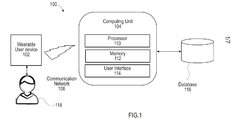
- FIG. 1 illustrates a block diagram of the present system to monitor the interaction between a plurality of users to determine the emotional state of the users and modulate biorhythms of the users based on feedback over a communication network, in accordance with one embodiment of the present invention.
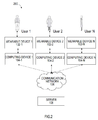
- FIG. 1 illustrates a network implementation of the present system, in accordance with one embodiment of the present invention.
- FIG. 1 illustrates a block diagram of the various modules within a memory of a computing device, in accordance with another embodiment of the present invention.
- FIG. 1 illustrates a flowchart of the method for monitoring interaction between a plurality of users for determining the emotional state of the users and modulating biorhythms of the users based on feedback over a communication network, in accordance with an alternative embodiment of the present invention.
- AI artificial intelligence
- FIG. 1 illustrates a flowchart of the plurality of steps performed by an emotional data displaying module, in accordance with an alternative embodiment of the present invention.
- FIG. 1 illustrates a flowchart of the plurality of steps performed by a feedback module, in accordance with an alternative embodiment of the present invention.
- references to “one embodiment,” “at least one embodiment,” “an embodiment,” “one example,” “an example,” “for example,” and so on indicate that the embodiment(s) or example(s) may include a particular feature, structure, characteristic, property, element, or limitation but that not every embodiment or example necessarily includes that particular feature, structure, characteristic, property, element, or limitation. Further, repeated use of the phrase “in an embodiment” does not necessarily refer to the same embodiment.
- Methods of the present invention may be implemented by performing or completing manually, automatically, or a combination thereof, selected steps or tasks.
- the term “method” refers to manners, means, techniques and procedures for accomplishing a given task including, but not limited to, those manners, means, techniques, and procedures either known to, or readily developed from known manners, means, techniques and procedures by practitioners of the art to which the invention belongs.
- the descriptions, examples, methods, and materials presented in the claims and the specification are not to be construed as limiting but rather as illustrative only. Those skilled in the art will envision many other possible variations within the scope of the technology described herein.
- FIG. 1 illustrates a block diagram of the present system 100 to monitor the interaction between a plurality of users to determine the emotional state of the users and modulate biorhythms of the users based on feedback over a communication network, in accordance with one embodiment of the present invention.
- the system 100 includes a wearable user device 102, and a computing device 104.
- the wearable user device 102 is configured to be worn on the user’s body, near the body, or placed in the user’s body (implantable) to collect biorhythm data of the user 118.
- Examples of the wearable user device 102 include but not limited to the implantable, wireless sensor device, smartwatch, smart jewelry, fitness tracker, smart cloth, etc.
- the wearable user device 102 includes various sensors to detect one or more parameters pertaining to the emotions of the user 118.
- the wearable user device 102 may include a flexible body that can be secured around the user’s body to collect the biorhythm data.
- the wearable user device 102 may including a securing mechanism to secure the wearable user device 102 may in a closed loop around a wrist of the user 118.
- the wearable user device 102 may be any wearable such as an on-body sticker or 3d-printed device that is directly printed on the skin, or a device that placed on the body with an adhesive.
- the wearable user device 102 may utilize various wired or wireless communication protocols to establish communication with the computing unit 104.
- the computing device 104 is communicatively connected with the wearable user device 102 to receive the biorhythm data of the users over a communication network 106.
- Communication network 106 may be a wired or a wireless network, and the examples may include but are not limited to the Internet, Wireless Local Area Network (WLAN), Wi-Fi, Long Term Evolution (LTE), Worldwide Interoperability for Microwave Access (WiMAX), General Packet Radio Service (GPRS), Bluetooth (BT) communication protocols, Transmission Control Protocol and Internet Protocol (TCP/IP), User Datagram Protocol (UDP), Hypertext Transfer Protocol (HTTP), File Transfer Protocol (FTP), ZigBee, EDGE, infrared (IR), Z-Wave, Thread, 5G, USB, serial, RS232, NFC, RFID, WAN , and/or IEEE 802.11, 802.16, 2G, 3G, 4G cellular communication protocols
- Examples of the computing device 104 include but not limited to a laptop, a desktop, a smartphone, a smart device, a smartwatch, a phablet, and a tablet.
- the computing device 104 includes a processor 110, a memory 112 communicatively coupled to the processor 110, and a user interface 114.
- the computing device 104 is communicatively coupled with a database 114.
- the database 116 receives, stores, and process the emotional data and referral data which can be used for further analysis and prediction so that the present system can learn and improve the analysis by using the historical emotional data.
- the present system 100 may also be implemented in a variety of computing systems, such as an Amazon elastic compute cloud (Amazon EC2), a network server, and the like.
- Amazon elastic compute cloud Amazon EC2
- the data collected from the user is constantly being monitored and sent to the server (when convenient and connected), where it is stored, analyzed, and modeled.
- New AI models are generated on the server and then downloaded to the computing devices at various intervals.
- Processor 110 may include at least one data processor for executing program components for executing user- or system-generated requests.
- a user may include a person, a person using a device such as those included in this invention, or such a device itself.
- Processor 110 may include specialized processing units such as integrated system (bus) controllers, memory management control units, floating point units, graphics processing units, digital signal processing units, etc.
- Processor 110 may include a microprocessor, such as AMD® ATHLON® microprocessor, DURON® microprocessor OR OPTERON® microprocessor, ARM's application, embedded or secure processors, IBM® POWERPC®, INTEL'S CORE® processor, ITANIUM® processor, XEON® processor, CELERON® processor or other line of processors, etc.
- Processor 110 may be implemented using mainframe, distributed processor, multi-core, parallel, grid, or other architectures. Some embodiments may utilize embedded technologies like application-specific integrated circuits (ASICs), digital signal processors (DSPs), Field Programmable Gate Arrays (FPGAs), etc.
- ASICs application-specific integrated circuits
- DSPs digital signal processors
- FPGAs Field Programmable Gate Arrays
- I/O interface may employ communication protocols/methods such as, without limitation, audio, analog, digital, RCA, stereo, IEEE-1394, serial bus, universal serial bus (USB), infrared, PS/2, BNC, coaxial, component, composite, digital visual interface (DVI), high-definition multimedia interface (HDMI), RF antennas, S-Video, VGA, IEEE 802.n/b/g/n/x, Bluetooth, cellular (e.g., code-division multiple access (CDMA), high-speed packet access (HSPA+), global system for mobile communications (GSM), long-term evolution (LTE), WiMax, or the like), etc.
- CDMA code-division multiple access
- HSPA+ high-speed packet access
- GSM global system for mobile communications
- LTE long-term evolution
- WiMax wireless wide area network
- Memory 112 which may be a non-volatile memory or a volatile memory.
- non-volatile memory may include, but are not limited to flash memory, a Read Only Memory (ROM), a Programmable ROM (PROM), Erasable PROM (EPROM), and Electrically EPROM (EEPROM) memory.
- volatile memory may include but are not limited Dynamic Random Access Memory (DRAM), and Static Random-Access memory (SRAM).
- the user interface 114 may present the monitored interaction data, determine emotional data and modulated biorhythms data as per the request of an administrator of the present system.
- the user interface (UI or GUI) 114 is a convenient interface for accessing the platform and viewing the products or services.
- the biorhythmic data includes but not limited to heart rate, heart rate variability, electrodermal activity (EDA)/ Galvanic skin response (GSR), breathing rate, 3D accelerometer data, and gyroscope data, body temperature, among others.
- the biorhythmic data can be processed to generate the signals based on mathematical description or algorithms. The algorithms may be introduced via software. There is potential that data is processed on the wearable user device end. Data may also be stored there temporarily before acted upon.
- FIG. 2 illustrates a network implementation 200 of the present system, in accordance with one embodiment of the present invention.
- FIG. 2 is explained in conjunction with FIG. 1.
- the computing devices 104-1, 104-2, and 104-N are communicatively connected with the wearable user devices 102-1, 102-2, and 102-N to receive the biorhythm data of the users over the communication network 106.
- a server 108 stores and processes the monitored interaction data, determine emotional data and modulated biorhythms data.
- the computing device 104 or wearable user device 102 may initiate a sound notification (any type of sound). Based on the user’s current emotional state score, different sounds should be issued by one or more of the wearable user devices 102 to inform the users to do one of several different behaviors.
- behavior may not be limited to one behavior, and sound could signal a plurality (multiple) of actions.
- the behavior associated with the sound should help the user change their behavior to move closer to the user's desired/preset emotional state, or move towards changing a more specific biorhythm.
- the network architecture of the wearable user device 102 and the computing device 104 can include one or more Internet of Things (IoT) devices.
- IoT Internet of Things
- a typical network architecture of the present disclosure can include a plurality of network devices such as transmitter, receivers, and/or transceivers that may include one or more IoT devices.
- the wearable user device, 102 can directly interact with the cloud and/or cloud servers and IoT devices.
- the IoT devices are utilized to communicate with many wearable user devices or other electronic devices.
- the IoT devices may provide various feedback through sensing or controlling mechanism to collect interaction between the users and communicate the emotional state of the users.
- the data and/or information collected can be directly stored in the cloud server without taking any space on the user mobile and/or portable computing device.
- the mobile and/or portable computing device can directly interact with a server and receive information for feedback activation to trigger deliver the feedback. Examples of the feedback include but not limited to auditory feedback, haptic feedback, tactile feedback, vibration feedback, or visual feedback from a primary wearable device, a secondary wearable device, a separate computing device (i.e. mobile), or IoT device (which may or may not be a computing device).
- the IoT devices can be a device that includes sensing and/or control functionality as well as a WiFiTM transceiver radio or interface, a BluetoothTM transceiver radio or interface, a ZigbeeTM transceiver radio or interface, an Ultra-Wideband (UWB) transceiver radio or interface, a WiFi-Direct transceiver radio or interface, a BluetoothTM Low Energy (BLE) transceiver radio or interface, and/or any other wireless network transceiver radio or interface that allows the IoT device to communicate with a wide area network and with one or more other devices.
- a WiFiTM transceiver radio or interface a BluetoothTM transceiver radio or interface
- a ZigbeeTM transceiver radio or interface a ZigbeeTM transceiver radio or interface
- an Ultra-Wideband (UWB) transceiver radio or interface a WiFi-Direct transceiver radio or interface
- BLE BluetoothTM Low Energy
- an IoT device does not include a cellular network transceiver radio or interface, and thus may not be configured to directly communicate with a cellular network.
- an IoT device may include a cellular transceiver radio and may be configured to communicate with a cellular network using the cellular network transceiver radio.
- a user may communicate with the network devices using an access device that may include any human-to-machine interface with network connection capability that allows access to a network.
- the access device may include a stand-alone interface (e.g., a cellular telephone, a smartphone, a home computer, a laptop computer, a tablet, a personal digital assistant (PDA), a computing device, a wearable device such as a smartwatch, a wall panel, a keypad, or the like), an interface that is built into an appliance or other device e.g., a television, a refrigerator, a security system, a game console, a browser, or the like), a speech or gesture interface (e.g., a KinectTM sensor, a WiimoteTM, or the like), an IoT device interface (e.g., an Internet-enabled devices such as a wall switch, a control interface, or other suitable interface), or the like.
- a stand-alone interface e.g., a cellular telephone,
- the access device may include a cellular or other broadband network transceiver radio or interface and may be configured to communicate with a cellular or other broadband network using the cellular or broadband network transceiver radio. In some embodiments, the access device may not include a cellular network transceiver radio or interface.
- the users may be provided with an input/display screen which is configured to display information to the user about the current status of the system.
- the input/display screen may take input from an input apparatus, in the current example buttons.
- the input/display screen may also be configured as a touch screen or may accept input for determining vitals or bio-signals through touch or haptic based input system.
- the input buttons and/or screen are configured to allow a user to respond to input prompt from the system regarding needed user input.
- the information which may be displayed on the screen to the user may be, for instance, the number of treatments provided, bio-signals values, vitals, the battery charge level, and volume level.
- the input/display screen may take information from a processor which may also be used as the waveform generator or maybe a separate processor. The processor provides available information for display to the user allowing the user to initiate menu selections.
- the input/display screen may be a liquid crystal display to minimize power drain on the battery.
- the input/display screen and the input buttons may be illuminated to provide a user with the capability to operate the system in low light levels. Information can be obtained from a user through the use of the input/display screen.
- FIG. 3 illustrates a block diagram of the various modules within a memory 112 of a computing device 104, in accordance with another embodiment of the present invention.
- the memory 110 includes an artificial intelligence (AI) based agent module 202, an emotional data displaying module 204, and a feedback module 206.
- AI artificial intelligence
- the artificial intelligence (AI) based agent module 202 establishes an interaction with the users over the communication network.
- the emotional data displaying module 204 analyzes and displays emotional data of the users in real-time.
- the feedback module 206 configured with the wearable user device to modulate biorhythms of the users based on the feedback emitted from the computing device.
- the (AI) based agent module 202 includes a tracking module 208, a software learning agent module 210, a virtual chat-bot module 212, a community module 214, and a sync module 216.
- the tracking module 208 receives the biorhythm data from the wearable user device and monitors the interactions of a plurality of users and retrieves relevant data for analysis.
- the tracking module 208 is integrated with one or more messaging platforms and one or more voice platforms of the computing device corresponding to the users to monitor textual interactions and audio interactions of the users.
- the tracking module 208 processes the relevant data and the retrieved parameters to generate training data.
- the tracking module 208 retrieves a plurality of parameters of the users from the biorhythm data and monitored data.
- the plurality of parameters includes the location of the user, biorhythm data of the user, personal and social behavior of the user, and environment, month, day, and time of the interactions.
- the plurality of scenarios includes but not limited to contexts, situations, and environments.
- the software learning agent module 210 receives and processes the training data to determine the emotional state of the user in a plurality of scenarios.
- the biorhythm data, emotional data, relevant data, and training data can be combined or deconstructed or converted in various ways to aid modeling.
- the training data can be utilized to train the various algorithms used to achieve the objective of the present system.
- the training data includes input data and the corresponding expected output.
- the algorithm can learn how to apply various mechanisms such as neural networks, to learn, produce, and predict the emotional state of the user in the plurality of scenarios, so that it can accurately determine the emotional state when later presented with new input data.
- the software learning agent module 210 is adaptable to continuously learn the contexts, situations, and environments based on the received training data and stores the learned data in a database.
- the virtual chat-bot module 212 initiates the interaction with the user and assist the user based on the learned data received from the software learning agent module. In an embodiment, the virtual chat-bot module 212 interacts with the user to assist to improve the emotional state of the user.
- the community module 214 facilitates the user to connect and interact with a plurality of other users.
- the community module 214 facilitates the plurality of users to interact with each other and share emotional state and biorhythm data among the other users over the communication network.
- the community module 214 enables the user to view a list of existing friends and further enables the user to search for other users via a text-based name search.
- the users can also send friend requests to other users.
- the other users receive a notification on receiving the friend request from the users.
- the users can accept or decline the friend request.
- the community module 214 further allows both the users to access the general statistics related to the emotional state of each other. Additionally, the user can interact with each other through a messaging module integrated within the community module 214.
- the sync module 216 allows the user to access the emotion data of the other users.
- the sync module 216 utilizes an initiation and acceptance protocols to enables the user to accept/decline the friend request and allow/disallow the other users to access his/her emotional data.
- the users may turn on a setting that is (bidirectional or unidirectional) to allow both the users to receive expanded access to the one or each other's data.
- the end benefit is that the other person’s psychological state or emotional state score should be visualized with options to view past periods of time.
- real-time data is streaming from each other’s devices to their secondary devices (mobile phones), the users should be able to view each other’s real-time emotional scores.
- zones can be linearly divided or along zones in a 2-axis array, or in zones based on the n-dimensional matrix. Overall, the zones follow some clear gradient that is communicated to users in various places in the product.
- the syncing states between two parties also allow evaluations to be made and insights to be derived between the 2 or more synced accounts.
- the present invention uses a multi-syncing module.
- the multi-syncing module enables more than two user accounts to sync up (get connected with others) to visualize the emotional data of each other.
- the use of location-based services facilitates easy recognition when multi-syncing can occur. If multiple devices are detected on the software application or if the GPS services detect that computing units are within a short distance of each other, then those users - who have already acknowledged each other as friends on the community module - will appear most prominent on the list.
- the multi-syncing module provides advanced insights and shows many groups statistics.
- the notifications in the multi-syncing module may include changes in groups results.
- the sync factor can be turned off at any given time by anyone. In the multi-syncing module, if one user turns off their sync feature, other members who are still synced up will remain connected.
- the secondary computing units (not shown in FIG.) that display related sync results may offer visual, auditory, or haptic/tactile feedback that progressively synchronizes various behaviors such as breathing rate and aspect of the breathing cycle (whether both people are at the peak of inhalation or trough of exhalation).
- the sync feature encompasses any combinations of biorhythms including brain waves such as EEG.
- the software application identifies the target points on bio-signals, or users can mutually or individually select goals/ targets points for biorhythm measurements. Once these targets are identified, the feedback of various types will then work change behavior and biorhythms to move them closer to this target point.
- the target can be static or dynamic.
- the objective of the syncing is to move the emotional states of the two or more users closer together, but only in a positive direction. Moving one user who is in a negative emotional state to closer alignment with a person in a positive emotional state will yield a more positive conversational experience between the two users.
- the sync module 216 comprises a recording module to record the conversation.
- the recording module acts as a virtual button over an interface that allows the user to turn ON/OFF the recording. Audio is then recorded through the microphone of a secondary computing unit if there is one or a similar tool available.
- the sync module 216 comprises a language processing module that applies to the recorded audio files to transform the dialogue audio waves into the transcribed language. The transcribed language is further processed based on sentiment and content and matched temporally with biorhythms of the speaker’s emotional scores.
- a visualized display of the emotional scores of the users in the meeting is displayed in real-time on the interfaces of the secondary computing units of all the users.
- Notifications can be sent to one or more users (either visual – i.e., textual or graphics), auditory (a short audio clip) or haptic (either via the wearable device or secondary computing unit). These notifications can be sent when there are marked biorhythm changes that occur in either participant/ user.
- the emotional data displaying module 204 includes an algorithmic module 218, and a visualization module 220.
- the algorithmic module 218 analyzes the biorhythm data and computes an emotional score of the user to generate one or more insights.
- the emotional score is indicative of the emotional state of the user during the interactions.
- the visualization module 220 graphically represents a plurality of emotional cycles for a specific time duration for the user.
- the visualization module 220 displays the insights and emotional scores of the users on the computing device associated with the users.
- the visualization module 220 displays emotional data in a plurality of manners on at least one of a two dimensional (2D) graph, and a three dimensional (3D) graphs by using at least one of a plurality of alpha-numeric characters, a plurality of geometric shapes, a plurality of holograms, and a plurality of symbols which include colors or moving shapes.
- the feedback module 206 includes a physiological data collection engine 222, a biosignal generating engine 224, a feedback activation determining engine 226, and feedback generating engine 228.
- the physiological data collection engine 222 collects physiological data of at least one physiological property of the user.
- the biosignal generating engine 224 processes the physiological data into at least one biosignal.
- the feedback activation determining engine monitors and measures the biosignal for a feedback activation condition.
- the feedback generating engine 228 triggers feedback upon satisfying a feedback activation condition.
- the feedback activation condition triggers feedback when the measured value is more than one or more predetermined threshold values.
- FIG. 4 illustrates a flowchart 400 of the method for monitoring interaction between a plurality of users for determining the emotional state of the users and modulating biorhythms of the users based on feedback over a communication network, in accordance with an alternative embodiment of the present invention.
- the method includes step 402 of collecting biorhythm data of the user through a wearable user device configured to be worn on the user’s body, near the body, or placed in the user’s body (implantable).
- the method includes the step 404 of receiving the biorhythm data of the users through a computing device communicatively connected with the wearable user device over a communication network.
- the method includes the step 406 of establishing an interaction with the users over the communication network through an artificial intelligence (AI) based agent module.
- the method includes the step 408 of analyzing and displaying emotional data of the users in real-time through an emotional data displaying module.
- the method includes step 410 of modulating biorhythms of the users based on the feedback emitted from the computing device through a feedback module
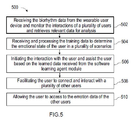
- FIG. 5 illustrates a flowchart 500 of the plurality of steps performed by an artificial intelligence (AI) based agent module, in accordance with an alternative embodiment of the present invention.
- the (AI) based agent module performs a plurality of steps that initiates with a step 502 of receiving the biorhythm data from the wearable user device and monitor the interactions of a plurality of users and retrieves relevant data for analysis through a tracking module.
- the tracking module is integrated with one or more messaging platforms and one or more voice platforms of the computing device corresponding to the users to monitor textual interactions and audio interactions of the users.
- the tracking module processes the relevant data and the retrieved parameters to generate training data.
- the tracking module retrieves a plurality of parameters of the users from the biorhythm data and monitored data.
- the plurality of parameters includes the location of the user, biorhythm data of the user, personal and social behavior of the user, and environment, month, day, and time of the interactions.
- the method includes the step 504 of receiving and processing the training data to determine the emotional state of the user in a plurality of scenarios through a software learning agent module.
- the plurality of scenarios includes but not limited to contexts, situations, and environments.
- the software learning agent module is adaptable to continuously learn the contexts, situations, and environments based on the received training data and stores the learned data in a database.
- the method includes the step 506 of initiating the interaction with the user and assist the user based on the learned data received from the software learning agent module through a virtual chat-bot module.
- the virtual chat-bot module interacts with the user to assist to improve the emotional state of the user.
- the method includes the step 508 of facilitating the user to connect and interact with a plurality of other users through a community module.
- the community module facilitates the plurality of users to interact with each other and share emotional state and biorhythm data among the other users over the communication network.
- the method includes the step 510 of allowing the user to access the emotion data of the other users through a
- FIG. 6 illustrates a flowchart 600 of the plurality of steps performed by an emotional data displaying module, in accordance with an alternative embodiment of the present invention.
- the emotional data displaying module performs a plurality of steps that initiates with a step 602 of analyzing the biorhythm data and computing an emotional score of the user to generate one or more insights through an algorithmic module.
- the emotional score is indicative of the emotional state of the user during the interactions.
- the method includes step 604 of graphically representing a plurality of emotional cycles for a specific time duration for the user through a visualization module.
- the visualization module displays the insights and emotional scores of the users on the computing device associated with the users.
- the visualization module displays emotional data in a plurality of manners on at least one of a two dimensional (2D) graph, and a three dimensional (3D) graphs by using at least one of a plurality of alpha-numeric characters, a plurality of geometric shapes, a plurality of holograms, and a plurality of symbols which include colors or moving shapes.
- FIG. 7 illustrates a flowchart 700 of the plurality of steps performed by a feedback module, in accordance with an alternative embodiment of the present invention.
- the feedback module performs a plurality of steps that initiates with a step 702 of collecting physiological data of at least one physiological property of the user through a physiological data collection engine.
- the method includes the step 704 of processing the physiological data into at least one biosignal through a biosignal generating engine.
- the method includes the step 706 of monitoring and measuring the biosignal for a feedback activation condition through a feedback activation determining engine.
- the method includes the step 708 of triggering feedback upon satisfying a feedback activation condition through feedback generating engine.
- the feedback activation condition triggers feedback when the measured value is more than one or more predetermined threshold values.
- the present invention provides a cognitive platform to monitor user interactions and to determine the emotional state of the user to provide assistance based on the emotional state of the user. Further, the present invention captures the user communication data related to the biorhythm and bio-data of the users to generate training datasets for the software learning agent module. Furthermore, the present invention interacts with the users based on a plurality of biophysical states of the users determined such as Heart rate variability (HRV), Electroencephalography (EEG), etc. Further, the present invention provides a ratio scale that receives emotional data and visualizes it linearly. Furthermore, the present invention provides the emotional data of the users periodically to help the users to optimize their emotional and psychological state over time. Additionally, the present invention enables the users to draw personal insights based on their emotional data or the emotional data of the other users.
- HRV Heart rate variability
- EEG Electroencephalography
Landscapes
- Health & Medical Sciences (AREA)
- Engineering & Computer Science (AREA)
- Life Sciences & Earth Sciences (AREA)
- Medical Informatics (AREA)
- Public Health (AREA)
- General Health & Medical Sciences (AREA)
- Biomedical Technology (AREA)
- Physics & Mathematics (AREA)
- Pathology (AREA)
- Theoretical Computer Science (AREA)
- Primary Health Care (AREA)
- Epidemiology (AREA)
- Molecular Biology (AREA)
- Psychiatry (AREA)
- Biophysics (AREA)
- Data Mining & Analysis (AREA)
- Animal Behavior & Ethology (AREA)
- Veterinary Medicine (AREA)
- Heart & Thoracic Surgery (AREA)
- Psychology (AREA)
- Surgery (AREA)
- Hospice & Palliative Care (AREA)
- Child & Adolescent Psychology (AREA)
- General Physics & Mathematics (AREA)
- General Engineering & Computer Science (AREA)
- Social Psychology (AREA)
- Databases & Information Systems (AREA)
- Developmental Disabilities (AREA)
- Signal Processing (AREA)
- Computational Linguistics (AREA)
- Artificial Intelligence (AREA)
- Software Systems (AREA)
- Computing Systems (AREA)
- Computer Networks & Wireless Communication (AREA)
- Audiology, Speech & Language Pathology (AREA)
- Mathematical Physics (AREA)
- Evolutionary Computation (AREA)
- Human Computer Interaction (AREA)
- Computer Hardware Design (AREA)
- Acoustics & Sound (AREA)
Priority Applications (8)
| Application Number | Priority Date | Filing Date | Title |
|---|---|---|---|
| US17/278,539 US20210350917A1 (en) | 2018-09-21 | 2019-09-20 | System and method to improve interaction between users through monitoring of emotional state of the users and reinforcement of goal states |
| EP19863510.4A EP3852614A4 (en) | 2018-09-21 | 2019-09-20 | SYSTEM AND METHOD FOR ENHANCING USER INTERACTION BY MONITORING THE EMOTIONAL STATE OF USERS AND REINFORCING GOAL STATES |
| JP2021540344A JP2022502219A (ja) | 2018-09-21 | 2019-09-20 | 目標状態の強化及びユーザの感情状態の監視を通してユーザ間の対話を改善するためのシステム及び方法 |
| CN201980076464.1A CN113271851A (zh) | 2018-09-21 | 2019-09-20 | 通过监控用户的情绪状态和增强目标状态来改善用户之间的交互的系统和方法 |
| KR1020217011834A KR20210099556A (ko) | 2018-09-21 | 2019-09-20 | 사용자의 감정 상태의 모니터링 및 목표 상태 보강을 통해 사용자 간의 상호 작용의 향상을 위한 시스템 및 방법 |
| MX2021003334A MX2021003334A (es) | 2018-09-21 | 2019-09-20 | Sistema y método para mejorar interacción entre usuarios a traves de monitoreo de estado emocional de usuarios y refuerzo de estados objetivo. |
| CA3113698A CA3113698A1 (en) | 2018-09-21 | 2019-09-20 | System and method to improve interaction between users through monitoring of emotional state of the users and reinforcement of goal states |
| BR112021005417-0A BR112021005417A2 (pt) | 2018-09-21 | 2019-09-20 | sistema e método para melhorar a interação entre os usuários através do monitoramento do estado emocional dos usuários e reforço dos estados-objetivos |
Applications Claiming Priority (8)
| Application Number | Priority Date | Filing Date | Title |
|---|---|---|---|
| US201862734608P | 2018-09-21 | 2018-09-21 | |
| US201862734522P | 2018-09-21 | 2018-09-21 | |
| US201862734490P | 2018-09-21 | 2018-09-21 | |
| US201862734553P | 2018-09-21 | 2018-09-21 | |
| US62/734,553 | 2018-09-21 | ||
| US62/734,490 | 2018-09-21 | ||
| US62/734,522 | 2018-09-21 | ||
| US62/734,608 | 2018-09-21 |
Publications (1)
| Publication Number | Publication Date |
|---|---|
| WO2020056519A1 true WO2020056519A1 (en) | 2020-03-26 |
Family
ID=69886866
Family Applications (1)
| Application Number | Title | Priority Date | Filing Date |
|---|---|---|---|
| PCT/CA2019/051340 Ceased WO2020056519A1 (en) | 2018-09-21 | 2019-09-20 | System and method to improve interaction between users through monitoring of emotional state of the users and reinforcement of goal states |
Country Status (9)
| Country | Link |
|---|---|
| US (1) | US20210350917A1 (https=) |
| EP (1) | EP3852614A4 (https=) |
| JP (1) | JP2022502219A (https=) |
| KR (1) | KR20210099556A (https=) |
| CN (1) | CN113271851A (https=) |
| BR (1) | BR112021005417A2 (https=) |
| CA (1) | CA3113698A1 (https=) |
| MX (1) | MX2021003334A (https=) |
| WO (1) | WO2020056519A1 (https=) |
Cited By (5)
| Publication number | Priority date | Publication date | Assignee | Title |
|---|---|---|---|---|
| US11954443B1 (en) | 2021-06-03 | 2024-04-09 | Wells Fargo Bank, N.A. | Complaint prioritization using deep learning model |
| US12008579B1 (en) | 2021-08-09 | 2024-06-11 | Wells Fargo Bank, N.A. | Fraud detection using emotion-based deep learning model |
| US12079826B1 (en) | 2021-06-25 | 2024-09-03 | Wells Fargo Bank, N.A. | Predicting customer interaction using deep learning model |
| US12169593B2 (en) | 2018-09-21 | 2024-12-17 | Steve Curtis | System and method for distributing revenue among users based on quantified and qualified emotional data |
| US12223511B1 (en) | 2021-11-23 | 2025-02-11 | Wells Fargo Bank, N.A. | Emotion analysis using deep learning model |
Families Citing this family (8)
| Publication number | Priority date | Publication date | Assignee | Title |
|---|---|---|---|---|
| US11809958B2 (en) * | 2020-06-10 | 2023-11-07 | Capital One Services, Llc | Systems and methods for automatic decision-making with user-configured criteria using multi-channel data inputs |
| US20220351855A1 (en) * | 2021-04-30 | 2022-11-03 | Marvin Behavioral Health CA, P.C. | Systems and methods for machine learning-based predictive matching |
| WO2023013927A1 (en) * | 2021-08-05 | 2023-02-09 | Samsung Electronics Co., Ltd. | Method and wearable device for enhancing quality of experience index for user in iot network |
| KR102420359B1 (ko) * | 2022-01-10 | 2022-07-14 | 송예원 | 감정맞춤형 cbt용 ai제어모듈을 통한 메타버스공간에서의 1:1 감정맞춤형 인지적행동치료 생성장치 및 방법 |
| US12347009B2 (en) | 2022-11-10 | 2025-07-01 | Red Hat, Inc. | Modifying avatars in user interfaces based on wearable device data using machine learning |
| CN117731288B (zh) * | 2024-01-18 | 2024-09-06 | 深圳谨启科技有限公司 | 一种ai心理咨询方法和系统 |
| KR20250123460A (ko) | 2024-02-08 | 2025-08-18 | 상명대학교산학협력단 | 실시간 감정 인식 기술을 활용한 간접적인 감정 상태 메시지 생성 방법 및 시스템 |
| IL315723A (en) * | 2024-09-18 | 2026-04-01 | Belongtail Ltd | A system for improving user well-being in large language model inventions |
Citations (1)
| Publication number | Priority date | Publication date | Assignee | Title |
|---|---|---|---|---|
| WO2014137919A1 (en) * | 2013-03-04 | 2014-09-12 | Hello Inc. | Wearable device with unique user id and telemetry system in communication with one or more social networks and/or one or more payment systems |
Family Cites Families (7)
| Publication number | Priority date | Publication date | Assignee | Title |
|---|---|---|---|---|
| US10869626B2 (en) * | 2010-06-07 | 2020-12-22 | Affectiva, Inc. | Image analysis for emotional metric evaluation |
| WO2014085910A1 (en) * | 2012-12-04 | 2014-06-12 | Interaxon Inc. | System and method for enhancing content using brain-state data |
| JP6122816B2 (ja) * | 2014-08-07 | 2017-04-26 | シャープ株式会社 | 音声出力装置、ネットワークシステム、音声出力方法、および音声出力プログラム |
| US10120413B2 (en) * | 2014-09-11 | 2018-11-06 | Interaxon Inc. | System and method for enhanced training using a virtual reality environment and bio-signal data |
| JP6798353B2 (ja) * | 2017-02-24 | 2020-12-09 | 沖電気工業株式会社 | 感情推定サーバ及び感情推定方法 |
| US11599729B2 (en) * | 2017-06-15 | 2023-03-07 | Microsoft Technology Licensing, Llc | Method and apparatus for intelligent automated chatting |
| US10091554B1 (en) * | 2017-12-06 | 2018-10-02 | Echostar Technologies L.L.C. | Apparatus, systems and methods for generating an emotional-based content recommendation list |
-
2019
- 2019-09-20 JP JP2021540344A patent/JP2022502219A/ja active Pending
- 2019-09-20 KR KR1020217011834A patent/KR20210099556A/ko not_active Ceased
- 2019-09-20 US US17/278,539 patent/US20210350917A1/en not_active Abandoned
- 2019-09-20 WO PCT/CA2019/051340 patent/WO2020056519A1/en not_active Ceased
- 2019-09-20 CA CA3113698A patent/CA3113698A1/en active Pending
- 2019-09-20 CN CN201980076464.1A patent/CN113271851A/zh active Pending
- 2019-09-20 BR BR112021005417-0A patent/BR112021005417A2/pt not_active IP Right Cessation
- 2019-09-20 MX MX2021003334A patent/MX2021003334A/es unknown
- 2019-09-20 EP EP19863510.4A patent/EP3852614A4/en not_active Withdrawn
Patent Citations (1)
| Publication number | Priority date | Publication date | Assignee | Title |
|---|---|---|---|---|
| WO2014137919A1 (en) * | 2013-03-04 | 2014-09-12 | Hello Inc. | Wearable device with unique user id and telemetry system in communication with one or more social networks and/or one or more payment systems |
Cited By (5)
| Publication number | Priority date | Publication date | Assignee | Title |
|---|---|---|---|---|
| US12169593B2 (en) | 2018-09-21 | 2024-12-17 | Steve Curtis | System and method for distributing revenue among users based on quantified and qualified emotional data |
| US11954443B1 (en) | 2021-06-03 | 2024-04-09 | Wells Fargo Bank, N.A. | Complaint prioritization using deep learning model |
| US12079826B1 (en) | 2021-06-25 | 2024-09-03 | Wells Fargo Bank, N.A. | Predicting customer interaction using deep learning model |
| US12008579B1 (en) | 2021-08-09 | 2024-06-11 | Wells Fargo Bank, N.A. | Fraud detection using emotion-based deep learning model |
| US12223511B1 (en) | 2021-11-23 | 2025-02-11 | Wells Fargo Bank, N.A. | Emotion analysis using deep learning model |
Also Published As
| Publication number | Publication date |
|---|---|
| EP3852614A4 (en) | 2022-08-03 |
| EP3852614A1 (en) | 2021-07-28 |
| KR20210099556A (ko) | 2021-08-12 |
| CN113271851A (zh) | 2021-08-17 |
| MX2021003334A (es) | 2021-09-28 |
| US20210350917A1 (en) | 2021-11-11 |
| JP2022502219A (ja) | 2022-01-11 |
| CA3113698A1 (en) | 2020-03-26 |
| BR112021005417A2 (pt) | 2021-06-15 |
Similar Documents
| Publication | Publication Date | Title |
|---|---|---|
| WO2020056519A1 (en) | System and method to improve interaction between users through monitoring of emotional state of the users and reinforcement of goal states | |
| WO2020058943A1 (en) | System and method for collecting, analyzing and sharing biorhythm data among users | |
| US20220327794A1 (en) | Immersive ecosystem | |
| US10735831B2 (en) | System and method communicating biofeedback to a user through a wearable device | |
| US20190385066A1 (en) | Method for predicting emotion status and robot | |
| US20190142349A1 (en) | Electromyography (emg) assistive communications device with context-sensitive user interface | |
| US20200222756A1 (en) | Finger exercise training menu generating system, method thereof, and program thereof | |
| US10431116B2 (en) | Orator effectiveness through real-time feedback system with automatic detection of human behavioral and emotional states of orator and audience | |
| US20210401339A1 (en) | Adaptive behavioral training, and training of associated physiological responses, with assessment and diagnostic functionality | |
| US10108784B2 (en) | System and method of objectively determining a user's personal food preferences for an individualized diet plan | |
| WO2020058942A1 (en) | System and method to integrate emotion data into social network platform and share the emotion data over social network platform | |
| US20210145323A1 (en) | Method and system for assessment of clinical and behavioral function using passive behavior monitoring | |
| JP2021090668A (ja) | 情報処理装置及びプログラム | |
| CN118058707A (zh) | 睡眠评估方法、设备及存储介质 | |
| US20220133195A1 (en) | Apparatus, system, and method for assessing and treating eye contact aversion and impaired gaze | |
| KR102936448B1 (ko) | 생체신호 연동형 생성형 ai 기반 심층 심리상담 방법 및 시스템 | |
| US20190167158A1 (en) | Information processing apparatus | |
| EP4708312A1 (en) | Methods and apparatuses for action quality evaluation, storage media and electronic devices | |
| CN115188494A (zh) | 运动监测方法、装置、可穿戴设备、系统及存储介质 |
Legal Events
| Date | Code | Title | Description |
|---|---|---|---|
| 121 | Ep: the epo has been informed by wipo that ep was designated in this application |
Ref document number: 19863510 Country of ref document: EP Kind code of ref document: A1 |
|
| ENP | Entry into the national phase |
Ref document number: 3113698 Country of ref document: CA Ref document number: 2021540344 Country of ref document: JP Kind code of ref document: A |
|
| NENP | Non-entry into the national phase |
Ref country code: DE |
|
| WWE | Wipo information: entry into national phase |
Ref document number: 140050140003000032 Country of ref document: IR |
|
| REG | Reference to national code |
Ref country code: BR Ref legal event code: B01A Ref document number: 112021005417 Country of ref document: BR |
|
| ENP | Entry into the national phase |
Ref document number: 2019863510 Country of ref document: EP Effective date: 20210421 |
|
| ENP | Entry into the national phase |
Ref document number: 112021005417 Country of ref document: BR Kind code of ref document: A2 Effective date: 20210322 |
|
| WWR | Wipo information: refused in national office |
Ref document number: 1020217011834 Country of ref document: KR |