WO2020039984A1 - 化合物ライブラリ - Google Patents
化合物ライブラリ Download PDFInfo
- Publication number
- WO2020039984A1 WO2020039984A1 PCT/JP2019/031716 JP2019031716W WO2020039984A1 WO 2020039984 A1 WO2020039984 A1 WO 2020039984A1 JP 2019031716 W JP2019031716 W JP 2019031716W WO 2020039984 A1 WO2020039984 A1 WO 2020039984A1
- Authority
- WO
- WIPO (PCT)
- Prior art keywords
- amino acid
- acid sequence
- cysteine
- compound library
- cyclic peptide
- Prior art date
- Legal status (The legal status is an assumption and is not a legal conclusion. Google has not performed a legal analysis and makes no representation as to the accuracy of the status listed.)
- Ceased
Links
Images

Classifications
-
- C—CHEMISTRY; METALLURGY
- C07—ORGANIC CHEMISTRY
- C07K—PEPTIDES
- C07K2/00—Peptides of undefined number of amino acids; Derivatives thereof
-
- C—CHEMISTRY; METALLURGY
- C40—COMBINATORIAL TECHNOLOGY
- C40B—COMBINATORIAL CHEMISTRY; LIBRARIES, e.g. CHEMICAL LIBRARIES
- C40B40/00—Libraries per se, e.g. arrays, mixtures
- C40B40/04—Libraries containing only organic compounds
- C40B40/10—Libraries containing peptides or polypeptides, or derivatives thereof
Definitions
- the present invention relates to a compound library, a method for producing the same, and the like.
- Peptides are useful as bioactive compounds in drug discovery research and basic biology research. Searching for a peptide having activity is an important task, but the peptide sequences are diverse, and it is practically impossible to actually synthesize all sequences.
- Patent Document 1 a RAPID system combining a cell-free expression system and a display method has been put to practical use by PeptiDream (Patent Document 1).
- Patent Document 1 this is a method for producing a mixture of a large number of peptides, and the amount of the peptide of each sequence is extremely small.
- the target protein must be purified, and cannot be applied to phenotype screening.
- An object of the present invention is to provide a compound library having a higher ratio of compounds having a physiological activity.
- cysteine-rich proteins During the course of research, the present inventors focused on cysteine-rich proteins. Since cysteine-rich proteins contain a relatively large amount of cysteine residues, random SS bonds are liable to be generated by oxidation with air or the like, and thus tend to be difficult to handle. Therefore, many cysteine-rich proteins have unknown functions. The present inventors have reported that the region between cysteines in the amino acid sequence of a cysteine-rich protein may form a loop structure by SS bond in the three-dimensional structure of the protein, and may be involved in protein-protein interaction. I guessed it was expensive.
- the present inventor has conducted further studies based on this idea and speculation, and as a result, (i) an amino acid sequence sandwiched between cysteine residues in a cysteine-rich protein, or (ii) an amino acid sequence sandwiched between cysteine residues in a cysteine-rich protein. It has been found that the above problem can be solved by a compound library containing a cyclic peptide containing an amino acid sequence having 80% or more identity to the obtained amino acid sequence. As a result of further research based on this finding, the present invention was completed.
- the present invention includes the following embodiments: Item 1. (I) an amino acid sequence flanked by cysteine residues in a cysteine-rich protein, or (ii) an amino acid sequence having 80% or more identity to an amino acid sequence flanked by cysteine residues in a cysteine-rich protein, A compound library comprising a cyclic peptide comprising:
- Item 2. The compound library according to Item 1, wherein the amino acid sequence has 5 to 50 amino acid residues.
- Item 3. The compound library according to Item 1 or 2, which contains 40 or more types of the cyclic peptides.
- Item 4. The compound library according to any one of Items 1 to 3, wherein the cysteine-rich protein is a secretory protein.
- Item 5. The compound library according to any one of Items 1 to 4, wherein the cysteine-rich protein has 40 to 200 amino acid residues.
- a compound library comprising a step of producing a cyclic peptide containing an amino acid sequence sandwiched between cysteine residues in a cysteine-rich protein and / or a cyclic peptide containing an amino acid sequence having 80% or more identity to the amino acid sequence Manufacturing method.
- Item 7 (A) selecting a cysteine-rich protein, (B) a step of determining an amino acid sequence flanked by cysteine residues in the cysteine-rich protein, and (c) a cyclic peptide containing the amino acid sequence, and / or 80% or more identity to the amino acid sequence.
- Producing a cyclic peptide comprising an amino acid sequence having Item 7. The production method according to Item 6, comprising:
- the present invention it is possible to provide a compound library having a higher ratio of compounds having a physiological activity. Further, according to the present invention, the library can be produced more easily and efficiently even when each compound is separated. In a preferred embodiment of the library, it can be used for phenotypic screening.
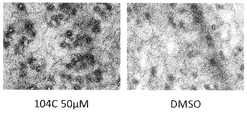
- Test Example 1 An example of the results of a screening assay for pore formation (Test Example 1) is shown. The photograph on the left shows an observation image when a certain cyclic peptide of the compound library (Example 1) is added, and the photograph on the right shows an observation image when no cyclic peptide is added.
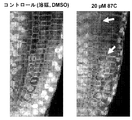
- An example of the results of a screening assay (Test Example 2) for changes in root morphology is shown. The photograph on the left shows an observed image when no cyclic peptide was added, and the photograph on the right shows an observed image when a certain cyclic peptide of the compound library (Example 1) was added. Arrows indicate morphological abnormalities (abnormal cell division surface (cell plate) formation).
- An example of the results of a screening assay (Test Example 2) for changes in root morphology is shown.
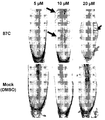
- the upper photograph shows an observation image when a certain cyclic peptide of the compound library (Example 1) is added, and the lower photograph shows an observation image when no cyclic peptide is added.
- Arrows indicate morphological abnormalities (10 ⁇ M: abnormal cell division specific to epidermal cell layer, 20 ⁇ M: abnormal cell division and abnormal morphology (hypertrophy) in inner cell layer (endothelium, cortex)).
- An example of the results of a screening assay (Test Example 2) for changes in root morphology is shown.
- the photograph on the left shows an observation image when a certain cyclic peptide of the compound library (Example 1) is added, and the photograph on the right shows an observation image when no cyclic peptide is added. Arrows indicate morphological abnormalities (cell layers abnormally increased in the lateral direction). An example of the results of a screening assay (Test Example 2) for changes in root morphology is shown.
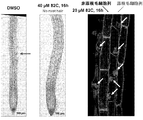
- the photographs on the left show the observed images when no cyclic peptide was added, and the photographs on the center and on the right show the images observed when a cyclic peptide of the compound library (Example 1) was added. In the photograph on the left, the arrow indicates the hair root.
- arrows indicate morphological abnormalities (abnormally retained aggregates of intracellular membranes).
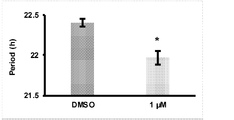
- An example of the results of a screening assay (Test Example 4) relating to the circadian rhythm cycle is shown.
- the vertical axis indicates the circadian rhythm cycle.
- DMSO shows the case where no cyclic peptide was added, and 1 ⁇ M shows the case where the cyclic peptide was allowed to act. * Indicates that the p-value (t-test) for “DMSO” was less than 0.05.
- the compound library of the present invention comprises (i) an amino acid sequence flanked by cysteine residues in a cysteine-rich protein (in the present specification, this may be referred to as “amino acid sequence i”), or (ii).
- the present invention relates to a compound library (hereinafter, sometimes referred to as “the compound library of the present invention”). Hereinafter, this will be described.
- a cysteine-rich protein is a protein that contains cysteine residues in a relatively large amount, and is not particularly limited as long as it is a cysteine-rich protein. Particularly preferred is a protein in which the ratio of the number of cysteine residues to the total number of amino acid residues is 100% or more.
- cysteine-rich proteins include secretory proteins, enzyme proteins, structural proteins, transport proteins, storage proteins, contractile proteins, defense proteins, regulatory proteins and the like. Among these, secretory proteins are preferred.
- the origin of the cysteine-rich protein is not particularly limited, and includes, for example, animals, plants, and bacteria.
- INDUSTRIAL APPLICABILITY The compound library of the present invention is useful for phenotypic screening of various biological species and screening using substances (for example, proteins, etc.) derived from various biological species, regardless of the biological origin of the amino acid sequence of the listed cyclic peptide. .
- animals include various mammals such as human, monkey, mouse, rat, dog, cat, rabbit, pig, horse, cow, sheep, goat, deer and the like.
- Plants include, for example, moss plants, fern plants, gymnosperms, angiosperm magnolias, monocotyledons, and true dicotyledons (roses I, roses II, chrysanthemums I, chrysanthemums II and their outer groups) And a wide range of plants. Of these, gymnosperms and angiosperms are preferred.
- plants include eggplants such as tomato, pepper, pepper, eggplant and tobacco; cucumber, pumpkin, watermelon and other cucumber; cabbage, broccoli, Chinese cabbage, Arabidopsis and other vegetables; celery, parsley, Raw and spicy vegetables such as lettuce; leek such as leek, onion, garlic; beans such as soybean, peanut, bean, pea, adzuki bean, mung bean, cowpea and fava beans; and other fruits and vegetables such as strawberries and melons; Roots such as taro, carrot, burdock, etc .; ⁇ Potatoes such as taro, cassava, potato, sweet potato, potato; Soft vegetables such as eustoma and suis Blossoms such as corn, carnation, chrysanthemum, etc .; turf, such as bentgrass and black mulberry; ⁇ oil crops, such as rapeseed, peanut, oilseed rape, and black crocodile; ⁇ ⁇ fiber crops, such as cotton and rush; clover, dent corn
- Gram-positive bacteria include, for example, Staphylococci (eg, Staphylococcus aureus, Staphylococcus epidermidis), enterococci (eg, Enterococcus), streptococci (eg, group A streptococci, group B streptococci, pneumococci) Bacillus (eg, Bacillus cereus, Bacillus anthracis), Clostridium (eg, tetanus, botulinum, difficile), Corynebacterium (eg, diphtheria), Listeria, Lactobacillus. Fungi, Bifidobacterium, Propionibacterium (for example, acne causing acne), actinomycetes and the like.
- Staphylococci eg, Staphylococcus aureus, Staphylococcus epidermidis
- enterococci eg, Enterococcus
- streptococci eg, group A streptococci,
- the number of amino acid residues in the cysteine-rich protein is not particularly limited, but is, for example, 30 to 2000, preferably 30 to 1000, more preferably 30 to 500, and further preferably 40 to 200.
- the ratio of the number of cysteine residues in the cysteine-rich protein is particularly preferably 3% or more based on 100% of all amino acid residues.
- the ratio can be 5% or more, 8% or more, 10% or more in one embodiment of the present invention.
- the upper limit of the ratio is not particularly limited, but is, for example, 30%, 25%, 15%, or 12%.
- the number of cysteine residues in the cysteine-rich protein is not particularly limited, but is, for example, 5 or more, 6 or more, 8 or more, 10 or more, 12 or more, 15 or more, 20 or more, or 30 or more.
- the upper limit of the number is not particularly limited, but is, for example, 50, 40, 30, or 20.
- the number of amino acid residues in the amino acid sequence i is, for example, 5 to 100.
- the number of the amino acid residues is preferably 5 to 50, more preferably 5 to 40, still more preferably 5 to 35, still more preferably 5 to 30, and particularly preferably 5 to 30, from the viewpoint of loop formation and ease of synthesis. 5 to 25.
- amino acid sequence ii an amino acid sequence having 80% or more identity to the amino acid sequence i (amino acid sequence ii) is also an object.
- the identity of the amino acid sequence ii to the amino acid sequence i is preferably 90% or more, more preferably 95% or more, and further preferably 98% or more.
- the amino acid sequence ii has one or more (for example, 1 to 4, preferably 1 to 3, more preferably 1 to 2, and still more preferably 1) amino acids with respect to the amino acid sequence i.
- an amino acid sequence that has been mutated for example, substitution, deletion, addition, or insertion, preferably substitution, more preferably conservative substitution).
- Constant substitution means that an amino acid residue is replaced with an amino acid residue having a similar side chain.
- substitution between amino acid residues having a basic side chain such as lysine, arginine, and histidine is a conservative substitution.
- Others amino acid residues having an acidic side chain such as aspartic acid and glutamic acid; amino acid residues having a non-charged polar side chain such as glycine, asparagine, glutamine, serine, threonine, tyrosine, and cysteine; alanine, valine, leucine, isoleucine, Amino acid residues having non-polar side chains such as proline, phenylalanine, methionine and tryptophan; amino acid residues having ⁇ -branched side chains such as threonine, valine and isoleucine; having aromatic side chains such as tyrosine, phenylalanine, tryptophan and histidine Similarly, substitution between amino acid residues correspond
- the cyclic peptide contained in the compound library of the present invention contains the amino acid sequence i or the amino acid sequence ii.
- the ratio of the number of amino acid residues in the amino acid sequence i or the amino acid sequence ii is not particularly limited, but is, for example, 50%, preferably 70%, more preferably 80%, and still more preferably 90%. It is even more preferably 95%, even more preferably 97%.
- Cyclic peptides are usually obtained by cyclizing chain peptides. For this reason, the cyclic peptide may have a structure derived from a modified product for cyclization.
- the method for cyclization is not particularly limited. For example, head-to-tail (connection between N-terminal and C-terminal), Head-to-sidetochain (connection between C-terminal and side chain), Side chain -to-tail (linkage between side chain and N-terminal), SideSchain-to- side chain (linkage between side chain and side chain) and the like. More specifically, as the method, for example, a method already reported (Nat Chem. 2011 Jun 23; 3 (7): 509-24., Chemical Science 2015 2015 Aug 1; 6 (8): 4889-4896.) Can be used.
- Cyclic peptides also include those that have been chemically modified in addition to the structure derived from the above-mentioned modified product for cyclization.
- the C-terminus has a carboxyl group (—COOH), a carboxylate (—COO ⁇ ), Amide (—CONH 2 ) or ester (—COOR), and the like.
- the cyclic peptide preferably has an amide (—CONH 2 ) at the C-terminus.
- R in the ester is, for example, a C 1-6 alkyl group such as methyl, ethyl, n-propyl, isopropyl, or n-butyl; for example, a C 3-8 cycloalkyl group such as cyclopentyl or cyclohexyl; And C 6-12 aryl groups such as ⁇ -naphthyl; for example, phenyl-C 1-2 alkyl groups such as benzyl and phenethyl; and C 7- such as ⁇ -naphthyl-C 1-2 alkyl groups such as ⁇ -naphthylmethyl. 14 aralkyl groups; pivaloyloxymethyl groups and the like are used.
- the amino group of the amino acid at the N-terminus has a protecting group (eg, And a C 1-6 acyl group such as a C 1-6 alkanoyl such as a formyl group and an acetyl group, preferably an acetyl group).
- a protecting group eg, And a C 1-6 acyl group such as a C 1-6 alkanoyl such as a formyl group and an acetyl group, preferably an acetyl group.
- Cyclic peptides include those in which amino acids other than the termini are chemically modified, but preferably, the amino acids other than the termini of the cyclic peptide are not chemically modified.
- Examples of the chemical modification in this case include amidation and esterification of a carboxyl group; and protection of an amino group with a protecting group. The esterification and the protecting group are the same as those for the terminal chemical modification described above.
- Cyclic peptides also include salts with acids or bases.
- the salt is not particularly limited, and any of an acidic salt and a basic salt can be employed.
- the acidic salt include inorganic salts such as hydrochloride, hydrobromide, sulfate, nitrate and phosphate; acetic acid, propionate, trifluoroacetate, tartrate, fumarate, Organic acid salts such as maleate, malate, citrate, methanesulfonate and paratoluenesulfonate; and amino acid salts such as aspartate and glutamate.
- the basic salt include alkali metal salts such as sodium salt and potassium salt; and alkaline earth metal salts such as calcium salt and magnesium salt.
- Cyclic peptides also include solvate forms.
- the solvent is not particularly limited, and includes, for example, water, ethanol, glycerol, acetic acid and the like.
- the number of types of cyclic peptides contained in the compound library of the present invention is not particularly limited, for example, 10 or more, preferably 40 or more, more preferably 80 or more, still more preferably 160 or more, and still more preferably 320 or more. More than a species.
- the upper limit of the number of types is not particularly limited, but is, for example, 20,000, 10,000, 5000, 2000, 1000, 500.
- the compound library of the present invention may include only cyclic peptides as compounds, or may include compounds other than cyclic peptides.
- the proportion of the cyclic peptide in the listed compounds is, for example, 10% or more, preferably 30% or more, more preferably 50% or more, still more preferably 70% or more, even more preferably 90% or more, It is even more preferably at least 95%, particularly preferably at least 99%.
- the listed compound containing a cyclic peptide is usually contained in a container.
- the type of the container is not particularly limited as long as it is used for the compound library, and examples thereof include a multi-well plate (for example, a 24-well plate, a 96-well plate, a 384-well plate, a 1536-well plate, etc.), a microtube, and the like.
- Can be The accommodation mode is not particularly limited, and all the compounds are accommodated separately without being mixed with other compounds (for example, one compound is accommodated in one well of a multiwell plate, and one compound is accommodated in one microtube.
- two or more compounds for example, 2 to 100, 2 to 50, 2 to 20, 2 to 10, 2 to 5, and 2 to 3
- It may be housed in a mixed state (for example, a plurality of compounds are housed in one well of a multiwell plate, and a plurality of compounds are housed in one microtube).
- the compound library of the present invention may be in the form of a compound array in which listed compounds containing a cyclic peptide are immobilized on a solid phase.
- the solid phase is not particularly limited as long as the listed compound can be immobilized.
- Examples of the solid phase include a substrate made of glass, polydimethylsiloxane, gold, or the like. The shape of the substrate can be applied to any of the substrates reported so far, such as a flat plate, a lined pillar, or a lined well.
- polypeptide of the present invention can be immobilized by using a cross-linking agent or the like, active esterifying a terminal carboxyl group, or introducing a formyl group or a maleimide group, and then reacting the peptide terminal with a cysteine residue. .
- each cyclic peptide in the compound library of the present invention is, for example, 1 ⁇ g or more, 10 ⁇ g or more, 100 ⁇ g or more, 1 mg or more.
- the upper limit of the amount is not particularly limited, and is, for example, 1 g, 100 mg, or 10 mg.
- the listed compound may be present alone, or may contain other components such as a base, a carrier, a solvent, a dispersant, an emulsifier, a buffer, a stabilizer, an excipient, It may be present (eg, in a mixed state) with binders, disintegrants, lubricants, thickeners, humectants, colorants, flavors, chelating agents, and the like.
- the compound library of the present invention includes only the compound library of the present invention, and includes the compound library of the present invention and other compound libraries, or, if necessary, instruments and reagents that can be used for compound screening. In addition, it can be provided in the form of a kit.
- the compound library of the present invention is useful for phenotypic screening of various biological species and screening using substances (for example, proteins, etc.) derived from various biological species, regardless of the biological origin of the amino acid sequence of the listed cyclic peptide. .
- the compound library of the present invention can be suitably used for phenotype screening.
- the present invention provides, in one embodiment, a cyclic peptide comprising an amino acid sequence (amino acid sequence i) flanked by cysteine residues in a cysteine-rich protein, and / or 80% or more of the amino acid sequence.
- the present invention relates to a method for producing a compound library (hereinafter, also referred to as “the production method of the present invention”) including a step of producing a cyclic peptide containing an amino acid sequence having the same identity (amino acid sequence ii).
- the production method of the present invention including a step of producing a cyclic peptide containing an amino acid sequence having the same identity (amino acid sequence ii).
- the cyclic peptide can be produced according to a known peptide synthesis method depending on its amino acid sequence.
- the method for cyclization is not particularly limited, and includes, for example, Head-to-tail (connection between N-terminal and C-terminal), Head-to-side chain (connection between C-terminal and side chain), Side chain-to-tail (connection between side chain and N-terminal), Side chain-to-side chain (connection between side chain and side chain) and the like. More specifically, as the method, for example, a method already reported (Nat Chem. 2011 Jun 23; 3 (7): 509-24., Chemical Science 2015 2015 Aug 1; 6 (8): 4889-4896.) Can be used.
- the production method of the present invention more specifically, (A) selecting a cysteine-rich protein, (B) a step of determining an amino acid sequence flanked by cysteine residues in the cysteine-rich protein, and (c) a cyclic peptide containing the amino acid sequence, and / or 80% or more identity to the amino acid sequence. Producing a cyclic peptide comprising an amino acid sequence having including.
- the selection of a cysteine-rich protein is not particularly limited, and can be performed by any method. As an example, it can be selected as a clue for an annotation indicating a cysteine-rich protein on a known gene database.
- step (b) the amino acid sequence sandwiched between any two cysteine residues present on the amino acid sequence of the cysteine-rich protein (excluding the two arbitrary cysteine residues) is determined.
- the amino acid sequence may contain a cysteine residue or may not contain a cysteine residue, but preferably does not contain a cysteine residue.
- step (c) The production in step (c) is as described above.
- Embodiment 1 FIG. Design and manufacture of compound libraries 1 Extract Arabidopsis thaliana genes with 40-200 amino acid residues of the translated protein, annotated with "cystein-rich” and "secreted", from the gene database (Tair: https://www.arabidopsis.org) did. From the extracted genes, genes were selected in order from the 5 ′ end of chromosome 1. The gene sequence was converted to an amino acid sequence for a total of 30 selected genes. An amino acid sequence sandwiched between two cysteine residues in the full-length amino acid sequence (the amino acid sequence does not include cysteine residues) was determined. Among the determined amino acid sequences, those having 5 to 30 amino acid residues were selected. The selected amino acid sequences are shown in Tables 1-2.
- Cysteine numbers at both ends indicate the number of cysteine residues on both sides of the selected amino acid sequence in the case where consecutive numbers starting from 1 are assigned to cysteine residues in order from the N-terminal side of the full-length amino acid sequence. Number.
- Test example 1 Screening assay for stomatal formation In a 96-well plate, control liquid medium (Murashige and Skoog base salt (Duchefa Biochemie: M0222) mixed with 2.2 g / L vitamin, 250 mg / L MES, pH5.7 (KOH), 5 g / L Sucrose) ) And planted Arabidopsis seeds there. The culture was carried out with shaking (130 rpm) at 22 ° C. under the condition that the brightness was kept constant.
- control liquid medium Merashige and Skoog base salt (Duchefa Biochemie: M0222) mixed with 2.2 g / L vitamin, 250 mg / L MES, pH5.7 (KOH), 5 g / L Sucrose)
- the culture was carried out with shaking (130 rpm) at 22 ° C. under the condition that the brightness was kept constant.
- a DMSO solution (10 mM) of each cyclic peptide of the compound library (Example 1) was added to the liquid medium to a final concentration of 12.5 ⁇ M, 25 ⁇ M, or 50 ⁇ M, or DMSO was used as a negative control.
- DMSO was used as a negative control.
- Test example 2 Screening assays sterilized plastic Petri dish on the morphology change of the root, MGRL (+ Fe) solid medium (1.75 mM sodium phosphate buffer (pH 5.8), 1.5 mM MgSO4 , 2.0 mM Ca (NO3) 2, 3.0 mM KNO 3, 67 ⁇ M Na 2 EDTA, 50 ⁇ M FeSO 4 , 10.3 ⁇ M MnSO 4 , 30 ⁇ M H 3 BO 3 , 1.0 ⁇ M ZnSO 4 , 24 nM (NH 4 ) 6 Mo 7 O 24 , 130 nM CoCl 2 , 1 ⁇ M CuSO 4 , 1 g / L Sucrose, 1.5 g / L gellan gum), and seeds of Arabidopsis transformants expressing Lti6b-YFP protein or BOR1-GFP protein as a cell membrane marker and H2B-RFP protein as a nuclear marker were planted therein.
- MGRL (+ Fe) solid medium (1.75 mM sodium
- MGRL (+ Fe) solid medium [MGRL (+ Fe) solid medium containing 10, 20 or 40 ⁇ M cyclic peptide (each cyclic peptide of compound library (Example 1)) or DMSO as a negative control Medium containing the same solute as the medium but without gellan gum], and similarly incubated in an artificial weather vessel for 16 to 24 hours. After the incubation, the cell structure at the root tip of the main root was observed with a confocal laser fluorescence microscope.
- FIGS. 5 Some examples of the results are shown in FIGS. Addition of a cyclic peptide causes abnormal cell division surface formation (FIG. 2), abnormal cell division in epidermal cells (10 ⁇ M in FIG. 3), abnormal cell division and abnormal morphology in the inner cell layer (endothelium, cortex) (hypertrophy) (20 ⁇ M in FIG. 3), abnormal cell differentiation pattern (FIG. 4), abnormal root morphological changes such as inhibition of intracellular membrane traffic in primary root hair cells and suppression of root hair elongation (FIG. 5).
- the number of cyclic peptides in which the root morphological change was abnormal due to the addition was 6 out of 73 cyclic peptides used in the test.
- Test example 3 Screening assay for germination of parasitic plant Striga A 96-well plate was filled with an aqueous solution prepared so that each cyclic peptide of the compound library (Example 1) had a final concentration of 100 ⁇ M, and seeds of the Striga were planted. After culturing at 30 ° C. for 2 days in the dark, the germination rate of Striga was measured. Next, rac-GR24 (CAS: 76974-79-3) was added to each well to a final concentration of 100 nM, and after culturing for 2 days, the germination rate was measured.
- the number of cyclic peptides whose germination rate was significantly changed by the addition was 21 out of 73 cyclic peptides used in the test.
- Embodiment 2 FIG. Design and manufacture of compound libraries 2
- a cysteine-rich protein gene was extracted in the same manner as in Example 1, and the extracted gene was subjected to an amino acid sequence sandwiched between two cysteine residues in the full-length amino acid sequence (the amino acid sequence contained a cysteine residue). Groups are not included).
- the selected amino acid sequence is as follows. 1. TVAPRERQN (SEQ ID NO: 90) 2.
- GFPGVTPSQ SEQ ID NO: 91
- ANKG SEQ ID NO: 92
- FDDTVRGVPW SEQ ID NO: 93
- FYPNTIDVPPEEE (SEQ ID NO: 94) 6. SRLSPHNRTN (SEQ ID NO: 95) 7. GFPGITSDQ (SEQ ID NO: 96) 8. FDSSVTGVPW (SEQ ID NO: 97) 9. FDNG (SEQ ID NO: 98) Ten. FHPLPKQESDQ (SEQ ID NO: 99) 11. VMEVSDRRN (SEQ ID NO: 100) 12. GYPGISPEE (SEQ ID NO: 101) 13. ASRK (SEQ ID NO: 102) 14.
- FSNFIFEVPW (SEQ ID NO: 103) 15. FFPKSVED (SEQ ID NO: 104) 16. AVPAKDRVD (SEQ ID NO: 105) 17. GYPHVTPKE (SEQ ID NO: 106) 18. NNRG (SEQ ID NO: 107) 19. FDSRIPGVPW (SEQ ID NO: 108) 20. FKPLQEAE (SEQ ID NO: 109)
- Test example 4 Screening assay for circadian rhythm cycle Human osteosarcoma-derived cell line U2OS stably transfected with a luminescent reporter (Bmal1-dLuc) linked to a destabilized luciferase gene downstream of the promoter region of clock gene Bmal1 was diluted to a predetermined concentration with DMSO After administering the cyclic peptide (each cyclic peptide of the compound library of Example 2) (final concentration of DMSO: 0.2%), the transcriptional activity of Bmal1 was measured as a luminescence rhythm for 7 days. The analysis period was 36 to 120 hours from the start of the measurement, and the waveform obtained by the measurement was used to calculate the waveform cycle (circadian rhythm cycle) by the cosiner least squares spectrum method, and was compared with the negative control group.
- DMSO luminescent reporter
Landscapes
- Chemical & Material Sciences (AREA)
- Organic Chemistry (AREA)
- Medicinal Chemistry (AREA)
- Biochemistry (AREA)
- Health & Medical Sciences (AREA)
- Molecular Biology (AREA)
- Life Sciences & Earth Sciences (AREA)
- Chemical Kinetics & Catalysis (AREA)
- General Chemical & Material Sciences (AREA)
- Biophysics (AREA)
- General Health & Medical Sciences (AREA)
- Genetics & Genomics (AREA)
- Proteomics, Peptides & Aminoacids (AREA)
- Peptides Or Proteins (AREA)
Abstract
生理活性を有する化合物の割合がより高い化合物ライブラリを提供することを課題とし、該課題を、(i)システインリッチタンパク質におけるシステイン残基に挟まれたアミノ酸配列、又は(ii)システインリッチタンパク質におけるシステイン残基に挟まれたアミノ酸配列に対して80%以上の同一性を有するアミノ酸配列、を含む環状ペプチドを含有する、化合物ライブラリ、により解決する。
Description
本発明は、化合物ライブラリ、その製造方法等に関する。
ペプチドは生理活性化合物として、創薬研究や基礎生物学研究に有用なターゲットである。活性を持つペプチドを探索することは重要な課題であるが、ペプチド配列は多様であり全ての配列を実際に合成するのは現実的には不可能である。
一方、無細胞発現系とディスプレイ法を組み合わせたRAPIDシステムがPeptiDream社により実用化されている(特許文献1)。ただ、これは多数のペプチドの混合物を生じさせる方法であり、個々の配列のペプチドの量も極微量である。また、標的となるタンパク質を精製しておく必要があり、表現型スクリーニングには適用できない。
創薬において中心的な役割を担ってきた表現型スクリーニングを行うためには、少なくともmgのスケールでペプチドを合成する必要があるものの、多数の配列のペプチドを網羅的に合成するのは大きなコストがかかるため、全ての可能な配列を合成することは不可能である。限られた合成可能なサンプル数のペプチドを合成し、かつ高いヒット率で効率的に活性名ペプチドを見出す、つまり質の高いライブラリを作るためには戦略が必要である。
本発明は、生理活性を有する化合物の割合がより高い化合物ライブラリを提供することを課題とする。
本発明者は研究を進める中で、システインリッチタンパク質に着目した。システインリッチタンパク質は、システイン残基を比較的多く含むので空気などによる酸化によりランダムなS-S結合を生じ易く、このため取り扱いが困難である傾向にある。よって、システインリッチタンパク質は機能未知のものが多い。本発明者は、システインリッチタンパク質のアミノ酸配列上のシステインに挟まれた領域は、タンパク質の三次元構造中ではS-S結合によりループ構造を形成し、タンパク質-タンパク質間相互作用に関わる可能性が高いのではないかと推測した。
本発明者は、この着想及び推測に基づいてさらに鋭意研究を進めた結果、(i)システインリッチタンパク質におけるシステイン残基に挟まれたアミノ酸配列、又は(ii)システインリッチタンパク質におけるシステイン残基に挟まれたアミノ酸配列に対して80%以上の同一性を有するアミノ酸配列、を含む環状ペプチドを含有する、化合物ライブラリであれば、上記課題を解決できることを見出した。この知見に基づいてさらに研究を進められた結果、本発明が完成した。
即ち、本発明は、下記の態様を包含する:
項1.
(i)システインリッチタンパク質におけるシステイン残基に挟まれたアミノ酸配列、又は
(ii)システインリッチタンパク質におけるシステイン残基に挟まれたアミノ酸配列に対して80%以上の同一性を有するアミノ酸配列、
を含む環状ペプチドを含有する、化合物ライブラリ。
項1.
(i)システインリッチタンパク質におけるシステイン残基に挟まれたアミノ酸配列、又は
(ii)システインリッチタンパク質におけるシステイン残基に挟まれたアミノ酸配列に対して80%以上の同一性を有するアミノ酸配列、
を含む環状ペプチドを含有する、化合物ライブラリ。
項2.
前記アミノ酸配列のアミノ酸残基数が5~50である、項1に記載の化合物ライブラリ。
前記アミノ酸配列のアミノ酸残基数が5~50である、項1に記載の化合物ライブラリ。
項3.
40種以上の前記環状ペプチドを含有する、項1又は2に記載の化合物ライブラリ。
40種以上の前記環状ペプチドを含有する、項1又は2に記載の化合物ライブラリ。
項4.
前記システインリッチタンパク質が分泌タンパク質である、項1~3のいずれかに記載の化合物ライブラリ。
前記システインリッチタンパク質が分泌タンパク質である、項1~3のいずれかに記載の化合物ライブラリ。
項5.
前記システインリッチタンパク質のアミノ酸残基数が40~200である、項1~4のいずれかに記載の化合物ライブラリ。
前記システインリッチタンパク質のアミノ酸残基数が40~200である、項1~4のいずれかに記載の化合物ライブラリ。
項6.
システインリッチタンパク質におけるシステイン残基に挟まれたアミノ酸配列を含む環状ペプチド、及び/又は前記アミノ酸配列に対して80%以上の同一性を有するアミノ酸配列を含む環状ペプチドを製造する工程を含む、化合物ライブラリの製造方法。
システインリッチタンパク質におけるシステイン残基に挟まれたアミノ酸配列を含む環状ペプチド、及び/又は前記アミノ酸配列に対して80%以上の同一性を有するアミノ酸配列を含む環状ペプチドを製造する工程を含む、化合物ライブラリの製造方法。
項7.
(a)システインリッチタンパク質を選択する工程、
(b)前記システインリッチタンパク質におけるシステイン残基に挟まれたアミノ酸配列を決定する工程、及び
(c)前記アミノ酸配列を含む環状ペプチド、及び/又は前記アミノ酸配列に対して80%以上の同一性を有するアミノ酸配列を含む環状ペプチドを製造する工程、
を含む、項6に記載の製造方法。
(a)システインリッチタンパク質を選択する工程、
(b)前記システインリッチタンパク質におけるシステイン残基に挟まれたアミノ酸配列を決定する工程、及び
(c)前記アミノ酸配列を含む環状ペプチド、及び/又は前記アミノ酸配列に対して80%以上の同一性を有するアミノ酸配列を含む環状ペプチドを製造する工程、
を含む、項6に記載の製造方法。
本発明によれば、生理活性を有する化合物の割合がより高い化合物ライブラリを提供することができる。また、本発明によれば、該ライブラリを、各化合物それぞれが分離した状態であっても、より簡便且つ効率的に製造することができる。該ライブラリの好ましい一態様においては、表現型スクリーニングに利用することも可能である。
本明細書中において、「含有」及び「含む」なる表現については、「含有」、「含む」、「実質的にからなる」及び「のみからなる」という概念を含む。
1.化合物ライブラリ
本発明は、その一態様において、(i)システインリッチタンパク質におけるシステイン残基に挟まれたアミノ酸配列(本明細書において、「アミノ酸配列i」と示すこともある。)、又は(ii)システインリッチタンパク質におけるシステイン残基に挟まれたアミノ酸配列に対して80%以上の同一性を有するアミノ酸配列(本明細書において、「アミノ酸配列ii」と示すこともある。)、を含む環状ペプチドを含有する、化合物ライブラリ(本明細書において、「本発明の化合物ライブラリ」と示すこともある。)に関する。以下に、これについて説明する。
本発明は、その一態様において、(i)システインリッチタンパク質におけるシステイン残基に挟まれたアミノ酸配列(本明細書において、「アミノ酸配列i」と示すこともある。)、又は(ii)システインリッチタンパク質におけるシステイン残基に挟まれたアミノ酸配列に対して80%以上の同一性を有するアミノ酸配列(本明細書において、「アミノ酸配列ii」と示すこともある。)、を含む環状ペプチドを含有する、化合物ライブラリ(本明細書において、「本発明の化合物ライブラリ」と示すこともある。)に関する。以下に、これについて説明する。
システインリッチタンパク質は、システイン残基を比較的豊富に含むタンパク質であり、その限りにおいて特に制限されない。特に好ましくは、全アミノ酸残基数100%に対するシステイン残基数の割合が3%以上のタンパク質である。システインリッチタンパク質としては、例えば、分泌タンパク質、酵素タンパク質、構造タンパク質、輸送タンパク質、貯蔵タンパク質、収縮タンパク質、防御タンパク質、調節タンパク質等が挙げられる。これらの中でも、好ましくは分泌タンパク質が挙げられる。
システインリッチタンパク質の由来生物としては、特に制限されず、例えば動物、植物、細菌等が挙げられる。本発明の化合物ライブラリは、収載する環状ペプチドのアミノ酸配列の由来生物に関係なく、多様な生物種の表現型スクリーニング、多様な生物種由来の物質(例えばタンパク質等)を用いたスクリーニングに有用である。
動物としては、例えばヒト、サル、マウス、ラット、イヌ、ネコ、ウサギ、ブタ、ウマ、ウシ、ヒツジ、ヤギ、シカ等の種々の哺乳類が挙げられる。
植物としては、例えばコケ植物、シダ植物、裸子植物、被子植物のモクレン類、単子葉類、真正双子葉類(バラ類I、バラ類II、キク類I、キク類II及びそれらの外群)を含む広い範囲の植物を挙げることができる。これらの中でも、裸子植物、被子植物等が好ましい。植物のより具体的な例としては、トマト、ピーマン、トウガラシ、ナス、タバコ等のナス類; キュウリ、カボチャ、スイカ等のウリ類; キャベツ、ブロッコリー、ハクサイ、シロイヌナズナ等の菜類; セルリー、パセリー、レタス等の生菜・香辛菜類; ネギ、タマネギ、ニンニク等のネギ類; ダイズ、ラッカセイ、インゲン、エンドウ、アズキ、リョクトウ、ササゲ、ソラマメ等の豆類; イチゴ、メロン等のその他果菜類; ダイコン、カブ、ニンジン、ゴボウ等の直根類; サトイモ、キャッサバ、ジャガイモ、サツマイモ、ナガイモ等のイモ類; イネ、トウモロコシ、コムギ、ソルガム、オオムギ、ライムギ、ミナトカモジグサ、ソバ等の穀類; アスパラガス、ホウレンソウ、ミツバ等の柔菜類; トルコギキョウ、ストック、カーネーション、キク等の花卉類; ベントグラス、コウライシバ等の芝類; ナタネ、ラッカセイ、セイヨウアブラナ、ナンヨウアブラギリ等の油料作物類; ワタ、イグサ等の繊維料作物類; クローバー、デントコーン、タルウマゴヤシ等の飼料作物類; リンゴ、ナシ、ブドウ、モモ、キウイフルーツ等の落葉性果樹類; ウンシュウミカン、オレンジ、レモン、グレープフルーツ等の柑橘類; サツキ、ツツジ、スギ、ポプラ、パラゴムノキ、イチョウ、マツ等の木本類等が挙げられる。
細菌としては、グラム陰性菌、グラム陽性菌等を広く採用することができる。グラム陰性菌としては、例えば、腸内細菌科細菌(例えば、エシェリヒア属菌、クレブシエラ属菌、サルモネラ属菌、赤痢菌属等)、アシネトバクター属菌、シュードモナス属菌(例えば緑膿菌)、モラクセラ属菌、ヘリコバクター属菌、カンピロバクター属菌、アエロモナス属菌、ビブリオ属菌(例えばコレラ菌、腸炎ビブリオ菌)、ヘモフィルス属菌(例えばインフルエンザ菌)、ナイセリア属菌(例えば淋菌、髄膜炎菌)、バクテロイデス属菌等が挙げられる。グラム陽性菌としては、例えば、ブドウ球菌属菌(例えば黄色ブドウ球菌、表皮ブドウ球菌)、腸球菌(例えばエンテロコッカス属菌)、レンサ球菌属菌(例えばA群連鎖球菌、B群連鎖球菌、肺炎球菌、緑色連鎖球菌)、バシラス属菌(例えばセレウス菌、炭疽菌)、クロストリジウム属菌(例えば破傷風菌、ボツリヌス菌、ディフィシル菌)、コリネバクテリウム属菌(例えばジフテリア菌)、リステリア属菌、ラクトバシラス属菌、ビフィドバクテリウム属菌、プロピオニバクテリウム属菌(例えばニキビの原因となるアクネ菌)、放線菌等が挙げられる。
システインリッチタンパク質のアミノ酸残基数は、特に制限されないが、例えば30~2000、好ましくは30~1000、より好ましくは30~500、さらに好ましくは40~200である。
システインリッチタンパク質におけるシステイン残基数の割合は、前述の通り、全アミノ酸残基数100%に対して、特に好ましくは3%以上である。該割合は、本発明の一態様において、5%以上、8%以上、10%以上であり得る。該割合の上限は、特に制限されないが、例えば30%、25%、15%、12%である。
システインリッチタンパク質におけるシステイン残基数は、特に制限されるものではないが、例えば5以上、6以上、8以上、10以上、12以上、15以上、20以上、30以上である。該数の上限は、特に制限されないが、例えば50、40、30、20である。
システイン残基をより多く含むシステインリッチタンパク質は、ランダムなS-S結合により凝集してしまい機能解析が困難である。このようなシステインリッチタンパク質に由来するアミノ酸配列を本発明により環状ペプチド化することによって、機能未知のシステインリッチタンパク質に基づいた有用なアミノ酸配列をスクリーニングすることができる。
システイン残基に挟まれたアミノ酸配列(アミノ酸配列i)は、システインリッチタンパク質のアミノ酸配列上に存在する任意の2つのシステイン残基に挟まれたアミノ酸配列(該任意の2つのシステイン残基は含まない)であり、その限りにおいて特に制限されない。アミノ酸配列iは、システイン残基を含むものであってもよいし、システイン残基を含まないものであってもよいが、好ましくはシステイン残基を含まないものである。
アミノ酸配列iのアミノ酸残基数は、例えば5~100である。該アミノ酸残基数は、ループの形成及び合成の容易性の観点から、好ましくは5~50、より好ましくは5~40、さらに好ましくは5~35、よりさらに好ましくは5~30、特に好ましくは5~25である。
本発明の化合物ライブラリにおいては、アミノ酸配列iの他に、アミノ酸配列iに対して80%以上の同一性を有するアミノ酸配列(アミノ酸配列ii)も対象となる。
アミノ酸配列の「同一性」とは、2以上の対比可能なアミノ酸配列の、お互いに対するアミノ酸配列の一致の程度をいう。従って、ある2つのアミノ酸配列の一致性が高いほど、それらの配列の同一性又は類似性は高い。アミノ酸配列の同一性のレベルは、例えば、配列分析用ツールであるFASTAを用い、デフォルトパラメータを用いて決定される。若しくは、Karlin及びAltschulによるアルゴリズムBLAST(KarlinS,Altschul SF.“Methods for assessing the statistical significance of molecular sequence features by using general scoringschemes”Proc Natl Acad Sci USA.87:2264-2268(1990)、KarlinS,Altschul SF.“Applications and statistics for multiple high-scoring segments in molecular sequences.”Proc Natl Acad Sci USA.90:5873-7(1993))を用いて決定できる。このようなBLASTのアルゴリズムに基づいたBLASTXと呼ばれるプログラムが開発されている。これらの解析方法の具体的な手法は公知であり、National Center of Biotechnology Information(NCBI)のウェエブサイト(http://www.ncbi.nlm.nih.gov/)を参照すればよい。
アミノ酸配列iiの、アミノ酸配列iに対する同一性は、好ましくは90%以上、より好ましくは95%以上、さらに好ましくは98%以上である。
アミノ酸配列iiは、その一態様において、アミノ酸配列iに対して1若しくは複数個(例えば1~4個、好ましくは1~3個、より好ましくは1~2個、さらに好ましくは1個)のアミノ酸が変異(例えば置換、欠失、付加、又は挿入、好ましくは置換、より好ましくは保存的置換)されたアミノ酸配列である。
「保存的置換」とは、アミノ酸残基が類似の側鎖を有するアミノ酸残基に置換されることを意味する。例えば、リジン、アルギニン、ヒスチジンといった塩基性側鎖を有するアミノ酸残基同士で置換されることが、保存的な置換にあたる。その他、アスパラギン酸、グルタミン酸といった酸性側鎖を有するアミノ酸残基;グリシン、アスパラギン、グルタミン、セリン、スレオニン、チロシン、システインといった非帯電性極性側鎖を有するアミノ酸残基;アラニン、バリン、ロイシン、イソロイシン、プロリン、フェニルアラニン、メチオニン、トリプトファンといった非極性側鎖を有するアミノ酸残基;スレオニン、バリン、イソロイシンといったβ-分枝側鎖を有するアミノ酸残基;チロシン、フェニルアラニン、トリプトファン、ヒスチジンといった芳香族側鎖を有するアミノ酸残基同士での置換も同様に、保存的な置換にあたる。
アミノ酸配列iiのアミノ酸残基数は、例えば5~100である。該アミノ酸残基数は、ループの形成及び合成の容易性の観点から、好ましくは5~50、より好ましくは5~40、さらに好ましくは5~35、よりさらに好ましくは5~30、特に好ましくは5~25である。
本発明の化合物ライブラリに収載される環状ペプチドは、アミノ酸配列i又はアミノ酸配列iiを含む。
環状ペプチドのアミノ酸配列中の、アミノ酸配列i又はアミノ酸配列iiのアミノ酸残基数の割合は、特に制限されないが、例えば50%、好ましくは70%、より好ましくは80%、さらに好ましくは90%、よりさらに好ましくは95%、よりさらに好ましくは97%である。
環状ペプチドは、通常、鎖状ペプチドを環状化することにより得られる。このため、環状ペプチドは、環状化のための修飾物に由来する構造を有することがある。環状化のための手法については、特に制限されず、例えばHead-to-tail(N末端とC末端との連結)、Head-to-side chain(C末端と側鎖との連結)、Side chain-to-tail(側鎖とN末端との連結)、Side chain-to- side chain(側鎖と側鎖との連結)等が挙げられる。該手法として、より具体的には、例えば既報(Nat Chem. 2011 Jun 23;3(7):509-24.、Chemical Science. 2015 Aug 1; 6(8): 4889-4896.等)の手法を利用することができる。
環状ペプチドは、上記環状化のための修飾物に由来する構造以外に化学修飾されているものも、包含する。
環状ペプチドがC末端を有する場合(例えば、Side chain-to-tail、Side chain-to- side chain等で環状化した場合等)は、C末端がカルボキシル基(-COOH)、カルボキシレート(-COO-)、アミド(-CONH2)またはエステル(-COOR)であるもの、等も包含する。環状ペプチドは、C末端がアミド(-CONH2)であるものが好ましい。
ここでエステルにおけるRとしては、例えば、メチル、エチル、n-プロピル、イソプロピル、n-ブチルなどのC1-6アルキル基;例えば、シクロペンチル、シクロヘキシルなどのC3-8シクロアルキル基;例えば、フェニル、α-ナフチルなどのC6-12アリール基;例えば、ベンジル、フェネチルなどのフェニル-C1-2アルキル基;α-ナフチルメチルなどのα-ナフチル-C1-2アルキル基などのC7-14アラルキル基;ピバロイルオキシメチル基などが用いられる。
さらに、環状ペプチドは、N末端を有する場合(例えば、Head-to-side chain、Side chain-to- side chain等で環状化した場合等)は、N末端のアミノ酸のアミノ基が保護基(例えば、ホルミル基、アセチル基などのC1-6アルカノイルなどのC1-6アシル基など、好ましくはアセチル基)で保護されているもの、なども包含する。
環状ペプチドは、末端以外のアミノ酸が、化学修飾されたものも包含するが、好ましくは、環状ペプチドは末端以外のアミノ酸は化学修飾されていない。この場合の化学修飾としては、例えばカルボキシル基のアミド化、エステル化等; 保護基によるアミノ基の保護等が挙げられる。エステル化、保護基については、上記した末端の化学修飾と同様である。
環状ペプチドは、酸または塩基との塩の形態も包含する。塩は、特に限定されず、酸性塩、塩基性塩のいずれも採用することができる。例えば酸性塩の例としては、塩酸塩、臭化水素酸塩、硫酸塩、硝酸塩、リン酸塩等の無機酸塩; 酢酸塩、プロピオン酸塩、トリフルオロ酢酸塩、酒石酸塩、フマル酸塩、マレイン酸塩、リンゴ酸塩、クエン酸塩、メタンスルホン酸塩、パラトルエンスルホン酸塩等の有機酸塩; アスパラギン酸塩、グルタミン酸塩等のアミノ酸塩等が挙げられる。また、塩基性塩の例として、ナトリウム塩、カリウム塩等のアルカリ金属塩; カルシウム塩、マグネシウム塩等のアルカリ土類金属塩等が挙げられる。
環状ペプチドは、溶媒和物の形態も包含する。溶媒は、特に限定されず、例えば水、エタノール、グリセロール、酢酸等が挙げられる。
本発明の化合物ライブラリが含有する環状ペプチドの種類数は、特に制限されないが、例えば10種以上、好ましくは40種以上、より好ましくは80種以上、さらに好ましくは160種以上、よりさらに好ましくは320種以上である。該種類数の上限は、特に制限されないが、例えば20000、10000、5000、2000、1000、500である。
本発明の化合物ライブラリには、化合物として環状ペプチドのみが収載されていてもよいし、環状ペプチド以外の化合物も収載されていてもよい。後者の場合、収載されている化合物中の環状ペプチドの割合は、例えば10%以上、好ましくは30%以上、より好ましくは50%以上、さらに好ましくは70%以上、よりさらに好ましくは90%以上、よりさらに好ましくは95%以上、特に好ましくは99%以上である。
本発明の化合物ライブラリにおいて、環状ペプチドを含む収載化合物は、通常、容器に収容されている。容器の種類としては、化合物ライブラリに使用されるものであれば特に制限されず、例えばマルチウェルプレート(例えば24ウェルプレート、96ウェルプレート、384ウェルプレート、1536ウェルプレート等)、マイクロチューブ等が挙げられる。収容の態様は特に制限されず、全ての化合物がそれぞれ他の化合物と混合されない状態で別々に収容(例えば、マルチウェルプレートの1ウェルに1種の化合物が収容され、マイクロチューブ1つに1種の化合物が収容)されていてもよいし、複数種の化合物(例えば、2~100種、2~50種、2~20種、2~10種、2~5種、2~3種)が混合された状態で収容(例えば、マルチウェルプレートの1ウェルに複数種の化合物が収容され、マイクロチューブ1つに複数種の化合物が収容)されていてもよい。
また、本発明の化合物ライブラリは、環状ペプチドを含む収載化合物が固相に固定化されてなる化合物アレイの形態であってもよい。固相は、収載化合物を固定可能なものである限り特に制限されない。固相としては、例えばガラス、ポリジメチルシロキサン、金などの基板が挙げられる。基板の形状は、平板なもの、ピラーを並べたもの、ウェルを並べたものなど、これまでに報告されたいずれの基板にも適用可能である。これらの基板上にガラスではシランカップリング剤や、表面を多糖などでコートすることにより、ポリジメチルシロキサンでは、表面を多糖などでコートしたり、表面をプラズマなどで修飾することで、また、金ではチオール誘導体で修飾することにより、アミノ基、カルボキシル基などの官能基を導入する。これに架橋剤などを用いたり、末端カルボシキシル基を活性エステル化したり、ホルミル基やマレイミド基を導入後、ペプチド末端をシステイン残基として反応させることにより本発明のポリペプチドを固定化することができる。
本発明の化合物ライブラリにおける、それぞれの環状ペプチドの量は、例えば1μg以上、10μg以上、100μg以上、1mg以上である。該量の上限は特に制限されず、例えば1g、100mg、10mgである。
本発明の化合物ライブラリにおいては、収載化合物は、それのみで存在していてもよいし、他の成分、例えば基剤、担体、溶剤、分散剤、乳化剤、緩衝剤、安定剤、賦形剤、結合剤、崩壊剤、滑沢剤、増粘剤、保湿剤、着色料、香料、キレート剤等と共に(例えば混合された状態で)存在していてもよい。
本発明の化合物ライブラリは、本発明の化合物ライブラリのみで、本発明の化合物ライブラリと他の化合物ライブラリとを合わせて、或いは必要に応じてこれらに加えて、化合物スクリーニングに用いられ得る器具、試薬などと共に、キットの形態で提供することもできる。
本発明の化合物ライブラリは、収載する環状ペプチドのアミノ酸配列の由来生物に関係なく、多様な生物種の表現型スクリーニング、多様な生物種由来の物質(例えばタンパク質等)を用いたスクリーニングに有用である。本発明の化合物ライブラリは、表現型スクリーニングに好適に用いることができる。
2.化合物ライブラリの製造方法
本発明は、その一態様において、システインリッチタンパク質におけるシステイン残基に挟まれたアミノ酸配列(アミノ酸配列i)を含む環状ペプチド、及び/又は前記アミノ酸配列に対して80%以上の同一性を有するアミノ酸配列(アミノ酸配列ii)を含む環状ペプチドを製造する工程を含む、化合物ライブラリの製造方法(本明細書において、「本発明の製造方法」と示すこともある。)に関する。以下に、これについて説明する。
本発明は、その一態様において、システインリッチタンパク質におけるシステイン残基に挟まれたアミノ酸配列(アミノ酸配列i)を含む環状ペプチド、及び/又は前記アミノ酸配列に対して80%以上の同一性を有するアミノ酸配列(アミノ酸配列ii)を含む環状ペプチドを製造する工程を含む、化合物ライブラリの製造方法(本明細書において、「本発明の製造方法」と示すこともある。)に関する。以下に、これについて説明する。
環状ペプチドの製造は、そのアミノ酸配列に応じて、公知のペプチド合成法に従って製造することができる。また、環状化のための手法については、特に制限されず、例えばHead-to-tail(N末端とC末端との連結)、Head-to-side chain(C末端と側鎖との連結)、Side chain-to-tail(側鎖とN末端との連結)、Side chain-to- side chain(側鎖と側鎖との連結)等が挙げられる。該手法として、より具体的には、例えば既報(Nat Chem. 2011 Jun 23;3(7):509-24.、Chemical Science. 2015 Aug 1; 6(8): 4889-4896.等)の手法を利用することができる。
本発明の製造方法は、より具体的には、
(a)システインリッチタンパク質を選択する工程、
(b)前記システインリッチタンパク質におけるシステイン残基に挟まれたアミノ酸配列を決定する工程、及び
(c)前記アミノ酸配列を含む環状ペプチド、及び/又は前記アミノ酸配列に対して80%以上の同一性を有するアミノ酸配列を含む環状ペプチドを製造する工程、
を含む。
(a)システインリッチタンパク質を選択する工程、
(b)前記システインリッチタンパク質におけるシステイン残基に挟まれたアミノ酸配列を決定する工程、及び
(c)前記アミノ酸配列を含む環状ペプチド、及び/又は前記アミノ酸配列に対して80%以上の同一性を有するアミノ酸配列を含む環状ペプチドを製造する工程、
を含む。
工程(a)において、システインリッチタンパク質の選択は、特に制限されず、任意の方法で行うことができる。一例として、公知の遺伝子データベース上で、システインリッチタンパク質を示すアノテーションの手がかりに選択することができる。
工程(b)においては、システインリッチタンパク質のアミノ酸配列上に存在する任意の2つのシステイン残基に挟まれたアミノ酸配列(該任意の2つのシステイン残基は含まない)を決定する。この際、該アミノ酸配列は、システイン残基を含むものであってもよいし、システイン残基を含まないものであってもよいが、好ましくはシステイン残基を含まないものである。
工程(c)における製造は、上記の通りである。
その他、本項に記載していない事項については、上記「1.化合物ライブラリ」における説明を援用することができる。
以下に、実施例に基づいて本発明を詳細に説明するが、本発明はこれらの実施例によって限定されるものではない。
実施例1.化合物ライブラリの設計及び製造1
遺伝子データベース(Tair:https://www.arabidopsis.org)から、「cystein-rich」及び「secreted」のアノテーションが付いた、翻訳されるタンパク質のアミノ酸残基数が40~200のシロイヌナズナ遺伝子を抽出した。抽出した遺伝子について、1番染色体の5’末端から順に遺伝子を選択した。選択した計30個の遺伝子について、遺伝子配列をアミノ酸配列に変換した。全長アミノ酸配列中、2つのシステイン残基に挟まれたアミノ酸配列(当該アミノ酸配列にはシステイン残基は含まれない)を決定した。決定されたアミノ酸配列中、アミノ酸残基数が5~30のものを選択した。選択されたアミノ酸配列を表1~2に示す。表1~2中、「両末端のシステイン番号」は、全長アミノ酸配列のN末端側から順にシステイン残基に1から始まる連続番号を付与した場合における、選択したアミノ酸配列の両隣のシステイン残基の番号である。
遺伝子データベース(Tair:https://www.arabidopsis.org)から、「cystein-rich」及び「secreted」のアノテーションが付いた、翻訳されるタンパク質のアミノ酸残基数が40~200のシロイヌナズナ遺伝子を抽出した。抽出した遺伝子について、1番染色体の5’末端から順に遺伝子を選択した。選択した計30個の遺伝子について、遺伝子配列をアミノ酸配列に変換した。全長アミノ酸配列中、2つのシステイン残基に挟まれたアミノ酸配列(当該アミノ酸配列にはシステイン残基は含まれない)を決定した。決定されたアミノ酸配列中、アミノ酸残基数が5~30のものを選択した。選択されたアミノ酸配列を表1~2に示す。表1~2中、「両末端のシステイン番号」は、全長アミノ酸配列のN末端側から順にシステイン残基に1から始まる連続番号を付与した場合における、選択したアミノ酸配列の両隣のシステイン残基の番号である。


上記で選択したアミノ酸配列について、両末端に反応活性な官能基を導入したペプチドを設計し、設計したペプチドを個別にペプチド固相合成法によって合成後、既報(Chemical Science. 2015 Aug 1; 6(8): 4889-4896.)に従って両末端の反応活性官能基を利用してhead-to-tailで環化し、環状ペプチドを製造した。得られた環状ペプチド群を化合物ライブラリとした。
試験例1.気孔形成に関するスクリーニングアッセイ
96ウェルプレートに、コントロール液体培地(2.2 g/L ビタミン混合済Murashige and Skoog基本塩(DuchefaBiochemie:M0222)、250 mg/L MES、pH5.7(KOH)、5 g/L Sucrose)を満たし、そこへシロイヌナズナの種子を植えた。22℃、一定の明るさが保たれた条件下で、シェーカー(130 rpm)で振とう培養した。培養開始から1日後に、液体培地に、化合物ライブラリ(実施例1)の各環状ペプチドのDMSO溶液(10mM)を終濃度12.5μM、25μM、又は50μMになるように添加し、或いはネガティブコントロールとしてDMSOを添加し、更に振とう培養を続けた。培養開始から9日後に、葉を採取し、ニュートラルレッドで染色し、顕微鏡で観察した。
96ウェルプレートに、コントロール液体培地(2.2 g/L ビタミン混合済Murashige and Skoog基本塩(DuchefaBiochemie:M0222)、250 mg/L MES、pH5.7(KOH)、5 g/L Sucrose)を満たし、そこへシロイヌナズナの種子を植えた。22℃、一定の明るさが保たれた条件下で、シェーカー(130 rpm)で振とう培養した。培養開始から1日後に、液体培地に、化合物ライブラリ(実施例1)の各環状ペプチドのDMSO溶液(10mM)を終濃度12.5μM、25μM、又は50μMになるように添加し、或いはネガティブコントロールとしてDMSOを添加し、更に振とう培養を続けた。培養開始から9日後に、葉を採取し、ニュートラルレッドで染色し、顕微鏡で観察した。
結果の一例を図1に示す。環状ペプチドの添加により、気孔数が増加した。
添加により気孔数が増加した環状ペプチドの数は、試験に供した環状ペプチド50個中、1個であった。
試験例2.根の形態変化に関するスクリーニングアッセイ
滅菌済みプラスチックシャーレに、MGRL(+Fe)固体培地(1.75 mM リン酸ナトリウムバッファー (pH 5.8), 1.5 mM MgSO4, 2.0 mM Ca(NO3)2, 3.0 mM KNO3, 67 μM Na2EDTA, 50 μM FeSO4, 10.3 μM MnSO4, 30 μM H3BO3, 1.0 μM ZnSO4, 24 nM (NH4)6Mo7O24, 130 nM CoCl2, 1 μM CuSO4, 1 g/L Sucrose, 1.5 g/Lゲランガム)を満たし、そこへ細胞膜マーカーとしてLti6b-YFPタンパク質あるいはBOR1-GFPタンパク質、核マーカーとしてH2B-RFPタンパク質を発現するシロイヌナズナ形質転換体の種子を植えた。4℃・暗所で2日間処理した後、22℃、明16時間・暗8時間サイクルに設定した人工気象器内で4日間栽培した。このシロイヌナズナ芽生えを、10 、20、または40 μMの環状ペプチド(化合物ライブラリ(実施例1)の各環状ペプチド)、あるいはネガティブコントロールとしてDMSOを含むMGRL(+Fe)液体培地 [MGRL(+Fe)固体培地と同様の溶質を含みゲランガムを含まない培地]に移し、同様に人工気象器内で16時間~24時間インキュベートした。インキュベート後、共焦点レーザー蛍光顕微鏡により主根の根端における細胞構造について観察した。
滅菌済みプラスチックシャーレに、MGRL(+Fe)固体培地(1.75 mM リン酸ナトリウムバッファー (pH 5.8), 1.5 mM MgSO4, 2.0 mM Ca(NO3)2, 3.0 mM KNO3, 67 μM Na2EDTA, 50 μM FeSO4, 10.3 μM MnSO4, 30 μM H3BO3, 1.0 μM ZnSO4, 24 nM (NH4)6Mo7O24, 130 nM CoCl2, 1 μM CuSO4, 1 g/L Sucrose, 1.5 g/Lゲランガム)を満たし、そこへ細胞膜マーカーとしてLti6b-YFPタンパク質あるいはBOR1-GFPタンパク質、核マーカーとしてH2B-RFPタンパク質を発現するシロイヌナズナ形質転換体の種子を植えた。4℃・暗所で2日間処理した後、22℃、明16時間・暗8時間サイクルに設定した人工気象器内で4日間栽培した。このシロイヌナズナ芽生えを、10 、20、または40 μMの環状ペプチド(化合物ライブラリ(実施例1)の各環状ペプチド)、あるいはネガティブコントロールとしてDMSOを含むMGRL(+Fe)液体培地 [MGRL(+Fe)固体培地と同様の溶質を含みゲランガムを含まない培地]に移し、同様に人工気象器内で16時間~24時間インキュベートした。インキュベート後、共焦点レーザー蛍光顕微鏡により主根の根端における細胞構造について観察した。
結果の一部の例を図2~5に示す。環状ペプチドの添加により、細胞分裂面形成異常(図2)、表皮細胞における細胞分裂異常(図3中、10μM)、内側の細胞層(内皮、皮層)における細胞分裂異常及び形態の異常(肥大化)(図3中、20μM)、細胞分化パターンの異常(図4)、原根毛細胞における細胞内膜交通の阻害及び根毛の伸長抑制(図5)等の根の形態変化異常が生じた。
添加により根の形態変化異常が生じた環状ペプチドの数は、試験に供した環状ペプチド73個中、6個であった。
試験例3.寄生植物ストライガの発芽に関するスクリーニングアッセイ
96ウェルプレートに、化合物ライブラリ(実施例1)の各環状ペプチドを終濃度100μMとなるように調製した水溶液で満たし、ストライガの種子を植えた。暗条件下、30℃で2日間培養したのち、ストライガの発芽率を計測した。次に各ウェルに終濃度100nMとなるようにrac-GR24(CAS: 76974-79-3)を加え、2日間培養した後、発芽率を計測した。さらに、各ウェルに終濃度5μMとなるように2,6-ジメトキシ-1,4-ベンゾキノン(CAS: 530-55-2)を加え、2日間培養した後、発芽率を計測した。以上の操作を三回繰り返し行った。
96ウェルプレートに、化合物ライブラリ(実施例1)の各環状ペプチドを終濃度100μMとなるように調製した水溶液で満たし、ストライガの種子を植えた。暗条件下、30℃で2日間培養したのち、ストライガの発芽率を計測した。次に各ウェルに終濃度100nMとなるようにrac-GR24(CAS: 76974-79-3)を加え、2日間培養した後、発芽率を計測した。さらに、各ウェルに終濃度5μMとなるように2,6-ジメトキシ-1,4-ベンゾキノン(CAS: 530-55-2)を加え、2日間培養した後、発芽率を計測した。以上の操作を三回繰り返し行った。
添加により有意に発芽率が変化した環状ペプチドの数は、試験に供した環状ペプチド73個中、21個であった。
実施例2.化合物ライブラリの設計及び製造2
ヒトゲノムを参照し、実施例1と同様にして、システインリッチタンパク質の遺伝子を抽出し、抽出した遺伝子について、全長アミノ酸配列中2つのシステイン残基に挟まれたアミノ酸配列(当該アミノ酸配列にはシステイン残基は含まれない)を選択した。選択されたアミノ酸配列は以下の通りである。
1.TVAPRERQN(配列番号90)
2.GFPGVTPSQ(配列番号91)
3.ANKG(配列番号92)
4.FDDTVRGVPW(配列番号93)
5.FYPNTIDVPPEEE(配列番号94)
6.SRLSPHNRTN(配列番号95)
7.GFPGITSDQ(配列番号96)
8.FDSSVTGVPW(配列番号97)
9.FDNG(配列番号98)
10.FHPLPKQESDQ(配列番号99)
11.VMEVSDRRN(配列番号100)
12.GYPGISPEE(配列番号101)
13.ASRK(配列番号102)
14.FSNFIFEVPW(配列番号103)
15.FFPKSVED(配列番号104)
16.AVPAKDRVD(配列番号105)
17.GYPHVTPKE(配列番号106)
18.NNRG(配列番号107)
19.FDSRIPGVPW(配列番号108)
20.FKPLQEAE(配列番号109)
ヒトゲノムを参照し、実施例1と同様にして、システインリッチタンパク質の遺伝子を抽出し、抽出した遺伝子について、全長アミノ酸配列中2つのシステイン残基に挟まれたアミノ酸配列(当該アミノ酸配列にはシステイン残基は含まれない)を選択した。選択されたアミノ酸配列は以下の通りである。
1.TVAPRERQN(配列番号90)
2.GFPGVTPSQ(配列番号91)
3.ANKG(配列番号92)
4.FDDTVRGVPW(配列番号93)
5.FYPNTIDVPPEEE(配列番号94)
6.SRLSPHNRTN(配列番号95)
7.GFPGITSDQ(配列番号96)
8.FDSSVTGVPW(配列番号97)
9.FDNG(配列番号98)
10.FHPLPKQESDQ(配列番号99)
11.VMEVSDRRN(配列番号100)
12.GYPGISPEE(配列番号101)
13.ASRK(配列番号102)
14.FSNFIFEVPW(配列番号103)
15.FFPKSVED(配列番号104)
16.AVPAKDRVD(配列番号105)
17.GYPHVTPKE(配列番号106)
18.NNRG(配列番号107)
19.FDSRIPGVPW(配列番号108)
20.FKPLQEAE(配列番号109)
上記で選択したアミノ酸配列について、両末端に反応活性な官能基を導入したペプチドを設計し、設計したペプチドを個別にペプチド固相合成法によって合成後、既報(Chemical Science. 2015 Aug 1; 6(8): 4889-4896.)に従って両末端の反応活性官能基を利用してhead-to-tailで環化し、環状ペプチドを製造した。得られた環状ペプチド群を化合物ライブラリとした。
試験例4.概日リズム周期に関するスクリーニングアッセイ
時計遺伝子Bmal1のプロモーター領域の下流にdestabilized luciferase遺伝子を連結させた発光レポーター(Bmal1-dLuc)を安定導入したヒト骨肉腫由来細胞株U2OSに、DMSOで所定濃度に希釈した環状ペプチド(実施例2の化合物ライブラリの各環状ペプチド)を投与したのち(DMSO終濃度0.2%)、7日間、Bmal1の転写活性を発光リズムとして測定した。測定開始から36-120時間を解析区間とし、測定で得られた波形をコサイナー最小自乗スペクトル法によって波形の周期(概日リズム周期)を算出し、陰性対照群と比較した。
時計遺伝子Bmal1のプロモーター領域の下流にdestabilized luciferase遺伝子を連結させた発光レポーター(Bmal1-dLuc)を安定導入したヒト骨肉腫由来細胞株U2OSに、DMSOで所定濃度に希釈した環状ペプチド(実施例2の化合物ライブラリの各環状ペプチド)を投与したのち(DMSO終濃度0.2%)、7日間、Bmal1の転写活性を発光リズムとして測定した。測定開始から36-120時間を解析区間とし、測定で得られた波形をコサイナー最小自乗スペクトル法によって波形の周期(概日リズム周期)を算出し、陰性対照群と比較した。
結果の一例を図6に示す。環状ペプチドの添加により、概日リズムが変化した。
添加により概日リズムが変化した環状ペプチドの数は、試験に供した環状ペプチド20個中、1個であった。
Claims (7)
- (i)システインリッチタンパク質におけるシステイン残基に挟まれたアミノ酸配列、又は
(ii)システインリッチタンパク質におけるシステイン残基に挟まれたアミノ酸配列に対して80%以上の同一性を有するアミノ酸配列、
を含む環状ペプチドを含有する、化合物ライブラリ。 - 前記アミノ酸配列のアミノ酸残基数が5~50である、請求項1に記載の化合物ライブラリ。
- 40種以上の前記環状ペプチドを含有する、請求項1又は2に記載の化合物ライブラリ。
- 前記システインリッチタンパク質が分泌タンパク質である、請求項1~3のいずれかに記載の化合物ライブラリ。
- 前記システインリッチタンパク質のアミノ酸残基数が40~200である、請求項1~4のいずれかに記載の化合物ライブラリ。
- システインリッチタンパク質におけるシステイン残基に挟まれたアミノ酸配列を含む環状ペプチド、及び/又は前記アミノ酸配列に対して80%以上の同一性を有するアミノ酸配列を含む環状ペプチドを製造する工程を含む、化合物ライブラリの製造方法。
- (a)システインリッチタンパク質を選択する工程、
(b)前記システインリッチタンパク質におけるシステイン残基に挟まれたアミノ酸配列を決定する工程、及び
(c)前記アミノ酸配列を含む環状ペプチド、及び/又は前記アミノ酸配列に対して80%以上の同一性を有するアミノ酸配列を含む環状ペプチドを製造する工程、
を含む、請求項6に記載の製造方法。
Priority Applications (1)
| Application Number | Priority Date | Filing Date | Title |
|---|---|---|---|
| JP2020538321A JP7389488B2 (ja) | 2018-08-20 | 2019-08-09 | 化合物ライブラリ |
Applications Claiming Priority (2)
| Application Number | Priority Date | Filing Date | Title |
|---|---|---|---|
| JP2018-154018 | 2018-08-20 | ||
| JP2018154018 | 2018-08-20 |
Publications (1)
| Publication Number | Publication Date |
|---|---|
| WO2020039984A1 true WO2020039984A1 (ja) | 2020-02-27 |
Family
ID=69593232
Family Applications (1)
| Application Number | Title | Priority Date | Filing Date |
|---|---|---|---|
| PCT/JP2019/031716 Ceased WO2020039984A1 (ja) | 2018-08-20 | 2019-08-09 | 化合物ライブラリ |
Country Status (2)
| Country | Link |
|---|---|
| JP (1) | JP7389488B2 (ja) |
| WO (1) | WO2020039984A1 (ja) |
Citations (3)
| Publication number | Priority date | Publication date | Assignee | Title |
|---|---|---|---|---|
| JP2003334086A (ja) * | 2002-05-21 | 2003-11-25 | Sumitomo Electric Ind Ltd | 大腸菌ランダムペプチドライブラリーを使用したサイトカインアゴニストペプチドの取得方法 |
| WO2010104114A1 (ja) * | 2009-03-10 | 2010-09-16 | 独立行政法人産業技術総合研究所 | ポリペプチドライブラリーを調製する方法 |
| US20110136740A1 (en) * | 2009-11-06 | 2011-06-09 | The Board Of Trustees Of The Leland Stanford Junior University | CYSTINE KNOT PEPTIDES BINDING TO ALPHA IIb BETA 3 INTEGRINS AND METHODS OF USE |
Family Cites Families (2)
| Publication number | Priority date | Publication date | Assignee | Title |
|---|---|---|---|---|
| US20030157561A1 (en) * | 2001-11-19 | 2003-08-21 | Kolkman Joost A. | Combinatorial libraries of monomer domains |
| JP2009509535A (ja) * | 2005-09-27 | 2009-03-12 | アムニクス, インコーポレイテッド | タンパク様薬剤およびその使用 |
-
2019
- 2019-08-09 WO PCT/JP2019/031716 patent/WO2020039984A1/ja not_active Ceased
- 2019-08-09 JP JP2020538321A patent/JP7389488B2/ja active Active
Patent Citations (3)
| Publication number | Priority date | Publication date | Assignee | Title |
|---|---|---|---|---|
| JP2003334086A (ja) * | 2002-05-21 | 2003-11-25 | Sumitomo Electric Ind Ltd | 大腸菌ランダムペプチドライブラリーを使用したサイトカインアゴニストペプチドの取得方法 |
| WO2010104114A1 (ja) * | 2009-03-10 | 2010-09-16 | 独立行政法人産業技術総合研究所 | ポリペプチドライブラリーを調製する方法 |
| US20110136740A1 (en) * | 2009-11-06 | 2011-06-09 | The Board Of Trustees Of The Leland Stanford Junior University | CYSTINE KNOT PEPTIDES BINDING TO ALPHA IIb BETA 3 INTEGRINS AND METHODS OF USE |
Non-Patent Citations (2)
| Title |
|---|
| MATSUBAYASHI, YOSHIKATSU: "Preface:Recent advances in research on peptide signaling in plants", REGULATION OF PLANT GROWTH & DEVELOPMENT, vol. 48, no. 1, 2013, pages 33 - 35 * |
| SUGANO, SHIGEO ET AL.: "Identification of the functional domain of stomagen, a positive signal of stomata development", ABSTRACTS OF THE ANNUAL MEETING OF THE JAPANESE SOCIETY OF PLANT PHYSIOLOGISTS, vol. 52, pages 196, Retrieved from the Internet <URL:https://www.jstage.jst.go.jp/article/jspp/2011/0/2011_0_0196/_article/-char/ja> * |
Also Published As
| Publication number | Publication date |
|---|---|
| JP7389488B2 (ja) | 2023-11-30 |
| JPWO2020039984A1 (ja) | 2021-08-26 |
Similar Documents
| Publication | Publication Date | Title |
|---|---|---|
| Ortiz-Lopez et al. | Amino acid transporters in plants | |
| Song et al. | Cloning of a second Arabidopsis peptide transport gene | |
| Wu et al. | MaMPK2 enhances MabZIP93-mediated transcriptional activation of cell wall modifying genes during banana fruit ripening | |
| Lu et al. | Small peptides: orchestrators of plant growth and developmental processes | |
| Song et al. | Heterodimerization of MaTCP proteins modulates the transcription of MaXTH10/11 genes during banana fruit ripening | |
| Ji et al. | ChMYB1-ChbHLH42-ChTTG1 module regulates abscisic acid-induced anthocyanin biosynthesis in Cerasus humilis | |
| EP2511292A1 (en) | Stomate-increasing agent, polypeptide, method for increasing number and/or density of stomates in plant, and method for increasing yield of plant | |
| Sámano et al. | NIN-like proteins (NLPs) as crucial nitrate sensors: an overview of their roles in nitrogen signaling, symbiosis, abiotic stress, and beyond | |
| Wang et al. | Expression profiles of a banana fruit linker histone H1 gene MaHIS1 and its interaction with a WRKY transcription factor | |
| WO2023027041A1 (ja) | 部位特異的ヌクレアーゼ | |
| Boullet et al. | Small antimicrobial peptide with in vivo activity against sepsis | |
| US20210054028A1 (en) | Bacterial siderophore gramibactin | |
| Cheung et al. | A rich and bountiful harvest: key discoveries in plant cell biology | |
| Laborda et al. | ACC deaminase from Lysobacter gummosus OH17 can promote root growth in Oryza sativa Nipponbare plants | |
| Kuznetsova et al. | Functional modules in the meristems:“Tinkering” in action | |
| Kolukisaoglu et al. | D-Amino acids in plants: new insights and aspects, but also more open questions | |
| WO2020039984A1 (ja) | 化合物ライブラリ | |
| Xie et al. | Design, synthesis and biological activity of peptidomimetic analogs of insect allatostatins | |
| CN102260348B (zh) | 蝶蛹金小蜂毒液丝氨酸蛋白酶抑制剂Pp-PI多肽及应用 | |
| CN102918394A (zh) | 用于鉴定改变植物细胞中基因和蛋白质的野生型表达的组合物的方法 | |
| Bozkus | The Role of the Auxin Biosynthesis and Signaling in Soybean Root Nodule Development | |
| JP2023095441A (ja) | ワクチン様植物免疫誘導剤の評価又は選択方法 | |
| JP2023095440A (ja) | ワクチン様植物免疫誘導剤 | |
| US20130333074A1 (en) | Enhancer of cell division | |
| Yang et al. | A Witches’ Broom Phytoplasma effector induces stunting by stabilizing a bHLH transcription factor in plants |
Legal Events
| Date | Code | Title | Description |
|---|---|---|---|
| 121 | Ep: the epo has been informed by wipo that ep was designated in this application |
Ref document number: 19851937 Country of ref document: EP Kind code of ref document: A1 |
|
| ENP | Entry into the national phase |
Ref document number: 2020538321 Country of ref document: JP Kind code of ref document: A |
|
| NENP | Non-entry into the national phase |
Ref country code: DE |
|
| 122 | Ep: pct application non-entry in european phase |
Ref document number: 19851937 Country of ref document: EP Kind code of ref document: A1 |