WO2020002690A1 - Method for stripping the artificial colour from keratin fibres with dihydroxyisoquinolinium salts - Google Patents
Method for stripping the artificial colour from keratin fibres with dihydroxyisoquinolinium salts Download PDFInfo
- Publication number
- WO2020002690A1 WO2020002690A1 PCT/EP2019/067493 EP2019067493W WO2020002690A1 WO 2020002690 A1 WO2020002690 A1 WO 2020002690A1 EP 2019067493 W EP2019067493 W EP 2019067493W WO 2020002690 A1 WO2020002690 A1 WO 2020002690A1
- Authority
- WO
- WIPO (PCT)
- Prior art keywords
- radical
- chosen
- linear
- alkyl radical
- branched
- Prior art date
- Legal status (The legal status is an assumption and is not a legal conclusion. Google has not performed a legal analysis and makes no representation as to the accuracy of the status listed.)
- Ceased
Links
- 0 CC1(*)c(c(*)c(*)c(*)c2*)c2C(*)=[N+](*)C1(*)* Chemical compound CC1(*)c(c(*)c(*)c(*)c2*)c2C(*)=[N+](*)C1(*)* 0.000 description 4
- NNCAWEWCFVZOGF-UHFFFAOYSA-N C[N+]1(C)CCCCC1 Chemical compound C[N+]1(C)CCCCC1 NNCAWEWCFVZOGF-UHFFFAOYSA-N 0.000 description 1
Classifications
-
- A—HUMAN NECESSITIES
- A61—MEDICAL OR VETERINARY SCIENCE; HYGIENE
- A61K—PREPARATIONS FOR MEDICAL, DENTAL OR TOILETRY PURPOSES
- A61K8/00—Cosmetics or similar toiletry preparations
- A61K8/18—Cosmetics or similar toiletry preparations characterised by the composition
- A61K8/30—Cosmetics or similar toiletry preparations characterised by the composition containing organic compounds
- A61K8/49—Cosmetics or similar toiletry preparations characterised by the composition containing organic compounds containing heterocyclic compounds
- A61K8/4906—Cosmetics or similar toiletry preparations characterised by the composition containing organic compounds containing heterocyclic compounds with one nitrogen as the only hetero atom
- A61K8/4926—Cosmetics or similar toiletry preparations characterised by the composition containing organic compounds containing heterocyclic compounds with one nitrogen as the only hetero atom having six membered rings
-
- A—HUMAN NECESSITIES
- A61—MEDICAL OR VETERINARY SCIENCE; HYGIENE
- A61Q—SPECIFIC USE OF COSMETICS OR SIMILAR TOILETRY PREPARATIONS
- A61Q5/00—Preparations for care of the hair
- A61Q5/08—Preparations for bleaching the hair
-
- A—HUMAN NECESSITIES
- A61—MEDICAL OR VETERINARY SCIENCE; HYGIENE
- A61Q—SPECIFIC USE OF COSMETICS OR SIMILAR TOILETRY PREPARATIONS
- A61Q5/00—Preparations for care of the hair
- A61Q5/10—Preparations for permanently dyeing the hair
Definitions
- the present invention relates to a method for stripping the artificial colour from human keratin fibres such as the hair, using a composition comprising one or more dihydroxyisoquinolinium salts, and also to the use of a composition comprising one or more dihydroxyisoquinolinium salts for stripping the artificial colour from human keratin fibres such as the hair.
- oxidation dye precursors which are generally known as oxidation bases, such as ortho- or para-phenylenediamines, ortho- or para-aminophenols, or heterocyclic compounds such as pyrazoles, pyrazolinones or pyrazolo-pyridines.
- oxidation bases are colourless or weakly coloured compounds which, when combined with oxidizing products, may give rise to coloured compounds via a process of oxidative condensation.
- oxidation bases may be varied by combining them with couplers or colour modifiers, the latter being chosen especially from aromatic meta-diamines, meta-aminophenols, meta- diphenols and certain heterocyclic compounds such as indole or pyridine compounds.
- couplers or colour modifiers the latter being chosen especially from aromatic meta-diamines, meta-aminophenols, meta- diphenols and certain heterocyclic compounds such as indole or pyridine compounds.
- couplers or colour modifiers the variety of molecules used as oxidation bases and couplers allows a wide range of colours to be obtained.
- the second type of dyeing is "semi-permanent” dyeing or direct dyeing, which consists in applying, to the keratin fibres, direct dyes, which are coloured and colouring molecules that have affinity for said fibres, in leaving them on for a time, and then in rinsing them off.
- the direct dyes generally used are chosen from nitrobenzene, anthraquinone, nitropyridine, azo, xanthene, acridine, azine and triarylmethane direct dyes, and natural dyes.
- oxidation dyes may be used in combination with direct dyes.
- direct dye means natural and/or synthetic dyes, other than oxidation dyes. They are dyes that will superficially diffuse on the fibre and dye the fibres by themselves.
- the direct dye(s) may be natural or synthetic, cationic, anionic or non-ionic direct dyes.
- natural dyes or “dyes of natural origin” is intended to mean dyes derived from natural materials (plant, mineral or animal origin), for instance extracts, ground material and decoctions, which have a greater or smaller concentration of dyes.
- the natural dyes may be chosen especially from spinulosin, orceins, polyphenols or ortho-diphenols (also known as ODPs in the rest of the description) and all extracts rich in ODPs, curcumin, indole derivatives such as isatin or indole-2, 3- dione, indigoids including indigo, phthalocyanines and porphyrins in particular complexed to a metal, glycosyl or non-glycosyl iridoids, chromene dyes, anthraquinone and naphthoquinone dyes such as lawsone or henna, juglone, spinulosin, chromene or chroman dyes, such as neoflavanols and neoflavanones, flavanols; and anthocyanidols.
- Use may also be made of extracts or decoctions containing these natural dyes and especially plant extracts or poultices containing said dye
- the user may be led to partially or totally destroy the dyes thus formed or introduced into or onto the hair. Stripping of the artificial colour of the keratin fibres is then performed.
- artificial colour is intended to mean a colour obtained by means of the two types of dyeing described above.
- This stripping is generally performed via methods using oxidizing or reducing systems.
- the prior art stripping techniques which use peroxygenated reagents such as persulfates, perborates or percarbonates of ammonium or of alkali metals, that are combined at the time of use with an aqueous composition of hydrogen peroxide, are often very aggressive and modify the chemical structure of keratin. This results in poor cosmetic properties of the hair, such as difficulty in
- This fibre degradation is particularly undesirable since it irreversibly deteriorates the physicochemical properties of the hair. Said hair becomes more porous and consequently more difficult to dry, it exhibits a greater sensitivity to various other hair treatments such as dyeing or permanent-waving, and it experiences an unfavourable modification of its mechanical properties and its surface properties, which results for example in a decrease in the tensile breaking strength or an increase in the coefficient of friction. There is thus a real need to provide a method which makes it possible to overcome these drawbacks.
- dihydroxyisoquinolinium salts for stripping the artificial colour from human keratin fibres, preferably the hair, makes it possible to overcome the drawbacks described above.
- a subject of the invention is thus a method for stripping the artificial colour from human keratin fibres such as the hair, which comprises applying to said artificially dyed fibres, a composition comprising one or more dihydroxyisoquinolinium salts as defined below by formulae (I) and (II).
- Another subject of the invention is a method implementing: - a step of dyeing human keratin fibres such as the hair using a dye composition comprising one or more dyes chosen from oxidation dyes and/or direct dyes,
- a subject of the invention is the use of a composition comprising one or more dihydroxyisoquinolinium salts as defined below, for stripping the artificial colour from human keratin fibres such as the hair.
- the expression“stripping the artificial colour from human keratin fibres such as the hair” is intended to mean removing the artificial colour from human keratin fibres such as the hair, previously dyed using an oxidation dyeing and/or direct dyeing composition.
- the stripping method differs from a method for bleaching or lightening keratin fibres such as the hair which aims to degrade the melanin pigments of the hair.
- R1 represents: a linear or branched, unsubstituted C1-C12 alkyl radical
- ⁇ a saturated or unsaturated, optionally aromatic, 5- or 6-membered heterocycle, optionally substituted with one or more radicals, which may be identical or different, chosen from:
- o a linear or branched C1-C6 alkyl radical, o a linear or branched C1-C6 hydroxyalkyl radical, o a C1-C6 alkoxy radical, o a hydroxyl radical, o an amino radical -NR10R11, o a pyrrolidine, piperidine or morpholine radical, o an ammonium radical NTRaRbRc in which R a , Rb and R c denote, independently of one another, a linear or branched C1-C6 alkyl radical or a C1-C6 hydroxyalkyl radical,
- ⁇ a saturated or unsaturated, optionally aromatic, 5- or 6-membered cationic heterocycle optionally substituted with one or more radicals, which may be identical or different, chosen from a linear or branched C1-C6 alkyl radical, a C1-C6 hydroxyalkyl radical, a C1-C6 alkoxy radical, a hydroxyl radical and an amino radical - NR10R11,
- R a , Rb and Rc denote, independently of one another, a linear or branched C1-C6 alkyl radical or a C1-C6 hydroxyalkyl radical
- R2, R3, R4, R5, R6, R7, Re and R9 represent, independently of one another, a radical chosen from:
- R10 and Rn which may be identical or different, denote a hydrogen atom or a linear or branched C1-C6 alkyl radical,
- R12 and R13 which may be identical or different, denote a linear or branched C1-C6 alkyl radical, substituted with a hydroxyl group;
- R’l, R’2, R’S, R’S, R’e, R’7, R’8, R’9, R’lO, R"I , R"2, R"3, R"5, R" 6 , R'V, R"8, R"9 and R"io represent, independently of one another, a radical chosen from:
- C1-C6 alkyl radical optionally substituted with one or more groups, which may be identical or different, chosen from hydroxyl, C1-C6 alkoxy, cyano and amino -NR’aR’b groups,
- R and R m 4 represent, independently of one another: - a C1-C6 alkyl radical optionally substituted with one or more groups, which may be identical or different, chosen from hydroxyl, amino -NR’aR’b, C1- C6 alkoxy, cyano, aminocarbonyl -CONH2 and carboxyl -CO2H groups,
- divalent radical L representing a linear or branched, saturated or unsaturated C1 -C15 alkylene radical, optionally substituted with one or more hydroxyl groups and/or interrupted with one or more non-adjacent heteroatoms chosen from oxygen, nitrogen and sulfur atoms, or
- R’i represents one of the radicals R’1 to R’10 and R"j represents one of the radicals R"i to R"io; i and j denoting an integer ranging from 1 to 10,
- R’ a and R’b represent, independently of one another, a hydrogen atom or a linear or branched, saturated or unsaturated C1-C6 alkyl radical,
- An- denotes an anion or a mixture of anions ensuring the electrical neutrality of the compounds of formula (I) or (II).
- anion or a mixture of anions ensuring the electrical neutrality of the compounds of formula (I) or (II) is intended to mean more particularly an anion or an anionic group chosen from: i) a halide such as a chloride or a bromide; ii) a nitrate; iii) a sulfonate including C1 -C6 alkylsulfonates: Alk-S(0)20 _ such as methylsulfonate or mesylate and ethylsulfonate; iv) an arylsulfonate: Ar-S(0)20 such as benzenesulfonate and toluenesulfonate or tosylate; v) citrate; vi) succinate; vii) tartrate; viii) lactate; ix) an alkyl sulfate: Alk-0-S(0)0 such as methyl sulfate or ethyl sulfate
- addition salts of the compounds of formulae (I) and (II) according to the invention are in particular chosen from addition salts with an acid, such as hydrochlorides, hydrobromides, sulfates, citrates, succinates, tartrates, lactates, tosylates, benzenesulfonates, methanesulfonates, phosphates and acetates, and the addition salts with a base such as sodium hydroxide, potassium hydroxide, ammonia, amines or alkanolamines.
- an acid such as hydrochlorides, hydrobromides, sulfates, citrates, succinates, tartrates, lactates, tosylates, benzenesulfonates, methanesulfonates, phosphates and acetates
- a base such as sodium hydroxide, potassium hydroxide, ammonia, amines or alkanolamines.
- the solvates of the compounds of formulae (I) and (II) according to the invention more particularly represent the hydrates of said compounds and/or the combination of said compounds with a linear or branched Ci to C4 alcohol such as methanol, ethanol, isopropanol or n-propanol.
- a linear or branched Ci to C4 alcohol such as methanol, ethanol, isopropanol or n-propanol.
- the solvates are hydrates.
- the invention uses a composition comprising one or more compounds of formula (I) for stripping the artificial colour from human keratin fibres such as the hair.
- R represents in formula (I):
- R1 represents in formula (I):
- R10 and R1 1 which may be identical or different, represent a C1 -C3 alkyl radical
- Rd corresponding to a linear C1-C4 and preferably C1 alkyl radical, an ammonium radical NTRaRbRc in which R a , Rb and R c denote, independently of one another, a C1-C3 and preferably C1 alkyl radical, a saturated or unsaturated, optionally aromatic, 5- or 6-membered heterocycle, chosen from:
- R a corresponds to a C1-C3 and preferably C1 alkyl radical
- heterocycle being optionally substituted with an amino radical - NR10R11 in which R10 and Rn are as defined above, or with an ammonium radical N + R a RbRc in which R a , Rb and Rc are as defined above.
- the cationic heterocycle is chosen from:
- the cationic heterocycle is aromatic and especially corresponds to: in which Rd corresponds to a linear C1-C4 and preferably C1 alkyl radical.
- the heterocycle is chosen from:
- the heterocycle is aromatic and is chosen from:
- the R2, R3, R4, R5, R6, R7, Re and R9 groups preferably represent, independently of one another, a hydrogen atom, or a linear C1-C4 alkyl radical, optionally substituted with a C1-C4 alkoxy group.
- An- and X represent, independently of one another, an anion chosen from halides, in particular chloride and bromide; (Ci-C6)alkylsulfonates chosen from methylsulfonate or mesylate and ethylsulfonate; arylsulfonates chosen from benzenesulfonate and toluenesulfonate or tosylate; tartrate; citrate; lactate;
- An- is an anion chosen from halides, in particular chloride and bromide, and para-toluenesulfonate.
- An- is more particularly an anion chosen from halides, in particular chloride and bromide, and X
- the compounds of formula (I) or (II) are chosen from the following compounds:
- the compounds of formula (I) are chosen from the compounds (1 ) to (37), better still from the compounds (1 ) to (3) and (10) to (37), and even better still from the compounds (1 ), (1 1 ) and (12) and also mixtures thereof.
- the compound(s) (I) and (II) and/or the addition salt(s) thereof and/or the solvate(s) thereof is (are) used in a proportion ranging from 0.1 % to 100% by weight, more preferentially from 1 % to 50% by weight, better still from 2% to 20% by weight, even better still from 5% to 15% by weight, relative to the total weight of the composition.
- the pH of the composition used in the invention ranges generally from 1 to 7, preferably from 1 to 6, better from 2 to 5 and better still from 2 to 4.
- the method according to the invention may also use one or more chemical oxidizing agents.
- chemical oxidizing agents used conventionally, mention may be made of hydrogen peroxide, compounds that can produce hydrogen peroxide by hydrolysis, such as urea peroxide or persalts such as perborates, percarbonates and persulfates, hydrogen peroxide being particularly preferred.
- the chemical oxidizing agent(s) is (are) used in a proportion ranging from 2% to 20% by weight, even better still from 7% to 12% by weight, relative to the total weight of the composition.
- the method uses one or more chemical oxidizing agents, preferably hydrogen peroxide.
- the method preferably uses a composition C) comprising one or more compounds of formula (I) or of formula (II) and/or the addition salts thereof and/or the solvates thereof, and one or more chemical oxidizing agents, preferably hydrogen peroxide.
- the composition C) can be obtained by mixing, at the time of use (extemporaneous mixing), a composition C1 ) comprising one or more compounds of formula (I) or of formula (II) and/or the addition salts thereof and/or the solvates thereof, and a composition C2) comprising one or more chemical oxidizing agents, preferably hydrogen peroxide.
- the term“ready-to-use composition” is used to refer to the composition applied to the keratin fibres, such as the hair.
- the ready-to-use composition can result from the mixing of the compositions C1 ) and C2) as previously described, and corresponding to the composition C).
- the ready-to-use composition used in the method of the invention preferably comprises the compound(s) of formula (I) or (II) and/or the addition salts thereof and/or the solvates thereof in a total content ranging from 0.1 % to 100% by weight, more preferentially from 1 % to 50% by weight, better still from 2% to 20% by weight, even better still from 5% to 15% by weight, relative to the total weight of the ready-to-use composition.
- the ready-to-use composition may also comprise one or more fatty substances, which are preferably liquid(s) (or oil(s)).
- fatty substance is intended to mean an organic compound that is insoluble in water at ordinary temperature (25°C) and at atmospheric pressure (760 mmHg) (solubility of less than 5%, preferably less than 1 % and even more preferentially less than 0.1 %). They have in their structure at least one
- hydrocarbon-based chain comprising at least 6 carbon atoms or a sequence of at least two siloxane groups.
- fatty substances are generally soluble in organic solvents under the same temperature and pressure conditions, for instance chloroform, ethanol, benzene, liquid petroleum jelly or
- o ⁇ G is intended to mean a "fatty substance” that is liquid at ambient temperature (25°C) and at atmospheric pressure (760 mmHg or 1.013x10 5 Pa).
- non-silicone oil is intended to mean an oil not containing any silicon atoms (Si) and the term “silicone oil” is intended to mean an oil containing at least one silicon atom.
- the fatty substances are chosen from C6-C16 hydrocarbons, non-silicone (hydrocarbon-based) oils comprising more than 16 carbon atoms, of plant, animal, mineral or synthetic origin, triglycerides of plant or synthetic origin, fluoro oils, fatty alcohols, non-salified fatty acids, esters of fatty acid and/or of fatty alcohol other than triglycerides, non-silicone waxes other than solid fatty alcohols and than solid synthetic esters, and silicones, and mixtures thereof.
- C6-C16 hydrocarbons non-silicone (hydrocarbon-based) oils comprising more than 16 carbon atoms, of plant, animal, mineral or synthetic origin, triglycerides of plant or synthetic origin, fluoro oils, fatty alcohols, non-salified fatty acids, esters of fatty acid and/or of fatty alcohol other than triglycerides, non-silicone waxes other than solid fatty alcohols and than solid synthetic esters, and silicones
- fatty alcohols, esters and acids more particularly bear at least one linear or branched, saturated or unsaturated hydrocarbon-based group comprising 6 to 30 carbon atoms, which is optionally substituted, in particular with one or more hydroxyl groups (in particular 1 to 4). If they are unsaturated, these compounds may comprise one to three conjugated or unconjugated carbon-carbon double bonds.
- C6-C16 hydrocarbons mention may in particular be made of C6-C16 alkanes, the latter being linear, branched, or optionally cyclic.
- Examples that may be mentioned include hexane, dodecane and isoparaffins such as isohexadecane and isodecane.
- the hydrocarbon-based oils comprising more than 16 carbon atoms may be linear or branched. They may be chosen from liquid paraffins, petroleum jelly, liquid petroleum jelly, polydecenes, and hydrogenated polyisobutene such as Parleam®, squalane, squalene, and mixtures thereof.
- hydrocarbon-based oils of plant origin mention may be made of the refined plant perhydrosqualene sold under the name Fitoderm by the company Cognis; the plant squalane sold, for example, under the name Squalive by the company Biosynthis.
- a hydrocarbon-based oil of animal origin that may be mentioned is
- the triglycerides of plant or synthetic origin are preferably chosen from liquid fatty acid triglycerides containing from 6 to 30 carbon atoms, for instance heptanoic or octanoic acid triglycerides, or alternatively, more particularly from those present in plant oils, for instance sunflower oil, corn oil, soybean oil, marrow oil, grapeseed oil, sesame seed oil, hazelnut oil, apricot oil, macadamia oil, arara oil, castor oil, avocado oil, jojoba oil, shea butter oil or synthetic caprylic/capric acid triglycerides, for instance those sold by the company Stearineries Dubois or those sold under the names Miglyol® 810, 812 and 818 by the company Dynamit Nobel, and mixtures thereof.
- the fluoro oils may be chosen from perfluoromethylcyclopentane and perfluoro- 1 ,3-dimethylcyclohexane, sold under the names Flutec® PC1 and Flutec® PC3 by the company BNFL Fluorochemicals; perfluoro-1 ,2-dimethylcyclobutane;
- perfluoroalkanes such as dodecafluoropentane and tetradecafluorohexane, sold under the names PF 5050® and PF 5060® by the company 3M, or alternatively bromoperfluorooctyl sold under the name Foralkyl® by the company Atochem; nonafluoromethoxybutane and nonafluoroethoxyisobutane; perfluoromorpholine derivatives such as 4-trifluoromethyl perfluoromorpholine sold under the name PF 5052® by the company 3M.
- the fatty alcohols that are suitable for use in the invention are more particularly chosen from linear or branched, saturated or unsaturated alcohols comprising from 8 to 30 carbon atoms. Examples that may be mentioned include cetyl alcohol, stearyl alcohol and a mixture thereof (cetylstearyl alcohol),
- octyldodecanol 2-butyloctanol, 2-hexyldecanol, 2-undecylpentadecanol, oleyl alcohol, linolenyl alcohol, ricinoleyl alcohol, undecylenyl alcohol and linoleyl alcohol, and mixtures thereof.
- the fatty acids that may be used in the context of the invention are more particularly chosen from saturated or unsaturated carboxylic acids containing from 6 to 30 carbon atoms and in particular from 9 to 30 carbon atoms. They are advantageously chosen from myristic acid, palmitic acid, stearic acid, behenic acid, oleic acid, linoleic acid, linolenic acid and isostearic acid. These fatty acids are, in the composition of the invention, not salified with organic or mineral bases, so as not to give rise to soaps.
- esters of fatty acids and/or of fatty alcohols other than the triglycerides mentioned above and plant waxes mention may be made in particular of esters of saturated or unsaturated, linear C1-C26 or branched C3-C26 aliphatic monoacids or polyacids and of saturated or unsaturated, linear Ci-C26 or branched C3-C26 aliphatic monoalcohols or polyalcohols, the total carbon number of the esters being greater than or equal to 6 and more advantageously greater than or equal to 10.
- octyldodecyl behenate isocetyl behenate; cetyl lactate; C12-C15 alkyl lactate; isostearyl lactate; lauryl lactate; linoleyl lactate; oleyl lactate; (iso)stearyl octanoate; isocetyl octanoate; octyl octanoate; cetyl octanoate; decyl oleate;
- isocetyl isostearate isocetyl laurate; isocetyl stearate; isodecyl octanoate;
- esters of C4-C22 dicarboxylic or tricarboxylic acids and of C1 -C22 alcohols and esters of mono-, di- or tricarboxylic acids and of C2-C26 di-, tri-, tetra- or pentahydroxy alcohols may also be used.
- diisopropyl adipate di-n-propyl adipate; dioctyl adipate; diisostearyl adipate;
- dioctyl maleate dioctyl maleate; glyceryl undecylenate; octyldodecyl stearoyl stearate;
- pentaerythrityl monoricinoleate pentaerythrityl tetraisononanoate
- pentaerythrityl tetrapelargonate pentaerythrityl tetraisostearate
- pentaerythrityl tetraoctanoate propylene glycol dicaprylate; propylene glycol dicaprate; tridecyl erucate;
- triisopropyl citrate triisostearyl citrate; glyceryl trilactate; glyceryl trioctanoate; trioctyldodecyl citrate; trioleyl citrate; propylene glycol dioctanoate; neopentyl glycol diheptanoate; diethylene glycol diisononanoate; and polyethylene glycol distearates, and mixtures thereof.
- esters mentioned above it is preferred to use ethyl, isopropyl, myristyl, cetyl or stearyl palmitate, 2-ethylhexyl palmitate, 2-octyldecyl palmitate, alkyl myristates such as isopropyl, butyl, cetyl or 2-octyldodecyl myristate, hexyl stearate, butyl stearate, isobutyl stearate, dioctyl malate, hexyl laurate, 2- hexyldecyl laurate, isononyl isononanoate or cetyl octanoate, and mixtures thereof.
- alkyl myristates such as isopropyl, butyl, cetyl or 2-octyldodecyl myristate, hexyl stearate, butyl stearate, isobut
- composition may also comprise, as fatty ester, sugar esters and diesters of C6-C30 and preferably C12-C22 fatty acids.
- sugar esters and diesters of C6-C30 and preferably C12-C22 fatty acids.
- sugar esters and diesters of C6-C30 and preferably C12-C22 fatty acids.
- sugar esters are intended to mean oxygen-bearing hydrocarbon-based compounds bearing several alcohol functions, with or without aldehyde or ketone functions, and which comprise at least 4 carbon atoms.
- sugars may be monosaccharides, oligosaccharides or polysaccharides.
- suitable sugars include sucrose, glucose, galactose, ribose, fucose, maltose, fructose, mannose, arabinose, xylose and lactose, and derivatives thereof, especially alkyl derivatives, such as methyl derivatives, for instance methylglucose.
- the esters of sugars and of fatty acids may especially be chosen from the group comprising the esters or mixtures of esters of sugars described previously and of linear or branched, saturated or unsaturated C6-C30, preferably C12-C22, fatty acids. If they are unsaturated, these compounds may comprise one to three conjugated or unconjugated carbon-carbon double bonds.
- esters according to this variant may also be chosen from mono-, di-, tri- and tetraesters, polyesters, and mixtures thereof.
- esters may be, for example, oleates, laurates, palmitates, myristates, behenates, cocoates, stearates, linoleates, linolenates, caprates and
- arachidonates or mixtures thereof such as, in particular, oleopalmitate,
- monoesters and diesters and especially sucrose, glucose or methylglucose monooleate or dioleate, stearate, behenate,
- esters or mixtures of esters of sugar and of fatty acid examples include:
- Ryoto Sugar Esters for example referenced B370 and corresponding to sucrose behenate formed from 20% monoester and 80% d iester-triester-polyester;
- the non-silicone wax(es) other than solid fatty alcohols and solid synthetic esters are chosen especially from carnauba wax, candelilla wax, esparto wax, paraffin wax, ozokerite, plant waxes, such as olive tree wax, rice wax, hydrogenated jojoba wax or absolute flower waxes, such as the blackcurrant blossom essential wax sold by the company Bertin (France), or animal waxes, such as beeswaxes or modified beeswaxes (cerabellina); other waxes or waxy raw materials that may be used according to the invention are especially marine waxes, such as the wax sold by the company Sophim under the reference M82, polyethylene waxes or polyolefin waxes in general.
- the fatty substance(s) do not comprise any C2-C3 oxyalkylene units. Preferably, they do not contain any glycerol units. More particularly, the fatty substances are other than fatty acids.
- the fatty substances are chosen from compounds that are liquid or pasty at ambient temperature and at atmospheric pressure.
- the fatty substance is a compound that is liquid at a temperature of 25°C and at atmospheric pressure, or oil.
- the fatty substances are not silicone-based.
- the fatty substances are preferably chosen from C6-C16 hydrocarbons, hydrocarbon-based oils comprising more than 16 carbon atoms, of plant, animal, mineral or synthetic origin, triglycerides of plant or synthetic origin, fatty alcohols, fatty acid and/or fatty alcohol esters, or mixtures thereof.
- the fatty substance is chosen from linear or branched hydrocarbon- based oils, of mineral or synthetic origin, comprising more than 16 carbon atoms, or mixtures thereof, for instance liquid petroleum jelly.
- the ready-to-use composition used in the method of the invention comprises one or more fatty substances, which are preferably liquid
- the total content thereof preferably ranges from 1 % to 90% by weight, more preferentially from 10% to 80% by weight, better still from 20% to 70%, even more
- the ready-to-use composition may also comprise one or more surfactants, preferably one or more non-ionic surfactants.
- the non-ionic surfactants preferably one or more non-ionic surfactants.
- surfactant(s) are chosen from oxyalkylenated (OA), preferably oxyethylenated, non-ionic surfactants.
- the ready-to-use composition comprises at least one oxyalkylenated (OA) non-ionic surfactant comprising a number of OA units ranging from 1 to 9 and at least one oxyalkylenated (OA) non-ionic surfactant comprising at least 10 OA units.
- OA oxyalkylenated
- oxyalkylenated non-ionic surfactant(s) comprising a number of OA units ranging from 1 to 9 to the amount of oxyalkylenated non-ionic surfactant(s) comprising at least 10 OA units is greater than 1 , preferably greater than or equal to 1.2, better still greater than or equal to 1.5 and even better still greater than or equal to 2.
- the oxyalkylenated non-ionic surfactants according to the invention are chosen from oxyethylenated non-ionic surfactants.
- the ready-to-use composition according to the invention comprises at least one oxyethylenated (OE) non-ionic surfactant comprising a number of OE units ranging from 1 to 9 and at least one oxyethylenated (OE) non-ionic surfactant comprising at least 10 OE units.
- OE oxyethylenated
- the weight ratio, in the ready-to-use composition of the invention, of the amount of oxyethylenated non-ionic surfactant(s) comprising a number of OE units ranging from 1 to 9 to the amount of oxyethylenated non-ionic surfactant(s) comprising at least 10 OE units is greater than 1 , preferably greater than or equal to 1.2, better still greater than or equal to 1.5 and even better still greater than or equal to 2.
- This weight ratio may range, for example, from 1.2 to 15, better still from 1.5 to 10 and even better still from 2 to 5.
- oxyethylenated non-ionic surfactants comprising a number of OE units ranging from 1 to 9 and the oxyethylenated (OE) non-ionic surfactants comprising at least 10 OE units can be chosen from the following categories: •oxyethylenated (C8-C24)alkylphenols,
- the oxyethylenated non-ionic surfactant comprising at least 10 OE units and the oxyethylenated non-ionic surfactant comprising from 1 to 9 OE units are chosen from oxyethylenated, saturated or unsaturated, linear or branched, preferably linear, C8-C30, preferably C12-C22 and better still C14-C20, fatty alcohols, for instance cetyl alcohol, oleyl alcohol, oleocetyl alcohol, behenyl alcohol, cetearyl alcohol and stearyl alcohol, and mixtures thereof, and more preferably stearyl alcohol.
- oxyethylenated non-ionic surfactant comprising from 1 to 9 OE units, of oxyethylenated non-ionic surfactants comprising from 2 to 8 and preferably from 2 to 4 OE units, for instance the products of addition of ethylene oxide and stearyl alcohol such as stearyl alcohol 2 OE (CTFA name: Steareth-2).
- the oxyethylenated non-ionic surfactants comprising at least 10 OE units used in the invention may in particular contain a number of oxyethylene groups, ranging from 10 to 50, preferably from 15 to 30 and better still from 15 to 25, for instance the products of addition of ethylene oxide and stearyl alcohol such as stearyl alcohol 20 OE (CTFA name: Steareth-20).
- the content of oxyalkylenated, preferably oxyethylenated, non-ionic surfactant(s) comprising from 1 to 9 oxyalkylene units, preferably oxyethylene units, in the ready-to-use composition according to the invention may range from 0.5% to 15% by weight, preferably from 1 % to 10% by weight and better still from 2% to 6% by weight relative to the total weight of the composition.
- the content of oxyalkylenated, preferably oxyethylenated, non-ionic surfactants comprising at least 10 oxyalkylene groups, preferably oxyethylene groups, in the ready-to-use composition according to the invention may range from 0.1 % to
- the total amount of oxyalkylenated, preferably oxyethylenated, non-ionic surfactants in the ready-to-use composition may range from 1 % to 25% by weight, preferably from 2% to 15% by weight and better still from 3% to 7% by weight relative to the total weight of the composition.
- the ready-to-use composition used in the method of the invention generally comprises water.
- the water content can range from 10% to 95% by weight, preferably from 20% to 70%, better still from 20% to 50% by weight, relative to the ready-to-use composition.
- composition comprising one or more compounds of formulae (I) and (II) and/or the addition salts thereof and/or the solvates thereof may comprise one or more additional ingredients chosen from ionic liquids, organic solvents, anionic surfactants, cationic surfactants or non-ionic surfactants, other than those listed above, and amphoteric surfactants, cationic, anionic, non-ionic or amphoteric polymers or mixtures thereof, antidandruff agents, anti-seborrhoea agents, agents for preventing hair loss and/or for promoting hair regrowth, vitamins and provitamins including panthenol, sunscreens, mineral or organic pigments, sequestrants, plasticizers, solubilizers, acidifying agents, mineral or organic thickeners, especially polymeric thickeners, opacifiers or nacreous agents, antioxidants, hydroxy acids, fragrances, preservatives, pigments and ceramides.
- additional ingredients chosen from ionic liquids, organic solvents,
- Another subject of the invention is a method for stripping the artificial colour from human keratin fibres, such as the hair, which comprises the steps consisting:
- Another subject of the invention is a method implementing:
- a step of dyeing human keratin fibres such as the hair using a dye composition comprising one or more dyes chosen from oxidation dyes and/or direct dyes,
- a step of stripping the artificial colour from said fibres using a composition comprising one or more compounds of formulae (I) and (II) and/or the addition salts thereof and/or the solvates thereof as previously described, preferably in the presence of one or more chemical oxidizing agents, preferably hydrogen peroxide.
- the method preferably uses a composition C) as defined above.
- a subject of the invention is the use of a composition comprising one or more compounds of formula (I) or of formula (II) and/or the addition salts thereof and/or the solvates thereof as previously described, for stripping the artificial colour from human keratin fibres such as the hair.
- the following oxidizing composition A was prepared from the following ingredients in the following proportions indicated as % by weight of product relative to the total weight of the composition in Table 1 :
- a 1 g lock of natural hair containing 90% grey hairs was dyed beforehand with a Movida chestnut brown dye under the following conditions: 5 g of dye mixture, obtained by mixing the dye support and the oxidizing agent that are sold by L’Oreal, in the proportions 1 + 2, were applied to the lock for a leave-on time of 15 minutes.
- the lock was then rinsed, washed with a shampoo, and then dried.
- the following oxidizing composition B was prepared from the following ingredients in the following proportions indicated as % by weight of product relative to the total weight of the composition in Table 2:
- the three parameters denote, respectively, the colour intensity (L*), the green/red colour axis (a*) and the blue/yellow colour axis (b*).
- L* colour intensity
- a* green/red colour axis
- b* blue/yellow colour axis
- Lo*, ao* and bo* represent the values measured on the locks of hair dyed with Movida dye.
- the method using compound 12 according to the invention results in a higher AEab* value, and thus in better stripping compared with the comparative method on previously dyed locks. Moreover, the treatment carried out with compound 12 on natural locks results in a lower DE’ value, and thus in less degradation of the melanin pigments of the hair compared with the comparative treatment.
- a lock was dyed with a Movida chestnut brown dye in the same way as that indicated in Example 1 , with the exception that the leave-on time was 10 minutes.
- the lock was then rinsed, then shampooed and dried.
- the method using compound 1 or 11 according to the invention results in a higher AEab* value, and thus in better stripping compared with the comparative method, on previously dyed locks.
- the treatment carried out with compound 1 or 11 on natural locks results in a lower DE’ value, and thus in less degradation of the melanin pigments of the hair compared with the comparative treatment.
Landscapes
- Life Sciences & Earth Sciences (AREA)
- Health & Medical Sciences (AREA)
- Animal Behavior & Ethology (AREA)
- General Health & Medical Sciences (AREA)
- Public Health (AREA)
- Veterinary Medicine (AREA)
- Birds (AREA)
- Epidemiology (AREA)
- Cosmetics (AREA)
Abstract
The present invention relates to a method for stripping the artificial colour from keratin fibres such as the hair with dihydroxyisoquinolinium salts, and also to the use of dihydroxyisoquinolinium salts for stripping the artificial colour from human keratin fibres such as the hair.
Description
l
Description
Title of the invention: METHOD FOR STRIPPING THE ARTIFICIAL COLOUR FROM KERATIN FIBRES WITH DIHYDROXYISOQUINOLINIUM SALTS
The present invention relates to a method for stripping the artificial colour from human keratin fibres such as the hair, using a composition comprising one or more dihydroxyisoquinolinium salts, and also to the use of a composition comprising one or more dihydroxyisoquinolinium salts for stripping the artificial colour from human keratin fibres such as the hair.
Many people have sought for a long time to modify the colour of their hair and in particular to mask their grey hair.
It is known practice to dye keratin fibres, in particular human keratin fibres such as the hair, to obtain "permanent" colourings with dyeing compositions containing oxidation dye precursors, which are generally known as oxidation bases, such as ortho- or para-phenylenediamines, ortho- or para-aminophenols, or heterocyclic compounds such as pyrazoles, pyrazolinones or pyrazolo-pyridines. These oxidation bases are colourless or weakly coloured compounds which, when combined with oxidizing products, may give rise to coloured compounds via a process of oxidative condensation.
It is also known that the shades obtained with these oxidation bases may be varied by combining them with couplers or colour modifiers, the latter being chosen especially from aromatic meta-diamines, meta-aminophenols, meta- diphenols and certain heterocyclic compounds such as indole or pyridine compounds. The variety of molecules used as oxidation bases and couplers allows a wide range of colours to be obtained.
The second type of dyeing is "semi-permanent” dyeing or direct dyeing, which consists in applying, to the keratin fibres, direct dyes, which are coloured and colouring molecules that have affinity for said fibres, in leaving them on for a time, and then in rinsing them off.
In order to perform these dyeing operations, the direct dyes generally used are chosen from nitrobenzene, anthraquinone, nitropyridine, azo, xanthene, acridine, azine and triarylmethane direct dyes, and natural dyes.
To vary the shades obtained in oxidation dyeing, or to enrich them with tints, oxidation dyes may be used in combination with direct dyes.
The term "direct dye" means natural and/or synthetic dyes, other than oxidation dyes. They are dyes that will superficially diffuse on the fibre and dye the fibres by themselves.
The direct dye(s) may be natural or synthetic, cationic, anionic or non-ionic direct dyes.
The term "natural dyes" or "dyes of natural origin" is intended to mean dyes derived from natural materials (plant, mineral or animal origin), for instance extracts, ground material and decoctions, which have a greater or smaller concentration of dyes.
Among the natural dyes are included compounds that may be present in nature and that are reproduced by chemical (semi)synthesis.
The natural dyes may be chosen especially from spinulosin, orceins, polyphenols or ortho-diphenols (also known as ODPs in the rest of the description) and all extracts rich in ODPs, curcumin, indole derivatives such as isatin or indole-2, 3- dione, indigoids including indigo, phthalocyanines and porphyrins in particular complexed to a metal, glycosyl or non-glycosyl iridoids, chromene dyes, anthraquinone and naphthoquinone dyes such as lawsone or henna, juglone, spinulosin, chromene or chroman dyes, such as neoflavanols and neoflavanones, flavanols; and anthocyanidols. Use may also be made of extracts or decoctions containing these natural dyes and especially plant extracts or poultices containing said dyes.
For various reasons, such as the wish to partially or totally modify the shade thus given to the head of hair by oxidation dyeing or direct dyeing, or the wish to remove this colouration, the user may be led to partially or totally destroy the dyes thus formed or introduced into or onto the hair. Stripping of the artificial colour of the keratin fibres is then performed.
The term“artificial colour” is intended to mean a colour obtained by means of the two types of dyeing described above.
This stripping is generally performed via methods using oxidizing or reducing systems. However, the prior art stripping techniques, which use peroxygenated reagents such as persulfates, perborates or percarbonates of ammonium or of alkali metals, that are combined at the time of use with an aqueous composition of hydrogen peroxide, are often very aggressive and modify the chemical structure of keratin. This results in poor cosmetic properties of the hair, such as difficulty in
disentangling, an unpleasant feel or rough and dull hair, but especially a degradation of the keratin fibres.
This fibre degradation is particularly undesirable since it irreversibly deteriorates the physicochemical properties of the hair. Said hair becomes more porous and consequently more difficult to dry, it exhibits a greater sensitivity to various other hair treatments such as dyeing or permanent-waving, and it experiences an unfavourable modification of its mechanical properties and its surface properties, which results for example in a decrease in the tensile breaking strength or an increase in the coefficient of friction. There is thus a real need to provide a method which makes it possible to overcome these drawbacks.
The applicant has thus discovered, surprisingly, that the use of
dihydroxyisoquinolinium salts for stripping the artificial colour from human keratin fibres, preferably the hair, makes it possible to overcome the drawbacks described above.
A subject of the invention is thus a method for stripping the artificial colour from human keratin fibres such as the hair, which comprises applying to said artificially dyed fibres, a composition comprising one or more dihydroxyisoquinolinium salts as defined below by formulae (I) and (II).
Another subject of the invention is a method implementing:
- a step of dyeing human keratin fibres such as the hair using a dye composition comprising one or more dyes chosen from oxidation dyes and/or direct dyes,
- a step of stripping the artificial colour from said fibres using a composition comprising one or more dihydroxyisoquinolinium salts as defined below.
Finally, a subject of the invention is the use of a composition comprising one or more dihydroxyisoquinolinium salts as defined below, for stripping the artificial colour from human keratin fibres such as the hair.
Other subjects, characteristics, aspects and advantages of the invention will emerge even more clearly on reading the description and the examples that follow.
In the text hereinbelow, unless otherwise indicated, the limits of a range of values are included in that range, notably in the expressions“between" and“ranging from ... to ...".
The expression "at least one" used in the present description is equivalent to the expression "one or more".
For the purposes of the present invention, the expression“stripping the artificial colour from human keratin fibres such as the hair” is intended to mean removing the artificial colour from human keratin fibres such as the hair, previously dyed using an oxidation dyeing and/or direct dyeing composition.
The stripping method differs from a method for bleaching or lightening keratin fibres such as the hair which aims to degrade the melanin pigments of the hair.
In the context of the invention, use is made of one or more compounds of formula (I) or (II) and also the addition salts thereof and the solvates thereof, for stripping the artificial colour from human keratin fibres such as the hair:
formula (I)

• R represents:
- a hydrogen atom,
- a linear or branched C1-C12 alkyl radical optionally substituted with one or more groups, which may be identical or different, chosen from hydroxyl, C1-C6 alkoxy, cyano and amino -NR10R11 groups,
• R1 represents: a linear or branched, unsubstituted C1-C12 alkyl radical,
a linear or branched C1-C20 alkyl radical, substituted with a group chosen from:
■ a hydroxyl group,
■ a C1-C6 alkoxy group,
■ an amino group -NR10R11,
■ an amino group - NR12R13,
■ a carboxyl group -COOH,
■ a cyano group,
■ a halogen atom,
■ an aminocarbonyl group -CONH2,
■ a (Ci-C6)alkoxycarbonyl group,
■ a saturated or unsaturated, optionally aromatic, 5- or 6-membered heterocycle, optionally substituted with one or more radicals, which may be identical or different, chosen from:
o a linear or branched C1-C6 alkyl radical, o a linear or branched C1-C6 hydroxyalkyl radical, o a C1-C6 alkoxy radical, o a hydroxyl radical,
o an amino radical -NR10R11, o a pyrrolidine, piperidine or morpholine radical, o an ammonium radical NTRaRbRc in which Ra, Rb and Rc denote, independently of one another, a linear or branched C1-C6 alkyl radical or a C1-C6 hydroxyalkyl radical,
■ a saturated or unsaturated, optionally aromatic, 5- or 6-membered cationic heterocycle optionally substituted with one or more radicals, which may be identical or different, chosen from a linear or branched C1-C6 alkyl radical, a C1-C6 hydroxyalkyl radical, a C1-C6 alkoxy radical, a hydroxyl radical and an amino radical - NR10R11,
■ an ammonium radical NTRaRbRc in which Ra, Rb and Rc denote, independently of one another, a linear or branched C1-C6 alkyl radical or a C1-C6 hydroxyalkyl radical,
■ it being understood that when R1 represents an alkyl radical substituted with a cationic group, then the electrical neutrality of the compounds of formula (I) is ensured by the presence of one or more anions C , X adding to the anion An-,
• R2, R3, R4, R5, R6, R7, Re and R9 represent, independently of one another, a radical chosen from:
- a hydrogen atom,
- a halogen atom,
- a linear or branched C1-C6 alkyl radical optionally substituted with one or more groups, which may be identical or different, chosen from hydroxyl, C1-C6 alkoxy and amino -NR10R11 groups,
- a C1-C6 alkoxy radical,
- a hydroxyl radical,
- an amino radical -NR10R11,
an aminocarbonyl radical -CONH2
a carboxyl radical -COOH,
• R10 and Rn , which may be identical or different, denote a hydrogen atom or a linear or branched C1-C6 alkyl radical,
• R12 and R13, which may be identical or different, denote a linear or branched C1-C6 alkyl radical, substituted with a hydroxyl group;
formula (II)

Am
in which:
R’l, R’2, R’S, R’S, R’e, R’7, R’8, R’9, R’lO, R"I , R"2, R"3, R"5, R"6, R'V, R"8, R"9 and R"io represent, independently of one another, a radical chosen from:
- a hydrogen atom,
- a halogen atom,
- a C1-C6 alkyl radical optionally substituted with one or more groups, which may be identical or different, chosen from hydroxyl, C1-C6 alkoxy, cyano and amino -NR’aR’b groups,
- a C1-C6 alkoxy radical,
- a hydroxyl radical,
- an amino radical -NR’aR’b,
an aminocarbonyl radical -CONH2
a carboxyl radical -CO2H,
R and Rm4 represent, independently of one another:
- a C1-C6 alkyl radical optionally substituted with one or more groups, which may be identical or different, chosen from hydroxyl, amino -NR’aR’b, C1- C6 alkoxy, cyano, aminocarbonyl -CONH2 and carboxyl -CO2H groups,
• it being understood that a radical chosen from the R’i radicals and a radical chosen from the R"j radicals together form:
- a divalent radical L representing a linear or branched, saturated or unsaturated C1 -C15 alkylene radical, optionally substituted with one or more hydroxyl groups and/or interrupted with one or more non-adjacent heteroatoms chosen from oxygen, nitrogen and sulfur atoms, or
- a covalent single bond,
• R’i represents one of the radicals R’1 to R’10 and R"j represents one of the radicals R"i to R"io; i and j denoting an integer ranging from 1 to 10,
• R’a and R’b represent, independently of one another, a hydrogen atom or a linear or branched, saturated or unsaturated C1-C6 alkyl radical,
• An- denotes an anion or a mixture of anions ensuring the electrical neutrality of the compounds of formula (I) or (II).
The term“anion or a mixture of anions ensuring the electrical neutrality of the compounds of formula (I) or (II)” is intended to mean more particularly an anion or an anionic group chosen from: i) a halide such as a chloride or a bromide; ii) a nitrate; iii) a sulfonate including C1 -C6 alkylsulfonates: Alk-S(0)20_ such as methylsulfonate or mesylate and ethylsulfonate; iv) an arylsulfonate: Ar-S(0)20 such as benzenesulfonate and toluenesulfonate or tosylate; v) citrate; vi) succinate; vii) tartrate; viii) lactate; ix) an alkyl sulfate: Alk-0-S(0)0 such as methyl sulfate or ethyl sulfate; x) an aryl sulfate: Ar-0-S(0)0 such as benzene sulfate or toluene sulfate; xi) an alkoxy sulfate: Alk-0-S(0)20 such as methoxy sulfate or ethoxy sulfate; xii) an aryloxy sulfate: Ar-0-S(0)20 , xiii) a phosphate 0=P(0H)2-0-, 0=P(0 0H, 0=P(0-)3, H0-[P(0)(0 )]W-P(0)(0 )2 with w being an integer between 1 and 15; xiv) acetate; xv) triflate; and xvi) a borate such as tetrafluoroborate, xvii) a disulfate (0=)2S(0 )2 or SO42 and the monosulfate HSO4 ; xviii) the carbonate CO32 or the hydrogen carbonate HCO3 .
The term "addition salts of the compounds of formulae (I) and (II) according to the invention" thus means addition salts with an organic or mineral acid, and addition salts with an organic or mineral base.
The addition salts of the compounds of formulae (I) and (II) according to the invention are in particular chosen from addition salts with an acid, such as hydrochlorides, hydrobromides, sulfates, citrates, succinates, tartrates, lactates, tosylates, benzenesulfonates, methanesulfonates, phosphates and acetates, and the addition salts with a base such as sodium hydroxide, potassium hydroxide, ammonia, amines or alkanolamines.
Moreover, the solvates of the compounds of formulae (I) and (II) according to the invention more particularly represent the hydrates of said compounds and/or the combination of said compounds with a linear or branched Ci to C4 alcohol such as methanol, ethanol, isopropanol or n-propanol. Preferably, the solvates are hydrates.
The compound(s) of formula (I) or (II) defined in this way thus correspond to substituted or unsubstituted dihydroisoquinolinium salts or to double
dihydroisoquinolinium salts which are symmetrical.
Preferably, the invention uses a composition comprising one or more compounds of formula (I) for stripping the artificial colour from human keratin fibres such as the hair.
In one embodiment, R represents in formula (I):
- a hydrogen atom, or
- a linear C1-C4 alkyl radical optionally substituted with a cyano group.
According to one embodiment, R1 represents in formula (I):
- an unsubstituted linear C1-C6 alkyl radical, or
a linear C1-C6 alkyl radical substituted with:
■ a group -N R10R1 1 in which R10 and R1 1 , which may be identical or different, represent a C1 -C3 alkyl radical,
a cyano group
a halogen atom,
a (C2-C6)alkoxycarbonyl group,
a saturated or unsaturated, optionally aromatic, 5- or 6-membered cationic heterocycle chosen from the following formulae:

Rd corresponding to a linear C1-C4 and preferably C1 alkyl radical, an ammonium radical NTRaRbRc in which Ra, Rb and Rc denote, independently of one another, a C1-C3 and preferably C1 alkyl radical, a saturated or unsaturated, optionally aromatic, 5- or 6-membered heterocycle, chosen from:

■ said heterocycle being optionally substituted with an amino radical - NR10R11 in which R10 and Rn are as defined above, or with an ammonium radical N+RaRbRc in which Ra, Rb and Rc are as defined above.
According to one embodiment, the cationic heterocycle is chosen from:

According to another embodiment, the cationic heterocycle is aromatic and especially corresponds to:
 in which Rd corresponds to a linear C1-C4 and preferably C1 alkyl radical.
According to one embodiment, the heterocycle is chosen from:

According to one embodiment, the heterocycle is aromatic and is chosen from:
 The R2, R3, R4, R5, R6, R7, Re and R9 groups preferably represent, independently of one another, a hydrogen atom, or a linear C1-C4 alkyl radical, optionally substituted with a C1-C4 alkoxy group.
Preferably, An- and X represent, independently of one another, an anion chosen from halides, in particular chloride and bromide; (Ci-C6)alkylsulfonates chosen from methylsulfonate or mesylate and ethylsulfonate; arylsulfonates chosen from benzenesulfonate and toluenesulfonate or tosylate; tartrate; citrate; lactate;
succinate; (Ci-Ce)alkyl sulfates chosen from methyl sulfate and ethyl sulfate; aryl sulfates chosen from benzene sulfate and toluene sulfate; alkoxy sulfates chosen from methoxy sulfate and ethoxy sulfate; the phosphates as defined previously; acetate, disulfate and carbonate.
Even better still , An- is an anion chosen from halides, in particular chloride and bromide, and para-toluenesulfonate.
According to one embodiment in which X- is present, An- is more particularly an anion chosen from halides, in particular chloride and bromide, and X
corresponds to para-toluenesulfonate.
In one particular embodiment of the invention, the compounds of formula (I) or (II) are chosen from the following compounds:


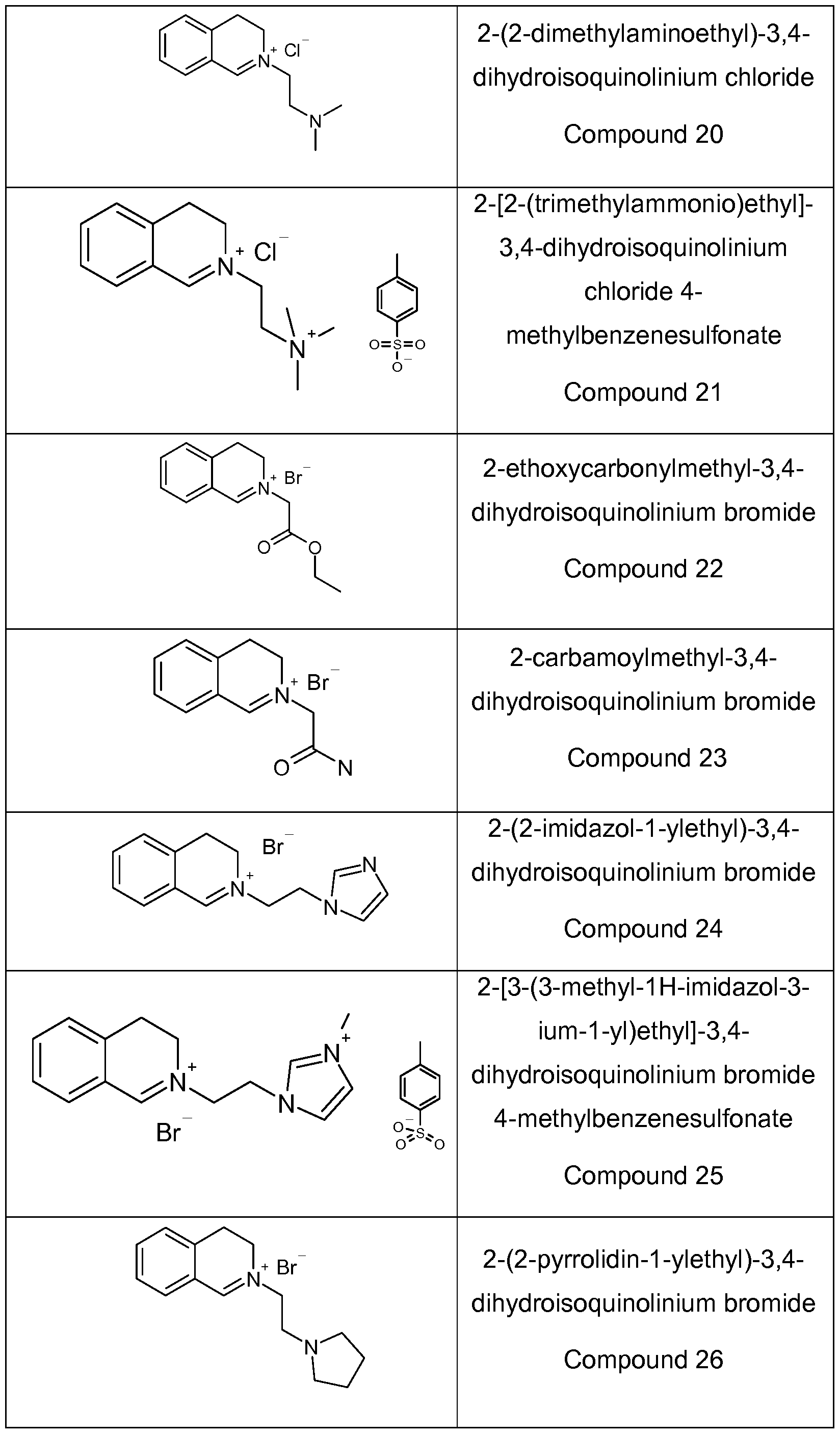


Even more preferentially, the compounds of formula (I) are chosen from the compounds (1 ) to (37), better still from the compounds (1 ) to (3) and (10) to (37), and even better still from the compounds (1 ), (1 1 ) and (12) and also mixtures thereof.
Preferably, the compound(s) (I) and (II) and/or the addition salt(s) thereof and/or the solvate(s) thereof is (are) used in a proportion ranging from 0.1 % to 100% by weight, more preferentially from 1 % to 50% by weight, better still from 2% to 20% by weight, even better still from 5% to 15% by weight, relative to the total weight of the composition.
The pH of the composition used in the invention ranges generally from 1 to 7, preferably from 1 to 6, better from 2 to 5 and better still from 2 to 4.
The method according to the invention may also use one or more chemical oxidizing agents.
Among the chemical oxidizing agents used conventionally, mention may be made of hydrogen peroxide, compounds that can produce hydrogen peroxide by hydrolysis, such as urea peroxide or persalts such as perborates, percarbonates and persulfates, hydrogen peroxide being particularly preferred.
Preferably, the chemical oxidizing agent(s) is (are) used in a proportion ranging from 2% to 20% by weight, even better still from 7% to 12% by weight, relative to the total weight of the composition.
In one preferred embodiment, the method uses one or more chemical oxidizing agents, preferably hydrogen peroxide. According to this embodiment, the method preferably uses a composition C) comprising one or more compounds of formula (I) or of formula (II) and/or the addition salts thereof and/or the solvates thereof, and one or more chemical oxidizing agents, preferably hydrogen peroxide. The composition C) can be obtained by mixing, at the time of use (extemporaneous mixing), a composition C1 ) comprising one or more compounds of formula (I) or of formula (II) and/or the addition salts thereof and/or the solvates thereof, and a composition C2) comprising one or more chemical oxidizing agents, preferably hydrogen peroxide.
According to the invention, the term“ready-to-use composition” is used to refer to the composition applied to the keratin fibres, such as the hair. The ready-to-use composition can result from the mixing of the compositions C1 ) and C2) as previously described, and corresponding to the composition C).
The ready-to-use composition used in the method of the invention preferably comprises the compound(s) of formula (I) or (II) and/or the addition salts thereof and/or the solvates thereof in a total content ranging from 0.1 % to 100% by weight, more preferentially from 1 % to 50% by weight, better still from 2% to 20% by weight, even better still from 5% to 15% by weight, relative to the total weight of the ready-to-use composition.
The ready-to-use composition may also comprise one or more fatty substances, which are preferably liquid(s) (or oil(s)).
The term "fatty substance" is intended to mean an organic compound that is insoluble in water at ordinary temperature (25°C) and at atmospheric pressure
(760 mmHg) (solubility of less than 5%, preferably less than 1 % and even more preferentially less than 0.1 %). They have in their structure at least one
hydrocarbon-based chain comprising at least 6 carbon atoms or a sequence of at least two siloxane groups. In addition, the fatty substances are generally soluble in organic solvents under the same temperature and pressure conditions, for instance chloroform, ethanol, benzene, liquid petroleum jelly or
decamethylcyclopentasiloxane.
The term "oίG is intended to mean a "fatty substance" that is liquid at ambient temperature (25°C) and at atmospheric pressure (760 mmHg or 1.013x10⁵ Pa). The term "non-silicone oil" is intended to mean an oil not containing any silicon atoms (Si) and the term "silicone oil" is intended to mean an oil containing at least one silicon atom.
More particularly, the fatty substances are chosen from C6-C16 hydrocarbons, non-silicone (hydrocarbon-based) oils comprising more than 16 carbon atoms, of plant, animal, mineral or synthetic origin, triglycerides of plant or synthetic origin, fluoro oils, fatty alcohols, non-salified fatty acids, esters of fatty acid and/or of fatty alcohol other than triglycerides, non-silicone waxes other than solid fatty alcohols and than solid synthetic esters, and silicones, and mixtures thereof.
It is recalled that, for the purposes of the invention, fatty alcohols, esters and acids more particularly bear at least one linear or branched, saturated or unsaturated hydrocarbon-based group comprising 6 to 30 carbon atoms, which is optionally substituted, in particular with one or more hydroxyl groups (in particular 1 to 4). If they are unsaturated, these compounds may comprise one to three conjugated or unconjugated carbon-carbon double bonds.
As C6-C16 hydrocarbons, mention may in particular be made of C6-C16 alkanes, the latter being linear, branched, or optionally cyclic.
Examples that may be mentioned include hexane, dodecane and isoparaffins such as isohexadecane and isodecane.
Mention may also be made of the following compounds:
- a mixture of C15-C16 branched alkanes, for example that which is sold by the company SEPPIC under the name Emogreen L15;
- a mixture of C13-C15 linear and/or branched alkanes, for example that which is sold by the company SEPPIC under the name Emosmart L15.
The hydrocarbon-based oils comprising more than 16 carbon atoms may be linear or branched. They may be chosen from liquid paraffins, petroleum jelly, liquid petroleum jelly, polydecenes, and hydrogenated polyisobutene such as Parleam®, squalane, squalene, and mixtures thereof.
Among the hydrocarbon-based oils of plant origin, mention may be made of the refined plant perhydrosqualene sold under the name Fitoderm by the company Cognis; the plant squalane sold, for example, under the name Squalive by the company Biosynthis.
A hydrocarbon-based oil of animal origin that may be mentioned is
perhydrosqualene.
The triglycerides of plant or synthetic origin are preferably chosen from liquid fatty acid triglycerides containing from 6 to 30 carbon atoms, for instance heptanoic or octanoic acid triglycerides, or alternatively, more particularly from those present in plant oils, for instance sunflower oil, corn oil, soybean oil, marrow oil, grapeseed oil, sesame seed oil, hazelnut oil, apricot oil, macadamia oil, arara oil, castor oil, avocado oil, jojoba oil, shea butter oil or synthetic caprylic/capric acid triglycerides, for instance those sold by the company Stearineries Dubois or those sold under the names Miglyol® 810, 812 and 818 by the company Dynamit Nobel, and mixtures thereof.
The fluoro oils may be chosen from perfluoromethylcyclopentane and perfluoro- 1 ,3-dimethylcyclohexane, sold under the names Flutec® PC1 and Flutec® PC3 by the company BNFL Fluorochemicals; perfluoro-1 ,2-dimethylcyclobutane;
perfluoroalkanes such as dodecafluoropentane and tetradecafluorohexane, sold under the names PF 5050® and PF 5060® by the company 3M, or alternatively bromoperfluorooctyl sold under the name Foralkyl® by the company Atochem; nonafluoromethoxybutane and nonafluoroethoxyisobutane; perfluoromorpholine derivatives such as 4-trifluoromethyl perfluoromorpholine sold under the name PF 5052® by the company 3M.
The fatty alcohols that are suitable for use in the invention are more particularly chosen from linear or branched, saturated or unsaturated alcohols comprising from 8 to 30 carbon atoms. Examples that may be mentioned include cetyl alcohol, stearyl alcohol and a mixture thereof (cetylstearyl alcohol),
octyldodecanol, 2-butyloctanol, 2-hexyldecanol, 2-undecylpentadecanol, oleyl alcohol, linolenyl alcohol, ricinoleyl alcohol, undecylenyl alcohol and linoleyl alcohol, and mixtures thereof.
The fatty acids that may be used in the context of the invention are more particularly chosen from saturated or unsaturated carboxylic acids containing from 6 to 30 carbon atoms and in particular from 9 to 30 carbon atoms. They are advantageously chosen from myristic acid, palmitic acid, stearic acid, behenic acid, oleic acid, linoleic acid, linolenic acid and isostearic acid. These fatty acids are, in the composition of the invention, not salified with organic or mineral bases, so as not to give rise to soaps.
As regards the esters of fatty acids and/or of fatty alcohols other than the triglycerides mentioned above and plant waxes, mention may be made in particular of esters of saturated or unsaturated, linear C1-C26 or branched C3-C26 aliphatic monoacids or polyacids and of saturated or unsaturated, linear Ci-C26 or branched C3-C26 aliphatic monoalcohols or polyalcohols, the total carbon number of the esters being greater than or equal to 6 and more advantageously greater than or equal to 10.
Among the monoesters, mention may be made of dihydroabietyl behenate;
octyldodecyl behenate; isocetyl behenate; cetyl lactate; C12-C15 alkyl lactate; isostearyl lactate; lauryl lactate; linoleyl lactate; oleyl lactate; (iso)stearyl octanoate; isocetyl octanoate; octyl octanoate; cetyl octanoate; decyl oleate;
isocetyl isostearate; isocetyl laurate; isocetyl stearate; isodecyl octanoate;
isodecyl oleate; isononyl isononanoate; isostearyl palmitate; methylacetyl ricinoleate; myristyl stearate; octyl isononanoate; 2-ethylhexyl isononanoate; octyl palmitate; octyl pelargonate; octyl stearate; octyldodecyl erucate; oleyl erucate; ethyl and isopropyl palmitates, 2-ethylhexyl palmitate, 2-octyldecyl palmitate, alkyl myristates such as isopropyl, butyl, cetyl, 2-octyldodecyl, myristyl or stearyl
myristate, hexyl stearate, butyl stearate, isobutyl stearate; dioctyl malate, hexyl laurate, 2-hexyldecyl laurate and mixtures thereof.
Still within the context of this variant, esters of C4-C22 dicarboxylic or tricarboxylic acids and of C1 -C22 alcohols and esters of mono-, di- or tricarboxylic acids and of C2-C26 di-, tri-, tetra- or pentahydroxy alcohols may also be used.
Mention may especially be made of: diethyl sebacate; diisopropyl sebacate;
diisopropyl adipate; di-n-propyl adipate; dioctyl adipate; diisostearyl adipate;
dioctyl maleate; glyceryl undecylenate; octyldodecyl stearoyl stearate;
pentaerythrityl monoricinoleate; pentaerythrityl tetraisononanoate; pentaerythrityl tetrapelargonate; pentaerythrityl tetraisostearate; pentaerythrityl tetraoctanoate; propylene glycol dicaprylate; propylene glycol dicaprate; tridecyl erucate;
triisopropyl citrate; triisostearyl citrate; glyceryl trilactate; glyceryl trioctanoate; trioctyldodecyl citrate; trioleyl citrate; propylene glycol dioctanoate; neopentyl glycol diheptanoate; diethylene glycol diisononanoate; and polyethylene glycol distearates, and mixtures thereof.
Among the esters mentioned above, it is preferred to use ethyl, isopropyl, myristyl, cetyl or stearyl palmitate, 2-ethylhexyl palmitate, 2-octyldecyl palmitate, alkyl myristates such as isopropyl, butyl, cetyl or 2-octyldodecyl myristate, hexyl stearate, butyl stearate, isobutyl stearate, dioctyl malate, hexyl laurate, 2- hexyldecyl laurate, isononyl isononanoate or cetyl octanoate, and mixtures thereof.
The composition may also comprise, as fatty ester, sugar esters and diesters of C6-C30 and preferably C12-C22 fatty acids. It is recalled that the term "sugar" is intended to mean oxygen-bearing hydrocarbon-based compounds bearing several alcohol functions, with or without aldehyde or ketone functions, and which comprise at least 4 carbon atoms. These sugars may be monosaccharides, oligosaccharides or polysaccharides.
Examples of suitable sugars that may be mentioned include sucrose, glucose, galactose, ribose, fucose, maltose, fructose, mannose, arabinose, xylose and lactose, and derivatives thereof, especially alkyl derivatives, such as methyl derivatives, for instance methylglucose.
The esters of sugars and of fatty acids may especially be chosen from the group comprising the esters or mixtures of esters of sugars described previously and of linear or branched, saturated or unsaturated C6-C30, preferably C12-C22, fatty acids. If they are unsaturated, these compounds may comprise one to three conjugated or unconjugated carbon-carbon double bonds.
The esters according to this variant may also be chosen from mono-, di-, tri- and tetraesters, polyesters, and mixtures thereof.
These esters may be, for example, oleates, laurates, palmitates, myristates, behenates, cocoates, stearates, linoleates, linolenates, caprates and
arachidonates, or mixtures thereof such as, in particular, oleopalmitate,
oleostearate and palmitostearate mixed esters.
More particularly, use is made of monoesters and diesters and especially sucrose, glucose or methylglucose monooleate or dioleate, stearate, behenate,
oleopalmitate, linoleate, linolenate or oleostearate.
An example that may be mentioned is the product sold under the name Glucate® DO by the company Amerchol, which is a methylglucose dioleate.
Examples of esters or mixtures of esters of sugar and of fatty acid that may also be mentioned include:
- the products sold under the names F160, F140, F110, F90, F70 and SL40 by the company Crodesta, respectively denoting sucrose pal mitate/stea rates formed from 73% monoester and 27% diester and triester, from 61 % monoester and 39% diester, triester and tetraester, from 52% monoester and 48% diester, triester and tetraester, from 45% monoester and 55% diester, triester and tetraester, from 39% monoester and 61 % diester, triester and tetraester, and sucrose monolaurate;
- the products sold under the name Ryoto Sugar Esters, for example referenced B370 and corresponding to sucrose behenate formed from 20% monoester and 80% d iester-triester-polyester;
- the sucrose mono-dipalmito-stearate sold by the company Goldschmidt under the name Tegosoft® PSE.
The non-silicone wax(es) other than solid fatty alcohols and solid synthetic esters are chosen especially from carnauba wax, candelilla wax, esparto wax, paraffin wax, ozokerite, plant waxes, such as olive tree wax, rice wax, hydrogenated jojoba wax or absolute flower waxes, such as the blackcurrant blossom essential wax sold by the company Bertin (France), or animal waxes, such as beeswaxes or modified beeswaxes (cerabellina); other waxes or waxy raw materials that may be used according to the invention are especially marine waxes, such as the wax sold by the company Sophim under the reference M82, polyethylene waxes or polyolefin waxes in general.
The fatty substance(s) do not comprise any C2-C3 oxyalkylene units. Preferably, they do not contain any glycerol units. More particularly, the fatty substances are other than fatty acids.
More particularly, the fatty substances are chosen from compounds that are liquid or pasty at ambient temperature and at atmospheric pressure.
Preferably, the fatty substance is a compound that is liquid at a temperature of 25°C and at atmospheric pressure, or oil.
According to one preferred variant, the fatty substances are not silicone-based.
The fatty substances are preferably chosen from C6-C16 hydrocarbons, hydrocarbon-based oils comprising more than 16 carbon atoms, of plant, animal, mineral or synthetic origin, triglycerides of plant or synthetic origin, fatty alcohols, fatty acid and/or fatty alcohol esters, or mixtures thereof.
Preferably, the fatty substance is chosen from linear or branched hydrocarbon- based oils, of mineral or synthetic origin, comprising more than 16 carbon atoms, or mixtures thereof, for instance liquid petroleum jelly.
When the ready-to-use composition used in the method of the invention comprises one or more fatty substances, which are preferably liquid, the total content thereof preferably ranges from 1 % to 90% by weight, more preferentially from 10% to 80% by weight, better still from 20% to 70%, even more
preferentially from 25% to 60%, even better still from 35% to 65% by weight, relative to the total weight of the ready-to-use composition.
The ready-to-use composition may also comprise one or more surfactants, preferably one or more non-ionic surfactants. Preferably, the non-ionic
surfactant(s) are chosen from oxyalkylenated (OA), preferably oxyethylenated, non-ionic surfactants.
According to one particular embodiment, the ready-to-use composition comprises at least one oxyalkylenated (OA) non-ionic surfactant comprising a number of OA units ranging from 1 to 9 and at least one oxyalkylenated (OA) non-ionic surfactant comprising at least 10 OA units.
The weight ratio, in the composition of the invention, of the amount of
oxyalkylenated non-ionic surfactant(s) comprising a number of OA units ranging from 1 to 9 to the amount of oxyalkylenated non-ionic surfactant(s) comprising at least 10 OA units is greater than 1 , preferably greater than or equal to 1.2, better still greater than or equal to 1.5 and even better still greater than or equal to 2.
Preferably, the oxyalkylenated non-ionic surfactants according to the invention are chosen from oxyethylenated non-ionic surfactants.
Preferably, according to this embodiment, the ready-to-use composition according to the invention comprises at least one oxyethylenated (OE) non-ionic surfactant comprising a number of OE units ranging from 1 to 9 and at least one oxyethylenated (OE) non-ionic surfactant comprising at least 10 OE units.
The weight ratio, in the ready-to-use composition of the invention, of the amount of oxyethylenated non-ionic surfactant(s) comprising a number of OE units ranging from 1 to 9 to the amount of oxyethylenated non-ionic surfactant(s) comprising at least 10 OE units is greater than 1 , preferably greater than or equal to 1.2, better still greater than or equal to 1.5 and even better still greater than or equal to 2.
This weight ratio may range, for example, from 1.2 to 15, better still from 1.5 to 10 and even better still from 2 to 5.
The oxyethylenated non-ionic surfactants comprising a number of OE units ranging from 1 to 9 and the oxyethylenated (OE) non-ionic surfactants comprising at least 10 OE units can be chosen from the following categories:
•oxyethylenated (C8-C24)alkylphenols,
• saturated or unsaturated, linear or branched, oxyethylenated, C8-C30 and preferably C12-C22 fatty alcohols,
•saturated or unsaturated, linear or branched, oxyethylenated C8-C30 amides, «esters of saturated or unsaturated, linear or branched, C8-C30 acids and of polyethylene glycols,
•polyoxyethylenated esters of saturated or unsaturated, linear or branched, Cs- C30 acids and of sorbitol,
•saturated or unsaturated, oxyethylenated plant oils, and mixtures thereof.
Preferably, the oxyethylenated non-ionic surfactant comprising at least 10 OE units and the oxyethylenated non-ionic surfactant comprising from 1 to 9 OE units are chosen from oxyethylenated, saturated or unsaturated, linear or branched, preferably linear, C8-C30, preferably C12-C22 and better still C14-C20, fatty alcohols, for instance cetyl alcohol, oleyl alcohol, oleocetyl alcohol, behenyl alcohol, cetearyl alcohol and stearyl alcohol, and mixtures thereof, and more preferably stearyl alcohol.
Use is preferably made, as oxyethylenated non-ionic surfactant comprising from 1 to 9 OE units, of oxyethylenated non-ionic surfactants comprising from 2 to 8 and preferably from 2 to 4 OE units, for instance the products of addition of ethylene oxide and stearyl alcohol such as stearyl alcohol 2 OE (CTFA name: Steareth-2).
The oxyethylenated non-ionic surfactants comprising at least 10 OE units used in the invention may in particular contain a number of oxyethylene groups, ranging from 10 to 50, preferably from 15 to 30 and better still from 15 to 25, for instance the products of addition of ethylene oxide and stearyl alcohol such as stearyl alcohol 20 OE (CTFA name: Steareth-20).
The content of oxyalkylenated, preferably oxyethylenated, non-ionic surfactant(s) comprising from 1 to 9 oxyalkylene units, preferably oxyethylene units, in the ready-to-use composition according to the invention may range from 0.5% to
15% by weight, preferably from 1 % to 10% by weight and better still from 2% to 6% by weight relative to the total weight of the composition.
The content of oxyalkylenated, preferably oxyethylenated, non-ionic surfactants comprising at least 10 oxyalkylene groups, preferably oxyethylene groups, in the ready-to-use composition according to the invention may range from 0.1 % to
15% by weight, preferably from 0.5% to 10% by weight and better still from 1 % to 5% by weight relative to the total weight of the composition.
The total amount of oxyalkylenated, preferably oxyethylenated, non-ionic surfactants in the ready-to-use composition may range from 1 % to 25% by weight, preferably from 2% to 15% by weight and better still from 3% to 7% by weight relative to the total weight of the composition.
The ready-to-use composition used in the method of the invention generally comprises water. When the composition is aqueous, the water content can range from 10% to 95% by weight, preferably from 20% to 70%, better still from 20% to 50% by weight, relative to the ready-to-use composition.
The composition comprising one or more compounds of formulae (I) and (II) and/or the addition salts thereof and/or the solvates thereof may comprise one or more additional ingredients chosen from ionic liquids, organic solvents, anionic surfactants, cationic surfactants or non-ionic surfactants, other than those listed above, and amphoteric surfactants, cationic, anionic, non-ionic or amphoteric polymers or mixtures thereof, antidandruff agents, anti-seborrhoea agents, agents for preventing hair loss and/or for promoting hair regrowth, vitamins and provitamins including panthenol, sunscreens, mineral or organic pigments, sequestrants, plasticizers, solubilizers, acidifying agents, mineral or organic thickeners, especially polymeric thickeners, opacifiers or nacreous agents, antioxidants, hydroxy acids, fragrances, preservatives, pigments and ceramides.
Another subject of the invention is a method for stripping the artificial colour from human keratin fibres, such as the hair, which comprises the steps consisting:
- in mixing, immediately before use, one or more compounds of formula (I) or (II) defined above, and/or the addition salts thereof and/or the solvates thereof, with
a composition comprising one or more chemical oxidizing agents, preferably hydrogen peroxide,
- in applying the mixture obtained to the human keratin fibres to be stripped,
- in leaving on the mixture for a sufficient time, for example between 1 minute and 1 hour, preferably between 5 and 50 minutes, more preferentially between 15 and
45 minutes, in order to obtain the desired stripping, and
- in removing the stripping mixture by rinsing with water, optionally followed by washing with a shampoo, then optionally by drying.
Another subject of the invention is a method implementing:
- a step of dyeing human keratin fibres such as the hair using a dye composition comprising one or more dyes chosen from oxidation dyes and/or direct dyes,
- a step of stripping the artificial colour from said fibres using a composition comprising one or more compounds of formulae (I) and (II) and/or the addition salts thereof and/or the solvates thereof as previously described, preferably in the presence of one or more chemical oxidizing agents, preferably hydrogen peroxide.
According to this embodiment, the method preferably uses a composition C) as defined above.
Finally, a subject of the invention is the use of a composition comprising one or more compounds of formula (I) or of formula (II) and/or the addition salts thereof and/or the solvates thereof as previously described, for stripping the artificial colour from human keratin fibres such as the hair.
The examples that follow serve to illustrate the invention without, however, being limiting in nature.
EXAMPLES Example 1
The following oxidizing composition A was prepared from the following ingredients in the following proportions indicated as % by weight of product relative to the total weight of the composition in Table 1 :
Table 1

A 1 g lock of natural hair containing 90% grey hairs was dyed beforehand with a Movida chestnut brown dye under the following conditions: 5 g of dye mixture, obtained by mixing the dye support and the oxidizing agent that are sold by L’Oreal, in the proportions 1 + 2, were applied to the lock for a leave-on time of 15 minutes.
The lock was then rinsed, washed with a shampoo, and then dried.
10 g of 2-[3-(3-methyl-1 H-imidazol-3-ium-1 -yl)propyl]-3,4-dihydroisoquinolinium bis(4-methylbenzenesulfonate) (compound 12 according to the invention) were
mixed with 90 g of oxidizing composition A. The pH was 2.5 ± 0.5. This mixture was then applied to the lock for 30 minutes, at 33°C in a proportion of 10 g of mixture per 1 g of hair. The lock was then rinsed, then shampooed and dried.
Example 2 (comparative example)
The following oxidizing composition B was prepared from the following ingredients in the following proportions indicated as % by weight of product relative to the total weight of the composition in Table 2:
Table 2

Another lock dyed beforehand with Movida chestnut brown dye in the same way as that indicated in Example 1 was subjected to stripping using the oxidizing composition B mixed with hot water in a 1 :2 weight ratio for 30 minutes at 33°C. 10 g of mixture were applied to 1 g of lock of hair. The lock was then rinsed, then shampooed and dried.
Example 3 (Estimation of lightening)
In order to demonstrate the impact of each of the methods on the melanin pigments of the hair, undyed natural chestnut brown locks (Tone depth 4, TD4) were treated either with the method of Example 1 using compound 12 according to the invention, or with the method of Example 2 using the oxidizing composition B. This estimation was carried out on locks which had not been artificially dyed so that the effect was not masked by the dyeing.
The colour of the locks treated in Examples 1 , 2 and 3 was then evaluated with an SF600X Datacolor spectrocolorimeter (illuminant D65, angle 10°, specular component included), in the CIELab system.
In this L* a* b* system, the three parameters denote, respectively, the colour intensity (L*), the green/red colour axis (a*) and the blue/yellow colour axis (b*). The higher the value of L*, the lighter the colour.
In the case of the stripping of the previously dyed locks of Examples 1 and 2, the colour variation between the coloured locks of hair and the locks of hair after stripping is defined by the parameter AEab* and is calculated according to the following Equation 1 :
Equation 1

In this Equation 1 , the parameters L*, a* and b* represent the values measured on the locks of hair after stripping with:
- compound 12 of the invention combined with the oxidizing compound A or the oxidizing composition B mixed with water,
and the parameters Lo*, ao* and bo* represent the values measured on the locks of hair dyed with Movida dye.
The higher the AEab* value, the better the stripping of the keratin fibres.
In the case of the treatment of the natural chestnut brown locks of Example 3, the colour variation between the natural locks of hair and the locks of hair after treatment is defined by the parameter DE’ and is calculated according to the following Equation 2: Equation 2

In this Equation 2, the parameters L’*, a’* and b’* represent the values measured on the locks of hair after treatment with:
- compound 12 of the invention combined with the oxidizing compound A or - the oxidizing composition B mixed with water, and the parameters L’o*, a’o* and b’o* represent the values measured on the natural chestnut brown locks.
The lower the DE’ value, the less the lock is lightened, which corresponds to less degradation of the melanin pigments. The results are collated in Table 3 below.
Table 3

The method using compound 12 according to the invention results in a higher AEab* value, and thus in better stripping compared with the comparative method on previously dyed locks.
Moreover, the treatment carried out with compound 12 on natural locks results in a lower DE’ value, and thus in less degradation of the melanin pigments of the hair compared with the comparative treatment.
Example 4
A lock was dyed with a Movida chestnut brown dye in the same way as that indicated in Example 1 , with the exception that the leave-on time was 10 minutes.
10 g of 1 ,2,3,3-tetramethyl-3,4-dihydroisoquinolinium toluenesulfonate
(compound 1 according to the invention) were mixed with 90 g of oxidizing composition A of example 1. This mixture was then applied to the lock for 30 minutes at 33°C, in a proportion of 10 g of mixture per 1 g of hair.
The lock was then rinsed, then shampooed and dried.
Further the same procedure was used for 2-[3-(3-methyl-1 H-imidazol-3-ium-1 - yl)propyl]-3,4-dihydroisoquinolinium bromide 4-methylbenzenesulfonate
(compound 11 according to the invention).
Other locks were prepared according to Examples 2 and 3.
The colour of the locks treated in Examples 4, 2 and 3 was then evaluated with the same procedure as described above, with a Konica-Minolta CM 3600A spectrocolorimeter (illuminant D65, angle 10°, specular component included), in the CIELab system .
The results are collated in the Table 4 below.
Table 4

The method using compound 1 or 11 according to the invention results in a higher AEab* value, and thus in better stripping compared with the comparative method, on previously dyed locks.
Moreover, the treatment carried out with compound 1 or 11 on natural locks results in a lower DE’ value, and thus in less degradation of the melanin pigments of the hair compared with the comparative treatment.
Claims
1 . Method for stripping the artificial colour from human keratin fibres such as the hair, which comprises applying to said artificially dyed fibres a composition comprising one or more compounds of formula (I) or (II) and/or the addition salts thereof and/or the solvates thereof: formula (I)

• R represents:
- a hydrogen atom,
- a linear or branched C1-C12 alkyl radical optionally substituted with one or more groups, which may be identical or different, chosen from hydroxyl, C1-C6 alkoxy, cyano and amino -NR10R11 groups,
• R1 represents: a linear or branched, unsubstituted C1-C12 alkyl radical,
a linear or branched C1-C20 alkyl radical, substituted with a group chosen from:
■ a hydroxyl group,
■ a C1-C6 alkoxy group,
■ an amino group -NR10R11,
■ an amino group - NR12R13,
■ a carboxyl group -COOH,
a cyano group a halogen atom
■ an aminocarbonyl group -CONH2,
■ a (Ci-C6)alkoxycarbonyl group,
■ a saturated or unsaturated, optionally aromatic, 5- or 6-membered heterocycle, optionally substituted with one or more radicals, which may be identical or different, chosen from:
o a linear or branched C1-C6 alkyl radical, o a linear or branched C1-C6 hydroxyalkyl radical, o a C1-C6 alkoxy radical,
o a hydroxyl radical, o an amino radical -NR10R11, o a pyrrolidine, piperidine or morpholine radical, o an ammonium radical NTRaRbRc in which Ra, Rb and Rc denote, independently of one another, a linear or branched C1-C6 alkyl radical or a C1-C6 hydroxyalkyl radical,
■ a saturated or unsaturated, optionally aromatic, 5- or 6-membered cationic heterocycle optionally substituted with one or more radicals, which may be identical or different, chosen from a linear or branched C1-C6 alkyl radical, a C1-C6 hydroxyalkyl radical, a C1-C6 alkoxy radical, a hydroxyl radical and an amino radical - NR10R11,
■ an ammonium radical NTRaRbRc in which Ra, Rb and Rc denote, independently of one another, a linear or branched C1-C6 alkyl radical or a C1-C6 hydroxyalkyl radical,
■ it being understood that when R1 represents an alkyl radical substituted with a cationic group, then the electrical neutrality of the compounds of formula (I) is ensured by the presence of one or more anions C , X adding to the anion An-,
• R2, R3, R4, R5, R6, R7, Re and R9 represent, independently of one another, a radical chosen from:
- a hydrogen atom,
- a halogen atom,
- a linear or branched C1-C6 alkyl radical optionally substituted with one or more groups, which may be identical or different, chosen from hydroxyl, C1-C6 alkoxy and amino -NR10R11 groups,
- a C1-C6 alkoxy radical,
- a hydroxyl radical,
- an amino radical -NR10R11,
- an aminocarbonyl radical -CONH2,
- a carboxyl radical -COOH,
• R10 and R11, which may be identical or different, denote a hydrogen atom or a linear or branched C1-C6 alkyl radical,
• R12 and R13, which may be identical or different, denote a linear or branched C1-C6 alkyl radical, substituted with a hydroxyl group,
formula (II)

in which:
R’i, R’2, R’3, R’S, R’6, R’7, R’e, R’9, R’IO, R"I , RM2, R"3, RM5, R"6, RM7, RM8, R"9 and R"io represent, independently of one another, a radical chosen from:
a hydrogen atom
a halogen atom,
- a C1-C6 alkyl radical optionally substituted with one or more groups, which may be identical or different, chosen from hydroxyl, C1-C6 alkoxy, cyano and amino -NR’aR’b groups,
- a C1-C6 alkoxy radical,
- a hydroxyl radical,
- an amino radical -NR’aR’b,
- an aminocarbonyl radical -CONH2,
- a carboxyl radical -CO2H,
• R’4 and Rm4 represent, independently of one another:
- a C1-C6 alkyl radical optionally substituted with one or more groups, which may be identical or different, chosen from hydroxyl, amino -NR’aR’b, C1- C6 alkoxy, cyano, aminocarbonyl -CONH2 and carboxyl -CO2H groups,
• it being understood that a radical chosen from the R’i radicals and a radical chosen from the R"j radicals together form:
- a divalent radical L representing a linear or branched, saturated or unsaturated C1-C15 alkylene radical, optionally substituted with one or more hydroxyl groups and/or interrupted with one or more non-adjacent heteroatoms chosen from oxygen, nitrogen and sulfur atoms, or
- a covalent single bond,
• R’i represents one of the radicals R’1 to R’10 and R"j represents one of the radicals R"i to R"io; i and j denoting an integer ranging from 1 to 10,
• R’a and R’b represent, independently of one another, a hydrogen atom or a linear or branched, saturated or unsaturated C1-C6 alkyl radical,
• An- denotes an anion or a mixture of anions ensuring the electrical neutrality of the compounds of formula (I) or (II).
2. Method according to Claim 1 , characterized in that R represents in formula (I), a hydrogen atom or a linear C1-C4 alkyl radical, optionally substituted with a cyano group.
3. Method according to Claim 1 or 2, characterized in that Ri represents in formula (I): an unsubstituted linear C1-C6 alkyl radical, or a linear C1-C6 alkyl radical substituted with:
■ a group -N R10R1 1 in which R10 and R1 1 , which may be identical or different, represent a C1 -C3 alkyl radical,
■ a cyano group,
■ a halogen atom,
■ a (C2-C6)alkoxycarbonyl group,
■ a saturated or unsaturated, optionally aromatic, 5- or 6-membered cationic heterocycle chosen from the following formulae:

Rd corresponding to a linear C1-C4 and preferably C1 alkyl radical, an ammonium radical NTRaRbRc in which Ra, Rb and Rc denote, independently of one another, a C1-C3 and preferably C1 alkyl radical, a saturated or unsaturated, optionally aromatic, 5- or 6-membered heterocycle, chosen from:

4. Method according to any one of the preceding claims, characterized in that R2, R3, R4, R5, R6, R7, Re and R9 represent, independently of one another, a hydrogen atom, or a linear C1-C4 alkyl radical, optionally substituted with a C1-C4 alkoxy group.
5. Method according to any one of the preceding claims, characterized in that An- is an anion chosen from halides, in particular chloride and bromide, and para-toluenesulfonate.
6. Method according to any one of the preceding claims, characterized in that the compounds of formula (I) or (II) are chosen from the following
compounds:


7. Method according to any one of the preceding claims, characterized in that the pH of the composition ranges from 1 to 7, preferably from 1 to 6, better from 2 to 5.
8. Method according to any one of the preceding claims, using one or more chemical oxidizing agents.
9. Method according to Claim 8, characterized in that the chemical oxidizing agent is hydrogen peroxide.
10. Method for stripping the artificial colour from human keratin fibres such as the hair, using a composition comprising one or more compounds of formula (I) or (II) as defined in any one of Claims 1 to 6, and/or the addition salts thereof and/or the solvates thereof, and one or more chemical oxidizing agents, preferably hydrogen peroxide.
11. Stripping method according to Claim 10, characterized in that it comprises the steps consisting:
- in mixing, immediately before use, one or more compounds of formula (I) or (II), and/or the addition salts thereof and/or the solvates thereof, with a composition comprising one or more chemical oxidizing agents, preferably hydrogen peroxide,
- in applying the mixture obtained to the human keratin fibres to be stripped,
- in leaving on the mixture for a time sufficient to obtain the desired stripping, and
- in removing the stripping mixture by rinsing with water, followed by washing with a shampoo, then by drying.
12. Method for treating human keratin fibres such as the hair,
implementing:
a step of dyeing human keratin fibres such as the hair using a dye composition comprising one or more dyes chosen from oxidation dyes and/or direct dyes,
- a step of stripping the artificial colour from said fibres using a
composition comprising one or more compounds of formulae (I) and (II) as defined in any one of Claims 1 to 6 and/or the addition salts thereof and/or the solvates thereof, preferably in the presence of one or more chemical oxidizing agents, preferably hydrogen peroxide.
13. Use of a composition comprising one or more compounds of formulae (I) and (II) as defined in any one of Claims 1 to 6 and/or the addition salts thereof and/or the solvates thereof, for stripping the artificial colour from human keratin fibres such as the hair.
Applications Claiming Priority (2)
| Application Number | Priority Date | Filing Date | Title |
|---|---|---|---|
| FR1855963A FR3083101B1 (en) | 2018-06-29 | 2018-06-29 | METHOD FOR STRIPPING THE ARTIFICIAL COLOR OF KERATIN FIBERS WITH DIHYDROXYISOQUINOLINIUM SALTS |
| FR1855963 | 2018-06-29 |
Publications (1)
| Publication Number | Publication Date |
|---|---|
| WO2020002690A1 true WO2020002690A1 (en) | 2020-01-02 |
Family
ID=65031320
Family Applications (1)
| Application Number | Title | Priority Date | Filing Date |
|---|---|---|---|
| PCT/EP2019/067493 Ceased WO2020002690A1 (en) | 2018-06-29 | 2019-06-28 | Method for stripping the artificial colour from keratin fibres with dihydroxyisoquinolinium salts |
Country Status (2)
| Country | Link |
|---|---|
| FR (1) | FR3083101B1 (en) |
| WO (1) | WO2020002690A1 (en) |
Citations (4)
| Publication number | Priority date | Publication date | Assignee | Title |
|---|---|---|---|---|
| DE102007047688A1 (en) * | 2007-10-04 | 2009-04-09 | Henkel Ag & Co. Kgaa | Brightening agent with cationic 3,4-Dihydroisochinoliniumderivaten and hydrogen peroxide |
| WO2017109183A1 (en) * | 2015-12-23 | 2017-06-29 | L'oreal | Use of dihydroisoquinolinium salts for treating keratin materials, compositions and implementation processes |
| WO2017109184A1 (en) * | 2015-12-23 | 2017-06-29 | L'oreal | Use of dihydroisoquinolinium double derivatives for treating keratin materials, compositions and implementation processes |
| FR3046167A1 (en) * | 2015-12-23 | 2017-06-30 | Oreal | USE OF NON-SUBSTITUTED DIHYDROISOQUINOLINIUM SALTS FOR THE TREATMENT OF KERATINIC MATERIALS, COMPOSITIONS AND METHODS OF IMPLEMENTATION |
-
2018
- 2018-06-29 FR FR1855963A patent/FR3083101B1/en not_active Expired - Fee Related
-
2019
- 2019-06-28 WO PCT/EP2019/067493 patent/WO2020002690A1/en not_active Ceased
Patent Citations (4)
| Publication number | Priority date | Publication date | Assignee | Title |
|---|---|---|---|---|
| DE102007047688A1 (en) * | 2007-10-04 | 2009-04-09 | Henkel Ag & Co. Kgaa | Brightening agent with cationic 3,4-Dihydroisochinoliniumderivaten and hydrogen peroxide |
| WO2017109183A1 (en) * | 2015-12-23 | 2017-06-29 | L'oreal | Use of dihydroisoquinolinium salts for treating keratin materials, compositions and implementation processes |
| WO2017109184A1 (en) * | 2015-12-23 | 2017-06-29 | L'oreal | Use of dihydroisoquinolinium double derivatives for treating keratin materials, compositions and implementation processes |
| FR3046167A1 (en) * | 2015-12-23 | 2017-06-30 | Oreal | USE OF NON-SUBSTITUTED DIHYDROISOQUINOLINIUM SALTS FOR THE TREATMENT OF KERATINIC MATERIALS, COMPOSITIONS AND METHODS OF IMPLEMENTATION |
Non-Patent Citations (1)
| Title |
|---|
| "Kosmetik und Hygiene", 30 June 2004, WILEY-VCH, Weinheim, ISBN: 978-3-527-30996-2, article WILFRIED UMBACH: "9.5 Haarfarbänderungsmittel - 9.5.1.3 Anwendung", pages: 299, XP055563746 * |
Also Published As
| Publication number | Publication date |
|---|---|
| FR3083101B1 (en) | 2022-07-15 |
| FR3083101A1 (en) | 2020-01-03 |
Similar Documents
| Publication | Publication Date | Title |
|---|---|---|
| CN101773457B (en) | Process for coloring keratinous materials using lightening emulsions containing dyes and alkaline agents and oxidizing compositions | |
| CN101822618B (en) | Compositions comprising fatty substances and silicates, dyeing or lightening processes using it or apparatus for such processes | |
| KR101781964B1 (en) | Agent for dyeing and/or bleaching keratin fibres in two parts, comprising a fatty substance and a sequestrant | |
| EP2926802B1 (en) | Hair colouring compositions, kits, method, and use thereof | |
| CN101861188A (en) | Hair treatment method using direct emulsion containing oxidizing agent and composition containing alkaline agent | |
| CN101744748A (en) | Process for lightening or process for direct dyeing or oxidation dyeing of keratin fibers in the presence of ammonium salt and device therefor | |
| EP4362893A1 (en) | Cosmetic composition comprising at least one alkyl (poly)glycoside, n,n-dicarboxymethylglutamic acid, propane-1,3-diol, at least one fatty substance other than fatty acids, at least one dye | |
| WO2014174114A2 (en) | Hair dyeing process using henna and then indigo and an oil and/or butter | |
| EP3346970A1 (en) | Composition for altering the color of keratin fibers | |
| BRPI0911109B1 (en) | staining or bleaching process of human keratin materials and multi-compartment device | |
| WO2023278726A1 (en) | Compositions containing direct dyes for imparting color and tone to the hair | |
| EP4362894A1 (en) | Composition comprising n,n-dicarboxymethylglutamic acid, at least one fatty alcohol, at least one fatty acid, at least one polyol, at least one alkaline agent and optionally at least one dye | |
| WO2011076646A2 (en) | Agent for dyeing and/or bleaching keratin fibres, comprising an inverse emulsion comprising an oxidizing agent | |
| WO2014131870A1 (en) | Process for dyeing and/or bleaching keratin fibres using an oxidizing composition in the form of an oil-in-water nanoemulsion | |
| JP7134454B2 (en) | Hair bleaching / destaining composition or hair dye composition | |
| WO2013083702A1 (en) | Composition based on red henna powder and butter(s), and hair dyeing process using this composition | |
| FR2971158A1 (en) | PROCESS FOR LIGHTENING OR COLORING IN THE PRESENCE OF AMMONIUM (BI) CARBONATE AND A MINERAL BASE, DEVICE | |
| WO2020002690A1 (en) | Method for stripping the artificial colour from keratin fibres with dihydroxyisoquinolinium salts | |
| WO2014174116A2 (en) | Composition based on henna or indigo powder with a predispersion of oil, and hair dyeing process using this composition | |
| WO2020002685A1 (en) | Method for stripping the artificial colour from keratin fibres with pyridinium salts | |
| WO2016097126A1 (en) | Composition for dyeing or lightening keratin fibres, in the form of a microemulsion based on particular oil(s), hydrotropic solvents and surfactant(s) | |
| JP7044236B2 (en) | Reducing composition for hair deformation | |
| JP2024026512A (en) | hair dye composition | |
| JP7104954B2 (en) | Oxidative hair dye composition | |
| WO2023275209A1 (en) | Composition comprising n,n-dicarboxymethylglutamic acid, 1,3-propanediol, at least one nonionic surfactant, at least one alkaline agent and/or at least one dye |
Legal Events
| Date | Code | Title | Description |
|---|---|---|---|
| 121 | Ep: the epo has been informed by wipo that ep was designated in this application |
Ref document number: 19733087 Country of ref document: EP Kind code of ref document: A1 |
|
| NENP | Non-entry into the national phase |
Ref country code: DE |
|
| 122 | Ep: pct application non-entry in european phase |
Ref document number: 19733087 Country of ref document: EP Kind code of ref document: A1 |