WO2019239691A1 - Cod経時変化モデル構築方法及びcod経時変化予測方法 - Google Patents
Cod経時変化モデル構築方法及びcod経時変化予測方法 Download PDFInfo
- Publication number
- WO2019239691A1 WO2019239691A1 PCT/JP2019/015057 JP2019015057W WO2019239691A1 WO 2019239691 A1 WO2019239691 A1 WO 2019239691A1 JP 2019015057 W JP2019015057 W JP 2019015057W WO 2019239691 A1 WO2019239691 A1 WO 2019239691A1
- Authority
- WO
- WIPO (PCT)
- Prior art keywords
- cod
- coefficient
- compound
- formula
- attribute
- Prior art date
- Legal status (The legal status is an assumption and is not a legal conclusion. Google has not performed a legal analysis and makes no representation as to the accuracy of the status listed.)
- Ceased
Links
Images

Classifications
-
- C—CHEMISTRY; METALLURGY
- C02—TREATMENT OF WATER, WASTE WATER, SEWAGE, OR SLUDGE
- C02F—TREATMENT OF WATER, WASTE WATER, SEWAGE, OR SLUDGE
- C02F1/00—Treatment of water, waste water, or sewage
- C02F1/72—Treatment of water, waste water, or sewage by oxidation
- C02F1/78—Treatment of water, waste water, or sewage by oxidation with ozone
-
- G—PHYSICS
- G01—MEASURING; TESTING
- G01N—INVESTIGATING OR ANALYSING MATERIALS BY DETERMINING THEIR CHEMICAL OR PHYSICAL PROPERTIES
- G01N33/00—Investigating or analysing materials by specific methods not covered by groups G01N1/00 - G01N31/00
- G01N33/18—Water
Definitions
- the present disclosure relates to a COD temporal change model construction method and a COD temporal change prediction method.
- the decomposition behavior can be known by decomposing a compound in waste water using an oxidant such as ozone, obtaining a sample over time, and measuring a chemical oxygen demand (COD) and the like. it can.
- CODs COD Cr using potassium dichromate as an oxidizing agent is widely used internationally.
- the method of repeating the COD experiment for each sample has a problem in that it takes cost and time to perform an experiment for analyzing the COD. Moreover, in the said method, since it took time to estimate the cost concerning COD experimental equipment and processing time, there was a possibility that it would take time until actual operation. For this reason, it is possible to accurately predict the degradation behavior of a compound in wastewater by an oxidizing agent, specifically, the COD change over time when the compound in wastewater is decomposed by an oxidizing agent. Can be reduced, which is preferable.
- Patent Document 1 discloses a technique for predicting a reaction rate constant between ozone in air and volatile organic compounds (VOCs).
- Patent Document 2 discloses a technique for predicting a reaction rate constant between ozone in the air and an aliphatic compound.
- Patent Documents 1 and 2 predict reaction rate constants of organic substances in the air, and predict COD changes over time when compounds in wastewater are decomposed with an oxidizing agent. It cannot be used.
- An object of the present disclosure is to provide a COD temporal change model construction method and a COD temporal change prediction method capable of accurately predicting the temporal change of COD when a compound in wastewater is decomposed with an oxidizing agent.
- the COD temporal change model construction method is the COD temporal change model construction method according to the first aspect, wherein the fitting step uses a plurality of the above-mentioned COD temporal change measurement data DK as the above formula. is fitted to a COD aging formula CP represented by (1), for each of the plurality of kinds of said known compound K, by creating a COD aging formula CP F represented by the following formula (4), the formula It is a step of obtaining a first coefficient A F after fitting after correcting the first coefficient A in (1) and a second coefficient B F after fitting after correcting the second coefficient B in the above formula (1). .
- the COD aging model building method according to the third aspect of the present disclosure, the COD aging model building method according to the first or second aspect, the attribute AT K is a quantum chemical calculation value QCV K, the The quantum chemical calculation value QCV K is characterized by including one or more kinds of energy selected from the group consisting of HOMO energy E HOMO , LUMO energy E LUMO , and total energy E Total .
- the attribute AT K is a compound attribute AC K, the compound attribute AC K, the molecular weight Mw, the number of atoms NA of each element, electronic speed NE, the complete oxidation requires oxygen atoms n, the bonding number NB, double bond and the number NDT with triple bond, and from the degree of unsaturation DU It includes one or more attributes selected from the group consisting of:
- the attribute AT K is a solution attribute AS K
- the solution attribute AS K includes one or more attributes selected from the group consisting of pH, C 0 (initial COD Cr ), molar concentration CM, temperature T, and electrical conductivity CE.
- a COD temporal change model construction method is the COD temporal change model construction method according to any one of the first to fifth aspects, in which the first regression equation RE 1 has the QCV of HOMO.
- Energy E HOMO wherein AT is the number of oxygen atoms required for complete oxidation n, and is represented by the following formula (5).
- A first coefficient of the formula (1)
- B second coefficient of the formula (1)
- C 0 initial COD Cr of the compound in the sample aqueous solution
- F A log (E HOMO ) as explanatory variables (N: number of oxygen atoms required for complete oxidation, E HOMO : HOMO energy)
- a COD temporal change model construction method is the COD temporal change model construction method according to any one of the first to sixth aspects, in which the second regression equation RE 2 has the QCV of HOMO.
- Energy E HOMO wherein AT is the number of oxygen atoms required for complete oxidation n, and is represented by the following formula (6).
- B second coefficient of formula (1)
- C 0 initial COD Cr of the compound in the sample aqueous solution
- F B linear regression equation with log (E HOMO ) and log (n) as explanatory variables
- n number of oxygen atoms required for complete oxidation
- E HOMO HOMO energy
- a COD temporal change prediction method is a COD temporal change prediction method using information created by the COD temporal change model construction method according to any one of the first to seventh aspects,
- a quantum chemical calculation step for obtaining a quantum chemical calculation value QCV M by performing quantum chemical calculation for the measurement target compound M
- an attribute acquisition step for acquiring an attribute ATM for the measurement target compound M
- the first regression equation RE By substituting the quantum chemistry calculation value QCV M into QCV of 1 and the second regression equation RE 2 and substituting the attribute AT M into AT, the predicted first coefficient A M and the predicted number of the measurement target compound M are substituted.
- C M, 0 that is the initial CODCr of the measurement target compound M in the aqueous solution
- the COD that creates the COD time-varying equation CP M of the measurement target compound M represented by the following formula (7)
- a time-varying expression creation step In formula, C M (t): COD Cr , C M, 0 of measurement target compound M in sample aqueous solution at time t: Initial COD Cr , A M of measurement target compound M in sample aqueous solution: Measurement target compound M Prediction first coefficient, B M : second prediction coefficient of measurement target compound M, t: ozone treatment time)
- COD temporal change model construction method for each of a plurality of types of known compounds K, ozone is passed through a sample aqueous solution of the known compound K, and a plurality of samples having different ozone ventilation times are provided.
- the COD temporal change measurement data D K is a set of data (t, C (t)) a temporal change measurement data storage step of storing, calculation unit, by fitting a plurality of the COD temporal change measurement data D K to COD aging formula CP represented by the following formula (1), formula (1) first coefficient first coefficient after fitting modified the a a F, and the fitting step to obtain a second coefficient B F after fitting that fix the second coefficient B of the formula (1) , (Where C (t): COD Cr at time t of the compound in the sample aqueous solution, C 0 : initial COD Cr of the compound in the sample aqueous solution, A: first coefficient of the compound, B: second coefficient of the compound, t: ozone treatment time) Quantum chemistry calculation step for obtaining a quantum chemistry calculation value QCV K by performing quantum chemistry calculation for each of the plurality of types of
- a COD temporal change prediction method is a COD temporal change prediction method using information created by the COD temporal change model construction method according to the ninth aspect, in which the calculation unit is a measurement target.
- Quantum chemistry calculation step for obtaining quantum chemistry calculation value QCV M by performing quantum chemistry calculation for compound M, and attribute for obtaining attribute AT M for measurement target compound M stored in data storage unit an acquisition step, by the computing unit substitutes the attribute AT M in the first regression equation RE 1 and the second regression equation RE 2 QCV the quantum chemical calculation value QCV M substitution vital AT, the A coefficient calculating step for calculating the predicted first coefficient A M and the predicted second coefficient B M of the measurement target compound M, and the calculation unit calculates the predicted first coefficient A M and the predicted second coefficient B M as described above.
- the calculation unit includes a COD temporal change prediction step of predicting the COD temporal change of the measurement target compound M using the COD temporal change formula CPM.
- a graph showing an example change over time measured data COD aging measured obtained in storage step S102 data D K and COD aging formula obtained in the fitting step S103 CP F, of the COD aging model construction method according to an embodiment is there.
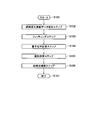
- FIG. 1 is an example of a flowchart of a COD temporal change model construction method according to the embodiment.
- the COD temporal change model construction method includes a temporal change actual measurement data storage step S102, a fitting step S103, a quantum chemistry calculation step S104, an attribute acquisition step S105, and a regression equation construction step S106.
- the time-varying actual measurement data storage step S102 is a step performed after the start S101 in the COD time-varying model construction method according to the embodiment. Aging measured data storage step S102, for each of a plurality of types of known compounds K, the vented ozone into aqueous sample solution of known compounds K, stores the COD aging measured data D K, is a step. COD aging measured data D K, for a plurality of samples with different aeration time ozone was measured COD Cr, relationship between CODCr value C (t) at the time t and the venting time t ozone (t, C (T)) is obtained by creating a collection of data. As a unit of ozone ventilation time t, for example, “minute” is used. As a unit of the COD Cr value C (t), for example, “mg / L” is used.
- the known compound K is a compound whose structural formula is known.
- known compounds K since the structural formula is known, from the known compound K, compound attributes AC K below is an attribute of the known compound K can be easily known.
- molecular weight Mw molecular weight
- number of atoms NA of each element number of electrons NE, number of oxygen atoms required for complete oxidation n, number of bonds NB, number of double bonds and triple bonds NDT, and degree of unsaturation DU, etc. it is possible to know the compound attribute AC K.
- the compound attribute AC K means a compound attribute AC for known compounds generally contained in known compound K.
- it represents a compound attribute AC K of certain known compounds K n in the plurality of types of known compounds K and AC n.
- it represents a compound attribute AC K of known compounds K 1 and AC 1.
- a plurality of known compounds K are used.
- the reason why a plurality of types of known compounds K are used is that, when the first regression equation RE 1 and the second regression equation RE 2 are constructed in the regression equation construction step S106 described later, the higher the number of known compounds K, the higher the accuracy. This is because the regression equation RE 1 and the second regression equation RE 2 can be easily constructed. For this reason, it is generally preferable that there are many types of known compounds K.
- the known compound K a compound that is decomposed when ozone is passed through a sample aqueous solution of the known compound K is used.
- the known compound K is not particularly limited as long as the sample aqueous solution of the known compound K is decomposed by ozone.
- an organic compound is used. Examples of the organic compound include 4,4′-methylenedianiline (CAS registration number: 101-77-9), triisopropanolamine (CAS registration number: 122-20-3), 1,4-butanediol diglycidyl.
- Ether (CAS registration number: 2425-79-8), 4-nitrotoluene-2-sulfonic acid (CAS registration number: 121-03-9), ethylenethiourea (CAS registration number: 96-45-7), 4-chloro -O-cresol (CAS registration number: 1570-64-5), ethylenediaminetetraacetic acid iron (III) monosodium (CAS registration number: 15708-41-5), 4-chloroaniline (CAS registration number: 106-47-) 8), trimethylolpropane (CAS registration number: 77-99-6), etc. are used.
- a plurality of types of known compounds K are used.
- the plurality of known compounds K include, for example, the above 4,4′-methylenedianiline, triisopropanolamine, 1,4-butanediol diglycidyl ether, 4-nitrotoluene-2-sulfonic acid, ethylenethiourea, 4- Two or more compounds selected from the group consisting of chloro-o-cresol, iron (III) ethylenediaminetetraacetate monosodium, 4-chloroaniline, and trimethylolpropane can be used.
- a large number of known compounds K used in this step is preferable because a more accurate COD aging model can be easily obtained.
- a sample aqueous solution of the known compound K is prepared for each of a plurality of types of known compounds K.
- a known compound K the case of using five kinds of known compounds K 1, K 2, K 3 , K 4, K 5 , of known compounds K 1, K 2, K 3 , K 4, K 5 , respectively
- Sample aqueous solutions that is, five types of sample aqueous solutions are prepared.
- ozone is aerated for each of a plurality of sample aqueous solutions of known compounds K, and CODCr is measured for a plurality of samples having different ozone aeration times.
- COD Cr is COD when chromium dioxide is used as an oxidizing agent.
- it is bubbled ozone for sample solution of known compounds K 1, to measure the COD Cr for each of the plurality of samples with different aeration time ozone.
- the number of samples with different ozone ventilation times is usually 3 or more. A large number of samples with different ozone ventilation times is preferable because a more accurate COD aging model can be easily obtained.
- the known compound K used in this step is a compound that is decomposed when ozone is passed through the sample aqueous solution
- a plurality of samples having different ozone ventilation times usually have longer ozone ventilation times.
- COD Cr decreases.
- COD Cr decreases.
- C n for convenience, denoted C n, with t.
- (t 0 , C (t 0 )), (t 1 , C (t 1 )), and (t 2 , C (t 2 )) of the known compound K 1 are respectively converted into (t 0 , C 1 , t0), (t 1, C 1, t1), also referred to as (t 2, C 1, t2 ).
- the relationship between the ozone ventilation time t and the COD Cr value C (t) at this time t (t, C (t ) a collection of data), is defined as COD aging measured data D K.
- COD aging measured data D K of known compounds K 1 to D 1.
- the COD time-varying measurement data D 1 was (t 0 , C (t 0 )), (T 1 , C (t 1 )), (t 2 , C (t 2 )).
- the COD time-dependent change measurement data D 1 of the known compound K 1 is also expressed as (t 0 , C 1, t0 ), (t 1 , C 1, t 1 ), (t 2 , C 1, t 2 ).
- COD aging measured data D K is obtained by the number of known compounds K.
- a known compound K the case of using five kinds of known compounds K 1, K 2, K 3 , K 4, K 5 , the sample solution of known compounds K 1, K 2, K 3 , K 4, K 5 is the COD aging measured data D K, D 1, D 2 , D 3, D 4, D 5 is obtained.
- the COD temporal change actual measurement data D 1 , D 2 , D 3 , D 4 , and D 5 are data of the relationship (t, C (t)) between the ozone ventilation time t and the COD Cr value C (t), respectively. It is a collection of.
- the COD temporal change actual measurement data D 1 , D 2 , D 3 , D 4 , and D 5 are respectively (t 0 , C (t 0 )), (t 1 , C (t 1 )), (t 2 , C (t 2 )).
- COD aging formula CP F obtained in aging measured data storage step S102 COD aging measured data D K and fitting step S103 obtained in the COD aging model building method according to the examples below, It is a graph which shows an example.
- FIG. 3 shows a COD temporal change measurement data of the sample solution of known compounds K n D n, the COD aging type sample solution of known compounds K n CP n, and F.
- D 1 the measured data on COD change over time of a sample aqueous solution of known compound K 1
- CP 1 the COD change over time equation of the sample aqueous solution of known compound K 1
- COD aging measured data D 1, D 2, D 3 , D 4, D 5 is For example, it is a collection of the following data. That is, the COD temporal change actual measurement data D 1 of the known compound K 1 is, for example, (t 0 , C 1, t0 ), (t 1 , C 1, t1 ), (t 2 , C 1, t2 ) data It is an aggregate. COD aging measured data D 2 of the known compounds K 2 are, for example, (t 0, C 2, t0), (t 1, C 2, t1), a collection of data (t 2, C 2, t2 ) It is.
- COD aging measured data D 3 of the known compounds K 3 for example, (t 0, C 3, t0), (t 1, C 3, t1), a collection of data (t 2, C 3, t2 ) It is.
- COD aging measured data D 4 of known compounds K 4 for example, (t 0, C 4, t0), (t 1, C 4, t1), a collection of data (t 2, C 4, t2 ) It is.
- COD aging measured data D 5 of known compounds K 5 for example, (t 0, C 5, t0), (t 1, C 5, t1), a collection of data (t 2, C 5, t2 ) It is.
- Each of the seven small graph diagrams includes graphs corresponding to seven kinds of known compounds K 1 , K 2 , K 3 , K 4 , K 5 , K 6 , and K 7 .
- a small graphical representation of the upper left of FIG. 3 is a small graph and a COD aging measured data D 1 and COD aging formula CP 1, F sample solution of known compounds K 1.
- FIG. 3 is a small graph and a COD aging measured data D 7 and COD aging formula CP 7, F sample solution of known compounds K 7.
- Small graph respectively, the horizontal axis represents time (minutes), the vertical axis is in COD Cr values (mg / L).
- Each COD temporal change measurement data D n in FIG. 3 is an aggregate of 6 points of data indicating the relationship (t, C (t)) between the ozone ventilation time t and the COD Cr value C (t), respectively. It has become.
- COD aging measured data D 1 of the sample solution of known compounds K 1 is ozone relationship between ventilation time t and COD Cr value C (t) (t, C (t)) of the data of 6 points indicating the It is an aggregate.
- the COD temporal change actual measurement data D 1 ,. . . D 7 shows a tendency that COD Cr decreases as the ozone ventilation time t increases.
- the shape of D 7 is different.
- COD aging measured data D 1 is in the form of a convex substantially below
- COD aging measured data D 4 is made up substantially convex shape.
- the resulting COD aging measured data D K for example, is stored in the data storage unit of a personal computer.
- (Fitting step) Fitting step S103 by fitting a plurality of the COD temporal change measurement data D K to COD aging formula CP of the formula (1), the first coefficient after fitting A F and fittings after the second coefficient B This is a step of obtaining F.
- the first coefficient AF after fitting is a coefficient obtained by correcting the first coefficient A in the equation (1) by the fitting.
- the post-fitting second coefficient BF is a coefficient obtained by correcting the second coefficient B of Expression (1) by the above fitting.
- First coefficient A F and the second coefficient B F after fitting after fitting, is fitted to COD aging formula CP represented a plurality of the COD aging measured data D K in equation (1), the following equation (1 ) Is corrected by correcting the first coefficient A and the second coefficient B.
- the first coefficient A F after fitting and the second coefficient B F after fitting are, for example, known compounds K 1 , K 2 , K 3 , K 4 , K 5 , K 6 , K 7, respectively. Create for each.
- the fitting in the step fitting the plurality of the COD temporal change measurement data D K to COD aging formula CP represented by the above formula (1). Then, for each of a plurality of types of the known compounds K, by creating a COD aging formula CP F represented by the following formula (4), the post-fit to correct the first coefficient A of the equation (1) Obtain a first coefficient A F and a second coefficient B F after fitting.
- the C F, 0 of the formula (4), using a C n, 0 is COD Cr value C (0) in the COD aging measured data D n of the time of the known compound K n 0 (minute).
- formula (4) are those represented by generalizing the COD aging formula CP F after fitting all of a plurality of kinds of known compounds K.
- the plurality of types of COD aging formula after fitting specific known compound K n in the known compound K denoted CP n, F as shown in Equation (4-n).
- CP F in the formula for the known compounds K 1 (4) represents the CP 1, F as the following equation (4-1).
- the C n, F, 0 of the formula (4-n), using a C n, 0 is COD Cr value C (0) in the COD aging measured data D n of the time 0 minutes.
- C n, F (t) COD Cr of time t of the known compound K n in the sample solution
- C n, F, 0 initial COD Cr known compound K n in the sample solution
- a n, F the first factor after fitting known compound K n
- B n, F after fitting the known compound K n second coefficients
- t ozone treatment time
- the COD change equation CP n, F is calculated for each of the plurality of types of known compounds K.
- known compounds K is seven known compounds K 1, K 2, when it is ⁇ ⁇ ⁇ K 7, known compounds K 1, K 2, for each sample aqueous solution ⁇ ⁇ ⁇ K 7 COD aging formula CP 1, F 2 , CP 2, F 2, ... CP 7, F are calculated.
- the method of fitting in this step is not particularly limited, but, for example, the least square method is used.
- the COD time-change actual measurement data D 1 shown in FIG. 3 indicates that (t, C (t)) of the known compound K 1 is (0, C (0)), (5, C (5)), (15, C (15)), (30, C (30)), (60, C (60)), and (120, C (120)).
- COD aging measured data D 1 shown in FIG. 3, (t, C (t) ) is (0, C 1,0), ( 5, C 1,5), (15, C 1,15), ( 30, C 1,30 ), (60, C 1,60 ), and (120, C 1,120 ).
- the COD time-varying equation CP 1, F represented by 1) is obtained. Specifically, (0, C 1,0 ), (5, C 1,5 ), (15, C 1,15 ), (30, C 1,30 ) constituting the COD temporal change actual measurement data D 1 , (60, C 1,60 ) and (120, C 1,120 ) are substituted into (t, C (t)) in the equation (1). Then, CP 1, F is obtained by fitting each data.
- the known compounds K 2 , K 3 ,... K 7 are also fitted in the same manner as the known compound K 1, and the COD time-varying equations CP 2, F , CP 3, F ,. 7.
- Get F For example, (0, C 2,0 ), (5, C 2,5 ), (15, C 2,15 ), (30, C 2,30 ), (60) constituting the COD temporal change actual measurement data D 2 , C 2,60 ) and (120, C 2,120 ) are substituted into (t, C (t)) of equation (1).
- CP 2 and F are obtained by fitting each data.
- CP 3, F 1 ,..., CP 7, F are obtained.
- COD aging formula CP 1, F, CP 2, F, ⁇ CP 7, F is can get.
- COD aging formula CP 1, F, CP 2, F, from ⁇ CP 7, F, the first coefficient A 1 after fitting, F, A 2, F, ⁇ A 7, F and post-fit Second coefficients B1 , F , B2 , F ,... B7 , F are obtained.
- the seven small graph constituting Figure 3, known compound K 1, an example of the COD aging formula for sample aqueous ⁇ K 7 CP 1, F, CP 2, F, ⁇ CP 7, F is shown respectively.
- the COD time-varying equations CP 1, F 2 , CP 2, F 2 ,..., CP 7 and F each show a tendency that COD Cr decreases as the ozone ventilation time t increases.
- COD aging formula CP 1 illustrating the manner of lowering, F, CP 2, F, ⁇ CP 7, F shape is different.
- the COD time-varying equation CP1 , F has a substantially convex shape downward
- the COD time-varying equation CP4 , F has a substantially convex shape.
- COD aging formula CP F known compound K has a curved or straight line along the COD aging measured data D K of the same known compounds K.
- This step is processed by, for example, a calculation unit of a personal computer.
- Formula (1) is preserve
- Expressions such as Expression (4), Expression (4-n), and Expression (4-1) obtained in this step are stored, for example, in a data storage unit of a personal computer.
- the quantum chemistry calculation step S104 performs quantum chemistry calculation for each of the plurality of types of known compounds K, for example, each of the known compounds K 1 , K 2 , K 3 , K 4 , K 5 , K 6 , K 7. In this step, the quantum chemical calculation value QCV K is obtained.
- Compound attribute AC K plural kinds of known compounds K formula, each known as the above are also known. For this reason, it is possible to obtain the quantum chemical calculation value QCV K for each of a plurality of types of known compounds K by performing quantum chemical calculation using known calculation program software.
- the quantum chemical calculation value QCV K means the quantum chemical calculation value QCV for known compounds in general contained in the known compound K. In the present embodiment, it represents a QCV n quantum chemical calculation value QCV K of certain known compounds K n in the plurality of types of known compounds K. For example, expressed as QCV 1 quantum chemical calculation value QCV K of known compounds K 1.
- the quantum chemistry calculation value QCV K means energy calculated by performing quantum chemistry calculation on the known compound K.
- energy including at least one energy selected from the group consisting of HOMO energy E HOMO , LUMO energy E LUMO , and total energy E Total is used.
- the quantum chemistry calculation value QCV K is calculated for each of the known compounds K.
- known compounds K are known compounds K 1, K 2, if made of ⁇ ⁇ ⁇ K 7, known compounds K 1, K 2, for each of the ⁇ ⁇ ⁇ K 7, the quantum chemical calculation value QCV 1, QCV 2, ... QCV 7 is calculated.
- the quantum chemistry calculation value QCV K is calculated for the same type of QCV common to a plurality of types of known compounds K. For example, when the energy type of the quantum chemistry calculated value QCV K is HOMO energy E HOMO , for each of the known compounds K 1 , K 2 ,... K 7 , the HOMO energies E HOMO, 1 , E HOMO, 2 , ... E HOMO, 7 is calculated.
- the calculation method used for the quantum chemical calculation in this step is not particularly limited, and for example, a density functional method using a density functional theory (DFT method), a molecular orbital method, or the like can be used.
- DFT method density functional method
- a density functional method using B3LYP, BLYP or the like as an exchange correlation functional can be used.
- the molecular orbital method for example, a semi-empirical molecular orbital method using PM3, an HF method, or an ab initio molecular orbital method using MP2 can be used.
- the basis functions used in the quantum chemical calculation in this step for example, the basis functions of the minimum basis set, the split valence basis set, and the polarization basis set can be used.
- STO-3G can be used as the basis function of the minimum basis set.
- the basis function of the split valence basis set for example, 3-21G and 6-31G can be used.
- 6-31 + G (d.p.), 6-31 + G (d), 6-31G (d.p.), And 6-31G (d) can be used as the basis function of the polarization basis set.
- 6-31 + G (d.p.) And 6-31 + G (d) including the diffuse function are preferable because of high calculation accuracy, and 6-31 + G (d.p.) Is preferable. More preferred.
- the quantum chemical calculation in this step both the limiting method and the non-limiting method can be used, but the limiting method is usually used.
- Gaussian Gaussian 09
- Games GAMESS
- the quantum chemical calculation value QCV K is calculated for each known compound K.
- a quantum chemical calculation value QCV K, known compounds K 1, K 2, E is an HOMO energy E HOMO of ⁇ K 7 HOMO, 1, E HOMO, 2, ⁇ E HOMO, 7 are calculated.
- This step is processed by, for example, a calculation unit of a personal computer.
- Attribute acquisition step S105 is a step of acquiring the attribute AT K for each of the plurality of kinds of said known compound K.
- the attribute AT K includes at least one of a compound attribute AC K that is an attribute of the known compound K and a solution attribute AS K that is an attribute of the sample aqueous solution of the known compound K.
- the attribute AT K may consist both of a compound attribute AC K and solution attributes AS K.
- the attribute AT K , the compound attribute AC K , and the solution attribute AS K mean an attribute AT, a compound attribute AC, and a solution attribute AS for known compounds in general included in the known compound K.
- it represents an attribute AT K of certain known compounds K n in the plurality of types of known compounds K AT n, compound attribute AC K the AC n, the solution attribute AS K and AS n.
- AT 1 attribute AT K of known compounds K 1 AC 1 Compound attribute AC K, represents the solution attribute AS K and AS 1.
- the attribute acquisition step S105 may be performed simultaneously with the quantum chemistry calculation step S104, may be performed before the quantum chemistry calculation step S104, or may be performed after the quantum chemistry calculation step S104.
- the compound attribute AC K for example, molecular weight Mw, the number of atoms NA of each element, electronic speed NE, the complete oxidation requires oxygen atoms n, the bonding number NB, double bond and the number NDT, and degree of unsaturation of the triple bond Attributes including one or more attributes selected from the group consisting of DUs are used.
- the number of oxygen atoms n required for complete oxidation means the number of oxygen atoms necessary for completely oxidizing one molecule of the known compound K.
- the formula for completely oxidizing one molecule of triisopropanolamine C 9 H 21 NO 3 is as shown in the following formula (8).
- the known compound K has a known structural formula. Thus, for example, it is possible to obtain a compound attribute AC K from known information concerning known compound K.
- solution attribute AS K for example, an attribute including at least one attribute selected from the group consisting of pH, C 0 (initial COD Cr ), molar concentration CM, temperature T, and electrical conductivity CE is used. It is done.
- the solution attribute AS K is obtained from the measured value for the target aqueous solution.
- an attribute ATK for each of the plurality of types of known compounds K is acquired.
- known compounds K are known compounds K 1, K 2, complete oxidation required number of oxygen atoms ⁇ K 7 n 1, n 2 , acquires ⁇ ⁇ ⁇ n 7.
- the attribute AT K is stored in, for example, a data storage unit of a personal computer. For this reason, this step is carried out, for example, when the calculation unit acquires the attribute AT K stored in the data storage unit of the personal computer.
- the regression formula building step S106 uses the first coefficient AF after fitting, the second coefficient BF after fitting, the quantum chemistry calculation value QCV K, and the attribute AT K for each of a plurality of types of known compounds K, and performs the first regression. This is a step of constructing the equation RE 1 and the second regression equation RE 2 .
- the first regression equation RE 1 is a regression equation represented by the following equation (2) using the first coefficient A as an objective variable.
- the first regression equation RE 1 is defined as the following equation (2) using the QCV of the quantum chemistry calculation value QCV K and the AT of the attribute AT K as explanatory variables and the first coefficient A as an objective variable: ).
- RE 1 : A F R1 (QCV, AT) (2) (A: 1st coefficient of Formula (1), QCV: Quantum chemical calculation value, AT: Attribute, F R1 : Function)
- the QCV is HOMO energy E HOMO
- the AT is the number of oxygen atoms required for complete oxidation n
- the first regression equation RE 1 represented by the following equation (5) is used. It is done.
- the C 0 of the formula (5), using a C n, 0 is COD Cr value C (0) in the COD aging measured data D n of the time of the known compound K n 0 (minute).
- A first coefficient of the formula (1)
- B second coefficient of the formula (1)
- C 0 initial COD Cr of the compound in the sample aqueous solution
- F A log (E HOMO ) as explanatory variables (N: number of oxygen atoms required for complete oxidation, E HOMO : HOMO energy)
- Formula (5) is obtained by, for example, first post-fitting coefficient An, F and second post-fitting coefficient B n, F obtained from COD time-varying equation CP n, F shown in FIG. 3, and HOMO energy E HOMO, n , and is constructed as a regression equation for predicting the coefficient of the first coefficient A.
- the COD temporal change expression CP n, F shown in FIG. 3 is the COD temporal change expression CP 1, F ,... CP 7, F.
- the obtained first coefficient after fitting An, F is the first coefficient after fitting A1 , F , A2 , F ,..., A7 , F.
- the obtained second coefficient B n, F after fitting is the second coefficient B 1, F , B 2, F ,... B 7, F after fitting.
- the HOMO energy E HOMO, n is the HOMO energy E HOMO, 1 , E HOMO, 2 ,... E HOMO, 7 .
- the first regression equation RE 1 represented by the equation (5) can be expressed as the following equation (5-1).
- A first coefficient of the formula (1)
- B second coefficient of the formula (1)
- C 0 initial COD Cr of the compound in the sample aqueous solution
- F A log (E HOMO ) as explanatory variables (N: number of oxygen atoms required for complete oxidation, E HOMO : HOMO energy)
- the second regression equation RE 2 is the second coefficient B a regression equation represented by the following formula for the purpose variables (3).
- the second regression equation RE 2 is the explanatory variable Toshikatsu the second coefficient B and the said QCV AT regression equation represented by the following formula for the purpose variables (3).
- RE 2 : B F R2 (QCV, AT) (3) (B: second coefficient of formula (1), QCV: quantum chemistry calculated value, AT: attribute, F R2 : function)
- the QCV is HOMO energy E HOMO
- the AT is the number of oxygen atoms required for complete oxidation n
- the second regression equation RE 2 represented by the following equation (6) is used. It is done.
- the C 0 of the formula (6), using a C n, 0 is COD Cr value C (0) in the COD aging measured data D n of the time of the known compound K n 0 (minute).
- Equation (6) is obtained by, for example, the second coefficient after fitting B n, F obtained from the COD time-varying equation CP n, F shown in FIG. 3, the HOMO energy E HOMO, n, and the number of oxygen atoms required for complete oxidation n Is used as a regression equation to predict the coefficient of the second coefficient B.
- the COD temporal change expression CP n, F shown in FIG. 3 is the COD temporal change expression CP 1, F ,... CP 7, F.
- the obtained second coefficient B n, F after fitting is the second coefficient B 1, F , B 2, F ,... B 7, F after fitting.
- the HOMO energy E HOMO, n is the HOMO energy E HOMO, 1 , E HOMO, 2 ,... E HOMO, 7 .
- the number of oxygen atoms required for complete oxidation n is the number of oxygen atoms required for complete oxidation n 1 , n 2 ,... N 7 .
- the second regression equation RE 2 expressed by the equation (6) can be expressed as the following equation (6-1).
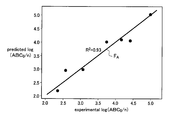
- FIG. 4 is an example of the first regression equation RE 1 obtained in the regression equation construction step S106 of the COD time-varying model construction method according to an example described later.
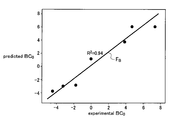
- FIG. 5 is an example of the second regression equation RE 2 obtained in the regression equation construction step S106 of the COD time-varying model construction method according to an example described later.
- FIG. 4 shows an example of F A in the above formulas (5) and (5-1).
- the point of discrete are the individual data of the seven known compounds K used for the construction of F A.
- Figure 4 shows an example of a coefficient of determination R 2 is 0.93 F A.
- FIG. 5 shows an example of a F B in the formula (6) and (6-1).
- the discrete points is nine individual data of known compounds K used for the construction of F B.
- Figure 5 is an example of a coefficient of determination R 2 is 0.94 F B.
- the first regression equation RE 1 can be constructed.
- the second equation B for calculating the second coefficient B of the above equation (1) is represented by the above equation (6) or (6-1)
- a two regression equation RE 2 can be constructed.
- This step is processed by, for example, a calculation unit of a personal computer.
- the first regression equation RE 1 and the second regression equation RE 2 can be constructed based on a plurality of types of known compounds K.
- an attribute of the measurement target compound M is obtained or a quantum chemistry calculation is performed, thereby measuring the measurement target.
- a COD aging formula CP M for compound M can be generated.
- COD aging formula CP M of the measurement target compound M it is possible to predict the COD temporal change of the measurement target compound M. Therefore, according to the COD temporal change model construction method according to the embodiment, there is provided a COD temporal change model construction method capable of accurately predicting the temporal change of COD when a compound in waste water is decomposed with an oxidizing agent.
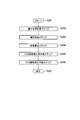
- FIG. 2 is an example of a flowchart of the COD temporal change prediction method according to the embodiment.
- the COD temporal change prediction method according to the embodiment is a COD temporal change prediction method using information created by the COD temporal change model construction method according to the embodiment.
- the COD temporal change prediction method according to the embodiment includes a quantum chemistry calculation step S202, an attribute acquisition step S203, a coefficient calculation step S204, a COD temporal change expression creation step S205, and a COD temporal change prediction step S206.
- the quantum chemistry calculation step S202 is a step performed after the start S201 in the COD temporal change prediction method according to the embodiment.
- the quantum chemistry calculation step S202 is a step of obtaining a quantum chemistry calculation value QCV M by performing quantum chemistry calculation for the measurement target compound M.
- the object to be subjected to the quantum chemistry calculation is changed to “measurement target compound M” instead of the “plural types of known compounds K” in the quantum chemistry calculation step S104.
- the quantum chemistry calculation step S202 is set to “quantum chemistry calculation value QCV M ” instead of “quantum chemistry calculation value QCV K ” of the quantum chemistry calculation step S104. Except for these, the quantum chemistry calculation step S202 is the same as the quantum chemistry calculation step S104.
- the “quantum chemistry calculation value QCV M ” simply means the quantum chemistry calculation value QCV of the “measurement target compound M”.
- the quantum chemistry calculation value QCV K in the quantum chemistry calculation step S104 This is equivalent to using “measurement target compound M” instead of “known compound K”. For this reason, descriptions other than the measurement target compound M are omitted.
- the measurement target compound M which is a target for performing quantum chemical calculation, is a compound having a known structural formula.
- the measurement target compound M may be one kind or plural kinds.
- the measurement target compound M has a known structural formula. Thus, for example, it is possible to obtain a compound attribute AC M from known information concerning the measurement target compound M.
- the quantum chemical calculation value QCV M is calculated for the measurement target compound M.
- E HOMO, 8 and E HOMO, 9 which are HOMO energies E HOMO of the measurement target compounds M 8 and M 9 are calculated as the quantum chemistry calculation value QCV M.
- This step is processed by, for example, a calculation unit of a personal computer.
- Attribute acquisition step S203 is a step of acquiring the attribute AT M for the measurement target compound M.
- Attribute AT M is the measurement target compound M attribute, compound attribute AC M, and the an attribute of the sample solution to be measured compound M solution attribute AS M, consists of at least one.
- the target to be subjected to the quantum chemical calculation is “measurement target compound M” instead of “plural types of known compounds K” in the attribute acquisition step S105.
- the attribute acquisition step S203 uses “attribute AT M , compound attribute AC M , and solution attribute AS M ” instead of “attribute AT K , compound attribute AC K , and solution attribute AS K ” in attribute acquisition step S105. Apart from these, the attribute acquisition step S203 is the same as the attribute acquisition step S105.
- attribute AT M , compound attribute AC M , solution attribute AS M simply means “attribute AT, compound attribute AC, solution attribute AS” of “measurement target compound M”.
- attribute AT M , compound attribute AC M , and solution attribute AS M are “attribute AT K , compound attribute AC K , and solution attribute AS K ” in attribute acquisition step S 105. This is equivalent to using “measurement target compound M” instead of “compound K”.
- the “measurement target compound M” has been described in the quantum chemistry calculation step S202. For this reason, explanation of this step is omitted.
- an attribute ATM for the measurement target compound M is acquired.
- the measurement target compound M is a measurement target compound M 8, M 9, when the type of the attribute AT M is completely oxidized required oxygen atoms n, complete oxidation required number of oxygen atoms of the measurement target compound M 8, M 9 n 8 and n 9 which are n are acquired.
- the measurement target compound M is composed of the measurement target compounds M 8 and M 9 and the type of the attribute AT M is C 0 (initial COD Cr )
- the measurement target compounds M 8 and M 9 have C 0 (initial COD Cr ) C 8,0 and C 9,0 .
- the measurement target compound M is, if a known compound the same compound and K is to incorporate the attributes AT K obtained by the attribute obtaining step S105 of COD aging model building method according to the embodiment as an attribute AT M Can do.
- the attribute AT M for example, stored in the data storage unit of a personal computer. Therefore, this step is, for example, an attribute AT M stored in the data storage unit of the personal computer calculating unit is implemented by acquiring.
- Coefficient calculation step S204 substitutes the attribute AT M the quantum chemical calculation value QCV M assignment vital AT in the first regression equation RE 1 and the second regression equation RE 2 QCV. Thereby, the prediction first coefficient A M and the prediction second coefficient B M of the measurement target compound M are calculated.
- the first regression equation RE 1 is a regression equation represented by the following equation (2) described in the regression equation construction step S106 of the COD temporal change model construction method according to the embodiment. Specifically, the first regression equation RE 1 is an equation using the QCV of the quantum chemistry calculated value QCV K and the AT of the attribute AT K as explanatory variables and the first coefficient A as an objective variable: ).
- RE 1 : A F R1 (QCV, AT) (2) (A: 1st coefficient of Formula (1), QCV: Quantum chemical calculation value, AT: Attribute, F R1 : Function)
- the first regression equation RE 1 for example, the first regression equation RE 1 represented by the following equation (5) is used.
- the first regression equation RE 1 represented by the following formula (5) is a regression equation in which the QCV is HOMO energy E HOMO and the AT is the number of oxygen atoms required for complete oxidation n.
- the C 0 of the formula (5), using a C n, 0 is COD Cr value C (0) in the COD aging measured data D n of the time of the known compound K n 0 (minute).
- A first coefficient of the formula (1)
- B second coefficient of the formula (1)
- C 0 initial COD Cr of the compound in the sample aqueous solution
- F A log (E HOMO ) as explanatory variables (N: number of oxygen atoms required for complete oxidation, E HOMO : HOMO energy)
- the second regression equation RE 2 a regression equation represented by the following formula described in the regression equation construction step S106 of COD aging model construction method according to an embodiment (3).
- the second regression equation RE 2 is defined by the following equation (3) in which the QCV of the quantum chemistry calculation value QCV K and the AT of the attribute AT K are explanatory variables and the second coefficient B is an objective variable. ).
- RE 2 : B F R2 (QCV, AT) (3) (B: second coefficient of formula (1), QCV: quantum chemistry calculated value, AT: attribute, F R2 : function)
- the second regression equation RE 2 for example, the second regression equation RE 2 represented by the following equation (6) is used.
- the second regression equation RE 2 represented by the following formula (6) is a regression equation in which the QCV is HOMO energy E HOMO and the AT is the number of oxygen atoms required for complete oxidation n.
- the C 0 of the formula (6), using a C n, 0 is COD Cr value C (0) in the COD aging measured data D n of the time of the known compound K n 0 (minute).
- the HOMO energy E of each measurement target compound M is represented in these equations.
- the HOMO energy E HOMO of each measurement target compound M is, for example, E HOMO, 8 , E HOMO, 9 which is the HOMO energy E HOMO of the measurement target compounds M 8 and M 9 .
- the number n of oxygen atoms required for complete oxidation of each measurement target compound M is, for example, n 8 and n 9 which are the number of oxygen atoms required for complete oxidation n of the measurement target compounds M 8 and M 9 .
- COD Cr having zero ozone ventilation time in the sample aqueous solution of the measurement target compound M is used.
- C 0 of the measurement target compound M is obtained by performing the same processing as the time-dependent change actual data storage step of the COD time-change model construction method except that the measurement target compound M is used instead of the known compound K.
- the COD time-varying actual measurement data DK is generated using a plurality of samples having different ozone ventilation times in the time-varying actual measurement data storage step. It is only necessary to obtain COD Cr with 0.
- the first regression equation RE 1 such as Equation (5) and the second regression equation RE 2 such as Equation (6) are used to predict the first coefficient A M and the prediction value of the measurement target compound M.
- Two coefficients B M are calculated.
- the predicted first coefficient A M is, for example, the first coefficient calculated as a result of substituting E HOMO, 8 etc. into the first regression equation RE 1 such as Equation (5).
- the predicted second coefficient B M is calculated as a result of substituting E HOMO, 8, the number of oxygen atoms required for complete oxidation n 8 and the like into the second regression equation RE 2 such as Equation (6), Two coefficients.
- This step is processed by, for example, a calculation unit of a personal computer.
- COD aging-preparing step S205 is a step of creating a COD aging formula CP M of the measurement target compound M represented by the formula (7).
- the COD time-varying equation creating step S205 the predicted first coefficient A M and the predicted second coefficient B M are respectively substituted into the first coefficient A and the second coefficient B of the equation (1), and the measurement in the aqueous solution is performed.
- C M, 0 which is the initial CODCr of the target compound M is substituted.
- the COD aging formula creation step S205 creating a COD aging formula CP M of the measurement target compound M represented by the formula (7).
- C M, 0 in the formula (7) C n, 0 which is the COD Cr value C (0) at the time 0 (min) of the measurement target compound M n is used.
- Measurement subject compound M is the case of a plurality of types, COD aging formula CP M is created for each measurement target compound M.
- COD aging formula CP M is created for each measurement target compound M.
- two types of COD time-varying equations CP 8, M , CP 9, M are created.
- CP M and C M, 0 in the formula (7) are generalized and expressed for all the measurement target compounds M.
- the COD time-varying equations CP M and C M, 0 of a specific measurement target compound M n among the measurement target compounds M are represented by CP n, M and C n, M, 0 as shown in the formula (7-n), respectively. It is expressed.
- the COD change equation with time is expressed as CP 8, M
- the initial COD Cr is expressed as C 8, M, 0 .
- the C n, M, 0 of the formula (7-n) the C n, 0 is COD Cr value C (0) at time 0 (min) of the measurement target compound M n used.
- C n, M (t) COD Cr of time t of the measurement target compound M n in the sample solution, C n, M, 0: the measurement target compound M n in the sample solution initial COD Cr, A n, M : Prediction first coefficient of measurement target compound M n , B n, M : Prediction second coefficient of measurement target compound M n , t: Ozone treatment time)
- the numerical value to be substituted for C M, 0 in the formula (7) is created in, for example, the fitting step S103 of the COD time-varying model construction method according to the embodiment.
- C F, 0 in formula (4) can be used.
- C F, 0 in the formula (4) means C F, 0 in the COD time-varying equation CP F after fitting for known compounds in general included in a plurality of types of known compounds K.
- the COD aging formula CP F and C F, 0 after fitting specific known compound K n in the plurality of types of known compounds K, CP n as shown in Equation (4-n), F and It is expressed as Cn , F, 0 .
- the COD time-varying equations CP F and C F, 0 after fitting of the known compound K 1 are represented as CP 1, F and C 1, F, 0 as in the formula (4-n).
- C 8, M, 0 (n 1) by the formula (7-n).
- C 0 (attribute AT M of the known compound K)
- the initial COD Cr can be substituted for C 0 in equations (5) and (6).
- the attribute obtaining step S203 for the measurement target compound M in advance to obtain the C 0 is an attribute AT M (initial COD Cr), the C 0 (Initial COD Cr) Equation (5) and (6 ) can be substituted into C 0 of the.
- COD aging formula CP M An example of creation of COD aging formula CP M in this step will be described with reference to FIG. Figure 6 is an example of COD aging formula CP M obtained in COD aging-preparing step S205 of COD aging prediction method according to the examples described later.
- FIG. 6 the COD change equation of the sample aqueous solution of the measurement target compound M n is shown as CP n, M.
- the COD change equation of the sample aqueous solution of the measurement target compound M 8 is represented as CP 8, M.
- FIG. 6 shows two aggregates of small graphs in which the COD time-varying equations of the sample aqueous solutions of the measurement target compounds M 8 and M 9 are represented by CP 8, M and CP 9, M in one coordinate. It has become.
- the small graph also describes the graph of the measurement target compound M 8, M COD aging measured data D 8 samples an aqueous solution of 9, D 9.
- the horizontal axis represents time (minutes)
- the vertical axis represents the COD Cr values (mg / L).
- COD time-varying equations CP 8, M , CP 9, M are similar to the COD time-varying equations CP 1, F ,... CP 7, F shown in FIG.
- COD Cr tends to decrease.
- COD aging formula CP 8 as shown in FIG. 6, M, CP 9, M is, COD aging formula CP 1 shown in FIG. 3, F, when compared to the ⁇ CP 7, F known compound K n, or tends to slightly spaced from the graph of COD aging measured data D n of the sample solution measurement compounds M n.
- This step is processed by, for example, a calculation unit of a personal computer.
- COD aging prediction step S206 is a step of predicting the COD temporal change of the measurement target compound M with the COD aging formula CP M.
- Each COD aging formula CP M created by COD aging-preparing step S205 approximates the graph of COD aging measured data D n of the sample solution of each known compound K n As can be seen from the example shown in FIG. 6 It seems that the prediction accuracy is high. Therefore, only substituting the COD aging-preparing step S205 ozone treatment time COD aging formula CP M represented by the formula (7) created by t, higher the COD time course of the measurement target compound M precision Can be predicted.
- the COD temporal change prediction method according to the embodiment is terminated S207 after this step.
- Example 1 [COD aging model construction method] (Time-change actual measurement data storage step) After the start S101 of the COD temporal change model construction method, the temporal change actual measurement data storage step S102 was performed. Specifically, for each of the seven known compounds shown in Table 1 (compounds A to G), ozone was passed through a sample aqueous solution of the known compound, and a plurality of samples having different ozone ventilation times were used. saving the COD temporal change measurement data D K.
- the compounds H and I shown in Table 1 are compounds used as the measurement target compound M in [COD change with time prediction method] described later. The specific procedure of this step is shown below.
- aqueous sample solution of known compound Preparation of aqueous sample solution of known compound> [Preparation of aqueous sample solution of Compound A] First, 19 L of an aqueous solution of 1 mol / L and pH 6.5 to 7.5 was prepared using Compound A and ion-exchanged water. The obtained aqueous sample solution was designated as aqueous sample solution A. The pH of the sample aqueous solution A was adjusted using sodium hydroxide, hydrochloric acid or the like.
- sample aqueous solution A In the course of 120 minutes of aeration, 450 mL of sample aqueous solution A was sampled every 5 minutes, 15 minutes, 30 minutes, and 60 minutes. Each sampled solution was vented with air to remove ozone, and samples were processed for 5 minutes, 15 minutes, 30 minutes, and 60 minutes. These samples were designated as sample aqueous solutions A 5 , A 15 , A 30 and A 60 . Finally, 1 L of the sample aqueous solution A immediately after aeration for 120 minutes was sampled, air was aerated to remove ozone, and a sample with a treatment time of 120 minutes was obtained. This sample was designated as sample aqueous solution A120 . By the above operation, sample aqueous solutions A 0 , A 5 , A 15 , A 30 , A 60 , A 120 were obtained as samples.
- COD Cr was measured for the sample aqueous solutions A 0 , A 5 ,... A 120 , which are samples of the sample aqueous solution of Compound A, by the JIS K 0102-20.2 spectrophotometric method.
- the aggregate of the six data is the COD temporal change actual measurement data in the temporal change actual measurement data storage step S102 in the compound A.
- a collection of 6 points of data related to the sample aqueous solutions A 0 , A 5 ,... A 120 was defined as COD temporal change actual measurement data D 1 .
- the results are shown in FIG. FIG. 3 is an aggregate of seven small graph diagrams of 3 rows ⁇ 3 columns.
- each small graph respectively, the horizontal axis represents time (minutes), the vertical axis represents the COD Cr values (mg / L).
- COD Cr value C (t) at the time t (minute) of the compound A is also expressed as C 1, t .
- the data constituting the COD temporal change actual measurement data D 1 shown in FIG. 3 is (0, C (0)), (5, C (5)),... (120, C (120 )).
- Data constituting the COD aging measured data D 1 is also expressed as (0, C 1,0), ( 5, C 1,5), ⁇ (120, C 1,120).
- COD Cr values C (t) of the compounds B, C, D, E, F, G, H, and I at the time t (min) are respectively expressed as C 2, t , C 3, t , C 4, t , C 5, t , C 6, t , C 7, t , C 8, t , C 9, t are also expressed.
- the data constituting the COD aging measured data D 2 to be described later for compound B (0, C (0) ), (5, C (5)), ⁇ (120, C (120)) It is.
- Data constituting the COD aging measured data D 2 are, (0, C 2,0), (5, C 2,5), also referred to as ⁇ (120, C 2,120).
- a collection of 6 data relating to the obtained sample aqueous solutions B 0 , B 5 ,... B 120 was defined as COD temporal change actual measurement data D 2 .
- Data constituting the COD aging measured data D 2 is for compound B (0, C (0) ), a (5, C (5)) , ⁇ (120, C (120)).
- the data constituting the COD aging measured data D 2 are, (0, C 2,0), (5, C 2,5), also referred to as ⁇ (120, C 2,120).
- a collection of 6 data on the obtained sample aqueous solutions C 0 , C 5 ,... C 120 was designated as COD temporal change actual measurement data D 3 .
- Data constituting the COD aging measured data D 3 is for compound C (0, C (0) ), a (5, C (5)) , ⁇ (120, C (120)).
- the data constituting the COD temporal change actual measurement data D 3 is also expressed as (0, C 3,0 ), (5, C 3 , 5 ),... (120, C 3,120 ).
- a collection of 6 data relating to the obtained sample aqueous solutions D 0 , D 5 ,... D 120 was designated as COD temporal change actual measurement data D 4 .
- Data constituting the COD aging measured data D 4 is for compound D (0, C (0) ), a (5, C (5)) , ⁇ (120, C (120)).
- the data constituting the COD aging measured data D 4 is, (0, C 4,0), (5, C 4,5), also referred to as ⁇ (120, C 4,120).
- a collection of six data on the obtained sample aqueous solutions E 0 , E 5 ,... E 120 was designated as COD temporal change actual measurement data D 5 .
- Data constituting the COD aging measured data D 5 is, for compound E (0, C (0) ), a (5, C (5)) , ⁇ (120, C (120)).
- the data constituting the COD aging measured data D 5 is, (0, C 5,0), (5, C 5,5), also referred to as ⁇ (120, C 5,120).
- a collection of 6 data on the obtained sample aqueous solutions F 0 , F 5 ,... F 120 was designated as COD temporal change actual measurement data D 6 .
- Data constituting the COD aging measured data D 6 is for compounds F of (0, C (0)) , a (5, C (5)) , ⁇ (120, C (120)).
- the data constituting the COD aging measured data D 6 is, (0, C 6,0), (5, C 6,5), also referred to as ⁇ (120, C 6,120).
- a collection of 6 data regarding the obtained sample aqueous solutions G 0 , G 5 ,... G 120 was designated as COD temporal change actual measurement data D 7 .
- Data constituting the COD aging measured data D 7 is for Compound G of (0, C (0)) , a (5, C (5)) , ⁇ (120, C (120)).
- the data constituting the COD temporal change actual measurement data D 7 is also expressed as (0, C 7,0 ), (5, C 7 , 5 ),... (120, C 7,120 ).
- a fitting step S103 was performed. Specifically, by fitting each of the obtained COD time-varying actual measurement data D 1 , D 2 ,... D 7 to a COD time-varying CP represented by the following formula (1), A first coefficient A F and a second coefficient B F after fitting were obtained.
- the first coefficient AF after the fitting is a coefficient obtained by correcting the first coefficient A in the equation (1) by fitting.
- the second coefficient BF after fitting is a coefficient obtained by correcting the second coefficient B in the equation (1) by fitting.
- a method of calculating the first coefficient AF after fitting and the second coefficient B F after fitting will be described later.
- a first coefficient A F after fitting and a second coefficient B F after fitting were obtained for each of the compounds A, B, C, D, E, F, and G.
- the first coefficient AF after fitting and the second coefficient BF after fitting were calculated as follows. First , each of the COD temporal change measurement data D 1 , D 2 ,... D 7 was fitted to the COD temporal change expression CP represented by the following formula (1). Then, for each of the compounds A, B, C, D, E, F, and G, the first coefficient A and the second coefficient B in the following formula (1) are corrected based on the fitting, and then each compound is fitted. A first coefficient A F and a second coefficient B F after fitting were obtained.
- the following formula (1) is stored in advance in a data storage unit of a personal computer.
- C 2, F, 0 , C 3, F, 0 ,..., C 7, F, 0 corresponding to C 1, F, 0 in the equation (4-1) are the COD temporal change measured data D 2 , D 3 ,... D 7 , C 2,0 , C 3,0 ,..., C 7,0 , which are COD Cr values C (0) at time 0 (minutes), were used.
- FIG. 3 shows the COD time-varying equations CP1 , F , CP2 , F ,... CP7 , F.
- the obtained COD time-varying equations CP1 , F , CP2 , F ,... CP7 , F first coefficients A1 , F , A2 , F ,... A7 , F , and fitting after fitting
- the second coefficients B1 , F , B2 , F ,... B7 , F were stored in the data storage unit of the personal computer. Thereby, fitting step S103 was completed.
- Quantum chemical calculation step S104 a quantum chemistry calculation step S104 was performed. Specifically, quantum chemical calculation values QCV 1 , QCV 2 , QCV 3 , QCV 4 , QCV 5 , and QCV are calculated for each of the compounds A, B, C, D, E, F, and G. 6 and QCV 7 were obtained.
- HOMO High Occupied Molecular Orbital
- E HOMO was used as QCV. That is, the compound A, B, for each of ⁇ ⁇ ⁇ I, Compound A, B, a E HOMO of ⁇ I, E HOMO, 1, E HOMO, 2, was calculated ⁇ ⁇ ⁇ E HOMO, 7 . The specific procedure of this step is shown below.
- Quantum chemical calculations were performed in the computing section of a personal computer. Specifically, the calculation was performed by a density functional method using a density functional theory (DFT) using a Gaussian 09 program as calculation program software for quantum chemistry calculations. Further, B3LYP was used as an exchange correlation functional in the density functional method, and 6-31 + G (d.p.) was used as a basis function. Moreover, the solvent effect of water was taken in by SCRF (Self Consistent Reaction Field). In the quantum chemistry calculation, a stable structure was obtained by structure stabilization, and HOMO energy E HOMO was calculated. Thereby, HOMO energies E HOMO, 1 , E HOMO, 2 ,... E HOMO, 7 were calculated for each of compounds A, B ,.
- DFT density functional theory
- B3LYP was used as an exchange correlation functional in the density functional method
- 6-31 + G d.p.
- SCRF Self Consistent Reaction Field
- the obtained HOMO energies EHOMO, 1 , EHOMO, 2 , EHOMO, 3 , EHOMO, 4 , EHOMO, 5 , EHOMO, 6 , EHOMO, 7 were stored in a data storage unit of a personal computer. Thereby, quantum chemistry calculation step S104 was completed.
- attribute acquisition step S105 was performed after quantum chemistry calculation step S104. In other experimental examples, the attribute acquisition step S105 may be performed before the quantum chemistry calculation step S104 or simultaneously with the quantum chemistry calculation step S104.
- attribute acquisition step S105 specifically, for each of compounds A, B,... G, the number of oxygen atoms required for complete oxidation, which is the number of oxygen atoms required for complete oxidation n of compounds A, B,. n 1, n 2, was obtained ⁇ n 7.
- the number of oxygen atoms required for complete oxidation n 1 , n 2 ,..., N 7 those stored in the data storage unit of a personal computer were used.
- the number n of oxygen atoms required for complete oxidation does not have to be stored in the data storage unit of the personal computer, and can be calculated as appropriate.
- 28 which is the number n 2 of oxygen atoms necessary for complete oxidation of compound B (triisopropanolamine)
- the number of O atoms in 14O 2 in the above formula (8) is 28. .
- the obtained number of oxygen atoms required for complete oxidation n 1 , n 2 ,... N 7 was stored in a data storage unit of a personal computer. Thereby, the attribute acquisition step S105 is completed.
- a regression equation construction step S106 was performed following the attribute acquisition step S105. Specifically, for each of the compounds A, B,... G, a first coefficient An n, F after fitting, a second coefficient B n, F after fitting, a quantum chemical calculation value E HOMO, n , using the attributes n n, was constructed first regression equation RE 1 and a second regression formula RE 2. As the first coefficients An n, F after fitting, the first coefficients A 1, F , A 2, F ,... A 7, F after fitting were used. As the second coefficient B n, F after fitting, second coefficients B 1, F , B 2, F ,... B 7, F after fitting were used.
- the quantum chemical calculation value E HOMO, n the quantum chemical calculation values E HOMO, 1 , E HOMO, 2 ,... E HOMO, 7 were used.
- attributes n n attributes n 1 , n 2 ,... N 7 were used.
- a personal computer was processed by a calculation unit. The specific procedure of this step is shown below.
- the first coefficients An n, F after fitting the first coefficients A 1, F , A 2, F ,... A 7, F after fitting were used.
- second coefficient B n, F after fitting second coefficients B 1, F , B 2, F ,... B 7, F after fitting were used.
- E HOMO, 1 , E HOMO, 2 ,... E HOMO, 7 was used as the QCV.
- AT the number of oxygen atoms required for complete oxidation n 1 , n 2 ,..., N 7 was used.
- A first coefficient of the formula (1)
- B second coefficient of the formula (1)
- C 0 initial COD Cr of the compound in the sample aqueous solution
- F A log (E HOMO ) as explanatory variables (N: number of oxygen atoms required for complete oxidation, E HOMO : HOMO energy)
- the first regression equation RE 1 represented by the above equation (5) can be expressed as the following equation (5-1).
- A first coefficient of the formula (1)
- B second coefficient of the formula (1)
- C 0 initial COD Cr of the compound in the sample aqueous solution
- F A log (E HOMO ) as explanatory variables (N: number of oxygen atoms required for complete oxidation, E HOMO : HOMO energy)
- FIG. 4 shows the F A in the above formula (5) and (5-1).
- discrete points are individual data of the compounds A, B, C, D, E, F, and G used for the construction of F A.
- the determination coefficient R 2 of F A was 0.94.
- second coefficient B n F after fitting
- second coefficients B 1, F , B 2, F ,... B 7, F after fitting were used.
- E HOMO, 1 , E HOMO, 2 ,... E HOMO, 7 was used as the QCV.
- AT the number of oxygen atoms required for complete oxidation n 1 , n 2 ,..., N 7 was used.
- C 0 in the equation (6) C 1,0 , C 2,0 , C 3, which are COD Cr values C (0) at time 0 (minutes) of the COD temporal change measurement data D 1 to D 7 . 0 , C 4,0 , C 5,0 , C 6,0 , C 7,0 were used.
- the second regression equation RE 2 represented by the equation (6) can be expressed as the following equation (6-1).
- Figure 5 shows the F B of the above formula (6) and (6-1).
- the discrete points are compounds A, B, C, D, E, F, individual data of G used for the construction of F B.
- the coefficient of determination R 2 of F B was 0.93.
- the first coefficient A and the second coefficient B of the above formula (1) are calculated as regression equations applicable to all the compounds A, B,... G with high accuracy.
- the first regression equation RE 1 represented by the formula (5) or (5-1) was constructed.
- a regression equation that can be applied to all of the compounds A, B,... G with high accuracy it is expressed by the above equation (6) or (6-1) that calculates the second coefficient B of the above equation (1).
- the second regression formula RE 2 being was constructed.
- the regression formula construction step S106 is finished, and the COD time-varying model construction method is finished S107.
- COD temporal change prediction method was implemented using the information created by the COD temporal change model construction method.
- Quantum chemical calculation step S202 After the start S201 of the COD temporal change prediction method, a quantum chemistry calculation step S202 was performed.
- This quantum chemistry calculation step S202 is a step of obtaining the quantum chemistry calculation value QCV M by performing quantum chemistry calculation for the measurement target compound M.
- HOMO for each of compounds H and I was carried out in the same manner as in (Quantum chemical calculation step) of [COD time course model construction method] except that compounds H and I were used instead of compound A, respectively.
- the energies E HOMO, 8 and E HOMO, 9 were calculated.
- the obtained HOMO energies E HOMO, 8 and E HOMO, 9 were stored in a data storage unit of a personal computer. Thereby, quantum chemistry calculation step S202 was completed.
- attribute acquisition step S203 (Attribute acquisition step) Following the quantum chemistry calculation step S202, an attribute acquisition step S203 was performed.
- the attribute acquisition step S203 can be performed before the quantum chemistry calculation step S202 or simultaneously with the quantum chemistry calculation step S202. However, in this experimental example, step S203 was performed after step S202.
- Attribute acquisition step S203 is a step of acquiring the attribute AT M for the measurement target compound M.
- the resulting complete oxidation requires oxygen atoms n 8 and n 9 and stored in the data storage unit of a personal computer. Thereby, the attribute acquisition step S203 is completed.
- a coefficient calculation step S204 was performed. Specifically, the first regression equation RE 1 represented by the above equation (5) or (5-1) constructed in the regression equation construction step S106 and the above equation (6) or (6-1) The predicted first coefficient A M and the predicted second coefficient B M of each compound were calculated using the second regression equation RE 2 represented. The predicted first coefficient A M and the predicted second coefficient B M of each compound are obtained by substituting HOMO energy E HOMO , the number of oxygen atoms required for complete oxidation n, and C 0 which is the initial COD Cr into the above formula. Calculated by This step was processed by the computing unit of the personal computer. The specific procedure of this step is shown below.
- COD Cr was measured for the sample aqueous solutions H 5 ,... H 120 as well as the sample aqueous solution H 0 .
- C8,5 , C8,15 , ... C8,120 were obtained.
- Data constituting the COD aging measured data D 8 is for Compound H of (0, C (0)) , a (5, C (5)) , ⁇ (120, C (120)).
- the data constituting the COD aging measured data D 8 is, (0, C 8,0), (5, C 8,5), also referred to as ⁇ (120, C 8,120).
- the ⁇ ⁇ ⁇ I 120 also in the same manner as the sample solution I 0 was measured COD Cr, C 9,5, C 9,15 , ⁇ C 9,120 to It was.
- the obtained sample solution I 0, I 5 the data of 6 points regarding ⁇ I 120 (C 9,0, C 9,5, ⁇ C 9,120) a collection COD aging measured data D It was set to 9 .
- COD aging measured data D 9 Data constituting the COD aging measured data D 9, for the compound I (0, C (0)) , a (5, C (5)) , ⁇ (120, C (120)).
- the data constituting the COD aging measured data D 9 is, (0, C 9,0), (5, C 9,5), also referred to as ⁇ (120, C 9,120).
- These COD temporal change measurement data D 8 and D 9 of compounds H and I are data corresponding to the COD temporal change measurement data D 1 to D 7 of compounds A to G in [COD temporal change model construction method]. .
- Predicted first coefficients A 8, M and A 9, M and predicted second coefficients B 8, M and B 2, M for the obtained compounds H and I were stored in a data storage unit of a personal computer. . Thus, the coefficient calculation step S204 is completed.
- COD time-varying equation creation step S205 was performed following the coefficient calculation step S204. Specifically, the predicted first coefficient A M and the predicted second coefficient B M of each compound were substituted into the first coefficient A and the second coefficient B of the following formula (1), respectively. Further, by substituting the initial COD Cr of the compounds H and I in the aqueous solution into C M, 0 of the following formula (1), the COD time-varying CP of the measurement target compound M represented by the following formula (7) M was created.
- the initial COD Cr for compounds H and I in aqueous solution are C 8,0 and C 9,0 , respectively.
- This step was processed by the computing unit of the personal computer. The specific procedure of this step is shown below.
- FIG. 6 is an aggregate of two small graph diagrams. Each small graph, respectively, as in FIG. 3, the horizontal axis represents time (minutes), the vertical axis represents the COD Cr values (mg / L). 9 also shows COD temporal change actual measurement data D 8 and D 9 together with FIG.
- the COD time-varying equations CP 8, M and CP 9, M are respectively similar to the COD time-varying equations CP 1, F ,... CP 7, F shown in FIG.
- COD Cr tends to decrease.
- the COD time-varying equations CP 8, M and CP 9, M of compounds H and I shown in FIG. 6 are in good agreement with the COD time-varying actual measurement data D 8 and D 9 of compounds H and I, respectively. I understand. For this reason, it was found that the COD time-varying equations CP 8, M and CP 9, M shown in FIG. 6 are sufficiently accurate as a formula for predicting the COD time-dependent changes of the compounds H and I that are the measurement target compounds M. .
- the COD time-varying formulas CP 8, M and CP 9, M were stored in a data storage unit of a personal computer.
- the COD temporal change equation creation step S205 is completed.
- COD temporal change prediction step S206 was performed following the COD temporal change formula creation step S205. Specifically, COD aging was predicted for compounds H and I using the COD aging equations CP 8, M and CP 9, M. This step was processed by the computing unit of the personal computer. As a result, the COD temporal change prediction step S206 is finished, and the COD temporal change prediction method is finished S207.
- a COD temporal change model construction method and a COD temporal change prediction method capable of accurately predicting the temporal change of COD when a compound in waste water is decomposed with an oxidizing agent.
Landscapes
- Chemical & Material Sciences (AREA)
- Life Sciences & Earth Sciences (AREA)
- Engineering & Computer Science (AREA)
- Health & Medical Sciences (AREA)
- Food Science & Technology (AREA)
- Analytical Chemistry (AREA)
- Organic Chemistry (AREA)
- Environmental & Geological Engineering (AREA)
- Hydrology & Water Resources (AREA)
- Medicinal Chemistry (AREA)
- Physics & Mathematics (AREA)
- Water Supply & Treatment (AREA)
- Biochemistry (AREA)
- General Health & Medical Sciences (AREA)
- General Physics & Mathematics (AREA)
- Immunology (AREA)
- Pathology (AREA)
- Treatment Of Water By Oxidation Or Reduction (AREA)
- Investigating Or Analyzing Non-Biological Materials By The Use Of Chemical Means (AREA)
Abstract
COD経時変化モデル構築方法は、複数種類の既知化合物Kのそれぞれについて、COD経時変化実測データDKを保存する経時変化実測データ保存ステップと、COD経時変化実測データDKを、第1係数A及び第2係数Bを含むCOD経時変化式CPにフィッティングさせることにより、式(1)の第1係数Aを修正したフィッティング後第1係数AF、及び式(1)の第2係数Bを修正したフィッティング後第2係数BFを得るフィッティングステップと、量子化学計算値QCVKを得る量子化学計算ステップと、属性ATKを取得する属性取得ステップと、第1係数Aを目的変数とした第1回帰式RE1と、第2係数Bを目的変数とした第2回帰式RE2と、を構築する回帰式構築ステップと、を備える。
Description
本開示は、COD経時変化モデル構築方法及びCOD経時変化予測方法に関する。
排水中の化合物の酸化による分解挙動の把握は、排水処理の観点から重要である。前記分解挙動は、オゾン等の酸化剤を用いて排水中の化合物を分解し、時間経過とともにサンプルを取得し、化学的酸素要求量(COD:Chemical Oxygen Demand)等を測定することにより知ることができる。CODのうち、酸化剤として二クロム酸カリウムを用いるCODCrは国際的に広く用いられている。
しかし、上記のサンプル毎にCOD実験を繰り返す方法では、CODを分析する実験を行うコスト及び時間がかかるという問題があった。また、上記方法では、CODの実験設備にかかるコスト及び処理時間の見積りに時間がかかるため、実際の稼働までに時間がかかるおそれがあった。このため、排水中の化合物の酸化剤による分解挙動、具体的には排水中の化合物を酸化剤で分解したときのCODの経時変化の正確な予測が可能であるとCOD実験にかかるコスト及び時間を減らすことができるため好ましい。
従来、有機化合物の挙動の予測技術はいくつか知られている。例えば、特許文献1には、空気中のオゾンと揮発性有機化合物(VOCs)との反応速度定数を予測する技術が開示されている。また、特許文献2には、空気中のオゾンと脂肪族化合物との反応速度定数を予測する技術が開示されている。
マテウズ・ポンぺ外、「O3と異なる有機化合物との反応の速度定数の予測」、アトモスフェリック・インバイロンメント、オランダ、エルゼビア、2001年8月、第35巻、p.3781-3788
シンリャン・ユ外、「ラジカル構造からのオゾンと有機化合物との反応の速度定数の予測」、アトモスフェリック・インバイロンメント、オランダ、エルゼビア、2012年5月、第51巻、p.124-130
しかしながら、特許文献1及び2に記載された予測技術は、空気中の有機物質の反応速度定数を予測するものであり、排水中の化合物を酸化剤で分解したときのCODの経時変化の予測に用いることはできない。
本開示は、このような従来技術が有する課題に鑑みてなされたものである。本開示の目的は、排水中の化合物を酸化剤で分解したときのCODの経時変化の正確な予測が可能な、COD経時変化モデル構築方法及びCOD経時変化予測方法を提供することにある。
本開示の第1の態様に係るCOD経時変化モデル構築方法は、複数種類の既知化合物Kのそれぞれについて、前記既知化合物Kの試料水溶液にオゾンを通気させ、オゾンの通気時間の異なる複数個のサンプルについての、オゾンの通気時間tとこの時間tでのCODCr値C(t)との関係(t,C(t))のデータの集合体であるCOD経時変化実測データDKを保存する経時変化実測データ保存ステップと、複数個の前記COD経時変化実測データDKを下記式(1)で表されるCOD経時変化式CPにフィッティングさせることにより、式(1)の第1係数Aを修正したフィッティング後第1係数AF、及び式(1)の第2係数Bを修正したフィッティング後第2係数BFを得るフィッティングステップと、

(式中、C(t):試料水溶液中の化合物の時間tのCODCr、C0:試料水溶液中の化合物の初期CODCr、A:化合物の第1係数、B:化合物の第2係数、t:オゾン処理時間)
複数種類の前記既知化合物Kのそれぞれについて、量子化学計算を行うことにより量子化学計算値QCVKを得る量子化学計算ステップと、複数種類の前記既知化合物Kのそれぞれについて属性ATKを取得する属性取得ステップと、複数種類の前記既知化合物Kのそれぞれについての、前記フィッティング後第1係数AFと前記フィッティング後第2係数BFと前記量子化学計算値QCVKと前記属性ATKとを用い、前記第1係数Aを目的変数とした下記式(2)で表される第1回帰式RE1と、
[数2]
RE1: A=FR1(QCV,AT) (2)
(A:式(1)の第1係数、QCV:量子化学計算値、AT:属性、FR1:関数)
前記第2係数Bを目的変数とした下記式(3)で表される第2回帰式RE2と、
[数3]
RE2: B=FR2(QCV,AT) (3)
(B:式(1)の第2係数、QCV:量子化学計算値、AT:属性、FR2:関数)
を構築する回帰式構築ステップと、を備えることを特徴とする。
複数種類の前記既知化合物Kのそれぞれについて、量子化学計算を行うことにより量子化学計算値QCVKを得る量子化学計算ステップと、複数種類の前記既知化合物Kのそれぞれについて属性ATKを取得する属性取得ステップと、複数種類の前記既知化合物Kのそれぞれについての、前記フィッティング後第1係数AFと前記フィッティング後第2係数BFと前記量子化学計算値QCVKと前記属性ATKとを用い、前記第1係数Aを目的変数とした下記式(2)で表される第1回帰式RE1と、
[数2]
RE1: A=FR1(QCV,AT) (2)
(A:式(1)の第1係数、QCV:量子化学計算値、AT:属性、FR1:関数)
前記第2係数Bを目的変数とした下記式(3)で表される第2回帰式RE2と、
[数3]
RE2: B=FR2(QCV,AT) (3)
(B:式(1)の第2係数、QCV:量子化学計算値、AT:属性、FR2:関数)
を構築する回帰式構築ステップと、を備えることを特徴とする。
本開示の第2の態様に係るCOD経時変化モデル構築方法は、第1の態様に係るCOD経時変化モデル構築方法において、前記フィッティングステップは、複数個の前記COD経時変化実測データDKを上記式(1)で表されるCOD経時変化式CPにフィッティングさせ、複数種類の前記既知化合物Kのそれぞれについて、下記式(4)で表されるCOD経時変化式CPFを作成することにより、上記式(1)の第1係数Aを修正したフィッティング後第1係数AF、及び上記式(1)の第2係数Bを修正したフィッティング後第2係数BFを得るステップであることを特徴とする。

(式中、CF(t):試料水溶液中の既知化合物Kの時間tのCODCr、CF,0:試料水溶液中の既知化合物Kの初期CODCr、AF:既知化合物Kのフィッティング後第1係数、BF:既知化合物Kのフィッティング後第2係数、t:オゾン処理時間)
本開示の第3の態様に係るCOD経時変化モデル構築方法は、第1又は第2の態様に係るCOD経時変化モデル構築方法において、前記属性ATKは、量子化学計算値QCVKであり、前記量子化学計算値QCVKは、HOMOエネルギーEHOMO、LUMOエネルギーELUMO、及び全エネルギーETotalからなる群より選択される1種以上のエネルギーを含むことを特徴とする。
本開示の第4の態様に係るCOD経時変化モデル構築方法は、第1~第3のいずれかの態様に係るCOD経時変化モデル構築方法において、前記属性ATKは、化合物属性ACKであり、前記化合物属性ACKは、分子量Mw、各元素の原子数NA、電子数NE、完全酸化必要酸素原子数n、結合数NB、二重結合と三重結合との数NDT、及び不飽和度DUからなる群より選択される1種以上の属性を含むことを特徴とする。
本開示の第5の態様に係るCOD経時変化モデル構築方法は、第1~第4のいずれかの態様に係るCOD経時変化モデル構築方法において、前記属性ATKは、溶液属性ASKであり、前記溶液属性ASKは、pH、C0(初期CODCr)、モル濃度CM、温度T、及び電気伝導度CEからなる群より選択される1種以上の属性を含むことを特徴とする。
本開示の第6の態様に係るCOD経時変化モデル構築方法は、第1~第5のいずれかの態様に係るCOD経時変化モデル構築方法において、前記第1回帰式RE1は、前記QCVがHOMOエネルギーEHOMO、前記ATが完全酸化必要酸素原子数nであり、下記式(5)で表されることを特徴とする。

(式中、A:式(1)の第1係数、B:式(1)の第2係数、C0:試料水溶液中の化合物の初期CODCr、FA:log(EHOMO)を説明変数とする線形回帰式、n:完全酸化必要酸素原子数、EHOMO:HOMOエネルギー)
本開示の第7の態様に係るCOD経時変化モデル構築方法は、第1~第6のいずれかの態様に係るCOD経時変化モデル構築方法において、前記第2回帰式RE2は、前記QCVがHOMOエネルギーEHOMO、前記ATが完全酸化必要酸素原子数nであり、下記式(6)で表されることを特徴とする。

(式中、B:式(1)の第2係数、C0:試料水溶液中の化合物の初期CODCr、FB:log(EHOMO)及びlog(n)を説明変数とする線形回帰式、n:完全酸化必要酸素原子数、EHOMO:HOMOエネルギー)
本開示の第8の態様に係るCOD経時変化予測方法は、第1~第7のいずれかの態様に係るCOD経時変化モデル構築方法で作成された情報を用いるCOD経時変化予測方法であって、測定対象化合物Mについて、量子化学計算を行うことにより量子化学計算値QCVMを得る量子化学計算ステップと、前記測定対象化合物Mについて属性ATMを取得する属性取得ステップと、前記第1回帰式RE1及び前記第2回帰式RE2のQCVに前記量子化学計算値QCVMを代入しかつATに前記属性ATMを代入することにより、前記測定対象化合物Mの予測第1係数AM及び予測第2係数BMを算出する係数算出ステップと、前記予測第1係数AM及び予測第2係数BMを上記式(1)の第1係数A及び第2係数Bにそれぞれ代入し、かつ、水溶液中の前記測定対象化合物Mの初期CODCrであるCM,0を代入することで、下記式(7)で表される前記測定対象化合物MのCOD経時変化式CPMを作成するCOD経時変化式作成ステップと、

(式中、CM(t):試料水溶液中の測定対象化合物Mの時間tのCODCr、CM,0:試料水溶液中の測定対象化合物Mの初期CODCr、AM:測定対象化合物Mの予測第1係数、BM:測定対象化合物Mの予測第2係数、t:オゾン処理時間)
前記COD経時変化式CPMを用いて前記測定対象化合物MのCOD経時変化を予測するCOD経時変化予測ステップと、を備えることを特徴とする。
前記COD経時変化式CPMを用いて前記測定対象化合物MのCOD経時変化を予測するCOD経時変化予測ステップと、を備えることを特徴とする。
本開示の第9の態様に係るCOD経時変化モデル構築方法は、複数種類の既知化合物Kのそれぞれについて、前記既知化合物Kの試料水溶液にオゾンを通気させ、オゾンの通気時間の異なる複数個のサンプルについての、オゾンの通気時間tとこの時間tでのCODCr値C(t)との関係(t,C(t))のデータの集合体であるCOD経時変化実測データDKをデータ保存部に保存する経時変化実測データ保存ステップと、演算部が、複数個の前記COD経時変化実測データDKを下記式(1)で表されるCOD経時変化式CPにフィッティングさせることにより、式(1)の第1係数Aを修正したフィッティング後第1係数AF、及び式(1)の第2係数Bを修正したフィッティング後第2係数BFを得るフィッティングステップと、

(式中、C(t):試料水溶液中の化合物の時間tのCODCr、C0:試料水溶液中の化合物の初期CODCr、A:化合物の第1係数、B:化合物の第2係数、t:オゾン処理時間)
演算部が、複数種類の前記既知化合物Kのそれぞれについて、量子化学計算を行うことにより量子化学計算値QCVKを得る量子化学計算ステップと、演算部が、データ保存部に保存された、複数種類の前記既知化合物Kのそれぞれについて属性ATKを取得する属性取得ステップと、演算部が、複数種類の前記既知化合物Kのそれぞれについての、前記フィッティング後第1係数AFと前記フィッティング後第2係数BFと前記量子化学計算値QCVKと前記属性ATKとを用い、前記第1係数Aを目的変数とした下記式(2)で表される第1回帰式RE1と、
[数9]
RE1: A=FR1(QCV,AT) (2)
(A:式(1)の第1係数、QCV:量子化学計算値、AT:属性、FR1:関数)
前記第2係数Bを目的変数とした下記式(3)で表される第2回帰式RE2と、
[数10]
RE2: B=FR2(QCV,AT) (3)
(B:式(1)の第2係数、QCV:量子化学計算値、AT:属性、FR2:関数)
を構築する回帰式構築ステップと、を備えることを特徴とする。
演算部が、複数種類の前記既知化合物Kのそれぞれについて、量子化学計算を行うことにより量子化学計算値QCVKを得る量子化学計算ステップと、演算部が、データ保存部に保存された、複数種類の前記既知化合物Kのそれぞれについて属性ATKを取得する属性取得ステップと、演算部が、複数種類の前記既知化合物Kのそれぞれについての、前記フィッティング後第1係数AFと前記フィッティング後第2係数BFと前記量子化学計算値QCVKと前記属性ATKとを用い、前記第1係数Aを目的変数とした下記式(2)で表される第1回帰式RE1と、
[数9]
RE1: A=FR1(QCV,AT) (2)
(A:式(1)の第1係数、QCV:量子化学計算値、AT:属性、FR1:関数)
前記第2係数Bを目的変数とした下記式(3)で表される第2回帰式RE2と、
[数10]
RE2: B=FR2(QCV,AT) (3)
(B:式(1)の第2係数、QCV:量子化学計算値、AT:属性、FR2:関数)
を構築する回帰式構築ステップと、を備えることを特徴とする。
本開示の第10の態様に係るCOD経時変化予測方法は、第9の態様に係るCOD経時変化モデル構築方法で作成された情報を用いるCOD経時変化予測方法であって、演算部が、測定対象化合物Mについて、量子化学計算を行うことにより量子化学計算値QCVMを得る量子化学計算ステップと、演算部が、データ保存部に保存された、前記測定対象化合物Mについて属性ATMを取得する属性取得ステップと、演算部が、前記第1回帰式RE1及び前記第2回帰式RE2のQCVに前記量子化学計算値QCVMを代入しかつATに前記属性ATMを代入することにより、前記測定対象化合物Mの予測第1係数AM及び予測第2係数BMを算出する係数算出ステップと、演算部が、前記予測第1係数AM及び予測第2係数BMを上記式(1)の第1係数A及び第2係数Bにそれぞれ代入し、かつ、水溶液中の前記測定対象化合物Mの初期CODCrであるCM,0を代入することで、下記式(7)で表される前記測定対象化合物MのCOD経時変化式CPMを作成するCOD経時変化式作成ステップと、

(式中、CM(t):試料水溶液中の測定対象化合物Mの時間tのCODCr、CM,0:試料水溶液中の測定対象化合物Mの初期CODCr、AM:測定対象化合物Mの予測第1係数、BM:測定対象化合物Mの予測第2係数、t:オゾン処理時間)
演算部が、前記COD経時変化式CPMを用いて前記測定対象化合物MのCOD経時変化を予測するCOD経時変化予測ステップと、を備えることを特徴とする。
演算部が、前記COD経時変化式CPMを用いて前記測定対象化合物MのCOD経時変化を予測するCOD経時変化予測ステップと、を備えることを特徴とする。
以下、図面を用いて実施形態に係るCOD経時変化モデル構築方法、及びCOD経時変化予測方法について詳細に説明する。
[COD経時変化モデル構築方法]
図1は、実施形態に係るCOD経時変化モデル構築方法のフローチャートの一例である。
図1は、実施形態に係るCOD経時変化モデル構築方法のフローチャートの一例である。
実施形態に係るCOD経時変化モデル構築方法は、経時変化実測データ保存ステップS102と、フィッティングステップS103と、量子化学計算ステップS104と、属性取得ステップS105と、回帰式構築ステップS106と、を備える。
(経時変化実測データ保存ステップ)
経時変化実測データ保存ステップS102は、実施形態に係るCOD経時変化モデル構築方法において、スタートS101の後に行うステップである。経時変化実測データ保存ステップS102は、複数種類の既知化合物Kのそれぞれについて、前記既知化合物Kの試料水溶液にオゾンを通気させ、COD経時変化実測データDKを保存する、ステップである。COD経時変化実測データDKは、オゾンの通気時間の異なる複数個のサンプルについてCODCrを測定し、オゾンの通気時間tとこの時間tでのCODCr値C(t)との関係(t,C(t))のデータの集合体を作成することにより得られる。オゾンの通気時間tの単位としては、例えば、「分」が用いられる。CODCr値C(t)の単位としては、例えば、「mg/L」が用いられる。
経時変化実測データ保存ステップS102は、実施形態に係るCOD経時変化モデル構築方法において、スタートS101の後に行うステップである。経時変化実測データ保存ステップS102は、複数種類の既知化合物Kのそれぞれについて、前記既知化合物Kの試料水溶液にオゾンを通気させ、COD経時変化実測データDKを保存する、ステップである。COD経時変化実測データDKは、オゾンの通気時間の異なる複数個のサンプルについてCODCrを測定し、オゾンの通気時間tとこの時間tでのCODCr値C(t)との関係(t,C(t))のデータの集合体を作成することにより得られる。オゾンの通気時間tの単位としては、例えば、「分」が用いられる。CODCr値C(t)の単位としては、例えば、「mg/L」が用いられる。
ここで、既知化合物Kとは、構造式が知られている化合物である。既知化合物Kは、構造式が既知であるため、既知化合物Kから、既知化合物Kの属性である後述の化合物属性ACKを容易に知ることができる。例えば、既知化合物Kから、分子量Mw、各元素の原子数NA、電子数NE、完全酸化必要酸素原子数n、結合数NB、二重結合と三重結合との数NDT、及び不飽和度DU等の化合物属性ACKを知ることができる。
化合物属性ACKとは、既知化合物Kに含まれる既知化合物一般についての化合物属性ACを意味する。本実施形態では、複数種類の既知化合物K中の特定の既知化合物Knの化合物属性ACKをACnと表す。例えば、既知化合物K1の化合物属性ACKをAC1と表す。
既知化合物Kは、複数種類用いられる。既知化合物Kを複数種類用いる理由は、後述の回帰式構築ステップS106で第1回帰式RE1及び第2回帰式RE2を構築する際に、既知化合物Kの数が多いほど精度の高い第1回帰式RE1及び第2回帰式RE2を構築しやすいからである。このため、一般的に、既知化合物Kの種類は、多いことが好ましい。
既知化合物Kとしては、既知化合物Kの試料水溶液にオゾンを通気させたときに分解される化合物が用いられる。既知化合物Kとしては、既知化合物Kの試料水溶液がオゾンで分解される限り特に限定されないが、例えば、有機化合物が用いられる。有機化合物としては、例えば、4,4‘-メチレンジアニリン(CAS登録番号:101-77-9)、トリイソプロパノールアミン(CAS登録番号:122-20-3)、1,4-ブタンジオールジグリシジルエーテル(CAS登録番号:2425-79-8)、4-ニトロトルエン-2-スルホン酸(CAS登録番号:121-03-9)、エチレンチオ尿素(CAS登録番号:96-45-7)、4-クロロ-o-クレゾール(CAS登録番号:1570-64-5)、エチレンジアミン四酢酸鉄(III)モノナトリウム(CAS登録番号:15708-41-5)、4-クロロアニリン(CAS登録番号:106-47-8)、トリメチロールプロパン(CAS登録番号:77-99-6)、等が用いられる。
本ステップでは、複数種類の既知化合物Kが用いられる。複数種類の既知化合物Kとしては、例えば、上記の4,4‘-メチレンジアニリン、トリイソプロパノールアミン、1,4-ブタンジオールジグリシジルエーテル、4-ニトロトルエン-2-スルホン酸、エチレンチオ尿素、4-クロロ-o-クレゾール、エチレンジアミン四酢酸鉄(III)モノナトリウム、4-クロロアニリン、及びトリメチロールプロパンからなる群より選択される2種以上の化合物を用いることができる。本ステップで用いられる既知化合物Kの種類数が多いと、より正確なCOD経時変化モデルが得られやすいため好ましい。
本ステップでは、複数種類の既知化合物Kのそれぞれについて、既知化合物Kの試料水溶液を作製する。例えば、既知化合物Kとして、既知化合物K1、K2、K3、K4、K5の5種類を用いる場合は、既知化合物K1、K2、K3、K4、K5のそれぞれの試料水溶液、すなわち5種類の試料水溶液を作製する。
本ステップでは、複数種類の既知化合物Kの試料水溶液のそれぞれについて、オゾンを通気させ、オゾンの通気時間の異なる複数個のサンプルについてCODCrを測定する。ここで、CODCrとは、ニ酸化クロムカリウムを酸化剤として用いたときのCODである。本ステップでは、例えば、既知化合物K1の試料水溶液についてオゾンを通気させ、オゾンの通気時間の異なる複数個のサンプルのそれぞれについてCODCrを測定する。オゾンの通気時間の異なるサンプルの数は、通常、3個以上である。オゾンの通気時間の異なるサンプルの数が多いと、より正確なCOD経時変化モデルが得られやすいため好ましい。
本ステップで用いられる既知化合物Kは、その試料水溶液にオゾンを通気させたときに分解される化合物であるため、オゾンの通気時間の異なる複数個のサンプルは、通常、オゾンの通気時間が長くなるにつれてCODCrが低下する。例えば、既知化合物K1の試料水溶液におけるオゾンの通気時間がt0、t1、t2(t0<t1<t2)の3個のサンプルA0、A1、A2では、通常、後者ほどCODCrが低下する。
本ステップでは、オゾンの通気時間の異なる複数個のサンプルについてオゾンの通気時間tとCODCr値C(t)との関係(t,C(t))のデータを取得する。例えば、上記3個のサンプルA0、A1、A2についてオゾンの通気時間tとCODCr値C(t)との関係(t0,C(t0))、(t1,C(t1))、(t2,C(t2))のデータを取得する。
なお、本明細書では、既知化合物Kが化合物Knである場合の時間tでのCODCr値C(t)を、便宜上、Cn,tとも表記する。例えば、上記の既知化合物K1の(t0,C(t0))、(t1,C(t1))、(t2,C(t2))を、それぞれ(t0,C1,t0)、(t1,C1,t1)、(t2,C1,t2)とも表記する。
本ステップでは、既知化合物K毎の、オゾンの通気時間の異なる複数個のサンプルについての、オゾンの通気時間tとこの時間tでのCODCr値C(t)との関係(t,C(t))のデータの集合体を、COD経時変化実測データDKと規定する。例えば、既知化合物K1のCOD経時変化実測データDKをD1する。既知化合物K1の試料水溶液にオゾンを通気させた場合に、上記3個のサンプルA0、A1、A2を得たとき、COD経時変化実測データD1は(t0,C(t0))、(t1,C(t1))、(t2,C(t2))からなる。なお、この既知化合物K1のCOD経時変化実測データD1は、(t0,C1,t0)、(t1,C1,t1)、(t2,C1,t2)とも表記される。
本ステップでは、複数種類の既知化合物Kのそれぞれについて、既知化合物Kの試料水溶液にオゾンを通気させてCOD経時変化実測データDKを得る。このため、本ステップでは、COD経時変化実測データDKは、既知化合物Kの数だけ得られる。例えば、既知化合物Kとして、既知化合物K1、K2、K3、K4、K5の5種類を用いる場合は、既知化合物K1、K2、K3、K4、K5の試料水溶液のCOD経時変化実測データDKである、D1、D2、D3、D4、D5が得られる。COD経時変化実測データD1、D2、D3、D4、D5は、それぞれが、オゾンの通気時間tとCODCr値C(t)との関係(t,C(t))のデータの集合体になっている。例えば、COD経時変化実測データD1、D2、D3、D4、D5は、それぞれが、(t0,C(t0))、(t1,C(t1))、(t2,C(t2))のデータを含む。
図3は、後述の実施例に係るCOD経時変化モデル構築方法の経時変化実測データ保存ステップS102で得られたCOD経時変化実測データDK及びフィッティングステップS103で得られたCOD経時変化式CPF、の一例を示すグラフである。
図3において、既知化合物Knの試料水溶液のCOD経時変化実測データをDn、既知化合物Knの試料水溶液のCOD経時変化式をCPn,Fと示す。例えば、既知化合物K1の試料水溶液のCOD経時変化実測データをD1、既知化合物K1の試料水溶液のCOD経時変化式をCP1,Fと示す。
COD経時変化実測データDnにおいて時間tでのCODCr値C(t)をCn,tと表記した場合、COD経時変化実測データD1、D2、D3、D4、D5は、例えば、以下のデータの集合体である。すなわち、既知化合物K1のCOD経時変化実測データD1は、例えば、(t0,C1,t0)、(t1,C1,t1)、(t2,C1,t2)のデータの集合体である。既知化合物K2のCOD経時変化実測データD2は、例えば、(t0,C2,t0)、(t1,C2,t1)、(t2,C2,t2)のデータの集合体である。既知化合物K3のCOD経時変化実測データD3は、例えば、(t0,C3,t0)、(t1,C3,t1)、(t2,C3,t2)のデータの集合体である。既知化合物K4のCOD経時変化実測データD4は、例えば、(t0,C4,t0)、(t1,C4,t1)、(t2,C4,t2)のデータの集合体である。既知化合物K5のCOD経時変化実測データD5は、例えば、(t0,C5,t0)、(t1,C5,t1)、(t2,C5,t2)のデータの集合体である。
図3は、既知化合物Knの試料水溶液のCOD経時変化実測データDnのグラフとCOD経時変化式CPn,Fのグラフとを1個の座標中に示した小グラフ図の7個の集合体になっている。7個の小グラフ図は、それぞれ、7種類の既知化合物K1、K2、K3、K4、K5、K6、K7に対応するグラフを含む。例えば、図3の左上の小グラフ図は、既知化合物K1の試料水溶液のCOD経時変化実測データD1とCOD経時変化式CP1,Fとを含む小グラフ図である。また、図3の左下の小グラフ図は、既知化合物K7の試料水溶液のCOD経時変化実測データD7とCOD経時変化式CP7,Fとを含む小グラフ図である。小グラフ図は、それぞれ、横軸が時間(分)、縦軸がCODCr値(mg/L)になっている。
図3中の各COD経時変化実測データDnは、それぞれ、オゾンの通気時間tとCODCr値C(t)との関係(t,C(t))を示す6点のデータの集合体となっている。例えば、既知化合物K1の試料水溶液のCOD経時変化実測データD1は、オゾンの通気時間tとCODCr値C(t)との関係(t,C(t))を示す6点のデータの集合体となっている。
図3に示すように、COD経時変化実測データD1、...D7は、それぞれ、オゾンの通気時間tが増加するとCODCrが低下する傾向を示す。ただし、その低下の仕方を示すCOD経時変化実測データD1、...D7の形状は、様々である。例えば、COD経時変化実測データD1はほぼ下に凸の形状であり、COD経時変化実測データD4はほぼ上に凸の形状になっている。
得られたCOD経時変化実測データDKは、例えば、パーソナルコンピューターのデータ保存部に保存される。
(フィッティングステップ)
フィッティングステップS103は、複数個の前記COD経時変化実測データDKを式(1)で表されるCOD経時変化式CPにフィッティングさせることにより、フィッティング後第1係数AF及びフィッティング後第2係数BFを得るステップである。フィッティング後第1係数AFは、上記フィッティングにより式(1)の第1係数Aが修正されて得られる係数である。フィッティング後第2係数BFは、上記フィッティングにより式(1)の第2係数Bが修正されて得られる係数である。フィッティング後第1係数AF及びフィッティング後第2係数BFは、複数個の前記COD経時変化実測データDKを式(1)で表されるCOD経時変化式CPにフィッティングさせ、下記式(1)の第1係数A及び第2係数Bを修正することにより得られる。フィッティング後第1係数AF及びフィッティング後第2係数BFは、複数種類の前記既知化合物Kのそれぞれ、例えば既知化合物K1、K2、K3、K4、K5、K6、K7のそれぞれについて、作成する。
フィッティングステップS103は、複数個の前記COD経時変化実測データDKを式(1)で表されるCOD経時変化式CPにフィッティングさせることにより、フィッティング後第1係数AF及びフィッティング後第2係数BFを得るステップである。フィッティング後第1係数AFは、上記フィッティングにより式(1)の第1係数Aが修正されて得られる係数である。フィッティング後第2係数BFは、上記フィッティングにより式(1)の第2係数Bが修正されて得られる係数である。フィッティング後第1係数AF及びフィッティング後第2係数BFは、複数個の前記COD経時変化実測データDKを式(1)で表されるCOD経時変化式CPにフィッティングさせ、下記式(1)の第1係数A及び第2係数Bを修正することにより得られる。フィッティング後第1係数AF及びフィッティング後第2係数BFは、複数種類の前記既知化合物Kのそれぞれ、例えば既知化合物K1、K2、K3、K4、K5、K6、K7のそれぞれについて、作成する。

具体的には、前記フィッティングステップでは、複数個の前記COD経時変化実測データDKを上記式(1)で表されるCOD経時変化式CPにフィッティングさせる。そして、複数種類の前記既知化合物Kのそれぞれについて、下記式(4)で表されるCOD経時変化式CPFを作成することにより、上記式(1)の第1係数Aを修正したフィッティング後第1係数AF及びフィッティング後第2係数BFを得る。式(4)のCF,0としては、既知化合物KnのCOD経時変化実測データDnの時間0(分)でのCODCr値C(0)であるCn,0を用いる。

なお、式(4)は、フィッティング後のCOD経時変化式CPFを複数種類の既知化合物Kの全てについて一般化して表すものである。複数種類の既知化合物K中の特定の既知化合物Knのフィッティング後のCOD経時変化式については、下記式(4-n)のようにCPn,Fと表す。例えば、既知化合物K1についての上記式(4)のCPFは、下記式(4-1)のようにCP1,Fと表す。式(4-n)のCn,F,0としては、COD経時変化実測データDnの時間0(分)でのCODCr値C(0)であるCn,0を用いる。


本ステップでは、複数種類の前記既知化合物Kのそれぞれについて、COD経時変化式CPn,Fを算出する。例えば、既知化合物Kが7種類の既知化合物K1、K2、・・・K7である場合、既知化合物K1、K2、・・・K7の試料水溶液のそれぞれについてCOD経時変化式CP1,F、CP2,F、・・・CP7,Fを算出する。
本ステップにおけるフィッティングの方法としては、特に限定されないが、例えば、最小二乗法が用いられる。
図3を用いて本ステップにおけるフィッティングの一例を説明する。上記のように、図3中の左上の小グラフ図に示すCOD経時変化実測データD1は、既知化合物K1の試料水溶液にオゾンを通気させたときの、オゾンの通気時間tとCODCr値C(t)との関係(t,C(t))を示す6点のデータの集合体となっている。例えば、図3に示すCOD経時変化実測データD1は、既知化合物K1の(t,C(t))が(0,C(0))、(5,C(5))、(15,C(15))、(30,C(30))、(60,C(60))、(120,C(120))のデータの集合体である。図3に示すCOD経時変化実測データD1は、(t,C(t))が(0,C1,0)、(5,C1,5)、(15,C1,15)、(30,C1,30)、(60,C1,60)、(120,C1,120)のデータの集合体であるとも表現される。
このCOD経時変化実測データD1を構成する6点のデータをそれぞれ式(1)の(t,C(t))に代入し、最小二乗法等を用いてフィッティングさせると、上記式(4-1)で表されるCOD経時変化式CP1,Fが得られる。具体的には、COD経時変化実測データD1を構成する(0,C1,0)、(5,C1,5)、(15,C1,15)、(30,C1,30)、(60,C1,60)、(120,C1,120)の各データを式(1)の(t,C(t))に代入する。そして、各データをフィッティングさせることによりCP1,Fを得る。既知化合物K1を用いる式(4-1)のC1,F,0としては、COD経時変化実測データD1の時間0(分)でのCODCr値C(0)であるC1,0を用いる。
また、本ステップでは、既知化合物K2、K3、・・・K7についても既知化合物K1と同様にしてフィッティングさせ、COD経時変化式CP2,F、CP3,F、・・・CP7,Fを得る。例えば、COD経時変化実測データD2を構成する(0,C2,0)、(5,C2,5)、(15,C2,15)、(30,C2,30)、(60,C2,60)、(120,C2,120)の各データを式(1)の(t,C(t))に代入する。そして、各データをフィッティングさせることによりCP2,Fを得る。同様にして、CP3,F、・・・CP7,Fを得る。既知化合物K2、K3、・・・K7を用いる場合、式(4-n)のCn,F,0としては、COD経時変化実測データD2、D3、・・・D7の時間0(分)でのCODCr値C(0)であるC2,0、C3,0、・・・C7,0を用いる。
これにより、本ステップでは、複数種類の前記既知化合物K1、K2、・・・K7のそれぞれについて、COD経時変化式CP1,F、CP2,F、・・・CP7,Fが得られる。また、COD経時変化式CP1,F、CP2,F、・・・CP7,Fより、フィッティング後第1係数A1,F、A2,F、・・・A7,F及びフィッティング後第2係数B1,F、B2,F、・・・B7,Fが得られる。
図3を構成する7個の小グラフ図に、既知化合物K1、・・・K7の試料水溶液についてのCOD経時変化式の一例CP1,F、CP2,F、・・・CP7,Fをそれぞれ示す。図3に示すように、COD経時変化式CP1,F、CP2,F、・・・CP7,Fは、それぞれ、オゾンの通気時間tが増加するとCODCrが低下する傾向を示す。ただし、その低下の仕方を示すCOD経時変化式CP1,F、CP2,F、・・・CP7,Fの形状は、様々である。例えば、COD経時変化式CP1,Fはほぼ下に凸の形状であり、COD経時変化式CP4,Fはほぼ上に凸の形状になっている。
図3に示すように、既知化合物KのCOD経時変化式CPFは同じ既知化合物KのCOD経時変化実測データDKに沿ったカーブ又は直線を有する。
本ステップは、例えば、パーソナルコンピューターの演算部で処理される。
なお、式(1)は、本ステップの開始前に、例えば、パーソナルコンピューターのデータ保存部に保存されている。本ステップで得られた式(4)、式(4-n)、式(4-1)等の式は、例えば、パーソナルコンピューターのデータ保存部に保存される。
(量子化学計算ステップ)
量子化学計算ステップS104は、複数種類の前記既知化合物Kのそれぞれ、例えば既知化合物K1、K2、K3、K4、K5、K6、K7のそれぞれについて、量子化学計算を行うことにより量子化学計算値QCVKを得るステップである。上記のように複数種類の既知化合物Kはそれぞれ構造式が既知で化合物属性ACKも既知である。このため、公知の計算プログラムソフトウェアを用いて量子化学計算を行うことにより複数種類の既知化合物Kのそれぞれについての量子化学計算値QCVKを得ることが可能である。
量子化学計算ステップS104は、複数種類の前記既知化合物Kのそれぞれ、例えば既知化合物K1、K2、K3、K4、K5、K6、K7のそれぞれについて、量子化学計算を行うことにより量子化学計算値QCVKを得るステップである。上記のように複数種類の既知化合物Kはそれぞれ構造式が既知で化合物属性ACKも既知である。このため、公知の計算プログラムソフトウェアを用いて量子化学計算を行うことにより複数種類の既知化合物Kのそれぞれについての量子化学計算値QCVKを得ることが可能である。
量子化学計算値QCVKとは、既知化合物Kに含まれる既知化合物一般についての量子化学計算値QCVを意味する。本実施形態では、複数種類の既知化合物K中の特定の既知化合物Knの量子化学計算値QCVKをQCVnと表す。例えば、既知化合物K1の量子化学計算値QCVKをQCV1と表す。
ここで、量子化学計算値QCVKとは、既知化合物Kについて量子化学計算を行うことにより算出されるエネルギーを意味する。量子化学計算値QCVKとしては、例えば、HOMOエネルギーEHOMO、LUMOエネルギーELUMO、及び全エネルギーETotalからなる群より選択される1種以上のエネルギーを含むエネルギーが用いられる。
量子化学計算値QCVKは、既知化合物Kのそれぞれについて算出される。例えば、既知化合物Kが既知化合物K1、K2、・・・K7からなる場合、既知化合物K1、K2、・・・K7のそれぞれについて、量子化学計算値QCV1、QCV2、・・・QCV7が算出される。量子化学計算値QCVKは、複数種類の既知化合物Kに共通する同一種類のQCVについて算出される。例えば、量子化学計算値QCVKのエネルギーの種類がHOMOエネルギーEHOMOである場合、既知化合物K1、K2、・・・K7について、それぞれのHOMOエネルギーEHOMO,1、EHOMO,2、・・・EHOMO,7が算出される。
本ステップの量子化学計算に用いられる計算方法としては特に限定されないが、例えば、密度汎関数理論を用いる密度汎関数法(DFT法)、分子軌道法等を用いることができる。密度汎関数法(DFT法)としては、例えば、交換相関汎関数としてB3LYP、BLYP等を用いる密度汎関数法を用いることができる。分子軌道法としては、例えば、PM3を用いる半経験的分子軌道法、HF法、MP2を用いる非経験的分子軌道法を用いることができる。
本ステップの量子化学計算に用いられる基底関数としては、例えば、最小基底系、スプリットバレンス基底系、分極基底系の基底関数を用いることができる。最小基底系の基底関数としては、例えば、STO-3Gを用いることができる。スプリットバレンス基底系の基底関数としては、例えば、3-21G、6-31Gを用いることができる。分極基底系の基底関数としては、例えば、6-31+G(d.p.)、6-31+G(d)、6-31G(d.p.)、6-31G(d)を用いることができる。分極基底系の基底関数のうちでは、計算の精度が高いため、diffuse関数を含む6-31+G(d.p.)及び6-31+G(d)が好ましく、6-31+G(d.p.)がより好ましい。本ステップの量子化学計算では制限法及び非制限法のいずれも用いることができるが、通常、制限法を用いる。
量子化学計算に用いられる公知の計算プログラムソフトウェアとしては特に限定されないが、例えば、ガウシアン(Gaussian)09、ガメス(GAMESS)等を用いることができる。
本ステップでは、既知化合物Kのそれぞれについて量子化学計算値QCVKが算出される。例えば、量子化学計算値QCVKとして、既知化合物K1、K2、・・・K7のHOMOエネルギーEHOMOであるEHOMO,1、EHOMO,2、・・・EHOMO,7が算出される。
本ステップは、例えば、パーソナルコンピューターの演算部で処理される。
(属性取得ステップ)
属性取得ステップS105は、複数種類の前記既知化合物Kのそれぞれについて属性ATKを取得するステップである。属性ATKは、前記既知化合物Kの属性である化合物属性ACK、及び前記既知化合物Kの試料水溶液の属性である溶液属性ASK、の少なくとも一方からなる。例えば、属性ATKは、化合物属性ACKと溶液属性ASKとの両方からなっていてもよい。
属性取得ステップS105は、複数種類の前記既知化合物Kのそれぞれについて属性ATKを取得するステップである。属性ATKは、前記既知化合物Kの属性である化合物属性ACK、及び前記既知化合物Kの試料水溶液の属性である溶液属性ASK、の少なくとも一方からなる。例えば、属性ATKは、化合物属性ACKと溶液属性ASKとの両方からなっていてもよい。
なお、属性ATK、化合物属性ACK、溶液属性ASKとは、既知化合物Kに含まれる既知化合物一般についての属性AT、化合物属性AC、溶液属性ASを意味する。本実施形態では、複数種類の既知化合物K中の特定の既知化合物Knの属性ATKをATn、化合物属性ACKをACn、溶液属性ASKをASnと表す。例えば、既知化合物K1の属性ATKをAT1、化合物属性ACKをAC1、溶液属性ASKをAS1と表す。
なお、属性取得ステップS105は、前記量子化学計算ステップS104と同時に行ってもよく、量子化学計算ステップS104より前に行ってもよく、量子化学計算ステップS104より後に行ってもよい。
化合物属性ACKとしては、例えば、分子量Mw、各元素の原子数NA、電子数NE、完全酸化必要酸素原子数n、結合数NB、二重結合と三重結合との数NDT、及び不飽和度DUからなる群より選択される1種以上の属性を含む属性が用いられる。なお、完全酸化必要酸素原子数nとは、既知化合物Kの1分子を完全に酸化させるために必要な酸素原子数を意味する。例えばトリイソプロパノールアミンC9H21NO3の1分子を完全に酸化させる式は下記式(8)のとおりであり、14O2中のO原子数は28個であるから、トリイソプロパノールアミンの完全酸化必要酸素原子数nは28である。
[数16]
C9H21NO3+14O2→9CO2+10H2O+HNO3 (8)
[数16]
C9H21NO3+14O2→9CO2+10H2O+HNO3 (8)
既知化合物Kは構造式が既知である。このため、例えば、既知化合物Kに関する公知情報等から化合物属性ACKを取得することができる。
また、溶液属性ASKとしては、例えば、pH、C0(初期CODCr)、モル濃度CM、温度T、及び電気伝導度CEからなる群より選択される1種以上の属性を含む属性が用いられる。
溶液属性ASKは、対象とする水溶液に対する測定値から得られるが、文献値、計算値、経時変化実測データ保存ステップS102を実行する際の各種データ、フィッティングステップS103で作成されたCOD経時変化式CPF等から取得してもよい。
本ステップでは、複数種類の前記既知化合物Kのそれぞれについての属性ATKを取得する。例えば、既知化合物Kが既知化合物K1、K2、・・・K7の完全酸化必要酸素原子数n1、n2、・・・n7を取得する。
上記属性ATKは、例えば、パーソナルコンピューターのデータ保存部に保存されている。このため、本ステップは、例えば、パーソナルコンピューターのデータ保存部に保存された属性ATKを演算部が取得することにより実施される。
(回帰式構築ステップ)
回帰式構築ステップS106は、複数種類の既知化合物Kのそれぞれについてのフィッティング後第1係数AFとフィッティング後第2係数BFと量子化学計算値QCVKと属性ATKとを用い、第1回帰式RE1と第2回帰式RE2とを構築するステップである。
回帰式構築ステップS106は、複数種類の既知化合物Kのそれぞれについてのフィッティング後第1係数AFとフィッティング後第2係数BFと量子化学計算値QCVKと属性ATKとを用い、第1回帰式RE1と第2回帰式RE2とを構築するステップである。
ここで、第1回帰式RE1とは、前記第1係数Aを目的変数とした下記式(2)で表される回帰式である。具体的には、第1回帰式RE1とは、前記量子化学計算値QCVKのQCVと前記属性ATKのATとを説明変数としかつ前記第1係数Aを目的変数とした下記式(2)で表される回帰式である。
[数17]
RE1: A=FR1(QCV,AT) (2)
(A:式(1)の第1係数、QCV:量子化学計算値、AT:属性、FR1:関数)
[数17]
RE1: A=FR1(QCV,AT) (2)
(A:式(1)の第1係数、QCV:量子化学計算値、AT:属性、FR1:関数)
前記第1回帰式RE1としては、例えば、前記QCVがHOMOエネルギーEHOMO、前記ATが完全酸化必要酸素原子数nであり、下記式(5)で表される第1回帰式RE1が用いられる。式(5)のC0としては、既知化合物KnのCOD経時変化実測データDnの時間0(分)でのCODCr値C(0)であるCn,0を用いる。

式(5)は、例えば、図3に示すCOD経時変化式CPn,Fから得られたフィッティング後第1係数An,F及びフィッティング後第2係数Bn,Fと、HOMOエネルギーEHOMO,n、とを用いて、第1係数Aの係数を予測する回帰式として構築される。
なお、図3に示すCOD経時変化式CPn,Fとは、COD経時変化式CP1,F、・・・CP7,Fである。得られたフィッティング後第1係数An,Fとは、フィッティング後第1係数A1,F、A2,F、・・・A7,Fである。得られたフィッティング後第2係数Bn,Fとは、フィッティング後第2係数B1,F、B2,F、・・・B7,Fである。HOMOエネルギーEHOMO,nとは、HOMOエネルギーEHOMO,1、EHOMO,2、・・・EHOMO,7である。
式(5)で表される第1回帰式RE1は、下記式(5-1)のように表すことができる。

また、第2回帰式RE2とは、前記第2係数Bを目的変数とした下記式(3)で表される回帰式である。具体的には、第2回帰式RE2とは、前記QCVと前記ATとを説明変数としかつ前記第2係数Bを目的変数とした下記式(3)で表される回帰式である。
[数20]
RE2: B=FR2(QCV,AT) (3)
(B:式(1)の第2係数、QCV:量子化学計算値、AT:属性、FR2:関数)
[数20]
RE2: B=FR2(QCV,AT) (3)
(B:式(1)の第2係数、QCV:量子化学計算値、AT:属性、FR2:関数)
前記第2回帰式RE2としては、例えば、前記QCVがHOMOエネルギーEHOMO、前記ATが完全酸化必要酸素原子数nであり、下記式(6)で表される第2回帰式RE2が用いられる。式(6)のC0としては、既知化合物KnのCOD経時変化実測データDnの時間0(分)でのCODCr値C(0)であるCn,0を用いる。

式(6)は、例えば、図3に示すCOD経時変化式CPn,Fから得られたフィッティング後第2係数Bn,Fと、HOMOエネルギーEHOMO,nと、完全酸化必要酸素原子数nとを用いて、第2係数Bの係数を予測する回帰式として構築される。
なお、図3に示すCOD経時変化式CPn,Fとは、COD経時変化式CP1,F、・・・CP7,Fである。得られたフィッティング後第2係数Bn,Fとは、フィッティング後第2係数B1,F、B2,F、・・・B7,Fである。HOMOエネルギーEHOMO,nとは、HOMOエネルギーEHOMO,1、EHOMO,2、・・・EHOMO,7である。完全酸化必要酸素原子数nとは、完全酸化必要酸素原子数n1、n2、・・・n7である。
式(6)で表される第2回帰式RE2は、下記式(6-1)のように表すことができる。

本ステップで構築した回帰式の一例を図4及び図5に示す。図4は、後述の実施例に係るCOD経時変化モデル構築方法の回帰式構築ステップS106で得られた第1回帰式RE1の一例である。図5は、後述の実施例に係るCOD経時変化モデル構築方法の回帰式構築ステップS106で得られた第2回帰式RE2の一例である。
図4に、上記式(5)及び(5-1)のFAの一例を示す。図4中、離散する点はFAの構築に用いた7個の既知化合物Kの個々のデータである。図4はFAの決定係数R2が0.93の一例である。
図5に、上記式(6)及び(6-1)のFBの一例を示す。図5中、離散する点はFBの構築に用いた9個の既知化合物Kの個々のデータである。図5はFBの決定係数R2が0.94の一例である。
上記のように、本ステップでは、複数種類の既知化合物Kの全てに高い精度で適用可能な回帰式として、上記式(1)の第1係数A及び第2係数Bを算出する上記式(5)又は(5-1)で表される第1回帰式RE1を構築することができる。また、複数種類の既知化合物Kの全てに高い精度で適用可能な回帰式として、上記式(1)の第2係数Bを算出する上記式(6)又は(6-1)で表される第2回帰式RE2を構築することができる。
本ステップは、例えば、パーソナルコンピューターの演算部で処理される。
実施形態に係るCOD経時変化モデル構築方法は、回帰式構築ステップS106で第1回帰式RE1及び第2回帰式RE2を構築した後、終了S107となる。
(効果)
実施形態に係るCOD経時変化モデル構築方法によれば、複数種類の既知化合物Kに基づき、第1回帰式RE1及び第2回帰式RE2を構築することができる。これらの第1回帰式RE1及び第2回帰式RE2を用いると、後述のCOD経時変化予測方法において、測定対象化合物Mの属性を取得したり量子化学計算をしたりすることにより、測定対象化合物MのCOD経時変化式CPMを作成することができる。この測定対象化合物MのCOD経時変化式CPMを用いると、測定対象化合物MのCOD経時変化を予測することができる。このため、実施形態に係るCOD経時変化モデル構築方法によれば、排水中の化合物を酸化剤で分解したときのCODの経時変化の正確な予測が可能な、COD経時変化モデル構築方法が提供される。
実施形態に係るCOD経時変化モデル構築方法によれば、複数種類の既知化合物Kに基づき、第1回帰式RE1及び第2回帰式RE2を構築することができる。これらの第1回帰式RE1及び第2回帰式RE2を用いると、後述のCOD経時変化予測方法において、測定対象化合物Mの属性を取得したり量子化学計算をしたりすることにより、測定対象化合物MのCOD経時変化式CPMを作成することができる。この測定対象化合物MのCOD経時変化式CPMを用いると、測定対象化合物MのCOD経時変化を予測することができる。このため、実施形態に係るCOD経時変化モデル構築方法によれば、排水中の化合物を酸化剤で分解したときのCODの経時変化の正確な予測が可能な、COD経時変化モデル構築方法が提供される。
[COD経時変化予測方法]
図2は、実施形態に係るCOD経時変化予測方法のフローチャートの一例である。
図2は、実施形態に係るCOD経時変化予測方法のフローチャートの一例である。
実施形態に係るCOD経時変化予測方法は、実施形態に係るCOD経時変化モデル構築方法で作成された情報を用いるCOD経時変化予測方法である。実施形態に係るCOD経時変化予測方法は、量子化学計算ステップS202と、属性取得ステップS203と、係数算出ステップS204と、COD経時変化式作成ステップS205と、COD経時変化予測ステップS206と、を備える。
(量子化学計算ステップ)
量子化学計算ステップS202は、実施形態に係るCOD経時変化予測方法において、スタートS201の後に行うステップである。量子化学計算ステップS202は、測定対象化合物Mについて、量子化学計算を行うことにより量子化学計算値QCVMを得るステップである。
量子化学計算ステップS202は、実施形態に係るCOD経時変化予測方法において、スタートS201の後に行うステップである。量子化学計算ステップS202は、測定対象化合物Mについて、量子化学計算を行うことにより量子化学計算値QCVMを得るステップである。
量子化学計算ステップS202は、量子化学計算を行う対象を量子化学計算ステップS104の「複数種類の前記既知化合物K」に代えて「測定対象化合物M」する。また、量子化学計算ステップS202は、量子化学計算ステップS104の「量子化学計算値QCVK」に代えて「量子化学計算値QCVM」とする。量子化学計算ステップS202は、これら以外は、量子化学計算ステップS104と同じである。
ここで、「量子化学計算値QCVM」とは、単に「測定対象化合物M」の量子化学計算値QCVを意味し、量子化学計算ステップS104の量子化学計算値QCVKにおいて、「複数種類の前記既知化合物K」に代えて「測定対象化合物M」を用いたものに等しい。このため、測定対象化合物M以外の説明については、省略する。
本ステップで、量子化学計算を行う対象である測定対象化合物Mは、構造式が知られている化合物である。測定対象化合物Mは、1種であってもよいし複数種類であってもよい。
測定対象化合物Mは、構造式が既知である。このため、例えば、測定対象化合物Mに関する公知情報等から化合物属性ACMを取得することができる。
本ステップでは、測定対象化合物Mについて量子化学計算値QCVMが算出される。例えば、量子化学計算値QCVMとして、測定対象化合物M8、M9のHOMOエネルギーEHOMOであるEHOMO,8、EHOMO,9が算出される。
本ステップは、例えば、パーソナルコンピューターの演算部で処理される。
(属性取得ステップ)
属性取得ステップS203は、前記測定対象化合物Mについて属性ATMを取得するステップである。属性ATMは、前記測定対象化合物Mの属性である化合物属性ACM、及び前記測定対象化合物Mの試料水溶液の属性である溶液属性ASM、の少なくとも一方からなる。
属性取得ステップS203は、前記測定対象化合物Mについて属性ATMを取得するステップである。属性ATMは、前記測定対象化合物Mの属性である化合物属性ACM、及び前記測定対象化合物Mの試料水溶液の属性である溶液属性ASM、の少なくとも一方からなる。
属性取得ステップS203は、量子化学計算を行う対象を属性取得ステップS105の「複数種類の前記既知化合物K」に代えて「測定対象化合物M」する。また、属性取得ステップS203は、属性取得ステップS105の「属性ATK、化合物属性ACK、溶液属性ASK」に代えてそれぞれ「属性ATM、化合物属性ACM、溶液属性ASM」とする。属性取得ステップS203は、これら以外は、属性取得ステップS105と同じである。
ここで、「属性ATM、化合物属性ACM、溶液属性ASM」とは、単に「測定対象化合物M」の「属性AT、化合物属性AC、溶液属性AS」を意味する。すなわち、「属性ATM、化合物属性ACM、溶液属性ASM」とは、属性取得ステップS105の「属性ATK、化合物属性ACK、溶液属性ASK」において、それぞれ、「複数種類の前記既知化合物K」に代えて「測定対象化合物M」を用いたものに等しい。また、「測定対象化合物M」については、量子化学計算ステップS202で説明した。このため、本ステップの説明を省略する。
本ステップでは、測定対象化合物Mについての属性ATMを取得する。例えば、測定対象化合物Mが測定対象化合物M8、M9からなり、属性ATMの種類が完全酸化必要酸素原子数nである場合、測定対象化合物M8、M9の完全酸化必要酸素原子数nであるn8、n9を取得する。例えば、測定対象化合物Mが測定対象化合物M8、M9からなり、属性ATMの種類がC0(初期CODCr)である場合、測定対象化合物M8、M9のC0(初期CODCr)であるC8,0、C9,0を取得する。
なお、測定対象化合物Mが、既知化合物Kと同一の化合物である場合は、実施形態に係るCOD経時変化モデル構築方法の属性取得ステップS105により取得された属性ATKを属性ATMとして援用することができる。
上記属性ATMは、例えば、パーソナルコンピューターのデータ保存部に保存されている。このため、本ステップは、例えば、パーソナルコンピューターのデータ保存部に保存された属性ATMを演算部が取得することにより実施される。
(係数算出ステップ)
係数算出ステップS204は、前記第1回帰式RE1及び前記第2回帰式RE2のQCVに前記量子化学計算値QCVMを代入しかつATに前記属性ATMを代入する。これにより、前記測定対象化合物Mの予測第1係数AM及び予測第2係数BMを算出する。
係数算出ステップS204は、前記第1回帰式RE1及び前記第2回帰式RE2のQCVに前記量子化学計算値QCVMを代入しかつATに前記属性ATMを代入する。これにより、前記測定対象化合物Mの予測第1係数AM及び予測第2係数BMを算出する。
第1回帰式RE1とは、実施形態に係るCOD経時変化モデル構築方法の回帰式構築ステップS106で説明した下記式(2)で表される回帰式である。具体的には、第1回帰式RE1とは、前記量子化学計算値QCVKのQCVと前記属性ATKのATとを説明変数としかつ前記第1係数Aを目的変数とした式下記(2)で表される回帰式である。
[数23]
RE1: A=FR1(QCV,AT) (2)
(A:式(1)の第1係数、QCV:量子化学計算値、AT:属性、FR1:関数)
[数23]
RE1: A=FR1(QCV,AT) (2)
(A:式(1)の第1係数、QCV:量子化学計算値、AT:属性、FR1:関数)
第1回帰式RE1としては、例えば、下記式(5)で表される第1回帰式RE1が用いられる。下記式(5)で表される第1回帰式RE1は、前記QCVがHOMOエネルギーEHOMO、前記ATが完全酸化必要酸素原子数nである回帰式である。式(5)のC0としては、既知化合物KnのCOD経時変化実測データDnの時間0(分)でのCODCr値C(0)であるCn,0を用いる。

(式中、A:式(1)の第1係数、B:式(1)の第2係数、C0:試料水溶液中の化合物の初期CODCr、FA:log(EHOMO)を説明変数とする線形回帰式、n:完全酸化必要酸素原子数、EHOMO:HOMOエネルギー)
第2回帰式RE2とは、実施形態に係るCOD経時変化モデル構築方法の回帰式構築ステップS106で説明した下記式(3)で表される回帰式である。具体的には、第2回帰式RE2とは、前記量子化学計算値QCVKのQCVと前記属性ATKのATとを説明変数としかつ前記第2係数Bを目的変数とした下記式(3)で表される回帰式である。
[数25]
RE2: B=FR2(QCV,AT) (3)
(B:式(1)の第2係数、QCV:量子化学計算値、AT:属性、FR2:関数)
[数25]
RE2: B=FR2(QCV,AT) (3)
(B:式(1)の第2係数、QCV:量子化学計算値、AT:属性、FR2:関数)
第2回帰式RE2としては、例えば、下記式(6)で表される第2回帰式RE2が用いられる。下記式(6)で表される第2回帰式RE2は、前記QCVがHOMOエネルギーEHOMO、前記ATが完全酸化必要酸素原子数nである回帰式である。式(6)のC0としては、既知化合物KnのCOD経時変化実測データDnの時間0(分)でのCODCr値C(0)であるCn,0を用いる。

(式中、B:式(1)の第2係数、C0:試料水溶液中の化合物の初期CODCr、FB:log(EHOMO)及びlog(n)を説明変数とする線形回帰式、n:完全酸化必要酸素原子数、EHOMO:HOMOエネルギー)
本ステップでは、前記第1回帰式RE1及び前記第2回帰式RE2のQCVに量子化学計算ステップS202で得た前記量子化学計算値QCVMを代入し、かつATに属性取得ステップS203で取得した前記属性ATMを代入する。これにより、本ステップでは、前記測定対象化合物Mの予測第1係数AM及び予測第2係数BMが算出される。
例えば、式(5)で表される第1回帰式RE1と式(6)で表される第2回帰式RE2とを用い、これらの式に、各測定対象化合物Mの、HOMOエネルギーEHOMOと完全酸化必要酸素原子数nと、を代入する。
各測定対象化合物MのHOMOエネルギーEHOMOとは、例えば、測定対象化合物M8、M9のHOMOエネルギーEHOMOであるEHOMO,8、EHOMO,9である。各測定対象化合物Mの完全酸化必要酸素原子数nとは、例えば、測定対象化合物M8、M9の完全酸化必要酸素原子数nであるn8、n9である。
なお、式(5)と式(6)中のC0としては、測定対象化合物Mの試料水溶液のオゾンの通気時間が0のCODCrを用いる。例えば、既知化合物Kに代えて測定対象化合物Mを用いる以外は上記COD経時変化モデル構築方法の経時変化実測データ保存ステップと同様の処理をすることにより、測定対象化合物MのC0が得られる。なお、COD経時変化モデル構築方法の経時変化実測データ保存ステップでは、オゾンの通気時間の異なる複数個のサンプルを用いてCOD経時変化実測データDKを作成するが、本ステップでは、オゾンの通気時間が0のCODCrを得るだけでよい。
本ステップでは、上記作業により、式(5)等の第1回帰式RE1、及び式(6)等の第2回帰式RE2から前記測定対象化合物Mの予測第1係数AM及び予測第2係数BMが算出される。ここで、予測第1係数AMは、例えば、式(5)等の第1回帰式RE1にEHOMO,8等が代入がされた結果算出された、第1係数である。また、予測第2係数BMは、例えば、式(6)等の第2回帰式RE2にEHOMO,8及び完全酸化必要酸素原子数n8等が代入がされた結果算出された、第2係数である。本ステップで算出された予測第1係数AM及び予測第2係数BMを用いると、後述の測定対象化合物MのCOD経時変化式CPMを作成することが可能になる。
本ステップは、例えば、パーソナルコンピューターの演算部で処理される。
(COD経時変化式作成ステップ)
COD経時変化式作成ステップS205は、式(7)で表される前記測定対象化合物MのCOD経時変化式CPMを作成するステップである。COD経時変化式作成ステップS205では、前記予測第1係数AM及び予測第2係数BMを式(1)の第1係数A及び第2係数Bにそれぞれ代入し、かつ、水溶液中の前記測定対象化合物Mの初期CODCrであるCM,0を代入する。これにより、COD経時変化式作成ステップS205では、式(7)で表される前記測定対象化合物MのCOD経時変化式CPMを作成する。式(7)のCM,0としては、測定対象化合物Mnの時間0(分)でのCODCr値C(0)であるCn,0を用いる。
COD経時変化式作成ステップS205は、式(7)で表される前記測定対象化合物MのCOD経時変化式CPMを作成するステップである。COD経時変化式作成ステップS205では、前記予測第1係数AM及び予測第2係数BMを式(1)の第1係数A及び第2係数Bにそれぞれ代入し、かつ、水溶液中の前記測定対象化合物Mの初期CODCrであるCM,0を代入する。これにより、COD経時変化式作成ステップS205では、式(7)で表される前記測定対象化合物MのCOD経時変化式CPMを作成する。式(7)のCM,0としては、測定対象化合物Mnの時間0(分)でのCODCr値C(0)であるCn,0を用いる。

測定対象化合物Mが複数種類の場合は、各測定対象化合物MについてCOD経時変化式CPMが作成される。例えば、測定対象化合物MがM8、M9の2種類ある場合、COD経時変化式CP8,M、CP9,Mの2種類が作成される。
式(7)のCPM及びCM,0は、測定対象化合物Mの全てについて一般化して表すものである。測定対象化合物Mのうちの特定の測定対象化合物MnのCOD経時変化式CPM及びCM,0は、それぞれ、式(7-n)のようにCPn,M及びCn,M,0と表される。例えば、測定対象化合物M8では、COD経時変化式はCP8,M、初期CODCrはC8,M,0と表される。式(7-n)のCn,M,0としては、測定対象化合物Mnの時間0(分)でのCODCr値C(0)であるCn,0を用いる。

測定対象化合物Mが既知化合物Kと同一化合物である場合は、式(7)中のCM,0に代入する数値として、例えば、実施形態に係るCOD経時変化モデル構築方法のフィッティングステップS103で作成された、式(4)中のCF,0を用いることができる。
なお、式(4)のCF,0は、複数種類の既知化合物Kに含まれる既知化合物一般についてのフィッティング後のCOD経時変化式CPFのCF,0を意味する。本実施形態では、複数種類の既知化合物K中の特定の既知化合物Knのフィッティング後のCOD経時変化式CPF及びCF,0を、式(4-n)のようにCPn,F及びCn,F,0と表す。例えば、既知化合物K1のフィッティング後のCOD経時変化式CPF及びCF,0を、式(4-n)のようにCP1,F及びC1,F,0と表す。
また、上記のように、測定対象化合物M8における式(7)中のCM,0は式(7-n)によりC8,M,0(n=1)と表される。このため、例えば、測定対象化合物M8において、式(4-n)で得られるC8,F,0を式(7-n)で得られるC8,M,0に代入することにより、式(7-n)を作成することができる。
また、各測定対象化合物Mが、実施形態に係るCOD経時変化モデル構築方法の各既知化合物Kと構造が異なるが酸化分解挙動が類似する場合は、既知化合物Kの属性ATMであるC0(初期CODCr)を式(5)及び式(6)のC0に代入することができる。具体的には、属性取得ステップS203で測定対象化合物Mについて属性ATMであるC0(初期CODCr)を取得しておき、このC0(初期CODCr)を式(5)及び式(6)のC0に代入することができる。
図6を用いて本ステップにおけるCOD経時変化式CPMの作成の一例を説明する。図6は、後述の実施例に係るCOD経時変化予測方法のCOD経時変化式作成ステップS205で得られたCOD経時変化式CPMの一例である。
図6において、測定対象化合物Mnの試料水溶液のCOD経時変化式をCPn,Mと示す。例えば、測定対象化合物M8の試料水溶液のCOD経時変化式をCP8,Mと示す。図6は、測定対象化合物M8、M9の試料水溶液のCOD経時変化式をCP8,M、CP9,Mのグラフを1個の座標中に示した小グラフ図の2個の集合体になっている。なお、図6には、参考のために、各小グラフ図に、測定対象化合物M8、M9の試料水溶液のCOD経時変化実測データD8、D9のグラフも記載している。小グラフ図は、それぞれ、横軸が時間(分)、縦軸がCODCr値(mg/L)である。
図6に示すように、COD経時変化式CP8,M、CP9,Mは、図3に示すCOD経時変化式CP1,F、・・・CP7,Fと同様に、それぞれ、オゾンの通気時間tが増加するとCODCrが低下する傾向を示す。なお、図6に示すCOD経時変化式CP8,M、CP9,Mは、図3に示すCOD経時変化式CP1,F、・・・CP7,Fに比較すると既知化合物Kn、又は測定化合物Mnの試料水溶液のCOD経時変化実測データDnのグラフから若干離間する傾向にある。しかし、図6に示すCOD経時変化式CP8,M、CP9,Mは、図3に示すCOD経時変化式CP1,F、・・・CP7,Fに比較しても、十分にCOD経時変化実測データDnに近似している。このため、図6に示すCOD経時変化式CP8,M、CP9,Mは、測定対象化合物MのCOD経時変化を予測する式として十分に精度が高いと思われる。
本ステップは、例えば、パーソナルコンピューターの演算部で処理される。
(COD経時変化予測ステップ)
COD経時変化予測ステップS206は、前記COD経時変化式CPMを用いて前記測定対象化合物MのCOD経時変化を予測するステップである。COD経時変化式作成ステップS205で作成される各COD経時変化式CPMは、図6に示す一例から分かるように各既知化合物Knの試料水溶液のCOD経時変化実測データDnのグラフに近似しており、予測精度が高いと思われる。このため、COD経時変化式作成ステップS205で作成された式(7)で表されるCOD経時変化式CPMにオゾン処理時間tを代入するだけで、測定対象化合物MのCOD経時変化を高い精度で予測することができる。実施形態に係るCOD経時変化予測方法は、本ステップの後、終了S207となる。
COD経時変化予測ステップS206は、前記COD経時変化式CPMを用いて前記測定対象化合物MのCOD経時変化を予測するステップである。COD経時変化式作成ステップS205で作成される各COD経時変化式CPMは、図6に示す一例から分かるように各既知化合物Knの試料水溶液のCOD経時変化実測データDnのグラフに近似しており、予測精度が高いと思われる。このため、COD経時変化式作成ステップS205で作成された式(7)で表されるCOD経時変化式CPMにオゾン処理時間tを代入するだけで、測定対象化合物MのCOD経時変化を高い精度で予測することができる。実施形態に係るCOD経時変化予測方法は、本ステップの後、終了S207となる。
(効果)
実施形態に係るCOD経時変化予測方法によれば、COD経時変化式CPMを用いることにより、排水中の化合物を酸化剤で分解したときのCODの経時変化の正確な予測が可能な、COD経時変化予測方法が提供される。
実施形態に係るCOD経時変化予測方法によれば、COD経時変化式CPMを用いることにより、排水中の化合物を酸化剤で分解したときのCODの経時変化の正確な予測が可能な、COD経時変化予測方法が提供される。
以下、本実施形態を実施例及び比較例によりさらに詳細に説明するが、本実施形態はこれら実施例に限定されるものではない。
[実施例1]
[COD経時変化モデル構築方法]
(経時変化実測データ保存ステップ)
COD経時変化モデル構築方法のスタートS101後、経時変化実測データ保存ステップS102を行った。具体的には、表1に示す7種類の既知化合物(化合物A~G)のそれぞれについて、既知化合物の試料水溶液にオゾンを通気させ、オゾンの通気時間の異なる複数個のサンプルを用いて作成したCOD経時変化実測データDKを保存した。なお、表1に示す化合物H及びIは、後述の[COD経時変化予測方法]の測定対象化合物Mとして用いる化合物である。
本ステップの具体的な手順を以下に示す。
[COD経時変化モデル構築方法]
(経時変化実測データ保存ステップ)
COD経時変化モデル構築方法のスタートS101後、経時変化実測データ保存ステップS102を行った。具体的には、表1に示す7種類の既知化合物(化合物A~G)のそれぞれについて、既知化合物の試料水溶液にオゾンを通気させ、オゾンの通気時間の異なる複数個のサンプルを用いて作成したCOD経時変化実測データDKを保存した。なお、表1に示す化合物H及びIは、後述の[COD経時変化予測方法]の測定対象化合物Mとして用いる化合物である。
本ステップの具体的な手順を以下に示す。
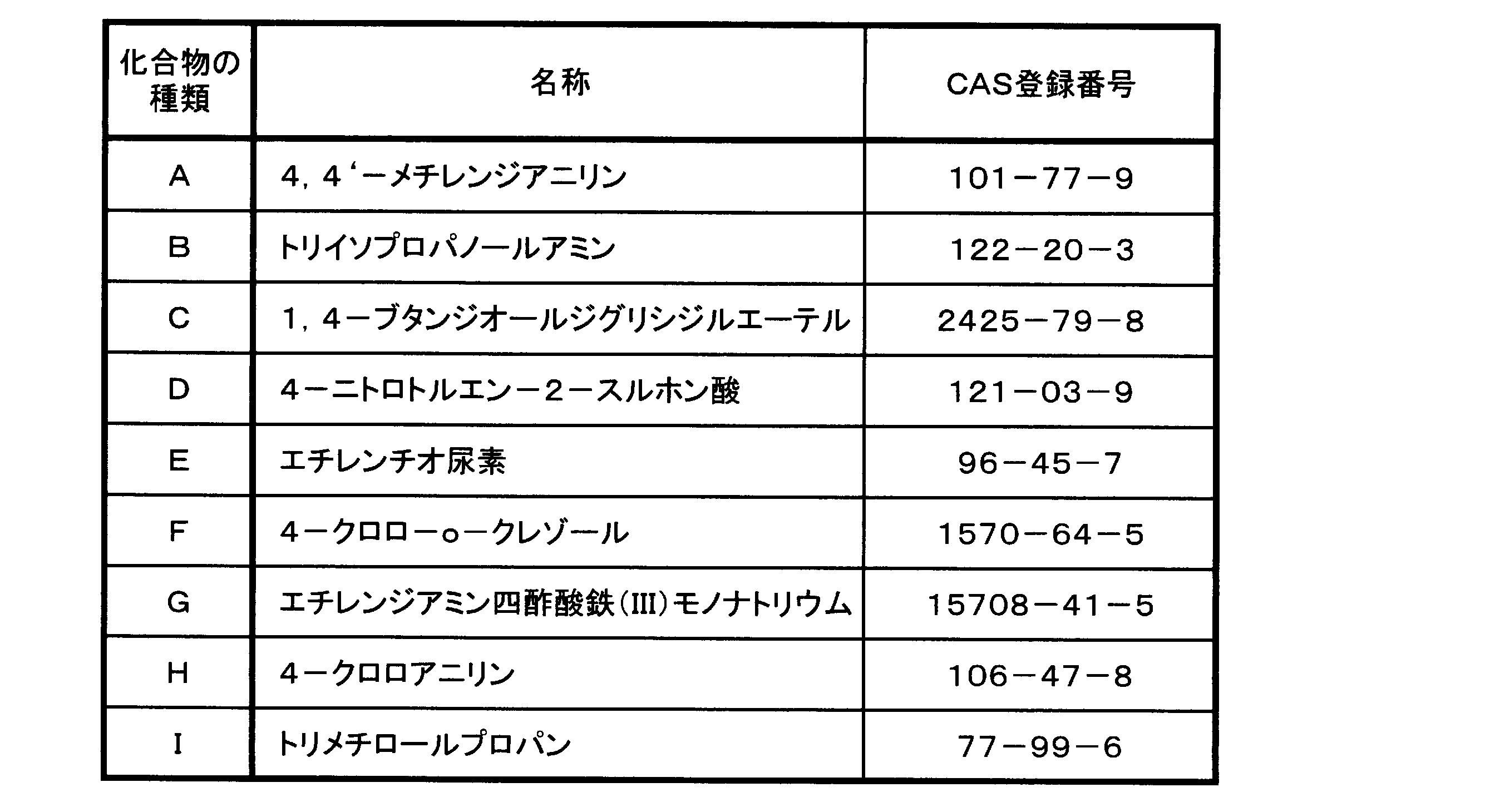
<既知化合物の試料水溶液の調製>
[化合物Aの試料水溶液の調製]
はじめに、化合物Aとイオン交換水とを用いて1mol/L、pH6.5~7.5の水溶液を19L調製した。得られた試料水溶液を試料水溶液Aとした。なお、試料水溶液AのpHは水酸化ナトリウム、塩酸等を用いて調整した。
[化合物Aの試料水溶液の調製]
はじめに、化合物Aとイオン交換水とを用いて1mol/L、pH6.5~7.5の水溶液を19L調製した。得られた試料水溶液を試料水溶液Aとした。なお、試料水溶液AのpHは水酸化ナトリウム、塩酸等を用いて調整した。
[化合物Aの試料水溶液のサンプルの調製]
19Lの試料水溶液Aをステンレス製容器に投入した。試料水溶液Aのステンレス製容器への投入直後に、ステンレス製容器から試料水溶液Aを1L採取した。採取した溶液に空気を通気させてオゾンを除去し、処理時間0分のサンプルとした。得られたサンプルを試料水溶液A0とした。
ステンレス製容器内の18Lの試料水溶液Aに濃度100g/Nm3のオゾンを1L/minの流量で120分通気した。120分の通気の途中、通気時間5分、15分、30分、60分の試料水溶液Aを450mLずつ採取した。採取したそれぞれの溶液に、空気を通気させてオゾンを除去し、処理時間5分、15分、30分、60分のサンプルとした。これらのサンプルを試料水溶液A5、A15、A30、A60とした。
最後に、120分通気直後の試料水溶液Aを1L採取し、空気を通気させてオゾンを除去し、処理時間120分のサンプルとした。このサンプルを試料水溶液A120とした。
以上の操作により、サンプルとして試料水溶液A0、A5、A15、A30、A60、A120を得た。
19Lの試料水溶液Aをステンレス製容器に投入した。試料水溶液Aのステンレス製容器への投入直後に、ステンレス製容器から試料水溶液Aを1L採取した。採取した溶液に空気を通気させてオゾンを除去し、処理時間0分のサンプルとした。得られたサンプルを試料水溶液A0とした。
ステンレス製容器内の18Lの試料水溶液Aに濃度100g/Nm3のオゾンを1L/minの流量で120分通気した。120分の通気の途中、通気時間5分、15分、30分、60分の試料水溶液Aを450mLずつ採取した。採取したそれぞれの溶液に、空気を通気させてオゾンを除去し、処理時間5分、15分、30分、60分のサンプルとした。これらのサンプルを試料水溶液A5、A15、A30、A60とした。
最後に、120分通気直後の試料水溶液Aを1L採取し、空気を通気させてオゾンを除去し、処理時間120分のサンプルとした。このサンプルを試料水溶液A120とした。
以上の操作により、サンプルとして試料水溶液A0、A5、A15、A30、A60、A120を得た。
[化合物B~Gの試料水溶液の調製]
化合物Aに代えて化合物B、C、D、E、F、Gを用いた以外は上記[化合物Aの試料水溶液の調製]と同様にして、試料水溶液B、C、D、E、F、Gを調製した。
化合物Aに代えて化合物B、C、D、E、F、Gを用いた以外は上記[化合物Aの試料水溶液の調製]と同様にして、試料水溶液B、C、D、E、F、Gを調製した。
[化合物B~Gの試料水溶液のサンプルの調製]
化合物Aに代えて化合物B、C、D、E、F、Gを用いた以外は上記[化合物Aの試料水溶液のサンプルの調製]と同様にして、試料水溶液B、C、D、E、F、Gのサンプルを調製した。
具体的には、化合物Bについて試料水溶液B0、B5、・・・B120のサンプルを得た。化合物Cについて試料水溶液C0、C5、・・・C120のサンプルを得た。化合物Dについて試料水溶液D0、D5、・・・D120のサンプルを得た。化合物Eについて試料水溶液E0、E5、・・・E120のサンプルを得た。化合物Fについて試料水溶液F0、F5、・・・F120のサンプルを得た。化合物Gについて試料水溶液G0、G5、・・・G120のサンプルを得た。
化合物Aに代えて化合物B、C、D、E、F、Gを用いた以外は上記[化合物Aの試料水溶液のサンプルの調製]と同様にして、試料水溶液B、C、D、E、F、Gのサンプルを調製した。
具体的には、化合物Bについて試料水溶液B0、B5、・・・B120のサンプルを得た。化合物Cについて試料水溶液C0、C5、・・・C120のサンプルを得た。化合物Dについて試料水溶液D0、D5、・・・D120のサンプルを得た。化合物Eについて試料水溶液E0、E5、・・・E120のサンプルを得た。化合物Fについて試料水溶液F0、F5、・・・F120のサンプルを得た。化合物Gについて試料水溶液G0、G5、・・・G120のサンプルを得た。
<サンプルのCODCrの測定>
[化合物AのサンプルのCODCrの測定]
上記化合物Aの試料水溶液のサンプルである試料水溶液A0、A5、・・・A120について、JIS K 0102-20.2 吸光光度法により、CODCrを測定した。
得られた試料水溶液A0、A5、・・・A120のCODCrに関する6点のデータは、オゾンの通気時間t(t=0分、5分、15分、30分、60分、120分)とCODCr値C(t)との関係(t,C(t))を示す6個のデータの集合体である。これら6個のデータの集合体は、(t,C(t))が(0,C(0))、(5,C(5))、(15,C(15))、(30,C(30))、(60,C(60))、(120,C(120))のデータからなる。
上記6個のデータの集合体は、化合物Aにおける経時変化実測データ保存ステップS102のCOD経時変化実測データである。上記試料水溶液A0、A5、・・・A120に関する6点のデータの集合体を、COD経時変化実測データD1とした。
結果を図3に示す。
図3は、3行×3列の7個の小グラフ図の集合体になっている。各小グラフ図は、それぞれ、横軸が時間(分)、縦軸がCODCr値(mg/L)である。COD経時変化実測データD1を、図3の7個の小グラフ図のうちの左上の小グラフ図中に示す。
[化合物AのサンプルのCODCrの測定]
上記化合物Aの試料水溶液のサンプルである試料水溶液A0、A5、・・・A120について、JIS K 0102-20.2 吸光光度法により、CODCrを測定した。
得られた試料水溶液A0、A5、・・・A120のCODCrに関する6点のデータは、オゾンの通気時間t(t=0分、5分、15分、30分、60分、120分)とCODCr値C(t)との関係(t,C(t))を示す6個のデータの集合体である。これら6個のデータの集合体は、(t,C(t))が(0,C(0))、(5,C(5))、(15,C(15))、(30,C(30))、(60,C(60))、(120,C(120))のデータからなる。
上記6個のデータの集合体は、化合物Aにおける経時変化実測データ保存ステップS102のCOD経時変化実測データである。上記試料水溶液A0、A5、・・・A120に関する6点のデータの集合体を、COD経時変化実測データD1とした。
結果を図3に示す。
図3は、3行×3列の7個の小グラフ図の集合体になっている。各小グラフ図は、それぞれ、横軸が時間(分)、縦軸がCODCr値(mg/L)である。COD経時変化実測データD1を、図3の7個の小グラフ図のうちの左上の小グラフ図中に示す。
なお、以下、化合物Aの時間t(分)でのCODCr値C(t)をC1,tとも表記する。具体的には、化合物Aの時間t=0(分)、5(分)、・・・120(分)でのCODCr値C(0)、C(5)、・・・C(120)を、C1,0、C1,5、・・・C1,120とも表記する。
例えば、図3に示すCOD経時変化実測データD1を構成するデータは、化合物Aについての(0,C(0))、(5,C(5))、・・・(120,C(120))である。このCOD経時変化実測データD1を構成するデータは、(0,C1,0)、(5,C1,5)、・・・(120,C1,120)とも表記する。
例えば、図3に示すCOD経時変化実測データD1を構成するデータは、化合物Aについての(0,C(0))、(5,C(5))、・・・(120,C(120))である。このCOD経時変化実測データD1を構成するデータは、(0,C1,0)、(5,C1,5)、・・・(120,C1,120)とも表記する。
また、化合物B、C、D、E、F、G、H、Iの時間t(分)でのCODCr値C(t)をそれぞれC2,t、C3,t、C4,t、C5,t、C6,t、C7,t、C8,t、C9,tとも表記する。
例えば、後述のCOD経時変化実測データD2を構成するデータは、化合物Bについての(0,C(0))、(5,C(5))、・・・(120,C(120))である。このCOD経時変化実測データD2を構成するデータは、(0,C2,0)、(5,C2,5)、・・・(120,C2,120)とも表記する。
例えば、後述のCOD経時変化実測データD2を構成するデータは、化合物Bについての(0,C(0))、(5,C(5))、・・・(120,C(120))である。このCOD経時変化実測データD2を構成するデータは、(0,C2,0)、(5,C2,5)、・・・(120,C2,120)とも表記する。
[化合物B~GのサンプルのCODCrの測定]
化合物Aの試料水溶液A0、A5、・・・A120に代えて、試料水溶液B、C、D、E、F、Gのサンプルを用いた以外は、[化合物AのサンプルのCODCrの測定]と同様にして、化合物B~Gの各サンプルのCODCrを測定した。試料水溶液B、C、D、E、F、Gのサンプルとは、B0、B5、・・・B120;C0、C5、・・・C120等のサンプルである。
化合物Aの試料水溶液A0、A5、・・・A120に代えて、試料水溶液B、C、D、E、F、Gのサンプルを用いた以外は、[化合物AのサンプルのCODCrの測定]と同様にして、化合物B~Gの各サンプルのCODCrを測定した。試料水溶液B、C、D、E、F、Gのサンプルとは、B0、B5、・・・B120;C0、C5、・・・C120等のサンプルである。
得られた試料水溶液B0、B5、・・・B120に関する6個のデータの集合体をCOD経時変化実測データD2とした。COD経時変化実測データD2を構成するデータは、化合物Bについての(0,C(0))、(5,C(5))、・・・(120,C(120))である。なお、COD経時変化実測データD2を構成するデータは、(0,C2,0)、(5,C2,5)、・・・(120,C2,120)とも表記する。
得られた試料水溶液C0、C5、・・・C120に関する6個のデータの集合体をCOD経時変化実測データD3とした。COD経時変化実測データD3を構成するデータは、化合物Cについての(0,C(0))、(5,C(5))、・・・(120,C(120))である。なお、COD経時変化実測データD3を構成するデータは、(0,C3,0)、(5,C3,5)、・・・(120,C3,120)とも表記する。
得られた試料水溶液D0、D5、・・・D120に関する6個のデータの集合体をCOD経時変化実測データD4とした。COD経時変化実測データD4を構成するデータは、化合物Dについての(0,C(0))、(5,C(5))、・・・(120,C(120))である。なお、COD経時変化実測データD4を構成するデータは、(0,C4,0)、(5,C4,5)、・・・(120,C4,120)とも表記する。
得られた試料水溶液E0、E5、・・・E120に関する6個のデータの集合体をCOD経時変化実測データD5とした。COD経時変化実測データD5を構成するデータは、化合物Eについての(0,C(0))、(5,C(5))、・・・(120,C(120))である。なお、COD経時変化実測データD5を構成するデータは、(0,C5,0)、(5,C5,5)、・・・(120,C5,120)とも表記する。
得られた試料水溶液F0、F5、・・・F120に関する6個のデータの集合体をCOD経時変化実測データD6とした。COD経時変化実測データD6を構成するデータは、化合物Fについての(0,C(0))、(5,C(5))、・・・(120,C(120))である。なお、COD経時変化実測データD6を構成するデータは、(0,C6,0)、(5,C6,5)、・・・(120,C6,120)とも表記する。
得られた試料水溶液G0、G5、・・・G120に関する6個のデータの集合体をCOD経時変化実測データD7とした。COD経時変化実測データD7を構成するデータは、化合物Gについての(0,C(0))、(5,C(5))、・・・(120,C(120))である。なお、COD経時変化実測データD7を構成するデータは、(0,C7,0)、(5,C7,5)、・・・(120,C7,120)とも表記する。
これらの結果を図3に示す。なお、上記のCOD経時変化実測データD1、D2、・・・D7は、パーソナルコンピューターのデータ保存部に保存した。これにより、経時変化実測データ保存ステップS102を終了した。
なお、図3の7個の小グラフ図のそれぞれには、上記のCOD経時変化実測データD1、D2、・・・D7に加え、フィッティングステップS103で形成される、フィッティング後のCOD経時変化式CP1,F、CP2,F、・・・CP7,Fも、併せて示す。
なお、図3の7個の小グラフ図のそれぞれには、上記のCOD経時変化実測データD1、D2、・・・D7に加え、フィッティングステップS103で形成される、フィッティング後のCOD経時変化式CP1,F、CP2,F、・・・CP7,Fも、併せて示す。
(フィッティングステップ)
経時変化実測データ保存ステップS102の次に、フィッティングステップS103を行った。具体的には、得られたCOD経時変化実測データD1、D2、・・・D7のそれぞれを、下記式(1)で表されるCOD経時変化式CPにフィッティングさせることにより、フィッティング後第1係数AF及びフィッティング後第2係数BFを得た。フィッティング後第1係数AFはフィッティングにより式(1)の第1係数Aが修正されて得られる係数である。フィッティング後第2係数BFはフィッティングにより式(1)の第2係数Bが修正されて得られる係数である。フィッティング後第1係数AF及びフィッティング後第2係数BFの算出方法については、後述する。フィッティング後第1係数AF及びフィッティング後第2係数BFは、化合物A、B、C、D、E、F、Gのそれぞれについて得た。
経時変化実測データ保存ステップS102の次に、フィッティングステップS103を行った。具体的には、得られたCOD経時変化実測データD1、D2、・・・D7のそれぞれを、下記式(1)で表されるCOD経時変化式CPにフィッティングさせることにより、フィッティング後第1係数AF及びフィッティング後第2係数BFを得た。フィッティング後第1係数AFはフィッティングにより式(1)の第1係数Aが修正されて得られる係数である。フィッティング後第2係数BFはフィッティングにより式(1)の第2係数Bが修正されて得られる係数である。フィッティング後第1係数AF及びフィッティング後第2係数BFの算出方法については、後述する。フィッティング後第1係数AF及びフィッティング後第2係数BFは、化合物A、B、C、D、E、F、Gのそれぞれについて得た。
フィッティング後第1係数AF及びフィッティング後第2係数BFを次のように算出した。はじめに、COD経時変化実測データD1、D2、・・・D7のそれぞれを、下記式(1)で表されるCOD経時変化式CPにフィッティングさせた。そして、化合物A、B、C、D、E、F、Gのそれぞれについて、フィッティングに基づき下記式(1)の第1係数A及び第2係数Bを修正することにより、各化合物について、フィッティング後第1係数AF及びフィッティング後第2係数BFを得た。なお、下記式(1)は、予め、パーソナルコンピューターのデータ保存部に保存しておいた。

(式中、C(t):試料水溶液中の化合物の時間tのCODCr、C0:試料水溶液中の化合物の初期CODCr、A:化合物の第1係数、B:化合物の第2係数、t:オゾン処理時間)
本ステップの具体的な手順を以下に示す。
<COD経時変化実測データD1のフィッティング>
第1に、化合物AのCOD経時変化実測データD1のフィッティングを以下のようにして行った。
はじめに、パーソナルコンピューターのデータ保存部に保存されているCOD経時変化実測データD1と上記式(1)とを読み出した。
次に、上記式(1)で表されるCOD経時変化式CPをCOD経時変化実測データD1に最小二乗法を用いてフィッティングさせることにより、化合物Aについて、下記式(4-1)で表されるCOD経時変化式CP1,Fを作成した。式(4-1)のC1,F,0としては、COD経時変化実測データD1の時間0(分)でのCODCr値C(0)であるC1,0を用いた。
第1に、化合物AのCOD経時変化実測データD1のフィッティングを以下のようにして行った。
はじめに、パーソナルコンピューターのデータ保存部に保存されているCOD経時変化実測データD1と上記式(1)とを読み出した。
次に、上記式(1)で表されるCOD経時変化式CPをCOD経時変化実測データD1に最小二乗法を用いてフィッティングさせることにより、化合物Aについて、下記式(4-1)で表されるCOD経時変化式CP1,Fを作成した。式(4-1)のC1,F,0としては、COD経時変化実測データD1の時間0(分)でのCODCr値C(0)であるC1,0を用いた。

上記COD経時変化式CP1,Fより、フィッティング後第1係数A1,F及びフィッティング後第2係数B1,Fを得た。
<COD経時変化実測データD2~D7のフィッティング>
化合物AのCOD経時変化実測データD1に代えて、COD経時変化実測データD2~D7をそれぞれ用いた以外は<COD経時変化実測データD1のフィッティング>と同様にして、化合物B~GのCOD経時変化実測データD2~D7のフィッティングを行った。
具体的には、試料水溶液B、C、・・・GのCOD経時変化実測データD2、D3、・・・D7のそれぞれを、上記式(1)で表されるCOD経時変化式CPにフィッティングさせたところ、COD経時変化式CP2,F、CP3,F、・・・CP7,Fが得られた。なお、式(4-1)のC1,F,0に相当するC2,F,0、C3,F,0、・・・C7,F,0としては、COD経時変化実測データD2、D3、・・・D7の時間0(分)でのCODCr値C(0)であるC2,0、C3,0、・・・C7,0を用いた。そして、COD経時変化式CP2,F、CP3,F、・・・CP7,Fより、フィッティング後第1係数A2,F、A3,F、・・・A7,F、及びフィッティング後第2係数B2,F、B3,F、・・・B7,Fを得た。
化合物AのCOD経時変化実測データD1に代えて、COD経時変化実測データD2~D7をそれぞれ用いた以外は<COD経時変化実測データD1のフィッティング>と同様にして、化合物B~GのCOD経時変化実測データD2~D7のフィッティングを行った。
具体的には、試料水溶液B、C、・・・GのCOD経時変化実測データD2、D3、・・・D7のそれぞれを、上記式(1)で表されるCOD経時変化式CPにフィッティングさせたところ、COD経時変化式CP2,F、CP3,F、・・・CP7,Fが得られた。なお、式(4-1)のC1,F,0に相当するC2,F,0、C3,F,0、・・・C7,F,0としては、COD経時変化実測データD2、D3、・・・D7の時間0(分)でのCODCr値C(0)であるC2,0、C3,0、・・・C7,0を用いた。そして、COD経時変化式CP2,F、CP3,F、・・・CP7,Fより、フィッティング後第1係数A2,F、A3,F、・・・A7,F、及びフィッティング後第2係数B2,F、B3,F、・・・B7,Fを得た。
図3に、COD経時変化式CP1,F、CP2,F、・・・CP7,Fを示す。
得られたCOD経時変化式CP1,F、CP2,F、・・・CP7,F、フィッティング後第1係数A1,F、A2,F、・・・A7,F、及びフィッティング後第2係数B1,F、B2,F、・・・B7,Fをパーソナルコンピューターのデータ保存部に保存した。これにより、フィッティングステップS103を終了した。
得られたCOD経時変化式CP1,F、CP2,F、・・・CP7,F、フィッティング後第1係数A1,F、A2,F、・・・A7,F、及びフィッティング後第2係数B1,F、B2,F、・・・B7,Fをパーソナルコンピューターのデータ保存部に保存した。これにより、フィッティングステップS103を終了した。
(量子化学計算ステップ)
フィッティングステップS103の次に、量子化学計算ステップS104を行った。具体的には、化合物A、B、C、D、E、F、Gのそれぞれについて、量子化学計算を行うことにより量子化学計算値QCV1、QCV2、QCV3、QCV4、QCV5、QCV6、QCV7を得た。
本実験例では、QCVとしてHOMO(Highest Occupied Molecular Orbital)エネルギーEHOMOを用いた。すなわち、化合物A、B、・・・Iのそれぞれについて、化合物A、B、・・・IのEHOMOである、EHOMO,1、EHOMO,2、・・・EHOMO,7を算出した。
本ステップの具体的な手順を以下に示す。
フィッティングステップS103の次に、量子化学計算ステップS104を行った。具体的には、化合物A、B、C、D、E、F、Gのそれぞれについて、量子化学計算を行うことにより量子化学計算値QCV1、QCV2、QCV3、QCV4、QCV5、QCV6、QCV7を得た。
本実験例では、QCVとしてHOMO(Highest Occupied Molecular Orbital)エネルギーEHOMOを用いた。すなわち、化合物A、B、・・・Iのそれぞれについて、化合物A、B、・・・IのEHOMOである、EHOMO,1、EHOMO,2、・・・EHOMO,7を算出した。
本ステップの具体的な手順を以下に示す。
パーソナルコンピューターの演算部で量子化学計算を行った。具体的には、量子化学計算の計算プログラムソフトウェアとして、ガウシアン(Gaussian)09プログラムを用い、密度汎関数理論(DFT:Density Function Theory)を用いる密度汎関数法で計算を行った。また、密度汎関数法での交換相関汎関数としてB3LYP、基底関数として6-31+G(d.p.)を用いた。また、水の溶媒効果をSCRF(Self Consistent Reaction Field)で取り込んだ。
上記量子化学計算では、構造安定化により安定構造を求め、HOMOエネルギーEHOMOを算出した。
これにより、化合物A、B、・・・Gのそれぞれについて、HOMOエネルギーEHOMO,1、EHOMO,2、・・・EHOMO,7を算出した。
上記量子化学計算では、構造安定化により安定構造を求め、HOMOエネルギーEHOMOを算出した。
これにより、化合物A、B、・・・Gのそれぞれについて、HOMOエネルギーEHOMO,1、EHOMO,2、・・・EHOMO,7を算出した。
得られたHOMOエネルギーEHOMO,1、EHOMO,2、EHOMO,3、EHOMO,4、EHOMO,5、EHOMO,6、EHOMO,7をパーソナルコンピューターのデータ保存部に保存した。これにより、量子化学計算ステップS104を終了した。
(属性取得ステップ)
本実験例では、量子化学計算ステップS104の次に、属性取得ステップS105を行った。なお、他の実験例では、属性取得ステップS105を、量子化学計算ステップS104の前、又は量子化学計算ステップS104と同時に行っていもよい。
属性取得ステップS105として、具体的には、化合物A、B、・・・Gのそれぞれについて、化合物A、B、・・・Gの完全酸化必要酸素原子数nである、完全酸化必要酸素原子数n1、n2、・・・n7を取得した。完全酸化必要酸素原子数n1、n2、・・・n7としては、パーソナルコンピューターのデータ保存部に保存されたものを用いた。なお、完全酸化必要酸素原子数nは、パーソナルコンピューターのデータ保存部に保存されたものである必要はなく、適宜、算出することも可能である。例えば、化合物B(トリイソプロパノールアミン)の完全酸化必要酸素原子数n2である28は、上記式(8)中の14O2中のO原子数が28個であるから、簡単に求めることができる。
本実験例では、量子化学計算ステップS104の次に、属性取得ステップS105を行った。なお、他の実験例では、属性取得ステップS105を、量子化学計算ステップS104の前、又は量子化学計算ステップS104と同時に行っていもよい。
属性取得ステップS105として、具体的には、化合物A、B、・・・Gのそれぞれについて、化合物A、B、・・・Gの完全酸化必要酸素原子数nである、完全酸化必要酸素原子数n1、n2、・・・n7を取得した。完全酸化必要酸素原子数n1、n2、・・・n7としては、パーソナルコンピューターのデータ保存部に保存されたものを用いた。なお、完全酸化必要酸素原子数nは、パーソナルコンピューターのデータ保存部に保存されたものである必要はなく、適宜、算出することも可能である。例えば、化合物B(トリイソプロパノールアミン)の完全酸化必要酸素原子数n2である28は、上記式(8)中の14O2中のO原子数が28個であるから、簡単に求めることができる。
得られた完全酸化必要酸素原子数n1、n2、・・・n7をパーソナルコンピューターのデータ保存部に保存した。これにより、属性取得ステップS105を終了した。
(回帰式構築ステップ)
属性取得ステップS105の次に、回帰式構築ステップS106を行った。具体的には、化合物A、B、・・・Gのそれぞれについて、フィッティング後第1係数An,Fと、フィッティング後第2係数Bn,Fと、量子化学計算値EHOMO,nと、属性nnとを用い、第1回帰式RE1と第2回帰式RE2とを構築した。
フィッティング後第1係数An,Fとしては、フィッティング後第1係数A1,F、A2,F、・・・A7,Fを用いた。フィッティング後第2係数Bn,Fとしては、フィッティング後第2係数B1,F、B2,F、・・・B7,Fを用いた。量子化学計算値EHOMO,nとしては、量子化学計算値EHOMO,1、EHOMO,2、・・・EHOMO,7を用いた。属性nnとしては、属性n1、n2、・・・n7を用いた。
本ステップは、パーソナルコンピューターを用の演算部で処理した。
本ステップの具体的な手順を以下に示す。
属性取得ステップS105の次に、回帰式構築ステップS106を行った。具体的には、化合物A、B、・・・Gのそれぞれについて、フィッティング後第1係数An,Fと、フィッティング後第2係数Bn,Fと、量子化学計算値EHOMO,nと、属性nnとを用い、第1回帰式RE1と第2回帰式RE2とを構築した。
フィッティング後第1係数An,Fとしては、フィッティング後第1係数A1,F、A2,F、・・・A7,Fを用いた。フィッティング後第2係数Bn,Fとしては、フィッティング後第2係数B1,F、B2,F、・・・B7,Fを用いた。量子化学計算値EHOMO,nとしては、量子化学計算値EHOMO,1、EHOMO,2、・・・EHOMO,7を用いた。属性nnとしては、属性n1、n2、・・・n7を用いた。
本ステップは、パーソナルコンピューターを用の演算部で処理した。
本ステップの具体的な手順を以下に示す。
<第1回帰式RE1の構築>
第1回帰式RE1における上位概念の式は、下記式(2)で表される回帰式である。
[数31]
RE1: A=FR1(QCV,AT) (2)
(A:式(1)の第1係数、QCV:量子化学計算値、AT:属性、FR1:関数)
第1回帰式RE1における上位概念の式は、下記式(2)で表される回帰式である。
[数31]
RE1: A=FR1(QCV,AT) (2)
(A:式(1)の第1係数、QCV:量子化学計算値、AT:属性、FR1:関数)
本ステップでは、フィッティング後第1係数An,Fと、フィッティング後第2係数Bn,Fと、QCVとしてのEHOMO,nと、属性としてのnnとを用い、回帰を行って下記式(5)を構築した。具体的には、上記式(2)のQCVとしてEHOMOを用い、ATとして完全酸化必要酸素原子数nを用いた。式(5)のC0としては、COD経時変化実測データD1~D7の時間0(分)でのCODCr値C(0)であるC1,0、C2,0、C3,0、C4,0、C5,0、C6,0、C7,0を用いた。
フィッティング後第1係数An,Fとしては、フィッティング後第1係数A1,F、A2,F、・・・A7,Fを用いた。フィッティング後第2係数Bn,Fとしては、フィッティング後第2係数B1,F、B2,F、・・・B7,Fを用いた。QCVとしては、EHOMO,1、EHOMO,2、・・・EHOMO,7を用いた。ATとしては、完全酸化必要酸素原子数n1、n2、・・・n7を用いた。

上記式(5)で表される第1回帰式RE1は、下記式(5-1)のように表すことができる。

(式中、A:式(1)の第1係数、B:式(1)の第2係数、C0:試料水溶液中の化合物の初期CODCr、FA:log(EHOMO)を説明変数とする線形回帰式、n:完全酸化必要酸素原子数、EHOMO:HOMOエネルギー)
図4に、上記式(5)及び(5-1)のFAを示す。図4中、離散する点はFAの構築に用いた化合物A、B、C、D、E、F、Gの個々のデータである。FAの決定係数R2は0.94であった。
<第2回帰式RE2の構築>
第2回帰式RE2における上位概念の式は、下記式(3)で表される回帰式である。
[数34]
RE2: B=FR2(QCV,AT) (3)
(B:式(1)の第2係数、QCV:量子化学計算値、AT:属性、FR2:関数)
第2回帰式RE2における上位概念の式は、下記式(3)で表される回帰式である。
[数34]
RE2: B=FR2(QCV,AT) (3)
(B:式(1)の第2係数、QCV:量子化学計算値、AT:属性、FR2:関数)
本ステップでは、フィッティング後第2係数Bn,Fと、QCVとしてのEHOMO,nと、属性としてのnnとを用い、回帰を行って下記式(6)を構築した。具体的には、上記式(3)のQCVとしてEHOMOを用い、ATとして完全酸化必要酸素原子数nを用いた。
フィッティング後第2係数Bn,Fとしては、フィッティング後第2係数B1,F、B2,F、・・・B7,Fを用いた。QCVとしては、EHOMO,1、EHOMO,2、・・・EHOMO,7を用いた。ATとしては、完全酸化必要酸素原子数n1、n2、・・・n7を用いた。式(6)のC0としては、COD経時変化実測データD1~D7の時間0(分)でのCODCr値C(0)であるC1,0、C2,0、C3,0、C4,0、C5,0、C6,0、C7,0を用いた。

なお、式(6)で表される第2回帰式RE2は、下記式(6-1)のように表すことができる。

図5に、上記式(6)及び(6-1)のFBを示す。図5中、離散する点はFBの構築に用いた化合物A、B、C、D、E、F、Gの個々のデータである。FBの決定係数R2は0.93であった。
上記のように、本ステップでは、化合物A、B、・・・Gの全てに高い精度で適用可能な回帰式として、上記式(1)の第1係数A及び第2係数Bを算出する上記式(5)又は(5-1)で表される第1回帰式RE1が構築された。また、化合物A、B、・・・Gの全てに高い精度で適用可能な回帰式として、上記式(1)の第2係数Bを算出する上記式(6)又は(6-1)で表される第2回帰式RE2が構築された。
得られた上記式(5)又は(5-1)で表される第1回帰式RE1と、上記式(6)又は(6-1)で表される第2回帰式RE2とを、パーソナルコンピューターのデータ保存部に保存した。これにより、回帰式構築ステップS106を終了し、COD経時変化モデル構築方法を終了S107した。
[COD経時変化予測方法]
上記COD経時変化モデル構築方法で作成された情報を用いてCOD経時変化予測方法を実施した。
上記COD経時変化モデル構築方法で作成された情報を用いてCOD経時変化予測方法を実施した。
本COD経時変化予測方法では、上記第1回帰式RE1及び第2回帰式RE2を用いて、測定対象化合物Mとしての化合物H及びIのCOD経時変化を予測した。
本方法の具体的な手順を以下に示す。
本方法の具体的な手順を以下に示す。
(量子化学計算ステップ)
COD経時変化予測方法のスタートS201後、量子化学計算ステップS202を行った。この量子化学計算ステップS202は、測定対象化合物Mについて、量子化学計算を行うことにより量子化学計算値QCVMを得るステップである。
COD経時変化予測方法のスタートS201後、量子化学計算ステップS202を行った。この量子化学計算ステップS202は、測定対象化合物Mについて、量子化学計算を行うことにより量子化学計算値QCVMを得るステップである。
具体的には、化合物Aに代えて化合物H及びIをそれぞれ用いた以外は、[COD経時変化モデル構築方法]の(量子化学計算ステップ)と同様にして、化合物H及びIのそれぞれについて、HOMOエネルギーEHOMO,8及びEHOMO,9を算出した。
得られたHOMOエネルギーEHOMO,8及びEHOMO,9をパーソナルコンピューターのデータ保存部に保存した。
これにより、量子化学計算ステップS202を終了した。
これにより、量子化学計算ステップS202を終了した。
(属性取得ステップ)
量子化学計算ステップS202の次に、属性取得ステップS203を行った。
なお、属性取得ステップS203は、量子化学計算ステップS202の前、又は量子化学計算ステップS202と同時に行うこともできるが、本実験例では、ステップS202の後にステップS203を行った。
量子化学計算ステップS202の次に、属性取得ステップS203を行った。
なお、属性取得ステップS203は、量子化学計算ステップS202の前、又は量子化学計算ステップS202と同時に行うこともできるが、本実験例では、ステップS202の後にステップS203を行った。
属性取得ステップS203は、測定対象化合物Mについて属性ATMを取得するステップである。
具体的には、化合物Aに代えて化合物H及びIをそれぞれ用いた以外は、[COD経時変化モデル構築方法]の(属性取得ステップ)と同様にして、化合物H及びIのそれぞれについて、完全酸化必要酸素原子数n8及びn9を得た。
得られた完全酸化必要酸素原子数n8及びn9をパーソナルコンピューターのデータ保存部に保存した。
これにより、属性取得ステップS203を終了した。
これにより、属性取得ステップS203を終了した。
(係数算出ステップ)
属性取得ステップS203の次に、係数算出ステップS204を行った。具体的には、回帰式構築ステップS106で構築された、上記式(5)又は(5-1)で表される第1回帰式RE1と、上記式(6)又は(6-1)で表される前記第2回帰式RE2とを用い、各化合物の予測第1係数AM及び予測第2係数BMを算出した。各化合物の予測第1係数AM及び予測第2係数BMは、上記式に、各化合物のHOMOエネルギーEHOMO、完全酸化必要酸素原子数n、及び初期CODCrであるC0を代入することにより算出した。
本ステップは、パーソナルコンピューターの演算部で処理した。
本ステップの具体的な手順を以下に示す。
属性取得ステップS203の次に、係数算出ステップS204を行った。具体的には、回帰式構築ステップS106で構築された、上記式(5)又は(5-1)で表される第1回帰式RE1と、上記式(6)又は(6-1)で表される前記第2回帰式RE2とを用い、各化合物の予測第1係数AM及び予測第2係数BMを算出した。各化合物の予測第1係数AM及び予測第2係数BMは、上記式に、各化合物のHOMOエネルギーEHOMO、完全酸化必要酸素原子数n、及び初期CODCrであるC0を代入することにより算出した。
本ステップは、パーソナルコンピューターの演算部で処理した。
本ステップの具体的な手順を以下に示す。
<情報の取得>
上記COD経時変化モデル構築方法で作成されパーソナルコンピューターのデータ保存部に保存された上記式(5)又は(5-1)で表される第1回帰式RE1と、上記式(6)又は(6-1)で表される第2回帰式RE2とを読み出した。
さらに、量子化学計算ステップS202で得た化合物H及びIのそれぞれについてのHOMOエネルギーEHOMO,8及びEHOMO,9を用意した。また、属性取得ステップS203で取得した化合物H及びIのそれぞれについての完全酸化必要酸素原子数n8及びn9を用意した。
上記COD経時変化モデル構築方法で作成されパーソナルコンピューターのデータ保存部に保存された上記式(5)又は(5-1)で表される第1回帰式RE1と、上記式(6)又は(6-1)で表される第2回帰式RE2とを読み出した。
さらに、量子化学計算ステップS202で得た化合物H及びIのそれぞれについてのHOMOエネルギーEHOMO,8及びEHOMO,9を用意した。また、属性取得ステップS203で取得した化合物H及びIのそれぞれについての完全酸化必要酸素原子数n8及びn9を用意した。
<C0(初期CODCr)の取得>
また、水溶液中の化合物H及びIのそれぞれについてC0(初期CODCr)を得る作業を行った。
具体的には、化合物Aに代えて化合物H及びIをそれぞれ用いた以外は、[COD経時変化モデル構築方法]の(経時変化実測データ保存ステップ)の[化合物Aの試料水溶液のサンプルの調製]と同様にして、化合物H及びIのサンプルを得た。
具体的には、化合物Hについて試料水溶液H0、H5、・・・H120のサンプルを得、化合物Iについて試料水溶液I0、I5、・・・I120のサンプルを得た。
また、水溶液中の化合物H及びIのそれぞれについてC0(初期CODCr)を得る作業を行った。
具体的には、化合物Aに代えて化合物H及びIをそれぞれ用いた以外は、[COD経時変化モデル構築方法]の(経時変化実測データ保存ステップ)の[化合物Aの試料水溶液のサンプルの調製]と同様にして、化合物H及びIのサンプルを得た。
具体的には、化合物Hについて試料水溶液H0、H5、・・・H120のサンプルを得、化合物Iについて試料水溶液I0、I5、・・・I120のサンプルを得た。
試料水溶液A0に代えて、試料水溶液H0及びI0を用いた以外は、[COD経時変化モデル構築方法]の(経時変化実測データ保存ステップ)の<サンプルのCODCrの測定>と同様にして、試料水溶液H0及びI0のCODCr(初期CODCr)を測定した。これにより試料水溶液H0及びI0の初期CODCrである、C8,0及びC9,0が得られた。なお、C8,0は、化合物Hの時間t=0(分)でのCODCr値C(0)である。C9,0は、化合物Iの時間t=0(分)でのCODCr値C(0)である。
また、[COD経時変化予測方法]には不要であるが、予測結果の検証のため、試料水溶液H5、・・・H120についても、試料水溶液H0と同様にしてCODCrを測定し、C8,5、C8,15、・・・C8,120を得た。なお、C8,5、C8,15、・・・C8,120は、化合物Hの時間t=5(分)、15(分)、・・・120(分)でのCODCr値C(5)、C(15)、・・・C(120)である。得られた試料水溶液H0、H5、・・・H120に関する6点のデータ(C8,0、C8,5、・・・C8,120)の集合体をCOD経時変化実測データD8とした。COD経時変化実測データD8を構成するデータは、化合物Hについての(0,C(0))、(5,C(5))、・・・(120,C(120))である。なお、COD経時変化実測データD8を構成するデータは、(0,C8,0)、(5,C8,5)、・・・(120,C8,120)とも表記する。
同様にして、試料水溶液I5、・・・I120についても、試料水溶液I0と同様にしてCODCrを測定し、C9,5、C9,15、・・・C9,120を得た。なお、C9,5、C9,15、・・・C9,120は、化合物Iの時間t=5(分)、15(分)、・・・120(分)でのCODCr値C(5)、C(15)、・・・C(120)である。得られた試料水溶液I0、I5、・・・I120に関する6点のデータ(C9,0、C9,5、・・・C9,120)の集合体をCOD経時変化実測データD9とした。COD経時変化実測データD9を構成するデータは、化合物Iについての(0,C(0))、(5,C(5))、・・・(120,C(120))である。なお、COD経時変化実測データD9を構成するデータは、(0,C9,0)、(5,C9,5)、・・・(120,C9,120)とも表記する。
これらの、化合物H及びIのCOD経時変化実測データD8及びD9は、[COD経時変化モデル構築方法]における化合物A~GのCOD経時変化実測データD1~D7に相当するデータである。
COD経時変化実測データD8及びD9を図6に示す。
これらの、化合物H及びIのCOD経時変化実測データD8及びD9は、[COD経時変化モデル構築方法]における化合物A~GのCOD経時変化実測データD1~D7に相当するデータである。
COD経時変化実測データD8及びD9を図6に示す。
<化合物Hの予測第1係数AM及び予測第2係数BMの算出>
上記式(6)又は(6-1)で表される第2回帰式RE2のEHOMO、n及びC0のそれぞれに、化合物HのHOMOエネルギーEHOMO,8、完全酸化必要酸素原子数n8、及び初期CODCrであるC8,0を代入した。これにより、式(1)の第2係数Bを算出した。この第2係数Bを化合物Hの予測第2係数B8,Mとした。
上記式(6)又は(6-1)で表される第2回帰式RE2のEHOMO、n及びC0のそれぞれに、化合物HのHOMOエネルギーEHOMO,8、完全酸化必要酸素原子数n8、及び初期CODCrであるC8,0を代入した。これにより、式(1)の第2係数Bを算出した。この第2係数Bを化合物Hの予測第2係数B8,Mとした。
上記式(5)又は(5-1)で表される第1回帰式RE1のEHOMO、n、C0及びBのそれぞれに、化合物HのHOMOエネルギーEHOMO,8、完全酸化必要酸素原子数n8、初期CODCrであるC8,0、及び上記予測第2係数B8,Mを代入た。これにより、式(1)の第1係数Aを算出した。この第1係数Aを化合物Hの予測第1係数A8,Mとした。
<化合物Iの予測第1係数AM及び予測第2係数BMの算出>
化合物HのHOMOエネルギーEHOMO,8、完全酸化必要酸素原子数n8、初期CODCrであるC8,0に代えて、化合物IのHOMOエネルギーEHOMO,9、完全酸化必要酸素原子数n9、初期CODCrであるC9,0を用いた。これ以外は<化合物Hの予測第1係数AM及び予測第2係数BMの算出>と同様にして、化合物Iの予測第1係数A9,M及び予測第2係数B9,Mを算出した。
化合物HのHOMOエネルギーEHOMO,8、完全酸化必要酸素原子数n8、初期CODCrであるC8,0に代えて、化合物IのHOMOエネルギーEHOMO,9、完全酸化必要酸素原子数n9、初期CODCrであるC9,0を用いた。これ以外は<化合物Hの予測第1係数AM及び予測第2係数BMの算出>と同様にして、化合物Iの予測第1係数A9,M及び予測第2係数B9,Mを算出した。
得られた化合物H及びIについての、予測第1係数A8,M及びA9,Mと、予測第2係数B8,M及びB2,Mとを、パーソナルコンピューターのデータ保存部に保存した。これにより、係数算出ステップS204を終了した。
(COD経時変化式作成ステップ)
係数算出ステップS204の次に、COD経時変化式作成ステップS205を行った。具体的には、各化合物の予測第1係数AM及び予測第2係数BMを下記式(1)の第1係数A及び第2係数Bにそれぞれ代入した。また、下記式(1)のCM,0に水溶液中の化合物H及びIの初期CODCrを代入することで、下記式(7)で表される前記測定対象化合物MのCOD経時変化式CPMを作成した。水溶液中の化合物H及びIの初期CODCrは、それぞれ、C8,0及びC9,0である。
係数算出ステップS204の次に、COD経時変化式作成ステップS205を行った。具体的には、各化合物の予測第1係数AM及び予測第2係数BMを下記式(1)の第1係数A及び第2係数Bにそれぞれ代入した。また、下記式(1)のCM,0に水溶液中の化合物H及びIの初期CODCrを代入することで、下記式(7)で表される前記測定対象化合物MのCOD経時変化式CPMを作成した。水溶液中の化合物H及びIの初期CODCrは、それぞれ、C8,0及びC9,0である。

本ステップは、パーソナルコンピューターの演算部で処理した。
本ステップの具体的な手順を以下に示す。
本ステップの具体的な手順を以下に示す。
<情報の取得>
パーソナルコンピューターのデータ保存部に保存された上記式(1)を読み出した。
パーソナルコンピューターのデータ保存部に保存された上記式(1)を読み出した。
<化合物AのCOD経時変化式の作成>
上記式(1)で表されるCOD経時変化式CPの第1係数A及び第2係数Bのそれぞれに、係数算出ステップS204で算出された化合物Hの予測第1係数A8,M及び予測第2係数B8,Mを代入した。
また、上記式(1)のC0に、係数算出ステップS204で得た試料水溶液H0の初期CODCrであるC8,0を代入した。
これにより、下記式(7-8)で表される化合物HのCOD経時変化式CP8,Mを作成した。なお、下記式(7-8)においては、予測第1係数A8,M、予測第2係数B8,M、及び後述のCOD経時変化式CP8,Mとの表記のバランスの観点から、代入したC8,0をC8,M,0と表記し直した。C8,M,0とC8,0とは同一数値を示す。
上記式(1)で表されるCOD経時変化式CPの第1係数A及び第2係数Bのそれぞれに、係数算出ステップS204で算出された化合物Hの予測第1係数A8,M及び予測第2係数B8,Mを代入した。
また、上記式(1)のC0に、係数算出ステップS204で得た試料水溶液H0の初期CODCrであるC8,0を代入した。
これにより、下記式(7-8)で表される化合物HのCOD経時変化式CP8,Mを作成した。なお、下記式(7-8)においては、予測第1係数A8,M、予測第2係数B8,M、及び後述のCOD経時変化式CP8,Mとの表記のバランスの観点から、代入したC8,0をC8,M,0と表記し直した。C8,M,0とC8,0とは同一数値を示す。

<化合物IのCOD経時変化式の作成>
化合物Hの予測第1係数A8,M、予測第2係数B8,M及びC8,0に代えて、それぞれ、化合物Iの予測第1係数A9,M、予測第2係数B9,M、及びC9,0を用いた。これ以外は、<化合物AのCOD経時変化式の作成>と同様にして、下記式(7-9)で表される化合物IのCOD経時変化式CP9,Mを作成した。
化合物Hの予測第1係数A8,M、予測第2係数B8,M及びC8,0に代えて、それぞれ、化合物Iの予測第1係数A9,M、予測第2係数B9,M、及びC9,0を用いた。これ以外は、<化合物AのCOD経時変化式の作成>と同様にして、下記式(7-9)で表される化合物IのCOD経時変化式CP9,Mを作成した。

化合物IのCOD経時変化式CP8,M及びCP9,Mを図6に示す。
図6は、2個の小グラフ図の集合体になっている。各小グラフ図は、それぞれ、図3と同様に、横軸が時間(分)、縦軸がCODCr値(mg/L)である。なお、図9には、図3と同様に、COD経時変化実測データD8及びD9も併せて示す。
図6は、2個の小グラフ図の集合体になっている。各小グラフ図は、それぞれ、図3と同様に、横軸が時間(分)、縦軸がCODCr値(mg/L)である。なお、図9には、図3と同様に、COD経時変化実測データD8及びD9も併せて示す。
図6に示すように、COD経時変化式CP8,M及びCP9,Mは、図3に示すCOD経時変化式CP1,F、・・・CP7,Fと同様に、それぞれ、オゾンの通気時間tが増加するとCODCrが低下する傾向を示す。
また、図6に示す化合物H及びIのCOD経時変化式CP8,M及びCP9,Mは、それぞれ、化合物H及びIのCOD経時変化実測データD8及びD9とよく一致していることが分かる。
このため、図6に示すCOD経時変化式CP8,M及びCP9,Mは、測定対象化合物Mである化合物H及びIのCOD経時変化を予測する式として十分に精度が高いことが分かった。
このため、図6に示すCOD経時変化式CP8,M及びCP9,Mは、測定対象化合物Mである化合物H及びIのCOD経時変化を予測する式として十分に精度が高いことが分かった。
得られた化合物H及びIについての、COD経時変化式CP8,M及びCP9,Mを、パーソナルコンピューターのデータ保存部に保存した。これにより、COD経時変化式作成ステップS205を終了した。
(COD経時変化予測ステップ)
COD経時変化式作成ステップS205の次に、COD経時変化予測ステップS206を行った。具体的には、COD経時変化式CP8,M及びCP9,Mを用いて化合物H及びIについてCOD経時変化を予測した。
本ステップは、パーソナルコンピューターの演算部で処理した。
これにより、COD経時変化予測ステップS206を終了し、COD経時変化予測方法を終了S207した。
COD経時変化式作成ステップS205の次に、COD経時変化予測ステップS206を行った。具体的には、COD経時変化式CP8,M及びCP9,Mを用いて化合物H及びIについてCOD経時変化を予測した。
本ステップは、パーソナルコンピューターの演算部で処理した。
これにより、COD経時変化予測ステップS206を終了し、COD経時変化予測方法を終了S207した。
特願2018-114961号(出願日:2018年6月15日)の全内容は、ここに援用される。
以上、実施例に沿って本実施形態の内容を説明したが、本実施形態はこれらの記載に限定されるものではなく、種々の変形及び改良が可能であることは、当業者には自明である。
本開示によれば、排水中の化合物を酸化剤で分解したときのCODの経時変化の正確な予測が可能な、COD経時変化モデル構築方法及びCOD経時変化予測方法が提供される。
S101 スタート
S102 経時変化実測データ保存ステップ
S103 フィッティングステップ
S104 量子化学計算ステップ
S105 属性取得ステップ
S106 回帰式構築ステップ
S107 終了
S201 スタート
S202 量子化学計算ステップ
S203 属性取得ステップ
S204 係数算出ステップ
S205 COD経時変化式作成ステップ
S206 COD経時変化予測ステップ
S207 終了
S102 経時変化実測データ保存ステップ
S103 フィッティングステップ
S104 量子化学計算ステップ
S105 属性取得ステップ
S106 回帰式構築ステップ
S107 終了
S201 スタート
S202 量子化学計算ステップ
S203 属性取得ステップ
S204 係数算出ステップ
S205 COD経時変化式作成ステップ
S206 COD経時変化予測ステップ
S207 終了
Claims (10)
- 複数種類の既知化合物Kのそれぞれについて、前記既知化合物Kの試料水溶液にオゾンを通気させ、オゾンの通気時間の異なる複数個のサンプルについての、オゾンの通気時間tとこの時間tでのCODCr値C(t)との関係(t,C(t))のデータの集合体であるCOD経時変化実測データDKを保存する経時変化実測データ保存ステップと、
複数個の前記COD経時変化実測データDKを下記式(1)で表されるCOD経時変化式CPにフィッティングさせることにより、式(1)の第1係数Aを修正したフィッティング後第1係数AF、及び式(1)の第2係数Bを修正したフィッティング後第2係数BFを得るフィッティングステップと、

複数種類の前記既知化合物Kのそれぞれについて、量子化学計算を行うことにより量子化学計算値QCVKを得る量子化学計算ステップと、
複数種類の前記既知化合物Kのそれぞれについて属性ATKを取得する属性取得ステップと、
複数種類の前記既知化合物Kのそれぞれについての、前記フィッティング後第1係数AFと前記フィッティング後第2係数BFと前記量子化学計算値QCVKと前記属性ATKとを用い、
前記第1係数Aを目的変数とした下記式(2)で表される第1回帰式RE1と、
[数2]
RE1: A=FR1(QCV,AT) (2)
(A:式(1)の第1係数、QCV:量子化学計算値、AT:属性、FR1:関数)
前記第2係数Bを目的変数とした下記式(3)で表される第2回帰式RE2と、
[数3]
RE2: B=FR2(QCV,AT) (3)
(B:式(1)の第2係数、QCV:量子化学計算値、AT:属性、FR2:関数)
を構築する回帰式構築ステップと、
を備えることを特徴とするCOD経時変化モデル構築方法。 - 前記フィッティングステップは、
複数個の前記COD経時変化実測データDKを上記式(1)で表されるCOD経時変化式CPにフィッティングさせ、複数種類の前記既知化合物Kのそれぞれについて、下記式(4)で表されるCOD経時変化式CPFを作成することにより、上記式(1)の第1係数Aを修正したフィッティング後第1係数AF、及び上記式(1)の第2係数Bを修正したフィッティング後第2係数BFを得るステップであることを特徴とする請求項1に記載のCOD経時変化モデル構築方法。

- 前記属性ATKは、量子化学計算値QCVKであり、
前記量子化学計算値QCVKは、HOMOエネルギーEHOMO、LUMOエネルギーELUMO、及び全エネルギーETotalからなる群より選択される1種以上のエネルギーを含むことを特徴とする請求項1又は2に記載のCOD経時変化モデル構築方法。 - 前記属性ATKは、化合物属性ACKであり、
前記化合物属性ACKは、分子量Mw、各元素の原子数NA、電子数NE、完全酸化必要酸素原子数n、結合数NB、二重結合と三重結合との数NDT、及び不飽和度DUからなる群より選択される1種以上の属性を含むことを特徴とする請求項1~3のいずれか1項に記載のCOD経時変化モデル構築方法。 - 前記属性ATKは、溶液属性ASKであり、
前記溶液属性ASKは、pH、C0(初期CODCr)、モル濃度CM、温度T、及び電気伝導度CEからなる群より選択される1種以上の属性を含むことを特徴とする請求項1~4のいずれか1項に記載のCOD経時変化モデル構築方法。 - 前記第1回帰式RE1は、前記QCVがHOMOエネルギーEHOMO、前記ATが完全酸化必要酸素原子数nであり、下記式(5)で表されることを特徴とする請求項1~5のいずれか1項に記載のCOD経時変化モデル構築方法。

- 前記第2回帰式RE2は、前記QCVがHOMOエネルギーEHOMO、前記ATが完全酸化必要酸素原子数nであり、下記式(6)で表されることを特徴とする請求項1~6のいずれか1項に記載のCOD経時変化モデル構築方法。

- 請求項1~7のいずれか1項に記載のCOD経時変化モデル構築方法で作成された情報を用いるCOD経時変化予測方法であって、
測定対象化合物Mについて、量子化学計算を行うことにより量子化学計算値QCVMを得る量子化学計算ステップと、
前記測定対象化合物Mについて属性ATMを取得する属性取得ステップと、
前記第1回帰式RE1及び前記第2回帰式RE2のQCVに前記量子化学計算値QCVMを代入しかつATに前記属性ATMを代入することにより、前記測定対象化合物Mの予測第1係数AM及び予測第2係数BMを算出する係数算出ステップと、
前記予測第1係数AM及び予測第2係数BMを上記式(1)の第1係数A及び第2係数Bにそれぞれ代入し、かつ、水溶液中の前記測定対象化合物Mの初期CODCrを代入することで、下記式(7)で表される前記測定対象化合物MのCOD経時変化式CPMを作成するCOD経時変化式作成ステップと、

前記COD経時変化式CPMを用いて前記測定対象化合物MのCOD経時変化を予測するCOD経時変化予測ステップと、
を備えることを特徴とするCOD経時変化予測方法。 - 複数種類の既知化合物Kのそれぞれについて、前記既知化合物Kの試料水溶液にオゾンを通気させ、オゾンの通気時間の異なる複数個のサンプルについての、オゾンの通気時間tとこの時間tでのCODCr値C(t)との関係(t,C(t))のデータの集合体であるCOD経時変化実測データDKをデータ保存部に保存する経時変化実測データ保存ステップと、
演算部が、複数個の前記COD経時変化実測データDKを下記式(1)で表されるCOD経時変化式CPにフィッティングさせることにより、式(1)の第1係数Aを修正したフィッティング後第1係数AF、及び式(1)の第2係数Bを修正したフィッティング後第2係数BFを得るフィッティングステップと、

演算部が、複数種類の前記既知化合物Kのそれぞれについて、量子化学計算を行うことにより量子化学計算値QCVKを得る量子化学計算ステップと、
演算部が、データ保存部に保存された、複数種類の前記既知化合物Kのそれぞれについて属性ATKを取得する属性取得ステップと、
演算部が、複数種類の前記既知化合物Kのそれぞれについての、前記フィッティング後第1係数AFと前記フィッティング後第2係数BFと前記量子化学計算値QCVKと前記属性ATKとを用い、
前記第1係数Aを目的変数とした下記式(2)で表される第1回帰式RE1と、
[数9]
RE1: A=FR1(QCV,AT) (2)
(A:式(1)の第1係数、QCV:量子化学計算値、AT:属性、FR1:関数)
前記第2係数Bを目的変数とした下記式(3)で表される第2回帰式RE2と、
[数10]
RE2: B=FR2(QCV,AT) (3)
(B:式(1)の第2係数、QCV:量子化学計算値、AT:属性、FR2:関数)
を構築する回帰式構築ステップと、
を備えることを特徴とするCOD経時変化モデル構築方法。 - 請求項9に記載のCOD経時変化モデル構築方法で作成された情報を用いるCOD経時変化予測方法であって、
演算部が、測定対象化合物Mについて、量子化学計算を行うことにより量子化学計算値QCVMを得る量子化学計算ステップと、
演算部が、データ保存部に保存された、前記測定対象化合物Mについて属性ATMを取得する属性取得ステップと、
演算部が、前記第1回帰式RE1及び前記第2回帰式RE2のQCVに前記量子化学計算値QCVMを代入しかつATに前記属性ATMを代入することにより、前記測定対象化合物Mの予測第1係数AM及び予測第2係数BMを算出する係数算出ステップと、
演算部が、前記予測第1係数AM及び予測第2係数BMを上記式(1)の第1係数A及び第2係数Bにそれぞれ代入し、かつ、水溶液中の前記測定対象化合物Mの初期CODCrであるCM,0を代入することで、下記式(7)で表される前記測定対象化合物MのCOD経時変化式CPMを作成するCOD経時変化式作成ステップと、

演算部が、前記COD経時変化式CPMを用いて前記測定対象化合物MのCOD経時変化を予測するCOD経時変化予測ステップと、
を備えることを特徴とするCOD経時変化予測方法。
Priority Applications (1)
| Application Number | Priority Date | Filing Date | Title |
|---|---|---|---|
| JP2020525286A JP7124869B2 (ja) | 2018-06-15 | 2019-04-05 | Cod経時変化モデル構築方法及びcod経時変化予測方法 |
Applications Claiming Priority (2)
| Application Number | Priority Date | Filing Date | Title |
|---|---|---|---|
| JP2018114961 | 2018-06-15 | ||
| JP2018-114961 | 2018-06-15 |
Publications (1)
| Publication Number | Publication Date |
|---|---|
| WO2019239691A1 true WO2019239691A1 (ja) | 2019-12-19 |
Family
ID=68842074
Family Applications (1)
| Application Number | Title | Priority Date | Filing Date |
|---|---|---|---|
| PCT/JP2019/015057 Ceased WO2019239691A1 (ja) | 2018-06-15 | 2019-04-05 | Cod経時変化モデル構築方法及びcod経時変化予測方法 |
Country Status (2)
| Country | Link |
|---|---|
| JP (1) | JP7124869B2 (ja) |
| WO (1) | WO2019239691A1 (ja) |
Cited By (2)
| Publication number | Priority date | Publication date | Assignee | Title |
|---|---|---|---|---|
| CN113072195A (zh) * | 2021-03-29 | 2021-07-06 | 中电建生态环境集团有限公司 | 海绵城市雨水净化系统 |
| CN116644553A (zh) * | 2023-04-13 | 2023-08-25 | 中国科学院南京地理与湖泊研究所 | 一种长时序水库化学需氧量储量的估算方法 |
-
2019
- 2019-04-05 JP JP2020525286A patent/JP7124869B2/ja active Active
- 2019-04-05 WO PCT/JP2019/015057 patent/WO2019239691A1/ja not_active Ceased
Non-Patent Citations (4)
| Title |
|---|
| LI XUEHUA ET AL.: "Development of a model for predicting reaction rate constants of organic chemicals with ozone at different temperatures", CHEMOSPHERE, vol. 92, 16 April 2013 (2013-04-16), pages 1029 - 1034, XP028673029, DOI: 10.1016/j.chemosphere.2013.03.040 * |
| SAIRAM SUDHAKARAN ET AL.: "QSAR models for oxidation of organic micropollutants in water based on ozone and hydroxyl radical rate constants and their chemical classification", WATER RESEARCH, vol. 47, 28 November 2012 (2012-11-28), pages 1111 - 1122 * |
| ZHU HUICEN ET AL.: "Degradation mechanism study of organic pollutants in ozonation process by QSAR analysis", CHEMICAL ENGINEERING JOURNAL, vol. 255, 6 June 2014 (2014-06-06), pages 431 - 436 * |
| ZHU SHIYUN ET AL.: "Ozonation of naphthalene sulfonic acids in aqueous solutions: Part II - Relationships of their COD, T0C removal and the frontier orbital energies", WATER RESEARCH, vol. 37, 2003, pages 1185 - 1191, XP004404143, DOI: 10.1016/S0043-1354(02)00178-1 * |
Cited By (2)
| Publication number | Priority date | Publication date | Assignee | Title |
|---|---|---|---|---|
| CN113072195A (zh) * | 2021-03-29 | 2021-07-06 | 中电建生态环境集团有限公司 | 海绵城市雨水净化系统 |
| CN116644553A (zh) * | 2023-04-13 | 2023-08-25 | 中国科学院南京地理与湖泊研究所 | 一种长时序水库化学需氧量储量的估算方法 |
Also Published As
| Publication number | Publication date |
|---|---|
| JP7124869B2 (ja) | 2022-08-24 |
| JPWO2019239691A1 (ja) | 2021-05-13 |
Similar Documents
| Publication | Publication Date | Title |
|---|---|---|
| Giacomelli et al. | Electrochemistry of caffeic acid aqueous solutions with pH 2.0 to 8.5 | |
| Rockwood et al. | Efficient calculation of accurate masses of isotopic peaks | |
| KR101666978B1 (ko) | 생체시료 내 분석대상물질의 농도측정방법 및 측정장치 | |
| Anisimova et al. | Approximate likelihood-ratio test for branches: a fast, accurate, and powerful alternative | |
| Chaisson et al. | Fragment assembly with short reads | |
| Margulies et al. | Analyses of deep mammalian sequence alignments and constraint predictions for 1% of the human genome | |
| JP6096655B2 (ja) | バイオセンサのための残差補正 | |
| Rard et al. | A review of the osmotic coefficients of aqueous calcium chloride at 25. degree. C | |
| JP7124869B2 (ja) | Cod経時変化モデル構築方法及びcod経時変化予測方法 | |
| Borges et al. | Quantifying GC-biased gene conversion in great ape genomes using polymorphism-aware models | |
| Bartolomé et al. | Patterns of selection on synonymous and nonsynonymous variants in Drosophila miranda | |
| CN112539810A (zh) | 一种智能水表运行误差校准方法 | |
| Jiang et al. | Retrospective association analysis of binary traits: overcoming some limitations of the additive polygenic model | |
| Heßelmann et al. | A density‐fitting implementation of the density‐based basis‐set correction method | |
| JP4944740B2 (ja) | 亜塩素酸イオンの測定方法 | |
| Ambauen et al. | Insights into the kinetics of intermediate formation during electrochemical oxidation of the organic model pollutant salicylic acid in chloride electrolyte | |
| Gajda et al. | The standard electrode potential of the Sn4+/Sn2+ couple revisited | |
| WO2009113994A1 (en) | Analysis of fluoride at low concentrations in acidic processing solutions | |
| Himmelstein et al. | Kinetic modeling of β-chloroprene metabolism: II. The application of physiologically based modeling for cancer dose response analysis | |
| Heydorn et al. | Calibration uncertainty | |
| Montes et al. | Critical Comparison between Modified Monier‐Williams and Electrochemical Methods to Determine Sulfite in Aqueous Solutions | |
| Birth et al. | Insertions and deletions as phylogenetic signal in an alignment-free context | |
| Nolan et al. | The EC-catalytic mechanism at the rotating disk electrode: Part I. Approximate theories for the pseudo-first-order case and applications to the Fenton reaction | |
| Ganapathisubramanian et al. | Chemical oscillations and instabilities. Part 48. Reliability of bromide ion-selective electrodes for studying the oscillatory Belousov-Zhabotinsky reaction | |
| JP5358618B2 (ja) | 糖濃度測定装置および糖濃度測定方法 |
Legal Events
| Date | Code | Title | Description |
|---|---|---|---|
| 121 | Ep: the epo has been informed by wipo that ep was designated in this application |
Ref document number: 19820103 Country of ref document: EP Kind code of ref document: A1 |
|
| ENP | Entry into the national phase |
Ref document number: 2020525286 Country of ref document: JP Kind code of ref document: A |
|
| NENP | Non-entry into the national phase |
Ref country code: DE |
|
| 122 | Ep: pct application non-entry in european phase |
Ref document number: 19820103 Country of ref document: EP Kind code of ref document: A1 |