WO2019220751A1 - 情報処理装置、情報処理方法、および情報処理プログラム - Google Patents
情報処理装置、情報処理方法、および情報処理プログラム Download PDFInfo
- Publication number
- WO2019220751A1 WO2019220751A1 PCT/JP2019/009525 JP2019009525W WO2019220751A1 WO 2019220751 A1 WO2019220751 A1 WO 2019220751A1 JP 2019009525 W JP2019009525 W JP 2019009525W WO 2019220751 A1 WO2019220751 A1 WO 2019220751A1
- Authority
- WO
- WIPO (PCT)
- Prior art keywords
- user
- information
- unit
- information processing
- processing apparatus
- Prior art date
- Legal status (The legal status is an assumption and is not a legal conclusion. Google has not performed a legal analysis and makes no representation as to the accuracy of the status listed.)
- Ceased
Links
Images





Classifications
-
- G—PHYSICS
- G06—COMPUTING OR CALCULATING; COUNTING
- G06F—ELECTRIC DIGITAL DATA PROCESSING
- G06F3/00—Input arrangements for transferring data to be processed into a form capable of being handled by the computer; Output arrangements for transferring data from processing unit to output unit, e.g. interface arrangements
- G06F3/01—Input arrangements or combined input and output arrangements for interaction between user and computer
- G06F3/048—Interaction techniques based on graphical user interfaces [GUI]
- G06F3/0481—Interaction techniques based on graphical user interfaces [GUI] based on specific properties of the displayed interaction object or a metaphor-based environment, e.g. interaction with desktop elements like windows or icons, or assisted by a cursor's changing behaviour or appearance
-
- G—PHYSICS
- G06—COMPUTING OR CALCULATING; COUNTING
- G06Q—INFORMATION AND COMMUNICATION TECHNOLOGY [ICT] SPECIALLY ADAPTED FOR ADMINISTRATIVE, COMMERCIAL, FINANCIAL, MANAGERIAL OR SUPERVISORY PURPOSES; SYSTEMS OR METHODS SPECIALLY ADAPTED FOR ADMINISTRATIVE, COMMERCIAL, FINANCIAL, MANAGERIAL OR SUPERVISORY PURPOSES, NOT OTHERWISE PROVIDED FOR
- G06Q50/00—Information and communication technology [ICT] specially adapted for implementation of business processes of specific business sectors, e.g. utilities or tourism
- G06Q50/10—Services
- G06Q50/20—Education
Definitions
- the present invention relates to an information processing apparatus, an information processing method, and an information processing program.
- Patent Document 1 discloses a merchandise sales apparatus that can easily identify a merchandise ahead of the customer's line of sight. It is disclosed that the merchandise sales apparatus acquires marketing useful data such as merchandise that the customer has not purchased but is interested in by detecting the line of sight of the customer.
- Patent Gazette No. 4991440 registered on May 11, 2012
- the conventional technology as described above is intended only to accumulate data related to purchase history and preferences of an unspecified number of customers (users) and use it in marketing. It wasn't about the benefits for users that they offered. Moreover, the trend of each user after the information was provided was not followed, and the provided information could not be evaluated.
- An object of one embodiment of the present invention is to provide information optimized for each user and to provide benefits to each user.
- an object of one embodiment of the present invention is to follow the trend of each user after information is provided and to evaluate the provided information.
- an information processing apparatus includes a user information acquisition unit that acquires user information of a registered specific user, and face information acquisition that acquires the face information of the user. And a state detection unit that detects the state of the user from the face information acquired by the face information acquisition unit, and a visual recognition that determines the object that the user is viewing with reference to the information detected by the state detection unit With reference to the object determination unit, the decision information acquisition unit that acquires the user's decision information, the user information of the user, the determination result by the visual object determination unit, and the decision information, the user And a preference information generation unit that generates preference information related to the preference.
- An information processing method is an information processing method executed by an information processing device, and includes a user information acquisition step of acquiring user information of a registered specific user, and the user's face information. The user is viewing with reference to the face information acquisition step to be acquired, the state detection step of detecting the state of the user from the face information acquired in the face information acquisition step, and the result detected in the state detection step.
- the visual object determination step for determining an object
- the decision information acquisition step for acquiring the user's decision information, the user information of the user, the determination result in the visual object determination step, and the decision information.
- a preference information generation step for generating preference information related to the user preference. It contains.
- An information processing apparatus includes a user information acquisition unit that acquires user information of a registered specific user, a face information acquisition unit that acquires the user's face information, and the user's decision making A decision information acquisition unit that acquires information; a user information of the user; a user information of the user; a user information of the user; and a user information acquisition unit that acquires user information that is obtained by referring to the user's decision information. ing.
- An information processing device includes a user information acquisition unit that acquires user information of a registered specific user, a face information acquisition unit that acquires the user's face information, and the user's intention Referring to the decision information acquisition unit for acquiring decision information, the user information of the user, the face information of the user, and the decision information of the user, the preference information that generates the preference information related to the preference of the user And a generation unit.
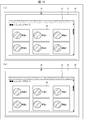
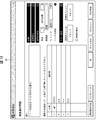
- FIG. 10 is a block diagram which shows the component of the information processing apparatus which concerns on Embodiment 1 and 2 of this invention. It is a figure which shows the display part of the smart phone provided with the information processing apparatus which concerns on Embodiment 1 and 3 of this invention. It is a figure which shows the display part of the personal computer provided with the information processing apparatus which concerns on Embodiment 1 and 3 of this invention. 10 is a table showing an example of data output by a visual object determination unit and a decision-making information acquisition unit of the information processing apparatus according to Embodiments 1 to 3 of the present invention. 10 is a table showing an example of preference information generated by a preference information generation unit of the information processing apparatus according to Embodiments 1 to 3 of the present invention.
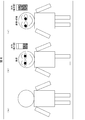
- FIG. 5 It is a schematic diagram which shows an example of the avatar image which the avatar image generation part of the information processing apparatus which concerns on Embodiment 1 of this invention produces
- 5 is a table showing an example of data output by an evaluation unit of the information processing apparatus according to Embodiments 1 to 3 of the present invention.
- 5 is a table showing an example of data output by an evaluation unit of the information processing apparatus according to Embodiments 1 to 3 of the present invention.
- FIG. 3 It is a block diagram which shows the component of the information processing apparatus which concerns on Embodiment 3 of this invention. It is a figure which shows the display part of the personal computer provided with the information processing apparatus which concerns on Embodiment 3 of this invention, (a) Before a display is changed, (b) The display part after a display is changed. It is a figure which shows an example of the browser screen which a terminal device provided with the information processing apparatus which concerns on Embodiment 4 of this invention displays. It is a figure which shows an example of the preference information which the preference production
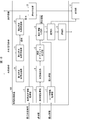
- FIG. 1 is a block diagram illustrating components of the information processing apparatus 100.
- the information processing apparatus 100 includes a user information acquisition unit 1, a face information acquisition unit 2, a decision determination information acquisition unit 3, a state detection unit 4, a visual object determination unit 5, and preference information.
- a generation unit 6, a proposal unit 7, an evaluation unit 8, and an avatar image generation unit 11 are provided.
- the information processing apparatus 100 can generate user preference information.
- the state detection unit 4, the visual object determination unit 5, the preference information generation unit 6, the proposal unit 7, the evaluation unit 8, and the avatar image generation unit 11 are realized as one configuration of the control unit 9 included in the information processing apparatus 100.
- the information processing apparatus 100 is mounted on a terminal device (for example, a smartphone, a tablet, a personal computer, a television receiver, or the like) that can be connected to a local network or a global network.
- a terminal device for example, a smartphone, a tablet, a personal computer, a television receiver, or the like
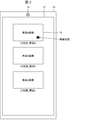
- FIG. 2 schematically illustrates the display screen of the smartphone and the line-of-sight position on the display screen when the information processing apparatus 100 is mounted on the smartphone.
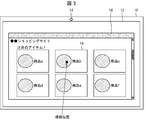
- FIG. 3 schematically shows the display screen of the personal computer and the line-of-sight position on the display screen when the information processing apparatus 100 is mounted on the personal computer.
- Other configurations included in FIGS. 2 and 3 will be described later.
- the user information acquisition unit 1 acquires, for example, user information of a specific user registered in advance in a database such as a shopping site, and transmits the acquired user information to the preference information generation unit 6.
- the user information includes attribute information indicating user attributes and user identification information for identifying other users and target users.
- the user attribute information includes, for example, the user's age, sex, member type (whether or not he / she is a paid member), and the like.
- the user identification information is, for example, a user ID, a user mail address, or the like.
- user identification information in the user information, it is possible to identify other users and target users, and to associate user preference information with user information.
- the face information acquisition unit 2 acquires user face information from an image acquired from an imaging unit such as a camera, for example.
- the user's face information is information indicating the feature amount of the face.
- the feature amount of the face refers to, for example, position information indicating the position of each part of the face (for example, eyes, nose, mouth, and eyebrows), shape information indicating the shape, size information indicating the size, and the like.
- the eye information is particularly useful because it can evaluate the user's interest and degree of interest with respect to the object to which the user is gazing. Examples of the eye information include end points of the eyes and the corners of the eyes, edges such as irises and pupils, and the like.
- the face information acquisition unit 2 may appropriately perform correction processing such as noise reduction and edge enhancement on the image acquired from the imaging unit.
- the face information acquisition unit 2 transmits the extracted face information to the state detection unit 4.
- the state detection unit 4 detects the user's state based on the face information extracted by the face information acquisition unit 2. After detecting the state of the user, the state detection unit 4 transmits the detection result to the visual object determination unit 5.
- the state of the user detected by the state detection unit 4 is, for example, the state of each part of the user's face, and the line of sight of the user, the state of the pupil, the number of blinks, the movement of the eyebrows, the movement of the cheeks, the movement of the eyelids At least one of lip movement and jaw movement.
- the state detection unit 4 includes position information and a shape indicating the position of each part of the face (for example, eyes, nose, mouth, cheeks, and eyebrows), which is the facial feature amount acquired by the face information acquisition unit 2.
- a shape indicating the position of each part of the face for example, eyes, nose, mouth, cheeks, and eyebrows
- the size information to show the size of the user for example, the user's line of sight, pupil state, number of blinks, eyebrow movement, cheek movement, wrinkle movement, lip movement At least one of movement and jaw movement may be detected.
- the information processing apparatus can suitably detect the user's state.
- the line-of-sight detection method is not particularly limited, but the information processing apparatus 100 is provided with a point light source (not shown), and the user captures a corneal reflection image of light from the point light source with the imaging unit for a predetermined time.
- a method for detecting the movement destination of the line of sight There is a method for detecting the movement destination of the line of sight.
- the type of the point light source is not particularly limited, and examples thereof include visible light and infrared light. For example, by using an infrared LED, it is possible to detect the line of sight without causing discomfort to the user. In the detection of the line of sight, if the line of sight does not move for a predetermined time or more, it can be said that the same place is being watched.
- the method for detecting the state of the pupil is not particularly limited, and examples thereof include a method for detecting a circular pupil from an eye image using Hough transform.
- a method for detecting a circular pupil from an eye image using Hough transform since humans tend to open their eyes when they are concentrated, it is possible to evaluate the degree of user concentration by detecting the size of the pupil. For example, when the pupil size is detected for a predetermined time and the pupil is enlarged within the predetermined time, it can be said that there is a high possibility that the user is gazing at a certain target.
- a threshold value may be set for the pupil size, and may be evaluated as “open” when the pupil size is equal to or larger than the threshold value, and “closed” when the pupil size is smaller than the threshold value.
- the method for detecting the number of blinks is not particularly limited.
- the user's eyes are irradiated with infrared light, and the difference in the amount of reflected infrared light between when the eye is opened and when the eye is closed is detected. Methods and the like.
- humans tend to blink at a stable interval at a low frequency when they are concentrated. Therefore, the user's degree of concentration can be evaluated by detecting the number of blinks. For example, if the number of blinks is detected for a predetermined time and blinks are performed at a stable interval within the predetermined time, it can be said that the user is likely to be gazing at a certain target.
- the state detection unit 4 detects at least one of the user's line of sight, pupil state and number of blinks, eyebrow movement, eyelid movement, cheek movement, nose movement, lip movement, and jaw movement A combination of these is preferred. By combining the detection methods in this way, the state detection unit 4 can suitably evaluate the degree of concentration of the user when viewing a certain object.
- movement of the eyebrows such as lifting or lifting the inside of the eyebrows
- movement of the eyelids such as raising the upper eyelid or tensioning the eyelids
- movement of the nose such as bringing the eyelids to the nose
- Lip movements such as lifting the upper lip and squeezing the lips
- cheek movements such as lifting the cheeks
- chin movements such as lowering the chin.
- the state of a plurality of parts of the face may be combined.
- the state detection unit 4 can also calculate information related to the user's facial expression by machine learning.
- the specific configuration of the learning process for acquiring information related to facial expressions is not limited to the present embodiment, for example, any of the following machine learning methods or a combination thereof can be used.
- the data may be processed and used in advance for input to the neural network.
- a method such as data argumentation (Deta Argumentation) can be used in addition to the one-dimensional arrangement or multidimensional arrangement of data.
- a convolutional neural network including convolution processing
- CNN Convolutional Neural Network
- a convolution layer that performs a convolution operation is provided as one or a plurality of layers (layers) included in the neural network, and a filter operation (product-sum operation) is performed on input data input to the layer. It is good also as a structure. Further, when performing the filter operation, a process such as padding may be used together, or an appropriately set stride width may be adopted.
- a multi-layer or super multi-layer neural network having several tens to several thousand layers may be used.
- the visual object determination unit 5 Based on the detection result acquired from the state detection unit 4, the visual object determination unit 5 determines the object that the user is viewing, the degree of user concentration, and the user's emotion. The visual recognition object determination unit 5 first determines the product image (object) that the user is viewing, and determines the degree of concentration and the user's emotion when the user is viewing the product image. Moreover, the visual recognition object determination unit 5 further refers to the arrangement information of the page being browsed by the user, and determines the object being visually recognized by the user.
- the information processing apparatus can accurately determine the object that the user is visually recognizing, and what kind of emotion the user has to visually recognize the object Can be determined.
- FIG. 2 illustrates a smartphone including the information processing apparatus 100
- FIG. 3 illustrates a personal computer including the information processing apparatus 100.
- a terminal device (smart phone) 10 including the information processing apparatus 100 according to the present embodiment further includes an imaging unit 14 and a display unit 12.
- the display area of the browser is the same as the size of the display unit of the smartphone and the images of the products are arranged side by side.
- the display order of the products, the manufacturer of each product, and the product name can be extracted from the source code of the web page displayed by the display unit 12. Since each product image area is controlled by the browser, the visual recognition object determination unit 5 can obtain the coordinates of the image area of each product with reference to the source code and the browser.
- the visual recognition object determination unit 5 collates the acquired image area coordinates of each product with the line-of-sight information acquired from the state detection unit 4 so that the position coordinates of the user's line-of-sight are within the image area coordinates of the product. Determine if there is. For example, as shown in FIG. 2, when it is determined that the position coordinate of the user's line of sight is within the coordinates of the image area 18 of the product a, the visual object determination unit 5 determines that the position coordinate of the user's line of sight is The counting of the time remaining in the coordinates of the image area of the product a is started.
- the terminal device (personal computer) 10 including the information processing apparatus 100 according to the present embodiment further includes an imaging unit 14 and a display unit 12 as in FIG. 2.
- the visual object determination unit 5 needs to acquire information on the position of the browser screen 16 on the display unit 12. Since the position and area of the browser are controlled by the OS (Operating System) of the information processing apparatus 100, the visual object determination unit 5 refers to the OS in addition to the source code and the browser, and coordinates of the image area of each product. Can be obtained. For example, as shown in FIG.
- the visual object determination unit 5 determines that the position coordinate of the user's line of sight is The counting of the time remaining in the coordinates of the image area of the product b is started.
- the visual recognition object determination unit 5 determines the user's emotion from the state of each part of the user's face acquired from the state detection unit 4.
- a Paul Ekman emotion classification model may be used.
- the emotion classification model includes, for example, “happiness”, “surprise”, “anger”, “disgust”, “fear”, and “sadness”.
- the emotion classification model may include “normal”.
- the emotion classification model includes “interesting”, “contempt”, “satisfaction”, “confused”, “excitement”, “guilt”, “confidence based on achievement”, “relief”, “convincing”, It may include emotions such as “shame” and a combination of these emotions (eg, anger + disgust, happiness + satisfaction, etc.).
- the visual recognition object determination unit 5 may determine which product the user is concentrating on using the machine learning method described in (State detection unit).
- the visual recognition object determination unit 5 transmits the determined result to the preference information generation unit 6.
- the information processing apparatus 100 may further include an image acquisition unit 15 that acquires a captured image including the visual field of the user from an imaging apparatus worn by the user.
- the imaging device worn by the user is not particularly limited as long as the user's state can be detected, and examples thereof include a camera mounted on a glasses-type wearable device, a camera mounted on a head mounted device, and the like.
- These types of devices may be transmissive or non-transmissive.
- the non-transmissive type as an example, a configuration in which a camera (imaging device) and a previous display (display unit) visually recognized by the user are provided in the same device may be employed.
- the captured image including the user's field of view is, for example, an image obtained by capturing a scene that the user is looking at and a display (display unit).
- the visual object determination unit 5 may determine the object that the user is viewing with reference to the captured image acquired by the image acquisition unit 15 and the detection result of the state detection unit 4. Specifically, the visual recognition object determination unit 5 collates the coordinates of the captured image area with the user's line-of-sight information detected by the state detection unit 4, and the position coordinate of the user's line of sight corresponds to which coordinate in the captured image. Judge whether it corresponds.
- the visual object determination unit 5 may be configured to recognize an object included in the captured image acquired by the image acquisition unit 15 using machine learning, for example.
- the decision making information acquisition unit 3 obtains decision making information as to whether or not the user has made a decision.
- the decision making information is, for example, settlement information indicating whether or not the user has purchased a product.
- the decision making information can be acquired from, for example, credit card information registered in advance in a shopping site, a payment server at a shopping site, a payment server at a payment agent, and the like.
- the decision information acquisition unit 3 can acquire information indicating whether the user has made a decision within the shopping site.
- the decision-making information is not limited to credit card information, and can be obtained from a medium associated with the user's personal information. For example, debit card information, prepaid card information, etc. are mentioned.
- the decision determination information acquisition unit 3 transmits the acquired decision determination information to the preference information generation unit 6.
- the decision-making information is information indicating whether or not a decision has been made in shopping or the like, but is not limited to this, and more generally is decision-making information that reflects the user's intention.
- the decision making information acquisition unit 3 is configured to be able to obtain decision making information from the information processing apparatus 100 or another device.
- the decision determination information acquisition unit 3 may be configured to acquire the decision determination information as, for example, click information with a mouse or touch information to the display unit 12 including a touch sensor.
- the information processing apparatus 100 includes a voice recognition unit that recognizes the user's voice and a motion recognition unit that recognizes the user's motion, and the decision information acquisition unit 3 converts the decision information into voice information or motion information. It is good also as a structure acquired as.
- movement is mentioned as an example of the operation
- the preference information generation unit 6 refers to the user information acquired from the user information acquisition unit 1, the determination result acquired from the visual object determination unit 5, and the determination information acquired from the decision information acquisition unit 3. Generate preference information about.
- the preference information is information indicating to which object the user's interest is strong and to which object.
- the preference information generation unit 6 can generate preference information weighted according to the degree of interest of each user.
- the preference information generation unit 6 determines the information of the product visually recognized by the user and the result of the user's concentration when viewing the product, as determined by the visual object determination unit 5, and the decision-making information acquisition unit 3 The information of the product actually purchased by the user and the information of the unpurchased product acquired from the above are collated.
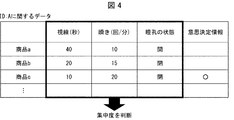
- the result detected by the state detection unit 4 and the result acquired by the decision making information acquisition unit 3 are input to the preference information generation unit as data as shown in FIG.
- the table of FIG. 4 shows an example of data about a user whose ID is A (hereinafter referred to as user A) input to the preference information generation unit.
- the table in FIG. 4 shows, for each product, the time when the user A visually recognized the product (“line of sight”), the number of blinks per minute (“blink”), the opening and closing of the pupil (“pupil state”), and It represents whether the user A has purchased the product (“decision information”). From the table of FIG.
- the user A has been viewing the product a for a long time, and has not been able to purchase the product a even though the number of blinks during that time and the state of the pupils are high concentration. Is determined. Further, from the table in FIG. 4, it is determined that the user A has purchased the product c, although the viewing time of the product c is short and the concentration state is not so high.
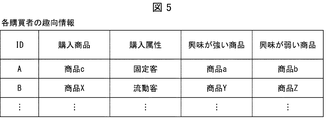
- the preference information generation unit 6 refers to the data in the table of FIG. 4 and generates the preference information as shown in FIG. 5, for example.
- the table of FIG. 5 is preference information generated for each purchaser's purchased products, purchase attributes, highly interested products, and less interested products.
- the table of FIG. 5 shows that the user A actually purchased the product c, that he / she has not purchased the product c, but has a strong interest in the product a, and that he / she is not very interested in the product b.
- the preference information generation unit 6 has purchased the product c from the gaze, blink, and pupil state because the user A has purchased the product c even though the product viewing time is short and not concentrated.
- the purchase attribute of the user A may be set as a fixed customer on the assumption that c is highly likely to be purchased. Further, the preference information generation unit 6 determines that the user who has viewed the product in a high concentration state with a long viewing time of the product has decided to purchase the product for the first time regardless of whether the product has been purchased or not purchased.
- the purchase attribute of the user may be set as a flow customer because it is highly likely that the purchase was considered.
- the preference information generation unit 6 may generate preference information using a machine learning method described in (State detection unit).
- the preference information generation unit 6 may be configured to generate user preference information with reference to other information such as click information in place of the above-described various information or instead of the above-described various information.
- the click information may include information such as a position where the user clicks or touches, the number of clicks or touches, a time interval of double clicks, and the like.
- the display unit When the display unit is configured as a touch panel, the user's touch strength can be detected by adopting a so-called resistive film method.
- the preference information generation unit 6 transmits the generated preference information to the proposal unit 7.
- the proposal unit 7 acquires the preference information from the preference information generation unit 6, and generates proposal information for making a proposal to the user with reference to the preference information.
- the proposal information is, for example, an electronic announcement of a product with a strong interest in the user's preference information, price drop information, and an electronic coupon.
- Proposal part 7 may transmit generated proposal information to a user using communication means, such as mail, SNS, and IM, for example. Moreover, you may notify a user as a banner advertisement.
- the proposal unit proposes proposal information to the user, so that the user can enjoy information based on his / her preferences.
- the user can obtain information about the product he is interested in and is given an opportunity to purchase at a low price.
- the proposal unit 7 transmits the generated proposal information to the user and transmits the proposal information to the evaluation unit 8.
- the evaluation unit 8 evaluates each product with reference to the proposal information acquired from the proposal unit 7 and the determination result of whether or not the user to whom the proposal information has been transmitted has actually made a decision based on the proposal information. .
- the evaluation unit 8 performs the evaluation as shown in the table of FIG. In the table of FIG. 7, when the proposal unit 7 transmits the advertisement of the product a (suggestion information) to the users A, C, and D and transmits the advertisement of the product b to the users E and F, It is the result of evaluating whether or not the product has been purchased.
- the contract rate in the table of FIG. 7 is the ratio of the number of users who have actually purchased the advertisement product in the number of users to whom the proposal unit 7 has transmitted the advertisement.
- the contract rate is 100%.
- the contract rate is 50%.
- it is not always necessary to determine whether or not the user who has transmitted the advertisement has actually seen the advertisement.
- the evaluation unit 8 may acquire information on whether or not the user has made a decision based on the proposal information from the decision determination information acquisition unit 3.
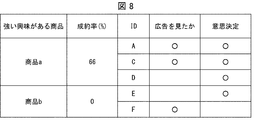
- the evaluation unit 8 may perform the evaluation by adding the advertisement visual information indicating whether or not the user to whom the advertisement is transmitted actually viewed the advertisement. For example, the evaluation shown in the table of FIG. 8 is performed.
- the table in FIG. 8 is the same as the table in FIG. 7, when the proposal unit 7 transmits the advertisement for the product a to the users A, C, and D, and the advertisement for the product b to the users E and F. Is a result of evaluating whether or not the product of the advertisement has been purchased.
- the contract rate in the table of FIG. 8 is the ratio of the number of users who have seen the advertisement and have purchased the product in the number of users to whom the proposal unit 7 has transmitted the advertisement. As shown in the table of FIG.
- the contract rate is 66%.
- the contract rate is 0%.
- the advertisement viewing information may determine whether or not the advertisement has been viewed using the method described in (Viewing Object Determination Unit).
- the information processing apparatus 100 includes the evaluation unit 8 so that it is possible to evaluate from the contract rate whether or not the method of suggesting the proposal information to the user is appropriate.
- the avatar image generation unit 11 generates an avatar image corresponding to the user, the state of the user detected by the state detection unit 4, the object visually recognized by the user determined by the visual object determination unit 5, the user's emotion, and the taste An avatar image corresponding to at least one of the preference information acquired from the information generation unit 6 is generated.
- the avatar image is information symbolically representing the user, and is mainly an image that reminds the user.
- the avatar image is generated on an image formed by imitating an actual store.
- the avatar image generation unit 11 when the avatar image generation unit 11 generates the avatar image, the object that the user is viewing, the user's emotion, and the preference information can be visualized.
- the state of the user is the state of each part of the user's face described in (state detection unit).
- the object visually recognized by the user and the user's emotion are determined by the method described in (Visual Object Determination Unit).
- the preference information is information indicating to which object the user's interest is strong and to which object, as described in (Preference Information Generation Unit).
- FIG. 6 is an example of an avatar image generated by the avatar image generation unit 11.
- 6A is an example of a conventional avatar image
- FIG. 6B is an example of an avatar image according to the user's facial expression
- FIG. 6C is an example of an avatar image according to the user's facial expression and line of sight.
- the conventional avatar image does not reflect the user's facial expression.
- the avatar image generation unit 11 of the present embodiment generates an avatar image corresponding to the user's facial expression. For example, when the user visually recognizes a certain product, if the user has a facial expression with a raised mouth corner, an avatar image having a facial expression with a raised mouth corner is generated.
- the avatar image generation part 11 may display the gauge which visualized the degree of favor (preference) with respect to a certain goods of a user with reference to preference information.
- an avatar image corresponding to the information of the user's line of sight may be generated.
- the line-of-sight information includes, for example, the line-of-sight direction, the state of the pupil, and the number of blinks.
- the avatar image generation unit 11 may generate an image in which an object visually recognized by the user is held in the hand of the avatar, for example, and the product held by the avatar is visually recognized.
- the avatar image may be displayed on the display unit 12 of the user's terminal device so that the user can view the avatar image, or the other user can view the user's avatar image. It may be transmitted to other terminal devices and shopping site servers.
- the user can objectively view how he / she is shopping at a shopping site as if he / she was shopping at a real store.
- other users store staff, etc.
- the display unit 12 is illustrated as being configured separately from the information processing apparatus 100.
- the control unit 9 comprehensively controls each unit of the information processing apparatus 100.
- the control unit 9 includes a state detection unit 4, a visual object determination unit 5, a preference information generation unit 6, a proposal unit 7, an evaluation unit 8, and an avatar image generation unit 11.
- Each function of the control unit 9 and all the functions included in the information processing apparatus 100 may be realized, for example, by the CPU executing a program stored in a storage unit (not shown) or the like.
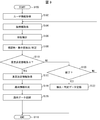
- step S100 use of the information processing apparatus is started (step S100), and processing is started.
- the process proceeds to step S (hereinafter, “step” is omitted) 102.
- the user information acquisition unit 1 acquires user information (user information acquisition step). Details of the processing are as described in (User Information Acquisition Unit). The user information acquisition unit 1 transmits user information to the preference information generation unit 6, and proceeds to S104.
- the face information acquisition unit 2 acquires the face image of the user from the imaging unit, and extracts each part of the face from the face image (face information acquisition step). Details of the processing are as described in (Face Information Acquisition Unit). The face information acquisition unit 2 transmits the extracted result to the state detection unit 4, and proceeds to S106.
- the state detection unit 4 detects the user's line of sight, blinking, the state of the pupil, and the state of each part of the face (state detection step). Details of the processing are as described in (Status Detection Unit). The detection result is transmitted to the visual object determination unit 5, and the process proceeds to S108.
- the visual recognition object determination unit 5 determines the product image (visual recognition object) visually recognized by the user, the degree of concentration when visually recognizing, and the emotion when visually recognizing (visual object determination step). Details of the processing are as described in (visual recognition object determination unit). The visual recognition object determination unit 5 transmits the determination result to the preference information generation unit 6, and proceeds to S110.
- the decision making information acquisition unit 3 refers to decision making information such as a payment server at the shopping site or the user's credit card information to determine the presence / absence of decision making. move on. If there is no decision making information, the process proceeds to S120.
- the decision making information obtaining unit 3 obtains the payment information such as the product purchased by the user from the user's credit card information, the payment server of the shopping site, the payment server of the payment agent, etc. (decision information) Generation step). Details of the processing are as described in (Decision information acquisition unit). The decision making information acquisition unit 3 transmits the obtained decision making information (settlement information) to the preference information generation unit 6, and proceeds to S114.
- the preference information generation unit 6 includes the user information acquired from the user information acquisition unit 1, the determination result acquired from the visual object determination unit 5, and the decision determination information acquired from the decision determination information acquisition unit 3. To generate preference information (preference information generation step). The details of the processing are as described in (Preference information generator).
- the control unit 9 records the preference information generated by the preference information generation unit 6 in a database or the like, proceeds to S118, and ends the preference estimation process.
- control unit 9 determines whether or not to end the preference estimation process, and when it ends (for example, when the user logs out from the shopping site), the process proceeds to S122.
- control unit 9 records data on a product or the like that the user has visually recognized but has not purchased in a database or the like, proceeds to S118, and ends the process.
- control unit 9 when it is determined that the control unit 9 does not end the preference estimation process (for example, when the user remains logged in to the shopping site), the process returns to S104 and the process is repeated.
- the information processing apparatus 100 includes the same units as those of the information processing apparatus 100 according to the first embodiment, and the processing performed by each unit is the same except for the visual object determination unit 5.
- the visual object determination unit 5 will be described later.
- the information processing apparatus 100 according to the present embodiment further includes a temporary ID providing unit that assigns a temporary ID, and a matching unit that collates the temporary ID with the decision making information of the user.
- the information processing apparatus can temporarily distinguish the face information from other face information.
- provisional part can further be collated by collating temporary ID and a user's decision-making information.
- Embodiment 1 the form in which a user purchases a product using an EC service has been described, but in this embodiment, a form in which a user purchases a product at an actual store will be described.
- Embodiment 1 first, personal information of a user is acquired. This corresponds to, for example, a user entering an ID and a password at a shopping site and logging in to the shopping site. However, in an actual store, the user rarely logs in in advance.
- user information is acquired after acquiring decision information or simultaneously with decision information.
- an imaging unit is installed on a display shelf of a product in a store, and the user's line of sight, blink, pupil state, eyebrow movement, eyelid movement, cheek movement, nose when the user selects the product It is possible to detect the movement of the lips, the movement of the lips and the movement of the jaws.
- a temporary ID assigning unit assigns a temporary ID to the user, and information on a product visually recognized by the user is used as the temporary ID information. Or the like.
- the decision making information and the user information are acquired for the first time.
- an imaging unit is also installed in the cash register, and after the imaging unit of the display shelf and the imaging unit of the cash register are synchronized, it is determined which temporary ID user has made the decision, You may collate temporary ID information and user decision-making information, or user information.
- the temporary ID information may be discarded.
- S200 use of the information processing apparatus is started (S200).
- the user may stand in front of the display shelf and start when the imaging unit of the display shelf recognizes the presence of the user.
- the process proceeds to S202.
- the face information acquisition unit 2 acquires a user's face image from the imaging unit, and extracts an eye part from the face image. Details of the processing are as described in (Face Information Acquisition Unit) in ⁇ Embodiment 1>.
- the face information acquisition unit 2 transmits the extracted data to the temporary ID assigning unit, and proceeds to S204.
- the temporary ID assigning unit assigns a temporary ID to the data acquired from the face information acquiring unit 2.
- the temporary ID assigning unit transmits the face information data provided with the temporary ID to the state detecting unit 4, and the process proceeds to S206.
- the state detection unit 4 detects the user's line of sight, blink, pupil state, eyebrow movement, eyelid movement, cheek movement, nose movement, lip movement, and jaw movement. Details of the processing are as described in (State detection unit) in ⁇ Embodiment 1>.
- the state detection unit 4 transmits the detection result to the visual object determination unit 5, and proceeds to S208.
- the visual recognition object determination unit 5 determines the product on the display shelf visually recognized by the user and the degree of concentration when viewing the product. For example, the visual recognition object determination unit according to the present embodiment performs the determination by collating the arrangement of the products arranged on the display shelf with the position coordinates of the user's line of sight. The visual recognition object determination unit 5 transmits the determined result to the preference information generation unit 6, and proceeds to S210.
- S210 it is determined whether or not the user of the temporary ID has made a decision with a medium that can specify the user information. If the decision has been made with a medium that can specify the user information, the process proceeds to S212. Further, when the user with the temporary ID has not purchased any product, or when making a decision with a medium in which the user information cannot be specified, the process proceeds to S222.
- the decision-making information acquisition unit 3 acquires information such as a product purchased by the temporary ID user, and the user information acquisition unit 1 acquires personal information from a credit card or the like used by the temporary ID user. , The process proceeds to S216.
- the decision-making information acquisition unit 3 may also serve as the user information acquisition unit 1 and acquire purchase information and user information of the temporary ID user.
- control unit 9 collates the user information of the temporary ID acquired from the temporary ID providing unit (the user's visual recognition object and the degree of concentration) with the user information acquired from the user information acquisition unit 1. That is, the personal information of the user with the temporary ID is specified.
- the collated result is transmitted to the preference information generating unit 6, and the process proceeds to S217.
- the preference information generation unit 6 generates the preference information with reference to the result of collating the temporary ID user information and the user information acquired from the user information acquisition unit 1.
- the details of the processing are as described in (Preference information generator).
- the control unit 9 records the preference information generated by the preference information generation unit 6 in a database or the like, proceeds to S218, and ends the process.
- control unit 9 records data on a product or the like that is visually recognized by the user but not purchased in the database or the like, proceeds to S220, and ends the process.
- the temporary ID information that is not linked to the user information is discarded, but in this modification, the temporary ID information that is not linked to the user information is
- the statistical data may be recorded and accumulated in a database or the like as unspecified statistical data and used.
- provisional ID information is recorded and used, so that not only proposals tailored to the user's taste but also what other users who have purchased the same product as the user are purchasing, Additional information such as what is a popular product can be proposed to each user.
- the information processing method includes the user information acquisition step (S212) for acquiring user information of a registered specific user, and the face information acquisition step (S202) for acquiring the user face information. ), A state detection step (S206) for detecting the state of the user from the face information acquired in the face information acquisition step, and a result detected in the state detection step, and an object that the user is viewing is determined.
- Visual object determination step (S208) for determination
- decision information acquisition step (S212) for acquiring the user's decision information, user information of the user, the determination result in the visual object determination step, and the determination
- the preference for generating preference information related to the user's preference with reference to the information A broadcast generating step (S217) contains.
- the user information acquisition step (S212) may be performed after steps S202 to S210, or may be performed in the middle of steps S202 to S210. 1 may be performed before steps S202 to S208.
- the information processing apparatus 100 changes the display information displayed on the display unit 12 based on the preference information generated by the preference information generation unit 6 and the display information.
- the user can acquire information optimized for his / her preference.
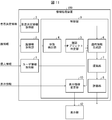
- the information processing apparatus 100 according to the present embodiment further includes a display information changing unit 13 in addition to each unit of the information processing apparatus 100 according to the first embodiment.
- FIG. 11 is a block diagram illustrating components of the information processing apparatus 100 according to the present embodiment. The processing performed by each unit other than the display information changing unit 13 is the same as the processing described in the first embodiment.
- the display information changing unit 13 changes display information to be displayed on the display unit 12 based on the preference information generated by the preference information generating unit 6. Further, the display information changing unit 13 further changes the display information with reference to the display information.
- the display unit 12 includes image information indicating the displayed image, layout information indicating the coordinates of the image, and the like. Display information can be acquired from source code, a browser, and an OS. Moreover, although the change of information is not particularly limited, as an example, the change of the product image displayed on the display unit 12 is changed.
- the display information changing unit 13 transmits the changed display information to the display unit 12.
- the display unit 12 displays the changed display information received from the display information changing unit 13.
- FIG. 12 shows the display unit 12 of the personal computer.
- FIG. 12A shows the display unit 12 before the display is changed, and the display unit 12 displays images of products a to f.
- the preference information generation unit 6 generates preference information indicating that the items of interest of the user are d, e, and f among the products a to f.
- the display information changing unit 13 Based on the currently displayed display information of FIG. 12A and the preference information generated by the preference information generating unit 6, the display information changing unit 13 and the positions of the images of the products a to c and the items of the products d to f are displayed. Display information whose layout has been changed is generated by switching the position of the image.
- the display unit 12 displays as shown in FIG. That is, the display information changing unit 13 arranges and displays images of the products d, e, and f at the most prominent place in the displayed screen.
- the layout change is not limited to this form, and examples include a top-and-bottom interchange of product images and a left-and-right interchange.
- the images may be rearranged one by one in the order of strong user interest based on the preference information of the preference information generation unit 6.
- the timing at which the display information on the display unit 12 is changed is not particularly limited. For example, it is changed when the user logs out once from a shopping site or the like and then logs in to the same site. Moreover, the timing at which the web page is updated in a state where the user is logged in to the shopping site may be used.
- the display information changing process by the display information changing unit 13 is exemplified by changing the layout information included in the display information.
- the present embodiment is not limited to this.
- Another example of changing the display information is a configuration that highlights an image of a product that is of great interest to the user. Specifically, as an example of highlighting, -Surround the product image-Change the background color around the product image-Display the product image larger than other products-Display the product image as a pop-up window, etc. Can be mentioned.
- the information processing apparatus is a learning support apparatus.
- a learning support device for example, a device that performs E-learning can be cited.
- the information processing apparatus generates an estimated understanding level of a learner who answers a plurality of selection questions.
- the preference information generated by the preference information generation unit 6 is the estimated understanding level of the user.
- the estimated comprehension degree is a degree for estimating the user's comprehension degree in consideration of not only the correctness of the answer finally selected by the user but also the process until the user reaches the answer. .
- FIG. 13 is an example of question sentences and answer options displayed by the information processing apparatus according to the present embodiment.
- the learner reads the displayed question sentence, reads the answer options, and selects an option that he thinks is correct. In such a choice-type problem, even if the learner finally selects an option that is the correct answer, the learner does not always make a correct answer after understanding the problem.
- the answer is correct by chance
- the correct answer is found by chance as a result of selecting an option without reading the question sentence.
- the information processing apparatus outputs the estimated understanding level of the learner in consideration of not only the correctness of the answer finally selected by the learner but also the process until the learner reaches the answer. . In this way, by outputting the estimated understanding level, the learner himself or a third party who teaches the learner can accurately know the understanding level of the learner.
- the information processing apparatus includes a user information acquisition unit 1, a face information acquisition unit 2, a state detection unit 4, a visual object determination unit 5, and a decision determination information acquisition unit 3.
- the preference information generation unit 6 is provided.
- the user information acquisition unit 1 acquires information about the user by using a pre-registered learner as a user.
- the face information acquisition unit 2 acquires user face information.
- the state detection unit 4 detects the user state from the user face information acquired by the face information acquisition unit 2.
- the detection method may be the same determination method as that of the state detection unit 4 of the first embodiment. For example, the time when the object is visually recognized (“line of sight”), the number of blinks per minute (“blink”), and the opening / closing of the pupil (“Pupil state”) and the like are detected.
- the visual object determination unit 5 refers to the result detected by the state detection unit 4 to determine the object that the user is viewing.
- the object determination method may be the same as the determination method of the visual object determination unit 5 of the first embodiment.
- the object visually recognized by the user is a question sentence and an answer option visually recognized by the user.
- the decision information acquisition unit 3 acquires the user's decision information.
- the decision making information is an answer number selected by the answerer. More generally speaking, decision information is decision information that reflects the user's intention.
- the preference information generation unit 6 refers to the user information acquired from the user information acquisition unit 1, the determination result acquired from the visual object determination unit 5, and the decision determination information acquired from the decision information acquisition unit 3. Generate estimated comprehension. As an example, for the object that the visual recognition object determination unit 5 determines that the learner is turning his / her line of sight many times, that is, the answer choice that is read back many times, the preference information generation unit 6 It is determined that the option is lost as a candidate, and an estimated comprehension level is generated.
- FIG. 15 is an example of information generated by the preference information generation unit 6.
- ID is information for identifying a learner
- selection number is the number of an option actually selected by the learner of each ID
- correct is correct / incorrect.
- the “lost option” is an option determined by the visual object determination unit 5 that the learner was visually recognizing, and the “optional option that was not lost” was determined that the learner was not so much visually recognized. Is an option.
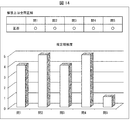
- the “estimated comprehension level” is a result of comprehensively determining “correct / no-go”, “lost option”, and “not lost option” and indicating the learner's level of understanding in five stages.
- the preference information generating unit 6 determines that the learner A has a degree of understanding that can only exclude the option d from the correct answer candidates, and generates an estimated degree of understanding 3 as a medium degree of understanding.
- the learner C after reading through the question sentence and the options, visually recognized only the option a and selected the option a as the correct answer. Accordingly, the preference information generation unit 6 determines that the learner C has a high understanding level, and generates an estimated understanding level 5.
- learner D Since learner D was also viewing options b, c, and d in addition to option a, it can be said that learner A was lost in all of the options. From this, the learner D finally selected the correct answer option, but because he was lost in all the options, there is a high possibility that the correct answer was accidental and the understanding information is not so high. Determine and generate an estimated comprehension level 2.
- the estimated comprehension level of learners B and E who are wrong answers to the problem, is similarly determined. For example, the learner B was wrong, but he was lost in the choices a and b, and was not lost in the other choices. Is determined, and an estimated comprehension level 4 is generated. In addition, learner E is confused with all the options, and is eventually incorrect, so preference information generator 6 determines that the understanding level is low, and generates estimated understanding level 1.
- the preference information generation unit 6 may output display data including an object visualizing the generated estimated comprehension level to an external display device.
- a graph is mentioned as an example of display data.
- FIG. 14 is a bar graph showing the estimated comprehension level of a learner who answered five question sentences. Thus, by showing with a graph, an estimated comprehension degree can be grasped at a glance.
- the visualization method is not limited, and a radar chart or the like may be used. 14 shows the estimated comprehension level of one learner, the average estimated comprehension level of a plurality of learners who solved the same problem may be displayed together.
- the learner's estimated comprehension level can be visualized.
- the information processing apparatus may further determine the following items and generate an estimated understanding level.
- the preference information generation unit 6 may perform processing such as lowering the estimated understanding level.
- the preference information generation unit 6 may perform processing such as lowering the estimated understanding level.
- the proposal unit 7 proposes proposal information based on the preference information acquired from the preference information generation unit 6 to the user.
- the proposal information is, for example, for the learner to review a problem with a low estimated comprehension among a plurality of answered questions for each learner included in the taste information generated by the taste information generating unit 6. It is information for.
- the information for review is commentary for allowing the learner to understand a problem with a low estimated comprehension degree. More specifically, the information to be reviewed is a message such as “It seems that the understanding of past completed forms of English grammar is low.”, “Please review the textbook pages 10 to 13 again.” There may be.
- the proposal unit 7 may display the proposal information on the display unit on a screen for confirming whether the answer is correct. Moreover, the proposal part 7 may transmit the produced
- communication means such as an email, a social network service (SNS), and an instant message (IM).
- the proposing unit 7 proposes the proposal information to the learner
- the learner can enjoy information based on his / her estimated understanding level.
- the evaluation unit 8 may determine whether or not the user has viewed the proposal information. For example, the evaluation unit 8 determines whether or not the user has visually confirmed the screen on which information for reviewing the problem proposed to the learner is displayed. You may determine by referring. Information about whether or not the learner has visually recognized is acquired from the visual object determination unit 5, for example.
- the visual recognition object determination unit 5 may perform the process described in (Visual recognition object determination unit) in the first embodiment, for example.
- the evaluation unit 8 may perform the evaluation based on the above determination result.
- the evaluation is, for example, an evaluation of whether or not the information (suggestion information) proposed to the learner for reviewing the problem was appropriate.
- the evaluation unit 8 makes an evaluation by referring to information such as whether a learner who has viewed information for reviewing a problem has logged in to a site for solving the problem again or has solved the problem. Do.
- the evaluation unit 8 performs evaluation by further considering information on whether or not the learner's grade has improved when the learner who has reviewed the information for reviewing the problem solves the problem again. May be.
- the evaluation value may be the ratio of the number of learners who solved the problem again in the total number of learners who proposed information for reviewing the problem.
- FIG. 16 is a block diagram illustrating components of the information processing apparatus 100.
- the information processing apparatus 100 according to the present embodiment includes a user information acquisition unit 1, a face information acquisition unit 2, a decision determination information acquisition unit 3, a state detection unit 4, a visual object determination unit 5, and preference information.
- the functions of the members other than the preference sharing request transmission unit 20, the preference sharing request reception unit 21, the preference sharing request approval unit 22, and the preference sharing unit 23 are the same as the functions of the members described in the first embodiment. Omitted.
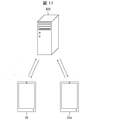
- FIG. 17 is a diagram showing an outline of the information processing system according to the present embodiment.
- the information processing system according to the present embodiment includes a server 300 and a plurality of terminal devices (10, 10a) as an example of the plurality of information processing devices 100.
- the preference sharing request transmission unit 20 transmits information for requesting sharing of preference information to other terminals via the server 300.
- the preference sharing request reception unit 21 receives request information for requesting sharing of preference information from the preference sharing request transmission unit of another terminal via the server 300.
- the preference sharing request reception unit 21 notifies the preference sharing request approval unit of the received information.
- the preference sharing request approval unit 22 approves the transmission of preference information to another terminal based on the information received from the preference sharing request reception unit 21. More specifically, the preference sharing request approval unit 22 may send preference information to another terminal based on the information received from the preference sharing request reception unit 21 or display a notification requesting authorization from the user. And accepting an operation from the user. When the operation input from the user indicates “approval”, the preference sharing request approval unit 22 approves that the preference information is transmitted to another terminal.
- the following message can be cited.
- the preference sharing unit 23 transmits the preference information acquired from the preference information generation unit 6 to another terminal device via the server 300 based on the approval of the preference sharing request approval unit 22.
- the preference sharing request transmission unit 20 transmits request information for requesting sharing of preference information to other terminals via the server 300.
- the preference sharing unit 23 receives preference information from other terminals via the server 300, and refers to the preference information from other terminals and the preference information acquired from the preference information generation unit 6 to share the preference. Generate information.
- the preference sharing unit 23 causes the display unit 12 to display at least a part of the generated sharing preference information. Specifically, both preference information may be displayed on the terminal device, or only preference information from other terminals may be displayed on its own terminal device. In addition, both preference information and preference information from other terminals may be appropriately switched and displayed by a user operation or the like. With such a configuration, the user can know the preference information of the partner who is the user of the other terminal. Also, it is possible to know both the preference information in consideration of the preference information of the other party and the preference information of the other party.
- the server 300 manages the information for requesting the sharing of the preference information described above in association with the terminal ID or user ID of the transmission source terminal device and the terminal ID or user ID of the transmission destination terminal device. . Further, the server 300 manages the “preference information” in association with the terminal ID or user ID of the terminal device from which the preference information is acquired, and the terminal ID or user ID of the terminal device that can share the preference information. Yes.
- the case of sharing restaurant preference information will be described.
- the user A and the user B select a restaurant to be used by two people, the user A and the user B share the preference information regarding each other's restaurant, so that their preferences are the same or the same.
- a restaurant can be selected.
- the preference sharing request transmission unit of the user A terminal device transmits information for requesting the user B terminal device to share preference information of the user B restaurant.
- the preference sharing request reception unit 21 of the user B terminal device notifies the preference sharing request approval unit 22 of the information received from the user A preference sharing request transmission unit, and the preference information is displayed on the display unit of the user B terminal device.
- the user B is notified that authorization may be sent to another terminal.
- the preference sharing request approval unit 22 transmits information indicating that the preference sharing unit 23 has been authorized.
- the preference sharing unit 23 acquires preference information from the preference information generation unit 6 and transmits the preference information to the terminal device of the user A.
- the preference information generation unit 6 acquires preference information from the terminal device of the user A, generates preference information of two people based on the preference information of the user A and the user B, and displays the generated result on the display unit 12
- FIG. 18 is an example in which the preference information of the user A and the user B is displayed.
- the store included in both is displayed as preference information common to both.
- the stores Y, P, X, and C displayed in the upper row on the browser screen 16 are stores that are common preferences of the user A and the user B.
- the browser screen 16 is displayed on the display unit 12 of the terminal device of the user A, only the favorite store of the user B may be displayed on the display unit 12 of the terminal device of the user A.
- the preference information common to the user A and the user B is referred to as shared preference information.
- the information processing apparatus 100 may further include a display information changing unit, and may appropriately change the layout of the display unit.
- the process of the display information changing unit is the same as the process of the display information changing unit described in the third embodiment.
- the information processing apparatus 100 may further include an avatar image generation unit.
- the function of the avatar image generation unit may be the same as that of the avatar image generation unit described in the first embodiment.
- the avatar image generation unit views the generated avatar image, for example, by the user himself / herself. It may be displayed on the display unit 12 of the terminal device of the user, or may be transmitted to another terminal device via the preference sharing unit 23. That is, an avatar image may be shared with preference information among a plurality of users.
- the avatar image generation unit when the avatar image generation unit generates the avatar image, the object that the user is viewing, the user's emotion, and the preference information can be visualized. Further, by sharing the avatar image among a plurality of users, it is possible to increase the familiarity between the users while looking at the display unit of the terminal device.
- the number of terminals that share preference information is not particularly limited, and may be shared among three or more terminal devices.
- the terminal device includes the preference information generation unit 6 and the preference sharing unit 23, and the preference information is shared among a plurality of terminal devices.
- the server 300 includes the preference information generation unit 6 and the preference sharing unit 23, and a plurality of users share each other's preference information and generate preference information of a plurality of people via the server. Form may be sufficient.
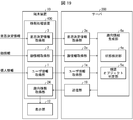
- FIG. 19 is a block diagram illustrating components of the terminal device 10 including the information processing apparatus 400 according to the present embodiment and the server 200 that is the information processing apparatus according to the present embodiment.
- the terminal device 10 acquires user information, face information, and decision-making information of the user, transmits the acquired information to the server 200, and the server 200 generates preference information with reference to the received information.
- the server 200 transmits the generated preference information to the terminal device 10, and the terminal device 10 acquires the preference information.
- the information processing apparatus 400 includes a user information acquisition unit 1 that acquires user information of a registered specific user, a face information acquisition unit 2 that acquires user face information, and a user.
- Decision information acquisition unit 3 for acquiring the decision information of the user
- the preference information acquisition unit 24 for acquiring the preference information obtained by referring to the user information of the user, the face information of the user, and the decision information of the user, and the display Part 12 is provided.
- the user information acquisition unit 1, face information acquisition unit 2, decision making information acquisition unit 3, and preference information acquisition unit 24 are collectively referred to as an information processing device 400.
- the terminal device 10 can acquire user preference information.
- the user information acquisition unit 1, the face information acquisition unit 2, and the decision information acquisition unit 3 acquire user information, user face information, and user decision information, respectively, as in the first embodiment.
- the user information includes user attribute information, and specific user attribute information is the same as the attribute information described in the first exemplary embodiment.
- the user information includes user identification information for identifying the user from other users, and specific user identification information is the same as the identification information described in the first embodiment.
- user identification information in the user information, it is possible to identify other users and target users, and to associate user preference information with user information.
- the user information acquisition unit 1, the face information acquisition unit 2, and the decision making information acquisition unit 3 transmit the acquired information to the server 200. Is different.
- the preference information acquisition unit 24 acquires preference information from the server 200 and causes the display unit 12 to display the acquired result.
- the server 200 will be described with reference to FIG.
- the server 200 includes a user information acquisition unit 1a that acquires user information of a registered specific user, a face information acquisition unit 2a that acquires the user's face information, and the user's decision-making information.
- the decision making information acquisition unit 3a to be acquired, the user information of the user, the face information of the user, and the decision making information of the user, the preference information generation unit that generates the preference information related to the user preference 6a.
- the server 200 can suitably generate user preference information.
- the server 200 further includes a transmission unit 19 that transmits preference information.
- the user information acquisition unit 1 a, the face information acquisition unit 2 a, and the decision information acquisition unit 3 a included in the server 200 are from the user information acquisition unit 1, the face information acquisition unit 2, and the decision information acquisition unit 3 in the terminal device 10.
- the user information, the face information, and the decision making information are received, and the received information is transmitted to the preference information generating unit 6a.
- the preference information generation unit 6a generates user preference information by referring to the received user information, face information, and decision-making information.
- the specific operation of the preference information generation unit 6a is the same as that of the preference information generation unit 6 described in the first embodiment, but the preference information generation unit 6a of the server 200 according to the present embodiment includes the state detection unit 4a, and A visual recognition object determination unit 5a may be provided.
- the state detection unit 4a and the visual object determination unit 5a are the same as the state detection unit 4 and the visual object determination unit 5 described in the first embodiment.
- the server 200 can detect the user's state and can appropriately determine the object that the user is viewing.
- state detection unit 4a that detects the user's state and the visual object determination unit 5a that determines an object that the user is viewing may be configured to be included in the terminal device 10 according to the present embodiment.
- the terminal device 10 can detect the user's state and can appropriately determine the object that the user is viewing.
- the visual recognition object determination part 5a determines the object which the user is visually recognizing further referring to the arrangement information of the page that the user is browsing similarly to the visual object determination part 5 according to the first embodiment.
- the object determination unit can further accurately determine which object on the page the user is viewing by further referring to the layout information of the page.
- the information processing apparatus 100 may further include an image acquisition unit (not shown) that acquires a captured image including a user's field of view from an imaging apparatus worn by the user.
- the visual object determination unit may determine the object that the user is viewing with reference to the captured image acquired by the image acquisition unit and the result detected by the state detection unit.
- the functions of the image acquisition unit and the visual object determination unit are the same as the functions of the image acquisition unit 15 and the visual object determination unit 5 described in the first embodiment.
- the state of the user detected by the state detection unit 4a is the same as that of the state detection unit 4 according to the first embodiment, such as the user's line of sight, pupil state, number of blinks, eyebrow movement, eyelid movement, cheek movement, nose movement. , The movement of the lips and the movement of the chin, and the visual object determination unit determines the degree of concentration of the user based on the detection result.
- the state detection unit detects the user's state, so that the user's degree of concentration can be suitably determined.
- the information processing apparatus 400 refers to the preference information acquired by the preference information acquisition unit 24, and proposes a proposal unit that proposes proposal information to the user, and the user selects a product based on the proposal information.
- An evaluation unit that determines whether or not a purchase has been made and performs an evaluation based on a result of the determination.
- the functions of the proposal unit and the evaluation unit are the same as the functions of the proposal unit and the evaluation unit described in the first embodiment.
- the information processing apparatus 400 includes the proposal unit, so that the user can acquire proposal information based on his / her preference.
- the information processing apparatus 400 includes an evaluation unit, it is possible to evaluate whether or not the method of suggesting proposal information to the user is appropriate.
- the preference information is information related to an object having a strong interest and an object having a low interest, as in the first embodiment.
- the preference information generation unit 6a generates preference information weighted according to the degree of interest of each user, and the preference information acquisition unit 24 acquires the preference information, so that the user can The preference information based on the preference can be acquired.
- the information processing apparatus is a server, and the form in which the taste information is generated in the taste information generation unit provided in the server is not limited to the present embodiment, and may be applied to the above-described first to fifth embodiments.
- the server since the server includes the preference information generation unit, for example, even if the terminal devices used by the user are not always the same, the user's preference information can be generated on the server. As long as the user information, face information, and decision-making information of the user can be acquired, the user's preference information can be stably generated when the user uses any terminal device such as a personal computer, a tablet, or a smartphone. .
- the provision of the preference information generation unit in the server is particularly useful in the mode of sharing preference information of a plurality of users described in the fifth embodiment.
- the server may further include a preference sharing unit. With such a configuration, preference information for a plurality of users can be suitably generated on the server.
- the server 200 adds a temporary ID to the face information. You may further provide the provisional ID provision part to provide, and the collation part which collates the said temporary ID and the said user's decision-making information.
- the server 200 can temporarily distinguish the face information from other face information.
- the control block of the information processing apparatus 100 may be realized by a logic circuit (hardware) formed in an integrated circuit (IC chip) or the like, or may be realized by software.
- the information processing apparatus 100 includes a computer that executes instructions of a program that is software for realizing each function.
- the computer includes, for example, at least one processor (control device) and at least one computer-readable recording medium storing the program.
- the processor reads the program from the recording medium and executes the program, thereby achieving the object of the present invention.
- a CPU Central Processing Unit
- the recording medium a “non-temporary tangible medium” such as a ROM (Read Only Memory), a tape, a disk, a card, a semiconductor memory, a programmable logic circuit, or the like can be used.
- a RAM Random Access Memory
- the program may be supplied to the computer via an arbitrary transmission medium (such as a communication network or a broadcast wave) that can transmit the program.
- an arbitrary transmission medium such as a communication network or a broadcast wave
- one embodiment of the present invention can also be realized in the form of a data signal embedded in a carrier wave, in which the program is embodied by electronic transmission.
- the information processing apparatus may be realized by a computer.
- the information processing apparatus is operated on each computer by causing the computer to operate as each unit (software element) included in the information processing apparatus.
- the control program for the information processing apparatus to be realized in this way and a computer-readable recording medium on which the control program is recorded also fall within the scope of the present invention.
- An information processing apparatus includes a user information acquisition unit that acquires user information of a registered specific user, a face information acquisition unit that acquires face information of the user, and the face information acquisition unit.
- a state detection unit that detects the state of the user from the acquired face information
- a visual object determination unit that refers to information detected by the state detection unit and determines an object that the user is viewing, and the user's intention
- a preference for generating preference information related to the preference of the user by referring to the decision information acquisition unit for acquiring decision information, the user information of the user, the determination result by the visual object determination unit, and the decision information.
- an information generation unit is a user information acquisition unit that acquires user information of a registered specific user, a face information acquisition unit that acquires face information of the user, and the face information acquisition unit.
- a state detection unit that detects the state of the user from the acquired face information
- a visual object determination unit that refers to information detected by the state detection unit and determines an object that the user is viewing
- user preference information can be generated.
- the information processing apparatus further includes a proposal unit that proposes proposal information to the user with reference to the preference information.
- the user can enjoy information based on his / her preferences.
- the information processing apparatus further includes an evaluation unit that determines whether the user has made a decision based on the proposal information and performs an evaluation based on a result of the determination.
- An information processing apparatus further includes a display information change unit that changes display information to be displayed on a display unit based on the preference information generated by the preference information generation unit and display information. .
- a layout or the like based on each user's preference information can be provided to each user.
- the above preference information is the user's estimated comprehension level.
- the user's estimated comprehension level can be suitably generated.
- An information processing apparatus includes a preference information generation unit, and outputs display data including an object that visualizes the estimated understanding level to an external display device.
- the information processing apparatus includes the state of the user detected by the state detection unit, the object visually recognized by the user determined by the visual object determination unit, the emotion of the user, and the taste
- the apparatus further includes an avatar image generation unit that generates an avatar image corresponding to at least one of the preference information acquired from the information generation unit.
- An information processing apparatus includes a visual object determination unit, and the visual object determination unit further refers to arrangement information of a page being browsed by the user and is visually recognized by the user. Determine the object.
- An information processing apparatus further includes an image acquisition unit that acquires a captured image including a user's visual field from an imaging device worn by the user, and the visual object determination unit includes: The object that the user is viewing is determined with reference to the acquired captured image and the result detected by the state detection unit.
- the user information includes the user attribute information.
- user preference information can be associated with user information.
- the user information includes user identification information for identifying the user from other users.
- user preference information can be associated with user information.
- the user state detected by the state detection unit is the user's line of sight, pupil state, number of blinks, eyebrow movement, eyelid movement, cheek movement, nose movement, lips
- the visual object determination unit determines the concentration level of the user based on the detection result.
- the information processing apparatus can preferably detect the state of the user.
- the preference information generated by the preference information generation unit is information related to an object that is highly interested and weakly interested by the user.
- the preference information generation unit can generate preference information weighted according to the degree of interest of each user.
- the information processing apparatus further includes a temporary ID giving unit that gives a temporary ID to the face information, and a matching unit that checks the temporary ID and the decision making information of the user.
- the information processing apparatus can temporarily distinguish the face information from other face information and can collate the temporary ID with the user's decision making information.
- An information processing apparatus includes a preference sharing request reception unit that receives request information for requesting sharing of preference information from another information processing device, and information received by the preference sharing request reception unit. Based on the approval of the preference sharing request approval unit and the preference sharing request approval unit that approves the transmission of the preference information to the other information processing apparatus, the preference information acquired from the preference information generation unit is A preference sharing unit that transmits to another information processing apparatus.
- preference information can be shared with other terminal devices.
- An information processing apparatus further includes a preference sharing request transmission unit that transmits request information for requesting sharing of the preference information to the other information processing device, and the preference sharing unit includes the other information sharing device.
- Other preference information is received from the information processing apparatus, and shared preference information is further generated with reference to the other preference information and the preference information acquired from the preference information generation unit.
- preference information can be shared with other terminal devices.
- An information processing program is an information processing program for causing a computer to function as the information processing apparatus according to the aspect, and causes the computer to function as the preference information generation unit.
- An information processing method is an information processing method executed by an information processing device, and includes a user information acquisition step of acquiring user information of a registered specific user, and the user's face information. The user is viewing with reference to the face information acquisition step to be acquired, the state detection step of detecting the state of the user from the face information acquired in the face information acquisition step, and the result detected in the state detection step.
- the visual object determination step for determining an object
- the decision information acquisition step for acquiring the user's decision information, the user information of the user, the determination result in the visual object determination step, and the decision information.
- a preference information generation step for generating preference information related to the user preference. It contains.
- user preference information can be generated.
- An information processing apparatus includes a user information acquisition unit that acquires user information of a registered specific user, a face information acquisition unit that acquires the user's face information, and the user's decision making A decision information acquisition unit that acquires information; a user information of the user; a user information of the user; a user information of the user; and a user information acquisition unit that acquires user information that is obtained by referring to the user's decision information. ing.
- user preference information can be generated.
- An information processing apparatus refers to a state detection unit that detects the state of the user from face information acquired by the face information acquisition unit, and a result detected by the state detection unit, A visual object determination unit that determines an object that is visually recognized.
- user preference information can be generated.
- the visual object determination unit further refers to the arrangement information of the page that the user is browsing to determine the object that the user is viewing.
- the information processing apparatus can accurately determine the object that the user is viewing, and can determine what emotion the user is viewing the object. .
- an image acquisition unit that acquires a captured image including a user's field of view from an imaging device worn by the user, and the visual object determination unit is acquired by the image acquisition unit.
- the object that the user is viewing is determined with reference to the captured image and the result detected by the state detection unit.
- the state of the user detected by the state detection unit includes the user's line of sight, pupil state, number of blinks, eyebrow movement, eyelid movement, cheek movement, nose movement, It is at least one of lip movement and chin movement, and the visual object determination unit determines the user's degree of concentration based on the detection result.
- the information processing apparatus can preferably detect the state of the user.
- the information processing apparatus further includes a proposal unit that proposes proposal information to the user with reference to the preference information.
- the user can enjoy information based on his / her preferences.
- the information processing apparatus further includes an evaluation unit that determines whether or not the user has made a decision based on the proposal information and performs an evaluation based on a result of the determination.
- the user information includes the user attribute information.
- user preference information can be associated with user information.
- the user information includes user identification information for identifying the user from other users.
- user preference information can be associated with user information.
- the preference information is information related to an object that is highly interested and weakly interested by the user.
- the preference information generation unit can generate preference information weighted according to the degree of interest of each user.
- An information processing apparatus further includes a temporary ID giving unit that gives a temporary ID to the face information, and a matching unit that checks the temporary ID and the decision making information of the user.
- the information processing apparatus can temporarily distinguish the face information from other face information and can collate the temporary ID with the user's decision making information.
- An information processing device includes a user information acquisition unit that acquires user information of a registered specific user, a face information acquisition unit that acquires the user's face information, and the user's intention Referring to the decision information acquisition unit for acquiring decision information, the user information of the user, the face information of the user, and the decision information of the user, the preference information that generates the preference information related to the preference of the user And a generation unit.
- user preference information can be generated.
- the preference information is information related to an object that is highly interested in the user and an object that is less interested.
- the preference information generation unit can generate preference information weighted according to the degree of interest of each user.
- An information processing apparatus further includes a temporary ID giving unit that gives a temporary ID to the face information, and a matching unit that checks the temporary ID and the decision making information of the user. .
- the information processing apparatus can temporarily distinguish the face information from other face information and can collate the temporary ID with the user's decision making information.
Landscapes
- Engineering & Computer Science (AREA)
- Business, Economics & Management (AREA)
- Theoretical Computer Science (AREA)
- Physics & Mathematics (AREA)
- Tourism & Hospitality (AREA)
- General Engineering & Computer Science (AREA)
- General Physics & Mathematics (AREA)
- Primary Health Care (AREA)
- Human Resources & Organizations (AREA)
- Marketing (AREA)
- General Health & Medical Sciences (AREA)
- Strategic Management (AREA)
- Educational Technology (AREA)
- General Business, Economics & Management (AREA)
- Economics (AREA)
- Educational Administration (AREA)
- Health & Medical Sciences (AREA)
- Human Computer Interaction (AREA)
- User Interface Of Digital Computer (AREA)
Abstract
各ユーザに最適化した情報を提供し、各ユーザへの利益の提供を実現することを目的とする。また、情報が提供された後の各ユーザの動向をフォローし、提供した情報の評価を行うことを目的とする。本発明の一態様に係る情報処理装置は、登録された特定のユーザのユーザ情報を取得するユーザ情報取得部と、上記ユーザの顔情報を取得する顔情報取得部と、上記顔情報取得部が取得した顔情報から上記ユーザの状態を検出する状態検出部と、上記状態検出部が検出した情報を参照し、上記ユーザが視認しているオブジェクトを判定する視認オブジェクト判定部と、上記ユーザの意思決定情報を取得する意思決定情報取得部と、上記ユーザのユーザ情報と、上記視認オブジェクト判定部による判定結果と、上記意思決定情報とを参照して、上記ユーザの趣向に関する趣向情報を生成する趣向情報生成部と、を備える。
Description
本発明は情報処理装置、情報処理方法、および情報処理プログラムに関する。
近年、顧客の購買行動と、該顧客の動向とを照合することにより、顧客の趣向等を推定する方法が、マーケティングに利用されている。
例えば、特許文献1には、顧客の視線の先にある商品を容易に特定することが可能な商品販売装置が開示されている。該商品販売装置は、顧客の視線を検出することにより、顧客が購入しなかったが関心を抱いている商品などマーケティング上有用なデータを取得することが開示されている。
しかしながら、上述のような従来技術は不特定多数の顧客(ユーザ)の購買履歴および趣向に関するデータを蓄積し、マーケティングで利用することのみを考えられたものであり、各ユーザに最適化した情報を提供するような、ユーザにとっての利益を考えたものではなかった。また、該情報が提供された後の各ユーザの動向についてはフォローされず、提供した該情報の評価はできなかった。
本発明の一態様は、各ユーザに最適化した情報を提供し、各ユーザへの利益の提供を実現することを目的とする。
また、本発明の一態様は、情報が提供された後の各ユーザの動向をフォローし、提供した情報の評価を行うことを目的とする。
上記の課題を解決するために、本発明の一態様に係る情報処理装置は、登録された特定のユーザのユーザ情報を取得するユーザ情報取得部と、上記ユーザの顔情報を取得する顔情報取得部と、上記顔情報取得部が取得した顔情報から上記ユーザの状態を検出する状態検出部と、上記状態検出部が検出した情報を参照し、上記ユーザが視認しているオブジェクトを判定する視認オブジェクト判定部と、上記ユーザの意思決定情報を取得する意思決定情報取得部と、上記ユーザのユーザ情報と、上記視認オブジェクト判定部による判定結果と、上記意思決定情報とを参照して、上記ユーザの趣向に関する趣向情報を生成する趣向情報生成部と、を備えていることを特徴とする。
本発明の一態様に係る情報処理方法は、情報処理装置によって実行される情報処理方法であって、登録された特定のユーザのユーザ情報を取得するユーザ情報取得ステップと、上記ユーザの顔情報を取得する顔情報取得ステップと、上記顔情報取得ステップにおいて取得した顔情報から上記ユーザの状態を検出する状態検出ステップと、上記状態検出ステップにおいて検出した結果を参照し、上記ユーザが視認しているオブジェクトを判定する視認オブジェクト判定ステップと、上記ユーザの意思決定情報を取得する意思決定情報取得ステップと、上記ユーザのユーザ情報と、上記視認オブジェクト判定ステップにおける判定結果と、上記意思決定情報とを参照して、上記ユーザの趣向に関する趣向情報を生成する趣向情報生成ステップと、を含んでいる。
本発明の他の態様に係る情報処理装置は、登録された特定のユーザのユーザ情報を取得するユーザ情報取得部と、上記ユーザの顔情報を取得する顔情報取得部と、上記ユーザの意思決定情報を取得する意思決定情報取得部と、上記ユーザのユーザ情報と、上記ユーザの顔情報と、上記ユーザの意思決定情報とを参照して得られる趣向情報を取得する趣向情報取得部とを備えている。
本発明のさらに他の態様に係る情報処理装置は、登録された特定のユーザのユーザ情報を取得するユーザ情報取得部と、上記ユーザの顔情報を取得する顔情報取得部と、上記ユーザの意思決定情報を取得する意思決定情報取得部と、上記ユーザのユーザ情報と、上記ユーザの顔情報と、上記ユーザの意思決定情報とを参照して、上記ユーザの趣向に関する趣向情報を生成する趣向情報生成部と、を備えている。
本発明の一態様によれば、各ユーザの趣向に合わせた各ユーザへの利益を提供することができる。
<実施形態1>
以下、本発明の一実施形態について、詳細に説明する。以下の特定の項目(実施形態)における構成について、それが他の項目で説明されている構成と同じである場合は、説明を省略する場合がある。また、説明の便宜上、各項目に示した部材と同一の機能を有する部材については、同一の符号を付し、適宜その説明を省略する。
以下、本発明の一実施形態について、詳細に説明する。以下の特定の項目(実施形態)における構成について、それが他の項目で説明されている構成と同じである場合は、説明を省略する場合がある。また、説明の便宜上、各項目に示した部材と同一の機能を有する部材については、同一の符号を付し、適宜その説明を省略する。
〔情報処理装置(その1)〕
情報処理装置100は、ユーザの趣向推定および推定に基づく提案及び評価の少なくとも何れかを行う。図1は、情報処理装置100の構成要素を示すブロック図である。図1に示すように、本実施形態に係る情報処理装置100は、ユーザ情報取得部1、顔情報取得部2、意思決定情報取得部3、状態検出部4、視認オブジェクト判定部5、趣向情報生成部6、提案部7、評価部8、およびアバター画像生成部11を備えている。
情報処理装置100は、ユーザの趣向推定および推定に基づく提案及び評価の少なくとも何れかを行う。図1は、情報処理装置100の構成要素を示すブロック図である。図1に示すように、本実施形態に係る情報処理装置100は、ユーザ情報取得部1、顔情報取得部2、意思決定情報取得部3、状態検出部4、視認オブジェクト判定部5、趣向情報生成部6、提案部7、評価部8、およびアバター画像生成部11を備えている。
このような構成により、本実施形態に係る情報処理装置100は、ユーザの趣向情報を生成することができる。
ここで、状態検出部4、視認オブジェクト判定部5、趣向情報生成部6、提案部7及び評価部8、アバター画像生成部11は、情報処理装置100の備える制御部9の一構成として実現される。
情報処理装置100は、一例として、ローカルネットワーク又はグローバルネットワークに接続可能な端末装置(例えば、スマートフォン、タブレット、パソコン、テレビジョン受像機等)に実装される。図2は、情報処理装置100をスマートフォンに実装した場合の、当該スマートフォンの表示画面と、当該表示画面における視線位置とを模式的に示している。図3は、情報処理装置100を、パソコンに実装した場合の、当該パソコンの表示画面と、当該表示画面における視線位置とを模式的に示している。図2及び図3に含まれる他の構成については後述する。
また、本実施形態においては、ユーザが電子商取引(EC(Electronic Commerce))サービスを利用して、商品を購入する形態について説明する。
(ユーザ情報取得部)
ユーザ情報取得部1は、例えば、ショッピングサイト等のデータベース等に予め登録されている特定のユーザのユーザ情報を取得し、取得したユーザ情報を趣向情報生成部6に送信する。一例として、ユーザ情報には、ユーザの属性を示す属性情報と、他のユーザと対象ユーザとを識別するためのユーザ識別情報が含まれる。ユーザの属性情報とは、例えば、ユーザの年齢、性別、会員の種別(有料会員であるか否か)等である。また、ユーザ識別情報とは、例えば、ユーザのID、ユーザのメールアドレス等である。
ユーザ情報取得部1は、例えば、ショッピングサイト等のデータベース等に予め登録されている特定のユーザのユーザ情報を取得し、取得したユーザ情報を趣向情報生成部6に送信する。一例として、ユーザ情報には、ユーザの属性を示す属性情報と、他のユーザと対象ユーザとを識別するためのユーザ識別情報が含まれる。ユーザの属性情報とは、例えば、ユーザの年齢、性別、会員の種別(有料会員であるか否か)等である。また、ユーザ識別情報とは、例えば、ユーザのID、ユーザのメールアドレス等である。
このように、ユーザ情報に、ユーザ識別情報が含まれることで、他のユーザと対象ユーザとを識別することができ、ユーザの趣向情報と、ユーザ情報とを紐づけることができる。
(顔情報取得部)
顔情報取得部2は、例えば、カメラ等の撮像部から取得した画像から、ユーザの顔情報を取得する。ユーザの顔情報とは、顔の特徴量を示す情報である。顔の特徴量とは、例えば、顔の各部位(例えば、目、鼻、口及び眉等)の位置を示す位置情報、形状を示す形状情報および大きさを示す大きさ情報等を指す。特に、目の情報からは、ユーザが注視する対象に対するユーザの興味および関心の度合い等を評価することができるため、特に有用である。目の情報としては、例えば目頭および目尻の端点、虹彩および瞳孔等のエッジ等が挙げられる。また、顔情報取得部2は、撮像部から取得した画像に、ノイズ低減、エッジ強調等の補正処理を適宜行ってもよい。顔情報取得部2は、抽出した顔情報を状態検出部4に送信する。
顔情報取得部2は、例えば、カメラ等の撮像部から取得した画像から、ユーザの顔情報を取得する。ユーザの顔情報とは、顔の特徴量を示す情報である。顔の特徴量とは、例えば、顔の各部位(例えば、目、鼻、口及び眉等)の位置を示す位置情報、形状を示す形状情報および大きさを示す大きさ情報等を指す。特に、目の情報からは、ユーザが注視する対象に対するユーザの興味および関心の度合い等を評価することができるため、特に有用である。目の情報としては、例えば目頭および目尻の端点、虹彩および瞳孔等のエッジ等が挙げられる。また、顔情報取得部2は、撮像部から取得した画像に、ノイズ低減、エッジ強調等の補正処理を適宜行ってもよい。顔情報取得部2は、抽出した顔情報を状態検出部4に送信する。
(状態検出部)
状態検出部4は、顔情報取得部2が抽出した顔情報に基づき、ユーザの状態を検出する。状態検出部4は、ユーザの状態を検出した後、該検出結果を視認オブジェクト判定部5へ送信する。状態検出部4が検出する上記ユーザの状態は、例えば、ユーザの顔の各部位の状態であり、上記ユーザの視線、瞳孔の状態、瞬きの回数、眉の動き、頬の動き、瞼の動き、唇の動きおよび顎の動きのうち少なくとも1つである。
状態検出部4は、顔情報取得部2が抽出した顔情報に基づき、ユーザの状態を検出する。状態検出部4は、ユーザの状態を検出した後、該検出結果を視認オブジェクト判定部5へ送信する。状態検出部4が検出する上記ユーザの状態は、例えば、ユーザの顔の各部位の状態であり、上記ユーザの視線、瞳孔の状態、瞬きの回数、眉の動き、頬の動き、瞼の動き、唇の動きおよび顎の動きのうち少なくとも1つである。
状態検出部4は、一例として、顔情報取得部2が取得した顔の特徴量である顔の各部位(例えば、目、鼻、口、頬および眉等)の位置を示す位置情報、形状を示す形状情報および大きさを示す大きさ情報等を参照し、ユーザの状態として、例えば、上記ユーザの視線、瞳孔の状態、瞬きの回数、眉の動き、頬の動き、瞼の動き、唇の動きおよび顎の動きのうち少なくとも1つを検出してもよい。
このように、状態検出部を備えることで、情報処理装置は、ユーザの状態を好適に検出することできる。
例えば、視線の検出方法としては、特に限定されないが、情報処理装置100に、点光源(不図示)を設け、点光源からの光の角膜反射像を撮像部で所定時間撮影することにより、ユーザの視線の移動先を検出する方法が挙げられる。点光源の種類は特に限定されず、可視光、赤外光が挙げられるが、例えば赤外線LEDを用いることで、ユーザに不快感を与えることなく、視線の検出をすることができる。視線の検出において、視線が所定時間以上移動しない場合は、同じ場所を注視しているといえる。
また、瞳孔の状態を検出する方法としては、特に限定されないが、例えば、ハフ変換を利用して、目の画像から円形の瞳孔を検出する方法等が挙げられる。一般的に、人間は、集中している場合に開瞳する傾向にあるため、瞳孔のサイズを検出することで、ユーザの集中の度合いを評価することができる。例えば、瞳孔のサイズを所定時間検出し、所定時間内で瞳孔が大きくなっている時間は、ユーザがある対象を注視している可能性が高いといえる。瞳孔のサイズに関して、閾値を設定し、瞳孔のサイズが閾値以上である場合は「開」、瞳孔のサイズが閾値未満である場合は「閉」として評価してもよい。
また、瞬きの回数を検出する方法としては、特に限定されないが、例えば、赤外光をユーザの目に対して照射し、開眼時と、閉眼時との赤外光量反射量の差を検出する方法等が挙げられる。一般的に、人間は、集中している場合、低い頻度で安定した間隔で瞬きをする傾向にあるため、瞬きの回数を検出することで、ユーザの集中度を評価することができる。例えば、瞬きの回数を所定時間検出し、所定時間内で瞬きが安定した間隔で行われている場合、ユーザがある対象を注視している可能性が高いといえる。
状態検出部4は、ユーザの視線、瞳孔の状態および瞬きの回数、眉の動き、瞼の動き、頬の動き、鼻の動き、唇の動きおよび顎の動きのうち少なくとも1つを検出すればよいが、これらを組み合わせることが好ましい。このように検出方法を組み合わせることで、状態検出部4は、ある対象物を視認しているときのユーザの集中度を好適に評価することができる。
目の状態以外では、例えば、眉の内側を持ち上げるか、外側を上げるか等の眉の動き、上瞼を上げる、瞼を緊張させる等の瞼の動き、鼻に皺を寄せる等の鼻の動き、上唇を持ち上げる、唇をすぼめる等の唇の動き、頬を持ち上げる等の頬の動き、顎を下げる等の顎の動き等の顔の各部位の状態が挙げられる。ユーザの状態として、顔の複数の部位の状態を組み合わせてもよい。
また、ユーザの表情を検出させる場合、状態検出部4は、ユーザの表情に関する情報を機械学習により算出することもできる。表情に関する情報を取得するための学習処理の具体的な構成は本実施形態を限定するものではないが、例えば、以下のような機械学習的手法の何れかまたはそれらの組み合わせを用いることができる。
・サポートベクターマシン(SVM: Support Vector Machine)
・クラスタリング(Clustering)
・帰納論理プログラミング(ILP: Inductive Logic Programming)
・遺伝的アルゴリズム(GP: Genetic Programming)
・ベイジアンネットワーク(BN: Baysian Network)
・ニューラルネットワーク(NN: Neural Network)
ニューラルネットワークを用いる場合、データをニューラルネットワークへのインプット用に予め加工して用いるとよい。このような加工には、データの1次元的配列化、または多次元的配列化に加え、例えば、データアーギュメンテーション(Deta Argumentation)等の手法を用いることができる。
また、ニューラルネットワークを用いる場合、畳み込み処理を含む畳み込みニューラルネットワーク(CNN: Convolutional Neural Network)を用いてもよい。より具体的には、ニューラルネットワークに含まれる1又は複数の層(レイヤ)として、畳み込み演算を行う畳み込み層を設け、当該層に入力される入力データに対してフィルタ演算(積和演算)を行う構成としてもよい。またフィルタ演算を行う際には、パディング等の処理を併用したり、適宜設定されたストライド幅を採用したりしてもよい。
また、ニューラルネットワークとして、数十~数千層に至る多層型又は超多層型のニューラルネットワークを用いてもよい。
(視認オブジェクト判定部)
視認オブジェクト判定部5は、状態検出部4から取得した検出結果に基づき、ユーザが視認しているオブジェクト、ユーザの集中度、およびユーザの感情を判定する。視認オブジェクト判定部5は、ユーザが視認している商品画像(オブジェクト)をまず判定し、ユーザが該商品画像を視認しているときの集中度、およびユーザの感情を判定する。また、視認オブジェクト判定部5は、ユーザが閲覧しているページの配置情報を更に参照して、ユーザが視認しているオブジェクトを判定する。
視認オブジェクト判定部5は、状態検出部4から取得した検出結果に基づき、ユーザが視認しているオブジェクト、ユーザの集中度、およびユーザの感情を判定する。視認オブジェクト判定部5は、ユーザが視認している商品画像(オブジェクト)をまず判定し、ユーザが該商品画像を視認しているときの集中度、およびユーザの感情を判定する。また、視認オブジェクト判定部5は、ユーザが閲覧しているページの配置情報を更に参照して、ユーザが視認しているオブジェクトを判定する。
このように、視認オブジェクト判定部5を備えることで、情報処理装置は、ユーザが視認しているオブジェクトを正確に判定することができ、ユーザがどのような感情を持って該オブジェクトを視認しているかを判定することができる。
視認オブジェクト判定部5の具体的な処理について、情報処理装置100を備える端末装置10を例に挙げ、図2及び図3を用いて説明する。図2は、情報処理装置100を備えるスマートフォン、図3は、情報処理装置100を備えるパソコンを示す。
図2において、本実施形態に係る情報処理装置100を備える端末装置(スマートフォン)10は、撮像部14と、表示部12とをさらに備えている。例えば、図2のように、ブラウザの表示領域が、スマートフォンの表示部のサイズと同じであり、商品の画像が並んで配置されている場合を想定する。例えば、商品の表示順、各商品の製造会社および商品名は、表示部12が表示しているウェブページのソースコードから抽出することができる。各商品画像領域はブラウザによって制御されているため、視認オブジェクト判定部5は、ソースコードおよびブラウザを参照して、各商品の画像領域の座標を取得することができる。視認オブジェクト判定部5は、取得した各商品の画像領域の座標と、状態検出部4から取得した視線情報とを照合して、ユーザの視線の位置座標が、どの商品の画像領域の座標内にあるかを判定する。例えば、図2に示されるように、ユーザの視線の位置座標が、商品aの画像領域18の座標内にあると判定された場合、視認オブジェクト判定部5は、ユーザの視線の位置座標が、商品aの画像領域の座標内に留まっている時間のカウントを開始する。このように、ユーザの視線の位置座標と、商品の画像領域の座標とを照合することで、ユーザがどの商品を視認しているかを好適に判定することができる。また、視線の情報に加えて、(状態検出部)で記載したように、瞳孔の状態、瞬きの回数、眉の動き、瞼の動き、頬の動き、鼻の動き、唇の動きおよび顎の動きの検出結果を参照することで、ユーザがどの商品を集中して視認しているかをさらに好適に判定することができる。
図3において、本実施形態に係る情報処理装置100を備える端末装置(パソコン)10も、図2と同様に、撮像部14と、表示部12とをさらに備えている。図3の場合、ブラウザ画面16の大きさは、表示部12よりも小さいため、視認オブジェクト判定部5は、表示部12におけるブラウザ画面16の位置の情報も取得する必要がある。ブラウザの位置および領域は情報処理装置100のOS(Operating System)によって制御されているため、視認オブジェクト判定部5は、ソースコードおよびブラウザに加え、OSを参照して、各商品の画像領域の座標を取得することができる。例えば、図3に示されるように、ユーザの視線の位置座標が、商品bの画像領域18の座標内にあると判定された場合、視認オブジェクト判定部5は、ユーザの視線の位置座標が、商品bの画像領域の座標内に留まっている時間のカウントを開始する。
また、視認オブジェクト判定部5は、状態検出部4から取得したユーザの顔の各部位の状態から、ユーザの感情を判定する。ユーザの感情を判定するために、例えば、Paul Ekman感情分類モデルを用いてもよい。該感情分類モデルには、例えば、「幸福」、「驚き」、「怒り」、「嫌悪」、「恐れ」、「悲しみ」が含まれる。なお、該感情分類モデルは、「平常」を含んでいてもよい。さらに該感情分類モデルは、「面白さ」、「軽蔑」、「満足」、「困惑」、「興奮」、「罪悪感」、「功績に基づく自負心」、「安心」、「納得感」、「恥」のような感情およびこれら感情を複合したもの(例えば、怒り+嫌悪、幸福+満足など)を含むものであってもよい。
また、視認オブジェクト判定部5は、ユーザがどの商品を集中して視認しているかの判定を、(状態検出部)に記載の機械学習的手法を用いて判定してもよい。
視認オブジェクト判定部5は、判定した結果を趣向情報生成部6へ送信する。
(画像取得部)
情報処理装置100は、ユーザが身に着ける撮像装置から、ユーザの視野を含む撮像画像を取得する画像取得部15を更に備えてもよい。ここで、ユーザが身に着ける撮像装置は、ユーザの状態を検出できれば特に限定されないが、例えば、メガネ型のウェアラブルデバイスに搭載されたカメラ、ヘッドマウントデバイスに搭載されたカメラ等が挙げられる。これらのデバイスの種類としては、透過型でもよいし、非透過型でもよい。非透過型の場合、一例として、カメラ(撮像装置)と、ユーザが視認している先のディスプレイ(表示部)とが同じ装置に備えられる構成であってもよい。
情報処理装置100は、ユーザが身に着ける撮像装置から、ユーザの視野を含む撮像画像を取得する画像取得部15を更に備えてもよい。ここで、ユーザが身に着ける撮像装置は、ユーザの状態を検出できれば特に限定されないが、例えば、メガネ型のウェアラブルデバイスに搭載されたカメラ、ヘッドマウントデバイスに搭載されたカメラ等が挙げられる。これらのデバイスの種類としては、透過型でもよいし、非透過型でもよい。非透過型の場合、一例として、カメラ(撮像装置)と、ユーザが視認している先のディスプレイ(表示部)とが同じ装置に備えられる構成であってもよい。
ユーザの視野を含む撮像画像とは、例えば、ユーザが見ている先の景色およびディスプレイ(表示部)等を撮影した画像である。
視認オブジェクト判定部5は、画像取得部15が取得した撮像画像と、上記状態検出部4が検出した結果と、を参照して、上記ユーザが視認しているオブジェクトを判定してもよい。具体的には、視認オブジェクト判定部5は、撮像画像領域の座標と、状態検出部4が検出したユーザの視線情報とを照合し、ユーザの視線の位置座標が、撮像画像中のどの座標に対応するかを判定する。視認オブジェクト判定部5は、画像取得部15が取得した撮像画像に含まれるオブジェクトを、例えば、機械学習を用いて認識させる構成としてもよい。
これにより、ユーザが視認しているオブジェクトを好適に判定することができる。
(意思決定情報取得部)
意思決定情報取得部3は、ユーザが意思決定を行ったか否かの意思決定情報を取得する。本実施形態において、意思決定情報とは、一例として、ユーザが商品を購入したか否かの決済情報である。意思決定情報は、例えば、ショッピングサイト等に予め登録されているクレジットカード情報、ショッピングサイトの決済用サーバ及び決済代行事業者の決済用サーバ等から取得することができる。意思決定情報取得部3は、ユーザが該ショッピングサイト内で、意思決定を行ったかの情報を取得することができる。意思決定情報は、クレジットカード情報に限定されず、ユーザの個人情報と紐づけられている媒体から取得することができる。例えば、デビットカード情報、プリペイドカード情報等が挙げられる。意思決定情報取得部3は、取得した意思決定情報を、趣向情報生成部6へ送信する。
意思決定情報取得部3は、ユーザが意思決定を行ったか否かの意思決定情報を取得する。本実施形態において、意思決定情報とは、一例として、ユーザが商品を購入したか否かの決済情報である。意思決定情報は、例えば、ショッピングサイト等に予め登録されているクレジットカード情報、ショッピングサイトの決済用サーバ及び決済代行事業者の決済用サーバ等から取得することができる。意思決定情報取得部3は、ユーザが該ショッピングサイト内で、意思決定を行ったかの情報を取得することができる。意思決定情報は、クレジットカード情報に限定されず、ユーザの個人情報と紐づけられている媒体から取得することができる。例えば、デビットカード情報、プリペイドカード情報等が挙げられる。意思決定情報取得部3は、取得した意思決定情報を、趣向情報生成部6へ送信する。
意思決定情報とは、ショッピング等においては、意思決定を行ったか否かの情報であるが、これに限定されず、より一般的に言えば、ユーザの意思を反映する意思決定情報である。意思決定情報取得部3は、意思決定情報を、情報処理装置100又は他のデバイスから取得可能に構成されている。一例として、意思決定情報取得部3は、意思決定情報を、例えば、マウスによるクリック情報、又は、タッチセンサを備えた表示部12へのタッチ情報として取得する構成とすることができる。また、情報処理装置100が、ユーザの音声を認識する音声認識部やユーザの動作を認識する動作認識部を備える構成とし、意思決定情報取得部3が、意思決定情報を、音声情報や動作情報として取得する構成としてもよい。なお、意思決定の動作の例示として以下の動作が挙げられる。
・ウインク
・瞬きの回数(所定の時間内に所定の回数の瞬き等)
・手を振る
・うなずく等。
・ウインク
・瞬きの回数(所定の時間内に所定の回数の瞬き等)
・手を振る
・うなずく等。
(趣向情報生成部)
趣向情報生成部6は、ユーザ情報取得部1から取得したユーザ情報、視認オブジェクト判定部5から取得した判定結果、および意思決定情報取得部3から取得した意思決定情報を参照して、ユーザの趣向に関する趣向情報を生成する。ここで、趣向情報とは、ユーザの興味がどのオブジェクトに対して強く、どのオブジェクトに対して弱いかを示す情報である。
趣向情報生成部6は、ユーザ情報取得部1から取得したユーザ情報、視認オブジェクト判定部5から取得した判定結果、および意思決定情報取得部3から取得した意思決定情報を参照して、ユーザの趣向に関する趣向情報を生成する。ここで、趣向情報とは、ユーザの興味がどのオブジェクトに対して強く、どのオブジェクトに対して弱いかを示す情報である。
このような構成により、趣向情報生成部6は、各ユーザの興味の度合いによって重みづけを行った趣向情報を生成することができる。
例えば、趣向情報生成部6は、視認オブジェクト判定部5で判定された、ユーザが視認した商品の情報および該商品を視認していたときのユーザの集中度の結果と、意思決定情報取得部3から取得された、ユーザが実際に購入した商品および未購入の商品の情報と、を照合する。
具体的に、状態検出部4で検出された結果および意思決定情報取得部3で取得された結果は、図4に示すようなデータとして趣向情報生成部に入力される。図4の表は、趣向情報生成部に入力される、IDがAであるユーザ(以下、ユーザAと称する)についてのデータの一例を示す。図4の表は、商品ごとに、ユーザAがその商品を視認した時間(「視線」)、1分あたりの瞬きの回数(「瞬き」)、瞳孔の開閉(「瞳孔の状態」)、およびユーザAがその商品を購入したか(「意思決定情報」)を表している。図4の表から、ユーザAは、商品aを長時間視認しており、その間の瞬きの回数および瞳孔の状態から高い集中状態であったにも関わらず、商品aの購入に至らなかったということが判定される。また、図4の表から、ユーザAは商品cに関して、商品cの視認時間は短く、それほど高い集中状態ではなかったにも関わらず、商品cを購入したことが判定される。
趣向情報生成部6は、図4の表のデータを参照して、例えば、図5に示すような趣向情報を生成する。図5の表は、各購買者の購入商品、購入属性、興味が強い商品および興味が弱い商品について生成された趣向情報である。図5の表は、実際にユーザAが商品cを購入したこと、未購入であるが商品aに強い興味を持っていること、商品bにはあまり興味を持っていないことを示している。
趣向情報生成部6は、視線、瞬きおよび瞳孔の状態から、商品の視認時間が短く、集中していない状態であったにも関わらずユーザAが商品cの購入に至ったため、過去にも商品cを購入した可能性が高いとして、ユーザAの購入属性を固定客と設定してもよい。また、趣向情報生成部6は、商品の視認時間が長く、かつ高い集中状態で、商品を視認したユーザは、該商品の購入および未購入に関わらず、初めて該商品の購入を決めた、または購入を考えていた可能性が高いとして、該ユーザの購入属性を流動客と設定してもよい。
また、趣向情報生成部6は、(状態検出部)に記載の機械学習的手法を用いて趣向情報を生成してもよい。
また、趣向情報生成部6は、上述の各種情報と共に、又は、上述の各種情報に代えて、クリック情報等の他の情報を参照してユーザの趣向情報を生成する構成としてもよい。ここで、クリック情報とは、ユーザがクリック又はタッチした位置、クリック又はタッチの回数、ダブルクリックの時間間隔等の情報を含み得る。また、クリック又はタッチの強さを検出する強度検出部を備え、趣向情報生成部6が当該クリック又はタッチの強さを参照してユーザの趣向情報を生成する構成としてもよい。
なお、表示部をタッチパネルとして構成する場合、いわゆる抵抗膜方式を採用すればユーザのタッチの強さを検出することができる。
趣向情報生成部6は、生成した趣向情報を提案部7へ送信する。
(提案部)
提案部7は、趣向情報生成部6から趣向情報を取得し、該趣向情報を参照してユーザに提案するための提案情報を生成する。提案情報とは、例えば、ユーザの趣向情報における興味が強い商品の電子公告、値下がりの情報、および電子クーポン等である。提案部7は、例えば、メール、SNSおよびIM等の通信手段を用いて、生成した提案情報をユーザに送信してもよい。また、バナー広告としてユーザに通知してもよい。
提案部7は、趣向情報生成部6から趣向情報を取得し、該趣向情報を参照してユーザに提案するための提案情報を生成する。提案情報とは、例えば、ユーザの趣向情報における興味が強い商品の電子公告、値下がりの情報、および電子クーポン等である。提案部7は、例えば、メール、SNSおよびIM等の通信手段を用いて、生成した提案情報をユーザに送信してもよい。また、バナー広告としてユーザに通知してもよい。
このように、提案部がユーザに提案情報を提案することで、ユーザは、自身の趣向に基づいた情報を享受することができる。また、ユーザは、興味のある商品についての情報を取得することができ、かつ低価格で購入する機会が付与される。
提案部7は、生成した提案情報をユーザに送信するとともに、評価部8へ提案情報を送信する。
(評価部)
評価部8は、提案部7から取得した提案情報と、提案情報が送信されたユーザが実際に提案情報に基づく意思決定を行ったか否かの判定結果とを参照し、各商品について評価を行う。評価部8は、例えば、図7の表に示すような評価を行う。図7の表は、提案部7が、ユーザA、CおよびDに商品aの広告(提案情報)を送信し、ユーザEおよびFに商品bの広告を送信した場合に、各ユーザが広告の商品の購入に至ったか否かを評価した結果である。図7の表中の成約率とは、提案部7が広告を送信したユーザの人数における、実際に広告の商品を購入したユーザの人数の割合である。商品aの広告を送信されたユーザA、CおよびDは、全員が商品aを購入しているため、成約率は100%である。また、商品bの広告を送信されたユーザEおよびFについては、ユーザEのみが商品bの購入に至っているため、成約率は50%である。このとき、広告を送信されたユーザが実際に広告を見たか否かについては必ずしも判定しなくてもよい。特に、メール等、オフライン状態でも確認できる広告においては、判定しなくてもよい。
評価部8は、提案部7から取得した提案情報と、提案情報が送信されたユーザが実際に提案情報に基づく意思決定を行ったか否かの判定結果とを参照し、各商品について評価を行う。評価部8は、例えば、図7の表に示すような評価を行う。図7の表は、提案部7が、ユーザA、CおよびDに商品aの広告(提案情報)を送信し、ユーザEおよびFに商品bの広告を送信した場合に、各ユーザが広告の商品の購入に至ったか否かを評価した結果である。図7の表中の成約率とは、提案部7が広告を送信したユーザの人数における、実際に広告の商品を購入したユーザの人数の割合である。商品aの広告を送信されたユーザA、CおよびDは、全員が商品aを購入しているため、成約率は100%である。また、商品bの広告を送信されたユーザEおよびFについては、ユーザEのみが商品bの購入に至っているため、成約率は50%である。このとき、広告を送信されたユーザが実際に広告を見たか否かについては必ずしも判定しなくてもよい。特に、メール等、オフライン状態でも確認できる広告においては、判定しなくてもよい。
評価部8は、意思決定情報取得部3から、ユーザが提案情報に基づく意思決定を行ったか否かの情報を取得してもよい。
また、評価部8は、広告を送信されたユーザが実際に広告を見たか否かという、広告の視認情報を加えて評価を行ってもよい。例えば、図8の表に示すような評価を行う。図8の表は、図7の表と同じく、提案部7が、ユーザA、CおよびDに商品aの広告を送信し、ユーザEおよびFに商品bの広告を送信した場合に、各ユーザが広告の商品の購入に至ったか否かを評価した結果である。図8の表中の成約率とは、提案部7が広告を送信したユーザの人数における、広告を視認して商品の購入に至ったユーザの人数の割合である。図8の表に示されるように、商品aの広告を送信されたユーザA、CおよびDは、全員が商品aを購入したが、広告を見て購入に至ったのは、ユーザAおよびCのみであったため、成約率は66%である。また、商品bの広告を送信されたユーザEおよびFについては、広告を見たうえで商品の購入に至ったユーザはいなかったため、成約率は0%である。
広告の視認情報は、(視認オブジェクト判定部)に記載の方法を用いて広告を見たか否かを判定してもよい。
このように情報処理装置100は、評価部8を備えることで、ユーザへの提案情報の提案の方法が適当であったか否かを成約率から評価することができる。
(アバター画像生成部)
アバター画像生成部11は、ユーザに対応したアバター画像を生成し、状態検出部4が検出するユーザの状態、視認オブジェクト判定部5が判定するユーザが視認しているオブジェクト、ユーザの感情、および趣向情報生成部6から取得する趣向情報のうち少なくとも1つに応じたアバター画像を生成する。
アバター画像生成部11は、ユーザに対応したアバター画像を生成し、状態検出部4が検出するユーザの状態、視認オブジェクト判定部5が判定するユーザが視認しているオブジェクト、ユーザの感情、および趣向情報生成部6から取得する趣向情報のうち少なくとも1つに応じたアバター画像を生成する。
アバター画像は、ユーザを象徴的に表す情報であり、主には、ユーザを想起させる画像である。ユーザがショッピングサイトで商品を選んでいる場合、一例として、アバター画像は、実店舗を模倣して形成される画像上に生成される。
このように、アバター画像生成部11がアバター画像を生成することにより、ユーザが視認しているオブジェクト、ユーザの感情、および趣向情報を可視化することができる。
ユーザの状態は、(状態検出部)で記載したユーザの顔の各部位の状態である。ユーザが視認しているオブジェクトおよびユーザの感情は、(視認オブジェクト判定部)で記載した方法で判定される。また、趣向情報は、(趣向情報生成部)で記載したように、ユーザの興味がどのオブジェクトに対して強く、どのオブジェクトに対して弱いかを示す情報である。
図6は、アバター画像生成部11が、生成するアバター画像の一例である。図6(a)は従来のアバター画像の一例、図6(b)はユーザの表情に応じたアバター画像の一例、図6(c)はユーザの表情および視線に応じたアバター画像の一例である。従来のアバター画像は、図6(a)で示すように、ユーザの表情は反映されていなかった。本実施形態のアバター画像生成部11は、図6(b)で示すように、ユーザの表情に応じたアバター画像を生成する。例えば、ユーザがある商品を視認している際、口角を上げた表情をしている場合、口角を上げた表情のアバター画像を生成する。また、アバター画像生成部11は、趣向情報を参照することにより、ユーザのある商品に対する好意の度合い(好み)を可視化したゲージを表示してもよい。図6(c)で示すように、ユーザの視線の情報に応じたアバター画像を生成してもよい。視線の情報とは、例えば、視線の方向、瞳孔の状態および瞬きの回数等である。例えば、ユーザがショッピングサイトの商品aの画像を視認している場合、実店舗のように商品が陳列されている画像上において、陳列されている商品aの方向をアバターが見ているように、アバター画像の視線を設定してもよい。また、アバター画像生成部11は、ユーザが視認しているオブジェクトを、例えば、アバターの手に持たせて、アバターが手に持った商品を視認しているような画像を生成してもよい。
なお、アバター画像は、ユーザ自身が見ることが出来るように、該ユーザの端末装置の表示部12に表示されてもよいし、他のユーザが該ユーザのアバター画像を見ることが出来るように、他の端末装置およびショッピングサイトのサーバ等に送信されてもよい。
このような構成により、ユーザは、ショッピングサイトで自身がショッピングをしている様子を、あたかも実店舗でショッピングしている自身の姿として客観視ができる。また、他のユーザ(店舗のスタッフ等)は、ショッピングサイトでショッピングしているユーザを、アバター画像を介して、実店舗でショッピングしている客の一人として捉えることができ、ユーザにより良いサービスを提供するための意識の向上を図ることが出来る。
また、図1に示すように、本実施形態では、表示部12は、情報処理装置100と別体に構成すると例示している。
(制御部)
制御部9は、情報処理装置100の各部を統括的に制御するものである。制御部9は、状態検出部4、視認オブジェクト判定部5、趣向情報生成部6、提案部7、評価部8およびアバター画像生成部11を含むものである。制御部9の各機能、および情報処理装置100に含まれる全ての機能は、例えば、記憶部(不図示)等に記憶されたプログラムを、CPUが実行することによって実現されてもよい。
制御部9は、情報処理装置100の各部を統括的に制御するものである。制御部9は、状態検出部4、視認オブジェクト判定部5、趣向情報生成部6、提案部7、評価部8およびアバター画像生成部11を含むものである。制御部9の各機能、および情報処理装置100に含まれる全ての機能は、例えば、記憶部(不図示)等に記憶されたプログラムを、CPUが実行することによって実現されてもよい。
〔情報処理装置の処理例1〕
次に、図9のフローチャートに基づき、情報処理装置100の処理について説明する。
次に、図9のフローチャートに基づき、情報処理装置100の処理について説明する。
まず情報処理装置の使用を開始(ステップS100)し、処理を開始する。ステップS(以下、「ステップ」は省略する)102に進む。
S102では、ユーザ情報取得部1が、ユーザ情報を取得する(ユーザ情報取得ステップ)。処理の詳細は、(ユーザ情報取得部)に記載の通りである。ユーザ情報取得部1は、ユーザ情報を趣向情報生成部6に送信し、S104に進む。
S104では、顔情報取得部2が、ユーザの顔画像を撮像部から取得し、顔画像から顔の各部位を抽出する(顔情報取得ステップ)。処理の詳細は、(顔情報取得部)に記載の通りである。顔情報取得部2は、抽出した結果を状態検出部4に送信し、S106に進む。
S106では、状態検出部4が、ユーザの視線、瞬き、瞳孔の状態、および顔の各部位の状態を検出する(状態検出ステップ)。処理の詳細は(状態検出部)に記載の通りである。検出結果を視認オブジェクト判定部5に送信し、S108に進む。
S108では、視認オブジェクト判定部5が、ユーザの視認する商品画像(視認オブジェクト)、視認しているときの集中度、および視認しているときの感情を判定する(視認オブジェクト判定ステップ)。処理の詳細は、(視認オブジェクト判定部)に記載の通りである。視認オブジェクト判定部5は、判定した結果を、趣向情報生成部6に送信し、S110に進む。
S110では、意思決定情報取得部3が、ショッピングサイトの決済用サーバ等の意思決定情報またはユーザのクレジットカード情報を参照して意思決定の有無を判定し、意思決定があった場合は、S112に進む。また、意思決定情報がなかった場合はS120に進む。
S112では、意思決定情報取得部3が、ユーザが購入した商品等の決済情報をユーザのクレジットカード情報、ショッピングサイトの決済用サーバ及び決済代行事業者の決済用サーバ等から取得する(意思決定情報生成ステップ)。処理の詳細は、(意思決定情報取得部)に記載の通りである。意思決定情報取得部3は、取得した意思決定情報(決済情報)を趣向情報生成部6に送信し、S114に進む。
S114では、趣向情報生成部6が、ユーザ情報取得部1から取得されたユーザ情報と、視認オブジェクト判定部5から取得された判定結果と、意思決定情報取得部3から取得された意思決定情報とを参照し、趣向情報を生成する(趣向情報生成ステップ)。処理の詳細は、(趣向情報生成部)に記載の通りである。制御部9は、趣向情報生成部6が生成した趣向情報をデータベース等に記録させ、S118に進み、趣向推定処理を終了する。
S120では、制御部9が趣向推定処理を終了するか否かの判定を行い、終了する場合(例えば、ユーザがショッピングサイトからログアウトする場合)は、S122に進む。
S122では、制御部9が、データベース等に、ユーザが視認したが未購入である商品等についてのデータを記録させ、S118に進み、処理を終了する。
S120で、制御部9が趣向推定処理を終了しないと判定した場合(例えば、ユーザがショッピングサイトにログインしたままの場合)は、S104に戻り、処理を繰り返す。
<実施形態2>
本発明の他の実施形態について、以下に説明する。なお、説明の便宜上、上記実施形態にて説明した部材と同じ機能を有する部材については、同じ符号を付記し、その説明を繰り返さない。
本発明の他の実施形態について、以下に説明する。なお、説明の便宜上、上記実施形態にて説明した部材と同じ機能を有する部材については、同じ符号を付記し、その説明を繰り返さない。
〔情報処理装置(その2)〕
本実施形態に係る情報処理装置100は、実施形態1に係る情報処理装置100と同じ部を備え、各部が行う処理についても視認オブジェクト判定部5以外は同じである。視認オブジェクト判定部5については後述する。また、本実施形態に係る情報処理装置100は、仮IDを付与する仮ID付与部と、仮IDと上記ユーザの意思決定情報とを照合する照合部とをさらに備える。
本実施形態に係る情報処理装置100は、実施形態1に係る情報処理装置100と同じ部を備え、各部が行う処理についても視認オブジェクト判定部5以外は同じである。視認オブジェクト判定部5については後述する。また、本実施形態に係る情報処理装置100は、仮IDを付与する仮ID付与部と、仮IDと上記ユーザの意思決定情報とを照合する照合部とをさらに備える。
このように、仮ID付与部を備えることで、情報処理装置は、顔情報を一時的に他の顔情報と区別することができる。また、照合部をさらに備えることで、仮IDとユーザの意思決定情報とを照合することができる。
実施形態1においては、ユーザがECサービスを利用して商品を購入する形態について説明したが、本実施形態では、ユーザが実店舗で商品を購入する形態について説明する。
実施形態1においては、まずユーザの個人情報を取得する。これは、例えば、ショッピングサイトにおいて、ユーザがIDおよびパスワードを入力して、ショッピングサイトにログインすることに相当するが、実店舗では、ユーザが予めログインする場面は稀である。
本実施形態においては、例えば、意思決定情報を取得した後に、または意思決定情報と同時にユーザ情報を取得する。一例として、店舗内の商品の陳列棚等に撮像部を設置し、ユーザが商品を選んでいる際のユーザの視線、瞬き、瞳孔の状態、眉の動き、瞼の動き、頬の動き、鼻の動き、唇の動きおよび顎の動き等を検出できるようにする。ユーザ情報が取得されるまでは、例えば、ユーザには仮ID付与部(不図示)が仮のIDを付与しておき、ユーザが視認している商品の情報等を仮ID情報として、キャッシュメモリ等に格納してもよい。ユーザがレジでクレジットカード等、ユーザ情報が紐付けられている媒体を使用して意思決定を行った際に、初めて意思決定情報およびユーザ情報が取得されることになる。例えば、レジにも撮像部を設置しておき、陳列棚の撮像部と、レジの撮像部とを同期させた上で、どの仮IDのユーザが意思決定を行ったか判定し、照合部が、仮ID情報とユーザの意思決定情報とを、またはユーザ情報とを照合してもよい。
なお、仮IDのユーザが、現金で意思決定を行った場合等、ユーザ情報と照合できない方法で意思決定を行った場合は、仮ID情報を破棄してもよい。
〔情報処理装置の趣向推定処理例2〕
図10のフローチャートに基づき、情報処理装置100の趣向推定処理について説明する。
図10のフローチャートに基づき、情報処理装置100の趣向推定処理について説明する。
まず情報処理装置の使用を開始する(S200)。例えば、ユーザが、陳列棚の前に立ち、陳列棚の撮像部がユーザの存在を認識したときを開始とすればよい。S202に進む。
S202では、顔情報取得部2が、ユーザの顔画像を撮像部から取得し、顔画像から目の部分を抽出する。処理の詳細は、<実施形態1>の(顔情報取得部)に記載の通りである。顔情報取得部2は、抽出したデータを仮ID付与部に送信し、S204に進む。
S204では、仮ID付与部が顔情報取得部2から取得したデータに仮IDを付与する。仮ID付与部は、仮IDを付与した顔情報のデータを状態検出部4に送信し、S206に進む。
S206では、状態検出部4が、ユーザの視線、瞬き、瞳孔の状態、眉の動き、瞼の動き、頬の動き、鼻の動き、唇の動きおよび顎の動きを検出する。処理の詳細は<実施形態1>の(状態検出部)に記載の通りである。状態検出部4は、検出結果を視認オブジェクト判定部5に送信し、S208に進む。
S208では、視認オブジェクト判定部5が、ユーザの視認する陳列棚の商品、および商品を視認しているときの集中度を判定する。本実施形態に係る視認オブジェクト判定部は、例えば、陳列棚に並ぶ商品の配置と、ユーザの視線の位置座標とを照合して、判定を行う。視認オブジェクト判定部5は、判定した結果を、趣向情報生成部6に送信し、S210に進む。
S210では、仮IDのユーザが、ユーザ情報が特定できる媒体で意思決定を行った否かを判定し、ユーザ情報が特定できる媒体で意思決定を行った場合は、S212に進む。また、仮IDのユーザが何も商品を購入しなかった場合、またユーザ情報が特定できない媒体で意思決定を行った場合は、S222に進む。
S222では、仮IDのユーザのユーザ情報が特定できないため、一時的にキャッシュとして記録されていた仮ID情報は破棄され、S218に進む。
S212では、意思決定情報取得部3が、仮IDのユーザが購入した商品等の情報を取得すると共に、ユーザ情報取得部1が、仮IDのユーザが使用したクレジットカード等から個人情報を取得し、S216に進む。S212では、意思決定情報取得部3が、ユーザ情報取得部1を兼ねて、仮IDのユーザの購入情報と、ユーザ情報とを取得してもよい。
S216では、制御部9が、仮ID付与部から取得した仮IDのユーザ情報(ユーザの視認オブジェクト及び集中度)と、ユーザ情報取得部1から取得したユーザ情報とを照合する。すなわち、仮IDのユーザの個人情報が特定される。照合された結果は、趣向情報生成部6に送信され、S217に進む。
S217では、趣向情報生成部6が、仮IDのユーザ情報と、ユーザ情報取得部1から取得したユーザ情報とが照合された結果を参照して、趣向情報を生成する。処理の詳細は、(趣向情報生成部)に記載の通りである。制御部9は、趣向情報生成部6が生成した趣向情報をデータベース等に記録させ、S218に進み、処理を終了する。
S218では、制御部9が、データベース等に、ユーザが視認したが未購入である商品等についてのデータを記録させ、S220に進み、処理を終了する。
また、趣向情報を生成した後、<実施形態1>の(提案部)および(評価部)に記載の提案および評価を行ってもよい。
〔変形例〕
実施形態1及び2では、個人情報を取得した特定ユーザの趣向情報のみを生成し、該特定ユーザへ情報を提案し、提案の結果を評価する形態であるが、本変形例においては、対象ユーザは、特定ユーザに加え、個人情報未取得の不特定多数のユーザも対象とする。
実施形態1及び2では、個人情報を取得した特定ユーザの趣向情報のみを生成し、該特定ユーザへ情報を提案し、提案の結果を評価する形態であるが、本変形例においては、対象ユーザは、特定ユーザに加え、個人情報未取得の不特定多数のユーザも対象とする。
例えば、実施形態2の図10のフローチャートのS222において、ユーザ情報と紐付けられなかった仮ID情報は破棄されるが、本変形例ではユーザ情報と紐付けられなかった仮ID情報は、個人を特定しない統計データとしてデータベース等に記録および蓄積させ、該統計データを利用してもよい。
このように、仮ID情報が記録され、利用されることにより、ユーザの趣向に合わせた提案のみならず、ユーザと同じ商品を購入した他のユーザが、どのような商品を購入しているか、人気の商品は何か、といった付加情報が各ユーザに提案されることが可能である。
以上のように、本実施形態に係る情報処理方法は、登録された特定のユーザのユーザ情報を取得するユーザ情報取得ステップ(S212)と、上記ユーザの顔情報を取得する顔情報取得ステップ(S202)と、上記顔情報取得ステップにおいて取得した顔情報から上記ユーザの状態を検出する状態検出ステップ(S206)と、上記状態検出ステップにおいて検出した結果を参照し、上記ユーザが視認しているオブジェクトを判定する視認オブジェクト判定ステップ(S208)と、上記ユーザの意思決定情報を取得する意思決定情報取得ステップ(S212)と、上記ユーザのユーザ情報と、上記視認オブジェクト判定ステップにおける判定結果と、上記意思決定情報とを参照して、上記ユーザの趣向に関する趣向情報を生成する趣向情報生成ステップ(S217)と、を含んでいる。
ここで、ユーザ情報取得ステップ(S212)は、本実施形態において上述のように、ステップS202~S210の後に行われてもよいし、ステップS202~S210の途中で行われてもよいし、実施形態1のようにステップS202~S208の前に行われてもよい。
<実施形態3>
〔情報処理装置(その3)〕
本実施形態に係る情報処理装置100は、趣向情報生成部6で生成された趣向情報と、表示情報とに基づき、表示部12に表示する表示情報を変更する。
〔情報処理装置(その3)〕
本実施形態に係る情報処理装置100は、趣向情報生成部6で生成された趣向情報と、表示情報とに基づき、表示部12に表示する表示情報を変更する。
このような構成により、ユーザは自身の趣向に最適化された情報を取得することができる。
本実施形態に係る情報処理装置100は、実施形態1に係る情報処理装置100の各部に加え、表示情報変更部13をさらに備える。図11は、本実施形態に係る情報処理装置100の構成要素を示すブロック図である。表示情報変更部13以外の各部が行う処理は、実施形態1に記載の処理と同じである。
(表示情報変更部)
表示情報変更部13は、趣向情報生成部6で生成された趣向情報に基づき、表示部12に表示させる表示情報の変更を行う。また、表示情報変更部13は表示情報を更に参照して表示情報の変更を行う。表示部12表示されている画像を示す画像情報、及び、該画像の座標等を示すレイアウト情報等が含まれる。表示情報は、ソースコード、ブラウザおよびOSから取得することができる。また、情報の変更とは、特に限定されないが、一例として、表示部12に表示させる商品画像のレイアウトの変更である。表示情報変更部13は、変更した表示情報を表示部12に送信する。
表示情報変更部13は、趣向情報生成部6で生成された趣向情報に基づき、表示部12に表示させる表示情報の変更を行う。また、表示情報変更部13は表示情報を更に参照して表示情報の変更を行う。表示部12表示されている画像を示す画像情報、及び、該画像の座標等を示すレイアウト情報等が含まれる。表示情報は、ソースコード、ブラウザおよびOSから取得することができる。また、情報の変更とは、特に限定されないが、一例として、表示部12に表示させる商品画像のレイアウトの変更である。表示情報変更部13は、変更した表示情報を表示部12に送信する。
これにより、各ユーザの趣向情報に基づいたレイアウト等を各ユーザに提供することができる。
(表示部)
表示部12は、表示情報変更部13から受信した変更された表示情報を表示する。
表示部12は、表示情報変更部13から受信した変更された表示情報を表示する。
〔処理の具体例〕
本実施形態の表示情報変更部13及び表示部12が行う処理の具体例を説明する。図12は、パソコンの表示部12を示す。図12(a)は表示が変更される前の表示部12を示し、表示部12は、商品a~fの画像を表示している。
本実施形態の表示情報変更部13及び表示部12が行う処理の具体例を説明する。図12は、パソコンの表示部12を示す。図12(a)は表示が変更される前の表示部12を示し、表示部12は、商品a~fの画像を表示している。
ここで、例えば、商品a~fの中で、ユーザの興味の強い商品がd、e、fであるという趣向情報を、趣向情報生成部6が生成したとする。表示情報変更部13は、現在表示されている図12(a)の表示情報と、趣向情報生成部6が生成した趣向情報に基づき、商品a~cの画像の位置と、商品d~fの画像の位置とを入れ替えることによってレイアウトが変更された表示情報を生成する。表示部12は、表示情報変更部13から取得した変更された表示情報に基づき、図12(b)のような表示をさせる。すなわち、表示情報変更部13は、表示される画面の中で、最も目立つ場所に商品d、e、fの画像を配置し、表示させる。なお、レイアウトの変更は、この形態に限定されず、商品画像の上下の入れ替え、左右の入れ替え等が挙げられる。また、趣向情報生成部6の趣向情報に基づき、ユーザの興味が強い順に1つずつ画像を並べ替えてもよい。
表示部12の表示情報が変更されるタイミングは、特に限定されないが、例えば、ユーザがショッピングサイト等から一度ログアウトをし、次に同じサイトにログインした場合に変更される。また、ユーザがショッピングサイトにログインしている状態において、ウェブページが更新されるタイミングでもよい。
上記の説明では、表示情報変更部13による表示情報の変更処理として、表示情報に含まれるレイアウト情報の変更を例に挙げたが、本実施形態はこれに限定されるものではない。表示情報の変更の他の例として、ユーザの興味の強い商品の画像を強調表示する構成が挙げられる。具体的は強調表示の例として、
・当該商品の画像を枠囲みする
・当該商品の画像の周辺の背景色を変更する
・当該商品の画像を、他の商品よりも大きく表示する
・当該商品の画像をポップアップウィンドウとして表示する
等が挙げられる。
・当該商品の画像を枠囲みする
・当該商品の画像の周辺の背景色を変更する
・当該商品の画像を、他の商品よりも大きく表示する
・当該商品の画像をポップアップウィンドウとして表示する
等が挙げられる。
<実施形態4>
本実施形態に係る情報処理装置は、学習支援装置である。学習支援装置の形態としては、例えばEラーニングを実施する装置が挙げられる。本実施形態において、情報処理装置は、複数の選択問題に解答する学習者の推定理解度を生成する。
本実施形態に係る情報処理装置は、学習支援装置である。学習支援装置の形態としては、例えばEラーニングを実施する装置が挙げられる。本実施形態において、情報処理装置は、複数の選択問題に解答する学習者の推定理解度を生成する。
本実施形態において、趣向情報生成部6が生成する趣向情報は、ユーザの推定理解度である。ここで、推定理解度とは、ユーザが最終的に選択した解答の正否のみではなく、ユーザが該解答に至るまでの過程も考慮した上で、ユーザの理解度を推定するための度合いである。
これにより、ユーザの推定理解度を好適に生成することができる。
図13は、本実施形態に係る情報処理装置が表示する問題文及び解答選択肢の一例である。学習者は、図13のように、表示された問題文を読み、解答の選択肢を読んだ上で、正解だと思う選択肢を選択する。このような選択式の問題では、学習者が、最終的に正解である選択肢を選択した場合であっても、学習者が本当にその問題を理解した上で正解したとは限らない。複数の選択肢で迷った結果、偶然正解する場合もあれば、問題文を読まずにある選択肢を選択した結果、偶然正解する場合もある。本実施形態に係る情報処理装置は、学習者が最終的に選択した解答の正否のみではなく、学習者が該解答に至るまでの過程も考慮した上で、学習者の推定理解度を出力する。このように、推定理解度を出力することで、学習者本人、又は、学習者を指導する第三者が、該学習者の理解度を正確に知ることができる。
本実施形態に係る情報処理装置は、実施形態1と同じく、ユーザ情報取得部1と、顔情報取得部2と、状態検出部4と、視認オブジェクト判定部5と、意思決定情報取得部3と、趣向情報生成部6とを備えている。
ユーザ情報取得部1は、予め登録された学習者をユーザとして、該ユーザの情報を取得する。
顔情報取得部2は、ユーザの顔情報を取得する。
状態検出部4は、顔情報取得部2が取得したユーザの顔情報から上記ユーザの状態を検出する。検出方法は、実施形態1の状態検出部4と同じ判定方法を用いればよく、例えば、オブジェクトを視認した時間(「視線」)、1分あたりの瞬きの回数(「瞬き」)、瞳孔の開閉(「瞳孔の状態」)等を検出する。
視認オブジェクト判定部5は、状態検出部4が検出した結果を参照し、上記ユーザが視認しているオブジェクトを判定する。オブジェクトの判定方法は、実施形態1の視認オブジェクト判定部5の判定方法と同じ方法を用いればよい。本実施形態において、ユーザが視認しているオブジェクトとは、ユーザが視認している問題文及び解答の選択肢である。
意思決定情報取得部3は、上記ユーザの意思決定情報を取得する。本実施形態において、意思決定情報とは、解答者が選択した解答の番号である。より一般的に言えば、意思決定情報とは、ユーザの意思を反映する意思決定情報である。
趣向情報生成部6は、ユーザ情報取得部1から取得したユーザ情報、視認オブジェクト判定部5から取得した判定結果、および意思決定情報取得部3から取得した意思決定情報を参照して、学習者の推定理解度を生成する。一例として、視認オブジェクト判定部5が、学習者が何度も視線を向けていると判定したオブジェクト、すなわち、何度も読み返している解答の選択肢について、趣向情報生成部6は、学習者が正解の候補として迷った選択肢であると判定し、推定理解度を生成する。
趣向情報生成部6が生成する情報について説明する。図15は、趣向情報生成部6が生成する情報の一例である。図15において、「ID」は、学習者を識別するための情報、「選択番号」は、各IDの学習者が実際に選択した選択肢の番号、「正否」は、解答の正否である。「迷った選択肢」とは、視認オブジェクト判定部5において、学習者が視認していたと判定された選択肢であり、「迷わなかった選択肢」とは、学習者がそれほど視認していなかったと判定された選択肢である。「推定理解度」は、「正否」、「迷った選択肢」及び「迷わなかった選択肢」を総合的に判定し、学習者の理解度を5段階で示した結果である。
図15において、問題に正解した、学習者A、C及びDの推定理解度について説明する。学習者A、C及びDは、何れも正解である選択肢aを選択したが、選択肢aを選択するに至った過程が異なる。
学習者Aは、選択肢a以外に、選択肢b及びcも視認していたため、学習者Aは、選択肢a、b及びcで迷ったといえる。逆に、学習者Aは、選択肢dについては、それほど視認していなかったため、選択肢dを一読した上で正解の候補から除外していた可能性が高いといえる。このことより、学習者Aは、選択肢dを正解の候補から除外するだけの理解度はあったと趣向情報生成部6が判定し、中程度の理解度として推定理解度3を生成する。
学習者Cは、問題文及び選択肢を一読した上で、選択肢aのみを視認し、選択肢aを正解として選択した。このことより、学習者Cは、理解度が高いと趣向情報生成部6が判定し、推定理解度5を生成する。
学習者Dは、選択肢a以外に、選択肢b、c及びdも視認していたため、学習者Aは、選択肢全てで迷ったといえる。このことより、学習者Dは、最終的に正解の選択肢を選択したが、全ての選択肢で迷ったことから、偶然正解した可能性が高く、理解度はそれほど高くないと趣向情報生成部6が判定し、推定理解度2を生成する。
また、問題に不正解であった、学習者B及びEの推定理解度についても同様に判定される。例えば、学習者Bは、不正解であったが、選択肢a及びbで迷い、その他の選択肢では迷わなかったことから、選択肢a及びbまで絞り込むまでの理解度は備えていたと趣向情報生成部6は判定し、推定理解度4を生成する。また、学習者Eは、全ての選択肢で迷った挙句、結局不正解であったため、理解度が低いと趣向情報生成部6が判定し、推定理解度1を生成する。
趣向情報生成部6は、生成した推定理解度を可視化したオブジェクトを含む表示データを外部の表示装置へ出力してもよい。表示データの一例として、グラフが挙げられる。
図14は、問題文5つに解答した、ある学習者の推定理解度を棒グラフに示したものである。このようにグラフで示すことにより、推定理解度を一目で把握することができる。可視化の方法は、限定されず、レーダチャート等を用いてもよい。また、図14は、1人の学習者の推定理解度を示しているが、同じ問題を解いた複数の学習者の平均の推定理解度等を併せて表示してもよい。
これにより、ユーザの趣向情報を一目で把握することができる。本実施形態においては、学習者の推定理解度を可視化することができる。
本実施形態に係る情報処理装置は、例えば、以下の事項をさらに判定して、推定理解度を生成してもよい。
問題文及び解答の選択肢の文全体を一読するのに最低限必要であるとされる閾値の時間より短い時間で解答した場合は、そもそも学習者が問題文及び選択肢の文を読まずに解答した可能性が高く、理解した上での解答ではないといえる。この場合、趣向情報生成部6は、推定理解度を下げる等の処理を行ってもよい。
また、解答の選択肢に重みづけをした上で、学習者が複数の選択肢を解答の候補として迷った場合に、その選択肢の重みを推定理解度に反映させてもよい。例えば、事前に学習をしたはずの学習者なら通常選び得ない解答の選択肢が解答の候補とされた場合、趣向情報生成部6は、推定理解度を下げる等の処理を行ってもよい。
提案部7は、趣向情報生成部6から取得した趣向情報に基づいた提案情報をユーザに提案する。本実施形態において、提案情報とは、例えば、趣向情報生成部6が生成する趣向情報に含まれる、各学習者における解答済みの複数の問題のうち推定理解度が低い問題について学習者に復習させるための情報である。復習させるための情報とは、具体的には、推定理解度が低い問題を学習者に理解させるための解説等である。復習させるための情報とは、さらに具体的には、「英文法の過去完了形についての理解が低いようです。」、「教科書10ページから13ページを再度復習してください。」等のメッセージであってもよい。
提案情報の提案の方法として、例えば、学習者が所定の複数の問題を解き終わった後、解答の正誤を確認する画面において、提案部7が提案情報を表示部に表示してもよい。また、提案部7は、メール、ソーシャルネットワークサービス(SNS)およびインスタントメッセージ(IM)等の通信手段を用いて、生成した提案情報を学習者に送信してもよい。
このように、提案部7が提案情報を学習者に提案することで、学習者は、自身の推定理解度に基づいた情報を享受することができる。
評価部8は、ユーザが提案情報を視認したか否かを判定してもよい。ユーザが提案情報を視認したか否かの判定は、例えば、学習者に提案した、問題を復習させるための情報を表示した画面を、学習者が視認したか否かの情報を評価部8が参照することにより判定してもよい。学習者が視認したか否かの情報は、例えば、視認オブジェクト判定部5より取得する。視認オブジェクト判定部5は、例えば、実施形態1の(視認オブジェクト判定部)で記載の処理を行えばよい。
また、評価部8は、上述の判定の結果に基づいて評価を行ってもよい。ここで、評価とは、例えば、学習者へ提案した、問題を復習させるための情報(提案情報)が適当であったかの評価である。一例として、評価部8は、問題を復習させるための情報を視認した学習者が、再度問題を解くためのサイトにログインしたか、実際に問題を解いたか等の情報を参照することにより評価を行う。評価部8は、問題を復習させるための情報を視認した学習者が、再度問題を解いた際に、該学習者の成績が向上したか否かの情報等を、さらに考慮して評価を行ってもよい。一例として、問題を復習させるための情報を提案した全学習者の人数における、再度問題を解いた学習者の人数の割合を評価値としてもよい。
<実施形態5>
本実施形態の情報処理装置100は、他の端末装置と趣向情報の共有を行う。図16は、情報処理装置100の構成要素を示すブロック図である。図16に示すように、本実施形態に係る情報処理装置100は、ユーザ情報取得部1、顔情報取得部2、意思決定情報取得部3、状態検出部4、視認オブジェクト判定部5、趣向情報生成部6、提案部7、評価部8、表示部12、趣向共有依頼送信部20、趣向共有依頼受信部21、趣向共有依頼承認部22及び趣向共有部23を備える。趣向共有依頼送信部20、趣向共有依頼受信部21、趣向共有依頼承認部22及び趣向共有部23以外の部材の機能は、実施形態1で説明した部材の機能と同じであるため、その説明を省略する。
本実施形態の情報処理装置100は、他の端末装置と趣向情報の共有を行う。図16は、情報処理装置100の構成要素を示すブロック図である。図16に示すように、本実施形態に係る情報処理装置100は、ユーザ情報取得部1、顔情報取得部2、意思決定情報取得部3、状態検出部4、視認オブジェクト判定部5、趣向情報生成部6、提案部7、評価部8、表示部12、趣向共有依頼送信部20、趣向共有依頼受信部21、趣向共有依頼承認部22及び趣向共有部23を備える。趣向共有依頼送信部20、趣向共有依頼受信部21、趣向共有依頼承認部22及び趣向共有部23以外の部材の機能は、実施形態1で説明した部材の機能と同じであるため、その説明を省略する。
図17は、本実施形態に係る情報処理システムの概要を示す図である。図17に示すように本実施形態に係る情報処理システムは、サーバ300と、複数の情報処理装置100の一例としての複数の端末装置(10、10a)とを備えている。
趣向共有依頼送信部20は、サーバ300を介して他の端末に、趣向情報の共有を依頼するための情報を送信する。
趣向共有依頼受信部21は、サーバ300を介して他の端末の趣向共有依頼送信部から、趣向情報の共有を依頼する依頼情報を受信する。趣向共有依頼受信部21は、受信した情報を趣向共有依頼承認部へ通知する。
趣向共有依頼承認部22は、趣向共有依頼受信部21から受信した情報に基づき、趣向情報を他の端末に送信することを承認する。より具体的には、趣向共有依頼承認部22は、趣向共有依頼受信部21から受信した情報に基づき、趣向情報を他の端末に送信してもよいか、ユーザに認可を求める通知を表示部に表示させ、ユーザからの操作を受け付ける。趣向共有依頼承認部22は、ユーザからの操作入力が「承認」を示すものである場合、趣向情報を他の端末に送信することを承認する。
表示部に表示させる表示内容の1つの例として、例えば下記のようなメッセージが挙げられる。即ち、「Aさんからお店の情報共有のリクエストが届いています!あなたの趣向情報をAさんと共有してもよいですか?」。
趣向共有部23は、趣向共有依頼承認部22の承認に基づき、趣向情報生成部6から取得した趣向情報を、サーバ300を介して他の端末装置へ送信する。
上述のように、趣向共有依頼送信部20は、サーバ300を介して他の端末に、趣向情報の共有を依頼する依頼情報を送信する。
また、趣向共有部23は、サーバ300を介して他の端末から趣向情報を受信し、他の端末からの趣向情報と、趣向情報生成部6から取得した趣向情報とを参照して、共有趣向情報を生成する。趣向共有部23は、生成した共有趣向情報の少なくとも一部を表示部12に表示させる。具体的には、両者の趣向情報を端末装置に表示させてもよいし、他の端末からの趣向情報のみを自身の端末装置に表示させてもよい。また、両者の趣向情報と、他の端末からの趣向情報のみとを、ユーザの操作等によって適宜切り換えて表示させてもよい。このような構成により、ユーザは、他の端末のユーザである相手の趣向情報を知ることができる。また、自分の趣向情報と、相手の趣向情報とを考慮した両者の趣向情報を知ることができる。
サーバ300は、上述した趣向情報の共有を依頼するための情報を、送信元の端末装置の端末ID又はユーザID、及び、送信先の端末装置の端末ID又はユーザIDと関連付けて管理している。また、サーバ300は、「趣向情報」を、当該趣向情報の取得元の端末装置の端末ID又はユーザID、及び当該趣向情報を共有可能な端末装置の端末ID又はユーザIDと関連付けて管理している。
一例として、飲食店の趣向情報を共有する場合を説明する。ユーザA及びユーザBが、二人で利用する飲食店を選択する際、ユーザAと、ユーザBとが、お互いの飲食店に関する趣向情報を共有することで、お互いの趣向が最も近い、又は同じ飲食店を選択することができる。
例えば、ユーザAの端末装置の趣向共有依頼送信部は、ユーザBの端末装置にユーザBの飲食店の趣向情報の共有を依頼するための情報を送信する。ユーザBの端末装置の趣向共有依頼受信部21は、ユーザAの趣向共有依頼送信部から受信した情報を趣向共有依頼承認部22へ通知し、ユーザBの端末装置の表示部に、趣向情報を他の端末に送信してもよいか、ユーザBに認可を求める通知をさせる。ユーザBが、認可をするための入力を行うことで、趣向共有依頼承認部22は、趣向共有部23に認可されたことの情報を送信する。趣向共有部23は、趣向情報生成部6から趣向情報を取得し、ユーザAの端末装置へ趣向情報を送信する。また、趣向情報生成部6は、ユーザAの端末装置から趣向情報を取得し、ユーザA及びユーザBの趣向情報に基づき、二人の趣向情報を生成し、生成した結果を表示部12に表示させる。
図18は、ユーザA及びユーザBの趣向情報を表示した一例である。例えば、ユーザAの趣向情報及びユーザBの趣向情報のうち、両方に含まれていた店舗は、両者の共通する趣向情報として上位に表示する。図18では、例えば、ブラウザ画面16において、上段に表示されている店舗Y、P、X及びCは、ユーザA及びユーザBの共通の好みである店舗である。また、ブラウザ画面16がユーザAの端末装置の表示部12に表示されている場合、ユーザAの端末装置の表示部12には、ユーザBの好みの店舗のみが表示されていてもよい。
このように、本実施形態では、ユーザA及びユーザBの共通する趣向情報を共有趣向情報と称する。
本実施形態の情報処理装置100は、表示情報変更部をさらに備えてもよく、表示部のレイアウトを適宜変更してもよい。表示情報変更部の処理は、実施形態3に記載の表示情報変更部の処理と同じである。
また、本実施形態の情報処理装置100は、アバター画像生成部をさらに備えてもよい。アバター画像生成部の機能は、実施形態1で記載したアバター画像生成部と同じ働きであればよいが、本実施形態において、アバター画像生成部は、生成したアバター画像を、例えば、ユーザ自身が見ることが出来るように、該ユーザの端末装置の表示部12に表示してもよいし、趣向共有部23を介して、他の端末装置へ送信してもよい。すなわち、複数ユーザの間で、趣向情報と共にアバター画像を共有してもよい。
このように、アバター画像生成部がアバター画像を生成することにより、ユーザが視認しているオブジェクト、ユーザの感情、および趣向情報を可視化することができる。また、複数のユーザの間でアバター画像を共有することで、端末装置の表示部を見ながらもユーザ同士の親近感を増すことが可能となる。
趣向情報を共有する端末の数は、特に限定されず、3つ以上の端末装置の間で共有されてもよい。
本実施形態では、端末装置が、趣向情報生成部6及び趣向共有部23を備えており、複数の端末装置同士で趣向情報を共有する形態であったが、この形態に限定されない。図17に示す例において、サーバ300が、趣向情報生成部6及び趣向共有部23を備え、サーバを経由して、複数のユーザがお互いの趣向情報を共有し、複数人の趣向情報を生成する形態であってもよい。
サーバが趣向情報生成部6を備える構成については、実施形態6で説明する。
<実施形態6>
本実施形態に係る情報処理装置について、図19を用いて説明する。図19は、本実施形態に係る情報処理装置400を備える端末装置10及び本実施形態に係る情報処理装置であるサーバ200の構成要素を示すブロック図である。
本実施形態に係る情報処理装置について、図19を用いて説明する。図19は、本実施形態に係る情報処理装置400を備える端末装置10及び本実施形態に係る情報処理装置であるサーバ200の構成要素を示すブロック図である。
端末装置10は、ユーザのユーザ情報、顔情報及び意思決定情報を取得し、取得した情報をサーバ200に送信し、サーバ200は受信した情報を参照して趣向情報を生成する。サーバ200は、生成した趣向情報を端末装置10に送信し、端末装置10は、趣向情報を取得する。
図19に示すように、本実施形態に係る情報処理装置400は、登録された特定のユーザのユーザ情報を取得するユーザ情報取得部1、ユーザの顔情報を取得する顔情報取得部2、ユーザの意思決定情報を取得する意思決定情報取得部3、ユーザのユーザ情報と、ユーザの顔情報と、ユーザの意思決定情報とを参照して得られる趣向情報を取得する趣向情報取得部24及び表示部12を備えている。本実施形態では、ユーザ情報取得部1、顔情報取得部2、意思決定情報取得部3、および趣向情報取得部24を合わせて情報処理装置400と称する。
このような構成により、本実施形態に係る端末装置10は、ユーザの趣向情報を取得することができる。
ユーザ情報取得部1、顔情報取得部2、及び意思決定情報取得部3は、実施形態1と同じく、それぞれ、ユーザ情報、ユーザの顔情報、及びユーザの意思決定情報を取得する。
ユーザ情報には、ユーザの属性情報が含まれ、具体的なユーザの属性情報は、実施形態1で記載の属性情報と同じである。
また、上記ユーザ情報には、上記ユーザを他のユーザと識別するためのユーザ識別情報が含まれ、具体的なユーザの識別情報は、実施形態1で記載の識別情報と同じである。
このように、ユーザ情報に、ユーザ識別情報が含まれることで、他のユーザと対象ユーザとを識別することができ、ユーザの趣向情報と、ユーザ情報とを紐づけることができる。
本実施形態では、図19に示すように、ユーザ情報取得部1、顔情報取得部2、及び意思決定情報取得部3が、取得した情報を、サーバ200に送信する点で、実施形態1とは異なる。
また、趣向情報取得部24は、サーバ200から趣向情報を取得し、取得した結果を表示部12に表示させる。
図19に基づき、サーバ200について説明する。本実施形態に係るサーバ200は、登録された特定のユーザのユーザ情報を取得するユーザ情報取得部1aと、上記ユーザの顔情報を取得する顔情報取得部2aと、上記ユーザの意思決定情報を取得する意思決定情報取得部3aと、上記ユーザのユーザ情報と、上記ユーザの顔情報と、上記ユーザの意思決定情報とを参照して、上記ユーザの趣向に関する趣向情報を生成する趣向情報生成部6aと、を備えている。
このような構成により、サーバ200は、ユーザの趣向情報を好適に生成することができる。
図19に示すように、また、本実施形態に係るサーバ200は、趣向情報を送信する送信部19をさらに備えている。
サーバ200が備えるユーザ情報取得部1a、顔情報取得部2a、及び意思決定情報取得部3aは、端末装置10内のユーザ情報取得部1、顔情報取得部2、及び意思決定情報取得部3から、それぞれユーザ情報、顔情報及び意思決定情報を受信し、受信した情報を趣向情報生成部6aに送信する。
趣向情報生成部6aは、受信したユーザ情報、顔情報及び意思決定情報を参照することにより、ユーザの趣向情報を生成する。趣向情報生成部6aの具体的な動作は、実施形態1において説明した趣向情報生成部6と同様であるが、本実施形態に係るサーバ200の趣向情報生成部6aは、状態検出部4a、及び視認オブジェクト判定部5aを備え得る。ここで、状態検出部4a及び視認オブジェクト判定部5aは、実施形態1において説明した状態検出部4及び視認オブジェクト判定部5と同様である。
このように、状態検出部と、視認オブジェクト判定部とを備えることで、サーバ200は、ユーザの状態を検出できると共に、ユーザが視認しているオブジェクトを好適に判定することができる。
なお、ユーザの状態を検出する状態検出部4aと、ユーザが視認しているオブジェクトを判定する視認オブジェクト判定部5aは、本実施形態に係る端末装置10が備える構成としてもよい。
このように、状態検出部4aと、視認オブジェクト判定部5aとを備えることで、端末装置10は、ユーザの状態を検出できると共に、ユーザが視認しているオブジェクトを好適に判定することができる。
視認オブジェクト判定部5aは、実施形態1に係る視認オブジェクト判定部5と同様に、上記ユーザが閲覧しているページの配置情報をさらに参照して、ユーザが視認しているオブジェクトを判定する。
このようにオブジェクト判定部が、ページの配置情報をさらに参照することで、ユーザがページ上のどのオブジェクトを視認しているか、正確に判定することができる。
情報処理装置100は、ユーザが身に着ける撮像装置から、ユーザの視野を含む撮像画像を取得する画像取得部(不図示)を更に備えてもよい。また、視認オブジェクト判定部は、画像取得部が取得した撮像画像と、上記状態検出部が検出した結果と、を参照して、上記ユーザが視認しているオブジェクトを判定してもよい。
画像取得部および視認オブジェクト判定部の機能は、実施形態1で記載の画像取得部15および視認オブジェクト判定部5の機能と同じである。
これにより、ユーザが視認しているオブジェクトを好適に判定することができる。
状態検出部4aが検出するユーザの状態は、実施形態1に係る状態検出部4に、ユーザの視線、瞳孔の状態、瞬きの回数、眉の動き、瞼の動き、頬の動き、鼻の動き、唇の動きおよび顎の動きのうち少なくとも1つであり、視認オブジェクト判定部は、上記検出の結果に基づき、上記ユーザの集中度を判定する。
このように、状態検出部がユーザの状態を検出することで、ユーザの集中度を好適に判定することができる。
また、本実施形態に係る情報処理装置400は、趣向情報取得部24が取得した趣向情報を参照して、提案情報をユーザに提案する提案部と、上記ユーザが、上記提案情報に基づく商品を購入したか否かを判定し、該判定の結果に基づく評価を行う評価部と、をさらに備え得る。
提案部及び評価部の機能は、実施形態1で記載の提案部及び評価部の機能と同じである。
このように、情報処理装置400が、提案部を備えることで、ユーザは、自分の趣向に基づいた提案情報を取得することができる。また、情報処理装置400が、評価部を備えることで、ユーザへの提案情報の提案の方法が適当であったか否かを評価することができる。
ここで、趣向情報は、実施形態1と同様に、ユーザの興味が強いオブジェクトおよび興味が弱いオブジェクトに関する情報である。
このような構成により、趣向情報生成部6aは、各ユーザの興味の度合いによって重みづけを行った趣向情報を生成し、趣向情報取得部24が該趣向情報を取得することで、ユーザは、自身の趣向に基づいた趣向情報を取得することができる。
情報処理装置が、サーバであり、サーバが備える趣向情報生成部において趣向情報が生成される形態は、本実施形態に限定されず、上述した、実施形態1~5にも適用され得る。
このように、サーバが趣向情報生成部を備えることで、例えば、ユーザが使用する端末装置が常に同じでなくても、該ユーザの趣向情報をサーバ上で生成することができるという効果を奏する。ユーザのユーザ情報、顔情報及び意思決定情報さえ取得出来れば、ユーザが、パソコン、タブレット、スマートフォンなどいずれの端末装置を使用した場合においても、該ユーザの趣向情報を安定して生成することができる。
また、サーバが趣向情報生成部を備えることは、実施形態5に記載の複数ユーザの趣向情報を共有する形態においては、特に有用である。複数ユーザの趣向情報を共有する場合、例えば、サーバが趣向共有部をさらに備えてもよい。このような構成により、複数ユーザの趣向情報をサーバ上で好適に生成することができる。
また、実施形態2に記載のユーザが実店舗で商品を購入する形態において、本実施形態において説明した端末装置10及びサーバ200の構成を適用する場合、当該サーバ200は、顔情報に仮IDを付与する仮ID付与部と、上記仮IDと上記ユーザの意思決定情報とを照合する照合部と、をさらに備えてもよい。
このように、仮ID付与部を備えることで、サーバ200は、顔情報を一時的に他の顔情報と区別することができる。
〔ソフトウェアによる実現例〕
情報処理装置100の制御ブロックは、集積回路(ICチップ)等に形成された論理回路(ハードウェア)によって実現してもよいし、ソフトウェアによって実現してもよい。
情報処理装置100の制御ブロックは、集積回路(ICチップ)等に形成された論理回路(ハードウェア)によって実現してもよいし、ソフトウェアによって実現してもよい。
後者の場合、情報処理装置100は、各機能を実現するソフトウェアであるプログラムの命令を実行するコンピュータを備えている。このコンピュータは、例えば少なくとも1つのプロセッサ(制御装置)を備えていると共に、上記プログラムを記憶したコンピュータ読み取り可能な少なくとも1つの記録媒体を備えている。そして、上記コンピュータにおいて、上記プロセッサが上記プログラムを上記記録媒体から読み取って実行することにより、本発明の目的が達成される。上記プロセッサとしては、例えばCPU(Central Processing Unit)を用いることができる。上記記録媒体としては、「一時的でない有形の媒体」、例えば、ROM(Read Only Memory)等の他、テープ、ディスク、カード、半導体メモリ、プログラマブルな論理回路などを用いることができる。また、上記プログラムを展開するRAM(Random Access Memory)などをさらに備えていてもよい。また、上記プログラムは、該プログラムを伝送可能な任意の伝送媒体(通信ネットワークや放送波等)を介して上記コンピュータに供給されてもよい。なお、本発明の一態様は、上記プログラムが電子的な伝送によって具現化された、搬送波に埋め込まれたデータ信号の形態でも実現され得る。
本発明の各態様に係る情報処理装置は、コンピュータによって実現してもよく、この場合には、コンピュータを上記情報処理装置が備える各部(ソフトウェア要素)として動作させることにより上記情報処理装置をコンピュータにて実現させる情報処理装置の制御プログラム、およびそれを記録したコンピュータ読み取り可能な記録媒体も、本発明の範疇に入る。
〔まとめ〕
本発明の一態様に係る情報処理装置は、登録された特定のユーザのユーザ情報を取得するユーザ情報取得部と、上記ユーザの顔情報を取得する顔情報取得部と、上記顔情報取得部が取得した顔情報から上記ユーザの状態を検出する状態検出部と、上記状態検出部が検出した情報を参照し、上記ユーザが視認しているオブジェクトを判定する視認オブジェクト判定部と、上記ユーザの意思決定情報を取得する意思決定情報取得部と、上記ユーザのユーザ情報と、上記視認オブジェクト判定部による判定結果と、上記意思決定情報とを参照して、上記ユーザの趣向に関する趣向情報を生成する趣向情報生成部と、を備えていることを特徴とする。
本発明の一態様に係る情報処理装置は、登録された特定のユーザのユーザ情報を取得するユーザ情報取得部と、上記ユーザの顔情報を取得する顔情報取得部と、上記顔情報取得部が取得した顔情報から上記ユーザの状態を検出する状態検出部と、上記状態検出部が検出した情報を参照し、上記ユーザが視認しているオブジェクトを判定する視認オブジェクト判定部と、上記ユーザの意思決定情報を取得する意思決定情報取得部と、上記ユーザのユーザ情報と、上記視認オブジェクト判定部による判定結果と、上記意思決定情報とを参照して、上記ユーザの趣向に関する趣向情報を生成する趣向情報生成部と、を備えていることを特徴とする。
上記の態様によれば、ユーザの趣向情報を生成することができる。
本発明の一態様に係る情報処理装置は、上記趣向情報を参照して提案情報を上記ユーザに提案する提案部をさらに備える。
上記の態様によれば、ユーザは、自身の趣向に基づいた情報を享受することができる。
本発明の一態様に係る情報処理装置は、上記ユーザが、上記提案情報に基づく意思決定を行ったか否かを判定し、該判定の結果に基づく評価を行う評価部をさらに備える。
上記の態様によれば、提案情報が適当なものであったかの評価を行うことができる。
本発明の一態様に係る情報処理装置は、上記趣向情報生成部により生成された上記趣向情報と、表示情報とに基づき、表示部に表示させる表示情報の変更を行う表示情報変更部をさらに備える。
上記の態様によれば、各ユーザの趣向情報に基づいたレイアウト等を各ユーザに提供することができる。
上記趣向情報は、ユーザの推定理解度である。
上記の態様によれば、ユーザの推定理解度を好適に生成することができる。
本発明の一態様に係る情報処理装置は、趣向情報生成部を備え、上記推定理解度を可視化したオブジェクトを含む表示データを外部の表示装置へ出力する。
上記の態様によれば、ユーザの推定理解後を可視化することができる。
本発明の一態様に係る情報処理装置は、上記状態検出部が検出する上記ユーザの状態、上記視認オブジェクト判定部が判定する上記ユーザが視認している上記オブジェクト、上記ユーザの感情、および上記趣向情報生成部から取得する上記趣向情報のうち少なくとも1つに応じたアバター画像を生成するアバター画像生成部をさらに備える。
上記の態様によれば、ユーザが視認しているオブジェクト、ユーザの感情、および趣向情報を可視化することができる。
本発明の一態様に係る情報処理装置は、視認オブジェクト判定部を備え、上記視認オブジェクト判定部は、上記ユーザが閲覧しているページの配置情報を更に参照して、上記ユーザが視認しているオブジェクトを判定する。
上記の態様によれば、ユーザが視認しているオブジェクトを正確に判定することができ、ユーザがどのような感情を持って該オブジェクトを視認しているかを判定することができる。
本発明の一態様に係る情報処理装置は、ユーザが身に着ける撮像装置から、ユーザの視野を含む撮像画像を取得する画像取得部を更に備え、上記視認オブジェクト判定部は、上記画像取得部が取得した撮像画像と、上記状態検出部が検出した結果と、を参照して、上記ユーザが視認しているオブジェクトを判定する。
上記の態様によれば、ユーザが視認しているオブジェクトを好適に判定することができる。
本発明の一態様では、上記ユーザ情報には、上記ユーザの属性情報が含まれる。
上記の態様によれば、他のユーザと対象ユーザとを識別することができ、ユーザの趣向情報と、ユーザ情報とを紐づけることができる。
本発明の一態様では、上記ユーザ情報には、上記ユーザを他のユーザと識別するためのユーザ識別情報が含まれる。
上記の態様によれば、他のユーザと対象ユーザとを識別することができ、ユーザの趣向情報と、ユーザ情報とを紐づけることができる。
本発明の一態様では、上記状態検出部が検出する上記ユーザの状態は、上記ユーザの視線、瞳孔の状態、瞬きの回数、眉の動き、瞼の動き、頬の動き、鼻の動き、唇の動きおよび顎の動きのうち少なくとも1つであり、上記視認オブジェクト判定部は、上記検出の結果に基づき、上記ユーザの集中度を判定する。
上記の態様によれば、情報処理装置は、ユーザの状態を好適に検出することできる。
本発明の一態様では、上記趣向情報生成部が生成する上記趣向情報は、上記ユーザの興味が強いオブジェクトおよび興味が弱いオブジェクトに関する情報である。
上記の態様によれば、趣向情報生成部は、各ユーザの興味の度合いによって重みづけを行った趣向情報を生成することができる。
本発明の一態様に係る情報処理装置は、上記顔情報に仮IDを付与する仮ID付与部と、上記仮IDと上記ユーザの意思決定情報とを照合する照合部と、をさらに備える。
上記の態様によれば、情報処理装置は、顔情報を一時的に他の顔情報と区別することができるとともに、仮IDとユーザの意思決定情報とを照合することができる。
本発明の一態様に係る情報処理装置は、他の情報処理装置から、上記趣向情報の共有を依頼する依頼情報を受信する趣向共有依頼受信部と、上記趣向共有依頼受信部が受信した情報に基づき、上記趣向情報を上記他の情報処理装置に送信することを承認する趣向共有依頼承認部と、上記趣向共有依頼承認部の承認に基づき、上記趣向情報生成部から取得した上記趣向情報を上記他の情報処理装置へ送信する趣向共有部と、をさらに備える。
上記の態様によれば、他の端末装置と趣向情報の共有を行うことができる。
本発明の一態様に係る情報処理装置は、上記他の情報処理装置に上記趣向情報の共有を依頼する依頼情報を送信する趣向共有依頼送信部をさらに備え、上記趣向共有部は、上記他の情報処理装置から他の趣向情報を受信し、上記他の趣向情報と、上記趣向情報生成部から取得した上記趣向情報とを参照して、共有趣向情報をさらに生成する。
上記の態様によれば、他の端末装置と趣向情報の共有を行うことができる。
本発明の一態様に係る情報処理プログラムは、上記態様に係る情報処理装置としてコンピュータを機能させるための情報処理プログラムであって、上記趣向情報生成部としてコンピュータを機能させる。
上記の態様によれば、上記態様に係る情報処理装置と同様な効果を奏する。
本発明の一態様に係る情報処理方法は、情報処理装置によって実行される情報処理方法であって、登録された特定のユーザのユーザ情報を取得するユーザ情報取得ステップと、上記ユーザの顔情報を取得する顔情報取得ステップと、上記顔情報取得ステップにおいて取得した顔情報から上記ユーザの状態を検出する状態検出ステップと、上記状態検出ステップにおいて検出した結果を参照し、上記ユーザが視認しているオブジェクトを判定する視認オブジェクト判定ステップと、上記ユーザの意思決定情報を取得する意思決定情報取得ステップと、上記ユーザのユーザ情報と、上記視認オブジェクト判定ステップにおける判定結果と、上記意思決定情報とを参照して、上記ユーザの趣向に関する趣向情報を生成する趣向情報生成ステップと、を含んでいる。
上記の態様によれば、ユーザの趣向情報を生成することができる。
本発明の他の態様に係る情報処理装置は、登録された特定のユーザのユーザ情報を取得するユーザ情報取得部と、上記ユーザの顔情報を取得する顔情報取得部と、上記ユーザの意思決定情報を取得する意思決定情報取得部と、上記ユーザのユーザ情報と、上記ユーザの顔情報と、上記ユーザの意思決定情報とを参照して得られる趣向情報を取得する趣向情報取得部とを備えている。
上記の態様によれば、ユーザの趣向情報を生成することができる。
本発明の他の態様に係る情報処理装置は、上記顔情報取得部が取得した顔情報から上記ユーザの状態を検出する状態検出部と、上記状態検出部が検出した結果を参照し、上記ユーザが視認しているオブジェクトを判定する視認オブジェクト判定部と、をさらに備えている。
上記の態様によれば、ユーザの趣向情報を生成することができる。
本発明の他の態様では、上記視認オブジェクト判定部は、上記ユーザが閲覧しているページの配置情報を更に参照して、上記ユーザが視認しているオブジェクトを判定する。
上記の態様によれば、情報処理装置は、ユーザが視認しているオブジェクトを正確に判定することができ、ユーザがどのような感情を持って該オブジェクトを視認しているかを判定することができる。
本発明の他の態様では、ユーザが身に着ける撮像装置から、ユーザの視野を含む撮像画像を取得する画像取得部と、を更に備え、上記視認オブジェクト判定部は、上記画像取得部が取得した撮像画像と、上記状態検出部が検出した結果と、を参照して、上記ユーザが視認しているオブジェクトを判定する。
上記の態様によれば、ユーザが視認しているオブジェクトを好適に判定することができる。
本発明の他の態様では、上記状態検出部が検出する上記ユーザの状態は、上記ユーザの視線、瞳孔の状態、瞬きの回数、眉の動き、瞼の動き、頬の動き、鼻の動き、唇の動きおよび顎の動きのうち少なくとも1つであり、上記視認オブジェクト判定部は、上記検出の結果に基づき、上記ユーザの集中度を判定する。
上記の態様によれば、情報処理装置は、ユーザの状態を好適に検出することできる。
本発明の他の態様では、上記趣向情報を参照して提案情報を上記ユーザに提案する提案部をさらに備える。
上記の態様によれば、ユーザは、自身の趣向に基づいた情報を享受することができる。
本発明の他の態様では、上記ユーザが、上記提案情報に基づく意思決定を行ったか否かを判定し、該判定の結果に基づく評価を行う評価部をさらに備える。
上記の態様によれば、提案情報が適当なものであったかの評価を行うことができる。
本発明の他の態様では、上記ユーザ情報には、上記ユーザの属性情報が含まれる。
上記の態様によれば、他のユーザと対象ユーザとを識別することができ、ユーザの趣向情報と、ユーザ情報とを紐づけることができる。
本発明の他の態様では、上記ユーザ情報には、上記ユーザを他のユーザと識別するためのユーザ識別情報が含まれる。
上記の態様によれば、他のユーザと対象ユーザとを識別することができ、ユーザの趣向情報と、ユーザ情報とを紐づけることができる。
本発明の他の態様では、上記趣向情報は、上記ユーザの興味が強いオブジェクトおよび興味が弱いオブジェクトに関する情報である。
上記の態様によれば、趣向情報生成部は、各ユーザの興味の度合いによって重みづけを行った趣向情報を生成することができる。
本発明の他の態様に係る情報処理装置は、上記顔情報に仮IDを付与する仮ID付与部と、上記仮IDと上記ユーザの意思決定情報とを照合する照合部と、をさらに備える。
上記の態様によれば、情報処理装置は、顔情報を一時的に他の顔情報と区別することができるとともに、仮IDとユーザの意思決定情報とを照合することができる。
本発明のさらに他の態様に係る情報処理装置は、登録された特定のユーザのユーザ情報を取得するユーザ情報取得部と、上記ユーザの顔情報を取得する顔情報取得部と、上記ユーザの意思決定情報を取得する意思決定情報取得部と、上記ユーザのユーザ情報と、上記ユーザの顔情報と、上記ユーザの意思決定情報とを参照して、上記ユーザの趣向に関する趣向情報を生成する趣向情報生成部と、を備えている。
上記の態様によれば、ユーザの趣向情報を生成することができる。
本発明のさらに他の態様では、上記趣向情報は、上記ユーザの興味が強いオブジェクトおよび興味が弱いオブジェクトに関する情報である。
上記の態様によれば、趣向情報生成部は、各ユーザの興味の度合いによって重みづけを行った趣向情報を生成することができる。
本発明のさらに他の態様に係る情報処理装置は、上記顔情報に仮IDを付与する仮ID付与部と、上記仮IDと上記ユーザの意思決定情報とを照合する照合部と、をさらに備える。
上記の態様によれば、情報処理装置は、顔情報を一時的に他の顔情報と区別することができるとともに、仮IDとユーザの意思決定情報とを照合することができる。
本発明は上述した各実施形態に限定されるものではなく、請求項に示した範囲で種々の変更が可能であり、異なる実施形態にそれぞれ開示された技術的手段を適宜組み合わせて得られる実施形態についても本発明の技術的範囲に含まれる。さらに、各実施形態にそれぞれ開示された技術的手段を組み合わせることにより、新しい技術的特徴を形成することができる。
1 ユーザ情報取得部
2、2a 顔情報取得部
3、3a 意思決定情報取得部
4、4a 状態検出部
5、5a 視認オブジェクト判定部
6、6a 趣向情報生成部
7 提案部
8 評価部
11 アバター画像生成部
13 表示変更部
15 画像取得部
20 趣向共有依頼送信部
21 趣向共有依頼受信部
22 趣向共有依頼承認部
23 趣向共有部
24 趣向情報取得部
100、400 情報処理装置
2、2a 顔情報取得部
3、3a 意思決定情報取得部
4、4a 状態検出部
5、5a 視認オブジェクト判定部
6、6a 趣向情報生成部
7 提案部
8 評価部
11 アバター画像生成部
13 表示変更部
15 画像取得部
20 趣向共有依頼送信部
21 趣向共有依頼受信部
22 趣向共有依頼承認部
23 趣向共有部
24 趣向情報取得部
100、400 情報処理装置
Claims (33)
- 登録された特定のユーザのユーザ情報を取得するユーザ情報取得部と、
上記ユーザの顔情報を取得する顔情報取得部と、
上記顔情報取得部が取得した顔情報から上記ユーザの状態を検出する状態検出部と、
上記状態検出部が検出した結果を参照し、上記ユーザが視認しているオブジェクトを判定する視認オブジェクト判定部と、
上記ユーザの意思決定情報を取得する意思決定情報取得部と、
上記ユーザのユーザ情報と、上記視認オブジェクト判定部による判定結果と、上記意思決定情報とを参照して、学習に関する上記ユーザの推定理解度を生成する理解度情報生成部と、
を備えていることを特徴とする情報処理装置。 - 上記推定理解度は、選択問題に対する上記ユーザの推定理解度である、請求項1に記載の情報処理装置。
- 上記意思決定情報は、上記ユーザが選択した解答の番号である、請求項2に記載の情報処理装置。
- 上記理解度情報生成部は、上記ユーザが最終的に選択した上記解答の番号の正否を参照して、上記推定理解度を生成する、請求項3に記載の情報処理装置。
- 上記視認オブジェクト判定部は、上記オブジェクトに対する上記ユーザによる視認の度合いに応じて、当該オブジェクトを、迷った選択肢及び迷わなかった選択肢の何れかに分類し、
上記理解度情報生成部は、ユーザの解答の正否、迷った選択肢、及び迷わなかった選択肢からなる群より選択される少なくとも1つを更に参照して、上記推定理解度を生成する請求項1~4の何れか1項に記載の情報処理装置。 - 上記推定理解度を参照して提案情報を上記ユーザに提案する提案部をさらに備える請求項1~5の何れか1項に記載の情報処理装置。
- 上記ユーザが、上記提案情報に基づく意思決定を行ったか否かを判定し、該判定の結果に基づく評価を行う評価部をさらに備える請求項6に記載の情報処理装置。
- 上記理解度情報生成部により生成された上記推定理解度に基づき、表示部に表示させる表示情報の変更を行う表示情報変更部
をさらに備える請求項1~7の何れか1項に記載の情報処理装置。 - 上記理解度情報生成部は、
上記推定理解度を可視化したオブジェクトを含む表示データを外部の表示装置へ出力することを特徴とする請求項1~8の何れか1項に記載の情報処理装置。 - 上記状態検出部が検出する上記ユーザの状態、上記視認オブジェクト判定部が判定する上記ユーザが視認している上記オブジェクト、上記ユーザの感情、および上記理解度情報生成部から取得する上記推定理解度のうち少なくとも1つに応じたアバター画像を生成するアバター画像生成部
をさらに備える請求項1~9の何れか1項に記載の情報処理装置。 - 上記視認オブジェクト判定部は、上記ユーザが閲覧しているページの配置情報を更に参照して、上記ユーザが視認しているオブジェクトを判定することを特徴とする、請求項1~10の何れか1項に記載の情報処理装置。
- ユーザが身に着ける撮像装置から、ユーザの視野を含む撮像画像を取得する画像取得部と、を更に備え、
上記視認オブジェクト判定部は、
上記画像取得部が取得した撮像画像と、
上記状態検出部が検出した結果と、
を参照して、上記ユーザが視認しているオブジェクトを判定することを特徴とする請求項1~11の何れか1項に記載の情報処理装置。 - 上記ユーザ情報には、上記ユーザの属性情報が含まれる、請求項1~12の何れか1項に記載の情報処理装置。
- 上記ユーザ情報には、上記ユーザを他のユーザと識別するためのユーザ識別情報が含まれる、請求項1~13の何れか1項に記載の情報処理装置。
- 上記状態検出部が検出する上記ユーザの状態は、上記ユーザの視線、瞳孔の状態、瞬きの回数、眉の動き、瞼の動き、頬の動き、鼻の動き、唇の動きおよび顎の動きのうち少なくとも1つであり、
上記視認オブジェクト判定部は、上記検出の結果に基づき、上記ユーザの集中度を判定することを特徴とする、請求項1~14の何れか1項に記載の情報処理装置。 - 他の情報処理装置から、上記推定理解度の共有を依頼する依頼情報を受信する趣向共有依頼受信部と、
上記趣向共有依頼受信部が受信した情報に基づき、上記推定理解度を上記他の情報処理装置に送信することを承認する趣向共有依頼承認部と、
上記趣向共有依頼承認部の承認に基づき、上記理解度情報生成部から取得した上記推定理解度を上記他の情報処理装置へ送信する趣向共有部と、
をさらに備える請求項1~15の何れか1項に記載の情報処理装置。 - 上記他の情報処理装置に上記推定理解度の共有を依頼する依頼情報を送信する趣向共有依頼送信部をさらに備え、
上記趣向共有部は、上記他の情報処理装置から他の推定理解度を受信し、上記他の推定理解度と、上記理解度情報生成部から取得した上記推定理解度とを参照して、共有推定理解度をさらに生成することを特徴とする、請求項16に記載の情報処理装置。 - 請求項1に記載の情報処理装置としてコンピュータを機能させるための情報処理プログラムであって、
上記理解度情報生成部としてコンピュータを機能させるための情報処理プログラム。 - 登録された特定のユーザのユーザ情報を取得するユーザ情報取得ステップと、
上記ユーザの顔情報を取得する顔情報取得ステップと、
上記顔情報取得ステップにおいて取得した顔情報から上記ユーザの状態を検出する状態検出ステップと、
上記状態検出ステップにおいて検出した結果を参照し、上記ユーザが視認しているオブジェクトを判定する視認オブジェクト判定ステップと、
上記ユーザの意思決定情報を取得する意思決定情報取得ステップと、
上記ユーザのユーザ情報と、上記視認オブジェクト判定ステップにおける判定結果と、上記意思決定情報とを参照して、学習に関する上記ユーザの推定理解度を生成する理解度情報生成ステップと、
を含んでいることを特徴とする情報処理方法。 - 登録された特定のユーザのユーザ情報を取得するユーザ情報取得部と、
上記ユーザの顔情報を取得する顔情報取得部と、
上記ユーザの意思決定情報を取得する意思決定情報取得部と、
上記ユーザのユーザ情報と、上記ユーザの顔情報と、上記ユーザの意思決定情報とを参照して得られる、学習に関する上記ユーザの推定理解度を取得する理解度情報取得部と
を備えていることを特徴とする情報処理装置。 - 上記推定理解度は、選択問題に対する上記ユーザの推定理解度である、請求項20に記載の情報処理装置。
- 上記意思決定情報は、上記ユーザが選択した解答の番号である、請求項21に記載の情報処理装置。
- 上記理解度情報取得部は、上記ユーザが最終的に選択した上記解答の番号の正否を参照して、上記推定理解度を取得する、請求項22に記載の情報処理装置。
- 上記顔情報取得部が取得した顔情報から上記ユーザの状態を検出する状態検出部と、
上記状態検出部が検出した結果を参照し、上記ユーザが視認しているオブジェクトを判定する視認オブジェクト判定部と、
をさらに備えていることを特徴とする請求項20~23の何れか1項に記載の情報処理装置。 - 上記視認オブジェクト判定部は、上記オブジェクトに対する上記ユーザによる視認の度合いに応じて、当該オブジェクトを、迷った選択肢及び迷わなかった選択肢の何れかに分類し、
上記理解度情報取得部は、ユーザの解答の正否、迷った選択肢、及び迷わなかった選択肢からなる群より選択される少なくとも1つを更に参照して、上記推定理解度を取得する請求項24に記載の情報処理装置。 - 上記視認オブジェクト判定部は、上記ユーザが閲覧しているページの配置情報を更に参照して、上記ユーザが視認しているオブジェクトを判定することを特徴とする、請求項24または25に記載の情報処理装置。
- ユーザが身に着ける撮像装置から、ユーザの視野を含む撮像画像を取得する画像取得部と、を更に備え、
上記視認オブジェクト判定部は、
上記画像取得部が取得した撮像画像と、
上記状態検出部が検出した結果と、
を参照して、上記ユーザが視認しているオブジェクトを判定することを特徴とする請求項24~26の何れか1項に記載の情報処理装置。 - 上記状態検出部が検出する上記ユーザの状態は、上記ユーザの視線、瞳孔の状態、瞬きの回数、眉の動き、瞼の動き、頬の動き、鼻の動き、唇の動きおよび顎の動きのうち少なくとも1つであり、
上記視認オブジェクト判定部は、上記検出の結果に基づき、上記ユーザの集中度を判定することを特徴とする、請求項24~27の何れか1項に記載の情報処理装置。 - 上記推定理解度を参照して提案情報を上記ユーザに提案する提案部をさらに備える請求項20~28の何れか1項に記載の情報処理装置。
- 上記ユーザが、上記提案情報に基づく意思決定を行ったか否かを判定し、該判定の結果に基づく評価を行う評価部をさらに備える請求項29に記載の情報処理装置。
- 上記ユーザ情報には、上記ユーザの属性情報が含まれる、請求項20~30の何れか1項に記載の情報処理装置。
- 上記ユーザ情報には、上記ユーザを他のユーザと識別するためのユーザ識別情報が含まれる、請求項20~31の何れか1項に記載の情報処理装置。
- 登録された特定のユーザのユーザ情報を取得するユーザ情報取得部と、
上記ユーザの顔情報を取得する顔情報取得部と、
上記ユーザの意思決定情報を取得する意思決定情報取得部と、
上記ユーザのユーザ情報と、上記ユーザの顔情報と、上記ユーザの意思決定情報とを参照して、学習に関する上記ユーザの推定理解度を生成する理解度情報生成部と、
を備えていることを特徴とする情報処理装置。
Applications Claiming Priority (10)
| Application Number | Priority Date | Filing Date | Title |
|---|---|---|---|
| JP2018094879 | 2018-05-16 | ||
| JP2018-094879 | 2018-05-16 | ||
| JP2018107228 | 2018-06-04 | ||
| JP2018-107228 | 2018-06-04 | ||
| JP2018131076 | 2018-07-10 | ||
| JP2018-131076 | 2018-07-10 | ||
| JP2018166227A JP2020013523A (ja) | 2018-05-16 | 2018-09-05 | 情報処理装置、情報処理方法、および情報処理プログラム |
| JP2018-166227 | 2018-09-05 | ||
| JP2019018289A JP7259370B2 (ja) | 2018-05-16 | 2019-02-04 | 情報処理装置、情報処理方法、および情報処理プログラム |
| JP2019-018289 | 2019-02-04 |
Publications (1)
| Publication Number | Publication Date |
|---|---|
| WO2019220751A1 true WO2019220751A1 (ja) | 2019-11-21 |
Family
ID=68540214
Family Applications (1)
| Application Number | Title | Priority Date | Filing Date |
|---|---|---|---|
| PCT/JP2019/009525 Ceased WO2019220751A1 (ja) | 2018-05-16 | 2019-03-08 | 情報処理装置、情報処理方法、および情報処理プログラム |
Country Status (1)
| Country | Link |
|---|---|
| WO (1) | WO2019220751A1 (ja) |
Cited By (1)
| Publication number | Priority date | Publication date | Assignee | Title |
|---|---|---|---|---|
| JP2023003994A (ja) * | 2021-06-25 | 2023-01-17 | 株式会社Jvcケンウッド | 嗜好情報収集装置、及び嗜好情報収集方法 |
Citations (9)
| Publication number | Priority date | Publication date | Assignee | Title |
|---|---|---|---|---|
| JP2003345908A (ja) * | 2002-05-27 | 2003-12-05 | Sharp Corp | 情報提供システムおよび情報提供サーバ |
| JP2004070233A (ja) * | 2002-08-09 | 2004-03-04 | Kinya Tamaki | 教育指導支援方法および支援プログラム |
| JP2005292498A (ja) * | 2004-03-31 | 2005-10-20 | Joint Wave:Kk | 学習支援装置、学習支援システムおよびコンピュータプログラム |
| JP2007200210A (ja) * | 2006-01-30 | 2007-08-09 | Research Organization Of Information & Systems | コンテンツ配信システム、コンテンツ配信プログラム及びコンテンツ配信方法 |
| WO2007135796A1 (ja) * | 2006-05-18 | 2007-11-29 | Visual Interactive Sensitivity Research Institute Co., Ltd. | コンテンツに対する利用者応答を評価する制御装置 |
| JP2011007963A (ja) * | 2009-06-24 | 2011-01-13 | Tokyo Denki Univ | 遠隔学習システム及び遠隔学習方法 |
| WO2015080063A1 (ja) * | 2013-11-27 | 2015-06-04 | 株式会社ニコン | 電子機器 |
| WO2016088463A1 (ja) * | 2014-12-03 | 2016-06-09 | ソニー株式会社 | 情報処理装置、情報処理方法及びコンピュータプログラム |
| JP2018041032A (ja) * | 2016-09-09 | 2018-03-15 | 米澤 朋子 | 親近アンビエントエージェントシステムおよびプログラム |
-
2019
- 2019-03-08 WO PCT/JP2019/009525 patent/WO2019220751A1/ja not_active Ceased
Patent Citations (9)
| Publication number | Priority date | Publication date | Assignee | Title |
|---|---|---|---|---|
| JP2003345908A (ja) * | 2002-05-27 | 2003-12-05 | Sharp Corp | 情報提供システムおよび情報提供サーバ |
| JP2004070233A (ja) * | 2002-08-09 | 2004-03-04 | Kinya Tamaki | 教育指導支援方法および支援プログラム |
| JP2005292498A (ja) * | 2004-03-31 | 2005-10-20 | Joint Wave:Kk | 学習支援装置、学習支援システムおよびコンピュータプログラム |
| JP2007200210A (ja) * | 2006-01-30 | 2007-08-09 | Research Organization Of Information & Systems | コンテンツ配信システム、コンテンツ配信プログラム及びコンテンツ配信方法 |
| WO2007135796A1 (ja) * | 2006-05-18 | 2007-11-29 | Visual Interactive Sensitivity Research Institute Co., Ltd. | コンテンツに対する利用者応答を評価する制御装置 |
| JP2011007963A (ja) * | 2009-06-24 | 2011-01-13 | Tokyo Denki Univ | 遠隔学習システム及び遠隔学習方法 |
| WO2015080063A1 (ja) * | 2013-11-27 | 2015-06-04 | 株式会社ニコン | 電子機器 |
| WO2016088463A1 (ja) * | 2014-12-03 | 2016-06-09 | ソニー株式会社 | 情報処理装置、情報処理方法及びコンピュータプログラム |
| JP2018041032A (ja) * | 2016-09-09 | 2018-03-15 | 米澤 朋子 | 親近アンビエントエージェントシステムおよびプログラム |
Non-Patent Citations (1)
| Title |
|---|
| KOJIMA KAZUAKI ET AL.: "Experimental study for proposing a method to analyze processes in solving multiple-choice problems and convictions based on eye-movements", THE 26TH ANNUAL CONFERENCE OF THE JAPANESE SOCIETY FOR ARTIFICIAL INTELLIGENCE 2012, 15 June 2012 (2012-06-15) * |
Cited By (2)
| Publication number | Priority date | Publication date | Assignee | Title |
|---|---|---|---|---|
| JP2023003994A (ja) * | 2021-06-25 | 2023-01-17 | 株式会社Jvcケンウッド | 嗜好情報収集装置、及び嗜好情報収集方法 |
| JP7651978B2 (ja) | 2021-06-25 | 2025-03-27 | 株式会社Jvcケンウッド | 嗜好情報収集装置、及び嗜好情報収集方法 |
Similar Documents
| Publication | Publication Date | Title |
|---|---|---|
| JP6724090B2 (ja) | 情報処理装置、情報処理方法、および情報処理プログラム | |
| AU2017252625B2 (en) | Systems and methods for sensor data analysis through machine learning | |
| US20190095775A1 (en) | Artificial intelligence (ai) character system capable of natural verbal and visual interactions with a human | |
| US20120164613A1 (en) | Determining a demographic characteristic based on computational user-health testing of a user interaction with advertiser-specified content | |
| US20090119154A1 (en) | Determining a demographic characteristic based on computational user-health testing of a user interaction with advertiser-specified content | |
| US10565655B2 (en) | Systems and methods for providing customized financial advice | |
| US20090118593A1 (en) | Determining a demographic characteristic based on computational user-health testing of a user interaction with advertiser-specified content | |
| US20090132275A1 (en) | Determining a demographic characteristic of a user based on computational user-health testing | |
| JP7259370B2 (ja) | 情報処理装置、情報処理方法、および情報処理プログラム | |
| JP7263825B2 (ja) | 情報処理装置、情報処理方法、および情報処理プログラム | |
| US20250005868A1 (en) | System and method for generating a virtual overlay in an xr environment | |
| Barone et al. | Artificial intelligence along the customer journey: A customer experience perspective | |
| Essiz et al. | The dark side of a big smile: Detrimental effects of smile intensity on luxury brand advertising effectiveness | |
| Shergill et al. | Computerized sales assistants: the application of computer technology to measure consumer interest-a conceptual framework | |
| Ladeira et al. | Energetic and tense arousal as drivers of willingness to buy: mediating effects of visual attention | |
| JP6288748B1 (ja) | 評価支援システム及び評価支援装置 | |
| Shahri et al. | Eye‐Tracking Study Reveals the Impact of Packaging Design on Consumer Behavior: A Case Study of Liquid Soap Bottles | |
| Vo et al. | Exploring value co-destruction process in customer interactions with AI-powered mobile applications | |
| JP7378743B2 (ja) | 情報処理システム、情報処理方法およびプログラム | |
| Yang et al. | “Robot, don’t approach me!” When a robot emulates a salesperson approaching in-store: Impact on perceived intrusiveness and behavioral expectations | |
| Bai et al. | Psychological distance in the metaverse: user consumption behavior and avatar facial maturity | |
| KR102855682B1 (ko) | 모션 기반 사용자 감정 상호 작용 방법 및 시스템 | |
| Payne | Do your eyes give you away: Consumers reactance and privacy concerns to biometrically determining the price for goods and services | |
| Singh et al. | in Varanasi District: An Explorative Study | |
| JP2026074926A (ja) | システム |
Legal Events
| Date | Code | Title | Description |
|---|---|---|---|
| 121 | Ep: the epo has been informed by wipo that ep was designated in this application |
Ref document number: 19803021 Country of ref document: EP Kind code of ref document: A1 |
|
| NENP | Non-entry into the national phase |
Ref country code: DE |
|
| 122 | Ep: pct application non-entry in european phase |
Ref document number: 19803021 Country of ref document: EP Kind code of ref document: A1 |