WO2019130701A1 - セルロース粉末 - Google Patents
セルロース粉末 Download PDFInfo
- Publication number
- WO2019130701A1 WO2019130701A1 PCT/JP2018/036319 JP2018036319W WO2019130701A1 WO 2019130701 A1 WO2019130701 A1 WO 2019130701A1 JP 2018036319 W JP2018036319 W JP 2018036319W WO 2019130701 A1 WO2019130701 A1 WO 2019130701A1
- Authority
- WO
- WIPO (PCT)
- Prior art keywords
- cellulose
- powder
- mass
- cellulose powder
- acid
- Prior art date
- Legal status (The legal status is an assumption and is not a legal conclusion. Google has not performed a legal analysis and makes no representation as to the accuracy of the status listed.)
- Ceased
Links
Classifications
-
- A—HUMAN NECESSITIES
- A61—MEDICAL OR VETERINARY SCIENCE; HYGIENE
- A61K—PREPARATIONS FOR MEDICAL, DENTAL OR TOILETRY PURPOSES
- A61K47/00—Medicinal preparations characterised by the non-active ingredients used, e.g. carriers or inert additives; Targeting or modifying agents chemically bound to the active ingredient
- A61K47/30—Macromolecular organic or inorganic compounds, e.g. inorganic polyphosphates
- A61K47/36—Polysaccharides; Derivatives thereof, e.g. gums, starch, alginate, dextrin, hyaluronic acid, chitosan, inulin, agar or pectin
- A61K47/38—Cellulose; Derivatives thereof
-
- A—HUMAN NECESSITIES
- A61—MEDICAL OR VETERINARY SCIENCE; HYGIENE
- A61K—PREPARATIONS FOR MEDICAL, DENTAL OR TOILETRY PURPOSES
- A61K9/00—Medicinal preparations characterised by special physical form
- A61K9/20—Pills, tablets, discs, rods
-
- C—CHEMISTRY; METALLURGY
- C08—ORGANIC MACROMOLECULAR COMPOUNDS; THEIR PREPARATION OR CHEMICAL WORKING-UP; COMPOSITIONS BASED THEREON
- C08B—POLYSACCHARIDES; DERIVATIVES THEREOF
- C08B1/00—Preparatory treatment of cellulose for making derivatives thereof, e.g. pre-treatment, pre-soaking, activation
-
- C—CHEMISTRY; METALLURGY
- C08—ORGANIC MACROMOLECULAR COMPOUNDS; THEIR PREPARATION OR CHEMICAL WORKING-UP; COMPOSITIONS BASED THEREON
- C08J—WORKING-UP; GENERAL PROCESSES OF COMPOUNDING; AFTER-TREATMENT NOT COVERED BY SUBCLASSES C08B, C08C, C08F, C08G or C08H
- C08J3/00—Processes of treating or compounding macromolecular substances
- C08J3/12—Powdering or granulating
Definitions
- the present invention relates to a cellulose powder useful as a tablet additive which contributes to the prevention of segregation of active ingredients used in the fields of medicine, health food and the like, and which is excellent in balance between hardness and disintegration.
- a cellulose powder useful as a tablet additive which contributes to the prevention of segregation of active ingredients used in the fields of medicine, health food and the like, and which is excellent in balance between hardness and disintegration.
- compositions in which an active ingredient and other additives are mixed.
- active ingredients used in the pharmaceutical and health food fields have low moldability, so when making compositions such as tablets, granules, and fine granules, an excipient is used as another additive. It is common to use. Among them, crystalline cellulose is widely used as an excipient for tablets because it simultaneously has high moldability and quick disintegration.
- uniformity of the content of the active ingredient is required.
- the content of the active ingredient is 20% by mass or less, it is more strongly required to make the content of the active ingredient uniform in the tablet in order to exert the drug effect accurately.
- a wet tableting method or a wet tableting method is mainly used.
- the active ingredient and other additives are mixed, then granulated with water and the like together with the binder to form granules, and further a lubricant and the like are added and mixed to make tablets by tableting It is a method.
- the wet tableting and powdering method is a method of adding crystalline cellulose, a disintegrant and the like to the above granules and mixing, further adding a lubricant and the like, and mixing to make a tablet.
- the wet tableting after-powder method it is desirable that the granules containing the active ingredient and other additives such as crystalline cellulose and a disintegrant do not separate and segregate in the process through which they are mixed or made into tablets.
- a direct tableting method is widely used, in which an active ingredient and other additives are mixed, a lubricant and the like are further added and mixed, and tableted.
- the direct tableting method has no process for processing the active ingredient into granules etc. and is directly affected by the physical properties of the active ingredient, so the content uniformity is generally better than the wet tableting method and the wet tableting after-end method Is difficult to secure. Then, in order to make the influence of the physical property of an active ingredient small, crushing an active ingredient and controlling particle size small is performed.
- Patent Document 1 a cellulose powder having a specific particle structure by controlling an average particle diameter, a repose angle, a bulk density, a tapping bulk density, a specific surface area, and an internal friction angle segregates active components and other additives. It is described that it is hard to occur. Further, in the example of Patent Document 1, the effect of preventing segregation is verified using acetaminophen.
- Patent Document 2 describes that powdered cellulose having improved powder flowability while maintaining strength is used in the field of pharmaceuticals and the like by appropriately controlling the acid concentration by an acid hydrolysis method. ing. It is also described that the strength (average particle size) of cellulose powder and powder flowability are contradictory.
- Patent Document 3 in the conventional powder mixing method, when the concentration of drug is low, the mixing speed of the drug and the additive tends to be low, and the content uniformity of the drug tends to be difficult to improve. There is a description of. In the document, before mixing the drug and the additive, the mixing speed of the drug is increased by mixing the drug and the flow modifier in advance and then further mixing the mixed powder with the other additives. , To improve the content uniformity of the drug is described.
- Patent Document 4 discloses a cellulose powder blended in tableting, which has an average particle size of more than 30 ⁇ m and 250 ⁇ m or less and an apparent specific volume and an intraparticle pore volume within a specific range. Have been described.
- the cellulose powder is excellent in compression moldability, and at the time of granulating traditional Chinese medicines, sticky components and the like, these sticky components are uniformly held, and the particle size distribution of the cellulose powder is sharp. It is described that not only the particle size distribution of the granules can be sharpened, and also the disintegration time can be shortened, but also that the disintegration can be stabilized over time.
- Patent No. 5439366 gazette JP, 2013-189572, A Patent No. 4925526 Patent No. 6104905
- the inventors of the present invention have conducted intensive studies, and by blending a cellulose powder having a specific particle size distribution, segregation can be suppressed even for active components which are particularly difficult to prevent segregation.
- the inventors have found that a tablet excellent in the balance between hardness and disintegration can be obtained, and reached the present invention. That is, the present invention is as follows.
- [4] The cellulose powder according to any one of [1] to [3], which has a repose angle of 45 to 58 °.
- [5] A molded article comprising the cellulose powder according to any one of [1] to [4].
- [6] A method for producing a tablet, comprising tableting a composition comprising the cellulose powder according to any one of [1] to [4] and an active ingredient.
- the cellulose powder of the present embodiment is extremely excellent in the prevention of separation and segregation of the active ingredient in a composition containing the active ingredient in the pharmaceutical, health food, food and industrial fields. Therefore, by using the cellulose powder of the present embodiment as an antisegregation agent in the production of a composition containing an active ingredient, the content uniformity of the active ingredient which is difficult to be uniformly dispersed is improved, and further, the transportation step after mixing. It becomes possible to make it difficult to cause segregation of the active ingredient and other additives even if it receives gravity or vibration in the charging step, the filling step and the like. Furthermore, by using the cellulose powder, the compression moldability of the composition containing the active ingredient is also significantly improved, and a tablet having excellent disintegration can be provided from the composition.
- the present embodiment modes for carrying out the present invention (hereinafter, simply referred to as "the present embodiment") will be described in detail.
- the present invention is not limited to the following embodiments, and can be variously modified and implemented within the scope of the invention.
- Cellulose powder is generally referred to as crystalline cellulose, powdered cellulose and the like, and is suitably used as a pharmaceutical additive or food additive.
- Preferred as the cellulose powder is crystalline cellulose.
- Crystalline cellulose is at least one that conforms to the confirmation test of microcrystalline cellulose described in Food Additives Standard 8th Edition, and more preferably, the confirmation test of crystalline cellulose described in Japanese Pharmacopoeia 17th Revision. It fits.
- the cellulose powder of this embodiment is a type I crystal.
- the crystalline form of cellulose is known as type I, type II, type III, type IV, etc.
- type I has the same crystal structure as natural cellulose such as ramie, cotton linter, wood pulp etc. Using it alone does not require any special treatment and is excellent in terms of cost / environmental impact.
- the cellulose powder of the present embodiment has an average particle size of 45 ⁇ m or less.
- the average particle size is 45 ⁇ m or less, it is likely to be uniformly mixed with an active ingredient such as a drug.
- it is 40 micrometers or less. More preferably, it is 30 ⁇ m or less.
- the lower limit is not particularly limited, but is preferably at least about 5 ⁇ m in view of handleability.
- the ratio of particles to the total amount of the powder, which passes through the 45 ⁇ m sieve and remains on the 20 ⁇ m sieve exceeds 40% by mass.
- the proportion of particles having a size in this range exceeds 40% by mass, the cellulose powder intrudes between active ingredients such as drugs and is less likely to cause segregation.
- the ratio of particles to the total amount of particles remaining on the 20 ⁇ m sieve after passing through the 45 ⁇ m sieve of the cellulose powder of the present embodiment is preferably 50% by mass or more, particularly preferably 60% by mass or more.
- the proportion of the particles is preferably as high as possible in principle, but 100% by mass or less, 95% by mass or less, or 90% by mass or less is a practical range.
- the ratio of particles to the total amount of powder passing through the 45 ⁇ m sieve and remaining on the 32 ⁇ m sieve exceeds 6% by mass.
- the proportion of particles of the cellulose powder of the present embodiment which pass through the 45 ⁇ m sieve and remain on the 32 ⁇ m sieve is preferably 10% by mass or more, more preferably 15% by mass or more, particularly preferably It is 20 mass% or more.
- the proportion of the particles is preferably basically as high as possible, but 100% by mass or less, 90% by mass or less, or 80% by mass or less is a practical range.
- the cellulose powder of the present embodiment preferably has a repose angle of 45 to 58 °. If the angle of repose is 58 ° or less, the flowability of the cellulose powder itself is good and segregation is difficult to occur, which is preferable.
- the angle of repose is an index of fluidity generally used in the field of powder, and the lower the angle of repose, the better the fluidity. The lower the angle of repose of the cellulose powder, the better for uniform mixing with the active ingredient. However, if the flowability of the cellulose powder itself becomes too good, the active component supported on the cellulose powder may be separated during mixing, causing segregation, or only the cellulose powder may flow into the mold, resulting in uniform content. May be difficult to keep. Therefore, from the viewpoint of balance between fluidity and segregation prevention, the repose angle of the cellulose powder of the present embodiment is preferably 45 to 58 ° or more, more preferably 47 to 55 °, and particularly preferably 49 to 53 °.
- the cellulose powder of the present embodiment preferably has an aspect ratio of 1.2 to 2.3 of particles which pass through a 45 ⁇ m sieve and remain on the 32 ⁇ m sieve.
- the aspect ratio of the particles is in this range, the mixing property with the active ingredient is also good, the entanglement of the long and narrow particles is appropriate, and the balance between the formability and the disintegrability is excellent.
- the active ingredient currently carry
- the aspect ratio of particles passing through a 45 ⁇ m sieve and remaining on a 32 ⁇ m sieve is preferably 1.2 to 2.1, more preferably 1.2 to 1 .9, particularly preferably 1.2 to 1.8.
- the degree of compression of the cellulose powder of the present embodiment is preferably 32 to 45%. When the degree of compression is in the above range, the flowability of the cellulose powder itself is good, which is preferable from the viewpoint of preventing segregation.
- the degree of compression of the cellulose powder of the present embodiment is preferably 32 to 43%, and particularly preferably 36 to 42%.
- the degree of compression is an index that represents the flowability of the powder, and is used as a numerical value that can predict the air transport of the powder and the discharge failure from the hopper.
- the sharpness of the cellulose powder of the present embodiment is preferably 1.5 to 2.1. When the sharpness is in the above range, the segregation prevention is more excellent.
- the sharpness of the cellulose powder of the present embodiment is particularly preferably 1.5 to 1.7.
- sharpness is an index showing fluidity, and the particle size distribution width of powder is quantified. The closer the powder sharpness to 1, the sharper the particle size distribution and the higher the flowability. Therefore, it is preferable that the sharpness of the cellulose powder of the present embodiment be in the above-mentioned range from the viewpoint of balance between flowability and segregation prevention.
- the pore volume of the cellulose powder of the present embodiment is preferably 1.0 mL / g or more. When the pore volume is 1.0 mL / g or more, the moldability is more excellent.
- the pore volume of the cellulose powder of the present embodiment is preferably 1.3 mL / g or more, and particularly preferably 1.5 mL / g or more.
- the upper limit of the pore volume is not particularly limited because it does not affect segregation, hardness, and collapse even if the pore volume is increased, the practical range is 2.7 mL / g or less.
- a pore volume is an index showing the porous body on the surface of cellulose powder.
- the pore volume is 1.0 mL / g or more, active ingredients such as drugs are trapped on the surface of the cellulose powder, so it is difficult to separate at the time of flow, and plastic deformation of the cellulose powder works at the time of tableting compression. Hardness becomes higher.
- water is water-introduced from the contact part of cellulose powder. For this reason, by using a cellulose powder having a pore volume in the above-mentioned range, a tablet having a high hardness and a fast disintegration can be obtained, and a well-balanced tablet can be obtained.
- the physical-property value of the cellulose powder mentioned above is a value measured by the method described in the Example mentioned later.
- the method for producing the cellulose powder of the present embodiment will be described below.
- the cellulose powder of the present embodiment can be obtained, for example, by dispersing a hydrolyzed natural cellulose-based material in a suitable medium to obtain a cellulose dispersion, and drying the dispersion.
- the solid content concentration of the cellulose dispersion is not particularly limited, and can be, for example, 1 to 10% by mass. In this case, it is possible to isolate the solid content containing the hydrolyzed cellulose-based material from the hydrolysis reaction solution obtained by the hydrolysis treatment, and dry separately the dispersion prepared by dispersing this separately in an appropriate medium. Good. When the cellulose dispersion is formed in the same state of the hydrolyzed solution, this dispersion can be directly dried.
- the natural cellulose-based material may be vegetable or animal, and is, for example, a fibrous material derived from a natural product containing cellulose such as wood, bamboo, cotton, ramie, bagasse, kenaf, bacterial cellulose, etc. It preferably has a crystalline structure of the type.
- a raw material one of the above-mentioned natural cellulose-based substances may be used, or a mixture of two or more may be used.
- it is preferable to use it in the form of a purified pulp but there is no particular limitation on the method of purifying the pulp, and any pulp such as dissolving pulp, kraft pulp, NBKP pulp, etc. may be used.
- water is preferable as a medium to be used in the case of dispersing the solid content containing a natural cellulose-based substance in a suitable medium, but there is no particular limitation as long as it is used industrially.
- Organic solvents may be used. Examples of the organic solvent include alcohols such as methanol, ethanol, isopropyl alcohol, butyl alcohol, 2-methylbutyl alcohol and benzyl alcohol; hydrocarbons such as pentane, hexane, heptane and cyclohexane; acetone, ethyl methyl ketone and the like Ketones can be mentioned.
- organic solvents are preferably used for pharmaceuticals, and examples of such organic solvents include those classified as solvents in "Pharmaceutical Additives” (issued by Pharmaceutical Jichi Nipponsha Co., Ltd.). Water or an organic solvent may be used alone, or two or more may be used in combination. After being dispersed in one medium, the medium may be removed and dispersed in a different medium. .
- the average particle diameter of the cellulose particles (cellulose dispersed particles) in the dispersion is preferably 21 to 50 ⁇ m, more preferably 21 to 40 ⁇ m, and particularly preferably 21 to 30 ⁇ m.
- the average particle size of the cellulose dispersed particles is within the above range, the average particle size of the cellulose particles obtained after drying can be easily controlled to 45 ⁇ m or less, and the ratio of particles in the range of 45-20 ⁇ m tends to easily exceed 40% by mass. There is. Further, also from the viewpoint of controlling the aspect ratio of particles of 45 to 32 ⁇ m in a preferable range, it is desirable to control the average particle diameter of the cellulose dispersed particles in the above-mentioned range.
- the average particle size of the cellulose dispersed particles can be controlled to a desired range by adjusting the degree of polymerization of the raw material cellulose by hydrolysis and the stirring power in the hydrolysis and / or dispersion step of the cellulose.
- the degree of polymerization of cellulose decreases, and the average particle size of cellulose in the dispersion tends to be reduced.
- the average particle size of the particles tends to be smaller.
- the concentration of the acid when hydrolyzing the natural cellulose-based material is preferably 0.1 to 1.0% by mass.
- the average particle size of the cellulose dispersed particles can be easily controlled to less than 45 ⁇ m.
- the angle of repose and the aspect ratio of particles in the range of 45 to 32 ⁇ m also tend to be easily controlled in a predetermined range.
- pulp fibers having an average width of 2 to 30 ⁇ m and an average thickness of 0.5 to 5 ⁇ m are hydrolyzed while rotating a stirrer at 110 to 140 ° C. in 0.1 to 1.0% by mass hydrochloric acid under pressure. .
- the progress of the hydrolysis can be controlled by adjusting the motor power (P: unit W) of the stirrer and the stirring volume (L: unit L).
- P unit W
- L stirring volume
- P / V represented by the following formula to a range of 0.2 to 6.0 (W / L)
- the average particle size of cellulose particles finally obtained is 45 ⁇ m or less, 45 to 20 ⁇ m It is possible to control the proportion of particles in the range of more than 40% by mass.
- P / V is preferably in the range of 0.2 to 6.0 (W / L), and more preferably 0.2 to 4.0 (W / L). L), more preferably 0.2 to 3.0 (W / L).
- W / L the natural cellulose-based material
- the average particle size of the cellulose dispersed particles tends to be 50 ⁇ m or less. Therefore, the average particle size of the dried cellulose powder Also, the proportion of particles of 45 ⁇ m or less and in the range of 45-20 ⁇ m tends to easily exceed 40% by mass.
- the decomposition of the natural cellulose-based material does not proceed too much, the average particle diameter of the cellulose dispersed particles becomes 21 ⁇ m or more, and the aspect ratio and the angle of repose of the dried product are specified
- the cellulose powder thus obtained tends to exhibit the effect of preventing separation and segregation.
- any of lyophilization, spray drying, drum drying, shelf drying, flash drying and vacuum drying may be used, or one may be used alone, or two or more may be used in combination.
- the spray method for spray drying may be any spray method such as a disk type, a pressure nozzle, a pressure two fluid nozzle, a pressure four fluid nozzle, etc. One type may be used alone, or two or more types may be used. You may use together.
- a trace amount of water-soluble polymer and surfactant may be added for the purpose of lowering the surface tension of the dispersion, and the foaming agent is added to the dispersion for the purpose of accelerating the evaporation rate of the medium.
- a gas may be added.
- the disc-type rotating disk speed and the solid content concentration of the cellulose dispersion to be subjected to spray drying It is preferable to control
- the solid content concentration of the cellulose dispersion at the time of spray drying is preferably in the range of 1 to 7% by mass. Even if the solid content concentration is less than 1% by mass, the desired physical properties can be achieved, but the productivity is poor and the conditions are not so practical.
- the obtained cellulose powder tends to have an average particle diameter of 45 ⁇ m or less, and the pore volume is also 1.0 mL / g or more Prone.
- the peripheral speed of the spray-dried disc is preferably 130 to 220 m / sec.
- a cellulose dispersion containing cellulose dispersion particles having an average particle diameter of a specific size is obtained by controlling stirring conditions when preparing the cellulose dispersion, and the cellulose dispersion when drying the cellulose dispersion.
- the average particle size, the degree of compression, the angle of repose, the pore volume, and the particle size distribution (sharpness) of the obtained cellulose powder can be controlled by adjusting the solid content concentration and the drying conditions of the above.
- the stirring power at the time of preparing the cellulose dispersion is in a specific range, and the solid content concentration of the cellulose dispersion during spray drying and disc spray drying
- the rotational speed conditions By setting the rotational speed conditions in a specific range, it is possible to obtain a cellulose powder having an average particle size and a particle size distribution in a specific range.
- the degree of compression, the angle of repose, the sharpness and the pore volume can also be adjusted by controlling the stirring conditions. .
- composition of the present embodiment By blending the cellulose powder of the present embodiment with a composition containing an active ingredient for tableting, it is possible to obtain a tablet excellent in the balance between hardness and disintegration, in which segregation of the active ingredient is suppressed.
- a composition for tableting which contains one or more active ingredients and the cellulose powder of the present embodiment is referred to as “the composition of the present embodiment”.
- the blending ratio of the cellulose powder of the present embodiment to the composition of the present embodiment is preferably about 0.1 to 50% by mass, more preferably 0.1 to 20% by mass, and particularly preferably 0.1 to 10% by mass .
- the active ingredient is added to the mixed powder, the molded product, the processed product, etc., in order to exhibit the intended function or effect in the pharmaceutical field, health food, food, industrial field etc. Say what to do.
- the active ingredient in the pharmaceutical field is a medicinal active ingredient.
- an active ingredient contained in the composition of this embodiment is illustrated.
- an active ingredient of a drug to be orally administered is preferable.
- orally administered medicines include antipyretic analgesic anti-inflammatory drugs, hypnotic sedative drugs, anti-sleepiness drugs, antipruritic drugs, pediatric analgesics, antigastric drugs, antacids, digestive medicines, inotropic drugs, antiarrhythmic drugs, antihypertensive drugs, Vasodilators, diuretics, anti-ulcers, anti-aging agents, osteoporosis treatment, antitussives, anti-asthmatics, anti-bacterial agents, frequent urination agents, nourishing agents, vitamins, etc. may be mentioned.
- the medicinal ingredients may be used alone or in combination of two or more.
- aspirin for example, aspirin, aspirin aluminum, acetaminophen, etendamide, sazapyrin, salicylamide, lactylphenetidine, isothibenzyl hydrochloride, diphenylpyraline hydrochloride, diphenhydramine hydrochloride, dipheterol hydrochloride, dipheterol hydrochloride, triprolysine hydrochloride, triperenamine hydrochloride, tondilamine hydrochloride , Phenethazine hydrochloride, methodzirazine hydrochloride, diphenhydramine salicylate, carbinoxamine diphenyldisulfonate, alimemazine tartrate, diphenhydramine tannate, diphenylpyraline theocorate, mebuhydrolin napadisylate, promethazine methylene disalicylic acid salt, carbinoxamine maleate, chlorphenirin maleate, d -Chlorpheniramine maleate,
- the pharmaceutical active ingredients described in the United States Pharmacopoeia (USP), the National Pharmaceutical Collection (NF), and the European Pharmacopoeia (EP) can be mentioned.
- One type selected from the above may be used alone, or two or more types may be used in combination.
- the active ingredient for health foods is not limited as long as it is a component to be formulated for the purpose of health enhancement, but for example, green juice powder, aglycone, agaricus, ashwagandha, astaxanthin, acerola, amino acids (valine, leucine, isoleucine, Lysine, methionine, phenylalanine, threonine, tryptophan, histidine, cystine, tyrosine, arginine, alanine, aspartic acid, seaweed powder, glutamine, glutamic acid, glycine, proline, serine etc.), alginic acid, ginseng leaf extract, sardine peptide, turmeric, uron Acid, Echinacea, Eleuthero, Oligosaccharides, Oleic Acid, Nucleoprotein, Bonito Scipeptide, Catechins, Potassium, Calcium, Carotenoids, Garcinia, L-Carnitine, Chitosan, Conju
- the active ingredient may be poorly soluble as well as water soluble.
- the “poorly soluble” indicates that, in the 17th revised Japanese Pharmacopoeia, the amount of water necessary to dissolve 1 g of solute is required to be 30 mL or more.
- the poorly water-soluble solid active ingredients include acetaminophen, ibuprofen, benzoic acid, ethensamide, caffeine, camphor, quinine, calcium gluconate, dimethyl caprole, sulfamine, theophylline, theopromine, riboflavin, mephenesin, pheno Antipyretic analgesics such as barbital, aminophylline, thioacetazone, quercetin, rutin, salicylic acid, theophylline sodium salt, pirapital, quinine hydrochloride, irgapirin, dikitoxin, griseofulvin, phenacetin, etc.
- Japanese Pharmacopoeia Japanese Pharmacopoeia
- external group such as other fat-soluble vitamins , "USP”, “NF”, and “EP”, and the like.
- One type selected from the above may be used alone, or two or more types may be used in combination. If it is poorly soluble in water, the effects of the present invention can be obtained by incorporating it as an active ingredient into the composition of the present embodiment regardless of the degree of sublimation and surface polarity.
- the active ingredient may be a poorly water-soluble oil or liquid.
- poorly water-soluble oily or liquid active ingredients in active ingredients include teprenone, indomethacin farnesyl, menatetrenone, phytonadione, vitamin A oil, phenipentol, vitamin D, vitamins such as vitamin E, DHA (docosahexaenoic acid) "EPA” (eicosapentaenoic acid), higher unsaturated fatty acids such as liver oil, coenzyme Qs, oil-soluble flavoring agents such as orange oil, lemon oil, peppermint oil etc., "Japanese Pharmacopoeia", "outside group", The pharmaceutical active ingredients described in “USP", “NF”, and “EP” can be mentioned.
- Vitamin E includes various homologues and derivatives, but is not particularly limited as long as it is liquid at normal temperature.
- dl- ⁇ -tocopherol, dl- ⁇ -tocopherol acetate, d- ⁇ -tocopherol, d- ⁇ -tocopherol acetate and the like can be mentioned.
- One type selected from the above may be used alone, or two or more types may be used in combination.
- the active ingredient may be a poorly water-soluble semi-solid active ingredient.
- poorly water-soluble semi-solid substances in the active ingredient include earthworm, licorice, cauliflower, peony, bokinpi, kanokosou, sansho, cinnabar, chimpanzee, maow, nandizite, ohi, onji, chizinoki, shazenshi, shazenshi, stone Acupuncture needle, Seneca, Bichols, Ginseng, Ginseng, Gaunchian, Gau, Javelin, Ginseng, Ginseng, Ginseng, Ginseng, Ginseng, Ginseng, Ginseng, Ginseng, Ginseng, Ginseng, Ginseng, Chiksetsu ginseng, Carrot, Shikonyu, Koshikushi-yu, Aroma Chinese medicine or herbal medicine extracts such as Sosan, Shigoshi-ji-to, Sho-shi-ko-to, Sho-seiryu
- the active ingredient may be sublimable.
- the sublimable active ingredients for example, "Japanese Pharmacopoeia” such as benzoic acid, ethensamide, caffeine, camphor, salicylic acid, phenacetin, ibuprofen, "external group", “USP”, “NF”, “EP”
- the sublimable medicinal drug active ingredient etc. which are described in can be mentioned.
- One type selected from the above may be used alone, or two or more types may be used in combination.
- the sublimable active component referred to in the present invention is not particularly limited as long as it has sublimability, and is semisolid even if it is solid or liquid at normal temperature. Or any state.
- the active ingredients may be incorporated into the composition of the present embodiment together with the cellulose powder of the present embodiment in a finely pulverized state.
- the active ingredient used in the present invention has an average particle size of 1 to 40 ⁇ m or less for the purpose of improving the dispersibility of the active ingredient or improving the mixing uniformity of the active ingredient having a small amount of medicinal effect. It may be finely ground. The smaller the average particle size of the active ingredient. The effect of the cellulose powder of the present embodiment such as segregation prevention is enhanced.
- the average particle size of the active ingredient is more preferably 1 to 20 ⁇ m, and still more preferably 1 to 10 ⁇ m.
- Both of these active ingredients and the cellulose powder of the present embodiment have charging characteristics.
- the charge of the cellulose powder of the present embodiment is +1 to 10 nC / g.
- Some of the active ingredients are lowered in charge due to friction when mixed with ingredients such as excipients, etc., and some do not change from the state of standing.
- the negatively charged active component interacts with and adsorbs to the cellulose powder, segregation hardly occurs.
- the positively charged active ingredients do not interact with the cellulose powder and are present in each, so when flowing, the high flow excipients flow first and the poor flow active ingredients flow later So segregation is likely to occur.
- the charge of the active component can be measured with a Faraday gauge (manufactured by Kasuga Denki). For example, about 10 g of the active ingredient can be placed in a glass container, and the amount of charge can be measured after shaking the mixture up and down 120 times by hand.
- those having a charge amount of 0 to +5 nC / g after shaking include, for example, chlorpheniramine 1-maleate, chlorpheniramine d-maleate, aminophylline, etendamide and the like.
- Aspirin or the like has a charge of -5 to 0 nC / g after shaking.
- Examples of the charge amount after shaking of -5 to -20 nC / g include acetaminophen, ibuprofen and the like.
- the cellulose powder of the present embodiment has an effect of preventing segregation widely in various active ingredients from low to high charge.
- composition of the present embodiment may further contain other additives in addition to the above-mentioned active ingredient.
- additives include excipients, disintegrants, binder fluidizers, lubricants, flavors and the like.
- Excipients such as acrylic acid starch, L-aspartic acid, aminoethyl sulfonic acid, aminoacetic acid, candy (powder), gum arabic, gum arabic powder, alginic acid, sodium alginate, pregelatinized starch, pumice grains, inositol, ethyl cellulose , Ethylene vinyl acetate copolymer, sodium chloride, olive oil, kaolin, cocoa butter, casein, fructose, pumice grains, carmellose, carmellose sodium, hydrous silicon dioxide, dry yeast, dry aluminum hydroxide gel, dry sodium sulfate, dry magnesium sulfate, Agar, agar powder, xylitol, citric acid, sodium citrate, disodium citrate, glycerin, calcium glycerophosphate, sodium gluconate, L-glutamine, clay, clay 3, clay granules, black Carmellose sodium, crospovidone, magnesium alum
- Disintegrators include croscarmellose sodium, carmellose, carmellose calcium, carmellose sodium, celluloses such as low substituted hydroxypropyl cellulose, carboxymethyl starch sodium, hydroxypropyl starch, rice starch, wheat starch, corn starch, potato List those classified as disintegrants in “Pharmaceutical Additives” (published by Pharmaceutical Jichi Nipponsha Co., Ltd.) such as starches, starches such as partially pregelatinized starch, crospovidone, and synthetic polymers such as crospovidone copolymers. Can. One type selected from the above may be used alone, or two or more types may be used in combination.
- Binders include sugars such as sucrose, glucose, lactose and fructose, sugar alcohols such as mannitol, xylitol, maltitol, erythritol and sorbitol, gelatin, pullulan, carrageenan, locust bean gum, agar, glucomannan, xanthan gum, tamarind Water-soluble polysaccharides such as gum, pectin, sodium alginate and gum arabic, crystalline cellulose, powdered cellulose, hydroxypropyl cellulose, celluloses such as methyl cellulose, starches such as pregelatinized starch and starch paste, polyvinyl pyrrolidone, carboxyvinyl polymer, “Pharmaceutical additives such as synthetic polymers such as polyvinyl alcohol, calcium hydrogen phosphate, calcium carbonate, synthetic hydrotalcite, inorganic compounds such as magnesium aluminum silicate It may include those classified as a binder Dian "(Yakujinipposha
- a fluidizing agent those classified as a fluidizing agent in "Pharmaceutical additives" (published by Pharmaceutical Jichi Nipponsha Co., Ltd.) such as hydrous silicon dioxide and silicon compounds such as light anhydrous silicic acid can be mentioned. .
- One type selected from the above may be used alone, or two or more types may be used in combination.
- lubricants mention may be made of those classified as lubricants in "Pharmaceutical Supplements” (published by Pharmaceutical Jichi Nipponsha Co., Ltd.) such as magnesium stearate, calcium stearate, stearic acid, sucrose fatty acid ester, and talc. .
- One type selected from the above may be used alone, or two or more types may be used in combination.
- Flavoring agents such as glutamic acid, fumaric acid, succinic acid, citric acid, sodium citrate, tartaric acid, malic acid, ascorbic acid, sodium chloride, 1-menthol, etc. Can be mentioned as those classified as flavoring agents).
- One type selected from the above may be used alone, or two or more types may be used in combination.
- oils such as orange, vanilla, strawberry, yoghurt, menthol, fennel oil, coffee oil, spruce oil, pepper oil, etc.
- “Pharmaceutical ingredients such as green tea powder” And those classified as perfumes.
- One type selected from the above may be used alone, or two or more types may be used in combination.
- coloring agents food colorings such as food red No. 3 and food yellow No. 5 and food blue No. 1, coloring agents such as "drug added matters” such as sodium copper chlorofin, titanium oxide, riboflavin It can be mentioned what is classified as One type selected from the above may be used alone, or two or more types may be used in combination.
- sweetening agents mention should be made of those classified as sweetening agents in the “Pharmaceutical Additives Dictionary” (published by Pharmaceutical Jichisha Co., Ltd.) such as aspartame, saccharin, dipotassium glycyrrhizinate, stevia, maltose, maltitol, starch syrup, mackerel powder etc. Can.
- One type selected from the above may be used alone, or two or more types may be used in combination.
- a method for producing a tablet a method may be employed in which the active ingredient and the cellulose powder of the present embodiment are mixed and then compression-molded. At this time, in addition to the active ingredient, if necessary, other additives may be blended.
- Other additives are selected from, for example, the above-mentioned components such as excipients, disintegrants, binders, fluidizers, lubricants, flavoring agents, flavors, coloring agents, sweeteners, solubilizers, etc. One or more may be mentioned.
- the order of addition of the respective components is not particularly limited, i) a method of collectively mixing the active component and the cellulose powder of the present embodiment, and other additives as necessary, and compression molding, ii) the active component, and flow
- the additives such as the agent and / or the lubricant may be pretreated and mixed, and the cellulose powder of the present embodiment and, if necessary, other additives may be mixed and then compression molded. I) is preferable from the easiness of operation.
- a lubricant may be added to the mixed powder for compression molding obtained in i) and ii), followed by mixing and compression molding.
- the method of adding each component is not particularly limited as long as it is a commonly used method, but a small suction transfer device, an air transfer device, a bucket conveyor, a pressure transfer device, a vacuum conveyor, a vibratory quantitative feeder, a spray, a funnel
- the addition may be performed continuously or collectively.
- a spraying method a method of spraying an active ingredient solution / dispersion liquid using a pressure nozzle, a two fluid nozzle, a four fluid nozzle, a rotary disk, an ultrasonic nozzle etc., a method of dropping an active ingredient solution / dispersion liquid from a tubular nozzle It may be either.
- the mixing method is not particularly limited as long as it is a method that is usually performed, but a container rotary mixer such as a V-type, W-type, double cone type, container tack type mixer, or high speed stirring type, universal stirring type Stirring mixers such as ribbon type, pug type and nauta type mixers, high speed flow type mixers, drum type mixers and fluidized bed type mixers may be used. Moreover, container shaking type
- the compression molding method of the composition is not particularly limited as long as it is a commonly used method, but a method of compression molding into a desired shape using a die and a mallet, and after compression molding into a sheet shape in advance into a desired shape It may be a method of cutting.
- a roller press such as a static pressure press, a briquetting roller press, a smooth roller press, or a compressor such as a single punch tableting machine or a rotary tableting press can be used. .
- the method for dissolving or dispersing the active ingredient in the medium is not particularly limited as long as it is a commonly used dissolution or dispersion method, but it is a unidirectional mixer such as portable mixer, steric mixer, side mixer, etc., multi-axial rotary, reciprocating Stirrative mixing method using stirring blades such as reversing type, vertical moving type, rotation + vertical moving type, channel type, jet type stirring and mixing method such as line mixer, gas blowing type stirring and mixing method, high shear homogenizer, high pressure
- a mixing method using a homogenizer, an ultrasonic homogenizer or the like, or a container shaking type mixing method using a shaker may be used.
- the solvent used in the above-mentioned production method is not particularly limited as long as it is used for pharmaceuticals, and, for example, water and / or an organic solvent may be used.
- Alcohols such as methanol, ethanol, isopropyl alcohol, butyl alcohol, 2-methylbutyl alcohol, benzyl alcohol etc .
- Hydrocarbons such as pentane, hexane, heptane, cyclohexane etc.
- “Pharmaceutical addition of ketones such as acetone, ethyl methyl ketone etc. Include those classified as solvents in “Drug Encyclopedia” (published by Yakuhin Nippo). It may be used alone, or two or more may be used in combination. After dispersing in one medium, the medium may be removed and dispersed in a different medium.
- a water-soluble polymer, a fat and oil, a surfactant or the like may be used as a solubilizing agent.
- the water-soluble polymer, the oil and fat, and the surfactant used as the solubilizing agent those described in the "Additives for pharmaceutical additives" (published by Yakuhin Nipponsha Co., Ltd.) can be appropriately used. These may be used alone or in combination of two or more.
- the molded body referred to in the present invention is in the form of granules, fine granules, slugs, tablets and the like, and contains the cellulose powder of the present embodiment, one or more active ingredients and optionally other additives. It is a thing.
- a method of forming into a tablet for example, a mixture of the active ingredient and the cellulose powder of the present embodiment, or one or more active ingredients and the cellulose powder of the present embodiment, and, if necessary, other additives are mixed.
- the direct compression method which compression-molds what was carried out as it is is mentioned.
- a manufacturing method such as a multi-core tablet having a tablet, which has been compression-molded in advance, as an inner core, and a multi-layered tablet in which a plurality of previously compressed compacts are stacked and compressed again.
- Direct tableting is preferred in terms of productivity and ease of process control.
- the compressed tablets (molded bodies) may be further coated.
- a coating agent used in this case the coating agent described in "the pharmaceutical additive encyclopedia" (Kazurichi Nippa Publishing Co., Ltd.) is mentioned, for example. These may be used alone or in combination of two or more.
- Examples of the granulation method in the case of undergoing granulation in the production process include dry granulation, wet granulation, heating granulation, spray granulation, and microcapsulation.
- wet granulation method specifically, fluidized bed granulation method, stirring granulation method, extrusion granulation method, crushing granulation method, rolling granulation method are effective, and in fluidized bed granulation method, fluidized bed In a granulator, the fluidized powder is granulated by spraying a binder.
- the stirring granulation method mixing, kneading, and granulation of powders are simultaneously performed in a closed structure by rotating a stirring blade in a mixing tank while adding a binding solution.
- the wet mass kneaded by the addition of the binding solution is granulated by forcibly pushing it out of a screen of an appropriate size by a screw method, a basket method or the like method.
- a wet mass kneaded by the addition of a binding solution is sheared and broken with a rotary blade of a granulator, and granulated by repelling it from the screen of the outer periphery by its centrifugal force.
- granulation is carried out by growing a spherical granule having a uniform particle diameter in a snowball-like manner, by rolling with the centrifugal force of a rotating rotor, and by using a binding solution sprayed from a spray gun at this time. .
- Granules can be dried by hot air heating (shelf drying, vacuum drying, fluid bed drying), conductive heat transfer (flat pan, tray box, drum) or freeze drying. Can also be used.
- hot air heating type the additive is brought into direct contact with the hot air, and at the same time the evaporated water is removed.
- conductive heat transfer type the additive is indirectly heated through the heat transfer wall.
- lyophilization the additive is frozen at -10 to 40 ° C and then the water is warmed by warming under high vacuum (1.3 x 10 -5 to 2.6 x 10 -4 MPa) Sublimate and remove.
- the method of adding one or more active ingredients, the cellulose powder of the present embodiment, other additives, or granules is not particularly limited as long as it is a commonly practiced method, but a small suction transport device, an air transport device, It may be continuously added or batched in using a bucket conveyor, a pumping type transport device, a vacuum conveyor, a vibratory type quantitative feeder, a spray, a funnel or the like.
- a small suction transport device an air transport device
- a vacuum conveyor a vibratory type quantitative feeder
- a spray a funnel or the like.
- the content CV of the active ingredient is expressed by the following formula from the average value and the standard deviation of the content of the active ingredient in the composition or in the molded product.
- the content of the active ingredient in the tablet or powder can be determined by preparing a calibration curve for each active ingredient as described later and determining it by the method of determination by absorbance method, but it is appropriate according to the circumstances of each active ingredient It is possible to select a quantitative method. For example, when the active ingredient is poorly soluble, a quantitative method using gas chromatography is appropriate, and when multiple active ingredients are contained, a quantitative method using liquid chromatography is appropriate.
- the description of the general test method of Japanese Pharmacopoeia 17th Edition can be referred to.
- Average particle size of cellulose dispersed particles ( ⁇ m) The sample dispersed in water was measured with a laser diffraction type particle size distribution analyzer (LA-950 V2 (trade name) manufactured by HORIBA, Ltd.) without ultrasonication and a refractive index of 1.20. The cumulative volume of 50% particles obtained by the measurement was taken as the average particle diameter ( ⁇ m) of the cellulose dispersed particles.
- LA-950 V2 (trade name) manufactured by HORIBA, Ltd.
- the proportion of particles remaining on a sieve with 45 ⁇ m openings was used to measure the weight of the powder remaining on a 45 ⁇ m sieve by sucking about 5.0 g of the powder for 5 minutes (more than -2.0 Pa) It was calculated by dividing by the weight of the powder.
- the ratio of particles passing through a 45 ⁇ m sieve and remaining on the 32 ⁇ m sieve (hereinafter referred to as “particles with a 45 – 32 ⁇ m mesh”) is that the powder passing through a 45 ⁇ m sieve is 32 ⁇ m
- the weight of the powder remaining on the sieve was calculated by dividing by the weight of the powder used for measurement.
- particles of 32-20 ⁇ m mesh are also similar to the ratio of particles having passed a 32 ⁇ m mesh screen It was passed through a 20 ⁇ m sieve, and the weight of the powder remaining on the sieve was calculated by dividing it by the weight of the powder used before the measurement.
- the ratio of 45-20 ⁇ m particles is the sum of 45-32 ⁇ m particles and 32-20 ⁇ m particles.
- the cumulative mass of 50% was determined from the ratio (% by mass) of the weight of the powder remaining on each sieve to the weight of the powder used in the measurement, and this was used as the average particle size ( ⁇ m) of the powder.
- the repose angle of the cellulose powder uses a Sugihara-type repose-angle measuring device (slit size: 10 cm wide x 50 mm high 140 mm wide and 50 mm wide with a protractor), and the cellulose powder 50 cc / min with a feeder
- the dynamic self-fluidity at the time of dropping onto the slit at a speed of 1 was measured and determined.
- the angle between the bottom of the device and the formed layer of cellulose powder is the repose angle. The measurement was performed 5 times, and the average value was calculated.
- Step 1 Binarization The image taken with the microscope was taken into analysis software in monochrome, and the setting of the image scale was performed by the distance between two points method. Next, “Otsu method” was selected in the binarization processing, and the threshold was set. Since the optimal threshold value differs for each image, the threshold value was selected to match the original particle shape as much as possible while comparing with the original image.
- Step 2 Binarized hand correction While comparing with the photographed original image, particles with overlapping particles, particles protruding from the screen, particles with unclear outlines and blurs, etc. do not obtain appropriate measurement results Deleted and excluded from the measurement target.
- Step 3 Fill in hole In the "fill in hole” mode, select “8" in “Nearby” and execute "fill in hole”. Next, the original image was compared again with "binary image hand correction” to confirm whether correction was successful. If correction was not successful, manual correction was performed again.
- Step 4 Image Measurement After setting the deletion pixel number to “100” and selecting “Nearby” to be “8”, “image measurement” was executed.
- the measurement results of “long diameter” and “short diameter” are displayed on a personal computer for each measurement particle.
- the value obtained by dividing "long diameter” by “short diameter” was taken as the aspect ratio.
- Pore Volume of Cellulose Powder The pore volume of cellulose powder was measured using a pore distribution measuring apparatus (Autopore 9520: manufactured by Micromeritics (Shimadzu Corp.)) using a mercury intrusion method. The measurement was carried out under the conditions of an initial pressure of 20 kPa (about 3 psia, equivalent to a pore diameter of about 60 ⁇ m) by dividing about 0.12 g of cellulose powder into a 5 cc powder standard cell (4 cc stem volume). The mercury parameters were set at a mercury contact angle of 130.0 degrees and a mercury surface tension of 485.0 dynes / cm. The result is the pore volume of the whole measurement range.
- the tableting machine is a tableting machine provided with a flat plate (with a base area of 1 cm 2 ) (with a base area of 1 cm 2 ) (using material SUK2, 3 made by Kikusui Seisakusho) and a mortar (using material SUK2, 3 made by Kikusui Seisakusho) (1325 VCW: manufactured by Aiko Engineering Co., Ltd.). Specifically, 500 mg of powder was placed in a die, compressed at 1 kN and 3 kN with a tableting machine, and held at that stress for 10 seconds to produce a tablet.
- (10) Hardness of Tablet The hardness of the tablet produced only from cellulose powder was measured. Specifically, the hardness of a tablet prepared in (9) was measured with a hardness tester (Tablet Tester 8M: manufactured by DR. SCHLEUNIGER) 20 to 48 hours after immediately after tableting. The tablets prepared in (9) were sealed in Lamijiz so as not to absorb moisture until hardness measurement, and stored at room temperature. The average value of 5 tablets for each hitting pressure was taken as the hardness of the tablet.
- Weight CV of tablet The weight of 10 tablets obtained by rotary compression is measured, the average weight and the standard deviation of weight are taken, and the weight variation is evaluated from the coefficient of variation (%) defined by (standard deviation / average weight) ⁇ 100. did. The smaller the coefficient of variation, the smaller the variation.
- a calibration curve of the active ingredient is prepared.
- the absorption spectrum of the active ingredient was measured with an absorptiometer, and a calibration curve was prepared based on the wavelength of the peak top (example: wavelength of d-chlorpheniramine maleate: 264 nm, aspirin) Wavelength: 276 nm, acetaminophen wavelength: 244 nm).
- Friability The weight (Wa) of 30 tablets was measured, placed in a tablet friability tester (PTFR-A: manufactured by PHARMA TEST), rotated at 25 rpm for 4 minutes, and adhered to the tablets. The powder was removed, weighed again (Wb), and the friability was calculated according to the following equation.
- Example 1 2.0 kg of commercially available KP pulp (polymerization degree 840, level off polymerization degree 145) was shredded, placed in 30 L of 0.2 mass% aqueous hydrochloric acid solution, and stirred with a low-speed stirrer (30 LGL reactor: Ikebukuro Industries) While hydrolyzing at 140 ° C. for 120 minutes, an acid-insoluble residue was obtained.
- P / V was 0.3 w / L, and the average particle size of the cellulose dispersed particles was 44 ⁇ m.
- the resulting acid insoluble residue was filtered using Nutsche, and the filter residue was further washed 4 times with 70 L of pure water and neutralized with aqueous ammonia.
- Example 2 2.0 kg of commercially available KP pulp (polymerization degree 840, level off polymerization degree 145) was shredded, placed in 30 L of 0.3 mass% hydrochloric acid aqueous solution, and stirred with a low speed stirrer (30 LGL reactor: manufactured by Ikebukuro Industries) While hydrolyzing at 135 ° C. for 100 minutes, an acid-insoluble residue was obtained.
- P / V was 3.0 w / L, and the average particle size of the cellulose dispersed particles was 39 ⁇ m.
- the resulting acid insoluble residue was filtered using Nutsche, and the filter residue was further washed 4 times with 70 L of pure water and neutralized with aqueous ammonia.
- Example 3 2.0 kg of commercially available KP pulp (polymerization degree 840, level off polymerization degree 145) was shredded, placed in 30 L of a 1.00 mass% aqueous hydrochloric acid solution, and stirred with a low-speed stirrer (30 LGL reactor: manufactured by Ikebukuro Industries) While hydrolyzing at 130 ° C. for 60 minutes, an acid-insoluble residue was obtained.
- P / V was 1.0 w / L, and the average particle size of the cellulose dispersed particles was 32 ⁇ m.
- the resulting acid insoluble residue was filtered using Nutsche, and the filter residue was further washed 4 times with 70 L of pure water and neutralized with aqueous ammonia.
- Example 4 2.0 kg of commercially available KP pulp (polymerization degree 840, level off polymerization degree 145) is shredded, placed in 30 L of a 0.65% by mass aqueous hydrochloric acid solution, and stirred with a low speed stirrer (30 LGL reactor: Ikebukuro Industries) While hydrolyzing at 130 ° C. for 60 minutes, an acid-insoluble residue was obtained.
- P / V was 1.0 w / L, and the average particle size of the cellulose dispersed particles was 44 ⁇ m.
- the resulting acid insoluble residue was filtered using Nutsche, and the filter residue was further washed 4 times with 70 L of pure water and neutralized with aqueous ammonia.
- the residue after neutralization is placed in a 90 L poly bucket, pure water is added, and the solid concentration is 5 mass while stirring (stirring speed 500 rpm) with a three one motor (type BL h 1200, 8 M / M, wing diameter about 10 cm: manufactured by HEIDON).
- % Cellulose dispersion was prepared (pH 7.8, IC 35 ⁇ S / cm).
- the cellulose dispersion is spray-dried (disk peripheral speed 170 m / sec, liquid supply rate 6 L / h, inlet temperature 180 to 220 ° C., outlet temperature 50 to 70 ° C.) to obtain cellulose powder D (loss on drying 4.0% by mass) Got).
- the conditions at the time of production are shown in Table 1, and the physical properties of the cellulose powder D are shown in Table 2.
- Example 5 2.0 kg of commercially available KP pulp (polymerization degree 840, level off polymerization degree 145) is shredded, placed in 30 L of a 0.65% by mass aqueous hydrochloric acid solution, and stirred with a low speed stirrer (30 LGL reactor: Ikebukuro Industries) While hydrolyzing at 130 ° C. for 60 minutes, an acid-insoluble residue was obtained.
- the P / V was 1.0 w / L, and the average particle size of the cellulose dispersed particles was 44 ⁇ m.
- the resulting acid insoluble residue was filtered using Nutsche, and the filter residue was further washed 4 times with 70 L of pure water and neutralized with aqueous ammonia.
- the residue after neutralization is placed in a 90 L poly bucket, pure water is added, and the solid concentration is 5 mass while stirring (stirring speed 500 rpm) with a three one motor (type BL h 1200, 8 M / M, wing diameter about 10 cm: manufactured by HEIDON).
- % Cellulose dispersion was prepared (pH 7.4, IC 43 ⁇ S / cm).
- the cellulose dispersion is spray-dried (disk peripheral speed 180 m / sec, liquid supply rate 6 L / h, inlet temperature 180-220 ° C., outlet temperature 50-70 ° C.) to obtain cellulose powder E (dry weight loss 3.9% by mass) Got).
- the conditions at the time of production are shown in Table 1, and the physical properties of the cellulose powder E are shown in Table 2.
- Example 6 2.0 kg of commercially available KP pulp (polymerization degree 840, level off polymerization degree 145) is shredded, placed in 30 L of a 0.65% by mass aqueous hydrochloric acid solution, and stirred with a low speed stirrer (30 LGL reactor: Ikebukuro Industries) While hydrolyzing at 130 ° C. for 60 minutes, an acid-insoluble residue was obtained.
- P / V was 1.0 w / L, and the average particle size of the cellulose dispersed particles was 43 ⁇ m.
- the resulting acid insoluble residue was filtered using Nutsche, and the filter residue was further washed 4 times with 70 L of pure water and neutralized with aqueous ammonia.
- the residue after neutralization is put in a 90 L poly bucket, pure water is added, and while stirring (stirring speed 500 rpm) with a three one motor (type BL h 1200, 8 M / M, wing diameter about 10 cm: manufactured by HEIDON), solid content concentration 4.
- a 5% by mass cellulose dispersion was prepared (pH 7.3, IC 53 ⁇ S / cm).
- the cellulose dispersion is spray-dried (disk peripheral speed 180 m / sec, liquid supply rate 6 L / h, inlet temperature 180-220 ° C., outlet temperature 50-70 ° C.) to obtain cellulose powder F (dry weight loss 3.8 mass% Got).
- the conditions at the time of production are shown in Table 1, and the physical properties of the cellulose powder F are shown in Table 2.
- Example 7 2.0 kg of commercially available KP pulp (polymerization degree 840, level off polymerization degree 145) is shredded, put into 30 L of 0.85 mass% hydrochloric acid aqueous solution, and stirred with a low speed stirrer (30 LGL reactor: manufactured by Ikebukuro Industries) While hydrolyzing at 110 ° C. for 160 minutes, an acid-insoluble residue was obtained.
- P / V was 6.0 w / L, and the average particle size of the cellulose dispersed particles was 28 ⁇ m.
- the resulting acid insoluble residue was filtered using Nutsche, and the filter residue was further washed 4 times with 70 L of pure water and neutralized with aqueous ammonia.
- Example 8 2.0 kg of commercially available KP pulp (polymerization degree 840, level off polymerization degree 145) is shredded, put into 30 L of 0.60 mass% hydrochloric acid aqueous solution, and stirred with a low speed stirrer (30 LGL reactor: Ikebukuro Kogyo) While hydrolyzing at 130 ° C. for 40 minutes, an acid insoluble residue was obtained.
- P / V was 7 w / L, and the average particle size of the cellulose dispersed particles was 45 ⁇ m.
- the resulting acid insoluble residue was filtered using Nutsche, and the filter residue was further washed 4 times with 70 L of pure water and neutralized with aqueous ammonia.
- Comparative Example 2 2.0 kg of commercially available KP pulp (polymerization degree 840, level off polymerization degree 145) is shredded, placed in 30 L of a 1.5% by mass aqueous hydrochloric acid solution, and stirred with a low-speed stirrer (30 LGL reactor: manufactured by Ikebukuro Industries) While hydrolyzing at 135 ° C. for 90 minutes, an acid-insoluble residue was obtained.
- P / V was 7.0 w / L, and the average particle size of the cellulose dispersed particles was 4 ⁇ m.
- the resulting acid insoluble residue was filtered using Nutsche, and the filter residue was further washed 4 times with 70 L of pure water and neutralized with aqueous ammonia.
- Comparative Example 3 2.0 kg of commercially available KP pulp (polymerization degree 840, level off polymerization degree 145) is shredded, placed in 30 L of 0.8 mass% hydrochloric acid aqueous solution, and stirred with a low speed stirrer (30 LGL reactor: manufactured by Ikebukuro Industries) While hydrolyzing at 130 ° C. for 50 minutes, an acid insoluble residue was obtained.
- P / V was 7.0 w / L, and the average particle size of the cellulose dispersed particles was 14 ⁇ m.
- the resulting acid insoluble residue was filtered using Nutsche, and the filter residue was further washed 4 times with 70 L of pure water and neutralized with aqueous ammonia.
- the residue after neutralization is placed in a 90 L poly bucket, pure water is added, and the solid concentration 8 mass while stirring (stirring speed 500 rpm) with a three one motor (type BL h 1200, 8 M / M, wing diameter about 10 cm: manufactured by HEIDON) % Cellulose dispersion was prepared (pH 7.3, IC 50 ⁇ S / cm).
- the cellulose dispersion is spray-dried (disk peripheral speed 151 m / sec, liquid supply rate 6 L / h, inlet temperature 180-220 ° C., outlet temperature 50-70 ° C.) to obtain cellulose powder K (dry weight loss 3.8% by mass) Got).
- the conditions at the time of production are shown in Table 1, and the physical properties of the cellulose powder K are shown in Table 2.
- Comparative Example 4 2.0 kg of commercially available KP pulp (polymerization degree 840, level off polymerization degree 145) is shredded, placed in 30 liters of 0.39 mass% hydrochloric acid aqueous solution, and stirred with a low-speed stirrer (30 LGL reactor: Ikebukuro Industries) While hydrolyzing at 128 ° C. for 145 minutes, an acid-insoluble residue was obtained.
- P / V was 0.2 w / L, and the average particle size of the cellulose dispersed particles was 85 ⁇ m.
- the resulting acid insoluble residue was filtered using Nutsche, and the filter residue was further washed 4 times with 70 L of pure water and neutralized with aqueous ammonia.
- the residue after neutralization is placed in a 90 L poly bucket, pure water is added, and the solid concentration is 18 mass while stirring (stirring speed 500 rpm) with a three one motor (type BL h 1200, 8 M / M, wing diameter about 10 cm: manufactured by HEIDON).
- % Cellulose dispersion was prepared (pH 7.3, IC 43 ⁇ S / cm).
- the cellulose dispersion is spray-dried (disk circumferential speed 110 m / sec, liquid supply rate 6 L / h, inlet temperature 180-220 ° C., outlet temperature 50-70 ° C.) to obtain cellulose powder L (dry weight loss 3.8 mass%) Got).
- the conditions at the time of production are shown in Table 1, and the physical properties of the cellulose powder L are shown in Table 2.
- Comparative Example 5 2.0 kg of commercially available KP pulp (polymerization degree 840, level off polymerization degree 145) is shredded, put into 30 L of 0.1 mass% hydrochloric acid aqueous solution, and stirred with a low speed stirrer (30 LGL reactor: Ikebukuro Kogyo) While hydrolyzing at 135 ° C. for 120 minutes, an acid-insoluble residue was obtained.
- P / V was 0.2 w / L, and the average particle size of the cellulose dispersed particles was 110 ⁇ m.
- the resulting acid insoluble residue was filtered using Nutsche, and the filter residue was further washed 4 times with 70 L of pure water and neutralized with aqueous ammonia.
- the residue after neutralization is placed in a 90 L poly bucket, pure water is added, and the solid concentration is 20 mass while stirring (stirring speed 500 rpm) with a three one motor (type BL h 1200, 8 M / M, wing diameter about 10 cm: manufactured by HEIDON) % Cellulose dispersion was prepared (pH 7.4, IC 50 ⁇ S / cm).
- the cellulose dispersion is spray-dried (disk peripheral speed 110 m / sec, liquid supply rate 6 L / h, inlet temperature 180 to 220 ° C., outlet temperature 50 to 70 ° C.) to obtain cellulose powder M (dry weight loss 3.8 mass% Got).
- the conditions at the time of production are shown in Table 1, and the physical properties of the cellulose powder M are shown in Table 2.
- Comparative Example 6 2.0 kg of commercially available KP pulp (polymerization degree 840, level off polymerization degree 145) is shredded and placed in 30 L of 0.49 mass% hydrochloric acid aqueous solution, and a low speed stirrer (30 LGL reactor manufactured by Ikebukuro Sakai Kogyo Co., Ltd.) The mixture was hydrolyzed at 121 ° C. for 60 minutes while stirring with stirring to obtain an acid-insoluble residue. P / V was 0.2 w / L, and the average particle size of the cellulose dispersed particles was 65 ⁇ m. The resulting acid insoluble residue was filtered using Nutsche, and the filter residue was further washed 4 times with 70 L of pure water and neutralized with aqueous ammonia.
- the residue after neutralization is put in a 90 L poly bucket, pure water is added, and the solid concentration 17 mass while stirring (stirring speed 500 rpm) with a three one motor (type BL h 1200, 8 M / M, wing diameter about 10 cm: manufactured by HEIDON).
- % Cellulose dispersion was prepared (pH 7.2, IC 46 ⁇ S / cm).
- the cellulose dispersion is spray-dried (disk peripheral speed 120 m / sec, liquid supply rate 6 L / h, inlet temperature 180-220 ° C., outlet temperature 50-70 ° C.) to obtain cellulose powder N (dry loss 4.0% by mass) Got).
- the conditions at the time of production are shown in Table 1, and the physical properties of cellulose powder N are shown in Table 2.
- Comparative Example 7 2.0 kg of commercially available KP pulp (polymerization degree 840, level off polymerization degree 145) is shredded and placed in 30 L of 0.7 mass% hydrochloric acid aqueous solution, and a low speed stirrer (30 LGL reactor manufactured by Ikebukuro Sakai Kogyo Co., Ltd.) The mixture was hydrolyzed at 150 ° C. for 30 minutes with stirring to obtain an acid-insoluble residue. P / V was 0.2 w / L, and the average particle size of the cellulose dispersed particles was 53 ⁇ m. The resulting acid insoluble residue was filtered using Nutsche, and the filter residue was further washed 4 times with 70 L of pure water and neutralized with aqueous ammonia.
- Example 9 to 16 Cellulose powders A to H alone were compressed and formed into tablets. The hardness of the obtained tablet and the result of disintegration test are shown in Table 3 (hardness is 5 tablets, disintegration test is an average value of 6 tablets).
- the tablets of Examples 9 to 16 produced from cellulose powders A to H have higher hardness and shorter disintegration times than the tablets of Comparative Examples 8 to 14 produced from cellulose powders I to O. Was observed.
- Examples 17 to 24 10 parts by mass each of cellulose powders A to H, 0.1 parts by mass of d-chlorpheniramine maleate (average particle diameter 12 ⁇ m, charged (after shaking 120 times) 0.5 nC / g: manufactured by Kingo Kagaku Co., Ltd.), lactose (Pharmatose 100M (trade name): manufactured by DFE pharmacist) in a 5 L scale V-type mixer (manufactured by Tokusyu Seisakusho Co., Ltd.), 89.9 parts by mass is mixed for 120 minutes, and then 1.0 part by mass of magnesium stearate % (External division) was added and mixed, and further mixed in a V-type mixer for 3 minutes. The mixed powder of 9 points in total was sampled from each of the upper, middle and lower parts of the V-type mixer, and the content of chlorpheniramine maleate was measured with an absorptiometer. It was confirmed that the content CV was 1.9%).
- the prepared mixed powder is subjected to a tablet weight of 200 mg using a punch (material SUK2, 3 used: Kikusui Manufacturing made) with a diameter of 8 mm ⁇ . Tableting was carried out at 1200 kgf and 30 rpm for 10 minutes. About 300 tablets were sampled 10 minutes after the start of tableting. The weight CV, hardness, disintegration test, friability, content CV of chlorpheniramine maleate were evaluated for the sampled tablets. The results are shown in Table 4.
- the mixed powder of 9 points in total was sampled from each of the upper, middle and lower parts of the V-type mixer, and the content of chlorpheniramine maleate was measured with an absorptiometer. It was confirmed that the content CV was 1.9%). Tableting was performed under the same conditions as in Examples 17 to 24 and evaluations were carried out. The results are shown in Table 4.
- Examples 25 to 32 20 parts by mass each of cellulose powders A to H, 0.1 parts by mass of d-chlorpheniramine maleate (average particle diameter 12 ⁇ m, charge 0.3 nC / g), lactose (Pharmatose 100 M (trade name): manufactured by DFE) 79.9 parts by mass is put into a 5 L scale V-type mixer (manufactured by Tokusyu Seisakusho Co., Ltd.) and mixed for 120 minutes, and then 1.0% (external ratio) of magnesium stearate is added and mixed, and further V Mix for 3 minutes in a mold mixer.
- V-type mixer manufactured by Tokusyu Seisakusho Co., Ltd.
- the mixed powder of 9 points in total was sampled from each of the upper, middle and lower parts of the V-type mixer, and the content of d-chlorpheniramine maleate was measured with an absorptiometer. It was confirmed that the content CV was 3 to 1.9%. Tableting was performed under the same conditions as in Examples 17 to 24 and evaluations were carried out. The results are shown in Table 5.
- the mixed powder of 9 points in total was sampled from each of the upper, middle and lower parts of the V-type mixer, and the content of d-chlorpheniramine maleate was measured with an absorptiometer. It was confirmed that the content CV was 3 to 1.9%. Tableting was performed under the same conditions as in Examples 17 to 24 and evaluations were carried out. The results are shown in Table 5.
- the hardness of the 20% by mass tablet is higher than that of the 10% by mass cellulose tablet, and the disintegration time is It was getting longer.
- the tablets of Examples 17 to 24 prepared from cellulose powders A to H have smaller contents CV, higher hardness and smaller friability than the tablets of Comparative Examples 15 to 21 prepared from cellulose powders I to O. And collapse time was short (Table 4).
- the tablets of Examples 25-32 made from Cellulose Powders AH have a smaller content CV, higher hardness, and friability than the tablets of Comparative Examples 22-28 made from Cellulose Powders I-O. It was small and the disintegration time was short (Table 5).
- Examples 33 to 40 10 parts by mass each of cellulose powders A to H, aspirin (average particle size 14 ⁇ m, charge (after shaking 120 times)-7.8 nC / g: made by Mitsui Chemicals Fine) 12 parts by mass, lactose (Pharmatose 100 M (trade name) : 78 parts by weight of DFE pharma) is put into a 5 L scale V-type mixer (made by Tokuju sakusho) and mixed for 120 minutes, and 1.0 mass% (external ratio) of magnesium stearate is added and mixed, The mixture was further mixed in a V-type mixer for 3 minutes.
- the mixed powder of 9 points in total was sampled from each of the upper, middle and lower parts of the V-type mixer, and the content of aspirin was measured with an absorbance meter, and 2% or less (1.3 to 1.9% substantial) It confirmed that it was the variation of. Tableting was performed under the same conditions as in Examples 17 to 24 and evaluations were carried out. The results are shown in Table 6.
- the mixed powder of 9 points in total was sampled from each of the upper, middle and lower parts of the V-type mixer, and the content of aspirin was measured with an absorbance meter, and 2% or less (1.3 to 1.9% substantial) It confirmed that it was the variation of. Tableting was performed under the same conditions as in Examples 17 to 24 and evaluations were carried out. The results are shown in Table 6.
- the tablets of Examples 33 to 40 prepared from cellulose powders A to H were tablets of Comparative Examples 29 to 35 prepared from cellulose powders I to O even if the tablet contains aspirin as an active ingredient.
- the content CV was smaller, the hardness was higher, the friability was smaller, and the disintegration time was shorter than the tablet.
- Examples 41 to 48 10 parts by mass of each of cellulose powders A to H, 10 parts by mass of acetaminophen (average particle diameter 17 ⁇ m, charge (after shaking 120 times) -16.8 nC / g: Shin Nippon Pharmaceutical Co., Ltd.), lactose (Pharmatose 100 M (product Name): 80 parts by mass of DFE pharma) is put into a 5 L scale V-type mixer (made by Tokusyu Seisakusho Co., Ltd.) and mixed for 120 minutes, and 1.0 mass% (external ratio) of magnesium stearate is added and mixed And further mixed in a V-type mixer for 3 minutes.
- V-type mixer made by Tokusyu Seisakusho Co., Ltd.
- the mixed powder of 9 points in total was sampled from each of the upper, middle and lower portions of the V-type mixer, and the content of acetaminophen was measured with an absorptiometer, and 2% or less (substantially 1.3 to 1. It was confirmed that the variation was 9%. Tableting was performed under the same conditions as in Examples 17 to 24 and evaluations were carried out. The results are shown in Table 7.
- the mixed powder of 9 points in total was sampled from each of the upper, middle and lower portions of the V-type mixer, and the content of acetaminophen was measured with an absorptiometer, and 2% or less (substantially 1.3 to 1. It was confirmed that the variation was 9%. Tableting was performed under the same conditions as in Examples 17 to 24 and evaluations were carried out. The results are shown in Table 7.
- the content CV was smaller, the hardness was higher, the friability was smaller, and the disintegration time was shorter than the 42 tablets.
- Example 49 10 parts by mass of cellulose powder D, 5 parts by mass of ethensamide (average particle diameter 15 ⁇ m, electrification (after shaking 120 times) + 3.9 nC / g: Yamamoto Chemical Industries Co., Ltd.), lactose (Pharmatose 100 M (trade name): DFE pharma Made in a 5L scale V-type mixer (made by Tokuju sakusho) and mixed for 120 minutes, add 1.0% by mass (external ratio) of magnesium stearate and mix, and further add V type Mix in a mixer for 3 minutes.
- the mixed powder of nine points in total was sampled at three points each from the upper, middle and lower parts of the V-type mixer, and the content of etendamide was measured with an absorbance meter, and it was confirmed that the variation was 2% or less. Tableting was performed under the same conditions as in Examples 17 to 24 and evaluations were carried out. The results are shown in Table 8.
- Comparative Example 43 The tablet was manufactured on the same conditions as Example 49, except not having added cellulose powder D and having made lactose into 95 mass parts, and evaluation was implemented. The results are shown in Table 8.
- Example 50 10 parts by mass of cellulose powder D, 0.3 parts by mass of ascorbic acid (average particle diameter: 10 ⁇ m, charged (after shaking 120 times)-0.5 nC / g: manufactured by northeast pharmaceutical group), lactose (Pharmatose 100 M (trade name) ): 89.7 parts by mass of DFE pharma) is placed in a 5 L scale V-type mixer (made by Tokusyu Seisakusho Co., Ltd.) and mixed for 120 minutes, and 1.0% by mass (external division) of magnesium stearate is added. Mix and further mix in a V-blender for 3 minutes.
- Example 51 10 parts by mass of cellulose powder D, 0.3 parts by mass of sodium salicylate (average particle diameter 6 ⁇ m, charge (after shaking 120 times)-1.4 nC / g: AP corporation), lactose (Pharmatose 100 M (trade name) ): 89.7 parts by mass of DFE pharma) is placed in a 5 L scale V-type mixer (made by Tokusyu Seisakusho Co., Ltd.) and mixed for 120 minutes, and 1.0% by mass (external division) of magnesium stearate is added. Mix and further mix in a V-blender for 3 minutes.
- the mixed powder of 9 points in total was sampled from each of the upper, middle and lower parts of the V-type mixer, and the content of sodium salicylate was measured with an absorptiometer, and 2% or less (substantially 1.3 to 1.9) It confirmed that it was variation of%). Tableting was performed under the same conditions as in Examples 17 to 24 and evaluations were carried out. The results are shown in Table 10.
- Comparative Example 45 A tablet was produced under the same conditions as in Example 51 except that cellulose powder D was not added and lactose was changed to 99.7 parts by mass, and evaluation was carried out. The results are shown in Table 10.
- Example 52 10 parts by mass of cellulose powder D, 5 parts by mass of ibuprofen (average particle diameter 15 ⁇ m, electrification (after shaking 120 times) -12.0 nC / g: Yonezawa Hama Chemical Co., Ltd.), lactose (Pharmatose 100 M (trade name) : 85 parts by mass of DFE pharma) is put into a 5 L scale V-type mixer (made by Tokuju sakusho) and mixed for 120 minutes, and 1.0 mass% (externally split) of magnesium stearate is added and mixed, The mixture was further mixed in a V-type mixer for 3 minutes.
- Example 53 20 parts by mass of cellulose powder D, 60 parts by mass of cellulose powder PH-102 (manufactured by Asahi Kasei Co., Ltd.), levothyroxine (average particle diameter 10 ⁇ m, charged (after shaking 120 times)-1.1 nC / g: Chengdu Firster Pharmaceutical Of D-Mannitol (made by PEARLITOL 200SD ROQUETTE) and 27.9 parts by weight of croscarmellose sodium (Kikolate ND-2HS made by Asahi Kasei Co., Ltd.) at 5 L scale.
- the mixture was placed in a V-type mixer (manufactured by Tokusyu Seisakusho Co., Ltd.) and mixed for 120 minutes, and 1.0% by mass (externally split) of magnesium stearate was added and mixed, and further mixed in a V-type mixer for 3 minutes.
- the mixed powder of 9 points in total was sampled from each of the upper, middle and lower parts of the V-type mixer, and the content of levothyroxine was measured with an absorptiometer, and 2% or less (substantially 1.3 to 1.9) It confirmed that it was variation of%). Tableting was performed under the same conditions as in Examples 17 to 24 and evaluations were carried out. The results are shown in Table 12.
- tablets containing cellulose powder D also have a content, compared to tablets corresponding to the respective comparative examples, in tablets containing ethensamide, ascorbic acid, sodium salicylate, ibuprofen and levothyroxine as active ingredients.
- the CV was small, the hardness was high, the friability was small, and the disintegration time was short.
- the cellulose powder of the present embodiment is excellent in the prevention of segregation of the active ingredient and in the balance of hardness and disintegrability, and therefore, can be suitably used in the fields of pharmaceutical preparations containing medical drugs and health foods.
Landscapes
- Chemical & Material Sciences (AREA)
- Health & Medical Sciences (AREA)
- Medicinal Chemistry (AREA)
- Life Sciences & Earth Sciences (AREA)
- Epidemiology (AREA)
- General Health & Medical Sciences (AREA)
- Polymers & Plastics (AREA)
- Veterinary Medicine (AREA)
- Public Health (AREA)
- Organic Chemistry (AREA)
- Animal Behavior & Ethology (AREA)
- Pharmacology & Pharmacy (AREA)
- Chemical Kinetics & Catalysis (AREA)
- Inorganic Chemistry (AREA)
- Materials Engineering (AREA)
- Biochemistry (AREA)
- Engineering & Computer Science (AREA)
- Medicinal Preparation (AREA)
Abstract
本発明は、セルロース粉体の平均粒子径が45μm以下であり、目開き45μmの篩を通過して目開き20μmの篩上に残る粒子の割合が粉末全量に対して40質量%を超えるセルロース粉末などを提供する。
Description
本発明は、医薬、健康食品分野等で使用される活性成分の偏析防止に寄与し、硬度と崩壊性のバランスに優れた、錠剤の添加剤として有用なセルロース粉末に関するものである。
本願は、2017年12月26日に、日本に出願された特願2017-249590号に基づき優先権を主張し、その内容をここに援用する。
本願は、2017年12月26日に、日本に出願された特願2017-249590号に基づき優先権を主張し、その内容をここに援用する。
従来、医薬、健康食品、食品、工業分野において、活性成分とその他の添加剤を混合した組成物を作製することが、広く行われている。特に、医薬、健康食品分野で用いられる活性成分は、成形性が低いものが多いため、錠剤や顆粒、細粒剤等の組成物を作成する際には、その他の添加剤として賦形剤を利用するのが一般的である。中でも、結晶セルロースは高い成形性と素早い崩壊性を同時に合わせ持つことから、錠剤用の賦形剤として広く使用されている。
錠剤を製造する場合、活性成分の含量の均一性が要求される。活性成分の含有量が20質量%以下の場合、正確に薬効を発現させるために、錠剤中の活性成分の含有量を均一にすることがより強く求められる。活性成分の含有量が均一な錠剤を得るためには、湿式打錠法や湿式打錠後末法が主に用いられる。湿式打錠法は、活性成分とその他の添加剤とを混合し、次いで結合剤とともに水等で造粒して顆粒とし、さらに滑沢剤等を加え混合し、打錠することにより錠剤とする方法である。湿式打錠後末法は、前記顆粒に結晶セルロースや崩壊剤等を加えて混合し、さらに滑沢剤等を加え混合し、打錠することにより錠剤とする方法である。湿式打錠後末法では、活性成分を含む顆粒と、結晶セルロースや崩壊剤等の他の添加剤とが、混合時、又は錠剤とするまでに経る工程中で分離偏析しないことが望ましい。
一方、錠剤の製造方法としては、活性成分とその他の添加剤を混合し、さらに滑沢剤等を加え混合し、打錠することにより錠剤とする直接打錠法が汎用されている。しかし、直接打錠法は、活性成分を顆粒などに加工する工程がなく、活性成分の物性の影響を直接に受けるため、一般に湿打打錠法、湿打打錠後末法よりも含量均一性が確保しにくい。そこで、活性成分の物性の影響を小さくするため、活性成分を粉砕して粒子径を小さく制御することが行われている。しかしながら、活性成分の粒子径を小さく制御すると、重量が軽くなることや表面付着力が増大すること等により流動性が悪くなる。これにより、打錠時に臼への充填が不十分となって、錠剤重量の変動が起こりやすく、かえって活性成分の含量均一性の確保が困難になる。
このように、直接打錠法において活性成分の含量均一性を確保するためには、活性成分の物性安定化と錠剤化が可能な程度の流動性を両立することが重要である。流動性を確保するためには、流動性のよい添加剤を加えることが一般的である。しかし、流動性のよい添加剤には、平均粒子径が大きなものが多い。活性成分の平均粒子径と添加剤の粒子径との差が大きくなると分離偏析が起こりやすくなる。これまでに分離偏析を解決する方法としては、以下の方法が開示されている。
特許文献1には、平均粒子径、安息角、嵩密度、タッピング嵩密度、比表面積、内部摩擦角を制御して特定の粒子構造にしたセルロース粉末が、活性成分とその他の添加剤の偏析を起こしにくいことが記載されている。また、特許文献1の実施例には、アセトアミノフェンを用いて偏析防止の効果が検証されている。
特許文献2には、酸加水分解法で酸濃度を適宜コントロールすることによって、強度を維持した状態で粉体流動性を向上させた粉末セルロースが、医薬品等の分野で使用されることが記載されている。セルロース粉末の強度(平均粒子径)と粉体流動性は相反する旨も記載されている。
特許文献3には、従来の粉体混合方法では、凝集性が高い薬物で、薬物含有濃度が低いときには、薬物と添加剤の混合速度が遅く、薬物の含量均一性が向上しにくい傾向があるとの記載がある。該文献には、薬物と添加剤を混合する前に、予め薬物と流動改質剤と混合した後、その混合粉体とその他の添加剤とをさらに混合することによって、薬物の混合速度を速め、薬物の含量均一性を高めること、が記載されている。
特許文献4には、平均粒子径が30μmより大きく、250μm以下であって、見掛け比容積や粒子内細孔容積が特定の範囲内であるからなる、錠剤化の際に配合されるセルロース粉末が記載されている。該文献には、該セルロース粉末は、圧縮成形性に優れ、かつ漢方薬、粘着性のある成分等を造粒する際、これら粘着性のある成分を均一に保持し、セルロース粉末の粒度分布がシャープであることより顆粒の粒度分布もシャープにでき、さらに崩壊時間が短くできることのみならず、経時的に安定した崩壊性とできること、が記載されている。
以上に述べてきたように、従来技術においても、薬物の偏析防止を目的として様々な検討がなされているものの、特定の種類の薬物には効果を十分に発揮しない場合や、特殊な工程を必須とするため製造工程が複雑化するなどの問題があった。また、粉体混合した時点で含量均一性が十分であっても、打錠工程で薬物の偏析が起こり、得られる錠剤中の含量のばらつきが大きくなるという問題もあった。
本発明者らが行った検討によると、薬物の偏析にはセルロース粉末と薬物の持つ帯電性(静電特性)が大きく関与していることが分かった。セルロース粉末と薬物の持つ帯電性のバランスが悪いと、偏析が起こりやすい場合があり、従前のセルロース粉末は偏析防止剤として適用できる薬物の種類が限られていた。こうした事情により、依然として、幅広い活性成分を含む錠剤において偏析を防止できるセルロース粉末が求められている。
上述の課題を解決すべく、発明者らは鋭意検討を行ったところ、特定の粒度分布を有するセルロース粉末を配合することにより、偏析防止が特に難しい活性成分においても、偏析を抑制でき、更には硬度と崩壊性のバランスに優れる錠剤が得られることを見出し、本発明に到達した。すなわち、本発明は、下記の通りである。
[1]セルロース粉体の平均粒子径が45μm以下であり、目開き45μmの篩を通過して目開き20μmの篩上に残る粒子の割合が粉末全量に対して40質量%を超える、セルロース粉末。
[2]目開き45μmの篩を通過して目開き32μmの篩上に残る粒子を含み、当該粒子のアスペクト比が1.2~2.3の範囲にある、[1]に記載のセルロース粉末。
[3]目開き45μmの篩を通過して目開き32μmの篩上に残る粒子の割合が粉末全量に対して6質量%を超える、[1]又は[2]に記載のセルロース粉末。
[4]安息角45~58°の範囲にある、[1]~[3]のいずれか一項に記載のセルロース粉末。
[5][1]~[4]のいずれか一つに記載のセルロース粉末を含む成形体。
[6][1]~[4]のいずれか一つに記載のセルロース粉末と活性成分とを含む組成物を錠剤化する、錠剤の製造方法。
[2]目開き45μmの篩を通過して目開き32μmの篩上に残る粒子を含み、当該粒子のアスペクト比が1.2~2.3の範囲にある、[1]に記載のセルロース粉末。
[3]目開き45μmの篩を通過して目開き32μmの篩上に残る粒子の割合が粉末全量に対して6質量%を超える、[1]又は[2]に記載のセルロース粉末。
[4]安息角45~58°の範囲にある、[1]~[3]のいずれか一項に記載のセルロース粉末。
[5][1]~[4]のいずれか一つに記載のセルロース粉末を含む成形体。
[6][1]~[4]のいずれか一つに記載のセルロース粉末と活性成分とを含む組成物を錠剤化する、錠剤の製造方法。
本実施形態のセルロース粉末は、医薬、健康食品、食品、工業分野において活性成分を含む組成物中の活性成分の分離偏析防止に極めて優れている。そのため、活性成分を含む組成物の製造において、本実施形態のセルロース粉末を偏析防止剤として使用することにより、均一に分散されにくい活性成分の含量均一性を改善し、さらには混合後の輸送工程、投入工程、充填工程等において、重力や振動を受けても活性成分とその他の添加剤の偏析を起こしにくくすることが可能となる。更に、該セルロース粉末を使用することにより、活性成分を含む組成物の圧縮成形性も著しく改良され、かつ該組成物から崩壊性にも優れた錠剤を提供することができる。
以下、本発明を実施するための形態(以下、単に「本実施形態」という。)について詳細に説明する。なお、本発明は、以下の実施の形態に限定されるものではなく、その要旨の範囲内で種々変形して実施することができる。
<セルロース粉末>
セルロース粉末とは、一般に結晶セルロース、粉末セルロースなどと称されるものであり、医薬品添加剤又は食品添加物として好適に用いられるものである。セルロース粉末として好ましくは、結晶セルロースである。結晶セルロースとは、少なくとも、食品添加物公定書第8版に記載の微結晶セルロースの確認試験に適合するものであり、より好ましくは、日本薬局方第17改定に記載の結晶セルロースの確認試験に適合するものである。
セルロース粉末とは、一般に結晶セルロース、粉末セルロースなどと称されるものであり、医薬品添加剤又は食品添加物として好適に用いられるものである。セルロース粉末として好ましくは、結晶セルロースである。結晶セルロースとは、少なくとも、食品添加物公定書第8版に記載の微結晶セルロースの確認試験に適合するものであり、より好ましくは、日本薬局方第17改定に記載の結晶セルロースの確認試験に適合するものである。
本実施形態のセルロース粉末はI型結晶であることが好ましい。セルロースの結晶形としてはI型、II型、III型、IV型などが知られているが、I型はラミー、コットンリンター、木材パルプ等の天然セルロースと同じ結晶構造であるため、天然資源を用いるだけで特別な処理が不要でありコスト/環境への影響の点で優れている。
本実施形態のセルロース粉末は、平均粒子径が45μm以下である。平均粒子径が45μm以下であると、薬物などの活性成分と均一に混合されやすくなる。好ましくは40μm以下である。さらに好ましくは30μm以下である。下限は特に制限は無いが、取扱い性を鑑みて、小さくとも5μm程度であることが好ましい。
本実施形態のセルロース粉末は、目開き45μmの篩を通過して目開き20μmの篩上に残る粒子の粉末全量に対する割合が40質量%を超えるものである。大きさがこの範囲の粒子の割合が40質量%を超えると、薬物などの活性成分の間にセルロース粉末が入りこみ、偏析を起こしにくくなる。本実施形態のセルロース粉末の目開き45μmの篩を通過して20μmの篩上に残る粒子の粉末全量に対する割合は、好ましくは50質量%以上、特に好ましくは60質量%以上である。当該粒子の割合は、基本的に高いほど好ましいが、100質量%以下、95質量%以下、あるいは90質量%以下が現実的な範囲である。
本実施形態のセルロース粉末は、目開き45μmの篩を通過して目開き32μmの篩上に残る粒子の粉末全量に対する割合が6質量%を超えることが好ましい。大きさがこの範囲の粒子の粉末全量に対する割合が6質量%を超えると、薬物などの活性成分の間にセルロース粉末がより入りこみやすくなり、さらに、偏析を起こしにくくなる。本実施形態のセルロース粉末の目開き45μmの篩を通過して目開き32μmの篩上に残る粒子の粉末全量に対する割合は、好ましくは10質量%以上、より好ましくは15質量%以上、特に好ましくは20質量%以上である。当該粒子の割合は、基本的に高いほど好ましいが、100質量%以下、90質量%以下、あるいは80質量%以下が現実的な範囲である。
本実施形態のセルロース粉末は、安息角が45~58°であることが好ましい。安息角が58°以下であると、セルロース粉末自体の流動性が良好であり、偏析を起こしにくくなり、好ましい。安息角は粉体の分野で一般的に用いられる流動性の指標であり、安息角が低いほど流動性に優れるものである。活性成分と均一に混合するためには、セルロース粉末の安息角は低いほど好ましい。ただし、セルロース粉末自体の流動性があまりに良くなりすぎてしまうと、混合時にセルロース粉末に担持された活性成分が離脱して偏析の原因となったり、成形型にセルロース粉末ばかり流入し、含量均一性が保ちにくくなる場合もある。そのため、流動性と偏析防止のバランスをとる観点から、本実施形態のセルロース粉末の安息角は45~58°以上が好ましく、47~55°がより好ましく、49~53°が特に好ましい。
本実施形態のセルロース粉末は、目開き45μmの篩を通過して目開き32μmの篩上に残る粒子のアスペクト比が1.2~2.3であることが好ましい。当該粒子のアスペクト比がこの範囲であると、活性成分との混合性も良好であり、細長い粒子同士の絡み合いも適度であり、成形性と崩壊性のバランスに優れる。また、セルロース粉末と活性成分を混合する際に、セルロース粉末に担持していた活性成分が離脱しにくく、偏析防止にも優れる傾向がある。本実施形態のセルロース粉末のうちの目開き45μmの篩を通過して目開き32μmの篩上に残る粒子のアスペクト比は、好ましくは1.2~2.1、より好ましくは1.2~1.9、特に好ましくは1.2~1.8である。
本実施形態のセルロース粉末の圧縮度は、32~45%であることが好ましい。圧縮度が前記範囲内であると、セルロース粉末自身の流動性が良好で、偏析防止の観点で好ましい。本実施形態のセルロース粉末の圧縮度は、好ましくは、32~43%であり、特に好ましくは36~42%である。なお、圧縮度とは、粉体の流動性を表す指標であり、粉体の空気輸送やホッパーからの排出不良を予測できる数値として使用される。
本実施形態のセルロース粉末のシャープネスは、1.5~2.1であることが好ましい。シャープネスが前記範囲内であると、より偏析防止に優れる。本実施形態のセルロース粉末のシャープネスは、特に好ましくは、1.5~1.7である。なお、シャープネスとは、流動性を表す指標であり、粉体の粒度分布幅を数値化したものである。粉体のシャープネスが1に近いほど、該粉体はシャープな粒度分布を持ち、流動性が高い。そのため、流動性と偏析防止のバランスをとる観点から、本実施形態のセルロース粉末のシャープネスは、前記範囲内であることが好ましい。
本実施形態のセルロース粉末の細孔体積は、1.0mL/g以上であることが好ましい。細孔体積が1.0mL/g以上であると、より成形性に優れる。本実施形態のセルロース粉末の細孔体積は、好ましくは1.3mL/g以上であり、特に好ましくは1.5mL/g以上である。細孔体積が高くなっても、偏析、硬度、崩壊には影響しないので、特に上限の範囲は限定されないが、現実的な範囲として2.7mL/g以下である。なお、細孔体積とは、セルロース粉末表面の多孔体を表す指標である。細孔体積が1.0mL/g以上あると、セルロース粉末の表面に薬物などの活性成分が引っ掛かるために流動時に離脱しにくく、かつ、錠剤成形の圧縮時において、セルロース粉末の塑性変形が働くために硬度がより高くなる。また、錠剤の崩壊においても、セルロース粉末同士の接触部分から水が導水する。このため、細孔体積が前記範囲内であるセルロース粉末を用いることで、硬度が高く発現する割には崩壊が速く、バランスがとれた錠剤が得られる。
なお、上述したセルロース粉末の物性値は、後述する実施例に記載した方法で測定される値である。
<セルロース粉末の製造方法>
以下に本実施形態のセルロース粉末の製造方法について記述する。
本実施形態のセルロース粉末は、例えば、加水分解処理された天然セルロース系物質を適当な媒体に分散してセルロース分散液を得る工程、該分散液を乾燥する工程を含むことにより得られる。該セルロース分散液の固形分濃度は特に限定されるものではなく、例えば、1~10質量%とすることができる。この場合、加水分解処理により得られる加水分解反応溶液から、加水分解処理されたセルロース系物質を含む固形分を単離し、別途これを適当な媒体に分散させて調製した分散液を乾燥してもよい。また、同加水分解溶液がそのままの状態で、セルロース分散液を形成している場合はこの分散液を直接乾燥することもできる。
以下に本実施形態のセルロース粉末の製造方法について記述する。
本実施形態のセルロース粉末は、例えば、加水分解処理された天然セルロース系物質を適当な媒体に分散してセルロース分散液を得る工程、該分散液を乾燥する工程を含むことにより得られる。該セルロース分散液の固形分濃度は特に限定されるものではなく、例えば、1~10質量%とすることができる。この場合、加水分解処理により得られる加水分解反応溶液から、加水分解処理されたセルロース系物質を含む固形分を単離し、別途これを適当な媒体に分散させて調製した分散液を乾燥してもよい。また、同加水分解溶液がそのままの状態で、セルロース分散液を形成している場合はこの分散液を直接乾燥することもできる。
天然セルロース系物質とは、植物性でも動物性でもよく、例えば木材、竹、コットン、ラミー、ホヤ、バガス、ケナフ、バクテリアセルロース等のセルロースを含有する天然物由来の繊維質物質であり、セルロースI型の結晶構造を有していることが好ましい。原料として、前記のうち1種の天然セルロース系物質を使用してもよく、2種以上を混合したものを使用することも可能である。また、精製パルプの形態で使用することが好ましいが、パルプの精製方法には特に制限はなく、溶解パルプ、クラフトパルプ、NBKPパルプ等いずれのパルプを使用してもよい。
前記製法において、天然セルロース系物質を含む固形分を、適当な媒体に分散させる場合に用いられる媒体としては、水が好ましいが、工業的に使用されるものであれば特に制限はなく、例えば、有機溶剤を使用してもよい。有機溶剤としては、例えば、メタノール、エタノール、イソプロピルアルコール、ブチルアルコール、2-メチルブチルアルコール、ベンジルアルコールなどのアルコール類;ペンタン、ヘキサン、ヘプタン、シクロヘキサン等の炭化水素類;アセトン、エチルメチルケトンなどのケトン類が挙げられる。特に有機溶剤は、医薬品に使用されるものが好ましく、そのようなものとしては「医薬品添加物事典」(薬事日報社(株)発行)に溶剤として分類されるものが挙げられる。水、有機溶剤はそれを単独で使用してもよく、2種以上を併用してもよく、1種の媒体で一旦分散させたのち、その媒体を除去し、異なる媒体に分散させてもよい。
前記分散液中のセルロース粒子(セルロース分散粒子)の平均粒子径は、21~50μmであることが好ましく、21~40μmであることがより好ましく、21~30μmであることが特に好ましい。セルロース分散粒子の平均粒子径が前記範囲内であると、乾燥後に得られるセルロース粒子の平均粒子径を45μm以下に制御しやすく、45-20μmの範囲の粒子の割合が40質量%を超えやすい傾向がある。また、45―32μmの粒子のアスペクト比を好ましい範囲に制御する観点においても、セルロース分散粒子の平均粒子径を前述の範囲に制御することが望ましい。
セルロース分散粒子の平均粒子径は、加水分解による原料セルロースの重合度、及び、セルロースの加水分解及び/又は分散工程での攪拌力を調整することにより、所望の範囲に制御することができる。一般に、加水分解溶液の酸濃度、反応温度を高くすると、セルロース重合度が低下し、分散液中のセルロース平均粒子径が小さくなる傾向にあり、また、溶液の攪拌力を強めても、セルロース分散粒子の平均粒子径が小さくなる傾向にある。
天然セルロース系物質の加水分解を行う時の酸の濃度は、0.1~1.0質量%が好ましい。酸濃度が前記範囲だと、セルロース分散粒子の平均粒子径を45μm未満に制御しやすい。また、セルロース分散粒子を乾燥した後に得られるセルロース粉末において、安息角、及び、45-32μmの範囲の粒子のアスペクト比も所定の範囲に制御しやすい傾向がある。
例えば、平均幅が2~30μm、平均厚みが0.5~5μmのパルプ繊維を、加圧下0.1~1.0質量%の塩酸中で110~140℃で攪拌機を回しながら加水分解を行う。加水分解の進行度は、攪拌機のモーター動力(P:単位W)と撹拌容量(L:単位L)を調整することで制御できる。例えば、下記式で表されるP/Vを0.2~6.0(W/L)の範囲に調整することで、最終的に得られるセルロース粒子の平均粒子径を45μm以下、45-20μmの範囲の粒子の割合を40質量%超に制御することが可能である。
P/V(W/L)=[撹拌機のモーター実動力(W)]/[撹拌容量(L)]
本実施形態のセルロース粉末を製造するにあたり、P/Vは、好ましくは0.2~6.0(W/L)の範囲内であり、より好ましくは、0.2~4.0(W/L)、さらに好ましくは0.2~3.0(W/L)である。P/Vが0.2(W/L)以上だと、天然セルロース系物質が適度に分解され、セルロース分散粒子の平均粒子径が50μm以下となりやすく、従って、乾燥後のセルロース粉末の平均粒子径も45μm以下且つ、45-20μmの範囲の粒子の割合が40質量%を超えやすい傾向にある。P/Vが6.0(W/L)以下であると、天然セルロース系物質の分解が進みすぎず、セルロース分散粒子の平均粒子径が21μm以上となり、乾燥品のアスペクト比や安息角を特定の範囲を所定の範囲に制御しやすく、こうして得られるセルロース粉末は分離偏析防止の効果を発揮しやすい傾向にある。
セルロース分散液を乾燥させてセルロース粉末を得る際の乾燥方法は、特に制限はない。例えば、凍結乾燥、噴霧乾燥、ドラム乾燥、棚乾燥、気流乾燥、真空乾燥のいずれを使用してもよく、1種を単独で使用してもよく、2種以上を併用してもよい。噴霧乾燥する際の噴霧方法は、ディスク式、加圧ノズル、加圧二流体ノズル、加圧四流体ノズル等のいずれの噴霧方法でもよく、1種を単独で使用してもよく、2種以上を併用してもよい。前記の噴霧乾燥の際には、分散液の表面張力を下げる目的で、微量の水溶性高分子、界面活性剤を添加してもよく、媒体の気化速度を促進させる目的で分散液に発泡剤又はガスを添加してもよい。
例えば、ディスク式噴霧乾燥を行う場合、乾燥後に得られるセルロース粉末の平均粒子径、細孔体積を制御するためには、ディスク式の回転盤速度、及び噴霧乾燥に供するセルロース分散液の固形分濃度を制御することが好ましい。噴霧乾燥する際のセルロース分散液の固形分濃度は1~7質量%の範囲が好ましい。固形分濃度が1質量%未満であっても所望の物性を達成できる可能性はあるが、生産性が悪く、あまり実用的な条件ではない。7質量%以下の固形分濃度であれば、粗大な二次凝集物の発生が少なく、得られるセルロース粉末は、平均粒子径が45μm以下になりやすく、細孔体積も1.0mL/g以上になりやすい。固形分濃度1~7質量%のセルロース分散液を乾燥させる際、噴霧乾燥のディスクの周速は130~220m/秒であることが好ましい。固形分濃度に合わせて適切な収束を選択することで、平均粒子径を45μm以下に制御しやすく、粒度分布も好適な範囲に制御しやすい。こうして得られたセルロース粉末を配合して得られた錠剤は、硬度が高く、崩壊時間にも優れる傾向がある。
セルロース分散液を調製する際の撹拌条件を制御することによって平均粒子径が特定の大きさであるセルロース分散粒子を含むセルロース分散液が得られ、さらにこのセルロース分散液を乾燥する際のセルロース分散液の固形分濃度や乾燥条件を調整することによって、得られるセルロース粉末の平均粒子径、圧縮度、安息角、細孔体積、粒度分布(シャープネス)を制御できる。例えば、セルロース分散液の乾燥をディスク式噴霧乾燥で行う場合、セルロース分散液を調製する際の撹拌動力を特定の範囲にし、かつ噴霧乾燥時のセルロース分散液の固形分濃度とディスク式噴霧乾燥の回転数の条件を特定の範囲にすることによって、平均粒子径、粒度分布が特定の範囲内のセルロース粉末を得ることができる。圧縮度、安息角、シャープネス、及び細孔体積についても、攪拌条件を制御することによって調整可能である。。
<錠剤>
錠剤化のための活性成分を含む組成物に本実施形態のセルロース粉末を配合することにより、活性成分の偏析が抑制された、硬度と崩壊性のバランスに優れる錠剤が得られる。以降、錠剤化のための組成物であって、1種以上の活性成分と本実施形態のセルロース粉末を含む組成物を、「本実施形態の組成物」という。
錠剤化のための活性成分を含む組成物に本実施形態のセルロース粉末を配合することにより、活性成分の偏析が抑制された、硬度と崩壊性のバランスに優れる錠剤が得られる。以降、錠剤化のための組成物であって、1種以上の活性成分と本実施形態のセルロース粉末を含む組成物を、「本実施形態の組成物」という。
本実施形態の組成物に対する本実施形態のセルロース粉末の配合割合は、0.1~50質量%程度が好ましく、0.1~20質量%がより好ましく、0.1~10質量%が特に好ましい。
<活性成分>
本発明及び本願明細書において、活性成分とは、混合粉体、成形物、加工物等に対して、医薬品、健康食品、食品、工業分野等で目的とする機能や効果を発揮させるために添加するものをいう。例えば、医薬品分野における活性成分は、医薬品薬効成分である。
本発明及び本願明細書において、活性成分とは、混合粉体、成形物、加工物等に対して、医薬品、健康食品、食品、工業分野等で目的とする機能や効果を発揮させるために添加するものをいう。例えば、医薬品分野における活性成分は、医薬品薬効成分である。
以下に、本実施形態の組成物に含まれる活性成分として好適なものを例示する。
医薬品薬効成分としては、経口投与される医薬品の有効成分が好ましい。経口投与される医薬品としては、例えば、解熱鎮痛消炎薬、催眠鎮静薬、眠気防止薬、鎮暈薬、小児鎮痛薬、健胃薬、制酸薬、消化薬、強心薬、不整脈用薬、降圧薬、血管拡張薬、利尿薬、抗潰瘍薬、整腸薬、骨粗鬆症治療薬、鎮咳去痰薬、抗喘息薬、抗菌剤、頻尿改善剤、滋養強壮剤、ビタミン剤などが挙げられる。薬効成分は、それを単独で使用してもよく、2種以上を併用してもよい。
医薬品薬効成分としては、経口投与される医薬品の有効成分が好ましい。経口投与される医薬品としては、例えば、解熱鎮痛消炎薬、催眠鎮静薬、眠気防止薬、鎮暈薬、小児鎮痛薬、健胃薬、制酸薬、消化薬、強心薬、不整脈用薬、降圧薬、血管拡張薬、利尿薬、抗潰瘍薬、整腸薬、骨粗鬆症治療薬、鎮咳去痰薬、抗喘息薬、抗菌剤、頻尿改善剤、滋養強壮剤、ビタミン剤などが挙げられる。薬効成分は、それを単独で使用してもよく、2種以上を併用してもよい。
具体的には、例えば、アスピリン、アスピリンアルミニウム、アセトアミノフェン、エテンザミド、サザピリン、サリチルアミド、ラクチルフェネチジン、塩酸イソチベンジル、塩酸ジフェニルピラリン、塩酸ジフェンヒドラミン、塩酸ジフェテロール、塩酸トリプロリジン、塩酸トリペレナミン、塩酸トンジルアミン、塩酸フェネタジン、塩酸メトジラジン、サリチル酸ジフェンヒドラミン、ジフェニルジスルホン酸カルビノキサミン、酒石酸アリメマジン、タンニン酸ジフェンヒドラミン、テオクル酸ジフェニルピラリン、ナパジシル酸メブヒドロリン、プロメタジンメチレン二サリチル酸塩、マレイン酸カルビノキサミン、dl-マレイン酸クロルフェニラミン、d-マレイン酸クロルフェニラミン、リン酸ジフェテロール、塩酸アロクラミド、塩酸クロペラスチン、クエン酸ペントキシベリン(クエン酸カルベタペンタン)、クエン酸チペピジン、ジブナートナトリウム、臭化水素酸デキストロメトルファン、デキストロメトルファン・フェノールフタリン酸、ヒベンズ酸チペピジン、フェンジゾ酸クロペラスチン、リン酸コデイン、リン酸ジヒドロコデイン、塩酸ノスカピン、ノスカピン、dl-塩酸メチルエフェドリン、dl-メチルエフェドリンサッカリン塩、グアヤコールスルホン酸カリウム、グアイフェネシン、安息香酸ナトリウムカフェイン、カフェイン、無水カフェイン、ビタミンB1及びその誘導体並びにそれらの塩類、ビタミンB2及びその誘導体並びにそれらの塩類、ビタミンC及びその誘導体並びにそれらの塩類、ヘスペリジン及びその誘導体並びにそれらの塩類、ビタミンB6及びその誘導体並びにそれらの塩類、ニコチン酸アミド、パントテン酸カルシウム、アミノ酢酸、ケイ酸マグネシウム、合成ケイ酸アルミニウム、合成ヒドロタルサイト、酸化マグネシウム、ジヒドロキシアルミニウム・アミノ酢酸塩(アルミニウムグリシネート)、水酸化アルミニウムゲル(乾燥水酸化アルミニウムゲルとして)、乾燥水酸化アルミニウムゲル、水酸化アルミニウム・炭酸マグネシウム混合乾燥ゲル、水酸化アルミニウム・炭酸水素ナトリウムの共沈生成物、水酸化アルミニウム・炭酸カルシウム・炭酸マグネシウムの共沈生成物、水酸化マグネシウム・硫酸アルミニウムカリウムの共沈生成物、炭酸マグネシウム、メタケイ酸アルミン酸マグネシウム、塩酸ラニチジン、シメチジン、ファモチジン、ナプロキセン、ジクロフェナックナトリウム、ピロキシカム、アズレン、インドメタシン、ケトプロフェン、イブプロフェン、塩酸ジフェニドール、塩酸ジフェニルピラリン、塩酸ジフェンヒドラミン、塩酸プロメタジン、塩酸メクリジン、ジメンヒドリナート、タンニン酸ジフェンヒドラミン、タンニン酸フェネタジン、テオクル酸ジフェニルピラリン、フマル酸ジフェンヒドラミン、プロメタジンメチレンジサリチル酸塩、臭化水素酸スポコラミン、塩酸オキシフェンサイクリミン、塩酸ジサイクロミン、塩酸メチキセン、臭化メチルアトロピン、臭化メチルアニソトロピン、臭化メチルスポコラミン、臭化メチル-1-ヒヨスチアミン、臭化メチルベナクチジウム、ベラドンナエキス、ヨウ化イソプロパミド、ヨウ化ジフェニルピペリジノメチルジオキソラン、塩酸パパベリン、アミノ安息香酸、シュウ酸セシウム、ピペリジルアセチルアミノ安息香酸エチル、アミノフィリン、ジプロフィリン、テオフィリン、炭酸水素ナトリウム、フルスルチアミン、硝酸イソソルバイド、エフェドリン、セファレキシン、アンピシリン、スルフィキサゾール、スクラルファート、アリルイソプロピルアセチル尿素、ブロムワレリル尿素等、マオウ、ナンテンジツ、オウヒ、オンジ、カンゾウ、キキョウ、シャゼンシ、シャゼンソウ、セネガ、バイモ、ウイキョウ、オウバク、オウレン、ガジュツ、カミツレ、ケイヒ、ゲンチアナ、ゴオウ、獣胆(ユウタンを含む)、シャジン、ショウキョウ、ソウジュツ、チョウジ、チンピ、ビャクジュツ、地竜、チクセツニンジン、ニンジン、カノコソウ、ボタンピ、サンショウ及びこれらのエキス等、インスリン、バゾプレッシン、インターフェロン、ウロキナーゼ、セラチオペプチターゼ、ソマトスタチン等の「日本薬局方」、「日本薬局方外医薬品規格(局外基)」、「米国薬局方(USP)」、「国民医薬品集(NF)」、「ヨーロッパ薬局方(EP)」に記載の医薬品薬効成分等を挙げることができる。前記から選ばれる1種を単独で使用してもよく、2種以上を併用してもよい。
健康食品用の活性成分としては、健康増強を目的のために配合する成分であれば限定されないが、例えば、青汁粉末、アグリコン、アガリクス、アシュワガンダ、アスタキサンチン、アセロラ、アミノ酸(バリン、ロイシン、イソロイシン、リジン、メチオニン、フェニルアラニン、トレオニン、トリプトファン、ヒスチジン、シスチン、チロシン、アルギニン、アラニン、アスパラギン酸、海藻粉末、グルタミン、グルタミン酸、グリシン、プロリン、セリン等)、アルギン酸、いちょう葉エキス、イワシペプチド、ウコン、ウロン酸、エキナセア、エゾウコギ、オリゴ糖、オレイン酸、核タンパク、カツオブシペプチド、カテキン、カリウム、カルシウム、カロチノイド、ガルシニア、L-カルニチン、キトサン、共役リノール酸、キダチアロエ、ギムネマシルベスタエキス、クエン酸、クミスクチン、グリセリド、グリセノール、グルカゴン、クルクミン、グルコサミン、L-グルタミン、クロレラ、クランベリーエキス、キャッツクロー、ゲルマニウム、酵素、高麗人参エキス、コエンザイムQ10、コラーゲン、コラーゲンペプチド、コリウスフォルスコリン、コンドロイチン、サイリウムハスク末、サンザシエキス、サポニン、脂質、L-シスチン、シソエキス、シトリマックス、脂肪酸、植物ステロール、種子エキス、スピルリナ、スクワレン、セイヨウシロヤナギ、セラミド、セレン、セントジョーンズワートエキス、大豆イソフラボン、大豆サポニン、大豆ペプチド、大豆レシチン、単糖、タンパク質、チェストツリーエキス、鉄、銅、ドコサヘキサエン酸、トコトリエノール、納豆キナーゼ、納豆菌培養エキス、ナイアシンナトリウム、ニコチン酸、二糖、乳酸菌、ニンニク、ノコギリヤシ、発芽米、ハトムギエキス、ハーブエキス、バレリヤンエキス、パントテン酸、ヒアルロン酸、ビオチン、ピコリン酸クロム、ビタミンA、A2、ビタミンB1、B2、B6、ビタミンB12、ビタミンC、ビタミンD、ビタミンE、ビタミンK、ヒドロキシチロソール、ビフィズス菌、ビール酵母、フラクトオリゴ糖、フラボノイド、ブッチャーズブルームエキス、ブラックコホシュ、ブルーベリー、プルーンエキス、プロアントシアニジン、プロテイン、プロポリス、ブロメライン、プロバイオティクス、ホスファチジルコリン、ホスファチジルセリン、β-カロチン、ペプチド、ベニバナエキス、マイタケエキス、マカエキス、マグネシウム、マリアアザミ、マンガン、ミトコンドリア、ミネラル、ムコ多糖、メラトニン、メシマコブ、メリロートエキス末、モリブデン、野菜粉末、葉酸、ラクトース、リコピン、リノール酸、リポ酸、燐(リン)、ルテイン、レシチン、ロズマリン酸、ローヤルゼリー、DHA、EPA等が挙げられる。
活性成分は、水溶性の他、難溶性であってもよい。「難溶性」とは、第17改正日本薬局方において、溶質1gを溶かすのに必要な水量が30mL以上必要であることを指す。水難溶性で固体状の活性成分としては、例えば、アセトアミノフェン、イブプロフェン、安息香酸、エテンザミド、カフェイン、カンフル、キニーネ、グルコン酸カルシウム、ジメチルカプロール、スルフアミン、テオフィリン、テオプロミン、リボフラビン、メフェネシン、フェノバービタル、アミノフィリン、チオアセタゾン、クエルセチン、ルチン、サリチル酸、テオフィリンナトリウム塩、ピラピタール、塩酸キニーネ、イルガピリン、ジキトキシン、グリセオフルビン、フェナセチン等の解熱鎮痛薬、神経系医薬、鎮静催眠薬、筋弛緩剤、血圧硬化剤、抗ヒスタミン剤等;アセチルスピラマイシン、アンピシリン、エリスロマイシン、キサタマイシン、クロラムフェニコール、トリアセチルオレアンドマイシン、ナイスタチン、硫酸コリスチン等の抗生物質;メチルテストステロン、メチルアンドロステトロンジオール、プロゲステロン、エストラジオールベンゾエイト、エチニレストラジオール、デオキシコルチコステロン・アセテート、コーチゾンアセテート、ハイドロコーチゾン、ハイドロコーチゾンアセテート、ブレドニゾロン等のステロイドホルモン剤;ジエンストロール、ヘキサストロール、ジエチルスチルベステロール、ジエチルスチルベステロールジブロヒオネイト、クロロトリアニセン等の非ステロイド系卵黄ホルモン剤;その他脂溶性ビタミン類等の、「日本薬局方」、「局外基」、「USP」、「NF」、「EP」に記載の医薬品薬効成分等を挙げることができる。前記から選ばれる1種を単独で使用してもよく、2種以上を併用してもよい。水難溶性であれば、昇華性、表面極性の程度にかかわらず、本実施形態の組成物に活性成分として配合することで、本発明の効果が得られるものである。
活性成分は、水難溶性の油状、液状のものであってもよい。活性成分中の水難溶性の油状、液状活性成分としては、例えば、テプレノン、インドメタシン・ファルネシル、メナテトレノン、フィトナジオン、ビタミンA油、フェニペントール、ビタミンD、ビタミンE等のビタミン類、DHA(ドコサヘキサエン酸)、EPA(エイコサペンタエン酸)、肝油等の高級不飽和脂肪酸類、補酵素Q類、オレンジ油、レモン油、ペパーミント油等の油溶性香味料等の「日本薬局方」、「局外基」、「USP」、「NF」、「EP」に記載の医薬品薬効成分等が挙げられる。ビタミンEには種々の同族体、誘導体があるが、常温で液状であれば特に限定されない。例えばdl-α-トコフェロール、酢酸dl-α-トコフェロール、d-α-トコフェロール、酢酸d-α-トコフェロール等を挙げることができる。前記から選ばれる1種を単独で使用してもよく、2種以上を併用してもよい。
活性成分は、水難溶性の半固形状の活性成分のものでもよい。活性成分中の水難溶性の半固形状としては、例えば地竜、カンゾウ、ケイヒ、シャクヤク、ボタンピ、カノコソウ、サンショウ、ショウキョウ、チンピ、マオウ、ナンテンジツ、オウヒ、オンジ、キキョウ、シャゼンシ、シャゼンソウ、石蒜、セネカ、バイモ、ウイキョウ、オウバク、オウレン、ガジュツ、カミツレ、ゲンチアナ、ゴオウ、獣胆、シャジン、ショウキョウ、ソウジュツ、チョウジ、チンヒ、ビャクジュツ、チクセツニンジン、ニンジン、葛根湯、桂枝湯、香蘇散、紫胡桂枝湯、小紫胡湯、小青竜湯、麦門冬湯、半夏厚朴湯、麻黄湯等の漢方又は生薬エキス類;カキ肉エキス、プロポリス及びプロポリス抽出物、補酵素Q類等を挙げることができる。前記から選ばれる1種を単独で使用してもよく、2種以上を併用してもよい。
活性成分は、昇華性のものでもよい。昇華性の活性成分としては、例えば、安息香酸、エテンザミド、カフェイン、カンフル、サリチル酸、フェナセチン、イブプロフェン等の「日本薬局方」、「局外基」、「USP」、「NF」、「EP」に記載される昇華性の医薬品薬効成分等を挙げることができる。前記から選ばれる1種を単独で使用してもよく、2種以上を併用してもよい。なお、本発明でいう昇華性の活性成分とは、昇華性を有するものであれば、特に制限されるものではなく、常温で固体状であっても、液体状であっても、半固体状であっても、いずれの状態でもよい。
これらの活性成分は、微粉砕された状態で、本実施形態のセルロース粉末と共に本実施形態の組成物に配合されてもよい。例えば、本発明で使用される活性成分は、活性成分の分散性を改善する、又は微量で薬効を有する活性成分の混合均一性を改善する等の目的で、平均粒子径が1~40μm以下に微粉砕したものでもよい。活性成分の平均粒子径が小さいほど。本実施形態のセルロース粉末による偏析防止等の効果は大きくなる。活性成分の平均粒子径としては、より好ましくは1~20μmであり、さらに好ましくは、1~10μmである。
これらの活性成分と本実施形態のセルロース粉末は、いずれも帯電特性を持っている。本実施形態のセルロース粉末の帯電は+1~10nC/gである。活性成分は、賦形剤等の成分と混合すると摩擦によって帯電が下がったり、上がったり変化するものもあれば、静置状態と変わらないものもある。本実施形態のセルロース粉末と混合することによって、マイナスに帯電する活性成分はセルロース粉末と相互作用し吸着するため、偏析は起こりにくくなる。逆に、プラスに帯電する活性成分はセルロース粉末と相互作用せず、各々に存在するので、流動する際、流動の高い賦形剤が先に流動し、流動性が悪い活性成分は後に流動するので偏析が起こりやすい。
活性成分の帯電は、ファラデーゲージ(春日電機製)で測定できる。例えば、ガラス容器に活性成分を約10gいれて、手で混合を上下に120回振とうした後に帯電量を測定することができる。前記の活性成分のうち、振とう後の帯電量が0~+5nC/gのものとしては、例えば、l-マレイン酸クロルフェニラミン、d-マレイン酸クロルフェニラミン、アミノフィリン、エテンザミド等が挙げられる。振とう後の帯電量が-5~0nC/gなのがアスピリン等である。振とう後の帯電量が-5~-20nC/gのものとしては、例えば、アセトアミノフェン、イブプロフェン等が挙げられる。本実施形態のセルロース粉末は、帯電が低いものから高いものまで様々な活性成分において幅広く、偏析防止効果を有する。
本実施形態の組成物は、前記の活性成分に加えて、さらに他の添加剤を含有してもよい。 その他の添加剤としては、賦形剤、崩壊剤、結合剤流動化剤、滑沢剤、矯味剤等が挙げられる。
賦形剤としては、アクリル酸デンプン、L-アスパラギン酸、アミノエチルスルホン酸、アミノ酢酸、あめ(粉)、アラビアゴム、アラビアゴム末、アルギン酸、アルギン酸ナトリウム、アルファー化デンプン、軽石粒、イノシトール、エチルセルロース、エチレン酢酸ビニルコポリマー、塩化ナトリウム、オリーブ油、カオリン、カカオ脂、カゼイン、果糖、軽石粒、カルメロース、カルメロースナトリウム、含水二酸化ケイ素、乾燥酵母、乾燥水酸化アルミニウムゲル、乾燥硫酸ナトリウム、乾燥硫酸マグネシウム、カンテン、カンテン末、キシリトール、クエン酸、クエン酸ナトリウム、クエン酸二ナトリウム、グリセリン、グリセロリン酸カルシウム、グルコン酸ナトリウム、L-グルタミン、クレー、クレー3、クレー粒、クロスカルメロースナトリウム、クロスポビドン、ケイ酸アルミン酸マグネシウム、ケイ酸カルシウム、ケイ酸マグネシウム、軽質無水ケイ酸、軽質流動パラフィン、ケイヒ末、結晶セルロース、結晶セルロース・カルメロースナトリウム、結晶セルロース(粒)、ゲンマイコウジ、合成ケイ酸アルミニウム、合成ヒドロタルサイト、ゴマ油、小麦粉、コムギデンプン、小麦胚芽粉、コメコ、コメデンプン、酢酸カリウム、酢酸カルシウム、無水ケイ酸・結晶セルロース、酢酸フタル酸セルロース、サフラワー油、サラシミツロウ、酸化亜鉛、酸化チタン、酸化マグネシウム、β―シクロデキストリン、ジヒドロキシアルミニウムアミノアセテート、2,6-ジ-ブチル-4-メチルフェノール、ジメチルポリシロキサン、酒石酸、酒石酸水素カリウム、焼セッコウ、ショ糖脂肪酸エステル、水酸化アルミナマグネシウム、水酸化アルミニウム・ゲル、水酸化アルミニウム・炭酸水素ナトリウム共沈物、水酸化マグネシウム、スクラワン、ステアリルアルコール、ステアリン酸、ステアリン酸カルシウム、ステアリン酸ポリオキシル、ステアリン酸マグネシウム、ダイズ硬化油、精製ゼラチン、精製セラック、精製白糖、精製白糖球状顆粒、セトステアリルアルコール、ポリエチレングリコール1000モノセチルエーテル、ゼラチン、ソルビタン脂肪酸エステル、D-ソルビトール、第三リン酸カルシウム、ダイズ油、大豆不ケン化物、大豆レシチン、脱脂粉乳、タルク、炭酸アンモニウム、炭酸カルシウム、炭酸マグネシウム、中性無水硫酸ナトリウム、低置換度ヒドロキシプロピルセルロース、デキストラン、デキストリン、天然ケイ酸アルミニウム、トウモロコシデンプン、トラガント末、二酸化ケイ素、乳酸カルシウム、乳糖、乳糖造粒物、パーフィラー101、白色セラック、白色ワセリン、ハクド、白糖、白糖・デンプン球状顆粒、ハダカムギ緑葉エキス末、裸麦芽葉青汁乾燥粉末、ハチミツ、パラフィン、バレイショデンプン、半消化体デンプン、人血清アルブミン、ヒドロキシプロピルスターチ、ヒドロキシプロピルセルロース、ヒドロキシプロピルセルロース、ヒドロキシプロピルメチルセルロースフタレート、ヒドロキシプロピルメチルセルロースフタレート、フィチン酸、ブドウ糖、ブドウ糖水和物、部分アルファー化デンプン、プルラン、プロピレングリコール、粉末還元麦芽糖水飴、粉末セルロース、ペクチン、ベントナイト、ポリアクリル酸ナトリウム、ポリオキシエチレンアルキルエーテル、ポリオキシエチレン硬化ヒマシ油、ポリオキシエチレン(105)ポリオキシプロピレン(5)グリコール、ポリオキシエチレン(160)ポリオキシプロピレン(30)グリコール、ポリスチレンスルホン酸ナトリウム、ポリソルベート80、ポリビニルアセタールジエチルアミノアセテート、ポリビニルピロリドン、ポリエチレングリコール、マルチトール、マルトース、D-マンニトール、水アメ、ミリスチン酸イソプロピル、無水乳糖、無水リン酸水素カルシウム、無水リン酸カルシウム造粒物、メタケイ酸アルミン酸マグネシウム、メチルセルロース、綿実粉、綿実油、モクロウ、モノステアリン酸アルミニウム、モノステアリン酸グリセリン、モノステアリン酸ソルビタン、薬用炭、ラッカセイ油、硫酸アルミニウム、硫酸カルシウム、粒状トウモトコシデンプン、流動パラフィン、dl-リンゴ酸、リン酸-水素カルシウム、リン酸水素カルシウム、リン酸水素カルシウム造粒物、リン酸水素ナトリウム、リン酸二水素カリウム、リン酸二水素カルシウム、リン酸二水素ナトリウム等の「医薬品添加剤事典」(薬事日報社(株)発行)に賦形剤として分類されるものが挙げられる。これらは単独で使用してもよく、2種以上を併用してもよい。
崩壊剤としては、クロスカルメロースナトリウム、カルメロース、カルメロースカルシウム、カルメロースナトリウム、低置換度ヒドロキシプロピルセルロース等のセルロース類、カルボキシメチルスターチナトリウム、ヒドロキシプロピルスターチ、コメデンプン、コムギデンプン、トウモロコシデンプン、バレイショデンプン、部分アルファー化デンプン等のデンプン類、クロスポビドン、クロスポビドンコポリマー等の合成高分子等の「医薬品添加物事典」(薬事日報社(株)発行)に崩壊剤として分類されるものを挙げることができる。前記から選ばれる1種を単独で使用しても、2種以上を併用してもよい。 結合剤としては、白糖、ブドウ糖、乳糖、果糖等の糖類、マンニトール、キシリトール、マルチトール、エリスリトール、ソルビトール等の糖アルコール類、ゼラチン、プルラン、カラギーナン、ローカストビーンガム、寒天、グルコマンナン、キサンタンガム、タマリンドガム、ペクチン、アルギン酸ナトリウム、アラビアガム等の水溶性多糖類、結晶セルロース、粉末セルロース、ヒドロキシプロピルセルロース、メチルセルロース等のセルロース類、アルファー化デンプン、デンプン糊等のデンプン類、ポリビニルピロリドン、カルボキシビニルポリマー、ポリビニルアルコール等の合成高分子類、リン酸水素カルシウム、炭酸カルシウム、合成ヒドロタルサイト、ケイ酸アルミン酸マグネシウム等の無機化合物類等「医薬品添加物事典」(薬事日報社(株)発行)に結合剤として分類されるものを挙げることができる。前記から選ばれる1種を単独で使用してもよく、2種以上を併用してもよい。
流動化剤としては、含水二酸化ケイ素、軽質無水ケイ酸等のケイ素化合物類等の「医薬品添加物事典」(薬事日報社(株)発行)に流動化剤として分類されるものを挙げることができる。前記から選ばれる1種を単独で使用しても、2種以上を併用してもよい。
滑沢剤としては、ステアリン酸マグネシウム、ステアリン酸カルシウム、ステアリン酸、ショ糖脂肪酸エステル、タルク等の「医薬品添加物事典」(薬事日報社発行)に滑沢剤として分類されるものを挙げることができる。前記から選ばれる1種を単独で使用してもよく、2種以上を併用してもよい。
矯味剤としては、グルタミン酸、フマル酸、コハク酸、クエン酸、クエン酸ナトリウム、酒石酸、リンゴ酸、アスコルビン酸、塩化ナトリウム、1-メントール等の「医薬品添加物事典」(薬事日報社(株)発行)に矯味剤として分類されるものを挙げることができる。前記から選ばれる1種を単独で使用してもよく、2種以上を併用してもよい。
滑沢剤としては、ステアリン酸マグネシウム、ステアリン酸カルシウム、ステアリン酸、ショ糖脂肪酸エステル、タルク等の「医薬品添加物事典」(薬事日報社発行)に滑沢剤として分類されるものを挙げることができる。前記から選ばれる1種を単独で使用してもよく、2種以上を併用してもよい。
矯味剤としては、グルタミン酸、フマル酸、コハク酸、クエン酸、クエン酸ナトリウム、酒石酸、リンゴ酸、アスコルビン酸、塩化ナトリウム、1-メントール等の「医薬品添加物事典」(薬事日報社(株)発行)に矯味剤として分類されるものを挙げることができる。前記から選ばれる1種を単独で使用してもよく、2種以上を併用してもよい。
香料としては、オレンジ、バニラ、ストロベリー、ヨーグルト、メントール、ウイキョウ油、ケイヒ油、トウヒ油、ハッカ油等の油類、緑茶末等の「医薬品添加物事典」(薬事日報社発行)に着香剤、香料として分類されるものを挙げることができる。前記から選ばれる1種を単独で使用してもよく、2種以上を併用してもよい。
着色剤としては、食用赤色3号、食用黄色5号、食用青色1号等の食用色素、銅クロロフィンナトリウム、酸化チタン、リボフラビン等の「医薬品添加物事典」(薬事日報社発行)に着色剤として分類されるものを挙げることができる。前記から選ばれる1種を単独で使用してもよく、2種以上を併用してもよい。
甘味剤としては、アスパルテーム、サッカリン、ギリチルリチン酸二カリウム、ステビア、マルトース、マルチトール、水飴、アマチャ末等の「医薬品添加物事典」(薬事日報社発行)に甘味剤として分類されるものを挙げることができる。前記から選ばれる1種を単独で使用しても、2種以上を併用してもよい。
着色剤としては、食用赤色3号、食用黄色5号、食用青色1号等の食用色素、銅クロロフィンナトリウム、酸化チタン、リボフラビン等の「医薬品添加物事典」(薬事日報社発行)に着色剤として分類されるものを挙げることができる。前記から選ばれる1種を単独で使用してもよく、2種以上を併用してもよい。
甘味剤としては、アスパルテーム、サッカリン、ギリチルリチン酸二カリウム、ステビア、マルトース、マルチトール、水飴、アマチャ末等の「医薬品添加物事典」(薬事日報社発行)に甘味剤として分類されるものを挙げることができる。前記から選ばれる1種を単独で使用しても、2種以上を併用してもよい。
<錠剤の製造方法>
以下に、1種以上の活性成分と本実施形態のセルロース粉末とを含む組成物を錠剤化して錠剤を製造する方法(本実施形態の錠剤の製造方法)について記述するが、これは一例であって、本実施形態の効果は、以下の方法に制限されるものではない。
以下に、1種以上の活性成分と本実施形態のセルロース粉末とを含む組成物を錠剤化して錠剤を製造する方法(本実施形態の錠剤の製造方法)について記述するが、これは一例であって、本実施形態の効果は、以下の方法に制限されるものではない。
錠剤の製造方法としては、活性成分と本実施形態のセルロース粉末を混合した後、圧縮成型する方法が採れる。この際に、活性成分以外に、必要に応じて他の添加剤を配合してもよい。他の添加剤としては、例えば、前記に示す賦形剤、崩壊剤、結合剤、流動化剤、滑沢剤、矯味剤、香料、着色剤、甘味剤、溶解補助剤等の成分から選ばれる1種以上が挙げられる。
各成分の添加順序には、特に制限がなく、i)活性成分と本実施形態のセルロース粉末と、必要に応じ他の添加剤を一括混合し、圧縮成型する方法、ii)活性成分と、流動化剤及び/又は滑沢剤等の添加剤を前処理混合し、本実施形態のセルロース粉末と、必要に応じ他の添加剤を混合した後、圧縮成型する方法、のいずれでもよい。操作の簡便性から、i)が好ましい。i)、ii)において得られた圧縮成型用混合末に、滑沢剤を添加し、さらに混合した後、圧縮成型することもできる。各成分の添加方法は、通常行われている方法であれば特に制限はないが、小型吸引輸送装置、空気輸送装置、バケットコンベヤ、圧送式輸送装置、バキュームコンベヤ、振動式定量フィーダー、スプレー、漏斗等を用いて連続的に添加しても、一括投入してもよい。噴霧方法としては、圧力ノズル、二流体ノズル、四流体ノズル、回転ディスク、超音波ノズル等を使用し活性成分溶液/分散液を噴霧する方法、管状ノズルから活性成分溶液/分散液を滴下する方法のいずれでもよい。
混合方法は、通常行われている方法であれば特に制限はないが、V型、W型、ダブルコーン型、コンテナタック型混合機などの容器回転式混合機、又は高速撹拌型、万能撹拌型、リボン型、パグ型、ナウター型混合機などの撹拌式混合機、高速流動式混合機、ドラム式混合機、流動層式混合機を使用してもよい。またシェーカー等の容器振とう式混合機を使用することもできる。
組成物の圧縮成形方法は、通常行われている方法であれば特に制限はないが、臼と杵を使用し所望の形状に圧縮成形する方法、予めシート状に圧縮成形した後所望の形状に割断する方法でもよい。圧縮成形機としては、例えば、静圧プレス機、ブリケッティングローラー型プレス機、平滑ローラー型プレス機等のローラー式プレス機、シングルパンチ打錠機、ロータリー打錠機等の圧縮機を使用できる。
活性成分を媒体に溶解又は分散する方法としては、通常行われる溶解、分散方法であれば特に制限はないが、ポータブルミキサー、立体ミキサー、側面ミキサーなどの1方向回転式、多軸回転式、往復反転式、上下移動式、回転+上下移動式、管路式等の撹拌翼を使用する撹拌混合方法、ラインミキサー等の噴流式撹拌混合方法、気体吹き込み式の撹拌混合方法、高剪断ホモジナイザー、高圧ホモジナイザー、超音波ホモジナイザー等を使用する混合方法でも、シェーカーを使用する容器振とう式混合方法等を用いてもよい。
前記の製造方法において使用する溶剤としては、医薬品に使用されるものであれば、特に制限されるものではないが、例えば水及び/又は有機溶剤を使用してもよい。メタノール、エタノール、イソプロピルアルコール、ブチルアルコール、2-メチルブチルアルコール、ベンジルアルコールなどのアルコール類;ペンタン、ヘキサン、ヘプタン、シクロヘキサン等の炭化水素類;アセトン、エチルメチルケトンなどのケトン類等の「医薬品添加剤事典」(薬事日報社発行)に溶剤として分類されるものが挙げられる。それを単独で使用してもよく、2種以上を併用することも自由であり、1種の媒体で一旦分散させたのち、その媒体を除去し、異なる媒体に分散させてもよい。
活性成分を媒体に溶解させる際、溶解補助剤として、水溶性高分子、油脂、界面活性剤等を使用してよい。溶解補助剤として用いる水溶性高分子、油脂、界面活性剤は、「医薬品添加剤事典」(薬事日報社発行)に記載されるものを適宜用いることができる。これらは単独で使用してもよく、2種以上を併用してもよい。
本発明でいう成形体とは、顆粒、細粒、スラッグ、錠剤等の形態を有し、本実施形態のセルロース粉末と、1種以上の活性成分と必要に応じて他の添加剤を含んだものである。錠剤に成形する方法としては、例えば、活性成分と本実施形態のセルロース粉末を混合したもの、又は1種以上の活性成分と本実施形態のセルロース粉末と、必要に応じて他の添加剤を混合したものをそのまま圧縮成型する直接打錠法が挙げられる。その他、予め圧縮成形した錠剤を内核とする多核錠、予め圧縮した複数の成形体を重ねて再度圧縮する多層錠の製造方法等の製造方法を使用してもよい。生産性、工程管理のし易さから、直接打錠法が好ましい。
圧縮成型した錠剤(成形体)に、さらにコーティングを施してもよい。この場合に用いるコーティング剤としては、例えば、「医薬品添加剤事典」(薬事日報社発行)に記載されるコーティング剤が挙げられる。これらを単独で使用してもよく、2種以上を併用してもよい。
製造工程において造粒を経る場合の造粒方法としては、乾式造粒、湿式造粒、加熱造粒、噴霧造粒、マイクロカプセル化がある。湿式造粒法は、具体的には流動層造粒法、攪拌造粒法、押し出し造粒法、破砕造粒法、転動造粒法が有効であり、流動層造粒法では、流動層造粒装置の中で、流動化された粉体に結合液を噴霧して造粒する。攪拌造粒法では、結合液を添加しながら、混合槽内で攪拌羽根を回転させることにより、粉体の混合、練合、造粒が密閉構造の中で同時に行われる。押し出し造粒法では、結合液の添加によって練合された湿潤塊をスクリュー式やバスケット式等の方法で、適当な大きさのスクリーンから強制的に押し出すことにより造粒する。破砕造粒法では、結合液の添加によって練合された湿潤塊を造粒機の回転刃で剪断、破砕し、その遠心力によって外周のスクリーンからはじき出すことにより造粒する。転動造粒法では、回転するローターの遠心力によって転動し、この時スプレーガンから噴霧される結合液によって、雪だるま式に粒子径の均一な球形顆粒を成長させていくことにより造粒する。
造粒物の乾燥方法は、熱風加熱型(棚乾燥、真空乾燥、流動層乾燥)、伝導伝熱型(平鍋型、棚段箱型、ドラム型)や、凍結乾燥のようないずれかの方法を使用することもできる。熱風加熱型では、添加剤を熱風を直接接触させ、同時に蒸発水分を除去する。伝導伝熱型では、伝熱壁を通して添加剤を間接的に加熱させる。凍結乾燥では、添加剤を-10~40℃で凍結させておき、次に高真空下(1.3×10⁻⁵~2.6×10⁻⁴MPa)で加温することによって、水を昇華させて除去する。
1種以上の活性成分、本実施形態のセルロース粉末、他の添加剤、又は顆粒の添加方法は、通常行われている方法であれば特に制限はないが、小型吸引輸送装置、空気輸送装置、バケットコンベヤ、圧送式輸送装置、バキュームコンベヤ、振動式定量フィーダー、スプレー、漏斗等を用いて連続的に添加しても、一括投入してもよい。本実施形態のセルロース粉末を0.1~50質量部添加することで、活性成分0.1~20重量%を含有する本実施形態の組成物及び成形体中の活性成分の含量CVは5%以下、好ましくは2%以下、特に好ましくは1.5%以下であることが好ましい。活性成分の含量CVとは、組成物中又は成形体中の活性成分の含有量の平均値と標準偏差より次式で表される。なお、錠剤、粉体中の活性成分の含量量は後述するとおり、活性成分ごとの検量線を作成し、吸光度法による定量方法で求めることができるが、活性成分ごとの事情に応じて、適切な定量方法を選択してもよい。例えば、活性成分が難溶性の場合はガスクロマトグラフィーを用いた定量方法が妥当であり、活性成分が複数含まれる場合は液体クロマトグラフィーを用いた定量方法が妥当である。活性成分の定量方法は、日本薬局方第17改定の一般試験方法の記載を参照することができる。
[含量CV(%)]=[活性成分の含有量の標準偏差]/[活性成分の含有量の平均値]×100
以下に実施例及び比較例を挙げて本実施形態を詳しく説明する。本発明の実施形態はこれらに限定されるものではないが、各物性の測定方法については、以下の実施例の記載に従うものとする。
(1)セルロース分散粒子の平均粒子径(μm)
水で分散した試料を、レーザー回折式粒度分布計(LA-950 V2(商品名):堀場製作所製)を使用し、超音波処理なし、屈折率1.20で測定した。測定により得られた累積体積50%粒子を、セルロース分散粒子の平均粒子径(μm)とした。
水で分散した試料を、レーザー回折式粒度分布計(LA-950 V2(商品名):堀場製作所製)を使用し、超音波処理なし、屈折率1.20で測定した。測定により得られた累積体積50%粒子を、セルロース分散粒子の平均粒子径(μm)とした。
(2)セルロース粉末の水分含有量
セルロース粉末の水分含有量は、水分計(FD-240:ケット科学研究所製)にて測定した。粉体約3.0gを測定に供し、該水分計の測定条件は、105℃(自動測定モード、監視時間60秒)とした。
セルロース粉末の水分含有量は、水分計(FD-240:ケット科学研究所製)にて測定した。粉体約3.0gを測定に供し、該水分計の測定条件は、105℃(自動測定モード、監視時間60秒)とした。
(3)セルロース粉末の平均粒子径(μm)
粉体5.0gをエアージェットシーブ(A200LS:ALPINE製)にて5分間吸引(-2.0Pa以上)し、各篩上に残った粉体の重量を元の粉体重量で割って粒子の割合を算出した。使用した篩は、JIS規格で定められたステンレス製のもの(ALPINE製)であり、目開きのサイズは45μm(外形200φ)、32μm(外形200φ)、20μm(外形70φ)を選択した。
粉体5.0gをエアージェットシーブ(A200LS:ALPINE製)にて5分間吸引(-2.0Pa以上)し、各篩上に残った粉体の重量を元の粉体重量で割って粒子の割合を算出した。使用した篩は、JIS規格で定められたステンレス製のもの(ALPINE製)であり、目開きのサイズは45μm(外形200φ)、32μm(外形200φ)、20μm(外形70φ)を選択した。
目開き45μmの篩上に残る粒子の割合は、粉体約5.0gを5分間吸引(-2.0Pa以上)し、目開き45μmの篩上に残った粉体の重量を、測定に用いた粉体の重量で割返すことで算出した。目開き45μmの篩を通過して目開き32μmの篩上に残る粒子(以下、「目開き45-32μmの粒子」)の割合は、目開き45μmの篩を通過した粉体を目開き32μmの篩に通し、篩上に残った粉体の重量を測定に用いた粉体の重量で割返すことで算出した。目開き32μmの篩を通過して目開き20μmの篩上に残る粒子(以下、「目開き32-20μmの粒子」)の割合も同様に、目開き32μmの篩を通過した粉体を目開き20μmの篩に通し、篩上に残った粉体の重量を測定前に用いた粉体の重量で割返すことで算出した。目開き45-20μmの粒子の割合は、目開き45-32μmの粒子と目開き32-20μmの粒子の合計である。測定に用いた粉体の重量に対する各篩上に残った粉体の重量の割合(質量%)から累積質量50%の大きさを求め、これを粉体の平均粒子径(μm)とした。
(4)セルロース粉末のシャープネス
(3)で測定した各篩上に残った粉体の重量の割合(質量%)から、積算質量10%粒子径(D10)、積算質量50%粒子径(D50)、積算質量90%粒子径(D90)を求め、下式よりシャープネスを算出した。
(3)で測定した各篩上に残った粉体の重量の割合(質量%)から、積算質量10%粒子径(D10)、積算質量50%粒子径(D50)、積算質量90%粒子径(D90)を求め、下式よりシャープネスを算出した。
[粒度分布シャープネス]=[(D50/D10)+(D90/D50)]/2
(5)セルロース粉末の安息角
測定には、水分含有量を3.5~4.5質量%に調整した粉体を用いた。粉体の水分含有量の範囲が下側に外れた場合は、恒温恒湿機等で粉体に水分を吸湿させて調整した。また、上側に外れた場合は、熱風オーブンにて60℃の熱風を粉体に均等に与えて水分を範囲内に調整した。セルロース粉末の安息角は、杉原式安息角測定器(スリットサイズ:奥行10×幅50×高さ140mm、幅50mmの位置に分度器を設置)を使用し、セルロース粉末を定量フィーダーにて50cc/分の速度でスリットに投下した際の動的自流動性を測定して求めた。装置底部とセルロース粉末の形成層との角度が安息角である。測定は5回実施し、平均値を求めた。
測定には、水分含有量を3.5~4.5質量%に調整した粉体を用いた。粉体の水分含有量の範囲が下側に外れた場合は、恒温恒湿機等で粉体に水分を吸湿させて調整した。また、上側に外れた場合は、熱風オーブンにて60℃の熱風を粉体に均等に与えて水分を範囲内に調整した。セルロース粉末の安息角は、杉原式安息角測定器(スリットサイズ:奥行10×幅50×高さ140mm、幅50mmの位置に分度器を設置)を使用し、セルロース粉末を定量フィーダーにて50cc/分の速度でスリットに投下した際の動的自流動性を測定して求めた。装置底部とセルロース粉末の形成層との角度が安息角である。測定は5回実施し、平均値を求めた。
(6)セルロース粉末のアスペクト比
(3)で得た「目開き45-32μmの粒子」を測定に供した。目開き45-32μmの粒子をガラス板上に乗せて粒子同士が重ならないように分散させ、マイクロスコープ(VHS-1000:キーエンス製)を用いて倍率500倍で撮影した。撮影した画像を、画像処理解析システムソフトウェア(Image HyperII:DigiMo製)を用いて以下の手順で解析して、粒子のアスペクト比を測定した。少なくとも50個の粒子について測定を行い、平均値を求めた。
(3)で得た「目開き45-32μmの粒子」を測定に供した。目開き45-32μmの粒子をガラス板上に乗せて粒子同士が重ならないように分散させ、マイクロスコープ(VHS-1000:キーエンス製)を用いて倍率500倍で撮影した。撮影した画像を、画像処理解析システムソフトウェア(Image HyperII:DigiMo製)を用いて以下の手順で解析して、粒子のアスペクト比を測定した。少なくとも50個の粒子について測定を行い、平均値を求めた。
手順1 2値化処理
マイクロスコープで撮影した画像をモノクロで解析ソフトに取り込み、画像のスケールの設定を2点間距離法で行った。次に、2値化処理にて「大津法」を選択し、しきい値の設定を行った。最適なしきい値は画像ごとに異なるため、元画像と見比べつつ、なるべく元の粒子の形状と一致するよう、しきい値を選択した。
マイクロスコープで撮影した画像をモノクロで解析ソフトに取り込み、画像のスケールの設定を2点間距離法で行った。次に、2値化処理にて「大津法」を選択し、しきい値の設定を行った。最適なしきい値は画像ごとに異なるため、元画像と見比べつつ、なるべく元の粒子の形状と一致するよう、しきい値を選択した。
手順2 2値化手補正
撮影した元画像と見比べつつ、粒子同士が重なっているもの、画面からはみ出ている粒子、不鮮明で輪郭がぼやけている粒子など、適切な測定結果が得られない粒子は削除し、測定対象から除外した。
撮影した元画像と見比べつつ、粒子同士が重なっているもの、画面からはみ出ている粒子、不鮮明で輪郭がぼやけている粒子など、適切な測定結果が得られない粒子は削除し、測定対象から除外した。
手順3 穴埋め
「穴埋め」のモードで、「近傍」は「8」を選択し、「穴埋め」を実行した。次に、再度、「2値画像手補正」にて元画像と比較を行い、正常に補正できているか確認した。正常に補正できていない場合は、再度手補正を行った。
「穴埋め」のモードで、「近傍」は「8」を選択し、「穴埋め」を実行した。次に、再度、「2値画像手補正」にて元画像と比較を行い、正常に補正できているか確認した。正常に補正できていない場合は、再度手補正を行った。
手順4 画像計測
削除画素数を「100」に設定し、「近傍」は「8」を選定した後、「画像計測」を実行した。測定粒子1個毎に「長径」及び「短径」の計測結果が、パソコン上にて表示される。「長径」を「短径」で除した数値をアスペクト比とした。
削除画素数を「100」に設定し、「近傍」は「8」を選定した後、「画像計測」を実行した。測定粒子1個毎に「長径」及び「短径」の計測結果が、パソコン上にて表示される。「長径」を「短径」で除した数値をアスペクト比とした。
(7)セルロース粉末の圧縮度
測定には、水分含有量を3.5~4.5質量%に調整した粉体を用いた。粉体の水分含有量の調整は、前記(5)と同様にして行った。
粉体物性測定機(PT-R:ホソカワミクロン製)にて、「ゆるみ見掛け比重」及び「かため見掛け比重」を測定し、下式より圧縮度を測定した。使用した篩の目開きは710μm、ロートは金属製(静電防止スプレー塗布)の内径0.8cmのものを使用した。VIBRATIONは2.0(60Hz)で実施した。
測定には、水分含有量を3.5~4.5質量%に調整した粉体を用いた。粉体の水分含有量の調整は、前記(5)と同様にして行った。
粉体物性測定機(PT-R:ホソカワミクロン製)にて、「ゆるみ見掛け比重」及び「かため見掛け比重」を測定し、下式より圧縮度を測定した。使用した篩の目開きは710μm、ロートは金属製(静電防止スプレー塗布)の内径0.8cmのものを使用した。VIBRATIONは2.0(60Hz)で実施した。
[圧縮度(%)]=([かため見掛け比重]-[ゆるみ見掛け比重])/[かため見掛け比重]×100
(8)セルロース粉末の細孔体積
セルロース粉末の細孔体積は、水銀圧入法を利用した細孔分布測定装置(オートポア9520形:マイクロメリティックス製(島津製作所))を用いて測定した。測定は、セルロース粉末約0.12gを5cc粉体用標準セル(ステム容積4cc)に分取し、初期圧20kPa(約3psia、細孔直径約60μmに相当)の条件で行った。水銀パラメータは、水銀接触角130.0degrees、水銀表面張力485.0dynes/cmに設定した。結果は、測定全範囲の細孔体積である。
セルロース粉末の細孔体積は、水銀圧入法を利用した細孔分布測定装置(オートポア9520形:マイクロメリティックス製(島津製作所))を用いて測定した。測定は、セルロース粉末約0.12gを5cc粉体用標準セル(ステム容積4cc)に分取し、初期圧20kPa(約3psia、細孔直径約60μmに相当)の条件で行った。水銀パラメータは、水銀接触角130.0degrees、水銀表面張力485.0dynes/cmに設定した。結果は、測定全範囲の細孔体積である。
(9)セルロース粉末単独の圧縮成形性
セルロース粉末のみを圧縮機で圧縮成形して錠剤を作製した。錠剤化には、水分含有量を3.5~4.5質量%に調整したセルロース粉末を用いた。セルロース粉末の水分含有量の調整は、前記(5)と同様にして行った。錠剤化は、直径1.13cm(底面積が1cm2)の平面杵(菊水製作所製、材質SUK2,3を使用)と臼(菊水製作所製、材質SUK2,3を使用)を設けた打錠機(1325VCW:アイコーエンジニアリング製)を用いて行った。具体的には、粉末500mgを臼に入れ、打錠機にて、1kN、3kNで圧縮し、その応力で10秒間保持することで、錠剤を作製した。
セルロース粉末のみを圧縮機で圧縮成形して錠剤を作製した。錠剤化には、水分含有量を3.5~4.5質量%に調整したセルロース粉末を用いた。セルロース粉末の水分含有量の調整は、前記(5)と同様にして行った。錠剤化は、直径1.13cm(底面積が1cm2)の平面杵(菊水製作所製、材質SUK2,3を使用)と臼(菊水製作所製、材質SUK2,3を使用)を設けた打錠機(1325VCW:アイコーエンジニアリング製)を用いて行った。具体的には、粉末500mgを臼に入れ、打錠機にて、1kN、3kNで圧縮し、その応力で10秒間保持することで、錠剤を作製した。
(10)錠剤の硬度
セルロース粉末のみから作製した錠剤の硬度を測定した。具体的には、(9)で作製した錠剤に対して、打錠直後から20~48時間経過した後に、その硬度を硬度計(Tablet Tester8M:DR.SCHLEUNIGER製)で測定した。(9)で作製した錠剤は、硬度測定までの間、吸湿しないようにラミジップに入れて密封し、室温で保管した。各打圧5錠の平均値を錠剤の硬度とした。
セルロース粉末のみから作製した錠剤の硬度を測定した。具体的には、(9)で作製した錠剤に対して、打錠直後から20~48時間経過した後に、その硬度を硬度計(Tablet Tester8M:DR.SCHLEUNIGER製)で測定した。(9)で作製した錠剤は、硬度測定までの間、吸湿しないようにラミジップに入れて密封し、室温で保管した。各打圧5錠の平均値を錠剤の硬度とした。
(11)錠剤の崩壊試験
セルロース粉末のみから作製した錠剤の崩壊性を、第17改正日本薬局方、一般試験法「崩壊試験法」(試験液:水、ディスク有りの条件)に従って調べた。(9)で作製した錠剤について、崩壊試験器(NT-40HS型(商品名):富山産業製)を用い、37℃、純水中における崩壊時間(秒)を求めた。試料6錠の平均値を錠剤の崩壊時間とした。
セルロース粉末のみから作製した錠剤の崩壊性を、第17改正日本薬局方、一般試験法「崩壊試験法」(試験液:水、ディスク有りの条件)に従って調べた。(9)で作製した錠剤について、崩壊試験器(NT-40HS型(商品名):富山産業製)を用い、37℃、純水中における崩壊時間(秒)を求めた。試料6錠の平均値を錠剤の崩壊時間とした。
(12)錠剤の重量CV
ロータリー打錠により得られた錠剤10錠の重量を測定し、平均重量と、重量の標準偏差をとり、(標準偏差/平均重量)×100で定義される変動係数(%)から重量ばらつきを評価した。変動係数が小さいほど、ばらつきが小さい。
ロータリー打錠により得られた錠剤10錠の重量を測定し、平均重量と、重量の標準偏差をとり、(標準偏差/平均重量)×100で定義される変動係数(%)から重量ばらつきを評価した。変動係数が小さいほど、ばらつきが小さい。
(13)活性成分含量CV
まず、活性成分の検量線を作成する。本件実施例、比較例では、吸光度計にて活性成分の吸収スペクトルを測定し、ピークトップの波長を元に検量線を作成した(例:d-マレイン酸クロルフェニラミンの波長:264nm、アスピリンの波長:276nm、アセトアミノフェンの波長:244nm)。
まず、活性成分の検量線を作成する。本件実施例、比較例では、吸光度計にて活性成分の吸収スペクトルを測定し、ピークトップの波長を元に検量線を作成した(例:d-マレイン酸クロルフェニラミンの波長:264nm、アスピリンの波長:276nm、アセトアミノフェンの波長:244nm)。
(粉体の場合)粉体500mgをサンプリングし、100mLメスフラスコに入れて純水で100mLにメスアップした。得られた水溶液を樹脂フィルターにより濾過して不溶分を除去した後、濾液中の活性成分のサンプリングした粉体重量に対する含有量を吸光度法により定量した。粉体は、合計9点を測定し、活性成分含量の平均値及び標準偏差を求めた。
(錠剤の場合)錠剤1錠を精秤した後、粉体サンプルと同様に操作して定量し、錠剤1錠中に含まれる活性成分含有量を算出した。錠剤の場合は、合計10個について、活性成分含量の平均値及び標準偏差を求めた。
下式により、均一性の尺度である変動係数(含量CVとも言う)を求めた。変動係数は低いほど含量均一性が良好である。
[含量CV(%)]=([標準偏差]/[平均値])×100
[含量CV(%)]=([標準偏差]/[平均値])×100
(14)摩損度
錠剤30剤の重量(Wa)を測定し、これを錠剤摩損度試験器(PTFR-A:PHARMA TEST製)に入れ、25rpm、4分間回転させた後、錠剤に付着している微粉を取り除き、再度重量を測定し(Wb)、以下の式より摩損度を計算した。
錠剤30剤の重量(Wa)を測定し、これを錠剤摩損度試験器(PTFR-A:PHARMA TEST製)に入れ、25rpm、4分間回転させた後、錠剤に付着している微粉を取り除き、再度重量を測定し(Wb)、以下の式より摩損度を計算した。
[摩損度]=100×(Wa-Wb)/Wa
[実施例1]
市販KPパルプ(重合度840、レベルオフ重合度145)2.0kgを細断し、0.2質量%塩酸水溶液30L中に入れ、低速型攪拌機(30LGL反応器:池袋琺瑯工業製)で攪拌しながら、140℃、120分間加水分解し、酸不溶解性残渣を得た。P/Vは0.3w/Lであり、セルロース分散粒子の平均粒子径は44μmであった。
得られた酸不溶解残渣は、ヌッチェを使用して濾過し、濾過残渣をさらに70Lの純水で4回洗浄し、アンモニア水で中和した。中和後の残渣を90L容ポリバケツに入れて純水を加え、スリーワンモーター(タイプBLh1200、8M/M、翼径約10cm:HEIDON製)で攪拌(攪拌速度500rpm)しながら、固形分濃度7質量%のセルロース分散液を調製した(pH7.5、IC54μS/cm)。
このセルロース分散液を噴霧乾燥(ディスク周速135m/sec、液供給速度6L/h、入口温度180~220℃、出口温度50~70℃)して、セルロース粉末A(乾燥減量3.7質量%)を得た。製造時の条件を表1に、セルロース粉末Aの物性を表2に示す。
市販KPパルプ(重合度840、レベルオフ重合度145)2.0kgを細断し、0.2質量%塩酸水溶液30L中に入れ、低速型攪拌機(30LGL反応器:池袋琺瑯工業製)で攪拌しながら、140℃、120分間加水分解し、酸不溶解性残渣を得た。P/Vは0.3w/Lであり、セルロース分散粒子の平均粒子径は44μmであった。
得られた酸不溶解残渣は、ヌッチェを使用して濾過し、濾過残渣をさらに70Lの純水で4回洗浄し、アンモニア水で中和した。中和後の残渣を90L容ポリバケツに入れて純水を加え、スリーワンモーター(タイプBLh1200、8M/M、翼径約10cm:HEIDON製)で攪拌(攪拌速度500rpm)しながら、固形分濃度7質量%のセルロース分散液を調製した(pH7.5、IC54μS/cm)。
このセルロース分散液を噴霧乾燥(ディスク周速135m/sec、液供給速度6L/h、入口温度180~220℃、出口温度50~70℃)して、セルロース粉末A(乾燥減量3.7質量%)を得た。製造時の条件を表1に、セルロース粉末Aの物性を表2に示す。
[実施例2]
市販KPパルプ(重合度840、レベルオフ重合度145)2.0kgを細断し、0.3質量%塩酸水溶液30L中に入れ、低速型攪拌機(30LGL反応器:池袋琺瑯工業製)で攪拌しながら、135℃、100分間加水分解し、酸不溶解性残渣を得た。P/Vは3.0w/Lであり、セルロース分散粒子の平均粒子径は39μmであった。
得られた酸不溶解残渣は、ヌッチェを使用して濾過し、濾過残渣をさらに70Lの純水で4回洗浄し、アンモニア水で中和した。中和後の残渣を90L容ポリバケツに入れて純水を加え、スリーワンモーター(タイプBLh1200、8M/M、翼径約10cm:HEIDON製)で攪拌(攪拌速度500rpm)しながら、固形分濃度6質量%のセルロース分散液を調製した(pH7.1、IC45μS/cm)。
このセルロース分散液を噴霧乾燥(ディスク周速140m/sec、液供給速度6L/h、入口温度180~220℃、出口温度50~70℃)して、セルロース粉末B(乾燥減量3.9質量%)を得た。製造時の条件を表1に、セルロース粉末Bの物性を表2に示す。
市販KPパルプ(重合度840、レベルオフ重合度145)2.0kgを細断し、0.3質量%塩酸水溶液30L中に入れ、低速型攪拌機(30LGL反応器:池袋琺瑯工業製)で攪拌しながら、135℃、100分間加水分解し、酸不溶解性残渣を得た。P/Vは3.0w/Lであり、セルロース分散粒子の平均粒子径は39μmであった。
得られた酸不溶解残渣は、ヌッチェを使用して濾過し、濾過残渣をさらに70Lの純水で4回洗浄し、アンモニア水で中和した。中和後の残渣を90L容ポリバケツに入れて純水を加え、スリーワンモーター(タイプBLh1200、8M/M、翼径約10cm:HEIDON製)で攪拌(攪拌速度500rpm)しながら、固形分濃度6質量%のセルロース分散液を調製した(pH7.1、IC45μS/cm)。
このセルロース分散液を噴霧乾燥(ディスク周速140m/sec、液供給速度6L/h、入口温度180~220℃、出口温度50~70℃)して、セルロース粉末B(乾燥減量3.9質量%)を得た。製造時の条件を表1に、セルロース粉末Bの物性を表2に示す。
[実施例3]
市販KPパルプ(重合度840、レベルオフ重合度145)2.0kgを細断し、1.00質量%塩酸水溶液30L中に入れ、低速型攪拌機(30LGL反応器:池袋琺瑯工業製)で攪拌しながら、130℃、60分間加水分解し、酸不溶解性残渣を得た。P/Vは1.0w/Lであり、セルロース分散粒子の平均粒子径は32μmであった。
得られた酸不溶解残渣は、ヌッチェを使用して濾過し、濾過残渣をさらに70Lの純水で4回洗浄し、アンモニア水で中和した。中和後の残渣を90L容ポリバケツに入れて純水を加え、スリーワンモーター(タイプBLh1200、8M/M、翼径約10cm:HEIDON製)で攪拌(攪拌速度500rpm)しながら、固形分濃度4質量%のセルロース分散液を調製した(pH7.5、IC40μS/cm)。
このセルロース分散液を噴霧乾燥(ディスク周速170m/sec、液供給速度6L/h、入口温度180~220℃、出口温度50~70℃)して、セルロース粉末C(乾燥減量3.5質量%)を得た。製造時の条件を表1に、セルロース粉末Cの物性を表2に示す。
市販KPパルプ(重合度840、レベルオフ重合度145)2.0kgを細断し、1.00質量%塩酸水溶液30L中に入れ、低速型攪拌機(30LGL反応器:池袋琺瑯工業製)で攪拌しながら、130℃、60分間加水分解し、酸不溶解性残渣を得た。P/Vは1.0w/Lであり、セルロース分散粒子の平均粒子径は32μmであった。
得られた酸不溶解残渣は、ヌッチェを使用して濾過し、濾過残渣をさらに70Lの純水で4回洗浄し、アンモニア水で中和した。中和後の残渣を90L容ポリバケツに入れて純水を加え、スリーワンモーター(タイプBLh1200、8M/M、翼径約10cm:HEIDON製)で攪拌(攪拌速度500rpm)しながら、固形分濃度4質量%のセルロース分散液を調製した(pH7.5、IC40μS/cm)。
このセルロース分散液を噴霧乾燥(ディスク周速170m/sec、液供給速度6L/h、入口温度180~220℃、出口温度50~70℃)して、セルロース粉末C(乾燥減量3.5質量%)を得た。製造時の条件を表1に、セルロース粉末Cの物性を表2に示す。
[実施例4]
市販KPパルプ(重合度840、レベルオフ重合度145)2.0kgを細断し、0.65質量%塩酸水溶液30L中に入れ、低速型攪拌機(30LGL反応器:池袋琺瑯工業製)で攪拌しながら、130℃、60分間加水分解し、酸不溶解性残渣を得た。P/Vは
1.0w/Lであり、セルロース分散粒子の平均粒子径は44μmであった。
得られた酸不溶解残渣は、ヌッチェを使用して濾過し、濾過残渣をさらに70Lの純水で4回洗浄し、アンモニア水で中和した。中和後の残渣を90L容ポリバケツに入れて純水を加え、スリーワンモーター(タイプBLh1200、8M/M、翼径約10cm:HEIDON製)で攪拌(攪拌速度500rpm)しながら、固形分濃度5質量%のセルロース分散液を調製した(pH7.8、IC35μS/cm)。
このセルロース分散液を噴霧乾燥(ディスク周速170m/sec、液供給速度6L/h、入口温度180~220℃、出口温度50~70℃)して、セルロース粉末D(乾燥減量4.0質量%)を得た。製造時の条件を表1に、セルロース粉末Dの物性を表2に示す。
市販KPパルプ(重合度840、レベルオフ重合度145)2.0kgを細断し、0.65質量%塩酸水溶液30L中に入れ、低速型攪拌機(30LGL反応器:池袋琺瑯工業製)で攪拌しながら、130℃、60分間加水分解し、酸不溶解性残渣を得た。P/Vは
1.0w/Lであり、セルロース分散粒子の平均粒子径は44μmであった。
得られた酸不溶解残渣は、ヌッチェを使用して濾過し、濾過残渣をさらに70Lの純水で4回洗浄し、アンモニア水で中和した。中和後の残渣を90L容ポリバケツに入れて純水を加え、スリーワンモーター(タイプBLh1200、8M/M、翼径約10cm:HEIDON製)で攪拌(攪拌速度500rpm)しながら、固形分濃度5質量%のセルロース分散液を調製した(pH7.8、IC35μS/cm)。
このセルロース分散液を噴霧乾燥(ディスク周速170m/sec、液供給速度6L/h、入口温度180~220℃、出口温度50~70℃)して、セルロース粉末D(乾燥減量4.0質量%)を得た。製造時の条件を表1に、セルロース粉末Dの物性を表2に示す。
[実施例5]
市販KPパルプ(重合度840、レベルオフ重合度145)2.0kgを細断し、0.65質量%塩酸水溶液30L中に入れ、低速型攪拌機(30LGL反応器:池袋琺瑯工業製)で攪拌しながら、130℃、60分間加水分解し、酸不溶解性残渣を得た。P/Vは1.0w/Lであり、セルロース分散粒子の平均粒子径は44μmであった。
得られた酸不溶解残渣は、ヌッチェを使用して濾過し、濾過残渣をさらに70Lの純水で4回洗浄し、アンモニア水で中和した。中和後の残渣を90L容ポリバケツに入れて純水を加え、スリーワンモーター(タイプBLh1200、8M/M、翼径約10cm:HEIDON製)で攪拌(攪拌速度500rpm)しながら、固形分濃度5質量%のセルロース分散液を調製した(pH7.4、IC43μS/cm)。
このセルロース分散液を噴霧乾燥(ディスク周速180m/sec、液供給速度6L/h、入口温度180~220℃、出口温度50~70℃)して、セルロース粉末E(乾燥減量3.9質量%)を得た。製造時の条件を表1に、セルロース粉末Eの物性を表2に示す。
市販KPパルプ(重合度840、レベルオフ重合度145)2.0kgを細断し、0.65質量%塩酸水溶液30L中に入れ、低速型攪拌機(30LGL反応器:池袋琺瑯工業製)で攪拌しながら、130℃、60分間加水分解し、酸不溶解性残渣を得た。P/Vは1.0w/Lであり、セルロース分散粒子の平均粒子径は44μmであった。
得られた酸不溶解残渣は、ヌッチェを使用して濾過し、濾過残渣をさらに70Lの純水で4回洗浄し、アンモニア水で中和した。中和後の残渣を90L容ポリバケツに入れて純水を加え、スリーワンモーター(タイプBLh1200、8M/M、翼径約10cm:HEIDON製)で攪拌(攪拌速度500rpm)しながら、固形分濃度5質量%のセルロース分散液を調製した(pH7.4、IC43μS/cm)。
このセルロース分散液を噴霧乾燥(ディスク周速180m/sec、液供給速度6L/h、入口温度180~220℃、出口温度50~70℃)して、セルロース粉末E(乾燥減量3.9質量%)を得た。製造時の条件を表1に、セルロース粉末Eの物性を表2に示す。
[実施例6]
市販KPパルプ(重合度840、レベルオフ重合度145)2.0kgを細断し、0.65質量%塩酸水溶液30L中に入れ、低速型攪拌機(30LGL反応器:池袋琺瑯工業製)で攪拌しながら、130℃、60分間加水分解し、酸不溶解性残渣を得た。P/Vは1.0w/Lであり、セルロース分散粒子の平均粒子径は43μmであった。
得られた酸不溶解残渣は、ヌッチェを使用して濾過し、濾過残渣をさらに70Lの純水で4回洗浄し、アンモニア水で中和した。中和後の残渣を90L容ポリバケツに入れて純水を加え、スリーワンモーター(タイプBLh1200、8M/M、翼径約10cm:HEIDON製)で攪拌(攪拌速度500rpm)しながら、固形分濃度4.5質量%のセルロース分散液を調製した(pH7.3、IC53μS/cm)。
このセルロース分散液を噴霧乾燥(ディスク周速180m/sec、液供給速度6L/h、入口温度180~220℃、出口温度50~70℃)して、セルロース粉末F(乾燥減量3.8質量%)を得た。製造時の条件を表1に、セルロース粉末Fの物性を表2に示す。
市販KPパルプ(重合度840、レベルオフ重合度145)2.0kgを細断し、0.65質量%塩酸水溶液30L中に入れ、低速型攪拌機(30LGL反応器:池袋琺瑯工業製)で攪拌しながら、130℃、60分間加水分解し、酸不溶解性残渣を得た。P/Vは1.0w/Lであり、セルロース分散粒子の平均粒子径は43μmであった。
得られた酸不溶解残渣は、ヌッチェを使用して濾過し、濾過残渣をさらに70Lの純水で4回洗浄し、アンモニア水で中和した。中和後の残渣を90L容ポリバケツに入れて純水を加え、スリーワンモーター(タイプBLh1200、8M/M、翼径約10cm:HEIDON製)で攪拌(攪拌速度500rpm)しながら、固形分濃度4.5質量%のセルロース分散液を調製した(pH7.3、IC53μS/cm)。
このセルロース分散液を噴霧乾燥(ディスク周速180m/sec、液供給速度6L/h、入口温度180~220℃、出口温度50~70℃)して、セルロース粉末F(乾燥減量3.8質量%)を得た。製造時の条件を表1に、セルロース粉末Fの物性を表2に示す。
[実施例7]
市販KPパルプ(重合度840、レベルオフ重合度145)2.0kgを細断し、0.85質量%塩酸水溶液30L中に入れ、低速型攪拌機(30LGL反応器:池袋琺瑯工業製)で攪拌しながら、110℃、160分間加水分解し、酸不溶解性残渣を得た。P/Vは6.0w/Lであり、セルロース分散粒子の平均粒子径は28μmであった。
得られた酸不溶解残渣は、ヌッチェを使用して濾過し、濾過残渣をさらに70Lの純水で4回洗浄し、アンモニア水で中和した。中和後の残渣を90L容ポリバケツに入れて純水を加え、スリーワンモーター(タイプBLh1200、8M/M、翼径約10cm:HEIDON製)で攪拌(攪拌速度500rpm)しながら、固形分濃度2質量%のセルロース分散液を調製した(pH7.3、IC44μS/cm)。
このセルロース分散液を噴霧乾燥(ディスク周速140m/sec、液供給速度6L/h、入口温度180~220℃、出口温度50~70℃)して、セルロース粉末G(乾燥減量3.9質量%)を得た。製造時の条件を表1に、セルロース粉末Gの物性を表2に示す。
市販KPパルプ(重合度840、レベルオフ重合度145)2.0kgを細断し、0.85質量%塩酸水溶液30L中に入れ、低速型攪拌機(30LGL反応器:池袋琺瑯工業製)で攪拌しながら、110℃、160分間加水分解し、酸不溶解性残渣を得た。P/Vは6.0w/Lであり、セルロース分散粒子の平均粒子径は28μmであった。
得られた酸不溶解残渣は、ヌッチェを使用して濾過し、濾過残渣をさらに70Lの純水で4回洗浄し、アンモニア水で中和した。中和後の残渣を90L容ポリバケツに入れて純水を加え、スリーワンモーター(タイプBLh1200、8M/M、翼径約10cm:HEIDON製)で攪拌(攪拌速度500rpm)しながら、固形分濃度2質量%のセルロース分散液を調製した(pH7.3、IC44μS/cm)。
このセルロース分散液を噴霧乾燥(ディスク周速140m/sec、液供給速度6L/h、入口温度180~220℃、出口温度50~70℃)して、セルロース粉末G(乾燥減量3.9質量%)を得た。製造時の条件を表1に、セルロース粉末Gの物性を表2に示す。
[実施例8]
市販KPパルプ(重合度840、レベルオフ重合度145)2.0kgを細断し、0.60質量%塩酸水溶液30L中に入れ、低速型攪拌機(30LGL反応器:池袋琺瑯工業製)で攪拌しながら、130℃、40分間加水分解し、酸不溶解性残渣を得た。P/Vは7w/Lであり、セルロース分散粒子の平均粒子径は45μmであった。
得られた酸不溶解残渣は、ヌッチェを使用して濾過し、濾過残渣をさらに70Lの純水で4回洗浄し、アンモニア水で中和した。中和後の残渣を90L容ポリバケツに入れて純水を加え、スリーワンモーター(タイプBLh1200、8M/M、翼径約10cm:HEIDON製)で攪拌(攪拌速度500rpm)しながら、固形分濃度6質量%のセルロース分散液を調製した(pH7.1、IC48μS/cm)。
このセルロース分散液を噴霧乾燥(ディスク周速160m/sec、液供給速度6L/h、入口温度180~220℃、出口温度50~70℃)して、セルロース粉末H(乾燥減量4.2質量%)を得た。製造時の条件を表1に、セルロース粉末Hの物性を表2に示す。
市販KPパルプ(重合度840、レベルオフ重合度145)2.0kgを細断し、0.60質量%塩酸水溶液30L中に入れ、低速型攪拌機(30LGL反応器:池袋琺瑯工業製)で攪拌しながら、130℃、40分間加水分解し、酸不溶解性残渣を得た。P/Vは7w/Lであり、セルロース分散粒子の平均粒子径は45μmであった。
得られた酸不溶解残渣は、ヌッチェを使用して濾過し、濾過残渣をさらに70Lの純水で4回洗浄し、アンモニア水で中和した。中和後の残渣を90L容ポリバケツに入れて純水を加え、スリーワンモーター(タイプBLh1200、8M/M、翼径約10cm:HEIDON製)で攪拌(攪拌速度500rpm)しながら、固形分濃度6質量%のセルロース分散液を調製した(pH7.1、IC48μS/cm)。
このセルロース分散液を噴霧乾燥(ディスク周速160m/sec、液供給速度6L/h、入口温度180~220℃、出口温度50~70℃)して、セルロース粉末H(乾燥減量4.2質量%)を得た。製造時の条件を表1に、セルロース粉末Hの物性を表2に示す。
[比較例1]
市販KPパルプ(重合度840、レベルオフ重合度145)2.0kgを細断し、10質量%塩酸水溶液30L中に入れ、低速型攪拌機(30LGL反応器:池袋琺瑯工業製)で攪拌しながら、105℃、30分間加水分解し、酸不溶解性残渣を得た。P/Vは
7.0w/Lであり、セルロース分散粒子の平均粒子径は18μmであった。
得られた酸不溶解残渣は、ヌッチェを使用して濾過し、濾過残渣をさらに70Lの純水で4回洗浄し、アンモニア水で中和した。中和後の残渣を90L容ポリバケツに入れて純水を加え、スリーワンモーター(タイプBLh1200、8M/M、翼径約10cm:HEIDON製)で攪拌(攪拌速度500rpm)しながら、固形分濃度10質量%のセルロース分散液を調製した(pH7.6、IC56μS/cm)。
このセルロース分散液を噴霧乾燥(ディスク周速151m/sec、液供給速度6L/h、入口温度180~220℃、出口温度50~70℃)して、セルロース粉末I(乾燥減量3.8質量%)を得た。製造時の条件を表1に、セルロース粉末Iの物性を表2に示す。
市販KPパルプ(重合度840、レベルオフ重合度145)2.0kgを細断し、10質量%塩酸水溶液30L中に入れ、低速型攪拌機(30LGL反応器:池袋琺瑯工業製)で攪拌しながら、105℃、30分間加水分解し、酸不溶解性残渣を得た。P/Vは
7.0w/Lであり、セルロース分散粒子の平均粒子径は18μmであった。
得られた酸不溶解残渣は、ヌッチェを使用して濾過し、濾過残渣をさらに70Lの純水で4回洗浄し、アンモニア水で中和した。中和後の残渣を90L容ポリバケツに入れて純水を加え、スリーワンモーター(タイプBLh1200、8M/M、翼径約10cm:HEIDON製)で攪拌(攪拌速度500rpm)しながら、固形分濃度10質量%のセルロース分散液を調製した(pH7.6、IC56μS/cm)。
このセルロース分散液を噴霧乾燥(ディスク周速151m/sec、液供給速度6L/h、入口温度180~220℃、出口温度50~70℃)して、セルロース粉末I(乾燥減量3.8質量%)を得た。製造時の条件を表1に、セルロース粉末Iの物性を表2に示す。
[比較例2]
市販KPパルプ(重合度840、レベルオフ重合度145)2.0kgを細断し、1.5質量%塩酸水溶液30L中に入れ、低速型攪拌機(30LGL反応器:池袋琺瑯工業製)で攪拌しながら、135℃、90分間加水分解し、酸不溶解性残渣を得た。P/Vは7.0w/Lであり、セルロース分散粒子の平均粒子径は4μmであった。
得られた酸不溶解残渣は、ヌッチェを使用して濾過し、濾過残渣をさらに70Lの純水で4回洗浄し、アンモニア水で中和した。中和後の残渣を90L容ポリバケツに入れて純水を加え、スリーワンモーター(タイプBLh1200、8M/M、翼径約10cm:HEIDON製)で攪拌(攪拌速度500rpm)しながら、固形分濃度10質量%のセルロース分散液を調製した(pH7.3、IC52μS/cm)。
このセルロース分散液を噴霧乾燥(ディスク周速151m/sec、液供給速度6L/h、入口温度180~220℃、出口温度50~70℃)して、セルロース粉末J(乾燥減量3.8質量%)を得た。製造時の条件を表1に、セルロース粉末Jの物性を表2に示す。
市販KPパルプ(重合度840、レベルオフ重合度145)2.0kgを細断し、1.5質量%塩酸水溶液30L中に入れ、低速型攪拌機(30LGL反応器:池袋琺瑯工業製)で攪拌しながら、135℃、90分間加水分解し、酸不溶解性残渣を得た。P/Vは7.0w/Lであり、セルロース分散粒子の平均粒子径は4μmであった。
得られた酸不溶解残渣は、ヌッチェを使用して濾過し、濾過残渣をさらに70Lの純水で4回洗浄し、アンモニア水で中和した。中和後の残渣を90L容ポリバケツに入れて純水を加え、スリーワンモーター(タイプBLh1200、8M/M、翼径約10cm:HEIDON製)で攪拌(攪拌速度500rpm)しながら、固形分濃度10質量%のセルロース分散液を調製した(pH7.3、IC52μS/cm)。
このセルロース分散液を噴霧乾燥(ディスク周速151m/sec、液供給速度6L/h、入口温度180~220℃、出口温度50~70℃)して、セルロース粉末J(乾燥減量3.8質量%)を得た。製造時の条件を表1に、セルロース粉末Jの物性を表2に示す。
[比較例3]
市販KPパルプ(重合度840、レベルオフ重合度145)2.0kgを細断し、0.8質量%塩酸水溶液30L中に入れ、低速型攪拌機(30LGL反応器:池袋琺瑯工業製)で攪拌しながら、130℃、50分間加水分解し、酸不溶解性残渣を得た。P/Vは7.0w/Lであり、セルロース分散粒子の平均粒子径は14μmであった。
得られた酸不溶解残渣は、ヌッチェを使用して濾過し、濾過残渣をさらに70Lの純水で4回洗浄し、アンモニア水で中和した。中和後の残渣を90L容ポリバケツに入れて純水を加え、スリーワンモーター(タイプBLh1200、8M/M、翼径約10cm:HEIDON製)で攪拌(攪拌速度500rpm)しながら、固形分濃度8質量%のセルロース分散液を調製した(pH7.3、IC50μS/cm)。
このセルロース分散液を噴霧乾燥(ディスク周速151m/sec、液供給速度6L/h、入口温度180~220℃、出口温度50~70℃)して、セルロース粉末K(乾燥減量3.8質量%)を得た。製造時の条件を表1に、セルロース粉末Kの物性を表2に示す。
市販KPパルプ(重合度840、レベルオフ重合度145)2.0kgを細断し、0.8質量%塩酸水溶液30L中に入れ、低速型攪拌機(30LGL反応器:池袋琺瑯工業製)で攪拌しながら、130℃、50分間加水分解し、酸不溶解性残渣を得た。P/Vは7.0w/Lであり、セルロース分散粒子の平均粒子径は14μmであった。
得られた酸不溶解残渣は、ヌッチェを使用して濾過し、濾過残渣をさらに70Lの純水で4回洗浄し、アンモニア水で中和した。中和後の残渣を90L容ポリバケツに入れて純水を加え、スリーワンモーター(タイプBLh1200、8M/M、翼径約10cm:HEIDON製)で攪拌(攪拌速度500rpm)しながら、固形分濃度8質量%のセルロース分散液を調製した(pH7.3、IC50μS/cm)。
このセルロース分散液を噴霧乾燥(ディスク周速151m/sec、液供給速度6L/h、入口温度180~220℃、出口温度50~70℃)して、セルロース粉末K(乾燥減量3.8質量%)を得た。製造時の条件を表1に、セルロース粉末Kの物性を表2に示す。
[比較例4]
市販KPパルプ(重合度840、レベルオフ重合度145)2.0kgを細断し、0.39質量%塩酸水溶液30L中に入れ、低速型攪拌機(30LGL反応器:池袋琺瑯工業製)で攪拌しながら、128℃、145分間加水分解し、酸不溶解性残渣を得た。P/Vは0.2w/Lであり、セルロース分散粒子の平均粒子径は85μmであった。
得られた酸不溶解残渣は、ヌッチェを使用して濾過し、濾過残渣をさらに70Lの純水で4回洗浄し、アンモニア水で中和した。中和後の残渣を90L容ポリバケツに入れて純水を加え、スリーワンモーター(タイプBLh1200、8M/M、翼径約10cm:HEIDON製)で攪拌(攪拌速度500rpm)しながら、固形分濃度18質量%のセルロース分散液を調製した(pH7.3、IC43μS/cm)。
このセルロース分散液を噴霧乾燥(ディスク周速110m/sec、液供給速度6L/h、入口温度180~220℃、出口温度50~70℃)して、セルロース粉末L(乾燥減量3.8質量%)を得た。製造時の条件を表1に、セルロース粉末Lの物性を表2に示す。
市販KPパルプ(重合度840、レベルオフ重合度145)2.0kgを細断し、0.39質量%塩酸水溶液30L中に入れ、低速型攪拌機(30LGL反応器:池袋琺瑯工業製)で攪拌しながら、128℃、145分間加水分解し、酸不溶解性残渣を得た。P/Vは0.2w/Lであり、セルロース分散粒子の平均粒子径は85μmであった。
得られた酸不溶解残渣は、ヌッチェを使用して濾過し、濾過残渣をさらに70Lの純水で4回洗浄し、アンモニア水で中和した。中和後の残渣を90L容ポリバケツに入れて純水を加え、スリーワンモーター(タイプBLh1200、8M/M、翼径約10cm:HEIDON製)で攪拌(攪拌速度500rpm)しながら、固形分濃度18質量%のセルロース分散液を調製した(pH7.3、IC43μS/cm)。
このセルロース分散液を噴霧乾燥(ディスク周速110m/sec、液供給速度6L/h、入口温度180~220℃、出口温度50~70℃)して、セルロース粉末L(乾燥減量3.8質量%)を得た。製造時の条件を表1に、セルロース粉末Lの物性を表2に示す。
[比較例5]
市販KPパルプ(重合度840、レベルオフ重合度145)2.0kgを細断し、0.1質量%塩酸水溶液30L中に入れ、低速型攪拌機(30LGL反応器:池袋琺瑯工業製)で攪拌しながら、135℃、120分間加水分解し、酸不溶解性残渣を得た。P/Vは0.2w/Lであり、セルロース分散粒子の平均粒子径は110μmであった。
得られた酸不溶解残渣は、ヌッチェを使用して濾過し、濾過残渣をさらに70Lの純水で4回洗浄し、アンモニア水で中和した。中和後の残渣を90L容ポリバケツに入れて純水を加え、スリーワンモーター(タイプBLh1200、8M/M、翼径約10cm:HEIDON製)で攪拌(攪拌速度500rpm)しながら、固形分濃度20質量%のセルロース分散液を調製した(pH7.4、IC50μS/cm)。
このセルロース分散液を噴霧乾燥(ディスク周速110m/sec、液供給速度6L/h、入口温度180~220℃、出口温度50~70℃)して、セルロース粉末M(乾燥減量3.8質量%)を得た。製造時の条件を表1に、セルロース粉末Mの物性を表2に示す。
市販KPパルプ(重合度840、レベルオフ重合度145)2.0kgを細断し、0.1質量%塩酸水溶液30L中に入れ、低速型攪拌機(30LGL反応器:池袋琺瑯工業製)で攪拌しながら、135℃、120分間加水分解し、酸不溶解性残渣を得た。P/Vは0.2w/Lであり、セルロース分散粒子の平均粒子径は110μmであった。
得られた酸不溶解残渣は、ヌッチェを使用して濾過し、濾過残渣をさらに70Lの純水で4回洗浄し、アンモニア水で中和した。中和後の残渣を90L容ポリバケツに入れて純水を加え、スリーワンモーター(タイプBLh1200、8M/M、翼径約10cm:HEIDON製)で攪拌(攪拌速度500rpm)しながら、固形分濃度20質量%のセルロース分散液を調製した(pH7.4、IC50μS/cm)。
このセルロース分散液を噴霧乾燥(ディスク周速110m/sec、液供給速度6L/h、入口温度180~220℃、出口温度50~70℃)して、セルロース粉末M(乾燥減量3.8質量%)を得た。製造時の条件を表1に、セルロース粉末Mの物性を表2に示す。
[比較例6]
市販KPパルプ(重合度840、レベルオフ重合度145)2.0kgを細断し、0.49質量%塩酸水溶液30L中に入れ、低速型攪拌機(池袋琺瑯工業(株)製、30LGL反応器)で攪拌しながら、121℃、60分間加水分解し、酸不溶解性残渣を得た。P/Vは0.2w/Lであり、セルロース分散粒子の平均粒子径は65μmであった。
得られた酸不溶解残渣は、ヌッチェを使用して濾過し、濾過残渣をさらに70Lの純水で4回洗浄し、アンモニア水で中和した。中和後の残渣を90L容ポリバケツに入れて純水を加え、スリーワンモーター(タイプBLh1200、8M/M、翼径約10cm:HEIDON製)で攪拌(攪拌速度500rpm)しながら、固形分濃度17質量%のセルロース分散液を調製した(pH7.2、IC46μS/cm)。
このセルロース分散液を噴霧乾燥(ディスク周速120m/sec、液供給速度6L/h、入口温度180~220℃、出口温度50~70℃)して、セルロース粉末N(乾燥減量4.0質量%)を得た。製造時の条件を表1に、セルロース粉末Nの物性を表2に示す。
市販KPパルプ(重合度840、レベルオフ重合度145)2.0kgを細断し、0.49質量%塩酸水溶液30L中に入れ、低速型攪拌機(池袋琺瑯工業(株)製、30LGL反応器)で攪拌しながら、121℃、60分間加水分解し、酸不溶解性残渣を得た。P/Vは0.2w/Lであり、セルロース分散粒子の平均粒子径は65μmであった。
得られた酸不溶解残渣は、ヌッチェを使用して濾過し、濾過残渣をさらに70Lの純水で4回洗浄し、アンモニア水で中和した。中和後の残渣を90L容ポリバケツに入れて純水を加え、スリーワンモーター(タイプBLh1200、8M/M、翼径約10cm:HEIDON製)で攪拌(攪拌速度500rpm)しながら、固形分濃度17質量%のセルロース分散液を調製した(pH7.2、IC46μS/cm)。
このセルロース分散液を噴霧乾燥(ディスク周速120m/sec、液供給速度6L/h、入口温度180~220℃、出口温度50~70℃)して、セルロース粉末N(乾燥減量4.0質量%)を得た。製造時の条件を表1に、セルロース粉末Nの物性を表2に示す。
[比較例7]
市販KPパルプ(重合度840、レベルオフ重合度145)2.0kgを細断し、0.7質量%塩酸水溶液30L中に入れ、低速型攪拌機(池袋琺瑯工業(株)製、30LGL反応器)で攪拌しながら、150℃、30分間加水分解し、酸不溶解性残渣を得た。P/Vは0.2w/Lであり、セルロース分散粒子の平均粒子径は53μmであった。
得られた酸不溶解残渣は、ヌッチェを使用して濾過し、濾過残渣をさらに70Lの純水で4回洗浄し、アンモニア水で中和した。中和後の残渣を90L容ポリバケツに入れて純水を加え、スリーワンモーター(タイプBLh1200、8M/M、翼径約10cm:HEIDON製)で攪拌(攪拌速度500rpm)しながら、固形分濃度10質量%のセルロース分散液を調製した(pH7.3、IC51μS/cm)。
このセルロース分散液を噴霧乾燥(ディスク周速115m/sec、液供給速度6L/h、入口温度180~220℃、出口温度50~70℃)して、セルロース粉末O(乾燥減量3.8質量%)を得た。製造時の条件を表1に、セルロース粉末Oの物性を表2に示す。
市販KPパルプ(重合度840、レベルオフ重合度145)2.0kgを細断し、0.7質量%塩酸水溶液30L中に入れ、低速型攪拌機(池袋琺瑯工業(株)製、30LGL反応器)で攪拌しながら、150℃、30分間加水分解し、酸不溶解性残渣を得た。P/Vは0.2w/Lであり、セルロース分散粒子の平均粒子径は53μmであった。
得られた酸不溶解残渣は、ヌッチェを使用して濾過し、濾過残渣をさらに70Lの純水で4回洗浄し、アンモニア水で中和した。中和後の残渣を90L容ポリバケツに入れて純水を加え、スリーワンモーター(タイプBLh1200、8M/M、翼径約10cm:HEIDON製)で攪拌(攪拌速度500rpm)しながら、固形分濃度10質量%のセルロース分散液を調製した(pH7.3、IC51μS/cm)。
このセルロース分散液を噴霧乾燥(ディスク周速115m/sec、液供給速度6L/h、入口温度180~220℃、出口温度50~70℃)して、セルロース粉末O(乾燥減量3.8質量%)を得た。製造時の条件を表1に、セルロース粉末Oの物性を表2に示す。

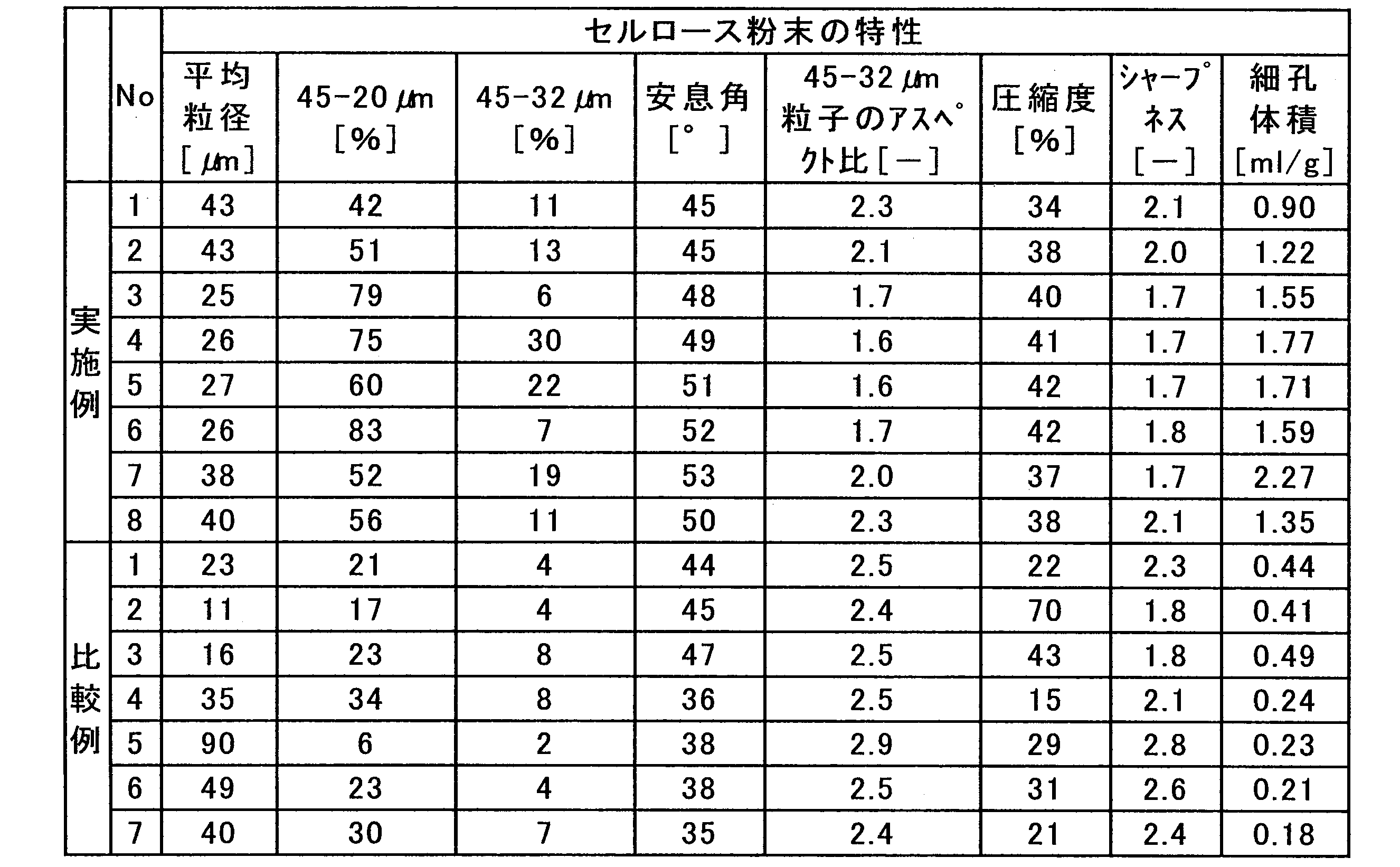
表2中、「45-20μm」は測定に用いた粉体の全重量に対する目開き45-20μmの粒子の重量の割合(%)を、「45-32μm」は測定に用いた粉体の全重量に対する目開き45-32μmの粒子の重量の割合(%)を、それぞれ示す。
[実施例9~16]
セルロース粉末A~Hを単独で圧縮成形性して錠剤を作製した。得られた錠剤の硬度、崩壊試験の結果を表3に示す(硬度は5錠、崩壊試験は6錠の平均値)。
セルロース粉末A~Hを単独で圧縮成形性して錠剤を作製した。得られた錠剤の硬度、崩壊試験の結果を表3に示す(硬度は5錠、崩壊試験は6錠の平均値)。
[比較例8~14]
セルロース粉末I~Oを単独で圧縮成形性して錠剤を作製した。得られた錠剤の硬度、崩壊試験の結果を表3に示す(硬度は5錠、崩壊試験は6錠の平均値)。
セルロース粉末I~Oを単独で圧縮成形性して錠剤を作製した。得られた錠剤の硬度、崩壊試験の結果を表3に示す(硬度は5錠、崩壊試験は6錠の平均値)。
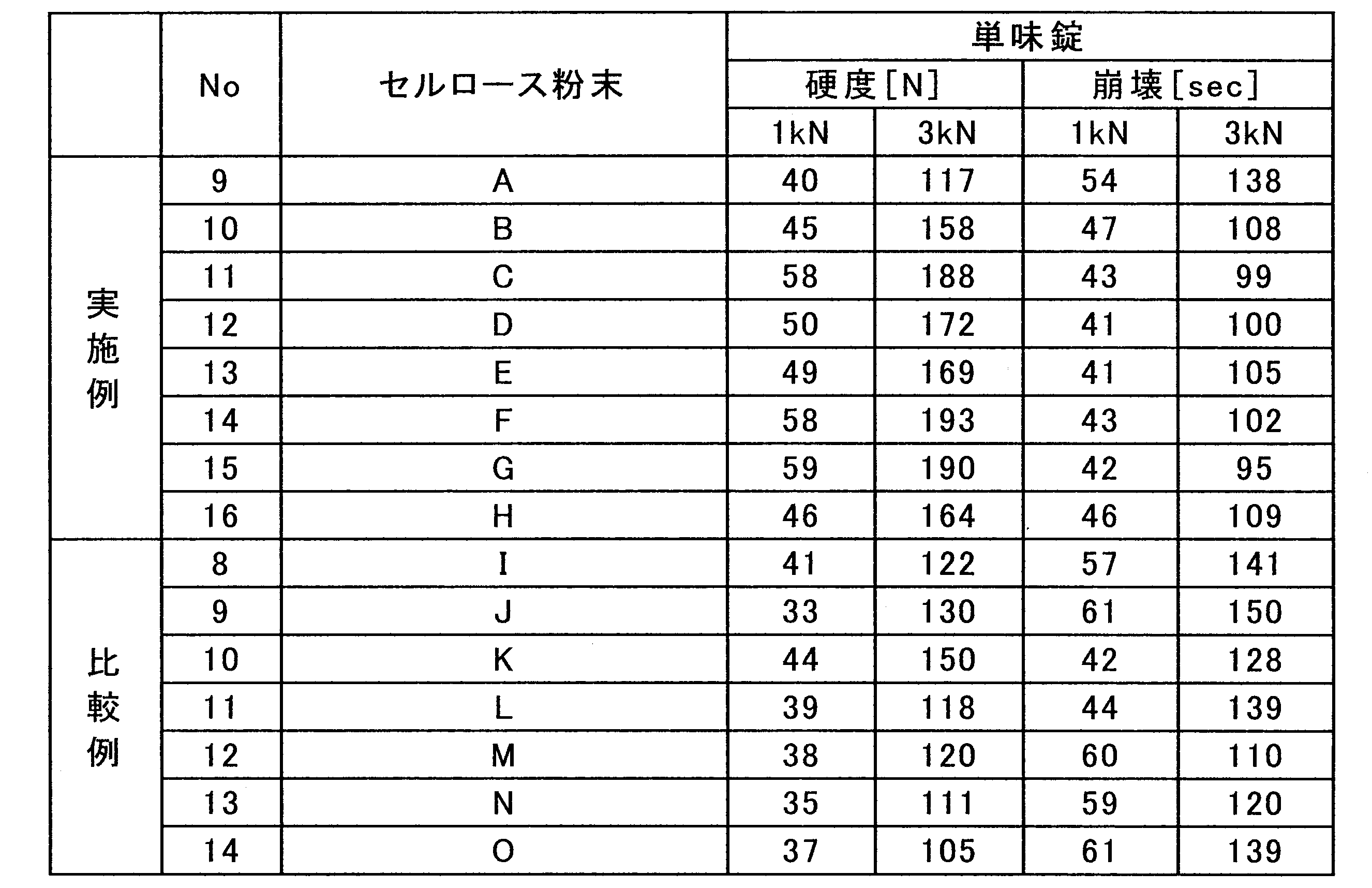
表3に示すように、セルロース粉末A~Hから作製した実施例9~16の錠剤は、セルロース粉末I~Oから作製した比較例8~14の錠剤よりも、硬度が高く、崩壊時間が短くなる傾向が観察された。
[実施例17~24]
セルロース粉末A~Hを各10質量部、d-マレイン酸クロルフェニラミン(平均粒子径12μm、帯電(120回振とう後)0.5nC/g:金剛化学製)を0.1質量部、乳糖(Pharmatose100M(商品名):DFE pharma製)を89.9質量部を、5LスケールのV型混合機(特寿工作所製)に入れて120分間混合し、次いでステアリン酸マグネシウムを1.0質量%(外割)添加して混合し、さらにV型混合機で3分間混合した。V型混合機の上部、中部、下部から各3点ずつ計9点の混合粉体をサンプリングし、吸光度計にてマレイン酸クロルフェニラミンの含量測定を行い、2%以下(実質1.5~1.9%)の含量CVであることを確認した。
セルロース粉末A~Hを各10質量部、d-マレイン酸クロルフェニラミン(平均粒子径12μm、帯電(120回振とう後)0.5nC/g:金剛化学製)を0.1質量部、乳糖(Pharmatose100M(商品名):DFE pharma製)を89.9質量部を、5LスケールのV型混合機(特寿工作所製)に入れて120分間混合し、次いでステアリン酸マグネシウムを1.0質量%(外割)添加して混合し、さらにV型混合機で3分間混合した。V型混合機の上部、中部、下部から各3点ずつ計9点の混合粉体をサンプリングし、吸光度計にてマレイン酸クロルフェニラミンの含量測定を行い、2%以下(実質1.5~1.9%)の含量CVであることを確認した。
調製された混合粉体を、大型ロータリー打錠機(LIBRA2:菊水製作所製)にて、直径8mmφの杵(材質SUK2,3を使用:菊水製作所製)を使用して、錠剤重量200mg、打圧1200kgf、30rpmで10分間打錠を実施した。打錠開始10分後に約300錠をサンプリングした。サンプリングした錠剤に対して、重量CV、硬度、崩壊試験、摩損度、d-マレイン酸クロルフェニラミンの含量CVを評価した。結果を表4に示す。
[比較例15~21]
セルロース粉末I~Oを各10質量部、d-マレイン酸クロルフェニラミン(平均粒子径12μm、帯電0.5nC/g)0.1質量部、造粒乳糖(Pharmatose100M(商品名):DFE pharma製)を89.9質量部を、5LスケールのV型混合機(徳寿工作所製)に入れて120分間混合し、ステアリン酸マグネシウムを1.0質量%(外割)添加して混合し、さらにV型混合機で3分間混合した。V型混合機の上部、中部、下部から各3点ずつ計9点の混合粉体をサンプリングし、吸光度計にてマレイン酸クロルフェニラミンの含量測定を行い、2%以下(実質1.5~1.9%)の含量CVであることを確認した。
実施例17~24と同じ条件で打錠を行い、評価を実施した。結果を表4に示す。
セルロース粉末I~Oを各10質量部、d-マレイン酸クロルフェニラミン(平均粒子径12μm、帯電0.5nC/g)0.1質量部、造粒乳糖(Pharmatose100M(商品名):DFE pharma製)を89.9質量部を、5LスケールのV型混合機(徳寿工作所製)に入れて120分間混合し、ステアリン酸マグネシウムを1.0質量%(外割)添加して混合し、さらにV型混合機で3分間混合した。V型混合機の上部、中部、下部から各3点ずつ計9点の混合粉体をサンプリングし、吸光度計にてマレイン酸クロルフェニラミンの含量測定を行い、2%以下(実質1.5~1.9%)の含量CVであることを確認した。
実施例17~24と同じ条件で打錠を行い、評価を実施した。結果を表4に示す。
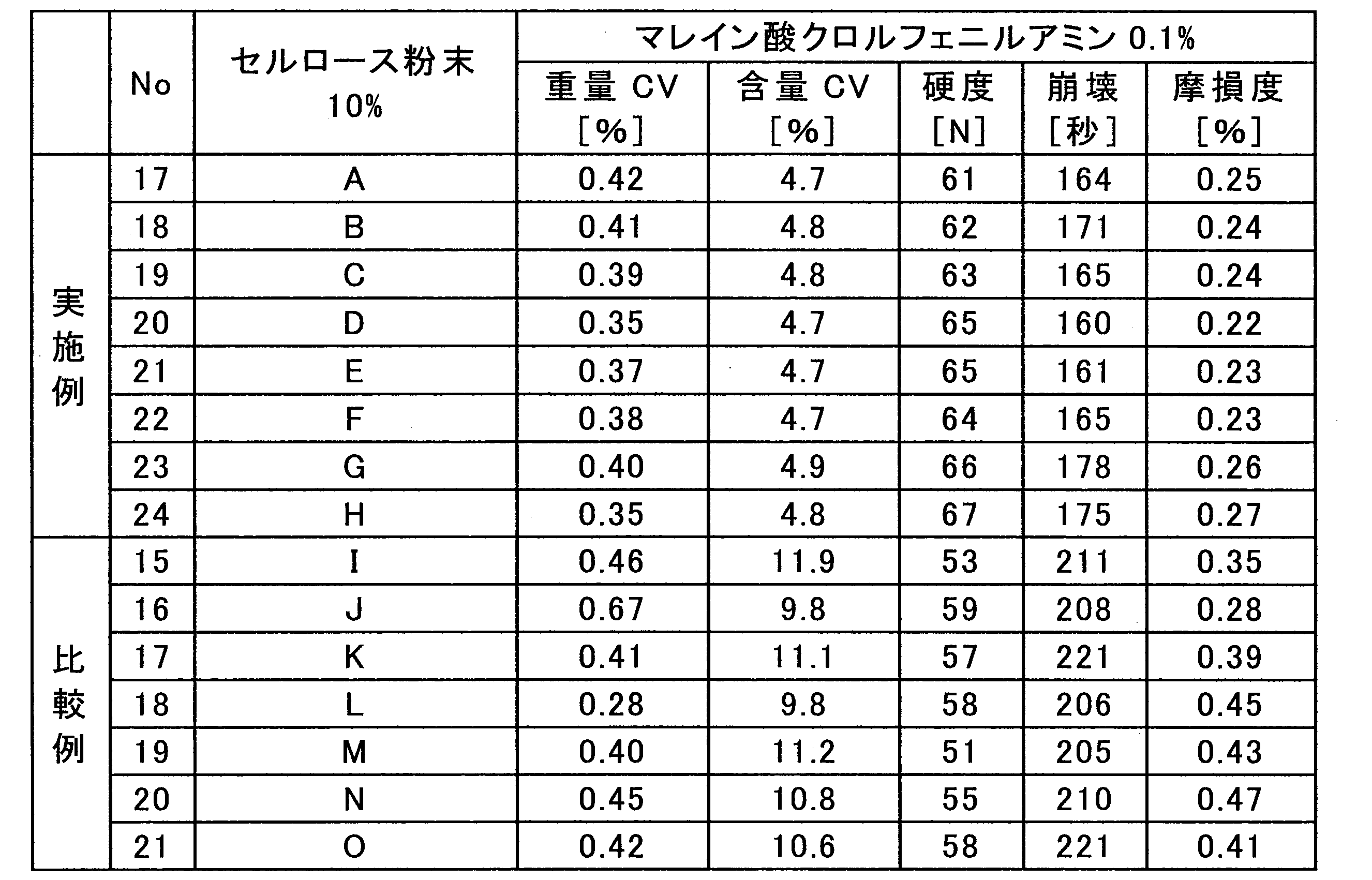
[実施例25~32]
セルロース粉末A~Hを各20質量部、d-マレイン酸クロルフェニラミン(平均粒子径 12μm、帯電0.3nC/g)を0.1質量部、乳糖(Pharmatose100M(商品名):DFE製)を79.9質量部を、5LスケールのV型混合機(特寿工作所製)に入れて120分間混合し、次いでステアリン酸マグネシウムを1.0%(外割)添加して混合し、さらにV型混合機で3分間混合した。V型混合機の上部、中部、下部から各3点ずつ計9点の混合粉体をサンプリングし、吸光度計にてd-マレイン酸クロルフェニラミンの含量測定を行い、2%以下(実質1.3~1.9%)の含量CVであることを確認した。
実施例17~24と同じ条件で打錠を行い、評価を実施した。結果を表5に示す。
セルロース粉末A~Hを各20質量部、d-マレイン酸クロルフェニラミン(平均粒子径 12μm、帯電0.3nC/g)を0.1質量部、乳糖(Pharmatose100M(商品名):DFE製)を79.9質量部を、5LスケールのV型混合機(特寿工作所製)に入れて120分間混合し、次いでステアリン酸マグネシウムを1.0%(外割)添加して混合し、さらにV型混合機で3分間混合した。V型混合機の上部、中部、下部から各3点ずつ計9点の混合粉体をサンプリングし、吸光度計にてd-マレイン酸クロルフェニラミンの含量測定を行い、2%以下(実質1.3~1.9%)の含量CVであることを確認した。
実施例17~24と同じ条件で打錠を行い、評価を実施した。結果を表5に示す。
[比較例22~28]
セルロース粉末I~Oを各20質量部、d-マレイン酸クロルフェニラミン(平均粒子径12μm、帯電(120回振とう後)0.5nC/g)を0.1質量部、乳糖(Pharmatose100M(商品名):DFE製)を79.9質量部を、5LスケールのV型混合機(徳寿工作所製)に入れて120分間混合し、ステアリン酸マグネシウムを1.0質量%(外割)添加して混合し、さらにV型混合機で3分間混合した。V型混合機の上部、中部、下部から各3点ずつ計9点の混合粉体をサンプリングし、吸光度計にてd-マレイン酸クロルフェニラミンの含量測定を行い、2%以下(実質1.3~1.9%)の含量CVであることを確認した。
実施例17~24と同じ条件で打錠を行い、評価を実施した。結果を表5に示す。
セルロース粉末I~Oを各20質量部、d-マレイン酸クロルフェニラミン(平均粒子径12μm、帯電(120回振とう後)0.5nC/g)を0.1質量部、乳糖(Pharmatose100M(商品名):DFE製)を79.9質量部を、5LスケールのV型混合機(徳寿工作所製)に入れて120分間混合し、ステアリン酸マグネシウムを1.0質量%(外割)添加して混合し、さらにV型混合機で3分間混合した。V型混合機の上部、中部、下部から各3点ずつ計9点の混合粉体をサンプリングし、吸光度計にてd-マレイン酸クロルフェニラミンの含量測定を行い、2%以下(実質1.3~1.9%)の含量CVであることを確認した。
実施例17~24と同じ条件で打錠を行い、評価を実施した。結果を表5に示す。
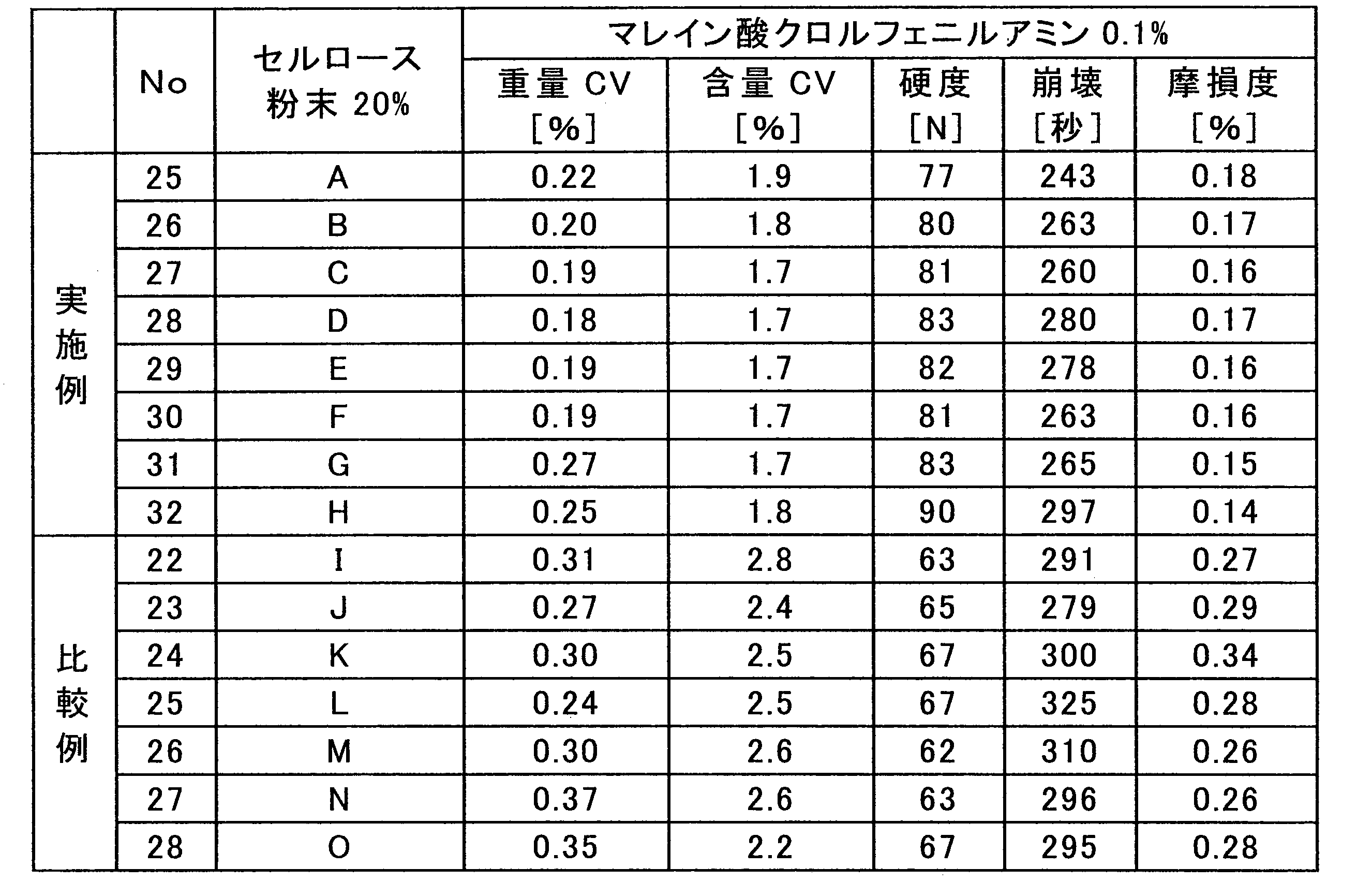
表4及び5に示すように、いずれのセルロース粉末を用いた場合でも、セルロース粉末の含有量が10質量%の錠剤よりも20質量%の錠剤のほうが、硬度が高くなっており、崩壊時間が長くなっていた。また、セルロース粉末A~Hから作製した実施例17~24の錠剤は、セルロース粉末I~Oから作製した比較例15~21の錠剤よりも、含量CVは小さく、硬度は高く、摩損度は小さく、崩壊時間は短かった(表4)。同様に、セルロース粉末A~Hから作製した実施例25~32の錠剤は、セルロース粉末I~Oから作製した比較例22~28の錠剤よりも、含量CVは小さく、硬度は高く、摩損度は小さく、崩壊時間は短かった(表5)。
[実施例33~40]
セルロース粉末A~Hを各10質量部、アスピリン(平均粒子径14μm、帯電(120回振とう後)-7.8nC/g:三井化学ファイン製)を12質量部、乳糖(Pharmatose100M(商品名):DFE pharma製)78質量部を、5LスケールのV型混合機(徳寿工作所製)に入れて120分間混合し、ステアリン酸マグネシウムを1.0質量%(外割)添加して混合し、さらにV型混合機で3分間混合した。V型混合機の上部、中部、下部から各3点ずつ計9点の混合粉体をサンプリングし、吸光度計にてアスピリンの含量測定を行い、2%以下(実質1.3~1.9%)のバラツキであることを確認した。
実施例17~24と同じ条件で打錠を行い、評価を実施した。結果を表6に示す。
セルロース粉末A~Hを各10質量部、アスピリン(平均粒子径14μm、帯電(120回振とう後)-7.8nC/g:三井化学ファイン製)を12質量部、乳糖(Pharmatose100M(商品名):DFE pharma製)78質量部を、5LスケールのV型混合機(徳寿工作所製)に入れて120分間混合し、ステアリン酸マグネシウムを1.0質量%(外割)添加して混合し、さらにV型混合機で3分間混合した。V型混合機の上部、中部、下部から各3点ずつ計9点の混合粉体をサンプリングし、吸光度計にてアスピリンの含量測定を行い、2%以下(実質1.3~1.9%)のバラツキであることを確認した。
実施例17~24と同じ条件で打錠を行い、評価を実施した。結果を表6に示す。
[比較例29~35]
セルロース粉末I~Oを各10質量部、アスピリン(平均粒子径14μm、帯電(120回振とう後)-7.8nC/g:三井化学ファイン製)を12質量部、乳糖(Pharmatose100M(商品名):DFE pharma製)78質量部を、5LスケールのV型混合機(徳寿工作所製)に入れて120分間混合し、ステアリン酸マグネシウムを1.0質量%(外割)添加して混合し、さらにV型混合機で3分間混合した。V型混合機の上部、中部、下部から各3点ずつ計9点の混合粉体をサンプリングし、吸光度計にてアスピリンの含量測定を行い、2%以下(実質1.3~1.9%)のバラツキであることを確認した。
実施例17~24と同じ条件で打錠を行い、評価を実施した。結果を表6に示す。
セルロース粉末I~Oを各10質量部、アスピリン(平均粒子径14μm、帯電(120回振とう後)-7.8nC/g:三井化学ファイン製)を12質量部、乳糖(Pharmatose100M(商品名):DFE pharma製)78質量部を、5LスケールのV型混合機(徳寿工作所製)に入れて120分間混合し、ステアリン酸マグネシウムを1.0質量%(外割)添加して混合し、さらにV型混合機で3分間混合した。V型混合機の上部、中部、下部から各3点ずつ計9点の混合粉体をサンプリングし、吸光度計にてアスピリンの含量測定を行い、2%以下(実質1.3~1.9%)のバラツキであることを確認した。
実施例17~24と同じ条件で打錠を行い、評価を実施した。結果を表6に示す。
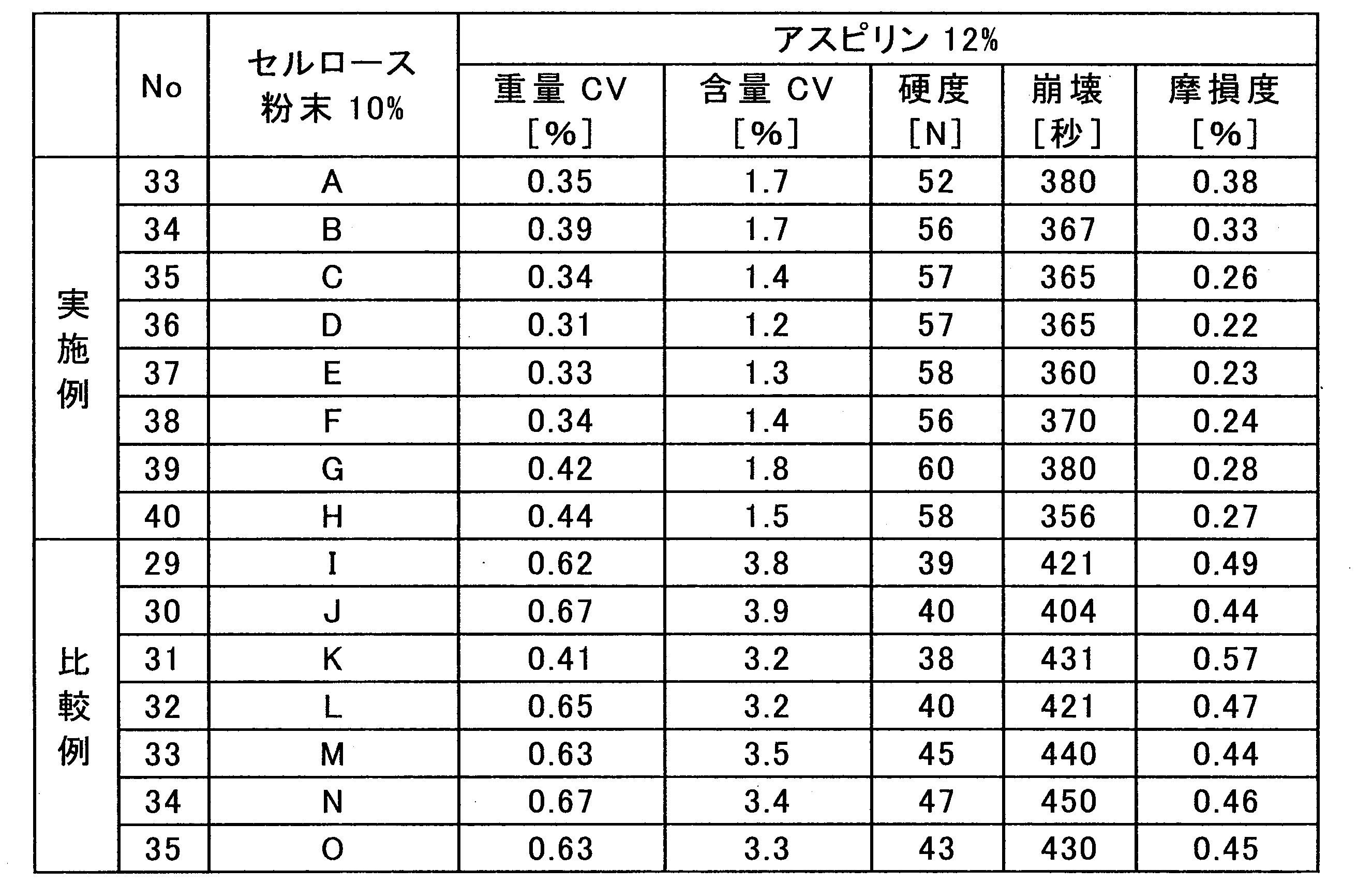
表6に示すように、アスピリンを活性成分とする錠剤であっても、セルロース粉末A~Hから作製した実施例33~40の錠剤は、セルロース粉末I~Oから作製した比較例29~35の錠剤よりも、含量CVは小さく、硬度は高く、摩損度は小さく、崩壊時間は短かった。
[実施例41~48]
セルロース粉末A~Hを各10質量部、アセトアミノフェン(平均粒子径17μm、帯電(120回振とう後)-16.8nC/g:新日本製薬製)を10質量部、乳糖(Pharmatose100M(商品名):DFE pharma製)80質量部を、5LスケールのV型混合機(徳寿工作所製)に入れて120分間混合し、ステアリン酸マグネシウムを1.0質量%(外割)添加して混合し、さらにV型混合機で3分間混合した。V型混合機の上部、中部、下部から各3点ずつ計9点の混合粉体をサンプリングし、吸光度計にてアセトアミノフェンの含量測定を行い、2%以下(実質1.3~1.9%)のバラツキであることを確認した。
実施例17~24と同じ条件で打錠を行い、評価を実施した。結果を表7に示す。
セルロース粉末A~Hを各10質量部、アセトアミノフェン(平均粒子径17μm、帯電(120回振とう後)-16.8nC/g:新日本製薬製)を10質量部、乳糖(Pharmatose100M(商品名):DFE pharma製)80質量部を、5LスケールのV型混合機(徳寿工作所製)に入れて120分間混合し、ステアリン酸マグネシウムを1.0質量%(外割)添加して混合し、さらにV型混合機で3分間混合した。V型混合機の上部、中部、下部から各3点ずつ計9点の混合粉体をサンプリングし、吸光度計にてアセトアミノフェンの含量測定を行い、2%以下(実質1.3~1.9%)のバラツキであることを確認した。
実施例17~24と同じ条件で打錠を行い、評価を実施した。結果を表7に示す。
[比較例36~42]
セルロース粉末I~Oを各10質量部、アセトアミノフェン(平均粒子径17μm、帯電(120回振とう後)-16.8nC/g:新日本製薬製)を10質量部、乳糖(Pharmatose100M(商品名):DFE pharma製)80質量部を、5LスケールのV型混合機(徳寿工作所製)に入れて120分間混合し、ステアリン酸マグネシウムを1.0質量%(外割)添加して混合し、さらにV型混合機で3分間混合した。V型混合機の上部、中部、下部から各3点ずつ計9点の混合粉体をサンプリングし、吸光度計にてアセトアミノフェンの含量測定を行い、2%以下(実質1.3~1.9%)のバラツキであることを確認した。
実施例17~24と同じ条件で打錠を行い、評価を実施した。結果を表7に示す。
セルロース粉末I~Oを各10質量部、アセトアミノフェン(平均粒子径17μm、帯電(120回振とう後)-16.8nC/g:新日本製薬製)を10質量部、乳糖(Pharmatose100M(商品名):DFE pharma製)80質量部を、5LスケールのV型混合機(徳寿工作所製)に入れて120分間混合し、ステアリン酸マグネシウムを1.0質量%(外割)添加して混合し、さらにV型混合機で3分間混合した。V型混合機の上部、中部、下部から各3点ずつ計9点の混合粉体をサンプリングし、吸光度計にてアセトアミノフェンの含量測定を行い、2%以下(実質1.3~1.9%)のバラツキであることを確認した。
実施例17~24と同じ条件で打錠を行い、評価を実施した。結果を表7に示す。
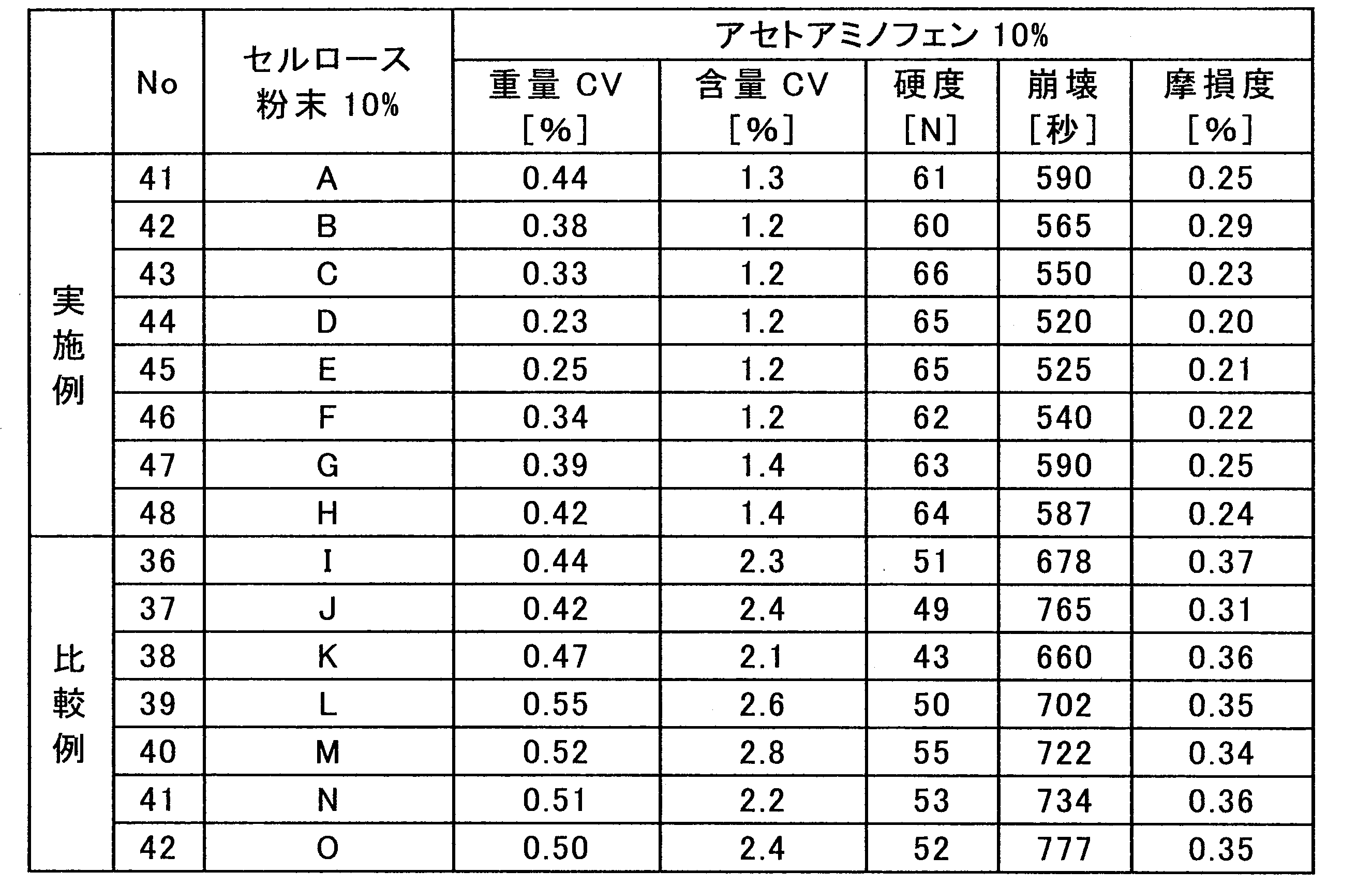
表7に示すように、アセトアミノフェンを活性成分とする錠剤であっても、セルロース粉末A~Hから作製した実施例41~48の錠剤は、セルロース粉末I~Oから作製した比較例36~42の錠剤よりも、含量CVは小さく、硬度は高く、摩損度は小さく、崩壊時間は短かった。
[実施例49]
セルロース粉末Dを10質量部、エテンザミド(平均粒子径15μm、帯電(120回振とう後)+3.9nC/g:山本化学工業社製)を5質量部、乳糖(Pharmatose100M(商品名):DFE pharma製)85質量部を、5LスケールのV型混合機(徳寿工作所製)に入れて120分間混合し、ステアリン酸マグネシウムを1.0質量%(外割)添加して混合し、さらにV型混合機で3分間混合した。V型混合機の上部、中部、下部から各3点ずつ計9点の混合粉体をサンプリングし、吸光度計にてエテンザミドの含量測定を行い、2%以下のバラツキであることを確認した。
実施例17~24と同じ条件で打錠を行い、評価を実施した。結果を表8に示す。
セルロース粉末Dを10質量部、エテンザミド(平均粒子径15μm、帯電(120回振とう後)+3.9nC/g:山本化学工業社製)を5質量部、乳糖(Pharmatose100M(商品名):DFE pharma製)85質量部を、5LスケールのV型混合機(徳寿工作所製)に入れて120分間混合し、ステアリン酸マグネシウムを1.0質量%(外割)添加して混合し、さらにV型混合機で3分間混合した。V型混合機の上部、中部、下部から各3点ずつ計9点の混合粉体をサンプリングし、吸光度計にてエテンザミドの含量測定を行い、2%以下のバラツキであることを確認した。
実施例17~24と同じ条件で打錠を行い、評価を実施した。結果を表8に示す。
[比較例43]
セルロース粉末Dを添加せず、乳糖を95質量部としたこと以外は、実施例49と同じ条件で錠剤を製造し、評価を実施した。結果を表8に示す。
セルロース粉末Dを添加せず、乳糖を95質量部としたこと以外は、実施例49と同じ条件で錠剤を製造し、評価を実施した。結果を表8に示す。

[実施例50]
セルロース粉末Dを10質量部、アスコルビン酸(平均粒子径10μm、帯電(120回振とう後)-0.5nC/g:northeast pharmaceutical group社製)を0.3質量部、乳糖(Pharmatose100M(商品名):DFE pharma製)89.7質量部を、5LスケールのV型混合機(徳寿工作所製)に入れて120分間混合し、ステアリン酸マグネシウムを1.0質量%(外割)添加して混合し、さらにV型混合機で3分間混合した。V型混合機の上部、中部、下部から各3点ずつ計9点の混合粉体をサンプリングし、吸光度計にてアスコルビン酸の含量測定を行い、2%以下(実質1.3~1.9%)のバラツキであることを確認した。
実施例17~24と同じ条件で打錠を行い、評価を実施した。結果を表9に示す。
[比較例44]
セルロース粉末Dを添加せず、乳糖を99.7質量部としたこと以外は、実施例50と同じ条件で錠剤を製造し、評価を実施した。結果を表9に示す。
セルロース粉末Dを10質量部、アスコルビン酸(平均粒子径10μm、帯電(120回振とう後)-0.5nC/g:northeast pharmaceutical group社製)を0.3質量部、乳糖(Pharmatose100M(商品名):DFE pharma製)89.7質量部を、5LスケールのV型混合機(徳寿工作所製)に入れて120分間混合し、ステアリン酸マグネシウムを1.0質量%(外割)添加して混合し、さらにV型混合機で3分間混合した。V型混合機の上部、中部、下部から各3点ずつ計9点の混合粉体をサンプリングし、吸光度計にてアスコルビン酸の含量測定を行い、2%以下(実質1.3~1.9%)のバラツキであることを確認した。
実施例17~24と同じ条件で打錠を行い、評価を実施した。結果を表9に示す。
[比較例44]
セルロース粉末Dを添加せず、乳糖を99.7質量部としたこと以外は、実施例50と同じ条件で錠剤を製造し、評価を実施した。結果を表9に示す。

[実施例51]
セルロース粉末Dを10質量部、サリチル酸ナトリウム(平均粒子径6μm、帯電(120回振とう後)-1.4nC/g:エーピーアイコーポレーション社製)を0.3質量部、乳糖(Pharmatose100M(商品名):DFE pharma製)89.7質量部を、5LスケールのV型混合機(徳寿工作所製)に入れて120分間混合し、ステアリン酸マグネシウムを1.0質量%(外割)添加して混合し、さらにV型混合機で3分間混合した。V型混合機の上部、中部、下部から各3点ずつ計9点の混合粉体をサンプリングし、吸光度計にてサリチル酸ナトリウムの含量測定を行い、2%以下(実質1.3~1.9%)のバラツキであることを確認した。
実施例17~24と同じ条件で打錠を行い、評価を実施した。結果を表10に示す。
セルロース粉末Dを10質量部、サリチル酸ナトリウム(平均粒子径6μm、帯電(120回振とう後)-1.4nC/g:エーピーアイコーポレーション社製)を0.3質量部、乳糖(Pharmatose100M(商品名):DFE pharma製)89.7質量部を、5LスケールのV型混合機(徳寿工作所製)に入れて120分間混合し、ステアリン酸マグネシウムを1.0質量%(外割)添加して混合し、さらにV型混合機で3分間混合した。V型混合機の上部、中部、下部から各3点ずつ計9点の混合粉体をサンプリングし、吸光度計にてサリチル酸ナトリウムの含量測定を行い、2%以下(実質1.3~1.9%)のバラツキであることを確認した。
実施例17~24と同じ条件で打錠を行い、評価を実施した。結果を表10に示す。
[比較例45]
セルロース粉末Dを添加せず、乳糖を99.7質量部としたこと以外は、実施例51と同じ条件で錠剤を製造し、評価を実施した。結果を表10に示す。
セルロース粉末Dを添加せず、乳糖を99.7質量部としたこと以外は、実施例51と同じ条件で錠剤を製造し、評価を実施した。結果を表10に示す。

[実施例52]
セルロース粉末Dを10質量部、イブプロフェン(平均粒子径15μm、帯電(120回振とう後)-12.0nC/g:米沢浜理薬品工業社製)を5質量部、乳糖(Pharmatose100M(商品名):DFE pharma製)85質量部を、5LスケールのV型混合機(徳寿工作所製)に入れて120分間混合し、ステアリン酸マグネシウムを1.0質量%(外割)添加して混合し、さらにV型混合機で3分間混合した。V型混合機の上部、中部、下部から各3点ずつ計9点の混合粉体をサンプリングし、吸光度計にてイブプロフェンの含量測定を行い、2%以下(実質1.3~1.9%)のバラツキであることを確認した。
実施例17~24と同じ条件で打錠を行い、評価を実施した。結果を表11に示す。
[比較例46]
セルロース粉末Dを添加せず、乳糖を95質量部としたこと以外は、実施例52と同じ条件で錠剤を製造し、評価を実施した。結果を表11に示す。
セルロース粉末Dを10質量部、イブプロフェン(平均粒子径15μm、帯電(120回振とう後)-12.0nC/g:米沢浜理薬品工業社製)を5質量部、乳糖(Pharmatose100M(商品名):DFE pharma製)85質量部を、5LスケールのV型混合機(徳寿工作所製)に入れて120分間混合し、ステアリン酸マグネシウムを1.0質量%(外割)添加して混合し、さらにV型混合機で3分間混合した。V型混合機の上部、中部、下部から各3点ずつ計9点の混合粉体をサンプリングし、吸光度計にてイブプロフェンの含量測定を行い、2%以下(実質1.3~1.9%)のバラツキであることを確認した。
実施例17~24と同じ条件で打錠を行い、評価を実施した。結果を表11に示す。
[比較例46]
セルロース粉末Dを添加せず、乳糖を95質量部としたこと以外は、実施例52と同じ条件で錠剤を製造し、評価を実施した。結果を表11に示す。

[実施例53]
セルロース粉末Dを20質量部、セルロース粉末PH-102(旭化成株式会社製)を60質量部、レボチロキシン(平均粒子径10μm、帯電(120回振とう後)-1.1nC/g:Chengdu Firster Pharmaceutical社製)を0.1質量部、D-マンニトール(PEARLITOL 200SD ROQUETTE社製)を17.9質量部、クロスカルメロースナトリウム(キッコレートND-2HS 旭化成株式会社製)を2質量部を、5LスケールのV型混合機(徳寿工作所製)に入れて120分間混合し、ステアリン酸マグネシウムを1.0質量%(外割)添加して混合し、さらにV型混合機で3分間混合した。V型混合機の上部、中部、下部から各3点ずつ計9点の混合粉体をサンプリングし、吸光度計にてレボチロキシンの含量測定を行い、2%以下(実質1.3~1.9%)のバラツキであることを確認した。
実施例17~24と同じ条件で打錠を行い、評価を実施した。結果を表12に示す。
セルロース粉末Dを20質量部、セルロース粉末PH-102(旭化成株式会社製)を60質量部、レボチロキシン(平均粒子径10μm、帯電(120回振とう後)-1.1nC/g:Chengdu Firster Pharmaceutical社製)を0.1質量部、D-マンニトール(PEARLITOL 200SD ROQUETTE社製)を17.9質量部、クロスカルメロースナトリウム(キッコレートND-2HS 旭化成株式会社製)を2質量部を、5LスケールのV型混合機(徳寿工作所製)に入れて120分間混合し、ステアリン酸マグネシウムを1.0質量%(外割)添加して混合し、さらにV型混合機で3分間混合した。V型混合機の上部、中部、下部から各3点ずつ計9点の混合粉体をサンプリングし、吸光度計にてレボチロキシンの含量測定を行い、2%以下(実質1.3~1.9%)のバラツキであることを確認した。
実施例17~24と同じ条件で打錠を行い、評価を実施した。結果を表12に示す。
[比較例47]
セルロース粉末Dを添加せず、PH-102を80質量部としたこと以外は、実施例53と同じ条件で錠剤を製造し、評価を実施した。結果を表12に示す。
セルロース粉末Dを添加せず、PH-102を80質量部としたこと以外は、実施例53と同じ条件で錠剤を製造し、評価を実施した。結果を表12に示す。

本実施形態のセルロース粉末は、活性成分の偏析防止、及び硬度と崩壊性のバランスに優れているため、医薬品薬物を含有する医薬品製剤、健康食品の分野で好適に利用できる。
Claims (6)
- セルロース粉体の平均粒子径が45μm以下であり、目開き45μmの篩を通過して目開き20μmの篩上に残る粒子の割合が粉末全量に対して40質量%を超える、セルロース粉末。
- 目開き45μmの篩を通過して目開き32μmの篩上に残る粒子を含み、当該粒子のアスペクト比が1.2~2.3の範囲にある、請求項1に記載のセルロース粉末。
- 目開き45μmの篩を通過して目開き32μmの篩上に残る粒子の割合が粉末全量に対して6質量%を超える、請求項1又は2に記載のセルロース粉末。
- 安息角45~58°の範囲にある、請求項1~3のいずれか一項に記載のセルロース粉末。
- 請求項1~4のいずれか一項に記載のセルロース粉末を含む成形体。
- 請求項1~4のいずれか一項に記載のセルロース粉末と活性成分とを含む組成物を錠剤化する、錠剤の製造方法。
Applications Claiming Priority (2)
| Application Number | Priority Date | Filing Date | Title |
|---|---|---|---|
| JP2017-249590 | 2017-12-26 | ||
| JP2017249590 | 2017-12-26 |
Publications (1)
| Publication Number | Publication Date |
|---|---|
| WO2019130701A1 true WO2019130701A1 (ja) | 2019-07-04 |
Family
ID=67063320
Family Applications (1)
| Application Number | Title | Priority Date | Filing Date |
|---|---|---|---|
| PCT/JP2018/036319 Ceased WO2019130701A1 (ja) | 2017-12-26 | 2018-09-28 | セルロース粉末 |
Country Status (2)
| Country | Link |
|---|---|
| TW (1) | TW201927340A (ja) |
| WO (1) | WO2019130701A1 (ja) |
Cited By (2)
| Publication number | Priority date | Publication date | Assignee | Title |
|---|---|---|---|---|
| WO2022065361A1 (ja) * | 2020-09-25 | 2022-03-31 | 日本臓器製薬株式会社 | 造粒物の製造方法 |
| WO2024204699A1 (ja) * | 2023-03-31 | 2024-10-03 | 旭化成株式会社 | セルロース粉末及び成形体 |
Citations (4)
| Publication number | Priority date | Publication date | Assignee | Title |
|---|---|---|---|---|
| JPH11152233A (ja) * | 1997-11-20 | 1999-06-08 | Asahi Chem Ind Co Ltd | 結晶セルロース及びその製法 |
| JP4721212B2 (ja) * | 2001-07-05 | 2011-07-13 | 株式会社新日本科学 | インスリンの経鼻投与用組成物 |
| JP2015048315A (ja) * | 2013-08-30 | 2015-03-16 | 旭化成ケミカルズ株式会社 | セルロース系核粒子及びその製造方法 |
| JP2015183021A (ja) * | 2014-03-20 | 2015-10-22 | 日本製紙株式会社 | 粉末状セルロース |
-
2018
- 2018-09-28 WO PCT/JP2018/036319 patent/WO2019130701A1/ja not_active Ceased
- 2018-10-02 TW TW107134740A patent/TW201927340A/zh unknown
Patent Citations (4)
| Publication number | Priority date | Publication date | Assignee | Title |
|---|---|---|---|---|
| JPH11152233A (ja) * | 1997-11-20 | 1999-06-08 | Asahi Chem Ind Co Ltd | 結晶セルロース及びその製法 |
| JP4721212B2 (ja) * | 2001-07-05 | 2011-07-13 | 株式会社新日本科学 | インスリンの経鼻投与用組成物 |
| JP2015048315A (ja) * | 2013-08-30 | 2015-03-16 | 旭化成ケミカルズ株式会社 | セルロース系核粒子及びその製造方法 |
| JP2015183021A (ja) * | 2014-03-20 | 2015-10-22 | 日本製紙株式会社 | 粉末状セルロース |
Cited By (5)
| Publication number | Priority date | Publication date | Assignee | Title |
|---|---|---|---|---|
| WO2022065361A1 (ja) * | 2020-09-25 | 2022-03-31 | 日本臓器製薬株式会社 | 造粒物の製造方法 |
| JPWO2022065361A1 (ja) * | 2020-09-25 | 2022-03-31 | ||
| WO2024204699A1 (ja) * | 2023-03-31 | 2024-10-03 | 旭化成株式会社 | セルロース粉末及び成形体 |
| JPWO2024204699A1 (ja) * | 2023-03-31 | 2024-10-03 | ||
| JP7719317B2 (ja) | 2023-03-31 | 2025-08-05 | 旭化成株式会社 | セルロース粉末及び成形体 |
Also Published As
| Publication number | Publication date |
|---|---|
| TW201927340A (zh) | 2019-07-16 |
Similar Documents
| Publication | Publication Date | Title |
|---|---|---|
| US9446137B2 (en) | Composite particles which contain both cellulose and inorganic compound | |
| JP7332549B2 (ja) | マウントの発生を抑制する方法 | |
| US12427113B2 (en) | Cellulose composition, tablet, and orally disintegrating tablet | |
| JP7028927B2 (ja) | 顆粒の静電量を低減させる方法 | |
| JP6744518B1 (ja) | セルロース組成物及び錠剤 | |
| JP2021075686A (ja) | セルロース組成物、錠剤及び口腔内崩壊錠 | |
| TW201927340A (zh) | 纖維素粉末 | |
| TWI723621B (zh) | 纖維素組合物、錠劑及口腔內崩散錠 | |
| CA3158393C (en) | Cellulose composition, tablet, and orally disintegrating tablet | |
| RU2796502C1 (ru) | Содержащая целлюлозу композиция, таблетка и таблетка с внутриротовой распадаемостью | |
| CA3158394C (en) | Cellulose composition and tablet | |
| TWI734247B (zh) | 纖維素組合物及錠劑 | |
| RU2798266C1 (ru) | Содержащая целлюлозу композиция и таблетка | |
| JP2021075687A (ja) | セルロース組成物及び錠剤 | |
| JP2025147828A (ja) | 顆粒及び錠剤 | |
| BR112022007434B1 (pt) | Composição de celulose, comprimido e comprimido de desintegração oral | |
| TW202446806A (zh) | 纖維素粉末及成形體 |
Legal Events
| Date | Code | Title | Description |
|---|---|---|---|
| 121 | Ep: the epo has been informed by wipo that ep was designated in this application |
Ref document number: 18895020 Country of ref document: EP Kind code of ref document: A1 |
|
| NENP | Non-entry into the national phase |
Ref country code: DE |
|
| 122 | Ep: pct application non-entry in european phase |
Ref document number: 18895020 Country of ref document: EP Kind code of ref document: A1 |
|
| NENP | Non-entry into the national phase |
Ref country code: JP |