WO2019124306A1 - Dnaウイルスまたは単細胞生物の活性測定方法、及び、活性エネルギー線照射装置の殺菌力測定方法 - Google Patents
Dnaウイルスまたは単細胞生物の活性測定方法、及び、活性エネルギー線照射装置の殺菌力測定方法 Download PDFInfo
- Publication number
- WO2019124306A1 WO2019124306A1 PCT/JP2018/046335 JP2018046335W WO2019124306A1 WO 2019124306 A1 WO2019124306 A1 WO 2019124306A1 JP 2018046335 W JP2018046335 W JP 2018046335W WO 2019124306 A1 WO2019124306 A1 WO 2019124306A1
- Authority
- WO
- WIPO (PCT)
- Prior art keywords
- dna
- activity
- active energy
- energy ray
- measuring
- Prior art date
- Legal status (The legal status is an assumption and is not a legal conclusion. Google has not performed a legal analysis and makes no representation as to the accuracy of the status listed.)
- Ceased
Links
Images
Classifications
-
- C—CHEMISTRY; METALLURGY
- C12—BIOCHEMISTRY; BEER; SPIRITS; WINE; VINEGAR; MICROBIOLOGY; ENZYMOLOGY; MUTATION OR GENETIC ENGINEERING
- C12N—MICROORGANISMS OR ENZYMES; COMPOSITIONS THEREOF; PROPAGATING, PRESERVING, OR MAINTAINING MICROORGANISMS; MUTATION OR GENETIC ENGINEERING; CULTURE MEDIA
- C12N15/00—Mutation or genetic engineering; DNA or RNA concerning genetic engineering, vectors, e.g. plasmids, or their isolation, preparation or purification; Use of hosts therefor
- C12N15/09—Recombinant DNA-technology
-
- C—CHEMISTRY; METALLURGY
- C12—BIOCHEMISTRY; BEER; SPIRITS; WINE; VINEGAR; MICROBIOLOGY; ENZYMOLOGY; MUTATION OR GENETIC ENGINEERING
- C12Q—MEASURING OR TESTING PROCESSES INVOLVING ENZYMES, NUCLEIC ACIDS OR MICROORGANISMS; COMPOSITIONS OR TEST PAPERS THEREFOR; PROCESSES OF PREPARING SUCH COMPOSITIONS; CONDITION-RESPONSIVE CONTROL IN MICROBIOLOGICAL OR ENZYMOLOGICAL PROCESSES
- C12Q1/00—Measuring or testing processes involving enzymes, nucleic acids or microorganisms; Compositions therefor; Processes of preparing such compositions
- C12Q1/02—Measuring or testing processes involving enzymes, nucleic acids or microorganisms; Compositions therefor; Processes of preparing such compositions involving viable microorganisms
-
- C—CHEMISTRY; METALLURGY
- C12—BIOCHEMISTRY; BEER; SPIRITS; WINE; VINEGAR; MICROBIOLOGY; ENZYMOLOGY; MUTATION OR GENETIC ENGINEERING
- C12Q—MEASURING OR TESTING PROCESSES INVOLVING ENZYMES, NUCLEIC ACIDS OR MICROORGANISMS; COMPOSITIONS OR TEST PAPERS THEREFOR; PROCESSES OF PREPARING SUCH COMPOSITIONS; CONDITION-RESPONSIVE CONTROL IN MICROBIOLOGICAL OR ENZYMOLOGICAL PROCESSES
- C12Q1/00—Measuring or testing processes involving enzymes, nucleic acids or microorganisms; Compositions therefor; Processes of preparing such compositions
- C12Q1/34—Measuring or testing processes involving enzymes, nucleic acids or microorganisms; Compositions therefor; Processes of preparing such compositions involving hydrolase
-
- C—CHEMISTRY; METALLURGY
- C12—BIOCHEMISTRY; BEER; SPIRITS; WINE; VINEGAR; MICROBIOLOGY; ENZYMOLOGY; MUTATION OR GENETIC ENGINEERING
- C12Q—MEASURING OR TESTING PROCESSES INVOLVING ENZYMES, NUCLEIC ACIDS OR MICROORGANISMS; COMPOSITIONS OR TEST PAPERS THEREFOR; PROCESSES OF PREPARING SUCH COMPOSITIONS; CONDITION-RESPONSIVE CONTROL IN MICROBIOLOGICAL OR ENZYMOLOGICAL PROCESSES
- C12Q1/00—Measuring or testing processes involving enzymes, nucleic acids or microorganisms; Compositions therefor; Processes of preparing such compositions
- C12Q1/68—Measuring or testing processes involving enzymes, nucleic acids or microorganisms; Compositions therefor; Processes of preparing such compositions involving nucleic acids
- C12Q1/6844—Nucleic acid amplification reactions
- C12Q1/686—Polymerase chain reaction [PCR]
-
- C—CHEMISTRY; METALLURGY
- C12—BIOCHEMISTRY; BEER; SPIRITS; WINE; VINEGAR; MICROBIOLOGY; ENZYMOLOGY; MUTATION OR GENETIC ENGINEERING
- C12Q—MEASURING OR TESTING PROCESSES INVOLVING ENZYMES, NUCLEIC ACIDS OR MICROORGANISMS; COMPOSITIONS OR TEST PAPERS THEREFOR; PROCESSES OF PREPARING SUCH COMPOSITIONS; CONDITION-RESPONSIVE CONTROL IN MICROBIOLOGICAL OR ENZYMOLOGICAL PROCESSES
- C12Q1/00—Measuring or testing processes involving enzymes, nucleic acids or microorganisms; Compositions therefor; Processes of preparing such compositions
- C12Q1/70—Measuring or testing processes involving enzymes, nucleic acids or microorganisms; Compositions therefor; Processes of preparing such compositions involving virus or bacteriophage
-
- C—CHEMISTRY; METALLURGY
- C12—BIOCHEMISTRY; BEER; SPIRITS; WINE; VINEGAR; MICROBIOLOGY; ENZYMOLOGY; MUTATION OR GENETIC ENGINEERING
- C12M—APPARATUS FOR ENZYMOLOGY OR MICROBIOLOGY; APPARATUS FOR CULTURING MICROORGANISMS FOR PRODUCING BIOMASS, FOR GROWING CELLS OR FOR OBTAINING FERMENTATION OR METABOLIC PRODUCTS, i.e. BIOREACTORS OR FERMENTERS
- C12M1/00—Apparatus for enzymology or microbiology
- C12M1/42—Apparatus for the treatment of microorganisms or enzymes with electrical or wave energy, e.g. magnetism, sonic waves
Definitions
- the present invention relates to a method of measuring the activity of a DNA virus or unicellular organism, and a method of measuring the bactericidal activity of an active energy ray irradiation apparatus.
- the sterilization and disinfection of unicellular organisms such as pathogenic viruses and bacteria are very important in maintaining a hygienic environment.
- the sterilization and disinfection of drinking water and environmental water need to be strictly carried out in order to directly affect people's health.
- administration of drugs such as chlorine agents has often been used, but there has been a problem that the drug residue causes an influence on the ecosystem, causes of allergies, and the like. Therefore, in recent years, sterilization / disinfection treatments that damage the nucleic acid by irradiation with active energy rays such as ultraviolet rays and radiation have come to be widely used.
- active energy ray irradiation treatment is expected as a countermeasure against protozoa such as cryptosporidium having chlorine resistance.
- the active energy ray irradiation apparatus used to kill viruses and unicellular organisms.
- the irradiation dose of the active energy ray irradiation device it is possible to verify the extent to which the setting of the device or light source or the irradiation amount measuring device is performed.
- the actual bactericidal activity varies depending on the irradiation time, the residence time in the irradiation device, the irradiation site, etc. Therefore, the verification of the bactericidal activity possessed by the actual device can be performed by living bacteria or pathogenicity by the culture method. There is a big problem that it takes a long time to make a decision.
- Non-Patent Document 1 uses PCR to detect the damage rate of nucleic acid based on the results of two real-time PCR when the amplification products of PCR are 40-70 bp and 3000-4000 bp. A method of determining the damage rate is disclosed. However, there is a problem that there is a problem of having to perform PCR twice, and when the amplification product exceeds 3000 bp, a PCR amplification error easily occurs.
- An object of the present invention is to provide a method for measuring the activity of a DNA virus or unicellular organism conveniently and quickly. Another object of the present invention is to provide a method for measuring the bactericidal activity of an active energy ray irradiation apparatus simply and quickly.
- the present inventors found that by setting the amplification range of quantitative PCR to 1500-2800 bp, the result of quantitative PCR can be used as a method for measuring the activity of a virus or unicellular organism.
- the present invention comprises the steps of 1) preparing a target nucleic acid possessed by a DNA virus or unicellular organism, 2) preparing a primer with a target nucleic acid as a template and an amplification range of 1500-2800 bp by PCR.
- Activity of a DNA virus or unicellular organism characterized by comprising the steps of: performing quantitative PCR using a target nucleic acid and a primer; and 4) converting the results of the quantitative PCR into the activity of the DNA virus or unicellular organism. It provides a measurement method.
- the present invention further provides a method for measuring the activity of a virus or unicellular organism, comprising the step of processing the target nucleic acid with endonuclease.
- the present inventors found that the result of quantitative PCR can be used as a method for measuring the bactericidal activity of an active energy ray irradiation apparatus by setting the amplification range of quantitative PCR to 1500-2800 bp.
- a step of irradiating treated DNA with active energy ray using an active energy ray irradiation device to obtain treated DNA and 2) amplification range by PCR for the obtained treated DNA is 1500-2800 bp. It is characterized by having the steps of preparing a primer having a length of 3), performing quantitative PCR using the treated DNA and the primer, and 4) converting the result of quantitative PCR into bactericidal activity by active energy rays.
- the present invention provides a method of measuring the bactericidal activity of an active energy ray irradiation device.
- the activity of the DNA virus or unicellular organism can be conveniently measured. Further, by using the method of measuring the bactericidal activity of the active energy ray irradiation device of the present invention, the substantial bactericidal activity of the active energy ray irradiation device can be simply measured.
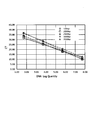
- FIG. 21 is a diagram showing a calibration curve obtained by PCR in Reference Example 1-5.
- the present invention comprises the steps of 1) preparing a target nucleic acid possessed by a DNA virus or unicellular organism, and 2) preparing a primer whose amplification product by PCR using the target nucleic acid is 1500-2800 bp in length, Activity of a DNA virus or unicellular organism, characterized by comprising the steps of: performing quantitative PCR using a target nucleic acid and a primer; and 4) converting the results of the quantitative PCR into the activity of the DNA virus or unicellular organism. It provides a measurement method. By this method, the activity of DNA virus or unicellular organism can be measured by quantitative PCR. As used herein, activity refers to the growth potential of DNA viruses or unicellular organisms.
- Step of preparing target nucleic acid possessed by DNA virus or unicellular organism ⁇ DNA virus or unicellular organism>
- a target nucleic acid possessed by a DNA virus or unicellular organism is amplified by quantitative PCR.
- the target nucleic acid is DNA (deoxyribonucleic acid).
- the DNA virus may be a virus having DNA as a nucleic acid. Although it is possible to measure the activity of those with or without pathogenicity, it is useful from the viewpoint of public health that it is possible to measure the activity of viruses with pathogenicity without culturing.
- DNA viruses include lambda phage, herpes virus, human papilloma virus, JC virus, cytomegalovirus, adenovirus, hepatitis B virus, varicella-zoster virus, parvovirus, EB virus, M13 phage, T2 phage, T4 phage , T5 phage, T6 phage, T7 phage and the like.
- the unicellular organism may be a prokaryotic unicellular organism or a eukaryotic unicellular organism. If one cell has one activity, the activity measurement will be more accurate.
- unicellular organisms include bacteria, protozoa, algae, ciliates, flagellates, spores and the like. Preferred are bacteria and protozoa. Although it is possible to measure the activity of those with or without pathogenicity, it is useful that the activity of unicellular organisms with pathogenicity can be measured without culture from the viewpoint of public health.
- bacteria examples include E. coli, Legionella, Shigella, Vibrio cholerae, Campylobacter, Yersinia, typhus, diphtheria, Streptococcus, Streptococcus, Bacillus anthracis, Brucella, Pseudomonas aeruginosa, Salmonella, Plasmodium, bacteria.
- Mycobacterium tuberculosis, Vibrio parahaemolyticus, Listeria monocytogenes, Staphylococci, Clostridium botulinum, Bacillus cereus, Bacillus cereus, Plasmodium, Mycoplasma and the like can be mentioned.
- protozoa examples include cryptosporidium, giardia, amoeba, malaria, toxoplasma, microsporidia, isospora, negreria, baumtia, leishmania, trypanosome, trichomonas, babesiosis, lamblias flagellum, valantidium, paramecium and the like.
- the target nucleic acid possessed by the DNA virus or unicellular organism is prepared for quantitative PCR. Specifically, part or all of the outer shell such as the virus shell or cell wall may be destroyed.
- the target nucleic acid may be extracted and isolated, or may be used in the state of being released from the outer shell.
- the method of breaking the outer shell may be a known conventional method. Methods such as an osmotic pressure method, an enzyme treatment method, a surfactant treatment method, a freezing and thawing method, an ultrasonic treatment, and a grinding treatment can be used.
- a commercially available DNA extraction kit may be used.
- the target nucleic acid may be genomic DNA, plasmid DNA, or organelle DNA. In the case of one copy of one cell, genomic DNA is preferable because activity measurement is more accurate.
- the present invention measures the presence or absence of a DNA error by performing PCR with a long amplification range of 1500-2800 bp.
- the target nucleic acid to be a template may be used as it is, but it is preferable to use in combination with endonuclease treatment since it is possible to clarify errors borne by DNA and to more accurately measure the result of quantitative PCR.
- endonucleases for example, Endonuclease III, Tma Endonuclease III, Endonuclease VIII, Endonuclease IV, Endonuclease V, T4 PDG, S1 Nuclease can be used.
- a primer for performing quantitative PCR is designed to use the target nucleic acid as a template.
- the amplification product by PCR is adjusted to 1500-2800 bp. If the amplification product is less than 1500 bp, even DNA having a DNA error and no activity may be amplified by PCR. If it is larger than 2800 bp, errors in the PCR itself may increase and amplification products may not be obtained successfully.
- the amplification product is preferably 1500-2500 bp, particularly preferably 1700-2200 bp.
- Primers for quantitative PCR are designed as a set of forward and reverse. At this time, it is preferable to use a primer having sequence specificity so as not to cause an amplification error in the target nucleic acid.
- Step of performing quantitative PCR using target nucleic acid and primers Quantitative PCR is performed using the obtained target nucleic acid and primers.
- quantitative PCR known and commonly used methods may be used, and agarose gel electrophoresis, intercalator method, fluorescent probe method and the like can be mentioned. From the viewpoint of accuracy, a fluorescent probe method in which a probe annealing to a target area is used in combination is preferable.
- the intercalator method or the fluorescent probe method is preferable because real-time quantitative PCR can be performed and rapid measurement is possible.
- the amount of amplification product obtained can be determined by a calibration curve from a standard product.
- the standard product may be a DNA fragment to which the sequence is homologous or may be a different sequence.
- a standard curve can be drawn by measuring the fluorescence concentration of a sample whose concentration has been changed, with respect to a standard of approximately the same length as the amplification product.
- PCR conditions may be used as PCR conditions.
- the conditions of holding stage is 95 ° C. ⁇ 3 min
- cycling stage is 95 ° C. ⁇ 3 sec
- 65-66 ° C. ⁇ 90 sec for 40 cycles.
- the result of quantitative PCR can be treated as the activity of DNA virus or unicellular organism.
- the result of quantitative PCR can be made active by the following formula.
- Activity per ml of sample (U / ml) (number of copies of DNA in sample) / (number of ml of sample)
- the DNA copy number in the sample can be determined by performing quantitative PCR using a standard having a bp number almost equal to the amplification range as a template, and making a calibration curve and referring to it.
- the activity measurement method of the present invention can convert the result of quantitative PCR as it is into the activity of DNA virus or unicellular organism. This is because by performing PCR with an amplification range having a specific length of 1500-2800 bp, it is possible to accurately measure undamaged DNA.
- the activity measurement in this method is accurate can be proved by the correlation between the DNA copy number obtained from quantitative PCR and the viable cell number obtained in bioassay such as culture method.
- the decrease in activity before and after ultraviolet (UV) irradiation may be compared by quantitative PCR and culture methods.
- a step of irradiating the DNA with active energy ray irradiation using an active energy ray irradiation device to obtain a treated DNA and 2) the obtained treated DNA has an amplification range of 1500-2800 bp by PCR. It has a step of preparing a primer to be a length, 3) a step of performing quantitative PCR using treated DNA and the primer, and 4) a step of converting the result of quantitative PCR into a bactericidal force by active energy rays.
- the present invention also provides a method of measuring the bactericidal activity of an active energy ray irradiation device. By this method, the bactericidal activity of the active energy ray irradiation device can be measured.
- the bactericidal activity as used herein refers to the ability to damage DNA by active energy radiation.
- DNA is irradiated with active energy ray using an active energy ray irradiation device for which the bactericidal activity is to be measured. And get processed DNA.
- active energy ray any energy ray which damages DNA may be used, and radiation (x-ray, gamma ray, electron beam etc.), ultraviolet ray, infrared ray etc. may be mentioned. It is ultraviolet light that is often used in industry.
- DNA is prepared and treated DNA irradiated with active energy rays is obtained.
- a DNA obtained by extraction from an organism or a virus may be used, a PCR amplification product may be used, or a synthetic DNA may be used. From environmental impact, preferably, it is a non-pathogenic DNA fragment.
- the number of bps of the pre-treatment DNA may be equal to or greater than the amplification range of the subsequent PCR, but when performing electrophoresis, it is 1.5 more than the DNA amplification range so that contamination of the template and the amplification product does not occur. It is preferable that the chain length be longer by about twice or more.
- An active energy ray may be irradiated in an open environment using an open petri dish or the like, or DNA may be placed in a container or line of a material which can transmit the active energy ray, and the active energy ray may be irradiated.
- the DNA contained in a container such as a petri dish, a microtube, a test tube, or a bag may be irradiated with active energy rays, or the line through which the DNA solution passes through the tube may be irradiated with active energy rays. Absent.
- the active energy ray is irradiated, the dose and the irradiation time may be adjusted appropriately.
- step 2) A step of preparing a primer having an amplification range of 1500 to 2800 bp by PCR on the obtained treated DNA 3)
- step of performing quantitative PCR using the treated DNA and the primer The method can be carried out in the same manner as step 2) or 3) of the method for measuring the activity of DNA virus or unicellular organism.
- Step 4 Step of Converting Result of Quantitative PCR into Bactericidal Power by Active Energy Ray
- the bactericidal power of active energy ray is calculated based on the result obtained by quantitative PCR. From the results of quantitative PCR, it is possible to deduce the number of intact DNA by irradiation. When it is desired to show bactericidal activity, bactericidal activity can be obtained by expressing the ratio of copy numbers before and after irradiation with active energy rays.
- Bactericidal activity (%) [1- (DNA copy number after active energy ray irradiation / DNA copy number before active energy ray irradiation)] * 100
- the bactericidal activity measurement method of the present invention can convert the result of quantitative PCR as it is into the bactericidal activity of the active energy ray irradiation apparatus. This is because by performing PCR of an amplification range having a specific length of 1500-2800 bp, it is possible to accurately measure undamaged DNA, ie, DNA that could not be sterilized.
- the activity measurement in this method is accurate means that the present method is carried out using live bacteria as the pre-treatment DNA, and the DNA copy number obtained from quantitative PCR and the live bacteria obtained by bioassay such as culture method We can prove it by correlating numbers. For example, the decrease in activity before and after ultraviolet (UV) irradiation may be compared by quantitative PCR and culture methods.
- UV ultraviolet
- the amplification range of quantitative PCR needs to be 1500-2800 bp. If the amplification range of PCR is smaller than 1500 bp, the residual activity in this method can not be used because it will be higher than the result of the bioassay, and if larger than 2800 bp, the residual activity in this method will be greater than the result of the bioassay Because it is too low to use.
- the amplification product is preferably 1500-2500 bp, particularly preferably 1700-2200 bp.
- the measurement method of the present invention can measure the activity of DNA virus or unicellular organism easily and quickly by using quantitative PCR.
- the target DNA virus or single cell biomass can be simply measured from water, soil, food, biological origin, etc., which is very useful in industry.
- the bactericidal activity measuring method of this invention can measure the bactericidal activity of an active energy ray irradiation apparatus easily and speedily by using quantitative PCR. In particular, it is suitable for measuring the residual activity amount after active energy ray irradiation whose activity can not be discriminated by morphological observation using a microscope or the like.
- UV light source LED (30-50mW; UVMAX260-FW-50, Sensor Electronic Technology Inc.)
- Virus sample 1 ⁇ 10 10 copies / mL (TE buffer, pH 8.0)
- T4PDG was prepared with 10 ⁇ T4 PDG Reaction Buffer, BSA (final concentration 0.1 mg / mL), and Nuclease free water so that the titer of T4PDG would be 40 U / 1 g DNA. The enzyme reaction was carried out at 37 ° C. for 2 hours.
- Plaque assay spot assay
- Plaque assay was performed as follows. Approximately 9 mL of soft agar was mixed with 300 ⁇ L of E. coli culture, poured onto a plate and allowed to dry. Next, 1 ⁇ L each of the sample phage suspension was spotted on a plate, and incubated at 37 ° C. overnight to observe spots. If the phage is infectious, plaques are observed around the spots.
- Virus lambda phage (Gelman Culture Collection, No. 4499)
- PCR primer amplification range 100 bp Forward Primer TAACACGCTCACCATGAAGC (SEQ ID NO: 1) Reverse Primer GCCACATCCACCGACTTTT (SEQ ID NO: 2) Fluorescent Probe FAM-ACTAATGGGCGTGGCT-MGB (SEQ ID NO: 3)
- Amplification range 2000 bp Forward Primer TAACACGCTCACCATGAAGC (SEQ ID NO: 4) Reverse Primer GCCACATCCACCGACTTTT (SEQ ID NO: 5) Fluorescent Probe FAM-CCGTCTACGGAAAGC-MGB (SEQ ID NO: 6)
- Amplification range 2500 bp Forward Primer TAACACGCTCACCATGAAGC (SEQ ID NO: 7) Reverse Primer CATACAT CGCCTTCACAATGG (SEQ ID NO: 8) Fluorescent Probe FAM-ATCTGACCGAAGGCCA-MGB (SEQ ID NO: 9)
- Amplification range 3000 bp Forward Primer TAACACGCTCACCATGAAGC (SEQ ID NO: 10) Reverse Primer GAGCCTATCC AGTCGCAGTTC (SEQ ID NO: 11) Fluorescent Probe FAM-ACAGGAAGAACTTGCCG-MGB (SEQ ID NO: 12)
- Amplification range 3500 bp Forward Primer TAACACGCTCACCATGAAGC (SEQ ID NO: 13) Reverse Primer GATGCCGTTCATGACCTGAT (SEQ ID NO: 14) Fluorescent Probe FAM-AATATGCCGGTATCACG-MGB (SEQ ID NO: 15)
- the relationship between the DNA concentration obtained with each primer and probe and the threshold cycle (CT), that is, the calibration curve is shown in FIG.
- Virus lambda phage (Gelman Culture Collection, No. 4499) ⁇ Ultraviolet radiation dose: 40mJ / cm 2
- the primers used are as follows. Amplification range: 100 bp Forward Primer TAACACGCTCACCATGAAGC (SEQ ID NO: 16) Reverse Primer GCCACATCCACCGACTTTT (SEQ ID NO: 17)
- Amplification range 1600 bp Forward Primer TAACACGCTCACCATGAAGC (SEQ ID NO: 18) Reverse Primer CGTAAACTCCACCCTTCGTCC (SEQ ID NO: 19)
- Amplification range 2000 bp Forward Primer TAACACGCTCACCATGAAGC (SEQ ID NO: 20) Reverse Primer AGCTTGGGCGATGACTGAG (SEQ ID NO: 21)
- Amplification range 2500 bp Forward Primer TAACACGCTCACCATGAAGC (SEQ ID NO: 22) Reverse Primer CATACAT CGCCTTCACAATGG (SEQ ID NO: 23)
- Plaque assay was performed as follows. Approximately 9 mL of soft agar was mixed with 300 ⁇ L of E. coli culture, poured onto a plate and allowed to dry. Next, a dilution series of a sample phage suspension was prepared, and 1 ⁇ L of each was spotted on a plate and incubated overnight at 37 ° C. to observe spots. If the phage is infectious, plaques are observed around the spots.
- the plaque assay / qPCR ratio does not change even after the enzyme treatment, but with the amplification range extended 1600 bp, the plaque assay / qPCR ratio is closer to 1 when enzyme treatment is combined rather than qPCR alone It turned out that it became.
- Primer amplification range for T5 phage 2000 bp Forward Primer TAACTGCCCAAAATGCTTC (SEQ ID NO: 24) Reverse Primer AATTCTGGAGCAATCCATCG (SEQ ID NO: 25)
- Primer amplification range for M13 phage 2000 bp Forward Primer GCGTTGGCCGATTCATTAA (SEQ ID NO: 26) Reverse Primer TCACTGCCCGCTTTCCA (SEQ ID NO: 27)
- Amplification range 2500 bp Forward Primer GCTACTTGGAGCCACTATCGACTA (SEQ ID NO: 28) Reverse Primer CTCTGCTAATCCTGTTACCAGTGG (SEQ ID NO: 29) Fluorescent Probe FAM-TCCTGTCTGTTGAGGACC-MGB (SEQ ID NO: 30)
- the activity measuring method and the bactericidal activity measuring method of the present invention can measure the bactericidal activity of the DNA virus or single cell organism or the bactericidal activity of the active energy ray irradiation apparatus without waiting for the culture of the virus or single cell organism.
Landscapes
- Chemical & Material Sciences (AREA)
- Life Sciences & Earth Sciences (AREA)
- Organic Chemistry (AREA)
- Health & Medical Sciences (AREA)
- Engineering & Computer Science (AREA)
- Zoology (AREA)
- Wood Science & Technology (AREA)
- Proteomics, Peptides & Aminoacids (AREA)
- Genetics & Genomics (AREA)
- General Engineering & Computer Science (AREA)
- Bioinformatics & Cheminformatics (AREA)
- Biotechnology (AREA)
- Molecular Biology (AREA)
- Microbiology (AREA)
- Biophysics (AREA)
- Biochemistry (AREA)
- Physics & Mathematics (AREA)
- General Health & Medical Sciences (AREA)
- Immunology (AREA)
- Analytical Chemistry (AREA)
- Biomedical Technology (AREA)
- Chemical Kinetics & Catalysis (AREA)
- Virology (AREA)
- Plant Pathology (AREA)
- Measuring Or Testing Involving Enzymes Or Micro-Organisms (AREA)
Abstract
本発明は、1)DNAウイルスまたは単細胞生物の保有する標的核酸を用意する工程と、2)標的核酸を鋳型としたPCRによる増幅範囲が1500-2800bpの長さとなるプライマーを用意する工程と、3)標的核酸とプライマーを用いて定量PCRを行う工程と、4)定量PCRの結果をDNAウイルスまたは単細胞生物の活性能に変換する工程とを有することを特徴とする、DNAウイルスまたは単細胞生物の活性測定方法を提供するものである。 また本発明は、活性エネルギー線照射装置の殺菌力測定方法を提供するものである。
Description
本発明は、DNAウイルスまたは単細胞生物の活性測定方法、及び、活性エネルギー線照射装置の殺菌力測定方法に関する。
本願は、2017年12月21日に、日本に出願された特願2017-245023号に基づき優先権を主張し、その内容をここに援用する。
本願は、2017年12月21日に、日本に出願された特願2017-245023号に基づき優先権を主張し、その内容をここに援用する。
病原性を有するウイルスや細菌等の単細胞生物の殺菌・消毒は、衛生環境の維持に置いて大変重要である。特に飲料水や環境水の殺菌・消毒は、人々の健康に直結する為、厳密に行われる必要がある。従来は、塩素剤等の薬剤投与が多く用いられているが、薬剤の残留が生態系への影響やアレルギー等の原因となるという課題があった。そこで、近年紫外線や放射線といった活性エネルギー線照射を行い核酸に損傷を与える殺菌・消毒処理が多く利用されるようになってきた。特に、耐塩素性を有するクリプトスポリジウムなどの原虫対策に、活性エネルギー線照射処理が期待されている。
しかし、ウイルスや単細胞生物の殺菌に用いる活性エネルギー線照射装置については、各種課題が存在する。例えば、活性エネルギー線照射装置の照射線量については、装置や光源の設定や照射量測定装置等である程度の検証は可能である。しかし、実際の殺菌力については、照射時間や照射装置内での滞留時間、照射場所等でバラつきがあるため、実際の装置が保有する殺菌力の検証は、培養法により、生菌や病原性の確認を行う必要があり、判定までに時間がかかってしまうという大きな課題が存在していた。
また、殺菌対象であるウイルスや単細胞生物についても、殺菌・消毒処理がきちんと行われたかどうかの検証には、多くの課題があった。たとえば処理前後で顕微鏡観察したとしても、形態変化が無い場合があるため、ウイルスや単細胞生物が病原性を保持しているのかどうか判別できなかった。また、菌量やウイルス量を測定するのに定量PCRを用いる場合があるが、従来の一般的な定量PCRでは核酸の損傷の有無に関係なく増幅反応が進む場合があるため、核酸の損傷有無に伴う不活化の効果を判定しにくかった。よって、殺菌・消毒処理の正確な検証、つまり、ウイルスや単細胞生物の保有する活性能の測定を行うには、やはり培養法により生菌や病原性の確認を行う必要があり、判定までに時間がかかってしまうという大きな課題があった。
核酸の損傷率を知るために、非特許文献1では、PCRを利用して核酸の損傷率をPCRの増幅産物が40-70bpと3000-4000bpとなる2つのリアルタイムPCRの結果から、標的核酸の損傷率を求める方法が開示されている。しかし、PCRを2回行う手間がある上、増幅産物が3000bpを越える場合、PCR増幅エラーが起こりやすくなるという課題があった。
Oliver Rothfuss、"Nucleic Acids Research", 2014, Vol.42, No.6, e41
本発明の課題は、簡便かつスピーディーにDNAウイルスまたは単細胞生物の活性を測定する方法を提供することにある。
また、本発明の課題は、簡便かつスピーディーに活性エネルギー線照射装置の殺菌力を測定する方法を提供するものである。
また、本発明の課題は、簡便かつスピーディーに活性エネルギー線照射装置の殺菌力を測定する方法を提供するものである。
本発明者らは鋭意検討の結果、定量PCRの増幅範囲を1500-2800bpとすることで、定量PCRの結果をウイルスまたは単細胞生物の活性測定方法として使用できることを見出した。
すなわち本発明は、1)DNAウイルスまたは単細胞生物の保有する標的核酸を用意する工程と、2)標的核酸を鋳型としPCRによる増幅範囲が1500-2800bpの長さとなるプライマーを用意する工程と、3)標的核酸とプライマーを用いて定量PCRを行う工程と、4)定量PCRの結果をDNAウイルスまたは単細胞生物の活性能に変換する工程とを有することを特徴とする、DNAウイルスまたは単細胞生物の活性測定方法を提供するものである。
また本発明は、さらに、標的核酸をエンドヌクレアーゼ処理する工程を有するウイルスまたは単細胞生物の活性測定方法を提供するものである。
また本発明者らは鋭意検討の結果、定量PCRの増幅範囲を1500-2800bpとすることで、定量PCRの結果を活性エネルギー線照射装置の殺菌力測定方法として使用できることを見出した。
すなわち本発明は、1)活性エネルギー線照射装置を用いて、DNAに活性エネルギー線照射処理し、処理DNAを得る工程と、2)得られた処理DNAに対し、PCRによる増幅範囲が1500-2800bpの長さとなるプライマーを用意する工程と、3)処理DNAとプライマーを用いて定量PCRを行う工程と、4)定量PCRの結果を活性エネルギー線による殺菌力に変換する工程とを有することを特徴とする、活性エネルギー線照射装置の殺菌力測定方法を提供するものである。
本発明の活性測定方法を用いることで、DNAウイルスまたは単細胞生物の活性が簡便に測定可能となる。
また、本発明の活性エネルギー線照射装置の殺菌力測定方法を用いることで、活性エネルギー線照射装置の実質的な殺菌力を簡便に測定することができる。
また、本発明の活性エネルギー線照射装置の殺菌力測定方法を用いることで、活性エネルギー線照射装置の実質的な殺菌力を簡便に測定することができる。
<DNAウイルスまたは単細胞生物の活性測定方法>
本発明は、1)DNAウイルスまたは単細胞生物の保有する標的核酸を用意する工程と、2)標的核酸を鋳型としたPCRによる増幅産物が1500-2800bpの長さとなるプライマーを用意する工程と、3)標的核酸とプライマーを用いて定量PCRを行う工程と、4)定量PCRの結果をDNAウイルスまたは単細胞生物の活性能に変換する工程とを有することを特徴とする、DNAウイルスまたは単細胞生物の活性測定方法を提供するものである。
本方法により、定量PCRでDNAウイルスまたは単細胞生物の活性を測定することが出来る。ここでいう活性とは、DNAウイルスまたは単細胞生物の増殖能力のことをいう。
本発明は、1)DNAウイルスまたは単細胞生物の保有する標的核酸を用意する工程と、2)標的核酸を鋳型としたPCRによる増幅産物が1500-2800bpの長さとなるプライマーを用意する工程と、3)標的核酸とプライマーを用いて定量PCRを行う工程と、4)定量PCRの結果をDNAウイルスまたは単細胞生物の活性能に変換する工程とを有することを特徴とする、DNAウイルスまたは単細胞生物の活性測定方法を提供するものである。
本方法により、定量PCRでDNAウイルスまたは単細胞生物の活性を測定することが出来る。ここでいう活性とは、DNAウイルスまたは単細胞生物の増殖能力のことをいう。
1)DNAウイルスまたは単細胞生物の保有する標的核酸を用意する工程
<DNAウイルスまたは単細胞生物>
本発明の活性測定方法では、DNAウイルスまたは単細胞生物の保有する標的核酸を定量PCRにて増幅させる。このとき、標的核酸はDNA(デオキシリボ核酸)である。
<DNAウイルスまたは単細胞生物>
本発明の活性測定方法では、DNAウイルスまたは単細胞生物の保有する標的核酸を定量PCRにて増幅させる。このとき、標的核酸はDNA(デオキシリボ核酸)である。
DNAウイルスとしては、核酸としてDNAを有するウイルスであれば良い。
病原性があるものも無いものも活性測定可能であるが、公衆衛生上の観点から病原性を有するウイルスの活性測定が培養せずとも可能であることは有用である。
DNAウイルスとしては、たとえばラムダファージ、ヘルペスウイルス、ヒトパピローマウイルス、JCウイルス、サイトメガロウイルス、アデノウイルス、B型肝炎ウイルス、水痘・帯状疱疹ウイルス、パルボウイルス、EBウイルス、M13ファージ、T2ファージ、T4ファージ、T5ファージ、T6ファージ、T7ファージ等が挙げられる。
病原性があるものも無いものも活性測定可能であるが、公衆衛生上の観点から病原性を有するウイルスの活性測定が培養せずとも可能であることは有用である。
DNAウイルスとしては、たとえばラムダファージ、ヘルペスウイルス、ヒトパピローマウイルス、JCウイルス、サイトメガロウイルス、アデノウイルス、B型肝炎ウイルス、水痘・帯状疱疹ウイルス、パルボウイルス、EBウイルス、M13ファージ、T2ファージ、T4ファージ、T5ファージ、T6ファージ、T7ファージ等が挙げられる。
単細胞生物としては、原核単細胞生物でも真核単細胞生物でも構わない。1細胞で1活性を有するものであると、活性測定がより正確となる。
単細胞生物としては、細菌、原虫、藻類、繊毛虫、鞭毛虫、胞子、等が挙げられる。好ましくは細菌、原虫である。
病原性があるものも無いものも活性測定可能であるが、公衆衛生上の観点から病原性を有する単細胞生物の活性測定が、培養せずとも可能であることは有用である。
単細胞生物としては、細菌、原虫、藻類、繊毛虫、鞭毛虫、胞子、等が挙げられる。好ましくは細菌、原虫である。
病原性があるものも無いものも活性測定可能であるが、公衆衛生上の観点から病原性を有する単細胞生物の活性測定が、培養せずとも可能であることは有用である。
細菌としては、例えば、大腸菌、レジオネラ菌、赤痢菌、コレラ菌、カンピロバクター、エルシニア菌、チフス菌、ジフテリア菌、連鎖球菌、炭疽菌、破傷風菌、ブルセラ属菌、緑膿菌、サルモネラ菌、ペスト菌、結核菌、腸炎ビブリオ、リステリア菌、ブドウ球菌、ボツリヌス菌、セレウス菌、ウェルシュ菌、ペスト菌、マイコプラズマ等が挙げられる。
原虫としては例えば、クリプトスポリジウム、ジアルジア、アメーバ、マラリア、トキソプラズマ、サイクロスポラ、ミクロスポリディア、イソスポラ、ネグレリア、バウムチア、リーシュマニア、トリパノソーマ、トリコモナス、バベシア、ランブル鞭毛虫、バランチジウム、ゾウリムシ等が挙げられる。
<標的核酸>
DNAウイルスまたは単細胞生物が保有する標的核酸を、定量PCRするために用意する。具体的には、ウイルス殻や細胞壁といった外殻の一部または全部を破壊すればよい。標的核酸は抽出して単離しても良いし、外殻から開放された状態のまま使用しても構わない。
外殻の破壊方法は公知慣用の方法を用いればよい。浸透圧法、酵素処理法、界面活性剤処理法、凍結融解法、超音波処理、磨砕処理等の方法を用いることが出来る。市販のDNA抽出キットを用いても構わない。
標的核酸は、ゲノムDNAであっても、プラスミドDNAであっても、細胞小器官DNAであってもよい。1細胞1コピーである場合、活性測定がより正確である為、ゲノムDNAであることが好ましい。
DNAウイルスまたは単細胞生物が保有する標的核酸を、定量PCRするために用意する。具体的には、ウイルス殻や細胞壁といった外殻の一部または全部を破壊すればよい。標的核酸は抽出して単離しても良いし、外殻から開放された状態のまま使用しても構わない。
外殻の破壊方法は公知慣用の方法を用いればよい。浸透圧法、酵素処理法、界面活性剤処理法、凍結融解法、超音波処理、磨砕処理等の方法を用いることが出来る。市販のDNA抽出キットを用いても構わない。
標的核酸は、ゲノムDNAであっても、プラスミドDNAであっても、細胞小器官DNAであってもよい。1細胞1コピーである場合、活性測定がより正確である為、ゲノムDNAであることが好ましい。
<エンドヌクレアーゼ処理>
本発明は、1500-2800bpという長い増幅範囲のPCRを行うことで、DNAのエラーの有無を測定するものである。このとき、鋳型となる標的核酸はそのまま用いても良いが、エンドヌクレアーゼ処理をすることで、DNAが負ったエラーを明確化し、定量PCRの結果をより正確に測定できる為、併用することが好ましい。
エンドヌクレアーゼとしては、例えば、Endonuclease III、Tma Endonuclease III、Endonuclease VIII、Endonuclease IV、Endonuclease V、T4PDG、S1 Nucleaseを用いることが出来る。
本発明は、1500-2800bpという長い増幅範囲のPCRを行うことで、DNAのエラーの有無を測定するものである。このとき、鋳型となる標的核酸はそのまま用いても良いが、エンドヌクレアーゼ処理をすることで、DNAが負ったエラーを明確化し、定量PCRの結果をより正確に測定できる為、併用することが好ましい。
エンドヌクレアーゼとしては、例えば、Endonuclease III、Tma Endonuclease III、Endonuclease VIII、Endonuclease IV、Endonuclease V、T4PDG、S1 Nucleaseを用いることが出来る。
2)標的核酸を鋳型としたPCRによる増幅産物が1500-2800bpの長さとなるプライマーを用意する工程
定量PCRを行う為のプライマーは、標的核酸を鋳型とするように設計する。このとき、PCRによる増幅産物が1500-2800bpとなるように調整することが本発明の特徴である。増幅産物が1500bp未満であると、DNAエラーがあり活性を有さないDNAであっても、PCRで増幅してしまう可能性がある。2800bpより大きい場合、PCR自体のエラーが多くなり増幅産物がうまく得られない場合がある。
増幅産物としては、好ましくは1500-2500bpであり、特に好ましくは1700-2200bpである。
定量PCR用のプライマーは、フォワードとリバースのセットで設計する。このとき、標的核酸中で増幅エラーが起きないよう、配列特異性のあるプライマーとするのが好ましい。
定量PCRを行う為のプライマーは、標的核酸を鋳型とするように設計する。このとき、PCRによる増幅産物が1500-2800bpとなるように調整することが本発明の特徴である。増幅産物が1500bp未満であると、DNAエラーがあり活性を有さないDNAであっても、PCRで増幅してしまう可能性がある。2800bpより大きい場合、PCR自体のエラーが多くなり増幅産物がうまく得られない場合がある。
増幅産物としては、好ましくは1500-2500bpであり、特に好ましくは1700-2200bpである。
定量PCR用のプライマーは、フォワードとリバースのセットで設計する。このとき、標的核酸中で増幅エラーが起きないよう、配列特異性のあるプライマーとするのが好ましい。
3)標的核酸とプライマーを用いて定量PCRを行う工程
得られた標的核酸とプライマーとを用いて定量PCRを行う。定量PCRとしては、公知慣用の方法を用いればよく、アガロースゲル電気泳動法、インターカレーター法、蛍光プローブ法等が挙げられる。正確性から、標的範囲にアニールするプローブを併用する蛍光プローブ法が好ましい。インターカレーター法や蛍光プローブ法であれば、リアルタイム定量PCRを行うことが出来るので、スピーディーな測定が可能であることから好ましい。
得られた標的核酸とプライマーとを用いて定量PCRを行う。定量PCRとしては、公知慣用の方法を用いればよく、アガロースゲル電気泳動法、インターカレーター法、蛍光プローブ法等が挙げられる。正確性から、標的範囲にアニールするプローブを併用する蛍光プローブ法が好ましい。インターカレーター法や蛍光プローブ法であれば、リアルタイム定量PCRを行うことが出来るので、スピーディーな測定が可能であることから好ましい。
得られた増幅産物量は、標準品からの検量線で求めることが出来る。標準品は、配列が相同するDNA断片であっても良いし、異なる配列であっても構わない。増幅産物とほぼ同じ長さの標準品について、濃度を振ったサンプルの蛍光濃度を測定することで、検量線を描くことができる。
PCRの条件としては、公知慣用の方法を用いればよい。例えばDNAウイルスの標的核酸を増幅する場合の一例として、Holding Stageは95℃ x 3min、Cycling Stageは95℃ x 3sec、65-66℃ x 90secを40サイクルという条件が挙げられる。
4)定量PCRの結果をDNAウイルスまたは単細胞生物の活性能に変換する工程
本方法に依ると、定量PCRの結果はDNAウイルスまたは単細胞生物の活性能として扱うことが出来る。
具体的には、定量PCRの結果を以下の式で活性能とすることが出来る。
サンプル1ml当たりの活性能(U/ml)=(サンプル中のDNAコピー数)/(サンプルml数)
サンプル中のDNAコピー数は、増幅範囲とほぼ同等のbp数を有する標準品を鋳型として定量PCRを行い、検量線を作製し参照することで求めることが出来る。
本方法に依ると、定量PCRの結果はDNAウイルスまたは単細胞生物の活性能として扱うことが出来る。
具体的には、定量PCRの結果を以下の式で活性能とすることが出来る。
サンプル1ml当たりの活性能(U/ml)=(サンプル中のDNAコピー数)/(サンプルml数)
サンプル中のDNAコピー数は、増幅範囲とほぼ同等のbp数を有する標準品を鋳型として定量PCRを行い、検量線を作製し参照することで求めることが出来る。
本発明の活性測定方法は、定量PCRの結果をそのままDNAウイルスまたは単細胞生物の活性能に変換することが出来る。これは、1500-2800bpという特定の長さを有する増幅範囲のPCRを行うことで、損傷のないDNAを正確に測定できるからである。
本方法での活性測定が正確であることは、定量PCRから得られるDNAコピー数と、培養法等のバイオアッセイで得られる生菌数とが相関することで証明が出来る。
例えば、紫外線(UV)照射前後での活性低下を、定量PCRと培養法で比較すればよい。
例えば、紫外線(UV)照射前後での活性低下を、定量PCRと培養法で比較すればよい。
<活性エネルギー線照射装置の殺菌力測定方法>
本発明は、1)活性エネルギー線照射装置を用いて、DNAに活性エネルギー線照射処理し、処理DNAを得る工程と、2)得られた処理DNAに対し、PCRによる増幅範囲が1500-2800bpの長さとなるプライマーを用意する工程と、3)処理DNAとプライマーを用いて定量PCRを行う工程と、4)定量PCRの結果を活性エネルギー線による殺菌力に変換する工程とを有することを特徴とする、活性エネルギー線照射装置の殺菌力測定方法も提供するものである。
本方法により、活性エネルギー線照射装置の殺菌力を測定することが出来る。ここでいう殺菌力とは、活性エネルギー線照射によりDNAに損傷を与える能力のことを言う。
本発明は、1)活性エネルギー線照射装置を用いて、DNAに活性エネルギー線照射処理し、処理DNAを得る工程と、2)得られた処理DNAに対し、PCRによる増幅範囲が1500-2800bpの長さとなるプライマーを用意する工程と、3)処理DNAとプライマーを用いて定量PCRを行う工程と、4)定量PCRの結果を活性エネルギー線による殺菌力に変換する工程とを有することを特徴とする、活性エネルギー線照射装置の殺菌力測定方法も提供するものである。
本方法により、活性エネルギー線照射装置の殺菌力を測定することが出来る。ここでいう殺菌力とは、活性エネルギー線照射によりDNAに損傷を与える能力のことを言う。
1)活性エネルギー線照射装置を用いて、DNAに活性エネルギー線照射処理し、処理DNAを得る工程
本工程では、殺菌力を測定したい活性エネルギー線照射装置を用いて、DNAに活性エネルギー線を照射し、処理DNAを得る。
活性エネルギー線としては、DNAに損傷を与えるエネルギー線であれば良く、放射線(エックス線、ガンマ線、電子線等)、紫外線、赤外線等が挙げられる。産業上良く使用されているのは紫外線である。
本工程では、殺菌力を測定したい活性エネルギー線照射装置を用いて、DNAに活性エネルギー線を照射し、処理DNAを得る。
活性エネルギー線としては、DNAに損傷を与えるエネルギー線であれば良く、放射線(エックス線、ガンマ線、電子線等)、紫外線、赤外線等が挙げられる。産業上良く使用されているのは紫外線である。
本測定方法では、DNAを用意し活性エネルギー線を照射した処理DNAを得る。
DNAとしては特に限定は無く、生物やウイルスから抽出して得られるDNAを用いてもよいし、PCR増幅産物を用いてもよいし、合成DNAを用いてもよい。環境への影響から、好ましくは、病原性のないDNA断片である。
処理前DNAのbp数としては、その後のPCRの増幅範囲以上であれば良いが、電気泳動を行う場合には、鋳型と増幅産物のコンタミネーションが起きないよう、DNA増幅範囲よりも1.5倍程度以上鎖長が長いほうが好ましい。
DNAとしては特に限定は無く、生物やウイルスから抽出して得られるDNAを用いてもよいし、PCR増幅産物を用いてもよいし、合成DNAを用いてもよい。環境への影響から、好ましくは、病原性のないDNA断片である。
処理前DNAのbp数としては、その後のPCRの増幅範囲以上であれば良いが、電気泳動を行う場合には、鋳型と増幅産物のコンタミネーションが起きないよう、DNA増幅範囲よりも1.5倍程度以上鎖長が長いほうが好ましい。
DNAに対し活性エネルギー線照射処理を行うのにあたって、特に方法に限定は無い。開放シャーレ等を用いるオープン環境で活性エネルギー線を照射するか、活性エネルギー線を透過できる材質の容器やライン中にDNAを入れ、活性エネルギー線を照射すればよい。例えばシャーレ、マイクロチューブ、試験管、バッグ等の容器に入っているDNAに活性エネルギー線を照射しても良いし、管にDNA液を通液したラインに対し活性エネルギー線を照射しても構わない。
活性エネルギー線を照射する場合、線量と照射時間については適宜調整すればよい。
活性エネルギー線を照射する場合、線量と照射時間については適宜調整すればよい。
2)得られた処理DNAに対し、PCRによる増幅範囲が1500-2800bpの長さとなるプライマーを用意する工程
3)処理DNAとプライマーを用いて定量PCRを行う工程
本2)3)の工程については、DNAウイルスまたは単細胞生物の活性測定方法の2)3)工程と同様に行うことができる。
3)処理DNAとプライマーを用いて定量PCRを行う工程
本2)3)の工程については、DNAウイルスまたは単細胞生物の活性測定方法の2)3)工程と同様に行うことができる。
4)定量PCRの結果を活性エネルギー線による殺菌力に変換する工程
本工程では、定量PCRで得られた結果を元に、活性エネルギー線による殺菌力を計算する。
定量PCRの結果から、照射により傷がついていないDNA数を導き出すことができる。殺菌力を示したい場合、活性エネルギー線照射前後でコピー数の比を表すことで、殺菌力とすることができる。
殺菌力(%)=[1-(活性エネルギー線照射後のDNAコピー数 / 活性エネルギー線照射前のDNAコピー数)]*100
本工程では、定量PCRで得られた結果を元に、活性エネルギー線による殺菌力を計算する。
定量PCRの結果から、照射により傷がついていないDNA数を導き出すことができる。殺菌力を示したい場合、活性エネルギー線照射前後でコピー数の比を表すことで、殺菌力とすることができる。
殺菌力(%)=[1-(活性エネルギー線照射後のDNAコピー数 / 活性エネルギー線照射前のDNAコピー数)]*100
本発明の殺菌力測定方法は、定量PCRの結果をそのまま活性エネルギー線照射装置の殺菌能に変換することが出来る。これは、1500-2800bpという特定の長さを有する増幅範囲のPCRを行うことで、損傷のないDNA、すなわち殺菌できなかったDNAを正確に測定できるからである。
本方法での活性測定が正確であることは、処理前DNAとして生菌を用いた上で本法を行い、定量PCRから得られるDNAコピー数と、培養法等のバイオアッセイで得られる生菌数とが相関することで証明が出来る。
例えば、紫外線(UV)照射前後での活性低下を、定量PCRと培養法で比較すればよい。
例えば、紫外線(UV)照射前後での活性低下を、定量PCRと培養法で比較すればよい。
<定量PCR>
前記活性測定方法およびまたは殺菌力測定方法において、このように正確な結果を得る為には、定量PCRの増幅範囲が1500-2800bpである必要がある。PCRの増幅範囲が1500bpより小さい場合、本方法での残活性能がバイオアッセイの結果よりも高くなるため使用できず、2800bpより大きい場合は、本方法での残活性能がバイオアッセイの結果よりも低くなるため使用できないからである。
増幅産物としては、好ましくは1500-2500bpであり、特に好ましくは1700-2200bpである。
前記活性測定方法およびまたは殺菌力測定方法において、このように正確な結果を得る為には、定量PCRの増幅範囲が1500-2800bpである必要がある。PCRの増幅範囲が1500bpより小さい場合、本方法での残活性能がバイオアッセイの結果よりも高くなるため使用できず、2800bpより大きい場合は、本方法での残活性能がバイオアッセイの結果よりも低くなるため使用できないからである。
増幅産物としては、好ましくは1500-2500bpであり、特に好ましくは1700-2200bpである。
このように、本発明の測定方法は、定量PCRを用いることで簡単かつスピーディーにDNAウイルスまたは単細胞生物の活性を測定することが出来る。本方法を利用することで、水や土壌、食品や生体由来物質等から、目的のDNAウイルスまたは単細胞生物量を簡便に測定することが出来るため、産業上非常に有用である。
また、本発明の殺菌力測定方法は、定量PCRを用いることで簡単かつスピーディに活性エネルギー線照射装置の殺菌力を測定することができる。
特に、顕微鏡等を用いた形態観察では活性が判別できない、活性エネルギー線照射後の残活性量を測定することに適している。
また、本発明の殺菌力測定方法は、定量PCRを用いることで簡単かつスピーディに活性エネルギー線照射装置の殺菌力を測定することができる。
特に、顕微鏡等を用いた形態観察では活性が判別できない、活性エネルギー線照射後の残活性量を測定することに適している。
以下、本発明を実施例にて詳細に説明するが、本発明は実施例に限定されるものではない。
<定量PCR条件>
定量PCRについては以下の条件にて行った。
定量PCRについては以下の条件にて行った。
・PCR装置 Step One Plus Real-Time PCR System(ライフテクノロジーズジャパン製)
・PCRキット TaqMan Fast Advanced Master Mix(ライフテクノロジーズジャパン製)
・PCRキット TaqMan Fast Advanced Master Mix(ライフテクノロジーズジャパン製)
・PCR条件
Holding Stage 95℃ x 3min
Cycling Stage(40サイクル)
(100bp) 95℃x3sec、60℃x20sec
(2000bp) 95℃x3sec、65℃x90sec
(>2000bp) 95℃x3sec、65℃x120sec
Holding Stage 95℃ x 3min
Cycling Stage(40サイクル)
(100bp) 95℃x3sec、60℃x20sec
(2000bp) 95℃x3sec、65℃x90sec
(>2000bp) 95℃x3sec、65℃x120sec
<紫外線照射条件>
・紫外線光源 : LED(30-50mW; UVMAX260-FW-50, Sensor Electronic Technology Inc.)
・ウイルスサンプル : 1x10¹⁰copies/mL(TE緩衝液、pH8.0)
・紫外線光源 : LED(30-50mW; UVMAX260-FW-50, Sensor Electronic Technology Inc.)
・ウイルスサンプル : 1x10¹⁰copies/mL(TE緩衝液、pH8.0)
<DNA抽出及び酵素処理>
・DNA抽出キット : QIAGEN MinElute Virus Spinキット(株式会社キアゲン製)
・酵素 : エンドヌクレアーゼ T4PDG(NEW ENGLAND BioLabs Inc. No.M0308S)
・酵素処理条件 : T4PDGの力価が40U/1g DNAとなるように、10×T4PDG Reaction Buffer、BSA(最終濃度0.1mg/mL)、Nuclease free waterで調製した。酵素反応は37℃で2時間行った。
・DNA抽出キット : QIAGEN MinElute Virus Spinキット(株式会社キアゲン製)
・酵素 : エンドヌクレアーゼ T4PDG(NEW ENGLAND BioLabs Inc. No.M0308S)
・酵素処理条件 : T4PDGの力価が40U/1g DNAとなるように、10×T4PDG Reaction Buffer、BSA(最終濃度0.1mg/mL)、Nuclease free waterで調製した。酵素反応は37℃で2時間行った。
<培養法(プラークアッセイ)>
プラークアッセイ(スポットアッセイ)は次のようにして行った。約9mLのソフトアガーを大腸菌培養液300μLと混合し、平板上に注ぎ、乾燥させた。次に試料であるファージ懸濁液各1μLを平板上にスポットし、37℃で一晩インキュベートしてスポットを観察した。ファージに感染性があれば、スポットの周りにプラークが観察される。
プラークアッセイ(スポットアッセイ)は次のようにして行った。約9mLのソフトアガーを大腸菌培養液300μLと混合し、平板上に注ぎ、乾燥させた。次に試料であるファージ懸濁液各1μLを平板上にスポットし、37℃で一晩インキュベートしてスポットを観察した。ファージに感染性があれば、スポットの周りにプラークが観察される。
<DNAウイルスの活性測定方法>
(参考例1~5) 定量PCR用の検量線作成及びPCR正確性の確認
鋳型としてラムダファージを用いて、定量PCRの検量線を作成した。
用いたプライマーは以下のとおりである。
(参考例1~5) 定量PCR用の検量線作成及びPCR正確性の確認
鋳型としてラムダファージを用いて、定量PCRの検量線を作成した。
用いたプライマーは以下のとおりである。
・ウイルス : ラムダファージ(Gelman Culture Collection, No.4499)
・PCRプライマー
増幅範囲:100bp
Forward Primer TAACACGCTCACCATGAAGC(配列番号1)
Reverse Primer GCCACATCCACCGACTTTT(配列番号2)
蛍光Probe FAM-ACTAATGGGCGTGGCT-MGB(配列番号3)
増幅範囲:100bp
Forward Primer TAACACGCTCACCATGAAGC(配列番号1)
Reverse Primer GCCACATCCACCGACTTTT(配列番号2)
蛍光Probe FAM-ACTAATGGGCGTGGCT-MGB(配列番号3)
増幅範囲:2000bp
Forward Primer TAACACGCTCACCATGAAGC(配列番号4)
Reverse Primer GCCACATCCACCGACTTTT(配列番号5)
蛍光Probe FAM-CCGTCTACGGAAAGC-MGB(配列番号6)
Forward Primer TAACACGCTCACCATGAAGC(配列番号4)
Reverse Primer GCCACATCCACCGACTTTT(配列番号5)
蛍光Probe FAM-CCGTCTACGGAAAGC-MGB(配列番号6)
増幅範囲:2500bp
Forward Primer TAACACGCTCACCATGAAGC(配列番号7)
Reverse Primer CATACATCGCCTTCACAATGG(配列番号8)
蛍光Probe FAM-ATCTGACCGAAGCGCA-MGB(配列番号9)
Forward Primer TAACACGCTCACCATGAAGC(配列番号7)
Reverse Primer CATACATCGCCTTCACAATGG(配列番号8)
蛍光Probe FAM-ATCTGACCGAAGCGCA-MGB(配列番号9)
増幅範囲:3000bp
Forward Primer TAACACGCTCACCATGAAGC(配列番号10)
Reverse Primer GAGCCTATCCAGTCGCAGTTC(配列番号11)
蛍光Probe FAM-ACAGGAAGAACTTGCCG-MGB(配列番号12)
Forward Primer TAACACGCTCACCATGAAGC(配列番号10)
Reverse Primer GAGCCTATCCAGTCGCAGTTC(配列番号11)
蛍光Probe FAM-ACAGGAAGAACTTGCCG-MGB(配列番号12)
増幅範囲:3500bp
Forward Primer TAACACGCTCACCATGAAGC(配列番号13)
Reverse Primer GATGCCGTTCATGACCTGAT(配列番号14)
蛍光Probe FAM-AATATGCCGGTTATCACG-MGB(配列番号15)
Forward Primer TAACACGCTCACCATGAAGC(配列番号13)
Reverse Primer GATGCCGTTCATGACCTGAT(配列番号14)
蛍光Probe FAM-AATATGCCGGTTATCACG-MGB(配列番号15)
各プライマー、プローブで得られたDNA濃度とThreshold Cycle(CT)との関係、すなわち検量線を図1に示す。CT=30の場合のDNA数を検量線から求めると、表1の通りとなった。増幅範囲が100bpのときを1とすると、2500bpでは3.3であるのに対し、3000bpでは13.3、3500bpでは11.3と10倍以上の値となった。これは、増幅範囲が2500bp以下では検出するためのDNA量が3倍以内であるのに対し、増幅範囲が3000bpを超えると、検出するためのDNAが100bpの10倍以上必要であることを示している。

活性能測定および培養法との比較
(参考例6・実施例1~4・比較例1及び2) ラムダファージ
DNA源として、ラムダファージ(Gelman Culture Collection, No.4499)を使用して、紫外線を照射し(40mJ/cm2)、紫外線照射ファージを得た。
得られた紫外線照射ファージから処理DNA抽出し、当該処理DNAを鋳型として用いて、定量PCRをインターカレート法にて行い、活性測定を行った。また、処理DNAに対し、さらに前述の方法にて、エンドヌクレアーゼによる酵素処理を行ったサンプルを調製した。
また、培養法(プラークアッセイ)での活性測定を行い、本発明の活性測定方法と比較した。
(参考例6・実施例1~4・比較例1及び2) ラムダファージ
DNA源として、ラムダファージ(Gelman Culture Collection, No.4499)を使用して、紫外線を照射し(40mJ/cm2)、紫外線照射ファージを得た。
得られた紫外線照射ファージから処理DNA抽出し、当該処理DNAを鋳型として用いて、定量PCRをインターカレート法にて行い、活性測定を行った。また、処理DNAに対し、さらに前述の方法にて、エンドヌクレアーゼによる酵素処理を行ったサンプルを調製した。
また、培養法(プラークアッセイ)での活性測定を行い、本発明の活性測定方法と比較した。
・ウイルス : ラムダファージ(Gelman Culture Collection, No.4499)
・紫外線照射量 : 40mJ/cm2
・紫外線照射量 : 40mJ/cm2
用いたプライマーは以下のとおりである。
増幅範囲:100bp
Forward Primer TAACACGCTCACCATGAAGC(配列番号16)
Reverse Primer GCCACATCCACCGACTTTT(配列番号17)
増幅範囲:100bp
Forward Primer TAACACGCTCACCATGAAGC(配列番号16)
Reverse Primer GCCACATCCACCGACTTTT(配列番号17)
増幅範囲:1600bp
Forward Primer TAACACGCTCACCATGAAGC(配列番号18)
Reverse Primer CGTAAACTCCACCCTTCGTC(配列番号19)
Forward Primer TAACACGCTCACCATGAAGC(配列番号18)
Reverse Primer CGTAAACTCCACCCTTCGTC(配列番号19)
増幅範囲:2000bp
Forward Primer TAACACGCTCACCATGAAGC(配列番号20)
Reverse Primer AGCTTGGGCGATGACTGAG(配列番号21)
Forward Primer TAACACGCTCACCATGAAGC(配列番号20)
Reverse Primer AGCTTGGGCGATGACTGAG(配列番号21)
増幅範囲:2500bp
Forward Primer TAACACGCTCACCATGAAGC(配列番号22)
Reverse Primer CATACATCGCCTTCACAATGG(配列番号23)
Forward Primer TAACACGCTCACCATGAAGC(配列番号22)
Reverse Primer CATACATCGCCTTCACAATGG(配列番号23)
プラークアッセイ(スポットアッセイ)は次のようにして行った。約9mLのソフトアガーを大腸菌培養液300μLと混合し、平板上に注ぎ、乾燥させた。次に試料であるファージ懸濁液の希釈系列を調製し、各1μLを平板上にスポットし、37℃で一晩インキュベートしてスポットを観察した。ファージに感染性があれば、スポットの周りにプラークが観察される。
ラムダファージにおける定量PCR及びプラークアッセイの結果を以下表2-1に示す。
紫外線(UV)照射後の残活性能については、以下の式で求めた。
qPCRによる残活性能[%] = UV照射後のDNAコピー数 / UV照射前のDNAコピー数*100
プラーク法による残活性能[%] = UV照射後のDNAプラーク数 / UV照射前のDNAプラーク数*100
紫外線(UV)照射後の残活性能については、以下の式で求めた。
qPCRによる残活性能[%] = UV照射後のDNAコピー数 / UV照射前のDNAコピー数*100
プラーク法による残活性能[%] = UV照射後のDNAプラーク数 / UV照射前のDNAプラーク数*100
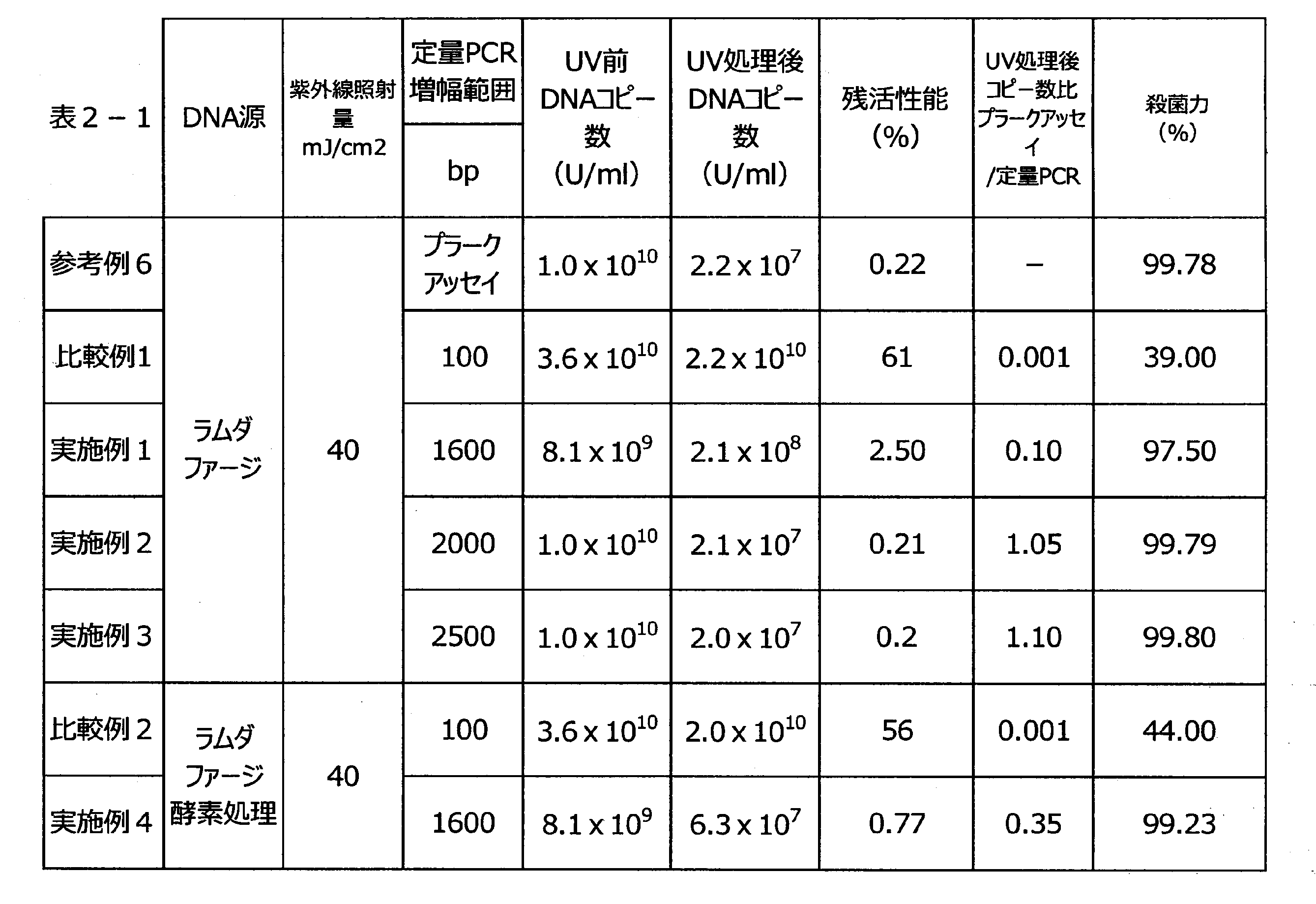
増幅範囲が100bpの場合は、酵素処理してもプラークアッセイ/qPCR比は変化しないが、増幅範囲を長くした1600bpではqPCRのみよりも酵素処理を組合せた方がプラークアッセイ/qPCR比は1に近くなることがわかった。
(参考例7および8・実施例5および6) T5およびM13
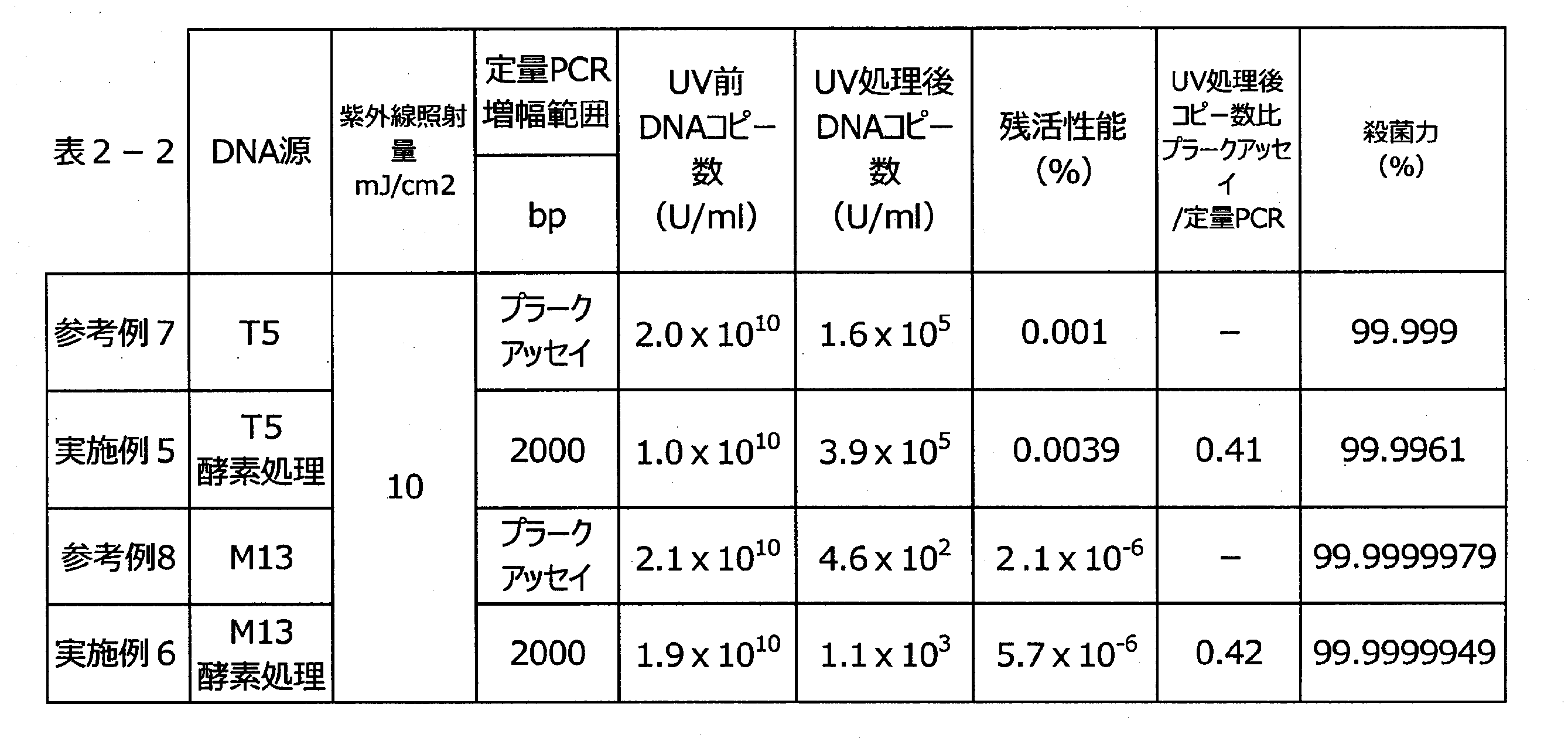
参考例6および実施例4において、ラムダファージに代えて、T5ファージ(Gelman Culture Collection, No.16353)およびM13ファージ(Takara 3118)でも同様の試験を行い、結果を表2-2に示す。なお、紫外線照射量は10mJ/cm2とした。定量PCRでの増幅範囲は2000bpのみとした。使用したプライマーを以下に示す。
参考例6および実施例4において、ラムダファージに代えて、T5ファージ(Gelman Culture Collection, No.16353)およびM13ファージ(Takara 3118)でも同様の試験を行い、結果を表2-2に示す。なお、紫外線照射量は10mJ/cm2とした。定量PCRでの増幅範囲は2000bpのみとした。使用したプライマーを以下に示す。
T5ファージ用プライマー
増幅範囲:2000bp
Forward Primer TAACTGCCCAAAATGCTTCC(配列番号24)
Reverse Primer AATTCTGGAGCAATCCATCG(配列番号25)
増幅範囲:2000bp
Forward Primer TAACTGCCCAAAATGCTTCC(配列番号24)
Reverse Primer AATTCTGGAGCAATCCATCG(配列番号25)
M13ファージ用プライマー
増幅範囲:2000bp
Forward Primer GCGTTGGCCGATTCATTAA(配列番号26)
Reverse Primer TCACTGCCCGCTTTCCA(配列番号27)
増幅範囲:2000bp
Forward Primer GCGTTGGCCGATTCATTAA(配列番号26)
Reverse Primer TCACTGCCCGCTTTCCA(配列番号27)
(参考例9-12) 遺伝子損傷と測定の正確性の確認
・pBR322 DNAの酵素処理(分解)
pBR322 DNA(NEW ENGLAND BioLabs)を5μg、制限酵素Hinf I(タカラバイオ製)50 units、制限酵素に添付されている10 x H Bufferを10μL測りとり、水で全量が100μLとなるよう調製し、37℃で3時間インキュベートした。
・pBR322 DNAの酵素処理(分解)
pBR322 DNA(NEW ENGLAND BioLabs)を5μg、制限酵素Hinf I(タカラバイオ製)50 units、制限酵素に添付されている10 x H Bufferを10μL測りとり、水で全量が100μLとなるよう調製し、37℃で3時間インキュベートした。
・酵素処理後のpBR322 DNAの精製
インキュベート後、TE緩衝液(pH 8.0)で反応液中のDNA量を2 x 10⁹ copies/μLに調整し、Agencourt AMPure XP(Beckman Coulter)と磁気プレートを用い、Agencourt AMPure XPに添付の取扱い説明書記載の方法に準じて、DNAの精製を行った。
インキュベート後、TE緩衝液(pH 8.0)で反応液中のDNA量を2 x 10⁹ copies/μLに調整し、Agencourt AMPure XP(Beckman Coulter)と磁気プレートを用い、Agencourt AMPure XPに添付の取扱い説明書記載の方法に準じて、DNAの精製を行った。
(定量PCRによる測定)
制限酵素で処理したpBR322 DNAと、制限酵素で処理していないpBR322 DNAを任意の割合で混合して、定量PCRを行った。
この時、増幅範囲には、制限酵素Hinf I の認識部位が含まれていることから、制限酵素で処理したpBR322のDNAを鋳型とする場合には、理論上定量PCRでは検出されない。よって、定量PCRが正確に行われるのであれば、制限酵素で処理したDNAと処理しないDNAをある一定の濃度で混合した場合、定量PCRの結果は、理論上の混合比と同等となるはずである。
ただし、定量PCRの増幅部位が長すぎる、あるいは短すぎる場合には、定量PCRの検出精度が悪くなることから、理論値とのずれが生じてしまう。
制限酵素で処理したpBR322 DNAと、制限酵素で処理していないpBR322 DNAを任意の割合で混合して、定量PCRを行った。
この時、増幅範囲には、制限酵素Hinf I の認識部位が含まれていることから、制限酵素で処理したpBR322のDNAを鋳型とする場合には、理論上定量PCRでは検出されない。よって、定量PCRが正確に行われるのであれば、制限酵素で処理したDNAと処理しないDNAをある一定の濃度で混合した場合、定量PCRの結果は、理論上の混合比と同等となるはずである。
ただし、定量PCRの増幅部位が長すぎる、あるいは短すぎる場合には、定量PCRの検出精度が悪くなることから、理論値とのずれが生じてしまう。
酵素処理DNAと未処理DNAの混合割合と定量PCRによる測定値、および理論値を表3に示す。
増幅範囲:2500bp
Forward Primer GCTACTTGGAGCCACTATCGACTA(配列番号28)
Reverse Primer CTCTGCTAATCCTGTTACCAGTGG(配列番号29)
蛍光Probe FAM-TCCTGTCGTTGAGGACC-MGB(配列番号30)
Forward Primer GCTACTTGGAGCCACTATCGACTA(配列番号28)
Reverse Primer CTCTGCTAATCCTGTTACCAGTGG(配列番号29)
蛍光Probe FAM-TCCTGTCGTTGAGGACC-MGB(配列番号30)
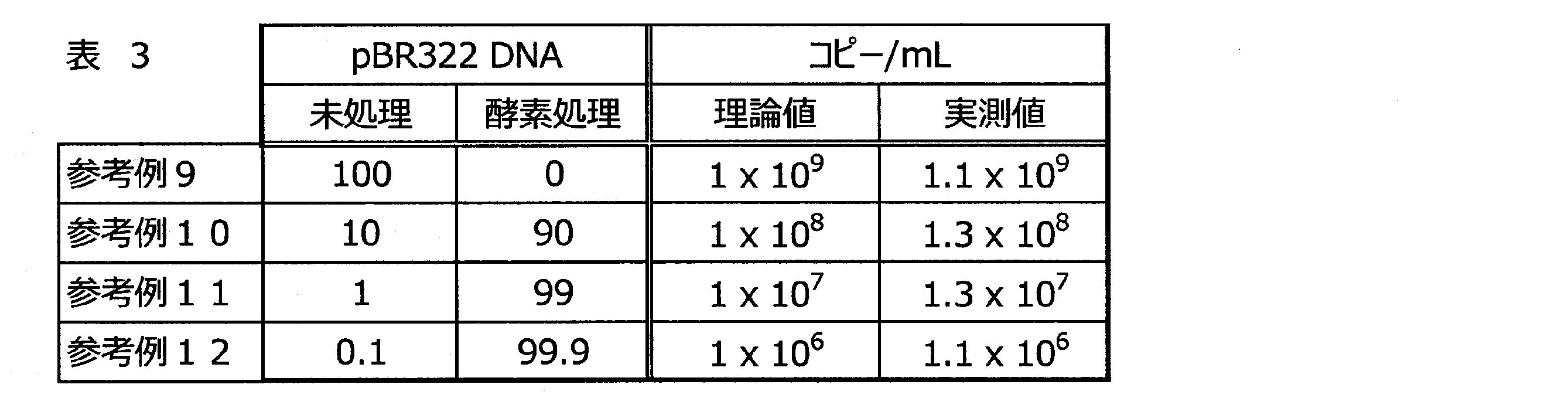
表3から明らかなとおり、本発明の測定方法を用いると、定量PCRの結果は、制限酵素で処理したDNAと処理しないDNAの理論上の混合比と同等となり、定量PCRの結果が正確であることが確かめられた。
本発明の活性測定方法や殺菌力測定方法は、ウイルスや単細胞生物の培養を待たずとも、DNAウイルスまたは単細胞生物の活性や活性エネルギー線照射装置の殺菌力を測定することが可能である。
Claims (4)
- 1)DNAウイルスまたは単細胞生物の保有する標的核酸を用意する工程と、
2)標的核酸を鋳型としたPCRによる増幅産物が1500-2800bpの長さとなるプライマーを用意する工程と、
3)標的核酸とプライマーを用いて定量PCRを行う工程と、
4)定量PCRの結果をDNAウイルスまたは単細胞生物の活性能に変換する工程とを有することを特徴とする、
DNAウイルスまたは単細胞生物の活性測定方法。 - さらに、標的核酸をエンドヌクレアーゼ処理する工程を有する、請求項1に記載のDNAウイルスまたは単細胞生物の活性測定方法。
- 1)活性エネルギー線照射装置を用いて、DNAに活性エネルギー線照射処理し、処理DNAを得る工程と、
2)得られた処理DNAに対し、PCRによる増幅範囲が1500-2800bpの長さとなるプライマーを用意する工程と、
3)処理DNAとプライマーを用いて定量PCRを行う工程と、
4)定量PCRの結果を活性エネルギー線による殺菌力に変換する工程とを有することを特徴とする、
活性エネルギー線照射装置の殺菌力測定方法。 - さらに、活性エネルギー線照射処理後に得られた処理DNAをエンドヌクレアーゼ処理する工程を有する、請求項3に記載の活性エネルギー線照射装置の殺菌力測定方法。
Priority Applications (1)
| Application Number | Priority Date | Filing Date | Title |
|---|---|---|---|
| JP2019561075A JPWO2019124306A1 (ja) | 2017-12-21 | 2018-12-17 | Dnaウイルスまたは単細胞生物の活性測定方法、及び、活性エネルギー線照射装置の殺菌力測定方法 |
Applications Claiming Priority (2)
| Application Number | Priority Date | Filing Date | Title |
|---|---|---|---|
| JP2017245023 | 2017-12-21 | ||
| JP2017-245023 | 2017-12-21 |
Publications (1)
| Publication Number | Publication Date |
|---|---|
| WO2019124306A1 true WO2019124306A1 (ja) | 2019-06-27 |
Family
ID=66994836
Family Applications (1)
| Application Number | Title | Priority Date | Filing Date |
|---|---|---|---|
| PCT/JP2018/046335 Ceased WO2019124306A1 (ja) | 2017-12-21 | 2018-12-17 | Dnaウイルスまたは単細胞生物の活性測定方法、及び、活性エネルギー線照射装置の殺菌力測定方法 |
Country Status (2)
| Country | Link |
|---|---|
| JP (1) | JPWO2019124306A1 (ja) |
| WO (1) | WO2019124306A1 (ja) |
Cited By (1)
| Publication number | Priority date | Publication date | Assignee | Title |
|---|---|---|---|---|
| JP2024067177A (ja) * | 2022-11-04 | 2024-05-17 | 国立大学法人お茶の水女子大学 | 紫外線処理評価装置および紫外線処理評価方法 |
Citations (1)
| Publication number | Priority date | Publication date | Assignee | Title |
|---|---|---|---|---|
| US5891682A (en) * | 1996-05-06 | 1999-04-06 | Florida Institute Of Technology | Radiation dosimeter and method of making and using |
-
2018
- 2018-12-17 WO PCT/JP2018/046335 patent/WO2019124306A1/ja not_active Ceased
- 2018-12-17 JP JP2019561075A patent/JPWO2019124306A1/ja active Pending
Patent Citations (1)
| Publication number | Priority date | Publication date | Assignee | Title |
|---|---|---|---|---|
| US5891682A (en) * | 1996-05-06 | 1999-04-06 | Florida Institute Of Technology | Radiation dosimeter and method of making and using |
Non-Patent Citations (7)
| Title |
|---|
| AYTAY, S. ET AL.: "Development of a sensitive PCR inhibition method to demonstrate HBV nucleic acid inactivation", TRANSFUSION, vol. 44, no. 4, 24 March 2004 (2004-03-24) - April 2004 (2004-04-01), pages 476 - 484, XP055620557 * |
| BANIHASHEMI, A. ET AL.: "Long-amplicon propidium monoazide-PCR enumeration assay to detect viable Campylobacter and Salmonella", JOURNAL OF APPLIED MICROBIOLOGY, vol. 113, no. 4, 2 July 2012 (2012-07-02) - October 2012 (2012-10-01), pages 863 - 873, XP055620538 * |
| BESPALOV, V. A. ET AL.: "Improved method for measuring the ensemble average of strand breaks in genomic DNA", ENVIRONMENTAL AND MOLECULAR MUTAGENESIS, vol. 38, no. 2-3, 29 October 2001 (2001-10-29), pages 166 - 174, XP055620564 * |
| MATUO YOICHIRO ET AL.: "Review on quantitative evaluation of DNA damage by radiation", ABSTRACTS OF JOINT MEETING : THE 50TH ANNUAL MEETING OF JAPAN HEALTH PHYSICS SOCIETY AND THE 16TH ANNUAL MEETING OF JAPANESE SOCIETY OF RADIATION SAFETY MANAGEMENT, 2017, pages 211 * |
| NOCKER, A. ET AL.: "Assessment of UV-C-induced water disinfection by differential PCR-based quantification of bacterial DNA damage", JOURNAL OF MICROBIOLOGICAL METHODS, vol. 149, 31 March 2018 (2018-03-31) - June 2018 (2018-06-01), pages 89 - 95, XP055620572 * |
| POEPPING, C. ET AL.: "Evaluation of DNA damage reversal during medium-pressure UV disinfection", WATER RESEARCH, vol. 56, 5 March 2014 (2014-03-05) - 1 June 2014 (2014-06-01), pages 181 - 189, XP055620524 * |
| RUDI, K. ET AL.: "Different length (DL) qPCR for quantification of cell killing by UV-induced DNA damage", INTERNATIONAL JOURNAL OF ENVIRONMENTAL RESEARCH AND PUBLIC HEALTH, vol. 7, 31 August 2010 (2010-08-31), pages 3376 - 3381, XP055620530 * |
Cited By (2)
| Publication number | Priority date | Publication date | Assignee | Title |
|---|---|---|---|---|
| JP2024067177A (ja) * | 2022-11-04 | 2024-05-17 | 国立大学法人お茶の水女子大学 | 紫外線処理評価装置および紫外線処理評価方法 |
| JP7822047B2 (ja) | 2022-11-04 | 2026-03-02 | 国立大学法人お茶の水女子大学 | 紫外線処理評価装置および紫外線処理評価方法 |
Also Published As
| Publication number | Publication date |
|---|---|
| JPWO2019124306A1 (ja) | 2021-01-21 |
Similar Documents
| Publication | Publication Date | Title |
|---|---|---|
| Kralik et al. | Mycobacterium avium subsp. paratuberculosis viability determination using F57 quantitative PCR in combination with propidium monoazide treatment | |
| JP5295787B2 (ja) | 核酸に基づく分子的技法を用いて無傷細胞と膜損傷細胞とを識別するためのフェナントリジウム誘導体の使用 | |
| WO2004072231A2 (en) | Pathogen inactivation assay | |
| Toldrà et al. | Detection of isothermally amplified ostreid herpesvirus 1 DNA in Pacific oyster (Crassostrea gigas) using a miniaturised electrochemical biosensor | |
| JP2010046042A (ja) | 特定遺伝子の検出方法 | |
| JP2015039320A (ja) | 複数細菌の同時検出及び/又は定量方法 | |
| Vondrakova et al. | Impact of various killing methods on EMA/PMA-qPCR efficacy | |
| JP2023521783A (ja) | Rt-pcrを用いたウイルス感染の迅速な検出 | |
| JP4127847B2 (ja) | 微生物検出法及び微生物検出キット | |
| Seidel et al. | The feasibility of improved live-dead distinction in qPCR-based microbial source tracking | |
| CN103443294B (zh) | 用于修饰核酸的方法 | |
| WO2019124306A1 (ja) | Dnaウイルスまたは単細胞生物の活性測定方法、及び、活性エネルギー線照射装置の殺菌力測定方法 | |
| US20140342366A1 (en) | Modification of sample preparation to differentiate live and dead bacteria by polymerase chain reaction assay | |
| JP4217797B2 (ja) | 微生物検出法及び微生物検出キット | |
| CN101160410B (zh) | 使用病毒检测样本中活细胞的方法 | |
| KR102261713B1 (ko) | 해양 병원성 박테리아 검출 방법, 및 이를 위한 프라이머-프로브 세트, 조성물 및 키트 | |
| JP5692489B2 (ja) | 微生物の検出方法 | |
| JP4217795B2 (ja) | 微生物検出法及び微生物検出キット | |
| JP2010017144A (ja) | レジオネラ属菌の検出方法及び検出キット | |
| Nwaiwu et al. | Probing the Evolution of Genes Associated with DNA Methylation in Listeria monocytogenes | |
| RU2728317C1 (ru) | Способ устранения ложноположительных результатов, вызванных контаминацией ДНК-полимераз фрагментами чужеродной ДНК, при индентификации генов blaTEM | |
| Franco et al. | Anticipating xenogenic pollution at the source: Impact of sterilizations on DNA release from microbial cultures | |
| Lim et al. | Effect of ionizing radiation on the quantitative detection of Salmonella using real-time PCR | |
| US20230212697A1 (en) | Isothermal real-time pcr method for determining presence of a pre-determined nucleic acid sequence of a bacterium of the mollicutes class in a sample | |
| RU2456348C1 (ru) | Способ детекции генов антибиотикоустойчивости у штаммов возбудителя чумы методом полимеразной цепной реакции |
Legal Events
| Date | Code | Title | Description |
|---|---|---|---|
| 121 | Ep: the epo has been informed by wipo that ep was designated in this application |
Ref document number: 18892659 Country of ref document: EP Kind code of ref document: A1 |
|
| ENP | Entry into the national phase |
Ref document number: 2019561075 Country of ref document: JP Kind code of ref document: A |
|
| NENP | Non-entry into the national phase |
Ref country code: DE |
|
| 122 | Ep: pct application non-entry in european phase |
Ref document number: 18892659 Country of ref document: EP Kind code of ref document: A1 |