WO2019102700A1 - ガラス、筐体及び電子機器 - Google Patents
ガラス、筐体及び電子機器 Download PDFInfo
- Publication number
- WO2019102700A1 WO2019102700A1 PCT/JP2018/034433 JP2018034433W WO2019102700A1 WO 2019102700 A1 WO2019102700 A1 WO 2019102700A1 JP 2018034433 W JP2018034433 W JP 2018034433W WO 2019102700 A1 WO2019102700 A1 WO 2019102700A1
- Authority
- WO
- WIPO (PCT)
- Prior art keywords
- glass
- metal atoms
- region
- average concentration
- area
- Prior art date
- Legal status (The legal status is an assumption and is not a legal conclusion. Google has not performed a legal analysis and makes no representation as to the accuracy of the status listed.)
- Ceased
Links
Images







Classifications
-
- C—CHEMISTRY; METALLURGY
- C03—GLASS; MINERAL OR SLAG WOOL
- C03C—CHEMICAL COMPOSITION OF GLASSES, GLAZES OR VITREOUS ENAMELS; SURFACE TREATMENT OF GLASS; SURFACE TREATMENT OF FIBRES OR FILAMENTS MADE FROM GLASS, MINERALS OR SLAGS; JOINING GLASS TO GLASS OR OTHER MATERIALS
- C03C21/00—Treatment of glass, not in the form of fibres or filaments, by diffusing ions or metals in the surface
- C03C21/001—Treatment of glass, not in the form of fibres or filaments, by diffusing ions or metals in the surface in liquid phase, e.g. molten salts, solutions
- C03C21/002—Treatment of glass, not in the form of fibres or filaments, by diffusing ions or metals in the surface in liquid phase, e.g. molten salts, solutions to perform ion-exchange between alkali ions
-
- C—CHEMISTRY; METALLURGY
- C03—GLASS; MINERAL OR SLAG WOOL
- C03C—CHEMICAL COMPOSITION OF GLASSES, GLAZES OR VITREOUS ENAMELS; SURFACE TREATMENT OF GLASS; SURFACE TREATMENT OF FIBRES OR FILAMENTS MADE FROM GLASS, MINERALS OR SLAGS; JOINING GLASS TO GLASS OR OTHER MATERIALS
- C03C19/00—Surface treatment of glass, not in the form of fibres or filaments, by mechanical means
-
- G—PHYSICS
- G09—EDUCATION; CRYPTOGRAPHY; DISPLAY; ADVERTISING; SEALS
- G09F—DISPLAYING; ADVERTISING; SIGNS; LABELS OR NAME-PLATES; SEALS
- G09F9/00—Indicating arrangements for variable information in which the information is built-up on a support by selection or combination of individual elements
-
- H—ELECTRICITY
- H05—ELECTRIC TECHNIQUES NOT OTHERWISE PROVIDED FOR
- H05K—PRINTED CIRCUITS; CASINGS OR CONSTRUCTIONAL DETAILS OF ELECTRIC APPARATUS; MANUFACTURE OF ASSEMBLAGES OF ELECTRICAL COMPONENTS
- H05K5/00—Casings, cabinets or drawers for electric apparatus
- H05K5/02—Details
- H05K5/03—Covers
-
- Y—GENERAL TAGGING OF NEW TECHNOLOGICAL DEVELOPMENTS; GENERAL TAGGING OF CROSS-SECTIONAL TECHNOLOGIES SPANNING OVER SEVERAL SECTIONS OF THE IPC; TECHNICAL SUBJECTS COVERED BY FORMER USPC CROSS-REFERENCE ART COLLECTIONS [XRACs] AND DIGESTS
- Y10—TECHNICAL SUBJECTS COVERED BY FORMER USPC
- Y10T—TECHNICAL SUBJECTS COVERED BY FORMER US CLASSIFICATION
- Y10T428/00—Stock material or miscellaneous articles
- Y10T428/24—Structurally defined web or sheet [e.g., overall dimension, etc.]
- Y10T428/24479—Structurally defined web or sheet [e.g., overall dimension, etc.] including variation in thickness
- Y10T428/24488—Differential nonuniformity at margin
Definitions
- the present technology relates to glass, a housing, and an electronic device.
- Glass is used for devices such as smartphones, digital cameras, PDAs (Personal Data Assistants), touch panel displays, etc., which are becoming increasingly popular in the market.
- PDAs Personal Data Assistants
- touch panel displays etc.
- Patent Documents 1 to 3 For example, techniques relating to tempered glass and methods for producing tempered glass have been proposed (see Patent Documents 1 to 3).
- the present technology has been made in view of such a situation, and has as its main object to provide a glass with improved strength, and a housing and an electronic device provided with the glass.
- Each of the second surface and the third surface contains a metal atom, and the first surface and the third surface have an average concentration of the metal atom of each of the first surface and the third surface.
- the glass is provided in which the average concentration of the metal atoms in the first side region formed from the third surface is small.
- the first side region may have a chamfered shape, and the chamfered shape of the first side region may have a C-chamfered shape or a R-chamfered shape.
- an average concentration of the metal atoms in a second side region formed of the second surface and the third surface is the same as that of each of the second surface and the third surface. It may be smaller than the average concentration of the metal atoms.
- the second side region may have a chamfered shape, and the chamfered shape of the second side region may have a C-chamfered shape or a R-chamfered shape.
- the glass according to the present technology may further include at least a fourth surface connecting the first surface and the second surface, and in the glass according to the present technology, the fourth surface is the metal atom.
- the fourth surface is the metal atom.
- the glass according to the present technology may further include at least a fourth surface connecting the first surface and the second surface, and in the glass according to the present technology, the fourth surface is the metal atom. And the metal of the second side region formed of the second surface and the third surface, and the fourth side region formed of the second surface and the fourth surface.
- the average concentration of the metal atoms in the top portion formed of the second side region and the fourth side region may be smaller than the average concentration of atoms.
- At least one of the first surface and the second surface may be flat. In the glass according to the present technology, at least one of the first surface and the second surface may be a curved surface.
- the present technology also provides a housing provided with the glass according to the present technology. Furthermore, the present technology provides an electronic device including the glass according to the present technology.
- the strength of the glass can be further improved.
- the effect described here is not necessarily limited, and may be any effect described in the present disclosure.
- a common solution is to strengthen with compressed glass.
- Compressed glass is a glass in which a state of compressive stress is created on the surface, and the margin of cracking caused by tensile stress is broadened.
- a typical production method is a method of chemical strengthening in which a glass is placed in a tank and ions of large size are injected from the surface by ion exchange, or a method of rapidly cooling during glass molding to leave residual stress of compression on the outer surface.
- a glass which may be a chemically strengthened glass which provides a glass maintaining a surface strengthening stress while reducing the fracture of the side portion (side region) or the corner portion (apex portion) of the glass is provided.
- the amount of ion exchange of the side area (or side) between the surface of the glass and the apex area (or the apex between side and side) formed by the side areas is compared with the surface of the surface
- the internal stress at the corners which is generated by ion exchange is reduced and the crushing is reduced while maintaining the strength of the surface.
- the glass according to the first embodiment of the present technology includes at least a first surface and a second surface facing each other, and a third surface connecting the first surface and the second surface, Each of the first surface, the second surface and the third surface contains a metal atom, and the first surface and the first surface with respect to the average concentration of the metal atom in each of the first surface and the third surface. It is glass in which the average concentration of the metal atoms in the first side region formed from the third surface is small.
- the average concentration of the metal atoms in the second side region formed of the second surface and the third surface is the same as that of the second surface and the third surface. It may be smaller than the average concentration of each metal atom.
- the glass of the first embodiment according to the present technology may include a fourth surface connecting the first surface and the second surface, and the fourth surface may contain metal atoms.
- the average concentration of metal atoms in the third side region formed of the first surface and the fourth surface is smaller than the average concentration of metal atoms in each of the first surface and the fourth surface;
- the average concentration of the metal atoms in the fourth side region formed of the second surface and the fourth surface may be smaller than the average concentration of the metal atoms in each of the surface and the fourth surface.
- the glass of the first embodiment according to the present technology may include a fifth surface connecting the first surface and the second surface, and the fifth surface may contain metal atoms.
- the average concentration of metal atoms in the fifth side region formed of the first and fifth surfaces may be smaller than the average concentration of metal atoms in each of the first and fifth surfaces,
- the average concentration of metal atoms in the sixth side region 56-1 formed of the second and fifth surfaces is smaller than the average concentration of metal atoms in each of the second and fifth surfaces.
- the glass of the first embodiment according to the present technology may include a sixth surface connecting the first surface and the second surface, and the sixth surface may contain metal atoms.
- the average concentration of metal atoms in the seventh side region formed of the first surface and the sixth surface may be smaller than the average concentration of metal atoms in the first surface and the sixth surface,
- the average concentration of metal atoms in the eighth side region 58-1 formed of the second surface and the sixth surface 6-1 with respect to the average concentration of the metal atoms in the second surface and the sixth surface The concentration may also be small.
- the average concentration of metal atoms in the ninth side region formed of the third surface and the fourth surface is equal to each of the third surface and the fourth surface.
- the average concentration of the metal atoms in the tenth side region formed of the fourth surface and the fifth surface may be smaller than the average concentration of the metal atoms in the fourth surface and the fifth surface.
- the average concentration of metal atoms in the eleventh side region, which may be smaller than the average concentration of metal atoms, and which is formed from the fifth surface and the sixth surface is the same as that of each metal of the fifth surface and the sixth surface.
- the average concentration of the metal atoms in the twelfth side region which may be smaller than the average concentration of atoms, and which is formed from the sixth surface and the third surface, is determined by comparing the respective concentrations of the sixth surface and the third surface. It may be smaller than the average concentration of metal atoms.
- the first to twelfth side regions are preferably within a range where the influence of the internal stress (tensile stress) can reach, but the invention is not limited to this.
- the range where the influence of the internal stress (tensile stress) can be reached is, for example, several ⁇ m to 100 ⁇ m from the glass surface when the thickness of the glass is about 700 ⁇ m.
- the metal atom is a concept in which the metal atom is in an ionized state, that is, includes a metal ion.
- the metal atom can be contained in the glass of the first embodiment according to the present technology by an ion exchange method.
- the ion exchange method refers to, for example, replacing ions of small ion radius (atomic radius) contained in glass with ions of large ion radius (atomic radius) before ion exchange. For example, it refers to replacing Li ions contained in the glass with Na ions before ion exchange, or replacing Na ions contained in the glass with K ions before ion exchange.
- the shape of the glass of the first embodiment according to the present technology may be any shape.
- the shape of the glass of the first embodiment according to the present technology may be a hexahedron or a polyhedron.
- FIG. 1 shows a glass 100 (100-1 in FIG. 1) which is an example of the glass of the first embodiment according to the present technology.
- FIG. 1 is a perspective view of a hexahedral glass 100-1.
- the glass 100-1 is a third surface 3 connecting the first surface 1-1 and the second surface 2-1 facing each other, and the first surface 1-1 and the second surface 2-1. And at least one.
- Each of the first surface 1-1, the second surface 2-1, and the third surface 3-1 contains a metal atom.
- a first side formed of the first surface 1-1 and the third surface 3-1 with respect to the average concentration of metal atoms in each of the first surface 1-1 and the third surface 3-1 The average concentration of metal atoms in the region 51-1 is small.
- the first side area 51-1 is an area including the first side 13-1.
- the average concentration of metal atoms in the second side region 52-1 formed from the second surface 2-1 and the third surface 3-1 is the same as the second surface 2-1 and the second surface 2-1. It is smaller than the average concentration of each metal atom of the surface 3-1 of 3.
- the second side area 52-1 is an area including the second side 23-1.
- the glass 100-1 is provided with a fourth surface 4-1 connecting the first surface 1-1 and the second surface 2-1, and the fourth surface 4-1 contains a metal atom.
- a third side formed of the first surface 1-1 and the fourth surface 4-1 with respect to the average concentration of metal atoms in each of the first surface 1-1 and the fourth surface 4-1 The average concentration of metal atoms in the region 53-1 is small, and the second surface 2-1 and the fourth surface are lower than the average concentration of metal atoms in the second surface 2-1 and the fourth surface 4-1.
- the average concentration of metal atoms in the fourth side region 54-1 formed from the face 4-1 is small.
- the third side area 53-1 is an area including the third side 14-1.
- the fourth side area 54-1 is an area including the fourth side 24-1.
- the glass 100-1 is provided with a fifth surface 5-1 connecting the first surface 1-1 and the second surface 2-1, and the fifth surface 5-1 contains metal atoms.
- a fifth side formed of the first surface 1-1 and the fifth surface 5-1 with respect to the average concentration of metal atoms of the first surface 1-1 and the fifth surface 5-1.
- the average concentration of metal atoms in the region 55-1 is small, and the second surface 2-1 and the fifth surface are lower than the average concentration of metal atoms in the second surface 2-1 and the fifth surface 5-1, respectively.
- the fifth side area 55-1 is an area including the fifth side 15-1.
- the sixth side area 56-1 is an area including the sixth side 25-1.
- the glass 100-1 is provided with a sixth surface 6-1 connecting the first surface 1-1 and the second surface 2-1, and the sixth surface 6-1 contains a metal atom.
- a seventh side formed of the first surface 1-1 and the sixth surface 6-1 with respect to the average concentration of metal atoms in each of the first surface 1-1 and the sixth surface 6-1
- the average concentration of metal atoms in the region 57-1 is small, and the second surface 2-1 and the sixth surface are lower than the average concentration of metal atoms in the second surface 2-1 and the sixth surface 6-1, respectively.
- the seventh side area 57-1 is an area including the seventh side 16-1.
- the eighth side area 58-1 is an area including the eighth side 26-1.
- the average concentration of metal atoms in the ninth side region 59-1 formed of the third surface 3-1 and the fourth surface 4-1 in the glass 100-1 is the third surface 3-1 and the third surface 3-1.
- the average concentration of metal atoms in the tenth side region 60-1 formed from the fourth surface 4-1 and the fifth surface 5-1 which is smaller than the average concentration of the metal atoms in each of the four surfaces 4-1
- the concentration is smaller than the average concentration of metal atoms in each of the fourth surface 4-1 and the fifth surface 5-1, and is formed of the fifth surface 5-1 and the sixth surface 6-1.
- the average concentration of metal atoms in the eleventh side region 61-1 is smaller than the average concentration of metal atoms in each of the fifth surface 5-1 and the sixth surface 6-1, and further, the sixth surface 6-
- the average concentration of metal atoms in the twelfth side region 62-1 formed of the first and third faces 3-1 is the same as that of each of the sixth face 6-1 and the third face 3-1. Smaller than the average concentration of the genus atoms.
- the ninth side area 59-1 is an area including the ninth side 340-1.
- the tenth side area 60-1 is an area including the tenth side 450-1.
- the eleventh side area 61-1 is an area including the eleventh side 560-1.
- the twelfth side area 62-1 is an area including the twelfth side 630-1.
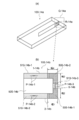
- FIG. 14 is a figure for explaining the composition of the glass of a 1st embodiment concerning this art.
- FIG. 14 (a) is a perspective view of the glass 100-14a
- FIG. 14 (b) is an enlarged cross-sectional view of a hatched portion R-14a in Q-14a of the glass 100-14a.
- the glass 100-14b connects the first surface 1-14b, the second surface 2-14b, the first surface 1-14b and the second surface 2-14b.
- a fifth surface 5-14b and an unreinforced region 520-14b are included.
- a reinforced region 510-14b-1 is formed on the first surface 1-14b
- a reinforced region 510-14b-2 is formed on the second surface 2-14b
- a reinforced region is formed on the fifth surface 5-14b.
- a region 510-14b-3 is formed.
- a reinforced reduction region 500-14b-2 is formed from the first surface 1-14b and the fifth surface 5-14b, and from the second surface 2-14b and the fifth surface 5-14b,
- a reinforced reduced area 500-14b-1 is formed.
- the reinforcement reduction area 500-14b-2 corresponds to the fifth side area
- the reinforcement reduction area 500-14b-1 corresponds to the sixth side area.
- the reinforced reduced area 500-14b-1 has a width 1 in the direction along the second surface 2-14b and a width 2 in the direction along the fifth surface 5-14b.
- the reinforced reduced area 500-14b-2 has a width 3 in the direction along the fifth surface 5-14b and a width 4 in the direction along the first surface 1-14b.
- Each of the width 1 to width 4 may have the same length or different lengths.
- the reinforced reduced regions 500-14 b-1 and 500-14 b-2 have a smaller amount of metal atoms (metal ions) having a larger atomic radius to be ion-exchanged than the reinforced regions 510-14 b-1 to 3.
- the reinforcement stress (compressive stress) P-14b-1 of the first surface 1-14b, and the second surface 2- by providing the reinforced reduction regions 500-14b-1 and 500-14b-2 in the glass 100-14b.
- the internal stress (tensile stress) of the corner 100-14b can be reduced to prevent crushing and crushing.
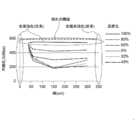
- FIG. 15 shows that the internal stress (tensile stress) (MPa) and the reinforcement reduction when the concentration ratio of the average concentration of metal atoms in the reinforcement reduction region to the average concentration of metal atoms in the reinforcement region is changed from 0% to 100% It is a figure for demonstrating the relationship with the width
- the width ( ⁇ m) of the reinforced reduced area corresponds to any one of width 1 to width 4 shown in FIG. 14 (b).
- the concentration ratio "0%” means that the reinforced reduced region has an average concentration of metal atoms with a large atomic radius of 0 mol% (without ion exchange), like the average concentration of metal atoms with a large atomic radius in the unreinforced region.
- concentration ratio “20%” means that when the average concentration of metal atoms (large atomic radius) in the reinforced region is 10 mol%, the average concentration of metal atoms in the reinforced reduced region is large Indicates that it is 2 mol%.
- concentration ratio "100%” indicates that the reinforced reduction region is not formed but only the reinforced region is formed.
- the width has an optimum value at a concentration ratio of 0% to 80%.
- FIG. 16 is a graph showing the distribution of internal stress (tensile stress) with respect to the width ( ⁇ m) of the reinforced reduction region.
- FIG. 16 (a) is a view showing the distribution of internal stress (tensile stress) of glass in which the width of the reinforcement reduction region is 0 ⁇ m (without reinforcement reduction region), and
- FIG. 16 (b) is the reinforcement reduction region It is a figure which shows distribution of the internal stress (tensile stress) of the glass whose width
- FIG.16 (c) is a figure which shows distribution of the internal stress (tensile stress) of the width
- the width ( ⁇ m) of the reinforcement reduction region means one of the mutually opposing first and second surfaces and the third surface (end surface) connecting the first and second surfaces. It means the length (distance) from the surface of any one face, and corresponds to, for example, any one of the widths 1 to 4 shown in FIG. 14 (b).
- the concentration ratio of the average concentration of metal atoms in the enhanced reduction region to the average concentration of metal atoms in the enhanced region is 40%.
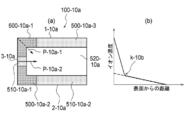
- FIG. 8 is a diagram for explaining the relationship between the metal ion concentration and the distance from the glass surface.
- FIG. 8 (a) is a cross-sectional view when the glass 100-8a is cut in the thickness direction
- FIG. 8 (b) is a graph showing the metal ion concentration with respect to the distance from the glass surface.
- the metal ion concentration in the direction of the arrow P-8a-1 (broken line) shown in FIG. 8 (a) corresponds to the graph of the broken line shown in FIG. 8 (b), and the arrow P shown in FIG. 8 (a)
- the metal ion concentration in the direction of ⁇ 8a-2 (solid line) corresponds to the solid line graph shown in FIG. 8 (b).
- the concentration ratio is 40%.
- the glass 100-8a connects the first surface 1-8a, the second surface 2-8a, and the first surface 1-8a to the second surface 2-8a.
- a third surface 3-8a and an unreinforced area 520-8a are included.
- a reinforced region 510-8a-3 is formed on the first surface 1-8a
- a reinforced region 510-8a-2 is formed on the second surface 2-8a
- a reinforced region is formed on the third surface 3-8a.
- a region 510-8a-1 is formed.
- a reinforcement reduction region 500-8a-1 is formed on the first surface 1-8a and the third surface 3-8a, and the second surface 2-8a and the third surface 3-8a are formed. Is formed with a reinforced reduction region 500-8a-2.
- the reinforcement reduction area 500-8a-1 corresponds to the first side area
- the reinforcement reduction area 500-8a-2 corresponds to the second side area.
- the concentration of the outermost surface of metal atoms in the first side region and the second side region is made lower than the surface (strengthening region) to lower the concentration of metal atoms. It is also good.
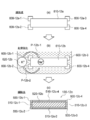
- FIG. 9 is a view for explaining the relationship between the metal ion concentration and the distance from the glass surface.
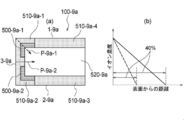
- FIG. 9 (a) is a cross-sectional view when the glass 100-9a is cut in the thickness direction
- FIG. 9 (b) is a graph showing the metal ion concentration with respect to the distance from the glass surface.
- the metal ion concentration in the direction of the arrow P-9a-1 (broken line) shown in FIG. 9 (a) corresponds to the graph of the broken line shown in FIG. 9 (b), and the arrow P shown in FIG.
- the metal ion concentration in the direction of -9a-2 (solid line) corresponds to the solid line graph shown in FIG. 9 (b).
- the distance ratio from the surface is 40%.
- the glass 100-9a connects the first surface 1-9a, the second surface 2-9a, the first surface 1-9a and the second surface 2-9a.
- a third surface 3-9a and an unreinforced region 520-9a are included.
- a reinforced region 510-9a-4 is formed on the first surface 1-9a
- a reinforced region 510-9a-3 is formed on the second surface 2-9a
- a reinforced region is formed on the third surface 3-9a.
- Regions 510-9a-1 and -2 are formed.
- a strengthening reduction region 500-9a-1 is formed inside the glass 100-9a on the first surface 1-9a and the third surface 3-9a, and the second surface 2-9a and the third surface 3-9a are formed.
- a reinforced reduced area 500-9a-2 is formed inside the glass 100-9a.
- the reinforcement reduction area 500-9a-1 corresponds to the first side area
- the reinforcement reduction area 500-9a-2 corresponds to the second side area.
- FIG. 10 is a diagram for explaining the relationship between the metal ion concentration and the distance from the glass surface.
- FIG. 10 (a) is a cross-sectional view when the glass 100-10a is cut in the thickness direction
- FIG. 10 (b) is a graph showing the metal ion concentration with respect to the distance from the glass surface.
- the metal ion concentration in the direction of the arrow P-10a-1 (broken line) shown in FIG. 10 (a) corresponds to the graph of the broken line shown in FIG. 10 (b), and the arrow P shown in FIG.
- the metal ion concentration in the direction of ⁇ 10a-2 (solid line) corresponds to the graph of the solid line shown in FIG. 10 (b).
- the glass 100-10a connects the first surface 1-10a, the second surface 2-10a, and the first surface 1-10a to the second surface 2-10a.
- a reinforced region 510-10a-3 is formed on the first surface 1-10a
- a reinforced region 510-10a-2 is formed on the second surface 2-10a
- a reinforced region is formed on the third surface 3-10a.
- a region 510-10a-1 is formed.
- a reinforcement reduction region 500-10a-1 is formed on the first surface 1-10a and the third surface 3-10a, and the second surface 2-10a and the third surface 3-10a are formed. Is formed with a reinforced reduced area 500-10a-2.
- the reinforcement reduction area 500-10a-1 corresponds to the first side area
- the reinforcement reduction area 500-10a-2 corresponds to the second side area.
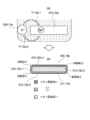
- FIG. 11 is a diagram for explaining the relationship between the metal ion concentration and the distance from the glass surface.
- FIG. 11 (a) is a cross-sectional view when the glass 100-11a is cut in the thickness direction
- FIG. 11 (b) is a graph showing the metal ion concentration with respect to the distance from the glass surface.
- the metal ion concentration in the direction of the arrow P-11a-1 (broken line) shown in FIG. 11 (a) corresponds to the graph of the broken line shown in FIG. 11 (b), and the arrow P shown in FIG.
- the metal ion concentration in the direction of ⁇ 11a-2 (solid line) corresponds to the graph of the solid line shown in FIG.
- the glass 100-11a connects the first surface 1-11a, the second surface 2-11a, and the first surface 1-11a to the second surface 2-11a.
- a third surface 3-11a and an unreinforced area 520-11a are included.
- a reinforced region 510-11a-3 is formed on the first surface 1-11a
- a reinforced region 510-11a-2 is formed on the second surface 2-11a
- a reinforced region is formed on the third surface 3-11a.
- a region 510-11a-1 is formed.
- a reinforced reduction region 500-11a-1 is formed inside the glass 100-11a, and the second surface 2-11a and the third surface 3-11a.
- a reinforced reduction region 500-11a-2 is formed inside the glass 100-11a.
- the reinforcement reduction area 500-11a-1 corresponds to the first side area
- the reinforcement reduction area 500-11a-2 corresponds to the second side area.
- the concentration of metal atoms may be reduced by reducing the bent portion k-11b) shown in FIG. 11B and FIG. 11B with respect to the surface (reinforcing region). This is realized by reducing the number of times of reinforcement in the first side area and the second side area (reinforcement reduction area) with respect to the surface (reinforcement area).
- the depth of reinforcement may be reduced or the depth of reinforcement may be reduced.
- the glass of the first embodiment according to the present technology can be obtained, for example, by the following manufacturing method.
- FIG. 12 (a) shows that a film (mask) (600-12a-1 to 600-12a-4) is formed on glass 610-12a
- FIG. 12 (b) is a film on glass 610-12b.
- (Mask) 600-12b-1 to 600-12b-4)
- chemical strengthening treatment Na + to K in glass 610-12b
- FIG. 12 (c) shows that the film is removed and glass 100-12 c is obtained. It is.
- the glass 100-12c includes an unreinforced region 520-12c, reinforced regions 510-12c-1 to 510-12c-4, and reinforced reduced regions 500-12c-1 to 51-12c-4. Reinforcing regions 510-12c-1 to 510-12c-4 are formed on the outer surface of the non-reinforcing region 520-12c, and reinforcing reduced regions 500-12c-1 to 51 in the side region outside the non-reinforcing region 520-12c. -12c-4 is formed.
- a material having a slow ion penetration rate to glass such as resist, tape, glass of different composition, etc.
- a material having a slow ion penetration rate to glass such as resist, tape, glass of different composition, etc.
- It can be realized by reducing the concentration of metal atoms at the side and top of the glass by chemical strengthening by ion substitution.
- the type of ion substitution is not limited as long as, for example, Na is replaced by K, Li by Na or the like to increase the size of the metal atom.
- Example 2 of Method of Manufacturing Glass of First Embodiment According to the Present Technology Example 2 of the manufacturing method of the glass of the first embodiment according to the present technology will be described using FIG. 13.
- FIG. 13 (a) shows chemical strengthening treatment of glass 610-13a in the direction of arrow P-13a-1 and arrow P-13a-2 (from Na + to K + in glass 610-13a (Fig. 13 (a) Among them, it is shown that ion exchange treatment is applied to 620-13a), and FIG. 13 (b) is a view showing that glass 100-13b was obtained by processing the end of the glass.
- the glass 100-13 c is composed of a region with low ion concentration, a region 511-13 b with high ion concentration, and regions 510-13 b-1-4 with very high ion concentration. Regions 511-13 b with high ion concentration are formed on the outer surface of regions with low ion concentration, and regions 510-13 b-1-with very high ion concentration on the surface outside region with high ion concentration 511-13 b 4 is formed, and the end portion exposes the region 511-13 b having high ion concentration at the end portion.
- the glass of the second embodiment according to the present technology has the same configuration as that of the glass of the first embodiment according to the present technology described above, and further includes the first surface and the second surface. Glass, at least one side of which is planar.
- the glass of the second embodiment according to the present technology has the same configuration as that of the glass of the first embodiment according to the present technology described above, and further, the first surface and the second It is glass in which at least one surface of the surface is a curved surface.
- FIG. 2 shows a glass 100-2 which is an example of the glass of the second embodiment according to the present technology.
- FIG. 2 is a perspective view of the glass 100-2.
- the glass 100-2 is a third surface 3 connecting the first surface 1-2 and the second surface 2-2 facing each other, and the first surface 1-2 and the second surface 2-2. And at least two.
- Each of the first surface 1-2, the second surface 2-2 and the third surface 3-2 contains a metal atom.
- the average concentration of metal atoms in region 51-2 is small.
- the first side area 51-2 is an area including the first side 13-2.
- the average concentration of metal atoms in the second side region 52-2 formed of the second surface 2-2 and the third surface 3-2 is the same as that of the second surface 2-2 and the second surface It is smaller than the average concentration of each metal atom of face 3-2 of 3.
- the second side area 52-2 is an area including the second side 23-2.
- the glass 100-2 includes a fourth surface 4-2 connecting the first surface 1-2 and the second surface 2-2, and the fourth surface 4-2 contains metal atoms.
- the average concentration of metal atoms in the region 53-2 is small, and the second surface 2-2 and the fourth surface are lower than the average concentration of metal atoms in the second surface 2-2 and the fourth surface 4-2, respectively.
- the third side area 53-2 is an area including the third side 14-2.
- the fourth side area 54-2 is an area including the fourth side 24-2.
- the glass 100-2 includes a fifth surface 5-2 connecting the first surface 1-2 and the second surface 2-2, and the fifth surface 5-2 contains metal atoms.
- a fifth side formed of the first surface 1-2 and the fifth surface 5-2 with respect to the average concentration of metal atoms in each of the first surface 1-2 and the fifth surface 5-2 The average concentration of metal atoms in the region 55-2 is small, and the second surface 2-2 and the fifth surface are lower than the average concentration of metal atoms in the second surface 2-2 and the fifth surface 5-2, respectively.
- the average concentration of metal atoms in the sixth side region 56-2 formed from the face 5-2 is small.
- the fifth side area 55-2 is an area including the fifth side 15-2.
- the sixth side area 56-2 is an area including the sixth side 25-2.
- the glass 100-2 includes a sixth surface 6-2 connecting the first surface 1-2 and the second surface 2-2, and the sixth surface 6-2 contains a metal atom.
- the average concentration of metal atoms in the region 57-2 is small, and the second surface 2-2 and the sixth surface are lower than the average concentration of metal atoms in the second surface 2-2 and the sixth surface 6-2.
- the average concentration of metal atoms in the eighth side region 58-2 formed from the face 6-2 is small.
- the seventh side area 57-2 is an area including the seventh side 16-2.
- the eighth side area 58-2 is an area including the eighth side 26-2.
- the average concentration of metal atoms in the ninth side region 59-2 formed of the third surface 3-2 and the fourth surface 4-2 is the third surface 3-2 and the third surface 3-2.
- Average of metal atoms in the tenth side region 60-2 formed of the fourth surface 4-2 and the fifth surface 5-2 which is smaller than the average concentration of the metal atoms of the surface 4-2 of 4
- the concentration is smaller than the average concentration of metal atoms of each of the fourth surface 4-2 and the fifth surface 5-2, and is formed from the fifth surface 5-2 and the sixth surface 6-2.
- the average concentration of metal atoms in the eleventh side region 61-2 is smaller than the average concentration of metal atoms in each of the fifth surface 5-2 and the sixth surface 6-2, and further, the sixth surface 6-
- the average concentration of metal atoms in the twelfth side region 62-2 formed of the second and third faces 3-2 is the same as that of each of the sixth face 6-2 and the third face 3-2. Smaller than the average concentration of the genus atoms.
- the ninth side area 59-2 is an area including the ninth side 340-2.
- the tenth side region 60-2 is a region including the tenth side 450-2.
- the eleventh side area 61-2 is an area including the eleventh side 560-2.
- the twelfth side area 62-2 is an area including the twelfth side 630-2.
- the first surface (upper surface in FIG. 2) 1-2 is a curved surface
- the second surface 2-2 (lower surface in FIG. 2) is a flat surface
- the end face) 602 is a plane.
- the second surface 2-2, the third surface (end surface) 3-2, the fourth surface (end surface) 4-2, the fifth surface (end surface) 5-2 and the sixth surface (end surface) At least any one of 602 may be a curved surface.
- the glass of the third embodiment according to the present technology has the same configuration as that of the glass of the first embodiment according to the present technology described above, and further, the first side region has at least a chamfered shape There is a glass.
- the chamfered shape of the first side region may be a C-chamfered shape or an R-chamfered shape.
- the second side region may be a chamfered shape, and the chamfered shape of the second side region may be a C-chamfered shape or an R-chamfered shape.
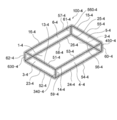
- FIG. 4 shows a glass 100-4 which is an example of the glass of the third embodiment according to the present technology.
- FIG. 4 is a perspective view of the glass 100-4.
- the glass 100-4 has a third surface 3 connecting the first surface 1-4 and the second surface 2-4 facing each other, and the first surface 1-4 and the second surface 2-4. And at least -4.
- Each of the first surface 1-4, the second surface 2-4 and the third surface 3-4 contains a metal atom.
- a first side formed of the first surface 1-4 and the third surface 3-4 with respect to the average concentration of metal atoms of each of the first surface 1-4 and the third surface 3-4 The average concentration of metal atoms in region 51-4 is small.
- the first side area 51-4 is an area including the first side 13-4.
- the average concentration of metal atoms in the second side region 52-4 formed of the second surface 2-4 and the third surface 3-4 is the same as that of the second surface 2-4 and the third surface. It is smaller than the average concentration of each metal atom of the surface 3-4 of 3.
- the second side area 52-4 is an area including the second side 23-4.
- the glass 100-4 has a fourth surface 4-4 connecting the first surface 1-4 and the second surface 2-4, and the fourth surface 4-4 contains metal atoms.
- a third side formed of the first surface 1-4 and the fourth surface 4-4 with respect to the average concentration of metal atoms in each of the first surface 1-4 and the fourth surface 4-4 The average concentration of metal atoms in the region 53-4 is small, and the second surface 2-4 and the fourth surface have the average concentrations of metal atoms in the second surface 2-4 and the fourth surface 4-4, respectively.
- the average concentration of metal atoms in the fourth side region 54-4 formed from the face 4-4 is small.
- the third side area 53-4 is an area including a third side 14-4 (also referred to as a third chamfered portion 14-4).
- the fourth side area 54-4 is an area including a fourth side 24-4 (also referred to as a fourth chamfered portion 24-4).
- the glass 100-4 has a fifth surface 5-4 connecting the first surface 1-4 and the second surface 2-4, and the fifth surface 5-4 contains metal atoms.
- a fifth side formed of the first surface 1-4 and the fifth surface 5-4 with respect to the average concentration of metal atoms in each of the first surface 1-4 and the fifth surface 5-4 The average concentration of metal atoms in the region 55-4 is small, and the second surface 2-4 and the fifth surface are lower than the average concentration of metal atoms in the second surface 2-4 and the fifth surface 5-4, respectively.
- the average concentration of metal atoms in the sixth side region 56-4 formed from the face 5-4 and the surface 5-4 is small.
- the fifth side area 55-4 is an area including the fifth side 15-4.
- the sixth side area 56-4 is an area including the sixth side 25-4.
- the glass 100-4 has a sixth surface 6-4 connecting the first surface 1-4 and the second surface 2-4, and the sixth surface 6-4 contains metal atoms.
- a seventh side formed of the first surface 1-4 and the sixth surface 6-4 with respect to the average concentration of metal atoms in each of the first surface 1-4 and the sixth surface 6-4
- the average concentration of metal atoms in the region 57-4 is small, and the second surface 2-4 and the sixth surface are lower than the average concentration of metal atoms in the second surface 2-4 and the sixth surface 6-4, respectively.
- the seventh side area 57-4 is an area including a seventh side 16-4 (also referred to as a seventh chamfered portion 16-4).
- the eighth side area 58-4 is an area including an eighth side 26-4 (also referred to as an eighth chamfered portion 26-4).
- the average concentration of metal atoms in the ninth side region 59-4 formed of the third surface 3-4 and the fourth surface 4-4 is the third surface 3-4 and the third surface
- the average concentration of metal atoms in the tenth side region 60-4 formed of the fourth surface 4-4 and the fifth surface 5-4 which is smaller than the average concentration of the metal atoms of the four surfaces 4-4.
- the concentration is smaller than the average concentration of metal atoms of each of the fourth surface 4-4 and the fifth surface 5-4, and is formed of the fifth surface 5-4 and the sixth surface 6-4.
- the average concentration of metal atoms in the eleventh side region 61-4 is smaller than the average concentration of metal atoms in each of the fifth surface 5-4 and the sixth surface 6-4, and further, the sixth surface 6-
- the average concentration of metal atoms in the twelfth side region 62-4 formed of the fourth and third faces 3-4 is the same as that of each of the sixth face 6-4 and the third face 3-4. Smaller than the average concentration of the genus atoms.
- the ninth side area 59-4 is an area including the ninth side 340-4.
- the tenth side region 60-4 is a region including the tenth side 450-4.
- the eleventh side area 61-4 is an area including the eleventh side 560-4.
- the twelfth side area 62-4 is an area including the twelfth side 630-4.
- the third side area 53-4, the fourth side area 54-4, the seventh side area 57-4 and the eighth side area 58-4 have a chamfered shape. Furthermore, at least one of the first side area 51-4, the second side area 52-4, the fifth side area 55-4, and the sixth side area 56-4 may have a chamfered shape.
- the chamfered shape will be described in detail below with reference to FIGS. 5 and 6.
- FIG. 5 is a cross-sectional view of a glass 100-5 having a C-chamfered shape.
- the glass 100-5 includes a first surface (upper surface) 1-5, a second surface (lower surface) 2-5, a first surface (upper surface) 1-5 and a second surface (lower surface) 2-
- a fifth surface (end surface) 4-5 connecting the fifth and a sixth surface (end surface) 6-5 are provided.
- a third side region 53-5 is formed from the first surface 1-5 and the fourth surface 4-5, and the second surface 2-5 and the fourth surface 4-5 And a fourth side region 54-5 is formed, and a first side 1-5 and a sixth side 6-5 form a seventh side region 57-5, and a second side 2-5 and a An eighth side region 58-5 is formed from the surface 4-5 of six.
- the third side region 53-5 includes the third side 14-5, the fourth side region 54-5 includes the fourth side 24-5, and the seventh side region 57-5 includes the seventh side 16-5. including.
- the eighth side area 58-5 includes a C-chamfered Q-5.
- the C-chamfered width P-5 of the C-chamfered Q-5 may be optional, a C-chamfered shape having a width P-5 within a range where the influence of internal stress (tensile stress) can reach is preferable. In the case of a chamfering width larger than that, it is preferable not to reduce the concentration of metal atoms in the surface, by regarding the C surface as a surface.
- the thickness of the glass 100-5 that is, the length (the length in the vertical direction in FIG. 5) of the fourth surface (end surface) 4-5 and the sixth surface (end surface) 6-5 is about 700 ⁇ m
- the width P-5 should be less than 200 ⁇ m.
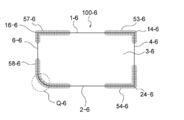
- FIG. 6 is a cross-sectional view of a glass 100-6 having an R-chamfered shape.
- the glass 100-6 has a first surface (upper surface) 1-6, a second surface (lower surface) 2-6, a first surface (upper surface) 1-6 and a second surface (lower surface) 2- It is composed of a fourth surface (end surface) 4-6 connecting the 6 and a sixth surface (end surface) 6-6.
- a third side region 53-6 is formed from the first surface 1-6 and the fourth surface 4-6, and the second surface 2-6 and the fourth surface 4-6 are formed.
- a fourth side region 54-6 is formed, and a first side 1-6 and a sixth side 6-6 form a seventh side region 57-6, and the second side 2-6 and the An eighth side region 58-6 is formed from the faces 4-6 of six.
- the third side region 53-6 includes the third side 14-6
- the fourth side region 54-6 includes the fourth side 24-6,
- the seventh side region 57-6 includes the seventh side 16-6. including.
- the eighth side area 58-6 includes an R-chamfered Q-6.
- the R-chamfered width (radius) of the R-chamfered Q-6 may be optional, an R-chamfered shape having a width (radius) within a range where the influence of internal stress (tensile stress) can reach is preferable. In the case of a chamfering width (radius) larger than that, it is preferable not to reduce the concentration of metal atoms in the surface by regarding the R surface as a surface.
- the thickness of the glass 100-6 that is, the length (the length in the vertical direction in FIG. 6) of the fourth surface (end surface) 4-6 and the sixth surface (end surface) 6-6 is about 700 ⁇ m
- the radius of the R-chamfer should be less than 200 ⁇ m.
- the glass of the fourth embodiment according to the present technology has the same configuration as that of the glass of the first embodiment according to the present technology described above, and further includes a first surface and a second surface, and Of the first side region and the third side region formed of the first surface and the fourth surface, the fourth surface containing the metal atoms, It is glass in which the average concentration of metal atoms in the top portion formed of the first side region and the third side region is smaller than the average concentration of metal atoms.
- the average concentration of metal atoms in each of the fourth side regions formed of the second side region and the second surface and the fourth surface may be small.
- FIG. 7 shows a glass 100-7 which is an example of the glass of the fourth embodiment according to the present technology.
- FIG. 7 is a perspective view of the glass 100-7.
- the glass 100-7 is a third surface 3 connecting the first surface 1-7 and the second surface 2-7 facing each other, and the first surface 1-7 and the second surface 2-7 And at least -7.
- Each of the first surface 1-7, the second surface 2-7 and the third surface 3-7 contains a metal atom.
- a first side formed of the first surface 1-7 and the third surface 3-7 with respect to the average concentration of metal atoms in each of the first surface 1-7 and the third surface 3-7 The average concentration of metal atoms in region 51-7 is small.
- the first side area 51-7 is an area including the first side 13-7.
- the average concentration of metal atoms in the second side region 52-7 formed of the second surface 2-7 and the third surface 3-7 is the same as the second surface 2-7 and the second surface 2-7. It is smaller than the average concentration of each metal atom of the surface 3-7 of 3.
- the second side area 52-7 is an area including the second side 23-7.
- the glass 100-7 has a fourth surface 4-7 connecting the first surface 1-7 and the second surface 2-7, and the fourth surface 4-7 contains metal atoms.
- the average concentration of metal atoms in the region 53-7 is small, and the second surface 2-7 and the fourth surface are different from the average concentrations of metal atoms in the second surface 2-7 and the fourth surface 4-7
- the third side area 53-7 is an area including the third side 14-7.
- the fourth side area 54-7 is an area including the fourth side 24-7.
- the glass 100-7 has a fifth surface 5-7 connecting the first surface 1-7 and the second surface 2-7, and the fifth surface 5-7 contains metal atoms.
- a fifth side formed of the first surface 1-7 and the fifth surface 5-7 with respect to the average concentration of metal atoms in each of the first surface 1-7 and the fifth surface 5-7.
- the average concentration of metal atoms in the region 55-7 is small, and the second surface 2-7 and the fifth surface are lower than the average concentration of metal atoms in the second surface 2-7 and the fifth surface 5-7, respectively.
- the fifth side area 55-7 is an area including the fifth side 15-7.
- the sixth side area 56-7 is an area including the sixth side 25-7.
- the glass 100-7 has a sixth surface 6-7 connecting the first surface 1-7 and the second surface 2-7, and the sixth surface 6-7 contains metal atoms.
- a seventh side formed of the first surface 1-7 and the sixth surface 6-7 with respect to the average concentration of metal atoms in each of the first surface 1-7 and the sixth surface 6-7
- the average concentration of metal atoms in the region 57-7 is small, and the second surface 2-7 and the sixth surface are lower than the average concentration of metal atoms in the second surface 2-7 and the sixth surface 6-7, respectively.
- the seventh side area 57-7 is an area including the seventh side 16-7.
- the eighth side area 58-7 is an area including the eighth side 26-7.
- the average concentration of metal atoms in the ninth side region 59-7 formed of the third surface 3-7 and the fourth surface 4-7 in the glass 100-7 is the same as the third surface 3-7 and the third surface Average of metal atoms in a tenth side region 60-7 formed of the fourth surface 4-7 and the fifth surface 5-7, which is smaller than the average concentration of the metal atoms of the four surfaces 4-7
- the concentration is smaller than the average concentration of metal atoms in each of the fourth surface 5-7 and the fifth surface 5-7, and is formed of the fifth surface 5-7 and the sixth surface 6-7.
- the average concentration of metal atoms in the eleventh side region 61-7 is smaller than the average concentration of metal atoms in each of the fifth surface 5-7 and the sixth surface 6-7, and further, the sixth surface 6-
- the average concentration of metal atoms in the twelfth side region 62-7 formed of the seventh and third faces 3-7 is the same as that of each of the sixth face 6-7 and the third face 3-7. Smaller than the average concentration of the genus atoms.
- the ninth side area 59-7 is an area including the ninth side 340-7.
- the tenth side region 60-7 is a region including the tenth side 450-7.
- the eleventh side area 61-7 is an area including the eleventh side 560-7.
- the twelfth side area 62-7 is an area including the twelfth side 630-7.
- the average concentration of the metal atoms in the top portion 1314-7 formed of the first side region 51-7 and the third side region 53-7 is the first side region 51-7 and the third side. It is smaller than the average concentration of each metal atom in region 53-7.
- the vicinity of the apex 1314-7 and the apex 1314-7 is surrounded by the first surface 1-7, the third surface 3-7 and the fourth surface 4-7, and the internal stress tends to be high. Therefore, it may be effective to reduce the average density of the apexes 1324-7.
- the vertex portion 1314-7 may be formed of the first side area 51-7, the third side area 53-7, and the ninth side area 59-7.
- the average concentration of metal atoms in the top portion 2234-7 formed of the first side region 52-7 and the fourth side region 54-7 is the second side region 52-7 and the fourth side. It is smaller than the average concentration of each metal atom in the region 54-7.
- the vicinity of the apexes 2324-7 and the apexes 2234-7 is surrounded by the second surface 2-7, the third surface 3-7, and the fourth surface 4-7, and the internal stress tends to be high. Therefore, it may be effective to reduce the average density of the apexes 2234-7.
- the apex portion 2234-7 may be formed of the second side area 52-7, the fourth side area 54-7, and the ninth side area 59-7.
- the average concentration of the metal atoms of the vertex portion 1415-7 formed of the third side region 53-7 and the fifth side region 55-7 is the third side region 53-7 and the fifth side. Small relative to the average concentration of each metal atom in region 55-7.
- the vicinity of the apexes 1415-7 and 1415-7 is surrounded by the first surface 1-7, the fourth surface 4-7, and the fifth surface 5-7, and the internal stress tends to be high. Therefore, it may be effective to reduce the average density of the apexes 1415-7.
- the vertex 1415-7 may be formed of the third side area 53-7, the fifth side area 55-7, and the tenth side area 60-7.
- the average concentration of the metal atoms of the apex portion 2425-7 formed of the fourth side region 54-7 and the sixth side region 56-7 is the fourth side region 54-7 and the sixth side Small relative to the average concentration of each metal atom in region 56-7.
- the vicinity of the apexes 2425-7 and 2425-7 is surrounded by the second surface 2-7, the fourth surface 4-7 and the fifth surface 5-7, and the internal stress tends to be high. Therefore, it may be effective to reduce the average density of the apexes 2425-7.
- the apex portion 2425-7 may be formed of the fourth side area 54-7, the sixth side area 56-7, and the tenth side area 60-7.
- the average concentration of metal atoms in the top portion 1516-7 formed of the fifth side region 55-7 and the seventh side region 57-7 is the fifth side region 55-7 and the seventh side. Small relative to the average concentration of each metal atom in region 57-7.
- the vicinity of the apex 1516-7 and the apex 1516-7 is surrounded by the first surface 1-7, the fifth surface 5-7 and the sixth surface 6-7, and the internal stress tends to be high. Therefore, it may be effective to reduce the average density of the apexes 1516-7.
- the vertex 1516-7 may be formed of the fifth side area 55-7, the seventh side area 57-7, and the eleventh side area 61-7.
- the average concentration of the metal atoms of the apex portion 2526-7 formed of the sixth side region 56-7 and the eighth side region 58-7 is the sixth side region 56-7 and the eighth side. Small relative to the average concentration of each metal atom in region 58-7.
- the vicinity of the apexes 2526-7 and the apexes 2526-7 is surrounded by the second face 2-7, the fifth face 5-7 and the sixth face 6-7, and the internal stress tends to be high. Therefore, it may be effective to reduce the average density of the apexes 2526-7.
- the apex portion 2526-7 may be formed of the sixth side area 56-7, the eighth side area 58-7, and the eleventh side area 61-7.
- the average concentration of the metal atoms of the vertex 1316-7 formed of the seventh side region 57-7 and the first side region 51-7 is the seventh side region 57-7 and the first side. It is smaller than the average concentration of metal atoms in each of the regions 51-7.
- the vicinity of the apexes 1316-7 and 1316-7 is surrounded by the first surface 1-7, the sixth surface 6-7 and the third surface 3-7, and the internal stress tends to be high. Therefore, it may be effective to reduce the average density of the apex 1316-7.
- the vertex 1316-7 may be formed of a seventh side area 57-7, a first side area 51-7, and a twelfth side area 62-7.
- the average concentration of the metal atoms of the apex portion 2326-7 formed of the eighth side region 58-7 and the second side region 52-7 is the eighth side region 58-7 and the second side Small relative to the average concentration of each metal atom in region 52-7.
- the vicinity of the apex 2326-7 and the apex 2326-7 is surrounded by the second surface 2-7, the sixth surface 6-7 and the third surface 3-7, and the internal stress tends to be high. Therefore, it may be effective to reduce the average density of the apex 2326-7.
- the apex 2326-7 may be formed of an eighth side area 58-7, a second side area 52-7, and a twelfth side area 62-7.
- the case (example of a case) of the fifth embodiment according to the present technology is a case provided with the glass of any of the glasses according to the first to fourth embodiments according to the present technology.
- the casing of the fifth embodiment according to the present technology is provided with the above-described glass having excellent strength, so that the user can robustly handle the casing of the fifth embodiment according to the present technology. .
- the electronic device (example of the electronic device) of the sixth embodiment according to the present technology is an electronic device provided with the glass of any of the glasses according to the first to fourth embodiments of the present technology.
- the electronic device according to the sixth embodiment of the present technology includes the above-described glass having excellent strength, so that the user can robustly handle the electronic device according to the fifth embodiment according to the present technology. .
- the electronic device of the sixth embodiment according to the present technology includes, for example, the glass of any of the glasses of the first to fourth embodiments according to the present technology as a cover glass, and further, 2 facing each other
- An electronic device comprising: a housing having two main surfaces (front and back surfaces) and four side surfaces (peripheral surfaces) connected to the two main surfaces; and a display, wherein a cover glass is provided to cover the display is there.
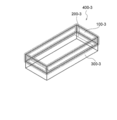
- FIG. 3 shows an electronic device 400-3 which is an example of the electronic device according to the sixth embodiment of the present technology.
- FIG. 3 is a perspective view of the electronic device 400-3.
- Electronic device 400-3 includes glass 100-3, display 200-3, and housing 300-3. As shown in FIG. 3, in the electronic device 400-3, the display 200-3 is disposed on the upper portion (upper direction in FIG. 3) of the housing 300-3 and glass is provided to cover the display 200-3 100-3 is arranged as a cover glass.
- FIG. 17 is a diagram showing an example of use of the electronic device according to the sixth embodiment of the present technology as a device including an image sensor.
- the electronic device according to the sixth embodiment described above can be used, for example, in various cases for sensing light such as visible light, infrared light, ultraviolet light, and X-rays as described below. That is, as shown in FIG. 17, the electronic device according to the sixth embodiment of the present technology has, for example, the field of appreciation for capturing an image to be used for appreciation, the field of traffic, the field of home appliances, It can be used as an apparatus used in the field of health care, the field of security, the field of beauty, the field of sports, the field of agriculture, etc.
- the electronic device in the field of viewing, is, for example, an image provided for viewing such as a digital camera, a smartphone, or a mobile phone with a camera function. It can be used as an apparatus for photographing.
- the electronic device is, for example, in front of, behind, around, in a car, for safe driving such as automatic stop, recognition of driver's condition, etc. It can be used as a device provided for traffic, such as an on-vehicle sensor for photographing etc., a monitoring camera for monitoring a traveling vehicle or a road, a distance measuring sensor for distance measurement between vehicles, etc.
- the electronic device is, for example, a television receiver, a refrigerator, an air conditioner, and the like to capture a gesture of a user and perform device operation according to the gesture. It can be used as a device provided to home appliances such as
- the electronic device is used for medical and healthcare applications such as endoscopes and devices that perform blood vessel imaging by receiving infrared light, for example. It can be used as a device to be provided.
- the electronic device may be used as an apparatus provided for security, for example, a surveillance camera for crime prevention or a camera for person authentication. it can.
- the electronic device of the sixth embodiment according to the present technology is used, for example, as an apparatus provided for beauty use, such as a skin measuring instrument for photographing the skin and a microscope for photographing the scalp. can do.
- the electronic device according to the sixth embodiment of the present technology can be used as a device provided for sports, for example, an action camera or a wearable camera for sports use, etc. .
- the electronic device in the field of agriculture, can be used, for example, as an apparatus used for agriculture, such as a camera for monitoring the condition of fields and crops. .
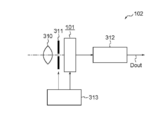
- FIG. 18 shows a schematic configuration of the electronic device 102 (camera) as an example.
- the electronic device 102 is, for example, a video camera capable of shooting still images or moving images, and drives the solid-state imaging device 101, an optical system (optical lens) 310, a shutter device 311, the solid-state imaging device 101, and the shutter device 311. And a signal processing unit 312.
- the optical system 310 guides image light (incident light) from a subject to the pixel unit 101 a of the solid-state imaging device 101.
- the optical system 310 may be composed of a plurality of optical lenses.
- the shutter device 311 controls a light irradiation period and a light shielding period to the solid-state imaging device 101.
- the drive unit 313 controls the transfer operation of the solid-state imaging device 101 and the shutter operation of the shutter device 311.
- the signal processing unit 312 performs various types of signal processing on the signal output from the solid-state imaging device 101.
- the video signal Dout after signal processing is stored in a storage medium such as a memory or output to a monitor or the like.
- the present technology can also have the following configurations.
- [1] At least a first surface and a second surface facing each other, and a third surface connecting the first surface and the second surface,
- Each of the first surface, the second surface and the third surface contains a metal atom, With respect to the average concentration of the metal atoms in each of the first surface and the third surface, Glass having a low average concentration of the metal atoms in a first side region formed of the first surface and the third surface.
- the glass according to [1], wherein the first side area is a chamfered shape.
- [3] The glass according to [2], wherein the chamfered shape is a C-chamfered shape.
- the fourth surface contains the metal atom;
- the first side region and the third side region with respect to the average concentration of the metal atoms of the third side region formed of the first side region and the first surface and the fourth surface The glass according to any one of [1] to [8], wherein the average concentration of the metal atoms in the top portion formed by the two is small.
- the fourth surface contains the metal atom; Average concentrations of the metal atoms of the second side region formed of the second surface and the third surface, and the fourth side region formed of the second surface and the fourth surface.
- the glass according to any one of [1] to [10], wherein at least one of the first surface and the second surface is a plane.
- a housing comprising the glass according to any one of [1] to [12].
- Electronic equipment provided with the glass as described in any one of [1] to [12].
Landscapes
- Chemical & Material Sciences (AREA)
- Engineering & Computer Science (AREA)
- Geochemistry & Mineralogy (AREA)
- Life Sciences & Earth Sciences (AREA)
- Chemical Kinetics & Catalysis (AREA)
- General Chemical & Material Sciences (AREA)
- Materials Engineering (AREA)
- Organic Chemistry (AREA)
- Mechanical Engineering (AREA)
- Microelectronics & Electronic Packaging (AREA)
- Physics & Mathematics (AREA)
- General Physics & Mathematics (AREA)
- Theoretical Computer Science (AREA)
- Surface Treatment Of Glass (AREA)
- Devices For Indicating Variable Information By Combining Individual Elements (AREA)
Abstract
強度が向上したガラスを提供すること。 互いに対向する第1の面及び第2の面と、該第1の面と該第2の面とを接続する第3の面とを少なくとも備え、該第1の面、該第2の面及び該第3の面のそれぞれが金属原子を含有し、該第1の面及び該第3の面のそれぞれの該金属原子の平均濃度に対して、該第1の面と該第3の面とから形成される第1辺領域の該金属原子の平均濃度が小さい、ガラスを提供する。
Description
本技術は、ガラス、筐体及び電子機器に関する。
益々、市場に普及する傾向がある、スマートフォン、デジタルカメラ、PDA(携帯情報端末:Personal Data Assistance)、タッチパネルディスプレイ等のデバイスには、ガラスが用いられている。
例えば、強化ガラス及び強化ガラスの製造方法に関する技術が提案されている(特許文献1~3を参照)。
しかしながら、特許文献1~3で提案された技術では、ガラスの強度の更なる向上が図れないおそれがある。
そこで、本技術は、このような状況に鑑みてなされたものであり、強度が向上したガラス、及びそのガラスを備える筐体及び電子機器を提供することを主目的とする。
本発明者は、上述の目的を解決するために鋭意研究を行った結果、ガラスの強度を飛躍的に向上させることに成功し、本技術を完成するに至った。
すなわち、本技術では、互いに対向する第1の面及び第2の面と、該第1の面と該第2の面とを接続する第3の面とを少なくとも備え、該第1の面、該第2の面及び該第3の面のそれぞれが金属原子を含有し、該第1の面及び該第3の面のそれぞれの該金属原子の平均濃度に対して、該第1の面と該第3の面とから形成される第1辺領域の該金属原子の平均濃度が小さい、ガラスを提供する。
本技術に係るガラスにおいて、前記第1辺領域が面取り形状でよく、前記第1辺領域の前記面取り形状がC面取り形状でもよく、R面取り形状でもよい。
本技術に係るガラスにおいて、前記第2の面と前記第3の面とから形成される第2辺領域の前記金属原子の平均濃度が、前記第2の面及び前記第3の面のそれぞれの前記金属原子の平均濃度よりも小さくてもよい。
本技術に係るガラスにおいて、前記第2辺領域が面取り形状でよく、前記第2辺領域の前記面取り形状がC面取り形状でもよく、R面取り形状でもよい。
本技術に係るガラスが、更に、前記第1の面と前記第2の面とを接続する第4の面を少なくとも備えてよく、本技術に係るガラスにおいて、該第4の面が前記金属原子を含有し、前記第1辺領域及び前記第1の面と該第4の面とから形成される第3辺領域のそれぞれの前記金属原子の平均濃度に対して、前記第1辺領域と該第3辺領域とから形成される頂点部の前記金属原子の平均濃度が小さくてもよい。
本技術に係るガラスが、更に、前記第1の面と前記第2の面とを接続する第4の面を少なくとも備えてよく、本技術に係るガラスにおいて、該第4の面が前記金属原子を含有し、前記第2の面と前記第3の面とから形成される第2辺領域及び前記第2の面と該第4の面とから形成される第4辺領域のそれぞれの前記金属原子の平均濃度に対して、該第2辺領域と該第4辺領域とから形成される頂点部の前記金属原子の平均濃度が小さくてもよい。
本技術に係るガラスにおいて、前記第1の面及び前記第2の面の少なくとも一方の面が平面でもよい。
本技術に係るガラスにおいて、前記第1の面及び前記第2の面の少なくとも一方の面が曲面でもよい。
本技術に係るガラスにおいて、前記第1の面及び前記第2の面の少なくとも一方の面が曲面でもよい。
また、本技術では、本技術に係るガラスを備える筐体を提供する。
さらに、本技術では、本技術に係るガラスを備える電子機器を提供する。
さらに、本技術では、本技術に係るガラスを備える電子機器を提供する。
本技術によれば、ガラスの強度を更に向上させることができる。なお、ここに記載された効果は、必ずしも限定されるものではなく、本開示中に記載されたいずれかの効果であってもよい。
以下、本技術を実施するための好適な形態について説明する。以下に説明する実施形態は、本技術の代表的な実施形態の一例を示したものであり、これにより本技術の範囲が狭く解釈されることはない。
なお、説明は以下の順序で行う。
1.本技術の概要
2.第1の実施形態(ガラスの例1)
3.第2の実施形態(ガラスの例2)
4.第3の実施形態(ガラスの例3)
5.第4の実施形態(ガラスの例4)
6.第5の実施形態(筐体の例)
7.第6の実施形態(電子機器の例)
8.本技術を適用した電子機器の使用例
1.本技術の概要
2.第1の実施形態(ガラスの例1)
3.第2の実施形態(ガラスの例2)
4.第3の実施形態(ガラスの例3)
5.第4の実施形態(ガラスの例4)
6.第5の実施形態(筐体の例)
7.第6の実施形態(電子機器の例)
8.本技術を適用した電子機器の使用例
<1.本技術の概要>
まず、本技術の概要について説明をする。
まず、本技術の概要について説明をする。
使用環境下で、モバイル機器が落下することにより、表面ガラスが割れる場合がある。一般的な解決手段として圧縮ガラスにより強化する方法がある。圧縮ガラスは表面に圧縮応力状態を作り、引っ張り応力で発生する割れのマージンを広げられたガラスである。製法としてはガラスを槽につけてイオン交換により表面からサイズの大きい原子を注入する化学強化の手法やガラス成型時に急速に冷却して外表面に圧縮の残留応力を残す手法が代表的である。これらの強化方法は良い成果を残しているが、さらに良い成果を出す強化方法は依然として求められている。こうした従来の技術の問題として、ガラスのエッジ部分で強化層の応力により内部の応力が増大し粉砕され破片が細かくなり危険性が上がる問題や強度が落ちる問題がある。そのため、たとえば端部にRをつけたり、端面全体の強化を強くしたり、逆に端面全体の強化を弱くしたりして改善する技術がある。
しかしながら、単純に端面全体の強化を強くする技術ではガラスの辺部分や角部分の内部応力が増大して粉砕され破片が細かくなってしまうことがある。逆に端面全体の強化を弱くする技術ではガラスの強化すべき面部分の応力が低下して強化が弱くなることがある。
本技術では、ガラス(化学強化ガラスでもよい。)においてガラスの辺部分(辺領域)や角部分(頂点部)の破砕を低減しつつ面の強化応力を保つガラスを提供する。ガラスの面と面がなす辺領域(辺でもよい。)や、辺領域同士で形成される頂点部(辺と辺とがなす頂点部でもよい。)のイオン交換量を面の表面と比較して減らして面の強度を保ったままイオン交換により発生する角部の内部応力を低減し粉砕を低減する。
<2.第1の実施形態(ガラスの例1)>
本技術に係る第1の実施形態のガラスは、互いに対向する第1の面及び第2の面と、第1の面と第2の面とを接続する第3の面とを少なくとも備え、第1の面、第2の面及び該第3の面のそれぞれが金属原子を含有し、第1の面及び第3の面のそれぞれの該金属原子の平均濃度に対して、第1の面と第3の面とから形成される第1辺領域の該金属原子の平均濃度が小さい、ガラスである。
本技術に係る第1の実施形態のガラスは、互いに対向する第1の面及び第2の面と、第1の面と第2の面とを接続する第3の面とを少なくとも備え、第1の面、第2の面及び該第3の面のそれぞれが金属原子を含有し、第1の面及び第3の面のそれぞれの該金属原子の平均濃度に対して、第1の面と第3の面とから形成される第1辺領域の該金属原子の平均濃度が小さい、ガラスである。
本技術に係る第1の実施形態のガラスは、第2の面と第3の面とから形成される第2辺領域の前記金属原子の平均濃度が、第2の面及び第3の面のそれぞれの金属原子の平均濃度よりも小さくてもよい。
本技術に係る第1の実施形態のガラスは、第1の面と第2の面とを接続する第4の面を備えてもよく、第4の面は金属原子を含有してよい。第1の面及び第4の面のそれぞれの金属原子の平均濃度に対して、第1の面と第4の面とから形成される第3辺領域の金属原子の平均濃度は小さく、第2の面及び第4の面のそれぞれの金属原子の平均濃度に対して、第2の面と第4の面とから形成される第4辺領域の金属原子の平均濃度は小さくてよい。
本技術に係る第1の実施形態のガラスは、第1の面と第2の面とを接続する第5の面を備えてよく、第5の面は金属原子を含有してよい。第1の面及び第5の面のそれぞれの金属原子の平均濃度に対して、第1の面と第5の面とから形成される第5辺領域の金属原子の平均濃度は小さくてよく、第2の面及び第5の面のそれぞれの金属原子の平均濃度に対して、第2の面と第5の面とから形成される第6辺領域56-1の金属原子の平均濃度も小さくてよい。
本技術に係る第1の実施形態のガラスは、第1の面と第2の面とを接続する第6の面を備えてよく、第6の面は金属原子を含有してよい。第1の面及び第6の面のそれぞれの金属原子の平均濃度に対して、第1の面と第6の面とから形成される第7辺領域の金属原子の平均濃度は小さくてよく、第2の面及び第6の面のそれぞれの金属原子の平均濃度に対して、第2の面と第6の面6-1とから形成される第8辺領域58-1の金属原子の平均濃度も小さくてよい。
本技術に係る第1の実施形態のガラスにおいて、第3の面と第4の面とから形成される第9辺領域の金属原子の平均濃度は、第3の面及び第4の面のそれぞれの金属原子の平均濃度よりも小さくてよく、第4の面と第5の面とから形成される第10辺領域の金属原子の平均濃度は、第4の面及び第5の面のそれぞれの金属原子の平均濃度よりも小さくてよく、第5の面と第6の面とから形成される第11辺領域の金属原子の平均濃度は、第5の面及び第6の面のそれぞれの金属原子の平均濃度よりも小さくてよく、さらに、第6の面と第3の面とから形成される第12辺領域の金属原子の平均濃度は、第6の面及び第3の面のそれぞれの金属原子の平均濃度よりも小さくてよい。
第1辺領域~第12辺領域は、内部応力(引張応力)の影響が届く範囲内であることが好適であるが、これに限定されなくてもよい。内部応力(引張応力)の影響が届く範囲内とは、例えば、ガラスの厚みが700μm程度の場合は、ガラス表面から数μm~100μmである。
金属原子は、金属原子がイオン化した状態、すなわち、金属イオンを含む概念である。金属原子は、イオン交換法によって、本技術に係る第1の実施形態のガラスに含有させることができる。イオン交換法は、例えば、イオン交換前にガラスに含まれる小さなイオン半径(原子半径)のイオンを大きなイオン半径(原子半径)のイオンに置換することをいう。例えば、イオン交換前にガラスに含まれるLiイオンを、Naイオンに置換したり、イオン交換前にガラスに含まれるNaイオンを、Kイオンに置換することをいう。
本技術に係る第1の実施形態のガラスの形状は、任意の形状でよい。例えば、本技術に係る第1の実施形態のガラスの形状は、六面体でもよいし、多面体でもよい。
図1に、本技術に係る第1の実施形態のガラスの一例であるガラス100(図1中では100-1である。)を示す。図1は、六面体のガラス100-1の斜視図である。
ガラス100-1は、互いに対向する第1の面1-1及び第2の面2-1と、第1の面1-1と第2の面2-1とを接続する第3の面3-1とを少なくとも備える。第1の面1-1、第2の面2-1及び第3の面3-1のそれぞれが金属原子を含有する。第1の面1-1及び第3の面3-1のそれぞれの金属原子の平均濃度に対して、第1の面1-1と第3の面3-1とから形成される第1辺領域51-1の金属原子の平均濃度は小さい。第1辺領域51-1は、第1辺13-1を含む領域である。
ガラス100-1において、第2の面2-1と第3の面3-1とから形成される第2辺領域52-1の金属原子の平均濃度が、第2の面2-1及び第3の面3-1のそれぞれの金属原子の平均濃度よりも小さい。第2辺領域52-1は、第2辺23-1を含む領域である。
ガラス100-1は、第1の面1-1と第2の面2-1とを接続する第4の面4-1を備え、第4の面4-1は金属原子を含有する。第1の面1-1及び第4の面4-1のそれぞれの金属原子の平均濃度に対して、第1の面1-1と第4の面4-1とから形成される第3辺領域53-1の金属原子の平均濃度は小さく、第2の面2-1及び第4の面4-1のそれぞれの金属原子の平均濃度に対して、第2の面2-1と第4の面4-1とから形成される第4辺領域54-1の金属原子の平均濃度は小さい。第3辺領域53-1は、第3辺14-1を含む領域である。第4辺領域54-1は、第4辺24-1を含む領域である。
ガラス100-1は、第1の面1-1と第2の面2-1とを接続する第5の面5-1を備え、第5の面5-1は金属原子を含有する。第1の面1-1及び第5の面5-1のそれぞれの金属原子の平均濃度に対して、第1の面1-1と第5の面5-1とから形成される第5辺領域55-1の金属原子の平均濃度は小さく、第2の面2-1及び第5の面5-1のそれぞれの金属原子の平均濃度に対して、第2の面2-1と第5の面5-1とから形成される第6辺領域56-1の金属原子の平均濃度は小さい。第5辺領域55-1は、第5辺15-1を含む領域である。第6辺領域56-1は、第6辺25-1を含む領域である。
ガラス100-1は、第1の面1-1と第2の面2-1とを接続する第6の面6-1を備え、第6の面6-1は金属原子を含有する。第1の面1-1及び第6の面6-1のそれぞれの金属原子の平均濃度に対して、第1の面1-1と第6の面6-1とから形成される第7辺領域57-1の金属原子の平均濃度は小さく、第2の面2-1及び第6の面6-1のそれぞれの金属原子の平均濃度に対して、第2の面2-1と第6の面6-1とから形成される第8辺領域58-1の金属原子の平均濃度は小さい。第7辺領域57-1は、第7辺16-1を含む領域である。第8辺領域58-1は、第8辺26-1を含む領域である。
ガラス100-1において、第3の面3-1と第4の面4-1とから形成される第9辺領域59-1の金属原子の平均濃度は、第3の面3-1及び第4の面4-1のそれぞれの金属原子の平均濃度よりも小さく、第4の面4-1と第5の面5-1とから形成される第10辺領域60-1の金属原子の平均濃度は、第4の面4-1及び第5の面5-1のそれぞれの金属原子の平均濃度よりも小さく、第5の面5-1と第6の面6-1とから形成される第11辺領域61-1の金属原子の平均濃度は、第5の面5-1及び第6の面6-1のそれぞれの金属原子の平均濃度よりも小さく、さらに、第6の面6-1と第3の面3-1とから形成される第12辺領域62-1の金属原子の平均濃度は、第6の面6-1及び第3の面3-1のそれぞれの金属原子の平均濃度よりも小さい。第9辺領域59-1は、第9辺340-1を含む領域である。第10辺領域60-1は、第10辺450-1を含む領域である。第11辺領域61-1は、第11辺560-1を含む領域である。第12辺領域62-1は、第12辺630-1を含む領域である。
図14は、本技術に係る第1の実施形態のガラスの構成を説明するための図である。図14(a)は、ガラス100-14aの斜視図であり、図14(b)は、ガラス100-14aのQ-14a中の斜線部分R-14aを拡大断面視した図である。
図14(b)を参照すると、ガラス100-14bは、第1の面1-14b、第2の面2-14b、第1の面1-14bと第2の面2-14bとを接続する第5の面5-14b、及び未強化領域520-14bとから構成されている。第1の面1-14bには強化領域510-14b-1が形成され、第2の面2-14bには強化領域510-14b-2が形成され、第5の面5-14bには強化領域510-14b-3が形成されている。そして、第1の面1-14bと第5の面5-14bとから、強化低減領域500-14b-2が形成され、第2の面2-14bと第5の面5-14bとから、強化低減領域500-14b-1が形成されている。強化低減領域500-14b-2が第5辺領域に対応し、強化低減領域500-14b-1が第6辺領域に対応する。強化低減領域500-14b-1は、第2の面2-14bに沿った方向の幅1を有し、第5の面5-14bに沿った方向の幅2を有する。強化低減領域500-14b-2は、第5の面5-14bに沿った方向の幅3を有し、第1の面1-14bに沿った方向の幅4を有する。幅1~幅4のそれぞれは、互いに同じ長さでもよいし、異なった長さでもよい。
強化低減領域500-14b-1及び500-14b-2は、強化領域510-14b-1~3に比べて、イオン交換される原子半径が大きい金属原子(金属イオン)の量が少ない。ガラス100-14bに強化低減領域500-14b-1及び500-14b-2を設けることで、第1の面1-14bの強化応力(圧縮応力)P-14b-1、第2の面2-14bの強化応力(圧縮応力)P14-b-2、及び第5の面5-14bの面の強化応力(圧縮応力)P14b-3を保ったまま、第5辺領域及び第6辺領域(ガラス100-14bの角部)の内部応力(引張応力)を低減して、粉砕・破砕を防止することができる。
図15は、強化領域の金属原子の平均濃度に対する強化低減領域の金属原子の平均濃度の濃度比を0%~100%まで変化させたときの、内部応力(引張応力)(MPa)と強化低減領域の幅(μm)との関係を説明するための図である。強化低減領域の幅(μm)は図14(b)に示される幅1~幅4のどれか1つの幅に対応する。例えば、濃度比「0%」とは、強化低減域は、未強化領域の原子半径が大きい金属原子の平均濃度と同様に、原子半径が大きい金属原子の平均濃度は0mol%(イオン交換なし。)であることを示し、濃度比「20%」とは、強化領域の(原子半径が大きい)金属原子の平均濃度が10mol%であるとき、強化低減領域の原子半径が大きい金属原子の平均濃度は2mol%であることを示す。濃度比「100%」とは、強化低減領域が形成されていなく、強化領域のみが形成されていることを示す。
図15に示されるように、内部応力は低い方が良いが、濃度比0%~80%において、幅に最適値があることを確認することできる。
図16は、強化低減領域の幅(μm)に対する内部応力(引張応力)の分布を示す図である。図16(a)は、強化低減領域の幅が0μm(強化低減領域なし。)であるガラスの内部応力(引張応力)の分布を示す図であり、図16(b)は、強化低減領域の幅が150μmであるガラスの内部応力(引張応力)の分布を示す図であり、図16(c)は、強化低減領域の幅が300μmであるガラスの内部応力(引張応力)の分布を示す図である。強化低減領域の幅(μm)とは、ガラスの互いに対抗する第1の面及び第2の面、並びに、第1の面及び第2の面を接続する第3の面(端面)のうちのいずれか1つの面の表面からの長さ(距離)を意味し、例えば、図14(b)に示される幅1~4のいずれか1つの幅に対応する。強化領域の金属原子の平均濃度に対する強化低減領域の金属原子の平均濃度の濃度比は40%である。
図16に示されるように、強化低減領域がない場合(0μm)は2面の応力影響が重なって大きい内部応力が発生するが、強化低減領域を入れることにより、応力ピークが分散し、内部応力が低減する。更に強化層低減領域を広げると他エッジの強化層低減領域の応力ピーク同士が干渉して強い内部応力を生じる。これは、最適値があるメカニズムである。したがってエッジからの幅が応力の影響距離以上かつ他端の強化低減領域との距離が応力の影響距離以上離れていると効果的である。
図8は、金属イオン濃度とガラス表面からの距離との関係を説明するための図である。図8(a)は、ガラス100-8aを厚み方向に切断したときの断面図であり、図8(b)は、ガラス表面からの距離に対する金属イオン濃度を示すグラフである。図8(a)に示される矢印P-8a―1(破線)の方向の金属イオン濃度が、図8(b)に示される破線のグラフに対応し、図8(a)に示される矢印P-8a―2(実線)の方向の金属イオン濃度が、図8(b)に示される実線のグラフに対応する。図8(b)に示されるように、濃度比は40%である。
図8(a)を参照すると、ガラス100-8aは、第1の面1-8a、第2の面2-8a、第1の面1-8aと第2の面2-8aとを接続する第3の面3-8a、及び未強化領域520-8aとから構成されている。第1の面1-8aには強化領域510-8a-3が形成され、第2の面2-8aには強化領域510-8a-2が形成され、第3の面3-8aには強化領域510-8a-1が形成されている。そして、第1の面1-8aと第3の面3-8aとには、強化低減領域500-8a-1が形成され、第2の面2-8aと第3の面3-8aとには、強化低減領域500-8a-2が形成されている。強化低減領域500-8a-1が第1辺領域に対応し、強化低減領域500-8a-2が第2辺領域に対応する。図8から明らかなように、第1辺領域及び第2辺領域(強化低減領域)における金属原子の最表面の濃度を面(強化領域)に対して低くして金属原子の濃度を低くしてもよい。
図9は、金属イオン濃度とガラス表面からの距離との関係を説明するための図である。図9(a)は、ガラス100-9aを厚み方向に切断したときの断面図であり、図9(b)は、ガラス表面からの距離に対する金属イオン濃度を示すグラフである。図9(a)に示される矢印P-9a―1(破線)の方向の金属イオン濃度が、図9(b)に示される破線のグラフに対応し、図9(a)に示される矢印P-9a―2(実線)の方向の金属イオン濃度が、図9(b)に示される実線のグラフに対応する。図9(b)に示されるよう、表面からの距離比(深さの比)は、40%である。
図9(a)を参照すると、ガラス100-9aは、第1の面1-9a、第2の面2-9a、第1の面1-9aと第2の面2-9aとを接続する第3の面3-9a、及び未強化領域520-9aとから構成されている。第1の面1-9aには強化領域510-9a-4が形成され、第2の面2-9aには強化領域510-9a-3が形成され、第3の面3-9aには強化領域510-9a-1及び-2が形成されている。そして、第1の面1-9aと第3の面3-9aとには、強化低減領域500-9a-1がガラス100-9aの内部に形成され、第2の面2-9aと第3の面3-9aとには、強化低減領域500-9a-2がガラス100-9aの内部に形成されている。強化低減領域500-9a-1が第1辺領域に対応し、強化低減領域500-9a-2が第2辺領域に対応する。図9から明らかなように、第1辺領域及び第2辺領域(強化低減領域)における金属原子の表面からの浸透距離を面(強化領域)に対して短くして金属原子の濃度を低くしてもよい。
図10は、金属イオン濃度とガラス表面からの距離との関係を説明するための図である。図10(a)は、ガラス100-10aを厚み方向に切断したときの断面図であり、図10(b)は、ガラス表面からの距離に対する金属イオン濃度を示すグラフである。図10(a)に示される矢印P-10a―1(破線)の方向の金属イオン濃度が、図10(b)に示される破線のグラフに対応し、図10(a)に示される矢印P-10a―2(実線)の方向の金属イオン濃度が、図10(b)に示される実線のグラフに対応する。
図10(a)を参照すると、ガラス100-10aは、第1の面1-10a、第2の面2-10a、第1の面1-10aと第2の面2-10aとを接続する第3の面3-10a、及び未強化領域520-10aとから構成されている。第1の面1-10aには強化領域510-10a-3が形成され、第2の面2-10aには強化領域510-10a-2が形成され、第3の面3-10aには強化領域510-10a-1が形成されている。そして、第1の面1-10aと第3の面3-10aとには、強化低減領域500-10a-1が形成され、第2の面2-10aと第3の面3-10aとには、強化低減領域500-10a-2が形成されている。強化低減領域500-10a-1が第1辺領域に対応し、強化低減領域500-10a-2が第2辺領域に対応する。
図11は、金属イオン濃度とガラス表面からの距離との関係を説明するための図である。図11(a)は、ガラス100-11aを厚み方向に切断したときの断面図であり、図11(b)は、ガラス表面からの距離に対する金属イオン濃度を示すグラフである。図11(a)に示される矢印P-11a―1(破線)の方向の金属イオン濃度が、図11(b)に示される破線のグラフに対応し、図11(a)に示される矢印P-11a―2(実線)の方向の金属イオン濃度が、図11(b)に示される実線のグラフに対応する。
図11(a)を参照すると、ガラス100-11aは、第1の面1-11a、第2の面2-11a、第1の面1-11aと第2の面2-11aとを接続する第3の面3-11a、及び未強化領域520-11aとから構成されている。第1の面1-11aには強化領域510-11a-3が形成され、第2の面2-11aには強化領域510-11a-2が形成され、第3の面3-11aには強化領域510-11a-1が形成されている。そして、第1の面1-11aと第3の面3-11aとには、強化低減領域500-11a-1がガラス100-11aの内部に形成され、第2の面2-11aと第3の面3-11aとには、強化低減領域500-11a-2がガラス100-11aの内部に形成されている。強化低減領域500-11a-1が第1辺領域に対応し、強化低減領域500-11a-2が第2辺領域に対応する。
図10及び図11から明らかなように、第1辺領域及び第2辺領域(強化低減領域)における金属原子の最表面からの濃度分布の屈曲部(図10(b)で示される屈曲部k-10b及び図11(b)に示される屈曲部k-11b)を面(強化領域)に対して少なくして金属原子の濃度を低くしてもよい。これは、面(強化領域)に対して、第1辺領域及び第2辺領域(強化低減領域)における強化回数を減らして実現される。深く入れる強化を減らしてもよいし、浅く入れる強化を減らしてもよい。
[本技術に係る第1の実施形態のガラスの製造方法]
次に、本技術に係る第1の実施形態のガラスの製造方法について説明をする。本技術に係る第1の実施形態のガラスは、例えば、以下の製造方法の例によって得られる。
次に、本技術に係る第1の実施形態のガラスの製造方法について説明をする。本技術に係る第1の実施形態のガラスは、例えば、以下の製造方法の例によって得られる。
(本技術に係る第1の実施形態のガラスの製造方法の例1)
本技術に係る第1の実施形態のガラスの製造方法の例1を、図12を用いて説明をする。図12(a)は、ガラス610-12aに膜(マスク)(600-12a―1~600-12a-4)を形成することを示し、図12(b)は、ガラス610-12bに、膜(マスク)(600-12b―1~600-12b-4)をして、矢印P-12b-1及び矢印P-12b-2方向で、化学強化処理(ガラス610-12b中のNa+からK+(図12(b)中では、620-12b)にイオン交換処理)を施すことを示し、図12(c)は、膜を除去して、ガラス100-12cが得られたことを示す図である。
本技術に係る第1の実施形態のガラスの製造方法の例1を、図12を用いて説明をする。図12(a)は、ガラス610-12aに膜(マスク)(600-12a―1~600-12a-4)を形成することを示し、図12(b)は、ガラス610-12bに、膜(マスク)(600-12b―1~600-12b-4)をして、矢印P-12b-1及び矢印P-12b-2方向で、化学強化処理(ガラス610-12b中のNa+からK+(図12(b)中では、620-12b)にイオン交換処理)を施すことを示し、図12(c)は、膜を除去して、ガラス100-12cが得られたことを示す図である。
ガラス100-12cは、未強化領域520-12cと、強化領域510-12c-1~510-12c-4と、強化低減領域500-12c-1~51-12c-4とから構成されている。未強化領域520-12cの外側の面に強化領域510-12c-1~510-12c-4が形成され、未強化領域520-12cの外側の辺領域に強化低減領域500-12c-1~51-12c-4が形成されている。
図12(a)~図12(c)から明らかなように、ガラスの辺領域や頂点部においてレジスト、テープ、異組成のガラスなどイオン浸透速度がガラスに対して遅い材料をマスクとして塗布してイオン置換による化学強化をすることでガラスの辺や頂点の金属原子の濃度を減らすことで実現可能である。イオン置換は例えばNaをK、LiをNaなどにより金属原子のサイズが大きいものへの置換であれば種類は問わない。
(本技術に係る第1の実施形態のガラスの製造方法の例2)
本技術に係る第1の実施形態のガラスの製造方法の例2を、図13を用いて説明をする。
本技術に係る第1の実施形態のガラスの製造方法の例2を、図13を用いて説明をする。
図13(a)は、ガラス610-13aに、矢印P-13a-1及び矢印P-13a-2方向で、化学強化処理(ガラス610-13a中のNa+からK+(図13(a)中では、620-13a)にイオン交換処理)を施すことを示し、図13(b)は、ガラスの端部を加工して、ガラス100-13bが得られたことを示す図である。
ガラス100-13cは、イオン濃度が低い領域と、イオン濃度が高い領域511-13bと、イオン濃度が非常に高い領域510-13b-1~4とから構成されている。イオン濃度が低い領域の外側の面にイオン濃度が高い領域511-13bが形成され、さらに、イオン濃度が高い領域511-13bの外側の面にイオン濃度が非常に高い領域510-13b-1~4が形成され、端部加工により、端部はイオン濃度が高い領域511-13bが露出している。
図13(a)及び(b)から明らかなように、ガラスの強化後に、辺や頂点を研磨やエッチングで削ることで最表面の最も濃度が高い強化領域を取り除き、ガラスの辺や頂点の金属原子の濃度を減らすことで実現可能である。
<3.第2の実施形態(ガラスの例2)>
本技術に係る第2の実施形態のガラスは、上記で述べた本技術に係る第1の実施形態のガラスの構成と同じ構成を有して、さらに、第1の面及び第2の面の少なくとも一方の面が平面である、ガラスである。又は、本技術に係る第2の実施形態のガラスは、上記で述べた本技術に係る第1の実施形態のガラスの構成と同じ構成を有して、さらに、第1の面及び第2の面の少なくとも一方の面が曲面である、ガラスである。
本技術に係る第2の実施形態のガラスは、上記で述べた本技術に係る第1の実施形態のガラスの構成と同じ構成を有して、さらに、第1の面及び第2の面の少なくとも一方の面が平面である、ガラスである。又は、本技術に係る第2の実施形態のガラスは、上記で述べた本技術に係る第1の実施形態のガラスの構成と同じ構成を有して、さらに、第1の面及び第2の面の少なくとも一方の面が曲面である、ガラスである。
図2に、本技術に係る第2の実施形態のガラスの一例であるガラス100-2を示す。図2は、ガラス100-2の斜視図である。
ガラス100-2は、互いに対向する第1の面1-2及び第2の面2-2と、第1の面1-2と第2の面2-2とを接続する第3の面3-2とを少なくとも備える。第1の面1-2、第2の面2-2及び第3の面3-2のそれぞれが金属原子を含有する。第1の面1-2及び第3の面3-2のそれぞれの金属原子の平均濃度に対して、第1の面1-2と第3の面3-2とから形成される第1辺領域51-2の金属原子の平均濃度は小さい。第1辺領域51-2は、第1辺13-2を含む領域である。
ガラス100-2において、第2の面2-2と第3の面3-2とから形成される第2辺領域52-2の金属原子の平均濃度が、第2の面2-2及び第3の面3-2のそれぞれの金属原子の平均濃度よりも小さい。第2辺領域52-2は、第2辺23-2を含む領域である。
ガラス100-2は、第1の面1-2と第2の面2-2とを接続する第4の面4-2を備え、第4の面4-2は金属原子を含有する。第1の面1-2及び第4の面4-2のそれぞれの金属原子の平均濃度に対して、第1の面1-2と第4の面4-2とから形成される第3辺領域53-2の金属原子の平均濃度は小さく、第2の面2-2及び第4の面4-2のそれぞれの金属原子の平均濃度に対して、第2の面2-2と第4の面4-2とから形成される第4辺領域54-2の金属原子の平均濃度は小さい。第3辺領域53-2は、第3辺14-2を含む領域である。第4辺領域54-2は、第4辺24-2を含む領域である。
ガラス100-2は、第1の面1-2と第2の面2-2とを接続する第5の面5-2を備え、第5の面5-2は金属原子を含有する。第1の面1-2及び第5の面5-2のそれぞれの金属原子の平均濃度に対して、第1の面1-2と第5の面5-2とから形成される第5辺領域55-2の金属原子の平均濃度は小さく、第2の面2-2及び第5の面5-2のそれぞれの金属原子の平均濃度に対して、第2の面2-2と第5の面5-2とから形成される第6辺領域56-2の金属原子の平均濃度は小さい。第5辺領域55-2は、第5辺15-2を含む領域である。第6辺領域56-2は、第6辺25-2を含む領域である。
ガラス100-2は、第1の面1-2と第2の面2-2とを接続する第6の面6-2を備え、第6の面6-2は金属原子を含有する。第1の面1-2及び第6の面6-2のそれぞれの金属原子の平均濃度に対して、第1の面1-2と第6の面6-2とから形成される第7辺領域57-2の金属原子の平均濃度は小さく、第2の面2-2及び第6の面6-2のそれぞれの金属原子の平均濃度に対して、第2の面2-2と第6の面6-2とから形成される第8辺領域58-2の金属原子の平均濃度は小さい。第7辺領域57-2は、第7辺16-2を含む領域である。第8辺領域58-2は、第8辺26-2を含む領域である。
ガラス100-2において、第3の面3-2と第4の面4-2とから形成される第9辺領域59-2の金属原子の平均濃度は、第3の面3-2及び第4の面4-2のそれぞれの金属原子の平均濃度よりも小さく、第4の面4-2と第5の面5-2とから形成される第10辺領域60-2の金属原子の平均濃度は、第4の面4-2及び第5の面5-2のそれぞれの金属原子の平均濃度よりも小さく、第5の面5-2と第6の面6-2とから形成される第11辺領域61-2の金属原子の平均濃度は、第5の面5-2及び第6の面6-2のそれぞれの金属原子の平均濃度よりも小さく、さらに、第6の面6-2と第3の面3-2とから形成される第12辺領域62-2の金属原子の平均濃度は、第6の面6-2及び第3の面3-2のそれぞれの金属原子の平均濃度よりも小さい。第9辺領域59-2は、第9辺340-2を含む領域である。第10辺領域60-2は、第10辺450-2を含む領域である。第11辺領域61-2は、第11辺560-2を含む領域である。第12辺領域62-2は、第12辺630-2を含む領域である。
図2中のガラス100-2において、第1の面(図2中では上面)1-2は曲面であり、第2の面2-2(図2中では下面)は平面であり、ガラス100-2の外周部を構成する側面である、第3の面(端面)3-2、第4の面(端面)4-2、第5の面(端面)5-2及び第6の面(端面)602は平面である。なお、第2の面2-2、第3の面(端面)3-2、第4の面(端面)4-2、第5の面(端面)5-2及び第6の面(端面)602の少なくともいずれ1つが曲面であってもよい。
<4.第3の実施形態(ガラスの例3)>
本技術に係る第3の実施形態のガラスは、上記で述べた本技術に係る第1の実施形態のガラスの構成と同じ構成を有して、さらに、第1辺領域が、少なくとも面取り形状である、ガラスである。第1辺領域の面取り形状はC面取り形状でもよく、R面取り形状でもよい。そして、本技術に係る第3の実施形態のガラスにおいて、第2辺領域が面取り形状でもよく、第2辺領域の面取り形状がC面取り形状でもよく、R面取り形状でもよい。
本技術に係る第3の実施形態のガラスは、上記で述べた本技術に係る第1の実施形態のガラスの構成と同じ構成を有して、さらに、第1辺領域が、少なくとも面取り形状である、ガラスである。第1辺領域の面取り形状はC面取り形状でもよく、R面取り形状でもよい。そして、本技術に係る第3の実施形態のガラスにおいて、第2辺領域が面取り形状でもよく、第2辺領域の面取り形状がC面取り形状でもよく、R面取り形状でもよい。
図4に、本技術に係る第3の実施形態のガラスの一例であるガラス100-4を示す。図4は、ガラス100-4の斜視図である。
ガラス100-4は、互いに対向する第1の面1-4及び第2の面2-4と、第1の面1-4と第2の面2-4とを接続する第3の面3-4とを少なくとも備える。第1の面1-4、第2の面2-4及び第3の面3-4のそれぞれが金属原子を含有する。第1の面1-4及び第3の面3-4のそれぞれの金属原子の平均濃度に対して、第1の面1-4と第3の面3-4とから形成される第1辺領域51-4の金属原子の平均濃度は小さい。第1辺領域51-4は、第1辺13-4を含む領域である。
ガラス100-4において、第2の面2-4と第3の面3-4とから形成される第2辺領域52-4の金属原子の平均濃度が、第2の面2-4及び第3の面3-4のそれぞれの金属原子の平均濃度よりも小さい。第2辺領域52-4は、第2辺23-4を含む領域である。
ガラス100-4は、第1の面1-4と第2の面2-4とを接続する第4の面4-4を備え、第4の面4-4は金属原子を含有する。第1の面1-4及び第4の面4-4のそれぞれの金属原子の平均濃度に対して、第1の面1-4と第4の面4-4とから形成される第3辺領域53-4の金属原子の平均濃度は小さく、第2の面2-4及び第4の面4-4のそれぞれの金属原子の平均濃度に対して、第2の面2-4と第4の面4-4とから形成される第4辺領域54-4の金属原子の平均濃度は小さい。第3辺領域53-4は、第3辺14-4(第3面取り部14-4ともいう。)を含む領域である。第4辺領域54-4は、第4辺24-4(第4面取り部24-4ともいう。)を含む領域である。
ガラス100-4は、第1の面1-4と第2の面2-4とを接続する第5の面5-4を備え、第5の面5-4は金属原子を含有する。第1の面1-4及び第5の面5-4のそれぞれの金属原子の平均濃度に対して、第1の面1-4と第5の面5-4とから形成される第5辺領域55-4の金属原子の平均濃度は小さく、第2の面2-4及び第5の面5-4のそれぞれの金属原子の平均濃度に対して、第2の面2-4と第5の面5-4とから形成される第6辺領域56-4の金属原子の平均濃度は小さい。第5辺領域55-4は、第5辺15-4を含む領域である。第6辺領域56-4は、第6辺25-4を含む領域である。
ガラス100-4は、第1の面1-4と第2の面2-4とを接続する第6の面6-4を備え、第6の面6-4は金属原子を含有する。第1の面1-4及び第6の面6-4のそれぞれの金属原子の平均濃度に対して、第1の面1-4と第6の面6-4とから形成される第7辺領域57-4の金属原子の平均濃度は小さく、第2の面2-4及び第6の面6-4のそれぞれの金属原子の平均濃度に対して、第2の面2-4と第6の面6-4とから形成される第8辺領域58-4の金属原子の平均濃度は小さい。第7辺領域57-4は、第7辺16-4(第7面取り部16-4ともいう。)を含む領域である。第8辺領域58-4は、第8辺26-4(第8面取り部26-4ともいう。)を含む領域である。
ガラス100-4において、第3の面3-4と第4の面4-4とから形成される第9辺領域59-4の金属原子の平均濃度は、第3の面3-4及び第4の面4-4のそれぞれの金属原子の平均濃度よりも小さく、第4の面4-4と第5の面5-4とから形成される第10辺領域60-4の金属原子の平均濃度は、第4の面4-4及び第5の面5-4のそれぞれの金属原子の平均濃度よりも小さく、第5の面5-4と第6の面6-4とから形成される第11辺領域61-4の金属原子の平均濃度は、第5の面5-4及び第6の面6-4のそれぞれの金属原子の平均濃度よりも小さく、さらに、第6の面6-4と第3の面3-4とから形成される第12辺領域62-4の金属原子の平均濃度は、第6の面6-4及び第3の面3-4のそれぞれの金属原子の平均濃度よりも小さい。第9辺領域59-4は、第9辺340-4を含む領域である。第10辺領域60-4は、第10辺450-4を含む領域である。第11辺領域61-4は、第11辺560-4を含む領域である。第12辺領域62-4は、第12辺630-4を含む領域である。
図4中においては、第3辺領域53-4、第4辺領域54-4、第7辺領域57-4及び第8辺領域58-4が、面取り形状である。さらに、第1辺領域51-4、第2辺領域52-4、第5辺領域55-4及び第6辺領域56-4の少なくとも1つが面取り形状でもよい。
以下に、図5及び図6を用いて、面取り形状について詳細に説明をする。
図5は、C面取り形状を有するガラス100-5の断面図である。ガラス100-5は、第1の面(上面)1-5と、第2の面(下面)2-5と、第1の面(上面)1-5及び第2の面(下面)2-5を接続する第4の面(端面)4-5及び第6の面(端面)6-5とから構成されている。ガラス100-5においては、第1の面1-5と第4の面4-5とから第3辺領域53-5が形成され、第2の面2-5と第4の面4-5とから第4辺領域54-5が形成され、第1の面1-5と第6の面6-5とから第7辺領域57-5が形成され、第2の面2-5と第6の面4-5とから第8辺領域58-5が形成されている。
第3辺領域53-5は第3辺14-5を含み、第4辺領域54-5は第4辺24-5を含み、そして、第7辺領域57-5は第7辺16-5を含む。第8辺領域58-5は、C面取りQ-5を含む。C面取りQ-5のC面取り幅P-5は随意でよいが、内部応力(引張応力)の影響が届く範囲内の幅P-5を有するC面取形状が好適である。それ以上の面取り幅の場合はC面を面とみなして面の金属原子の濃度を低くしない方が好適である。例えば、ガラス100-5の厚み、すなわち、第4の面(端面)4-5及び第6の面(端面)6-5の長さ(図5中では上下方向の長さ)が700μm程度の場合は、幅P-5は200μm未満がよい。
図6は、R面取り形状を有するガラス100-6の断面図である。ガラス100-6は、第1の面(上面)1-6と、第2の面(下面)2-6と、第1の面(上面)1-6及び第2の面(下面)2-6を接続する第4の面(端面)4-6及び第6の面(端面)6-6とから構成されている。ガラス100-6においては、第1の面1-6と第4の面4-6とから第3辺領域53-6が形成され、第2の面2-6と第4の面4-6とから第4辺領域54-6が形成され、第1の面1-6と第6の面6-6とから第7辺領域57-6が形成され、第2の面2-6と第6の面4-6とから第8辺領域58-6が形成されている。
第3辺領域53-6は第3辺14-6を含み、第4辺領域54-6は第4辺24-6を含み、そして、第7辺領域57-6は第7辺16-6を含む。第8辺領域58-6は、R面取りQ-6を含む。R面取りQ-6のR面取り幅(半径)は随意でよいが、内部応力(引張応力)の影響が届く範囲内の幅(半径)を有するR面取り形状が好適である。それ以上の面取り幅(半径)の場合はR面を面とみなして面の金属原子の濃度を低くしない方が好適である。例えば、ガラス100-6の厚み、すなわち、第4の面(端面)4-6及び第6の面(端面)6-6の長さ(図6中では上下方向の長さ)が700μm程度の場合は、R面取りの半径は200μm未満がよい。
<5.第4の実施形態(ガラスの例4)>
本技術に係る第4の実施形態のガラスは、上記で述べた本技術に係る第1の実施形態のガラスの構成と同じ構成を有して、さらに、第1の面と第2の面とを接続する第4の面を少なくとも備えて、第4の面が前記金属原子を含有し、第1辺領域及び第1の面と第4の面とから形成される第3辺領域のそれぞれの金属原子の平均濃度に対して、第1辺領域と第3辺領域とから形成される頂点部の金属原子の平均濃度が小さい、ガラスである。また、本技術に係る第4の実施形態のガラスは、第2辺領域及び第2の面と第4の面とから形成される第4辺領域のそれぞれの金属原子の平均濃度に対して、第2辺領域と第4辺領域とから形成される頂点部の金属原子の平均濃度が小さくてもよい。
本技術に係る第4の実施形態のガラスは、上記で述べた本技術に係る第1の実施形態のガラスの構成と同じ構成を有して、さらに、第1の面と第2の面とを接続する第4の面を少なくとも備えて、第4の面が前記金属原子を含有し、第1辺領域及び第1の面と第4の面とから形成される第3辺領域のそれぞれの金属原子の平均濃度に対して、第1辺領域と第3辺領域とから形成される頂点部の金属原子の平均濃度が小さい、ガラスである。また、本技術に係る第4の実施形態のガラスは、第2辺領域及び第2の面と第4の面とから形成される第4辺領域のそれぞれの金属原子の平均濃度に対して、第2辺領域と第4辺領域とから形成される頂点部の金属原子の平均濃度が小さくてもよい。
図7に、本技術に係る第4の実施形態のガラスの一例であるガラス100-7を示す。図7は、ガラス100-7の斜視図である。
ガラス100-7は、互いに対向する第1の面1-7及び第2の面2-7と、第1の面1-7と第2の面2-7とを接続する第3の面3-7とを少なくとも備える。第1の面1-7、第2の面2-7及び第3の面3-7のそれぞれが金属原子を含有する。第1の面1-7及び第3の面3-7のそれぞれの金属原子の平均濃度に対して、第1の面1-7と第3の面3-7とから形成される第1辺領域51-7の金属原子の平均濃度は小さい。第1辺領域51-7は、第1辺13-7を含む領域である。
ガラス100-7において、第2の面2-7と第3の面3-7とから形成される第2辺領域52-7の金属原子の平均濃度が、第2の面2-7及び第3の面3-7のそれぞれの金属原子の平均濃度よりも小さい。第2辺領域52-7は、第2辺23-7を含む領域である。
ガラス100-7は、第1の面1-7と第2の面2-7とを接続する第4の面4-7を備え、第4の面4-7は金属原子を含有する。第1の面1-7及び第4の面4-7のそれぞれの金属原子の平均濃度に対して、第1の面1-7と第4の面4-7とから形成される第3辺領域53-7の金属原子の平均濃度は小さく、第2の面2-7及び第4の面4-7のそれぞれの金属原子の平均濃度に対して、第2の面2-7と第4の面4-7とから形成される第4辺領域54-7の金属原子の平均濃度は小さい。第3辺領域53-7は、第3辺14-7を含む領域である。第4辺領域54-7は、第4辺24-7を含む領域である。
ガラス100-7は、第1の面1-7と第2の面2-7とを接続する第5の面5-7を備え、第5の面5-7は金属原子を含有する。第1の面1-7及び第5の面5-7のそれぞれの金属原子の平均濃度に対して、第1の面1-7と第5の面5-7とから形成される第5辺領域55-7の金属原子の平均濃度は小さく、第2の面2-7及び第5の面5-7のそれぞれの金属原子の平均濃度に対して、第2の面2-7と第5の面5-7とから形成される第6辺領域56-7の金属原子の平均濃度は小さい。第5辺領域55-7は、第5辺15-7を含む領域である。第6辺領域56-7は、第6辺25-7を含む領域である。
ガラス100-7は、第1の面1-7と第2の面2-7とを接続する第6の面6-7を備え、第6の面6-7は金属原子を含有する。第1の面1-7及び第6の面6-7のそれぞれの金属原子の平均濃度に対して、第1の面1-7と第6の面6-7とから形成される第7辺領域57-7の金属原子の平均濃度は小さく、第2の面2-7及び第6の面6-7のそれぞれの金属原子の平均濃度に対して、第2の面2-7と第6の面6-7とから形成される第8辺領域58-7の金属原子の平均濃度は小さい。第7辺領域57-7は、第7辺16-7を含む領域である。第8辺領域58-7は、第8辺26-7を含む領域である。
ガラス100-7において、第3の面3-7と第4の面4-7とから形成される第9辺領域59-7の金属原子の平均濃度は、第3の面3-7及び第4の面4-7のそれぞれの金属原子の平均濃度よりも小さく、第4の面4-7と第5の面5-7とから形成される第10辺領域60-7の金属原子の平均濃度は、第4の面4-7及び第5の面5-7のそれぞれの金属原子の平均濃度よりも小さく、第5の面5-7と第6の面6-7とから形成される第11辺領域61-7の金属原子の平均濃度は、第5の面5-7及び第6の面6-7のそれぞれの金属原子の平均濃度よりも小さく、さらに、第6の面6-7と第3の面3-7とから形成される第12辺領域62-7の金属原子の平均濃度は、第6の面6-7及び第3の面3-7のそれぞれの金属原子の平均濃度よりも小さい。第9辺領域59-7は、第9辺340-7を含む領域である。第10辺領域60-7は、第10辺450-7を含む領域である。第11辺領域61-7は、第11辺560-7を含む領域である。第12辺領域62-7は、第12辺630-7を含む領域である。
ガラス100-7において、第1辺領域51-7と第3辺領域53-7とから形成される頂点部1314-7の金属原子の平均濃度は、第1辺領域51-7及び第3辺領域53-7のそれぞれの金属原子の平均濃度に対して小さい。頂点部1314-7及び頂点部1314-7の近傍は、第1の面1-7、第3の面3-7及び第4の面4-7に囲まれて内部応力が高くなる傾向にあるので、頂点部1324-7の平均濃度を小さくすることは効果的な場合がある。なお、頂点部1314-7は、第1辺領域51-7と第3辺領域53-7と第9辺領域59-7とから形成されてもよい。
ガラス100-7において、第1辺領域52-7と第4辺領域54-7とから形成される頂点部2324-7の金属原子の平均濃度は、第2辺領域52-7及び第4辺領域54-7のそれぞれの金属原子の平均濃度に対して小さい。頂点部2324-7及び頂点部2324-7の近傍は、第2の面2-7、第3の面3-7及び第4の面4-7に囲まれて内部応力が高くなる傾向にあるので、頂点部2324-7の平均濃度を小さくすることは効果的な場合がある。なお、頂点部2324-7は、第2辺領域52-7と第4辺領域54-7と第9辺領域59-7とから形成されてもよい。
ガラス100-7において、第3辺領域53-7と第5辺領域55-7とから形成される頂点部1415-7の金属原子の平均濃度は、第3辺領域53-7及び第5辺領域55-7のそれぞれの金属原子の平均濃度に対して小さい。頂点部1415-7及び頂点部1415-7の近傍は、第1の面1-7、第4の面4-7及び第5の面5-7に囲まれて内部応力が高くなる傾向にあるので、頂点部1415-7の平均濃度を小さくすることは効果的な場合がある。なお、頂点部1415-7は、第3辺領域53-7と第5辺領域55-7と第10辺領域60-7とから形成されてもよい。
ガラス100-7において、第4辺領域54-7と第6辺領域56-7とから形成される頂点部2425-7の金属原子の平均濃度は、第4辺領域54-7及び第6辺領域56-7のそれぞれの金属原子の平均濃度に対して小さい。頂点部2425-7及び頂点部2425-7の近傍は、第2の面2-7、第4の面4-7及び第5の面5-7に囲まれて内部応力が高くなる傾向にあるので、頂点部2425-7の平均濃度を小さくすることは効果的な場合がある。なお、頂点部2425-7は、第4辺領域54-7と第6辺領域56-7と第10辺領域60-7とから形成されてもよい。
ガラス100-7において、第5辺領域55-7と第7辺領域57-7とから形成される頂点部1516-7の金属原子の平均濃度は、第5辺領域55-7及び第7辺領域57-7のそれぞれの金属原子の平均濃度に対して小さい。頂点部1516-7及び頂点部1516-7の近傍は、第1の面1-7、第5の面5-7及び第6の面6-7に囲まれて内部応力が高くなる傾向にあるので、頂点部1516-7の平均濃度を小さくすることは効果的な場合がある。なお、頂点部1516-7は、第5辺領域55-7と第7辺領域57-7と第11辺領域61-7とから形成されてもよい。
ガラス100-7において、第6辺領域56-7と第8辺領域58-7とから形成される頂点部2526-7の金属原子の平均濃度は、第6辺領域56-7及び第8辺領域58-7のそれぞれの金属原子の平均濃度に対して小さい。頂点部2526-7及び頂点部2526-7の近傍は、第2の面2-7、第5の面5-7及び第6の面6-7に囲まれて内部応力が高くなる傾向にあるので、頂点部2526-7の平均濃度を小さくすることは効果的な場合がある。なお、頂点部2526-7は、第6辺領域56-7と第8辺領域58-7と第11辺領域61-7とから形成されてもよい。
ガラス100-7において、第7辺領域57-7と第1辺領域51-7とから形成される頂点部1316-7の金属原子の平均濃度は、第7辺領域57-7及び第1辺領域51-7のそれぞれの金属原子の平均濃度に対して小さい。頂点部1316-7及び頂点部1316-7の近傍は、第1の面1-7、第6の面6-7及び第3の面3-7に囲まれて内部応力が高くなる傾向にあるので、頂点部1316-7の平均濃度を小さくすることは効果的な場合がある。なお、頂点部1316-7は、第7辺領域57-7と第1辺領域51-7と第12辺領域62-7とから形成されてもよい。
ガラス100-7において、第8辺領域58-7と第2辺領域52-7とから形成される頂点部2326-7の金属原子の平均濃度は、第8辺領域58-7及び第2辺領域52-7のそれぞれの金属原子の平均濃度に対して小さい。頂点部2326-7及び頂点部2326-7の近傍は、第2の面2-7、第6の面6-7及び第3の面3-7に囲まれて内部応力が高くなる傾向にあるので、頂点部2326-7の平均濃度を小さくすることは効果的な場合がある。なお、頂点部2326-7は、第8辺領域58-7と第2辺領域52-7と第12辺領域62-7とから形成されてもよい。
<6.第5の実施形態(筐体の例)>
本技術に係る第5の実施形態の筐体(筐体の例)は、本技術に係る第1の実施形態~第4の実施形態のガラスのいずれかのガラスを備える筐体である。本技術に係る第5の実施形態の筐体は、優れた強度を有する上記のガラスを備えているので、ユーザが、本技術に係る第5の実施形態の筐体をロバストに扱うことができる。
本技術に係る第5の実施形態の筐体(筐体の例)は、本技術に係る第1の実施形態~第4の実施形態のガラスのいずれかのガラスを備える筐体である。本技術に係る第5の実施形態の筐体は、優れた強度を有する上記のガラスを備えているので、ユーザが、本技術に係る第5の実施形態の筐体をロバストに扱うことができる。
<7.第6の実施形態(電子機器の例)>
本技術に係る第6の実施形態の電子機器(電子機器の例)は、本技術に係る第1の実施形態~第4の実施形態のガラスのいずれかのガラスを備える電子機器である。本技術に係る第6の実施形態の電子機器は、優れた強度を有する上記のガラスを備えているので、ユーザが、本技術に係る第5の実施形態の電子機器をロバストに扱うことができる。
本技術に係る第6の実施形態の電子機器(電子機器の例)は、本技術に係る第1の実施形態~第4の実施形態のガラスのいずれかのガラスを備える電子機器である。本技術に係る第6の実施形態の電子機器は、優れた強度を有する上記のガラスを備えているので、ユーザが、本技術に係る第5の実施形態の電子機器をロバストに扱うことができる。
本技術に係る第6の実施形態の電子機器は、例えば、本技術に係る第1の実施形態~第4の実施形態のガラスのいずれかのガラスをカバーガラスとして備え、更に、互いに対向する2つの主面(表面及び裏面)と、2つの主面と接続する4つの側面(外周面)とを有する筐体と、ディスプレイとを備え、カバーガラスがディスプレイを覆って設けられている電子機器である。
図3に、本技術に係る第6の実施形態の電子機器の一例である電子機器400-3を示す。図3は、電子機器400-3の斜視図である。
電子機器400-3は、ガラス100-3と、ディスプレイ200-3と、筐体300-3とを備える。図3に示されるように、電子機器400-3には、筐体300-3の上部(図3中の上方向)に、ディスプレイ200-3が配され、ディスプレイ200-3を覆うようにガラス100-3が、カバーガラスとして配されている。
<8.本技術を適用した固体撮像素子の使用例>
図17は、イメージセンサを備える機器としての本技術に係る第6の実施形態の電子機器の使用例を示す図である。
図17は、イメージセンサを備える機器としての本技術に係る第6の実施形態の電子機器の使用例を示す図である。
上述した第6の実施形態の電子機器は、例えば、以下のように、可視光や、赤外光、紫外光、X線等の光をセンシングするさまざまなケースに使用することができる。すなわち、本技術に係る第6の実施形態の電子機器は、図17に示すように、例えば、鑑賞の用に供される画像を撮影する鑑賞の分野、交通の分野、家電の分野、医療・ヘルスケアの分野、セキュリティの分野、美容の分野、スポーツの分野、農業の分野等において用いられる装置として使用することができる。
具体的には、鑑賞の分野においては、本技術に係る第6の実施形態の電子機器は、例えば、デジタルカメラやスマートフォン、カメラ機能付きの携帯電話機等の、鑑賞の用に供される画像を撮影するための装置として使用することができる。
交通の分野においては、本技術に係る第6の実施形態の電子機器は、例えば、自動停止等の安全運転や、運転者の状態の認識等のために、自動車の前方や後方、周囲、車内等を撮影する車載用センサ、走行車両や道路を監視する監視カメラ、車両間等の測距を行う測距センサ等の、交通の用に供される装置として使用することができる。
家電の分野においては、本技術に係る第6の実施形態の電子機器は、例えば、ユーザのジェスチャを撮影して、そのジェスチャに従った機器操作を行うために、テレビ受像機や冷蔵庫、エアーコンディショナ等の家電に供される装置として使用することができる。
医療・ヘルスケアの分野においては、本技術に係る第6の実施形態の電子機器は、例えば、内視鏡や、赤外光の受光による血管撮影を行う装置等の、医療やヘルスケアの用に供される装置として使用することができる。
セキュリティの分野においては、本技術に係る第6の実施形態の電子機器は、例えば、防犯用途の監視カメラや、人物認証用途のカメラ等の、セキュリティの用に供される装置として使用することができる。
美容の分野においては、本技術に係る第6の実施形態の電子機器は、例えば、肌を撮影する肌測定器や、頭皮を撮影するマイクロスコープ等の、美容の用に供される装置として使用することができる。
スポーツの分野において、本技術に係る第6の実施形態の電子機器は、例えば、スポーツ用途等向けのアクションカメラやウェアラプルカメラ等の、スポーツの用に供される装置として使用することができる。
農業の分野においては、本技術に係る第6の実施形態の電子機器は、例えば、畑や作物の状態を監視するためのカメラ等の、農業の用に供される装置として使用することができる。
次に、本技術に係る第6の実施形態の電子機器の一例を具体的に説明する。例えば、本技術に係る第6の実施形態の電子機器は、例えばデジタルスチルカメラやビデオカメラ等のカメラシステムや、撮像機能を有する携帯電話など、撮像機能を備えたあらゆるタイプの電子機器として使用することができる。図18に、その一例として、電子機器102(カメラ)の概略構成を示す。この電子機器102は、例えば静止画または動画を撮影可能なビデオカメラであり、固体撮像素子101と、光学系(光学レンズ)310と、シャッタ装置311と、固体撮像素子101およびシャッタ装置311を駆動する駆動部313と、信号処理部312とを有する。
光学系310は、被写体からの像光(入射光)を固体撮像素子101の画素部101aへ導くものである。この光学系310は、複数の光学レンズから構成されていてもよい。シャッタ装置311は、固体撮像素子101への光照射期間および遮光期間を制御するものである。駆動部313は、固体撮像素子101の転送動作およびシャッタ装置311のシャッタ動作を制御するものである。信号処理部312は、固体撮像素子101から出力された信号に対し、各種の信号処理を行うものである。信号処理後の映像信号Doutは、メモリなどの記憶媒体に記憶されるか、あるいは、モニタ等に出力される。
なお、本技術に係る実施形態は、上述した実施形態に限定されるものではなく、本技術の要旨を逸脱しない範囲において種々の変更が可能である。
また、本明細書に記載された効果はあくまでも例示であって限定されるものではなく、また他の効果があってもよい。
また、本技術は、以下のような構成も取ることができる。
[1]
互いに対向する第1の面及び第2の面と、該第1の面と該第2の面とを接続する第3の面とを少なくとも備え、
該第1の面、該第2の面及び該第3の面のそれぞれが金属原子を含有し、
該第1の面及び該第3の面のそれぞれの該金属原子の平均濃度に対して、
該第1の面と該第3の面とから形成される第1辺領域の該金属原子の平均濃度が小さい、ガラス。
[2]
前記第1辺領域が面取り形状である、[1]に記載のガラス。
[3]
前記面取り形状がC面取り形状である、[2]に記載のガラス。
[4]
前記面取り形状がR面取り形状である、[2]に記載のガラス。
[5]
前記第2の面と前記第3の面とから形成される第2辺領域の前記金属原子の平均濃度が、前記第2の面及び前記第3の面のそれぞれの前記金属原子の平均濃度よりも小さい、[1]から[4]のいずれか1つに記載のガラス。
[6]
前記第2辺領域が面取り形状である、[5]に記載のガラス。
[7]
前記面取り形状がC面取り形状である、[6]に記載のガラス。
[8]
前記面取り形状がR面取り形状である、[6]に記載のガラス。
[9]
更に、前記第1の面と前記第2の面とを接続する第4の面を少なくとも備え、
該第4の面が前記金属原子を含有し、
前記第1辺領域及び前記第1の面と該第4の面とから形成される第3辺領域のそれぞれの前記金属原子の平均濃度に対して、前記第1辺領域と該第3辺領域とから形成される頂点部の前記金属原子の平均濃度が小さい、[1]から[8]のいずれか1つに記載のガラス。
[10]
更に、前記第1の面と前記第2の面とを接続する第4の面を少なくとも備え、
該第4の面が前記金属原子を含有し、
前記第2の面と前記第3の面とから形成される第2辺領域及び前記第2の面と該第4の面とから形成される第4辺領域のそれぞれの前記金属原子の平均濃度に対して、該第2辺領域と該第4辺領域とから形成される頂点部の前記金属原子の平均濃度が小さい、[1]から[9]のいずれか1つに記載のガラス。
[11]
前記第1の面及び前記第2の面の少なくとも一方の面が平面である、[1]から[10]のいずれか1つに記載のガラス。
[12]
前記第1の面及び前記第2の面の少なくとも一方の面が曲面である、[1]から[11]のいずれか1つに記載のガラス。
[13]
[1]から[12]のいずれか1つに記載のガラスを備える、筐体。
[14]
[1]から[12]のいずれか1つに記載のガラスを備える、電子機器。
[1]
互いに対向する第1の面及び第2の面と、該第1の面と該第2の面とを接続する第3の面とを少なくとも備え、
該第1の面、該第2の面及び該第3の面のそれぞれが金属原子を含有し、
該第1の面及び該第3の面のそれぞれの該金属原子の平均濃度に対して、
該第1の面と該第3の面とから形成される第1辺領域の該金属原子の平均濃度が小さい、ガラス。
[2]
前記第1辺領域が面取り形状である、[1]に記載のガラス。
[3]
前記面取り形状がC面取り形状である、[2]に記載のガラス。
[4]
前記面取り形状がR面取り形状である、[2]に記載のガラス。
[5]
前記第2の面と前記第3の面とから形成される第2辺領域の前記金属原子の平均濃度が、前記第2の面及び前記第3の面のそれぞれの前記金属原子の平均濃度よりも小さい、[1]から[4]のいずれか1つに記載のガラス。
[6]
前記第2辺領域が面取り形状である、[5]に記載のガラス。
[7]
前記面取り形状がC面取り形状である、[6]に記載のガラス。
[8]
前記面取り形状がR面取り形状である、[6]に記載のガラス。
[9]
更に、前記第1の面と前記第2の面とを接続する第4の面を少なくとも備え、
該第4の面が前記金属原子を含有し、
前記第1辺領域及び前記第1の面と該第4の面とから形成される第3辺領域のそれぞれの前記金属原子の平均濃度に対して、前記第1辺領域と該第3辺領域とから形成される頂点部の前記金属原子の平均濃度が小さい、[1]から[8]のいずれか1つに記載のガラス。
[10]
更に、前記第1の面と前記第2の面とを接続する第4の面を少なくとも備え、
該第4の面が前記金属原子を含有し、
前記第2の面と前記第3の面とから形成される第2辺領域及び前記第2の面と該第4の面とから形成される第4辺領域のそれぞれの前記金属原子の平均濃度に対して、該第2辺領域と該第4辺領域とから形成される頂点部の前記金属原子の平均濃度が小さい、[1]から[9]のいずれか1つに記載のガラス。
[11]
前記第1の面及び前記第2の面の少なくとも一方の面が平面である、[1]から[10]のいずれか1つに記載のガラス。
[12]
前記第1の面及び前記第2の面の少なくとも一方の面が曲面である、[1]から[11]のいずれか1つに記載のガラス。
[13]
[1]から[12]のいずれか1つに記載のガラスを備える、筐体。
[14]
[1]から[12]のいずれか1つに記載のガラスを備える、電子機器。
100(100-1)…ガラス、1-1…第1の面、2-1…第2の面、3-1…第3の面、51-1…第1辺領域
Claims (14)
- 互いに対向する第1の面及び第2の面と、該第1の面と該第2の面とを接続する第3の面とを少なくとも備え、
該第1の面、該第2の面及び該第3の面のそれぞれが金属原子を含有し、
該第1の面及び該第3の面のそれぞれの該金属原子の平均濃度に対して、
該第1の面と該第3の面とから形成される第1辺領域の該金属原子の平均濃度が小さい、ガラス。 - 前記第1辺領域が面取り形状である、請求項1に記載のガラス。
- 前記面取り形状がC面取り形状である、請求項2に記載のガラス。
- 前記面取り形状がR面取り形状である、請求項2に記載のガラス。
- 前記第2の面と前記第3の面とから形成される第2辺領域の前記金属原子の平均濃度が、前記第2の面及び前記第3の面のそれぞれの前記金属原子の平均濃度よりも小さい、請求項1に記載のガラス。
- 前記第2辺領域が面取り形状である、請求項5に記載のガラス。
- 前記面取り形状がC面取り形状である、請求項6に記載のガラス。
- 前記面取り形状がR面取り形状である、請求項6に記載のガラス。
- 更に、前記第1の面と前記第2の面とを接続する第4の面を少なくとも備え、
該第4の面が前記金属原子を含有し、
前記第1辺領域及び前記第1の面と該第4の面とから形成される第3辺領域のそれぞれの前記金属原子の平均濃度に対して、前記第1辺領域と該第3辺領域とから形成される頂点部の前記金属原子の平均濃度が小さい、請求項1に記載のガラス。 - 更に、前記第1の面と前記第2の面とを接続する第4の面を少なくとも備え、
該第4の面が前記金属原子を含有し、
前記第2の面と前記第3の面とから形成される第2辺領域及び前記第2の面と該第4の面とから形成される第4辺領域のそれぞれの前記金属原子の平均濃度に対して、該第2辺領域と該第4辺領域とから形成される頂点部の前記金属原子の平均濃度が小さい、請求項1に記載のガラス。 - 前記第1の面及び前記第2の面の少なくとも一方の面が平面である、請求項1に記載のガラス。
- 前記第1の面及び前記第2の面の少なくとも一方の面が曲面である、請求項1に記載のガラス。
- 請求項1に記載のガラスを備える、筐体。
- 請求項1に記載のガラスを備える、電子機器。
Priority Applications (1)
| Application Number | Priority Date | Filing Date | Title |
|---|---|---|---|
| US16/765,022 US20200361816A1 (en) | 2017-11-27 | 2018-09-18 | Glass, casing, and electronic device |
Applications Claiming Priority (2)
| Application Number | Priority Date | Filing Date | Title |
|---|---|---|---|
| JP2017226956A JP2019094242A (ja) | 2017-11-27 | 2017-11-27 | ガラス、筐体及び電子機器 |
| JP2017-226956 | 2017-11-27 |
Publications (1)
| Publication Number | Publication Date |
|---|---|
| WO2019102700A1 true WO2019102700A1 (ja) | 2019-05-31 |
Family
ID=66631528
Family Applications (1)
| Application Number | Title | Priority Date | Filing Date |
|---|---|---|---|
| PCT/JP2018/034433 Ceased WO2019102700A1 (ja) | 2017-11-27 | 2018-09-18 | ガラス、筐体及び電子機器 |
Country Status (3)
| Country | Link |
|---|---|
| US (1) | US20200361816A1 (ja) |
| JP (1) | JP2019094242A (ja) |
| WO (1) | WO2019102700A1 (ja) |
Citations (4)
| Publication number | Priority date | Publication date | Assignee | Title |
|---|---|---|---|---|
| US20110293928A1 (en) * | 2010-05-28 | 2011-12-01 | Wintek Corporation | Method for Strengthening Glass and Glass Using the Same |
| JP2013506618A (ja) * | 2009-09-30 | 2013-02-28 | アップル インコーポレイテッド | ポータブル電子デバイスのガラスカバーを強化する技術 |
| JP2014510012A (ja) * | 2011-03-16 | 2014-04-24 | アップル インコーポレイテッド | 薄いガラスの制御された化学的強化 |
| JP2017508693A (ja) * | 2013-12-16 | 2017-03-30 | ピルキントン グループ リミテッド | 積層ガラス |
-
2017
- 2017-11-27 JP JP2017226956A patent/JP2019094242A/ja active Pending
-
2018
- 2018-09-18 US US16/765,022 patent/US20200361816A1/en not_active Abandoned
- 2018-09-18 WO PCT/JP2018/034433 patent/WO2019102700A1/ja not_active Ceased
Patent Citations (4)
| Publication number | Priority date | Publication date | Assignee | Title |
|---|---|---|---|---|
| JP2013506618A (ja) * | 2009-09-30 | 2013-02-28 | アップル インコーポレイテッド | ポータブル電子デバイスのガラスカバーを強化する技術 |
| US20110293928A1 (en) * | 2010-05-28 | 2011-12-01 | Wintek Corporation | Method for Strengthening Glass and Glass Using the Same |
| JP2014510012A (ja) * | 2011-03-16 | 2014-04-24 | アップル インコーポレイテッド | 薄いガラスの制御された化学的強化 |
| JP2017508693A (ja) * | 2013-12-16 | 2017-03-30 | ピルキントン グループ リミテッド | 積層ガラス |
Also Published As
| Publication number | Publication date |
|---|---|
| US20200361816A1 (en) | 2020-11-19 |
| JP2019094242A (ja) | 2019-06-20 |
Similar Documents
| Publication | Publication Date | Title |
|---|---|---|
| CN103703403B (zh) | 广角镜头以及成像装置 | |
| EP3335067B1 (en) | Short focus lens optical system and imaging device including the same | |
| KR101914041B1 (ko) | 옵티칼 렌즈 어셈블리 및 이를 포함한 전자 장치 | |
| US10529059B2 (en) | Vision correcting display with aberration compensation using inverse blurring and a light field display | |
| US6980675B2 (en) | Method for processing images of coronary arteries | |
| EP2259119B1 (en) | Anamorphic lens | |
| US8547423B2 (en) | Imaging system and device | |
| US9971162B2 (en) | Apparatuses and methods for making an object appear transparent | |
| EP2846531A1 (en) | Stereo camera and stereo camera system | |
| TWI259912B (en) | 3D image display device | |
| JP5921376B2 (ja) | 立体表示装置 | |
| US20110310231A1 (en) | Stereoscopic imaging optical system, interchangeable lens apparatus, and camera system | |
| JP6633601B2 (ja) | 物体を透明に見せる装置及び方法 | |
| US20060209407A1 (en) | Image display | |
| US20120300033A1 (en) | 3d image shooting apparatus and endoscope | |
| CN101543053A (zh) | 图像处理设备,成像设备,图像处理方法和程序 | |
| KR102386492B1 (ko) | 렌즈 어셈블리 및 그를 포함하는 광학 장치 | |
| US20210011263A1 (en) | Lens system, imaging device, and imaging system | |
| JP2010283511A5 (ja) | ||
| WO2019102700A1 (ja) | ガラス、筐体及び電子機器 | |
| CN205051781U (zh) | 一种双镜头光学摄像系统 | |
| CN218728388U (zh) | 一种3d成像设备和显示系统 | |
| CN212181183U (zh) | 一种基于双折射柱透镜的立体显示装置 | |
| CN102273213A (zh) | 图像数据获得方法和图像数据获得设备 | |
| US12038583B2 (en) | Head-mounted display |
Legal Events
| Date | Code | Title | Description |
|---|---|---|---|
| 121 | Ep: the epo has been informed by wipo that ep was designated in this application |
Ref document number: 18880229 Country of ref document: EP Kind code of ref document: A1 |
|
| NENP | Non-entry into the national phase |
Ref country code: DE |
|
| 122 | Ep: pct application non-entry in european phase |
Ref document number: 18880229 Country of ref document: EP Kind code of ref document: A1 |