WO2019099759A1 - Functionalization of trans-3 hexenedioic acid for the production of hydrophobic polyamides and chemical resistance thereof - Google Patents
Functionalization of trans-3 hexenedioic acid for the production of hydrophobic polyamides and chemical resistance thereof Download PDFInfo
- Publication number
- WO2019099759A1 WO2019099759A1 PCT/US2018/061410 US2018061410W WO2019099759A1 WO 2019099759 A1 WO2019099759 A1 WO 2019099759A1 US 2018061410 W US2018061410 W US 2018061410W WO 2019099759 A1 WO2019099759 A1 WO 2019099759A1
- Authority
- WO
- WIPO (PCT)
- Prior art keywords
- formula
- polymer
- compound
- process according
- group
- Prior art date
- Legal status (The legal status is an assumption and is not a legal conclusion. Google has not performed a legal analysis and makes no representation as to the accuracy of the status listed.)
- Ceased
Links
Classifications
-
- C—CHEMISTRY; METALLURGY
- C08—ORGANIC MACROMOLECULAR COMPOUNDS; THEIR PREPARATION OR CHEMICAL WORKING-UP; COMPOSITIONS BASED THEREON
- C08G—MACROMOLECULAR COMPOUNDS OBTAINED OTHERWISE THAN BY REACTIONS ONLY INVOLVING UNSATURATED CARBON-TO-CARBON BONDS
- C08G69/00—Macromolecular compounds obtained by reactions forming a carboxylic amide link in the main chain of the macromolecule
- C08G69/42—Polyamides containing atoms other than carbon, hydrogen, oxygen, and nitrogen
-
- C—CHEMISTRY; METALLURGY
- C08—ORGANIC MACROMOLECULAR COMPOUNDS; THEIR PREPARATION OR CHEMICAL WORKING-UP; COMPOSITIONS BASED THEREON
- C08G—MACROMOLECULAR COMPOUNDS OBTAINED OTHERWISE THAN BY REACTIONS ONLY INVOLVING UNSATURATED CARBON-TO-CARBON BONDS
- C08G12/00—Condensation polymers of aldehydes or ketones with only compounds containing hydrogen attached to nitrogen
- C08G12/02—Condensation polymers of aldehydes or ketones with only compounds containing hydrogen attached to nitrogen of aldehydes
- C08G12/04—Condensation polymers of aldehydes or ketones with only compounds containing hydrogen attached to nitrogen of aldehydes with acyclic or carbocyclic compounds
- C08G12/06—Amines
-
- C—CHEMISTRY; METALLURGY
- C08—ORGANIC MACROMOLECULAR COMPOUNDS; THEIR PREPARATION OR CHEMICAL WORKING-UP; COMPOSITIONS BASED THEREON
- C08G—MACROMOLECULAR COMPOUNDS OBTAINED OTHERWISE THAN BY REACTIONS ONLY INVOLVING UNSATURATED CARBON-TO-CARBON BONDS
- C08G69/00—Macromolecular compounds obtained by reactions forming a carboxylic amide link in the main chain of the macromolecule
- C08G69/02—Polyamides derived from amino-carboxylic acids or from polyamines and polycarboxylic acids
- C08G69/04—Preparatory processes
-
- C—CHEMISTRY; METALLURGY
- C08—ORGANIC MACROMOLECULAR COMPOUNDS; THEIR PREPARATION OR CHEMICAL WORKING-UP; COMPOSITIONS BASED THEREON
- C08G—MACROMOLECULAR COMPOUNDS OBTAINED OTHERWISE THAN BY REACTIONS ONLY INVOLVING UNSATURATED CARBON-TO-CARBON BONDS
- C08G69/00—Macromolecular compounds obtained by reactions forming a carboxylic amide link in the main chain of the macromolecule
- C08G69/02—Polyamides derived from amino-carboxylic acids or from polyamines and polycarboxylic acids
- C08G69/26—Polyamides derived from amino-carboxylic acids or from polyamines and polycarboxylic acids derived from polyamines and polycarboxylic acids
- C08G69/265—Polyamides derived from amino-carboxylic acids or from polyamines and polycarboxylic acids derived from polyamines and polycarboxylic acids from at least two different diamines or at least two different dicarboxylic acids
-
- C—CHEMISTRY; METALLURGY
- C07—ORGANIC CHEMISTRY
- C07C—ACYCLIC OR CARBOCYCLIC COMPOUNDS
- C07C319/00—Preparation of thiols, sulfides, hydropolysulfides or polysulfides
- C07C319/14—Preparation of thiols, sulfides, hydropolysulfides or polysulfides of sulfides
- C07C319/18—Preparation of thiols, sulfides, hydropolysulfides or polysulfides of sulfides by addition of thiols to unsaturated compounds
-
- C—CHEMISTRY; METALLURGY
- C07—ORGANIC CHEMISTRY
- C07C—ACYCLIC OR CARBOCYCLIC COMPOUNDS
- C07C323/00—Thiols, sulfides, hydropolysulfides or polysulfides substituted by halogen, oxygen or nitrogen atoms, or by sulfur atoms not being part of thio groups
- C07C323/50—Thiols, sulfides, hydropolysulfides or polysulfides substituted by halogen, oxygen or nitrogen atoms, or by sulfur atoms not being part of thio groups containing thio groups and carboxyl groups bound to the same carbon skeleton
- C07C323/51—Thiols, sulfides, hydropolysulfides or polysulfides substituted by halogen, oxygen or nitrogen atoms, or by sulfur atoms not being part of thio groups containing thio groups and carboxyl groups bound to the same carbon skeleton having the sulfur atoms of the thio groups bound to acyclic carbon atoms of the carbon skeleton
- C07C323/52—Thiols, sulfides, hydropolysulfides or polysulfides substituted by halogen, oxygen or nitrogen atoms, or by sulfur atoms not being part of thio groups containing thio groups and carboxyl groups bound to the same carbon skeleton having the sulfur atoms of the thio groups bound to acyclic carbon atoms of the carbon skeleton the carbon skeleton being acyclic and saturated
Definitions
- the present invention relates to functionalization of trans-3-hexenedioic acid for the production of hydrophobic polyamides.
- Polyamide 6,6 (Nylon 6,6) is a versatile engineering thermoplastic with high strength and stiffness, and thermal stability. These properties make Nylon 6,6 widely applicable in a variety of industries, including automotive parts, electronics, and food packaging. Despite its widespread use, Nylon 6,6 has two major drawbacks: it has a high moisture absorption and limited chemical stability in the presence of aqueous solutions containing high concentrations of inorganic salts. For example, zinc chloride is an aggressive agent that induces cracking among polyamides, making them unsuitable for applications in the automotive industry, in particular for tubing/hosing parts.
- plasticized polyamides such as Nylon 11 and Nylon 12, with higher ratios of methylene to amide group, show higher resistance to stress cracking compared to Nylon 6,6.
- their lower melting temperature is a barrier to their applications at temperatures above 95 °C.
- plasticized Nylon 6,10 and 6,12 present higher melting temperatures compared to Nylon 11 and Nylon 12, but show lower mechanical properties and poor chloride salt resistance, impeding their used for auto tubing applications.
- Polyamides are noted for their high strength, toughness, excellent wear properties, and chemical resistance.
- dimensional stability is a major weakness of some nylons, because they easily absorb water, which results in reduction in tensile strength and stiffness while increasing elongation by acting as a plasticizer.
- Young’s modulus values for Nylon 6,6 and Nylon 6 decrease by about 40% with the absorption of 2% moisture. Nylons with longer monomers are less moisture-sensitive and find use in under-the-hood automotive applications.
- Nylon 6,12 Conventional polyamides with longer chain are prepared by co-polymerizing hexamethylenediamine (HMD A) with azelaic acid (Nylon 6,9), sebacic acid (Nylon 6,10), and dodecanedioic acid (Nylon 6,12).
- HMD A hexamethylenediamine
- Nylon 6,9 azelaic acid
- nylon 6,10 sebacic acid
- Nylon 6,12 dodecanedioic acid
- the longer chain has undesirable mechanical properties.
- Nylon 6,12 has a lower Young’s modulus, higher elongation, lower strength, lower thermal distortion temperature, lower hardness, and lower melting point than Nylon 6,6 under dry conditions.
- Polyamides with longer chains present advantages over Nylon 6,6 only when water uptake is an issue. Therefore, there are unmet needs for moisture insensitive polyamides.
- the present invention is directed to overcoming these and other deficiencies in the art.
- One aspect of the present invention relates to a polymer having the structure of formula (I):
- X is NH or O
- R is independently selected from the group consisting of H and Ci -2 o alkyl
- R 1 and R 2 are independently selected from the group consisting of H, C M OO alkyl, alkylene;
- R 4 is selected from the group consisting of— P0 3 ,— SO 3 ,— N3 ⁇ 4 + ,— S ,— PO 3 H,— SO 3 H,— NH 2 ,— SH, and— H;
- i 1 to 1,000,000
- j 1 to 1,000,000
- n 1 to 30;
- s 1 to 50;
- Another aspect of the present invention relates to a process for preparation of a polymer having the structure of formula (I):
- X is NH or O
- R is independently selected from the group consisting of H and Ci -2 o alkyl
- R 1 and R 2 are independently selected from the group consisting of H, C M OO alkyl, alkylene;
- R 4 is selected from the group consisting of— P0 3 ,— SO 3 ,— N3 ⁇ 4 + ,— S ,— PO 3 H,— SO 3 H,— NH 2 ,— SH, and— H;
- i 1 to 1,000,000
- j 1 to 1,000,000
- n 1 to 30;
- n 1 to 30;
- o 1 to 30;
- s is 1 to 50; and is a terminal group of the polymer
- This process includes:
- This invention relates to the synthesis of a hydrophobic and chemical-resistant
- Bio-Advantaged Nylon (BAN). Reducing water absorption and increasing chemical resistance allows the use of Bio- Advantaged Nylon in new applications were the materials are subject to high humidity and/or to contact with liquid water, and chemical attacks from aqueous halide salts. These materials are for example relevant for use in transportation vehicles as conventional Nylons are sensitive to weather and exposure to salts.
- Figure 1 is an image showing hydrophobic Bio- Advantaged Nylon (BAN-H)
- Figure 2 is a 1H NMR spectrum of purified 3-(dodecylthio)hexanedioic acid
- Figure 3 is a 1H NMR spectrum of purified 3-(hexylthio)hexanedioic acid.
- Figures 4A-4B are graphs showing differential scanning calorimetry (DSC) plots of comparison of Nylon 6,6 and hydrophobic BAN-H samples from 25-300°C ( Figure 4A) and thermogravimetric analysis (TGA) plots of comparison of Nylon 6,6 and hydrophobic BAN-H samples from 40-700 °C ( Figure 4B).
- DSC differential scanning calorimetry
- TGA thermogravimetric analysis
- Figures 5A-5B are graphs showing differential scanning calorimetry (DSC) plots of comparison of Nylon 6,6 and BAN samples from 25-300°C ( Figure 5A) and
- thermogravimetric analysis plots of comparison of Nylon 6,6 and BAN samples from 40- 700 °C ( Figure 5B).
- Figure 6 shows results of the moisture absorption experiments.
- Figure 7 is a graph showing X-ray diffraction (XRD) data of hydrophobic BAN-
- Figures 8A-8B are scanning electron microscopy images showing the surface of conventional Nylon 6,6 ( Figure 8 A) and hydrophobic BAN C12-20H containing 10 mol% of DDTHDA (20 mol% relative to adipic acid) after exposure to a zinc chloride solution for 96 hours ( Figure 8B).
- One aspect of the present invention relates to a polymer having the structure of formula (I):
- X is NH or O
- R is independently selected from the group consisting of H and Ci -2 o alkyl
- R 1 and R 2 are independently selected from the group consisting of H, C l-l0 o alkyl, and— S— R 3 — R 4 ;
- R 3 is Ci-ioo alkylene
- R 4 is selected from the group consisting of— P0 3 ,— SO3 ,— NH 3 + ,— S ,—
- i 1 to 1,000,000
- j 1 to 1,000,000
- n 1 to 30;
- n 1 to 30;
- o 1 to 30;
- s is 1 to 50; and is a terminal group of the polymer
- alkyl means an aliphatic hydrocarbon group which may be straight or branched having about 1 to about 100 carbon atoms in the chain. Branched means that one or more lower alkyl groups such as methyl, ethyl or propyl are attached to a linear alkyl chain. Exemplary alkyl groups include methyl, ethyl, n-propyl, i-propyl, n-butyl, t-butyl, n-pentyl, and 3 -pentyl.
- alkylene refers to a group obtained by removal of a hydrogen atom from an alkyl group.
- alkylene include methylene and ethylene.
- substituted or “substitution” of an atom means that one or more hydrogen on the designated atom is replaced with a selection from the indicated group, provided that the designated atom's normal valency is not exceeded.
- Up to three H atoms in each residue are replaced with alkyl, halogen, haloalkyl, hydroxy, lower alkoxy, carboxy, carboalkoxy (also referred to as alkoxycarbonyl), carboxamido (also referred to as alkylaminocarbonyl), cyano, carbonyl, nitro, amino, alkylamino, dialkylamino, mercapto, alkylthio, sulfoxide, sulfone, acylamino, amidino, phenyl, benzyl, heteroaryl, phenoxy, benzyloxy, or heteroaryloxy.
- Compounds described herein may contain one or more asymmetric centers and may thus give rise to enantiomers, diastereomers, and other stereoisomeric forms.
- Each chiral center may be defined, in terms of absolute stereochemistry, as (R)- or (S)-.
- the present invention is meant to include all such possible isomers, as well as mixtures thereof, including racemic and optically pure forms.
- Optically active (R)- and (S)-, (-)- and (+)-, or (D)- and (L)- isomers may be prepared using chiral synthons or chiral reagents, or resolved using conventional techniques.
- the compounds described herein contain olefmic double bonds or other centers of geometric asymmetry, and unless specified otherwise, it is intended that the compounds include both E and Z geometric isomers. Likewise, all tautomeric forms are also intended to be included.
- salts when used in relation to the compounds and polymers of the present invention, means the organic acid addition salts and base addition salts of the compounds and polymers of the present invention.
- Exemplary acid addition salts include the hydrobromide, hydrochloride, sulfate, bisulfate, phosphate, nitrate, acetate, oxalate, valerate, oleate, palmitate, stearate, laurate, borate, benzoate, lactate, phosphate, tosylate, citrate, maleate, fumarate, succinate, tartrate, naphthylate, mesylate, glucoheptonate, lactiobionate, sulphamates, malonates, salicylates, propionates, methylene-bis-b-hydroxynaphthoates, gentisates, isethionates, di-p- toluoyltartrates, methane-sulphonates, ethane
- salts when used in relation to the chemical properties of the polymers of the present invention, means the inorganic salts. Suitable salts include metal, fluorides, metal chlorides, metal bromides, and metal iodides. Preferred salts include CaCl 2 , MgCl 2 , ZnCl 2 ,
- copolymer refers to a polymer derived from more than one species of monomer.
- alternating copolymer or“alternating polymer” refers to a copolymer consisting of two or more species of monomeric units that are arranged in an alternating sequence (in which every other building unit is different (-MiM 2 -) n.
- random copolymer or“random polymer” refers to a copolymer in which there is no definite order for the sequence of the different building blocks (- M l M 2 M l M l M 2 M l M 2 M 2 -).
- statistical copolymer or“statistical polymer” refers to a copolymer in which the sequential distribution of the monomeric units obeys known statistical laws.
- block copolymer or“block polymer” refers to a macromolecule consisting of long sequences of different repeat units.
- Exemplary block polymers include, but are not limited to A n B m , A n B m A m , A n B m C k , or A n B m C k A n .
- the repeating groups in the polymer of formula (I) can be the same or different.
- the polymer is a statistical polymer.
- the polymer is a random polymer.
- the polymer is an alternating polymer.
- the polymer is a block polymer.
- R 1 or R 2 are independently selected from H and— S— C I2 H 2 5.
- Another embodiment relates to the polymer of the present invention where R 1 or
- R 2 are independently selected from H,— S— C 6 H I3 , and— S— C I2 H 25 .
- Yet another embodiment relates to the polymer of the present invention where X is NH.
- Another embodiment relates to the polymer of the present invention having the structure of formula (la):
- the polymers of the present invention can be prepared according to the schemes described below.
- Polymers of formula 4 can be prepared by an initial polycondensation reaction (oligomer formation) between acids 1 and 3 and the compound of formula 2 followed by a polymerization step (polymer formation) (Scheme 1).
- the initial polycondensation reaction (oligomer formation) can be carried out neat or in a variety of solvents, for example in water, methanol (MeOH), ethanol (EtOH), isopropanol (i-PrOH), dimethylformamide (DMF), or other such solvents or in a mixture of such solvents.
- the initial polycondensation reaction can be carried out at a temperature of 0 °C to 150 °C, at a temperature of 40 °C to 90 °C, or at a temperature of 50 °C to 70 °C.
- the polymer formation step can be performed neat or in a variety of solvents, for example in phenols, cresols, hexafluoro-isopropanol,
- the final step in the polymerization (polymer formation) reaction can be carried out at a temperature of 20 °C to 400 °C, at a temperature of 100 °C to 300 °C, or at a temperature of 200 °C to 300 °C.
- a combination of Nylon 6,6 and DDTHDA is one example of a polymer of formula 4.
- the combination of Nylon 6,6 and DDTHDA (4a) can be prepared by a
- HMD A hexamethylenediamine
- adipic acid (3a) (Scheme 2).
- This reaction can be carried out neat or in a variety of solvents, for example in water, methanol (MeOH), ethanol (EtOH), isopropanol (i-PrOH), dimethylformamide (DMF), phenols, cresols, hexafluoro- isopropanol, tetrafluoroethane (TFE) or other such solvents or in a mixture of such solvents.
- solvents for example in water, methanol (MeOH), ethanol (EtOH), isopropanol (i-PrOH), dimethylformamide (DMF), phenols, cresols, hexafluoro- isopropanol, tetrafluoroethane (TFE) or other such solvents or in a mixture of such solvents.
- the reaction can be carried out at a temperature of 0 °C to 400 °C, at a temperature 0 °C to 150 °C, at a temperature of 40 °C to 90 °C, or at a temperature of 50 °C to 70 °C, or at a temperature of 100 °C to 300 °C, or at a temperature of 200 °C to 300 °C.
- Compounds of formula 1 can be prepared by a reaction between acid 5 and compound of formula 6 (Scheme 3).
- the reaction can be carried out neat or in a variety of solvents, for example in tetrabydrofuran (THF), methylene chloride (CH 2 C1 2 ),
- R' is R 1 or R 2
- DDTHDA is one of the examples of compounds of formula 1.
- DDTHDA (la) can be prepared by reacting 3-hexenedioic acid (5a) and dodecanethiol (6a) (Scheme 4). The reaction can be carried out in THF in the presence of azobisisobutyronitrile (AIBN) or any other suitable azo or peroxide initiators or photoinitiator or a mixture thereof. The reaction can be carried out at room temperature or at the elevated temperature. The reaction can also be carried out under the UV light.
- AIBN azobisisobutyronitrile
- Suitable photoinitiators that can be used in accordance with the present invention include, but are not limited to, benzoin ethers, benzil ketals, a-dialkoxy-acetophenones, a - hydroxy-alkyl-phenones, a -amino-alkyl-phenones, acyl-phosphine oxides, benzo- phenones/amines, thio- xanthones/ amines, and titanocenes.
- photoinitiators that can be used include, but are not limited to, acetophenone, anisoin, anthraquinone, anthraquinone-2- sulfonic acid, (benzene)tricarbonylchromium, benzil, benzoin, benzoin ethyl ether, benzoin isobutyl ether, benzoin methyl ether, benzophenone, benzophenone/l -hydroxy cyclohexyl phenyl ketone (50/50 blend), 3,3',4,4'-benzophenonetetracarboxylic dianhydride, 4-benzoylbiphenyl, 2- benzyl-2-(dimethylamino)-4'-morpholinobutyrophenone, 4,4'-bis(diethylamino)benzophenone, 4,4'-bis(dimethylamino)benzophenone, camphorquinone, 2-chlorothioxanthen-9-one
- Another aspect of the present invention relates to a process for preparation of a polymer having the structure of formula (I):
- X is NH or O
- R is independently selected from the group consisting of H and Ci -2 o alkyl
- R 1 and R 2 are independently selected from the group consisting of H, C M OO alkyl, alkylene;
- R 4 is selected from the group consisting of— P0 3 ,— SO 3 ,— N3 ⁇ 4 + ,— S ,— PO 3 H,— SO 3 H,— NH 2 ,— SH, and— H;
- i 1 to 1,000,000
- j 1 to 1,000,000
- n 1 to 30;
- n 1 to 30;
- o 1 to 30;
- s is 1 to 50; and is a terminal group of the polymer
- This process includes:
- One embodiment relates to the process of the present invention where said providing a compound having the structure of formula (II) includes:
- a polymer comprising a repeating group having the structure of formula (I) may include polymers where some of the repeating units have a chemical structure like that of formula (I) but have a double bond resulting from incomplete conversion of the double bond when compound of formula (II) is prepared from the compound of formula (V).
- Another embodiment relates to the process of the present invention where the polymer has the structure of formula (la):
- Another embodiment relates to the process of the present invention where the polymer has the structure of formula (lb):
- Another embodiment relates to the process of the present invention where the compound of formula (III) is hexamethylenediamine.
- Yet another embodiment relates to the process of the present invention where the compound of formula (IV) is adipic acid.
- a further embodiment relates to the process of the present invention where the compound of formula (V) is 3-hexenedioic acid.
- Yet another embodiment relates to the process of the present invention where said forming the compound having the structure of formula (II) from the compound of formula (V) includes reacting the compound of formula (V) with the compound of formula (Via):
- Another embodiment relates to the process of the present invention where compound (V) is reacted with the compound of formula (Via) in the presence of AIBN.
- Yet another embodiment relates to the process of the present invention where said forming the compound having the structure of formula (II) from the compound of formula (V) includes reacting the compound of formula (V) with the compound of formula (VIb):
- Another embodiment relates to the process of the present invention where said forming the compound having the structure of formula (II) from the compound of formula (V) includes reacting the compound of formula (V) with the compound of formula (Vic):
- a further embodiment relates to the process of the present invention where said forming the compound having the structure of formula (II) from the compound of formula (V) includes reacting the compound of formula (V) with the compound of formula (VId):
- Another embodiment relates to the process of the present invention where said forming the compound having the structure of formula (II) from the compound of formula (V) includes reacting the compound of formula (V) with the compound of formula (Vie):
- Yet another embodiment relates to the process of the present invention where said forming the compound having the structure of formula (II) from the compound of formula (V) includes reacting the compound of formula (V) with the compound of formula (Vlb’):
- Another embodiment relates to the process of the present invention where said forming the compound having the structure of formula (II) from the compound of formula (V) includes reacting the compound of formula (V) with the compound of formula (Vic’):
- a further embodiment relates to the process of the present invention where said forming the compound having the structure of formula (II) from the compound of formula (V) includes reacting the compound of formula (V) with the compound of formula (VId’):
- Another embodiment relates to the process of the present invention where said forming the compound having the structure of formula (II) from the compound of formula (V) includes reacting the compound of formula (V) with the compound of formula (Vie’):
- Another embodiment relates to the polymer of Formula (I), having a i:j ratio of from 0.01 to 1.
- the i:j ratio is 0.01, 0.02, 0.03, 0.04, 0.05, 0.06, 0.07, 0.08, 0.09, 0.1, 0.11, 0.12, 0.13, 0.14, 0.15, 0.16, 0.17, 0.18, 0.19, 0.2, 0.21, 0.22, 0.23, 0.24, 0.25, 0.26, 0.27, 0.28, 0.29, 0.3, 0.31, 0.32, 0.33, 0.34, 0.35, 0.36, 0.37, 0.38, 0.39, 0.4, 0.41, 0.42, 0.43, 0.44, 0.45, 0.46, 0.47, 0.48, 0.49, 0.5, 0.6, 0.7, 0.8, 0.9, or 1.0.
- the polymer of the present invention may have a molar ratio for the compound having the structure of formula (II):
- the molar ratio of the compound of formula (II), to the compound having the structure of formula (IV) is 0.01, 0.02, 0.03, 0.04, 0.05, 0.06, 0.07, 0.08, 0.09, 0.1, 0.11, 0.12, 0.13, 0.14, 0.15, 0.16, 0.17, 0.18, 0.19, 0.2, 0.21, 0.22, 0.23, 0.24, 0.25, 0.26, 0.27, 0.28, 0.29, 0.3, 0.31, 0.32, 0.33, 0.34, 0.35, 0.36, 0.37, 0.38, 0.39, 0.4, 0.41, 0.42, 0.43, 0.44, 0.45, 0.46, 0.47, 0.48, 0.49, 0.5, 0.6, 0.7, 0.8, 0.9, or 1.0.
- the polymer of the present invention is desirably able to withstand moisture and aqueous solutions with minimal moisture absorption. In one embodiment, the polymer of the present invention is able to withstand pure water.
- the polymer of the present invention is desirably able to withstand moisture and aqueous solutions with less than 10 wt% moisture absorption.
- moisture and aqueous solutions with less than 10 wt% moisture absorption.
- moisture absorption less than 1 wt% moisture absorption, less than 0.9 wt%, less than 0.8 wt%, less than 0.7 wt%, less than 0.6 wt% , less than 0.5 wt%, less than 0.4 wt%, less than 0.3 wt%, less than 0.2 wt%, less than 0.1 wt%.
- the polymer of the present invention is desirably able to withstand halide solutions for a significant amount of time without any noticeable damage to the polymer.
- the polymer is able to withstand halide solutions for 96 hours without any noticeable damage to the polymer.
- a halide solution according to the present invention is a solution of metal halide, such as solutions of CaCl 2 , MgCl 2 , ZnCl 2 , NaCl, KC1, CaBr 2 , MgBr 2 , ZnBr 2 , NaBr, or KBr.
- the halide solution can be present at a concentration from 0.1 to 100% (w/v).
- the halide solution is a 50% (w/v) solution of CaCl 2 , MgCl 2 , ZnCl 2 , NaCl, KC1, CaBr 2 , MgBr 2 , ZnBr 2 , NaBr, or KBr.
- the halide solution is a 50% (w/v) solution of ZnCl 2 .
- tetrahydrofuran (THF) with the stoichiometric ratio of 1 : 1 :7, respectively.
- THF tetrahydrofuran
- the THF was evaporated and the product was solubilized in a 1M solution of sodium hydroxide (NaOH).
- NaOH sodium hydroxide
- the aqueous solution layer was extracted and then precipitated and purified using 1M hydrochloric acid (HC1).
- hydrophobic bioadvantaged Nylon (B AN-H) was polymerized using the synthesized DDTHDA, adipic acid (AA), and hexamethylenediamine (HMDA) (following the method described in US Patent Application Publication No. 2017/0130001, which is hereby incorporated by reference in its entirety).
- AA and DDTHDA in various molar ratios of 0.05, 0.1 and 0.2 with respect to AA were both dissolved separately in methanol (CH 3 OH), combined, and the resulting solution was mixed in a 1 : 1 molar ratio with HMDA dissolved in CH 3 OH. Then, the reactants were heated in a round bottom flask at 60 °C. The precipitated salt was filtered, and left to dry in a fume hood. To complete the polycondensation, the resulting salt was mixed with DI water and heated up to 250°C under N 2 purge, and then cooled to room temperature. The differences in the color of hydrophobic BAN compared to conventional nylon and unsaturated Nylon are shown in Figure 1.
- Table 1 shows the moisture absorption results on Nylon samples.
- the results demonstrate that increasing the amount of DDTHDA into the backbone of the polymer (BAN Cl2-xH samples, with x representing the percentage of DDTHDA relative to AA) can significantly increase the hydrophobicity of Nylon.
- the resulting BAN C12-20H reduced moisture absorption (0.28%) compared to the conventional Nylon 6,6 (4.12%).
- DSC thermogravimetric analysis
- TGA thermogravimetric analysis
- FIG. 4A shows the thermal properties of Nylon 6,6 and hydrophobic BAN functionalized with the long chain monothiol (BAN C12) samples.
- Figure 4A shows the DSC results for Nylon 6,6 and hydrophobic BAN Cl2-xH.
- Nylon 6,6 exhibited a high melting temperature (T m ) of 253 °C, however, addition of DDTHDA decreased the T m.
- a Siemens D 500 X-ray diffractometer (XRD) was used to determine the crystallinity of the samples.
- Figure 7 shows XRD data of hydrophobic BAN samples at room temperature.
- the diffractogram of hydrophobic BAN is very similar to that of Nylon 6,6 consisting of both an amorphous and a crystalline part.
- the two characteristic peaks of hydrophobic BAN samples are at the same position as Nylon 6,6 which are approximately at a 20 of 21 and 24 degrees. These peaks correspond to intrasheet and intersheets scattering, respectively, and are characteristic of the a-phase of the triclinic structure.
- Further addition of functionalized diacid (DDTHDA) slightly changed the crystallinity from 52 % for BAN C12-5H to 47 % for BAN Cl 2-1 OH, and 51 % for BAN C12-20H.
Landscapes
- Chemical & Material Sciences (AREA)
- Health & Medical Sciences (AREA)
- Chemical Kinetics & Catalysis (AREA)
- Medicinal Chemistry (AREA)
- Polymers & Plastics (AREA)
- Organic Chemistry (AREA)
- Polyamides (AREA)
Abstract
The present invention relates to a polymer comprising a repeating group having the structure of formula (I) wherein R, R1, R2, X, i, j, m, n, o, and s are as described herein. The present invention also relates to a process for preparation of such polymers.
Description
FUNCTIONALIZATION OF TRAN S-3-HEXENEDIOIC ACID FOR THE
PRODUCTION OF HYDROPHOBIC POLYAMIDES AND CHEMICAL RESISTANCE
THEREOF
[0001] This application claims the priority benefit of U.S. Provisional Patent Application
Serial No. 62/750,978, filed October 26, 2018, and U.S. Provisional Patent Application Serial No. 62/587,966, filed November 17, 2017, each of which is hereby incorporated by reference in its entirety.
[0002] This invention was made with government support under CBET-1512126 awarded by National Science Foundation and IIP- 1701000 awarded by National Science
Foundation. The government has certain rights in the invention.
FIELD OF THE INVENTION
[0003] The present invention relates to functionalization of trans-3-hexenedioic acid for the production of hydrophobic polyamides.
BACKGROUND OF THE INVENTION
[0004] Polyamide 6,6 (Nylon 6,6) is a versatile engineering thermoplastic with high strength and stiffness, and thermal stability. These properties make Nylon 6,6 widely applicable in a variety of industries, including automotive parts, electronics, and food packaging. Despite its widespread use, Nylon 6,6 has two major drawbacks: it has a high moisture absorption and limited chemical stability in the presence of aqueous solutions containing high concentrations of inorganic salts. For example, zinc chloride is an aggressive agent that induces cracking among polyamides, making them unsuitable for applications in the automotive industry, in particular for tubing/hosing parts. In this regard, plasticized polyamides, such as Nylon 11 and Nylon 12, with higher ratios of methylene to amide group, show higher resistance to stress cracking compared to Nylon 6,6. However, their lower melting temperature is a barrier to their applications at temperatures above 95 °C. Similarly, plasticized Nylon 6,10 and 6,12, present higher melting temperatures compared to Nylon 11 and Nylon 12, but show lower mechanical properties and poor chloride salt resistance, impeding their used for auto tubing applications.
[0005] Polyamides are noted for their high strength, toughness, excellent wear properties, and chemical resistance. However, dimensional stability is a major weakness of some nylons, because they easily absorb water, which results in reduction in tensile strength and stiffness
while increasing elongation by acting as a plasticizer. For example, the Young’s modulus values for Nylon 6,6 and Nylon 6 decrease by about 40% with the absorption of 2% moisture. Nylons with longer monomers are less moisture-sensitive and find use in under-the-hood automotive applications. Conventional polyamides with longer chain are prepared by co-polymerizing hexamethylenediamine (HMD A) with azelaic acid (Nylon 6,9), sebacic acid (Nylon 6,10), and dodecanedioic acid (Nylon 6,12). However, the longer chain has undesirable mechanical properties. For example, Nylon 6,12 has a lower Young’s modulus, higher elongation, lower strength, lower thermal distortion temperature, lower hardness, and lower melting point than Nylon 6,6 under dry conditions. Polyamides with longer chains present advantages over Nylon 6,6 only when water uptake is an issue. Therefore, there are unmet needs for moisture insensitive polyamides.
[0006] The present invention is directed to overcoming these and other deficiencies in the art.
SUMMARY OF THE INVENTION
[0007] One aspect of the present invention relates to a polymer having the structure of formula (I):

wherein
X is NH or O;
R is independently selected from the group consisting of H and Ci-2o alkyl;
R1 and R2 are independently selected from the group consisting of H, C M OO alkyl,
 alkylene;
R4 is selected from the group consisting of— P03 ,— SO3 ,— N¾+,— S ,— PO3H,— SO3H,— NH2,— SH, and— H;
i is 1 to 1,000,000;
j is 1 to 1,000,000;
m is 1 to 30;
n is 1 to 30;
o is 1 to 30;
s is 1 to 50; and
1 is a terminal group of the polymer;
or a salt thereof.
[0008] Another aspect of the present invention relates to a process for preparation of a polymer having the structure of formula (I):

wherein
X is NH or O;
R is independently selected from the group consisting of H and Ci-2o alkyl;
R1 and R2 are independently selected from the group consisting of H, C M OO alkyl,
 alkylene;
R4 is selected from the group consisting of— P03 ,— SO3 ,— N¾+,— S ,— PO3H,— SO3H,— NH2,— SH, and— H;
i is 1 to 1,000,000;
j is 1 to 1,000,000;
m is 1 to 30;
n is 1 to 30;
o is 1 to 30;
s is 1 to 50; and
 is a terminal group of the polymer;
or a salt thereof.
This process includes:
providing a compound having the structure of formula (II):

providing a compound having the structure of formula (III):

providing a compound having the structure of formula (IV):

reacting the compound of formula (II), the compound of formula (III), and the compound of formula (IV) under conditions effective to produce the product compound of formula (I).
[0009] This invention relates to the synthesis of a hydrophobic and chemical-resistant
Bio-Advantaged Nylon (BAN). Reducing water absorption and increasing chemical resistance allows the use of Bio- Advantaged Nylon in new applications were the materials are subject to high humidity and/or to contact with liquid water, and chemical attacks from aqueous halide salts. These materials are for example relevant for use in transportation vehicles as conventional Nylons are sensitive to weather and exposure to salts.
BRIEF DESCRIPTION OF THE DRAWINGS [0010] Figure 1 is an image showing hydrophobic Bio- Advantaged Nylon (BAN-H)
(functionalized), unsaturated Bio-Advantaged Nylon (BAN) (unfunctionalized), and Nylon 6,6.
[0011] Figure 2 is a 1H NMR spectrum of purified 3-(dodecylthio)hexanedioic acid
(DDTHDA).
[0012] Figure 3 is a 1H NMR spectrum of purified 3-(hexylthio)hexanedioic acid.
[0013] Figures 4A-4B are graphs showing differential scanning calorimetry (DSC) plots of comparison of Nylon 6,6 and hydrophobic BAN-H samples from 25-300°C (Figure 4A) and thermogravimetric analysis (TGA) plots of comparison of Nylon 6,6 and hydrophobic BAN-H samples from 40-700 °C (Figure 4B).
[0014] Figures 5A-5B are graphs showing differential scanning calorimetry (DSC) plots of comparison of Nylon 6,6 and BAN samples from 25-300°C (Figure 5A) and
thermogravimetric analysis (TGA) plots of comparison of Nylon 6,6 and BAN samples from 40- 700 °C (Figure 5B).
[0015] Figure 6 shows results of the moisture absorption experiments.
[0016] Figure 7 is a graph showing X-ray diffraction (XRD) data of hydrophobic BAN-
H.
[0017] Figures 8A-8B are scanning electron microscopy images showing the surface of conventional Nylon 6,6 (Figure 8 A) and hydrophobic BAN C12-20H containing 10 mol% of DDTHDA (20 mol% relative to adipic acid) after exposure to a zinc chloride solution for 96 hours (Figure 8B).
DETAILED DESCRIPTION OF THE INVENTION
[0018] One aspect of the present invention relates to a polymer having the structure of formula (I):

wherein
X is NH or O;
R is independently selected from the group consisting of H and Ci-2o alkyl;
R1 and R2 are independently selected from the group consisting of H, Cl-l0o alkyl, and— S— R3— R4;
R3 is Ci-ioo alkylene;
R4 is selected from the group consisting of— P03 ,— SO3 ,— NH3 +,— S ,—
PO3H,— SO3H,— NH2,— SH, and— H;
i is 1 to 1,000,000;
j is 1 to 1,000,000;
m is 1 to 30;
n is 1 to 30;
o is 1 to 30;
s is 1 to 50; and is a terminal group of the polymer;
or a salt thereof.
[0019] As used above, and throughout the description herein, the following terms, unless otherwise indicated, shall be understood to have the following meanings. If not defined
otherwise herein, all technical and scientific terms used herein have the same meaning as is commonly understood by one of ordinary skill in the art to which this technology belongs. In the event that there is a plurality of definitions for a term herein, those in this section prevail unless stated otherwise.
[0020] The term "alkyl" means an aliphatic hydrocarbon group which may be straight or branched having about 1 to about 100 carbon atoms in the chain. Branched means that one or more lower alkyl groups such as methyl, ethyl or propyl are attached to a linear alkyl chain. Exemplary alkyl groups include methyl, ethyl, n-propyl, i-propyl, n-butyl, t-butyl, n-pentyl, and 3 -pentyl.
[0021] The term“alkylene” refers to a group obtained by removal of a hydrogen atom from an alkyl group. Non-limiting examples of alkylene include methylene and ethylene.
[0022] The term "substituted" or "substitution" of an atom means that one or more hydrogen on the designated atom is replaced with a selection from the indicated group, provided that the designated atom's normal valency is not exceeded.
[0023] "Unsubstituted" atoms bear all of the hydrogen atoms dictated by their valency.
When a substituent is keto (i.e., =0), then two hydrogens on the atom are replaced.
Combinations of substituents and/or variables are permissible only if such combinations result in stable compounds; by "stable compound" or "stable structure" is meant a compound that is sufficiently robust to survive isolation to a useful degree of purity from a reaction mixture.
[0024] The term“optionally substituted” is used to indicate that a group may have a substituent at each substitutable atom of the group (including more than one substituent on a single atom), provided that the designated atom's normal valency is not exceeded and the identity of each substituent is independent of the others. Up to three H atoms in each residue are replaced with alkyl, halogen, haloalkyl, hydroxy, lower alkoxy, carboxy, carboalkoxy (also referred to as alkoxycarbonyl), carboxamido (also referred to as alkylaminocarbonyl), cyano, carbonyl, nitro, amino, alkylamino, dialkylamino, mercapto, alkylthio, sulfoxide, sulfone, acylamino, amidino, phenyl, benzyl, heteroaryl, phenoxy, benzyloxy, or heteroaryloxy.
[0025] Compounds described herein may contain one or more asymmetric centers and may thus give rise to enantiomers, diastereomers, and other stereoisomeric forms. Each chiral center may be defined, in terms of absolute stereochemistry, as (R)- or (S)-. The present invention is meant to include all such possible isomers, as well as mixtures thereof, including racemic and optically pure forms. Optically active (R)- and (S)-, (-)- and (+)-, or (D)- and (L)- isomers may be prepared using chiral synthons or chiral reagents, or resolved using conventional
techniques. When the compounds described herein contain olefmic double bonds or other centers of geometric asymmetry, and unless specified otherwise, it is intended that the compounds include both E and Z geometric isomers. Likewise, all tautomeric forms are also intended to be included.
[0026] The term "salts", when used in relation to the compounds and polymers of the present invention, means the organic acid addition salts and base addition salts of the compounds and polymers of the present invention. Exemplary acid addition salts include the hydrobromide, hydrochloride, sulfate, bisulfate, phosphate, nitrate, acetate, oxalate, valerate, oleate, palmitate, stearate, laurate, borate, benzoate, lactate, phosphate, tosylate, citrate, maleate, fumarate, succinate, tartrate, naphthylate, mesylate, glucoheptonate, lactiobionate, sulphamates, malonates, salicylates, propionates, methylene-bis-b-hydroxynaphthoates, gentisates, isethionates, di-p- toluoyltartrates, methane-sulphonates, ethanesulphonates, benzenesulphonates, p- toluenesulphonates, cyclohexyl sulphamates and quinateslaurylsulphonate salts, and the like. Suitable metal salts include the sodium, potassium, calcium, barium, zinc, magnesium, and aluminum salts.
[0027] The term "salts", when used in relation to the chemical properties of the polymers of the present invention, means the inorganic salts. Suitable salts include metal, fluorides, metal chlorides, metal bromides, and metal iodides. Preferred salts include CaCl2, MgCl2, ZnCl2,
NaCl, KC1, CaBr2, MgBr2, ZnBr2, NaBr, or KBr.
[0028] The term“copolymer” refers to a polymer derived from more than one species of monomer.
[0029] The term“alternating copolymer” or“alternating polymer” refers to a copolymer consisting of two or more species of monomeric units that are arranged in an alternating sequence (in which every other building unit is different (-MiM2-)n.
[0030] The term“random copolymer” or“random polymer” refers to a copolymer in which there is no definite order for the sequence of the different building blocks (- MlM2MlMlM2MlM2M2-).
[0031] The term“statistical copolymer” or“statistical polymer” refers to a copolymer in which the sequential distribution of the monomeric units obeys known statistical laws.
[0032] The term“block copolymer” or“block polymer” refers to a macromolecule consisting of long sequences of different repeat units. Exemplary block polymers include, but are not limited to AnBm, AnBmAm, AnBmCk, or AnBmCkAn.
[0033] The repeating groups in the polymer of formula (I) can be the same or different.
[0034] In one embodiment, the polymer is a statistical polymer.
[0035] In another embodiment, the polymer is a random polymer.
[0036] In another embodiment, the polymer is an alternating polymer.
[0037] In yet another embodiment, the polymer is a block polymer.
[0038] One embodiment relates to the polymer of the present invention where R1 or R2 are independently selected from H and— S— CI2H25.
[0039] Another embodiment relates to the polymer of the present invention where R1 or
R2 are independently selected from H,— S— C6HI3, and— S— CI2H25.
[0040] Yet another embodiment relates to the polymer of the present invention where X is NH.
[0041] Another embodiment relates to the polymer of the present invention having the structure of formula (la):

[0042] The polymers of the present invention can be prepared according to the schemes described below. Polymers of formula 4 can be prepared by an initial polycondensation reaction (oligomer formation) between acids 1 and 3 and the compound of formula 2 followed by a polymerization step (polymer formation) (Scheme 1). The initial polycondensation reaction (oligomer formation) can be carried out neat or in a variety of solvents, for example in water, methanol (MeOH), ethanol (EtOH), isopropanol (i-PrOH), dimethylformamide (DMF), or other such solvents or in a mixture of such solvents. The initial polycondensation reaction (oligomer formation) can be carried out at a temperature of 0 °C to 150 °C, at a temperature of 40 °C to 90 °C, or at a temperature of 50 °C to 70 °C. The polymer formation step can be performed neat or in a variety of solvents, for example in phenols, cresols, hexafluoro-isopropanol,
dimethylformamide (DMF) or other such solvents or in a mixture of such solvents. The final step in the polymerization (polymer formation) reaction can be carried out at a temperature of 20 °C to 400 °C, at a temperature of 100 °C to 300 °C, or at a temperature of 200 °C to 300 °C.
Scheme 1.

[0043] A combination of Nylon 6,6 and DDTHDA is one example of a polymer of formula 4. The combination of Nylon 6,6 and DDTHDA (4a) can be prepared by a
polycondensation reaction between 3-(dodecylthio)hexanedioic acid (DDTHDA) (la),
hexamethylenediamine (HMD A) (2a), and adipic acid (3a) (Scheme 2). This reaction can be carried out neat or in a variety of solvents, for example in water, methanol (MeOH), ethanol (EtOH), isopropanol (i-PrOH), dimethylformamide (DMF), phenols, cresols, hexafluoro- isopropanol, tetrafluoroethane (TFE) or other such solvents or in a mixture of such solvents. The reaction can be carried out at a temperature of 0 °C to 400 °C, at a temperature 0 °C to 150 °C, at a temperature of 40 °C to 90 °C, or at a temperature of 50 °C to 70 °C, or at a temperature of 100 °C to 300 °C, or at a temperature of 200 °C to 300 °C.
Scheme 2.

[0044] Compounds of formula 1 can be prepared by a reaction between acid 5 and compound of formula 6 (Scheme 3). The reaction can be carried out neat or in a variety of
solvents, for example in tetrabydrofuran (THF), methylene chloride (CH2C12),
dimethylformamide (DMF), dioxane or other such solvents or in the mixture of such solvents.
Scheme 3.

R' is R1 or R2
[0045] DDTHDA is one of the examples of compounds of formula 1. DDTHDA (la) can be prepared by reacting 3-hexenedioic acid (5a) and dodecanethiol (6a) (Scheme 4). The reaction can be carried out in THF in the presence of azobisisobutyronitrile (AIBN) or any other suitable azo or peroxide initiators or photoinitiator or a mixture thereof. The reaction can be carried out at room temperature or at the elevated temperature. The reaction can also be carried out under the UV light.
Scheme 4.

[0046] Suitable photoinitiators that can be used in accordance with the present invention include, but are not limited to, benzoin ethers, benzil ketals, a-dialkoxy-acetophenones, a - hydroxy-alkyl-phenones, a -amino-alkyl-phenones, acyl-phosphine oxides, benzo- phenones/amines, thio- xanthones/ amines, and titanocenes. Exemplary photoinitiators that can be used include, but are not limited to, acetophenone, anisoin, anthraquinone, anthraquinone-2- sulfonic acid, (benzene)tricarbonylchromium, benzil, benzoin, benzoin ethyl ether, benzoin isobutyl ether, benzoin methyl ether, benzophenone, benzophenone/l -hydroxy cyclohexyl phenyl ketone (50/50 blend), 3,3',4,4'-benzophenonetetracarboxylic dianhydride, 4-benzoylbiphenyl, 2- benzyl-2-(dimethylamino)-4'-morpholinobutyrophenone, 4,4'-bis(diethylamino)benzophenone, 4,4'-bis(dimethylamino)benzophenone, camphorquinone, 2-chlorothioxanthen-9-one,
(cumene)cyclopentadienyliron(ii)hexafluorophosphate, dibenzosuberenone, 2,2- diethoxy acetophenone, 4,4'-dihydroxybenzophenone, 2,2-dimethoxy-2-phenylacetophenone, 4- (dimethylamino)benzophenone, 4,4'-dimethylbenzil, 2,5-dimethylbenzophenone, 3,4- dimethylbenzophenone, diphenyl(2,4,6-trimethylbenzoyl)phosphine oxide/2-hydroxy-2-
methylpropiophenone (50/50 blend), 4'-ethoxyacetophenone, 2-ethylanthraquinone, ferrocene,
3 '-hydroxy acetophenone, 4'-hydroxyacetophenone, 3-hydroxybenzophenone, 4- hydroxybenzophenone, 1 -hydroxy cyclohexyl phenyl ketone, 2-hydroxy-2-methylpropiophenone, 2-methylbenzophenone, 3-methylbenzophenone, methybenzoylformate, 2-methyl -4'- (methylthio)-2-morpholinopropiophenone, phenanthrenequinone, 4'-phenoxyacetophenone, thioxanthen-9-one, triarylsulfonium hexafluoroantimonate salts (mixed, 50% in propylene carbonate), triarylsulfonium hexafluorophosphate salts, (mixed, 50% in propylene carbonate).
[0047] Another aspect of the present invention relates to a process for preparation of a polymer having the structure of formula (I):

wherein
X is NH or O;
R is independently selected from the group consisting of H and Ci-2o alkyl;
R1 and R2 are independently selected from the group consisting of H, C M OO alkyl,
 alkylene;
R4 is selected from the group consisting of— P03 ,— SO3 ,— N¾+,— S ,— PO3H,— SO3H,— NH2,— SH, and— H;
i is 1 to 1,000,000;
j is 1 to 1,000,000;
m is 1 to 30;
n is 1 to 30;
o is 1 to 30;
s is 1 to 50; and is a terminal group of the polymer;
or a salt thereof.
This process includes:
providing a compound having the structure of formula (II):

providing a compound having the structure of formula (III):

providing a compound having the structure of formula (IV):

reacting the compound of formula (II), the compound of formula (III), and the compound of formula (IV) under conditions effective to produce the product compound of formula (I).
[0048] One embodiment relates to the process of the present invention where said providing a compound having the structure of formula (II) includes:
providing a compound having the structure of formula (V):
 wherein each = is independently a single or a double bond with no adjacent double bonds, and wherein one = is a double bond, and
forming the compound having the structure of formula (II) from the compound of formula (V).
[0049] According to the present invention, a polymer comprising a repeating group having the structure of formula (I) may include polymers where some of the repeating units have a chemical structure like that of formula (I) but have a double bond resulting from incomplete conversion of the double bond when compound of formula (II) is prepared from the compound of formula (V).
[0050] Another embodiment relates to the process of the present invention where the polymer has the structure of formula (la):

[0051] Another embodiment relates to the process of the present invention where the polymer has the structure of formula (lb):

[0052] Another embodiment relates to the process of the present invention where the compound of formula (III) is hexamethylenediamine.
[0053] Yet another embodiment relates to the process of the present invention where the compound of formula (IV) is adipic acid.
[0054] A further embodiment relates to the process of the present invention where the compound of formula (V) is 3-hexenedioic acid.
[0055] Yet another embodiment relates to the process of the present invention where said forming the compound having the structure of formula (II) from the compound of formula (V) includes reacting the compound of formula (V) with the compound of formula (Via):
C MOO alkyl— SH (Via).
[0056] Another embodiment relates to the process of the present invention where compound (V) is reacted with the compound of formula (Via) in the presence of AIBN.
[0057] Yet another embodiment relates to the process of the present invention where said forming the compound having the structure of formula (II) from the compound of formula (V) includes reacting the compound of formula (V) with the compound of formula (VIb):
HS— C 1-100 alkyl— S (VIb).
[0058] Another embodiment relates to the process of the present invention where said forming the compound having the structure of formula (II) from the compound of formula (V) includes reacting the compound of formula (V) with the compound of formula (Vic):
HS— Ci-ioo alkyl— P03 (Vic).
[0059] A further embodiment relates to the process of the present invention where said forming the compound having the structure of formula (II) from the compound of formula (V) includes reacting the compound of formula (V) with the compound of formula (VId):
HS— Ci.ioo alkyl— S03 (VId).
[0060] Another embodiment relates to the process of the present invention where said forming the compound having the structure of formula (II) from the compound of formula (V) includes reacting the compound of formula (V) with the compound of formula (Vie):
HS— Ci.ioo alkyl— N¾+ (Vie).
[0061] Yet another embodiment relates to the process of the present invention where said forming the compound having the structure of formula (II) from the compound of formula (V) includes reacting the compound of formula (V) with the compound of formula (Vlb’):
HS—C OO alkyl— SH (Vlb’)·
[0062] Another embodiment relates to the process of the present invention where said forming the compound having the structure of formula (II) from the compound of formula (V) includes reacting the compound of formula (V) with the compound of formula (Vic’):
HS— Ci.ioo alkyl— P03H (Vic’).
[0063] A further embodiment relates to the process of the present invention where said forming the compound having the structure of formula (II) from the compound of formula (V) includes reacting the compound of formula (V) with the compound of formula (VId’):
HS— Ci.ioo alkyl— S03H (VId’).
[0064] Another embodiment relates to the process of the present invention where said forming the compound having the structure of formula (II) from the compound of formula (V) includes reacting the compound of formula (V) with the compound of formula (Vie’):
HS— Ci.ioo alkyl— N¾ (Vie’)·
[0065] Another embodiment relates to the polymer of Formula (I), having a i:j ratio of from 0.01 to 1. Preferably, the i:j ratio is 0.01, 0.02, 0.03, 0.04, 0.05, 0.06, 0.07, 0.08, 0.09, 0.1, 0.11, 0.12, 0.13, 0.14, 0.15, 0.16, 0.17, 0.18, 0.19, 0.2, 0.21, 0.22, 0.23, 0.24, 0.25, 0.26, 0.27, 0.28, 0.29, 0.3, 0.31, 0.32, 0.33, 0.34, 0.35, 0.36, 0.37, 0.38, 0.39, 0.4, 0.41, 0.42, 0.43, 0.44, 0.45, 0.46, 0.47, 0.48, 0.49, 0.5, 0.6, 0.7, 0.8, 0.9, or 1.0.
[0066] The polymer of the present invention may have a molar ratio for the compound having the structure of formula (II):

to the compound having the structure of formula (IV):

of from 0.01 to 1. Preferably, the molar ratio of the compound of formula (II), to the compound having the structure of formula (IV) is 0.01, 0.02, 0.03, 0.04, 0.05, 0.06, 0.07, 0.08, 0.09, 0.1, 0.11, 0.12, 0.13, 0.14, 0.15, 0.16, 0.17, 0.18, 0.19, 0.2, 0.21, 0.22, 0.23, 0.24, 0.25, 0.26, 0.27, 0.28, 0.29, 0.3, 0.31, 0.32, 0.33, 0.34, 0.35, 0.36, 0.37, 0.38, 0.39, 0.4, 0.41, 0.42, 0.43, 0.44, 0.45, 0.46, 0.47, 0.48, 0.49, 0.5, 0.6, 0.7, 0.8, 0.9, or 1.0.
[0067] The polymer of the present invention is desirably able to withstand moisture and aqueous solutions with minimal moisture absorption. In one embodiment, the polymer of the present invention is able to withstand pure water.
[0068] The polymer of the present invention is desirably able to withstand moisture and aqueous solutions with less than 10 wt% moisture absorption. Preferably, with less than 1 wt% moisture absorption, less than 0.9 wt%, less than 0.8 wt%, less than 0.7 wt%, less than 0.6 wt% , less than 0.5 wt%, less than 0.4 wt%, less than 0.3 wt%, less than 0.2 wt%, less than 0.1 wt%.
[0069] The polymer of the present invention is desirably able to withstand halide solutions for a significant amount of time without any noticeable damage to the polymer. In one embodiment, the polymer is able to withstand halide solutions for 96 hours without any noticeable damage to the polymer. A halide solution according to the present invention is a solution of metal halide, such as solutions of CaCl2, MgCl2, ZnCl2, NaCl, KC1, CaBr2, MgBr2, ZnBr2, NaBr, or KBr. The halide solution can be present at a concentration from 0.1 to 100% (w/v). Preferably, from 1 to 99% (w/v), from 5 to 90% (w/v), from 10 to 80% (w/v), from 20 to 70% (w/v), from 30 to 65% (w/v), from 40 to 60% (w/v), from 45 to 55% (w/v). In one embodiment, the halide solution is a 50% (w/v) solution of CaCl2, MgCl2, ZnCl2, NaCl, KC1, CaBr2, MgBr2, ZnBr2, NaBr, or KBr. In another embodiment, the halide solution is a 50% (w/v) solution of ZnCl2.
EXAMPLES
Example 1 - Synthesis of 3-(Dodecylthio)hexanedioic Acid (DDTHDA)
[0070] The bioadvantaged trans-3-hexenedioic acid monomer (t3HDA) was
functionalized using l-dodecanethiol (DDT) via thiol-ene chemistry with a thermal based radical initiator such as azobisisobutyronitrile (AIBN). The product of 3-(dodecylthio) hexanedioic acid (DDTHDA) (Figure 2) was produced using a mixture of t3HDA, AIBN, and DDT in
tetrahydrofuran (THF) with the stoichiometric ratio of 1 : 1 :7, respectively. After 72 hours of reaction at 60 °C under inert atmosphere, the THF was evaporated and the product was solubilized in a 1M solution of sodium hydroxide (NaOH). The aqueous solution layer was extracted and then precipitated and purified using 1M hydrochloric acid (HC1). Subsequently, hydrophobic bioadvantaged Nylon (B AN-H) was polymerized using the synthesized DDTHDA, adipic acid (AA), and hexamethylenediamine (HMDA) (following the method described in US Patent Application Publication No. 2017/0130001, which is hereby incorporated by reference in its entirety).
[0071] 3-(Hexylthio)hexanedioic acid (Figure 3) can be prepared using similar protocol.
Example 2 - Polymerization of a Hydrophobic and Chemically-Resistant Bio-Advantaged
Nylon (BAN)
[0072] AA and DDTHDA in various molar ratios of 0.05, 0.1 and 0.2 with respect to AA, were both dissolved separately in methanol (CH3OH), combined, and the resulting solution was mixed in a 1 : 1 molar ratio with HMDA dissolved in CH3OH. Then, the reactants were heated in a round bottom flask at 60 °C. The precipitated salt was filtered, and left to dry in a fume hood. To complete the polycondensation, the resulting salt was mixed with DI water and heated up to 250°C under N2 purge, and then cooled to room temperature. The differences in the color of hydrophobic BAN compared to conventional nylon and unsaturated Nylon are shown in Figure 1. Samples were named based on the molar ratio of t3HDA and DDTHDA relative to adipic acid with BAN 5 representing an unsaturated Nylon with a 0.05 molar ratio of t3HDA relative to AA, and BAN 5H being a hydrophobic BAN with a 0.05 molar ratio of DDTHDA relative to AA.
Example 3 - Characterization of a Hydrophobic and Chemically -Resistant Bio- Advantaged Nylon (BAN)
Water Absorption Tests
[0073] To investigate the effect of the thiol-ene functionalization on the hydrophobicity of the samples, moisture absorption measurements were carried out at room temperature (25 °C) by obtaining a 14 x 5 x 1 mm of Nylon 6,6 sample as well as of functionalized BAN samples (Figure 6). The initial mass of the samples after drying at 60 °C for 48 hours in a vacuum oven were measured using a microbalance (Mettler Toledo model XP2U) with precision of ± 0.1 mg. The samples were then immersed in 18.2 MW DI water for 24 hours. Unabsorbed water was wiped off of the samples’ surface after removing them from the water and their masses were quickly measured using the microbalance. Moisture absorption was calculated as follows:
A=[(W-D)/D] x 100
where A is moisture absorption, %; W is weight of wet sample, g ; D is weight of dry sample, g.
[0074] Table 1 shows the moisture absorption results on Nylon samples. The results demonstrate that increasing the amount of DDTHDA into the backbone of the polymer (BAN Cl2-xH samples, with x representing the percentage of DDTHDA relative to AA) can significantly increase the hydrophobicity of Nylon. The resulting BAN C12-20H reduced moisture absorption (0.28%) compared to the conventional Nylon 6,6 (4.12%).
Table 1. Moisture Absorption Comparison for Nylon Samples Containing Various Amounts of 3HDA Modified with Hexylthiol Groups (BAN C6-xH with x Corresponding to 5-20 mol% relative to AA) and Dodecanethiol Groups (BAN Cl2-xH with x Corresponding to 5-20mol% DDTHDA Relative to AA)

Thermal Properties and Crystallinity
[0075] Thermal characterization was performed using differential scanning calorimetry
(DSC) and thermogravimetric analysis (TGA). DSC of the polymer powder was performed using a DSC Q2000 (TA Instruments) with aluminum Tzero pans by three consecutive heating and cooling cycles between 25 and 300 °C, at a heating-cooling rate of 10 °C/min under a 50 mL/min N2 flow. TGA measurements of all samples were carried out using a NETZSCH model STA 449 Fl Jupiter thermogravimetric analyzer, on 3-5 mg samples placed in alumina crucibles. The samples were heated from room temperature to 700 °C with a heating rate of 10 °C/min. Nitrogen with a flow rate of 20 mL/min was used to maintain an inert atmosphere. As an example, the thermal properties of Nylon 6,6 and hydrophobic BAN functionalized with the long chain monothiol (BAN C12) samples are presented in Figures 4A-4B. Figure 4A shows the DSC results for Nylon 6,6 and hydrophobic BAN Cl2-xH. Nylon 6,6 exhibited a high melting temperature (Tm) of 253 °C, however, addition of DDTHDA decreased the Tm.
[0076] The thermal decomposition of Nylon 6,6 and hydrophobic BAN samples is shown in Figure 4B. Similar to Nylon 6,6, the hydrophobic bioadvantaged Nylon presented a decomposition temperature ranging between 320 to 500 °C. The temperature at 50% weight loss of sample (Tdso) varies from 431 °C for Nylon 6,6 and BAN C12-5H to 435°C for BAN C 121 OH and BAN C12-20H. The slightly higher value of Tdso for hydrophobic BAN samples showed that the addition of long chain thiol has no negative effect on the stability of the polyamide
structure. Similar results were obtained for the hydrophobic BAN functionalized with the short chain monothiol (BAN C6) samples (Figures 5A-5B).
[0077] A Siemens D 500 X-ray diffractometer (XRD) was used to determine the crystallinity of the samples. The diffractometer was equipped with a copper X-ray tube (l = 1.5406A) and a diffracted beam monochromator (carbon). Specimens were scanned from 10 to 60 degrees two-theta using a step size of 0.05 degrees and a count time of three seconds per step.
[0078] Figure 7 shows XRD data of hydrophobic BAN samples at room temperature.
The diffractogram of hydrophobic BAN is very similar to that of Nylon 6,6 consisting of both an amorphous and a crystalline part. The two characteristic peaks of hydrophobic BAN samples are at the same position as Nylon 6,6 which are approximately at a 20 of 21 and 24 degrees. These peaks correspond to intrasheet and intersheets scattering, respectively, and are characteristic of the a-phase of the triclinic structure. Further addition of functionalized diacid (DDTHDA) slightly changed the crystallinity from 52 % for BAN C12-5H to 47 % for BAN Cl 2-1 OH, and 51 % for BAN C12-20H. These results are in agreement with the DSC data, and the crystallinity of BAN-20H is consistent with its higher melting point compared to BAN- 1 OH.
Salt Resistance Tests
[0079] In addition to thermal properties and crystallinity, the hydrophobic BAN samples were tested for their resistance to halides, specifically CaCl2, MgCl2, and ZnCl2. A method commonly used in industry was followed to test the samples. In this regard, samples were submerged into 50% (w/v) of each halide solution for 96 hours at room temperature, recovered, and then dried at 40 °C, followed by characterization using scanning electron microscopy (SEM). Figures 8A-8B show the SEM results of the Nylon 6,6 and hydrophobic BAN specifically BAN C12-20H. Figure 8A showed large cracks that extended over several tens of microns on Nylon 6,6. However, Figure 8B showed Hydrophobic BAN C12-20H has excellent resistance to zinc chloride cracking and it can withstand a 50% (w/v) ZnCl2 solution for 96 hours without any noticeable damage to the polymer material.
[0080] Although preferred embodiments have been depicted and described in detail herein, it will be apparent to those skilled in the relevant art that various modifications, additions, substitutions, and the like can be made without departing from the spirit of the invention and these are therefore considered to be within the scope of the invention as defined in the claims which follow.
Claims
1. A polymer having the structure of formula (I):

wherein
X is NH or O;
R is independently selected from the group consisting of H and Ci-2o alkyl;
R1 and R2 are independently selected from the group consisting of H, Cl-l0o alkyl, and— S— R3— R4;
R3 is Ci-ioo alkylene;
R4 is selected from the group consisting of— P03 ,— SO3 ,— M¾+,— S ,— PO3H,— SO3H,— NH2,— SH, and— H;
i is 1 to 1,000,000;
j is 1 to 1,000,000;
m is 1 to 30;
n is 1 to 30;
o is 1 to 30;
s is 1 to 50; and is a terminal group of the polymer;
or a salt thereof.
2. The polymer of claim 1, wherein the polymer is a statistical polymer.
3. The polymer of claim 1, wherein the polymer is a random polymer.
4. The polymer of claim 1, wherein the polymer is an alternating polymer.
5. The polymer of claim 1, wherein the polymer is a block polymer.
6. The polymer according to claim 1, wherein R1 or R2 are independently selected from the group consisting of H and— S— CI2H25.
7. The polymer according to claim 1, wherein R1 or R2 are independently selected from the group consisting of ,— S— CI2H25, and— S— C6Hi3.
8 The polymer according to claim 1, wherein X is NH.
9. The polymer according to claim 1, wherein the polymer has the structure of formula (la):

10 The polymer according to claim 1, wherein the polymer has the structure of formula (lb):

11. A process for preparation of a polymer having the structure of formula (I):

wherein
X is NH or O;
R is independently selected from the group consisting of H and Ci-2o alkyl;
R1 and R2 are independently selected from the group consisting of H, Ci-ioo alkyl, and— S— R3— R4;
R3 is Ci-ioo alkylene;
R4 is selected from the group consisting of— P03 ,— SO3 ,— M¼+,— S ,— PO3H,— SO3H,— NH2,— SH, and— H;
i is 1 to 1,000,000;
j is 1 to 1,000,000;
m is 1 to 30;
n is 1 to 30;
o is 1 to 30;
s is 1 to 50; and is a terminal group of the polymer;
or a salt thereof,
said process comprising:
providing a compound having the structure of formula (II):

providing a compound having the structure of formula (III):

providing a compound having the structure of formula (IV):

reacting the compound of formula (II), the compound of formula (III), and the compound of formula (IV) under conditions effective to produce the polymer of formula (I).
12. The process according to claim 11, wherein the polymer is a statistical polymer.
13. The process according to claim 11, wherein the polymer is a random polymer.
14. The process according to claim 11, wherein the polymer is an alternating polymer.
15. The process according to claim 11, wherein the polymer is a block polymer.
16. The process according to claim 11, wherein said providing a compound having the structure of formula (II) comprises:
providing a compound having the structure of formula (V):
 wherein each = is independently a single or a double bond with no adjacent double bonds, and wherein one = is a double bond, and
forming the compound having the structure of formula (II) from the compound of formula (V).
17. The process according to claim 11, wherein R1 or R2 are independently selected from the group consisting of H and— S— CI2H25.
18. The process according to claim 11, wherein R1 or R2 are independently selected from the group consisting of H,— S— C6HI3, and— S— CI2H25.
19. The process according to claim 11, wherein X is NH.
20. The process according to claim 11, wherein the polymer has the structure of formula (la):

21. The process according to claim 11, wherein the polymer has the structure of formula (lb):
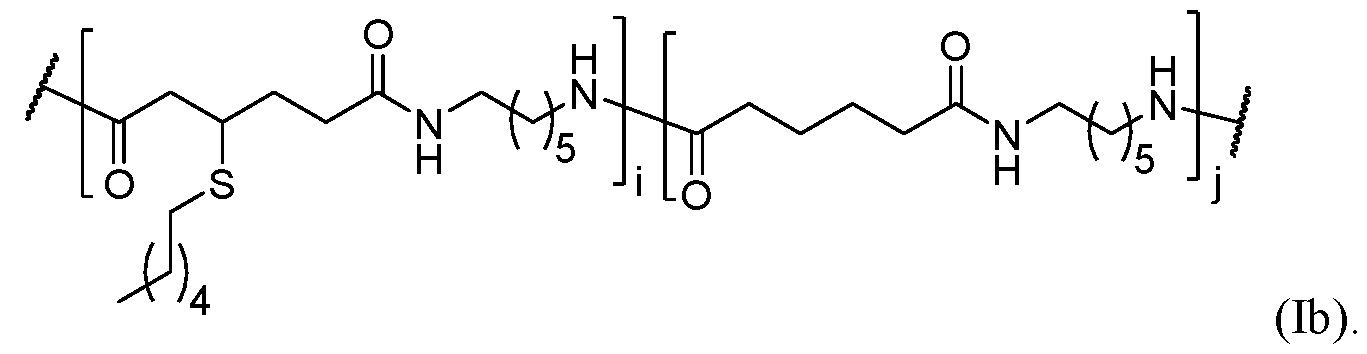
22. The process according to claim 11, wherein the compound of formula (III) is hexamethylenediamine.
23. The process according to claim 11, wherein the compound of formula (IV) is adipic acid.
24. The process according to claim 16, wherein the compound of formula (V) is 3-hexenedioic acid.
25. The process according to claim 16, wherein said forming the compound having the structure of formula (II) from the compound of formula (V) comprises:
reacting the compound of formula (V) with the compound of formula (Via):
C MOO alkyl— SH (Via).
26. The process according to claim 16, wherein said forming the compound having the structure of formula (II) from the compound of formula (V) comprises:
reacting the compound of formula (V) with the compound of formula (VIb):
HS— Ci-ioo alkyl— SH (VIb).
27. The process according to claim 16, wherein said forming the compound having the structure of formula (II) from the compound of formula (V) comprises:
reacting the compound of formula (V) with the compound of formula (Vic):
HS— Ci.ioo alkyl— P03 (Vic).
28. The process according to claim 16, wherein said forming the compound having the structure of formula (II) from the compound of formula (V) comprises:
reacting the compound of formula (V) with the compound of formula (VId):
HS— Ci.ioo alkyl— S03 (VId).
29. The process according to claim 16, wherein said forming the compound having the structure of formula (II) from the compound of formula (V) comprises:
reacting the compound of formula (V) with the compound of formula (Vie):
HS— C OO alkyl— N¾+ (Vie).
30. The process according to claim 25, wherein said reacting the compound of formula (V) with the compound of formula (Via) is carried out in the presence of AIBN.
31. The polymer according to claim 1, wherein the polymer has a i:j ratio of from 0.01 to 1.
32. The process according to claim 11, wherein the polymer has a molar ratio of the compound having the structure of formula (II):

to the compound having the structure of formula (IV):

is from 0.01 to 1.
33. The polymer according to claim 1, where the polymer is able to withstand moisture and aqueous solutions with minimal moisture absorption.
34. The polymer according to claim 33, where the polymer is able to withstand pure water with minimal moisture absorption.
35. The polymer according to claim 33, where the polymer is able to withstand moisture and aqueous solutions with less than 1 wt% moisture absorption.
36. The polymer according to claim 35, where the polymer is able to withstand moisture and aqueous solutions with less than 0.5 wt% moisture absorption.
37. The polymer according to claim 33, where the polymer is able to withstand halide solutions for at least 96 hours without any noticeable damage.
38. The polymer according to claim 37, wherein the halide solution is a solution of metal halide selected from the group consisting of CaCl2, MgCl2, ZnCl2, NaCl, KC1, CaBr2, MgBr2, ZnBr2, NaBr, and KBr.
Applications Claiming Priority (4)
| Application Number | Priority Date | Filing Date | Title |
|---|---|---|---|
| US201762587966P | 2017-11-17 | 2017-11-17 | |
| US62/587,966 | 2017-11-17 | ||
| US201862750978P | 2018-10-26 | 2018-10-26 | |
| US62/750,978 | 2018-10-26 |
Publications (1)
| Publication Number | Publication Date |
|---|---|
| WO2019099759A1 true WO2019099759A1 (en) | 2019-05-23 |
Family
ID=66533843
Family Applications (1)
| Application Number | Title | Priority Date | Filing Date |
|---|---|---|---|
| PCT/US2018/061410 Ceased WO2019099759A1 (en) | 2017-11-17 | 2018-11-16 | Functionalization of trans-3 hexenedioic acid for the production of hydrophobic polyamides and chemical resistance thereof |
Country Status (2)
| Country | Link |
|---|---|
| US (1) | US20190153156A1 (en) |
| WO (1) | WO2019099759A1 (en) |
Cited By (1)
| Publication number | Priority date | Publication date | Assignee | Title |
|---|---|---|---|---|
| US11401377B2 (en) | 2015-11-10 | 2022-08-02 | Iowa State University Research Foundation, Inc. | Bioadvantaged nylon: polycondensation of 3-hexenedioic acid with hexamethylenediamine |
Citations (2)
| Publication number | Priority date | Publication date | Assignee | Title |
|---|---|---|---|---|
| US8450447B2 (en) * | 2007-03-14 | 2013-05-28 | Dow Global Technologies Llc | Copolyesteramides with decreased perfection of the amide sequence |
| EP2910600A1 (en) * | 2012-10-19 | 2015-08-26 | Daicel Polymer Ltd. | Cellulose ester composition |
-
2018
- 2018-11-16 WO PCT/US2018/061410 patent/WO2019099759A1/en not_active Ceased
- 2018-11-16 US US16/192,937 patent/US20190153156A1/en not_active Abandoned
Patent Citations (2)
| Publication number | Priority date | Publication date | Assignee | Title |
|---|---|---|---|---|
| US8450447B2 (en) * | 2007-03-14 | 2013-05-28 | Dow Global Technologies Llc | Copolyesteramides with decreased perfection of the amide sequence |
| EP2910600A1 (en) * | 2012-10-19 | 2015-08-26 | Daicel Polymer Ltd. | Cellulose ester composition |
Non-Patent Citations (1)
| Title |
|---|
| FREDRICKSON ET AL.: "Multicritical Phenomena and Microphase Ordering in Random Block Copolymer Melts", MACROMOLECULES, vol. 25, 1992, pages 6341 - 6354, XP055610928 * |
Cited By (3)
| Publication number | Priority date | Publication date | Assignee | Title |
|---|---|---|---|---|
| US11401377B2 (en) | 2015-11-10 | 2022-08-02 | Iowa State University Research Foundation, Inc. | Bioadvantaged nylon: polycondensation of 3-hexenedioic acid with hexamethylenediamine |
| US11976169B2 (en) | 2015-11-10 | 2024-05-07 | Iowa State University Research Foundation, Inc. | Bioadvantaged nylon: polycondensation of 3-hexenedioic acid with hexamethylenediamine |
| US12180338B2 (en) | 2015-11-10 | 2024-12-31 | Iowa State University Research Foundation, Inc. | Bioadvantaged nylon: polycondensation of 3-hexenedioic acid with hexamethylenediamine |
Also Published As
| Publication number | Publication date |
|---|---|
| US20190153156A1 (en) | 2019-05-23 |
Similar Documents
| Publication | Publication Date | Title |
|---|---|---|
| Escalé et al. | Highly structured pH-responsive honeycomb films by a combination of a breath figure process and in situ thermolysis of a polystyrene-block-poly (ethoxy ethyl acrylate) precursor | |
| CN113544192A (en) | Functionalized poly(aryl ether sulfone) copolymers | |
| TW200829545A (en) | Monomers comprising superacidic groups, and polymers therefrom | |
| JP7308001B2 (en) | Compounds with perfluoroaryl groups that can facilitate post-synthetic functionalization | |
| US7718756B2 (en) | Brominated flame retardant | |
| WO2019099759A1 (en) | Functionalization of trans-3 hexenedioic acid for the production of hydrophobic polyamides and chemical resistance thereof | |
| EP3870664B1 (en) | Polyacrylic pfpe derivatives | |
| JP6309083B2 (en) | Amino-containing polymeric materials with rigid and controlled divinyl crosslinkers | |
| KR20240122821A (en) | Sensualized poly(aryl ether sulfone) copolymer | |
| JP2013108074A (en) | Polyalkylene carbonate diol having cyclic alkylene group, copolymer there of, and method for producing them | |
| US9303105B2 (en) | Process for the preparation of sevelamer | |
| JP2025032249A (en) | Resin raw material composition | |
| JP6877707B2 (en) | Resin composition containing a benzotriazole-based polymer | |
| KR20250159675A (en) | Ammonium styrene sulfonate composition with excellent preservation stability and method for producing the same | |
| JP6894747B2 (en) | Polymer | |
| US7652118B2 (en) | Polycarbosilane and method for producing same | |
| US8680221B2 (en) | Method for producing diallylamine acetate polymer | |
| JP7113480B2 (en) | Copolymer production method | |
| JP4771164B2 (en) | Copolymer of diallyldialkylammonium alkylsulfate, (meth) acrylamides and sulfur dioxide and method for producing the same | |
| JP4743474B2 (en) | Modified diallylamine-sulfur dioxide copolymer and process for producing the same | |
| JP3712379B2 (en) | Unsaturated group-containing phosphate ester | |
| US7754837B1 (en) | Flourinated aryl ether polymers exhibiting dual fluoroolefin functionality and methods of forming same | |
| JP4168551B2 (en) | Method for producing amphoteric copolymer | |
| JP2008179661A (en) | Method for producing polyarylene | |
| CN102686561B (en) | Fluorinated arylene-containing compounds, methods, and polymers prepared therefrom |
Legal Events
| Date | Code | Title | Description |
|---|---|---|---|
| 121 | Ep: the epo has been informed by wipo that ep was designated in this application |
Ref document number: 18877635 Country of ref document: EP Kind code of ref document: A1 |
|
| NENP | Non-entry into the national phase |
Ref country code: DE |
|
| 122 | Ep: pct application non-entry in european phase |
Ref document number: 18877635 Country of ref document: EP Kind code of ref document: A1 |