WO2019049602A1 - 仮想センサ生成装置 - Google Patents
仮想センサ生成装置 Download PDFInfo
- Publication number
- WO2019049602A1 WO2019049602A1 PCT/JP2018/029868 JP2018029868W WO2019049602A1 WO 2019049602 A1 WO2019049602 A1 WO 2019049602A1 JP 2018029868 W JP2018029868 W JP 2018029868W WO 2019049602 A1 WO2019049602 A1 WO 2019049602A1
- Authority
- WO
- WIPO (PCT)
- Prior art keywords
- virtual sensor
- virtual
- sensor
- unit
- information
- Prior art date
- Legal status (The legal status is an assumption and is not a legal conclusion. Google has not performed a legal analysis and makes no representation as to the accuracy of the status listed.)
- Ceased
Links
Images


Classifications
-
- G—PHYSICS
- G06—COMPUTING OR CALCULATING; COUNTING
- G06F—ELECTRIC DIGITAL DATA PROCESSING
- G06F16/00—Information retrieval; Database structures therefor; File system structures therefor
Definitions
- the present invention relates to a technology for generating a virtual sensor that processes input data to acquire virtual sensing data.
- the sensing device referred to here is a real sensor or a device to which a plurality of real sensors are connected.
- the sensing data is obtained by sensing the observation characteristics of the observation target with a sensing device.
- the observation target is an abstraction of a real world phenomenon (person, thing, event, etc.).
- the observation characteristic is a characteristic of an observation object observed by an actual sensor.
- the observation targets are, for example, adults, homes, and automobiles.
- the observation characteristics of adults are, for example, the highest blood pressure, the lowest blood pressure, and the heartbeat.
- the household observation characteristics are, for example, power consumption, gas consumption, and water consumption.
- the observation characteristics of the vehicle are, for example, position, speed, fuel consumption rate (fuel consumption).
- Patent Document 2 a technology relating to a virtual device (virtual sensor) that processes input data to acquire virtual sensing data has also been proposed (see, for example, Patent Document 2).
- a virtual device master database is searched. In this search, it is described that, when a predetermined number of virtual devices matching the output requirement are extracted, the information of the extracted virtual devices is output.
- Patent Document 2 describes that, in the search of the virtual device master database, if a predetermined number of virtual devices meeting the output requirement can not be extracted, a virtual device meeting the output requirement is generated. Furthermore, outputting information about the generated virtual device and registering information about the generated virtual device in the virtual device master database are described.
- Patent No. 5445722 gazette JP, 2014-153797, A
- Patent Document 2 only registers information on a virtual device newly generated in response to a user's request in the virtual device master database. That is, Patent Document 2 discards information that is not directly related to the generated virtual device without registering it in the virtual device master database, even if the information is acquired in the process of generating the virtual device. Therefore, in Patent Document 2, even if the information acquired at the time of generation of the virtual device in the past, the information discarded at the time of generation of the virtual device at that time is not related directly to the virtual device generated at that time. Can not be utilized at the time of generation.
- An object of the present invention is to provide a technology capable of efficiently generating a virtual sensor that meets requirements of virtual sensing data by utilizing information acquired at the time of generation of a virtual sensor in the past.
- the virtual sensor generation device of the present invention is configured as follows.
- the first storage unit stores virtual sensor information on a virtual sensor that processes input data and acquires virtual sensing data.
- the second storage unit also stores actual sensor information on an actual sensor that outputs actual sensing data obtained by sensing the observation characteristic of the observation target.
- the input data of the virtual sensor may include virtual sensing data of another virtual sensor, or may include sensing data of an actual sensor.
- the virtual sensor acquires virtual sensing data by performing processing of processing input data, processing of analyzing input data, and the like.
- the search unit searches the first storage unit and the second storage unit with a search key according to the requirements of the virtual sensing data, and extracts virtual sensor information and actual sensor information.
- the virtual sensor generation unit uses a virtual sensor of a requirement corresponding to the search key used by the search unit to search the first storage unit and the second storage unit using virtual sensor information extracted by the search unit and actual sensor information Generate.
- the virtual sensor generation unit uses, as input data, virtual sensing data of the virtual sensor from which the search unit has extracted virtual sensor information, and part or all of the actual sensing data of the actual sensor from which the search unit has extracted real sensor information. Generate a virtual sensor.
- the virtual sensor information registration unit may be a virtual sensor of virtual sensor information extracted by the search unit and an actual sensor of actual sensor information used as input data of the virtual sensor generated by the virtual sensor generation unit; The virtual sensor information distinguished from those not used for the input data is registered in the first storage unit.
- the virtual sensor generation unit when the virtual sensor generation unit generates a virtual sensor, virtual sensor information of the generated virtual sensor is registered. Therefore, the virtual sensor generation unit can generate a new virtual sensor by using information of virtual sensors generated in the past. Also, virtual sensor information is not used for the virtual sensor of virtual sensor information extracted by the search unit and for the real sensor of real sensor information used for input data of the generated virtual sensor and for input data It is distinguished from That is, the virtual sensor information includes the information acquired at the time of generation of the virtual sensor, even if the information is not directly related to the generated virtual sensor.
- the virtual sensor generation unit acquires the information acquired at the time of generation of the virtual sensor in the past even if the information is not directly related to the virtual sensor generated in the past. It can be effectively used, and virtual sensors can be generated efficiently.
- a generation request receiving unit for receiving a virtual sensor generation request including virtual sensing data requirements, and a search key according to the virtual sensing data requirements included in the virtual sensor generation request accepted by the generation request receiving unit.
- a search key generation unit that generates a search key.
- the virtual sensor generation unit may further include an output unit that outputs virtual sensor information of the virtual sensor generated by the virtual sensor generation unit to a request source of the generation request of the virtual sensor received by the generation request reception unit. According to this configuration, the user can easily improve the generated virtual sensor and the like by requesting the generation of the virtual sensor.
- the virtual sensor information registration unit is used application information indicating usage application of virtual sensing data of the virtual sensor generated by the virtual sensor generation unit, and similar sensor information indicating another virtual sensor similar to the generated virtual sensor (1) It may be configured to be registered in the storage unit. According to this configuration, it is possible to refer to the virtual sensor using the virtual sensing data of the virtual sensor or a similar sensor similar to the virtual sensor, thereby promoting utilization of the virtual sensor.
- FIG. 1 is a schematic view showing a sensing data distribution system.
- the sensing data distribution system according to this example includes a sensor device 1, an application system 2, and a network server 3.
- a plurality of sensor devices 1 and a plurality of application systems 2 are communicably connected to the network server 3 via a network (not shown).
- the sensor device 1 provides actual sensing data.
- the application system 2 also uses actual sensing data.
- the network server 3 is a configuration for realizing a sensing data distribution market, i.e., a sensing data trading market (SDTM), which is a market place on the Internet for trading real sensing data and virtual sensing data described later.
- SDTM sensing data trading market
- the sensor device 1 and the application system 2 can also provide virtual sensing data by having a configuration for acquiring virtual sensing data.
- the sensor device 1 has an actual sensor that senses the observation characteristic of the observation target. That is, in this example, the sensor device 1 is configured to have one or more real sensors.
- the real sensor said here is a sensor which exists actually, for example, a temperature sensor, a humidity sensor, a light sensor, a sound wave sensor, a blood pressure sensor, an image sensor, etc.
- the observation target is an abstraction of a real world phenomenon (person, thing, event, etc.).
- the observation targets are, for example, adults, homes, and automobiles.
- An observation characteristic is a characteristic of the observation object observed by a real sensor. For example, the observation characteristics of adults are systolic blood pressure, diastolic blood pressure, heart rate and the like. Household observation characteristics are the amount of electricity used, the amount of gas used, the amount of water used, etc.
- the observation characteristics of the vehicle are position, speed, fuel consumption rate (fuel consumption) and the like.
- a virtual sensor is a sensor that does not exist physically and operates by an algorithm.
- the virtual sensor is configured by a computer or the like that executes a program (a program that operates an algorithm related to the virtual sensor) that acquires processing results obtained by processing input data as virtual sensing data.
- Virtual sensing data can be acquired by performing processing related to processing, analysis, etc. on input data.
- the input data of the virtual sensor may be sensing data of a real sensor, virtual sensing data of another virtual sensor, or a combination thereof.
- the input data of the virtual sensor is open data that is widely available to the public without particular restrictions on its use (data related to weather forecast, data related to past traffic surveys, data indicating the number of local population, etc.) May or may not be included.
- a virtual sensor that acquires a heatstroke index at a certain point as virtual sensing data may be sensing data of an actual sensor such as a temperature sensor, humidity sensor, or solar radiation sensor around the point, open data for weather forecast of the point, etc. It may be input data of a virtual sensor.
- a virtual sensor that acquires the number of pedestrians at a certain point as virtual sensing data may use sensing data or the like of an actual sensor obtained by measuring a flow of people around the point as input data of the virtual sensor.
- sensing data when actual sensing data and virtual sensing data are not distinguished, they are collectively referred to as sensing data.
- metadata provisioning side data catalog
- metadata user-side data catalog
- the provider of sensing data registers the provider data catalog in the network server 3.
- the use side of the sensing data registers the use side data catalog in the network server 3.
- Data provider numbers, sensing data providers, sensing data provision periods, sensing data measurement locations, sensing data targets, event data specifications, data sales contract conditions, etc. are registered in the provider-side data catalog.
- the data catalog number is a number that identifies the provider data catalog.
- the sensing data provider is information indicating an organization (individual or business entity) providing the sensing data.
- the sensing data provision period is information indicating a period for providing sensing data.
- the sensing data measurement location is information indicating a location for sensing an observation target.
- the sensing data target is information indicating the sensing data, the name of the sensing data (sensing data name), a brief description of the sensing data (sensing data description), the genre (genre name) that utilizes the sensing data, the observation target, etc. It contains the information shown. Further, the observation target includes information indicating the name of the observation target, the description of the observation target, the attribute of the observation target, and the like. Furthermore, the observation target attribute includes information indicating the name of the observation target attribute, the description of the observation target attribute, the unit of the observation target attribute, and the observation date and time type (intermittent type or regular type) of the observation target attribute. .
- the event data specification is information indicating a label name (event data identification name) at the time of describing in the event condition, meaning of a value of event data, data representation (event data explanation), and the like.
- the data sales contract condition is information indicating a trading condition of sensing data.
- the user-side data catalog includes roughly data catalog numbers, sensing data users, sensing data usage periods, sensing data measurement locations, sensing data targets, event data specifications, and data sales contract conditions.
- the data catalog number is a number that identifies the user side data catalog.
- the sensing data user is information indicating an organization (individual or business person) using the sensing data.
- the sensing data use period is information indicating a period in which the sensing data is used.
- the sensing data measurement location is information indicating a location for sensing an observation target.
- the sensing data target is information indicating the sensing data, the name of the sensing data (sensing data name), a brief description of the sensing data (sensing data description), the genre (genre name) that utilizes the sensing data, the observation target, etc. It contains the information shown. Further, the observation target includes information indicating the name of the observation target, the description of the observation target, the attribute of the observation target, and the like. Furthermore, the observation target attribute includes information indicating the name of the observation target attribute, the description of the observation target attribute, the unit of the observation target attribute, and the observation date and time type (intermittent type or regular type) of the observation target attribute. .
- the event data specification is information indicating a label name (event data identification name) at the time of describing in the event condition, meaning of a value of event data, data representation (event data explanation), and the like.
- the data sales contract condition is information indicating a trading condition of sensing data.
- the network server 3 matches the provider-side data catalog with the user-side data catalog, and extracts a provider that can provide sensing data that meets the requirements of the user.
- a data flow control instruction is transmitted to the provider side extracted by the network server 3.
- the data flow control command instructs the provider side to distribute sensing data to the user side.
- the provider side and the user side can perform data communication via the network server 3 or can perform data communication without using the network server 3.
- the provider may transmit the sensing data to the user through the network server 3 or may transmit the sensing data to the user without the network server 3.
- the sensor device 1 not only operates as a provider side device that provides actual sensing data, but also operates as a user side device that purchases input data for acquiring virtual sensing data using SDTM. There is something.
- the application system 2 not only operates as a user-side device that uses sensing data, but also operates as a provider-side device that acquires virtual sensing data and sells the acquired virtual sensing data using SDTM. There is something to do.
- FIG. 2 is a block diagram showing the configuration of the main part of the virtual sensor generation device according to this example.
- the virtual sensor generation device 10 includes a control unit 11, a communication unit 12, a virtual sensing database (virtual sensor DB) 16, an actual sensor database (actual sensor DB) 17, and an open data database (open data DB) 18, A dictionary database (dictionary DB) 19 is provided.
- the virtual sensor generation device 10 of this example generates a virtual sensor requested by the user.
- the virtual sensor generation device 10 of this example supports the design of the virtual sensor for the user by outputting the generated information of the virtual sensor to the user.
- the virtual sensor generation device 10 is, for example, a server device connected to a network such as the Internet, and the above-described network server 3 and a terminal of a user who requests the design of the virtual sensor (hereinafter referred to as a user terminal). It performs data communication with etc.
- the user terminal is a personal computer, a tablet terminal, a smartphone or the like.
- the control unit 11 controls the operation of each part of the virtual sensor generation device 10 main body. Further, as shown in FIG. 2, the control unit 11 has a search key extraction unit 21, a search unit 22, a combination inference unit 23, a combination verification unit 24, a virtual sensor information provision unit 25, and a virtual sensor information registration unit 26. doing. The details of these units 21, 22, 23, 24, 25 and 26 will be described later.
- the communication unit 12 controls data communication with devices connected via a network.
- the communication unit 12 performs data communication with the above-described network server 3 and user terminals and the like.
- the communication unit 12 has a configuration corresponding to the generation request receiving unit and the output unit in the present invention.
- Virtual sensor DB16 is a database which memorizes virtual sensor information about a virtual sensor.
- the virtual sensor DB 16 of this example stores an input management table 16a and an output management table 16b.
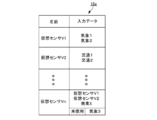
- FIG. 3 is a diagram showing an input management table of this example.
- the input management table 16a is a table in which the names of virtual sensors and input data of the virtual sensors are registered in association with each other.
- FIG. 3 exemplifies virtual sensor V1 whose input data is three of weather 1, weather 2 and weather forecast 1, and virtual sensor V2 whose input data is two of traffic 1 and traffic 2. There is.
- the virtual sensors V1 and V2 in the example illustrated in FIG. 3 are not associated with input data that has been made unused at the time of generation.
- the virtual sensors V1 and V2 are not generated by the virtual sensor generation device 10 according to this example, but are already generated. Also, although the virtual sensors V1 and V2 are generated by the virtual sensor generation device 10 according to this example, there is no input data that has not been used at the time of generation.
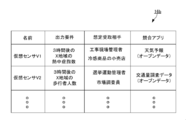
- FIG. 4 is a diagram showing an output management table of this example.
- the output management table 16 b is a table in which the names of virtual sensors, the output requirements of the virtual sensors, the assumed recipients, and the competing application are registered in association with each other.
- the output requirement of the virtual sensor is information for specifying virtual sensing data that is the output of the virtual sensor (for example, heat stroke index of X area after 3 hours, the number of pedestrians at Y point after 3 hours, etc.) It is.
- the assumed recipient is information indicating the type of the user who uses the virtual sensing data that is the output of the virtual sensor (for example, a construction site manager, a retail store of cold goods, an election campaign manager, a market researcher, etc.) It is.
- a competition application is information (for example, weather forecast, traffic survey data, etc.) which shows other data which can be used for the same application as virtual sensing data which is an output of the virtual sensor.
- the virtual sensor V1 is the heat stroke index of the X area after 3 hours with the output requirement
- the assumed recipient is the construction site manager
- the competing application is It is a weather forecast (open data).
- the virtual sensor V2 is the number of pedestrians in the X area after 3 hours
- the assumed recipient is the campaign manager, and the market researcher
- the competitor application is the traffic It is quantitative survey data (open data).
- the virtual sensor DB 16 corresponds to the first storage unit in the present invention.
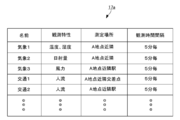
- the real sensor DB 17 is a database that stores real sensor information on real sensors.
- the actual sensor DB 17 of this example stores the actual sensor management table 17a registered in association with the name of the actual sensing data provided by the above-described sensing data distribution system, the observation characteristic, the measurement location, and the observation time interval.
- FIG. 5 is a diagram showing an actual sensor management table of this example.
- FIG. 5 exemplifies actual sensor information applied to weather 1, weather 2, weather 3, traffic 1 and traffic 2.
- the observation characteristic is temperature and humidity
- the measurement location (observation location) is near the point A
- the observation time interval is 5 minutes.
- the observation characteristic of the weather 2 is the amount of solar radiation
- the measurement location (observation location) is near the point A
- the observation time interval is 5 minutes.
- the observation characteristic is wind power
- the measurement location (observation location) is a nearby station at the point A
- the observation time interval is 5 minutes.
- the observation characteristic is human flow
- the measurement location (observation location) is a nearby intersection at point A
- the observation time interval is 5 minutes.
- the observation characteristic is human flow
- the measurement location (observation location) is a nearby station at point A
- the observation time interval is 5 minutes.
- the real sensor DB 17 corresponds to the second storage unit in the present invention.
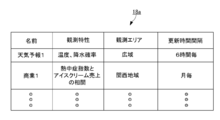
- the open data DB 18 in this example is a database that stores information on open data.
- the open data DB 18 of this example stores an open data management table 18a registered in association with the name of the open data, the observation characteristic, the observation area, and the update time interval.
- FIG. 6 is a diagram showing the open data management table of this example.
- FIG. 6 illustrates information of weather forecast 1 and open data of commerce 1.
- the observation characteristics are temperature and precipitation probability
- the observation area is wide area
- the update time interval is 6 hours.
- the observation characteristic is the correlation between heatstroke index and ice cream sales
- the observation area is the Kansai region
- the update time interval is monthly.
- the dictionary DB 19 is a database in which a dictionary in which vocabulary is classified and arranged by meaning is registered.
- the dictionary DB 19 one or more dictionaries such as a synonym dictionary in which synonyms are registered, a related word dictionary in which related words are registered, and a similar word dictionary in which similar words are registered are registered. That is, the dictionary DB 19 may have one registered dictionary or a plurality of registered dictionaries (one or more dictionaries may be registered).
- the virtual sensor DB 16, the real sensor DB 17, the open data DB 18, and the dictionary DB 19 described above may be integrated by combining any two or more databases.
- the virtual sensor DB 16 and the real sensor DB 17 may be configured as one database, or the virtual sensor DB 16, the real sensor DB 17 and the open data DB 18 may be configured as one database.
- the virtual sensor generation device 10 receives, at the communication unit 12, the virtual sensor generation request transmitted from the user terminal.
- the virtual sensor generation request includes the output requirement of the virtual sensor that requests generation. For example, the above-described “heatstroke index of X area after 3 hours”, “the number of pedestrians at point Y after 3 hours”, and the like are included in the generation request of the virtual sensor.
- the search key extraction unit 21 extracts a vocabulary serving as a keyword from the output requirement of the virtual sensor included in the generation request of the virtual sensor received from the user terminal in the communication unit 12. Further, the search key extraction unit 21 extracts, as a search key, synonyms, related words, similar words, etc. of keywords extracted from the output requirement of the virtual sensor, using the dictionary stored in the dictionary DB 19. For example, when the output requirement of the virtual sensor included in the virtual sensor generation request received from the user terminal is "sales of ice cream after 3 hours in the X area", for example, "heatstroke index of the X area” , "The number of pedestrians in the X area”, etc. are extracted as a search key.
- the search unit 22 searches each of the virtual sensor DB 16, the real sensor DB 17 and the open data DB 18 with the search key extracted by the search key extraction unit 21, and the information of the corresponding virtual sensor, the information of the corresponding actual sensor, Extract the corresponding open data information.
- the combination inference unit 23 generates one or more combination patterns of virtual sensor input data matching the output requirement from among the virtual sensors searched by the search unit 22 and the real sensors.
- a method of generating the combination pattern of the input data of the virtual sensor for example, the following methods A to C can be considered, but they may be generated by other methods.
- the combination inference unit 23 generates one combination pattern in which all of the virtual sensor searched by the search unit 22 and the sensing data of the real sensor are input data of the virtual sensor.
- the combinational reasoning unit 23 classifies the sensing data of the virtual sensor and the real sensor searched by the searching unit 22 into groups according to their attributes. For example, the attributes (temperature, solar radiation amount, people flow, etc.) of the type of sensing data are classified items, and the sensing data of virtual sensors and real sensors searched by the search unit 22 are classified into groups.
- the combination inference unit 23 generates a combination of sensing data extracted one by one from each group as one combination pattern of input data of the virtual sensor.
- the combination pattern of the input data of the virtual sensor generated by the combination inference unit 23 is all combinations when one piece of sensing data is extracted from each group. For example, when there are four sensing data classified into group X, two sensing data classified into group Y, and two sensing data classified into group Z, the combination inference unit 23 A total of 16 (4 ⁇ 2 ⁇ 2) combination patterns are generated as combination patterns of input data of the virtual sensor.
- the combinational reasoning unit 23 classifies the sensing data of the virtual sensor and the real sensor searched by the searching unit 22 into groups according to their attributes. For example, the attributes (temperature, solar radiation amount, people flow, etc.) of the type of sensing data are classified items, and the sensing data of virtual sensors and real sensors searched by the search unit 22 are classified into groups.
- the combination inference unit 23 determines, for each group, the magnitude of the degree of influence of the sensing data of the attribute belonging to the group on the output of the virtual sensor, and ranks each group based on the magnitude of the degree of influence. .
- the groups classified by the attribute are group W, group X, group Y, and group Z, and the determined degree of influence is 1.2 for group W, 1.5 for group X, 1.8 for group Y, 1.8 for group Z If it is 1.4, the ranking is performed in the order of group Y, group X, group Z, and group W from the top.
- the combination inference unit 23 generates a combination of sensing data extracted one by one from each group extracted in the above-described process as one combination pattern of input data of the virtual sensor.
- the combination pattern of the input data of the virtual sensor generated by the combination inference unit 23 is all combinations when sensing data is extracted one by one from each group extracted in the above process. That is, the combination inference unit 23 extracts a group having a predetermined number of attributes (n), and performs the above-described ⁇ combination pattern generation method B> on the extracted group.
- the combination verification unit 24 estimates the appropriateness of the virtual sensor for each combination pattern of the input data of the virtual sensor generated by the combination inference unit 23.
- a processing program that processes input data such that the degree of similarity with open data (open data searched by search unit 22) having similar output requirements is maximized for each combination pattern of input data
- the parameters of each input data in are adjusted by multivariate analysis etc.
- the combination verification unit 24 estimates that the similarity that has become maximum at this time is the appropriateness of the virtual sensor.
- the combination verification unit 24 maximizes the similarity with the open data having similar output requirements.
- the parameters of each input data in the processing program for processing the input data are adjusted by multivariate analysis or the like.
- the combination verification unit 24 determines, for each input data, whether the influence of the input data on the sensing data (output) of the virtual sensor is large or small according to the size of the parameter adjusted for the input data. Specifically, the combination verification unit 24 determines whether the input data has a large or small influence on the output of the virtual sensor based on whether the magnitude of the parameter is larger or smaller than a predetermined threshold. To judge.
- the combination verification unit 24 determines that the input data determined to have a large influence on the output of the virtual sensor as the input data of the virtual sensor, and simultaneously determines the input data determined to have a small influence on the output of the virtual sensor It is judged that it is not input data of the sensor.
- the combination verification unit 24 is an open data having similar output requirements when the combination pattern of the input data of the virtual sensor is set by ⁇ combination pattern generation method B> or ⁇ combination pattern generation method C> described above.
- the combination pattern of the input data having the highest degree of similarity with is determined as the combination pattern of the input data of the virtual sensor. Therefore, the combination verification unit 24 is assumed that the input data not included in the determined combination pattern, which is the sensing data of the virtual sensor and the real sensor retrieved by the retrieval unit 22, is input data of the virtual sensor. to decide.
- the combination verification unit 24 is configured to additionally determine that the input data determined to have a small influence on the output of the virtual sensor in the determined combination pattern is not to be input data of the virtual sensor. You may
- the virtual sensor generation unit referred to in the present invention is configured by the combination inference unit 23 and the combination verification unit 24.
- the virtual sensor information provision unit 25 controls the communication unit 12 to transmit the information of the virtual sensor determined to have the maximum appropriateness by the combination verification unit 24 to the user terminal that has transmitted the generation request of the virtual sensor. .
- the user terminal can obtain virtual sensor information by transmitting a virtual sensor generation request to the virtual sensor generation device 10.
- the virtual sensor information provision unit 25 adds not only the information of the generated virtual sensor, but also the usage (the assumed recipient) of the virtual sensor, the information of the similar virtual sensor and the open data (the information of the competing application) It may be sent.
- the user can also make a change or the like to improve the virtual sensor based on the acquired information of the virtual sensor.
- the virtual sensor information registration unit 26 registers, in the virtual sensor DB 16, the information of the virtual sensor generated this time (the information of the virtual sensor determined to have the maximum appropriateness by the combination verification unit 24). At this time, the virtual sensor information registration unit 26 is sensing data searched by the search unit 22 and is sensing data that is input data of the generated virtual sensor and sensing that is not used as input data of the generated virtual sensor Virtual sensor information distinguished from data is registered in the virtual sensor DB 16.
- FIG. 7 shows an input management table in which information related to the virtual sensor Vn is registered
- FIG. 8 shows an output management table in which information related to the virtual sensor Vn is registered.
- the virtual sensor Vn is a virtual sensor generated this time, and the search unit 22 extracts the virtual sensor V1, the virtual sensor V2, the commerce X, and the weather 3 at the time of generation.
- the combination of input data is the virtual sensor V1, the virtual sensor V2, and the commerce X (the weather 3 is not used as input data). ).
- the control unit 11 is configured by a hardware CPU, a memory, and other electronic circuits.
- the hardware CPU executes the virtual sensor generation program according to the present invention, whereby the search key extraction unit 21, the search unit 22, the combination inference unit 23, the combination verification unit 24, the virtual sensor information provision unit 25 and the above described It operates as a virtual sensor information registration unit 26.
- the memory also has an area for expanding the virtual sensor generation program according to the present invention, and an area for temporarily storing data and the like generated when the virtual sensor generation program is executed.
- the control unit 11 may be an LSI in which a hardware CPU, a memory, and the like are integrated.
- FIG. 9 is a flowchart showing the operation of the virtual sensor generation device.
- the virtual sensor generation device 10 waits for receiving a virtual sensor generation request from the user terminal in the communication unit 12 (s1).
- the control unit 11 receives the virtual sensor generation request from the user terminal by the communication unit 12
- a sentence “estimate of ice cream sales after 3 hours at a point 0000” is included in the virtual sensor generation request received in s1.
- s2 "00 point”, "ice cream”, “sales”, etc. are extracted as a vocabulary serving as a keyword.
- the search key extraction unit 21 extracts, as a search key, synonyms, related words, similar words, etc.
- the search unit 22 searches the virtual sensor DB 16, the real sensor DB 17, and the open data DB 18 with the search key extracted in s3, and relates to the information on the corresponding virtual sensor, the information on the corresponding real sensor, and the corresponding open data Extract information (s4).
- the search of the virtual sensor DB 16, the real sensor DB 17, and the open data DB 18 in s4 is performed using, for example, a known ontology technology.
- the combinational inference unit 23 generates one or more combination patterns of virtual sensor input data matching the output requirement from among the virtual sensors searched by the search unit 22 and the real sensors extracted by the search in s4 ( s5).
- one or more combination patterns of the input data of the virtual sensor are generated by, for example, the method of ⁇ combination pattern generation method B> or ⁇ combination pattern generation method C> described above.
- the combination verification unit 24 estimates the appropriateness of the virtual sensor for each combination pattern of the input data of the virtual sensor generated by the combination inference unit 23 (s6). In s6, the combination verification unit 24 processes the input data so that the degree of similarity with the open data (open data searched by the search unit 22) having similar output requirements is maximized for each combination pattern of the input data. Parameters of each input data in the processing program to be adjusted by multivariate analysis or the like. The combination verification unit 24 estimates that the similarity that has become maximum at this time is the appropriateness of the virtual sensor. The combination verification unit 24 determines the input data of the virtual sensor corresponding to the generation request of the virtual sensor this time as the combination pattern of the input data having the highest appropriateness (s7).
- the combination verification unit 24 determines whether the input data has a large or small influence on the sensing data (output) of the virtual sensor for each input data in the combination pattern of the input data having the highest appropriateness. To judge. Then, the combination verification unit 24 determines that the input data determined to have a large influence on the output of the virtual sensor in the combination pattern of the input data for which the degree of appropriateness is maximum is the input data of the virtual sensor and It may be determined that the input data determined to have a small influence on the output of the sensor is not to be input data of the virtual sensor.
- the virtual sensor information provision unit 25 transmits the information of the virtual sensor whose input data is the input pattern determined in s7 to the user terminal that has transmitted the generation request of the virtual sensor this time (s8).
- the virtual sensor information provision unit 25 adds not only the information on the virtual sensor generated in s8, but also the intended use of the virtual sensor (the assumed recipient), the information on similar virtual sensors and open data (information on competing applications) May be sent.
- the virtual sensor information registration unit 26 registers information of the virtual sensor generated this time in the virtual sensor DB 16 (s9).
- the virtual sensor information registration unit 26 is sensing data searched by the search unit 22 and is sensing data that is input data of the generated virtual sensor and sensing data that is not used as input data of the generated virtual sensor
- the distinguished virtual sensor information is registered in the virtual sensor DB 16.
- the virtual sensor information registration unit 26 additionally registers in the virtual sensor DB 16 the use application of the generated virtual sensor (assumed recipient), information on similar virtual sensors and open data (information on competing applications) It is also good.
- the virtual sensor generation device 10 when the virtual sensor generation device 10 generates a virtual sensor, the virtual sensor generation device 10 registers information on the virtual sensor in the virtual sensor DB 16. Therefore, the virtual sensor generation device 10 can grow the virtual sensor DB 16 by generating the virtual sensor.
- the virtual sensor generation device 10 is virtual sensor information of the virtual sensor extracted by the search unit 22 and actual sensor information of the real sensor, which is used for input data of the generated virtual sensor, and input data Virtual sensor information distinguished from those not used is registered in the virtual sensor DB 16. That is, the virtual sensor information registered in the virtual sensor DB 16 at the time of generation of the virtual sensor includes information acquired at the time of generation of the virtual sensor, even if the information is not directly related to the generated virtual sensor. ing. Therefore, in the determination of the input data of the virtual sensor to be generated, etc., the virtual sensor generation device 10 obtains the information acquired at the time of generation of the virtual sensor in the past even if the information is not directly related to the virtual sensor generated in the past.
- the virtual sensor generation device 10 when the virtual sensor generation device 10 generates virtual sensors, the virtual sensor information of the virtual sensors searched by the search unit 22 includes information related to sensing data not used as input data. By determining whether or not the sensing data is to be input data of the virtual sensor to be generated this time, it is possible to efficiently generate the virtual sensor from which a more appropriate output can be obtained.
- the virtual sensor generation device 10 outputs information of the generated virtual sensor to the user terminal that has made the generation request of the virtual sensor. Therefore, the user can easily generate a virtual sensor that can obtain a more appropriate output based on the virtual sensor generated by the virtual sensor generation device 10. That is, the virtual sensor generation device 10 can support the design of the virtual sensor for the user.
- the virtual sensor generation device 10 adds and outputs usage application information indicating the usage application of the virtual sensing data of the generated virtual sensor, and similar sensor information indicating another virtual sensor similar to the generated virtual sensor. Therefore, the user can easily check competing open data and assume the other party who uses the virtual sensing data, so that the virtual sensing data of this virtual sensor can be used as an index when selling by SDTM.
- the virtual sensor generation device 10 may receive feedback of information on the improved virtual sensor from the user terminal, and may update the virtual sensor DB 16 based on this information. If comprised in this way, virtual sensor DB16 can be grown efficiently.
- the combination pattern of the input data of the virtual sensor is generated by the method of ⁇ combination pattern generation method B> or ⁇ combination pattern generation method C> described above as an example.
- the processing s6 and s7 described above may be replaced with the processing described below.
- the combination verification unit 24 processes the combination pattern of the input data such that the similarity with the open data (open data searched by the search unit 22) having similar output requirements is maximized. Adjust parameters of each input data by multivariate analysis etc.
- the combination verification unit 24 determines, for each input data, whether the influence of the input data on the sensing data (output) of the virtual sensor is large or small according to the size of the parameter adjusted for the input data.
- the combination verification unit 24 determines that the input data determined to have a large influence on the output of the virtual sensor as the input data of the virtual sensor, and simultaneously determines the input data determined to have a small influence on the output of the virtual sensor It is judged that it is not input data of the sensor.
- the virtual sensor generation device 10 of this example receives the virtual sensor generation request of the virtual sensor from the user terminal, for example, the operation unit (not shown) is configured to receive an input operation related to the virtual sensor generation request It is also good. According to this configuration, the user can directly generate a virtual sensor in the virtual sensor generation device 10.
- the hardware processor is Search key according to the requirements of the virtual sensing data of the virtual sensor that processes input data to acquire virtual sensing data, and the first storage unit that stores virtual sensor information about the virtual sensor, and sensing the observation characteristics of the observation target Searching a second storage unit storing actual sensor information on an actual sensor outputting the detected actual sensing data, and extracting the virtual sensor information and the actual sensor information;
- the virtual sensor of the requirement corresponding to the search key used for the search of the first storage unit and the second storage unit is generated using the extracted virtual sensor information and the actual sensor information, Furthermore, the virtual sensor of the extracted virtual sensor information and the real sensor of the real sensor information are used for the input data of the generated virtual sensor and those not used for the input data Registering the distinguished virtual sensor information in the first storage unit; Virtual sensor generation device.
- the hardware processor is Search key according to the requirements of the virtual sensing data of the virtual sensor that processes input data to acquire virtual sensing data, and the first storage unit that stores virtual sensor information about the virtual sensor, and sensing the observation characteristics of the observation target Searching a second storage unit storing actual sensor information on an actual sensor outputting the detected actual sensing data, and extracting the virtual sensor information and the actual sensor information;
- the virtual sensor of the requirement corresponding to the search key used for the search of the first storage unit and the second storage unit is generated using the extracted virtual sensor information and the actual sensor information, Furthermore, the virtual sensor of the extracted virtual sensor information and the real sensor of the real sensor information are used for the input data of the generated virtual sensor and those not used for the input data Registering the distinguished virtual sensor information in the first storage unit; Virtual sensor generation method.
Landscapes
- Engineering & Computer Science (AREA)
- Theoretical Computer Science (AREA)
- Data Mining & Analysis (AREA)
- Databases & Information Systems (AREA)
- Physics & Mathematics (AREA)
- General Engineering & Computer Science (AREA)
- General Physics & Mathematics (AREA)
- Information Retrieval, Db Structures And Fs Structures Therefor (AREA)
Abstract
過去の仮想センサの生成時に取得した情報を活用することによって、仮想センサを効率的に生成する仮想センサ生成装置を提供する。仮想センサDB16が仮想センサ情報を記憶し、実センサDB17が実センサ情報を記憶する。検索部22が、仮想センシングデータの要件に応じた検索キーで、仮想センサDB16、および実センサDB17を検索する。仮想センサ情報登録部26は、検索されたセンシングデータを、生成された仮想センサの入力データに使用されたものと、入力データに使用されなかったものとに区別した仮想センサ情報を仮想センサDB16に登録する。
Description
この発明は、入力データを処理して仮想センシングデータを取得する仮想センサを生成する技術に関する。
従来、センシングデバイスでセンシングしたセンシングデータを、提供側と利用側との間で流通させるセンサネットワークシステムが検討されている(例えば、特許文献1参照)。ここで言うセンシングデバイスとは、実センサ、あるいは実センサが複数接続されるデバイスである。センシングデータは、観測対象の観測特性をセンシングデバイスでセンシングしたものである。観測対象は、実世界の現象の抽象(人、物、事象等)である。また、観測特性は、実センサで観測する観測対象の特性である。観測対象は、例えば、成人、家庭、自動車である。成人の観測特性は、例えば最高血圧、最低血圧、心拍である。家庭の観測特性は、例えば電力使用量、ガス使用量、水道使用量である。車両の観測特性は、例えば位置、速度、燃料消費率(燃費)である。
また、入力データを処理して仮想センシングデータを取得する仮想デバイス(仮想センサ)にかかる技術も提案されている(例えば、特許文献2参照)。この特許文献2には、出力結果を特定する出力要件を含む検索要求を受け付けると、仮想デバイスマスタデータベースを検索する。この検索で、出力要件に適合する仮想デバイスを所定数抽出すると、抽出した仮想デバイスの情報を出力することが記載されている。また、特許文献2には、仮想デバイスマスタデータベースの検索で、出力要件に適合する仮想デバイスを所定数抽出できなければ、出力要件に適合する仮想デバイスを生成することが記載されている。さらに、生成した仮想デバイスに関する情報を出力すること、および生成した仮想デバイスに関する情報を仮想デバイスマスタデータベースに登録することが記載されている。
しかしながら、特許文献2は、ユーザの要求に応じて新たに生成した仮想デバイスに関する情報を仮想デバイスマスタデータベースに登録しているだけである。すなわち、特許文献2は、仮想デバイスの生成過程で取得した情報であっても、生成された仮想デバイスに直接的に関連しない情報については、仮想デバイスマスタデータベースに登録することなく破棄していた。したがって、特許文献2では、過去の仮想デバイスの生成時に取得していた情報であっても、そのときに生成された仮想デバイスに直接的に関連しないために破棄した情報については、後の仮想デバイスの生成時に活用することができなかった。
この発明の目的は、過去の仮想センサの生成時に取得した情報を活用することによって、仮想センシングデータの要件に適合する仮想センサの生成が効率的に行える技術を提供することにある。
この発明の仮想センサ生成装置は、上記目的を達するために、以下のように構成している。
第1記憶部は、入力データを処理して仮想センシングデータを取得する仮想センサに関する仮想センサ情報を記憶する。また、第2記憶部は、観測対象の観測特性をセンシングした実センシングデータを出力する実センサに関する実センサ情報を記憶する。
仮想センサの入力データには、他の仮想センサの仮想センシングデータが含まれていてもよいし、実センサのセンシングデータが含まれていてもよい。仮想センサは、入力データを加工する処理や、入力データを分析する処理等を行うことによって、仮想センシングデータを取得する。
検索部は、仮想センシングデータの要件に応じた検索キーで、第1記憶部、および第2記憶部を検索し、仮想センサ情報、および実センサ情報を抽出する。仮想センサ生成部は、検索部が第1記憶部、および第2記憶部の検索に用いた検索キーに対応する要件の仮想センサを、検索部が抽出した仮想センサ情報、および実センサ情報を用いて生成する。例えば、仮想センサ生成部は、検索部が仮想センサ情報を抽出した仮想センサの仮想センシングデータ、および検索部が実センサ情報を抽出した実センサの実センシングデータの一部または全部を入力データとする仮想センサを生成する。
さらに、仮想センサ情報登録部は、検索部によって抽出された仮想センサ情報の仮想センサ、および実センサ情報の実センサが、仮想センサ生成部が生成した仮想センサの入力データに使用されたものと、入力データに使用されなかったものとに区別されている仮想センサ情報を第1記憶部に登録する。
したがって、仮想センサ生成部が仮想センサを生成すると、生成された仮想センサの仮想センサ情報が登録される。したがって、仮想センサ生成部は、過去に生成した仮想センサの情報を活用して、新たな仮想センサの生成が行える。また、仮想センサ情報は、検索部によって抽出された仮想センサ情報の仮想センサ、および実センサ情報の実センサが、生成された仮想センサの入力データに使用されたものと、入力データに使用されなかったものとに区別されている。すなわち、仮想センサ情報には、生成された仮想センサに直接的に関連しない情報であっても、仮想センサの生成時に取得した情報が含まれている。したがって、仮想センサ生成部は、生成する仮想センサの入力データの決定等において、過去に生成された仮想センサに直接的に関連しない情報であっても、過去の仮想センサの生成時に取得した情報を有効に活用することができ、仮想センサの生成が効率的に行える。
また、仮想センシングデータの要件を含む仮想センサの生成要求を受け付ける生成要求受付部と、この生成要求受付部が受け付けた仮想センサの生成要求に含まれている仮想センシングデータの要件に応じた検索キーを生成する検索キー生成部と、を備えてもよい。このように構成すれば、ユーザは、仮想センサの生成要求を行うことによって、簡単に所望の仮想センシングデータを利活用できる。すなわち、ユーザに対して、仮想センサの設計支援が行える。
また、仮想センサ生成部が生成した仮想センサの仮想センサ情報を、生成要求受付部が受け付けた仮想センサの生成要求の要求元に対して出力する出力部を備えてもよい。このように構成すれば、ユーザは、仮想センサの生成要求を行うことによって、生成された仮想センサの改良等が簡単に行える。
また、仮想センサ情報登録部は、仮想センサ生成部が生成した仮想センサの仮想センシングデータの利用用途を示す利用用途情報や、生成した仮想センサと類似する別の仮想センサを示す類似センサ情報を第1記憶部に登録する構成にしてもよい。このように構成すれば、仮想センサについて、その仮想センサの仮想センシングデータの利用用途や、その仮想センサに類似する類似センサを参照することができるので、仮想センサの利活用の促進が図れる。
この発明によれば、過去の仮想センサの生成時に取得した情報を有効に活用することによって、仮想センシングデータの要件に適合する仮想センサの生成が効率的に行える。
以下、この発明の実施形態について説明する。
まず、この発明の実施形態にかかる仮想センサ生成装置の例を説明する前に、センシングデータ流通システムについて簡単に説明する。図1は、センシングデータ流通システムを示す概略図である。この例にかかるセンシングデータ流通システムは、センサ装置1、アプリケーションシステム2、およびネットワークサーバ3を有している。ネットワークサーバ3には、図示していないネットワークを介して、複数のセンサ装置1、および複数のアプリケーションシステム2がデータ通信可能に接続されている。
この例では、センサ装置1は、実センシングデータを提供する。また、アプリケーションシステム2は、実センシングデータを利用する。ネットワークサーバ3は、実センシングデータ、および後述する仮想センシングデータの取引を行うインタネット上のマーケットプレースであるセンシングデータ流通市場、すなわちSensing Data Trading Market(SDTM)を実現するための構成である。
また、センサ装置1、およびアプリケーションシステム2は、仮想センシングデータを取得する構成を有することによって、仮想センシングデータを提供することもできる。
センサ装置1は、観測対象の観測特性をセンシングする実センサを有する。すなわち、この例では、センサ装置1は、1つ以上の実センサを有する構成である。ここで言う実センサは、実際に存在しているセンサであり、例えば温度センサ、湿度センサ、光センサ、音波センサ、血圧センサ、画像センサ等である。観測対象は、実世界の現象の抽象(人、物、事象等)である。観測対象は、例えば、成人、家庭、自動車である。観測特性は、実センサで観測する観測対象の特性である。例えば、成人の観測特性は、最高血圧、最低血圧、心拍等である。家庭の観測特性は、電力使用量、ガス使用量、水道使用量等である。車両の観測特性は、位置、速度、燃料消費率(燃費)等である。
また、仮想センサは、物理的には存在せずアルゴリズムで作動するセンサである。仮想センサは、入力データを処理した処理結果を仮想センシングデータとして取得するプログラム(その仮想センサにかかるアルゴリズムを作動させるプログラム)を実行するコンピュータ等によって構成される。仮想センシングデータは、入力データに対して加工、分析等にかかる処理を行うことによって取得できる。仮想センサの入力データは、実センサのセンシングデータであってもよいし、他の仮想センサの仮想センシングデータであってもよいし、これらの組み合わせであってもよい。また、仮想センサの入力データには、特に利用制限をかけることなく広く一般に公開されているオープンデータ(天気予報にかかるデータ、過去の交通量調査にかかるデータ、地域の人口数を示すデータ等)が含まれていてもよいし、含まれていなくてもよい。
例えば、ある地点の熱中症指数を仮想センシングデータとして取得する仮想センサは、当該地点周辺の温度センサ、湿度センサ、日射センサ等の実センサのセンシングデータ、当該地点の天気予報にかかるオープンデータ等を仮想センサの入力データにすればよい。また、ある地点の歩行者人数を仮想センシングデータとして取得する仮想センサは、当該地点周辺の人流を計測した実センサのセンシングデータ等を仮想センサの入力データにすればよい。
以下の説明では、実センシングデータと、仮想センシングデータとを区別しない場合、総称してセンシングデータと言う。
ネットワークサーバ3には、SDTMで販売するセンシングデータのメタデータ(提供側データカタログ)が登録される。また、ネットワークサーバ3には、SDTMで購入するセンシングデータのメタデータ(利用側データカタログ)が登録される。センシングデータの提供側が、提供側データカタログをネットワークサーバ3に登録する。センシングデータの利用側が、利用側データカタログをネットワークサーバ3に登録する。
提供側データカタログには、大別すると、データカタログ番号、センシングデータ提供者、センシングデータ提供期間、センシングデータ測定場所、センシングデータ対象、イベントデータ仕様、データ売買契約条件等が登録されている。データカタログ番号は、提供側データカタログを識別する番号である。センシングデータ提供者は、センシングデータを提供する組織(個人、または事業者)を示す情報である。センシングデータ提供期間は、センシングデータを提供する期間を示す情報である。センシングデータ測定場所は、観測対象をセンシングする場所を示す情報である。センシングデータ対象は、センシングデータを示す情報であり、センシングデータの名前(センシングデータ名称)、センシングデータの簡単な説明(センシングデータ説明)、センシングデータを活用するジャンル(ジャンル名)、観測対象等を示す情報を含んでいる。また、観測対象には、観測対象の名前、観測対象の説明、観測対象属性等を示す情報が含まれている。さらに、観測対象属性には、観測対象属性の名前、観測対象属性の説明、観測対象属性の単位、観測対象属性の観測日時種別(間欠型、または常時型)等を示す情報が含まれている。イベントデータ仕様は、イベント条件に記載する際のラベル名(イベントデータ識別名)、イベントデータの値の意味やデータ表現(イベントデータ説明)等を示す情報である。データ売買契約条件は、センシングデータの取引条件を示す情報である。
利用側データカタログには、大別すると、データカタログ番号、センシングデータ利用者、センシングデータ利用期間、センシングデータ測定場所、センシングデータ対象、イベントデータ仕様、データ売買契約条件が含まれている。データカタログ番号は、利用側データカタログを識別する番号である。センシングデータ利用者は、センシングデータを利用する組織(個人、または事業者)を示す情報である。センシングデータ利用期間は、センシングデータを利用する期間を示す情報である。センシングデータ測定場所は、観測対象をセンシングする場所を示す情報である。センシングデータ対象は、センシングデータを示す情報であり、センシングデータの名前(センシングデータ名称)、センシングデータの簡単な説明(センシングデータ説明)、センシングデータを活用するジャンル(ジャンル名)、観測対象等を示す情報を含んでいる。また、観測対象には、観測対象の名前、観測対象の説明、観測対象属性等を示す情報が含まれている。さらに、観測対象属性には、観測対象属性の名前、観測対象属性の説明、観測対象属性の単位、観測対象属性の観測日時種別(間欠型、または常時型)等を示す情報が含まれている。イベントデータ仕様は、イベント条件に記載する際のラベル名(イベントデータ識別名)、イベントデータの値の意味やデータ表現(イベントデータ説明)等を示す情報である。データ売買契約条件は、センシングデータの取引条件を示す情報である。
ネットワークサーバ3は、提供側データカタログと、利用側データカタログとのマッチングを行って、利用側の要求を満たすセンシングデータを提供できる提供側を抽出する。この例のセンシングデータ流通システムでは、ネットワークサーバ3が抽出した提供側に対してデータフロー制御指令が送信される。このデータフロー制御指令は、提供側から利用側にセンシングデータを流通させることを指令するものである。
提供側と利用側とはネットワークサーバ3を介してデータ通信を行うこともできれば、ネットワークサーバ3を介することなくデータ通信を行うこともできる。例えば、提供側は、センシングデータを、ネットワークサーバ3を介して利用側に送信してもよいし、ネットワークサーバ3を介することなく利用側に送信してもよい。
なお、センサ装置1の中には、実センシングデータを提供する提供側の装置として動作するだけでなく、仮想センシングデータを取得するための入力データをSDTMで購入する利用側の装置としても動作するものがある。また、アプリケーションシステム2の中には、センシングデータを利用する利用側の装置として動作するだけでなく、仮想センシングデータを取得し、取得した仮想センシングデータをSDTMで販売する提供側の装置としても動作するものがある。
この発明の実施形態にかかる仮想センサ生成装置の例について説明する。図2は、この例にかかる仮想センサ生成装置の主要部の構成を示すブロック図である。仮想センサ生成装置10は、制御ユニット11と、通信ユニット12と、仮想センシングデータベース(仮想センサDB)16と、実センサデータベース(実センサDB)17と、オープンデータデータベース(オープンデータDB)18と、辞書データベース(辞書DB)19とを備えている。
この例の仮想センサ生成装置10は、ユーザから要求された仮想センサを生成する。また、この例の仮想センサ生成装置10は、生成した仮想センサの情報をユーザに出力することによって、当該ユーザに対する仮想センサの設計を支援する。また、仮想センサ生成装置10は、例えば、インタネット等のネットワークに接続されたサーバ装置であり、上述したネットワークサーバ3、および仮想センサの設計を要求するユーザの端末(以下、ユーザ端末と言う。)等との間でデータ通信を行う。ユーザ端末は、パーソナルコンピュータ、タブレット端末、スマートフォン等である。
制御ユニット11は、仮想センサ生成装置10本体各部の動作を制御する。また、制御ユニット11は、図2に示すように、検索キー抽出部21、検索部22、組合せ推論部23、組合せ検証部24、仮想センサ情報提供部25、および仮想センサ情報登録部26を有している。これらの部21、22、23、24、25および26の詳細については後述する。
通信ユニット12は、ネットワークを介して接続された機器との間におけるデータ通信を制御する。例えば、通信ユニット12は、上述したネットワークサーバ3、およびユーザ端末等との間でデータ通信を行う。この例では、通信ユニット12が、この発明で言う生成要求受付部、および出力部に相当する構成を有する。
仮想センサDB16は、仮想センサに関する仮想センサ情報を記憶するデータベースである。この例の仮想センサDB16は、入力管理テーブル16a、および出力管理テーブル16bを記憶している。図3は、この例の入力管理テーブルを示す図である。入力管理テーブル16aは、仮想センサの名前と、その仮想センサの入力データとを対応付けて登録したテーブルである。図3には、入力データが気象1、気象2、および天気予報1の3つである仮想センサV1と、入力データが交通1、および交通2の2つである仮想センサV2とを例示している。この図3に示す例の仮想センサV1、V2は、生成時に未使用にした入力データが対応づけられていないものである。例えば、仮想センサV1、V2は、この例にかかる仮想センサ生成装置10で生成されたものではなく、すでに生成されていたものである。また、仮想センサV1、V2は、この例にかかる仮想センサ生成装置10で生成されたものであるが、生成時に未使用にした入力データが存在しなかったものである。
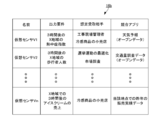
また、図4は、この例の出力管理テーブルを示す図である。出力管理テーブル16bは、仮想センサの名前、仮想センサの出力要件、想定受取相手、および競合アプリを対応付けて登録したテーブルである。仮想センサの出力要件とは、その仮想センサの出力である仮想センシングデータを特定するための情報(例えば、3時間後のX地域の熱中症指数、3時間後のY地点の歩行者人数等)である。想定受取相手は、その仮想センサの出力である仮想センシングデータを利用する利用者の種別を示す情報(例えば、工事現場管理者、冷感商品の小売店、選挙運動管理者、市場調査員等)である。また、競合アプリは、その仮想センサの出力である仮想センシングデータと同じ用途で使用できる他のデータを示す情報(例えば、天気予報、交通量調査データ等)である。仮想センサV1は、図4に示すように、出力要件が3時間後のX地域の熱中症指数であり、想定受取相手が工事現場管理者、および冷感商品の小売店であり、競合アプリが天気予報(オープンンデータ)である。また、仮想センサV2は、図4に示すように、出力要件が3時間後のX地域の歩行者人数であり、想定受取相手が選挙運動管理者、および市場調査員であり、競合アプリが交通量調査データ(オープンンデータ)である。
この例では、仮想センサDB16が、この発明で言う第1記憶部に相当する。
実センサDB17は、実センサに関する実センサ情報を記憶するデータベースである。この例の実センサDB17は、上述したセンシングデータ流通システムで提供されている実センシングデータの名前、観測特性、測定場所、観測時間間隔を対応付けて登録した実センサ管理テーブル17aを記憶している。図5は、この例の実センサ管理テーブルを示す図である。図5は、気象1、気象2、気象3、交通1、交通2にかかる実センサ情報を例示している。気象1は、観測特性が温度、および湿度であり、測定場所(観測場所)がA地点近隣であり、観測時間間隔が5分である。気象2は、観測特性が日射量であり、測定場所(観測場所)がA地点近隣であり、観測時間間隔が5分である。気象3は、観測特性が風力であり、測定場所(観測場所)がA地点の近隣駅であり、観測時間間隔が5分である。交通1は、観測特性が人流であり、測定場所(観測場所)がA地点の近隣交差点であり、観測時間間隔が5分である。交通2は、観測特性が人流であり、測定場所(観測場所)がA地点の近隣駅であり、観測時間間隔が5分である。
この例では、実センサDB17が、この発明で言う第2記憶部に相当する。
また、この例のオープンデータDB18は、オープンデータに関する情報を記憶するデータベースである。この例のオープンデータDB18は、オープンデータの名前、観測特性、観測エリア、更新時間間隔を対応付けて登録したオープンデータ管理テーブル18aを記憶している。図6は、この例のオープンデータ管理テーブルを示す図である。図6は、天気予報1、および商業1にかかるオープンデータの情報を例示している。天気予報1は、観測特性が温度、および降水確率であり、観測エリアが広域であり、更新時間間隔が6時間である。商業1は、観測特性が熱中症指数とアイスクリームの売上の相関であり、観測エリアが関西地域であり、更新時間間隔が月毎である。
辞書DB19は、語彙を意味によって分類・配列した辞書を登録したデータベースである。辞書DB19には、同義語を登録した同義語辞書、関連語を登録した関連語辞書、類似語を登録した類似語辞書等、1つ以上の辞書が登録されている。すなわち、辞書DB19は、登録されている辞書が1つであってもよいし、複数であってもよい(1つ以上の辞書が登録されていればよい。)。
上述した、仮想センサDB16、実センサDB17、オープンデータDB18、および辞書DB19は、いずれか2つ以上のデータベースを組み合わせて統合した構成にしてもよい。例えば、仮想センサDB16、および実センサDB17を1つのデータベースで構成してもよいし、仮想センサDB16、実センサDB17、およびオープンデータDB18を1つのデータベースで構成してもよい。
次に、制御ユニット11が有する各部21、22、23、24、25および26について説明する。
この例にかかる仮想センサ生成装置10は、ユーザ端末から送信されてきた仮想センサの生成要求を通信ユニット12において受信する。この仮想センサの生成要求には、生成を要求する仮想センサの出力要件が含まれている。例えば、上述した「3時間後のX地域の熱中症指数」や、「3時間後のY地点の歩行者人数」等が仮想センサの生成要求に含まれている。
検索キー抽出部21は、通信ユニット12においてユーザ端末から受信した仮想センサの生成要求に含まれている仮想センサの出力要件から、キーワードになる語彙を抽出する。また、検索キー抽出部21は、辞書DB19に記憶している辞書を用いて、仮想センサの出力要件から抽出したキーワードの同義語、関連語、類似語等を検索キーとして抽出する。例えば、ユーザ端末から受信した仮想センサの生成要求に含まれている仮想センサの出力要件が「X地域での3時間後のアイスクリームの売上」である場合、例えば「X地域の熱中症指数」、「X地域の歩行者人数」等を、検索キーとして抽出する。
検索部22は、検索キー抽出部21が抽出した検索キーで、仮想センサDB16、実センサDB17、およびオープンデータDB18のそれぞれを検索し、該当する仮想センサの情報、該当する実センサの情報、および該当するオープンデータの情報を抽出する。
組合せ推論部23は、検索部22によって検索された仮想センサ、および実センサの中から、出力要件に適合する仮想センサの入力データの組合せパターンを1つ以上生成する。仮想センサの入力データの組合せパターンを生成する手法としては、例えば、以下に示す手法A~Cが考えられるが、他の手法で生成してもよい。
<組合せパターン生成手法A>
組合せ推論部23は、検索部22によって検索された仮想センサ、および実センサのセンシングデータの全てを仮想センサの入力データとした1つの組合せパターンを生成する。
組合せ推論部23は、検索部22によって検索された仮想センサ、および実センサのセンシングデータの全てを仮想センサの入力データとした1つの組合せパターンを生成する。
<組合せパターン生成手法B>
組合せ推論部23は、検索部22によって検索された仮想センサ、および実センサのセンシングデータを、その属性によってグループに分類する。例えば、センシングデータの種別にかかる属性(温度、日射量、人流等)を分類項目にして、検索部22によって検索された仮想センサ、および実センサのセンシングデータをグループに分類する。
組合せ推論部23は、検索部22によって検索された仮想センサ、および実センサのセンシングデータを、その属性によってグループに分類する。例えば、センシングデータの種別にかかる属性(温度、日射量、人流等)を分類項目にして、検索部22によって検索された仮想センサ、および実センサのセンシングデータをグループに分類する。
組合せ推論部23は、各グループから1つずつ抽出したセンシングデータの組合せを、仮想センサの入力データの1つの組合せパターンとして生成する。組合せ推論部23が生成する仮想センサの入力データの組合せパターンは、各グループからセンシングデータを1つずつ抽出した場合の全ての組合せである。例えば、グループXに分類されたセンシングデータが4つであり、グループYに分類されたセンシングデータが2つであり、グループZに分類されたセンシングデータが2つであった場合、組合せ推論部23は、仮想センサの入力データの組合せパターンとして、合計16個(4×2×2)の組合せパターンを生成する。
<組合せパターン生成手法C>
組合せ推論部23は、検索部22によって検索された仮想センサ、および実センサのセンシングデータを、その属性によってグループに分類する。例えば、センシングデータの種別にかかる属性(温度、日射量、人流等)を分類項目にして、検索部22によって検索された仮想センサ、および実センサのセンシングデータをグループに分類する。
組合せ推論部23は、検索部22によって検索された仮想センサ、および実センサのセンシングデータを、その属性によってグループに分類する。例えば、センシングデータの種別にかかる属性(温度、日射量、人流等)を分類項目にして、検索部22によって検索された仮想センサ、および実センサのセンシングデータをグループに分類する。
組合せ推論部23は、グループ毎に、そのグループに属する属性のセンシングデータが仮想センサの出力に与える影響度の大きさを判断し、この影響度の大きさに基づいて、各グループを順位づけする。仮想センサの出力に与える影響度が大きいグループほど、順位を上位にする。例えば、その属性によって分類されたグループが、グループW、グループX、グループY、グループZであり、判断された影響度が、グループWが1.2、グループXが1.5、グループYが1.8、グループZが1.4であった場合、上位からグループY、グループX、グループZ、グループWの順に順位づけする。
組合せ推論部23は、仮想センサの入力データに対して、予め定められた属性数(n)に基づき、上記n個のグループを抽出する。組合せ推論部23は、例えばn=3である場合、上記の例ではグループX、グループY、およびグループZを抽出し、グループWを抽出しない。また、組合せ推論部23は、例えばn=2である場合、上記の例ではグループX、およびグループYを抽出し、グループZ、およびグループWを抽出しない。
組合せ推論部23は、上記の処理で抽出した各グループから1つずつ抽出したセンシングデータの組合せを、仮想センサの入力データの1つの組合せパターンとして生成する。組合せ推論部23が生成する仮想センサの入力データの組合せパターンは、上記の処理で抽出した各グループからセンシングデータを1つずつ抽出した場合の全ての組合せである。すなわち、組合せ推論部23は、予め定められた属性数(n)のグループを抽出し、抽出したグループを対象にして、上述した<組合せパターン生成手法B>を行う。
組合せ検証部24は、組合せ推論部23によって生成された仮想センサの入力データの組合せパターン毎に仮想センサの適正度を推定する。組合せ検証部24は、入力データの組合せパターン毎に、出力要件が類似するオープンデータ(検索部22によって検索されたオープンデータ)との類似度が最大になるように、入力データを処理する処理プログラムにおける各入力データのパラメータを多変量解析等で調整する。組合せ検証部24は、このとき最大となった類似度を仮想センサの適正度であると推定する。
例えば、組合せ検証部24は、上述した<組合せパターン生成手法A>によって、仮想センサの入力データの組合せパターンが設定されている場合、出力要件が類似するオープンデータとの類似度が最大になるように、入力データを処理する処理プログラムにおける各入力データのパラメータを多変量解析等で調整する。組合せ検証部24は、入力データ毎に、その入力データについて調整されたパラメータの大きさによって、当該入力データが仮想センサのセンシングデータ(出力)に与える影響が大きいか、小さいかを判断する。具体的には、組合せ検証部24は、パラメータの大きさが、予め定めた閾値よりも大きいか小さいかを判断基準にして、その入力データが仮想センサの出力に与える影響が大きいか、小さいかを判断する。組合せ検証部24は、仮想センサの出力に与える影響が大きいと判断した入力データを、仮想センサの入力データにすると判断するとともに、仮想センサの出力に与える影響が小さいと判断した入力データを、仮想センサの入力データにしないと判断する。
また、組合せ検証部24は、上述した<組合せパターン生成手法B>、または<組合せパターン生成手法C>によって、仮想センサの入力データの組合せパターンが設定されている場合、出力要件が類似するオープンデータとの類似度が最大であった入力データの組合せパターンを、仮想センサの入力データの組合せパターンに決定する。したがって、組合せ検証部24は、検索部22によって検索された仮想センサ、および実センサのセンシングデータであって、決定した組合せパターンに含まれていない入力データを、この仮想センサの入力データにしないと判断する。
なお、この場合、組合せ検証部24は、決定した組合せパターンにおいて、仮想センサの出力に与える影響が小さいと判断される入力データを、仮想センサの入力データにしないと追加的に判断するように構成してもよい。
この例では、この発明で言う仮想センサ生成部が、組合せ推論部23、および組合せ検証部24によって構成される。
仮想センサ情報提供部25は、通信ユニット12を制御して、組合せ検証部24によって適正度が最大であるとされた仮想センサの情報を、仮想センサの生成要求を送信してきたユーザ端末に送信する。これにより、ユーザ端末は、仮想センサの生成要求を仮想センサ生成装置10に送信することにより、仮想センサの情報を得ることができる。仮想センサ情報提供部25は、生成した仮想センサの情報だけでなく、当該仮想センサの利用用途(想定受取相手)、類似する仮想センサやオープンデータの情報(競合するアプリの情報)を追加的に送信してもよい。
なお、ユーザは、取得した仮想センサの情報に基づいて、当該仮想センサを改良する変更等を行うこともできる。
仮想センサ情報登録部26は、今回生成した仮想センサの情報(組合せ検証部24によって適正度が最大であるとされた仮想センサの情報)を仮想センサDB16に登録する。このとき、仮想センサ情報登録部26は、検索部22によって検索されたセンシングデータであって、生成した仮想センサの入力データであるセンシングデータと、生成した仮想センサの入力データとして使用していないセンシングデータとを区別した仮想センサ情報を仮想センサDB16に登録する。図7は、仮想センサVnにかかる情報が登録された入力管理テーブルを示し、図8は、仮想センサVnにかかる情報が登録された出力管理テーブルを示している。仮想センサVnは、今回生成された仮想センサであり、生成時に検索部22が仮想センサV1、仮想センサV2、商業X、および気象3を抽出している。そして、組合せ検証部24によって適正度が最大であると判定された仮想センサは、入力データの組合せが、仮想センサV1、仮想センサV2、商業Xである(気象3が入力データとして使用されていない。)。
この制御ユニット11は、ハードウェアCPU、メモリ、その他の電子回路によって構成されている。ハードウェアCPUが、この発明にかかる仮想センサ生成プログラムを実行することにより、上述した、検索キー抽出部21、検索部22、組合せ推論部23、組合せ検証部24、仮想センサ情報提供部25、および仮想センサ情報登録部26として動作する。また、メモリは、この発明にかかる仮想センサ生成プログラムを展開する領域や、この仮想センサ生成プログラムの実行時に生じたデータ等を一時記憶する領域を有している。制御ユニット11は、ハードウェアCPU、メモリ等を一体化したLSIであってもよい。
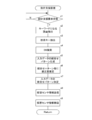
以下、この仮想センサ生成装置10の動作について説明する。図9は、仮想センサ生成装置の動作を示すフローチャートである。
仮想センサ生成装置10は、通信ユニット12においてユーザ端末から、仮想センサの生成要求を受信するのを待っている(s1)。制御ユニット11は、ユーザ端末から仮想センサの生成要求を通信ユニット12で受信すると、検索キー抽出部21が受信した仮想センサの生成要求に含まれている仮想センサの出力要件から、キーワードになる語彙を抽出する(s2)。例えば、仮想センサの出力要件として、「〇〇地点での3時間後のアイスクリームの売り上げ推定」という文が、s1で受信した仮想センサの生成要求に含まれている。s2では、「〇〇地点」、「アイスクリーム」、「売り上げ」等をキーワードになる語彙として抽出する。検索キー抽出部21は、辞書DB19に記憶している辞書を用いて、仮想センサの出力要件から抽出したキーワードの同義語、関連語、類似語等を検索キーとして抽出する(s3)。例えば、s3では、「アイスクリーム」に関連する語彙として、「熱い」、「熱中症」等を抽出する。また「売り上げ」に関連する語彙として、「人数」、「歩行者」等を抽出する。
検索部22は、s3で抽出された検索キーで、仮想センサDB16、実センサDB17、およびオープンデータDB18を検索し、該当する仮想センサに関する情報、該当する実センサに関する情報、および該当するオープンデータに関する情報を抽出する(s4)。s4における、仮想センサDB16、実センサDB17、およびオープンデータDB18の検索は、例えば公知のオントロジー技術を利用して行う。
組合せ推論部23は、s4における検索で抽出した、検索部22によって検索された仮想センサ、および実センサの中から、出力要件に適合する仮想センサの入力データの組合せパターンを1つ以上生成する(s5)。s5では、例えば、上述した<組合せパターン生成手法B>、または<組合せパターン生成手法C>の手法によって、仮想センサの入力データの組合せパターンが1つ以上生成される。
組合せ検証部24は、組合せ推論部23によって生成された仮想センサの入力データの組合せパターン毎に仮想センサの適正度を推定する(s6)。s6では、組合せ検証部24は、入力データの組合せパターン毎に、出力要件が類似するオープンデータ(検索部22によって検索されたオープンデータ)との類似度が最大になるように、入力データを処理する処理プログラムにおける各入力データのパラメータを多変量解析等で調整する。組合せ検証部24は、このとき最大となった類似度を仮想センサの適正度であると推定する。組合せ検証部24は、今回の仮想センサの生成要求に応じた仮想センサの入力データを、適正度が最大であった入力データの組合せパターンに決定する(s7)。
なお、s7では、組合せ検証部24は、適正度が最大であった入力データの組合せパターンにおいて、入力データ毎に、その入力データが仮想センサのセンシングデータ(出力)に与える影響が大きいか、小さいかを判断する。そして、組合せ検証部24は、適正度が最大であった入力データの組合せパターンにおいて、仮想センサの出力に与える影響が大きいと判断した入力データを、仮想センサの入力データにすると判断するとともに、仮想センサの出力に与える影響が小さいと判断した入力データを、仮想センサの入力データにしないと判断するようにしてもよい。
仮想センサ情報提供部25は、入力データがs7で決定した入力パターンである仮想センサの情報を、今回仮想センサの生成要求を送信してきたユーザ端末に送信する(s8)。仮想センサ情報提供部25は、s8で生成した仮想センサの情報だけでなく、当該仮想センサの利用用途(想定受取相手)、類似する仮想センサやオープンデータの情報(競合するアプリの情報)も追加的に送信してもよい。
また、仮想センサ情報登録部26は、今回生成した仮想センサの情報を仮想センサDB16に登録する(s9)。仮想センサ情報登録部26は、検索部22によって検索されたセンシングデータであって、生成した仮想センサの入力データであるセンシングデータと、生成した仮想センサの入力データとして使用していないセンシングデータとを区別した仮想センサ情報を仮想センサDB16に登録する。また、仮想センサ情報登録部26は、生成した仮想センサの利用用途(想定受取相手)、類似する仮想センサやオープンデータの情報(競合するアプリの情報)も追加的に仮想センサDB16に登録してもよい。
なお、s8、s9にかかる処理は、どちらを先に実行してもよいし、また、同時並行的に実行してもよい。
このように、仮想センサ生成装置10は、仮想センサを生成すると、その仮想センサにかかる情報を仮想センサDB16に登録する。したがって、仮想センサ生成装置10は、仮想センサの生成によって、仮想センサDB16を成長させることができる。
また、仮想センサ生成装置10は、検索部22によって抽出された仮想センサの仮想センサ情報、および実センサの実センサ情報であって、生成した仮想センサの入力データに使用したものと、入力データに使用しなかったものとを区別した仮想センサ情報を仮想センサDB16に登録する。すなわち、仮想センサの生成時に、仮想センサDB16に登録される仮想センサ情報には、生成された仮想センサに直接的に関連しない情報であっても、その仮想センサの生成時に取得した情報が含まれている。したがって、仮想センサ生成装置10は、生成する仮想センサの入力データの決定等において、過去に生成された仮想センサに直接的に関連しない情報であっても、過去の仮想センサの生成時に取得した情報を有効に活用することができ、仮想センサの生成が効率的に行える。仮想センサ生成装置10は、例えば、仮想センサの生成時に、検索部22によって検索された仮想センサの仮想センサ情報に、入力データとして使用されなかったセンシングデータにかかる情報が含まれていると、そのセンシングデータを今回生成する仮想センサの入力データにするかどうか等を判断することで、より適正な出力が得られる仮想センサを効率的に生成できる。
また、仮想センサ生成装置10は、仮想センサの生成要求を行ったユーザ端末に対して、生成した仮想センサの情報を出力する。したがって、ユーザは、仮想センサ生成装置10で生成された仮想センサを基にして、より適正な出力が得られる仮想センサを簡単に生成できる。すなわち、仮想センサ生成装置10は、ユーザに対する仮想センサの設計支援が行える。
また、仮想センサ生成装置10は、生成した仮想センサの仮想センシングデータの利用用途を示す利用用途情報や、生成した仮想センサと類似する別の仮想センサを示す類似センサ情報を加えて出力する。したがって、ユーザは、競合するオープンデータの確認や、仮想センシングデータを利用する相手の想定が簡単に行えるので、この仮想センサの仮想センシングデータをSDTMで販売するときの指標にできる。
また、仮想センサ生成装置10は、ユーザ端末から、改良された仮想センサにかかる情報のフィードバックを受け付け、この情報に基づいて仮想センサDB16を更新するようにしてもよい。このように構成すれば、仮想センサDB16を効率的に成長させることができる。
また、図9では、仮想センサの入力データの組合せパターンが、上述した<組合せパターン生成手法B>、または<組合せパターン生成手法C>の手法によって生成された場合を例にしたが、<組合せパターン生成手法A>の手法によって生成されている場合には、上述したs6、s7にかかる処理を、以下に示す処理に置き換えればよい。
組合せ検証部24は、入力データの組合せパターンについて、出力要件が類似するオープンデータ(検索部22によって検索されたオープンデータ)との類似度が最大になるように、入力データを処理する処理プログラムにおける各入力データのパラメータを多変量解析等で調整する。組合せ検証部24は、入力データ毎に、その入力データについて調整されたパラメータの大きさによって、当該入力データが仮想センサのセンシングデータ(出力)に与える影響が大きいか、小さいかを判断する。組合せ検証部24は、仮想センサの出力に与える影響が大きいと判断した入力データを、仮想センサの入力データにすると判断するとともに、仮想センサの出力に与える影響が小さいと判断した入力データを、仮想センサの入力データにしないと判断する。
なお、この例の仮想センサ生成装置10は、ユーザ端末から仮想センサの仮想センサ生成要求を受け付けるとしたが、例えば操作部(不図示)において仮想センサ生成要求にかかる入力操作を受け付ける構成であってもよい。このように構成すれば、ユーザは、仮想センサ生成装置10において直接仮想センサの生成を行うことができる。
また、上記の例では、オープンデータは、生成する仮想センサの入力データに使用しないものとして説明したが、仮想センサの入力データに使用することも可能である。
なお、この発明は、上記実施形態そのままに限定されるものではなく、実施段階ではその要旨を逸脱しない範囲で構成要素を変形して具体化できる。また、上記実施形態に開示されている複数の構成要素の適宜な組み合せにより種々の発明を形成できる。例えば、実施形態に示される全構成要素から幾つかの構成要素を削除してもよい。さらに、異なる実施形態に亘る構成要素を適宜組み合せてもよい。
また、上記の実施形態の一部又は全部は、以下の付記のようにも記載されうるが、以下には限られない。
(付記1)
少なくとも1つのハードウェアプロセッサを有し、
前記ハードウェアプロセッサが、
入力データを処理して仮想センシングデータを取得する仮想センサの前記仮想センシングデータの要件に応じた検索キーで、仮想センサに関する仮想センサ情報を記憶する第1記憶部、および観測対象の観測特性をセンシングした実センシングデータを出力する実センサに関する実センサ情報を記憶する第2記憶部を検索し、前記仮想センサ情報、および前記実センサ情報を抽出し、
前記第1記憶部、および前記第2記憶部の検索に用いた前記検索キーに対応する要件の前記仮想センサを、抽出した前記仮想センサ情報、および前記実センサ情報を用いて生成し、
さらに、抽出した前記仮想センサ情報の前記仮想センサ、および前記実センサ情報の実センサを、生成した前記仮想センサの前記入力データに使用されたものと、前記入力データに使用されなかったものとに区別した前記仮想センサ情報を前記第1記憶部に登録する、
仮想センサ生成装置。
(付記2)
少なくとも1つのハードウェアプロセッサを用いて、
前記ハードウェアプロセッサが、
入力データを処理して仮想センシングデータを取得する仮想センサの前記仮想センシングデータの要件に応じた検索キーで、仮想センサに関する仮想センサ情報を記憶する第1記憶部、および観測対象の観測特性をセンシングした実センシングデータを出力する実センサに関する実センサ情報を記憶する第2記憶部を検索し、前記仮想センサ情報、および前記実センサ情報を抽出し、
前記第1記憶部、および前記第2記憶部の検索に用いた前記検索キーに対応する要件の前記仮想センサを、抽出した前記仮想センサ情報、および前記実センサ情報を用いて生成し、
さらに、抽出した前記仮想センサ情報の前記仮想センサ、および前記実センサ情報の実センサを、生成した前記仮想センサの前記入力データに使用されたものと、前記入力データに使用されなかったものとに区別した前記仮想センサ情報を前記第1記憶部に登録する、
仮想センサ生成方法。
1…センサ装置
2…アプリケーションシステム
3…ネットワークサーバ
10…仮想センサ生成装置
11…制御ユニット
12…通信ユニット
16…仮想センシングデータベース(仮想センサDB)
16a…入力管理テーブル
16b…出力管理テーブル
17…実センサデータベース(実センサDB)
17a…実センサ管理テーブル
18…オープンデータデータベース(オープンデータDB)
18a…オープンデータ管理テーブル
19…辞書データベース(辞書DB)
21…検索キー抽出部
22…検索部
23…組合せ推論部
24…組合せ検証部
25…仮想センサ情報提供部
26…仮想センサ情報登録部
2…アプリケーションシステム
3…ネットワークサーバ
10…仮想センサ生成装置
11…制御ユニット
12…通信ユニット
16…仮想センシングデータベース(仮想センサDB)
16a…入力管理テーブル
16b…出力管理テーブル
17…実センサデータベース(実センサDB)
17a…実センサ管理テーブル
18…オープンデータデータベース(オープンデータDB)
18a…オープンデータ管理テーブル
19…辞書データベース(辞書DB)
21…検索キー抽出部
22…検索部
23…組合せ推論部
24…組合せ検証部
25…仮想センサ情報提供部
26…仮想センサ情報登録部
Claims (7)
- 入力データを処理して仮想センシングデータを取得する仮想センサに関する仮想センサ情報を記憶する第1記憶部と、
観測対象の観測特性をセンシングした実センシングデータを出力する実センサに関する実センサ情報を記憶する第2記憶部と、
前記仮想センシングデータの要件に応じた検索キーで、前記第1記憶部、および前記第2記憶部を検索し、前記仮想センサ情報、および前記実センサ情報を抽出する検索部と、
前記検索部が前記第1記憶部、および前記第2記憶部の検索に用いた前記検索キーに対応する要件の仮想センサを、前記検索部が抽出した前記仮想センサ情報、および前記実センサ情報を用いて生成する仮想センサ生成部と、
前記検索部によって抽出された前記仮想センサ情報の仮想センサ、および前記実センサ情報の実センサが、前記仮想センサ生成部が生成した前記仮想センサの前記入力データに使用されたものと、前記入力データに使用されなかったものとに区別されている前記仮想センサ情報を前記第1記憶部に登録する仮想センサ情報登録部と、を備えた仮想センサ生成装置。 - 前記仮想センシングデータの要件を含む前記仮想センサの生成要求を受け付ける生成要求受付部と、
前記生成要求受付部が受け付けた前記仮想センサの生成要求に含まれている前記仮想センシングデータの要件に応じた前記検索キーを生成する検索キー生成部と、を備えた請求項1に記載の仮想センサ生成装置。 - 前記仮想センサ生成部が生成した前記仮想センサの前記仮想センサ情報を、前記生成要求受付部が受け付けた前記仮想センサの生成要求の要求元に対して出力する出力部を備えた、請求項2に記載の仮想センサ生成装置。
- 前記仮想センサ情報登録部は、前記仮想センサ生成部が生成した前記仮想センサの前記仮想センシングデータの利用用途を示す利用用途情報を前記第1記憶部に登録する、請求項1~3のいずれかに記載の仮想センサ生成装置。
- 前記仮想センサ情報登録部は、前記仮想センシングデータの要件が、前記仮想センサ生成部が生成した前記仮想センサと類似する別の仮想センサを示す類似センサ情報を前記第1記憶部に登録する、請求項1~4のいずれかに記載の仮想センサ生成装置。
- 入力データを処理して仮想センシングデータを取得する仮想センサに関する仮想センサ情報を記憶する第1記憶部と、観測対象の観測特性をセンシングした実センシングデータを出力する実センサに関する実センサ情報を記憶する第2記憶部とに接続されたコンピュータが、
前記仮想センシングデータの要件に応じた検索キーで、前記第1記憶部、および前記第2記憶部を検索し、前記仮想センサ情報、および前記実センサ情報を抽出するステップと、
前記抽出するステップで前記第1記憶部、および前記第2記憶部の検索に用いた前記検索キーに対応する要件の仮想センサを、前記抽出するステップで抽出した前記仮想センサ情報、および前記実センサ情報を用いて生成するステップと、
前記抽出するステップで抽出された前記仮想センサ情報の仮想センサ、および前記実センサ情報の実センサが、前記仮想センサを生成するステップで生成された前記仮想センサの前記入力データに使用されたものと、前記入力データに使用されなかったものとに区別されている前記仮想センサ情報を前記第1記憶部に登録するステップと、
を実行する仮想センサ生成方法。 - 入力データを処理して仮想センシングデータを取得する仮想センサに関する仮想センサ情報を記憶する第1記憶部と、観測対象の観測特性をセンシングした実センシングデータを出力する実センサに関する実センサ情報を記憶する第2記憶部とに接続されたコンピュータに、
前記仮想センシングデータの要件に応じた検索キーで、前記第1記憶部、および前記第2記憶部を検索し、前記仮想センサ情報、および前記実センサ情報を抽出するステップと、
前記抽出するステップで前記第1記憶部、および前記第2記憶部の検索に用いた前記検索キーに対応する要件の仮想センサを、前記抽出するステップで抽出した前記仮想センサ情報、および前記実センサ情報を用いて生成するステップと、
前記抽出するステップで抽出された前記仮想センサ情報の仮想センサ、および前記実センサ情報の実センサが、前記仮想センサを生成するステップで生成された前記仮想センサの前記入力データに使用されたものと、前記入力データに使用されなかったものとに区別されている前記仮想センサ情報を前記第1記憶部に登録するステップと、
を実行させる仮想センサ生成プログラム。
Priority Applications (1)
| Application Number | Priority Date | Filing Date | Title |
|---|---|---|---|
| JP2018544376A JP7006609B2 (ja) | 2017-09-06 | 2018-08-09 | 仮想センサ生成装置 |
Applications Claiming Priority (2)
| Application Number | Priority Date | Filing Date | Title |
|---|---|---|---|
| JP2017170798 | 2017-09-06 | ||
| JP2017-170798 | 2017-09-06 |
Publications (1)
| Publication Number | Publication Date |
|---|---|
| WO2019049602A1 true WO2019049602A1 (ja) | 2019-03-14 |
Family
ID=65633914
Family Applications (1)
| Application Number | Title | Priority Date | Filing Date |
|---|---|---|---|
| PCT/JP2018/029868 Ceased WO2019049602A1 (ja) | 2017-09-06 | 2018-08-09 | 仮想センサ生成装置 |
Country Status (2)
| Country | Link |
|---|---|
| JP (1) | JP7006609B2 (ja) |
| WO (1) | WO2019049602A1 (ja) |
Citations (3)
| Publication number | Priority date | Publication date | Assignee | Title |
|---|---|---|---|---|
| JP2013055570A (ja) * | 2011-09-06 | 2013-03-21 | Oki Electric Ind Co Ltd | データ生成装置、方法およびプログラム |
| JP2013172247A (ja) * | 2012-02-20 | 2013-09-02 | Oki Electric Ind Co Ltd | データ生成装置、方法およびプログラム |
| JP2014153797A (ja) * | 2013-02-06 | 2014-08-25 | Omron Corp | デバイス情報提供システム、デバイス情報提供方法 |
-
2018
- 2018-08-09 WO PCT/JP2018/029868 patent/WO2019049602A1/ja not_active Ceased
- 2018-08-09 JP JP2018544376A patent/JP7006609B2/ja active Active
Patent Citations (3)
| Publication number | Priority date | Publication date | Assignee | Title |
|---|---|---|---|---|
| JP2013055570A (ja) * | 2011-09-06 | 2013-03-21 | Oki Electric Ind Co Ltd | データ生成装置、方法およびプログラム |
| JP2013172247A (ja) * | 2012-02-20 | 2013-09-02 | Oki Electric Ind Co Ltd | データ生成装置、方法およびプログラム |
| JP2014153797A (ja) * | 2013-02-06 | 2014-08-25 | Omron Corp | デバイス情報提供システム、デバイス情報提供方法 |
Also Published As
| Publication number | Publication date |
|---|---|
| JPWO2019049602A1 (ja) | 2020-08-20 |
| JP7006609B2 (ja) | 2022-01-24 |
Similar Documents
| Publication | Publication Date | Title |
|---|---|---|
| Singh et al. | A novel deep neural-based music recommendation method considering user and song data | |
| JP6511455B2 (ja) | ユーザ行動の特徴を抽出して推奨を個人化する方法及びシステム | |
| US9065727B1 (en) | Device identifier similarity models derived from online event signals | |
| CN110909176A (zh) | 数据推荐方法、装置、计算机设备以及存储介质 | |
| US10110544B2 (en) | Method and system for classifying a question | |
| CN109543840B (zh) | 一种基于多维分类强化学习的动态推荐系统设计方法 | |
| Zhong et al. | Time-aware service recommendation for mashup creation in an evolving service ecosystem | |
| US20210118024A1 (en) | Multi-label product categorization | |
| CN108596695B (zh) | 实体推送方法及系统 | |
| CN105045799A (zh) | 可搜索索引 | |
| CN113707302B (zh) | 基于关联信息的服务推荐方法、装置、设备及存储介质 | |
| CN102902753A (zh) | 用于补全搜索词及建立个体兴趣模型的方法及装置 | |
| CN113435970B (zh) | 基于生物信息的产品推荐方法、装置、电子设备及介质 | |
| CN110348919A (zh) | 物品推荐方法、装置和计算机可读存储介质 | |
| CN113706251A (zh) | 基于模型的商品推荐方法、装置、计算机设备和存储介质 | |
| CN112925986A (zh) | 商品对象推荐方法、装置、电子设备及存储介质 | |
| JP2019149057A (ja) | 情報処理装置、情報処理方法、及び情報処理プログラム | |
| CN117057855A (zh) | 一种数据处理方法及相关装置 | |
| CN110766489A (zh) | 请求内容及提供内容的方法和相应设备 | |
| CN113486232B (zh) | 查询方法、装置、服务器、介质及产品 | |
| Zhang et al. | Improving augmented reality using recommender systems | |
| US20140372207A1 (en) | Profit index value generation system and profit index value generation method | |
| CN110175892B (zh) | 基于消费者行为的热力球双向推荐方法及系统 | |
| CN114595377A (zh) | 词汇推荐方法、装置、终端及可读存储介质 | |
| JP7006609B2 (ja) | 仮想センサ生成装置 |
Legal Events
| Date | Code | Title | Description |
|---|---|---|---|
| ENP | Entry into the national phase |
Ref document number: 2018544376 Country of ref document: JP Kind code of ref document: A |
|
| NENP | Non-entry into the national phase |
Ref country code: DE |
|
| 122 | Ep: pct application non-entry in european phase |
Ref document number: 18854699 Country of ref document: EP Kind code of ref document: A1 |