WO2019048561A1 - New compounds suitable as catalysts for polymerization reactions - Google Patents
New compounds suitable as catalysts for polymerization reactions Download PDFInfo
- Publication number
- WO2019048561A1 WO2019048561A1 PCT/EP2018/074043 EP2018074043W WO2019048561A1 WO 2019048561 A1 WO2019048561 A1 WO 2019048561A1 EP 2018074043 W EP2018074043 W EP 2018074043W WO 2019048561 A1 WO2019048561 A1 WO 2019048561A1
- Authority
- WO
- WIPO (PCT)
- Prior art keywords
- group
- 6alkyl
- independently selected
- hydrogen
- optionally substituted
- Prior art date
- Legal status (The legal status is an assumption and is not a legal conclusion. Google has not performed a legal analysis and makes no representation as to the accuracy of the status listed.)
- Ceased
Links
- 0 CC(C)I*(C)NN(C)* Chemical compound CC(C)I*(C)NN(C)* 0.000 description 3
- PZDCNAHNAXTTRA-ADMZDKPHSA-N CC([C@H]1C(C)C2C)[C@@]1(C)C(C)C(C)C2(C)NN Chemical compound CC([C@H]1C(C)C2C)[C@@]1(C)C(C)C(C)C2(C)NN PZDCNAHNAXTTRA-ADMZDKPHSA-N 0.000 description 1
- NWACIASZMNDJQN-WCWDXBQESA-N Cc1c(/C(/CC2)=C(\CCc3c4C)/c3c(C)cc4[Si](C)(C)C)c2c(C)c([Si](C)(C)C)c1 Chemical compound Cc1c(/C(/CC2)=C(\CCc3c4C)/c3c(C)cc4[Si](C)(C)C)c2c(C)c([Si](C)(C)C)c1 NWACIASZMNDJQN-WCWDXBQESA-N 0.000 description 1
Classifications
-
- C—CHEMISTRY; METALLURGY
- C07—ORGANIC CHEMISTRY
- C07F—ACYCLIC, CARBOCYCLIC OR HETEROCYCLIC COMPOUNDS CONTAINING ELEMENTS OTHER THAN CARBON, HYDROGEN, HALOGEN, OXYGEN, NITROGEN, SULFUR, SELENIUM OR TELLURIUM
- C07F7/00—Compounds containing elements of Groups 4 or 14 of the Periodic Table
- C07F7/02—Silicon compounds
- C07F7/08—Compounds having one or more C—Si linkages
- C07F7/0803—Compounds with Si-C or Si-Si linkages
- C07F7/0805—Compounds with Si-C or Si-Si linkages comprising only Si, C or H atoms
-
- C—CHEMISTRY; METALLURGY
- C08—ORGANIC MACROMOLECULAR COMPOUNDS; THEIR PREPARATION OR CHEMICAL WORKING-UP; COMPOSITIONS BASED THEREON
- C08F—MACROMOLECULAR COMPOUNDS OBTAINED BY REACTIONS ONLY INVOLVING CARBON-TO-CARBON UNSATURATED BONDS
- C08F110/00—Homopolymers of unsaturated aliphatic hydrocarbons having only one carbon-to-carbon double bond
- C08F110/02—Ethene
-
- C—CHEMISTRY; METALLURGY
- C08—ORGANIC MACROMOLECULAR COMPOUNDS; THEIR PREPARATION OR CHEMICAL WORKING-UP; COMPOSITIONS BASED THEREON
- C08F—MACROMOLECULAR COMPOUNDS OBTAINED BY REACTIONS ONLY INVOLVING CARBON-TO-CARBON UNSATURATED BONDS
- C08F2410/00—Features related to the catalyst preparation, the catalyst use or to the deactivation of the catalyst
- C08F2410/03—Multinuclear procatalyst, i.e. containing two or more metals, being different or not
-
- C—CHEMISTRY; METALLURGY
- C08—ORGANIC MACROMOLECULAR COMPOUNDS; THEIR PREPARATION OR CHEMICAL WORKING-UP; COMPOSITIONS BASED THEREON
- C08F—MACROMOLECULAR COMPOUNDS OBTAINED BY REACTIONS ONLY INVOLVING CARBON-TO-CARBON UNSATURATED BONDS
- C08F4/00—Polymerisation catalysts
- C08F4/42—Metals; Metal hydrides; Metallo-organic compounds; Use thereof as catalyst precursors
- C08F4/44—Metals; Metal hydrides; Metallo-organic compounds; Use thereof as catalyst precursors selected from light metals, zinc, cadmium, mercury, copper, silver, gold, boron, gallium, indium, thallium, rare earths or actinides
- C08F4/60—Metals; Metal hydrides; Metallo-organic compounds; Use thereof as catalyst precursors selected from light metals, zinc, cadmium, mercury, copper, silver, gold, boron, gallium, indium, thallium, rare earths or actinides together with refractory metals, iron group metals, platinum group metals, manganese, rhenium technetium or compounds thereof
- C08F4/62—Refractory metals or compounds thereof
- C08F4/64—Titanium, zirconium, hafnium or compounds thereof
- C08F4/659—Component covered by group C08F4/64 containing a transition metal-carbon bond
- C08F4/65912—Component covered by group C08F4/64 containing a transition metal-carbon bond in combination with an organoaluminium compound
Definitions
- the invention relates to the new compounds and their use as catalysts, in particular catalysts for polymerization reactions.
- the present invention also relates to process for preparing polyolefins using the new compounds, and polyolefins obtained therewith.
- a constant mechanical properties improvement is required in the field of the polymer industry. Such improvement can for example be obtained by tailor made bimodal or multimodal resins synthesized in the presence of catalyst.
- the present invention relates to a compound of formula (I), or a stereoisomer thereof,
- X 1 is CR 5 or N; is CR 6 or N;
- R 1 and R 2 are selected from , or
- R 1 and R 2 are identical, expect for the meanings of M, Q 1 , and Q 2 which may be identical or different;
- R 1 together with one of R 3 , and R 2 together with one of R 4 are selected from
- L 1 is a single bond or -[CR 14 R 15 ] q -; wherein q is an integer selected from 1 , 2, or 3; each of R 14 and R 15 are independently selected from hydrogen or G-6alkyl;
- Ar 1 and Ar 2 are each independently selected from the group consisting of cyclopentadienyl, indenyl, tetrahydroindenyl, and fluorenyl; wherein each of said groups is optionally substituted with one or more substituents each independently selected from the group consisting of G- 2oalkyl, C3-2ocycloalkyl, C6-2oaryl, Ci-6alkoxy, C7-2oalkylaryl and C7-2oarylalkyl, halogen, Si(R 7 )3, heteroCi-6alkyl; wherein R 7 is selected from the group consisting of hydrogen, Ci-6alkyl, Ce- 2oaryl, C7-2oalkylaryl and C7-2oarylalkyl;
- each Q 1 and Q 2 are each independently selected from the group consisting of halogen, Ci- 2oalkyl, haloCi-2oalkyl, -N(R 8 ) 2 , -Si(R 7 )3, -Ge(R 7 )3, Ci-2oalkoxy, C3-2ocycloalkyloxy, C 5 -2oaryloxy, C7-2oaralkoxy, C3-2ocycloalkyl, C6-2oaryl, C7-2oalkylaryl, C7-2oaralkyl, and heteroCi-6alkyl; wherein R 8 is hydrogen or Ci-6alkyl;
- each M is a transition metal independently selected from the group consisting of titanium, zirconium, hafnium, and vanadium; preferably each M is independently selected from zirconium or hafnium;
- Z 1 is a moiety bridging Ar 1 and Z 2 , and is selected from the group consisting of Ci-2oalkylene, germanium, SiR 7 , GeR 7 , B, siloxane, Ci-6 alkylphosphine, and N, and wherein each of said group is optionally substituted with one or more substituents each independently selected from the group consisting of halogen, Ci-2oalkyl, C3-i2alkenyl, C3-2ocycloalkyl, C6-2oaryl, Ci-6alkoxy, C7-2oalkylaryl and C7-2oarylalkyl, halogen, Si(R 7 )3, heteroCi-6alkyl;
- Z 2 is selected from the group consisting of Ar 1 , Ar 2 , Ci-2oalkanetriyl, NR 8 , Si(R 7 )2, germanium, siloxane, and Ci-6alkylphosphine, and wherein each of said group is optionally substituted with one or more substituents each independently selected from the group consisting of halogen, Ci-2oalkyl, C3-i2alkenyl, C3-2ocycloalkyl, C6-2oaryl, Ci-6alkoxy, C7-2oalkylaryl and C7-2oarylalkyl, halogen, Si(R 7 )3, heteroCi-6 alkyl;
- Z 3 is selected from the group consisting of N, CR 12 , and SiR 7 ;
- Z 4 is selected from the group consisting of N, CR 12 , and SiR 7 ;
- Z 5 is selected from the group consisting of NR 8 , Si(R 7 )2, Ge(R 7 )2, and siloxane;
- R 12 is selected from the group consisting of hydrogen, Ci-6alkyl, and Ar 4 ;
- Ar 3 is a group selected from C6-2oaryl or heteroaryl; wherein each of said group is optionally substituted with one or more substituent selected from halogen and Ci-6alkyl;
- Ar 4 is hydrogen or a group selected from C6-2oaryl or heteroaryl; wherein each of said group is optionally substituted with one or more substituent selected from halogen and Ci-6alkyl;
- Ar 5 is a group selected from C6-2oaryl or heteroaryl; wherein each of said group is optionally substituted with one or more substituent selected from halogen and Ci-6alkyl;
- each R 3 is independently selected from the group consisting of hydrogen, Ci-6alkyl, heterod- 6alkyl, Ci-6alkoxy, and C6-i2aryl, wherein each of said group is optionally substituted with one or more substituents each independently selected from the group consisting of hydroxy, halo, and Ci-6alkyl, and n is an integer selected from 1 , 2, 3, or 4;
- R 5 is selected from hydrogen, Ci-6alkyl, and heteroCi-6alkyl
- R 5 and one of R 3 together with the atoms to which they are bound form a Cs- iocycloalkenyl, or a Cs-eheterocyclyl, wherein each Cs-iocycloalkenyl, and Cs-eheterocyclyl is optionally substituted by one or more R 10 ; wherein R 10 is Ci-6alkyl, or C6-i2aryl;
- each R 4 is independently selected from the group consisting of hydrogen, Ci-6alkyl, heterod- 6alkyl, Ci-6alkoxy, and C6-i2aryl, wherein each of said group is optionally substituted with one or more substituents each independently selected from the group consisting of hydroxy, halogen, and Ci-6alkyl, and m is an integer selected from 1 , 2, 3, or 4;
- R 6 is selected from hydrogen, Ci-6alkyl, and heteroCi-6alkyl; and/or R 6 and one of R 4 together with the atoms to which they are bound form a C5- iocycloalkenyl, or a Cs-eheterocyclyl, wherein each Cs-iocycloalkenyl, and Cs-eheterocyclyl is optionally substituted by one or more R 11 ; wherein R 11 is Ci-6alkyl or C6-i2aryl.
- the present invention also relates to the use of at least one compound according to the first aspect as a catalyst and/or in the preparation of a catalyst system.
- the present invention also relates to a catalyst system comprising at least one compound according to the first aspect.
- the present invention also relates to the use of at least one compound according to the first aspect, or of at least one catalyst system according to the third aspect, in polymerization reaction.
- the present invention also encompasses a process for the preparation of a polymer comprising contacting at least one monomer with at least one compound according to the first aspect, or contacting at least one monomer with at least one catalyst system according to the third aspect.
- the present invention also encompasses a polymer at least partially catalyzed by:
- the present invention also encompasses an article, comprising a polymer according to the invention.
- a resin means one resin or more than one resin.
- stereoisomers means all possible isomeric forms, including tautomeric and stereochemical forms, which the compounds of formulae herein may possess.
- the structures shown herein exemplify only one tautomeric or resonance form of the compounds, but the corresponding alternative configurations are contemplated as well. More particularly, stereogenic centers may have either the R- or S-configuration, and multiple bonds may have either cis- or trans-configuration.
- polymer refers to a polymeric compound prepared by polymerizing monomers, whether of the same or a different type.
- the generic term polymer thus embraces the term homopolymer, usually employed to refer to polymers prepared from only one type of monomer, and the terms copolymer and interpolymer as defined below.
- copolymer means a polymer prepared by the polymerization of at least two different types of monomers. These generic terms include polymers prepared from two or more different types of monomers, i.e. terpolymers, tetrapolymers, etc.
- substituted is meant to indicate that one or more hydrogen atoms on the atom indicated in the expression using “substituted” is replaced with a selection from the indicated group, provided that the indicated atom's normal valence is not exceeded, and that the substitution results in a chemically stable compound, i.e. a compound that is sufficiently robust to survive isolation from a reaction mixture.
- halo or "halogen” as a group or part of a group is generic for fluoro, chloro, bromo, iodo.
- alkyl refers to a hydrocarbyl group of formula C n H2n+i wherein n is a number greater than or equal to 1.
- Alkyl groups may be linear or branched and may be substituted as indicated herein.
- alkyl groups of this invention comprise from 1 to 20 carbon atoms, preferably from 1 to 10 carbon atoms, preferably from 1 to 6 carbon atoms, more preferably from 1 to 4 carbon atoms.
- the subscript refers to the number of carbon atoms that the named group may contain.
- Ci-2oalkyl refers to a hydrocarbyl group of formula -CnH n+i wherein n is a number ranging from 1 to 20.
- Ci- 6alkyl includes all linear or branched alkyl groups with between 1 and 6 carbon atoms, and thus includes methyl, ethyl, n-propyl, i-propyl, butyl and its isomers (e.g. n-butyl, i-butyl and t- butyl); pentyl and its isomers, hexyl and its isomers.
- a "substituted alkyl” refers to an alkyl group substituted with one or more substituent(s) (for example 1 to 3 substituent(s), for example 1 , 2, or 3 substituent(s)) at any available point of attachment.
- alkylene When the suffix "ene” is used in conjunction with an alkyl group, i.e. "alkylene”, this is intended to mean the alkyl group as defined herein having two single bonds as points of attachment to other groups.
- alkylene also referred as “alkanediyl”, by itself or as part of another substituent, refers to alkyl groups that are divalent, i.e., with two single bonds for attachment to two other groups.
- Alkylene groups may be linear or branched and may be substituted as indicated herein.
- Non-limiting examples of alkylene groups include methylene (-CH 2 -), ethylene (-CH2-CH2-), methylmethylene (-CH(CH 3 )-), 1 -methyl-ethylene (-CH(CH 3 )- CH 2 -), n-propylene (-CH2-CH2-), 2-methylpropylene (-CH 2 -CH(CH 3 )-CH 2 -), 3- methylpropylene (-CH 2 -CH 2 -CH(CH 3 )-), n-butylene (-CH2-CH2-CH2-), 2-methylbutylene (- CH2-CH(CH 3 )-CH 2 -CH 2 -), 4-methylbutylene (-CH 2 -CH 2 -CH 2 -CH(CH 3 )-), pentylene and its chain isomers, hexylene and its chain isomers.
- alkynetriyl refers to alkyl groups that are trivalent, i.e., with three single bonds for attachment to three other groups.
- alkoxy or "alkyloxy”, as a group or part of a group, refers to a group having the formula -OR b wherein R b is alkyl as defined herein above.
- suitable alkoxy include methoxy, ethoxy, propoxy, isopropoxy, butoxy, isobutoxy, sec-butoxy, tert- butoxy, pentyloxy and hexyloxy.
- haloalkyl refers to refers to an alkyl having the meaning as defined above wherein one or more hydrogens are replaced with a halogen as defined above.
- Non-limiting examples of such haloalkyl radicals include chloromethyl, 1 - bromoethyl, fluoromethyl, difluoromethyl, trifluoromethyl, 1 ,1 ,1 -trifluoroethyl and the like.
- cycloalkyi refers to a cyclic alkyl group, that is a monovalent, saturated, hydrocarbyl group having 1 or more cyclic structure, and comprising from 3 to 20 carbon atoms, more preferably from 3 to 10 carbon atoms, more preferably from 3 to 8 carbon atoms; more preferably from 3 to 6 carbon atoms.
- Cycloalkyi includes all saturated hydrocarbon groups containing 1 or more rings, including monocyclic, bicyclic groups or tricyclic. The further rings of multi-ring cycloalkyls may be either fused, bridged and/or joined through one or more spiro atoms.
- the subscript refers to the number of carbon atoms that the named group may contain.
- the term “C3-6cycloalkyl” a cyclic alkyl group comprising from 3 to 6 carbon atoms.
- C3-i2cycloalkyl groups include but are not limited to adamantly, cyclopropyl, cyclobutyl, cyclopentyl, cyclohexyl, cycloheptyl, cyclooctyl, bicycle[2.2.1]heptan-2yl, (1 S,4R)-norbornan-2-yl, (1 R,4R)-norbornan-2-yl, (1 S,4S)-norbornan- 2-yl, (1 R,4S)-norbornan-2-yl.
- cydoalkylene When the suffix "ene” is used in conjunction with a cycloalkyi group, i.e. cydoalkylene, this is intended to mean the cycloalkyi group as defined herein having two single bonds as points of attachment to other groups.
- cydoalkylene include 1 ,2- cyclopropylene, 1 ,1 -cyclopropylene, 1 ,1 -cyclobutylene, 1 ,2-cyclobutylene, 1 ,3-cyclopentylene, 1 ,1 -cyclopentylene, and 1 ,4-cyclohexylene.
- a Csalkylene group may be for example * -CH 2 CH 2 CH 2 - * , * -CH(-CH 2 CH 3 )- * or * -CH 2 CH(-CH 3 )- * .
- a C3cycloalkylene group may be
- cycloalkoxy refers to a group having the formula - OR h wherein R h is cycloalkyl as defined herein above.
- cycloalkenyl refers to a non-aromatic hydrocarbon radical having from 5 to 18 carbon atoms with at least one site (usually 1 to 3, preferably 1 ) of unsaturation, namely a carbon-carbon, sp2 double bond and consisting of or comprising a Cs- io monocyclic or C7-18 polycyclic hydrocarbon.
- sites usually 1 to 3, preferably 1
- unsaturation namely a carbon-carbon, sp2 double bond
- Examples include, but are not limited to: cyclopentenyl (-C5H7), cyclopentenylpropylene, methylcyclohexenylene and cyclohexenyl (- C6H9).
- the double bond may be in the cis or trans configuration.
- aryl refers to a polyunsaturated, aromatic hydrocarbyl group having a single ring (i.e. phenyl) or multiple aromatic rings fused together (e.g. naphthyl), or linked covalently, typically containing 6 to 20 atoms; preferably 6 to 10, wherein at least one ring is aromatic.
- the aromatic ring may optionally include one to two additional rings (either cycloalkyl, heterocyclyl or heteroaryl) fused thereto.
- suitable aryl include C6-2oaryl, preferably C6-ioaryl, more preferably C6-saryl.
- Non-limiting examples of aryl comprise phenyl, biphenylyl, biphenylenyl, or 1 -or 2-naphthyl; 1 -, 2-, 3-, 4-, 5- or 6-tetralinyl (also known as "1 ,2,3,4-tetrahydronaphtalene); 1 -, 2-, 3-, 4-, 5-, 6-, 7- or 8-azulenyl, 4-, 5-, 6 or 7-indenyl; 4- or 5-indanyl; 5-, 6-, 7- or 8-tetrahydronaphthyl; 1 ,2,3,4-tetrahydronaphthyl; and 1 ,4- dihydronaphthyl; 1 -, 2-, 3-, 4- or 5-pyrenyl.
- a "substituted aryl” refers to an aryl group having one or more substituent(s) (for example 1 , 2 or 3 substituent(s), or 1 to 2 substituent
- aryloxy refers to a group having the formula -OR 9 wherein R 9 is aryl as defined herein above.
- arylalkyl as a group or part of a group, means an alkyl as defined herein, wherein at least one hydrogen atom is replaced by at least one aryl as defined herein.
- arylalkyl group include benzyl, phenethyl, dibenzylmethyl, methylphenylmethyl, 3- (2-naphthyl)-butyl, and the like.
- alkylaryl as a group or part of a group, means an aryl as defined herein wherein at least one hydrogen atom is replaced by at least one alkyl as defined herein.
- alkylaryl group include p-Ch -R 9 -, wherein R 9 is aryl as defined herein above.
- arylalkyloxy or “aralkoxy” as a group or part of a group, refers to a group having the formula -0-R a -R 9 wherein R 9 is aryl, and R a is alkylene as defined herein above.
- heteroalkyl refers to an acyclic alkyl wherein one or more carbon atoms are replaced by at least one heteroatom selected from the group comprising O, Si, S, B, and P, with the proviso that said chain may not contain two adjacent heteroatoms .
- heterocyclyl refers to non-aromatic, fully saturated or partially unsaturated cyclic groups (for example, 3 to 7 member monocyclic, 7 to 1 1 member bicyclic, or comprising a total of 3 to 10 ring atoms) which have at least one heteroatom in at least one carbon atom-containing ring; wherein said ring may be fused to an aryl, cycloalkyl, heteroaryl or heterocyclyl ring.
- the heterocyclic group may be attached at any heteroatom or carbon atom of the ring or ring system, where valence allows.
- the rings of multi-ring heterocycles may be fused, bridged and/or joined through one or more spiro atoms.
- Non limiting exemplary heterocyclic groups include aziridinyl, oxiranyl, thiiranyl, piperidinyl, azetidinyl, oxetanyl, pyrrolidinyl, thietanyl, 2- imidazolinyl, pyrazolidinyl imidazolidinyl, isoxazolinyl, oxazolidinyl, isoxazolidinyl, thiazolidinyl, isothiazolidinyl, piperidinyl, succinimidyl, 3H-indolyl, indolinyl, chromanyl (also known as 3,4- dihydrobenzo[b]pyranyl), isoindolinyl, 2H-pyrrolyl, 1 -pyrrolinyl, 2-pyrrolinyl, 3-pyrrolinyl, 4H- quinolizinyl, 2-oxopiperazinyl, piperazinyl, homopiperaz
- heterocyclylene when used in conjunction with a heterocyclyl group, i.e. "heterocyclylene”, this is intended to mean the heterocyclyl group as defined herein having two single bonds as points of attachment to other groups.
- Such rings may be fused to an aryl, cycloalkyl, heteroaryl or heterocyclyl ring.
- Non-limiting examples of such heteroaryl include: pyrrolyl, furanyl, thiophenyl, pyrazolyl, imidazolyl, oxazolyl, isoxazolyl, thiazolyl, isothiazolyl, triazolyl, oxadiazolyl, thiadiazolyl, tetrazolyl, oxatriazolyl, thiatriazolyl, pyridinyl, pyrimidyl, pyrazinyl, pyridazinyl, oxazinyl, dioxinyl, thiazinyl, triazinyl, imidazo[2,1 -b][1 ,3]thiazolyl, thieno[3,2- b]furanyl, thieno[3,2-b]thiophenyl, thieno[2,3-d][1 ,3]thiazolyl, thieno[2,3-d]imidazoly
- X 1 is C 5 or N
- X 2 is CR 6 or N
- R 1 and R 2 are selected from
- R 1 together with one of R 3 , and R 2 together with one of R 4 are selected from
- R 1 and R 2 are identical, expect for the meanings of M, Q 1 , and Q 2 which may be identical or different;
- L 1 is a single bond or -[CR 14 R 15 ] q -; wherein q is an integer selected from 1 , 2, or 3; each of R 14 and R 15 are independently selected from hydrogen or Ci-6alkyl;
- Ar 1 and Ar 2 are each independently selected from the group consisting of cyclopentadienyl, indenyl, tetrahydroindenyl, and fluorenyl; wherein each of said groups is optionally substituted with one or more substituents each independently selected from the group consisting of Ci-2oalkyl, C3-2ocycloalkyl, C6-2oaryl, Ci-6alkoxy, C7-2oalkylaryl and C7-2oarylalkyl, halogen, Si(R 7 )3, heteroCi-6alkyl; wherein R 7 is selected from the group consisting of hydrogen, Ci-6alkyl, C6-2oaryl, C7-2oalkylaryl and C7-2oarylalkyl;
- each Q 1 and Q 2 are each independently selected from the group consisting of halogen, Ci-2 0 alkyl, haloCi-2oalkyl, -N(R 8 ) 2 , Si(R 7 ) 3 , Ge(R 7 ) 3 , Ci -2 oalkoxy, C 3 - 2 ocycloalkyloxy, C 7 -
- each M is a transition metal independently selected from the group consisting of titanium, zirconium, hafnium, and vanadium; preferably each M is independently selected from zirconium or hafnium, more preferably zirconium;
- Z 1 is a moiety bridging Ar 1 and Z 2 and is selected from the group consisting of Ci- 2oalkylene, germanium, SiR 7 , GeR 7 , B, siloxane, Ci-6 alkylphosphine, and N, and wherein each of said group is optionally substituted with one or more substituents each independently selected from the group consisting of halogen, Ci-2oalkyl, C3-i2alkenyl, C3- 2ocycloalkyl, C6-2oaryl, Ci-6alkoxy, C7-2oalkylaryl and C7-2oarylalkyl, halogen, Si(R 7 )3, heteroCi-6alkyl;
- Z 2 is selected from the group consisting of Ar 1 , Ar 2 , Ci-2oalkanetriyl, NR 8 , Si(R 7 )2, germanium, siloxane, and Ci-6alkylphosphine, and wherein each of said group is optionally substituted with one or more substituents each independently selected from the group consisting of halogen, Ci-2oalkyl, C3-i2alkenyl, C3-2ocycloalkyl, C6-2oaryl, Ci-6alkoxy, C7-
- Z 3 is selected from the group consisting of N, CR 12 , and SiR 7 ;
- Z 4 is selected from the group consisting of N, CR 12 , and SiR 7 ;
- Z 5 is selected from the group consisting of NR 8 , Si(R 7 )2, Ge(R 7 )2, and siloxane;
- R 12 is selected from the group consisting of hydrogen, Ci-6alkyl, and Ar 4 ;
- Ar 3 is a group selected from C6-2oaryl or heteroaryl; wherein each of said group is optionally substituted with one or more substituent selected from halogen and Ci-6alkyl;
- Ar 4 is hydrogen or a group selected from C6-2oaryl or heteroaryl; wherein each of said group is optionally substituted with one or more substituent selected from halogen and Ci-6alkyl;
- Ar 5 is a group selected from C6-2oaryl or heteroaryl; wherein each of said group is optionally substituted with one or more substituent selected from halogen and Ci-6alkyl;
- each R 3 is independently selected from the group consisting of hydrogen, Ci-6alkyl, heteroCi-6alkyl, Ci-6alkoxy, and C6-i2aryl, wherein each of said group is optionally substituted with one or more substituents each independently selected from the group consisting of hydroxy, halo, and Ci-6alkyl, and n is an integer selected from 1 , 2, 3, or 4;
- R 5 is selected from hydrogen, Ci-6alkyl, and heteroCi-6alkyl,
- R 5 and one of R 3 together with the atoms to which they are bound form a Cs- iocycloalkenyl, or a Cs-6heterocyclyl, wherein each Cs-iocycloalkenyl, and Cs-6heterocyclyl is optionally substituted by one or more R 10 ; wherein R 10 is Ci-6alkyl, or C6-i2aryl;
- each R 4 is independently selected from the group consisting of hydrogen, Ci-6alkyl, heteroCi-6alkyl, Ci-6alkoxy, and C6-i2aryl, wherein each of said group is optionally substituted with one or more substituents each independently selected from the group consisting of hydroxy, halogen, and Ci-6alkyl, and m is an integer selected from 1 , 2, 3, or 4;
- R 6 is selected from hydrogen, Ci-6alkyl, and heteroCi-6alkyl
- R 6 and one of R 4 together with the atoms to which they are bound form a Cs- iocycloalkenyl, or a Cs-eheterocyclyl, wherein each Cs-iocycloalkenyl, and Cs-eheterocyclyl is optionally substituted by one or more R 11 ; wherein R 11 is Ci-6alkyl, or C6-i2aryl.
- R 1 , R 2 , R 3 , R 4 , R 5 , R 6 , m and n have the same meaning as that defined above.
- R 1 , R 2 , R 3 , R 4 , m and n have the same meaning as that defined above;
- R 10 is Ci-6alkyl, or C6-i2aryl; and o is an integer selected from 0, 1 , 2, 3 or 4;
- R 11 is Ci-6alkyl, or C6-i2aryl; and p is an integer selected from 0, 1 , 2, 3 or 4;
- each R 3 is independently selected from the group consisting of hydrogen, Ci-6alkyl, Ci-6alkoxy, and C6-i2aryl, wherein each of said group is optionally substituted with one or more substituents each independently selected from the group consisting of hydroxy, halo, and Ci-6alkyl, and n is an integer selected from 1 , 2, or 3; preferably each R 3 is independently selected from the group consisting of hydrogen, Ci-6alkyl, and Ci-6alkoxy, wherein each of said group is optionally substituted with one or more substituents each independently selected from the group consisting of hydroxy, halo, and Ci-6alkyl, and n is an integer selected from 1 , 2, or 3; preferably each R 3 is independently selected from the group consisting of hydrogen, and Ci-6alkyl, wherein each of said group is optionally substituted with one or more substituents each independently selected from the group consisting of hydroxy, halo, and Ci-6alkyl, and
- Ar 1 and Ar 2 are each independently selected from the group consisting of cyclopentadienyl, indenyl, and fluorenyl; wherein each of said groups is optionally substituted with one or more substituents each independently selected from the group consisting of Ci-2oalkyl, C3- 2ocycloalkyl, C6-2oaryl, Ci-6alkoxy, C7-2oalkylaryl and C7-2oarylalkyl, halogen, Si(R 7 )3, heteroCi-6alkyl; wherein R 7 is selected from the group consisting of hydrogen or, Ci-6alkyl, C6-2oaryl, C7-2oalkylaryl and C7-2oarylalkyl; preferably Ar 1 and Ar 2 are each independently selected from the group consisting of cyclopentadienyl, and indenyl; wherein each of said groups is optionally substituted with one or more substituents each independently selected from the group consisting of Ci-6al
- each Q 1 and Q 2 are each independently selected from the group consisting of halogen, Ci-2oalkyl, and -N(R 8 )2; wherein R 8 is hydrogen or Ci-6alkyl.
- each M is a transition metal independently selected from the group consisting of titanium, zirconium, hafnium, and vanadium; preferably each M is independently selected from zirconium or hafnium.
- Z 1 is a moiety bridging Ar 1 and Z 2 and is selected from the group consisting of Ci-6alkylene, and SiR 7 .
- Z 2 is selected from the group consisting of Ar 1 , Ar 2 , Ci-6alkanetriyl, NR 8 , and Si(R 7 )2.
- Z 3 is selected from the group consisting of N, CR 12 , and SiR 7 ; and R 12 is hydrogen or Ci-6alkyl;
- Z 4 is selected from the group consisting of N, CR 12 , SiR 7 , and R 12 is hydrogen or Ci-6alkyl, or Ar 4 ;
- Ar 3 is a group selected from C6-i2aryl or heteroaryl; wherein each of said group is optionally substituted with one or more substituent selected from halogen and Ci-6alkyl; - Ar 4 is hydrogen or a group selected from C6-i2aryl or heteroaryl; wherein each of said group is optionally substituted with one or more substituent selected from halogen and
- Ar 5 is a group selected from C6-i2aryl or heteroaryl; wherein each of said group is optionally substituted with one or more substituent selected from halogen and Ci-6alkyl. 21. The compound according to any one of statements 1-20, wherein R 5 is hydrogen, or Ci- 6alkyl; preferably R 5 is hydrogen, and R 6 is hydrogen, or Ci-6alkyl; preferably R 6 is hydrogen.
- R 6 and one of R 4 together with the atoms to which they are bound form a Cs-iocycloalkenyl, optionally substituted by one or more Ci-6alkyl.
- R 20 is selected from the group consisting of halogens, Li, Na, K, ZnCI, sulfonate, azide, tosylate, triflate, mesylate, OR 21 , C0 2 R 21 , B(OH) 2 , B(OR 21 ) 2 , AIR 21 2 , lnR 21 2 , SnR 21 3 , F 3 X; and MgX, wherein X is halo; and wherein R 21 is alkyl;
- R 30 is selected from R 1 or R 2 ;
- R 40 is selected from the group consisting of halogens, Li, Na, K, ZnCI, sulfonate, azide, tosylate, triflate, mesylate, OR 21 , C0 2 R 21 , B(OH) 2 , B(OR 21 ) 2 , AIR 21 2 , lnR 21 2 , SnR 21 3 , F 3 X; and MgX, wherein X is halo; and wherein R 21 is alkyl; or,
- R 41 is selected from the group consisting of halogens, Li, Na, K, ZnCI, sulfonate, azide, tosylate, triflate, mesylate, OR 21 , CO2R 21 , B(OH)2, B(OR 21 ) 2 , AIR 21 2, lnR 21 2 , SnR 21 3 , F 3 X; and MgX, wherein X is halo; and wherein R 21 is alkyl; preferably halogen; and contacting compound of formula (III) with at least two equivalents of a compound of formula (IV)
- Q (VI) wherein Q 4 and Q 3 have the same meaning as Q 1 and Q 2 wherein X 1 , X 2 , R 1 , R 2 , R 3 , R 4 , m, n, L 1 , Z 1 , M, Q 1 , Q 2 , Ar 1 , Ar 2 have the same meaning as that defined in any one of statements 1 -23.
- a catalyst system comprising at least one compound according to any one of statements 1 -24, or obtained by the process according to statement 25.
- said external stimulus is light, preferably light having a wavelength from 100 to 800 nm, preferably from 200 to 700 nm
- a process for the preparation of a polymer comprising contacting at least one monomer with at least one compound according to any one of statements 1 -24, or obtained by the process according to statement 25, or contacting at least one monomer with at least one catalyst system according to any one of statements 27-30; preferably said monomer is an alpha-olefin.
- a process for preparing a polyolefin comprising the steps of:
- a process for preparing a multimodal polyolefin comprising the steps of:
- a polymer produced by a process according to any one of statements 36-38.
- the invention encompasses compound of formula (I) and any subgroups thereof as defined herein below and/or in any one of statements 1 to 24; wherein X 1 is CR 5 or N; preferably X 1 is CR 5 ;
- X 2 is CR 6 or N; preferably X 2 is CR 6 ;
- R 1 and R 2 are selected from
- R 1 and R 2 are identical, expect for the meanings of M, Q 1 , and Q 2 which may be identical or different;
- R 1 together with one of R 3 , and R 2 together with one of R 4 are selected from
- R 1 and R 2 are identical, expect for the meanings of M, Q 1 , and Q 2 which may be identical or different;
- L 1 is a single bond or -[CR 14 R 15 ] q -; wherein q is an integer selected from 1 , 2, or 3; each of R 14 and R 15 are independently selected from hydrogen or G-6alkyl; preferably L 1 is a single bond;
- Ar 1 and Ar 2 are each independently selected from the group consisting of cyclopentadienyl, indenyl, tetrahydroindenyl, and fluorenyl; wherein each of said groups is optionally substituted with one or more substituents each independently selected from the group consisting of G- 2oalkyl, C3-2ocycloalkyl, C6-2oaryl, Ci-6alkoxy, C7-2oalkylaryl and C7-2oarylalkyl, halogen, Si(R 7 )3, heteroCi-6alkyl; wherein R 7 is selected from the group consisting of hydrogen, G-6alkyl, C6- 20a ry I, C7-2oalkylaryl and C7-2oarylalkyl;
- each Q 1 and Q 2 are each independently selected from the group consisting of halogen, Ci- 2oalkyl, haloCi-2oalkyl, -N(R 8 )2, -Si(R 7 )3, -Ge(R 7 )3, Ci-2oalkoxy, C3-2ocycloalkyloxy, C7-2oaralkoxy, C3-2ocycloalkyl, C6-2oaryl, C7-2oalkylaryl, C7-2oaralkyl, and heteroCi-6alkyl; wherein R 8 is hydrogen or Ci-6alkyl; preferably Q 1 and Q 2 are each independently selected from the group consisting of halogen, and Ci-6alkyl;
- each M is a transition metal independently selected from the group consisting of titanium, zirconium, hafnium, and vanadium; preferably each M is independently selected from zirconium or hafnium, preferably zirconium;
- Z 1 is a moiety bridging Ar 1 and Z 2 , and Z 1 is selected from the group consisting of Ci-2oalkylene, germanium, SiR 7 , GeR 7 , B, siloxane, Ci-6 alkylphosphine, and N, and wherein each of said group is optionally substituted with one or more substituents each independently selected from the group consisting of halogen, Ci-2oalkyl, C3-i2alkenyl, C3-2ocycloalkyl, C6-2oaryl, Ci-6alkoxy, C7-2oalkylaryl and C7-2oarylalkyl, halogen, Si(R 7 )3, heteroCi-6alkyl;
- Z 2 is selected from the group consisting of Ar 1 , Ar 2 , Ci-2oalkanetriyl, NR 8 , Si(R 7 )2, germanium, siloxane, and Ci-6alkylphosphine, and wherein each of said group is optionally substituted with one or more substituents each independently selected from the group consisting of halogen, Ci-2oalkyl, C3-i2alkenyl, C3-2ocycloalkyl, C6-2oaryl, Ci-6alkoxy, C7-2oalkylaryl and C7-2oarylalkyl, halogen, Si(R 7 )3, heteroCi-e alkyl;
- Z 3 is selected from the group consisting of N, CR 12 , SiR 7 ;
- Z 4 is selected from the group consisting of N, CR 12 , SiR 7 ;
- Z 5 is selected from the group consisting of NR 8 , Si(R 7 )2, Ge(R 7 )2, and siloxane;
- R 12 is selected from the group consisting of hydrogen, Ci-6alkyl, and Ar 4 ;
- Ar 3 is a group selected from C6-2oaryl or heteroaryl; wherein each of said group is optionally substituted with one or more substituent selected from halogen and Ci-6alkyl;
- Ar 4 is hydrogen, or a group selected from C6-2oaryl or heteroaryl; wherein each of said group is optionally substituted with one or more substituent selected from halogen and Ci-6alkyl;
- Ar 5 is a group selected from C6-2oaryl or heteroaryl; wherein each of said group is optionally substituted with one or more substituent selected from halogen and Ci-6alkyl;
- each R 3 is independently selected from the group consisting of hydrogen, Ci-6alkyl, heterod- 6alkyl, Ci-6alkoxy, and C6-i2aryl, wherein each of said group is optionally substituted with one or more substituents each independently selected from the group consisting of hydroxy, halo, and Ci-6alkyl, and n is an integer selected from 1 , 2, 3, or 4;
- R 5 is selected from the group consisting of hydrogen, Ci-6alkyl, and heteroCi-6alkyl, and/or R 5 and one of R 3 together with the atoms to which they are bound form a Cs- iocycloalkenyl, or a Cs-eheterocyclyl, wherein each Cs-iocycloalkenyl, and Cs-eheterocyclyl is optionally substituted by one or more R 10 ; wherein R 10 is Ci-6alkyl, or C6-i2aryl;
- each R 4 is independently selected from the group consisting of hydrogen, Ci-6alkyl, heterod- 6alkyl, Ci-6alkoxy, and C6-i2aryl, wherein each of said group is optionally substituted with one or more substituents each independently selected from the group consisting of hydroxy, halogen, and Ci-6alkyl, and m is an integer selected from 1 , 2, 3, or 4;
- R 6 is selected from the group consisting of hydrogen, Ci-6alkyl, and heteroCi-6alkyl;
- R 6 and one R 4 together with the atoms to which they are bound form a Cs-iocycloalkenyl, or a C5-6heterocyclyl, wherein each Cs-iocycloalkenyl, and C3-6heterocyclyl is optionally substituted by one or more R 11 ; wherein R 11 is Ci-6alkyl, or C6-i2aryl.
- R 3 and R 4 are identical;
- each R 3 is independently selected from the group consisting of hydrogen, Ci-6alkyl, Ci-6alkoxy, and C6-i2aryl, wherein each of said group is optionally substituted with one or more substituents each independently selected from the group consisting of hydroxy, halo, and Ci-6alkyl, and n is an integer selected from 1 , 2, or 3; preferably each R 3 is independently selected from the group consisting of hydrogen, Ci-6alkyl, and Ci-6alkoxy, wherein each of said group is optionally substituted with one or more substituents each independently selected from the group consisting of hydroxy, halo, and Ci-6alkyl, and n is an integer selected from 1 , 2, or 3; preferably each R 3 is independently selected from the group consisting of hydrogen, and Ci-6alkyl, wherein each of said group is optionally substituted with one or more substituents each independently selected from the group consisting of hydroxy, halo, and Ci-6alkyl, and n is an integer selected from 1 , or 2;
- each R 4 is independently selected from the group consisting of hydrogen, Ci-6alkyl, Ci-6alkoxy, and C6-i2aryl, wherein each of said group is optionally substituted with one or more substituents each independently selected from the group consisting of hydroxy, halo, and Ci-6alkyl, and n is an integer selected from 1 , 2, or 3; preferably each R 4 is independently selected from the group consisting of hydrogen, Ci-6alkyl, and Ci-6alkoxy, wherein each of said group is optionally substituted with one or more substituents each independently selected from the group consisting of hydroxy, halo, and Ci-6alkyl, and n is an integer selected from 1 , 2, or 3; preferably each R 4 is independently selected from the group consisting of hydrogen, and Ci-6alkyl, wherein each of said group is optionally substituted with one or more substituents each independently selected from the group consisting of hydroxy, halo, and Ci-6alkyl, and n is an integer selected from 1 , or 2;
- R 10 is Ci-6alkyl; and o is 0, or 1 ; preferably o is 0;
- R 11 is Ci-6alkyl; and p is 0, or 1 ; preferably p is 0;
- L 1 is a single bond or -[CR 14 R 15 ] q -; wherein q is 1 , or 2, preferably q is 1 ; each of R 14 and R 15 are independently selected from hydrogen or Ci-6alkyl, preferably each of R 14 and R 15 are independently selected from hydrogen or Ci-4alkyl preferably each of R 14 and R 15 are independently selected from hydrogen or Ci-2alkyl; preferably L 1 is a single bond;
- Ar 1 and Ar 2 are each independently selected from the group consisting of cyclopentadienyl, indenyl, and fluorenyl; wherein each of said groups is optionally substituted with one or more substituents each independently selected from the group consisting of Ci-2oalkyl, C3- 2ocycloalkyl, C6-2oaryl, Ci-6alkoxy, C7-2oalkylaryl and C7-2oarylalkyl, halogen, Si(R 7 )3, heteroCi- 6alkyl; wherein R 7 is hydrogen or Ci-6alkyl; preferably Ar 1 and Ar 2 are each independently selected from the group consisting of cyclopentadienyl, and indenyl; wherein each of said groups is optionally substituted with one or more substituents each independently selected from the group consisting of Ci-6alkyl, C3-6cycloalkyl, C6-ioaryl, Ci-6alkoxy, C7-i2alkylaryl and C7- i2arylalky
- each M is a transition metal independently selected from the group consisting of titanium, zirconium, hafnium, and vanadium; preferably each M is independently selected from zirconium or hafnium, more preferably zirconium;
- Z 1 is a moiety bridging Ar 1 and Z 2 and is selected from the group consisting of Ci-6alkylene, and SiR 7 ;
- Z 2 is selected from the group consisting of Ar 1 , Ar 2 , Ci-6alkanetriyl, NR 8 , and Si(R 7 )2;
- Z 3 is selected from the group consisting of N, CR 12 , and SiR 7 ; and R 12 is hydrogen, Ci-6alkyl, or Ar 4 ;
- Z 4 is selected from the group consisting of N, CR 12 , SiR 7 , and R 12 is hydrogen or Ci-6alkyl
- Z 5 is selected from the group consisting of NR 8 , Si(R 7 )2, Ge(R 7 )2, and siloxane;
- Ar 3 is a group selected from C6-i2aryl or heteroaryl; wherein each of said group is optionally substituted with one or more substituent selected from halogen and Ci-6alkyl;
- Ar 4 is hydrogen or a group selected from C6-i2aryl or heteroaryl; wherein each of said group is optionally substituted with one or more substituent selected from halogen and Ci-6alkyl;
- Ar 5 is a group selected from C6-i2aryl or heteroaryl; wherein each of said group is optionally substituted with one or more substituent selected from halogen and Ci-6alkyl;
- each R 3 is independently selected from hydrogen, or Ci-6alkyl;
- R 5 is hydrogen, or Ci-6alkyl; preferably R 5 is hydrogen, and R 6 is hydrogen, or Ci-6alkyl; preferably R 6 is hydrogen;
- R 5 and one of R 3 together with the atoms to which they are bound form a C5- iocycloalkenyl, optionally substituted by one or more Ci-6alkyl;
- each R 4 is independently selected from hydrogen, or Ci-6alkyl
- R 6 is selected from hydrogen, or Ci-6alkyl
- R 6 and one of R 4 together with the atoms to which they are bound form a C5- iocycloalkenyl, optionally substituted by one or more Ci-6alkyl.
- the present also encompasses a process for the synthesis of a compound according to any one of statements 1 -24, and any subgroup thereof, comprising the step of:
- R 20 is selected from the group consisting of halogens, Li, Na, K, ZnCI, sulfonate, azide, tosylate, triflate, mesylate, OR 21 , CO2R 21 , B(OH) 2 , B(OR 21 ) 2 , AIR 21 2 , lnR 21 2 , SnR 21 3 , F 3 X; and MgX, wherein X is halo; and wherein R 21 is alkyl;
- R 30 is selected from R 1 or R 2 ;
- R 40 is selected from the group consisting of halogens, Li, Na, K, ZnCI, sulfonate, azide, tosylate, triflate, mesylate, OR 21 , C0 2 R 21 , B(OH) 2 , B(OR 21 ) 2 , AIR 21 2 , lnR 21 2 , SnR 21 3 , F 3 X; and MgX; preferably R 40 is halogen; wherein X is halo; and wherein R 21 is alkyl;
- R 41 is selected from the group consisting of halogens, Li, Na, K, ZnCI, sulfonate, azide, tosylate, triflate, mesylate, OR 21 , C0 2 R 21 , B(OH) 2 , B(OR 21 ) 2 , AIR 21 2 , lnR 21 2 , SnR 21 3 , F 3 X; and MgX; preferably R 41 is halogen; wherein X is halo; and wherein R 21 is alkyl; and contacting compound of formula (III) with at least two equivalents of a compound of formula (IV)
- compounds of formula (I52), (I53), (I54), (I55) can be prepared as shown below under Scheme 1 .
- compound of formula (I52) can be obtained by reaction of the dibromo compound of formula (XIX) or a dilithium derivate thereof with CpHSiMeC , followed by addition of fBuNhb and then a metallation step.
- Compounds of formula (153) can be synthetized by palladium catalyzed Negishi coupling between the diorganozincate derivative of compound of formula (XIX) and a previously synthetized zirconocene complex containing a bromoindenyl ligand.
- Compounds of formula (154) can be obtained in a sequence of four reactions by Suzuki coupling from the boronic acid derivate of compound of formula (XIX) and a brominated ligand type precursor.
- compounds of formula (156-163) can be prepared as shown below under schemes 2 and 3.
- the present invention also encompasses the use of at least one compound of formula (I), or any subgroup thereof; or obtained by a process as defined herein, as a catalyst and/or in the preparation of a catalyst system.
- catalyst refers to a substance that causes a change in the rate of a reaction. In the present invention, it is especially applicable to catalysts suitable for a polymerization, preferably for the polymerization of olefins to polyolefins.
- the present invention also encompasses a catalyst system comprising at least one compound of formula (I) or any subgroup thereof.
- the compound of formula (I) or any subgroup thereof can be provided on a solid support.
- the support can be an inert organic or inorganic solid, which is chemically unreactive with any of the components of the catalyst system.
- Suitable support materials for the supported catalyst include solid inorganic oxides, such as silica, alumina, magnesium oxide, titanium oxide, thorium oxide, as well as mixed oxides of silica and one or more Group 2 or 13 metal oxides, such as silica-magnesia and silica-alumina mixed oxides.
- Silica, alumina, and mixed oxides of silica and one or more Group 2 or 13 metal oxides are preferred support materials.
- Preferred examples of such mixed oxides are the silica-alumina.
- Most preferred is a silica compound.
- compound of formula (I) can be provided on a solid support, preferably a silica support.
- the silica may be in granular, agglomerated, fumed or other form.
- suitable support for the catalyst is a porous support, and preferably a porous silica support having a surface area comprised between 200 m 2 /g and 900 m 2 /g.
- the support of the polymerization catalyst is a porous support, and preferably a porous silica support having an average pore volume comprised between 0.5 ml/g and 4 ml/g.
- the support of the polymerization catalyst is a porous support, and preferably a porous silica support having an average pore diameter comprised between 50 A and 300 A, and preferably between 75 A and 220 A.
- the support has a D50 of at most 150 ⁇ , for example of at most 100 ⁇ , for example of at most 75 ⁇ , for example of at most 50 ⁇ , for example of at most 25 ⁇ , for example of at most 15 ⁇ , for example of at most 10 ⁇ , for example of at most 8 ⁇ .
- the D50 is defined as the particle size for which fifty percent by weight of the particles has a size lower than the D50.
- the measurement of the particle size can be made according to the International Standard ISO 13320:2009 ("Particle size analysis -Laser diffraction methods").
- the D50 can be measured by sieving, by BET surface measurement, or by laser diffraction analysis.
- Malvern Instruments' laser diffraction systems may advantageously be used.
- the particle size may be measured by laser diffraction analysis on a Malvern type analyzer.
- the particle size may be measured by laser diffraction analysis on a Malvern type analyzer after having put the supported catalyst in suspension in cyclohexane.
- Suitable Malvern systems include the Malvern 2000, Malvern MasterSizer (such as Mastersizer S), Malvern 2600 and Malvern 3600 series.
- Malvern MasterSizer such as Mastersizer S
- Mastersizer S may also be useful as it can more accurately measure the D50 towards the lower end of the range e.g. for average particle sizes of less 8 ⁇ , by applying the theory of Mie, using appropriate optical means.
- the compound of formula (I) can be activated by a cocatalyst.
- the cocatalyst, which activates compound of formula (I) can be any cocatalyst known for this purpose such as an aluminum-containing cocatalyst, a boron-containing cocatalyst or a fluorinated catalyst.
- the aluminum-containing cocatalyst may comprise an alumoxane, an alkyl aluminum, a Lewis acid and/or a fluorinated catalytic support.
- alumoxane is used as an activating agent.
- the alumoxane can be used in conjunction with the compound of formula (I) in order to improve its catalytic activity during the polymerization reaction.
- alumoxane and “aluminoxane” are used interchangeably, and refer to a substance, which is capable of activating the catalyst.
- alumoxanes comprise oligomeric linear and/or cyclic alkyl alumoxanes.
- the alumoxane has formula (IA) or (IB)
- x is 1 -40, and preferably 10-20;
- y is 3-40, and preferably 3-20;
- each R a is independently selected from a d-Csalkyl, and preferably is methyl.
- the alumoxane is methylalumoxane (MAO).
- the catalyst system comprises at least one compound of formula (I), and an alumoxane and are preferably bound on a porous silica support.
- One or more aluminumalkyl represented by the formula AIR b x can be used as additional cocatalyst, wherein each R b is the same or different and is selected from halogens or from alkoxy or alkyl groups having from 1 to 12 carbon atoms and x is from 1 to 3.
- Non-limiting examples are Tri-Ethyl Aluminum (TEAL), Tri-lso-Butyl Aluminum (TIBAL), Tri-Methyl Aluminum (TMA), and Methyl-Methyl-Ethyl Aluminum (MMEAL).
- TEAL Tri-Ethyl Aluminum
- TIBAL Tri-lso-Butyl Aluminum
- TMA Tri-Methyl Aluminum
- MMEAL Methyl-Methyl-Ethyl Aluminum
- trialkylaluminums the most preferred being triisobutylaluminum (TIBAL) and triethylaluminum (TEAL).
- the compound of formula (I) and/or the catalyst system comprising said compound are particularly suitable for being used in the preparation of a polyolefin.
- said compound and/or said catalyst system are particularly useful as a photo-switchable catalyst, preferably wherein isomerization of compound of formula (I) changes upon external stimulus, such as light, temperature and redox; .
- said external stimulus is light.
- photo-switchable refers to the ability of a compound to undergo a conformational change, preferably isomerization, upon external stimulus, such as light, temperature and redox; for example irradiation with light, for example light with a wavelength from 100 to 800 nm, preferably from 200 to 700 nm, preferably from 280 to 700 nm.
- photo-switchable refers to the conformational change of the double bond between X1 and X2 in compound (I) from E-conformation to a Z-conformation and the other way around, under the influence of light, preferably light with a wavelength from 100 to 800 nm, preferably from 200 to 700 nm, preferably from 280 to 700 nm.
- the present compound and catalyst system are particularly useful in a process for the preparation of a polymer comprising contacting at least one monomer with at least one compound (I) or any subgroup thereof, or contacting at least one monomer with at least one catalyst system defined herein.
- said polymer is a polyolefin, preferably said monomer is an alpha-olefin.
- the present invention therefore also encompasses a process for preparing a polyolefin comprising the steps of:
- Olefin refers herein to molecules composed of carbon and hydrogen, containing at least one carbon-carbon double bond. Olefins containing one carbon-carbon double bond are denoted herein as mono-unsaturated hydrocarbons and have the chemical formula CnHbn, where n equals at least two. "Alpha-olefins”, “a-olefins”, “1 -alkenes” or “terminal olefins” are used as synonyms herein and denote olefins or alkenes having a double bond at the primary or alpha (a) position. "
- polyolefin and “polyolefin polymer” may be used synonymously.
- Suitable polymerization includes but is not limited to homopolymerization of an alpha-olefin, or copolymerization of the alpha-olefin and at least one other alpha-olefin comonomer.
- the term "comonomer” refers to olefin co-monomers which are suitable for being polymerized with alpha-olefin monomer. The comonomer if present is different from the olefin monomer and chosen such that it is suited for copolymerization with the olefin monomer.
- Co-monomers may comprise but are not limited to aliphatic C2-C20 alpha-olefins.
- Suitable aliphatic C3-C20 alpha-olefins include ethylene, propylene, 1 -butene, 1 -pentene, 4- methyl-1 -pentene, 1 -hexene, 1 -octene, 1 -decene, 1 -dodecene, 1 -tetradecene, 1 -hexadecene, 1 -octadecene, and 1 -eicosene.
- olefin copolymers suited which can be prepared can be random copolymers of propylene and ethylene, random copolymers of propylene and 1 -butene, heterophasic copolymers of propylene and ethylene, ethylene-butene copolymers, ethylene-hexene copolymers, ethylene- octene copolymers, copolymer of ethylene and styrene, copolymer of ethylene and diene, copolymers of ethylene and vinyl acetate (EVA), copolymers of ethylene and vinyl alcohol (EVOH).
- EVA ethylene and vinyl acetate
- EVOH ethylene and vinyl alcohol
- Suitable polymerization includes but is not limited to the preparation of polystyrene, poly(dienes) and their rubbers with ethylene, as well as stereoblock polystyrenes, polydienes with different microstructures (cis/trans 1 ,4 or 1 ,2 or 3,4); and copolymers with variable amounts of comonomers such as copolydiene-a-olefins.
- the present invention also encompasses a process for preparing a multimodal polyolefin, comprising the steps of:
- the term "monomodal polyolefin” or “polyolefin with a monomodal molecular weight distribution” refers to polyolefin having one maximum in their molecular weight distribution curve, which is also defined as a unimodal distribution curve.
- polyolefin with a bimodal molecular weight distribution or “bimodal polyolefin” it is meant, polyolefin having a distribution curve being the sum of two unimodal molecular weight distribution curves, and refers to a polyolefin product having two distinct but possibly overlapping populations of polyolefin macromolecules each having different weight average molecular weights.
- polyolefins with a multimodal molecular weight distribution or “multimodal polyolefins” it is meant polyolefins with a distribution curve being the sum of at least two, preferably more than two unimodal distribution curves, and refers to a polyolefin product having two or more distinct but possibly overlapping populations of polyolefin macromolecules each having different weight average molecular weights.
- the multimodal polyolefin can have an "apparent monomodal" molecular weight distribution, which is a molecular weight distribution curve with a single peak and no shoulder.
- the polyolefin will still be multimodal if it comprises at least two distinct populations of polyolefin macromolecules each having a different weight average molecular weights, as defined above, for example when the two distinct populations were prepared in different reactors and/or under different conditions and/or with different catalysts.
- said polyolefin comprises two or more distinct but possibly overlapping populations of polyolefin macromolecules each having different densities.
- said polyolefin comprises two or more distinct but possibly overlapping populations of polyolefin macromolecules each having different amounts of comonomers inserted.
- the polyolefin can be prepared out in bulk, gas, solution and/or slurry phase.
- slurry or “polymerization slurry” or “polymer slurry”, as used herein refers to substantially a multi-phase composition including at least polymer solids and a liquid phase, the liquid phase being the continuous phase.
- the solids may include the catalyst and polymerized monomer.
- the liquid phase comprises a diluent.
- diluent refers to any organic diluent, which does not dissolve the synthesized polyolefin.
- the term “diluent” refers to diluents in a liquid state, liquid at room temperature and preferably liquid under the pressure conditions in the loop reactor. Suitable diluents comprise but are not limited to hydrocarbon diluents such as aliphatic, cycloaliphatic and aromatic hydrocarbon solvents, or halogenated versions of such solvents.
- Preferred solvents are C12 or lower, straight chain or branched chain, saturated hydrocarbons, C5 to C9 saturated alicyclic or aromatic hydrocarbons or C2 to C6 halogenated hydrocarbons.
- Non-limiting illustrative examples of solvents are butane, isobutane, pentane, hexane, heptane, cyclopentane, cyclohexane, cycloheptane, methyl cyclopentane, methyl cyclohexane, isooctane, benzene, toluene, xylene, chloroform, chlorobenzenes, tetrachloroethylene, dichloroethane and trichloroethane, preferably isobutane or hexane.
- the polymerization can also be performed in gas phase, under gas phase conditions.
- gas phase conditions refers to temperatures and pressures suitable for polymerizing one or more gaseous phase
- said polymer can be prepared in at least one reactor, for example selected from the group comprising gas phase reactor, loop reactor, or continuous stirred-tank reactor (CSTR), or combinations thereof.
- at least one reactor for example selected from the group comprising gas phase reactor, loop reactor, or continuous stirred-tank reactor (CSTR), or combinations thereof.
- the polymerization steps can be performed over a wide temperature range. In certain embodiments, the polymerization steps may be performed at a temperature from 20 °C to 125 °C, preferably from 40 °C to 1 10 °C, more preferably from 45 °C to 100 °C, for example from 50 °C to 100 °C.
- the invention also encompasses a polymer at least partially catalyzed by:
- At least one catalyst system comprising a compound of formula (I) or any subgroup thereof.
- the present invention also encompasses a polymer, preferably a polyolefin produced by a process as defined herein.
- the present invention also encompasses an article comprising a polymer as defined herein; preferably a polyolefin as defined herein, or obtained according to a process as defined herein.
- NMR spectra of air and moisture sensitive compounds were recorded on Bruker AM-400 and AM-500 spectrometers in Teflon-valved NMR tubes for long experiments or in normal NMR tubes with rubber septa for short experiments at room temperature. 1 H and 13 C chemical shifts were reported in ppm vs. SiMe 4 and were determined using residual solvent signals. Assignment of signals were carried out using 1 D ( 1 H, 13 C ⁇ 1 H ⁇ , JMOD) and 2D (COSY, HMBC, HMQC) NMR experiments. NMR spectra of non-sensitive compounds were recorded on Bruker AM-400 and Bruker AM-500 spectrometers in regular NMR tubes.
- DSC Differential scanning calorimetry
- the molecular weight (M n (number average molecular weight), M w (weight average molecular weight) and molecular weight distributions d (M w /M n ), and d' (M z /M w ) were determined by size exclusion chromatography (SEC) and in particular by gel permeation chromatography (GPC). Briefly, a GPC-IR5 from Polymer Char was used: 10 mg polymer sample was dissolved at 160 °C in 10 ml of trichlorobenzene for 1 hour. Injection volume: about 400 ⁇ , automatic sample preparation and injection temperature: 160 °C. Column temperature: 145 °C. Detector temperature: 160 °C.
- M n number average
- M w weight average
- M z z average
- N, and W are the number and weight, respectively, of molecules having molecular weight Mi.
- the third representation in each case defines how one obtains these averages from SEC chromatograms.
- hi is the height (from baseline) of the SEC curve at the ith elution fraction and M, is the molecular weight of species eluting at this increment.
- Rheology long chain branching index g r heo was measured according to the formula, as described in WO 2008/1 13680:
- Mw (SEC) is the weight average molecular weight obtained from size exclusion chromatography expressed in kDa; and wherein Mw ( ⁇ , MWD, SCB) is determined according to the following, also expressed in kDa:
- M ⁇ o WD,SCB exp( ⁇ 1 ⁇ 9+0A99169LnM n +0209026(Ln ⁇ o)+0.955(lnp)- 0.007561( ⁇ ⁇ )( ⁇ ⁇ )+0.02355(1 ⁇ ⁇ ) 2 )
- the zero shear viscosity ⁇ ⁇ in Pa.s is obtained from a frequency sweep experiment combined with a creep experiment, in order to extend the frequency range to values down to 10 "4 s "1 or lower, and taking the usual assumption of equivalence of angular frequency (rad/s) and shear rate; wherein zero shear viscosity ⁇ ⁇ is estimated by fitting with Carreau-Yasuda flow curve ( ⁇ -W) at a temperature of 190 °C, obtained by oscillatory shear rheology on ARES- G2 equipment (manufactured by TA Instruments) in the linear viscoelasticity domain; wherein circular frequency (W in rad/s) varies
- the total co-monomer content especially 1 -hexene (wt % C6) relative to the total weight of the ethylene polymer and the molar fraction of hexene co-monomer in sequences of length one relative to the co-monomer content are determined by 13 C NMR analysis according to the state of the art of 13 C NMR analysis of ethylene based polyolefins.
- the 13 C NMR analysis was performed under conditions such that the signal intensity in the spectrum is directly proportional to the total number of contributing carbon atoms in the sample. Such conditions are well known to the skilled person and include for example sufficient relaxation time etc. In practice, the intensity of a signal is obtained from its integral, i.e. the corresponding area. The data were acquired using proton decoupling, several hundred even thousands scans per spectrum, at a temperature of 130 °C.
- the sample was prepared by dissolving a sufficient amount of polymer in 1 ,2,4-trichlorobenzene (TCB 99 % spectroscopic grade) at 130 °C and occasional agitation to homogenize the sample, followed by the addition of hexadeuterobenzene ⁇ CeDe, spectroscopic grade) and a minor amount of hexamethyldisiloxane (HMDS, 99.5+ %), with HMDS serving as internal standard.
- TCB 99 % spectroscopic grade 1 ,2,4-trichlorobenzene
- HMDS hexamethyldisiloxane
- Reagent 1 shown below was prepared as described in Izmer, V. V. et al. Organometallics 2006, 25 (5), 1217-1229- and in Debad, J. D.; et al. Organometallics 1999, 18, 3414-3428.
- the white precipitate obtained contained (£)-3,3'-Br2-Stilbene and POP i3 according to the comparison of the 1 H NMR and the one described in the literature.
- the filtrate contained mainly POP i3 and (Z)-3,3'-Br2-Stilbene which is an oil.
- the isomer (£ -3,3'-Br2-Stilbene was purified by silica column chromatography eluted by a pentane/ethyl acetate mixture and used for the coupling experiments described below for the preparation of isomer (£) of compound 1.
- AICI3 (9.0 g, 60 mmol) was added to a 250 ml Schlenk containing a stirring bar. Dried and degassed dichloromethane (80 ml) was added. A solution of 3-chloropropionyl chloride (7.3 ml, 76 mmol) in 10 ml of dichloromethane was added dropwise to the yellow slurry and stirred 15 min to obtain a dark brown solution. A solution of 2,5-dimethylbromobenzene (8.6 ml, 62 mmol) in 10 ml of dichloromethane was added dropwise to the brown solution and the mixture was stirred 20 h at room temperature, until no HCI overpressure was observed.
- the (£)-5 isomer could be obtained pure after several attempts of washing with cold THF, extraction with hot CH2CI2, concentration of the solution and recrystallization at -40°C.
- Reversible back-isomerization was carried out by irradiating the last sample to 350 nm or by temperature. At 350 nm at room temperature the PSS was observed by the back-shifting of the band to the UV region after 18 h . At that moment, a third 1 H NMR spectrum showed that the back conversion was not completed, but both isomers were in a ratio (E)- 5/(Z)-5 of 3.8. Isomerization conditions are shown under scheme 6.
- Example 6 comparative example monovalent catalyst:
- the Grignard reagent phenylmagnesium bromide was obtained from the dropwise reaction of bromobenzene in THF and Mg turnings in THF as described below.
- a three neck round bottom flask assembled with a reflux condenser and an addition ampoule was purged by argon/vacuum cycles. Magnesium turnings were added to the flask.
- Freshly distilled THF (4 ml) was added. A small crystal of was added and the mixture was heated until the color disappears.
- a solution of dry bromobenzene (3 ml, 28.5 mmol) in THF (8 ml) was added to the addition ampoule and this solution was added dropwise to the flask. An exothermic reaction started immediately.
- Example 7 polymerization of ethylene
- a purged 300 mL glass high-pressure reactor (TOP-lndustrie) provided with Mechanical stirring (Pelton turbine) was charged with 150 mL of distilled and degassed toluene under argon flow and heated to 50 °C by circulating water in a double mantle. When the temperature was stabilized, the reactor was purged with an ethylene flow. MAO (1000 eq, 0.444 ml, 4.5 M) from the glovebox was injected and the solution was aging for 40 min. The reactor was purged with ethylene. A solution of the catalyst (1 mmol) in toluene (2 mL) was prepared in the glovebox and injected immediately to the reactor.
- the reactor was then charged with ethylene to 5 bar pressure which was kept constant with a back regulator.
- methanol ca. 2 mL was added to quench the reaction.
- the precipitated polymer was washed with methanol (ca. 500 mL), filtered and dried under vacuum overnight at 40 °C.
- a small amount of polymer was analyzed by NMR in 1 ,2,4-trichlorobenzene, DSC and GPC analyses.
- Example 8 polymerization of ethylene/1 -hexene
- Route b Zn (0.92 g, 69 mmol) and THF (50 ml) were placed in a Schlenk flask and TiCI 3 - 1/3 AICI3 (0.69 g, 35 mmol) was added as a purple solid. The slurry was stirred for 30 min and no changes were observed. A solution of 5-bromo-1 -indanone (0.88 g, 41.7 mmol) in THF (50 ml) was then added. The dark brown solution was refluxed to 65 °C for 24 h. The mixture was filtered over celite and washed with CH2CI2. The organic phase was washed with saturated NH4CI and water and dried over Na2S0 4 .
- 4-bromo-1 -(4-bromo-2-methyl-indan-1 -ylidene)-2-methyl-indane was prepared following the procedure described in Example 2 point 2.1 route b, using 4-bromo-2-methyl-indan-1 -one (1 .20 g, 53.3 mmol), TiCI 3 - 1/3 AICI3 (2.22 g, 1 1 .2 mmol) and Zinc (2.96 g, 223.9 mmol) in THF (100 ml) provided 4-bromo-1 -(4-bromo-2-methyl-indan-1 -ylidene)-2-methyl-indane.
Landscapes
- Chemical & Material Sciences (AREA)
- Organic Chemistry (AREA)
- Health & Medical Sciences (AREA)
- Chemical Kinetics & Catalysis (AREA)
- Medicinal Chemistry (AREA)
- Polymers & Plastics (AREA)
Abstract
The invention relates to a compound of formula (I) and a process for synthesizing said compound. The invention further relates to the use of said compound as a catalyst, preferably for polymerization, such as, olefin polymerization. The invention also relates to the polymers produced using said catalyst and articles comprising said polymers.
Description
NEW COMPOUNDS SUITABLE AS CATALYSTS FOR POLYMERIZATION REACTIONS FIELD OF INVENTION
The invention relates to the new compounds and their use as catalysts, in particular catalysts for polymerization reactions. The present invention also relates to process for preparing polyolefins using the new compounds, and polyolefins obtained therewith.
BACKGROUND OF THE INVENTION
A constant mechanical properties improvement is required in the field of the polymer industry. Such improvement can for example be obtained by tailor made bimodal or multimodal resins synthesized in the presence of catalyst.
Several strategies have been used so far to provide tailor made multimodal resins, including the use of a single catalyst in multiple cascade reactors. However, the equipment need to be specifically built and does not allow a lot of flexibility. This also comes with high building costs and operating costs. Another strategy is to use multiple catalysts in a single reactor. This can be performed by multiple catalyst injection or, by multiple site catalyst. However, such polymerizations are difficult to control and often the homogeneity of the obtained polymer is poor. Therefore, there is still a need for new polymerization conditions and/or new catalysts suitable for polymerization. There is even a further need for new catalysts that preferably overcome one or more of the named shortcomings currently present in the art.
SUMMARY OF THE INVENTION
It is therefore an object of the present invention to provide a new compound suitable as a catalyst, preferably as a catalyst suitable for polymerization reactions, preferably olefin polymerization.
In a first aspect, the present invention relates to a compound of formula (I), or a stereoisomer thereof,
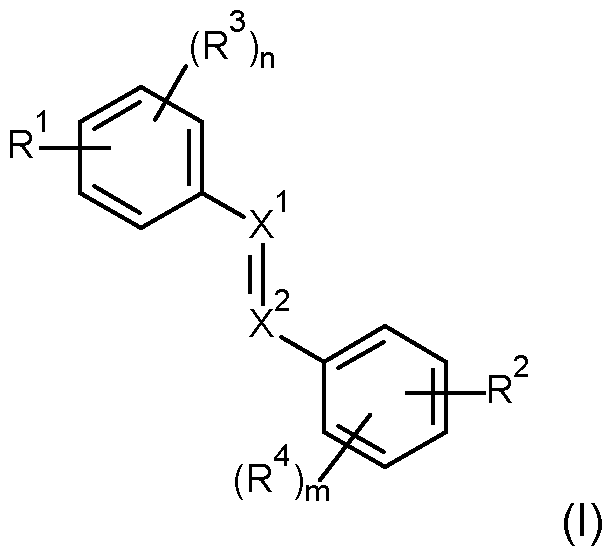
wherein
X1 is CR5 or N;
is CR6 or N;

wherein R1 and R2 are selected from , or

or R1 together with one of R3, and R2 together with one of R4 are selected from

and wherein R1 and R2 are identical, expect for the meanings of
M, Q1, and Q2 which may be identical or different;
L1 is a single bond or -[CR14R15]q-; wherein q is an integer selected from 1 , 2, or 3; each of R14 and R15 are independently selected from hydrogen or G-6alkyl;
Ar1 and Ar2 are each independently selected from the group consisting of cyclopentadienyl, indenyl, tetrahydroindenyl, and fluorenyl; wherein each of said groups is optionally substituted with one or more substituents each independently selected from the group consisting of G- 2oalkyl, C3-2ocycloalkyl, C6-2oaryl, Ci-6alkoxy, C7-2oalkylaryl and C7-2oarylalkyl, halogen, Si(R7)3, heteroCi-6alkyl; wherein R7 is selected from the group consisting of hydrogen, Ci-6alkyl, Ce- 2oaryl, C7-2oalkylaryl and C7-2oarylalkyl;
each Q1 and Q2 are each independently selected from the group consisting of halogen, Ci- 2oalkyl, haloCi-2oalkyl, -N(R8)2, -Si(R7)3, -Ge(R7)3, Ci-2oalkoxy, C3-2ocycloalkyloxy, C5-2oaryloxy, C7-2oaralkoxy, C3-2ocycloalkyl, C6-2oaryl, C7-2oalkylaryl, C7-2oaralkyl, and heteroCi-6alkyl; wherein R8 is hydrogen or Ci-6alkyl;
each M is a transition metal independently selected from the group consisting of titanium, zirconium, hafnium, and vanadium; preferably each M is independently selected from zirconium or hafnium;
Z1 is a moiety bridging Ar1 and Z2, and is selected from the group consisting of Ci-2oalkylene,
germanium, SiR7, GeR7, B, siloxane, Ci-6 alkylphosphine, and N, and wherein each of said group is optionally substituted with one or more substituents each independently selected from the group consisting of halogen, Ci-2oalkyl, C3-i2alkenyl, C3-2ocycloalkyl, C6-2oaryl, Ci-6alkoxy, C7-2oalkylaryl and C7-2oarylalkyl, halogen, Si(R7)3, heteroCi-6alkyl;
Z2 is selected from the group consisting of Ar1, Ar2, Ci-2oalkanetriyl, NR8, Si(R7)2, germanium, siloxane, and Ci-6alkylphosphine, and wherein each of said group is optionally substituted with one or more substituents each independently selected from the group consisting of halogen, Ci-2oalkyl, C3-i2alkenyl, C3-2ocycloalkyl, C6-2oaryl, Ci-6alkoxy, C7-2oalkylaryl and C7-2oarylalkyl, halogen, Si(R7)3, heteroCi-6 alkyl;
Z3 is selected from the group consisting of N, CR12, and SiR7;
Z4 is selected from the group consisting of N, CR12, and SiR7;
Z5 is selected from the group consisting of NR8, Si(R7)2, Ge(R7)2, and siloxane;
R12 is selected from the group consisting of hydrogen, Ci-6alkyl, and Ar4;
Ar3 is a group selected from C6-2oaryl or heteroaryl; wherein each of said group is optionally substituted with one or more substituent selected from halogen and Ci-6alkyl;
Ar4 is hydrogen or a group selected from C6-2oaryl or heteroaryl; wherein each of said group is optionally substituted with one or more substituent selected from halogen and Ci-6alkyl;
Ar5 is a group selected from C6-2oaryl or heteroaryl; wherein each of said group is optionally substituted with one or more substituent selected from halogen and Ci-6alkyl;
each R3 is independently selected from the group consisting of hydrogen, Ci-6alkyl, heterod- 6alkyl, Ci-6alkoxy, and C6-i2aryl, wherein each of said group is optionally substituted with one or more substituents each independently selected from the group consisting of hydroxy, halo, and Ci-6alkyl, and n is an integer selected from 1 , 2, 3, or 4;
R5 is selected from hydrogen, Ci-6alkyl, and heteroCi-6alkyl;
and/or R5 and one of R3 together with the atoms to which they are bound form a Cs- iocycloalkenyl, or a Cs-eheterocyclyl, wherein each Cs-iocycloalkenyl, and Cs-eheterocyclyl is optionally substituted by one or more R10; wherein R10 is Ci-6alkyl, or C6-i2aryl;
each R4 is independently selected from the group consisting of hydrogen, Ci-6alkyl, heterod- 6alkyl, Ci-6alkoxy, and C6-i2aryl, wherein each of said group is optionally substituted with one or more substituents each independently selected from the group consisting of hydroxy, halogen, and Ci-6alkyl, and m is an integer selected from 1 , 2, 3, or 4;
R6 is selected from hydrogen, Ci-6alkyl, and heteroCi-6alkyl;
and/or R6 and one of R4 together with the atoms to which they are bound form a C5- iocycloalkenyl, or a Cs-eheterocyclyl, wherein each Cs-iocycloalkenyl, and Cs-eheterocyclyl is optionally substituted by one or more R11; wherein R11 is Ci-6alkyl or C6-i2aryl.
In a second aspect, the present invention also relates to the use of at least one compound according to the first aspect as a catalyst and/or in the preparation of a catalyst system.
In a third aspect, the present invention also relates to a catalyst system comprising at least one compound according to the first aspect.
In a fourth aspect, the present invention also relates to the use of at least one compound according to the first aspect, or of at least one catalyst system according to the third aspect, in polymerization reaction.
In a further aspect, the present invention also encompasses a process for the preparation of a polymer comprising contacting at least one monomer with at least one compound according to the first aspect, or contacting at least one monomer with at least one catalyst system according to the third aspect.
In a further aspect, the present invention also encompasses a polymer at least partially catalyzed by:
at least one compound according to the first aspect; or,
at least one catalyst system according to the third aspect.
In a further aspect, the present invention also encompasses an article, comprising a polymer according to the invention.
The independent and dependent claims set out particular and preferred features of the invention. Features from the dependent claims may be combined with features of the independent or other dependent claims as appropriate.
The present invention will now be further described. In the following passages, different aspects of the invention are defined in more detail. Each aspect so defined may be combined with any other aspect or aspects unless clearly indicated to the contrary. In particular, any feature or statement indicated as being preferred or advantageous may be combined with any other features or statements indicated as being preferred or advantageous.
DETAILED DESCRIPTION OF THE INVENTION
Before the present compounds, processes, articles, and uses encompassed by the invention are described, it is to be understood that this invention is not limited to particular compounds, processes, articles, and uses described, as such compounds, processes, articles, and uses may, of course, vary. It is also to be understood that the terminology used herein is not intended
to be limiting, since the scope of the present invention will be limited only by the appended claims.
Unless otherwise defined, all terms used in disclosing the invention, including technical and scientific terms, have the meaning as commonly understood by one of ordinary skill in the art to which this invention belongs. By means of further guidance, definitions for the terms used in the description are included to better appreciate the teaching of the present invention. When describing the compounds, processes, articles, and uses of the invention, the terms used are to be construed in accordance with the following definitions, unless the context dictates otherwise.
As used herein, the singular forms "a", "an", and "the" include both singular and plural referents unless the context clearly dictates otherwise. By way of example, "a resin" means one resin or more than one resin.
The terms "comprising", "comprises" and "comprised of as used herein are synonymous with "including", "includes" or "containing", "contains", and are inclusive or open-ended and do not exclude additional, non-recited members, elements or method steps. The terms "comprising", "comprises" and "comprised of" also include the term "consisting of".
The recitation of numerical ranges by endpoints includes all integer numbers and, where appropriate, fractions subsumed within that range (e.g. 1 to 5 can include 1 , 2, 3, 4, and 5, when referring to, for example, a number of elements, and can also include 1 .5, 2, 2.75 and 3.80, when referring to, for example, measurements). The recitation of end points also includes the end point values themselves (e.g. from 1.0 to 5.0 includes both 1 .0 and 5.0). Any numerical range recited herein is intended to include all sub-ranges subsumed therein.
The term "stereoisomers" as used herein means all possible isomeric forms, including tautomeric and stereochemical forms, which the compounds of formulae herein may possess. Typically, the structures shown herein exemplify only one tautomeric or resonance form of the compounds, but the corresponding alternative configurations are contemplated as well. More particularly, stereogenic centers may have either the R- or S-configuration, and multiple bonds may have either cis- or trans-configuration.
The term "polymer" as used herein refers to a polymeric compound prepared by polymerizing monomers, whether of the same or a different type. The generic term polymer thus embraces the term homopolymer, usually employed to refer to polymers prepared from only one type of monomer, and the terms copolymer and interpolymer as defined below.
The term "copolymer", "interpolymer" and like terms, as used herein, mean a polymer prepared by the polymerization of at least two different types of monomers. These generic terms include
polymers prepared from two or more different types of monomers, i.e. terpolymers, tetrapolymers, etc.
Whenever the term "substituted" is used herein, it is meant to indicate that one or more hydrogen atoms on the atom indicated in the expression using "substituted" is replaced with a selection from the indicated group, provided that the indicated atom's normal valence is not exceeded, and that the substitution results in a chemically stable compound, i.e. a compound that is sufficiently robust to survive isolation from a reaction mixture.
The term "halo" or "halogen" as a group or part of a group is generic for fluoro, chloro, bromo, iodo.
The term "alkyl" as a group or part of a group, refers to a hydrocarbyl group of formula CnH2n+i wherein n is a number greater than or equal to 1. Alkyl groups may be linear or branched and may be substituted as indicated herein. Generally, alkyl groups of this invention comprise from 1 to 20 carbon atoms, preferably from 1 to 10 carbon atoms, preferably from 1 to 6 carbon atoms, more preferably from 1 to 4 carbon atoms. When a subscript is used herein following a carbon atom, the subscript refers to the number of carbon atoms that the named group may contain. For example, the term "Ci-2oalkyl", as a group or part of a group, refers to a hydrocarbyl group of formula -CnH n+i wherein n is a number ranging from 1 to 20. Thus, for example, "Ci- 6alkyl" includes all linear or branched alkyl groups with between 1 and 6 carbon atoms, and thus includes methyl, ethyl, n-propyl, i-propyl, butyl and its isomers (e.g. n-butyl, i-butyl and t- butyl); pentyl and its isomers, hexyl and its isomers. A "substituted alkyl" refers to an alkyl group substituted with one or more substituent(s) (for example 1 to 3 substituent(s), for example 1 , 2, or 3 substituent(s)) at any available point of attachment.
When the suffix "ene" is used in conjunction with an alkyl group, i.e. "alkylene", this is intended to mean the alkyl group as defined herein having two single bonds as points of attachment to other groups. As used herein, the term "alkylene" also referred as "alkanediyl", by itself or as part of another substituent, refers to alkyl groups that are divalent, i.e., with two single bonds for attachment to two other groups. Alkylene groups may be linear or branched and may be substituted as indicated herein. Non-limiting examples of alkylene groups include methylene (-CH2-), ethylene (-CH2-CH2-), methylmethylene (-CH(CH3)-), 1 -methyl-ethylene (-CH(CH3)- CH2-), n-propylene (-CH2-CH2-CH2-), 2-methylpropylene (-CH2-CH(CH3)-CH2-), 3- methylpropylene (-CH2-CH2-CH(CH3)-), n-butylene (-CH2-CH2-CH2-CH2-), 2-methylbutylene (- CH2-CH(CH3)-CH2-CH2-), 4-methylbutylene (-CH2-CH2-CH2-CH(CH3)-), pentylene and its chain isomers, hexylene and its chain isomers.
The term "alkynetriyl" as a group or part of a group, refers to alkyl groups that are trivalent, i.e., with three single bonds for attachment to three other groups.
The term "alkoxy" or "alkyloxy", as a group or part of a group, refers to a group having the formula -ORb wherein Rb is alkyl as defined herein above. Non-limiting examples of suitable alkoxy include methoxy, ethoxy, propoxy, isopropoxy, butoxy, isobutoxy, sec-butoxy, tert- butoxy, pentyloxy and hexyloxy.
The term "haloalkyl", as a group or part of a group, refers to refers to an alkyl having the meaning as defined above wherein one or more hydrogens are replaced with a halogen as defined above. Non-limiting examples of such haloalkyl radicals include chloromethyl, 1 - bromoethyl, fluoromethyl, difluoromethyl, trifluoromethyl, 1 ,1 ,1 -trifluoroethyl and the like.
The term "cycloalkyi", as a group or part of a group, refers to a cyclic alkyl group, that is a monovalent, saturated, hydrocarbyl group having 1 or more cyclic structure, and comprising from 3 to 20 carbon atoms, more preferably from 3 to 10 carbon atoms, more preferably from 3 to 8 carbon atoms; more preferably from 3 to 6 carbon atoms. Cycloalkyi includes all saturated hydrocarbon groups containing 1 or more rings, including monocyclic, bicyclic groups or tricyclic. The further rings of multi-ring cycloalkyls may be either fused, bridged and/or joined through one or more spiro atoms. When a subscript is used herein following a carbon atom, the subscript refers to the number of carbon atoms that the named group may contain. For example, the term "C3-2ocycloalkyl", a cyclic alkyl group comprising from 3 to 20 carbon atoms. For example, the term "C3-iocycloalkyl", a cyclic alkyl group comprising from 3 to 10 carbon atoms. For example, the term "C3-8cycloalkyl", a cyclic alkyl group comprising from 3 to 8 carbon atoms. For example, the term "C3-6cycloalkyl", a cyclic alkyl group comprising from 3 to 6 carbon atoms. Examples of C3-i2cycloalkyl groups include but are not limited to adamantly, cyclopropyl, cyclobutyl, cyclopentyl, cyclohexyl, cycloheptyl, cyclooctyl, bicycle[2.2.1]heptan-2yl, (1 S,4R)-norbornan-2-yl, (1 R,4R)-norbornan-2-yl, (1 S,4S)-norbornan- 2-yl, (1 R,4S)-norbornan-2-yl.
When the suffix "ene" is used in conjunction with a cycloalkyi group, i.e. cydoalkylene, this is intended to mean the cycloalkyi group as defined herein having two single bonds as points of attachment to other groups. Non-limiting examples of "cydoalkylene" include 1 ,2- cyclopropylene, 1 ,1 -cyclopropylene, 1 ,1 -cyclobutylene, 1 ,2-cyclobutylene, 1 ,3-cyclopentylene, 1 ,1 -cyclopentylene, and 1 ,4-cyclohexylene.
Where an alkylene or cydoalkylene group is present, connectivity to the molecular structure of which it forms part may be through a common carbon atom or different carbon atom. To illustrate this applying the asterisk nomenclature of this invention, a Csalkylene group may be for example *-CH2CH2CH2-*, *-CH(-CH2CH3)-* or *-CH2CH(-CH3)-*. Likewise a C3cycloalkylene group may be

The term "cycloalkoxy", as a group or part of a group, refers to a group having the formula - ORh wherein Rh is cycloalkyl as defined herein above.
The term "cycloalkenyl", as a group or part of a group, refers to a non-aromatic hydrocarbon radical having from 5 to 18 carbon atoms with at least one site (usually 1 to 3, preferably 1 ) of unsaturation, namely a carbon-carbon, sp2 double bond and consisting of or comprising a Cs- io monocyclic or C7-18 polycyclic hydrocarbon. Examples include, but are not limited to: cyclopentenyl (-C5H7), cyclopentenylpropylene, methylcyclohexenylene and cyclohexenyl (- C6H9). The double bond may be in the cis or trans configuration.
The term "aryl", as a group or part of a group, refers to a polyunsaturated, aromatic hydrocarbyl group having a single ring (i.e. phenyl) or multiple aromatic rings fused together (e.g. naphthyl), or linked covalently, typically containing 6 to 20 atoms; preferably 6 to 10, wherein at least one ring is aromatic. The aromatic ring may optionally include one to two additional rings (either cycloalkyl, heterocyclyl or heteroaryl) fused thereto. Examples of suitable aryl include C6-2oaryl, preferably C6-ioaryl, more preferably C6-saryl. Non-limiting examples of aryl comprise phenyl, biphenylyl, biphenylenyl, or 1 -or 2-naphthyl; 1 -, 2-, 3-, 4-, 5- or 6-tetralinyl (also known as "1 ,2,3,4-tetrahydronaphtalene); 1 -, 2-, 3-, 4-, 5-, 6-, 7- or 8-azulenyl, 4-, 5-, 6 or 7-indenyl; 4- or 5-indanyl; 5-, 6-, 7- or 8-tetrahydronaphthyl; 1 ,2,3,4-tetrahydronaphthyl; and 1 ,4- dihydronaphthyl; 1 -, 2-, 3-, 4- or 5-pyrenyl. A "substituted aryl" refers to an aryl group having one or more substituent(s) (for example 1 , 2 or 3 substituent(s), or 1 to 2 substituent(s)), at any available point of attachment.
The term "aryloxy", as a group or part of a group, refers to a group having the formula -OR9 wherein R9 is aryl as defined herein above.
The term "arylalkyl", as a group or part of a group, means an alkyl as defined herein, wherein at least one hydrogen atom is replaced by at least one aryl as defined herein. Non-limiting examples of arylalkyl group include benzyl, phenethyl, dibenzylmethyl, methylphenylmethyl, 3- (2-naphthyl)-butyl, and the like.
The term "alkylaryl" as a group or part of a group, means an aryl as defined herein wherein at least one hydrogen atom is replaced by at least one alkyl as defined herein. Non-limiting example of alkylaryl group include p-Ch -R9-, wherein R9 is aryl as defined herein above.
The term "arylalkyloxy" or "aralkoxy" as a group or part of a group, refers to a group having the formula -0-Ra-R9 wherein R9 is aryl, and Ra is alkylene as defined herein above.
The term "heteroalkyl" as used herein refers to an acyclic alkyl wherein one or more carbon
atoms are replaced by at least one heteroatom selected from the group comprising O, Si, S, B, and P, with the proviso that said chain may not contain two adjacent heteroatoms . This means that one or more -CH3 of said acyclic alkyl can be replaced by -OH for example and/or that one or more -CR2- of said acyclic alkyl can be replaced by O, Si, S, B, and P.
The terms "heterocyclyl", as a group or part of a group, refer to non-aromatic, fully saturated or partially unsaturated cyclic groups (for example, 3 to 7 member monocyclic, 7 to 1 1 member bicyclic, or comprising a total of 3 to 10 ring atoms) which have at least one heteroatom in at least one carbon atom-containing ring; wherein said ring may be fused to an aryl, cycloalkyl, heteroaryl or heterocyclyl ring. Each ring of the heterocyclyl group containing a heteroatom may have 1 , 2, 3 or 4 heteroatoms selected from N, O and/or S, where the N and S heteroatoms may optionally be oxidized and the N heteroatoms may optionally be quaternized, and wherein at least one carbon atom of heterocyclyl can be oxidized to form at least one C=0. The heterocyclic group may be attached at any heteroatom or carbon atom of the ring or ring system, where valence allows. The rings of multi-ring heterocycles may be fused, bridged and/or joined through one or more spiro atoms. Non limiting exemplary heterocyclic groups include aziridinyl, oxiranyl, thiiranyl, piperidinyl, azetidinyl, oxetanyl, pyrrolidinyl, thietanyl, 2- imidazolinyl, pyrazolidinyl imidazolidinyl, isoxazolinyl, oxazolidinyl, isoxazolidinyl, thiazolidinyl, isothiazolidinyl, piperidinyl, succinimidyl, 3H-indolyl, indolinyl, chromanyl (also known as 3,4- dihydrobenzo[b]pyranyl), isoindolinyl, 2H-pyrrolyl, 1 -pyrrolinyl, 2-pyrrolinyl, 3-pyrrolinyl, 4H- quinolizinyl, 2-oxopiperazinyl, piperazinyl, homopiperazinyl, 2-pyrazolinyl, 3-pyrazolinyl, tetrahydro-2H-pyranyl, 2H-pyranyl, 4H-pyranyl, 3,4-dihydro-2H-pyranyl, 3-dioxolanyl, 1 ,4- dioxanyl, 2,5-dioximidazolidinyl, 2-oxopiperidinyl, 2-oxopyrrolodinyl, indolinyl, tetrahydropyranyl, tetrahydrofuranyl, tetrahydrothiophenyl, tetrahydroquinolinyl, tetrahydroisoquinolin-1 -yl, tetrahydroisoquinolin-2-yl, tetrahydroisoquinolin-3-yl, tetrahydroisoquinolin-4-yl, thiomorpholin-4-yl, thiomorpholin-4-ylsulfoxide, thiomorpholin-4- ylsulfone, 1 , 3-dioxolanyl, 1 ,4-oxathianyl, 1 ,4-dithianyl, 1 ,3,5-trioxanyl, 1 H-pyrrolizinyl, tetrahydro-1 ,1 -dioxothiophenyl, N- formylpiperazinyl, and morpholin-4-yl.
When the suffix "ene" is used in conjunction with a heterocyclyl group, i.e. "heterocyclylene", this is intended to mean the heterocyclyl group as defined herein having two single bonds as points of attachment to other groups.
The term "heteroaryl" as a group or part of a group, refers but is not limited to 5 to 12 atom aromatic rings or ring systems containing 1 or 2 rings which can be fused together or linked covalently, typically containing 5 to 6 atoms; at least one of which is aromatic in which one or more carbon atoms in one or more of these rings can be replaced by N, O and/or S atoms where the N and S heteroatoms may optionally be oxidized and the N heteroatoms may optionally be quaternized, and wherein at least one carbon atom of said heteroaryl can be
oxidized to form at least one C=0. Such rings may be fused to an aryl, cycloalkyl, heteroaryl or heterocyclyl ring. Non-limiting examples of such heteroaryl, include: pyrrolyl, furanyl, thiophenyl, pyrazolyl, imidazolyl, oxazolyl, isoxazolyl, thiazolyl, isothiazolyl, triazolyl, oxadiazolyl, thiadiazolyl, tetrazolyl, oxatriazolyl, thiatriazolyl, pyridinyl, pyrimidyl, pyrazinyl, pyridazinyl, oxazinyl, dioxinyl, thiazinyl, triazinyl, imidazo[2,1 -b][1 ,3]thiazolyl, thieno[3,2- b]furanyl, thieno[3,2-b]thiophenyl, thieno[2,3-d][1 ,3]thiazolyl, thieno[2,3-d]imidazolyl, tetrazolo[1 ,5-a]pyridinyl, indolyl, indolizinyl, isoindolyl, benzofuranyl, isobenzofuranyl, benzothiophenyl, isobenzothiophenyl, indazolyl, benzimidazolyl, 1 ,3-benzoxazolyl, 1 ,2- benzisoxazolyl, 2,1 -benzisoxazolyl, 1 ,3-benzothiazolyl, 1 ,2-benzoisothiazolyl, 2,1 - benzoisothiazolyl, benzotriazolyl, 1 ,2,3-benzoxadiazolyl, 2,1 ,3-benzoxadiazolyl, 1 ,2,3- benzothiadiazolyl, 2,1 ,3-benzothiadiazolyl, benzo[d]oxazol-2(3H)-one, 2,3-dihydro- benzofuranyl, thienopyridinyl, purinyl, imidazo[1 ,2-a]pyridinyl, 6-oxo-pyridazin-1 (6H)-yl, 2- oxopyridin-1 (2H)-yl, 6-oxo-pyridazin-1 (6H)-yl, 2-oxopyridin-1 (2H)-yl, 1 ,3-benzodioxolyl, quinolinyl, isoquinolinyl, cinnolinyl, quinazolinyl, quinoxalinyl; preferably said heteroaryl group is selected from the group consisting of pyridyl, 1 ,3-benzodioxolyl, benzo[d]oxazol-2(3H)-one, 2,3-dihydro-benzofuranyl, pyrazinyl, pyrazolyl, pyrrolyl, isoxazolyl, thiophenyl, imidazolyl, benzimidazolyl, pyrimidinyl, triazolyl and thiazolyl.
Reference throughout this specification to "one embodiment" or "an embodiment" means that a particular feature, structure or characteristic described in connection with the embodiment is included in at least one embodiment of the present invention. Thus, appearances of the phrases "in one embodiment" or "in an embodiment" in various places throughout this specification are not necessarily all referring to the same embodiment, but may. Furthermore, the particular features, structures or characteristics may be combined in any suitable manner, as would be apparent to a person skilled in the art from this disclosure, in one or more embodiments. Furthermore, while some embodiments described herein include some but not other features included in other embodiments, combinations of features of different embodiments are meant to be within the scope of the invention, and form different embodiments, as would be understood by those in the art. For example, in the following claims and statements, any of the embodiments can be used in any combination.
Preferred statements (features) and embodiments of the compounds, processes, articles, and uses of this invention are set herein below. Each statement and embodiment of the invention so defined may be combined with any other statement and/or embodiment, unless clearly indicated to the contrary. In particular, any feature indicated as being preferred or advantageous may be combined with any other features or statements indicated as being preferred or advantageous. Hereto, the present invention is in particular captured by any one
any combination of one or more of the below numbered statements and embodiments 1 to, with any other aspect and/or embodiment.
A compound of formula (I), or a stereoisomer thereof,

wherein
X1 is C 5 or N;
X2 is CR6 or N;

wherein R1 and R2 are selected from
, or
 ; and R1 and R2 are identical, expect for the meanings of M,
Q1, and Q2 which may be identical or different;
or R1 together with one of R3, and R2 together with one of R4 are selected from
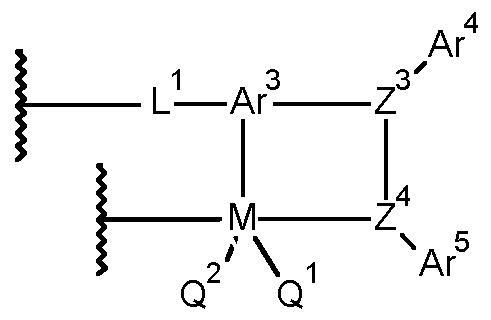
, and wherein R1 and R2 are identical, expect for the meanings of M, Q1, and Q2 which may be identical or different;
L1 is a single bond or -[CR14R15]q-; wherein q is an integer selected from 1 , 2, or 3; each of R14 and R15 are independently selected from hydrogen or Ci-6alkyl;
Ar1 and Ar2 are each independently selected from the group consisting of cyclopentadienyl, indenyl, tetrahydroindenyl, and fluorenyl; wherein each of said groups is optionally substituted with one or more substituents each independently selected from
the group consisting of Ci-2oalkyl, C3-2ocycloalkyl, C6-2oaryl, Ci-6alkoxy, C7-2oalkylaryl and C7-2oarylalkyl, halogen, Si(R7)3, heteroCi-6alkyl; wherein R7 is selected from the group consisting of hydrogen, Ci-6alkyl, C6-2oaryl, C7-2oalkylaryl and C7-2oarylalkyl;
each Q1 and Q2 are each independently selected from the group consisting of halogen, Ci-20alkyl, haloCi-2oalkyl, -N(R8)2, Si(R7)3, Ge(R7)3, Ci-2oalkoxy, C3-2ocycloalkyloxy, C7-
2oaralkoxy, C3-2ocycloalkyl, C6-2oaryl, C7-2oalkylaryl, C7-2oaralkyl, and heteroCi-6alkyl; wherein R8 is hydrogen or Ci-6alkyl;
each M is a transition metal independently selected from the group consisting of titanium, zirconium, hafnium, and vanadium; preferably each M is independently selected from zirconium or hafnium, more preferably zirconium;
Z1, is a moiety bridging Ar1 and Z2 and is selected from the group consisting of Ci- 2oalkylene, germanium, SiR7, GeR7, B, siloxane, Ci-6 alkylphosphine, and N, and wherein each of said group is optionally substituted with one or more substituents each independently selected from the group consisting of halogen, Ci-2oalkyl, C3-i2alkenyl, C3- 2ocycloalkyl, C6-2oaryl, Ci-6alkoxy, C7-2oalkylaryl and C7-2oarylalkyl, halogen, Si(R7)3, heteroCi-6alkyl;
Z2 is selected from the group consisting of Ar1, Ar2, Ci-2oalkanetriyl, NR8, Si(R7)2, germanium, siloxane, and Ci-6alkylphosphine, and wherein each of said group is optionally substituted with one or more substituents each independently selected from the group consisting of halogen, Ci-2oalkyl, C3-i2alkenyl, C3-2ocycloalkyl, C6-2oaryl, Ci-6alkoxy, C7-
2oalkylaryl and C7-2oarylalkyl, halogen, Si(R7)3, heteroCi-6 alkyl;
Z3 is selected from the group consisting of N, CR12, and SiR7;
Z4 is selected from the group consisting of N, CR12, and SiR7;
Z5 is selected from the group consisting of NR8, Si(R7)2, Ge(R7)2, and siloxane;
R12 is selected from the group consisting of hydrogen, Ci-6alkyl, and Ar4;
Ar3 is a group selected from C6-2oaryl or heteroaryl; wherein each of said group is optionally substituted with one or more substituent selected from halogen and Ci-6alkyl;
Ar4 is hydrogen or a group selected from C6-2oaryl or heteroaryl; wherein each of said group is optionally substituted with one or more substituent selected from halogen and Ci-6alkyl; Ar5 is a group selected from C6-2oaryl or heteroaryl; wherein each of said group is optionally substituted with one or more substituent selected from halogen and Ci-6alkyl;
each R3 is independently selected from the group consisting of hydrogen, Ci-6alkyl, heteroCi-6alkyl, Ci-6alkoxy, and C6-i2aryl, wherein each of said group is optionally
substituted with one or more substituents each independently selected from the group consisting of hydroxy, halo, and Ci-6alkyl, and n is an integer selected from 1 , 2, 3, or 4;
R5 is selected from hydrogen, Ci-6alkyl, and heteroCi-6alkyl,
and/or R5 and one of R3 together with the atoms to which they are bound form a Cs- iocycloalkenyl, or a Cs-6heterocyclyl, wherein each Cs-iocycloalkenyl, and Cs-6heterocyclyl is optionally substituted by one or more R10; wherein R10 is Ci-6alkyl, or C6-i2aryl;
each R4 is independently selected from the group consisting of hydrogen, Ci-6alkyl, heteroCi-6alkyl, Ci-6alkoxy, and C6-i2aryl, wherein each of said group is optionally substituted with one or more substituents each independently selected from the group consisting of hydroxy, halogen, and Ci-6alkyl, and m is an integer selected from 1 , 2, 3, or 4;
R6 is selected from hydrogen, Ci-6alkyl, and heteroCi-6alkyl;
and/or R6 and one of R4 together with the atoms to which they are bound form a Cs- iocycloalkenyl, or a Cs-eheterocyclyl, wherein each Cs-iocycloalkenyl, and Cs-eheterocyclyl is optionally substituted by one or more R11; wherein R11 is Ci-6alkyl, or C6-i2aryl.
The compound according to statement 1 , wherein the compound has the structure of formula (11 ),

wherein R1, R2, R3, R4, R5, R6, m and n have the same meaning as that defined above.
The compound according to any one of statements 1 or 2, wherein the compound has a structure of formula (I2) or (I3),

R10 is Ci-6alkyl, or C6-i2aryl; and o is an integer selected from 0, 1 , 2, 3 or 4;
or
R11 is Ci-6alkyl, or C6-i2aryl; and p is an integer selected from 0, 1 , 2, 3 or 4;
The compound according to any one of statements 1 -3, wherein the compound has structure of formula (I4), (I5), (I6), (I7), (I8), (I9), (110), or (11 1 );

(I7),

Compound according to any one of statements 1-4, wherein the compound has a structure selected from any one of formula (I12)-(I27),


The compound according to any one of statements 1 -5, wherein the compound has structure selected from any one of formula (I28)-(I42),


. The compound according to any one of statements 1 -6, wherein the compound has structure selected from any one of formula (I43)-(I51 ),

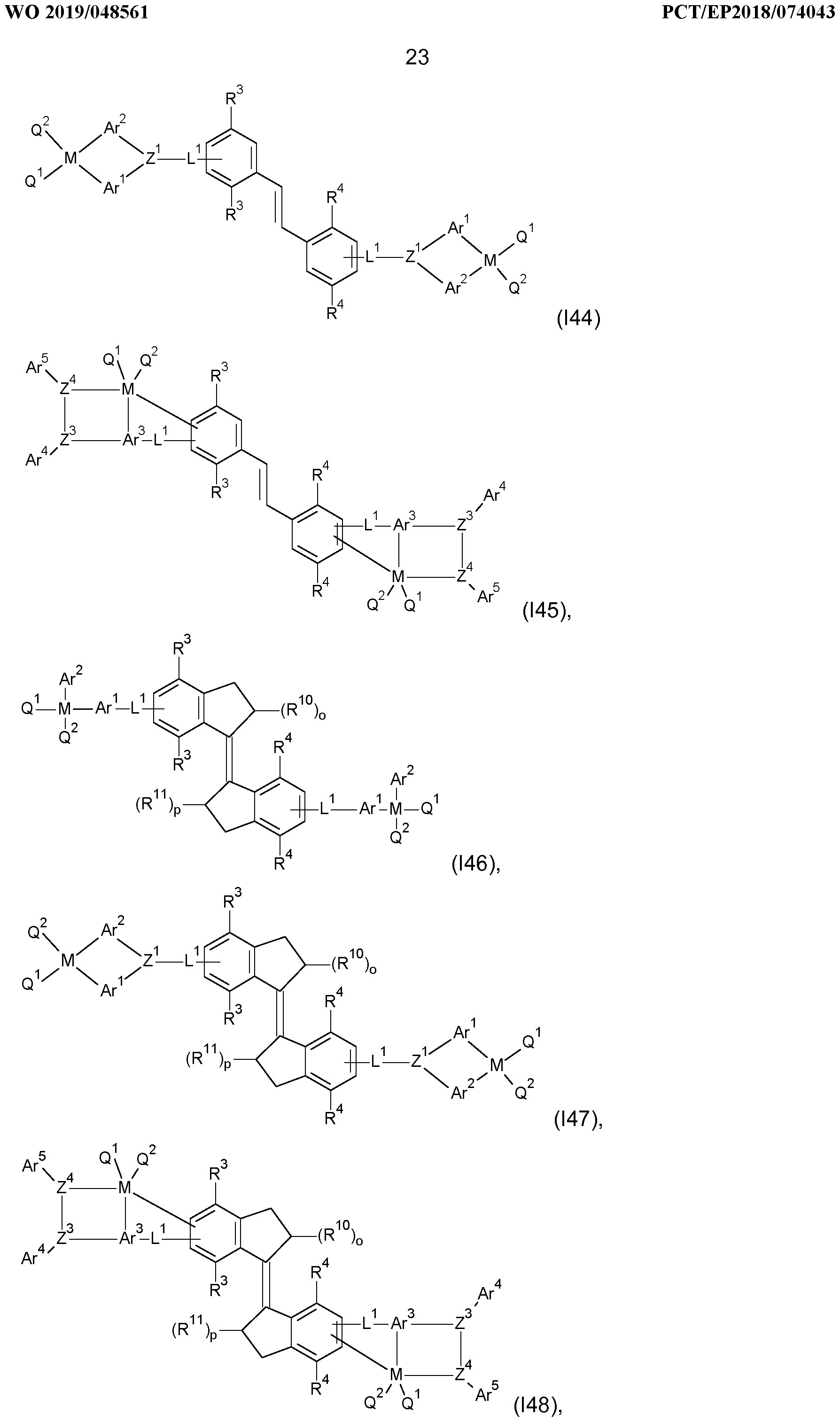

The compound according to any one of statements 1-8, wherein R3 and R4 are identical.
The compound according to any one of statements 1-9, wherein each R3 is independently selected from the group consisting of hydrogen, Ci-6alkyl, Ci-6alkoxy, and C6-i2aryl, wherein each of said group is optionally substituted with one or more substituents each independently selected from the group consisting of hydroxy, halo, and Ci-6alkyl, and n is an integer selected from 1 , 2, or 3; preferably each R3 is independently selected from the group consisting of hydrogen, Ci-6alkyl, and Ci-6alkoxy, wherein each of said group is optionally substituted with one or more substituents each independently selected from the group consisting of hydroxy, halo, and Ci-6alkyl, and n is an integer selected from 1 , 2, or 3; preferably each R3 is independently selected from the group consisting of hydrogen, and Ci-6alkyl, wherein each of said group is optionally substituted with one or more substituents each independently selected from the group consisting of hydroxy, halo, and Ci-6alkyl, and n is an integer selected from 1 , or 2; preferably each R3 is independently selected from the group consisting of hydrogen, and Ci-6alkyl, and n is an integer selected from 1 , or 2;
each R4 is independently selected from the group consisting of hydrogen, Ci-6alkyl, Ci- 6alkoxy, and C6-i2aryl, wherein each of said group is optionally substituted with one or more substituents each independently selected from the group consisting of hydroxy, halo, and Ci-6alkyl, and n is an integer selected from 1 , 2, or 3; preferably each R4 is independently selected from the group consisting of hydrogen, Ci-6alkyl, and Ci-6alkoxy, wherein each of said group is optionally substituted with one or more substituents each independently selected from the group consisting of hydroxy, halo, and Ci-6alkyl, and n is an integer selected from 1 , 2, or 3; preferably each R4 is independently selected from the group consisting of hydrogen, and Ci-6alkyl, wherein each of said group is optionally substituted with one or more substituents each independently selected from the group consisting of hydroxy, halo, and Ci-6alkyl, and n is an integer selected from 1 , or 2; preferably each R4 is independently selected from the group consisting of hydrogen, and Ci-6alkyl, and n is an integer selected from 1 , or 2.
The compound according to any one of statements 1 -9, wherein R10 is Ci-6alkyl; and o is 0, or 1 ; preferably o is 0.
The compound according to any one of statements 1 -10, wherein R11 is Ci-6alkyl; and p is 0, or 1 ; preferably p is 0.
The compound according to any one of statements 1 -1 1 , wherein L1 is a single bond or - [CR14R15]q-; wherein q is 1 , or 2, preferably q is 1 ; each of R14 and R15 are independently selected from hydrogen or Ci-6alkyl, preferably each of R14 and R15 are independently selected from hydrogen or
 preferably each of R14 and R15 are independently selected from hydrogen or Ci-2alkyl.
The compound according to any one of statements 1 -12, wherein Ar1 and Ar2 are each independently selected from the group consisting of cyclopentadienyl, indenyl, and fluorenyl; wherein each of said groups is optionally substituted with one or more substituents each independently selected from the group consisting of Ci-2oalkyl, C3- 2ocycloalkyl, C6-2oaryl, Ci-6alkoxy, C7-2oalkylaryl and C7-2oarylalkyl, halogen, Si(R7)3, heteroCi-6alkyl; wherein R7 is selected from the group consisting of hydrogen or, Ci-6alkyl, C6-2oaryl, C7-2oalkylaryl and C7-2oarylalkyl; preferably Ar1 and Ar2 are each independently selected from the group consisting of cyclopentadienyl, and indenyl; wherein each of said groups is optionally substituted with one or more substituents each independently selected from the group consisting of Ci-6alkyl, C3-6cycloalkyl, C6-ioaryl, Ci-6alkoxy, C7-i2alkylaryl and C7-i2arylalkyl, halogen, Si(R7)3, heteroCi-6alkyl; wherein R7 is hydrogen or Ci-6alkyl; preferably Ar1 and Ar2 are each independently selected from the group consisting of cyclopentadienyl, and indenyl; wherein each of said groups is optionally substituted with
one or more substituents each independently selected from the group consisting of Ci- 6alkyl, Ci-6alkoxy, and halogen.
14. The compound according to any one of statements 1-13, wherein each Q1 and Q2 are each independently selected from the group consisting of halogen, Ci-2oalkyl, and -N(R8)2; wherein R8 is hydrogen or Ci-6alkyl.
15. The compound according to any one of statements 1-14, wherein each M is a transition metal independently selected from the group consisting of titanium, zirconium, hafnium, and vanadium; preferably each M is independently selected from zirconium or hafnium.
16. The compound according to any one of statements 1-15, wherein Z1 is a moiety bridging Ar1 and Z2 and is selected from the group consisting of Ci-6alkylene, and SiR7.
17. The compound according to any one of statements 1-16, wherein Z2 is selected from the group consisting of Ar1 , Ar2, Ci-6alkanetriyl, NR8, and Si(R7)2.
18. The compound according to any one of statements 1-17, wherein Z3 is selected from the group consisting of N, CR12, and SiR7; and R12 is hydrogen or Ci-6alkyl;
19. The compound according to any one of statements 1-18, wherein Z4 is selected from the group consisting of N, CR12, SiR7, and R12 is hydrogen or Ci-6alkyl, or Ar4;
20. The compound according to any one of statements 1-19, wherein:
Ar3 is a group selected from C6-i2aryl or heteroaryl; wherein each of said group is optionally substituted with one or more substituent selected from halogen and Ci-6alkyl; - Ar4 is hydrogen or a group selected from C6-i2aryl or heteroaryl; wherein each of said group is optionally substituted with one or more substituent selected from halogen and

Ar5 is a group selected from C6-i2aryl or heteroaryl; wherein each of said group is optionally substituted with one or more substituent selected from halogen and Ci-6alkyl. 21. The compound according to any one of statements 1-20, wherein R5 is hydrogen, or Ci- 6alkyl; preferably R5 is hydrogen, and R6 is hydrogen, or Ci-6alkyl; preferably R6 is hydrogen.
22. The compound according to any one of statements 1-21 , wherein R5 and one of R3 together with the atoms to which they are bound form a Cs-iocycloalkenyl, optionally substituted by one or more Ci-6alkyl;
and,
R6 and one of R4 together with the atoms to which they are bound form a Cs-iocycloalkenyl, optionally substituted by one or more Ci-6alkyl.
The compound according to any one of statements 1 -22, wherein the compound has a structure selected from any one of formula (I52)-(I69),


24. The compound according to any one of statements 1 to 23, selected from


25. A process for the synthesis of a compound according to any one of statements 1-24, comprising the step of:
- contacting at least one equivalent of a compound of formula (ll)with at least 2 equivalents of a compound of formula 40- 30;

wherein R20 is selected from the group consisting of halogens, Li, Na, K, ZnCI, sulfonate, azide, tosylate, triflate, mesylate, OR21, C02R21, B(OH)2, B(OR21)2, AIR21 2, lnR21 2, SnR21 3, F3X; and MgX, wherein X is halo; and wherein R21 is alkyl;
R30 is selected from R1 or R2; and,
R40 is selected from the group consisting of halogens, Li, Na, K, ZnCI, sulfonate, azide, tosylate, triflate, mesylate, OR21, C02R21, B(OH)2, B(OR21)2, AIR21 2, lnR21 2, SnR21 3, F3X; and MgX, wherein X is halo; and wherein R21 is alkyl;
or,
- contacting at least one equivalent of a compound of formula (II) with at least 2 equivalents of a compound of formula R41-L1-Ar1, wherein R41 is selected from the group consisting of halogens, Li, Na, K, ZnCI, sulfonate, azide, tosylate, triflate, mesylate, OR21, CO2R21, B(OH)2, B(OR21)2, AIR212, lnR21 2, SnR21 3, F3X; and MgX, wherein X is halo; and wherein R21 is alkyl; preferably halogen; and contacting compound of formula (III) with at least two equivalents of a compound of formula (IV)

- contacting at least one equivalent of a compound of formula (II) with at least 2 equivalents of a compound of formula R42-L1-Z1(R42)2, wherein R42 is halogen,
and contacting compound of formula (V) with at least 2 equivalents of a compound of formula Ar1X3 and at least 2 equivalents of a compound of formula Ar2X3; wherein X3 is selected from the group consisting of Na, K, Li, Mg, and Ca;

and contacting the reaction product of said step with at least two equivalents of a compound of formula (VI);
Q
I 2
M— Q
I s
Q (VI), wherein Q4 and Q3 have the same meaning as Q1 and Q2
wherein X1, X2, R1, R2, R3, R4, m, n, L1, Z1, M, Q1, Q2, Ar1, Ar2 have the same meaning as that defined in any one of statements 1 -23.
26. Use of at least one compound according to any one of statements 1 -24, or obtained by the process according to statement 25, as a catalyst and/or in the preparation of a catalyst system.
27. A catalyst system comprising at least one compound according to any one of statements 1 -24, or obtained by the process according to statement 25.
28. The catalyst system according to statement 27, further comprising a solid support, preferably a silica solid support.
29. The catalyst system according to any one of statements 27-28, further comprising an activating agent and/or a cocatalyst, preferably said activating agent is alumoxane.
30. The catalyst system according to any one of statements 27-29, further comprising an alkyl aluminum.
31 . Use of at least one compound according to any one of statements 1 -24, or obtained by the process according to statement 25, or of at least one catalyst system according to any one of statements 27-30, in polymerization reaction.
32. Use of at least one compound according to any one of statements 1 -24, or obtained by the process according to statement 25, or of at least one catalyst system according to any one of statements 27-30, for the preparation of a polyolefin.
33. Use of at least one compound according to any one of statements 1 -24, or obtained by the process according to statement 25, or of at least one catalyst system according to any one of statements 27-30, or use according to any one of statements 31 -32, as a photo- switchable catalyst.
34. Use of at least one compound according to any one of statements 1 -24, or obtained by the process according to statement 25, or use of at least one catalyst system according to any one of statements 27-30, or use according to any one of statements 31 -33,, wherein isomerization of compound of formula (I) changes upon external stimulus, such as light, temperature and redox; preferably light.
35. Use according to statement 34, wherein said external stimulus is light, preferably light having a wavelength from 100 to 800 nm, preferably from 200 to 700 nm
36. A process for the preparation of a polymer comprising contacting at least one monomer with at least one compound according to any one of statements 1 -24, or obtained by the process according to statement 25, or contacting at least one monomer with at least one
catalyst system according to any one of statements 27-30; preferably said monomer is an alpha-olefin.
37. A process for preparing a polyolefin comprising the steps of:
(a) contacting an olefin monomer, with at least one compound according to any one of statements 1 -24, or a catalyst system comprising said at least one compound according to any one of statements 27-30, optionally hydrogen, and optionally one or more olefin co- monomers; and,
(b) polymerizing the monomer, and the optionally one or more olefin co-monomers, in the presence of the at least one compound, and optional hydrogen, thereby obtaining said polyolefin.
38. A process for preparing a multimodal polyolefin, comprising the steps of:
(a) contracting an olefin monomer, with at least one compound according to any one of statements 1 -24, or a system comprising said at least one compound according to any one of statements 27-30, optionally hydrogen, and optionally one or more olefin co-monomers; (b) polymerizing the monomer, and the optionally one or more olefin co-monomers, in the presence of the at least one compound, and optional hydrogen,
(c) isomerization of said at least one compound according to any one of statements 1 -24 preferably using external stimulus, and
(d) further polymerizing the monomer, and the optionally one or more olefin co-monomers, in the presence of the at least one isomerized compound, and optional hydrogen, thereby preparing a multimodal polyolefin, for example bimodal polyolefin.
39. A polymer at least partially catalyzed by:
a compound according to any one of statements 1-24; or,
a catalyst system according to any one of statements 27-30.
40. A polyolefin, produced by the process according to statement 39.
41 . A polymer, produced by a process according to any one of statements 36-38.
42. An article comprising a polymer according to any one of statements 39 or 41 ; or a polyolefin according to statement 40, or obtained according to a process according to any one of statements 36-38.
The invention encompasses compound of formula (I) and any subgroups thereof as defined herein below and/or in any one of statements 1 to 24; wherein
X1 is CR5 or N; preferably X1 is CR5 ;
X2 is CR6 or N; preferably X2 is CR6 ;

R1 and R2 are selected from

or R1 together with one of R3, and R2 together with one of R4 are selected from

, and wherein R1 and R2 are identical, expect for the meanings of M, Q1, and Q2 which may be identical or different;
L1 is a single bond or -[CR14R15]q-; wherein q is an integer selected from 1 , 2, or 3; each of R14 and R15 are independently selected from hydrogen or G-6alkyl; preferably L1 is a single bond;
Ar1 and Ar2 are each independently selected from the group consisting of cyclopentadienyl, indenyl, tetrahydroindenyl, and fluorenyl; wherein each of said groups is optionally substituted with one or more substituents each independently selected from the group consisting of G- 2oalkyl, C3-2ocycloalkyl, C6-2oaryl, Ci-6alkoxy, C7-2oalkylaryl and C7-2oarylalkyl, halogen, Si(R7)3, heteroCi-6alkyl; wherein R7 is selected from the group consisting of hydrogen, G-6alkyl, C6- 20a ry I, C7-2oalkylaryl and C7-2oarylalkyl;
each Q1 and Q2 are each independently selected from the group consisting of halogen, Ci- 2oalkyl, haloCi-2oalkyl, -N(R8)2, -Si(R7)3, -Ge(R7)3, Ci-2oalkoxy, C3-2ocycloalkyloxy, C7-2oaralkoxy, C3-2ocycloalkyl, C6-2oaryl, C7-2oalkylaryl, C7-2oaralkyl, and heteroCi-6alkyl; wherein R8 is hydrogen or Ci-6alkyl; preferably Q1 and Q2 are each independently selected from the group consisting of halogen, and Ci-6alkyl;
each M is a transition metal independently selected from the group consisting of titanium, zirconium, hafnium, and vanadium; preferably each M is independently selected from zirconium or hafnium, preferably zirconium;
Z1 , is a moiety bridging Ar1 and Z2, and Z1 is selected from the group consisting of Ci-2oalkylene, germanium, SiR7, GeR7, B, siloxane, Ci-6 alkylphosphine, and N, and wherein each of said group is optionally substituted with one or more substituents each independently selected from the group consisting of halogen, Ci-2oalkyl, C3-i2alkenyl, C3-2ocycloalkyl, C6-2oaryl, Ci-6alkoxy, C7-2oalkylaryl and C7-2oarylalkyl, halogen, Si(R7)3, heteroCi-6alkyl;
Z2 is selected from the group consisting of Ar1 , Ar2, Ci-2oalkanetriyl, NR8, Si(R7)2, germanium, siloxane, and Ci-6alkylphosphine, and wherein each of said group is optionally substituted with one or more substituents each independently selected from the group consisting of halogen, Ci-2oalkyl, C3-i2alkenyl, C3-2ocycloalkyl, C6-2oaryl, Ci-6alkoxy, C7-2oalkylaryl and C7-2oarylalkyl, halogen, Si(R7)3, heteroCi-e alkyl;
Z3 is selected from the group consisting of N, CR12, SiR7;
Z4 is selected from the group consisting of N, CR12, SiR7;
Z5 is selected from the group consisting of NR8, Si(R7)2, Ge(R7)2, and siloxane;
R12 is selected from the group consisting of hydrogen, Ci-6alkyl, and Ar4;
Ar3 is a group selected from C6-2oaryl or heteroaryl; wherein each of said group is optionally substituted with one or more substituent selected from halogen and Ci-6alkyl;
Ar4 is hydrogen, or a group selected from C6-2oaryl or heteroaryl; wherein each of said group is optionally substituted with one or more substituent selected from halogen and Ci-6alkyl;
Ar5 is a group selected from C6-2oaryl or heteroaryl; wherein each of said group is optionally substituted with one or more substituent selected from halogen and Ci-6alkyl;
each R3 is independently selected from the group consisting of hydrogen, Ci-6alkyl, heterod- 6alkyl, Ci-6alkoxy, and C6-i2aryl, wherein each of said group is optionally substituted with one or more substituents each independently selected from the group consisting of hydroxy, halo, and Ci-6alkyl, and n is an integer selected from 1 , 2, 3, or 4;
R5 is selected from the group consisting of hydrogen, Ci-6alkyl, and heteroCi-6alkyl, and/or R5 and one of R3 together with the atoms to which they are bound form a Cs- iocycloalkenyl, or a Cs-eheterocyclyl, wherein each Cs-iocycloalkenyl, and Cs-eheterocyclyl is optionally substituted by one or more R10; wherein R10 is Ci-6alkyl, or C6-i2aryl;
each R4 is independently selected from the group consisting of hydrogen, Ci-6alkyl, heterod- 6alkyl, Ci-6alkoxy, and C6-i2aryl, wherein each of said group is optionally substituted with one or more substituents each independently selected from the group consisting of hydroxy, halogen, and Ci-6alkyl, and m is an integer selected from 1 , 2, 3, or 4;
R6 is selected from the group consisting of hydrogen, Ci-6alkyl, and heteroCi-6alkyl;
and/or R6 and one R4 together with the atoms to which they are bound form a Cs-iocycloalkenyl, or a C5-6heterocyclyl, wherein each Cs-iocycloalkenyl, and C3-6heterocyclyl is optionally substituted by one or more R11; wherein R11 is Ci-6alkyl, or C6-i2aryl.
In some embodiments, R3 and R4 are identical;
each R3 is independently selected from the group consisting of hydrogen, Ci-6alkyl, Ci-6alkoxy, and C6-i2aryl, wherein each of said group is optionally substituted with one or more substituents each independently selected from the group consisting of hydroxy, halo, and Ci-6alkyl, and n is an integer selected from 1 , 2, or 3; preferably each R3 is independently selected from the group consisting of hydrogen, Ci-6alkyl, and Ci-6alkoxy, wherein each of said group is optionally substituted with one or more substituents each independently selected from the group consisting of hydroxy, halo, and Ci-6alkyl, and n is an integer selected from 1 , 2, or 3; preferably each R3 is independently selected from the group consisting of hydrogen, and Ci-6alkyl, wherein each of said group is optionally substituted with one or more substituents each independently selected from the group consisting of hydroxy, halo, and Ci-6alkyl, and n is an integer selected from 1 , or 2; preferably each R3 is independently selected from hydrogen, or Ci-6alkyl, and n is an integer selected from 1 , or 2;
each R4 is independently selected from the group consisting of hydrogen, Ci-6alkyl, Ci-6alkoxy, and C6-i2aryl, wherein each of said group is optionally substituted with one or more substituents each independently selected from the group consisting of hydroxy, halo, and Ci-6alkyl, and n is an integer selected from 1 , 2, or 3; preferably each R4 is independently selected from the group consisting of hydrogen, Ci-6alkyl, and Ci-6alkoxy, wherein each of said group is optionally substituted with one or more substituents each independently selected from the group consisting of hydroxy, halo, and Ci-6alkyl, and n is an integer selected from 1 , 2, or 3; preferably each R4 is independently selected from the group consisting of hydrogen, and Ci-6alkyl, wherein each of said group is optionally substituted with one or more substituents each independently selected from the group consisting of hydroxy, halo, and Ci-6alkyl, and n is an integer selected from 1 , or 2; preferably each R4 is independently selected from hydrogen, or Ci-6alkyl, and n is an integer selected from 1 , or 2;
R10 is Ci-6alkyl; and o is 0, or 1 ; preferably o is 0;
R11 is Ci-6alkyl; and p is 0, or 1 ; preferably p is 0;
L1 is a single bond or -[CR14R15]q-; wherein q is 1 , or 2, preferably q is 1 ; each of R14 and R15 are independently selected from hydrogen or Ci-6alkyl, preferably each of R14 and R15 are independently selected from hydrogen or Ci-4alkyl preferably each of R14 and R15 are
independently selected from hydrogen or Ci-2alkyl; preferably L1 is a single bond;
Ar1 and Ar2 are each independently selected from the group consisting of cyclopentadienyl, indenyl, and fluorenyl; wherein each of said groups is optionally substituted with one or more substituents each independently selected from the group consisting of Ci-2oalkyl, C3- 2ocycloalkyl, C6-2oaryl, Ci-6alkoxy, C7-2oalkylaryl and C7-2oarylalkyl, halogen, Si(R7)3, heteroCi- 6alkyl; wherein R7 is hydrogen or Ci-6alkyl; preferably Ar1 and Ar2 are each independently selected from the group consisting of cyclopentadienyl, and indenyl; wherein each of said groups is optionally substituted with one or more substituents each independently selected from the group consisting of Ci-6alkyl, C3-6cycloalkyl, C6-ioaryl, Ci-6alkoxy, C7-i2alkylaryl and C7- i2arylalkyl, halogen, Si(R7)3, heteroCi-6alkyl; wherein R7 is hydrogen or Ci-6alkyl; preferably Ar1 and Ar2 are each independently selected from the group consisting of cyclopentadienyl, and indenyl; wherein each of said groups is optionally substituted with one or more substituents each independently selected from the group consisting of Ci-6alkyl, Ci-6alkoxy, and halogen; each Q1 and Q2 are each independently selected from the group consisting of halogen, Ci- 2oalkyl, and -N(R8)2; wherein R8 is hydrogen or Ci-6alkyl;
each M is a transition metal independently selected from the group consisting of titanium, zirconium, hafnium, and vanadium; preferably each M is independently selected from zirconium or hafnium, more preferably zirconium;
Z1 is a moiety bridging Ar1 and Z2 and is selected from the group consisting of Ci-6alkylene, and SiR7;
Z2 is selected from the group consisting of Ar1 , Ar2, Ci-6alkanetriyl, NR8, and Si(R7)2;
Z3 is selected from the group consisting of N, CR12, and SiR7; and R12 is hydrogen, Ci-6alkyl, or Ar4;
Z4 is selected from the group consisting of N, CR12, SiR7, and R12 is hydrogen or Ci-6alkyl; Z5 is selected from the group consisting of NR8, Si(R7)2, Ge(R7)2, and siloxane;
Ar3 is a group selected from C6-i2aryl or heteroaryl; wherein each of said group is optionally substituted with one or more substituent selected from halogen and Ci-6alkyl;
Ar4 is hydrogen or a group selected from C6-i2aryl or heteroaryl; wherein each of said group is optionally substituted with one or more substituent selected from halogen and Ci-6alkyl;
Ar5 is a group selected from C6-i2aryl or heteroaryl; wherein each of said group is optionally substituted with one or more substituent selected from halogen and Ci-6alkyl;
each R3 is independently selected from hydrogen, or Ci-6alkyl;
R5 is hydrogen, or Ci-6alkyl; preferably R5 is hydrogen, and R6 is hydrogen, or Ci-6alkyl; preferably R6 is hydrogen;
and/or R5 and one of R3 together with the atoms to which they are bound form a C5- iocycloalkenyl, optionally substituted by one or more Ci-6alkyl;
each R4 is independently selected from hydrogen, or Ci-6alkyl;
R6 is selected from hydrogen, or Ci-6alkyl;
and/or R6 and one of R4 together with the atoms to which they are bound form a C5- iocycloalkenyl, optionally substituted by one or more Ci-6alkyl.
The present also encompasses a process for the synthesis of a compound according to any one of statements 1 -24, and any subgroup thereof, comprising the step of:
contacting at least one equivalent of a compound of formula (II) with at least 2 equivalents of a compound of formula R40-R30

wherein R20 is selected from the group consisting of halogens, Li, Na, K, ZnCI, sulfonate, azide, tosylate, triflate, mesylate, OR21, CO2R21 , B(OH)2, B(OR21)2, AIR21 2, lnR21 2, SnR21 3, F3X; and MgX, wherein X is halo; and wherein R21 is alkyl;
R30 is selected from R1 or R2; and,
R40 is selected from the group consisting of halogens, Li, Na, K, ZnCI, sulfonate, azide, tosylate, triflate, mesylate, OR21, C02R21, B(OH)2, B(OR21)2, AIR21 2, lnR21 2, SnR21 3, F3X; and MgX; preferably R40 is halogen; wherein X is halo; and wherein R21 is alkyl;,
or,
contacting at least one equivalent of a compound of formula (II) with at least 2 equivalents of a compound of formula R41-L1-Ar1, wherein R41 is selected from the group consisting of halogens, Li, Na, K, ZnCI, sulfonate, azide, tosylate, triflate, mesylate, OR21, C02R21, B(OH)2, B(OR21)2, AIR21 2, lnR21 2, SnR21 3, F3X; and MgX; preferably R41 is halogen; wherein X is halo;
and wherein R21 is alkyl; and contacting compound of formula (III) with at least two equivalents of a compound of formula (IV)

contacting at least one equivalent of a compound of formula (II) with at least 2 equivalents of a compound of formula R42-L1-Z1(R42)2, wherein R42 is halogen, and contacting compound of formula (V) with at least 2 equivalents of a compound of formula Ar1X3 and at least 2 equivalents of a compound of formula Ar2X3; wherein X3 is selected from the group consisting of Na, K, Li, Mg, and Ca,

and contacting the reaction product of said step with at least two equivalents of a compound of formula (VI)
Q
4
M I 2
Q— — Q
I s
u (VI), wherein Q4 and Q3 have the same meaning as Q1 and Q2,
wherein X1, X2, R1, R2, R3, R4, m, n, L1, Z1, M, Q1, Q2, Ar1, Ar2 have the same meaning as that defined herein.
In some embodiments, compounds of formula (I52), (I53), (I54), (I55) can be prepared as shown below under Scheme 1 .

Scheme 1
For example, compound of formula (I52) can be obtained by reaction of the dibromo compound of formula (XIX) or a dilithium derivate thereof with CpHSiMeC , followed by addition of fBuNhb and then a metallation step.
Compounds of formula (153) can be synthetized by palladium catalyzed Negishi coupling between the diorganozincate derivative of compound of formula (XIX) and a previously synthetized zirconocene complex containing a bromoindenyl ligand.
Compounds of formula (154) can be obtained in a sequence of four reactions by Suzuki coupling from the boronic acid derivate of compound of formula (XIX) and a brominated ligand type precursor.
In some embodiments, compounds of formula (156-163) can be prepared as shown below under schemes 2 and 3.

Scheme 2
(i) 2 nBuLi

Scheme 3
The present invention also encompasses the use of at least one compound of formula (I), or any subgroup thereof; or obtained by a process as defined herein, as a catalyst and/or in the preparation of a catalyst system.
As used herein, the term "catalyst" refers to a substance that causes a change in the rate of a reaction. In the present invention, it is especially applicable to catalysts suitable for a polymerization, preferably for the polymerization of olefins to polyolefins.
The present invention also encompasses a catalyst system comprising at least one compound of formula (I) or any subgroup thereof.
In some embodiments, the compound of formula (I) or any subgroup thereof can be provided on a solid support. The support can be an inert organic or inorganic solid, which is chemically unreactive with any of the components of the catalyst system. Suitable support materials for the supported catalyst include solid inorganic oxides, such as silica, alumina, magnesium oxide, titanium oxide, thorium oxide, as well as mixed oxides of silica and one or more Group 2 or 13 metal oxides, such as silica-magnesia and silica-alumina mixed oxides. Silica, alumina, and mixed oxides of silica and one or more Group 2 or 13 metal oxides are preferred support materials. Preferred examples of such mixed oxides are the silica-alumina. Most preferred is a silica compound. For example, compound of formula (I) can be provided on a solid support, preferably a silica support. The silica may be in granular, agglomerated, fumed or other form.
In some embodiments, suitable support for the catalyst is a porous support, and preferably a porous silica support having a surface area comprised between 200 m2/g and 900 m2/g. In another embodiment, the support of the polymerization catalyst is a porous support, and preferably a porous silica support having an average pore volume comprised between 0.5 ml/g and 4 ml/g. In yet another embodiment, the support of the polymerization catalyst is a porous support, and preferably a porous silica support having an average pore diameter comprised between 50 A and 300 A, and preferably between 75 A and 220 A.
In some embodiments, the support has a D50 of at most 150 μηη, for example of at most 100 μηη, for example of at most 75 μηη, for example of at most 50 μηη, for example of at most 25 μηη, for example of at most 15 μηη, for example of at most 10 μηη, for example of at most 8 μηη. The D50 is defined as the particle size for which fifty percent by weight of the particles has a size lower than the D50.
The measurement of the particle size can be made according to the International Standard ISO 13320:2009 ("Particle size analysis -Laser diffraction methods"). For example, the D50 can be measured by sieving, by BET surface measurement, or by laser diffraction analysis. For example, Malvern Instruments' laser diffraction systems may advantageously be used. The particle size may be measured by laser diffraction analysis on a Malvern type analyzer. The particle size may be measured by laser diffraction analysis on a Malvern type analyzer after having put the supported catalyst in suspension in cyclohexane. Suitable Malvern systems include the Malvern 2000, Malvern MasterSizer (such as Mastersizer S), Malvern 2600 and
Malvern 3600 series. Such instruments together with their operating manual meet or even exceed the requirements set-out within the ISO 13320 Standard. The Malvern MasterSizer ( such as Mastersizer S) may also be useful as it can more accurately measure the D50 towards the lower end of the range e.g. for average particle sizes of less 8 μηη, by applying the theory of Mie, using appropriate optical means.
In some embodiments, the compound of formula (I) can be activated by a cocatalyst. The cocatalyst, which activates compound of formula (I) can be any cocatalyst known for this purpose such as an aluminum-containing cocatalyst, a boron-containing cocatalyst or a fluorinated catalyst. The aluminum-containing cocatalyst may comprise an alumoxane, an alkyl aluminum, a Lewis acid and/or a fluorinated catalytic support.
In some embodiments, alumoxane is used as an activating agent. The alumoxane can be used in conjunction with the compound of formula (I) in order to improve its catalytic activity during the polymerization reaction.
As used herein, the term "alumoxane" and "aluminoxane" are used interchangeably, and refer to a substance, which is capable of activating the catalyst. In some embodiments, alumoxanes comprise oligomeric linear and/or cyclic alkyl alumoxanes. In a further embodiment, the alumoxane has formula (IA) or (IB)
Ra-(AI(Ra)-0)x-AIRa2 (IA) for oligomeric, linear alumoxanes; or
(-AI(Ra)-0-)y (IB) for oligomeric, cyclic alumoxanes
wherein x is 1 -40, and preferably 10-20;
wherein y is 3-40, and preferably 3-20; and
wherein each Ra is independently selected from a d-Csalkyl, and preferably is methyl. In a preferred embodiment, the alumoxane is methylalumoxane (MAO).
In some embodiments, the catalyst system comprises at least one compound of formula (I), and an alumoxane and are preferably bound on a porous silica support.
One or more aluminumalkyl represented by the formula AIRb x can be used as additional cocatalyst, wherein each Rb is the same or different and is selected from halogens or from alkoxy or alkyl groups having from 1 to 12 carbon atoms and x is from 1 to 3. Non-limiting examples are Tri-Ethyl Aluminum (TEAL), Tri-lso-Butyl Aluminum (TIBAL), Tri-Methyl Aluminum (TMA), and Methyl-Methyl-Ethyl Aluminum (MMEAL). Especially suitable are trialkylaluminums, the most preferred being triisobutylaluminum (TIBAL) and triethylaluminum (TEAL).
The compound of formula (I) and/or the catalyst system comprising said compound are particularly suitable for being used in the preparation of a polyolefin. Preferably, said
compound and/or said catalyst system are particularly useful as a photo-switchable catalyst, preferably wherein isomerization of compound of formula (I) changes upon external stimulus, such as light, temperature and redox; . In some embodiments, said external stimulus is light.
As used herein, the term "photo-switchable" refers to the ability of a compound to undergo a conformational change, preferably isomerization, upon external stimulus, such as light, temperature and redox; for example irradiation with light, for example light with a wavelength from 100 to 800 nm, preferably from 200 to 700 nm, preferably from 280 to 700 nm. More specific does "photo-switchable" refer to the conformational change of the double bond between X1 and X2 in compound (I) from E-conformation to a Z-conformation and the other way around, under the influence of light, preferably light with a wavelength from 100 to 800 nm, preferably from 200 to 700 nm, preferably from 280 to 700 nm.
The present compound and catalyst system are particularly useful in a process for the preparation of a polymer comprising contacting at least one monomer with at least one compound (I) or any subgroup thereof, or contacting at least one monomer with at least one catalyst system defined herein.
Preferably, said polymer is a polyolefin, preferably said monomer is an alpha-olefin.
The present invention therefore also encompasses a process for preparing a polyolefin comprising the steps of:
(a) contracting an olefin monomer, with at least one compound of formula (I), or with at least one catalyst system comprising said at least one compound of formula (I), optionally hydrogen, and optionally one or more olefin co-monomers; and,
(b) polymerizing the monomer, and the optionally one or more olefin co-monomers, in the presence of the at least one compound, and optional hydrogen, thereby obtaining said polyolefin.
The term "olefin" refers herein to molecules composed of carbon and hydrogen, containing at least one carbon-carbon double bond. Olefins containing one carbon-carbon double bond are denoted herein as mono-unsaturated hydrocarbons and have the chemical formula CnHbn, where n equals at least two. "Alpha-olefins", "a-olefins", "1 -alkenes" or "terminal olefins" are used as synonyms herein and denote olefins or alkenes having a double bond at the primary or alpha (a) position. "
Throughout the present application the terms "polyolefin" and "polyolefin polymer" may be used synonymously.
Suitable polymerization includes but is not limited to homopolymerization of an alpha-olefin, or copolymerization of the alpha-olefin and at least one other alpha-olefin comonomer.
As used herein, the term "comonomer" refers to olefin co-monomers which are suitable for being polymerized with alpha-olefin monomer. The comonomer if present is different from the olefin monomer and chosen such that it is suited for copolymerization with the olefin monomer. Co-monomers may comprise but are not limited to aliphatic C2-C20 alpha-olefins. Examples of suitable aliphatic C3-C20 alpha-olefins include ethylene, propylene, 1 -butene, 1 -pentene, 4- methyl-1 -pentene, 1 -hexene, 1 -octene, 1 -decene, 1 -dodecene, 1 -tetradecene, 1 -hexadecene, 1 -octadecene, and 1 -eicosene. Further examples of suitable comonomers are styrene, diene, vinyl acetate (H3C-C(=0)0-CH=CH2) or vinyl alcohol ("HO-CH=CH2"). Examples of olefin copolymers suited which can be prepared can be random copolymers of propylene and ethylene, random copolymers of propylene and 1 -butene, heterophasic copolymers of propylene and ethylene, ethylene-butene copolymers, ethylene-hexene copolymers, ethylene- octene copolymers, copolymer of ethylene and styrene, copolymer of ethylene and diene, copolymers of ethylene and vinyl acetate (EVA), copolymers of ethylene and vinyl alcohol (EVOH).
Suitable polymerization includes but is not limited to the preparation of polystyrene, poly(dienes) and their rubbers with ethylene, as well as stereoblock polystyrenes, polydienes with different microstructures (cis/trans 1 ,4 or 1 ,2 or 3,4); and copolymers with variable amounts of comonomers such as copolydiene-a-olefins.
The present invention also encompasses a process for preparing a multimodal polyolefin, comprising the steps of:
(a) contracting an olefin monomer, with at least one compound of formula (I), or a catalyst system comprising said at least one compound of formula (I), optionally hydrogen, and optionally one or more olefin co-monomers;
(b) polymerizing the monomer, and the optionally one or more olefin co-monomers, in the presence of the at least one compound, and optional hydrogen,
(c) isomerization of said at least one compound of formula (I) preferably using external stimulus, and
(d) further polymerizing the monomer, and the optionally one or more olefin co-monomers, in the presence of the at least one isomerized compound, and optional hydrogen,
thereby preparing a multimodal polyolefin.
As used herein, the term "monomodal polyolefin" or "polyolefin with a monomodal molecular weight distribution" refers to polyolefin having one maximum in their molecular weight distribution curve, which is also defined as a unimodal distribution curve. As used herein, the term "polyolefin with a bimodal molecular weight distribution" or "bimodal polyolefin" it is meant,
polyolefin having a distribution curve being the sum of two unimodal molecular weight distribution curves, and refers to a polyolefin product having two distinct but possibly overlapping populations of polyolefin macromolecules each having different weight average molecular weights. By the term "polyolefins with a multimodal molecular weight distribution" or "multimodal polyolefins" it is meant polyolefins with a distribution curve being the sum of at least two, preferably more than two unimodal distribution curves, and refers to a polyolefin product having two or more distinct but possibly overlapping populations of polyolefin macromolecules each having different weight average molecular weights. The multimodal polyolefin can have an "apparent monomodal" molecular weight distribution, which is a molecular weight distribution curve with a single peak and no shoulder. Nevertheless, the polyolefin will still be multimodal if it comprises at least two distinct populations of polyolefin macromolecules each having a different weight average molecular weights, as defined above, for example when the two distinct populations were prepared in different reactors and/or under different conditions and/or with different catalysts. In some embodiments, said polyolefin comprises two or more distinct but possibly overlapping populations of polyolefin macromolecules each having different densities. In some embodiments, said polyolefin comprises two or more distinct but possibly overlapping populations of polyolefin macromolecules each having different amounts of comonomers inserted.
The polyolefin can be prepared out in bulk, gas, solution and/or slurry phase.
The term "slurry" or "polymerization slurry" or "polymer slurry", as used herein refers to substantially a multi-phase composition including at least polymer solids and a liquid phase, the liquid phase being the continuous phase. The solids may include the catalyst and polymerized monomer.
In some embodiments, the liquid phase comprises a diluent. As used herein, the term "diluent" refers to any organic diluent, which does not dissolve the synthesized polyolefin. As used herein, the term "diluent" refers to diluents in a liquid state, liquid at room temperature and preferably liquid under the pressure conditions in the loop reactor. Suitable diluents comprise but are not limited to hydrocarbon diluents such as aliphatic, cycloaliphatic and aromatic hydrocarbon solvents, or halogenated versions of such solvents. Preferred solvents are C12 or lower, straight chain or branched chain, saturated hydrocarbons, C5 to C9 saturated alicyclic or aromatic hydrocarbons or C2 to C6 halogenated hydrocarbons. Non-limiting illustrative examples of solvents are butane, isobutane, pentane, hexane, heptane, cyclopentane, cyclohexane, cycloheptane, methyl cyclopentane, methyl cyclohexane, isooctane, benzene, toluene, xylene, chloroform, chlorobenzenes, tetrachloroethylene, dichloroethane and trichloroethane, preferably isobutane or hexane.
The polymerization can also be performed in gas phase, under gas phase conditions. The term "gas phase conditions" as used herein refers to temperatures and pressures suitable for polymerizing one or more gaseous phase olefins to produce polymer therefrom.
In some embodiments, said polymer can be prepared in at least one reactor, for example selected from the group comprising gas phase reactor, loop reactor, or continuous stirred-tank reactor (CSTR), or combinations thereof.
In some embodiments, the polymerization steps can be performed over a wide temperature range. In certain embodiments, the polymerization steps may be performed at a temperature from 20 °C to 125 °C, preferably from 40 °C to 1 10 °C, more preferably from 45 °C to 100 °C, for example from 50 °C to 100 °C.
The invention also encompasses a polymer at least partially catalyzed by:
at least one compound of formula (I) or any subgroup thereof; or,
at least one catalyst system comprising a compound of formula (I) or any subgroup thereof.
The present invention also encompasses a polymer, preferably a polyolefin produced by a process as defined herein.
The present invention also encompasses an article comprising a polymer as defined herein; preferably a polyolefin as defined herein, or obtained according to a process as defined herein.
The invention will now be illustrated by the following, non-limiting illustrations of particular embodiments of the invention.
EXAMPLES
Instruments and measurements
NMR spectra of air and moisture sensitive compounds were recorded on Bruker AM-400 and AM-500 spectrometers in Teflon-valved NMR tubes for long experiments or in normal NMR tubes with rubber septa for short experiments at room temperature. 1H and 13C chemical shifts were reported in ppm vs. SiMe4 and were determined using residual solvent signals. Assignment of signals were carried out using 1 D (1H, 13C{1H}, JMOD) and 2D (COSY, HMBC, HMQC) NMR experiments. NMR spectra of non-sensitive compounds were recorded on Bruker AM-400 and Bruker AM-500 spectrometers in regular NMR tubes. Differential scanning calorimetry (DSC) analyses were performed on a Setaram DSC 131 apparatus, under continuous flow of helium and using aluminum capsules. Crystallization temperatures were measured during the first cooling (10 °C/min), and glass transition and melting temperatures
were measured during the second heating (10 °C/min). UV irradiation was performed in a Rayonet RPR-100 apparatus.
Test methods
The molecular weight (Mn (number average molecular weight), Mw (weight average molecular weight) and molecular weight distributions d (Mw/Mn), and d' (Mz/Mw) were determined by size exclusion chromatography (SEC) and in particular by gel permeation chromatography (GPC). Briefly, a GPC-IR5 from Polymer Char was used: 10 mg polymer sample was dissolved at 160 °C in 10 ml of trichlorobenzene for 1 hour. Injection volume: about 400 μΙ, automatic sample preparation and injection temperature: 160 °C. Column temperature: 145 °C. Detector temperature: 160 °C. Two Shodex AT-806MS (Showa Denko) and one Styragel HT6E (Waters) columns were used with a flow rate of 1 ml/min. Detector: Infrared detector (2800- 3000 cm"1). Calibration: narrow standards of polystyrene (PS) (commercially available). Calculation of molecular weight M, of each fraction i of eluted polymer is based on the Mark- Houwink relation (logio(MPE) = 0.965909 x log10(MPS) - 0.28264) (cut off on the low molecular weight end at MPE = 1000).
The molecular weight averages used in establishing molecular weight/property relationships are the number average (Mn), weight average (Mw) and z average (Mz) molecular weight. These averages are defined by the following expressions and are determined form the calculated M,:
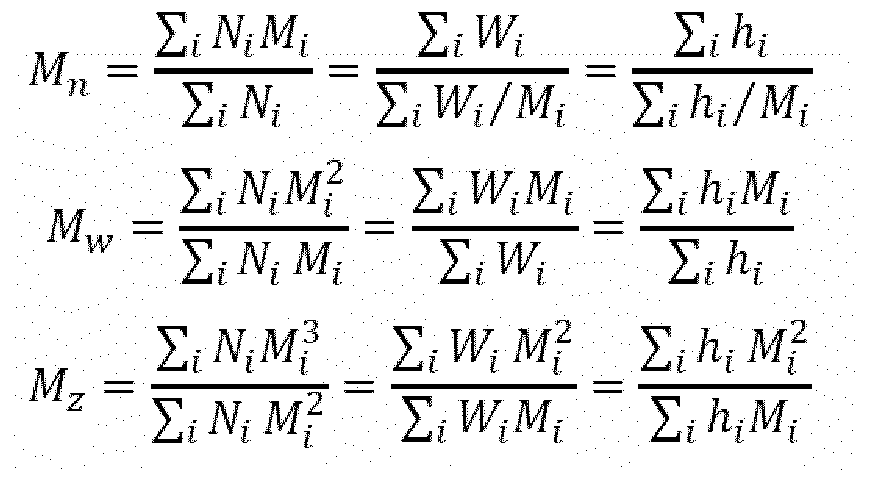
Here N, and W, are the number and weight, respectively, of molecules having molecular weight Mi. The third representation in each case (farthest right) defines how one obtains these averages from SEC chromatograms. hi is the height (from baseline) of the SEC curve at the ith elution fraction and M, is the molecular weight of species eluting at this increment.
Rheology long chain branching index grheo was measured according to the formula, as described in WO 2008/1 13680:
M SEC)
3rheo {PE) =
Mw ^o, MWD, SCB)
wherein Mw (SEC) is the weight average molecular weight obtained from size exclusion chromatography expressed in kDa; and wherein Mw (ηο, MWD, SCB) is determined according to the following, also expressed in kDa:
M^o WD,SCB)=exp(\ 1^9+0A99169LnMn+0209026(Ln^o)+0.955(lnp)- 0.007561(Ιη ζ)(Ζηηο)+0.02355(1η ζ)2) wherein the zero shear viscosity ηο in Pa.s is obtained from a frequency sweep experiment combined with a creep experiment, in order to extend the frequency range to values down to 10"4 s"1 or lower, and taking the usual assumption of equivalence of angular frequency (rad/s) and shear rate; wherein zero shear viscosity ηο is estimated by fitting with Carreau-Yasuda flow curve (η-W) at a temperature of 190 °C, obtained by oscillatory shear rheology on ARES- G2 equipment (manufactured by TA Instruments) in the linear viscoelasticity domain; wherein circular frequency (W in rad/s) varies from 0.05-0.1 rad/s to 250-500 rad/s, typically 0.1 to 250 rad/s, and the shear strain is typically 10 %. In practice, the creep experiment is carried out at a temperature of 190 °C under nitrogen atmosphere with a stress level such that after 1200 s the total strain is less than 20 %; wherein the apparatus used is an AR-G2 manufactured by TA instruments.
The total co-monomer content, especially 1 -hexene (wt % C6) relative to the total weight of the ethylene polymer and the molar fraction of hexene co-monomer in sequences of length one relative to the co-monomer content are determined by 13C NMR analysis according to the state of the art of 13C NMR analysis of ethylene based polyolefins.
The 13C NMR analysis was performed under conditions such that the signal intensity in the spectrum is directly proportional to the total number of contributing carbon atoms in the sample. Such conditions are well known to the skilled person and include for example sufficient relaxation time etc. In practice, the intensity of a signal is obtained from its integral, i.e. the corresponding area. The data were acquired using proton decoupling, several hundred even thousands scans per spectrum, at a temperature of 130 °C. The sample was prepared by dissolving a sufficient amount of polymer in 1 ,2,4-trichlorobenzene (TCB 99 % spectroscopic grade) at 130 °C and occasional agitation to homogenize the sample, followed by the addition of hexadeuterobenzene {CeDe, spectroscopic grade) and a minor amount of hexamethyldisiloxane (HMDS, 99.5+ %), with HMDS serving as internal standard. To give an example, about 200 to 600 mg of polymer were dissolved in 2.0 ml of TCB, followed by addition of 0.5 ml of C6D6 and 2 to 3 drops of HMDS. The chemical shifts are referenced to the signal of the internal standard HMDS, which is assigned a value of 2.03 ppm. NMR13C observed signals are assigned according to the co-monomer involved and corresponding literature. The
following non-exhaustive literature references can be used: G.J. Ray et al. in Macromolecules, vol 10, n°4, 1977, p. 773-778 and Y. D Zhang et al in Polymer Journal, vol 35, n°7, 2003, p. 551 -559. The total co-monomer content relative to the total weight of ethylene polymer is determined from the appropriate peaks area combination, a well-known method to the skilled person.
General considerations
All experiments were performed under a dry argon atmosphere, using a glovebox or standard Schlenk techniques unless otherwise stated. THF was distilled from sodium benzophenone ketyl and freshly used. Et.20, pentane, dichloromethane and toluene were dried over alumina columns and degassed by bubbling argon before use. Deuterated solvents (benzene-d6, THF- de, chloroform-c/ and dichloromethane-c/2) were stored on 3 A molecular sieves. Ethylene (Air Liquid, N35) was used without further purification. 3-bromobenzyl bromide (3-BrBzBr), 3- bromobenzaldehyde 3-BrPhCHO, bromobenzene, 3-chloropropionyl acyl chloride, magnesium were purchased from Aldrich. Trichloro(cyclopentadienyl)zirconium (CP*ZrCl3), TiC , TiCU and zinc were purchased from Stem. 1-Hexene was purchased from Acros. ZnC was purified in SOCI2 to reflux and then dried under vacuum. 4-bromo-2-methyl-indan-1 -one was prepared as described in Izmer, V. et al. Organometallics 2006, 25 (5), 1217-1229. Reagent 1 shown below was prepared as described in Izmer, V. V. et al. Organometallics 2006, 25 (5), 1217-1229- and in Debad, J. D.; et al. Organometallics 1999, 18, 3414-3428.

Reagent 1
List of abbreviations: Cp cyclopentadiene; DFT density functional theory; DOSY diffusion- ordered NMR spectroscopy; HMBC heteronuclear multiple-bond correlation; HMQC Heteronuclear multiple quantum coherence; STSB Stiff-Stilbene ; λ wavelength; m.p. melting point; PSS photostationary state ; TMS Trimethylsislyl group; TLC Tin Layer Chromatography ; UV-vis Ultraviolet-visible ; MAO methylaluminoxane.
Example 1 : synthesis of Compound 1 :

1.1 step 1
(£) and (Z) 3,3'-Br2-Stilbene were prepared as shown in Scheme 4 following the synthetic procedure described in the Oba, M.; et al. J. Organomet. Chem. 2006, 691 (6), 1 151-1 153.
1) KO'Bu, 30 nun, .T.

Scheme 4
From 3-bromobenzylbromide and PP i3 in reflux of toluene for 12 hours, the corresponding phosphonium salt precipitated as a white solid. This solid was washed with toluene and pentane and used without further purification for the next step. KOiBu was added to a suspension of this solid in tetrahydrofuran (THF) and the mixture was stirred for 30 min at room temperature, becoming bright orange. Then, 3-bromobenzaldehyde was added and the mixture was stirred for 4 h at room temperature. After removing most of the precipitated POP i3 by filtration over celite, the THF solution was concentrated and pentane was added. The white precipitate obtained contained (£)-3,3'-Br2-Stilbene and POP i3 according to the comparison of the 1H NMR and the one described in the literature. The filtrate contained mainly POP i3 and (Z)-3,3'-Br2-Stilbene which is an oil. The isomer (£ -3,3'-Br2-Stilbene was purified by silica column chromatography eluted by a pentane/ethyl acetate mixture and used for the coupling experiments described below for the preparation of isomer (£) of compound 1.
1.2 Step 2
To a solution of said obtained (£)-3,3'-Br2-Stilbene (0.164 g, 0.485 mmol) in THF (10 ml) at - 80 °C, nBuLi in hexanes (0.39 ml, 2.64 M, 1 .02 mmol) was added. The color changed immediately to yellow. After 3 minutes, ZnC (0.145 g, 1 .07 mmol) in THF (10 ml) was added
at -80 °C, the solution becoming colorless. The mixture was stirred from -80 °C to room temperature and the volatiles were pumped off to obtain a white sticky solid. A colorless solution containing Reagent 1 (0.487 g, 0.970 mmol) and Pd(PfBu3)2 (0.012 g, 2.4 10"2mmol) in THF (20 ml) was added to the white sticky solid and the mixture was stirred for 4 h at room temperature. The volatiles were pumped off. The orange oil obtained was solubilized in toluene and filtered over celite. Addition of some drops of pentane resulted in the precipitation of a black solid that was filtered off. The solution was evaporated and the solid was recrystallized several times in a toluene/pentane mixture until obtaining Compound (E -1 as a yellow crystalline solid, with a 66 % yield.
1H NMR (400 MHz, Benzene-cfe) δ 7.41 (d, J = 7.3 Hz, 2H), 7.02 (d, J = 8.6 Hz, 2H), 6.84 (d, J = 2.4 Hz, 2H), 6.59 (t, J = 7.8 Hz, 2H), 5.69 (d, J = 2.4 Hz, 2H), 2.03 (s, 6H), 1 .83 (s, 30H).
1H NMR (500 MHz, Chloroform-d) δ 7.53 (d, J = 7.1 Hz, 2H), 7.45 (d, J = 7.2 Hz, 2H), 7.35 (d, J = 8.2 Hz, 2H), 6.94 - 6.86 (m, 2H), 6.65 (s, 2H), 6.18 (t, J = 2.8 Hz, 2H), 2.24 (d, J = 3.1 Hz, 6H, Me-lnd), 2.01 (d, J = 2.5 Hz, 30H, Cp*).
1H NMR (400 MHz, Methylene Chloride-^) δ 7.96 (s, 1 H), 7.59 (s, 1 H), 7.54 (d, J = 8.3 Hz, 1 H), 7.47 (d, J = 7.3 Hz, 1 H), 7.35 (dt, J = 14.4, 7.8 Hz, 4H), 7.15 (q, J = 7.6 Hz, 2H), 6.81 (s, 1 H), 6.27 (s, 1 H), 2.21 (s, 3H), 2.03 (s, 15H).
13C NMR (101 MHz, Methylene Chloride-^) δ 126.57, 127.65, 126.19, 128.78, 121 .22, 125.27, 128.77, 125.20, 1 14.45, 100.73, 15.66, 12.17.
13C NMR (126 MHz, Chloroform-c/) δ 128.67, 128.24, 126.50, 125.13, 120.86, 1 12.70, 101.62, 16.36, 12.61 (Cp*).
Preparation of compound (Z)-1 (obtained as a mixture ofZ and E isomers)

The synthesis was carried out following the same synthetic procedure as for compound (£)-1 starting from (Z)-3,3'-Br2-Stilbene except that the Negishi coupling reaction was carried out overnight.
1H NMR (500 MHz, Benzene-d6) δ 7.89 - 7.82 (m, 2H), 7.36 - 7.27 (m, 2H), 7.27 - 7.17 (m, 2H), 7.04 - 6.94 (m, 4H), 6.94 - 6.86 (m, 2H), 6.82 (dd, J = 10.2, 2.2 Hz, 2H), 6.59 (d, J = 2.0
Hz, 2H), 5.69 (dd, J = 37.2, 2.3 Hz, 2H), 5.72 - 5.57 (m, 2H), 1.95 (s, 6H, Me), 1 .79 (d, J = 1 .8 Hz, 30H, Cp*).
13C NMR (126 MHz, Benzene-de) δ 141.90 (Cquat), 134.25 (Cquat indenyl), 130.07 (CH), 128.49 (CH), 125.86 (CH), 120.68 (CH), 1 18.32 (Cquat indenyl), 1 14.95 (CH), 125.42 (CH), 1 14.25 (CH), 130.77 (CH), 104.61 (Cquat indenyl), 100.34 (CH), 15.74 (CH3), 12.42 (Cp*).
Example 2: synthesis of Compound 2:

2.1. E and Z 5-bromo-1 -(5-bromo-4, 7-dimethyl-indan-1-ylidene)-4, 7-dimethyl-indane
E- and Z-5-bromo-1 -(5-bromo-4,7-dimethyl-indan-1 -ylidene)-4, 7-dimethyl-indane prepared as shown in Scheme 5.

Scheme 5
AICI3 (9.0 g, 60 mmol) was added to a 250 ml Schlenk containing a stirring bar. Dried and degassed dichloromethane (80 ml) was added. A solution of 3-chloropropionyl chloride (7.3 ml, 76 mmol) in 10 ml of dichloromethane was added dropwise to the yellow slurry and stirred 15 min to obtain a dark brown solution. A solution of 2,5-dimethylbromobenzene (8.6 ml, 62 mmol) in 10 ml of dichloromethane was added dropwise to the brown solution and the mixture was stirred 20 h at room temperature, until no HCI overpressure was observed. The brown mixture was poured onto ice and extracted with dichloromethane (3 x 120 ml). The organic
phase was washed with aqueous NaHCC>3 and brine and dried over Na2S04. Volatiles were pumped off to give 3-chloro-1 -(4-bromo-3,5-dimethyl)propanone as a white solid (17.3 g, 99%). This solid was used without further purification.
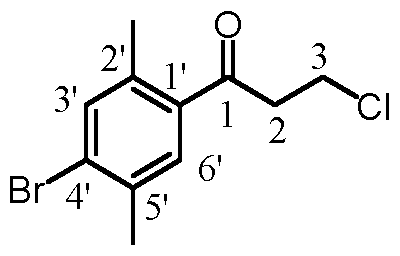
1H NMR (300 MHz, Chloroform-d) δ 7.49 (s, 1 H, 3'a), 7.44 (s, 1 H, 6'a), 3.88 (t, J = 6.6 Hz, 2H, 2a, 2b), 3.34 (t, J = 6.6 Hz, 2H, 3a, 3b), 2.44 (s, 3H, 5'Me), 2.40 (s, 3H, 2'Me).
To a 100 ml round bottom flask equipped with a condenser, 3-chloro-1 -(4-bromo-3,5- dimethyl)propanone (3.38 g, 12.3 mmol) and H2SO4 95% (40 ml, 736 mmol) were added. This brown mixture was heated to 100 °C for 2 h under Ar flow. The brown solution obtained was cooled down to room temperature and carefully added onto ice. The organic product was extracted with diethylether (3 x 30 ml) and the organic phase was washed with aqueous NaHCC>3 and brine and dried over Na2S04. After evaporation of the solvents, 5-bromo-4,7- dimethyl-1 -indanone (2.55 g, 86%) was obtained as a white solid.

1H NMR (300 MHz, Chloroform-d) δ 7.33 (s, 1 H, 6a), 3.00 (t, J = 6.2, 5.5 Hz, 2H, 2a, 2b), 2.67 (t, J = 6.2 Hz, 2H, 3a, 3b), 2.57 (t, J = 0.7 Hz, 3H, 4Me), 2.36 (s, 3H, 7Me).
Preparation of £- and Z-5-bromo-1 -(5-bromo-4,7-dimethyl-indan-1 -ylidene)-4,7-dimethyl- indane. Two different routes were used: in the first route (a) the catalyst used was TiCI4 reduced by Zn and the mixture was refluxed for 24 h at 65 °C and in the second route (b), the catalyst was TiC reduced by Zn and the mixture was refluxed for 96 h at 65 °C.
Route a: Zn dust (3.89 g, 29.5 mmol) and 50 ml of freshly distilled THF were added to a 250 ml Schlenk flask and the slurry was cooled down to 0 °C. TiCI4 (1 .73 ml, 10.8 mmol) was carefully added dropwise to give a yellow slurry that became light blue after 30 min at room temperature. A solution of 5-bromo-4,7-dimethyl-1 -indanone (2.35 g, 41 .7 mmol) in THF (50 ml) was then added. The dark brown solution was refluxed to 65 °C for 24 h. The mixture was filtered over celite and washed with CH2CI2. The organic phase was washed with saturated NH4CI. The dark purple aqueous phase was extracted with dichloromethane and the organic phase was dried over Na2S04. The yellow solution was filtered onto a small silica column and concentrated under vacuum until some white precipitate appeared. At this moment, ethanol
was added and the product crystallized at - 40 °C overnight. After filtration, the product obtained as a white solid (0.92 g, 43%) was a mixture of the Z and £ isomers.
Route b: Zn (1 .935 g, 14.6 mmol), TiCI3- 1/3 AICI3 (1.46 g, 7.3 mmol) as a purple solid and 5- bromo-4,7-dimethylindanone (0.835 g, 3.5 mmol) were placed in a Schlenk flask and THF (85 ml, 0.04 M solution) was added. The purple slurry was stirred at room temperature for 30 min. The dark mixture was refluxed to 65 °C for 96 h. Color changed from purple, to blueish and finally dark brown. The mixture was filtered over celite and washed with CH2CI2. The organic phase was washed with saturated NH4CI and water and dried over Na2S04. The yellow solution was filtered onto a small silica column and concentrated under vacuum until some white precipitate appeared. At this moment, ethanol was added and the product crystallized at - 40 °C overnight. After filtration, the product obtained as a white solid (0.46 g, 60%) was a mixture of the Z and £ isomers. The structure of the £-isomer was determined by X-Ray diffraction.
The (£)-5 isomer could be obtained pure after several attempts of washing with cold THF, extraction with hot CH2CI2, concentration of the solution and recrystallization at -40°C.
(£)-5 characterization

1H NMR (400 MHz, Methylene Chloride-d2) δ 7.30 (s, 2H, 6a', 6a), 2.79 (t, J = 6.4 Hz, 4H, 2a', 2b', 2a, 2b), 2.60 (s, 4H, 3a', 3b', 3a, 3b), 2.29 (s, 6H, 10a', 10b', 10c', 10a, 10b, 10c), 2.28 (s, 6H, 1 1 a', 1 1 b', 1 1 c', 1 1 a, 1 1 b, 1 1 c).
13C NMR (101 MHz, Methylene Chloride-d2) δ 147.26, 142.05, 137.37, 132.88 (d, J = 161 .8 Hz, 6, 6'), 132.50, 130.89, 124.33, 37.82 (t, J = 131 .2 Hz, 3, 3'), 32.39 (t, J = 130.0 Hz, 2, 2'), 21.07 (ddd, J = 254.5, 127.5, 4.7 Hz, 1 1 , 1 1 '), 18.86 (q, J = 127.6 Hz, 10, 10').
(Z)-5 characterization

13C {1H} NMR (101 MHz, Methylene Chloride-cfe) δ 149.0, 142.6, 136.83, 134.0, 132.3 (6\ 6), 103.8, 124.0, 38.45 (2\ 2), 32.14 (3\ 3), 20.75 (1 1 ', 1 1 ), 18.96 (10', 10).
Photoisomerization by UV light of E- and Z-5-bromo-1 -(5-bromo-4,7-dimethyl-indan-1 - ylidene)-4,7-dimethyl-indane and vice versa
A solution c.a. 10"6M of pure (£)-5-bromo-1 -(5-bromo-4,7-dimethyl-indan-1 -ylidene)-4,7- dimethyl-indane in degassed CD2CI2 was prepared and the UV and 1H NMR spectrum were registered. Irradiation at the maximum (λ = 320 nm) with a UV lamp equipped with a filter was performed and the UV spectra was registered over time until the photostationary state (PSS) was reached (after 3 h) observing the shift of the band versus the visible. At that moment another 1H NMR spectrum was carried out, showing the apparition of isomer (Z)-5 in a ratio (£)-5/(Z)-5 of 1 .3. Reversible back-isomerization was carried out by irradiating the last sample to 350 nm or by temperature. At 350 nm at room temperature the PSS was observed by the back-shifting of the band to the UV region after 18 h . At that moment, a third 1H NMR spectrum showed that the back conversion was not completed, but both isomers were in a ratio (E)- 5/(Z)-5 of 3.8. Isomerization conditions are shown under scheme 6.

Scheme 6
2.2. Compound 2
To a solution of compound 5-bromo-1 -(5-bromo-4,7-dimethyl-indan-1 -ylidene)-4,7-dimethyl- indane (mixture of isomers) (0.100 g, 0.225 mmol) in THF (15 ml) at -80 °C, nBuLi in hexanes (0.19 ml, 2.39 M, 0.45 mmol) was added. The color changed immediately to yellow. After 3 minutes, ZnC (0.067 g, 0.495 mmol) in THF (5 ml) was added at -80 °C, the solution becoming colorless. The mixture was stirred from -80 °C to room temperature and the volatiles were pumped off to obtain a white sticky solid. A colorless solution containing Reagent 1 (0.225 g, 0.448 mmol) and Pd(PfBu3)2 (0.006 g, 1.1 10"2mmol) in THF (15 ml) was added to the white sticky solid and the mixture was stirred for 4 h at room temperature. The volatiles were pumped
off. The orange oil obtained was solubilized in toluene and filtered over celite. Addition of some drops of pentane result in the precipitation of a black solid that was filtered off. The solution was evaporated and the solid was recrystallized several times in a toluene/pentane mixture until obtaining Compound 2 (mixture of isomers) as a yellow crystalline solid with a 67 % yield. Elemental analysis. Calcd for CeeHeoCUZfc: C 66.19 H 6.73. Found C 66.09, H 6.82.
1H NMR for Compound 2 (400 MHz, Chloroform-d), δ 7.26 (d, J = 8.4, 2H, 5-lnd, 5'-lnd), 7.20 - 7.15 (m, 2H, 6-lnd, 6'-lnd), 7.01 (dd, J = 7.8, 4.3 Hz, 4H, 7-lnd, 7'-lnd, 6-STSB, 6'-STSB ), 6.61 (d, J = 2.2 Hz, 1 H, 1 -lnd, 1 '-lnd), 6.07 (d, J = 2.2 Hz, 1 H, 3-lnd, 3'-lnd), 3.06 - 2.55 (m, -STSB, 2'-STSB, 3-STSB, 3'-STSB), 2.22 (s, 6H, Me), 2.17 (s, 6H, Me), 2.04 (s, 6H, Me),

13C NMR for Compound 2 (101 MHz, Chloroform-d) δ 128.61 (C6-lnd or C5-STSB), 1 18.69 (C5-lnd), 125.1 1 , 123.21 (C6-lnd or C5-STSB), 128.61 , 125.17, 1 1 1 .20 (C1 -lnd), 100.30 (C3- Ind), 30.94, 37.40, (C2-STSB, C3-STSB) 18.38 (Me), 16.42 (Me), 16.00 (Me), 12.43 (Me5Cp).
Example 3 synthesis of Compound 3:

Compound 3 was prepared as shown under scheme 7

Scheme 7
To a solution of compound 5-bromo-1 -(5-bromo-4,7-dimethyl-indan-1 -ylidene)-4,7-dimethyl- indane (prepared as described in example 2, point 2.1 ) (0.2 g, 0.448 mmol) in THF (15 ml) at -80 °C, nBuLi in hexanes (0.38 ml, 2.5 M, 0.94 mmol) was added. The color changed immediately to yellow. After 3 minutes, MeSiCb (2.1 ml, 17.9 mmol) were added at -80 °C, the solution becoming colorless. The mixture was stirred from -80 °C to room temperature and the volatiles were pumped off. dichloro-[1 -[5-[dichloro(methyl)silyl]-4,7-dimethyl-indan-1 -ylidene]- 4,7-dimethyl-indan-5-yl]-methyl-silane containing the isomers H and Zwas obtained as a white solid after stripping with pentane and used for the next step.
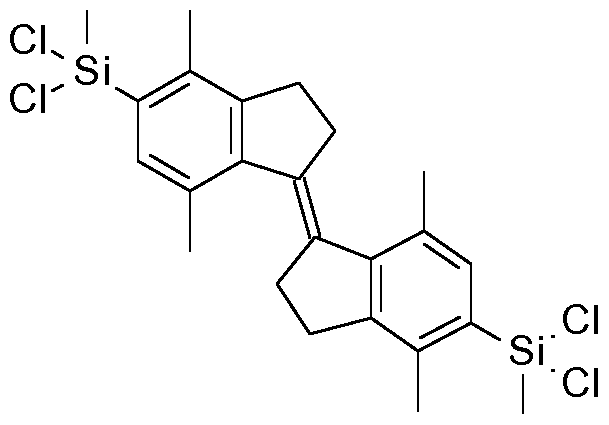
1H NM (400 MHz, Chloroform-d) δ 7.47 (d, J = 5.1 Hz, 2H, 6, 6'), 2.78 (s, 4H, 2, 2'), 2.64 (s, 4H, 3, 3'), 2.48 (s, 6H, Me), 2.36 (s, 6H, Me), 1 .13 (s, 6H, Si/We).
To a solution of dichloro-1 -[5-[dichloro(methyl)silyl]-4,7-dimethyl-indan-1 -ylidene]-4,7- dimethyl-indan-5-yl]-methyl-silane (0.23 g, 0.363 mmol) in THF (10 ml) a solution of sodium cyclopentadienylide (NaCp) (0.579g, 1 .79 mmol) in THF (10 ml) was added. The slurry changed from dark to light orange after 4 h stirring. The excess of NaCp was quenched with water and the product was extracted in dichloromethane. After evaporation the orange solid obtained was used for the next step.

1H NMR (400 MHz, Chloroform-d) δ 7.01 -7.37 (6), 6.63 (m, CH-Cp), 2.77, 2.66 (m, CH2-STSB), 2.25-2.34 (m, CH3-STSB), 1.54-1 .59 (m, CH2-Cp), 0.88 (m, SiMe).
To the previous solution of di(cyclopenta-1 ,4-dien-1 -yl)-[ 1 -[5-[di(cyclopenta-1 ,4-dien-1 -yl)- methyl-silyl]-4,7-dimethyl-indan-1 -ylidene]-4,7-dimethyl-indan-5-yl]-methyl-silane, a solution of Zr(NMe2)4 (0.194g, 0.726 mmol) in toluene (10 ml) was added. After 2 hours stirring at room temperature, the reaction was finished. Compound 3 slowly precipitates in solution. Addition of pentane made a fast precipitation of Compound 3.
1H NMR for Compound 3(400 MHz, benzene-c 6) δ 8.07 (s, 6, 6'), 6.59 (m, Cp), 5.90 (m, Cp), 2.87 (s, NMe2), 2.69 (s, NMe2), 2.05-2.98 (2, 2', 3, 3'), 0.92 (SiMe).
Example 4: synthesis of Compound (E)-4:
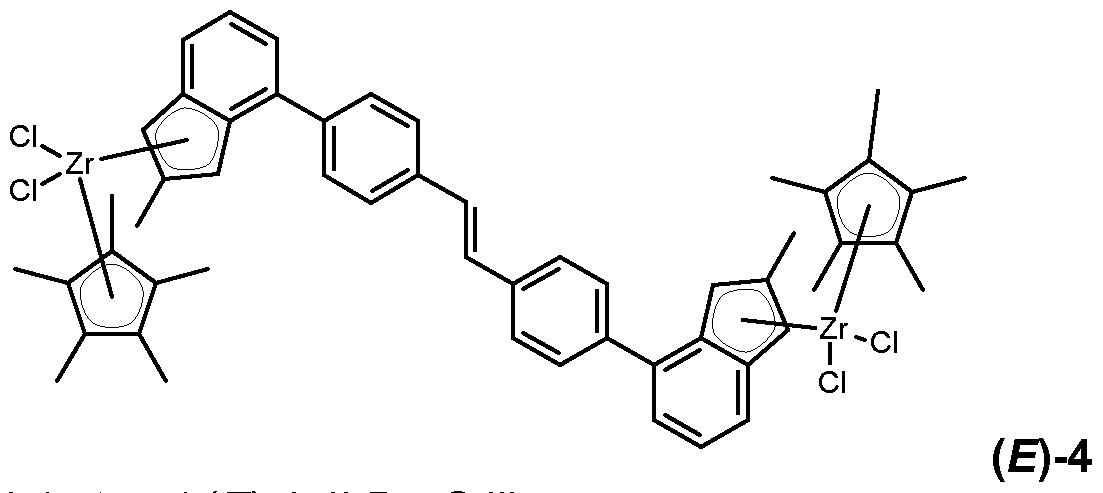
4.1 step 1 (£) 4,4'-Br2-Stilbene
The synthesis of (£) 4,4'-Br2-Stilbene was carried out by Mc Murry coupling as shown in Scheme 8 following a synthetic procedure similar to what is described in Linseis, M.; et al. J. Am. C em. Soc. 2012, 134 (40), 16671-16692.

Scheme 8
To a suspension of 7.99 g (60.05 mmol) of zinc-powder in 50 ml of THF in a three-neck flask with two dropping funnels and an effective reflux condenser, 3.2 ml (5.53 g, 29.19 mmol) of TiCU was added dropwise at -10 °C. After the addition was finished, the mixture was heated to reflux, until the color changed from yellow to blue. A solution of 2.000 g (10.80 mmol) of 4- bromobenzaldehyde in 50 ml of THF was added to the refluxing solution. Reflux was continued for 5 h. The cooled mixture was filtered over celite. Then a saturated aqueous NaHCC>3 solution was added, and the resulting mixture was extracted three times with ethylacetate by decanting the organic phase from the bluish residue. The combined extracts were dried over MgSC>4, filtered and evaporated to dryness. Recrystallization from hot toluene yielded, after cooling down, colorless plates of (£)-1 ,2-bis(4-bromophenyl)ethene (0.729 g, 5.40 mmol, 39.9 %).
1H-NMR (400 MHz, Chloroform-d6): δ 7.48 (dm, 3JH-H = 8.5 Hz, 4H, H3/4), 7.36 (dm, 3JH-H = 8.5 Hz, 4H, H3/4), 7.02 ppm (s, 2H, H1 ).
4.2 step 2 Compound (E)-4
To a solution of compound (£)-1 ,2-bis(4-bromophenyl)ethene (0.188 g, 0.556 mmol) in THF (10 ml) at -80 °C, nBuLi in hexanes (0.46 ml, 2.64 M, 1 .17 mmol) was added. The color changed immediately to yellow. After 2 to 3 minutes, ZnC (0.167 g, 1 .22 mmol) in THF (10 ml) was added at -80 °C, the solution became colorless. The mixture was stirred from - 80 °C to room temperature and the volatiles were pumped off to obtain a white sticky solid. A colorless solution containing Reagent 1 (0.0885 g, 1 .1 1 mmol) and Pd(PiBu3)2 (0.014 g, 2.8 10"2 mmol) in THF (20 ml) was added to the white sticky solid and the mixture was stirred for 4 h at room temperature. The volatiles were pumped off. The orange oil obtained was solubilized in toluene and filtered over celite. Addition of some drops of pentane result in the precipitation of a black solid that was filtered off. The solution was evaporated and the solid was recrystallized several times in a dichloromethane/pentane mixture until compound (E)-4 as a yellow crystalline solid (0.365 g) in a 60% yield.
1H NMR (500 MHz, Benzene-d6) δ 7.93 (dd, J = 8.3, 3.9 Hz, 1 H), 7.52 - 7.29 (m, 3H), 7.15 - 6.97 (m, 4H), 5.72 (dd, J = 4.8, 2.3 Hz, 1 H, (£) CH=CH stilbene), 1.98 (d, J = 5.4 Hz, 3H, CH3), 1 .85 - 1.82 (m, 15H, Cp*).
13C NMR (126 MHz, Benzene-d6) δ 139.21 (Cquat indenyl), 136.21 (Cquat indenyl), 130.24 (Cquat indenyl), 129.28 (CH), 128.68 (CH), 126.96 (CH), 126.84 (CH), 125.49 (CH), 125.34 (CH), 120.60 (CH), 1 14.42 (CH), 100.43 ((£) CH=CH stilbene), 1 14.68 (Cquat indenyl), 15.68 (CH3), 12.40 (Cp*).
Example 5: synthesis of Compound (Z)-4 :

5.1 step 1 (Z) 4,4'-Br2-Stilbene
The synthesis of (Z) 4,4'-Br2-Stilbene was carried by Wittig coupling of (Z) 4,4'-Br2-Stilbene in the presence of 18-C-6 crown ether, shown in Scheme 9 as previously described in Linseis, M.; et al. J. Am. C em. Soc. 2012, 134 (40), 16671-16692.
1 ) Ph3P, toluene, 12h reflux

Scheme 9
A solution of 4.00 g (16.00 mmol) of 4-(bromomethyl)bromobenzene and 6.30 g (24.00 mmol) of triphenylphosphane in 100 ml of dry toluene was refluxed for 12 h. After cooling to room temperature, a precipitate formed which was filtered off and washed with toluene. Drying in vacuo afforded (4-bromobenzyl)triphenylphosphonium bromide as a white powder that was used for the next step.
A solution of 2.36 g (12.80 mmol) of 4-bromobenzaldehyde, 8.19 g (16.00 mmol) of (4- bromobenzyl)triphenylphosphonium bromide and 0.338 g (1.28 mmol) of 18-crown-6 in 80 ml of CH2CI2 was cooled to -78 °C. After addition of 1.79 g (32.00 mmol) of freshly powdered KOH the mixture was stirred for 1 .5 h at -78 °C and for 3 h at room temperature, until the color changed from orange to white. The precipitated white solids were removed by filtration and the mother liquor was washed with saturated aqueous N H4CI solution and dried over MgS04. The solvent were evaporated which yielded a yellowish powder. This powder was extracted with
140 ml of hexanes and filtered through a short flash-column eluting with hexanes. The solvent was removed to give a colorless oil which solidified upon standing to give pure (Z)-1 ,2-bis(4- bromophenyl)ethene in 63.0 % yield (2.7 g, 8.00 mmol).
1H-NMR (400 MHz, Chloroform-dC): δ 7.36 (dm, 3JH-H = 8.5 Hz, 4H, H3/4), 7.08 (dm, 3JH-H = 8.5 Hz, 4H, H3/4), 6.54 ppm (s, 2H, H1 )
5.2 step 2 Compound (Z)-4
To a solution of (Z)-1 ,2-bis(4-bromophenyl)ethene (0.15 g, 0.443 mmol) in THF (10 ml) at -80 °C, nBuLi in hexanes (0.37 ml, 2.64 M, 0.93 mmol) was added. The color changed immediately to yellow. After 2 to 3 minutes, ZnC (0.133 g, 0.97 mmol) in THF (10 ml) was added at -80 °C, the solution becoming colorless. The mixture was stirred from - 80 °C to room temperature and the volatiles were pumped off to obtain a white sticky solid. A colorless solution containing Reagent 1 (0.445 g, 0.880 mmol) and Pd(PiBu3)2 (0.01 1 g, 2.2 10"2mmol) in THF (20 ml) was added to the white sticky solid and the mixture was stirred for 4 h at room temperature. The volatiles were pumped off. The orange oil obtained was solubilized in toluene and filtered over celite. Addition of some drops of pentane result in the precipitation of a black solid that was filtered off. The solution was evaporated and the solid was recrystallized several times in a toluene/pentane mixture until obtaining compound (Z)-4 as a yellow crystalline solid (0.350 g) in a 70% yield.
1H NMR (500 MHz, Benzene-d6) δ 7.81 - 7.70 (m, 1 H, CH), 7.41 (d, J = 8.1 Hz, 1 H, CH), 7.36 - 7.26 (m, 1 H, CH), 7.26 - 7.18 (m, 1 H, CH), 7.08 - 6.98 (m, 1 H, CH), 6.98 - 6.85 (m, 2H, CH), 6.48 (dd, J = 5.2, 2.8 Hz, 1 H, CH), 5.76 - 5.65 (m, 1 H, CH), 2.08 (d, J = 2.2 Hz, 3H, CH3), 1 .80 (d, J = 1 .8 Hz, 15H, Cp*).
13C NMR (75 MHz, Benzene-d6) δ 128.74 (CH), 129.13 (CH), 128.53 (CH), 125.50 (CH), 120.57 (CH), 124.97 (CH), 1 13.08 (CH), 130.08 (CH), 100.78 (CH), 13.10 (CH3), 12.29 (Cp*).
Example 6: comparative example monovalent catalyst:
Compound 5: (^-2-Met yl-4-P enyl)-indenyl(^-tetramet ylcyclopentadienyl)zircon dichloride

Compound 5 was prepared as shown under scheme 10.

Scheme 10
First, the Grignard reagent phenylmagnesium bromide was obtained from the dropwise reaction of bromobenzene in THF and Mg turnings in THF as described below. A three neck round bottom flask assembled with a reflux condenser and an addition ampoule was purged by argon/vacuum cycles. Magnesium turnings were added to the flask. Freshly distilled THF (4 ml) was added. A small crystal of was added and the mixture was heated until the color disappears. A solution of dry bromobenzene (3 ml, 28.5 mmol) in THF (8 ml) was added to the addition ampoule and this solution was added dropwise to the flask. An exothermic reaction started immediately. The addition continued over 1 h. Then the mixture was stirred for one more hour at room temperature. The solution was filtered off by filter canula. The phenyl magnesium bromide obtained was titrated by a reported procedure in Watson, S. C; Eastham, J. F. J. Organomet. Chem. 1967, 9 (1 ), 165-168, resulting in a concentration 2.4 M
A solution of phenyl magnesium bromide (0.498 ml, 2.4 M, 1.19 mmol) in THF was added onto ZnC (0.19 g, 1 .39 mmol) in THF (12 ml). The cloudy solution was stirred for 1 h at room temperature. Volatiles were removed under vacuum to obtain a white sticky solid. A solution of Reagent 1 (0.5 g, 1 .0 mmol), Pd(PiBu)3 (0.013 g, 2.5 10"2 mmol) and THF was added onto the white solid. The mixture was stirred for 4 h at room temperature, the color changing from yellow to orange. THF was removed under vacuum. The orange oil obtained was solubilized in toluene and filtered over celite. Addition of some drops of pentane result in the precipitation of a black solid that was filtered off. The solution was evaporated and the solid was recrystallized until (n5-2-Methyl-4-Phenyl)-indenyl(n5-tetramethylcyclopentadienyl)zirconium dichloride was obtained as a yellow crystalline solid. A similar procedure was described in Ryabov, A. N.; et al. Organometallics 2009, 28 (13), 3614-3617.

1H NMR (400 MHz, Methylene Chloride-*) δ 7.72 - 7.67 (m, 2H, 2,6-H in Ph), 7.50 - 7.44- 7.28 (m, 4H, 7-H in indenyl and 3,4,5-H in Ph), 7.24 (d, J = 7.5 Hz, 1 H, 5-H in indenyl), 7.08 (s, 1 H, 6-H in indenyl), 6.74 (dd, J = 2.0, 1 .1 Hz, 1 H, 1-H in indenyl), 6.25 (d, J = 2.3 Hz, 1 H, 3-H in indenyl), 2.20 (s, 3H, 2-Me in indenyl), 2.02 (s, 15H, C5Me5).
Example 7: polymerization of ethylene
Comparison of the activities of dinuclear catalysts (compounds 1 , 2, (E)-4, and (Z)-4) and mononuclear catalyst (comparative compound 5) were performed in ethylene polymerization. Experiments were performed in 150 ml of toluene using 5 bar of ethylene and quenched after 30 min.
A purged 300 mL glass high-pressure reactor (TOP-lndustrie) provided with Mechanical stirring (Pelton turbine) was charged with 150 mL of distilled and degassed toluene under argon flow and heated to 50 °C by circulating water in a double mantle. When the temperature was stabilized, the reactor was purged with an ethylene flow. MAO (1000 eq, 0.444 ml, 4.5 M) from the glovebox was injected and the solution was aging for 40 min. The reactor was purged with ethylene. A solution of the catalyst (1 mmol) in toluene (2 mL) was prepared in the glovebox and injected immediately to the reactor. The reactor was then charged with ethylene to 5 bar pressure which was kept constant with a back regulator. At the end of the polymerization, methanol (ca. 2 mL) was added to quench the reaction. The precipitated polymer was washed with methanol (ca. 500 mL), filtered and dried under vacuum overnight at 40 °C. A small amount of polymer was analyzed by NMR in 1 ,2,4-trichlorobenzene, DSC and GPC analyses.
Results are shown in Table 1 .
Table 1

Example 8: polymerization of ethylene/1 -hexene
Comparison of the activities of dinuclear catalysts (compounds 1 , 2, (E)-4, and (Z)-4)) and mononuclear catalyst (comparative compound 5) were performed in ethylene/1 -hexene copolymerization. Experiments were performed in 100 ml of toluene and at 50 °C and quenched after 30 min. Results are shown in Table 2. A purged 300 mL glass high-pressure reactor (TOP-lndustrie) provided with Mechanical stirring (Pelton turbine) was charged with 100 mL of distilled and degassed toluene and 2.5 mL of distilled 1 -hexene under argon flow and heated to 50 °C by circulating water in a double mantle. When the temperature was stabilized, the reactor was purged with an ethylene flow. MAO (1000 eq, 0.444 ml, 4.5 M) from the glovebox was injected and the solution was aging for 30 min. The reactor was purged with ethylene. A solution of the catalyst (1 mmol) in toluene (2 mL) was prepared in the glovebox and injected immediately to the reactor. The reactor was then charged with ethylene to 5 bar pressure which was kept constant with a back regulator. At the end of the copolymerization, methanol (ca. 2 mL) was added to quench the reaction. The precipitated polymer was washed with methanol (ca. 500 mL), filtered and dried under vacuum overnight at 40 °C. A small
amount of copolymer was analyzed by NMR in 1 ,2,4-trichlorobenzene, DSC and GPC analyses.
Table 2

Example 9: polymerization of 1 -hexene
Comparison of the activities of dinuclear catalysts (compounds 1 , 2, (E)-4, and (Z)-4)) and mononuclear catalyst (comparative compound 5) were performed in 1 -hexene polymerization. Experiments were performed in 50 ml of toluene and at 50 °C and quenched after 30 min. A purged 250 mL glass Schlenk flask provided with a magnetic stirring bar was charged with 38 mL of distilled and degassed toluene and 10 mL of 1 -hexene under argon flow and heated to 50 °C in an oil bath. When the temperature was stabilized, MAO (1000 eq, 0.444 ml, 4.5 M) from the glovebox was injected and the solution was aging for 30 min. A solution of the catalyst (1 mmol) in toluene (2 mL) was prepared in the glovebox and injected immediately to the reactor. At the end of the polymerization, methanol (ca. 2 mL) was added to quench the reaction. The gel polymer was precipitated with methanol (ca. 500 mL), separated by decantation overnight, then dried under vacuum overnight at 40 °C. A small amount of polymer was analyzed by NMR in 1 ,2,4-trichlorobenzene, DSC and GPC analyses.
Results are shown in Table 3.
Table 3

Example 10: Other suitable intermediates for the preparation of compounds according to the invention
10.1. (1E)- and (1Z)-5-bromo-1-(5-bromoindan-1-ylidene)indane
E and Z 5-bromo-1 -(5-bromoindan-1 -ylidene)indane were prepared as shown in Scheme 1 1 .

Scheme 1 1
AlC (15.0 g, 1 12.5 mmol) was added to a 250 ml Schlenk containing a stirring bar. Dried and degassed dichloromethane (100 ml) was added. A solution of 3-chloropropionyl chloride (12.14 ml, 127 mmol) in 20 ml of dichloromethane was added dropwise to the yellow slurry and stirred 15 min to obtain a dark brown solution. A solution of bromobenzene (10.92 ml, 104 mmol) in 20 ml of dichloromethane was added dropwise to the brown solution and the mixture was stirred 24 h at room temperature until no HCI overpressure was observed. The brown mixture was poured onto ice and extracted with dichloromethane (3 x 120 ml). The organic phase was washed with aqueous NaHCC>3 and brine and dried over Na2S04. Volatiles were pumped off to give 3-chloro-1 -(4-bromo)propanone as a light brown solid. This solid was used without further purification.

1H NMR for 3-chloro-1 -(4-bromo)propanone (400 MHz, Chloroform-d) δ 7.79 (dt, J = 8.7, 2.3 Hz, 2H, 3'a, 3'b), 7.64 - 7.55 (m, 2H, 2'a, 2'b), 3.89 (td, J = 6.8, 2.0 Hz, 2H, 2a, 2b), 3.40 (td, J = 6.8, 1.9 Hz, 2H, 3a, 3b).
To a 100 ml round bottom flask equipped with a condenser, 3-chloro-1 -(4-bromo)propanone (1 .55 g, 6.35 mmol) and H2S04 98% (35 ml, 644 mmol) were added. This brown mixture was heated to 100 °C for 2 h under argon flown. The dark brown solution obtained was cooled down to room temperature and added onto ice. The organic product was extracted with diethylether (3 x 30 ml) and the organic phase was washed with aqueous NaHCC>3 and brine and dried over Na2S04. After evaporation of the solvents, 5-bromo-1 -indanone was obtained as a brown solid.

1H NMR for 5-bromo-1 -indanone (300 MHz, Chloroform-d) δ 7.65 (t, J = 0.9, 0.5 Hz, 1 H, 4a), 7.59 (d, J = 8.2 Hz, 1 H, 6a), 7.50 (dt, J = 8.2, 0.9 Hz, 1 H, 7a), 3.13 (t, J = 6.1 , 5.7 Hz, 2H, 2a, 2b), 2.69 (t, J = 6.0 Hz, 2H, 3a, 3b).
Preparation of E- and Z-5-bromo-1 -(5-bromoindan-1 -ylidene)indane. Two different routes were used: in the first route (a) the catalyst used was TiCI4 reduced by Zn and the mixture was refluxed for 24 h at 65 °C and in the second route (b), the catalyst was T1CI3 reduced by Zn and the mixture was refluxed for 24 h at 65 °C.
Route a; Zinc dust (1 .5 g, 1 1 .4 mmol) and 50 ml of freshly distilled THF were added to a 250
ml Schlenk flask and the slurry was cooled down to 0 °C. TiCU (0.5 ml, 4.56 mmol) was carefully added dropwise to give a yellow slurry that became light blue when warmed to room temperature and stirred for 30 min. A solution of 5-bromo-1 -indanone (0.88 g, 41 .7 mmol) in THF (50 ml) was then added. The dark brown solution was refluxed to 65 °C for 24 h. The mixture was filtered over celite and washed with CH2CI2. The organic phase was washed with saturated NH4CI and water and dried over Na2S04. After evaporation, the product obtained as an orange solid was a mixture of (1 E)-5-bromo-1 -(5-bromoindan-1 -ylidene)indane and (1Z)-5- bromo-1 -(5-bromoindan-1 -ylidene)indane (E-isomer is major according to DFT calculations).
Route b: Zn (0.92 g, 69 mmol) and THF (50 ml) were placed in a Schlenk flask and TiCI3- 1/3 AICI3 (0.69 g, 35 mmol) was added as a purple solid. The slurry was stirred for 30 min and no changes were observed. A solution of 5-bromo-1 -indanone (0.88 g, 41.7 mmol) in THF (50 ml) was then added. The dark brown solution was refluxed to 65 °C for 24 h. The mixture was filtered over celite and washed with CH2CI2. The organic phase was washed with saturated NH4CI and water and dried over Na2S04. A mixture of (1 E)-5-bromo-1 -(5-bromoindan-1 - ylidene)indane and (1 Z)-5-bromo-1 -(5-bromoindan-1 -ylidene)indane was obtained.

1H NMR for (1 E)-5-bromo-1 -(5-bromoindan-1 -ylidene)indane (400 MHz, Chloroform-c/) δ 7.82 (d, J = 8.3 Hz, 2H, 6'a, 6a), 7.42 (d, J = 1 .8 Hz, 2H, 4'a, 4a), 7.28 - 7.21 (m, 1 H, 7'a, 7a), 2.97 (dd, J = 8.3, 5.3 Hz, 4H, 2'a, 2'b, 2a, 2b), 2.78 (t, J = 6.8 Hz, 4H, 3'a, 3'b, 3a, 3b).

1H NMR for (1 Z)-5-bromo-1 -(5-bromoindan-1 -ylidene)indane (400 MHz, Chloroform-c/) δ 7.45 (d, J = 1 .9 Hz, 1 H, 4'a, 4a), 7.43 (d, J = 8.4 Hz, 1 H, 6'a, 6a), 7.36 (dd, J = 8.4, 1 .9 Hz, 1 H, 7'a, 7a), 3.1 1 (s, 4H, 2'a, 2a, 3'a, 3a).
10.2 [1 -(4, 7-dimethyl-5-trimethylsilyl-indan- 1 -ylidene)-4, 7-dimethyl-indan-5-yl]-trimethyl- silane

To a solution of compound 5-bromo-1 -(5-bromo-4,7-dimethyl-indan-1 -ylidene)-4,7-dimethyl- indane (as prepared in Example 2 point 2.1 ) (0.1 g, 0.225 mmol) in THF (15 ml) at -80 °C, nBuLi in hexanes (0.19 ml, 2.39 M, 0.45 mmol) was added. The color changed immediately to yellow. After 2 or 3 minutes, MesSiCI (0.1 ml, 18 mmol) were added at -80 °C, the solution becoming colorless. The mixture was stirred from -80 °C to room temperature and the volatiles were pumped off. [1 -(4,7-dimethyl-5-trimethylsilyl-indan-1 -ylidene)-4,7-dimethyl-indan-5-yl]- trimethyl-silane containing the isomers H and Z was obtained as a white solid.
1H NMR of [(E)-1 -(4,7-dimethyl-5-trimethylsilyl-indan-1 -ylidene)-4,7-dimethyl-indan-5-yl]- trimethyl-silane (400 MHz, Chloroform-d) δ 7.22 (s, 2H, 6, 6' H), 2.75 (d, J = 6.4 Hz, 4H, 3, 3' CH2), 2.64 (s, 2H, 2, 2' CH2), 2.35 (s, 6H, Me), 2.32 (s, 6H, Me), 0.35 (s, 18H, SiMe3). M+ (C28 H40 Si2). m/z Theo: 432.26631 ; Found: 432.2664.
10.3 1-(4, 7-dimethyl-5-phenyl-indan- 1 -ylidene)-4, 7-dimethyl-5-phenyl-indane, represented by formula (XI)

To a solution of compound 5-bromo-1 -(5-bromo-4,7-dimethyl-indan-1 -ylidene)-4,7-dimethyl- indane (as prepared in Example 2 point 2.1 ) (0.1 g, 0.225 mmol) in THF (15 ml) at -80 °C, nBuLi in hexanes (0.19 ml, 2.39 M, 0.45 mmol) was added. The color changed immediately to yellow. After 2 or 3 minutes, ZnCI2 (0.067 g, 0.495 mmol) in THF (5 ml) was added at -80 °C, the solution becoming colorless. The mixture was stirred from -80 °C to room temperature and the volatiles were pumped off to obtain a white sticky solid. A colorless solution containing compound bromobenzene (0.05 ml, 0.455 mmol) and Pd(PiBu3)2 (0.006 g, 6.8 10"3 mmol) in THF (15 ml) was added to the white sticky solid and the mixture was stirred for 4 h at room temperature. The volatiles were pumped off. Then the mixture was solubilized in toluene and
filter over celite. Recrystallization from a dichloromethane/pentane mixture gave 1 -(4,7- dimethyl-5-phenyl-indan-1 -ylidene)-4,7-dimethyl-5-phenyl-indane (0.084 g) as a white solid.
1H NMR of (1 E)-1 -(4,7-dimethyl-5-phenyl-indan-1 -ylidene)-4,7-dimethyl-5-phenyl-indane (400 MHz, Chloroform-d) δ 7.45 - 7.31 (m, 10H, Ph), 7.05 (s, 2H, 6, 6'), 2.84 (d, J = 6.8 Hz, 4H, 2, 2' CH2), 2.76 (s, 4H, 3, 3' CH2), 2.39 (s, 6H, Me), 2.19 (s, 6H, Me).
13C NMR of (1 E)-1 -(4,7-dimethyl-5-phenyl-indan-1 -ylidene)-4,7-dimethyl-5-phenyl-indane (100 MHz, Chloroform-d) δ 145.48 (C1 ), 142.77 (CipSo Ph), 141 .67 (C8), 141.42 (C5), 137.61 (C9), 130.87 (C6), 130.05 (C7), 129.39 (Corto Ph), 128.39 (C4), 128.00 (Cmeta), 126.63 (Cpara), 37.54 (C3), 31 .41 (C2), 21 .14 (Me), 16.26 (Me).
M+ (C34 H32). m/z Theo: 440.25040; Found: 440.24985.
10.4 4-bromo-1 -(4-bromo-2-methyl-indan-1 -ylidene)-2-methyl-indane
4-bromo-1 -(4-bromo-2-methyl-indan-1 -ylidene)-2-methyl-indane was prepared as shown under scheme 12.

Scheme 12
4-bromo-1 -(4-bromo-2-methyl-indan-1 -ylidene)-2-methyl-indane was prepared following the procedure described in Example 2 point 2.1 route b, using 4-bromo-2-methyl-indan-1 -one (1 .20 g, 53.3 mmol), TiCI3- 1/3 AICI3 (2.22 g, 1 1 .2 mmol) and Zinc (2.96 g, 223.9 mmol) in THF (100 ml) provided 4-bromo-1 -(4-bromo-2-methyl-indan-1 -ylidene)-2-methyl-indane.
Major isomer. 1H NMR (400 MHz, Chloroform-d) δ 7.67 (d, J = 7.9 Hz, 2H, 5, 5'), 7.38 (d, J = 8.1 Hz, 2H, 7, 7'), 7.14 (t, J = 7.9 Hz, 1 H, 6, 6'), 3.73 (p, J = 6.9, 6.4 Hz, 4H, 3, 3'), 3.27 (dd, J = 16.8, 7.8 Hz, 2H, 2, 2'), 1.1 1 (dd, J = 10.5, 6.8 Hz, 6H, Me, Me').
Second major isomer (less soluble) 1H NMR (400 MHz, Chloroform-c/) δ 7.85 (d, J = 7.7 Hz, 2H, 5, 5'), 7.37 (d, J = 7.8 Hz, 2H, 7, 7'), 7.03 (t, J = 7.8 Hz, 2H, 6, 6'), 3.31 - 3.19 (m, 4H, 3, 3'), 2.60 (d, J = 15.6 Hz, 4H, 2, 2'), 1.12 (d, J = 6.8 Hz, 6H, Me, Me').
Claims
1 . A compound of formula (I), or a stereoisomer thereof,

wherein
X1 is C 5 or N;
X2 is CR6 or N;

wherein R1 and R2 are selected from

identical, expect for the meanings of M, Q1 , and Q2 which may be identical or different; or R1 together with one of R3, and R2 together with one of R4 are selected from

, and wherein R1 and R2 are identical, expect for the meanings of M, Q1, and Q2 which may be identical or different;
L1 is a single bond or -[CR14R15]q-; wherein q is an integer selected from 1 , 2, or 3; each of R14 and R15 are independently selected from hydrogen or Ci-6alkyl;
Ar1 and Ar2 are each independently selected from the group consisting of cyclopentadienyl, indenyl, tetrahydroindenyl, and fluorenyl; wherein each of said groups is optionally substituted with one or more substituents each independently selected from the group consisting of Ci-2oalkyl, C3-2ocycloalkyl, C6-2oaryl, Ci-6alkoxy, C7-
2oalkylaryl and C7-2oarylalkyl, halogen, Si(R7)3, heteroCi-6alkyl; wherein R7 is selected from the group consisting of hydrogen, Ci-6alkyl, C6-2oaryl, C7-2oalkylaryl and C7- 2oarylalkyl;
each Q1 and Q2 are each independently selected from the group consisting of halogen, Ci-20alkyl, haloCi-2oalkyl, -N(R8)2, -Si(R7)3, -Ge(R7)3, Ci-2oalkoxy, C3-2ocycloalkyloxy, C7- 2oaralkoxy, C3-2ocycloalkyl, C6-2oaryl, C7-2oalkylaryl, C7-2oaralkyl, and heteroCi-6alkyl; wherein R8 is hydrogen or Ci-6alkyl;
each M is a transition metal independently selected from the group consisting of titanium, zirconium, hafnium, and vanadium; preferably each M is independently selected from zirconium or hafnium; preferably zirconium;
Z1 , is a moiety bridging Ar1 and Z2, and is selected from the group consisting of Ci- 2oalkylene, germanium, SiR7, GeR7, B, siloxane, C1-6 alkylphosphine, and N, and wherein each of said group is optionally substituted with one or more substituents each independently selected from the group consisting of halogen, Ci-2oalkyl, C3-i2alkenyl, C3-2ocycloalkyl, C6-2oaryl, Ci-6alkoxy, C7-2oalkylaryl and C7-2oarylalkyl, halogen, Si(R7)3, heteroCi-6alkyl;
Z2 is selected from the group consisting of Ar1 , Ar2, Ci-2oalkanetriyl, NR8, Si(R7)2, germanium, siloxane, and Ci-6alkylphosphine, and wherein each of said group is optionally substituted with one or more substituents each independently selected from the group consisting of halogen, Ci-2oalkyl, C3-i2alkenyl, C3-2ocycloalkyl, C6-2oaryl, Ci- 6alkoxy, C7-2oalkylaryl and C7-2oarylalkyl, halogen, Si(R7)3, heteroCi-6 alkyl;
Z3 is selected from the group consisting of N, CR12, SiR7;
Z4 is selected from the group consisting of N, CR12, SiR7;
Z5 is selected from the group consisting of NR8, Si(R7)2, Ge(R7)2, and siloxane;
R12 is selected from the group consisting of hydrogen, Ci-6alkyl and Ar4;
Ar3 is a group selected from C6-2oaryl or heteroaryl; wherein each of said group is optionally substituted with one or more substituent selected from halogen and Ci-6alkyl;
Ar4 is hydrogen or a group selected from C6-2oaryl or heteroaryl; wherein each of said group is optionally substituted with one or more substituent selected from halogen and Ci-ealkyl;
Ar5 is a group selected from C6-2oaryl or heteroaryl; wherein each of said group is optionally substituted with one or more substituent selected from halogen and Ci-6alkyl;
each R3 is independently selected from the group consisting of hydrogen, Ci-6alkyl, heteroCi-6alkyl, Ci-6alkoxy, and C6-i2aryl, wherein each of said group is optionally substituted with one or more substituents each independently selected from the group consisting of hydroxy, halo, and Ci-6alkyl, and n is an integer selected from 1 , 2, 3, or 4;
R5 is selected from hydrogen, Ci-6alkyl, and heteroCi-6alkyl,
and/or R5 and one of R3 together with the atoms to which they are bound form a Cs- iocycloalkenyl, or a Cs-6heterocyclyl, wherein each Cs-iocycloalkenyl, and Cs- 6heterocyclyl is optionally substituted by one or more R10; wherein R10 is Ci-6alkyl, or each R4 is independently selected from the group consisting of hydrogen, Ci-6alkyl, heteroCi-6alkyl, Ci-6alkoxy, and C6-i2aryl, wherein each of said group is optionally substituted with one or more substituents each independently selected from the group consisting of hydroxy, halogen, and Ci-6alkyl, and m is an integer selected from 1 , 2, 3, or 4;
R6 is selected from hydrogen, Ci-6alkyl, and heteroCi-6alkyl;
and/or R6 and one of R4 together with the atoms to which they are bound form a Cs- iocycloalkenyl, or a Cs-eheterocyclyl, wherein each Cs-iocycloalkenyl, and Cs- eheterocyclyl is optionally substituted by one or more R11; wherein R11 is Ci-6alkyl, or
2. The compound according to claim 1 , wherein the compound has a structure of formula
(I2) or (I3),

wherein R1, R2, R3, R4, m and n have the same meaning as that defined above; and is Ci-6alkyl; and o is an integer selected from 0, 1 , 2, 3 or 4;
is Ci-6alkyl; and p is an integer selected from 0, 1 , 2, 3 or 4.
3. The compound according to any one of claims 1 -2, wherein the compound has structure of formula (I4), (I5), (I6), (I7), (I8), (I9), (110), or (11 1 );


4. The compound according to any one of claims 1-3, wherein the compound has structure selected from any one of formula (I43)-(I51),


6. The compound according to any one of claims 1 -5, wherein Ar1 and Ar2 are each independently selected from the group consisting of cyclopentadienyl, indenyl, and fluorenyl; wherein each of said groups is optionally substituted with one or more substituents each independently selected from the group consisting of Ci-2oalkyl, C3- 2ocycloalkyl, C6-2oaryl, Ci-6alkoxy, C7-2oalkylaryl and C7-2oarylalkyl, halogen, Si(R7)3, heteroCi-6alkyl; wherein R7 is hydrogen or Ci-6alkyl; preferably Ar1 and Ar2 are each independently selected from the group consisting of cyclopentadienyl, and indenyl; wherein each of said groups is optionally substituted with one or more substituents each independently selected from the group consisting of Ci-6alkyl, C3-6cycloalkyl, C6- loaryl, Ci-6alkoxy, C7-i2alkylaryl and C7-i2arylalkyl, halogen, Si(R7)3, heteroCi-6alkyl; wherein R7 is hydrogen or Ci-6alkyl; preferably Ar1 and Ar2 are each independently selected from the group consisting of cyclopentadienyl, and indenyl; wherein each of said groups is optionally substituted with one or more substituents each independently selected from the group consisting of Ci-6alkyl, Ci-6alkoxy, and halogen.
7. The compound according to any one of claims 1-6, wherein:
Ar3 is a group selected from C6-i2aryl or heteroaryl; wherein each of said group is optionally substituted with one or more substituent selected from halogen and Ci-6alkyl;
Ar4 is hydrogen or a group selected from C6-i2aryl or heteroaryl; wherein each of said group is optionally substituted with one or more substituent selected from halogen and
Ci-6alkyl; and,
Ar5 is a group selected from C6-i2aryl or heteroaryl; wherein each of said group is optionally substituted with one or more substituent selected from halogen and Ci-6alkyl.
8. Use of at least one compound according to any one of claims 1 -7 as a catalyst and/or in the preparation of a catalyst system.
9. A catalyst system comprising at least one compound according to any one of claims 1- 7.
10. Use of at least one compound according to any one of claims 1-7, or of at least one catalyst system according to claim 9, in polymerization reaction.
1 1. A process for the preparation of a polymer comprising contacting at least one monomer with at least one compound according to any one of claims 1-7, or contacting at least one monomer with at least one catalyst system according to claim 9.
12. A process for preparing a polyolefin comprising the steps of:
(a) contracting an olefin monomer, with at least one compound according to any one of claims 1-7, or a catalyst system comprising said at least one compound according to any one of claims 1-7, optionally hydrogen, and optionally one or more olefin co- monomers; and,
(b) polymerizing the monomer, and the optionally one or more olefin co-monomers, in the presence of the at least one compound, and optional hydrogen, thereby obtaining said polyolefin.
13. A polymer at least partially catalyzed by:
at least one compound according to any one of claims 1-7; or,
at least one catalyst system according to claim 9.
14. A polyolefin, produced by the process according to claim 12.
15. An article, comprising a polymer according to claim 13 or a polyolefin according to claim 14.
Applications Claiming Priority (2)
| Application Number | Priority Date | Filing Date | Title |
|---|---|---|---|
| EP17306163.1 | 2017-09-08 | ||
| EP17306163 | 2017-09-08 |
Publications (1)
| Publication Number | Publication Date |
|---|---|
| WO2019048561A1 true WO2019048561A1 (en) | 2019-03-14 |
Family
ID=59895247
Family Applications (1)
| Application Number | Title | Priority Date | Filing Date |
|---|---|---|---|
| PCT/EP2018/074043 Ceased WO2019048561A1 (en) | 2017-09-08 | 2018-09-06 | New compounds suitable as catalysts for polymerization reactions |
Country Status (1)
| Country | Link |
|---|---|
| WO (1) | WO2019048561A1 (en) |
Cited By (1)
| Publication number | Priority date | Publication date | Assignee | Title |
|---|---|---|---|---|
| CN110981800A (en) * | 2019-12-31 | 2020-04-10 | 安徽省诚联医药科技有限公司 | Preparation method of lenvatinib |
Citations (5)
| Publication number | Priority date | Publication date | Assignee | Title |
|---|---|---|---|---|
| US20040043893A1 (en) * | 2002-09-04 | 2004-03-04 | Laughlin G. Mccullough | Process for producing fluorinated catalysts |
| US20040072677A1 (en) * | 2001-01-29 | 2004-04-15 | Min-Hyung Lee | Multinuclear metallocene catalyst |
| WO2008113680A1 (en) | 2007-03-19 | 2008-09-25 | Total Petrochemicals Research Feluy | Homo- or co-polymers of ethylene with combination of processability and toughness properties. |
| US20090171041A1 (en) * | 2007-12-28 | 2009-07-02 | Chevron Phillips Chemical Company | Nano-linked metallocene catalyst compositions and their polymer products |
| US20100048842A1 (en) * | 2008-08-21 | 2010-02-25 | Ruth Figueroa | Metal-ligand complexes and catalysts |
-
2018
- 2018-09-06 WO PCT/EP2018/074043 patent/WO2019048561A1/en not_active Ceased
Patent Citations (5)
| Publication number | Priority date | Publication date | Assignee | Title |
|---|---|---|---|---|
| US20040072677A1 (en) * | 2001-01-29 | 2004-04-15 | Min-Hyung Lee | Multinuclear metallocene catalyst |
| US20040043893A1 (en) * | 2002-09-04 | 2004-03-04 | Laughlin G. Mccullough | Process for producing fluorinated catalysts |
| WO2008113680A1 (en) | 2007-03-19 | 2008-09-25 | Total Petrochemicals Research Feluy | Homo- or co-polymers of ethylene with combination of processability and toughness properties. |
| US20090171041A1 (en) * | 2007-12-28 | 2009-07-02 | Chevron Phillips Chemical Company | Nano-linked metallocene catalyst compositions and their polymer products |
| US20100048842A1 (en) * | 2008-08-21 | 2010-02-25 | Ruth Figueroa | Metal-ligand complexes and catalysts |
Non-Patent Citations (9)
| Title |
|---|
| DEBAD, J. D. ET AL., ORGANOMETALLICS, vol. 18, 1999, pages 3414 - 3428 |
| G.J. RAY ET AL., MACROMOLECULES, vol. 10, no. 4, 1977, pages 773 - 778 |
| IZMER, V. ET AL., ORGANOMETALLICS, vol. 25, no. 5, 2006, pages 1217 - 1229 |
| IZMER, V. V. ET AL., ORGANOMETALLICS, vol. 25, no. 5, 2006, pages 1217 - 1229 |
| LINSEIS, M. ET AL., J. AM. CHEM. SOC., vol. 134, no. 40, 2012, pages 16671 - 16692 |
| OBA, M. ET AL., J. ORGANOMET. CHEM., vol. 691, no. 6, 2006, pages 1151 - 1153 |
| RYABOV, A. N. ET AL., ORGANOMETALLICS, vol. 28, no. 13, 2009, pages 3614 - 3617 |
| WATSON, S. C.; EASTHAM, J. F., J. ORGANOMET. CHEM., vol. 9, no. 1, 1967, pages 165 - 168 |
| Y. D ZHANG ET AL., POLYMER JOURNAL, vol. 35, no. 7, 2003, pages 551 - 559 |
Cited By (1)
| Publication number | Priority date | Publication date | Assignee | Title |
|---|---|---|---|---|
| CN110981800A (en) * | 2019-12-31 | 2020-04-10 | 安徽省诚联医药科技有限公司 | Preparation method of lenvatinib |
Similar Documents
| Publication | Publication Date | Title |
|---|---|---|
| CA3069270C (en) | Dual catalyst composition | |
| KR102285480B1 (en) | Polyethylene copolymer and method for preparing the same | |
| WO2007003378A2 (en) | Catalyst | |
| CN117396523B (en) | Novel metallocene catalysts and their use | |
| JP6440832B2 (en) | Metallocene compound, metallocene supported catalyst, and method for producing polyolefin using the same | |
| JP2018501186A (en) | Ligand compound, transition metal compound and catalyst composition containing the same | |
| WO2017131490A2 (en) | Hybrid supported catalyst and method for preparing olefin polymer by using same | |
| WO2019124835A1 (en) | Polyethylene copolymer and preparation method therefor | |
| KR20200021070A (en) | Biaryl Phenoxyl IV Transition Metal Catalyst For Olefin Polymerization | |
| KR20180071160A (en) | Supported hybrid metallocene catalyst and method for preparing polyolefin using the same | |
| CN118317983A (en) | Dual catalyst composition | |
| WO2019048561A1 (en) | New compounds suitable as catalysts for polymerization reactions | |
| KR102558310B1 (en) | Transition metal compound, catalystic composition comprising the same, and methode for preparing polymers using the same | |
| JP7206196B2 (en) | Transition metal compound for olefin polymerization catalyst, olefin polymerization catalyst containing the same, and polyolefin polymerized using the same | |
| KR102022686B1 (en) | Metallocene compounds, catalyst compositions comprising the same, and method for preparing olefin polymers using the same | |
| CN113039190B (en) | Transition metal compound and catalyst composition comprising the same | |
| CN106661143B (en) | A transition metal compound having a heteroatom, a catalyst composition comprising the compound, and a method for producing a polymer using the catalyst composition | |
| EP3524612B1 (en) | Ligand compound, transition metal compound, and catalyst composition comprising the transition metal compound | |
| KR20240099425A (en) | Polymerization Process Using Dual Catalyst Composition |
Legal Events
| Date | Code | Title | Description |
|---|---|---|---|
| 121 | Ep: the epo has been informed by wipo that ep was designated in this application |
Ref document number: 18762530 Country of ref document: EP Kind code of ref document: A1 |
|
| DPE1 | Request for preliminary examination filed after expiration of 19th month from priority date (pct application filed from 20040101) | ||
| NENP | Non-entry into the national phase |
Ref country code: DE |
|
| 122 | Ep: pct application non-entry in european phase |
Ref document number: 18762530 Country of ref document: EP Kind code of ref document: A1 |