WO2019012740A1 - Operation rule extraction device, operation rule extraction system, and operation rule extraction method - Google Patents
Operation rule extraction device, operation rule extraction system, and operation rule extraction method Download PDFInfo
- Publication number
- WO2019012740A1 WO2019012740A1 PCT/JP2018/011001 JP2018011001W WO2019012740A1 WO 2019012740 A1 WO2019012740 A1 WO 2019012740A1 JP 2018011001 W JP2018011001 W JP 2018011001W WO 2019012740 A1 WO2019012740 A1 WO 2019012740A1
- Authority
- WO
- WIPO (PCT)
- Prior art keywords
- target device
- unit
- simulation
- control input
- combination
- Prior art date
- Legal status (The legal status is an assumption and is not a legal conclusion. Google has not performed a legal analysis and makes no representation as to the accuracy of the status listed.)
- Ceased
Links
Images




Classifications
-
- G—PHYSICS
- G05—CONTROLLING; REGULATING
- G05B—CONTROL OR REGULATING SYSTEMS IN GENERAL; FUNCTIONAL ELEMENTS OF SUCH SYSTEMS; MONITORING OR TESTING ARRANGEMENTS FOR SUCH SYSTEMS OR ELEMENTS
- G05B15/00—Systems controlled by a computer
- G05B15/02—Systems controlled by a computer electric
-
- G—PHYSICS
- G05—CONTROLLING; REGULATING
- G05B—CONTROL OR REGULATING SYSTEMS IN GENERAL; FUNCTIONAL ELEMENTS OF SUCH SYSTEMS; MONITORING OR TESTING ARRANGEMENTS FOR SUCH SYSTEMS OR ELEMENTS
- G05B13/00—Adaptive control systems, i.e. systems automatically adjusting themselves to have a performance which is optimum according to some preassigned criterion
- G05B13/02—Adaptive control systems, i.e. systems automatically adjusting themselves to have a performance which is optimum according to some preassigned criterion electric
- G05B13/04—Adaptive control systems, i.e. systems automatically adjusting themselves to have a performance which is optimum according to some preassigned criterion electric involving the use of models or simulators
- G05B13/042—Adaptive control systems, i.e. systems automatically adjusting themselves to have a performance which is optimum according to some preassigned criterion electric involving the use of models or simulators in which a parameter or coefficient is automatically adjusted to optimise the performance
-
- G—PHYSICS
- G05—CONTROLLING; REGULATING
- G05B—CONTROL OR REGULATING SYSTEMS IN GENERAL; FUNCTIONAL ELEMENTS OF SUCH SYSTEMS; MONITORING OR TESTING ARRANGEMENTS FOR SUCH SYSTEMS OR ELEMENTS
- G05B2219/00—Program-control systems
- G05B2219/20—Pc systems
- G05B2219/26—Pc applications
- G05B2219/2614—HVAC, heating, ventillation, climate control
Definitions
- An embodiment relates to an operation rule extraction device, an operation rule extraction system, and an operation rule extraction method.
- Inconsistency between a target device and a simulation model thereof occurs due to various causes. Hence, it is not easy to specify an optimal operation point of the target device during operation thereof even if the simulation model is used. For example, it is not easy to grasp whether the above-mentioned inconsistency has occurred due to a deviation of a characteristic value of the simulation model or an error in the simulation model itself (refer to JP 2006-48474 and "Bayesian calibration of computer models (with discussions)", Kennedy, M. C. and O'Hagan, A., Journal of the Royal Statistical Society B (2001), 63, pages 425-464).
- An embodiment provides an operation rule extraction device, an operation rule extraction system, and an operation rule extraction method that are capable of extracting an optimal operation point for a target device and an operation rule for the same in a simple and accurate manner.
- An operation rule extraction device includes: a combination generation unit; at least one of a simulation unit and a trial operation unit; an optimal point search unit; and an operation rule extraction unit.
- the combination generation unit generates, from within expanded ranges obtained by expanding variable ranges of a plurality of control input variables input to a target device, a combination of the plurality of control input variables.
- the simulation unit performs simulation of the target device, based on an external condition input to the target device and the combination of the plurality of control input variables.
- the trial operation unit performs trial operation of the target device, based on the external condition and the combination of the plurality of control input variables.
- the optimal point search unit searches for an optimal operation point for operation of the target device, based on at least one of: a result of the simulation of the target device by the simulation unit; and a result of the trial operation of the target device by the trial operation unit.
- the operation rule extraction unit extracts an operation rule that is in accordance with the optimal operation point.
- Fig. 1 is a block diagram illustrating a schematic configuration of an operation rule extraction system according to one embodiment
- Fig. 2 is a diagram describing in-processing operations of a simulation unit
- Fig. 3 is a diagram describing in-processing operations of a posterior distribution calculation unit
- Fig. 4 is a flowchart illustrating one example of in-processing operations of a combination generation unit
- Fig. 5 is a diagram illustrating one example of an expanded distribution estimated in Step S2 of Fig. 4
- Fig. 6 is a diagram illustrating one example of a recording format of a recording unit
- Fig. 7 is a flowchart illustrating one example of in-processing operations of an operation rule extraction unit
- Fig. 1 is a block diagram illustrating a schematic configuration of an operation rule extraction system according to one embodiment
- Fig. 2 is a diagram describing in-processing operations of a simulation unit
- Fig. 3 is a diagram describing in-processing operations of a posterior distribution calculation unit
- FIG. 8 is a diagram illustrating an example of a search for an optimal operation point of an air-conditioning system
- Fig. 9 is a diagram illustrating a first example of a screen displayed on a display device
- Fig. 10 is a diagram illustrating a second example of a screen displayed on the display device.
- Fig. 1 is a block diagram illustrating a schematic configuration of an operation rule extraction system 2 including an operation rule extraction device 1 according to one embodiment.
- the operation rule extraction system 2 illustrated in Fig. 1 includes the operation rule extraction device 1, a plurality of sensors 3, an initial condition setting unit 4, and a display device 5.
- the plurality of sensors 3 are provided for monitoring the operation state of a target device 6, and operation data detected by the plurality of sensors 3 are input to the operation rule extraction device 1.
- the temperature and humidity at the inside or the surroundings of the target device 6, etc. are included in the operation data.
- the specific contents of the operation data are not particularly limited.
- an assumption is made that the operation data also includes data input to the target device 6, configuration values internal to the target device 6, and output values of the target device 6.
- the target device 6 is an air-conditioning system.
- the specific type of the target device 6 is not particularly limited.
- the target device 6 is regarded as an air-conditioning system, and description is provided of an example in which the operation rule extraction device 1 extracts an operation rule with which power consumption of the air-conditioning system can be reduced as much as possible, in accordance with an external condition, control input variables, etc.
- the initial condition setting unit 4 supplies, to the operation rule extraction device 1, an initial model of a simulation model of the target device 6 and an initial condition, such as a probability distribution of a model variable of the initial model.
- the specific contents of the initial condition also, are not particularly limited. Further, the initial condition setting unit 4 may be output data from a plurality of devices.
- the display device 5 is provided for displaying output result from the operation rule extraction device 1, but may be omitted. For example, optimal operation rules of the target device 6 extracted by the operation rule extraction device 1, etc., are displayed on the display device 5.
- the operation rule extraction device 1 illustrated in Fig. 1 includes a combination generation unit 11, a recording unit 12, at least one of a simulation unit 13 and a trial operation unit 14, an optimal point search unit 15, an operation rule extraction unit 16, and a posterior distribution calculation unit 17.
- the operation rule extraction device 1 may internally include constituent units other than those illustrated in Fig. 1. Also, two or more of the constituent units illustrated in Fig. 1 may be integrated into one.
- the combination generation unit 11 identifies variable ranges of a plurality of control input variables input to the target device 6, and generates, from within expanded ranges obtained by expanding the variable ranges, a combination of the plurality of control input variables. Specifically, the combination generation unit 11 generates all combinations covering every combination of the plurality of control input variables.
- the recording unit 12 associates, as one set, a plurality of pieces of information including an external condition provided to the target device 6, a combination of a plurality of control input variables input to the target device 6, an output value of the target device 6, and a confidence degree indicating the certainty of the output value, and records a plurality of such sets.
- the plurality of pieces of information associated as one set may include a model variable for identifying a simulation model of the target device 6. Further, the plurality of pieces of information associated as one set may include information for making a distinction between an actually-measured value, a simulation result, and a trial operation result.
- the recording unit 12 is not always a necessary constituent element. For example, a mathematical formula representing the correspondence between the data items recorded in the recording unit 12 may be prepared, and the plurality of sets of data as described above may be generated by providing the mathematical formula with input parameters and performing computation of the mathematical formula.
- the simulation unit 13 performs simulation of the target device 6, based on an external condition and a combination of a plurality of control input variables. Specifically, the simulation unit 13 performs simulation of the target device 6 while taking into consideration a modelling error and a probability distribution of a model variable, and outputs an output value indicating a result of the simulation, along with a confidence degree indicating the certainty of the output value.
- the trial operation unit 14 performs trial operation of the target device 6, based on an external condition and a combination of a plurality of control input variables.
- the term "trial operation" indicates that the target device 6 is actually operated.
- the trial operation unit 14 outputs an output value indicating a result of the trial operation of the target device 6, along with a confidence degree.
- the optimal point search unit 15 searches for an optimal operation point for operation of the target device 6, based on at least one of a result of simulation of the target device 6 by the simulation unit 13, and a result of trial operation of the target device 6 by the trial operation unit 14.
- the operation rule extraction unit 16 extracts an operation rule corresponding to an optimal operation point, based on a result of a search by the optimal point search unit 15. For example, the operation rule so extracted is displayed on the display device 5.
- the display form of the operation rule displayed on the display device 5 is not particularly limited.
- y denotes operation data (observation data) of the target device 6
- ⁇ (x, ⁇ ) denotes a simulation model (calculation model) of the target device 6
- ⁇ (x) denotes a modelling error
- ⁇ (x) denotes an observation error
- ⁇ denotes an uncertain parameter in the simulation model
- the modelling error ⁇ (x) is an error portion that remains after calibration using the simulation model ⁇ (x) is performed with respect to the observation data.
- the modelling error ⁇ (x) is generated when the simulation model ⁇ (x) itself is not consistent with the actual process, or when there is an unexpected fluctuation factor.
- the uncertain parameter ⁇ is a model variable.
- a publicly-known algorithm for example, may be used.
- Fig. 2 is a diagram describing in-processing operations of the simulation unit 13.
- the simulation unit 13 When provided with a prior distribution p( ⁇ ) of the model variable ⁇ , the simulation unit 13 performs simulation by using the simulation model ⁇ (x), in accordance with the prior distribution, and calculates a predictive value (output value) of observation data y(x) and a confidence degree (0-100) of the predictive value while taking into consideration the modelling error and the observation error.
- the confidence degree is calculated by using a predictive distribution of the predictive value.
- the optimal point search unit 15 compares observation data and a result of simulation by the simulation unit 13, and corrects (updates) the model variable so that the observation data and the result of the simulation are consistent.
- values of the model variable form a probability distribution
- the optimal point search unit 15 corrects the probability distribution while performing simulation. This correction is the calibration.
- p( ⁇ ) a before-correction probability distribution (prior distribution) of the model variable, which is an uncertain parameter
- Fig. 3 is a diagram describing in-processing operations of the posterior distribution calculation unit 17.
- the posterior distribution calculation unit 17 compares this predictive distribution of output values with the observation value d, and estimates a posterior distribution p( ⁇
- a Markov chain Monte Carlo method is used as the inverse calculation for calculating a posterior distribution in the present embodiment.
- values of the parameter ⁇ which are the model variable, are randomly selected in accordance with the prior distribution, and simulation is repeated while updating the selection of the next parameter ⁇ from a comparison between the simulation result and observation data.
- a posterior distribution is obtained when a selection history of the parameter ⁇ is expressed as a histogram.
- the simulation unit 13 performs simulation by using the posterior distribution of the model variable.
- simulation accuracy can be enhanced by repeating simulation by the simulation unit 13 and the calculation of a posterior distribution of the model variable by the posterior distribution calculation unit 17.
- Fig. 4 is a flowchart illustrating one example of in-processing operations of the combination generation unit 11.
- a variable range of a current control input variable is identified from operation data (Step S1).
- a distribution obtained by expanding the identified variable range (referred to hereinafter as an "expanded distribution") is estimated in order to perform a more optimal search for an operation point (Step S2).
- the estimation of the expanded distribution is performed by using the on-design variable range of the control input variable.
- the expansion may be performed based on a frequency graph.
- all combinations of control input variables are generated based on expanded distributions (Step S3).
- Fig. 5 is a diagram illustrating one example of an expanded distribution estimated in Step S2 in Fig. 4.
- values of a control input variable e.g., supply air temperature
- frequency is presented on the vertical axis.
- the left side of Fig. 5 is a graph obtained by expressing a value range of a current control input variable as a frequency distribution, based on operation data.
- the right side of Fig. 5 is a curve of an expanded distribution estimated based on the frequency distribution.
- Fig. 6 is a diagram illustrating one example of a recording format of the recording unit 12.
- the recording unit 12 associates, as one set, a plurality of pieces of information including external conditions, model variables, control input variables, an output value, a flag, and a confidence degree, and records a plurality of such sets.
- the external conditions include ambient temperature Ta and relative humidity Rh.
- the model variables include ⁇ 1 and ⁇ 2.
- the control input variables include supply air temperature SAT and cooling water temperature CWT.
- the output value is output power Pow of the target device 6.
- the flag is information distinguishing whether each set including a plurality of pieces of information is a simulation result S, a result obtained through interpolation calculation of values of other sets, real operation data R, or a trial operation result T.
- the confidence degree is a numeric value from 0 to 100, and the greater the numerical value, the higher the confidence degree.
- real operation data R is provided with a confidence degree of 100
- a simulation result S and a trial operation result T are each provided with a confidence degree of 23.5
- an interpolation calculation result I is provided with a confidence degree of 10.
- these values are mere examples of confidence degrees and may be arbitrarily changed.
- Fig. 7 is a flowchart illustrating one example of in-processing operations of the operation rule extraction unit 16.
- Step S11 one combination of a plurality of control input variables is selected.
- Step S12 a determination is performed of whether the selected combination is included in operation data. If the selected combination is not included in the operation data, a determination is performed of whether or not trial operation of the target device 6 can be performed by using the selected combination (Step S13).
- the ranges of control input variables with which trial operation of the target device 6 can be performed are limited, and there may be cases in which the combination of the plurality of control input variables selected in Step S11 is beyond the ranges with which the trial operation of the target device 6 can be performed.
- trial operation of the target device 6 is performed by the trial operation unit 14 by using the combination selected in Step S11 (Step S14).
- simulation is performed by the simulation unit 13 by using the combination selected in Step S11 (Step S15).
- Step S16 when it is determined in Step S12 that the selected combination is included in the operation data or when processing in Step S14 or S15 is completed, a confidence degree is updated (Step S16). For example, when it is determined in Step S12 that the selected combination is included in the operation data, the confidence degree of the output value for the combination is set to maximum. Further, when trial operation of the target device 6 is performed in Step S14, updating is performed to a confidence degree for when trial operation has been performed. Further, when simulation of the target device 6 is performed in Step S15, updating is performed to a confidence degree for when simulation has been performed.
- Step S17 a determination is made of whether or not an optimal operation point of the target device 6 has been obtained.
- the determination of whether an operation point is optimal is performed in accordance with output values and confidence degrees. For example, when the output value is power consumption, a combination having as low an output value as possible and as high a confidence degree as possible, while satisfying a predetermined external condition, is selected.
- Step S11 and on When an optimal operation point has not yet been obtained, the processing in Step S11 and on is repeated.
- the operation rule in that case is extracted (Step S18).
- Fig. 8 is a diagram illustrating an example of a search for an optimal operation point of an air-conditioning system.
- Fig. 8 illustrates an example in which: summer (August) in Tokyo; and an indoor temperature setting of 24 degrees are set as external conditions.
- the correspondence between supply air temperature, cooling water temperature, and air-conditioning power amount is illustrated by using a three-dimensional graph. This graph can be obtained by combining real operation data, trial operation results, and simulation results.
- curves cb1 to cb3 shown in the right side of Fig. 8 indicate the correspondence between supply air temperature and air-conditioning power amount.
- the curve cb1 indicates the characteristics of a whole building air-conditioning system (chiller), the curve cb2 indicates the characteristics of an individual air-conditioning system (variable refrigerant flow (VRF)), and the curve cb3 indicates the characteristics of the entire air-conditioning system in which the whole building air-conditioning system and the individual air-conditioning system are combined. For example, a valley-part of the curve cb3 is extracted as an optimal operation rule.
- Fig. 9 is a diagram illustrating a first example of a screen displayed on the display device 5.
- the screen illustrated in Fig. 9 is a screen for executing the calibration mentioned above.
- the screen illustrated in Fig. 9 shows tabs tb1 to tb3 for selecting evaluation variables, which are output values of the target device 6, a data load button b1 for providing an instruction to load detection data of the plurality of sensors 3, a check button ck1 for selecting a desired model variable (model parameter) from among a list of model variables of the target device 6, an execution button b2 for providing an instruction to start the calibration, a graph g1 showing a result of the calibration, and a posterior distribution g2 of the model variable.
- the respective model variables are displayed in sorted state in the order of greater influence on the output value of the target device 6, by sensitivity analysis being performed.
- a posterior distribution of the selected model variable is displayed.
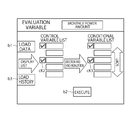
- Fig. 10 is a diagram illustrating a second example of a screen displayed on the display device 5.
- a list of control variables and a list of conditional variables are displayed in synchronized state, with respect to an evaluation variable, which is an output value of the target device 6.
- the screen illustrated in Fig. 10 is provided with a check button ck2 for selecting a desired control variable from among the list of control variables, a check button ck3 for selecting a desired conditional variable from among the list of conditional variables, a data load button b1 for providing an instruction to load detection data of the plurality of sensors 3, a history load button b3 for loading history information of simulation results, and an execution button b2.
- a combination of a plurality of control input variables is generated from within expanded ranges obtained by expanding variable ranges of the plurality of control input variables, updating of an output value and a confidence degree in the recording unit 12 is performed based on at least one of a result of simulation of the target device 6 by the simulation unit 13 and a result of trial operation of the target device 6, which are performed based on the generated combination and an external condition, and an operation rule of the target device 6 is extracted. Accordingly, an optimal operation rule of the target device 6 can be identified with high accuracy and by performing simulation a small number of times.
- variable ranges of a plurality of control input variables can be expanded as necessary from operation data of the target device 6. Further, a combination of a plurality of control input variables can be acquired from within the expanded ranges through design of experiments, for example.
- calibration can be performed based on a result of simulation of the target device 6 and a result of trial operation of the target device 6, and a modeling error and a posterior distribution of a model variable of a simulation model can be determined. Further, due to a search for an optimal operation point being performed while taking into consideration a confidence degree obtained based on the posterior distribution, an optimal operation rule of the target device 6 can be extracted accurately.
- an optimal operation rule taking accuracy information in consideration can be extracted.
- an optimal operation rule can be extracted by performing simulation for the minimum necessary number of times while making good use of real operation data.
- At least a part of the operation rule extraction device 1 described in the above-described embodiment may be configured by using hardware or by using software.
- a program realizing at least a part of the functions of the operation rule extraction device 1 may be stored to a recording medium such as a flexible disk or a CD-ROM, and may be executed by having a computer load the program.
- the recording medium is not limited to an attachable/detachable recording medium such as a magnetic disk or an optimal disk, and may be a fixed-type recording medium such as a hard disk device or a memory.
- a program realizing at least a part of the functions of the operation rule extraction device 1 may be distributed over a communication line (including wireless communication) such as the Internet. Further, the program, in encrypted, modulated, and/or compressed state, may be distributed over a wired line or a wireless line such as the Internet, or may be distributed by being stored to a recording medium.
- Operation rule extraction device 1 Operation rule extraction device 2 Operation rule extraction system 3 Sensor 4 Initial condition setting unit 5 Display device 6 Target device 11 Combination generation unit 12 Recording unit 13 Simulation unit 14 Trial operation unit 15 Optimal point search unit 16 Operation rule extraction unit 17 Posterior distribution calculation unit
Landscapes
- Engineering & Computer Science (AREA)
- Physics & Mathematics (AREA)
- Automation & Control Theory (AREA)
- General Physics & Mathematics (AREA)
- Computer Vision & Pattern Recognition (AREA)
- Medical Informatics (AREA)
- Software Systems (AREA)
- Evolutionary Computation (AREA)
- Health & Medical Sciences (AREA)
- Artificial Intelligence (AREA)
- General Engineering & Computer Science (AREA)
- Feedback Control In General (AREA)
- Testing And Monitoring For Control Systems (AREA)
Abstract
An operation rule extraction device includes a combination generation unit; a recording unit, a simulation unit, a trial operation unit, an optimal point search unit, and an operation rule extraction unit. The combination generation unit identifies variable ranges of a plurality of control input variables, and generates a combination of the plurality of control input variables. The recording unit associates a plurality of pieces of information including an external condition provided to the target device, a combination of a plurality of control input variables, an output value of the target device, and a confidence degree, and records a plurality of such sets. The simulation unit performs simulation of the target device, based on an external condition and a combination of a plurality of control input variables. The trial operation unit performs trial operation of the target device. The optimal point search unit searches for an optimal operation point.
Description
An embodiment relates to an operation rule extraction device, an operation rule extraction system, and an operation rule extraction method.
Inconsistency between a target device and a simulation model thereof occurs due to various causes. Hence, it is not easy to specify an optimal operation point of the target device during operation thereof even if the simulation model is used. For example, it is not easy to grasp whether the above-mentioned inconsistency has occurred due to a deviation of a characteristic value of the simulation model or an error in the simulation model itself (refer to JP 2006-48474 and "Bayesian calibration of computer models (with discussions)", Kennedy, M. C. and O'Hagan, A., Journal of the Royal Statistical Society B (2001), 63, pages 425-464).
An embodiment provides an operation rule extraction device, an operation rule extraction system, and an operation rule extraction method that are capable of extracting an optimal operation point for a target device and an operation rule for the same in a simple and accurate manner.
An operation rule extraction device according to the present embodiment includes: a combination generation unit; at least one of a simulation unit and a trial operation unit; an optimal point search unit; and an operation rule extraction unit. The combination generation unit generates, from within expanded ranges obtained by expanding variable ranges of a plurality of control input variables input to a target device, a combination of the plurality of control input variables. The simulation unit performs simulation of the target device, based on an external condition input to the target device and the combination of the plurality of control input variables. The trial operation unit performs trial operation of the target device, based on the external condition and the combination of the plurality of control input variables. The optimal point search unit searches for an optimal operation point for operation of the target device, based on at least one of: a result of the simulation of the target device by the simulation unit; and a result of the trial operation of the target device by the trial operation unit. The operation rule extraction unit extracts an operation rule that is in accordance with the optimal operation point.
The following provides a description of an embodiment, with reference to the drawings. Note that in the present description and the attached drawings, description and illustration of some constituent parts are omitted, changed, or simplified for ease of understanding and for convenience of illustration. However, the present embodiment should be construed to also include matters that can be expected to have functions similar to the matters described and illustrated.
Fig. 1 is a block diagram illustrating a schematic configuration of an operation rule extraction system 2 including an operation rule extraction device 1 according to one embodiment. The operation rule extraction system 2 illustrated in Fig. 1 includes the operation rule extraction device 1, a plurality of sensors 3, an initial condition setting unit 4, and a display device 5. The plurality of sensors 3 are provided for monitoring the operation state of a target device 6, and operation data detected by the plurality of sensors 3 are input to the operation rule extraction device 1. For example, the temperature and humidity at the inside or the surroundings of the target device 6, etc., are included in the operation data. The specific contents of the operation data, however, are not particularly limited. In the present embodiment, an assumption is made that the operation data also includes data input to the target device 6, configuration values internal to the target device 6, and output values of the target device 6.
For example, the target device 6 is an air-conditioning system. However, the specific type of the target device 6 is not particularly limited. In the following, the target device 6 is regarded as an air-conditioning system, and description is provided of an example in which the operation rule extraction device 1 extracts an operation rule with which power consumption of the air-conditioning system can be reduced as much as possible, in accordance with an external condition, control input variables, etc.
The initial condition setting unit 4 supplies, to the operation rule extraction device 1, an initial model of a simulation model of the target device 6 and an initial condition, such as a probability distribution of a model variable of the initial model. The specific contents of the initial condition, also, are not particularly limited. Further, the initial condition setting unit 4 may be output data from a plurality of devices.
The display device 5 is provided for displaying output result from the operation rule extraction device 1, but may be omitted. For example, optimal operation rules of the target device 6 extracted by the operation rule extraction device 1, etc., are displayed on the display device 5.
Next, the internal configuration of the operation rule extraction device 1 will be described below. The operation rule extraction device 1 illustrated in Fig. 1 includes a combination generation unit 11, a recording unit 12, at least one of a simulation unit 13 and a trial operation unit 14, an optimal point search unit 15, an operation rule extraction unit 16, and a posterior distribution calculation unit 17. Note that the operation rule extraction device 1 may internally include constituent units other than those illustrated in Fig. 1. Also, two or more of the constituent units illustrated in Fig. 1 may be integrated into one.
The combination generation unit 11 identifies variable ranges of a plurality of control input variables input to the target device 6, and generates, from within expanded ranges obtained by expanding the variable ranges, a combination of the plurality of control input variables. Specifically, the combination generation unit 11 generates all combinations covering every combination of the plurality of control input variables.
The recording unit 12 associates, as one set, a plurality of pieces of information including an external condition provided to the target device 6, a combination of a plurality of control input variables input to the target device 6, an output value of the target device 6, and a confidence degree indicating the certainty of the output value, and records a plurality of such sets. The plurality of pieces of information associated as one set may include a model variable for identifying a simulation model of the target device 6. Further, the plurality of pieces of information associated as one set may include information for making a distinction between an actually-measured value, a simulation result, and a trial operation result. The recording unit 12 is not always a necessary constituent element. For example, a mathematical formula representing the correspondence between the data items recorded in the recording unit 12 may be prepared, and the plurality of sets of data as described above may be generated by providing the mathematical formula with input parameters and performing computation of the mathematical formula.
The simulation unit 13 performs simulation of the target device 6, based on an external condition and a combination of a plurality of control input variables. Specifically, the simulation unit 13 performs simulation of the target device 6 while taking into consideration a modelling error and a probability distribution of a model variable, and outputs an output value indicating a result of the simulation, along with a confidence degree indicating the certainty of the output value.
The trial operation unit 14 performs trial operation of the target device 6, based on an external condition and a combination of a plurality of control input variables. The term "trial operation" indicates that the target device 6 is actually operated. The trial operation unit 14 outputs an output value indicating a result of the trial operation of the target device 6, along with a confidence degree.
The optimal point search unit 15 searches for an optimal operation point for operation of the target device 6, based on at least one of a result of simulation of the target device 6 by the simulation unit 13, and a result of trial operation of the target device 6 by the trial operation unit 14.
The operation rule extraction unit 16 extracts an operation rule corresponding to an optimal operation point, based on a result of a search by the optimal point search unit 15. For example, the operation rule so extracted is displayed on the display device 5. The display form of the operation rule displayed on the display device 5 is not particularly limited.
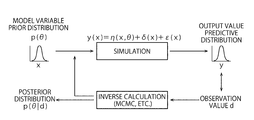
Next, detailed description is provided of the in-processing operations of the simulation unit 13 and the optimal point search unit 15. Given that: y denotes operation data (observation data) of the target device 6; η(x, θ) denotes a simulation model (calculation model) of the target device 6; δ(x) denotes a modelling error; ε(x) denotes an observation error; and θ denotes an uncertain parameter in the simulation model, the following expression (1) holds true.
y(x) = η(x,θ) + δ(x) + ε(x) ...(1)
y(x) = η(x,θ) + δ(x) + ε(x) ...(1)
The modelling error δ(x) is an error portion that remains after calibration using the simulation model η(x) is performed with respect to the observation data. The modelling error δ(x) is generated when the simulation model η(x) itself is not consistent with the actual process, or when there is an unexpected fluctuation factor.
Here, the calibration is processing for concurrently estimating the uncertain parameter θ and the modelling error δ(x) that provide a good explanation of the observation data y, when the model η(x) and the observation data y = (y(x1), …, y(xn)) are provided. The uncertain parameter θ is a model variable.
As the detailed procedure for concurrently estimating the uncertain parameter θ and the modelling error δ(x) from the observation data y, a publicly-known algorithm, for example, may be used.
As the detailed procedure for concurrently estimating the uncertain parameter θ and the modelling error δ(x) from the observation data y, a publicly-known algorithm, for example, may be used.
Fig. 2 is a diagram describing in-processing operations of the simulation unit 13. When provided with a prior distribution p(θ) of the model variable θ, the simulation unit 13 performs simulation by using the simulation model η(x), in accordance with the prior distribution, and calculates a predictive value (output value) of observation data y(x) and a confidence degree (0-100) of the predictive value while taking into consideration the modelling error and the observation error. For example, the confidence degree is calculated by using a predictive distribution of the predictive value.
The optimal point search unit 15 compares observation data and a result of simulation by the simulation unit 13, and corrects (updates) the model variable so that the observation data and the result of the simulation are consistent. When values of the model variable form a probability distribution, the optimal point search unit 15 corrects the probability distribution while performing simulation. This correction is the calibration. In the calibration, provided that a before-correction probability distribution (prior distribution) of the model variable, which is an uncertain parameter, is denoted as p(θ), simulation is repeated while correcting the probability distribution so that the observation data is consistent with the result of the simulation, whereby a posterior distribution p(θ|y) of the model variable is finally determined.
Fig. 3 is a diagram describing in-processing operations of the posterior distribution calculation unit 17. When the prior condition p(θ) of the model variable θ and an observation value d are provided and simulation is performed by the simulation unit 13 in accordance with the distribution p(θ), a predictive distribution of output values can be obtained. The posterior distribution calculation unit 17 compares this predictive distribution of output values with the observation value d, and estimates a posterior distribution p(θ|d) of the model variable θ by performing inverse calculation so that the predictive distribution and the observation value d are consistent.
For example, a Markov chain Monte Carlo method (MCMC) is used as the inverse calculation for calculating a posterior distribution in the present embodiment. In an MCMC, values of the parameter θ, which are the model variable, are randomly selected in accordance with the prior distribution, and simulation is repeated while updating the selection of the next parameter θ from a comparison between the simulation result and observation data. As a result, a posterior distribution is obtained when a selection history of the parameter θ is expressed as a histogram. Following this, the simulation unit 13 performs simulation by using the posterior distribution of the model variable. Hence, simulation accuracy can be enhanced by repeating simulation by the simulation unit 13 and the calculation of a posterior distribution of the model variable by the posterior distribution calculation unit 17.
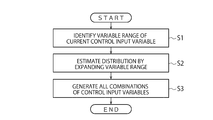
Next, the in-processing operations of the combination generation unit 11 will be described below. Fig. 4 is a flowchart illustrating one example of in-processing operations of the combination generation unit 11. First, a variable range of a current control input variable is identified from operation data (Step S1). Next, a distribution obtained by expanding the identified variable range (referred to hereinafter as an "expanded distribution") is estimated in order to perform a more optimal search for an operation point (Step S2). For example, the estimation of the expanded distribution is performed by using the on-design variable range of the control input variable. Alternatively, the expansion may be performed based on a frequency graph. Then, all combinations of control input variables are generated based on expanded distributions (Step S3).
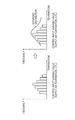
Fig. 5 is a diagram illustrating one example of an expanded distribution estimated in Step S2 in Fig. 4. In Fig. 5, values of a control input variable (e.g., supply air temperature) are presented on the horizontal axis, and frequency is presented on the vertical axis. The left side of Fig. 5 is a graph obtained by expressing a value range of a current control input variable as a frequency distribution, based on operation data. The right side of Fig. 5 is a curve of an expanded distribution estimated based on the frequency distribution.
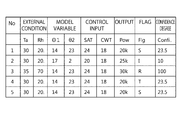
Fig. 6 is a diagram illustrating one example of a recording format of the recording unit 12. In the example illustrated in Fig. 6, the recording unit 12 associates, as one set, a plurality of pieces of information including external conditions, model variables, control input variables, an output value, a flag, and a confidence degree, and records a plurality of such sets. For example, the external conditions include ambient temperature Ta and relative humidity Rh. For example, the model variables include θ1 and θ2. For example, the control input variables include supply air temperature SAT and cooling water temperature CWT. For example, the output value is output power Pow of the target device 6. The flag is information distinguishing whether each set including a plurality of pieces of information is a simulation result S, a result obtained through interpolation calculation of values of other sets, real operation data R, or a trial operation result T. The confidence degree is a numeric value from 0 to 100, and the greater the numerical value, the higher the confidence degree. In the example illustrated in Fig. 6, real operation data R is provided with a confidence degree of 100, a simulation result S and a trial operation result T are each provided with a confidence degree of 23.5, and an interpolation calculation result I is provided with a confidence degree of 10. However, these values are mere examples of confidence degrees and may be arbitrarily changed.
Fig. 7 is a flowchart illustrating one example of in-processing operations of the operation rule extraction unit 16. First, one combination of a plurality of control input variables is selected (Step S11). Here, a combination still remaining unselected is selected. Next, a determination is performed of whether the selected combination is included in operation data (Step S12). If the selected combination is not included in the operation data, a determination is performed of whether or not trial operation of the target device 6 can be performed by using the selected combination (Step S13).
The ranges of control input variables with which trial operation of the target device 6 can be performed are limited, and there may be cases in which the combination of the plurality of control input variables selected in Step S11 is beyond the ranges with which the trial operation of the target device 6 can be performed. Hence, when it is determined in Step S13 that trial operation can be performed, trial operation of the target device 6 is performed by the trial operation unit 14 by using the combination selected in Step S11 (Step S14). Meanwhile, when it is determined in Step S13 that trial operation cannot be performed, simulation is performed by the simulation unit 13 by using the combination selected in Step S11 (Step S15).
Next, when it is determined in Step S12 that the selected combination is included in the operation data or when processing in Step S14 or S15 is completed, a confidence degree is updated (Step S16). For example, when it is determined in Step S12 that the selected combination is included in the operation data, the confidence degree of the output value for the combination is set to maximum. Further, when trial operation of the target device 6 is performed in Step S14, updating is performed to a confidence degree for when trial operation has been performed.
Further, when simulation of thetarget device 6 is performed in Step S15, updating is performed to a confidence degree for when simulation has been performed.
Further, when simulation of the
Subsequently, a determination is made of whether or not an optimal operation point of the target device 6 has been obtained (Step S17). The determination of whether an operation point is optimal is performed in accordance with output values and confidence degrees. For example, when the output value is power consumption, a combination having as low an output value as possible and as high a confidence degree as possible, while satisfying a predetermined external condition, is selected.
When an optimal operation point has not yet been obtained, the processing in Step S11 and on is repeated. When an optimal operation point has been obtained, the operation rule in that case is extracted (Step S18).
Fig. 8 is a diagram illustrating an example of a search for an optimal operation point of an air-conditioning system. Fig. 8 illustrates an example in which: summer (August) in Tokyo; and an indoor temperature setting of 24 degrees are set as external conditions. In Fig. 8, the correspondence between supply air temperature, cooling water temperature, and air-conditioning power amount is illustrated by using a three-dimensional graph. This graph can be obtained by combining real operation data, trial operation results, and simulation results. Meanwhile, curves cb1 to cb3 shown in the right side of Fig. 8 indicate the correspondence between supply air temperature and air-conditioning power amount. The curve cb1 indicates the characteristics of a whole building air-conditioning system (chiller), the curve cb2 indicates the characteristics of an individual air-conditioning system (variable refrigerant flow (VRF)), and the curve cb3 indicates the characteristics of the entire air-conditioning system in which the whole building air-conditioning system and the individual air-conditioning system are combined. For example, a valley-part of the curve cb3 is extracted as an optimal operation rule.
By using the graph and curves cb1 to cb3 shown in Fig. 8, the following result can be obtained for example: when it is summer in Tokyo and the indoor temperature setting is set to 24 degrees, power consumption can be suppressed to the greatest extent by setting supply air temperature to 24 degrees and cooling water temperature to 8 degrees.
Fig. 9 is a diagram illustrating a first example of a screen displayed on the display device 5. The screen illustrated in Fig. 9 is a screen for executing the calibration mentioned above. The screen illustrated in Fig. 9 shows tabs tb1 to tb3 for selecting evaluation variables, which are output values of the target device 6, a data load button b1 for providing an instruction to load detection data of the plurality of sensors 3, a check button ck1 for selecting a desired model variable (model parameter) from among a list of model variables of the target device 6, an execution button b2 for providing an instruction to start the calibration, a graph g1 showing a result of the calibration, and a posterior distribution g2 of the model variable.
In the list of model variables, the respective model variables are displayed in sorted state in the order of greater influence on the output value of the target device 6, by sensitivity analysis being performed. When a user selects a desired model variable from among the sorted model variables, a posterior distribution of the selected model variable is displayed.
Fig. 10 is a diagram illustrating a second example of a screen displayed on the display device 5. In the screen illustrated in Fig. 10, a list of control variables and a list of conditional variables are displayed in synchronized state, with respect to an evaluation variable, which is an output value of the target device 6. Further, the screen illustrated in Fig. 10 is provided with a check button ck2 for selecting a desired control variable from among the list of control variables, a check button ck3 for selecting a desired conditional variable from among the list of conditional variables, a data load button b1 for providing an instruction to load detection data of the plurality of sensors 3, a history load button b3 for loading history information of simulation results, and an execution button b2.
When a desired control variable and conditional variable are selected and the execution button b2 is selected, a combination table of the selected control variable and conditional variable is displayed. A causal relationship between the control variable and the conditional variable can be grasped by using this combination table.
Hence, in the present embodiment, a combination of a plurality of control input variables is generated from within expanded ranges obtained by expanding variable ranges of the plurality of control input variables, updating of an output value and a confidence degree in the recording unit 12 is performed based on at least one of a result of simulation of the target device 6 by the simulation unit 13 and a result of trial operation of the target device 6, which are performed based on the generated combination and an external condition, and an operation rule of the target device 6 is extracted. Accordingly, an optimal operation rule of the target device 6 can be identified with high accuracy and by performing simulation a small number of times.
According to the present embodiment, variable ranges of a plurality of control input variables can be expanded as necessary from operation data of the target device 6. Further, a combination of a plurality of control input variables can be acquired from within the expanded ranges through design of experiments, for example.
Further, according to one embodiment, calibration can be performed based on a result of simulation of the target device 6 and a result of trial operation of the target device 6, and a modeling error and a posterior distribution of a model variable of a simulation model can be determined. Further, due to a search for an optimal operation point being performed while taking into consideration a confidence degree obtained based on the posterior distribution, an optimal operation rule of the target device 6 can be extracted accurately.
Hence, due to a stochastic calculation in which the operation state of the target device 6 is reflected being performed in the present embodiment, accuracy of a response phase can be evaluated in advance and an optimal operation rule taking accuracy information in consideration can be extracted. In particular, in the present embodiment, after inconsistency of a simulation model with respect to the real operation state is corrected, an optimal operation rule can be extracted by performing simulation for the minimum necessary number of times while making good use of real operation data.
At least a part of the operation rule extraction device 1 described in the above-described embodiment may be configured by using hardware or by using software. In configuration with software, a program realizing at least a part of the functions of the operation rule extraction device 1 may be stored to a recording medium such as a flexible disk or a CD-ROM, and may be executed by having a computer load the program. The recording medium is not limited to an attachable/detachable recording medium such as a magnetic disk or an optimal disk, and may be a fixed-type recording medium such as a hard disk device or a memory.
Further, a program realizing at least a part of the functions of the operation rule extraction device 1 may be distributed over a communication line (including wireless communication) such as the Internet. Further, the program, in encrypted, modulated, and/or compressed state, may be distributed over a wired line or a wireless line such as the Internet, or may be distributed by being stored to a recording medium.
Several embodiments of the present invention have been described. These embodiments, however, are presented as examples and are not intended to limit the scope of the invention. These novel embodiments can be implemented in other various forms, and various omissions, replacements, and alterations may be carried out without departing from the gist of the invention. These embodiments as well as modifications thereof are included in the scope and gist of the invention, and are included in the range of the inventions as set forth in the claims and the range of equivalents thereof.
1 Operation rule extraction device
2 Operation rule extraction system
3 Sensor
4 Initial condition setting unit
5 Display device
6 Target device
11 Combination generation unit
12 Recording unit
13 Simulation unit
14 Trial operation unit
15 Optimal point search unit
16 Operation rule extraction unit
17 Posterior distribution calculation unit
2 Operation rule extraction system
3 Sensor
4 Initial condition setting unit
5 Display device
6 Target device
11 Combination generation unit
12 Recording unit
13 Simulation unit
14 Trial operation unit
15 Optimal point search unit
16 Operation rule extraction unit
17 Posterior distribution calculation unit
Claims (20)
- An operation rule extraction device comprising:
a combination generation unit that generates, from within expanded ranges obtained by expanding variable ranges of a plurality of control input variables input to a target device, a combination of the plurality of control input variables;
at least one of: a simulation unit that performs simulation of the target device, based on an external condition input to the target device and the combination of the plurality of control input variables; and a trial operation unit that performs trial operation of the target device, based on the external condition and the combination of the plurality of control input variables;
an optimal point search unit that searches for an optimal operation point for operation of the target device, based on at least one of: a result of the simulation of the target device by the simulation unit; and a result of the trial operation of the target device by the trial operation unit; and
an operation rule extraction unit that extracts an operation rule that is in accordance with the optimal operation point. - The operation rule extraction device according to claim 1, wherein
the combination generation unit identifies the variable ranges of the plurality of control input variables, based on at least one of: data input to the target device when the target device is actually operated; and data acquired by a sensor that performs sensing of an inside or surroundings of the target device. - The operation rule extraction device according to claim 1 or claim 2, comprising
a recording unit that records a plurality of pieces of information in associated state as one set and stores a plurality of the sets, the plurality of pieces of information including: an external condition input to the target device; a combination of the plurality of control input variables; an output value of the target device; and a confidence degree indicative of the certainty of the output value, wherein
the simulation unit performs the simulation of the target device, based on the combination of the plurality of control input variables and the external condition that are recorded in the recording unit, and
the trial operation unit performs the trial operation of the target device, based on the combination of the plurality of control input variables and the external condition that are recorded in the recording unit. - The operation rule extraction device according to claim 3, wherein
the plurality of pieces of information recorded in associated state in the recording unit include a model variable for identifying a simulation model of the target device,
the operation rule extraction device comprises a posterior distribution calculation unit that, when the simulation unit performs simulation of the target device, updates the model variable so that a result of the simulation coincides with observation data and calculates a posterior distribution, the posterior distribution being a probability distribution of the model variable after the update, and
the simulation unit performs the simulation of the target device, based on the posterior distribution and the model variable updated by the posterior distribution calculation unit and updates the output value and the confidence degree stored in the recording unit by using the result of the simulation. - The operation rule extraction device according to claim 4, wherein
the posterior distribution calculation unit calculates a modeling error of the simulation model and updates the model variable and calculating the posterior distribution. - The operation rule extraction device according any one of claims 3 through 5, wherein
the plurality of pieces of information recorded in associated state in the recording unit includes: identification information for making a distinction between: operation data of the target device; a result of simulation by the simulation unit; a result of trial operation by the trial operation unit; and a result obtained by performing interpolation calculation of values of two or more sets, and
the confidence degree is a value in accordance with the identification information. - The operation rule extraction device according to claim 6, wherein
the optimal point search unit comprises:
a first determination unit that determines whether or not the combination of the control input variables is included in operation data of the target device;
a second determination unit that, when the combination of the control input variables is determined as not being included in the operation data, determines whether or not trial operation of the target device is possible;
a confidence degree optimal point search unit that, when the second determination unit determines that trial operation is possible, updates the corresponding confidence degree recorded in the recording unit, based on the result of the trial operation of the target device performed by the trial operation unit, and when the second determination unit determines that trial operation is impossible, updates the corresponding confidence degree recorded in the recording unit, based on the result of the simulation by the simulation unit; and
an optimal operation point judgment unit that performs a judgment of optimal operation point or not, based on the confidence degree updated by the confidence degree optimal degree search unit. - The operation rule extraction device according to claim 7, wherein
the optimal point search unit, when the first determination unit determines that the combination of the plurality of control input variables is included in the operation data, updates the corresponding confidence degree recorded in the recording unit to a higher value. - An operation rule extraction system comprising:
an operation rule extraction device;
a plurality of sensors that each supply, as part of operation data, different sensing data to the operation rule extraction device; and
an initial condition setting unit that provides the operation rule extraction device with an initial condition, wherein
the operation rule extraction device comprises:
a combination generation unit that generates, from within expanded ranges obtained by expanding variable ranges of a plurality of control input variables input to a target device, a combination of the plurality of control input variables;
at least one of: a simulation unit that performs simulation of the target device, based on an external condition input to the target device and the combination of the plurality of control input variables; and a trial operation unit that performs trial operation of the target device, based on the external condition and the combination of the plurality of control input variables;
an optimal point search unit that searches for an optimal operation point for operation of the target device, based on at least one of: a result of the simulation of the target device by the simulation unit; and a result of the trial operation of the target device by the trial operation unit; and
an operation rule extraction unit that extracts an operation rule that is in accordance with the optimal operation point. - The operation rule extraction system according to claim 9, wherein
the combination generation unit identifies the variable ranges of the plurality of control input variables, based on at least one of: data input to the target device when the target device is actually operated; and data acquired by a sensor that performs sensing of an inside or surroundings of the target device. - The operation rule extraction system according to claim 9 or claim 10, comprising
a recording unit that records a plurality of pieces of information in associated state as one set and stores a plurality of the sets, the plurality of pieces of information including: an external condition input to the target device; a combination of the plurality of control input variables; an output value of the target device; and a confidence degree indicative of the certainty of the output value, wherein
the simulation unit performs the simulation of the target device, based on the combination of the plurality of control input variables and the external condition that are recorded in the recording unit, and
the trial operation unit performs the trial operation of the target device, based on the combination of the plurality of control input variables and the external condition that are recorded in the recording unit. - The operation rule extraction system according to claim 11, wherein
the plurality of pieces of information recorded in associated state in the recording unit include a model variable for identifying a simulation model of the target device,
The operation rule extraction system comprises a posterior distribution calculation unit that, when the simulation unit performs simulation of the target device, updates the model variable so that a result of the simulation coincides with observation data and calculates a posterior distribution, the posterior distribution being a probability distribution of the model variable after the update, and
the simulation unit performs the simulation of the target device, based on the posterior distribution and the model variable updated by the posterior distribution calculation unit and updates the output value and the confidence degree stored in the recording unit by using the result of the simulation. - The operation rule extraction system according to claim 12, wherein
the posterior distribution calculation unit calculates a modeling error of the simulation model and updates the model variable and calculating the posterior distribution. - The operation rule extraction system according any one of claims 11 through 13, wherein
the plurality of pieces of information recorded in associated state in the recording unit includes: identification information for making a distinction between: operation data of the target device; a result of simulation by the simulation unit; a result of trial operation by the trial operation unit; and a result obtained by performing interpolation calculation of values of two or more sets, and
the confidence degree is a value in accordance with the identification information. - The operation rule extraction system according to claim 14, wherein
the optimal point search unit comprises:
a first determination unit that determines whether or not the combination of the control input variables is included in operation data of the target device;
a second determination unit that, when the combination of the control input variables is determined as not being included in the operation data, determines whether or not trial operation of the target device is possible;
a confidence degree optimal point search unit that, when the second determination unit determines that trial operation is possible, updates the corresponding confidence degree recorded in the recording unit, based on the result of the trial operation of the target device performed by the trial operation unit, and when the second determination unit determines that trial operation is impossible, updates the corresponding confidence degree recorded in the recording unit, based on the result of the simulation by the simulation unit; and
an optimal operation point judgment unit that performs a judgment of optimal operation point or not, based on the confidence degree updated by the confidence degree optimal degree search unit. - The operation rule extraction system according to claim 15, wherein
the optimal point search unit, when the first determination unit determines that the combination of the plurality of control input variables is included in the operation data, updates the corresponding confidence degree recorded in the recording unit to a higher value. - An operation rule extraction method comprising:
generating, from within expanded ranges obtained by expanding variable ranges of a plurality of control input variables input to a target device, a combination of the plurality of control input variables;
at least one of: performing simulation of the target device, based on an external condition input to the target device and the combination of the plurality of control input variables; and performing trial operation of the target device, based on the external condition and the combination of the plurality of control input variables;
searching for an optimal operation point for operation of the target device, based on at least one of: a result of the simulation of the target device; and a result of the trial operation of the target device; and
extracting an operation rule that is in accordance with the optimal operation point. - The operation rule extraction method according to claim 17, wherein
the generating the combination identifies the variable ranges of the plurality of control input variables, based on at least one of: data input to the target device when the target device is actually operated; and data acquired by a sensor that performs sensing of an inside or surroundings of the target device. - The operation rule extraction method according to claim 17 or claim 18, comprising
recording, into a recording unit, a plurality of pieces of information in associated state as one set and stores a plurality of the sets, the plurality of pieces of information including: an external condition input to the target device; a combination of the plurality of control input variables; an output value of the target device; and a confidence degree indicative of the certainty of the output value, wherein
the performing the simulation performs the simulation of the target device, based on the combination of the plurality of control input variables and the external condition that are recorded in the recording unit, and
the trial operation of the target device is performed, based on the combination of the plurality of control input variables and the external condition that are recorded in the recording unit. - The operation rule extraction method according to claim 19, wherein
the plurality of pieces of information recorded in associated state in the recording unit include a model variable for identifying a simulation model of the target device,
the method comprises, when the simulation of the target device is performed, updating the model variable so that a result of the simulation coincides with observation data and calculating a posterior distribution, the posterior distribution being a probability distribution of the model variable after the update, and
the simulation of the target device is performed, based on the posterior distribution and the updated model variable to update the output value and the confidence degree stored in the recording unit by using the result of the simulation.
Applications Claiming Priority (2)
| Application Number | Priority Date | Filing Date | Title |
|---|---|---|---|
| JP2017-135661 | 2017-07-11 | ||
| JP2017135661A JP6895334B2 (en) | 2017-07-11 | 2017-07-11 | Operation rule extraction device, operation rule extraction system and operation rule extraction method |
Publications (1)
| Publication Number | Publication Date |
|---|---|
| WO2019012740A1 true WO2019012740A1 (en) | 2019-01-17 |
Family
ID=61911651
Family Applications (1)
| Application Number | Title | Priority Date | Filing Date |
|---|---|---|---|
| PCT/JP2018/011001 Ceased WO2019012740A1 (en) | 2017-07-11 | 2018-03-20 | Operation rule extraction device, operation rule extraction system, and operation rule extraction method |
Country Status (2)
| Country | Link |
|---|---|
| JP (1) | JP6895334B2 (en) |
| WO (1) | WO2019012740A1 (en) |
Cited By (3)
| Publication number | Priority date | Publication date | Assignee | Title |
|---|---|---|---|---|
| JP2019020779A (en) * | 2017-07-11 | 2019-02-07 | 株式会社東芝 | Operation rule extraction device, operation rule extraction system, and operation rule extraction method |
| KR102398978B1 (en) | 2021-04-29 | 2022-05-18 | 주식회사 제노코 | FOREST FIRE MONITORING AND EXTINGUISHING SYSTEM USING UAVs AND AN AIRSHIP |
| US20220197230A1 (en) * | 2019-05-22 | 2022-06-23 | Nec Corporation | Operation rule determination device, operation rule determination method, and recording medium |
Citations (2)
| Publication number | Priority date | Publication date | Assignee | Title |
|---|---|---|---|---|
| JP2006048474A (en) | 2004-08-06 | 2006-02-16 | Fuji Electric Systems Co Ltd | Plant optimum operation planning device |
| EP2398301A1 (en) * | 2010-06-15 | 2011-12-21 | Redwood Systems, Inc. | Goal-based control of lighting |
Family Cites Families (4)
| Publication number | Priority date | Publication date | Assignee | Title |
|---|---|---|---|---|
| JPH1020923A (en) * | 1996-07-02 | 1998-01-23 | Hitachi Ltd | Plant control device |
| JPH10111862A (en) * | 1996-08-13 | 1998-04-28 | Fujitsu Ltd | Time series analysis apparatus and method based on recursive neural network |
| JP2004326200A (en) * | 2003-04-21 | 2004-11-18 | Mitsubishi Heavy Ind Ltd | Automatic machine, and system and method for automatically operating same |
| JP6895334B2 (en) * | 2017-07-11 | 2021-06-30 | 株式会社東芝 | Operation rule extraction device, operation rule extraction system and operation rule extraction method |
-
2017
- 2017-07-11 JP JP2017135661A patent/JP6895334B2/en active Active
-
2018
- 2018-03-20 WO PCT/JP2018/011001 patent/WO2019012740A1/en not_active Ceased
Patent Citations (2)
| Publication number | Priority date | Publication date | Assignee | Title |
|---|---|---|---|---|
| JP2006048474A (en) | 2004-08-06 | 2006-02-16 | Fuji Electric Systems Co Ltd | Plant optimum operation planning device |
| EP2398301A1 (en) * | 2010-06-15 | 2011-12-21 | Redwood Systems, Inc. | Goal-based control of lighting |
Non-Patent Citations (1)
| Title |
|---|
| KENNEDY, M. C.; O'HAGAN, A.: "Bayesian calibration of computer models (with discussions", JOURNAL OF THE ROYAL STATISTICAL SOCIETY B, vol. 63, 2001, pages 425 - 464 |
Cited By (4)
| Publication number | Priority date | Publication date | Assignee | Title |
|---|---|---|---|---|
| JP2019020779A (en) * | 2017-07-11 | 2019-02-07 | 株式会社東芝 | Operation rule extraction device, operation rule extraction system, and operation rule extraction method |
| US20220197230A1 (en) * | 2019-05-22 | 2022-06-23 | Nec Corporation | Operation rule determination device, operation rule determination method, and recording medium |
| US12093001B2 (en) * | 2019-05-22 | 2024-09-17 | Nec Corporation | Operation rule determination device, method, and recording medium using frequency of a cumulative reward calculated for series of operations |
| KR102398978B1 (en) | 2021-04-29 | 2022-05-18 | 주식회사 제노코 | FOREST FIRE MONITORING AND EXTINGUISHING SYSTEM USING UAVs AND AN AIRSHIP |
Also Published As
| Publication number | Publication date |
|---|---|
| JP6895334B2 (en) | 2021-06-30 |
| JP2019020779A (en) | 2019-02-07 |
Similar Documents
| Publication | Publication Date | Title |
|---|---|---|
| JP6562883B2 (en) | Characteristic value estimation device and characteristic value estimation method | |
| JP6708204B2 (en) | Accuracy estimation model generation system and accuracy estimation system | |
| JP6529096B2 (en) | Simulation system, simulation method and program for simulation | |
| JP6240050B2 (en) | Bias estimation apparatus, method and program thereof, and fault diagnosis apparatus, method and program thereof | |
| JP2008003920A (en) | Time series data prediction / diagnosis device and program thereof | |
| JP2020027370A (en) | Optimization device, simulation system and optimization method | |
| CN107808122A (en) | Method for tracking target and device | |
| JPWO2008087968A1 (en) | Change point detection method and apparatus | |
| CN100568124C (en) | Control object model generation device and generation method | |
| US20190220336A1 (en) | Information processing device, information processing method, and recording medium | |
| JP6647992B2 (en) | Design support equipment | |
| JP6895334B2 (en) | Operation rule extraction device, operation rule extraction system and operation rule extraction method | |
| JP2013061768A (en) | Optimal model estimation device, method, and program | |
| WO2016056113A1 (en) | Energy saving diagnosis device, energy saving diagnosis method, and program | |
| JP2016045536A (en) | Design support device | |
| JPWO2020049994A5 (en) | ||
| JP7372630B2 (en) | Estimation device, estimation method and program | |
| JP2013149203A (en) | Optimal model estimation device, method and program | |
| JP7502211B2 (en) | Information processing device, information processing method, and program | |
| JP5717950B2 (en) | Model function processing apparatus and method | |
| JP6448745B2 (en) | Bias estimation apparatus, method and program thereof | |
| JP2010113527A (en) | Bug extraction prediction system | |
| Chen et al. | Bayesian hierarchical modelling on dual response surfaces in partially replicated designs | |
| JP2015232914A (en) | Abnormality diagnosis apparatus, abnormality diagnosis method, and abnormality diagnosis program | |
| EP3063596B1 (en) | Method of regression for change detection |
Legal Events
| Date | Code | Title | Description |
|---|---|---|---|
| 121 | Ep: the epo has been informed by wipo that ep was designated in this application |
Ref document number: 18716371 Country of ref document: EP Kind code of ref document: A1 |
|
| NENP | Non-entry into the national phase |
Ref country code: DE |
|
| 122 | Ep: pct application non-entry in european phase |
Ref document number: 18716371 Country of ref document: EP Kind code of ref document: A1 |