WO2019003554A1 - 吸収性物品、及び、吸収性物品の製造方法 - Google Patents
吸収性物品、及び、吸収性物品の製造方法 Download PDFInfo
- Publication number
- WO2019003554A1 WO2019003554A1 PCT/JP2018/014593 JP2018014593W WO2019003554A1 WO 2019003554 A1 WO2019003554 A1 WO 2019003554A1 JP 2018014593 W JP2018014593 W JP 2018014593W WO 2019003554 A1 WO2019003554 A1 WO 2019003554A1
- Authority
- WO
- WIPO (PCT)
- Prior art keywords
- skin
- skin side
- woven fabric
- absorbent article
- thickness direction
- Prior art date
- Legal status (The legal status is an assumption and is not a legal conclusion. Google has not performed a legal analysis and makes no representation as to the accuracy of the status listed.)
- Ceased
Links
Images



Classifications
-
- A—HUMAN NECESSITIES
- A61—MEDICAL OR VETERINARY SCIENCE; HYGIENE
- A61F—FILTERS IMPLANTABLE INTO BLOOD VESSELS; PROSTHESES; DEVICES PROVIDING PATENCY TO, OR PREVENTING COLLAPSING OF, TUBULAR STRUCTURES OF THE BODY, e.g. STENTS; ORTHOPAEDIC, NURSING OR CONTRACEPTIVE DEVICES; FOMENTATION; TREATMENT OR PROTECTION OF EYES OR EARS; BANDAGES, DRESSINGS OR ABSORBENT PADS; FIRST-AID KITS
- A61F13/00—Bandages or dressings; Absorbent pads
- A61F13/15—Absorbent pads, e.g. sanitary towels, swabs or tampons for external or internal application to the body; Supporting or fastening means therefor; Tampon applicators
-
- A—HUMAN NECESSITIES
- A61—MEDICAL OR VETERINARY SCIENCE; HYGIENE
- A61F—FILTERS IMPLANTABLE INTO BLOOD VESSELS; PROSTHESES; DEVICES PROVIDING PATENCY TO, OR PREVENTING COLLAPSING OF, TUBULAR STRUCTURES OF THE BODY, e.g. STENTS; ORTHOPAEDIC, NURSING OR CONTRACEPTIVE DEVICES; FOMENTATION; TREATMENT OR PROTECTION OF EYES OR EARS; BANDAGES, DRESSINGS OR ABSORBENT PADS; FIRST-AID KITS
- A61F13/00—Bandages or dressings; Absorbent pads
- A61F13/15—Absorbent pads, e.g. sanitary towels, swabs or tampons for external or internal application to the body; Supporting or fastening means therefor; Tampon applicators
- A61F13/45—Absorbent pads, e.g. sanitary towels, swabs or tampons for external or internal application to the body; Supporting or fastening means therefor; Tampon applicators characterised by the shape
- A61F13/49—Absorbent pads, e.g. sanitary towels, swabs or tampons for external or internal application to the body; Supporting or fastening means therefor; Tampon applicators characterised by the shape specially adapted to be worn around the waist, e.g. diapers, nappies
-
- A—HUMAN NECESSITIES
- A61—MEDICAL OR VETERINARY SCIENCE; HYGIENE
- A61F—FILTERS IMPLANTABLE INTO BLOOD VESSELS; PROSTHESES; DEVICES PROVIDING PATENCY TO, OR PREVENTING COLLAPSING OF, TUBULAR STRUCTURES OF THE BODY, e.g. STENTS; ORTHOPAEDIC, NURSING OR CONTRACEPTIVE DEVICES; FOMENTATION; TREATMENT OR PROTECTION OF EYES OR EARS; BANDAGES, DRESSINGS OR ABSORBENT PADS; FIRST-AID KITS
- A61F13/00—Bandages or dressings; Absorbent pads
- A61F13/15—Absorbent pads, e.g. sanitary towels, swabs or tampons for external or internal application to the body; Supporting or fastening means therefor; Tampon applicators
- A61F13/51—Absorbent pads, e.g. sanitary towels, swabs or tampons for external or internal application to the body; Supporting or fastening means therefor; Tampon applicators characterised by the outer layers of the pads
Definitions
- the present invention relates to an absorbent article and a method of manufacturing the absorbent article.
- a pant-type disposable diaper is known as an absorbent article.
- Patent Document 1 there is provided a plurality of elastic members between a first sheet and a second sheet, and a stretchable sheet having a hole formed in the first sheet is used as a belt member around the waist, and disposable A diaper is disclosed. The air permeability of the diaper is improved by the openings of the first sheet.
- the present invention has been made in view of the conventional problems as described above, and is an absorbent article in which the stimulation on the skin of the wearer is suppressed while maintaining the shape of the opening formed in the waist portion. And it aims at providing the manufacturing method.
- the main invention for achieving the above object is an absorbent article comprising a waist portion applied to the waist of a wearer, wherein the waist portion is disposed on the skin side of the wearer in the thickness direction A non-woven fabric on the non-skin side disposed on the non-skin side of the wearer relative to the non-woven fabric on the non-skin side, and a skin-side opening penetrating the non-woven fabric on the non-skin side
- the skin-side non-woven fabric is in communication with the skin-side opening, and the skin-side non-woven fabric is provided with a protruding portion that protrudes to the non-skin side at the edge of the skin-side opening, and the protruding portion is at least in the thickness direction
- stimulation to a wearer's skin, and its manufacturing method can be provided, maintaining the shape of the opening formed in the waist part.
- FIG. 1 is a schematic perspective view of a shorts-type disposable diaper 1; It is the schematic plan view which looked at the diaper 1 of the expansion
- An absorbent article comprising a waistline applied to the waistline of a wearer, wherein the waistline is more worn than the non-woven fabric on the skin side disposed on the skin side of the wearer in the thickness direction and the non-woven fabric on the skin side
- the non-skin side non-woven fabric disposed on the non-skin side of the person, and the skin side opening penetrating the non-skin side non-woven fabric is in communication with the non-skin side opening penetrating the non-skin side non-woven fabric
- the skin-side non-woven fabric is provided with a protruding portion protruding toward the non-skin side at the edge of the skin-side opening, and the protruding portion overlaps at least a part of the non-skin-side non-woven fabric in the thickness direction
- an absorbent article characterized by
- an absorbent article it can control that a wearer's skin is stimulated with a projection part. Moreover, the shape of the skin-side opening and the shape of the non-skin-side opening can be easily maintained by the protruding portion extending to the non-skin-side non-woven fabric. Thus, the air permeability and the visibility of the holes are improved.
- the absorbent article is an absorbent article characterized in that the protrusion does not protrude to the non-skin side with respect to the non-skin side of the non-skin side non-woven fabric in the thickness direction.
- the non-skin side non-woven fabric is provided with a second protrusion projecting to the non-skin side at an edge portion of the non-skin side opening, and the skin side in the thickness direction
- the length from the non-skin side of the non-skin side non-woven fabric to the apex of the second projection is shorter than the length from the non-skin side of the non-woven fabric to the apex of the projection.
- the absorbent article is an absorbent article characterized in that the diameter of the fibers constituting the non-skin side non-woven fabric is thicker than the diameter of the fibers constituting the skin side non-woven fabric.
- the length of the protrusion can be made longer than the length of the second protrusion in the thickness direction.
- the absorbent article is an absorbent article characterized in that the melting point of the fibers constituting the non-skin side non-woven fabric is higher than the melting point of the fibers constituting the skin side non-woven fabric.
- the length of the protrusion can be made longer than the length of the second protrusion in the thickness direction.
- the waist portion includes a plurality of thread-like elastic members aligned in a predetermined direction between the skin-side non-woven fabric and the non-skin-side non-woven fabric, and the skin-side aperture and the non-skin The side opening is formed between the plurality of thread-like elastic members aligned in the predetermined direction, and the skin-side non-woven fabric and the non-skin-side non-woven fabric are bonded with an adhesive via the thread-like elastic member
- an absorbent article characterized by
- the adhesive does not exist at the edge of the skin side opening and the non-skin side opening, and it is possible to prevent the curing of the adhesive from being added to the curing of the fiber. Therefore, it is possible to make the edges of the skin side opening and the non-skin side opening as soft as possible, and it is possible to suppress stimulation of the skin of the wearer or the like.
- the non-skin side non-skin disposed on the non-skin side of the wearer than the non-skin side non-woven fabric and the non-skin side non-woven fabric placed on the skin side of the wearer in the thickness direction It is a manufacturing method of an absorptive article provided with a girth part which has a nonwoven fabric, Comprising: The pin heated to temperature lower than melting point of fiber which constitutes the skin side nonwoven fabric and the non-skin side nonwoven fabric, respectively is said thickness direction Forming the non-skin-side non-woven fabric in the non-skin-side non-woven fabric by penetrating the non-skin-side non-woven fabric from the non-skin side of the non-skin non-woven fabric; The process of forming the skin-side opening in the skin-side non-woven fabric by penetrating the non-skin side of the skin-side non-woven fabric in the longitudinal direction, and pulling out the pin from the skin-side non-woven fabric toward the non-skin-
- a projection part stimulates a wearer's skin with a projection part extended to a non-skin side nonwoven fabric, and the shape of skin side opening and An absorbent article in which the shape of the non-skin side opening is maintained can be manufactured.
- an absorbent article according to the present invention an embodiment will be described by taking a pants-type disposable diaper for infants as an example.
- the absorbent article according to the present invention is not limited to the above, and the absorbent article according to the present invention is also applicable to disposable diapers for shorts, shorts type sanitary napkins, and tape type disposable diapers attached to a wearer with hook tape.
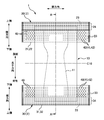
- FIG. 1 is a schematic perspective view of a pants-type disposable diaper 1 (hereinafter, “diaper”) of the present embodiment.
- FIG. 2 is a schematic plan view of the unfolded and stretched diaper 1 as seen from the skin side.
- FIG. 3 is a schematic cross-sectional view taken along line AA of FIG.
- the diaper 1 has an absorbent main body 10 which is a rectangular three-part member, an abdominal side 20 and a dorsal side 30.
- the absorbent body 10 is disposed in the crotch of the wearer.
- the ventral side 20 and the back side 30 are also the waist portion 2 applied to the waist of the wearer.
- the diaper 1 has a longitudinal direction, a lateral direction, and a thickness direction.
- the side in contact with the wearer is referred to as the skin side
- the side not in contact with the wearer is referred to as the non-skin side.
- the transverse center portion of the ventral side 20 overlaps the end on one longitudinal side of the absorbent main body 10, and the end on the other longitudinal side of the absorbent main 10
- the lateral central part of the dorsal part 30 overlaps the part.
- the diaper 1 in the unfolded state is folded in half at a substantially central portion C10 in the longitudinal direction, and both lateral sides of the ventral side 20 and the back side 30 are joined by welding or the like, thereby forming the pants type shown in FIG. It becomes diaper 1 of a state.
- the absorbent body 10 As the absorbent main body 10, the absorbent body 11, a liquid-permeable top sheet (not shown) disposed closer to the skin side than the absorbent body 11, and liquid impermeability disposed closer to the non-skin side than the absorbent body 11 And a back sheet (not shown).
- the absorber 11 absorbs and holds excrement such as urine, and can be exemplified by a liquid absorbent fiber such as pulp containing a super absorbent polymer (SAP) formed into a predetermined shape.
- SAP super absorbent polymer
- the belly side 20 and the back side 30 are more worn than the skin side non-woven fabrics 21 and 31 and the skin side non-woven fabrics 21 and 31 arranged on the skin side in the thickness direction as shown in FIG.
- a non-skin side non-woven fabric 22, 32 disposed on the non-skin side of a person, a plurality of thread-like elastic members 23, 33, and a cover non-woven fabric 24, 34 are provided.
- the skin side nonwoven fabrics 21 and 31 and the non-skin side nonwoven fabrics 22 and 32 are arranged on the non-skin side with respect to the absorbent main body 10.
- the cover non-woven fabrics 24, 34 are disposed closer to the skin than the absorbent main body 10, have a shorter length in the longitudinal direction than the skin-side non-woven fabrics 21, 31, etc., and cover the longitudinal ends of the absorbent main body 10. ing.
- Skin side nonwoven fabrics 21 and 31, non-skin side nonwoven fabrics 22 and 32, and cover nonwoven fabrics 24 and 34 shall have thermoplastic resin fiber.
- a single fiber of a thermoplastic resin such as polypropylene (PP) or polyethylene (PE), or a composite fiber of a sheath-core structure of PP and PE can be exemplified.
- the plurality of thread-like elastic members 23 and 33 are arranged in the longitudinal direction between the skin side non-woven fabrics 21 and 31 and the non-skin side non-woven fabrics 22 and 32, and are fixed in a laterally extended state.
- the ventral side 20 and the dorsal side 30 are provided with elasticity.
- thread-like elastic members 23, 33 thread-like rubber, spandex, etc. can be exemplified.
- a plurality of openings 40 penetrating the skin side non-woven fabrics 21 and 31 and the non-skin side non-woven fabrics 22 and 32 in the thickness direction are formed.
- the shape of the opening 40 is not limited to the illustrated circular shape, and may be various shapes. Alternatively, the opening 40 may be formed in only one of the ventral side 20 and the dorsal side 30.
- FIG. 4 is a schematic side view of the manufacturing apparatus 50 of the waist portion 2.
- the manufacturing apparatus 50 of the waist portion 2 (the ventral side portion 20 and the back side portion 30) includes an upstream roll 51, an intermediate roll 52, a downstream roll 53, and a pair of transport rolls 54.
- the outer peripheral surface of the intermediate roll 52 is provided with a plurality of pins 55 for forming the holes 40.
- a plurality of recessed portions 56 which receive the plurality of pins 55 respectively are provided.
- the intermediate roll 52 incorporates a heat source (not shown). Therefore, the heated pin 55 is inserted into the skin-side non-woven fabrics 21 and 31 and the non-skin-side non-woven fabrics 22 and 32 of the waist portion 2.
- the non-skin side non-woven fabrics 22 and 32 are conveyed by the rotation of the upstream side roll 51 while being wound around the upstream side roll 51 with the skin side surfaces 22a and 32a as the inner side.
- the plurality of pins 55 of the intermediate roll 52 are inserted into the non-skin side non-woven fabric 22, 32.
- the pins 55 are inserted from the non-skin side surfaces 22 b and 23 b of the non-skin side non-woven fabrics 22 and 32 toward the skin side surfaces 22 a and 23 a and penetrate the non-skin-side non-woven fabrics 22 and 32.
- the plurality of apertures 40 are formed in the non-skin side non-woven fabric 22, 32. Thereafter, the non-skin side non-woven fabrics 22 and 32 are delivered from the upstream side roll 51 to the intermediate roll 52, and are conveyed by the rotation of the intermediate roll 52 in a state where the pins 55 pass through.
- the skin side non-woven fabrics 21 and 31 are conveyed by the rotation of the downstream side roll 53 while being wound around the downstream side roll 53 with the skin side surfaces 21a and 31a as the inner side. Further, toward the position where the intermediate roll 52 and the downstream side roll 53 approach, the thread-like elastic members 23 and 33 in the stretched state to which the adhesive is applied are introduced. The thread-like elastic members 23 and 33 are passed between the pins 55 and 55.
- the plurality of pins 55 passing through the non-skin side non-woven fabrics 22 and 32 are inserted from the non-skin side 21b and 31b of the skin-side non-woven fabrics 21 and 31 toward the skin sides 21a and 31a.
- the non-woven fabrics 21 and 31 are penetrated.
- a plurality of openings 40 are formed in the skin side non-woven fabrics 21 and 31.
- the pins 55 are pulled out from the non-skin side non-woven fabrics 22, 32 from the skin non-woven fabrics 21, 31.
- the waist portion 2 (continuous body) having the openings 40 is formed.
- the waist portion 2 is transported to the downstream process by the pair of transport rollers 54 and cut into a size for each product.
- the holes 40 may be formed by the pins 55 after the skin side nonwoven fabrics 21 and 31, the thread-like elastic members 23 and 33, and the non-skin side nonwoven fabrics 22 and 32 are joined.
- the thread-like elastic members 23 and 33 are less likely to be cut by the pins 55 by passing the thread-like elastic members 23 and 33 between the pins 55 and 55.
- it is easy to detect that the thread-like elastic members 23 and 33 have been cut it is possible to avoid the flow of defective products.
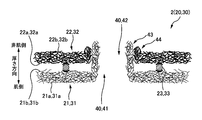
- FIG. 5 is a schematic cross-sectional view of the waist portion 2.
- FIG. 6 is a schematic cross-sectional view for explaining the process of forming the openings 40.
- FIG. 7 is a schematic cross-sectional view of the waist portion 2 of the modification.
- the skin side non-woven fabrics 21 and 31 and the non-skin side non-woven fabrics 22 and 32 are penetrated in the thickness direction in the waistline portion 2 (the abdominal side 20 and the back side 30) manufactured by the manufacturing apparatus 50 of FIG. A plurality of openings 40 are formed.
- the openings 40 penetrating the skin side nonwoven fabrics 21 and 31 are called skin side openings 41
- the openings 42 penetrating the non-skin side nonwoven fabrics 22 and 32 are called non-skin side openings 42.
- the skin side opening 41 communicates with the non-skin side opening 42. That is, in plan view in the thickness direction, the position of the skin side opening 41 and the position of the non-skin side opening 42 are aligned. Therefore, the air permeability of the waist portion 2 is good. In addition, the user can recognize that the hole 40 is easily visible and the product has good ventilation.
- the non-skin side non-woven fabrics 21, 31 and the non-skin side non-woven fabrics 22, 32 are made of soft fibers. Therefore, when the openings are formed without heating the skin side non-woven fabrics 21 and 31 and the non-skin side non-woven fabrics 22 and 32, the fibers are easily returned to the original state and the openings are easily closed.
- the holes 40 are formed by the heated pins 55. Then, the fibers (thermoplastic resin fibers) around the pins 55 soften and then harden, and the shape of the openings 40 is easily maintained.
- the fiber present in the portion of the hole 40 is protruded. Since the protruding fibers are cured by heat, if protruding to the skin side, they will irritate the skin of the wearer.
- the fiber is first extruded to the skin side by making the heated pin 55 penetrate from the non-skin side 21b, 31b of the skin side non-woven fabrics 21 and 31. Thereafter, as shown in FIG. 6C, the fibers pushed to the skin side are non-drawn with the pins 55 by pulling out the pins 55 from the skin side 21a, 31a of the skin side non-woven fabric 21, 31 toward the non-skin side 21b, 31b. Move to the skin side.
- the skin side non-woven fabrics 21 and 31 of the present embodiment are provided with the projecting portions 43 protruding to the non-skin side in the thickness direction at the edge of the skin side opening 41.
- the protruding portion 43 is, more specifically, a fiber protruding from the non-skin side surfaces 21 b and 31 b (flat surfaces other than the edge of the skin side opening 41) of the skin side non-woven fabrics 21 and 31. By doing so, it can suppress that the projection part 43 stimulates a wearer's (infants) skin.
- the protruding portion 43 overlaps at least a part of the non-skin side non-woven fabrics 22 and 32 in the thickness direction.
- the waist part 2 shrinks in the lateral direction, but the protruding part 43 hardened by heat is not easily affected by the shrinkage and is along the edge of the skin side opening 41 Shape is easy to maintain. Therefore, even if the waist part 2 contracts, the skin side opening 41 is not easily crushed. Furthermore, since the protrusion 43 extends to the non-skin side non-woven fabrics 22 and 32, the non-skin-side opening 42 can also be made less likely to be crushed. That is, even when the waist portion 2 contracts, the visibility of the hole 40 can be maintained.
- the non-skin-side non-woven fabrics 22 and 32 are more difficult to melt than the skin-side non-woven fabrics 21 and 31 (details will be described later).
- the non-skin side opening 42 is more easily closed than the skin side opening 41 and is easily crushed when the waist portion 2 contracts. Therefore, as described above, it is preferable to maintain the shape of the non-skin side opening 42 by the projecting portion 43 of the skin side non-woven fabric 21 and 31.
- the positions of the openings are easily shifted.
- the air permeability is reduced compared to the case where the positions of the openings of the plurality of layers are aligned, and it becomes difficult to visually recognize the openings.
- the protruding portion 43 extends to the non-skin side non-woven fabrics 22 and 32, the positions of the skin-side opening 41 and the non-skin-side opening 42 do not easily shift.
- the communication state of the non-skin side opening 42 is easily maintained. That is, even in the case where the openings 40 are formed in the waist portion 2 formed of a plurality of non-woven fabrics, the air permeability and the visibility of the openings 40 can be improved.
- the opening 40 is formed in the site
- the present invention is not limited to the above, in a portion overlapping the cover nonwoven fabrics 24 and 34, and a portion overlapping the folded portions 22f and 32f in which the upper end portions of the non-skin side nonwoven fabrics 22 and 32 are folded back to the skin side as shown in FIG.
- the openings 40 may be formed.
- the cover non-woven fabrics 24, 34 and the folded portions 22f, 32f may or may not be formed with an opening communicating with the skin-side opening 41 and the non-skin-side opening 42. . Even if the holes are not formed, the effects of the breathability and the visibility of the holes 40 can be obtained.
- the non-skin side surfaces 22 b and 32 b of the non-skin side non-woven fabrics 22 and 32 edges of the non-skin-side openings 42
- the non-skin side is not projected beyond the flat surface (other than the above).
- the vertex of the protrusion part 43 may be in line with the non-skin side 22b, 32b of the non-skin side non-woven fabrics 22 and 32 (not shown), more preferably, the vertex of the protrusion 43 is drawn to the skin side Good to have.
- the product is a product that is comfortable to wear by improving not only the skin side but also the non-skin side of the waist portion 2.
- the present invention is not limited to the above, as shown in the modified example of FIG. 7, the protruding portion 43 of the non-skin side non-woven fabric 22, 32 in the thickness direction is more than the non-skin side 22 b, 32 b of the non-skin side non-woven fabric 22, 32. It may protrude to the non-skin side.
- the touch from the non-skin side is reduced compared to the waist portion 2 of FIG.
- the projection 43 is longer, the shape of the opening 40 is easily maintained, and the opening 40 is not easily crushed even when the waist portion 2 contracts, and the positions of the skin side opening 41 and the non-skin side opening 42 are It becomes difficult to shift.
- the visibility of the openings 40 from the non-skin side is improved, it is possible to make a parenter aware that the product is a breathable product.
- the non-skin side opening 42 may be formed in the same manner as the skin side opening 41. As shown in FIGS. 6A and 6C, after the heated pin 55 is penetrated from the non-skin side 22b, 32b of the non-skin side non-woven fabric 22, 32, from the skin side 22a, 32a to the non-skin side 22b, 32b Pull it out. By doing so, the non-skin side non-woven fabrics 22 and 32 are provided with the second protrusion 44 that protrudes to the non-skin side in the thickness direction at the edge of the non-skin side opening 42. It can suppress that a wearer's (infants) skin is stimulated by the 2nd protrusion part 44 protruding to the non-skin side.
- the non-skin side non-woven fabrics 22 and 32 are compared with the length h1 from the non-skin side 21 b and 31 b of the skin-side non-woven fabrics 21 and 31 to the apex of the projecting portion 43.
- the length h2 from the non-skin side 22b, 32b to the top of the second protrusion 44 may be shortened (h1> h2).
- the shape of the opening 40 is easily maintained, and the opening 40 is not easily crushed even when the waist portion 2 contracts, and the skin side opening 41 and the non-skin side It becomes difficult to shift the position of the opening 42.
- the length h2 of the second projecting portion 44 it is possible to suppress stimulation of the skin of a parenting child who often touches the waist portion 2 from the non-skin side.
- the diameter of the fibers constituting the non-skin side non-woven fabrics 22, 32 larger than the diameter of the fibers constituting the skin-side non-woven fabrics 21, 32. That is, it is preferable that the heat is easily transmitted to the fibers constituting the skin side non-woven fabrics 21 and 31 and the heat is not easily transmitted to the fibers constituting the non-skin side non-woven fabrics 22 and 32.
- SMS non-woven fabric spun bond / melt blown / spun bond non-woven fabric
- non-skin side non-woven fabric 22 As 32 a spunbonded nonwoven fabric
- the comparison of the fiber diameters may be performed by a known method. For example, the cross sections and surfaces of the skin side nonwoven fabrics 21 and 22 and the non-skin side nonwoven fabrics 22 and 32 are enlarged with an electron microscope. Then, the diameter of the fibers present in the magnified image is measured. It is good to measure a plurality of fiber diameters and compare the average value. Moreover, in the case of the nonwoven fabric of a multilayer structure like SMS nonwoven fabric, let the fiber diameter of the layer of the thinnest fiber be the fiber diameter of the nonwoven fabric.
- the melting point of the fibers constituting the non-skin side non-woven fabrics 22 and 32 may be higher than the melting point of the fibers constituting the skin-side non-woven fabrics 21 and 32. That is, the non-skin side non-woven fabrics 22 and 32 may be difficult to melt.
- examples of the skin side non-woven fabrics 21 and 31 include non-woven fabrics made of a low melting point material such as polyethylene, and non-skin side non-woven fabrics 22 and 32 include non-woven fabrics made of a high melting point material such as polypropylene.
- the comparison of the melting points may be performed by a known method.
- the melting peak temperature measured using DSC (differential scanning calorimeter) according to JIS K 7121 (Method of measuring transition temperature of plastic) for each of the non-skin side non-woven fabrics 21 and 22 and non-skin non-woven fabrics 22 and 32 It is good to obtain as a melting point and compare.
- the melting point of the layer with the lowest melting point be the melting point of the nonwoven fabric.
- the non-skin-side non-woven fabrics 22 and 32 are more difficult to melt than the skin-side non-woven fabrics 21 and 31. Therefore, like the manufacturing apparatus 50 of the waist part 2 shown in FIG. 4, it is good to half-rotate the intermediate
- the openings 40 are formed between the plurality of thread-like elastic members 23 and 33 aligned in the longitudinal direction (predetermined direction) of the diaper 1. It is formed. Then, at the time of manufacturing the waist portion 2, it is preferable to apply the adhesive only to the thread-like elastic members 23, 33 without applying the adhesive to the skin side non-woven fabrics 21, 31 and the non-skin side non-woven fabrics 22, 32. That is, as shown in FIG. 5, it is preferable that the skin side non-woven fabrics 21 and 31 and the non-skin side non-woven fabrics 22 and 32 be joined by the adhesive 45 via the thread-like elastic members 23 and 32.
- the edge of the opening 40 no adhesive is present at the edge of the opening 40. Therefore, at the edge of the opening 40, the curing of the adhesive is not added to the curing of the fiber, and it is possible to prevent the skin of the wearer or the parenter from being stimulated. Thus, it is preferable to make the edge of the opening 40 as soft as possible.
- the pins 55 may be heated to a temperature lower than the melting point of the fibers constituting the skin side non-woven fabrics 21 and 31 and the non-skin side non-woven fabrics 22 and 32, respectively. By doing so, it is possible to prevent the fibers around the pins 55 from being excessively melted, and it is possible to form the desired apertures 40, the protrusions 43, and the second protrusions 44.
- the measurement of the melting points of the skin side non-woven fabrics 21 and 31 and the non-skin side non-woven fabrics 22 and 32 is the same as described above.
- the pin 55 is heated so that the desired opening 40, the protrusion 43, and the second protrusion 44 are formed.
- the softening points of the fibers constituting the skin side non-woven fabrics 21 and 31 and the non-skin side non-woven fabrics 22 and 32 may be higher than the softening point thereof.
- a softening point it can measure according to JISK7196 (The softening temperature test method by the thermomechanical analysis of a thermoplastic plastic film and a sheet
- the length of the second protrusion 44 may be equal to or greater than the length of the protrusion 43 in the thickness direction.
- the fiber diameter of the non-skin side non-woven fabrics 22, 32 is less than the fiber diameter of the skin-side non-woven fabrics 21, 31, or the melting point of the non-skin side non-woven fabrics 22, 32 is less than the melting point of the skin-side non-woven fabrics 21, 31.
- an adhesive may be applied to the skin side non-woven fabrics 21 and 31 and the non-skin side non-woven fabrics 22 and 32.
Landscapes
- Health & Medical Sciences (AREA)
- Epidemiology (AREA)
- Engineering & Computer Science (AREA)
- Biomedical Technology (AREA)
- Heart & Thoracic Surgery (AREA)
- Vascular Medicine (AREA)
- Life Sciences & Earth Sciences (AREA)
- Animal Behavior & Ethology (AREA)
- General Health & Medical Sciences (AREA)
- Public Health (AREA)
- Veterinary Medicine (AREA)
- Absorbent Articles And Supports Therefor (AREA)
Abstract
胴回り部(2)を備える吸収性物品(1)であって、胴回り部(2)は、その厚さ方向において、肌側不織布(21,31)と、非肌側不織布(22,32)とを備え、肌側不織布(21,31)を貫通する肌側開孔(41)は、非肌側不織布(22,32)を貫通する非肌側開孔(42)と連通しており、肌側不織布(21,31)は、肌側開孔(41)の縁部において、非肌側に突出した突出部(43)を備え、突出部(43)は、厚さ方向において、少なくとも非肌側不織布(22,32)の一部と重複している吸収性物品(1)。
Description
本発明は、吸収性物品、及び、吸収性物品の製造方法に関する。
吸収性物品として、パンツ型使い捨ておむつが知られている。特許文献1には、第1シートと第2シートの間に複数本の弾性部材を有し、第1シートに開孔が形成されている伸縮シートを、胴回りのベルト部材として利用したパンツ型使い捨ておむつが開示されている。第1シートの開孔により、おむつの通気性が向上する。
しかし、胴回りのベルト部材として一般に使用される不織布では、繊維が絡み合っている。そのため、開孔が塞がり易い。そこで、加熱されたピンを不織布に貫通して開孔を形成することで、開孔の形状が維持され易くなる。ただし、加熱されたピンの貫通と引き抜きにより、開孔部分に存在していた繊維が突出する。この突出した繊維は加熱により硬くなっており、着用者の肌を刺激するおそれがある。
本発明は、上記のような従来の問題に鑑みてなされたものであって、胴回り部に形成された開孔の形状を維持しつつ、着用者の肌への刺激を抑制した吸収性物品、及び、その製造方法を提供することを目的とする。
上記目的を達成するための主たる発明は、着用者の胴回りに当てられる胴回り部を備える吸収性物品であって、前記胴回り部は、その厚さ方向において、着用者の肌側に配置される肌側不織布と、前記肌側不織布よりも着用者の非肌側に配置される非肌側不織布とを備え、前記肌側不織布を貫通する肌側開孔は、前記非肌側不織布を貫通する非肌側開孔と連通しており、前記肌側不織布は、前記肌側開孔の縁部において、前記非肌側に突出した突出部を備え、前記突出部は、前記厚さ方向において、少なくとも前記非肌側不織布の一部と重複していること、を特徴とする吸収性物品である。
本発明の他の特徴については、本明細書及び添付図面の記載により明らかにする。
本発明の他の特徴については、本明細書及び添付図面の記載により明らかにする。
本発明によれば、胴回り部に形成された開孔の形状を維持しつつ、着用者の肌への刺激を抑制した吸収性物品、及び、その製造方法を提供することができる。
本明細書及び添付図面の記載により、少なくとも以下の事項が明らかとなる。
着用者の胴回りに当てられる胴回り部を備える吸収性物品であって、前記胴回り部は、その厚さ方向において、着用者の肌側に配置される肌側不織布と、前記肌側不織布よりも着用者の非肌側に配置される非肌側不織布とを備え、前記肌側不織布を貫通する肌側開孔は、前記非肌側不織布を貫通する非肌側開孔と連通しており、前記肌側不織布は、前記肌側開孔の縁部において、前記非肌側に突出した突出部を備え、前記突出部は、前記厚さ方向において、少なくとも前記非肌側不織布の一部と重複していること、を特徴とする吸収性物品である。
着用者の胴回りに当てられる胴回り部を備える吸収性物品であって、前記胴回り部は、その厚さ方向において、着用者の肌側に配置される肌側不織布と、前記肌側不織布よりも着用者の非肌側に配置される非肌側不織布とを備え、前記肌側不織布を貫通する肌側開孔は、前記非肌側不織布を貫通する非肌側開孔と連通しており、前記肌側不織布は、前記肌側開孔の縁部において、前記非肌側に突出した突出部を備え、前記突出部は、前記厚さ方向において、少なくとも前記非肌側不織布の一部と重複していること、を特徴とする吸収性物品である。
このような吸収性物品によれば、突出部で着用者の肌を刺激してしまうことを抑制できる。また、非肌側不織布まで延びた突出部により、肌側開孔の形状及び非肌側開孔の形状が維持され易くなる。よって、通気性、及び、開孔の視認性が向上する。
かかる吸収性物品であって、前記突出部は、前記厚さ方向において、前記非肌側不織布の非肌側面よりも前記非肌側に突出していないこと、を特徴とする吸収性物品である。
このような吸収性物品によれば、突出部で育児者や介護者の肌を刺激してしまうことを抑制できる。
かかる吸収性物品であって、前記非肌側不織布は、前記非肌側開孔の縁部において、前記非肌側に突出した第2の突出部を備え、前記厚さ方向において、前記肌側不織布の非肌側面から前記突出部の頂点までの長さに比べて、前記非肌側不織布の非肌側面から前記第2の突出部の頂点までの長さの方が短いこと、を特徴とする吸収性物品である。
このような吸収性物品によれば、突出部を長くすることで、肌側開孔の形状及び非肌側開孔の形状を維持しつつ、第2の突出部で育児者や介護者の肌を刺激してしまうことを抑制できる。
かかる吸収性物品であって、前記非肌側不織布を構成する繊維の径は、前記肌側不織布を構成する繊維の径よりも太いこと、を特徴とする吸収性物品である。
このような吸収性物品によれば、厚さ方向において突出部の長さを第2の突出部の長さよりも長くできる。
かかる吸収性物品であって、前記非肌側不織布を構成する繊維の融点は、前記肌側不織布を構成する繊維の融点よりも高いこと、を特徴とする吸収性物品である。
このような吸収性物品によれば、厚さ方向において突出部の長さを第2の突出部の長さよりも長くできる。
かかる吸収性物品であって、前記胴回り部は、前記肌側不織布と前記非肌側不織布の間に、所定方向に並ぶ複数の糸状弾性部材を備え、前記肌側開孔、及び、前記非肌側開孔は、前記所定方向に並ぶ複数の糸状弾性部材の間に形成されており、前記肌側不織布、及び、前記非肌側不織布は、前記糸状弾性部材を介して接着剤で接合されていること、を特徴とする吸収性物品である。
このような吸収性物品によれば、肌側開孔及び非肌側開孔の縁部において、接着剤が存在せず、繊維の硬化に接着剤の硬化が加わってしまうことを防止できる。よって、肌側開孔及び非肌側開孔の縁部を出来る限り柔らかくでき、着用者等の肌を刺激してしまうことを抑制できる。
また、着用者の胴回りに当てられ、且つ、厚さ方向において、着用者の肌側に配置される肌側不織布と、前記肌側不織布よりも着用者の非肌側に配置される非肌側不織布とを有する胴回り部を備える吸収性物品の製造方法であって、前記肌側不織布及び前記非肌側不織布をそれぞれ構成する繊維の融点よりも低い温度まで加熱されたピンを、前記厚さ方向における前記非肌側不織布の非肌側面から貫通させて、前記非肌側不織布に非肌側開孔を形成する工程と、前記非肌側不織布に貫通している状態の前記ピンを、前記厚さ方向における前記肌側不織布の非肌側面から貫通させて、前記肌側不織布に肌側開孔を形成する工程と、前記肌側不織布から前記非肌側不織布に向かって前記ピンを引き抜くことで、前記肌側開孔の縁部において、前記非肌側に突出し、且つ、前記厚さ方向において、少なくとも前記非肌側不織布の一部と重複している突出部を、前記肌側不織布に形成する工程と、を有することを特徴とする吸収性物品の製造方法である。
このような吸収性物品の製造方法によれば、突出部で着用者の肌を刺激してしまうことを抑制し、且つ、非肌側不織布まで延びた突出部により、肌側開孔の形状及び非肌側開孔の形状が維持された吸収性物品を製造できる。
===実施形態===
以下、本発明に係る吸収性物品として、乳幼児向けのパンツ型使い捨ておむつを例に挙げて実施形態を説明する。但し上記に限定されず、本発明に係る吸収性物品は、大人向けの使い捨ておむつ、ショーツ型の生理用ナプキン、フックテープで着用者に装着するテープタイプの使い捨ておむつ等にも適用可能である。
以下、本発明に係る吸収性物品として、乳幼児向けのパンツ型使い捨ておむつを例に挙げて実施形態を説明する。但し上記に限定されず、本発明に係る吸収性物品は、大人向けの使い捨ておむつ、ショーツ型の生理用ナプキン、フックテープで着用者に装着するテープタイプの使い捨ておむつ等にも適用可能である。
<<<パンツ型使い捨ておむつ1の構成>>>
図1は、本実施形態のパンツ型使い捨ておむつ1(以下「おむつ」)の概略斜視図である。図2は、展開且つ伸長状態のおむつ1を肌側から見た概略平面図である。図3は、図2のA-A線の概略断面図である。
図1は、本実施形態のパンツ型使い捨ておむつ1(以下「おむつ」)の概略斜視図である。図2は、展開且つ伸長状態のおむつ1を肌側から見た概略平面図である。図3は、図2のA-A線の概略断面図である。
おむつ1は、長方形状の3部材である吸収性本体10と、腹側部20と、背側部30とを有する。吸収性本体10は着用者の股間に配置される。腹側部20と背側部30は、着用者の胴回りに当てられる胴回り部2でもある。
おむつ1は、縦方向、横方向、及び、厚さ方向を有する。厚さ方向において、着用者に接触する側を肌側といい、着用者に接触しない側を非肌側という。
図2の展開状態のおむつ1では、吸収性本体10の長手方向一方側の端部に、腹側部20の横方向の中央部が重なっており、吸収性本体10の長手方向他方側の端部に、背側部30の横方向の中央部が重なっている。展開状態のおむつ1が長手方向の略中央部C10で二つ折りされ、腹側部20と背側部30の横方向の両側部がそれぞれ溶着等で接合されることにより、図1に示すパンツ型状態のおむつ1となる。
吸収性本体10として、吸収体11と、吸収体11よりも肌側に配置される液透過性のトップシート(不図示)と、吸収体11よりも非肌側に配置される液不透過性のバックシート(不図示)とを有するものを例示できる。吸収体11は、尿等の排泄物を吸収保持するものであり、高吸収性ポリマー(SAP)を含むパルプ等の液体吸収性繊維が所定の形状に成形されたものを例示できる。
腹側部20、及び、背側部30は、それぞれ、図3に示すように、その厚さ方向において肌側に配置される肌側不織布21,31と、肌側不織布21,31よりも着用者の非肌側に配置される非肌側不織布22,32と、複数の糸状弾性部材23,33と、カバー不織布24,34とを有する。肌側不織布21,31、及び、非肌側不織布22,32は、吸収性本体10よりも非肌側に配置されている。カバー不織布24,34は、吸収性本体10よりも肌側に配置されており、肌側不織布21,31等よりも縦方向の長さが短く、吸収性本体10の長手方向の端部を覆っている。
肌側不織布21,31、非肌側不織布22,32、及び、カバー不織布24,34は、熱可塑性樹脂繊維を有するものとする。例えば、ポリプロピレン(PP)やポリエチレン(PE)等の熱可塑性樹脂の単独繊維や、PP及びPEの鞘芯構造等の複合繊維からなるものを例示できる。
複数の糸状弾性部材23,33は、肌側不織布21,31と非肌側不織布22,32の間において、縦方向に並んで配置されるとともに、横方向に伸長した状態で固定されている。そうして、腹側部20、及び、背側部30に、伸縮性が付与されている。なお、糸状弾性部材23,33としては、糸状のゴムやスパンデックス等を例示できる。
また、腹側部20、及び、背側部30には、その厚さ方向において、肌側不織布21,31、及び、非肌側不織布22,32を貫通する開孔40が複数形成されている。開孔40の形状は、図示する円形状に限定されず、種々の形状であってよい。また、腹側部20と背側部30の何れかに一方にのみ開孔40が形成されている形態であってもよい。
<<<開孔40を有する胴回り部2の製造方法>>>
図4は、胴回り部2の製造装置50の概略側面図である。
胴回り部2(腹側部20及び背側部30)の製造装置50は、上流側ロール51と、中間ロール52と、下流側ロール53と、一対の搬送ロール54とを有する。
図4は、胴回り部2の製造装置50の概略側面図である。
胴回り部2(腹側部20及び背側部30)の製造装置50は、上流側ロール51と、中間ロール52と、下流側ロール53と、一対の搬送ロール54とを有する。
中間ロール52の外周面には、開孔40を形成するための複数のピン55が設けられている。上流側ロール51、及び、下流側ロール53の外周面には、複数のピン55をそれぞれ受ける複数の凹部56が設けられている。また、中間ロール52には熱源(不図示)が内蔵されている。よって、胴回り部2を構成する肌側不織布21,31及び非肌側不織布22,32に、加熱されたピン55が挿入される。
まず、非肌側不織布22,32(連続体)は、肌側面22a,32aを内側として上流側ロール51に巻き付けられながら、上流側ロール51の回転により搬送される。非肌側不織布22,32が中間ロール52に接近すると、中間ロール52の複数のピン55が非肌側不織布22,32に挿入される。ピン55は、非肌側不織布22,32の非肌側面22b,23bから肌側面22a,23aに向かって挿入され、非肌側不織布22,32を貫通する。そうして、非肌側不織布22,32に複数の開孔40が形成される。その後、非肌側不織布22,32は、上流側ロール51から中間ロール52に受け渡され、ピン55が貫通している状態で、中間ロール52の回転により搬送される。
一方、肌側不織布21,31(連続体)は、肌側面21a,31aを内側として下流側ロール53に巻き付けられながら、下流側ロール53の回転により搬送される。また、中間ロール52と下流側ロール53が接近する位置に向かって、接着剤が塗布された伸長状態の糸状弾性部材23,33が投入される。なお、糸状弾性部材23,33は、ピン55とピン55の間に通される。
そして、中間ロール52と下流側ロール53が接近する位置において、肌側不織布21,31と非肌側不織布22,32は、間に糸状弾性部材23,33を介在させつつ、中間ロール52の外周面(ピン55以外の面)と下流側ロール53の外周面(凹部56以外の面)に挟み込まれる。そうして、肌側不織布21,31と非肌側不織布22,32は、糸状弾性部材23,33に塗布されている接着剤により接合される。
それと共に、非肌側不織布22,32に貫通している状態の複数のピン55は、肌側不織布21,31の非肌側面21b,31bから肌側面21a,31aに向かって挿入され、肌側不織布21,31を貫通する。そうして、肌側不織布21,31に複数の開孔40が形成される。
その後、中間ロール52の回転により、ピン55が肌側不織布21,31から非肌側不織布22,32に向かって引き抜かれる。こうして、開孔40を有する胴回り部2(連続体)が形成される。胴回り部2は、一対の搬送ローラー54により下流の工程へ搬送され、製品毎の大きさにカットされる。
なお、肌側不織布21,31と糸状弾性部材23,33と非肌側不織布22,32とを接合した後に、ピン55で開孔40を形成してもよい。ただし、図4の製造装置50のように、ピン55とピン55の間に糸状弾性部材23,33を通すことで、ピン55により糸状弾性部材23,33が切断され難くなる。また、糸状弾性部材23,33が切断されたことを検出し易いため、不良品の流通を回避できる。
<<<開孔40を有する胴回り部2について>>>
図5は、胴回り部2の断面模式図である。図6は、開孔40の形成工程を説明する断面模式図である。図7は、変形例の胴回り部2の断面模式図である。
図5は、胴回り部2の断面模式図である。図6は、開孔40の形成工程を説明する断面模式図である。図7は、変形例の胴回り部2の断面模式図である。
図4の製造装置50にて製造された胴回り部2(腹側部20及び背側部30)には、その厚さ方向において、肌側不織布21,31及び非肌側不織布22,32を貫通する開孔40が複数形成されている。肌側不織布21,31を貫通する開孔40を肌側開孔41といい、非肌側不織布22,32を貫通する開孔42を非肌側開孔42という。
そして、肌側開孔41は非肌側開孔42と連通している。つまり、厚さ方向における平面視において、肌側開孔41の位置と非肌側開孔42の位置が揃っている。そのため、胴回り部2の通気性が良い。また、開孔40が視認され易く、通気性の良い製品であることをユーザーに認識させることができる。
また、胴回り部2の肌触り向上のために、肌側不織布21,31及び非肌側不織布22,32は柔らかい繊維で構成される。そのため、肌側不織布21,31及び非肌側不織布22,32を加熱することなく開孔を形成した場合、繊維が元に戻り易く、開孔が塞がり易い。これに対して、本実施形態では、加熱されたピン55で開孔40を形成する。そうすると、ピン55の周りの繊維(熱可塑性樹脂繊維)が軟化した後に硬化し、開孔40の形状が維持され易い。
ただし、加熱されたピン55の貫通と引き抜きにより、開孔40の部分に存在していた繊維が突出してしまう。この突出した繊維は熱により硬化しているため、肌側に突出していると、着用者の肌を刺激してしまう。
そこで、本実施形態では、図6Bに示すように、加熱されたピン55を肌側不織布21,31の非肌側面21b,31bから貫通させることで、まず、繊維を肌側に押し出す。その後、図6Cに示すように、肌側不織布21,31の肌側面21a,31aから非肌側面21b,31bに向かってピン55を引き抜くことで、肌側に押し出された繊維をピン55と共に非肌側へ移動する。
そうして本実施形態の肌側不織布21,31は、図5に示すように、肌側開孔41の縁部において、厚さ方向の非肌側に突出した突出部43を備えるものとする。突出部43とは、詳しくは、肌側不織布21,31の非肌側面21b,31b(肌側開孔41の縁部以外の平坦な面)よりも突出した繊維である。そうすることで、突出部43で着用者(乳幼児)の肌を刺激してしまうことを抑制できる。
さらに、突出部43は、厚さ方向において、少なくとも非肌側不織布22,32の一部と重複しているものとする。そうすることで、突出部43により、肌側不織布21,31の繊維のみならず、非肌側不織布22,32の繊維も元に戻り難くなり、肌側開孔41及び非肌側開孔42の形状がより維持され易くなる。
また、非着用時など自然状態のおむつ1では、胴回り部2は横方向に収縮するが、熱により硬化した突出部43は、収縮の影響を受け難く、肌側開孔41の縁部に沿った形状を維持し易い。よって、胴回り部2が収縮しても、肌側開孔41は潰れ難い。さらに、突出部43は非肌側不織布22,32まで延びているため、非肌側開孔42も潰れ難くすることができる。つまり、胴回り部2の収縮時においても、開孔40の視認性を保つことができる。
特に、本実施形態では、肌側不織布21,31に比べて非肌側不織布22,32の方が溶融し難いものとする(詳細は後述)。この場合、非肌側開孔42は、肌側開孔41に比べて塞がり易く、胴回り部2の収縮時に潰れ易い。そのため、上記のように、肌側不織布21,31の突出部43で非肌側開孔42の形状を維持することが好ましい。
また、1層の不織布に開孔を形成する場合に比べて、本実施形態のように複数層(ここでは2層)の不織布に開孔を形成する場合、開孔の位置がずれ易い。そうすると、複数層の開孔の位置が揃っている場合に比べて、通気性が低下し、開孔が視認され難くなる。
これに対して、本実施形態では、突出部43が非肌側不織布22,32まで延びているため、肌側開孔41と非肌側開孔42の位置がずれ難く、肌側開孔41と非肌側開孔42の連通状態が維持され易い。つまり、複数層の不織布から構成される胴回り部2に開孔40を形成する場合であっても、通気性、及び、開孔40の視認性を向上させることができる。
また、図2に示すおむつ1では、胴回り部2のうち、肌側不織布21,31と非肌側不織布22,32の2層で構成される部位に、開孔40が形成されている。そのため、通気性、及び、開孔40の視認性がより良い。
ただし、上記に限らず、カバー不織布24,34と重なる部位や、図3に示すように非肌側不織布22,32の上端部が肌側に折り返された折り返し部22f,32fと重なる部位に、開孔40が形成されていてもよい。これらの場合、カバー不織布24,34や折り返し部22f,32fに、肌側開孔41及び非肌側開孔42と連通する開孔が形成されていてもよいし、形成されていなくてもよい。開孔が形成されていない場合であっても、上記の通気性及び開孔40の視認性の効果は得られる。
また、図5に示すように、肌側不織布21,31の突出部43が、厚さ方向において、非肌側不織布22,32の非肌側面22b,32b(非肌側開孔42の縁部以外の平坦な面)よりも非肌側に突出していないことが好ましい。なお、突出部43の頂点が、非肌側不織布22,32の非肌側面22b,32bと揃っていてもよいが(不図示)、より好ましくは、突出部43の頂点が肌側に引っ込んでいるとよい。
そうすることで、おむつ1を着用している乳幼児を世話したり、おむつ1を持ち運びしたりと、胴回り部2を非肌側から触れることの多い育児者(母親等)の肌を、肌側不織布21,31の突出部43で刺激してしまうことを抑制できる。
また、乳幼児向けのおむつ1の場合、おむつ1の購入者である育児者はおむつ1を着用しないため、胴回り部2の肌側の肌触りの良さを実感し難い。そのため、胴回り部2の肌側だけでなく非肌側の肌触りも良くして、着け心地の良い製品であることを、育児者に認識させることも重要である。
ただし、上記に限らず、図7の変形例に示すように、肌側不織布21,31の突出部43が、厚さ方向において、非肌側不織布22,32の非肌側面22b,32bよりも非肌側に突出していてもよい。
この場合、図5の胴回り部2に比べると、非肌側からの肌触りは低下してしまう。しかし、突出部43がより長くなるため、開孔40の形状が維持され易く、胴回り部2の収縮時にも開孔40が潰れ難く、肌側開孔41と非肌側開孔42の位置がずれ難くなる。特に、非肌側からの開孔40の視認性が向上するため、通気性の良い製品であることを、育児者に認識させることができる。
また、非肌側開孔42も肌側開孔41と同様に形成するとよい。図6A及び図6Cに示すように、加熱されたピン55を、非肌側不織布22,32の非肌側面22b,32bから貫通させた後、肌側面22a,32aから非肌側面22b,32bに向かって引き抜く。そうすることで、非肌側不織布22,32は、非肌側開孔42の縁部において、厚さ方向の非肌側に突出した第2の突出部44を備えることになる。第2の突出部44が非肌側に突出していることで、着用者(乳幼児)の肌を刺激してしまうことを抑制できる。
さらに、図5に示すように、厚さ方向において、肌側不織布21,31の非肌側面21b,31bから突出部43の頂点までの長さh1に比べて、非肌側不織布22,32の非肌側面22b,32bから第2の突出部44の頂点までの長さh2を短くするとよい(h1>h2)。
このように、突出部43の長さh1を長くすることで、開孔40の形状が維持され易く、胴回り部2の収縮時にも開孔40が潰れ難く、肌側開孔41と非肌側開孔42の位置がずれ難くなる。一方、第2の突出部44の長さh2を短くすることで、胴回り部2を非肌側から触れることの多い育児者の肌を刺激してしまうことを抑制できる。
そのために、非肌側不織布22,32を構成する繊維の径を、肌側不織布21,32を構成する繊維の径よりも太くするとよい。つまり、肌側不織布21,31を構成する繊維には熱が伝わり易く、非肌側不織布22,32を構成する繊維には熱が伝わり難くするとよい。
そうすることで、肌側不織布21,31では、加熱されたピン55の周囲の多くの繊維が軟化したり、繊維の軟化度合が高まったりするため、厚さ方向に長い突出部43を形成できる。逆に、非肌側不織布22,32では、加熱されたピン55の周囲の少ない繊維しか軟化しなかったり、繊維の軟化度合が低かったりするため、厚さ方向に短い第2の突出部44を形成できる。
具体的には、メルトブローン法によって製造された不織布では繊維径が細くなるので、肌側不織布21,31として、SMS不織布(スパンボンド/メルトブローン/スパンボンド不織布)を例示でき、非肌側不織布22,32として、スパンボンド不織布を例示できる。
繊維径の比較は周知の方法で行うとよい。例えば、肌側不織布21,22及び非肌側不織布22,32の断面や表面を、電子顕微鏡で拡大する。そして、拡大画像中に存在する繊維の径を測定する。複数本の繊維径を測定し、その平均値を比較するとよい。また、SMS不織布のように多層構造の不織布の場合、最も細い繊維の層の繊維径を、その不織布の繊維径とする。
また、非肌側不織布22,32を構成する繊維の融点を、肌側不織布21,32を構成する繊維の融点よりも高くしてもよい。つまり、肌側不織布21,31は溶融し易く、非肌側不織布22,32は溶融し難いものにするとよい。
そうすることで、肌側不織布21,31では、加熱されたピン55の周囲の多くの繊維が軟化したり、繊維の軟化度合が高まったりするため、厚さ方向に長い突出部43を形成できる。逆に、非肌側不織布22,32では、加熱されたピン55の周囲の少ない繊維しか軟化しなかったり、繊維の軟化度合が低かったりするため、厚さ方向に短い第2の突出部44を形成できる。
具体的には、肌側不織布21,31として、例えばポリエチレンなどの低融点材料からなる不織布を例示でき、非肌側不織布22,32として、例えばポリプロピレンなどの高融点材料からなる不織布を例示できる。
融点の比較は周知の方法で行うとよい。例えば、肌側不織布21,22及び非肌側不織布22,32のそれぞれについて、JISK7121(プラスチックの転移温度測定方法)に準じて、DSC(示差走査型熱量計)を用いて測定される融解ピーク温度を融点として取得し、比較するとよい。また、SMS不織布のように多層構造の不織布の場合、最も融点の低い層の融点を、その不織布の融点とする。
このように、本実施形態では、肌側不織布21,31に比べて非肌側不織布22,32の方が溶融し難いものとする。そのため、図4に示す胴回り部2の製造装置50のように、非肌側不織布22,32にピン55を貫通している状態で中間ロール52を半回転するとよい。つまり、非肌側不織布22,32の方が、肌側不織布21,31に比べて、ピン55が貫通している時間が長くなるようにするとよい。そうすることで、溶融し難い非肌側不織布22,32においても、繊維が軟化し、非肌側開孔42の形状が維持される。
また、図2に示すように、開孔40(肌側開孔41及び非肌側開孔42)は、おむつ1の縦方向(所定方向)に並ぶ複数の糸状弾性部材23,33の間に形成されている。そして、胴回り部2の製造時において、肌側不織布21,31、及び、非肌側不織布22,32には接着剤を塗布せず、糸状弾性部材23,33にのみ接着剤を塗布するとよい。つまり、図5に示すように、肌側不織布21,31、及び、非肌側不織布22,32は、糸状弾性部材23,32を介して接着剤45で接合されていることが好ましい。
この場合、開孔40の縁部に接着剤が存在しないこととなる。そのため、開孔40の縁部において、繊維の硬化に接着剤の硬化が加わることがなく、着用者や育児者の肌を刺激してしまうことを防止できる。このように開孔40の縁部を出来る限り柔らかくするとよい。
また、胴回り部2の製造時において、ピン55は、肌側不織布21,31及び非肌側不織布22,32をそれぞれ構成する繊維の融点よりも低い温度まで加熱するとよい。そうすることで、ピン55の周囲の繊維が溶融し過ぎることを防止でき、所望の開孔40、突出部43、及び、第2の突出部44を形成できる。肌側不織布21,31及び非肌側不織布22,32の融点の測定については前述と同様である。
また、ピン55は、所望の開孔40、突出部43、及び、第2の突出部44が形成される程に加熱されていることが好ましい。例えば、肌側不織布21,31及び非肌側不織布22,32をそれぞれ構成する繊維の軟化点よりも高くするとよい。なお、軟化点については、JISK7196(熱可塑性プラスチックフィルム、及び、シートの熱機械分析による軟化温度試験方法)に準じて測定できる。
以上、本発明の実施形態について説明したが、上記の実施形態は、本発明の理解を容易にするためのものであり、本発明を限定して解釈するためのものではない。また、本発明は、その趣旨を逸脱することなく、変更や改良され得るとともに、本発明にはその等価物が含まれるのはいうまでもない。
例えば、厚さ方向において、第2の突出部44の長さが突出部43の長さ以上であってもよい。また、非肌側不織布22,32の繊維径が肌側不織布21,31の繊維径以下であったり、非肌側不織布22,32の融点が肌側不織布21,31の融点以下であったりしてもよい。また、肌側不織布21,31や非肌側不織布22,32に接着剤が塗布されていてもよい。
1 パンツ型使い捨ておむつ(吸収性物品)、2 胴回り部、
10 吸収性本体、11 吸収体、
20 腹側部、21 肌側不織布、22 非肌側不織布、
23 糸状弾性部材、24 カバー不織布、
30 背側部、31 肌側不織布、32 非肌側不織布、
33 糸状弾性部材、34 カバー不織布、
40 開孔、41 肌側開孔、42 非肌側開孔、
43 突出部、44 第2の突出部、45 接着剤、
50 胴回り部の製造装置、51 上流側ロール、52 中間ロール、
53 下流側ロール、54 搬送ロール、55 ピン、56 凹部、
10 吸収性本体、11 吸収体、
20 腹側部、21 肌側不織布、22 非肌側不織布、
23 糸状弾性部材、24 カバー不織布、
30 背側部、31 肌側不織布、32 非肌側不織布、
33 糸状弾性部材、34 カバー不織布、
40 開孔、41 肌側開孔、42 非肌側開孔、
43 突出部、44 第2の突出部、45 接着剤、
50 胴回り部の製造装置、51 上流側ロール、52 中間ロール、
53 下流側ロール、54 搬送ロール、55 ピン、56 凹部、
Claims (7)
- 着用者の胴回りに当てられる胴回り部を備える吸収性物品であって、
前記胴回り部は、その厚さ方向において、着用者の肌側に配置される肌側不織布と、前記肌側不織布よりも着用者の非肌側に配置される非肌側不織布とを備え、
前記肌側不織布を貫通する肌側開孔は、前記非肌側不織布を貫通する非肌側開孔と連通しており、
前記肌側不織布は、前記肌側開孔の縁部において、前記非肌側に突出した突出部を備え、
前記突出部は、前記厚さ方向において、少なくとも前記非肌側不織布の一部と重複していること、を特徴とする吸収性物品。 - 請求項1に記載の吸収性物品であって、
前記突出部は、前記厚さ方向において、前記非肌側不織布の非肌側面よりも前記非肌側に突出していないこと、を特徴とする吸収性物品。 - 請求項1又は請求項2に記載の吸収性物品であって、
前記非肌側不織布は、前記非肌側開孔の縁部において、前記非肌側に突出した第2の突出部を備え、
前記厚さ方向において、前記肌側不織布の非肌側面から前記突出部の頂点までの長さに比べて、前記非肌側不織布の非肌側面から前記第2の突出部の頂点までの長さの方が短いこと、を特徴とする吸収性物品。 - 請求項1から請求項3の何れか1項に記載の吸収性物品であって、
前記非肌側不織布を構成する繊維の径は、前記肌側不織布を構成する繊維の径よりも太いこと、を特徴とする吸収性物品。 - 請求項1から請求項4の何れか1項に記載の吸収性物品であって、
前記非肌側不織布を構成する繊維の融点は、前記肌側不織布を構成する繊維の融点よりも高いこと、を特徴とする吸収性物品。 - 請求項1から請求項5の何れか1項に記載の吸収性物品であって、
前記胴回り部は、前記肌側不織布と前記非肌側不織布の間に、所定方向に並ぶ複数の糸状弾性部材を備え、
前記肌側開孔、及び、前記非肌側開孔は、前記所定方向に並ぶ複数の糸状弾性部材の間に形成されており、
前記肌側不織布、及び、前記非肌側不織布は、前記糸状弾性部材を介して接着剤で接合されていること、を特徴とする吸収性物品。 - 着用者の胴回りに当てられ、且つ、厚さ方向において、着用者の肌側に配置される肌側不織布と、前記肌側不織布よりも着用者の非肌側に配置される非肌側不織布とを有する胴回り部を備える吸収性物品の製造方法であって、
前記肌側不織布及び前記非肌側不織布をそれぞれ構成する繊維の融点よりも低い温度まで加熱されたピンを、前記厚さ方向における前記非肌側不織布の非肌側面から貫通させて、前記非肌側不織布に非肌側開孔を形成する工程と、
前記非肌側不織布に貫通している状態の前記ピンを、前記厚さ方向における前記肌側不織布の非肌側面から貫通させて、前記肌側不織布に肌側開孔を形成する工程と、
前記肌側不織布から前記非肌側不織布に向かって前記ピンを引き抜くことで、前記肌側開孔の縁部において、前記非肌側に突出し、且つ、前記厚さ方向において、少なくとも前記非肌側不織布の一部と重複している突出部を、前記肌側不織布に形成する工程と、
を有することを特徴とする吸収性物品の製造方法。
Priority Applications (1)
| Application Number | Priority Date | Filing Date | Title |
|---|---|---|---|
| CN201880041224.3A CN110769793B (zh) | 2017-06-30 | 2018-04-05 | 吸收性物品和吸收性物品的制造方法 |
Applications Claiming Priority (2)
| Application Number | Priority Date | Filing Date | Title |
|---|---|---|---|
| JP2017128313A JP6830864B2 (ja) | 2017-06-30 | 2017-06-30 | 吸収性物品、及び、吸収性物品の製造方法 |
| JP2017-128313 | 2017-06-30 |
Publications (1)
| Publication Number | Publication Date |
|---|---|
| WO2019003554A1 true WO2019003554A1 (ja) | 2019-01-03 |
Family
ID=64740525
Family Applications (1)
| Application Number | Title | Priority Date | Filing Date |
|---|---|---|---|
| PCT/JP2018/014593 Ceased WO2019003554A1 (ja) | 2017-06-30 | 2018-04-05 | 吸収性物品、及び、吸収性物品の製造方法 |
Country Status (3)
| Country | Link |
|---|---|
| JP (1) | JP6830864B2 (ja) |
| CN (1) | CN110769793B (ja) |
| WO (1) | WO2019003554A1 (ja) |
Cited By (2)
| Publication number | Priority date | Publication date | Assignee | Title |
|---|---|---|---|---|
| JP2020185377A (ja) * | 2019-05-10 | 2020-11-19 | 王子ホールディングス株式会社 | 吸収性物品の製造方法及び吸収性物品 |
| WO2020255523A1 (ja) * | 2019-06-19 | 2020-12-24 | ユニ・チャーム株式会社 | 吸収性物品に係るシート部材の製造方法、吸収性物品に係るシート部材の製造装置、及び吸収性物品 |
Citations (2)
| Publication number | Priority date | Publication date | Assignee | Title |
|---|---|---|---|---|
| JP2016138359A (ja) * | 2009-02-06 | 2016-08-04 | ザ プロクター アンド ギャンブル カンパニー | 孔を形成したウェブの作製方法 |
| JP6134877B1 (ja) * | 2016-07-29 | 2017-05-24 | ユニ・チャーム株式会社 | 吸収性物品に係る不織布への貫通孔の形成方法、及び形成装置 |
Family Cites Families (4)
| Publication number | Priority date | Publication date | Assignee | Title |
|---|---|---|---|---|
| CN1286602A (zh) * | 1997-12-15 | 2001-03-07 | 宝洁公司 | 一种多孔网状物的制造方法 |
| CN2479956Y (zh) * | 2001-05-31 | 2002-03-06 | 龚军 | 松软型复合网面 |
| KR20060018930A (ko) * | 2001-07-03 | 2006-03-02 | 코로빈 게엠베하 | 천공장치 |
| CN101529005B (zh) * | 2006-10-23 | 2012-10-10 | 詹姆士·W·克里 | 带孔的幅材以及用于制造其的方法和装置 |
-
2017
- 2017-06-30 JP JP2017128313A patent/JP6830864B2/ja active Active
-
2018
- 2018-04-05 CN CN201880041224.3A patent/CN110769793B/zh active Active
- 2018-04-05 WO PCT/JP2018/014593 patent/WO2019003554A1/ja not_active Ceased
Patent Citations (2)
| Publication number | Priority date | Publication date | Assignee | Title |
|---|---|---|---|---|
| JP2016138359A (ja) * | 2009-02-06 | 2016-08-04 | ザ プロクター アンド ギャンブル カンパニー | 孔を形成したウェブの作製方法 |
| JP6134877B1 (ja) * | 2016-07-29 | 2017-05-24 | ユニ・チャーム株式会社 | 吸収性物品に係る不織布への貫通孔の形成方法、及び形成装置 |
Cited By (7)
| Publication number | Priority date | Publication date | Assignee | Title |
|---|---|---|---|---|
| JP2020185377A (ja) * | 2019-05-10 | 2020-11-19 | 王子ホールディングス株式会社 | 吸収性物品の製造方法及び吸収性物品 |
| WO2020230494A1 (ja) * | 2019-05-10 | 2020-11-19 | 王子ホールディングス株式会社 | 吸収性物品の製造方法及び吸収性物品 |
| CN113795227A (zh) * | 2019-05-10 | 2021-12-14 | 王子控股株式会社 | 用于生产吸收性物品的方法和吸收性物品 |
| CN113795227B (zh) * | 2019-05-10 | 2023-07-21 | 王子控股株式会社 | 用于生产吸收性物品的方法和吸收性物品 |
| WO2020255523A1 (ja) * | 2019-06-19 | 2020-12-24 | ユニ・チャーム株式会社 | 吸収性物品に係るシート部材の製造方法、吸収性物品に係るシート部材の製造装置、及び吸収性物品 |
| JP2020203017A (ja) * | 2019-06-19 | 2020-12-24 | ユニ・チャーム株式会社 | 吸収性物品に係るシート部材の製造方法、吸収性物品に係るシート部材の製造装置、及び吸収性物品 |
| JP7254638B2 (ja) | 2019-06-19 | 2023-04-10 | ユニ・チャーム株式会社 | 吸収性物品に係るシート部材の製造方法、吸収性物品に係るシート部材の製造装置、及び吸収性物品 |
Also Published As
| Publication number | Publication date |
|---|---|
| JP6830864B2 (ja) | 2021-02-17 |
| CN110769793B (zh) | 2022-09-30 |
| CN110769793A (zh) | 2020-02-07 |
| JP2019010277A (ja) | 2019-01-24 |
Similar Documents
| Publication | Publication Date | Title |
|---|---|---|
| JP5342751B2 (ja) | 伸縮性不織布 | |
| JP2021137579A (ja) | パンツ型吸収性物品及びその製造方法 | |
| JP6185155B2 (ja) | 改良された滑らかな柔軟性及び良好な強度特性を有する不織布ウェブ材料及び製造方法 | |
| US8900211B2 (en) | Disposable wearing article | |
| JP7770918B2 (ja) | パンツ型着用可能物品 | |
| US20200260799A1 (en) | Pant-Type Wearable Article | |
| US10292874B2 (en) | Dual-mode high-waist foldover disposable absorbent pant | |
| CN110022815A (zh) | 一次性裤型吸收性物品 | |
| US20170105881A1 (en) | Absorbent article having an outer blouse layer | |
| WO2019003554A1 (ja) | 吸収性物品、及び、吸収性物品の製造方法 | |
| CN110831557B (zh) | 一次性穿着物品 | |
| JP5448513B2 (ja) | パンツ型吸収性物品 | |
| CN109069319B (zh) | 套穿式吸收性物品与用于制造套穿式吸收性物品方法 | |
| JP7438686B2 (ja) | 吸収性物品用シート部材製造方法、及び、吸収性物品 | |
| JP6245644B2 (ja) | パンツ型使い捨ておむつ及びその製造方法 | |
| JP6889203B2 (ja) | 吸収性物品の製造方法、及び、吸収性物品の製造装置 | |
| US20220071311A1 (en) | Pant-type wearable article | |
| JP5655116B2 (ja) | 伸縮性不織布 | |
| JP7254638B2 (ja) | 吸収性物品に係るシート部材の製造方法、吸収性物品に係るシート部材の製造装置、及び吸収性物品 | |
| JP2017064402A (ja) | 伸縮部を有する吸収性物品 |
Legal Events
| Date | Code | Title | Description |
|---|---|---|---|
| 121 | Ep: the epo has been informed by wipo that ep was designated in this application |
Ref document number: 18824977 Country of ref document: EP Kind code of ref document: A1 |
|
| NENP | Non-entry into the national phase |
Ref country code: DE |
|
| 122 | Ep: pct application non-entry in european phase |
Ref document number: 18824977 Country of ref document: EP Kind code of ref document: A1 |