WO2018229294A1 - Process for dyeing keratin fibres using at least one disulfide, thiol or protected-thiol fluorescent dye and at least one activator comprising a reducing agent and at least two different alkaline agents - Google Patents
Process for dyeing keratin fibres using at least one disulfide, thiol or protected-thiol fluorescent dye and at least one activator comprising a reducing agent and at least two different alkaline agents Download PDFInfo
- Publication number
- WO2018229294A1 WO2018229294A1 PCT/EP2018/066112 EP2018066112W WO2018229294A1 WO 2018229294 A1 WO2018229294 A1 WO 2018229294A1 EP 2018066112 W EP2018066112 W EP 2018066112W WO 2018229294 A1 WO2018229294 A1 WO 2018229294A1
- Authority
- WO
- WIPO (PCT)
- Prior art keywords
- group
- preferentially
- alkyl
- thiol
- different
- Prior art date
- Legal status (The legal status is an assumption and is not a legal conclusion. Google has not performed a legal analysis and makes no representation as to the accuracy of the status listed.)
- Ceased
Links
- 0 C*N(*)C(*)=[N+](C)C(C)(*)* Chemical compound C*N(*)C(*)=[N+](C)C(C)(*)* 0.000 description 1
Classifications
-
- A—HUMAN NECESSITIES
- A61—MEDICAL OR VETERINARY SCIENCE; HYGIENE
- A61K—PREPARATIONS FOR MEDICAL, DENTAL OR TOILETRY PURPOSES
- A61K8/00—Cosmetics or similar toiletry preparations
- A61K8/18—Cosmetics or similar toiletry preparations characterised by the composition
- A61K8/30—Cosmetics or similar toiletry preparations characterised by the composition containing organic compounds
- A61K8/49—Cosmetics or similar toiletry preparations characterised by the composition containing organic compounds containing heterocyclic compounds
- A61K8/4906—Cosmetics or similar toiletry preparations characterised by the composition containing organic compounds containing heterocyclic compounds with one nitrogen as the only hetero atom
- A61K8/4933—Cosmetics or similar toiletry preparations characterised by the composition containing organic compounds containing heterocyclic compounds with one nitrogen as the only hetero atom having sulfur as an exocyclic substituent, e.g. pyridinethione
-
- A—HUMAN NECESSITIES
- A61—MEDICAL OR VETERINARY SCIENCE; HYGIENE
- A61K—PREPARATIONS FOR MEDICAL, DENTAL OR TOILETRY PURPOSES
- A61K8/00—Cosmetics or similar toiletry preparations
- A61K8/18—Cosmetics or similar toiletry preparations characterised by the composition
- A61K8/19—Cosmetics or similar toiletry preparations characterised by the composition containing inorganic ingredients
-
- A—HUMAN NECESSITIES
- A61—MEDICAL OR VETERINARY SCIENCE; HYGIENE
- A61K—PREPARATIONS FOR MEDICAL, DENTAL OR TOILETRY PURPOSES
- A61K8/00—Cosmetics or similar toiletry preparations
- A61K8/18—Cosmetics or similar toiletry preparations characterised by the composition
- A61K8/30—Cosmetics or similar toiletry preparations characterised by the composition containing organic compounds
- A61K8/40—Cosmetics or similar toiletry preparations characterised by the composition containing organic compounds containing nitrogen
- A61K8/41—Amines
-
- A—HUMAN NECESSITIES
- A61—MEDICAL OR VETERINARY SCIENCE; HYGIENE
- A61K—PREPARATIONS FOR MEDICAL, DENTAL OR TOILETRY PURPOSES
- A61K8/00—Cosmetics or similar toiletry preparations
- A61K8/18—Cosmetics or similar toiletry preparations characterised by the composition
- A61K8/30—Cosmetics or similar toiletry preparations characterised by the composition containing organic compounds
- A61K8/46—Cosmetics or similar toiletry preparations characterised by the composition containing organic compounds containing sulfur
-
- A—HUMAN NECESSITIES
- A61—MEDICAL OR VETERINARY SCIENCE; HYGIENE
- A61K—PREPARATIONS FOR MEDICAL, DENTAL OR TOILETRY PURPOSES
- A61K8/00—Cosmetics or similar toiletry preparations
- A61K8/18—Cosmetics or similar toiletry preparations characterised by the composition
- A61K8/30—Cosmetics or similar toiletry preparations characterised by the composition containing organic compounds
- A61K8/49—Cosmetics or similar toiletry preparations characterised by the composition containing organic compounds containing heterocyclic compounds
-
- A—HUMAN NECESSITIES
- A61—MEDICAL OR VETERINARY SCIENCE; HYGIENE
- A61K—PREPARATIONS FOR MEDICAL, DENTAL OR TOILETRY PURPOSES
- A61K8/00—Cosmetics or similar toiletry preparations
- A61K8/18—Cosmetics or similar toiletry preparations characterised by the composition
- A61K8/30—Cosmetics or similar toiletry preparations characterised by the composition containing organic compounds
- A61K8/49—Cosmetics or similar toiletry preparations characterised by the composition containing organic compounds containing heterocyclic compounds
- A61K8/494—Cosmetics or similar toiletry preparations characterised by the composition containing organic compounds containing heterocyclic compounds with more than one nitrogen as the only hetero atom
- A61K8/4953—Cosmetics or similar toiletry preparations characterised by the composition containing organic compounds containing heterocyclic compounds with more than one nitrogen as the only hetero atom containing pyrimidine ring derivatives, e.g. minoxidil
-
- A—HUMAN NECESSITIES
- A61—MEDICAL OR VETERINARY SCIENCE; HYGIENE
- A61Q—SPECIFIC USE OF COSMETICS OR SIMILAR TOILETRY PREPARATIONS
- A61Q5/00—Preparations for care of the hair
- A61Q5/10—Preparations for permanently dyeing the hair
-
- A—HUMAN NECESSITIES
- A61—MEDICAL OR VETERINARY SCIENCE; HYGIENE
- A61K—PREPARATIONS FOR MEDICAL, DENTAL OR TOILETRY PURPOSES
- A61K2800/00—Properties of cosmetic compositions or active ingredients thereof or formulation aids used therein and process related aspects
- A61K2800/40—Chemical, physico-chemical or functional or structural properties of particular ingredients
- A61K2800/42—Colour properties
- A61K2800/43—Pigments; Dyes
- A61K2800/434—Luminescent, Fluorescent; Optical brighteners; Photosensitizers
-
- A—HUMAN NECESSITIES
- A61—MEDICAL OR VETERINARY SCIENCE; HYGIENE
- A61K—PREPARATIONS FOR MEDICAL, DENTAL OR TOILETRY PURPOSES
- A61K2800/00—Properties of cosmetic compositions or active ingredients thereof or formulation aids used therein and process related aspects
- A61K2800/80—Process related aspects concerning the preparation of the cosmetic composition or the storage or application thereof
- A61K2800/94—Involves covalent bonding to the substrate
Definitions
- the present invention relates to a process for dyeing and/or lightening human keratin fibres such as the hair, using a) one or more disulfide, thiol or protected-thiol fluorescent direct dyes and b) an activating agent comprising i) at least one reducing agent and ii) at least two alkaline agents that are different from one another.
- the present invention also relates to a cosmetic composition
- a cosmetic composition comprising the dyes a) as defined above, i) at least one reducing agent, and ii) at least two alkaline agents that are different from one another, and also to a multi-compartment device containing the ingredients a) and b).
- oxidation bases are colourless or weakly coloured compounds, which, when combined with oxidizing products, may give rise to coloured compounds via a process of oxidative condensation.
- the shades obtained with these oxidation bases may be modified by combining them with couplers or colour modifiers.
- couplers or colour modifiers The variety of molecules used as oxidation bases and couplers allows a wide range of colours to be obtained.
- Another well-known method consists in obtaining "semi-permanent" or transient dyeing by applying to the keratin fibres direct dyes, which are coloured and colouring molecules that have affinity for said fibres.
- the direct dyes conventionally used are chosen from nitrobenzene, anthraquinone, nitropyridine, azo, xanthene, acridine, azine and triarylmethane direct dyes.
- the chemical species may be non-ionic, anionic (acidic dyes) or cationic (basic dyes).
- the direct dyes may also be natural dyes.
- Another aim of these inventions is also to provide novel systems for dyeing dark keratin materials, making it possible to lighten them, even without the use of a chemical oxidizing agent, which make it possible to obtain improved colourations, especially in terms of fastness with respect to external agents, homogeneity of the colouration (little selectivity between the root and the end of the keratin fibres), chromaticity and intensity, and/or which do not impair the cosmetic properties of the keratin fibres.
- Another aim of the present invention is thus to be able to dye and/or lighten human keratin fibres such as the hair, preferably only with the direct dyes a) as defined previously without necessarily having to add an oxidizing agent.
- the applicant has discovered, surprisingly, that a process for dyeing keratin fibres, in particular human keratin fibres such as the hair, using a) one or more disulfide, thiol or protected-thiol fluorescent dyes and b) an activating agent comprising at least one reducing agent and at least two alkaline agents that are different from one another, makes it possible to achieve the objectives set out above.
- the main subject of the present invention relates to a process for dyeing keratin fibres, in particular human keratin fibres such as the hair, consisting in applying to said fibres:
- Another subject of the invention is a cosmetic composition
- a cosmetic composition comprising:
- the pH of said composition is inclusively between 7 and 12, preferably between 8 and 1 1 , more preferentially between 8.5 and 10.5 even more preferentially between 8.7 and 9.5.
- the combination of the activating agent(s) b) and of the disulfide, thiol or protected-thiol fluorescent direct dye(s) a) makes it possible in particular to obtain colourings which are very chromatic and particularly visible and have good dyeing properties, in particular in terms of persistence, power, intensity, sheen and/or selectivity, in particular on light hair; preferably making it possible to obtain colourings which have good dyeing properties, in particular in terms of chromaticity, intensity, and colour build-up.
- the combination according to the invention also makes it possible to visibly lighten dark keratin fibres. Furthermore, under UV radiation, the fluorescence phenomenon associated with the colour effects is particularly marked and aesthetic.
- the colourings obtained by means of the process and the composition according to the invention show good resistance to the various attacking factors to which the hair may be subjected, such as light, bad weather, washing and perspiration. They are in particular persistent with respect to shampooing, especially after at least three shampoo washes.
- the lightening obtained in particular on dark hair by means of the process and the composition according to the invention show good resistance to the various attacking factors to which the hair may be subjected, such as light, bad weather, washing and perspiration.
- a subject of the present invention is also a multi-compartment device comprising a first compartment containing a) one or more disulfide, thiol or protected-thiol fluorescent dye(s), as defined previously, and one or more other compartments containing, together or separately, i) one or more reducing agent(s), and ii) two or more alkaline agent(s) that are different from one another.
- the present invention also relates to the use of the activating agent b) combined with the dye(s) a) as defined previously, for dyeing and/or lightening light or dark keratin fibres, and in particular for improving the colour build-up, the intensity and/or the chromaticity.
- the process and the composition of the invention make it possible to obtain, with the fluorescent dyes of the invention, lightening of dark keratin fibres.
- the process of the invention makes it possible to obtain lightening of keratin fibres such as the hair, which is chromatic, with good colour build-up, and/or fast with respect to shampooing, common attacking factors (sunlight, perspiration) and other hair treatments without degrading the keratin fibre.
- the term "dark hair” means hair with a tone depth of less than or equal to 6 (dark blond) and preferably less than or equal to 4 (chestnut-brown).
- tone depth which characterizes the degree or level of lightening.
- tone is based on the European classification of natural shades, one tone separating each shade from the shade immediately following or preceding it. This definition and the classification of natural shades are well known to hairstyling professionals and are published in the book “Sciences des.s capillaires [Hair treatment sciences]” by Charles Zviak, 1988, published by Masson, pp. 215 and 278.
- the tone depths range from 1 (black) to 10 (very light blond), one unit corresponding to one tone; the higher the figure, the lighter the shade.
- An artificially dyed keratin fibre is a fibre of which the colour has been modified by a dyeing treatment, for example dyeing with direct dyes or oxidation dyes.
- composition of the invention after application to dark keratin fibres, for example chestnut-brown fibres, may be evaluated by reflectance:
- the fibres are irradiated with visible light in the wavelength range from 400 to 700 nanometres;
- the curve corresponding to the treated fibres should show a reflectance in the wavelength range from 450 to 700 nanometres higher than the curve corresponding to the untreated fibres.
- the wavelength at which the difference is maximal between the reflectance curve for the treated hair and that for the untreated hair is in the wavelength range from 450 to 650 nanometres and preferably in the wavelength range from 450 to 620 nanometres.
- direct dye means natural and/or synthetic dyes, which are soluble in the cosmetic medium, other than oxidation dyes which absorb colour in the visible spectrum, i.e. which appear to be visually coloured; they are dyes which will diffuse superficially on the keratin fibres;
- a fluorescent direct dye "bearing a disulfide function" is a direct dye comprising one or more fluorescent chromophores as defined below, and comprising a disulfide bond: -S-S- between two carbon atoms and which is preferably indirectly bonded to the chromophore(s) of the dye, i.e. between the chromophores and the -S-S- function there is at least one methylene group;
- a "direct dye bearing a protected-thiol function" is a direct dye comprising a chromophore, comprising a protected-thiol function -SY in which Y is a protecting group known to those skilled in the art, for instance those described in the publications Protective Groups in Organic Synthesis, T.W. Greene, John Wiley & Sons ed., NY, 1981 , pp. 193-217; Protecting Groups, P. Kocienski, Thieme, 3rd ed., 2005, chap. 5; and Ullmann's Encyclopedia, Peptide Synthesis, pp. 4-5, 2005
- said protected-thiol function is preferably indirectly bonded to the chromophore of the dye, i.e. between the chromophore and the function -SY there is at least one methylene group;
- a "direct dye bearing a thiol function” is a direct dye comprising a chromophore, and comprising a thiol function -SY' in which Y' is i) a hydrogen atom; ii) an alkali metal; iii) an alkaline-earth metal; iv) an ammonium group: N + R a R b R 9 R d or a phosphonium group: P + R a R b R 9 R d with R a , R b , R 9 and R d , which may be identical or different, representing a hydrogen atom or a group (Ci-C4)alkyl, preferentially comprising a thiol function -SH, it being understood that said thiol function is indirectly bonded to the chromophore of the dye, i.e. between the chromophore and the function -SY' there is at least one methylene group;
- a “fluorescent chromophore” is a radical derived from a fluorescent dye, that is to say a radical derived from a molecule which absorbs light in the visible range of radiation which is visually perceptible by human beings and which appears coloured to the naked eye, i.e. which absorbs light at an absorption wavelength ⁇ a bs preferably inclusively between 300 and 700 nm; said chromophore is also capable of re-emitting in the visible range at an emission wavelength em greater than the absorption wavelength, i.e.
- the difference in the absorption wavelength and emission wavelength, also called Stoke's shift, is inclusively between 1 nm and 100 nm; more preferentially the fluorescent chromophores are capable of absorbing at a wavelength ⁇ a bs inclusively between 420 nm and 550 nm and of re-emitting in the visible range at a wavelength em inclusively between 470 and 600 nm;
- chromophore is said to be “quaternized cationic” or "bearing a quaternized cationic group” if it comprises in its structure at least one permanent cationic charge formed from at least one quaternized nitrogen atom (ammonium) or quaternized phosphorus atom (phosphonium), preferably nitrogen;
- a group is said to be "bearing a quaternizable cationic group" when it comprises at least one tertiary amine or tertiary phosphine at the end of a hydrocarbon-based chain, preferably C1-C10 alkyl, such as -(CR'R") p -N(R a )-Rb with R' and R", which may be identical or different, representing a hydrogen atom or a (C1-C6) alkyl group; R a and Rb, which may be identical or different, representing a (poly)(hydroxy)(Ci- Ce)alkyl group or R a and Rb form, together with the nitrogen atom that bears them, a heterocycloalkyl group such as morpholino, piperidino or piperazino; and p representing an integer inclusively between 1 and 10; preferably, R' and R" represent a hydrogen atom, R a and Rb represent a (Ci-C4)alkyl group and
- the dyes according to the invention contain one or more coloured and fluorescent chromophores as defined previously; they are particularly capable of absorbing light at a wavelength a bs inclusively between 300 and 700 nm and of re-emitting in the visible range at a greater wavelength than the absorption wavelength, in particular ⁇ inclusively between 400 and 800 nm: the difference in the absorption wavelength and emission wavelength, also called Stoke's shift, is inclusively between 1 nm and 100 nm; more preferentially, the fluorescent dyes of the invention are dyes capable of absorbing at a wavelength ⁇ a bs inclusively between 420 nm and 550 nm and of re-emitting in the visible range at a wavelength em inclusively between 470 and 600 nm;
- the chromophores are said to be "different" when they differ in their chemical structure and may be chromophores derived from different families or from the same family on condition that they have different chemical structures: for example, the chromophores may be chosen from the family of azo dyes but differ in the chemical structure of the radicals constituting them or in the respective position of these radicals;
- an "alkylene chain” represents an acyclic hydrocarbon-based divalent chain which is of C1-C20, particularly C1-C6, more particularly C1-C2 when the chain is linear, optionally substituted with one or more groups, which may be identical or different, chosen from i) hydroxyl, ii) (Ci-C2)alkoxy, iii) (poly)hydroxy(C2-C 4 )alkoxy(di)(Ci- C 2 )(alkyl)amino, iv) R a -Z a -C(Z b )-Z c - and v) R a -Z a -S(0) t -Z c - with Z a and Z b , which may be identical or different, representing an oxygen or sulfur atom, or a group NR a ', Z c representing a bond, an oxygen or sulfur atom, or a group NR a ; R a representing an alkali metal, a
- an "optionally substituted, saturated or unsaturated C1-C30 divalent hydrocarbon- based chain” represents a, particularly Ci-Cs, hydrocarbon-based chain optionally comprising one or more conjugated or non-conjugated double bonds p, the hydrocarbon-based chain being in particular saturated; said chain is optionally substituted with one or more identical or different groups chosen from i) hydroxyl, ii) (Ci-C2)alkoxy, iii) (poly)hydroxy(C2-C 4 )alcoxy (di)(Ci-C2) (alkyl)amino, iv) R a -Z a - C(Z b )-Z c - and v) R a -Z a -S(0) t -Z c - with Z a , Z b , which may be identical or different, representing an oxygen or sulfur atom, or a group NR a ', Z c representing a bond, an oxygen or sulfur atom,
- the “fluorescent dyes” according to the present invention are to be differentiated from optical brighteners.
- Optical brighteners also generally known as “brighteners” or “fluorescent brighteners” or “fluorescent brightening agents” or “fluorescent whitening agents or FWA” or “whiteners” or “fluorescent whiteners”
- the colour impression is then generated only by the purely fluorescent light that is predominantly blue;
- (hetero)aryf' is generally intended to mean aryl and heteroaryl groups; the "aryr or “heteroaryr radicals or the aryl or heteroaryl part of a radical may be substituted with at least one substituent borne by a carbon atom, chosen from:
- halogen atom such as chlorine
- - a 5- or 6-membered heterocycloalkyl radical, preferentially morpholino, piperazino, piperidino or pyrolidino, which is optionally substituted with a (C1-C4) alkyl radical, preferentially methyl;
- - a 5- or 6-membered heteroaryl radical, preferentially imidazolyl, optionally substituted with a (Ci-C4)alkyl radical, preferentially methyl;
- alkyl radicals possibly forming with the nitrogen atom to which they are attached a saturated or unsaturated, optionally substituted 5- to 7-membered heterocycle, optionally comprising at least one other nitrogen or non-nitrogen heteroatom,
- an acylamino radical (-N(R)-C(0)-R') in which the R radical is a hydrogen atom or a C1-C4 alkyl radical optionally bearing at least one hydroxyl group and the R' radical is a C1-C2 alkyl radical;
- R'-S(0)2-N(R)- an alkylsulfonylamino radical in which the R radical represents a hydrogen atom or a C1-C4 alkyl radical optionally bearing at least one hydroxyl group and the R' radical represents a C1-C4 alkyl radical, or a phenyl radical;
- R radicals which may be identical or different, represent a hydrogen atom or a C1-C4 alkyl radical optionally bearing at least one hydroxyl group;
- cyclic or heterocyclic part of a non-aromatic radical may be substituted with at least one substituent chosen from the following groups:
- R-C(O)-N(R')- in which the radical R' is a hydrogen atom or a C1-C4 alkyl radical optionally bearing at least one hydroxyl group, and the radical R is a C1-C2 alkyl radical or an amino radical optionally substituted with one or two C1-C4 alkyl groups, which may be identical or different, themselves optionally bearing at least one hydroxyl group, said alkyl radicals possibly forming, with the nitrogen atom to which they are attached, a saturated or unsaturated, optionally substituted 5- to 7-membered heterocycle optionally comprising at least one other nitrogen or non-nitrogen heteroatom;
- R-C(O)-O- in which the radical R is a C1-C4 alkyl radical or an amino group optionally substituted with one or two identical or different C1-C4 alkyl groups themselves optionally bearing at least one hydroxyl group, said alkyl radicals possibly forming with the nitrogen atom to which they are attached a saturated or unsaturated, optionally substituted 5- to 7-membered heterocycle, optionally comprising at least one other nitrogen or non-nitrogen heteroatom;
- R-Xi-C(0)- in which the radical R is a C1-C4 alkoxy radical, Xi is an oxygen atom or an amino group optionally substituted with a C1-C4 alkyl group itself optionally bearing at least one hydroxyl group, said alkyl radical possibly forming with the nitrogen atom to which it is attached a saturated or unsaturated, optionally substituted 5- to 7-membered heterocycle, optionally comprising at least one other nitrogen or non-nitrogen heteroatom;
- a cyclic or heterocyclic radical or a non-aromatic part of an aryl or heteroaryl radical, which may also be substituted with one or more oxo groups;
- an "ary radical generally represents a monocyclic or fused or non-fused polycyclic carbon-based group comprising from 6 to 22 carbon atoms, at least one ring of which is aromatic; preferentially, the aryl radical is a phenyl, biphenyl, naphthyl, indenyl, anthracenyl or tetrahydronaphthyl;
- a "cationic heteroaryl radical' is a heteroaryl group as defined previously, which comprises an endocyclic or exocyclic cationic group;
- R being a heteroaryl substituent as defined below and R + an ammonium R a RbR c N + -, phosphonium R a RbR c P + - or ammonium R a RbRcN + -(Ci-C6)alkylamino, R a RbRcN + -(Ci-C 6 )alkyl or R a R b R c N + -(Ci-C 6 )alkoxy group with R a , R b and R c , which may be identical or different, representing a (Ci-Cs)alkyl group such as methyl;
- a heteroaryl radicar generally represents a 5- to 22-membered, monocyclic or fused or non-fused polycyclic group, comprising from 1 to 6 heteroatoms chosen from nitrogen, oxygen and sulfur, at least one ring of which is aromatic; preferentially, a heteroaryl radical is chosen from acridinyl, benzimidazolyl, benzobistriazolyl, benzopyrazolyl, benzopyridazinyl, benzoquinolyl, benzothiazolyl, benzotriazolyl, benzoxazolyl, pyridinyl, tetrazolyl, dihydrothiazolyl, imidazopyridinyl, imidazolyl, indolyl, isoquinolyl, naphthoimidazolyl, naphthoxazolyl, naphthopyrazolyl, oxadiazolyl, oxazolyl, oxazolopyridyl, phenazinyl,
- heterocyclic radicar is a 5- to 22- membered radical possibly containing one or two fused or non-fused, mono- or polycyclic but non-aromatic unsaturations, comprising from 1 to 6 heteroatoms chosen from the nitrogen, oxygen and sulfur atom;
- heterocycloalkyl radicar is a heterocyclic radical comprising at least one saturated ring
- an “alkyl radical” is a linear or branched Ci to C20, preferably Ci to C10, more preferentially Ci to Cs, better still Ci to C6 and even better still Ci to C 4 hydrocarbon- based radical;
- alkyl radical may be substituted with one or more radicals chosen from the following radicals: i) hydroxyl, ii) C1-C4 alkoxy, iii) R-Z-C(X)-Y- with X, Y and Z representing an oxygen or sulfur atom or N(R'), or alternatively X and/or Z represent a bond, R and R', which may be identical or different, represent a hydrogen atom or a (Ci- C6)alkyl group, preferably, X represents an oxygen atom, iv) amino optionally substituted with one or two identical or different C1-C4 alkyl radicals, said alkyl radicals possibly forming, with the nitrogen atom that bears them, a 5- to 7- membered heterocycle, optionally comprising another nitrogen or non-nitrogen heteroatom; v) a quaternary ammonium group N + R'R"R"', M " for which R'
- an "alkoxy radical' is generally an alkyl-oxy radical for which the alkyl radical is a linear or branched Ci to Cs and preferentially Ci to C6 hydrocarbon-based radical; when the alkoxy group is optionally substituted, this implies that the alkyl group is optionally substituted as defined above;
- organic or mineral acid salt is more particularly intended to mean salts chosen from a salt derived from i) hydrochloric acid HCI, ii) hydrobromic acid HBr, iii) sulfuric acid H2SO4, iv) alkylsulfonic acids: Alk-S(0)20H such as methylsulfonic acid and ethylsulfonic acid; v) arylsulfonic acids: Ar-S(0)20H such as benzenesulfonic acid and toluenesulfonic acid; vi) citric acid; vii) succinic acid; viii) tartaric acid; ix) lactic acid; x) alkoxysulfinic acids: Alk-0-S(0)-OH such as methoxysulfinic acid and ethoxysulfinic acid; xi) aryloxysulfinic acids such as tolueneoxysulfinic acid and phenoxysulfinic acid; xii)
- anionic counterion or anion means an organic or mineral cosmetically acceptable anion or anionic group derived from an organic or mineral acid salt associated with the cationic charge of the dye; more particularly, the anion is chosen from: i) halides such as chloride or bromide; ii) nitrates; iii) sulfonates, including Ci- C6 alkylsulfonates: Alk-S(0)20 " such as methylsulfonate or mesylate and ethylsulfonate; iv) arylsulfonates: Ar-S(0)20 " such as benzenesulfonate and toluenesulfonate or tosylate; v) carboxylates Alk-C(0)-OH with Alk representing a (Ci-Ce)alkyl group optionally substituted with one or more hydroxyl or carboxylate groups such as citrate; vi) succinate; vii) tartrate; viii) lac
- the anionic counterions are chosen from halides such as chloride, bromide, fluoride or iodide; a hydroxide; a sulfate; a hydrogen sulfate; a linear or branched C1-C6 alkyl sulfate, such as the methylsulfate or ethylsulfate ion; carbonates and hydrogen carbonates; carboxylic acid salts such as formate, acetate, citrate, tartrate and oxalate; linear or branched C1-C6 alkylsulfonates, such as the methylsulfonate ion; arylsulfonates for which the aryl part, preferably phenyl, is optionally substituted with one or more C1-C4 alkyl radicals, for instance 4- tolylsulfonate; and alkylsulfonyls such as mesylate;
- halides such as chloride, bromide, fluoride
- cationic counterion is intended to mean alkali metal cations, alkaline- earth metal cations or organic cations such as ammoniums, preferably the anionic counterions of the invention are chosen from alkali metals such as N + or K + ;
- chemical oxidizing agent means any oxidizing agent other than atmospheric oxygen conventionally used in the field.
- oxidizing agent any oxidizing agent other than atmospheric oxygen conventionally used in the field.
- the chemical oxidizing agent is hydrogen peroxide;
- addition salts that may be used in the context of the invention are especially chosen from addition salts with a cosmetically acceptable base such as alkaline agents as defined below, for instance alkali metal hydroxides, such as sodium hydroxide or potassium hydroxide, aqueous ammonia, amines or alkanolamines;
- a cosmetically acceptable base such as alkaline agents as defined below, for instance alkali metal hydroxides, such as sodium hydroxide or potassium hydroxide, aqueous ammonia, amines or alkanolamines;
- the process for dyeing keratin fibres and the composition according to the present invention also use, or comprise, (b) one or more disulfide, thiol or protected-thiol fluorescent dye(s).
- the disulfide, thiol or protected-thiol fluorescent dye(s) b) according to the invention is (are) dyes which absorb light in the yellow, orange and red, particularly red, range, preferably in the absorption wavelength ⁇ a bs inclusively between 400 nm and 500 nm.
- the disulfide, thiol or protected-thiol fluorescent dye(s) are chosen from those of formula (la): A - (X) p - C sa t - S - U and also the organic or mineral acid or base salts thereof, the optical and geometric isomers and tautomers thereof and the solvates thereof such as hydrates,
- a and A' which may be identical or different, represent a radical containing at least one quaternized cationic fluorescent chromophore or at least one chromophore bearing a quaternized or quaternizable cationic group;
- Y represents i) a hydrogen atom; or ii) a thiol-function protecting group
- • X and X' which may be identical or different, represent a linear or branched, saturated or unsaturated divalent C1-C30 hydrocarbon-based chain, optionally interrupted and/or optionally terminated at one or both of its ends with one or more divalent groups or combinations thereof chosen from: • -N(R)-, -N + (R)(R)-, -0-, -S-, -C(0)-, -S(O)- and -SO2-, with R, which may be identical or different, chosen from a hydrogen and a C1-C4 alkyl, hydroxyalkyl or aminoalkyl radical;
- Csat and C'sat which may be identical or different, represent an optionally substituted linear or branched, or cyclic, C1-C18 alkylene chain.
- the dyes of formula (la) bearing a thiol function are as defined previously, i.e. U representing the radical b) Y.
- Another particular embodiment of the invention relates to fluorescent dyes bearing a disulfide, thiol or protected-thiol function.
- the fluorescent dye of formula (lb) is a thiol dye, i.e. Y represents i) a hydrogen atom.
- Y is a protecting group known to those skilled in the art, for instance those described in the publications "Protective Groups in Organic Synthesis", T. W. Greene, published by John Wiley & Sons, NY, 1981 , pages 193-217; “Protecting Groups”, P. Kocienski, Thieme, 3rd edition, 2005, chapter 5, and Ullmann's Encyclopedia, "Peptide Synthesis", pages 4-5, 2005 Wiley-VCH Verlag GmbH & Co. KGaA, Weinheim 10.1002/14356007.a19 157.
- Y represents a thiol-function protecting group chosen from the following radicals:
- arylcarbonyl such as phenylcarbonyl
- M + with M + representing an alkali metal such as sodium or potassium, or else a counterion of the cationic chromophore A and M + are absent;
- aryl such as phenyl, dibenzosuberyl or 1 ,3,5- cycloheptatrienyl
- the heterocycloalkyl group in particular represents a saturated or partially saturated 5-, 6- or 7- membered monocyclic group comprising from 1 to 4 heteroatoms chosen from oxygen, sulfur and nitrogen, such as di/tetrahydrofuranyl, di/tetrahydrothiophenyl, di/tetrahydropyrrolyl, di/tetrahydropyranyl, di/tetra/hexahydrothiopyranyl, dihydropyridyl, piperazinyl, piperidinyl, tetramethylpiperidyl, morpholinyl, di/tetra/hexahydroazepinyl, di/tetrahydropyrimidinyl, these groups being optionally substituted with one or more groups such as (C1-C4) alkyl, oxo or thioxo; or the heterocycle represents the following group:
- R' c , R' d , R' e , R' , R' 9 and R' h which may be identical or different, represent a hydrogen atom or a (Ci-C4)alkyl group, or alternatively two groups R' 9 with R' h , and/or R' e with R' form an oxo or thioxo group, or alternatively R' 9 with R' e together form a cycloalkyl; and v represents an integer inclusively between 1 and 3; preferentially, R' c to R' h represent a hydrogen atom; and An " represents a counterion;
- R' c , R' d , R' e and R' f which may be identical or different, representing a hydrogen atom or a (Ci-C4)alkyl group; preferentially, R' c to R' represent a hydrogen atom; and An'" " represents a counterion;
- (di)aryl(Ci-C4)alkyl such as 9-anthracenylmethyl, phenylmethyl or diphenylmethyl optionally substituted with one or more groups in particular chosen from (C1-C4) alkyl, (C1-C4) alkoxy such as methoxy, hydroxyl, alkylcarbonyl or (di)(Ci-C4)(alkyl)amino such as dimethylamino;
- the heteroaryl group especially being a cationic or non-cationic, 5- or 6-membered monocyclic radical comprising from 1 to 4 heteroatoms chosen from nitrogen, oxygen and sulfur, such as pyrrolyl, furanyl, thiophenyl, pyridyl, pyridyl N-oxide such as 4-pyridyl or 2-pyridyl-N-oxide, pyrylium, pyridinium or triazinyl groups, optionally substituted with one or more groups such as alkyl, particularly methyl; advantageously, the (di)heteroaryl(Ci- C 4 )alkyl is (di)heteroarylmethyl or (di)heteroarylethyl;
- R 1 , R 2 and R 3 which may be identical or different, representing a halogen atom or a group chosen from:
- aryl such as phenyl optionally substituted with one or more groups, for instance (Ci-C 4 )alkyl, (Ci-C 4 )alkoxy or hydroxyl;
- heteroaryl such as thiophenyl, furanyl, pyrrolyl, pyranyl or pyridyl, optionally substituted with a (Ci-C 4 )alkyl group;
- R' 1 and R' 2 which may be identical or different, representing a hydroxyl, (Ci-C 4 )alkoxy or alkyl group, R' 3 representing a hydroxyl or (Ci-
- alkoxyalkyi such as methoxymethyl (MOM), ethoxyethyl (EOM) and isobutoxymethyl.
- the fluorescent dye(s) of formula (la) are such that Y represents a protective group such as:
- arylcarbonyl such as phenylcarbonyl
- cationic 5- or 6-membered monocyclic heteroaryl such as pyrylium, pyridinium, pyrimidinium, pyrazinium, pyridazinium, triazinium, imidazolium; these groups being optionally substituted with one or more identical or different (Ci-C 4 )alkyl groups such as methyl;
- M + with M + representing an alkali metal such as sodium or potassium.
- C sa t and C' sa t independently of one another, represent a linear or branched or cyclic, optionally substituted C1-C18 alkylene chain.
- the fluorescent dye(s) of formula (la) are such that, when p and p' are equal to 1 , X and X', which may be identical or different, represent the following sequence: -(T)t-(Z) z -(T')t- said sequence being bonded in formula (la) symmetrically as follows: - C sa t (or C' S at)-(T)t-(Z) z -(A or A'); in which:
- T and T' which may be identical or different, represent one or more radicals or combinations thereof chosen from: -0-; -S-; -N(R)-; -N + (R)(R°)-; -S(O)-; -S(0) 2 -; - C(O)-; with R, R°, which may be identical or different, representing a hydrogen atom, a C1-C4 alkyl radical, C1-C4 hydroxyalkyl radical or an aryl(Ci-C4)alkyl radical; and a cationic or non-cationic, preferentially monocyclic heterocycloalkyl or heteroaryl radical, preferentially containing two heteroatoms (more preferentially two nitrogen atoms) and preferentially being 5- to 7-membered, more preferentially imidazolium;
- an aryl, alkylaryl or arylalkyl radical in which the alkyl radical is C1-C4 and the aryl radical is preferably C6, being optionally substituted with at least one group SO3M with M representing a hydrogen atom, an alkali metal or an ammonium group substituted with one or more identical or different, linear or branched C1-C18 alkyl radicals optionally bearing at least one hydroxyl;
- Z represents:
- M represents a hydrogen atom, an alkali metal or an ammonium group or an ammonium group substituted with one or more identical or different, linear or branched Ci- C10 alkyl radicals optionally bearing at least one hydroxyl; 0-4 represents an integer inclusively between 0 and 4, and q represents an integer inclusively between 1 and 6.
- the fluorescent dye(s) of formula (la) are such that A and/or A' represent a quaternized cationic fluorescent chromophore or at least one chromophore bearing a quaternized or quaternizable cationic group.
- the dyes (la) according to the invention are disulfides and comprise identical quaternized cationic chromophores A and A'. More particularly, the dyes of formula (la) according to the invention are disulfides and symmetrical, i.e. they contain a C2 axis of symmetry, i.e. formula (lb) is such that:
- a and/or A' of formula (la) contain at least one cationic radical borne by or included in at least one of the fluorescent chromophores.
- the cationic radical is a quaternary ammonium; more preferentially, the cationic charge is endocyclic.
- These cationic radicals are, for example, a cationic radical:
- an endocyclic charge such as the following cationic heteroaryl groups: acridinium, benzimidazolium, benzobistriazolium, benzopyrazolium, benzopyridazinium, benzoquinolium, benzothiazolium, benzotriazolium, benzoxazolium, bipyridinium, bis-tetrazolium, dihydrothiazolium, imidazopyridinium, imidazolium, indolium, isoquinolium, naphthoimidazolium, naphthoxazolium, naphthopyrazolium, oxadiazolium, oxazolium, oxazolopyridinium, oxonium, phenazinium, phenooxazolium, pyrazinium, pyrazolium, pyrazoyltriazolium, pyridinium, pyridinoimidazolium, pyrrolium, pyrylium
- the fluorescent dye(s) are of formula (la) in which A and/or A' represent(s) a chromophore chosen from those derived from acridine, acridone, benzanthrone, benzimidazole, benzimidazolone, benzindole, benzoxazole, benzopyran, benzothiazole, coumarin, difluoro ⁇ 2-[(2/-/-pyrrol-2-ylidene- kN)methyl]-1 H-pyrrolato-kN ⁇ boron (BODIPY®), diketopyrrolopyrrole, fluorindine, (poly)methine (in particular cyanin and styryl/hemicyanin), naphthalimide, naphthanilide, naphthylamine (such as dansyl), oxadiazole, oxazine, perilones, perinone, perylene, polyene/carote
- the disulfide, thiol or protected-thiol fluorescent dye(s) of formula (la) are such that A and/or A' is (are) of formulae (lib) and (1Mb) below:
- W + representing a cationic heterocyclic or heteroaryl group, particularly comprising a quaternary ammonium optionally substituted with one or more (Ci-Cs)alkyl groups optionally substituted especially with one or more hydroxyl groups;
- W ,+ representing a divalent heterocyclic or heteroaryl radical as defined for W + ;
- Aw representing an aryl group such as phenyl or naphthyl, optionally substituted preferentially with i) one or more halogen atoms such as chlorine or fluorine; ii) one or more groups (Ci-C8)alkyl, preferably of C1-C4 such as methyl; iii) one or more hydroxyl groups; iv) one or more (Ci-Cs)alkoxy groups such as methoxy; v) one or more hydroxy(Ci-Cs)alkyl groups such as hydroxyethyl, vi) one or more amino groups or (di)(Ci-C8)alkylamino, preferably with the C1-C4 alkyl part optionally substituted with one or more hydroxyl groups, such as (di)hydroxyethylamino, vii) with one or more acylamino groups; viii) one or more heterocycloalkyl groups such as piperazinyl, piperidyl or 5- or 6-member
- Ar' is an arylene, i.e. divalent aryl, radical as defined for Ar;
- m' represents an integer inclusively between 1 and 4, and in particular m has the value 1 or 2; more preferentially 1 ;
- R c , R d which may be identical or different, represent a hydrogen atom or an optionally substituted group (Ci-C8)alkyl, preferentially of C1-C4, or alternatively R c contiguous with W + or W' + and/or R d contiguous with Ar or Ar' form, with the atoms that bear them, a (hetero)cycloalkyl, particularly R c is contiguous with W + or W' + and forms a (hetero)cycloalkyl such as cyclohexyl;
- the disulfide, thiol or protected-thiol dye(s) of the invention are quaternized or quaternizable fluorescent dyes of formula (la) with A and/or A' representing a naphthalimidyl chromophore optionally bearing an exocyclic catonic charge of formula (IVa) or
- a and/or A' is (are) of formulae (Ha) and (Ilia) as defined previously with W + or W ,+ representing a group chosen from imidazolium, pyridinium, benzimidazolium, pyrazolium, benzothiazolium and quinolinium, optionally substituted with one or more C1-C4 alkyl radicals, which may be identical or different.
- the disulfide, thiol or protected-thiol dye(s) are fluorescent dyes of formula (la) in which A and/or A' represent a styrylpyridinium group of formula below:
- R a , Rb and R c representing a hydrogen atom or a (Ci-Ce)alkyl group, preferably a (Ci-C6)alkyl group such as methyl;
- An " represents an anionic counterion as defined previously.
- a and A' represent a group ⁇ .
- the disulfide, thiol or protected-thiol fluorescent dye(s) of formula (la) are chosen from the dyes of formulae (Via) to (X'a) below:
- G and G' which may be identical or different, represent a group -NR c Rd, -NR' c R'd or C-I-C6 alkoxy which is optionally substituted, preferentially unsubstituted; preferentially, G and G' represent a group -NR c Rd or -NR' c R'd, respectively;
- Ra and R'a which may be identical or different, represent an aryl(Ci-C4)alkyl group or a C-I-C6 alkyl group optionally substituted with a hydroxyl or amino, C1-C4 alkylamino or C1-C4 dialkylamino group, said alkyl radicals possibly forming, with the nitrogen atom that bears them, a 5- to 7-membered heterocycle, optionally comprising another nitrogen or non-nitrogen heteroatom; preferentially, R a and R' a represent a C1-C3 alkyl group optionally substituted with a hydroxyl group, or a benzyl group; Rb and R'b, which may be identical or different, represent a hydrogen atom, an aryl(Ci-C4)alkyl group or a C1-C6 alkyl group that is optionally substituted; preferentially, Rb and R'b represent a hydrogen atom or a C1-C3 alkyl or benzyl
- Rc, R'c, Rd and R'd which may be identical or different, represent a hydrogen atom, an aryl(Ci-C4)alkyl or C1-C6 alkoxy group or a C1-C6 alkyl group that is optionally substituted;
- R c , R' c , Rd and R'd preferentially represent a hydrogen atom, a hydroxyl, C1-C3 alkoxy, amino or C1-C3 (di)alkylamino group, or a C1-C3 alkyl group that is optionally substituted with i) a hydroxyl group, ii) amino, iii) C1-C3 (di)alkylamino, or iv) quaternary ammonium (R")(R"')(R"")N + -;
- heterocyclic or heteroaryl group or alternatively two adjacent radicals R c and Rd, R'c and R'd borne by the same nitrogen atom together form a heterocyclic or heteroaryl group; preferentially, the heterocycle or heteroaryl is monocyclic and 5- to 7-membered; more preferentially, the groups are chosen from imidazolyl and pyrrolidinyl;
- R e and R' e which may be identical or different, represent a linear or branched Ci- C6 alkylene or C2-C6 alkenylene hydrocarbon-based chain;
- Rf and RV which may be identical or different, represent a group di(Ci- C4)alkylamino, (R")(R"')N- or a quaternary ammonium group (R")(R"')(R"")N + - in which R", R'" and R"", which may be identical or different, represent a hydrogen atom or a C1-C4 alkyl group or alternatively (R")(R"')(R"")N + - represents an optionally substituted cationic heteroaryl group, preferentially an imidazolinium group optionally substituted with a C1-C3 alkyl group;
- R g , R'g, R" g , R"'g, R h , R'h, R"h, and R'" h represent a hydrogen atom, a halogen atom, an amino, C1-C4 alkylamino, C1-C4 dialkylamino, cyano, carboxyl, hydroxyl or trifluoromethyl group, an acylamino, Ci- C4 alkoxy, (poly)hydroxy(C2-C4)alkoxy, alkylcarbonyloxy, alkoxycarbonyl or alkylcarbonylamino radical, an acylamino, carbamoyl or alkylsulfonylamino radical, an aminosulfonyl radical, or a C1-C16 alkyl radical optionally substituted with a group chosen from C1-C12 alkoxy, hydroxyl, cyano, carboxyl, amino, C1-C4 alkylamino and C1
- R g and R' g ; R" g and R"' g ; Rh and R'h; R"h and R"'h borne by two adjacent carbon atoms together form a benzo or indeno ring, a fused heterocycloalkyi or fused heteroaryl group; the benzo, indeno, heterocycloalkyi or heteroaryl ring being optionally substituted with a halogen atom, an amino, C1-C4 alkylamino, C1-C4 dialkylamino, nitro, cyano, carboxyl, hydroxyl or trifluoromethyl group, an acylamino, C1-C4 alkoxy, (poly)hydroxy(C2-C4)alkoxy, alkylcarbonyloxy, alkoxycarbonyl or alkylcarbonylamino radical, an acylamino, carbamoyl or alkylsulfonylamino radical, an aminosulfonyl radical, or
- R and R g ; R'" and R"' g ; R', and R'h; and/or R" and R"h together form a fused (hetero)cycloalkyl, preferentially cycloalkyl such as cyclohexyl;
- G represents -NR c Rd and G' represents -NR' c R'd, two groups Rc and R' g ; R' c and R" g ; Rd and R g ; R'd and R"' g together form a saturated heteroaryl or heterocycle, optionally substituted with one or more C1-C6 alkyl groups, preferentially a 5- to 7-membered heterocycle containing one or two heteroatoms chosen from nitrogen and oxygen; more preferentially the heterocycle is chosen from morpholinyl, piperazinyl, piperidinyl and pyrrolidinyl groups;
- Ri, R'i, R"i, and R'" which may be identical or different, represent a hydrogen atom or a C1-C4 alkyl group
- Ri , R2, R3, R 4 , R'i , R'2, R'3, and R'4 which may be identical or different, represent a hydrogen atom or a C1-C4 alkyl, C1-C12 alkoxy, hydroxyl, cyano, carboxy, amino, C1-C4 alkylamino or C1-C4 dialkylamino group, said alkyl radicals possibly forming, with the nitrogen atom which bears them, a 5- to 7-membered heterocycle optionally comprising another nitrogen or non-nitrogen heteroatom; preferentially, Ri , R2, R3, R4, R'i , R'2, R'3, and R'4 are hydrogen atoms, or a (Ci-C4)alkyl or amino group; more preferentially, Ri , R2, R3, R4, R'i , R'2, R'3, and R'4 represent a hydrogen atom; T a and Tb, which may be identical or different, represent i) either a covalent bond s,
- the ring represents an aryl or heteroaryl group fused to the imidazolium or phenyl ring; or alternatively is absent from the imidazolium or phenyl ring; preferentially, when the ring is present, the ring is a benzo;
- Y is as defined above; in particular, Y represents a hydrogen atom or a protective group such as:
- arylcarbonyl such as phenylcarbonyl
- cationic 5- or 6-membered monocyclic heteroaryl such as pyrylium, pyridinium, pyrimidinium, pyrazinium, pyridazinium, triazinium, imidazolium; these groups being optionally substituted with one or more identical or different (Ci-C4)alkyl groups such as methyl;
- M + with M + representing an alkali metal such as sodium or potassium
- M' representing an anionic counterion, derived from a salt of an organic or mineral acid, or from an organic or mineral base that ensures the electrical neutrality of the molecule.
- the dyes of formula (la) are chosen from disulfide, thiol or protected-thiol dyes bearing a naphthalidimyl chromophore, chosen from formulae (Villa), (VIM'a), (IXa) and (IX'a) as defined previously.
- the dyes of formula (la) are chosen from disulfide, thiol or protected-thiol dyes chosen from formulae (Xla) and (Xl'a) below:
- R and R" ⁇ which may be identical or different, represent a hydroxyl group, an amino group (N RaRb) or an ammonium group (N + R a RbRc), An " ; preferentially hydroxyl; with R a , Rb and R c , which may be identical or different, representing a hydrogen atom or a (Ci-C4)alkyl group;
- R a and Rb of the amino or ammonium group form a 5- to 7-membered heterocycle optionally comprising another nitrogen or non- nitrogen heteroatom, such as morpholinyl, piperazinyl, piperidinyl, pyrrolyl, morpholinium, piperazinium, piperidinium or pyrrolinium, and An " representing an anionic counterion;
- R' and R which may be identical or different, represent a hydrogen atom or a group as defined for R and R'", respectively;
- R g , R'g, R" g , R'"g, R h , R'h, R"h and R'" h represent a hydrogen or halogen atom, an amino, (di)(Ci-C4)alkylamino, cyano, carboxyl, hydroxyl, trifluoromethyl, acylamino, C1-C4 alkoxy, C2-C4 (poly)hydroxyalkoxy, (Ci-C4)alkylcarbonyloxy, (Ci-C4)alkoxycarbonyl, (Ci- C4)alkylcarbonylamino, acylamino, carbamoyl or (Ci-C4)alkylsulfonylamino group, an aminosulfonyl radical or a (Ci-Ci6)alkyl radical optionally substituted with a group chosen from (Ci-Ci2)alkoxy, hydroxyl, cyano, carboxyl, amino and
- R'i, R"i, R'"i and R"" which may be identical or different, represent a hydrogen atom or a (Ci-C4)alkyl group; in particular R',, R" , R'" , and R"" represent a hydrogen atom;
- m ⁇ which may be identical or different, represent an integer inclusively between 1 and 10; in particular, an integer inclusively between 2 and 4; preferentially m and m' are equal to 2;
- p, p', q and q' which may be identical or different, represent an integer inclusively between 1 and 6;
- the disulfide, thiol or protected-thiol fluorescent dyes b) belong to formula (Xlla) or (Xll'a) which bear an ethylene group connecting the pyridinium part to the phenyl ortho or para to the pyridinium, i.e. 2-4', 4-2', 4-4': R
- R, R', R", R" ⁇ R g , R' g , R" g , R"' g , R h , R' h , R" h , R'" h , R'i, R"i, R"'i, R""i, m, m', p, p', q, q', Y and M' are as defined previously in formulae (Xla) and (Xl'a).
- Rh and R"h are ortho to the pyridinium group and R'h and R"h represent a hydrogen atom.
- Another aspect of the invention concerns the dyes of formula (Xlla) or (Xll'a) bearing groups R g , R" g in position 3' and R' g /R" g which represent a hydrogen atom.
- the dyes of formulae (Xlla) and (Xll'a) bear their ethylene group para to the phenyl bearing the amino group: R'(CH2)p-N-(CH 2 )q-R and/or R"(CH 2 )p-N-(CH 2 ) ⁇ rR'", i.e. in position 4', preferentially bear an ethylene or styryl group linking the pyridinium part to the phenyl ortho to the pyridinium, i.e. 2-4'.
- the disulfide, thiol or protected-thiol fluorescent dyes b) belong to formula (Xllla) or (Xlll'a) below:
- Ri represents a C1-C6 alkyl group substituted with one or more hydroxyl groups or -C(0)OR' with R' representing a hydrogen atom, a C1-C4 alkyl group or a group - C(0)-0 " and, in the latter case, an anionic counterion An " is absent; in particular Ri represents a C1-C6 alkyl group substituted with one or more hydroxyl groups and more specifically with only one hydroxyl group;
- R2 represents a C1-C6 alkyl group optionally substituted with one or more hydroxyl groups
- the groups Ri and R2 form, together with the nitrogen atom that bears them, a saturated heterocyclic radical substituted with at least one hydroxyl, (poly)hydroxy(Ci-C4)alkyl and/or -C(0)OR' group with R' representing a hydrogen atom, a C1-C4 alkyl group or a group -C(0)-0 " and, in the latter case, an anionic counterion An " is absent; such as pyrrolidinyl and piperidyl;
- R3 represents a hydrogen atom or a group -C(0)O R" with R" representing a hydrogen atom, an alkali metal or a C1-C6 alkyl group or alternatively R3 represents a group -C(0)-0 " and, in the latter case, an anionic counterion An " is absent;
- Z represents a divalent amido group -C(0)-N (R)-, -N (R)-C(0)-, or a divalent C1-C10 alkylene group interrupted with an amido group -C(0)-N (R)-, -N (R)-C(0)- such as -
- the dyes of the invention belong to formula (XVIa) or (XVI""a) below:
- R'i represents a C1-C4 alkyl group substituted with one or more hydroxyl groups, particularly with only one hydroxyl group, or -C(0)OR' with R' representing a hydrogen atom, a C1-C4 alkyl group or a group -C(0)-0 " and, in the latter case, an anionic counterion An " is absent; preferentially, R'i represents a C1-C4 alkyl group substituted with a hydroxyl group;
- R'2 represents a C1-C4 alkyl group optionally substituted with one or more hydroxyl groups, particularly with only one hydroxyl group;
- R'i and R'2 are identical;
- R a , Rb and R c represent a (Ci-Ce)alkyl groups such as methyl, they are in particular in positions 3', 4' and 5', or 2', 4' and 5' or 2', 4' and 6', they are preferably in positions 2', 4' and 5',
- n and m which may be identical or different, represent an integer inclusively between 1 and 4, preferentially n is equal to 3 and m is equal to 2;
- B represents an amido group -C(0)-N(R)-or -N(R)-C(0)-. According to another particular embodiment, B represents a bond.
- the dyes of the invention belong to formula (Xlla) or (Xll'a) as defined previously.
- the disulfide, thiol and protected-thiol dyes of the invention b) have the following chemical structures:
- the disulfide, thiol or protected-thiol fluorescent dyes a) as defined previously are chosen from the compounds 31., 44, 49, 49a and 55, 56, 56a in particular 44, and 56, 56a.
- the disulfide, thiol or protected-thiol fluorescent dye(s) a) are a dye comprising a "permanent" cationic charge, i.e. containing in its structure at least one quaternized nitrogen atom (ammonium) or quaternized phosphorus atom (phosphonium); preferentially quaternized nitrogen.
- the composition according to the invention contains, in a cosmetic medium, an amount of disulfide, thiol or protected-thiol fluorescent dye(s) as defined previously, in particular of formula (lb) as defined previously, of generally inclusively between 0.001 % and 30% relative to the total weight of the composition which contains it (them).
- the amount of disulfide, thiol or protected-thiol fluorescent dye(s) as defined previously, in particular of formula (lb), is inclusively between 0.005% and 5% by weight relative to the total weight of the composition.
- the dye(s) is (are) in an amount of inclusively between 0.01 % and 2% relative to the total weight of the composition comprising it (them).
- the process of the invention uses at least one activating agent.
- the activating agent is a cosmetic composition which comprises i) at least one reducing agent, and ii) at least two alkaline agents that are different from one another. ⁇ ' restlLcjng ⁇ agent ⁇ sl
- reducing agent(s) i) that are useful in the present invention are advantageously chosen from the compounds of formula (i) below, and also the addition salts thereof and mixtures thereof:
- - s represents an integer equal to 0 or 1 ,
- - 1 represents an integer equal to 1 or 2
- R10 represents a linear or branched, saturated or unsaturated Ci to C20 alkyl radical, optionally interrupted with one or more heteroatoms, and/or optionally substituted with one or more radicals chosen from hydroxyl, halo, amine, carboxyl, ((Ci- C3o)alkoxy)carbonyl, amido, ((Ci-C3o)alkyl)aminocarbonyl, ((Ci-C3o)acyl)amino, mono- or dialkylamino, and mono- or dihydroxylamino radicals.
- the reducing agent(s) of the invention are thiolated.
- the reducing agent(s) present in the activating agent(s) used according to the invention are chosen from organic compounds comprising one or more mercapto (-SH or -S-) groups, or disulfide (-S-S-) groups, preferably -SH (thiol) groups, and at least one other function chosen from carboxylic acid, amine, amide, ester and alcohol functions and mixtures thereof.
- the reducing agent(s) used in the invention are chosen from those of formulae i-1 and i-2, and also the organic or mineral acid or base salts thereof, optical isomers thereof and tautomers thereof, and the solvates such as hydrates:
- R' and R which may be identical or different, represent a (Ci-Cs)alkyl group, preferably (Ci-C6)alkyl group, preferably substituted with one or more groups chosen from hydroxyl, thiol and carboxy;
- R' and R" form, together with the sulfur atom which bears them, a 5- to 7- membered heterocyclic group, which is preferably saturated, which comprises from 1 to 3 heteroatoms, and which is optionally substituted (in particular with one or more (Ci- Ce)alkyl groups optionally substituted with one or more hydroxyl, thiol or carboxy groups), more preferentially the heterocyclic group is a dithiolane group optionally substituted with a (Ci-Ce)alkyl group optionally substituted with one or more carboxy groups.
- the reducing agents are of formula i-1 , in particular those for which R represents a linear or branched (Ci-Cs) alkyl group, preferably (C1-C6) alkyl group,
- R represents a linear or branched, uninterrupted (Ci- Cs)alkyl group, preferably (Ci-Ce)alkyl group.
- the reducing agents are of formula i-1 for which R represents:
- heteroaryl comprising from 5 to 10 ring members, which is preferably bicyclic comprising 9 or 10 ring members, comprising from 1 to 4 heteroatoms chosen from O, S or N, preferably N, optionally substituted with one or more hydroxyl or thiol groups.
- the reducing agents are of formula i-2, in particular those for which R' and R", which may be identical or different, represent a (Ci-Cs)alkyl group, preferably (Ci-Ce)alkyl group, preferably substituted with one or more groups chosen from hydroxyl, thiol and carboxy.
- the reducing agents are of formula i-2, in particular those for which R' and R" form, together with the sulfur atom which bears them, a 5- to 7-membered heterocyclic group, which is preferably saturated, which comprises from 1 to 3 heteroatoms, and which is optionally substituted with one or more (Ci-Ce)alkyl groups optionally substituted with one or more hydroxyl, thiol or carboxy groups, more preferentially the heterocyclic group is a dithiolane group optionally substituted with a (Ci-Ce)alkyl group optionally substituted with one or more hydroxyl, thiol or carboxy groups.
- the reducing agents comprising at least one mercapto or disulfide group of the invention are chosen from thioglycolic acid, thiolactic acid or 2-mercaptopropionic acid, cysteine, cysteamine, homocysteine, glutathione, thioglycerol, thiomalic acid, 3- mercaptopropionic acid, thiodiglycol, 2-mercaptoethanol, dithiothreitol, thioxanthine, thiosalicylic acid, thiodiglycolic acid, lipoic acid, N-acetylcysteine, and thioglycolic or thiolactic acid esters and amides, in particular glyceryl monothioglycolate, salts thereof and mixtures of these compounds.
- the reducing agents comprising at least one mercapto or disulfide group of the invention are chosen from thioglycolic acid, thiolactic acid or 2- mercaptopropionic acid, cysteine, cysteamine, homocysteine, glutathione, thioglycerol, thiomalic acid, 3-mercaptopropionic acid, thiodiglycol, 2-mercaptoethanol, dithiothreitol, thioxanthine, thiosalicylic acid, thiodiglycolic acid, lipoic acid, N-acetylcysteine, and thioglycolic or thiolactic acid esters and amides, in particular glyceryl monothioglycolate, salts thereof and mixtures of these compounds.
- the reducing agent(s) according to the invention are chosen from reducing agents comprising at least one -SH (thiol) group, also called thiolated reducing agents.
- the thiol reducing agent(s) may be used in particular in the form of salts, in particular alkali metal salts such as sodium and potassium salts, alkaline-earth metal salts, for example magnesium and calcium salts, ammonium salts, amine salts and amino alcohol salts. Ammonium thioglycolate may thus be used as thiolated reducing agent.
- the reducing agent(s) i) of the invention are chosen from thioglycolic acid and salts thereof, thiolactic acid and salts thereof, cysteamine and salts thereof, and mixtures thereof.
- the reducing agent(s) i) of the invention are chosen from thioglycolic acid and thiolactic acid, and salts thereof.
- the preferably thiolated reducing agent(s) i) according to the invention are preferably present in an amount ranging from 1 % to 30% by weight, preferably from 5% to 20% by weight and better still from 7% to 15% by weight relative to the total weight of the activating agent b) containing it (them).
- the dyeing process of the invention uses an activating agent comprising at least two alkaline agents that are different from one another.
- the activating agent comprises two or more than two alkaline agents, at least two alkaline agents of which are different: for example, the first may be a mineral alkaline agent such as a mineral bicarbonate or hydroxide and the second may be an organic alkaline agent such as an alkanolamine, or alternatively the two alkaline agents may be mineral alkaline agents, the first being a bicarbonate and the second a mineral hydroxide such as ammonium hydroxide, or alternatively the two alkaline agents may be organic, the first being an alkanolamine and the second a different organic base.
- the activating agent comprises two or more than two alkaline agents, at least two alkaline agents of which are different: for example, the first may be a mineral alkaline agent such as a mineral bicarbonate or hydroxide and the second may be an organic alkaline agent such as an alkanolamine, or alternative
- alkaline agent is intended to mean compounds that make it possible to increase the pH of the composition(s) containing it (them).
- the alkaline agent is a Bransted, Lowry or Lewis base. It may be mineral or organic.
- the alkaline agent(s) are chosen from mineral, organic or hybrid alkaline agents.
- each alkaline agent has one or more pKa values which are inclusively between 6 and 1 1 .5, or better still between 9.5 and 1 1 , i.e. each pKa must preferably be between 6 and 1 1.5, or better still between 9.5 and 1 1 .
- the mineral alkaline agent(s) are preferably chosen from alkali metal (bi)carbonates such as ammonium, sodium or potassium carbonates or bicarbonates, and alkali metal hydroxides, alkaline-earth metal hydroxides or ammonium hydroxides, and silicates, preferably ammonium hydroxides or aqueous ammonia, or sodium or potassium hydroxides.
- alkali metal (bi)carbonates such as ammonium, sodium or potassium carbonates or bicarbonates
- alkali metal hydroxides, alkaline-earth metal hydroxides or ammonium hydroxides, and silicates preferably ammonium hydroxides or aqueous ammonia, or sodium or potassium hydroxides.
- bicarbonates also known as hydrogen carbonates, of the following formulae:
- R' + , HCO3 " with R' representing a hydrogen atom, an alkali metal, an ammonium group R" 4 N + - or a phosphonium group R" 4 P + -, where R", which may be identical or different, represent a hydrogen atom or an optionally substituted (Ci-Ce)alkyl group, such as hydroxyethyl, and, when R' represents a hydrogen atom, the hydrogen carbonate is then known as dihydrogen carbonate (CO2, H2O); and
- carbonates and bicarbonates that are suitable for use in the present invention
- These bicarbonates may originate from a natural water, for example spring water from the Vichy basin or from La-Roche Posay or Badoit water (cf. for example, patent document FR 2 814 943).
- the organic amines do not comprise any alkyl or alkenyl fatty chain comprising more than ten carbon atoms.
- the organic alkaline agent(s) are preferably chosen from alkanolamines, in particular mono-, di- or tri- hydroxy(Ci-C6)alkylamines, such as triethanolamine, oxyethylenated and/or oxypropylenated ethylenediamines, amino acids, polyamines of formula (lb) below, and mixtures thereof:
- W is a divalent C1-C6 alkylene radical optionally substituted with one or more hydroxyl groups or a C1-C6 alkyl radical, and/or optionally interrupted with one or more heteroatoms such as O or NR U ;
- Rx, R y , Rz, Rt, and R u which may be identical or different, represent a hydrogen atom, or a C1-C6 alkyl, C1-C6 hydroxyalkyl or C1-C6 aminoalkyl radical.
- amines of formula (lb) examples include 1 ,3- diaminopropane, 1 ,3-diamino-2-propanol, spermine and spermidine.
- alkanolamine is intended to mean an organic amine comprising a primary, secondary or tertiary amine function, and one or more linear or branched Ci to Cs alkyl groups bearing one or more hydroxyl radicals.
- Organic amines chosen from alkanolamines such as monoalkanolamines, dialkanolamines or trialkanolamines comprising one to three identical or different Ci to C 4 hydroxyalkyl radicals are in particular suitable for performing the invention.
- MAA monoethanolamine
- diethanolamine triethanolamine
- monoisopropanolamine diisopropanolamine
- ⁇ , ⁇ -dimethylethanolamine 2-amino-2-methyl-1 -propanol
- triisopropanolamine 2- amino-2-methyl-1 ,3-propanediol
- 2-propanediol 3-amino-1 ,2-propanediol
- 3-dimethylamino-1 ,2- propanediol tris(hydroxymethyl)aminomethane.
- the amino acids are of natural or synthetic origin, in their L, D or racemic form, and comprise at least one acid functional group chosen more particularly from carboxylic acid, sulfonic acid, phosphonic acid or phosphoric acid functional groups.
- the amino acids may be in neutral or ionic form.
- amino acids that may be used in the present invention, mention may be made in particular of aspartic acid, glutamic acid, alanine, arginine, ornithine, citrulline, asparagine, carnitine, cysteine, glutamine, glycine, histidine, lysine, isoleucine, leucine, methionine, N-phenylalanine, proline, serine, taurine, threonine, tryptophan, tyrosine and valine.
- the amino acids are basic amino acids comprising an additional amine function optionally included in a ring or in a ureido function.
- Such basic amino acids are preferably chosen from those corresponding to formula (lib) below:
- R represents a group chosen from imidazolyl, preferably imidazolyl-4-yl; aminopropyl; aminoethyl; -(CH 2 )2N(H)-C(0)-NH 2 ; and -(CH 2 ) 2 -N(H)- C(NH)-NH 2 .
- the compounds corresponding to formula (lie) are histidine, lysine, arginine, ornithine and citrulline.
- the organic amine may also be chosen from organic amines of heterocyclic type. Besides histidine that has already been mentioned in the amino acids, mention may in particular be made of pyridine, piperidine, imidazole, triazole, tetrazole and benzimidazole.
- the organic amine may also be chosen from amino acid dipeptides.
- amino acid dipeptides that may be used in the present invention, mention may be made especially of carnosine, anserine and balenine.
- the organic amine may also be chosen from compounds comprising a guanidine function.
- amines of this type that may be used in the present invention, besides arginine, which has already been mentioned as an amino acid, mention may be made in particular of creatine, creatinine, 1 , 1 -dimethylguanidine, 1 , 1 -diethylguanidine, glycocyamine, metformin, agmatine, n-amidinoalanine, 3-guanidinopropionic acid, 4- guanidinobutyric acid and 2-([amino(imino)methyl]amino)ethane-1 -sulfonic acid.
- Hybrid compounds that may be mentioned include the salts of the amines mentioned previously with acids such as carbonic acid or hydrochloric acid.
- Guanidine carbonate or monoethanolamine hydrochloride may be used in particular.
- the alkaline agents of the invention are chosen from (bi)carbonates, in particular ammonium bicarbonate, hydroxides, in particular ammonium hydroxide (also called aqueous ammonia), alkanolamines, in particular mono-, di- or tri-hydroxy(Ci- C6)alkylamines, such as monoethanolamine.
- the alkaline agent(s) are preferably present in a total amount ranging from 0.5% to 30% by weight, more preferentially from 1 % to 20% by weight and better still from 5% to 15% by weight relative to the total weight of the activating agent b) containing it (them).
- alkaline agents of the invention are chosen from the following mixtures:
- the number by moles of hydroxides, in particular of ammonium hydroxide, contained in the activating agent b) is inclusively between 1 x 10 "2 and 10 "1 mol, preferably between 2x 10 "2 and 7x10 "2 mol, preferably between 2.5x10 "2 and 4x10 "2 mol.
- the activator comprises a mixture of (bi)carbonate(s) and hydroxide(s), the (mass) weight ratio R of 1 ) (bi)carbonate(s) / hydroxide(s) is greater than or equal to 0.50, preferentially R is greater than or equal to 0.60, more preferentially R is greater than or equal to 0.70, in particular R is inclusively between 1 and 10, more particularly R is inclusively between 0.60 and 7 and preferentially R is inclusively between 1.50 and 5.50.
- the activator comprises a mixture of (bi)carbonate(s) and alkanolamine(s), more particularly the weight ratio R' of 2) (bi)carbonate(s) / alkanolamine(s) is greater than or equal to 0.50, preferentially R' is greater than or equal to 0.70, more preferentially R' is greater than or equal to 0.80, in particular R' is inclusively between 0.50 and 10, more particularly R' is inclusively between 0.60 and 7 and preferentially R' is inclusively between 0.70 and 5.
- the weight ratio ⁇ /L of the reducing agent(s) / alkaline agent(s) is inclusively between 0.1 and 3.0, preferably between 0.5 and 2.5 and more particularly between 0.7 and 2, or even between 0.8 and 1 .5.
- the process for dyeing keratin fibres and the cosmetic composition according to the present invention may also optionally use, or comprise, one or more oxidizing agents c).
- oxidizing agent is intended to mean a chemical oxidizing agent, i.e. other than atmospheric oxygen.
- the oxidizing agent(s) c) are chosen from hydrogen peroxide, hydrogen peroxide-generating systems, urea peroxide, alkali metal bromates or ferricyanides, peroxygenated salts, for instance persulfates, perborates, peracids and precursors thereof and percarbonates of alkali metals or alkaline-earth metals, and mixtures thereof.
- the oxidizing agent(s) c) are chosen from hydrogen peroxide and hydrogen peroxide-generating systems.
- the hydrogen peroxide-generating system(s) are chosen from urea peroxide, polymeric complexes that can release hydrogen peroxide, chosen from polyvinylpyrrolidone/H2C>2; oxidases; perborates; and percarbonates.
- the oxidizing agent(s) are hydrogen peroxide, and more preferentially hydrogen peroxide in aqueous solution (aqueous hydrogen peroxide).
- the oxidizing agent(s) c) are advantageously applied in the form of an aqueous composition of which the total content of chemical oxidizing agents is preferably between 0.05% and 5% by weight and more preferentially between 0.1 % and 2% by weight, relative to the total weight of the aqueous solution.
- the dyeing process does not use a chemical oxidizing agent.
- the dyeing process uses one or more chemical oxidizing agent(s).
- the cosmetic composition comprising ingredients a) and b) does not comprise any oxidizing agent.
- the disulfide, thiol or protected-thiol fluorescent direct dye(s) a) as defined previously, the activating agent(s) b) as defined previously and also, when they are present, the oxidizing agent(s) c), may be dissolved beforehand before being applied to the keratin fibres.
- ingredients used in the dyeing process of the present invention may be present in one or more compositions.
- composition(s) comprising the ingredients according to the present invention are cosmetic compositions, i.e. they are preferably aqueous. Besides water, they may comprise one or more organic solvents, or mixtures thereof.
- organic solvents examples include linear or branched C2 to C 4 alkanols, such as ethanol and isopropanol; glycerol; polyols and polyol ethers, for instance 2-butoxyethanol, propylene glycol, hexylene glycol, dipropylene glycol, propylene glycol monomethyl ether, diethylene glycol monomethyl ether and monoethyl ether, and also aromatic alcohols or ethers, for instance benzyl alcohol or phenoxyethanol, and mixtures thereof.
- alkanols such as ethanol and isopropanol
- glycerol polyols and polyol ethers
- 2-butoxyethanol propylene glycol
- hexylene glycol dipropylene glycol
- propylene glycol monomethyl ether diethylene glycol monomethyl ether and monoethyl ether
- aromatic alcohols or ethers for instance benzyl alcohol or phenoxyethanol, and mixtures thereof.
- the pH of the composition which comprises the ingredients a) and b) and that of the composition(s) used in the dyeing process of the invention is preferably inclusively between 2 and 12, more preferentially between 7 and 12 and even better still between 8 and 1 1 , such as between 8.5 and 10.5 even more preferentially between 8.7 and 9.5.
- mineral and organic acids as defined previously, mention may be made, by way of example, of mineral or organic acids, for instance hydrochloric acid, orthophosphoric acid or sulfuric acid, carboxylic acids, for instance acetic acid, tartaric acid, citric acid and lactic acid, and sulfonic acids.
- mineral or organic acids for instance hydrochloric acid, orthophosphoric acid or sulfuric acid, carboxylic acids, for instance acetic acid, tartaric acid, citric acid and lactic acid, and sulfonic acids.
- alkaline agents mention may be made of the alkaline agents ii) defined previously.
- composition(s) comprising the disulfide, thiol or protected-thiol fluorescent dye(s) a) and/or the activating agent b) as defined previously may be in various presentation forms, such as in the form of liquids, lotions, creams or gels or in any other form that is suitable for dyeing keratin fibres.
- composition(s) may also optionally comprise one or more additives, different from the ingredients of the invention and among which mention may be made of fatty substances, cationic, anionic, non-ionic, amphoteric or zwitterionic surfactants, cationic, anionic, non-ionic or amphoteric polymers or mixtures thereof, antidandruff agents, anti-seborrhoea agents, agents for preventing hair loss and/or for promoting hair regrowth, vitamins and provitamins including panthenol, sunscreens, mineral or organic pigments, sequestrants, plasticizers, solubilizers, acidifying agents, mineral or organic thickeners, especially polymeric thickeners, opacifiers or nacreous agents, antioxidants, hydroxy acids, fragrances, preservatives, pigments and ceramides.
- additives different from the ingredients of the invention and among which mention may be made of fatty substances, cationic, anionic, non-ionic, amphoteric or zwitterionic
- the above additives may generally be present in an amount, for each of them, of between 0 and 20% by weight relative to the total weight of the composition comprising them.
- the process for dyeing keratin fibres, in particular human keratin fibres such as the hair, according to the present invention comprises the application to said keratin fibres of the following ingredients:
- one or more activating agent(s) comprising: i) at least one reducing agent as defined previously;
- the dyeing process according to the present invention may be performed in one or more steps.
- the disulfide, thiol or protected-thiol fluorescent direct dye(s) a) as defined previously, and the activating agent(s) b) as defined previously, are applied together (or jointly), that is to say simultaneously, to the keratin fibres.
- the dyeing process is thus performed in one step.
- a cosmetic composition according to the invention which comprises one or more disulfide, thiol or protected-thiol fluorescent direct dyes a) as defined previously, and the activating agent(s) b) as defined previously.
- the cosmetic composition comprising the disulfide, thiol or protected-thiol fluorescent direct dye(s) a), as defined previously, and the activating agent(s) b), as defined previously, result from the mixing of at least one composition (A) comprising said disulfide, thiol or protected-thiol fluorescent direct dye(s) a) and of at least one composition (B) comprising said activating agent(s) b).
- a rinsing step preferably with water, can be carried out after the step of applying to the keratin fibres the composition comprising a) and b) as defined previously.
- the keratin fibres are treated with a) and b) as defined previously , they are rinsed with water.
- the keratin fibres in particular human keratin fibres such as the hair, which are treated with the process of the invention, can also be pretreated with a detergent composition, i.e. a composition comprising at least one anionic and/or amphoteric surfactant.
- a detergent composition i.e. a composition comprising at least one anionic and/or amphoteric surfactant.
- the clean hair may be wrung out or dry before the application of the dyes a) and the activating agents b).
- the disulfide, thiol or protected-thiol fluorescent direct dye(s) a), as defined previously, and the activating agent(s) b), as defined previously are applied jointly to the keratin fibres; preferably, the process comprises a step of applying to said keratin fibres a cosmetic composition which comprises one or more disulfide, thiol or protected-thiol fluorescent direct dye(s) a), as defined previously, and i) at least one reducing agent as defined previously, and ii) at least two alkaline agents that are different from one another, as defined previously.
- the ingredients a) and b) are applied to the keratin materials in a bath ratio that may range from 0.1 to 10 and more particularly from 1 to 5.
- bath ratio is intended to mean the ratio between the total weight of composition comprising the ingredient a) and/or b) and the total weight of keratin fibres to be treated.
- Ingredients a) and b) are advantageously left to stand on the keratin fibres for a time ranging from 1 to 60 minutes, preferentially greater than 30 minutes and more preferentially for a time ranging from 15 to 45 minutes.
- each of the ingredients a) and b) may be advantageously left in place on the keratin materials for a time ranging from 1 to 60 minutes and more preferentially for a time ranging from 5 to 50 minutes, better still from 10 to 30 minutes.
- the keratin fibres are advantageously rinsed with water. They may optionally be washed with a shampoo, followed by rinsing with water, before being dried or left to dry.
- the dyeing process according to the present invention may be performed at ambient temperature (25°C) or with heating.
- the reducing agent(s) are in a cosmetic composition also referred to as activating agent b) comprising i) at least one reducing agent, preferably one thiolated reducing agent, and ii) at least two alkaline agents that are different from one another; in particular, one of the alkaline agents is a bicarbonate, more particularly an ammonium bicarbonate.
- the dyeing process implements an additional step, termed fixing step, using a composition comprising one or more oxidizing agents.
- the oxidizing agent(s) are applied after application of ingredients a) and b).
- the dyeing process according to the present invention may be applied to keratin materials which are wet or dry, in particular keratin fibres which are wet or dry, and preferably dry.
- the process of the invention implements a step of applying to the keratin fibres one or more disulfide, thiol or protected-thiol fluorescent dye(s) a) as defined previously and at least one activator b) as defined previously, i.e. a cosmetic composition preferably comprising as reducing agent i) thioglycolic acid and/or a salt thereof, and at least two alkaline agents that are different from one another ii) as defined previously, including preferably at least one bicarbonate, followed by a rinsing step, then the application of an oxidizing composition containing at least one oxidizing agent, preferably hydrogen peroxide H2O2 or bromate.
- a cosmetic composition preferably comprising as reducing agent i) thioglycolic acid and/or a salt thereof, and at least two alkaline agents that are different from one another ii) as defined previously, including preferably at least one bicarbonate, followed by a rinsing step, then the application of
- the process of the invention implements a step 1 ) of applying at least one activator b) as defined previously, i.e. a cosmetic composition preferably comprising as reducing agent i) thioglycolic acid and/or a salt thereof, then 2) the application of a dye composition comprising one or more disulfide, thiol or protected-thiol fluorescent dye(s) a) as defined previously, then 3) the application of an oxidizing composition containing at least one oxidizing agent, preferably hydrogen peroxide H2O2 or bromate.
- a cosmetic composition preferably comprising as reducing agent i) thioglycolic acid and/or a salt thereof
- a dye composition comprising one or more disulfide, thiol or protected-thiol fluorescent dye(s) a) as defined previously
- an oxidizing composition containing at least one oxidizing agent, preferably hydrogen peroxide H2O2 or bromate.
- the dyeing process of the invention is such that, taken together or separately:
- the activating agent comprises i) at least one reducing agent as defined previously and ii) at least two alkaline agents that are different from one another as defined previously, of which one of the two alkaline agents is a bicarbonate, preferably ammonium bicarbonate;
- an optional detergent pretreatment with a composition comprising at least one anionic and/or amphoteric surfactant is carried out; the clean hair may be wet or dry before application of the mixture;
- the process implements a finishing step with a post-treatment as defined previously, preferably hydrogen peroxide or bromate derivative.
- a post-treatment as defined previously, preferably hydrogen peroxide or bromate derivative.
- the process is a dyeing process carried out on bleached keratin fibres in particular with a tone depth of greater than 6, preferably a tone depth of between 7 and 8, more, preferentially between 8 and 9. The colourings obtained are therefore very fast with respect to external agents, in particular with respect to light and shampooing.
- the process implements a pre-treatment step with a detergent composition comprising at least one anionic and/or amphoteric surfactant.
- a pre-treatment step with a detergent composition comprising at least one anionic and/or amphoteric surfactant.
- said pre-treatment with the detergent composition is carried out between 1 second and 1 hour, particularly between 1 minute and 30 minutes, more particularly between 5 minutes and 15 minutes, before the application of the ingredients a) and b) as defined previously.
- the present invention also relates to a multi-compartment device comprising a first compartment containing one or more disulfide, thiol or protected-thiol fluorescent direct dye(s) a), as defined previously, a second compartment comprising one or more activating agents b) as defined previously, and optionally another compartment comprising one or more oxidizing agents c) as defined previously.
- a subject of the present invention is also the use of one or more disulfide, thiol or protected-thiol fluorescent direct dye(s) a) as defined previously, combined with one or more activating agent(s) b) as defined previously, for dyeing keratin fibres, in particular human keratin fibres such as the hair, an intense, chromatic colour and/or with good colour build-up, without using an additional dye different from a).
- a subject of the present invention is also the use of one or more thiol or protected- thiol fluorescent direct dye(s) a) as defined previously, combined with one or more activating agent(s) b) as defined previously, for dyeing and/or lightening dark keratin fibres, in particular human keratin fibres such as the hair, with a tone depth of less than 6, preferably less than or equal to 4, without using an additional dye different from a).
- a subject of the present invention is also the use of one or more thiol or protected- thiol fluorescent direct dye(s) a) as defined previously, combined with one or more activating agent(s) b) as defined previously, for dyeing bleached keratin fibres, in particular with a tone depth of greater than 6, preferably a tone depth of between 7 and 8, more preferentially between 8 and 9.
- the colourings obtained on the bleached keratin fibres are particularly fast with respect to external agents such as shampooing or light.
- the examples that follow serve to illustrate the invention without, however, being limiting in nature.
- compositions in the tables below are indicated by weight of active material (g per 100 g unless otherwise mentioned).
- Activating agents reducing agent + aqueous ammonia:
- Activating agents reducing agent + alkanolamine: monoethanolamine:
- the combination according to the invention thus makes it possible to obtain more intense shades, with excellent colour build-up.
- the colour of the locks was evaluated in the L * a * b * system, using a Minolta® CM 3600D spectrocolorimeter, (llluminant D65).
- L * represents the lightness
- a * indicates the green/red colour axis
- b * indicates the blue/yellow colour axis.
- the higher the value of L the lighter or less intense the colour. Conversely, the lower the value of L, the darker or more intense the colour.
- the higher the value of a * the redder the shade, and the higher the value of b * , the yellower the shade.
- the colour "build-up” also called “uptake” on the hair corresponds to the variation in colouring between the locks of undyed hair and dyed hair and is measured by ( ⁇ * ) according to the following equation:
- L * , a * and b * represent the values measured after dyeing of the hair
- l_o * , ao * and bo * represent the values measured before dyeing of the hair.
- the application is carried out on TD4 Caucasian hair:
- the application is carried out on TD4 Caucasian hair with an acidity pre-treatment on the hair (Simulation sweat, leave-on (acidic) care product) without shampooing pre-treatment.
- the application is carried out on TD4 Caucasian hair with an acidity pre-treatment on the hair (Simulation sweat, leave-on (acidic) care product). The hair is then washed with a shampoo before treatment.
- EXAMPLE 3 Composition A with dye A / Comparison normal hair compared with hair with acidity in order to simulate sweat (lactic acid) or the presence of a leave-on acidic care product.
- the shampooing pre-treatment makes it possible to clearly remove the acidity present on the hair, thereby making it possible to obtain a ⁇ and a chromaticity C * that are even more improved compared with the process without shampooing pre- treatment on "acidic" hair.
- EXAMPLE 4 Composition B with Dye B / Comparison normal hair compared with hair with acidity in order to simulate sweat (lactic acid) or the presence of a leave-on acidic care product.
- the colour of the locks was evaluated in the L * a * b * system, using a Minolta® CM 2600D spectrocolorimeter, (llluminant D65).
Landscapes
- Health & Medical Sciences (AREA)
- Life Sciences & Earth Sciences (AREA)
- Animal Behavior & Ethology (AREA)
- General Health & Medical Sciences (AREA)
- Public Health (AREA)
- Veterinary Medicine (AREA)
- Birds (AREA)
- Epidemiology (AREA)
- Chemical & Material Sciences (AREA)
- Inorganic Chemistry (AREA)
- Cosmetics (AREA)
Abstract
The present invention relates to a process for dyeing and/or lightening keratin fibres, in particular human keratin fibres such as the hair, using a) one or more disulfide, thiol or protected-thiol fluorescent direct dyes and b) an activating agent comprising i) at least one reducing agent and ii) at least two alkaline agents that are different from one another. The present invention also relates to a cosmetic composition comprising the dyes a) as defined above, i) at least one reducing agent, and ii) at least two alkaline agents that are different from one another, and also to a multi-compartment device containing the ingredients a) and b). The combination of the activating agent(s) b) and of the disulfide, thiol or protected-thiol fluorescent direct dye(s) a) makes it possible in particular to obtain colourings which are very chromatic and particularly visible, having good colouring properties, in particular in terms of chromaticity, intensity and colour build-up.
Description
Process for dyeing keratin fibres using at least one disulfide, thiol or protected-thiol fluorescent dye and at least one activator comprising a reducing agent and at least two different alkaline agents The present invention relates to a process for dyeing and/or lightening human keratin fibres such as the hair, using a) one or more disulfide, thiol or protected-thiol fluorescent direct dyes and b) an activating agent comprising i) at least one reducing agent and ii) at least two alkaline agents that are different from one another.
The present invention also relates to a cosmetic composition comprising the dyes a) as defined above, i) at least one reducing agent, and ii) at least two alkaline agents that are different from one another, and also to a multi-compartment device containing the ingredients a) and b).
Many people have sought for a long time to modify the colour of their hair and in particular to mask their grey hair.
It is especially known practice to dye keratin fibres, in particular human keratin fibres, with dye compositions containing oxidation dye precursors, which are generally known as oxidation bases. These oxidation bases are colourless or weakly coloured compounds, which, when combined with oxidizing products, may give rise to coloured compounds via a process of oxidative condensation.
The shades obtained with these oxidation bases may be modified by combining them with couplers or colour modifiers. The variety of molecules used as oxidation bases and couplers allows a wide range of colours to be obtained.
Another well-known method consists in obtaining "semi-permanent" or transient dyeing by applying to the keratin fibres direct dyes, which are coloured and colouring molecules that have affinity for said fibres.
The direct dyes conventionally used are chosen from nitrobenzene, anthraquinone, nitropyridine, azo, xanthene, acridine, azine and triarylmethane direct dyes. The chemical species may be non-ionic, anionic (acidic dyes) or cationic (basic dyes). The direct dyes may also be natural dyes.
Conventional direct dyeing processes consist in applying to keratin fibres dye compositions comprising direct dyes. After application, a leave-on time is observed so as to allow the dyeing molecules to penetrate by diffusion into the fibres. On conclusion of the process, the fibres are rinsed.
In contrast with oxidation dyeing, these direct dyeing processes have a tendency to better protect the integrity of keratin materials. The resulting colourings are generally chromatic, but, however, are only semi-temporary. The nature of the interactions that bind
the direct dyes to the keratin fibres and their desorption from the surface and/or the core of the fibre are responsible for their weak persistence on the fibre.
Applications EP 1 647 580, WO 2005/097 051 , EP 2 004 759, EP 2 075 289, WO 2007/1 10 541 , WO 2007/1 10 540, WO 2007/1 10 539, WO 2007/1 10 538, WO 2007/1 10 537, WO 2007/1 10 536, WO 2007/1 10 535, WO 2007/1 10 534, WO 2007/1 10 533, WO 2007/1 10 532, WO 2007/1 10 531 , EP 2 070 988, WO 2009/040 354 and WO 2009/034 059 disclose direct dyes bearing a disulfide, thiol or protected-thiol function, for dyeing the hair. The colours obtained are not always sufficiently satisfactory, in particular in terms of colouration intensity, colour build-up, colour selectivity between the root and the end, and chromaticity of the colour.
Another aim of these inventions is also to provide novel systems for dyeing dark keratin materials, making it possible to lighten them, even without the use of a chemical oxidizing agent, which make it possible to obtain improved colourations, especially in terms of fastness with respect to external agents, homogeneity of the colouration (little selectivity between the root and the end of the keratin fibres), chromaticity and intensity, and/or which do not impair the cosmetic properties of the keratin fibres.
These colourings are not always sufficiently chromatic, and the colour is not always sufficiently well taken up, and/or are not always sufficiently fast in the face of external agents such as light or perspiration. Moreover, in the case of optical lightening of keratin fibres, in particular dark keratin fibres, the prior art systems are not always satisfactory in terms of visibility of this lightening.
Thus, there is a real need to implement processes for the direct dyeing of keratin fibres, in particular of human keratin fibres such as the hair, which do not have the drawbacks mentioned above, i.e. which make it possible especially to produce colourings that have good properties, especially in terms of chromaticity, power, intensity, sheen, selectivity and colour build-up, and/or which are persistent with respect to shampooing, in particular on light keratin fibres, or which make it possible in particular to produce optical lightening that is visible, in particular on dark keratin fibres.
Another aim of the present invention is thus to be able to dye and/or lighten human keratin fibres such as the hair, preferably only with the direct dyes a) as defined previously without necessarily having to add an oxidizing agent.
The applicant has discovered, surprisingly, that a process for dyeing keratin fibres, in particular human keratin fibres such as the hair, using a) one or more disulfide, thiol or protected-thiol fluorescent dyes and b) an activating agent comprising at least one reducing agent and at least two alkaline agents that are different from one another, makes it possible to achieve the objectives set out above.
Thus, the main subject of the present invention relates to a process for dyeing keratin fibres, in particular human keratin fibres such as the hair, consisting in applying to said
fibres:
a) one or more disulfide, thiol or protected-thiol fluorescent direct dyes;
b) one or more activating agents comprising:
i) at least one reducing agent; and
ii) at least two alkaline agents that are different from one another;
it being understood that a) the disulfide, thiol or protected-thiol fluorescent direct dye(s), and b) the activating agent(s) are applied to said keratin fibres jointly.
Another subject of the invention is a cosmetic composition comprising:
a) one or more disulfide, thiol or protected-thiol fluorescent direct dyes;
b) one or more activating agents comprising:
i) at least one reducing agent; and
ii) at least two alkaline agents that are different from one another;
c) optionally, the pH of said composition is inclusively between 7 and 12, preferably between 8 and 1 1 , more preferentially between 8.5 and 10.5 even more preferentially between 8.7 and 9.5.
The combination of the activating agent(s) b) and of the disulfide, thiol or protected-thiol fluorescent direct dye(s) a) makes it possible in particular to obtain colourings which are very chromatic and particularly visible and have good dyeing properties, in particular in terms of persistence, power, intensity, sheen and/or selectivity, in particular on light hair; preferably making it possible to obtain colourings which have good dyeing properties, in particular in terms of chromaticity, intensity, and colour build-up. The combination according to the invention also makes it possible to visibly lighten dark keratin fibres. Furthermore, under UV radiation, the fluorescence phenomenon associated with the colour effects is particularly marked and aesthetic.
Moreover, the colourings obtained by means of the process and the composition according to the invention show good resistance to the various attacking factors to which the hair may be subjected, such as light, bad weather, washing and perspiration. They are in particular persistent with respect to shampooing, especially after at least three shampoo washes.
Moreover, the lightening obtained in particular on dark hair by means of the process and the composition according to the invention show good resistance to the various attacking factors to which the hair may be subjected, such as light, bad weather, washing and perspiration.
A subject of the present invention is also a multi-compartment device comprising a first compartment containing a) one or more disulfide, thiol or protected-thiol fluorescent dye(s), as defined previously, and one or more other compartments containing, together or separately, i) one or more reducing agent(s), and ii) two or more alkaline agent(s) that are different from one another.
The present invention also relates to the use of the activating agent b) combined with the dye(s) a) as defined previously, for dyeing and/or lightening light or dark keratin fibres, and in particular for improving the colour build-up, the intensity and/or the chromaticity.
The process and the composition of the invention make it possible to obtain, with the fluorescent dyes of the invention, lightening of dark keratin fibres. In particular, the process of the invention makes it possible to obtain lightening of keratin fibres such as the hair, which is chromatic, with good colour build-up, and/or fast with respect to shampooing, common attacking factors (sunlight, perspiration) and other hair treatments without degrading the keratin fibre.
For the purposes of the invention, the term "dark keratin fibre" is intended to mean a keratin fibre that has a luminescence L* in the CIE system L*a*b*, of less than or equal to 45 and preferably less than or equal to 40, given that, moreover, L* = 0 is equivalent to black and L* = 100 is equivalent to white.
For the purposes of the invention, the term "dark hair" means hair with a tone depth of less than or equal to 6 (dark blond) and preferably less than or equal to 4 (chestnut-brown).
The lightening of hair is evaluated by the "tone depth", which characterizes the degree or level of lightening. The notion of "tone" is based on the European classification of natural shades, one tone separating each shade from the shade immediately following or preceding it. This definition and the classification of natural shades are well known to hairstyling professionals and are published in the book "Sciences des traitements capillaires [Hair treatment sciences]" by Charles Zviak, 1988, published by Masson, pp. 215 and 278.
The tone depths range from 1 (black) to 10 (very light blond), one unit corresponding to one tone; the higher the figure, the lighter the shade.
An artificially dyed keratin fibre is a fibre of which the colour has been modified by a dyeing treatment, for example dyeing with direct dyes or oxidation dyes.
The lightening properties of the composition of the invention after application to dark keratin fibres, for example chestnut-brown fibres, may be evaluated by reflectance:
- the fibres are irradiated with visible light in the wavelength range from 400 to 700 nanometres;
- the curves of reflectance as a function of the wavelength, for fibres treated with the composition of the invention and for untreated fibres, are then compared;
- the curve corresponding to the treated fibres should show a reflectance in the wavelength range from 450 to 700 nanometres higher than the curve corresponding to the untreated fibres.
This means that, in the wavelength range from 450 to 700 nanometres, there is at least one region in which the reflectance curve corresponding to the treated fibres is higher than the reflectance curve corresponding to the untreated fibres. The term "higher" means a
difference in reflectance of at least 0.05% and preferably of at least 0.1 %. This does not prevent there from being in the wavelength range from 450 to 700 nanometres at least one region in which the reflectance curve corresponding to the treated fibres is superposable, or lower than the reflectance curve corresponding to the untreated fibres.
Preferably, the wavelength at which the difference is maximal between the reflectance curve for the treated hair and that for the untreated hair is in the wavelength range from 450 to 650 nanometres and preferably in the wavelength range from 450 to 620 nanometres.
Other subjects, characteristics, aspects and advantages of the invention will emerge even more clearly on reading the description and the examples that follow.
For the purposes of the present invention and unless otherwise indicated:
• for the purposes of the present invention, the term "direct dye" means natural and/or synthetic dyes, which are soluble in the cosmetic medium, other than oxidation dyes which absorb colour in the visible spectrum, i.e. which appear to be visually coloured; they are dyes which will diffuse superficially on the keratin fibres;
• by way of visual colour and absorption wavelength of the direct dyes of the invention associated with said colour, mention may be made of the following colours: "yellow" > 400 nm up to 440 nm limits included, "orange" = max > 440 nm up to 490 nm limits included, "red" = max > 490 up to 520 nm limits included, "purple to violet' = max > 520 nm and 560 nm limits included, "violet = max > 560 nm to 580 nm limits included, "blue" = max > 580 nm up to 620 nm limits included, "blue-green" = max > 620 nm up to 650 nm limits included, and "green" max > 650 nm up to 780 nm limits included; preferably, the fluorescent dyes a) are yellow, orange or red in colour;
· a fluorescent direct dye "bearing a disulfide function" is a direct dye comprising one or more fluorescent chromophores as defined below, and comprising a disulfide bond: -S-S- between two carbon atoms and which is preferably indirectly bonded to the chromophore(s) of the dye, i.e. between the chromophores and the -S-S- function there is at least one methylene group;
· a "direct dye bearing a protected-thiol function" is a direct dye comprising a chromophore, comprising a protected-thiol function -SY in which Y is a protecting group known to those skilled in the art, for instance those described in the publications Protective Groups in Organic Synthesis, T.W. Greene, John Wiley & Sons ed., NY, 1981 , pp. 193-217; Protecting Groups, P. Kocienski, Thieme, 3rd ed., 2005, chap. 5; and Ullmann's Encyclopedia, Peptide Synthesis, pp. 4-5, 2005
Wiley-VCH Verlag GmbH & Co. KGaA, Weinheim 10.1002/14356007.a19 157; it being understood that said protected-thiol function is preferably indirectly bonded
to the chromophore of the dye, i.e. between the chromophore and the function -SY there is at least one methylene group;
a "direct dye bearing a thiol function" is a direct dye comprising a chromophore, and comprising a thiol function -SY' in which Y' is i) a hydrogen atom; ii) an alkali metal; iii) an alkaline-earth metal; iv) an ammonium group: N+RaRbR9Rd or a phosphonium group: P+RaRbR9Rd with Ra, Rb, R9 and Rd, which may be identical or different, representing a hydrogen atom or a group (Ci-C4)alkyl, preferentially comprising a thiol function -SH, it being understood that said thiol function is indirectly bonded to the chromophore of the dye, i.e. between the chromophore and the function -SY' there is at least one methylene group;
a "fluorescent chromophore" is a radical derived from a fluorescent dye, that is to say a radical derived from a molecule which absorbs light in the visible range of radiation which is visually perceptible by human beings and which appears coloured to the naked eye, i.e. which absorbs light at an absorption wavelength λabs preferably inclusively between 300 and 700 nm; said chromophore is also capable of re-emitting in the visible range at an emission wavelength em greater than the absorption wavelength, i.e. preferably em re-emitts inclusively between 400 and 800 nm; the difference in the absorption wavelength and emission wavelength, also called Stoke's shift, is inclusively between 1 nm and 100 nm; more preferentially the fluorescent chromophores are capable of absorbing at a wavelength λabs inclusively between 420 nm and 550 nm and of re-emitting in the visible range at a wavelength em inclusively between 470 and 600 nm;
a "chromophore" is said to be "quaternized cationic" or "bearing a quaternized cationic group" if it comprises in its structure at least one permanent cationic charge formed from at least one quaternized nitrogen atom (ammonium) or quaternized phosphorus atom (phosphonium), preferably nitrogen;
a group is said to be "bearing a quaternizable cationic group" when it comprises at least one tertiary amine or tertiary phosphine at the end of a hydrocarbon-based chain, preferably C1-C10 alkyl, such as -(CR'R")p-N(Ra)-Rb with R' and R", which may be identical or different, representing a hydrogen atom or a (C1-C6) alkyl group; Ra and Rb, which may be identical or different, representing a (poly)(hydroxy)(Ci- Ce)alkyl group or Ra and Rb form, together with the nitrogen atom that bears them, a heterocycloalkyl group such as morpholino, piperidino or piperazino; and p representing an integer inclusively between 1 and 10; preferably, R' and R" represent a hydrogen atom, Ra and Rb represent a (Ci-C4)alkyl group and p is between 2 and 5;
the dyes according to the invention contain one or more coloured and fluorescent chromophores as defined previously; they are particularly capable of absorbing light
at a wavelength abs inclusively between 300 and 700 nm and of re-emitting in the visible range at a greater wavelength than the absorption wavelength, in particular λβΓπ inclusively between 400 and 800 nm: the difference in the absorption wavelength and emission wavelength, also called Stoke's shift, is inclusively between 1 nm and 100 nm; more preferentially, the fluorescent dyes of the invention are dyes capable of absorbing at a wavelength λabs inclusively between 420 nm and 550 nm and of re-emitting in the visible range at a wavelength em inclusively between 470 and 600 nm;
the chromophores are said to be "different" when they differ in their chemical structure and may be chromophores derived from different families or from the same family on condition that they have different chemical structures: for example, the chromophores may be chosen from the family of azo dyes but differ in the chemical structure of the radicals constituting them or in the respective position of these radicals;
an "alkylene chain" represents an acyclic hydrocarbon-based divalent chain which is of C1-C20, particularly C1-C6, more particularly C1-C2 when the chain is linear, optionally substituted with one or more groups, which may be identical or different, chosen from i) hydroxyl, ii) (Ci-C2)alkoxy, iii) (poly)hydroxy(C2-C4)alkoxy(di)(Ci- C2)(alkyl)amino, iv) Ra-Za-C(Zb)-Zc- and v) Ra-Za-S(0)t-Zc- with Za and Zb, which may be identical or different, representing an oxygen or sulfur atom, or a group NRa', Zc representing a bond, an oxygen or sulfur atom, or a group NRa; Ra representing an alkali metal, a hydrogen atom, an alkyl group, or alternatively is absent if another part of the molecule is cationic and Ra' representing a hydrogen atom or an alkyl group and t is equal to 1 or 2; more particularly, the groups iv) are chosen from carboxylate -C(0)0" or-C(0)OMetal (Metal = alkali metal), carboxyl -C(0)-OH, guanidino H2H-C(NH2)-NH-, amidino H2H-C(NH2)-, (thio)ureo H2N- C(0)-NH- and H2N-C(S)-NH-, aminocarbonyl -C(0)-NRa'2 or aminothiocarbonyl - C(S)-NRa'2; carbamoyl Ra'-C(0)-NRa'- or thiocarbamoyl Ra'-C(S)-NRa'- with Ra', which may be identical or different, representing a hydrogen atom or a (Ci- C4)alkyl group;
an "optionally substituted, saturated or unsaturated C1-C30 divalent hydrocarbon- based chain" represents a, particularly Ci-Cs, hydrocarbon-based chain optionally comprising one or more conjugated or non-conjugated double bonds p, the hydrocarbon-based chain being in particular saturated; said chain is optionally substituted with one or more identical or different groups chosen from i) hydroxyl, ii) (Ci-C2)alkoxy, iii) (poly)hydroxy(C2-C4)alcoxy (di)(Ci-C2) (alkyl)amino, iv) Ra-Za- C(Zb)-Zc- and v) Ra-Za-S(0)t-Zc- with Za, Zb, which may be identical or different, representing an oxygen or sulfur atom, or a group NRa', Zc representing a bond, an
oxygen or sulfur atom, or a group NRa; Ra representing an alkali metal, a hydrogen atom or an alkyl group or else is absent if another part of the molecule is cationic and Ra' representing a hydrogen atom or an alkyl group and t is 1 or 2; more particularly, the groups iv) are chosen from carboxylate -C(0)0" or-C(0)OMetal (Metal = alkali metal), carboxyl -C(0)-OH, guanidino H2H-C(NH2)-NH-, amidino H2H-C(NH2)-, (thio)ureo H2N-C(0)-NH- and H2N-C(S)-NH-, aminocarbonyl -C(O)- NRa'2 or aminothiocarbonyl -C(S)-NRa'2; carbamoyl Ra'-C(0)-NRa'- or thiocarbamoyl Ra'-C(S)-NRa'- with Ra', which may be identical or different, representing a hydrogen atom or a (Ci-C4)alkyl group;
the "fluorescent dyes" according to the present invention are to be differentiated from optical brighteners. Optical brighteners, also generally known as "brighteners" or "fluorescent brighteners" or "fluorescent brightening agents" or "fluorescent whitening agents or FWA" or "whiteners" or "fluorescent whiteners", are colourless compounds, which do not impart a colour and are consequently not dyes since they do not absorb in the visible light range, but only absorb in the ultraviolet range (wavelength ranging from 200 to 400 nm) and transform the absorbed energy into fluorescent light of a longer wavelength emitted in the visible part of the spectrum in the blue range. The colour impression is then generated only by the purely fluorescent light that is predominantly blue;
the term "(hetero)aryf' is generally intended to mean aryl and heteroaryl groups; the "aryr or "heteroaryr radicals or the aryl or heteroaryl part of a radical may be substituted with at least one substituent borne by a carbon atom, chosen from:
- a C-I-C6 and preferably C1-C4 alkyl radical optionally substituted with one or more radicals chosen from hydroxyl, Ci-C2 alkoxy, C2-C4 (poly)hydroxyalkoxy, acylamino, amino substituted with two C1-C4 alkyl radicals, which may be identical or different, optionally bearing at least one hydroxyl group, or the two radicals possibly forming, with the nitrogen atom to which they are attached, a saturated or unsaturated, optionally substituted 5- to 7-membered and preferably 5- or 6- membered heterocycle optionally comprising another nitrogen or non-nitrogen heteroatom;
- a halogen atom such as chlorine;
- a hydroxyl or thiol group;
- a C1-C6 alkoxy or C1-C6 alkylthio radical;
- a (poly)hydroxy(C2-C6)alkoxy radical;
- an amino radical;
- a 5- or 6-membered heterocycloalkyl radical, preferentially morpholino, piperazino, piperidino or pyrolidino, which is optionally substituted with a (C1-C4) alkyl radical, preferentially methyl;
- a 5- or 6-membered heteroaryl radical, preferentially imidazolyl, optionally substituted with a (Ci-C4)alkyl radical, preferentially methyl;
- an amino radical substituted with one or two identical or different C1-C6 alkyl radicals, optionally bearing at least:
i) a hydroxyl group,
ii) an amino group optionally substituted with one or two optionally substituted C1-C3 alkyl radicals, said alkyl radicals possibly forming with the nitrogen atom to which they are attached a saturated or unsaturated, optionally substituted 5- to 7-membered heterocycle, optionally comprising at least one other nitrogen or non-nitrogen heteroatom,
iii) a quaternary ammonium group -N+R'R"R"', Y" for which R', R" and R"\ which may be identical or different, represent a C1-C4 alkyl group and Y" represents an anionic counterion,
iv) or an optionally cationic 5- or 6-membered heteroaryl radical, preferentially imidazolium, optionally substituted with a (Ci-C4)alkyl radical, preferentially methyl;
- an acylamino radical (-N(R)-C(0)-R') in which the R radical is a hydrogen atom or a C1-C4 alkyl radical optionally bearing at least one hydroxyl group and the R' radical is a C1-C2 alkyl radical;
- a carbamoyl radical ((R)2N-C(0)-) in which the radicals R, which may be identical or different, represent a hydrogen atom or a C1-C4 alkyl radical optionally bearing at least one hydroxyl group;
> an alkylsulfonylamino radical (R'-S(0)2-N(R)-) in which the R radical represents a hydrogen atom or a C1-C4 alkyl radical optionally bearing at least one hydroxyl group and the R' radical represents a C1-C4 alkyl radical, or a phenyl radical;
> an aminosulfonyl radical ((R)2N-S(0)2-) in which the R radicals, which may be identical or different, represent a hydrogen atom or a C1-C4 alkyl radical optionally bearing at least one hydroxyl group;
> a carboxyl radical in the acid or salified form (preferably salified with an alkali metal or a substituted or unsubstituted ammonium);
> a cyano group;
> a nitro or nitroso group;
> a polyhaloalkyl group, preferably trifluoromethyl;
the cyclic or heterocyclic part of a non-aromatic radical may be substituted with at least one substituent chosen from the following groups:
- hydroxyl;
- C1-C4 alkoxy, C2-C4 (poly)hydroxyalkoxy;
- C1-C4 alkyl;
- alkylcarbonylamino (R-C(O)-N(R')-) in which the radical R' is a hydrogen atom or a C1-C4 alkyl radical optionally bearing at least one hydroxyl group, and the radical R is a C1-C2 alkyl radical or an amino radical optionally substituted with one or two C1-C4 alkyl groups, which may be identical or different, themselves optionally bearing at least one hydroxyl group, said alkyl radicals possibly forming, with the nitrogen atom to which they are attached, a saturated or unsaturated, optionally substituted 5- to 7-membered heterocycle optionally comprising at least one other nitrogen or non-nitrogen heteroatom;
- alkylcarbonyloxy (R-C(O)-O-) in which the radical R is a C1-C4 alkyl radical or an amino group optionally substituted with one or two identical or different C1-C4 alkyl groups themselves optionally bearing at least one hydroxyl group, said alkyl radicals possibly forming with the nitrogen atom to which they are attached a saturated or unsaturated, optionally substituted 5- to 7-membered heterocycle, optionally comprising at least one other nitrogen or non-nitrogen heteroatom;
- alkoxycarbonyl (R-Xi-C(0)-) in which the radical R is a C1-C4 alkoxy radical, Xi is an oxygen atom or an amino group optionally substituted with a C1-C4 alkyl group itself optionally bearing at least one hydroxyl group, said alkyl radical possibly forming with the nitrogen atom to which it is attached a saturated or unsaturated, optionally substituted 5- to 7-membered heterocycle, optionally comprising at least one other nitrogen or non-nitrogen heteroatom;
a cyclic or heterocyclic radical, or a non-aromatic part of an aryl or heteroaryl radical, which may also be substituted with one or more oxo groups;
an "ary radical generally represents a monocyclic or fused or non-fused polycyclic carbon-based group comprising from 6 to 22 carbon atoms, at least one ring of which is aromatic; preferentially, the aryl radical is a phenyl, biphenyl, naphthyl, indenyl, anthracenyl or tetrahydronaphthyl;
a "cationic heteroaryl radical' is a heteroaryl group as defined previously, which comprises an endocyclic or exocyclic cationic group;
- when the charge is endocyclic, it is included in the electron derealization via the mesomeric effect; for example, it is a pyridinium, imidazolium or indolinium group:
 with R and R' being a heteroaryl substituent as defined previously and particularly a (hydroxy)(Ci-C8)alkyl group, such as methyl;
- when the charge is exocyclic, it is not included in the electron derealization via the mesomeric effect; for example, it is an ammonium or phosphonium substituent R+, such as trimethylammonium, which is outside the heteroaryl, such as pyridyl, indolyl, imidazolyl or naphthalimidyl, in question:

with R being a heteroaryl substituent as defined below and R+ an ammonium RaRbRcN+-, phosphonium RaRbRcP+- or ammonium RaRbRcN+-(Ci-C6)alkylamino, RaRbRcN+-(Ci-C6)alkyl or RaRbRcN+-(Ci-C6)alkoxy group with Ra, Rb and Rc, which may be identical or different, representing a (Ci-Cs)alkyl group such as methyl;
a "heteroaryl radicar generally represents a 5- to 22-membered, monocyclic or fused or non-fused polycyclic group, comprising from 1 to 6 heteroatoms chosen from nitrogen, oxygen and sulfur, at least one ring of which is aromatic; preferentially, a heteroaryl radical is chosen from acridinyl, benzimidazolyl, benzobistriazolyl, benzopyrazolyl, benzopyridazinyl, benzoquinolyl, benzothiazolyl, benzotriazolyl, benzoxazolyl, pyridinyl, tetrazolyl, dihydrothiazolyl, imidazopyridinyl, imidazolyl, indolyl, isoquinolyl, naphthoimidazolyl, naphthoxazolyl, naphthopyrazolyl, oxadiazolyl, oxazolyl, oxazolopyridyl, phenazinyl, phenoxazolyl, pyrazinyl, pyrazolyl, pyrilyl, pyrazoyltriazyl, pyridyl, pyridinoimidazolyl, pyrrolyl, quinolyl, tetrazolyl, thiadiazolyl, thiazolyl, thiazolopyridinyl, thiazoylimidazolyl, thiopyrylyl, triazolyl, xanthylyl and the ammonium salt thereof;
a "heterocyclic radicar is a 5- to 22- membered radical possibly containing one or two fused or non-fused, mono- or polycyclic but non-aromatic unsaturations, comprising from 1 to 6 heteroatoms chosen from the nitrogen, oxygen and sulfur atom;
a "heterocycloalkyl radicar is a heterocyclic radical comprising at least one saturated ring;
an "alkyl radical" is a linear or branched Ci to C20, preferably Ci to C10, more preferentially Ci to Cs, better still Ci to C6 and even better still Ci to C4 hydrocarbon- based radical;
the expression "optionally substituted" applied to the alkyl radical implies that said
alkyl radical may be substituted with one or more radicals chosen from the following radicals: i) hydroxyl, ii) C1-C4 alkoxy, iii) R-Z-C(X)-Y- with X, Y and Z representing an oxygen or sulfur atom or N(R'), or alternatively X and/or Z represent a bond, R and R', which may be identical or different, represent a hydrogen atom or a (Ci- C6)alkyl group, preferably, X represents an oxygen atom, iv) amino optionally substituted with one or two identical or different C1-C4 alkyl radicals, said alkyl radicals possibly forming, with the nitrogen atom that bears them, a 5- to 7- membered heterocycle, optionally comprising another nitrogen or non-nitrogen heteroatom; v) a quaternary ammonium group N+R'R"R"', M" for which R', R" and R'", which may be identical or different, represent a C1-C4 alkyl group, or alternatively -N+R'R"R"' forms a 5- or 6-membered heteroaryl such as imidazolium optionally substituted with a C1-C4 alkyl group and M" represents the anionic counterion, vi) carboxyl C(0)OH, vii) carboxylate C(0)0", M+ with M+ representing a cationic counterion such as alkali metal or alkaline-earth metal, viii) sulfonic - SO3H, ix) sulfonate -SO3-, M+ with M+ as defined previously, x) cyano and xi) a carbamoyl radical ((R)2N-C(0)-) in which R, which may be identical or different, represent a hydrogen atom or a Ci to C4 alkyl radical optionally bearing at least one hydroxyl group;
an "alkoxy radical' is generally an alkyl-oxy radical for which the alkyl radical is a linear or branched Ci to Cs and preferentially Ci to C6 hydrocarbon-based radical; when the alkoxy group is optionally substituted, this implies that the alkyl group is optionally substituted as defined above;
the term "organic or mineral acid salt" is more particularly intended to mean salts chosen from a salt derived from i) hydrochloric acid HCI, ii) hydrobromic acid HBr, iii) sulfuric acid H2SO4, iv) alkylsulfonic acids: Alk-S(0)20H such as methylsulfonic acid and ethylsulfonic acid; v) arylsulfonic acids: Ar-S(0)20H such as benzenesulfonic acid and toluenesulfonic acid; vi) citric acid; vii) succinic acid; viii) tartaric acid; ix) lactic acid; x) alkoxysulfinic acids: Alk-0-S(0)-OH such as methoxysulfinic acid and ethoxysulfinic acid; xi) aryloxysulfinic acids such as tolueneoxysulfinic acid and phenoxysulfinic acid; xii) phosphoric acid H3PO4; xiii) acetic acid CH3C(0)-OH; xiv) triflic acid CF3SO3H; and xv) tetrafluoroboric acid HBF4;
the term "anionic counterion or anion" means an organic or mineral cosmetically acceptable anion or anionic group derived from an organic or mineral acid salt associated with the cationic charge of the dye; more particularly, the anion is chosen from: i) halides such as chloride or bromide; ii) nitrates; iii) sulfonates, including Ci- C6 alkylsulfonates: Alk-S(0)20" such as methylsulfonate or mesylate and ethylsulfonate; iv) arylsulfonates: Ar-S(0)20" such as benzenesulfonate and
toluenesulfonate or tosylate; v) carboxylates Alk-C(0)-OH with Alk representing a (Ci-Ce)alkyl group optionally substituted with one or more hydroxyl or carboxylate groups such as citrate; vi) succinate; vii) tartrate; viii) lactate; ix) alkyl sulfates: Alk- 0-S(0)0" such as methyl sulfate and ethyl sulfate; x) aryl sulfates: Ar-0-S(0)0" such as benzene sulfate and toluene sulfate; xi) alkoxy sulfates: Alk-0-S(0)20" such as methoxy sulfate and ethoxy sulfate; xii) aryloxy sulfates: Ar-0-S(0)20", xiii) phosphates 0=Ρ(ΟΗ)2-0-, 0=Ρ(0>ΟΗ 0=P(0% HO-[P(0)(0-)]w-P(0)(0")2 with w being an integer; xiv) acetate; xv) triflate; xvi) borates such as tetrafluoroborate; xvii) sulfate S(02C>2" or SCU2"; xviii) hydrogen sulfate HSO4"; xix) carbonate; xx) hydrogen carbonate; xxi) perchlorate (CIO4") and (xxii) dianionic mineral salts such as a zinc tetrachloride;
the anionic counterion, derived from the organic or mineral acid salt, ensures the electrical neutrality of the molecule; thus, it is understood that when the anion comprises several anionic charges, then the same anion may serve for the electrical neutrality of several cationic groups in the same molecule or else may serve for the electrical neutrality of several molecules; for example, a dye which contains two cationic groups may contain either two "singly charged" anionic counterions or a "doubly charged" anionic counterion such as (0=)2S(0")2 or 0=P(0")2-OH;
in particular, the anionic counterions are chosen from halides such as chloride, bromide, fluoride or iodide; a hydroxide; a sulfate; a hydrogen sulfate; a linear or branched C1-C6 alkyl sulfate, such as the methylsulfate or ethylsulfate ion; carbonates and hydrogen carbonates; carboxylic acid salts such as formate, acetate, citrate, tartrate and oxalate; linear or branched C1-C6 alkylsulfonates, such as the methylsulfonate ion; arylsulfonates for which the aryl part, preferably phenyl, is optionally substituted with one or more C1-C4 alkyl radicals, for instance 4- tolylsulfonate; and alkylsulfonyls such as mesylate;
The term "cationic counterion" is intended to mean alkali metal cations, alkaline- earth metal cations or organic cations such as ammoniums, preferably the anionic counterions of the invention are chosen from alkali metals such as N+ or K+;
The term "chemical oxidizing agent" means any oxidizing agent other than atmospheric oxygen conventionally used in the field. Thus, mention may be made of hydrogen peroxide, urea peroxide, alkali metal bromates, persalts such as perborates and persulfates, and also enzymes, among which mention may be made of peroxidases, 2-electron oxidoreductases such as uricases, and 4-electron oxygenases such as laccases; preferably, the chemical oxidizing agent is hydrogen peroxide;
Moreover, the addition salts that may be used in the context of the invention are
especially chosen from addition salts with a cosmetically acceptable base such as alkaline agents as defined below, for instance alkali metal hydroxides, such as sodium hydroxide or potassium hydroxide, aqueous ammonia, amines or alkanolamines;
· the expression "at least one" is equivalent to "one or more";
• the limits of a range of values are included in that range, in particular in the expressions "between" and "ranging from ... to and
• the expression "inclusively" for a range of values means that the limits of that range are included in the defined range.
a) The disulfide, thiol or protected-thiol fluorescent dyes
The process for dyeing keratin fibres and the composition according to the present invention also use, or comprise, (b) one or more disulfide, thiol or protected-thiol fluorescent dye(s).
In particular, the disulfide, thiol or protected-thiol fluorescent dye(s) b) according to the invention is (are) dyes which absorb light in the yellow, orange and red, particularly red, range, preferably in the absorption wavelength λabs inclusively between 400 nm and 500 nm.
Preferably, the disulfide, thiol or protected-thiol fluorescent dye(s) are chosen from those of formula (la): A - (X)p - Csat - S - U and also the organic or mineral acid or base salts thereof, the optical and geometric isomers and tautomers thereof and the solvates thereof such as hydrates,
in which formula (la):
• U represents a radical chosen from:
a) - S - Csat - (Χ')ρ· - A'; and
b) - Y;
A and A', which may be identical or different, represent a radical containing at least one quaternized cationic fluorescent chromophore or at least one chromophore bearing a quaternized or quaternizable cationic group;
• Y represents i) a hydrogen atom; or ii) a thiol-function protecting group;
• X and X', which may be identical or different, represent a linear or branched, saturated or unsaturated divalent C1-C30 hydrocarbon-based chain, optionally interrupted and/or optionally terminated at one or both of its ends with one or more divalent groups or combinations thereof chosen from:
• -N(R)-, -N+(R)(R)-, -0-, -S-, -C(0)-, -S(O)- and -SO2-, with R, which may be identical or different, chosen from a hydrogen and a C1-C4 alkyl, hydroxyalkyl or aminoalkyl radical;
• an aromatic or non-aromatic, saturated or unsaturated, fused or non-fused (hetero)cyclic radical optionally comprising one or more identical or different, optionally substituted heteroatoms;
• p and p', which may be identical or different, are equal to 0 or 1 ;
• Csat and C'sat, which may be identical or different, represent an optionally substituted linear or branched, or cyclic, C1-C18 alkylene chain.
According to one particular mode of the invention, the dyes (la) are disufide dyes, i.e. for which U represents the following radical a) -S-C'sat-(X')P— A', and more particularly the dyes of formula (la) are symmetrical i.e. are such that A = A', Csat = C'sat, X = X' and p = P'-
According to another particular mode of the invention, the dyes of formula (la) bearing a thiol function are as defined previously, i.e. U representing the radical b) Y.
Another particular embodiment of the invention relates to fluorescent dyes bearing a disulfide, thiol or protected-thiol function.
According to a particular embodiment of the invention, the fluorescent dye of formula (lb) is a thiol dye, i.e. Y represents i) a hydrogen atom.
In accordance with another particular embodiment of the invention, in the abovementioned formula (lb), Y is a protecting group known to those skilled in the art, for instance those described in the publications "Protective Groups in Organic Synthesis", T. W. Greene, published by John Wiley & Sons, NY, 1981 , pages 193-217; "Protecting Groups", P. Kocienski, Thieme, 3rd edition, 2005, chapter 5, and Ullmann's Encyclopedia, "Peptide Synthesis", pages 4-5, 2005 Wiley-VCH Verlag GmbH & Co. KGaA, Weinheim 10.1002/14356007.a19 157.
In particular, Y represents a thiol-function protecting group chosen from the following radicals:
■ (Ci-C4)alkylcarbonyl;
■ (Ci-C4)alkylthiocarbonyl;
■ (Ci-C4)alkoxycarbonyl;
■ (Ci-C4)alkoxythiocarbonyl;
■ (Ci-C4)alkylthiothiocarbonyl;
■ (di)(Ci-C4)(alkyl)aminocarbonyl;
■ (di)(Ci-C4)(alkyl)aminothiocarbonyl;
■ arylcarbonyl such as phenylcarbonyl;
■ aryloxycarbonyl;
■ aryl(Ci-C4)alkcoxycarbonyl;
(di)(Ci-C4)(alkyl)aminocarbonyl such as dimethylaminocarbonyl;
(Ci-C4)(alkyl)arylaminocarbonyl;
carboxyl;
SC>3"; M+ with M+ representing an alkali metal such as sodium or potassium, or else a counterion of the cationic chromophore A and M+ are absent;
optionally substituted aryl such as phenyl, dibenzosuberyl or 1 ,3,5- cycloheptatrienyl;
optionally substituted heteroaryl;
optionally cationic, optionally substituted heterocycloalkyl, the heterocycloalkyl group in particular represents a saturated or partially saturated 5-, 6- or 7- membered monocyclic group comprising from 1 to 4 heteroatoms chosen from oxygen, sulfur and nitrogen, such as di/tetrahydrofuranyl, di/tetrahydrothiophenyl, di/tetrahydropyrrolyl, di/tetrahydropyranyl, di/tetra/hexahydrothiopyranyl, dihydropyridyl, piperazinyl, piperidinyl, tetramethylpiperidyl, morpholinyl, di/tetra/hexahydroazepinyl, di/tetrahydropyrimidinyl, these groups being optionally substituted with one or more groups such as (C1-C4) alkyl, oxo or thioxo; or the heterocycle represents the following group:

in which R'c, R'd, R'e, R' , R'9 and R'h, which may be identical or different, represent a hydrogen atom or a (Ci-C4)alkyl group, or alternatively two groups R'9 with R'h, and/or R'e with R' form an oxo or thioxo group, or alternatively R'9 with R'e together form a cycloalkyl; and v represents an integer inclusively between 1 and 3; preferentially, R'c to R'h represent a hydrogen atom; and An" represents a counterion;
-C(NR'cR'd)=N+R'eR'f; An'"" with R'c, R'd, R'e and R'f, which may be identical or different, representing a hydrogen atom or a (Ci-C4)alkyl group; preferentially, R'c to R' represent a hydrogen atom; and An'"" represents a counterion;
-C(NR'cR'd)=NR'e; with R'c, R'd and R'e as defined previously;
optionally substituted (di)aryl(Ci-C4)alkyl such as 9-anthracenylmethyl, phenylmethyl or diphenylmethyl optionally substituted with one or more groups in particular chosen from (C1-C4) alkyl, (C1-C4) alkoxy such as methoxy, hydroxyl, alkylcarbonyl or (di)(Ci-C4)(alkyl)amino such as dimethylamino;
optionally substituted (di)heteroaryl(Ci-C4)alkyl, the heteroaryl group especially being a cationic or non-cationic, 5- or 6-membered monocyclic radical comprising
from 1 to 4 heteroatoms chosen from nitrogen, oxygen and sulfur, such as pyrrolyl, furanyl, thiophenyl, pyridyl, pyridyl N-oxide such as 4-pyridyl or 2-pyridyl-N-oxide, pyrylium, pyridinium or triazinyl groups, optionally substituted with one or more groups such as alkyl, particularly methyl; advantageously, the (di)heteroaryl(Ci- C4)alkyl is (di)heteroarylmethyl or (di)heteroarylethyl;
■ CR1R2R3 with R1, R2 and R3, which may be identical or different, representing a halogen atom or a group chosen from:
- (Ci-C4)alkyl;
- (Ci-C4)alkoxy;
- optionally substituted aryl such as phenyl optionally substituted with one or more groups, for instance (Ci-C4)alkyl, (Ci-C4)alkoxy or hydroxyl;
- optionally substituted heteroaryl such as thiophenyl, furanyl, pyrrolyl, pyranyl or pyridyl, optionally substituted with a (Ci-C4)alkyl group;
- P(Z1)R'1R'2R'3 with R'1 and R'2, which may be identical or different, representing a hydroxyl, (Ci-C4)alkoxy or alkyl group, R'3 representing a hydroxyl or (Ci-
C4)alkoxy group, and Z1 representing an oxygen or sulfur atom;
■ a sterically hindered ring; and
■ optionally substituted alkoxyalkyi, such as methoxymethyl (MOM), ethoxyethyl (EOM) and isobutoxymethyl.
In particular, the fluorescent dye(s) of formula (la) are such that Y represents a protective group such as:
> (Ci-C4)alkylcarbonyl, for instance methylcarbonyl or ethylcarbonyl;
> arylcarbonyl such as phenylcarbonyl;
> (Ci-C4)alkoxycarbonyl;
> aryloxycarbonyl;
> aryl(Ci-C4)alkoxycarbonyl;
> (di)(Ci-C4)(alkyl)aminocarbonyl such as dimethylaminocarbonyl;
> (Ci-C4)(alkyl)arylaminocarbonyl;
> optionally substituted aryl such as phenyl;
> 5- or 6-membered monocyclic heteroaryl such as imidazolyl or pyridyl;
> cationic 5- or 6-membered monocyclic heteroaryl such as pyrylium, pyridinium, pyrimidinium, pyrazinium, pyridazinium, triazinium, imidazolium; these groups being optionally substituted with one or more identical or different (Ci-C4)alkyl groups such as methyl;
> cationic 8- to 1 1 -membered bicyclic heteroaryl such as benzimidazolium or benzoxazolium; these groups being optionally substituted with one or more identical or different (Ci-C4)alkyl groups such as methyl;
> cationic heterocycle having the following formula:
 An'""
An'""
> -C(N H2)=N+H2; An'""; with An'"" being an anionic counterion as defined previously;
> -C(NH2)=NH; and
> SO3", M+ with M+ representing an alkali metal such as sodium or potassium.
As indicated previously, in the fluorescent dye(s) of formulae (la), Csat and C'sat, independently of one another, represent a linear or branched or cyclic, optionally substituted C1-C18 alkylene chain.
Substituents of said C1-C18 alkylene chain that may be mentioned include the following groups: i) amino, ii) (Ci-C4)alkylamino, iii) (Ci-C4)dialkylamino, or the group iv) Ra-Za-C(Zb)- Zc-, in which Za, Zb, which may be identical or different, represent an oxygen or sulfur atom, or a group NRa', Zc represents a bond, an oxygen or sulfur atom or a group NRa, and Ra represents an alkali metal, a hydrogen atom or a C1-C4 alkyl group and Ra' represents a hydrogen atom or a C1-C4 alkyl group; more particularly, the groups iv) are chosen from carboxylate -C(0)0" or-C(0)OMetal (Metal = alkali metal), carboxyl -C(0)-OH, guanidino H2H-C(NH2)-NH-, amidino H2H-C(NH2)-, (thio)ureo H2N-C(0)-NH- and H2N-C(S)-NH-, aminocarbonyl-C(0)-NRa'2 or aminothiocarbonyl -C(S)-NRa'2; carbamoyl Ra'-C(O)- NRa'- or thiocarbamoyl Ra'-C(S)-NRa'- with Ra', which may be identical or different, representing a hydrogen atom or a (C1-C4) alkyl group; said substituent(s) are preferably present on the carbon in the beta or gamma position relative to the sulfur atoms of the disulfide, thiol or protected-thiol group. Preferably, the fluorescent dye(s) of formula (la) are such that Csat and C represent a -(CH2)k- chain with k being an integer inclusively between 1 and 8.
In accordance with one particular embodiment of the invention, the fluorescent dye(s) of formula (la) are such that, when p and p' are equal to 1 , X and X', which may be identical or different, represent the following sequence: -(T)t-(Z)z-(T')t- said sequence being bonded in formula (la) symmetrically as follows: - Csat (or C'Sat)-(T)t-(Z)z-(A or A'); in which:
• T and T', which may be identical or different, represent one or more radicals or combinations thereof chosen from: -0-; -S-; -N(R)-; -N+(R)(R°)-; -S(O)-; -S(0)2-; - C(O)-; with R, R°, which may be identical or different, representing a hydrogen atom, a C1-C4 alkyl radical, C1-C4 hydroxyalkyl radical or an aryl(Ci-C4)alkyl radical; and a cationic or non-cationic, preferentially monocyclic heterocycloalkyl or heteroaryl radical, preferentially containing two heteroatoms (more preferentially two nitrogen atoms) and preferentially being 5- to 7-membered, more preferentially imidazolium;
the indices t and t', which may be identical or different, are equal to 0 or 1 ;
• Z represents:
> -(CH2)m- with m an integer between 1 and 8;
> -(ChbChbC q- or -(OChbChb in which q is an integer inclusively between 1 and 5;
> an aryl, alkylaryl or arylalkyl radical in which the alkyl radical is C1-C4 and the aryl radical is preferably C6, being optionally substituted with at least one group SO3M with M representing a hydrogen atom, an alkali metal or an ammonium group substituted with one or more identical or different, linear or branched C1-C18 alkyl radicals optionally bearing at least one hydroxyl;
• z is equal to 0 or 1.
Moreover, according to one particular embodiment of the invention, Z represents:

in which M represents a hydrogen atom, an alkali metal or an ammonium group or an ammonium group substituted with one or more identical or different, linear or branched Ci- C10 alkyl radicals optionally bearing at least one hydroxyl; 0-4 represents an integer inclusively between 0 and 4, and q represents an integer inclusively between 1 and 6.
The fluorescent dye(s) of formula (la) are such that A and/or A' represent a quaternized cationic fluorescent chromophore or at least one chromophore bearing a quaternized or quaternizable cationic group. According to one preferred embodiment of the invention the dyes (la) according to the invention are disulfides and comprise identical quaternized cationic chromophores A and A'. More particularly, the dyes of formula (la) according to the invention are disulfides and symmetrical, i.e. they contain a C2 axis of symmetry, i.e. formula (lb) is such that:
A - (X)p - Csat - S - S - C'sat - (Χ')ρ· - A1 with A = A', X = Χ', p = p\ Csat = C
According to one variant, A and/or A' of formula (la) contain at least one cationic radical borne by or included in at least one of the fluorescent chromophores.
Preferably, the cationic radical is a quaternary ammonium; more preferentially, the cationic charge is endocyclic. These cationic radicals are, for example, a cationic radical:
- bearing an exocyclic (di/tri)(Ci-C8)alkylammonium charge, or
- bearing an endocyclic charge, such as the following cationic heteroaryl groups: acridinium, benzimidazolium, benzobistriazolium, benzopyrazolium, benzopyridazinium, benzoquinolium, benzothiazolium, benzotriazolium, benzoxazolium, bipyridinium, bis-tetrazolium, dihydrothiazolium, imidazopyridinium, imidazolium, indolium, isoquinolium, naphthoimidazolium, naphthoxazolium, naphthopyrazolium, oxadiazolium, oxazolium, oxazolopyridinium, oxonium, phenazinium, phenooxazolium, pyrazinium, pyrazolium, pyrazoyltriazolium,
pyridinium, pyridinoimidazolium, pyrrolium, pyrylium, quinolium, tetrazolium, thiadiazolium, thiazolium, thiazolopyridinium, thiazoylimidazolium, thiopyrylium, triazolium or xanthylium.
According to one embodiment of the invention, the fluorescent dye(s) are of formula (la) in which A and/or A' represent(s) a chromophore chosen from those derived from acridine, acridone, benzanthrone, benzimidazole, benzimidazolone, benzindole, benzoxazole, benzopyran, benzothiazole, coumarin, difluoro{2-[(2/-/-pyrrol-2-ylidene- kN)methyl]-1 H-pyrrolato-kN}boron (BODIPY®), diketopyrrolopyrrole, fluorindine, (poly)methine (in particular cyanin and styryl/hemicyanin), naphthalimide, naphthanilide, naphthylamine (such as dansyl), oxadiazole, oxazine, perilones, perinone, perylene, polyene/carotenoid, squarane, stilbene and xanthene fluorescent dyes; preferably (poly)methines, such as styryl or naphthalimide fluorescent dyes, more particularly of formulae (Ha) and (Ilia) or of formulae (IVa) and (Va) as defined below.
According to one preferred variant of the invention, the disulfide, thiol or protected-thiol fluorescent dye(s) of formula (la) are such that A and/or A' is (are) of formulae (lib) and (1Mb) below:
W+-[C(Rc)=C(Rd)]m-Ar,-(*) Q Ar-[C(Rd)=C(Rc)]m-W,+-(*) Q
(lla) (Ilia)
in which formula (Ha) or (Ilia):
• W+ representing a cationic heterocyclic or heteroaryl group, particularly comprising a quaternary ammonium optionally substituted with one or more (Ci-Cs)alkyl groups optionally substituted especially with one or more hydroxyl groups;
• W,+ representing a divalent heterocyclic or heteroaryl radical as defined for W+;
• Aw representing an aryl group such as phenyl or naphthyl, optionally substituted preferentially with i) one or more halogen atoms such as chlorine or fluorine; ii) one or more groups (Ci-C8)alkyl, preferably of C1-C4 such as methyl; iii) one or more hydroxyl groups; iv) one or more (Ci-Cs)alkoxy groups such as methoxy; v) one or more hydroxy(Ci-Cs)alkyl groups such as hydroxyethyl, vi) one or more amino groups or (di)(Ci-C8)alkylamino, preferably with the C1-C4 alkyl part optionally substituted with one or more hydroxyl groups, such as (di)hydroxyethylamino, vii) with one or more acylamino groups; viii) one or more heterocycloalkyl groups such as piperazinyl, piperidyl or 5- or 6-membered heteroaryl such as pyrrolidinyl, pyridyl and imidazolinyl;
• Ar' is an arylene, i.e. divalent aryl, radical as defined for Ar;
• m' represents an integer inclusively between 1 and 4, and in particular m has the value 1 or 2; more preferentially 1 ;
· Rc, Rd, which may be identical or different, represent a hydrogen atom or an optionally substituted group (Ci-C8)alkyl, preferentially of C1-C4, or alternatively Rc
contiguous with W+ or W'+ and/or Rd contiguous with Ar or Ar' form, with the atoms that bear them, a (hetero)cycloalkyl, particularly Rc is contiguous with W+ or W'+ and forms a (hetero)cycloalkyl such as cyclohexyl;
• Q" is an organic or mineral anionic counterion as defined previously;
• (*) represents the part of the chromophore bonded to the rest of formula (la).
According to another variant, the disulfide, thiol or protected-thiol dye(s) of the invention are quaternized or quaternizable fluorescent dyes of formula (la) with A and/or A' representing a naphthalimidyl chromophore optionally bearing an exocyclic catonic charge of formula (IVa) or

(IVa) (Va)
in which formulae (IVa) and (Va):
• Re, Rf, Rg, and Rh, which may be identical or different, represent a hydrogen atom or a C-I-C6 alkyl group which is optionally substituted, preferentially with a di(Ci- kylamino or tri(Ci-C6)alkylammonium group such as trimethylammonium;
 representing the bond which bonds the naphthalimidyl radical to the rest of the molecule via X or X', if p = 1 or p' = 1 or else via Csat or Csat' if p = 0 or p'=0. According to one particular embodiment of the invention, the disulfide, thiol or protected-thiol dye(s) are fluorescent dyes of formula (la) of the invention and are such that A and/or A' is (are) of formulae (Ha) and (Ilia) as defined previously, X and X', which may be identical or different, represent the following sequence -(T)t-(Z)z-(T')t- with p=1 , z=t'=0, t =1 and T represents -N(R)-, preferably in the para position on Ar relative to the olefin function -C(Rc)=C(Rd)-. Particularly, in one variant, p=1 , z=t'=0, t =1 and T represents - N(R)-, preferably in the para position on Ar relative to the styryl function -C(Rc)=C(Rd)- and T' represents a group -N(R)- or -N+(R)(R°)- or an imidazolium. Preferably, A and/or A' is (are) of formulae (Ha) and (Ilia) as defined previously with W+ or W,+ representing a group chosen from imidazolium, pyridinium, benzimidazolium, pyrazolium, benzothiazolium and quinolinium, optionally substituted with one or more C1-C4 alkyl radicals, which may be identical or different.
According to one particularly preferred embodiment of the invention, the disulfide, thiol or protected-thiol dye(s) of the invention are quaternized fluorescent dyes of formula (la)
such that A and/or A' represent the chromophore (1Mb) as defined previously, m' = 1 , Ar representing a phenyl group substituted in the para position of the styryl group - C(Rd)=C(Rc)- with a (di)(hydroxy)(Ci-C6)(alkyl)amino group such as dihydroxy(Ci- C4)alkylamino, Q" is as defined previously and W,+ representing an imidazolium or pyridinium group, preferentially ortho- or para-pyridinium.
According to another preferred embodiment, the disulfide, thiol or protected-thiol dye(s) are fluorescent dyes of formula (la) in which A and/or A' represent a styrylpyridinium group of formula below:

a β
with
Ra, Rb and Rc representing a hydrogen atom or a (Ci-Ce)alkyl group, preferably a (Ci-C6)alkyl group such as methyl;
^ representing the bond which bonds the styryl radical to the rest of the molecule and
An" represents an anionic counterion as defined previously. Preferably, A and A' represent a group β.
According to one particular embodiment of the invention, the disulfide, thiol or protected-thiol fluorescent dye(s) of formula (la) are chosen from the dyes of formulae (Via) to (X'a) below:

(Vl'a)


(Vlll'a)

(X'a)
and also the organic or mineral acid or base salts thereof, the optical and geometric isomers and tautomers thereof, and the solvates thereof such as hydrates;
in which formulae (Via) to (X'a):
• G and G', which may be identical or different, represent a group -NRcRd, -NR'cR'd or C-I-C6 alkoxy which is optionally substituted, preferentially unsubstituted; preferentially, G and G' represent a group -NRcRd or -NR'cR'd, respectively;
• Ra and R'a, which may be identical or different, represent an aryl(Ci-C4)alkyl group or a C-I-C6 alkyl group optionally substituted with a hydroxyl or amino, C1-C4 alkylamino or C1-C4 dialkylamino group, said alkyl radicals possibly forming, with the nitrogen atom that bears them, a 5- to 7-membered heterocycle, optionally comprising another nitrogen or non-nitrogen heteroatom; preferentially, Ra and R'a represent a C1-C3 alkyl group optionally substituted with a hydroxyl group, or a benzyl group;
Rb and R'b, which may be identical or different, represent a hydrogen atom, an aryl(Ci-C4)alkyl group or a C1-C6 alkyl group that is optionally substituted; preferentially, Rb and R'b represent a hydrogen atom or a C1-C3 alkyl or benzyl group;
Rc, R'c, Rd and R'd, which may be identical or different, represent a hydrogen atom, an aryl(Ci-C4)alkyl or C1-C6 alkoxy group or a C1-C6 alkyl group that is optionally substituted; Rc, R'c, Rd and R'd preferentially represent a hydrogen atom, a hydroxyl, C1-C3 alkoxy, amino or C1-C3 (di)alkylamino group, or a C1-C3 alkyl group that is optionally substituted with i) a hydroxyl group, ii) amino, iii) C1-C3 (di)alkylamino, or iv) quaternary ammonium (R")(R"')(R"")N+-;
or alternatively two adjacent radicals Rc and Rd, R'c and R'd borne by the same nitrogen atom together form a heterocyclic or heteroaryl group; preferentially, the heterocycle or heteroaryl is monocyclic and 5- to 7-membered; more preferentially, the groups are chosen from imidazolyl and pyrrolidinyl;
Re and R'e, which may be identical or different, represent a linear or branched Ci- C6 alkylene or C2-C6 alkenylene hydrocarbon-based chain;
Rf and RV, which may be identical or different, represent a group di(Ci- C4)alkylamino, (R")(R"')N- or a quaternary ammonium group (R")(R"')(R"")N+- in which R", R'" and R"", which may be identical or different, represent a hydrogen atom or a C1-C4 alkyl group or alternatively (R")(R"')(R"")N+- represents an optionally substituted cationic heteroaryl group, preferentially an imidazolinium group optionally substituted with a C1-C3 alkyl group;
Rg, R'g, R"g, R"'g, Rh, R'h, R"h, and R'"h, which may be identical or different, represent a hydrogen atom, a halogen atom, an amino, C1-C4 alkylamino, C1-C4 dialkylamino, cyano, carboxyl, hydroxyl or trifluoromethyl group, an acylamino, Ci- C4 alkoxy, (poly)hydroxy(C2-C4)alkoxy, alkylcarbonyloxy, alkoxycarbonyl or alkylcarbonylamino radical, an acylamino, carbamoyl or alkylsulfonylamino radical, an aminosulfonyl radical, or a C1-C16 alkyl radical optionally substituted with a group chosen from C1-C12 alkoxy, hydroxyl, cyano, carboxyl, amino, C1-C4 alkylamino and C1-C4 dialkylamino, or alternatively the two alkyl radicals borne by the nitrogen atom of the amino group form a 5- to 7-membered heterocycle optionally comprising another heteroatom identical to or different from that of the nitrogen atom; preferentially, Rg, R'g, R"g, R'"g, Rh, R'h, R"h, and R"'h represent a hydrogen or halogen atom or a C1-C3 alkyl group;
or alternatively two groups Rg and R'g; R"g and R"'g; Rh and R'h; R"h and R"'h borne by two adjacent carbon atoms together form a benzo or indeno ring, a fused heterocycloalkyi or fused heteroaryl group; the benzo, indeno, heterocycloalkyi or heteroaryl ring being optionally substituted with a halogen atom, an amino, C1-C4
alkylamino, C1-C4 dialkylamino, nitro, cyano, carboxyl, hydroxyl or trifluoromethyl group, an acylamino, C1-C4 alkoxy, (poly)hydroxy(C2-C4)alkoxy, alkylcarbonyloxy, alkoxycarbonyl or alkylcarbonylamino radical, an acylamino, carbamoyl or alkylsulfonylamino radical, an aminosulfonyl radical, or a C1-C16 alkyl radical optionally substituted with: a group chosen from C1-C12 alkoxy, hydroxyl, cyano, carboxyl, amino, C1-C4 alkylamino, C1-C4 dialkylamino, or alternatively the two alkyl radicals borne by the nitrogen atom of the amino group form a 5- to 7-membered heterocycle optionally comprising another heteroatom identical to or different from that of the nitrogen atom; preferentially, Rg and R'g; R"g and R'"g together form a benzo group;
or alternatively two groups R and Rg; R'" and R"'g; R', and R'h; and/or R" and R"h together form a fused (hetero)cycloalkyl, preferentially cycloalkyl such as cyclohexyl;
or alternatively when G represents -NRcRd and G' represents -NR'cR'd, two groups Rc and R'g; R'c and R"g; Rd and Rg; R'd and R"'g together form a saturated heteroaryl or heterocycle, optionally substituted with one or more C1-C6 alkyl groups, preferentially a 5- to 7-membered heterocycle containing one or two heteroatoms chosen from nitrogen and oxygen; more preferentially the heterocycle is chosen from morpholinyl, piperazinyl, piperidinyl and pyrrolidinyl groups;
Ri, R'i, R"i, and R'" , which may be identical or different, represent a hydrogen atom or a C1-C4 alkyl group;
Ri , R2, R3, R4, R'i , R'2, R'3, and R'4, which may be identical or different, represent a hydrogen atom or a C1-C4 alkyl, C1-C12 alkoxy, hydroxyl, cyano, carboxy, amino, C1-C4 alkylamino or C1-C4 dialkylamino group, said alkyl radicals possibly forming, with the nitrogen atom which bears them, a 5- to 7-membered heterocycle optionally comprising another nitrogen or non-nitrogen heteroatom; preferentially, Ri , R2, R3, R4, R'i , R'2, R'3, and R'4 are hydrogen atoms, or a (Ci-C4)alkyl or amino group; more preferentially, Ri , R2, R3, R4, R'i , R'2, R'3, and R'4 represent a hydrogen atom; Ta and Tb, which may be identical or different, represent i) either a covalent bond s, ii) or one or more radicals or combinations thereof chosen from -SO2-, -0-, -S-, - N(R)-, -N+(R)(R°)- and -CO-, with R and R°, which may be identical or different, representing a hydrogen atom, a C1-C4 alkyl or a C1-C4 hydroxyalkyl radical; or an aryl(Ci-C4)alkyl radical; preferentially, Ta is identical to Tb and they represent a covalent bond s or a group chosen from -N(R)-, -C(0)-N(R)-, -N(R)-C(0)-, -O-C(O)- , -C(0)-0- and -N+(R)(R°)-, with R and R°, which may be identical or different, representing a hydrogen atom or a C1-C4 alkyl group; more preferentially, Ta and Tb represent a bond s; iii) or a cationic or non-cationic, preferentially monocyclic heterocycloalkyl or heteroaryl radical, which are preferentially identical,
preferentially containing two heteroatoms (more preferentially two nitrogen atoms) and preferentially being 5- to 7-membered, such as imidazolium; which may be identical or different, represent an
 I optionally substituted group; preferentially, the heterocycles are identical, monocyclic and saturated, and comprise in total two nitrogen atoms and from 5 to 8 ring members;
represents an aryl or heteroaryl group fused to the imidazolium or phenyl ring; or alternatively is absent from the imidazolium or phenyl ring; preferentially, when the ring is present, the ring is a benzo;
m, m\ n and n', which may be identical or different, represent an integer inclusively between 0 and 6, with m+n and m'+n', which may be identical or different, represent an integer inclusively between 1 and 10; preferentially, m+n = m'+n' = an integer inclusively between 2 and 4; more preferentially, m+n = m'+n' = an integer equal to 2;
Y is as defined above; in particular, Y represents a hydrogen atom or a protective group such as:
> (Ci-C4)alkylcarbonyl, for instance methylcarbonyl or ethylcarbonyl;
> arylcarbonyl such as phenylcarbonyl;
> (Ci-C4)alkoxycarbonyl;
> aryloxycarbonyl;
> aryl(Ci-C4)alkoxycarbonyl;
> (di)(Ci-C4)(alkyl)aminocarbonyl such as dimethylaminocarbonyl;
> (Ci-C4)(alkyl)arylaminocarbonyl;
> optionally substituted aryl such as phenyl;
> 5- or 6-membered monocyclic heteroaryl such as imidazolyl or pyridyl;
> cationic 5- or 6-membered monocyclic heteroaryl such as pyrylium, pyridinium, pyrimidinium, pyrazinium, pyridazinium, triazinium, imidazolium; these groups being optionally substituted with one or more identical or different (Ci-C4)alkyl groups such as methyl;
> cationic 8- to 1 1 -membered bicyclic heteroaryl such as benzimidazolium or benzoxazolium; these groups being optionally substituted with one or more identical or different (Ci-C4)alkyl groups such as methyl;
> cationic heterocycle having the following formula:

> -C(NH2)=N+H2; An'""; with An'"" being an anionic counterion as defined previously;
> -C(NH2)=NH;
> SO3", M+ with M+ representing an alkali metal such as sodium or potassium; and
• M' representing an anionic counterion, derived from a salt of an organic or mineral acid, or from an organic or mineral base that ensures the electrical neutrality of the molecule.
In particular, the dyes of formula (la) are chosen from disulfide, thiol or protected-thiol dyes bearing a naphthalidimyl chromophore, chosen from formulae (Villa), (VIM'a), (IXa) and (IX'a) as defined previously.
According to one preferred mode of the invention, the dyes of formula (la) are chosen from disulfide, thiol or protected-thiol dyes chosen from formulae (Xla) and (Xl'a) below:

and also the organic or mineral acid or base salts thereof, the optical isomers thereof, the geometric isomers thereof, and the solvates thereof such as hydrates;
in which formulae (Xla) and (Xl'a):
> R and R"\ which may be identical or different, represent a hydroxyl group, an amino group (N RaRb) or an ammonium group (N+RaRbRc), An"; preferentially hydroxyl; with Ra, Rb and Rc, which may be identical or different, representing a hydrogen atom or a (Ci-C4)alkyl group;
or alternatively two alkyl groups Ra and Rb of the amino or ammonium group form a 5- to 7-membered heterocycle optionally comprising another nitrogen or non- nitrogen heteroatom, such as morpholinyl, piperazinyl, piperidinyl, pyrrolyl,
morpholinium, piperazinium, piperidinium or pyrrolinium, and An" representing an anionic counterion;
> R' and R", which may be identical or different, represent a hydrogen atom or a group as defined for R and R'", respectively;
> Rg, R'g, R"g, R'"g, Rh, R'h, R"h and R'"h, which may be identical or different, represent a hydrogen or halogen atom, an amino, (di)(Ci-C4)alkylamino, cyano, carboxyl, hydroxyl, trifluoromethyl, acylamino, C1-C4 alkoxy, C2-C4 (poly)hydroxyalkoxy, (Ci-C4)alkylcarbonyloxy, (Ci-C4)alkoxycarbonyl, (Ci- C4)alkylcarbonylamino, acylamino, carbamoyl or (Ci-C4)alkylsulfonylamino group, an aminosulfonyl radical or a (Ci-Ci6)alkyl radical optionally substituted with a group chosen from (Ci-Ci2)alkoxy, hydroxyl, cyano, carboxyl, amino and (di)(Ci- C4)alkylamino, or alternatively the two alkyl radicals borne by the nitrogen atom of the amino group form a 5- to 7-membered heterocycle optionally comprising another nitrogen or non-nitrogen heteroatom; in particular, Rg, R'g, R"g, R'"g, Rh, R'h, R"h and R"'h represent a hydrogen atom or a (Ci-C4)alkyl group;
> R'i, R"i, R'"i and R"" , which may be identical or different, represent a hydrogen atom or a (Ci-C4)alkyl group; in particular R',, R" , R'" , and R"" represent a hydrogen atom;
> m, and m\ which may be identical or different, represent an integer inclusively between 1 and 10; in particular, an integer inclusively between 2 and 4; preferentially m and m' are equal to 2;
> p, p', q and q', which may be identical or different, represent an integer inclusively between 1 and 6;
> M' representing an anionic counterion; and
> Y is as defined previously;
it being understood that when the compound of formula (XIa) or (Xl'a) contains other cationic parts, it is combined with one or more anionic counterions that afford formula (XIa) or (Xl'a) electrical neutrality.
According to one particular mode of the invention, the disulfide, thiol or protected-thiol fluorescent dyes b) belong to formula (Xlla) or (Xll'a) which bear an ethylene group connecting the pyridinium part to the phenyl ortho or para to the pyridinium, i.e. 2-4', 4-2', 4-4':
R

and also the organic or mineral acid or base salts thereof, the optical and geometric isomers and tautomers thereof, and the solvates thereof such as hydrates;
in which formulae (Xlla) and (Xll'a), R, R', R", R"\ Rg, R'g, R"g, R"'g, Rh, R'h, R"h, R'"h, R'i, R"i, R"'i, R""i, m, m', p, p', q, q', Y and M' are as defined previously in formulae (Xla) and (Xl'a). In particular, Rh and R"h are ortho to the pyridinium group and R'h and R"h represent a hydrogen atom. Another aspect of the invention concerns the dyes of formula (Xlla) or (Xll'a) bearing groups Rg, R"g in position 3' and R'g/R"g which represent a hydrogen atom. Advantageously, the dyes of formulae (Xlla) and (Xll'a) bear their ethylene group para to the phenyl bearing the amino group: R'(CH2)p-N-(CH2)q-R and/or R"(CH2)p-N-(CH2)<rR'", i.e. in position 4', preferentially bear an ethylene or styryl group linking the pyridinium part to the phenyl ortho to the pyridinium, i.e. 2-4'.
According to another particular mode of the invention, the disulfide, thiol or protected-thiol fluorescent dyes b) belong to formula (Xllla) or (Xlll'a) below:

(Xllla)

and also the organic or mineral acid or base salts thereof, the optical and geometric isomers and tautomers thereof, and the solvates thereof such as hydrates;
in which formulae (Xllla) or (Xllla'):
• Ri represents a C1-C6 alkyl group substituted with one or more hydroxyl groups or -C(0)OR' with R' representing a hydrogen atom, a C1-C4 alkyl group or a group -
C(0)-0" and, in the latter case, an anionic counterion An" is absent; in particular Ri represents a C1-C6 alkyl group substituted with one or more hydroxyl groups and more specifically with only one hydroxyl group;
• R2 represents a C1-C6 alkyl group optionally substituted with one or more hydroxyl groups;
• or alternatively the groups Ri and R2 form, together with the nitrogen atom that bears them, a saturated heterocyclic radical substituted with at least one hydroxyl, (poly)hydroxy(Ci-C4)alkyl and/or -C(0)OR' group with R' representing a hydrogen atom, a C1-C4 alkyl group or a group -C(0)-0" and, in the latter case, an anionic counterion An" is absent; such as pyrrolidinyl and piperidyl;
• R3 represents a hydrogen atom or a group -C(0)O R" with R" representing a hydrogen atom, an alkali metal or a C1-C6 alkyl group or alternatively R3 represents a group -C(0)-0" and, in the latter case, an anionic counterion An" is absent;
• Z represents a divalent amido group -C(0)-N (R)-, -N (R)-C(0)-, or a divalent C1-C10 alkylene group interrupted with an amido group -C(0)-N (R)-, -N (R)-C(0)- such as -
(CH2)n-C(0)-N (R)-(CH2)p-, -(CH2)n"-N (R)-C(0)-(CH2)P-, with n' representing an integer inclusively between 0 and 3; preferentially, n' is equal to 0, 2, 3; p representing an integer inclusively between 0 and 4, n" representing an integer inclusively between 0 and 3 and especially n'=n"=p=0 and R representing a hydrogen atom or a C1-C6 alkyl group;
• An" represents an anionic counterion;
• Y is as defined previously;
it being understood that when the compound of formula (XMIa) or (XIM'a) contains other cationic parts, it is combined with one or more anionic counterions that afford formula (XMIa) or (XIM'a) electrical neutrality.
According to one particular mode of the invention, the dyes of the invention belong to formula (XVIa) or (XVI""a) below:

and also the organic or mineral acid or base salts thereof, the optical and geometric isomers and tautomers thereof, and the solvates thereof such as hydrates;
in which formula (XVIa) or (XVI""a):
• R'i represents a C1-C4 alkyl group substituted with one or more hydroxyl groups, particularly with only one hydroxyl group, or -C(0)OR' with R' representing a hydrogen atom, a C1-C4 alkyl group or a group -C(0)-0" and, in the latter case, an anionic counterion An" is absent; preferentially, R'i represents a C1-C4 alkyl group substituted with a hydroxyl group;
• R'2 represents a C1-C4 alkyl group optionally substituted with one or more hydroxyl groups, particularly with only one hydroxyl group;
more particularly, R'i and R'2 are identical;
• Ra, Rb and Rc represent a (Ci-Ce)alkyl groups such as methyl, they are in particular in positions 3', 4' and 5', or 2', 4' and 5' or 2', 4' and 6', they are preferably in positions 2', 4' and 5',
• An" represents an anionic counterion as defined previously;
• B represent a bond or a divalent amido group -C(0)-N(R)- or -N(R)-C(0)-, with R representing a hydrogen atom or a (Ci-Ce)alkyl group; preferentially, R=H;
• n and m, which may be identical or different, represent an integer inclusively between 1 and 4, preferentially n is equal to 3 and m is equal to 2;
• Y is as defined previously;
it being understood that the bond between the pyridinium ring and the double bond of the ethylene or styryl group is located in position 2 or 4 of the pyridinium, preferentially at 4. According to one embodiment, B represents an amido group -C(0)-N(R)-or -N(R)-C(0)-.
According to another particular embodiment, B represents a bond.
According to another preferred mode of the invention, the dyes of the invention belong to formula (Xlla) or (Xll'a) as defined previously. By way of example, the disulfide, thiol and protected-thiol dyes of the invention b) have the following chemical structures:


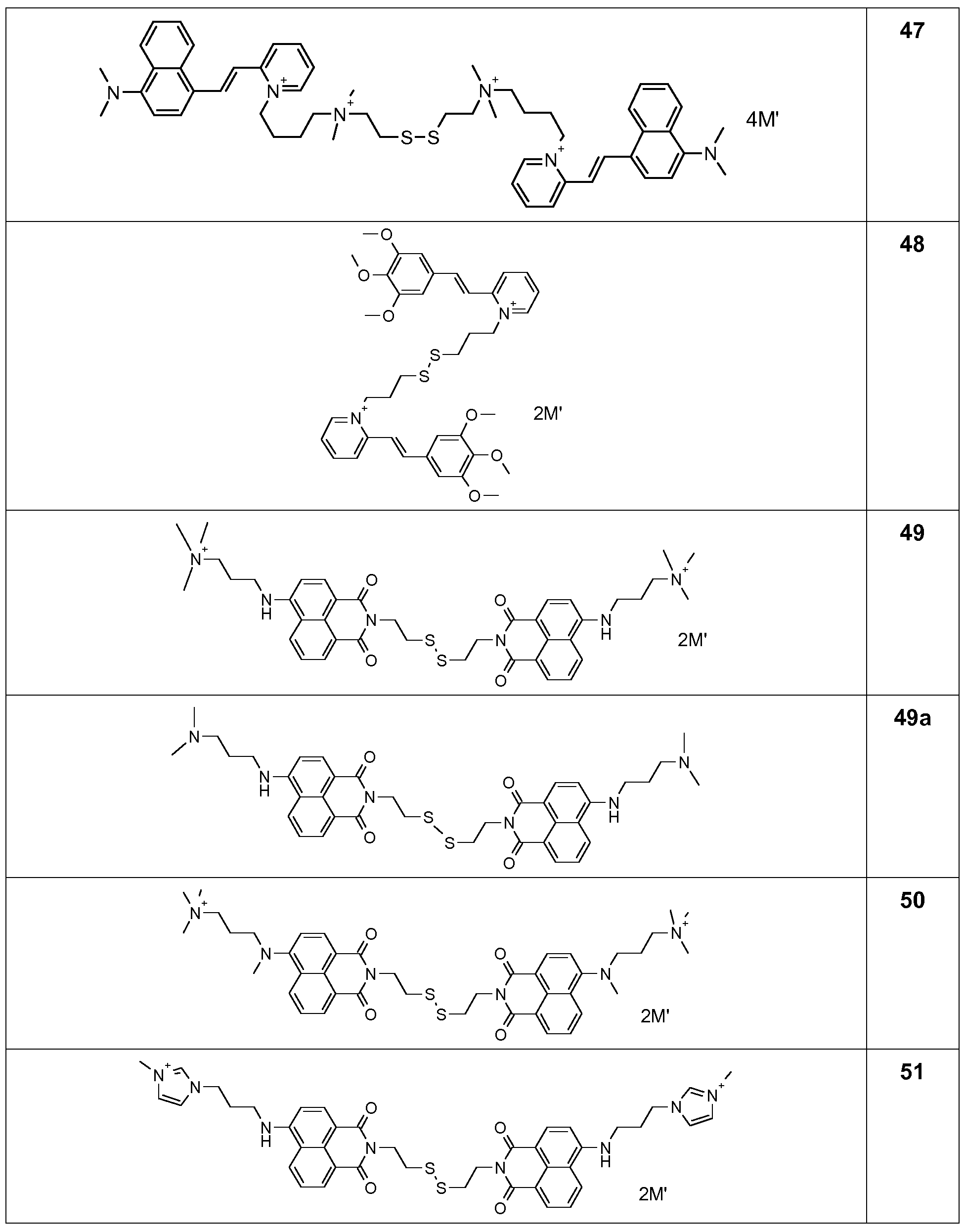


with An" and M', which may be identical or different, preferentially identical, representing anionic counterions. More particularly, the anionic counterion is chosen from halides such as chloride, alkyl sulfates such as methyl sulfate, mesylate and ½ (0=)2S02" or ½ S04 2".
More preferentially, the disulfide, thiol or protected-thiol fluorescent dyes a) as defined previously are chosen from the compounds 31., 44, 49, 49a and 55, 56, 56a in particular 44, and 56, 56a.
According to one particularly advantageous embodiment of the invention, the disulfide, thiol or protected-thiol fluorescent dye(s) a) are a dye comprising a "permanent" cationic charge, i.e. containing in its structure at least one quaternized nitrogen atom (ammonium) or quaternized phosphorus atom (phosphonium); preferentially quaternized nitrogen.
The composition according to the invention contains, in a cosmetic medium, an amount of disulfide, thiol or protected-thiol fluorescent dye(s) as defined previously, in particular of formula (lb) as defined previously, of generally inclusively between 0.001 % and 30% relative to the total weight of the composition which contains it (them).
Preferably, the amount of disulfide, thiol or protected-thiol fluorescent dye(s) as defined previously, in particular of formula (lb), is inclusively between 0.005% and 5% by weight relative to the total weight of the composition. By way of example, the dye(s) is (are) in an amount of inclusively between 0.01 % and 2% relative to the total weight of the composition comprising it (them).
b) Activating agent The process of the invention uses at least one activating agent. The activating agent is a cosmetic composition which comprises i) at least one reducing agent, and ii) at least two alkaline agents that are different from one another. }} ' restlLcjng ^ agent{sl
The reducing agent(s) i) that are useful in the present invention are advantageously chosen from the compounds of formula (i) below, and also the addition salts thereof and mixtures thereof:

in which formula (i):
- X represents P, S or SO2,
- q represents an integer equal to 0 or 1 or 2, preferably 1 or 2, with X = S,
- s represents an integer equal to 0 or 1 ,
- 1 represents an integer equal to 1 or 2, and
- R10 represents a linear or branched, saturated or unsaturated Ci to C20 alkyl radical, optionally interrupted with one or more heteroatoms, and/or optionally substituted with one or more radicals chosen from hydroxyl, halo, amine, carboxyl, ((Ci- C3o)alkoxy)carbonyl, amido, ((Ci-C3o)alkyl)aminocarbonyl, ((Ci-C3o)acyl)amino, mono- or dialkylamino, and mono- or dihydroxylamino radicals.
Preferably, the reducing agent(s) of the invention are thiolated.
More particularly, the reducing agent(s) present in the activating agent(s) used according to the invention are chosen from organic compounds comprising one or more mercapto (-SH or -S-) groups, or disulfide (-S-S-) groups, preferably -SH (thiol) groups,
and at least one other function chosen from carboxylic acid, amine, amide, ester and alcohol functions and mixtures thereof.
According to one particular embodiment of the invention, the reducing agent(s) used in the invention are chosen from those of formulae i-1 and i-2, and also the organic or mineral acid or base salts thereof, optical isomers thereof and tautomers thereof, and the solvates such as hydrates:
R-SH R'-S-R"
i-1 i-2
in which formulae i-1 and i-2:
• R represents:
- a linear or branched (Ci-C8)alkyl, preferably (Ci-Ce)alkyl group which is optionally substituted, preferably substituted, with one or more groups chosen from carboxy
C(0)OH, (di)(Ci-C4)(alkyl)amino, hydroxyl -OH, thiol -SH; and/or optionally interrupted with one or more heteroatoms or groups chosen from -0-, and -S-, -N(R"')-, C(O) or combinations thereof, such as -O-C(O)-, -C(0)-0- -N(R"')-C(0)-, or -C(O)- N(R"')-; with R'" representing a hydrogen atom or a (Ci-Ce)alkyl group; or
- a (hetero)aryl group optionally substituted in particular with one or more hydroxyl, thiol or carboxy groups;
• R' and R", which may be identical or different, represent a (Ci-Cs)alkyl group, preferably (Ci-C6)alkyl group, preferably substituted with one or more groups chosen from hydroxyl, thiol and carboxy;
or else R' and R" form, together with the sulfur atom which bears them, a 5- to 7- membered heterocyclic group, which is preferably saturated, which comprises from 1 to 3 heteroatoms, and which is optionally substituted (in particular with one or more (Ci- Ce)alkyl groups optionally substituted with one or more hydroxyl, thiol or carboxy groups), more preferentially the heterocyclic group is a dithiolane group optionally substituted with a (Ci-Ce)alkyl group optionally substituted with one or more carboxy groups.
According to one particular embodiment of the invention, the reducing agents are of formula i-1 , in particular those for which R represents a linear or branched (Ci-Cs) alkyl group, preferably (C1-C6) alkyl group,
- which is preferably substituted with one or more groups chosen from carboxy C(0)OH, amino, hydroxyl -OH, thiol -SH; and/or
- optionally interrupted with one or more heteroatoms or groups chosen from -0-, - N(R"')-, C(O) or combinations thereof such as -O-C(O)-, -C(0)-0-, -N(R'")-C(0)- or -C(0)-N(R"')-. Preferably, R represents a linear or branched, uninterrupted (Ci- Cs)alkyl group, preferably (Ci-Ce)alkyl group.
According to another particular embodiment of the invention, the reducing agents are of formula i-1 for which R represents:
- a phenyl group optionally substituted with one or more hydroxyl, thiol or carboxy groups; or
- heteroaryl comprising from 5 to 10 ring members, which is preferably bicyclic comprising 9 or 10 ring members, comprising from 1 to 4 heteroatoms chosen from O, S or N, preferably N, optionally substituted with one or more hydroxyl or thiol groups.
According to another particular embodiment of the invention, the reducing agents are of formula i-2, in particular those for which R' and R", which may be identical or different, represent a (Ci-Cs)alkyl group, preferably (Ci-Ce)alkyl group, preferably substituted with one or more groups chosen from hydroxyl, thiol and carboxy.
According to another particular embodiment of the invention, the reducing agents are of formula i-2, in particular those for which R' and R" form, together with the sulfur atom which bears them, a 5- to 7-membered heterocyclic group, which is preferably saturated, which comprises from 1 to 3 heteroatoms, and which is optionally substituted with one or more (Ci-Ce)alkyl groups optionally substituted with one or more hydroxyl, thiol or carboxy groups, more preferentially the heterocyclic group is a dithiolane group optionally substituted with a (Ci-Ce)alkyl group optionally substituted with one or more hydroxyl, thiol or carboxy groups.
Preferably, the reducing agents comprising at least one mercapto or disulfide group of the invention are chosen from thioglycolic acid, thiolactic acid or 2-mercaptopropionic acid, cysteine, cysteamine, homocysteine, glutathione, thioglycerol, thiomalic acid, 3- mercaptopropionic acid, thiodiglycol, 2-mercaptoethanol, dithiothreitol, thioxanthine, thiosalicylic acid, thiodiglycolic acid, lipoic acid, N-acetylcysteine, and thioglycolic or thiolactic acid esters and amides, in particular glyceryl monothioglycolate, salts thereof and mixtures of these compounds.
More particularly, the reducing agents comprising at least one mercapto or disulfide group of the invention are chosen from thioglycolic acid, thiolactic acid or 2- mercaptopropionic acid, cysteine, cysteamine, homocysteine, glutathione, thioglycerol, thiomalic acid, 3-mercaptopropionic acid, thiodiglycol, 2-mercaptoethanol, dithiothreitol, thioxanthine, thiosalicylic acid, thiodiglycolic acid, lipoic acid, N-acetylcysteine, and thioglycolic or thiolactic acid esters and amides, in particular glyceryl monothioglycolate, salts thereof and mixtures of these compounds.
Preferably, the reducing agent(s) according to the invention are chosen from reducing agents comprising at least one -SH (thiol) group, also called thiolated reducing agents.
The thiol reducing agent(s) may be used in particular in the form of salts, in particular alkali metal salts such as sodium and potassium salts, alkaline-earth metal salts, for
example magnesium and calcium salts, ammonium salts, amine salts and amino alcohol salts. Ammonium thioglycolate may thus be used as thiolated reducing agent.
Particularly preferably, the reducing agent(s) i) of the invention are chosen from thioglycolic acid and salts thereof, thiolactic acid and salts thereof, cysteamine and salts thereof, and mixtures thereof.
Even more preferentially, the reducing agent(s) i) of the invention are chosen from thioglycolic acid and thiolactic acid, and salts thereof.
The preferably thiolated reducing agent(s) i) according to the invention are preferably present in an amount ranging from 1 % to 30% by weight, preferably from 5% to 20% by weight and better still from 7% to 15% by weight relative to the total weight of the activating agent b) containing it (them).
HI alk_a_li_n_e agents The dyeing process of the invention uses an activating agent comprising at least two alkaline agents that are different from one another. In other words, the activating agent comprises two or more than two alkaline agents, at least two alkaline agents of which are different: for example, the first may be a mineral alkaline agent such as a mineral bicarbonate or hydroxide and the second may be an organic alkaline agent such as an alkanolamine, or alternatively the two alkaline agents may be mineral alkaline agents, the first being a bicarbonate and the second a mineral hydroxide such as ammonium hydroxide, or alternatively the two alkaline agents may be organic, the first being an alkanolamine and the second a different organic base.
The term "alkaline agent' is intended to mean compounds that make it possible to increase the pH of the composition(s) containing it (them). The alkaline agent is a Bransted, Lowry or Lewis base. It may be mineral or organic. The alkaline agent(s) are chosen from mineral, organic or hybrid alkaline agents.
Preferentially, the pKa values of each alkaline agent are inclusively between 6 and 1 1.5, more particularly between 9.5 and 1 1 , at ambient temperature, said alkaline agent possibly having several pKa values when it comprises several basic functions. Mention may be made, for example, of sodium bicarbonate, which has two pKa values (pKal = 6.33 and pKa2 = 10.33). Thus, preferably, each alkaline agent has one or more pKa values which are inclusively between 6 and 1 1 .5, or better still between 9.5 and 1 1 , i.e. each pKa must preferably be between 6 and 1 1.5, or better still between 9.5 and 1 1 .
The mineral alkaline agent(s) are preferably chosen from alkali metal (bi)carbonates such as ammonium, sodium or potassium carbonates or bicarbonates, and alkali metal hydroxides, alkaline-earth metal hydroxides or ammonium hydroxides, and silicates,
preferably ammonium hydroxides or aqueous ammonia, or sodium or potassium hydroxides.
The term "(bi)carbonates" is intended to mean:
a) carbonates of alkali metals (Met2+, CCV"), of alkaline-earth metals (Met'2+, CO32") of ammonium ((R"4N+)2,C032") or of phosphonium ((R"4P+)2,CC>32" with Met' representing an alkaline-earth metal and Met representing an alkali metal, and R", which may be identical or different, represent a hydrogen atom or an optionally substituted (Ci-Ce)alkyl group such as hydroxyethyl), and
b) bicarbonates, also known as hydrogen carbonates, of the following formulae:
> R'+, HCO3", with R' representing a hydrogen atom, an alkali metal, an ammonium group R"4N+- or a phosphonium group R"4P+-, where R", which may be identical or different, represent a hydrogen atom or an optionally substituted (Ci-Ce)alkyl group, such as hydroxyethyl, and, when R' represents a hydrogen atom, the hydrogen carbonate is then known as dihydrogen carbonate (CO2, H2O); and
> Met'2+ (HCC>3")2 with Met' representing an alkaline-earth metal.
Among the carbonates and bicarbonates that are suitable for use in the present invention, mention may be made of the carbonates and bicarbonates (also known as hydrogen carbonates) of Na, K, Mg and Ca, and mixtures thereof, and in particular Na carbonate and bicarbonate. These bicarbonates may originate from a natural water, for example spring water from the Vichy basin or from La-Roche Posay or Badoit water (cf. for example, patent document FR 2 814 943). Mention may in particular be made of sodium carbonate [497-19-8] = Na2CC>3, sodium hydrogencarbonate or sodium bicarbonate [144- 55-8] = NaHCC>3, and sodium dihydrogencarbonate = Na(HCC>3)2.
The organic alkaline agent(s) of the invention are preferably chosen from organic amines with a pKb at 25°C (pKb = 14 - pKa) of less than 12, preferably less than 10 and even more advantageously less than 6. It should be noted that it is the pKb corresponding to the function of highest basicity. In addition, the organic amines do not comprise any alkyl or alkenyl fatty chain comprising more than ten carbon atoms.
The organic alkaline agent(s) are preferably chosen from alkanolamines, in particular mono-, di- or tri- hydroxy(Ci-C6)alkylamines, such as triethanolamine, oxyethylenated and/or oxypropylenated ethylenediamines, amino acids, polyamines of formula (lb) below, and mixtures thereof:

in which formula (lb):
W is a divalent C1-C6 alkylene radical optionally substituted with one or more hydroxyl groups or a C1-C6 alkyl radical, and/or optionally interrupted with one or more heteroatoms such as O or NRU;
Rx, Ry, Rz, Rt, and Ru which may be identical or different, represent a hydrogen atom, or a C1-C6 alkyl, C1-C6 hydroxyalkyl or C1-C6 aminoalkyl radical.
Examples of amines of formula (lb) that may be mentioned include 1 ,3- diaminopropane, 1 ,3-diamino-2-propanol, spermine and spermidine.
The term "alkanolamine" is intended to mean an organic amine comprising a primary, secondary or tertiary amine function, and one or more linear or branched Ci to Cs alkyl groups bearing one or more hydroxyl radicals.
Organic amines chosen from alkanolamines such as monoalkanolamines, dialkanolamines or trialkanolamines comprising one to three identical or different Ci to C4 hydroxyalkyl radicals are in particular suitable for performing the invention.
Among the compounds of this type, mention may be made of monoethanolamine (MEA), diethanolamine, triethanolamine, monoisopropanolamine, diisopropanolamine, Ν,Ν-dimethylethanolamine, 2-amino-2-methyl-1 -propanol, triisopropanolamine, 2- amino-2-methyl-1 ,3-propanediol, 3-amino-1 ,2-propanediol, 3-dimethylamino-1 ,2- propanediol and tris(hydroxymethyl)aminomethane.
According to one preferred variant of the invention, the amino acids are of natural or synthetic origin, in their L, D or racemic form, and comprise at least one acid functional group chosen more particularly from carboxylic acid, sulfonic acid, phosphonic acid or phosphoric acid functional groups. The amino acids may be in neutral or ionic form. As amino acids that may be used in the present invention, mention may be made in particular of aspartic acid, glutamic acid, alanine, arginine, ornithine, citrulline, asparagine, carnitine, cysteine, glutamine, glycine, histidine, lysine, isoleucine, leucine, methionine, N-phenylalanine, proline, serine, taurine, threonine, tryptophan, tyrosine and valine.
Advantageously, the amino acids are basic amino acids comprising an additional amine function optionally included in a ring or in a ureido function. Such basic amino acids are preferably chosen from those corresponding to formula (lib) below:
R-CH2-CH(NH2)-C(0)-OH,
and also the organic or mineral acid or base salts thereof,
in which formula (lib), R represents a group chosen from imidazolyl, preferably imidazolyl-4-yl; aminopropyl; aminoethyl; -(CH2)2N(H)-C(0)-NH2; and -(CH2)2-N(H)- C(NH)-NH2. The compounds corresponding to formula (lie) are histidine, lysine, arginine, ornithine and citrulline.
The organic amine may also be chosen from organic amines of heterocyclic type. Besides histidine that has already been mentioned in the amino acids, mention may in particular be made of pyridine, piperidine, imidazole, triazole, tetrazole and benzimidazole.
The organic amine may also be chosen from amino acid dipeptides. As amino acid dipeptides that may be used in the present invention, mention may be made especially of carnosine, anserine and balenine.
The organic amine may also be chosen from compounds comprising a guanidine function. As amines of this type that may be used in the present invention, besides arginine, which has already been mentioned as an amino acid, mention may be made in particular of creatine, creatinine, 1 , 1 -dimethylguanidine, 1 , 1 -diethylguanidine, glycocyamine, metformin, agmatine, n-amidinoalanine, 3-guanidinopropionic acid, 4- guanidinobutyric acid and 2-([amino(imino)methyl]amino)ethane-1 -sulfonic acid.
Hybrid compounds that may be mentioned include the salts of the amines mentioned previously with acids such as carbonic acid or hydrochloric acid.
Guanidine carbonate or monoethanolamine hydrochloride may be used in particular. Preferentially, the alkaline agents of the invention are chosen from (bi)carbonates, in particular ammonium bicarbonate, hydroxides, in particular ammonium hydroxide (also called aqueous ammonia), alkanolamines, in particular mono-, di- or tri-hydroxy(Ci- C6)alkylamines, such as monoethanolamine.
The alkaline agent(s) are preferably present in a total amount ranging from 0.5% to 30% by weight, more preferentially from 1 % to 20% by weight and better still from 5% to 15% by weight relative to the total weight of the activating agent b) containing it (them).
In particular, the alkaline agents of the invention are chosen from the following mixtures:
1 ) hydroxide(s) + (bi)carbonate(s), particularly hydroxide(s) + bicarbonate(s), preferably ammonium hydroxide + ammonium bicarbonate;
2) alkanolamine(s) + (bi)carbonate(s), particularly alkanolamine(s) + bicarbonate(s), and preferably monoethanolamine + ammonium bicarbonate.
According to one particular embodiment of the invention, the number by moles of hydroxides, in particular of ammonium hydroxide, contained in the activating agent b) is inclusively between 1 x 10"2 and 10"1 mol, preferably between 2x 10"2 and 7x10"2 mol, preferably between 2.5x10"2 and 4x10"2 mol.
According to one particular embodiment of the invention, the activator comprises a mixture of (bi)carbonate(s) and hydroxide(s), the (mass) weight ratio R of 1 ) (bi)carbonate(s) / hydroxide(s) is greater than or equal to 0.50, preferentially R is greater than or equal to 0.60, more preferentially R is greater than or equal to 0.70, in particular R
is inclusively between 1 and 10, more particularly R is inclusively between 0.60 and 7 and preferentially R is inclusively between 1.50 and 5.50.
According to another particular embodiment of the invention, the activator comprises a mixture of (bi)carbonate(s) and alkanolamine(s), more particularly the weight ratio R' of 2) (bi)carbonate(s) / alkanolamine(s) is greater than or equal to 0.50, preferentially R' is greater than or equal to 0.70, more preferentially R' is greater than or equal to 0.80, in particular R' is inclusively between 0.50 and 10, more particularly R' is inclusively between 0.60 and 7 and preferentially R' is inclusively between 0.70 and 5.
According to one particular embodiment of the invention, the weight ratio </L of the reducing agent(s) / alkaline agent(s) is inclusively between 0.1 and 3.0, preferably between 0.5 and 2.5 and more particularly between 0.7 and 2, or even between 0.8 and 1 .5.
The oxidizing agents c): The process for dyeing keratin fibres and the cosmetic composition according to the present invention may also optionally use, or comprise, one or more oxidizing agents c).
The term "oxidizing agent" is intended to mean a chemical oxidizing agent, i.e. other than atmospheric oxygen.
More particularly, the oxidizing agent(s) c) are chosen from hydrogen peroxide, hydrogen peroxide-generating systems, urea peroxide, alkali metal bromates or ferricyanides, peroxygenated salts, for instance persulfates, perborates, peracids and precursors thereof and percarbonates of alkali metals or alkaline-earth metals, and mixtures thereof.
Preferably, the oxidizing agent(s) c) are chosen from hydrogen peroxide and hydrogen peroxide-generating systems.
According to a preferred embodiment, the hydrogen peroxide-generating system(s) are chosen from urea peroxide, polymeric complexes that can release hydrogen peroxide, chosen from polyvinylpyrrolidone/H2C>2; oxidases; perborates; and percarbonates.
Preferably, the oxidizing agent(s) are hydrogen peroxide, and more preferentially hydrogen peroxide in aqueous solution (aqueous hydrogen peroxide).
The oxidizing agent(s) c) are advantageously applied in the form of an aqueous composition of which the total content of chemical oxidizing agents is preferably between 0.05% and 5% by weight and more preferentially between 0.1 % and 2% by weight, relative to the total weight of the aqueous solution.
According to one embodiment of the invention, the dyeing process does not use a chemical oxidizing agent.
According to one preferred embodiment of the invention, the dyeing process uses one or more chemical oxidizing agent(s).
According to one preferred embodiment of the invention, the cosmetic composition comprising ingredients a) and b) does not comprise any oxidizing agent.
The cosmetic medium and the solvents
The disulfide, thiol or protected-thiol fluorescent direct dye(s) a) as defined previously, the activating agent(s) b) as defined previously and also, when they are present, the oxidizing agent(s) c), may be dissolved beforehand before being applied to the keratin fibres.
In other words, the ingredients used in the dyeing process of the present invention may be present in one or more compositions.
The composition(s) comprising the ingredients according to the present invention are cosmetic compositions, i.e. they are preferably aqueous. Besides water, they may comprise one or more organic solvents, or mixtures thereof.
Examples of organic solvents that may be mentioned include linear or branched C2 to C4 alkanols, such as ethanol and isopropanol; glycerol; polyols and polyol ethers, for instance 2-butoxyethanol, propylene glycol, hexylene glycol, dipropylene glycol, propylene glycol monomethyl ether, diethylene glycol monomethyl ether and monoethyl ether, and also aromatic alcohols or ethers, for instance benzyl alcohol or phenoxyethanol, and mixtures thereof.
The pH
The pH of the composition which comprises the ingredients a) and b) and that of the composition(s) used in the dyeing process of the invention (in particular the composition which comprises the reducing agent(s)) is preferably inclusively between 2 and 12, more preferentially between 7 and 12 and even better still between 8 and 1 1 , such as between 8.5 and 10.5 even more preferentially between 8.7 and 9.5.
Among the acidifying agents, mineral and organic acids as defined previously, mention may be made, by way of example, of mineral or organic acids, for instance hydrochloric acid, orthophosphoric acid or sulfuric acid, carboxylic acids, for instance acetic acid, tartaric acid, citric acid and lactic acid, and sulfonic acids.
Among the alkaline agents, mention may be made of the alkaline agents ii) defined previously.
Forms of the composition
The composition(s) comprising the disulfide, thiol or protected-thiol fluorescent dye(s) a) and/or the activating agent b) as defined previously may be in various presentation forms, such as in the form of liquids, lotions, creams or gels or in any other form that is suitable for dyeing keratin fibres.
It (they) may also be packaged under pressure in an aerosol container in the presence of a propellant or in a non-aerosol container and may form a foam.
Additives When the ingredients used in the dyeing process according to the present invention are present in one or more composition(s), said composition(s) may also optionally comprise one or more additives, different from the ingredients of the invention and among which mention may be made of fatty substances, cationic, anionic, non-ionic, amphoteric or zwitterionic surfactants, cationic, anionic, non-ionic or amphoteric polymers or mixtures thereof, antidandruff agents, anti-seborrhoea agents, agents for preventing hair loss and/or for promoting hair regrowth, vitamins and provitamins including panthenol, sunscreens, mineral or organic pigments, sequestrants, plasticizers, solubilizers, acidifying agents, mineral or organic thickeners, especially polymeric thickeners, opacifiers or nacreous agents, antioxidants, hydroxy acids, fragrances, preservatives, pigments and ceramides.
Needless to say, those skilled in the art will take care to select this or these optional additional compound(s) such that the advantageous properties intrinsically associated with the composition(s) in accordance with the invention are not, or are not substantially, adversely affected by the envisaged addition(s).
The above additives may generally be present in an amount, for each of them, of between 0 and 20% by weight relative to the total weight of the composition comprising them.
The dyeing process
The process for dyeing keratin fibres, in particular human keratin fibres such as the hair, according to the present invention comprises the application to said keratin fibres of the following ingredients:
a) one or more disulfide, thiol or protected-thiol fluorescent dye(s) as defined previously;
b) one or more activating agent(s) comprising:
i) at least one reducing agent as defined previously; and
li) at least two alkaline agents that are different from one another, as defined previously;
it being understood that a) the disulfide, thiol or protected-thiol fluorescent direct dye(s), and b) the activating agent(s) are applied to said keratin fibres jointly.
In other words, the dyeing process according to the present invention may be performed in one or more steps.
According to the process of the invention, the disulfide, thiol or protected-thiol fluorescent direct dye(s) a) as defined previously, and the activating agent(s) b) as defined previously, are applied together (or jointly), that is to say simultaneously, to the keratin fibres. The dyeing process is thus performed in one step.
According to the process of the invention it comprises a step of applying to said keratin fibres a cosmetic composition according to the invention which comprises one or more disulfide, thiol or protected-thiol fluorescent direct dyes a) as defined previously, and the activating agent(s) b) as defined previously.
In one embodiment, the cosmetic composition comprising the disulfide, thiol or protected-thiol fluorescent direct dye(s) a), as defined previously, and the activating agent(s) b), as defined previously, result from the mixing of at least one composition (A) comprising said disulfide, thiol or protected-thiol fluorescent direct dye(s) a) and of at least one composition (B) comprising said activating agent(s) b).
A rinsing step, preferably with water, can be carried out after the step of applying to the keratin fibres the composition comprising a) and b) as defined previously.
Preferably, after the keratin fibres are treated with a) and b) as defined previously , they are rinsed with water.
The keratin fibres, in particular human keratin fibres such as the hair, which are treated with the process of the invention, can also be pretreated with a detergent composition, i.e. a composition comprising at least one anionic and/or amphoteric surfactant.
The clean hair may be wrung out or dry before the application of the dyes a) and the activating agents b).
According to one particular embodiment of the process of the invention, the disulfide, thiol or protected-thiol fluorescent direct dye(s) a), as defined previously, and the activating agent(s) b), as defined previously are applied jointly to the keratin fibres; preferably, the process comprises a step of applying to said keratin fibres a cosmetic composition which comprises one or more disulfide, thiol or protected-thiol fluorescent direct dye(s) a), as defined previously, and i) at least one reducing agent as defined
previously, and ii) at least two alkaline agents that are different from one another, as defined previously.
Preferably, the ingredients a) and b) are applied to the keratin materials in a bath ratio that may range from 0.1 to 10 and more particularly from 1 to 5. For the purposes of the present invention, the term "bath ratio" is intended to mean the ratio between the total weight of composition comprising the ingredient a) and/or b) and the total weight of keratin fibres to be treated.
Ingredients a) and b) are advantageously left to stand on the keratin fibres for a time ranging from 1 to 60 minutes, preferentially greater than 30 minutes and more preferentially for a time ranging from 15 to 45 minutes. When the dyeing process is performed in at least two steps, each of the ingredients a) and b) may be advantageously left in place on the keratin materials for a time ranging from 1 to 60 minutes and more preferentially for a time ranging from 5 to 50 minutes, better still from 10 to 30 minutes. At the end of the dyeing process according to the invention, in one or at least two steps, the keratin fibres are advantageously rinsed with water. They may optionally be washed with a shampoo, followed by rinsing with water, before being dried or left to dry.
The dyeing process according to the present invention may be performed at ambient temperature (25°C) or with heating.
The reducing agent(s) are in a cosmetic composition also referred to as activating agent b) comprising i) at least one reducing agent, preferably one thiolated reducing agent, and ii) at least two alkaline agents that are different from one another; in particular, one of the alkaline agents is a bicarbonate, more particularly an ammonium bicarbonate.
According to one particular embodiment of the invention, the dyeing process implements an additional step, termed fixing step, using a composition comprising one or more oxidizing agents.
When they are present, the oxidizing agent(s) are applied after application of ingredients a) and b).
The dyeing process according to the present invention may be applied to keratin materials which are wet or dry, in particular keratin fibres which are wet or dry, and preferably dry.
According to one particular embodiment of the invention, the process of the invention implements a step of applying to the keratin fibres one or more disulfide, thiol or protected-thiol fluorescent dye(s) a) as defined previously and at least one activator b) as defined previously, i.e. a cosmetic composition preferably comprising as reducing agent i) thioglycolic acid and/or a salt thereof, and at least two alkaline agents that are different from one another ii) as defined previously, including preferably at least one
bicarbonate, followed by a rinsing step, then the application of an oxidizing composition containing at least one oxidizing agent, preferably hydrogen peroxide H2O2 or bromate.
According to another particular embodiment of the invention, the process of the invention implements a step 1 ) of applying at least one activator b) as defined previously, i.e. a cosmetic composition preferably comprising as reducing agent i) thioglycolic acid and/or a salt thereof, then 2) the application of a dye composition comprising one or more disulfide, thiol or protected-thiol fluorescent dye(s) a) as defined previously, then 3) the application of an oxidizing composition containing at least one oxidizing agent, preferably hydrogen peroxide H2O2 or bromate.
According to one particular embodiment of the invention, the dyeing process of the invention is such that, taken together or separately:
(1 ) the activating agent comprises i) at least one reducing agent as defined previously and ii) at least two alkaline agents that are different from one another as defined previously, of which one of the two alkaline agents is a bicarbonate, preferably ammonium bicarbonate;
(2) the leave-on time on the hair (of the mixture) is greater than or equal to 10 minutes;
(3) before application of the mixture, an optional detergent pretreatment with a composition comprising at least one anionic and/or amphoteric surfactant is carried out; the clean hair may be wet or dry before application of the mixture; and
(4) optionally, the process implements a finishing step with a post-treatment as defined previously, preferably hydrogen peroxide or bromate derivative. According to one particular mode of the invention, the process is a dyeing process carried out on bleached keratin fibres in particular with a tone depth of greater than 6, preferably a tone depth of between 7 and 8, more, preferentially between 8 and 9. The colourings obtained are therefore very fast with respect to external agents, in particular with respect to light and shampooing.
In one preferred variant of the invention, the process implements a pre-treatment step with a detergent composition comprising at least one anionic and/or amphoteric surfactant. Preferably, said pre-treatment with the detergent composition is carried out between 1 second and 1 hour, particularly between 1 minute and 30 minutes, more particularly between 5 minutes and 15 minutes, before the application of the ingredients a) and b) as defined previously.
The multi-compartment device
The present invention also relates to a multi-compartment device comprising a first compartment containing one or more disulfide, thiol or protected-thiol fluorescent direct dye(s) a), as defined previously, a second compartment comprising one or more activating agents b) as defined previously, and optionally another compartment comprising one or more oxidizing agents c) as defined previously.
Use
A subject of the present invention is also the use of one or more disulfide, thiol or protected-thiol fluorescent direct dye(s) a) as defined previously, combined with one or more activating agent(s) b) as defined previously, for dyeing keratin fibres, in particular human keratin fibres such as the hair, an intense, chromatic colour and/or with good colour build-up, without using an additional dye different from a).
A subject of the present invention is also the use of one or more thiol or protected- thiol fluorescent direct dye(s) a) as defined previously, combined with one or more activating agent(s) b) as defined previously, for dyeing and/or lightening dark keratin fibres, in particular human keratin fibres such as the hair, with a tone depth of less than 6, preferably less than or equal to 4, without using an additional dye different from a).
A subject of the present invention is also the use of one or more thiol or protected- thiol fluorescent direct dye(s) a) as defined previously, combined with one or more activating agent(s) b) as defined previously, for dyeing bleached keratin fibres, in particular with a tone depth of greater than 6, preferably a tone depth of between 7 and 8, more preferentially between 8 and 9. The colourings obtained on the bleached keratin fibres are particularly fast with respect to external agents such as shampooing or light. The examples that follow serve to illustrate the invention without, however, being limiting in nature.
EXAMPLES
In the examples that follow, all the amounts are given as weight percentages relative to the total wei ht of the com osition, unless otherwise indicated.

Common conditions for all the tests:
- Thermostatted heating bed at 27°C.
- Natural chestnut-brown hair with a tone depth of 4 (TD4).
- Application of the mixture 90% dyeing formula comprising dye A or dye B + 10% activating agent, in a proportion of 5 g of mixture per g of hair.
- Leave-on-time 30 minutes then rinsing.
- Application of the oxidizing composition in a proportion of 5 g of composition per g of hair.
- Leave-on-time 5 minutes then rinsing and drying in the open air or with a hairdryer.
The amounts of the compositions in the tables below are indicated by weight of active material (g per 100 g unless otherwise mentioned).
Activating agents: reducing agent + aqueous ammonia:

Activating agents: reducing agent + alkanolamine: monoethanolamine:

100 100 100 100 100 100 100


The combination according to the invention thus makes it possible to obtain more intense shades, with excellent colour build-up.
Spectrocolorimetric results
The colour of the locks was evaluated in the L*a*b* system, using a Minolta® CM 3600D spectrocolorimeter, (llluminant D65).
In this L*a*b* system, L* represents the lightness, a* indicates the green/red colour axis
and b* indicates the blue/yellow colour axis. The higher the value of L, the lighter or less intense the colour. Conversely, the lower the value of L, the darker or more intense the colour. The higher the value of a*, the redder the shade, and the higher the value of b*, the yellower the shade.
The colour "build-up" also called "uptake" on the hair corresponds to the variation in colouring between the locks of undyed hair and dyed hair and is measured by (ΔΕ*) according to the following equation:
Δ E = (L* - L0 *)2 + (a* - a0 *)2 + (b* - b0 *)2
In this equation, L*, a* and b* represent the values measured after dyeing of the hair, and l_o*, ao* and bo* represent the values measured before dyeing of the hair.
The higher the ΔΕ value, the better the colour build-up of the hair.
The chromaticity is calculated according to the following formula:

The higher the value of the chromaticity C*, the more chromatic the colour of the treated keratin fibres.
EXAMPLE 1 : Composition A with Dye A / activating agent 9 (just 1 alkaline agent = MEA) compared with activating agent 10 (2 alkaline agents = MEA + Ammonium bicarbonate) in an equivalent total molar amount of alkaline agent(s). The application is carried out on TD4 Caucasian hair:


In this comparison, for an identical total alkalinity (in moles), it appears that the colour buildup ΔΕ and the chromaticity C* are significantly higher when an activating agent comprising a reducing agent is applied with two alkaline agents rather than a reducing agent with a single alkaline agent.
EXAMPLE 2: Composition A with Dye A/ activating agent 2 (just 1 alkaline agent = NH4OH) compared with activating agent 3 (2 alkaline agents = NH4OH + Ammonium bicarbonate) in an equivalent total molar amount of alkaline agent(s).
The application is carried out on TD4 Caucasian hair with an acidity pre-treatment on the hair (Simulation sweat, leave-on (acidic) care product) without shampooing pre-treatment.
Mixture L* ΔΕ*
A + 2 comparative 21.42 5.31
A + 3 invention 23.73 7.51
In this comparison, acidity was deposited on the hair in order to simulate sweat (lactic acid) or the presence of a leave-on acidic care product.
No shampooing pre-treatment is carried out.
For an identical total alkalinity (in moles), it appears that the lock appears to be significantly lighter the colour build-up ΔΕ are significantly higher when an activating agent comprising a reducing agent is applied with two alkaline agents rather than a reducing agent with a single alkaline agent. EXAMPLE 3: Composition B with Dye B / activating agent 9 (just 1 alkaline agent = MEA) compared with activating agent 10 (2 alkaline agents = MEA + Ammonium bicarbonate) in an equivalent total molar amount of alkaline agent(s).
The application is carried out on TD4 Caucasian hair with an acidity pre-treatment on the hair (Simulation sweat, leave-on (acidic) care product). The hair is then washed with a shampoo before treatment.

In this comparison, for an identical total alkalinity (in moles), it appears that the colour buildup ΔΕ and the chromaticity C* are significantly higher when an activating agent comprising a reducing agent is applied with two alkaline agents rather than a reducing agent with a single alkaline agent.
EXAMPLE 3: Composition A with dye A / Comparison normal hair compared with hair with acidity in order to simulate sweat (lactic acid) or the presence of a leave-on acidic care product. Application of the same activating agent 12 (2 alkaline agents = MEA + Ammonium bicarbonate).

In this comparison, acidity was deposited on the hair in order to simulate sweat (lactic acid) or the presence of a leave-on acidic care product. A shampooing pre-treatment compared
with no shampooing pre-treatment is carried out with the same activating agent 12.
It appears that the shampooing pre-treatment makes it possible to clearly remove the acidity present on the hair, thereby making it possible to obtain a ΔΕ and a chromaticity C* that are even more improved compared with the process without shampooing pre- treatment on "acidic" hair.
EXAMPLE 4: Composition B with Dye B / Comparison normal hair compared with hair with acidity in order to simulate sweat (lactic acid) or the presence of a leave-on acidic care product. Application of the same activating agent 3 (2 alkaline agents = NH4OH + Ammonium bicarbonate).

In this comparison, acidity was deposited on the hair in order to simulate sweat (lactic acid) or the presence of a leave-on acidic care product. A shampooing pre-treatment compared with no shampooing pre-treatment are carried out with the same activating agent 3.
It appears that the shampooing pre-treatment makes it possible to clearly remove the acidity present on the hair, thereby making it possible to obtain a ΔΕ and a chromaticity C* that are even more improved compared with the process without shampooing pre- treatment on "acidic" hair. EXAMPLE 5: Composition B with Dye B / Comparison normal hair compared with hair with acidity in order to simulate sweat (lactic acid) or the presence of a leave-on acidic care product. Application of the same activating agent 5 (2 alkaline agents = NH4OH + Ammonium bicarbonate).

In this comparison, acidity was deposited on the hair in order to simulate sweat (lactic acid) or the presence of a leave-on acidic care product. A shampooing pre-treatment compared with no shampooing pre-treatment are carried out with the same activating agent 5.
It appears that the shampooing pre-treatment makes it possible to clearly remove the acidity present on the hair, thereby making it possible to obtain a ΔΕ and a chromaticity C* that are even more improved compared with the process without shampooing pre- treatment on "acidic" hair
Comparative tests:
The following compositions were prepared, the amounts are expressed in % by weight. Dyeing composition:

ma = active material
Activator

Method 1 according to the invention (dyeing composition + activator applied jointly) :
- Thermostatted heating bed at 27°C.
- Natural chestnut-brown hair with a "tone depth" also called "tone height" of 4 or (TH4).
- Application of the mixture 90% dyeing composition comprising dye A or dye B or dye C + 10% activating agent, in a proportion of 5 g of mixture per g of hair.
- Leave-on-time 30 minutes then rinsing. pH values for 3 mixtures :

- Thermostatted heating bed at 27°C.
- Natural chestnut-brown hair (TH4).
- Application of activating agent in a proportion of 0.5 g of mixture per g of hair.
- Leave-on-time 10 minutes then rinsing.
- Application of the dyeing composition comprising dye A or dye B or dye C +, in a proportion of 4.5 g of mixture per g of hair
- Leave-on-time 20 minutes then rinsing and drying in the open air or with a hairdryer.
Spectrocolorimetric results buildup (ΔΕ) and chromaticity (C*)
The colour of the locks was evaluated in the L*a*b* system, using a Minolta® CM 2600D spectrocolorimeter, (llluminant D65).

It appears that the process according to the invention makes it possible to obtain a ΔΕ and a chromaticity C* that are significantly improved compared with the comparative process using a sequential application of activator and dyeing composition.
Claims
1. Process for dyeing keratin fibres, in particular human keratin fibres such as the hair, consisting in applying to said fibres:
> a) one or more disulfide, thiol or protected-thiol fluorescent direct dyes;
> b) one or more activating agents comprising:
i) at least one reducing agent; and
ii) at least two alkaline agents that are different from one another;
it being understood that a) the disulfide, thiol or protected-thiol fluorescent direct dye(s), and b) the activating agent(s) are applied to said keratin fibres jointly.
2. Process according to the preceding claim, in which the disulfide, thiol or protected- thiol fluorescent dye(s) a) is (are) chosen from dyes which absorb light in the yellow, orange and red, particularly red, range, preferably in the absorption wavelength λabs inclusively between 400 nm and 500 nm.
3. Process according to either one of the preceding claims, in which the disulfide, thiol or protected-thiol fluorescent dye(s) a) is (are) chosen from those of formula (la): A - (X)p - Csat - S - U and also the organic or mineral acid or base salts thereof, the optical and geometric isomers and tautomers thereof and the solvates thereof such as hydrates, in which formula (la):
> U represents a radical chosen from:
a) - S - Csat - (Χ')ρ· - A'; and
b) - Y;
> A and A', which may be identical or different, represent a radical containing at least one quaternized cationic fluorescent chromophore or at least one fluorescent chromophore bearing a quaternized or quaternizable cationic group;
> Y represents i) a hydrogen atom; or ii) a thiol-function-protecting group, in particular hydrogen;
> X and X', which may be identical or different, represent a linear or branched, saturated or unsaturated divalent C1-C30 hydrocarbon-based chain, optionally interrupted and/or optionally terminated at one or both of its ends with one or more divalent groups or combinations thereof chosen from:
• -N(R)-, -N+(R)(R)-, -0-, -S-, -C(O)-, -S(O)- and -SO2-, with R, which may be identical or different, chosen from a hydrogen and a C1-C4 alkyl, hydroxyalkyl or aminoalkyl radical;
• an aromatic or non-aromatic, saturated or unsaturated, fused or non-fused (hetero)cyclic radical optionally comprising one or more identical or different, optionally substituted heteroatoms;
> p and p', which may be identical or different, are equal to 0 or 1 ;
> Csat and C'sat, which may be identical or different, represent an optionally substituted linear or branched, or cyclic, C1-C18 alkylene chain;
preferably, the dyes (la) are disulfide dyes, i.e. for which U represents the following radical a) -S-C'sat-(X')p— A', and more particularly the dyes of formula (la) are symmetrical i.e. are such that A = A', Csat = C'sat, X = X' and p = p'.
4. Process according to the preceding claim, in which the fluorescent dye(s) of formula (1 a) is (are) dyes which, when p and/or p' is equal to 1 , X and/or X', which may be identical or different, represent the following sequence: -(T)t-(Z)z-(T')t- said sequence being bonded in formula (la) symmetrically as follows: - Csat (or C'Sat)-(T)t-(Z)z-(A or A') in which:
· T and T', which may be identical or different, represent one or more radicals or combinations thereof chosen from: -0-; -S-; -N(R)-; -N+(R)(R°)-; -S(O)-; -S(0)2-; - C(O)-; with R, R°, which may be identical or different, representing a hydrogen atom, a C1-C4 alkyl radical, C1-C4 hydroxyalkyl radical or an aryl(Ci-C4)alkyl radical; and a cationic or non-cationic, preferentially monocyclic heterocycloalkyl or heteroaryl radical, preferentially containing two heteroatoms (more preferentially two nitrogen atoms) and preferentially being 5- to 7-membered, more preferentially imidazolium;
the indices t and t', which may be identical or different, are equal to 0 or 1 ;
• Z represents:
- -(CH2)m- with m an integer between 1 and 8;
- -(ChbChbC q- or -(OCH2CH2)q- in which q is an integer inclusively between 1 and 5;
- an aryl, alkylaryl or arylalkyl radical in which the alkyl radical is C1-C4 and the aryl radical is preferably C6, being optionally substituted with at least one group SO3M with M representing a hydrogen atom, an alkali metal or an ammonium group substituted with one or more identical or different, linear or branched C1-C18 alkyl radicals optionally bearing at least one hydroxyl;
• z is equal to 0 or 1.
5. Process according to either one of Claims 3 and 4, in which the disulfide, thiol or protected-thiol fluorescent dye(s) of formula (la) is (are) such that A and/or A' is (are) chosen from chromophores derived from (poly)methine or naphthalimide fluorescent dyes; and preferably chosen from those:
> of formulae (lib) and (1Mb) below:
W+-[C(Rc)=C(Rd)]m-Ar,-(*) Q Ar-[C(Rd)=C(Rc)]m-W,+-(*) Q
(Ma) (Ilia)
in which formula (Ha) or (Ilia):
• W+ representing a cationic heterocyclic or heteroaryl group, particularly comprising a quaternary ammonium optionally substituted with one or more (Ci-Cs)alkyl groups optionally substituted especially with one or more hydroxyl groups;
• W,+ representing a divalent heterocyclic or heteroaryl radical as defined for W+;
• Ar representing an aryl group such as phenyl or naphthyl, optionally substituted preferentially with i) one or more halogen atoms such as chlorine or fluorine; ii) one or more groups (Ci-C8)alkyl, preferably of C1-C4 such as methyl; iii) one or more hydroxyl groups; iv) one or more (Ci-Cs)alkoxy groups such as methoxy; v) one or more hydroxy(Ci-Cs)alkyl groups such as hydroxyethyl, vi) one or more amino or (di)(Ci-C8)alkylamino groups, preferably with the C1-C4 alkyl part optionally substituted with one or more hydroxyl groups, such as (di)hydroxyethylamino, vii) with one or more acylamino groups; viii) one or more heterocycloalkyl groups such as piperazinyl, piperidinyl or 5- or 6-membered heteroaryl such as pyrrolidinyl, pyridinyl and imidazolinyl, and Ar' is an arylene, i.e. divalent aryl, radical as defined for Ar;
• m' represents an integer inclusively between 1 and 4, and in particular m has the value 1 or 2; more preferentially 1 ;
• Rc, Rd, which may be identical or different, represent a hydrogen atom or an optionally substituted group (Ci-C8)alkyl, preferentially of C1-C4, or alternatively Rc contiguous with W+ or W'+ and/or Rd contiguous with Ar or Ar' form, with the atoms that bear them, a (hetero)cycloalkyl, particularly Rc is contiguous with W+ or W'+ and forms a (hetero)cycloalkyl such as cyclohexyl;
• Q" is an organic or mineral anionic counterion as defined previously;
• (*) represents the part of the chromophore bonded to the rest of formula (la);
preferably, W+ or W'+ is an imidazolium, pyridinium, benzimidazolium, pyrazolium, benzothiazolium or quinolinium radical optionally substituted with one or more identical or different C1-C4 alkyl radicals; preferably, the fluorescent chromophore(s) are chosen from those with m' = 1 , Ar representing a phenyl group substituted para to the styryl group -C(Rd)=C(Rc)- with a (di)(hydroxy)(Ci-C6)(alkyl)amino group such as dihydroxy(Ci-C4)alkylamino, and W'+ representing an imidazolium or pyridinium group, preferably ortho- or para-pyridinium;
> of formula (IVa) or (Va):

which formulae (IVa) and (Va):
Re, Rf, Rg, and Rh, which may be identical or different, represent a hydrogen atom or a C1-C6 alkyl group which is optionally substituted, preferentially with a di(Ci- C6)alkylamino or tri(Ci-C6)alkylammonium group such as trimethylammonium;
^ representing the bond which bonds the naphthalimidyl radical to the rest of the molecule via X or X', if p = 1 or p' = 1 or else via Csat or Csat' if p = 0 or p'=0.
6. Process according to any one of the preceding claims, in which the disulfide, thiol or protected-thiol fluorescent dye(s) a) is (are) chosen from the dyes of formulae (Via) to (X'a) below:


(X'a)
and also the organic or mineral acid or base salts thereof, the optical or geometric isomers thereof, tautomers thereof, and solvates thereof such as the hydrates,
in which formulae (Via) to (X'a):
• G and G', which may be identical or different, represent a group -NRcRd, -NR'cR'd or C1-C6 alkoxy which is optionally substituted, preferentially unsubstituted; preferentially, G and G' represent a group -NRcRd and -NR'cR'd, respectively;
• Ra and R'a, which may be identical or different, represent an aryl(Ci-C4)alkyl group or a C1-C6 alkyl group optionally substituted with a hydroxyl or amino, C1-C4 alkylamino or C1-C4 dialkylamino group, said alkyl radicals possibly forming, with the nitrogen atom that bears them, a 5- to 7-membered heterocycle, optionally comprising another nitrogen or non-nitrogen heteroatom; preferentially, Ra and R'a represent a C1-C3 alkyl group optionally substituted with a hydroxyl group, or a benzyl group;
• Rb and R'b, which may be identical or different, represent a hydrogen atom, an aryl(Ci-C4)alkyl group or a C1-C6 alkyl group that is optionally substituted; preferentially, Rb and R'b represent a hydrogen atom or a C1-C3 alkyl or benzyl group;
• Rc, R'c, Rd and R'd, which may be identical or different, represent a hydrogen atom, an aryl(Ci-C4)alkyl or C1-C6 alkoxy group or a C1-C6 alkyl group that is optionally substituted; Rc, R'c, Rd and R'd preferentially represent a hydrogen atom, a hydroxyl, C1-C3 alkoxy, amino or C1-C3 (di)alkylamino group, or a C1-C3 alkyl group that is optionally substituted with i) a hydroxyl group, ii) amino, iii) C1-C3 (di)alkylamino, or iv) quaternary ammonium (R")(R"')(R"")N+-;
or alternatively two adjacent radicals Rc and Rd, R'c and R'd borne by the same nitrogen atom together form a heterocyclic or heteroaryl group; preferentially, the
heterocycle or heteroaryl is monocyclic and 5- to 7-membered; more preferentially, the groups are chosen from imidazolyl and pyrrolidinyl;
Re and R'e, which may be identical or different, represent a linear or branched Ci- C6 alkylene or C2-C6 alkenylene hydrocarbon-based chain;
Rf and RV, which may be identical or different, represent a group di(Ci- C4)alkylamino, (R")(R"')N- or a quaternary ammonium group (R")(R"')(R"")N+- in which R", R'" and R"", which may be identical or different, represent a hydrogen atom or a C1-C4 alkyl group or alternatively (R")(R"')(R"")N+- represents an optionally substituted cationic heteroaryl group, preferentially an imidazolinium group optionally substituted with a C1-C3 alkyl group;
Rg, R'g, R"g, R"'g, Rh, R'h, R"h, and R'"h, which may be identical or different, represent a hydrogen atom, a halogen atom, an amino, C1-C4 alkylamino, C1-C4 dialkylamino, cyano, carboxyl, hydroxyl or trifluoromethyl group, an acylamino, Ci- C4 alkoxy, (poly)hydroxy(C2-C4)alkoxy, alkylcarbonyloxy, alkoxycarbonyl or alkylcarbonylamino radical, an acylamino, carbamoyl or alkylsulfonylamino radical, an aminosulfonyl radical, or a C1-C16 alkyl radical optionally substituted with a group chosen from C1-C12 alkoxy, hydroxyl, cyano, carboxyl, amino, C1-C4 alkylamino and C1-C4 dialkylamino, or alternatively the two alkyl radicals borne by the nitrogen atom of the amino group form a 5- to 7-membered heterocycle optionally comprising another heteroatom identical to or different from that of the nitrogen atom; preferentially, Rg, R'g, R"g, R'"g, Rh, R'h, R"h, and R"'h represent a hydrogen or halogen atom or a C1-C3 alkyl group;
or alternatively two groups Rg and R'g; R"g and R'"g; Rh and R'h; R"h and R"'h borne by two adjacent carbon atoms together form a benzo or indeno ring, a fused heterocycloalkyi or fused heteroaryl group; the benzo, indeno, heterocycloalkyi or heteroaryl ring being optionally substituted with a halogen atom, an amino, C1-C4 alkylamino, C1-C4 dialkylamino, nitro, cyano, carboxyl, hydroxyl or trifluoromethyl group, an acylamino, C1-C4 alkoxy, (poly)hydroxy(C2-C4)alkoxy, alkylcarbonyloxy, alkoxycarbonyl or alkylcarbonylamino radical, an acylamino, carbamoyl or alkylsulfonylamino radical, an aminosulfonyl radical, or a C1-C16 alkyl radical optionally substituted with: a group chosen from C1-C12 alkoxy, hydroxyl, cyano, carboxyl, amino, C1-C4 alkylamino, C1-C4 dialkylamino, or alternatively the two alkyl radicals borne by the nitrogen atom of the amino group form a 5- to 7-membered heterocycle optionally comprising another heteroatom identical to or different from that of the nitrogen atom; preferentially, Rg and R'g; R"g and R"'g together form a benzo group;
or alternatively two groups R, and Rg; R'" and R'"g; R', and R'h; and/or R" and R"h together form a fused (hetero)cycloalkyl, preferentially cycloalkyl such as cyclohexyl;
or alternatively when G represents -NRcRd and G' represents -NR'cR'd, two groups Rc and R'g; R'c and R"g; Rd and Rg; R'd and R"'g together form a saturated heteroaryl or heterocycle, optionally substituted with one or more C1-C6 alkyl groups, preferentially a 5- to 7-membered heterocycle containing one or two heteroatoms chosen from nitrogen and oxygen; more preferentially the heterocycle is chosen from morpholinyl, piperazinyl, piperidyl and pyrrolidinyl groups;
Ri, R'i, R"i, and R'" , which may be identical or different, represent a hydrogen atom or a C1-C4 alkyl group;
Ri, R2, R3, R4, R'i, R'2, R'3, and R'4, which may be identical or different, represent a hydrogen atom or a C1-C4 alkyl, C1-C12 alkoxy, hydroxyl, cyano, carboxy, amino, C1-C4 alkylamino or C1-C4 dialkylamino group, said alkyl radicals possibly forming, with the nitrogen atom which bears them, a 5- to 7-membered heterocycle optionally comprising another nitrogen or non-nitrogen heteroatom; preferentially, Ri, R2, R3, R4, R'i, R'2, R'3, and R'4 are hydrogen atoms, or a (Ci-C4)alkyl or amino group; more preferentially, Ri, R2, R3, R4, R'i, R'2, R'3, and R'4 represent a hydrogen atom; Ta, and Tb, which may be identical or different, represent i) either a covalent bond s, ii) or one or more radicals or combinations thereof chosen from -SO2-, -0-, -S-, -N(R)-, -N+(R)(R°)- and -CO-, with R and R°, which may be identical or different, representing a hydrogen atom, a C1-C4 alkyl or a C1-C4 hydroxyalkyl radical; or an aryl(Ci-C4)alkyl radical; preferentially, Ta is identical to Tb and they represent a covalent bond s or a group chosen from -N(R)-, -C(0)-N(R)-, -N(R)-C(0)-, -O-C(O)- , -C(0)-0- and -N+(R)(R°)-, with R and R°, which may be identical or different, representing a hydrogen atom or a C1-C4 alkyl group; more preferentially, Ta and Tb represent a bond s; iii) or a cationic or non-cationic, preferentially monocyclic heterocycloalkyl or heteroaryl radical, which are preferentially identical, preferentially containing two heteroatoms (more preferentially two nitrogen atoms) and preferentially being 5- to 7-membered, such as imidazolium; which may be identical or different, represent an optionally substituted group; preferentially, the

heterocycles are identical, monocyclic and saturated, and comprise in total two nitrogen atoms and from 5 to 8 ring members;
represents an aryl or heteroaryl group fused to the imidazolium or phenyl ring; or alternatively is absent from the imidazolium or phenyl ring; preferentially, when the ring is present, the ring is a benzo;
m, m\ n and n', which may be identical or different, represent an integer inclusively between 0 and 6, with m+n and m'+n', which may be identical or different, represent an integer inclusively between 1 and 10; preferentially, m+n = m'+n' = an integer inclusively between 2 and 4; more preferentially, m+n = m'+n' = an integer equal to 2;
Y represents a hydrogen atom, or a group chosen from:
> (Ci-C4)alkylcarbonyl, for instance methylcarbonyl or ethylcarbonyl;
> arylcarbonyl such as phenylcarbonyl;
> (Ci-C4)alkoxycarbonyl;
> aryloxycarbonyl;
> aryl(Ci-C4)alkoxycarbonyl;
> (di)(Ci-C4)(alkyl)aminocarbonyl such as dimethylaminocarbonyl;
> (Ci-C4)(alkyl)arylaminocarbonyl;
> optionally substituted aryl such as phenyl;
> 5- or 6-membered monocyclic heteroaryl such as imidazolyl or pyridyl;
> cationic 5- or 6-membered monocyclic heteroaryl such as pyrylium, pyridinium, pyrimidinium, pyrazinium, pyridazinium, triazinium, imidazolium; these groups being optionally substituted with one or more identical or different (Ci-C4)alkyl groups such as methyl;
> cationic 8- to 1 1 -membered bicyclic heteroaryl such as benzimidazolium or benzoxazolium; these groups being optionally substituted with one or more identical or different (Ci-C4)alkyl groups such as methyl;
> cationic heterocycle having the following formula:

> -C(NH2)=N+H2; An'""; with An'"" being an anionic counterion as defined previously;
> -C(NH2)=NH;
> SO3", M+ with M+ representing an alkali metal such as sodium or potassium; and
• Μ' representing an anionic counterion, derived from a salt of an organic or mineral acid, or from an organic or mineral base that ensures the electrical neutrality of the molecule;
in particular, the disulfide, thiol or protected-thiol fluorescent dye(s) are chosen from the dyes of formulae (Villa), (VIM'a), (IXa) and (IX'a) as defined previously.
7. Process according to any one of the preceding claims, in which the disulfide, thiol or protected-thiol fluorescent dye(s) a) are chosen from the dyes of formula (XVIa) or (XVI""a) below:

and also the organic or mineral acid or base salts thereof, the optical and geometric isomers and tautomers thereof, and the solvates thereof such as hydrates;
in which formula (XVIa) or (XVI""a):
• R'i represents a C1-C4 alkyl group substituted with one or more hydroxyl groups, particularly with only one hydroxyl group, or -C(0)OR' with R' representing a hydrogen atom, a C1-C4 alkyl group or a group -C(0)-0" and, in the latter case, an anionic counterion An" is absent; preferentially, R'i represents a C1-C4 alkyl group substituted with a hydroxyl group;
• R'2 represents a C1-C4 alkyl group optionally substituted with one or more hydroxyl groups, particularly with only one hydroxyl group;
more particularly, R'i and R'2 are identical;
• Ra, Rb and Rc represent a (Ci-Ce)alkyl group such as methyl, they are in particular in positions 3', 4' and 5', or 2', 4' and 5' or 2', 4' and 6', they are preferably in positions 2', 4' and 5',
• An" represents an anionic counterion as defined previously;
• B represent a bond or a divalent amido group -C(0)-N(R)- or -N(R)-C(0)-, with R representing a hydrogen atom or a (Ci-Ce)alkyl group; preferentially, R=H;
• n and m, which may be identical or different, represent an integer inclusively between 1 and 4, preferentially n is equal to 3 and m is equal to 2;
• Y is as defined previously;
it being understood that the bond between the pyridinium ring and the double bond of the ethylene or styryl group is located in position 2 or 4 of the pyridinium, preferentially at 4.
8. Process according to any one of the preceding claims, in which the disulfide, thiol or protected-thiol fluorescent dye(s) is (are) chosen from the dyes having the following


with An" and M', which may be identical or different, preferably identical, representing anionic counterions; in particular, the anionic counterion is chosen from halides such as chloride, alkyl sulfate such as methyl sulfate, mesylate and ½ (0=)2S02" or ½ S04 2", more preferentially, the disulfide, thiol or protected-thiol fluorescent dyes b) as defined previously are chosen from the compounds 31., 44, 49, 49a and 55, 56, 56a, in particular 44, and 56, 56a.
9. Process according to any one of the preceding claims, in which the disulfide, thiol or protected-thiol fluorescent dye(s) are present in a total amount of inclusively between 0.001 % and 30% by weight, preferably between 0.005% and 5% by weight, better still between 0.01 % and 2% relative to the total weight of the composition comprising it (them).
10. Process according to any one of the preceding claims, in which the activating agent(s) comprise i) one or more reducing agents chosen from the compounds of formula (i) below, and also the addition salts thereof and mixtures thereof:

in which formula (i):
- X represents P, S or SO2,
- q represents an integer equal to 0 or 1 or 2, preferably 1 or 2, with X = S,
- s represents an integer equal to 0 or 1 ,
- 1 represents an integer equal to 1 or 2, and
- R10 represents a linear or branched, saturated or unsaturated Ci to C20 alkyl radical, optionally interrupted with a heteroatom, and/or optionally substituted with one or more radicals chosen from hydroxyl, halo, amine, carboxyl, ((Ci-C3o)alkoxy)carbonyl, amido, ((Ci-C3o)alkyl)aminocarbonyl, ((Ci-C3o)acyl)amino, mono- or dialkylamino, and mono- or dihydroxylamino radicals;
in particular are chosen from those of formulae i-1 and i-2, and also the organic or mineral acid or base salts thereof, optical isomers thereof and tautomers thereof, and the solvates such as hydrates:
R-SH R'-S-R"
i-1 i-2
in which formulae i-1 and i-2:
· R represents:
- a linear or branched (Ci-C8)alkyl, preferably (Ci-Ce)alkyl group which is optionally substituted, preferably substituted, with one or more groups chosen from carboxy C(0)OH, (di)(Ci-C4)(alkyl)amino, hydroxyl -OH, thiol -SH; and/or optionally interrupted with one or more heteroatoms or groups chosen from -0-, and -S-, -N(R"')-, C(O) or combinations thereof, such as -O-C(O)-, -C(0)-0- -N(R"')-C(0)-, or -C(O)-
N(R"')-; with R'" representing a hydrogen atom or a (Ci-Ce)alkyl group; or
- a (hetero)aryl group optionally substituted in particular with one or more hydroxyl, thiol or carboxy groups;
• R' and R", which may be identical or different, represent a (Ci-Cs)alkyl group, preferably (Ci-C6)alkyl group, preferably substituted with one or more groups chosen from hydroxyl, thiol and carboxy;
or else R' and R" form, together with the sulfur atom which bears them, a 5- to 7- membered heterocyclic group, which is preferably saturated, which comprises from 1 to 3 heteroatoms, and which is optionally substituted (in particular with one or more (Ci- C6)alkyl groups optionally substituted with one or more hydroxyl, thiol or carboxy
groups), more preferentially the heterocyclic group is a dithiolane group optionally substituted with a (Ci-Ce)alkyl group optionally substituted with one or more carboxy groups, more preferentially the reducing agent(s) are chosen from thiolated reducing agents.
11. Process according to any one of the preceding claims, in which the activating agent(s) comprise i) one or more reducing agents comprising at least one mercapto or disulfide group of the invention, in particular chosen from thioglycolic acid, thiolactic acid or 2-mercaptopropionic acid, cysteine, cysteamine, homocysteine, glutathione, thioglycerol, thiomalic acid, 3-mercaptopropionic acid, thiodiglycol, 2-mercaptoethanol, dithiothreitol, thioxanthine, thiosalicylic acid, thiodiglycolic acid, lipoic acid, N-acetylcysteine, and thioglycolic or thiolactic acid esters and amides, in particular glyceryl monothioglycolate, salts thereof and mixtures of these compounds; more particularly, the reducing agents comprising at least one mercapto or disulfide group of the invention are chosen from thioglycolic acid, thiolactic acid or 2-mercaptopropionic acid, cysteine, cysteamine, homocysteine, glutathione, thioglycerol, thiomalic acid, 3-mercaptopropionic acid, thiodiglycol, 2-mercaptoethanol, dithiothreitol, thioxanthine, thiosalicylic acid, thiodiglycolic acid, lipoic acid, N-acetylcysteine, and thioglycolic or thiolactic acid esters and amides, in particular glyceryl monothioglycolate, salts thereof and mixtures of these compounds; preferably, the reducing agent(s) i) of the invention are chosen from thioglycolic acid and salts thereof, thiolactic acid and salts thereof, cysteamine and salts thereof, and mixtures thereof; more preferentially, the reducing agent(s) i) of the invention are chosen from thioglycolic acid and thiolactic acid, and/or salts thereof.
12. Process according to any one of the preceding claims, in which the activating agent(s) comprise ii) at least two alkaline agents that are different from one another, chosen from (bi)carbonates such as ammonium, sodium or potassium carbonates or bicarbonates, hydroxides such as ammonium, sodium or potassium hydroxides, and silicates, alkanolamines, in particular mono-, di- or tri-hydroxy(Ci-C6)alkylamines such as monoethanolamine, oxyethylenated and/or oxypropylenated ethylenediamines, amino acids, polyamines of formula (lb) below, and mixtures thereof:
N - W - N
R* R< (lb)
in which formula (lb):
W is a divalent C1-C6 alkylene radical optionally substituted with one or more hydroxyl groups or a C1-C6 alkyl radical, and/or optionally interrupted with one or more heteroatoms such as O or NRU;
Rx, Ry, Rz, Rt, and Ru which may be identical or different, represent a hydrogen atom or a C1-C6 alkyl, C1-C6 hydroxyalkyl or C1-C6 aminoalkyl radical;
preferentially, the alkaline agents ii) are chosen from (bi)carbonates, in particular ammonium bicarbonate, hydroxides, in particular ammonium hydroxide, mono-, di- or tri- hydroxy(Ci-C6)alkylamines, such as monoethanolamine.
13. Process according to any one of the preceding claims, in which the alkaline agent(s) are present in a total amount ranging from 0.5% to 30% by weight, more preferentially from 1 % to 20% by weight, better still from 5% to 15% by weight relative to the total weight of the activating agent b) containing it (them).
14. Process according to any one of the preceding claims, in which the activator(s) b) comprise ii) at least two alkaline agents that are different from one another, chosen from the following mixtures:
1 ) hydroxide(s) + (bi)carbonate(s), particularly hydroxide(s) + bicarbonates, preferably ammonium hydroxide + ammonium bicarbonate;
2) alkanolamine(s) + (bi)carbonate(s), particularly alkanolamine(s) + bicarbonate(s), and preferably monoethanolamine + ammonium bicarbonate;
in particular, the number by moles of hydroxides, in particular of ammonium hydroxide, contained in the activating agent b) is inclusively between 1 x 10"2 and 10"1 mol, preferably between 2x 10"2 and 7x10"2 mol, preferably between 2.5* 10"2 and 4x10"2 mol.
15. Process according to the preceding claim, in which the (mass) weight ratio R of 1 ) (bi)carbonate(s) / hydroxide(s) is greater than or equal to 0.50, preferentially R is greater than or equal to 0.60, more preferentially R is greater than or equal to 0.70, in particular R is inclusively between 1 and 10, more particularly R is inclusively between 0.60 and 7 and preferentially R is inclusively between 1 .50 and 5.50; and the weight ratio R' of 2) (bi)carbonate(s) / alkanolamine(s) is greater than or equal to 0.50, preferentially R' is greater than or equal to 0.70, more preferentially R' is greater than or equal to 0.80, in particular R' is inclusively between 0.50 and 10, more particularly R' is inclusively between 0.60 and 7 and preferentially R' is inclusively between 0.70 and 5.
16. Process according to any one of the preceding claims, in which the weight ratio R of the reducing agent(s) / alkaline agent(s) is inclusively between 0.1 and 3.0, preferably between 0.5 and 2.5 and more particularly between 0.7 and 2, or even between 0.8 and 1 .5.
17. Process according to any one of the preceding claims, comprises a step of applying
to the keratin fibres a cosmetic composition which comprises one or more disulfide, thiol or protected-thiol fluorescent dye(s) a), as defined in any one of Claims 1 to 8, one or more reducing agents i), as defined in any one of Claims 1 , 10, 1 1 and 16, and at least two alkaline agents that are different from one another, as defined in any one of Claims 1 and 12 to 16.
18. Process according to any one of the preceding claims, which also comprises the application to said keratin fibres of one or more oxidizing agents applied after application to said keratin fibres of a cosmetic composition comprising one or more disulfide, thiol or protected-thiol fluorescent dyes a), as defined in any one of Claims 1 to 8, and the application to said fibres of an activating agent b) as defined in any one of Claims 1 and 10 to 16.
19. Process according to any one of the preceding claims, in which the keratin fibres, in particular human keratin fibres such as the hair, are pretreated with a detergent composition, i.e. a composition comprising at least one anionic and/or amphoteric surfactant, said pretreatment with the detergent composition preferably being carried out between 1 second and 1 hour, particularly between 1 minute and 30 minutes, more particularly between 5 minutes and 15 minutes, before the application of the ingredients a) and b).
20. Process according to any one of the preceding claims, in which the keratin fibres, in particular human keratin fibres such as the hair, are keratin fibres which are preferably natural keratin fibres with a tone depth of less than or equal to 6, preferably less than or equal to 4.
21. Process according to any one of Claims 1 to 19, in which the keratin fibres, in particular human keratin fibres such as the hair, are bleached keratin fibres, in particular with a tone depth of greater than 6, preferably with a tone depth of between 7 and 8, more preferentially between 8 and 9.
22. Cosmetic composition which comprises one or more disulfide, thiol or protected- thiol fluorescent dye(s) a), as defined in any one of Claims 1 to 8, one or more reducing agents i), as defined in any one of Claims 1 , 10, 1 1 and 16, and at least two alkaline agents that are different from one another, as defined in any one of Claims 1 and 12 to 16, the pH of said composition optionally being inclusively between 7 and 12, preferably between 8 and 1 1 , more preferentially between 8.5 and 10.5, even more preferentially between 8.7 and 9.5.
23. Multi-compartment device comprising a first compartment containing one or more disulfide, thiol or protected-thiol fluorescent dyes a), as defined in any one of Claims 1 to 9, a second compartment containing one or more activating agents b), as defined in any one of Claims 1 and 10 to 16, and optionally another compartment containing one or more oxidizing agents.
24. Use of one or more thiol or protected-thiol fluorescent direct dye(s) a), as defined in any one of Claims 1 to 9, combined with one or more activating agent(s) b), as defined in any one of Claims 1 and 10 to 16, for dyeing and/or lightening dark keratin fibres, in particular human keratin fibres such as the hair, with a tone depth of less than 6, preferably less than or equal to 4, without using an additional dye different from a).
25. Use of one or more thiol or protected-thiol fluorescent direct dye(s) a), as defined in any one of Claims 1 to 9, combined with one or more activating agent(s) b), as defined in any one of Claims 1 and 10 to 16, for dyeing bleached keratin fibres in particular with a tone depth of greater than 6, preferably a tone depth of between 7 and 8, more preferentially between 8 and 9.
Applications Claiming Priority (2)
| Application Number | Priority Date | Filing Date | Title |
|---|---|---|---|
| FR1755481A FR3067598B1 (en) | 2017-06-16 | 2017-06-16 | PROCESS FOR COLORING KERATINIC FIBERS IMPLEMENTING AT LEAST ONE FLUORESCENT DYE DISULPHIDE, THIOL OR PROTECTED THIOL AND AT LEAST ONE ACTIVATOR INCLUDING A REDUCER AND LESS THAN TWO DIFFERENT ALKALINE AGENTS |
| FR1755481 | 2017-06-16 |
Publications (1)
| Publication Number | Publication Date |
|---|---|
| WO2018229294A1 true WO2018229294A1 (en) | 2018-12-20 |
Family
ID=59521107
Family Applications (1)
| Application Number | Title | Priority Date | Filing Date |
|---|---|---|---|
| PCT/EP2018/066112 Ceased WO2018229294A1 (en) | 2017-06-16 | 2018-06-18 | Process for dyeing keratin fibres using at least one disulfide, thiol or protected-thiol fluorescent dye and at least one activator comprising a reducing agent and at least two different alkaline agents |
Country Status (2)
| Country | Link |
|---|---|
| FR (1) | FR3067598B1 (en) |
| WO (1) | WO2018229294A1 (en) |
Cited By (2)
| Publication number | Priority date | Publication date | Assignee | Title |
|---|---|---|---|---|
| KR20230024055A (en) * | 2021-08-11 | 2023-02-20 | 부경대학교 산학협력단 | New compound for targeting glutathione, in vivo fluorescence imaging method and photodynamic therapy |
| US11839673B2 (en) | 2020-08-28 | 2023-12-12 | L'oreal | Compositions, kits, and methods for altering the color of keratinous fibers |
Families Citing this family (1)
| Publication number | Priority date | Publication date | Assignee | Title |
|---|---|---|---|---|
| FR3115206B1 (en) * | 2020-10-16 | 2023-12-15 | Oreal | COMPOSITION FOR MODIFYING THE COLOR OF KERATIN FIBERS |
Citations (21)
| Publication number | Priority date | Publication date | Assignee | Title |
|---|---|---|---|---|
| FR2814943A1 (en) | 2000-10-09 | 2002-04-12 | Oreal | COLORING COMPOSITION, PROCESS FOR OBTAINING AND USE FOR COLORING SKIN AND / OR KERATIN FIBERS |
| WO2005097051A2 (en) | 2004-04-08 | 2005-10-20 | Ciba Specialty Chemicals Holding Inc. | Disulfide dyes, composition comprising them and method of dyeing hair |
| EP1647580A1 (en) | 2004-10-14 | 2006-04-19 | L'oreal | Dying composition comprising a particular disulfide dye and process of dying keratinous fibres with this dye. |
| WO2006136617A2 (en) * | 2005-10-11 | 2006-12-28 | Ciba Specialty Chemicals Holding Inc. | Mixture of sulfide dyes |
| WO2007110540A2 (en) | 2006-03-24 | 2007-10-04 | L'oreal | Dyeing composition containing a thiol/disulphide fluorescent colorant comprising an alkoxy/hydroxy grouping, with an internal cationic charge, and method for lightening keratin materials using said colorant |
| WO2007110539A2 (en) | 2006-03-24 | 2007-10-04 | L'oréal | Dyeing composition containing a thiol/disulphide fluorescent colorant comprising a heterocycle, with an internal cationic charge, and method for lightening keratin materials using said colorant |
| WO2007110538A2 (en) | 2006-03-24 | 2007-10-04 | L'oréal | Dyeing composition containing a masked thiol fluorescent colorant comprising a dimethylamino group, with an internal cationic charge, and method for lightening keratin materials using said colorant and disulphide colorants |
| WO2007110534A2 (en) | 2006-03-24 | 2007-10-04 | L'oréal | Dyeing composition comprising a thiol/disulphide fluorescent colorant having an external cationic charge, and method for lightening keratin materials using said colorant |
| WO2007110537A2 (en) | 2006-03-24 | 2007-10-04 | L'oréal | Dyeing composition containing a thiol/disulphide fluorescent colorant comprising amine groups and having an internal cationic charge, and method for lightening keratin materials using said colorant |
| WO2007110535A2 (en) | 2006-03-24 | 2007-10-04 | L'oréal | Dyeing composition containing a thiol/disulphide fluorescent colorant comprising an ortho-pyridinium group with an interrupted alkylene chain and an external cationic load, and method for lightening keratin materials using said colorant |
| WO2007110531A2 (en) | 2006-03-24 | 2007-10-04 | L'oréal | Dyeing composition containing a thiol/disulphide naphthylimide fluorescent colorant, and method for lightening keratin materials using said colorant |
| WO2007110533A2 (en) | 2006-03-24 | 2007-10-04 | L'oréal | Dyeing composition containing a thiol/disulphide fluorescent colorant having an external cationic charge and an interrupted alkylene chain, and method for lightening keratin materials using said colorant |
| WO2007110532A2 (en) | 2006-03-24 | 2007-10-04 | L'oréal | Dyeing composition containing a thiol/disulphide fluorescent colorant comprising a heterocycle, with an external cationic charge, and method for lightening keratin materials using said colorant |
| WO2007110541A2 (en) | 2006-03-24 | 2007-10-04 | L'oreal | Dyeing composition containing a thiol/disulphide fluorescent colorant comprising a condensed cycle, with an internal cationic charge, and method for lightening keratin materials using said colorant |
| WO2007110536A2 (en) | 2006-03-24 | 2007-10-04 | L'oréal | Dyeing composition containing a thiol/disulphide fluorescent colorant comprising an ortho-pyridinium group with an uninterrupted alkylene chain and an internal cationic charge, and method for lightening keratin materials using said colorant |
| WO2007110542A2 (en) * | 2006-03-24 | 2007-10-04 | L'oreal | Method of dyeing and lightening keratin materials in the presence of a reducing agent comprising a fluorescent disulphide dye |
| WO2009034059A2 (en) | 2007-09-11 | 2009-03-19 | L'oreal | Azo quinolinium compounds comprising a disulphide/thiol unit, compositions containing same, process for dyeing keratin fibres and device |
| WO2009040354A1 (en) | 2007-09-24 | 2009-04-02 | L'oreal | Dye composition comprising at least one colorless disulfide/thiol precursor, and dyeing process using the composition |
| EP2070988A2 (en) | 2007-09-21 | 2009-06-17 | L'Oréal | Styryl thiol/disulfide compound with a hydroxy(cyclo)alkylamino unit, process for lightening keratin materials using this dye |
| EP2075289A1 (en) | 2007-09-21 | 2009-07-01 | L'Oréal | Styryl tetrahydroquinolinium thiol/disulfide compound, process for lightening keratin materials using this dye |
| FR2971935A1 (en) * | 2011-02-25 | 2012-08-31 | Oreal | COMPOSITION FOR COLORING KERATIN FIBERS COMPRISING A DIRECT DYE WITH DISULFURE / THIOL FUNCTION, A THICKENING POLYMER, A NON-IONIC SURFACTANT, AN ALKALI AGENT, AND A REDUCING AGENT |
-
2017
- 2017-06-16 FR FR1755481A patent/FR3067598B1/en not_active Expired - Fee Related
-
2018
- 2018-06-18 WO PCT/EP2018/066112 patent/WO2018229294A1/en not_active Ceased
Patent Citations (22)
| Publication number | Priority date | Publication date | Assignee | Title |
|---|---|---|---|---|
| FR2814943A1 (en) | 2000-10-09 | 2002-04-12 | Oreal | COLORING COMPOSITION, PROCESS FOR OBTAINING AND USE FOR COLORING SKIN AND / OR KERATIN FIBERS |
| WO2005097051A2 (en) | 2004-04-08 | 2005-10-20 | Ciba Specialty Chemicals Holding Inc. | Disulfide dyes, composition comprising them and method of dyeing hair |
| EP1647580A1 (en) | 2004-10-14 | 2006-04-19 | L'oreal | Dying composition comprising a particular disulfide dye and process of dying keratinous fibres with this dye. |
| WO2006136617A2 (en) * | 2005-10-11 | 2006-12-28 | Ciba Specialty Chemicals Holding Inc. | Mixture of sulfide dyes |
| WO2007110531A2 (en) | 2006-03-24 | 2007-10-04 | L'oréal | Dyeing composition containing a thiol/disulphide naphthylimide fluorescent colorant, and method for lightening keratin materials using said colorant |
| WO2007110541A2 (en) | 2006-03-24 | 2007-10-04 | L'oreal | Dyeing composition containing a thiol/disulphide fluorescent colorant comprising a condensed cycle, with an internal cationic charge, and method for lightening keratin materials using said colorant |
| WO2007110538A2 (en) | 2006-03-24 | 2007-10-04 | L'oréal | Dyeing composition containing a masked thiol fluorescent colorant comprising a dimethylamino group, with an internal cationic charge, and method for lightening keratin materials using said colorant and disulphide colorants |
| WO2007110534A2 (en) | 2006-03-24 | 2007-10-04 | L'oréal | Dyeing composition comprising a thiol/disulphide fluorescent colorant having an external cationic charge, and method for lightening keratin materials using said colorant |
| WO2007110537A2 (en) | 2006-03-24 | 2007-10-04 | L'oréal | Dyeing composition containing a thiol/disulphide fluorescent colorant comprising amine groups and having an internal cationic charge, and method for lightening keratin materials using said colorant |
| WO2007110535A2 (en) | 2006-03-24 | 2007-10-04 | L'oréal | Dyeing composition containing a thiol/disulphide fluorescent colorant comprising an ortho-pyridinium group with an interrupted alkylene chain and an external cationic load, and method for lightening keratin materials using said colorant |
| WO2007110540A2 (en) | 2006-03-24 | 2007-10-04 | L'oreal | Dyeing composition containing a thiol/disulphide fluorescent colorant comprising an alkoxy/hydroxy grouping, with an internal cationic charge, and method for lightening keratin materials using said colorant |
| WO2007110533A2 (en) | 2006-03-24 | 2007-10-04 | L'oréal | Dyeing composition containing a thiol/disulphide fluorescent colorant having an external cationic charge and an interrupted alkylene chain, and method for lightening keratin materials using said colorant |
| WO2007110532A2 (en) | 2006-03-24 | 2007-10-04 | L'oréal | Dyeing composition containing a thiol/disulphide fluorescent colorant comprising a heterocycle, with an external cationic charge, and method for lightening keratin materials using said colorant |
| WO2007110539A2 (en) | 2006-03-24 | 2007-10-04 | L'oréal | Dyeing composition containing a thiol/disulphide fluorescent colorant comprising a heterocycle, with an internal cationic charge, and method for lightening keratin materials using said colorant |
| WO2007110536A2 (en) | 2006-03-24 | 2007-10-04 | L'oréal | Dyeing composition containing a thiol/disulphide fluorescent colorant comprising an ortho-pyridinium group with an uninterrupted alkylene chain and an internal cationic charge, and method for lightening keratin materials using said colorant |
| WO2007110542A2 (en) * | 2006-03-24 | 2007-10-04 | L'oreal | Method of dyeing and lightening keratin materials in the presence of a reducing agent comprising a fluorescent disulphide dye |
| EP2004759A2 (en) | 2006-03-24 | 2008-12-24 | L'Oréal | Method of dyeing and lightening keratin materials in the presence of a reducing agent comprising a fluorescent disulphide dye |
| WO2009034059A2 (en) | 2007-09-11 | 2009-03-19 | L'oreal | Azo quinolinium compounds comprising a disulphide/thiol unit, compositions containing same, process for dyeing keratin fibres and device |
| EP2070988A2 (en) | 2007-09-21 | 2009-06-17 | L'Oréal | Styryl thiol/disulfide compound with a hydroxy(cyclo)alkylamino unit, process for lightening keratin materials using this dye |
| EP2075289A1 (en) | 2007-09-21 | 2009-07-01 | L'Oréal | Styryl tetrahydroquinolinium thiol/disulfide compound, process for lightening keratin materials using this dye |
| WO2009040354A1 (en) | 2007-09-24 | 2009-04-02 | L'oreal | Dye composition comprising at least one colorless disulfide/thiol precursor, and dyeing process using the composition |
| FR2971935A1 (en) * | 2011-02-25 | 2012-08-31 | Oreal | COMPOSITION FOR COLORING KERATIN FIBERS COMPRISING A DIRECT DYE WITH DISULFURE / THIOL FUNCTION, A THICKENING POLYMER, A NON-IONIC SURFACTANT, AN ALKALI AGENT, AND A REDUCING AGENT |
Non-Patent Citations (5)
| Title |
|---|
| "Ullmann's Encyclopedia", 2005, WILEY-VCH VERLAG GMBH & CO. KGAA, article "Peptide Synthesis", pages: 4 - 5 |
| "Ullmann's Encyclopedia, Peptide Synthesis", 2005, WILEY-VCH VERLAG GMBH & CO. KGAA, pages: 4 - 5 |
| P. KOCIENSKI: "Protecting Groups, 3rd ed.,", 2005, THIEME |
| T. W. GREENE: "Protective Groups in Organic Synthesis", 1981, JOHN WILEY & SONS, pages: 193 - 217 |
| T.W. GREENE: "Protective Groups in Organic Synthesis", 1981, pages: 193 - 217 |
Cited By (3)
| Publication number | Priority date | Publication date | Assignee | Title |
|---|---|---|---|---|
| US11839673B2 (en) | 2020-08-28 | 2023-12-12 | L'oreal | Compositions, kits, and methods for altering the color of keratinous fibers |
| KR20230024055A (en) * | 2021-08-11 | 2023-02-20 | 부경대학교 산학협력단 | New compound for targeting glutathione, in vivo fluorescence imaging method and photodynamic therapy |
| KR102752373B1 (en) | 2021-08-11 | 2025-01-10 | 국립부경대학교 산학협력단 | New compound for targeting glutathione, in vivo fluorescence imaging method and photodynamic therapy |
Also Published As
| Publication number | Publication date |
|---|---|
| FR3067598B1 (en) | 2020-09-11 |
| FR3067598A1 (en) | 2018-12-21 |
Similar Documents
| Publication | Publication Date | Title |
|---|---|---|
| ES2532278T3 (en) | Compound of styryl with hydroxy (cyclo) alkylamino thiol / disulfide unit, rinse process of keratin materials from this dye | |
| ES2363100T3 (en) | STAINING COMPOSITION CONTAINING A THIOL / DISULFIDE FLUORESCENT DYE WITH AMINATED GROUPS AND WITH INTERNAL CATIONIC CHARGE AND LIGHTENING PROCEDURE OF KERATINAL MATTERS FROM THIS COLORANT. | |
| EP3558254B1 (en) | Process for dyeing keratin fibres using at least one particular 2- or 4-azopyridinium dye and at least one fluorescent dye | |
| US11278482B2 (en) | Process for dyeing keratin materials using at least one blue, purple or green dye and at least one disulfide, thiol or protected thiol fluorescent dye | |
| WO2018229294A1 (en) | Process for dyeing keratin fibres using at least one disulfide, thiol or protected-thiol fluorescent dye and at least one activator comprising a reducing agent and at least two different alkaline agents | |
| US10980729B2 (en) | Process for dyeing keratin fibres using at least one particular azinium dye and at least one fluorescent dye | |
| US10959930B2 (en) | Process for dyeing keratin fibres using at least one particular triarylmethane dye and at least one fluorescent dye | |
| EP3558235A1 (en) | Use of anthraquinone dyes and of fluorescent dyes for dyeing keratin fibres, dyeing process and composition | |
| US11096880B2 (en) | Process for dyeing keratin fibres using at least one direct dye and at least one disulfide, thiol or protected-thiol fluorescent dye | |
| EP3558242A1 (en) | Process for dyeing keratin fibres using at least one particular 2-azo(benz)imidazolium dye and at least one fluorescent dye | |
| ES2463687T3 (en) | Dye composition comprising a thiol / disulfide fluorescent dye with interrupted alkylene chain ortho-pyridinium group and with internal cationic charge, method of clearing keratin materials from this dye | |
| FR3067601A1 (en) | PROCESS FOR COLORING KERATINIC MATERIALS USING AT LEAST ONE AUTO-OXIDABLE OR COLORING COLOR OF BLUE, VIOLET OR GREEN OXIDATION AND AT LEAST ONE FLUORESCENT COLOR |
Legal Events
| Date | Code | Title | Description |
|---|---|---|---|
| 121 | Ep: the epo has been informed by wipo that ep was designated in this application |
Ref document number: 18732332 Country of ref document: EP Kind code of ref document: A1 |
|
| NENP | Non-entry into the national phase |
Ref country code: DE |
|
| 122 | Ep: pct application non-entry in european phase |
Ref document number: 18732332 Country of ref document: EP Kind code of ref document: A1 |