WO2018209874A1 - 利用氮掺杂二氧化钛强化藻类混凝同时在可见光下降解含藻底泥的方法 - Google Patents
利用氮掺杂二氧化钛强化藻类混凝同时在可见光下降解含藻底泥的方法 Download PDFInfo
- Publication number
- WO2018209874A1 WO2018209874A1 PCT/CN2017/104482 CN2017104482W WO2018209874A1 WO 2018209874 A1 WO2018209874 A1 WO 2018209874A1 CN 2017104482 W CN2017104482 W CN 2017104482W WO 2018209874 A1 WO2018209874 A1 WO 2018209874A1
- Authority
- WO
- WIPO (PCT)
- Prior art keywords
- algae
- weight
- parts
- tio
- powder
- Prior art date
- Legal status (The legal status is an assumption and is not a legal conclusion. Google has not performed a legal analysis and makes no representation as to the accuracy of the status listed.)
- Ceased
Links
Images
Classifications
-
- C—CHEMISTRY; METALLURGY
- C02—TREATMENT OF WATER, WASTE WATER, SEWAGE, OR SLUDGE
- C02F—TREATMENT OF WATER, WASTE WATER, SEWAGE, OR SLUDGE
- C02F1/00—Treatment of water, waste water, or sewage
- C02F1/52—Treatment of water, waste water, or sewage by flocculation or precipitation of suspended impurities
- C02F1/5236—Treatment of water, waste water, or sewage by flocculation or precipitation of suspended impurities using inorganic agents
-
- C—CHEMISTRY; METALLURGY
- C02—TREATMENT OF WATER, WASTE WATER, SEWAGE, OR SLUDGE
- C02F—TREATMENT OF WATER, WASTE WATER, SEWAGE, OR SLUDGE
- C02F11/00—Treatment of sludge; Devices therefor
-
- C—CHEMISTRY; METALLURGY
- C02—TREATMENT OF WATER, WASTE WATER, SEWAGE, OR SLUDGE
- C02F—TREATMENT OF WATER, WASTE WATER, SEWAGE, OR SLUDGE
- C02F2103/00—Nature of the water, waste water, sewage or sludge to be treated
- C02F2103/007—Contaminated open waterways, rivers, lakes or ponds
Definitions
- the invention relates to the field of drinking water treatment, in particular to a method for strengthening algae coagulation by nitrogen-doped titanium dioxide (N-TiO 2 ) while degrading algae-containing mud under visible light.
- N-TiO 2 nitrogen-doped titanium dioxide
- the removal of algae mainly depends on the coagulation process.
- the algae have a certain floating property, the flocs produced thereof are not easy to settle, thereby reducing the removal efficiency of the algae and increasing the burden of the subsequent treatment process.
- the technical problem to be solved by the present invention is to provide an algae removal method for improving the efficiency of coagulation and algae removal, and at the same time, degrading the algae-containing mud under visible light and detoxifying the discharged mud water.
- the present invention provides the following technical solutions:
- the present invention provides a method for simultaneously treating algae in a body of water and sediment, comprising the steps of:
- Step (1) adding a algaecide coagulant to the algae-containing water to stir to complete coagulation;
- the algaecide coagulant is composed of the following parts by weight: 50-400 parts by weight of N-TiO 2 powder, 7.5 parts by weight of polyaluminum ferric chloride;
- Step (2) after standing to precipitate, the algae-containing floc is sedimented to the bottom, and the algae in the supernatant is removed;
- Step (3) Discard the supernatant, leave the bottom containing algae sediment, place it under visible light and stir. After a certain time, the algae and algal toxin are degraded.
- the N-TiO 2 powder is prepared by the following method: 12-18 parts by weight of butyl titanate, 18-22 parts by weight of absolute ethanol, 0.05-0.5 parts by weight of urea and 28-35 weight
- the diluted dilute nitric acid solution is heated at 80 to 100 ° C for 3 to 5 hours, and then calcined at 400 ° C to 500 ° C for 3 to 5 hours, and the obtained white powder is N-TiO 2 .
- the N-TiO 2 powder and the polyaluminum ferric chloride are weighed according to the set weight, and the algae coagulant is obtained after being uniformly mixed.
- the present invention has the following beneficial effects:
- the algaecide coagulant is compounded with N-TiO 2 powder and polyaluminum ferric chloride, and the amount of the polyaluminum ferric chloride coagulant used alone is reduced by 50%, which significantly reduces the mixing.
- the amount of coagulant used increases the algae removal efficiency.
- the N-TiO 2 powder has little impact on the environment and does not cause secondary pollution to the water body.
- the reduction of the amount of the coagulant also reduces the content of heavy metals in the water body, avoids heavy metal pollution, and further improves the water quality.
- the N-TiO 2 powder settles into the sediment with the algae-containing floc, and the algae-containing mud is subjected to visible light irradiation while stirring, and all algae can be degraded and destroyed in 12 hours, and the algae released in the algae within 48 hours.
- the degradation rate of toxins is over 85%. Reduced sediment volume and improved muddy water quality for safe discharge or further recycling.
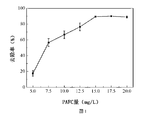
- FIG 1 shows the effect of different doses of PAFC on algae removal.
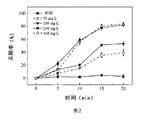
- Figure 2 shows the algae removal rate of the coagulant formulated with PAFC and PAFC and different concentrations of N-TiO 2 powder during coagulation.
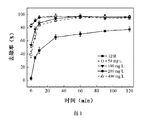
- Figure 3 shows the algae removal rate of floc sedimentation process of coagulant formulated with PAFC and PAFC and different concentrations of N-TiO 2 powder.
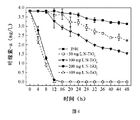
- Figure 4 shows the changes of chlorophyll in different concentrations of N-TiO 2 powder during degradation of algae-containing mud under visible light.
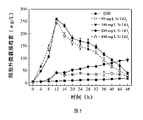
- Figure 5 shows the changes of microcystins (MCs) during the degradation of algae-containing sludge under visible light with different concentrations of N-TiO 2 powder.
- the algae removal rate, the algal cell degradation rate, and the microcapsule toxin (MCs) degradation rate are calculated as follows:
- Algae removal rate (%) (experimental water source OD 680 - supernatant OD 680 ) ⁇ 100% / experimental water source OD 680 ;
- Algae cell degradation rate (%) (0h contains algae sediment chlorophyll content - measured time point contains algae sediment chlorophyll content) ⁇ 100% / 0h containing algae sediment chlorophyll content;
- Microcystins degradation rate (%) (microcystin content in the complete rupture of algae cells in algae sediments - microcystin content in algae sediment at the time point measured) ⁇ 100% / algae-containing sediment Microcystin content when the algae cells are completely ruptured.
- the present invention provides a simultaneous treatment of water and sediment.
- the method of algae includes the following steps:
- Step (1) adding a algaecide coagulant to the algae-containing water to stir to complete coagulation;
- the algaecide coagulant comprises the following components by weight: 50-400 parts by weight of N-TiO 2 powder, 7.5 parts by weight of polyaluminum ferric chloride;
- Step (2) after standing to precipitate, the algae-containing floc is sedimented to the bottom, and the algae in the supernatant is removed;
- Step (3) Discard the supernatant, leave the bottom containing algae sediment, place it under visible light and stir. After a certain period of time (12-48h), the algae and algal toxin are degraded.
- the above-mentioned algaecide coagulant is composed of the following parts by weight: 200 to 250 parts by weight of N-TiO 2 powder, 7.5 parts by weight of polymerization.
- Aluminum iron chloride is a preferred embodiment of the present invention.
- the above-described algaecide coagulant is composed of the following parts by weight: 200 parts by weight of N-TiO 2 powder, and 7.5 parts by weight of polyaluminum ferric chloride.
- the N-TiO 2 powder is prepared by the following method: 12-18 parts by weight of butyl titanate, 18-22 parts by weight of absolute ethanol, 0.05-0.5 parts by weight of urea and 28-35 weight
- the diluted dilute nitric acid solution is heated at 80 to 100 ° C for 3 to 5 hours, and then calcined at 400 ° C to 500 ° C for 3 to 5 hours, and the obtained white powder is N-TiO 2 .
- the N-TiO 2 powder is prepared by the following method:
- the N-TiO 2 powder has a particle diameter of 50 to 150 mesh; more preferably, the N-TiO 2 powder has a particle diameter of 100 mesh.
- the N-TiO 2 powder and the polyaluminum ferric chloride are weighed according to the set weight, and the algae coagulant is obtained after being uniformly mixed.
- the density of the algae-containing water is 10 5 to 10 7 cells/mL
- the stirring condition is 150 to 250 rpm, stirring for 1 to 2 minutes, and stirring at 30 to 60 rpm for 10 to 20 minutes.
- the dose of coagulant PAFC was 7.5 mg/L for a semi-optimal dose (15 mg/L without N-TiO 2 ) and 50-400 mg/L for N-TiO 2 .
- the PAFC and N-TiO 2 are put into the algae-containing water and rapidly stirred to rapidly disperse to form fine scented flowers. At this time, the water body becomes more turbid, so that the water flow can generate intense turbulence, and in the flocculation stage, the process of sputum flower grows thicker. Appropriate turbulence and sufficient residence time (10-20 min) are required. At the later stage, a large amount of alfalfa accumulation can be observed to rely on gravity to sink slowly.
- the OD 680 value of the supernatant (2 cm below the liquid surface) was measured, and the sedimentation of the flocs during the coagulation process was investigated.
- the standing time is 10 to 60 minutes.
- the sedimentation stage a large number of coarse alfalfa flowers are deposited, and the upper layer of water is clarified water.
- the remaining small-sized and low-density alfalfa flowers slowly descend while continuing to collide with each other, and the residual turbidity remains basically unchanged.
- the OD 680 value of the supernatant turbidity during the sedimentation process was determined, and the time required for complete flotation of the flocs was examined.
- Algae cells in water usually have a large number, a small specific gravity, and a high negative charge on the surface, which is difficult to remove.
- the flocs formed by the algae cells have a certain floating property, making it difficult to settle and reducing the algae removal efficiency.
- Polyaluminum ferric chloride is a highly efficient inorganic polymer coagulant. When an appropriate amount of N-TiO 2 powder is added during the coagulation process, N-TiO 2 can be used as a micro-floc produced by the coagulant.
- the core combined with the polyaluminum ferric chloride, utilizes the sediment trapping mechanism, electric neutralization and bridging to make the algae cells formed by coagulation rapid and rapid sedimentation, and the effect of removing algae is good.
- the discarded supernatant liquid accounts for 93% to 97% of the total volume, the light intensity is 3000 to 15000 Lux, and the stirring speed is 200 to 800 rpm.
- TiO 2 semiconductors have become the most widely used photocatalysts due to their non-toxicity, low cost, stable performance and corrosion resistance.
- the titanium dioxide photocatalyst has some limitations: due to its band gap of 3.2 eV, narrow light absorption band (mainly in the ultraviolet region), low solar light utilization efficiency; semiconductor carrier High compounding rate and low quantum efficiency.
- the introduction of the non-metallic element N can enlarge the photo-response range of TiO 2 , thereby increasing its photocatalytic activity in the visible light region. Therefore, N-TiO 2 can efficiently degrade algae, algal toxins, and intracellular extracellular organisms under visible light.
- the dosage of N-TiO 2 powder is 50 ⁇ 400mg / L
- the mixed dosage of polyaluminium ferric chloride is 7.5mg / L of semi-optimal dose (not added
- the optimal dosage of N-TiO 2 is 15mg/L
- the algae removal rate can reach over 96%
- the algae removal rate is good.
- all the algae were degraded and ruptured within 12 hours. Within 48 hours, the degradation rate of algae released by algae reached more than 85%.
- the algaecide coagulant is composed of the following parts by weight: 50 parts by weight of N-TiO 2 powder (particle size of 100 mesh) and 7.5 parts by weight of polyaluminum ferric chloride.
- the Microcystisaeruginosa used in the experiment was cultured in BG11 medium at a temperature of 25 ° C for 12 hours, dark for 12 hours, and light intensity of 2000 lux, and cultured to a logarithmic growth stage for preparation of an experimental algae-containing water source.
- the volume of the treated water sample is 1L, and weigh 50mg of N-TiO 2 powder and 7.5mg of polyaluminum chloride.
- stir at 250 rpm for 1 min stir at 250 rpm for 1 min, and slowly stir at 30 rpm for 30 min to complete the coagulation process.
- the supernatant at 2 cm below the liquid surface was taken within 2 h after the coagulation process and coagulation, and the absorbance at 680 nm (OD 680 ) was measured.
- the algae removal rate reached the maximum 1 h after the completion of coagulation. , for 96%. See Figures 2 and 3.
- the algae-containing floc settles, the supernatant is discarded, and the remaining part is the algae-containing mud, which accounts for about 7% of the original volume.
- the algae-containing mud was placed under visible light of 8000 lux and stirred at 500 rpm. After 48 hours, 41.6% of the algae cells were degraded, and some microcystins were also present in the algae cells. See Figures 4 and 5.
- the algaecide coagulant is composed of the following parts by weight: 100 parts by weight of N-TiO 2 powder (particle size of 100 mesh) and 7.5 parts by weight of polyaluminum ferric chloride.
- the Microcystisaeruginosa used in the experiment was cultured in BG11 medium at a temperature of 25 ° C for 12 hours, dark for 12 hours, and light intensity of 2000 lux, and cultured to a logarithmic growth stage for preparation of an experimental algae-containing water source.
- the volume of the treated water sample is 1L, and weigh 100mg of N-TiO 2 powder and 7.5mg of polyaluminum chloride.
- stir at 250 rpm for 1 min stir at 250 rpm for 1 min, and slowly stir at 30 rpm for 30 min to complete the coagulation process.
- the supernatant at 2 cm below the liquid surface was taken within 2 h after the coagulation process and coagulation, and the absorbance at 680 nm (OD 680 ) was measured.
- the algae removal rate reached the maximum 1 h after the completion of coagulation. , for 97%. See Figures 2 and 3.
- the algae-containing floc settles, the supernatant is discarded, and the remaining part is the algae-containing mud, which accounts for about 7% of the original volume.
- the algae-containing mud was placed under visible light of 8000 lux and stirred at 500 rpm. After 48 hours, 59.9% of the algae cells were degraded, and some microcystins were also present in the algae cells. See Figures 4 and 5.
- the algaecide coagulant is composed of the following parts by weight: 200 parts by weight of N-TiO 2 powder (particle size of 100 mesh) and 7.5 parts by weight of polyaluminum ferric chloride.
- the Microcystisaeruginosa used in the experiment was cultured in BG11 medium at a temperature of 25 ° C for 12 hours, dark for 12 hours, and light intensity of 2000 lux, and cultured to a logarithmic growth stage for preparation of an experimental algae-containing water source.
- the volume of the treated water sample is 1L, and weigh 200mg of N-TiO 2 powder and 7.5mg of polyaluminium chloride.
- stir at 250 rpm for 1 min stir at 250 rpm for 1 min, and slowly stir at 30 rpm for 30 min to complete the coagulation process.
- the supernatant at 2 cm below the liquid surface was taken within 2 h after the coagulation process and coagulation, and the absorbance at 680 nm (OD 680 ) was measured.
- the algae removal rate reached the maximum 10 min after the coagulation was completed. , for 98%. See Figures 2 and 3.
- the algae-containing floc settles, the supernatant is discarded, and the remaining part is the algae-containing mud, which accounts for about 7% of the original volume.
- the algae-containing mud was placed under visible light of 8000 lux and stirred at 500 rpm. After 12 hours, all algae cells were degraded, and the degradation rate of microcystins was 84.2% after 48 hours. See Figures 4 and 5.
- the algaecide coagulant is composed of the following parts by weight: 400 parts by weight of N-TiO 2 powder (particle size of 100 mesh) and 7.5 parts by weight of polyaluminum ferric chloride.
- the Microcystisaeruginosa used in the experiment was cultured in BG11 medium at a temperature of 25 ° C for 12 hours, dark for 12 hours, and light intensity of 2000 lux, and cultured to a logarithmic growth stage for preparation of an experimental algae-containing water source.
- the algae-containing floc settles, the supernatant is discarded, and the remaining part is the algae-containing mud, which accounts for about 7% of the original volume.
- the algae-containing mud was placed under visible light of 8000 lux and stirred at 500 rpm. After 12 hours, all algae cells were degraded, and the degradation rate of microcystins was 87.6% after 48 hours. See Figures 4 and 5.
- Example 1 the algaecide coagulant in Example 3 is preferred.
- Example 1 and Example 2 the algae in the sediment did not completely degrade within 48 hours, and the treatment effect was not achieved.
- Example 4 the amount of the N-TiO 2 powder added was too large, and part of the N-TiO 2 powder remained in the supernatant after the completion of the coagulation, which affected the water quality and increased the treatment cost.
- the present invention uses "photocatalyst and conventional coagulant to strengthen each other.
- the type of the photocatalyst, the present invention is optimized screened, preferred nitrogen-doped titanium oxide-based photocatalyst as found, compared to TiO 2, TiO 2 after the nitrogen-doped titanium dioxide material other metal or non-doped According to this characteristic, it can be used as the core of the micro-flocs generated by the coagulant breaking.
- the polyaluminium chloride is beneficial to the dispersion of coagulant and the formation of flocs, which enhances the flocculation effect. It can solve the phenomenon of floating flowers in a short time; in addition, nitrogen-doped TiO 2 degrades algae, algal toxins and intracellular extracellular organisms under visible light.
- this application prefers polyaluminum ferric chloride, which combines the advantages of aluminum and iron salts, and has a significant improvement in the morphology of aluminum ions and iron ions.
- 7.5 parts by weight of polyaluminum ferric chloride is preferred, when the amount of N-TiO 2 is certain (the treatment effect is the best, When the amount is the lowest, when the amount is more than 7.5 parts by weight of the aluminum ferric chloride, the algae removal rate will decrease; when less than 7.5 parts by weight of the polyaluminum ferric chloride, regardless of the amount of N-TiO 2 , the treatment The effect could not be optimized, and a combination of 7.5 parts by weight of polyaluminum ferric chloride and 50 to 400 parts by weight of N-TiO 2 powder was selected.
- the algaecide coagulant consists of the following parts by weight: 7.5 parts by weight of polyaluminum ferric chloride.
- the Microcystisaeruginosa used in the experiment was cultured in BG11 medium at a temperature of 25 ° C for 12 hours, dark for 12 hours, and light intensity of 2000 lux, and cultured to a logarithmic growth stage for preparation of an experimental algae-containing water source.
- the concentration of the algae solution was diluted to 1 ⁇ 10 6 cells/mL with deionized water to prepare an experimental water source.
- the volume of the treated water sample was 1 L, and 7.5 mg of polyaluminium ferric chloride was weighed and mixed into each experimental water source, 250 rpm. Stir for 1 min, stir slowly at 30 rpm for 30 min to complete the coagulation process.
- the supernatant at 2 cm below the liquid surface was taken within 2 h after the coagulation process and coagulation, and the absorbance at 680 nm (OD 680 ) was measured.
- the algae removal rate is shown in Fig. 2 and Fig. 3.
- the flocculation rate is slow, the algae removal rate in the coagulation process is low, only 5 to 6%, which can be obtained from Fig. 3, the algae removal rate is only about 60% at 120 min during the flocculation sedimentation process, at 120 min. The algae removal rate reached a maximum of only 80%.
- the algae-containing floc settles, the supernatant is discarded, and the remaining part is the algae-containing mud, which accounts for about 7% of the original volume.
- the algae-containing mud was placed under visible light of 8000 lux and stirred at 500 rpm.
- the degradation rate of algae cells is shown in Fig. 4.
- the change of microcystins is shown in Fig. 5, and the contents of chlorophyll and microcystins are not changed much.
- Fig. 1 When PAFC is used alone, the removal effect of algae is shown in Fig. 1. As shown in Fig. 1, when the dose of PAFC is 7.5 mg/L, the algae removal rate is only about 60%, and when the PAFC dose is 15 mg/ L, the algae removal rate is the highest, It is 90%.
- the algaecide coagulant is composed of the following parts by weight: 200 parts by weight of N-TiO 2 powder (particle size of 100 mesh) and 7.5 parts by weight of polymeric aluminum aluminum silicate.
- the Microcystisaeruginosa used in the experiment was cultured in BG11 medium at a temperature of 25 ° C for 12 hours, dark for 12 hours, and light intensity of 2000 lux, and cultured to a logarithmic growth stage for preparation of an experimental algae-containing water source.
- the volume of the treated water sample is 1L, and weigh 200mg of N-TiO 2 powder and 7.5mg of polyaluminium chloride.
- stir at 250 rpm for 1 min stir at 250 rpm for 1 min, and slowly stir at 30 rpm for 30 min to complete the coagulation process.
- the supernatant at 2 cm below the liquid surface was taken within 2 h after the coagulation process and the completion of coagulation, and the absorbance at the wavelength of 680 nm (OD 680 ) was measured.
- the algae removal rate can reach 80% at 30 min.
- the algaecide coagulant is composed of the following parts by weight: 200 parts by weight of TiO 2 powder (particle size of 100 mesh) and 7.5 parts by weight of polyaluminum ferric chloride.
- the Microcystisaeruginosa used in the experiment was cultured in BG11 medium at a temperature of 25 ° C for 12 hours, dark for 12 hours, and light intensity of 2000 lux, and cultured to a logarithmic growth stage for preparation of an experimental algae-containing water source.
- the volume of the treated water sample is 1L, and weigh 200mg of N-TiO 2 powder and 7.5mg of polyaluminium chloride.
- stir at 250 rpm for 1 min stir at 250 rpm for 1 min, and slowly stir at 30 rpm for 30 min to complete the coagulation process.
- the supernatant at 2 cm below the liquid surface was taken within 2 h after the coagulation process and the completion of coagulation, and the absorbance at the wavelength of 680 nm (OD 680 ) was measured.
- the algae removal rate can reach 85% at 30 min.
- the algae-containing floc settles, the supernatant is discarded, and the remaining part is the algae-containing mud, which accounts for about 7% of the original volume.
- the algae-containing sludge was placed under irradiation with 8000 lux of visible light while stirring at 500 rpm. After 48h, only 49% of the algae cells were degraded, and the degradation rate of microcystins after 48h was only 48.4%.
- the algaecide coagulant consists of the following parts by weight: 200 parts by weight of rare earth doped TiO 2 powder (particle size 100 mesh) and 7.5 parts by weight of polymeric aluminum aluminum silicate.
- the rare earth doped TiO 2 powder is prepared by the following method:
- the Microcystisaeruginosa used in the experiment was cultured in BG11 medium at a temperature of 25 ° C for 12 hours, dark for 12 hours, and light intensity of 2000 lux, and cultured to a logarithmic growth stage for preparation of an experimental algae-containing water source.
- the volume of the treated water sample is 1L, and weigh 200mg of N-TiO 2 powder and 7.5mg of polyaluminium chloride.
- stir at 250 rpm for 1 min stir at 250 rpm for 1 min, and slowly stir at 30 rpm for 30 min to complete the coagulation process.
- the supernatant at 2 cm below the liquid surface was taken within 2 h after the coagulation process and the completion of coagulation, and the absorbance at the wavelength of 680 nm (OD 680 ) was measured.
- the algae removal rate reached 83% at 30 min.
- the algae-containing floc settles, the supernatant is discarded, and the remaining part is the algae-containing mud, which accounts for about 7% of the original volume.
- the algae-containing sludge was placed under irradiation with 8000 lux of visible light while stirring at 500 rpm. After 48h, only 43% of the algae cells were degraded, and the degradation rate of microcystins after 48h was only 45.6%.
- the algaecide coagulant is composed of the following parts by weight: 200 parts by weight of N-TiO 2 powder (particle size of 100 mesh) and 10 parts by weight of polyaluminum ferric chloride.
- the Microcystisaeruginosa used in the experiment was cultured in BG11 medium at a temperature of 25 ° C for 12 hours, dark for 12 hours, and light intensity of 2000 lux, and cultured to a logarithmic growth stage for preparation of an experimental algae-containing water source.
- the volume of the treated water sample is 1L, and weigh 200mg of N-TiO 2 powder and 7.5mg of polyaluminium chloride.
- stir at 250 rpm for 1 min stir at 250 rpm for 1 min, and slowly stir at 30 rpm for 30 min to complete the coagulation process.
- the supernatant at 2 cm below the liquid surface was taken within 2 h after the coagulation process and the completion of coagulation, and the absorbance at the wavelength of 680 nm (OD 680 ) was measured.
- the algae removal rate can reach 90% at 30 min.
- the algaecide coagulant provided by the present invention is compounded with PAFC and N-TiO 2 powder, and the amount of coagulant is reduced by 50% compared with the single coagulant or other coagulant, and the water is remarkably lowered.
- the treatment cost, and the algae removal efficiency is more than 96%, the effect is significantly higher than the comparative examples 1 to 5, wherein the N-TiO 2 powder has little impact on the environment and does not cause secondary pollution to the water body.
- the N-TiO 2 powder settles into the sediment with the algae-containing floc, and the algae-containing mud is subjected to visible light irradiation while stirring, and at the appropriate N-TiO 2 dose, all algae can be degraded and broken within 12 hours. And the degradation rate of algae released from algae reached more than 85% within 48h, and the effect was significantly higher than that of the comparative examples 1-5. Reduced sediment volume and improved muddy water quality for safe discharge or further recycling.
- the amount of each component in the algaecide-containing coagulant of the present invention is also very critical. The inventors adjusted the amount of the raw materials during the test, and found that the algae removal of the algaecide-containing coagulant after the adjusted amount was adjusted. The rate and degradation of the algae-containing mud is significantly reduced.
Landscapes
- Chemical & Material Sciences (AREA)
- Life Sciences & Earth Sciences (AREA)
- Hydrology & Water Resources (AREA)
- Engineering & Computer Science (AREA)
- Environmental & Geological Engineering (AREA)
- Water Supply & Treatment (AREA)
- Organic Chemistry (AREA)
- Inorganic Chemistry (AREA)
- Separation Of Suspended Particles By Flocculating Agents (AREA)
- Micro-Organisms Or Cultivation Processes Thereof (AREA)
Abstract
Description
Claims (10)
- 一种同时处理水体和底泥中藻类的方法,其特征是,包括以下步骤:步骤(1):向含藻水中加入除藻混凝剂进行搅拌完成混凝;其中,所述除藻混凝剂,是由如下重量份组分组成:50~400重量份的N-TiO2粉末、7.5重量份聚合氯化铝铁;步骤(2):静置沉淀后,含藻絮体沉降到底部,上清液中藻类被去除;步骤(3):弃掉上清液,保留底部含藻底泥,放置在可见光下照射并搅拌,一定时间后,藻类以及藻毒素被降解。
- 如权利要求1所述的方法,其特征是,步骤(1)中,所述除藻混凝剂是由如下重量份组分组成:200~250重量份的N-TiO2粉末、7.5重量份聚合氯化铝铁。
- 如权利要求2所述的方法,其特征是,所述除藻混凝剂是由如下重量份组分组成:200重量份的N-TiO2粉末、7.5重量份聚合氯化铝铁。
- 如权利要求1所述的方法,其特征是,步骤(1)中,所述N-TiO2粉末是通过以下方法制备得到的:12~18重量份的钛酸丁酯、18~22重量份的无水乙醇、0.05~0.5重量份的尿素与28~35重量份的稀硝酸溶液在80~100℃下加热3~5小时,之后在400℃~500℃下煅烧3~5小时,得到的白色粉末即为N-TiO2。
- 如权利要求4所述的方法,其特征是,所述N-TiO2粉末的粒径为50~150目;优选的,所述N-TiO2粉末的粒径为100目。
- 如权利要求1所述的方法,其特征是,步骤(1)中,所述除藻混凝剂的制备方法包括以下步骤:按照设定重量份称取N-TiO2粉末和聚合氯化铝铁,混合均匀后即得除藻混凝剂。
- 如权利要求1所述的方法,其特征是,步骤(1)中,所述含藻水的密度为105~107cells/mL,搅拌的条件为150~250rpm搅拌1~2min,30~60rpm搅拌10~20min。
- 如权利要求7所述的方法,其特征是,步骤(1)中,含藻水中含有的聚合氯化铝铁的浓度为7.5mg/L;含藻水中含有的N-TiO2的浓度为50~400mg/L。
- 如权利要求1所述的方法,其特征是,步骤(2)中,静置时间为10~60min。
- 如权利要求1所述的方法,其特征是,步骤(3)中,弃掉的上清液体积占总体积的93%~97%,光照强度为3000~15000Lux,搅拌速度为200~800rpm。
Priority Applications (1)
| Application Number | Priority Date | Filing Date | Title |
|---|---|---|---|
| AU2017414238A AU2017414238B2 (en) | 2017-05-18 | 2017-09-29 | Method for enhancing algae coagulation using nitrogen-doped titanium dioxide and degrading algae-containing sediment in visible light simultaneously |
Applications Claiming Priority (2)
| Application Number | Priority Date | Filing Date | Title |
|---|---|---|---|
| CN201710352078.3 | 2017-05-18 | ||
| CN201710352078.3A CN107140719B (zh) | 2017-05-18 | 2017-05-18 | 利用氮掺杂二氧化钛强化藻类混凝同时在可见光下降解含藻底泥的方法 |
Publications (1)
| Publication Number | Publication Date |
|---|---|
| WO2018209874A1 true WO2018209874A1 (zh) | 2018-11-22 |
Family
ID=59778697
Family Applications (1)
| Application Number | Title | Priority Date | Filing Date |
|---|---|---|---|
| PCT/CN2017/104482 Ceased WO2018209874A1 (zh) | 2017-05-18 | 2017-09-29 | 利用氮掺杂二氧化钛强化藻类混凝同时在可见光下降解含藻底泥的方法 |
Country Status (3)
| Country | Link |
|---|---|
| CN (1) | CN107140719B (zh) |
| AU (1) | AU2017414238B2 (zh) |
| WO (1) | WO2018209874A1 (zh) |
Cited By (4)
| Publication number | Priority date | Publication date | Assignee | Title |
|---|---|---|---|---|
| CN113511712A (zh) * | 2021-05-25 | 2021-10-19 | 中国人民解放军陆军勤务学院 | 一种三氯化钛的应用及含铜绿微囊藻的高藻水的处理方法 |
| CN114890524A (zh) * | 2022-04-18 | 2022-08-12 | 绍兴市上虞区武汉理工大学高等研究院 | 一种基于两亲性树状分子的除藻剂及其除藻方法 |
| CN114956412A (zh) * | 2022-07-08 | 2022-08-30 | 天津农学院 | 一种水产养殖尾水中微囊藻毒素催化处理工艺 |
| CN117494290A (zh) * | 2023-12-29 | 2024-02-02 | 深圳市大鹏园林生态建设有限公司 | 一种生态园林绿化优化方法 |
Families Citing this family (6)
| Publication number | Priority date | Publication date | Assignee | Title |
|---|---|---|---|---|
| CN107140719B (zh) * | 2017-05-18 | 2020-05-08 | 山东大学 | 利用氮掺杂二氧化钛强化藻类混凝同时在可见光下降解含藻底泥的方法 |
| CN107098453B (zh) * | 2017-05-18 | 2020-05-12 | 山东大学 | 一种强化藻类混凝同时在可见光下降解含藻底泥的除藻混凝剂及其制备方法和应用 |
| CN107570197A (zh) * | 2017-10-11 | 2018-01-12 | 南开大学 | 一种空心自掺杂结构双金属光催化剂的合成方法及应用 |
| CN108147496B (zh) * | 2017-12-21 | 2020-06-05 | 山东大学 | 一种利用纳米光催化剂絮体降解水体污染物的方法 |
| CN107935269B (zh) * | 2017-12-21 | 2020-05-12 | 山东大学 | 一种能回用混凝剂和光催化材料的泥水零排放的水处理工艺 |
| CN110354833B (zh) * | 2019-06-18 | 2022-12-23 | 中冶华天工程技术有限公司 | 利用混凝后污泥制备可见光响应介孔二氧化钛材料的方法 |
Citations (7)
| Publication number | Priority date | Publication date | Assignee | Title |
|---|---|---|---|---|
| JP2004249148A (ja) * | 2003-02-18 | 2004-09-09 | Touzai Kagaku Sangyo Kk | 浄化水槽の防藻方法 |
| KR100836527B1 (ko) * | 2008-01-31 | 2008-06-10 | (주) 존인피니티 | 다공성 나노 미립자 티타니아 광촉매를 이용한 적조, 녹조,규조 제거용 조성물 및 상기 조성물의 제조방법 및 상기조성물을 이용한 수중의 적조, 녹조, 규조 제거방법 |
| CN105481031A (zh) * | 2015-12-16 | 2016-04-13 | 无锡吉进环保科技有限公司 | 一种新型污水处理剂 |
| CN105776688A (zh) * | 2016-03-29 | 2016-07-20 | 刘牧 | 一种富藻水或高浓度有机废水的处理方法 |
| CN106186231A (zh) * | 2016-08-15 | 2016-12-07 | 山东大学 | 除藻混凝剂及其制备和除藻方法 |
| CN107098453A (zh) * | 2017-05-18 | 2017-08-29 | 山东大学 | 一种强化藻类混凝同时在可见光下降解含藻底泥的除藻混凝剂及其制备方法和应用 |
| CN107140719A (zh) * | 2017-05-18 | 2017-09-08 | 山东大学 | 利用氮掺杂二氧化钛强化藻类混凝同时在可见光下降解含藻底泥的方法 |
Family Cites Families (1)
| Publication number | Priority date | Publication date | Assignee | Title |
|---|---|---|---|---|
| WO2010022394A2 (en) * | 2008-08-22 | 2010-02-25 | The Board Of Trustees Of The University Of Illinois | Catalytic compositions, composition production methods, and aqueous solution treatment methods |
-
2017
- 2017-05-18 CN CN201710352078.3A patent/CN107140719B/zh active Active
- 2017-09-29 WO PCT/CN2017/104482 patent/WO2018209874A1/zh not_active Ceased
- 2017-09-29 AU AU2017414238A patent/AU2017414238B2/en not_active Ceased
Patent Citations (7)
| Publication number | Priority date | Publication date | Assignee | Title |
|---|---|---|---|---|
| JP2004249148A (ja) * | 2003-02-18 | 2004-09-09 | Touzai Kagaku Sangyo Kk | 浄化水槽の防藻方法 |
| KR100836527B1 (ko) * | 2008-01-31 | 2008-06-10 | (주) 존인피니티 | 다공성 나노 미립자 티타니아 광촉매를 이용한 적조, 녹조,규조 제거용 조성물 및 상기 조성물의 제조방법 및 상기조성물을 이용한 수중의 적조, 녹조, 규조 제거방법 |
| CN105481031A (zh) * | 2015-12-16 | 2016-04-13 | 无锡吉进环保科技有限公司 | 一种新型污水处理剂 |
| CN105776688A (zh) * | 2016-03-29 | 2016-07-20 | 刘牧 | 一种富藻水或高浓度有机废水的处理方法 |
| CN106186231A (zh) * | 2016-08-15 | 2016-12-07 | 山东大学 | 除藻混凝剂及其制备和除藻方法 |
| CN107098453A (zh) * | 2017-05-18 | 2017-08-29 | 山东大学 | 一种强化藻类混凝同时在可见光下降解含藻底泥的除藻混凝剂及其制备方法和应用 |
| CN107140719A (zh) * | 2017-05-18 | 2017-09-08 | 山东大学 | 利用氮掺杂二氧化钛强化藻类混凝同时在可见光下降解含藻底泥的方法 |
Non-Patent Citations (1)
| Title |
|---|
| WANG, JING: "Research on the Photocatalytic Degradation of Nodularin by Using UV and Visible Light", SCIENCE -ENGINEERING (A) , CHINA MASTER'S THESES FULL-TEXT DATABASE (ELECTRONIC JOURNALS, vol. 36, 52,, 15 February 2017 (2017-02-15), ISSN: 1674-0246 * |
Cited By (7)
| Publication number | Priority date | Publication date | Assignee | Title |
|---|---|---|---|---|
| CN113511712A (zh) * | 2021-05-25 | 2021-10-19 | 中国人民解放军陆军勤务学院 | 一种三氯化钛的应用及含铜绿微囊藻的高藻水的处理方法 |
| CN114890524A (zh) * | 2022-04-18 | 2022-08-12 | 绍兴市上虞区武汉理工大学高等研究院 | 一种基于两亲性树状分子的除藻剂及其除藻方法 |
| CN114890524B (zh) * | 2022-04-18 | 2023-07-25 | 武汉理工大学三亚科教创新园 | 一种基于两亲性树状分子的除藻剂及其除藻方法 |
| CN114956412A (zh) * | 2022-07-08 | 2022-08-30 | 天津农学院 | 一种水产养殖尾水中微囊藻毒素催化处理工艺 |
| CN117494290A (zh) * | 2023-12-29 | 2024-02-02 | 深圳市大鹏园林生态建设有限公司 | 一种生态园林绿化优化方法 |
| CN117494290B (zh) * | 2023-12-29 | 2024-04-19 | 深圳市大鹏园林生态建设有限公司 | 一种生态园林绿化优化方法 |
| CN117494290B8 (zh) * | 2023-12-29 | 2024-06-04 | 深圳市大鹏园林生态建设有限公司 | 一种生态园林绿化优化方法 |
Also Published As
| Publication number | Publication date |
|---|---|
| CN107140719A (zh) | 2017-09-08 |
| CN107140719B (zh) | 2020-05-08 |
| AU2017414238A1 (en) | 2019-10-17 |
| AU2017414238B2 (en) | 2020-10-29 |
Similar Documents
| Publication | Publication Date | Title |
|---|---|---|
| WO2018209874A1 (zh) | 利用氮掺杂二氧化钛强化藻类混凝同时在可见光下降解含藻底泥的方法 | |
| WO2018209875A1 (zh) | 一种强化藻类混凝同时在可见光下降解含藻底泥的除藻混凝剂及其制备方法和应用 | |
| CN110040878B (zh) | 一种含氟废水深度处理方法 | |
| CN101343090B (zh) | 镧系水处理剂及其制备方法 | |
| CN105236539B (zh) | 一种高效消除赤潮的改性粘土 | |
| CN104370390B (zh) | 一种消减水处理消毒副产物生成的方法 | |
| CN104478050B (zh) | 一种用于处理工业废水的改性聚合硫酸铁的制备方法及其应用 | |
| Jin et al. | Using photocatalyst powder to enhance the coagulation and sedimentation of cyanobacterial cells and enable the sludge to be self-purified under visible light | |
| CN110217850A (zh) | 一种光催化降解水体中抗生素的方法 | |
| CN106186231A (zh) | 除藻混凝剂及其制备和除藻方法 | |
| CN104445455A (zh) | 一种活性氧化锌抑菌蓝藻处理剂及其制备方法 | |
| Bukhari et al. | Effects of different parameters on photocatalytic oxidation of slaughterhouse wastewater using TiO | |
| CN108187687B (zh) | 一种光芬顿催化剂的制备方法 | |
| CN1611454A (zh) | 光氧化絮凝处理有机污染物废水的方法 | |
| CN108178259A (zh) | 一种聚合氯化铝镁钛的制备方法及应用 | |
| CN104707560A (zh) | 一种可高效去除废水中磷的改性介孔TiO2的制备方法 | |
| CN110204084A (zh) | 一种阿维菌素废水的处理方法 | |
| CN102531249A (zh) | 一种光催化氧化-混凝除As(III)的方法 | |
| CN113582226B (zh) | 一种用于处理黑臭水体的光纳米材料的制备方法 | |
| CN108147496B (zh) | 一种利用纳米光催化剂絮体降解水体污染物的方法 | |
| CN111573935B (zh) | 一种强化饮用水混凝与异味去除的水处理工艺及应用 | |
| CN107935269B (zh) | 一种能回用混凝剂和光催化材料的泥水零排放的水处理工艺 | |
| CN106492796B (zh) | 一种电气石陶瓷负载TiO2—NCP固载光催化剂的制备工艺 | |
| CN103570169B (zh) | 污水脱色处理的工艺 | |
| CN106430396A (zh) | 一种选择性纳米吸附剂和氧族桥联铁絮凝剂制备方法及其协同净水应用 |
Legal Events
| Date | Code | Title | Description |
|---|---|---|---|
| 121 | Ep: the epo has been informed by wipo that ep was designated in this application |
Ref document number: 17909950 Country of ref document: EP Kind code of ref document: A1 |
|
| ENP | Entry into the national phase |
Ref document number: 2017414238 Country of ref document: AU Date of ref document: 20170929 Kind code of ref document: A |
|
| NENP | Non-entry into the national phase |
Ref country code: DE |
|
| 122 | Ep: pct application non-entry in european phase |
Ref document number: 17909950 Country of ref document: EP Kind code of ref document: A1 |